Bede's Letter to Egbert

B E D E ' S L E T T E R T O E G B E R T

B E D E ' S L E T T E R T O E G B E R T
T o the most dear and most reverend bishop Egbert,* greet ings from Bede the servant of Christ. I remember how you said last year, when I was staying for some days in your monastery for purposes of study, that when you came back there again this year you would like to be able to have a talk to me about our common interests in learning. If, by God's will, that could have happened, it would not have been necessary now to send you this letter; as I could have said to you whatever I wanted or was necessary in private conver sation. Because this could not be, on account, as you know, of the state of my health, and because of your brotherly affection for me, I have taken the trouble to send you in this letter that which I should have preferred to say in person.* I beg you in the Lord's name not to feel that the intentions of this letter are arrogant, but rather to look upon it as a gift proffered in humility and affection [pietas].
I urge your Holiness, my most beloved Father in Christ, to remember to uphold by both holy living and teaching the most sacred office which the Author of all dignities and the bestower of all spiritual gifts has conferred upon you. Neither of these virtues is complete without the other; for the bishop who lives a holy life should not neglect the duty of teaching, and he would be condemned if he gave good instruction but failed to follow it in practice. But he who truly does both is that slave* who joyfully awaits the coming of the Lord, hoping soon to hear the words 'Rejoice you good and faithful slave; because you have been trustworthy over these small matters,
I shall place you in charge of greater ones; join in your Master's happiness.'* But if anyone—may it never happen!— receives the office of bishop and does not take care to keep himself free from evil by living well, and does not ensure that the people under his authority are corrected by instruction and punishment, what will happen to him at the hour of the coming of the Lord, the time of which is unknown to him, is made clear in the Gospel; where He says to the useless slave:
Bede's Letter to Egbert 'Throw him into the outer darkness, where there will be weeping and gnashing of teeth.'* I advise you above all, holy father, to avoid all idle chatting and gossiping and other evils of the unrestrained tongue, as being harmful to your episcopal dignity. You should occupy your mind and your tongue in the divine speech* and in meditations on the Scriptures, and above all you should read the Epistles of the blessed Apostle Paul to Timothy and to Titus; also the words of the most holy pope Gregory in which he carefully considered the life and also the vices of those in spiritual authority* [rectores] in his Book of the Pastoral Rule and in his Homilies on the Gospels. In this way your language will be savoured with the salt of wisdom, be elevated above the common speech, and be worthier of the divine ear. For just as it is inappropriate to sully the holy vessels of the altar by ordinary domestic use, so is it unsuitable and demeaning that someone who has been ordained to consecrate the Lord's sacraments on the altar should go out of the church after serving the Lord in the administration of the sacraments and then, with the same mouth and with hands just used for sacred matters, give offence to the Lord by frivolous speech and deeds.
As by the reading of holy texts [lectio divina], so can the company of those who are faithful servants of Christ preserve the purity of one's words and actions. Thus, if my speech begins to become lascivious or an improper action suggests itself to me, I am quickly prevented from falling by the hand of my faithful companions. When this is so useful for all of the servants of God, how much more so is it for those of such rank as to have not only the care of their own salvation but also that of the Church entrusted to them. As it is said,
'leaving aside those things which are irrelevant, my daily concern is the care of all the churches. Who is unwell and I am not unwell with him; who is tempted to evil, and I am not burned?'* I do not say this because I think you would act in any other way, but because it is reported of some bishops that they have no men of true religion or self-control around them, but instead are surrounded by those who give themselves up to laughter, jokes, storytelling, eating, drinking, and other
Bede's Letter to Egbert seductions of the soft life, and who would prefer each day to fill their stomachs with feasting rather than their minds with heavenly offerings. If you should meet any of these bishops, I should like you to correct them by your holy authority, and to warn them that they ought to have such companions in their day-time and in their night-time activities as might inspire people by actions worthy in the sight of God and by proper teaching; thus they would be able to assist in the spiritual duties of the bishops themselves. Read the Acts of the Apostles, and you will see in blessed Luke's account the sort of companions the Apostles Paul and Barnabas had with them and how they themselves behaved wherever they went. For whenever they entered a city or a synagogue they at once began to preach the word of God and to spread it everywhere.
This I should also like you to do, my dearest friend, wherever you can. For you were chosen by the Lord and elected to your high office in order that you might preach the word boldly, with the help of him who is the king of all virtues, our lord
Jesus Christ. This you will achieve properly if, whenever you arrive somewhere, you immediately gather together the in habitants of the place and expound the word to them with moral encouragement, and at the same time set them an example, by living with those companions who came with you as if you were the commander of a heavenly host.
And because the places in the diocese under your authority are so far apart that it would take you more than the whole year on your own to go through them all and preach the word of God in every hamlet and field, it is clearly essential that you appoint others to help you in your holy work; thus priests should be ordained and teachers established who may preach the word of God and consecrate the holy mysteries in every small village, and above all perform the holy rites of baptism wherever the opportunity arises. In this preaching to the populace I consider it most important that you attempt to fix ineradicably in the memory of all those under your rule the beliefs of the Church, as set out in the Apostles' Creed, and also the Lord's Prayer, which a reading of the holy Gospel teaches us. It is most certain that all those who have learned to read Latin will know these well, but the unlearned, that is
3 4 5
Bede3s Letter to Egbert to say those who only know their own language, must learn to say them in their own tongue and to chant them carefully.*
This ought to be done not only by the laity, that is to say those living the ordinary life of the populace, but also by the clergy and the monks, who are experts in Latin. For thus the whole community of the believers may learn of what their faith consists, and how they ought in the strength of that belief to arm and defend themselves against the assaults of evil spirits.
Thus they will learn, as a united chorus of supplicants to God, what above all they should seek from the divine clemency.
Because of this I have frequently offered an English trans lation of the Creed and the Lord's Prayer to uneducated priests. For the holy bishop Ambrose advises,* when talking about belief, that the words of the Creed should be chanted by the faithful each morning, as a kind of spiritual antidote to the poison with which the devil tries by day and night to infect them. The custom of frequent prayer and bending of the knee has also taught us to chant the Lord's Prayer very often.
If your pastoral authority can achieve what we have suggested in the ruling over and caring for the flocks of Christ, it is impossible to say how great is the spiritual reward that you will be preparing for yourself in the future with the Shepherd of the shepherds. The fewer the examples you find of this most holy activity amongst the bishops of our people, so much greater will be the prize for your special merit; since in your fatherly affection and care you will be inspiring the people of God through the repetition of the Creed and the chanting of the Lord's Prayer to understanding, love, hope, faith, and the search for those heavenly gifts for which they pray. But on the other hand, if you carry out the task en trusted to you by God less diligently, you will be rewarded in the future alongside the bad and lazy slave who hid his coin;* especially if you demand and receive temporal dues from those whom you have not attempted to repay with the gifts of heavenly support [beneficium]. For as the Lord said when he sent his disciples out to preach: 'As you go preach, saying that kingdom of heaven is at hand.' A little later he added: 'Freely you have received, so freely give; do not seek to possess either gold or silver.' If therefore he ordered them to preach the
Bede's Letter to Egbert Gospel freely, and did not permit them to receive gold or silver or any form of worldly recompense from those to whom they preached, what dangers, I ask you, must threaten those who act differently?
You must appreciate what a serious crime is committed by those who most sedulously demand earthly recompense from those who listen to them, but at the same time devote no attention to their eternal salvation by way of preaching, moral exhortation, or rebukes. Be moved by this and weigh it care fully, dearest bishop. For we have heard, and it is indeed well known, that there are many of the villages and hamlets of our people located in inaccessible mountains or in dense forests, where a bishop has never been seen over the course of many years performing his ministry and revealing the divine grace.
But not one of these places is immune from paying the taxes that are due to that bishop.* Not only does the bishop never appear in such places, to confirm the baptized by the layingon of his hand, neither do they have any teacher to instruct them in the truth of the faith or to enable them to distinguish between good and evil deeds. Thps it may come about that not only do the bishops not evangelize freely and confirm the faithful, but also they do something much worse, which is that having received money from their congregations, something the Lord forbade, they neglect the ministry of the word which the Lord ordered. It may be read how the priest Samuel, beloved of God, acted very differently, as testified to by the whole people.
Having dwelt amongst you from my youth up to this very day, behold I stand prepared; speak of me in the presence of the Lord and in the presence of his Anointed one as to whether I have carried off any man's ox or ass, or whether I have falsely accused anyone or have oppressed anyone, or if I have received a bribe from any man's hand; if so today I shall despise it and return it to you. And they said: you have not falsely accused us, nor have you oppressed us nor taken anything from any man.* Because of his innocence and his justice he was deemed worthy to be numbered amongst the most outstanding of the leaders and priests of the people of God, and he was worthy
Bede's Letter to Egbert in his prayers to be heard by and to talk to God; as the Psalmist said: 'Moses and Aaron amongst his priests, and Samuel amongst those who call upon his name; they called upon the Lord and he heard them, and in the column of cloud he spoke to them.'* If we believe and confess that something useful is conferred on the faithful by the laying-on of hands, through which the Holy Spirit may be received, it follows on the converse, that if the laying-on of hands is deferred, the benefit is denied them. On whom more does this denial of the good reflect than on those bishops who have promised to be their protectors, but who have neglected or have proved unwilling to perform this duty of spiritual leadership? The principle cause of this crime is avarice; against which the Apostle— through whom
Christ was speaking— declaimed: 'Greed is the root of all evil',* and again, 'Nor shall the covetous possess the kingdom of God.'* For when a bishop, urged on by a love of money, takes under his authority a larger portion of the population than he could visit and preach to in the course of a year, then it may be shown that he is causing danger both to himself and to those whom he is guiding under the false title of spiritual director.
Dearest bishop, in suggesting these few things about the harm that has been done to our people, I am praying that you may strive zealously to recall to the right way of life any whom you see acting so wickedly. For you have, I believe, in king
Ceolwulf* a most active helper in so just an undertaking.
From his own love of religion he will be constantly and determinedly anxious to help with anything that relates to the rule of piety, and above all, as you are his dearest and closest relative, he will be keen to assist any good works that you initiate. Therefore, I should like you to advise him wisely, so that in your time you may together put the Church of our people into a better condition than it has been in up to now.
Which, it seems to me, could not be better achieved than by consecrating more of our race as bishops;* following the example of the legislator who when he could no longer sustain by himself the problems and contentiousness of the people of Israel, by divine guidance chose and consecrated seventy
34 8
Bede's Letter to Egbert elders whose aid and counsel might help him bear more lightly the burden placed upon him. For who cannot see how much better it would be for the enormous weight of ecclesias tical government to be divided up amongst many, who could easily take their share, than for one to be oppressed by a load which he cannot carry? For the holy pope Gregory, in a letter* that he sent to the blessed archbishop Augustine about the future and the preservation in Christ of the faith of our people, ordered that twelve bishops should be ordained after all had been converted. Over these the bishop of York, receiving a pallium from the apostolic see, would be the metropolitan. I should like you, holy father, under the protec tion and guidance of the previously mentioned most pious and God-beloved king, most assiduously to seek to bring about the achieving of that number of bishops; so that by an abundance of office-holders the Church of Christ may be more perfectly governed in all matters that relate to the practice of holy religion. As we are aware, because of the lack of concern on the part of previous kings and the making of unwise donations, it is not easy to find available the kind of place in which a new episcopal see ought be located.
Therefore I would consider it most appropriate for a major council to be held and with its consent and by episcopal and royal decree one of the monasteries* should be considered as a site for an episcopal see. In case either the abbot or the monks should be tempted to oppose or resist this decree they should be given permission to elect one of their own number to be ordained bishop and to exercise episcopal authority over both the monastery itself and over the adjoining regions be longing to that diocese. If it should prove impossible to find anyone in that monastery who should be ordained bishop, then let someone be found to become bishop of the diocese following the rules of canon law. If, with the help of God, you do what we suggest you will very easily achieve, or so we think, metropolitan status* for the church of York, according to the decrees of the apostolic see. If it be felt that, on account of having to support the episcopal dignity, such a monastery should be enlarged by more lands and possessions, there are many such places, as we all know, that only in the most
Bede's Letter to Egbert foolish way deserve the name of monastery, having absolutely nothing of real monastic life about them. Some of these I should wish to be turned by the authority of a council from luxury to chastity, from vanity to verity, from indulgence of the stomach and the gullet to continence and heartfelt piety, to help the episcopal see* that now ought to be established.
Such places which are in the common phrase 'useless to God and man', because they neither serve God by following a regular monastic life nor provide soldiers and helpers for the secular powers who might defend our people from the barbarians, are both numerous and large; so whoever estab lishes episcopal sees in them because of the needs of the times will be judged not to have committed the crime of betraying the divine law but rather to have carried out an act of virtue.
For how can it be thought sinful if the illegal decisions of some princes are corrected by the just judgement of better ones, or if the lying pen of evil scribes is destroyed and made as nothing by the discreet sentence of wiser priests, following the example in sacred history, which in describing the times of the kings of Judah from David and Solomon to Zedekiah,* the last of them, shows some of them to have been men of religion but more to have been evil-doers; taking it in turn now for the wicked rulers to alter the decrees of the good ones who had gone before them, and now for the good kings, aided by the spirit of God acting through the holy prophets and priests, to undo the evil deeds of their unjust predecessors; all in accordance with that which Isaiah perceived and said:
'Break the bonds of legal contacts obtained by violence; let the parties thus divided go their own way in freedom, and obliterate every evil document.'* Following this example, your holiness should, together with the most pious king, tear up the irreligious and wicked deeds and documents* of earlier rulers of our people, and should provide in our land those things which are useful either to God or to lay society, lest in our times either religion come to an end, together with the love and fear of Him who sees within us, or with the diminish ing of our military forces* those who should defend our borders against barbarian incursions disappear. It is shocking to say how many places that go by the name of monasteries
3 5 0
Bede's Letter to Egbert have been taken under the control of men who have no knowledge of true monastic life, with the result that there is nowhere that sons of the nobles or retired soldiers can take possession of. In consequence, wandering and without a spouse, and having passed the age of puberty, they live with out a commitment to continence, and in consequence they either leave their homeland for which they ought to be fighting in order to go overseas or, with even greater wicked ness and lack of shame, because they lack the intention of being chaste, they give themselves up to indulgence and for nication, not even abstaining from virgins consecrated to God!
There are others, laymen who have no love for the monastic life nor for military service, who commit a graver crime by giving money to the kings and obtaining lands under the pretext of building monasteries, in which they can give freer rein to their libidinous tastes; these lands they have assigned to them in hereditary right through written royal edicts, and these charters, as if to make them really worthy in the sight of God, they arrange to be witnessed in writing* by bishops, abbots, and the most powerful laymen. Thus they have gained unjust rights over fields and villages, free from both divine and human legal obligations; as laymen ruling over monks they serve only their own wishes. Indeed, they do not gather monks there but rather they find those vagrants who have been expelled from monasteries in other places for the sin of disobedience, or whom they have lured away from other monasteries, or, for sure, those of their own followers whom they can persuade to take the tonsure and promise monastic obedience to them. They fill the monastic cells they have built with these cohorts of the deformed, and as a hideous and unheard-of spectacle, those same men occupy themselves with their wives and the children they have engendered, and, rising from their beds, carefully deal with whatever needs to be done within the monastic enclosure. Also with equal shamelessness they obtain places where their wives may con struct monasteries, in which with the same stupidity they, although laywomen, permit themselves the role of spiritual guides to the handmaids of Christ. To these it would be
Bede's Letter to Egbert appropriate to apply the common proverb: 'Wasps can make honey combs, but use them to store poison rather than honey.'
Thus for about thirty years, from when king Aldfrid was taken from human affairs, our kingdom* [provincial has been made so mad with this insane error that almost everyone of the leading nobles* has bought himself a monastery of this kind during his time in office and has involved his wife in the same wicked offence. With this most evil custom being so prevalent, the kings' ministers and servants have done the same, and thus by this perverse state of affairs a large number of men may be found calling themselves abbots and at the same time leading nobles or ministers or servants of the king; although as laymen they could know something of the mon astic life by hearing about it though not experiencing it, they are quite lacking in any share of the character or the training needed to teach it. And such men, as you know, having received the tonsure at their own pleasure, are transformed by their own choice from laymen not into monks but into abbots!
But because they have neither knowledge of nor interest in that above-mentioned quality, what applies to them better than that curse in the Gospel: 'If the blind lead the blind, both will fall into the pit'?* Such blindness could certainly be ended at any time, confined by the discipline of regular monastic life* and expelled far beyond the borders of the holy
Church by joint episcopal and conciliar authority, if only the bishops did not show themselves to be aiding and abetting in these offences. They not only do not take the trouble to counter unjust decrees with just ones, but instead they prefer to confirm them, as we mentioned above, with their own signatures. They are moved to witness these evil documents by that same love of wealth that impelled the purchasers to buy such monasteries.
Much more could I tell you in this letter about these and other such traitors to the word of God by whom our kingdom is so wretchedly vexed, if I did not know that you your self have recognized this to be most true. For I have not written what I have as if I were teaching you something about which you did not already know, but in order to warn you
Bede3s Letter to Egbert by friendly advice that you ought to correct at once, as far as you may, those things which you best of all know to be wrong.
Now I beg and beseech you in the Lord's name that you keep safe the flock entrusted to you from the audacious at tacks of the ravening wolves, and that you remember that you have been appointed not as a hireling but as a shepherd; you may show your love for the supreme Shepherd in caring for the sheep of his pasture and in being ready, like the blessed
Prince of the Apostles, to lay down your life for those sheep if need be. Take care, I beg you, in case when the same Prince of the Aposdes and other leaders of the flocks of the faithful offer to Christ on the Day of Judgement the great achieve ment of their pastoral care, a group of your sheep deserve to be set amongst the goats on the left hand of the Judge and to go with curses into eternal torment. May you rather deserve at that time to be enrolled in the number of those of whom
Isaiah said: 'The least will become a thousand and the small est a most powerful nation.'* For it is your duty to enquire most carefully into what is done rightly and what wrongly in each monastery of your diocese, in case either an abbot ignorant or contemptuous of the rules of monastic life or an unworthy abbess be put in charge of the servants and handmaidens of Christ; or lest an undisciplined group of contumacious monks rebel against the authority of their spiri tual teachers. All the more so, since it is commonly known that you bishops normally say that what happens in individual monasteries is subject to your episcopal investigation and jurisdiction and not that of the king or any other secular lord, unless it turns out that someone in the monastery has of fended against those rulers. It is your duty, I say, to ensure that in the places that are consecrated to God the devil does not set up his kingdom, in case conflict replaces peace, dis cord piety, drunkenness sobriety, and fornication and murder take the throne of charity and chastity; lest there be some found amongst you of whom it needed to be said: 'I saw the evil-doers buried, who, when they were alive, stood in the holy place and were praised in the city as men of good deeds.'*
Bede's Letter to Egbert You should also exercise solicitous care for those who re main in the secular life, and remember, as I advised you at the beginning of this letter, to provide them with enough teachers of the life of salvation. Amongst other things you ought to teach them which acts are most pleasing to God and from which sins those who wish to please him ought to abstain; also with what sincerity of heart they should believe in God; with what devotion they ought to pray, begging for divine mercy; how frequently and carefully they need to fortify themselves with the sign of the Lord's cross against the continuous as saults of the evil spirits; how salutary the daily receiving of the Lord's body and blood may be for every sort of Christian, as you know is the custom of the Church of Christ throughout
Italy, Gaul, Africa, Greece, and all of the East. It is clear that this kind of religion and sanctification through devotion to God has too long been absent, almost as if it were an alien custom, amongst virtually all the laity of this kingdom because of the lack of care on the part of the instructors; so that even those amongst them who appear to be most religious only receive the holy mysteries at Christmas,
Epiphany, and Easter. Meanwhile there are innumerable innocent boys and girls, young men and women, and old people, all of good character, who without any doctrinal worry are able to receive the holy mysteries every Sunday and on the feasts of the holy apostles and martyrs, as you have seen done in the holy Roman and apostolic Church. Also, if someone explains to them the capacity for continence and recommends the virtue of chastity, married people can freely do the same and would gladly wish to do so.
I have sought briefly to express these things, holiest bishop, both in response to your affection and for the good of all, very much wanting and urging you to take care to turn our people away from the old errors and bring them back to the safer and more direct road. If there are some men, of whatever rank or class, who try to restrain or impede your good efforts, you must strive to bring your holy and virtuous undertaking firmly to its end, remembering the heavenly reward. I know indeed that there are some very opposed to what I have been advis ing, especially those who feel themselves ensnared in those
Bede's Letter to Egbert crimes against which I have been warning you, but it is appropriate to remind you of the reply made by the Apostle that 'it is more important to obey God than men'.* It is certainly commanded by God: 'Sell what you own and give alms'* and 'Unless he has renounced all that he possess, he cannot be my disciple.'* But the modem fashion is for those who profess themselves to be the servants of God not only not to sell their possessions but rather to obtain things that are not their own. How does anyone dare enter the service of God, while both retaining those things he had in the secular life and also, under the pretence of a holier life, gathering riches that do not belong to him? That the punishment inflicted by the Aposde on Annanias and Saphira, who were trying to do the same, was not one of penance or correction by means of restitution, but one of instant avenging death and damnation is surely well known? And they had not chosen to acquire other people's goods, merely to retain their own. Hence it is patently obvious how far the spirit of the Apostles stood back from the accepting and amassing of wealth, who served the Lord under his own rule: 'Blessed are the poor, because yours is the kingdom of heaven.'* No less were they instructed by a contrary example: 'Woe to you who are rich, because you have your consolation.' Can we think that by chance the Apostle was wrong or wrote deceptively, when he warned us
'Brothers, do not seek to err', and at once he added: 'Neither the greedy, nor the drunkard, nor the rapacious will possess the kingdom of God'; and again: 'But know this, that no fornicator, nor any debauched, avaricious or rapacious man has any inheritance in the kingdom of Christ and of God, because he is the slave of idols.'* When the Apostle thus clearly labels avarice and rapacity as idolatry, how can those be thought wrong who have withdrawn their hand from signing the documents of a greedy commerce, even when ordered by the king, or who have applied their hand to rooting out harmful documents and their witness lists?
Indeed we ought to wonder at the temerity of the fools, or rather lament the wretchedness of the blind, who, without any thought of the fear of the divine, everywhere and every day are shown to annul and to treat as worthless those things which
Bede's Letter to Egbert the Apostles and Prophets have written at the instigation of the Holy Spirit. On the other hand they are terrified of de stroying or altering what they or those like them have written out of an instinct for greed and excess, as if it were a holy and divine writ, in the manner— if I am not mistaken— of the heathen, who in defiance of worship of the true God venerate as spirits, fear, cherish, adore, and petition things which they themselves have made and shaped in their own hearts, fully meriting the Lord's rebuke by which He showed the Pharisees to be guilty of preferring their minor regulations to the law of God, saying: 'Why do you disobey the command of God on account of your traditions?'* Even if they offer written docu ments, witnessed by the signatures of noble people, in defence of their desires, I beg that you will never forget the Lord's decree in which he said: 'Every plant that my heavenly father did not plant will be eradicated.'* This I should certainly like to learn from you, dearest bishop: Our Lord having testified and said that 'wide is the gate and broad the road that leads to damnation, and many are they who enter by it, but slender is the gate and narrow the road that leads to life, and few find it',* what do you believe to be the life and the eternal salvation of those who are known to walk through the wide gate and on the broad highway through all the length of their lives, and who do not care, even in the smallest matters, to resist and struggle against the pleasures of the body and the mind for fear of heavenly retribution? Unless their crimes ought to be believed to have been absolved through the alms that they were seen to give to the poor in the midst of their daily pleasures and indulgences, though the very hand with which an offering is made to God should be as clean and absolved from sin as the conscience. Or perhaps they ought to hope that they may be redeemed after they have died through others offering the holy mysteries, of which they showed themselves unworthy while they lived. Or perhaps the crime of greed seems very small to them? I shall examine it a little further. This is what made Balaam, a man very full of the spirit of prophecy, a stranger to the reward of the saints;
Achan the son of Carmi was corrupted by sharing in the curse and was damned; it stripped Saul of the royal insignia; it
3 5 6
Bede's Letter to Egbert deprived Gehazi of the power of prophecy and contaminated him and his descendants with a perpetual plague of leprosy; it deposed Judas Iscariot from the glory of the Apostolate; it punished Annanias and Saphira, whom I also allegorized as those unworthy members in a community of monks, with the death of the body; to come to higher matters it both threw the angels out of heaven and expelled our first ancestors from the paradise of perpetual delight. If you wish to know, it is that three-headed dog of the underworld, to whom the stories give the name of Cerberus, from whose rabid teeth the Apostle John protects us when he said 'Dearest, do not love the world, nor those things that are in the world. If anyone loves the world, the love of the Father is not in him. Because everything that is in the world is the longing of the flesh and the longing of the eyes and the pride of life, which are not from the Father but from the world.'* These are brief sayings against the poison of greed. If we wished to deal with drunk enness, gluttony, extravagance, and other such plagues with equal attention, the length of this letter would have to be enormously extended.
May the grace of the supreme Shepherd keep you safe for the healthy pasturing of his sheep, most beloved bishop in Christ. Written on the fifth of November in the third indiction.*
EXPLANATORY N O TES
Details of individuals mentioned more than once will be found at their first occurrence, which may be located by means of the Index.
References to Plummer (Baedae Opera Historica (Oxford, 1896), vol. ii) and Wallace-Hadrill (Bede's Ecclesiastical History of the English
People: A Historical Commentary (Oxford, 1988)) indicate that fuller notes may be found for this reference.
E C C L E S I A S T I C A L H IS T O R Y
Ceolwulf: became king of the Northumbrians in 729 and had to confront unspecified difficulties which were not resolved when
Bede wrote two years later (v. 23). Bede's continuator (p. 296) described his capture, tonsure, and later return to his kingdom in 7 31; in 737 he chose tonsure at Lindisfame, and seems to have died in 764.
History of the English Church and Nation: properly Ecclesiastical History of the English People. Bede stands in the great tradition of ecclesiastical history founded by Eusebius: W H 2-3. His par ticular field was the bringing of Christianity to the English people: the settlers in the former Roman province of Britain who were politically divided, but lent unity by the mission to them sent by pope Gregory I (590-604) in 596-7. lately published: after criticism of the rough draft, release of the completed text for general copying.
Should history tell of good men: Bede alludes to the moral purpose of historical writing, a commonplace of the classical form. sources: in words echoing those of the preface of the Dialogues of pope Gregory I, Bede follows the practice of previous writers of ecclesiastical history in delineating his sources, both oral and written, in a section of immense value in establishing his method and evaluating his material.
Albinus: an Englishman, trained by Theodore and Hadrian to succeed the latter as abbot of the monastery of St Peter and St Paul (later known as St Augustine's) in Canterbury. Bede admired his scriptural scholarship (v. 20) and describes him both as the one who had persuaded him to write the Ecclesias3 5 8
Explanatory Notes tical History, and as the source of much material on the mission sent by pope Gregory I. The supposed letter from Bede to Albinus, printed by Plummer (i. 3), was first published by Mabillon in his Vetera Analecta (Paris, 1723), p. 398, from a manuscript, apparently since lost, which he had not seen; it is unlikely to be genuine.
Theodore: Bede describes in iv. 1 the consecration by pope Vitalian in 668 of this elderly and unlikely archbishop of the English Church. Theodore was a monk from Tarsus, then under Arab rule, and the fourth choice for consecration; none theless he was an immensely successful archbishop who for over twenty-one years, until his death, aged 88, in 690, revived
Christianity in the English kingdoms and laid the foundations for its institutional development. Book IV gives an account of his activities and their significance.
Hadrian: was from Africa and an abbot of a monastery near Naples who refused Pope Vitalian's offer to consecrate him archbishop of the English Church in 667, but was persuaded to accompany Theodore.
He arrived in Canterbury after Theodore, who made him abbot of the monastery of St Peter and St Paul; he spent his time assisting Theodore and instruct ing students, including his successor Albinus (iv. 2). He probably died in 709 (v. 20). from written records or from the old traditions: Bede distinguishes oral and written sources. Documents concerning references to Gregory's mission in Canterbury may have included episcopal lists, or Easter tables with marginal notes of events. disciples of St Gregory : the mission sent to the English people in 596, which arrived in Thanet, in the kingdom of Aethelberht of Kent, in 597, was despatched by pope Gregory I, and was led by Augustine, prior of Gregory's own monastery of St Andrew's in Rome (1. 23-7). In 601 Gregory sent a second group of missionaries, with instructions on the organization of the English Church (v. 29).
Nothhelm: it seems Nothhelm certainly visited Bede in Wearmouth-Jarrow twice, firstly to bring written materials and oral traditions from Canterbury, and secondly after his visit to the papal archives in Rome, from which he returned with the letters of Gregory I relating to the English mission contained in I. 27-32. See W H 37-8 . Bede wrote a series of learned opinions on points in the Books of Kings for Nothhelm, who became
Explanatory Notes archbishop of Canterbury in 735, and died in 739 (Continu ations, sub anno 735 and 739).
the present Pope Gregory: pope Gregory II (7 15 -3 1), previously librarian in charge of the papal archives. the writings of earlier writers: in his first book Bede made sub stantial use of the Spanish historian Orosius, History against the Pagans (416 -18), the British monk Gildas, On the Ruin of Britain (c.520-40), the Gallic priest Constantius, Life of Germanus (c.475), and of a sixth-century account of the passion of the martyr Alban. The library at Wearmouth-Jarrow was extensive.
Daniel: in 705 Daniel became bishop of Winchester, with juris diction over one part of the kingdom of the West Saxons, the other being the diocese of Sherborne, first administered by Aldhelm (v. 18). He also had jurisdiction over the Isle of Wight
(iv. 16). Daniel corresponded with Boniface, the distinguished West Saxon missionary to the Continental Saxons, though
Bede does not mention him: perhaps an indication of his limited significance in the 720s.
Lastingham: the foundation of this monastery near Whitby by Cedd, on land given by Ethelwald king of the Deirans, is described in hi. 23.
Cedd and Chad: of four English brothers from the kingdom of the Northumbrians, all of whom were priests, Cedd and Chad were the two who became bishops and were of great import ance in the extension of Christianity in the mid-seventh century. Cedd preached to the Middle Angles after the conver sion of Peada (in. 21) and to the East Saxons, of whom he became bishop, after the conversion of Sigeberht (m. 22). After founding the monastery of Lastingham (in. 23) he died in the plague of 664. His brother Chad, who succeeded him as abbot of Lastingham, had studied in Ireland and was a pupil of the Irish missionary to the Northumbrians, Aidan, whose lifestyle and missionary methods he followed closely (m. 28). He be came bishop of York in controversial circumstances (hi. 28) and later bishop of the Mercians and the people of Lindsey, with his see at Lichfield (rv. 3).
Esi: presumably an abbot of a monastery in the territory of the East Angles: nothing more is known of him. He may have drawn Bede's attention to the Life of St Fursa, which he used extensively (hi. 19).
Explanatory Notes Cyneberht: the fourth bishop of the people of Lindsey, and alive when Bede completed his work in 731 (iv. 12). Bede refers to Lindsey as a province, dominated repeatedly during much of the seventh century by the Northumbrians and the Mercians, though it had an ancient royal dynasty of its own.
Cuthbert: Bede wrote two Lives of Cuthbert, one in verse, and the other in prose (c.721), based on an earlier anonymous life by a Lindisfame monk which had not satisfied the community at Lindisfame. Cuthbert had become a monk at the monastery of Melrose, where he was trained by the prior Boisil, and later became prior himself at Melrose and then at Lindisfame (iv.
27). After some time as a hermit on Fam e Island, he was consecrated bishop of the church of Lindisfame in 685 (rv. 28), dying two years later (iv. 29). Bede presents Cuthbert as an ideal monk, bishop, and missionary of the kind he rec ommended for the Church of his own day in his Letter to Egbert; he described his growing cult in rv. 30 -2. principles of true history, properly a true law of history. Using a phrase from Jerome which he had already noted in his Commen tary on the Gospel of Luke, 2, where it is said to be common knowledge that Joseph was the name of the father of the Christ,
Bede here defends his inclusion of material based on generally held belief. See W H 5, 207.
Britain: this geographical introduction is composed of extracts from Pliny the Elder's Natural History (ad 77/9), Julius Solinus'
Collections of Memorable Things (c.200), Orosius' Seven Books of History against the Pagans (416/18) and Gildas' On the Ruin of Britain (c. 5 20/40).
4,875 miles: actually 3,600.
St Basil, bishop of Caesarea in Cappadocia (d. 379); the quot ation is from his Hexameron (4. 6) on the six days of creation, known to Bede in the fifth-century Latin translation by Eustathius.
10 five languages: the languages of the four main ethnic groups in Britain: Old English, British (what would now be called
Welsh), Irish (Old Irish, the language of Bede's Scotti), and Pictish (the nature of which is uncertain due to lack of evi dence; it may have been pre-Indo-European). The fifth lan guage, Latin, is included as that of the Western Church, and thus to be found in use alongside all of the other four in Bede's
Explanatory Notes day. The five languages are compared with the Pentateuch, the first five books of the Old Testament.
Britons: Bede reports their origin-story, from north-west Gaul, quite simply as a legend. In reality much of western Armorica was resettled by a migration from south-west Britain in the fifth century ad.
Armorica: Roman name for the region of north-western Gaul extending from the Seine to Cape Finisterre and from the Loire to the Channel; it later— by the time of Bede— came to be applied only to the area now known as Brittany.
Pictish race: Bede here reports a legendary origin-story of the Piets, possibly confusing Scythia with 'Scandia', a Roman geographical term for the southern part of the Scandinavian peninsula. reaching Ireland: Bede gives another legend, concerning the Piets' arrival in Ireland and their settlement in northern Britain, including a rationale for the origin of what he thought was a Pictish practice in his own day, that of female succession to kingship in exceptional circumstances. N o such Pictish ruling queens are known; so this was probably a misunderstanding of Pictish matrilineal succession.
Dalreudini: Bede here describes the origins of the Irish settle ment in Argyll and the Western Isles, and the foundation there in the later fifth century of the kingdom of the Dalriada or Dal
Riata. The name comes from that of a people living in the north-east of Antrim, who may have been forced into expand ing across the sea into Argyll by the growing power in the north of Ireland of the Ui Néill.
Ireland: this description of Ireland evokes that of the land promised to Moses: W H 9.
Now Britain: almost all of this chapter is taken from Orosius, 6.
7, and 9 -10 , other than the claim that the very stakes the British set in the Thames were still visible. This information (probably mistaken) must have come from one of Bede's Kentish inform ants. year of Rome 693: Bede took the dating of Julius Caesar's first expedition from Orosius; actually it was 699. He then calcu lated the date from the Incarnation (actually 55 bc); in so doing he was possibly the first person in Britain to follow the example of Dionysius Exiguus in his sixth-century Easter tables in a historical work.
Explanatory Notes
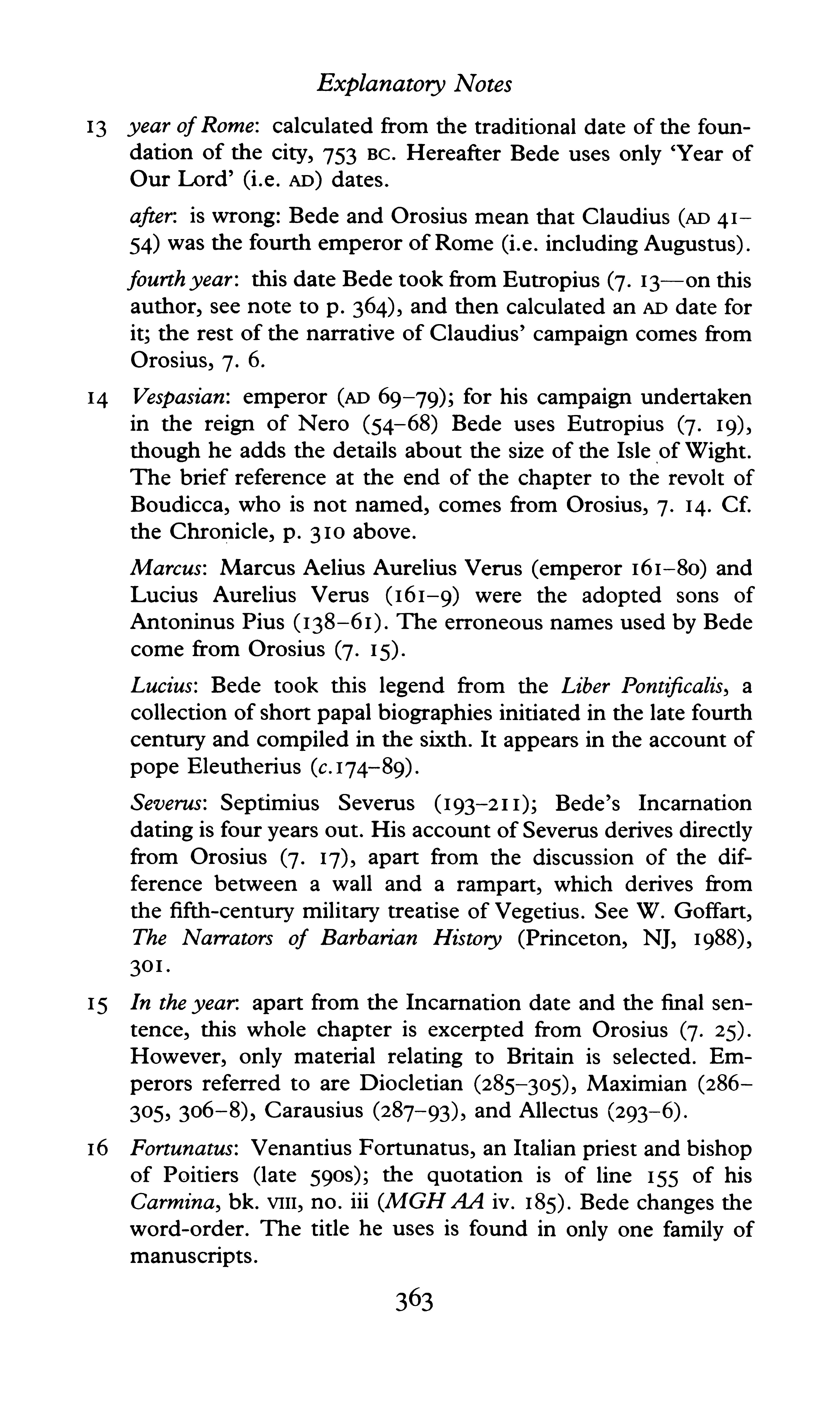
year of Rome: calculated from the traditional date of the foun dation of the city, 753 bc. Hereafter Bede uses only 'Year of Our Lord' (i.e. ad) dates. after, is wrong: Bede and Orosius mean that Claudius (ad 4 1 - 54) was the fourth emperor of Rome (i.e. including Augustus). fourth year: this date Bede took from Eutropius (7. 13— on this author, see note to p. 364), and then calculated an ad date for it; the rest of the narrative of Claudius' campaign comes from Orosius, 7. 6.
Vespasian: emperor (ad 69-79); for his campaign undertaken in the reign of Nero (54-68) Bede uses Eutropius (7. 19), though he adds the details about the size of the Isle of Wight.
The brief reference at the end of the chapter to the revolt of Boudicca, who is not named, comes from Orosius, 7. 14. Cf. the Chronicle, p. 310 above.
Marcus: Marcus Aelius Aurelius Verus (emperor 161-80) and Lucius Aurelius Verus (16 1-9 ) were the adopted sons of Antoninus Pius (13 8 -6 1). The erroneous names used by Bede come from Orosius (7. 15).
Lucius: Bede took this legend from the Liber Pontificalis, a collection of short papal biographies initiated in the late fourth century and compiled in the sixth. It appears in the account of pope Eleutherius (c. 174-89).
Severus: Septimius Severus (19 3 -2 11); Bede's Incarnation dating is four years out. His account of Severus derives directly from Orosius (7. 17), apart from the discussion of the dif ference between a wall and a rampart, which derives from the fifth-century military treatise of Vegetius. See W. Goffart,
The Narrators of Barbarian History (Princeton, N J, 1988), 301.
In the year, apart from the Incarnation date and the final sen tence, this whole chapter is excerpted from Orosius (7. 25).
However, only material relating to Britain is selected. Em perors referred to are Diocletian (285-305), Maximian (286305, 306-8), Carausius (287-93), and Allectus (293-6).
Fortunatus: Venantius Fortunatus, an Italian priest and bishop of Poitiers (late 590s); the quotation is of line 155 of his
Carmina, bk. vm, no. iii (M G H A A iv. 185). Bede changes the word-order. The title he uses is found in only one family of manuscripts.
Explanatory Notes
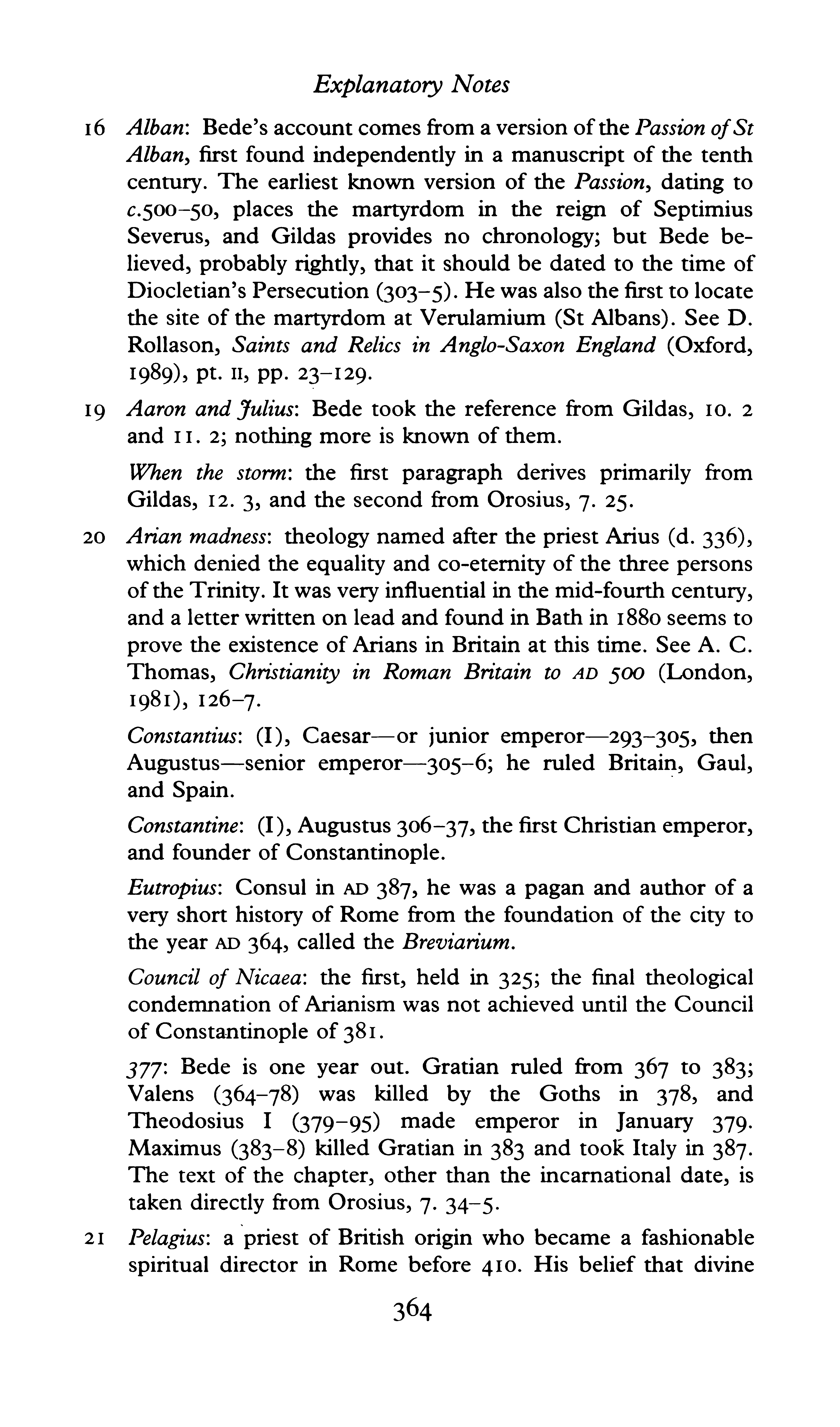
Alban: Bede's account comes from a version of the Passion of St Albany first found independently in a manuscript of the tenth century. The earliest known version of the Passion, dating to c.500-50, places the martyrdom in the reign of Septimius
Severus, and Gildas provides no chronology; but Bede be lieved, probably rightly, that it should be dated to the time of Diocletian's Persecution (303-5). He was also the first to locate the site of the martyrdom at Verulamium (St Albans). See D.
Rollason, Saints and Relics in Anglo-Saxon England (Oxford, 1989), pt. ii, pp. 23-129.
Aaron and Julius: Bede took the reference from Gildas, 10. 2 and 1 1 . 2; nothing more is known of them.
When the storm: the first paragraph derives primarily from Gildas, 12. 3, and the second from Orosius, 7. 25.
Arian madness: theology named after the priest Arius (d. 336), which denied the equality and co-etemity of the three persons of the Trinity. It was very influential in the mid-fourth century, and a letter written on lead and found in Bath in 1880 seems to prove the existence of Arians in Britain at this time. See A. C.
Thomas, Christianity in Roman Britain to a d 500 (London, 1981), 126 -7.
Constantius: (I), Caesar— or junior emperor— 293-305, then Augustus— senior emperor— 305-6; he ruled Britain, Gaul, and Spain.
Constantine: (I), Augustus 30 6 -37, the first Christian emperor, and founder of Constantinople.
Eutropius: Consul in ad 387, he was a pagan and author of a very short history of Rome from the foundation of the city to the year ad 364, called the Breviarium.
Council of Nicaea: the first, held in 325; the final theological condemnation of Arianism was not achieved until the Council of Constantinople of 381.
377: Bede is one year out. Gratian ruled from 367 to 383; Valens (364-78) was killed by the Goths in 378, and Theodosius I (379-95) made emperor in January 379.
Maximus (383-8) killed Gratian in 383 and took Italy in 387.
The text of the chapter, other than the incamational date, is taken directly from Orosius, 7. 34 -5.
Pelagius: a priest of British origin who became a fashionable spiritual director in Rome before 410. His belief that divine
36 4
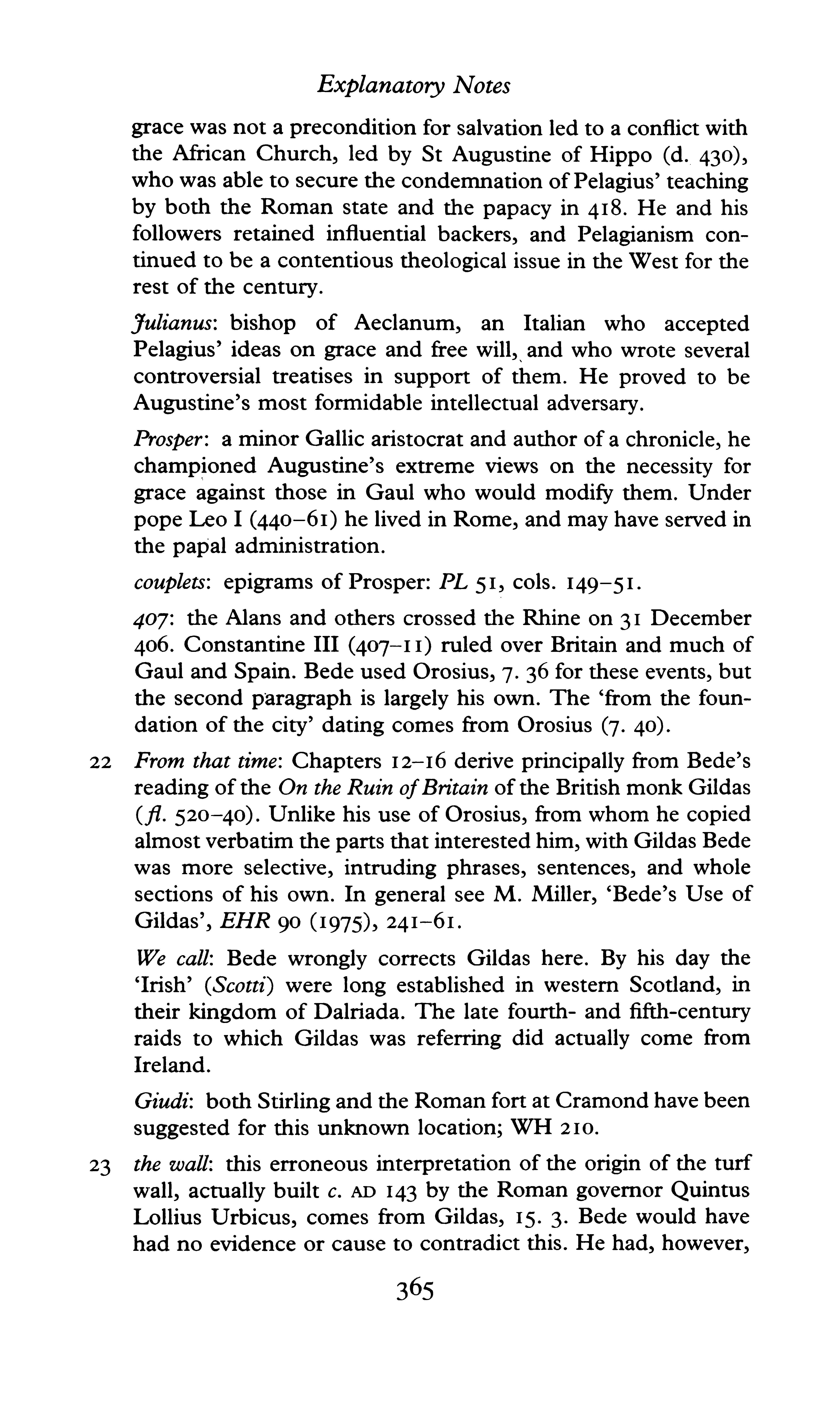
Explanatory Notes grace was not a precondition for salvation led to a conflict with the African Church, led by St Augustine of Hippo (d. 430), who was able to secure the condemnation of Pelagius' teaching by both the Roman state and the papacy in 418. He and his followers retained influential backers, and Pelagianism con tinued to be a contentious theological issue in the West for the rest of the century.
Julianus', bishop of Aeclanum, an Italian who accepted Pelagius' ideas on grace and free will, and who wrote several controversial treatises in support of them. He proved to be
Augustine's most formidable intellectual adversary.
Prosper : a minor Gallic aristocrat and author of a chronicle, he championed Augustine's extreme views on the necessity for grace against those in Gaul who would modify them. Under pope Leo I (440-61) he lived in Rome, and may have served in the papal administration. couplets: epigrams of Prosper: P L 5 1, cols. 14 9 -51.
407: the Alans and others crossed the Rhine on 31 December 406. Constantine III (40 7-11) ruled over Britain and much of Gaul and Spain. Bede used Orosius, 7. 36 for these events, but the second paragraph is largely his own. The 'from the foun dation of the city' dating comes from Orosius (7. 40).
From that time: Chapters 12 -16 derive principally from Bede's reading of the On the Ruin of Britain of the British monk Gildas
(fl. 520-40). Unlike his use of Orosius, from whom he copied almost verbatim the parts that interested him, with Gildas Bede was more selective, intruding phrases, sentences, and whole sections of his own. In general see M . Miller, 'Bede's Use of Gildas', EH R 90 (1975), 2 4 1-6 1.
We call: Bede wrongly corrects Gildas here. By his day the 'Irish' (Scotti) were long established in western Scotland, in their kingdom of Dalriada. The late fourthand fifth-century raids to which Gildas was referring did actually come from Ireland.
Giudi: both Stirling and the Roman fort at Cramond have been suggested for this unknown location; W H 210.
the wall: this erroneous interpretation of the origin of the turf wall, actually built c. ad 143 by the Roman governor Quintus
Lollius Urbicus, comes from Gildas, 15. 3. Bede would have had no evidence or cause to contradict this. He had, however,
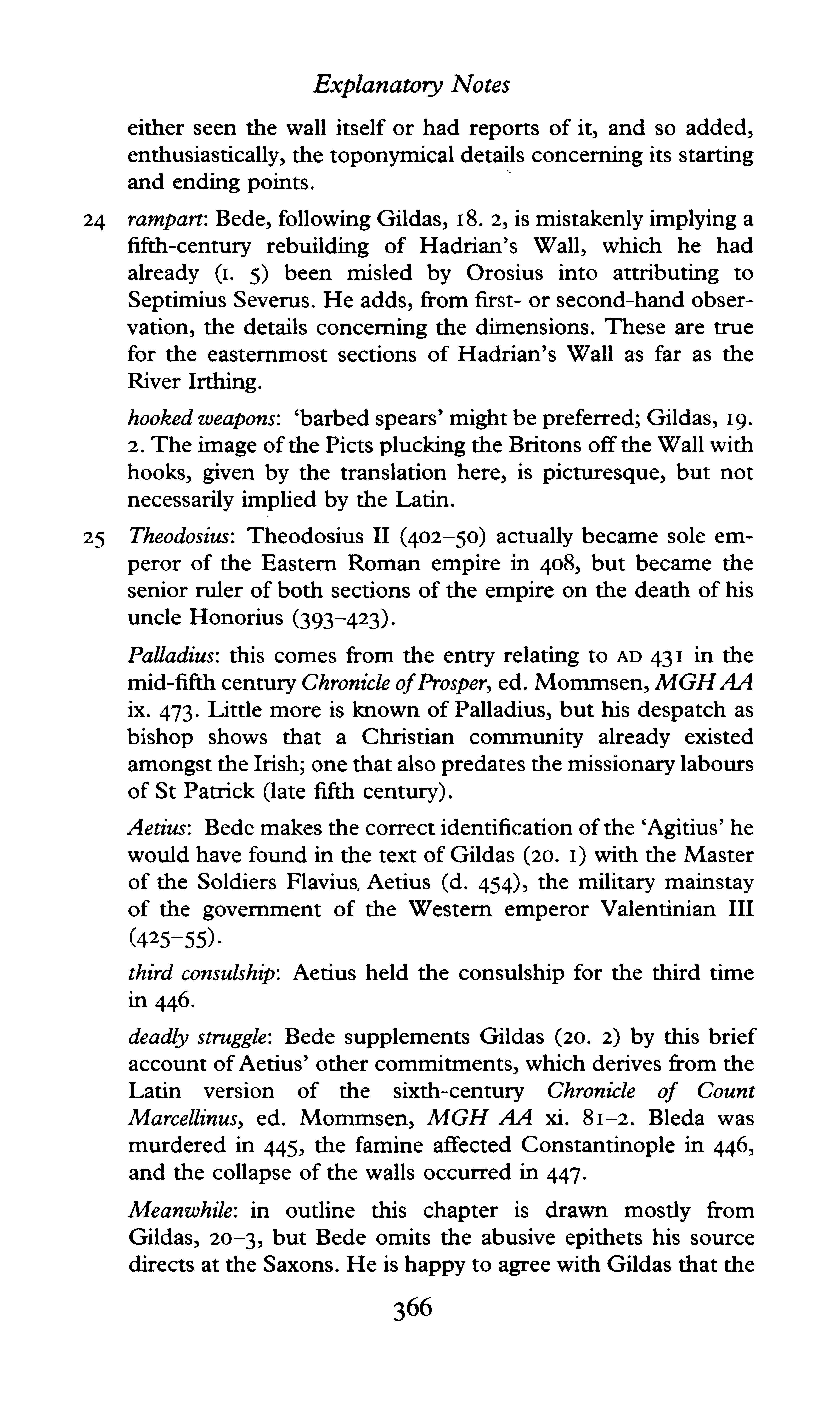
Explanatory Notes either seen the wall itself or had reports of it, and so added, enthusiastically, the toponymical details concerning its starting and ending points.
rampart: Bede, following Gildas, 18. 2, is mistakenly implying a fifth-century rebuilding of Hadrian's Wall, which he had already (1. 5) been misled by Orosius into attributing to Septimius Severus. He adds, from firstor second-hand obser vation, the details concerning the dimensions. These are true for the easternmost sections of Hadrian's Wall as far as the River Irthing. hooked weapons: 'barbed spears' might be preferred; Gildas, 19.
2. The image of the Piets plucking the Britons off the Wall with hooks, given by the translation here, is picturesque, but not necessarily implied by the Latin.
Theodosius: Theodosius II (402-50) actually became sole em peror of the Eastern Roman empire in 408, but became the senior ruler of both sections of the empire on the death of his uncle Honorius (393-423).
Palladius: this comes from the entry relating to ad 431 in the mid-fifth century Chronicle of Prosper, ed. Mommsen, M G H A A ix. 473. Little more is known of Palladius, but his despatch as bishop shows that a Christian community already existed amongst the Irish; one that also predates the missionary labours of St Patrick (late fifth century).
Aetius: Bede makes the correct identification of the 'Agitius' he would have found in the text of Gildas (20. 1) with the Master of the Soldiers Flavius, Aetius (d. 454), the military mainstay of the government of the Western emperor Valentinian III (42555)third consulship: Aetius held the consulship for the third time in 446. deadly struggle: Bede supplements Gildas (20. 2) by this brief account of Aetius' other commitments, which derives from the Latin version of the sixth-century Chronicle of Count Marcellinus, ed. Mommsen, M G H A A xi. 8 1-2. Bleda was murdered in 445, the famine affected Constantinople in 446, and the collapse of the walls occurred in 447.
Meanwhile: in outline this chapter is drawn mostly from Gildas, 20 -3, but Bede omits the abusive epithets his source directs at the Saxons. He is happy to agree with Gildas that the 36 6
Explanatory Notes consequences of the arrival of the Saxons represent divine chastisement of the Britons for their vices.
Vortigem: Vurtigemus; Bede provides a name for the 'proud tyrant' he found in the text of Gildas (23. 1). The source and value of this information remain debatable. He had already used it in the compiling of his Chronicle: see p. 326 above.
Marciam emperor (450-57) in the East; his Western colleague was Valentinian III (425-55).
A t that time: Bede places the arrival of the first Anglo-Saxons in Britain firmly in the joint reign of Marcian and Valentinian III, i.e. 450 -5. W hy he does so is not clear, as Gildas provides no chronological guidance here at all. the enemy: the Piets and Scots; cf. Gildas, 23-5, but apart from a few phrases, Bede uses his own words for most of this chapter.
Saxons, Angles, and Jutes: Bede is the unique source for this threefold division of the Germanic settlers. Their subdivisions that he then lists are those of his own day, and do not represent fifth-century realities. Evidence, both from elsewhere in the EH and other texts, such as the eighth-century Mercian Tribal
Hideage (see D. Hill, An Atlas of Anglo-Saxon England (Oxford, 1981), 76 -7), proves the existence of numerous small political and ethnic groups, who gradually coalesce into the units known to Bede in the course of the seventh century: see the various contributions to S. Bassett, The Origins of Anglo-Saxon King doms (Leicester 1989). Frisians and Franks may also have been involved in the early period of settlement, especially in the south-east, but the once fashionable view that there was also significant Swedish participation is now treated with some scepticism: see the general discussions and the analyses of individual items in R. Farrell and C. Neuman de Vegvar (eds.),
Sutton Hoo: Fifty Years After (Oxford, Oh., 1992). people of Kent: called by Bede the Cantuarii, and 'the inhabi tants of the Isle of Wight' are the Victuarii; in other words both have Latin names, testifying to greater continuity between late
Roman and early Anglo-Saxon society in the south-east than is always allowed for.
Old Saxony: actually Bede calls it 'the region of the Old Saxons' . As with the kingdoms that developed in Britain, he always referred to such political entities by the name of their inhabitants rather than by creating an abstract geographical
Explanatory Notes name: thus he always used 'kingdom of the West Saxons' and not 'Wessex', 'kingdom of the East Angles' and not 'East
Anglia', etc. This procedure has been reversed in virtually all modem translations and historical discussions, but this can give a false impression of fixed territorial boundaries and of patriotism tied more to land than to ethnic identity.
Hengist and Horsa: Bede is the first to mention these, but his information on them is vague. Are they the leaders of all of the peoples he has just mentioned, or only those establishing them selves in Kent? They both appear in A S C in the years 449-88, with Horsa being killed in 455. Hengist also features in the Kentish royal genealogy. However, the reality of their exist ence, and certainly the details of the A S C account, should not be relied upon.
Wihtgisl: some of the manuscripts, preferred by P, give 'Wihtgils'. The genealogy needs to be treated with caution. See
D. Dumville, 'Kingship, Genealogies, and Regnal Lists', in P. H. Sawyer and I. N . Wood (eds.), Early Medieval Kingship
(Leeds, 1977), 72-10 4, on the difficulties of interpreting such texts.
Woden: to be identified with the Norse divinity, 0 3 in, and found in all of the known Anglo-Saxon royal genealogies other than that of the East Saxons, though not always as the founding figure. For his role in these lists, see E. John, 'The Point of Woden', A S S A H 5 (1992), 127-34.
'It was not long': the content of this paragraph, with its apoca lyptic language and chronological imprecision, derives from Gildas, 23. 5-25. i.
When the army: the content and much of the language of this chapter derives from Gildas, 25-26. 1.
Ambrosius Aurelianus: all that is known of this man, his status, and the siege of 'Mount Badon' (Bath?) comes from the elusive words of Gildas, here quoted almost verbatim by Bede.
29 fourty-four years: the same figure is given by Gildas, 26. 1 for the years that have passed since the battle. As Bede lacked any independent chronological indicators by which to date the battle, and the same number is used by him and by Gildas, though for different purposes, it is possible that he misunder stood his source. As he placed the coming of the Saxons in the period 4 50 -5, he would therefore have thought the battle took place c.494-9.
Explanatory Notes A few years: much of this chapter and virtually all of Chapters
18 -2 1 are taken by Bede directly from The Life of St Germanus, Bishop of Auxerre. Germanus himself died in either 437 or 442, and this Life was written by Constantius of Lyons around the year 475. Despite the relative closeness in date, the reliability of the work as a source of 'hard facts' about the career of Germanus, beyond its basic outlines, has rightly been questioned: see I. Wood, 'The End of Roman Britain: Conti nental Evidence and Parallels', in M . Lapidge and D. Dumville
(eds.), Gildas: New Approaches (Woodbridge, 1984), 1-25, esp.
9 -17.
Pelagian heresy: see pp. 3 6 4 -5 above.
Agricola: Bede found this specific context for the story that follows, which comes from the Life of Germanus, in the Chron icle of Prosper (M G H A A ix. 472). However, he ignores Pros pers statement that Germanus was ordered to go to Britain by pope Celestine (422-32). This first visit by Germanus is dated via Prosper's account to 429.
3 1 rank of tribune: is wrong; more accurate is 'holding tribunician power', which was one of the titles of the emperor in the early
Roman empire.
Constantius, quoted by Bede, is thus classicizing, but thereby implies that the man was a local ruler.
St Albam Constantius' narrative precedes all versions of the Passion of St Alban, and is the first evidence for the cult. Wood
('The End of Roman Britain'; see note to p. 29 above), 12-14 , suggests that Germanus may have indeed developed the ven eration of Alban.
Saxons and Piets: it is hard to see how Bede could have rec onciled this story of a Saxon-Pictish alliance with the narrative of the coming of the Saxons that he gives in Chapter 15, and which he obtained from Gildas.
He hastened: the existence of a second visit has been denied by E. A. Thompson, 'Gildas and the History of Britain', Britannia,
10 (1979), 203-26, but if it did occur it would have to be dated M 35-
western empire fell: Bede took these events from the Chronicle of Marcellinus {M G H A A xi. 86), but diverges from his source by making the death of Valentinian rather than that of Aetius mark the end of the empire. Peculiarly, in the Chronicle (p. 327 above) he follows Marcellinus exactly.
Explanatory Notes
Meanwhile: this very short chapter is the only link Bede can provide between the events he has just described, dating from the mid-fifth century, and the inception of the papal mission to the kingdom of Kent in 596. It is unlikely that he would have made such a chronological leap if he had any other substantial materials relating to Britain in this period available to him. unspeakable crimes: Bede here adds a personal note of com plaint against the Romano-British; one which also helps explain why he had embraced Gildas' very critical view of their society with such relish, and why his subsequent references to the British Church are so negative.
Maurice'. Tiberius Maurice (582-602); for the history of the empire in this period, see M . Whitby, The Emperor Maurice and his Historian (Oxford, 1988).
Gregory: the Great, pope (3 September 59 0 -12 March 604); Maurice's tenth year fell between August 591 and August 592; so Bede's calculations are a full year out, but his statement of the length of Gregory's pontificate is correct. fourteenth year: August 595 to August 596.
Augustine', prior of the monastery that Gregory founded on his own family property on the Caelian Hill in Rome.
The letter: this and other papal letters quoted by Bede in Chap ters 23-32 were brought to him from Rome by the priest
Nothhelm, as described in the preface to EH . They caused him to modify and expand his previous understanding of the events of the conversion of Kent, as can be seen by contrasting the E H version with the way he wrote about it in his Chronicle of 725.
His previous knowledge of Gregory and of the mission may have derived primarily from the Life of Gregory written c.68o704 at Whitby (possibly by a nun); see B. Colgrave, The Earliest
Life of Gregory the Great (Kansas City, Kan., 1968), for edition and translation.
indiction: this was a regular cycle of fifteen years, used initially for tax-assessment purposes, but which remained a conven tional way of dating documents in the late Roman empire.
From its use the years within each indictional cycle can be distinguished, but some additional chronological information is needed to indicate the particular cycle.
Etherius'. actually bishop of Lyons (586-602) not of Arles. Bede adopts the term archbishop used in the Anglo-Saxon Church,
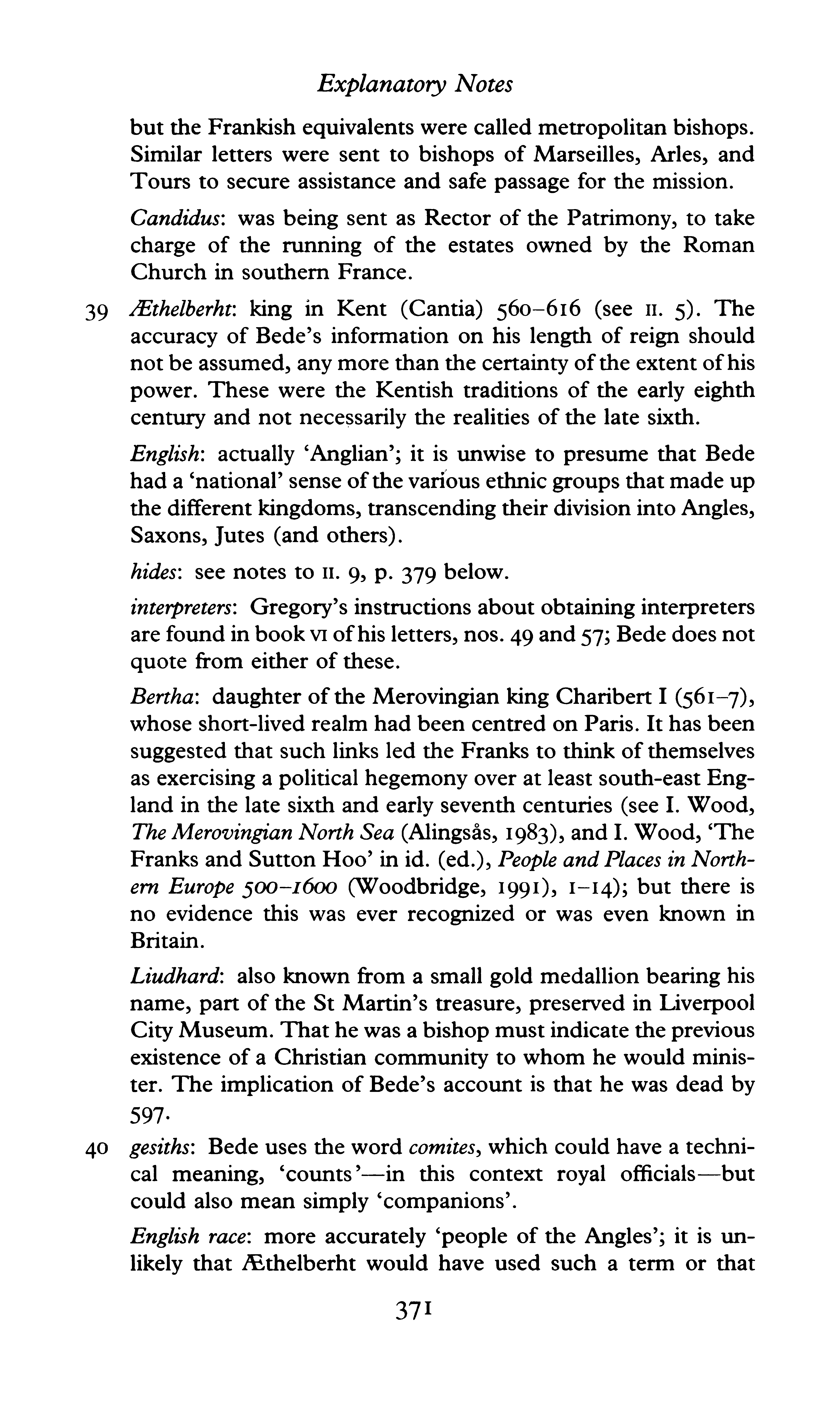
Explanatory Notes but the Frankish equivalents were called metropolitan bishops.
Similar letters were sent to bishops of Marseilles, Arles, and Tours to secure assistance and safe passage for the mission.
Candidus: was being sent as Rector of the Patrimony, to take charge of the running of the estates owned by the Roman
Church in southern France.
Æthelberht: king in Kent (Cantia) 56 0 -6 16 (see 11. 5). The accuracy of Bede's information on his length of reign should not be assumed, any more than the certainty of the extent of his power. These were the Kentish traditions of the early eighth century and not necessarily the realities of the late sixth.
English: actually 'Anglian'; it is unwise to presume that Bede had a 'national' sense of the various ethnic groups that made up the different kingdoms, transcending their division into Angles,
Saxons, Jutes (and others). hides: see notes to 11. 9, p. 379 below. interpreters: Gregory's instructions about obtaining interpreters are found in book vi of his letters, nos. 49 and 57; Bede does not quote from either of these.
Bertha: daughter of the Merovingian king Charibert I (561-7), whose short-lived realm had been centred on Paris. It has been suggested that such links led the Franks to think of themselves as exercising a political hegemony over at least south-east Eng land in the late sixth and early seventh centuries (see I. Wood,
The Merovingian North Sea (Alingsâs, 1983), and I. Wood, 'The Franks and Sutton Hoo' in id. (ed.), People and Places in North ern Europe 500-1600 (Woodbridge, 1991), 1-14 ); but there is no evidence this was ever recognized or was even known in Britain.
Liudhard: also known from a small gold medallion bearing his name, part of the St Martin's treasure, preserved in Liverpool
City Museum. That he was a bishop must indicate the previous existence of a Christian community to whom he would minis ter. The implication of Bede's account is that he was dead by 5 9 7 -
gesiths: Bede uses the word comités, which could have a techni cal meaning, 'counts'— in this context royal officials— but could also mean simply 'companions'.
English race: more accurately 'people of the Angles'; it is un likely that Æthelberht would have used such a term or that
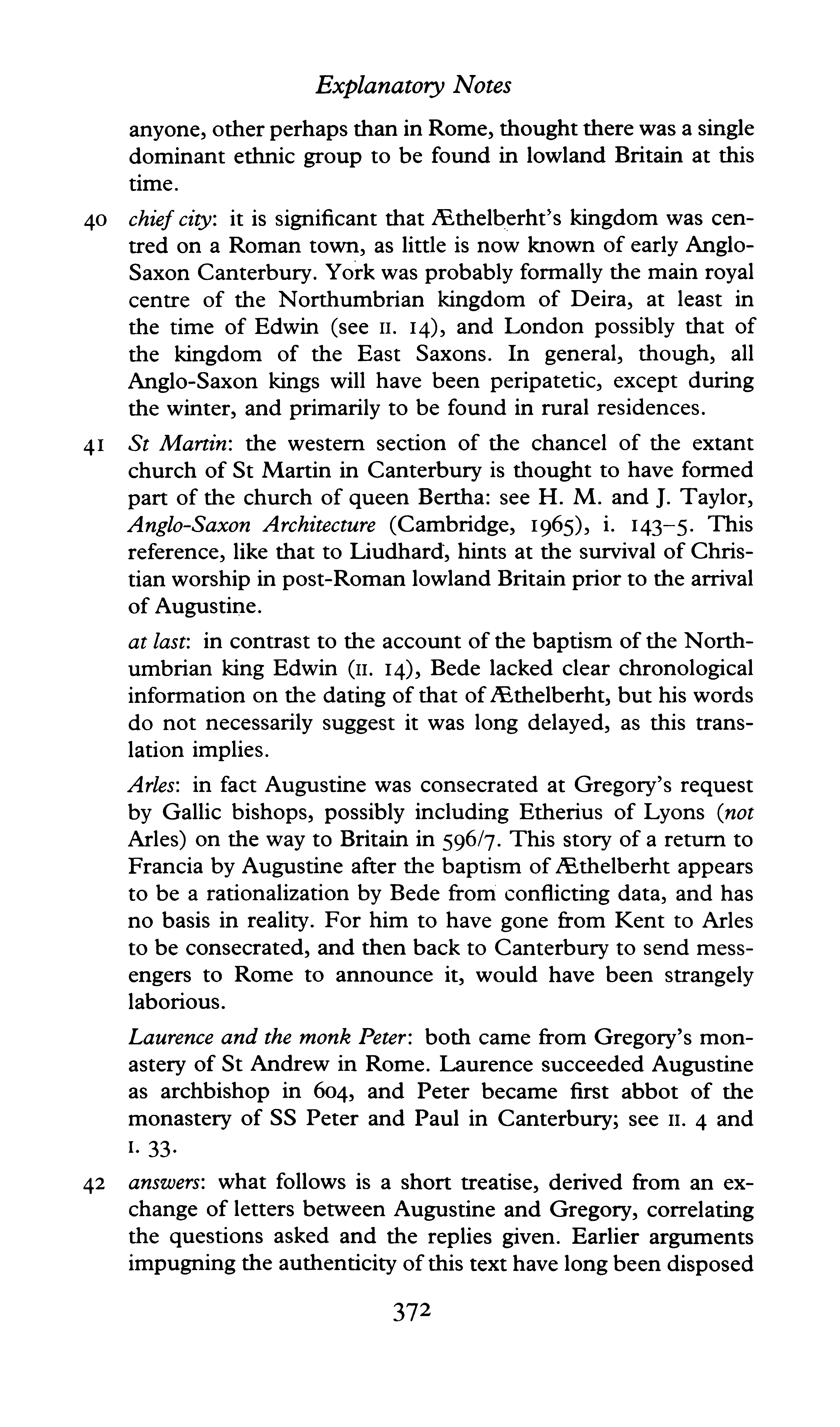
Explanatory Notes anyone, other perhaps than in Rome, thought there was a single dominant ethnic group to be found in lowland Britain at this time.
chief city: it is significant that Æthelberht's kingdom was cen tred on a Roman town, as little is now known of early AngloSaxon Canterbury. York was probably formally the main royal centre of the Northumbrian kingdom of Deira, at least in the time of Edwin (see 11. 14), and London possibly that of the kingdom of the East Saxons. In general, though, all
Anglo-Saxon kings will have been peripatetic, except during the winter, and primarily to be found in rural residences.
St Martin: the western section of the chancel of the extant church of St Martin in Canterbury is thought to have formed part of the church of queen Bertha: see H. M . and J. Taylor,
Anglo-Saxon Architecture (Cambridge, 1965), i. 14 3-5. This reference, like that to Liudhard, hints at the survival of Chris tian worship in post-Roman lowland Britain prior to the arrival of Augustine. at last: in contrast to the account of the baptism of the North umbrian king Edwin (11. 14), Bede lacked clear chronological information on the dating of that of Æthelberht, but his words do not necessarily suggest it was long delayed, as this trans lation implies.
Arles: in fact Augustine was consecrated at Gregory's request by Gallic bishops, possibly including Etherius of Lyons (not Arles) on the way to Britain in 596/7. This story of a return to Francia by Augustine after the baptism of Æthelberht appears to be a rationalization by Bede from conflicting data, and has no basis in reality. For him to have gone from Kent to Arles to be consecrated, and then back to Canterbury to send mess engers to Rome to announce it, would have been strangely laborious.
Laurence and the monk Peter: both came from Gregory's mon astery of St Andrew in Rome. Laurence succeeded Augustine as archbishop in 604, and Peter became first abbot of the monastery of SS Peter and Paul in Canterbury; see 11. 4 and I33-
answers: what follows is a short treatise, derived from an ex change of letters between Augustine and Gregory, correlating the questions asked and the replies given. Earlier arguments impugning the authenticity of this text have long been disposed
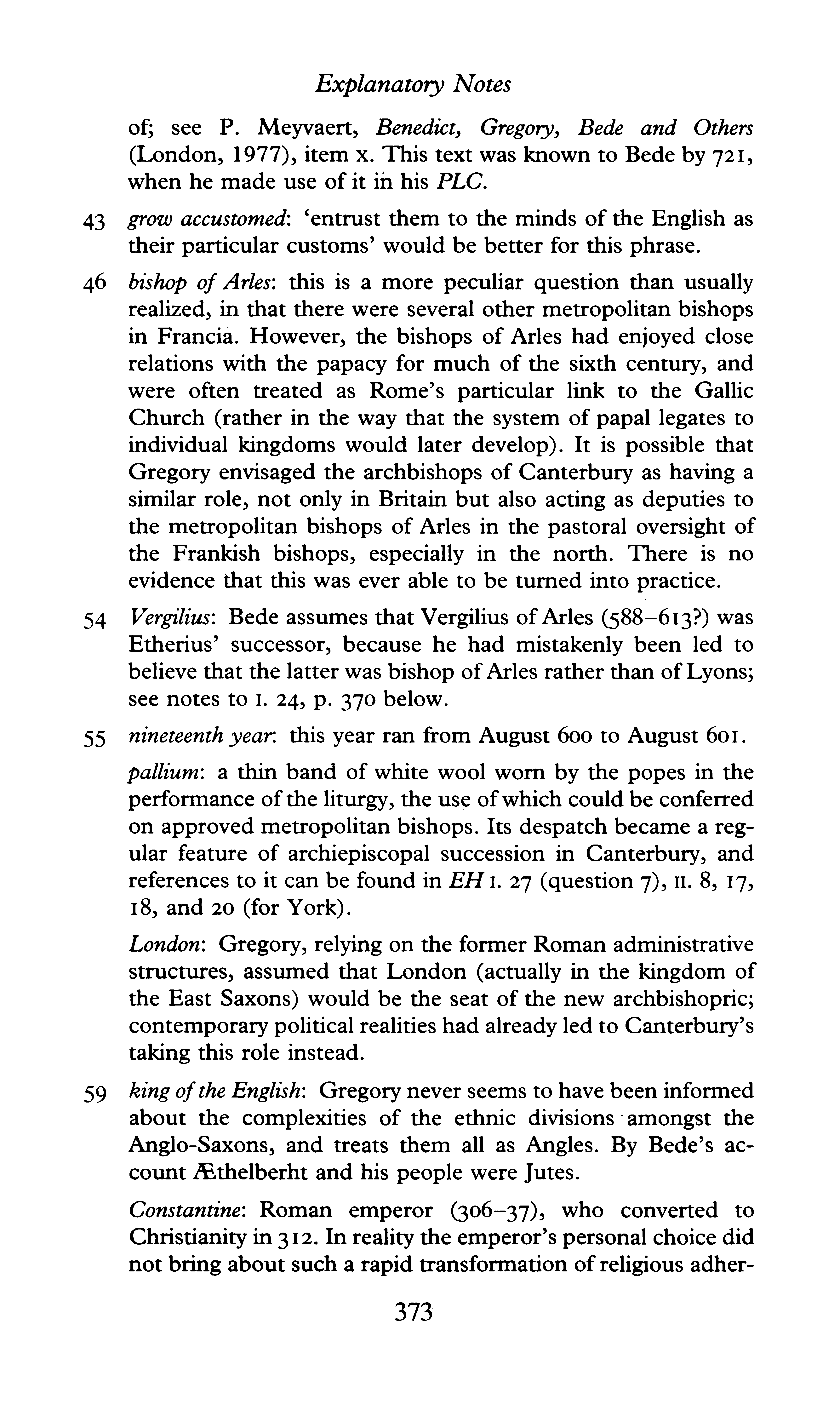
Explanatory Notes of; see P. Meyvaert, Benedict, Gregory, Bede and Others (London, 1977), item x. This text was known to Bede by 721, when he made use of it in his PLC .
grow accustomed: 'entrust them to the minds of the English as their particular customs' would be better for this phrase.
bishop of Arles: this is a more peculiar question than usually realized, in that there were several other metropolitan bishops in Francia. However, the bishops of Arles had enjoyed close relations with the papacy for much of the sixth century, and were often treated as Rome's particular link to the Gallic
Church (rather in the way that the system of papal legates to individual kingdoms would later develop). It is possible that Gregory envisaged the archbishops of Canterbury as having a similar role, not only in Britain but also acting as deputies to the metropolitan bishops of Arles in the pastoral oversight of the Frankish bishops, especially in the north. There is no evidence that this was ever able to be turned into practice.
Vergilius: Bede assumes that Vergilius of Arles (588-613?) was Etherius' successor, because he had mistakenly been led to believe that the latter was bishop of Arles rather than of Lyons; see notes to 1. 24, p. 370 below.
nineteenth year, this year ran from August 600 to August 601. pallium: a thin band of white wool worn by the popes in the performance of the liturgy, the use of which could be conferred on approved metropolitan bishops. Its despatch became a reg ular feature of archiépiscopal succession in Canterbury, and references to it can be found in E H 1. 27 (question 7), 11. 8, 17,
18, and 20 (for York).
London: Gregory, relying on the former Roman administrative structures, assumed that London (actually in the kingdom of the East Saxons) would be the seat of the new archbishopric; contemporary political realities had already led to Canterbury's taking this role instead.
king of the English: Gregory never seems to have been informed about the complexities of the ethnic divisions amongst the Anglo-Saxons, and treats them all as Angles. By Bede's ac count Æthelberht and his people were Jutes.
Constantine: Roman emperor (306-37), who converted to Christianity in 312. In reality the emperor's personal choice did not bring about such a rapid transformation of religious adher
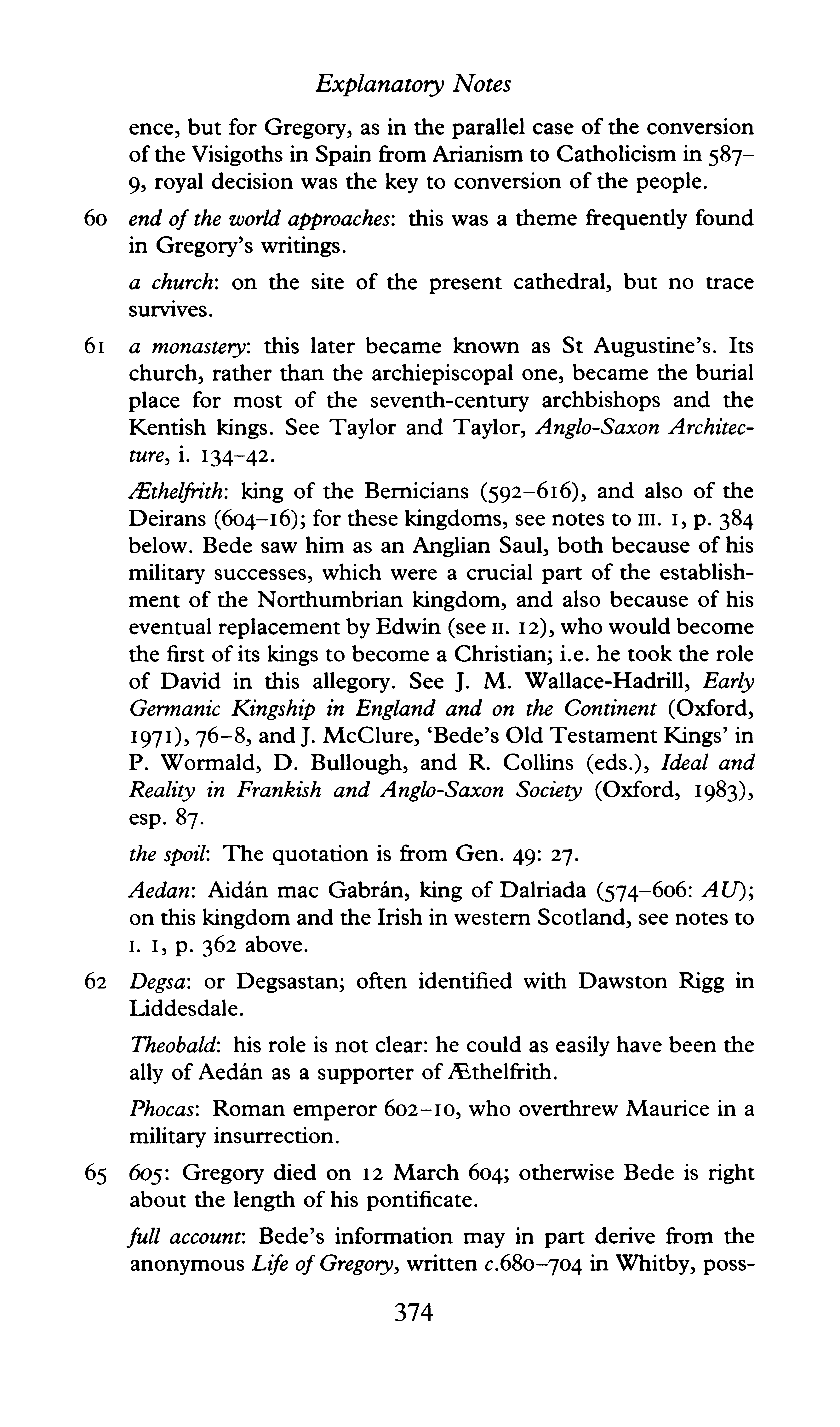
Explanatory Notes ence, but for Gregory, as in the parallel case of the conversion of the Visigoths in Spain from Arianism to Catholicism in 58 79, royal decision was the key to conversion of the people.
end of the world approaches: this was a theme frequendy found in Gregory's writings. a church: on the site of the present cathedral, but no trace survives.
a monastery: this later became known as St Augustine's. Its church, rather than the archiépiscopal one, became the burial place for most of the seventh-century archbishops and the Kentish kings. See Taylor and Taylor, Anglo-Saxon Architec ture, i. 134-42.
Æthelfrith: king of the Bemicians (592-616), and also of the Deirans (604-16); for these kingdoms, see notes to hi. 1, p. 384 below. Bede saw him as an Anglian Saul, both because of his military successes, which were a crucial part of the establish ment of the Northumbrian kingdom, and also because of his eventual replacement by Edwin (see 11. 12), who would become the first of its kings to become a Christian; i.e. he took the role of David in this allegory. See J. M . Wallace-Hadrill, Early
Germanic Kingship in England and on the Continent (Oxford, 1971), 76 -8 , and J. McClure, 'Bede's Old Testament Kings' in P. Wormald, D. Bullough, and R. Collins (eds.), Ideal and Reality in Frankish and Anglo-Saxon Society (Oxford, 1983), esp. 87. the spoil: The quotation is from Gen. 49: 27.
Aedan: Aidân mac Gabrân, king of Dalriada (574-606: A U ); on this kingdom and the Irish in western Scotland, see notes to i. i, p. 362 above.
Degsa: or Degsastan; often identified with Dawston Rigg in Liddesdale.
Theobald: his role is not clear: he could as easily have been the ally of Aedan as a supporter of Æthelfrith.
Phocas: Roman emperor 602-10, who overthrew Maurice in a military insurrection.
605: Gregory died on 12 March 604; otherwise Bede is right about the length of his pontificate. full account: Bede's information may in part derive from the anonymous Life of Gregory, written c.680-704 in Whitby, poss
Explanatory Notes ibly by a nun (see Colgrave, The Earliest Life of Gregory the Great). Otherwise, and more certainly, it derives from the Liber
Pontificalis, a compilation of short papal biographies. See Meyvaert, Benedict, Gregory, Bede, item viii, and Goffart, The Narrators of Barbarian History, 303-7. Bede uses this chapter not only to commemorate Gregory but also to present a model of the ideal bishop.
Felix'. Felix IV, pope 526-30. entered a monastery: Gregory turned his own family home on the Caelian Hill in Rome into the monastery of St Andrew.
Monastic life there followed rules of his own devising.
thirty-five books: this work, first delivered as sermons, is known as the Moralia and was completed by April 591.
Tiberius Constantine: was made Caesar in 574, when Justin II (565-78) became insane, and was sole emperor from 578 to 582.
Maurice'. (582-602) was overthrown in a military revolt led by Phocas (602-10).
Ælle: Although not stated by Bede, Ælle, king of the Deirans (C.568/9-C.598/9) was the father of the Northumbrian monarch
Edwin (616-33) according to a genealogy preserved in the Moore M S of the EH ; also H B 62 and 63. this story. For consideration of non-legendary motives for Gregory's despatch of the mission of Augustine, see R. A.
Markus, 'Gregory the Great's Europe', TRH S 5th series, 31 (1981), 21-36 . borders of the Hzuicce: The border between the kingdom of the West Saxons and that of the Hwicce probably ran along the southern edge of the Cotswolds in the early seventh century.
The precise location of 'Augustine's Oak' is unknown. keep Easter Sunday: The British and northern Irish churches had retained older traditions of how to calculate the date of Easter, which had been abandoned by Rome in the fifth cen tury. The effect of applying alternative forms of calculation was that in some years Easter would fall on totally different Sundays according to the system followed.
Bancomaburg: Bangor Iscoed, located twelve miles south of Chester. Little is known of this monastery, and nothing more of its abbot Dinoot. It has been suggested that this story, which is somewhat critical of Augustine, came to Bede from a British
Explanatory Notes source. He altered the moral of the tale in his account of the subsequent slaughter of the monks of Bangor by the pagan
Northumbrian king Æthelfrith, which is used to show that Augustine's prophecy of their destruction was well founded.
On the battle see R. Bromwich, Trioedd Ynys Prydein: The Welsh Triads (2nd edn., Cardiff, 1978), 16 3-5.
emporium: testimony to the commercial importance of London, at least in Bede's day, if not necessarily in Augus tine's. N o traces are known of Æthelberht's St Paul's. The dedication is rare outside Rome, and must derive from the missionaries' origins in that city.
St Andrew: the choice of Andrew as patron of the episcopal church of Rochester probably reflects the dedication to him of Gregory's monastery on the Caelian, where Augustine and his companions had been monks. On the remains of this church in Rochester, uncovered in 1889, see Taylor and Taylor AngloSaxon Architecture, ii. 5 18 -19 . death: the year of Augustine's death is not specified, but falls between 604 and 610. His emphasis on the role of miracle in the validation of his work seems to be made explicit in his epitaph. during his lifetime: Bede stresses this precedent, as it was uncanonical for a bishop to consecrate or even appoint his own successor.
Bishop Dagan: unidentified. See P. Grosjean in Analecta Bollandiana, 64 (1946), 232-7.
Columbanus: (d. 615), formerly a monk of Bangor in Ireland, he arrived in Francia in 591 and founded the monastery of Luxeuil in Burgundy under the patronage of king Childebert II (575-96). He was exiled from Francia in 610, and moved to the Lombard kingdom in northern Italy, where he founded the monastery of Bobbio. A monastic rule, a penitential, at least thirteen sermons, five letters, and some verses of his have survived. From this letter Laurentius would seem to have met him in Francia, possibly in 596/7.
Pope Boniface: Boniface IV (15 September 608-8 M ay 615), was formerly treasurer to Gregory the Great and continued many of his policies. The synod was held in 610, and is known only from Bede. all the southern kingdoms: this chapter is famous, or notorious, for its account of the five kings who exercised 'rule over all the 3 7 6
Explanatory Notes southern kingdoms'. This has been interpreted as referring to an institutionalized overlordship, but what else is known of the kings named here, not least from other sections of Bede's work, shows that this never existed. Some of these rulers, notably the three Northumbrian ones, did occasionally exercise a military ascendancy over several, though never all, of their neighbours. Oswy (642-70), for example, was only dominant south of the Humber in the years 655-8. Other even more powerful kings, notably Æthelbald of Mercia (716—
57), are not included in Bede's list. In the late ninth century one of the authors of the Anglo-Saxon Chronicle (A S C : Parker
M S only) added Egbert of Wessex to Bede's five, and coined the phrase 'Bretwalda' (probably 'Britain-ruler') to describe their status. N o such title was ever used in practice. Political influence and military power remained permanently fluid in pre-tenth-century Anglo-Saxon kingdoms.
Bede probably did not invent this misleading categorization, as he makes no other reference to either Ælle or Ceawlin. See P. Wormald,
'Bede, the Bretwaldas and the Origins of the Gens Anglorum', in Wormald et al., Ideal and Reality, 99-129, and S. Keynes,
'Rædwald the Bretwalda' in C. B. Kendall and P. S. Wells, Voyage to the Other World:
The Legacy of Sutton Hoo (Minneapolis, 1992), 103-23.
Ælle: recorded in the A S C as coming to Britain in 477, and taking the fortress of Pevensey (Sussex) in 491. The dates are untrustworthy and the former event, at least, legendary. See M .
Welch, 'The Kingdom of the South Saxons: The Origins', in S.
Bassett, The Origins of Anglo-Saxon Kingdoms (Leicester, 1989), 7583.
Ceawlin: presented, probably erroneously, by the A S C as a king of the West Saxons. Such an ethnic group may not have formed itself in his time. His activities are recorded in entries for the years 556, 560, 568, 571, 584, 592, and 593. The A S C s dates for this period are not secure. See D. Dumville, 'The West Saxon Genealogical Regnal List and the Chronology of Early Wessex', Peritia, 4 (1985), 21-66. gaining the leadership: this phrase is one of the few in Bede in which his meaning is unclear. Various translations have been suggested, each altering its significance. What it seems to be saying is that Rædwald obtained independent rule over his own people, the East Angles, even during the lifetime of Æthelberht of Kent. It is notable that the author of the Anglo-Saxon
Explanatory Notes translation of E H was equally perplexed, and omitted the entire phrase.
code of laws: probably to be identified with the extant code of laws ascribed to him in the Textus Roffensisy but this sole manu script is twelfth-century, and the title there given to the work is not original. See F. L. Attenborough, The Laws of the Earliest
Kings (Cambridge, 1922), 4 -17 and N . R. Ker, Catalogue of Manuscripts Containing Anglo-Saxon (Oxford, 1957), no. 373oiscingas: at best this genealogy represents the view of Kentish dynastic succession held in the early eighth century.
three sons: who may have been Sæward, Seaxread, and Seaxbald. See B. Yorke, Kings and Kingdoms of Early AngloSaxon England (London, 1990), 4 6 -53.
Gewisse: an early name for the people who became the West Saxons. scourged him hard: for other examples of supernatural floggings see Jerome, Epistle 22; Vitas Patrum Emeretensium, hi. viii. 3-4, and Adomnan's Life of Columba, m. v.
entered the heavenly kingdom: Laurentius probably died in January of 619.
Pope Boniface: Boniface V (23 December 6 19 -25 October 625).
Deusdedit: pope (19 October 6 15 -8 November 618); both of these popes were drawn from the ranks of the Roman clergy, and have been seen as being opposed to the monastic enthusi asm of Gregory the Great. If so, this did not affect their interest in the Anglo-Saxon mission.
Four Crowned Martyrs: this dedication parallels one in the city of Rome, on the Caelian, near Gregory's monastery.
Eadbald: in the Latin the name given is Aduluald, and it has therefore been proposed that two separate kings ruled Kent at this time. However, the name derives from a scribal error on the part of the papal notary who wrote the letter, which was sent prior to Boniface V 's death in October 625. Through carelessness he substituted the name of the contemporary
Lombard king Adaluald (616-26) for that of the Kentish mon arch. The letter contradicts the account of 11. 6, which at tributes Eadbald's conversion to Laurentius. Letters sent by Boniface V to the Northumbrian rulers in 625 (11. 10, 11) confirm that Eadbald's conversion and baptism were achieved by Justus rather than Laurentius.
Explanatory Notes
Edwin: king of both parts of Northumbria (616-33). The dating of the events described in this chapter is controversial. See
S. Wood, 'Bede's Northumbrian Dates Again', EH R 98 (1983), 280-96, and D. P. Kirby, The Earliest English Kings (London,
1991), 37_44* If it be accepted that Bede's story of Laurentius converting Eadbald is mistaken, then there is no need to place that event earlier than 624/5 or to try to modify the chronology and narrative of this chapter. The consecration of Paulinus in July 625 is associated with the marriage, itself apparently de pendent on Edwin's willingness to convert. In practice, how ever, he failed to do so for several years. hides: Bede's phrase is familiarum mensura, 'measure of fam ilies'. The probability is that this is a fiscal unit rather than one of physical measurement, but it has not been established that it is identical to the 'hide', a unit that first appears in the eighth-century Tribal Hideage; on which see Hill, An Atlas of Anglo-Saxon England, 767. became related: N . J. Higham, The Kingdom of Northumbria
3 5 0 -110 0 (Cirencester, 1993), 115, suggests the marriage was to symbolize an alliance between Edwin and Eadbald, aimed at containing the rising power of the West Saxons. This might explain the subsequent West Saxon attempt to murder Edwin
(P85).
Cwichelm: king of the West Saxons (c.614-36) A S C also records Cynegils (611-42?) as king of the West Saxons at this time. Although it takes the story of the attempted assassination from Bede, no reference is made to the subsequent war. It does, however, refer to a conflict between the West Saxons and the Mercians in 628.
thegn: Bede's word is minister. This would seem to be a mem ber of the royal household, in personal attendance on the monarch or other members of the ruling family. 87
letter, this letter and that in 11. 11 must predate the death of Boniface V in October 625, and follow Edwin's marriage to Æthelburh earlier that year. Both letters retain their formal titles, something missing from all of the papal letters quoted in Book I. It has been suggested that these two reached Bede independently of the others, which were brought to him from Canterbury by Nothhelm. See Meyvaert, Benedict, Gregory,
Bede, item xi.
3 7 9
Explanatory Notes
Æthelfrith: ruled 59 2-6 16 , was initially ruler of the northern Northumbrian kingdom, Bemicia, but conquered Deira from Æthelric (599-604) in 604.
it is related: another version of this story appears in the Whitby Life of Gregory the Great. See Colgrave, The Earliest Life of Gregory y ch. 16.
east bank of the river Idle: in the light of the speed and surprise achieved it is likely that Rædwald's army used the Roman roads. In which case the battle was probably fought in the vicinity of Bawtry.
his council: this story was much loved by ninteenth-century constitutional historians looking for early evidence of 'the Witan(agemöt)', an institutionalized assembly or even 'Parlia ment' they detected in the later Anglo-Saxon period; e.g. E. A.
Freeman, The Norman Conquest (Oxford, 1870), i. 9 8 -115.
Goodmanham: Bede's Godmunddingaham has been identified as Goodmanham, near Market Weighton in the East Riding of Yorkshire; see Higham, The Kingdom of Northumbria, 67 and I059s and D. Wilson, Anglo-Saxon Paganism (London, 1993),
30, on the significance of the site in relation to the early history of the kingdom of the Deirans.
holy baptism: later Welsh traditions, first recorded in the early ninth century, claim that Edwin was baptized by 'Rhun son of Urien' : H B 63. church of stone: no traces of these churches have yet been found.
Ceorl: no other reference to him can be found earlier than the twelfth century. Henry of Huntingdon (died c.1155) seems to locate his reign c.597-607, but this should be considered with caution. See W . Davies, 'Annals and the Origin of Mercia', in A. Domier, Mercian Studies (Leicester, 1977), 17-29. chrisom: a garment worn by children for a week following their baptism.
Yeavering: for the excavations of this site see B. Hope-Taylor, Yeavering (London, 1977). The other palace sites have not been located precisely, but Maelmin may be near Millfield, two miles from Yeavering; ibid. 13. The Roman settlement of Cambodunum is modem Cleckheaton in the West Riding, and Loidis is the modem Leeds. An alternative suggestion for Bede's Cambodunum, deriving the name from 'Field of the
Explanatory Notes Don', is Doncaster: Higham, The Kingdom of Northumbria, 85-6.
Elmet: a British kingdom in southern Yorkshire, probably cen tred between the River Don and Wharfedale, conquered by the Deirans in the reign of Edwin; see Higham, The Kingdom of Northumbria, 84-7.
Eorpwald: king of the East Angles (fl. c.627); his conversion probably followed rapidly on from that of Edwin.
Rcedwald: king of the East Angles (?-pre-027) has been said to have been buried in Mound One at Sutton Hoo, near
Woodbridge, Suffolk; see R. Bruce-Mitford (ed.), The Sutton Hoo Ship Burial (London, 1975), i. 683-717. The evidence for such an assumption and for the related belief that the nineteen mounds represent the cemetery of the East Anglian royal dynasty is almost non-existent: see J. Campbell,
'The Impact of the Sutton Hoo Discovery on the Study of Anglo-Saxon History', in Kendall and Wells, Voyage to the Other World, 7 9 -10 1. The recent excavations of the site (on which see M . Carver, The Age of Sutton Hoo (Woodbridge,
1992), 34 3-71) tend to confirm rather than weaken these doubts.
Wuffings: the lack of relationship between the names of the members of this dynasty is surprising. Attempts to make this family Scandinavian in origin and related to the Scandinavian
Wylfingas (from the Anglo-Saxon poem Beowulf ) are unwise; see R. T . Farrell, 'Beowulf, Swedes and Geats', Saga Book of the Viking Society.) 18 (1970/3), 220-96; also R. Frank, 'Beowulf and Sutton Hoo: The Odd Couple', in Kendall and Wells,
Voyage to the Other World, 47-64, on the unhelpful impact of the Anglo-Saxon epic poem Beowulf on the study of Sutton
Hoo.
Sigeberht: king of the East Angles (c.630/1-?): he has a name also used by the Frankish Merovingian dynasty, and had spent some period of exile in Francia. On problems of chronology of his and related reigns, see I. Wood, 'The Franks and Sutton
Hoo', in id.
(ed.) People and Places in Northern Europe (Woodbridge, 1991), 3-4 .
Bishop Felix: was already consecrated bishop when he came to Britain, and was deployed by archbishop Honorius (c.627-53) to aid Sigeberht. A bishop Felix held the see of Châlons in 626/7. A political exile, perhaps following the death of Chlotar
Explanatory Notes II in 629, would explain the otherwise inexplicable phenom enon of a wandering bishop searching for employment.
Dunwich: a recent refinement to the argument over the identi fication of Dommoc is the suggestion that it was located in a Roman fort that was eroded away by the sea, probably around the middle of the ninth century, near the present site of Dunwich. See J. Haslam, 'Dommoc and Dunwich: A Reap praisal', A S S A H 5 (1992), 4 1-6 .
Lindsey: this 'kingdom' (Bede uses provincia) in the north of the later county of Lincoln once had its own ruling dynasty, but was conquered by the Northumbrians prior to these events. On its origins see B. Eagles, 'Lindsey' in Bassett, The Origins of Anglo-Saxon Kingdoms, 20 2-12, and A. Vince (ed.), Pre-Viking
Lindsey (Lincoln, 1993). It became an area of dispute between the Northumbrians and the Mercians in the later seventh century.
Bkecca: he is called 'praefectus' by Bede, implying substantial regional authority, but in subordination to a monarch, in this case Edwin of Northumbria. He may have been a member of the former royal house of Lindsey; see B. Yorke, 'Lindsey: The Lost Kingdom Found?', in Vince, Pre-Viking Lindsey, 141-50 . stone church: on this church see Higham, The Kingdom of Northumbria, 12 1-2 .
Partney: although also referred to in hi. 11, Bede gives no account of the origin of this monastery. For its possible struc ture, see D. A. Stocker, 'The Early Church in Lincolnshire', in Vince, Pre-Viking Lindsey3 10 1-22, esp. 110 -12 . man of zeal: W H 80 offers a better translation of this phrase: 'a man at once zealous and noble through Christ and in the Church'. take no harm: one of a number of points in which Bede's imagery reflected his Old Testament models. See J. M cClure,
'Bede's Old Testament Kings', in Wormald et al.3 Ideal and Reality, 76-98. tufa. . . thuf. the temptation to equate this with the metal ob ject found in Mound One at Sutton Hoo that has tendentiously been called 'the Standard' should be resisted.
Honorius: pope Honorius I (27 October 6 25-12 October 638), a conscious disciple of Gregory the Great in many aspects of his pontificate.
Explanatory Notes
io November, although the exact day of Justus' death is re corded for liturgical commemoration, the year can only be said to be c. 627. archbishop of Canterbury or York: Honorius envisaged a struc turing of the English Church in which the metropolitan sees of Canterbury and York would be equal and independent. The collapse of Paulinus' mission in 633 (see 11. 20) prevented this being put into practice. Although the revived diocese was re stored to its metropolitan status in 735, the archbishops of York thereafter remained under the primacy of Canterbury.
Heraclius: emperor (6 10 -4 1); he overthrew Phocas in a military revolt. From the Paschal Chronicle, composed c.630, it is known that he associated his eldest son Heraclius Constantine with him as titular joint ruler on January 613. The regnal year of the latter given in this letter should be the 22nd, not the 23rd.
Heraclius Constantine's half-brother Heracleonas was made Caesar in 631, and then joint emperor in 638.
John: pope John IV (24 December 6 40 -12 October 642). This letter was sent in the interval between his election and conse cration, while awaiting the imperial mandate permitting the latter. It is notable that the see of Rome was directed during this period by two vicegerents, one of whom signed the letter before the pope-elect.
Severinus: pope Severinus (28 M ay-2 August 640). a letter. Bede probably deliberately abridged the central part of the letter, either because he realized that the accusations levelled against the Irish were here wrongly grounded (i.e. they were not following Jewish practices but archaic Christian ones), or because he understood that Rome itself used a different system for calculating the date of Easter (albeit with identical results) from that which he followed. On the greater diversity of such systems than is often appreciated, and the differences between Roman and Anglo-Saxon procedures, see W. Stevens,
'Sidereal Time in Anglo-Saxon England', in Kendall and Wells Voyage to the Other World, 125-52.
teachers and abbots: a council, attended by the bishops and abbots mentioned, was held, perhaps to consider the letter sent by pope Honorius, and its views were then sent to the shortreigned Severinus, leaving his successor to reply in this letter.
The individuals named have been identified as the bishop of Armagh, the abbot-bishop of Clonard, the bishops of Nendrum,
Explanatory Notes Connor, and Bangor (?), the abbots of Moville, Tory Island, and Leighlin, the bishop of Devenish, and the abbot of Iona respectively. The final recipient, Saran (ob. 662: A U ) is not known to have held any office, but is called sapiens!wise.
Pelagian heresy : by a twist of logic, in v.21 the Piets are warned against Irish Easter observances because they are Pelagian. See p. 282, and first note to p. 21.
Cœdwalla: Cadwallon (latinized by Bede as Caedualla) son of Cadfan was king of Gwynedd (north-west Wales). Bede is perhaps being tendentious in speaking of this war as a re bellion. Under Edwin's predecessor Æthelfnth Northumbrian power was edging into north Wales, as evidenced by the battle at Chester. The newly emerging kingdom of the Mercians was also threatened by the expansion of Northumbrian dominion.
Penda: the beginning of Penda's rule in Mercia is placed in 626 in the A S C . That he was aged 50 at the time of his accession
(Parker M S of A S C ) seems improbable. 'Very strenuous' is inadequate: 'a man exceptionally gifted as a warrior' is sug gested in W H 84. head of King Edwin: the Whitby Life of Gregory indicates that Edwin's body was buried beside the altar dedicated to Gregory the Great in the monastery at Whitby. This Bede confirms in in. 24. A separate burial of the head at York is quite probable.
King Dagobert: Dagobert I (king of Austrasian Francia 623-38/ 9 and of Neustria and Burgundy 629-38/9) was also a relative, via Æthelburh's Merovingian mother. n o two portions: the boundary between the Bemicians and the Deirans is thought to be the valley of the Tees or the North
York Moors. It has been argued that the concept of a distinct 'Northumbrian race' is due to Bede, but he may only be re sponsible for the terminology. See W H 87 and 226-8.
Very soon: in the year 634; for discussions of chronology, see M . Miller, 'The Dates of Deira', Anglo-Saxon England, 8
(1979), 3 5 -6 1 and S. Wood, 'Bede's Northumbrian Dates Again', EH R 98 (1983), 280-96.
Eanfrith: he probably married a member of the Pictish royal house, and became the father of the later king Talorgen (6537). See A. P. Smyth, Warlords and Holy Men (London, 1984),
6 1-3.
38 4
Explanatory Notes h i Denisesbum: for other references to this battle, see Annales
Cambriae, sub anno 631; H B 64; Life of Columba, I. 1: A. O. and M . O. Anderson (eds.), Adamnân's Life of Columba (Oxford,
1991), 198-203. great veneration: Iona tradition claimed that St Columba ap peared to Oswald in a vision prior to the battle, and that the king himself revealed it to abbot Ségéne (d. 652). The tradi tions concerning the battle that were known to Bede probably came from the monastery of Hexham, founded by Wilfrid in the 670s. just cause: W H 89 offers the preferable translation: 'we fight a just war for the salvation of our people', pointing out that the context is one of a 'victory won through faith' rather than an ethnic conflict. The special role of the cross may be evocative of Constantine's victory at the Milvian bridge in 3 12 and the vision that preceded it. Bede would have known of this through Rufinus' translation of Eusebius' Ecclesiastical History. See R.
Cramp, Early Northumbrian Sculpture (Jarrow Lecture, 1965), 45.
Heavenfield: the Tudor antiquary Leland located the site of the battle at Hallington, eight miles north-east of Hexham. Itiner ary, v, ed. L. Toulmin Smith (London, 1910), 61.
1 12 day before: 4 August. For the death of Oswald, see hi. 9.
1 13 the Irish elders: is strangely vague. From the fact that Aidan, the bishop sent by them, came from Iona, it is possible that this was where Oswald directed his appeal.
Aidan: on his career, see H. Mayr-Harting The Coming of Christianity to Anglo-Saxon England (London, 1972), 94-9. He was bishop of Lindisfame from c.634 to 651.
Anatolius: bishop of Laodicea ( fl. c.280), who devised the first known nineteen-year cycle for the dating of Easter. Bede held that the Irish were mistaken in thinking they were following his system.
1 14 ealdormen: the Latin is duces, and may indicate members of the royal court entrusted with specific regional administrative and military functions.
See J.
Campbell, Bede's (Reges' and <Principes' (Jarrow Lecture, 1979) and A. Thacker, 'Some
Terms for Noblemen in Anglo-Saxon England', A S S A H 2 (1981), 201-36.
38 5
Explanatory Notes 1 14 country of the Irish: the Latin is regio Scottorum, 'region of the Scots', and probably indicates Dalriada rather than Ireland proper.
Justin the second: reigned 14 November 565-78, he was the nephew of Justinian I (527-65).
Columba: (52i/2?~9 June 597), a member of the cenel-Conaill branch of the northern Ui Néill, he founded a number of monasteries in Ireland. These included Derry and Durrow.
He went into exile in Dalriada in 563, following his judicial condemnation, for reasons that are unclear, at the Synod of Teiltiu. His first monastery in the Inner Hebrides was on the island of Hinba, and in 565 he founded, following a gift of the island from the Pictish king Bruide, the monastery of Iona. A Life of St Columba was written c.688/92 by abbot
Adamnan of Iona (679-704), but it seems certain that Bede did not know it.
Piets: a preliterate society composed of Celtic and pre-Celtic elements, they were the indigenous inhabitants of most of northern and central Scotland in the Roman and post-Roman periods. Politically they were divided into at least two king doms, and in this period were subjected to military pressure and territorial expansion on the part of the Irish of the kingdom of Dalriada and the Northumbrians. Their principal surviving monuments are a series of carved symbol-stones, but what little is known of their history and society has to be reconstructed from the literary accounts of non-Pictish observers, such as Bede.
Ninian: more correctly Nynia; little is known of him beyond this account. His activities have been dated to the early fifth century. No other bishop of Whithorn is known between him and Pehthelm (c.731-5). See J. MacQueen, St Nynia
(Edinburgh, 1991); C. Thomas, Whithorn's Christian Beginnings (Whithorn Lecture, 1992).
St Martin: Martin of Tours (d. 397), a Pannonian and former soldier who became a monk in Gaul. He founded the monas tery of Ligugé, near Poitiers, and was made bishop of Tours in 372. He was subject of a very influential Life by his disciple, the Gallic aristocrat Sulpicius Severus, and his cult became wide spread in western Europe, as evidenced not least by the church dedication (and presence of some relics?) at Whithorn.
Whithorn: traces of the early monastery and a Northumbrian settlement have been found close to the south-west of the ruins
Explanatory Notes of the Augustinian priory; see P. Hill and D. Pollock, The Whithorn Dig (Whithorn, 1992).
Bridius the son of Malcolm: Bridei son of Maelchon, Pictish king {A U sub anno 558 and 560). even bishops: it has often been thought that such a system applied throughout the Irish Church in this period, but recent suggestions would make of it a peculiarity of the Columban family of monasteries. See R. Sharpe, 'Some Problems Con cerning the Organization of the Church in Early Medieval
Ireland', Peritia, 3 (1984), 230-70.
1 16 Egbert: he spent the years 716 to 729 at Iona; he was a bishop.
See also hi. 27 and v. 9, and the Chronicle (p. 339 above). as some believe: Bede was aware that this accusation was illgrounded. This may have led him to suppress part of the papal letter in 11. 19. See D. O'Croinin, 'New Heresy for Old:
Pelagianism in Ireland and the Papal Letter of 640', Speculum, 60 (1985), 505-16.
Ségéne: abbot of Iona (c.624-52).
1 17 slothfulness: {segnitia) was a vice that Bede thought prevalent in the Church of his own day. In this context it is clear that he meant both spiritual and intellectual indolence. See his Letter to Egbert (p. 344 above). slavery: the role of slavery in early Anglo-Saxon society has been barely noticed, but references such as this and the story in rv. 22 indicate its prevalence; see J. Campbell Essays in Anglo-Saxon History (London and Ronceverte, W . Va., 1986),
136 -8 .
1 18 the mother of all virtues: Bede derives his view of 'discretion', by which is meant spiritual insight, primarily from Gregory the Great, but is the first to make it the source of other virtues. See
C. Dagens, Saint Grégoire le Grand (Paris, 1977)» 117-24 . all the peoples: the real extent of Oswald's power and its basis can not easily be gauged. Both Bede and Adamnan, who calls him 'emperor of all Britain' {Life of Columba, 1. 1), had ideologi cal reasons of emphasize it. A reference in the Annals of Ulster to the siege of Edinburgh in 637/8 has been seen as suggesting that he conquered Lothian. His reign was, however, brief and a conflict with Penda of Mercia in 642 proved fatal.
1 19 Bebba: hence Bebbanburg; such links of place-names and people are frequent in the earliest sections of A S C , but need to 3 8 7
Explanatory Notes be regarded with some scepticism. H B 63 makes Bebba to be the first wife of the Bemician king Æthelfrith (d. 616).
1 19 Acha: second (?) wife of Æthelfrith^ was a daughter of king Ælle of the Deirans. Bede stresses Oswald's role in combining the two rival dynasties of the Bemicians and the Deirans in his person, but here ignores the survival after 633 of a son and of a grandson of Edwin.
Cynegisl: or Cynegils, king of the West Saxons (c.611-42).
Birinus: his role is mysterious. Why was a consecrated bishop sent to Britain, apparently on papal authority, quite independ ent of the hierarchical structure that had been created around
Canterbury?
It so happened: the presence of the Christian Oswald in the West Saxon kingdom at the time that Cynegisl received bap tism can hardly have been coincidental. whose daughter: the twelfth-century Life of St Oswald names her as Cyneburh, but this may be only an intelligent guess.
Dorchester : in Oxfordshire, in the Thames valley. The location of the see on the very northern fringes of the West Saxon kingdom is notable. That the baptism took place in Dorchester is no more than an assumption. That both Cynegisl and Oswald are involved in making the grant to Birinus has caused some speculation— see W H 98 and 231. Was Oswald confirm ing Cynegisl's grant or did he own property in the kingdom, as dowry from his wife? That Oswald merely witnessed his fatherin-law's deed of gift is probably the best explanation. See P.
Wormald, 'Bede, the Bretwaldas and the Gens Anglorum\ in Wormald et al.3 Ideal and Reality, 112.
Hcedde: bishop of the West Saxons (676-705). See v. 18.
Cenwealh: king of the West Saxons (642-73). That he reigned for exactly as long as his father raises some doubts as to dates in the A SC . The conflict with Penda is dated to 645 in ASC> which also has him restored to his kingdom by 648.
Agilbert: bishop of the West Saxons c.650-664/8; bishop of Paris C.664/8-C.680. He was buried in the crypt of the monastic church of Jouarre, where his sarcophagus is still preserved. His sister Theodechildis was the first abbess of Jouarre, which was founded by their uncle Ado, former treasurer of Dagobert I (623-38/9). Agilbert's episcopal consecration must initially have been to a Gallic see, which he left, voluntarily or other
Explanatory Notes wise, to go to Ireland. A S C dates his succession to Birinus in 650, and his ejection from it in 660. E H h i. 25 makes him still bishop of the West Saxons at the time of the Synod of Whitby in 664.
1 2 1 barbarous speech: jolly as is the story of Agilbert's dreadful Frankish accent, it is notable that CynegisPs plan was to in crease the number of episcopal sees in the kingdom, evidence of the expansion of Christianity and of the need for better ecclesiastical organization. Other bishops, notably Wilfrid of York, proved equally irascible when faced with a division of their dioceses. H. P. R. Finberg, The Early Charters of Wessex
(Leicester, 1964), 215, while doubting the language story, thinks the real reason was the Mercian threat to the northern frontiers of Wessex. If so, why divide the see, instead of just moving it?
Wine: (called Æscwine in A S C ), bishop of the West Saxons (66o?~3?: according to A S C ) and bishop of London (?-676), was of Saxon origin but consecrated bishop in Francia. Once more Canterbury has no part to play. It is conceivable that the West Saxon kings were linked with a Frankish metropolitan see; if so Rouen, then under Agilbert's relative Audoenus (64184), would be most probable.
Leuthere: bishop of the West Saxons (670-6). His selection is further proof of the orientation of the West Saxon church towards Neustria, though in this case the consecration was carried out by Theodore of Canterbury.
Eorcenberht: king of the Cantuarii (640-64), he was probably the son of Eadbald by his second marriage, according to later tradition, to a Frankish wife called Ymma. It has been sug gested that she was a daughter of the Neustrian Mayor of the Palace Erchinoald (641/2-C.657/9); hence the use of the Eorc/
Erch first element in the king's name. See I. Wood, 'The Franks and Sutton Hoo', 7.
Brie: Faremoutiers-en-Brie, founded in 613 by Burgundofara under the inspiration of the Irish abbot Columbanus.
Chelles: this monastery became famous after its refoundation in 660 by Balthildis, widow of Clovis II (640-57), herself almost certainly of Anglo-Saxon origin. Bede's perspective may be distorted slightly, as it is unlikely that Chelles would have been attractive to a Saxon princess before that date.
Explanatory Notes
Æthelburh: abbess of Faremoutiers and daughter of the East Anglian king Anna (d. 654). The links by marriage to the family of Erchinoald may help explain how these various members of the Kentish and East Anglian dynasties became abbesses of Frankish monasteries.
Seaxburh: according to a later Life of Seaxburh she played an important role alongside her husband in imposing Christian norms on Kentish society.
She succeeded her sister Æthelthryth as abbess of Ely in 679.
that year. Bede is rather undermining the purpose of this damnatio memoriae by telling us this, twice indeed. See hi. 1.
Maserfelth: from at least the twelfth century this has been identified with Oswestry (when the name was 'Oswald's-tree'); if this is correct, the location of the battle would suggest that it occurred in the course of Northumbrian aggression directed against the Mercians or against the Welsh princes.
Osthryth: Northumbrian wife of Æthelred of Mercia (675— 704), she was murdered by her husband's people in 697 (A S C ).
Æthelred retired to become a monk and abbot of Bardney in 704. He was buried there in 716.
Bardney: for a recent interpretation of the character of this monastery and its wider importance in the kingdom of Lindsey, see D. A. Stocker, 'The Early Church in Lincolnshire' in Vince,
Pre-Viking Lindsey, 10 1-22, esp. 107-10. honoured bones: the translation of Oswald's bones to Bardney took place c.679. Where they had been since 642 is unknown.
127 former hatred', the hostility of the monks of Bardney to the memory of Oswald may derive from the possible Mercian origin of the monastery. Lindsey became part of the Mercian kingdom during the reign of Penda's son Wulfhere (658-75).
This and the murder of Osthryth suggest how sensitive the Mercians remained over earlier attempts of the Northumbrians to dominate them.
Æthelwine: bishop of Lindsey 680-92.
the fame: for the spread of the cult of Oswald, see P. Clemoes, The Cult of St Oswald on the Continent (Jarrow Lecture, 1983).
Acca: bishop of Hexham 70 9-31.
Willibrord: see notes to v. 10, pp. 4 1 3 - 1 4 below.
1 3 1 Oswiu: or Oswy, king of Bemicia 642-70, and of Deira 655-70.
Explanatory Notes Alhfrith: king of Deira under his father from some point after 655 to some point after 664; Bede never explains how or when he attacked his father or what became of him.
Oethelwald: son of Oswald and king of Deira (6 51-5); see P395Ithamar: bishop of Rochester 644post 655. See hi. 20.
Oswine: although not stated explicitly here, it is clear that Northumbria split into its two component kingdoms on the death of Oswald. Oswiu obtained rule over the Bemicians, while the Deirans reverted to their indigenous dynasty in the person of Oswine (643-51). The latter was the son of Osric
(633-4), cousin of Edwin (see hi. 1). The A S C implies that Oswiu was initially accepted in Deira but lost it in 643.
Wilfare: unidentified, but its proximity to Catterick shows it was on the border between the two kingdoms. The implication would be that Oswine's army disintegrated in face of the supe rior Bemician forces, and he was forced to hide. reeve: the Latin is praefectus, 'prefect'; although often translated as being equivalent to the later Anglo-Saxon office of reeve
(essentially a local official), this was not necessarily what Bede implies. His terminology was mainly either biblical or Roman, and in the later Roman empire a prefect was the principal civil administrator immediately under the emperor; see Campbell,
Essays in Anglo-Saxon History, 107.
Gilling: Ceolfrith, abbot of Jarrow (682-716) and of Wearmouth (688-716), was a novice at this monastery, and it has been suggested that Bede's information concerning Oswine came through him: W H 107. This personal link would also explain the prominence here given to Oswine, an otherwise minor figure in Northumbrian history. The monastery was built by Oswiu at the request of his wife Eanfled, a relative of Oswine through her father Edwin.
Utta: later abbot of Gateshead (hi. 21).
Eanflœd: for her birth in 626 see 11. 9 and v. 24. She later became abbess of Whitby (rv. 26).
royal city: 'city'
(urbs) may seem rather grandiose for Bamburgh, but see Campbell, Essays in Anglo-Saxon History,
98-108, for Bede's use of this word.
Finan: bishop of Lindisfame 6 5 1-6 1.
Explanatory Notes
De Temporibus: ed. C. W. Jones in Bedae Opera de Temporibus (Cambridge, Mass., 1943), 293-303.
Sigeberht: king of the East Angles (630/1-?). See Wood, 'The Franks and Sutton Hoo', 1-14 , for problems of dating his reign.
Eorpwald: his reign has to be placed vaguely in the mid-620s.
His father Rædwald was alive in 616, and his (half?) brother Sigeberht's rule has to begin c.630/1. The latter obtained the kingdom after a three-year reign by the pagan Ricberht (11. 15).
The death of Eorpwald, whose conversion followed that of Edwin in 627, must be placed c. 627/8. enmity of Rædwald: why Sigeberht was in fear of Rædwald is not known. Bede indicates in 11. 15 that Eorpwald was the son of Rædwald, and here that Sigeberht was brother to Eorpwald.
However, he deliberately avoids stating that Sigeberht was Rædwald's son. It is probably sensible to assume that he was
Rædwald's stepson; one, moreover, who may have challenged his authority.
Ecgric: Bede's limited information on East Anglia at least en ables us to glimpse the existence of various subkingdoms or confederate kingdoms in the region prior to the mid-seventh century. The date of Sigeberht's abdication is incalculable. The A S C enters bishop Felix's preaching in East Anglia under the year 636.
Anna, son of Eni: A S C (Laud M S) places his death in 653, but 654 is more likely. In the Anglian genealogies Eni is a son of Tytla, and thus a brother of Rædwald. The extraordinary range of names found in this set of kings may lead to the suspicion that the genealogy is largely a post factum rationalization, based on the assumption that there must have been a single ruling dynasty.
Fursa: Bede's information on him seems to derive from the extant anonymous Life of St Fursa (M G H SR M iv. 423-40), which was probably written in the monastery of Péronne c.656. life of a pilgrim: pilgrimage, which could take the form of perpetual self-imposed exile, was a major feature of Irish spiri tuality and led to the establishment of several significant mon asteries in Britain and Francia by such Irish monks. As in this case, these depended on securing the patronage of local secular lords. Important as several of these foundations became, there has been a tendency to exaggerate the importance of the Irish monastic contribution at this time.
Explanatory Notes
Cnobhere: the identification with Burgh Castle is challenged by J. Campbell, 'Bede's Words for Places', in P. H. Sawyer, (ed.),
Names, Words and Graves: Early Medieval Settlement (Leeds, I979)> 36 n. 6.
Foillân: murdered in Francia in 655; he brought the com munity of Cnobheresburg to Francia following the death of Fursa
(see below). He became abbot of Fosses c.651-5.
Ultân: abbot of Fosses 655-C.680. heathen invasions: probably refers to Mercian attacks, such as those in which kings Sigeberht and Anna were killed (in.
17-18 ).
Clovis: Clovis II (640-57), son of Dagobert I (623-38/9), was the king of Neustrian Francia and of Burgundy.
Lagny: Fursa's emigration to Gaul and the foundation of Lagny is probably to be dated to c.645, as he died there on 16
January 649 {A U sub anno 649; M G H SR M iv. 439). Foillân and the entire community of Cnobheresburg moved to Francia c.650, following Fursa's death. This marks the end of the Irish pres ence in East Anglia. The monks of Cnobheresburg were installed by the Neustrian Mayor of the Palace Erchinoald in his newly created monastery of Péronne, but were rapidly expelled by him. They were then taken under the patronage of the Austrasian Pippinid family, who established them c.651 in the monastery of Fosses. See A. Dierkens, 'Prolégomènes à une histoire des relations culturelles entre les îles britanniques et le continent pendant le haut moyen âge', in H. Atsma (ed.), La
Neustrie (Sigmaringen, 1989), 371-9 4 , esp. 385-8.
Thomas: bishop of the East Angles 648-53.
Gyrwe: one of the smaller ethnic groups from which the major Anglo-Saxon kingdoms developed. The North and South
Gyrwe are known to have lived on the western edges of the Fens. See D. Dumville, 'Essex, Middle Anglia and the Expan sion of Mercia', in Bassett, The Origins of Anglo-Saxon King doms:, 123-40, esp. 13 0 -1.
Berhtgisly also named Boniface: bishop of the East Angles 653-70.
Deusdedit: archbishop of Canterbury 655-64. He was the first Anglo-Saxon to be made archbishop. Later Canterbury tradi tion claimed his original name was Frithonas. (Rolls Series edn. of Thomas of Elmham, 192).
3 9 3
Explanatory Notes
Damian: bishop of Rochester c.655-? (late 660s).
the Middle Angles: had once formed a separate kingdom, but in reality had recently been absorbed politically into the orbit of Mercia. Penda's appointment of his son Peada as their king was a recognition of both of these facts. See Dumville, 'Essex,
Middle Anglia and the Expansion of Mercia', 123-40. brother-in-law and friend: these relationships are not easy to assess, in that Aldffith later proved a threat to his father Oswiu
(hi. 14), and Peada collaborated with the Northumbrians after their killing of his father Penda in 655. Certainly, Peada's apparent willingness to contemplate conversion would seem to be drawing him into the Northumbrian political and cultural orbit. The dating is imprecise here, but the ecclesiastical changes of hi. 20 would indicate the early 650s, and hi. 21 implies 653. Alhflæd later became abbess of the monastery on Coquet Island, and a significant figure in Northumbrian dyn astic politics (P L C 24, L W 43 and 60).
Cyneburh: also recorded as a patron of the monastery of Peter borough in the spurious 664 charter (Laud M S of A S C and other copies).
A d Murum: see notes to hi. 22, p. 395 below.
Cedd: later bishop of the East Angles. See in. 22.
Diuma: bishop of the Mercians 655/6-? (pre-658).
Utta: abbot of Gateshead (see in. 15), he was possibly the informant of Bede for this episode as well as for others in which he was directly involved.
Infeppingum: unidentified region, though later tradition has Diuma buried at Charlbury in Oxfordshire.
Ceollach: bishop of the Mercians. Bede obviously had no pre cise chronology for the earliest Mercian bishops. In in. 25 he implies that Trumhere was bishop at the accession of king
Wulfhere in 658. If so, Ceollach's episcopate was very brief, as indeed must have been that of Diuma.
Sigeberht: king of the East Saxons; his conversion may be dated to c.653, and seems to represent another success for the Northumbrian diplomatic offensive, which saw Peada son of Penda of Mercia converted, and also in 653 a nephew of the Northumbrian king made king of the Piets. (See note on P396).
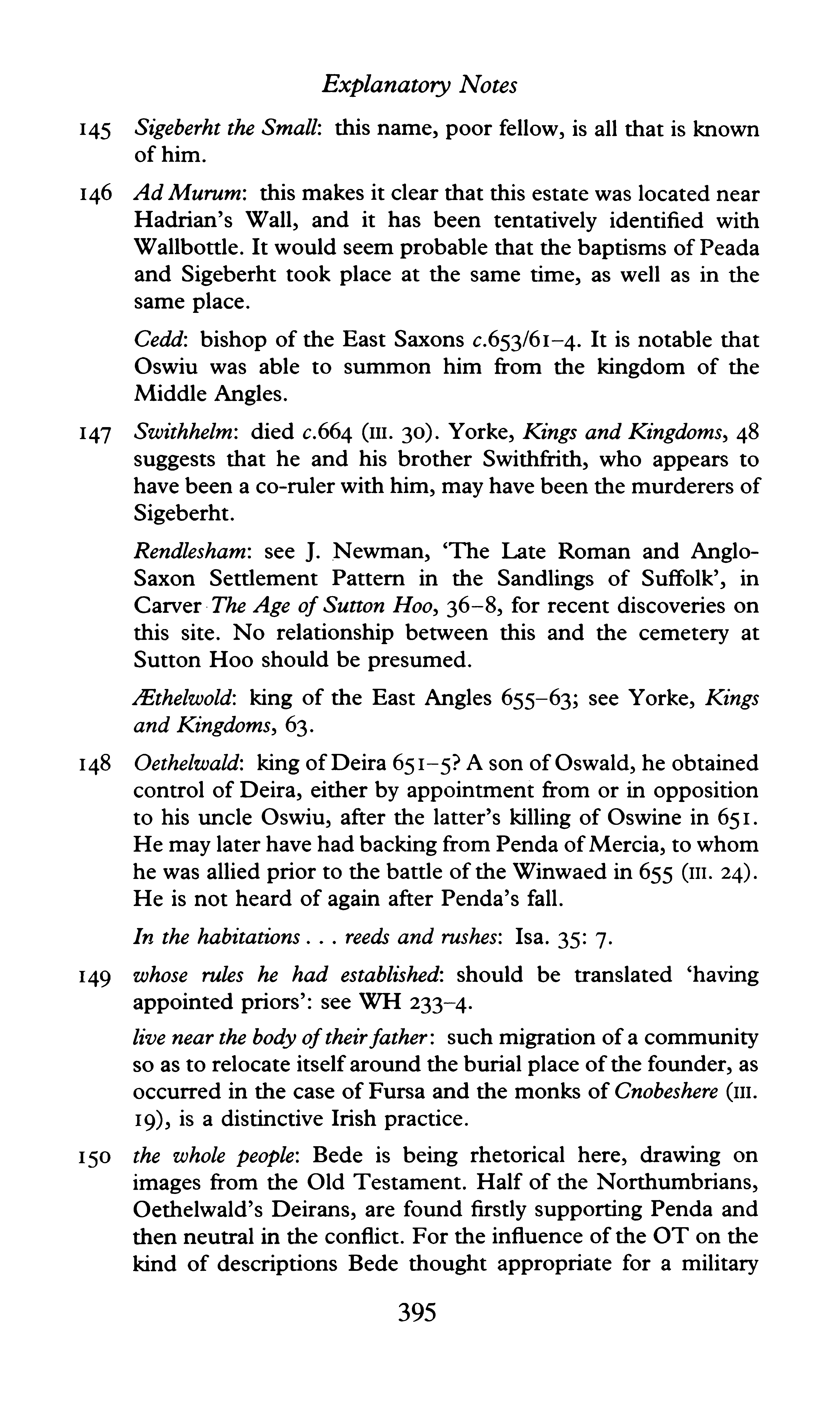
Explanatory Notes
Sigeberht the Small: this name, poor fellow, is all that is known of him.
A d Murum: this makes it clear that this estate was located near Hadrian's Wall, and it has been tentatively identified with Wallbottle. It would seem probable that the baptisms of Peada and Sigeberht took place at the same time, as well as in the same place.
Cedd: bishop of the East Saxons c.653/61-4. It is notable that Oswiu was able to summon him from the kingdom of the Middle Angles.
Swithhelm: died c.664 (in. 30). Yorke, Kings and Kingdoms, 48 suggests that he and his brother Swithffith, who appears to have been a co-ruler with him, may have been the murderers of Sigeberht.
Rendlesham: see J. Newman, 'The Late Roman and AngloSaxon Settlement Pattern in the Sandlings of Suffolk', in Carver The Age of Sutton Hoo> 36 -8 , for recent discoveries on this site. N o relationship between this and the cemetery at Sutton Hoo should be presumed.
Æthehuold: king of the East Angles 655-63; see Yorke, Kings and Kingdoms, 63.
Oethelwald: king of Deira 6 51-5? A son of Oswald, he obtained control of Deira, either by appointment from or in opposition to his uncle Oswiu, after the latter's killing of Oswine in 651.
He may later have had backing from Penda of Mercia, to whom he was allied prior to the battle of the Winwaed in 655 (hi. 24).
He is not heard of again after Penda's fall.
In the habitations. . . reeds and rushes: Isa. 35: 7.
whose rules he had established: should be translated 'having appointed priors' : see W H 233-4. live near the body of their father: such migration of a community so as to relocate itself around the burial place of the founder, as occurred in the case of Fursa and the monks of Cnobeshere (hi.
19), is a distinctive Irish practice.
the whole people: Bede is being rhetorical here, drawing on images from the Old Testament. Half of the Northumbrians,
Oethelwald's Deirans, are found firstly supporting Penda and then neutral in the conflict. For the influence of the O T on the kind of descriptions Bede thought appropriate for a military
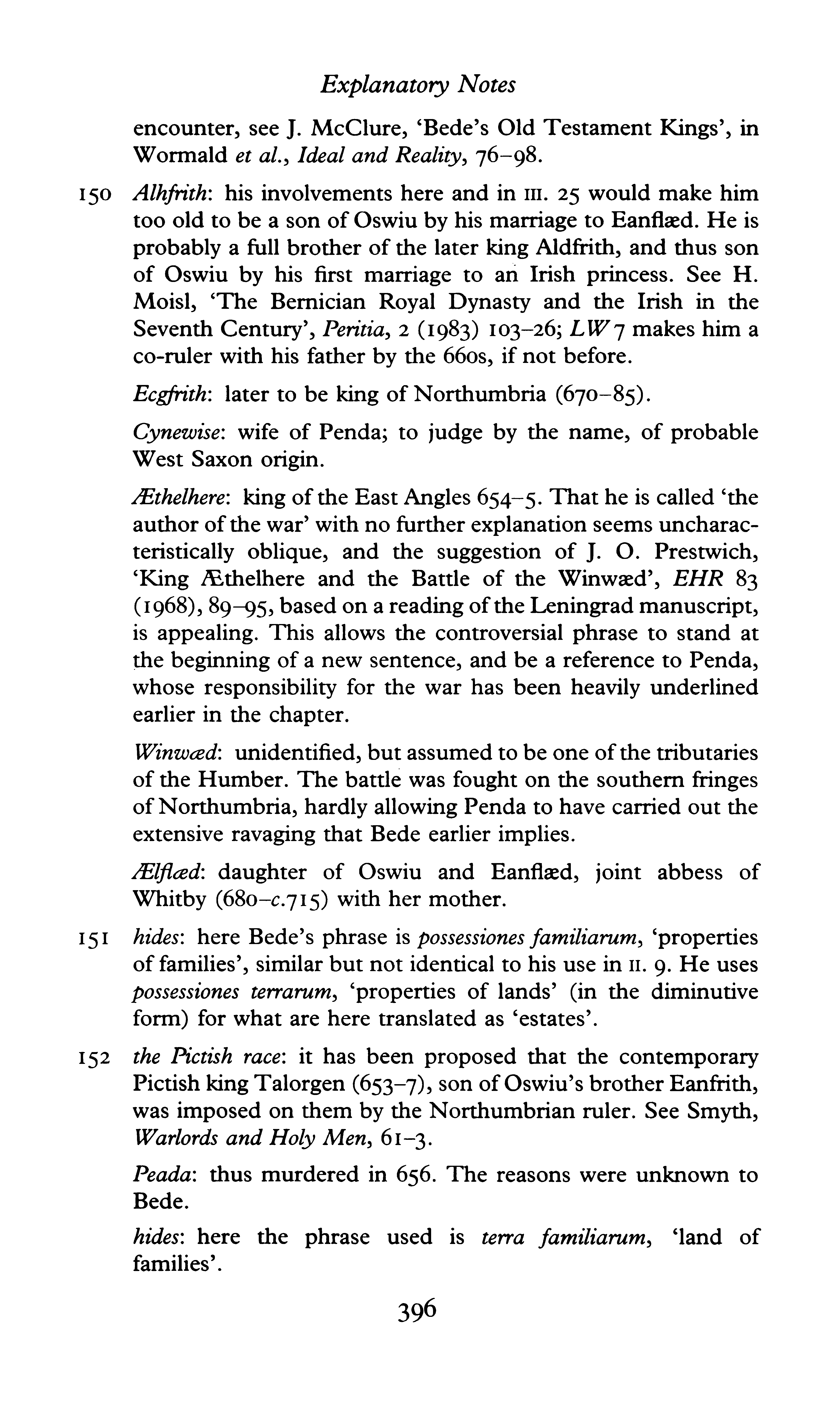
Explanatory Notes encounter, see J. McClure, 'Bede's Old Testament Kings', in Wormald et al., Ideal and Reality, 76-98.
Alhfrith: his involvements here and in m. 25 would make him too old to be a son of Oswiu by his marriage to Eanflæd. He is probably a full brother of the later king Aldfrith, and thus son of Oswiu by his first marriage to an Irish princess. See H.
Moisi, 'The Bemician Royal Dynasty and the Irish in the Seventh Century', Peritia, 2 (1983) 103-26; L W 7 makes him a co-ruler with his father by the 660s, if not before.
Ecgfrith: later to be king of Northumbria (670-85).
Cynewise: wife of Penda; to judge by the name, of probable West Saxon origin.
Æthelhere: king of the East Angles 654-5. That he is called 'the author of the war' with no further explanation seems uncharac teristically oblique, and the suggestion of J. O. Prestwich,
'King Æthelhere and the Battle of the Winwæd', EH R 83 (1968), 89-95, based on a reading of the Leningrad manuscript, is appealing. This allows the controversial phrase to stand at the beginning of a new sentence, and be a reference to Penda, whose responsibility for the war has been heavily underlined earlier in the chapter.
Winwæd: unidentified, but assumed to be one of the tributaries of the Humber. The battle was fought on the southern fringes of Northumbria, hardly allowing Penda to have carried out the extensive ravaging that Bede earlier implies.
Ælflæd: daughter of Oswiu and Eanflæd, joint abbess of Whitby (680-C.715) with her mother.
1 5 1 hides: here Bede's phrase is possessiones familiarum, 'properties of families', similar but not identical to his use in 11. 9. He uses possessiones terrarum, 'properties of lands' (in the diminutive form) for what are here translated as 'estates' .
the Pictish race: it has been proposed that the contemporary Pictish king Talorgen (653-7), son ° f Oswiu's brother Eanfrith, was imposed on them by the Northumbrian ruler. See Smyth,
Warlords and Holy Men, 6 1-3.
Peada: thus murdered in 656. The reasons were unknown to Bede. hides: here the phrase used is terra familiarum,
'land of families' .
39 6
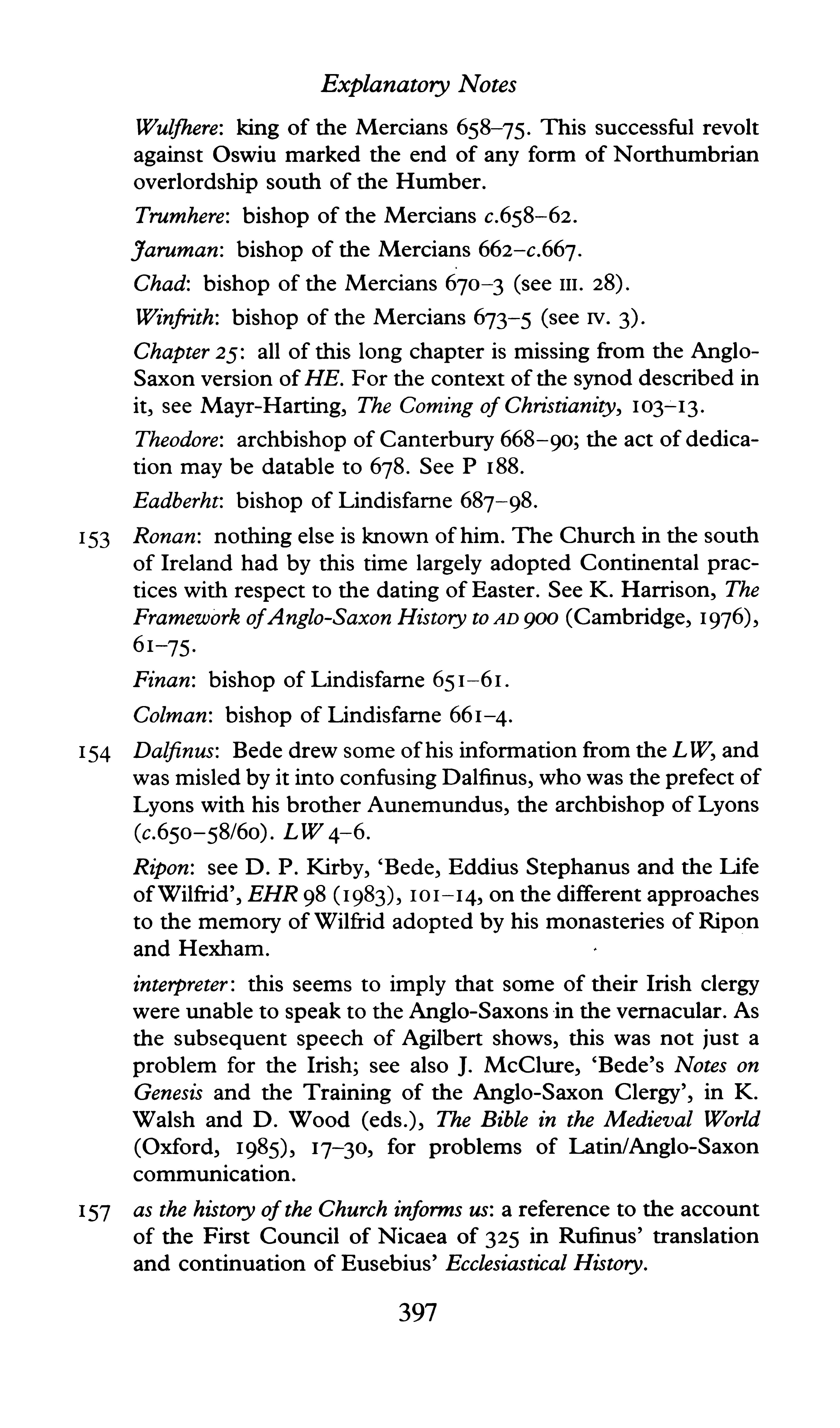
Explanatory Notes Wulfhere: king of the Mercians 658-75. This successful revolt against Oswiu marked the end of any form of Northumbrian overlordship south of the Humber.
Trumhere: bishop of the Mercians c.658-62.
Jaruman: bishop of the Mercians 662-C.667.
Chad: bishop of the Mercians 670-3 (see hi. 28).
Winfrith: bishop of the Mercians 6 73-5 (see iv. 3).
Chapter 25: all of this long chapter is missing from the AngloSaxon version of H E. For the context of the synod described in it, see Mayr-Harting, The Coming of Christianity, 10 3-13.
Theodore: archbishop of Canterbury 668-90; the act of dedica tion may be datable to 678. See P 188.
Eadberht: bishop of Lindisfame 687-98.
Ronan: nothing else is known of him. The Church in the south of Ireland had by this time largely adopted Continental prac tices with respect to the dating of Easter. See K. Harrison, The Framework of Anglo-Saxon History to a d 900 (Cambridge, 1976),
6175* Finan: bishop of Lindisfame 6 51-6 1.
Colman: bishop of Lindisfame 661-4.
Dalfinus: Bede drew some of his information from the LW> and was misled by it into confusing Dalfinus, who was the prefect of Lyons with his brother Aunemundus, the archbishop of Lyons
(c.650-58/60). L W 4-6.
Ripon: see D. P. Kirby, 'Bede, Eddius Stephanus and the Life of Wilfrid', EH R 98 (1983), 10 1-14 , on the different approaches to the memory of Wilfrid adopted by his monasteries of Ripon and Hexham. interpreter: this seems to imply that some of their Irish clergy were unable to speak to the Anglo-Saxons in the vernacular. As the subsequent speech of Agilbert shows, this was not just a problem for the Irish; see also J. McClure, 'Bede's Notes on Genesis and the Training of the Anglo-Saxon Clergy', in K.
Walsh and D. Wood (eds.), The Bible in the Medieval World (Oxford, 1985), 17-30 , for problems of Latin/Anglo-Saxon communication.
as the history of the Church informs us: a reference to the account of the First Council of Nicaea of 325 in Rufinus' translation and continuation of Eusebius' Ecclesiastical History.
3 9 7
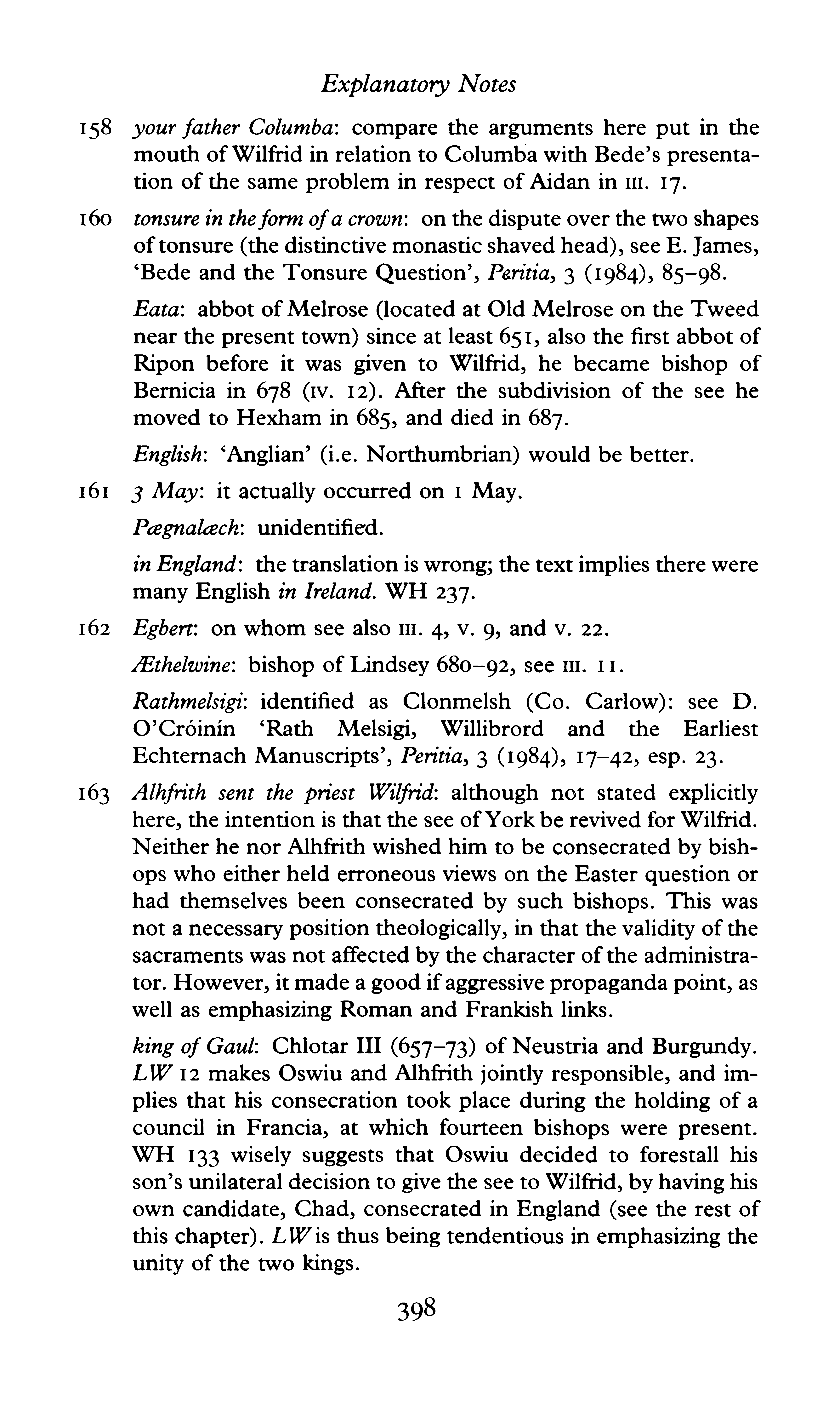
Explanatory Notes 158 your father Columba: compare the arguments here put in the mouth of Wilfrid in relation to Columba with Bede's presenta tion of the same problem in respect of Aidan in hi. 17.
tonsure in the form of a crown : on the dispute over the two shapes of tonsure (the distinctive monastic shaved head), see E. James,
'Bede and the Tonsure Question', P&ritia, 3 (1984), 85-98.
Eata: abbot of Melrose (located at Old Melrose on the Tweed near the present town) since at least 651, also the first abbot of Ripon before it was given to Wilfrid, he became bishop of Bemicia in 678 (iv. 12). After the subdivision of the see he moved to Hexham in 685, and died in 687.
English: 'Anglian' (i.e. Northumbrian) would be better.
5 M ay: it actually occurred on 1 May.
Pcegnalcech: unidentified. in England: the translation is wrong; the text implies there were many English in Ireland. W H 237.
Egbert: on whom see also in. 4, v. 9, and v. 22.
Æthelwine: bishop of Lindsey 680-92, see m. 11.
Rathmelsigi: identified as Clonmelsh (Co. Carlow): see D.
O 'Croinin 'Rath Melsigi, Willibrord and the Earliest Echternach Manuscripts', Peritia, 3 (1984), 17-4 2, esp. 23.
Alhfrith sent the priest Wilfrid: although not stated explicitly here, the intention is that the see of York be revived for Wilfrid.
Neither he nor Alhfrith wished him to be consecrated by bish ops who either held erroneous views on the Easter question or had themselves been consecrated by such bishops. This was not a necessary position theologically, in that the validity of the sacraments was not affected by the character of the administra tor. However, it made a good if aggressive propaganda point, as well as emphasizing Roman and Frankish links. king of Gaul: Chlotar III (657-73) of Neustria and Burgundy.
L W 12 makes Oswiu and Alhfrith jointly responsible, and im plies that his consecration took place during the holding of a council in Francia, at which fourteen bishops were present.
W H 133 wisely suggests that Oswiu decided to forestall his son's unilateral decision to give the see to Wilfrid, by having his own candidate, Chad, consecrated in England (see the rest of this chapter). L W is thus being tendentious in emphasizing the unity of the two kings.
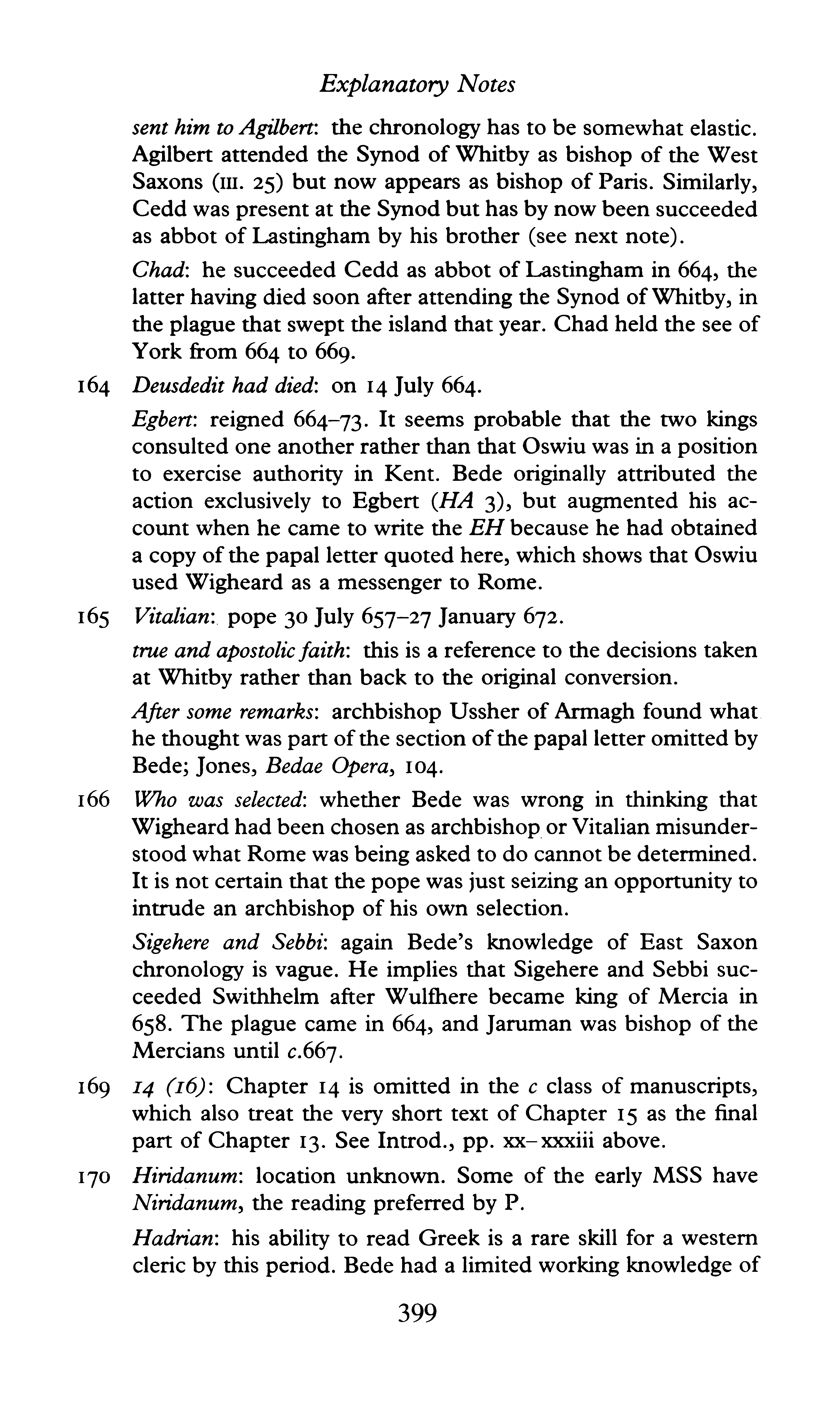
Explanatory Notes sent him to Agilbert: the chronology has to be somewhat elastic.
Agilbert attended the Synod of Whitby as bishop of the West Saxons (m. 25) but now appears as bishop of Paris. Similarly,
Cedd was present at the Synod but has by now been succeeded as abbot of Lastingham by his brother (see next note).
Chad: he succeeded Cedd as abbot of Lastingham in 664, the latter having died soon after attending the Synod of Whitby, in the plague that swept the island that year. Chad held the see of York from 664 to 669.
Deusdedit had died: on 14 July 664.
Egbert: reigned 664-73. It seems probable that the two kings consulted one another rather than that Oswiu was in a position to exercise authority in Kent. Bede originally attributed the action exclusively to Egbert {H A 3), but augmented his ac count when he came to write the E H because he had obtained a copy of the papal letter quoted here, which shows that Oswiu used Wigheard as a messenger to Rome.
Vitalian: pope 30 July 6 57-27 January 672. true and apostolic faith: this is a reference to the decisions taken at Whitby rather than back to the original conversion.
After some remarks', archbishop Ussher of Armagh found what he thought was part of the section of the papal letter omitted by Bede; Jones, Bedae Opera, 104.
Who was selected: whether Bede was wrong in thinking that Wigheard had been chosen as archbishop or Vitalian misunder stood what Rome was being asked to do cannot be determined.
It is not certain that the pope was just seizing an opportunity to intrude an archbishop of his own selection.
Sigehere and Sebbi: again Bede's knowledge of East Saxon chronology is vague. He implies that Sigehere and Sebbi suc ceeded Swithhelm after Wulfhere became king of Mercia in 658. The plague came in 664, and Jaruman was bishop of the Mercians until c. 667.
14 (16): Chapter 14 is omitted in the c class of manuscripts, which also treat the very short text of Chapter 15 as the final part of Chapter 13. See Introd., pp. xx-xxxiii above.
Hiridanum: location unknown. Some of the early M SS have Niridanum, the reading preferred by P.
Hadrian: his ability to read Greek is a rare skill for a western cleric by this period. Bede had a limited working knowledge of 3 9 9
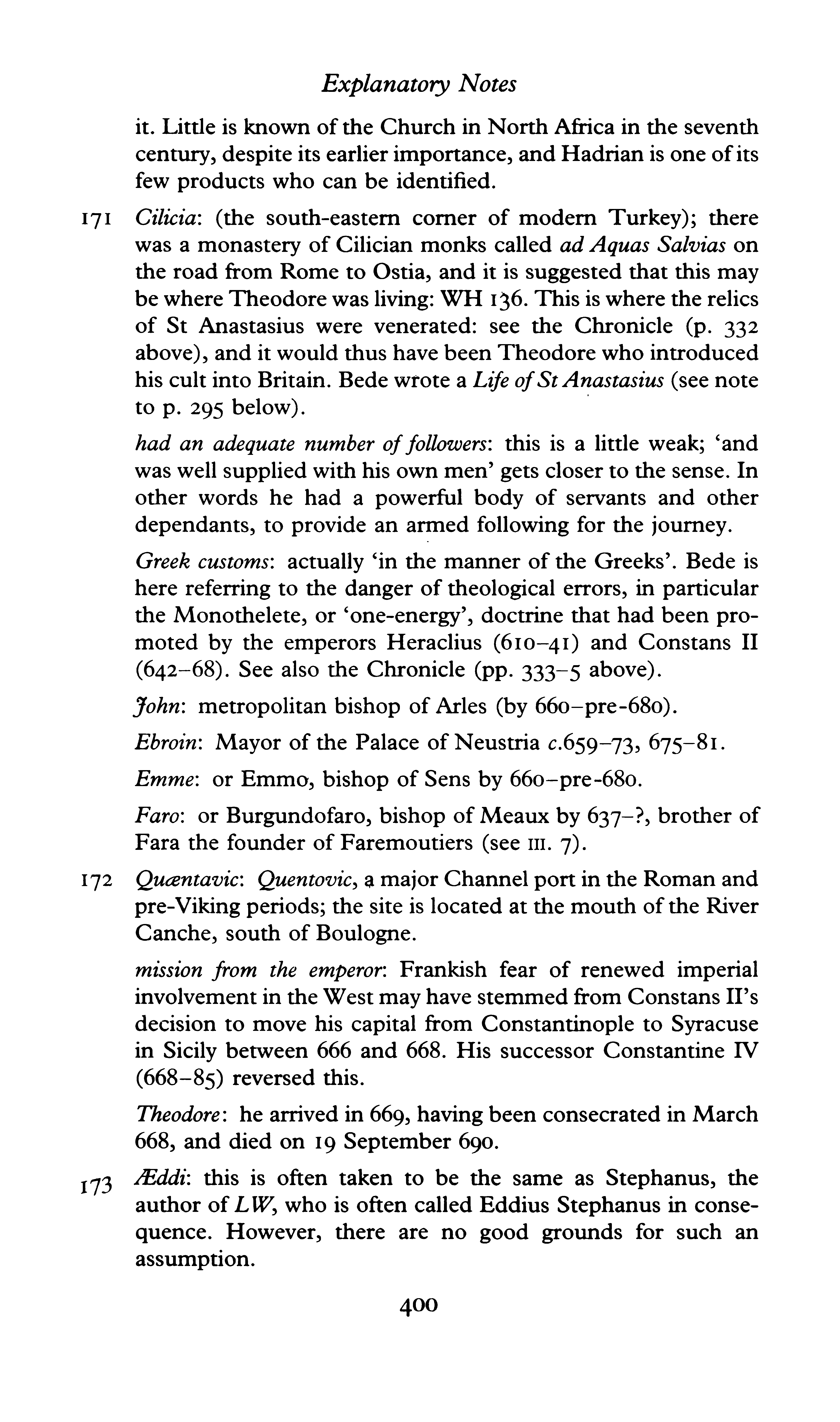
Explanatory Notes it. Little is known of the Church in North Africa in the seventh century, despite its earlier importance, and Hadrian is one of its few products who can be identified.
1 7 1 Cilicia: (the south-eastern comer of modem Turkey); there was a monastery of Cilician monks called ad Aquas Salvias on the road from Rome to Ostia, and it is suggested that this may be where Theodore was living: W H 156. This is where the relics of St Anastasius were venerated: see the Chronicle (p. 332 above), and it would thus have been Theodore who introduced his cult into Britain. Bede wrote a Life of St Anastasius (see note to p. 295 below). had an adequate number of followers: this is a little weak; 'and was well supplied with his own men' gets closer to the sense. In other words he had a powerful body of servants and other dependants, to provide an armed following for the journey.
Greek customs: actually 'in the manner of the Greeks'. Bede is here referring to the danger of theological errors, in particular the Monothelete, or 'one-energy', doctrine that had been pro moted by the emperors Heraclius (610-41) and Constans II (642-68). See also the Chronicle (pp. 3 3 3 -5 above).
John: metropolitan bishop of Arles (by 66o-pre-68o).
Ebroin: Mayor of the Palace of Neustria c.6 59-73, 6 75-8 1.
Emme: or Emmo, bishop of Sens by 66o-pre-68o.
Faro: or Burgundofaro, bishop of Meaux by 637-?, brother of Fara the founder of Faremoutiers (see hi. 7).
Qucentavic: Quentovic, a major Channel port in the Roman and pre-Viking periods; the site is located at the mouth of the River
Canche, south of Boulogne. mission from the emperor: Frankish fear of renewed imperial involvement in the West may have stemmed from Constans II's decision to move his capital from Constantinople to Syracuse in Sicily between 666 and 668. His successor Constantine IV (668-85) reversed this.
Theodore: he arrived in 669, having been consecrated in March 668, and died on 19 September 690. j 73 Æddi: this is often taken to be the same as Stephanus, the author of LW , who is often called Eddius Stephanus in conse quence. However, there are no good grounds for such an assumption.
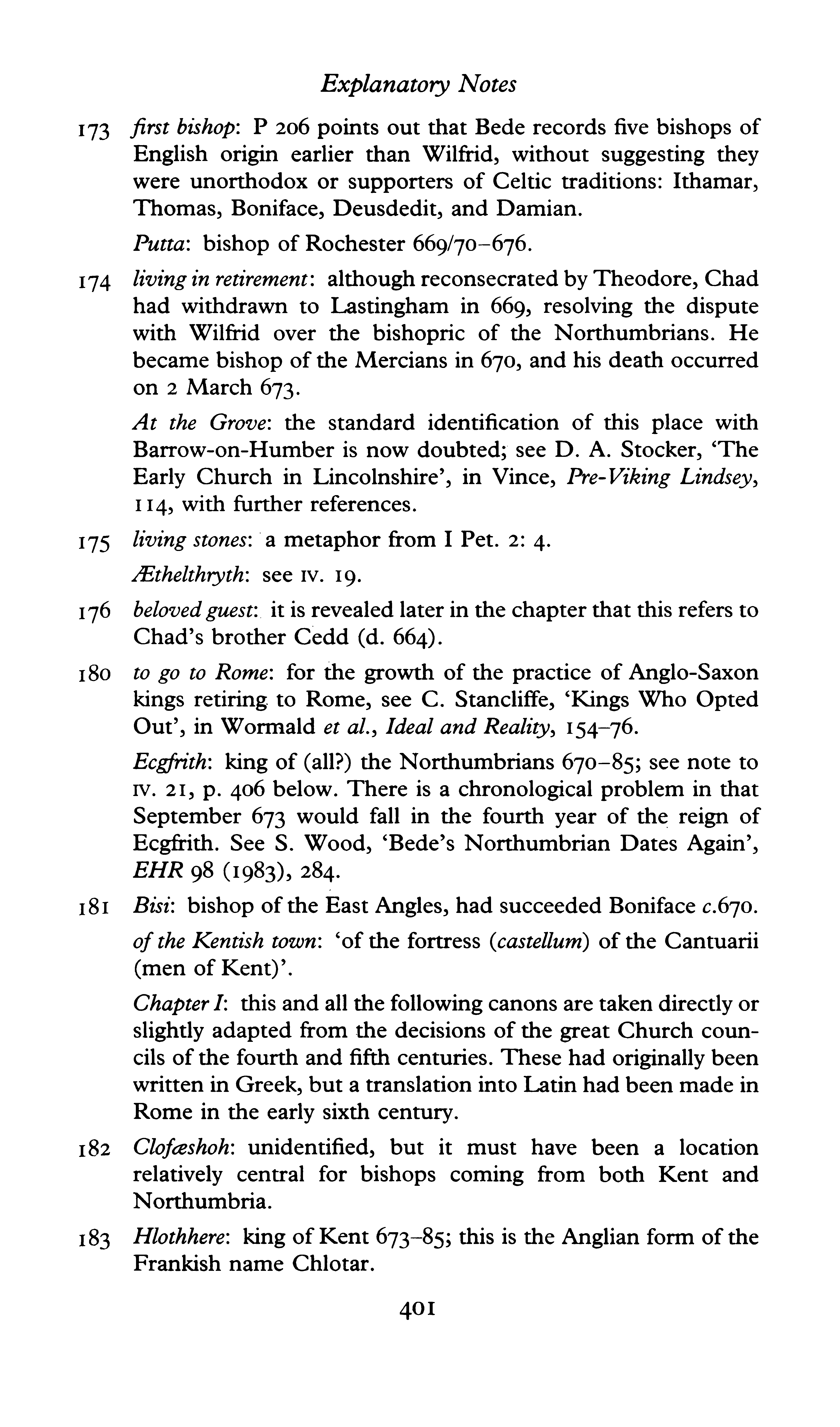
Explanatory Notes
first bishop: P 206 points out that Bede records five bishops of English origin earlier than Wilfrid, without suggesting they were unorthodox or supporters of Celtic traditions: Ithamar,
Thomas, Boniface, Deusdedit, and Damian.
Putta: bishop of Rochester 669/70-676.
living in retirement : although reconsecrated by Theodore, Chad had withdrawn to Lastingham in 669, resolving the dispute with Wilfrid over the bishopric of the Northumbrians. He became bishop of the Mercians in 670, and his death occurred on 2 March 673.
A t the Grove: the standard identification of this place with Barrow-on-Humber is now doubted; see D. A. Stocker, 'The Early Church in Lincolnshire', in Vince, Pre-Viking Lindsey,
1 14, with further references.
living stones', a metaphor from I Pet. 2: 4.
Æthelthryth: see iv. 19.
beloved guest', it is revealed later in the chapter that this refers to Chad's brother Cedd (d. 664).
to go to Rome: for the growth of the practice of Anglo-Saxon kings retiring to Rome, see C. Stancliffe, 'Kings Who Opted
Out', in Wormald et al., Ideal and Reality, 154-76.
Ecgfrith: king of (all?) the Northumbrians 670-85; see note to iv. 21, p. 406 below. There is a chronological problem in that September 673 would fall in the fourth year of the reign of Ecgfrith. See S. Wood, 'Bede's Northumbrian Dates Again',
EH R 98 (1983), 284.
Bisi: bishop of the East Angles, had succeeded Boniface c.670. of the Kentish town: 'of the fortress {castellum) of the Cantuarii
(men of Kent)' .
Chapter I: this and all the following canons are taken directly or slightly adapted from the decisions of the great Church coun cils of the fourth and fifth centuries. These had originally been written in Greek, but a translation into Latin had been made in Rome in the early sixth century.
Clofceshoh: unidentified, but it must have been a location relatively central for bishops coming from both Kent and Northumbria.
Hlothhere: king of Kent 673-85; this is the Anglian form of the Frankish name Chlotar.
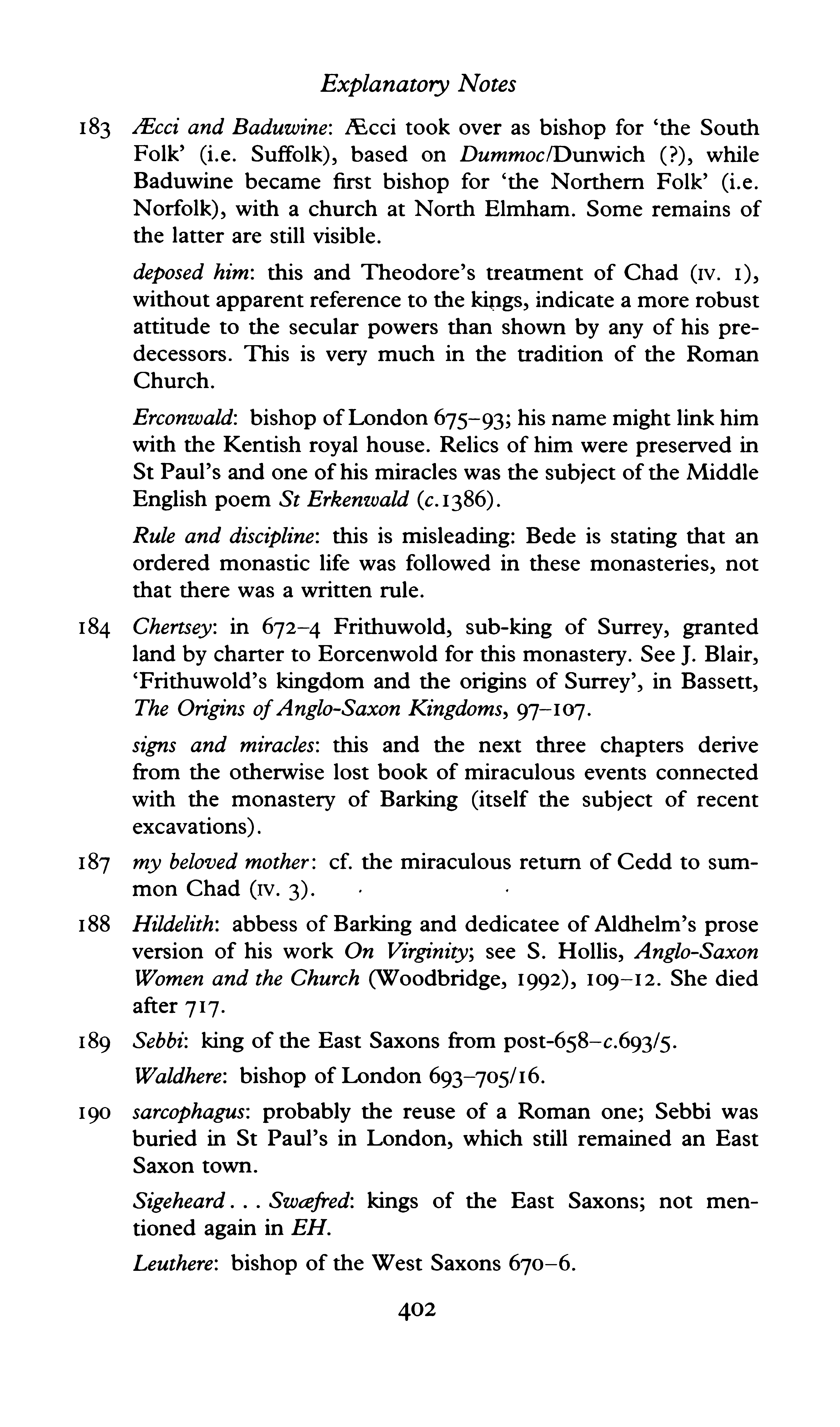
Explanatory Notes
Æcci and Baduwine: Æ cci took over as bishop for 'the South Folk' (i.e. Suffolk), based on Dwmwoc/Dunwich (?), while
Baduwine became first bishop for 'the Northern Folk' (i.e.
Norfolk), with a church at North Elmham. Some remains of the latter are still visible. deposed him: this and Theodore's treatment of Chad (iv. 1), without apparent reference to the kings, indicate a more robust attitude to the secular powers than shown by any of his pre decessors. This is very much in the tradition of the Roman
Church.
Erconwald: bishop of London 675-93; his name might link him with the Kentish royal house. Relics of him were preserved in St Paul's and one of his miracles was the subject of the Middle
English poem St Erkenwald (c.1386).
Rule and discipline: this is misleading: Bede is stating that an ordered monastic life was followed in these monasteries, not that there was a written rule.
Chertsey: in 672-4 Frithuwold, sub-king of Surrey, granted land by charter to Eorcenwold for this monastery. See J. Blair,
'Frithuwold's kingdom and the origins of Surrey', in Bassett, The Origins of Anglo-Saxon Kingdoms, 97-107. signs and miracles: this and the next three chapters derive from the otherwise lost book of miraculous events connected with the monastery of Barking (itself the subject of recent excavations).
my beloved mother: cf. the miraculous return of Cedd to sum mon Chad (iv. 3).
Hildelith: abbess of Barking and dedicatee of Aldhelm's prose version of his work On Virginity; see S. Hollis, Anglo-Saxon
Women and the Church (Woodbridge, 1992), 10 9 -12. She died after 717.
Sebbi: king of the East Saxons from post-658-c.693/5.
Waldhere: bishop of London 693-705/16.
sarcophagus: probably the reuse of a Roman one; Sebbi was buried in St Paul's in London, which still remained an East
Saxon town.
Sigeheard. . . Swcefred: kings of the East Saxons; not men tioned again in EH .
Leuthere: bishop of the West Saxons 670-6.
Explanatory Notes
Cenwealh: died in 672 (A S C , which adds that his wife Seaxburh then ruled for a year).
Hcedde: bishop of the West Saxons 676-705.
Ccedwalla: king of the West Saxons 685-8 (A SC ). Whether he had previously been one of the sub-kings is not known, but probable. His sudden renunciation and rapid death, seven days after his baptism in Rome according to A S C } may argue terminal illness, but see Stancliffe, 'Kings Who Opted Out',
17 0 -1.
Æthelred: king of the Mercians 675-704; he retired to the abbey of Bardney, of which he became the abbot (see v. 19 and 24).
Gefmund: (Gebmund): bishop of Rochester c.677~post 692 (v. 8). comev. it actually appeared in 676, but 678 is right for the conflict with Wilfrid. a dissension: V W 24 makes it clear that this dispute was over the plan to split Wilfrid's diocese in two, and that archbishop
Theodore was involved. Indeed, he may have instigated it. It is possible that Wilfrid was intended to retain the northern half, based on Hexham where he had founded a monastery, but he refused any compromise.
See M .
Roper, 'Wilfred's Landholdings in Northumbria', in D. P. Kirby (ed.), St Wilfrid at Hexham (Newcastle-Upon-Tyne, 1974), 61-80.
Lindsey: was conquered by Ecgfrith c.673/5 and regained by Mercia in 679. The Northumbrian conquest led to the creation of the new diocese. After the Mercian reconquest the North umbrian appointee Eadhæd fled and was replaced by Æthelwine (680-92). two more', the northern section of the former Northumbrian diocese was thus further subdivided in 681. Trumwine's see, in the Pictish territories conquered by Northumbria, was centred on Abercom on the Forth of Firth.
Æthelwealh: killed by the West Saxon Cædwalla (rv. 15). His reception as godson by Wulfhere must predate the latter's death in 675, i.e. long before Wilfrid's arrival in Sussex. This was a significant political act, involving the two participants in mutual obligations. H W 41 ignores this and has Wilfrid convert the king (c.681-5). Æthelwealh's wife Eafe was from the royal house of the Hwicce, a subkingdom of Mercia. This may confirm Bede's account. See H. Mayr-Harting, 'St Wilfrid in
Explanatory Notes Sussex', in M . J. Kitch (ed.), Studies in Sussex Church History
(London, 1981), 1-17 .
Meonware: a name preserved in that of the Meon valley in south Hampshire.
male and female slaves: these slaves are the same as the 'men' given with the estates; in other words they were tied to the lands given to Wilfrid by the king.
Chapter X IV : this chapter is missing from the c class of the M SS, and may be the product of a late revision of the work by Bede.
Acca: bishop of Hexham 70 9-31.
King Oswald: This story would indicate that the Northumb rian cult of Oswald was introduced into Sussex by Wilfrid's followers.
One was tonsured: the standard medieval images of Peter (tonsured with curly white hair) and Paul (bald with a long brown beard) became fixed iconographically by the early fifth century. The boy is thus describing them in the way his con temporaries would have expected them to have appeared.
Ine: king of the West Saxons 688-728. wipe out all the natives: why Cædwalla intended this act of genocide is not clear. It is dated to 686 in A S C . V W 42 presents a rather different picture of Cædwalla; but the intentions of Bede and of Stephanus were not identical.
Stoneham?: Stone (Hampshire) is now preferred: W H 156-7.
Cyneberht: nothing more is known of him or of his monastery.
Eutyches: the most prominent of the early Monophysite theolo gians, who denied the separation of the human and divine natures in Christ. His teaching was condemned most fully at the Council of Chalcedon in 451, but continued to attract adherents. Attempts to reach a compromise over this issue, which split the Eastern Church, had included the official pro motion under the emperor Heraclius (610 -41) of the Monothelete doctrine, which propounded the idea of two na tures but a single will or 'energy' . A renewed imperial initiative aimed at eliminating both of these doctrines was launched by Constantine IV in 678, culminating in the holding of an oecu menical council (the sixth) in Constantinople in November
680. In preparing Western views pope Agatho (678-81) secured
Explanatory Notes the holding of a number of provincial councils. O f these Theodore's synod at Hatfield was one. Bede was unaware of the wider purpose of the synod and mistaken as to its signifi cance: there was no chance of Monophysite or Monothelete doctrines establishing themselves in Britain. He based his deductions on the synodal acta, which contained the credal statement given here. This would have been sent to Rome to confirm the orthodoxy of the Church under Theodore's direc tion and then form part of the papal presentation at the Council of Constantinople. The Neustrian/Burgundian synod of Marly
(679/80) was probably similarly motivated. eighth indiction: there has been argument over the date, but the general consensus, based on Theodore's probable use of an indiction starting on 1 September, would place the synod in 679.
Ealdivulf: king of the East Angles 663-713. It is notable that the Northumbrian king Ecgfrith is not named here. Did none of the bishops of his kingdom attend? An important preparatory document for thé synod was certainly produced in Northum bria: see rv. 19 and notes.
Hatfield: contrary to the standard view that locates the site of the synod at Hatfield in Hertfordshire, the meeting almost certainly took place in the region of the former small kingdom of Hatfield, bordered by Deira, Elmet, Mercia, and Lindsey and centred on Hatfield Chase; see Higham, The Kingdom of Northumbria, 87-9. As is clear from the battle of the Idle in 616
(note to p. 94), this was a region easily accessible from East Anglia as well as from Northumbria and Mercia. universal councils: here referring to the first five oecumenical councils, in which in theory the whole Church was represented.
These were the councils of Nicaea (325), I Constantinople (381), Ephesus (431), Chalcedon (451) and II Constantinople
(553)- See the Chronicle (pp. 3 3 4 -5 above).
Pope Martin: (5 July 6 49 -17 June 653); he was exiled for his opposition to the Monothelete doctrine promulgated in the Typds of the emperor Constans II (642-68)— who, as here, was officially called Constantine. See the Chronicle (p. 334 above). precentor. John's title was archicantator or arch-chanter, in charge of the singing of the liturgical offices in the papal basilica of St Peter. His monastery of St Martin's was adjacent to it.
Explanatory Notes
Biscop: Benedict Biscop (628?-689), a Northumbrian noble who became a monk. He spent two years at Lérins, and was briefly abbot of St Peter and St Paul in Canterbury, before the arrival of Hadrian (670/1). He was the founder of Wearmouth
(674) and Jarrow (681), and made visits to Rome in 678-80 and 685-6 to obtain books, paintings, relics, and other embellish ments for them. See P. Wormald, 'Bede and Benedict Biscop' in G . Bonner (ed.), Famulus Christi: Essays in Commemoration of the Thirteenth Centenary of the Birth of the Venerable Bede
(London, 1976), 14 1-6 9 and E. Fletcher, Benedict Biscop (Jarrow Lecture, 1981). who has already been mentioned: he has not, and no satisfactory explanation exists for Bede's error here. W H 239.
Ceolfrid: (642-716); abbot of Jarrow (from 681) and of Wearmouth (from 688). He resigned in 716 and died en route to Rome. See the Chronicle (p. 339 above); also J. M cClure,
'Bede and the Life of Ceolfrid', Peritia, 3 (1984), 71-8 4 .
recently: this was the Lateran Council of October 649. a copy: John was clearly in England as much to help in the organization of the provincial synod as to teach chant. A manu script of the acts of the Lateran Council was written at Jarrow or Wearmouth in preparation for Hatfield, and John was ex pected to bring the decrees of the synod back with him to Rome.
ealdorman: princeps: see Campbell, Essays in Anglo-Saxon History, 88-9.
Æbbe: sister of Oswiu; see rv. 25.
Ely: it is thought that Bede used a lost Life of Æthelthryth (who can also, more conveniently, be called Audrey!) produced in her monastery of Ely. A S C dates her foundation of Ely to 673 and her death to 679. On Æthelthryth and the early saints of Ely, see S. J. Ridyard, The Royal Saints of Anglo-Saxon England
(Cambridge, 1988), 17 6 -8 1.
M aro's: the Roman poet Vergil (Vergilius Maro), referring here to the first line of his Aeneid: Arma virumque cano: ' [Of]
Arms I sing and the man'.
great battle: fought in 679, this regained Lindsey for the Mercians.
Ælfwine: V W (17 and 24) calls him a king; it has been sugges ted that he ruled Deira under his brother Ecgfrith. Note that
Explanatory Notes the obligations of feud, and compensation via payment of a wergild, can apply as much to death in battle as to murder.
Imttia: on this story, see W H , pp. xxiv-xxvi. many masses: this link between the masses and the loosening of chains can also be found in a work with which Bede was familiar: Gregory the Great's Dialogues, iv. 59.
Frisian in London: this is further slight testimony to the com mercial importance of London in the late seventh century.
Little archaeological evidence for the city in this period has yet emerged; see A. Vince, Saxon London (London, 1990), 13 -17 .
Æthelthryth's sister: Seaxburh, daughter of Anna king of the East Angles, and wife of Earconberht of Kent (640-64); see iv. 19.
Hild: (614-80); see Hollis, Anglo-Saxon Women, 243-70, for Bede's treatment of her role, and possible deliberate dimin ution of it. O f her father Hereric no more is recorded.
Chelles: was not founded/restored by Balthildis until 660, and so this is unlikely to have been Hild's intended destination.
Hereswith: married Æthelric of East Anglia if the ninth-century genealogy of the East Anglian kings in M S B L Cotton
Vespasian B 6 be believed. received a hide: from Aidan? He is also found involved in the establishment of Heiu's monastery.
2 1 1 Kœlcacœstir ( Tadcaster?): E. Ekwall, Concise Dictionary of English Place Names (Oxford, i960), 270, prefers Kelk in the East Riding. for some years: Bede's chronology implies that the move to Hartlepool occurred in 649. The foundation of Whitby has to be between 651 and 664.
Bosa: bishop of York 678-86, 691-706.
Æ tla: bishop of Dorchester (Oxon.)— early 670s.
Oftfor : bishop of the Hwicce c.691-?.
John: of Beverley, bishop of Hexham 687-706 and of York 70 6-21.
Wüfrid: Wilfrid II, bishop of York 7 2 1-3 2 .
Bosel: bishop of the Hwicce ?-c.690. now dead: Archbishop Theodore died in 690. His successor
Berhtwald was not consecrated until 1 July 692.
Explanatory Notes
Cerdic: possibly the same as Ceretic king of Elmet: H B 63.
Hackness: Hild had developed a family of monasteries, includ ing Hartlepool, Whitby, and Hackness (13 miles from Whitby).
Now we must praise: a nine-line Northumbrian poem that cor responds to the description here has been preserved in four
M SS, and a version in the West Saxon dialect survives in thirteen others. See D. G. Scragg, 'The Nature of Old English
Verse', in M . Godden and M . Lapidge (eds.), The Cambridge Companion to Old English Literature (Cambridge, 1991), 55-70, esp. 55-8 .
a whole week without food: by Irish penitential standards a week's fast would be the expiation for a very trivial offence. For example, in the Penitiential of Cummean this would be the penance imposed on a layman for being drunk (for which a monk would fast forty days). See L. Bieler, The Irish Penitentials
(Dublin, 1963).
Æbbe: sister of Oswiu. Her death and the destruction of Coldingham are placed in the mid-68os. See Hollis, AngloSaxon Women, 10 1-2.
Ireland: also recorded in A U for ad 685: 'The Saxons lay waste M ag Breg and many churches in the month of June.'
M ag Breg is the plain around Tara, south of the river Boyne.
Smyth, Warlords and Holy Men, 26, thinks British fugitives, notably from the former kingdom of Rheged, were using bases in eastern Ireland to raid Northumbria. This episode is also important evidence for seventh-century Anglo-Saxon maritime power; see J. Haywood, Dark Age Naval Power (London, 1991),
547 5 * Cuthbert: see A L C in. 6 and iv. 8 and P L C 24 and 27 for Cuthbert's prophesies of Ecgfrith's fate. Bede's main treatment of Cuthbert in E H follows in iv. 27-32. he was killed: A U for ad 686 locates the battle at Dûn Nechtain, thought to be Dunnichen near Forfar in Angus. H. Moisi, 'The Bemician Royal Dynasty and the Irish in the Seventh Century',
Peritia, 2 (1983), 103-26, esp. 120 -4, suggests this was an alliance involving not just the Piets and the Dalriadans, but also the Ui Néill of Ireland, and aimed at replacing Ecgfrith by his half-brother Aldfrith. The latter's mother may have come from the Ui Néill.
'ebb and fall away Virgil, Aeneid 2. 169. See notes to v. 1.
Explanatory Notes
Ælfflced: daughter of Oswiu and Eanflæd, she became joint abbess of Whitby and its dependencies after the death of Hild in 680. P L C 28 indicates that she also ruled over a monastery at Carlisle c.685. Trumwine's death occurred prior to the writing of A L C (699-705).
Aldfrith: king of the Northumbrians 685-705. Bede was unwill ing to be positive that he was the son of Oswiu. He says the same in P L C 24, where he also calls him illegitimate. V LC makes no mention of him. It should be noted that P L C and E H were written after this branch of the dynasty had been de throned in 716, and when the kingdom was being ruled by a rival line.
223 foreign kings: A S C records the West Saxon king Cædwalla rav aging Kent in 686 and 687; his brother Mul may have tried to make himself king there, but was burned to death in the latter year.
Wihtred: A S C (Laud M S) records Wihtred and 'Wæbheard' ruling in Kent in 692, and Wihtred 'succeeding' to the kingdom in 694. He died in 725. A law code was issued in his name at an ecclesiastical council held at Barham in the fifth year of his reign. 'Wæbheard' is probably a corruption of Swæfheard, son of the East Saxon king Sæbbi, who is known from S 10 and 11 to have ruled part of Kent by 690. E H v. 8 records him as still ruling in 692. Another king called Oswine is attested to by S 12 - 14 of 689-90.
Cuthbert: Chapters 27-32 form a brief 'Life of Cuthbert', of which Bede had already written two ( V LC written by 716; P L C by 721). He omits the miraculous stories about Cuthbert which constitute the main part of those works.
Adtuifyrdi: this synod, held in 684, also deposed bishop Tunberht of Hexham (681-4), whom Cuthbert was initially chosen to replace. Although it is not part of Bede's purpose, this shows the much greater control that Canterbury, in the person of Archbishop Theodore, was trying to exercise over the other English dioceses.
Herbert', this story is found in A L C iv. 9, and P L C 28. The text in E H is almost a verbatim repetition of the latter, with some minor stylistic variations. river Derwent: an island, still called St Herbert's, in Derwentwater in the Lake District.
Explanatory Notes
helpful advice: P L C 28 states that Cuthbert was in Carlisle to ordain priests and to admit king Ecgfrith's widow into monastic life. Why this specific context is here omitted, and why, of all the stories about Cuthbert's life in PLC, Bede has repeated this one in EH , remain unclear.
Bishop Wilfrid: his year as bishop would be 687-8. P L C 40 hints that this was a difficult time for Lindisfame: 'so great a blast of trial beat upon that church that many of the brethren chose to depart from the place' (tr. Colgrave, p. 287). Bede omits any suggestion of this in EH .
Eadberht: bishop of Lindisfame 688-98. body intact: it was this, taken as a clear sign of special spiritual grace, that may have led to the development of the cult of Cuthbert, and certainly to the commissioning of the first ac count (A L C ) of miraculous events that could be associated with him.
the coffin: this has survived, and is still visible in Durham cathedral. For the preservation of this and other burial items associated with Cuthbert, see C. F. Battiscombe (ed.), The Relics of St Cuthbert (Oxford, 1956).
Chapter X X X I: these miracle stories and those in Chapter 32 are not found in P L C and must represent tales that Bede heard after writing that work (before 721).
Dacre: in Westmorland. The names of the abbots would sug gest this was an Anglo-Saxon not a Celtic foundation.
BO O K V: the heading to the list of chapters, as found in Books I-IV inclusive, is missing, apparently in all major manuscripts.
This book, which is less well structured than the previous ones, may have been awaiting a final revision at the time of Bede's death.
merits: as elsewhere, Bede deduces the quality of the spiritual life of the subject of his story from the miracles that God performs at his intercession. Why this has been chosen to begin
Book V is unclear, as thematically it belongs with the final chapters of Book IV. swelling main: (tumida aequora) is a borrowing from Virgil,
Aeneid I. 142. For arguments over Bede's direct or indirect knowledge of Virgil, see W H 175 and 241.
John: John of Beverley, bishop of Hexham 687-706, and of York 70 6-21.
Explanatory Notes
oratory: the Latin here is clymiterium, which is unique, and suggests an early corruption in the text. St John's Lee (Acomb) and Warden, both immediately north of Hexham, have been suggested as locations for this oratory.
Bosa: died 706; despite this praise, Bede has virtually nothing to say of him.
Wetadun: located seven miles north of Beverley in the East Riding; nothing else is known of this monastery or its abbess.
mother-in-law of St Peter: Matt. 8: 14 -15.
Addi: both he and Puch of v. 4 are seeking to have their own churches dedicated. As in seventh-century Francia and the Visigothic kingdom in Spain, noblemen built such churches on their estates for the use of their family and servants. A possible surviving English example of such a building is the church of Escomb near Bishop Auckland, but the lack of any early documentary record relating to this building makes its original purpose impossible to determine. servant: the word used, puer ('boy'), and the behaviour as cribed to him at the end of the chapter suggest this was not just a servant, but a junior member of Addi's military household.
breathed upon my face: this procedure is advocated by Bede for the exorcising evil spirits from the body in his Commentary on Samuel, hi. xvii. 53: ed. D. Hurst, C C SL cxix. 162.
Beverley: actually In Silva Derorum, 'In the Wood of the Deirans'; the name Beverley ('Beaver Stream') is first recorded in the year 1000.
Ccedwalla: Bede's view of Cædwalla is strangely positive in the light of the brevity of his reign and the ferocity of his treatment of neighbouring realms (iv. 15-16 ). This must result from the abdication and pilgrimage described here, also singled out in v.24. Alternatively, Goffart, The Narrators of Barbarian His tory, 319 -2 0 , suggests that Bede's praise of Cædwalla was ironic.
Sergius: pope 15 December 687-9 September 701. Bede is unusually well informed on these events in Rome. The highly tendentious account of Cædwalla in V W 42 indicates that he got on well with Wilfrid, and it may be that Wilfrid's compan ions on his visit to Rome in 703/4, such as Acca, later bishop of Hexham, provided the route for these details to come to Bede.
Ine: king of the West Saxons 688-726.
4 1 1
Explanatory Notes
Gregory: Gregory II, pope 19 M ay 7 15 —11 February 731.
bodies are buried in peace: Eccles. 44: 14.
Berhtwald: a gap of nearly two years intervenes. V W 43 claims, probably mendaciously, that Theodore had told Wilfrid that he wished him to be his successor. The delay and the subsequent
Gallic consecration of Berhtwold have been seen as evidence of a dispute over the succession. See N . Brooks, The Early History of the Church of Canterbury (Leicester, 1984), 76 -8 .
Reculver: A S C records the foundation of the monastery by the priest Bass under the patronage of king Egbert of Kent in the year 669. A Saxon church survived on the site until 1805. See
Taylor and Taylor, Anglo-Saxon Architecture, ii. 503-9. river Yant: called the Genlade by Bede. It is the northern arm of the River Wantsum.
Wihtred and Swæfheard: see notes to iv. 26 above, p. 409.
Godwin: Godinus, metropolitan bishop of Lyons by 688; died after 701. Bede has anglicized the name. 'Gaulish church' is wrong, as the phrase used by Bede is a synpnym for Lyons.
Tobias: bishop of Rochester after 692; died 726.
Garmani: K. Jackson, Language and History in Early Britain (Edinburgh, 1953), 281, suggests this is a colloquial British
Latin form for Germani, not otherwise preserved.
Frisians: this list is either anachronistic or archaic. The Rugians and the Huns were last in contact with northern
Europe in the fifth century. This may be taken to represent Egbert's view of the unconverted Continental neighbours of the Anglo-Saxons.
Bructeri: were located between the Rivers Lippe and Ruhr in northern Germany. Their defeat by the Continental or 'Old'
Saxons in the 690s is recorded in v. 11. sailing round Britain: Egbert was in Rathmelsigi, probably in Co.
Carlow in south-east Ireland. He thus planned to sail all round the north of Britain on his way to the Continent; to visit island monasteries, such as Iona, Lindisfame, etc.? The story of the vision of Boisil that follows indicates that Egbert was, perhaps, more concerned about these than with a missionary venturecum-pilgrimage to Rome. It should be noted that evangelizing in this period was envisaged as a short-term activity, something that could be undertaken en route elsewhere. For examples, see
Wilfrid in Sussex and in Frisia: V W 41 and 26.
4 1 2
Explanatory Notes
servant: is misleading. Bede states that this monk was also the disciple of Boisil. The Melrose (and Lindisfame via Eata) links of this story are notable. Some of Egbert's followers felt there was work to be done closer to home. the mattin hymns: Although not envisaged in the Rule of Benedict or other southern monastic rules, a period of sleep after Mattins in certain periods of the summer (when Mattins was celebrated earlier in the day) can be found in the tenthcentury Regularis Concordia and may reflect earlier rules that made allowances for northern climates.
words of the prophet: Jonah 1:12.
Wihtbert: also referred to in Alcuin's Life of Willibrord, ch. 4, ed.
Reischmann, p. 50, and also possibly a signatory to the acts of the Irish Council of Birr of 697 ('Ichtbricht').
Pippin: Pippin II (d. 714), Mayor of the Palace of Austrasia (the eastern Frankish kingdom) and after 687 the dominant figure in Frankish politics generally.
Radbod: the king of the Frisians (d. 719). This campaign in the 690s is referred to in The Chronicle of Fredegar> continuations, ch. 7, ed. J. M . Wallace-Hadrill (London, i960), 86, which records Pippin's capture of the port of Dorestad.
viceroys: Bede uses the Biblical 'satrap'. He is the only source for this view of Saxon political life, but it accords with the impression gained from the better documented period of Charlemagne's Saxon wars of the late eighth century. See in general A. Genrich, Die Altsachsen (Hildesheim, 1981). reeve: translating vilicus. 'Village headman' may give a clearer impression. an altar: for a contemporary example, see the one found in the tomb of Cuthbert: C. F. Battiscombe (ed.), The Relics of St Cuthbert (Oxford, 1956), 326 -36 , displayed in Durham cathe dral. A chalice from such a set of vessels is preserved in Hexham abbey.
2 5 1 church of the city of Cologne: the fourthto eighth-century epis copal church, traces of which have been found under the later medieval cathedral. Pippin's involvement in this may argue greater Frankish backing for the Hewalds' venture than Bede was aware of.
Willibrord: (d. 739); the Life written in 796 by his relative Alcuin (d. 804) provides some additional details on his early
Explanatory Notes life. The son of a Northumbrian called Wilgis, who retired to live as a hermit on Spur Head, he was brought up in Wilfrid's monastery at Ripon, before going to study in Ireland in Egbert's monastery of Rathmelsigi (see notes to hi. 27, p. 398 above). It is worth noting that Wilfrid had himself had a brief involvement with the evangelizing of the Frisians ( V W 26) and thus Willibrord's debt to both Egbert's missionary interests and the Wilfridan tradition of Ripon may be more fully integrated than is usually believed. See R. Collins, Early Medieval Europe
(London, 1991), 240 -1.
Swithberht: the consecration must have taken place after Berhtwold's election in July 692 and before his return to England in August 693.
696: Bede was misinformed. Willibrord's own Calendar indi cates that the year was 695. Also St Cecilia's day (21 Novem ber) fell on a Sunday, the normal day for consecrating bishops, in 695 and not in 696. On Willibrord and the Frisian mission, see W. Levison, England and the Continent in the Eighth Century
(Oxford, 1946), 45-69.
Pippin gave him: his establishment of Willibrord in Utrecht should probably be dated to the winter of 703/4.
Clement: according to Alcuin, Life of Willibrord, 7, Pope Sergius (687-701) gave this name to Willibrord when consecrating him archbishop in 695. It was probably intended as a reference to the Clement who was one of St Paul's missionary followers
(Phil. 4: 3)-
Cunningham: assumed to be the district of Ayrshire of this name.
in the lone night: Virgil, Aeneid 6. 268.
I could see: it is notable that the 'human souls' envisaged here look like the material bodies of their possessors. Apocalyptic imagery may have been influenced by its artistic depiction, the earliest manifestations of which were to be found in fifthcentury Rome.
what all these things are: the man had been shown four variants of the afterlife, but, while such visions of future reward and punishment become increasingly prevalent in medieval litera ture (and art) from this period onwards, there is at this stage little or no formal theological underpinning of such details as the two purgatorial states described here.
4 1 4
Explanatory Notes
Hcemgisl: whose account of this vision was Bede's source. As Bede calls this a relatio rather than a narratio, a written account is implied.
Cenred: king of the Mercians 704-9 (See v. 19 and notes, p. 416 below). His role in this story displays aspects of Gregory the Great's ideas on rectores, all with responsibility for the spiritual guidance of those under their authority. Normally this would relate to a clerical or monastic context, but Gregory would have wished kings to think of themselves in the same light. In 709
Cenred abdicated to live as a monk in Rome.
daggers: the word used (vomeres) normally means plough shares, and only appears as a correction added to the two earliest manuscripts (the Moore and the Leningrad M S S — see
Introd. pp. xxi-xxii). The Anglo-Saxon translators certainly took the word to mean daggers or knives, but whether it was actually intrinsic to Bede's original text remains questionable.
Readers of J. R. R. Tolkien's The Lord of the Rings, book ii, ch. ii, will recognize the theme.
Pope Gregory writes: Gregory the Great, Dialogues, iv. 40.
Pehthelm: (the Northumbrian form, as used by Bede, is Pecthelm): formerly a monk of Malmesbury (Wilts.) and bishop of Whithorn in Galloway by 731. He died in 735.
Britons in Britain: this could refer in particular to the kingdom of Cornwall; see v. 18.
Adamnan: abbot of Iona 679-704; bom c.628 and related to Columba. His visit to Northumbria was to secure the release of Irish prisoners taken by Ecgfrith in 684 (H E rv. 26).
Arculf : his pilgrimage is recounted in greater detail in Adamnân's extant De Locis Sanctis ('On the Holy Places'), ed.
D. Meehan, S L H 3 (1958). His experiences show that Jerusa lem and Egypt remained open to western visitors, despite the Arab conquests of the 630s. That he should have been driven off course to the Hebrides on the way home from the Mediter ranean suggests he lived in Brittany or the north-west of Francia. thus: Bede here paraphrases rather than quotes directly from Adamnan. By his own account, at the end of v. 17, he made an abridgement of the whole work. Other than for these extracts, this has been lost.
Explanatory Notes
Osred: king of the Northumbrians 70 5-16. In V LC 11554-5 Bede hailed him as a new Josiah (king of Judah 640-609 bc, who came to the throne aged 8; see 2 Kgs.: 22). Although not mentioned by Bede, a usurper called Eadwulf seized power for about two months between Aldfrith and Osred. more will be said: there is a brief reference to him in v. 23, but this promises more than is fulfilled; another sign of hasty edit ing of Book V ?
Aldhelm: bom c.639, a former pupil of abbot Hadrian at Can terbury and from 675 abbot of Malmesbury; he was bishop of Sherborne (or 'bishop to the West of the Wood' in A S C ) 70 58/9, and after Bede the most prolific of the early Anglo-Saxon ecclesiastical authors in both prose and verse.
Daniel: bishop of Winchester 705-44, he was one of Bede's main informants on West Saxon matters; see Preface, p. 4 above. He was also a mentor and friend of the Anglo-Saxon missionary bishop Boniface; so it often causes surprise that Bede makes no mention of the latter. by means of this book: the Letter to Gerontius (or Geraint, king of Cornwall).
twofold: what is known as opus geminatum^ the writing of paral lel versions of a work in both prose and verse, as in Bede's two lives of Cuthbert. polished style: on which see M . Winterbottom, 'Aldhelm's
Prose Style and its Origins', A S E 6 (1977), 39-76 , who shows that he owed more to his Canterbury training than to Irish learning.
Forthhere: bishop of Sherborne 708/9-37/9. by a decree of the synod: 'by a synodal decree' is better, as it is not clear that Bede is referring here to the West Saxon synod that led Aldhelm to write his Letter to Gerontius (see above).
The episcopates of the two bishops of Selsey mentioned here can be dated no more precisely than saying both were post-705 and pre-731.
Constantine: pope 25 March 708-9 April 715.
Ceolred: king of the Mercians 70 9-16, son of the former king Æthelred (675-704).
Offa: probably a subor co-king of the East Saxons c.700: see Yorke Kings and Kingdoms, 49-50, 53-4. That both Cenred and
Explanatory Notes Offa simultaneously gave up their kingdoms and went to Rome together may imply some political upheaval that is otherwise concealed from us.
a hundredfold in this life: cf. Mark 10: 29-30.
the famous Bishop Wilfrid: the account given here is largely a précis of V W but with some omissions, e.g. Wilfrid's period in Mercia, and the failed attempt at a reconciliation with king
Aldfrith and archbishop Berhtwald at the Synod of Austerfield in 703 (V W 46-9).
Queen Baldhild: widow of Clovis II (640-57) and regent of Neustria 657-64/5. See J. Nelson, 'Queens as Jezebels', in D.
Baker (ed.), Medieval Women (Oxford, 1978), 3 1-7 7 .
Aldgisl: king of the Frisians c.679; otherwise only known from
F IF 2 6 -7 .
the priest Acca: later abbot and bishop of Hexham 70 9 -31; see v. 20. He may have died in 740 (HR sub anno 740, p. 32).
Here lie great Wilfrid's bones', this verse epitaph is not in VW, and it has been suggested that it is Bede's own composition.
W H 194.
he will not cease: this was written prior to Acca's expulsion from his see in 731.
Bosa: bishop of York 678-86, 691-706, formerly a monk of Whitby. His death is never mentioned by Bede, who becomes less comprehensive in the recording of episcopal successions in Book V.
Nechtan: (or Nechton) son of Derile; king of the Piets 706-24/ 6 ,7 2 8 -9 . Bede places his request to Ceolfrith with items dating from around the year 710. this monastery: following Benedict Biscop's intention, the two foundations were regarded as a single monastery, and from the time of Ceolfrid (d. 716) were ruled by a single abbot.
To the most excellent: this letter is the longest document quoted in H E and seems out of proportion to the rest of Book V, but it has been suggested that Bede may himself have contributed to its composition: W H 196. The conclusion of the chapter stresses the theme of adherence to Petrine, i.e. Roman, norms.
This is taken up again in v. 22.
Osred: Bede gives no explanation for his death; the early ninthcentury Northumbrian poem by Æthelwulf, De Abbatibus, ii
Explanatory Notes (ed. A. Campbell (Oxford, 1967), 4-7) refers to his ill-treat ment of his nobles.
Cenred: king of the Northumbrians 7 16 -18 , of a different branch of the dynasty to his immediate predecessors.
Dunchad: abbot of Iona 70 7-17. If Bede is right, Egbert per suaded the monks of Iona to accept these changes almost immediately, something Adamnân had failed to do over several years. never before been kept: 21 April would have been the latest date possible for Easter under the rules previously used in Iona for the calculation of Easter.
Osric: king of the Northumbrians 718 -29 ; brother of king Osred.
Wihtred: see notes to iv. 26. His sons Æthelbert II and Eadbert appear to have ruled jointly from 725 until 748 or possibly c.762. Alric is not heard of again; see Yorke, Kings and Kingdoms, 3 0 -1. two comets', probably only one comet, approaching and then drawing away from the sun.
A t this time: no Arab attacks on Gaul are recorded for 729.
Bede, who was best informed about events in the Rhone valley, may be reporting the raid of 725, which penetrated as far north as Autun, or he may be thinking of the very first Arab raid, back in 721. not long afterwards: the only events this can refer to are the defeat of the first Arab attack on Gaul at Toulouse in 721 or that of another Arab raid at the battle of Poitiers in October (?) of 732 or 733. If it were the latter, this would represent a late revision or posthumous editorial addition to the text of Book V.
Bede's lack of contemporary information about Arab attacks on Gaul is also apparent in the Chronicle. treachery : Bede, like most of his contemporaries, was ignorant of the nature of Islam, and regarded it as a heretical form of Christianity.
Ceolwulf: king of the Northumbrians 72 9 -37, who abdicated to enter a monastery.
73 January', c-class manuscripts are probably correct in making this date 9 January.
Tamine', archbishop of Canterbury 7 3 1-4 ; a collection of verse riddles and a grammatical treatise by him are extant: C C SL
4 1 8
Explanatory Notes cxxxiii. His monastery was at Breedon-on-the-Hill in Leicester shire, where some fine if damaged eighth-century carvings are still preserved; see A. Domier, 'The Anglo-Saxon monastery at Breedon-on-the-Hill', and R. Cramp, 'Schools of Mercian
Sculpture', in Domier, Mercian Studies, 155-6 8 and 19 1-233.
Ingzvold: bishop of London 716 -4 5. Bede makes no reference to his consecration, nor to that of Ealdwine of Lichfield. His interest in or information on episcopal successions is gready diminished in Book V.
Æthelbald: king of the Mercians 7 16 -5 7 ; the descendant of a brother of Penda, he came from a different branch of the Mercian dynasty, one that had previously produced no kings.
Wilfrid: Wilfrid II, bishop of York 7 2 1-3 2 , died 745. He was replaced in 732 by Egbert, but the text of H E was not corrected here.
Æthelwold: bishop of Lindisfame 721-40.
Acca: bishop of Hexham 70 9 -31.
Pehthelm: bishop of Whithorn c.731-5 .
to recapitulate: the chronology is not always the same as that found in the preceding narrative chapters, nor do the Incamational dates given here always correspond to the nor mally accepted dating of some of the events listed.
538, 540: neither eclipse appears in the text of EH .
54J. Ida: Ida does not appear elsewhere in EH . It has rightly been argued that Bede calculated the date from a list of North umbrian kings and their lengths of reign. This is not a contem porary source.
697, 698: these entries are not found in the c M SS. Berhtred may be the same as Berht of iv. 26. Berhtfrith of 7 11 may be his son.
I, Bede: this brief account of his own life and writings may have been added here by Bede, following the precedent of Gregory of Tours (d. 594) who did the same in concluding his Ten Books of Histories.
seven: manuscripts of the c class have six, which is the correct number of books for this work: ed. D. Hurst, C C SL cxix B.
life and passion of St Anastasius: this work, long thought lost, has been identified; see C. Vircillo Franklin and P. Meyvaert in Analecta Bollandiana, 100 (1982), 373-400.
4 1 9
Explanatory Notes
book of epigrams: some of these have been found: M . Lapidge, 'Some Remnants of Bede's Lost Liber Epigrammatum*, EH R 90
(i975)> 798-820.
C O N T I N U A T I O N S
Egbert: bishop of York 732-66; his see was restored to archi épiscopal dignity in 735. He was a brother of the Northumbrian king Eadberht.
Cyneberht: bishop of Lindsey ?~732.
Alzvih: bishop of Lindsey 733-50 .
Sigeferth: bishop of Selsey 733-post-747.
Frithuberht: bishop of Hexham 735-66.
Frithuwold: bishop of Whithorn 735-6 5.
Eadberht: king of the Northumbrians 737-58 ; a cousin of Ceolwulf.
Æthelheard: king of the West Saxons 728-4 1 or 726-40.
Cuthbert: archbishop of Canterbury 740-60.
Æthelwold: bishop of Lindisfame 724-40.
Cynewulf: bishop of Lindisfame 740-80; he suffered at the hands of king Eadberht in 750, who seized Lindisfame and imprisoned him, for protecting Offa, son of the former king
Aldffith (d. 705).
Eamwine and Eadberht: unknown.
Charles, king of the Franks: Charles Martel, Mayor of the Palace of Austrasia (715/6-41) and de facto ruler of most of Francia from 721; he did not install a new Merovingian king after the death of Theuderic IV (721-37). His son Pippin III (d. 768) made himself the first king of the Carolingian dynasty in 751.
Wilfrid: the deposed bishop of York (721-732).
Herefrith: possibly the priest used by Boniface as an intermedi ary with the Mercian king Æthelbald, c.746: Boniface, Ep. 74, ed. Tangl, M G H SR G .
Cuthred: king of the West Saxons 740/1-56.
Angus: Son of Fergus, king of the Piets 727/9-61; how a West Saxon king could be plotting against a Pictish one (see under year 761) is not easy to envisage; some textual corruption might be suspected here.
Tewdwr: Teudubr son of Beli, king of Strathclyde 7 2 2 -5 2 .
Earned: unknown.
Explanatory Notes 29J plain of Kyle: in Ayrshire.
Boniface: the West Saxon missionary, archbishop of Mainz and founder of the monastery of Fulda. He was murdered in 754 by some pagan Frisians.
Hrethgar: Boniface's successor as bishop of Mainz (archbishop from 781) was Lui (754-86).
Pope Stephen: Stephen II (26 March 752-26 April 757).
Beomred: king of the Mercians (757); his relationship to any of his predecessors is unknown.
Cynewulf : king of the West Saxons 757-86; the continuator's error would seem to derive from the A S C , which includes an account of the reign and the death of Cynewulf in its annal for 757 reporting his accession. If so, this text is ninth century or later.
Offa: king of the Mercians 757-96; from another branch of the dynasty.
Æthelwold: king of the Northumbrians 759 -6 5; known as Æthelwold Moll.
Oswine: probably a member of the former Northumbrian royal house, he was killed by Æthelwold Moll at Edwinesclif (A SC ).
Alhred: king of the Northumbrians 765-74.
C U T H B E R T ' S L E T T E R
Cuthwin: possibly to be identified with an abbot of the same name recorded in the Liber Vitae of Durham (a list of the dead who were to be commemorated annually in the liturgy, the earliest part of which was drawn up at Lindisfame); his monas tery is not known.
Cuthbert: became a monk of Wearmouth and Jarrow in 718 and was abbot c.764; in his letters to bishop Lui of Mainz (754-86) he described himself as the 'disciple of Bede' and was respon sible for sending manuscripts of several of the latter's works to Germany. twenty-sixth of M ay: Ascension Day fell on Thursday 26 M ay in 735; note that from the ensuing description it is clear Bede actually died on 25 May, but as his death came in the evening this fell liturgically into the Feast of the Ascension, which begins with the Vespers of the preceding day.
'It is a fearful thing. . . living God' : Heb. 10: 3 1; Vulgate.
Facing that enforced journey: in the original letter Cuthbert gave only a Latin paraphrase; the earliest manuscript to contain the 4 2 1
Explanatory Notes Old English text dates to the ninth century, and it is impossible to be sure that Bede himself composed this poem. O f the twenty-nine that contain it, the manuscripts of purely English provenance normally have the poem in the West Saxon dialect, whilst the original Northumbrian form is preserved in manu scripts that circulated on the Continent. These will have de rived from a copy sent, perhaps by Cuthbert himself, to one or other of the Anglo-Saxon missionaries working in Germany in the mid-eighth century.
O King of glory: almost certainly one of the antiphons from the liturgy for Ascension Day, but, as no Anglo-Saxon antiphonal survives from as early a date as this, this can be no more than a reasonable assumption.
'God scourgeth . . . He receiveth': Heb. 12: 6; Vulgate.
7 have not so lived. . . is good': this is attributed to Ambrose in the Life of Ambrose by Paulinus, ch. 45: P L vol. xiv, col. 43. gospel of St John: nothing more is known of this translation, which to judge by what is said here had only reached chapter 6 by the beginning of Bede's last day.
'But what are they. . . so many? ': John 6: 9; Vulgate.
Bishop Isidore's: Isidore of Seville (d. 636), the foremost scholar of the Spanish Church in the early seventh century, many of whose works enjoyed a rapid transmission to northern Italy and Francia and thence to Ireland and to England.
On the Wonders of Nature: Cuthbert actually refers to it by its unofficial but popular title, the Libri Rotarum or 'Books of Wheels'; a name probably deriving from its use of illu strative diagrams in the form of sets of concentric circles.
It is clear from the context that Bede disapproved of some of the content, and was preparing an abridged edition of it.
See P. Meyvaert, 'Bede the Scholar' in Bonner, Famulus Christi, esp. 58-60; on the other hand J. Fontaine, Isidore de Séville: Traité de la nature (Bordeaux, i960), 79 and n. 1, argues instead that Bede was translating excerpts into Old
English.
'Learn your lesson . . . take me from you. ': Job 32: 22; Vulgate. custom of that day required: this indicates that the community were here following the Gallic practice of Rogation processions in the days preceding Ascension Day. These developed in southern Gaul in the fifth century and were not followed in
Explanatory Notes Rome. This shows something of the liturgical influence of the Frankish Church on its Anglo-Saxon neighbour.
pepper: such spices, which had to be traded via the Indian Ocean and the eastern Mediterranean, were very valuable; as was incense, brought from south-east Arabia, napkins is an unhelpful translation; these oraria were small cloths or veils used in the performance of the liturgy. in this world: this sentence is a deliberate reminiscence of the sorrow of the elders of the Church of Ephesus at parting from St Paul: Acts 20: 38.
The time of my departure: cf. 2 Tim. 4: 6. my King in all His beauty: cf. Isa. 33: 17It is finished: the last words of Christ: John 29: 30. Was this the sentence that Wilberht was referring to? The ensuing phrase
'you have spoken the truth' implies it was, but this would mean that Bede translated thirteen chapters of the Gospel that day.
In reality Cuthbert was probably being more rhetorical than factual.
303 fuller account: either never written or lost.
T H E G R E A T E R C H R O N I C L E
Olympiad: as the Olympic Games had been held once every four years, this provided the basis for a chronological cycle; dating by Olympiad went out of use after the fifth century ad.
Why our computation: such didactic asides have led to the view that Bede wrote the D TR, and with it the Chronicle, primarily for the purposes of teaching in the monastery of WearmouthJarrow.
recorded by Luke: Acts 11: 28. as Luke reports: Acts 18: 2.
That same John: this story comes from Jerome's polemical treatise against Jovinian, 1. 26; and is a good example of Bede's use of non-historical texts in the compiling of the Chronicle.
3 12 Lucius the king of Britain: cf. E H 1. 4; see notes to p. 4.
3 13 a great ditch and wall: Bede takes this from Orosius, 7. 17. 6 -7; cf. E H i. 5; he was misled by Gildas into believing that two further walls were built by the Romans, in the fifth century.
Explanatory Notes
as Luke records: Luke 24: 13-35.
3 15 first of all emperors to be a Christian: this story, which has no factual basis, came to Bede from Orosius, 7. 20. 2.
Jerome somewhere indicates: Bede was probably thinking of one of Jerome's letters; though nothing quite so specific has been found.
Constantine turned: this is Bede's own deduction from his data, and contradicts the image of Constantine and his father
Constantius as non-persecutors, which early fourth-century Christian authors such as Eusebius and Lactantius wished to promote.
in his sixth consulship: it was actually his fifth and last; the year referred to is ad 380.
devastated, and pillaged it: the information for this entry comes from Gildas, 13 -14 , though Bede does not quote him verbatim.
The Britons: cf. E H 1. 12; this whole entry derives from Gildas, 15-16 , but is largely rewritten.
The Pelagian heresy: cf. E H 1. 17: this is a condensation of part of Constantius' Life of St Germanus of Auxerre; as with the sections deriving from Gildas, it is clear that the chronology of fifth-century Britain used in E H had already been developed by Bede in writing his Chronicle. with him fell the Western realm: Bede takes this view directly from his source, the Latin version of the sixth-century Chronicle of Count Marcellinus. He alters it in EH , having the murder of Valentinian III in the following year mark the end of the Western empire.
which they have now possessed: Bede here takes a long view over the outcome of these struggles; in E H 1. 16 he follows Gildas more closely in having this see-saw struggle last up till the siege of Mount Badon. See note to p. 28. perished by a divine thunderbolt: this tale comes from the Liber
Pontificalis, 54, on the pontificate of Hormisdas (514-23).
In that year: ad 525. due to the malice of the Romans: this story, which appears in a number of seventhand eighth-century sources, is taken by Bede from the Liber Pontificalis, 63, on John III (561-74).
Explanatory Notes
' Touch me and see.. . that I have.': Luke 24: 39.
Herminigild: this version of the death of Hermenigild derives from that in Gregory the Great's Dialogues, in. 3 1, but the wording is Bede's own.
Anastasius the Persian: Bede's own Life of St Anastasius has been identified: see notes to p. 295; he claims in E H v. 24 to have written it because the previous Latin translation of the Greek original was so bad; the relative length of this account in the Chronicle indicates that Bede was particularly interested in him.
were found uncorrupted: Bede only includes three of the numer ous Anglo-Saxon saints to be found in E H in the Chronicle: two of them, Æthelthryth and Cuthbert, are noted because their bodies were found intact when dug up some years after their burial. For Bede this was a special symptom of sanctity.
The third one to be included (p. 339) is bishop Egbert, who was responsible for bringing Iona into line on the matter of the dating of Easter.
Aripert: Aripert II, king of the Lombards (70 1-12); Bede took this from Liber Pontificalis, 88, on pope John VII (705-7), but 'anglicized' the name 'Haripertus' as 'Hereberectus'.
Receiving help from Terbellius: the information comes from Liber Pontificalis, 88.
pandect: the whole Bible in a single volume. This volume, which never reached Rome, was discovered in Milan in 1887.
It is written in an uncial script so fine that it long delayed the recognition that this manuscript had been written in Northumbria. See R. Bruce-Mitford, The Art of the Codex
Amiatinus (Jarrow Lecture, 1967). the Arabs: the source for Bede's knowledge of this event is not known; the information probably came via Rome and was transmitted orally. It is interesting that Bede, writing in 725, knew nothing of the Arab attacks on southern and western
Francia that had commenced in 721. The lateness of the arrival of any such information may explain some of the chronological ambiguities attending the mention of them in E H v. 23.
Liutprand: king of the Lombards (712-44); the story is not recorded elsewhere. Paul the Deacon took it directly from Bede in his History of the Lombards, vi. 48.
B ED E' S L E T T E R TO EG B ER T
bishop Egbert: bishop of York 732-66; he received a papal pallium in 735, becoming the first archbishop of the see since
Paulinus {H E 11. 20). He was the brother of the Northumbrian king Eadbert (737-58). There is a brief eulogy of him in Alcuin's poem The Bishops, Kings and Saints of York, ed. P.
Godman (Oxford, 1982), lines 1248-87. in person: while there is no need to doubt the reference to Bede's ill health, this is a rhetorical preface, and it should not be assumed that Bede would have forgone the opportunity of writing what is more of a free-standing moral treatise than a letter. slave: although habitually translated by the more anodyne
'servant' from the Reformation onwards, this diminishes the full force of the original here in Matt. 25: 2 1 -3 and elsewhere in the New Testament.
'Rejoice you . . . Master's happiness' : Matt. 25: 2 1-3 .
'Throw him . . . gnashing of teeth.': Matt. 25: 30; Vulgate. divine speech: Origen (186-254) first developed the idea that the Bible was written in a divine language, infinitely more subtle and profound than any human language, and capable of expressing different levels of meaning simultaneously; see his
De Principibus, 4. 1-3. Bede is not here implying that Egbert might speak 'in the divine speech', but is encouraging him to biblical reading, which in the Early Middle Ages was normally done aloud. those in spiritual authority: this is the nearest translation of the word Rectores, used by pope Gregory the Great (590-604), not least in his Pastoral Rule of 591. See R. Markus, 'Gregory the Great's Rector and his Genesis', in J. Fontaine et al. (eds.),
Grégoire le Grand (Paris, 1986), 137-46. Bede took this, and much else of his ideas on spiritual direction and the monastic life, from Gregory.
'leaving aside. . . not burned?': 2 Cor. 11: 28-9; Vulgate.
chant them carefully: from his vocabulary it is clear that Bede envisaged a chanting recitation of these texts. Later in the paragraph he indicates that this could be accompanied by a series of genuflexions. This was an Irish penitential practice; e.g. L. Bieler (ed.), The Irish Penitentials (Dublin, 1963), p. 279, nos. 10 -14 .
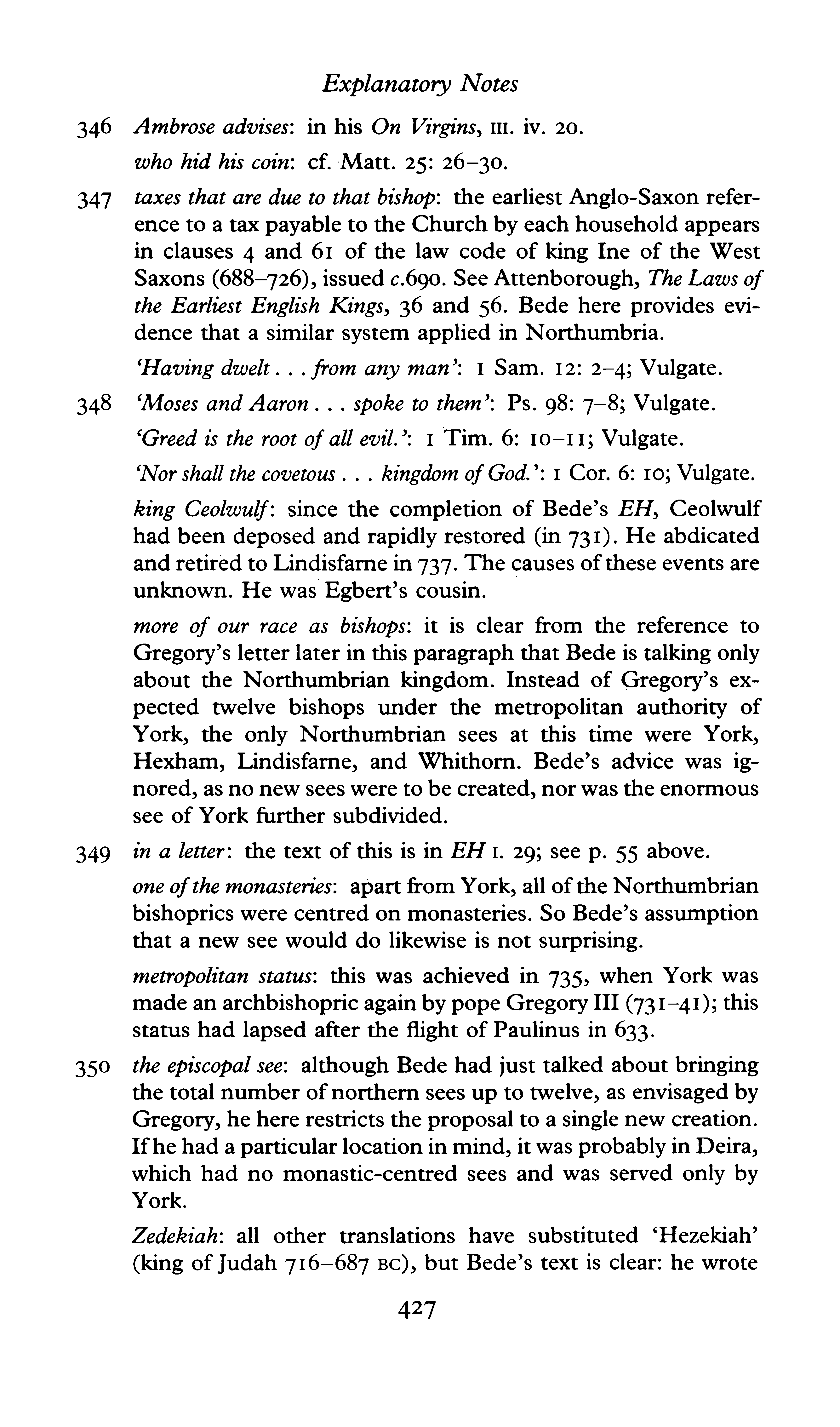
Explanatory Notes
Ambrose advises: in his On Virgins, m. iv. 20. w/m hid his coin: cf. Matt. 25: 26-30.
taxes that are due to that bishop: the earliest Anglo-Saxon refer ence to a tax payable to the Church by each household appears in clauses 4 and 61 of the law code of king Ine of the West
Saxons (688-726), issued c.690. See Attenborough, The Laws of the Earliest English Kings, 36 and 56. Bede here provides evi dence that a similar system applied in Northumbria.
'Having dwelt. . .from any man': I Sam. 12: 2-4; Vulgate.
'Moses and Aaron . . . spoke to them Ps. 98: 7-8 ; Vulgate.
'Greed is the root of all evil.': 1 Tim. 6: 10 -11; Vulgate.
'Nor shall the covetous . . . kingdom of God.': 1 Cor. 6: 10; Vulgate. king Ceolwulf: since the completion of Bede's EH) Ceolwulf had been deposed and rapidly restored (in 731). He abdicated and retired to Lindisfame in 737. The causes of these events are unknown. He was Egbert's cousin. more of our race as bishops: it is clear from the reference to Gregory's letter later in this paragraph that Bede is talking only about the Northumbrian kingdom. Instead of Gregory's ex pected twelve bishops under the metropolitan authority of York, the only Northumbrian sees at this time were York,
Hexham, Lindisfame, and Whithorn. Bede's advice was ig nored, as no new sees were to be created, nor was the enormous see of York further subdivided.
in a letter: the text of this is in E H 1. 29; see p. 55 above. one of the monasteries: apart from York, all of the Northumbrian bishoprics were centred on monasteries. So Bede's assumption that a new see would do likewise is not surprising. metropolitan status: this was achieved in 735, when York was made an archbishopric again by pope Gregory III (731-4 1); this status had lapsed after the flight of Paulinus in 633.
the episcopal see: although Bede had just talked about bringing the total number of northern sees up to twelve, as envisaged by Gregory, he here restricts the proposal to a single new creation.
If he had a particular location in mind, it was probably in Deira, which had no monastic-centred sees and was served only by York.
Zedekiah: all other translations have substituted 'Hezekiah'
(king of Judah 716 -6 8 7 bc), but Bede's text is clear: he wrote
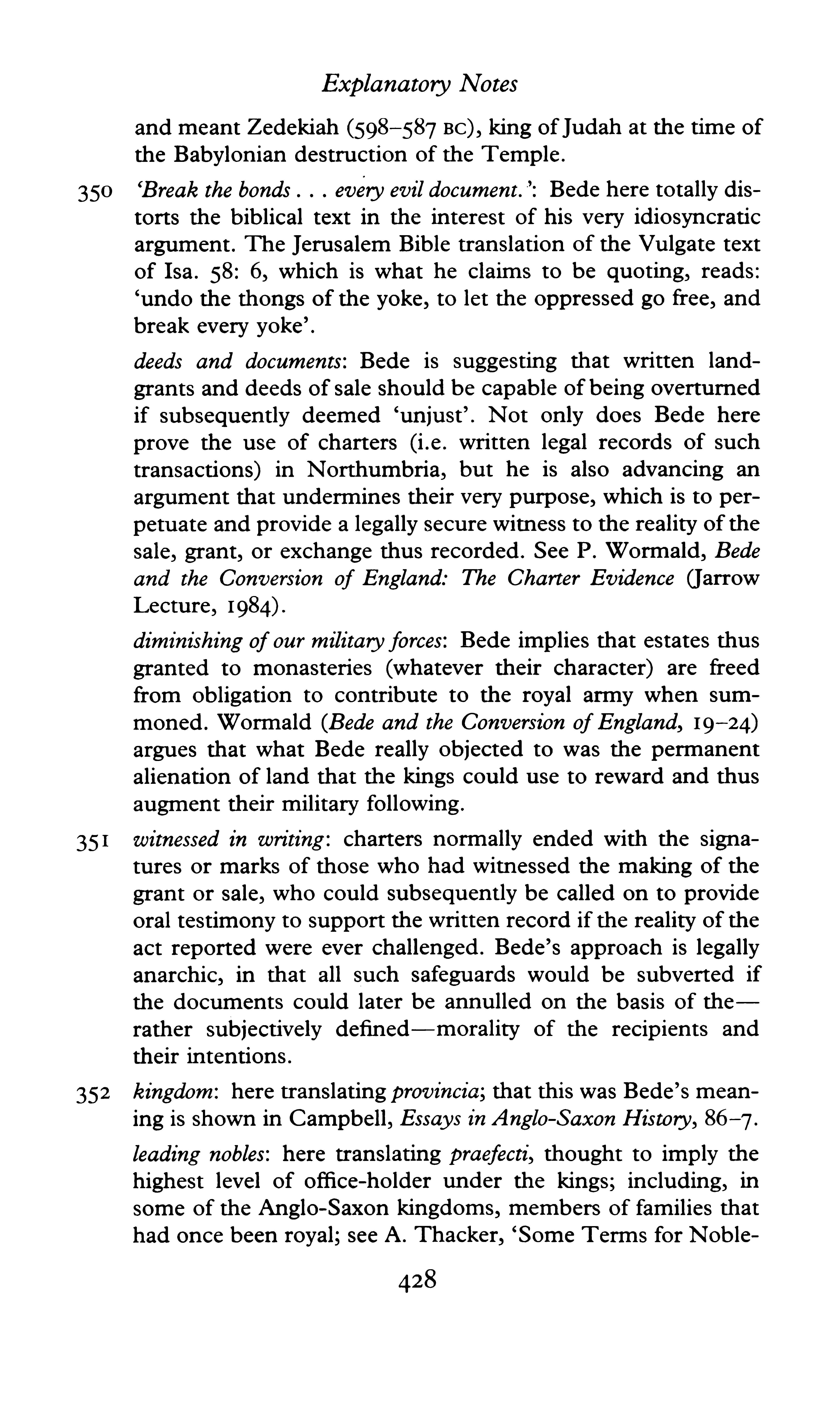
Explanatory Notes and meant Zedekiah (598-587 bc), king of Judah at the time of the Babylonian destruction of the Temple.
'Break the bonds. . . every evil document.
Bede here totally dis torts the biblical text in the interest of his very idiosyncratic argument. The Jerusalem Bible translation of the Vulgate text of Isa. 58: 6, which is what he claims to be quoting, reads:
'undo the thongs of the yoke, to let the oppressed go free, and break every yoke' . deeds and documents'. Bede is suggesting that written landgrants and deeds of sale should be capable of being overturned if subsequently deemed 'unjust' . Not only does Bede here prove the use of charters (i.e. written legal records of such transactions) in Northumbria, but he is also advancing an argument that undermines their very purpose, which is to per petuate and provide a legally secure witness to the reality of the sale, grant, or exchange thus recorded. See P. Wormald, Bede and the Conversion of England: The Charter Evidence (Jarrow
Lecture, 1984). diminishing of our military forces: Bede implies that estates thus granted to monasteries (whatever their character) are freed from obligation to contribute to the royal army when sum moned. Wormald (Bede and the Conversion of England, 19-24) argues that what Bede really objected to was the permanent alienation of land that the kings could use to reward and thus augment their military following.
witnessed in writing: charters normally ended with the signa tures or marks of those who had witnessed the making of the grant or sale, who could subsequently be called on to provide oral testimony to support the written record if the reality of the act reported were ever challenged. Bede's approach is legally anarchic, in that all such safeguards would be subverted if the documents could later be annulled on the basis of the— rather subjectively defined— morality of the recipients and their intentions.
kingdom: here translating prcwmcm; that this was Bede's mean ing is shown in Campbell, Essays in Anglo-Saxon History, 86-7. leading nobles: here translating praefecti, thought to imply the highest level of office-holder under the kings; including, in some of the Anglo-Saxon kingdoms, members of families that had once been royal; see A. Thacker, 'Some Terms for Noble
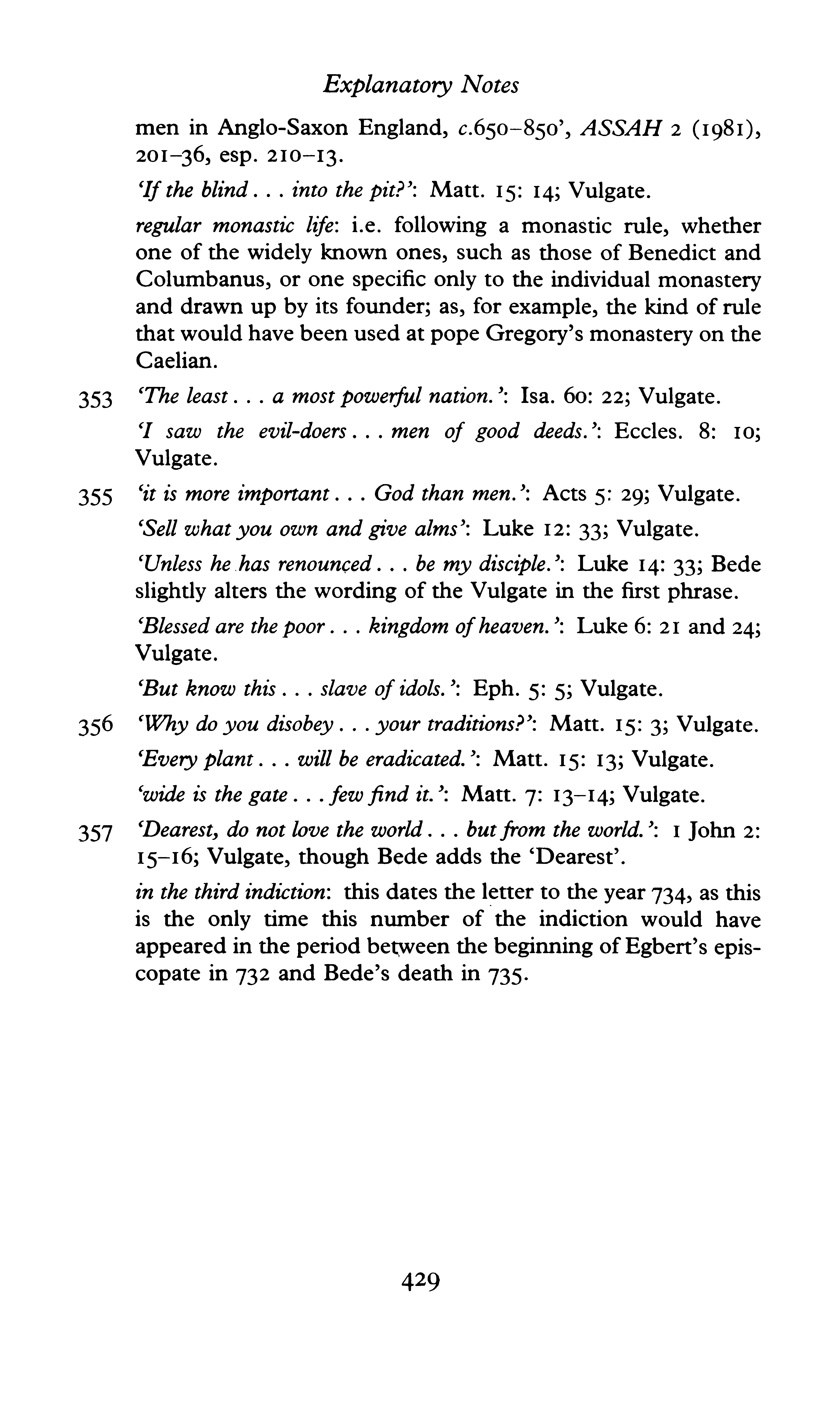
Explanatory Notes men in Anglo-Saxon England, c.650-850', A S S A H 2 (1981), 201-36, esp. 2 10 -13 .
'If the blind. . . into the pit?': Matt. 15: 14; Vulgate. regular monastic life: i.e. following a monastic rule, whether one of the widely known ones, such as those of Benedict and Columbanus, or one specific only to the individual monastery and drawn up by its founder; as, for example, the kind of rule that would have been used at pope Gregory's monastery on the Caelian.
'The least. . . a most powerful nation.
Isa. 60: 22; Vulgate.
7 saw the evil-doers. . . men of good deeds.
Eccles. 8: 10; Vulgate.
'it is more important. . . God than men/: Acts 5: 29; Vulgate.
'Sell what you own and give almsy: Luke 12: 33; Vulgate.
'Unless he has renounced. . . be my disciple/: Luke 14: 33; Bede slightly alters the wording of the Vulgate in the first phrase.
'Blessed are the poor. . . kingdom of heaven.
Luke 6: 21 and 24; Vulgate.
'But know this . . . slave of idols.
Eph. 5: 5; Vulgate.
'Why do you disobey. . . your traditions?': Matt. 15: 3; Vulgate.
'Every plant. . . will be eradicated/: Matt. 15: 13; Vulgate.
'wide is the gate. . . few find it.
Matt. 7: 13 -14 ; Vulgate.
'Dearest, do not love the world. . . but from the world.
1 John 2:
15 -16 ; Vulgate, though Bede adds the 'Dearest'. in the third indiction: this dates the letter to the year 734, as this is the only time this number of the indiction would have appeared in the period between the beginning of Egbert's epis copate in 732 and Bede's death in 735.

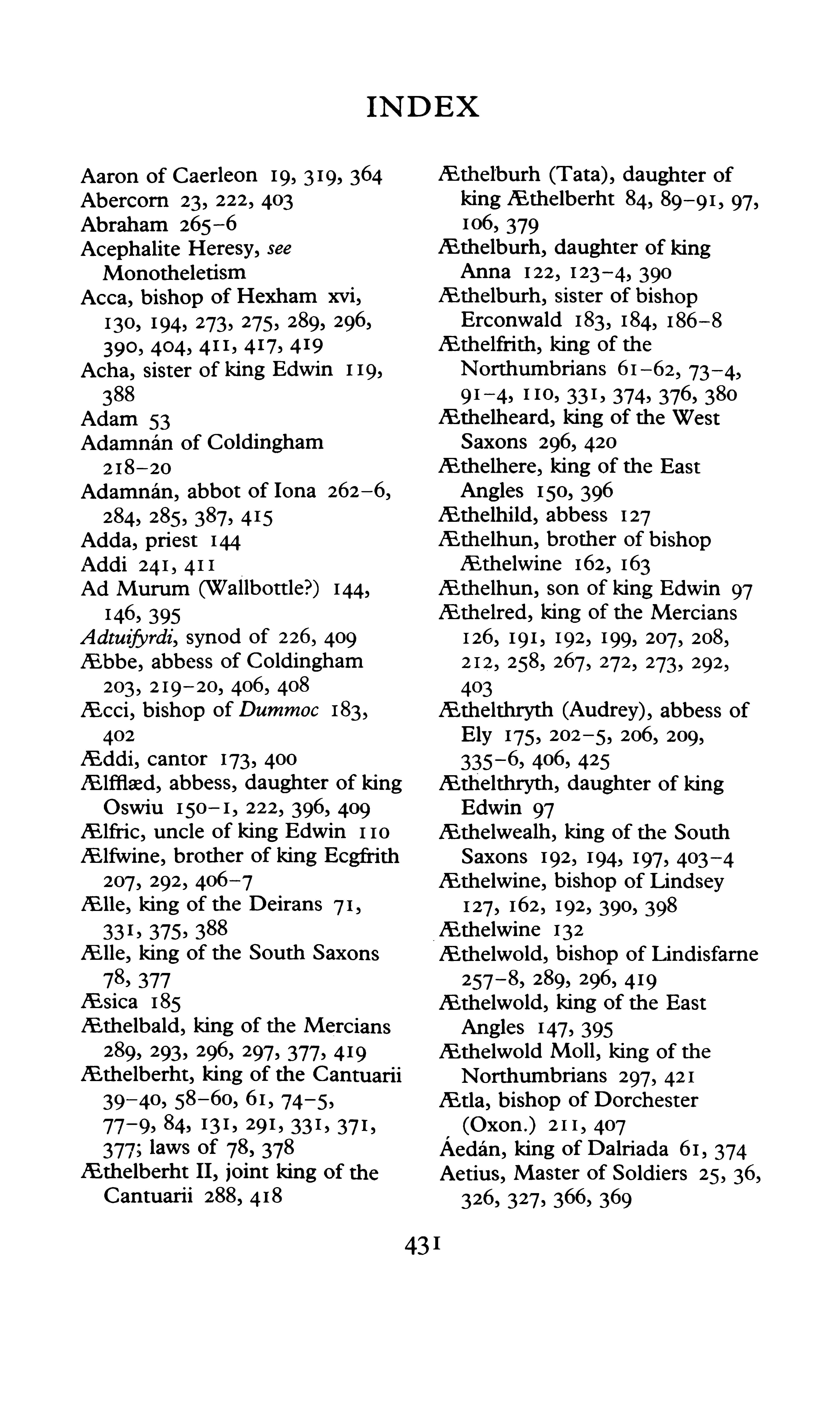
INDEX Æthelburh (Tata), daughter of Aaron of Caerleon 19, 319, 364 Abercom 23, 222, 403 Abraham 265-6 Acephalite Heresy, see king Æthelberht 84, 89-91, 97, 106, 379 Æthelburh, daughter of king Anna 122, 123-4, 390 Æthelburh, sister of bishop Monotheletism Acca, bishop of Hexham xvi, Erconwald 183, 184, 186-8 Æthelfrith, king of the 130, 194, 273, 275, 289, 296, 390, 404, 411, 4!7> 419 Acha, sister of king Edwin 119, Northumbrians 61-62, 73-4, 9 1-4 , no, 331, 374, 376, 380 Æthelheard, king of the West
Adam 53 Adamnan of Coldingham Saxons 296, 420 Æthelhere, king of the East 218-20 Adamnan, abbot of Iona 262-6, Angles 150, 396 Æthelhild, abbess 127 Æthelhun, brother of bishop 284, 285, 387, 415 Adda, priest 144 Addi 241, 4 11 Ad Murum (Wallbottle?) 144, Æthelwine 162, 163 Æthelhun, son of king Edwin 97 Æthelred, king of the Mercians 146, 395 Adtuifyrdi, synod of 226, 409 Æbbe, abbess of Coldingham 126, 191, 192, 199, 207, 208, 212, 258, 267, 272, 273, 292,
Æthelthryth (Audrey), abbess of 203, 219-20, 406, 408 Æcci, bishop of Dummoc 183, Ely 175, 202-5, 206, 209, 335-6 , 406, 425 Æthelthryth, daughter of king
Æddi, cantor 173, 400 Ælfflæd, abbess, daughter of king Oswiu 15 0 -1, 222, 396, 409 Ælffic, uncle of king Edwin n o Ælfwine, brother of king Ecgfrith Edwin 97 Æthelwealh, king of the South Saxons 192, 194, 197, 403-4 Æthelwine, bishop of Lindsey 207, 292, 406-7 Ælle, king of the Deirans 71, 127, 162, 192, 390, 398 Æthelwine 132 Æthelwold, bishop of Lindisfame 331> 375> 388 Ælle, king of the South Saxons 78, 377 Æsica 185 Æthelbald, king of the Mercians 257-8, 289, 296, 419 Æthelwold, king of the East Angles 147, 395 Æthelwold Moll, king of the 289, 293, 296, 297, 377, 419 Æthelberht, king of the Cantuarii Northumbrians 297, 421 Ætla, bishop of Dorchester 39-40, 58-60, 61, 74 -5, 77-9 , 84, 131, 291, 331, 371, 377; laws of 78, 378 Æthelberht II, joint king of the (Oxon.) 211,4 0 7 Âedân, king of Dalriada 61, 374 Aetius, Master of Soldiers 25, 36, Cantuarii 288, 418 326, 327, 366, 369 4 3 1
Index Africa io, 155, 170, 314, 323, 3 3 1-2 , 419, 425 Anatolius, bishop of Laodicaea 325, 328, 329, 332, 336 Agatha, St 206 Agatho, pope xi, 200, 201, 271, xiv, 1 13, 157, 158, 294, 317, 385 Andelys-sur-Seine, monastery at
Andhun, king of the South 272, 3345> 404-5 Agatho, priest 154 Agilbert, bishop of the West Saxons 197 Andrew, monk 170 -1 Andrew, St, monastery of in Saxons/Paris 120 -1, 154, 155, 159, 163, 171, 190, 270, 388-9,
Agnes, St 206, 320 Agricola, Pelagian bishop 29, 369 Aidan, bishop of Lindisfame Rome 65, 75, 375, 376 Angles/and Saxons xx, 27-8, 70 -1, 326, 328, 332, 339, 367 Angles, East 27, 78, 98, 99, 120,
1 13 -14 , 116 -19 , I32~4>
1356, 137, 152, 153» 160, 164, 210, 2 1 1, 225, 287, 292, 385 Alans 21, 322, 323, 325 Alaric, Gothic king 21, 324 Alban, St 16 -19 , 32, 34, 3i9> 122, 138, 139, 142, 147, 150, 175, 181, 183, 199, 205, 210,
Angles, Middle 27, 144, 145, 146, 151, 179, 212, 292, 394 Anglesey, island of 84 Anglo-Saxon Chronicle xxiv, 377, 364» 369 Albinus, abbot xvii, xxvi, 3, 4, 389, 403, 409, 421 Angus (Oengus), king of the Piets 275> 358-9 Alcuin xv, 299, 413, 414 Aldfrith, king of the 297, 420 Anna, king of the East Angles Northumbrians 222, 237, 244, 257, 262, 263, 266, 272, 274, 293j 352, 409 Aldgisl, king of the Frisians 271, 120, 122, 139, 147, 150, 202, 335s 392 Aquila 156 Aquileia 21, 323; synod of 337 Arabs 288, 336, 339-40, 418, 428 Arcadius, emperor 21, 322, 323,
Aldhelm, bishop of Sherborne 266-7, 4°2, 416 Alexandria 263, 279, 282, 3 15 -
Arculf, Frankish bishop 263, 415 Arianism 20, 199, 200, 320, 322, 16, 317, 3i9> 321, 327» 329 Alhflaed, Mercian queen 144 Alhfrith, king of the Deirans 131, 325, 328, 330, 335, 364 Arles 22, 38, 41, 46, 54, 17 1, 370, 144, 154, 163, 270, 391, 394, 396, 398 Alhred, king of the 372, 373 Armorica 10, 36, 362 Arwald, king of the Victuarii 198 Asterius, bishop of Genoa (recte Northumbrians 298, 421 Allectus, emperor 15, 363 Ain, river 226 Alric, king of the Cantuarii 288 Alwih, bishop of Lindsey 296, Milan) 119 Attila, king of the Huns 25, 326 Augustine, archbishop of Canterbury xxx, 37-56, 57-8, 59, 6 0-1, 7 1 -3 , 74, 75-6, 81, 102, 225, 291, 331, 349, 370, 372, 375 Augustine, bishop of Hippo xvi,
Ambrose, St xvi, 301, 346, 427 Ambrosius Aurelianus, RomanoBritish ruler 28-9, 328, 368
Anastasius the Persian, St 295, xxviii, 21, 294, 325, 340, 365
Index Augustine's Oak 71, 375 Augustus, emperor 37, 307 292, 419 Berhtwald, archbishop of Canterbury Bemicia, kingdom of the Badon, battle of 29, 368 Baduthegn, monk of Lindisfame Bemicians xxx, 98, no, 112, 230 -1 Baduwine, bishop of Elmham 1 15, 132, 151, 191, 262, 374,
Bertha, Frankish queen of the 183, 402 Baetân, Irish bishop 104 Baldhildis, wife of Clovis II 270, Cantuarii 39, 371 Betti, priest 144 Beverley (In Silva Derorum), 3% 417 Bamburgh 119, 129, 135, 391 Bangor-is-Coed, monastery at monastery of 244, 411 Birinus, bishop of the West Saxons 119, 190, 388 Bisi, bishop of the East Angles 72, 74, 375-6 Bardney, monastery of 126, 390 Barking, monastery of 184-9, 181, 183, 401 Blaecca 99, 382 Blædla (=Bleda), king of the
Barrow [?], monastery at 174, 183, 401 Basil, St 9, 361 Bass 106 Bebba, Northumbrian queen Huns 25, 326, 366 Bliththryth (=Plectrudis), wife of Pippin II 252 Boisil, prior of Melrose 223, 224, 226, 247, 248, 361, 412, 413 Boniface IV, pope 77, 331, 376 Boniface V, pope 81, 83-4, 1 19, 135, 387-8 Bede: his life ix, xii-xvi, 293, 299-303, 419, 429; his works xvi-xxi, 294-5; his De 879, 89-91, 378, 379 Boniface, archbishop of Mainz Temporibus xvii, xxviii-xxix, 137, 295; Old English version of EH xxi Begu, nun of Hackness 2 13 -14 Benedict Biscop, abbot of xxiii, 297, 421 Boniface, archdeacon 269 Bosa, bishop of York 191, 192, 2 1 1, 239, 275, 407, 4 11, 417 Bosel, bishop of the Hwicce 212, Wearmouth x-xii, xiii-xiv, xxi, xxvi, xxix, 200-1, 269, 276, 293, 295, 406 Beornred, king of the Mercians
Bosham, monastery at 193 Bothelm, monk of Hexham 1 12 -13 Boulogne 9, 61 Bradwell-on-Sea ( Ythanccestir) 297, 421 Beomwine, cleric 197-8 Berht, Northumbrian noble 221,
Berhtfrith, Northumbrian noble
Bredon-on-the-Hill, monastery of 289, 419 Breguswith, mother of Hild 293, 419 Berhtgisl (Boniface), bishop of 2 12 -13 'Bretwalda' 376-78 'Bridius', see Bruide Brie, see Faremoutier Britain 9-22, 41, 92, 130, 164, the East Angles 143, 183, 393 Berhthun, abbot of Beverley 237-41 Berhthun, king of the South Saxons 197 Berhtred, Northumbrian noble 170, 171, 172, 192, 198, 201,
Index Britain (com.):
I59> 163, 164, 178, 360, 395,
Celestine, pope 25, 291, 325, 335 Cenrèd, king of the Mercians 202, 247, 251, 252, 263, 270, 276, 283,309,310, 318 ,323,
British bishops 7 1 -3 Britons, the 10-22, 23-36, 258-60, 267, 273-4, 292, 293,
Cenred, king of the 7 1-2 , 76 -7, 78, 84, 105, h i , 124, 125, 155, 164, 222, 262, 266, 287, 290, 324-5, 325-6, 328, 332, 362, 415 Brittany, see Armorica Brocmail, British ruler (?) 74 Bructeri (.Boruhtware), the 247, Northumbrians 286, 288, 289,
Cenwealh, king of the West Saxons 120, 121, 190, 388, 403 Ceolfrith, abbot of Jarrow and of Wearmouth x, xi, xiii, xix, 200, 276-86, 293, 295, 339, 406 Ceollach, bishop of the Middle 252, 412 Bruide son of Mâelchü, Pictish Angles and the Mercians 145, king 1 15 Burgh Castle, see Cnobheresburg Burghelm, priest 193 Burgundy 99 15i>394 Ceolred, king of the Mercians 267, 293, 416 Ceolwulf, king of the Northumbrians 3, 288, 296, 348, 358, 418, 427 Ceorl, king of the Mercians 97, Caedmon, poet 2 15 -18 Cædwalla, king of Gwynedd 105, no, 384 Cædwalla, king of the West
Cerdic, king of Elmet 212, 408 Chad, abbot and bishop 4, 149, Saxons 191, 197, 244-5, 246, 292, 403, 404, 4 11 Cælin (Ceawlin), brother of 152, 163, 164, 172, 174-9» 270, 292, 360, 397, 399, 401, 402 Chalcedon, Council of (ad 451) Cedd and Chad 148, 149 Caerleon 19 Caesar, Caius Julius 12 -13 , 22, 200, 335, 404 Charlemagne, Frankish emperor
Campania 170 Cambodunum 98, 380-1 Candidus, priest 38, 371 Canterbury, city of 40, 41, 60-1, xxiii, xxvii Charles Martel, Frankish Mayor 297, 420 charters xxxi, 428 and cf. 350 -1 Chelles, monastery of 122, 210, 82, 102, 170, 372; monastery of Sts Peter and Paul (later St Augustine's) x, xxvi, 61, 75, 78, 81, 172, 173, 246, 358 Carausius, emperor 15, 363 Carlisle 228 Carloman, Frankish Mayor 297 Catterick 98, 106, 132 Ceawlin, early West Saxon king 389, 407 Chertsey, monastery of 184, 402 Chester 73 Chlotar III, Frankish king 398 Cilicia 171, 400 Claudius, emperor 13 -14 , 290, 309, 310, 363 Clement, pope 76 Clofceshohy synod of 182, 401 Clovis II, Frankish king 143, 389, 78, 377 Cecilia, St 206, 252 Cedd, bishop of the East Saxons
Clyde, river 23 4, 144, 146, 147, 148-9, 154,
Index Cnobheresburg 139, 393 Coifi, high priest 95, 96 Coldingham, monastery of 203, Jarrow xiii, xv, xviii, 299-303, 4 21-2 Cuthbert, bishop of Lindisfame 218 -2 1 Colman, bishop of Lindisfame xv-xvi, 5, 221, 223-33, 236-7, 295» 337» 361, 408, 409-10,
Cuthred, king of the West Saxons 153» 154» 155» 157» 158, 159» 160, 161, 170, 179, 292, 397 Cologne 251, 413 Columba, founder of Iona 297» 420 Cuthwin 300, 421 Cwenburh, wife of king Edwin 1 14 -15 , 157, 158, 159, 248, 284, 291, 386 Columbanus, Irish abbot 77, 376 Columbanus (Colman), bishop of
Cwenburh, daughter of abbess Hereburh 239-40 Cwichelm, king of the West Clonard 104 comets 191, 288, 292, 293, 403, Saxons 85, 379 Cwichelm, bishop of Rochester
Compiègne 163 Constans, Caésar 22 Constans II (also known as
Cyneberht, abbot of Redbridge 198, 404 Cyneberht, bishop of Lindsey 4, Constantine III), emperor 200, 332 -3, 400 Constantine I, emperor 20, 59, 192, 289, 296, 361, 420 Cynebill, brother of Chad and 264, 318, 319-20, 335, 364, 3734» 385» 424 Constantine III, emperor in the Cedd 148, 149 Cyneburh, wife of king Alhfrith 144» 394 Cynefrith, physician 204 Cynegils/Cynegisl, king of the West 2 1-2 , 365 Constantine IV, emperor 334, 335» 400 Constantine, pope 267, 338, West Saxons 119, 120, 379, 388 Cynemund, priest 134 Cynewise, queen of the Mercians
Constantinople, city of xii, xxvi, 150, 396 Cynewulf, bishop of Lindisfame 66, 67, 199, 200, 201, 263, 317, 320, 322, 328, 330, 331, 335, 336, 337» 338, 339-40; 1st Council of (a d 381) 199-200; 2nd Council of (ad 553) 200; 3rd Council of (ad 680-1) 335» 405 Constantius I, emperor 20, 318, 296, 420 Cynewulf, king of the West Saxons 297, 421 Cyril, bishop of Alexandria 282 Dacre, river, monastery on the 232-3, 410 Dagan, Irish bishop 76-7, 376 Dagobert I, Frankish king 106,
Constantius (III) 22 Crônan, bishop of Nendrum 104 Crönan, abbot of Moville 104 Cunningham, region 253, 414 Cuthbald, abbot 274 Cuthbert, archbishop of 384, 388, 393 Dalfinus (recte Aunemund), bishop of Lyons 154, 269, 270,
Dalreudini, the 11,36 2 Dalriada 11,36 5 Damascus 263 Canterbury 296, 420 Cuthbert, abbot of Wearmouth-
Index Damian, bishop of Rochester Eadberht, joint king of the Cantuarii 288 Eadberht, king of the r43> !73> 394 Daniel, bishop of Winchester 4, 198, 266, 267, 289, 360, 416 Danes, the 247 David 52, 350, 374 Dearmach (Durrow), monastery Northumbrians 296, 297, 420 Eadberht, Mercian noble 152 Eadfrith, son of king Edwin 97,
Eadgisl, monk 221 Eadhæd, bishop of Lindsey and of 1 15 Deda, abbot of Partney 100 Degsastan, battle of 6 1-2 , 291, ofRipon 164, 192 Eadric, king of the Cantuarii 222 Eafa, Mercian noble 152 Eafe (Eaba), South Saxon queen
Deira/kingdom of the Deiri xxx, 71, 98, no, 132, 148, 151, 191, 237> 374. 384
Denisebum, battle of i n , 385 Derwent, river (Cumbria) 85, 193. 403
Ealberht, bishop of Dommoc 289 Ealdwine, abbot of Partney 127 Ealdwine, bishop of Lichfield 228, 409 Derwent, river (Yorks.) 96 Deusdedit, pope 81, 378 Deusdedit, archbishop of 289, 419 Ealdwulf, bishop of Rochester 288, 289 Ealdwulf, king of the East Angles Canterbury 143, 164, 170, 173, 393. 399
Dicuill, abbot of Bosham 193 Dicuill, priest 142 Dima, Irish bishop 104 Dinoot, abbot of Bangor 72 Diocletian, emperor 14, 15-16 , 199, 210, 405 Eanflaed, wife of king Oswiu 86, 106, 134, 151, 153, 222, 268, 291, 391 Eanffith, king of the Bemicians no, h i , 384 Eanffith, king of the Hwicce 193 Eanhere, brother of Eanffith 193 Eanred 297, 420 Eappa, abbot of Selsey 193, 195 Eamwine 296 Easter, see Paschal Controversy Eata, bishop of Hexham 160, 318, 363 Dionysius Exiguus 282-3, 329 Diuma, bishop of the Mercians 144, 145, 151, 394 DommoCi see of 99, 382, 402 Dorchester (Oxon.) 12 0 ,2 11,38 8 Dryhthelm, vision of 253-8 Dumbarton 22-3 Dunchad, abbot of Iona 287, 191, 192, 223, 224-5, 227, 237, 247. 398
Ebroin, Neustrian Mayor of the
Dunnichen, battle of 221, 408 Durham, church of xiv, xv-xvi Palace 171, 172, 400 Ecgffith, king of the Northumbrians xi, 150, 164, Eadbald, king of the Cantuarii 180, 191, 192, 199, 200, 202, 203, 207, 221, 222, 223, 226, 227, 237, 271, 292, 336, 396,
Ecgric, king of the East Angles 79, 81, 82, 83, 84-5, 91, 106, 122, 292, 378 Eadberht 196 Eadberht, bishop of Lindisfame 152, 229, 230, 397, 410 Eadberht, bishop of the South 138, 392 Eddi 193 Edgar (Eadgar), bishop of Saxons 267
Index Lindsey 192 Edith (Eadgyth), nun 185 Edwin, king of the Eudoxius, Arian patriarch of Constantinople 200 Eulalia, St 206 Euphemia, St 206 Eusebius of Caesarea xviii, xxviii, Northumbrians 78, 84-9, 9 1-4 , 94-8, 100, 10 1-2, 105-6, no, 1 19, 124, 132, 134, 151, 210, 291, 332, 375, 379, 384» 388 Egbert, bishop of York xiv, 317» 319» 327» 358, 385» 397 Eutropius, Roman historian 20,
Eutyches, monophysite 200, 327, xxix-xxxi, 296, 298, 343-57, 420, 426 Egbert, king of the Cantuarii 328, 335» 404 Eutychius, patriarch of Constantinople 67, 330 164, 170, 171, 183, 222, 223, 288, 292, 399 Egbert, monk and bishop 116, Fara, abbess 122 Faremoutier-en-Brie, monastery 162-3, i78, 22 1-2 , 247-9, 286-7, 288, 293, 339, 387, 412 Egypt 278, 279, 280, 281, 282, of 122, 389 Fame island 135, 230, 236, 237 Faro, bishop of Meaux 171, 400 Felix IV, pope 65, 375 Felix, bishop of the East Angles
Elafius, British ruler 35 Eleutherius, pope 290 Elmet 98, 381 Ely, monastery of 203-4, 205, 99, 138, 143, 153, 38 1-2 ,
Felix, Life of St 295 Finan, bishop of Lindisfame 336, 406 Emme, bishop of Sens 171, 400 Eni, father of king Anna 139 Eolla, bishop of the South Saxons 136, 144, 145, 146, 152, 153, 160, 161, 391 Foillân, brother of Fursa 142,
Eomer 85-6 Eorcenberht, king of the
Forthere, bishop of Sherborne 267, 289, 416 Forthere, Northumbrian noble Cantuarii 122, 170, 203, 268, 292, 389 Eorcengota 12 2 -3 Eormenric, father of king
Franks/Francia xi, xxvi, xxvii, 15, 21, 122, 171, 249, 251, 297, 367» 389 Frigyth, mm 214 Frisians/Frisia xxiii, xxvii, 209, Æthelberht 78 Eorpwald, king of the East Angles 98, 138, 381, 392 Eosterwine, abbot of Wearmouth 247, 249, 251, 252, 271, 336, 367, 407, 412 Frithuberht, bishop of Hexham xi, xiii Ephesus, Council of (ad 431) 296, 298 Frithuwold, bishop of Whithorn 200, 335 Erchinoald, Neustrian Mayor of the Palace 143, 393 Erconwald, bishop of London Emene, Irish abbot 104 Esi, abbot 4, 360 Etherius, bishop of Lyons 38, 41,
Fursa, abbot 139-43» 392 Gateshead, monastery of 144 Gaul 2 1-2 , 106, 171, 173, 210, 263, 269, 270, 273, 291, 318, 54» 370 -1
Index Saxons 120, 191, 266, 388 Hæmgisl, priest 257, 415 Hœthfelth, battle of 165 Hamble, river 198 Hartlepool, monastery at 151, Gaul (com.):
321, 323; see also Franks/ Francia Gefmund, bishop of Rochester 191» 403 Geraint, king of Cornwall 416 Germani, the 247, 412 Gerontius, Master of Soldiers 2 10 -11 Hatfield, Council of 199-200, 292, 405 Hathulac, bishop of the East
Germanus, bishop of Auxerre Anglians 289 Heavenfield, battle of 111 -12 , 29-36, 327» 369 Germany 247 Gewisse, the 80, 119, 120, 121,
Heiu, abbess 211 Helena, mother of Constantine I 197, 198, 270, 378 Gildas xxv, 36, 360, 364, 365,
Hengist 27, 78 Heraclius, emperor 103, 332, 383 Heraclius Constantine, emperor 366-7, 368, 424 Gilling, monastery of 132, 15 1-2 , 391 Giudi urbs 22, 365 Gobân, Irish priest 142 Godwin (=Godinus), bishop of 103» 332 Heracleonas, emperor 103, 332 Herbert, priest 228-9, 4°9 Herebald, abbot 242-4 Hereburh, abbess 239 Herefrith, priest 297, 420 Heretic, father of Hild 210, 212 Hereswith, East Anglian queen Lyons 246, 412 Goodmanham 96, 380 Goths, the 21, 291, 317, 322, 323, 325, 328, 329, 330 Grantaccestir 203-4 Gratian, emperor 20, 291, 322, 210, 407 Hertford, Council of 180-3, 292, 323>364 Gratian, emperor in Britain 21 Greek 170, 172, 247, 275, 288,
Hewald the Black 249-51 Hewald the White 249-51 Hexham, monastery and see of 312, 318, 339 Gregory the Great, pope xvi,,xx, 112, 191, 192, 211, 223, 227, 237» 239» 289 Hiddila, priest 198 hides 84, 152, 197, 379, 396 Higebald, abbot 178 Hilarus, archpriest 104 Hild, abbess of Whitby 151, 154,
XXX» 34» 379» 4 1-6 1,
65-71» 75» 77» 102, 106, 173, 225, 269, 275, 291, 329, 330, 331» 344» 349» 358, 359» 37<>» 372, 373» 374» 375» 387» 407» 415, 426, 427, 429 Gregory II, pope xxvi, 245, 338, 360, 412 Guthfrith, abbot of Lindisfame 210 -14, 292, 407 Hildelith, abbess 188, 402 Hiridanum (Nindanum?), 236-7 Gyrwe, the 143, 183, 202, 393 monastery of 170, 399 Hlothere, king of the Cantuarii Hackness, monastery of 213, 408 Hadrian, abbot x, 3, 170 -1, 172, 183, 199, 209, 222, 292, 401 Honorius, archbishop of 274, 288, 334, 359, 399-400 Hædde, bishop of the West Canterbury 99, 100, 101, 1023, 106, 131, 143, 153, 381 4 3 8
Index Honorius, emperor 2 1-2 , 25, 324 Honorius I, pope 100-3, 106, James the Deacon 106-7, J53 Jarrow, monastery of St Paul 1 19, 269, 332, 382 Horsa 27 Hrethgar (=Lul, bishop of ix-xv, xxii, xxvi, xxviii, xxxi, 276, 293, 299 Jaruman, bishop of the Mercians Mainz) 297, 421 Hrof 75 Humber, river xx, 39, 75, 78, 84, 152, 167, 174, 397 Jerome xvi, xxviii, 323, 325, 339, 361, 378, 423» 424 Jerusalem 263, 310, 311, 314, 99, 132, 289, 331 Huns, the 25, 247, 322, 326 H unwold 132 Hwætberct, abbot of Wearmouth315» 327» 331 Jews 1 16, 137, 155-6, 300-1, 310, 3 11, 312 Job 66-7, 68 John, bishop of Arles 171, 400 John, primicerius and vicegerent Jarrow xi, xvi, xxiii, 295 Hwicce, the 71, 193, 212, 289, 375 Ibbas, bishop of Edessa 200 Ida, king of the Bemicians 291, of Rome 104 John the arch-chanter xi, 200-2,
Idle, battle of the river 94, 380 Imma 208-10, 407 Immin, Mercian noble 152 Ine, king of the West Saxons 292, 405, 406 John of Beverley, bishop of Hexham 211, 237-44, 4° 7»
John the Evangelist, St xviii, 155, 197, 245, 404 Infeppingum 145, 394 Ingwold, bishop of London 289, 157» 238, 301, 3 1 0 - 11 John IV, pope 103, 104-5, 332,
John VI, pope 272, 334, 337 Jones, C. W. xxvii-xxviii, xxxii Josephus xxix Julian, bishop of Eclanum 21, 297, 419 Inishboffin, monastery of 179 interpreters 39, 114, 155, 397 Iona, monastery of 114, 116, 145, 179, 248, 263, 285, 286, 287, 293» 384» 385 Ireland, Irish 10, 1 1 -1 2 , 22-3,
Julius, martyr 19, 319, 364 Justinian I, emperor 114, 200, 26, 6 1-2 , 78, 103-5, no, 1 13, 1 14, 1 15, 1 16, 1 17, 120, 130,
136, 139» M2, 145» 151» 152,
153, 154, 159, 160, 161, 162, 163, 164, 178, 179, 219, 221, 247, 248, 249, 257, 262, 268, 270, 271, 286, 289-90, 291, 292, 324, 325, 332, 362, 365, 386, 408, 426 Isaiah 148, 165, 294, 350, 353, 329, 335 Justinian II, emperor 245, 336, 337-8 Justin II, emperor 114, 329-30,
Justus, archbishop of Canterbury 55, 74, 75, 76, 80 -1, 82-4,
85, 99» I02» 106, 291, 332,
Jutes, the 27, 198
Isidore of Seville xxv, xxviii, 301, Kaiserwerth, monastery of 252 Kent (Cantia) 27, 39, 42, 61, 74,
Italy xxiii, xxvi, xxvii, 10, 323 Ithamar, bishop of Rochester 75» 77» 78, 84, 98, 106, 107, 122, 123, 138, 153, 163, 164, 173, 181, 191, 199, 203, 209, 13 1-2 , 391
Index Kent (Cantia) (com.) xv, 297; see also Hrethgar Lupus, bishop of Troyes 29, 30, 212, 222, 225, 251, 268, 269, 275, 289, 291, 292, 293,367 Kinneil 23 Kyle, plain of 297, 421
Lyons x, 269, 323, 370 Maban, chanter 275 Macedonius, Arian patriarch of Lagny, monastery of 143, 393 Laisréne, Irish abbot 104 languages, the four 10, 118, Constantinople 200 Malmesbury, monastery of 266 Man, Isle of 84 manuscripts xx-xxiv, xxvii, 36 1-2 Lastingham, monastery of 4, xxix-xxx Marcian, emperor 26-7, 36, 291, 148-9, 163, 174, 175, 271, 360 Latin 10, 118, 170, 172, 247, 275, 326, 335> 367 Marcus Aurelius, emperor 14, 288, 312, 324, 335, 339 Laurence, archbishop of
Mark the Evangelist, St xvi, 279 Marly, synod of 405 Marseille 171 Martin, bishop of Tours 41, 78, Canterbury 41, 75-7, 80 -1,
Leeds (Loidis), region of 98, 151,
Lérins, monastery of x Leuthere, bishop of the West 1 15, 202, 386 Martin I, pope 200, 201, 333-4 martyrologies 295 Martyrs, the Four Crowned 82, Saxons 121, 181, 190-1, 389,
Liber Pontificalis xxv-xxvi Lichfield 174, 289 Life of Ceolfrid, anon, x and n. 1,
mattins 247, 413 Maurice, emperor 37, 38, 55, 56, xiii Lilia, Northumbrian noble 86 Lincoln 99, 102 Lindisfame, monastery of xiv, xv, 57, 60, 69, 330, 331, 370, 375 Maximian, emperor 15-6 , 318,
Maximus, emperor 20 -1, 291, 5, 1 13, 129, 136, 146, 152, 160i, 179, 191, 223, 224, 226, 227,
236, 237, 259, 268, 289, 358 Lindsey, kingdom of 4, 99, 126, 323> 364 Mayo, monastery at 179-80 Mcelmin 98, 380 Meaux 273 Mellitus, archbishop of 127, 151, 162, 174, 178, 179, 192, 289, 382, 403 Littleborough (Tiowulfingaccestir) Canterbury 55, 56 -7, 74 -5, 76, 77> 79-80, 8 1-2 , 145, 291, 331 Melrose, monastery of 160,
Liudhard, Frankish bishop 39,
London 4, 55, 74, 75, 81, 121, 223-4, 247, 253 Meonware 192, 404 183, 189, 191, 209, 289, 297,
33 L 373> 376, 407
Lucius, mythical British king 14, Mercia/the Mercians xx, xxi, 27, 105, 120, 121, 124, 126, 131,
!35> 136, 138, 144» I45> 150»
151, 152, 167, 174, 179, 181, 191, 192, 199, 207, 251, 258, 267, 289, 292, 293, 296, 297 Michael the Archangel 237, 273
290, 312, 362 Luke the Evangelist, St xvi, 309,
Lui, bishop/archbishop of Mainz
Index Monophysitism 200, 404, 405 Monotheletism 201, 333-4 , 400, Osric, king of the Hwicce 212 Osric, king of the Northumbrians 404-5 Morini, the 9 Moses, laws of 155-6, 157, 277 Mynors, Sir Roger xx, xxi, xxii 288, 293, 391, 418 Osthryth, Mercian queen 126, 127, 207, 292, 390 Oswald, king of the Northumbrians xv, xxi, 78, 97, Naples 170, 330, 359 Nechtan(Naitan), Pictish king 105, i n , 1 12, 1 13-14 , 1 17, 118 -19 , 120, 124» 148, 150, 292, 385» 387, 388, 404; miracles of 124 -31, 14 5-7 Oswine 297, 421 Oswine, king of the Deirans xix, 276-86 (Ceolfrid's letter to), 417 Nero, emperor 14, 15, 309-10 Nestorius, patriarch of i323> 15 1-2 , 292, 391 Oswiu or Oswy, king of the Constantinople 200, 335 Nicaea, First Council of (ad 325) 104, 157, 199, 319, 335, 364 Nidd, synod of the river 274 Northumbrians, the 4, 5, 78, 84, Northumbrians x, 78, 126, 132, 134, 144, 145, 149-51» 152, 154-9, 160, 163, 164, 165-6, 170, 174, 180, 222, 270, 292, 377» 390» 396» 398 Oswulf, king of the 85, 97, 10 0 -1, 105, 120, 145, 148, 149, 154, 160, 161, 170, 191, 195, 199, 210, 237, 266, 289, 290, 291, 292, 293, 296, 332; see also Bemicia and Deira Nothelm, archbishop of Northumbrians 297 Oundle, monastery at 268, 274 Owine, monk 175-6 Canterbury xvii, xxvi, 4, 296, 359-60, 379 Nynia/Ninian, bishop at Padda, priest 193 Pcegnalcech, monastery of 161, Whithorn 115,38 6
Palladius, bishop 25, 291, 325, Octa 78 Oeric 78 Oethelwald, hermit 236-7 Oethelwald, king of the Deirans
pallium 55-6 , 83, 101, 102, 103,
Panera(tiu)s, St 166 Pantheon, the 77, 3 11, 331 Paris 270 Partney, monastery of 100, 382 Paschal controversy xiv, xix-xx, 131, 148, 150, 391, 395 Offa, king of the East Saxons 267-8, 4 16 -17 Offa, king of the Mercians 297,
Oftfor, bishop of the Hwicce 7 1-3 , 103-5, 1 13» 115 -16 , 137-8, 153-9» 164, 165, 181, 262-3, 266-7, 269, 270, 276-86, 287-8, 293, 312, 313, 329» 332, 339» 375» 383» 384»
Paul, St 75, 155, 156, 166, 171, 2 1 1, 212, 407 Oisc/Oiscingas 78, 378 Orkney islands 13, 290, 309 Osfrith, son of king Edwin 97, 105, 106 Osred, king of the 300, 309, 316, 319, 320, 322, 328, 344, 345, 404 Paulinus, archbishop of York 55, Northumbrians 266, 274, 286, 293, 416, 4 17 -18 Osric, king of the Deirans 110
84-6, 91, 94-8, 99-100, IOI,
4 4 1
Index Paulinus (corn.):
Quentovic, port of 172 106, no, 131, 153, 210, 291, 292, 296 Paulinus of Nola 295 Peada, king of the Middle Angles Radbod, king of the Frisians 249* 413 Rathmelsigi, monastery of 162, 398 Ravenna 36 Rædffith 17 1-2 Rædwald, king of the East Angles and Mercians 144, 152, 292, 394» 396 Pehthelm, bishop of Whithorn 260, 266, 289, 415 Pelagianism 21, 29 -31, 34-6, 78, 9 1-4, 98-9, 138, 377-8, 381, 392 Reculver, monastery at 246, 412 Redbridge, monastery of 198 Regenhere, son of Rædwald 94 Rendlesham 147, 395 Rhine, river 21, 250, 251 Ricberht, king of the East Angles 104, 324, 327, 332, 364-5* 384* 387* 424 Penda, king of the Mercians 105, 120, 135, 136, 138, 139, 144, 145, 149-50, 152, 292,
pepper 302, 423 Péronne, monastery of 143 Peter, St 69, 76, 80, 89, 91, 97,
Richborough 9 Ricule, queen 74 Ripon, monastery and see of xi, 103, 1 19, 152, 155, 157, 159, 166, 178, 200, 222, 238, 241, 244, 245, 268, 274, 279, 283-4, 285, 319* 320, 322, 328, 330, 333* 336, 353* 404 Peter, abbot 41, 61 Peter, Roman deacon 66 Peterborough, monastery of 154, 164, 192, 236, 268, 270, 274* 397 Rochester, town and see of 75, 81, 106, 13 1-2 , 143, 173, 181, 191, 247, 288, 289, 292 Romanus, bishop of Rochester 83, 106 Romanus, priest 153 Rome, city of x-xii, xxiv-xxv,
Phocas, emperor 62, 69, 77, 331, xxvi, 70, 71, 76, 77, 107, 154,
Piets, the 10, 1 1 -1 2 , 22-3, 26, 155* 156, 164, 170, 171, 180, 191, 192, 200, 201, 202, 212, 244, 246, 247, 251, 252, 267, 268, 269, 271, 275, 279, 291, 292, 313* 314* 315* 319-20, 321, 322, 323-4, 326, 328, 330, 332, 334* 338* 339* 401 Rome, synods of 271, 272-3, 28, 33, 78, no, 1 13, 1 14-15* 152, 155, 163, 174, 192, 221, 222, 248, 271, 276, 286, 289, 291, 292, 293, 296, 297, 324, 325, 362, 369, 386, 396 Pippin II, Frankish Mayor 249, 251, 252, 413 Pippin III, Frankish king 297, 330, 333-4 Ronan, Irish priest 153, 397 Rufinianus 55 Rugi, the 247
plague 161, 170, 195 Plegwine, monk xxix Plummer, C. xx-xxi, xxii, St Albans (Verulamium) 19 Sæberht, king of the East Saxons xxix -xxx, xxxii Prosper 21, 365 Puch 240 Putta, bishop of Rochester 173, 74-5, 79, 291 Sæthryth, daughter of king Anna
181, 191, 401
Index Samaritans 98 Saracens, see Arabs Saran, Irish cleric 104, Sigehere, king of the East Saxons 166, 167, 183, 267, 399 Sigffith, abbot of Wearmouth xi,
Satan 65, 261 Saxons, continental xxiii, 15, 27, xiii Sillan, Irish bishop 104 Simon Magus, tonsure of 284 Sinai, mount 52 slavery 117, 209, 387 Solent, the 198 Spain xxiii, xxviii, 9, 11 Stamford (Unes.) 270 Stephen, St 123, 124, 261, 308, 247, 250, 252, 367-8 Saxons, East 4, 27, 74 -5, 145, 149, 166-7, 183, 189, 267, 289,
Saxons, South 4, 27, 78, 143, 192, 193, 195, 198, 222, 267, 271, 289 Saxons, West 4, 27, 71, 78, 85, 324> 326 Stephen III, pope 297, 421 Stone (ham) 198, 404 Suevi, the 21 Surrey (Sudergeona regio) 184 Sutton Hoo 381 Swæfheard, king of the Cantuarii 86, 1 19 -21, 143, 154, 164, 181, 19 0 -1, 197, 266, 289, 296, 297; see also Gewisse Seaxbald, king of the East Saxons
Seaxburh, abbess of Ely 122, 203,
Swæfred, king of the East Saxons 390, 407 Seaxwulf, bishop of the Mercians 190, 402 Swale, river 98 Swithberht, abbot 232 Swithberht, bishop among the 183, 191, 192 Sebbi, king of the East Saxons 166, 183, 189-90, 399, 402 Sedulius 267 Ségéne, abbot of Iona 104, 116, Bructeri 251, 414 Swithelm, king of the East
Selsey, monastery and see of Saxons 147, 166, 395 Symmachus, consul 25 Syria 13 -14 194, 267, 296, 420 Sergius, pope 244, 245, 251, 252, Tadcaster? (Kcelcacastir) 211, 407 Tarsus 171 Tatfrith, bishop elect of the 336, 337? 4 11 Severianus, Pelagian bishop 29 Severinus, pope 103, 104, 332,
Severus, bishop of Trier 35 Severus, emperor 14 -15 , 22, 24, Hwicce 212 Tatwine, archbishop of Canterbury 289, 293, 296, 4 18 - 29i> 3i3> 362 Sigeberht, king of the East Angles
Tewdwr, British king 297, 420 Thames, river 12 -13 , 74, 420 Thanet, Isle of 39-40 Theda, St 206 Theodbald, brother of king 99, 138, 139, 381, 392 Sigeberht the Saint, king of the East Saxons 145-7, 394 Sigeberht the Small, king of the East Saxons 145, 395 Sigeferth (Sigga), bishop of Æthelfrith 62 Theodore of Mopsuestia 200 Theoderet of Cyrus 200, 327 Theodore of Tarsus, archbishop Selsey 296, 420 Sigeheard, king of the East of Canterbury x, 3, 75, 121, Saxons 190, 402 4 4 3
Index Theodore of Tarsus {com.):
Tyne, river 237 Tynemouth, monastery of 242 Tytil, son of Wufa 99 152, 17 1-3 , 174, i79> 180-3, 191, 192, 199-200, 207, 212, 226, 227, 239, 246, 251, 274-5, 288, 292, 334, 359, 397, 400, 402 Theodosius I, emperor 20 -1, Ultân, Irish hermit 142, 393 Uscffea, son of king Edwin 97,
Utrecht 252 Utta, abbot of Gateshead 134, 322-3, 364 Theodosius II, emperor 25, 282, 324, 325, 326, 366 Theophilus of Alexandria 282 Thomas, bishop of the East 144, 391, 394 Valens, emperor 20, 321, 322 Valentinian II, emperor 20 -1, Angles 143, 393 Thrythred, abbot 232-3 Thrythwulf, abbot 98 Tiberius Constantine, emperor 322, 323 Valentinian III, emperor 26-7, 36, 291, 325, 326, 367, 369,
vallum, see walls, Roman Vandals 21, 323, 325, 328, 329 Venantius Fortunatus, bishop of 67, 33°, 375 Tilbury 146 Tilmon, monk 250-1 Tiowulfi ngaccestir 100 Titill, notary 182 Tobias, bishop of Rochester 247, Poitiers 16, 363 Vergilius, bishop of Arles 54, 373 Vespasian, emperor 14, 309-10, 288, 412 Tolkien, J.R.R. 415
Tômine, Irish bishop 104 Tondberht of the South Gyrwe
Victuarii (inhabitants of the Isle of Wight) 4 Virgil, Roman poet 206, 406, 408,
Tondhere 132 tonsure xix, 154, 171, 253, 410, 414 Vitalian, pope x, 165, 170, 171, 283-5, 297» 398 Torhtgyth, nun 187 Tours 202 Trent, river 100, 152; battle on 274, 334, 359, 399 Vortigem 26, 27, 78, 367 Waldhere, bishop of London 189, 402 walls, Roman 15, 22, 23-4, 112, 207-8 Trumberht, monk 177 Trumhere, bishop of the Middle 146, 291, 313, 324-5, 365-6,
Wantsum, river 39 Ware, Sir James xxix Wealhstod, bishop beyond the Angles and Mercians 145, 151, 152, 167, 394, 397 Trumwine, bishop of the Piets 192, 222, 226, 403 Tuda, bishop of Lindisfarne 160, Severn 289 Wear, river 210 Wearmouth, monastery of St
tufalthuf 100, 382 Tunberht, bishop of Hexham Peter ix-xv, xxii, xxv, xxvi, xxviii, xxxi, 200, 276, 293, 299 Wecta, son of Woden 27 192, 227 Tunna, abbot 208 Wetadun, monastery of 239 Whitby (Streanceshalch), Tunnaccestir 208 Tweed, river 223, 253 4 4 4
Index monastery of 151, 210 -14 , 215, 292, 409 Whitby, Synod of 153-9 , 222, 130, 249, 251, 252, 271, 336, 413-14 Winchester, see of 120, 121, 197,
Whithorn (Ad Candidam Casam) 267, 289 Wine, bishop of the West Saxons 1 15, 289, 386-7 Wigheard, archbishop elect of 121, 164, 190, 389 Winffith, bishop of the Mercians Canterbury x, 164-5, 170 Wight, Isle of 4, 27, 192, 197-8, 152, 179, 181, 183, 397 Winwced, battle of the 150, 396 Witta, father of Wihtgisl 27 Woden 27, 368 Wuffa/Wuffingas 99, 381 Wulfhere, king of the Mercians 2 7 1-2 , 289, 310, 367 Wihtberht, hermit 248-9, 413 Wihtgisl, father of Hengist 27,
Wihtred, king of the Cantuarii 121, 145, 152, 167, 174, 179, 192, 292, 390, 397 223, 246, 288, 293, 409 Wilbert, scribe 302 Wilfarcesdun 132, 391 Wilfrid, bishop of York x, xi, Yant, river 246, 412 Yeavering 97, 380-1 Yffi, grandson of king Edwin 97, xxix, 130, 154, 155-7, i58-9> 163, 164, 173, 174, 180, 181, 191, 192, 193-4* 197* 202, 203, 204, 2 11-12 , 229, 238-9, 244, 251, 267, 268-74, 275, 292, 398, 401, 403, 410, 4 1 1, 417 Wilfrid II, bishop of York 289,
York, city and see of xiv, xxx, 15, 56, 97, 102, 105-6, 131, 163, 174, 191, 192, 2 1 1, 212, 226, 239, 244, 270, 272, 275, 289, 291, 292, 313, 318, 331, 332, 349* 383* 427 296, 297, 407, 419, 420 Wilfrid, bishop of the Hwicce
Willibrord, bishop of the Frisians Zedekiah, king 350, 427-8

A S E L E C T I O N O F
O X F O R D W O R L D ' S C L A S S I C S
Bhagavad G ita The Bible Authorized King James Version With Apocrypha D ham m apada Dharm asutras The Koran The Pancatantra The Sauptikaparvan (from the M ahabharata) The Tale o f Sinuhe and Other Ancient Egyptian Poems U panisads A nselm of C anterbury The M ajor Works T HOMAS A quinas Selected Philosophical W ritings A ugustine The Confessions On Christian Teaching B ede The Ecclesiastical History Hemacandra The Lives o f the Jain Elders K älidäsa The Recognition o f Sakuntalä M anjhan M adhum alati Säntideva The Bodhicaryàvatàra
A S E L E C T I O N O F
O X F O R D W O R L D ' S C L A S S I C S
The A nglo-Saxon World B eow ulf Lancelot o f the Lake T h e Paston Letters Sir G aw ain and the Green Knight Tales o f the Elders o f Ireland York M ystery Plays G eoffrey C haucer T h e C anterbury T ales Troilus and Criseyde H enry of Huntingdon T h e H istory o f the English People 1000-1154 J ocelin OF B rakelond Chronicle o f the A bbey o f B ury St Edm unds G uillaume de L orris The Romance of the Rose and J ean de M eun W illiam L angland Piers Plow m an S ir T homas M alory L e M orte D arth ur
A S E L E C T I O N O F
O X F O R D W O R L D ' S C L A S S I C S
THOMAS A quinas Selected Philosophical Writings F rancis Bacon The Essays Walter Bagehot The English Constitution G eorge Berkeley Principles o f H um an Knowledge and Three Dialogues Edmund Burke A Philosophical Enquiry into the Origin o f
Our Ideas o f the Sublim e and Beautiful Reflections on the Revolution in France C onfucius The Analects / __ _ E mile D urkheim The Elem entary Form s o f Religious Life
F riedrich E ngels The Condition o f the Working Class in England J ames G eorge F razer The Golden Bough S igmund F reud The Interpretation o f Dream s THOMAS Hobbes H um an Nature and De Corpore Politico Leviathan J ohn Hume Selected Essays N iccolo M achiavelli The Prince
T HOMAS M ALTHUS
An Essay on the Principle o f Population K arl M arx Capital The Com m unist M anifesto J. S. M ill On Liberty and Other Essays Principles o f Political Econom y and Chapters on Socialism F riedrich N ietzsche Beyond Good and Evil The Birth o f Tragedy On the Genealogy o f M orals Tw ilight o f the Idols
A s e l e c t i o n O F
O X F O R D W O R L D ' S C L A S S I C S
J ane A usten Em m a M ansfield Park Persuasion Pride and Prejudice Sense and Sensibility M rs Beeton Book o f Household M anagem ent L ady Elizabeth L ad y Audley's Secret Braddon A nne Brontë The Tenant o f W ildfell Hall C harlotte Brontë Jane Eyre Shirley Villette E mily Brontë Wuthering Heights S amuel T aylor The M ajor Works C oleridge Wilkie C ollins The Moonstone No N am e The W oman in White C harles Darwin The Origin o f Species C harles D ickens The Adventures o f Oliver Tw ist Bleak House David Copperfield Great Expectations Nicholas Nickleby The Old Curiosity Shop Our M utual Friend The Pickwick Papers A Tale o f Two Cities G eorge du M aurier T rilby M aria E dgeworth Castle Rackrent
A S E L E C T I O N O F
O X F O R D W O R L D ' S C L A S S I C S
G eorge Eliot Daniel Deronda The Lifted Veil and Brother Jacob M iddlem arch The M ill on the Floss Silas M arner S usan F errier M arriage E lizabeth G askell Cranford The Life o f Charlotte Brontë M ary Barton North and South Wives and Daughters G eorge G issing N ew Grub Street The Odd W om an T HOMAS Hardy Far from the M adding Crowd Jude the Obscure The M ayor o f Casterbridge The Return o f the Native Tess o f the d'Urbervilles The Woodlanders William Hazlitt Selected W ritings J ames Hogg The Private M em oirs and Confessions o f a Justified Sinner J OHN K eats The M ajor Works Selected Letters f C harles M aturin M elm oth the Wanderer Walter S cott The Antiquary Ivanhoe Rob Roy M ary S helley Frankenstein The L ast M an
A S E L E C T I O N O F
O X F O R D W O R L D ' S C L A S S I C S
Robert L ouis Kidnapped and Catriona S tevenson The Strange Case o f D r Jekyll and M r Hyde and Weir o f H erm iston Treasure Island Bram S toker D racula W illiam M akepeace Vanity Fair T hackeray Oscar W ilde Com plete Shorter Fiction The M ajor Works The Picture o f Dorian G ray D orothy W ordsworth The Grasm ere and Alfoxden Journals William W ordsworth The M ajor Works
A S E L E C T I O N O F
O X F O R D W O R L D ' S C L A S S I C S
Women's W riting 1778—1838 W illiam Beckford Vathek J ames Boswell Lifeo fjo h n son F rances Burney C am illa Cecilia Evelina The Wanderer L ord C hesterfield Lord Chesterfield's Letters J ohn C leland M em oirs o f a W oman o f Pleasure D aniel Defoe A Journal o f the Plague Year M oll Flanders Robinson Crusoe Roxana Henry F ielding Joseph Andrews and Sham ela A Journey from This World to the Next and The Journal o f a Voyage to Lisbon Tom Jones William G odwin Caleb W illiam s Oliver G oldsmith The Vicar o f Wakefield M ary Hays M em oirs o f Em m a Courtney E lizabeth Haywood The History o f M iss Betsy Thoughtless E lizabeth Inchbald A Sim ple Story S amuel J ohnson The History o f Rasselas The M ajor Works C harlotte L ennox The Fem ale Quixote M atthew L ewis Journal o f a West India Proprietor The Monk Henry M ackenzie The M an o f Feeling Alexander Pope Selected Poetry
A S E L E C T I O N O F
O X F O R D W O R L D ' S C L A S S I C S
A nn Radcliffe The Italian The M ysteries o f Udolpho The Rom ance o f the Forest A Sicilian Rom ance S amuel Richardson Pam ela F rances S heridan M em oirs o f M iss Sidney Bidulph Richard Brinsley The School for Scandal and Other Plays S heridan T obi as S mollett The Adventures o f Roderick Random The Expedition o f H um phry Clinker Travels through France and Italy L aurence S terne The Life and Opinions o f Tristram Shandy, Gentlem an A Sentim ental Journey J onathan S wift Gulliver's Travels A Tale o f a Tub and Other Works Horace Walpole The Castle o f Otranto M ary W ollstonecraft M ary and The Wrongs o f Woman A Vindication o f the Rights o f Woman
M O R E A B O U T
OXFORD WORLD'S CLASSICS
The www.worldsclassics.co.uk Oxford • Information about new titles World S
• Explore the full range of Oxford World's ^, • Classics Classics • Links to other literary sites and the main
Website OUP webpage • Imaginative competitions, with bookish prizes • Peruse the Oxford World's Classics Magazine • Articles by editors • Extracts from Introductions • A forum for discussion and feedback on the series • Special information for teachers and lecturers www.worldsclassics.co.uk
M O R E A B O U T
OXFORD WORLD'S CLASSICS
American Literature British and Irish Literature Children's Literature Classics and Ancient Literature Colonial Literature Eastern Literature European Literature History Medieval Literature Oxford English Drama Poetry Philosophy Politics Religion The Oxford Shakespeare A complete list of Oxford Paperbacks, including Oxford World's Classics,
Oxford Shakespeare, Oxford Drama, and Oxford Paperback Reference, is available in the U K from the Academic Division Publicity Department, Oxford
University Press, Great Clarendon Street, Oxford 0x2 6dp.
In the USA, complete lists are available from the Paperbacks Marketing Manager, Oxford University Press, 198 Madison Avenue, New York, ny 10016.
Oxford Paperbacks are available from all good bookshops. In case of difficulty, customers in the UK can order direct from Oxford University Press Bookshop,
Freepost, 116 High Street, Oxford ox 1 4BR, enclosing full payment. Please add 10 per cent of published price for postage and packing.