Front matter

OXFORD WORLD'S CLASSICS
THE ECCLESIASTICAL HISTORY
OF THE ENG LISH PEOPLE
B e d e was probably born in Bernicia, the northern component of the Kingdom of the Northumbrians, around the year 673. Nothing is known of his parents. At the age of 7 he entered the recently founded monastery of St Peter at Wearmouth, and was ordained a priest c. 703. By about 710 he had begun writing a series of commentaries on various books of the Old and New Testaments, and he undertook his first hagiographical commissions in the same period. His work as historian began with his compilation of chronicle sections to form part of works that he wrote on the divisions of time. He completed writing his best-known book,
The Ecclesiastical History o f the English People, in 731. His last known work was the letter that he sent to Bishop Egbert of York in 734. He died on 25 May 735. After his death his fame in Britain was matched by the interest in him shown by the Anglo-Saxon missionaries on the Continent, for or by whom many of the sur viving early manuscripts of his works were written. The Viking attacks on Northumbria in the ninth century cut short a growing cult of Bede, which was revived in a more limited way after the Norman Conquest.
J u d it h M c C l u r e is Head of St George's School for Girls in Edinburgh and is the author of articles on Bede and on the Latin
Bible in the Early Middle Ages. She is married to her co-editor.
R o g e r C o l l i n s has taught at the University of Liverpool and is currently Research Fellow in the Department of History in the University of Edinburgh. He is the author of several books on early medieval European history. He and Judith McClure are currently writing the first volume of the Oxford History of Medieval Europe.
OXFORD W O R L D ' S CLASSICS
For over too years Oxford World's Classics have brought readers closer to the world's great literature. Now with over joo titles—from the 4,000-year-old myths o f Mesopotamia to the twentieth century's greatest novels— the series makes available lesser-known as well as celebrated writing.
The pocket-sized hardbacks o f the earlyyears contained introductions by Virginia Woolf T. S. Eliot, Graham Greene, and other literaryfigures which enriched the experience o f reading.
Today the series is recognized fo r its fine scholarship and reliability in texts that span world literature, drama and poetry, religion, philosophy and politics. Each edition includes perceptive commentary and essential background information to meet the changing needs o f readers.
OXFORD WORLD'S CLASSICS
BEDE The Ecclesiastical History o f the English People The Greater Chronicle Bede's Letter to Egbert Edited with an Introduction and Notes by
JUDITH McCLURE
and
ROGER COLLINS
OXFORD
U N I V E R S I T Y PRESS
OXPORD
UNIVERSITY PRESS
Great Clarendon Street, Oxford 0x2 6dp Oxford University Press is a department of the University of Oxford.
It furthers the University's objective of excellence in research, scholarship, and education by publishing worldwide in Oxford New York Athens Auckland Bangkok Bogota Buenos Aires Calcutta
Cape Town Chennai Dar es Salaam Delhi Florence Hong Kong Istanbul Karachi Kuala Lumpur Madrid Melbourne Mexico City Mumbai
Nairobi Paris Sào Paulo Singapore Taipei Tokyo Toronto Warsaw with associated companies in Berlin Ibadan
Oxford is a registered trade mark of Oxford University Press in the UK and in certain other countries
Published in the United States by Oxford University Press Inc., New York Text of The Ecclesiastical History © Oxford University Press 1969
Editorial matter and Translation of The Greater Chronicle and Letter to Egbert © Judith McClure and Roger Collins
The moral rights of the author have been asserted Database right Oxford University Press (maker)
First published as a World's Classics paperback 1994 Reissued as an Oxford World's Classics paperback 1999
All rights reserved. No part of this publication may be reproduced, stored in a retrieval system, or transmitted, in any form or by any means, without the prior permission in writing of Oxford University Press, or as expressly permitted by law, or under terms agreed with the appropriate reprographics rights organizations. Enquiries concerning reproduction outside the scope of the above should be sent to the Rights Department,
Oxford University Press, at the address above You must not circulate this book in any other binding or cover and you must impose this same condition on any acquirer
British Library Cataloguing in Publication Data Data available Library of Congress Cataloging in Publication Data
Bede, the Venerable, Saint, 673-735.
[Historica ecclesiastica gentis Anglorum, English] The ecclesiastical history of the English people; The greater chronicle; Bede's letter to Egbert / Bede; edited with an introduction by Judith McClure and Roger Collins.
(Oxford world's classics) Includes bibliographical references and index.
1. England—Church history—449-1066.
2. Civilization, AngloSaxon I. McClure, Judith.
II. Collins, Roger, 1949— III. Title: Ecclesiastical history of the English people.
IV. Title: Greater chronicle.
V. Title: Bede's letter to Egbert.
VI. Series.
BR746.B5
274.2'02—dc20 96-3926
ISBN 0-19-283866-0
Printed in Great Britain by Clays Ltd, St Ives pic
C O N TEN TS
Abbreviations vii Introduction ix Note on the Translations xxxiii Select Bibliography xxxiv Map xxxvi
T H E E C C L E S IA S T IC A L H IS T O R Y OF
T H E E N G L IS H P E O P L E
C U T H B E R T ' S L E T T E R ON T H E D EA T H OF B ED E
29 9
T H E G R E A T E R C H R O N IC L E
B E D E ' S L E T T E R TO E G B E R T
Explanatory Notes
Index

ABBREVIATIONS
A L C Anonymous prose Life o f Cuthbert, tr. B.
Colgrave, in id. (ed.), Two Lives of S t Cuthbert (Cambridge, 1940) A S C Anglo-Saxon Chronicle A S E Anglo-Saxon England
A S S A H
Anglo-Saxon Studies in Archaeology and History A U Annals of Ulster, eds. S. MacAirt and G.
MacNiocaill (Dublin, 1983) C C S L Corpus Christianorum Series Latina C L A Codices Latinae Antiquiores, ed. E. A. Lowe, 11 vols. + supplement (Oxford, 1934-71) C&M B. Colgrave and R. A. B. Mynors (eds.), Bede:
Ecclesiastical History o f the English People (rev. edn.; Oxford, 1991) D T R D e Temporum Ratione E E Bede's Epistle to Egbert; text in P i. 405-23
E H Bede's Ecclesiastical History E H D English Historical Documents, i. 500-1042, tr. D.
Whitelock (London, 1968) E H R English Historical Review H A History o f the Abbots of Wearmouth and Jarrow
(Bede) text in P i. 364-87 H B Historia Brittonum, ed. J. Morris [under the title of Nennius] (Chichester, 1980), 50-84 H E Historia Ecclesiastica (Bede): the Latin text
H R Historia Regum , attributed to Symeon of Dur ham, ed. T. Arnold, Rolls series, lxxv, pt. 2
(London, 1885) L C Life of Ceolfrid; text in P i. 388-404; tr. in E H D 697-708 L W Stephanus' Life of W ilfrid, tr. B. Colgrave, in id.
(ed.), The Life of Bishop W ilfrid (Cambridge, 1927) M GH Monumenta Germaniae Historica
M G H A A
M onum enta Germ aniae Historica, Auctores vii
Abbreviations Antiquissim i
M G H S R G
M onum enta Germ aniae Historica, Scriptores Rerum Germanicarum
M G H S R M
M onum enta Germ aniae Historica, Scriptores Rerum M erovingicarum P Plummer's edition of H E : Venerabilis Baedae
Historiam Ecclesiasticam Gentis Anglorum , ed. C.
Plummer, 2 vols. (Oxford 1896) P L Patrologia Latina P L C Bede's prose Life ofCuthbert, tr. B. Colgrave, in id. (ed.), Two Lives o f S t Cuthbert (Cambridge,
1940) S P. H. Sawyer, Anglo-Saxon Charters (London, 1968) S L H Scriptores Latini Hiberniae T R H S Transactions of the R oyal Historical Society
V L C Bede's verse Life of Cuthbert, in W. Jaager (ed.), Bedas metrische Vita sancti Cuthberti (Leipzig,
1935)j never translated WH J. M. Wallace-Hadrill, Bedels Ecclesiastical History of the English People: A Historical C o m mentary (Oxford, 1988) Vlll
IN TR O D U C TIO N
T H E M AN AND HIS M O N A ST E R Y
Whether as 'the Venomous Bead' of 1066 and All That or through more serious appreciation of his life and work, Bede may fairly be called the best known of all medieval historians who wrote in Britain. His Ecclesiastical History of the English
People, which he completed in 731, has been enjoyed either in its original Latin or in numerous English translations for centuries. It has been seen as the first attempt at a national history, and although this would not have been Bede's real aim, it certainly provides us with most of what can be used to compile a narrative history of the early Anglo-Saxon kingdoms, from the fifth to the mid-eighth centuries. Sites associated with Bede's life have also aroused considerable interest, not least through the growing appeal of popular archaeology, both in books and on television. The church of St Paul's at Jarrow, whose chancel contains much of a build ing dating from Bede's time, receives frequent visitors, and their number will probably expand in the light of the recent development of the site as a museum of early Anglo-Saxon life and culture. It is with Bede's monastery, his home for all but seven years of his life, that it is best to begin a consideration of his work, not least because he has left us considerably more direct information relating to it than he has to himself.
Wearmouth and Jarrow Between completing his Chronicle in 725 and commencing the Ecclesiastical History of 731, Bede wrote an account of the foundation and subsequent history of his own monastery. It is largely thanks to this work, the History of the Abbots of Wearmouth and Jarrow> that we know as much as we do of the setting of Bede's life, and can also understand how such a wealth of resources, especially books, was available for him to draw on throughout his scholarly career. His narrative can
Introduction occasionally be supplemented by references in other sources, and these indicate that his History of the Abbots is perhaps not always impartial. As will also be seen in the case of his
Ecclesiastical History, let alone the Letter to Egbert, the image of Bede as a detached and saintly scholar does less than justice to the complexity of his personality and of his work.
Combining Bede's account in the History of the Abbots with other sources, notably a shorter, anonymous work known as the Life of Ceolfrid, written c.716/17, the history of the foun dation of Wearmouth and Jarrow can be described as fol lows.1 At the age of 25 a Northumbrian noble called Biscop
Baducing (later also known as Benedict) received a gift of land from king Oswy (642-70), probably following a period of personal and military service in the royal household. He then began a series of journeys to Rome that continued almost until his death. The first of these took place around 653, and Biscop was accompanied as far as Lyons by the future bishop
Wilfrid, a detail that Bede does not include.2 The second visit occurred in the 660s, and after some time in Rome Biscop returned to southern France where he became a monk in the once celebrated island monastery of Lérins. After two years he returned to Rome, where he was present at the arrival and death of Wigheard, who had been sent from England to be consecrated archbishop of Canterbury.3 When pope Vitalian chose Theodore to replace Wigheard, he also sent Biscop to accompany him on the journey to England. On their arrival in 669, Biscop took over the vacant abbacy of St Augustine's monastery in Canterbury, but relinquished it on the arrival of the African abbot Hadrian in 670. Soon afterwards Biscop was back in Rome, where he began amassing an impressive collection of books. He eventually returned to England and to Northumbria in 674, when he founded the monastery of 1 For consideration of the possibility that the Life of Ceolfrid was actually written by Bede, as an anniversary sermon, see J. McClure, 'Bede and the Life of Ceolfrid',
Peritia, 3 (1984), 71-84.
2 L Weh. 3, p. 8. Only this source adds the detail of Biscop's family name. For the view that Bede was hostile to the influence of Wilfrid and of his supporters, see
W. Goffart, The Narrators of Barbarian History (Princeton, NJ, 1988), ch. iv: 'Bede and the Ghost of Bishop Wilfrid', 235-328. EH v. 19 mentions Wilfrid's presence.
' On these events, see EH m. 29 and rv. 1.
Introduction Wearmouth on land given him for the purpose by king Ecgfrith (670-85).
To embellish his new foundation he crossed the Channel again in 675 to hire stonemasons in Francia, and he later sent for glaziers, traces of whose work can still be seen at Jarrow.
A fourth visit to Rome in the company of Ceolfrid, in the time of pope Agatho (678-81), led to the acquisition for the mon astery of more books and of some relics and icons. Biscop also brought back with him the papal cantor John, one of whose tasks in England was to give instruction in the performance of the liturgy. A gift of more estates from king Ecgfrith enabled
Biscop to found a sister monastery to Wearmouth at Jarrow in 6§o/i. The church there was dedicated on 23 April 685, as recorded in the inscription that may still be seen in St Paul's church at Jarrow. Biscop placed Ceolfrid, formerly a monk in Wilfrid's monastery at Ripon, in charge of Jarrow, while entrusting Wearmouth to his own cousin Eosterwine. The latter, another Northumbrian noble turned monk, had been involved with the monastery since its inception in 674. Biscop himself returned to Rome for more books and pictures soon after, not returning until 686. By this time Eosterwine had died (7 March 686) from the plague that had just swept
Britain, and Ceolfrid and the Wearmouth monks had elected Sigfrid to succeed him. The failing health of both Sigfrid and Biscop led to the latter appointing Ceolfrid as abbot of both houses on 12 May 688. Sigfrid died on 22 August that year, and Biscop followed on 12 January 689. Ceolfrid remained in office until renouncing the abbacy in 716, to go on a pilgrim age to Rome. Despite the fact that a civil war was raging in northern Francia, he got as far as Langres, where he died. His chosen successor Hwætberct, a former pupil of abbot Sigfrid, was still in office when Bede himself died in 735.
The fragmentary remains of the churches at Wearmouth and Jarrow give an impression of the central feature of the two monasteries, and excavations on the site of Jarrow have re vealed something of its domestic layout.4 Bede's own writ
R. Cramp, 'Monkwearmouth and Jarrow: The Archaeological Evidence' in G. Bonner (ed.), Famulus Christi: Essays in Commemoration of the Thirteenth Cente nary of the Birth of the Venerable Bede (London, 1976), 5-18.
Introduction ings, when analysed for the sources which he drew upon, give an indication of the enormous range of books available in the monastic library in his day, the fruits of Biscop's Continental journeys.5 Whether this library was divided between the two sites or concentrated in one of them is unknown. Equally tangible are some of the products of the scriptorium of the monastery, including at least one manuscript of Bede's own
Ecclesiastical History, and the quality of the script and of the vellum on which most were written gives a striking impression both of the wealth of the house and of the calibre of those teaching the arts of the scribe in it.6 Some of these manu scripts hint at the presence of artists from the Mediterranean, making brief or permanent stays in the monastery, and thus indicate something of the cultural ties linking Northumbria to the Continent and even to the Byzantine or Eastern Roman empire of Constantinople.7
Bede's Life For most of the details known of Bede's life, and there are all too few of them, his own writings are our only source. When composing the final section of his Ecclesiastical History (v. 24), he included a short account of himself. He implies that he was aged 59 at the time. Of the significant events of his life he singles out his entry into the monastery of Wearmouth and Jarrow at the age of 7, and his ordination, firstly as deacon and then as priest, at the ages of 19 and 30 respectively. From information he gives in Book V, it is clear that he finished the work sometime after 10 June 731, but before the end of that year.8 It may be assumed that Bede had entered has fiftyninth year by this time, though his actual fifty-ninth birthday could have fallen in the early months of 732. Therefore, his birth must have occurred in 672/3. This would date his
5 M. L. W. Laistner, 'The Library of the Venerable Bede' in A. Hamilton Thompson (ed.), Bede: His Life, Times and Writings (Oxford, 1935), pp. 237-66.
6 M. B. Parkes, The Scriptorium of Wearmouth-Jarrow (Jarrow Lecture, 1982).
7 P. J. Nordhagen, The Codex Amiatinus and the Byzantine Element in the Northum brian Renaissance (Jarrow Lecture, 1977).
8 EH v. 23; see D. P. Kirby, Bede's 'Historia Ecclesiastica Gentis Anglorum': Its
Contemporary Setting (Jarrow Lecture, 1992), 2-3. xii
Introduction admission to Wearmouth-Jarrow to 679/80, and his ordi nation as priest to 702/3. The more precise date of his death, on Wednesday 25 May 735, can be deduced from the account of his last days given in the letter written by his pupil, the deacon Cuthbert.
Inevitably, historians have sought to add some more flesh, however meagre, to the bare bones of Bede's own testimony.
In particular, a story in the Life of Ceolfrid has been thought to refer to an episode in Bede's early life. In 685/6, as mentioned above, plague devastated the monastic community to which he had been entrusted a few years earlier. The effects were particularly severe in Jarrow, where only the abbot Ceolfrid and a 'young boy' {puerulus) survived. Because it is normally assumed that Bede lived at Jarrow rather than Wearmouth, he must, it is maintained, be the boy in question. In fact the association of Bede with Jarrow in particular is poorly grounded. In his writings, particularly the History of the Abbots, he provides physical descriptions of Wearmouth but never of Jarrow. As the latter was founded only after he had been admitted to the monastery in 679/80, it can only have been at Wearmouth that he was received, and he never indi cates that he was moved to the new site. While stressing the unity of the foundation, he always makes it clear that Wearmouth was the senior of the two components, and it was there that the abbots of the joint monastery were buried.
Indeed, the story of the boy and the plague helps confirm that Bede did not live at Jarrow, in that the word used, puerulus or 'little boy', would not be applicable to the 12or 13-year-old
Bede, who, approaching his legal age of majority at 14, would not have qualified for that diminutive form of the word.
The reasons why Bede has been normally associated with Jarrow rather than with Wearmouth are probably twofold.
First, his statement that he was educated by the abbots Benedict Biscop and Ceolfrid could be taken to imply that he lived at Jarrow, in that Bede here omits reference to abbots
Eosterwine and Sigfrid, who were in charge of Wearmouth for most of the 680s. However, Bede himself makes it clear in his
History of the Abbots that these two were deputies for Benedict Biscop, who although often absent and then ill, remained the Xlll
Introduction sole abbot of the house until his death in 689. His primatial authority then passed to Ceolfrid (d. 716). There were thus only two full abbots of both houses in the period from the foundation of Wearmouth in 674 up to 716: Benedict Biscop and Ceolfrid. The second possible indicator that Bede lived at Jarrow rather than Wearmouth comes from the claim that his bones were discovered in the church of Jarrow in the mid eleventh century and thence translated (by theft) to Durham cathedral.9 As little or nothing is known of the history of either house between the late eighth century and the mid-eleventh, and as most medieval 'discoveries' of relics require to be treated with a fair degree of scepticism, this claim cannot be taken as proving that Bede spent most of his life at Jarrow rather than in its sister house at Wearmouth. His own words would place the probability in the opposite direction, though it is important to note that he always stressed the fundamental unity of the two. Despite the geographical distance between them, he, like their founders, wanted them always to be considered as a single institution.
Few other things can be said with certainty about Bede's life. He does not seem to have travelled much. He certainly visited Lindisfame, where he obtained information for the two versions of his Life of Cuthbert, and in his Letter to Egbert of 734 he reveals that he had studied at the bishop's monas tery (in York?) the previous year. He had also spent some time in the monastery of an otherwise unknown priest called
Wicthed, to whom he sent a letter on the subject of the dating of Easter and on Anatolius' calculation of the equinox.10
Despite the number and wide geographical distribution of his friends and contacts, and, as the Letter to Egbert shows, the ability to speak his mind very freely to a bishop who was the cousin of one king and brother of another, it is notable that Bede never rose beyond the rank of priest. While, as was customary, his family will have given the monastery an en dowment at the time of his entry, his own resources were few,
9 Symeon of Durham, History of the Church of Durham, iii. 7, ed. T. Arnold (Rolls
Series, vol. lxxv, pt. I, 1882), 88; written 1104/9.
10 For the text and discussion, see C. W. Jones (ed.), Bedae Opera de Temporibus
(Cambridge, Mass., 1943), 168-9, 318-25.
XIV
Introduction as the Letter of Cuthbert indicates. Bede himself gives no clue as to the members or the status of his family, and makes no reference to any named relative.
A cult of Bede clearly developed after his death. In the normal fashion of the period his body would have been left buried for a decade or more. In some cases, such as that of Cuthbert, when the tomb was then opened for the washing of the bones, the body inside was found to be in an unusually good state of preservation— probably due to the composition of the soil or the dryness of the site. Such a phenomenon was taken, not least by Bede himself, to be a sign of particular holiness, and this helps to explain Lindisfame's particular veneration for Cuthbert and interest in promoting his cult. In the case of Bede the more usual decomposition would seem to have occurred, but his bones would have been washed— a procedure he himself describes in the case of King Oswald11— and were subsequently venerated as relics. That this did take place is known from the letter sent by abbot Cuthbert of Wearmouth-Jarrow in 764 to Lui, the Anglo-Saxon bishop of Mainz, thanking him for the gift of a silk sheet which he had sent for the wrapping of Bede's relics. At least one miracle is reported to have been performed through these relics. The Northumbrian deacon Alcuin, in his Poem on the Bishops,
Kings and Saints of York of c.781/2, records that 'when a sick man was surrounded by the relics of that blessed father he was completely cured from his illness'.12 There is intrinsically no reason why the cult of Bede should not have developed fur ther, but this would have depended upon the continued sur vival of his own monastic community. Both Wearmouth and Jarrow seem to have been abandoned around the year 800, probably in consequence of Viking raids. The community, unlike that of Lindisfame, was unable to relocate itself and so the cults associated with it fell into abeyance. Not until the eleventh century were Wearmouth and Jarrow restored, and they were quickly brought under the control of the monks of Durham, who already believed they had possession of Bede's
" EH m. ii.
12 Alcuin, Bishops, Kings and Saints of York, ed. and tr. P. Godman (Oxford, 1982), lines 1317-18 , p. 105.
Introduction relics. Whatever the truth of that claim, the cult of Bede was neither allowed nor could hope to compete with that of Cuthbert, the patron saint of the Durham monks and their church.13
W RITINGS
The greater part of Bede's writings consist of commentaries on a variety of books of the Bible, from both Old and New
Testaments. As with most other early medieval exegetes, his method of work was largely one of making extracts from the writings of such recognized earlier authorities as Ambrose (d.
397)? Jerome (d. 419), Augustine (d. 430), and Gregory the Great (d. 604), whom he was the first to call the four 'Fathers of the Church'. There is little that is truly personal in such compositions, though his stated objectives and methods of work can prove revealing of aspects of his thinking and of his society.14 Few of his works give precise indications of their dates of composition; but some of these have been deduced, however roughly, on the basis of internal indicators. The following list is divided up generically, and indicates current views on dating.
I. Biblical commentaries Commentary on the Apocalypse: c.703-9; dedicated to Hwætberct before he became abbot (716).
Commentary on Acts: c.709; dedicated to Acca, bishop of Hexham; later, c.725-31, Bede wrote a Retraction to ac company this work.
Commentary on the Catholic Epistles: date unknown; in terms of extant manuscripts, the most popular of Bede's exegetical works.
Commentary on Luke: c.709-15.
Commentary on Mark: after 716. 15
15 See A. J. Piper, The Durham Monks at Jarrow (Jarrow Lecture, 1986).
14 See e.g. J. McClure, 'Bede's Notes on Genesis and the Training of the AngloSaxon Clergy', in K. Walsh and D. Wood (eds.), The Bible in the Medieval World
(Oxford, 1985), 17-30; also B. Ward, The Venerable Bede (London, 1990), 41-87.
XVI
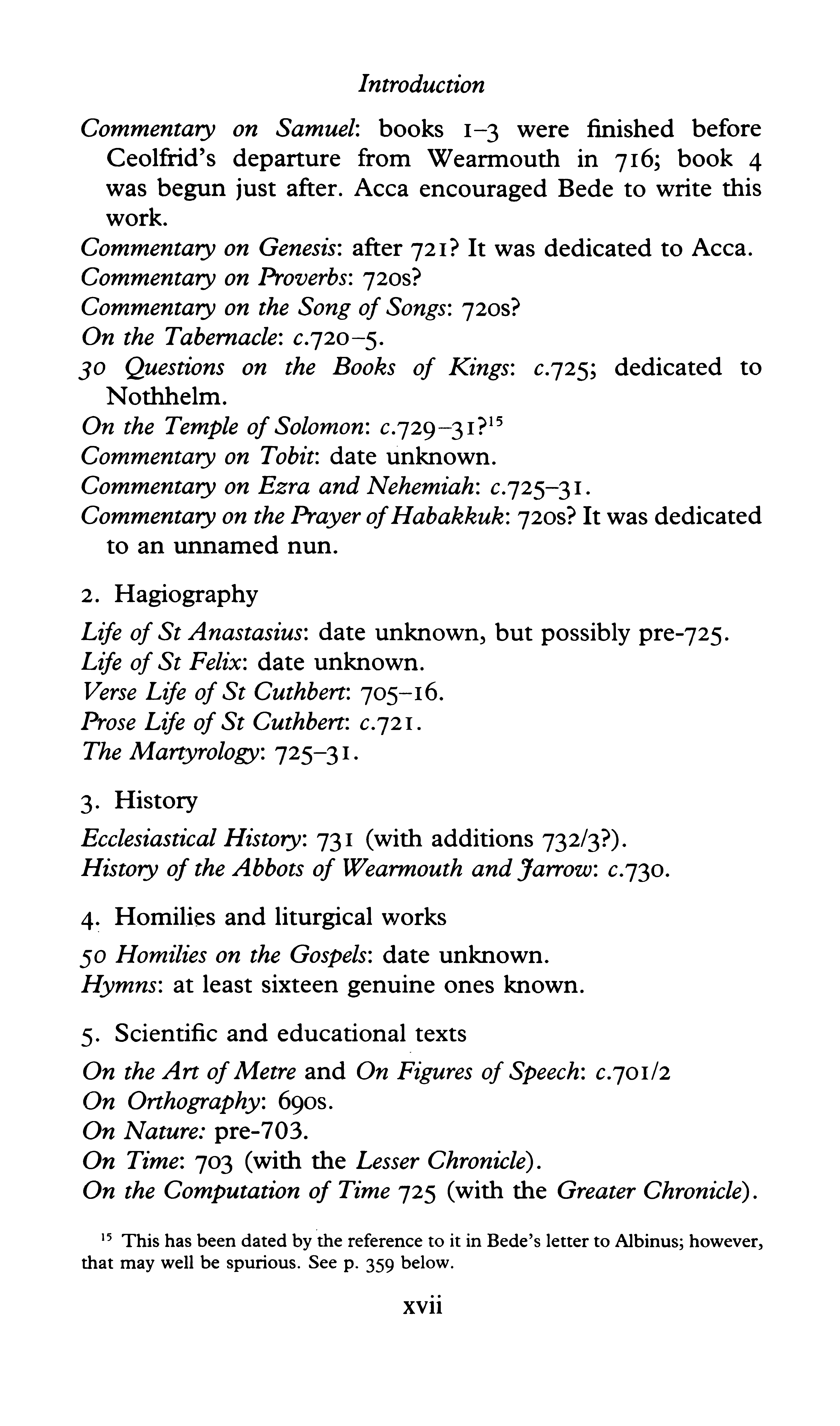
Introduction Commentary on Samuel: books 1-3 were finished before Ceolfrid's departure from Wearmouth in 716; book 4 was begun just after. Acca encouraged Bede to write this work.
Commentary on Genesis: after 721? It was dedicated to Acca.
Commentary on Proverbs: 720s?
Commentary on the Song of Songs: 720s?
On the Tabernacle: c.720-5.
30 Questions on the Books of Kings: c.725; dedicated to Nothhelm.
On the Temple of Solomon: c.729-31?15
Commentary on Tobit: date unknown.
Commentary on Ezra and Nehemiah: c.725-31.
Commentary on the Prayer ofHabakkuk: 720s? It was dedicated to an unnamed nun.
2. Hagiography Life of St Anastasius: date unknown, but possibly pre-725.
Life of St Felix: date unknown.
Verse Life of St Cuthbert: 705-16.
Prose Life of St Cuthbert: c.721.
The Martyrology: 725-31.
3. History Ecclesiastical History: 731 (with additions 732/3?).
History of the Abbots of Wearmouth and Jarrow: c.730.
4. Homilies and liturgical works 50 Homilies on the Gospels: date unknown.
Hymns: at least sixteen genuine ones known.
5. Scientific and educational texts On the Art of Metre and On Figures of Speech: c.701/2
On Orthography: 690s.
On Nature: pre-703.
On Time: 703 (with the Lesser Chronicle).
On the Computation of Time 725 (with the Greater Chronicle). 15
15 This has been dated by the reference to it in Bede's letter to Albinus; however, that may well be spurious. See p. 359 below.
XVII
Introduction The Ecclesiastical History For all those elements that go to make Bede seem accessible to us, as the founding father of a national historiography whom we also might like to visualize in the relatively wellpreserved remains of buildings that would have been familiar to him, there are other features that distance him from us.
These were important to him, and should not be overlooked or explained away. As the preceding list shows, most of his life and his scholarly activity was directed towards the study of the Bible and the arts of the computus, or the calculation of dates and time. History was far from being his sole or even prime preoccupation, and that the Ecclesiastical History proved to be his last major composition was due more to accident than design. As the account of his death given by his pupil
Cuthbert shows (pp. 300-303 below) he was engaged on a scriptural project, the translation of John's Gospel into Old
English, at the time of his death. His interest in and knowl edge of the Bible helped shape both the purposes and the literary style that he used in writing the Ecclesiastical History.16
As his Chronicle indicates, he had no sense of the disconti nuity of history. The world of the Old Testament, above all as described in its historical books, was not so remote from him in time as to seem irrelevant; those books provided him with models, both for the description of such secular events as battles and the making and unmaking of kings, of which he had no first-hand knowledge, and for the appreciation of how divine purposes might be worked out in the apparent random ness of the events of human history. He had learned too from the first great historian of the coming of Christianity to the Roman world, bishop Eusebius of Caesarea (c. 260-339/40), whose Ecclesiastical History influenced his view of the purpose of historical writing, and in its use of sources and inclusion of documents lent him a methodology.
The tendency to make Bede an honorary inhabitant of the twentieth century has sometimes also led to the downplaying
This is explained in greater detail in J. McClure, 'Bede's Old Testament Kings', in P. Wormald, D. Bullough, and R. Collins (eds.), Ideal and Reality in Frankish and Anglo-Saxon Society (Oxford, 1983), 76-98.
XV111
Introduction or rationalizing of two other major elements of his thought.
The first, and this is something he shared with most early medieval authors, was his interest in the miraculous. His careful and critical approach to the selecting of material for his History has seemed to some to be at variance with his interest in seeking out stories of miraculous events, and above all those worked through the relics of the various monks and bishops who people his pages. Modem approaches to such elements in the history and hagiography of the Early Middle
Ages have enabled us to understand the role such phenomena played in the thought-world of most other authors of this period.17
Equally liable to be understated is Bede's interest in the disputes about the correct way to calculate the date of Easter.
No reader of the Ecclesiastical History can fail to be struck by the frequency with which this topic occurs, and the detail in which it is discussed. Apart from the initial papal letters relating to the conversion of the kingdoms of Kent and of the Northumbrians, the only documents that Bede quotes verbatim in the text of the EH are ones relating to the dating of Easter. The longest chapter in the whole work is taken up with a letter on this from Bede's abbot Ceolfrid to the Pictish king Nechtan. On the other hand, he was capable of omitting sections from such letters where their arguments did not suit or might contradict his purpose, and he may well have been aware that the actual practices of the Roman Church in this area did not always correspond with his version of them.18 He would also have us believe that the whole of the important
Synod of Whitby of 664 was devoted almost exclusively to the discussion of this issue, and he all but hides from sight the equally contentious subject of differences of monastic tonsure. By the time that Bede was writing the EH in 731 the issue was hardly a living one, yet he gives it an extraordinary
17 See e.g. P. Brown, 'Relics and Social Status in the Age of Gregory of Tours', in his Society and the Holy in Late Antiquity (London, 1982), 222-50, and id., The Cult of Saints (Chicago, 1981).
18 W. Stevens, 'Sidereal Time in Anglo-Saxon England' in C. B. Kendall and P. S. Wells (eds.), Voyage to the Other World: The Legacy of Sutton Hoo (Minneapolis,
1992), 125-52. See the same author's Bede's Scientific Achievement (Jarrow Lecture,
1985) for an assessment of Bede's own contributions in this and related areas.
XIX
Introduction prominence, which is also matched in his Chronicle by refer ences to the subject and to those who wrote about it. Whereas his interest in the miraculous was common, his interest in Easter-dating must appear somewhat idiosyncratic.
Only relatively recently has it come to be appreciated that some explanation is needed for Bede's undertaking of his
Ecclesiastical History; one, moreover, that takes account of his particular methods of working and of the special concerns which he displays for various themes, topics, and perso nalities.19 This in turn involves the settling of a number of preliminary arguments. One such obvious area of debate concerns the question of whom Bede was actually writing about. Who are his Angli: are they the Angles, as opposed to the Saxons, Jutes, and others whose arrival in Britain he describes in Book I of EH ; or has he extended the meaning of this previously specific ethnic term to embrace all of the inhabitants of the kingdoms ruled by Anglo-Saxon dynasties?
The former theory may help to explain why he says relatively so little about the various Saxon kingdoms in the south and about the Mercians, and would accord with his usage in his
Letter to Egbert, in which 'our people' are clearly the Angles living north of the Humber. On the other hand, in his
Chronicle he uses Angles and Saxons as synonyms, and he had the authority of Gregory the Great for depicting all of the inhabitants of the former Roman provinces of Britain as Angles.20 It cannot be said, though, that even this issue has been resolved. As with other elements in this rich text, questions exceed answers.
In preparing the edition of the Latin text of the Ecclesiastical History on which the translation by Bertram Colgrave was based, Sir Roger Mynors followed the late-nineteenth-century editor Charles Plummer in detecting the existence of two distinct classes of manuscripts. These Plummer had desig
19 Goffart, in The Narrators of Barbarian History, has led the way here; although his thesis, that Bede was reacting to the posthumous influence of Wilfrid, may seem a little narrow.
20 See M. Richter, 'Bede's Angli: Angles or English?', Peritia, 3 (1984), 99-114, and P. Wormald, 'Bede, the Brettvaldas and the Origins of the Gens Anglorum', in Wormald et al., Ideal and Reality, 99-129.
Introduction nated as 'C ' and 'M ', and Mynors called them c and m. The differences between the two classes are neither numerous nor substantial. Thus, a short prayer is found added to the Pref ace to the whole work in manuscripts of class m but at the end of Book V in those of class c. One of the miracle stories associated with king Oswald (v. 14) is omitted in c. A reference in iv. 18 to a non-existent previous mention of Benedict Biscop is found only in m. There is a small textual difference in one sentence in iv. 30. One of the works of Bede, his Capitula on the Prophets, is omitted from the list of his writings in v. 24 in c; which class also includes the annals for 733 and 734 in the chronological synopsis in the same chapter.
Manuscripts in class m here add a phrase lacking in c but end with the annal for 731.21 To these six differences noted by Mynors should be added another: in the list of Bede's works, v. 24 c rightly describes his Commentary on the Song of Songs as being divided into six books, while m erroneously makes it seven.
The two classes of manuscripts also seem to have enjoyed very different transmissions. Manuscripts in c class are exclu sively linked to Britain. All extant manuscripts of this class, even if now found in Continental libraries, were written in Anglo-Saxon England. It was on the basis of the c-class text that an Old English vernacular translation was made, pro bably in Mercia in the ninth century.22 On the other hand, the m text appears to have been the one first sent to the Conti nent, from the mid-eighth century onwards, where it became the dominant form. Of this class two manuscripts are par ticularly important for their closeness in date to the original composition of the EH. The first of these, Cambridge Univer sity Library Kk. 5, known from its donor as 'the Moore Bede', is thought to have been written in Northumbria soon after 737, which is the last date mentioned in the brief annalistic continuation added at the end of the EH.23 Signs of haste in the copying and its lack of decoration have led to the 21 C&M , pp. xxxix-xli.
22 D. Whitelock, 'The Old English Bede', Proceedings of the British Academy, 48 (1962), 57-90.
23 C LA , ii, no. 139; C&M , pp. xliii-xliv.
XXI
Introduction suggestion that this was transcribed by someone visiting Wearmouth-Jarrow. For an actual product of the monastery's scriptorium, one made with more care and attention to detail, it is possible to turn to Leningrad Public Library MS lat. Q. v. I. 18.24 This manuscript was not known to Plummer, which is why the Mynors text is now taken as the standard. It was written no later than 747.25 Neither it nor the Cambridge manuscript were Bede's own work, and what was thought to be the author's own signature in the Leningrad manuscript has been shown to be a medieval forgery.26 However, it is exceedingly rare to have one, let alone two, manuscripts so close in time to the authorial composition of any early medi eval work, and the existence of this pair has made the task of establishing an authoritative version of the text of the m class of manuscripts remarkably easy.
The c class is much less well represented than the m, which as well as in the two manuscripts just mentioned can be found in several others of eighthand ninth-century date. For c the best extant representatives are, first, Kassel Landesbibliothek
4° MS theol. 2, which was written in Northumbria in the late eighth century.27 Unfortunately, only Books IV and V of the HE have survived in this manuscript. Secondly, there is
London, British Library MS Cotton Tiberius C. 11, written probably in Canterbury in the late eighth or early ninth century.28 Sir Roger Mynors argued on the basis of the textual differences between c and m, listed above, that priority should be given to the latter class, and this was made the basis for his edition. He was particularly struck by the addition of the miracle story in rv. 14 to the m-class manuscripts. It might, however, be argued that the presence of annals for 732 and 733 in the body of the text of EH indicates that the archetype of class c was written c.733/4, in other words, a few months
24 CLA xi, no. 1621; C&M , p. xliv.
25 D. H. Wright, 'The Date of the Leningrad Bede', Revue bénédictine, 71 (1961),
2 6 5 - 7 3 .
26 P. Meyvaert, 'The Bede " Signature" in the Leningrad Colophon', ibid.
274-86.
27 CLA viii, no. 1140; C&M , p. xlii.
2H CLA ii, no. 191; C&M , p. xlii. L. Webster and J. Backhouse (eds.), The Making of England: Anglo-Saxon Art and Culture AD 600-900 (London, 1991), no. 170.
XXII
Introduction before Bede's death. It is also clear that the story retold in iv.
14 was known to Bede long before he wrote the EH, and that it was not inserted in m just because it had recently been brought to his attention. Ultimately, though, it is unwise to see one class having more 'authority' than another. The original versions of both will have been written by or for Bede in Wearmouth-Jarrow in the years 731-4, and the differences between them are too slight to suggest that one or other represented a more definitive form of the author's intentions.
It is regrettable that the few surviving eighth-century letters referring to works of Bede do not include any references to his EH. In two letters the Anglo-Saxon missionary and archbishop of Mainz, Boniface (d. 754), asked abbot
Hwætberct of Wearmouth-Jarrow to send him some of Bede's exegetical writings and his lectionary. It is understandable enough that in the Saxon and Frisian mission fields, the EH might have seemed less necessary than some scriptural commentaries. It is clear, though, that at least one manuscript of EH made its way to the monastery of Fulda, which Boniface had founded; though this cannot be dated precisely.
A manuscript that certainly left England at an early date, although it later returned, is the 'Moore Bede' of Cambridge
University Library, described above. This has been shown to have been located in the palace library of Charlemagne by about 800, and via a lost intermediary seven extant ninthcentury western Carolingian copies of it were made. Library lists and provenanced manuscripts dating from the same century indicate that copies of the EH were also to be found in many of the principal eastern Carolingian monasteries and episcopal churches, notably Lorsch, Murbach, Reichenau,
St Gallen, Würzburg, and St Hubert. On the other hand, circulation of the EH in Italy at this time appears to have been very limited, and it was apparently entirely unknown in Spain.29 An Old Irish translation, now found only in the 29 For a fuller, though not comprehensive, discussion of the circulation of the manuscripts of HE, see C&M , pp. xlvi-lxx. See also M. L. W. Laistner, A Hand-List of Bede Manuscripts (New York, 1943), 9 3-112, for a listing of medieval manuscripts of the work.
XX111
Introduction fifteenth-century 'Book of the White Earl' (Oxford, Bodleian Library, MS Laud. mise. 610) was made in the tenth century.30
Although it is normally assumed that only the earliest manuscripts of a work such as EH need to be consulted to produce a critical text and to work out the first stages of its transmission, in this case there is a possible exception. The set of annals that continue the narrative from 732 to 766, and provide an important source for the history of the Northum brian kingdom in those years, survive only in a group of seven very late medieval manuscripts. They seem all to be associ ated with the Low Countries and northern Germany, having provenances in such places as Gouda, Kämpen, Utrecht, and Pegau (near Leipzig), but their precise interrelationships have never been worked out. It is usually assumed that they must all ultimately share an ancestor in a lost Northumbrian manu script of EH written in or soon after 766. However, possible use of ASC (see p. 421) for one entry would date this lost archetype at the late ninth century at the earliest.
The Greater Chronicle Having finished the Ecclesiastical History, a reader would be pardoned for thinking of Bede as living isolated on the very edge of civilization, and possessing only small sources of illumination, like bonfires seen across a valley, for the wider world. To plot on a map the places that he mentions in the work only confirms such a view. They dwindle in number and decrease in geographical concentration the further south the gaze moves; just extending across the Channel and with only
Rome as the most distant point on a dark horizon. However, such an impression is totally misleading: the Greater Chronicle, written in 725 as part of Bede's most elaborate work on the divisions of time, shows just how widely his interest and his knowledge extended. His geographical range expands from Britain and northern France to embrace Spain, North Africa,
,0 On this see P. Ni Chatéin, 'Bede's Ecclesiastical History in Irish', Peritia, 3
(1984), 1 15-30. The M S contains only Books I and II of HE.
XXIV
Introduction and the eastern provinces of the Byzantine empire. Rome, from being on the periphery of his vision in EH, becomes the centre of it in the Chronicle.
As in Book I of the EH, it is a question not so much of what Bede includes in his work, as of what he obviously knew about but decided not to include. His intentions dictated his selections: he was far from just stuffing into his historical writing all the scraps of information that came to hand. In the Chronicle, as in the first book of EH, it is possible to identify the works that he used for much of his information; this provides further testimony to the wealth of the library that he had at his disposal in Wearmouth-Jarrow. Not only is it possible to see what particularly interested him and what he thought the purposes of his own works might be, by compar ing what he selected with the complete works from which he made his choices; it is also instructive to contrast his use of these materials with those of others who also employed them.
In comparison, for example, with Isidore of Seville (d. 636), who wrote a comparable work in the mid-62os, the texture of Bede's Chronicle is very dense and complex. He used the widest possible variety of sources that were available to him, including ones that were not historical in character, to put together his account. He also adopted a critical approach to the literary merits of what he read. Thus, of his main sources, the one most likely to be quoted verbatim was the Spanish priest Orosius, whose seven-book history was completed in 418. On the other hand, neither in the Chronicle nor in EH did Bede ever fail to alter the wording of the passages that he cited from the British monk Gildas' On the Ruin of Britain. In contrast, Isidore in his Chronicle tended to use a much more limited range of sources and to allow one to predominate in each period that he covered, and he made hardly any stylistic alterations to the texts he borrowed.
A full discussion of the sources that Bede drew on in compiling his Chronicle would not be practicable here.31
However, one specific debt is particularly interesting, in that
All of the identified borrowings can be found in the apparatus to the CCSL edition that is used as the basis for this translation: CCSL cxxiiiA, ed. C. W. Jones
(Tumhout, 1977), 495535XXV
Introduction it also sheds some light on the composition of EH. For the Roman Church, a variety of theological issues, and aspects of the political history of both Italy and the Eastern
Roman empire, Bede made considerable use of a manuscript of the Liber Pontificalis. This is a collection of papal bio graphies, probably initially compiled in the first half of the sixth century, and kept up pontificate by pontificate from the mid-seventh century onwards. Bede used information from this source throughout the section of the Chronicle translated here, and with the fading of alternatives it becomes his dominant fount of information for the later seventh and early eighth centuries. While it is reasonable to assume that most of the books that Bede used throughout his career came from the nucleus of the monastic library of WearmouthJarrow, which was endowed with the works , that Benedict
Biscop brought back from Francia and from Rome in his visits in the 670s and 680s, Bede's manuscript of the Liber
Pontificalis was a more recent arrival. This can be deduced from the fact that Bede was using material from it to describe events as late as 716. This includes items relating to the pontificate of Gregory II (715-31). As Bede was writing in 725 and the final version of the biography of Gregory II could not have been compiled until 731, it seems that some form of annual record was being kept in Rome. Furthermore, the only known point of contact between Bede and Rome, where an up-to-date version of the Liber Pontificalis would have to be found, was the visit of Nothhelm, referred to in the Preface to EH. Nothhelm was sent by abbot Albinus of St Augustine's in Canterbury, not least to find copies of papal letters relating to the conversion of England. These he brought up to Bede in Wearmouth-Jarrow after his return.
The visit to Rome should, therefore, be dated to the year 717 or immediately after. If so, it may be that Nothhelm also gave
Bede an oral account of the events in Constantinople and Italy in that year, which form the final items in the Chronicle.
These items, amongst others, made Bede's work a primary source for the history of the contemporary Lombard kingdom in Italy, and Paul the Deacon, writing his History of the Lombards in southern Italy in the late 780s, depended on it for part of his narrative. xxvi
Introduction This literary debt is itself useful evidence for the transmis sion of the work, De Temporum Ratione, or On the Computation of Time, in which the Chronicle appears. It is most probable that Paul found it, as well as the EH> in Francia during his attendance at the court of Charlemagne in the years 782c.786. By the end of the century it had been copied in many of the principal Carolingian scriptoria, and had also appeared in northern Italy, where an abbreviated version of it was written in Verona. At the time of the publication in 1943 of the first and only critical edition of the DTR nothing was known of the very earliest history of the transmission of this text. The subsequent discovery of some fragments of the work in Northumbrian script, which have been dated to c.746-50, shows that like so many of Bede's writings it first crossed the Channel as a result of the interest of the Anglo-Saxon monks evangelizing Saxony and Frisia in acquiring his works.32 An other recently discovered fragment in Germany may even date from Bede's own lifetime. Of its purely English circula tion virtually nothing is known, as no manuscript of British provenance predates the Norman conquest.33 By the end of the eighth century at the latest, the Chronicle was also circu lating separately from its parent, and appears without the rest of the DTR in collections of historical works. Conversely, from the ninth century onwards some manuscripts of the DTR omit the Chronicle. Although less numerous than manu scripts of the complete DTR, those containing the Chronicle by itself continue to be found throughout the Middle Ages, and from all over western Europe, other than Spain. It was as a separate work that the Chronicle received its first critical edition, that of Theodor Mommsen for the M GH in 1898.
The DTR itself had to wait until 1943 to receive the same treatment. For reasons of length its editor C. W. Jones there omitted the Chronicle, though subsequently incorporating it in the reprint of the 1943 edition published in the CCSL series in 1977. It is this text which has been translated here. Al though only partial, this is the first English translation of it.
32 J. Petersohn, 'Neue Bedafragmente in northumbrischer Unziale saec. viii', Scriptorium, 20 (1966), 215-47.
33 For the manuscripts, see W. M. Stevens, Bede's Scientific Achievement (Jarrow
Lecture, 1985), 39-42.
XXV11
Introduction The DTR was a substantial expansion of one of Bede's earliest works, his De Temporibus or On Time, completed in 703. The Chronicle section of the later work is very consider ably longer and more substantial than that found in the De
Temporibus, which is normally referred to as Bede's Lesser Chronicle; although one or two items in the latter were not incorporated into the former. These include a reference to the early sixth-century African bishop Fulgentius of Ruspe and to the forced conversion of the Spanish Jews in the time of king
Sisebut (612-21). Both works were probably initially intended for the use of Bede's pupils in Wearmouth-Jarrow.34 Although very different in scale, both works adopt a similar structure, progressing from a discussion of the smallest units of time, through hours, days, months, years to the largest linear divisions of history. These were the Six Ages, the principal events of which are briefly described in the two versions of the Chronicle.
This, in its two very differently proportioned forms, takes the birth of Adam as its chronological starting-point, divid ing the rest of time into the Six Ages: the First from Adam to the Flood, the Second from Noah to Abraham, the Third from Abraham to David, the Fourth from David until the Captivity of the Jews in Babylon, the Fifth extending thence to the birth of Christ. In the Greater Chronicle the Sixth Age, the section which is translated here, takes up just over half of the total length. This for Bede and his readers was both the current and the last Age before the Second Coming, and would be terminated by the appear ance of Antichrist. Ever since the formulation of the idea of the Six Ages by Augustine of Hippo (354-430), and the application to it of the chronological information to be found in Jerome's Latin version of the great Chronicle of Eusebius of Caesarea (c.260-339/40), there had been specula tion as to how long the Sixth Age would last. One popular view was that its duration would be a thousand years. Bede, following both Augustine and Isidore of Seville, resolutely stated that there was no way of knowing; as he ends the '4 See Jones, Bedae Opera de Temporibus, 130-9.
XXV111
Introduction De Temporibus: 'The remainder of the Sixth Age is open only to God.'
One reason that led him to doubt the popular view that the first five Ages covered 5,000 years was that his own calcu lations, based on the Bible and the Jewish historian Josephus, led him to assign a total of 3,952 years to the period from Adam to the birth of Christ. Such deviations from received opinion led in 708 to his being accused of heresy in the presence of bishop Wilfrid by a certain David. When in formed of this he wrote a letter to one of the monks of Hexham, called Plegwine, both defending himself and ridi culing the scholarly weaknesses of his detractors. This episode mpy have coloured his view of Wilfrid, and help to explain the critical tone of some of the comments on him in EH and the omission of any references to his relations with Benedict Biscop.35 Bede's anger and touchiness on the subject lasted long after Wilfrid's death in 709, and he remained very sensitive to the possibilities of criticism when composing the DTR and its Chronicle in 725.
Unlike the language of EH and of the Letter to Egbert, that of the Chronicle is highly compressed. This was a feature of this particular literary genre, and Bede was able to adapt to it in those sections of the work that were entirely of his own composing. In translating such texts it is usually necessary to be more verbose than the original and to insert words or phrases not in the Latin, if the full meaning is to be brought out. Such additions are here signalled by the use of square brackets.
Bedeys Letter to Egbert This is very probably Bede's last surviving work. It is only to be found in three manuscripts, the earliest of which dates to the tenth century, and clearly had a very limited dissemina tion.36 It was first edited by Sir James Ware in Dublin in 1664.
35 Jones, Bedae Opera de Temporibus, 132-5; Goffart, The Narrators of Barbarian History.
36 M S Hague Koningklijke Bibl. 70 H 7: Laistner A Hand-List of Bede Manu scripts, 120. P used the I2th-c. London B L M S Harley 4688.
XXIX
Introduction The most recent edition, that of Charles Plummer (P), is used for this translation. However, he used the twelfth-century
London B L M S Harley 4688 for his text, being unaware of the existence of an earlier manuscript; this has yet to be embodied in a modem edition. Despite its title of 'Letter' and the very circumstantial details given in the opening section to explain why Bede has had to commit his thoughts to writing rather than express them more discretely to Egbert in private conversation, there is no doubt that this was intended as a free-standing treatise in its own right and as a very radical manifesto. Its complex rhetorical style and extensive use of biblical quotations were used to support some hard-hitting criticisms of the contemporary state of the Church in North umbria and to promote a very idiosyncratic remedy that Bede wished to propose.
Bede's primary targets for complaint were the episcopate and monasteries founded and directed by those untrained in and unsuited for the monastic life, as he would have defined it. Although sometimes thought to apply to the Church in England more widely, it is clear from his arguments that Bede's criticisms of the bishops applied to the kingdom of the Northumbrians. He wanted more bishoprics created, at least to try to bring into existence the pattern of twelve northern sees, subordinate to the metropolitan authority of York, which Gregory the Great had envisaged in one of his letters to Augustine of Canterbury. Bede expected that such new sees would have to be based on monasteries; York was anyway the only approximation to a functioning town that would have been found in Northumbria at this time. As well as wanting more bishops, he made clear in the Letter that he wanted a higher standard of episcopal behaviour and more assiduous attention to the pastoral responsibilities of that office. It is interesting to note that at the time he was writing there were three episcopal sees in Bemicia, all based on monasteries, and only one in Deira, that of York. Of the former, two of the holders were singled out for praise in HE, and the third had become bishop after its completion. The criticisms raised in the Letter might apply to the latter, but xxx
Introduction would seem most suited to the recipient of the work itself, bishop Egbert.
The radical nature of Bede's solution to the problem of the proliferation of what he regarded as unsatisfactory mona steries has hardly been commented on. His proposal that written and witnessed deeds of gift made by previous kings should be annulled by their successors on the grounds of the lack of moral worth of the recipients or of their intentions is truly extraordinary. If adopted it would have undermined the whole principle of security of tenure based on possession of documentary proof of ownership. This tradition, manifested in the use of charters, deriving from Roman legal practice, and established throughout western Europe at this time, was introduced into Anglo-Saxon England early in the seventh century.37 Admittedly, Bede does not go very far in defining the practical programme that he wished to see implemented.
How was the quality of the monastic life to be assessed by those here called upon to annul gifts of land made to founding abbots? Whatever the personal merits of the individuals concerned, Bede's own monastery of Wearmouth-Jarrow, founded by a family of nobles withdrawing from royal service and from military activity, originated in the very way that he condemns in the Letter. In his last message to posterity Bede's words remain enigmatic and problematic.
Cuthbert's Letter on the Death of Bede This short work, probably composed as part of WearmouthJarrow's promotion of the cult of Bede in the years following his death, has survived in a variety of English and continental contexts. It was incorporated into Symeon's History of the Church of Durham, written 1 104/9, and is often found ap pended to manuscripts of the EH from the twelfth century onwards. A ninth century manuscript of it from St. Gallen places it after selections from Jerome on Isaiah, wrongly
See the various studies in W. Davies and P. Fouracre (eds.), The Settlement of Disputes in Early Medieval Europe (Cambridge, 1986), and P. Wormald, Bede and the Conversion of England: The Charter Evidence (Jarrow Lecture, 1984).
XXXI
Introduction attributed to Bede. It appears later in a number of hagiographical collections, notably in Austrian monastic libraries.38
For a full study of its transmission see E. van K. Dobbie, The Manuscripts of Cædmon's hymn and Bede's Death Song (New York, 1937).
XXX11
N O TE ON THE TRANSLATIONS
The translation of the Ecclesiastical History is that produced by the late Bertram Colgrave for the Oxford Medieval Texts edition of the work, first published in 1969. It is reprinted here without the footnotes which originally accompanied it.
Improvements to the translation suggested by J. M. WallaceHadrill in his Bede's Ecclesiastical History: A Historical Com mentarypublished in 1988 in the same series to accompany the Colgrave and Mynors edition, have been included in the notes in this volume, togethèr with other corrections that now seem necessary.
The translation of the 'Sixth Age' section of the Greater Chronicle has been made by us, following C. W. Jones's edi tion of the De Temporum Ratione, of which the Chronicle text originally formed a part. This was published as vol. cxxiiiA of the Corpus Christianorum Series Latina in 1977, pp. 495-535, but was originally prèpared in 1943 and not subsequently revised.
For the Letter to Egbert the edition in C. Plummer, Baedae Opera Historica (Oxford, 1896), i. 405-23, which has been followed here, remains the most recent and most critical, although Plummer, who used two later manuscripts of the work, was .unaware of the existence of a third, the tenthcentury M S Hague Koningklijke Bibl. 70 H 7.
This manuscript from the Hague was used as the basis for the edition of Cuthbert's Letter on the Death of Bede included in Colgrave and Mynors's OM T volume. The translation by Bertram Colgrave is reprinted here.
X X X lll
SELECT BIBLIOGRAPHY
A nderson, A. O., and M . O. (eds.), Adamnan's Life of Columba (revised edn.; Oxford, 1991).
A rnold, C. J., An Archaeology of the Early Anglo-Saxon Kingdoms (London, 1988).
A ttenborough, F. L., The Laws of the Earliest English Kings (Cam bridge, 1922).
Bassett, S. (ed.), The Origins of Anglo-Saxon Kingdoms (Leicester, 1989) .
Battiscombe, C. F. (ed.), The Relics of St Cuthbert (Oxford, 1956).
Blair, P. Hunter, The World of Bede (Cambridge, 1970; rev. edn., 1990) .
Bonner, G. (ed.), Famulus Christi: Essays in Commemoration of the Thirteenth Centenary of the Birth of the Venerable Bede (London,
1976).
------Rollason, D ., and Stancliffe, C. (eds.), St Cuthbert: His Cult and his Community (Woodbridge, 1989).
Brooks, N ., The Early History of the Church of Canterbury (Leicester, 1984).
Bruce-M itford, R. (ed.), The Sutton Hoo Ship Burial, i (London, 1975)C ampbell, J. (ed.), The Anglo-Saxons (Oxford, 1982).
------ Essays in Anglo-Saxon History (London and Ronceverte, W. Va., 1986).
C arver, M ., The Age of Sutton Hoo (Woodbridge, 1992).
C olgrave, B., The Earliest Life of Gregory the Great (Kansas City, Kan., 1968).
D ornier, A. (ed.), Mercian Studies (Leicester, 1977).
F arrell, R., and N euman de V egvar, C. (eds.), Sutton Hoo: Fifty Years After (Oxford, Oh., 1992).
G offart, W ., The Narrators of Barbarian History (Princeton, N J, 1988), ch. 4: 'Bede and the Ghost of Bishop Wilfrid', 235-328.
Henderson, G ., From Durrow to Kells: The Insular Gospel-Books 650-800 (London, 1987).
H i g h a m , N . J., The Kingdom of Northumbria 350 -1 1 0 0 (Stroud, 1993)Hill, D An Atlas of Anglo-Saxon England (Oxford, 1981).
H olus, S., Anglo-Saxon Women and the Church (Woodbridge, 1992).
Hope-T aylor, B., Yeavering (London, 1977).
Select Bibliography Jones, C. W. (ed.), Bedae Opera de Temporibus (Cambridge, Mass.,
1943)Kendall, C. B., and W ells, P. S. (eds.), Voyage to the Other World:
The Legacy of Sutton Hoo (Minneapolis, 1992).
Kirby, D. P., The Earliest English Kings (London, 1991).
Laistner, M . L. W ., A Hand-List of Bede Manuscripts (New York, 1943)L evison, W ., England and the Continent in the Eighth Century (Oxford,
1946).
Mayr-Harting, H., The Coming of Christianity to Anglo-Saxon England (London, 1972).
M eyvaert, P., Benedict, Gregory, Bede and Others (London, 1977).
Rollason, D., Saints and Relics in Anglo-Saxon England (Oxford, 1989): pt. ii, 'The Age of Bede', 23-129 .
Sims-W illiams, P., Religion and Literature in Western England, 600800 (Cambridge, 1990).
Smyth, A. P., Warlords and Holy Men (London, 1984).
T aylor, H. M ., and J., Anglo-Saxon Architecture, 3 vols. (Cambridge, 1965-78).
T homas, A. C ., Christianity in Roman Britain to ad 500 (London, 1981).
T hompson, A. Hamilton (ed.), Bede: His Life, Times and Writings (Oxford, 1935).
V ince, A. (ed.), Pre-Viking Lindsey (Lincoln, 1993).
W ebster, L., and Backhouse, J. (eds.), The Making of England:
Anglo-Saxon Art and Culture ad 600-900 (London, 1991).
W elch, M ., Anglo-Saxon England (London, 1992).
W ormald, P., Bullough, D., and C oluns, R. (eds.), Ideal and Reality in Frankish and Anglo-Saxon Society (Oxford, 1983).
W ilson, D., Anglo-Saxon Paganism (London, 1993).
Y orke, B., Kings and Kingdoms of Early Anglo-Saxon England (London, 1990).
XXXV


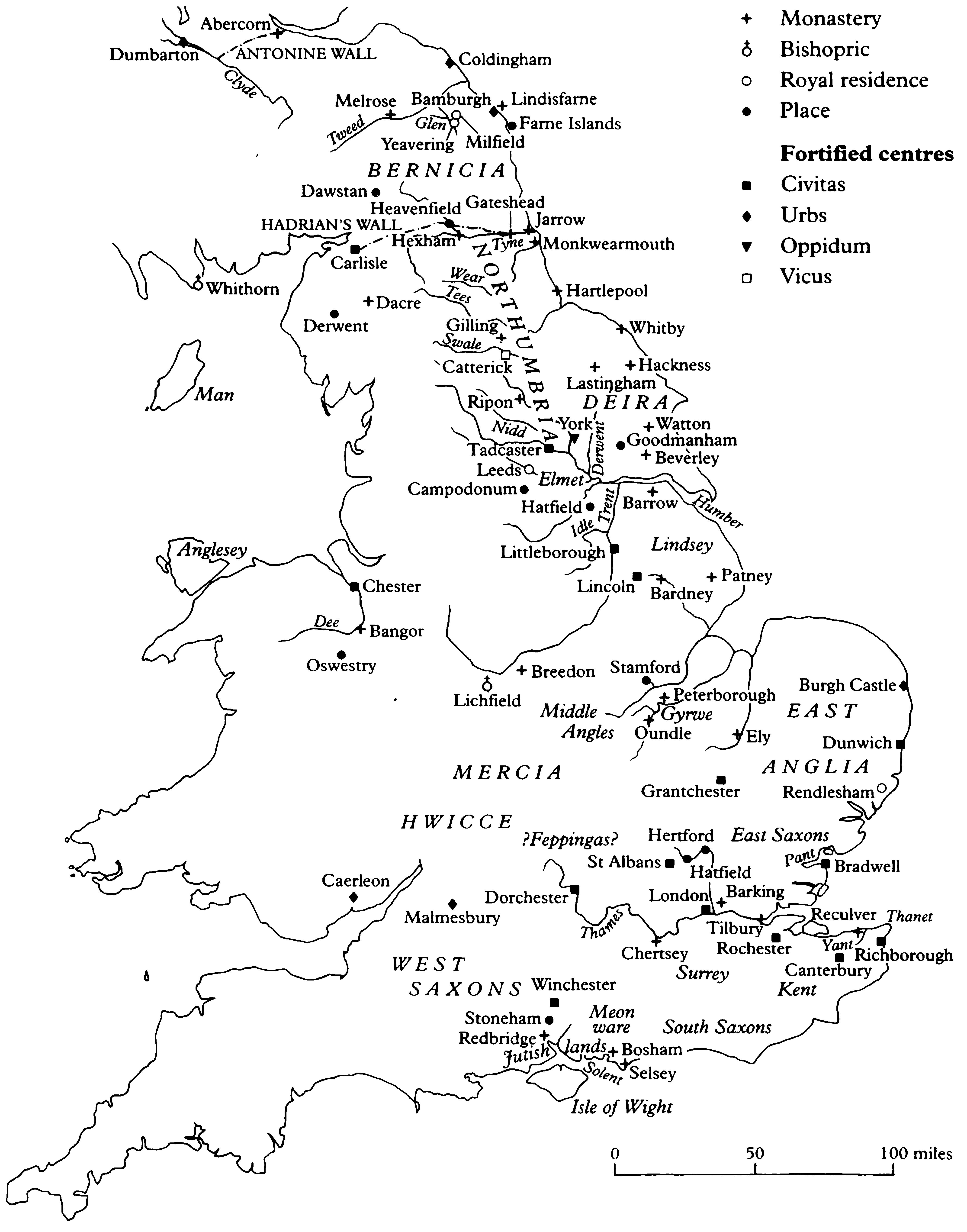
The England of Bede, c. 731. Place-names from The Ecclesiastical History.
Source: David Hill, An Atlas of Anglo-Saxon England (Oxford, 1981), 30.

T H E E C C L E S I A S T I C A L
H I S T O R Y O F
T H E E N G L I S H P E O P L E