
Book I
B O O K I
These are the contents of the first book of the history of the Church of the English people.
1. O f the situation of Britain and Ireland and of their earliest inhabitants.
2. How Gaius Julius was the first Roman to visit Britain.
3. How Claudius, the second Roman to visit Britain, also added the Orkney Islands to the Roman Empire; and how Vespasian was sent by him and brought the Isle of Wight also under Roman sway.
4. How Lucius, king of Britain, wrote to Pope Eleutherus asking to be made a Christian.
5. How Severus, by means of a rampart, divided the part of Britain which he had recovered from the rest.
6. O f the reign of Diocletian and how he persecuted the Christians.
7. The passion of St Alban and his companions who, at that time, shed their blood for the Lord.
8. How, when the persecution ceased, the Church in Britain had a little peace until the time of the Arian heresy.
9. How, during Gratian's reign, Maximus was created emperor in Britain and returned to Gaul with a large army.
10. How, during the reign of Arcadius, a Briton named Pelagius made a presumptuous attack upon the grace of God.
1 1 . How, during the reign of Honorius, Gratian and Constantine were set up as dictators in Britain; and how, shortly afterwards, the former was killed in Britain and the latter in Gaul.
12. How the Britons were ravaged by the Irish and the Piets and sought help from the Romans, who came a second time and built a wall across the island; but this was forthwith broken down by the same enemies and they were reduced to worse straits.
13. How, during the reign of Theodosius the younger, Palladius was sent to the Irish Christians; and how the Britons unsuccessfully sought help from the consul Aetius.
The Ecclesiastical History I 14. How the Britons, rendered desperate by famine, drove the bar barians out of their land; and how there quickly followed, first abundance of com and then riotous living and pestilence and finally doom upon the race.
15. How the Angles were invited to Britain and at first drove the enemy away; but not long afterwards the Angles made a treaty with them and turned their weapons against their allies.
16. How the Britons gained their first victory over the Angles under the leadership of a Roman named Ambrosius.
17. How Bishop Germanus sailed for Britain with Lupus and how he stilled, by divine power, first of all the raging of the sea and afterwards the raging of the Pelagians.
18. How he gave sight to a tribune's blind daughter and then visited St Alban, where he received some of his relics and presented relics of the blessed apostles and other martyrs.
19. How he was detained there by sickness, put out a fire in some burning buildings by his prayers, and was himself healed of his sickness by a vision.
20. How the two bishops brought divine help to the Britons in a battle and then returned home.
21. How when the pestilential growth of Pelagianism sprang up again, Germanus returned to Britain with Severus, first restoring the power of walking to a lame young man and then restoring the people of God to the paths of faith by condemning or converting the heretics.
22. How the Britons, though at rest from foreign invasion, wore themselves out by civil wars and also gave themselves up to more heinous crimes.
23. How Pope St Gregory sent Augustine and other monks to preach to the English people, and encouraged them in a letter not to cease from their efforts.
24. How he wrote to the bishop of Arles about their entertainment.
25. How Augustine came to Britain and first of all preached to the king of Kent on the island of Thanet; then, after obtaining permission, he went to Kent to preach.
26. How in Kent he followed both the manner of life and the teach ing of the primitive church and how he received an episcopal see in the royal city.
27. How he was made bishop and how he sent to inform Pope
i The Ecclesiastical History Gregory about what had been done in Britain, at the same time asking questions and receiving replies on important matters.
28. How Pope Gregory sent a letter to the bishop of Arles asking him to give Augustine help in the work of God.
29. How the pope sent Augustine a pallium with a letter, and also sent several more ministers of the Word.
30. A copy of the letter which Pope Gregory sent to Abbot Mellitus who was on his way to Britain.
3 1 . How he urged Augustine, in a letter, not to glory in the miracles he was performing.
32. How he sent letters and gifts to King Æthelberht.
33. How Augustine repaired the church of the Saviour and built the monastery of the Apostle St Peter; and about Peter its first abbot.
34. How Æthelfrith, king of Northumbria, vanquished the Irish race in battle and drove them from English territories.
E N D O F C H A P T E R H E A D I N G S
B E G I N N I N G O F B O O K I
C H A P T E R 1
Britain,* once called Albion, is an island of the ocean and lies to the north-west, being opposite Germany, Gaul, and Spain, which form the greater part of Europe, though at a considerable distance from them. It extends 800 miles to the north, and is 200 miles broad, save only where several prom ontories stretch out further and, counting these, the whole circuit of the coastline covers 4,875 miles.* To the south lies
Belgic Gaul, from which the city called Rutubi Portus (which tfye English now corruptly call Reptacœstir (Richborough)) is the nearest port for travellers. Between this and the closest point in the land of the Morini, Gessoriacum (Boulogne), is a crossing of fifty miles or, as some writers have it, 450 stadia.
Behind the island, where it lies open to the boundless ocean, are the Orkney islands. The island is rich in crops and in trees, and has good pasturage for cattle and beasts of burden. It also produces vines in certain districts, and has plenty of both landand waterfowl of various kinds. It is remarkable too for its rivers, which abound in fish, particularly salmon and eels, and for copious springs. Seals as well as dolphins are frequently captured and even whales; besides these there are various kinds of shellfish, among which are mussels, and enclosed in these there are often found excellent pearls of every colour, red and purple, violet and green, but mostly white. There is also a great abundance of whelks, from which a scarlet-coloured dye is made, a most beautiful red which neither fades through the heat of the sun nor exposure to the rain; indeed the older it is the more beautiful it becomes. The land possesses salt springs and warm springs and from them flow rivers which supply hot baths, suitable for all ages and both sexes, in separate places and adapted to the needs of each. For water, as St Basil* says, acquires the quality of heat when it passes through certain metals, so that it not only becomes warm but even scalding hot. The land also has rich veins of metal, copper, iron, lead, and silver. It produces a great deal of excellent jet, which is glossy black and bums
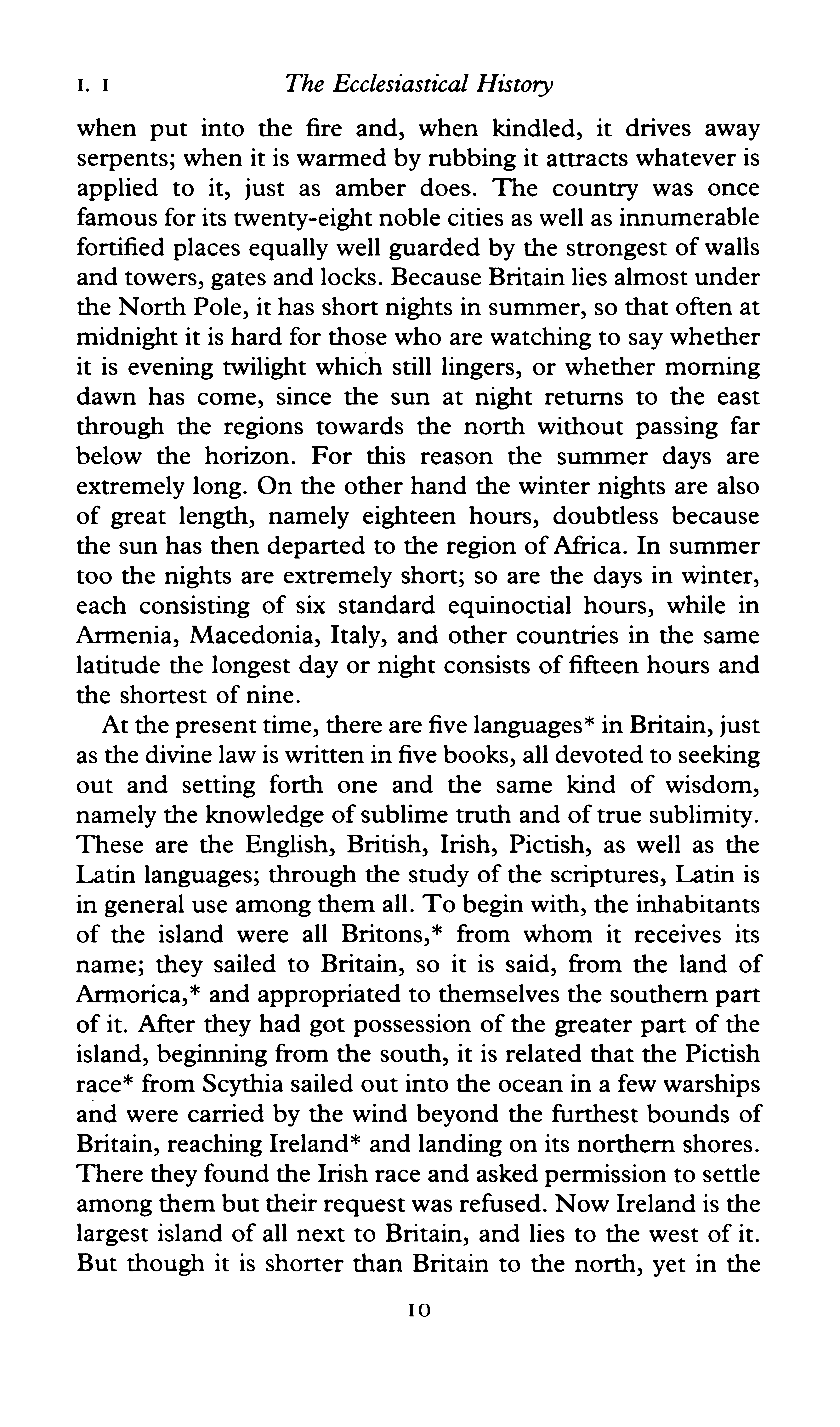
i. I The Ecclesiastical History when put into the fire and, when kindled, it drives away serpents; when it is warmed by rubbing it attracts whatever is applied to it, just as amber does. The country was once famous for its twenty-eight noble cities as well as innumerable fortified places equally well guarded by the strongest of walls and towers, gates and locks. Because Britain lies almost under the North Pole, it has short nights in summer, so that often at midnight it is hard for those who are watching to say whether it is evening twilight which still lingers, or whether morning dawn has come, since the sun at night returns to the east through the regions towards the north without passing far below the horizon. For this reason the summer days are extremely long. On the other hand the winter nights are also of great length, namely eighteen hours, doubtless because the sun has then departed to the region of Africa. In summer too the nights are extremely short; so are the days in winter, each consisting of six standard equinoctial hours, while in Armenia, Macedonia, Italy, and other countries in the same latitude the longest day or night consists of fifteen hours and the shortest of nine.
At the present time, there are five languages* in Britain, just as the divine law is written in five books, all devoted to seeking out and setting forth one and the same kind of wisdom, namely the knowledge of sublime truth and of true sublimity.
These are the English, British, Irish, Pictish, as well as the Latin languages; through the study of the scriptures, Latin is in general use among them all. To begin with, the inhabitants of the island were all Britons,* from whom it receives its name; they sailed to Britain, so it is said, from the land of Armorica,* and appropriated to themselves the southern part of it. After they had got possession of the greater part of the island, beginning from the south, it is related that the Pictish race* from Scythia sailed out into the ocean in a few warships and were carried by the wind beyond the furthest bounds of Britain, reaching Ireland* and landing on its northern shores.
There they found the Irish race and asked permission to settle among them but their request was refused. Now Ireland is the largest island of all next to Britain, and lies to the west of it.
But though it is shorter than Britain to the north, yet in the io
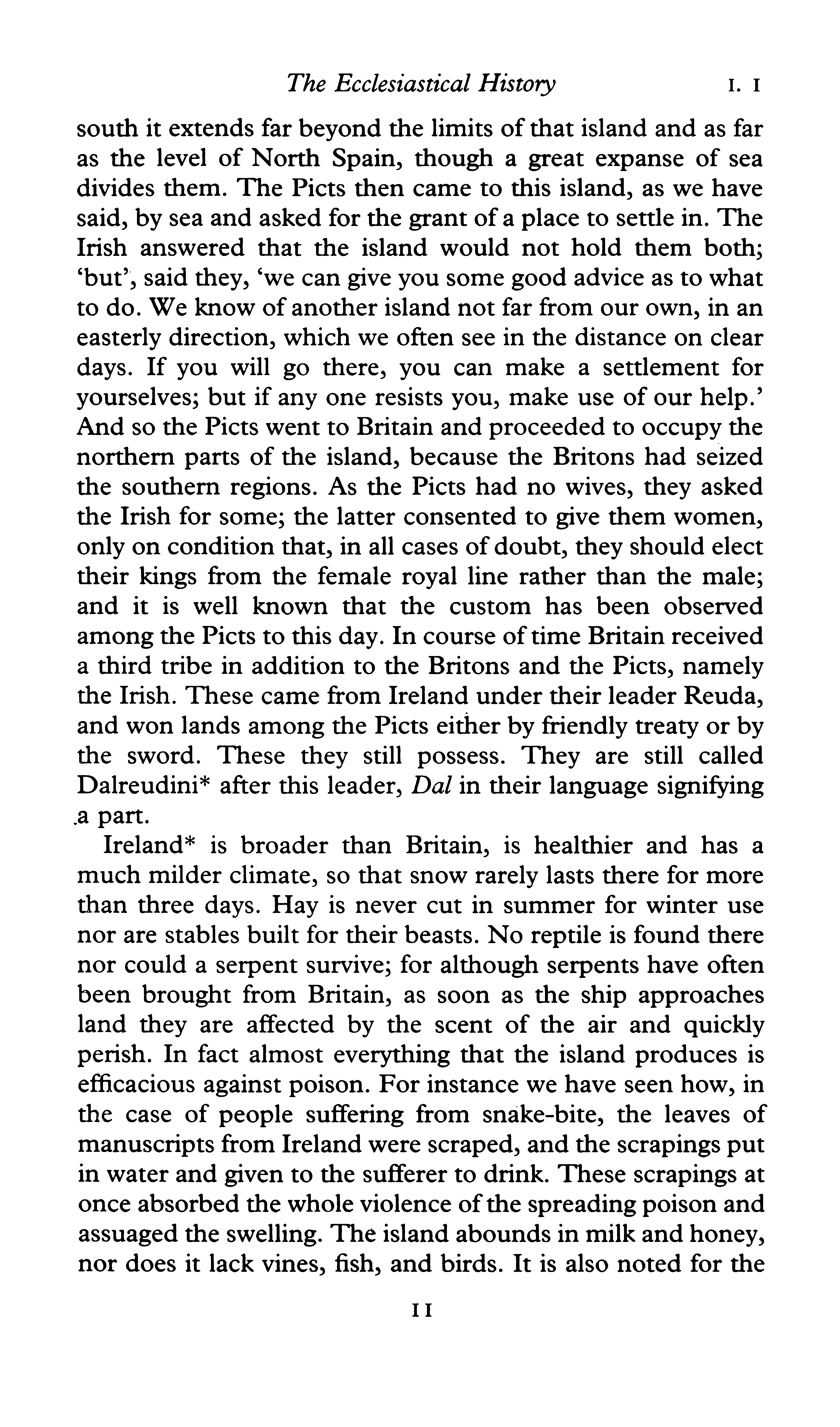
The Ecclesiastical History i. i south it extends far beyond the limits of that island and as far as the level of North Spain, though a great expanse of sea divides them. The Piets then came to this island, as we have said, by sea and asked for the grant of a place to settle in. The Irish answered that the island would not hold them both;
'but', said they, 'we can give you some good advice as to what to do. We know of another island not far from our own, in an easterly direction, which we often see in the distance on clear days. If you will go there, you can make a settlement for yourselves; but if any one resists you, make use of our help.'
And so the Piets went to Britain and proceeded to occupy the northern parts of the island, because the Britons had seized the southern regions. As the Piets had no wives, they asked the Irish for some; the latter consented to give them women, only on condition that, in all cases of doubt, they should elect their kings from the female royal line rather than the male; and it is well known that the custom has been observed among the Piets to this day. In course of time Britain received a third tribe in addition to the Britons and the Piets, namely the Irish. These came from Ireland under their leader Reuda, and won lands among the Piets either by friendly treaty or by the sword. These they still possess. They are still called
Dalreudini* after this leader, Dal in their language signifying .a part.
Ireland* is broader than Britain, is healthier and has a much milder climate, so that snow rarely lasts there for more than three days. Hay is never cut in summer for winter use nor are stables built for their beasts. No reptile is found there nor could a serpent survive; for although serpents have often been brought from Britain, as soon as the ship approaches land they are affected by the scent of the air and quickly perish. In fact almost everything that the island produces is efficacious against poison. For instance we have seen how, in the case of people suffering from snake-bite, the leaves of manuscripts from Ireland were scraped, and the scrapings put in water and given to the sufferer to drink. These scrapings at once absorbed the whole violence of the spreading poison and assuaged the swelling. The island abounds in milk and honey, nor does it lack vines, fish, and birds. It is also noted for the i i
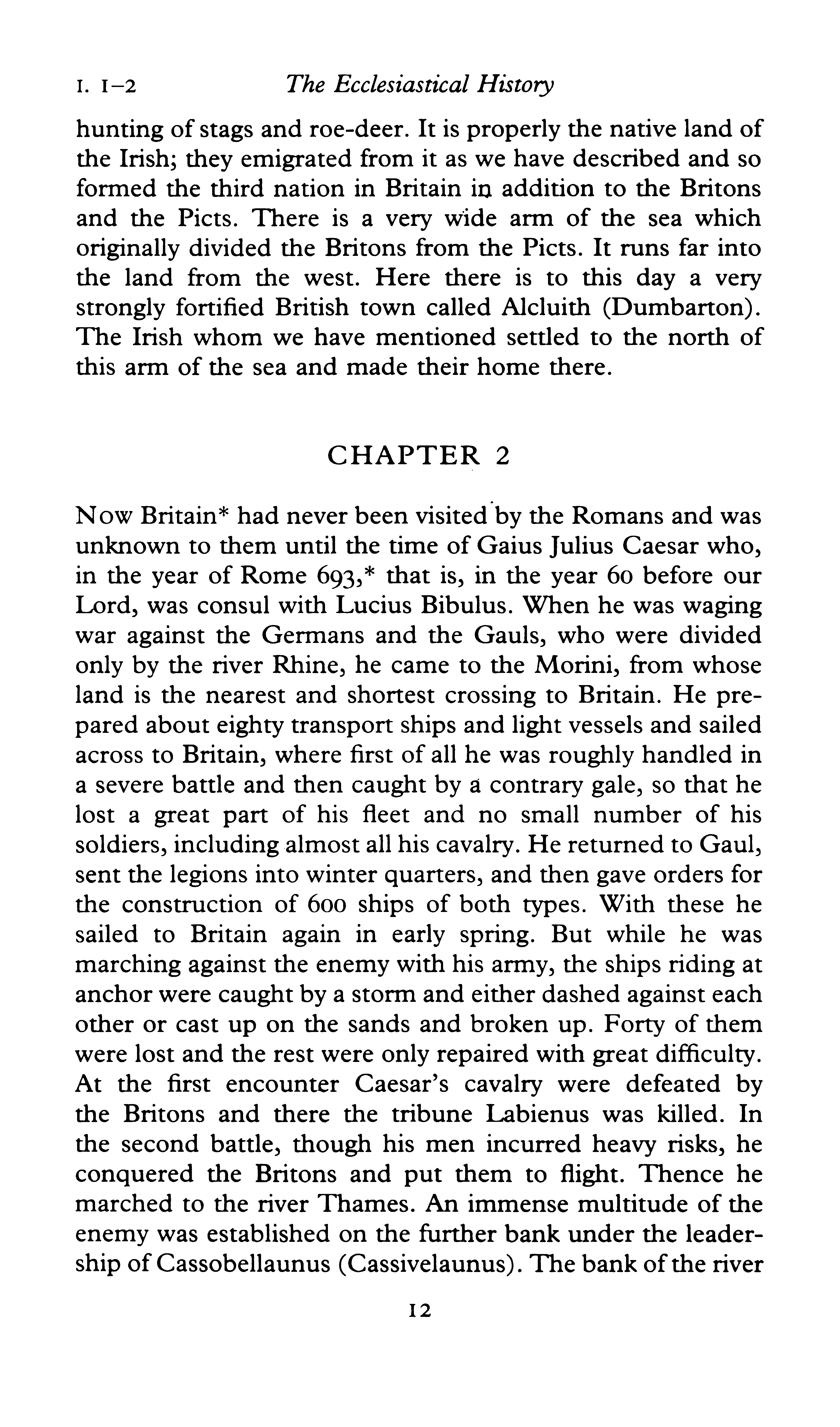
i. 1-2 The Ecclesiastical History hunting of stags and roe-deer. It is properly the native land of the Irish; they emigrated from it as we have described and so formed the third nation in Britain in addition to the Britons and the Piets. There is a very wide arm of the sea which originally divided the Britons from the Piets. It runs far into the land from the west. Here there is to this day a very strongly fortified British town called Alcluith (Dumbarton).
The Irish whom we have mentioned settled to the north of this arm of the sea and made their home there.
C H A P T E R 2
N ow Britain* had never been visited by the Romans and was unknown to them until the time of Gaius Julius Caesar who, in the year of Rome 693,* that is, in the year 60 before our
Lord, was consul with Lucius Bibulus. When he was waging war against the Germans and the Gauls, who were divided only by the river Rhine, he came to the Morini, from whose land is the nearest and shortest crossing to Britain. He pre pared about eighty transport ships and light vessels and sailed across to Britain, where first of all he was roughly handled in a severe battle and then caught by a contrary gale, so that he lost a great part of his fleet and no small number of his soldiers, including almost all his cavalry. He returned to Gaul, sent the legions into winter quarters, and then gave orders for the construction of 600 ships of both types. With these he sailed to Britain again in early spring. But while he was marching against the enemy with his army, the ships riding at anchor were caught by a storm and either dashed against each other or cast up on the sands and broken up. Forty of them were lost and the rest were only repaired with great difficulty.
At the first encounter Caesar's cavalry were defeated by the Britons and there the tribune Labienus was killed. In the second battle, though his men incurred heavy risks, he conquered the Britons and put them to flight. Thence he marched to the river Thames. An immense multitude of the enemy was established on the further bank under the leader ship of Cassobellaunus (Cassivelaunus). The bank of the river
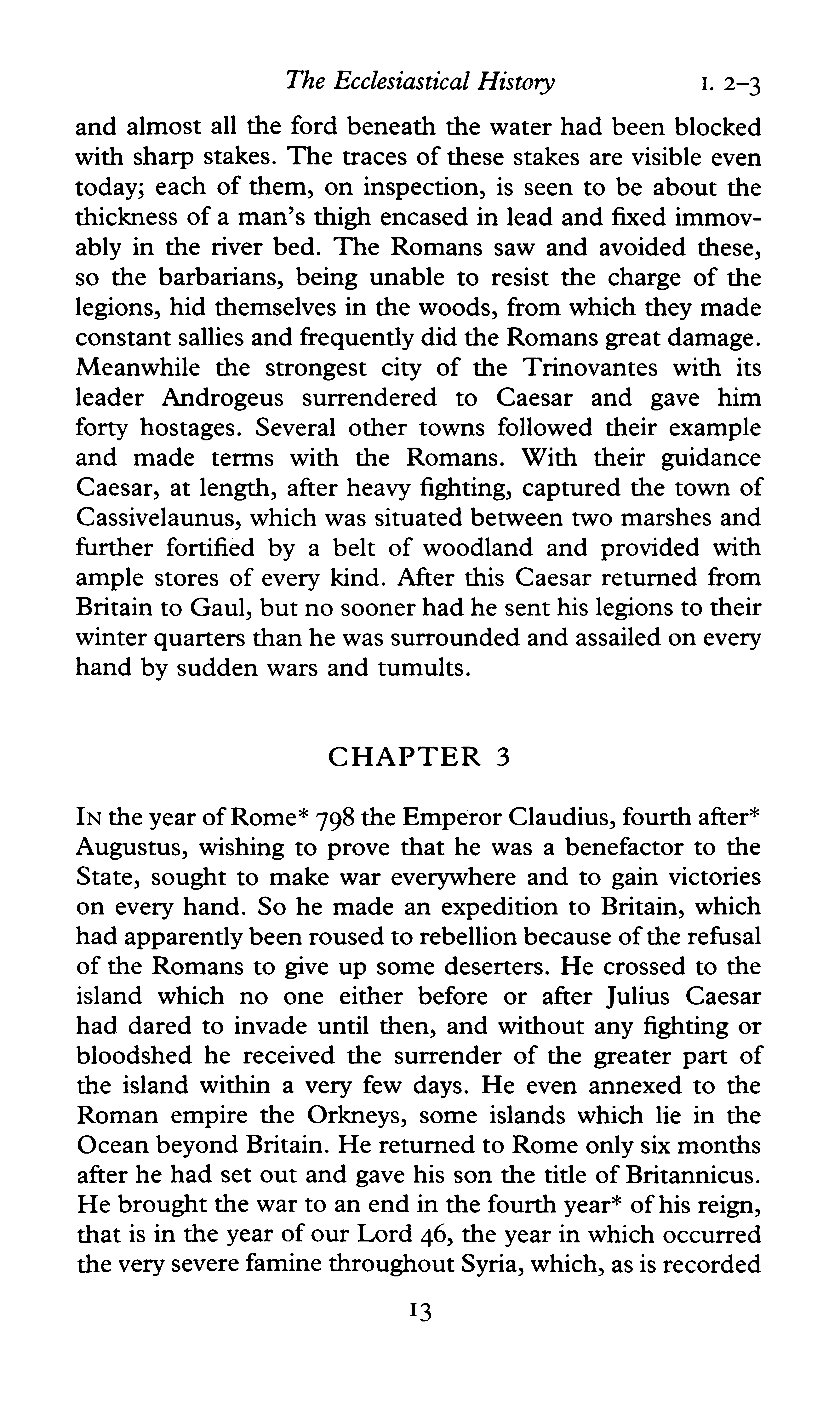
The Ecclesiastical History I. 2 - 3 and almost all the ford beneath the water had been blocked with sharp stakes. The traces of these stakes are visible even today; each of them, on inspection, is seen to be about the thickness of a man's thigh encased in lead and fixed immov ably in the river bed. The Romans saw and avoided these, so the barbarians, being unable to resist the charge of the legions, hid themselves in the woods, from which they made constant sallies and frequently did the Romans great damage.
Meanwhile the strongest city of the Trinovantes with its leader Androgeus surrendered to Caesar and gave him forty hostages. Several other towns followed their example and made terms with the Romans. With their guidance
Caesar, at length, after heavy fighting, captured the town of Cassivelaunus, which was situated between two marshes and further fortified by a belt of woodland and provided with ample stores of every kind. After this Caesar returned from Britain to Gaul, but no sooner had he sent his legions to their winter quarters than he was surrounded and assailed on every hand by sudden wars and tumults.
C H A P T E R 3
I n the year of Rome* 798 the Emperor Claudius, fourth after* Augustus, wishing to prove that he was a benefactor to the State, sought to make war everywhere and to gain victories on every hand. So he made an expedition to Britain, which had apparently been roused to rebellion because of the refusal of the Romans to give up some deserters. He crossed to the island which no one either before or after Julius Caesar had dared to invade until then, and without any fighting or bloodshed he received the surrender of the greater part of the island within a very few days. He even annexed to the Roman empire the Orkneys, some islands which lie in the Ocean beyond Britain. He returned to Rome only six months after he had set out and gave his son the title of Britannicus.
He brought the war to an end in the fourth year* of his reign, that is in the year of our Lord 46, the year in which occurred the very severe famine throughout Syria, which, as is recorded
i. 3 —5 The Ecclesiastical History in the Acts of the Apostles, was foretold by the prophet
Agabus.
Vespasian,* who became emperor after Nero, was sent to Britain by Claudius and brought the Isle of Wight also under Roman rule. It is close to the south coast of Britain, and is about thirty miles in length from east to west and twelve from north to south. At its eastern end it is six miles and at its western end three miles from the southern coast of Britain.
Nero, who succeeded Claudius as emperor, undertook no military campaigns of any kind. Consequently he brought countless other disasters upon the Roman empire, and nearly lost Britain as well. For two very noble cities were captured and destroyed there during his reign.
C H A P T E R 4
I n the year of our Lord 156 Marcus* Antoninus Verus was made emperor together with his brother Aurelius
Commodus. He was the fourteenth after Augustus. In their time, while a holy man called Eleutherius was bishop of the church at Rome, Lucius,* a king of Britain, sent him a letter praying him that he might be made a Christian by a rescript from him. His pious request was quickly granted and the Britons preserved the faith which they had received, inviolate and entire, in peace and quiet, until the time of the Emperor
Diocletian.
C H A P T E R 5
I n the year of our Lord 189 Severus,* an African by race, of the town of Leptis in the province of Tripoli, became emperor. He was the seventeenth after Augustus and reigned for seventeen years. He was harsh by nature and harassed by continual wars; he ruled the State firmly but with great difficulty. Having been victorious in the very grievous civil wars which happened in his time, he was drawn into Britain by the defection of almost all the federate tribes there. After
The Ecclesiastical History I. 5-6 fighting many great and hard battles, he decided to separate the part of the island over which he had regained control, from the other unconquered tribes, not by a wall as some think, but by a rampart. For a wall is made of stones but a rampart, with which the forts are strengthened to resist the violence of the enemy, is made of sods cut from the earth and is raised high above the ground like a wall. In front is the ditch from which the sods have been lifted and above it are fixed stakes made of the strongest wood. So Severus con structed a great ditch from sea to sea and a very strong rampart fortified by numerous towers upon it. He fell ill and died at York and left two sons, Bassianus and Geta. Of these
Geta perished, having been judged an enemy of the state, while Bassianus, who assumed the surname of Antoninus, gained the empire.
C H A P T E R 6
In the year* of our Lord 286 Diocletian, the thirty-third after Augustus, was elected emperor by the army and reigned twenty years. He made Maximianus, whose surname was
Herculius, his co-emperor. In their time a certain Carausius, a man of mean birth but able and energetic, had been ap pointed to guard the shores of the Ocean, which were then infested by Franks and Saxons. This man acted rather to the prejudice than to the benefit of the body politic, in that, when he took booty from the robbers, he restored none of it to its owners but kept it all himself. Thus he gave rise to the suspicion that he even allowed the enemy to invade the territories through intentional neglect. For this reason
Maximianus gave orders for him to be put to death, but instead Carausius assumed the purple and occupied Britain.
He seized and held it for seven years with great daring but was finally killed by the treachery of his colleague Allectus. The latter afterwards held the island which he had seized from Carausius for three years after which Asclipiodotus, the com mander of the imperial bodyguard, overthrew him and, ten years later, restored Britain to the Empire.
i. 6 -7 The Ecclesiastical History Meanwhile Diocletian in the east and Maximianus
Herculius in the west ordered the churches to be laid waste and the Christians persecuted and slain, the tenth persecution after Nero. This one lasted longer and was more cruel than almost any of the previous ones; it continued without ceasing for ten years accompanied by the burning of churches, the outlawry of innocent people, and the slaughter of the martyrs.
In fact Britain also attained to the great glory of bearing faithful witness to God.
C H A P T E R 7
D u r in g this persecution St Alban suffered. Fortunatus* in his Praise of the Virgins, in which he mentions the blessed martyrs, who came to the Lord from every quarter of the globe, calls him 'Illustrious Alban, fruitful Britain's child'.
When infidel rulers were issuing violent edicts against the Christians, Alban,* though still a heathen at the time, gave hospitality to a certain cleric who was fleeing from his per secutors. When Alban saw this man occupied day and night in continual vigils and prayers, divine grace suddenly shone upon him and he learned to imitate his guest's faith and devotion. Instructed little by little by his teaching about sal vation, Alban forsook the darkness of idolatry and became a wholehearted Christian. When this cleric had been staying with him for some days, it came to the ears of the evil ruler that a man who confessed Christ, though not yet destined to be a martyr, was hiding in Alban's house. He at once ordered his soldiers to make a thorough search for him there.
When they came to the martyr's dwelling, St Alban at once offered himself to the soldiers in place of his guest and teacher, and so, having put on the garment, that is to say the cloak, which the cleric was wearing, he was brought in bonds to the judge.
Now it happened that, when Alban was brought in to him, the judge was standing before the devils' altars and offering sacrifices to them. Seeing Alban, he immediately flew into a rage because this man of his own accord had dared to give
The Ecclesiastical History 1-7 himself up to the soldiers and to run so great a risk on behalf of the guest whom he had harboured. He ordered Alban to be dragged before the images of the devils in front of which he was standing and said, 'You have chosen to conceal a profane rebel rather than surrender him to my soldiers, to prevent him from paying a well-deserved penalty for his blasphemy in despising the gods; so you will have to take the punishment he has incurred if you attempt to forsake our worship and religion.' St Alban had of his own accord declared himself a Christian before the enemies of the faith, and was not at all afraid of the ruler's threats; arming himself for spiritual warfare, he openly refused to obey these commands. The judge said to him, 'What is your family and race?' Alban answered, 'What concern is it of yours to know my parentage?
If you wish to hear the truth about my religion, know that I am now a Christian and am ready to do a Christian's duty.'
The judge said, 'I insist on knowing your name, so tell me at once.' The saint said, 'My parents call me Alban and I shall ever adore and worship the true and living God who created all things.' The judge answered very angrily, 'If you wish to enjoy the happiness of everlasting life, you must sacrifice at once to the mighty gods.' Alban answered, 'The sacrifices which you offer to devils cannot help their votaries nor fulfil the desires and petitions of their suppliants. On the contrary, he who has offered sacrifices to these images will receive eternal punishment in hell as his reward.' When the judge heard this he was greatly incensed and ordered the holy confessor of God to be beaten by the torturers, thinking that he could weaken by blows that constancy of heart which he could not affect by words. Alban, though he was subjected to the most cruel tortures, bore them patiently and even joyfully for the Lord's sake. So when the judge perceived that he was not to be overcome by tortures nor turned from the Christian faith, he ordered him to be executed.
As he was being led to his execution, he came to a rapid river whose stream ran between the town wall and the arena where he was to suffer. He saw there a great crowd of people of both sexes and of every age and rank, who had been led
(doubtless by divine inspiration) to follow the blessed con
i. 7
The Ecclesiastical History fessor and martyr. They packed the bridge over the river so tightly that he could hardly have crossed it that evening. In fact almost everyone had gone out so that the judge was left behind in the city without any attendants at all. St Alban, whose ardent desire it was to achieve his martyrdom as soon as possible, came to the torrent and raised his eyes towards heaven. Thereupon the river-bed dried up at that very spot and he saw the waters give way and provide a path for him to walk in. The executioner who was to have put him to death was among those who saw this. Moved by a divine prompting, he hastened to meet the saint as he came to the place ap pointed for his execution; then he threw away his sword which he was carrying ready drawn and cast himself down at the saint's feet, earnestly praying that he might be judged worthy to be put to death either with the martyr whom he himself had been ordered to execute, or else in his place.
So while he was turned from a persecutor into a companion in the true faith, and while there was a very proper hesitation among the other executioners in taking up the sword which lay on the ground, the most reverend confessor ascended the hill with the crowds. This hill lay about five hundred paces from the arena, and, as was fitting, it was fair, shining and beautiful, adorned, indeed clothed, on all sides with wild flowers of every kind; nowhere was it steep or precipitous or sheer but Nature had provided it with wide, long-sloping sides stretching smoothly down to the level of the plain. In fact its natural beauty had long fitted it as a place to be hallowed by the blood of a blessed martyr. When he reached the top of the hill, St Alban asked God to give him water and at once a perpetual spring bubbled up, confined within its channel and at his very feet, so that all could see that even the stream rendered service to the martyr. For it could not have happened that the martyr who had left no water remaining in the river would have desired it on the top of the hill, if he had not realized that this was fitting. The river, when it had fulfilled its duty and completed its pious service, returned to its natural course, but it left behind a witness of its ministry.
And so in this spot the valiant martyr was beheaded and received the crown of life which God has promised to those
The Ecclesiastical History I. 7-8 who love him. But the one who laid his unholy hands on that holy neck was not permitted to rejoice over his death; for the head of the blessed martyr and the executioner's eyes fell to the ground together.
The soldier who had been constrained by the divine will to refuse to strike God's holy confessor was also beheaded there.
In his case it is clear that though he was not washed in the waters of baptism, yet he was cleansed by the washing of his own blood and made worthy to enter the kingdom of heaven. Then the judge, who was astonished by these strange heavenly miracles, ordered the persecution to cease and began to respect the way in which the saints met their death, though he had once believed that he could thereby make them forsake their devotion to the Christian faith. The blessed
Alban suffered death on 22 June near the city of Verulamium which the English now call either Uerlamaccestir or Uæclingaccestir (St Albans). Here when peaceful Christian times returned, a church of wonderful workmanship was built, a worthy memorial of his martyrdom. To this day sick people are healed in this place and the working of frequent miracles continues to bring it renown.
About this time Aaron and Julius,* both citizens of the city of the Legions (Caerleon), suffered, and many others of both sexes in various other places. They were racked by many kinds of torture and their limbs were indescribably mangled but, when their sufferings were over, their souls were carried to the joys of the heavenly city.
C H A P T E R 8
W h en the storm* of persecution had ceased, the faithful Christians who in the time of danger had hidden themselves in woods and deserts and secret caverns came out of hiding.
They rebuilt the churches which had been razed to the ground; they endowed and built shrines to the holy martyrs.
Everywhere, they displayed them as tokens of victory, cel ebrating festal days and performing their sacred rites with pure heart and voice. The churches of Britain remained at
i. 8 - 9 The Ecclesiastical History peace until the time of the Arian madness* which corrupted the whole world and even infected this island, sundered so far from the rest of mankind, with the poison of its error. This quickly opened the way for every foul heresy from across the Ocean to pour into an island which always delights in hearing something new and holds firmly to no sure belief.
At this time Constantius* died in Britain, a man of great clemency and courtesy, who had governed Gaul and Spain while Diocletian was alive. He left a son Constantine,* who was made emperor of Gaul, being the child of his concubine
Helena. Eutropius* writes that Constantine was created em peror in Britain and succeeded to his father's kingdom. In his time arose the Arian heresy which was exposed and con demned by the Council of Nicaea.* Nevertheless, the deadly poison of its evil doctrine, as has been said, tainted the churches of the whole world, including those of our own islands.
C H A P T E R 9
In the year of our Lord 377* Gratian, the fortieth after Augustus, ruled the empire alone for six years after the death of Valens. He had already reigned for a long time previously with his uncle Valens and his brother Valentinian. Seeing that the body politic was in a disordered state and on the point of collapse, and faced with the need of restoring it, he invested
Theodosius, a Spaniard, with the purple at Syrmium and at the same time made him emperor of Thrace and the east. At this moment, an energetic and upright man named Maximus, one worthy of the title of Augustus had he not risen to the rank of dictator by breaking his oath of allegiance, was elected emperor by the army in Britain almost against his will, and crossed to Gaul. There he treacherously murdered the Emperor Gratian, who had been terrified by the sudden in cursion and was intending to cross into Italy. Maximus also drove from Italy Gratian's brother, the Emperor Valentinian, who thereupon fled to the east, where Theodosius received him with fatherly affection and soon restored him to the
The Ecclesiastical History i. 9 -11 empire. The dictator Maximus was trapped within the walls of Aquileia, where he was caught and killed.
C H A P T E R 10
I n the year of our Lord 394 Arcadius, son of Theodosius, became joint-emperor with his brother Honorius and ruled for thirteen years. He was the forty-third from Augustus. In his time the Briton Pelagius* spread his treacherous poison far and wide, denying our need of heavenly grace. He had as his supporter Julianus* of Campania, who had long been stirred by an intemperate desire to get back his lost bishopric.
St Augustine and the rest of the orthodox fathers answered them by quoting many thousands of catholic authorities against them but failed to correct their folly; and, what was worse, the madness which should have been healed by turning to the truth was rather increased by rebuke and contradiction. The rhetorician Prosper* expresses it well in telling couplets* when he says:
Some hack, 'tis said, of envy long the prey, Against Augustine crawls his serpent way.
Who made this piteous worm raise from the ground A head once rightly sunk in caves profound?
Sure, sea-girt Britain's porridge bred this twaddle— Or else Campania's groats have turned his noddle.
C H A P T E R 1 1
I n the year of our Lord 407,* when Honorius Augustus, son of Theodosius the second was emperor, being the forty-fourth from Augustus, two years before the invasion of Rome by Alaric, king of the Goths, Gratian, a citizen, was set up here in Britain as dictator and killed. It was the year when the Alani, Suevi, Vandals, and many other races defeated the Franks, crossed the Rhine, and ravaged all Gaul. In his place
Constantine, a worthless soldier of the lowest rank, was elected in Britain solely on account of the promise of his name
i. 1 1-i 2 The Ecclesiastical History and with no virtue to recommend him. As soon as he had seized power he crossed over to Gaul. There he was often deluded by the barbarians into making doubtful treaties and so inflicted great harm on the body politic. Soon afterwards, on the orders of Honorius, his officer Constantius marched into Gaul with an army, besieged Constantine in the city of Arles, captured and killed him. Constans his son whom he had created Caesar, though a monk, was also put to death at Vienne by Gerontius, his own officer.
Now Rome was taken by the Goths in the eleven hundred and sixty-fourth year after its foundation; after this the Romans ceased to rule in Britain, almost 470 years after Gaius
Julius Caesar had come to the island. They had occupied the whole land south of the rampart already mentioned, set up across the island by Severus, an occupation to which the cities, lighthouses, bridges, and roads which they built there testify to this day. Moreover they possessed the suzerainty over the further parts of Britain as well as over the islands which are beyond it.
C H A P T E R 12
F r o m that time* Britain, or the British part of it, which had been stripped of all its armed men, its military supplies, and the whole flower of its active youth, who by the rashness of the dictators, had been led away never to return, lay wholly exposed to plunderers and the more so because the people were utterly ignorant of the practice of warfare. For instance, they were rapidly reduced to a state of terror and misery by two extremely fierce races from over the waters, the Irish from the west and the Piets from the north; and this lasted many years. We call* them races from over the waters, not because they dwelt outside Britain but because they were separated from the Britons by two wide and long arms of the sea, one of which enters the land from the east, the other from the west, although they do not meet. Half way along the eastern branch is the city of Giudi,* while above the western branch, that is on its right bank, is the town oiAlcluith (Dumbarton), a name
The Ecclesiastical History I. 12 which in their language means 'Clyde Rock' because it stands near the river of that name.
As a result of these invasions, the Britons sent messengers to Rome bearing letters with tearful appeals for aid, promising to be their subjects for ever, if only they would drive away their threatening foes. An armed legion was quickly dis patched to them which duly reached the island, attacked the enemy, destroying a great number of them and driving the rest from the territories of their allies. When the Romans had freed them from their dire distress, they urged the Britons to build a wall across the island from sea to sea, as a protection against their foes. And so the legion returned home in great triumph. The islanders built the wall,* as they had been bidden to do, but they made it, not of stone, since they had no skill in work of this kind, but of turves, so that it was useless.
They built many miles of it between the two channels or arms of the sea already mentioned, so that where there was no water to shield them, the protecting wall might defend their borders from enemy incursions. The clearest traces of the work constructed there, in the form of a very wide and high wall, can be seen to this day. It starts almost two miles west of the monastery at Aebbercumig (Abercom) in the place which the Piets all Peanfahel, while in English it is called
Penneltun (Kinneil). It stretches westward as far as Alcluith (Dumbarton).
But as soon as their former foes saw the Roman soldiers depart, they took ship and broke into their borders, felling, trampling, and treading down everything they met, like reapers mowing ripe com. Once more envoys were sent to Rome with pitiful appeals for help so that their wretched country might not be utterly destroyed, and the name of a Roman province, long renowned amongst them, might not be obliterated and disgraced by the barbarity of foreigners. Once again a legion was sent, which arrived unexpectedly in the autumn and did great destruction amongst the enemy, while all who succeeded in escaping were driven across the waters; before this they had been accustomed to carry off their booty every year across the same waters without any opposition.
Then the Romans informed the Britons that they could no 2 3
i. 12
The Ecclesiastical History longer be burdened with such troublesome expeditions for their defence; they advised them to take up arms themselves and make an effort to oppose their foes, who would prove too powerful for them only if they themselves were weakened by sloth. Moreover, thinking that it might be some help to the allies whom they were compelled to abandon, they built a strong wall of stone from sea to sea in a straight line between the fortresses which had been built there for fear of the enemy, on the site which Severus had once made his rampart.* So, at public and private expense and with the help of the Britons, they made a famous wall which is still to be seen. It is eight feet wide and twelve feet high, running in a straight line from east to west, as is plain for all to see even to this day. When it was complete they gave some heartening advice to this sluggish people and showed them how to make themselves weapons. In addition they built lookout towers at intervals along the shores of the Ocean to the south, where their ships plied and where there was fear of barbarian attacks.
And so they took leave of their allies never to return.
After the Romans had gone back to their own land, the Irish and Piets, who knew they were not to return, immedi ately came back themselves and, becoming bolder than ever, captured the whole of the northern and farthest portion of the island as far as the wall, driving out the natives. There the Britons deployed their dispirited ranks along the top of the defence and, day and night, they moped with dazed and trembling hearts. On the other hand the enemy with hooked weapons* never ceased from their ravages. The cowardly defenders were wretchedly dragged from the walls and dashed to the ground. In short, they deserted their cities, fled from the wall, and were scattered. The enemy pursued and there followed a massacre more bloodthirsty than ever before. The wretched Britons were tom in pieces by their enemies like lambs by wild beasts. They were driven from their dwellings and their poor estates; they tried to save themselves from the starvation which threatened them by robbing and plundering each other. Thus they increased their external calamities by internal strife until the whole land was left without food and destitute except for such relief as hunting brought.
The Ecclesiastical History
I. 1 3 - 1 4
C H A P T E R 13
I n the year of our Lord 423 Theodosius* the younger became emperor after Honorius, being the forty-fifth from Augustus, and ruled twenty-six years. In the eighth year of his reign
Palladius* was sent by Celestinus the pontiff of the Roman church to the Irish believers in Christ to be their first bishop.
In the twenty-third year of his reign Aetius,* a man of high rank, who was also a patrician, held his third consulship* together with Symmachus. The wretched remnant of the Britons sent him a letter which began: 'To Aetius, thrice consul, come the groans of the Britons.' In the course of the letter they unfolded their sorrows: 'The barbarians drive us to the sea: the sea drives us back on the barbarians; between them two kinds of death face us: we are either slaughtered or drowned.' In spite of all this they were unable to obtain any help from him, seeing that he was at that time engaged in a deadly struggle* with Blsedla and Attila, the kings of the Huns; and although in the previous year Blædla had been murdered by the treachery of his own brother Attila, never theless Attila continued to be so dangerous an enemy to the state that he devastated almost the whole of Europe, attacking and destroying cities and strongholds alike. At that time too,
Constantinople was attacked by a famine, which was followed immediately by the plague. Moreover most of the walls of the city fell, together with fifty-seven towers. Many cities also fell into ruins, while hunger and a pestiferous stench which filled the air destroyed many thousands more men and cattle.
C H A P T E R 14
M e a n w h il e* this famine, which left to posterity a lasting memory of its horrors, afflicted the Britons more and more. It compelled many of them to surrender to the plundering foe; others, trusting in divine aid when human help failed them, would never give in but continued their resistance, hiding in mountains, caves, and forests. At last they began to inflict
i. 14 -15 The Ecclesiastical History severe losses on the enemy who had been plundering their land for many years. So the shameless Irish robbers returned home, intending to come back before long, while the Piets, from that time on, settled down in the furthest part of the island, though they did not cease to plunder and harass the Britons occasionally.
After the enemy's depredations had ceased, there was so great an abundance of com in the island as had never before been known. With this affluence came an increase of luxury, followed by every kind of foul crime; in particular, cruelty and hatred of the truth and love of lying increased so that if anyone appeared to be milder than the rest and somewhat more inclined to the truth, the rest, without consideration, rained execrations and missiles upon him as if he had been an enemy of Britain. Not only were laymen guilty of these offences but even the Lord's own flock and their pastors.
They cast off Christ's easy yoke and thrust their necks under the burden of drunkenness, hatred, quarrelling, strife, and envy and other similar crimes. In the meantime a virulent plague suddenly fell upon these corrupt people which quickly laid low so large a number that there were not enough people left alive to bury the dead. Yet those who survived could not be awakened from the spiritual death which their sins had brought upon them either by the death of their kinsmen or by fear of their own death. For this reason a still more terrible retribution soon afterwards overtook this sinful people for their fearful crimes. They consulted as to what they should do and where they should seek help to prevent or repel the fierce and very frequent attacks of the northern nations; all, includ ing their king Vortigem,* agreed that they should call the Saxons to their aid from across the seas. As events plainly showed, this was ordained by the will of God so that evil might fall upon those miscreants.
C H A P T E R 15
I n the year of our Lord 449 Marcian,* forty-sixth from Augustus, became emperor with Valentinian and ruled for
The Ecclesiastical History I - 15 seven years. At that time* the race of the Angles or Saxons, invited by Vortigem, came to Britain in three warships and by his command were granted a place of settlement in the eastern part of the island, ostensibly to fight on behalf of the country, but their real intention was to conquer it. First they fought against the enemy* who attacked from the north and the Saxons won the victory. A report of this as well as of the fertility of the island and the slackness of the Britons reached their homes and at once a much larger fleet was sent over with a stronger band of warriors; this, added to the contingent already there, made an invincible army. The newcomers received from the Britons a grant of land in their midst on condition that they fought against their foes for the peace and safety of the country, and for this the soldiers were also to receive pay.
They came from three very powerful Germanic tribes, the Saxons, Angles, and Jutes.* The people of Kent* and the inhabitants of the Isle of Wight are of Jutish origin and also those opposite the Isle of Wight, that part of the kingdom of Wessex which is still today called the nation of the Jutes.
From the Saxon country, that is, the district now known as Old Saxony,* came the East Saxons, the South Saxons, and the West Saxons. Besides this, from the country of the Angles, that is, the land between the kingdoms of the Jutes and the Saxons, which is called Angulus, came the East Angles, the Middle Angles, the Mercians, and all the Northumbrian race
(that is those people who dwell north of the river Humber) as well as the other Anglian tribes. Angulus is said to have remained deserted from that day to this. Their first leaders are said to have been two brothers, Hengist and Horsa.* Horsa was afterwards killed in battle by the Britons, and in the eastern part of Kent there is still a monument bearing his name. They were the sons of Wihtgisl,* son of Witta, son of Wecta, son of Woden,* from whose stock the royal families of many kingdoms claimed their descent.
It was not long* before hordes of these peoples eagerly crowded into the island and the number of foreigners began to increase to such an extent that they became a source of terror to the natives who had called them in. Then suddenly
i. 15-16 The Ecclesiastical History they made a temporary treaty with the Piets whom they had already driven far away and began to turn their weapons against their allies. First they made them provide a greater quantity of food; then, seeking an occasion for a quarrel, they insisted that unless they received still greater supplies, they would break the treaty and lay waste every part of the island.
Nor were they at all slow in carrying out their threats. To put it briefly, the fire kindled by the hands of the heathen executed the just vengeance of God on the nation for its crimes. It was not unlike that fire once kindled by the Chaldeans which consumed the walls and all the buildings of Jerusalem. So here in Britain the just Judge ordained that the fire of their brutal conquerors should ravage all the neigh bouring cities and countryside from the east to the western sea, and bum on, with no one to hinder it, until it covered almost the whole face of the doomed island. Public and private buildings fell in mins, priests were everywhere slain at their altars, prelates and people alike perished by sword and fire regardless of rank, and there was no one left to bury those who had died a cruel death. Some of the miserable remnant were captured in the mountains and butchered indiscrimi nately; others, exhausted by hunger, came forward and sub mitted themselves to the enemy, ready to accept perpetual slavery for the sake of food, provided only they escaped being killed on the spot: some fled sorrowfully to lands beyond the sea, while others remained in their own land and led a wretched existence, always in fear and dread, among the mountains and woods and precipitous rocks.
C H A P T E R 16
W h e n the army* of the enemy had exterminated or scattered the native peoples, they returned home and the Britons slowly began to recover strength and courage. They emerged from their hiding-places and with one accord they prayed for the help of God that they might not be completely an nihilated. Their leader at that time was a certain Ambrosius
Aurelianus,* a discreet man, who was, as it happened, the
The Ecclesiastical History i. 16-17 sole member of the Roman race who had survived this storm in which his parents, who bore a royal and famous name, had perished. Under his leadership the Britons regained their strength, challenged their victors to battle, and, with God's help, won the day. From that time on, first the Britons won and then the enemy were victorious until the year of the siege of Mount Badon, when the Britons slaughtered no small number of their foes about forty-four years* after their arrival in Britain. But more of this hereafter.
C H A P T E R 17
A f e w years* before their arrival, the Pelagian heresy* in troduced by Agricola,* the son of the Pelagian bishop
Severianus, had corrupted the faith of Britain with its foul taint. The Britons had no desire at all to accept this perverse teaching and so blaspheme the grace of Christ, but could not themselves confute by argument the subtleties of the evil belief; so they wisely decided to seek help in this spiritual warfare from the Gaulish bishops. For this reason a great synod was called to consult together as to who should be sent thither to support the faith; by unanimous consent the .apostolic bishops, Germanus of Auxerre and Lupus of Troyes, came to Britain to confirm their belief in heavenly grace. These, with ready zeal, complied with the requests and commands of the holy Church and embarked on the Ocean.
The ship sped along safely with favouring winds and had reached half-way across the channel between Britain and Gaul, when suddenly they were met on their way by the hostile fury of devils; these were enraged that men of such quality should be sent to restore salvation to the people. They raised storms, they darkened the sky, turning day into night with clouds; the sails could not resist the fury of the winds; the sailors toiled in vain; the ship was supported by prayers rather than by their efforts. As it happened, their leader, the bishop, was worn out and fell asleep. Their champion having thus deserted his post (or so it seemed), the storm increased in fury and the ship, overwhelmed by the waves, was about to sink.
1.17
The Ecclesiastical History Then St Lupus and all the rest in their dismay awakened their leader so that he might oppose the fury of the elements. More resolute than they in the face of frightful danger, Germanus called on Christ and in the name of *he Holy Trinity took a little water and sprinkled it on the raging billows. At the same time he admonished his colleague and encouraged them all, whereupon with one consent and one voice they offered up their prayers. Divine help was forthcoming, the adversaries were put to flight, peace and calm followed, and the contrary winds veered round and helped them on their way; after a quick and peaceful crossing they reached the land they sought. There, great crowds gathered together from all quarters to meet the bishops, whose arrival had been foretold even by their enemies. The evil spirits proclaimed that what they feared had come to pass; and when driven out by the bishops' commands from the bodies of those possessed, they owned up to the nature of the tempest and the dangers which they had brought about, confessing that they had been vanquished by the merits and the power of these men.
In the meantime the island of Britain was soon filled with the fame of the preaching and the miracles of these apostolic bishops. They preached the word of God daily not only in the churches but also in the streets and in the fields, so that the faithful and the catholic were everywhere strengthened and the perverted recognized the true way; like the apostles, they acquired honour and authority for themselves through a good conscience, their learning through the scriptures, and the power of working miracles through their merits. And so the whole country readily turned to their way of thinking, while the authors of the false doctrine went into hiding and, like evil spirits, grieved over the loss of the people who had escaped destruction at their hands. At last, after long deliberation, they ventured to join battle. They came, ostentatiously dis playing their wealth in their gorgeous robes and surrounded by a multitude of their supporters, preferring to risk a contest rather than be put to shame by their own silence before the people whom they had subverted, lest by saying nothing they should appear to admit defeat. An immense multitude had been attracted thither with their wives and children. The
The Ecclesiastical History i. 17-18 crowds were present, ready to act as judges, but the contest ants differed widely one from the other: on the one side was divine faith, on the other side, human presumption: on the one side piety, on the other pride: on the one side Pelagius the founder of their faith, on the other Christ. The holy bishops gave their adversaries the opportunity of speaking first; these occupied their time and attention for a long period with nothing but empty words. Then the venerable bishops showered upon them the words of the apostles and evangelists in torrents of eloquence. They mingled their own words with the word of God, supporting their most trenchant arguments by the testimony of the scriptures. Falsehood was over come, deceit unmasked, so that their opponents, as every argument was presented, could not reply but had to confess their errors. The people who were judging found it hard to refrain from violence but nevertheless signified their verdict by applause.
C H A P T E R 18
I m m e d i a t e l y after this, a man who held the rank of tribune* came into the midst with his wife bringing to the bishops his blind daughter, a child of ten, to be healed. They bade the parents take her to their adversaries but the latter, rebuked by their consciences, joined in the prayers of the parents and begged the bishop to heal the child. Seeing their opponents yield, they uttered a short prayer and then Germanus, full of the Holy Spirit, invoked the Trinity. He tore from his neck the little bag which hung down close to his side, containing relics of the saints. Grasping it firmly, he pressed it in the sight of all on the girl's eyelids; her eyes were immediately delivered from darkness and filled with the light of truth. The parents re joiced while the people were overawed by the miracle. From that day the evil doctrine was so utterly banished from the minds of them all that they thirsted eagerly after the teaching of the bishops.
So when this damnable heresy had been suppressed and its authors confuted and the minds of all had been built up again
i. 18-19 The Ecclesiastical History on the pure faith, the bishops visited the martyr St Alban* to give thanks to God through him. Germanus had with him relics of all the apostles and various martyrs; and, after pray ing, he ordered the tomb to be opened so that he might place his precious gifts in it. He thought it fitting that the limbs of saints which had been gathered from near and far should find lodging in the same tomb, seeing that they had all entered heaven equal in merits. When these were honourably bestowed and placed side by side, he collected a heap of soil from the place where the blood of the blessed martyr had been shed, to take away with him. In it the blood still showed, pointing the contrast between the scarlet tide of martyrdom and the pale visage of the persecutor. After these incidents a countless number of men turned to the Lord on the same day.
C H A P T E R 19
W h il e they were returning, the treacherous foe, setting his chance snares, caused Germanus to fall and bruise his foot, not knowing that his merits like those of Job would be in creased by bodily affliction. While he was necessarily confined to one building because of the accident, a neighbouring cottage caught fire; the other dwellings which were thatched with reeds were destroyed and the fire, fanned by the wind, approached the house where he lay. All the people flocked to the bishop intending to lift him up in their arms and rescue him from the danger which threatened; but in the fulness of his faith, he rebuked them and would not allow himself to be moved. So the whole crowd in despair ran to fight the fire.
That the power of God might be made more manifest, what ever the crowds sought to preserve was destroyed; but, sick and prostrate as he was, he proved a sure defence. The saint's dwelling was wide open, yet the flames avoided and leapt over it though they raged hither and thither; and amid the masses of blazing fire, his shelter remained unharmed, preserved by the man who lay within. The crowd rejoiced at the miracle, glad to be outdone by the power of God. Day and night a
I. 19-20 The Ecclesiastical History countless multitude watched before the poor man's hut, some desiring to have their souls healed and some their bodies.
All that Christ wrought by his servant cannot be told, for though sick himself, he performed miracles; nor did he allow any remedy to be applied to his own injury. But one night he saw a person standing by him, clad in snow-white garments, who with outstretched hand seemed to raise him as he lay and bade him stand firm upon his feet. From that hour his pain departed and he was restored to his former health, so that when day returned he set out on his toilsome journey full of confidence.
C H A P T E R 20
M e a n w h i l e the Saxons and Piets* had joined forces and were making war upon the Britons, who were forced to take up arms. Fearing they were no match for their foes, they besought the help of the holy bishops. These came at once to fulfil their promise and inspired such confidence in the timid people that one would have thought that a large army had come to their support. Indeed, with such apostolic leaders, it was Christ Himself who fought in their camp. Now the holy season of Lent had come round and was made more sacred by the presence of the bishops, so much so that the people, instructed by their daily teaching, flocked eagerly to receive the grace of baptism. Vast numbers of the army were bap tized. A church of wattle was built in preparation for Easter
Day and set up for the army in the field as though it were in a city. So, still soaked in the waters of baptism, the army set out. The people's faith was fervent and putting no trust in their arms they expectantly awaited the help of God. The disposition and arrangement of the army was reported to the enemy; they were as sure of victory as though they were attacking an unarmed foe and hastened forward with renewed eagerness; but their approach was observed by the British scouts. So when the Easter solemnities had been celebrated and the greater part of the army, still fresh from the font, were beginning to take up arms and prepare for war, Germanus
i. 20-21 The Ecclesiastical History himself offered to be their leader. He picked out the most active and, having explored the surrounding country, he saw a valley surrounded by hills of moderate height lying in the direction from which the enemy was expected to approach. In this place he stationed his untried army and himself took command. The fierce enemy forces approached, plainly visible as they drew near to the army which was lying in ambush. Germanus who was bearing the standard, thereupon ordered his men to repeat his call in one great shout; as the enemy approached confidently, believing that their coming was unexpected, the bishops shouted 'Alleluia* three times. A universal shout of 'Alleluia' followed, and the echoes from the surrounding hills multiplied and increased the sound. The enemy forces were smitten with dread, fearing that not only the surrounding rocks but even the very frame of heaven itself would fall upon them. They were so filled with terror that they could not run fast enough. They fled hither and thither casting away their weapons and glad even to escape naked from the danger. Many of them rushed headlong back in panic and were drowned in the river which they had just crossed. The army, without striking a blow, saw themselves avenged and became inactive spectators of the victory freely offered to them. They gathered up the spoils lying ready to hand and the devout soldiery rejoiced in this heaven-sent triumph. The bishops thus overcame the enemy without the shedding of blood; they won a victory by faith and not by might.
So a widespread peace was restored to the island and foes visible and invisible were overcome; and the bishops prepared to return home. Their own merits and the intercession of the blessed martyr Alban won them a quiet voyage and their vessel prosperously brought them back in peace to their beloved people.
C H A P T E R 2 1
N o t long afterwards news came from Britain that a small number of people were again spreading abroad the Pelagian
The Ecclesiastical History I. 21 heresy. Again all the clergy sent to St Germanus, begging him to defend the cause of God which he had maintained before.
He hastened* to grant their request and, taking with him Severus, a man of great sanctity, put to sea and reached
Britain after a good voyage with favouring winds. Severus was a disciple of St Lupus, Bishop of Troyes; he was afterwards consecrated Bishop of Trier, preaching the word to the tribes in Germany west of the Rhine.
Meanwhile the evil spirits sped through the whole island, prophesying, though against their will, that Germanus was coming. So a certain Elafius, a chief of that district, hastened to meet the holy men, though no visible messenger had an nounced their coming. He took with him his son, who, while in the flower of his youth, had been smitten by a painful disease. His knee was wasted and the sinews shrunk so that he was unable to walk because the leg had withered. The whole population of the district followed Elafius. The bishops arrived and were met by the ignorant multitude, on whom they at once bestowed their blessing, giving them instruction in the Word of God. They recognized that the people as a whole had remained true to the faith from the time Germanus had left them; but on learning of the guilt of the few, they searched out the authors of the evil and condemned them.
Then Elafius threw himself at the bishop's feet and presented his son, whose infirmity proclaimed his need louder than words. All were grieved but especially the bishops, who were moved by pity to invoke the mercy of God. St Germanus at once told the boy to sit down and then stroked the knee which had been twisted by the disease. He passed his healing hand over all the afflicted parts and recovery quickly followed his health-giving touch. The withered knee regained its strength and the sinews were renewed; in the presence of them all, health was restored to the son and the son was restored to his father. The people were amazed at the miracle, and the catholic faith, already implanted in the hearts of them all, was further strengthened. Thereupon Germanus turned to the people and warned them in a sermon to correct their error.
The teachers of the heresy, who had been expelled from the island, were brought by common consent before the bishops,
i. 21-22 The Ecclesiastical History who banished them into the marchlands, so that the country might be rid of them and they might be rid of their error.
Thus it came to pass that the faith remained untainted in those parts for a very long time.
So when everything had been settled, the holy bishops returned as successfully as they had come. After this
Germanus went to Ravenna to obtain peace for the people of Armorica. He was received with the greatest reverence by Valentinian and his mother Placidia and there he departed to be with Christ. His body was carried to his own town with a splendid retinue and miracles took place on the way. Not long after, in the sixth year of the reign of Marcian, Valentinian was murdered by the followers of the patrician Aetius whom he had put to death, and with Valentinian the western empire fell.*
C H A P T E R 22
M e a n w h i l e* Britain had rest for a time from foreign though not from civil wars. The ruins of the cities destroyed and abandoned by the enemy still remained, while the citizens who had escaped from the foe fought against each other.
Nevertheless, so long as the memory of the calamity and bloodshed was still fresh, somehow the kings, priests, nobles, and private citizens kept within bounds. But, when they died, a generation succeeded which knew nothing of all these troubles and was used only to the present state of peace. Then all restraints of truth and justice were so utterly destroyed and abandoned that, not merely was there no trace of them to be found, but only a small, a very small minority even remembered their existence. To other unspeakable crimes,* which Gildas their own historian describes in doleful words, was added this crime, that they never preached the faith to the Saxons or Angles who inhabited Britain with them. Neverthe less God in His goodness did not reject the people whom He foreknew, but He had appointed much worthier heralds of the truth to bring this people to the faith.
The Ecclesiastical History I. 23
C H A P T E R 23
I n the year of our Lord 582 Maurice,* the fifty-fourth from Augustus, became emperor; he ruled for twenty-one years. In the tenth year of his reign, Gregory,* a man eminent in learning and in affairs, was elected pontiff of the apostolic see of Rome; he ruled for thirteen years, six months, and ten days.
In the fourteenth year* of this emperor and about 150 years after the coming of the Angles to Britain, Gregory, prompted by divine inspiration, sent a servant of God named
Augustine* and several more God-fearing monks with him to preach the word of God to the English race. In obedience to the pope's commands, they undertook this task and had already gone a little way on their journey when they were paralysed with terror. They began to contemplate returning home rather than going to a barbarous, fierce, and unbeliev ing nation whose language they did not even understand.
They all agreed that this was the safer course; so forthwith they sent home Augustine whom Gregory had intended to have consecrated as their bishop if they were received by the English. Augustine was to beg St Gregory humbly for permis sion to give up so dangerous, wearisome, and uncertain a journey. Gregory, however, sent them an encouraging letter in which he persuaded them to persevere with the task of preaching the Word and trust in the help of God. The letter* was in these terms:
Gregory, servant of the servants of God, to the servants of our Lord.
My dearly beloved sons, it would have been better not to have undertaken a noble task than to turn back deliberately from what you have begun: so it is right that you should carry out with all diligence this good work which you have begun with the help of the Lord. Therefore do not let the toilsome journey nor the tongues of evil speakers deter you. But carry out the task you have begun under the guidance of God with all constancy and fervour. Be sure that, however great your task may be, the glory of your eternal reward will be still
i. 23-24 The Ecclesiastical History greater. When Augustine your prior returns, now, by our appointment, your abbot, humbly obey him in all things, knowing that whatever you do under his direction will be in all respects profitable to your souls. May Almighty God protect you by His grace and grant that I may see the fruit of your labours in our heavenly home. Though I cannot labour with you, yet because I should have been glad indeed to do so,
I hope to share in the joy of your reward. May God keep you safe, my dearly loved sons.
Given on the 23 July, in the fourteenth year of the reign of our most religious emperor Maurice Tiberius, and the thirteenth year after his consulship, and the fourteenth indiction.*
C H A P T E R 24
T he venerable pontiff at the same time also sent a letter to Etherius,* archbishop of Arles, asking him to receive
Augustine kindly on his return to Britain. This is the text:
To his most reverend and holy brother and fellow bishop Etherius, Gregory, servant of the servants of God. Although religious men stand in need of no recommendation with those bishops who have that love which is pleasing to God, yet because a suitable occasion for writing presents itself, we think fit to send this letter to you our brother, informing you that we have directed thither the bearer of this document, Augustine, the servant of God, of whose zeal we are assured, together with other servants of God devoted to winning souls with the Lord's help. It is essential that your holiness should assist him with episcopal zeal and hasten to provide him with what he needs. And in order that you may be the more prompt with your help, we have specially enjoined him to tell you of his mission. We are sure that when you know this you will be prepared with all zeal to afford him your help for the Lord's sake as the occasion requires. We also commend to your charity the priest Candidus,* a son of both of us, whom we have sent to take charge of a small patrimony of our church. God keep you safe, most reverend brother.
Given on the 23 July, in the fourteenth year of the reign of our most religious emperor, Maurice Tiberius, and the thirteenth year after his consulship and the fourteenth indiction.
The Ecclesiastical History I. 25
C H A P T E R 25
So Augustine, strengthened by the encouragement of St Gregory, in company with the servants of Christ, returned to the work of preaching the word, and came to Britain. At that time Æthelberht,* king of Kent, was a very powerful monarch. The lands over which he exercised his suzerainty stretched as far as the great river Humber, which divides the northern from the southern Angles. Over against the eastern districts of Kent there is a large island called Thanet which, in English* reckoning, is 600 hides* in extent. It is divided from the mainland by the river Wantsum, which is about three furlongs wide, can be crossed in two places only, and joins the sea at either end. Here Augustine, the servant of the Lord, landed with his companions, who are said to have been nearly forty in number. They had acquired interpreters* from the Frankish race according to the command of Pope St Gregory.
Augustine sent to Æthelberht to say that he had come from Rome bearing the best of news, namely the sure and certain promise of eternal joys in heaven and an endless kingdom with the living and true God to those who received it. On hearing this the king ordered them to remain on the island where they had landed and be provided with all things necess ary until he had decided what to do about them. Some knowl edge about the Christian religion had already reached him because he had a Christian wife of the Frankish royal family whose name was Bertha.* He had received her from her parents on condition that she should be allowed to practise her faith and religion unhindered, with a bishop named
Liudhard* whom they had provided for her to support her faith.
Some days afterwards the king came to the island and, sitting in the open air, commanded Augustine and his com rades to come thither to talk with him. He took care that they should not meet in any building, for he held the traditional superstition that, if they practised any magic art, they might deceive him and get the better of him as soon as he entered.
But they came endowed with divine not devilish power and
i. 25-26 The Ecclesiastical History bearing as their standard a silver cross and the image of our
Lord and Saviour painted on a panel. They chanted litanies and uttered prayers to the Lord for their own eternal salvation and the salvation of those for whom and to whom they had come. At the king's command they sat down and preached the word of life to himself and all his gesiths* there present.
Then he said to them: 'The words and the promises you bring are fair enough, but because they are new to us and doubtful,
I cannot consent to accept them and forsake those beliefs which I and the whole English race* have held so long. But as you have come on a long pilgrimage and are anxious, I perceive, to share with us things which you believe to be true and good, we do not wish to do you harm; on the contrary, we will receive you hospitably and provide what is necessary for your support; nor do we forbid you to win all you can to your faith and religion by your preaching.' So he gave them a dwelling in the city of Canterbury, which was the chief city* of all his dominions; and, in accordance with his promise, he granted them provisions and did not refuse them freedom to preach. It is related that as they approached the city in accordance with their custom carrying the holy cross and the image of our great King and Lord, Jesus Christ, they sang this litany in unison: 'We beseech Thee, O Lord, in Thy great mercy, that Thy wrath and anger may be turned away from this city and from Thy holy house, for we have sinned.
Alleluia.'
C H A P T E R 26
As soon as they had entered the dwelling-place allotted to them, they began to imitate the way of life of the apostles and of the primitive church. They were constantly engaged in prayers, in vigils and fasts; they preached the word of life to as many as they could; they despised all worldly things as foreign to them; they accepted only the necessaries of life from those whom they taught; in all things they practised what they preached and kept themselves prepared to endure adversities, even to the point of dying for the truths they proclaimed. To
The Ecclesiastical History i. 2 6 -2 7 put it briefly, some, marvelling at their simple and innocent way of life and the sweetness of their heavenly doctrine, believed and were baptized. There was nearby, on the east of the city, a church built in ancient times in honour of St Martin,* while the Romans were still in Britain, in which the queen who, as has been said, was a Christian, used to pray. In this church they first began to meet to chant the psalms, to pray, to say mass, to preach, and to baptize, until, when the king had been converted to the faith, they received greater liberty to preach everywhere and to build or restore churches.
At last* the king, as well as others, believed and was baptized, being attracted by the pure life of the saints and by their most precious promises, whose truth they confirmed by performing many miracles. Every day more and more began to flock to hear the Word, to forsake their heathen worship, and, through faith, to join the unity of Christ's holy Church.
It is related that the king, although he rejoiced at their convèrsion and their faith, compelled no one to accept Chris tianity; though none the less he showed greater affection for believers since they were his fellow citizens in the kingdom of heaven. But he had learned from his teachers and guides in the way of salvation that the service of Christ was voluntary and ought not to be compulsory. It was not long before he granted his teachers a place to settle in, suitable to their rank, in Canterbury, his chief city, and gave them possessions of various kinds for their needs.
C H A P T E R 27
M e a n w h i l e Augustine, the man of God, went to Arles* and, in accordance with the command of the holy father Gregory, was consecrated archbishop of the English race by Etherius, the archbishop of that city. He returned to Britain and at once sent to Rome the priest Laurence and the monk Peter* to inform the pope St Gregory that the English race had received the faith of Christ and that he himself had been made their bishop. At the same time he asked his advice about certain
4 1
i. 27
The Ecclesiastical History questions which seemed urgent. He received fitting answers* to his inquiry without delay, and we have thought proper to insert them in our History.
The first question of St Augustine, bishop of the Kentish church. How should bishops live with their clergy? How are the offerings which the faithful bring to the altar to be appor tioned, and how ought a bishop to act in the church?
Pope Gregory, bishop of the city of Rome answered: The sacred scriptures with which you are doubtless very familiar bear witness to this and especially the epistles of St Paul to Timothy, in which he took pains to instruct him how he ought to behave himself in the house of God. It is a custom of the apostolic see to give instruction to those who have been consecrated bishops that all money received should be divided into four portions: that is, one for the bishop and his household for purposes of hospitality and entertainment, a second for the clergy, a third for the poor, and a fourth for the repair of churches. But because you, brother, are conversant with monastic rules, and ought not to live apart from your clergy in the English Church, which, by the guidance of God, has lately been converted to the faith, you ought to institute that manner of life which our fathers followed in the earliest beginnings of the Church: none of them said that anything he possessed was his own, but they had all things in common. If, however, there are any who are clerics but in minor orders and who cannot be continent, they should marry and receive their stipends outside the community; for we know that it is written concerning those fathers whom we have mentioned that division was to be made to each according to his need.
Care must also be taken and provision made for their stipends and they must be kept under ecclesiastical rule, living a moral life and attending to the chanting of the psalms and, under God's guidance, keeping their heart, their tongue, and their body from all things unlawful. And what need we say to those who lead a common life about assigning portions or dispens ing hospitality or giving alms? For all that is over is to be spent for holy and religious purposes as the Lord and Master of all
The Ecclesiastical History i. 27 teaches: 'Give alms of what you have over and behold all things are clean unto you.'
II. Augustine's second question. Even though the faith is one are there varying customs in the churches? and is there one form of mass in the Holy Roman Church and another in the Gaulish churches?
Pope Gregory answered: My brother, you know the customs of the Roman Church in which, of course, you were brought up. But it is my wish that if you have found any customs in the Roman or the Gaulish church or any other church which may be more pleasing to Almighty God, you should make a careful selection of them and sedulously teach the Church of the English, which is still new in the faith, what you have been able to gather from other churches. For things are not to be loved for the sake of a place, but places are to be loved for the sake of their good things. Therefore choose from every individual Church whatever things are devout, reli gious, and right. And when you have collected these as it were into one bundle, see that the minds of the English grow accustomed* to it.
III. Augustine's third question. I beg you to tell me how one who robs a church should be punished.
Gregory answered: My brother, you must judge from the thief's circumstances what punishment he ought to have. For there are some who commit theft though they have resources, while others transgress in this matter through poverty. So some must be punished by fines, some by a flogging, some severely and others more leniently. And when the punishment is more severe, it must be administered in love and not in anger, for it is bestowed on the one who is punished so that he shall not be delivered up to hell-fire. We ought to maintain discipline among the faithful as good fathers do with their children according to the flesh; they beat them with stripes for their faults and yet the very ones they chastise, they intend to make their heirs; and they keep whatever they possess for those whom they appear to persecute in their anger. So we must always keep love in mind and love must dictate the
i. 27
The Ecclesiastical History method of correction, so that we do not decide on anything unreasonable. You should also add that they ought to restore whatever they have stolen from a church. But God forbid that the Church should make a profit out of the earthly things it seems to lose and so seek to gain from such vanities.
IV. Augustine's fourth question. May two brothers marry two sisters provided they belong to a family not related to them?
Gregory answered: This is entirely permissible, for there is nothing in the sacred writings on this point which seems to forbid it.
V. Augustine's fifth question. Within what degree may the faithful marry their kindred; and is it lawful to marry a stepmother or a sister-in-law?
Gregory answered: A certain secular law in the Roman State allows that the son and daughter of a brother and sister, or of two brothers or two sisters may be married. But we have learned from experience that the offspring of such marriages cannot thrive. Sacred law forbids a man to uncover the naked ness of his kindred; hence it is necessary that the faithful should only marry relations three or four times removed, while those twice removed must not marry in any case, as we have said. It is a grave sin to marry one's stepmother, because it is written in the law: 'Thou shalt not uncover thy father's nakedness.' Now the son cannot uncover his father's naked ness, but because it is written, 'They twain shall be one flesh', he who presumes to uncover his stepmother's nakedness who was one flesh with his father at the same time uncovers his father's nakedness. So also it is forbidden to marry a brother's wife, because by a former union she had become one flesh with his brother. For this reason also John the Baptist was beheaded and won holy martyrdom. He was not bidden to deny Christ nor was he executed for his confession of Christ.
But since our Lord Jesus Christ said, 'I am the truth', and John was killed for the sake of the truth, therefore he shed his blood for Christ.
Now because there are many of the English race who, while they were unbelievers, are said to have contracted these un
The Ecclesiastical History i. 27 lawful marriages, when they accept the faith, they should be warned that they must abstain, because such marriages are a grave sin. Let them fear the heavy judgement of God, lest, for the gratification of their carnal desires, they incur the pains of eternal punishment. Nevertheless they are not to be deprived of the communion of the sacred Body and Blood of the Lord for this cause, lest they seem to be punished for sins which they committed through ignorance, before they received the washing of baptism. For in these days the holy Church corrects some things with zeal and tolerates some things with gentleness, while in her wisdom she connives at other things and so by forbearance and connivance often succeeds in checking the evil which she resists. But all who come to the faith must be warned not to perpetrate any such crime. If any do so, then they shall be deprived of the communion of the Body and Blood of the Lord; for as the sin is in some measure to be tolerated in those who did it through ignorance, so it must be strenuously prosecuted in those who presume to sin knowingly.
VI.
Augustine's sixth question. Whether a bishop may be consecrated without other bishops being present, if they are at so great a distance from one another that they cannot easily meet.
Gregory answered: In the English Church of which you are as yet the only bishop, it is not possible for you to consecrate a bishop otherwise than alone. For how often do bishops come from Gaul who can assist as witnesses at the consecra tion of a bishop? But, my brother, we wish you to consecrate bishops in order that they may not be separated by long distances, and thus there will be no lack, so that at the consecration of a bishop, other pastors also may easily be present: for their presence is extremely useful. When there fore, by God's help, bishops have been consecrated in places near to one another, no consecration of a bishop should take place under any circumstances, except in the presence of three or four bishops. For even in spiritual affairs we may take example from things of the flesh in order that they may be conducted wisely and discreetly. When marriages are cel
i. 27
The Ecclesiastical History ebrated in the world, certain married people are invited so that those who have preceded them in the path of matrimony may also share in the joy of the union of those who follow them. Why then, in the spiritual consecration too in which a man is joined to God in the sacred ministry, should not such persons meet together so that they may rejoice in the elevation of the newly consecrated bishop and also pour out their prayers to Almighty God for his preservation?
VII.
Augustine's seventh question. How ought we to deal with the bishops of Gaul and Britain?
Gregory answered: We give you no authority over the bishops of Gaul because the bishop of Arles* received the pallium long ago in the days of my predecessors and we must on no account deprive him of the authority he has received.
So, my brother, if you chance to cross over to the province of Gaul, you must consult with the bishop of Arles as to how such faults as are found among the bishops may be amended.
If he should happen to be slack in his discipline he must be kindled by your zeal. We have also sent letters to him bidding him profit by the presence of your Holiness in Gaul, to use his utmost efforts to check whatever is contrary to our Creator's commands in the conduct of the bishops. You have no right to judge the bishops of Gaul, who are outside your jurisdic tion; but, by persuading and winning them and by showing them a good example to imitate, you may restore the minds of the depraved to a zeal for holiness. It is written in the Law:
'When you pass through the standing com of another, you shall not put a sickle into it: but you may rub the ears with your hands and eat.' You cannot put the sickle of judgement into that harvest which you see has been entrusted to another: but by the influence of good works you may clear the Lord's wheat from the chaff of its vices and by warning and persua sion transform it into the Church's body as though by eating it. But whatever has to be done by the exercise of authority is to be done in collaboration with the bishop of Arles, lest a rule should be neglected which was established by the ancient disposition of the fathers, but we commit to you, my brother, all the bishops of Britain that the unlearned may be in 4 6
The Ecclesiastical History i. 27 structed, the weak strengthened by your counsel, and the perverse corrected by your authority.
VIII.
Augustine's eighth question. Should a pregnant woman be baptized? And when the child has been bom how much time should elapse before she can enter the church?
And after how many days may the child receive the sacrament of holy baptism so as to forestall its possible death; and after what length of time may her husband have intercourse with her; and is it lawful for her to enter the church if she is in her periods or to receive the sacrament of holy communion? Or may a man who has had intercourse with his wife enter the church before he has washed; or approach the mystery of the holy communion? All these things the ignorant English people need to know.
Gregory answered: I do not doubt, my brother, that you have been asked such questions and I think I have already given you the answer. But I believe that you merely wish that what you yourself may have thought and felt should be con firmed by my answer. Why indeed should a pregnant woman not be baptized, since the fruitfulness of the body is no sin in the eyes of Almighty God? For when our first parents had sinned in Paradise they forfeited by God's just judgement
.that immortality which they had received. And so because Almighty God had no desire to wipe out the human race entirely on account of its sin, He deprived man of immortality because of his transgression and yet in his loving-kindness and mercy He preserved man's power of propagating the race after him. For what reason then is that which has been preserved for human nature by the gift of Almighty God a cause for debarring anyone from the grace of holy baptism? In this mystery in which all guilt is utterly blotted out, it would be extremely foolish if a gift of grace could be considered an objection.
When a woman has been delivered, after how many days ought she to enter the church? You know by the teaching of the Old Testament that she should keep away for thirty-three days if the child is a boy and sixty-six days if it is a girl. This, however, must be understood figuratively. For if she enters
i. 27
The Ecclesiastical History the church even at the very hour of her delivery, for the purpose of giving thanks, she is not guilty of any sin: it is the pleasure of the flesh, not its pain, which is at fault. But it is in the intercourse of the flesh that the pleasure lies; for in bringing forth the infant there is pain. That is why it was said to the first mother of all: 'In sorrow thou shalt bring forth children.' So if we forbid a woman who has been delivered to enter the church, we reckon her punishment as a sin.
But there is nothing to hinder you from baptizing a woman who has been delivered or her infant either, if there is danger of death, even at the very hour when one is delivered and the other bom. For while the grace of the holy mystery is to be discreetly provided for those who are still alive and have understanding, let it be administered without delay to those who are on the point of death for fear that while we are waiting for a suitable time to administer the mystery of re demption, if there should be even a very small interval of delay, the person to be redeemed could no longer be found.
Her husband should not approach his bedfellow until her infant is weaned. But an evil custom has arisen among married people that women scorn to suckle the children they have borne, but hand them over to other women to be suckled; and this presumably has arisen solely as a result of incontinence because, as they will not be continent, they are unwilling to suckle their infants. And so those women who in accordance with this evil custom hand over their children to others to be nourished must not have intercourse with their husbands until the time of purification has passed. For apart from childbirth, women are forbidden from intercourse with their husbands during their ordinary periods: so much so that the sacred law condemned to death anyone who approached a menstruous woman. Nevertheless a woman must not be prohibited from entering a church during her usual periods, for this natural overflowing cannot be reckoned a crime: and so it is not fair that she should be deprived from entering the church for that which she suffers unwillingly. For we know that the woman who was suffering from the issue of blood humbly came behind the Lord's back and touched the hem of his garment and immediately her infirmity left her. So if she,
4 8
The Ecclesiastical History i. 27 when she had an issue of blood, could touch the Lord's garment and win commendation, why is it not lawful for a woman in her periods to enter the Lord's church? But you will say, 'She was driven by her infirmity; but these we speak of are fettered by the natural order of things.' Consider then, most beloved brother, that all that we suffer in this mortal flesh through the infirmity of nature is ordained by the just judgement of God as a result of sin. For hunger and thirst, heat, cold, and weariness are the result of the infirmity of our nature. And if we seek food when hungry, drink when thirsty, fresh air when hot, clothes when cold, and rest when weary, what else are we doing but seeking a remedy for our sick nesses? So a woman's menstruous flow of blood is an in firmity. Therefore if that woman who, in her infirmity, touched our Lord's garment was justified in her boldness, why is it that what was permitted to one was not permitted to all women who are afflicted through the weakness of their natures?
A woman ought not to be forbidden to receive the mystery of the Holy Communion at these times. If, out of deep rever ence she does not venture to receive it, that is praiseworthy; but if she has received it she is not to be judged. It is the part of noble minds to acknowledge their faults to some extent even when no fault exists, for an action is often itself faultless, though it originates in a fault. So when we are hungry it is no sin to eat even though our hunger is the result of the sin of the first man. A woman's periods are not sinful, because they happen naturally. But nevertheless, because our nature is itself so depraved that it appears to be polluted even without the consent of the will, the depravity arises from sin, and human nature itself recognizes its depravity to be a judgement upon it; so mankind having wilfully committed sin must bear the guilt of sin though unwillingly. Let women make up their own minds and if they do not venture to approach the sacra ment of the Body and Blood of the Lord when in their periods, they are to be praised for their right thinking: but when as the result of the habits of a religious life, they are carried away by the love of the same mystery, they are not to be prevented, as we said before. For as in the Old Testament
i. 27
The Ecclesiastical History it is the outward deeds that are observed, so in the New
Testament careful heed is paid not so much to what is done outwardly as to what is thought inwardly, so that the punish ment may be rendered on subtler'grounds. For as the law forbids the eating of many things as unclean, nevertheless in the gospel the Lord said: 'Not that which goeth into the mouth defileth a man: but that which cometh out of the mouth, that defileth a man.' And shortly afterwards He added in explanation, 'Out of the heart proceed evil thoughts.'
Whence it is abundantly clear that that is shown by Almighty God to be polluted indeed which is rooted in a polluted thought. So the Apostle Paul also says: 'Unto the pure all things are pure, but unto them that are defiled and unbeliev ing nothing is pure.' And further on, declaring the cause of that defilement he adds: 'For even their mind and conscience is defiled.' Therefore if no food is impure to him whose mind is pure, why should that which a pure-minded woman en dures from natural causes be imputed to her as uncleanness?
A man who has had intercourse with his wife ought not to enter the church unless he has washed himself; and even when washed he ought not to enter immediately. Now the law commanded the ancient people that when a man had inter course with a woman he ought to wash himself and should not enter the church before sunset; but this can be explained in a spiritual sense. A man has intercourse with a woman when his mind is united with her in thought in the delights of illicit concupiscence, so unless the fire of concupiscence is first quenched in his mind he should not consider himself worthy of the company of his brethren while he sees himself burdened by the sinfulness of depraved desire. Although dif ferent nations think differently in this matter and appear to observe different rules, yet it has always been the custom of the Romans from ancient times, after intercourse with one's own wife to seek purification by washing and reverently to abstain from entering the church for a brief period. In saying this we do not reckon marriage as a sin; but because even lawful intercourse cannot take place without fleshly desire, it is right to abstain from entering a sacred place, for the desire itself can by no means be without sin. The man who said,
The Ecclesiastical History i. 27
'Behold I was conceived in iniquity and in sin my mother brought me forth' was not bom of adultery or fornication but of lawful wedlock. He knew himself to have been conceived in iniquity and lamented that he was bom of sin: for, like a tree, he bears in the branch the sap of evil which he drew from the root: in these words, however, he does not declare the inter course of married people to be a sin, but only the desire for intercourse. There are indeed many things which are right and lawful and yet we are to some extent defiled in doing them; thus often by being angry we censure the faults of others and disturb our own peace of mind; though what we do is right, it is nevertheless not to be approved that in so doing our peace of mind is disturbed. He who said, 'My eye was disturbed with anger', had been roused to wrath against the vices of sinners. Since it is only a calm mind that can bask in the light of contemplation, so he was grieved because his eye was disturbed with anger. For while he was censuring evil deeds here below, he was compelled to be confused and disturbed in the contemplation of the highest things. And so anger against sin is praiseworthy and none the less harmful, seeing that he thought that by being perturbed in mind he had incurred some guilt. And so fleshly copulation is lawful when it is for the sake of producing offspring and not of desire; and the fleshly intercourse must be for the sake of producing children and not the satisfaction of vicious instincts. So if anyone approaches his wife, not carried away by lustful desire but only for the sake of getting children, such a man is by all means to be left to his own judgement both in the matter of entering the church and of receiving the mystery of the Lord's
Body and Blood; for one who is placed in the fire and yet cannot bum ought not to be hindered by us from receiving.
But when it is not the love of getting children but desire which dominates in the act of coition, the couple have cause to lament. Though the holy word of prophecy concedes this, yet the very concession gives them cause to fear. For when the Apostle Paul said, 'Let him who cannot contain himself have his own wife', he took care to add forthwith, 'But this I say by way of indulgence, not of commandment'. For that which is lawful is not granted by way of indulgence, so because he said
5 1
I. 27
The Ecclesiastical History it was an indulgence he proved it to be an offence. It should be considered carefully that when the Lord was about to speak to the people from Mount Sinai he first commanded them to abstain from women. And if such a standard of bodily purity was demanded when the Lord spoke to men through a creature as his substitute, that those who received the words of the Lord were not to approach women, how much more carefully should women who are receiving the Body of the omnipotent Lord preserve the purity of the flesh lest they be weighed down by the greatness of that inestimable Mystery.
For this reason also the priest instructed David that if his followers had not approached women, they might receive the shewbread, which they would by no means have received if David had not first declared that they were pure in this respect. A man then who, after intercourse with his wife, has washed, is able to receive the mystery of the Holy Com munion, since it is lawful for him, according to what has been said, to enter the church.
IX. Augustine's ninth question. Can anyone receive the Body of the Lord after an illusion such as is wont to occur in a dream; and if he is a priest can he celebrate the holy mysteries?
Gregory answered: The Old Testament, as we have said in an earlier chapter, declares him to be unclean and, unless he has washed, it does not allow him to enter the church until evening. Spiritual people will accept this law but will interpret it differently as we have already explained; for that man is deceived as it were by a dream who, after being tempted with impurity, is defiled in his waking thoughts by real images; and he must be washed with water in the sense that he should wash away the sins of thought with his tears: and unless the fire of temptation has first departed, let him reckon himself guilty until evening, so to speak. But in this same illusion a very necessary distinction must be carefully made as to the reason why it enters into the sleeper's mind; sometimes it happens through gluttony, sometimes through a natural superfluity or weakness, sometimes through the thoughts.
And indeed when it happens through a natural superfluity or
The Ecclesiastical History i. 27 weakness, the illusion is not in any way to be feared; for though it is a matter of regret that the mind unwittingly suffered it, it did not bring it about. But when a gluttonous appetite carries one away into immoderate eating and the receptacles of the humours are overburdened, then the mind contracts some guilt but not enough to prevent him from partaking of the holy mystery or celebrating the solemn rites of the mass, when perhaps either a feast day demands it or necessity compels him to administer the mystery because there is no other priest in the place. If others are present who can fulfil the ministry, an illusion caused by gluttony ought not to prevent one from receiving the sacred mystery, pro vided that the mind of the sleeper has not been overcome by vile imaginations. I think, however, that he ought humbly to abstain from offering the sacrifice of the holy mystery. There are some whose mind, when it experiences such an illusion even when the body is asleep, is not contaminated by base imaginations. Here one thing is plain, that the mind is guilty and not even cleared by its own judgement, since even though it has no memory of having seen anything while the body was asleep, nevertheless remembers that while the body was awake it fell into gluttony. But if the sleeper's illusion arises from evil thoughts while awake, then the guilt is clear to the mind; for he sees from what root this defilement sprang because what he thought of wittingly, he experienced unwit tingly. But it must be considered whether the thought was the result of a mere suggestion or of pleasure, or what is much more serious, of consent to sin. For all sin is committed in three ways, namely by suggestion, pleasure, and consent. The devil makes the suggestion, the flesh delights in it and the spirit consents. It was the serpent who suggested the first sin,
Eve representing the flesh was delighted by it, and Adam representing the spirit consented to it: and when the mind sits in judgement on itself it is necessary to make careful distinc tion between suggestion and delight, between delight and consent. For when an evil spirit suggests a sin to the mind, if no delight in the sin follows then the sin is not committed in any form; but when the flesh begins to delight in it then sin begins to arise. But if the mind deliberately consents, then the
i. 27-28 The Ecclesiastical History sin is seen to be complete. So the seed of sin is in suggestion, the nourishment of sin is in delight, and the maturity is in consent. It often happens that what an evil spirit sows in the thought, the flesh finds delight in, but the spirit nevertheless does not consent to that delight. And since the flesh cannot get delight without the mind, the mind, struggling against the desires of the flesh, is in some ways unwillingly bound down by carnal delight, so that through reason it refuses to give its consent: and yet it is bound by carnal delight, but vehemently bewails its fetters. It was for this reason that that chief soldier in the heavenly army uttered his complaint saying, 'I see another law in my members warring against the law of my mind and bringing me into captivity to the law of sin, which is in my members.' Now if he was a captive he would not fight; but he did fight: therefore he was both a captive and at the same time fought against the law of the mind to which the law that was in his members was opposed: but if he fought he was not a captive. And so here is a man who so to speak is both captive and free: free on account of his love of right, and captive because of the delight which he unwillingly experiences.
C H A P T E R 28
S u c h were the answers of the blessed Pope Gregory to the questions of the most reverend Bishop Augustine. The letter which he says he had written to the bishop of Arles was directed to Vergilius,* the successor of Etherius. This is the substance of it:
To the most reverend and holy brother Vergilius, my fellow bishop, Gregory, servant of the servants of God.
The fact that we usually invite our brethren because we love them shows how much affection ought to be lavished on those brethren who come uninvited. And so if the brother of us both, Bishop
Augustine, should happen to come to you, receive him, beloved, as is fitting, with such kindness and affection that he may be refreshed by your kindness and goodwill and that others may be taught how brotherly love should be practised. And because it very often happens that those who are watching from a distance recognize sooner than
The Ecclesiastical History i. 2 8 -2 9 those implicated what matters need to be emended, if he should bring to your notice, my brother, the sins committed by bishops and others, you will, in counsel with him, inquire into such affairs with elaborate investigation, showing yourself strict and careful in those matters which offend God and provoke Him to wrath, that the guilty may be punished, the innocent cleared, and others amend their ways.
M ay God keep you safe, most reverend brother.
Given on the 22 June in the nineteenth year* of the reign of our most religious emperor Maurice Tiberius and the eighteenth year after his consulship and in the fourth indiction.
C H A P T E R 29
S i n c e Bishop Augustine had advised him that the harvest was great and the workers were few, Pope Gregory sent more colleagues and ministers of the word together with his mess engers. First and foremost among these were Mellitus, Justus,
Paulinus, and Rufinianus; and he sent with them all such things as were generally necessary for the worship and minis try of the Church, such as sacred vessels, altar cloths and church ornaments, vestments for priests and clerks, relics of the holy apostles and martyrs, and very many manuscripts.
He also sent a letter in which he announced that he had despatched the pallium* to him and at the same time directed how he should organize the bishops in Britain. Here is the text of this letter:
T o the most reverend and holy brother Augustine, our fellowbishop, Gregory, servant of the servants of God.
While it is certain that untold rewards in the eternal kingdom are laid up for those who labour for Almighty God, nevertheless it is necessary that we should bestow rewards and honours upon them, so that they may be encouraged by this recognition to toil more abundandy in their spiritual work. And because the new church of the English has been brought into the grace of Almighty God, through the bounty of the Lord and by your labours, we grant to you the use of the pallium in the church but only for the performance of the solemn rites of the mass: so that you may ordain twelve bishops in various places who are to be subject to your jurisdiction: the bishop of London* shall however, for the future, always be conse crated by his own synod and receive the honour of the pallium from
i. 2 9 -30 The Ecclesiastical History that holy and apostolic see which, by the guidance of God, I serve.
We wish to send as bishop to the city of York one whom you yourself shall decide to consecrate; yet, always provided that if this city together with the neighbouring localities should receive the Word of the Lord, he is also to consecrate twelve bishops and enjoy the honourable rank of a metropolitan: for it is our intention, God willing, if we live, to give him the pallium too; nevertheless, brother, we wish him to be subject to your authority: but, after your death, he should preside over the bishops he has consecrated, being in no way subject to the authority of the bishop of London. There is, however, to be this distinction in honour, in future, between the bishops of London and York, that he who was first consecrated is to be reck oned senior. But let them agree to do whatever has to be done, taking counsel together and acting out of zeal for Christ. Let them judge rightly and with one mind and so carry out their decisions without disagreement.
You, brother, are to have under your subjection those bishops whom you have consecrated as well as those who shall be con secrated by the bishop of York, and not those only but also all the bishops of Britain, under the guidance of our Lord God, Jesus Christ: so that they may see from the words and actions of your Holiness what true faith and good living are like and so, fulfilling their office in faith and righteousness, may attain to the heavenly kingdom when it shall please the Lord. M ay God keep you safe, most reverend brother.
Given the 22 June in the nineteenth year of the reign of our most religious emperor Maurice Tiberius, the eighteenth year after his consulship and in the fourth indiction.
C H A P T E R 30
W h e n these messengers had departed, St Gregory sent after them a letter which is worth recording, in which he plainly showed his eager interest in the salvation of our race. This is what he wrote:
To my most beloved son, Abbot Mellitus, Gregory, servant of the servants of God.
Since the departure of our companions and yourself I have felt much anxiety because we have not happened to hear how your journey has prospered. However, when Almighty God has brought you to our most reverend brother Bishop Augustine, tell him what
5 6
The Ecclesiastical History i. 3 0 -3 1 I have decided after long deliberation about the English people, namely that the idol temples of that race should by no means be destroyed, but only the idols in them. Take holy water and sprinkle it in these shrines, build altars and place relics in them. For if the shrines are well built, it is essential that they should be changed from the worship of devils to the service of the true God. When this people see that their shrines are not destroyed they will be able to banish error from their hearts and be more ready to come to the places they are familiar with, but now recognizing and worshipping the true
God. And because they are in the habit of slaughtering much cattle as sacrifices to devils, some solemnity ought to be given them in exchange for this. So on the day of the dedication or the festivals of the holy martyrs, whose relics are deposited there, let them make themselves huts from the branches of trees around the churches which have been converted out of shrines, and let them celebrate the solemnity with religious feasts. Do not let them sacrifice animals to the devil, but let them slaughter animals for their own food to the praise of God, and let them give thanks to the Giver of all things for His bountiful provision. Thus while some outward rejoicings are preserved, they will be able more easily to share in inward rejoicings.
It is doubtless impossible to cut out everything at once from their stubborn minds: just as the man who is attempting to climb to the highest place, rises by steps and degrees and not by leaps. Thus the Lord made Himself known to the Israelites in Egypt; yet he preserved in his own worship the forms of sacrifice which they were accustomed to offer to the devil and commanded them to kill animals when sacrificing to him. So with changed hearts, they were to put away one part of the sacrifice and retain the other, even though they were the same animals as they were in the habit of offering, yet since the people were offering them to the true God and not to idols, they were not the same sacrifices. These things then, dearly beloved, you must say to our brother so that in his present position he may carefully consider how he should order all things. M ay God keep you in safety, most beloved son.
Given the 18 July in the nineteenth year of the reign of our most religious emperor Maurice Tiberius, and in the eighteenth year after his consulship and in the fourth indiction.
C H A P T E R 31
A t the same time Pope Gregory heard that Augustine had been performing miracles and sent him a letter on the subject,
The Ecclesiastical History 1.31-32 in which he exhorts Augustine not to incur the danger of being elated by their great number:
I know, most beloved brother, that Almighty God, out of love for you has worked great miracles through you for the race which it was his will to have among the chosen. It is therefore necessary that you should rejoice with trembling over this heavenly gift and fear as you rejoice. You will rejoice because the souls of the English are drawn by outward miracles to inward grace: but you will fear lest among these signs which are performed, the weak mind may be raised up by self esteem and so the very cause by which it is raised to outward honour may lead through vainglory to its inward fall. We ought to remember that when the disciples were returning from their preaching full of joy, they said to their heavenly Master, 'Lord, even the devils are subject to us through thy name.' And forthwith they received the reply, 'In this rejoice not, but rather rejoice that your names are written in heaven.' They had set their minds on personal and temporal joys when they rejoiced over their own miracles: but they are recalled from private to common joys and from temporal to eternal joys by his words, 'Rejoice in this that your names are written in heaven.' For not all the elect work miracles, but nevertheless all their names are written in heaven. Therefore those who are true disciples ought not to rejoice except in that good thing which they have in common with all the elect and which they will enjoy for ever.
So it remains, most dear brother, that amidst those outward deeds which you perform through the Lord's power you should always judge your inner self carefully and carefully note within yourself what you are and how great is the grace shown to that people for whose conversion you have received the gift of working miracles. And if you remember that you have at any time sinned against your Creator either in word or deed, always call this to mind in order that the memory of your guilt may suppress the vainglory which arises in your heart. And whatever power of working miracles you have received or shall receive, consider that these gifts have been conferred not on you, but on those for whose salvation they have been granted you.
C H A P T E R 32
P o p e G r e g o r y , at the same time also sent a letter to King Æthelberht, as well as numerous gifts of every kind. He was
The Ecclesiastical History i. 32 anxious to glorify the king with temporal honours, while at the same time he rejoiced to think that Æthelberht had attained to the knowledge of heavenly glory by Gregory's own labour and industry. This is a copy of the letter:
Bishop Gregory to his most worthy son, the glorious lord Æthelberht, king of the English.* Almighty God raises up certain good men to be rulers over nations in order that he may by their means bestow the gifts of his righteous ness upon all those over whom they are set. We realize that this has happened to the English race over whom your Majesty is placed, so that, by means of the blessings granted to you, heavenly benefits may also be bestowed upon your subjects. So, my most illustrious son, watch carefully over the grace you have received from God and hasten to extend the Christian faith among the people who are subject to you. Increase your righteous zeal for their conversion; suppress the worship of idols; overthrow their buildings and shrines; strengthen the morals of your subjects by outstanding purity of life, by exhorting them, terrifying, enticing, and correcting them, and by showing them an example of good works; so that you may be re warded in heaven by the One whose name and knowledge you have spread on earth. For He whose honour you seek and maintain among the nations will also make your glorious name still more glorious even to posterity.
It was thus that Constantine,* the most religious emperor, con verted the Roman State from the false worship of idols and subjected it and himself to Almighty God, our Lord Jesus Christ, turning to Him with all his heart, together with the nations under his rule. So it came about that he transcended in renown the reputation of former princes and surpassed his predecessors as much in fame as he did in good works. And now let your Majesty hasten to instil the knowledge of the one God, Father, Son, and Holy Spirit, into the kings and nations subject to you, that you may surpass the ancient kings of your race in praise and merit, and since you have caused others among your subjects to be cleansed from their sins, so you yourself may become less anxious about your own sins before the dread judgement of Almighty God.
Our most reverend brother Bishop Augustine, who was brought up under a monastic Rule, is filled with the knowledge of the holy scriptures and endowed with good works through the grace of God; so whatever counsel he gives you, listen to it gladly, follow it earnestly and keep it carefully in mind. If you listen to him as he speaks on behalf of Almighty God, that same Almighty God will listen to him
5 9
The Ecclesiastical History
I3 2 - 3 3
more readily as he prays for you. But if, which God forbid, you neglect his words, how can Almighty God listen to him when he speaks on your behalf, seeing that you fail to listen to him when he speaks on G od's behalf? So ally yourself to him with all your heart in fervent faith and aid his efforts with that vigour which God has bestowed on you, so that He may make you share in His kingdom, if you cause His faith to be accepted in your kingdom.
Besides, we would wish your Majesty to know that the end of the world is at hand, as we learn from the words of Almighty God in the holy scriptures; and the kingdom of the saints which knows no end is near. As the end of the world approaches,* many things threaten which have never happened before; these are changes in the sky and terrors from the heavens, unseasonable tempests, wars, famine, pestilence, and earthquakes in divers places. Not all these things will come about in our days, but they will all follow after our days. So if you see any of these things happening in your land, do not be troubled in mind; for these signs of the end of the world are sent in advance to make us heedful about our souls, watching for the hour of death, so that when the Judge comes we may, through our good works, be found prepared. I have said these things briefly, my distin guished son, but when the Christian faith increases in your kingdom, our discourses to you will become more abundant and we shall be ready to speak more fully in proportion as the joys of our heart are multiplied by the complete conversion of your race.
I am sending you some small gifts which will not be small to you, because you will receive them with the blessing of St Peter the Aposde. And may Almighty God fulfil the grace which He has begun in you and prolong your life here for many years, and in due time receive you into the fellowship of the heavenly country. M ay the grace of God keep your excellency in safety, my lord and son.
Given the 22 June, in the nineteenth year of the reign of our most religious emperor, Maurice Tiberius Augustus, the eighteenth year after his consulship and in the fourth indiction.
C H A P T E R 33
A fter Augustine had, as we said before, received his epi scopal see in the royal city, he with the help of the king restored a church* in it, which, as he was informed, had been built in ancient times by the hands of Roman believers. He dedicated it in the name of the holy Saviour, our Lord and
The Ecclesiastical History i33-34 God, Jesus Christ; and there he established a dwelling for himself and all his successors. He also founded a monastery* not far from the city, to the east, in which Æthelberht, en couraged by him, built from its foundations the church of the Apostles St Peter and St Paul and endowed it with various gifts, so that the bodies of Augustine himself and all the bishops of Canterbury and the kings of Kent might be placed in it. The church was consecrated, not by Augustine but by his successor Laurence.
The first abbot of this monastery was the priest Peter, who was sent on a mission to Gaul and was drowned in a bay of the sea known as Amfleat (Ambleteuse). He was given an unworthy burial by the inhabitants of the place but, in order that Almighty God might show how worthy a man he was, a heavenly light appeared every night above his grave until at last the people of the neighbourhood noticed it. They saw that it was a saint who had been buried there; so, after making inquiries as to who he was and whence he came, they re moved his body and put it in a church in Boulogne with all the honour due to so great a man.
C H A P T E R 34
A t this time Æthelfrith,* a very brave king and most eager for glory, was ruling over the kingdom of Northumbria. He rav aged the Britons more extensively than any other English ruler. He might indeed be compared with Saul who was once king of Israel, but with this exception, that Æthelfrith was ignorant of the divine religion. For no ruler or king had subjected more land to the English race or settled it, having first either exterminated or conquered the natives. To him, in the character of Saul, could fittingly be applied the words which the patriarch said when he was blessing his son,
'Benjamin shall ravin as a wolf; in the morning he shall devour the prey and at night shall divide the spoil.'* For this reason
Aedan,* king of the Irish living in Britain, aroused by his successes, marched against him with an immensely strong army; but he was defeated and fled with few survivors. In

i. 34
The Ecclesiastical History deed, almost all his army was cut to pieces in a very famous place called Degsastan, that is the stone of Degsa.* In this fight
Theobald,* Æthelfrith's brother, was killed together with all his army. Æthelfrith brought this war to an end in the year of our Lord 603, and the eleventh year of his reign, which lasted for twenty-four years. It was also the first year of the reign of Phocas* who was then Roman emperor. From that time no Irish king in Britain has dared to make war on the English race to this day.