The audio for this chapter has not been published yet — the text is available below.
Resume
Welcome back — you were listening to at . Resume →
Contents
Chapters
Select a chapter to listen. Your place is remembered on this device.
Now reading
UECF.NET · Audio Book · English
He Walked with God
The life-story of Professor Muthyala Theophilus, B.D. (7 May 1895 – 10 December 1946) — teacher of the Baptist Theological Seminary, Cocanada, 'friend of the poor', leader of the Northern Circars Baptist Convention and a saint of the Canadian Baptist Mission — written by G. R. Lorne in 1948 and republished by the Professor Muthyala Theophilus Foundation in 2024. Listen to the complete book, chapter by chapter, and read along.
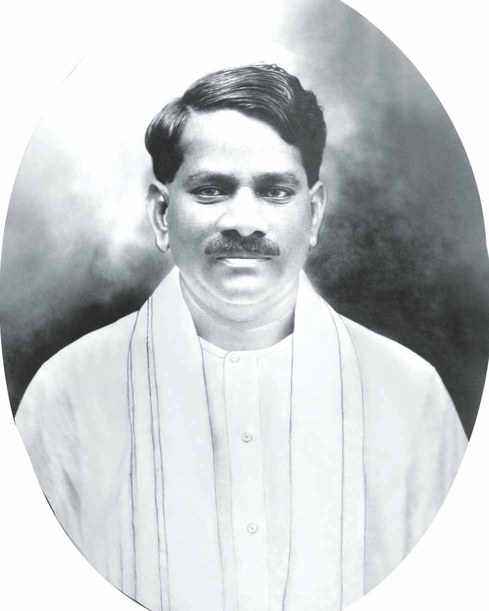
Prof. Muthyala Theophilus, B.D. · 7 May 1895 – 10 December 1946
Welcome back — you were listening to at . Resume →
Contents
Select a chapter to listen. Your place is remembered on this device.
Now reading
The audio for this chapter has not been published yet — the text is available below.
Now playing
—
Prof. Muthyala Theophilus, B.D. (7th May 1895 – 10th December 1946)
"…But indeed, he was our Christian leader, towering high above all the others in the quiet majesty of his splendid personality. The richness of his Christian character was such that he was fitly acknowledged as the Spiritual Leader among the Telugus and the devotion that he had won among our own Baptist peoples, was a tribute from us all that he was worthy of the trust and confidence that he so richly merited." – Principal A. Gordon, Cocanada.
A Life-Story of M. Theophilus of the Canadian Baptist Mission, India, by G. R. Lorne, Cocanada.
First Edition: Published by The Baptist Book Room, Collectorate P. O., Cocanada. Printed at George Press, Cocanada, 21-12-1948.
Second Edition: Published by Prof. Muthyala Theophilus Foundation, Hyderabad, 25-10-2024.
To the memory of The Reverend John McLaurin, Doctor of Divinity, and Founder of the Canadian Baptist Mission.
Greetings to everyone in the name of our Lord and Savior Jesus Christ. As we commemorate the first anniversary of our beloved father, the late Muthyala Benjamin Ranjit (who was promoted to Glory on October 25, 2023), we are both proud and honored to reprint and release the biography of our grandfather, Muthyala Theophilus, titled 'He Walked with God' by G.R. Lorne (originally published in 1948). It is truly a blessing for us to have rediscovered this timeless masterpiece, and we are thrilled to republish and share this inspiring work. We have personally gained a deep understanding of the extraordinary qualities of our Thatagaru. His humility, compassion for the less fortunate, visionary leadership to the Baptist Mission, and unwavering devotion to God have deeply inspired us. The impact of these values is clearly reflected in both the content and essence of this book for everyone to appreciate.
'He Walked with God' is a deeply impactful book that illustrates the life of Muthyala Theophilus and his spiritual journey with God. The extraordinary life of this remarkable holy person acts as a revelation for everyone. As you journey through the chapters of this book, it feels as though you are walking on hallowed ground. Rev. A. Gordon described Muthyala Theophilus as the preeminent leader among Indian pastors and evangelical preachers of that era. His preaching and selfless devotion to the Lord garnered recognition not only in India but also in far-off places such as Canada, Sri Lanka, and Burma. We would also like to take this moment to express my gratitude to the author, G.R. Lorne, for crafting this comprehensive work that illuminates the life and times of Muthyala Theophilus nearly 76 years ago. We are forever grateful to him, as without his influence, we may never have uncovered the true greatness of our grandfather.
We seek God's guidance as we embark on this journey.
Our mission is to embody the unwavering dedication to God and commitment to serving the Christian community, as exemplified by Muthyala Theophilus. We strive to contribute to the well-being of our society while engaging in nation-building. We are committed to preserving his legacy of visionary leadership, empathy, compassion, and moral integrity. With a steadfast focus on excellence and a spirit of generosity, we look forward to serving our community to the best of our abilities.
With Affection and Blessings, Rajiv, Ravi and Randhir Muthyala Professor Muthyala Theophilus Foundation Hyderabad, India, October 25th, 2024.
Professor Muthyala Theophilus Foundation, Jubilee Hills, Hyderabad 500 033. Phone: +91 879 7611 879. Email: [email protected]
The foundation's vision and mission are based on the core values instilled by our forefathers. Our vision is to transform lives through the power of the Gospel by fostering a vibrant community of faith, empowering pastors, producing impactful publications, expanding the reach of the Church, and providing education and compassionate care through medical help, old age homes, orphanages, and legal assistance, all contributing to the unity and integrity of the nation.
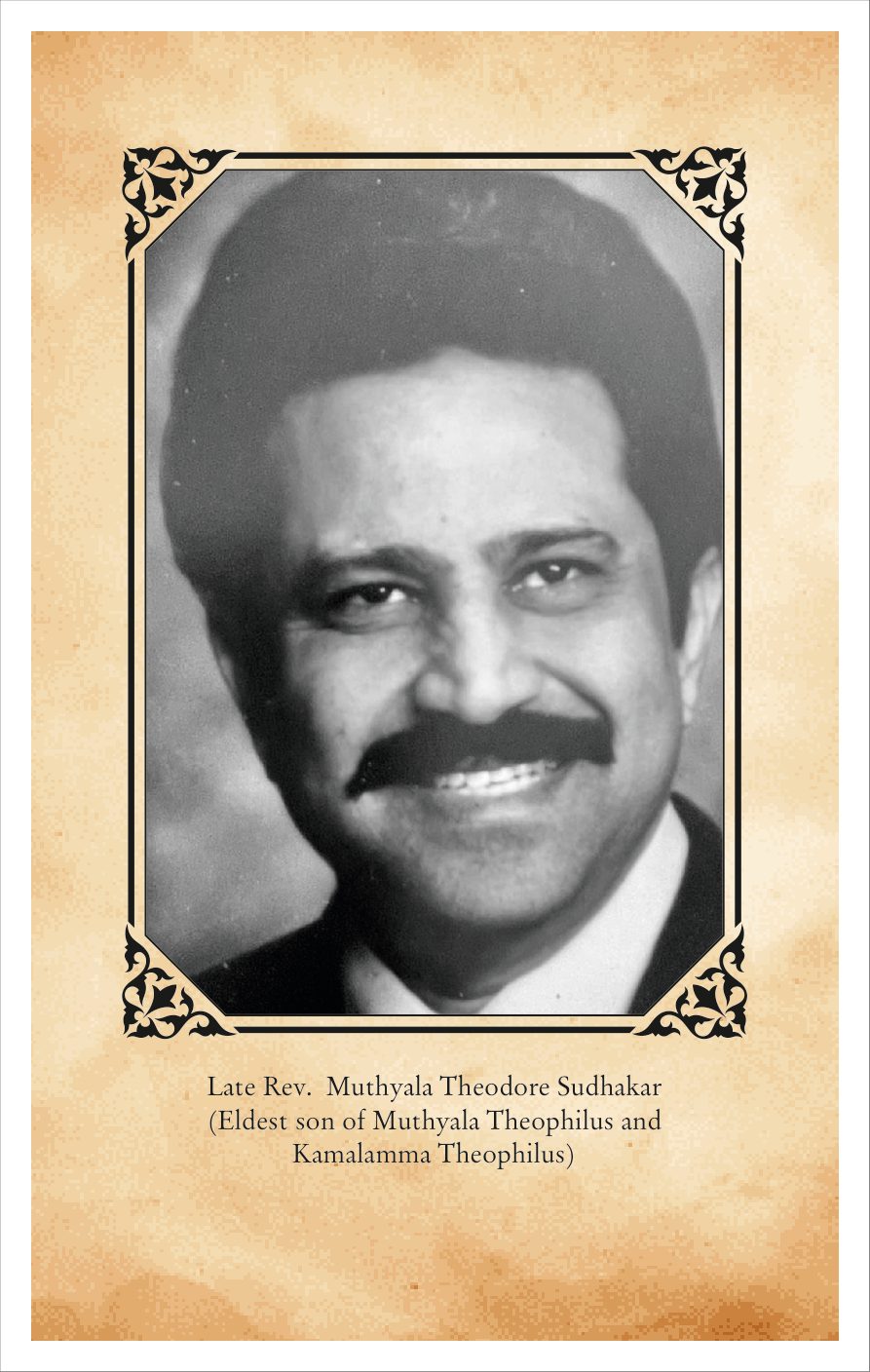
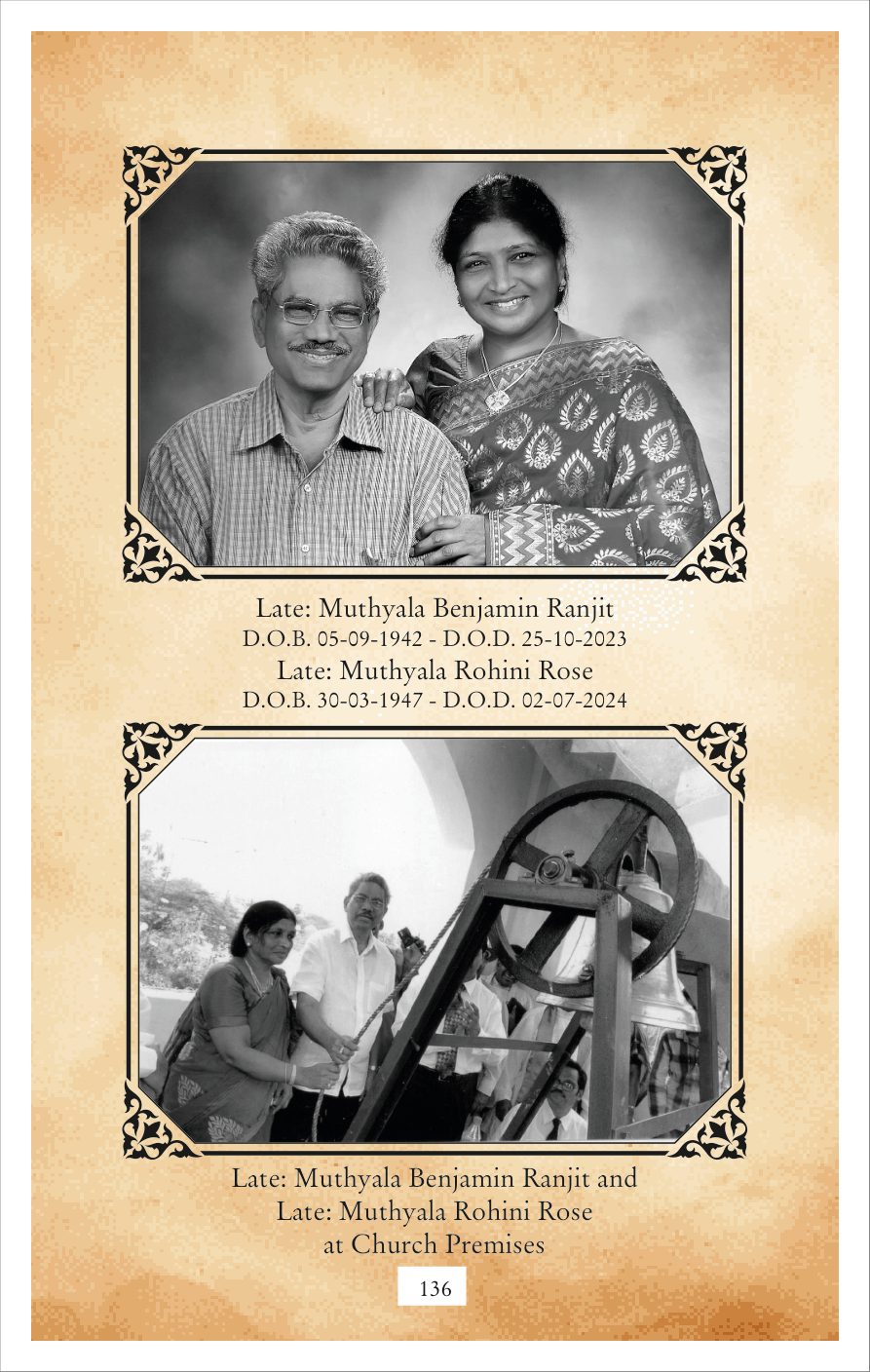
Professor Muthyala Theophilus Foundation was established in July 2024 to uphold and carry forward the legacy of the Muthyala family, represented by our late grandparents, Prof. Muthyala Theophilus, B.D. and Mrs. Kamala Muthyala, along with the service and dedication of our late uncle (Peddananna), Rev. Ted Sudhakar Muthyala, and our late parents, Muthyala Benjamin Ranjit and Muthyala Rohini Rose. Prof. Muthyala Theophilus, affectionately referred to as 'Ayyagaru,' was a figure of great respect and admiration within the Christian community. He embodied numerous core values throughout his life, including visionary leadership, unwavering dedication to service, and deep compassion for the marginalized. His legacy reflects a profound impact on individuals and the Church, driven by empathy, generosity, and a commitment to continuous learning.
The foundation is dedicated to improving the lives of children, families, and communities. We focus on tackling the root causes of community and church needs, particularly through community-based involvement and sustainable development. We strive to follow the example of Christ by helping those in need and sharing the hope of the Gospel. The foundation's mission primarily includes evangelism, discipleship, and training to build faith in individuals. We also plan to provide legal assistance to marginalized communities, demonstrating Christ's love through our services.
While we plan to begin our projects gradually, we anticipate scaling up our efforts in the coming years to create a meaningful and lasting impact. We invite everyone to join us in this noble endeavor as we honor the legacy of Muthyala Theophilus and strive to uplift our community through faith and service. Together, we can foster enduring change, inspired by the values of compassion and dedication that guide our mission.
With God's blessings, we strive to be vessels of His compassion and instruments of His peace. We appreciate your support and may God's grace be with you.
– Rajiv, Ravi, and Randhir Muthyala and their families
I am honoured indeed to be asked to write an introductory word to the biography of my friend and fellow-worker, Mr. M. Theophilus. God does not grant to a country or to His church many men like Mr. Theophilus in one generation, and we are profoundly grateful for this great man, and for his Christian character, and prophetic vision at a critical time in the history of the Christian churches in the Andhra Desa.
He was a man richly gifted of God. As a scholar, he stood high, and his students loved and honoured him; he was a statesman, and recognized as such throughout India. He was a patriot, and loved Bharata Mata with all his nature; a true husband and father, and a humble follower of Jesus Christ. His memory will be one of the most precious possessions of the Christian churches in India.
– J. B. McLaurin, General Secretary of the Canadian Baptist Foreign Mission Board. Toronto, Canada.
Brother Muthyala Theophilus was one of the most far-seeing leaders of the Canadian Baptist Mission field in India, who in his service extending over twenty-three years accomplished work of the greatest value and of lasting quality. It is now two years since he passed away. His life and his service to Jesus and His cause will always be fragrant memories in the church of India and it is my earnest desire that a full account of his life should be made available to the home churches. As an answer to their prayers and plans for India, will not this account of this devout disciple of Christ fill the hearts of the Baptists in Canada with delight?
I have gathered, gleaned and garnered material from a variety of sources. Some incidents of his life have been passed on to me by word of mouth from the circle of his friends. All available printed matter, manuscripts written by him on a variety of subjects, diaries which he maintained for some years, letters of condolence flown to Mrs. Theophilus from different Baptist Churches in India and abroad, have all been fully made use of. I am greatly indebted to a host of friends who have helped me to tide over this initial difficulty of equipping myself with material; yet I was aware that I had not fully filled my pen with ink before I sat down to write this account.
Here is the life story of a living character. While writing this account I bore three things in my mind: his Christ-like life and character; his self-spending services; and his message replete with prophetic vision. But throughout the pages of this book my subject is Theophilus the man; and a true disclosure of his inner life. This is the life-story of a man; not the history of a mission, not a chronological record of Theophilus's life, but a narrative of incidents which reveal his fragrant character. In writing this account I have striven to be brief; and in doing so I have had to present only the essential features, which make a portrait true to life.
What were the factors then that contributed to the making of Theophilus's life? The traditions of the Canadian Baptist Church, and its educational and spiritual environment into which he was born largely influenced his early years. In him there was more of this influence than the marks of inherited advantages. But he was as much a product of circumstances as he was of the religious atmosphere, for he deeply drank of the cup of suffering as a life-long victim to the relentless disease of Tuberculosis which never relaxed its hold on him till his death. Yet a spiritual power stronger than his physical weakness sustained him when all human help seemed to fail. Adversity became his tutor. Above and beyond all, Theophilus was a child of the grace and the providence of God, and on this account he has, I believe, the honour to be seen on the picture-gallery of the saints of eternity.
Theophilus felt the pulse of the Baptist churches in particular and the church of India in general. With the eye of a seer he envisioned the future needs of the church; and with the moral courage of a prophet he fought for the welfare of the church in the face of opposition: and worked out the visions of his mind, as a skilled architect does, until they were translated into living and exemplary patterns. The three master-passions of his life were: lay ministry; church-centric evangelism with a self-governing and self-supporting church; and church-union. The successful shaping of the Northern Circars Baptist Convention was his greatest delight. The pathway of his service was not always smooth and he had often to depart from the beaten track. At certain crises in his life he had to spend many tearful hours before God to seek His help. One thing has to be confessed, that his labours would not have borne fruit but for the co-operation of the leaders, Indian and Missionary. Dr. J. B. McLaurin's influence on the life, leadership and achievement of Theophilus has been powerful. There lay unseen but active within the heart of Theophilus the dynamic power of Jesus and the creative influence of the all-powerful God. He could therefore influence the outlook of the Baptist churches in conformity with the changing times. He also flung open the gates of hope under new circumstances and pointed the answer to the oft-repeated question, "What will be the future condition of the Church in an independent India?"
The light of Theophilus's life attracted outside the borders of the C. B. Mission. His services were demanded as, a Senator of Serampore University, President of the Andhra Christian Council, President of the Andhra Student Christian Movement, President of the Christian Endeavour Societies' Union of India, Burma & Ceylon, and Member of the Executive Committee of the National Christian Council. Proving his leadership at each stage he came to the forefront of the ministry of God by dint of hard labour, by ability and beauty of soul. 'A friend of the poor'; 'Moving spirit of the Baptist Seminary'; 'Soul of the Northern Circars' Baptist Convention'; 'Saint of the C.B. Mission'; are some of the phrases popularly used to describe him. Theophilus spent his life unsparingly and died in the active service of God proving in his life the famous saying of St. Paul, "For whether we live, we live unto the Lord; and whether we die, we die unto the Lord whether we live therefore, or die, we are the Lord's". I take this opportunity of saying that my fairly exhaustive researches have shown Theophilus to be a greater man than I had previously thought; and by writing his biography I have become its greatest beneficiary. My joy will be great if this record of Theophilus's life recalls the spirit of the readers to a greater devotion to Jesus and inspires the new generation to similar works of love and sacrificial service which he made manifest in all his deeds. Therefore, the challenge to the living is; who shall supply his spirit and follow in his train?
I warmly thank Mr. T. Premanandam, B. A., L. T., Miss M. I. Brothers, M. A., Mr. A. B. Masilamani, B. D., Rev. P. Sreenivasam, B. A, B. Ed., B. D. and the many other friends who most generously helped to bring the book to its present form; and Mr. J. Mosses of the Forest Department for help in another form.
The book makes no pretense of literary excellence. Moreover, the work has had to be laid aside several times as I had to go about preaching, sometimes the intervals stretching over months. Despite many imperfections in the presentation, will not the spirit of Theophilus, who sacrificed his life at the altar of the Cross of Jesus, prove a source of inspiration to the readers?
G. R. Lorne Cocanada, South India, December, 1948.
In the still air the music lies unheard; In the rough marble beauty lies unseen; To make the music and the beauty needs The Master's touch, the Sculptor's chisel keen. Great Master, touch us with Thy skillful hands; Let not the music that is in us die! Great Sculptor, hew and polish us; let not Hidden and lost, Thy form within us lie! FOREBEARS OF THEOPHILUS
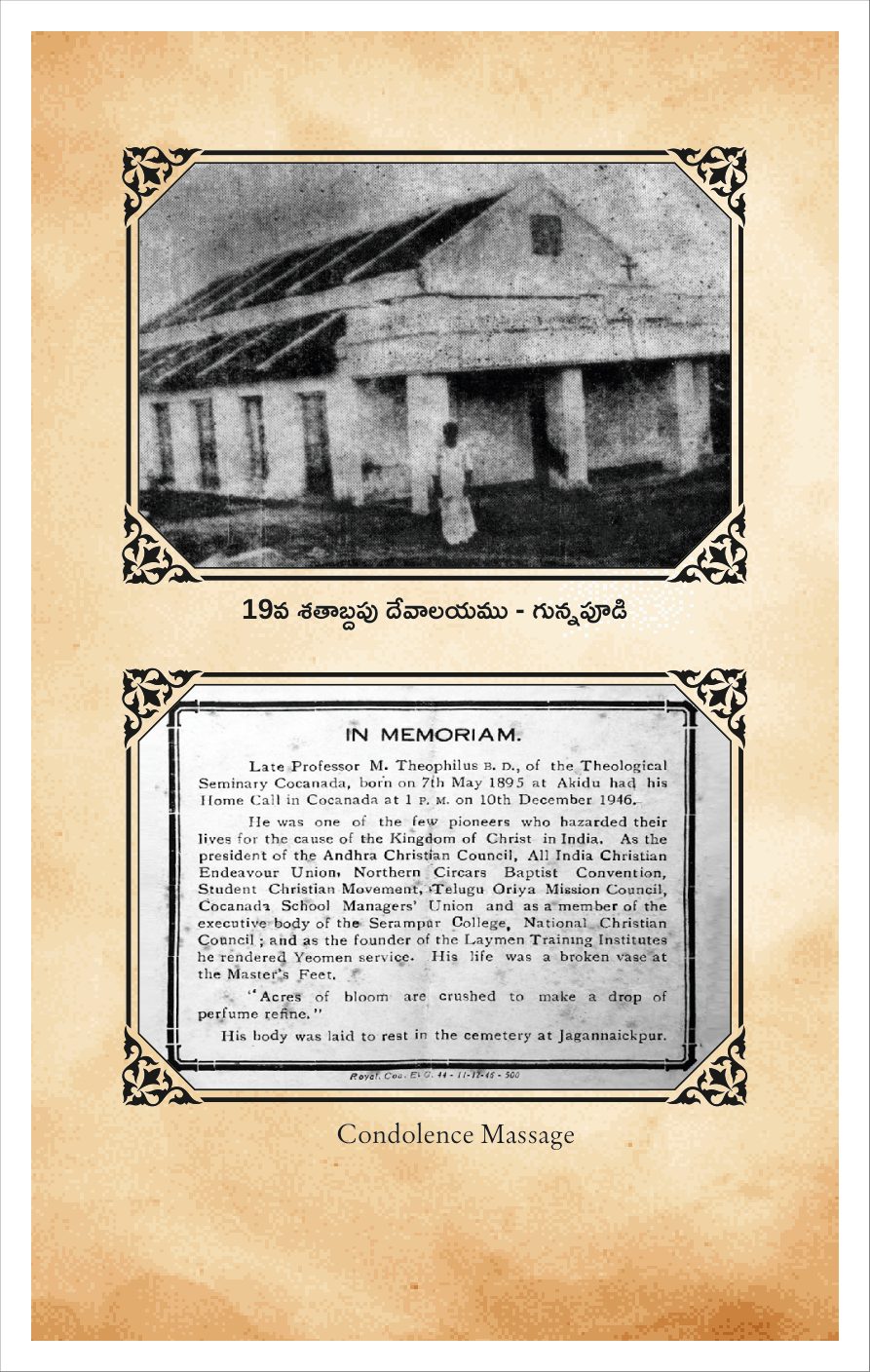
Gunnanapudy, in the Krishna District of Madras Presidency, South India, is one of the villages evangelised early by the Baptist Missionaries from Canada. Its inhabitants hardly number five hundred, yet it enjoys the enviable distinction of being the birthplace of many an evangelist. Towards the end of the Nineteenth Century and the beginning of the Twentieth, there lived in this humble hamlet one by name Benjamin and his wife, Mary, a woman of a quiet disposition. Holding a small farm, they lived in comfortable circumstances; and stood high in the esteem of the villagers, being religious at heart and in practice.
Benjamin's family name was 'Muthyalu' which means 'Pearls'. He was known for his piety. As a man of affairs he was strict in accounts. Benjamin was first a teacher, then an evangelist and finally a pastor.
Of these parents, Theophilus was born on 7th May 1895. He possessed the same gentle, amiable and peace-loving disposition which chiefly characterised his illustrious father. From his father, Theophilus inherited his mental faculties, from his mother his handsome features.
Little Theophilus received his early instruction in the village school at Gunnanapudy, where, the Inspector of Schools, noticing the extraordinary intelligence of the boy, promoted him at one leap from the first standard into the third. Theophilus always topped his class in the examinations. At school he was dutiful, and at home obedient, so that his mother held him up as an example when correcting the disobedient acts of his little sister. From Gunnanapudy, Theophilus moved to Akividu where he was admitted into the Canadian Baptist Mission Boarding School in July, 1907 as a student of the fourth standard.
In January, 1908 Theophilus was taken as boarder in the C.B.M. Middle School, Samalkot, and here with a steady step he finished his course upto the Third Form. In July, 1912 Theophilus entered form IV in McLaurin High School, Cocanada. As to the years of his life of this period we are left much in the dark. His classmates recall that Theophilus, the student, had the gift of an excellent memory and a logical mind. He was a keen student of Mathematics.
Theophilus was gentle and affectionate in his relations with his companions, so that his intellectual gifts won for him their recognition instead of causing envy. Though amiable he was easily irritated at times. In a foot-ball match, when he received an unfair kick, he left the play, assaulted the offender and was not easily quieted. This temperament followed him for many years afterwards although his illness finally corrected the defect.
In the buoyancy of youth, he gave no thought to his physical weakness as a handicap in life and unwisely spurned the strong and sturdy with remarks such as, "Foolish fellows, how they waste their time in physical exercise!" But two decades later, when his failing health stood in the way of God's service he uttered with deep emotion, "It is a sin to neglect one's health; see, how I am hindered in the service of God!"
It was customary for boarders to be engaged in work for an hour as part of their daily routine and it was the duty of Theophilus to carry the mail to and from the post office. This duty carried with it the confidence of the missionary.
Theophilus was interested in the religious practices of attending the church on Sundays, reading the Bible and being present at religious conferences and retreats for students; but all in a formal way. In the year 1914, even as a student he organised the Krishna District Student Federation of the C. B. Mission. The training which Theophilus received in early days helped him in the later years of his service.
He was not subject in his early days to peculiarly youthful transgressions or excesses, that might have given room to anyone ever to speak unfavorably of his character. In the midst of the joys of freedom which student life offers, he spared no effort to banish thoughts of sin because the innate desire to respond devotedly to religious duties expected of him by God already began to make its appeal. The full play of the frivolity of the natural child in Theophilus was also hampered by the weakness of his body. Thus the growing energies of Theophilus sought no outlet in the natural pranks of a school boy. These disciplined years of an early life were an added advantage to his later life of discipleship. As years rolled on he became quiet, reserved, self-sufficient, absorbed in his own responsibilities and slightly austere; answering to the Indian ideal of a good man.
The Christmas and Summer vacations were no ill-spent days. Theophilus ploughed the field with the tenants of his land; sowed seeds and helped in other farming operations. In the intervals he would make strong ropes of coconut fiber. He drove the carts of manure into the fields. He would retire into the green fields and trudge along the hedges gazing at the growing and ripening paddy meditatively.
While Theophilus was still in his teens a sense of deep sympathy for the suffering stole upon his heart.
He pitied the ignorance of the illiterate masses of the rural areas, and in his love for the country folk he would go down to the level of their conversation and assumed their habits of life when he was with them. This instilled in their hearts a deep love for him. During one summer vacation his village caught fire. He tried to fight the flames along with others but the flames flew faster than they could fight them. Added to the blaze of mid-summer was the problem of scarcity of water. The village was soon reduced to ashes. The thoughtful lad soon set himself busy to report the calamity to the Missionary who was on furlough and the District Magistrate in hill-camp in the Nilgiris, and to appeal to them for financial help. Before the early rains came the village was restored to a habitable condition. Thus Theophilus made use of his formative years.
Although Christian faith had not taken deep root in his soul, Theophilus detested the evils of heathenism that had crept into the Christian Society. He attacked them uncompromisingly. He was guest at a wedding which was attended by Christians, who had originally come out of two different sects of Hinduism. The host gave Theophilus a special seat, separate from the community considered to be inferior in social status. He sternly disapproved this difference of treatment and joined those who were seated in less honorable places.
Moral excellence and religious beauties such as these which began to appear in the life of Theophilus developed in years of maturity. Voices of this nature from within became clearer and clearer as he advanced in age.
Matriculating from the McLaurin High School in March, 1915 Theophilus continued his studies in the Pittapur Rajah's College, Cocanada. Of his University career it was remarked that all the hidden powers of his intellect came out, so to speak, as in volcanic eruption. He was suspected to be a mathematical prodigy.
At this time strange calamities occurred. Theophilus had spent nearly two successful years in the college. Just when the University examination was within sight his father passed away after a severe attack of cholera. Stepping on the heels of this calamity was the loss of his mother, who in trying to save her husband's life, lost her own. These two incidents occurred within the brief span of ten days. The Missionary and others locked up the news in their breasts lest it should upset the mind of preparing for the Intermediate examination. But the dismay of one and all, a foolish young boy took Theophilus aside and whispered the sad news in his ear. This so chilled the youthful spirit of Theophilus and so filled his mind with confusion that he failed in the examination.
On account of the early death of his parents Theophilus had to shoulder the responsibilities of the family of four, including a brother and a sister, both younger than he and a grandmother who was eighty.
He loved them all dearly. But none among his dear and near ones was held in greater affection and esteem than his sister Evy, to whom he gave the care and counsel of a father and the love and fondling of a mother. She gratefully remembers those days saying, "It is by the life and counsel of brother that I have been brought to this happy state in life." Theophilus would tell her, "Sister, if we are good on earth, it is joy to our parents in heaven." These words rang in her ears continually and helped her on many occasions in her spiritual life. When once his sister refused an invitation to the marriage of a Christian because he was poor, Theophilus admonished her saying: "God is pleased with them that share the joys and sorrows of the poor." In after years, when his brother and sister had grown up, Theophilus preserved a warm attachment for them.
Theophilus was taken on the staff of the McLaurin High School from July, 1917 for a year.
An incident is worth mentioning here. Just before the academic year came to a close the Inspector came to examine the school. It was the turn of Theophilus to prove his efficiency in teaching. As he was teaching science in his class, the Inspector abruptly stopped him to remark: "Theophilus, you are teaching wrong things." Theophilus, who was taken aback, left the room and the Inspector, and returned in a moment with an open Text book in his hand, saying, "Look here, Sir, is the book wrong?" The teacher and the Inspector, who stood before their tribunal, the textbook, found their case judged. Theophilus was right and the Inspector wrong. So great was his moral courage that he never knew fear when he stood for the right.
In July, 1919 the C. B. Mission offered to send Theophilus to the Theological College at Serampore to study for the degree of Bachelor of Divinity. With both his parents dead this was a time of test and trial for Theophilus. He took hold of this opportunity only as a means to prosperity in life. He did not think deeply of the fact that he could put his talents to the best use and be of service to the church. But God had deeper purposes.
As a student, Theophilus led an exemplary life. Mr. N. Daniel, a close associate of his in the ministry writes after the death of Theophilus: "I knew Theophilus as a student, one year senior to me. His brilliant career in the Theological College, speaks of the qualities of his head but his subsequent life of usefulness and Christian service pronounce the noble qualities of his heart." In a memorial tribute twenty-two years later the Students' Chronicle of Serampore College epitomizes his student career there: "His teachers and contemporaries remember him as a gentle, serious and thoughtful student."
One event of Serampore days was well remembered. Along with other students of the college Theophilus went on a boating excursion on the river Hoogli. As they were sailing, the boat began to leak. All the other members of the party jumped overboard and reached the bank safely. Theophilus waited many hesitant moments for fear of soaking his new shoes and as a consequence of delay he sank with the boat in the water and disappeared. A little later he was seen washed ashore. He narrated later how his parents appearing as angels, each held one of his arms and carried him ashore. Time and again Theophilus mentioned this incident to his friends in grateful acknowledgement of God's grace.
While in the Seminary, Theophilus went as a delegate to the Student Christian Movement Camp at Krishnanagar. It was here that the presence of the thorn which he carried for the rest of his life was first noticed. On 23rd September, 1922 during a strenuous game of Tennis he brought out blood. On medical examination it was discovered that his lungs showed signs of an attack of tuberculosis. Dr. George Howels, Principal of the college, sent him to the Sanatorium at Madanapalli, assuring him of the stipend while he stayed in the hospital. Rev. R. C. Bensen, Chairman of the Educational Committee, C. B. Conference, also offered him financial help but Theophilus replied, "I have enough money; do not need any more."
Theophilus had finished only three years in the seminary and there was yet a year's study. Before he could finish this however he was brought within the gates of another University, the Divine School of Suffering, there to sit on its benches and continue to be tutored till the end of his life. This illness, which to another might have been an unmitigated calamity, had a significant effect upon the spirit of this young man who endured it manfully.
Theophilus set down his reflections in the quiet moments of hospital life as follows: "The life of a patient is rather monotonous." But patients who soon became my friends lifted me out of my solitude. In my turn I began to cheer many of the patients with the motto of the college:
"Expect great things from God; Attempt great things for God."
In the quiet time of the hospital we profit both physically and spiritually. The long hours of silence afford us opportunities and inducement even to the most callous to reflect on the past and meditate upon life's future. People outside the hospital have "silent times" but to patients in bed "silent times" bring home, with greater force and firmness of conviction, man's necessity for fellowship with God, for it is the strongest impulse of the soul of man. We feel the presence of God and attain purity of soul.
At no other time are the value and the gravity of life brought to most serious consideration than when man is under circumstances strange and adverse. Life here with its facilities for observing nature and for fellowship with the suffering patients, gives unique opportunities for a special expression of spiritual life. Here is a thought of the Epistle to the Hebrews:
"Though He were a Son, yet learned He obedience by the things which He suffered; And being made perfect, He became the author of eternal salvation unto all them that obey Him."
The life of Theophilus which was hitherto based on abstract moral principles alone turned in these experiences into devotion, full of love for Jesus and His purposes. He now accepted Jesus as his personal Saviour.
"Oh, happy day that fixed my choice On Thee, my Saviour and my God. Well may this glowing heart rejoice And tell its raptures all abroad, Happy day, happy day, when Jesus washed my sins away."
Theophilus was in bed in the Sanatorium for nearly a year, from 27-10-1922 to 22-9-1923. His life made a lasting impression on the patients. The words of the patients when the time came for his discharge were: "You have been a real friend to us during the past eleven months. You are a friend to all and enemy to none. We shall always remember the example you have set before us."
In October, 1923, Theophilus resumed study for his degree examination. It may be mentioned that in him the college at Serampore possessed one of the most distinguished students. When he had taken the degree of Bachelor of Divinity, Dr. Howels offered him a post in the college; but Theophilus preferred to serve the Mission that had sent him up for training.
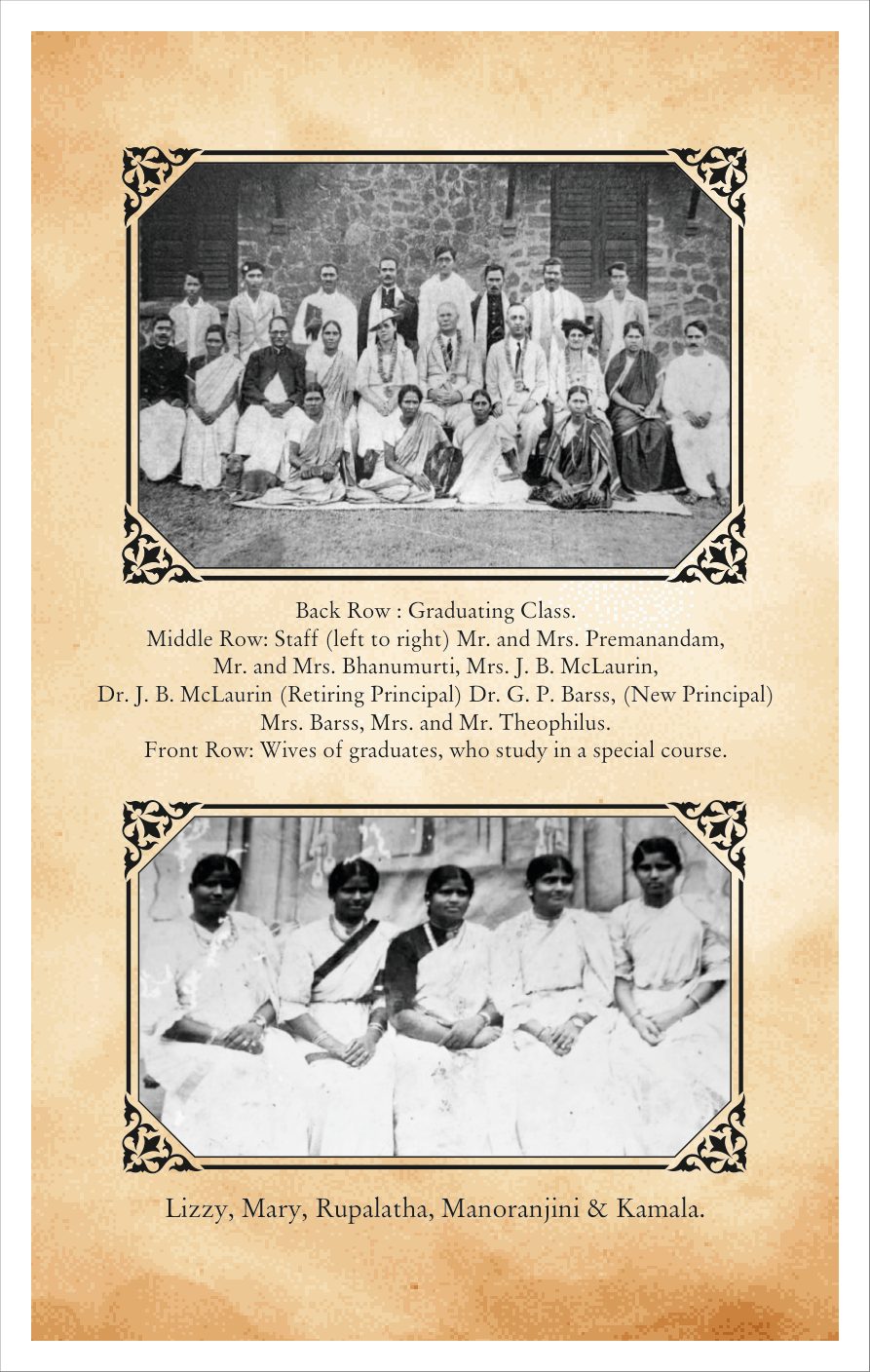
In July, 1924, Theophilus joined as lecturer the faculty of the Union Theological Seminary, then a joint enterprise of the Canadian and American Baptist Missions. He served the institution for two years until June, 1926.
The Northern Circars Baptist Convention held at Vuyyur in the year 1926 is remarkable in the history of the Baptist Churches for the fact that young men held all offices that year, most of whom have had to steer the affairs of the Convention afterwards. Mr. G. A. Samuel, who was later to be at the helm of education, presided over the Convention; and Theophilus, who should lead on the spiritual side of the Convention's activities, gave a series of devotional addresses. The situation called forth powers of leadership from these inexperienced young men. Diffident in every respect these two young novices, with an admixture of fear and shyness in them, resorted, before it was altogether dark, to a place, with brick here, mortar there and sand everywhere, awaiting a mason's hand to construct a building for a hospital; and there they threw themselves in utter dependance into the arms of God in prayer. Strengthened in every way they rose from their knees to fulfil their appointed tasks. The Convention was a great success.
O how love I Thy law! It is my meditation all the day. Thou through Thy commandments hast made me wiser than mine enemies; For they are ever with me. I have more understanding than all my teachers: for Thy testimonies are my meditation. I understand more than the ancients, because I keep Thy precepts. I have refrained my feet from every evil way, that I might keep Thy word, I have not departed from Thy judgements: for Thou hast taught me. How sweet are Thy words unto my taste! Yea, sweeter than honey to my mouth! -Psalm 119: 97-103.
In July 1926, Theophilus moved from Ramapatam to Cocanada as professor in the C. B. Mission Theological Seminary. He was fully aware of his special call to train up men for the ministry and in consequence refused the offer of pastorates from three different churches.
Theophilus was an ideal teacher. He prepared the lessons thoroughly. As at meeting so at school he was punctual. If school had begun before he returned from travel, he went straight from the railway station to the seminary, although his house lay on the way. Promptness in his duties and punctuality were seen in all his activities. He notes in his diary that he missed the train but once. The secret of the vastness of his service was that he never procrastinated. He finished all the business on hand before he wrote his diary in the night. In the morning he was ready for something more to do. In the classroom he was known to be a good disciplinarian. The sincerity of Theophilus at his work inspired the admiration of his students and commanded their respect.
Humility was the key note in the character of Theophilus. When the suggestion came in 1931 for ordaining him he replied that he was not ready. The suggestion came again nine years later and again he put them off. Finally, when it was again urged on him a few years afterwards he declined the proposal. Evidently he did not want "reverend" to be applied to him.
It was this characteristic of humility that made him indifferent to the praise of men. He remarked about the students of the graduating class one year: "The graduates have not praised their lecturers in extravagant terms in their replies to farewell speeches like the students of the past. Therefore, there is no hypocrisy or unreality in their replies."
Theophilus was once Chairman of the Board of Trustees of the Seminary. In the year 1936, when he had to sign the diplomas of the successful students he said, "An outsider should have been elected as Chairman in my place." He craved for no position of honour and popularity. He often said, "The more I understand Christ the smaller I feel." The humility of Theophilus found its origin, growth and establishment in the depth of his understanding of Jesus.
Theophilus believed in an educated ministry. In 1936 a proposal to affiliate the Seminary with the Serampore University came up before the Board of Trustees. One of the members on the board doubted its feasibility, for it would be difficult to get qualified candidates for study in sufficient numbers to warrant the opening of the L. Th. course (Licentiate in Theology), and funds sufficient for such an establishment could not easily be obtained. But, Theophilus stood strongly for the venture, saying, "It will be a fine thing to have the L. Th. standard." Ten years later he sent an appeal for funds with the same view and the appeal was met with a wave of goodwill. Donations poured in and the L.Th. classes were opened in the year 1946. Theophilus was a man who turned his visions into actualities.
From the year 1942 Theophilus represented the Baptist Constituency on the Senate of the Serampore University. As a senator he always advocated a high standard of learning in all the affiliated theological colleges in India.
Theophilus had a winning personality with which he could influence his students and win them for Christ. His personality owed its power to his close contact with Christ and his unswerving willingness to serve Him.
Prof. V. E. Dutt observed in the Serampore College Magazine: "His contribution to the work in the Seminary was great. He was an accomplished and able teacher, and inspired class after class of students during the last twenty years. He was a friend of the students. To the training for the ministry which is the main task of the seminary, Theophilus gave a rich and fruitful contribution of intellectual and spiritual gifts."
The Christ-like character of Theophilus attracted many young men to the seminary. Whenever David, a trained teacher, paid a visit to Theophilus the latter asked the young man, "David, we are waiting for you. When will you enter the ministry?" Finally, David was won for the ministry and he is now a zealous servant of God.
A young man, headmaster of a higher elementary school in the Mission Field, had been contemplating to go for theological training. Asked why he wanted to enter the ministry he replied, "I have preserved two letters which Theophilus wrote to me. As I read them now and then, I feel compelled to enter the ministry, although the burden of my family is too heavy for me to take up such a step." He tried every possible way to inspire young men year after year for pastor's training.
The theological students were greatly enriched in his fellowship. To those who sat with him, his perfect peace was contagious, lifting them in moments of spiritual depression. His personality permeated the class-rooms and the students' quarters as well. Without any hint of domination, Theophilus straightened their affairs; without any suggestion of arbitrary interference, he remained a practical adviser in all matters of importance. Tactful in advancing his views on matters that did not directly concern him, he became their respected counseller and guide.
His love for his students was such that he always felt as related to them by inner bonds of affection. He inspired them to noble ideals of life and service. He became their example in the walk of life. One of his student writes, "A student learns many things from his teachers but respect for and obedience to teachers I learn t entirely at the feet of Theophilus."
A pastor from the Godavari Association writes after Theophilus' demise, "Theophilus had been the
Life of that institution (the seminary)." Another pastor from the Krishna Association writes about him, "Theophilus was worthy to train men for the ministry of the church. He possessed the spirit of a teacher in the real sense. His works follow him: his influence will not soon die."
No one in the long line of students who have passed through the seminary during these twenty-three years to different pastoral positions in different stations of the mission can ever forget the influence of the life and character of Theophilus on his own.
When the seminarians had left the seminary Theophilus watched with deep interest their progress in the ministry. He missed no opportunity to appreciate their service. Where correction and counsel were needed he offered them without hesitation. He would help them in preparing their sermons, comfort them in their troubles, and discuss with them their problems. He thought deeply of the whole problem of Baptist church and polity and carefully considered the disadvantages under which the pastors suffered although they were well qualified for pastoral oversight and knew the word of God. The salary of the pastor is low and part of it is uncertain. To ensure the regularity of payment Theophilus proposed that a 'central fund' be created by the churches for the payment of the salaries of pastors.
Secondly, the security of the pastors' position depended on the whims and fancies of the congregation. Consequently a pastor is often driven from church to church and finally forced to quit the ministry. In order to rectify this defect Theophilus firmly advocated the appointment of a 'Pastoral Settlement Committee', with powers to appoint, transfer and discharge pastors. Such a procedure would also solve the problems attendant upon 'localisation of churches' and 'field exclusivism'. This would likewise ensure close cooperation between 'field' and 'field' which is essential for the solidarity and efficiency of the ministry.
Thirdly, as there were no provisions of securing pastors during their old age, Theophilus brought forward a proposal to the Telugu-Oriya Council to start a "Provident Fund" scheme. Some of the Indian members did not vote for it though it was intended for their own good. When Theophilus noticed the indifferent attitude to this move his inner feelings rose high and he burst into tears. This made the dissenting members realise their fault, so that at the next session of the T. O. Council the proposal was carried. In pursuance of this a 'Provident Fund' scheme for the pastors and other permanent workers of the Convention was started.
Fourthly, the pastor is made 'the central agent in evangelism' as against the old system of evangelism through the school teacher.
In all these Theophilus endeavoured, to make the pastor put his heart and soul into the work, to give him a status, and to make him the leader in all the activities of the church.
1. By the term, 'localisation of churches' is meant the independent existence of some churches, (it means financially strong station churches). Their existence without any relation to other churches is detrimental to the working of the Convention. Some of the evils attendant upon such 'localisation' are: their unwillingness to help the infant churches of the villages, which are financially weak; injustice done to their pastors; and their indifferent attitude to the discipline of the Convention.
2. The term, 'field exclusivism', denotes the exclusive right of a field missionary to decide the affairs of the churches and workers of his field at his discretion. The main defect of such a method is that similar cases may be treated differently by different field missionaries.
3. A 'teacher-evangelist' is one who is held responsible for all pastoral and evangelistic work in his village for a small mission help to supplement his teaching grant given by the government. He is directly responsible to the missionary for his ministry. The teacher-evangelists are now treated as laymen and are directly responsible to the pastor for their evangelistic work.
God and Home
Where there is faith, There is love; Where there is love, There is peace; Where there is peace, There is God; Where there is God, There is no need.
The house in which Theophilus lived is an old building, surrounded by vast verandahs. The room which he set his office is big and airy. It bespeaks the taste of an ancient Dutch merchant who left it all of sudden by force of circumstances many years ago. It has big windows and majestic doors. Theophilus kept the doors of the house open almost all through his stay indoors. A small table before his cane chair, a book-case to his left, two or more chairs around the table for visitors, was the sight that it presented to a visitor.
The chair in which he sat was significantly lower than the one he offered to the visitors. After a few minutes talk with a visitor, usually tea was offered. While his wife brought tea into the room he met her half-way, took it in his hand and offered it to the visitor. The courtesy of Theophilus to visitors and guests was a pleasure to witness for he received with uniform courtesy all people that came to him on whatever errands. He comforted those in sorrow; helped the poor. Thus he followed St. Paul in his attitude: "Though I be free from all men, yet I have made myself servant unto all, that I might gain the more."
Theophilus was unostentatious in dress. The dress he wore had three sermons to preach: simplicity, which is a means to economy; whiteness which indicates his inner purity; khady (handspun), which reveals his love for the poor weavers of the country. These were the marked features of the dress of a man who had on his breast the humility which conformed to the Lord's words, "Blessed are the humble in spirit for theirs is the Kingdom of heaven."
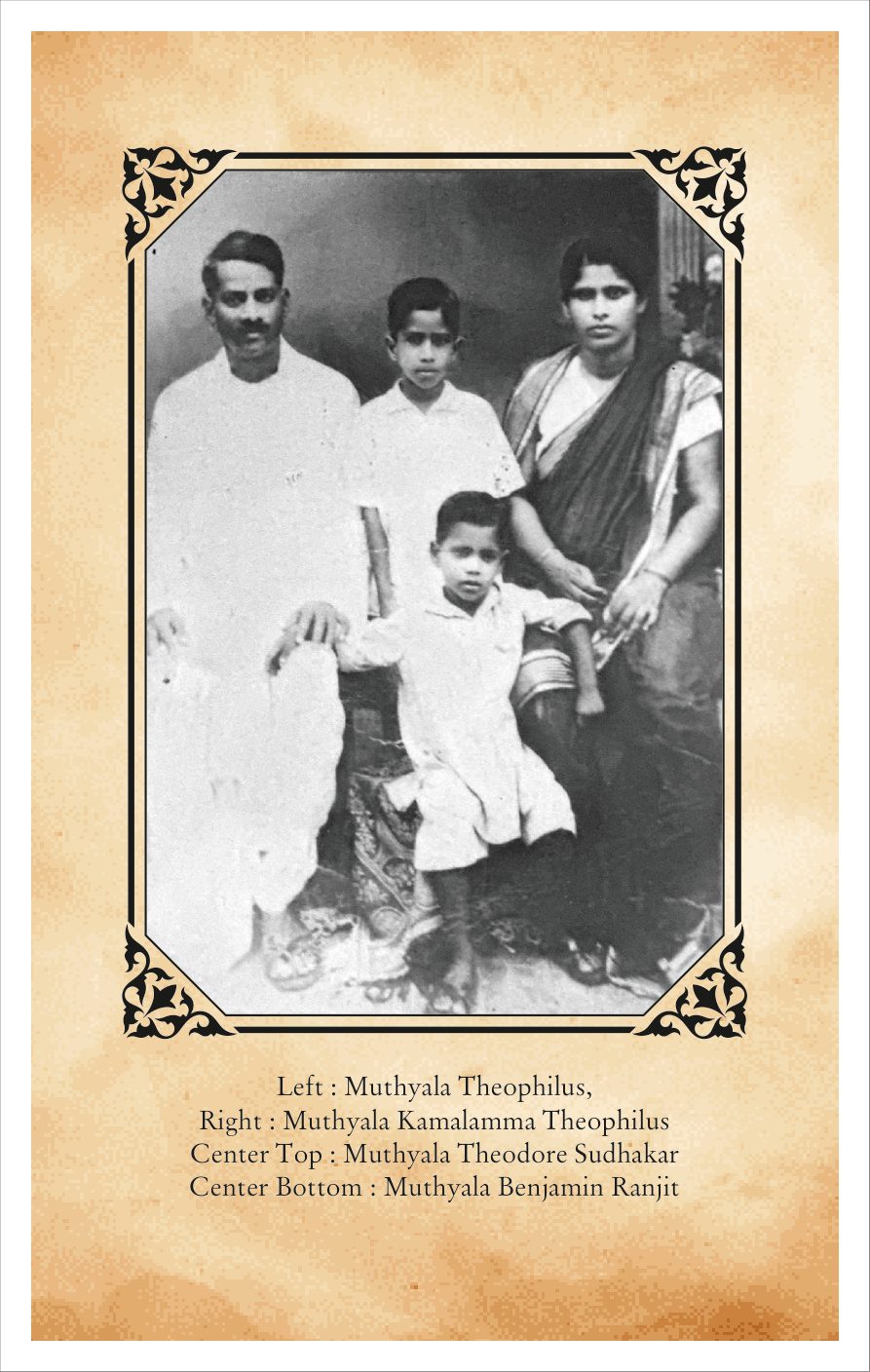
On 10th July, 1923 Theophilus married Miss Kamala Jagannaikulu, the girl of his own choice, beautiful and cheerful, full of courage in the face of adversity and misfortune. The couple was blessed with two sons.
On every birthday Theophilus counted God's mercies to him in the past and lifted his soul in praises: "I praise Thee, Lord, for all Thy mercies to me in the past and trust in Thee for the future. I am unworthy of Thy goodness. Thy grace humiliates me and leads me to a fresh consecration. Lord, grant me health, physical and spiritual, and use me in Thy service." There was nothing else that day by way of programme.
The fare in Theophilus' house was simple and was often shared with unexpected guests.
The financial position of the family was such that they could lay by nothing to meet the next emergency. But money, which is a natural man's inducement to service and a spiritual man's special source of temptation, was never allowed to play its game with him.
Theophilus loved his servants as his children and practised in his life his kind thoughts for the hard lot of servants; "Be kind to your servants, never forget that they are human beings. Oh, the work exacted from them! What a cruelty! Their backs ache! Your dogs are more kindly treated, and your cats too. But cruelty is meted out to servants. Is it forgotten that they are men with souls?
'It is not enough if you treat them gently, you have to pay them their worth. Let your kindness be also measured in terms of the money you pay them.' 'Trust them as brothers; cheer them up now and then. Let them eat with you at times. Make them feel they are members of your family. It is not enough if you sit with them on a mat. You should allow them to take a chair along with you.'
'Value their time as you value yours. Why should the dhoby or peon be kept standing at your door awaiting orders? Give your reply promptly.'
'Love your servants, treat them in such a manner that they will love you in return.'
"The Lord Jesus established a new relationship between God and man, between man and man. God is our Father and we are all brothers. It is a new order. The Apostle Paul, instead of ordering Onesimus, the slave boy to go back to his master, entreated Philemon, the master, to receive the runaway servant as a brother."
Laxmiah is the peon in the office of the 'Ravi' the monthly journal of the N. C. B. Convention. If he called on Theophilus on office errands, the latter would invite him to take a chair and rest a while before he returned. Laxmiah still remembers Theophilus as a loving Christian who went down to the level of a servant in order to lift his spirit to that of the high and the respected.
There was a deep sympathy in the heart of Theophilus for the poor.
A little child who had lost her mother became his foster-child. Not content with the mere rescue of the baby from the destitute condition she was in, he began to educate her so as to enable her to make a living. When his charge grew up and had to be sent for nurse's training because she did not shine at books, Theophilus regretfully observed: "Had she been more intelligent she would have received a high school education."
The wife and child of a Christian who died of tuberculosis were given shelter in his home.
For this helpless woman a door of hope was opened. She was taken care of for a year which was as long as he could undertake to bear the burden. Thereafter he prayed: "She is helpless now, God, grant her comfort and open means of work and livelihood." These souls orphaned and destitute, on whom sorrow and despair constantly prey, were the special concern of Theophilus. His means, although meager, found in his sympathetic heart an enlarged accommodation for others. "Pure religion, and undefiled before God and the Father, is this, to visit the fatherless and widows in their affliction..."
At one time Theophilus returned home from the cloth-shop with the purchase of two dhoties, which he badly needed, to find an evangelist awaiting him. The new dhoties drew the attention of the evangelist who said, "Sir, I have been managing with a single dhoty all these days. Will you give me one of these dhoties you have bought?" Theophilus, without the least hesitation, gave one to the evangelist.
In September, 1945 a sweeping cyclone came over Cocanada. The cyclonic gale affected the fishermen, who lived in their small huts between the city and the sea, more than any other community. The gale blew off the roofs of their huts and floods swept away what remained. The fishermen, an unremembered class of society, fled in search of shelter. Finding no ready invitation elsewhere, naked and starved they came to Theophilus who flung open the doors of his house. Once they found open doors they streamed in such numbers that Theophilus had to vacate and give them most of his house. How beautifully he lived to follow in the footsteps of the Master! Yet the divine in him made him blind to what he did for the Lord and cleared his vision to see what the Lord had done for him. Himself unconscious to what he had done he was ever ready to ask with the spirit of the righteous, "Lord, when saw we Thee an hungered, and fed Thee? Or thirsty, and gave Thee drink? When saw we Thee a stranger, and took Thee in? Or naked, and clothed Thee? Or when saw we Thee sick, or in prison, and came unto Thee?"
Theophilus helped poor students with money for clothes and schooling. He once gave money for clothes to a poor student who had only one shirt. Coming to know of this two more students made demands on him on the ground of poverty but having nothing in his hand he cried out in pain: "Many come to me for help with woeful tales of poverty. I wish I had resources to help them. It pains me when I am not able to help them."
Theophilus had tasted suffering and therefore knew how to sympathise with those who suffer. He learned to give up his luxuries to supply the necessities of others, and even his necessities to supply their extremities.
"To live is to love To love is to serve To serve is to suffer To suffer is to save."
At home one would most likely find Theophilus with a book in his hand. He pored over the pages of the Holy Bible with much avidity and fed his hungry intellect upon books about the Bible, intent upon acquainting himself with new trends of thoughts.
He read biographies with ardent love and rapt devotion. Sadhu Sunder Singh, Saint Francis of Assissi, C. T. Studd, St. Francis De Sales, were some of the biographies which he constantly read. On reading of St. Francis De Sales he notes, "His life has given me a fresh desire to order my devotional life." C. T. Studd's life inspired the reflection, "Studd was a man of great faith and courage. He was a great sufferer from asthma and yet turned out stupendous work. The book inspired me to deeper faith and consecration."
He read much but whether he read books on the Christian religion or other subjects, he read them with a singleness of purpose which was to enrich his devotion to the Lord. After reading the autobiography of Jawaharlal Nehru, he observed "What poor loyalty, sacrifice and works are mine for the Lord Jesus Christ, when compared with Nehru's for the cause of the country. How much more ought I to sacrifice for Christ, who has given His life for me?"
Theophilus had many friends. They bear through their lives priceless reminiscences of him. He based his friendship on Christ. '
Theophilus, with all fidelity, retained the friendships of his early days: but placed them on a new relationship with Christ as the bond. He remembered to visit his friends' homes and pray for them when work brought him into their locality. He had a large capacity for lasting friendship.
He used to say that a friend is one who knows the best and the worst in us and loves us just the same. He asserted that we should be simple, honest and unpretentious in order to enjoy through life the respect and love of friends.
He loved the words of the Master, "Ye are my friends, if ye do whatever I command you: but I have called you friends for all things that I have heard of my Father I have made known unto you." He applied these words of the Master in his relationship with his students. His students became his friends when they left school.
Conversation with Theophilus was most inspiring. One noted the chastity of his thought and enjoyed the green pastures of personal experience into which one would be unreservedly led. His expressions were the convictions of his heart, and replete with love. This characteristic in him left little room for others to doubt the truth of his statements. Many sought his advice.
Theophilus appreciated those who were earnest about their faith. He did not enter into vain discussions if he did not agree on any important issue. He tried to bear with the defects in others for the moment so that he might convince them later with love. He was more inclined to listen rather than to speak; he preferred to learn from others.
He perceived the virtue in a person more than the vice so that in such recognition he opened the person's eyes to see how good he could become in Christ. At the close of a convention two young men who delighted in acts of mischief while in the meeting followed him to his lodgings. Forgetting their fault altogether he recognised the virtues in them and complimented them with the words, "Yes, you are good boys." Now these young men who were guilty of mischief a little while ago were stung to the quick. Lifting the higher nature in man Theophilus tried to submerge the lower. Thus he reproved them who were in fault with greater effect.
Theophilus was humourous at times. His humour was rather heavy and characterised by a seriousness, which exhibited the discipline of the inner soul. On his way from Cocanada to Vizagapatam a Pastor joined his company. As usual Theophilus had few words to speak and his companion had the lion's share of the conversation, which threaded its way through a number of subjects and finally veered round to the 'Field Superintendent' and settled there. The journey of a hundred miles was coming to a close and not a word was interjected by Theophilus except an occasional 'yes'. Failing to get an encouraging word from him the pastor exclaimed in much vexation, "What sir, will your 'Yes' fill my stomach?" Theophilus sagely replied, 'Yes'.
On one occasion Theophilus was listening to the trial-sermons of his students. A student who spoke on prayer said: "Many of our prayers do not reach even the roof of our prayer hall. How then can God in heaven hear them?" At the end of the sermon Theophilus solved the difficulty by humourously asking, 'Our prayers may not reach the roof of our prayer-hall; but cannot God come below the roof and hear our prayers?
"I know whom I have believed." II Timothy 1:12. I know therefore my ideal, work and future. (a) My ideal: Christ-likeness. (b) My work: Promotion of His Kingdom. (c) My future: Service in spirit after death."
In the year 1927 Theophilus was entrusted with the important service of superintending the evangelistic work on the South Cocanada Field. As the first Indian in this aspect of service he accepted it reluctantly but once he took it up it became his passion.
Theophilus' love for the church was his greatest passion. He expressed it by bringing individuals to the Lord, building up broken families and elevating the tone of the church.
A young man who lost his balance of mind through reckless living left the Baptist Church and joined the Roman Catholic Church. When a few months had elapsed, this young man became repentant, and requested the Missionary to extend to him the privilege of membership in the Baptist Church. The discipline of the Church would not allow the Missionary to grant his request without testing the genuineness of his faith. In this predicament the young man felt guided to consult Theophilus who advised him to have patience, to spend some time in prayer and to continue attending the church. Theophilus once prayed with him and concluded his prayer with the words, "God open a way for him to be admitted into the church and have fellowship at the Lord's Supper which he longs for." The young man rose from his knees in tears.
A teacher, who had left mission service, became greatly burdened by his own secret sin. Suffering its pangs he wept bitterly. His tears gave him no relief. He had gone to the grave of his child and sought from her spirit some comfort, but to no purpose. It was now that he came to Theophilus. He prayed with him and instructed him to confess his fault to the person whom he had offended. This done all pain was quelled, and the teacher went home with new joy and happiness.
Theophilus entered into the ministry of prayer for the sick in a strange manner. Once a patient sent word to him saying that he would be healed if Theophilus prayed. Theophilus went and prayed for the patient. The patient was healed. This experience led him to continue this ministry among the sick. On another occasion a patient who was suffering from typhoid fever urgently sent word for him. He travelled ten miles to pray for the patient.
The patient was healed. On another occasion Theophilus travelled a hundred miles to pray for a minister who was sick. It was a regular practice with him to visit the sick and the bereaved and comfort them, thus fulfilling the Scripture, "Pray one for another that ye may be healed."
Theophilus built up families and reunited those that were broken. In the course of the seventeen years of his married life he celebrated a number of marriages in his home.
He discouraged the practice of a bride-groom demanding money from his bride as dowry. Once an orphan boy was forced by his poverty to make what he thought to be reasonable demands of dowry from his bride-to-be who lacked none of the accomplishments usually sought in a bride. Theophilus reproved the young man for this demand and himself undertook to celebrate the marriage. And he did it in an ideal manner; the feast was vegetarian, the clothes were simple and expenses were cut down to the minimum. He thus saved the young man from the debt with which an Indian family usually starts life. Theophilus appreciated and upheld the sanctity of Christian marriage and brought to light love as the secret and true bond of alliance.
Once a mother of six children approached him with complaints against her husband's bad character. Theophilus understood from her words that her allegations were untrue and advised her, "You can win your husband through patience, prayer, and love."
On another occasion a teacher and his wife, whose relationship was strained, came to Theophilus for settlement. This wedlock had emerged out of purely material advantages and there was no love lost between them. Theophilus spoke to them both and prayed with them. The young man and his wife now rose to their feet, once more desiring a happy and peaceful home. Theophilus built up families as a means to the building up of the church, which is the body of Christ.
'He loved the church more than he loved himself,' was the remark made by a minister after the demise of Theophilus. He often told his wife, "the laymen's work on the field is my life." But when she asked him about the family in the event of his death he replied, "God will take care of you." In his later years, "The Church" became the favourite theme of his sermons. His conception of the church grew deeper with time. Once a student asked him, "Why do you emphasise the church so much although you are fully aware of the short-comings that exist in the Church?" Theophilus replied, "In spite of the many weaknesses of the church, she is the only means of establishing the Kingdom of God on earth. For such defects we the members also are responsible."
Love, which is God's expectation from man and man's duty towards God, became the pivot on which the life of Theophilus revolved. He loved Christ and His Church. Service, unselfish and unremitting, was the expression of his love for His Lord and His Church.
Theophilus inspired the evangelists through his life. He carefully noted the special merits of each evangelist and instead of holding up any weakness to scorn, he encouraged the evangelist to develop his good gifts. He never expressed dissatisfaction with any one; although the recognition of merit in a sincere evangelist served as an indirect reproach to the lazy one. Theophilus placed great trust in his co-workers. Instruction and fellowship were the means which he adopted in order to lift a weaker brother out of his failures. Therefore, he avoided punishment. At the time of the monthly meetings he invited the evangelists to dinner and they always enjoyed his fellowship. He was concerned for the comfort of the evangelists more than his own. When the evangelists had to bear a cut on their salaries owing to financial stringency he decided, "I am prepared to forego the sum of ten rupees granted to me by the mission for superintending the South Cocanada Field work, as the workers will soon have a heavy cut."
Theophilus held retreats from time to time for all the refreshing of the evangelists. He gave little credit to the gusts of emotion that are the natural expressions of a soul under conviction of sin: he demanded more than mere temporary display; he wanted a soul to blossom into an active life of purity. To help build up such a spirit he based the constructive side of a retreat on Bible study. His Bible studies on Joseph, Moses, Jeremiah, Nehemiah, Daniel, Peter, Paul, Andrew, Mark, Abraham and others, prepared for the retreats of the Central Institutions at Cocanada will long be remembered and used. At the annual retreat of the Central Institutions of the C. B. Mission, Theophilus was always seen as the central figure, drafting its programmes, helping in the various details of preparation, directing its procedure with his advice and elevating its spirit with his presence.
Theophilus would be asked to lead revival and devotional meetings in other quarters of the Mission. Soon his services were demanded in other Missions as well and therefore he travelled far beyond Baptist frontiers. The Lutherans, the Church Missionary Society, the Anglicans and Baptists from America and England invited him to lead some of their special meetings such as annual retreats, ordination services and Conventions. The churches thus reached, reaped rich spiritual harvest through his labours.
Theophilus employed the summer vacation specially for field evangelism. He walked from village to village where conveyance was not available, not heeding the limitation put upon him by physical weakness. The villagers, both Christian and non-Christian, found in him not a man from the city to be made much of, but one of their own kind with whom they could share their troubles. In Theophilus, the village Christian found a father, the evangelist, a brother who shared his difficulties and the Hindu a friend to whom he could give his heart.
When Hindus are convinced of the Godhead of Jesus and confessed Him as their personal Saviour, he would ask them to make an open confession through baptism. He did not encourage any excuse not to witness publicly. In his conversation with Hindus he drove home the essential difference between Christianity and Hinduism: "Christianity has Christ: Hinduism has no Christ."
The life of Theophilus made a deep impression upon his Hindu acquaintances. He was once passing through a busy street of Cocanada. A non-Christian businessman, who had been observing him as he passed by, looked at him and said enquiringly, "Who is he that passes by? There is something in him that makes me stop my business and observe.
The devotion with which Theophilus carried on evangelism on the field, the efficiency with which he administered its business side, the ideals he placed before the evangelists; these proved that an India Superintendent could now manage the affairs on the field as efficiently as a Missionary. He led the way among Indians to be entrusted with this aspect of service.
In the constitution of the N. C. B. Convention he gave a responsible place to the Indian. Henceforth the term 'Field Minister' was to take the place of 'Field Missionary'. A 'Field Minister' is one who has 'general oversight of all work on the field,' whether a Canadian or an Indian. The guiding principle henceforth shall be: "An enduring partnership of Indian and Canadian members of the staff, working on a basis of complete equality in this great enterprise."
"No chance has brought this ill to me, 'Tis God's sweet will, so let it be: He seeth what I cannot see. There is a need be for each pain. And He will make it one-day plain, That earthly loss is heavenly gain."
In April 1936, Theophilus noticed a change, sudden and unexpected, in his physical condition when signs of tuberculosis made their appearance once more. The weakness was evidently due to the strenuous work during revival meetings at Palakonda, Chicacole and other places. Doctors ordered complete rest for two months and absolute silence.
(21-4-1936 - 20-6-1936)
On the 21st of the month Theophilus retired to Gopalapur, a sea-side village where he spent the following two months in rest.
As advised by doctors Theophilus kept himself on a vow of silence during these two months. Of this experience he wrote: "It is easy to close one's mouth and be silent but can we silence our minds into still-ness? The tongue may be silent but the mind wanders all over the world, sometimes over unpleasant things. The sight of a person, memory of past things, keep one's mind thinking. I often fought battles against my thoughts." It was here that Theophilus developed the silence of speaking briefly but with power. For nearly two years afterwards, away from the rush and noise of the city streets, he sat silently at the feet of the Master in the hospital, communing with Him.
On 20th June 1936 he came home to Cocanada from Gopalpur. He records of these two months: "There is improvement in general. The stay was pleasant; but fever persisted all through,"
(20-7-1936 - 23-4-1937)
Theophilus was examined by the doctor at the Sanatorium in Rajahmundry. It was discovered that the old complaint had reappeared. When the fact was revealed to him a gloom came upon him. He returned home with tears in his eyes. There were two thoughts that weighed heavily on him. He remarked, "The verdict is hard now that I have a family. I thought I could continue to teach till February 1937 and then rest in summer for four or five months. But this hope also is gone." This second attack of tuberculosis coming after fourteen years totally upset his frame. Theophilus was admitted into the Sanatorium on 20th July 1936 and was in bed for nearly nine months. During this stay the health chart showed that the fever touched the danger point on many occasions. In these days of suffering, distress and despair seized upon him. But his better self-whispered thoughts of purity and induced him to a fresh consecration.
He began to examine himself and count the small offences committed through word, thought and deed as they passed in review before his mind. He prayed, "Forgive me Lord, many are my failures and sins. Forgive me for the faithless and ungrounded fears that beset me often; for thoughts, corrupt and impure, that have troubled me often in the past; for motives of selfishness and acts of lovelessness. Amen."
Theophilus then prayed for purity of heart: "Holy God, from whom all purity flows, Thou in Thine Incarnate State hast lived a life of sinlessness and purity, full of grace and truth; setting up a standard for man to aspire to and reach. I beseech Thee, in humility and penitence to forgive my sins and fill me with Thy presence. Often impure and selfish thoughts make inroads on my heart against my better self. Help me, Lord, that they may not make a home in my heart. I struggle against these in vain and feel discouraged. Lord Jesus, I find that, when I read Thy word or some good book or am in fellowship with Thy children, these sinful thoughts do not trouble me. I thank Thee for these privileges.
Cleanse my heart, Lord, and take possession of it, for it is Thy temple. Create in me a new heart that hates sin but delights in all that is lovely, pure and beautiful, so that in the purity of my soul, I may see the vision of Thy face.
In Christ's Name, Amen".
Theophilus, who had not read the Bible through in order, found a deep longing in his heart to read it through. He now began to do it and completed the Bible in five and half months' time. He arrived at the following conclusions, "The march of events from the vision of creation to the end of the Old Testament, as revealed to the Jewish prophets and religious thinkers, culminates in a strong desire and hope for the coming of a Divine Saviour. It is all one grand unity, rising at times to immense heights of devotion and piety and falling occasionally to abysmal depths of sinfulness of the fallen man. Its conception of monotheism, holy and personal God; and a deep longing for the Messiah, are elements of permanent value."
"The study has further deepened my love for the Old Testament as preparation for the study of the New Testament."
This fresh reading wrought a change in his view of certain portions of the Old Testament which he had considered as mere allegories. Absolute faith in the Bible as wholly inspired by the Holy Spirit silently stole upon his inner spirit. The word of God comforted him in these days of affliction. He took the following lessons from the Book of Job. "Job became a new man with the experience of the vision of God. Now he would not question God as he wanted to, although God did not fulfil the conditions laid down by Job. God did not come to rescue Job immediately out of his suffering." With the help of this meditation Theophilus could keep himself free from distrust or complaint. He acquiesced in suffering as God's will and learned lessons, great and abiding.
On 7-11-1936, after nearly four months of stay in the hospital there was still high temperature. ranged between 100° and 104°. Theophilus meditated upon Romans 8: 28, "All things work together for good to them that love God." The meditation was a source of great comfort to him.
On 15-12-1936, after nearly five months stay in the hospital the temperature came down to the normal. With this slight promise of recovery Theophilus reveled in high hopes for life. He meditated upon chapter 37 of Ezekiel, "These are beautiful parables of bright hope and prospect. These are splendid visions. The prophet sees a bright future amidst disheartening circumstances." With this meditation he caught a fresh vision of future life and wrote down, "Envision new things for church, village, town and country: Visions of hope and revival; Visions of transformation of character; Visions of the Kingdom of God."
"Will you, Theophilus asked himself, "establish the Kingdom of God in the hearts of the Indian people? Will you help to establish the church of Christ in India?" He continued, "We need in these days prophets who can see visions and make bold plans; we need workers who will cooperate with these prophets."
By April 1937, after nine months in Vishranthipuram, the condition of Theophilus was definitely improved. On the 23rd of that month, he was discharged from the Sanitorium. He came out of the hospital with the faith 'That God would grant him another opportunity to serve him.'
Theophilus resumed duty in the last week of April 1937. Scarcely had he spent five months in his home when once again he felt that one of his lungs was diseased.
Rev. J. B. McLaurin wrote to all the sanatoria in India and finally secured a bed for Theophilus in the Hillside Sanatorium at Venugurla. The situation was very trying for Theophilus as he had to leave his family with nothing to fall back upon. Seeing no help he committed himself and his family to God's care. Just then Rev. J. B. McLaurin generously came forward and said to Theophilus and his helpless wife, "Theophilus, do not fear: as long as I am in India, if I have but one loaf left, I shall give you half of it." Theophilus gratefully muttered to himself, "What sympathy and largeness of heart!" He then picked up fresh courage and made himself bold to travel the long way to Venugurla. It was arranged by Mr. McLaurin that the usual salary of Rs. 75/- of Theophilus be paid to Mrs. Theophilus for a year. During the second year of his stay in the Sanatorium Mrs. Theophilus was paid Rs. 35/- and she was provided with work which brought her an additional Rs. 40/-.
(18-9-1937 - 28-3-1938)
On 16-9-1937 Theophilus started from Cocanada and reached Venugurla, Bombay Presidency on 18-9- 1937. He had to travel seventy miles by road from the station to the Sanatorium in this weak condition. Providentially a Red Cross Ambulance which came to the station to carry one of the doctors to the Sanatorium, found room for Theophilus too.
On examination it was found that one of his lungs needed an operation. The doctors announced that the lung would be operated upon on the following day. The operation had been contemplated eight months earlier but could not be attempted owing to his weak condition. Separated from near and dear ones who could give their love and words of comfort to him, and with the thought of the operation in his mind, Theophilus was in a mood of discouragement at this time.
It was at this moment that the thoughts of Mother Julian fell into his hands:-
'He said not: "Thou shalt not be tempted, Thou shalt not be travailed. Thou shalt not be afflicted," 'But He said: "Thou shalt not be overcome."
These thoughts gave courage to Theophilus once again.
He began to meditate upon the healing power of Jesus: "Jesus touched a leper and he was healed. Jesus touched Peter's mother-in-law and the fever left her immediately. Jesus touched a girl and she rose from death to life.
The touch of Jesus not only transforms a soul but also gives life to dead person."
"My times are in Thy hand, Jesus, the crucified! The hand my cruel sins had pierced Is now my guard and guide."
These thoughts fanning the flame of faith in Theophilus, he made another covenant with God.
Theophilus made a covenant of faith with God in the words of the prophet, Habakkuk;
"For though the fig-tree shall not flourish, Neither shall fruit be in the vines; The labour of the olive shall fail, And the fields shall yield no food; The flock shall be cut off from the fold, And there shall be no herd in the stall: Yet I will rejoice in Jehovah, I will joy in the God of my salvation. Jehovah, the Lord, is my strength; And he maketh my feet like hind's feet, And will make me to walk upon mine high places."
He cleansed his heart and prayed God that he might be given another chance to serve Him after the operation. If the operation should result in death, he prayed that he should be raised in glory to serve Him again. Praying for his wife with a heavy heart, he committed her to God's care. He also remembered in prayer his sister and brother and their families; friends, the Seminary, old and new students and the extension of God's work and the coming of Christ's reign.
"My times are in Thy hand, My God, I wish them there; My life, my friends, my soul, I leave Entirely to Thy care."
On 21-9-1937 Theophilus underwent an operation. As one of his lungs had ceased to function it was closed, to the surprise of the doctors, Theophilus survived the operation although he did not possess sufficient strength to stand the strain. God had worked a miracle in the life of Theophilus. Henceforth he lived with only one lung. For a few days after the operation he lay almost unconscious.
These moments of suffering intensified his sympathy for suffering humanity and he prayed for them:
"My Lord, my God, who suffereth with those that suffer and giveth to those that cry unto Thee strength to endure pain, I pray that Thou would look upon me with compassion and grant me Thy soothing presence. Help me to bear pain and make me whole with Thy healing touch. Open my heart and instruct me to learn wisdom during this time of misery and shadow so that I may take this as an opportunity to grow richer in experience to be a better servant of Thine in the days to come.
'Look with mercy on those who bear pain, suffer cruel injustice, endure poverty, and feel the burden of sin, that they may find hope in Jesus Christ and be strengthened, because it is not Thy will that we should suffer.'
'Bring in Thy Kingdom of peace, joy and service, where Thy will alone will be done.
'In Jesus' name, Amen."
"Why dost Thou leave me suffering? O haste and come, my God and King! I die unless Thou succour bring, O haste and come, my God and King!"
Although Theophilus suffered heavily in these days and shed tears often, the grace of God did not leave him and therefore he could bear all pain without murmur. As he depended more on God and prayed for his health, he became conscious of Christ's presence, sympathy and love; and lessons deeper and abiding were brought home to him: "And not only so, but we glory in tribulations also; knowing that tribulation worketh patience: and patience, experience; and experience, hope; and hope maketh not ashamed; because the love of God is shed abroad in our hearts by the Holy Ghost which is given unto us."
A few days after, Theophilus was allowed to walk. On the first day he walked up a hillside a short distance and began to meditate under its tiresomeness: "Any effort in life to go up, ambition to achieve, ideals to keep up, visions to realise, obstacles to surmount determination to make sacrifices, carry with them tiresomeness, suffering and demand great patience.
'To come down is easy; to swim against the stream is life: to be carried away down the stream is a sign of lifelessness, even death.'
Theophilus began to praise God for all that He had done to him: "How grateful I feel! from the valley of the shadow of death the Lord has brought me out and has given me a new lease of life. This thought humbles me.
'Praise the Lord, O my Soul, for all His mercies, for the year of rest and opportunities to read inspiring books and enriching biographies, for His help in the operation and days of suffering and the measure of health granted so far. I adore Thee, Lord for the love of the dear and near ones and the concern of many friends whom Thou hast given to uphold me through their prayers; for the self-spending services of doctors, nurses and others; for delightful new acquaintances and new experiences; for Mr. J. B. McLaurin and the C.B. Mission for their liberal financial support: for the rare opportunity to see new places; for spiritual struggles and victories."
"Praise ye the Lord, Praise the Lord, O my soul While I live will I praise the Lord: I will sing praises unto my God While I have any being." Psalm 146: 1-2.
"O for a thousand tongues to sing My great Redeemer's praise The glories of my God and King, The triumphs of His grace!"
Theophilus consecrated his life for God's service once again, with the following prayer:
"Make me a pure, loving and genuine servant of Thine, O Lord, my God. Grant me health and use me in Thy service. Help me, Lord, to be ever grateful to consecrate my all, to love Thee more and serve Thee better till the last day of my life.
'Help me to grow in the likeness of the Lord Jesus for Whose cause I now rededicate my all.'
'God, help me to act up to the trust that many Christian friends and Churches have in me."
Ideals of service, new and heavenly, were born in him in these times of illness. Is it not such ideals, that keep a man alive even after his physical strength has gone out of him? Then is not a servant of God imperishable till he finishes the purposes of God on earth?
Theophilus soon found his sphere of service among his fellow-sufferers in the hospital. Patients, mainly non- Christians, stormed him with a number of perplexing religious questions such as these on: Fate: Determination; Divine-will; Fore-knowledge; and Predestination. Theophilus availed himself of the opportunity to convince them of Christ as God and Saviour. He enjoyed the fellowship of sufferers in the Sanatorium. As a result of his friendship with the patients a new magazine came into existence and was published by the Sanatorium. The magazine was called 'New Life', and Theophilus became its Editor-in-Chief. He wrote a number of articles and among them, 'What God is'; 'The Kingdom of God'; and 'My Sojourn' are some.
God, the all-knowing, out of his grace taught Theophilus lessons in humility, endurance, in these days of suffering; and these brought him nearer to His breast. He came out of the hospital on 28-03-1938 aflame with a new passion to serve the Lord in different fields that awaited his arrival.
"Come, let us anew our journey pursue, .................................... His adorable will let us gladly fulfil, And our talents improve, By the patience of hope and the labour of Love."
"Youth, O Youth, can I reach you, Can I speak and make you hear? Can I open your eyes to see me, Can my presence draw you near? Is there a prophet among you, One with a heart to know? I will flash my secrets to him, He shall watch my glory grow, For I, the God, the Father, The Quest, the final Goal, Still search for a prophet among you, To speak my word in his soul."
Theophilus took a keen interest in every activity that contributed to the spiritual growth of the Church.
Theophilus had great faith in service among the young. He believed that life or interest invested in the cause of the young is never a waste but will yield fruit in plenty in due time. He encouraged local Sunday Schools and conducted Sunday School rallies. As an examiner, he made his contribution to the All-India Sunday School Union.
(1939)
In the year 1932, Theophilus organised the C.E. Societies in Cocanada into a union. In the local societies the aim had been to create opportunities for the young to develop their individuality, clean Christian life and powers of leadership. Stimulus was given to their spiritual life through Bible study, frank and living fellowship and the messages of leaders. The objectives were fellowship with Jesus and power to express Christian life in doing good to others, for 'Jesus went about doing good'. The local unions met once a week to explore the spiritual beauties in the life of Jesus. In due time the first C. E. Union Rally of the local societies, with delegates from a few other places, was celebrated and the attendance soared up to the incredible number of six hundred. The presidential address of Theophilus, based on the texts: 'Young men that are strong', and 'The people that know their God shall be strong and do exploits', were a source of great inspiration to the youth. C. E. Activities henceforth became an important feature of the work of the Churches.
In the year 1934, Theophilus was working for the Christian Endeavour Expert Examination. He felt that the study gave him precise knowledge of C. E. work, methods and organisations; and greatly inspired him to work among the young. He believed that the educator must be educated. Although he was already a leader and a guide, he remained a student to the end of his life showing that the best teacher is always the best student.
He organised the East Godavary District C. E. Union in 1939. He acted as President of the Provincial C. E. Union for two terms. As leader he won the affection of youth. Here is an instance. In the year 1938 when he was sick in the Sanatorium the C. E. Societies at Narasaraopeta sent him a gift of eight Rupees. What a tribute of love and sacrifice!
Theophilus contributed valuable articles to the C. E. Journal from time to time on subjects such as: 'Christ and the Individual'; 'Where God is'; 'The unique Christ'; 'The living Christ'; and 'The Kingdom of God'. Educating the youth through his messages, he kept himself in touch with them. He sent the following telegram to the C. E. Convention, held at Cocanada, from the Sanatorium in Rajahmundry:
"Choose ye Christ, Invest your life in His cause, Press forward."
Himself a patriot, Theophilus could guide Christian students who were enamoured of politics in the right manner. He loved the mother-country with the love of a son for his mother; but such love did not stand in the way of his love for the Church. He was no misguided patriot. Crossing a river in a boat in his company a student once expressed that there was none like Gandhi, not even Jesus Christ. He had scarcely finished his statement when Theophilus rejoined with all earnestness, "This generation must be very careful not to forget giving the right place to Christ. Christ alone can satisfy the spiritual needs of a country. He is the Saviour and should rightly be recognised as the Saviour and Master." The message of Theophilus was written in large letters on the heart of the student who said so later.
But before Christians who feared that the progress of the church would be impeded in an independent India he boldly affirmed, "It is not the political system of a country or a religious creed that would weaken the Church but the lack of Christ's spirit within the Church. The real danger to the Church is from within and not without."
In recognition of the interest which he evinced in the local, district and provincial activities of C. E. Societies, he was elected president of the C. E. Societies Union of All India, Burma and Ceylon for the year 1939.
Here is the message of Mr. Theophilus to the All India C. E. Societies:
'The Spirit of Jesus has leavened the thought, culture and outlook of man. No individual or institution has affected the life of man on earth as widely and powerfully as Jesus has done. But the modern world is faced with many problems which seem to defy solution. 'Is Christ sufficient for our modern world?' is a question often asked.
Christ we believe, is the answer to all our complex situations: firstly, because He revealed to us God as our Father, holy, loving and purposeful; and all has men as brothers; secondly because Christ has a practical programme which is the kingdom of God even on earth; thirdly because Christ is a present Reality. The same Jesus who was with the first century disciples as an abiding presence in their lives, is still available to us.
The family of God, which is the Kingdom of God where His will is done, will become a reality if men respond to his love and enthrone Christ in their hearts. Jesus will reign over all nations if we choose Him and let Him control our lives, homes and national life. 'The greatest significance of Christ for our daily life is that He is still accessible. He can still change our feeble lives and, by His transforming friendship, makes us brave, pure and good. Christ is humanity's ultimate hope, for He is all-sufficient for all our crises. 'Christ is all and in all'.
(1939)
Theophilus took an active interest in the life of college students.
At a carol service of the Collegiates in which sixty young men and women participated, he poured out of his feelings in the course of a Christmas message, "Oh, if they were all converted men and women what a power they would be for the Lord's service!" Theophilus was elected President of the S.C.M. for college students in the Andhra Province for the year 1939.
The leaders of the S, C. M. have been facing certain problems year after year in their dealings with college students: the indifference of a large section of them to the Christian life; difficulties in religion owing to lack of personal conviction on the one hand and their special devotion to secular knowledge on the other; ignorance of the true conception of Christianity; and distaste for spiritual life owing to lack of proper religious instruction. These, among other problems, have to be combatted.
Theophilus made an endeavour to root out these defects through the all-inclusive theme, "Lord, I want to be a Christian," which he selected for the camp. The theme is intensely personal and direct. It is a prayer as well as a choice. The several divisions of the theme: in my heart; in my home; in my social circle; in the company of my friends: in my vocation; in my nationalist aspirations; in the college; in the Church, all proved very appealing. Eminent Christian leaders were invited to lead the meetings. A new atmosphere which uplifted the spirit of the campers was created.
In his Presidential address, Theophilus traced the origin and significance of the name, 'Christian' defined a Christian as a follower of Christ and one anointed with the oil of God to belong to a holy generation and a royal priesthood.
Then he asked what makes one a Christian?
The three cardinal truths that make one a Christian are: faith in the crucified and resurrected Christ Who is a living reality, for personal salvation: secondly, obedience to the will of Jesus because, "Not everyone sayeth unto me, Lord, Lord, shall enter into the kingdom of heaven, but he that doeth the will of my Father, which is in heaven"; and thirdly, love for Christ which is a means to the establishment of the Kingdom of God on earth and love for man, this latter being the law of life.
'In other words four things constitute a Christian: faith makes one Christian; life proves one Christian; trials confirm one as a Christian; and death crowns one a Christian.
'Numerically we are weak in India to wield any influence. But we have a challenge to face. With Christ we become a mighty force in social and religious life. We represent Christ in India. Non-Christians, at one time said, 'Christianity is not true.' Later on they said, 'Christianity is not new,' but now they say, 'Christianity is not you.'
He concluded his speech with the words. "What a challenge! Consider what it means to be a Christian! May the Spirit of the Lord help us to rediscover from our life the meaning of being a Christian in these days. Let us rededicate our lives to live a true Christian life."
Thus through his message, fellowship and ideals of life he brought home to the college students the two foci of the life and work of S. C. M., namely,
a) To awaken and deepen the spiritual life of Christian students;
b) To present them as true witnesses to Christ among their fellow students.
Although the results of the camp could not be assessed immediately, the imprints which the personality of Theophilus left on the hearts of the campers could be observed from the words of Dr. A. Rallaram, ex-General Secretary of the All India S. C M., who said "Theophilus is a saint." These words were often repeated by him in the course of his conversation with Dr. J. B. McLaurin in Toronto, Canada.
Theophilus returned home after the camp, humbled in the reflection that the Lord had been pleased to make him the chief instrument in the S. C. M. Camp. The camp had led Theophilus, the President, to a new experience, "I thank God for His leading, His blessing; for I know I am a better man because of this camp." He decided, "Lord, I will be a Christian"; and lifted up his heart in adoration, "Praise God, O my soul."
"What is my reward then? Verily that, when I preach the gospel, I may make the gospel of Christ without charge, that I abuse not my power in the gospel." (I Corinthians 9:18)
"The parish priest of Austerity Climbed high in a church steeple To be near God, that he might hand God's word unto the people. In sermon script he daily wrote, What he thought sent from heaven; He dropped it on the people's heads Two times each day in seven. In time, God said, "Come down and die," The priest cried from the steeple, "Where art Thou, Lord?" The Lord replied, "Down here, among the people."
Theophilus saw the whitened fields of harvest of souls in his labours for the Lord. And the following of the Lord Jesus constantly rang in his ears, "The harvest truly is plenteous. but the labourers are few: pray ye therefore the Lord of the harvest, that He will send forth labourers into His harvest." He also saw the great need of training the laity, both young and old, of the village Churches as the time was also ripe for such a movement. It was also a time when men were not being attracted into the ministry in sufficient numbers for some reason or other.
Therefore, he prayerfully initiated the laymen's volunteer movement. There was a great difficulty in these days in carrying on evangelism through school teachers which was the practice of the mission so far. Theophilus appealed to all Christian laymen to spread the good news of the Master. A layman as he defined was, 'one who is not in the employ of either Church or Mission'.
Theophilus wrote about the origin of this movement in the following manner:
"Ye shall be witnesses unto me," are the last words of commission of the risen Christ to all His followers. But 'While evangelism is the God-given task of the Church,' it is popularly thought of as the task of paid missionaries and paid Christian workers. Consequently, the growth of the Church in recent years has been slow and conversions fewer.
'To replace this false idea with a Church-centric conception of evangelism and develop voluntary lay service, three day retreats had been held for village Christian elders and mission workers on the South Cocanada Field when Rev. J. B. McLaurin was the missionary. Finding the retreats to be helpful we then arranged three-day retreats for lay leaders alone which gave us better opportunities to awaken Church consciousness among them. It was soon realised that a three-day retreat was hardly sufficient to give adequate teaching and inspiration which would last. A laymen's Bible Institute was therefore held for eight full days in Jagannaickpur. The eight-day institute gave time both to teach and inspire laymen with a lasting inspiration."
"We discovered that the results of this venture were bigger than our anticipations. Eleven men and the first one woman, a significant number, attended the first laymen's institute and dedicated their lives for personal witness and voluntary service."
The Telugu Oriya Council of the Canadian Baptist Mission recognized the great value of the Laymen's Volunteer Movement and adopted in 1941 the following resolution, which contains in brief the purpose and possibilities of the enterprise:
"In view of the great spiritual need of the increasing number of village Christian congregations, which cannot be visited regularly by their pastors; and of the many openings for evangelistic work by our pastors and lay leaders; and the need of developing Church-consciousness in our villages, and in view of the value of the fellowship, inspiration and study to lay leaders themselves, and the recognition of the immense possibilities in the development of voluntary lay service, we urge all field councils to organise Bible Institutes for the training of lay volunteer leaders."
Here is an outline programme, followed at each institute, in the words of Theophilus:
"Each day begins with individual morning-watch and closes with family prayers conducted by laymen under training. Two addresses, one in the morning and the other at sunset, are given to lead them to personal surrender and voluntary witness. The Life of Christ, the Life of Paul, biographies of pioneer missionaries and Indian Christian leaders, health and sanitation, adult education, singing the gospel and bee-keeping, are some of the subjects included in the programme. The problems of the Church-baptism, form of worship, self-support, marriages, Church discipline, Church elders, problems of the village Church are discussed to stimulate in them an intelligent appreciation of their importance and responsibility as laymen. Provision is made for laymen to share their experiences and to witness for Christ in public. A consecration meeting brings the institute to a happy close when they dedicate themselves for voluntary work in a general or special form. Certificates are awarded to the trained men inscribed with Christ's challenging words of commission for the motto, 'Ye shall be witnesses unto me,' and with the disciples' bold words of response.' 'We all are witnesses.'
We aim at having our Lay-leaders attend three such institutes with different grades of instruction when they become established voluntary workers."
"Laymen for training are chosen for their character, intelligence and ability to lead the community. They should be able to read and write. Atleast two leaders of outstanding spiritual power stay with them throughout the period of their training which is from eight to ten days. They all eat and live together as members of one family. Ten is the minimum and twenty the maximum number of men fixed for an institute, lest there be too few, which will be discouraging or too many, which will be detrimental to close personal touch with the leaders and with one another."
The value of these trained voluntary leaders is inestimable. The life of Theophilus was so charged with love and sympathy that many who were drawn to him were finally led to surrender their lives to the Master. These Laymen's Bible Institutes had been held all over the Mission Field and thirteen such institutes were conducted in the two years 1940 - 1942, 206 men being men trained for unpaid ministry. Theophilus made these observations on the results of the institutes:
"Their (the laymen's) own lives are transformed and they are witnessing and bringing in people to Christ; they conduct family-worship; some are teaching in Sunday Schools and others are taking an active share in the life of the Church; some are teaching illiterates to read and write; and some are in charge of all groups of Christians where a paid worker is not available. A Christian cooly, by name, Abraham, has won a dozen men and women for Christ in a village on the South Cocanada Field, abandoned by the mission after some years of paid ministry. He is now a war technician, still leading people to Christ. Naganna, a labourer and barber, left the institute on a Sunday and brought for baptism the following Sunday a bright young man whom we had failed to win for years. Para Mariamma, a poor widow, who makes her living by selling glass bangles, was responsible for twenty baptisms in a village barren for some years. Instances of this kind may be multiplied. Many missionaries, pastors and leaders have recognised the value of this movement and are giving it their full support. The movement has now won the attention of the neighbouring Churches and missions."
Theophilus describes the financial side of the institutes, as follows:
"The expenses of training laymen are partly met by the laymen themselves, (and fully where they can afford) partly by the Church that sends them to the institute, and partly by a small subsidy given by the Convention. The laymen meet their own travel expenses. The goal, however, is to make the institutes self-supporting.
In the beginning these men find it hard to stay for eight or ten days but when they share the expenses they feel reluctant to leave the institute."
Theophilus sent a personal appeal and funds flowed in an unexpected measure.
The constitution of the N. C. B. Convention embodies as one of its guiding principles:
"The training of lay leaders for voluntary work, to strengthen the work of the ministry and to develop the Churches into witnessing and self-supporting Churches." It further insists on
"The inclusion on boards of committees of those independent of financial support by Churches and institutions of the Convention, with a view to developing church-consciousness and responsibility for the work on the part of the Churches."
The laymen gained a status and interest in the future history of the Church.
The late Dr. H. E. Stillwell, General Secretary of the C. B. Mission Foreign Board, Canada, wrote about this aspect of Theophilus' service:
"Especially i am glad to learn how indigenous evangelism is progressing. I have long felt that we shall never really evangelise India until we have more layservice and that seems to be growing year by year. You have made that very clear and I thank you for doing so." Rev. John Hart, wrote in 'Among the Telugus':
"Not only does the laymen's volunteer movement seek to correct the greatest single weakness in the Church in India, namely the lack of lay witness for Christ; but opens up the way for a
real forward movement in the Kingdom enterprise in these days of "Cuts" and fewer paid helpers." Dr. Gordon Barss expressed this opinion:
"In our opinion there has not been in recent years in our Mission any movement which is so full of promise as institutes for the training of laymen to carry on definite and aggressive evangelism in their own villages."
Theophilus affirmed:
"Christian missionaries, pastors and leaders who have a vision for establishing a firm Church in India are urged therefore to devote their time and energy, during slack seasons when Christians are comparatively free from work, to organize and conduct laymen's Bible Institutes to train Voluntary workers. If this is done, year after year, the Church will have before long an army of unpaid workers for personal voluntary witness and for up-building the Church. This should result in the rapid growth of our Churches. The L. V. movement helps to establish worship and witness. It transforms congregations and puts them on a self-supporting basis in time. Our vision for the Indian church is to see our Christians growing in soul-winning fervour, in missionary giving, and dedication to missionary service. The Laymen's Volunteer Movement solves most of the problems that arise in the churches of India today."
Theophilus put his heart and soul into this field of service. At one time when he had to choose between addressing the All India Christian Endeavour Convention and conducting a laymen's institute with but a handful of village Christians, he preferred the latter. He often said: "The laymen's volunteer movement is my life." He made a covenant to train a number of laymen for volunteer service and worked at it till the end of his life. The movement remains today as a monument of the zeal of Theophilus.
He followed his dream and men counted it madness, He followed his dream up the mountain's steep side, "See! here in the valley are music and gladness! Why then take the highway, the hard way?" they cried; at length from above them we heard a faint calling. His scorners turned quickly from feasting and play To look to the mountain height grim and appalling. "The lack of a fool! he has a treasure!" said they, With ropes and with stave they toiled after and found him Midway of the mountain, his treasures out-spread, "Let us share them!" They clamoured, pressured rudely around him. "Take all - it is yours; I go higher," He said. – Jessie Brown Pounds
"Teach me good Lord, to serve Thee with loyal and steadfast heart as Thou deservest; to give and not to count the cost; to fight and not to heed the wounds; to toil and not to seek for rest; to labour and not to ask for reward; save that of knowing that we do Thy will."
The following extract from the speech, 'The Task before us,' delivered by Mr. G. A. Samuel at the Baptist Convention in the year 1931 traces the origin and growth of the C. B. Mission Churches in the Northern Circars.
"The land of the Northern Circars, the land of the Hindu and Muslim, by the way of the Bay of Bengal, beyond the mighty rivers of Krishna and Godavary, and up towards the North as far as Utkala, the Andhra Land of the Gentiles; the people of this land sat in the region and shadow of death not many years ago. And darkness was upon the face of the land; the darkness of ignorance, illiteracy, superstition, idolatry, caste, and untouchability. And the spirit of God moved upon the face of this land. At first it shone in the heart of a man, a Government telephone operator, Thomas Gabriel by name. God touched this man and he became a gospel witness. His burning witness brought a few others into the light, and with the little flock thus gathered, a small indigenous mission was set on foot which, together with the fruits and the labours of such pioneer workers as Das Anthravedi, the soldier, preacher and Chowdhuri Purushottam, 'the sweet singer', of the Andhra Christians, later on became the nucleus of the Canadian Baptist Mission Field in India.
'Coming into contact with representatives of the Canadian Baptist Mission, Thomas Gabriel promptly offered to hand over his work to this body. The offer was readily accepted and consequently Rev. and Mrs. John McLaurin arrived at Cocanada on March 12, 1874 to take charge of the work. As the years rolled on, more men and women came in, carried on and extended the work. Indian Churches gradually increased in numbers; "fields" were formed; schools and hospitals were started; and devoted Indian Christian workers called to the service helped to carry on the work which developed in a wonderful manner."
For many years there have been two bodies managing the work, namely the Missionary Conference consisting of foreign missionaries only and the Convention of the Churches, mostly an Indian body. The Convention was responsible for the Home Mission Work only, but the Missionary Conference was wholly responsible for all the Mission activities, pastoral evangelistic, educational and social.
Theophilus was the President of the 19th N.C.B Convention held at Jagannaikpur in January 1931. The slogans with which he started his ministry were announced by him that year in his presidential address as: (a) 'Educated Ministry'; (b) 'Indian Leadership'; (c) 'A self-supporting church'; (d) 'Lay Evangelism': (e) 'Youth, the strength of the Church'; (f) 'The Church and not the Mission, the center of activities'; (g) 'The United Church'; (b) The important role of women in the Church'; (i) 'Partnership, the true relationship between the foreign Missionary and the Indian Pastor'. In the conclusion he asked the Indian leaders, "What is the Convention doing, except the work on the Home Mission Field?
The speech caught the imagination of Mr. J. B. McLaurin who said, "We, missionaries too have been thinking on similar lines."
Another new feature of this Convention was the formation on a suggestion by Theophilus of Committees for different activities of the Mission field.
Another step in the progress of the work was the formation of the Telugu-Oriya Council in the year 1934. The Council was composed of representatives of the Missionary Conference and the Convention. It was an intermediary body between the Conference and the Convention. The formation of the Council marked a step towards complete 'devolution' of responsibility on the Convention. The services of Theophilus, as Secretary to the T. O. Council for a number of years were highly valued.
He brought the momentum of his many-sided activity and his personality to bear upon the leaders and problems of the Churches. Through the T. O. Council, he brought the Indian and foreign members into intimate fellowship so as to enable them to understand and appreciate each other and to undertake the work of the kingdom of God as partners. The T. O. Council was a place of training for Indian leaders. It bridged the gulf that existed between the Missionary Conference and the N. C. B. Convention.
The contribution of Theophilus to the T. O. Council was of outstanding importance. In these days. when the Missions in India are looking for Indian leadership to entrust it with new responsibilities, Theophilus presented in himself a leader, in whom the Indian Christian and the Foreign Missionary could both repose the utmost confidence. In the year 1941 Rev. A. Gordon, a senior Missionary in India wrote to Dr. J. B. McLaurin, General Secretary of the C. B. M. Foreign Board, "Mr. Theophilus is stretching out as foremost leader among our Indian Co-workers."
Theophilus, as leader, never owed his eminence to circumstances. It was due to a number of spiritual forces which worked in unison to make him an outstanding personality in Christ. There was in him nothing of that self-righteous life, which straightens and narrows one's heart. Unselfish in himself he grieved at the self-seeking attitude of leaders in the ministry, who hindered the glorious service of God. He recognised the merit in other leaders and created opportunities for its exercise. He stressed cooperation as the bond of life and therefore marshalled the energies of different leaders to a common task. This trait in his character broadened his mind and enlarged his heart, so that in such enlargement he could accept a new and increasing number of responsibilities in the service of the Master, and easily escape the vicious influence exerted by an attitude of self-righteousness.
Theophilus not only felt the pulse of the Mission but also saw, with the vision of a prophet, that the Indian Church was about to enter into a period of transition. He was instrumental in shaping the policy of the Convention. For the reforming of existing institutions and bringing them abreast of changing times and circumstances he was mainly responsible.
He laid his finger precisely on the weak points in the Church and urged the setting up immediately of a special committee to study the question. If he served in a committee he demanded that there should be plan and purpose, culminating in action, not mere fruitless discussion. He wanted business done. His intellect gave him the ability to grapple with a situation and find easy solutions to problems that often perturb the average mind. Once he conceived a view and was convinced of its truth and of the rightness of the course he was pursuing, he worked it out resolutely and unbendingly. This tenacity of purpose and honesty of opinion compelled others to honour and respect his projects.
These noble ideals and visions of service demanded of him faith that would fan his courage and strengthen the faith of other leaders. It was here that his trust in God was more than in man. He kept alive in himself the presence of Jesus; and his devotion to Jesus increased his faith in God.
When situations demanded, Theophilus had the keen attack of a fighter and the spirit of a fiery prophet. He told the missionary; "Missionaries should be men and women who come with Christ-like love, sympathy and understanding, ready for a relationship of partnership and equality, eager to welcome the initiative and leadership of younger Churches." He rebuked the Indian leaders saying. "The Convention should work well but for some of our leaders who crave for positions without corresponding merit in their possession." Theophilus used no frills to decorate his speech.
Out of the heart of Theophilus went a move in every direction to touch every aspect of the convention's activity. The Students' Chronicle of Serampore College of December 1946 observes: "Every forward step that the church (Baptist) took in recent years is due in some measure to the inspiring leadership of Theophilus."
Dr. J. B. McLaurin wrote to Theophilus in appreciation of his services: "Your devotion to our Lord and Saviour and to all our Churches is greatly appreciated and we thank God for you................ I do not suppose that we have a leader in our Churches who is so widely loved and respected or who has sacrificed so much to remain with us."
By the year 1944 Theophilus had become very prominent in the Telugu-Oriya Council. He was not yet satisfied with the measure of 'devolution' attained. He wanted something more than the Telugu-Oriya Council. This he made plain in his speech on 8-8-1944 and it paved the way for the new constitution of the Convention and prepared the leaders for it:
"We have, however, at present two organizations, the Missionary Conference and the N. C. B. Convention, working side by side within the Mission Field. This dual system is not an indication of strength for the Church. Even if the Conference made over annually some departments of work to the Convention. it would not help in strengthening the Church, as it would perhaps... make the Missionary an on-looker noticing the mistakes of the Convention, and not a partner in the work. Therefore, the solution is the abolition of the Telugu- Oriya Council as soon as arrangements can be made and transfer all the work of the Conference to the Convention."
The above view was accepted and Theophilus was made Convener of a Committee to draft a constitution for the Convention. By November, 1946, the constitution of the N. C. B. Convention was ready for introduction in January, 1947.
The year 1946 was full of significance in the life of Theophilus.
It was usual for Theophilus to suggest a new project to every Convention. In the year 1946 he had Church-union in his mind. Having a mind broad and a heart large; and having joined hands in devotion, fellowship and service with the leaders of other denominations, as a member of the Andhra Christian Council, and National Christian Council. Theophilus found it impossible to separate himself by any denominational barriers from them. He yearned for a fellowship of all believers. Whenever a difference of opinion arose between two denominations he lifted his heart in prayer, "O Lord, bring about Church-union. Let all believers be united in Thee, so that there may be true witness for Thy cause." In a certain town he found two Churches, one a Roman Catholic, another a Protestant, divided only by a small shop; and he cried, "This division of Christ's believers, if a weakness in the West, is a definite hindrance to the progress of the Church in India. Oh for a united Church!"
He strongly advocated inter-denominational fraternity. "The Church," he was convinced, "should afford universal fellowship of believers. The twofold nature of the Church is fellowship with God and fellowship among men. In affording universal brotherhood of believers, the Church helps to establish the Kingdom of God. For establishing such universal brotherhood Church-union is imperative. The finest dream of humanity is universal brotherhood. Christ is the Head of the Church, which is His body. Therefore, believers, who constitute the Church, are the glory of Christ. The Church can reveal Christ's glory to the world by bringing about unity among its members,"
(January, 1946)
It was under the impulse of this conviction and with the burdening passion for oneness in the Church that Theophilus brought a proposal on 'Spiritual Hospitality' in the Convention of 1946. By the extension of 'Spiritual Hospitality', the Baptist Churches would have to accept non-Baptists as members if they were communicants of other Churches. He had strong arguments in support of this. As a precedent, he recalled that some years ago some Baptist Churches had been given over to the Luthern Mission under the comity agreement in exchange for some Luthern Churches. Our Baptist churches which had originally been orthodox in respect of the pulpit, the Lord's Supper and membership, now opened the pulpit and the communion table to non-Baptists. Why not membership also be extended in our churches to communicants of non-Baptist churches? The proposal was carried by a large majority in the Convention. Immediately a few leaders rose up in vehement opposition, contended that the convention had been taken by surprise, and even called in question Theophilus' allegiance to Baptist principles.
What pained Theophilus was the unsteadiness of the delegates in this matter more than the defeat he met with on this occasion. The incident gave him a shock from which he never recovered. From Avanigadda he moved on to Gudlavalleru where he spent two days in the home of Rev. D. R. Isaac, a colleague in the ministry. Brooding over the incident Theophilus often muttered, "My leadership is gone. How can we take up the responsibility of the convention when we cannot depend on our men and when our men do not trust our leaders?" The second night in the house of Mr. D. R. Isaac was critical for Theophilus, because he had a heart-attack and he was speechless for an hour. Mr. Isaac narrates thus, "We greatly feared that he would pass away in our house; and prayed that he may be spared. God out of the abundance of his grace averted the threatening disaster. He was so depressed that all our efforts to comfort him had little effect on him."
(April, 1946)
In April 1946 a special committee met at Cocanada to enquire into the faith of Theophilus. The members who attended the committee asked questions and answered themselves. Theophilus who was present in the committee submitted to the enquiry without a qualm. The occasion was one of test and trial to him.
His meditation on 'The seeing Jesus' comforted him: "When you receive a crushing letter, when you hear a shocking piece of news, when you feel that your noblest ideals are about to fail, when you think that your long years of earnest toil have resulted in fruitlessness, when the temptation you are struggling to overcome is about to over-power you, remember that there is One looking on you with utmost sympathy and love in His eyes."
At this time Dr. McLaurin comforted Theophilus with the words, "I know that you will meet a trying situation in a truly Christian spirit for that has been your record throughout."
After a very brief inquiry the committee declared its confidence in Theophilus. But his friends thought that although the issue was never in doubt, this enquiry and what the calling of it meant, dealt a blow at his already enfeebled body.
The zeal of Theophilus for the unity of the Church did not lead him to sacrifice the truth of believers' baptism, for he wrote in his diary, "I cannot Understand how people can reconcile themselves to infant baptism. Believers only should be baptised." But he wanted to find a way for the Baptists to have their home in the Church of Christ the favourite Pauline illustration of the whole Church as the body of Christ and at the same time not destroy the truth committed by our Lord to the Baptists as a branch of His Church; particularly as regards believers' baptism. As a Baptist Theophilus was convinced that 'believers' baptism' would be the best contribution of the Baptists to a united Church or a scheme of Church-union. Therefore, he advocated Church-union and as an ardent apostle fought for it.
The clouds having cleared away, Theophilus came into his own once again and pressed on with his duties as usual.
As an apostle of Church-union he stood fast in his convictions. Heaven alone should now fulfil what he envisioned on the earth. Do not we all, of this or that denomination, who live under the canopy of the love of Jesus, belong to the same family? Let us live then worthily of that love of Jesus. This was the gospel that underlay the mind of Theophilus.
(May, 1946)
It was mid-summer. Theophilus was present at a Christian marriage at Anaparthy, a village nearly thirty miles from Cocanada, that night after the marriage feast was over, there being no conveyance Theophilus had to walk from the wedding to the house of the pastor where he lodged. Accompanied by the pastor he had walked for a furlong when his strength failed. There was nearly a mile yet to be covered, Theophilus lay down on the verandah of a nearby house and there rested for three hours. Recovering his strength, he continued on his way.
The writer of this account since asked the pastor, "Why did Theophilus come at all for the marriage in such a weak condition?" The pastor replied: "The bridge-groom, a young man, showed interest in the ministry but wavered in his decision. Theophilus wanted to win him for the ministry. That is why he came all the long way."
(June, 1946)
Theophilus paid a visit to the pastor at Mandapeta, who was an old student of his. The pastor asked him, "Sir, why have you come so unexpectedly to this village?" Theophilus replied, "Israel, I have come to see you."
He then gave his last message in this Church on prayer. We learn God's will in prayer. Through prayer we make our wants clear before God. Infact prayer is not a means to supply God with information; but is an occasion on which we ourselves are drawn to Him. One who prays indicates his dependence on God; through such dependence he frees himself from all worries.
In prayer we find that our life is changed through divine fellowship. 'As He prayed His whole countenance changed.' True prayer flows spontaneously out of the heart of the supplicant. It is seeking the fellowship of God as a son seeks the love of his father, Prayer is the expression of man's love to God, loyalty to His cause and absolute dependence on Him. Prayer becomes creative when service goes along with it. When we pray, God prepares the ground for service and guides us into fruitful ways.
We often speak more in prayer and do not allow God to speak. "Speak Lord, for Thy servant hearth", should be our attitude in prayer. Wait upon the Lord in silence and know His will. Prayer is a travel into God's mind, to know His will and purpose. The ultimate end of prayer is communion. It is appropriation; not beggary, not soliloquy."
(October, 1946)
The retreat of the Central institutions came off in October 1946. The writer was one of the leaders at the retreat. Before any teacher or student, Theophilus entered the prayer-hall. His words of greeting were "It is you, the youth, that are pillars of the future Church."
What a change there was in his looks! His physical features betrayed clear signs of wear and tear. His hair, once thick and black, had become sparse with grey hair here and there. The beauty of the breadth of his forehead had disappeared and deep lines marked it. The large lustrous eyes appeared meditative. His words came like the quivering darts of a well-night spent hunter. The shadow of death was already in his face.
His mental powers likewise had undergone a change. He said. "I do not know why I do not get a message now with the readiness of the past."
He continued to murmur in diffident tones but with the faith of a child: "I am so very weak and it is really a wonder how I continue to live. Please pray for me." As he spoke these words, he quaked inwardly as though he had sensed some oncoming danger. In all this there was neither complaint nor desire for rest. As I stood before him I felt within me a cold wave of despair, for I felt something grave and tragic being played before me. I stood there humbled, being asked to pray for him. We prayed together and I left his presence with misgivings for his life.
(15th October – 9th December)
Theophilus travelled much from place to place in connection with the multifarious duties that demanded his presence and advice. He travelled frequently and at an enormous cost to his health. It was in connection with his wider activities that Theophilus came into contact with eminent leaders of the Church of India; it was here that his vision of the Church was enlarged; it was here that he gained knowledge for application to the activities of the Baptist Churches.
During the two months before his death he had to travel great distances especially in those days when travel was very difficult for the railways were not able to provide the necessary accommodation for the throngs of travelers. He was getting ready to go to the N. C. C. meetings at Nagpur. His wife objected to this journey; but he replied, "It is essential for me to go; I have yet to learn many things."
He first proceeded to Madras and spent there a day with one of his past students. From here he went to Nagpur. On his return he had to stay behind at Nagpur for a day as he did not have sufficient money to travel 2nd class. The next day when he had purchased his ticket there was left in his hand one rupee and eight annas which he spent frugally for an occasional tiffin. He arrived home exhausted. In those days every journey he made was a venture. But he followed the path of duty at all hazards. After coming home, he told his wife, "See, Dr. Angus came to the meetings with a temperature and attended the sessions with a cane in his hand to support him!"
After only a few days Theophilus had to go to Ramayapatam to give some messages. On his way back home he had to stop at Ongole to speak on a Sunday. As he was going to Ongole he was caught in a storm and was completely exposed to the rigours of the monsoon. He then visited a few other places and returned to Cocanada on the 9th of December late in the evening.
A day began for Theophilus before dawn and closed when half the night was over. He spent himself in busy toil. His diary recorded that on one occasion in the short interval between eating his meal in hotel and going to the station to catch a train, he translated an article for the 'Ravi'. Such toil was to him an expression of gratitude to the Lord Who had saved him from becoming a victim to Tuberculosis. There was in him a deep and ingrained conviction that there was not much time left for him to serve the Lord;
One of his friends offered to help him in the correction of the proof of a book in the press, but he replied; "No, I must do it myself." To the doctor who advised him to rest for a season he said, "It is true that I need rest; but I cannot help being busy." In all his toils Theophilus never counted his life dear.
All this was but the outward manifestation of an inwardly raging tempest of love for Jesus, which roused the ocean of his soul, out of which activities like waves, one after the other, moved in different directions. On the 9th of December Theophilus replied to all letters that awaited his attention working far into the night before he retired.
(10th December, 1946)
On the morning of 10th December Theophilus went to the Seminary as usual and having discussed certain problems with the faculty during the first hour, was now alone in the staff room. The bell being given the class waited for him but Theophilus who always entered the class punctually seemed to delay!
Whereupon one of the students who looking for him was taken aback at the sight of his beloved teacher lying prone on the floor in an unconscious state. The Bible in his hand was stained with the blood that had splashed out of a cut in his forehead caused by the fall. After a little inevitable delay, he was removed to hospital where he lay in bed, unconscious of the external world. Nearly two hours passed in the hospital with groups of visitors pouring in to see him. He was in that state until 1:15 p. m. when he slipped peacefully a way into the land where the heroic band of people 'who counted not their lives dear unto themselves' awaited his arrival. The warrior laid aside the weapons of his warfare, passing to his reward much earlier than his contemporaries.
'Death' according to Theophilus, 'is an opening into a larger life'. 'Death is sleep from which we awake in Glory. Our personality will not be thrown away at death but finds its consummation. Death reveals to us the vision of the land of Glory. It is the gate-way to another life, eternal life. Death gives us an opportunity for service, service in spirit. It offers a new hope, that of being with Jesus.'
Here is the fulfillment of the prayer of Theophilus: 'Lord, keep me prepared to face death any moment. Lord, keep me in Thy service till the last day of my life.'
"As for me, I shall behold Thy face in righteousness; I shall be satisfied, when I awake, with beholding Thy form."
"O Death, where is Thy sting? O Grave, where is Thy victory?"
Three weeks after the death of Theophilus the N. C. B. Convention was held at Cocanada between 6th and 13th January 1947. Dr. J. B. McLaurin, General Secretary of the C. B. Foreign Mission Board was present at the convention to hand-over the work of the Mission to the Convention. Theophilus, the 'chief architect of this scheme was not present to see the consummation of his labour.' 'Like Moses Theophilus led the C. B. Mission Churches to the land of freedom; but God lifted him up before he actually landed on the other side of The Jordon.'
The chief features of the scheme of 'devolution' are:-
(a) The church became the center of evangelism. The Missionary Conference handed-over nearly all its work to the N.C.B. Convention, a partnership between the Indian Churches and the Canadian Missionaries.
(b) "The relationship of Missionaries and Indian leader at one time was one of parents and children." Now it is the relationship of brother-hood with equal responsibilities and privileges. All offices such as those of president, secretaries and treasurers are open to Indian leaders.
(c) The financial contribution of the Foreign Mission Board is 'frozen', with a view to stimulating an increasing share of contribution from the Indian churches year by year, comparable to the increased share in the direction of affairs. The ultimate aim is self-support and financial independence of the Church.
(d) The laymen and the pastor opposing entities, often alienated in views and purposes; but brothers concerting their energies for the service of the Lord.
(e) A large place is given to women in the direction of all phases of work, with a view to securing their talent and leadership.
(f) The constitution secured uniformity in the policies and activities of different Mission fields.
Here is Rev. A. Gordon, B. A., B. D. speaking:-
290 Sheldrake Blvd., Toronto 12, 13-12-1946
Dear Kamalamma Garu,
What a shock was awaiting us when we returned home last night and found a message saying that Mr. Theophilus had passed on very suddenly to his Eternal Rest. Our minds immediately flashed back to our last letter from him some six weeks ago when he wrote how tired he was feeling. Poor man, he just wore himself out in his labours abundant for he was never free from many tasks, too many, in fact, that had been thrust upon him.
But indeed, he was our Christian leader, towering high above all the others in the quiet majesty of his splendid personality. The richness of his Christian character were such that he was fitly acknowledged as the Spiritual Leader among the Telugus and the devotion that he had won among our own Baptist peoples, was a tribute from us all that he was worthy of the trust and confidence that he so richly merited. Then his sterling leadership was evidenced in his conduct of all the business connected with the formation of our new Convention: I shall never forget the enthusiastic praise he received from the last Mission Council when Indian and missionary delegates joined in the heartiest congratulations upon his magnificent conduct of those twenty pages of constitutional formulae upon which the Churches of the Northern Circars Baptist Convention will now inaugurate their advance policy. Without Mr. Theophilus's strenuous efforts, I doubt if we could ever have achieved such a high result.
That God has called your beloved husband to still higher service is, to me, a token that he has achieved his most excellent work and is spiritually equipped for the better, the far better, purposes of God in the Life Beyond, but how sadly we shall all miss him.
We shall miss him in his quiet humble deportment of himself at our assemblies; we shall miss his inspirational addresses at our meetings; we shall miss his efficient teaching powers and influence at the Seminary; we shall miss his Christ like qualities of leadership on the South Cocanada Field and indeed of our whole Baptist Community; we shall miss his friendship and comradeship in our personal relationships; the Church will miss his Wisdom and loving interest; our Mission will greatly miss his fine discretion and judgment in business. But all our losses are as nothing compared with your LOSS in the companion of your life and home and the absence of the father of your two lovely, lively boys. It is an irreparable loss to you and only the consciousness, that I know you possess, of the Great Heavenly Father's loving support and consolation at this time will be able to sustain and comfort you.
Sincerely yours, (Signed) R. & A. GORDON.
Mr. G. A. Samuel, B. A. L. T, The President of the N. C. B. Convention for the year 1947, gives an illuminating tribute to Theophilus:
"Brother Theophilus was widely known even in other Mission areas as he was for long connected with the Andhra Christian Council and the National Christian Council. His popularity as a devout Christian, a friend of the poor, a wise Counseller, a man of magnetic personality, reached far and wide. His simplicity and humility worthy of imitation, his stand for truth regardless of consequence and his able leadership can never be lost sight of."
Mr. N. Daniel, B. A., L. T., Revivalist, writes to Mrs. Theophilus in a moving memorial tribute:-
Dear Mrs. Theophilus,
With deep sympathy we write this letter to you to comfort you in your great loss. Your husband Mr. Theophilus, was universally loved and respected and was a selfless leader of the C. B. Mission Churches. The graces that adorned his life were great and wonderful and bring so much glory to our Saviour.
Your lot it was to look after this humble saint of the C. B. Mission. I can only call him a saint for I never saw in your dear partner anything but the noblest of qualities. So weak he was but so powerful and capable of so much work. It simply bewilders me.
The King of Kings who came into this sinful world had bestowed on him a nature like His own.
I simply wonder how much God can do through one man when he yields himself to Jesus Christ. I feel this loss as personal for I cannot get a friend like Mr. Theophilus. I am grateful to God for such a personality and for sparing him even so long.
With much sympathy and Holy love, (Sd.) MR. & MRS. DANIEL.
Dr. P. K. Koshy, M. B. B. S., T. D. D., Medical Superintendent, in a tribute, estimates the value of Theophilus' services to the above institution:-
"Mr. Theophilus was a pillar of strength to the Christian Community. His ability, integrity, and deep devotion to all that Christianity stands for, has won for him the regard and affection of all who came into contact with him. This Sanatorium, with which he was connected so long both as a member of the Governing Body and since recently as a member of the Executive Committee had for long enjoyed the benefit of his counsel on various problems confronting it. His death is indeed a loss to this institution. It has left a void that cannot be filled. Those whom he has left behind find their only consolation in the thought that he walked in the footsteps of his Lord while in this world; and God in His wisdom had been pleased to call him unto Himself."
The National Missionary Society adopted a resolution at its All-India Session held in Madras Christian College on 29-12-1947, to record their appreciation of the services Mr. Theophilus rendered to the N. M. S:-
"Mr. M. Theophilus of the C. B. Mission, Cocanada, was an ardent supporter of the society and a member of the All India Council from 1933 - 1935."
Theophilus was an active member of the A.C.C. from its inception and its President during 1943 - 45.
Canon (now Bishop) B. Joseph, Nandyal writes:-
"I think we have lost a great Christian leader and I should say a sage and a saint in brother Theophilus....... a great helper and leader in the reconciliation of many of the shortcomings and small differences in the life of our Indian Church.
Let us beseech the Lord to give us grace to follow his good example that with him we may be partakers of the Lord's Heavenly Kingdom."
The Andhra Christian Council, held at Guntur during December 1947 expressed appreciation of the services of Mr. Theophilus in these words:- "Whereas it hath pleased the Almighty God our Father to call Home Professor M. Theophilus, our late President, be it resolved that we praise God and remember with gratitude his great qualities of leadership deep piety and abiding influence, and record with profound appreciation the great services rendered by him to the cause of this Council"
Dr. G. H. C. Angus, who knew Theophilus as a student of the Serampore College, as a senator of the Serampore University and a member of the National Christian Council, pays this glowing tribute to Theophilus:-
"A phrase that keeps recurring to my mind as I think of Muthyala Theophilus is, "Behold, an Israelite indeed in whom is no guile" It is over 25 years ago that I first met him when he came to Serampore for his course in Theology, rather quiet and reserved, but transparently honest and with the one desire to serve his Lord. He had to take a year off to fight against the disease that threatened his life, and we wondered whether we should see him again; but back he came, and with quiet determination brought his course to a successful termination. Then followed his work for the Church. One with less resolution and single-minded devotion might well have pleaded his ill-health as a reason for a retired, inactive life: but it seemed as though, knowing that his days might be few, he was the more eager to 'buy up the opportunity'. He gave himself to his work with such courage and zest that sometimes we were perhaps too inclined to forget his physical disabilities and to put upon him heavier burdens than we had a right to expect him to bear. But he delighted in it all right to the end of his ministry on earth. So he became a leader amongst us, a leader because of his utter sincerity: he seemed to be so free from any selfish motive, from class or race prejudice, from petty ambition. Expecting the best of others, he drew out the best that was in them. Hence we listened to his level-headed judgment, and we trusted him and loved him. Loved him, because though undemonstrative, his was an affectionate nature. And we knew in our hearts that his love and his courage and his sincerity all sprang out of his communion with Jesus Christ with whom truly he walked. We thank God for this gift to us and we rejoice that God is God not of the dead but of the living".
(First Edition Printed at George Press, Cocanada, 21-12-48.)
A collection of photographs preserved by the family of Professor Muthyala Theophilus.
Left: Muthyala Theophilus. Right: Muthyala Kamalamma Theophilus. Centre top: Muthyala Theodore Sudhakar. Centre bottom: Muthyala Benjamin Ranjit.
Left: Muthyala Benjamin Ranjit. Right: Muthyala Theodore Sudhakar.
Left: Muthyala Theophilus. Right: Muthyala Devasahayam (Brother of Muthyala Theophilus).
Late Rev. Muthyala Theodore Sudhakar (Eldest son of Muthyala Theophilus and Kamalamma Theophilus).
Late Muthyala Benjamin Ranjit (Date of birth 05-09-1942 – Date of death 25-10-2023), and Late Muthyala Rohini Rose (Date of birth 30-03-1947 – Date of death 02-07-2024), at the Church premises.
The nineteenth century church at Gunnanapudy, the birthplace of Theophilus.
Condolence message, printed in Cocanada in December 1946:
"Late Professor M. Theophilus, B. D., of the Theological Seminary, Cocanada, born on 7th May 1895 at Akidu, had his Home Call in Cocanada at 1 p. m. on 10th December 1946.
He was one of the few pioneers who hazarded their lives for the cause of the Kingdom of Christ in India. As the president of the Andhra Christian Council, All India Christian Endeavour Union, Northern Circars Baptist Convention, Student Christian Movement, Telugu Oriya Mission Council, Cocanada School Managers' Union and as a member of the executive body of the Serampur College, National Christian Council; and as the founder of the Laymen Training Institutes he rendered Yeomen service. His life was a broken vase at the Master's Feet.
'Acres of bloom are crushed to make a drop of perfume refine.'
His body was laid to rest in the cemetery at Jagannaickpur."
Back row: Graduating Class. Middle row: Staff (left to right) Mr. and Mrs. Premanandam, Mr. and Mrs. Bhanumurti, Mrs. J. B. McLaurin, Dr. J. B. McLaurin (Retiring Principal), Dr. G. P. Barss (New Principal), Mrs. Barss, Mrs. and Mr. Theophilus. Front row: Wives of graduates, who study in a special course: Lizzy, Mary, Rupalatha, Manoranjini and Kamala.
"I simply wonder how much God can do through one man when he yields himself to Jesus Christ. I feel this loss as personal for I cannot get a friend like Mr. Theophilus. I am grateful to God for such a personality and for sparing him even so long." – N. Daniel, Madras
Thank You.