
20 Behold I stand at the door, [and knock,] &c
England'sDuty.
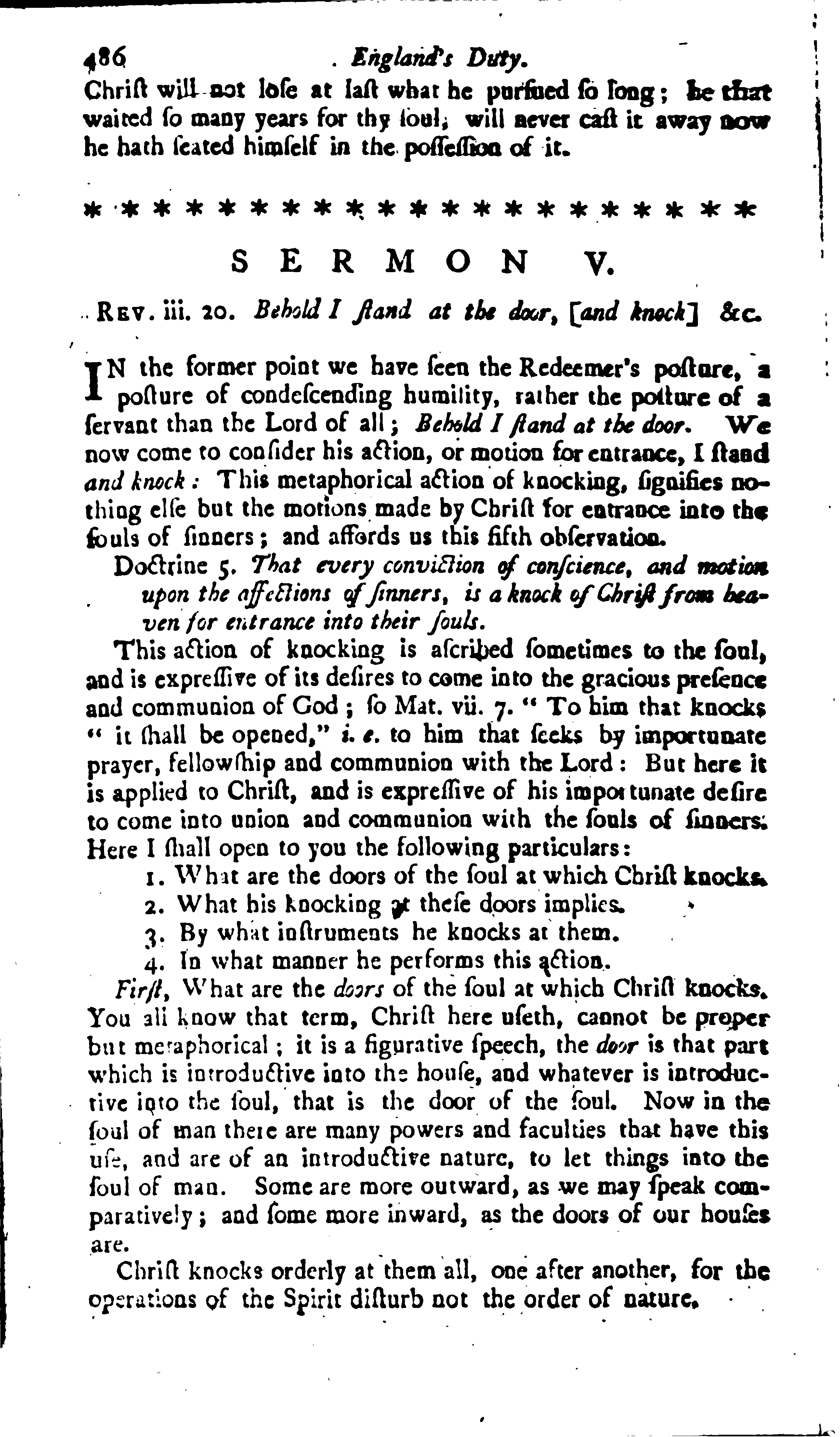
Christ will not lose at last what he pursued so long; he that waited so many years for thy soul, will never cast it away now he hath seated himself in the possession of it.
* * SERMON V.
REV. iii. 20. Behold I stand at the door, [and knock] &c.
IN the formerpointwe have seen the Redeemer's posture, a posture of condescending humility, rather the posture of a servant than the Lord of all; Behold I stand at the door.
We now come to consider his action, or motion for entrance, I stand and knock : This metaphorical action of knocking, signifies nothing else but the motions madebyChrist for entrance into the : fouls of sinners; and affords us this fifth observation.
Doctrine 5. That every conviction of conscience, and motion upon the affections offinners, is a knock of Christ from heaven for entrance into theirfouls.
This action of knocking is ascribed sometimes to the soul, and is expressive ofitsdefires to come into the gracious presence and communion of God ; fo Mat. vii. 7. " To him that knocks
" it shall be opened," i. e. to him that seeks by importunate prayer, fellowship and communion with the Lord: But here it is applied to Christ, and is expressive of his importunate desire to come into union and communion with the souls of sinners.
Here I shall open to you the following particulars :
1. What are the doors of the soul at which Christ knocks.
2. What his knocking at these doors implies.
3. By what instruments he knocks at them.
4. Inwhatmanner he performs this action .
First, What are the doors of the soul at which Christ knocks.
You all know that term, Christ here useth, cannot be proper butmeraphorical ; it is a figurative speech, the door is that part which is introductive into the house, and whatever is introductive into the soul, that is the door of the soul. Now in the soul of man there are many powers and faculties that have this use, and are of an introductive nature, to let things into the soul of man.
Some are more outward, as we may speak comparatively; and some more inward, as the doors of our houses are.
Christ knocks orderly at them all, one after another, for the operations of the Spirit disturb not the order of nature.
England's Duty.
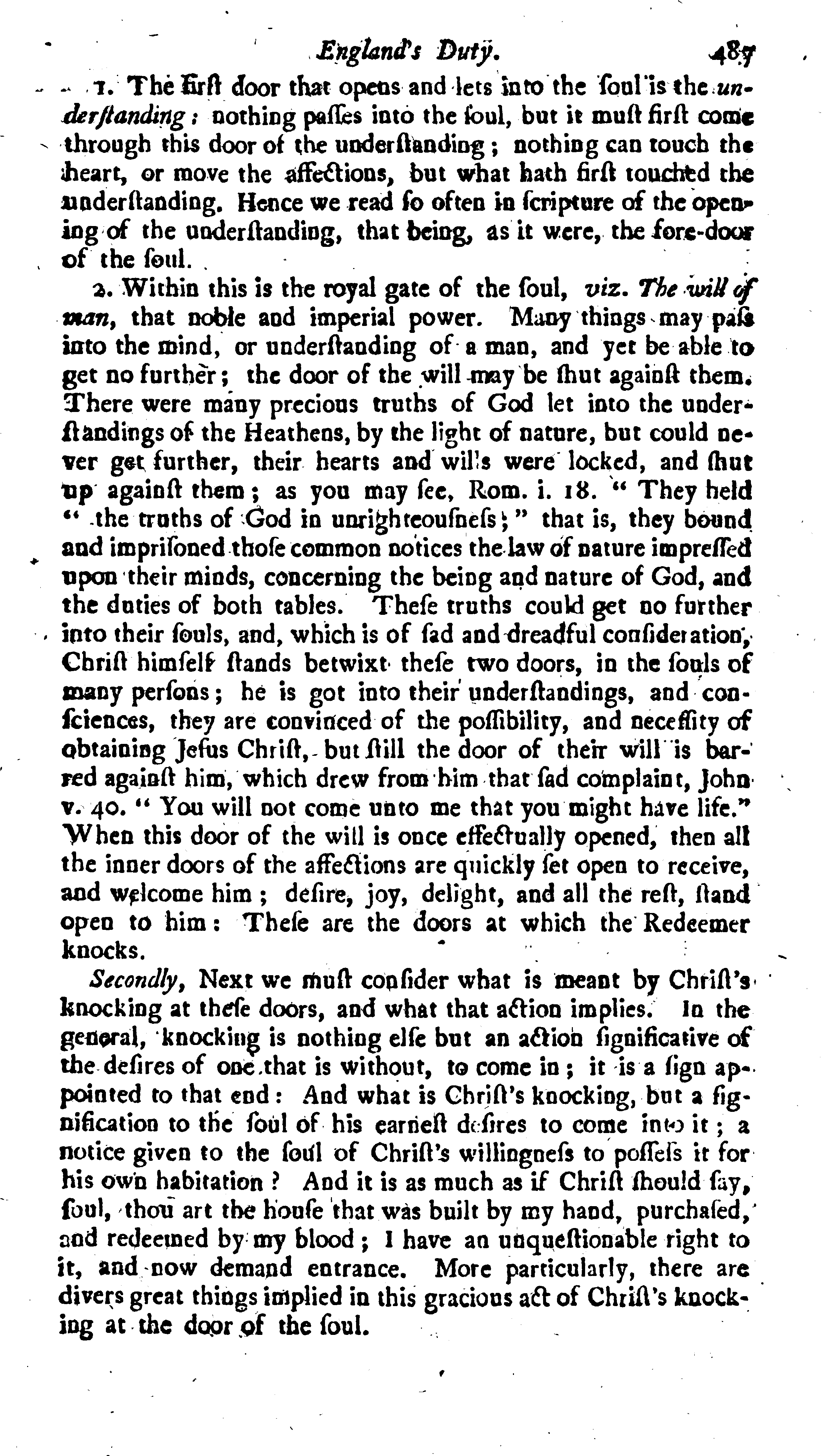
1. The first door that opens and lets into the foul is the understanding : nothing passes into the foul, but it must first come through this door of the understanding; nothing can touch the heart, or move the affections, but what hath first touched the understanding. Hence we read soofteninscripture oftheopeningof the understanding, that being, as it were, the fore-door of the soul.
2.Within this is the royal gate of the soul, viz. The will of man, that noble and imperial power.
Many things may pass into the mind, or understanding of am an, and yet be able to get no further; the door of the will maybe shut against them.
There were many precious truths of God let into the understandings of the Heathens,by the light of nature, but could never get further, their hearts and wil's were locked, and shut up against them; as you may fee, Rom. i. 18. " They held
" the truths of God in unrighteousness;" that is, they bound and imprisonedthosecommon notices thelawofnature impressed upon their minds,concerningthebeing and nature of God, and the duties of both tables.
These truths could get no further into their fouls, and,which is of fad and dreadful consideration,
Christ himself stands betwixt these two doors, in the souls of many persons; he is got into their understandings, and consciences, they are convinced of the possibility, and necessity of obtaining Jesus Christ, but still the door of their will is barred against him, which drew from him that sad complaint, John v. 40. " You will not come unto me that you might have life."
When this door of the will is once effectually opened, then all the innerdoorsof the affections are quickly set open to receive, and welcome him ; desire, joy, delight, and all the rest, stand open to him: These are the doors at which the Redeemer knocks.
Secondly, Next we must consider what is meant by Christ's knocking at these doors, and what that action implies.
In the general, knocking is nothing else but an action fignificativeof the desires of one that is without, to come in; it is a sign appointed to that end : And what is Christ's knocking, but a fignification to the soul of his earnest desires to come into it; a noticegivento the soul of Christ's willingness to pofssess it for his own habitation ? And it is as much as if Christ should fay, foul, thou art the house that was built by my hand, purchased, and redeeined by my blood ; I have an unquestionable right to it, and now demand entrance. More particularly, there are diversgreatthings implied in this gracious act of Chrifl's knocking at the door of the soul.
England's Duty.
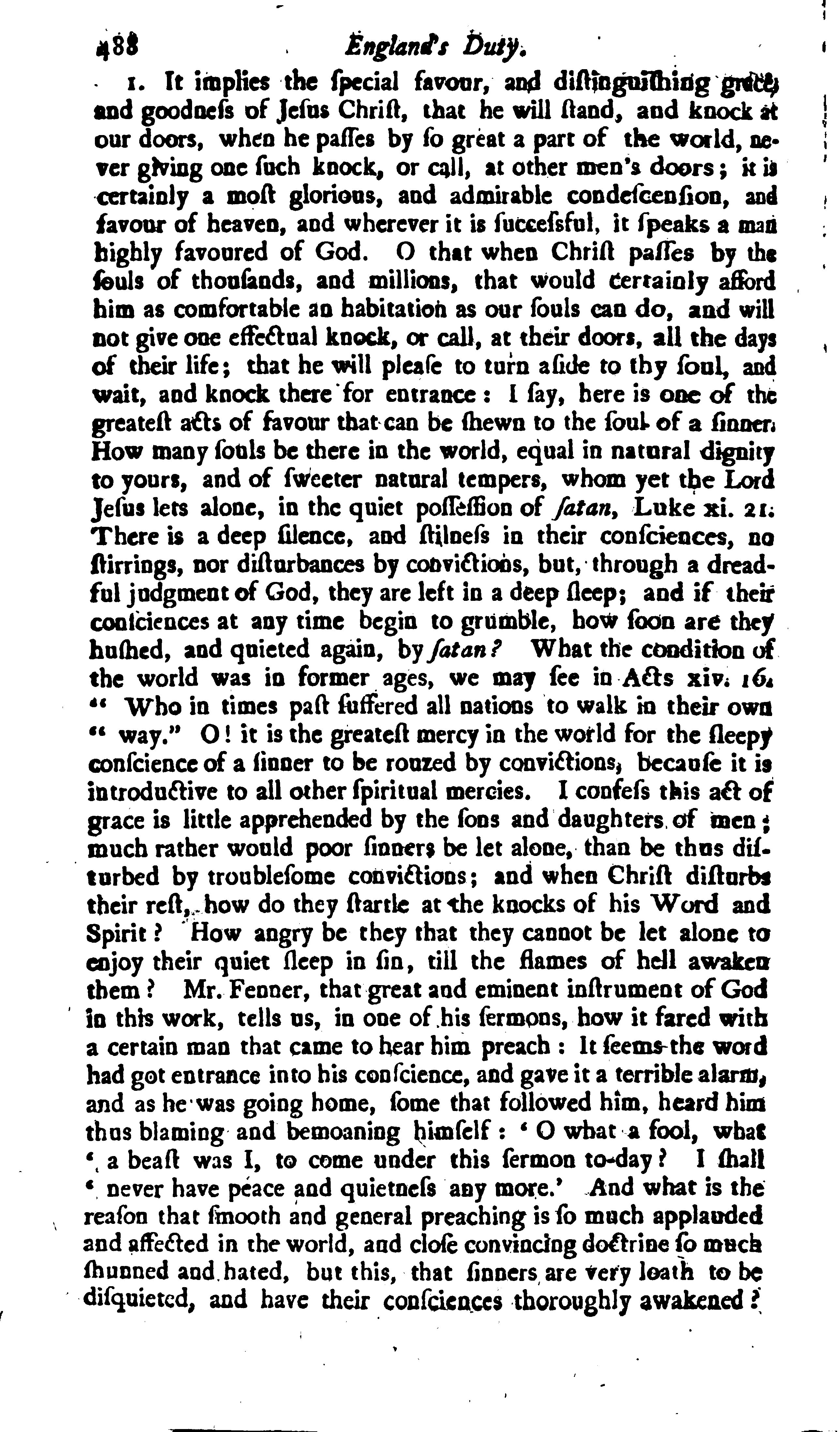
1. It implies the special favour, and distinguishing grace, and goodness of Jesus Christ, that he will stand, and knock at our doors, when he passes by so great a part of the world, never giving one such knock, or call, at other men's doors; it is certainly a most glorious, and admirable condescension, and favourofheaven, and wherever it is successful, it speaks am an highly favoured of God. O that when Christ passes by the souls of thousands, and millions, that would certainly afford him as comfortable an habitation as our souls can do, and will
: notgiveone effectual knock, or call, at their doors, all the days of their life; that he will please toturnaside to thy soul, and wait, and knock there for entrance : I say, here is one of the greatest acts of favour that can be shewn to the soul ofa sinner.
How many fouls be there in the world, equal in natural dignity to yours, and of sweeter natural tempers, whom yet the Lord
Jesus lets alone, in the quiet possession off at an, Luke xi. 21 .
There is a deep silence, and stilness in their consciences, no stirrings, nor disturbancesbyconvictions, but, through a dreadfuljudgmentofGod, they are left in a deep sleep; and if their consciences at anytime begin to grumble, how soon are they hushed, and quieted again, by fat an?
What the condition of the world was in former ages, we may fee in Acts xiv. 16.
" Who in times past suffered all nations to walk in their own way." O ! it is the greatest mercy in the world for the sleepy conscience of a sinner to be rouzed by convictions, because it is introductive to all other spiritual mercies.
I confess this act of grace is little apprehended by the sons and daughters of men; much rather would poor sinners be let alone, than be thus disturbed by troublesome convictions; and when Christ disturbs their rest, how do they startle at the knocks of his Word and Spirit ? How angry be they that they cannot be let alone to enjoy their quiet sleep in fin, till the flames of hell awaken them ?
Mr. Fenner, that great and eminent instrument of God in this work, tells us, in one of his sermons, how it fared with acertainman that came tohearhim preach : It seems the word had got entrance into his conscience,and gave ita terrible alarm, and as he was going home, some that followed him, heard him thus blaming and bemoaning himself: ' O what a fool, what a beast was I, to come under this sermon to-day ?
I shall • never have peace and quietness any more.' And what is the reason that smooth and general preaching is so much applauded and affected in the world,and closeconvincingdoctrine so much shunnedandhated, but this, that sinners are very loath to be disquieted, and have their consciences thoroughly awakened?
England'sDuty.
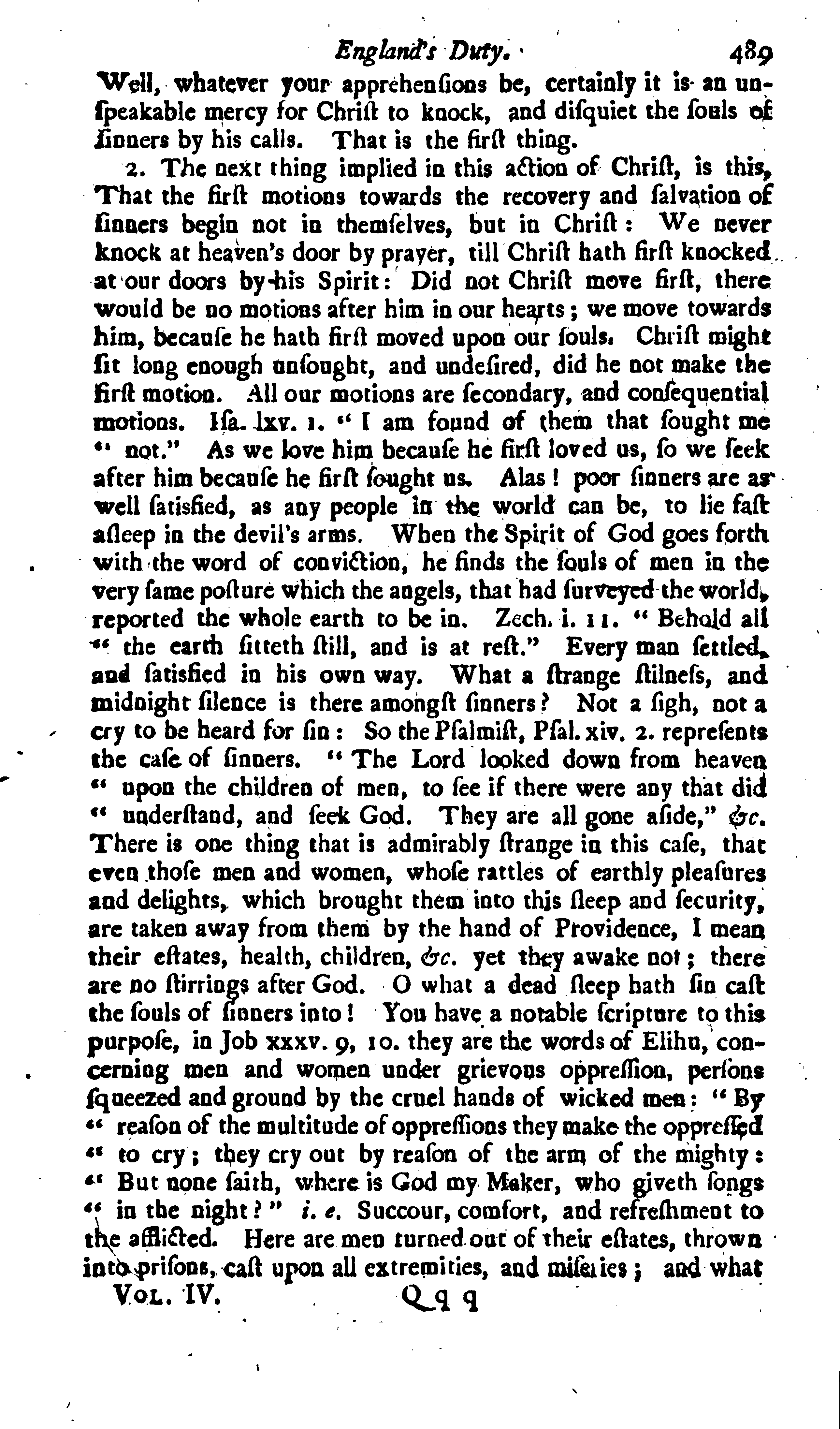
Well, whatever your apprehenfions be, certainly it is an unspeakable mercy for Christ to knock, and disquiet the souls of sinners by his calls.
That is the first thing.
2. The next thing implied in this action of Christ, is this, That the first motions towards the recovery and salvation of sinners begin not in themselves, but in Christ : We never knock at heaven's door by prayer, till Christ hath first knocked.. at our doors by his Spirit: Did not Christ move first, there would be no motions after him in our hearts ; we move towards him, because he hath first moved upon our souls. Christ might fit long enough unfought, and undefired, did he not make the first motion. All our motions are secondary, and consequential motions.
Ifa. lxv. 1. " I am found of them that fought me " not."
As we love him because he first loved us, so we seck after him because he first sought us. Alas ! poor sinners are as well satisfied, as any people in the world can be, to lie fast asleep in the devil's arms . When the Spirit of God goes forth with the word of conviction, he finds the souls of men in the veryfameposture which the angels, that had surveyed the world, reported the whole earth to be in.
Zech. i. 11. "Behold all " the earth sitteth still, and is at rest."
Every man settled, and satisfied in his own way.
What a strange stilness, and midnight silence is there amongst sinners ? Not a sigh, not a cry to be heard for fin : So the Pfalmist, Psal.xiv. 2. represents the case of sinners.
" The Lord looked down from heaven " upon the children of men, to fee if there were any that did
" understand, and seek God. They are all gone aside," &c.
There is one thing that is admirably strange in this case, that even those men and women, whose rattles of earthly pleasures and delights, which brought them into this sleep and security, are taken away from them by the hand of Providence, I mean their estates, health, children, &c. yet they awake not; there are no stirrings after God. O what a dead sleep hath sin cast the souls of sinners into !
You have a notable scripture to this purpose, in Job xxxv. 9, 10. they are the words of Elihu, concerning men and women under grievous oppression, persons squeezed and ground by the cruel hands of wicked men: "By " reason of the multitude ofoppreffions they make the oppressed
" to cry; they cry out by reason of the arm of the mighty :
" But none faith, where is God my Maker, who giveth songs " in the night? i. e. Succour, comfort, and refreshment to the afflicted.
Here aremen turnedoutoftheir estates,thrown into prisons, cast upon all extremities, and miseries; and what
VOL. IV.
England'sDuty.
1dothesepoorcreatures do? Why, faith he, theycryby rea son of their oppression : O my father, or my mother, my wife my child, my estate, my liberty; but none faith, where is my
God ? O my fin, or my miferyby reason of fin! "Where is "he thatgiveth songs in the night? "
The people of God when they lie musing upon their beds under affliction, they have their " songs in the night;" in the midst of the multitude of their troubled thoughts within them, the comforts of God delight their souls. These are their songs in the night, butnofuchword, or thought, in carnal men. How plain is it, that all the first motions of salvation have their first spring, and rife, in God, and not in us ? That is the second thing im plied in Christ's knocking.
3. Christ's knocking at the door of the heart, implies the method of the Spirit in conversion to be congruous, and agreeable, to the nature of man's foul.
Mark Christ's expression in the text; he doth not say, "Behold I come to the door," and break it open by violence; no,"Christ makes no forcible entries, whether sinners will or no; he will come in by consent of the will, or not at all.
I stand and knock ; if anymanopen the door, I will come in to him.
There is a great difference between a friendly admiffionby consent, and a forcible entrance :
In a forcible entrance bars of iron are brought to break open the door; but in a friendly admission one knocks, and the other opens.
Forcible actions are unsuitable to the nature of the will, whose motions are free and spontaneous; therefore it is said, Psalm cx. 3. " The people shall be willing in the day of " thy power."
It is true, the power of God is upon the will of man in the day of his conversion, or else it would never open to Christ ; but yet that power ofGoddoth not act against the freedom of man's will, by co-action and force; no, but of unwilling he makes it willing; taking away the obslinacy, and reluctancy of the will by the efficacy of his grace, which some divines call victrix delectatio, a sweet and pleasant victory ; and so the door of the will still opens freely.
Hofea xi. 4. " I drew " them with the cords of a man, with the bands of love."
drew them, there is almighty power; but how did this power draw them ? with the cords of am an, i. e. with rational arguments, convincing the judgment.
Beasts are driven, and forced, but men are drawn by reason, and will not move without it, if they act like themselves.
It must be confessed, that when the day of God's power is come for the bringing home of a poor sinner to Christ, he cannot resist the power of
God'sSpirit, that draws him effectually: " Every one that hath
England's Duty.
" heard and learned of the Father, cometh unto me;" yet still the soul comes freely by the consent of his will ; for this is the method of Christ in drawing fouls to him.
There is in the day of a sinner's conversion a kid, an offer made for the will, both by satan and Christ; satan bids riches, honours, and pleasures, with ease and quietness to the flesh, in the enjoyment of them: Abide where thou art, faith satan, remain with me, and thou shalt escape all the perfecutions, losses, and troubles of the world, which conscience entangles other men in; thou shalt draw thy life through peace and pleasure, to thy dying day. O, faith the flesh, this is a good motion, what can be better for me ?
But then faith Christ, dost thou not confider that all these enjoyments will quickly be at an end, and what shall become of thee then?
Behold, I offer thee the free, full, and final pardon of thy fins; peace and reconciliation with God, treasures in heaven, all these shall be thine, with troubles, reproaches, and perfecutions in this world.
The understanding, and conscience of a sinner, being convinced of the vanity of earthly things, and the indispensable necessity of pardon and peacewithGod; I say, when aconvincedjudgment hath duely balanced these things, and laid them before the will, and the Spirit of God puts forth his power in the renovation of it ; it moves towards Christ freely, and yet cannot, according to its natural order, act otherwise than it doth .
And, doubtless, this is the true meaning of that expression, so often mistaken and abused, in Luke xiv. 23." Compel them to come in."
What ! byforcingmen against the light of their consciences ? No, no ; to the shame of many Protestants let us hear the gloss of Stella, a Popish commentator upon the place.
Christ (faith he) com. pels men to come in, by shewing to their will such an excelling good as it cannot but embrace :
For voluntas naturaliter fertur in bonum, the will is naturally carried to the best good. And thus the Spirit works upon the foulharmoniously, and agreeable to its own nature.
That is the third thing im plied in Christ's knocking.
: 4. Christ's knocking at the door of the soul, manifestly implies the immediate access of the Spirit of God unto the soul of man; that he can come to the very innermost door of the toul at his pleasure, and make what impression upon it he pleaseth.
As for other instruments used in this work, they have no such privilege, or power; Ministers can but knock at the external door of the senses.
Thine eyes shall fee thy teachers, we can fee their persons and hear their voices ; we can reason with :
England'sDuty. sinners, and plead with their souls ; but awakenthemwe can not, open their hearts we cannot; we can only lodge our messages in their ears, and leave it to the Spirit of God to make it effectual.
This is a royalty belonging unto the Spirit of God, incommunicable to angels, or men; if an angel from heaven were the preacher, he could not give one immediate stroke to the conscience, much less canman; we have nodominionover your consciences.
The key of the doors of your souls hang not at our girdles, but are in the hands of Christ, Rev. iii. 7.
" He hath the key of David, he openeth, and no man shutteth; " and he shutteth, and no man openeth."
The conscience, and all the faculties lie naked and open to the stroke of God's Spirit ; he can wound them and heal them, and make what impressions he pleaseth upon them.
Learn hence what need there is, both for ministers and people, before they enter upon the solemn ordinances of God, to lift up their hearts by prayer for the blessing, and power of the Spirit upon them.
Lord, fend forth thy Spirit, pour itforthupon, and with thy word.
Ah! how many sermons have we preached,and you heard, and yet there is no opening ! These are the four things implied in Christ's knocking at the door, viz. condescending grace : All first motions being in God, the motions of his Spirit are congruous, and agreeable to the nature of the soul; and that his
Spirit can have immediate access to the innermost faculties, and powers of the soul, at his pleasure. Now in the next place let us confider, Thirdly, By what instruments Christ knocks at the doors, that is, the judgment, conscience, and will of a sinner.
And these are two, viz.
1. His word.
2. His providence.
Here my work will be to shewyou how the Spirit of God makes use both of the word and works of God, to rouze and open the consciences and hearts of sinners. These are the two hammers or instruments of the Spirit, by which he knocks at the door of the heart.
1. The word written or preached, but especially preached ; to this Christ gives the preference above all other instruments employed about this work; and, answerably, the word is called
God'shammer, Jer. xxii. 29. " Is not my word like fire, and " as the hammer which breaketh the rocks in pieces ? " By this hammer Christ raps at the door ofafinner's foul, to give warning that he is there.
The Spirit of God can open the heart immediately if he pleaseth; but he will honour his word in this work. And therefore, when Lydia's heart was to be
England's Duty.
opened, Paul, thegreatgospel-preacher, must be invited, even by an angel, to come over to Macedonia, and assist in thatblefsed work, Acts xvi. 9.
Lydia was to be converted, her heart must be opened to Christ ; the angel could not do it, but calls for the help of the Apostle,God's appointed instrument to carry on that work.
" I have made thee (faith God to Paul) a mi- " nister and a witness to open their eyes, and turn them from " darkness to light, and from the power of Satan to God,"
Acts xxvi. 13. Now there be three ways in which the Spirit uses the word, as his hammer, in knocking at the door of the soul.
(1.) He knocks by the particular convictions of the word upon the conscience; this knock, by conviction, rings and founds through all the rooms and chambers of the soul ; particular and effectual conviction wounds to the very centreof the soul. Ah, when the word shall come home by the Spirit's particular application, like that of Nathan's to David, Thou art the man ; then all the powers of the soul are roused and alarmed; now it pierces as a two-edged sword, Heb. iv. 12. divides the foul and spirit, the superior and inferior faculties of it; cuts down by the back-bone, lays open the secret guilt and innermost thoughts ofa man's heart, before which the sinner cannot stand.
The secrets of his heart are made manifest ; and falling down on his face he must acknowledge that God is in the word of a truth, 1 Cor. xiv. 24.
O these convictions of the word are such a rap, such a knock at the door of the conscience, as will never be forgotten, no not in heaven, to all eternity.
(2. ) Christ knocks in the word by its terrible comminations and awful threatenings, menacing the soul that opens not with eternal ruin; these are dreadful knocks : O sinner, faith Christ, wilt thou not open ? Shall all the tenders of my grace made to = thee be in vain ? Know then that this thy obstinacy shall be thy damnation.
Thus the word denounces ruin, in the name of the great and terrible God, to all wilful impenitents and obstinate unbelievers, John iii. 36. " He that believeth not the Son,
" shall not fee life; but the wrath of God abideth on him." O dreadful found ! like unto which is that, John viii. 24. " If ye
" believe not that I am he, ye shall die in your fins :" q.d.
Thy mittimus for hell shall be made and signed.
Will you not come tome that you might have life ? Then will I foretelwhat death you shall die, you shall even die inyourfins. O it were better for thee to die any kind of death, than to die in thy fins.
These are loud knocks of the word, terrible sounds, yet no
England'sDuty. more than needs to startle the drousy consciences of sinners.
And then, (3.) The spirit knocks by the gracious invitations of the word, the sweetallurements and gracious insinuations of it; and without this no heart would ever open to Christ.
It is not frost and snow, storms and thunder, but the gentle distilling dews, and cherishing fun-beams, that make the flowers open in the spring.
The terrors of the law may be preparative, but the grace of the gospel is that which effectually opens the sinner's heart.
The obdurate flint will sooner fly when smitten upon the soft pillow, than upon the anvil. Now the gospel a bounds with alluring invitations to draw the will, and open the heart of a sinner; such is that, Mat. xi. 28. " Come unto me
" all ye that labour, and are heavy laden; and I will give you " rest." O what a charming voice is here ! he that considers it, maywellwonder what heart in the world can resist it : like unto this is that in Isa. Iv. 1. " Ho, every one that shirsteth, come ye to the waters; and he that hath no money let him come; yea, let himcomeand buy wine and milk without money and without price." q. d. Come, sinner, come ; though thou have no qualifications, nor worthiness, nor righteousness ofthyown; though thou be but a heap of fin and vileness, yet come: my grace is a gift, not afale : and such is that in John vii. 37. " In the last day, the great day of the feast, Jesus stood
" up and cried, If anyman thirst let him come to me and " drink." q. d. My grace is not a fealedfountain, it is free and open to the greatest of sinners; if they thirst, they are invit-
" ed to come and drink.
This is that oil of the gospel grace which makes the key turn so pleasantly, and effectually, amongst all the cross wards of man's will. And thus you fee how the word preached becomes an instrument, in the Spirit's hand, to open the door of a sinner's heart, at which it knocks by its mighty convictions, dreadful threats, and gracious invita.ions.
2. We next come to the second hammer, by which the Spirit knocks at the sinner's heart, and that is the providential works of God.
These, in subserviency to the word, are of excellent use to awaken sinners, and make them open their hearts to Christ. God hath magnified his word above all his name; yet there are some of the providential works of God greatly serviceable in this case; the word fanctifies providences, andprovidences assist the word, and make it work. Now there are two fortsof providential dispensations which the Lord Jesus makes use of to gain entrance for him into the hearts of men, viz .
(1.) Judgments.
(2.) Mercies.
England's Duty.
(1.) Judgments andafflictions : thewordofGodmanytimes works not till some stroke ofGodcome to quicken and assist it; thus did the Lord open the heart of that monster of wickedness,
Manaffeh, the word would not work alone, but a smart rod quickened its operation : 2 Chron. xxxiii. 10, 11, 12. " And "the Lord spake to Manasseh, and to his people; but they
"would not hearken.
Wherefore the Lord brought upon "them the captains of the host of the king of Affyria, which "tookManasseh among the thorns, and bound him with set- *ters, and carried him to Babylon. And when he was in afflic- "tion, he be fought the Lord his God, and humbled himself
"greatly before the God of his fathers."
Thus the heart of this man relented under the word assisted by the rod. Ah, it is good that God takes such a course with some sinners, else the word would do them no good: and to this purpose is that in Job xxxvi. 8, 9, 10. " And if they be
"bound in fetters, andholden in cords of affliction; then he " sheweth them their work and their trasgreffion, that they
" have exceeded; and openeth their ears to discipline."
This is that rough course the obstinacy of mens hearts makes neceffaryfor their recovery, and therefore it is very observable, that some words of God have lain dead in some sinners hearts for years together,and at last have begun to work under some finart and close rod.
Alas, while all things are pleasant and prosperous about us, the word hath but little operation and effect :
Jer. xxii. 21, 22. " I spake unto thee in thy prosperity, but " thou saidst I will not hear this hath been thy manner from " thy youth, that thou obeyedst not my voice.
The wind " shall eat up all thy pastures, and thy lovers shall gointocap66 tivity; surely then shalt thou be ashamed and confounded for " all thy wickedness." q. d. Your eyes are so dazzled with the beautiful flowers, and your ears to charmed with the Syren songs or earthly delights, that my wind can take noplace upon you.
Let an east-wind blow, and wither up these flowers ; thentheword shall work, and conscience resent the concernments of eternity.
This courte God is fain to take with many of you; bere you fit from sabbath to'sabbath under the word, and nothing takesplaceupon your hearts.
Will you not hear the voice of my word ?? Go, death, faith God, smite thatman's child dead, I will try what that will do ; go poverty, and blast his estate, and see what that will do; go sickness, and smite his body, and shake him over the graves mouth, I will fee what that will do.
Thus God sends to sinners, that Abfalom sent toJoab, who refused to come near him, till he set
England'sDuty. fire to his fieldofcorn, andthenawaycomes Joab, 2Sam. xiv, 29, 30, 31. And thus the Lord opened the heart of theJaylor, by putting him into a fright, a panic fear of death, Acts xvi.
27. And thus doth the Lord devise means to bring back his banished.
(2.) AsGodmakes use of the hammer of judgments, so he makes use of mercies to make way for Christ into the hearts of men. Every mercy is a call, a knock of God : and truly if there be any ingenuity left unextinguished in the heart, one would think mercy would prevail more than all the judgments in the world, Rom. ii. 4. " Knowest thou not that the good- " nessofGodleadeth thee to repentance ?" q. d. Dost thou not see the hand of mercy stretched out to lead thee into a corner, there to mourn over thy fins committed against so gracious and merciful a God ? By every mercy you receive, Christ doth, as it were, sue you to open your hearts to him; they are so many gifts sentfromheaven to make way for Christ into your hearts.
It would be an endless task to enumerate all the mercies bestowed to this end upon the unregenerate: but surely this is the errand of them all; and the Lord takes it very ill when his end is not answered in them: hence is that complaint, Jer. v. 24.
" Neither say they in their heart, let us now fear the Lord our " God, that giveth us rain, both the former and the latter, in " his season."
Some of you have been marvellously preserved in times of common contagion and death, when thousands have fallen at your right hand and left: then have you been preserved or recovered, according to that, Exod. xv. 26. " I will put
" none of those diseases upon thee, for I am the Lord that " healeth thee."
I am Jehovah Rophe, the Lord the physician ; many of you have been at the graves mouth, in many diseases, others upon thedeeps; yet thehandofmercy pulled you back, and suffered you not to drop into the grave and hell in the fame moment.
O what a knock was here given by the hand of mercy at thy hard heart ! Certainly ifmenwouldbut observe, they might fee a strange, marvellous working, and moulding of things by the handofprovidence, for the production of thousands of mercies for then: and if mercy would do the work, and win you over to Christ, many rods had been spared, which your obstinacyhath made necessary. O ungrateful sinners! doth your Redeemer thus woo and fee you by fo many gifts of mercy, and yet will you that him out ? Do ye thus requite the Lord, O foolish people andunwife? For which of all his benefits do your ungrateful fouls shut the door upon him ?
England's Duty.
(3.) You see what Christ's knocking at the foul of a sinner implies, and by what instruments it is performed.
In the last place, we willconfiderthe manner how this action is performed in the ten following particulars, wherein much of the myfteryofconverfion will be opened; the Lord grant your experience may answer them.
We cannot indeed exactly describe and mark all the footsteps of the Spirit, in this work, upon the souls of men; yet these things seem eminently observable.
1. The knocks of Christ at the sinner's heart are silent and fecretto all persons in the world, except the soul itself at whose door he knocks; here be many hundreds of you this day under the word; if the Lord shall this day knock by conviction at any man's heart, none will hear that knock, but that man only ; for it is a knock without found or noise to any but the particular foul concerned in it. It was fore-prophefiedofour Redeemer, and of this very act of his, Ifa. xlii. 2. " He shall not cry, nor lift up, nor cause his voice to be heard in the street."
The kingdom of God cometh not into the souls of men with public observation : you read in 1 Cor. ii. 11. " No man know- ** eththe things ofa man, save the spirit of a man that is in " him."
None knows what convictions another man's conscience feels, until he himself mall discover them; you hear the fame found of the gospel, but you hear not the inward strokes it gives to another man's conscience.
Christ's approaches to the soul make no noise; littledoweknow what the spirit of Christ whispers in the ear of him that fits next us.
It is said of the inward comforts of the spirit, I will give him the hidden manna which no man knows but he that eateth of it.
This is true also of inward terrors and troubles.
Christ's knocks by conviction are but a secret whisper of his spirit in the ear of a sinner, saying, thou art the man, this is thy case.
That is the first thing in the manner of Christ's knocking, it is a silent knock without public found.
2. These silent inward knocks of the spirit of Christ, though they are heard by none but the soul itself, yet do they greatly differ as to the terror, or mildness of them indifferent subjects .
Some hear them with more terror and astonishment, others in a mild and gentle manner. When the Lord knocked at the Jaylor's conscience, Acts xvi. 29, 30. it was a terrible stroke ; he called for a light, and sprang in like am an distracted; and trembling and aftonishedfelldown at the apostles feet, crying,
" Sirs, what must Ido to be saved ?" Here was a terrible knock indeed, which almost affrighted his soul out of his body; it is
VOL . IV.
Rrr
England's Duty. as if he had said, tell me, for the Lord's fake, and tell me quickly, whether there be any way of salvation, and where it lies, for I am a lost man, an undone foul.
But when the Lord opened the heart of Lydia, there were no such terrors, the Lord spake to her in a more mild and gentle voice; as you fee ver. 14.
The spirit of God varies his method according to the temper of the soul he worketh on.
Knotty pieces need greater wedges and harder blows to rive them asunder, and as he directs his ministers, Jude 22. to make a difference, to deal tenderly and compassionately with some; but others, to save with fear; fohe himself observeth like different methods.
3. Some knocks of Christ are successful, and obtain the desired effect.
He knocks, and the soul opens ; but others are unsuccessful; he knocks once, and again,by convictions, which may cause the conscience, for the present, to startle a little, but there is no opening to Christ by faith. O friends ! this is of dreadful consideration; Prov. i. 24. " I called, and you refuf- " ed; I stretched out my hand, and noman regarded." There is a call without an answer, a knock, and no opening ; and these things are very common, especially among the unconverted, that live under a lively gospel-rousing ministry.
Of this Christ complains, Mat. xvi. 17. " Whereunto shall I liken this generation ? They are like unto children fitting in the market-place, and calling to their fellows, saying, We have pip- "eduntoyou, and you have not danced; we have mourned
" unto you, but you have not lamented:" q. d. Neither the delicious airs, and melody of gospel-grace, nor the mournful, and dreadful threats of damnation to unbeliever , avail any thing to open your hearts to embrace me; no voices from " mountGerezim, or mount Ebal, will prevail with you.
Ah ! how many fad witnesses unto this truth have I now before mine eyes ! but God forbid it should be thus all round: no, no, there be some fouls who hear, and open, even every one that hath heard, and learned of the Father, John vi. 45. when the spirit of God puts forth his power with the word, then, and not till then, it becomes successful.
4. Sometimes Christ knocks with a thick succession of convictions, a quick repetition of his calls. Some men have had thousands of convictions in a few years; for in this case the Lord faith, as it is Exod. iv. 8. " If they will not hearken to " the voice of the first sign, yet they may believe the voice of " the latter sign." And yet sometimes neither the former, nor the latter avail any thing. "How oft would I have gathered
66 thy children, an dye would not?" Mat. xxiii. 37. How often
England's Duty.
Intimating themanycalls Christ gave Jerusalem to come unto him, yet all in vain. Obstinate sinners, Christ hathbeenknocking, and calling at some of your consciences, from your very childhood; thousands of convictions have been tried upon some of you, and yet, to this day, your souls are shut fast against him.
The Lord hath waited, from year to year, for your answer, by this signifying howloath he is to part with you ; such a time thou wast upon a sick bed, nigh unto death ; at such a time under such a sermon, and then Christ knocked at thy soul : if all this be in vain, so many convictions as you have stifled, so many faggots you carry with you to hell, to increase your flames, and torments. Yetcommonlythosequick repetitions, and redoublings of the strokes of convictions end well; and it is a good sign, whenoneconviction revives another, and the Lord keeps the soul still waking.
But O take heed, and try not his patience too long, left the next stroke be more dreadful than all the former ; not to open your hearts, but smite dead your hopes for heaven.
5. Sometimes Christ knocks intermittingly, knocking and stopping, a call and silence, and that at a considerable time and distance: a conviction this day, and, it may be, not another in many months.
There be some aged sinners that have not had more thanone or two remarkable rouzings of conscience in fifty or sixty years time, and then no more; do not think that the Lord will make his spirit always strive with men, Gen. vi.
3. no, there is a time when God faith to the word, convict the conscience of that manor woman no more, not a stroke more, by way of conviction, but henceforth be thou for obduration, not to open, but to shut him up, Ifa. vi. 10.
Reader, bethink thyself, how long was it since thyconfcience was roused, and awakened ? O faith one, seven or ten years ago I heard such a sermon which tore my conscience to pieces ; I fell under such a providence, which roused and awakened all my fears ; but since that time all hath been still, and quiet; the Lord give a second awakening, left you awake with the flames of God's wrath about you .
I observe, it is usual, when God works upon any very early, he knocks thus intermittingly : now the conscience is active, and full of trouble, then the vanities of youth extinguish these convictions again, but the Lord follows his design, and at last the conviction settles, and ends in conversion.
6. Christ sometimes knocks with both hands at once, with the word, and with the rod together; the latter insubserviency
Rrr2
England'sDuty. to the former ; and i fever the foul be liketoopen, it will open then, when ordinances and afflictions work together. The word smites the conscience with conviction, and at, or about the fame time, providence smites the outward man with fame affliction, to make the word work effectually; or, under some smart affliction, a suitable word is seasonablydirected to the conscience: and thusjunctajuvant, the one assisteth the other, and both together produce the desired effect.
Thus the Lord wrought upon the Thessalonians, I Thef. i. 6. " And ye became followers of us, and of the Lord, having received the " word in much affliction " A child dies, an estate is loft, or a sickness seizeth, at the timewhenconfcience is prepared by a conviction from the word, or afflictions have prepared it for the word: the roduponthe back helps the word to work upon the heart, and if both these working in fellowship, will not do the work, there is little hope that any thing will do it.
7. Every knock of Christ disturbs the finfulrest of the soul; it rouseth guilt in the conscience, and puts the inner man into great distress, and trouble.
Before Christ comes, and knocks at the door of the heart, all is still and quiet within; the soul is in a quiet sleep offinful security, no fears or troubles molest its rest.
Luke xi. 21. " When a strong man armed keepeth his " palace, his goods are in peace; but when a stronger than he
" shall come upon him, and overcome him, he taketh from " him all his armour wherein he trusted."
The armour which Satanputs into the hands of sinners, todefendthemselves against the convictive strokes of the word, are the general mercy of God, the outward duties of religion, partial reformations, &c.
But when Christ comes by effectual conviction, he disarms the sinner of all these pleas, and then the soul fees what broken reeds it leaned upon. "When the commandment came, (faith
" Paul) fin revived, and I died," Rom. vii. 9. i. e. all my vain hopes expired; no artifice of Satan can any longer quiet the sinner's conscience; he apprehends himself in a miserable condition, meditates an escape; farewel now to found and quiet leep : no peace, till out of danger.
8. Every effectual knock of Christ gives an alarm to hell, and puts Satan to all his shifts, and arts, to secure the possession of the convinced sinner. The devil is a jealous spirit, and when his interest is in danger, he bestirs himself to purpose; the time of conviction is an hour of temptation. " We wrestle not with flesh
" and blood, (faith the apostle) but against principalities, a46 gainft powers, against the rulers of the darkness of this
" world, against spiritual wickedness, (or wicked spirits) in
England'sDuty.
501.
"high-places," or aboutheavenlies,Eph. vi. 12. The strife betwixtfatan and the soul,is now for no less than the prize of eternal life; it is now for all, or none; for life or death, for heaven or hell : The powers of hell are now all in arms todestroyconvictions, and secure the possession of the soul against Christ ; as when agranado falls into a garrison, the first care of the defendants is, to stifle, and choak it before it break.
Whilst Christ isspeakingbyhis Spirit in one ear, the devil is whispering in the other; and the things he whispers to quench convictions, are ufuallyfuch as these: It is time enough yet, what need such haste? Enjoy thy pleasures a little longer,thou mayeft come to Christ, and be saved at last. If that will not do, then he changeth his voice: To what purpose wilt thou go to Christ ? It is now too late, the time of grace is over; hadst thou come to him in thy youth, and obeyed his first call, it hadbeenfomewhat, but now it is to no purpose.
If this will not quiet the soul, then he faith,Thy fins aretoogreat to be pardoned, there is no hope for such a prodigious sinner as thou art. If the Lord help the foul to overcome this, by discovering to it the riches
of mercy, pardoning the greatest of sinners; then he represents the multitudes which are in the fame case with the convinced sinner ; Come, fear not, if itgo ill with thee, it will be as bad for millions of men and women; if thou go to hell, thousands will gowith thee: But if the foul be loath to be damned for company, then he bids it look upon the train of troubles and afflictions that come along with Christ, and will certainly follow him, if the door be open to let him in: If Christ come in, reproaches, losses, and sufferings, will certainly come in with him; troops of miseries and calamities follow him; himself hath told thee fo, and art thou mad, to ruin all thy comforts in the world, and plunge thyself into a sea of trouble for what thine eyes never saw ? But if the soul reply, these are more tolerablethandamnation,better my flesh suffer for a time, than my soul be cast away for ever; then he represents the infuperabledifficulties of religion, what a hard thing it is to be saved, how many painful duties and acts of mortificationthe foul must pass through.
Thus you see what an alarm conviction gives to the powers of hell .
19. Every effectual knock of Christ is followed on, and new convictions revive old and former ones, and the Lord never leaves knocking till the door be opened; if one fermonwill not do, another shall ; if one wound be plantered and healed by the art off at an, a fresh wound shall be made ; if a former conviction vanish, the next shall be fealeduponthe foul; and
England's Duty. when the Spirit of the Lord sealetha conviction upon the conscience, raze it out who can ?
And here is the difference betwixt special and common convictions ; common convictions come and go, they put the soul in a fright for a day or a month, and then trouble it no more for ever ; but special convictions will be continued, one thing backs another; for Christ is in pursuit of the soul, and will give it chase, till at last he overtake, and come up with it.
10. Lastly, All the knocks of Christ cease and end, when the sinner's day of grace is ended; this is of dreadful consideration ; when the time of mercy is over, no more strivings of the Spirit with a man, after that.
Christ saith to the drowsy sinner, as he spake to the drowsy disciples in the garden, Sleep on now, and take your rest.
So here, I called thee in such a sermon, but thou heardest not; by such a providence, but thou obeyedst not; sleep on now and take thy rest : "My people would not hearken to my voice, and Israel would
none of me; fo I gave them up to their own hearts lust, to " walk in their own counsels," Psal.lxxxi. 11 , 12. q. d. I have
" done with them, the treaty is ended, I will make no more essays towards their conversion and salvation.
So I gave them up.
Methinks it sounds as much as this, take them sin, take them devil, I will have no more to do with him.
So Hosea iv. 17.
" Ephraim is joined toidols, let him alone.". His heart is glued fast to fin, he is enamoured upon other lovers, let him alone.
Obeloved, it is adreadfulthing for God to say, let this man alone in his formality, and that man in his carnal security.
Let not this be misapplied by poor, trembling fouls under conviction : I know the fear of this judgment is upon their hearts, nothing makes them tremble more than left the day of grace be ended with them.
But there is no ground for this fear, whilst the Spirit continues convincing, and the soul trembling left his convictions should prove ineffectual. Thus much of the nature, instruments,and manner of Christ's knocking at the door ofa sinner's heart. Our way is now opened to a fruitful application of this point, which I will wind up in divers necessary uses.
I. Use, for Information.
And first, The point before uswillbeuseful for information, in the following inferences, and deductions.
Infer. 1. Into how deep a sleep hath fin cast the souls offinners, that Christ must stand so long, andgivefuch loud repeated knocks, before it will awake and open to him?
There is the spirit of a deep sleep fallen upon men, like that into which God caftAdam; God speaks once, yea, twice, but man re
England's Duty.
gards it not; it is the hardest thing in the world to rouze and awaken a man out of his carnal security.
Look over satan's kingdom, and you shall find a general stilness, and quietness among his subjects; there is no trouble for fin, no strivings after salvation, nocryings out, " What shall we do to be saved?"
Go into the crowds of carnal men and women, and you shall find them all intent and busy about other matters. How long shall you be in their company, before you hear one groan for fin, or see one tear slide from their eyes on that account ?
Oh!what a marvelious thing is here ! do not their consciences know the guilt that lies upon them ?
Are they not aware of a day of reckoning which approacheth ?
Yes, yes, these things are not hid from their contciences :
What art then is used to keep them so still and quiet ? Why, there are divers rattles to still the consciences of sinners, and they do it effectually.
There are four causes, and occasions of this wonderful stilness in the souls of sinners.
/ 1. Ignorance of the nature of regeneratinggrace, taking that for regeneration, which is none of it; thus did the Jews,
John viii. 25. confidently affirm God to be their God, and yet they did not know him. How many poor ignorant creatures think there is no need of any other work of regeneration, but what passed upon them in baptism ?
They were born, and baptized Christians, and that is enough, they think, to save them.
Matth. iii. 9. " We have Abraham to our father. "
They thought it sufficient that Abraham's blood ran in their veins, though there were not a spark of Abraham's faith kindled in their souls : The Lord forgive the fin of those men that lead poor souls into such fatal mistakes. O if men were butawareofthe necessity of a greater, andfartherwork to pass upon their souls than their baptism, common powerless profession, or thefimilarworks which appear upon formal hypocrites, heaven and earth would ring with their cries. But ignorance of the nature andneceffityof special regenerating grace, like a dose of opium, casts the consciences of many into this deep sleep.
2. Freedom from grosser fins andpollutions of the world, stills and quiets the consciences of thousands; they have had a civil, sober, and fair education; and though there be no grace and regeneration, yet what faints do they seem to themselves, being adorned with fobrietyand civility !
This stilled the conscience of the Pharifee, Luke xviii. 11. " God, I thank " thee, that I am not as other men are, extortioners, unjust,
" adulterers, or even as this publican."
Thus, like delicate A gag, they spruce up themselves with moral homilitical virtues,
England's Duty. wherein many thousand Heathens were more gay than them selves; butjusticewillhewthem to-pieces asAgagwas, for all their moral ornaments and endowments.
3. The strict performance of the external duties of religion quiets the consciences of many; they question not but those that do so well shall farewell, and that God will never damn men and women that keep their church, and say their prayers as they do.
Thus the carnal Jews deluded themselves, crying, " The temple of the Lord,thetempleoftheLord : " Asmalefactors, insomeofour neighbouringkingdoms, fly to the church from the hand of justice, so do these; but God will pluck them from the horns of the altar, and convince them that the empty name of religion is no security from damnation.
4. Manyconfciences are still and quieted in a natural sinful state, by misinterpreting the voices of Providence ; it maybe
God prospers your earthly affairs, succeeds and smiles upon 'your undertakings; and this you conclude must be a token of his love and favour: But, alas! this is a great mistake, the Lord give you better evidences of his love than these; for who prosper more in the world than wicked men ? And who are more crossed than the people of God ? Read Job xxi. and Psal.lxxiii. andcomparebothwithEccl. ix. 1.and you will quickly find the vanity of all hopes built upon such a foundation.
However, by such things as these are, the god of this world blinds the eyes of multitudes.
Infer. 2. If every conviction be a knock of Christ, how deeply areallfouls concerned in the success and issue of them?
Conviction is an embryo of the new creature; if it go out its full time, and come to a perfect new birth, it brings forth salvation to your souls ; if it miscarry finally, you are finally loft.
It is of infinite concernment therefore to every man and woman to be tender over those convictions of their consciences .
It is true, conviction and conversion are two things ; there may be conviction without conversion, though there can be no conversion without conviction. The blossoms upon the trees in the spring of the year cannot properly be called fruit, they are rather the rudiments of fruit, or something in order to fruit: If they open kindly, and knit or set firmly, perfect fruit follows them ; but if a blast or frosty morning kill them, no fruit is to be expected.
Thus it is here,great care therefore ought to be takenaboutthe preservation and success of convictions,both by
1. The soul itself that is under them.
2. And by all others that are concerned about them.
1. What care should the soul itself have, upon whom con-
England's Duty.
victions are wrought: have a care friends how you quench them, divert or hinder the operations of them, left you hinder as much as in you lies, the very conception of Christ in your souls by them.
I remember it is said, Exod. xxi. 22 .
" Ifmen strive and hurt a woman with child, and mischief " follow, life shall be given for life."
The life of your souls ' is bound up in the life of your convictions.
I know it is hard for men and women to dwell with their own convictions ; guilt and wrath are sad subjects for mens thoughts to dwell upon; but yet it is far better to dwell with the thoughts off in and wrath here, than to lie sweltering under them in hell for ever. You may be rid of your convictions and your salvation together ; be not too eager after peace, a good trouble is better than a false peace. And on the other side, beware that your convictions and troubles turn not into discouragements to faith; this will cross the proper interion of them : they are Christ's knocks for entrance, and were never intended to be bars or stumbling-blocks in your way to him ; not stops, but steps in yourwaytoChrift.
2. Let all others that are concerned about convincing souls, beware what counsels they give,and what rules they prescribe, left they render them abortive, and destroy all in the bud.
There are two errors too commonly committed, one in excess, persuading fouls under trouble of conscience that there is no coming for them to Christ, unless they be fo and so prepared, humbled just at such a degree; this is dangerous counsel, it overheats the troubles of conscience, and keeps the soul from its proper present dutyandremedy.
I am sure Paul and Silas took no such courte with the convincedjaylor,nor Peter with the three thousand wounded consciences, Acts ii.
Nor do IfindwhereGod hath stated the time and degree of spiritual troubles, fo that there must be no addresses to Christ in the way of faith, until they have fufferedthem so long, and to such an height: if they have imbittered fin to the soul, and made it seethe necessity of a Saviour, I think they cannot move too soon after Christ in the way of faith.
Let no man fetboundswhere God sets none...
There is another error committed in defect, when promises and comforts are presently applied, before the nature of faith is known, or one act of recumbency put forth towards Christ : thesehasty comforts come to nothing ; they will not, they cannot stand.
It is a dangerous thing to apply gospel-cordials,andpourouttheprecious ointment of the promises upon VOL. IV.
Sff
"కరర England's Duty. them that were never heart-sick for fin ; when upon every flight trouble, which is but an earlydew, the peculiar confo lations of penitent and believing souls are hand over-head applied to them : how many such unskilful emperics are there in every place ? such as the prophet Jeremy complains of "They have healed the hurt of the daughter of my people
" slightly, crying peace, peace, where there is no peace."
Remember the foundation is now laying for eternity, and that is the time of deep consideration ;men andwomenmustponderthe terms, and count the cofst, and deliberately accept and close with Christ, before the confolations of the promises can be regularly adminiftred to them.
Infer. 3. What a singular blessing is a rouzingfaithful ministry among the people? By such a ministry Christ knocks powerfully; this is one of the greatest bleflingsGod canbestowupon a people, next to the saving effects of it, when he fends among them powerful,judicious preachers of the gospel, under whose ministry their consciences cannot sleep quietly.
These are the proper instruments Christ knocks at mens hearts by: and as for those prophets that sow pillows for drowsy sinners to sleep quietly upon, the Lord owns them not for his,
Lam. ii. 14. " Thy prophets (not mine, but thine) have seen " vain and foolish things for thee, they have not discovered
" thine iniquity."
It is true, thoseminifters thatgivemen no restnorquietness in their fins, must expect but little rest and quietnessthemselves.
What is it for ministers topreachhome to the consciences of others, but topulldown the rage of the world upontheirheads ? Butcertainlyyouwillhave caufeto bless God to eternity, for casting your lot under such a ministry; and the Lord accounts such a mercy sufficient torecompenseany outward affliction that lies upon you, Ifa. xxx. 20.
You fare richly under such doctrine, though the Lord should feed you with the bread of affliction, andgiveyou the waters ofadverfity to drink ; this makes amends for all,
Thine eyes shall "behold thy teachers, and they shall be driven no more into " corners." O blessed be God that England's corners are this day emptied,that its pulpits maybe filled with laborious, faithful ministers. O that the knocks of Christ might this daybeheard in all the cities, towns, and villages of this nation! the kingdom of God is come nigh unto us, this mercy istinvaluable; pray that the Lord would continue it, and make all your ministers and means, whether more public ors private, successful.
England's Duty.
Infer. 4. And then, lastly, let allmen beware of those things that deafen their ears, and drown the found of Christ's knocks and calls in the gospel.
What pernicious enemies to the souls of men are those persons, and things, that turn away men's ears from attending to the knocks and calls of Christ in his word ? Such are, (1.)
Prophane, wicked men, who, like Elimas the sorcerer, make it their business, by wicked insinuations, flouts, andjeers, to turn away men's ears from the gospel.
Acts xiii. 19. "O " full of all fubtilty, and all mischief, thou child of the devil,
*" thou enemy of all righteousness ; wilt thou not cease to " pervert the right ways of the Lord?" Alloppofition ofgodliness hath a spice of devilishness, and no child more refembleshis father, than a scoffing enemy resembles his father, the devil.
But blessed be God for that good providence which, in a great measure, hath stoptthe mouths both of the father and his children, this day.
(2.) Take heed of carnal, and ungodly relations, which discourage and threaten their chosen servants, and all that depend on them, from attending upon the means, or giving way to the convictionswhichGod by them hath setup on their hearts.
Cruel parents, who had rather see their children turned into their graves, than turning to the ways of serious godliness. O that any should dare to quench the beginnings of spiritual life, in thosetowhom they were instruments to convey natural life.
(3.) Take heed of the world, its distracting cares, and charming pleasures ; what a din, what a confused buz, and noise, do these things make in the ears of men! Mark iv. 19. "The cares of this world
" choak the word, and it becometh unfruitful."
Tell not them of getting Christ, they must study how to get bread.
These are some of those distracting and diverting sounds, which drown the voice of Christ's knocks and calls in the goIpel. As you value your souls, bewareofthem.
H. Use, for Exhortation.
Christ is now come near us in the gospel, "Behold he " stands at the door and knocks:" and I am here this day to demand your answer, and in his name I do solemnly demand it; what shall I return to him that sent me ? What sayest thou, sinner ? Wilt thou open to Christ, or wilt thou shut him out; and with him thy own pardon, peace,and salvation ? Once more let me try the force ofa few more arguments upon your hearts, and refute your vain pleas to the contrary ; methinks
Sff2
England's Duty. noheartshouldbe able to refiftsuch motives,andrationalperfuafions, as these following will be found to be.
Motive 1. You are in extream need of Christ, you want him more than bread, or breath ; many things are convenient for your bodies, but Christ is the one thing necessary for your souls. Lukex. 9. " One thing is necessary."
Neceflity is an engine thatwillopenanything in the worldthatcan be opened; necessity will make all fly before it. Now there is a plain, present, absolute necessity lying upon every one of you to open your hearts to Christ, and that without delay.
Neceflity goes before the face of Christ, to open the way for him into the heart; thou must have him, or be loft for ever.
Christ and faith are not among the may bees, but the must bees, to the happiness ofthyfoul. Am an may be poor, and happy ; reproached, and blessed ; but he cannot be christless, and safe; nor christless and comfortable: you must have Christ, or you cannot have life, John iii. 36. you must have Christ, or you can have no hope, Col. i. 27.
Christ and life, Christ and hope, go together: No Christ, no life; no Christ, na hope: Sinner, thou must have Christ, or thou canst have no pardon ; for Christ and pardon are undivided, Eph. i. 7.
In a word, you must have Christ, or you can have no salvation, Acts iv. 12.
Well, then, if thou canst have no life nor hope, no pardon nor salvation without Christ ; then a plain necessity goes before Christ, to open hiswayintothine heart: methinks, thou shouldst now say, then will I open to Christ whatever the terms be. Come sufferings, losses, reproaches, yea, death itself, all is one; Christ I must have, and Christ
I will have; necessity is laid upon me, and my heart is opened to Christ by it : woe to me for ever if I miss of Christ.
Motive2. The Lord Jesus is this day come nigh to every one of your fouls.
I may say to you as Christ did to them, Lukex. 9. " The kingdom of God is come nigh unto you."
TheLordgranthebe not as nigh to some of you as ever he shall be; for he must come nearer, or else you are loft for ever.
It is not Christ among you in the means of grace,but Chriftwith in you by the work of grace, which must be unto you the hope of glory, Col. i. 27. He is not only among you in respect of external means, but he is come into your understandings andconfciences ; yea, some motions of his you may feel upon your affections, there wants but a little more to make you e ternallyhappy.
O what would one effectual touch upon your willsbeworth now ! the head-work is done, but O that the heart-work were done too. You are almostfaved,but to be
England'sDuty.
almost saved, is to be wholly, and eternally lost, if it go no further.
It is afadthing for am an that hath one foot in heaven to slide from thence into hell; it is fad to be shipwrecked at theharbour's mouth.
Motive 3. Jesus Christ hath unquestionable right to enter into, and possess every one of your souls : Satan is but anufurper: Christ is your lawful owner and proprietor; thy soul, sinner, hath not so full a title to thy body, as Christ hath to thy soul : Satan keeps Christ out of his right.
Christ knocks at the door of his own house; he built it, and therefore may well claim admission into it; it is his own creature.
Col. 1. 16.
" By him were all things made, whether they be visible, or in- " visible ;" bodies or fouls.
The invisible part, thy soul, is his workmanship, a stately structure of his own raising.
He hath álso aright by redemption, Christ hath bought thy soul, and that at the invaluable price of his own blood. Who then can dispute the right of Christ to enter into his own house ? But alas! hecometh to his own,but his own receive him not.
Motive 4. Open the door to Christ, for a train of blessings and mercies come in with him ; a troop of privileges follow him.
In the same day and hour that Christ comes into thine heart, bya full consent and deliberate choice, a pardon comes with him of all the fins that ever thou committedst in thought, word, or action.
Will such a pardon be welcome to thy soul ?
Then let Christ be welcome, Eph. i. 7. for where Christ comes, pardon comes.
If you open to Christ, you open to peace, and who would shut the door of his soul against peace ? If peace be welcome, let Christ be welcome ; for peace follows faith in Christ, Rom. v. 1. Where Christ comes, liberty comes, John viii. 36. " If the Son therefore make you free, then are you
" free indeed."
Are you in love with bonds and fetters ?
Satan's laws arewritteninblood.
Christ's yoke is easy, and his commands not grievous.
If you love liberty, love Christ.
In a word, where Christ comes, salvation comes ; " for he is the " author of eternal salvation to all them that obey him."
If therefore you love pardon, peace, liberty, and salvation, shut not the door against Christ; for all these follow him wherever he goes..
Mative 5. Christ this day solemnly demands entrance into thy soul; hebegs thee to open to him, 2 Cor. v. 20. he commands thee to open unto him, I John iii. 23. He denounceth eternal damnation to those that refuse him entrance. Now confider well, here is entrance demanded under pain of the eternal wrath of God: This demand, is filled and recorded in
England's Duty. heaven; at your own peril be it if you shut the door against him: Only thus will I say in my Redeemer's behalf, if you refuse, bear witness, heaven and earth this day, that Christ solemnly demanded entrance into thy soul, and was refused; bear wituess, that the door was shut against theonlyRedeemer, who in treated, commanded, and threatned eternal damnation to therejectors of him. Oh, methinks, that scripture, Prov. i. 24, 25. is able to strike terror into the very center of that foul that refuses the offers of Christ!
Motive 6. And fo I have done my master's errand ; if you now refuse the knock of Christ at your hearts, he may never knock more; andwhereareyouthen ? There isaknockwhich will be the last knock, a call which will be his last call; and after that no more knocks or calls, but an eternal silence as to any overture of mercy or grace.
Object. 1. But ifIde open to Christ, he willnevercome in to such afiltby pollutedfinfulfoul as mine is.
Answ. Who faith so?Who dare affirm so impudent a falsehood in the very face of the text? " If any man open to me, I " will come in to him."
Object. 2. If I open to Christ, I must bidfarewel to ease and reft in this world; reproaches,sufferings, losses follow him.
Answ. If Christ, pardon, and salvation, be not worth the enduring and suffering these small things, sure thou yaluest Christ and thy soul at alow rate. O who can sufficientlybewail the ignorance, and folly ofunbelievers, that will fell their souls and hopes of heaven for such trifles ! And ifChrift and thy soul must part upon these terms, then hear me, sinner, and let it fink into thine heart; thy damnation will be both, 1. Just and righteous.
2. Unavoidable and sure.
1. Thy damnation will be just; for thou hadst thy own choice, and deliberately preferredst the insignificant trifles of thisworldbefore Christ and salvation.
It was plainly told thee what the issue of thy rejecting Christ would be ; and yet, after sufficient warning, thou adventuredst upon it: Whatever other sinners will plead, I know not, but as for thee thou must be speechless, Matth. xxii. 12. If thou die christless, thou must appear at his bar speechless ; and thedayofjudgment will be the day of the revelation of the righteous judgment of God.
Rom. ii. 5.
2. It will also be unavoidable, for there is no other way to falvationbut this, Actsiv. 12. No Christ,no heaven; no faith,
England's Duty.
5M noChrift: "How shall we escape, if we neglect so great a sal- "vation ?" Heb. ii. 3. Mercy itself cannot save theeoutof
Christ, for all the saving mercy of God is dispensed to men through him, Jude 21.
It is to no purpose to cry mercy, Lord, mercy! when Christ, in whom all the mercies of God are dispensed to men, is rejected by thee.
III. Use, for consolation.
This point winds up in consolation to all such,as, hearing the knocks of Christ, have opened, or are now resolved to open their hearts unto him ; and that nothing henceforth shall keep
Christ and their souls asunder : To such I shall address the following grounds of comfort.
Consolation 1. An opening heart to Christ is a work wholly and altogether supernatural ; a special work of the spirit of God, never found upon any but an elect foul.
There are common gifts of the spirit, such as knowledge, vanishing convictions, &c. but the opening of the heart by faith is the special,saving,andpeculiarwork of the spirit,Johnvi. 29. " This
" is theworkofGod, thatye believe."
Yea, it is the effect of the Almighty power of God, the exceeding greatness of his power is exerted in the workoffaith, Eph. i. 19. It rises not out of nature, as common gifts do; but of this it is exprefly said,
Eph. ii. 8. " It is not ofyourselves, it is the gift of God. "
Where this work is effectually wrought,we may reason so solidly, as comfortably from it, both backward, to the electing love of God, and forward, to our eternal glorification with him,
Rom. viii. 30.
Confolat. 2. The opening ofthyheart toChriftbysaving faith, gives thee interest in Christ the very fame hour ; the relation is then constituted, the conjugal tie or bond isfastned betwixt him and thy soul; John i. 12. " To as many as received him,
" tothemgavehe power, (viz. right or priviledge) to become " the Sons of God, even to as many as believed on his name ."
You neither need, nor may expect an extraordinary messenger or voice from heaven totellyou that Christ is yours, and you are his ; you have a better foundationinthisword and work of faith : For my part, ifGodwillgive me the clear and satisfying experience of this work upon my heart, I would neverdefire more satisfaction on this side heaven.
I know not but the devilmaycounterfeit an extraordinary voice,and cheat the foul by a lying oracle; but if I reallyfeelmyheart and will sincerely opening to Christ upon gospel-terms, I am sure there is no deceit in that.
Confolat. 3.The opening of thy hearttoChrift by faith, is
England's Duty. a good assurance that heaven shall be opened to thy soul here after : Heaven is shut against none but those that shut their heart against Christ by unbelief.
Will you bar Christ out of your souls by ignorance, and unbelief,andthencry, Lord, or pen to us ? No, God will open to none but them that open to
Christ.
Eternity itself shall but suffice to bless God for this opening act of faith: " He that believeth shall be saved," Mark xvi. 16.
Confolat.4. TheopeningofthyfoultoChrift by faith, makes it Christ's habitation for ever ; in that hour out goes fin and Satan,and incomes Christ and grace: " Ifanymanopenunto
" me, I will come in to him," faith the text.
Of such a soul Christ faith, as it was said of the temple, Psal. cxxxii. 13, 14.
" The Lord hath desired it for his habitation. This is my rest " for ever ; here will I dwell, for I have desired it."
The soul now becomes anhallowedtemple to the Lord: ashe hath said, " I will dwell in them, and walk in them,and will be
" their God, and they shall be my people," 2 Cor. vi. 16. O whataheaven upon earth is here ! Christ dwelling in the foul, is the glory of the soul; as God's dwelling in the temple was the glory of the temple.
Confolat. 5. In a word,the opening of the heart to Christ is that work which answers thegreatdesignofthegospel. WhereforehathGodfet upordinancesand ministers,yea, wherefore is the Spirit sent forth,but to open the hearts of sinners to Christ by faith ? When this is done,the mainendand intentionofthegospel is attained and answered; the union is effected betwixt Chriftand the soul; it is nowputout of hazard. The whole work of the gospel, after that, is but to build up, confirm, and comfort the foul; ripen its implanted graces, and make it meet for glory.
And thus, through the assistance of the Spirit,I have finished the fifth observation, That every conviction of conscience, and motion upon the affections, isa knockorcallofChristfor entrance into the sinner's heart.
The End of the Fourth Volume.



UNIVERSITY OF MICHIGAN
3 9015 06534 4536