
A fuccinct and seasonable Discourse of the Occafi-
The Righteous Man's Refuge.
so meekness must carry you through them; if you avenge yourselves, you take the cause out of God's hand into your own; but the meek Christian leaves it to the Lord, and shall never have cause to repent of his so doing.
If thou have an upright heart with God, a tender and mournful heart for fin, and thou suffer with meekness for righteousness-fake, thou artone of those souls to whom that sweet voice is directed in my text, Come my people, enter thou into thy chambers, and shut thy doors about thee ; hide thyself, as it were,fora little moment, until the indignation be over past.
* *
A fuccinct and seasonable Discourse of the Occasions, Causes, Nature, Rife, Growth, and Remedies of
MENTAL ERRORS
THE reverend author of the ensuing treatises, having in them, explained and defended several gospel-truths , unto which divers things, in the writings of the reverend Dr.
Crisp, deceased, do seem very opposite; whereas some of us, who subscribed a paper, the design whereof was only to testify, that we believed certain writings of the doctor's never before published, were faithfully transcribed by his son, the publisher of them; which paper is now,by the book feller, prefixed to the whole volume ; containing a large preface, which we never saw
-till after the publication, together with all the doctor's former works that were publishedmanyyears before; and are hereupon, by some weak people, misunderstood; as if,by that certificate, we intended anapprobation of all that is contained in that volume. We declare we had no such intention : As the paper we subscribed hath no word in it that gives any such intimation :
But are well pleased these later writings are published (in referencewheretowe only certified our belief, which we fixedly retain, of the publisher's fidelity) as they contain many passages in them, that may, in some measure, remedy the hard and hurtful construction that many expressions were more liable to in the former; whereof the doctor seemedapprehenfive himself, when, in the beginning of his discourse on Tit, ii, 11, 12. he speaks
Aa2
) " thus: " [Beloved, I am jealous of you with an holy jealousy,"
1 Cor. xi. 2, 3 Left after the sweetwooingofyou in in Christ's " name, that ye mightbeespouseduntohim ; I fay, I am jea- " lous, and fear, lest as the serpent beguiled Eve, through his
" fubtility, namely, bewitching her toa presumptuous, licenti- " ous adventuring on God's gentleness,while the tasted the for- " bidden fruit ; to your minds should be corrupted from the " simplicity that is in him, namely, bypresumingtoomuchupon
" him and adventuring to continue in fin, in hope that grace " may abound.
For the preventing of which dangerous miscarriage, which hath been thedangerouslotofmany thousands,
" I thought good to step in with this text, which Iamperfuaded " will prove a seasonable warning to some at least. "]
And this pious caution of the author herein, lest he should be misua derstood, gives us some grounds to believe, that he intended them not in the more exceptionable sense.
'Tis best, if an unwary reader receive hurt that he receives his healing also from the fame hand.
And whereas a paper was printed upon this occasion, soon after the publication of the doctor's works, we willingly adopt somuchofit as is requisite to ourpresentpur pole; which is to this effect :
• Some who subscribed this certificate, saw only the paper it- • self, to which subscription was desired; never having perused
• the works of Dr. Crisp.
The certificate only concerned the • son, not the father ; and certified only concerning the son,
• That they who should subscribe it, believed him in this to deal truly ; that he was not a Falsarius; that he would not say that was his father's, which was not fo; a paper fo sober,
• so modest, was (taken by itself) scarce refusable by a friend.
' The son's preface, some that subscribed this certificate saw not, nor had any notice, or the least imagination of its contents ; otherwise, the part of a friend had certainlybeendone,
• as well in advising against much of the preface, as in sub- • fcribing the certificate.
• For the works of this reverend person themselves, as it no •way concerned the subscribing this certificate, to know what
• they were ; so from the opinion that went of the author, among many goodmen, that he was a learned, pious, good man, it was supposed they were likely to have in them many
• good and useful things ; to which it was only needful to think them bis, not to think them perfect.
' We may, in some respect,judge of books as of men; i. reckon, that though divers very valuable men have had res
( 189 ) mark able failings, yet that, upon the whole, 'tis better they' have lived, and been known in the world, than that they
•should not have lived, or have lived obscure.
The truth is (which we have often considered) that though 'the great doctrines of the Christianreligiondo make a most co- 'he rent, comely scheme, which every one should labour to ' comprehend and digest in his mind ; yet when the gospel first
•becomes effectual for the changing mens hearts, it is by God's ' blessing this or that passage which drops : The most discern
'not the series and connection of truths at first, and too little •afterwards.
•Upon that view of Dr. Crisp's writings we have had since *the publication, we find there are many things said in them,
'with thatgoodfavour, quickness, and spirit, as to be very apt 'to make good impressions upon men's hearts ; and do judge,
'that being greatly affected with the grace of God to sinners •himself, his sermons did thereupon run much in that strain.
•All our minds are little and in comprehensive ; we cannot re- 'ceive the weight and impression of all necessary things at once,
'but with some inequality; so that when the feal goes deeper 'in some part, it is shallower in some others.
• If some parts of Dr. Crisp's works be more liable toexcep- 'tion, the danger of hurt thereby seems, in some measure, ob- 'viated in some other : As when he says, Pag. 46. Vol. I.
* Sanctification of life, is an inseparable companion with thejufti- 'fication of a person by the free grace of Christ.
And Vol. IV.
'p. 93. That in respect of the rules of righteousness, or the matter ' of obedience, we are under the lawftill; or else we are lawless, to ' live every man asjeems good in his own eyes, which I know no ' true Christian doessomuch as think.
' In like manner, whereas, in Vol. II. Serm. 15. and perhaps * elsewhere. thedoctorfeems to be against evidencing ourjuftificationand union to Christ, by ourfanctification and new obedience : we have the truth of God in this matter plainly delivered by him,
' Vol . IV. p. 36. when he teacheth, that our obedience is a com- 'for table evidence of our being in Christ ; and on that, as well as ، 'onmanyaccounts, necessary.
'The difference between him, and other good men, seems to 'lie not so much in the things which the one or other of them
'believe, as about their order and reference to one another ; 'where, it is true, there may be very material difference : But 'we reckon, that notwithstanding what is more controverfible
'in these writings, there are much more material things, wherein they cannot but agree, and would have come much nearer
( 190 ) *each other, eveninthese things, iftheydidtake some words or terms which come into use on the one or the other hand,
•inthefamefenfe; but when one uses a word in onefenfe, ano- ⚫ther uses the same word (or understands it, being used) in quite another sense, here seems a vast disagreement, which proves, at length, to be verbal only, and really none at all :
•As let by condition, be meantadeserving cause, (in which case •it is well known civilians are not wont to take it) and the one
• side would never use it, concerning any good act that can be •done by us, or good habit that is wrought in us, in order to •our present acceptance with God, or final salvation.
Let be •meantbyitsomewhat, that, by the constitutionofthegospelcovenant, and in the nature of the thing, is requisite to our present and eternal well-being, without the least notion of •desert, but utmost abhorrence of any such notion in this case;
' and the other side would as little refuse it.
But what need is there for contending at all about a law-term, about the pro- *per, or present use whereof, there is so little agreement be- * tween them it seems best to serve, and them it offends. Let it
" go, and they willwellenough understand one another. Again, let justification be taken for that which is complete, entire,
'and full, as it results at last from all its causes andconcurrents ; 'and, on the one hand, it would never be denied, that Christ's
*righteousness justifies us at the bar of God in the day ofjudg- 'ment, as the only deserving cause; or affirmed, that our faith, repentance, sincerity, do justify us there, as any cause at all.
•Let justification be meant only of being justified in this or *that particular respect; as for instance, against this particular accusation, of never having been a believer : And the honest
* mistaken prefacer would never have said, O horrid ! upon its •being said, Christ's righteousness doth not justify us in this
'case: For he very well knows, Chriß's righteousness will juf- 'tify noman that never was a believer.
But that which must ' immediately justify him against this particularaccufation, must
'be proving, that he did sincerely believe ; which shews his • interest in Christ's righteousness, which then is the only de- •serving cause of his full and entire justification.
، 'There is an expression in Vol. 1. p. 46.
Thatfalvation is 'not the end of any good work we do, which is like that of a no- ' ther; we are to act from life, not for life.
Neither of which ' are to be rigidly taken, as it is likely they were never meant in > the strict sense.
For the former, this reverend author gives *us himself the handle for a gentle interpretation, in what he presently fubjoins; where he makes the end of our good works
( 191 ) to be the manifestation of our obedienceandfubjection; the setting •forth the praise of the glory of the grace of God; which seen- 'to imply, that he meant the foregoing negation in a comparas
'tive, not in an absolute sense; understanding the glory of God to be more principal; and so, that by end, he meant the very
' ultimate end : So for the other, it is likely it was meant, that 'we should not act or work for life only, without aiming and endeavouring that we might come to work from life also.
• For it is not with any tolerable charity supposable, thatone would deliberately say the one or the other of these in the rigid fenseofthewords; or that he would not, upon consideration,
•presently unsay it, being calmly reasoned with.
For it were, in effect, to abandon human nature, and to fin against avery fundamental law of our creation,not to intend our own felicity: it were to make our first and most deeply fundamental
*duty, inonegreatessentialbranch of it, our fin, viz. To take 'the Lord for our God : For to take him for our God most effen- ! tially, includes our taking him for ourfupreme good; which *we all know is included in the notion of the last end; it were
*to make it unlawful to strive against all fin, and particularly against sinful aversion from God; wherein lies the very death of the soul, or the sum of its misery ; or to strive after perfect
'conformity to God in holiness, and the full fruition of him; wherein its final blessedness doth principally consist.
It were to teach us to violate the great precepts of thego- ' spel; Repent that yourfinsmaybe blotted out-Strive to enter
' in at the ftraitgate.-Workout your ownfalvationwithfearand 'trembling: To obliterate the patterns and precedents set be- 'foreus in the gospel. We have believed in Jesus Christ, that ' we might be justified.I bear down my body, left I should be a cast-away. That thou mayest fave thyself, and them that hear thee.
'It were to suppose us bound to do more for the salvation 'of others, than our own salvation. We are required to save
' others with fear, plucking them out of the fire. Nay, we were not (by this rule strictly understood) so much as to pray for our own salvation; (which is a doing of somewhat) when no doubt, we are to pray for the success of the gospel, to this purpose, on behalfofothermen.
It were to make all the threatenings of eternal death, and *promises of eternal life, we find in the gospel of our blessed
* Lord, useless; as motives to shun the one, and obtain the other: for they can be motives noway, but as the escaping
An Epistle to the Reader.
• of the former, and the attainment of the other, have, with 'us, the place and consideration of an end.
• It makes what is mentioned in the scripture, as the charac- •ter and commendation of the most eminent saints, a fault; as • of Abraham, Isaac, and Jacob, &c. That they fought the better
• and heavenly country ; and declared, plainly, thattheydid fo; •which necessarily implies their making it their end.
•But let none be so harth as to think of any good man, that ⚫he intended any thing of all this ; if every passage that falls
• from us be stretched and tortured with the utmost severity, •we shall find little to do besides accusing others, and defend- ⚫ing ourselves, as long as we live.'
Afpirit of meekness and love will do more to our common peace, than all the disputations in the world.
Upon the whole, we are so well assuredofthepeaceful, healing temper of the present author of these treatises, that we are persuaded he designed such a course of managing the controversies wherein he hath concerned himself, as to prevent, on the one hand, injury to the memory of the dead; and, on the other, any hurt or danger to the living.
Nor do we say thus much of him, as if he fought, or did need any letters of recommendation from us ; but as counting this testimony to truth, and this expression of respect to him, a debt; to the spontaneous payment whereof, nothing more was requisite, besides such a fair occasion as the providence of God hath now laid before us, inviting us hereunto.
JohnHowe, John Turner, Vin. Alfop, Rich. Bures, Nath. Mather, Tho. Powel.
Increase Mather,
An EPISTLE
to the READER.
Candid READER, CENSURE not this treatise of errors, as an error in my prudentials, in sending it forth at such an improper time as this.
I should never spontaneously have awakened sleeping controverfies, after God's severe caftigation of his people for them, and in the most proper and hopeful season for their redintegration.
AndbefidewhatI have formerly said, I think fit here to add,
An Epistle to the Reader.
That if the attack had been general, and not so immediately and particularly upon that poit or quarter I was set to defend,
I should with Elihu, have modestly waited till some abler and more skilful hand had undertaken the defence of this cause.
If ever I felt a temptation to envy the happiness of my brethren, it hath been whilst I saw them quietly feeding their flocks, and myself forced to spend some part of my precious and most useful time (devoted to the same service) incombatingwith unquiet and erring brethren: but I fee I must not be my own chufer.
Notwithstanding, I hope, and am in some measure persuaded, that public benefit will redound to the church from this irksome labour of mine.
And that this strife will spread no farther, but the malady be cured by an antidote growing in the very place where it began : and that the Christian camp will not take a general alarm from such a single duel.
The book now in thy hands consisteth of four parts, viz. 1 .
Ageneraldiscourse of the causes and cures of errors, very necessary at all times (especially at this time) for the reduction and establishment of seduced and staggering Christians ; and nothing of that nature having occurred to my observation among the manifold polemical tracts that are extant, I thought it might be of some use to the churches of Christ, in such a vertiginous age as we live in; and the blessing of the Lord go forth with it for benefit and establishment.
2. Next, thou hast here the controverfies moved by my antagonist ; first, about the Mosaic law, complexly taken, which he boldly pronounces to be an Adam's covenant of works. And secondly, about God's covenant with Abraham, Gen. xvii. which he also makes the fame with that God made with Adam in paradise; and affirm circumcision (exprefly called a feal of the righteousness of faith) to be the feal of the said covenant of works first made with Adam.
3. Finding my adversary, in the pursuit of his design, running intomanyAntinomian delirations, to the reproach and damage of the cause he contends for, I thought it necessary to take the principal errors of Antinomianism into examination, especially at such a time as this,whentheyfeemto spring afresh, to the hazard of God's truth, and the church's peace ; wherein
I have dealt with becoming modesty and plainness, if haply I might be any way instrumental in my plain and home-way of argumentation, to detect the falsity and dangerous nature of thosenotionswhich some goodmen have vented, and preserve
VOL . IV.
Bb T
An Epistle to the Reader. the founder part of the church from so dangerous a contagion.
4. In the next place, I think it necessary to advertise the reader, That whereas, in my first appendix under that head of the conditionality of the new covenant, I have asserted faith to be the condition of it, and do acknowledge, that the word condition is variously used among Jurists; yet I do not use it in any sense, which implies or infinuates, that there is any such condition in the new covenant, as that in Adam's covenant was, consisting in perfect, personal, and perpetual obedience: or any thing in its own nature, meritorious of the benefits promised, or capable to be performed by us in our own strength; but plainly, that it bean act of ours(though done in God's strength) which must be necessarilydonebeforewe can be actually justified or saved; and so there is found in it the true suspending nature of a condition ; which is the thing I contend for, when I affirm, faith is the condition of the new covenant.
How many senses soever maybe given of this word condition, this is the determinate sense in which I use it throughout this controversy. And whosoever denies the suspending nature. of faith, with respect to actual justification, pleads (according to my understanding) for the actual justification of infidels.
And thus I find aconditiondefined byNavar.Johan. Baptist.
Petrusde Peruf. &c. Conditio eft fufpenfio alicujus difpofitionis tantifperdum aliquidfuturumfiat.
Condition is the suspension ofagrantuntil something futurebedone. And again, Conditio eft quidamfuturus event us, in quem difpofitio fufpenditur A condition is some future event in which the fulfilling of a grant is suspended.
Once more, my reader possibly maybe stumbled at my calling faith sometimes the instrument, and sometimes the condition of our justification, when there is so great a controversy depending among learnedmen,with respect to the use of both those terms.
I therefore desire the reader to take notice, that I dive not into that controversy here, much less presume to determine it ; but finding both these notions equally opposed by our
Antinomians, who reject our actual justification by faith either way, and allow to faith no other use, in our actual justification, but only to manifest to us what was done from eternity ; Ido therefore use both those terms, viz. the conditionality and inftrumentality of faith, with respect unto our justification, and shew in what sense those terms are useful in this controversy, and are accommodate enough to the design and purpose for
AnEpistle to the Reader.
which I use them; how repugnantsoevertheyareinthatparticular, whereinthelearned contend about the use and application of them.
To be plain, when I say faith justifieth us as an organ or instrument ; my only meaning is, that it receives, or apprehends the righteousness of Christ, by which we are justified; and so speaking to the quomodo, or manner of our justification, I say, with the general suffrage ofdivines, we are justified instrumentallybyfaith.
But in our controversy with the Antinomians where another different question is moved about the quando, or time of our actual justification; there I affirm, that we are actually justified at the time of our believing, and not before ; and this being theactuponwhich our justification is suspended, Icallfaith the conditionofourjustification.
This, I defiremaybe observed, lest, in my useofboth these terms, my reader should think either that I am not aware of the controversy depending about those terms; or, that I do herein manifest thevacillancy of my judgment, as if I leaned sometime to one side, and sometime to another.
I speak not here adidem, as they do in that contest ; but when I call it a condition of justification, my meaning is,that no man is justified until he believe.
And when I call it an instrument, my meaning is, that it is the righteousness of Christ, apprehended by faith, which doth justifyuswhenwe believe. And so I findthegeneralityof ourdivines calling faith sometimes a condition, and sometimes an instrument of our justification, as here Ido.
And if there be any expression my reader shall meet with, which is less accurate, and may be capable of another sense ; I cravethat candour from him, that he interpret it according to this my declared intention.
5. Lastly, I have added to the former, a short, plain, practical sermon, to promote the peace and unity of the churchesofChrist, and to prevent their relapse into past follies .
In all the parts of this discourse, I have sincerely aimed at the purityandpeace ofthechurchofGod; and he greatly mistakes, that takes me for a man of contention.
It is true, I am here contendingwith my brethren, but pure necessity brought me in, andanunpleasingirksomness hath attended me through it; and an heartydefire, and serious motion for peace, amongst all the professed members of Christ, shall close and finish it.
Let all litigations of this nature (at least in this critical juncture) besuspendedbycommon consent, since they waste our time,
Bb2
An Epifile to the Reader. hinder our communion, imbitterour spirits, impoverish practical godliness, grieve the spirit of God, and good men, make sport for our common enemies, who warm their own fingers at the fire of our contentions; and place more trust in our dividing lusts, than they do in their own feeble arguments, or castrated penal laws, to effect our ruin.
It is my grief(the Lord knows) to see the delightful communion the faints once enjoyed, whilst they walked together under the fame ordinances of God, now dissolved insuchafad and scandalous degree, by the impressions of erroneous opinions, made both upon their heads and hearts.
I do therefore heart i. lyjoin with Budaeus in his pious wish *, " That God would
" give his people as much conftancyinretainingthe truths they once received, as theyhadjoy and comfort at their first reception of them."
I must, on thisoccafion,declaremyjust jealousy that then on-improvement of our baptismalcovenantun-
to the great and solemn ends thereof, in our mortification, vivification, and regular communion with the church of Christ, into which society we were matriculated by it, is, at this day, punished upon professors in those fiery heats, and fierce oppofitions, unto which God seemeth to have penally delivered us at this day.
For my own part, it is my fixed resolution to provoke no goodman if I can help it.
But if their own intemperate zeal shall provoke them, in pursuit of their errors, to destroy the very nature of God's covenantofgrace with Abraham, and his feed, and I have a plain call (as here I had) at once to defend
God's truths, and my people's foul against them, I will earnestly contend in the cause of truth, whillt I can move my tongue, or make use of the pen of the scribe.
Reader, I small appeal to thee, if thou be wife and impartial, Whether any man that understands the covenantofGod renewed with Abraham, (which is the grand charter, by which we and our children hold and enjoy the most invaluable privileges) can endure to fee it dissolved and utterly destroyed, by making it an abolishing Adam's covenantofworks; and standby as an unconcerned spectator, when challenged and provoked to speak in defence thereof.
Is there any thing found in God's covenant with Abraham, Gen. xvii. to made it an abolished covenant of works, which * Utinam tam confertis manibus compertam comprehenfamque veritatemfemel retinerepoffemus quamprotinus agnitamfeftivis culis hilares exofculamur.
An Epistle to the Reader.
doth not as injuriously bear upon, and strike at the very life of the covenant of grace, in the last and best edition of it, under which the whole church of God now stands ? What is thatthing
(I would fain know) in God's covenant with Abraham ? Is it the promissory part of it, " I will be a God unto thee, and to " thy feed after thee ?" Gen. xvii. 7. God forbid: for the ef-, sentialand sweetest part of the newcovenantis contained in that promite, Jer. xxxi. 33. Heb. viii. 10. Yet thou wilt find myAntagonist here forced to assert, God may become a people'sGod in special manner, by virtue of the abolished covenant of works; and such he makes this covenant to be .
Or does the restipulation Abraham and his were here required to make unto God, even to walk before him, and be perfect, doth this make it an Adam's covenant of works ? Surely no.
For as God there requires perfection of Abraham,so Christ requires the fame perfection of all new covenant-federates now,
Matth. v. 48. " Be ye perfect, as your Father which is in hea66 ven is perfect ; " which is altogether as much as ever God required of Abraham and his, inGen. xvii. 1.
Take perfection inwhatsense you will, either for a positive perfection, consisting in truth and sincerity; or a comparative perfection, consisting in the growth and more eminent degrees of grace ; or a Superlative perfection, which all new-covenant-federates strive
after here, Phil. iii. 12, 13. and shall certainly attain in heaven, Heb. xii. 23. In this also the covenant with Abraham, and with us, are truly and substantially one and the fame.
Or doth my mistaken friend imagine, that God required this perfection of Abraham, and his, as in the first covenant he required it from Adam and all his ? viz. to be performed and maintained in his own strength, under penalty of the curse.
But now, though Christ command perfection, yet what duty lies in any command, answerable strength for it lies in the promise? Very well, and was it not so then ? Compare the command, Deut. x. 16. " Circumcise therefore the fore-skins of 16 your hearts," with the answerable gracious promise to enable them so to do, Deut. xxx. 6. " The Lord thy God will cir- " cumcife thy heart, and the heart of thy feed, to love the " Lord thy God."
Or lastly, Did circumcision, the sign and feal added to Abraham's covenant, make it an A dam's covenant of works ? That's equally impossible with the former: for no man, but such a daringman as I am concerned with, will dare to say, that afeal of the righteousness of faith (as circumcision was, Rom. iv. 11.) can make the covenant, to which it is affixed(and which I have
The INTRODUCTION.
shewn in all the other substantial parts, the very fame with that we are now under) to become an A dam's covenant of works.
These things I have here super-added, to leave as little as possible behind me to be an occasion of further trouble and contention.
Let all strife therefore, in so plainacase, be ended: contentious spirits, are not the most excellent spirits among Christians.
Fire (and so contention) is more apt to catch in low built thatcht cottages, than inhighbuiltcastles and princely palaces : the higherwego, stillthemore peace. The highest region is most sedate and calm.
Stars have the strongest influence when in conjunction. Angels(though legions)have no wars among them ; and as willinglygodown, as up the ladder, without justhngeach other. And the most high God is the God of peace; let us also be the children of peace. And I do assure the persons with whom I contend, that whilst they hold the head, and are tender of the church's peace, I can live in charity withthemhere, and hope to live in glory with them hereafter.
I remain, reader, thine and the truth's friend
JOHN FLAVEL.
THE
INTRODUCTION.
FINDING, byfadexperience, whatIbefore justly fear ed, that errors would be apt to spring up with liberty(tho' the restraint of just liberty being a practical error in rulers, can never be the cure of mental errors in the subjects ;) I judged it necessary, at this season, to give a fuccinct account oftherife, causes, and remedies of several mistakes and errors, under which, even the reformed churches among us, as well as others, dogroan at this day.
I will not stay my reader long upon the etymology andderivations of the word.
We all know thatetymologies are no definitions: yet because they cast some light upon the nature of the thing we enquire after, itwillnotbe lost labour to observe, that this word ERROR, derives itself from three roots in the Hebrew language.
(1.) The first * " word primitively signifies to deviate or de- " cline from the true scope or path," as unskilful marks-men,
אטח Chart a, a Scopo aberravit.
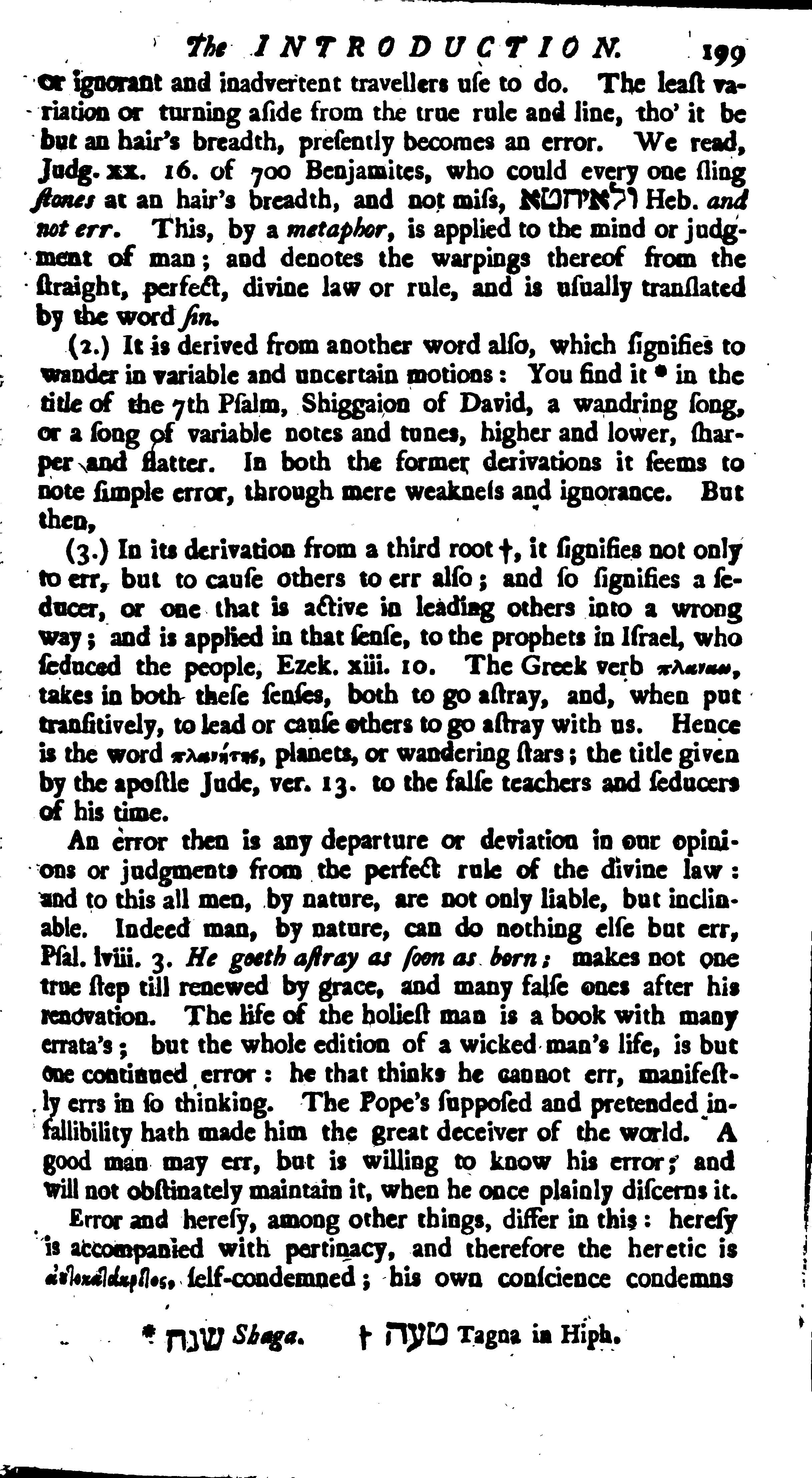
5 The INTRODUCTION.
or ignorant and inadvertent travellers use to do. The least variation or turning aside from the true rule and line, tho' it be but an hair's breadth, presently becomes an error. We read,
= Judg. xx. 16. of 700 Benjamites, who could every one fling stones at an hair's breadth, and not miss,
אטחיאלו Heb.and This, by a metaphor, is applied to the mind or judgment of man; and denotes the warpings thereof from the noterr. straight, perfect, divine law or rule, and is usually translated bythewordfin.
(2.) It is derived from another word also, which signifies to wander invariable and uncertain motions : You find it in the title of the 7th Psalm, Shiggaion of David, a wandring song, or afong of variable notes and tunes, higher and lower, sharper and flatter.
In both the former derivations it seems to note simple error, through mere weakness and ignorance. But then, (3.) In itsderivation from a third root†, it signifies not only toerr, but to cause others to err also; and so signifies a seducer, or one that is active in leading others into a wrong way; and is appliedinthatsense, to the prophets in Israel,who seduced the people, Ezek. xiii. 10. The Greek verb πλαναω, takes in both these senses, both togo astray, and, when put transitively, to lead or cause others togo astray with us. Hence is the word πλανήτης, planets, or wandering stars; the title given by the apostle Jude, ver. 13. to the false teachers and seducers of his time.
An error then is any departure or deviation in our opinions or judgments from the perfect rule of the divine law : and to this all men, by nature, are not only liable, but inclinable.
Indeed man, by nature, can do nothing else but err, Psal. lviii. 3. He goeth astray as soon as born ; makes not one true step till renewed by grace, and many false ones after his renovation.
The life of the holiest man is a book with many errata's ; but the whole edition of a wicked man's life, is but one continued error : he that thinks he cannot err, manifestly errs in so thinking. The Pope's supposed and pretended infallibilityhath made him the greatdeceiver of the world. A good man may err, but is willing to know his error; and will not obstinatelymaintain it,when he once plainly difcerns it.
Error and heresy, among other things, differ in this : heresy is accompanied with pertinacy, and therefore the heretic is ἀκοκαλάκριος, self-condemned ; his own conscience condemns
חנש העט * Tagna in Hiph.
Shaga