
Part 17
hand ; Heb. x. 23. For he is faithful that promiſed.
Q. 8. What is the fourth leſſonfrom God's truth ? A. That whatever God hath threatned in hisword againſt finners, ſhall ſurely come upon them, except they repent; Zech. i. 6. Butmyword,andmy ſtatutes, which Icommanded my ſervants the prophets, didthey not take hold of your fathers ? andthey returned and ſaid, like as the Lord of hofts thoughttodounto us, according to our ways, and according to ourdoings, fo hath he dealt with us. Ezek. xii. 27, 28.
478 An Expofition of the Affembly's Catechism. The word which Ihave ſpoken, ſhall bedone, faith the Lord God.
Q. 9. What is the fifth leſſon from God's truth? A. That falſehood, inwords andactions, is contrary to God's nature, and abhorred by him ; John viii. 44. Ye are of your father the devil, andthe lufts of yourfather ye will do; he was amurderer from the beginning, and abode not in the truth, becauſe there is no truth in him ; when he ſpeaketh a lie, he ſpeaketh of his own ; for he is a liar, and the father ofit.
Q. 10. What is the laſt leſſonfrom God's truth ? A. Thedayof judgment willrightlyand juſtly ſtate every man's condition; Rom. ii. 2. But we are ſure that the judgment of God is according to truth, againstthemwhich commitſuch things.
OfoneGod. RE there more Gods than one ?
God? A
A. There is but one only, the livingandtrue
Q. 1. How doth itappear that there isbut one God ? A. It is evident from ſcripture there is but one God; Deut. vi. 4. Hear, O Ifrael, the Lord our God is one Lord. Jer. x. 10. But the Lord is the true God; he is the living God, and an everlasting King: and as fcripture reveals no more, ſo reaſon will allow no more.
Q. 2. Why will reaſon allow no more but one God ? A. BecauſeGod is the firſtbeing ; Rev. i. 11 Saying, I am Alpha and Omega, the firſt and the last ; and there can be but one firſt being, and Godis the most perfect, and excellent being ; Pfal. lxxi. 19. Thy righteouſneſs, alſo, O God, is very high, who hath done great things : OGod, who is like untothee? Andthere can be but one moſt perfect and excellentbeing.
Q. 3. But doth not the ſcripturesſay, in 1 Cor. viii. 5. that there are gods many, and lordsmany?
A. Yes ; there are many intitle, andmany inopinion, but one only intruth ; Jer. x. 10. But the Lord is the true God, he isthe living God, and an everlafting King.
Q. 4. Why is hecalledthe true God ? A. Todistinguiſhhimfrom the idols and falſe gods of the heathens ; 1 Thef. i. 9. Howyeturned to God from idols, to ſerve the livingand true God. Acts xiv. 15. We preach untoyou, that ye ſhould turn fromthefevanitiesunto the living
An Expofition of the Affembly's Catechism, 479 God, which made heaven and earth, and the ſea, and all things that are therein.
Q. 5. Why is he calledthe living God? A. Becauſe all life, natural, ſpiritual, and eternal, is in him, and from him only. First, Natural life ; Acts xvii. 28. For inhim we live, and move, andhave ourbeing. Secondly, Spiritual life ; Eph. ii. 1. You hath he quickened, who were dead in treſpaſſes and fins. Thirdly, Eternal life in glory , Col. iii. 4. When Chriſt, who is our life, ſhall appear, then ſhall ye alſo appear with him in glory.
Q. 6. What is the firſt inſtruction from hence ? A. Ifbut one God, then all his children ſhould be of one heart, having one and the fame Father ; Eph. iv. 5, 6. One Lord, one faith, one baptifm, one God and Father of all, who is aboveall, andthrough all, and in youall.
Q. 7. What is the ſecondinference from hence ? A. That it is idolatry to perform worship to anyotherbut God only; Pfal. lxxxvi. 9, 10. All nations whom thou haft made, ſhall come andworship before thee, O Lord, and ſhall glorifythyname, forthou art great, and doſt wondrousthings, thou art God alone.
Q. 8. What is thethird inference from it ? A. That our fupreme love is due to God only, andit is very fiaful to place it on anyother ; Deut. vi. 4, 5. Hear, OIfrael, The Lord our God is one Lord; and thou shalt love the Lord thy Godwith all thyheart, and with allthy foul, and withallthymight.
Q. 9. What is the fourth inference from God's unity? A. ThatGod onlymust havethe reliance and dependence of our souls ; Jer. xvii. 5, 7. Thus faith the Lord, curſed be theman that truſteth in man, that maketh fleſh his arm, and whoſe heart departeth from the Lord. Bleſſed is the man that truſteth in the Lord, and whoſe hope the Lord is.
Q. 10. What is the laſt inference from it ? A. That we have great cauſe to be thankful for the goſpel, which diſcovers the only true God to us ; and that we are not as the heathens, worshipping many and falſe gods ; 1 Cor. viii. 5, 6. For though there be that are called gods, whether in heaven or in earth, as there be godsmany, and lords many; but to us there is but one God, the Father, of whom are allthings, and we in him ; and one Lord, Jeſus Chriſt, by whom are all things, andwebyhim.
480 An Exposition of the Assembly's Catechifm.
Ofthree Perfons in the Godhead. HOWmany perſonsare there inthegodhead?
Queſt. 6.
A. There are three persons in thegodhead, the Father, the Son,andthe holy Ghost, and these three are one God, thefame infubſtance, equal in power andglory.
Q. 1. Whatmean youby the word, godhead ? A. It is the nature, effence, orbeing of God, as the apostle ſpeaks, Acts xvi 29. Foraſmuch then as we are the off-fpring of God, we ought not to think that the godhead is like unto gold, or filver, or stone, graven by art, and man's device.
Q. 2. What isa perſon inthe godhead ? A. It is the godhead diftinguiſhed by perſonal properties; eachperſonhaving his distinct perſonal properties ; Heb. i. 3. Whobeing the brightneſs of his glory, and the expreſs image of his perſon, upholding all things by the wordofhis power. Q.3. How doth itappearthere are three perſons, and no more ?
A. First, From Chriſt's baptifm ; Mat. iii, 16, 17. And Jeſus, whenhe was baptized, went up ſtraightway out of the water, and lo, the heavens were opened unto him, and he faw the Spirit of God deſcending, like a dove, and lighting upon him ; and lo, a voice fromheaven,ſaying, This is mybeloved Son, in whom I am well pleaſed.
Q. 4. How elſe,inthe ſecondplace, doth it appear ? A. From the inſtitution of our baptifm ; Mat. xxviii. 19. Go ye, therefore, and teach all nations,baptizing them in the name of the Father, of the Son, and of the holy Ghoſt.
Q.5. What is the thirdprooffrom ſcripture ? A. From the apoftolicalbenediction ; 2 Cor. xiii. 14. The grace of our Lord Jesus Chriſt, and the love of God, and the fellowship of the holy Ghost, be with you all, Amen: Where threedistinct bleſſings are wiſhed from thethree divine perſons in the godhead, grace from Chriſt, love from the Father, and communion with the Spirit.
Q. 6. What farther evidence is there ofit in fcripture? A. From plain, poſitive aſſertions of the fcripture, afferting, First, A trinity of perſons. Secondly, A unity of effence; 1 John v. 7. For there are three that bear record in heaven, the Father, the Word,andtheholy Ghost, and theſe three are one.
Q. 7. What is the firſt inſtruction from the trinity ? A. That the doctrine of the goſpel concerning Chrift, is fullyconfirmed and ratified bythree witneſſes from heaven,
An Exposition of the Affembly's Catechism. 481 who are aboveall exceptions ; 1 John v. 7. For there are three thatbear record inheaven, the Father, the Word, and the holy Ghoft.
Q. 8. What is the ſecond inſtruction from the trinity ? A. Hence we learn the true order and manner ofworshipping God, in the Son ; John xvi. 23. Whatſoever ye ſhall afk the Father in myname,he ſhall give it you. And by the Spirit ; Eph. vi. 18. Praying always, with allprayer and ſupplication in the Spirit . Q9 . What is the third inſtruction from the trinity? A. That the covenant ofgrace conveys a rich portion to believers, in making over all three perſons to them ; Jer. xxxi. 33. But this ſhallbe the covenant that I willmake with thehouſe of Ifrael after thoſe days, faith the Lord; Iwill put my law into their inward parts, and write it in their hearts and Iwillbe their God, and they ſhall be my people.
Q. 10 What is the fourth inſtruction from the trinity ? A. That as it is the duty of all the faints to give distinct glory to the three perſons in the Godhead ; ſo it will be a ſpecial part of their bleſſedneſs inheaven, to contemplate the diſtinct benefits received from them all; Rev. i. 5. And from Jeſus Chrift, who is the faithful witneſs, and the firſt begotten of the dead, and the prince of the kings of the earth ; unto him that loved us, and washed us from our fins in his own blood.
of God's Decrees. Hat are the decrees of God ? Queft . 7. WhatA. The decrees of God arehis eternalpurpofe, according to the counsel of his will, wherebyfor his own glory hehathforeordained whatsoever comes to pafs.
Q. 1. What things are decreed of God ? A. Allthings whatsoevercome to paſs, even the ſmalleſt ; Eph. i. 11. In whomalſo we have obtained an inheritance, being predeftinated according to the purpoſe of him who worketh all things after the counſel of his own will.
Q. 2. What is the end of God's decrees ? A. The glory of his own name; Eph. i. 11, 12. Who worketh all things according to the counſel of his own will, that we should be tothe praiſe of his glory, who firſt trusted in Chrift.
Q. 3. But there are ſome evil things done in theworld ; Dothey fall under God's decree ?
A. Though Goddoth neither approve them, nor neceffitate VOL. VII, Ppp
482 An Exposition of the Affembly's Catechifm. mento commit them, yet he doth permit and fufferthem tobe done, and will turn them to his own glory; Acts iv. 27, 28. For of a truth, against thy holy child Jeſus, whom thou hast anointed, both Herod, and Pontius Pilate, with the Gentiles, and the people of Ifrael are gatheredtogether, for todowhatſoeverthyhand, and thy counſel determined before tobe done.
Q. 4. Who are the objects of God's ſpecial decrees ? A.Angels andmen are the objects of God's ſpecialdecrees ; 1 Tim. v. 21. I charge thee before God, and the Lord Jefus Chrift, and the elect angels, that thouobfervetheſethings, &c. Rom . viii. 33. Who shall lay anything to the charge of God's elect?
Q.5 . What is the firſt property of God's decrees ? A. That they are most wife acts of God, laid in the depth of wisdom and counſel ; Rom.xi. 33. O the depth of the riches both of the wisdom and knowledge of God! How unſearchable are his judgments, and his ways are paft finding out !
Q. 6. What is the ſecond property of God's decrees ? A. The decrees of God are most free, all flowing from the mere pleaſure of his will ; Rom. ix. 18. Therefore hath he •mercy on whom he will have mercy, and whom he will he hardeneth .
Q. 7. What is the thirdproperty of God's decrees ? A. They are moſt firm and ſtable ; 2Tim. ii. 19. Nevertheless, the foundation of God ſtandeth ſure ; having this ſeal, The Lord knoweth them that are his, Zech . vi . 1 .
Q. 8. What is the fourth property of God's decrees ? A They are eternal, and before all time ; Acts xv. 18 . Known unto God are all his works, from the beginning of the world.
Q9. What is the fifth property of God's decrees ? A. They are moſt pure, and altogether unſpotted of fin; 1 John i. 5. This is the meſſage which we have heard of him, and declare unto you, That God is light, and in him is no darkness at all .
Q. 10. What is the firſt inſtruction from God's decrees ? A. That we ought to aſcribe nothingto chance, but to the appointment or providence of God ; Prov. xvi. 33. The lot is caft into the lap; but the whole difpofing thereof is of the Lord.
Q. 11. What is the ſecond inſtruction from God's decrees ? A. That God's hand is to be acknowledged in the greatest afflictions that befal us ; 2 Sam xvi. 11. And David faid to Abiſhai, and to allhis fervants, behold, my fon, which came
An Exposition of the Affembly's Catechism. 483 forth of my bowels, ſeeketh my life; how much more now may this Benjamite do it ? Let him alone, and let him curſe, for the Lord hath bidden him .
Q. 12. What is the laſt inſtruction from God's decrees ? A. That we ought to be thankful to God for all the good, and patient under allthe evils that befal us ; Job ii. 10. Shall we receive good at the hand of God, and ſhall we not receive evil?
OW doth God execute his decrees ?
A. God executeth his decrees in the works of creation and providence.
Of the Creation. HAT are the works of creation?
A. The work ofcreation is, God's making all things ofnothing, by the word of his power, in thespace offix days, and all very good.
Q. 1. What is it to create ? A. To create, is to give a being to that which had nobeing ; or to bring ſomething out of nothing ; Heb. xi. 3. Through faith we understand that the worlds were framedby the word of God ; ſo thatthings which are ſeen were notmade ofthings that do appear.
Q. 2. How did God create the world ?
A. By his infinite power, executed inhis word ofcommand; Pfal. xxxiii . 6, 9. By the word of the Lord were the heavens made, and all the host of them by the breath of his mouth ; forhe ſpake, and it was done; he commanded, and it ſtood faft.
Q. 3. What attributes of God ſhine forth in the creation ? A. The wisdom of God ſhines forth gloriously, not onlyin their formation, but dependance one upon another ; Pfal. civ. 24. O Lord, how manifold are thy works! In wiſdom haft thou madethem all : The earth is full ofthy riches .
Q. 4. What maywe learn from the creation ? A. ThatGod perfectly knows all that is in the creature, be it never ſo ſecret ; Pfal. xciv. 8, 9. Understand, O ye brutish among thepeople; andye fools, when will ye be wife ? He that planted the ear, ſhallhe not hear ? Hethat formed the eye, ſhall he not fee ?
Q. 5. What is the ſecond inſtruction from the creation? A. That God is the rightful owner of us all, and may do - whathe will with us ; Rom. ix. 20. Nay but, Oman, who artthouthat replieſt against God! ſhall the thingformed ſay
1 Ppp2
484 An Expofition of the Affembly's Catechism. tohim that formed it, why haft thou made me thus ? Hath not the potter power over the clay, of the fame lump to make one veſſel to honour, and another to dishonour ?
Q. 6. What is the third inſtruction from the creation ? A. ThatGod only is the proper object of worship ; Jer.x. 11. Thus ſhall he sayunto them, The gods that have not made the heavens, and the earth, even they ſhall periſh from the earth, and from undertheſe heavens .
Q. 7. What is the fourth inſtruction fromhence ? A. That Chriftians ſhould not fear the power of creatures, fincethey derive theirbeing and power from God ; Ifa. liv. 16, 17. Behold, I have created the ſmith that bloweth the coals in the fire,that bringeth forthan inſtrument forhis work; and I have created the wafter to destroy; no weapon that is formed against thee ſhall profper.
Q. 8 What is the fifth inſtruction from hence ?
A. That Atheism is a fin against natural light and reaſon; Rom. i. 20. For the inviſible things of him from the creation of the world are clearly ſeen, being understood by the things that are made, even his eternal power and godhead ; fo that theyare without excuſe.
Q.9. What is the fixth inſtruction from hence ? A. That God's glory is the end of all being ; Col. i. 16. For by him were all things created, that are in heaven, and thatare in earth, viſible and inviſible, whether theybe thrones, or dominions, or principalities, or powers: all things were created by him and for him .
Q. 10. What is the ſeventh inſtruction from hence ? A. That there is anunnatural rebellion in fin, ſmiting at him that made and preſerves our being ; Iſa. i. 6. I have nouriſhed and brought up children, andthey have rebelled againstme.
Q. 11. What is the eighth inſtruction from hence ? A. ThatGod can in a moment revive and ſave the church when at the lowest ebb ; Iſa. lxv. 18. Behold, 1create Jerufalem a rejoicing, and her people a joy.
Q. 12. What is the laſt inſtruction from hence ? A. That it is eaſy with God to revive a dejected foul; Ifa. Ivii. 19. I create the fruit of the lips ; Peace, peace to him that is far off, and to him that is near, faith the Lord; and I willhealhim.
Queſt. 1.H
Of Man's Creation . OW did God create man ?
A. God created man male and female, :
An Expofition of the Affembly's Catechifm. 485 after his own image, in knowledge, righteousness, and holiness, with dominion over the creatures .
Q. 1. How did Godcreateman? A. God createdmanin hisown image ; Gen. i. 27. SoGod createdman in his own image, inthe image of God created he him, male and female created he them .
Q. 2. What is meant bythe image of God ? A. Not a reſemblance of God in any bodily thape or figure, but inholiness; Eph. iv. 24. And that ye puton the new man, which after God is created in righteouſneſs and true holineſs.
Q. 3. In what gracesdid man reſemble God ? A. Infuch a knowledge of God himself, andthe creatures, which made him happy ; Col. iii. 10. And have put onthe newman, which is renewed in knowledge, after the imageof him that createdhim.
Q. 4. Inwhat other graces did this image conſiſt? A. Inrighteouſneſs as well as holiness ; Eph. iv. 24. And thatye put on the new man, which after God is created in righteouſneſs andtrueholineſs.
Q. 5. What isthe firſt inference fromhence ? A. The deplorable miſeryof the fall ; Rom. v. 12. Wherefore as by one man fin entered into the world, and deathby fin, andfo death paſſed uponall men, forthat allhave finned.
Q. 6. What is the ſecond inſtruction from hence? A. Thebeautyof holiness, which is the image of God, and the excellency of man ; Pfalm xvi. 3. But to the faints that are in the earth, and to the excellent, in whom is allmydelight. Q. 7. What is the third inſtruction from hence? A. We have infinite cauſe tobleſs God for Chriſt, who repairs this loſt image inhis people ; Eph. iv. 23. And be renewed inthe ſpiritofyourmind.
Q. 8. What is the fourth inſtructionfrom hence ? A. That thedeſpiſers ofholineſs are the deſpiſers of God ; for holiness is God's image.
Q. 9. What is the fifth inſtruction from hence ? A. The excellency of fanctification, which defaces the image of Satan, and draws the image of God uponthe foulof man.
Of Divine Providence.
HAT are God's works of providence ?
A. God's works of providence, are his
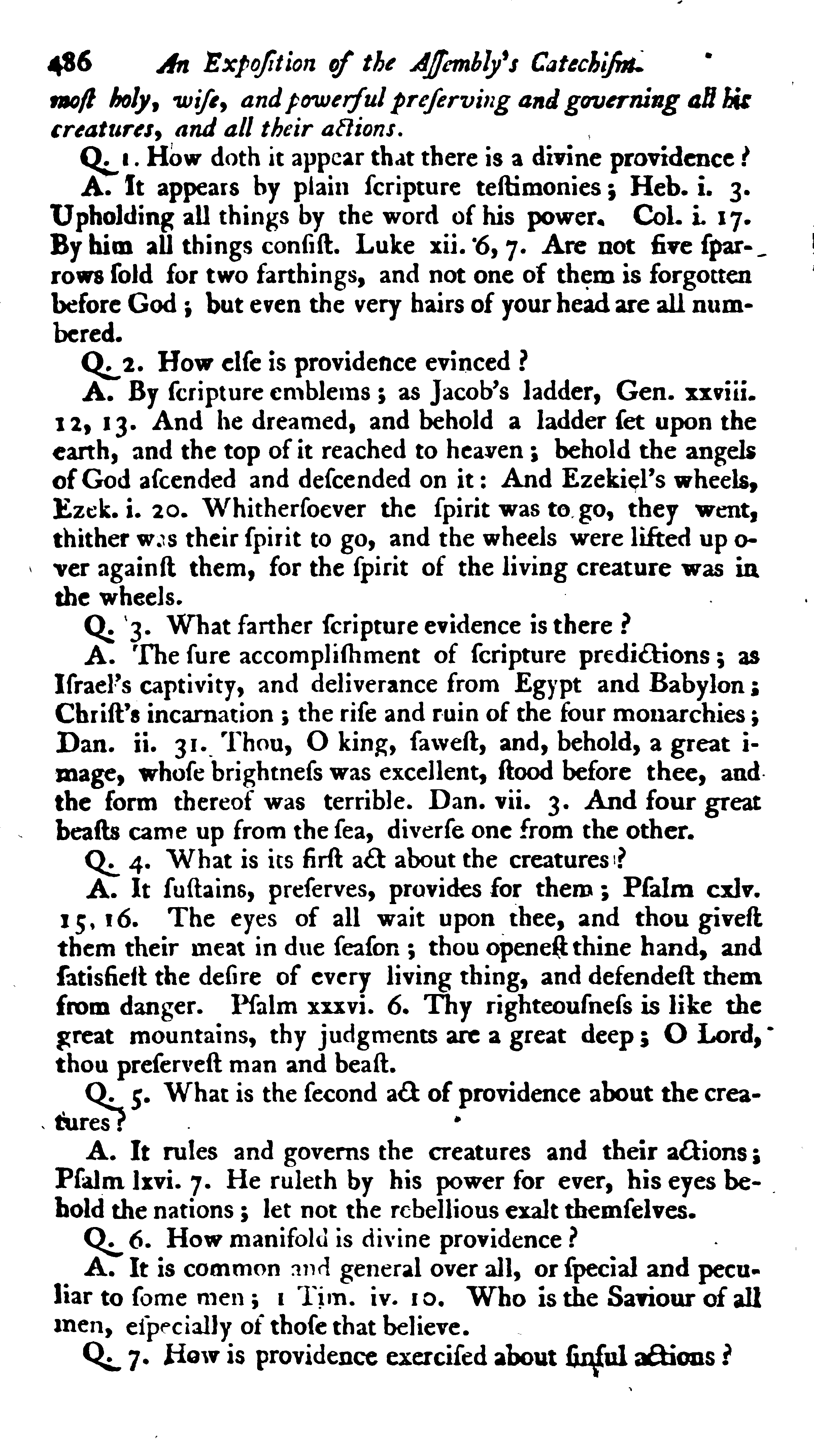
486 An Expofition of the Affembly's Catechism. most holy, wife, andpowerfulpreferving andgoverning allhis creatures, and all their actions.
Q. 1. How doth it appear that there is adivine providence? A. It appears by plain ſcripture teftimonies ; Heb. i. 3 . Upholding all things by the word of his power. Col. i. 17. Byhim all things conſiſt. Luke xii. 6, 7. Are not five ſpar-_ rows fold for two farthings, and not one of them is forgotten before God ; but eventhe very hairs ofyourhead are allnumbered.
Q. 2. How elſe is providence evinced ? A. By fcripture emblems ; as Jacob's ladder, Gen. xxviii. 12, 13. And he dreamed, and behold a ladder ſet upon the earth, and the top ofit reached to heaven; behold the angels of God aſcended anddefcended on it: And Ezekiel's wheels, Ezek. i. 20. Whitherfoever the ſpirit was to go, they went, thither was their ſpirit to go, and the wheels were lifted up over against them, for the ſpirit of the living creature was in the wheels.
Q.'3. What farther ſcripture evidence is there ? A. Thefure accomplishment of ſcripture predictions ; as Ifrael's captivity, and deliverance from Egypt and Babylon ; Chrift's incarnation ; the rife and ruin of the four monarchies ; Dan. ii. 31. Thou, O king, faweſt, and, behold, a great image, whoſe brightneſs was excellent, ſtood before thee, and the form thereof was terrible. Dan. vii. 3. And four great beaſts came up fromthe ſea, diverſe one from the other.
Q. 4. What is its firſt act aboutthe creatures? A. It ſuſtains, preferves, provides for them ; Pfalm cxlv. 15,16. The eyes of all wait upon thee, and thou giveft them their meat indue ſeaſon ; thou openeſtthine hand, and fatisfieft the defire of every living thing, anddefendeft them from danger. Pfalm xxxvi. 6. Thy righteouſneſs is like the great mountains, thy judgments are a great deep ; O Lord, thou preferveft man and beast. Q5. What is the ſecond act ofprovidence about the creatures?
A. It rules and governs the creatures and their actions ; Pfalm lxvi. 7. He rulethby his power for ever, his eyesbeholdthe nations; let not the rebellious exalt themſelves.
Q. 6. How manifold is divine providence ? A. It is common and general over all, orſpecial and peculiar to fome men ; 1 Tim. iv. 10. Who isthe Saviour of all men, eſpecially ofthoſe thatbelieve .
Q. 7. How is providence exerciſedabout ſinful actions ?
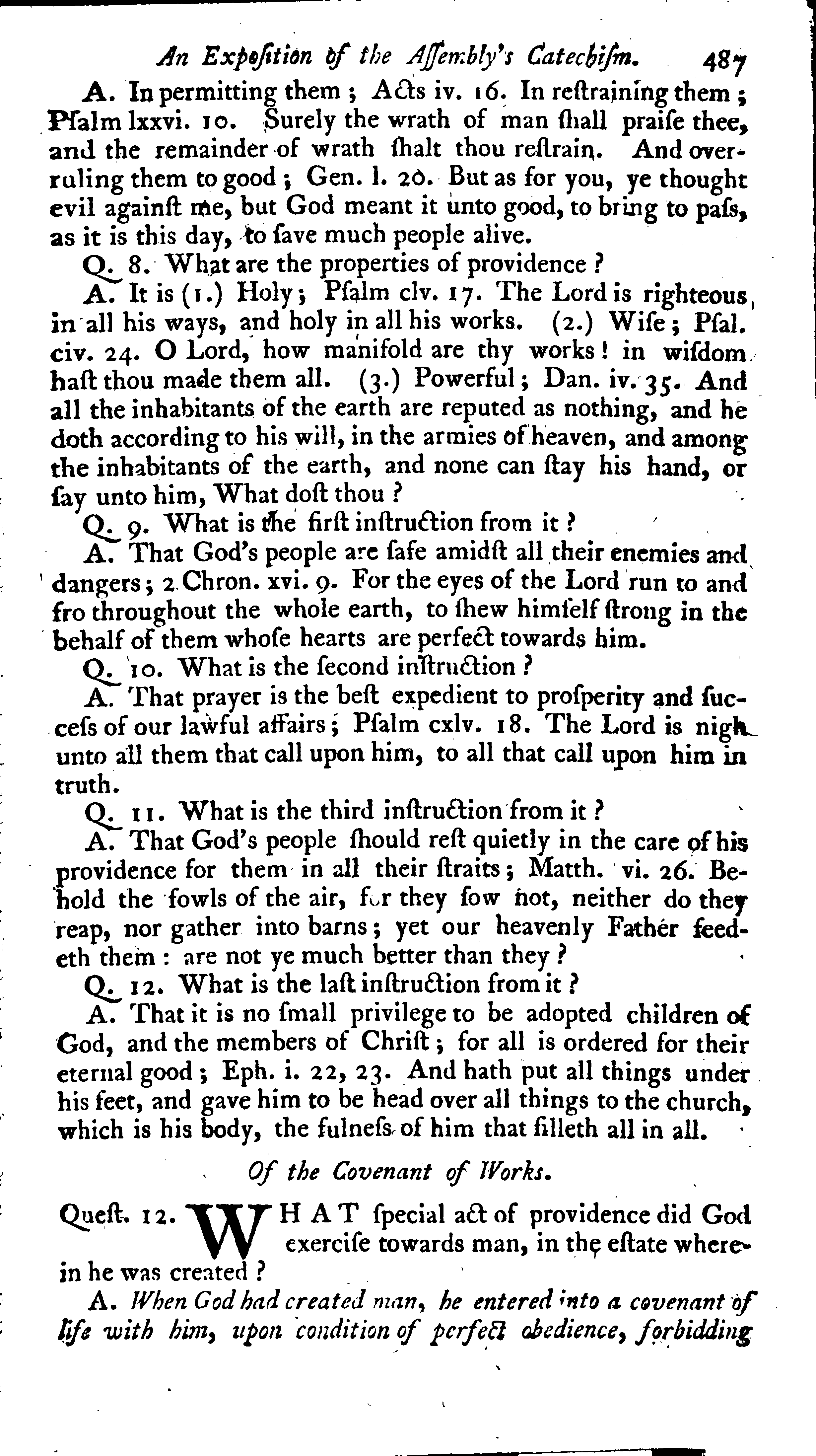
An Exposition of the Affembly's Catechism. 487
A. Inpermittingthem ; Acts iv. 16. Inreſtrainingthem ; Pfalm lxxvi. 10. Surely the wrath of man ſhall praiſe thee, and the remainder of wrath ſhalt thou reſtrain. And overrulingthem togood; Gen. 1. 20. But as for you, ye thought evil against me, but God meant it untogood, tobring topaſs, as it is this day, to ſave much people alive. Q. 8. What are the properties of providence ? A. It is (1.) Holy; Pfalm clv. 17. The Lord is righteous, in all his ways, and holy in allhis works. (2.) Wife; Pfal. civ. 24. O Lord, how manifold are thy works ! in wisdom haſtthou made them all. (3.) Powerful ; Dan. iv. 35. And all the inhabitants of the earth are reputed as nothing, and he doth according to his will, inthe armies ofheaven, andamong the inhabitants of the earth, and none can ſtay his hand, or ſay unto him, What doft thou ? Q. 9. What is the firſt inſtruction from it ? A. That God's people are ſafe amidſt all their enemies and dangers ; 2Chron. xvi. 9. For theeyes of the Lord run to and fro throughout the whole earth, to thew himselfſtrong inthe behalfofthem whoſe hearts are perfect towards him.
Q. 10. What is the ſecond inſtruction ? A. That prayer is the beſt expedient to profperity and fucceſs of our lawful affairs; Pfalm cxlv. 18. The Lord is nigh unto all them that callupon him, to all that callupon him in truth.
Q. 11. What is the third inſtruction from it ? A. That God's people ſhould reſt quietly in the care of his providence for them in all their ſtraits ; Matth. vi. 26. Behold the fowls of the air, for they fow not, neither do they reap, nor gather into barns; yet our heavenly Father feedeth them : are not ye much better than they ?
Q. 12. What is the laſt inſtruction from it ? A. That it is no ſmall privilege to be adopted children of God, andthe members of Chriſt ; for all is ordered for their eternal good ; Eph . i. 22, 23. And hath put all things under his feet, and gave him to be head over all things tothe church, which is his body, the fulness of him that filleth all in all.
12.WHAT ſpecial act of providence did God
Of the Covenant of Works. exerciſe towards man, in the eſtate whereinhewas created ?
A. When Godhad created man, he entered into a covenant of life with him, upon condition of perfect obedience, forbidding
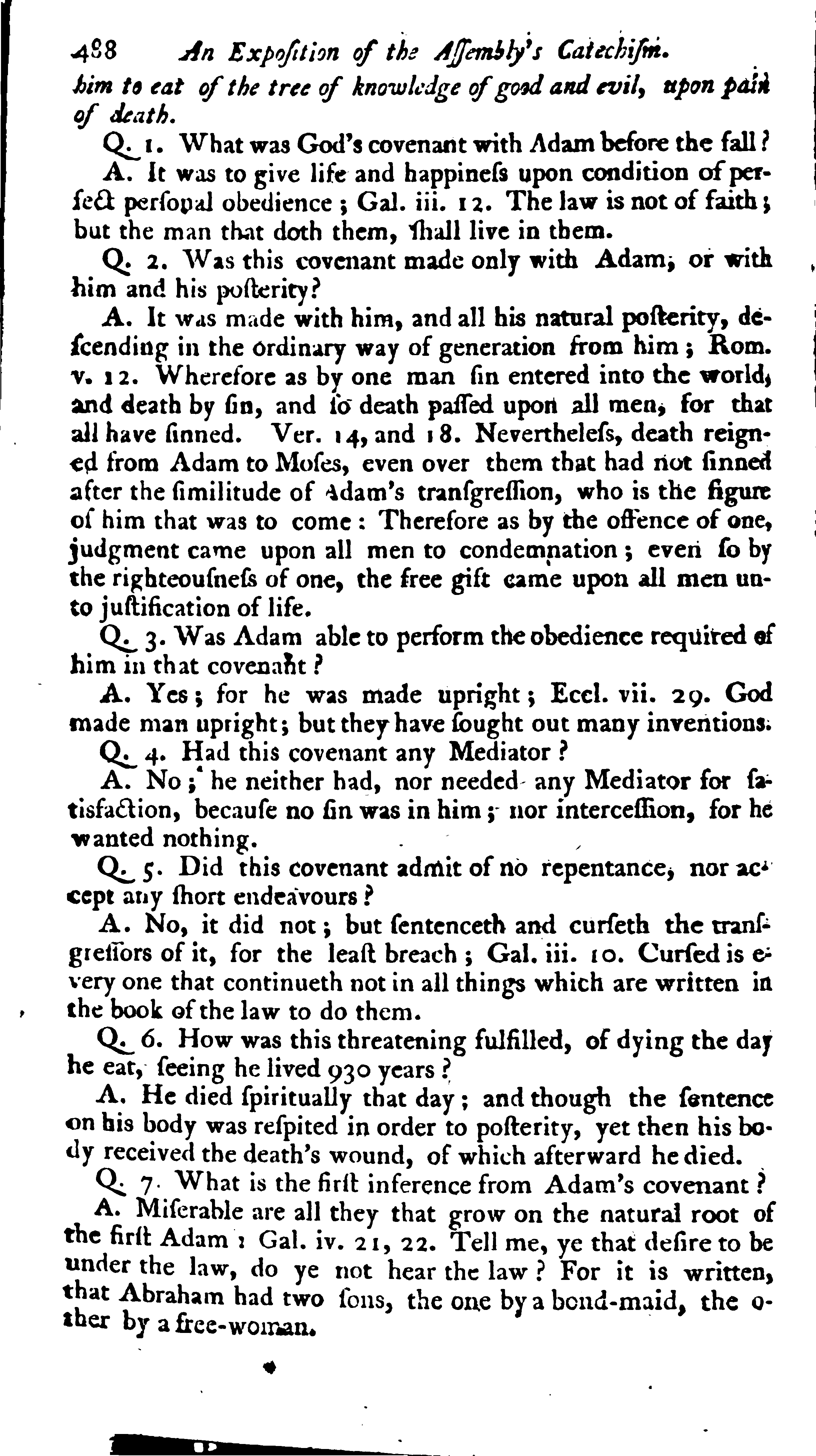
488 An Expofition of the Affembly's Catechifm. him to eat of the tree of knowledge of good and evil, upon pain of death.
Q.1 . What was God's covenantwith Adambeforethe fall? A. Itwas to give life and happineſs upon condition ofperfect perfopal obedience ; Gal. iii. 12. The law is not of faith; but the man that doth them, ſhall live inthem.
Q. 2. Was this covenant made only with Adam, or with him andhis pofterity?
A. It was made withhim, andallhis natural poſterity, deſcending in the ordinaryway ofgeneration from him ; Rom. v. 12. Wherefore as by one man fin entered into the world, anddeath by fin, and to death paffedupon allmen, for that allhave finned. Ver. 14, and 18. Nevertheleſs, death reignedfrom Adam to Mofes, even over them thathad not finned after the fimilitude of Adam's tranfgreffion, who is the figure of him that was to come: Therefore as by the offence of one, judgmentcame upon all men to condemnation ; even ſo by therighteouſneſs of one, the free gift came upon all men untojuftification of life.
Q. 3. Was Adam able to performtheobedience required of him inthat covenant?
A. Yes ; for he was made upright ; Eccl. vii. 29. God mademanupright; buttheyhave fought outmany inventions.
Q. 4. Had this covenant any Mediator ? A. No ; he neither had, nor needed any Mediator for fatisfaction, becauſe no finwas inhim; nor interceffion, forhe wanted nothing.
Q. 5. Did this covenant admitofno repentance, nor ac cept any ſhort endeavours ?
A. No, it did not; but ſentenceth and curſeth the tranf greffors of it, for the least breach; Gal. iii. 10. Curſedis e veryone that continueth notin allthings which are written in thebook of the law to do them .
Q. 6. How was this threatening fulfilled, ofdying the day he eat, feeing he lived 930 years ?
A. He died fpiritually that day; andthough the fentence onhis bodywas reſpited in order to pofterity, yetthen his body received the death's wound, ofwhich afterward hedied.
Q. 7. What is the firſt inference from Adam's covenant ? A. Miferable are all they that grow on the natural root of the firſtAdam : Gal. iv. 21, 22. Tell me, ye that defire to be under the law, do ye not hear the law ? For it is written, that Abraham had two fons, the one byabond-maid, the other by a free-woman.
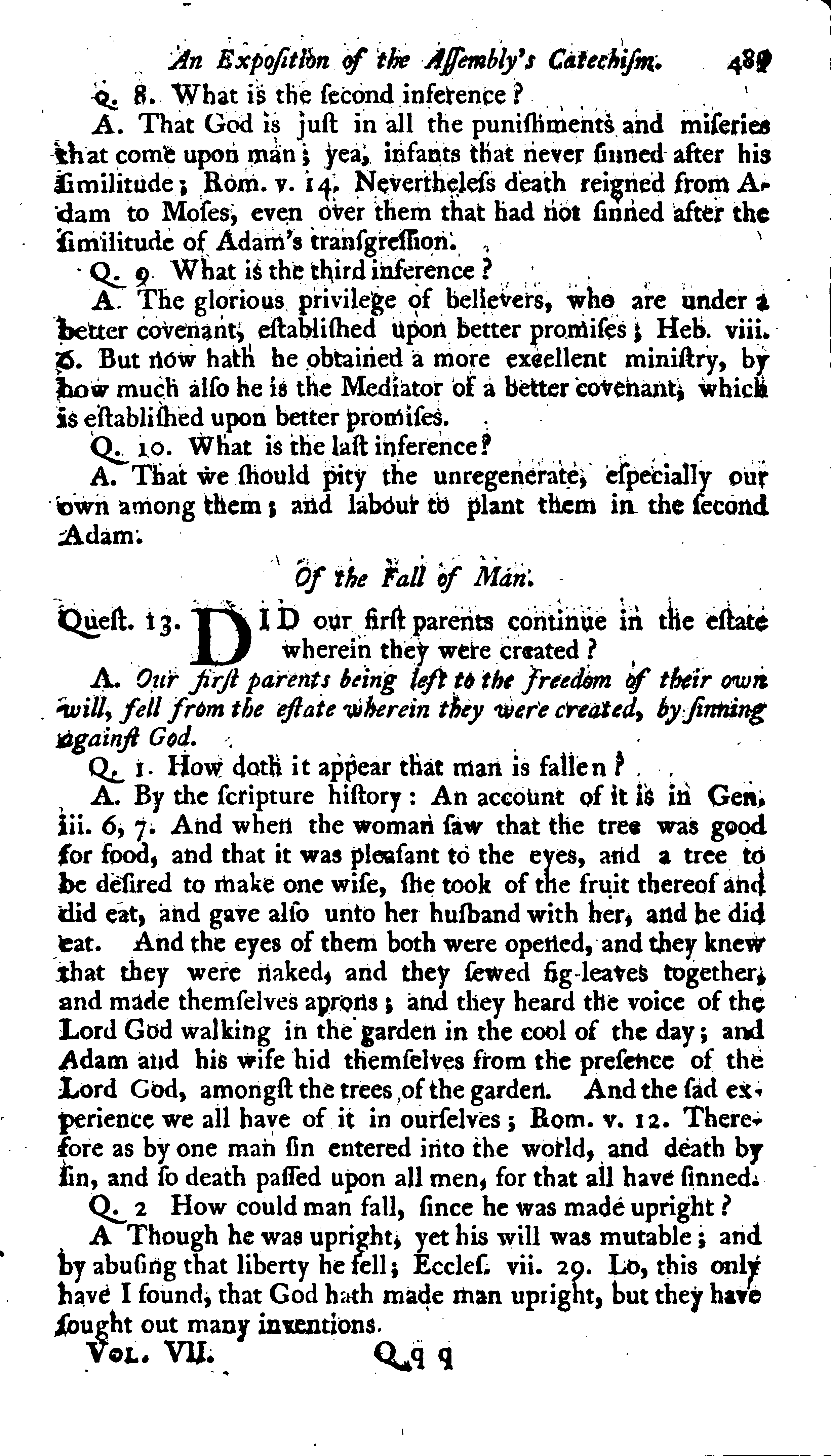
An Exposition of the Affembly's Catechism. 489 Q. 8. What is the ſecond inference?
1 A. That God is juſt in all the punishments and miſeries that come upon man; yea, infants that never finned after his fimilitude; Rom. v. 14. Nevertheleſs death reigned from Adam to Mofes, even over them that had not finned afterthe fimilitude of Adam's tranſgreſſion.
Q.9 What is thethird inference ? A. The glorious privilege of believers, who are under a better covenant, eſtabliſhed upon better promises ; Heb. viii.
6. But now hath he obtained a more excellent miniſtry, by howmuch alſo he is the Mediator of a better covenant, which is eſtabliſhed upon better promiſes.
Q. 10. What is the laſt inference? A. That we should pity the unregenerate, eſpecially our own among them ; and labourto plant them inthe ſecond Adam: 57 Of the Fall of Man. ID our firſt parents continue in the eſtate
Queft. 13.D wherein they were created ? A. Our firstparents being left to the freedom of their own will, fellfrom the estate wherein they werecreated, byfinning against God.
Q. 1. How doth it appear that man is fallen ? A. By the fcripture hiſtory: An account ofit is in Gen. iii.6, 7. Andwhen thewoman ſaw that the tree was good forfood, andthat itwas pleasant to the eyes, and a tree to bedefired to make one wiſe, ſhetook of the fruit thereof and did eat, and gave alſo unto her husbandwith her, andhedid eat. Andthe eyes of them both were opened, andthey knew that they were naked, and they ſewed fig-leaves together, andmade themselves aprons ; and theyheard the voice of the LordGod walking inthe garden in the cool of the day; and Adam and his wife hid themselves from the prefence of the Lord God, amongstthe trees ofthegarden. Andthe ſad experiencewe all have of it in ourſelves ; Rom. v. 12. Therefore as byone man fin entered into the world, and death by fin, and ſodeath paſſed upon allmen, for that all have finned.
Q. 2 How could man fall, ſince hewas made upright ? A Though he was upright, yethis willwas mutable ; and byabuſingthat libertyhefell; Ecclef. vii. 29. Lo, this only have I found, that Godhath made manupright,buttheyhave foughtoutmany inventions. VOL. VII.
490 An Expofition of the Affembly's Catechism. Q. 3. Howdid God leave him to abuſe the freedom of his will?
A. Not by inclining him to abuſe it; butby with-holding that further gracewhich he was nowayobliged to continue to him.
Q. 4. Did the will of man loſe its liberty to good, bythe fall? A. Yes, it did, and is ſo wounded, that it cannot, without thypreventing andregenerating grace, putforthone ſpiritualand faving act ; Eph. ii. 8, 9, 10. For by grace are ye faved, through faith, and that not ofyourſelves ; it is the gift of God, not of works, leaſt any man ſhouldboast; for we are his workmanſhip, created in Chriſt Jeſus unto good works, &c.
Q. 5. What was the aggravation of Adam's fin ? A. Itwas aggravated in his being a public innocent perſon, ſo newly placed in a state of happineſs and liberty.
Q. 6. What is the firſt inference from the fall ? A. That the beſt creature left to himself, cannot be long fafe ; as the angels, and Adam; Pfal. xlix. 12. Nevertheleſs, man being in honour abideth not; he is like the beafts that perish.
Q. 7. What is the ſecond inference ? A. That fince man could not be his own keeper, he can be much leſs his own ſaviour ; 2 Cor. iii. 5. Not that we are fufficient of ourſelves to think any thing as of ourſelves ; but our fufficiency is of God.
Q. 8 What is the third inference ? A. That it is impoffible for the covenant ofworks tojustify any one ; Rom. iii. 20. Therefore by the deeds of the law there ſhall no fleſh be justified in his fight ; Rom. viii. 3. For what the law could not do, in that it was weak, through the fleſh ; God fending his own Son, in the likeness offinful flesh, and for fin condemned fin in the flesh .
Q. 9. What is the laſt inference ? A. What cauſe have we to bleſs God for Chrift, who re.. covered us when the fall left us helpless ? Rom. v. 6. For when we wereyet without ſtrength, indue time Chrift died for the ungodly.
Queft. 14.W
Of Sin. Hat is fin ?
A. Sin is any want of conformity unto, or tranfgreffion of the law of God.
Q. 1. What is meant by the law ? A. Thecommandsand rules flowingfrom God'sfovereignty,
An Expofition of the Affembly's Catechism. 491 whereby his will is manifeſted, and the creature bound to obedience.
Q. 2. Where is this lawwritten ?
A. It is written either in the heart ; Rom. ii. 15. Which ſhews the work of the law written in their hearts, (which we call the law of nature) ; or in the Bible, which we call the written moral law.
Q. 3. What conformityisdue to this law of God? A. A twofold conformity is due to it : First, Internal, in our hearts. Secondly, External, in our lives ; and the want of either is fin ; 1 John iii. 4. Whosoever committeth fin, tranfgreffeth alſo the law ; for fin is the tranfgreffion of the law. Q4. How doth itappear thatthe want of internalconformity is fin?
A. Becauſe thelawrequiresit ; Mark xii. 30. Andthou shalt love the Lord thy God with all thine heart, and with all thy foul, and with allthy mind, and with allthy ſtrength ; for this is the first commandment : And condemns the want of it ? Rom . vii. 7. What ſhall we say then ? Is the law fin ? God forbid ! nay, Ihad notknown fin but bythelaw ; for I had not known luft, except the law had faid, Thou shalt not covet.
Q. 5. Is nothing a finbutwhat is againſt God's law ? A. No, nothing can be a fin but what God hath either exprefly, orby conſequence forbidden in his word.
Q. 6. Wherein liesthe evil oftranfgreffing God's law ? A. The evil of fin principally lies inthe offence and wrong done to God, whoſe ſovereignty it labours to shake off, and deſpiſes his will ; Pfal. li. 4. Against thee, thee only have I finned, and done this evil in thy fight .
Q. 7. What further evil is in fin ? A. It highly wrongs the finner's foul, by defacing, defiling, and damning it ; Prov. viii. 36. But he that finneth against me, wrongeth his own soul : allthey that hateme, love death.
Q. 8. Wherein is the evil of fin manifeſted ? A. It is manifefted in the death of Chriſt, the terrors of confcience, and torments ofhell.
Q. 9. What courſe must the finner take to recover himſelf out of his mifery?
A. Repentance towards God, faith towards Chrift, andboth evidenced by new obedience ; Acts xx. 21. Teſtifying both to the Jews, and alfo to the Greeks, repentance towards God, and faith towards our Lord Jesus Chriſt .
Q.ro. What may we infer from hence ?
492 An Exposition of the Affembly's Catechifm. A. Thatwe have infinite cauſe to bleſsGod for Chrift's fatisfaction of the law for our fins.
Of the Tree of Knowledge. W
Hatwas the ſinwherebyourfirſt parents fell
15. from the eſtatewherein theywere created? A. The fin whereby ourfirst parentsfell from the estate wherein they were created,was their eating theforbiddenfruit.
Q. 1. Whywas this tree calledthetree ofknowledge ? A. Not from any natural efficacy it had to give knowledge, but the knowledge he shouldhave by eating, or not eating, was experimental knowledge. i. e. Knowledge to hisforrow.
Q.2 WhydidGod forbid himthis tree?
SeA. First, Forthediſcovery of hisdominion over man . condly, For the trial of his ſubjection and obedience. Thirdly, For the aggravation of his fin, ifhe ſhould eat.
Q. 3. What evil was there in eating ofit? A. There was a twofold evil, the evilof fin, and the evil of punishment, bothvery great.'
Q. 4. What was the evil of fin ? A. Athreefold evilof fin. First, AgainstGod, calleddifobedience'; Rom. v. 19. For as by one man's diſobedience many were made ſinners. Secondly, Against himself, ſoul, body, and eſtate. Thirdly, Against his pofterity ; Rom.v. 12. Wherefore asby one man fin entered into the world, and death by fin ; and ſo death paſſed upon all men, for that all have ſinned.; Q.5. Whatwas the evil ofpunishment ? A. First, Lofs of God's image. Secondly, Horror of conſcience. Thirdly, Sorrow on the female fex. Fourthly, Curle on the creature. Fifthly, Expulfion from paradise. Sixthly, Deathboth ofbody and foul.
Q. 6. What is the firſt inſtruction from it ? A. To take heed of ſmall beginnings of temptations, and to refift it in the firſt motions ; James iii. 5. Beholdhow great amatter a little fire kindleth.
Q. 7. What is the ſecond inference ? A. Not to hold a parlywith the tempter; ſee2Cor. xi. 3. But I fear left by any means, as the ſepent beguiled Eve, through his fubtilty, ſo your minds ſhouldbe corruptedfrom the fimplicitythat is in Chrift. Q. 8. What is the third inference?
A. That Satan's policy lies much in the choice of his tempting inſtruments; as Eve and Peter, &c.
An Expoſition of the Aſſembly's Catechism. 493 Q. 9. What is the fourth inference ? A.Aneceffity ofkeeping ſtrong guards on our ſenſes ; Ifa. xxxiii. 15. That ſtoppeth his ears from hearing ofblood, and ſhutteth his eyes from ſeeing evil, he ſhall dwellonhigh, his place ofdefence ſhall be themunition ofrocks.
Q. 10. What is the fifth inference ? A. That covenant-breaking is a heinous ſin, which God will puniſh ; Hofea viii. 1. He ſhallcome as aneagle againft thehouſe of the Lord, becauſethey havetranfgreffedmyco. venant, and tranſgreſſed againstmylaws.
Q. 11. What is the laſt inference ? A. Thatthecorruption of our nature is much ſeen indefiring forbidden things ; Rom. vii. 7. What ſhall we say then? Is the law fin ? God forbid: Nay, I had not known fin, but by the law ; for Ihad not known luſt, except the lawhadfaid, Thou shalt not covet.
Of the Fall of Adam, and ours in him. D
ID all mankind fall in Adam's first tranf-
16. greffion ? A.Thecovenant being madewith Adam, not onlyfor himself, but for his posterity, all mankind defcending from him by ordinary generation,finned in him, andfellwith him inhisfirst tranfgreffion.
Q. 1. Didnoman evereſcapethe fin of Adam ? A. Yes, the man Chriſt Jeſus did, and he only; Heb. vii. 26. For fuch an High Priest became us,who is holy, harmleſs, undefiled, ſeparate from finners.
Q. 2. Why was not Chriſt tainted with it ? A. Becauſehe came into the world in an extraordinaryway; Matth. i. 18. Now the birth of Jesus Chriſt was on this wife : When as his Mother Marywas eſpouſedtoJoſeph,beforethey cametogether, ſhewas foundwith childof the holy Ghoft. Q. 3. How doth it appear all others are tainted with it ? A. It appears by ſcripture-teſtimony, Rom. v. 12. Wherefore as by one man finentered into the world, and death by fin, and fo death paſſed upon all men, for that all have finned ; and experience of the beſt men, Rom. vii. 21. I find thenalaw, that when I would do good, evil is preſentwith me.
Q. 4. How came allmen to fallwith Adam ? A. Becauſe all were includedin Adam's covenant, asa man's covenant includes his children before they be born, or the freaſon of the father affects his pofterity.
Q. 5. What inferyou fromhence ?
494 An Exposition of the Affembly's Catechism.
A. The ſtupendous wifdom of Godinfending Chrift in our nature, and yet without the ſin and taint ofit ; 1 Cor. i. 24. Chrift the wisdom of God.
Q. 6. What is the ſecond inference ? A. Hence we learnthe admirable love of Christ in taking our nature, with allthe finleſs infirmities thereof; Rom . viii. 3. For whatthe law could not do, in thatitwas weakthrough the flesh, God fending his own Son in the likeneſs offinful fleſh, and for fin condemned fin in the flesh .
Q. 7. What is the third inference ? A. The neceffity ofourunion with Chriſt, in order toour participation of his righteouſneſs andredemption ; 1 Cor. xv. 22. For as in Adam all die, ſo in Chriſt ſhall allbe made alive. Q. 8. What is the fourth inference ? A. Hence we learn the malignant and mortal nature of fin, inasmuch as one findefiled and destroyed awhole world.
Q. 9. What is the fifth inference ? A. Thatthough allbe not equally ſenſible of their need, yet one finner needs Chriſt as much as another.
Q. 10. What is the laſt inference ? A. That no man hath any cauſe or reaſon toboast of the goodness of his nature, ſince the beſt were by nature under the fame fin and miſery as the worst ; Eph. ii. 3. Among whom alſo we all had our converſation intimes paſt, in the luſts of our fleſh, fulfilling the defires of the flesh, and of the mind, andwere by nature thechildren ofwrath even as others.
OfOriginal Sin. Nto what eſtate did the fall bring mankind ?
Queſt. 17. I finandmisery.
A. Thefall brought mankind into an W
eftate of
Herein confifts the finfulness of that eſtate
18 . whereinto man fell ? A. Thefinfulness of that estate whereinto man fell, confifts in the guilt of Adam'sfirstfin, the want oforiginal righteousness, and the corruption of his wholenature, which is commonly called originalfin,together with allactual tranfgreffions which proceed from it.
Q. 1. How many forts of fin are allmenunder ? A. Allmen are guilty before God oftwo forts of fin ; of original, and of actual ; Pfal. li. 5. Behold, I was ſhapen in iniquity, and infin didmy mother conceive me. Ecclef. vii. 20. For there is not ajuſtman upon earth, that doth good, and finnethnot.
An Exposition of the Affembly's Catechism. 495 Q. 2. How can we be guilty of Adam's firſt fin ?
A. We are guiltyofit, becauſeAdam finned not only as a ſingle, but alfo as a public perſon, and repreſentative of all mankind : Rom. v. 15, 16, 17. Butnot as the offence, ſo al-
is the free gift : for ifthrough the offence of one, many be dead; much more the grace of God, and the gift by grace, which is by oneman, Jeſus Chriſt, hath abounded untomany : And not as it was by one that finned, ſo is the gift ; for the judgmentwas by one to condemnation.
Q. 3. How elſe came we under his guilt ? A. We are guiltyof his fin by generation ; for wewere in his loins, as treaſon ſtains the blood of the poſterity, or parents leprofy the children ; Pfalm li. 5. Behold, I was ſhapen in iniquity, and in fin didmy mother conceiveme.
Q. 4. Wherein doth it confift ? A. Itconſiſts in two things. First, In our averſation and enmity to thatwhich is good ; Rom. vii. 18. In me, that is, in my fleſh, there dwelleth no good thing. Secondly, In proneneſs tothat which is evil ; Rom. vii. 14. But I am carnal, fold under fin.
Q. 5. Is this corruption ofnaturein allmen ? A. Yes ; in all mere men, andwomen, none exempted; Rom. iii. 10. and 23. As it is written, there is none righteous, no not one, for all have finned, and come ſhort of the glory of God.
Q. 6. In what part of our nature doththis fin abide ?
A. Itabides in the whole man, in every part of man,both foul and body ; Gen. vi. 5. God faw that the wickedneſs of manwas great in the earth, and that every imagination of the thoughts of his heart was only evil continually. 1 Thef. v. 23. Now the God ofpeace ſanctify you wholly ; and I pray Godyour whole ſpirit, andfoul, andbody, be preferved blameleſs unto the comingof our Lord Jeſus Chrift.
Q. 7. How is the body infected by it ? A. In the readineſs of the bodily members to further fin, and its temptations inthe foul ; Rom. iii. 13, 14, 15. Their throat is anopen fepulchre, with their tongues they have uſed deceit,the poiſon ofafps is under their lips, whoſe mouth is full of curfing and bitterneſs, their feet are ſwift to ſhed blood.
Q8 . What learnwe from original fin ? A. To bear patiently the miſeries we fee on our children, and their death alfo without murmuring ; Rom. v. 14. Nevertheleſs death reigned from Adam to Mofes, even over ther
496 An Exposition of the Affembly's Catechism. thathadnot finned after the fimilitude of Adam's tranfgreffion. Q. 9. What is the ſecond inſtruction ? A. It teaches us humility, and ſhouldbe matter ofconfef fionandhumiliation,when we fin actually; Pfal. li. 5. Behold Iwas ſhapen in iniquity, andin findidmymother conceiveme.
Q. 10. What is the third inſtruction ? A. It should provoke parents to uſe their utmoſt diligence for the converſion of their children who draw fin from them.
Q. 11. What is the laſt iuſtruction ? •A. Itteaches us the neceſſity of regeneration, and ſhould provokeusgreatly to defire it.
of Man's Misery.
19. What isthemiſeryofthateſtatewhereintoman fell? A. Allmankindby theirfall lost communion with God, are under hiswrath aud curſe; andfo made liable toallthe miferies in this life, todeath itself, and to the pains of hellforever. Q1 . What communionhad God withmanbefore the fall?
A.Manthenenjoyed the gracious prefence and favour of Godwithhim, which was betterthan life.
Q. 2. How doth it appear this was lostby the fall? A. Itappears by ſcripture-teſtimony,that Adam loftit as to himself ; Gen. iii. 8. And Adam and his wife hid them. ſelves from the presence of the Lord God, amongthe trees of the garden. And we inhim; Eph. ii. 12. Atthat time ye werewithout Chriſt, being aliens from the commonwealth of Ifrael, and ſtrangers from the covenants ofpromiſe,having no hope, andwithout God in the world.
Q. 3. Was this theonly miſery that camebythe fall. A. No; mandidnotonly loſe communion with God, but fellunder his wrath and curſe; Eph. ii. 3. And were by nature children of wrath, even as others.
Q.4. Doth thewrath and curſeof Godthenlieon all men ? A. It lies on allthe unregenerate inthe world ; Gal. iii. 10. Curſed is everyone thatcontinueth not in all things which are writtenin thebook of the law,to do them : But believers are delivered from it by Chriſt ; 1 Theſ. i. 10. Even Jeſus, which delivered us from the wrath tocome.
Q. 5.How arethe miſeriesofmanby the falldivided ? A. They are dividedinto themiſeries of thisworld, and of the world to come.
Q.6.What arethe miſeriesthat comeonthem inthisworld! A. Themiſeries of life; as fickneſs, pain, poverty on the
An Exposition of the Affembly's Catechism. 497 bodys fear, trouble, forrow on the mind, and at laſtdeath itſelf; Rom. vi. ult. The wages offin isdeath.
Q. 7. What are the miſeries after this life ? A. The pains and torments of hell for ever; Pfal. ix. 17. The wicked ſhallbe turned into hell.
Q. 8. What are the tormentsofhell? A.Painoflofs, andpain of ſenſe; Matth. xxv. 41. Depart from me, ye curſed, into everlasting fire.
Q. 9. What learn you from hence? A. Thewoful stateofthe unconverted; miferablehere, and miferable to eternity.
Q. 10. What elſe learn we hence? A. Thegreat falvation believers have by Chriſt from all this mifery; Heb. ii. 3. How shall we eſcape, ifwe neglect fo great falvation, which at the firſt began to be ſpoken by the Lord,and was confirmedunto usby them thatheardhim.
of the Salvation of God's Elect, and of the Covenant of Grace. Queſt. 20. IDGod leave all mankind toperish in the eſtate of fin and miſery? D A. God havingout of his meregood pleasure,from all eternity, elected some to everlasting life, did enter into a covenant of grace, todeliver them out of the estate offin and mifery ; and to bringthem into an estate offalvation by a Redeemer.
Q. 1. Are ſome perſons choſen to falvation andothers left ? A. Yes: God hath choſen ſome to ſalvation, and paſſedby others; as the Scriptures ſpeak ; SeeRom. viii. 30. Moreover, whom he did predestinate,them he alſo called. And Jude 4. For there are certain men crept in unawares, who were before of old ordained to this condemnation,ungodly men, &c.
Q. 2. DidGodchuſe ſome,becauſehe foreſawthey would be better than others ?
A. No : God's choice was not on foreſeen works, but merelyof his grace, and goodpleafure of his will ; Eph. i. 5, 6. Havingpredeftinated us unto the adoption of children by Jefus Chrift tohimſelf, acccording to the good pleaſure of his will, tothe praiſe of the glory of his grace. Q. 3. Is this election of Godmade in time,and thataccording as men uſe their free-will, or from eternity ? A.Election is an eternal act of God before the world was, and depends noton man's uſing his free-will ; as appears from Eph i. 4. According as he hath choſenus in him,beforethe VOL. VII. Rrr
498 An Exposition of the Affembly's Catechism. foundationofthe world, that we shouldbe holy,andwithout blame before him in love.
Q. 4. Shall all that are elected,becalledand ſaved ? A.Yes, theſcripture is full and plain for it; Acts xiii. 48. Andwhen the Gentiles heard this, theywereglad, andglorifiedthewordofthe Lord ; and as manyas were ordained to eternal life believed. Rom. viii. 30. Moreover, whom he did predeftinate, them he also called, &c.
Q. 5. By whom are the elect ſaved ? A. By Chrift, the only Redeemer ; Titus iii. 4, 5, 6. But after that the kindness and love of God our Saviour towards man appeared notbyworks of righteousnesswhich we have done,but according to his mercy, he ſaved us, by the washing of regeneration, andrenewing of the holy Ghost, which he ſhed on us abundantly through Jeſus Chriſt our Saviour.
Q. 6. Is there no other way offalvation but by Chriſt ? A. No, no other way is revealed in ſcripture ; Acts iv. 12. Neither is there falvation in any other; forthere is none other name under heaven given among men, whereby we mustbe faved.
Q.7. Whatlearn you from God's election? A. What cauſe we have to admire free-grace in our choice, whowere nobetter than others ; Eph. ii. 3. Andwerebynature children of wrath even as others.
Q. 8. What is the ſecond instruction ? A. It teaches us humility ; we made not ourſelves to differ, but the free-grace of God made the difference ; 1 Cor. iv. 7. For who makeththee to differ from another? Q. 9. What is the third inſtruction ? A. It teaches us diligence to make our election fureto our ſelves, by our calling ; 2Pet. i. 10. Wherefore the rather, brethren,give diligence tomakeyour calling and election ſure.
Q. 10. What is the fourth inſtruction ? A. Itis matter of comfort to God's elect, amidst all dangers intheworld; 2 Tim. ii. 19. Nevertheless,the foundation of God ſtandeth ſure, having this feal, The Lord knoweth them that are his.
Queft. 1.W
of the Covenant of Grace.
Hat is the covenantofgrace? A. It is a new compact,or agreement, madewith finners, out ofmere grace, wherein Godpromiſeth to be our God, and that we shallbe his people, and to give everlastinglife to allthatbelieve in Chriſt; Jer. xxxi. 33. But
An Exposition of the Aſſembly's Catechism. 499 this ſhallbe the covenant that I will make with the houſe of Ifrael, after thoſe days, faith the Lord, I will put my law in their inward parts, and write it intheir hearts, and willbe their God, andthey ſhallbe mypeople. Q2. How doth this covenant differ from the covenantof works?
A. They differmany ways ; but principallyinthreethings. First, The covenant ofworks had no Mediator; the covenant of grace hath a Mediator ; Heb. xii. 24. And to Jeſus the Mediator of the new covenant. Secondly, In the former, no place was found forrepentance ; in thefecond, Godadmits it; Heb. viii. 10. For this is the covenant that I will make with thehouſe of Ifrael, after thoſe days, faith the Lord, I will put mylaws intheir minds, and write them in their hearts, and I willbe tothema God, and they ſhallbe tome a people ; v. 12.
For I will be merciful to their unrighteouſneſs, and their fins will I remember nomore. Thirdly, In their condition, the former requires exact obedience ; the latter faith and fincere obedience ; Mark. xvi. 16. He that believeth, and is baptized, ſhall be faved.
Q. 3. Maya finner thathathnoworthineſsat allofhis own, be takeninto the covenant ofgrace?
A. Yes, he may ; Ifa. xliii. 25. I, evenI, am he, thatblotteth outthy tranſgreſſions for mine own fake, and will not remember thy fins. This covenant is not of works, but of grace,Rom.xi. 6. And ifbygrace, then it is nomore ofworks, otherwiſe grace is no more grace. But ifitbe ofworks, then it is no more grace, otherwife work is nomore work.
Q. 4. Is this covenant changeable, or an unchangeablecovenant ?
A. No, it is not changeable, but everlastingandunchangeable for ever ; Ifa. liv. 10. For the mountains ſhall depart, and the hills be removed, but my kindneſs ſhall not depart from thee, neither ſhall the covenant ofmypeace be removed, faith the Lord, thathath mercyon thee.
Q. 5. What are the principalthings bestowedin thiscovenant?
A. Godhimself,andinandwith him pardonandfalvation ; Jer. xxxi. 33. Iwill be their God, and they ſhallbe mypeople.
Q. 6. Canno fin be forgiven outofthis covenant? A. No, God pardons none out of this covenant ; John iii.. 18. But he thatbelieveth not iscondemnedalready. Q.7. What is is the firſt inſtructionhence ? Brr2
500 An Exposition of the Affembly's Catechism. A. Humbled and believing ſinners have fingular fuppert fromthis new covenant, 1 John ii. 12. Iwriteuntoyou, little children,becauſe your finsare forgivenyoufor hisname'sfake.
Q. 8. What is the ſecond inſtruction from hence ? A. That it is the great concern of allmen to examinewhether they be in this covenant, orno ; 2 Cor. xiii. 5. Examine yourſelves, whether yebeinthe faith; proveyourownſelves; know ye not your ownſelves, howthat Jesus Chriſt is in you, except ye be reprobates ?
Q. 9. What is the third inſtruction ? A. See here the miſerable ſtate of the wicked, which have no intereft in it ; Pfalm 1. 16. Butunto the wicked God faith, What haſt thou to declare my ſtatutes, orthat thou ſhouldſt takemy covenant in thy mouth ?
Q. 10. What is the laſt inſtruction ? A. That Chriſtians are obliged towalkaspeople incovenant with God ; 1 Pet. ii. 9. But ye are a chofen generation, a royal priesthood, an holy nation, apeculiar people, that ye ſhouldthew forth the praiſes of him who hath calledyouout ofdarkneſs into his marvellous light.
Queſt. 21.W
Of the only Redeemer. HO is the Redeemer of God's elect?
A. The only Redeemer of God's elect, is the Lord Jesus Christ, who, being the eternal Son of God,became man, and so was, and continueth to be Godand man, in two distinctnatures, and onepersonforever.
Q. 1. Whatdoth the name Redeemer ſignify ? A. It ſignifies one that frees another out of captivity and bondage, as Chriſt did us ; Matth. xx. 28. And to give his life aranfom for many.
Q. 2 Whatwas the miferyfrom which Chriſtdeliveredus?
A. Atwofold miſery, viz . Sin andhell. First, Sin ;Matth. i. 21. Thou shalt call his name JESUS, for he ſhall fave his people fromtheir ſins. Secondly, Hell ; 1 Theſ. i. 10. Even Jeſus, who delivered us from the wrath tocome.
Q. 3. How did Chriſt deliver us from this mifery? A First, By price. Secondly, Bypower. By price ; 1 Pet. i. 18, 19. Ye are notredeemedwith filverand goldfrom your. vain converfation, received by tradition from your fathers ; but with the precious blood of Chriſt, as of a lamb without blemish, and without ſpot. Bypower; Col. i. 13. Who hath deliveredus from the power ofdarkness, andhath tranſlated us intothekingdom ofhisdear Son.
An Exposition of the Affembly's Catechifm. 501 4. Whenwas the redemptionwrought by Chriſt? A It was decreed from eternity ; it was actually wrought on the croſs ; Col. i. 20. And (having made peace through theblood of his croſs) byhim toreconcile allthings untohim-
by him, I ſay, whether theybe things inearth, or things inheaven.
Q5. How then could theybe redeemed that died before ? A. Though Chriſt's blood was actually ſhed after the Old Teftament believers died ; yet the virtue of Chriſt's death extends to them, as well as us ; Heb. xi. 39,40. Andtheſe all, havingobtainedagood report through faith, received not the promiſe, God having provided ſome better things for us, that theywithout us ſhould notbe madeperfect.
Q. 6. Why would not God deliver us without ſuch aRedeemer?
A. Because itwas not ſomuch forthe honour ofhisjuſtice; Rom. iii. 25, 26. Whom God hath ſet forth tobe a propitiationthrough faith inhis blood,to declare his righteouſneſs for theremiſſionof fins thatare paſt, through the forbearance of God. To declare, Ifay, at this time his righteouſneſs, thathe mightbejuſt, and the juftifier of him that believeth inJeſus. Q7. What is the firſt inſtruction from hence? A. Thatallthat are out of Chriſtare inamiferablebondage and captivity ; John viii. 36. Ifthe Son therefore ſhall make you free, ye ſhallbefree indeed. Q. 8. What is the ſecond inſtruction? A. Hence feethe heinous natureoffin,whichrequired ſuch a price to fatisfy for it ; 1 Pet. i. 18, 19. We were not redeemedwith corruptible things, as filver and gold, butwith the precious blood of Chriſt, as ofa lamb without blemish, andwithout ſpot.
Q. 9. What is the third inſtruction fromhence ? A. Thewonderful love of Chriſt in redeeming us at ſuch a rate ; Rev. i. 5. Who loved us, andwaſhedusfrom our fins in his own blood.
Q. 10. What is the laſt inſtruction ? A. This strongly obligeth us to an univerſal holiness ; Cor. vi. 20. Forye areboughtwith aprice; therefore glorify Godinyourbody, and inyour ſpirit, which are God's.
Of Christ's Incarnation. OW did Chriſt,beingthe SonofGod,becomeman?
A. Christ,the Son of God,became man, bytaking tohimselfa
402 An Exposition of the Affembly's Catechism. true body, anda reasonablefoul, being conceivedby thepowerof the HolyGhost in the womb of the virgin Mary, andborn of her, yet withoutfin.
Q. 1. Who is the only Redeemer of God's elect ? A. The Lord Jesus Chriſt is their only Redeemer, and there is noother Redeemer beſides him; Acts iv. 12. Neither is their ſalvation in any other; for there is none other name under heaven givenamong men, wherebywe mustbe ſaved.
Q. 2. How is he the Son of God, orcanbe, as no other is fo?
A. He is the Son of God by nature, from all eternity, and ſo no angelor faint is ; Heb. i. 5. For unto which of the angels faidhe atany time, Thou art my Son, this dayhave Ibegottenthee?
Q. 3. Whywas it neceſſary he ſhouldbecome man ? A. That he mightbe capable to fuffer death inour room ; Heb. ii. 15, 16, 17. For verilyhetook noton him the nature of angels, buthe took onhim the feed of Abraham ; wherefore in all things it behovedhim tobemade like unto his brethren, that he might be a merciful and faithful high priest, in things pertaining to God, to makereconciliation for the fins ofthepeople.
Q. 4. Why muſt the Redeemer be Godas well as man ? A. Becauſe the bloodof a mereman could not fatisfy and redeem us ; Acts xx. 28. Feed the church of God, which he hath purchased with his own blood.
Q. 5. Do theſetwo natures make twoperſons ? A. No, the human nature is united to theſecond perſon, and ſubſiſts in union with it ; John i. 14. And the word was made fleſh , and dwelt among us, and we beheld his glory, the glory as of the onlybegotten of the Father, full of grace and truth.
Q. 6. Was the union only for atime ? A. No, it continues and abides for ever; Heb. vii. 24. But this man, becauſehe continueth ever, hath an unchangeable priesthood.
Q. 7. What is the firſt inſtruction from hence ? A. Hence we learnthe tranſcendent love of God to poor finners ; John iii. 16. God ſo lovedthe world, that he gave his onlybegotten Son, that whoſoeverbelieveth on him ſhould not perish, but have everlasting life. Q.8 What is the ſecond inſtruction ? A. Hence we learn the matchless love of Chriſt, that he ſhould ftoop toſuch acondition for us; 2Cor. viii. 9. For ye
An Exposition of the Affembly's Catechism. 503 knowthegrace of our LordJesus Chriſt, that though he was rich, yet for yourſakes he became poor, that ye through his povertymightbemade rich. Q.9. What is the third inſtruction ? A. That the greateſt ſins are capable of remiſſion to believers ; John i. 29. Behold the Lamb of God which taketh awaythe ſins of the world. Q. 10. What is the fourth inſtruction ? A. Thatthoſe thatbe in Chriſt need not fear the denial or want of any other mercy ; Rom. viii. 32. He that ſpared not his own Son, but deliveredhim upfor us all; how shallhe not withhim alſo freely give us all things ?
Q. 11. What is the fifth inſtruction ? A. Hencewe learnhow impious it is to aſcribe any part of theglory ofredemption to any other beſides Chriſt. Q. 12. What is the fixth inſtruction ? A. This teaches us the miferable condition of all that are out of Chriſt, andthe neceffity of their damnation, he being the only Redeemer.
AS Chriſt's incarnation a Queſt. 1.Whim? voluntary act in Of the Manner of Christ's Incarnation.
A. Yes, it was; for though he hada command to die for us, John x. 18. No man taketh it from me, but I lay it down ofmyſelf; I have power to lay itdown, and I have power to take it again. Yet he came willingly; Pfalm xl.6, 7. Sacrifice and offering thou didſt not defire, mine ears haftthou opened; burnt-offerings, and fin-offerings haſtthou not required; lo, Icome; inthe volume ofthy book, it is written ofme. Ver. 8. I delight to do thywill, O my God, yea, thy law is withinmyheart.
Q. 2. Was thebody of Chriſt areal andtruehumanbody ? A. Yes, itwas a true and real body, notthe appearance and ſhape of a body only ; Luke xxiv. 38. And he ſaid unto them, Whyareyetroubled, andwhydothoughts arife inyourhearts ?
Ver. 39. Behold my hands, and my feet,that it is I myſelf ; handle me, and fee, for a ſpirit hath not flesh and bones as you feemehave. Q.3 . Had he a truehuman foul as well as a body ? A. Yes, he had a real human foul alſo, and all the natural faculties and powers thereof; Matth. xxvi. 38. Then faith he untothem, My foul is exceeding forrowful, even unto death.
Q. 4. Was he then in all refpects like to othermen ? A.No, his conceptionwas not like others ; Ifa. vii. 14. Be
504 An Expofition of the Affembly's Catechifm. hold, aVirgin ſhall conceive,andbear aSon,and ſhallcallhis name EMANUEL. And he had no fin inhim as others have; Heb. vii. 26. For fuch an High Priestbecameus,who isholy, harmleſs, undefiled, ſeparate from finners.
Q.5. Did Chrift put offthehuman nature athis afcenfion? A. No, hedid not,but carried ituptoglory, andnow is in ournature in heaven; 1 Tim. iii. 16. Received up intoglory.
Q.6. Why did he affume our nature ? A. That he mightdiein it forour ſalvation ; Heb. ii.15. Anddeliver them, who through fear of death were all their lifefubject tobondage.
Q. 7. Whydid herife in itafterdeath? A. Heraiſed it from the dead for our justification; Rom. iv. 25. Whowasdelivered forour offences, and was raiſed-2gain for ourjuftification.
Q. 8. Whydidhe afcendin ournature intoheaven? A. To be a Mediator of interceffion inour nature ; Heb. vii. 25. Whereforehe is able alſo toſavethemto theuttermoſt thatcomeunto Godbyhim, ſeeing he ever liveth tomake interceffion for them .
Q. 9. What is the firſt inſtruction from hence ? A. Thatthebody of Chriſt is not everywhere,but is con tained inheaven ; Acts iii. 21. Whom the heaven muſt receive, untilthetimes ofreſtitution ofallthings.
Q. 10.What is theſecond inſtruction ? A. That Chrift is full oftender compaſſions to his people's infirmities; Heb. iv. 15. Forwehave notanhigh prieſt which cannot be touchedwiththe feeling of our infirmities; butwas inall points tempted like as we are, yet without fin.
Q. 11. What is the third inſtruction ?
4. That great and admirable is the glorydefigned for the bodesofbelievers ; Phil. iii. 21. Who ſhall change our vile bodies, that it maybe fashioned like unto his glorious body, according to the working wherebyhe is ableevento fubdueall things unto himself.
Q. 12. What is the laſt inſtruction ? A. That the bodily eyes of believers afterthe refurrection, ſhall fee Chriſt in glory ; Job xix. 26, 27. And though after my skin worms deſtroy this body, yet in my fleſh ſhallI fee God, whom I ſhallfee for myself,andmineeyes ſhallbehold, and not another.
The End of the Seventh Volume.



UNIVERSITY OF MICHIGAN
3 9015 06534 4544