
The Whole Works
This is a reproduction of a library book that was digitized by Google as part of an ongoing effort to preserve the information in books and make it universally accessible. https://books.google.com

Presented to the Univ. of Michigan bly Hewery Le.Granger
Class of21-
GENERAL LIBRARY
OF UNIVERSITY OF MICHIGAN
PRESENTED BY
Rev. HenryC.Granger. Class of1871. Jan.25 1000. UUUUUUU

F58
OLLI

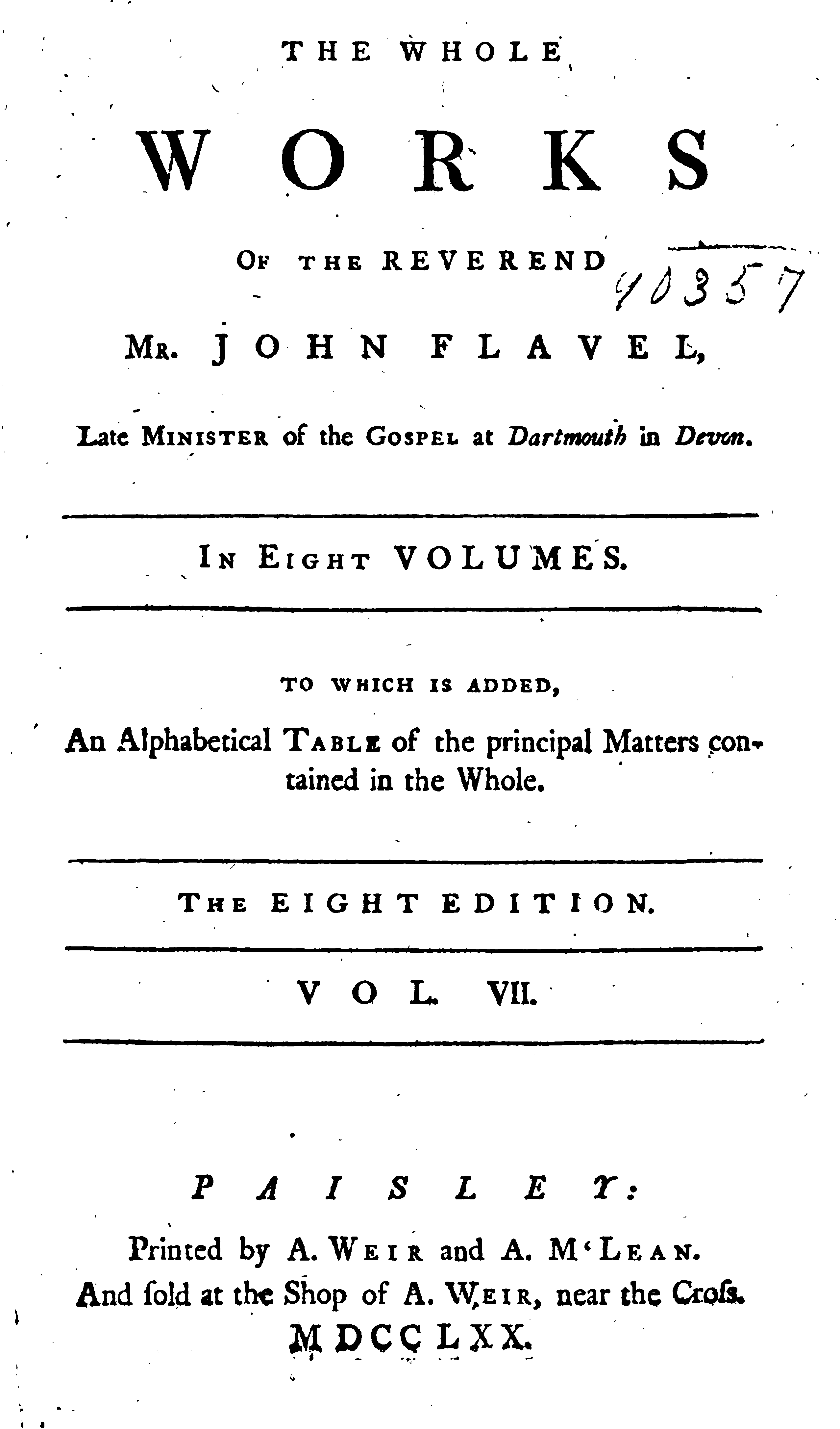
THE WHOLE WORKS
OF THE REVEREND 40357
MR. JOHN FLAVEL,
Late MINISTER of the GospeL at Dartmouth in Devon.
IN EIGHT VOLUMES.
TO WHICH IS ADDED,
An Alphabetical TABLE of the principal Matters contained in the Whole.
THE EIGHT EDITION.
VOL. VII.
PA ISLE Y:
Printed by A. WEIR and A. M'LEAN. And fold at the Shop of A. WEIR, near the Cross.
MDCCLXX.

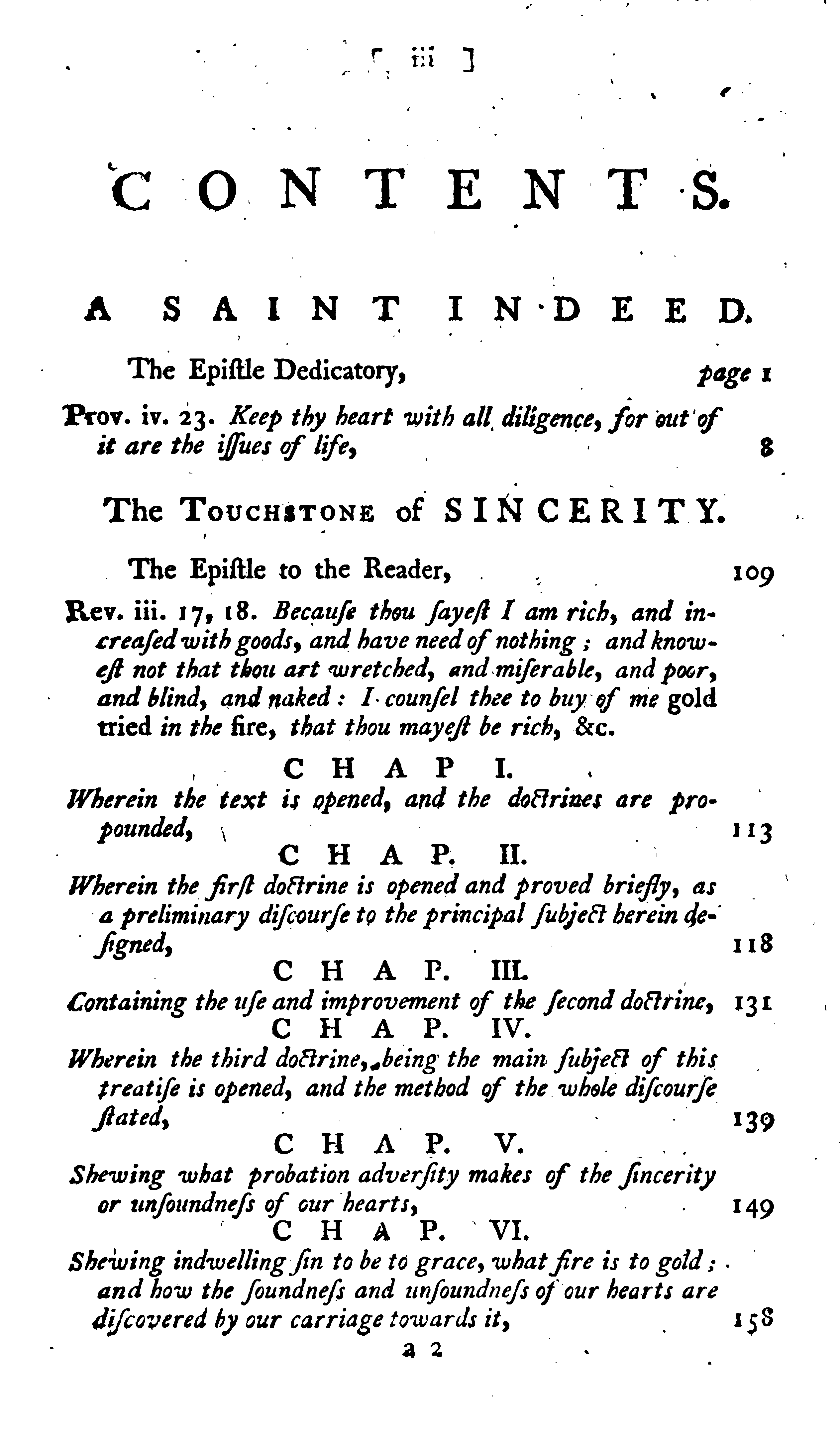
CONTENTS.
A SAINT INDEED.
The Epistle Dedicatory, page 1 Prov. iv. 23. Keep thy heart with all diligence, for out of it are the issues of life, 8
The TOUCHSTONE of SINCERITY.
The Epistle to the Reader, 109 Rev. iii. 17, 18. Because thou sayest I am rich, and increasedwithgoods, and have need of nothing ; and knowest not that thou art wretched, and miserable, and poor, and blind, and naked : I counsel thee to buy of me gold tried in the fire, that thou mayeft be rich, &c.
CHAP I. Wherein the text is opened, and the doctrines are propounded, CHAP. II. Wherein the first doctrine is opened and proved briefly, as a preliminary discourse to the principalfubject hereindefigned, CHA Г. III.
Containing the use and improvement of the second doctrine, 131 CHA P. IV. Wherein the third doctrine, being the main subject of this treatise is opened, and the method of the whole discourse Stated, 139 CHAP. V. Shewing what probation adversity makes of the sincerity or unfoundness of our hearts, 149 CHAP . VI . Shewing indwellingfin to be to grace, what fire is to gold; and how the foundness and unfoundness of our hearts are discovered by our carriage towards it, 158 22
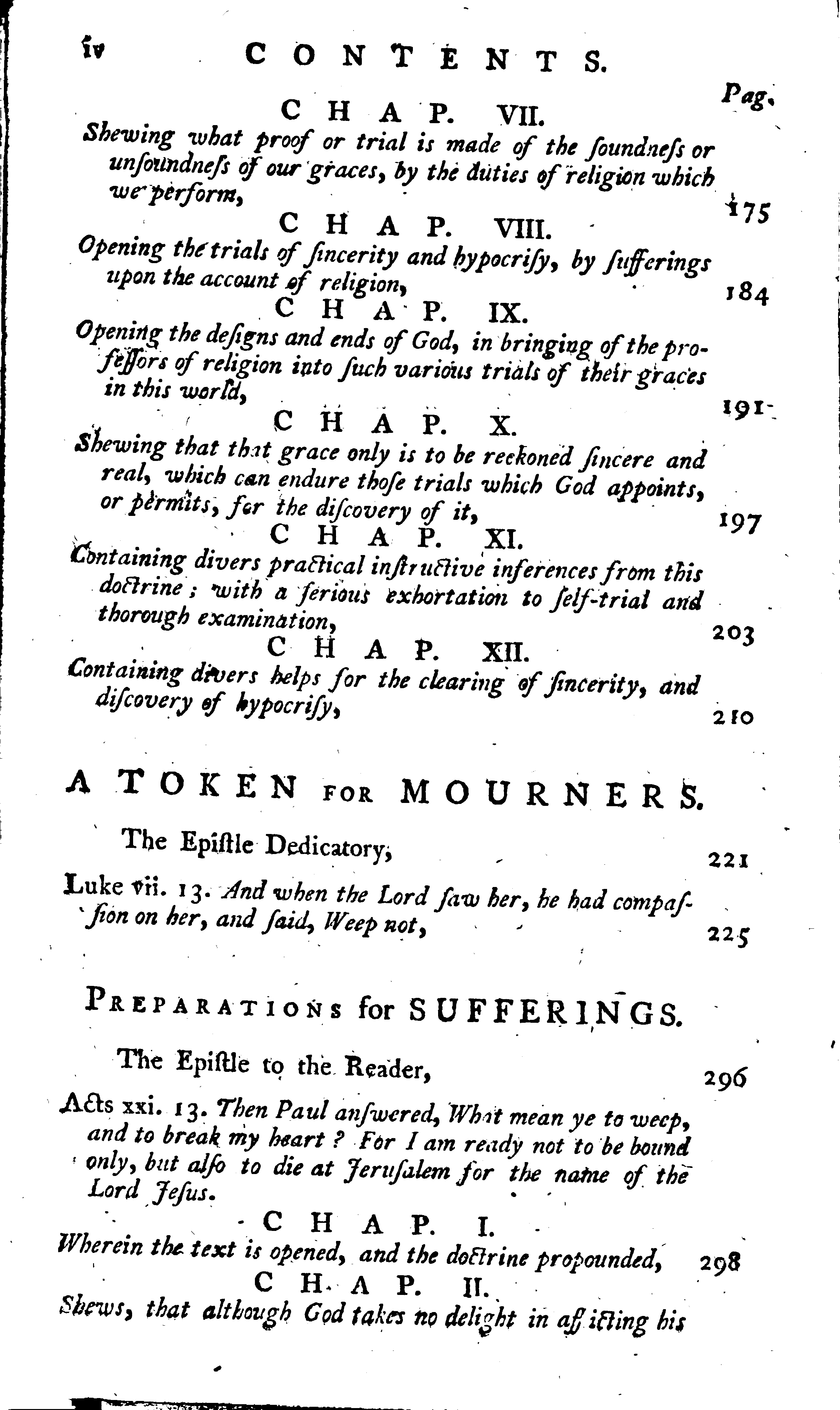
IV CONTENTS.
CHAP. VII. Pag
Shewing what proof or trial is made of the foundness or unfoundness of our graces, by the duties of religion which we perform, 175 CHAP. VIII . Opening the trials offincerity and hypocrisy, by sufferings upon the account of religion, 184 CHAP. IX . Opening the designs and ends of God, in bringing oftheprofeffors of religion intofuchvarious trials of their graces in this world, 7 CHAP. X. Shewing that that grace only is to be reckonedfincere and real, which can endure those trials which God appoints, or permits, for the discovery of it, CHAP. ΧΙ . Containing divers practical instructive inferencesfrom this doctrine ; with a serious exhortation to self-trial and thorough examination, CHAP. XII. Containing divers helps for the clearing offincerity, and discovery of hypocrisy, A TOKEN FOR MOURNERS.
The Epistle Dedicatory,
Luke vii. 13. And when the Lordfaw her, he had compassion on her, and said, Weep not, PREPARATIONS for SUFFERINGS.
The Epistle to the Reader,
Acts xxi. 13. Then Paul answered, What mean ye to weep, and to break my heart ? For I am ready not to be bound only, but also to die at Jerusalem for the name of the Lord Jesus.
- CHA P. I.
Wherein the text is opened, and the doctrine propounded, 298 CHAP. II. Shews, that although God takes no delight in assisting bis
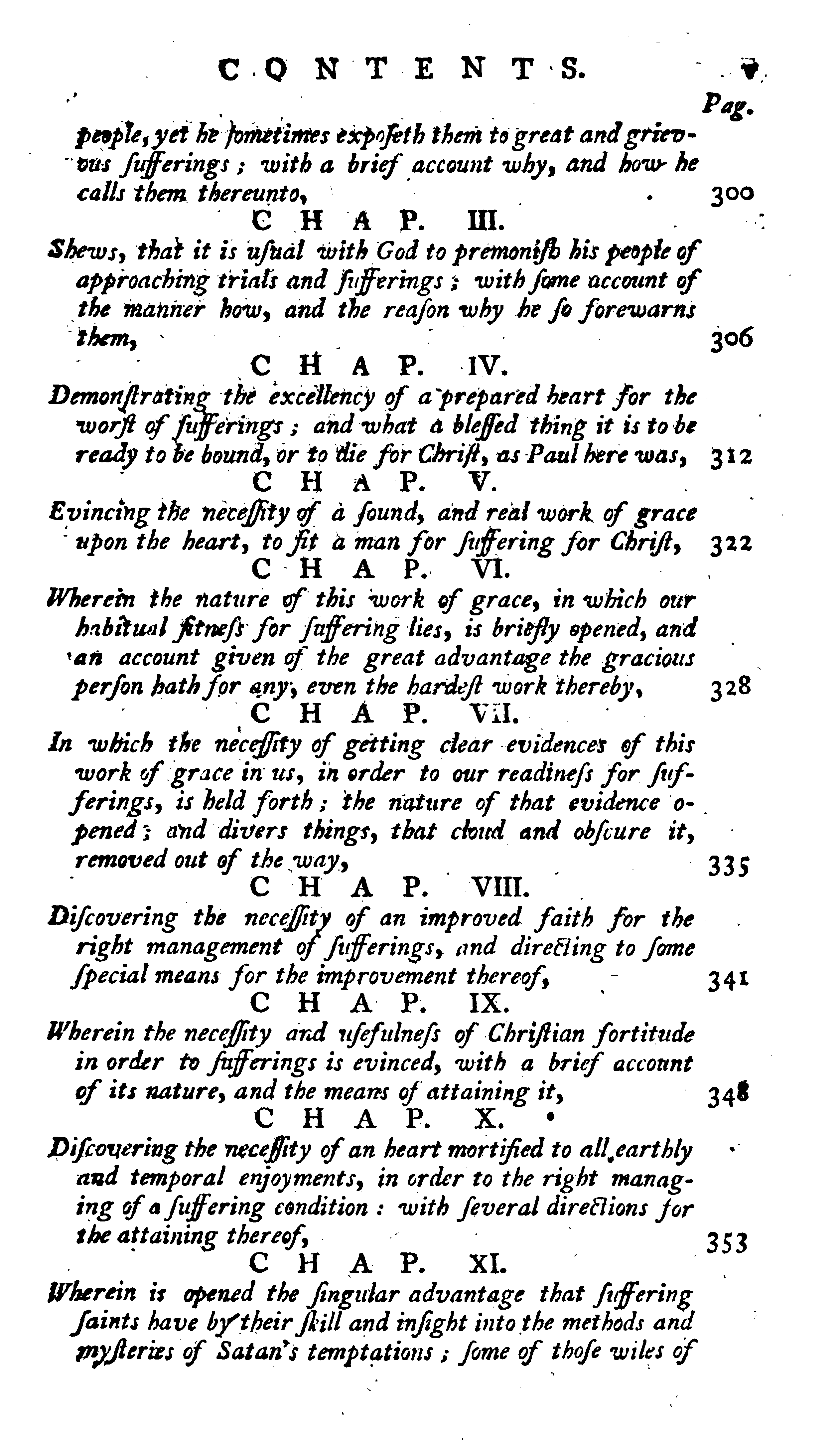
CONTENTS.
Pag. people,yet he sometimes expofeth them to great and grievous sufferings ; with a brief account why, and how he calls them thereunto, CHAP. III. Shews, that it is usual with God to premonish his people of approaching trials andfufferings ; with fame account of the manner how, and the reason why hefo forewarns them, CHAP. IV.
Demonstrating the excellency of a prepared heart for the worst offufferings ; and what a blessed thing it is to be ready to be bound, or to die for Christ, as Paulherewas, 312 CHAP. V. Evincingthe necessity of a found, and real work of grace upon the heart, to fit a man for suffering for Christ, 322 CHAP. VI. Wherein the nature of this work of grace, in which our habitual fitness for suffering lies, is briefly opened, and an account given of the great advantage the gracious perfonhathfor any, even the hardest work thereby, CHAP. VII. In which the necessity of getting clear evidences of this work of grace in us, in order to our readiness forfufferings, is held forth; the nature of that evidence opened and divers things, that cloud and obscure it, removed out of the way, CHAP . VIII . Discovering the necessity of an improved faith for the right management of sufferings, and directing to some Special means for the improvement thereof, CHA P. IX. Wherein the necessity and usefulness of Christian fortitude in order tofufferings is evinced, with a brief account of its nature, and the means of attaining it, CHA P. Χ. Discovering the necessity of an heart mortified to all earthly and temporal enjoyments, in order to the right managing ofafuffering condition : with several directions for the attaining thereof, CHAP . XI. Wherein is opened the singular advantage that suffering
Saints have bytheirskilland insight into the methods and mysteries of Satan's temptations ;some of those wiles of
vi CONTENTS .
Pag.
Satan opened, and rules for the avoiding of the danger briefly prescribed, 362 CHAP. Sheweth, that a choice part of our preparation and read i-
XII. ness for sufferings consists in the improvement of our praying abilities, and keeping close with God in that heavenly and excellent duty, in days offuffering ; wherein also is opened the nature and means of its improvement, 368 CHA P. XIII . Wherein is shewed the necessity of going out of ourselves, even when our habitual and actual preparations are at the greatest height ; and depending as constantly and entirely upon the Spirit, who is Lord of all gracious influences, as if we had done nothing : Together with the means of working the heart to such a frame, 372 CHAP. XIV . Containing the first use of the point by way of conviction, discovering the unreadiness of multitudes of professors for suffering-work, CHAP. XV. Containing another use of the point, by way of exhortation, persuading all the people of God, whilst the Lord refpites, and graciously delays their trials, to answer the end of God therein, and prepare themselves for greater trials : where several motives arepropounded, to excite to the duty, 1 CHA P. XVI. Containing the last use of the point, by way offupport and comfort to poor trembling fouls, who do take pains to make themselves ready for sufferings ; but yet finding such strength in Satan's temptations, and their own corruptions, fear that all their labour is in vain, and that they fall faint, and utterly apoftatize, when their troubles and trials come to an height, The BALM of the COVENANT applied to the bleeding WOUNDS of afflicted SAINTS .
The Epiftle Dedicatory,
2 Sam. xxiii. 5. Although my house be not so with God ; yet he hath made with me an everlasting covenant, ordered in all things and sure, &c.
CONTENTS. vii
Pag.
A SERMON preached for the Funeral of JOHN
UPTON of Lupton, Esq;
2 Chron. xxxv. 24, 25. Hisfervants therefore took him out of that chariot, and put him in thesecondchariot that he had; and they brought him to Jerusalem, and be died, and was buried in one of the fepulchres of his fathers, &c. 434
An EXPOSITION of the Assembly's SHORTER
CATECHISM.
The Preface, An Epistle to the Reader,
455 456
Quest. 1. Of man's chief end, 458 Quest. 2. Of thefcriptures as our rule, 460 Quest. 3. of faith and obedience, 462 Quest. 4. God is a Spirit, 463 Quest. 5. Of one God, 478 Quest. 6. Of three persons in the godhead, 480 Quest. 7. Of God's decrees, 481 Quest. 8. Of the execution of God's decrees, 483 Quest. 9. Of the creation, i bid. Quest. 10. Of man's creation, 484 Quest. 11. Of divine providence, 485 Quest. 12. Of the covenant of works, 487 Quest. 13. Of the fall of man, 489 Quest. 14. Off in, 490 Quest. 15. Of the tree of knowledge, 492 Quest. 16. Of the fall of Adam, and ours in him, 493 Quest. 17. Of original fin, 494 Quest. 18. Of the finfulness of that estate whereinto man fell, i bid. Quest. 19. Of man's misery, 496 Quest. 20. of the salvation of God's elect, and of the covenant of grace, 497 Quest. 21. of the only Redeemer. 500 Quest. 22. Of Christ's incarnation, 501

A SAINT INDEED.
OR,
The great Work of a CHRISTIAN, openedandpressed, From Proverbs iv. 23.
THE EPISTLE DEDICATORY. Tomydearlybelovedandlongedfor,the FlockofJesus Christ in Dartmouth, over whom the Holy Ghost hath made me an Overseer: Sound Judgment, true Zeal, and unftained Purity, are heartily wished.
MydearFriends, HERE are th T threefad fights with which our eyes should continually affect our hearts : The ( 1.) Is to behold in everyplace, so manyprofaneand dissolute ones, who hear the very image of Satan; the face of whose conversation plainly discovers what they are, and whither they are going, Philip. iii. 18, 19. These look like themselves, the children of wrath. The(2.) Is to fee so many cursed hypocrites artificially disguising themselves, and with marvellous dexterity acting the partsoffaints, so that even a judicious eye may sometimes mi-
the similar workings of the Spirit on them, for hisfaving workings on others : To hear such a person conferring, pray ing,be wailing his corruptions, and talking of his experiences ; wouldeasilyperfuade a man to believe that he hath the heart, as well as the face, ofa sincere Christian : For, Sic oculos,sic ille man us, fit ora ferebat. So the people of God do speak, so they pray, and even fo they open their conditions : These look like faints, but are none. The (3.) Is to see so many real saints, in whom the Spiritoftruth is,who yet,through the impetuous workings of theircorruptions, and neglecting of the watch over their hearts, VOL. VII.
2 The Epistle Dedicatory.
( dooftenfall intofuch scandalous practices, that they look like hypocrites, though they are not fo.
are three fad fights indeed,an dO that my head were waters, and mine eyes fountains of tears, that I might weep abundantly over them all !
For the first, I would mourn heartily, confideringthat they (so continuing) must be damned eternally, 2 Theff. i. 8, 9.
1 Cor. vi . 9. For the second, I would both weep and tremble, considering that they (fo abiding) must be damned doubly, Matth . xxiv. 51 . And for the third, no less than any of the rest, because, though they themselves may, and shall be saved, yet their examples make fast the bonds of death upon both the former, Matth . xviii. 7. 2 Sam. xii. 13, 14.
Alas! that ever they should shed the blood of others fouls, for whom Christ shed his own blood ! That ever they should be cruel to others, who have found Christ so kind to them ! I know they dare not do it directly and intentionally, but so it proves occasionally and eventually. Suffer me here to digress a little, and expoftulate with these prejudiced and hardened fouls, I will presently return to you again. O why do you mischieve your own souls by other mens examples ? Because they stumble and break their shins, will you fall and break your necks ? I desire all such as harden themselves by these things,and take up a good opinion oftheirowndeplorable condition, would foberly confider, andanswerthesethree queries.
Query 1. Doth religion any way countenance or patronize the sinful practices of its profesiors ? Or doth it not rather impartially and severely condemn them ? It is the glory of the Christian religion, that it is pure and undefiled, Jam. i. 27. No doctrine so holy, Psalm xix. 8. Nor doth any make more provision for an holy life, Tit. ii. 11, 12. Indeed there isa case wherein we may charge the evil practices of men upon their principles, but that is when their practices naturally flow from, and necessarily follow their principles : As for example, if I fee a Papist sin boldly, I may charge it upon his principles, for they set pardons to sale, and so make way for looseness. If I fee an Arminian flight the grace of God, and proudly advance himself, Imaycry shame upon his principles, which directly lead to it : But can Ido so where such practices Lare condemned, and provided against by their own avowed principles who commit them ?
Query 2. Is it not a most irrationalthing to let fly at religion
The Epistle Dedicatory... because of the scandalous ways of some, whilst, in the mean, time, you wholly flight and over-look the holy and heavenly conversation of many others ? Are all that profess godliness loose and careless in their lives ? No, some are an ornament to their profession, and the glory of Christ: And why must the innocentbecondemnedwiththe guilty ? Why the eleven, for one Judas ?
Query 3. If you condemn religion because of the scandalous lives of some that profess it, must you not then cast off all religion in the world, and turndown-right atheists ? Surely this is the consequent of it : For what religion is there,but
that profess it walk contrary to their profession ? And then, as Constantine told the Novation,you must set up a ladder, and go to heaven by yourself.
But, alas ! it is not our printed apologies for religion, but the visible reformations of its professors, that must both salve its honour, and remove those fatal stumbling-blocks at which the, blind world strikes, and falls into eternal perdition .
Now there are two ways by which this may be effected : First,By convincing the consciences of professors of their miscarriages, and the evil aggravations of them. Secondly, By medicating the heart, and cleanfingthe fountain whence they proceed. In the first of these, a worthy and emi-
SeeGospelglass. nent servant of Christ hath lately laboured,holding acleargospel-glass before the faces of professors, which truly represents their spots and blemishes : if he that reads it will confider, apply, and practise, it shall doubtless turn to his salvation ; but, if it turn to no good account, to him that reads it, I know it shall turn to a testimony for him that wrote it. The second is a principal design of this small treatise, the subject whereof is exceeding weighty, and of daily use to the people of God,thought he manner of handling it be attended with many defects and weaknesses : every one cannot be excellent,who yet may be useful.
I will exerciseyourpatience nolongerthan whilst I tell you,
1. Why I publish it to the view of the world. 2. Why I direct it particularly to you. First, For the publication of it, take this sincere and brief account, That as I was led to this subject by a special providence, so to the publication of it by a kind of necessity: the providence at first leading me to it, was this, A dear and choice friend of my intimate acquaintance being under much inward trouble, upon the accountofsomespecial heart-disorder,
4 The Epistle Dedicatory. opened the case tome, and earnestlyrequestedsome rules and helps in that particular ; whilst I was bending my thoughts to that special case, divers other cases of like importance(some of whichweredependant uponthatconfideration) occurred to my thoughts, and this scripture, which I have insisted upon,presented itself, as a fit foundation for the whole discourse; which being lengthenedout towhatyousee,divers friends requested me to transcribe for their use, divers of the cases here handled, and fomeothers begged me to publish the whole, to which I was inamannerneceffitated, to save the pains of transcribing, which tome is averytedious,and tiresome work: and just as I had almost finished the copy, an opportunity presented (and that somewhat strangely) to make it public. So that from first to last, I have been carriedbeyondmy first intentions in this thing.
Objection. If any say, The world is even cloyedwith books, and therefore though the discourse be necessary, yet the publication is needless .
Solution 1. I answer, There are multitudes of books indeed, and of them many concern not themselves about root truths, and practical godliness, but spend their strength upon impractical notions, and frivolous controverfies ; many also strike at root-truths, and endeavour to undermine the power of godliness ; and some there are that nourish the root, and tend to clear and confirm, to prepare and apply the great truths of the gospel, thattheymaybebreadforfouls to liveandfeed on : Now, though I could wish that those who have handledthepen of the scribe, had better employed their time and pains, than toobtrude such useless discoursesuponthe world ; yet for books of the latter rank, I say, that whenhusbandmencomplain of too much corn, let Christianscomplainoftoo manysuchbooks.
2.And if you be sohighlyconceitedofyour own furniture and ability, that such books are needless to you ; if you let them alone, they will do you no hurt, and other poor hungry fouls willbegladofthem,and bless God for what you despise and leave.
Objection. Ifitbesaidthat several of the cases here handled touch not your condition, I answer, Solution 1. That which is not your condition maybe ano ther's condition. If you be placed in an easy, full and pro-
and so have no need of the helps here offered to support your hearts under pinching wants, others are forced to live by faith for every day's provision : If you bedandleduponthe knee of providence, some of your brethren are under.
The Epistle Dedicatory.
its feet: If you have inward peace and tranquillity of spirit, andfoneednotthe counsels here given, to ward offthosede
that poor afflicted souls are ready to draw upon themselves at such a time ; yet it may be a word in sea-
them, and they may say as David to Abigail, " Blessed " be thou of the Lord, and blessed be thy advice."
2. That may be your condition shortly, which is not your conditionatpresent say not,thy mountain stands strong, thou shalt never be moved: there are changes in the right-hand of the Most High ; and then those truths which are little more esteemed than hedge-fruits, will be as apples of gold in picturesoffilver. InJer. xxxiii. 10, 11. the prophetthereteaches the Jews(whothendwelt in their own houses) how to defend their religion in Babylon, and what they should say to the Chaldeans there, and therefore that verse is written in Chaldee. So much for the reasonsofits publication. Next, for thededicationofit to you, I was induced thereto by the consideration,
1. OftherelationI have to you above all the people in the world: I look upon my gifts as yours, my time as yours, and all the talents I am intrusted with, as yours : it is not with you as with awomanwhose husband is dead, and so is freed from the law of her husband, the relation still continues, and fodo all the mutual duties of it.
2.By the consideration of my neceffitated absence from you, I would not that personal absence should by in sensible degrees untwift (as usually it doth) the cord of friendship; and therefore I have endeavoured (as absent friends use to do) to pre-
and strengthen it by this small remembrance, It was Vefpafian's answer to Apollonius,whenhedefired access for two philosophers, My doors (said Vefpafian) are always open to philosophers, but my very breast is open to thee.' I cannot faywithhim, my doors are open for the free access of friends, beingbyafadprovidence shut against myself; but this I can fay, myverybreast is stillopento you ; you are as dear to me as ever.
3. Another inducement (and indeedthemain) was the perpetual usefulness and neceffityofthesetruths for you, which you will have continual need of: And I know few of you have fuchhappymemories to retain, and I cannot be always with you toinculcatethese things, but literafcripta manet. I was willing to leave this with you as a legacy, as a teftimonyof sincere love for, and care over you : this may counsel anddijectyouwhen I cannot: I may be rendered useless to you by
6 The Epistle Dedicatory.
a civil or natural death; but this will out-live me, and oh that itmayferveyourfoulswhen I am silent in the dust.
Tohaftennow to a conclusion, I have only these three requests to you, which I earnestly beseech you not to deny me; yea, I charge you, as ever you hope to appear with comfort before the great Shepherd,do not dare to flight these requests.
1. Above all other studies in the world, study your own hearts : waste not a minute more of your precious time about frivolous andfaplefs controverfies. ItItisis reported even of Bellarmine (how truly I examine not) * Quod aftudiisscholasticae theologiae avertereturfere nauseabundus, quoniamfucco carebant liquidae pietatis, (i. e.) he turned with loathing from the study of school-divinity, because it wanted the sweet juice ofpiety; I had rather it shouldbefaid of you, as one said of‡ Swinkfeldius, (" He wanted a regular head, but not an honest " heart") than that youshouldhave regular heads, and irregular hearts. Mydearflock,I have according to the grace given me, laboured in the course of my ministry among you, to feed you with the heart-strengthening bread of practical doctrine ; and Ido assure you, it is far better you should have the sweet and saving impressions of gospel-truths feelingly and powerfullyconveyedto your hearts, than only to understand them by a bare ratiocination, or dry fyllogiftical inference. Leave trifling studies to such as have time lying on their hands, and know not how to employ it : remember you are at the door of eternity, and have other work to do; those hours you spend upon heart-work in your closets, are the golden spots of all your time, and will have the sweetest influence up to your last hour. Never forget these sermons I preached to you upon that subject, from 2 Kings xx. 2, 3. Heart-work is weighty, and difficult work ; an error there, may cost you your souls : I may say of it, as Augustine speaks of the doctrine of the Trinity, Nihilo facilius aut periculofius erratur ; Am an can err in nothing moreeasilyor more dangerously. Othen studyyourhearts.
2. My next request is, That you will carefully look to your conversations, and be accurate in all your ways, hold forth the word of life : be sure by the strictness and holiness of your lives, to settle yourselves in the very consciences of your ene. mies. Remember that your lives must be produced in the great day, to judge the world, 1 Cor. vi. 2. O then,whatmannerofperfons ought you to be! youhavemanyeyes over you ; 1* Fuligattus in vita Bell arm. † Caput regulatum ill i defuit, cor bonum non defuit.
The Epistle Dedicatory. 7 the omniscient eye of God, that searches heart and reins, Rev. ii. 23. the vigilant eye of Satan, Job i. 7, 8. the envious eyes of enemies, that curiously observe you, Psal. v. 8. the quick and observant eye of conscience, which none of your actions escape, Rom. ix. 1. : Othen be precise, and accurate, in all manner of conversation; keep up the power ofgodliness in your closets and families, and then you will not let it fall in your more public employments and converses in the world : I have often told you, that it is the honour of the gospel, that it makes the best parents and children, the best masters and servants, the best husbands and wives in the world. : 1 My third and last request is, that you pray for me : I hope Icanfay, and I am sure some of you have acknowledged, that I came at first among you, as the return and answer of your prayers: and indeed so it should be, fee Luke x. 2. I am perfuadedalso, I have been carried on in my work by your prayers; it is sweet when it is so ; see Eph. vi. 18, 19. And I hope by your prayers to receive yet a farther benefit, even that which is mentioned, Heb. xiii. 18, 19. Philem. ver. 22. And truly it is but equal you shouldprayfor me, I have oftenprayedfor you: letthepulpit, family, and closet witness for me; and God forbid I should fin against the Lord inceasingtopray for you.
Yea, friends, your own interest may persuade to it : what mercies you obtain for me, redound to your own advantage; if God preserve me, it is for your use and. service : the more gifts and graces a minister hath, the better for them that shall wait on his ministry ; the more God gives in tome, the more
I shall be able to give out to you. Iwilldetainyouno longer, but to entreat you to accept this small teftification of my great love, and have recourse to it, according as the exigencies of your condition shall require : read it confideringly, and obediently; judge it not by the dress and style, but by the weight andfavourof what you read. It is a good rule of Bernard, In legend is libris, nonquaeramus fcientiamfedfaporem, (i. e.) In reading books, regard not fo much the science, as the favour. That it may prove the favour of life unto life to you, and all those into whose hands it shall come, is the heartydefireof
Your loving, and faithful pastor
From my study at Ley in
Slap ton, 08. 7. 1667.
JOHNFLAVEL.
7 SAINT INDEED, &c.
PROV. iv. 23. Keep thy heart with all diligence, for out of it are the issues of life. THE heart of man is his worst part before it be be regenerate, and the best afterwards: it is the feat of principles, and fountain of actions. The eye of God is, and the eye of the Christian ought to be, principally fixed upon it.
The greatest difficulty in conversion, is, towintheheart to God; and the greatest difficulty after conversion, is to keep the heart with God. Here lies the very pinch and stress of religion; here is that which makes the way to life a narrow way, and the gate to heaven a strait gate. Direction and help inthisgreatwork, are the scope and sum of this text : where in we have,
1. Anexhortation, " Keep thy heart with all diligence." 2. The reason, or motive enforcing it, " For out of it are " the issues of life."
In the exhortation I shall consider,
1. The matter of the duty. 2. The manner of performing it. 1. The matter of the duty,keep thy heart. Heart is not here taken properly for that noble part ofthebodywhich philosophers call the primum vivens, et ultimum moriens ; the first that lives, and the last that dies; but by heart, in a metaphor, the scripture sometimes understands some particular noble faculty of the soul: in Rom. i. 21. it is put for the under- standing part, their foolish heart, (i. e.) " their foolish under- " standing was darkened." And Psalm cxix. 11. it is put for the memory, " Thy word have Ihidinmyheart;" and 1 John iii. 10. it is put for the conscience, which hath in it both the light of the understanding and the recognitions of the memory: if our heart condemn us, (i. c.) if our conscience, whose proper office it is to condemn. But here we are to take it more generally for the whole foul, or inner man ; for look what the heart is to the body, that the foul is to the man ; and what health is to the heart,'that holiness is to the soul: Quod
What it is to keep the Heart. fan it as in corporeidfanctitas in corde. The state of the whole body depends upon the foundness andvigour of the heart, and the everlasting state of the whole man upon the good or ill. condition of the soul.
And by keeping the heart, understand the diligent and con Aantuse and improvement of all holy means and duties, to preserve the soul from fin, and maintain its sweet and free communion with God. * Lavater, on the place, will have the word taken fromabefieged garrison, begirt bymanyenemies without, and in danger of being betrayed by treacherous citi zens within, in which danger the soldiers,uponpainofdeath, are commanded to watch; and whereas the expression(keep thy heart seems to put it upon us as our work,yet it doth not implya sufficiency or ability in us to do it ; we are as able to stop the fun in its course, or make the rivers run backward, as by our own skill and power to rule and order our hearts : we may as well be our own faviours, as our own keepers; and yet Solomon speaks properly enough,when he faith, keep thy heart; because the duty is ours, though the power be God's. A natural man hath no power, a gracious man hath some, though not sufficient ; and that power he hath,depends upon the exciting and assisting strength of Christ; Gratia gratiam poftulat, grace within us is beholden to grace without us, John xv. 5. "Without me yecando nothing." So much of thematterofthe duty.
2. The manner of performing it is, with all diligence; the Hebrew is very emphatical, † Cum omni cuftodia, keep with all keeping, q. d. keep, keep; set double guards, your hearts will be gone else. And this vehemency of expreffi on,with which the duty is urged, plainly implies how difficult it is to keep our hearts, andhowdangerous toletthem go.
3. The reason, or motivé quickeningto this duty, is very forcible and weighty: " For out of it are the issues of life.' That is, it is the fourceand fountain of all vital actions an do perations ; Hincfons boni etpeccandi origo, faith Jerom ; it is the spring and original both of good and evil, as the spring in * I say constant, for the reason added in the text extends the duty to all the states and condition sofa Christian's life, and makes itbindadfemper : If the heart must be kept because out of it are the issuesoflife; then as long as these issues of life do flow out of it, we are obliged to keep it.
* רמשכ לבכ
VOL VII.
10 What it is to keep the Heart. a watch that sets all the wheels in motion. The heart is the treasury,the hand and tongue but the shops,what is in these, comes from thence ; the hand and tongue always beginwhere the heart ends. The heart contrives, and the members execute; Luke vi. 45. "A good man out of the good treasure "of his heartbringeth forth good things,and an evil man out " of the evil treasure of his heart bringeth forth evil things ; " for out of the abundance of his hear this mouth speaketh." So then, if the heart err in its work, these must needs miscarry in theirs ; for heart-errors are like the errors of the first concoction, which cannot be rectified afterwards : Or like the misplacing, and inverting of the stamps and letters in the press,which must needs cause so many errata in all the copies that are printed off. Othen,how important a duty is that which is contained in the following proposition ? Doct. That the keeping, and right managing of the heart in every condition, is the great business ofa Christian's life. What the philosopher faithofwaters, is as properly applicable to hearts ; Suis term in is difficile continentur, it is hard to keep them within any bounds: God hath set bounds and limits to them, yet how frequently do they transgress, not only the bounds of grace and religion, but even of reason and common honesty ? Hic labor hocopus est ; this is that which affords the Christian matter of lab our, fear and trembling tohisdyingday. It is not the cleansing of the hand that makes the Christian, for many a hypocrite can shew as fair a hand ashe ; but the purifying, watching, and right ordering of the heart ; this is the thing that provokes so many fad complaints,and costs fo many deep groans and brinish tears. It was the pride of Hezekiah's heart that made him lie in the dust mourning before the Lord, 2 Chron. xxxii. 26. It was the fear ofhypocrify invading the heart, that made David cry, " Let my heart be "found in thy statutes, that I be not ashamed," Psalm cxix. 80. It was the fad experience he had of the divisions and distractions of his own heart, in the service of God, that made himpourout that prayer, Psalm lxxxvi. 11. "Unite my heart " to fear thy name." The method in which I shall improve the point, shall be this, First, I shall enquire what the keeping of the heart supposes and imports.
Secondly, Affigndivers reasons, why Christians must make this the great work and business of their lives.
What it is to keep the Heart. Thirdly, Point at those special seasons which especially call for this diligence in keeping the heart.
Fourthly, and lastly,Apply the whole in several uses.
1. What the keeping of the heart supposes and imports. To keep the heart, necessarily supposes a previous work of fanctification, which hath set the heart right,by giving it a new spiritual bent and inclination ; for as long as the heart is not set right by grace, as to its habitual frame, no duties or means can keep it right with God. Self is the poise of the unfanctified heart, which biasses and moves it in all its designs and actions ; and as long as it is so, it is impossible that any external means should keep it with God.
Man, by creation, was of one constant, uniform frame and ten our of spirit, held one straight and even course; not one thought or faculty revelledordisordered;his mind had a perfect illumination to understand and know the will of God, his will a perfect compliance therewith ; his sensitive appetite, and other inferior powers,stood in a most obedient fubordination.
Man, by degeneration,is become a most disorderedand rebellious creature,contesting with, and opposing his Maker, as the first cause, by self-dependence ; as the chiefeft good, by self-love; as the highest Lord, by self-will, and as the last end, by self-seeking ; and so is quite disordered,and all his acts irregular: His illuminated understanding is clouded with ignorance, his complying will fullofrebellion and stubborness ; his subordinate powers,casting off the dominion and government of the superior faculties.
But by regeneration this disordered foul is set right again ; fanctificationbeing the rectifying and due framing, or, as the scripture phrases it,the renovation of the soul after the image of God, Eph . iv. 24. in which,self-dependence is removed by faith ; self-love, by the love of God ; self-will, by fubjection and obedience to the will of God; and self-feekingby self-denial. The darkened understanding isagainilluminated,Eph. i. 18. the refractory will sweetly subdued, Psalm cx. 3. the rebellious appetite,orconcupifcence gradually conquered, Rom. vi. 7. per tot. And thus the soul which fin had universally depraved is again by grace restored and rectified.
This being pre-supposed, it will not be difficult to apprehend, what it is to keep the heart, which is nothing else but the constant careanddiligence offuch a renewed man, to preserve his foul in that holy frame to whichgracehath reduced it, and daily strives to hold it.
12 What it is to keep the Heart. For,though grace hath, in a great measure, rectified the soul, andgivenitanhabitual and heavenly temper ; yet fin often ac tuallydifcomposes it again: so that even a gracious heart is like a musical instrument, which, though it be never it be neversoexactly tuned, a small matter brings it out of tune again; yea, hang it aside but a little, and it will need setting again, before you can play another lesson on it; even even so stands the case with gracious hearts ; if they are in frameinone duty, yethowdull, dead, anddisorderedwhen they come to another ? And there fore every duty needs a particular preparation of the heart, Job xi. 13. " If thou prepare thine heart, and stretch out thine "hands towards him." Well then, to keep the heart, is care fullytopreserve it from fin, which disorders it; and maintain that spiritual and gracious frame, which fits it for a life of communion with God. And this includes these six acts in it :
1. Frequent observation of the frame of the hearts turning in and examining how the case stands with it, this is one part of the work. Carnal and formal persons take no heed to this, they cannot be brought to confer with their own hearts; there are some men and women that have lived forty or fifty years in the world, and have scarce had one hour'sdiscourse with theirownhearts all that while : It is a hard thing to bring am an andhimselftogether upon such an account; but saints know those soliloquies and self-conferences to be of excellent use and advantage. The heathen could say, animafedendo et quiefcendofit sapiens, the soul is made wife by fitting still in quietness ; though bankrupts care not to look into their books ofaccompt, yet upright hearts willknowwhethertheygobackwardor forward, Psalm lxxvii. 6. " I commune with mine own " heart." The heart can neverbekept, until its case be examinedandunderstood.
2. It includes deephumiliationfor heart-evils and disorders . thus Hezekiah humbled himself for the pride of his heart, 2 Chron. xxxii. 26. Thus the people were ordered to spread forth their hands to God in prayer, in a sense of the plague of their own hearts, 1 Kings viii. 38. Upon this account many an upright heart hath been laid low before God : O what an heart have I ? They have in their confessions pointed at the heart, the pained place ; Lord,here is the wound, here is the plague-fore. It is with the heart well kept, as it is with the eye,which is a fit emblem of a small dust get into the eye, it will never leave twinklingandwateringtillithavewept it out: So the upright heart cannot be at rest till it have wept out its troubles, and poured out its complaints before the Lord.
What it is to keep the Heart. 3. It includes earnest supplications and instant prayer for heart-purifying and rectifyinggrace,whenfinhathdefiledand disordered it; fo Psalm xix. 12. " Cleanse thou me from secret " faults;" and Psalm lxxxvi. 11. " Unite my heart to fear thy " name." Saints have always many such petitions depending before the throne of God's grace; this is the thing which is most pleaded by them with God: When they are praying for outward mercies, haply their spirits maybe more remiss, but when it comes to the heart-case, then they extend their spirits to the utmost, fill their mouths with arguments,weep and make fupplication : Oh, for a better heart ! Oh for a heart to love God more To hate finmore, to walk more evenly with God: Lord, deny not to me such a heart, whatever thou deny me; give me an heart to fear thee, love and delight in thee, ifI begmybreadin desolate places. It is observed of holy Mr. Bradford, that when he was confessing fin, he would never give over confessing until he had felt some prokenness of heart for that fin; andwhenpraying for any spiritual mercy, would never give over that suit, until he had got some relith of that mercy; that is the third thing included in keeping the heart.
4. It includes the imposing of strong engagementsandbonds upon ourselves to walk more accurately with God, and avoid the occasions whereby the heart maybe induced to fin: Well composed, advised, and deliberate vows, are, in some cases, of excellent use to guard the heart against some special fin; so Job xxxi. 1. " I made a covenant with mine eyes ;" by this means, holyones have over-awed their souls, and preserved themselves fromdefilementby some special heart-corruptions.
5. It includes aconstantholyjealousy over our own hearts; quick-sighted self-jealousy is an excellent preservative from fin ; hethatwillkeep his heart, must have the eyes of his foul awake andopenupon all the disorderly and tumultuous stirrings of his affections ; if the affections break loose, and the passions be stirred, the soul must discover and suppress them before they get to an height: O, my soul, dostthou well in this ? My tumultuous thoughts and passions, where is your commission ?
State viri, quae caufa viae? quive eftis in arm is. Virg. Happy is the man that thus feareth always, Prov. xxviii. 14. By this fear of the Lord it is that men depart from evil, fbakeof security,and preserve themselves from iniquity; he that will keep his heart must feed with fear, rejoice with fear, and pass the whole time of his sojourning here in fear, and all little enough to keep the heart from fin.
6. And, lastly,To add no more, it includes the realisingof
14 Heart-work, difficult and important. God's presence with us, and fettingthe Lord always before us : This the people of God have found a singular means to keep their hearts upright, and awe them from sin ; when the eye of our faith is fixed upon the eye of God's omniscience, we dare not let out our thoughts and affections to vanity : Holy Job durst not fufferhis heart to yield to an impure, vain thought ; and what was it that moved him to so great acircumspection ? Why, he tells you, Job xxxi . 4. "Doth he not see my ways, " and count all my steps ? Walk before me (faith God to " Abraham) and be thou perfect," Gen. xvii. 1. Even as parents use to fettheirchildreninthe congregation before them, knowingthatelse they will be toying and playing ; so would the heart of the best in an too, were it not for the eye of God. In these, and such like particulars, do gracious fouls express the care they have of their hearts ; they are as careful to prevent the breaking loose of their corruptions in times of temptation, as seamen are to bind fast the guns, that they break not loose ina storm ; as careful to preserve the sweetness and comforttheyhavegotfrom God in any duty, as onethatcomes outofanhot bath, or great sweat, is of taking cold, by going forth into the chill air. This is the work, and of all works in religion it is the most difficult, constant, and important work.
1. It is the hardest work; heart-work is hard work indeed. To shuffle over religious duties with a loose and heedless spirit, will cost no great pains; but to set thyself before the Lord,and tyeup thy loose and vain thoughts to a constant and serious attendanceuponhim ; this will cost thee something : To attain a facility and dexterity of language in prayer, and put thy meaning into apt and decent expressions, is easy; but to get thy heart broken for fin, whilst thou art confessing it; melted withfreegrace, whilst thou art blessing God for it; to be really ashamed and humbled through the apprehenfions of God's infinite holiness, and to keep thyheartin this frame,not only in, but after duty, will surely cost thee some groans and travailing pains of foul: To repress the outward acts of fin, and compose the external part of thy life in a laudable and comely manner, is no great matter ; even carnal persons by the force ofcommonprinciples can do this ; but to kill the root of corruption within, to set and keep up an holy government over thy thoughts, to have all things lie straight and orderly in the heart, this is not easy. 2. Itisaconstant work. The keeping of the heart is such a work, as is never done till life be done; this labour and our
Heart-work, difficult and important. 15 life, end together : It is with a Christian in this business, as it is with seamen that have sprung a leak at sea, if they tug not constantly at the pump, the water increases upon them, and will quickly finkthem. It is in vain for them to say the work is hard, and we are weary ; there is no time or condition in the life of a Christian, which will suffer an intermission of this work. It is in the keeping watch over our hearts, as it was in the keeping up of Moses his hands, whilst Israel and Amalek were fighting below, Exod. xvii. 12. No sooner do Moses his hands grow heavy andsinkdown, but Amalekprevails. You know it costDavid and Petermany a fad day and night for intermittingthe watch over their own hearts but afewminutes.
3. It is the most important business of a Christian's life. Without this we are but formalifts in religion ; all our profef-
gifts and duties signify nothing : " My son, give me " thine heart," Prov. xxiii. 36. God is pleased to call that a gift,which is indeed a debt ; he will put this honour upon the creature to receive it from him in the way of a gift; but if this be not given him, he regards not whatever else you bring to him: There is so much only of worth and valueinwhatwedo, as there is of heart in it. Concerning the heart,God seems to say, as Joseph of Benjamin, " Ifyoubring not Benjamin with
66 you, you shall not see my face." Among the heathens, when the beast was cutup for sacrifice, thefirstthing the priest lookeduponwas the heart, and if that was unsound and naught, the sacrifice was rejected. God rejects all duties (how glorious soever in other respects) offered him without a heart. He thatperformsduty without a heart, viz. heedlesly, is no more accepted with God, than he that performs it with a double heart, viz. hypocritically, Ifa. lxvi. 3. And thus I have briefly openedthenature of the duty, what is imported in this phrase, " Keep thy heart."
2. Next, I shall give you some rational account why Christians should make this the great business of their lives, to keep their hearts.
The importance and necessity of making this our great and main business, will manifestlyappear in that, 1. The honour of God; 2. The sincerity ofourprofeffion ; 3. The beauty of our conversation; 4. The comfort of our souls; 5. The improvement of our graces ; and, 6. Our stability in the hour of temptation; are all wraptup in, and dependent on our fincerityandcare in the management of this work.
1. The glory of God is muchconcernedtherein; heart-evils areveryprovoking evils to the Lord. The schools dowellob
16 Heart-work, difficult and important. serve, that outward sins are major is infamia, fins of great infamy; but heart-fins are majorisreatus, sins of deeper guilt. How severely hath the great Goddeclaredhiswrath from heaven against heart-wickedness; the great crime for which the oldworldstands indicted,Gen. vi. 5,6,7. is heart-wickedness.
Godfaw that every imagination, (or fiction) of their heart "was only evil, and that continually;" for which hefentthe dreadfullestjudgment that was ever executed since the world began: "And the Lord said, I willdestroymanwhom I have " created from the face of the earth, both man and beast, and " the creeping things, and the fowls of heaven, for it repent- " eth me that I have made man," verse 7. We find not their murders, adulteries,blafphemies, (thơ' they were defiled with these) particularly alledged against them;but theevils of their hearts: Yea, that which God was so provoked by,as to give up his peculiar inheritance into the enemy's hand,was the evil of their hearts, Jer. iv. 14. " O Jerusalem,wash thine heart from "wickedness, that thou mayest be saved; how long shall vain " thoughts lodge within thee ?" The wickedness and vanity of their thoughts God took specialnoticeof;and because of this the Chaldean must come upon them as a lion from his thicket, verse 7. and tear them to pieces. For the very fin of thoughts it was that Godthrewdown the fallen angels from heaven,and keeps them still in everlasting chains to the judgment of the great day; by which expression is notobscurely intimated some extraordinary judgment to which they are reserved, as prisoners that have most irons laid upon them,may be supposed to bethe greatest malefactors : And what was their fin ? Why only spiritual wickedness ? For they having no bodily organs, could act nothing externally against God. Yea, mere heartevils are so provoking,that for them he rejects with indignationalltheduties that some men perform unto him, Ifa. Ixvi. 3. "He that killeth anox, is as if he flew a man; he that facri- " ficeth a lamb, as if he cut offadog's neck; he thatoffereth " an oblation, as if he offered swines blood; he thatburneth " incense, as if he blessed an idol." In what words could the abhorrence of a creature's actions be more fully expressed by the holy God ? Murder and idolatryare not more vile in his account, than their sacrifices, thoughmaterially such as himself appointed : And what made them so ? The following words inform us, " their foul delighteth in their abominations."
To conclude, such is the vileness of mere heart-fins, that the scriptures sometimes intimate the difficulty of pardon for
Sincerity and Joy depends upon keeping our Hearts. 17 them. So in the case of Simon Magus, Acts viii. 21. his heart was not right, he had vile thoughts of God, and the things of God; the apostle bids him " repent and pray, if " perhaps the thoughts of his heart might be forgiven him." Othen, never flight heart-evils! for by these God is highly wronged and provoked; and forthisreasonletevery Christian make it his worktokeep his heart with all diligence.
2. The sincerity ofourprofessionmuchdepends upon the care and conscience we have in keeping our hearts ; for it is molt certain, that a man is but an hypocrite in his profession, how curious soever he be in the externals of religion, that is heedless and careless of the frame of his heart:You have a preg nant instance of this in the case of Jehu, 2Kings x. 31. "But "Jehu took no heed towalkintheways of the Lord God of " Ifraelwithhisheart." That context gives usanaccountofthe greatserviceperformedby Jehu against the house of Ahab and Baal,as also ofa great temporal rewardgivenhim by God før that service, even that his children, to the fourth generation, should fit upon the throne of Israel. And yet, inthesewords, Jehu is censured for an hypocrite; though God approved, and rewarded the work, yet he abhorred and rejected theperfonthat did it as hypocritical :Andwhereinlayhishypocrisy ? but in this, that he took no heedtowalkinthewaysofthe Lord with his heart, (i.e.) he did all in sincerely,and for self-ends ; and though the work he did was materially good,yet he not purging his heart from those unworthy self-designs in doing it, was an hypocrite : And Simon, of whom we spakebefore,though heappearedfuch a person, that the apostle could not regularly refuse him; yet his hypocrisy was quickly discovered: And whatdiscovereditbutthis,that though heprofessedandaffoci ated himselfwiththefaints,yet he was a stranger to the mortification of heart-fins ? " Thy heart is not right with God," Acts viii. 21. It is true, there isagreatdifferenceamong Chri
in their diligence and dexterity aboutheartwork; fomeare more converfant and successful in it than others are ; but he that takes no heed to his heart, that is not careful to order it aright before God, is but a hypocrite, Ezek. xxxiii. 31, 32. " And theycomeunto thee as the people com- "eth, and fit before thee (as my people) and they hear thy "words, but they will not do them; for with their mouths "they shewmuchlove, but theirheartgoeth after their cover- " ousness." Here were acompanyofformalhypocrites,as is evidentbythatexpression (as my people) like them,but not of VOL. VII.
18 Sincerity and Joy depends uponkeepingour Heart. them. Andwhatmade them so ? Their outside was fair; here were reverend postures,high professions,muchseemingjoyand delight in ordinances, " Thou art to them as a lovely song;" yea, but for all that they kept not their hearts with God in those duties, their hearts were commanded by their lusts, they went after their covetousness ; hadtheykept their hearts with God, all had been well ; but not regarding which way their hearts went in duty, there lay the core of their hypocrisy.
Objection. If any upright foul should hence infer, then I am an hypocrite too, for many times my heart departs from God in duty ; do what I can, yet I cannot hold it close with God.
Solution. To this I answer, The very objection carries in it its own solution. Thou sayest, do what I can, yet I cannot keep my heart with God. Soul, ifthoudost what thou canst,thou haft the blessing of an upright,though God fees good to exercifethee under the affliction ofadifcompofedheart. Their remains still some wildness in the thoughts and fancies of the besttohumble them; but if you find a care before to prevent them, and opposition againstthemwhenthey come, grief and sorrow afterwards ; you will find enough to clear you from reigning hypocrisy.
(1.) This fore-care is seen partly in laying up the word in thine heart to prevent them, Psal. exix. 11. " Thy word have " I hid in mine heart, that I might not finagainst thee:" partly in our endeavours to engage our hearts to God, Jer. xxx. 21. and partly in begging preventing grace from God in our on sets upon duty, Psal. cxix. 36, 37. it is a good sign where this care goes before a duty.
And,(2.) It is a sweet sign ofuprightness toopposethem in their first rife, Psal. cxix. 113. " I hate vain thoughts," Gal. v.. 17. "The spirit lusteth against the flesh."
And, (3.) Thy after-grief discovers thy upright heart. If, with Hezekiah, thou art humbled for the evilsof thy heart, thou hast no reason, from those disorders, to question the integrity of it; but to suffer fin to lodge quietly in the heart, to let thy heart habitually and uncontrolledlywander from God, is a fad, and dangerous symptom indeed.
3. The beauty of our conversation arises from the heavenly frame, and holy order of our spirits ; there is a spiritualluftre and beauty in the conversation of saints; "The righteous is "more excellent than his neighbour," they shine as the lights of the world; but whatever lustre and beauty is in their lives, comes from the excellency of their spirits ; as the candle within puts a luftre upon the lanthorn in which it shines. It is im-
Sincerity and Joy depends upon keeping our Heart. 19 possiblethatadifordered and neglected heart should everproducewell-ordered conversation;and since(as the text observes) the issues or streams of life flow outoftheheart as their fountain, it must needs follow, that such as the heart is, the life will be: hence Pet. ii. 11 , 12. " Abstain from fleshly lusts,---having yourconversationhonest," * or beautiful, as the Greek word imports. So Ifa. lv. 7." Letthewicked forsake his way, and the "unrighteous man his thoughts." Hiswaynotes the course of his life, his thoughts the frame of his heart ; and therefore fincetheway and course of his life flows from his thoughts, or •the frame of his heart, both or neither will be forsaken: the heart is the womb of all actions, these actions are virtually and seminallycontained in our thoughts, these thoughts being once made up into affections, are quickly made out into suitable actions and practices. Iftheheartbewicked,then, as Christ faith, Matth. xv. 19. "Out of the heart proceed evil thoughts, mur- " ders, adulteries," &c. Mark the order; first wanton, or revengeful thoughts, then unclean, or murderous practices.
Andiftheheart be holy and spiritual,then, as Davidspeaks, from sweet experience, Psal. xlv. 1. "My heart is (inditing) " a good matter, I speak of things which (I have made), my " tongue is as the pen of a ready writer." Here is a life richly beautifiedwith good works, some ready made ; " I will speak " of the things which I have made:" others upon the wheel making, my heart is inditing, but both proceeding from the heavenly frame of his heart.
Put but the heart in frame, and the life will quickly discover that it is so. I think it is not verydifficulttodifcern, by the duties and converses of Christians, what frames their spirits are under ; take a Christian in a good frame, and how serious, heavenly, and profitable, will his converses and duties be ! what a lovely companion is he during the continuance of it ! It would do anyone's heart good to be with him at such a time, Psal. xxxvii. 30, 31. " The mouth of the righteous speaketh wif- " dom, and his tongue talketh of judgment, the law of his " God is in his heart."
When the heart is up with God,and full of God, how dexterously and ingeniouflywill he wind in spiritual discourse, improving every occasion and advantage tofomeheavenlypurpose? Few words runthenat the waste spout. Andwhatelsecanbe the reason why the difcourses anddu.
* Κάλην.
20 Sincerity and Joy depends upon keeping our Heart. ties of many Christians are become so frothy,andunprofitable, their communion both with God, and one another, become as a dry stalk, but because their hearts are neglected ? Surely this must be the reason of it, andverilyitis an evil greatly to bebewailed ; for want of this Christian-fellowship, it is become a sapless thing ; so the attracting beauty thatwaswontto shine from the conversations of the saints upon the faces and consciences of the world, (which ifitdidnot allure, and bring them in love with the ways of God; yet at the least left a testimony in their consciences of the excellency of those men and their ways) this is in a great measure loft, to the unspeakable detriment of religion, Time was,when Christians did carry it at such a rate, that the world stoodatagaze at them, as the word ξενίζονται, 1 Pet. iv. 4. imports. Their life and language were of a different strain from others, their tongues discovered them to be GaliJeans, where-ever they came ; but now, since vain speculations, and fruitless controverfies have so much obtained, and heart-work, practical godliness, so much neglected among professors, the case is sadly altered ; their discourse is become like other men's : if they come among you now, they may (to allude to that, Acts ii. 6.) " hear heareveryman speak in his own <<language." And truly I have littlehopetosee this evil redressed, and the credit of religion again repaired, till Christians fall to their old work ; till they ply heart-work closer: when the salt of heavenly-mindedness is cast into the spring, the streams will run clearer, and sweeter. 4. The comfort of our foulsdoth much depend upon the keeping of our hearts;for he that is negligent in attending his own heart, is (ordinarily) a great stranger to assurance, and the sweet comforts flowing from it.
Indeed, if the Antinomian doctrine were true, which teaches you to reject all marks and signs for the trial of your conditions, telling you it is only the Spirit that immediately affuresyou, by witnessing your adoption directly without them, then you might be careless of your hearts, yea, strangers to them,and yet no strangers to comfort : but since both scripture and experience do confute this dotage, I hope you will never look for comfort in that unfcriptural way. I deny not but it is the work and office of the Spirit, to assure you, and yet do confidently affirm, that if ever you attain assurance, in the ordinarywaywherein God dispenses it, you must take pains with your own hearts ; you may expect your comforts upon @afier terms, but I am mistaken ifeveryou enjoy them upon
Assurance depends upon keeping the Heart. 201 any other: " Give all diligence,proveyourselves ;" this is the
way. I rememberMr Roberts, in his Treatise of the covenant, tells us, that he knew a Christian, who, in the infancy of his Christianity, so vehementlypanted after the infallible affsuranceof God's love, that for along timetogetherhe earnestlydefiredsomevoice from heaven,yea, sometimes walking in the solitary fields, earnestly desired some miraculous voice from the trees and stones there: this, aftermanydefires andlongings, was denied him , but in time a better was afforded in the ordinary way of searching the word,and his own heart. An instance of the like nature the learned Gersongives usofone that was driven by temptation upon the very borders of desperation ; at last being sweetly settled, and assured, one asked him how he attained it ? He answered, Nonexnovaaliqua revelatione, &c. Not by any extraordinary revelation,but by subjecting his understanding to the scriptures,and comparing his own heart with them. The Spirit, indeed, affuresby witnellingour adoption ; and he witnesseth two ways.
(1.) Objectively, (i. e.) by working those graces in our souls which are the conditions of the promise, and so the Spirit and his graces in us, are all one : the Spirit of God dwelling in us, is a mark of our adoption. Now the Spirit cannot bedifcerned in his essence, but in his operations ; and to discern these, is to discern the Spirit ; and how these shouldbedifcerned, without serious searching, and diligent watching of the heart, I cannot imagine.
(2.) The other way of the Spirit's witnessing is effectively, (ie.) by irradiating the soul with a grace-discovering light, shining upon his own work ; and this in order of nature follows the former work; he first infuses the grace, and thenopenstheeyeofthe foul to fee it. Now since the heart is the subjectofthatinfused grace, even this way of the Spirit'switneffing also includes the neceffityofkeeping carefully our own hearts: For, (1.) A neglected heart is so confused and dark, that the little grace which is in it, is not ordinarily difcernable: the most accurate and laborious Christians, that take most pains, andspendmosttime about their hearts,do yet find itverydifficult to discover the pure and genuine workings of the Spirit there: how then shall the Christian who is (comparatively) negligent and remiss about heart-work, be ever able to discover it ? Sincerity, which is the quaefitum, the thing fought for, lies in the heart like as mall piece of gold in the bottom ofa river, he that will find it, must staytillthe water is clear,and
22 Assurance depends upon keeping the Heart. iettled, and then he shall see it sparkling at the bottom. And that the heart may be clear, and settled, how much pains and watching, care and diligence, will it cost ?
(2.) Goddothnot usually indulge lazy and negligent fouls with the comforts of assurance; he will not so much as seem to patronize slot hand carlesiness ;he will give it, but it shall be inhisownway: his command hath unitedourcare and comfort together ; they are mistaken that think the beautiful child of assurance may be born without pangs: ah, how many folitaryhours have the people of God spent in heart-examination ! how many times have they looked into the word, and then into their hearts ? Sometimes they thought they discovered sincerity, and were even ready to draw forth the triumphant conclufionofafsurance; then comesadoubt they cannotre-
and dashes all again: many hopes and fears, doubtings andreasonings, they have had in their own breasts, before they arrived at a comfortable settlement.
To conclude, suppose it possible for a careless Christian to attain assurance, yet it is impossible he should long retain it; for as for those whose hearts are filled with the joys of assurance ; if extraordinary care be not used, it is a thousand to one i fever they long enjoy it: for a little pride,vanity, carelessness, will dash to pieces all that for whichtheyhavebeen labouring along time, in many a weary duty. Since, then, the joy of our life, the comfort of our souls, rises and falls with our dili gence in this work, keep your hearts with all diligence.
5. The improvementofourgraces depends upon the keeping our hearts; I never knew grace thrive inanegligentand careless soul : the habits and roots of grace are planted in the heart; and the deeper they are radicated there, the morethrivingand flourishing grace is. InEph. iii. 17. we read of " be- "ingrooted in grace;" grace in the heart is the root of every gracious word in the mouth, and of every holy work in the hand,Psal. cxvi. 10. 2Cor. iv. 13. It is true, Christ is the root ofa Christian ; but Christ is origo originans, the originating root ; and grace, origo origin at a, a root originated, planted, and influenced by Christ ; according as this thrives under divine influences, so the acts of grace are more or less fruitful, or vigorous. Now in a heart not kept with care and diligence, these fructifying influences are stopt and cutoff, multitudes ofvanities break in upon it, and devour its strength ; the heart is, as it were,the pasture, in which multitudes of thoughts are fed every day ; a gracious heart diligently kept, feedsmanyprecious thoughts of God in a day, Psal. cxxxix. 17. " How precious are
depends upon keeping the Heart. 23 "thy thoughts tome,OGod! how great is thefumofthem ? If " I should count them, they are more in number than the " sand; and when I awake, I am still with thee." And as thegraciousheart feeds and nourishes them, sotheyrefreshand feast the heart, Psal. lxiii. 5, 6. " My soul is filled as withmar- " row and fatness whilst I think upon thee," &c. But in the disregarded heart, swarms of vain and foolish thoughts are perpetually working, and justle out those spiritual ideas, and thoughts of God,by which the soul should be refreshed.
Besides, the careless heart makes nothing out ofanyduty of ordinance it performs or attends on,and yet these are the conduits of heaven,fromwhencegrace is watered,andmadefruitful: amanmaygo with an heedless spirit from ordinancetoordinance, abide all his days under the choicest teaching, and yet never be improved by them ; for heart-neglect is a leak in the bottom, no heavenly influences, how rich soever, abide in that foul, Mat. xiii. 3, 4. The heart that lies open and common, likethehigh-way, free for all passengers ;when the feed fell on it, the fowls came and devoured it. Alas! it is not enough to hear,unless we take heed how we hear ; amanmaypray,and never be the better, unless he watch unto prayer. In a word, allordinances,means, and duties, are blessed unto the improvement of grace, according to the care and strictness we use in keeping our hearts in them.
6. Lastly, The stabilityofourfouls in the houroftemptation, will be much, according to the care and conscience we have of keeping our hearts ; the careless heart is an easy prey to Satan in the hour of temptation, his main batteries ate raised against that fort-royal, the heart; if he wins that,he wins all ; for it commands the whole man: and, alas ! how easy a conquest is anglected heart ? It is nomoredifficultto surprizeit, than for an enemy to enter that city whose gates are open, and unguarded: it is the watchfulheartthat discovers and suppresses thetemptationbefore it comes to its strength. Divines observe this to be the method in which temptations are ripened, and brought to their full strength. There is, (1.) The irritation of the object, or that power it hath to work upon, and provoke our corrupt Ορεξις. nature;which iseitherdonebythe real presence of the object, or else by speculation,when the object (though absent) is held out by the phantasy before the soul.
(2.) Then follows the motion of the sensitive appetite,which is stirred and provoked by Ogun.
24 Assurance depends upon keeping the Heart. the phantafy, representing it as a fenfualgood; as having profit or pleasure in it.
Βέλησις.
(3.) 'Then there is a consultation in the mind about it, deliberating about the likeliest means of accomplishing it.
Αίρησις.
(4.) Next follows the election, or choice of the will. (5.) And, lastly, The desire, or full engagement of the will to it; all this may be done in a few moments, far the debates of the soul are quick, and soon ended : when it comes thus far,then the heart is won,Satan hath entered victorioufly, and displayed his colours upon the walls of that royal
Βελημικο fort; but hadtheheartbeen well guarded at first, it had never come to this height; the temptation had been stopped in the first or second act. And indeed there it is stopped easily : for it is in the motionsofatemptedfoul to fin,as inthemotionof stone falling from the brow ofa hill; it is easily stopped at first, butwheneonce it is set a-going, Vires acquirit eundo : And therefore it is the greatest wisdom in the world to observe the first motions of the heart, to check and stop sin there. The motions off in are weakest at first,a little care and watchfulness maypreventmuch mischief now, which the careless heart not heeding, is brought within the power of temptation , as the Syrians were brought blindfold into the midst of Samaria, before they knew where they were.
By this time, reader, I hope thou art fully satisfied how confequential and necessary a work the keeping of the heart is, itbeingadutythat wraps up fo many dear interests of the soul in it.
3. Next, according to the method propounded, I proceed to point out those fpecialseasons in the life ofa Christian, which require and call for our utmost diligence in keeping the heart: for though(as was observed before) thedutybinds adfemper, and there is no time or condition of life in which we may be excused from this work; yet there are some signal seasons, critical hours, requiring more than a common vigilance over the heart.
And the first, 1. Season. Is thetimeofprofperity,whenprovidencesmiles •upon us, anddandles us upon its knee.Now, Christian, keep thyheartwith all diligence ; for now it will be exceedingapt ⚫to grow secure,proud,and earthly, Rara virtus eft humilitas honor at a, (faith Bernard)to see amanhumbleunderprofpe-
How to keep the Heart humble in Prosperity 25 . rity, is one of the greatest rarities in the world. Even a good Hezekiah could not hide a vain-glorious temper under his temptation, and hence that caution to Israel, Deut. vi. 10, * T1, 12. " And it shall be when the Lord thy God shall have •brought thee into the land which he sware to thy fathers, to Abraham, Isaac and Jacob, togivethee great and goodly cities which thou buildedst not, and houses full of all good things which thou filledst not, &c. Then beware left thou • forget the Lord:" and indeed so it fell out, " for Jefurun *waxed fat, and kicked," Deut. xxxii. 15. Now, then, the first case will be this, viz. Case 1. How à Christian may keep his heart from pride, and carnalfecurity, under the smiles of providence, and confluence of creature-comforts.
There are seven choice helps to secure the heart from the dangerous snares of prosperity ; the first is this,
1. To confider the dangerous ensnaring temptations attending a pleasant and prosperous condition ; few , yea, very few of those that live in the pleasures and prosperity of this world, escape everlasting perdition, Matth. xix. 24. " It is easier (faith " Christ) for a camel to pass thro' the eye ofa needle, than for " a rich man to enter into the kingdom of heaven ;" and i Cor. i. 26. " Not many mighty, not many noble are called." It might justly make us tremble when the scripture tells us in general, that few shall be saved; much more when it tells us, that of that rank and fort of which we are speaking, but few shall befaved. WhenJofhua called all the tribes of Israel to lot upon them for the discovery of Achan, doubtless Achan feared ; when the tribe of Judah was taken, his fear increased ; but when the family of the Zarhites was taken, it was time then to tremble. So when the feripture comes so near as to tell üs that offuch a fort of men very few shall escape, it is time to look about ; Mirorfipoteftfervari aliquis rectorum, faith Chryfoftom ; I should wonder if any of the rulers be saved. O how manyhavebeen coached to hell in the chariots of earthly pleasures,while others have been whipped to heaven by the rod of affliction ! how few, like the daughter of Tyre, come to Christ with a gift ! how few among the rich intreat his favour !
2. It may keep us yet more humble and watchful in prosperity, if we consider, that among Christians many have been much the worse for it. How good had it been for some of them, if they had never known prosperity ! When they were in a low condition,how humble,spiritual,and heavenly,were they ! but VOL. VII. D
26 How to keep the Heart humble in Prosperity. when advanced, what an apparent alteration hath been up or their spirits? It was fo with Israel, when they were in a low condition in the wilderness ; then Israel was holiness to the Lord, Jer. ii. 23. but when they came into Canaan, and were fed in a fat pasture, then, "we are lords, we will come " no more unto thee," ver. 31. Outward gains are ordinarily attended with inward losses ; as in a low condition their civil employmentswere wont to have a tang and favour of their duties, so in an exalted conditiontheirduties commonly have a tang of the world. He, indeed, is rich in grace, whose graces are not hindered by his riches ; there are but few Jehofaphats in the world, of whom it is said, 2 Chron. xvii. 5, 6. " He had " silver and gold in abundance, and his heart was lifted up in " the way of God's commands:" Will not this keep thy heart humble in prosperity, to think how dear many godlymen have paid for their riches, that through them they have lost that which all the world cannot purchase ? Then,in the next place, 1 3. Keep down thy vain heart by this consideration, that God values no manajot the more for these things. God values noman by outward excellencies, but by inward graces : they are the internal ornaments of the Spirit, which are of great price in God's eyes, 1 Pet. iii. 4. He despises all worldly glory, and accepts no man's person ; " but in every nation, he that " feareth God,and worketh righteousness,is accepted of him ," Acts x. 35. Indeed, if the judgment of God went by the fame rule that man's doth, we might value ourselvesbythefe things, and stand upon them: But as one said (when dying) I shall not appear before God as a doctor, but as a man ; tantusquifque est, quantus eft apud Deum. So much everyman is, and no more, as he is in the judgment of God. Doth thy heart yet swell ? And will neither of the former considerations keep it humble?
4. Then, fourthly, Confider, how bitterly many persons have bewailed their folly when they came to die, that ever theyfet their hearts upon these things, and heartily wished that theyhadnever known them. What a sad story was that of Pius Quintus,who dying, cried out desparingly, when I was in a low condition, I had some hopes of salvation ; but when I was advanced to be a Cardinal, I greatly doubted it; but since I came to the Popedom, I have no hope at all. Mr. Spencer also tells us a real,but fad story, of a rich oppressor, who had scraped up a great estate for his only son ; when he came to die, he called his son to him, and said, son,do you indeed love me ? The son answered, that nature besides his paternal in
How to keep the Heart humble in Prosperity. 27 dulgence, obliged him to that. Then, said the father, express it by this; hold thy finger in the candle as long as I am saying apater nofter : The son attempted, but could not endure it. Upon that, the father broke out into these expressions, thou canst not fufferthe burning ofthyfinger for me,but to get this wealth, I have hazarded my foul for thee, and must burn body and foul in hell for thy sake : Thy pain would have been but for a moment, but mine will be unquenchable fire.
5. Theheartmay be kept humble, by considering of what a clogging nature earthly things are to a soul heartily engaged in the way to heaven ; they shut out much of heaven from us at present, though they may not shut us out of heaven at last. If thou confider thyself under the notion of a stranger in this world, travelling for heaven, and seeking a better country, thou haft then as much reason to be taken, and delighted with these things, as a weary horse hath with a heavy clog-bag : There was a serious truth in that atheistical scoff of Julian, when he took away the Christians estates, and told them, it was to make them fitter for the kingdom of heaven.
6. Is thy spirit, for all this, flatulent and lofty ? Then urge upon it the consideration of that awful day of reckoning, wherein, according to our receipts of mercies, shall be our accompts for them : Andmethinksthisshouldawe, and humble thevaineft heart that ever was in the breast ofa faint. Know for certain, that the Lord records all the mercies that ever he gave thee, from the beginning to the end of thy life. Mic. vi. 5.
" Remember,O my people, from Shittim unto Gilgal," &c. yea, they are exactly numbered, and recorded in order to an account ; and thy account will be suitable. Luke xii. 48. "To "whomsoever much is given, of him much shall be required."
You are but stewards, and your Lord will come to take an account of you ; and what a great account have you to make, who have much of this world in your hand ? What swift witnesses willyourmerciesbe against you, ifthisbethe best fruits of them?
7. It is a very humbling consideration, that the mercies of GodShouldwork otherwise upon my spirit, than they use to do upon the spirits of others, to whom they come as fanctifiedmerciesfrom the love of God. Ah Lord ! what a fad consideration is this ! enough to lay me in the dust; when Iconfider, (1.) That their mercies have greatly humbled them ; the higher God has raised them, the lowertheyhave laid themselves before God. Thus did Jacob,when God hadgivenhimmuch substance. Gen.xxxii. 10. " And Jacob said,I'am not worthy D2
28 How to keep the Heart humble in Prosperity.
" of the least of all thy mercies, and of all the truth which " thou hast shewed unto thyfervant; for with my staff I passed " over this Jordan, and now I am become two bands." And thus it was with holy David, 2 Sam. vii. 18. When God had confirmed the promise to him, to build him a house, and not reject him as he did Saul, he goes,in before the Lord, and faith, " Who am I ? and what is my father'shouse, that thou " haft brought me hitherto ?" And so indeed God required, Deut. xxvi. 5. when Israel was to bring to God the first-fruits of Canaan, they were to say, "A Syrian ready to perish was " my father," &c. Do others raise God the higher for the raising them ? And the more God raises me, the more shall I abuse him, and exalt myself ? O what afad thing is this !
(2.) Others have freely ascribed the glory of all their enjoyments to God, andmagnifiednotthemselves, but him, for their mercies : So David, 2Sam. vii. 26. " Let thy name be mag- " nifi d, and the house of thy servant be established." He doth not fly upon the mercy,and fuck out the sweetness of it, looking no fartherthanhis own comfort; no,he cares for no mercy except God be magnified in it. So Psalm xviii. 2 . when God had delivered him from all his enemies, " The " Lord (faith he) is my strength, and my rock, he is become " my salvation." They did not put the crownupontheir own heads, as Ido.
(3.) The mercies of God have been melting mercies unto others,melting their souls in love to the God of their mercies.
So Hannah, I Sam. ii. 1. when the received the mercy ofa son, " My soul (faith she) rejoiceth in the Lord ;" not in the mercy, but in the God of the mercy. AndfoMary, Luke i. 46. "My " foul doth magnify the Lord, my spirit rejoiceth in God my " Saviour." The word signifies to make more room for God; their hearts were not contracted,but the moreenlargedto God.
(4.) The mercies of God have been mighty restraints to keep others from fin. SoEzraix. 13. " Seeing thou, our God, haft given us such a deliverance as this, should we again break " thy commandments ?" Ingenuous fouls have felt the force of the obligations of love and mercy upon them. (5.) 'To conclude, The mercies of God to others have been as oil to the wheels of their obedience, and make them fitter for services, 2Chron. xvii. 5. Now if mercies work contrarilyuponmyheart,what cause have I to be afraid that they come not to me in love? I tell you,this is enough to damp the spirit of any faint, to fee what sweet effects they have had on others, and what fad effects on him.
How to keep the Heart from defponding, &c. 29
2. Season. Thesecondspecialseason in the life ofa christian requiring more than a common diligence to keep his heart, is the time of adversity : When providence frowns upon you, and blasts your outward comforts, then look to your hearts, keep them with all diligence from repining against God, or fainting under his hand; for troubles, though sanctified, are troubles still ; even sweet-briar, and boly thistle, have their prickles. Jonah was a good man, and yet how pettish was his heart under affliction ? Job was the mirror of patience, • yethowwas his heartdiscomposedby trouble ?You will find it as hard to get a composed spirit under great afflictions, as it is to fix quick-silver. O the hurries and tumults which they occasion even in the best hearts ! Well, then, the second cafewill be this :' : Case 2. How a Christian under great afflictions may keep hisbeartfrom repining, or desponding under the hand of God ? Now there are nine special helps, I shall here offer, to keep thy heart in this condition ; and the first shall be this, to work upon your hearts this great truth,
1. That by these cross providences, God is faithfully pursuing the great design of electing love upon thefouls of his people, and orders all these afflictions as means fanclified to that end. : Afflictions fall not out by casualty, but by counsel, Jobv. 6. Eph. i. 11 by this counsel of God they are ordained as means of much spiritual good to saints, Ifa. xxvii. 9. " By " this shall the iniquity of Jacob be purged," &c. Heb. xii .
10. " But he for our profit," &c. Rom. viii. 28. " All things " work together for good." They are God's workmen upon our hearts, to pulldownthe pride and carnal security of them; and being fo, their nature is changed , they are turned into blessings and benefits, Psalm cxix. 71. " It is good for me that " I have been afflicted." And sure, then, thou hast no reason to quarrel with,but rather to admire that God should concern himselfsomuch in thy good, to use any means for the accomplishing of it. Philip. iii. 11. " Paulcouldbless God, if by any " means he might attain the resurrection of the dead. My " brethren, (faith James) count it alljoywhen you fall into " divers temptations," Jam. i. 2, 3. My father is about a design of love upon my soul, and do I well to be angry with him? All that he doth isinpursuance of, and in reference to some eternal glorious ends upon my soul. O it is my ignorance of God's design, that makes me quarrel with him! he faith to thee in this case, as to Peter, "What I do thou krow- " eftnotnow,but hereafter thou shalt know it."
30 How to keep the Heartfromdesponding Help. 2. Though God hath refervedto himself a liberty ofafflicting his people,yet he hath tied up his own hands by promise, never to take away his loving-kindness from them. Can I look that scripture in the face with a repining,discontented spirit, 2 Sam. vii. 14. " I shall be his father,and he will be myfon ; " if he commit iniquity,I will chaftenhim with the rod of " men, and with the stripes of the children of men : Never- " the less, my mercy shall not depart away from him." Omy heart ! my haughty heart! dost thou well to be discontented, when God hath given thee the whole tree, with all the clusters ofcomfortgrowing on it, because he suffers the wind to blowdownafew leaves ? Christians have two forts of goods, the goods of the throne, and the goods of the footstool ; moveables, and inmoveables : If God have fecuredthese, never let my heart be troubled at the loss of those ; indeed, if he had cut off his love, or discovenanted my soul, I had reason to be cast down ; but this he hath not,nor can he do it. Help 3. It is ofmarvellous efficacy to keep the heart from sinking under affliction, to call to mind, that thine own father hath the ordering of them: Not a creature moves hand or tongue against thee,but by his permission. Suppose the cup be a bitter cup, yet it is the cup which thy father hath given thee to drink; and canst thou suspectpoifon to be in that cup which he delivers thee ? Foolish man, put home the case tothineown heart,consult with thine own bowels ; canst thou find in thy heart togivethy child that which would hurt, or undo him ? No, thou wouldsst as soon hurt thyself as him ; " If thou then " being evil knowest how to give good gifts to thy children,'* how much more doth God ? Matth vii, 11. The very consideration of his nature, a God of love, pity, and tender mercies, or of his relation to thee as a Father, Husband, Friend, mightbesecurity enough, if he had not spoken a word, to'quiet thee in this case; andyetyouhavehis word too, Jer. xxv. 6. I will do you no hurt. You lie too near his heart to hurt you ; nothing grieves him more thanyourgroundless and unworthysuse picions of his designs do ; would it not grieve a faithfultenderheartedphysician when he hath studied the case of his patient, prepared the most excellent receipts to save his life, to hear him cry out,O he hath undone me! he hath poisoned me ; because it gripes and painshimin the operation ? O when will you be ingenuous !
Help 4. God respects you as much in a low, as in a high condition; and therefore it need not so much trouble you to be made low : nay, to speak home,he manifests more of his love, grace, and tenderness, in the time of affliction, thanprofperity. As
in Times of Adversity. 31 Goddidnot at first chuseyou because you were high, so he will not forsake you because you are low : Menmaylookthy upon you, and alter their respects, as your condition is alter. ed : When providence hath blasted your estates, your summer friends may grow strange, as fearing you may be troublesome to them ; but will God do so ? No, no, " I will never leave " thee, nor forsake thee," Heb. xiii. 5. Indeed if adversity andpovertycouldbaryou from access to God, it were a fad condition ; but you may go to God as freely as ever. "My "God (faith the church) will hear me," Mic. vii. 7. Poor David, when stripped of all earthly comforts, could yet encourage himself in the Lord his God ; andwhycannot you ? Suppose your husband or child had lost all at sea, and should come to you in rags ; could you deny the relation, or refuse to entertain him ? If you would not, much less will God : Why then areye so troubled ? Though your condition be changed, your father's love and respects are not changed.
Help 5. And what if by the loss of outward comforts, God willpreferveyour fouls from the ruining power of temptation ?
Sure then, you have little cause tofinkyour hearts byfuchfad thoughts about them. Are not these earthly enjoyments the things that make men shrink and warp in times of trial ? For the love of these many have forsaken Christ in such an hour, Matth. xix. 22. " He went away sorrowful, for he had great "possessions." And if this be God'sdesign, what have I done in quarreling with him about it ? We see mariners in a storm can throw over-board rich bales offilk, and precious things, to preserve the vessel and their lives with it, and everyone faith they act prudently ; we know it is usual for soldiers ina city besieged, to batter down, or burn the fairest buildings without the walls, in which the enemy may shelter in the siege ; and no mandoubtsbut it is wifely done : Such as havegangrenedlegs or arms, can willingly stretch them out to be cut off, and not only thank, but pay the chirurgeon for his pains : And must Godonlybe repinedat, for casting overwhatwill fink you in a storm ? For pulling down that which would advantage your enemy in the siege of temptation ? For cutting off what would endanger your everlasting life ? O inconsiderate, in grateful man! are not these things, for which thou grievest, the very things that have ruined thousands offouls ? Well, what Christ doth in this, thouknowest not now, but hereafter thou mayest, Help 6. It would much stay the heart under adversity, to confider, That God, by such humbling providences, may be accomplishing that for which you have long prayed and waited :
32 How to keep the Heart from desponding
Andthouldyoube troubled at that ? Say, Christian, haft thou not many prayers depending before God upon such accounts as these; that he would keep thee from fin, discover to thee the emptiness and infufficiency of the creature; that he would kill andmortify thy lusts, that thy heart may never find rest in any enjoyment but Christ ? Why now, by such humbling and impoverishing strokes,God may be fulfilling thy desire : Woudlft thou be kept from fin ? Lo, he hath hedgedup thy way with thorns. Wouldst thou see the creatures vanity ? Thy affliction is a fair glass to discover it ; for the vanity of the creature is never fo effectually and fenfiblydiscovered, as in our own experience of it. Wouldst thou have thy corruptions mortified ? This is the way ; now God takes away the food and fewel thatmaintainedthem; for as prosperity beg at and fed them, fo adversity, when sanctified, is a means to kill them. Wouldst thouhavethyheart to reftno where but in the bosom of God? What better way canftthou imagine providence should take to accomplish thy desire, than by pulling from under thy head, that soft pillow of creature-delights on which thou restedstbefore? And yet you fretat this, peevish child,how dost thou exercise thy Father's patience ? If he delay to answer thy prayers, thou art ready to say he regards thee not; if he do that which really answers the scope and main endofthem, but not in the way thou expectedst, thou quarrellest with him for that ; as if instead of answering, he were crossing all thy hopes and aims ; is this ingenuous ? Is it not enough that God is so gracious todowhatthou defireft, but thou must be so impudent to expect he should do it in the way which thou prescribest.
Help 7. Again, It may stay thy heart, if thou confider, That in these troubles, God is about that work, which if thou didst See the design of, thy foul would rejoice. We, poor creatures, are bemisted with much ignorance, and are not able to discern how particular providences work towards God's end; and therefore, like Israel in the wilderness, are often murmuring, Because Providence leads us about inahowhngdefart, where we are exposed to straits ; though yet, then he led them, and is now leading us, by the right way, to a city of habitations. If you could but fee how God,in his secret counsel,hath exactly laid the whole plot and design ofthyfalvation, even to the fmallestmeans and circumstances; this way, and by these means such a one shall be saved, and by no other; such a number of afflictions I appoint for this man, at this time, and in this order; they shall befal him thus, and thus they shall work for hiu : Could you, I say, butdifcern the admirable harmony of
The Heart kept from desponding in Times of Adversity. 33 divinedispensations, their mutual relations to each other, togetherwiththegeneralrefpect and influence they all have unto the last end; of all the conditions in the world, you would chuse that you are now in, had you liberty to make your own choice. Providence is like a curious piece of arras, made up of athoufand threds, which single we know not what to make of, but put together, and stitched up orderly, they represent abeautifulhistory to the eye. As God works all things according to the counsel of his own will, so that the counsel of God hath ordained this as the best way to bring about thy salvation : Such aonehath a proud heart, so many humbling providences I appoint for him ; such a one an earthly heart, so many impoveriching providences for him : Did you but see this, I needfay no more to support the most dejected heart. : Help 8. Farther, It would much conduce to the settlement of your hearts, to consider, That by fretting and discontent, you do yourselves more injury than all the afflictions you lie under could do; your own discontent is that which arms your troubles with a sting ; it is you that make your burden heavy, by struggling under it. Could you but lie quiet under the hand of God, your condition would be much easier and sweeter than it is ; Impatiens aegrotus crudelem facit medicum. This makes God lay on more strokes , as a father will upon a
stubborn child that receives not correction .
it unfits the soul to pray over its troubles, or take in the sense of that good which God intends by them : Afflic tion is a pill, which being wraptup in patience and quiet submission, may be easily swallowed; but discontent chews the pill, and so imbitters the soul: God throws away some comfort which he saw would hurt you, and you will throw away your peace after it; he shoots an arrow which sticks in your cloaths, and was never intended to hurt, but only to fright you from fin; and you will thrust it onward to the piercing of your very hearts, bydespondencyanddiscontent.
Help 9. Lastly, If all this will not do, but thy heart, like Rachel, still refuses to be comforted, or quieted, then confiderone thing more, which, if seriously pondered, will doubtless do the work ; and that is this, Compare the condition thou art now in, and art so much dissatisfied with, with that condition others are, and thyself deferveft to be in: Others are roaring in flames, howhng under the scourge of vengeance,and amongst them I deserve to be. O my soul! is this hell ? Is my coudition as bad as the damned ? Owhat would thousands now in
VOL . VII. E
34 The Heart kept fromdesponding in Times of Adversity. hell give, to change conditions with me ! It is a famous in stance which * Dr Taylor gives us of the duke of Conde; I • have read (faith he) that when the duke of Conde had enter- ⚫ed voluntarily into the in commodities of a religious poverty, •he was one day espied and pitied by a lord of Italy, who out ✔of tenderness, wished him to be more careful and nutritive of
his person. The good duke answered, Sir, be not troubled, • and think not that I am ill provided of conveniencies, for I • send an harbinger before me, who makes ready my lodgings, •and takes care that I be royally entertained. The lord asked •him, who was his harbinger ? he answered, The knowledge of •myself, and the consideration of what I deserve for my fins, • which is eternal torments ; and when with this knowledge I • arrive at my lodging, how unprovided soever I find it, me- ⚫thinks it is ever better than I deserve. Whydoththe living man complain ? And thus the heart may bekeptfromdesponding, or repining under adversity.
Season 3. • The third season calling for more than ordinary •diligence to keep the heart, is the time of Zion's troubles : • When the church, like the ship in which Christ and his disciples were, is oppressed, and ready to perish, in the waves of •persecution ; then good fouls are ready to fink, and be ship- •wrecked too, upon thebillows of their own fears. I confess •most inenrather need the spur, than the reins in this case, and yet some fit down as over-weighed with the sense of the • church's troubles. The loss of the Ark cost old Eli his life ; • the sad posture Jerusalem lay in, made good Nehemiah's •countenance change in the midst of all the pleasures and ac- ⚫commodations of the court, Neh. ii. 2. Ah ! this goes close • to honest hearts .' • But though God allow, yea, command the most awakened • apprehenfionsof these calamities, and in" such a day calls to mourning, weeping, andgirding with sackcloth," Ifa. xxii. 12. and severely threatens the insensible, Amos vi. 1. yet it will not please him to fee you sit like pensive Elijah under the <juniper-tree. 1 Kings xix. 4. " Ah Lord God! it is enough, " take away my life also." No, mourners in Zion you may, ⚫and ought to be ; but self-tormentors you must not be ; •complain to God you may, but to complain of God, though •but by an unsuitable carriage, and the language of your ac- • tions, you must not.' Case 3. The third cafethat comes next to be spoken to, is this; How public and tenderbearts may be relieved, andfup
* Great Exemp. p. 310.
How to Jupportthe HeartunderZion's Troubles. 35 ported, when they are even over-weighed with the burdensome , sense of Zion's troubles? ' I grant, it is hard for him that pre- • ferreth Zion to his chief joy, to keep his heart that it fink not •below the due sense of its troubles ; and yet this ought, and •maybe done by the use of such heart-establishing directions • as these.' Direction 1. Settle this great truth in your hearts, that no trouble befals Zion, but by the permission of Zion'sGod; and he permits nothing out of which he will not bring muchgoodat last to his people.
There is truly a principle of quietness in the permitting, as in the commanding will of God. See it in David, 2 Sam. xvi.
10. " Let him alone, it maybe Godhathbiddenhim :" And in Christ, Joha xix. 11. " Thou couldest have no power against " me, except it weregiventhee from above;" it should much calm our spirits that it is the will of God to suffer it; and had he not suffered it, itcouldnever have been as it is.
This very consideration quieted Job, Eli, David, and Hezekiah; that the Lord did it, was enough to them, and why should it not be so to us ? If the Lord will have Zion plowed as a field, and her goodly stones lie in the dust; if it be his pleasure that Antichrist shall rage yet longer, and wear out the faints of the Most High ; if it be his will that adayoftrouble, and of treading down, and of perplexity by the Lord God of hosts shall be upon the valley of vision, that the wicked shall devour the man that is more righteous than he, what are we that we should contest with God ? Fit it is that we should be refignedupto thatwillwhencewe proceeded, and that he that made us should dispose of us as he pleaseth : he may do what feemeth him good without our consent: doth poor man stand upon equal ground, that he should capitulate with his Creator, or that God should renderhiman accountofanyof his matters ?
It iseveryway as reasonablewebecontent,however God dispose of us, as that we be obedient to whatever he commands us.
But then, if we pursue this argument further by considering that God's permissions do all meet at last in the real good of his people, this will much more quiet our spirits. Do the enemies carryawaythegood figs, even the best among the people, into captivity ? This looks like a sad providence, but yet God sends them thither for their good, Jer. xxiv. 5. Doth God take the Assyrian as a staff in his hand, to beat his people with ? Those blows are smart, and make them cry ; but the end of his fo doing is, "That he may accomplish his whole work upon E2
36 HowtofupporttheHeartunder Zion's Troubles. " mount Zion," Ifa. x. 12. IfGodcan bring much good ou of the worst, and greatest evil of fin, much more out of temporal afflictions ; and it is as evident that he will, as that he can do fo. For it is inconsistent with the wisdom of a common agent topermitany thing, which he might prevent if he pleased, to cross his great design and end ; and can it be imagined that the most wife God should do so ?
Well then, as Luther told Melandthon, Definat Philippus efferectormundi;so say I to you ; Let infinite wisdom, power, and love, alone ; forby these all creatures are swayed, and actions guided, in reference to the church: it is none of our work to rule the world, but to submit to him that doth; Non caeco impetuvolvuntur rotar, the motions of providence are all judicious, the wheels are full of eyes; it is enough that the affairs of Zion are in a good hand.
Direction 2. Ponder this heart-supporting truth, in reference to Zion's trouble: That how many troubles soever are upon her, yet her King is in her. What ! hath the Lord forsaken his churches ? Hath he fold them into the enemy's hand ? doth he not regard what evil befals them? that our hearts fink at this rate ? Is it not too snameful an undervaluing of the great God, and too much magnifying of poor, impotent men, to fear and tremble at creatures, whilst God is in the midst of us ? The church's enemies are many and mighty; let that be granted, yet that argument with which Caleb and Joshua strove to raise their own hearts, is of as much force now, as it was then : " The Lord is with us, " fear them not," Num.xiv. 9. The historian tells us that when Antigonus over heard his soldiers reckoning how many their enemies were, and so discouraging one another ; he suddenly steps in among them with this question, 'And how many • (laid he) do you reckon me for ?" Discouraged fouls, how manydoyou reckon the Lord for ? Is he not an over-match for all his enemies ? Is not one Almighty more than many mighties? Doth his presence stand for nothing with us ? " If God " be for us, who can be against us ?" Rom.viii. 31. Wha think you, was the reason of that great exploration Gideon made in Judges vi.? He questions, ver. 12, 13. he desires a sign, ver 17. and after that another, ver. 36. and what was the end of all this, but that he might be sure the Lord was with him, and that he might but write this mottoupon his ensign ? " The sword of the Lord, and of Gideon." So then, if you can be well assured the Lord is with his people, you will get thereby above all your difcouragements and that he is fo,
How to support the HeartunderZion's Troubles. 37 you need not, with him, desire a sign from heaven; lo, you have a sign before you, even their marvellous preservation a midst all their enemies. IfGodbenotwith his people, how is it they are not swallowed up quick? Do their enemies want malice, power, or opportunity ? No, but there is an invisible handuponthem. Well then, as it is, Exod. xxxiii. 14. let his prefencegive us rest; and though the mountains be hurled into the sea, though heaven and earth mingle together, fear not, God is in the midst of her, she shall not be moved.
Direction 3. Ponder the great advantages attending the people of God in an afflicted condition. If a low and an afflicted state in the world be really best for the church, then yourdejections are not only irrational, but ungrateful ; indeed, if you estimate the happiness of the church by its worldly ease, splendor, and prosperity, then such times will feembad for it; but if you reckon its glory to consist in its humility, faith, patience, and heavenly-mindedness, no condition in the world abounds with advantages for these, as an afflictedconditiondoth.
It was notpersecutions and prisons, bue worldlinefs and wan tonness, that was the poifonof the church: neither was it the earthly glory of its professors, but the blood of its martyrs, that was the feed of the church. The power of godliness did never thrive better than in affliction, and never ran lower than in times of greatest prosperity : when " we are leftapoorand " an afflicted people, then we learn to trust in the name of the " Lord," Zeph. iii. 12. What fayye, firs ? Is it indeed for the saints advantage to be weaned from the love of, and delight in, ensnaringworldly vanities ? To be quickened, and prick ed forward with more haste to heaven, to have clearer diícove ries of their own hearts, to be taught to pray more fervently, frequently, spiritually; to look and long for the rest to come, more ardently ? If these be for their advantage, experience teaches us, that no condition is ordinarily blessed with such fruits as these, like an afflicted condition.
And isitwelldone, then, to repine and droop,because your fatherconfults more the advantage of your souls, than the plea sing of your humours ? Because he will bring you a nearer way to heaven than you are willing togo? Is this a due requital of his love, who is pleased so muchtoconcernhimself in your welfare which is morethanhe will do for thousands in the world, upon whom he will not lay a rod, or spend an affliction for their good, Hos. iv. 17. Matth. xv. 14. But alas ! we judge by sense, and reckon things good or evil, according to what we, for the present, cantasteand feel in them,
38 Howtofupport the HeartunderZion'sTroubles. Direction 4. Take heed that you overlosk not themanyprecious mercies which the people of God enjoy amidst all their troubles.
It is a pity that our tears, upon the account of our troubles, should toblear and blind our eyes, that we should not fee our mercies and grounds of comfort. I will not insist upon the mercy of having your lives given you for a prey, nor yet upon the many outward comforts, temporal conveniencies and accommodations, which you enjoy even above what Christ and his precious servants, of whom the world was not worthy, ever had.
But what say you to pardon of fin? interest in Christ ? the covenant of promise ? and an eternity of happiness, in the prefenceof God after a few days are over ? O that ever a people entitled to such mercies as these, shoulddroop under any temporal affliction, or be so much concerned for the frowns of men, and loss of trifles ! you have not the smiles of great men, but you have the favour of the great God; you are, it maybe, cast back in your estates, but thereby furthered in spirituals. You cannot live so bravely, plentifully, and easily, as before; but still you may live as holy and heavenly as ever : will you then grieve so much for these circumstantials, as to forget your substantials ? Shall light troubles make you forget weighty mercies ? Remember the church's true riches are laid out of the reach of all its enemies: theymaymake you poor, but not miserable. What though God do not diftinguith, in his outwarddispensations,betwixt his own and others ? Yea, what though his judgments single out the best, and spare the worst ? What though an Abel be killed in love, and aCain survive in hatred ; a bloody Dionyfius die in his bed, and a good Jofiah fail in battle ? What though the belly of the wicked be filled with hidden treasures, and the teeth of the saints broken with gravel-stones; yet still here is much matter of praise; for electing love has distinguished, though common providence did not; and whilst prosperity and impunity lay the wicked, even slaying and adversity shall benefit and save the righteous.
Direction 5. Believe, that how low soever the church be plunged under the waters of adversity, it shall assuredly rife again. Fear not, for as sure as Christ arose the third day, notwithstanding the seal and watch that was upon him ; so sure the church shall arise out of all her troubles, and lift up its victorious head over all its enemies : there is no fear of ruining that people who thrive by their losses, and multiply by being,
HowtofupporttheHeartunder Zion'sTroubles. 39 diminished. Obe not too quick to bury the church before the is dead! stay till Christ hath tried his skill, before you give it up for loft . The bush may be all in a flame, but shall never beconsuned, and that because of the good will of him that dwelleth in it.
Direction 6. Record the famous instances of God's care and tenderness over bis people in former straits. Christ hath not suffered it to be devoured yet; for above these 1700 years the Christian church hath lived in affliction, and yet it is not consumed: manyawave of persecution hathgoneover it, and yet itisnotdrowned: many designs to ruin it, and hitherto none hath prospered; this is not the first time that Hamans and Achithophelshave plotted its ruin ; that an Herodhath stretched out his hand to vex it: still ithathbeen preserved from, supported under, or delivered out of all its troubles; and is it not as dear to God as ever ? Is he not as able to save it now, as formerly? Though we know notwhencedeliverance shouldarife, " Yet the Lord knoweth how to deliver the godly out of temptations," 2 Pet. ii . 9. Direction 7. If you can fetch no comfort from any of the former arguments, then, in the last place, Try whether you cannot draw some comfort out of your very troubles. Surely this trouble of yours is a good argument of your integrity ; union is the ground of sympathy ; if you had not some rich adventure in that ship, you would not tremble as you do, when itisindanger : besides, this frame of spirit may afford you this argument, that if you are sensible of the church'stroubles, JefusChrift is much more sensible of, andsollicitous about it, than youcanbe; and he will have an eye of favour uponthemthat mourn for it, Isa. lvii. 18. 3 Season4. The fourth special seasonofexpressing our utmost 'diligence in keeping our hearts, is the time of danger, and public distraction ; in such times the best hearts are but too apt to be fur prized by slavish fear; it is not eafytosecure the * heart against distractions in times of common distraction. If • Syriabe confederate with Ephraim, how do the hearts of the *house of Davidshake, even as the trees of the wood, which are thaken with the wind ? Ifa. vii. 2. When there are ominous signs in the heaven; on the earth distress of nations, 'with perplexity; the sea and waves roaring, then the hearts ' of men fail for fear, and for looking after those things which are coming on the earth, Luke xxi . 25, 26. Even aPaul *himself may "sometimes complain offightings within, when *" there are fears without," 2 Cor. vii. 5.
48 How to keep the Heart from Fears.
But, my brethren, these things ought not to be so, faints should be of a more raised spirit : So was David, when his heart was kept in a good frame, Psal. xxvii. 1. " The Lord is " my light, and my salvation; whom shall I fear ? The Lord " is the strength of my life, of whom shall I be afraid ?" Let none but the servants of finbe the slaves of fear, let them that have delighted in evil, fear evil; impius tantum metuit, quantum nocuit. O let not that which God hath threatened as a Judgmentuponthe wicked, ever seize upon the breasts of the righteous. I will fend (faith God) faintness into their hearts " in the land of their enemies, and the found of a shaking leaf " shallchacethem," Lev. xxvi. 36.Owhat poor-spirited men are these, to fly at a shaking leaf! which makes a pleasant, and not a terrible noise; and is in itself a kind of natural music : But to a guilty conscience the whisthng leaves are drums and trumpets. " But God hath notgivenusthe spirit of fear, bot " of love, and of a found mind," 2 Tim. i. 7. A found mind as it stands there in opposition to the spirit of fear, is anunwounded conscience, pot infirmed by guilt: And this should make a man as bold as a lion. I know it cannot be said of a faint, what God spake of Leviathan, that he is made without fear: There is a natural fear in everyman, and it as impossible to bewhollyput off, as the body itself is: It is a perturbation of the mind, arising from the apprehension of approaching danger; and as long as dangers can approach us, we shall find some perturbations within us. It is not my purpose to commend to you a stoical apathy, nor yet to take you off from such a degree of cautional preventive fear as may fit you for trouble, and be serviceable to your souls; there isa provident fear that opens our eyes to foresee danger, and quickens toa prudentandlawfuluse of means to prevent it: Such was Jacob's fear, Gen. xxxii. 7, 9, 10. &c. But it is the fear of diffidence Iperfuade you to keep your hearts from, that tyrannical passion which invades the heart in times of danger, distracts, weakens, and unfits the heart for duty ; drivesmenuponunlawful means, and brings a snare with it. Well, then, the fourth cafewill bè this : Case 4. How a Christian may keep his heart from distracting and tormenting fears, in times of great and threatening dangers. Now there are fourteen excellent rules, or helps, for the keepingtheheart from sinful fear, whenimminentdangers threaten us: And the first is this,
How to keep the Heart from Fears. 41 Rule 1. Look upon all the creatures as in the hand of God,who manages them in all their motions, limiting, restraining, and determining them all at his pleasure.
Get this truth well settled by faith in your hearts, it will marvelloufly guard them against slavish fears. The first chapter of Ezekiel contains an admirable scheme, or draught of providence; there you may fee the living creatures who move the wheels, viz. the great affairs and turnings of things here below, coming unto Christ, who fits upon the throne, to receive new orders and instructions from him, ver. 24, 25, 26. And in Rev. vi . you read of white, black, and red horses, which are nothing else but the instruments which God employs in executing his judgments in the world, as wars, pestilence, and death: But when these horses are prancing, and trampling up and down the world, here is that may quiet our hearts, that God hath the reins in his hand. Wicked men are sometimes Jike mad horles, they would stamp the people of God under their feet, but that the bridle of providence is in their lips, Job i. 11, 12. A lion at liberty is terrible to meet, but who is afraid of the lion in the keeper's hand ? Rule 2. Remember that this God, in whose hand all the creatures are, is your Father, and is much more tender over you, than you are, or can be, over yourselves : " He that " toucheth you, toucheth the apple of mine eye," Zech. ii. 8. Let me ask the most timorous woman, whether there be not a vast difference between the fight of a drawn sword in the hand of a bloody ruffian, and thesamesword in the hand of her own tender husband ? As great a difference there is in looking upon creatures by an eye of sense, and looking on them as in the hand of your God by an eye of faith ; that is a sweet scripture to this purpose, Ifa. liv. 5. " Thy Maker is thy Husband, the " Lord of Hosts is his name:" he is Lord of all the hosts of creatures in the world : Who would be afraid to pass through an army, though all the soldiers should turn their swords and guns towards him, if the general of that armywerehis friend, or father ? I have met with an excellent story of a religious youngman, who being at sea, with many other passengers, in a great storm, andtheybeinghalf dead with fear, he only was observed to be very cheerful, as if he had been but little concernedinthatdanger: One of them demanding the reason of his chearfulness, O, (said he) it is because the pilot of the • ship is my father.' Confider Christ, first as the King, and supreme Lord over the providential kingdom, and then as your VOL. VII. F
42 How to keep the Heart from Fears. Head, Husband, and Friend, and thou wilt quickly say, " Return unto thy rest, O my soul." This truth will make you cease trembling, and cause you to sing in the midst of dangers. Psalm xlvii. 7. The Lord is King of all the earth, sing ye 66 praise with understanding ;" (or, as the Hebrew word is,) " Everyone that hath understanding," viz. of this heart-reviving and establishing doctrine of the dominion of our Father over all the creatures.
Rule 3. Urge uponyourhearts the express prohibitions of Christ in this case : and let your hearts stand in awe of the violations of them. He hath charged you not to fear, Luke xxi. 9. "Whenye " shall hear of wars and commotions, see that ye be not terri- " fied." And Phil. i. 28. " In nothingbeterrified by your ad- " versaries," Yea, in Matth. x. 26, 28, 31. and within the compass of fix verses, our Saviour commands us thrice, not to fearman. Doth every big word of proud dust and ashes make thee afraid ? Doth the voice of am an make thee tremble ? and shall not the voice of God ? If thou art of such a fearful and timorous spirit, how is it that thou fearest not to disobey the flat commands of Jesus Christ ? Methinks the command of Christ should have as much power to calm, as the voice of a poor worm to terrify thy heart. Ifa. li. 12, 13. " I, even I, am he " that comforteth you : Who art thou, that thou shouldestbe " afraid of a man that shall die, and of the son of man that " shall be made as the grass,andforgettest the Lord thy Maker ? " We cannot fear creatures sinfully, till we have forgotten God ; did we remember what he is, and what he hath said, we should not be of such feeble spirits : Bring thy heart, then, to this dilemma in times of danger ; if I let into my heart the slavish fear of man, I must let out the reverentialawe and fear of God; and dare I cast off the fear of the Almighty for the frowns of a man ? Shall I lift up proud dust above the great God ? Shall I run upon a certain fin, to shunaprobable danger ? Okeep thy heart by this consideration !
Rule 4. Remember how much needless trouble your vain fears have brought upon you formerly, and how you have disquieted yourselves to no purpose.
Ifa. li. 13. "And haft feared continually because of the op- " preffor, as if he were ready to devour ; and where is the fu- " ry of the oppressor ?" He seemedreadytodevour, but yet you are not devoured : I have not brought upon you the thing that ye feared ; you have wasted your spirits, disordered your souls, and weakened your hands, and all this to no purpose :
Howtokeep the Heart from Fears. 43
Youmighthaveallthis while enjoyedyourpeace, and possessed your souls in patience. And here I cannot but observe a very deep policy of Satan, managing a design against the soul by these vain fears : I call them vain, in regard of the frustration of them by Providence ; but certainly they are not in vain, as to the end Satan aims at in raising them ; for herein he acts as soldiers use to do in the siege of agarrifon, who on purpose to wear out the besieged by constant watchings, and thereby unfit them to make resistance when they storin it in car nest, do every night give them false alarms, which though they come to nothing, yet doth notably serve this furtherde-
O when will you beware of Satan's devices ?
Rule 5. Confider solemnly, That though the things you fear Shouldreallyfall out, yet there is more evil in yourownfear, than in the thing feared.
And that not only as the least evil of sin is worse than the greatest evil of suffering; but as this sinful fear hath really more torment and trouble in it, than is in that condition you are so much afraid of; fear is both a multiplying, and a tormenting passion; it represents troubles much greater than they are, and so tortures and wrecks the soul much worse than when the suffering itself comes. So it was with Israel at the Red-
they cried out, and were fore afraid, till they put foot into the water, and then a passage was opened through those waters, which they thought wouldhavedrowned them. Thus it is with us; we looking through the glass of carnal fear, upon the waters of trouble, the swellings of Jordan, cry out, O they are unfordable ! we must needs perish in them : But when we come into the midst of those floods, indeed, we find the promisemadegood; "God will make awaytoescape," 1 Cor. x. 13. Thus it was with blessed Biiney,when he would make atrial, by putting his finger to the candle, and not able to endure that, he cried out, •What, cannot I bear the burning of 6 a finger ? how then shall I be able to bear the burning of my • whole body to-morrow ?" And yet when that morrow came, he could go chearfully into the flames, with that scripture in his mouth, Ifa. xliii. 1, 2, 3. " Fear not, for I have redeem- " ed thee : I have called thee by thy name, thou art mine; " when thou passest through the waters, I will be with " thee ; when thou walkest through the fire, thou shalt not " be burnt."
Rule 6. Consult the many precious promises which are written for your support and comfort in all dangers. F2
44 How to keep the Heart from Fears. These are your refuges, to which you may Ayandbe safe; " When the arrows of danger flyby night, and destruction " wasteth at noon-day." There are particular promises suited to particular cases and exigencies; and there are general promises, reaching all cases and conditions: Such are these, Rom. viii. 28. " All things shall work together for good," &c. And Ecclef. viii. 12. "Though a finnerdo evil an hundred times, and his " days be prolonged, yet it shall be well with them that fear " the Lord," &c. " Could you but believe the promises, " your hearts should be established," 2 Chron. xx. 29. Could you but plead them with God, as Jacobdid. Gen. xxxii. 12. " Thou faidst, I will surely do thee good," &c. they would relieve you in every distress.
Objection. But that promise was madeperfonally, and by name to him, fo are not these tome.
Answer. If Jacob'sGodbe your God, you have as good an interest in them as he had. The church, a thousand years after that transaction betwixt God and Jacob, applied that which God spake to him, as if it had been spoken to them-
Hos. xii. 4. " He found him in Bethel, and there he " spake with us."
Rule 7. Quiet your trembling hearts by recording and consulting your past experiences of the care and faithfulness of God in former distresses.
experiences are food for your faith inawildernesscondition, Psal. lxxiv. 14. By this David kept his heart in time of danger, 1 Sam. xvii. 37. and Paul his, 2 Cor. i. 10. was sweetly answered by Silentiarius, whenone told him that his enemies way-laid him to take away his life, Si Deusmei curam non habet, quid vivo ? IfGodtake no care of me, how have I escaped hitherto ? You may plead with God old expe. riences to procure new ones; for it is in pleading with God for new deliverances, as it is in pleading for new pardons. Now mark how Moses pleads on that account with God, Num. xiv.
19. " Pardon, I beseech thee, the iniquity of this people, as " thou hast forgiven them from Egypt until now." He doth not say as men do, Lord, this is the first fault, thou hast not been troubled before to sign their pardon : But, Lord, because thou hast pardoned them so often, I beseech thee pardon them once again. So in new straits, Lord, thou hast often heard, helped, and saved in former fears ; therefore now help again, for with thee there is plenteous redemption, and thine arm is not shortened.
How to keep the Heart from Fears. 45 Rule 8. Bewellfatisfiedthat you are in the way of your duty , and that will be get holy courage in times of danger.
66 " Who will harm you, it you be followers of that which is "good ?" 1 Pet. iii . 13. Or, if any dare attempt it, you " may boldly commit yourselves to God in well-doing," I Pet. iv. 19. It was this consideration that raised Luther's spirit above all fear : • In the cause of God (said he) I ever am, and ever shall be stout;' herein I assume this title, Gedo nulli, a good cause will bear up a man's spirit bravely. Hear the saying of a heathen, to the shame of cowardly Christians : When the emperor Vespasianhadcommanded Fluid i us Priscas 'not to come to the senate; or if he did, to speak nothing but ' what he would have him ; the senatorreturnedthis noble an- ' swer, That as he was a senator, it was fit he should be at ' the senate ; and if being there he were required to give his 'advice, he would speak freely that which his conscience com- ' mandedhim ; the emperor threatening, that then he should ' die; he answered, Did I ever tell you that I was immortal ? 'Do you what you will, and I will do what I ought ; it is in ' your power to put me to death unjustly, and in me to die ' constantly.'
is a breast plate, the cause of God will pay all your expences ; let them tremblewhomdanger findsoutofthe wayofduty.
Rule 9. Get your consciences sprinkled with the blood of Christ from all guilt, and that willfet your hearts aboveallfear.
It is guilt upon the conscience that softens and cowardizes our spirits : "The righteous are bold as a lion," Prov. xxviii.
I. It was guilt in Cain's conscience that made him cry, "Everyone that meets me shall lay me," Gen. iv. 14. A guilty conscience is more terrified with conceited dangers, than a pure conscience is with real ones. A guilty sinner carries a witness against himself in his ownbofom. It was guilty Herod cried out, " John Baptist is risen from the dead." Such a conscience is the devil's anvil, on which he fabricates all those
and spears, with which the guilty sinner pierces and wounds himself; guilt is to danger, what fire is to gun-powder ; am an need not fear to walk among many barrels of powder, if he have no fire about him .
Rule 10. Exercise holytruft in times of great distress. Make it your business to trust God with your lives and comforts, and then your hearts will be at rest about them. So did * Char. of Wisdom, p. 358.
46 Howtokeep the Heart from Fears. David, Psal.lvii. 3. " At what time I am afraid, I will trust in " thee;" q d. Lord, if at any time a storm rise, I will make bold to shelter me from it under the covert of thy wings . Go to God by acts of faith and trust, and never doubt but he will
you. Ifa. lxii. 3. " Thou wilt keep him in perfect peace, whose mind is stayed on thee, because he trusteth in " thee." God takes it well when thou comest to him thus ; Father, my life, my liberty, or estate, are hunted after, and I cannot secure them ; O let me leave them in thy hand : "The poorleavethhimself with thee;" and doth his God fail him ? No, " thou art the helper of the fatherless," Plal. x. 14. that is, thou art the helper of the destitute one, that hath none to gotobut God. And that is a sweet scripture, Psal. cxii. 7. "He shall not be afraid of evil tidings, his heart is fixed, " trusting in the Lord;" he doth not say, his ear shall be privileged from the report of evil tidings he may hear as fad tidings as other men, but his heart shall be privileged from the terror of those tidings, " his heart is fixed."
Rule 11. Consult thehonour of religion more, and your perfonalfafetyless.
Is it for the honour of religion, think you, that Christians should be as timorous as hares, to start at every found ? Will not this tempt the world to think, that whatever you talk, yet your principles are no better than other mens ? Owhat mischief may the discoveries of your fears before them do! It was a noble saying of Nehemiah, chap. vi. 11. "Should such am an " as I flee? And who, being as I am, would fee ?" Were it not better you should die, than that the world should be prejudiced against Christ by your example ? For, alas! how apt is the world, who judge more by what they fee in your practices, than by what they understand of your principles, to conclude from your timorousness, that how much soever you commend faith, and talk of assurance, yet you dare trust to these things no more than they, when it comes to the trial. O let not your fears lay such a stumbling-block before the blind world.
Rule 12. He that will secure his heart from fear, must first fecurethe eternal interest of his foul in the hands of Jesus Christ.
When this is done, then you may say, Now world, do thy qworst. You will not be very follicitous about a vile body, when you are once assured it shall be well to all eternity with your precious souls. " Fear not them (faith Christ) that can " kill the body, and after that, have no more that theycando."
The assured Christian may smile with contempt upon all his
How to keep the Heart from Fears. 47 enemies, and say, Is this the worst that you can do? What say you, Christians ? Are you assured that your souls are safe, that within a few moments of your dissolution they shall be received by Christ into an everlasting habitation ? Well, if you be sure of that, never trouble yourselves about the instrumeats and means of yourdiffolution.
Objection . O, but a violent death is terrible to nature! Answer. But what matter is it, when thy soul is in heaven, whether it were let out at thy mouth, or at thy throat ? Whether thy familiar friends, or barbarous enemies, standaboutthy deadbody, and close thine eyes ? Alas ! it is not worth the making so much ado about ; Nihil corpus fentit in nervo cum animafit in coelo, thy soul shall not be sensible in heaven how thybody is used on earth; no, it shall be swallowed up in life.
Rule 13. Learn to quench allflavish creature-fears, in the reverentialfear of God.
This is a cure by diversion : It is a rare piece of Christian wisdom to turn those passions of the soul which most predominate into spiritual channels ; to turn natural anger into spiritual zeal, natural mirth into holy cheerfulness, and natural fear into an holy dread and awe of God. This method of cure Christ prescribes in that forementioned place, Matth. x. like to which is that in Isa. viii. 12, 13. fear not their fear ; but how shall we help it ? Why, " sanctify the Lord of Hosts himself, and let " him be your fear, and yourdread." Natural fear maybeallayed for the present by natural reason, or the removal of the occasion, but then it is but like a candle blown out with a puff of breath, which is easily blown in again ; but if the fear of God extinguish it, then it is like a candle quenched in water, which cannot easily be rekindled.
Rule 14. Lastly, Pour out those fears to God in prayer, which the devil and your own unbelief pour in upon you in times of danger.
Prayer is the best out-let to fear; where is the Christian that cannotfet hisprobatum eft to this direction ? Iwillgiveyou the greatest example in the world toencourageyou in the use of it, even the example of Jesus Christ, Markxiv. 32. When the hourofhisdanger anddeathdrewnigh, he gets into the garden, separates from the disciples, and there wrestles mightily with God in prayer, even unto an agony: in reference to which the apottle faith, Heb. v. 7. Who in in the days of his flesh, when "he had offered up prayers and supplications, with strong cries "and tears, to him that was able to save him from death, and **was heard in that he feared." He was heard as to strength
48 HowtokeeptheHeartfromFears. and support to carry him through it, though not as to deliver ance, or exemption from it.
Now, O that these things might abide with you, and be reduced to practice in these evil days, that many trembling fouls may be established by them.
Season 5. The fifth season to excite this diligence inkeepingtheheart, is a time of straits and outward pinching wants; although at such times we should complain to God, and not ' of God, (the throne ofgracebeing erected for atimeofneed, Heb. iv. 16.) yet when the waters of relief run low, and want •begins to pinch hard,howprone are the best hearts to distrust the fountain! when the meal in the barrel, and the oil in the * cruise are almost spent, our faith and patience are almost spent * too. Now it is difficult tokeepdown the proud and unbeliev ingheart in an holy quietude and sweet submission at the foot • of God. It is an eaty thing to talk of trusting God for daily bread, while we have a full barn or purse; but to say, as the prophet, Hab. iii. 17. " Though the fig tree should not blof- " som, neither fruit be in the vine, &c. yet will I rejoice in *" the Lord:" surely this is not easy.' The fifth case there fore shall be this : Case 5. How a Christian may keep his heart from distrusting God, or repining against him, when outward wants are either feltorfeared.
This case deserves to be seriously pondered, and especially to be studied now, since it seems to be the design of providence to empty the people of God of their creature-fulness, and acquaint themwiththose straits which hitherto they have been altogether trangers to. Now, to secure the heart from the afore-mentioned dangers attending this condition, these following considerations, through the blessings of the Spirit, may prove effectual. And the first is this : Consideration 1. That if God reduce you to traits andneceffities, yethedeals no otherwise therein with you, thanhebathdone with some of the choicest and holiest men that ever lived.
Your condition is not singular; though you have hitherto been strangers to wants, other saints have daily conversed, and been familiarly acquainted with them. Hear what blessed Paul speaks, not of himself only, but in the name of other saints reduced to like exigencies, 1Cor. iv. 11. " Even to this present " hour we both hunger and thirst, and are naked and buffeted, " and have no certain dwelling-place." To see such a man as Paulgoingup and down the world with a naked back, and
How to keep the Heart from repining, &c. 49 empty belly, and not a house to put his head in, one that was fo far above thee in grace and holiness, one that did more service for God in a day, than perhaps thou haft done in all thy days, and yet you repine as if hardly dealt with ! Have you forgot what necessities and straits even aDavid hath suffered? How great were his straits and necessities ? I Sam. xxv. 8. "Give, I pray thee (faith he to Nabal) whatsoever cometh to " thy hand, to thy servants, and to thy son David." RenownedMusculus was forced to dig in the town-ditch for a maintenance. FamousAintworth (as I have been credibly informed) was forced to fell the bed he lay on to buy bread. But what speak I of, these ? Behold a greater thananyof them, even the SonofGod, "who is the heir of all things, and by whom the "worlds were made;" yet sometimes would have been glad of any thing, having nothing to eat, Mark xi. 12, 13."And on the morrow, when they were come from Bethany, he was hungry; and seeing a fig tree afar off, having leaves, he came, "ifhaply he might find [any thing) thereon."
Well then, hereby God hath set no mark of hatred upon you, neither can you infer the want of love from the want of bread. When thy repiningheart puts the question, Was there everanyforrow like unto mine? Ask these worthies, and they will tell thee, though they did not complain and fret as thou dost, yet they were driven to as great straits as thou art.
Confid. 2. If God leave you not in this necessitous condition without a promise, you have no reason to repineordefpondunder it.
Thatisafadcondition indeed, to which no promise belongs. I remember Mr Calvin, upon these words, Ifa. ix. 1. " Never the- " less thedimness thall not be such as was in her vexation," . folvesthedoubt, in what sense the darkness of the captivity was not so great, as the lesser incursions made by Tiglath Pelefer. In the captivity the city was destroyed, and the temple burnt with fire, there was no comparison in the affliction; but yet the darkness should not be such, and the reason (faith he) is this, Huic certam promiffionem esse add it am, cum in prioribus nulle effet; (i. e.) therewasacertain promise made to this, but none to the other.
It is better be as low as hell withapromife, than in paradise without one. Even the darkness of hell itself would be comparatively no darkness at all, were there but a promise to enlighten it. Now God hath left many fsweet promises for the faith of his poor people to feed on in this condition : such are these 1 G
VOL. VII.
50 How to keep the Heart from repining, &c.
Psal.xxxiv. y, ro. " O fear the Lord, ye his saints, for there " is no want to them that fear him ; the lions do lack and sos- " fer hunger, but they that fear the Lord shall want nothing " that is good." Psal. xxxiii. 18, 19. " The eye of the Lord " is upon the righteous, to keep them alive in famine." Psal. Ixxxiv. 11. "No good thing will he with-hold from them that " walkuprightly." Rom. viii. 32. "He that spared not his own 166
Son, but delivered him up for us all, how shall he not with " him also freely give us all things ?" Ha. xli . 17. "When the poor and the needy seek water, and there is none, and their tongue faileth for thirst, I the Lord will hear them, I the "God of Israel will not forsake them." Here you fee, first, their extreme wants, water being put even for the necessaries of life. ( 2. ) Their certain relief, I the Lord will hear them ; in which it is supposed that they cry unto him in their straits; and he hears their cry, Having therefore these promises, why should not your distrustful hearts conclude like David's, Psal. xxiii. 1. "The Lord " is my Shepherd, I shall not want."
Objection. But these promises imply conditions ; if they were absolute, they would afford more satisfaction.
Solution. What are those tacit conditions you speak of, but these: ( 1.) That either he will supply or sanctify your wants : (2.) That you shall have so much as God fees fit for you. And doth this trouble you ? Would you have the mercy whether sanctified or no ? Whether God fees it fit for you or no ? Methinks the appetites of saints after earthly things mould not be so ravenous, to seize greedilyuponanyenjoyment, not caring how they have it.
But oh, whenwantspinch, and we fee not whence supplies fhouldcome, then our faith in the promise shakes, and we, like murmuring Israel, cry, " He gave bread, can he give water al- " fo?" O unbelieving hearts ! When did his promise fail ? Who ever trusted them, and was ashamed ? May not God upbraid thee with thine unreasonable infidelity ; as Jer. ii. 31 . "Have I been a wilderness unto you ?" &c. Or as Christ said to the disciples, " Since I was with you, lacked ye any thing ?" Yea, may you not upbraid yourselves, may you not say with good old Polycarp, These many years I have served Christ, and toundhim a good master. Indeed he may deny what your wantonness, but not what your real wants call for. He will not regard the cry ofyourlufts, nor yet despise the cry of your faith; though he will not indulge andhumour your wanton appetites, yethewillnot violate his own faithful promises. These promises
How to keep the Heart from repining, &c. 51 are your best security for eternal life ; and it is strange if they should not fatisfyyoufor daily bread : remember ye the words of the Lord, and solace your hearts with them amidst all your wants. It is said of Epicurus, that in the dreadful fits of the cholic, he often refreshed himself, Ob memoriam inventorum, bycallingtomind his inventions in philosophy : and of Poffidonius the philosopher, that in a great fit of the sione he solacedhimself with difcourses of moral virtue : and when the pain twinged him, he would say, Nihil agis, dolor; quamvisfismoleftus, nunquamconfitebor te effemalum : O pain, thoudostnothing ; though thou art a little troublesome, I will never confess theetobeevil. If upon such grounds as these they could support themselves under such grinding and racking pains, and even delude their diseases by them, how much rather should the precious promises of God, and the sweet experiences which have gone along step by step with them, make you to forget all your wants, and comfort you in every strait. Confid. 3. If it be bad now, it might have been worse ; hath God denied theethecomforts of this life? He might have denied thee Christ, peace, andpardonalfo, and then thy case had been woful indeed. You know God hath done to to millions in the world : how many such wretched objects may your eyes behold every day, that have no comfort in hand, nor yet in hope, are miserable here, and will be so to eternity; that have a bitter cup, and nothing to sweeten it; no, not so much as any hope that it will be better. But it is not so with you, though you be poor in this world, " yet rich in faith, and heirs of the king. " domwhich God hath promised," Jam. ii. 5. O learn to set spiritual riches over against temporal poverty. Balance all your present troubles with your spiritual privileges. Indeed if God had denied your souls the robes of righteousness tocloath them, the hidden manna to feed them, the heavenly mansions to receive them ; if your souls were left destitute as well as your bodies, you might well be pensive; but this consideration hath enough to bring the considering soul to rest under any outward strait. It was bravely said by Luther, when want began to pinch him, Let us be contented with our hard fare (said he), fordonotwe feast with angels upon Christ, the bread of life?"
God(faith Paul) who hath abounded to us in " all spiritual blessings," Eph. i. 3 .
Confid. 4. This affliction, though great, is not such an efflic-. tion, but God hath far greater, with which he chastises the dearly beloved of his foul in this world; and should he remove this, G2
52 How to keep the Heart from repining, &e, and inflict those, you would account your present state avery comfortable state, andblessGod to be as now you are.
What think ye, firs ? Should God remove your present troubles, supply all your outward wants, give you the desire of your hearts in creature-comforts, but hide his face from you, shoot his arrows into your souls, and cause the venom of them to drink up your spirits ? Should he leave you but afewdays to the buffeting of Satan, and his blasphemous injection; shouldhehold your eyes but a few nights walking with horrors of conscience, tossing to and fro till the dawning of the day: should he lead you through the chambers of death, thew you the visions of darkness ; and make his terrors set themselves in array against you: Then tell me if you would not count ita choice mercytobeback again in your former necessitous condi tion, with peace of conscience; and count bread and water, with God's favour, a happy state ? O then, take heed of repining. SaynotGoddeals hardly with you, lest you provoke him to convince you, by your own sense and feeling, that he hath worse rods than these for unsubmissiveand froward children.
Consid. 5. If it be bad now, it will be better shortly.
Okeep thy heart by that consideration : the meal in the bar rel is almost spent; well, be it so, why should that trouble me, if I am almost beyond the need and use of all these things. The traveller hath spent almost all his money, butathilling of two left : well, faith he, though my money be almost spent, yet my journey is almost finished too ; I am near home, and then I shall be fully supplied. If there be no candles in the house, yet it is a comfort to think that it is almost day, and then there will be no need of candles. I am afraid, Christian, thou misreckonest thyself, when thou thinkest thy provision is almost spent, and you have agreatway to travel ; many years to live, and nothing to live upon ; it maybe not half so many as thou suppoteft; in this be confident, if thy provision be spent, either fresh supplies are coming, though thon seest not from whence, or thou art nearer thy journey's end than thou reckonest thyself to be. Desponding soul, doth it become am an or woman travelling upon the road to that heavenly city, and almost arrived there, within afewdays journey of his Father's house, where all his wants shall be supplied, to take on thus about a little meat, drink, or cloaths, which he fears he hall want by the way? It was a noble saying of the forty Manters, famous in the Ecclesiastical tory,when turned out naked in, a frosty night to be starvedtodeath, with these words they comforted one another, δριμμυς ο χειμων, &c. The winter indeed is sharp and
How to keep the Heartfromrepining, &c. 53 cold, but heaven is warm and comfortable ; here we shiver for cold, but Abraham's bosom will make amends for all.
Objection 1. But I may die for want. Solution. ( 1.) Whoever did so ? When were the righteous forsaken? (2.) If so, yourjourneyisended,and you fully supplied.
Object . 2. But I am not sure of that; were Ifure of heaven, it were another matter.
Sal. Are you not sure of that? Then you have other matters to trouble yourselves about than these: methinks these should be the least of all your cares : I do not find that souls perplexed and troubled about the want of Christ, pardon of fin, &c. are usually very anxious, or follicitous about these things. He that seriously puts such questions as these, What shall I do to be saved ? How shall I know my fin is pardoned ? doth notusuallytrouble himself with, " What shall I eat, what " shall I drink, or wherewith shall I be cloathed ?"
Confid. 6. Doth it become the children of such a Father todiftruft his all-fufficiency, orrepine at any ofbis difpenfations?
Do you well to question his care and love upon every new exigence ? Say, have you not beenashamedof this formerly ? Hath not your Father's seasonable provisions for you in former
put you to the blush, and made you resolve never ta question his love and care any more? and yet will you renew your unworthy suspicions of him again? Disingenuous child! reason thus with thyself; If I perish for want of what is good andneedful for me, it must either be because my Father knows not my wants, or hath not wherewith to supply them: or clse regards not what becomes of me. Which of these shall I charge upon him? Not the first; for, Mark vi. 32. My Father " knows what I have need of;" my condition is not hid from him: nor the second, " For the earth is the Lord's, and the " fulness of it, Psal. xxiv. 1. His name is God all-sufficient, Gen. xvii 1. Not the last, for, asa father pitieth his chil- " drea, so the Lord pities them that fear him," Psal: ciii. 13. " The Lord is exceeding pitiful, and of tender mercy," Jam.v. II. " He hears the young ravenswhenthey cry," Job xxxviii. 41. and will he not hear me ? " Confider (faith Christ) the " fowls of the air," Matth . vi. 26. Not the fowls at the door, that are everyday fed by hand, but the fowls of the air, that have none to provide for them. Doth he feed and cloath his enemies, and will he forget his children? He heard the very cry of Whmael in distress, Gen. xxi. 17. O my unbelieving heart ! dost thou yet doubt ? RememberHagar and the child.
Confid. 7. Your poverty is notyourfin, but your affliction on-
54 How to keep the Heart from repining, &c. ly! if by sinful means you have not brought it uponyourselves? and if it be but an affliction, it may be borne the easier for that.
It is hard indeed to bear an affliction coming upon us as the fruit and punishment of fin; when men are under trouble upon that account, they use to say, O ! if it were but a single afflictioncomingfrom the hand of God by way of trial, I could bear it, but I have brought it upon myself by fin, it comes as the pu nishment of fin; the marks of God's displeasure are upon it; it is the guilt within that troubles and galls more, than the want without.
But it is not so here, and therefore you have no reason to be cast down under it.
Objection. But though there be no fling of guilt, yet this condition wants not other stings : As first, the discredit of religion ; I cannot comply with mine engagements in the world, and thereby religion is hke to suffer.
Solution. It is well you have an heart to discharge every duty, yet if God disable you by providence, it is no discredit to your profession, because you do not that which you cannot do, so long as it is your desire and endeavour to do what you can and ought to do ; and in this case God's will is, that lenity and forbearance be exercised towards you, Deut. xxiv. 12, 13 .
Object. 2. But it grieves me to behold the necessities of others whom I was wont to relieve and refresh, but now cannot.
Sol. If you cannot, it ceases to be your duty, and God accepts the drawing out of your soul to the hungry in compassion and desire to help them, though you cannot draw forth a full purse to relieve and supply them .
Object. 3. But Ifindfuch a condition full of temptations, a foreclog in the way to heaven.
Sol. Every condition in the world hath itsclogs and attending temptations ; and were you in a prosperous condition, you might there meet with more temptations and fewer,advantages than now you have: For though I confess poverty hath its temptations as well as prosperity, yetI am confident prosperity hath not those excellent advantages that poverty hath: For here you have an opportunity to discover the sincerity of your love to God, when you can live upon him, and find enough in him, and constantly follow hin, even when all external inducements and motives fail. And thus I have shewed you how to keep your hearts from the temptations and dangers attending a poor and low condition in the world, when want pinches, and the heart begins to fink, then improve andblessGod for these helps to keep it.
How to keep the Heart from wandering in Duty 55 Season 6. The sixth season of expressing this diligence in keeping the hourt, is the season of duty ; when we draw nigh : to God in public, private, or secret duties, then it is time to look to the heart ; for the vanityoftheheartseldomdiscovers •itself more than at such times. How oftdoth the poor soul ary out, O Lord! how fain would I serve thee, but vain ⚫thoughts will not let me; I came toopenmyheart to thee, to 'delight my foul in communion with thee, but my corruptions
6 have set upon me: Lord, call off these vain thoughts, and • suffer them not to prostitute the foul which isespouledtothee, ' before thy face.' The sixth case then is this, Case6. How the heart maybe kept from distractions by vain thoughts, in the time of duty.
There isa twofolddistraction or wandering of the heart in duty : (r.) Voluntary and habitual, Pfilm lxxviii. 8. " They " set not their hearts aright, and their spirit was not stedfait " with God." Tais is the case of formalifts, and it proceeds from the want of an holy bent and inclination of the heart to God; their hearts are under the power of their lust, and therefore it is no wonder they go after their lust, even when they are about holy things, Ezek. xxxiii. 31. (2.) Involuntary and la mented distractions, Rom. vii. 21-24 . " I find then a law, " that when I woulddogood, evil is present with me ;Owretch- " ed man that I am," &c. This proceeds not from the wans of aholybent and aim, but from the weakness and imperfection of grace. And in this case the soul may make the like com-, plaintagainst its own corruptions that Abijah did against Jeroboam, 2 Chron. xiii. 6, 7. " Yet Jeroboam the son of Nebat " is risen up against his lord, when Rehoboam was young and " tender-hearted, and could not withstand him, and there are " gathered unto him vain men, the children of Belial." Grace hath dominion, but lusts are mutinous and seditious, during the infancy thereof. But it is not my business to thew you how these distractions come into the heart, but rather how to getandkeep them out of the heart : in order whereunto take thesetenfollowinghelps.
Help 1. Sequester yourselves from all earthly employments, and set apart some time for solemn preparation to meet God in duty: You cannot come reeking hot out of the world into God's presence, but you will find a tang of it in your duties : It is withtheheartafew minutes since plunged in the world, now at the feet of God, just as with the sea after a storm, which still continues working, muddy, and disquiet, thought he wind be laid, and storm over : Thy heart must have some time to fettle.
56 How to keep the HeartfromwanderinginDuty. There are few musicians that can takedowna lute or viol, and playpresentlyupon it, without some time to tune it; there are few Christians can presently fay, as Psalm lvii. 7. "OGod, my " heart is fixed, it is fixed." O when thou goest to God in any duty, take thy heart aside, and say, O my soul, I am now addressing myself to the greatest work that ever a creature was employed about : I am going into the awfulprefenceof God aboutbufiness of everlasting moment.
Oh my soul, leave trifing now, be composed, watchful, serious, this is no common-work ; it is God-work, foul-work, eternity-work. I am now going forth bearing feed, which will bring forth fruit to life or death in the world to come; pause awhileuponthy sins,wants, troubles; keep thy thoughts awhile on these before thou address thyself to duty. David first mused, and then spake with his tongue, Psal. xxxix. 3, 4. SoPfal. xlv. 1. " My heart is inditing," &c.
Help 2. Having composed thy heart by previous meditation, presently feta guard upon thy senses: Howoftenare poor Chri-
in danger of losing the eyes of their mind by those of theirbody; for this Job covenanted with his senses, chap. xxxi .
1. for this David prayed, Psal. cxix. 37. "Turn away mine "eyes frombeholdingvanity, and quicken thou me in thy way." This may serve to expound that mystical Arabian proverb, which advises to ' thut the windows that the house maybe
: It were excellent if you could fay in your on sets upon duty, as an holy man once did, when he came off from duty: Claudimini, oculimei, claudimini, &c. ' Be shut, O mine eyes, * be shut: for it is impossible you should ever fee such beauty * and glory in any creature, as I have now seen in God. You had need avoid all occasions of distraction from without, for be sure you will meet enough from within. Intention of spirit in the work of God, locks up the eye and ear against vanity. WhenMarcellus entered the gates of Syracufe, Archimedes was fo intent about his mathematical scheme, that he took no notice of the soldiers when they entered his very study with drawn
; a fervent cannot be a vagrant heart. Help 3. Beg of God a mortified fancy. A working fancy, faithone, how much soever it be extolledamong men, is a great snare to the soul ; except it work in fellowship with rightreafon, and a sanctified heart : The phantasy is a power of the soul placed between the senses and the understanding, it is that which first stirs itself in the soul, and by its motions the other powers are stirred ; it is the common shop where thoughts are first forgedandframed, and as this is, so are they; if imaginations
How to keep the Heart from wandering in Duty. 57 be not first caftdown, it is impoffiblethat every thought of the heart should be brought into obedience to Christ, 2 Cor. x. 5.
This fancy is naturally the wildestandmost untameable power in the soul. Some Christians, especially such as are of hot and dry constitutions, have much to do with it.
And truly, the more spiritual the heart is, the more it is troubled about the vanity and wildness of it. Owhat a fad thing it is! that thy nobler foul must lackey up and down after a vain and roving fancy, that such a beggar should rideou horseback, and such a prince run after on foot; that it should call off the foul from attendance upon God, when it is most sweetly engaged in communion with him, to prosecute such vanities as it will start at such times before it ! beg earnestly of God that the power of sanctification may once come upon it. Some Cariftians have at rained such a degree of sanctification of their fancies, that they have hadfuch sweetness leftupontheir hearts by the spiritual workings of it in the night-season : When thy fancy is more mortified, thy thoughts will be more orderly and Fixed.
Help 4. If thou wouldst keep thy heart from those vain excursions, realize to thyself by faith, the holy and awful presence of God in duties.
If the presence ofagraveman will compose us to seriousness, how much more the presence of an holy God ? Thinkest thou thy soul durst be so gay and light, if the sense of a divine eye were upon it ? Remember the place where thou art is the place of his feet, Ifa. Ix. 13. act faith upon the omnisciency of God. " All the churches shall know that I am he that searcheth the " heart, trieth the reins, and I will give to every one of you " according to your works," Rev. ii. 23. "All things are na- "kedandopen to the eyes of him with whom we have tode," Heb. iv. 12. Realize his infinite holiness ; into what a serious, composed framedidthe fight of God, in his holiness, put the Spirit of the prophet ? If. vi. 5. Labour also to get upon thy heart due apprehenfions of the greatness of God, such as Abraham had, Gen. xviii. 27. " I thatambutdust and ashes have taken upon me to speak to God." And lastly, remember the jealousy of God, howtenderhe is over his worship, Lev. Χ. 3. "And Moses said to Aaron, This is that the Lord spake, saying, I will be sanctified in them that come nigh me, and " before all the people I will be glorified."
Am an that is praying (faith Bernard) should behave him- ' self as if he were entering into the courtofheaven, where he VOL . VII .
48 How to keep the Heart from wandering in Duty. • fees the Lord upon his throne, surrounded with ten thousand * of his angels and faints mini string unto him.' When thou comest from a duty in which thy heart hath been toying and wandering, thou mayest say, Verily,God was in this place, and I knew it not. Suppose all the impertinencies and vanities which have past through thine heart in duty were written out, and interlinedwith thy petitions, couldeft thou have the face to present it to God ? Should thy tongue but utter all the thoughts of thy heart in prayer, would not menabhor thee ? Why, thy thoughts are vocal to God, Psal. cxxxix. 2. If thou wert petitioning the king for thy life, would it not provoke him to fee thee playing with thybandstrings, or catching at every fly that lights upon thy cloaths, whilst thou art speaking to him about such serious matters ? O think sadly upon that scripture, Psal. Ixxxvii. 7. " God is greatly to be feared in the assemblies of his " saints, and to be had in reverence of all them that are round " about him." Why did God descend in thunderings and lightnings, and dark clouds upon Sinai? Exod. xix. 16-18. Why did the mountains smoke under him ? The people quake and tremble round about him, yea, Moses himself not exempted ? but to teach the people that great truth, Heb . xii. 28, 29.
" Let us have grace whereby we may serve him acceptably, " with reverence and godlyfear, for our God is aconfuming " fire!" Present God thus before thee, and thy vain heart will quickly be reduced to a more serious frame.. Help 5. Maintain a praying frame of heart in the intervals of duty. What is the reason our hearts are so dull, careless, and wandering, whenwecome to hear or pray, but because there have been fuchlong intermissions in our communion with God; byreasonwhereof the heart is out of a praying frame ? If that spiritual warmth, those holy impressions we carry from God in one duty, were but preserved to kindle another duty, it would be of marvellous advantage to keep the heart intent and serious with God.
To this purpose those intermediate ejaculations,betwixt stated and solemn duties, are of most sweet and excellent use ; by these one duty is, as it were, linked to another, and so the foul, as it were, wraps up itself in a chain of duties. That Christian seldom misses his mark in solemn duty, that shoots up many of these darts in the intervals of duty. It is an excellent commendation Christ bestows upon the spouse, Cant. iv. 11. "Thy " lips, O my spouse, drop as the honey-comb." Upon which textone gives this sweet note ; The honey-comb drops actually but sometimes, but it always hangs full of fwect drops ready
How to keep the Heart from wandering in Duty. 59. to fall : If our ejaculations were more, our lamentations upon. this account would be fewer
Help 6. Endeavour to engage and raise thy affections to God in duty, if thou wouldst have thy distractions cured. A drooping eye, and a melting heart, are seldom troubled as others are upon this account : When the soul is intent upon any work, it gathers in its strength, and bends all the thoughts about it ; and when it is deeply affected, it will be intent: the affections command the thoughts to go after them ; deadness causes distraction, and distraction increases deadness : Could you but look upon duties as the galleries of communion in which you walk with God, where your souls maybe filled with those ravishing and matchless delights that are in his presence, your soul would not offer to stir from thence.
It is with the heart in duty, as it is with those that dig for golden ore ; they try here, and finding none, try there ; and so go from place to place, till at last they hit upon the rich vein, and there they fit down. If thy heart could but once hit the rich vein in duty, it would dwell and abide there with delight andconftancy. " O how I love thy law, it is iny meditation "day and night ! " Psal. cxix. 97. The soul could dwell day andnightuponits knees,when once its delights, loves, and desires are engaged. What is the reason your hearts are so shuffling, especially in secret duties ? Why are you ready to be gone, almost as soon as you are come into the presence of God, but because your affections are not engaged?
Help 7. Mourn over the matter to God, and call in assistance from heaven, when vain thoughts assault thy heart in duty.
When the messenger of Satan buffeted Paul by wicked injections, as is supposed, he goes to God, and mourns over it before him, 2Cor. xii. 8, never, flight wandering thoughts in duty as small matters : follow every vain thought with a deep. sigh, turn thee to God, with such words as these ; Lord, I came hither to speak with thee, and here abutydevil and a vain heart conspiringtogetherhave set upon me. OmyGad ! what an heart have I ? Shall Ineverwaitupon thee without distraction ! whea shall I enjoy an hour of free communion with thee ? Help me, my God, this once; do but display thyglorybefore mine eyes, and my heart shall quickly be recovered : Thou knowest I came hither to enjoy thee, and shall I go away without thee ? See, how the heart of thy poor child works towards thee ! strives to get near thee, but cannot : My heart is a-ground, " come thou north-wind, blow south-wind; " O for a fresh galenowfrom
60 How to keep the Heart from wandering in Duty. thy Spirit, to set my affections a-float ! Couldst thou but thus affectionately bewail thy distractions to God, thou mightest obtain help and deliverance from them : He would say to Satan, and thine imperious lusts, as Ahafuerus said of Haman, What, wil he force the queen before my face ? Who are these, that set upon my child in my work and presence ?"
Help 8. Look upon the success and sweetness of thy duties, as very much depending upon the keeping of thy heart close with God in them
two things, the success and sweetness of duty, are as dear to a Christian as his two eyes; and both of these must necessarily be loft, if the heart be loft in duty. Job xxxv. 13. Surely, God heareth not vanity, neither doth the Almighty regard it." The promise is made to an heart engaged, Jer. xxix. 13. " Then thall ye seck me, and find me, when yes hall " search for me with all your hearts. " Well, then, when thou findest thy heart under the power of deadness and distraction, say to thy soul, O what do I lose by a careless heart now! my praying times are the choicest parts, the golden spots of all my time: Could I but get up this heart with God, I might now obtain such mercies as would be matter for a song to all eternity.
Help 9. Look upon it as a great discovery of the sincerity or hypocrisy of your hearts, according as you find them careful, or careless, in this matter .
Nothing will fstartle an upright heart more than this : What, shall I give way to a customary wandering of heart from God! Shall the spot of the hypocrite appear upon my soul ? They indeedcandrudge on in the round of duty, never regarding the frames of their hearts, Ezek xxxiii. 31, 32. but shall Ido fo ? Whenmencome into the presence chamber, and the king is not there, they bow to the empty chair. O never let me be satisfied with empty duties ! never let me takemyleave of a duty, " until mine eyes have seen the king, the Lord of hosts."
Help 10. Lastly, It will be of special use to keep thine be art with God in duties, to confider what influence all thy duties have into thy eternity.
are your feed-times, and what you fowin your duties in this world, you must look to reap the fruits of it in another world, Gal. vi. 7, 8. If you sow to the flesh, of that you shall reap corruption; but if to the Spirit, life everlasting. O my soul, answer seriously, wouldst thou be willing to reap the fruit of vanity, in the world to come ? Darast thou say, when thy thoughts are roving to the ends of the earth in dury, when
How to keep the Heart from revengeful Motions . 61 thou scarce mindest what thou sayest orheareft; now, Lord, I am sowing to the Spirit ; now I am providing, and laying up for eternity ; now I am seeking for glory, honour, and'immortality ; now I am striving to enter in at the strait gate; now I am taking the kingdom of heaven by an holy violence ? O such aconfideration as this should make the multitudes of vain thoughts that press in upon the heartinduty, to flysevenways before it. And thus I have shewn you how to keep your hearts in the times of duty.
Season 7. The seventh season calling for more than common diligence to keep the heart, is, when we receive injuries, and ' abuses from men. Such is the depravedness and corruption ' of man in his collapsed state, that homo homini lupus, oneman ' is become a wolf, a tyger, to another : They are, as the prophet complains, Hab. i. 14. " As the fishes of the sea, and as " the creeping things, that have no ruler over them;" and as •wicked men are cruel and oppressive one to another, so they ' conspire together to abuse and wrong the people of God, as 'the same prophet complains, ver. 13. "The wicked devour- " eththe man that is more righteous than he." Now when • we are thus abused and wronged, it is hard to keep the heart * from revengeful motions ; to make it meekly and quietly to commit the cause tohimthatjudgeth righteously ; to exercise no other affection butpitytowards them that abuse us. Surely the spirit that is in us lusteth to revenge, but it must not be ' fo; you have choice helps in the gospel to keep down your * hearts from such sinful motions against your enemies, and to sweeten your imbittered spirits.' The seventh case, then, shall be this, Case 7. How a Christian may keephisheart from revengeful motions, under the greatest injuries and abuses from men.
The gospel, indeed, allows a liberty to vindicate our intocency, and assert our rights, but not to vent our corruptions, and invade God's right. When, therefore, thou findest thy heartbegintobe inflamed by revengeful motions, presentlyapplythe following remedies; and the first is this, Remedy 1. Urge upon thy heart the severe prohibitions of revenge by the law of God. Remember that this is forbidden fruit, how pleasant and luscious soever it be to our vitiated appetites. O, faith nature, revenge is sweet : O but, faith God, the effects thereof shall be bitter. How plainly hath God interdicted this flesh-pleasing sin, Prov. xx. 22. " Say not, I will recom- " pence evil." Prov. xxiv. 29. " Say not I will do to to him as " he hath done to me." Rom.xii. 17. "Recompence to no
62 How to keep the Heart from revengeful Motions. " man evil for evil. " And ver. 19. "Avenge not yourselves, "but rather give place to wrath." Nay, that is not all; but Prov. xxv. 21. " If thine enemy hunger, feed him ; if he " thirst, give him drink." The word feed him, as critics observe, signifies tofeedchearfully, and tenderly, as birds do their young ones : The scripture is a great friend to the peace and tranquillity of human society, which can never be preserved, if revenge be not deposed. It was wont to be an argument urged by the Christians to prove their religion to be supernatuaraland pure, that forbids revenge, which is so sweet to nature; and verily it is a thousand pities such an argument should be loft. Well, then, awe your hearts with the authority of God in these scriptures, and when carnal reason faith, mine enemy deserves to be hated, let conscience reply, but doth God deserve to be disobeyed ? Thus, and thus, hath he done, and so he hath wronged me; but what hath God done, that I should wrong him ? If he dare be fo bold to break the peace, shall I be fo wicked to break the precept ? If he fears not to wrong me, shall not I fear to wrong God ? O let the fear of God's threatnings repress such sinful motions.
Remedy 2. Set before your eyes the most eminent patterns of meekness and forgiveness, that your jouls may fall in love with them.
This is the way to cut off those common pleas of the flesh for revenge: As thus, no man would bear such an affront : Yes, such and such have borne as bad and worse. I shall be reckoned a coward, a fool, if I pass by this : No matter, as long as I follow the examples of the wisest, and holiest of men; never did any suffer more, and greater abuses from men, than Christ did, and never did any carry it more peaceably, and forgivingly, Ifa. liii. 7. "He was oppressed, and he was afflicted, yet " he opened not his mouth; he was brought as a lamb to the laughter," &c. This pattern of our Lord the apostle sets before you for your imitation, 1 Pet. ii. 21, 22, 23. For even hereunto are you called, because Christ also suffered for us, leaving us an example that we should follow his steps : Who when he was reviled, reviled not again ; when he suffered, *" he threatened not, but committed himself to him thatjudg- " eth righteously." To be of a meek, forgiving spirit, is Christ-like, God-like; "then shall you be the children of your Father, which is in heaven ; for he maketh his fun to " rise upon the evil and upon the good, and sendeth rain on " the just and unjust," Matth. v. 45 How eminently, also, did this Spirit of Christ rest upon his apostles ? Never were.
How to keep the Heart from revengeful Motions. 63 there such men upon earth for true excellency of spirit. None were ever abused more, or suffered their abuses better. " Being " reviled(fay they) we bless ; being persecuted, we suffer it; " being defamed, we intreat," I Cor iv. 12, 13 Mr Calvin, though a man of a quick spirit, yet had attained such a degree of this Christ-like forgiveness, that when Luther had used some opprobrious language of him, the good man said no more but this, ' Although he should call me devil, yet I will *acknowledge him to be an eminent servant of Jesus Christ. '
I have often heard it reported of holy Mr. Dod, that when one, enraged at his ciose, convincing doctrine, picked a quarrel with him, smote him on the face, and dashed out two of his teeth; this meek servant of Christ spit out the teeth and blood into his hand, and said, See, here,you have knocked out two of my teeth, and that without any just provocation ; but on condition I might do your soul good, I would give you leave to dash out all the rest. Here is the excellency of a Christian's spirit, above all theattainments of moral heathens : Though they were excellent at many other things, yet they could never attain this forgiving spirit. It is the first office of justice, said Tully, to hurt no body, unless first provoked by an injury ; whereupon Lactantius, O'quam fimplicem veramquefententiam, duorum verboram adjectione, corrupit ! What a daintyfentence spoiled theorator, by adding those two last words ! Strive then for this excellency of spirit, which is the proper excellency of Christians; do some singular thing that others cannot do, and then you will have a testimony in their consciences. When Moses out-did the magicians, they were forced to confess the finger of God in that business.
Remedy 3. Confider well the quality of the person that hath wronged thee ; either he is a good man, or a wicked man, that hath done thee the injury : If he be a good man, there is light and tenderness in his conscience, and that will bring him at last toa fenfeof the evil he hath done; however, Christ hath forgiven him greater injuries than these, and why shouldst not thou ? Will not Christ upbraid him, with any of those wrongs done to him, but frankly forgive him all ; and wilt thou take him by the throat for some petty abuse that he hath done to thee ?
Or is he a wicked man ? If so, truly you have more need to exercise pity, than revenge towards him, and that upon a double account : For, (1.) He is beside himself, so indeed is everyunconverted sinner, Luke xv. 17. Should you go into Bedlam, and there hear one rail at you, another mock you, and a third
64 How to keep the Heart from revengeful Motions. threaten you ; would you say, I will be revengeduponthem? No, you would rather go away pitying them. Alas, poor creatures! they are out of theirwits, and know not what they do. Besides, (2.) There is a day coming, if they repent not, when they will have more misery than you can find in your hearts to with them; you need not study to revenge,God's vengeancesleepeth `not, and will shortly take place upon them, and is not that enough ? Have they not an eternity of misery coming ? If they repent not, this must bethe portion of their cup ; and if ever they do repent, they will be ready to make you reparation.
Remedy 4. Keep down thy heart by this consideration, that by revenge thou canst butfatisfy a lust, but by forgiveness thou Shalt conquer a lust.
byrevengethou shouldst destroyoneenemy, I will shew thee how, by forgiving, thou shalt conquer three, thine own lust, the devil's temptation, and thine enemy's heart ; and is not this a more glorious conquest ? If by revenge thou overcome thine enemy, yet (as Bernard (aith) Infelix victoria, ubi fuperans virum fuccumbit vitio : Unhappy victory, when, by overcoming another man, thou art overcome by thine own corruption. But this way you may obtain a glorious conquest indeed. What an honourable, and dry victory, did David this way obtain over Saul, 1 Sam. xxiv. 16, 17. " And it came to " pass, when David had made an end of speaking these words, " that Saul lifted up his voice, and wept; and he said toDa- " vid, thou art more righteous than I."
It must be a verydilingenuous nature indeed, upon which meekness and forgiveness will not work ; a stony heart, which this fire will not melt. To this sense is that, Prov. xXV. 21 . " If thine enemy hunger, feed him; if he thirst, give him " drink ; for in so doing thou shalt heap coals of fire upon his " head." Some will have it a fin-punishing fire, but others a heart-melting fire. To be sure it will either melt his heart, or aggravate his misery. Augustine thinks that Stephen's prayer for his enemies was the great means of Paul's conversion.
Remedy 5. Seriously propound this question to thy own heart, bave Igotany goodby the wrongs and injuries received, or have I not ? If they have done you no good, turn the revenge upon yourselves : O that I should have such a bad heart, that can get no good out of such troubles ! O that my spirit should be so unlike to Christ's! The patience and meekness of other Christians, have turned all the injuries thrown at them into precious stones ; the spirits of others have been raised in blessing
How to keep the Heart from revengeful Motions. 65 God, when they have been loaded with reproaches from the world, they have bound them as an ornament to their necks.
Superb us fio (said Luther) quodvideo nomen pessimum mihi crefcere. I could even be proud upon it, that I have a bad name among wicked men. To the same purpose Jerom said sweetly, Gratias ago Deomeo quod dignus sum quem mundus oderit ; I thank my God that I am worthy to be hated of the world. Thus their hearts were provoked by injuries to magnify God, and bless him for them; if it work contrary with me, I have cause enough to be filled with self-difplicency.
If you have got any goodby them ; if the reproaches and wrongs you have received, have made you search your hearts the more, watch your ways the more narrowly ; if theirwrongingyou, has made you fee how you have wronged God, then let me say for them, as Pauldidhimself, Pray forgive them this wrong.
What, can you not find an heart to forgive one that hath been instrumental of fomuchgoodto you ? That is strange ! what though they meant it for evil ? yet if God hath turned it to good, you have no more reason to rage against the instrument than he had who received a wound from his enemy which only brake, and let outthatimposthume which otherwise had been his death.
Remedy 6. It is of excellent use to keep the heart from revenge, to look up, and eye the first cause by which all our troubles are ordered.
This will calm and meekenour spirits quickly : never did a wicked tongue try the patience of a faint, more than David's was triedbythatrailing Shimei ; yet the spirit of this goodman was not at all poisoned with revenge, though he goes along cursing, and casting stones at him, all the way. Yea, though Abishai offered David, if he pleased, the head of that enemy ; yettheking said, " What have I to do with you, ye sons of " Zureiah ? So let him curse, because the Lord hath faidun४८to him, curse David: who then shall say, Wherefore haft " thou done fo?" It maybe,God uses him as his rod, to lam me, because I, by my fin, madehisenemies toblafpheme him ; and shall I be angry with the rod ? How irrational were that ? This also was it that quieted Job; he doth not rail, and vow revenge upon the Chaldeans and Sabeans, but eyes God as the orderer of those troubles, and is quiet; " The Lord hath ta- " ken away, blessed be his name, Job i. 21 .
Objection, But you will say, To turn aside the right of am an, VOL. VII. I
66 How to keep the Heart from revengeful Motions. tofubvert am an in his cause, the Lordapproveth not, Lam. ii. 36. Answer. True : but though it fall not under his approving, yet it doth under his permitting will, and there is a great argument for quiet submission in that ; nay, he hath not only the permitting, but the ordering of all those troubles. Did we fee more of an holy God, we shouldshew less of a corrupt nature in such trials. 1 Remedy 7. Confiderhow you daily wrong God, and you will not be so easily inflamed with revenge against others that have wronged you.
You are daily grieving, andwronging God, and yet he bears, forgives, and will not take vengeanceuponyou; and will you be so quick in avenging yourselves upon others ? O what a sharp and terrible rebuke is that ! Mat. xviii. 32, 33. " O thou " wicked and flothful servant ; I forgave thee all that debt be- " cause thou defirest me, shouldst not thou also have had com- " passion on thy fellow servant, even as I had pity on thee ?" None should be so filled with bowels of pity, forbearance, and mercy, to such as wrong them, as those should be that have experienced the riches of mercy themselves : methinks the mercy of God to us should melt our very bowels into mercy over others; it is impossible we can be cruel to others, except we forget how kind Christ hath been to us. Those that have found mercy, should shew mercy : if kindness cannot work, methinks fear should. " If ye forgive notmen their trespasses, " neither will your Father forgive you your trespasses," Matth. vi. 15.
Remedy 8. Lastly, Let the consideration of the day of the Lord, whichdraweth nigh, with-hold your hearts from anticipating it by acts of revenge. Why are you so quick ? Is not the Lord at hand, to avenge all his abused servants ? "Be patient, therefore, my brethren, " unto the coming of the Lord. Behold the husbandman " waiteth, &c. Be je also patient, for the coming of the " Lord draws nigh: Grudge no tone against another, brethren, " left ye be condemned. Behold the Judge standeth at the " door," Jam. v. 7, 8, 9. This text affords three arguments against revenge : (1.) The Lord's near approach. (2.) The example of the husbandman's patience. (3.) The danger we draw upon ourselves by anticipating God's judgment ; Vengeance is mine, faith the Lord; he will distribute justice more equally, and impartially, than you can : they who believe they have a
How to keep the Heart from revengeful Motions. God to right them, will not somuchwrongthemselves, as avenge their own wrongs .
Objection 1. But flesh and blood are not able to bearfuchabuses.
Solution. If you resolve to consult flesh and blood in such cases, and do no more but what that will enable you to do; never pretend to religion: Christians must do singular, and supernatural things.
Object. 2. But if I put up such abuses, I shall be reckoned a fool, and every one will trample upon me.
Sol. (1.) You maybe reckoned so among fools, but God and good men, will account it your wisdom, and the excellency of your spirits. (2 ) It must be abase spirit indeed, that will trampleuponameek, and forgiving Christian : and thus learn to keep your hearts from revenge under all provocations.
Season 8. The next season in which we are in danger of • losing our hearts, is, when we meet with great crosses, and provocations; then sinful passion is apt to transport the heart. • It is the fault of many good men to be of hasty and quick • spirits, when provoked, though they dare not concoct anger ' into malice; for that would be a note of wickedness : yet are ' they very incident to sudden anger, which is a sign of weak- * ness.' * Beza, in the life of Calvin, observes, ' that he was of 6 a keen and hasty spirit; and he that writes the life of the great Cameron †, saith, that his anger was soon Air red towards ' his near and familiar friends, but then he would easily depose ، it, and acknowlege his weakness.' Alas ! when provocations and trials of our patience come, we know not what spirit we are of. The eight case, therefore, is this, Cale 8. How the heart maybe kept meek and patient under great crosses andprovocations.
There are three forts of anger, natural, holy, and sinful anger. (1.) Natural, which is nothing else but the motion of the irafcible appetite towards an offensive object ; and this in itself is no fin, they are pro passions, rather than passions; the infelicities, rather than the sins of nature, as Jerom calls them. Reason, faith Plutarch, is the driver, the soul is the chariot, and the two horses that draw it on in all its motions, are the concupifcibleandirascible appetites; whilst these are rightly managed by reason, they are not only lawful, butveryuseful to the soul. God would not haveustobe stupid and insensate, though 12
in Vit. Cal. p. 100. † Icon Cameron is, !
68 How to keep the Heart from revengeful Motions. he would have us to be meek, and patient. In Eph. iv. 26. he allows the natural motion, but forbids the sinful exorbitancy.
(2.) Holy anger, which is a pure flame, kindled by an heavenly spark of love to God, and in scripture is called zeal, which is, as one faith, the dagger which love draws in God's quarrel. Such was Lot's against the Sodomites, and that of Moses against the idolatrous Ifraelites. When Servetus con. demned Zuinglius for his harshness, his answer was, In aliis manfuetus ero, in blafphemiis in Chriftum, non ita ; In other cases I will be mild, but in the cause of Christ, not fo. That which the world calls moderation and mildness here, is in God's account stupidity and cowardliness ; neither of these are that which I am now persuading you to keep your hearts against.
But, (3.) There is a sinful passion, that is the thing which endangers you. Now anger becomes sinful when it is either causeless, Matth. v. 22. or excessive ; and that either in measure, or time, exceeding the value of the impulsive cause, be it more transient, or abiding; yet it is a sin, and it is matter of humiliation before God. Now the means to keep the heart from it under provocations, are these: Means 1. Get low and humble thoughts of yourselves, and then you will have meek spirits, and peaceable deportments towards others.
The humble, is ever the patientman ; pride is the root of passion; a lofty will be a surly spirit : bladdersblown up with wind, will not lie close together; but prick them, and you may pack a thousand in a little room : "Only by pride cometh con- " tent i on," Prov. xiii. 10. When we over rate ourselves, then we think we are unworthily treated by others, and that provokes ; and here, by the way, take notice of one great benefit of acquaintance with your own hearts, even the meekening and calming of your spirits Christian, methinks,thou wouldst know
much of thyself, that it is impossible any should lay thee lower, or have baser thoughts of thee, than thou hast of thyself. Some render the original of that text, Hab. ii. 5. thus : " The proud man is as he that tranfgreffeth by wine ;" and drunkards, you know, are quarrelsome. Oget more humility, and that will bring you more peace.
Means 2. Be often fweetening your spirits in communion with God, and they will not safily be intermitted with wrath towards men.A quiet conscience never produced an unquiet conversation : the peace of God doth βραζευειν, rule in the heart, as an umpire,
How to keep the Heart from revengeful Motions. 69 in appeasing strifes ; for so much that word, Col. iii. 15. imports, Wrath and strife are hugely opposite to the frame and temper of a spiritual heart, because inconsistent with the delight and contentment of thatdove-like spirit which loves asedateandquiet breast. O ! faith the soul that feeds upon the sweet communion of the spirit, shall the sparks of provocations now catch in my passions, and raise such a smoke in my soul, as will offend, and drive away the Comforter from me ? This is fo effectual a remedy against passion, that I durst almost venture, ina Christian of a hastynature, to make long suffering a sign of communion with God. Seest thou such a Christian quiet and calm under provocations, it is very like his soul feeds upon such sweetness in God as he is loath to leave; and on the other side, seest thou a Christian turbulent and clamourous, doubtless, all is not well within ; his spirit is like a bone out of joint, which cannot move without pain and trouble.
Means 3. Get due apprehenfions of the evil nature and effects offinful anger : Ira furor brevis; anger is a short madness, (faith one ;) Ira animae febris, (faith another;) anger is the fever of the soul; It is the interregnumand eclipse of reason, (faithathird).
The effects of it are also very fad. (1.) " It grieves the Spirit of God," Eph. iv. 30. banishes him from that breast in which itrages, andtumultuates : God is the God of peace; the presence and comforts of God are only enjoyed in a calm . It is a golden note one gives upon the forecitedtext,God doth notusuallybless with peace of conscience, such as make no conscience of peace. (2.) It gives advantage to the devil, Eph. iv. 26, 27. Satan is an angry anddiscontented spirit, and finds no rest but in restless hearts ; he lives like the salamander, in fires of contention ; he bestirs himself when the spirits are in a commotion; sometimes he fills the heart with revengeful thoughts, sometimes he fills the lips, and inflames the tongue with indecent language ; even a meek Moses sometimes speaks unadvisedly with his lips. (3.) Itdif-tunesthe spirit for duty ; upon this account the apostle diffuades husbands and wives from jarring carriages and contentions, that their prayers be not hindered, 1 Pet. iii. 7. All acts of worship must be suitable to the object of worship ; but God is the God of peace, the God of love. (4.) To mention no more, itdifparages the Christian religion. How would Plato and Pythagoras shame us, if they were now living ? Christ was a lamb for meekness, and doth it become his followers to be like prayers
70 How to keep the Heart from revengeful Motions. lions ? O keep your hearts, or you will at once lose not only your own peace, but the credit of religion .
Means 4. Confider how sweet a thing it is to a Christian to conquer his corrupcions, and carry away the spoils of them. " He that is flow to anger is betterthanthe mighty ; and he " that ruleth his spirit, than he that taketh a city," Prov. xvi. 32. Is there any content in venting a passion ? How much more in mortifying it ? When thou comest, ina calm mood, or upon a death-bed to review thy life, how comfortable then will it be, to reflect upon the conqests thou hast got by the fear of God, over the evil propenfions of thineownheart ! It was a memorable saying of Valentinian the emperor, when he came to die: •Amongst all my conquests (said he) there is but one that now comforts me; and being asked what that was, he • answered, I have overcome my worst enemy, mine own • naughty heart.' Means 5. Shame yourselves by setting before you those eminent patterns that have been most excellent for meekness.
Above all, compare your spirits with the Spirit of Christ ; " Learn of me (faith he), for I am meek and lowly," Matth. xi. 29. Christ was meek and lowly, but I am proud and passionate; it was the high commendation of Moses, Numb. xii. 3. "Now the man Moses was meek above all the men of the " earth : and this was the man that knew God to face." It is faidof Calvin and Urfin, that they both were of choleric natures, but yet hadfo learned the meekness of Christ, as not to utter one word, under the greatest provocation, unbeseeming religion. When I read the pretty stories of the very heathens, that never had the advantages that we have, how the Pythagoreans, whatever feuds had been among them in the day, would huth all, by sending to each other this message, The fun is almostfet ; and that of Plato to his scholar, I would beat thee, if I were not angry. When I read what lenity and tenderness Lycurgus shewed to an insolent fellow that had struck out one of his eyes ; I am ashamed to see how much Christians are out-shot by heathens ; who, by meer moral arguments and precepts, had thus meekened their spirits, and conquered their passions. The dim light of nature could teach Seneca to say, That anger will hurt amanmorethan the offence; for there is a certain bound in the offence, but I know not how far mine anger will carry me. is a shame that these men who come so far behind us in means and advantages, should so far out-ftripusinmeekness and patience.
Means 6. Lally, Avoid all irritating occasions.
How to keep the Heartfromyielding to Sin. 71 He that will not hear the clapper, must not pull the rope : " Grievous words stir up anger," faith Solomon, Prov. xv. 1. Do not only pray, and resolve against it, but get as far as you can out of the way of it; it is true spiritual valour, to run as fast, and far as we can, out of fin's way: If you can but avoid anger in its first rise, there is no great fear of it afterwards; for it is not with this fin as it is with other fins ; other fins grow to their full strength by degrees, their first motions are the weakest ; but this sin is born in its full strength, it is strongest at first ; withstand it then, and it falls before you. Thus learn to keep your hearts when provocations arise.
Seafony. The ninth season of exerting our greatest diligence, • Is, the critical hour of temptation, wherein Satan lays close siege to the fort-royal of a Christian's heart, and often fur prizes it for want of watchfulness : to keep the heart now, is ⚫no less a mercy thanaduty; few Christians are so well skilled ' in detecting fallacies, and retorting the arguments by which • Satanuses to draw them to fin, as to come off safe in those ' encounters. " Watch and pray (faith our Lord) lest ye enter • into temptation," Mark xiv. 38. Even an eminent David, and awise Solomon, havesmarted for their carelessness, at such a time as this . The ninth case therefore shall be this, Case 9. How a Christian, when strongly follicited by the devil to fin, may keep his heart from yielding to the temptation.
Now there are fix special arguments by which Satanfubtilly infinuates and winds in the temptation ; in all which I shall offer thee some help for the keeping of thy heart; and the first is this: Argument 1. The first argument is drawn from the pleasure of fin: O (faith Satan) here is pleasure to be enjoyed : the temptation comes with a smiling countenance, and charming voice : what, art thou so phlegmatic and dull a soul, as not to feel the powerful charms of pleasure ? Who can with-hold himself from such delights ?
Now thine heart maybekeptfrom the danger of this temptation, by retorting this argument of pleasure upon the tempter; which is done two ways.
1. Thou tellest me, Satan, that sin is pleasant; be it so : But are the gripes of conscience, and the flames of hell so too ?
Is it pleasant to feel the wounds and throbs of conscience ? If fo, why did Peter weep so bitterly ? Matth. xxvi. 75. Why did David cry out of broken bones ? Psal. li. I hear what thou fayeft of the pleasure of fin, and I have read what David hath
faidof the terrible effects of sin in his Psal. to bring to remembrance, Psal . xxxviii. ver. 2. " Thine arrows stick fast in me, " and thy hand presseth me fore:" ver. 3. " There is no " soundness in my flesh because ofthineanger; neither is there any rest in my bones,because of my fin:" ver.4. " mine iniquities are gone over mine head as an heavy burden; " they are too heavy for me :" ver. 5. " My wounds stink, " and are corrupt, because of my foolishness :" ver. 6. " I am troubled, I amboweddown greatly, I go mourning all " the day long :" ver. 7. " My loins are filled with a loath- " some disease, and there is no foundness in my flesh " ver. 8. " I am feeble and fore broken, I have roared by reafonof the " disquietness of my heart. Here I see the true face of sin; if I yield to thy temptation, I must either feel thesepangs of conscience, or the flames of hell.
2. What talkest thou of the pleasure of fin, when, by experience, I know there is more true pleasure in the mortification, than can be in the commission of fin ? O how sweet is it topleaseGod, to obey conscience, to preserve inward peace ! To be able to say, in this trial, I have discovered the sincerity of my heart ; now I know I fear the Lord, now I fee that I truly hate fin. Hath fin any such delight as this? This will choak that temptation.
Arg. 2. The second argument is drawn from the secrefyof fin: O (faith Satan) this fin will never disgrace thee abroad, none shall know it.
This argument may be retorted, and the heart secured thus : thou fayeft, none shall know it; but, Satan, canst thou find a place void of the divine presence for me to fin in ? Thus Job secured his heart from this temptation, Job xiii. 4. " Doth he " not see my ways, and count all my steps ?" Therefore he makes a covenant with his eyes, ver. 1. After the same manner Solomon teacheth us to retort this temptation, Prov. v. 20, 21. " And why my son wilt thou be ravished with a strange " woman, and embrace the bosom of a stranger ? For the ways of man are before the eyes of the Lord, and he ponder- " eth all his goings." What if I hide it from the eyes of all the world for the present ? I cannot hide it from God; and the time is at hand, when all the world shall know it too; for the word assures me, Luke viii. 17. "That what nowisdone in secret, shall " be proclaimed as upon the house-top." Besides, is not my conscience as a thousand witnesses ? Do I owe no reverence to myself? Could the heathen man say, Turpe quid aufurus, tefine teste time ; When thou art temptedtocommit fin, fear thyself
How to keep the Heart from revengeful Motions. 73 withoutanyother witness : And shall not I be afraid to finbeforemineownconfcience, which always hath are proof in its mouth, or a pen in its hand, to record my most secret actions?
Arg. 3. The third argument by which Satan temptethto inistakenfrom the gain and profit arising out of it: whyfo nice and scrupulous? it is but to stretch conscience a little, and thou mayest make thyself: now is thy opportunity !
The heart may be kept from falling into this dangerous snare, by retortingthe temptation thus : But what profit will it be, if am an should gain thewholeworld, and lose his own soul ? Or what shall am an give in exchange for his soul ? Shall I hazard thee for all the good that is in this world ? There is an immortal spirit dwelling in this fleshly tabernacle, of more value than all earthly things, which must live to all eternity, when this world shall lie in white ashes. Afoul for which Je-
his precious and invaluable blood. I was sent into this world to provide for this foul; indeed God hath also committed tome the care of mybody, but, (as * one happily expresses it) with this difference;am after commits two things to a servant, the child and the child's cloaths; will the master thank the servant, if he plead, I have kept the cloaths, but I have neglected the life of the child?
Arg. 4. The fourth argument is drawn from the smallness of the fin; it is but a little one, a small matter, a triffe ; who wouldstandupon such niceties ?
This argument maybe retorted three ways.
1. But is the majesty of heaven a little one too? If I commit this fin, Imustoffend and wrong a great God, Ifa. xl. 15, 16, 17,22. 2. Is there any littlehellto torment littlefinners in? Are not the least sin hers there filled with the fulness of wrath ? O there isgreatwrath treasured up for such as the world counts little sinners.
3. The less the fin, the less theinducement to commit it : What, shall I break with God for a trifle ? Destroy my peace, woundmyconfcience, grieve the Spirit, and all this for nothing ? Owhat madness is this !
Arg. 5. A fifth argument is drawn from the grace of God, and hopes of pardon: Come,God will pass by this as an infirmity, he will not be extreme to mark it.
But stay, my heart; VOL. VII. K *Gospel-Glass, P. 3.
74 How to keep the Heart from revengeful Motions. 1. Where do I find a promise of mercy to presumptuous fin ners ? Indeed for involuntary surprisals, unavoidable and lamented infirmities, there is a pardon of course; but where is the promise to a daring sinner, that fins upon presumption of pardon ? Pause awhile, my soul, upon that scripture, Numb. xv. 27,---30. " And ifa foul sin through ignorance, then he " shall bring a she-goat, of the first year for a fin offering, &c. " But the soul that doth oughtpresumptuously, the fame re- " proacheth the Lord, and that foul shall be cut off from a- " monghis people."
2. If God be a God offomuch mercy, how can I abuse so good a God ? shall I take so glorious an attribute as the mercy of God is, and abuse it unto fin ? Shall I wrong him because he is good ? Or should not rather the goodness of God lead me to repentance ? Rom. ii. 3. "There is mercy with " thee that thou mayest be feared," Psal. cxxx. 4.
Arg. 6. Lastly, Sometimes Satan encourages to fin from the examples ofgoodandholy men;thus, and thus they have finned and been restored, therefore this may consist with grace, and thou be saved nevertheless. The danger of this temptation is avoided, and the heart secured,by retortingthe argument these three ways :
1. Though goodmenmaycommitthe same sin materially, which I am tempted to, yet did ever any good man venture to fin, upon such a ground and encouragement as this ?
2. Did God record these examples for my imitation, or for my warning ? Are they not set up as sea-marks, that I might avoid the rocks upon which they split ? 1 Cor. x. 6. " Now " these were our examples, to the intent that we should not " lust after evil things, as they also lusted ."
3. Am I willing to feelwhatthey felt for fin ? O, I dare not follow them in the ways off in ! quia meveftigia terrent ; Left God should plunge me into the deeps of horror, into which he caftthem .
Thus learn to keep your hearts, in the hour of temptation, from fin.
Season 10. The tenth special season to keep the heart with all diligence, is the timeofspiritual darkness and doubting, when it is with the soul, as it was with Paul in his dangerous voyage, neither fun, nor moon, nor star appears for ma- ' ny days : When by reason of the hidings of God's face, the • prevalency of corruption, and the in evidence of grace, the • foul is even ready to give up all its hopes and comforts for * loft; to draw fadanddefperate conclusions upon itself; to
How to keep the Heart from yielding to Sin. 75 call its former comforts vain delusions ; its grace hypocrisy.
When the serene and clear heavens are overcast with dark clouds, yea, filled with thunders, and horribletempefts, when * the poor pensive foul fits down andweeps forth this fad la- ' mentation, " My hope is perished from the Lord !" Now to
keep the heart from sinking in such a day as this, to enable * it to maintain its own sincerity, is a matter of great difficul 6 ty. The tenth case then will be this :' Case 10. How the people of God, in dark anddoubtingfeafons, may keep their hearts from entertaining such fad conclusions about their estates, as destroy their peace, and unfit them for their duty.
There are two general heads, to which the groundsofdoubting our finceritymay be reduced. (1.) God'scarriage towards the soul, either in the time offome extraordinary affliction, or of some long and sad desertion. Or, (2.) The soul's carrriage towards God : And here it usually argues against the truth of its own graces, either (1.) From its relapses into the fame
from which, it hath formerly risen with shame and sorrow. Or, (2.) From the sensible declining of its affections from God. Or, (3.) From the excess of the affections towards creature-comforts and enjoyments. Or, (4.) From its enlargements in public, and often straitnings in private duties. Or, (5.) From some horrid injections of Satan, with which the soul is greatly perplexed. Or, lastly, From God'sfilence, and seeming denial of its long depending suits and prayers. These are the common grounds of those sad conclusions : Now in order to the establishment and support of the heart in this condition, it will be necessary,
1. That you be acquainted with somegeneraltruths, which have a tendency to the settlement ofa trembling and doubting foul.
2. That you be rightly instructed about the forementioned, particulars, which are the grounds of your doubting.
The general truths requisite for poor doubting fouls to be acquainted with, are these :
1. That every working and appearance of hypocrisy doth not presently prove the person in whom it is, to bean hypocrite. You must carefully distinguish between the presence and predominancy ofhypocrify : There are remains ofdeceitfulness in the best hearts ; David and Peter had fadexperience of it ; yet the standing frame andgeneralbentof the heart being upright, it didnotdenominate them hypocrites. K2
76 How to keep the Heart from yielding to Sin. 2. That we ought as well tohearwhat can befaidforus as against us . It is the fin of upright hearts sometimes to use an over-rigid, and merciless severity against themselves : They do not indifferently confider the case of their own fouls : It is in this case, as Solomon speaks in another, Prov. xiii. 7. " There is that maketh himself rich, and yet hath nothing ; " and there is that maketh himself poor, and yet hath great " riches." It is the damning fin of the self-flattering bypocrite, to make his condition better than it is: And it is the fin and folly offome uprightones, to make their conditionworfe thanindeedit is. Why shouldyoube such enemies to your own peace ? To read over the evidences of God's love to your fouls, as am an doth a book which he has a mind toconfute ? Why do you study to find evasions, to turn off those comforts which areduetoyou ? It is said of Joseph, that he was minded to put away his espoused Mary, not knowing that that holy thing which was conceived in her, was by the Holy Ghost: And this maybe your case. And a third truth is this :
3. That many a faint hath charged and condemned himself for that, which God will never charge him with, narcondemn bimfor. "Whyhaft thou hardenedourheartsfromthyfear," (faith the church) Ifa. Ixiii. 17. and yet the versebeforema nifests, that their hearts were not so hardened: GodlyBrad. ford wrote himself an hypocrite, a painted sepulchre; yet doubtless God acquitted him of that charge.
4. Every thing which is aground of grief to the people of God, is notafufficient ground of questioning their sincerity.
There aremanymore things to trouble you, than there is to stumble you : If upon every flip and failing through infirmity, you should question all that everwaswroughtuponyou, your life must be made up of doubtings and fears : You can never attain a settled peace, nor live that life of praise and thankfulness, the gospel calls for.
5. The soul is not at all times fit to pass judgment upon its own condition . To be sure in the dark day of desertion,when the soul is benighted ; and in the stormy day of temptation, when the soul is ina hurry, it is utterly unfit to judge its e-
" Examine your hearts upon your beds, and be still," Psal. iv. This is rather a season for watching and resisting, than for judging and determining.
6. That every breach of peace with God, is not a breach of covenant with God. The wife hath many weaknesses and failings, often grieves and displeases her husband; yet in the main is faithful, andtrulyloveshim: These failings may cause
How to keep the Heart from yielding to Sin. 77 kim to alter his carriage, but not to withdraw his love, or deny his relation. " Return, O backfliding Israel, for I am "married unto you."
7. Lastly, Whatever yourfin, or trouble be, it should rather drive us to God, than from God. " Pardon my fin, for it is " great," Psal. xxv. 11. Suppose it be true, that thou hast so and so sinned, that thou art thus long and sadly deserted : Yet it is a false inference, that therefore thou shouldst be discouraged,as if there were no help for thee in thy God. When you havewelldigested these seven establishing truths, if still the doubt remain, then confider, what may be replied to the particular grounds of these doubts. As,
1. You doubt, and are ready to conclude, the Lord hath no regard or love for your souls, because of some extraordinary affliction which is come upon you : But I would not have thy soul so to conclude, till thou be able fatisfactorily to an swerthese three questions.
Question 1. If great troubles and afflictions be marks of God'shatred, why should not impunity and constant prosperity be tokens of his love ? For contrariorum contraria eft ra tis& confequentia ? of contrary things, there is a contraryrea fonandconfequence: But is this so indeed ? or faith not the scripture quite otherwise ? Prov. i. 32. " The prosperity of " fools destroys them." So Psal. xxxvii. 5.
Quest. 2. Dare I draw the fame conclusion upon all others that have been as much, yea more afflicted than myself? If this argument conclude against thee, then so it doth against every one in thy condition ; yea, the greater the affliction of any child of God hath been, the more strongly the argument
: And then woe to David, Job, Heman,Paul, and all that have been afflicted as they were.
Quest. 3. Had God exempted you only from those troubles, which all other his people feel, would not that have been a greatergroundofdoubting to you than this ? Especially since the scripture faith, Heb. xii. 8. " Ifyebe without chaftenings, "whereof all are partakers, then are ye bastards, and not "sons."
Ohhow is our Father putto it by froward children ! If he afflicts, then one cries, he loves me not: If he exempt from afflictions, others question his love upon that ground. Surely you have otherworkto do, under the rod, than this.
2. Or do you rashly infer, the Lord hath no love for you, because he hides his face from you ; that your condition is miserable, because dark and uncomfortable ? Before you draw
78 How to keep the Heart from yielding to Sin. such rash conclusions, see what answer you can give to these four following queries .
Query 1. If any action of God towards his people will bear afavourable, as well as a harsh and severe construction, wby fhouldnot his people interpret it in the best sense ? And is not this such ? May he not have a design of love, as well as of hatred, in this dispensation ? May he not depart for a season, and not for ever; yea, that he might not depart for ever ? You are not the first that have mistaken God's ends in desertion. Ifa.xlix. 14. " Sion said, the Lord hath forsaken me, my God " hath forgotten me:" Was it so, indeed ? Nothing less. Ver. 15. " Can a mother forget," &c.
Query 2. Doyoufind the marks of an absolute, total, and final desertion upon your own spirits, that you are so apt to conclude yours to befuch? Do you find your hearts inclined to forsake God ? Have you lost your conscientious tenderness in point of fin ? If so, sad characters appear upon you indeed; but if in this dark hour you are as tender of fin as ever, as much resolved to cleave to God as ever ; I cannot, I will not forsake God, let him do what he will with me : O no, I cannot. If your hearts work thus, it can be but a partial, limited, and temporary desertion ; by this he still keeps his interest in your hearts, a sure sign he will return, and visit you again.
Query 3. Is sense and feeling a competent judge of God's actions and designs ? Or may am an safely rely upon its testimony, after so many discoveries of the fallibilityofit ? Is this afoundargument ? If God had any love for my soul, if it were notquitegone, Ishouldfeel it now, as well as informer times ; but I cannot feel it, therefore it is quite gone. Do you not know the fun still keeps on his course in the heavens, even in dull and close weather, when you cannot see it ? And may it not be fo with the love of God ? Read Ifa. 1. 10. May not I as well conclude in winter, when the flowers have hid their beautiful heads under ground, they are quite dead, and gone, because I cannot find them in December, where I saw them in May?
Query 4. Think you the Lord cares not to break his children'she arts, and his own promise too ? Hath he no more regard to either ? If he return no more, these must be the confequents, Ifa. Ivii. 16, 17. Heb . xiii. 5 .
Well, then, from God's carriage towards you, either in af fliction, or desertion, no such discouraging,heart-sinking conclusions can be inferred. Next, let us fee whether they may
How to keep the Heart from desperate Conclusions. 79 not be inferred from our carriage towards God ; and here the principal grounds of doubting are such as these :
1. I have fallen again into the same sin from which I have formerly risen with repentance and resolution ; therefore my sinning is customary sinning ; a spot that is not the spot of God's children. Hence the upright foul trembles ; upon this it is ready to affirm, that all its former humiliations for, and oppositions unto fin, were but acts ofhypocrify. But stay, poor trembling heart.
Query 1. If this be so, how comes it to pass that Christ put such a favourable construction upon the disciplesfleeping the third time, when he had as often reproved them for it ? Matth. xxvi. 40,41. and how is it that we find in scripture somanypromises made to God's people, not only upon their first sins, but upon their backflidings also ? Jer. iii. 22. Hos. xiv. 4
Query 2. Is not your repentance and care renewed as often as your guilt is renewed ? Yea, the oftener you fin, the more you are troubled; it is not so in customary sinning, the rise whereof * Bernard excellently discovers. 1. (Saith he) When am an accustomed to good, finneth grievously, it seems insupportable, yea, he seems to descend alive into hell. In process of time it seems notinsupportable, but heavy ; and betwixt insupportable and heavy, there is no small descent.
3.Next it becomes light, his consciencesmitesbut faintly, and he feels not the fstripes of it. 4. Then there is not only a total insensibleness of it,but that which was bitter anddifpleafing, is now become sweet, and pleasing, in some degree. 5. Then it is turned into custom, and not only pleases, but daily pleases. Lastly, Custom is turned into nature ; he cannot be pulled away from it, but defends and pleads for it : This is customary sinning,this is the wayofthewicked; but the quite contrary is your condition.
Query 3. Are youfure, fromfcripture grounds, that good men may not rel pse again, and again, into the famefin ? It is true, as for gross sins, they do not use to relapse into them : David committed adultery no more : Paul persecuted the church no more : Peter denied Christ no more : But I speak of ordinary infirmities. Job's friends were good men, yet (faith he) chap. xix. 3. "These ten times have ye reproach- " ed me." So, then, no such conclusions follow from this first ground of doubting.
* Lib. de Confc. p. 109.
80 How to keep the Heart from desperate Conclusions.
2. The second ground is the declining and withering of our affections to spiritual things. O! (faith the upright foul) i fever Ihadbeenplanted arightfeed,I should have been as a green olive-tree in the house of my God ; but my branches wither, thereforemyroot is naught. But stay, Query 1. May you not be mistaken about the decay. of grace, and fading of your affections ? What if they are not to quick and ravishing as at first, maynotthatbe recompenfed in the spirituality and solidity of them now? Phil. i. 9. "I "pray God your love may abound more and more in alljudg- " ment:" It maybe morefolid, though not foferverous ; or do you not mistake,by looking forward towhatyou would be, rather than backward to what once you were? It is a good note of Ames, wedifcern the growth of grace, as the growth of plants, which we perceive rather Grevissequam crefcere, to have. grown, than to grow.
Query 2. But grant it befo indeed, as you affirm, must it needs follow, that the root of the matter is not in you ? David's last ways are distinguished from his first, 2 Chron. xvii. 3. andyetboth first and lastaholyman. The church of Ephefus is charged by Christ for leaving her first love, and yet a golden candlestick, many precious faints in that church, Rev. ii. 2, 3,4. 3.A third ground ofthesefad conclusions, is,the excess of your affections to some creature-enjoyments. I fear, I love thecreaturemorethan God; and iffo, myloveisbut hypocritical: I sometimes feel stronger, and more sensible motions of my heart to earthly comforts, than I do to heavenly objects, therefore my foul is not upright in me. But stay, foul, Query 1. May notamanlove God morefolidly, and strongly, than the creature, and yet his affections to the creature be sometimes moved more violently, and sensibly, than towards God ? As rooted malice argues a stronger hatred, than a sudden, though more violent passion : So we must measure our love, notbyaviolent motion of it,now and then, but by the depth of the root, and constancy of its actings. Because Davidwas so passionately moved for Abfalom, Joab concludes, that if he had lived, and all the people died, " it would have " pleased him well," 2 Sam. xix. 7. But that was argued more like a soldier,than a logician. Query 2. If you indeed love the creature for itself, if you make it your end, and religion but a means, then the conclusion is rightly drawn upon you. But if you love the creature J
How to keep the Heart from desperate Conclusions. 81 in reference to God, and fee nothing in it feparatedfromhim, though sometimes your affections offend in the excess ; this is confiftentwith sincere love to God. To love the creature inordinately,(..)to put it in God's room, and make it am an's end; this is the love ofa carnal heart; to love it immoderately,that is, to let out more affection to it than we ought, is sometimes the fin of the best hearts.
Query3. Have not manyfoulsfeared, as you do, that when Chriftandcreaturesshallstand as competitors in some eminent trial, they should forsake Christ rather than the creature; and yet when brought to that dilemma, have been able to cast all the world at their heels for Christ ? Many of the martyrs had such fears, and they were satisfied; the prevalencyoflove is best seen at parting; there maybe more love to Christ in thy soul, than thou art now aware of; and if God bring thee to such a pinch, thou mayest see it.
4.A fourth ground of these sad conclusions, is from hence, that we find our hearts sometimes more straitned in private, than in public duties. Of if my soul werefincere, its actings indutywouldbe uniform. I fear I am but a Pharisee upon this ground. It is sad, indeed,we shouldatanytime find our hearts straiternedin private. But, Query 1. Do not all thine enlargements in duty, whether public, or private, depend upon the Spirit, who is the Lord of influences ; and according as he gives out, or helds back those influences, so art thou enlarged, or traitened? And what iffometimes he pleasestogive that in a public, which he with-holds in a private duty, as long as thy soul is satisfied in neither,without communion with God, and the straitness of thy heart is indeed its burden ? Deth that argue theetobean hypocrite?
Query 2. Dost thou not make conscience of private duties, and jet thyself as before the Lord in them ? Indeed, if thou live in the coustant neglect, or c.reless performance of them ; if thou art curious about public, and careless about private duties,that would be afad sign: butwhenyou have confcientiouflyperformed,and oftenmetwith God in them, it will not followthatyou are in sincere,because that communion is some times interrupted. Besides, Query 3. May there not be something, at sometimes, in a public, which is wanting in a private duty, to raise and advantage thine affections ? God may sometimes make use of themeltingaffectionsofthemwithwhomthou he a rest, orprayVOL. VII. L
82 How to keep the Heart from desperate Conclusions. eft, as petty instruments to move thy affections ; this advantage is wanting in private; therefore from hence(the case so standing) no such inference can be drawn.
5. Anothergroundisfrom those horrid injections of Satan with which the foul is greatly perplexed ; by these I may fee what an heart I have : Can grace be where those are ?
Yes,grace may be where such thoughts are, though not where they are lodged,and consented to. Dostthou cry out under the burden ? Enter thy protest in heaven against them, strive to keep up holy and reverend thoughts of God; then it is violence, not avoluntaryprostitution.
6. The last ground of these sad conclusions, is,the Lord's long silence, and seeming denial of our long depending suits, and prayers. O if God had any regard to my foul,he would have heard my cries before now ! But I have no answer from him, therefore no interest in him. But stay,doubting foul, Query 1. Have not manyfaintsstumbledupon this stone, before thee ? Psal. xxxi. 22. "I said in my haste, I am cut off " from beforethineeyes : nevertheless thou heardest the voice " of my supplication." So the church, Lam. iii. 44. "Thou " coverest thyself with a cloud, that our prayers should not " pass through." Jonah ii. 4. "Then said I, I am castoutof thy fight." And may notyoubemistaken in this matter, as :well as they ?
Query 2. Though God's abhorring, and final rejecting prayer, bean argument ofbis abhorring the person that prays ;yet dare we conclude fo from a mere suspension of the answer ? God may bear long with his own elect, that cry unto him day and night, Luke xviii. 7.
Query 3. Can you deny but that there aresomefigns appearing in yourfouls, even whilst Godfufpends his answer, that argue your prayers are not rejected by him ? As, (1.) Though no an- 1wer come, yet you are still resolved to wait : You dare not say as that profane wretch did, 2 Kings vi. 33. " This evil is " of the Lord, why should I wait for him any longer ?" (2.) You can clear and justify God still,and lay the reason and cause of his silence uponyourselves. So did David, Psal. xxii.
" O my God, I cry in the day time, and thou he a rest " not; andinthenight, and am not silent,but thou art holy," &c. (3.) The suspension of God's answer makes you inquisitive intoyourownhearts, what evils are there that obstruct your
2, 3 prayers. So the church, Lam. iii. 8. " He shutteth out my " prayer :" And how doth this work ? You may fee,ver. 40. " Let us search and try our ways." Well, then, neither
How to keep the Heart from Backfliding. 83 from hence may you conclude that God hath no love for your souls.
And thus I have shewn you how to keep your hearts, in a dark and doubting season,from those desperate conclusions of unbelief. Godforbidany false heart should encourage itself from these things ; it is our unhappiness Caution. that when we give faints and sinners their proper portions, that each of them are so prone to take up the other's part.
Season11.The eleventh special seasoncallingforthisdiligence to keep your hearts, is, when sufferings for religion come to 'an height, then look to your hearts, Matth. xxiv. 8, 9, 10.
" All these arethebeginningofforrows, and they shall deliver you up to be afflicted, and shall kill you ; and ye shall be hated of all nations for my name's fake ; and then shall manybeoffended." When sufferings for religion grow hot, then blessed i she that is not offended in Christ, troubles are *then at an height. (1.) When a man's nearest friends and ' relations forsake and leave him, Mic. vii. 5,6. 2Tim. iv. 16.
When a man is engaged alone. (2.) When it comes to resisting to blood, Heb. xii. 4. (3.) When temptations are presented to us in our sufferings, Heb, xi. 37. (4.) When eminent persons forprofessionturn aside, anddefertthecause ' of Christ, 2 Tim. ii. 19. (5.) When God hides his face in asufferinghour, Jer. xvii. 17. (C.) When Satan falls upon ' us with strong temptations, to question the grounds of our ' sufferings, or the soul's interest in Christ : Now it is hard to keep the heart from turning back, and the steps from declining God's ways." The eleventh question,then, shall be this : Case 11. How the heart may be kept from relapsing under the greatest sufferings for religion? If the bitterness of sufferings at any time cause thy soul to distaste the way of God, and take up thoughts of forsaking it; staythineheart under that temptation, bypropounding these eight questions solemnly to it, Question 1. What reproach and dishonourshall I pour up on Christ, and religion, by deserting him at such a time as this ? This will proclaim to all the world, that how much soever I have boasted of the promises, yet, when it comes to the trial, I dare hazard nothing upon the credit of them: And how will this open the mouths of Christ's enemies to blaspheme ? O better had I never been born, than that worthy name shouldbeblafphemed thro' me ! Shall I furnish the thi L2
84 How to keep the Heart from Backfliding. umphsofthe uncircumcised? Shall I make mirth in hell!Q if I did but value the name of Christ, as much as many awick edmanvalues his own name,I could never endure to fee itexposedtofuch contempt ! Willproudduft and ashes venture death, yea, hell, rather than ablot upon their names ? And shall I venture nothing to salvethe honourand reputation of Christ?
2. Dare I violate my conscience to fave my flesh? Who Shall comfort me when conscience wounds me ? What comfort is there in life, liberty, or friends, whenpeaceis takenawayfromthe inner man ? When Conftantius threatened to cutoff Samofatenus'sright-hand, if he would not subscribe somewhat that was against his conscience, heheldupbothhis hands to the messenger that was sent, saying, he shall cut off both, rather than I will do it: Farewel all peace, joy, and comfort, from that day forward. " Had Zimripeace, that flew his "master?" said Jezebel. So say I here, had Judaspeace ?Had Spira peace? And shall you have peace, ifyoutread in their
3. Is not the public interest of Christ and religion, infinitely more than any private interest of my own? It is a famous passage,'that of Terentius,captain to Adrian the emperor, he presentedapetitionto Adrian, that the Christians might have a temple by themselves, to worship God apart from the Arians : The emperor tore his petition, and threw it away, bidding him to ask something for himself, and it should be granted. But he modestly gathered up the pieces of his petition again, and told him, If he couldnotbeheard in God's cause, he would never ask anything for himself." Yea, even Tully, though an heathen, couldfay, Ne immortalitatemquidem contra rempublicam ; he would not accept even of immortality itself, against the commonwealth. O if we had more public, we should not have such cowardly spirits !
4. Did Jesus Chriftferve mesa, when,for my sake, he exposed himself to far greater sufferings than can be, before me? His sufferings were great indeed, he suffered from all hands, in all his offices, in every member, notonlyinhis body, but in his soul ; yea, the sufferings of his soul were the very foul of his sufferings : Witness the bloody sweat in the garden; witness that heart-melting, and heaven-rending outeryupon the cross, " My God, my God, why hast thou forsaken me?" And yet he flinched not, "he endured the "cross, despising the shame." Alas! what are my sufferings, compared with Christ's ? He hath drank up all that vinegar
How to keep the Heart from Backsliding. 85 andgallthatwould makemyfufferings bitter. When one of the martyrs was asked why he was so merry at his death ? O, faidhe, it is because the soul of Christ was soheavyathisdeath. Did Christ bear such a burden for me, with unbroken patience, andconftancy ; and shall I shrink back from momentary, and lightafflictions, for him ?
5. Is not eternal life worth the suffering of a moment's pain ? If I suffer with him, I shall reign with him. Ohow will men venture life and limb for a fading crown, swim through seas of blood to a throne! and will I venture nothing ? suffer nothing for the crown ofglorythatfadethnot away? Mydogwillfollow my horse'sheels from morning to night, takemanyaweary step through mireanddirt, rather than leave me, though at night all he gets by it is but bones, and blows: If my foul had any true greatness, any sparks of generofityinit, how would itdespisethefufferingsoftheway, for the glory of the end? how would it breakdown all difficulties before it? whilst, by an eye of faith, it fees the forerunner, who is already entered, standing, as it were, upon the walls of heaven, with the crown in his hand, saying, "He that overcometh shall inherit all things." Come on, then, my foul, come on, there is eternal life laid up for them that, bypatientcontinuance in well-doing, seek for glory, honour, and immortality, Rom. ii. 7.
Question6. Can I so easily cast offthefocietyand company of the saints, and give the right-hand of fellowship to the wicked? How can I part with such lovely companions as these have been? How often have I been benefited by their counsels ? Ezrax. 3. how often refreshed, warmed, and quickened by their company ? Eccl. iv. 10, 11. how often have I fasted and prayed with them ? What sweet counsel have I taken with them, and gone to the house of Godincompany ? And shall I now shake hands with them, and say, Farewel all ye faints, for ever; I shall never be among you more: Come drunkards, swearers, blafphemers, perfecutors, you shall be my everlasting companions ? Or at her let mybody and foul be rent asunder, than that ever I should say thus to the excellent of the earth, in whom is all my delight. Quest. 7. Have Iferiously considered the terriblefcripturecomminations against backsliders ? O my heart ! darest thou turn thy back upon the very point of such threatenings as these? Jer. xvii. 5, 6. " Thus faith the Lord, cursed be the " man that trusteth in man, and maketh flesh his arm ; and "whose heartdeparteth from the Lord; for he shall be like
86 How to keep the Heart from Backsliding.
theheathinthedefart, and shall not fee whengoodcometh," (i. e.) The curse of God shall wither him root and branch. And Heb. x. 26, 27. " If we sin wilfully, after we have received the knowledge of the truth, there remaineth no more " sacrificeforfins,but a certain fearful looking for of judgment, " and fiery indignation, which shall devour the adversaries." And again, ver. 38. " If any man drawback, my soul shall " have no pleasure in him:" As if he should say, Take him world, take him, devil, for your own, I have no delight in • him .' O who dare drawback,when God has hedgedup the way with such terrible threats as these !
8. Can I look Christ in the face, at the day ofjudg ment, if Idefert him now ?
" He that is ashamed of me and of my words, in this adul- "terous and sinful generation, of him shall the Son of man " be ashamed when he cometh in the glory of his Father, with " theholyangels," Mark viii. 38. Yet a little while, and you
the sign of the Son of man coming in the clouds of heaven, with power and great glory; the last trumpshallfound, the dead, both small and great, even all that sleep in the dust
awake, andcomebeforethatgreatwhite throne, on which Christ shall fit in that day. And now do but imagine thou fawest the trembling knees, and quivering lips of guilty sinners ; imagine thou heardest the dreadful sentence of the Judge upon them, " Go, ye cursed," &c. and then a cry. Oh! the weeping, wailing, and wringing of hands, that there shall be. Wouldst thou desert Christ now, toprotract a poor, mise. rable life on earth? If the word of God be true, if the sayings of Christ be sealed and faithful, this shall be the portion of the apostate. It is an easy thing to stop the mouth of conscience now, but will it be easy to stop the mouth of the Judge then ? Thus keep thy heart, that it depart not from the living God.
Season 12. The twelfth season of looking diligently to our hearts, andkeepingthem with greatest care, is the timeoffickness : When a child of God draws nigh to eternity, when ⚫there are but a few sands more in the upper part of his glass to run down ; now Satan busily bestirs himself; of him it may be said, as of the natural serpent, nunquam nifi mori- < ensproducitur in longum ; he is never seen at his full length •till dying : And now his great design, since he cannot win the soul from God, is to discourage, and make it unwilling to go to God, though the gracious foul, with Jacob, should < thenrouseup itself upon a dying bed, and rejoice that the
How to encourage the Heart against Death. : 87 marriage-day of the Lamb is now almost come ; though it •should then say, with dying Austin, vivererenuo ut Chrifto *vivam ; I despise life to be with Christ. Or as dying Milius, 'when one asked him, whether hewerewillingto die ?Of aid
he, ill us eft nolle mori, qui no lit ire ad Chriftum ; let him be unwilling to die, who is unwilling to go to Christ. ButO! •what shrinking from death ? What loathness to depart, may •sometimes (indeed too frequently) be observed in the people •of God? How loath are some of them to take death by the •cold hand? Iffuch a liberty were indulged to us, not to be • dissolved till we dissolve ourselves; when should we say with St. Paul, " I desire to be dissolved ?" Well then,the lastcafe shall be this .
Case 12. How the people of God, in times offickness, may get their hearts loose from all earthly engagements, and persuade them into a willingness to die.
And there are seven arguments, which I shall urge upon the people of God at such a time as this, to make them chearfully entertain the messengers of death, and die, as well as live, like
saints . And the first is this :
Argument 1. First, The harmlesness of death to the people of God. Though it keeps its dart, it hath lost its sting : A faint (to allude to that, Ifa. xi. 8.) " May play upon the hole of the "afp, and put his hand into the cockatrice's den." Death is the cockatrice, or asp,the grave is his hole or den;afaintneed not fear to put his hand boldly into it : It hath left and loft its sting in the sides of Christ, 1 Cor. xv. 55. "O death! where " is thy sting ?" Why art thou afraid, O faint, that this ficknessmaybe thy death, as long as thou knowest that the death of Christ is the death of death ? Indeed, ifthoudidstdie in thy fins,as John viii. 21. if death, as a king, did reign over thee, Rom. v. 14. Ifitcouldfeedupon thee, as the lion doth upon the prey he hath taken, as Psalm xlix. 14. If" hell followed " thepalehorse," as it is, Rev. vi. 8. then thou mightest well
and shrink baekfrom it ;but when God hath put away thy fins from thee, " as far as the east is from the west," Psal. ciii. 12. as long as there is no other evil left in death, for thee to encounter with, but bodily pain ; as long as the scriptures represent it to thee undersuchharmless and easy notions, as the putting offthycloaths, 2 Cor. v. 2." And lying down to sleep "uponthybed," Ifa. Ivii. 2. Why shouldst thou be afraid?
There is as much difference betwixt death to the people of God, and others, as betwixt the unicorn's horn, when it is up-
88 How to encourage the Heart against Death. on the head of that fierce beast, and when it is in the a pot he cary's shops, where it is made falubrious and medicinal.
Ang. 2. Thy heart may be kept from shrinking back at such a time as this,by considering the necessity of death, in order to the fullfruition of God.
Whether thou art willing todieorno, Iaffure thee there is nootherway toobtainthefull satisfaction of thy soul, and complete its happiness; tillthehand of death do thee the kind officetodraw aside the curtain of the flesh, thy soul cannot fee God: This animal life stands betwixt him and thee, 2 Cor.v. 6. " Whilst we are athomeinthe body, we are absent from " the Lord." Thybody must be refined and cast into anew mould, else that new wine of heavenly glor, would break it. Paul in his highest rapture, 2Cor.xii. 4. whenheheard things unutterable, was then but as a stander-by, a looker on, notad mitted into the company as one of them ; but as the angels are in our assemblies, so was Paul in that glorious assembly above, and no otherwise ; and yet even for this he must, as it were,betakenoutofthebody, uncloathed for a little time, to have a glimpse of that glory, andthenput on his cloaths again. Othen ! who would not be willing to die for a full fight and enjoyment of God? Methinks thy soul should look and sigh like a prisoner, through thegrates of this mortality ; " O that " I had wings like adove, then would I fly away, and be at " reft:" Most men need patience to die, but a saint that understands what death admits him to,should ratherneedpatience to live; methinks he should often look out, and listen ona death-bed for his Lord's coming ; and when he receives the news of his approaching change, should say, " The voice " of my beloved! behold,he cometh leaping over the moun " tains, skipping over the hills," Cant. ii. 8. Arg. 3. Another argument persuading to this willingness, is the immediate succession of a more excellent and glorious life.
It is but awink, and you shall fee God: Your happiness shall not be deferred till the resurrection; but as soon as the body is dead, the gracious foul is fwallowedup in life, Rom. viii. 10, 11. When once you have loofedfrom this shore, in a few moments, your souls will be wafted over upon the wings ofangelstothe other shore ofa glorious eternity. Phil. i. 23. " I desire to be dissolved, and to be with Christ." Did the foul and body die together, as Berilius taught; or did they fleeptill the resurrection, as others have groundleflyfancied; it had been a madness for Paul to desire a dissolution for the
How to encourage the Heart against Death. 89 enjoyment of Christ : For if this were so,he enjoyed more of Chriftwhilst his fouldwelt in its fleshly tabernacle, than he
should out of it.
There are but two ways of the soul's living, known in scrip ture, viz. the life of faith, and the life of vision, 1 Cor. v. 5. Those two divide all time;both present and future; betwixt them, 1 Cor. xiii. 12. If when faith fails, fight should not im-' mediately succeed, what would become of the unbodiedfoul ? But blessed be God this great heart-establishing truth is evidently revealed in scripture, Lukexxiii. 43. You have Christ's promise, John xiv. 3. "I will come and receive you to myself." Owhat a change will a few moments make upon your condition? Rouse up, dying faint; when thy soul is come out à little further ; when it shall stand like Abraham at its tent door, the angels of God shall soon be with it: thefouls of the elect are, as it were, put out to the angels to nurse, and when they die, these angels carry them home again to their Father's house: if an angel were caused to fly swiftly to bring a faint the answer of his prayer, Dan. ix. 22. how much more will the angels come poftfromheavento receive and transfer the prayingfoulitself?
Arg. 4. Farther, It may much conduce to thy willingness to die, to confider, that by death,God oftentimes hides his people out of the way of all temptations and troubles upon earth,Rev. xiv. 13. Write,from henceforth,Blessed are the dead which die in the Lord." It is God's usual way, when some extraordinary calamities are coming upon the world, to set his peopleoutofharms way before-hand, Ifa. lvii. 1. "Merciful "men are taken away from the evil to come:", So Mic. vii. 2. when such an evil time comes as is there described, " That theyallly inwaitforblood,andeveryman hunts his brother with a net:" God,by an act offavour; houses his people before-hand. Dost thou know what evil maybe in the earth, which thou art so loath to leave ? Thy God removes thee for thy great advantage ; thou artdisbandedbydeath,andcalledoff the field; other poor faints must stand to it, and endure a great fightofafflictions.
It is observed that Methuselahdiedthe very year before the flood; Augustine, a little before the sacking of Hippo ; Pareus, juftbefore the taking of Heidelburgh : Luther observes, that all the apostles died before the destruction of Jerusalem : and Lutherhimselfdied before the wars broke out in Germany. It maybe the Lord fees the tender heart cannot endure to seethe VOL. VII. M
How to encourage the Heart against Death. misery, or bear the temptations that are coming, and therefore will now gather thee to thy grave in peace; and yet wilt thou cry, O spare me a little longer ?
Arg. 5. If yet thy heart hang back, consider the great advantage you will have by death, above all that ever you enjoyed on earth ; and that, (1.) As to your communion with God : (2.) As to your communion with saints.
1. For your communion with God: the time of perfecting that is now come:thy soul shall shortly stand before the face of God, and have the immediate emanations andbeamings forth of his glory upon it; here thy soul is remote from God, the beams of his glory strike it but obliquely andfeebly, but shortly it will be under the line, and there the fun shall stand still, as it did in Gibeon; there shall be no cloudings, nor declinings of it. O how should this fill thy foul with desires of being uncloathed !
2. As for the enjoyment of saints, here indeed we have fellowship with them of the lower form; but that fellowship is sodissweetenedby remaining corruptions, that there is no satisfaction in it: as it is the greatest plague that canbefal an hypocrite to live in a pure church, so it is the greatestvexation to the spirit of a faint, to live in a corrupt and diforderedchurch; but when death hath admitted you into that glorious assembly of the spirits of just men made perfect, you shall have the desire of your hearts; here you cannot fully close with one another ; yea, you cannot fully close with your own souls. O what difcords, jar rings, censurings are here ? What perfect, blessed harmony there ! In heaven each faint loves another as himself, they are altogether lovely. O my soul, haste thee away from the lion'sdens, from the mountains of Bet her, from divided faints, to those mountains ofmyrrh,and hills offrankincense : thou art now going unto thine own people, as the apostle's phrase imports, 2 Cor. v. 8.
Arg. 6. I fall this will not do, Confider what heavy burdens death will ease thy shoulders of.
In this tabernacle we groan, being burdened, (1.) With bodily distempers ; how true do we find that of Theophraftus, The soul pays a dear rent for the tenement it now lives in ? But glorified bodies are clogged with no indifpofitions ; death is thebestphysician ; it will cure thee of all diseases at once. (2.) With the indwelling of fin; this makes us groan from the very bowels, Rom. vii. 24. "But he that is dead, is free " from fin," Rom. vi. 7. Hathjuftification destroyed its damningfower, andsanctification its reigning power ? Soglorifi-
How to encourage the Heart against Death. 91 cation destroys its very being and existence. (3.) We groan under temptations here, but as soon as we are out ofthebody, we are out of the reach of temptation : when once thou art got into heaven, thou mayest say, Now Satan, I am there where thou canst not come ; for as the damned in hell are malo obformati, so fixed in fin and misery, that their condition cannot be altered ; fo glorified saints are bono confirm at i, so fixed in holiness and glory, that theycannotbe shaken. (4.) Here we groan under various troubles, and afflictions, but thenthedays of our mourning are are ended. God shall wipe away all tears from our eyes. O then let us haste away, that we may be at rest.
Argument 7. If still thou linger, like Lot in Sodom, then, lastly, examine all the pleas and pretences for a longer time on earth. Why art thou unwilling to die?
Objection 1. OIhavemanyrelations in the world, I know notwhatwillbecomeofthem when I am gone.
Solution. If thou art troubled about their bodies, and outward condition, why should not that word fatisfythee,Jer, xlix. 11. Leave thy fatherless children to me, I will keep them " alive, and let thy widows trust in me." Luther, in his last will and testament, hath this expression, Lord, thou haft givenmewife and children, I have nothing to leave them,but ' I commit them unto thee. O Father of the fatherless, and 'judge of widows,Nutri,ferva, doce ; nourish, keep, and teach ' them.' Or, art thou troubled for their souls ? Thou canst not convert them, if thou shouldst live, and God can make thy prayers and counsels to live, and take place upon them when thou art dead.
Objection 2. I would fain live to do God more service in the world.
Solution , Well, but if he have no more service for thee to do here, why shouldst thou not say with David, " If he have " no delight to use me any farther, here am I, lethimdowhat " seemeth him good." In this world thou hast no more to do, but he is calling thee to an higher service and employment in heaven; andwhatthou wouldst do for him here, he can do that byotherhands. : Objection 3. I am not yet fully ready, I am not as a bride, completely adorned for the bridegroom.
Solution . Thy justification is complete already, though thy fanctificationbe not so ; and the way to make it so, is to die ; fortillthen it will have its defects, and wants. M 2
92 Why Saints walk so unfruitfully. Objection 4. Obut I want assurance; if I had that, I could die presently.
Solution. Yea, there it sticks, indeed; but then confider, that an hearty willingness to leave all the world to be freed from fin, and be with God, is the next way to that desired assurance; no carnal person was ever willing to die upon this ground. And thus I have finished those cases which so nearly con cernthepeopleof God, in the several conditions of their life, and taught them how to keep their hearts in all. I shall next applythewhole.
I. Use, of information. FOU have heard, that the keeping of the heart is the great work of a Christian, in which the very foul and lite of religion consists, and without which all other duties are of no value with God: hence, then, I shall infer, to the con-
sternation of hypocrites, and formal professors,
1. That the pains and labours which many persons have taken in religion, are but lost labour and pains, to no purpose, Juch as will never turn to account.
Many great services have been performed, many glorious works are wrought by men, which yet are utterly rejected by God,and shall never stand upon record, in order to an eternal acceptation,because they tooknoheed tokeepthei hearts with Godinthoseduties : this is that fatal rock, upon which thou-
of vain professors have split themselves eternally : they are curious about the externals of religion, but regardless of their hearts . O how many hours have some professors spent in hearing, praying, reading, conferring ! and yet, as to the main endofreligion, as good they had fat still, anddonenothing; for all this signifies nothing, the great work, I mean heart-work, being all the while neglected. Tell me, thou vainprofeffor,when did it thou shed a tear for the deadness, hardness, unbelief, or earthliness of thy heart ? Thinkest thou such an easy religion can fave thee ? If so, we may invert Christ'swords, and say, " Wide is the gate, and broad is the "way, that leadeth to life, and many there be that go in " thereat." Hear me, thou self-deluding hypocrite, thou that haft put off God with heartless duties, thou that hast, acted in religion as ifthouhadstbeenblessingan idol, thatcouldstnot
and discover thy heart; thou that hast offered to God but the skin of the sacrifice,not the marrow, fatandinwards of
Why Saints walk so uncomfortably. 93 it; howwiltthou abide the coming of the Lord ? How wilt thou holdup thy head before him, when he shall fay, O thou dissembling, false-hearted man ! how couldst thou profess religion? With what face couldst thou fo often tell me that thou lovedft me,when thou knewest all the while, in thine own conscience, that thine heart was not with me ? O tremble to thinkwhata fearful judgment it is to be given over toa heedless, and careless heart ; and then to have religious duties, instead of a rattle, to quiet and still the conscience !
2. Hence, also infer, for the humiliation, even of upright hearts, That unless the people of GodSpendmore time and pains about their hearts, than generally and ordinarily they do, they are never like to do God muchfervice, or be owners of much comfort in this world.
is remiss and careless in keeping his heart,as JacobfaidofReuben, " Thou shaltnotexcel." It grieves me to see how many Christians there are that go up anddowndejected, and complaining, that live at a poor, low rate, both of service and comfort ; and how can they expect it should be otherwise, as long as they live at such a careless rate? Ohow little of their time is spent in the closet,in searching, humbling, andquickening their hearts ? You say your hearts are dead, anddoyouwonder they are so, as long as you keep them not with the fountain of life ? If your bodies had been dieted as your souls have been, they wouldhavebeendead too ; never expect better hearts, till you takemorepains with them: Quifugit molam,fugitfarinam; he that will not have the sweat, must not expect the sweet of religion. O Christians ! I fear your zeal and strength have run in the wrong channel ; I fear most of us may take up the Church's complaint, Cant. i. 6. " They have made me the keeper of the "vineyards, but mine own vineyard have I not kept." Two things haveeatenupthetime and strength of the professors of this generation, and sadly diverted them from heart-work: (1.) Fruitless controverfies started by Satan, I doubt not, to this very purpose, to take us off from practical godliness, to make us puzzle our heads, when we should be searching our hearts. Ohow little have we minded that of the apostle, Heb. xiii. 9. " It is a good thing that the heart be established with grace, and not with meats ;" (i. e.) with disputes and con. troverfies about meats, " which have not profited them that have been occupied therein." how much better is it to fee men live exactly, than to
94 Why Saints walk Jo uncomfortably. hear them dispute fubtlely ! These unfruitful questions, how have they rended the churches, wasted time and spirits, and called Christians off from their main business, from looking to their own vineyard ? What think ye, firs ? Had it not been better if the questions agitated among the people of God, of late days, had been such as these ? How shall a mandifcern the special,from thecommonoperations of the Spirit ? How may a soul discern its firstdeclinings from God ? How may a backsliding Christian recover his first love ? How may the heart be preserved from unseasonable thoughts in duty ? How may a bosom fin be discovered,and mortified, &c. Would not this have tendedmoreto the creditofreligion, and comfort of your souls ?O it is timetorepentandbeashamedofthis folly !When I read what Suarez, a Papist, said, who wrote many tomes of difputations, that he prizedthetime hefetapart for the fearchingand examining of his heart, in reference to God, above all the time that ever he spent in other studies ; I am ashamed to find the professors of this age yet yet infen insensible of their folly. Shall the conscience of a Suarez relenting pang for strength and time so ill employed, and shall not yours ? This is it your ministers long since warned you of; your spiritual nurses were afraid of the rickets, when they saw your heads only to grow, and your hearts to wither. O when will God beat our swords into plow-shares ! I mean, our disputes and contentions into practical godliness. (2.) Another cause of neglecting our hearts, hath been earthly incumbrances ; the heads and hearts of many have been filled with such a crowd and noise of worldly business, that they have sadly and sensibly declined and withered in their zeal, love, and delight in God; in their heavenly, serious, and profitable way ofconverfingwith man. Ohowhath this wilderness entangled us ! ourdiscoursesand conferences, nay, our very prayers and duties, have a tang of it : we have had so much work without doors, that we have been able to do but little within. It was the fad complaint of an holy one *, O (faith he) it is sad to think how manypre- • cious opportunities I have loft ; how many sweet motions ⚫andadmonitions of the Spirit I have paffedover unfruitfully, and made the Lord to speak in vain: in the secret illapses of • his Spirit the Lord hath called upon me, but my worldly thoughts did still lodge within me, and there was noplace *within my heart for such calls of God." Surely, there is a wayofenjoying God, even in our worldly employments ;God
* Mr. Strong.
Why Saints walk so uncomfortably. 95 would never have put us upon them to our loss; " Enoch " walked with God, and beg at sons and daughters," Gen. v.
19. He walked with God, but did not retire and separate him- •self from the things of this life : and the angels, that are employed by Christ in the things of this world, (for the spirit of the living creatures is in the wheels) they are finite creatures, and cannot be in a twofold ubi at onetime ; yet they lose nothing of the beatifical vision, all the time of their administrati. on; for Matth. xviii. 10. " Their angels (even whilst they " are employed for them) behold the face of their Father which " is in heaven." We need not lose our visions by our employments, if the fault were not our own. Alas! that ever Christians, who stand at the door of eternity, and have more work upon their hands than this poor moment of interpofing time is sufficient for, should yet be filling both their heads and hearts with trifles.
3. Hence also I infer, for the awakening of all, That if the keeping of the heart be the great work ofa Christian, then there are but few real Christiaus in the world.
Indeed if everyone that hath learned the dialect of Christianity, and can talk like a faint; if every one that hath gifts and parts, and by the common assisting presence of the Spirit can preach, pray, or discourse like a Christian ; in a word, if such as associate themselves with the people of God, and delight inordinances, may pass for Christians, the number then is great.
But, alas ! to what a small number will they shrink, if you judge them by this rule ! how few are there that make conscience of keeping their hearts, watching their thoughts, judging their ends, &c. O there be but few closet men among professors ! It is far easier for men to be reconciled to any duties in religion than to these : The profane part of the world will not so much as touch with the outside of religious duties, much less with this ; and for the hypocrite, though he be polite and curious about those externals, yet you can never persuade him to this inward work, this difficult work, to which there is no inducement by human applause ; this work, that would quickly discover what the hypocrite cares not to know; so that by a general consent, this heart-work is left to the hands of a few secret ones, and I tremble to think in how few hands it is.
II. Use, for exhortation. If the keeping of the heart be so important a business ; iffuch choice advantages accrue to you thereby if so many dear and
96 Why Saints walk fo uncomfortably 1 . precious interests be wrapt up in it, then let me call upon the people of God every where to fall close to this work. Ostudyyourhearts,watch your hearts, keep your hearts away with fruitless controverfies, and all idle questions ; away withemptynames and vain shews ; awaywithunprofitable difcourseandbold censures of others; turn in upon yourselves; get into your closets, and now resolve to dwell there. You havebeenstrangersto this work too long; youhavekept others vineyards too long; you have trified abouttheborders ofreligiontoo long; this worldhathdetainedyou from your great work too long; will you now resolve to look better to your hearts? Willyouhafte and come out of the crowds of business, and clamours of the world, and retireyourselves more than you have done ? Othat this day youwouldrefolve upon it !
Reader, methinks I should prevail with thee: All that I beg for is but this, that thou wouldst step aside a little oftener to talk with God, and thine own heart; that thou wouldst not suffer every trifle to divert thee; that thou wouldst keepamore true and faithful accountofthy thoughts and affections ; that thouwouldstbut seriouflydemandof this thy own heart, at leasteveryevening,Omy heart,where haftthoubeento-day? Whither haft thou made a road to-day ? If all that hath been faidbyway ofinducement be not enough,I have yet more motives to offer you. And the first is this :
1. Motive. The studying, observing, anddiligentkeepingof your own hearts, will marvellously help your understanding in the deep mysteries of religion. Anhonestwell-experienced heart, is a singular help to a weak head; such a heart will serve you instead ofa comment a ryuponagreat part of the scriptures: By this means you shall far better understand the things of God, thanthelearned Rabbiesandprofounddoctors (ifgraceless and unexperienced) ever did; you shall not only haveamoreclear,but a more sweet precept i on and gustofthem : Am an may discourse orthodoxlyandprofoundlyofthe nature and effects of faith, the troubles and comforts of conscience, the sweetness of communion with God, that never felt the efficacy and sweet impressions of these things upon his own spirit : but O how dark and dry are these notions, compared with his upon whose heart they have been acted! When such am an reads David's Psalms, or Paul's epistles, there he finds his own objections made and answered. O, faith he, theseholymen speak my very heart : Their doubts were mine, their troubles mine, and their experiences mine. I remember Chryfoftome,fpeakingto his peo
Why Saints walk fo unfruitfully. 97 pleof Antioch about some choice experiences, used this expression: Sciunt initiatiquid dico : Those that are initiated, know what I say: Experience is the bestschooimaster. Othen, study your hearts, keep your hearts! 2 Motive. The study and observation of your own hearts will antidote you against the dangerous and infecting errors of the timesandplacesyou live in.
Forwhatthinkyou is the reason, that so many professors in England have departed from the faith,giving heed to fables ; that so manythousandshave been ledawayby the error of the wicked; that Jesuits and Quakers, who have sown corrupt doctrine, have had such plentiful harvests among us, but because they have met with a company of empty notional professors, that never knew what belongs to practical godliness, and the study of their own hearts...
Ifprofeffors did but give diligence to study, search,and watch theirownhearts,they would have that ιδιον περιγμον, that steadfastnessoftheirown, that Peter speaks of, 1 Pet. iii. 17. and this would ballast and settle them, Heb. xiii. 9. Suppose a subtle Papist should talk to such, of the dignity and meritof good works; could he ever work the persuasion of it into that heart, thatisconfcious to itself of so much darkness, deadness , distraction, and unbelief, attending its best duties? It is a good rule, Non est disputandum de gustu : There is no disputing against taste. What a man hath felt and tasted, one cannot beat him off from that by argument.
3 Motive. Your care and diligence in keeping your hearts, will prove one of the best evidences of yourfincerity.
I know no external act of religion that differences the found Fromtheunfound professor : It is wonderful toconfider how far hypocrites go in all external duties ; how plausibly they canorderthe outward man, hiding all their indecenciesfrom the observations of the world.
But then, theytakenoheed to their hearts ; they are not in Tecretwhatthey appear to be in public : And before this trial no hypocrite can stand. It is confessed, theymayin a fit, un der a pang upon a death-bed, cry out of the wickedness of their hearts ; but alas ! there is no heed to be taken to these extorted complaints. In our law, no credit is to be given to the teftimonyofone upon the rack, because itmaybefuppofedthat the extremity of the torture may make him say any thing to be eased. But ifself-jealousy, care, and watchfulness, be the daily workings and frames ofthyheart, it strongly argues VOL . VII. N
98 Why Saints walk so unfruitfully. the fincerityof it: For what but the sense of a divine eye; what but the real hatred of fin as fin, could put thee upon those secret duties, which lie out of the observation of allcreaturės?
If then it be adesireable thing in thine eyes, to have a fair testimonyofthine integrity, and to know of a truth, that thou feareft God; then study thine heart, watch thy heart, keep thy heart. 4 Motive. How fruitful, sweet, and comfortable would all ordinances and duties be to us, if our hearts were better kept? Owhat precious communion might you have with God, e very time you approach him, if your hearts were but in frame! You might then say with David,Psal. civ. 35. "My medita- "tionofhim shall be sweet." That which loses all our com forts in ordinances and more secret duties,is the indisposedness of the heart : A Christian whose heart is in a good frame, gets the start of all others that come with him in that duty : They
to get up their hearts to God, now trying this argument upon them, and then that, to quicken and affect them, and sometimes go away as bad as they came : Sometimes the duty is almost ended before their hearts begin to stir or feel any warmth,quickening, or power from it : But all this while thepreparedheart is at its work ;this is he that ordinarily gets the first fight of Christ in a sermon, the first seal from Christ in a sacrament, the first kiss from Christ in secret prayer. I tell you, and I tellyoubut what I llave felt, that prayers and sermons would appear to you other manner of things than they do, did you but bring better ordered hearts unto them; youwouldnotgo away dejected and drooping. O this hath been a loft day, a loft duty to me ! if you had not lost your hearts, it had not been so. If then the comfort of ordinances be sweet, look to your hearts, keep your hearts.
5 Motive. Acquaintance with your own hearts would be a fountain of matter to you in prayer. Am an, that is diligent in heart-work, and knows the state of his own soul, will have a fountain-fulness of matter tofupplyhim richly in all his addresses to God ;his tongue shall not faulter and makepaufeforwantof matter ; Psal. xlv. 1. " My " heart is inditing a good matter:" Or, as Montanus renders the original, my heart is boiling up good matter, like a living spring, that is ftillbubbling up fresh water ; and then my tongue is as the pen ofa ready writer: Others muftpumptheir memories, rack their inventions, and are often at a loss, when theyhavedone all;but ifthouhavekept,and faithfully studied
A good Heart the best Mark of Sincerity. 99 thine own heart, it will be with thee (as Job speaks in another case) like bottles full of new wine,that want vent, which are ready to burst: As holy matter flows plentifully, so more feelingly and sweetly from such a heart. When a heart-experienced Christian is mourning before God over some special heart-corruption, wresthng with God for the supply of some secialp inward want, he speaks not as other men do, that have learned to pray by rote ; their confessions and petitions are squeezed out ; his drop freely, like pure honey from the comb: It is a happiness then to be with or near such a Christian. I remember Bernard, havinggivenrules to prepare the heart for prayer, concludes them thus, Et cum talis fueris, momento mei; and (faith he) When thy heart is in this frame, then remember me.
6Motive. By this thedecayedpower of religion will be recovered again among professors, which is the most defireable fight in this world.
Othat I might live to see that day, when professors shall not walk in a yain shew, when they shall please themselves no more with a name to live, being spiritually dead ! When they shall be no more (as many of them now are) a company offrothy, vain, and unferious persons, but the majestic beams of holiness shining from their heavenly and serious conversations, shall awe the world, and command reverence from all that are about them ; when they shall warm the hearts of those that come nighthem, so that men shall say,God is in these men of a truth .
Well, such a time mayagainbeexpected,according to that promise, Ifa. lx. 21. " The people shall be all righteous." But till we pursue closer to this great work of keeping our hearts, I am out of hopes to fee those blessed days ; I cannot expect better times, till God gives better hearts. Doth it not grieve you to fee what aseorn religion is made in the world ? what objects of contempt and scorn the professors of it are made in the world?
Professors, Would you recover your credit ? Would you againobtainanhonourable teftimonyinthe consciences of your very enemies ? Then, keep your hearts, watch your hearts : it is the looseness, frothiness, and earthliness of your hearts that hath made your lives fo; and this hathbroughtyou underthecontempt of the world ; you first lost your fights of God, and communion with him, then your heavenly and feriousdeportmentamongmen,and by that, your interest in their N2
100 A good Heart the best Mark of Sincerity. consciences : O then, for the credit of religion,forthehonour of your profession keep your hearts !
7 Motive. By diligence in keeping our hearts, weshouldpre vent, and remove the fatal scandals and stumbling-blocks out of the way of the world. " Woe to the world (faith Christ) because of offences !" Matth. xviii. 7. Doth not shame cover your faces ? Do not your hearts bleed within you, to hear of the scandalous miscarriages ofmanyloose professors ? Could you not, like Shem and Japhet, gobackward with a garment to cover the shame ofmanyprofeffors ? How is that worthy name blafphemed !
Jam. ii. 7. 2 Sam. xii. 13, 14. the hearts of the righteous fadened, Psal xxv. 3. Ezek. xxxvi. 20. bythistheworldis fear fully prejudiced against Christ and religion, the bonds of death made fast upon their souls ; those that have a general love and liking to the ways of God, startled and quite driven back, and thus foul-blood is shed : woe to the world!
Yea, how are the consciences of fallen professors plunged, andevenoverwhelmedinthe deeps of trouble ?God inwardly excommunicating their souls from all comfortable fellowship with himself, and the joys of his salvation; infinite are the mischiefs that come by the scandalous lives of professors.
And what is the true cause and reason of all this, but the neglecting of their hearts ? Were our hearts better kept, all this would be prevented. Had David kept his heart,he had not broken his bones : a negligent and careless heart mustofnecessity produce a disorderly and scandalous life. I thank God for the freedom and faithfulness of a * reverend brother, in shewing professors their manifold miscarriages ; and from my heart do wish, that when their wounds have been thoroughly searched by that probe,God would be pleafedtoheal them by this plaister. O professors ! i fever you will keep religion sweet; i fever you hope to recover the credit of it in the world,keep your hearts ; either keep your hearts, or lose your credit ; keep your hearts, or lose your comforts : keep your hearts,left yeshedfoul-blood. What words can express the deep concernments, the wonderful consequences of this work! Every thing puts a necessity, a solemnity, abeautyupon it. 8 Motive. An heart well kept will fityouforany condition God casts you into, or anyferuice he hath to use you in.
He that hath learnt how to keep his heart lowly, is fit for prosperity;andhethatknowshowtouseandapply it to scrip-
AgoodHeart the best Mark of Sincerity 101 ture-promises, and supports, is fit to pass through any adversity: he thatcandeny the pride and selfishness of his heart,is fit to be employed in any service for God. Suchamanwas Paul,he did not only spend his time in preaching to others, in keeping others vineyards, but he looked to himself, kept his own vineyard ; 1 Cor. ix. 27. " Lest when I have preached to "others, I myselfshouldbe a cast-away." And what an eminent instrument was he for God ? He could turn his hand to any work; he could dexterously manage both an adverse and prosperous condition : " I know how to abound, and how to " fufferwant. Let the people deifyhim it moves him not, un- "less to indignation. Let them stone him,hecanbear it; If "am an purge himself from these(faith he," 2Tim. ii. 21.) " he shall be a vessel unto honour, sanctified and meet for the "master's use,andpreparedunto every good work."
First, The heart must be purgedandthen it is prepared for any service of God. When the heart of Ifaiah was purified, which was the thing signified by the touching of his lips with a coal from the altar, Ifa. vi. 7. then he was fit for God'swork: "Here am I, send me," ver. 8. A man that hath not learned to keep his heart, put him upon any service for God, and if it be attended with honour, it shall swell up and over-top his spirit; if with suffering, it will exanimate and finkhim .
had an instrumental fitness for his Father's work above all the servants that ever God employed: he was zealous in public work for God; so zealous, that sometimes he forgot to eat bread,yea, that his friends thought he had been befideshimself: but yet he so carried on his public work, as not to forget his own private communion with God: and therefore you read, Matth. xiii. 23. that when he had been labouring all day, yet, after that he went up to a mountain apart to pray, andwastherealone. O let the keepers of the vineyards look to their own vineyard: We shall never be so instrumental to the good of others,as when we are most diligent about our own souls.
9Motive. If the people of God would more diligently keep their hearts, how exceedingly would the communion of faints be thereby sweetened.
How goodly thenwouldbethytents,O Jacob! andthytabernacles,O Israel ! Then it isprophefied of the Jews, Zech . viii.23. "Menwouldsay, wewillgo with you ; for we have "heard that Godisamong you." It is the fellowship your souls have with the Father, and with the Son, that draws outthedefires of others afterfellowshipwith you, I John i. 3. I tell you,
102 AgoodHeart the best Mark of Sincerity if faints would be persuaded to take more pains, and spend more time abouttheirhearts, there would quickly be such a divine luftre upon the face of their conversations,thatmen would account it no small privilege to be with or near them.
It is the pride, passion, and earthliness of our hearts that have spoiled Christian fellowship. Whence is it, that when Christians meet,they are often jarring and contending ? but onlyfromtheirunmortifiedpaffions:whence aretheiruncharitable censures of their brethren ? but only from self-ignorance : Why are they sorigidand unmercifultowards those that are fallen? butbecausethey confider not themselves, as the apostle
Gal. vi. 1. Why is their discourse sofrothy andunprofitablewhentheymeet? is not this fromtheearthliness and vanity of their hearts ? My brethren,these be the things that have spoiled Christian fellowship, and made it become a dry and sapless thing ; so that many Christians are even weary of it, and are ready to say with the prophet, Jer. ix. 2. "O that I had a cottage in the " wilderness, &c. that I might leave my people and go from " them!" And with David, Psalm cxx. 6. " My soul hath " long dweltwith them thathatepeace." This hath made them long for the grave that they mightgofromthem that are not their own people, to them that are their own people, as the original of that text imports, 2 Cor. v. 8.
But now if profestors would study their own hearts more, watch andkeepthem better, all this would be prevented ; and the beauty and glory of communion again restored : they would divide no more, contend no more, censure rashly no more ; when their hearts are in tune, their tongues will not jar; how charitable, pitiful and tender will they be of one another, when every one is daily humbled under the evils of his own heart. Lord, hasten those much-desired days, and bless these counsels in order to them !
10 Motive, Lastly,By this the comforts of the Spirit, and precious influence ofallordinances, wouldbefixed, and much longer prefervedinyourfouls than now they are. Ah! what would I give, that my soul might be preserved in that frame I sometimes find it after an ordinance ? Aliquando intromittis me, Do mine, in affectum multum inusitatum, introrfus adquam nefcio dulcadinem, &c. Sometimes, O Lord, (faithoneofthe Fathers sweetly)thou admit test me into the most inward, unusual and sweet delights, to I know-not-what
Sweetness, which were it perfected in me, I know not what it
AgoodHeart is the best Mark of Sincerity would be, or rather, what it would not be. But, alas ! the heart grows careless again, and quickly returns, like water removed from the fire, to its native coldness. Could you but keep those things for ever in your hearts, what Christians would you be, what lives would you live ? and how is it that these things remainnolongerwith us? Doubtless it is because we suffer our hearts to take cold again; we should be as careful after an ordinance or duty, to prevent this, as one that comes out of ahotbath, or great sweat, is of going out into the chill air. We have our hot and cold fits by turns ; and what is the reason, but our unskilfulness and carelessness in keeping the heart ?
It is a thousand pities,that the ordinances of God, as to their quickeningandcomforting effects, should be like those humanordinancesthe apostlespeaksof, that perish in the using. Othen, let me say to you,as Job xv. 11. " Do the confolati- " ons of God seem smalltoyou ?" Look over these ten special benefits ; weighthemin ajustbalance;are they small matters ?
Is it a small matter to have thy weak understanding assisted ?
Thy endangered foul antidoted, thy sincerity cleared, thy communion with God sweetened, thy fails filled in prayer ? Is it as mall thing to have the decayed power of godliness again recovered, all fatal scandals removed, an instrumental fitness to serve Christ obtained, the communion of faints restored to its primitive glory, and the influences of ordinances abiding in the souls of faints ? Ifthesebenocommonblessings, no small benefits, then, surely, it is a great dutytokeepthe heart with all diligence.
The III. Use for direction . The next use shall be for direction to some special means for the keeping of the heart . And here, besides what hath beenhintedinthe explication of the duty at the beginning of this discourse, to which I refer the reader, and all those directions throughout the whole, appropriated to particular cases and seasons; I shall farther add several other general means of excellent use to this end. And the first is this : I Means. Would you thus keep your hearts as hathbeenperfuaded? Thenfurnishyour hearts richly with the word of God, which is their bestpreservative against fin.
Keep the word, and the word will keep you: as the first receiving of the word regenerated your hearts, so the keeping of the word within you will preserve your hearts : Col. iii. 16. " LetthewordofChriftdwell richly in you:" let it dwell, nottarrywithyou for a night, and let it dwell richlyorplen
104 Choice Means to keep the Heart. tifully; in all that is of it, initscommands,promises, threats; in all that is in you, in your understanding, memories, con-
affections, and then it will preserve your hearts ; Psalm cxix. 11. " Thy word have I hid in mine heart, that I might not fin against thee." It is the flipperiness of our hearts in reference to the word,that causes so many flips in our lives. Conscience cannot be urged or awedwith forgotten truths ; but keep it in the heart, and it will keep both heart and lifeuprght; Psalm xxxvii. 31. " The law of his God is "in his heart: none of his steps shall slide;" or if he do, the word will recover the straying heart again; Matth. xxvi. 57. " Then Peter remembered the words of Jesus, and wept " bitterly." We never lose our hearts, till they have first loft the efficaciousand powerful impression of the word.
2 Means. Call your hearts frequently to an account, i fever you mean to keep them with God.
Those that put a stock into the hands of unfaithful or fufpiciousservants,will be sure to make short reckonings with them; " The heart is deceitful, above all things,anddefperatelywick- " ed," Jer. xvii. 9. O it is as necessary as sweer, that we and our reins, that is,we and our secret thoughts, should confer together every night,Plalm xvi. 7. We should call our hearts to account every evening, and say, O my heart! Where haft thoubeentoday ? Where have thy thoughts been wandering today? What an account canstthougiveofthem ? O naughty heart! vain heart! couldst thou not abide by the fountain of delights? Is there better entertainment with the creature than with God ? The oftner the heart meets with rebukes and checks for wandering, the less it will wander: If every vain thought were retracted with a sigh, every excursion of the heart from God with a severe check, it would not dare fo boldly and frequently to digress and step aside; those actions which are committed with reluctancy, are not committed with frequency. 3 Means. He that will keep his heart, must take heed of plunging himself intofuch a multiplicity of earthly business, as he cannot manage without neglecting his main business.
It cannot be imagined he should keep his heart with God, that hath loft himself in a wood ofearthlybusiness : Take heed you do not pinch your souls, by gratifying the immoderate desires of your flesh. I wish many Christians could trulyfay what an*heathenoncedid! Ido not give,but onlylendmy-: * Seneca.
Choice Means to keep the Heart. selftobusiness.' It is said GermanicusreignedintheRomans hearts ; Tiberius only in their provinces. Though the world beinyourhands, let it notjustle Christ out of your hearts...
Take heed, Christian, lestthy shop steal away thy heart from thy closet ; God never intended earthly employments for a stop,but rather for a step to heavenly ones. Olet not Aristippus the heathen, arise in judgment against thee, who said, He would rather neglect his means, than his mind , his farm, than his soul. If thy ship be overladen, thou must caftfome over-board : More business than thou canst well manage, is like more meat than thou canst well digest, which will quickly make a fickly foul. 4Means. He that means to keep his heart, must carefully observe itsfirstdecliningsfrom God, and stop it there.
He that will find his house ingoodrepair, must stop every chinkas soon as discoverd ; and he that will keep his heart, must not let a vain thought be long neglected ; the serpent of heart-apoftacy is best killed in the egg ofa small remission. Oh! ifmanypoor decayed Christians had looked to their hearts in time, theyhadnever come to that sad pass they now are ? We may say of heart-neglects, as the apostle doth ofvainbablings; that they increase to more and more ungodliness. Nemo repentefit turpissimus ; little fins neglected, will quickly become great and masterless : The greatest crocodile once lay in an egg ; the greatest oak was once but an acorn. The firing of a small train ofpowdermay blow up all, by leading to a greater quantity. Men little think what a proud, vain wanton, or worldly thought may grow to : Behold how great a matter a little fire kindles !
5Means. Take heed of losing the liveliness and sweetness of your communion with God, left thereby your hearts be loosed off from God.
The heart is an hungry and restlessthing; it will have something to feed upon; if it enjoy nothing from God, it will hunt for something among the creatures, and there it often loses it self, as well as its end. There is nothing more engages the heart to aconftancyandevenness in walking with God, than the sweetness which it tastes therein : As the Gauls, when once they tasted the sweet wine of Italy, could never be fatiffiedtilltheyconquered the country where it grew.
It is true, conscience of duty may keep the heart from neglecting it, but when there is no higher motive, it drives on deadly, and is filled with distractions ; that which we delight
VOL . VII,
-гоб Choice Means to keep the Heart. in, we are never weary of, as is evident in the motions of the heart to earthly things,where the wheels beingoiled with delight, run nimbly, and have often need oftrigging; the motions oftheheartupwardwouldbe as free, if its delight inheavenlythings were as great.
6 Means. Habituate thy heart to spiritual meditations, if thou wouldst have it free from those burdensome diversions.
By this means you will get a facility and dexterity in he artwork : It is pity those smaller portions of our time betwixt solemn duties should lie upon our hands, and be rendered useless to us. O learn to fave, and be good husbands upon your thoughts . To this purpose a neat author * speaks ; These parentheses, which happen tocomebetweenthe morefolemn passages (whether business or recreations) of human life, are wont to be lost by most men for want ofa due value for them, and even by good men, for want of skill to preserve them ; for though they do not properly despise them, yet they neglect, or lose them, for want ofknowinghowto rescue them, or what to do with them : But although grains •off and and askes be, apart, but of a despicable smallness, and liable to be scattered and blown away, yet the skilful artificer, by a vehement fire, brings numbers of those to afford ⚫him that noble substance, glass, by whose help we may both * see ourselves, and our blemishes lively represented (as in • looking-glasses) and discern celestial objects (as with the telescopes) and with the fun beams kindle disposed materials (as ⚫with burning-glasses) : So when these little fragments, or parcels of time,which if not carefully looked to, would be •dissipated and Ioft, come to be managed by a skilful con- •templator, and to be improved by the celestial fire of deve- '' tion, they may be so ordered as to afford us both looking
to dress our souls by, and prospectives to discover heavenlywondersand incentives to inflame our hearts with zeal: Thus far he, Something of that nature I have under hand, for a pub lie benefit, if God give life to finish, and opportunity to produce it: Certainly this is a great advantage for the keeping of the heart with God.
IV. Use of consolation. I shall now close the whole with a word or two of con folation to all diligent and serious Christians, that faithfully and closelyplyheart-work ; that are groaning and weeping in secret
* Boyle's occasional reflect. p. 9. 10.
Choice Means to keep the Heart. 107 over the hardness, pride, earthliness, and vanity of their hearts; that are fearing and trembling over the experienced deceitfulnefs and falseness of them, whilst other vain professors eyes are abroad, their time and strength eaten up by fruitless diputes and earthly employments, or, at best, by a cold and formal performance of some heartless andemptyduties. Poor Christian! I have three things to offer thee, in order to thy
and comfort; and, doubtless, either of them alone, mixed with faith, is sufficient to comfort thee over all the trouble thou hast with thine own heart .
I Comfort. This argues thy heart to be upright and honest, whatever thy gifts and abilites are.
It is uprightness of heart will comfort thee upon a deathbed; 2Kings xx. 2, 3. " Then he turned his face to the wall, " and prayed to the Lord, saying, remember now, O Lord, " how I have walked before thee in truth, and with a perfect " heart," &c.
I am really of his mind, who said,fi mihi daretur optio, eligerem Chriftiani ruftici fordidissimum & max i me agreste opusprae omnibus victor i is & triumph is Alexandri aut Caefaris ; might I have my wish, I would prefer the most despicable and sordid work of a rustic Christian, before all the victories and triumphs of Alexander or Caesar ; yea, let me add, before alltheelaboratedduties and excellent gifts of vain professors; before the tongues of men and angels. It will signify more to my comfort, to spend onesolitaryhour in mourning before the Lord over heart-corruption, than many hours in a seeming zealous, but really dead performance of common duties with the greatest enlargements and richest embellishments of parts and gifts. By this verything Christdistinguishesthe formal and serious Christian,Matth. vi. 5. The one is for the street and synagogue, for the observation and applause of men,but the other is a closet-man . he drives on a home-trade a heart-trade. Never be troubled then for the want of those things that am an mayhaveandbe eternally damned; but rather bless God for that which none but the favourites and darlings of heaven have. Manyaone isnowinhell that had a better head than thine ; and manyaonenow in heaven that complained of as bad a heart as thine.
2 Comfort. Know further for thy comfort, that God would never leave thee under so many heart-troubles and burdens if he intend not thyrealbenefit thereby. 02
108. Choice Means to keep the Heart. Thou artoftencrying out, Lord! why is it thus ? Why go I mourning all the day, having sorrow in my heart? Thus long have I been exercised with hardness of heart, and to this day have not obtained a broken heart. Many years have I been praying and striving against vain thoughts, yet am still infested and perplexed with them. O when shall I get abetter heart ! I have been intravail, and brought forthbutwind; I have obtained, no deliverance, neither have the corruptions of my heart fallen. I have brought this heart many times to prayers, sermons and sacraments, expecting and hoping for a cure from them, and still my fore runneth, and ceaseth not.
foul! Let this comfort thee; thy God designs thy benefit, even by these occasions of thy fad complaints. For (1.) Hereby he would let thee feewhatthy heartbynature is and was, and therein take notice how much thou artbeholding to free grace. He leaves thee under these exercises of spirit, that thou mayst lie, as with thy face, upon the ground, admiring that ever the Lord of glory should take so vile a creature into his bosom. Thy base heart, if it be good for nothing else, yet serves to commend and set off the unsearchable riches of free grace, (2.) This serves to beat thee off continually from resting, yea, or but glancing upon thine own righteousness or excellency. The corruption of thy heart, working in all thy duties, makes thee sensibly to feel that the bed is too
and the covering too narrow. Were it not for those reflections thou hast after duties, upon the dulness and distractions of thine heart in them ; how apt wouldst thou be to fall in love with, and admire thine own performances and enlarge ments ? For if notwithstanding these, thou hast much to do with the pride of thy heart, how much more ; if such humbl ing and self-abafsing considerations were wanting. And, lastly, this tends to make thee the more compassionate and tender towards others: Perhaps thou wouldst have little pity for the distresses and foul-troubles of others, ifthouhadst less experience of thine own.
3 Comfort. To conclude ; God will shortly put a blessed end to all these troubles, cares andwatchings.
The time is coming, when thy heart shall be asthouwouldst have it ; when thou shalt be discharged of all these cares, fears, and sorrows, and never cry out, O my hard, my proud, my vain, my earthly heart any more ! When all darkness shall be banished from thine understanding ; and thou shalt clearlydif coverall truths in God, that crystal ocean of truth : When
The Epistle to the Reader. 109 all vanity shallbepurgedperfectlyout ofthythoughts, and they beeverlastingly, ravishingly, and delightfully entertained and exerciseduponthat supreme goodness, and infinite excellency of God, from whom they shall never start anymore like a broken bow. And as for thy pride, passion, earthliness, and all other the matters ofthycomplaint and trouble, it shall be said of them, as of the Egyptians to Israel, " Stand still, and fee "the falvationof God." These corruptionsthou seest today, henceforth thou shalt see them no more for ever! when thou
lay down thy weapons of prayers, tears, and groans, and put on the armour of light, not to fight, but triumph in.
Lord! when shall thisblessedday come ? How long! how long! holyandtrue ? My soul waiteth for thee! Come, my Beloved! and be thou like a roe, or a young hartupon the mountains of Bet her. Amen. 7
THE
TOUCHSTONE OF SINCERITY:
OR,
The signs of GRACE, and Symptoms of HYPOCRISY.
Opened in a practical Treatise upon Revelation iii, 17,18.
The Epistle to the Reader.
Reader, A
MONG the difficulties and severities of true religion, the faithful searching, and diligent keeping of our hearts are found in the first and highest rank of difficulties : These two take up the main work ofa Christian betwixt them, Hiclabor, hoc opus eft. I had hopes that these essays for the searching of the heart, might much sooner have followed my former for keeping the heart * . But providence hath reserved it for the fittest season .
Itcomestothyhand, Reader, in a day of straits and fears, dark andgloomyseason;when the nations about us are made
A Saint Indeed.
The Epistle to the Reader. drunk with their own blood, and filled with the wine of a stonishment? inadaywhen the cup is readytopass unto us,and a storm seems to be rising in the fearsofmany,and threatening the protestant interest in these reformed nations. Somemen, veryconfiderable for pietyand learning, from that scripture, Rev. xiii. 3. " The deadly wound," (viz. Thatgiventhebeaft by the reformation) was healed, have concluded, that Popery will once more over-run the reformed nations : And one of great renown inallthechurches of Christ, foretelling this furious, but short storm, comforts the people of God with this, That it is like to fall heaviest upon the worshippers in the outward court, namelytheformal professors of the times. Ohowmuch is everymannow concerned to have his estate and condition well cleared, and to give all diligence to make his calling and election sure!
It should both amaze and grieveapious mind, to fee how some ingenious persons can fit with unwearied patience and pleasure, racking their brains upon some dryschoolproblem, or some nice mathematical point ; whilst no reasons or perfuafions can prevail with them to spend one serious hour in the search and study of their own hearts !
It was the saying of the great Cicero, Libenter omnibus omnes opes concefferim, ut mihi liceat, vi nulla interpellante, is to modo literis vivere : I would give all the wealth in the world that Imightwholly liveinmystudies, and have nothing to hinder me. What a brave offer had that been, if heaven, and the clearing of a title to it, had been the subject-matter of those studies ! Crede mihi, extingui dulce effet, mathematicarum artiumftudio, faith another ; i. e. Believe me, it were asweetdeath to die in the study of the mathematical arts : And I should be apt to believe it too, did I not know that eternal judgment immediately follows death ; and that they who stand at the door of eternity have higher matters to mind than mathematical niceties. To discern the harmonies and proportions in nature is pleasant; but, to discern the harmonyandproportion of the signs of grace laid down in the word, with the works of grace wrought in our souls, is a far more pleasant and necessary employment; and, to be extinguished in suchawork as this, were a lovely death indeed; " Blessed " is that servant, whom his Lord,when he cometh, shall find " so doing !" My friends, a day of trouble is near, a dying hour approach ethus; and when onr eye-strings and heart-strings are breaking ; when we are taking the last grasp of Christ, and the pro
The Epistle to the Reader. mises, you will then know to what purpose those hours spent in such work as this were. Search yourselves, yea, search yourselves before the decree bring forth, as thattextmaybe read, Zeph. ii. 1, 2. "Enter into thy chamber, Christian, "and shut thy door;" ' fit close to this employment thou art < here directed to ; and however times shall govern, whether it be fair or foul weather abroad, thou shalt never repent ⚫such an expence of thy time. Nusquant requiem inveni, t nisi in libro, & clauftro, said a devout foul once; I am never betterthanwhenI am at my book, or on my knees.
This may seem but a dull, melancholy life to the brisk and airy spirits ofthesetimes; but let us be content with it as it is, and leave them(ifwecannothavetheircompany)to their sportiveness and frolics, never oncegrudging them their short and dear-bought pleasures. Assurance, That sin is pardoned, and Christ is ours, with the unspeakable joys that are inseparably connected therewith, is that "white stone, and new name, " which none knows but he that receives it;" for no words. can possibly signify to another what that foul tastes and feels in such an hour as that is..
And be not discouraged at the difficulty of obtaining it : This white stone is nophilofopher Stone, which nomancould ever say he had in his own hand; for many a Christian hath really found it in waiting upon the Lord by prayer, anddiligentlysearchingthe scriptures and his own heart.
Reader, the time will come when they that scoffat theferiousdiligenceofthe faints, andbreakmanya pleasantjest upon the most solemn and awful things in religion, will tremble when they shall hear the midnight-cry, " Behold the bride- " groom cometh !" and fee the lamps of all vain and formal professors expire,and none admitted into the marriage but such whose lamps are furnished with oil ; i. e. such whose professions and duties are enlivenedand maintained by vital springs and principles of real grace within them.
It is a very remarkable story that Melchior Adams records in the life of Gobelinus ; that a little before his time there •was a play set forth at Ifenach in Germany, of the wife and foolish virgins, wherein the virgin Mary, who was one of the five saints thatreprsentedthewise virgins, was brought in with the reft, tellingthefoolish virgins, that cried to her for oil, that it was too late : and then others representing thefoolisb virgins, fell a weeping, and making most bitter lamentations. 2 Hereat prince Frederic (who was one of the spectators) greatly amazed, cried out, Quid eft fides nostra Christian a, fi
112 The Epistle to the Reader. neque Maria, neque alia Sancta exorari poteft ! &c. What is our faith worth, and to what purpose are all our good works, if neither Mary, noranyothersaint can help us! And such was his consternation, that it threw him into a fore and violent di-
ended in an apoplex,whereof he died about four days after.
If the representation of these things in a play, ended the life of so great a man so tragically ; O think with thyself, Reader, and what will the effects of the Lord's real appearance in the clouds of heaven, and the mourning aud wailing of the tribes of the earthinthatdaybe ! Think I say, and think again, and again, what the dismal effects of such a fight and found willbeuponallthat neglect seriouspreparationthemselves, and coffat them that do prepare to meet the Lord!
The design of this manual is to bring every man's gold to the touchstone and fire; Imeanevery man's grace to the trial of the word; that therebywemayknow what we are, what we have, and what we must expect and trust to at the Lord's coming. I pretend not to any gift ofdifcerningspirits ; such an extraordinary gift there once was in the church, and very necessary for those times (wherein Sat an was so busy, and the canon of scripture not completed) which the apostle calls the gift of difcerningspirits, 1Cor. xii. 10. And some are of opinion, that by virtue of this gift, Peter difcernedthehypocrisy of Ananias and Saphira, but whatever that gift was, it is utterly ceased now; no man can pretend to it ; But the ordinary aids and assistances of the Spirit are with us
and the lively oracles are among us still; to them we may freely go for, resolution of all doubts, and decision of perplexed cases. And thus we maydifcern our own spirits, though we want the extraordinary gift of discerning othermen's spirits. I have little to say of this Treatise in thy hands, more than that it is well aimed and designed, however it be managed.
The ear tries words, as the mouth tasteth meat ; these things will relish according to the palates it meets with.
It is not the pleasing,but profiting of men, that I have herein laboured for. I know of nothing in it that is liketowound the upright, or slightly heal the hypocrite, by crying peace, peace, when there is no peace. Scripture light hathbeenmy Cynofura ; and with that thread in my hand, I have followed the search of hypocrisy through the labyrinths of the heart. Some assistance I hope I have had also from experience; for scripture and experience are such relatives, and the tie betwixt them sodifcernible, as nothing in nature canbemore fo. What
The Epistle to the Reader. 113 we feel in our hearts,we mighthaveread in the scriptures before ever we felt it.
That the blefling of God may go forth with it,and accompany it to thy soul, reader, is the heart's desire and prayer of,
Thine, and the Church's
Servant in CHRIST,
JOHN FLAVEL.
THE TOUCHSTONE OF SINCERITY:
The Signs of GRACE, and Symptoms of HYPOCRISY :
Opened ina Treatise upon Revelation iii. 17, 18.
Because thonfayeft I am rich, and increased with goods, and haveneedofnothing ; andknowest not that thou art wretched, and miserable, and poor, and blind, and naked : I counsel thee to buy of me GOLD TRIED in the FIRE, that thou mayestbe rich,&c.
CHAP. I.
Wherein the text is opened, and the doctrines are propounded.
A visions, and obscure prophecies, containing almost as many mysteries as words * ; yet that cloud overshadows the prophetical part only; which begins where this chapter (with thedoctrinal part) ends : here the waters are found no deeper than in other places of the Scripture; but if we go a little farther, they become an overflowing flood: Hitherto we touch
* Tot mysteria quot verba. Hieron. VOL. VIL P
114 The Doctrines propounded and opened. ground, but a step further delivers us into the deeps, which are above the heads of the tallest Christians : Here the Spirit speaks doctrinally, and perfpicuously; but in the following chapters mystically, and in great obseurity. Seven epiftles are found in this doctrinal part, immediately dictated from heaven, and sent by John to the seven churches of Asia, to instruct, correct, encourage, and confirm them, as their several cases required. My text falls in the last epistle, sent to the church of Laodicea; the worst and most degenerate of all the rest. The best had their defects and infirmities,but this laboured under the most dangerous disease of all. The fairest face of the seven had fomespots, but a dangerous disease seems to have invaded the very heart of this.
Not that allwereequallyguilty, but the greatest part (from which the whole is denominated) were lukewarm professors ; who had a name to live, but were dead ; who being never thoroughly engaged in religion, easilyembracedthat principle of the Gnostics, which made it αδιαφορον, a matter of indifferency to own or deny Christ in time of persecution ; the most saving doctrine that some professors are acquainted with. This lukewarm temper Christ hated ; he was sick of them, and loathed their indifferency ; " I with(faith he) ver. 16. thou wert ei " thercold or hot." An expression of the fame amount with that in 1 Kings xviii. 21. " How long haltyou between two " opinions ?" and is manifeftly translated from the qualities of water *, which is either cold or hot ; or lukewarm, a middle temper betwixt both, and more nauseous to the stomach than either of the former. Cold, is thecomplection and natural temper of those that are wholly alienated and estranged from Christ ' and religion: Hot, is the gracious temper of those that know and love Jesus Christ in an excelling degree ! lukewarm, or ' tepid, is the temper of those who have too much religion to • be esteemed carnal, and too little to be truly spiritual ; a generation that is too politic, to venture much, and yet so foolish as to lose all ; they areloath to forsake truth wholly, and more loath to follow ittooclosely the form ofreligionthey affect as an honour, the power ofittheyjudge a burden.
Frigidos vocat plane a Chrifto alienos. Fervidos, vera Chrifti cognitione in excellent i gradu præditos. Tepidos, qui cum Chriftiani dicivelint, nec caufam religionisferio agunt, nec vitam confeffioni conformem dignamque ducunt, Sol, Glass.Rhet. Sacra. par. 3 , p. 165.
The Doctrines propounded and opened. 115 This is that temper which the Lord hates, and this was the disease of Laodicea, which Christ,the great and only heart-anatomist and foul-physician, discovers in ver. 17. and prescribes a cure for it in ver. 18. So that the words resolve themselves into two parts ; viz.
First, A faithful discovery of the disease of Laodicea. Secondly,A proper remedy S
1. First, Their disease is faithfully discovered to them, both in its symptoms, cause and aggravations.
First, Its symptoms, an unconcerned, indifferent, regardless spirit in matters of religion, neither hot,nor cold; the true temper of formal-professors, who never engaged themselves thoroughly and heartily in the ways of God, but can take or leave as times govern,and worldly interest come to be concerned.
Secondly, Its cause and root,which is the defect and want of the truth, and power of inward grace, noted in these expressions, " Thou art wretched, and miserable, poor, blind, " and naked ;" i. e. thou art destitute of a real principle, a folidwork of grace. These five epithets do all point at one and the samething ; namely, the defective and rottenness of their foundation. The two first, ο ταλαίπωροςκαι ο ελεινος, wretched and miserable are more general, concluding them in a fad condition, a very sinful and lamentable estate; the three last, πλωχος, τυφλος, και γυμνος, viz. poor, blind, and naked, are more particular, pointing at those grand defects and flaws in the foundation, which made their condition so wretched and miserable.
First, Poor, that is, * void of righteousness andtrueholiness before God : These are the true riches of Christians ; and whosoever wants them, is poor and miserable,how rich soever he be in gifts of the mind,or treasures of the earth.
Secondly, Blind ; † i. e. without spiritual illumination, and so neither knowing their disease, nor their remedy ; the ⚫eviloffin, or necessity of Christ.
Thirdly, Naked, ‡ without Christ,and his righteousness. Sin is the soul's shame and nakedness ; Christ's pure and perfect righteousness is its covering or garment; this they wanted, P2
πλωχος deftitutus juftitia, et sanctitate vera, coram Deo. Grotius.
†τυφλος Nec morbam sciens, nec remedium-----Durham in loc. ‡γυμνός Carensjuftitia quæ vest it us eft Cbriftianorum. Pareus.
: 116 The Doctrines prapounded and opened. howrichlyfoever their bodies were adorned. ThesewereLaodiceans ; i. e. ajuft, or righteous people (according to the no- (at i on of that word) whosegarmentswith which they covered themselves, were made of the home-spunthreadof their own righteousness .
Thirdly, The disease of Laodicea is here opened to them in its'aggravation : " Thou saidst I am rich, and increased "with goods, and have needofnothing; butknowestnot,"&c.
To be really graceless and Christless, isa miserable condition *; but to be fo, and yet confidently persuaded of the contrary, is most miserable: to have the very symptoms of deathuponus, and yet tell thosethatpityusweareas well as they, is lamentable indeed ! Othe efficacyofaspiritualdelufion! this was the it disease, gracelesness ; and the aggravation of it, was their senseless ness.
Secondly, We have a proper remedy prescribed, ver. 18. "I counsel thee to buy ofmegoldtried in the fire, that thou " mayestbe rich," &c. In which we have to confider, First, what is prescribed for the cure. Secondly, Where it is to be had. Thirdly, How to be obtained. First,What are the remedies prescribed; andtheyarethree; Gold, white raiment, and eye-salve. First, gold, the cure of poverty, yea, Gold tried in the fire; i. e. gracethathathbeen variously proved already; and the more it is proved, the more its truth willbeconfpicuous. The next is white raiment, the remedy against nakedness. And, lastly, eye-salve, the effectual cure of blindness. Under all these choice metaphors, morechoiceandexcellent things are shadowed, even spiritual graces, real holiness, more precious than gold. Christ's imputedrighteousness, the richest garment in all the wardrobe of heaven ; and spiritual illumination, the most excellent collyrium or eye-falvethat ever was, or can be applied tothementaleyeor understanding of man in this world.
Secondly, Where these precious remedies maybe had; and you find Christ hath the † monopoly of them all ; Buy of me, faith Christ in the text; he is the repository of all graces. Angels, ministers, ordinances cannotfurnishyou with them with out Christ.
Nilmiferiusmiferonon miferantefeipfum, 2. e. None is more to be pitied than a pity able sinner who does not pity himself. * Ηος μονοπλιον εft Chrifti, extra quodnulla eftfatus.
The Doctrines propounded and opened. 117 Thirdly, How they may be obtained from him ; Buy of me. OnthisplaceEstius, and others,build their doctrine of merit; which is to build a superstructure of hay and stubble upon a foundation of gold. The exigenceof the very text itself de. stroys fuchconceits : for what have they that are poor, wretched, miserable, and want all things, to give as a price, or by wayofmerit for those inestimable treasures of grace ? Buying therefore in this place can fignifyor intend no more than the acquisition, compassing, or obtaining these things from Jesus Christ, in the use offuchmeans and methods as he hath appointed: and in the use of them we meritgrace no more than the patient merits of his physician by coming to him, and carefully following his prescriptions in the use of such medicaments as he freely gives him: And that place, Ifa. lv. 1. (from which this phrase seems to be borrowed) fully clears it; He that hath no money, lethimcomeand buy wine and " milk without money, and without price."
From all which, these three observations fairly offer themselves to us.
Doct. 1. That many professors of religion are under very great and dangerous mistakes in their profession. Doct. 2. That true grace is exceeding precious, and greatly enriches the soul that poffefsfeth it. Doct. 3. That only is to be accounted true grace, which is able to endure all those trials appointed, or permitted for the discovery of it. The first doctrine naturally rises out of the scope of the text, which is to awaken and convince unsound professors.
The second, from the use the HolyGhostmakes of the best and choicest thingsinnature, to shadow forth the inestimable worth andpreciousness of grace.
And the third, from that particular, and most significant metaphor ofgoldtried in the fire; by which I here understand areal and solid work of grace, evidencing itself to be so in all theproofsandtrials that are made of it ; for whatsoever is probational of grace, and puts its foundness and sincerity to the test, is that to it which fire is to gold: In this sense it is used in scripture, Psal. Ixvi. ro. " Thou hast tried us as silver is " tried:" And Zech. xiii. 9. " I will bring the third part " through the fire, and will refine them as silver is refined, " and try them as gold is tried." So that whatsoever it is which examines and tries grace whether it be found and sincere, that is the fire Christ here speaks of; and such grace as abides these trials, isthegoldhere intended.
118 The great and dangerous Mistake offome Professors, CHAP. II.
Wherein the first Doctrine is opened and proved briefly, as a preliminary Discourse to the principal Subject herein designed.
DOCT. I.
That many professors of religion are under very great and dangerous mistakes in their professions, SECT. I.
LL flattery is dangerous ; self-flattery is more dangerous; but self-flattery in the business offalvation, is the most dangerous of all.
To pretend to the good we know we have not, is gross hypocrisy; to persuade ourselves of the good we have not, tho we think we have it, is formal hypocrisy; and this was the case of those self-deceivers in the text.
My design in this discourse is not to shake the well-built hopes of any man, orbegetgroundless jealousies, but to discover the real dangerous flaws in the foundationofmanymens hopes for heaven : Every thing is as its foundation is, and debilefundamentum fall it opus ; that failing, all fails.
There is a twofoldfelf-suspicion or fear in God's own people: The one is a fear of caution, a waking the foul to the use of all the preventive means for avoiding danger ; this is laudable : The other a groundless suspicion of reigning hypocrisy, tending only todespondency ; this is culpable : By the former the soul is guarded against danger ; by the latter it is betrayed into needless trouble, and debarred from peace.
Good men have sometimes more fear than they ought, and wickedmenhave less than they ought: The former dofometimes shut their eyes against the fair evidences of their own graces; the latter shut their eyes against the sad evidences of their fin and misery. This isanevilinboth, but not equally dangerous ; for he that shuts his eyes against his own graces and privileges, loseth but his peace and comfort for a time ; but he that shuts his eyes against the evidences of his fin and misery, loseth his precious soul to all eternity. of this latter fort of self-deceivers the world is full, and these are the men I am concerned withinthispoint.
The great and dangerous Mistake offome Professors. 119 Oh! that some men had less trouble ! and, oh ! that some had more! If the foolish virgins had been less confident, they had certainly been more safe, Matth. xxv. If those glorious professors in Matth. vii. 22. had not shut their eyes against their ownhypocrify, Christ had not shut against them the door of salvation and glory. Ananias and Sapphira ; Hymeneus and Philetus ; Alexander and Demas, with multitudes more of that fort, are the fad instances and proofs of this point. It is said, Prov. xxx. 12. " There is a generation that is pure in " their own eyes,and yet is not washed from their filthiness." Through what false spectacles do the men of that generation lookupontheir own souls ; the men of that generation are multiplied in this generation : Never was any age over-run with a generation of vain, self-cozening, formal professors, as this generation is.
Three things I shall here endeavour to do : 1. To give evidence beyond contradiction to this sad truth, thatamongprofeffors arefoundmany self-deceivers .
(2.) To assign the true causes and reasons why it is so. And, (3.) Improve it in those practical inferences the point affords. T
SECT. II. HAT there are multitudes of such self-deceivers among professors, will appear, 1. First, By this, that there are every where to be found more professors than converts ; unregenerate professors, whose religion is but the effect of education. Christianity, by the favour of an early providence, was the first comer, it first bespoke them for itself; these are Christians of an human creation, rather born, than new-born, believers. Now all these arefelf-deceived, and hafting to damnation, under the efficacy of a strong delusion; " for if amanthinkhimself to be some- "thingwhenhe his nothing, hedeceiveth himself," faith the apostle, Gal. vi . 3. Surely our birth-privilege,withoutthenewbirth, is nothing, yea, worse than nothing, as to our last and great account : That which stands for a great sum in our arithmetic, it is nothing, it is but a cypher you see in God's, " Except am an be born again (fays the lips of truth) he cannot " see the kingdom of God," John iii. 3 .
Poor self-deceivers, ponder those words of Christ ; you have hitherto thought your civil education, your dead and heartless duties, enough to denominate you Christians before
120 The great and dangerous MistakeofSomeProfeffors: God; but, go now, and learn what that scripture meaneth; and be affuredyou must experienceanothermannerofconverfion, or else it is impossible for you to escape eternal damnation.
2. Secondly, It is too manifest by this, that manyprofeffors are only acquainted with the externals of religion ; and all their duties are no more but a compliance of the outward man with the commands of God: This is the superficial religion which deceives and betrays multitudes into eternal misery.
True religion seats itself in the inward man, and acts effec tuallyupon the vital powers,killing finintheheart, and purging its designs and delights from carnality and selfishness ; en gagingthe heart for God; and setting it as a bow in its full bent for him, in the approaches we make to him. But how little are many professors acquainted with these things ?
Alas! if this beallwehave to stand upon, how dangerous a station is it ? What is external conformity, but an artificial imitation of that which only lives in the souls of good inen? Thus was Jehudeceived; he did many acts of external obedience to God's command, " but Jehu took no heed to walk in " the ways of the Lord God of Israel with all his heart,"
2Kings x. 31. And this was his overthrow. This also was the ruin of those formalists, Ezek. xxxiii. 31. they came and fat before the Lord as his people : The word was to them as a lovely song ; mightily charmed with the modulation of the prophet's voice, and his lively gestures ; but all the while their hearts went after their covetousness And what abundanceoffuch pharisaical, superficial religion is everywhere to be found ?
3. Thirdly, It appears by this,thateverytrialmadebysufferingsupon professors,blows away multitudes, like dry leaves in Autumn, by a stormy wind; many fall from their own stedfastness in thakingtimes; prosperity multiplies vain professors, and adversitypurges the church of them; " Then shall " many be offended," Matth. xxiv. 10.
This the scripture everywhere marks as a symptom ofhype crisy; Psalm lxxviii. 8. "A generation that set not their "hearts aright, and whose spirit was not stedfaft with God."
1 John ii. 19. "Buttheywentout, thattheymightbe made " manifest, that they were not of us." Matth. xiii. 21. " For " when tribulation orperfecutionarifeth because of the word, " by and by he is offended." But should one have told them in the days of their first profession,that alltheirzeal and labour in religionwouldhave ended in this, it is liketheywouldhave
Evidences of self-deceit in Matters of Religion. 121 replied as Hazaeltothe man of God, 2 Kings viii. 13. " But "what, isthyservantadog, thatheshoulddothis great thing?"
Quantum mutatus ab illo ? Ohow unlike is their dark and dirty evening to their glorious and hopeful morning! These professors have more of the moonthanofthefun,little light,less heat,butmanychanges : Theydecievemany, yea, they deceive themselves,but cannot deceive God. During the calm,what a flourish do they make? And with what gallantry do they fail ! By and by you may hearhorrendas tempestates, and soon after you may feeflenda naufragia, a dreadful shipwreck after a furious storm ; and no wonder, for they wanted that ιδιον περιγμον, that ballast and establishment in themselves that 1Pet. iii. 17. would have kept them tight and stable.
4. Fourthly, It is too apparent by this, that many professors secretly indulge and shelter beloved lusts underthewings of their profession: This, like a worm at the root, will wither and kill them at last, how fragrant soever they may feemto be for a season. Gideon had seventy sons, and one bastard; but that one bastard was the death of all his seventy sons.
Somemen have many excellent gifts, and perform multitudes of duties; butone secret sin indulged and allowed, will destroy them all at last. He that is partial as to the mortification of his fins, is undoubtedly hypocritical in his profession. IfDavid's evidence was good for his integrity, surely fuchprofessors will never clear themselves ofhypocrify. " I was also " upright before him, and kept myself from mine iniquity," faith he, Psalm xviii. 23. This is the right eye, andrighthand which every sincere Christian must pluck out, and cut off, Matth. v. 29, 30.
Which is a metaphor from chirurgeons, whose manner it is,whenthewhole is indangerbyany part, to cut it off, ne parsfincera trahatur ; left all perish.
Their suppressing some lusts, raiseth their confidence ; the indulging of one, razeth the foundation of their hopes ; and thus they deceive themselves.
5. Fifthly, This also manifests the self-deceits of many professors, that the secret duties of religion, or at least the secret intercourse of the soul with God in them, is a secret hid from the knowledge and experience ofmanyprofeffors.
To attend the ordinances of God in the seasons of them, they know ; to pray in their families at the statedhoursthereVOL. VII.
az Evidences of Self-deceit in Matters of Religion . of, they know; but to retire from all the world into their closets, and there to pour out their hearts before the Lord, they know not.
To feel somewhat within,paining them like an empty hungry stomach, until they have eaten that hidden manna, that bread in secret ; Imeanrefreshedtheirfouls with real communion with the Lord there ; this is a mystery locked up from the acquaintance of many that call themselves Christians ; and yet this is made a characteristical note ofa sincere Christian by Christ himself, in Matth. vi. 6.
O reader ! if thy heart were right with God, and thou didst not cheat thyself with a vain profession, thou wouldst have frequent business with God, which thou wouldst be loath thy dearest friend, or the wife of thy bosom should be privy to : Non eft religio ubi omnia patent ; religion doth not lay all open to the eyes of men. Observed duties maintain our credit, but secret duties maintain our life. It was the saying of an heathen about his secret correfpondency with his friends, what need the world be acquainted with it ? Thou and I are theatre ' enough to each other.' There are inclosed pleasures in religion,which none but renewed soulsdofeelingly understand.
6. Lastly, How many more profess religion in these days, thanever made religion their business ! Philosophy tells us, there is a το εργον and a παρέργον, amain business ; and aby-business ; the fame is found in religion also.
There are that give themselves to the Lord," 2 Cor. viii. 5. whose conversation, or trade, is in heaven, Phil. iii. 18. the end or scope of whose life is Christ, Heb. xiii. 7, 8. who give religion the precedency both in time and affection, Psalm v. 3. Rom. xii. 11. who are constant and indefatigable in the work of the Lord , 1 Cor. xv. 58 .
And there are also that take upreligior rather for oftentationthan for an occupation, who nevermindtheduties of religion, butwhentheyhavenothing else to do; and when their outwardman is engaged in the duties of it, yet their heart is not in it ; they hear, they pray, ή δε ψυχη εξω, as Chyryfoftome
but their souls, their thoughts, and minds are abroad. It is not their business to have fellowship with God in duties, to get their lusts mortified, their hearts tried, their souls conformed to the image of God in holiness .
They pray as if they prayed not, and hear as if they heard not; and if they feel no power in ordinances, noquickening in duties, it is no disappointment at all to them; for theie
Causes of Self-deceit. 123 were not their designs in drawing nigh to God in these appointments.
And thus you see what numbers of professors deceive them.. selves. A SECT . III. ND if we seriouslyenquireinto the grounds and causes of this self-deceit among professors,we shall find these four things conspiring to delude and cheat them in the great concern of their salvation .
1. First, The natural deceitfulness of the heart, than which nothing is more treacherous, and false, Jer. xvii. 9. "The " heart is deceitful above all things, and desperately wicked;" *
קצ בלהילבט
Supplantativum cor,praeomnibus ; the heart is the greatest fupplanter, the most crafty and subtle cheat of all, that deceives us, as Jacobdid his brother (to whose name this textalludes). It defeats us of our heavenly heritage, as Jacob supplantedhim in his earthly one, while we are gone a hunting after earthly trifles. And wherein its deceitfulness principally appears, you may fee by the solemn caveat of the apostle, James i. 22. wherein he warns us to beware, that in hearing the word we deceive not ourselves by false reasonings ; for fo παραλογιζομενοι εαυτές imports, and may be strictly rendered, falsereasoningthemselves, namely,bymakingfalse syllogifms ; whereby they misconclude about their spiritual and eternal estateandcondition, and befoolthemselves.
The time will come when a man's own heart will be found to have the chief hand in his ruin ; and what Apollodorus did but fancy his heart said to him, some mens hearts will tell them in earnest, when they come to the place of misery and torment ; εχω σοι τουτων αιτία, I have been the cause of all this, I have betrayed thee into all these torments : it was my laziness, my credulity, my averseness to the ways of strict godliness, mortification and self-denial which have for ever undone thee : when thou fatest under the convincing truths of the gospel, it was I that whispered those atheistical furmises into thine ear, persuading thee that all thou heardst was but the intemperate heat of an hot-brained zealot ; when the judgments of God were denounced, and the misery thou now feelest forewarned and threatened, it was I that wisperedwhat the tongue of another once spake out,Tunc credam, cum illuc venero : I will be Jieve it when I come thither. • Surely this is a great truth which was observed by thewif 2 Ar,Mont,
124 Causes of Self-deceit. est of men, " He that trufsteth in his own heart, is a fool," Prov. xxviii. 26. And thousands of such fools are to be found among professors.
2. Secondly, Satan is a chief conspirator in this treacherous design ; we are not ignorant (faith the apostle) of his devices 3 νοηματα, his fophistry and flights, 2Cor. ii. 11. his επομδειας, trains and methods of temptation,which are thoroughly studied, and artificially moulded and ordered; even such systems as tutors and professors of arts and Sciences have, and read over to their auditors ; as * one judiciously observes, to be the import of that text, Erh . vi. 11. Nor is it to be wondered at, con idering his vast knowledge, deep malice, and long experience. in this art of cheating, together with the great corruption and proneness of the hearts of men to close with his de. vices, and believe his impostures, that so vast a number of fouls are taken " captive by him at his will," 2 Tim. ii. 26. It is the god of this world that blinds the minds of them that believe not, 2 Cor. iv. 3, 4. "The god of this world," (so called by a Mimesis) who leads a world of poor deluded wretches to destruction, having first blinded their minds, that is deluded, and with his hellish art practised upon their under- standing, that το ηγεμονικον, leading and directive faculty,which is to the foul what eyes are to the body.
I remember Basil brings in Satan thus insulting Christ : I have them ! I have them ! for all thy blood and miracles, thy wooings and beseechings, thy knockings and strivings, I have cozened thee of them at the very gates of heaven : for all their illuminations, and tasting of the powers of the world to come, I have shipwrackt them in the very mouth of the ha ven.
3. Thirdly, The common works found in unregenerate fouls deceive many, who cannotdiftinguishthem from the special works of the Spirit in God's elect: see that starthng scipture, Heb. vi. 4. where you find, among the common operations of the Spirit upon apoftates,that illumination,which gives perfpicuity to their minds in discerning spiritual truths, and that frequently with more distinctness and depth of judgment thanfome gracious fouls attain unto; besides, it is the matteroutof which many rare and excellent gifts are formed in admirable variety, which are singularly useful to others, as they are exercised in expounding the scriptures,defending
*Dr. Goodwin'sChild of light.
Causes of Self-deceit. 125 the truths of Christ by solid arguments, preaching, praying, c. and make the subject of them renowned and honouredin the church of God, whilst,meantime, they are dazzled with their own splendor, and fatally ruined by them.
There you find also tasting as well as enlightening : fo that they seem to abound not only in knowledge, but in sense also ; i.e. insomekind of experience of what they know; for experience is the bringing of things to the test of spiritual sense. They do taste or experience the good that comes by the promises of the word, and discoveries of heaven and glory, though they feel notexperimentally the transforming efficacy of these things,upontheirown fouls.
Now, that illumination furnishing them with excellent gifts (as before was noted),enabling them to affent to gospel-truths, which the scripture calls faith, Acts viii. 12. and working in them conviction of fin, I Sam. xv. 24. reformation of life, 2 Pet. ii. 20. and touching their affections also with tranfientjoy in the discovery of those truths. And this taste, which comes so near to the experience, which the sanctified foul enjoys,seems to put their condition beyond all controversy, and lay a foundation for their ill built confidence; nothing is more apt to beget and nourish such a confidence than the meltings and workings of our affections about spiritual things ; for, as a † grave divine hath well observed, such am an seems to have all that is required ofa Christian, and to have attained the very end of all knowledge, which is operation and influence upon the affections. When they shall findheatin their affections, as well as light in their minds, how apt are they to say (as these self-deceivers in the text did) they are rich, and have need " of nothing." Now of all the false signs of grace, by which mencozen themselves,none are so dangerous and destructive tofouls, as those that come nearest true ones : never doth Satan more effectually and securely manage his cheats, than when he is transformed into an angel of light.
Among this fort of self-deceivers, how many gifted men, and,among that fort, some employed in the office of the ministry will be found, whose daily employment being about spiritual things, studying,preaching,praying, &c. do conclude themselves fanctifiedperfons,because they are conversant about sacred employments,as if the subject must be, because the object is, sacred. Oh! that such would seriously ponder these
+Mr. A. Burgess.
126 Causes of Self-deceit. two scriptures, Matth. vii. 22. " Many will say unto me in " that day, Lord, Lord, have we not prophesied inthyname? " and in thy name have cast out devils ? and inthynamedone " many wonderful things ?" And 1 Cor. ix. 27.-" left that " by any means, when I have preached unto others, I myself " should be a cast-away."
4. Lastly, To add no more, this strengthens self-deceit exceedingly in many, viz. Their observations of, and comparing themselves with others. Thus the Pharisees (those gross
" trusted in themselves that they were righte- " ous, and despised others," Luke xviii. 9. Their low rating of others, gave them that high rate and value of themselves. And thus the proverb is made good, Regnat lufcus inter cæcos; he that hath but one eye, is a'king among the blind.
Thus the false apostles cheated and befooled themselves, 2Cor. x. 12. "But they measuringthemselvesbythemselves, " and comparing themselves among themselves, are not wife." God hath not made one man a measure or standard to another man, but his word is the common beam or scale to try all men.
men are as sharp-sighted to note other mens evil as their own excellencies ; to eye the miscarriages of others with derision, and their own performances with admiration.
They bless themselves whentheybehold the profane in their impieties, Luke xviii. 11. "God,I thank thee, that I am not as " other men are, extortioners, unjust, adulterers, or even as this " publican ;" q. d. O what a saint am I in comparison of these miscreants ! the Pharisee'sreligionyou see runs alluponnots; a negative holiness is enough to him ; andthemeasurehe takes of it is by comparison of himself with others more externally vilethanhimself. A Christian may say with praise and humility, " I am not as some men are; but tho' he knows nothing " by himself, yet is he not thereby justified," I Cor. iv. 4. He neither rakes together the enormities of the vilest, or the infirmities of the holiest, to justify and applaud himself as these self-deceivers do. And these are the causes and occasions of that general deception, under which so great a part of the profeffingworld bow down and perish.
SECT. IV, Nthe last place I shall improve this point variously, ac-
3. I cording to the importance and usefulness of it, with as much brevity and closeness of application as I can. And,
Afolemn Warning to all Professors. 127 Use 1. Shall be for caution to professors: before I tell you what use you should make of it, I must tell you what use you maynotmake of it.
First, Do not make this use of it; to conclude from what hathbeenfaid, that all professors are but a pack of hypocrites, and that there is no truth nor integrity in any man : this is both intolerable arrogance, to ascend the throne of God ; and unparelleled uncharitableness, to judge the hearts of allmen.
Somemenare as apt to conclude others to be hypocrites, by measuring their hearts by their own, as others are to conclude themselves faints, by comparing their own excellencies with othermens corruptions: but, blessed be God! there is some grain among the heap ofchaff, some true diamonds among the counterfeit stones : the devil hath not the whole piece ; a remnant, according to election, belongs really to the Lord .
Secondly, Do not make this use of it, that assurance must needs be impossible,because so many professors are found to be self-deceivers .
That assurance is one of the great difficulties in religion, isa great truth ; but that it is therefore unattainable in this world, is very false. Popish doctrine indeed makes itimpoflible; but that doctrine is practicallyconfuted in the comfortable experience ofmanyfouls: all are commanded to strive for it, 2 Pet. i. 10. " Givealldiligence to make your calling and " election sure :" and some have the happiness to obtain it, 2Tim. i. 12. " For I know whom I have believed ; and I am " perfuadedthat he is able to keep that which I have commit- " tedunto him against that day."
Let the fimilarworks upon hypocrites resemble as much as they will the favingworks of the Spirit upon believers ; yet God doth always, and the faints do sometimes plainly discern the difference .
Thirdly, Do not make this use of it, to conceal or hide the truths or graces of God, or refuse to profess, or confess them beforemen, because manyprofeffors deceive themselves and others also, by a vain profession: Because another professeth whathehath not, must you therefore hide or deny what you have? It is true, thepoffeffionofgrace and truth in your own souls, is thatwhichsavesyou ; but the profeffionand confeffionofit, is that which honours God,and edifies ; yea, sometimes is the instrument to save others ; it is your comfort that you feel it, it is others comfort toknowthatyou do so. Oftentation is your fin, but a serious and humble profession is your duty, Rom. x. 9.
-128 Afolemn Warning to all Professors.
SECT. V.
Aving shewedyou in the former section what use
Use2.Having you ought not to make of this doctrine, I will next shew you what use you ought to make of it; and surely you cannot improve this point to a better purpose than from it to take warning, and look toy ourselves, that you be not of that numberwhodeceive themselves in their profession. If this be fo, suffer me closely to press that great apoftolical caution, 1 Cor. x. 12. " Let him that thinks he stands, take heed left " he fall." O professors ! look carefully to your foundation ; be not high-minded, but fear. You have, it maybe, done and suffered many things in and for religion ; you have excellent gifts and sweet comforts ; a warm zeal for God, and high confidence of your integrity: All this maybe right (for ought I, or, it may be, you know;) but yet it is possible it may be false also: You have sometimes judgedyourselves, and pronounced yourselves upright ; but remember your final sentence is not yet pronounced by your Judge. And what if God weigh you over again in his more equal balance, and should fay, Mene Tekel, thou art weighed in the balance and art found wanting: What a confounded man wilt thou be under such a sentence ! Quaefplendent in confpectu hominis, for dent in conspectu Judicis : Things that are highly esteemed of men, are an abomination in the fight of God; he seeth not as man feeth. ( Thyheartmay be false, and thou not know it ; yea, it may be false, and thou strongly confidentofits integrity. ' The saints may approve thee, and God condemn thee; Rev. iii . 1. " Thou hast a name that thou livest, but thou art " dead." Men may say, there is at rue Nathaniel ; and God may fay, there is a self cozening Pharifee.
Reader, thou hast heard of Judas and Demas ; of Ananias and Sapphira; of Hymeneus and Philetus; oncerenownedand famous professors, and thou hastheardwhat they proved at last.
Take heed their case be not thine own; do they not all, as it were, with one mouth cry to thee, O professor! if thou wiltnotcomewhere we are, do notcozen thyself as we did: if thou expecteft a better place and lot, be sure thou getafincerer heart : Had we been more self-suspicious, we had been more safe.
I would not scare you with needless jealoufies,but I would fain prevent fatal mistakes. Do not you find your hearts deceitful in many things ? Do not you shuffle over secretdu-
Afolemn Warning to all Professors. 129 ties ? Do not you censure the fame evils in others, which you scarce reprove in yourselves ? Are there not many by-ends in duties? Do not you find you are far less affected with a great deal of service and honourdone to God by others, than with a littlebyyourselves ?
Is it not hard to look upon other men's excellencies without envy, or upon your own without pride?
And are you not troubled with a busy devil, as well as with abadheart ? Hath not he that circuits the whole world, observed you ? Hath he not studied your constitution sins, and found out that fin which most easily besets you ? Hath he less malice against your souls than others ? Surely you are in the very thicket of temptations; thousands of snares are round about you. Ohow difficultly are the righteous saved ! How hard to be upright ! How few even of the professing world win heaven at last !
Otherefore search your hearts, professors, and let this caution go down to your very reins ; " Let him that think she " stands, take heed left he fall."
Away with rash uncharitable censures of others, and be more just and severe in censuring yourselves. Away with dry and unprofitable controverfies, and spend your thoughts upon this great question, Am I found, or am I rotten at heart ? Am I a new creature, or the old creature still in a new creature's dress and habit? Beg the Lord that you be not deceived in that great point (your integrity) whatever you may be mistaken in. Pray that you be not given up to an heedless, careless, and vain spirit, and then have religious duties for a rattle, to still and quiet your consciences.
Surely that ground work can never be laid too sure, upon which fo great a stress as thy soul and eternity must depend. It will not repent thee, I dare promise, when thou comest to die, that thou hast employed thy time and strength to this end: Whilst others are panting after the dust of the earth, and saying, Who will shew us any good ? be thou panting after the assurance of the love of God, and crying, Who will thew me howtomake my calling and election sure? Odeceive not yourselves with names and notions ! Think not, because you are for a stricter way of worthip, or because you associate with, and are accordingly denominated, one of the more reformed professors, that therefore you are safe enough : Alas ! how small an interest have titles, modes, and denominations in religion ? Suppose a curious artist take a
VOL. VII. R
Afolemn Warning to all Professors. lump of lead and refine it, and cast it into the mould, whence it comes forth shining, and bearing some noble figure, suppose of an eagle ; yet it is but a leaden cagle. Suppose the figure of am an, and that in the most exact lineaments and proportions ; yet still it is but a leaden man : Nay, let it bear the figure of an angel, it is butaleaden angel : For the base and ignoble matter is the same it was, though the figure be not. Even so, take an unregenerate carnal man, let his life be re formed, and his tongue refined, and call him a zealous Conformist, or a strict Non-conformist ; call him a Presbyterian, an Independent, or what you will ; he is all the while but a carnal Conformist, or Non-conformist; anunregenerate Presbyterian, a carnal Independent ; for the nature is still the fame, though the stamp and figure his professiongiveshimbe not the fame.
Omy friends ! believe it, fine names and brave words are of little value with God: God will no more spare you for these, than Samuel did A gag for hisdelicateornaments, and spruce appearance : Either make sure the root of the matter, or the leaves of a vain profession will not long cover you.
To be deceived by another is bad enough; but to deceive ourselves, is a thousand times worse..
To deceive ourselves in truths of the superstructure, is bad; and they that do so, shall suffer loss, 1 Cor. iii. 12. But to deceive ourselves in the foundation, is a desperate deceit, and shipwrecks all our hopes and happiness at once.
If any man lose his money by a cheat, it troubles him; but to lose his soul by a cheat, will confound him. If am an lose an eye, an ear, a hand, a foot, yet omnia Deus dedit duplicia, as Chryfoftome speaks;Godhathgiventhese members double, fo that there is another left ; animam vero unam: But the soul isone, and only one; and if that be damned, you have not another to be saved.
O therefore be restless till it be, and tillyouknow it be, out of eternal danger !
SECT. VI.
Use 3. IN conclusion : If fo many professors of religion be cheated in their profession, let all that are well fatisfiedand assured of their integrity, bless the Lord whilst they live for that mercy. O it is a mercy that nounfanctified foul can have : yea, and it is a mercy that many gracious fouls cannot obtain, though they seek it with tears, and would part with all the pleasant things they have in the world to enjoy it.
The invaluable Worth of saving Grace
This is that mercy that gives fouls the highest pleasure this world is acquainted with, or the state of this mortality can bear; for let the well-assured soul but consider what it is assured of, Christ, with the purchases of his blood. O what is this ! " I am my beloved's, and my beloved is mine," Cant. ii. 16.
What a vital, ravishing, over-powering efficacy is in that voice of faith! let it but look back a few years, and compare what it was with what it is now ; it was afar off, it is nowmadenigh, Eph. ii. 12, 13. It was not beloved, butisnowbeloved, Rom. ix. 25, 26. It had not obtained mercy, but now hath obtained mercy, I Pet. ii. 10. Or let the assured foul look forward, and compare what it now is, and hath, with what it shortly shall be made, and put in possession of : Beloved, (faith the a- " postle) now are we the sons of God; but it doth not yet appear what we shall be: But we know that when he shall appear, we shall be like him, for we shall fee him as he is," I John iii. 2.
let the affuredsoulbut steep its thoughts,by meditation, in these subjects, and it will be impossible to keep him from the most agreeable transports of joy and delight. Owhat alifehaveyou in comparison of other men ? Some have two hells, one present, another coming; you have two heavens, oneinhand, the other in hope. Some of your own - brethren in Christ, that have been, it may be, many years panting after assurance, are still denied it; but God hath indulged fo peculiar a favour to you. Bless ye the Lord, and make his praise glorious.
CHAP. III.
Containing the use and improvement of
DOCT. II.
That true grace is exceeding precious, and greatly enricheth the soul that hath it : It is Christ's gold.
SECT . 1. HE Lord Jesus here chuseth the most pure, precious, resplendent, durable, and valuable thing, inallthetreafuries and magazines of nature, to shadow forth saving grace, which is infinitely more excellent : Certainly that must be the R2
132 The invaluable Worth of Saving Grace. best thing, which the best things in nature can but imperfectly
forth. What was the golden oil emptied through the twogoldenpipes, Zech. iv. 12. but the precious graces of God, flowing through Christ, into all his members : Gold is precious; but one drachm of saving grace is more precious than all the gold of Ophir : " It cannot be gotten for gold, neither shall " silver be weighed for a price thereof," Job xxviii. 15. Sure ly gold and silver, sapphires, diamonds, and rubies, are not worth the mentioning, when saving grace is once mentioned. For confider it,
1. First, In its cause and fountain from whence it flows, and you shall find it to be the fruit of the Spirit, Gal. v. 22. who, upon that account, is called the Spirit of grace, Heb. x. 29.
It derives its original from the Most High ; it is spirit born of Spirit John iii. 6 All the rules of morality, all human dili gence and industry can never produce one gracious habit or act alone ; 2 Cor. iii. 5. " Not that we are fufficientof ourselves,"
of grace, when we lay, it is the fruit and birth of the Spirit ; for fo are common gifts also. There are several emanations from this fun, divers streams from this fountain ; but of all his operations and productions, this of saving grace is the most noble and excellent. Gifts are from the Spirit as well as grace, but grace is more excellent than the best gifts, 1 Cor. xii 31. " Covet earneflly the best gifts, and yet thew I unto you a more excel- " lent way." Hence you read in Phil.i. 10. "Of things that " are excellent," or as the original, τα διαφεροντα, might be rendered, things that differ, namely, in respect of excellency, not as good and evil, but as less good and more good differ. Gifts have their value and precioufness, but the best gifts differ as much from grace, as brats from gold, though both be generated by the influence of the same sun. Gifts (as one faith) are dead graces but graces are living gifts; it is the most excellent production of the highest and molt excellent cause.
2. Secondly, Confider it in its nature, and you will find it divine, 2 Pet. i. 4. " Partakers of the divine nature," viz. in our fanctification ; not that it gives us the properties of the divine nature, they are incommunicable; but the similitude and resemblance of it is stamped upon our souls, in the work of grace. " Thenewman is renewed in knowledge, after the image of him that created him," Col. iii. 10. The schoolmen, and some of the fathers, place this image or resemblance of God,
The invaluable Worth of Saving Grace. 133 in the natural faculties of the soul, viz. the understanding, memory, and will ; which is an umbrage of a trinity in unity; but it rather consists in the renovation of the faculties by grace ; for in this we bear the divine image upon our souls, and that image or resemblance of God in holiness is the beauty and honourof our souls.
It is their beauty : " How fair, and how pleasant art thou, " O love, for delights !" faith Christ of his people, Cant. vii.
6. Natural beauty consists in the symmetry and comely proportion of parts each with the other; spiritual beauty in the harmony or agreeableness of our souls to God: and as it is our chiefest beauty, so certainly it is our highest honour ; for it gives us access unto God, who is the fountain of honour and glory; and this makes the righteous more excellent than his neighbour ; let his neighbour be what he will, though the blood of nobles run in his veins, the righteous is more excel. lent than he, except saving grace be also diffused into his soul.
3. Thirdly, Consider it in its recipient subject, and you will find its value still to increase ; for the precious oil of favinggrace is never poured into any other than an elect vessel.
Hence faith, one branch of fanctification, is, with respect to its subject, stiled The faith of God's elect, Tit. i. 1. Whosoever -finds true grace in his soul, may(during the evidence thereof) from it strongly conclude his election, looking backward, and his salvation, looking forward, Rom. viii. 30. It marks and seals the person in whom it is, for glory, " God hath set apart " him that is godly for himself," Psal. iv. 3 .
4. Fourthly, View the precious worth of grace in its excellent effects and inquences upon the soul in which it inheres.
(1.) Itadorns with incomparable ornaments, which are of great price in the fight of God, 1 Pet. iii. 4. Yea, it reflects such beams of glory in the soul where its feat is, that Christ himself, the author, is also the admirer of it ; Cant. iv. 9. " Thou hast ravished my heart, my sister, my spouse ! thou " haft ravished my heart with one of thine eyes, with one of " the chains of thy neck !" and as one overcome with its excelling beauty, he faith, " Turn away thine eyes from me, for " they have overcome me," Cant. vi . 5.
(2.) lt. elevates and enobles a man's spirit beyond all other principles in man; it sets the heart and affections upon heaven, and takes them up with the glory of the invisible world, Phil . iii. 20. "But our conversation is in heaven, from whence we " look for the Saviour " Whilst others are trading for corn and wine, for theep and oxen, for feathers and trifles, thegraciou
134 The invaluable Worth of Javing Grace.
" foul is trading with Godforpardonand peace, for righteousness and life, for glory and immortality : Truly our fellow- " ship is with the Father, and with his Son Jesus Christ," John i. 3.
(3.) It doth notonlyraise the spiritbyconverfing with God, and things above, but transforms the soul, by that converse, into the likeness of those heavenly objects it converseth with ; " It changes them into the same image," 2 Cor. iii. 18. So that though thesanctifiedman still remains the who he was, yet not the what he was before; the very temper of his spirit is altered.
(4.) It doth not only transform the soul in which it is, but preserves the subject in which it is: it is a singular preservative from fin; so that though finbe in them still, and works in them still, yet itcannotprevail in them still to fulfil the lusts of it, as it was wont to do, Gal.v 17. Sin conceives, but cannot bring forth fruit unto death; this gives a miscarrying womb.
(5.) It doth not only preserve it from fin,but grace establisheth the soul, in whom it is, far beyond any other arguments without, or any other principles within am an. " It is a good " thing that the heart be established with grace." Heb . xiii, g.
This is that which the apostle calls our own ftedfastness, or that ballast we have within ourselves ; which keeps us right and stable. O the excellency of grace !
(6 ) To conclude; it is the root of all that precious fruit which we bring forth to God in this world: it is the root of every gracious word in our lips, and of every gracious work in our hands: be the matter of our gracious thoughts never fo Excellent, the matter of our heavenlydifcourses and prayers never so sweet, still grace is the root of the matter, Job xix.
28. O then what a precious thing is grace ! 5. Fifthly, View it in its properties, and you will sooner cover its transcendent excellencies : the richest epithets are no hyperboles here; we seak not beyond the value of it, when we call it supernatural grace, for so it is: it comes down from above, from the Father of lights, Jam. i. 7. Nature can never be improved to that height, how much soever its admirers boast of it: nor do we strain too high, when we call it immortal grace; for fo hath God made it. This is that water which springs up in the sanctified foul unto eternal life, John iv. 14. It will not die when thou diest, but ascend with the soul from which it is inseparable, and be received up with it into glory, Rom. viii. 10. You may outhve your friends; you may out-
Live your estates ; you may outhve your gifts ; but you cannot outhve your graces. : Shall I say it is the most sweetandcomfortablethingthatever the soul was acquainted with in this world, next Jesus Christ, the author and fountain of it. Sure, if sol speak, I have as many witnesses to attest it, as there be gracious fouls in the world : nothing is more comfortable than grace, except Christ ; and yet without grace no foul can feel the comforts of Christ, inthetroublesof life, or in the straits of death. This is a spring of comfort!
6. Sixthly, Consider it in its design and scope; and you will till discern more and more of its precious excellency : for what is the aim and end of God in the infusions and improvements of grace, but to attemper and mould our spirits by it, into a meetnessand fitness for the enjoyment of himself in the world to come ? Col. i. 12. "Giving thanks to the Father, who "hath made us meet to be partakers of the inheritance of the " faints in light." Compare this with 2 Cor. v. 5. "Now he "that hath wrought us for the self-fame thing is God." Oblessed design ! how precious must that work be,which is wrought for fo high and glorious a purpose as this is ? No work more excellent, noendmore noble.
7. Seventhly, Consider the means and instruments,both principal and subordinate, employed in this work : many blessed instruments are set on work to be get, conserve, and improve it in our souls; and these all speak the precious worth of it. No wife manwilldigfor abase and worthless metal with golden mattocks. The blood of Christ was shed to procure it, Heb. xiii. 12.
The Spirit of God is sent forth to form and create it; for it is his own workmanship, Ephef. ii. 10. his fruit, Gal. v. 22.
The ordinances and officers of the gospel were at first instituted, and ever since continued in the church, for this work's fake, John xvii 17. and Eph. iv. 12. It is the fruit of Christ's blood ; yea, and it hath cost the sweat and blood of the difpenfersof the gospel too.
Nay, all the works of providence look this way, and aim at this thing, Rom . viii. 28. What is the errand of all God'srods, but to make us partakers of his holiness Heb.xii. 10.
66 8. Eighthly, The high value that the most high God setsupongrace, thews it to be an excellentthing indeed : It is of " great price in his fight, " Pet. iii. 4. no service finds acceptationwith God, but what is performed by grace: None bue fanctifiedvesselsare meet for the master'suse. " The end of the
136 The invaluable Worth of saving Grace. " commandment is charity out of apure heart," 1 Tim. i. f.
The weakest performances of grace find acceptance with hìm, thongh clogged with many sinful weaknesses and infirmities, Heb. xi 31, 32. If God so prize it, well may we : that made the jewel, best understands the value of it.
9. Ninthly, The hypocritical pretences made to it all over the professing world, thew what a most precious and defireable thing it is: If there were not some singular glory in it, why doth every one covet to be reputed gracious ? Nay, the devil himself baits many of his hooks of temptation with a shew of grace; for he knows fin hath no native beauty of its own to entice, and therefore he borrows the paint and pretence of ho linesstocover it but, oh ! what a dilemma will the hypocrite be posed with at last ? And how can he answer it when God
shall demand ?
If grace were evil, why didst thou affect the name and reputation of it ? And if it were good, why didst thou satisfy thyself with the empty name and shadow of it only ?
10. Tenthly, To conclude: the incomparable esteem that all good men have for it, shews it to be a thing of inestimable price.
Grace is the sum of all their prayers, the scope of all their endeavours, the matter of their chief joy, the reward of their afflictions and sufferings; their chiefjoys and sorrows, hopes and fears in this world, are taken up about it. By all which it appears that its price is above rubies; and all the gold and silver in the world are butdung anddross in comparison with it.
:SECT. II.
Containing fix practical inferences from this precious truth. Infer. 1. Is saving grace more precious than gold ? Let them that have it, bless God for it, and not braft. Mens hearts are as apt to puff up and swell with spiritual, as with material gold: It is hard to be an owner of,much of this gold, and not be lifted up with it. To keep down thy heart, and preserve thine eyes from being dazzled with these thy glorious excellencies, it will be needful for thee, Christian, sometimes toconfider, That althoughgracebe one of the most excellent things that ever God created, yet it is but a creature, a dependent thing, 1 Cor. v. 17. Yea, it is not only a creature, but avery imperfect creature yet inthyfoul, labouring under many weaknesses, Phil. iii. 12. and sometimes ready to die, Rev. iii. 2.
Practical Inferences from the preciousness of Grace. 137 Though it candomanythings for you, yet it cannot justify you before God: You cannot make a garment of it to cover your guilt, nor plead the dignity of it at God's bar for your discharge: It is not your inherent, but Christ's imputed righteouiness must do that for you, though in other respects it be very necessary. Nay, remember how excellent soever it be, it is not the native growth and product of your hearts ; all the grace you have is foreign to your natures; and what you have is received, 1 Cor. iv. 7.
And, lastly, remember he that is most proud and conceited of his own graces will be found to be the owner of least grace, and hath most cause to question whether he hath any or no. is the nature of grace to humble, abase, and empty the soul ; and it is the strength of ourcorruptions which thus puffs us up with vain conceits.
Infer. 2. Is saving grace more excellent than gold ? What causethenhave the poorest Christians to be wellfatisfied with their lot? To others God hath given Ishmael's portion, the fatness of the earth; to you Isaac's, thegracesofthecovenant : Their portion is paid in brass, yours in gold. Many of you are poor in the world, but " rich in faith, and heirs of the kingdom " which God hath promised," Jam. ii. 5. What is the dust of the earth to the fruits of the Spirit ? You are troubled that you have no more of the world : It may be if you had more gold, youwouldhave less grace. You confider nothowmany are poor and wretched in both worlds, moneyless and Christless too : You do not consider you are near come to that state, in which all your wants will be fully supplied; where you shall not need the treasures of the earth, and have your desires satisfied out of the treasures of grace and glory.
Infer. 3. Is saving grace gold ? yea, infinitely more precious than gold? Then surely declining Christians are great losers, and have cause to be great mourners. The remission of the least degree of grace, is more to be lamented than the loss of the greatest sum of gold.
Though the habits of grace be not lost, yettheacts of grace maybe suspended, 2 Sam. xii. 31. The degrees of grace may be remitted, Rev. iii. 3. The evidences ofgracemaybe clouded, and consequently the comforts of grace maybe suspended, Ifa. 1. 10. and the least of these is such a loss, as all the treasures oftheearthcannot repair. Well therefore may declined ChriVOL . VII. S
138 Practical Inferencesfrom thepreciousness of Gracc.
challenge the first place among all the mourners in the world.
In for. 4. Is grace so invaluably precious ? How precious then ought the ordinances of God to be to our souls, by which grace is first communicated, and afterwards improved in our souls! " The law of thy mouth is better unto me than thou- *" sands of gold and silver," Psal. cxix. 72. and good reason, whilst it imparts and improves that to which gold and silver are butdross and dung.
None but these that value not grace, will ever flight the means, or despise and injure the instruments thereof. It is a fad sign of a graceless world, when these precious things fall undercontemptsand lights .
Infer. 5. Ifgracebesoprecious,how watchful should all graciousperfonsbe in the days of temptation! The design of temptation is to rob you of your treasure: When cut-purses get into the croud, we use to say, Friends, look to your puries. How many brave Christians have we read and heard of, that have rather chosen to part with their lives, than with their graces, who have " resisted unto blood, striving against fin?" Heb. xii. 4.
O, Christians ! you live ina cheating age; many seeming Christians have lost all, and many real Christians have loft much; fomuch, that they are like to fee but little comfort in this world; who are like to go mourning to the grave with that lamentation, Job xxix. 2, 3. " O that it were with me as in times " past !"
Infer. 6. To conclude: Is there such precious worth in favinggrace ? Then blejs God for, and diligently use all means to increase and improve it in your souls. It is gold for precioufness, and for usefulness, and must not be laid up in a napkin: That is a fin condemned by the very scope of that parable, Matth. xxv. 14, 15.
All Christians indeed have not the fame advantages of improvement; but all must improve it according to the advantages they have, in order to an account. Reserved Christians, whe live too abstracted from the society and communion of others, and disperse not their streams abroad to the benefit of others, nor improve the graces of others for their own benefit, are wanting both to their own duty and comfort. See you am an rich in grace, O trade with him if you can, to improve your selves by him ; and the rather, becauseyouknow not how soon death may snatch him from you, and with him all his stock of grace is gone from you too, except what you made your own
Prosperity a Furnace to try our Graces. 139 whilst you conversed with him : But, alas ! alas ! instead of holy, profitable, foul-improving communion, some are fullenly reserved ; some are negligent and lazy; some are litigious and wrangling ; more apt to draw forth the dross, than the gold; I mean the corruptions, than graces of others. And how few there be that drive a profitable trade for increase of grace, is fad toconfider.
And as grace is not improved by communion with men, so I doubt most Christians thrive but little in their communion with God: We are too seldom in our closets, too little upon our knees; and when we are there, we gain but little ; we come not off such gainers by duty as we might. O Christians ! think when you are hearing and praying, I am now trading with heaven for that which is infinitely better than gold. God is rich to all that call upon him : What a treasure may I get this hour, if the fault be not in mine own heart ? And thus of the second observation .
CHAP. IV.
Wherein the third doctrine, being the main subject of this treatise, is opened, and the method of the whole discourse stated.
DOCT . Ι.
That only is to beaccountedtruegrace, which is able to endure all those trials appointed or permitted for the discovery of it. T
SECT Ι .
66 HE most wife God hath seen it fit to set all his people in a state of trial in this world. First, he tries, and then he crowns them ; James i. 12. Blessed is the man that " endureth temptation, wειρασμον, i. e. [probation or trial] ; " for when he is tried, hethall receive the crown of life, " &c.
he is ; whether his graces be true or false, till they be tried and examinedbythose things which are to them as fire is to gold. These self-deceivers in the text thought they had grace; yea, they thought they had been rich in grace ; but it proved no better than dross : And therefore Christ here counsels them to buy of him gold tried in the fire ; i. e. true grace indeed, which appears to be so upon the various proofs and examinations of its sincerity, which are to be made S2
140 Prosperity a Furnace to try our Graces. in this world, as well as in the great solemn trial it must come to in the world to come.
The scripture speaks of atwofold trial, viz.
Opinions,
Atrial of mens and Graces. 1. First, The opinions and judgments of menaretried as by fire; in which sense we aretounderstandthat place, 1 Cor. iii, 12,13. " Now if anyman build upon this foundation, gold, 66 silver, precious stones, wood, hay, stubble, every man's " work shall be made manifest; for the day shall declare it, because it shall be revealed by fire, and the fire shall try eve ry man's work, of what fort it is." "
This text speaks of such persons as hold the foundation of Christianity, but yet superstructed such doctrines and practices, as were no more able to endure the trial, than hay, wood, or stubble, can endure the fire *. Such a person hereby brings himself to danger ; and though the apostle will not deny the possibility, yet he asserts the difficulty of his salvation ; "He " shall be saved, yet so as by fire †; " i, e. as am an is favedby leaping out of his house at midnight, when it is all on fire a bout his ears ; for so that phrase imports, Amos iv. 11. and Jude23. Glad to escape naked, and with the loss of his goods; blessing God he hath his life fora prey : As little regard shall
have to their erroneous notions and unscriptural opinions at last.
2. Secondly, The graces of men are brought to the test, as well as their opinions. Trial will be made of their hearts, as well as their heads ; and upon this trial the everlasting safety and happiness of the person depends. If am an's opinions be fomeof them found hay or stubble, yet so long as he holds the head, and is right in the foundation, he maybe saved; but if am an's supposed graces be found so, all the world cannot save him: There is noway of escape, if he finally deceive himself herein. And of this trial of graces my text speaks : Sincere grace is gold tried by fire.
There is a twofold trial of grace ; active and passive. First, An active trial of it, in which we try it ourselves, 2Cor. xiii . 5. " Examine yourselves ; prove yourselves ;" i. e. measure your hearts, duties and graces,by the rule of the word; * Upon a thorough trial they ranish into smoke. † From which judgment he shall escape just as one does naked, or with his bare life, out of the midst of flames. Chryfoftome.
Prosperity a Furnace to try our Graces. 141 leehowthey answer to that rule : Bring your hearts and the word together by solemn self-examination ; confer with your reins, and commune with your own hearts.
Secondly, A passive trial of it: whether we try it or no, God will try it, he will bring our gold to the touchstone, and to the fire. " Thou, O Lord, knowest me; thou hast seen " me, and tried mine heart towards thee," faith the prophet, Jer.xii. 3.
Sometimes he tries the strength and ability of his servants graces; and thus he tried Abraham, Heb. xi. 17. And fometimeshe tries the foundness and sincerity of our graces ; so the Ephesianangelwas tried, and founddross, Rev. ii. 2. Andfo
Job was tried, and found true gold, Job xxiii. 10. These trials are not made by God for his own information; for he knows what is in man; his eyes pierce his heart and reins; but for our information ; which is the true sense of Deut. viii. 2. " Thou shalt remember all the way which the Lord thy God " led thee these forty years in the wilderness to humble thee, "and to prove thee, to know what was in thy heart;" i. e. to make thee know it, by giving thee such experiments and trials of it in those wilderness straits and difficulties.
And these are the trials of grace I am here to speak of, not excluding the active trials made by ourselves; no, no, all these trials made by God upon us, are designed to put us upon the trial of ourselves: When God tries, we should try too.
Now the method into which I shall cast this discourse, shall betoshewyou,
1. First, What those things are which try the sincerity of our graces, as fire tries gold.
2. Secondly, For what ends doth God put the graces of his people upon such trials in this world.
3. Thirdly, That such grace only is sincere as can endure these trials.
4. Fourthly, and lastly, To apply the whole, in the main uses of it.
SECT. II.
2. First, What those things are which try the sincerity of grace, as fire tries gold. Before I enter into particulars, it will be needfulto acquaint you, that the subject before me is full of difficulties. There is need, as one speaks, of much cautious respect to the various fizesanddegrees of growth among Christians, and the viciffi-
142 Prosperity a Furnace to try our Graces. tudesof their inwardcate; else we may darken and perplexthe way, instead of clearing it.
The portraiture of a Christian is such as none can draw to one model, but with respect to the infancy of some, as well as the age and strength of others.
Great heed ought also to be had in the application of marks and signs ; we should first try them, before we try ourselves or others by them. Marks and signs are by some distinguished into exclusive, inclusive, and positive : Exclusive marks serve to shut out bold pretenders, by shewing them how far they come short of a saving work of grace ; and they are commonly taken from some necessary common duty, as hearing, praying, &c. He that doth not these things, cannot have any work of grace in him ; and yet if he do them, he cannot from thence conclude his estate to be gracious : He that so concludes, deceives himself.
marks rather discover the degrees than the truth of grace, and are rather intended for comfort than for conviction : If we find them in ourselves, we do not only find sincerity, but eminencyof grace : They beingtakenfromfome raised degree and eminent acts of grace in confirmed and grown Christians.
Betwixt the two former there is a middle fort of marks, which are called positive marks, and they are such as are always, and only found, in regenerate souls : The hypocrite hath them not; the grown Christian hath them, and that in an eminent degree: The poorest Christian hath them in a lower, but saving degree : Great care must be taken in the application of them. And it is past,doubt, that many weak and injudicious Christians have •been greatly prejudiced by finding the experiences of eminent Christians proposed as rules to measure their sincerity by. Alas ! these no more fit their souls, than Saul's armour did David's body.
and a due carecarriedalongwith us through this discourse, I shall next come to the particulars, and shewyou what those things are which discover the state and tempers of our souls. And though it be true, that there is no condition we are in, no providence that befałs us, but it takes fomeproof, and makes some discovery of our hearts ; yet, to limit this discourse, and fall into particulars as soon as we can, I shall shew what trials are made of our graces in this world, by our prosperity, and our adversity ; by our corruptions, and our duties ; and, lastly, by our sufferings upon the score and account of religion.
Prosperity a Furnace to try our Graces. 143 SECT . III .
First, Prosperity, success, and the increase of outwardenjoyments, are togracewhat fire is to gold. Riches and honours make trial what we are ; and by these things many a false heart hath been detected, as well as the sincerity and eminency of other graces discovered. We may fancy the fire of prosperity to be rather for comfort than trial ; to refresh us rather than to prove us; but you will find prosperity to be a great discovery, and that scarce any thing proves the truth and strength ofmens graces andcorruptions more than that doth : Rara virtus eft humilitas honor at a, faith Bernard; to find humility with honour, is to find a phoenix. Let an obscure person be lifted up to honour, and how steady and well composed soever he was before, it is a thousand to one but his eyes will dazzle, and his headrunroundwhenhe is upon the loftypinacle of praise and honour * ; Prov. xxvii. 21. "As the fining-pot for silver, and " the furnace for gold, so is a man to his praise :" Put the bestgoldintothe fining-pot of praise, and it is a great wonder if a great deal of dross do not appear, Ifa. xxxix. 2. the vainglory of good Hezekiah rose like a froth or scum upon the pot, whenheatedby prosperity. It was such afining-pot to Herod, as discovered him to be dross itself, Acts xii. 23. How did that poor worm swell under that trial into the conceit of a god, and was justly destroyedbyworms, because he forgat himself to be one ? We little think what a strange alteration an exalted statewillmake upon our spirits. When the prophet would abatethe vain confidence of Hazael, who would not believe that ever he should be turned intosucha savage beast as the prophet had foretold; he only tells him, " The Lord hath shewed me, " that thou shalt be king over Syria," 2 Kings viii. 13. The meaning is, Do not be too confident Hazael, that thy temper anddispositioncannever alter to that degree ; thou never yet fat ona throne : When men see thecrownuponthyhead,then they will better see the true temper of thy heart.
How humble was Israel in the wilderness, tame and tractable in a lean pasture; but bring them once into Canaan, and the world is strangely altered; then, "we are lords, (say they) we "will come no more unto thee," Jer. ii. 2, 7, 31. Prosperity is a crisis both to grace and corruption. Thence is that caution to Israel, Deut. x. 11, 12. " When thou haft eaten, and art " full, then beware left thou forget the LordthyGod." Then *Magiftratus indicat virum: i. e. Preferment proves a man.
44 Prosperity a great Trial. beware, that is the critical time; surely, thatman must be acknowledged rich, very rich in grace, whose grace suffers nodiminution, or eclipse by his riches; and that man deserves doublehonour, whose pride the honours of this world cannot provoke and inflame.
It was afad truth from the lips of a piousdivine in Germany uponhisdeathbed; being somewhat disconsolate, by reflecting upon the barrenness of bis life, some friends took thence anoccafiontocommend him, and mind him of his painful ministry, and fruitful life among them; but he cried out, Auferte ignem, adhuc enim pale as habeo ; Withdraw the fire, for I have chaffin me; meaning, that he felthisambition like chaff catching fire from the sparkles of their praises. Like unto which was the saying of another, He that praiseth me, wounds me. Buttodefcend into the particular discoveries that prosperity andhonour make of the want of grace in some, and of the weakness of grace in others ; I will shew you what symptoms ofhypocrify appear upon somemenunderthe trial of prosperity, and what sigus of grace appear in others under the fame trial.
SECT. IV.
Prosperity discovers many fad symptoms of a naughty heart; and, among others, these are ordinarily most conspicuous. 1. First, It casts the hearts of some men into a deep oblivion of God, and makes them lay aside all care of duty ; Raro fumant foelicibus arae; the altars of rich men seldom smoke, Deut. xxxii. 13, 14, 15. Jesurun fucked honey out of the rock, eat the fat of lambs, and kidneys of wheat : But what was the effect of this; he kicked, and forsook God who made him, and lightly esteemed the rock of his salvation. Instead of lifting up their hearts in an humble thankful acknowledgment of God's bounty, they lifted up the heel in a wanton abuse of his mercy: In the fattest earth we find the most slippery footing. He that is truly gracions may, in prosperity, remit some degrees; but a carnal heart there loseth all that which in a low condition he seemed tofave. Augur's deprecation, as to himself, no doubt, was built upon his frequent observation how it was with others; Prov. xxx. 8, 9. " Lest I be full, and deny " God."
It is said in Eccles. v. 12. " That the abundance of the rich " will not fufferhim to sleep;" and I wish that were the worst injury it did him; but, alas! it will not fufferhim to pray, to
Prosperity a great Trial. 145 meditate, toallowtime and thoughts about his eternalconcernments ; he falls asleep in the lap of prosperity, and forgets that there is a God to be served, or a soul to be saved. O this is a dangerous symptom of a very graceless heart !
2. Secondly, Prosperity meeting with a graceless heart, makes it wholly sensual, and entirely swallows up its thoughts and affections : Earthly things transform andmould their hearts into their own similitude and nature : The whole strength of their souls goes out to those enjoyments. So those graceless, yet prosperous persons are described, Jobxxi. 11, 12, 13. " They " take the timbrel and harp, and rejoice at the found of the 66 organ: they spend their days in wealth." They take the timbrel, not the Bible. " They rejoice at the found of the " 6 " organ;" not a word of their rejoicing in God. They " fend forth their little ones in the dance :" That is all the catechism they are taught : " They spend their days in wealth ;" their whole time, that precious stock and talent, is wholly laid -out upon these sensitive things : Either the pleasure of it powerfully charms them, or the cares of it wholly engross their minds, that there is no time to spare for God. They live inpleafureupon earth, as it is, Jam. v. 5. just as the fish lives in the water, its proper element : Take him off from these things, and put him upon spiritual, serious, heavenly employments, and he is Piscis inarido; Like a fish upon the dry land.
Now, though prosperity may too much influence and ensnare the minds of good men, and estrange them too much from heavenly things ; yet thus to engross their hearts, and convert themintotheir own similitude and nature, so that these things
the centre of their hearts, the very proper element in which they live, is utterly impossible.
An hypocrite indeed maybebroughtto this, because, though Janus like, he have two faces, yet he really hath but one principle, and that is wholly carnal and earthly: So that it is easy to make all the water to run into one channel, to gather all into one entire stream, in which his heart shall pour out all its -strength to the creature.
But a Christian indeed hath a double principlethatacts him ; though he have a law of sin that moves him one way, yet there is in him alto the law of grace, which thwarts and crosses that principle of corruption : So that as grace cannot do what it would, because of fin; so neither can fin do what it would, because of grace, Gal. v. 17.
The heart of a Christian, in the midst of ensaaring sensitive
VOL. VII. T
146 Prosperity a great Trial. -enjoyments, finds indeedacorrupt principle in it,which would •incline him to fall asleep upon such a soft pillow, and forget God and duty; but it cannot, O no ! it cannot do fo; there is a principle of grace within him, that never leaves jogging, disturbing, andcallinguponhim,till he rife and return to his God, the true rest of his soul.
3. Thirdly, A false pretender to religion, anhypocriticalprofeffor, meeting with profperityand success, grows altogether unconcerned about the interest of religion, and senseless of the *calamities of God's people. Thus the prophet convinces the Jews of their hypocrisy, Amos vi. 1, 2, 3, 4, 5, 6. "They " were at ease in Zion, and trusted in the mountain of Sam a- " ria:" And fo, having a shadowofreligion, andafulness of all earthly things, they fell to feasting and sporting : " They drank " wine in bowls, andanointedthemselves with the chief oint- " ments, but were not grieved for the affliction of Joseph." Theycondolednot, Gnaltheber, over the breakings or tearing to pieces of Joseph : If they are out of danger once,letthechurch
for itself, they are secure in a warm nest: Let the birds of prey catch and devour that flock with which they sometimes associated, they are not touched with it. Mosescould not do fo, though in the greatest security and confluence of the honours and pleasures of Egypt, Acts vii. 23. Nehemiah could not do so, though the servant and favourite of a mighty monarch, and wanted nothing to make him outwardly happy ; yet the pleasures of a king's court could not cheer his heart, or scatter the clouds of sorrow from his countenance, whilst his brethren were in affliction, and the city of his God lay waste, Nehemiah ii. 1, 2, 3. Nor indeed can any gracious heart be unconcerned and senseless ; for that union that all the saints have with Christ their head, and with one another, as fellow members in Christ, will be get sympathy among them in their sufferings, 1 Cor. xii. 26. SECT . V. BUUT as the fire of profperitydiscovers this and much more dross in a graceless heart, so it discovers the sincerity and grace of God's people : I say not that it discovers nothing but grace in them : O that it did not ! alas! many of them have had agreatdeal of dross and corruption discovered by it, as was noted before : But yet in this trial, the graciousness and uprightness of their hearts will appear in these, and such like workings of it.
1. First, Under prosperity, success, andhonour, the upright
Prosperity a great Trial. 147 heart will labour to suppress pride, and keep itself lowly and humble; and still the more grace there is, the more humility there will be If God lift him up, he will lay himself low, and exalt his God high. So did Jacob when God had raised. and enlarged him ; Gen. xxxii. 10. " I am not worthy of the " least of all the mercies, and of all the truth, which thou hast " snewedunto thy servant, for with my staff I passed over this " Jordan, and now I am become two bands."
Great was the difference in Jacob's outward condition at his return, from what it was at his first passage over Jordan ; then poor, now rich ; then single and comfortless, now the head of a great family : Yea, but though his outward estate was altered, the frame of his heart was not altered. Jacob was an holy and humble man when he went out, and so he was when he returned : He saw a multitude of mercies about him, and among them all not one but was greater than himself. I dare not say every Christian under prosperity can at all times manifest like humility; but I am sure what pride and vanity soever may rise in a gracious heart tried by prosperity, thereisthatwithinhim will give check to it : He dare not suffer such proud thoughts to lodge quietly in his heart ; for, alas ! he fees that in himself, and that in his God, that will abase him: Grace will make him look back to his original condition, and say, with David, " What am I, O Lord God ? and what " is my father's house, that thou hast brought me hitherto ?"
2 Sam. vii. 18. It will make him look in, and see the baseness of his own heart, and the corruptions that are there, and admire at the dealings of God with so vile a creature. O, thinks he, if others - did but know what I know of myself, they would abhorme more than now they esteem and value me.
2. Secondly, Prosperity usually draws forth the faints love to the. God of their mercies : that which heats a wicked man's lusts, warms a gracious man's heart with love and delight in God.
were the words of that lovely song which David sang in the day that the Lord delivered him out of the hands of all his enemies, and from the hand of Saul; and he said, " I will " love thee, O Lord, my strength," Psalm xviii.title andver. 1. compared. These outward things are not the main grounds andmotivesoftheir love to God; no, no,they love him when he takes away, as well aswhenhegives : but they are sanctified in Aruments to inflame their love to God: they boil up a wicked man's lusts, but they melt a gracious man's soul. O in what a
148 Prosperity a greet Trial. Pang of love did David go into the prefenceof God under the sense of his mercies ! his melting mercies ! when he thus poured out his whole foul in a stream of love to his God, 2 Sam. vii. 19, 20, " Is this the manner of men, O Lord God ? And " what can David say more unto thee?" An expression that turns up the very bottom of his heart.
3.Thirdly, Prosperity and comfortable providencesdousually become cautions against sin, when they meet with a sanctified foul. This is the natural inference of a gracious foul from them: hath God pleased me, then hath he obliged me to take more care to please him : O let me not grieve him, that hath comforted me ! So Ezra ix. 13. " After such a deliverance as " this, should we again break thy commandments !" What ! break his commandments who hath broken our bonds ! God forbid!
It was an excellent resolution of a Christian once, who receiving an eminent mercy at the same time he felthimselfunder the power of a special corruption ; " Well, (faith he) now will " Igoforth in the strength of this mercy, to mortifyandfub- " due that corruption. " I will not measure every Christian by the eminent workings of grace in some one; but surely fo far I may safely go, that sincerity knows not how to fin, because grace hathabounded, any more than it dare fin, thatgracemay abound.
4. Fourthly, A truly gracious foul will not be satisfied with all the prosperity and comforts in the world for his portion : Not thine, Lord, but thee, is the voice of grace. When providencehed been more than ordinarily bountiful in outward things to Luther, he began to be afraid of its meaning, and earnestly protested, God should not put him off so, " The Lord is my " portion, faith my soul," Lam. iii. 24. and the soul can best tell what it hath made its choice, and whereon ithathbestowed its chief delights and expectations.
An unsound heart will accept these for its portion : if the world be sure to him, and his designs fail not there, he can be content to leave God, and foul, and heaven, and hell at hazard; but focannot the upright. These things in fubordination ; but peither these, nor any thing under the fun, in comparison with, or opposition to God.
Adversity a Furnace to try our Graces. 149
4CHAP. V
Shewingwhat probation adversity makes of the sincerity or unfoundness of our hearts.
SECT. I. HAT adversity is a furnace to try of what metal our hearts are, none can doubt, that hath either studied the scuptures, or observed his own heart under afflictions.
When the dross and rust of hypocrisy and corruption hadalmosteaten out the heart of religion among the Jews, then faith God, " I will melt them, and try them; for what shall Ido " for the daughter of my people ?" Jer ix. 7. Here affliction is the furnace, and the people are the metal cast into it, and the end of it is trial. I will melt them, and try them , what other course shall I take with them ? If I let them alone, their lusts, like the rust and canker in metals, will eat them out. Prosperity multiplies professors, andadversitybring them to the test; thenhirelings quickly become changlings. The guilded potsherdglisters till it come to scouring. The devil thought Job had been fuchaone, and moves that he may be tried this way; being confident he would be found but dross in the trial, Job i. 11. But though the furnace of affliction discovered some dross in him (as it will in the best of men) yet he came forth as gold.
In this furnace also grace is manifested: it is said, Rev. xiii. 10. " Here is the faith and patience of the saints ;" i e. here is the trial and discovery of it in these days of adversity. It was a weighty saying of * Tertullian to the perfecutors of the church in his days, Probatio innocentiae noftrae, eft iniquitas veftra; Your wickedness is the trial of our innocency. Constant i us, the father of Constantine, made an exploratory decree, that all who would not renounce the Christian faith, should lose their places of honour and profit. This presently separated the dross from the gold, which was his design; for many renounced Christianity, and thereupon were renounced by him ; and those that held their integrity, were received into favour.
In time of prosperity, hypocrisy lies covered in the heart like nests in the green bushes ; butwhenthewinter of adver-
* Tertul. in Apol.
150 Adversity a Furnace to try our Graces. fity hath made them bare, every body may see them without searching.
But to fall into closer particulars ; it will be necessary to enquire what effects of adversity are commontoboth the found and the unsound; and then what are proper to either in this close trial by adversity.
SECT. II. IT will be expedient to the design I manage in this discourse, to shew in the first place what are the common effects of adversity to both the godly and ungodly; for in some things they differ not, but as it is with the one, so also with the other : As,
1. First, Both the godlyand ungodlymayfear adversity before it comes : to be sure a wicked man cannot, and it is evident many godly men do not, come up to the height of that rule, James i. 2. " To account italljoywhen they fall into di- " verse temptations," or trialsbyadversity.
It is said, Ifa. xxxiii. 14. " The sinners in Zion are afraid; " trembling furprizeth the hypocrite ;" namely, under the apprehension of approaching calamities; and it is true also, the saints in Zion may be afraid : "My flesh trembleth for fear of " thee; and I am afraid of thy judgments," said holy David, Psal. cxix. 120. and Job iii . 23. " The thing which I greatly " feared(faith that upright foul) is come upon me." There isa vast difference betwixt a saint's first meeting with afflictions, and hispartingwiththem; he entertains them sometimes with trembling; he parts with them rejoicing, smiling on them, andbleffingthem in the name of the Lord. So that by this the upright, and the false heart, are not discriminated; even sanctified nature declines suffering and troubles.
2. Secondly, Both the godly and ungodly may entertain af Aictions with regret and unwillingness when they come. Affictions and troubles are wormwood and gall, Lam. iii. 19. And that goes notdownpleasantly with fleshandblood, Heb. xii. 11 . No affliction for the present seemeth joyous, but " grievous ;" he means to God's own people ; they are in heaviness through manifold temptations or trials by the rod, 1 Pet. i. 6. WhenGodgives the cup of affliction into the hands of the wicked, how do they reluctate and loath it ? How do their stomachs rise at it ? And thought he portion of the saints cup be much sweeter than theirs,(for that bitter ingredient of God's vindictive wrath is not in it), yet even they shrink from it, and loth they are to taste it.
a Furnace to try our Graces. 157 3. Thirdly, Both the one and other may be impatient and fretful in adversity; it is the very nature of flesh and blood to be fo. " The wicked are like the troubled sea, which cannot
65 reft, whose waters cast forth mire and dirt," Ifa. lvii. 20. It is an allusion to the unstable and stormy ocean : you know there is naturally an estuation and working in the sea, whether it be incensed by the wind or no; but if a violent wind blow upon the unquiet ocean, O what a raging and foaming is there ! what abundance of trash and filth doth it at such times cast out!
Now, though grace make a great difference betwixt one and another, yet I dare not say, but even a gracious heart may be very unquiet and tumultuous in the day of affliction. Sanctified fouls have their passions and lusts which are too little mortified; even as sweat-briar and holy-thistles have their prickles, as well as the worthless bramble. Jonah was a good man, yet his foul was sadlydistempered by adverse providences ; Jonah iv. 9. " Yea, (faith he, and that to his God) Ido well to be angry, "evenuntodeath."
4. Fourthly, Both the one and the other maybe weary of the rod, and think the day of adversity a tedious day, wishing it were once at an end. Babylon shall be weary of the evil that God will bring upon it, Jer. li. ult. An dO that none of Zion's children were weary of adversity too! How sad a moan doth Job make of his long continued affliction, Job xvi. 6, 7. " Though I speak, my grief is not assuaged ; and though I " forbear, what am I eased ? But now he hath made me " weary."
And if you look into Psalm vi. 3, 6. you may fee another - strong Christian even tired in the way of affliction : "My soul (faith David in that place) is sore vexed, but thou, O Lord, " how long ? I am weary with my groaning."
66 5. Fifthly, Both the one and the other may be driven to their knees by adversity. Lord, in trouble have they visited thee; they have poured out a prayer when thy chasteningwas upon them," Ifa. xxvi. 16. Not that agodly per ton will pray no longer than the rod is at his back ; Ono, he cannot live without prayer long, how few calls soever he hath to that duty by the rod ; but when the rod is on his back, he will be more frequently and more fervently upon his knees; indeed many graceless hearts are like childrens tops, which will go no longer than they are whipt; they cannot find their knees and their tongues, till God find a rod to excite them. A dangerous symptom. The fame affliction may put a gracious, and a grace-
132 Adversity a Furnace to try our Graces. less soul to their knees ; but though in the external matter of duty, and in the external call or occasion of duty, they seem to agree, yet is there a vast difference in the principles, manner, and ends of these their duties; as will evidently appear in its proper place in our following discourse.
But by what hath been said in this section, you may see how in some things the holy upright foul acts too like the unsanctified, and in other things how much the hypocrite may act like a faint; he may be externally humbled, so was Ahab ; he may pray under the rod, Mal. ii. 3. yea, and request others to pray for him, so did Simon, Acts viii. 24.
SECT. III. BUT though the found and unsound heart differ not in some external carriages under the rod, yet there are effects of adversity which are proper to either, and will discriminate them. To which end let us first see what effects adversity is usually followed withal in unsound and carnal hearts ; and we shall find among others, these five symptoms of a naughty heart appearingundercrosses and afflictions.
1. First, Agraceless heart is not quickly and easily brought to see the hand of God in those troubles that befal it, and be duly affected with it; Ifa. xxvi. 11. " Lord, when thy hand is " lifted up, they will not fee:" when it has smitten, or is lifted up to smite, they shut their eyes ; it is the malice of this man, or the negligence of that, or the unfaithfulness of another, that hath brought all this troubleuponmc. Thus the creature is the horizon thatterminates their fight, and beyond that they usually fee nothing. Sometimes indeed the hand of God isfo immediately manifested, and convincingly discovered in afflic tions, that they cannot avoid the fight of it, and then they may, in their way, pour out a prayer before him; but ordinarily they impute all to second causes, and overlook the first cause of their troubles.
2. Secondly, Nor is it usual with these men under the rod to retire into their closets, and search their hearts there, to find out the particular cause and provocation of their affliction : " Noman repented him of his wickedness, saying, What have " I done ?" Jer. viii. 6. What cursed thing is there with me, that hath thus incensed the anger of God against me ! God vi fits their iniquities with afflictions, but they visit not their own hearts by self-examinations. God judges them, but they judge not themselves: He shews their iniquities in a clear glass, but none faith, What have I done ? This phrase, What have I
Adversity & Furnace to try our Graces. 153 done? is the voice of one that recollects himself after a rath action; or the voice of a man astonished at the discovery afflictionsmake of his fins , but no such voice as this is ordinarily heard among carnal men.
3.Thirdly, An unfoundprofeffor, if left to his choice, would rather chuse sin than affliction ; and fees more evil in that, than in this.
And it cannot be doubted, if we confider the principle by whichallunregenerate men are acted, is sense,not faith. Hence
Job's friends would have argued his hypocrisy, Job xxxvi. 21. And had their application been as right as their rule, it would have concluded it; This (viz. fin) hast thou chosen, rather than affliction.
I do not say that an upright man cannot commit a moral evil, to escape a penal evil. O that daily observation did not tooplentifully furnith us with fadinstances of that kind ! But uprightonesdo not, dare not, uponaserious deliberate difcuffionanddebate, chuse sin rather than affliction ; what they may do upon surprisals, and in the violence of temptation, is of another nature.
But a false andunfound heart discovers itself in the choice it makes upon deliberation, and that frequently when fin and trouble come in competition. Put the case, faith Augustine, a ruffian should with one hand fetthe cup of drunkenness to thy mouth, and with the otheradagger to thy breast, and fay, drink or die; thou shouldest rather chuse to die sober, than to liveadrunkard: And many Christians have resisteduntoblood, Ariving against fin, and, with renownedMoses, chosenafflic. tion, the worst of afflictions, yea, death itself in the most for midableappearance, rather than fin; and it is the habitual temper and resolution of every gracious heart so to do, though those holy resolutions are sometimes over-borne by violence of temptation.
But the hypocrite dreads less the defilement of his soul, than the loss of his estate, liberty, or life. If you ask upon what groundthendoth the apostle suppose, 1 Cor. xiii. 3. a man may give his body to be burnt, and not have charity; that the salamander of hypocrisy may live in the flame of martyrdom? The answer is at hand; They that chusedeath in the fenfeof this text, donotchuse it to escape fin, but to feed and indulge it. Those strange adventures (ifanyfuch be) are rather to maititain their own honour, and enrol their names among worthyandfamous persons to posterity; or out of ablindzeal VOL. VII. U
454 Adversity a Furnace to try our Graces. to their espoused errors and mistakes, than in a due regard to the glory of God, and the preservation of integrity. ' I fear to • speak it, but it must be spoken, (faith * Hierom), That even • martyrdom itself, when suffered for admiration and applause, *profits nothing, but that blood is thed in vain.' 4. Fourthly, It is the property of an unregenerate soul, under, adversity, to turn from creature to creature for support and comfort, and not from every creature to God alone. So long as their feet cantouchground, I mean, feel any creature relief or comfort under them, they can subsist and live in afflictions ; butwhenthey lose ground, when all creature refuge fails, then their hearts fail too.
Thus Zedekiah, and the self-deceiving Jews, when they saw their own strength failed them, and there was little hope left that they should deliver themselves from the Chaldeans, what. do they in that strait ? Do they, with upright Jehoshaphat say, " Our eyes are unto thee ?" No, no, their eyes were upon Egypt for fuccour, not upon Heaven; well, Pharaoh and his aids are left still, all hope is not gone, Jer. xxxvii. 9. See the like in Ahaz, in a fore plunge and distress he courts the king of Affyria for help, 2 Chron. xxviii. 22, 23. That project failing, why then he will try what the gods of Damafcus can do for. him; any way rather than the right way, Flecterefinequeam fuperos, Acheronta movebo.
So it is with many others : if one child die, what do they do, run to God, and comfort themselves in this, the Lord liveth, though my child die. If an estate be lost, and a family sinking, do they with David comfort themselves in the everlasting covenant, ordered and sure ? No, no ; but if one relation die, there is another alive ; if an estate be lost, yet not all; something is left still, and the case will mend.
As long as ever tuch men have any visible encouragement, they will hang upon it; and not make up all in Christ, and encourage themselves in the Lord. To tell them of rejoicing in the Lord, when the fig-tree blossoms not, is what they cannot understand.
5. Fifthly, To conclude; an unfoundheart never comes out of the furnace of affliction purged, mortified, and more spiritual and holy than when he was cast into it; his scum and dross is not there separated from him ; nay, the more they are afflic-
Times dicere, feddicendum eft; martyrium ipfumfiideo fiat ut admiration i et laudi habeatur a fratribus : fruftrafanguis effufus eft. Hier.
a Furnace to try our Graces. 155 " ted, the worse they are. Why should ye be smitten any " more ? ye will revolt more and more," Ifa. i. 5. And, to keep to our metaphor, consult Jer. vi. 29. Godhadput that incorrigible people into the furnace of affliction, and kept them long in that fire; and what was the issue ? Why, faith the prophet, " The bellows are burnt, the lead isconfumedof the " fire, the founder melteth in vain, &c. reprobate silver shall " men call them, because the Lord hath rejected them."
If the fire of affliction be continually blown till the very bellows be burnt, that is, the tongue, or rather the lungs of the prophet, which have some resemblance to bellows; though these beevenspent in reproving, and threatening, and denouncing woeuponwoe,and judgment upon judgment, and God fulfils his word upon them; yet still they are as before; the dross remains : though Jerusalem be made a furnace, and the inhabitants the flesh boiling in it, as is noted (pertinently to my discourse) in Ezek. xxiv. 6, 13. the scum remains with them, and cannot be separated by the fire; and the reason is plain, because no affliction in itself purges sin, but as it is sanctified, and works in the virtue of God's blessing, and in pursuance of the promises.
O think on this you thathavehadthousands of afflictions in one kind and another, and none of them all have done you good; they have not mortified, humbled, or benefited you at all: And thus you fee what the effects of adversity are, when it meets with agracelessheart.
SECT. IV. Y this time, reader, I suppose thou art desirous to know meet with an honest and sincere heart : Only, before I come to particulars, I think it needful to acquaint thee, that the fruits of afflictions are mostly after-fruits, and not sodifcernableby the Christian himself under the rod, as after he hath been exercised by ir, Heb. xii. 11. and calmly relects upon what is past; nor doth every Christian attain the fame measure and degree ; some rejoice, others commonly submit; but I think these seven effects are ordinarily found in all upright hearts that pass under the rod.
1. First, The sincere and upright foul betakes itself to God -in affliction ; Job i. 20. When God was smiting, Job was praying; when God afflicted, Job worshipped: So David, Plalm cxvi. 3, 4. " I found sorrow and trouble, then called I
156 Adversity a Furnace to try our Graces. "upon the name of the Lord." And when the messenger of Satanbuffered Paul, " For this cause(faith he) I be fought the " Lord thrice," 2 Cor. xii. 8. Alas ! whither should a child go in distress, but to its father ?
2. Secondly, He fees and owns the hand of God in his afflic tions, how much or little soever of the instruments of trouble appear. The Lord hath taken away, taith Job, Job i. 21. God hath bidden him, faith David, 2 Sam. xvi. 10. If the blow come from the hand of a wicked man, yet he fees that wicked hand in God's righteous hand, Pialm xvii. 14. And this apprehension is fundamental to all that communion men have with God in their affl étions, and to all that peaceableness and gracious submission of their spirits under the rod : He that lees nothing of God in his troubles, hath nothing of God in his soul.
3. Thirdly, He can justity God in all the afflictions and troubles that come upon him, be they never so levere. " Thou " art ju in all that is brought upon us," saith Nehemiah, Neh. ix. 33. " Thou hast punished us less than our iniqui- " tiesdeferve," saith Ezra, Ezra ix. 13. " It is of the Lord's " mercy we arenotconfumed," faith the church, Lam. iii. 22. Are we in Babylon ? It is a mercy we are not in hell. If God condemn him, yet he will justify God; if God cast him into a sea of trouble, yet he will acknowledge, in all that feaoftrouble, there is notonedrop of injustice. If I have notdeferved such usage from the hands of men, yet I have deserved worse than this at the hands of God.
4. Fourthly, Afflictions use to melt and humble gracious hearts; there is an habitual tenderness planted in their spirits, and a just occasion quickly draws it forth : And so usual a thing it is for gracious hearts to be humbled under the afflictings of God, that affliction is upon that score called humiliation : effect put for the cause, to shew where one is, the other will The be, 2Cor. xii. 21. My God will humble me, i. e. he will afflict me with the fight of your fins and disorders ; and if a gracious foul be so apttobe humbled for other mens sins, much more for his own.
5. Fifthly, The upright foul is inquisitive under the rod, to find out that evil for which the Lord contendswith him by affliction ; Job x. 2. " Shew me wherefore thoucontendestwith " me:" And Job xxxiv. 32. " That which I see not, teach thou me : If I have done iniquity I will do no more." So Lam. iii. 39, 40. " Let us search and try our ways, and turn a- "gain to the Lord." In afflicting,God searches them, andupder affiction they search themselves : Willingtheyare to hear
Adversity a Furnace to try our Graces. 157 the voice of the rod, and glad of any discovery it makes of their hearts.
Sixthly, The upright heart chuseth to ly under affliction, rather than to be delivered from it by fin. I say, this is the choiceandresolution of every upright heart, however it maybe
over-borne by the violence of temptation, Heb. xi. 35. Notacceptingdeliverance, viz. upon sinful terms and conditions.
They are sensible how the flesh smarts under the rod, but had rather it should finart, thanconfcience should smart under guilt. Affliction, faith an upright foul, grieves me, but fin will grieve God; affliction wounds my flesh, but fin will wound my foul. Deliverance I long for, but I will not pay so dear for it, how much soever Idefire it : Nolo tanti emere poenitentiam : Outward ease is sweet, but inward peace is sweeter.
7. Seventhly, He prizeth the spiritual goodgottenby afflietion, above deliverance from it, and can bless God from his heart for those mercies, how dear soever his flemhath paid for them; Psalm cxix. 67, and71. " It is good for me that I have " been afflicted." Such is the value the people of God have for spiritual graces, that they cannot think them dear, whatever their flesh hath paid for them. The mortification of one lust, one discovery of sincerity, one manifestation of God to their souls, doth much more than make amends for all that they haveenduredunder the rud.
Is patience improved, self-acquaintance increased, the vanity ofthecreaturemore effectuallytaught, longings after heaven enflamed ? O blessed afflictions, that are attended with such blessed fruits ! It was the saying of a holyman, under a fore trouble for the death of anonlyfon,when inthatdarkday God hadgraciouslymanifestedhimself to his soul ; 'O, (faith he) I 'wouldbecontented, if it were possible, to layanonly son in the grave everyday I have to live in the world, for one such *discovery of the love of God as I now enjoy.'
158 Abstinence from Sin a Discovery of the Heart.
CHAP. VL.
Shewing indwellingfin to be to grace, what firezis to gold; and howthefoundness and unfoundness ofourheartsare discovered by our carriage towards it.
SECT . Ι .
Rofperity and adversity put sincerity to the trial ; but no thing makes a deeper search into our bosoms, nothing fists our spirits more narrowly, or tells us what our state is more plainly, than our behaviour towards that corruption that dwells in us ; the thorn is next neighbour to the rose : Sin and grace dwell not only in the same soul, but in the fame faculties. The collier and fuller dwell in one room; what one cleanfeth the other blacks . Of all the evils God permits in this world, none is more grievous to his people than this : They fometimeswonderwhy the Lord will suffer it to be so; why, surely, among other wife and holy ends of this permission, these are some.
They are left to try you, and to humble you : There is no intrinfical goodness in fin; but, however, in this it occasions good to us, that by our carriage towards it, we discern our sincerity. The touchstone is a worthless stone in itself, but it serves to try the gold; I John iii. 9, 10. " Whosoever is born " of God. doth not commit fin; for his feed remaineth in him, " and he cannot fin, because he is born of God: In this the " children of God are manifest, and the children of the devil :" q.d. In respect of their carriage towards fin, the one and other is plainly manifested: This is that which separates the dross from the gold, and shewsyou what the true state of men's persons, and tempers of their hearts is. By not sinning, we are not to understand a total freedom from it in this world, as if it implied any such perfection of the people of God in this world; that is the Popich and Pelagian sense : Nor yet must we take it in the Arminian sense, who, to avoid the argument of the orthodox, will understand it of the fin against the HolyGhoft. What a strangethingwouldit be, to make that a characteristical note of distinction betwixt the godly and ungodly, which fo very few, even of the most ungodly, are ever guilty of?
But the manner of our behaviour towards fin, and our carriage towards it before, or under, or after the commission of it, in that the children of God are manifest, and the children of the devil.
Abstinence from Sin a Discovery of the Heart. 159 Now, there are five things relating to fin, that discriminate and mark the state of the persons : The difference is discernible.
1. Abstinence from fin. 2. Hatred of fin. 3. Trouble about fin. 4. Subjection to fin. 15. Opposition of fin. SECT. II.
In our (1.) THE grounds and motives of our abstinence do very clearly manifest the state of our souls ; what they are in the regenerate and unregenerate, is our next work : And let it be considered,
1. First, That an unsound andunrenewedheart may abstain from one fin, because it is contrary to, and inconsistent with another fin : For, it is with the sins of our natures, as it is with the diseases of our bodies : Though all diseases be contrary to health, yet some diseases, as the fever and palsy, are contrary to each other. So are prodigality and covetousness, hypocrisyandprofaneness. These oppose each other, not for mutual destruction, as finandgrace do, but for superiority, each contending for the throne, and sometimes taking it by turns. It is with such persons as with that possessed man, Matth. xvii. 15. whom the spirit casts sometimes into the fire, sometimes into the water : Or if one subdue the other, yet the heart is also subdued to the vassalage of that lust that is uppermost in the soul.
2. Secondly, An unrenewed foul maybe kept from the commission of some sin, not because there is a principle of grace within him, but because of some providential restraint without him, or upon him : For, it often falls out, that when men have conceived sin, and are ready to execute it, providence claps on the fetters of restraint, and hinders them from fo doing.
Abimelech, Gen. xx. 6, and 17. compared, I with-held thee : And though persons so restrained, have not the good of such providences, yet others have ; for by it a world of mischief is prevented in the world, which otherwise would break out; and to this act of providence we owe our lives, liberties, estates, and comforts in this world.
3. Thirdly, An unsound heartmaynotcommit some fins, not because he truly hates them, but because his constitution in-
160 Abstinence from Sin a Discovery of the Heart. clineshimnot to them : These men are rather beholden to a goodtemperofbody, than to a gracious temper of foul. Some mencannotbe drunkards if they would, others cannot be covetous and base; they are made emeliori luto, of a more refined metal than others ; but chaste and liberal,just and sober nature, is but nature till : The best nature, in all its endowments, is but nature at the best.
4. Fourthly, A graceless heart maybe restrained from sia by the force of education and principles of morality that way in- stilled into it. Thus Jehoash was restrained from fin, 2Kings xii. 2. "AndJehoashdid that which was right in the fight of " the Lord, all thedayswherein Jehoiadah the priest instructed " him." The fear of a parent or master will do a great deal more with some in this case than the fear of God. The influence of a strict educationnips off the excrefcencies of budding vice. The way we are taught when young, we keep when old : This is the influence of manuponman, not the influence of the regenerating Spirit upon men.
5. Fifthly, A grace lets heartmaybekeptfrom some sins by the fear of the events, both in this world, and that to come. Sin that is followed with infamy and reproach amongmen, may on this ground be for born; not becauseGodhath forbidden it, but because human laws will punish it, and the sober world will brand us for it : And some look farther, to the punishment of fininhell; they are not afraid to fin, but they are afraid to burn.
Here sin is like a sweet rose ina brake of thorns; fain we would have it, but we are loth to tear our flesh to come by it.
It is good that fin is prevented anyway; but to be kept on this ground from fin, doth not argue the estate of the person to be good: And thus you fee some of the grounds on which carnal men are restrained; and in this "the children of the devil are " manifest."
ECT. III. BUT there are grounds of abstinence from fin, by which " the children of God are alfomanifested;" and such are these that follow :
1. First, A fincereheartdares not finbecause of the eye and fear of God, which is upon him: So you find it in Jobxxxi.
1, and 4. he durst not allow his thoughts to fid, because he lived under the awe of God's eye. Nehemiah durit not do as former governors,had done, though an opportunitypresentedtoenrichhimself, because of the fear of his God, Nehem.Ve
Hatred of Sin a Trial of Grace. 161
15.The soul that lives under the awe of this eye will be as confcientiouswherenodifcovery can be made by éréatures, as ifalltheworld looked on, Levit. xix. 14. " Thơu shalt not "cursethedeaf, nor putastumbling-block before the blind; "but shalt fear thy God, I am the Lord."
What ifamando curse the deaf, the deaf cannot hear him, and what if he do put a stumbling-block before the blind, the blind cannot see him : True,but God fees him, God hears him; that is enough to ámán that hath the fear of the Lord oponhisheart.
2. Secondly, As the fear of God,fothe love of God, isa principle of restraint from fin to the soul that is upright. This kept back Joseph from fin, Gen. xxxix. 9. "How can I do *thisgreatwickedness, and fin against God?" How can I? He speaks as am an that feels himselfboundupfrom fimbythe goodness and love of God, that had been manifested to him, 4.d. Hath he delivered me from the pit into which my enviousbrethrencastme ? Hath he, in so miraculous away, advanced me to all this honour and power in Egypt? and now, after all his kindness and love tome, shall I fin against him ? Ohow can Ido this against so good, so gracious a God? So Plak xevii. ro. " Ye that love the Lord,hate evil." Love will cry out in the hour of temptation, Isthisthykindnesstothy friend? Dost thou thus requite the Lord for all hiskindnefses?
3. Thirdly, As the love of God, so the intrinfical evil and filthiness that is in fin keeps back the gracious foul from it, Rom. xii. 9. Abhor that which is evil," αποτυγέτες τοπονηρον, hate it as hell itself: Or, as the French tranflationhath it, be in horror. As the apprehenfions of hell, so the apprehenfions off in impress horroruponthe mind that is sanctified: Nothing more loathsome to an holy foul. Its aversations from it are with the highest indigration and loathing.
4. Fourthly, The renewed nature ofa faint restrains him from fin; Gal. v. r7. " The spirit lusteth against the flesh, fo " thatye cannot do the thing ye would." Ye cannot, why cannot ye ? because it is against your new nature.
Beloved, This is a very remarkable thing in the experience of all renewedmen, That, upon the renovationofmen'sprinciples, their delights, and their aversations and loathings are laid quite cross and opposite to what they were before. In their carnal state, vain company and sinful exercises were their delight. To be separated from these, and tied to prayer, mediVOL.VI. X
162 Hatred of Sin a Trial of Grace. tation, heavenly discourse and company ; O what a bondage would that have been ! Now to be tied to such carnal society, and restrained from such duties ofgodliness, and the society of the godly, becomes a much forer bondage to the soul.
5. Fifthly, Experience of the bitterness off in, is a restraint to a gracious heart. They that have had so many sick days and sorrowful nights for fin as they have had, are loath to taste thatwormwood and gall again, which their foul hath
in remembrance ; 2 Cor. vii. 11. " In that ye forrowed " after agodly fort, what carefulness it wrought !" He would not grapple with those inward troubles again, he would not have the chearful light of God's countenance eclipsed again for all, and much more than all, the pleasures that are in fin.
C. Sixthly, Theconfiderationofthe sufferings of Christ for fin, powerfully withholds a gracious foul from the commission of it; Rom. vi. 6. " Our old man is crucified with him,that "thebodyoffin mightbedestroyed,that henceforth we should " not serve sin." Were there a knife or sword in the house that had been thrust through the heart of your father, would you ever endure the fight of it? Sin was the sword that pierced Christ, and so the death of Christ becomes the death off in in his people. Thus the children of God and the children of the devil are manifest, in the principles and reasons of their abstinence from fin.
SECT. IV.
Econdly, They are also manifested by their hatred of fin. This puts a clear distinction betwixt them ; for no false or unregenerate heart can hate fin as fin ; he may indeed,
1. First, Hate sin in another, butnotinhimself: Thus one proud man hates another ; Calco fuperbiam Platonis, said Diogenes, when he trampled Plato's fine clothes under foot; Ispurn the pride of Plato. Sedmajori fuperbia, as Plato smartly replied, Thou tramplest upon my pride, but it is with greater pride. "Why (faith Christ to the hypocrite) "beholdest thou the mote in thy brother's eye, but confider- " est not the beam that is in thine own eye ?" Matth. vii. 3 . How quick in espying, and rash incensuringthe smallest fault in another, is the hypocrite! it was but one fault, and that but a small one, but a mote that he could find in another ; yet this he quickly difcerns : It maybe there were many excellent graces in him, these he overlooks, but the mote he plainlydifcerns. 2.
Hatred of Sin a Trial of Grace. 163 It may be that mote in his brother's eye, haddrawnmany tears from it, but these he takes no notice of; and meanwhile there is abeam, i. e. a great horrid flagitious evil, in himself; but it is too near him to be discerned or bewailed : This is a sad symptom of a naughty heart.
2. Secondly, He may hate it in its effects andconfequents ; not in its own nature ; as the thief hates the gallows, not the wickedness that he hath done. It is not fin in itself, but sin in its connexion with hell, that is frightful to him. The unsound professor could wish that there were no such threatening in the Bible against sin. When fin tempts him, I would, faith he, but I fear the consequence. O fin, could I
thee from hell, nothing should separate thee and me.
3. Thirdly, He may hate it in a mood or pang, but not with a rooted habitual hatred. It is plain from 2 Pet. ii. 22.
That fin may sometimes lie upon the confcienceofan unregenerate man, as a load lies upon a sick stomach ; and so he may discharge himself of it by reformation, restitution, &c. but a little time reconciles the quarrel betwixt him and his lust again : If they fall out, they will fall in again : " The dog re- " turned to his vomit, and the sow that was washed, to her " wallowing in the mire."
But an upright foul hates fin in another manner; and in this hatred of fin the children of God are manifest.
1. First, The opposition of fin to God, is the very ground and formal reason upon which a gracious foul opposes and hates it. I fit be opposite to the holy nature and law of God, it cannot but be odious in his eyes : This cut David's heart, Psal. li. 4. " Against thee, thee only have I finned," q. d. I have wronged Uriah greatly, I have wronged myself and family greatly, but the wrong I have done to others is not worth naming, in comparison of the wrong I have done to thee.
2. Secondly, The upright foul hates fin in himself, more than he hates it in any other ; as am an hates aferpent in the hedge, but much more in his own bosom : Rom. vii. 23. " But I fee another law in my members ;" and ver. 21. " I " find then a law, that when I would do good, evil is present " with me:" q. d. Ido not knowhow others find it, but I am fureI findfin inmyverybosom, in my very bowels, it is prefentwithme. Owretched man that I am ! A gracious foul can mourn to fee it in others, buttofindit inhimselfpierceth him to the very heart. X2
164 Hatred of Sin a Trial of Grace,
3. Thirdly, The gracious foul hates not only this or that particular fin, but the whole kind, every thing that is sinful. True hatred is προς ταγενη, *of the whole nature or kind; Psal. cxix. 104. " I hate every false way." His reasonings proceed a quatenusad omne, from sin as fin, concluding against every fin; fins that are profitable and pleasant, as well as fins that have neither profit nor pleasure; fins that are secret, as well as fins that are open, and will defame him. And, before this trial, a false heart cannot stand; for he always indulges some lust: There is an iniquity which he cannot be separated from.
4. Fourthly,The sincere soul hates sin with an irreconcileable hatred. There was atimewhen sin and his soul fell out, but there never will be a time of reconciliation betwixt them again.
That breach, which effectual conviction once made, can neverbemadeupany more : " They will return no more to sol. " ly," Psal. lxxxv. 8. And indeed it seems to them that have suffered so much for fin, that have endured so many fears and sorrows for it, the greatest folly in the world to return to fin a gain: No, no, they admire the mercy of their escape from fin, to their dying day, and never look back upon their former state but with shame and grief.
a convert, Would you be back again where once you were ? Would you be among your old companions again ? Would you be fulfilling the lusts of the flesh again ? And he will tell you, he would not run the hazard, to abide one day or one night in that condition again, to gain all the kingdoms of the world the next morning.
5. Fifthly, The sincere soul hates sin with a superlative hatred;he hates it more than any other evil in the world besides it. Penal evils are not pleasant in themselves, but yet if hemuft endure them, or fin, then sufferings to chuse ; Heb, xi . 25. " Chusing rather to suffer affliction than enjoy the "pleasures of fin;" the worst of sufferings ratherthanthebest of fin.
6. Sixthly,To conclude ; so deep is the hatred that upright ones bear to fin, that nothing pleases them more than the thoughts of a full deliverance from it doth; Rom. vii, 34. " I " thank God, through Jesus Christ our Lord." What doth he
thank God for ? Of or a prospect of his final deliver ance from fin, never to be entangled, defiled, or troubled with Arift. Rhet. lib. 2. cap. 4.
Troubles for Sin are Trials of Grace. 165 it anymore: And this is one thing that sweetens death to the saints as much as any thing intheworldcando, except Christ's victory over it, and lying in the grave for us. To think ofa grave is not pleasant in itself; but to think of a parting-time with fin, that is sweet and pleasant indeed, SECT. V. the devil; pure gold and viledross,are manifest, as (3)T (3.) Hirdly, The children of God and the children of in hatred of fin, so in their troubles and sorrows about fin.
All trouble for fin argues not sincerity; some have reason to be troubled even for their troubles for fin: So have they,
1. First, That are only troubled for the commission offome more gross sins, that startle the natural conscience, but not for inward fins, that defile the soul. Judas was troubled forbetrayinginnocentblood,but not for that base luftofcovetousness that was the root of it, or the want of sincere love to Jesus Christ; Matth. xxvii. 4, 5. Outward fins are fins major is infamia, of greater scandal ; but heart-fins are oftentimes major is reatus, fins of greater guilt. To be troubled for grosser fins, and have no trouble for ordinary fins daily incurred, is an ill fignofabad heart.
2. Secondly,A graceless heart maybe much troubled at the discovery of fin, when it is not troubled for the guilt of fin ; Jer. ii. 26. "As the thief is ashamed when he is found,so is "the house of Israel ashamed." Hence it is that they stick not to commit ten fins against God, to hide one fin from the eyes of men. It is a mercy that sin is the matter of men's shame, and that all are not arrived to that height of impudence to declare their fin as Sodom, and glory in their shame : But to be ashamedonlybecausemen fee it, and not with Ezra, to fay,"O my God, I am ashamed, and blush to look up unto " thee," Ezra ix. 6. ashamed that thou seest it, is buthypocrify.
3. Thirdly,A graceless heart maybe troubled for the rod that findraws after it,but not for fin itself, as it provokes God to inflict such rods .
But the troubles of upright ones for fin are of another kind and nature.
1. First, They are troubled that God is wronged, and his Spirit troubled by their fins : So the penitent prodigal, " I " have finned against heaven, and in thy fight," Luke xv. 21 . Against heaven, that is, against him whose throne is in heaven, a great, glorious, and infinite Majesty ! a poor worm of the earth hath lifted up his hand against the Godofheaven.
166 Troubles for Sin are Trials of Grace. 2. Secondly, They are troubled forthedealement of their ownfoulsby fin: Hence they are compared in Proverbs xxv. 26. to a troubled fountain. You know it is the property ofa living spring, when any filth falls into it,or that which lies in the bottom of its channel,is raised anddefiles its streams, never to leave working until it hath purged itself of it, and recovered its purity again.
Soitiswith a righteous man,he loves purity in the precept, Psalm cxix. 140. and he loves it no less in the principle and practice: he thinks it is hell enough to lie under the pollution of fin, if he should never comeunderdamnation for it.
3. Thirdly, They are troubled for the estrangements of God, and the hidings of his face from them because of their fin. It wouldgo close to an ingenuous spirit to see a dear and faithful friend whom he hath grieved, to look strange and thy upon him at the next meeting, as if he did not know him : much more doth itgo to the heart of a gracious man to fee the face of God turned from him, and not to be towards him as in times past. This went to David's heart after his fall, as you may fee, Psalm li. 11. " Cast me not away from thy presence, " and take not thy holy Spirit from me ;" q. d. Lord, if thou turn thy back upon me, and estrange thyself from me, I am a loftman ; that is the greatest mischiefthatcan befalme.
4. Fourthly, Their troubles for fin run deep, to what other mens do. They are strong to bear other troubles, but fink and faint under this : Psalm xxxviii. 4. Other sorrows may for the present be violent, and make more noise, but this sorrow soaks deeper into the soul.
5. Fifthly, Their troubles for fin are more private and silent troubles than others are," their fore runs in the night," as it is Psalm lxxvii. 2. Not but that they may, and do open their troubles to men (and it is a mercy when they meet with a judicious, tender and experienced Christian to unbosom themselves unto) but when all is done, it is God and thy soul alone thatmustwhisper out the matter. Ille vere do let, qui fine tefte do let: That is sincere for row for fin indeed,which is expressed secretly to God in the closet.
6. Sixthly, Their troubles are incurable by creature-comforts. Itisnotthe removing some outward pressures and inconveniencies, that can remove their burden ; nothing but pardon, peace, and witnessed reconciliation, can quiet the gracious heart.
7. Seventhly, Their troubles for fin are ordinate and kept in their own place; they dare not stamp the dignity of Christ's
Signs of Sin in Dominion. 167 bloodupontheir worthless tears and groans for fin : * Lava lachrymas, Do mine : Lord, wash my sinful tears in the blood of Christ, was once the desire of a true penitent. And thus our trouble for sin shews us what our hearts are.
SECT. VI.
Ourthly, The behaviour and carriage of the soul,with Fourthly, respect tosubjection to the commands of fin, shews whatourestateandcondition is. This will feparatedross from gold. All unregenerate men are the servants off in,they subject themselves to its commands. This the scripture sometimes calls a " conversation in the lusts of the flesh," Eph. ii. 3. Sometimes the " felling of themselves to fin," 1 Kings xxi. 20. Now, as † a judicious divine observes, thought he children of God complain with Paul, Rom. vii. 14, 15. that they are " fold under fin," yet there is a vast difference betwixt these two: The saints are fold to it by Adam, but others by their own continued consent. But to shew you the difference in this matter, I conceive it necessary to shew wherein the reigning power of findoth not consist, and then wherein it doth ; thatyoumayplainlydifcern who are in subjection to the reigning power oftheircorruptions, and who are not. Now there be divers things common both to the regenerate andunregenerate; and we cannot say the dominion of fin lies in any or in all of them, viz. abstractlyand simply considered.
1. First, Both one and other having originalcorruptiondwelling in them, may also find this fountain breaking forth into gross and scandalous fins: But we cannot say that because original corruption thus breaks forth into gross and scandalous sins in both, therefore it must needs reign in the one as well as in the other ; a righteous man may " fall before the wicked," as it is, Prov. xxv. 26. He may fall into the dirt of grosser iniquities, and furnish them with matter of reproach. So did David, Peter, Abraham, and many more of the Lord'supright-hearted ones, whose souls nevertheless sindidnot reign over by a voluntary subjection to its commands, nor must this embolden any to fin with more liberty.
2. Secondly, Though an upright foul fall once and again into fin, though he reiterate the fame act off in which he hath repented of before ; yet it cannot merely from thence be concluded, that therefore fin reigns over him as it doth over a wickedmanthat makes it his daily trade. I confess every re-
Reynolds,
168 Signs of Sin in Dominion. iterationof fin puts a further aggravation upon it: And it is fad we should repent and fin, and fin and repent ; but yet you read, Prov. xxiv. 16. "A just man falleth feventimes, and " riseth up again:" Job's friends were goodmen,yet he tells them, "These ten times haveye reproachedme," Job xix. 3. This indeed fhews a heart that greatly needs purging ; for it is with relapses into spiritual as it is withrelapses into natural diseases: A recidivation or return of the disease shews that the morbific matter was not dulypurged; but though it shew the foulness, it doth not always prove the falseness of the heart.
3. Thirdly, Thought he one maybe impatient of the reproof of his fin, as well as the other ; yetthatalone will not conclude fin to be in full dominion over the one, as it is over the other.
It is pity any good man should storm at a just rebuke off in ; that such a precious oil as is proper to heal,should be conceited to break his head: but yet flesh will be tender and touchy, even in good men. Afawas a good man,and yet he was wroth withtheprophetwho reproved him, as you find, 2 Chron. xvi.
10. yet I doubt not but their consciences smite them for it, when pride suffers not another to do it ; areprocfmaybe welltimedand ill managed by another, and so may provoke, but they will hear the voice of conscience in another manner.
4. Fourthly, Though in both some one particular finmay have more power than another, yet neither doth this alone conclude,that therefore that fin must reign in one, as it doth in another. Indeed the beloved lust of every wickedman is king over his foul ; but yet agodly man's constitution, calling, Gr. may incline him more to one fin than another ; and yet neither that,nor any other maybe said to be in dominion; for though Davidspeaks of his iniquity, i. e. his special fin, Psalm xviii.
23. which fomesuppose to bethe finof lying, from that intimation, Psalm exix. 19. yet you fee in one place he begs God to keep him from it, and in the other he tells us he kept himself from it, and both thew he was not the servant of it.
5. Fifthly, Though both may fin against knowledge, yet it will not follow from thence,that therefore fins againftknowledgemust needs be sins in dominion in the one, as they are in the other: there was too much light abused, and violence offered in David's deliberated fin, as he confesses, Psal. li. 6. and the fad story itself too plainly shews; and yet, in the main, David was an upright man still, though this confiderationofthe fact shrewdlywoundedhis integrity, and stands upon record for a caution to all others.
Signs of Sin in Dominion. 169 W
SECT . VII. Ehave seen what doth not infer the dominion of fin in the former particulars, being simply considered; I shall next shew you what doth, and how the sincere and false hearts are distinguished in this trial. And,
1. First, Affent and consent upon deliberation notes the soul to be under the dominion of fin; when the mind approves fin, and the will gives its plenary consent to it, this sets up fin in its throne, and puts the soul into fubjection to it; for the dominion of fin consists in its authority over us, and our voluntary subjection to it. This you find to be the character of a wicked graceless person, Psal. xxxvi. 4. " He deviseth " mischief upon his bed ; he fetteth himselfinaway that is " not good; he abhorreth not evil."
men may fall into finthrough mistake, or be precipitated into fin through the violence of temptation; but to devise mischief, and set himself in an evil way, this notes full affent of the mind; and then, not to abhor evil, notes full consent of the will; and these two being given to fin, not onlyantecedently to the acting of it, but also consequently to it, to like it afterward, as well as before ; this puts the soul fully under the power of fin": What can it give more ?
This (as * one faith) in direct opposition to the apostle, Rom. xii. 1. is to present their bodies a dead sacrifice, unholy, and abominable to God ; acceptable to the devil,which is their unreasonable service: all men by nature are given to fin,but these men give themselves to it.
2. Secondly, The customary practice of fin, subjects the soul to the dominion of fin ; and so " he that is born of God "dothnotcommit sin," I John iii. 9. Fall into fin, yea, the fame finhemay,and that often; but then its not without reluctance, repentance, and a protest entred by the soul in heaven against it; so that sin hath not a quiet possession of his soul; he is not the servant of fin, nor doth he willingly walk after its commandments ; but so do its own servants ; it is their daily practice, Jer. ix. 3. " They proceed from evil to evil." 3. Thirdly, Delight in sin proves the dominion off in. So the servants of fin are described, Ifa. Ixvi. 3. " They have cho- " sentheirown ways, and theirfouldelighteth in their abominations."
VOL. VII. *Mr. Caryl. Y1
170 Signs of Sin in Dominion. Look, as our delight in God is the measure of our holiness, fo our delight in sin is the measureofourfinfulness. Delight in sin is the uppermost round of the ladder, and much higher the soul of a finnercannot go, till it be turned off into hell; " It is a sport to a fool to do mischief," Prov. x. 23. Never merrier thanwhenhehath the devil for his play-fellow, faith * one upon that place.
4. Fourthly, Impatience of Christ's yoke and government, argues the soul to be the subject off in. This is clear from the apostle's reasoning in Rom. vi. 17, 18. " But God be " thanked that ye were the servants off in, butye have obey- " ed from the heart the form of doctrine which was delivered " you. Being then made free from fin,ye became the fer- " vants of righteousness." Where you fee plainly, that no man can have his manumission or freedom from fin, that comes not into Christ's service, and yields himself up to his obedience.
So then, to fret at Christ's laws, that tie us up from our lusts, to be weary of all spiritual employments as a burden intolerable, never to be in our element and centre till we are off from God, and plunging in the world and our lusts ; this is a fad note of a foul in subjection to fin.
Object. But may not an upright foulfindsome weariness in Spiritual things ?
Sol. Doubtless he may,for he hath flesh as well as spirit; and though the spirit be willing, the flesh is weak : he is sanctified but in part, and his delight in the law of God is but according to, or after the inner-man, Rom vii. 22. But he sees another law in his members, i. e. contrary inclinations. However, if he be weary sometimes in the duties of godliness, to be sure he is more weary out of them, and is not cent red and at rest till he be with his God again : but the carnal heart is where it would be, when it is in the service of fin ; and as a fish upon dry land, when engaged in spiritual duties ; especially such as are secret, and have no externalallurements of reputation to engage him to them . But what surprisals or captivities to sin soever may befal an upright foul, yet it appears by these eight following particulars, that he is not the servant of fim, nor in full subjectionto it. For, 1. First, Though he maybe drawn to fin,yet he cannot reflect upon his finwithout shame and sorrow; which plainly
*Mr. Trap.
Evidences of the Non-dominion of Sin. 171 thews it to be an involuntary fur prize. So Peter wept bitterly, Matth. xxvi. 75. And David mourned for his fin heartily. Others can fetch new pleasures out of their old fins, by reflecting on them; and some can glory in their shame, Phil. iii. 19. some are stupid and senseless after fin; and the sorrow of a carnal heart for it, is but a morning dew: but it is far otherwise with God's people .
2. Secondly, Though a faint maybe drawn to fin, yet it is not with a deliberate and full consent of his will ; their delight is in the law of God, Rom. vii. 22. " They do that which they " would not," ver. 16. i. e. there are inward dislikes from the new nature : and as for that case of David, which seems to have fo much of counsel and deliberation in it, yet it was but in a single act ; it was not in the general course of his life ; he was upright in all things, i. e. in the general course and ten our of his life, 1 Kings xv. 5.
3 Thirdly, Though an upright foulmayfall into fin, yet he is restless and unquietin that condition, like a bone out of joint; and that speaks him to be none of fin's servants ; as, on the contrary, if am an be engaged in the external duties of religion, and be restless, and unquiet there, his heart is not in it,he is not at rest till he be again in his earthly business ; thisman cannot be reckoned Christ's servant : a gracious heart is much after that rate employed in the work of fin, that acarnalheart is employed in the work of religion. That is a good rule, Ea tantum dicuntur ineffe, quae infunt per modum quiet is : That is a man's true temper, wherein he is at reft. PoorDavid fell into fin,but he had noreft in his bones because of it, Psalm li. 10, 11, 12. If his heart be off from God and duty for a little while, yet he recollects himself, and faith, as Psal. cxvi. 7. "Return to thy reft, my soul." 4. Fourthly, Though a sincere Christian fall into fin, and commit evil; yet he proceeds not from evil to evil, as the ungodly do, Jer. ix. 3. but makes his fall into one fin a caution to prevent another fin. Peterby his fall got establishment for the time to come. If God will speak peace to them, they are careful to return no more to folly; Psalm lxxxv. 8. " In that " yeforrowed after a godlyfort, whatcarefulness it wrought ? " Yea, what fear?" 2 Cor.vii. 11. It is not fo with the servants off in, one fin leaves them much more disposed to another fin.
5. Fifthly, Afincere Christian maybe drawn to fin, but yet be wouldbeglad with all his heart to be rid of fin: it would Y 2
172 Evidences of the Non-dominion of Sin. be more tohimthan thousands of gold and silver, that he might grieve and offend God no more ; and that shews fin is not in dominion over him : he that is under the dominion off in, is loath to leave his lusts. Sin's servants are not willing to part with it, they hold it fast, and refuse to let it go, as that text expresseth it, Jer. viii. 5. Butthegreatcomplaintoftheupright is expressed by the apostle according to the true sense of their hearts, in Rom. vii. 24. "Who shalldelivermefrom the body " of this death ?"
6. Sixthly, It appears they yield not themselves willingly to obey fin, in as much as it is the matter of their joy when God orders any providence to prevent fin in them : " Blessed " bethe Lord,(said DavidtoAbigail)and blessedbethyadvice, " and blessed be thou, that haftkeptme this day from shed- " ding blood," 1 Sam. xv. 32, 33 .
Here isbleffing upon blessing for a fin-preventing providence. The author is blessed, the inftrumentblessed, the means blessed. O it is a blessedthing in the eyes of a sincere înan to be kept from fin ! he reckons it a great deliverance, a very happy escape, if he be kept from fin.
7. Seventhly, This shews that some who maybe drawn to commit fin, yet are none of the servants of fin, that they do heartily beg the assistance of grace to keep them from fin: " Keep back thy servant from presumptuous sins," (faith the Pfalmist, Psalm xix. 13.) " let them not have dominion over " me;" q. d. Lord, I find pro pensions to fin in my nature, yea, and strong ones too ; if thou leave me to myself, I am carried into fin as easily as a feather down the torrent. " Lord, keep back thy servant." And there is no petition that upright ones pour out their hearts to God in, either more frequently or more ardentlythan in this, to be kept back from fin .
8. Eighthly, and Lastly, This shews the foul not to be under the dominion of fin,that it doth not only cry to God to be kept back from fin,but uses the means ofprévent i on himself; he resists it, as well as prays against it ; Psalm xviii. 23. " I " was also upright before him, and kept myselffrommine ini- " quity :" So Job xxxi. 1. " I have made a covenant with "mine eyes;" and yet more fully in Ifa. xxxiii. 15. "He " shaketh his hands from holding bribes, and stoppeth his ears " from hearing blood, and shutteth his eyes from seeing evil." See with what care the portals are shut at which fin useth to enter. All these things are very relieving considerations to
Opposition to Sin, a Trial to Sincerity. 173 poorfouls questioning their integrity under the frequent furprisals of fin. And the next trial no less.
SECT. VIII.
(5.) Fifthly, our opposition to,and conflicts with find if cover what gold, or There are conflicts with fin both in the regenerate, and in theunregenerate; but there is a vast difference betwixt them, as will appear in the following account.
1. First, There is an universal, and there is a particular oppofitionto fin: the former is found in regenerate, the latter inunregenerate fouls : a gracious heart hates every false way, Psal. cxix. 104. and must needs do so, because he hates and opposes sin as fin; so that he can have no peccatum in deliciis, no excepted or reserved lust,but fights against the wholebody, and every limb and member of the body off in.
But it is not so with the hypocrite or carnal professor ; he hath overcome some reserved fin,that he cannot part with.
2. Secondly, There is an opposition betwixt the new nature and fin, and there is an opposition betwixt anaturalconfcience and fin ; the former is thecafeofan upright soul, the latter may be a self-deceiver. Aregenerateperson opposeth sin because there is an irreconcileable antipathy betwixt it and the new nature in him, as is clear from Gal. v. 17. " The flesh lufsteth against the spi- " rit, and the spirit against the flesh ; and these are contrary " the one to the other." By flesh, understand corrupt nature; by spirit, not only the spirit of man,but the Spirit of God, or principal of regeneration in man. By the lusting of these two against each other, understand the desire and endeavours of each others destruction and ruin; and the ground of all this is the contrariety of these two natures.
are contrary one to the other ; there is a twofold opposition betwixt them, one formal, their very natures are opposite ; the other effective, their workings and designs are opposite,as it is betwixt fire and water.
But theoppofitionfound in unrenewed fouls against sin, is not from their natures, for fin is suitable enough to that ; but from the light that is in their minds and consciences, which scares and terrifies them. Such was that in Darius, Dan. vi. 14. "He was fore displeased with himself, andfethis heart on " Daniel to deliver him ; and laboured till the going down of " the fun to deliver him." Here the contest was betwixt sense
174 Opposition to Sin, a Trial to Sincerity. of honour upon one side, and conviction of confcienceupon the other side.
Sometimes a generous and nobledifpofition opposes sordid. and base actions : Major sum, et ad major a natus ; quam ut corporis meifim mancipium. I am greater, and born to greater things, than that I should be a slave to my body, said a brave heathen .
3. Thirdly, There is a permanent, and there is a transient opposition to fin ; the former is the case of God's people, the latteroftemporary and unsound professors.
The faint when he draws the sword in this warfare against fin, throws away the scabbard ; no end of this combat with fin till life end ; their life and their troubles are finished together ; 2Tim. iv. 7. " I have fought the good fight, and have " finished my course."
But in other men it is but a transient quarrel ; out with fin one day, and in another ; and the reason is plain by what was noted before; it is not the opposition of two natures ; it is like the opposition of the wind and tide, these may be contrary and make a stormy sea to-day, but the wind may come about, andgo as the tide goes to-morrow ; but in aChriftian it is the opposition of the river and the dam, one must give way to the other, there is no reconciling them: but the other, " like the dog, returns to his vomit," 2 Pet. ii . ult.
4. Fourthly, There is an opposition to the root of fin, and an opposition to the fruits of fin. A gracious foulopposeth root and fruit, but others the latter only. The great design of an upright foul is not only to lopoff, this or that branch, but to kill the root of fin, which is in his nature ; Rom. vii. 24.
" Who shall deliver me from the body of this death ?" But the great care and endeavours of others is to suppress outward acts off in, and escape the mischievous consequences of it: Yea, their study is, as Lactantius phraseth it, Pot i us abfcondere, quam abfcindere vitia : To hide, rather than to kill their lusts.
5. Fifthly, There is an opposition to fin, in the strength of God, and an opposition to fin, in our own strength ; the former is proper to real Christians, the latter is found frequently with unsanctified persons ; when a Christian goes forth against any fin, it is in the strength of God; foyou read their rule directs them, Eph. vi. 10. " Be strong in the Lord, and " in the power of his might : take unto you the whole armour " of God:" And suitably,you shall find them frequently upon theirkneesbegging strength from heaven against their lusts;
Religious Duties are Heart-discoveries. 175 2 Cor. xii . 8. " For this cause I be fought the Lord thrice," faith Paul, i. e. often and earnestly, that the temptation might depart from him .
But others go forth against fin only in the strength of their own resolutions ; so did Pendleton in our story; these resolutions, or vows, which they have put themselves under, are as frequently frustrated as made.
6. Sixthly, There is a successful opposition to fin, and an oppofitionthat comes to nothing: The former is that of true Christians, the latter is found among unregenerate men.
The work ofmortification in the saints is progressive, and increasing: Hence Rom. vi. 6. " Our old man is crucified " with him, that the body off in might be destroyed." Sin dies in believers much as crucified persons use to die, viz. a flow, lingering, gradual, but sure death'; its vigour and life expires by degrees, or as a confumptive person dies ; for to that also he alludes here : There is a disease, which is called confumptio totius, a consumption of the whole ; and those that dieofthatdisease, languish more and more, till at last, they dropfenfumfinefenfu, by imperceptible degrees and steps into the grave.
But in the unregenerate, whatever conflicts they have with fin, no corruption falls before it: It may be said of them, as the church in another case complains of herself, Ifa. xxvi. 18 . " We have been in pain, we have, as it were, brought forth " wind. We have not wrought any deliverance in the earth, " neither have the inhabitants of the world fallen." So it fares with these profeflors ; they pray, they hear, they vow, they resolve, but when all is done, their lusts are as strong and vigorous as ever : No degree ofmortification appears after all.
And thus much of the trial of our sincerity by our carriage toward fin.
CHAP. VII.
Shewing what proof or trial is made of the foundness or unfoundness of our graces by the duties of religion which we perform. W
SECT . І. E now come (according to the method proposed) to make trial of the truth or falseness of grace, by the
176 Religious Duties are Heart-discoveries. duties we daily perform in religion. And certainly they also have the use and efficacy of fire, for this discovery, 1 John i i. 4, 5. " He that faith I know him, and keepeth not his com " mandments [is a liar] and the truth is not in him : But " whoso keepeth his word, in him verily is the love of God " perfected : And hereby know we that we are in him."
This is a practical lie, of which the apostle speaks here ; by which men deceive others for a while, and themselves forever ; a lie not spoken, but done, when am an's course of life contradicts his profession. The life of an hypocrite is but one longer or continued lie ; he faith or profeffeth he knows God, but takes no care at all to obeyhimin the dutieshecommands; he either neglects them, or if he performs them, it is not as God requires : " If they draw nigh to him with their lips, yet "their heart is far from him," Ifa. xxix. 13. " Thou art near " in their mouth, but far from their reins," Jer. xii . 2 .
There are some, that feel the influence and power of their communion with the Lord in duties,going down to their very reins : And there are others, whose lips and tongues only are touched with religion.
/ This is an age of light and much profession : Men cannot now keep up a reputation in the sober and professing world, whilst they letdown, and totally neglect the duties of religion; but surely, ifmenwould be but just to themselves, their very performances of duty wouldtellthem what their hearts are. F
SECT . II. OR there are, among others, these following particulars, that do very clearly difference the found from the unfoundprofeffor.
1. First, The designs and true levels and aims of mens hearts in duty will tell thern what they are.
Anhypocriteaims low; Hos. vii. 14. " They have not cri- " ed unto me with their heart when they howled upon their " beds; they assemble themselves for corn and wine, and they " rebel against me." It is not Christ, and pardon, formortification, and holiness, but for corn, and wine; thus they make a market of religion ; all their ends in duty are either carnal, natural, or legal ; either to accommodate their carnal ends, or satisfy and quiet their consciences ; and so their duties are performed as a fin-offering to God.
But an uprighthearthath very high and pure aims in duty; "The desire of their soul is to God," Ifa. xxvi. 8. " Their
Religious Duties are Heart-discoveries. 177 foul follows hard after God," Psal. Ixiii. 8. " Onethinghave "I desired of the Lord, that will I seek after, that I may "dwell in the house of the Lord all the days of my life, to fee " thebeautyofthe Lord, and to enquire in his temple," Psal. xxvii. 4. These are the true eagles that play at the fun, and will not stooptolow and earthly objects. Alas ! if the enjoyment of God be missed in a duty, it is not the greatest enlargements of gifts willfatisfy ;he comes back like am an that hath takenalongjourney to meet his friend upon important business, and lost his labour; his friend was not there.
2. Secondly, The engagements ofmens hearts to God in duties will tell them what they are; the hypocrite takes little heed to his heart, Ifa. xxix. 13. They are not afflicted really for the hardness, deadness, unbeliefandwanderings of their hearts in duty, as upright ones are; nor do they engage their hearts, and lab our to get them up with God in duty, as his people do. " I have in treated thy favour with my whole heart," faith David, Psal. cxix. 58. They are not pleased in duty until they feel their hearts stand towards God like a bow in its full bent. I say, it is not always fo with them ; what would they give that it might be so ? But, surely, if their souls in duty be - empty of God, they are filled with troubleandforrow.
3. Thirdly, The conscience thatmen make offecret, as well as public duties, will tell them what their hearts and graces - are; whether true or false. A vain professor is curious in the = former,and either negligent, or, at best, formal in the latter ; for he finds no inducements ofhonour, applause, or of tent a tion of gifts, externallymoving him to them ; nor hath he a nyexperience of the sweetness and benefit of such duties in ternally to allure and engage his soul to them.
The hypocrite therefore is not for the closet, but the synagogue, Matth. vi. 5, 6. Not but that education, example, or the impulseofconfcience, may sometimes drive him thither ; but it is no this daily delight to be there ; his meat and drink to retire from the clamour of the world to enjoy God in ser cret. It is the observation of their duties is the great inducement to these men to perform them; and, verily, faith our Lord, ver. 2. " they have their reward," απέχεσι, they have it away, or they have carried off all the benefit and advantage that ever they shall have by religion. Much good may it do them with their applause and honour, let them makemuchof that airy reward, for it is all that ever they shall have.
But now for afoul truly gracious, he cannot long fubfift VOL. VII. Z
178 Religious Duties are Heart-discoveries. without secret prayer. It is true, there is not always an equal freedom and delight, a like enlargement and comfort in those retirements ; but yet he cannot be without them ; he finds the want of his secret, in his public duties: If he and his God have not met in secret, and hadfome communion in the morning, he sensibly finds it in the deadness and unprofitableness of his heart and life all the day after.
4. Fourthly, The spirituality of our duties tries the sincerity of our graces : An unregenerate heart is carnal, whilst engaged in duties that are spiritual. Some men deceive themselves in thinking they are spiritualmen, because their employments and calling is about spiritual things, Hofea ix. 7. This indeed gives them the denomination, but not the frame of spiritual men; andothersjudgethemfelves fpiritualperfons, because they frequently perform and attend upon spiritual duties: But, alas, the heart and state maybe carnal not with-
this. O, my friends, it is not enough that the object of your duties is spiritual,that they respect an holy God; nor that the matter be spiritual,that you be converfant about holy things; but the frame of your heart must be spiritual ; an heavenly temperoffoul is necessary, and what are the most heavenly duties without it ?
The end anddesignyou aim at must be spiritual,the enjoy. ment of God, and a growing conformity to him in holiness; else multiply duties as the sand on the sea-shore, and they all will not amount to one evidence of your sincerity. "God is " my witness, whom I serve with my spirit," faith the apostle, Rom. i. 9. He seems to appeal to God in this matter. I serve Godinmyfpirit, and God knows that Ido so ; I dare appeal to him that it is fo ; he knows that my heart is with him, or would be with him in my duties: The arms of my faith do either sensibly grasp, or are stretched out towards him in my duties. O how little favour do gracious hearts find in the most excellent duties, if God and their foulsdo not sensibly meet in them !
Certainly, reader, there isatimewhen God comes nigh to men in duty,when he deals familiarlywith men, and sensibly fills theirfouls with unusual powers and delights. The near approaches of God to theirfouls are felt by them, (for fouls have their senses as well as bodies) and now are their minds abstracted and marvellously refined from all that is material and earthly, and swallowed up in spiritual excellencies and glories.
are the real prelibations, or foretastesofglory, which
Religious Duties are Heart-discoveries. 179 no man can by words, make another to understand, as he himself doth that feels them.
I confess,do but rarely occur to the best of Christians, nor continue long when they do* : Alas ! this wine is too strong for such weak bottles as we are. Hold, Lord, (an ⚫holymansaidonce,) it is enough thy poor creature is a clay ' vessel, and can hold no more : This is that joy unspeakable, and full of glory, which is mentioned, 1 Pet. i. 7, 8. Somethingthatwords cannot describe. These seasons are the golden spots of our lives, when we are admitted to these near and ineffable views and tastes of God: Possibly some poor Chriftianscan say but little to these things ; theirforrows are exercised in duties more than theirjoys; they are endeavouring to mount, but the stone hangs at the heel; they essay,but cannot rife to that height that others do, who are got up by their labouring faith into the upper region, and there display their wings, and sing in the fun-beams: But though they cannot reach this height, yet have they no satisfaction in duties wherein there is no intercourse betwixt God and their souls.
That which contents another, will not content a Christian. If the king be absent,men will bow to the empty chair ; but if God be absent, an empty duty gives no satisfaction to a gracious spirit. The poorest Christian isfoundpanting after God by sincere desires, and labouring to getup that dead and vain heart to God in duty,(though,alas! it is many times but the rolling of the returning stone against the hill)yet he never expects advantage by thatdutywherein the Spirit of God is not; nor doth he expect the Spirit of God should be where his own spirit is not.
5. Fifthly, Affiduityand constancy in the duties of religion make a notable discovery of the foundness or rottenneis of mens hearts. The hypocrite may shew some zeal and forwardness in duties for a time, but he willjade and give out at length ; Job xxvii. 10. " Will he delight himself in theAl- " mighty ? Will he always call upon God?" No, he will not. If his motions in religion were natural, they would be constant; but they are artificial, and he is moved by external inducements, and so must needs be off and on ; heprays himZ2
It isa sweet hour, and it is but an hour, (athing ofthort continuance:) The relish of it is exceeding sweet, but it is not often | that Christians taste it. Bernard,
1.80 Religious Duties are Heart-discoveries. self weary of praying, and hears himself weary of hearing : His heart is not delighted in his duties, and therefore his duties must needs grow stale anddrytohim after awhile. There be three seasons in which the zeal of an hypocrite maybe inflamed in duties.
First, When some imminent danger threatens him ; some smart rod of God is shaken over him; " When he flew them, " then they fought him, and returned andenquiredearlyaf- " ter God," Psalm Ixxviii. 34. Othe goodly words they give, the fair promises they make ! and yet all the while "they do but flatter him with their lips, and lie unto him "with their tongues," ver. 36, 37. for let butthatdangerpass over, and the heavens clear up again,and he willreftrain prayer, and return to his old course again.
Secondly, Whenthetimes countenance and favour religion, and the wind is in his back, O what zeal will he have for God! So in the stony ground, Matth. xiii. 5. the feed sprung up and flourisheduntilthefunofpersecution arose, and then it fadedaway, for it had no depth of earth, no deep solid inward work or principle of grace to maintain it. 1 Thirdly, Whenfelf-ends and designs are accommodated and promoted by these things. This was the case of Jehu, 2Kings x. 16. "Come, see my Zeal;" for what? For a base self interest, not for God. How fervently will some men pray, preach, and profess,whilst they sensibly feel the incomes and profits of these duties to their flesh; whilst they are admired and applauded!
external incentives will put an hypocrite into an hot fit of zeal; but then, as it is with a man, whose colours are raised by the heat of the fire, and not by the healthfulness ofa goodconftitution, it soon fades and falls again. But, blessed be God, it is not so with all : The man whose heart is upright with his God,will " keep judgment, and do " righteousness at all times," Psal. cvi. 3. Whether dangers threaten or no ; whether the times favour religion or no ; whether his earthly interest be promoted by it or no, he will be holy still, he will not part with his duties when they are ftript naked of those external advantages ; as the addition of these things to religion did not at first engage him, sothefub-
Ifhisdutybecome his reproach,yet Moses will not forsake it, Heb. xi. 26. If he lose his company, and be left alone, yet Paul will not flinch from his duty, 2 Tim. iv. 16. If hazard surround duty on every side, yet Daniel will not quit
Religious Duties are Heart-discoveries
it,Dan. vi. 10. for theyconfideredthesethings at first, and counted the cost ; they still find religion is rich enough to pay the cost of all that they can lose, or suffer for its sake; yea, and that with an hundred-fold reward now in this life. They never had anyotherdesign in engaging in religious duties,but to help them to heaven; and if they recover heaven at last, whether the way to it prove better or worse, they have their design and ends ; and therefore they will be stedfaft, " always " abounding in the work of the Lord, as knowing their labour " is not in vain in the Lord," 1 Cor. xv. ult . 6. Sixthly, The humility and self-denial of our hearts in duties, will try what they are for their integrity and sincerity towards God. Doth a man boast in his own excellencies in prayer,as the Pharisee did, Luke xviii. 10, 11. " God, I thank " thee, I am not as other men:" Which he speaks not in an humble acknowledgment of the grace of God which differencesmanfrom man, but ina proudoftentation of his own excellencies. Doth a man make his duties his saviours, and trust to them inavainconfidenceoftheirworth and dignity ? Luke xviii. 9. Surely, " his heart, which is thus lifted up within "him, is not upright," Hab. ii.4. But if the heart be upright indeed, it will express its humility, as in all other things, fo especially in its duties wherein it approaches the great and holy God.
First, It will manifest its humilityinthose awful andreverential apprehenfions it hath of God, as Abraham did, Gen. xviii. 27. " And now, I that am but dust and ashes, (faith he) "havetakenuponme to speak unto God." The humllityof Abraham's spirit is,in some measure,to be found in all Abraham's children .
Secondly, In those low and vile thoughts they have of themselves and their religious performances : Thus that poor penitent,Lukevii.38.stood behind Christ weeping : " Yet the dogs " eat the crumbs," faith another, Mark vii. 28. " I am more " brutish than anyman," faith a third, Prov.xxx. 7. " Iabhor "myself in dust and ashes," saith a fourth, Job xlii. 6. and as little esteem they have for their performances, Ifa. lxiv. 6. " All our righteousnesses are as filthy rags." Idenynotbut there is pride and vanity in the most uprightones ; but what place soever it finds in their converses with men, it finds little room in their converses with God,or if it doth, they loath it, and themselves for it.
Thirdly, But especiallytheirhumility in duty is discovered in renouncing alltheirdutiesin point of dependence, and re
182 Religious Duties are Heart-discoveries. lying entirely upon Christ for righteousness and acceptance : They have special regard to duties in point of obedience, but none at all in point of reliance.
7. Seventhly, The communion and intercourse which is betwixt God and men in duties, notably discovers what their persons and graces are. And it must needs do so, because what communion soever the hypocrite hath with duties, or with saints in duties, to be sure he hath none with God.
None can come nigh to God in duty, but those that are made nigh by reconciliation : All special communion with Christ is founded in real union with Christ; but " the wicked " are estranged from the womb," Psalm lviii. 3.
But now there is real communion betwixt God and his people in duties. Truly our fellowship, noivavia, our communion is with the Father and Son, I John i. 3. God pours forth of his Spirit upon them, and they pour forth their hearts to God.
It is sensibly manifested to them when the Lord comes nigh to their souls in duty, and as sensible they are of his retreats and withdrawments from their souls, Cant. iii. 1, 4. They find their hearts, like the heliotrope, open and shut according to the accesses and recesses of the divine presence. They that never felt any thing of this nature, may call it a faney, but the Lord's people are abundantly satisfied of the reality thereof.
Their very countenance is altered by it, I Sam. i. 18. the sad and cloudy countenance of Hannah cleared up, there was fair weather in her very face, as soon as she knew the had audience and acceptance with her God. I know all communion with God doth not consist in joys and comforts ; there is as realcommunionwith God in the mortifying and humbling influences of his Spirit upon men, as in the cheering and refreshing influences thereof. I know also there is a great diversity in the degrees and measures thereof: It is not alike in all Christians, nor with the fame Christian at all times. But that real Christians have true and real communion with God in their duties, is a truth as manifest in spiritual sense and experience of the saints, as their communion is one with another.
8. Eightly, Growth and improvement of grace in duties, notably differences the found and the unfoundheart. All the duties in the world will never make an hypocrite more holy, humble, or heavenly than he is ; but will, as the watering of a dry stick, sooner rot it, than make it flourishing and fruitful. What was Judas the better for all those heavenly fer
mons, prayers, and discourses of Christ which he heard ? And whatwillthy foul be the better for all the duties thouperformestweeklyanddaily, if thy heart be unsound ? It is plain, from Job xv. 4 there must be an implantation into Christ, before therecanbe an improvement in fruitful obedience. And it is as plain, from 1 John ii. 14. that the virtues of ordinances must remain; the efficacy and powers that we sometimes feel under them, must abide and remain in the heart afterwards, or we cannot grow, and be made fruitful by them.
But the false professor is neither rooted in Christ by union with him, nor doth, or can retain the virtue ofordinances with in him; but, like one that views his face in a glass, quickly forgets what manner of man he was; his head indeed may grow, his knowledge may increase, but he hath a dead and withered heart.
But as the saints have real communion with God in duties, so they do make improvements answerable thereunto : There is more certainly aripeningoftheir graces that way; achangingorgradual transformationfromglory to glory ; a springing up to that full ftatureofthe man in Christ. "They that " are planted in the house of the Lord, shall flourish in the " courts of our God," Psal. xcii. 13, 14. There is pure and sincere milk inthebreastsof ordinances ; a believer fucks the very breasts of Christ in his duties, and doth grow thereby, 1 Pet. ii. 2. theydogrowmoreand more judicious, experienced, humble, mortified,and heavenly,byconverfing with the Lord
sofrequentlyinhis appointments.
There is, I confess, a more difcernable growth and ripening in some Christians,than in others: The faith offome groweth exceedingly, 2 Theff. i. 3. others more slowly, Heb. v. 12. but yet there are improvements of grace in all upright ones : habits are more deeply radicated, or fruits of obedience more increased.
: Object. If any upright foul be stumbled at this, as not being able to discern the increase of his graces, after all his duties.
Sol. Let such consider the growth of grace is discerned as thegrowthofplants is,which we perceive rather creviffe, quam crefcere; to have grown, than to grow: Compare time past and present, and you may fee it; but usually our eager desires after more, make us overlook what we have as nothing.
9. Ninthly, The assistances and influences of the Spirit in duties, shews us what we are ; no vital fanctifying influences can fall upon carnal hearts in duties: The Spirit helps not their
184 The Advantages of Sincerity. inarmities, nor makes intercession for them with groanings which cannot be uttered, as he doth for his own people, Rom. viii. 26, 27. They have his assistances in the way of common gifts, but not in the way of special grace: He may enable them topreachjudicioufly,not experimentally ; to pray orderly and neatly, not feelingly, believingly, and broken-heartedly; " For as many as are led by the SpiritofGod, they are the sons " of God," Rom. viii. 14. He never so assists,but where he hath first sanctified. Carnal men furnish the materials of their duties out of the strength of their parts ; a strong memory, a goodinventionare the fountainswhencetheydraw. But it is otherwise with souls truly gracious ; they have ordinarily athreefold assistance from the Spirit in reference to their duties.
First, Before duties, exciting them to it, making them feel their need of it, like the call of an empty stomach ; Psalm xxvii. 8. " Thou faidft, Seek my face ; my heart answered, "Thy face, Lord, will Ifeek."
Secondly, In their duties. furnishing both matter and affec tion, as in that text lately cited, Rom. viii. 26. guiding them not only what to ask, but how to aik.
Thirdly, Aftertheirduties,helpingthemnot only to suppress the pride and vanity of their spirits,but also to wait on God for the accomplishment of their desires. Now, though all these things, wherein the sincerity of our hearts is tried in duties,befoundingreatvariety (as to degrees) among saints, yet they are mysteries unknown by experience toothermen.
CHAP. VIII.
Opening the trials offincerity and hypocrisy, byfufferings upon the account of religion.
SECT. I.
viz. by sufferings for religion. WE
E are now arrived at the last trial of grace propounded, Thousands ofhypocritesembark themselves in the profession ofreligionina calm;but ifthewindriseth, and these a rageth, and they fee religion will not transport them safely to the cape of their earthly hopes and expectations,theydefire to be landed
The Advantages of Sincerity. 185 again as soon as may be ; for they never intended to ride out a storm for Christ : So you find, Matth. xiii. 20, 21. " He en- " dureth for a while, but when tribulation or persecution " ariseth because of the word, by and by he is offended."
But yet it is not every trial by sufferings that separates gold fromdross ; and therefore my business will be to shew,
1. First, When the fire of sufferings and persecution i shot and vehement enough to separate them.
2. Secondly, Why it must needs discoverhypocrifywhenit isatthatheight.
3. Thirdly, What advantages sincere grace hath to endure thatfevere and sharp trial.
SECT . II. OW the fire of persecution, or sufferings for religi
1.N on, maybe judged intense, and high enough to separate gold and dross ; First, When religion exposes us to imminent hazard of our deepest and dearest interests in this world : Such are our liberties, estates and lives : Then it is a fierce and fiery trial indeed. Sometimes it exposes the liberties of its professors,Rev. ii. 10. " The devil shall cast some of you into prison." Sometimes their estates,Heb. x. 34. " Ye took joyfully the spoiling of " your goods;" and sometimes their lives, Heb. xi. 37. " Theywerestoned, they were fawn asunder, they were slain " with the sword." Whilst it goes nohigherthan some small inconveniencies of life, reputation and sense of honour will hold a false heart; but when it comes to this, few will be found able to endure it, but those that expect to save no more by religion but their souls, and account themselves in good case, iftheycan but save them with the loss of all that is dear to them in this world.
Here the falseheartboggles; here it usuallyjades and faulters.
Secondly, The fiery trial is then high, when there remains no visible hopes of deliverance, or outward encouragements to sense, that the scene will alter. When"we see not our signs, "there is no more any prophet, nor any that can tellushow "long," as the case with the church was, Psal.lxxiv. 9. Then theirhandshangdown, and their hearts faint : Nor is it to be wondredat, when the length of troubles prove so forea temptationevento the upright, to put forth their hands to iniquity; as it is Psal. cxxv. 3. If such a temptation shake such men VOL . VI. Aa
186 The Advantages of Sincerity. as build on the rock, it must quite overturn those whose fourdation is but sand.
Thirdly, When a false professor is engaged alone in sufferings, and is fingledoutfrom the herd, as a deer, to be run down, now it is a thousand to one but he quits religion to fave himself: Good company will encourage a faint-hearted traveller to jog on agreatway ; but if he be forsaken by all, as Paul was, no man to standby him ; if left alone, as Elijah was, whatcanencouragehim to hold out ?
Indeed, if they had the same invisible supports those good men had, that the Lord was with them, that would keep them
but wanting that encouragement from within, and all shrinking away from without, they quickly tire downright.
Fourthly, When near relations and intimates of pose and tempt us. The prophet speaks of a time "when a man's ene- "mies shall be the men of his own house ;" it may be the wife of his bosom, Micah vii.5, 6. Owhat a trial is that which
Christ mentions in Luke xiv. 26. when we must hate father and mother, wife and children, or quit claim to Christ and heaven ! This is hard work indeed.
Howharddid that truly noble and renowned Galeacius Carracciolus find this! O what a conflict found he in his bowels ! Now Christ and our dearest interest come to meet like twomenupon a narrow bridge ; ifone go forward, the other must go back, and nowthepredominate intereftcanno longer be concealed.
Fifthly, When powerful temptations are mixed with cruel sufferings ; when we are strongly tempted, as well as cruelly persecuted: This blows up the fire to a vehementheight. This was the trial ofthosepreciousprimitivebelievers, Heb. xi. 35, 37. "They were stoned, theywerefawn asunder, they were " tempted." Here was life, liberty, and preferment set upononehand, and death, in the most formidable shape, upon the other. This cannot but be a great trial to any, but efpeciallywhen a cruel death, and tender temper meet, then the trial goes high indeed.
SECT . III. ND that such sufferings as these will discover the 2.A falseness and rottenness of mens hearts, cannot be doubted: Ifyouconsiderthat this is thefiredesignedby God, for this very use and purpose, to separate the gold from the dross; fo you will find it, I Pet. iv. 12. " Beloved, think it not " strange concerning the fierytrialwhich is totryyou," i. e
The Advantages of Sincerity. 1871 the very design and aim of providence in permitting and ordering them, is to try you. The design of Satan is to destroy you; but God's design is to try you. Upon this account you find thehourofpersecution (in a suitable notion) called "the " hour of temptation or probation," Rev. iii. 10. forthenprofeffors are fiftedto the very bran ; searched to the very bottom principles. " This is the day that burns as an oven, in "which all the proud, and all that do wickedly, shall be as " stubble," Mal. iv. 1. For, 1. First, In that day the predominant interest must appear, and be discovered : It can be concealed no longer ; "Noman "can serve two masters," saith Christ, Luke xvi. 13. Am an mayservemany masters, iftheyallcommandthefamethings, or things subordinate to each other ; but he cannot serve two masters, if their commands clash and interfere with each o ther: And such are the commands of Christ and the flesh in a suffering hour. Christ faith, " Be thou faithful to the death;" the flesh faith, Spare thyself, and secure the comforts of life. Christ faith, " He that loveth father or mother, wife or chil- " dren, lands or inheritance morethanme, is not worthy of " me." Flesh faith, He that will grieveandbreak the heart of fuck dear relations, and forsake, when he might keep such earthly accommodations, is not worthy of them.
Thus the two interests come in full opposition : and now have but patience to wait a little, and you shall discern which ispredominant. A dog follows two men, while they both walk one way, and you know not which of the two is his ma-
but a little till their path parts, and then you shall quickly fee who is his master : So is it in this case.
2. Secondly, Inthatdaysensible supports fail,and all a man's relief comes in by the pureandimmediate actings of faith ; and were it not for those reliefs,his heart would soon faint and die away underdiscouragements, 2Cor. iv. 17, 18. " We faint " notwhilftwelook not at the things which are seen, for they " are temporal,but at the things which are not seen, for they are " eternal," q. d. If we keep not our eye intently fixed upon the invisible and eternal things in the coming world; we shall feel ourselves fainting and dying away under the many troubles and afflictions of this world. " I had fainted (faith holy David) " if I had not believed." How then suppose ye shall the hypocrite liveatsuch a time, who hath no faith to support him? No relief but what comes in through the senses ?
3. Thirdly, Inthatdayallmere notions and speculations about
188 The Advantages of Sincerity. religion vanish; and nothing relieves andfatisfies the suffering foul but what it really believes, and what it hath satisfying proofandexperience of in himself. There are a great many pretty and pleasing notions which our minds are entertained with; some delight in times of peace,which can do us nofervice at all in the day of trouble ! and for our speculative,unpracticableknowledge of the greatest truths in religion,as little
is to be expected from them : Except we have better evidence and security about them,we shall be loth to venture all upon the crédit of them .
That is averyconfiderable passage to this purpose in Heb. *. 34. "Yetookjoyfully the spoiling of your goods, (knowing " in yourselves) that ye have inheavenabetter and more en during substance." This knowing in yourselves is by inward and sensible experience,taste and feeling,which is abundantly satisfying to the soul; and standsopposedtoallthat traditional knowledge we receive from others; which, as it leaves the mind fluctuating, so the heart alsodeadand comfortless.
4. Fourthly, In that day the root and foundation ofa man's faith and hope is tried, and then they that have built upon the sand must needs fail; for every thing is as its foundation; principles are to us what a root is to a tree, or a foundation to a house ; a flaw or grand defect there most assuredly ruins all. This we find to be the veryscopeofthose two famousparables, Luke xiv. 25. and Matth xiii. 21. Lesser troubles shake but the branches, but these try the very root: if nothing be found there but self-ends; the force of education, and the influence of examples, furelywhen the winds rise high, and beat upon it, they will quickly lay the loftiest professor even with the ground.
And thus you see what acrisfis an hour of temptation, the suffering hour is, and what discoveries of hypocrisy it must needs make; for now the hypocrite, like Orpha, will forsake religion ; but sincerity will make the soul cleave to it, as Ruth did to Naomi.
SECT. IV. HAT advantages sincerity gives the soul for its e-
andperfeverance in suffering times, I thall briefly account for in the following particulars.
1. First, Sincere godliness dethrones that idol, the love of this world, in all true Christians ; and this is it that makes men thrinkand flinch from Christ inadayoffuffering. Ido pot deny but even believers themselves love the world too
The Advantages of Sincerity. much ; but they love it not as their chief good: it is not their portionorhappiness; ifanyman so lovetheworld," the love "of the Father is not in him," 1 John ii. 15. How much so ever a sincere Christian loves the world, yet still it is in fubordination to the love of God, John xxi. 15. Sincerity can consist with no other love of the world; it will not suffer such a cursed plant togrowunder its shadow.
Now,what is it, but this inordinate, supreme love of the creature, thatmakesmen forsake Christ intimeoftemptation? This was the ruin of that young man,Matth.xix. 22. "He "went away sorrowful, for he had great possessions." This was the overthrow of Demas, 2 Tim. iv. 10. " He hath for- " sakenme (faith the apostle)having lovedthispresentworld." The love of this world, like sap in greenwood, will not suffer youtoburn for Christ; get but the heart mortified to thecreaturebyadiscovery of better things in heaven, and it will esta blish and fix your spirits, that it shall not be in the power of creatures to shake you off from Christ your foundation.
2. Secondly, Sincerity knits the soul to Christ, and union with him fecuresus in the greatest trials ; Munimurquatenus tinimur. Thehypocritehaving no union with Christ, can have no communion with him, nor communications of grace from him; and so that little stock of his own being quickly spent (Imeannatural courage and resolution)and no incomes from Christ, he must needs give up ina short time. But it is with a believer in a day of trouble, as it is with a garrifonbesieged by land, but free and open to the sea, whence fresh supplies aredailyfent into relieve it: See 2 Cor. i 5. "As the suffer- " ings of Christ abound in us, soourconfolation also abound- " ethby Christ;" fresh aids and daily supplies proportionable to our expences and decays of strength: So Col. i. 11. " Strengthned with all might in the inner-man, according to " his glorious power, unto all patience and long-suffering with " joyfulness." And this is the believers great advantage by his uuionwith Christ in a day of trial.
3. Thirdly, As fincerityunites the soul with Christ, so it sets the heart upon heaven, and things eternal; Col. iii. 1. c. Surely nothing is more conducive to our stability than this, in thehouroftemptation.
This is the most effectual preservative from temptations upontherighthand,and upon the left. Moses could cast a kingdom at his heels; despise the riches, pleasures, and honours of Egypt, whilst his eye was fixeduponhim that is invisible, and had respect to the recompence of reward, Heb. xi. 24, 25,
190 The Advantages of Sincerity. 26. And it was a brave reply of the forty martyrs to Valence the emperor, temptingthemwiththepreferments andhonours of the world, Whyofferye these trifles to us,wheryou know •howthewholeworldiscontemnedbyus?" Andfortemptationsonthe left hand,howhttlecantheymovethat foul,who realizes the glory of the approaching world,and fees the afflictions and sufferings of this world preparing him for, and hastening him to the enjoyment of it: temptations meet with but cold entertainment from such fouls .
4. Fourthly, Sincerity drives but one design, and that is to please and enjoy God: and what can more establish and fix the soul in thehouroftemptationthan this ? The reason why the hypocrite is unstable inallhisways, is given usbytheapoftle James, i. 8. He is a double-minded man, διψυχος ανηρ, am an of two souls in one body; as a profane wretch once boasted, that he had one soul for God, and another for any thing. But all the designs of a gracious heart a reunited in one; and so the entire stream of his affections runs strong, It is base by-ends and self-interests, that, like a great many ditches cut out of the bank ofa river, draw away the stream out of its proper channel, and make its waters fail. But if the heart be united for God, as the expression is,Psal. Ixxxvi. 11. then, wemaysay offueh aChriftian, as was said of a young Roman, Quicquid vult, valde vult ; What he doth, is done with all his might. And this was the ground of that saying, Liberetme Deusab homine unius tantum negotii: Amanofone onlydefigu, puts to all his strength to carry it; nothing can stand before him .
5. Fifthly, Sincerity brings am an's will into subjection to the will of God; and this being done, the greatest danger and difficulty is over with such am an. This is that holyoilwhich makes the wheels of the soul run nimbly, even in difficult paths of obedience; Non tardat uncta rota. Let but a man be once brought to that, " The will of the Lord be done," as it is Acts xxi. 13. to seethehighest reason ofchearful obedience in the holy, just, and goodwill of God, and then all the difficulty is over ; he canfufferquietlywhatmeninflict unjustly.
6. Sixthly, Sincerity takes its measures of present things by the rules of faith and eternity; it goesnotbythefame reckoning and account that others do, who judge of things by sense, and the respects they have to the present world, 2 Cor. iv. 18. "We look not at the things that are seen, but at the things "that are not seen;" and this is there given as the reason of his not fainting under prefentdifficulties: So,Rom. vii. rå
The Design of God in the Trial of his People. 191 " I reckon that the sufferings ofthepresenttimes are not wor- " thy to be compared with the glory which shall be revealed " in us." He will not allow himself to undervalue eternal glory, by once mentioning present sufferings, in away of be moaning himselfforthem: A steady eye upon the other world makes us more than conquerors over the troubles of this world.
7. Seventhly, To conclude ; fincerityalone hath alltheheavenlyaids and assistances to stability, and perseverance in fufferingtimes: upright ones (and such only)have Christ's intercessioninheaven for them,Rom. viii. 34. The Spirit's consolation in all their troubles, 1Pet. iv. 14. The Spirit of glory and of Godrestethonthem: the beneficial ministryofangels, who are sent forth upon their account, Heb. i. 14. A stock of prayers, going for them all the world over, Eph. vi.
18. Multitudes of precious promises in the Scriptures ; for every line,word,and syllable of which the faithfulness of God
engaged : so that it is impossiblesuchgoldcan perish in the fire.
And thus oftheseveralwaysbywhichgrace is here tried.
CHAP. IX.
Opening the designs and ends of God, in bringing of the professors of religion intofuch various trials of their graces in this world. TH
SECT . I. HESE are some of the ways and methods in which
God brings his gold to the touchstone, and to the fire, eveninthisworld,before the awful and solemn trial they must come to in the final judgment : and if we desire to be satisfied whatthedesignand end of God in making such probations of his people is, Wemustconclude, in the general, he certainly designs his own glory, and his peoples advantage and profit in them. If hefuffer them to be tried by reproaches, happy are they, the Spirit of God and glory resteth on them ; there is their profit; and though his name be evil spoken of, yet in the meeknefs of their spirits he is glorified, as it is, 1 Pet. iv. 14. " If the scourge " slay suddenly, he laugheth at the trial of the innocent," Job ix. 23. Not at their afflictions, but at the effects and blessed issues and results of them : Not that it gives them pain, but that it gives them glory. Upon this account the apostle bids
192 The Design of God in the Trial of his People. us count it all joy when we fall into diverse temptations or trials: and still the more trials themorejoy; for thereby God will produce such effects as are more precious than gold that perisheth, 1Pet. i.7. O who canvaluethe comfort that is tasted by the foul,uponthetrialanddiscovery of its sincerity, when after some foretemptationwherein God hath helped us tomaintainourintegrity, or after some close pinching affliction, wherein we have discovered in ourselves a sweet resignation to, andcontentmentinthe will of God, an heartcleaving to the Lord, purged andmademore fpiritualunderthe rod! we can turn to the Lord, and appeal to him, as the prophet did, Jer. xii. 3. " But thou, O Lord, knowest me; thou hast seen me, " andtriedmine heart towards thee."
I say, who can duly value such an advantage: who would exchange such a comfort for all the gold and silver in the world? Howmanytrials soever God brings his people under, tobesureneither his own glory, nor their interest, shall suffer anydamageby them. B
SECT. V. thoughts close to UTmore particularly, let us bring our thematterbefore us,and we shall findmanygreat advantages and benefits rising outofthese trials of sincerity : For,
1. First,Herebyhypocrify is unmasked and discovered ; the vizard is plucked off from the false professor, and his true natural face and complexion shewn to the world ; and in this there is a great deal of good.
Object. Good, you will say, Where lies it ? All the world Jeesthe mischiefandfad effects of it ; many are stumbled, many are hardened by it : "Woeto the world because of of fences!" Matth. xvi. 7.
Sol. True, some are prejudiced and hardened by it, so as never to have good thoughts of the ways and people of God more: That isfadindeed; however,therein God accomplishes his word, and executeth his decree; and though these perish, yet, First, Others are warned, awakened, and set a searching their own hearts more narrowly than ever, and this is good, 1 Cor. x. 11 , 12. Now these were our examples ; "wherefore " let him that thinketh he standeth, take heed left he fall."
Secondly, Hereby sin is ashamed; and it is good when fin that hath exposed men to so much shame, shall be itself expofedtoshame: This is the just reward of fin, Jer. xiii. 25,26.
The Design of God in the Trial of his People. 193 This is thy lot, the portion of thy measures from me,faith the " Lord ; because thou hast forgotten me, and trusted in false- "hood,therefore will I difcoverthy skirts uponthyface, that " thy shame may appear."
The turning up the skirt is a modest expression of exposing a person to the greatest shame in thedayoftrial : God,bydifcoveringhypocrify, shames the hypocrite; and, surely, many such discoveries are made of men at this day : We may fee fin,that lurkedclose in the heart before, now laidopenbefore all Israel, and before the fun.
Thirdly, Hereby the poor self-cozening hypocrite hath the greatest opportunity and advantage that ever was beforehimin all his life, to recover himself out of the snare of the devil. Nowallhispretences are gone ; now that which like a shield was advanced against the arrows ofreproofand conviction is gone; nowapoor creature stands naked, and stripped out of all hispleas, as a fair andopenmark to the world,and his own conscience; and happy will it be for him, if now the Lord make conviction to enter point blank into his soul. All these are bleffedeffects of the difcoveryofhypocrify.
Secondly, By these trials integrity is cleared up, and the doubts and fears of many upright and holy ones allayed and quieted, resolved and satisfied. Owhatwouldmany a poor Christian give for satisfaction in thatgreatpointoffincerity! Howmanytears have been shed to Godinfecret upon that account ? How many hours have been spent in examination of his own heart about it, and still jealoufies and fears hang upon his heart ? He doubts what he may prove at last. Well, faith God, let his sincerity then come to the test, kindle the fire, and cast in my gold. Trials are the highway to assurance ; let my child see that he loves me more than these, that his heart is upright with me. I will try himbyprofperityandby adversity, byperfecutions and temptations,and he shall see his heart is better than he suspects it to be. This shall be the day of resolution to his fears and doubts.
The apostle, speaking ofherefies, 1 Cor. xi. 7, 9. puts a neceflity upon them: There must be herefies, faith he, that they which are approved may be made manifest. The same necessity there is (and for the fame end) of all other trials of grace, that the lovely,beautiful, sweet face offinceritymaybe openedfometimes to the world, to enamour them, and to the soul inwhoni it is, to satisfy it that it doth not personate a Christian, but вь VOL. VII.
194 The Design of God in the Trial of his People. lives the very life of a Christian, and hath the very spirit and principles of a Christian in him.
3. Thirdly, By these trials, pride and self-confidence is destroyed and mortified in the saints, as much as by any thing in the world. We never fee what poor weak creatures we are, until we come to the trial. It is said, Deut. viii. 2. "God " led Israel through the defart, to prove them, and to humble " them." When we are proved,then we are humbled. Those that over-reckon their graces before the trial, fee they must come to another account, and take new measuresofthemselves after they have been upon trial.
Ah! little did I think,faithone, that I had so much love for the world, and fo little for God, until afflictions tried it. I could not have believed that ever the creature had got so deep into my heart, until providence either threatened or made a separation, and then I found it. I thought I had been rich in faith, until such a danger befel me, or such a want began to pinch hard; and then I saw how unable I was to trust God for protection, or provision. O it is a good thing that our hearts be kept humble and lowly, how rich foeverthey be in grace!
4. Fourthly, By trials grace is kept in exercise,andthegra cious foul preserved from security and spiritual slothfulness. Trials are to grace what the estuationsandcontinual agitations of the waters are to the sea, or what the racking ofwines from the lees is to it: Were it not for our frequent trials and exercises, we should quickly fettle upon the lees, and our duties would be (as God complains of Ephraim) likefoure or dead drink,Hofea iv. 18. flat and spiritless. "Moabhathbeen at ease " from his youth, and he hath settled on his lees, and hath not " been emptied from vessel to vessel ; neither hath he gone " into captivity ; therefore his taste remained in him,and his " scent is not changed," Jer. xlviii. 11 .
Much after that rate it would be with our hearts, did not the Lord frequently try and exercise them. Let the best man bewithoutfome trial or other but a few months, and you may findthewant of it in his prayers and conferences quickly. O whatatang offormalitywillbe found in them! And is it for thehonour of God, or profit of his people, that it should be .fo ? No, no, the Lord knows it is not; but how shall their spirits be reduced to their former zealous heavenly temper again ? Why, faith the Lord, they must into the furnace again: " I will melt them andtrythem; for how shall Ido for
The Design of God in the Trial of his People. 195 the daughter of my people," Jer. ix. 7. I love them too well to lose them for want of a rod. Alas! if I should suffer things to go on at this rate, what will become of them in a little time? What delight can I take in their duties, when the faith, fervour, humility, and holy seriousness of their spirits is wanting in them ? I will therefore " refine them as silver is " refined, and try them as gold is tried, and they shall call uponmyname, and I will hear them, and I will say, It is my " people, and theyshallsay, TheLordismyGod," Zech. xiii. 9. and thus the Lord chides himself friend again with his people.
: Thus he recovers them to their true temper, and thus his visitations do preserve their spirits; and when the Lord fees these sweet effects of his trials upon them, it greatly pleaseth him. Onow, faith God, I like it ; this providence hath done them good; this rod was well bestowed ; the letting loose of this temptation, or that corruption upon them, hath made them findtheirknees again ; now I hear the voice of my child again.
Beloved, this is a blessed fruit and effect of our frequent trials ; and how ungrateful foeverthey are to flesh and blood, that affects ease, and is loth to be disturbed, yet it is necessary to the prefervationofour spirits.
5. Fifthly, By the trial of our graces Satan is defeated, and his accusation of the saints found to be mere slanders. It is a verycommonthing with the devil and wickedmen, to accuse the people of God of hypocrisy, and to tell the world they are not the men and women they are taken to be ; and that if their infidewere but turnedoutbysome thorough trial, or deep
it would appear that religiondidnotindeed live in their souls, as they pretend, but that they only act a part, andperfonateheavenly and mortifiedpersonsuponthe public stage of profession...
Thus the accuser of the brethren suggests the hypocrisy of Job, chap. ii. 5. " Put forth thine hand now, and touch his " bone and his flesh, and he will curse thee to thy face ;" q. d. Well might Job serve thee whilst thou hast been so bountiful a master to him; he hath been well rewarded for all the service he hath done thee ; but if thou stop the current of his prosperity, thou shalt see how quickly he will stop the course of his duty : A few lashes from thy hand will make him curse thee to thy face. ButOwhatshame and disappointment was Bb2
196 The Design of God in the Trial of his People. it to that envious spirit ? What a vindication of Job's integrity, when under the greatest trials of his faith and patience,he still held fast his integrity, and shews himself as great a pattern of patience under the cross, as he had been of piety in the days of his greatest prosperity ! Satangets nothingbybringing forth thefaintsuponthe stage, to be made a spectacle to angels and men, as it is, 1 Cor. iv. 9.
6. Sixthly, and lastly, The frequent trials of grace exhibit a full and living testimony against the atheism of the world. Theseprovebeyond all words or arguments that religion is no fancy, but the greatest reality in the world: Men would make religion but a fancy, and the zeal of its professors, but the intemperate heat of some crazy brains, over-heated with a fond potion.
They that never felt the real influences of religion upon their own souls, will not believe that others do feel them.
Serious piety is become the ludicrous subject with which the wantonwits of this atheistical world sport themselves. But behold the wisdom and goodness of God exhibiting to the worldtheundeniable testimonies of the truth of religion, as often as the sincere professors thereof are brought to the test by afflictions from the hand of God, orperfecution from the hands of men : Lo! here is the faith and patience of the faints: here is their courage, meekness, and self-denial, shining as gold in the fire ; they have the real proofs of it before their eyes: instead of casting them into hell, and convincing them by eternal fire, he is pleased to cast his own people into the fire of affliction, that they who scoffatthem maybe convinced at an easier and cheaper rate. It is no newthing to fee the enemies of religion brought over to embrace it, by the constancy and faithfulness of the saints in their trials and sufferings for it. God grant that the atheism of this presentgenerationdonot occasion a more fiery trial to the people of God in it,than they have yet suffered !
Tried Grace is true Grace. #97 CHAP. X.
Shewing that thatgraceonly is to bereckonedfincere and real, which can endure those trials which God appoints, or permits, for the discovery of it.
SECT. I. BEFORE I offer you the proofs and evidences of this truth, it will be neceflaryto prevent some mistakes that maybeoccafionedbymisunderstanding of it.
Caution 1. And, in the first place,we are not to thinkaffurance of our fincerityimpossible to be had in this life, because as long as we live here, we are in a state of trial ; and how many trials foeverhave been made upon us already, yet still therearemore to come; and we know not what we thall prove in future trials, though God hath kept us upright in former trials : No, no, this is none of my meaning; nor doth such a conclusion necessarily follow this assertion: For a Christian that hath rightly closed with Christ at first, and been faithful in the duties of active and passive obedience hitherto, may be assured, upon good grounds, of a victory before he come to the fire of his remaining trials. So was the apostle, Rom. viii. 35, &c. " Who shall separate us from the love of Christ? " Shall tribulation, or distress, or persecution, or famine, or " nakedness, or peril, or sword ? Nay,in all these we are more " than conquerors, thro' him that hath loved us." Here is an affuredtriumphbeforethe combat. So Job xxiii. ro. " But he " knoweththewaythat I takes whenhehath tried me, I shall " come forth as gold." He appeals to God for the fincerityof his heart fo far as he had hitherto gone inthewayofreligion, and thence concludes, that whatever trials God should bring himtofortime to come,he shouldcomeforth as gold, i. e.he
not lose one grain of the fire. And this confidence of a gracious foul is built notonlyupon experience gained in former trials, but upon faith in the power, promises, and faithfulness of God, which are engaged for him in the covenant of grace, tokeephiminthe greatest dangers thatbefalhim in this world.
He believes the power of God is able tomakehim stand, thoughhehath no powernormight in himself to overcome the least temptation, 1 Pet. i. 5. " You are kept, φρωραμμηνος (kept " as a garrison)by the power of God through faith unto sal-
198 Tried Grace is true Grace. " vation." When Christ hath once takenpossessionofthefoul by his spirit,he fortifies it by his power, as a garrison : thatufingthe means, it be surprized or betrayed no more into the enemy'shand,so as finally to be loft. He builds this confidence also upon the promises of God, which are his security in future dangers: And how are all the pages of the Biblebespangledwith such promises, as the firmament is with bright and glorious stars? Such are these of the first magnitude, 1 Cor. i. 8, 9. "Christ shall confirm you to " the end, thatye maybe blameless in the day of our Lord " Jesus Christ. God is faithful,by whom ye are called unto " the fellowship of his Son Jesus Christ our Lord." And no lesssatisfyingand sweet is that, Jer. xxxii. 40. "And I will "makeaneverlasting covenant with them, that I will not turn " away from them to do them good; but Iwillputmy fear in " their hearts, that they shall not depart from me." And of the same nature is that also, Johnx. 27, 28. " My sheep hear " my voice, and I know them, and they follow me, and I give " unto them eternal life ; and they shall never perish, neither " shall anymanpluckthem out of my hand."
If there be any hypocrite in sheeps-cloathing, he hath no part or lot in this promise; but it secures the whole flock of Christ, great and small, against all danger.
He also builds his assurance upon the faithfulness of God, which stands engaged to make good every line, word, and syllable of his promises to his people; so we find, in 1 Cor. x. 13. " There hath no temptation taken you but such as iscom- " mon to man; but God is faithful, who will not suffer you to " be tempted above thatye are able; but will witheverytemp- " tation make a way to escape, that ye may be able to bear " it." And, 2 Thef. iii. 3. " But the Lord is faithful, who " shall establish you, and keep you from evil." Add to this, the constant prevalent intercession of Christ in heaven for his people, in all their trials, andthenyou will fee a sincere Christian need not to deny himselfthejoy and comfort of his assurance, upon the account and supposition of his future trials.
SECT. II. OR do we here suppose, in this assertion, Caution 2.N that inherent grace in the saints hath a fufficiency of ability in itselftoendure the greatest and severest trials that canbefal it in this world. It is certain that it shall
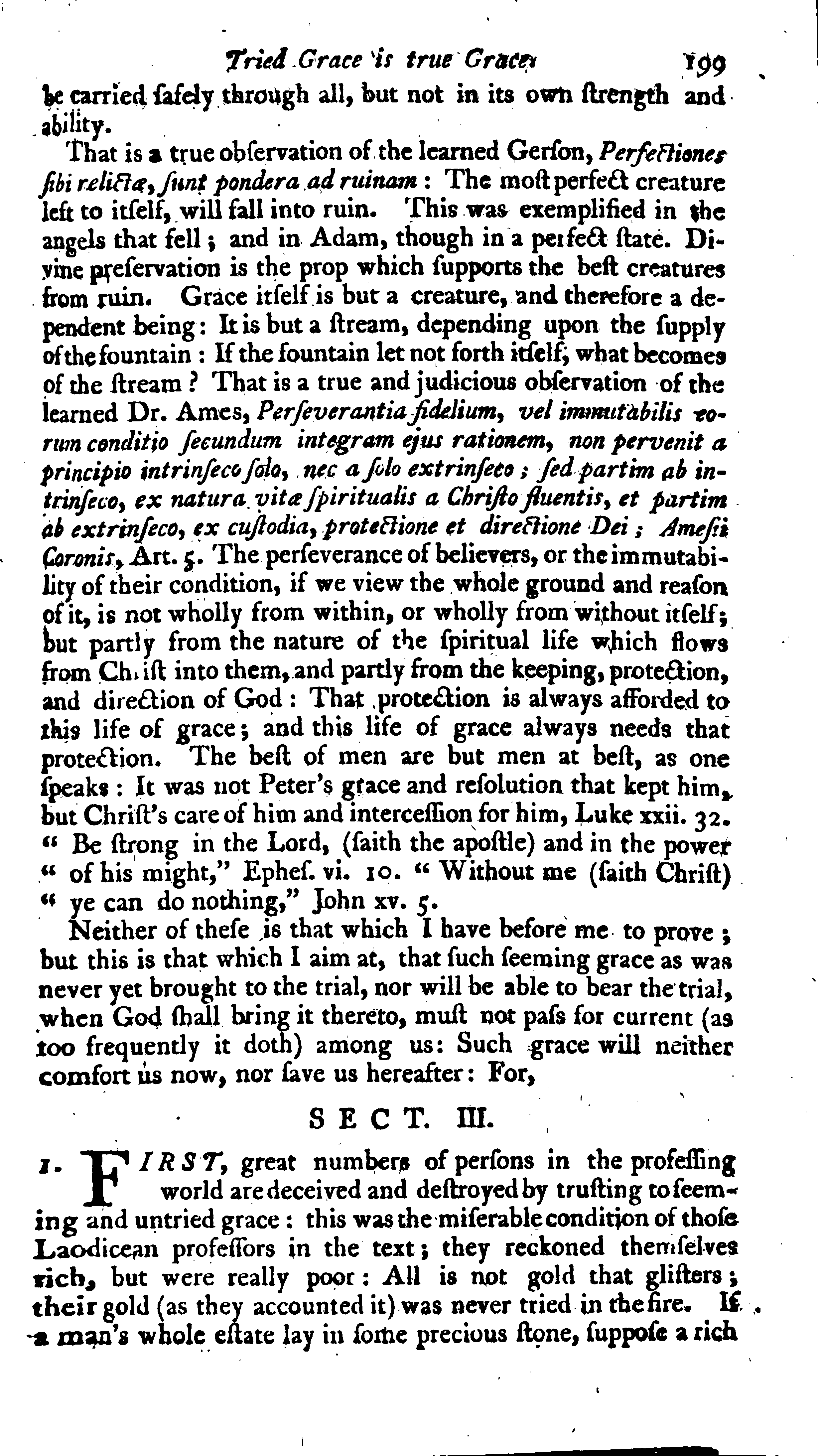
Tried Grace is true Graces 199 be carried safely through all, but not in its own strength and ability.
That is a true observation of the learned Gerson,Perfectiones fibirelicta,funt ponder a ad ruin am : The most perfect creature left to itself, will fall into ruin. This was exemplified in the angels that fell ; and in Adam, though in a perfect state. Divine preservation is the prop which supports the best creatures from ruin. Grace itself is but a creature, and therefore a dependent being: It is but a stream, depending upon the supply of the fountain: If the fountain let not forth itself,what becomes of the stream ? That is a true and judicious observation of the learned Dr. Ames, Perfeverantiafidelium, vel immutabilis eorum conditio fecundum integram ejus rationem, nonpervenit a principio intrinfecosolo, nec afolo extrinfeco ; fedpartim ab intrinfeco, ex natura vitæfpiritualis a Christofluentis, et partim ab extrinfeco, ex custodia, protectione et directione Dei ; Amefii Coronis,Art. 5. The perseveranceofbelievers, or theimmutabilityoftheir condition, if we view the wholegroundand reason of it, is not wholly from within, or wholly from without itself; but partly from the nature of the spiritual life which flows from Christ into them,and partly from the keeping,protection, and direction of God: That protection is always afforded to this life of grace; and this life of grace always needs that protection. The best of men are but men at best, as one speaks: It was not Peter's grace and resolution that kept him, but Christ's careofhim and interceffionforhim, Luke xxii. 32.
" Be strong in the Lord, (faith the apostle) and in the power " of his might," Ephef. vi. 10. " Without me (faith Christ) "ye can do nothing," John xv. 5. Neither of these is that which I have before me to prove ; but this is that which I aim at, that suchseeminggrace as was never yet brought to the trial, nor will be able to bear the trial, when God shall bring it thereto, must not pass for current (as too frequently it doth) among us: Such grace will neither comfort us now, nor fave us hereafter : For, SECT. III.
1.F
IRST, great numbers of persons in the professing world are deceived and destroyed by trusting to seeming anduntriedgrace: this was the miferableconditionofthose Laodicean professors in the text; they reckoned themselves rich, but were really poor : All is not gold that glifters ; their gold(as they accounted it)was never tried in the fire. If am an'swhole estate lay in some precious stone, suppose a rich
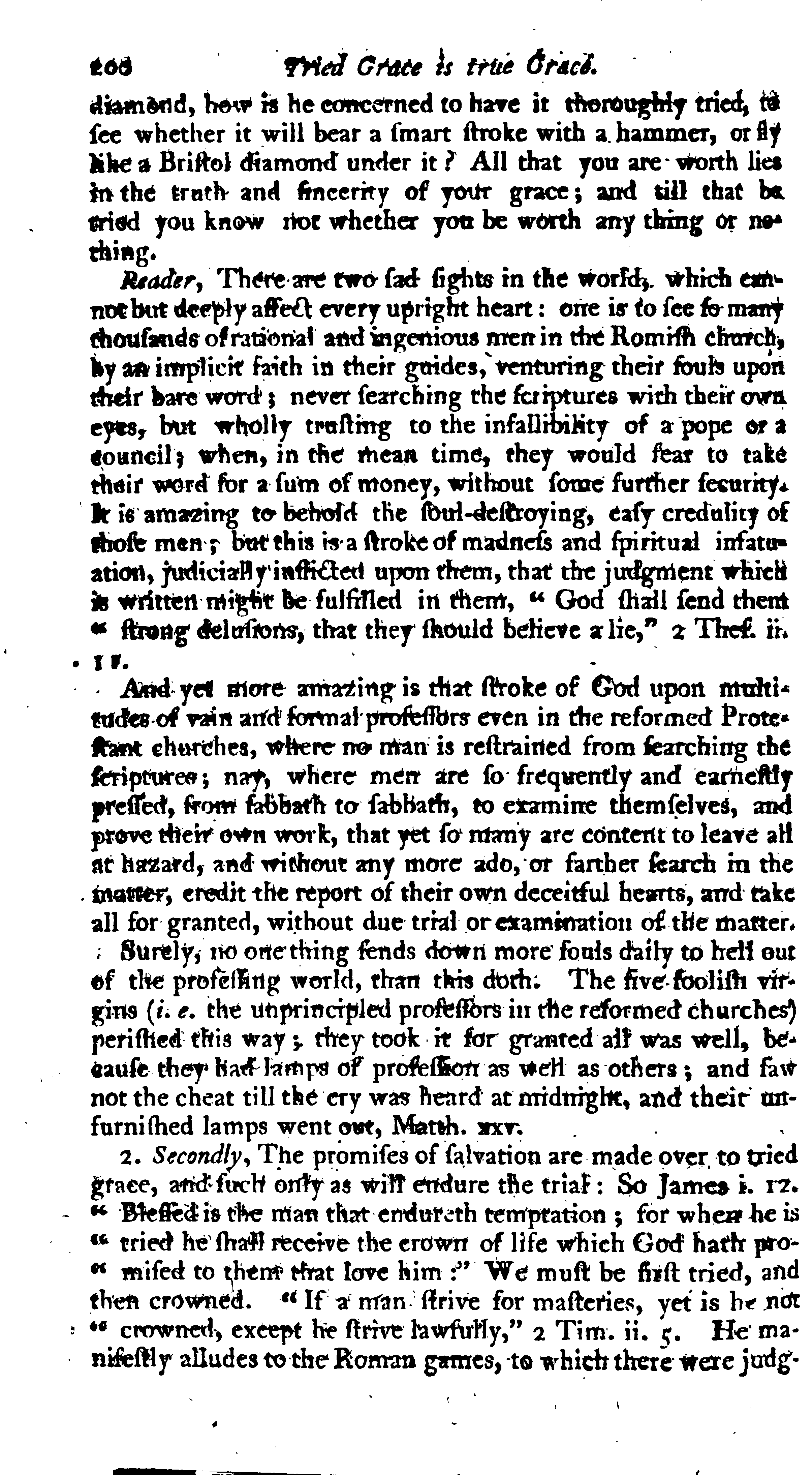
200 Tried Grace is true Grace. diamond, how i she concerned to have it thoroughly tried, to see whether it will bear a smart stroke with a hammer, or fly like a Bristol diamond under it ? All that you are worth lies in the truth and sincerity of your grace; and till that be tried you know not whether you be worth anything or no thing.
Reader, There are two fad fights in the world, which cannot but deeply affect everyuprightheart: one is toseefomany choufands of rational andingeniousmeninthe Romish church, by an implicit faith in their guides,venturing their souls upon their bare word; never fearchingthe scriptures with their own eyes, but wholly trusting to the infallibility of a pope or a council; when, in the mean time, they would fear to take their word for a sum of money, without some further security. It is amazing to behold the soul-destroying, easy credulity of thosemen; but this isa stroke of madness and spiritual infatuation,judicially inflicted upon them, that the judgment which iswrittenmight be fulfilled in them,"God shall send them " strong delusions, that they should believe a lie," 2 Thef. ii.
IV.
And yet more amazing is that stroke of God upon multitudesofvainand formal professors even in the reformed Prote-
churches, where noman is restrained from searching the scriptures; nay, where men are so frequently and earnestly pressed, from sabbath to sabbath, to examine themselves, and prove their own work, that yet so many are content to leave all at hazard, and without any more ado, or farther search in the matter, credit the report of their own deceitful hearts, and take all for granted, without due trial or examination of the matter.
: Surely, no one thing fends down more foulsdailytohell out of the profefling world, than this doth. The five foolish virgins (i. e. the unprincipled professors in thereformedchurches) perished this way; they took it for granted all was well, because they had lamps of profession as well as others ; and saw not the cheat till the cry was heardatmidnight, and their unfurnished lamps went out, Matth. xxv.
2. Secondly, The promises of salvation are made over to tried grace, and such only as will endure the trial: So James i. 12. "Bleffedis the man that endureth temptation; for when he is "tried he shall receive the crown of life which God hath pro- "mised to them that love him :" We must be first tried, and then crowned. "If am an strive for masteries, yet i she not : " crowned, except he strive lawfully," 2 Tim. ii. 5. He manifestly alludes to the Romangames, towhichtherewerejudg
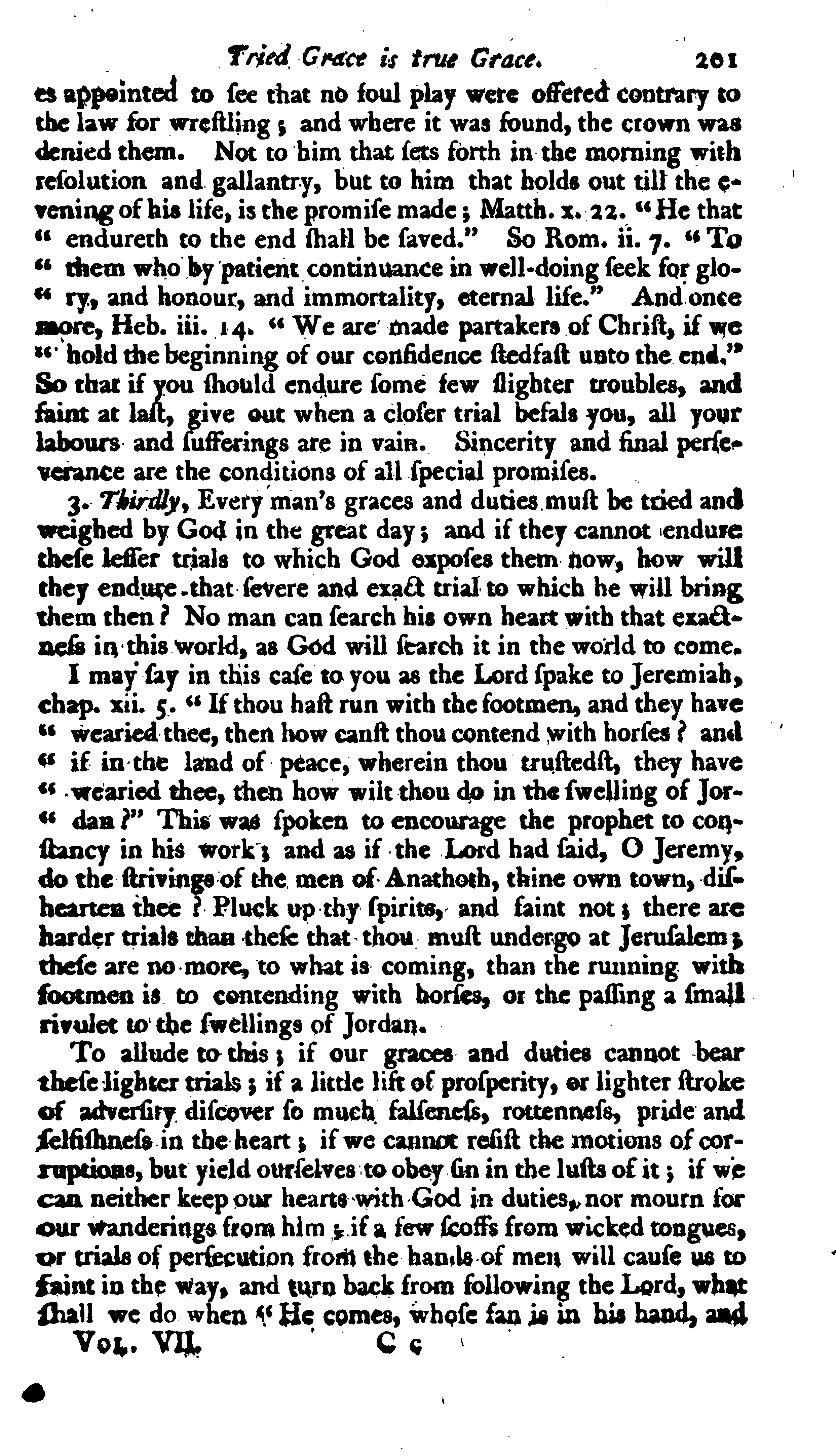
Tried Grace is true Grace. 201 esappointed to see that no foul play were offered contrary to the law for wresthng ; and where it was found, the crown was denied them. Not to him that sets forth in the morning with resolution and gallantry, but to him that holds out till the evening of his life, is the promise made ; Matth.x. 22. "He that " endureth to the end shall be saved." So Rom. ii. 7. " To " them who by patient continuance in well-doing seek forglo- " ry, andhonour, and immortality, eternal life." And once more, Heb. iii. 14. " We are made partakers of Christ, if we " hold the beginning of our confidence stedfast unto the end." So that if you should endure some few flighter troubles, and faint at last, give out when a closer trial befals you, all your labours and sufferings are in vain. Sincerity and final perseverance are the conditions of all special promises.
3. Thirdly, Every man's graces and duties must be tried and weighed by God in the great day; and if they cannot endure these lesser trials to which God exposes them now, how will they endure that severe and exact trial to which he will bring them then ? No man can search his own heart with that exactness in this world, as God will search it in the world to come.
in this case to you as the Lord spake to Jeremiah, chap. xii. 5. " If thou hast run withthefootmen, and they have " wearied thee,then how canst thou contendwithhorfes ? and " if in the land of peace,wherein thou trustedst, they have " wearied thee,then how wiltthoudo in the swelling of Jor- " dan?" This was spoken to encourage the prophet to constancy in his work; and as if the Lord had said, O Jeremy, do the strivings of the men of Anathoth,thine own town, difhearten thee ? Pluck up thy spirits, and faint not ; there are harder trials than these that thou must undergo at Jerusalem; these are no more, to what is coming, than the running with footmen is to contending with horses, or the passing a small rivulet to the swellings of Jordan.
To allude to this ; if our graces and duties cannot bear theselightertrials ; ifa little lift of prosperity, or lighter stroke of adversity discover so much falseness, rottenness, pride and selfishness in the heart ; if we cannot resist the motions ofcorruptions, but yield ourselves to obey sfininthe lusts of it ; if we can neither keep our hearts with God in duties, nor mourn for ourwanderings from him , ifa few scoffs fromwickedtongues, or trials of persecution from the hands of men will cause us to faintintheway, and turn back from following the Lord,what
we do when "He comes,whose fan is in his hand, and VOL. VII. C
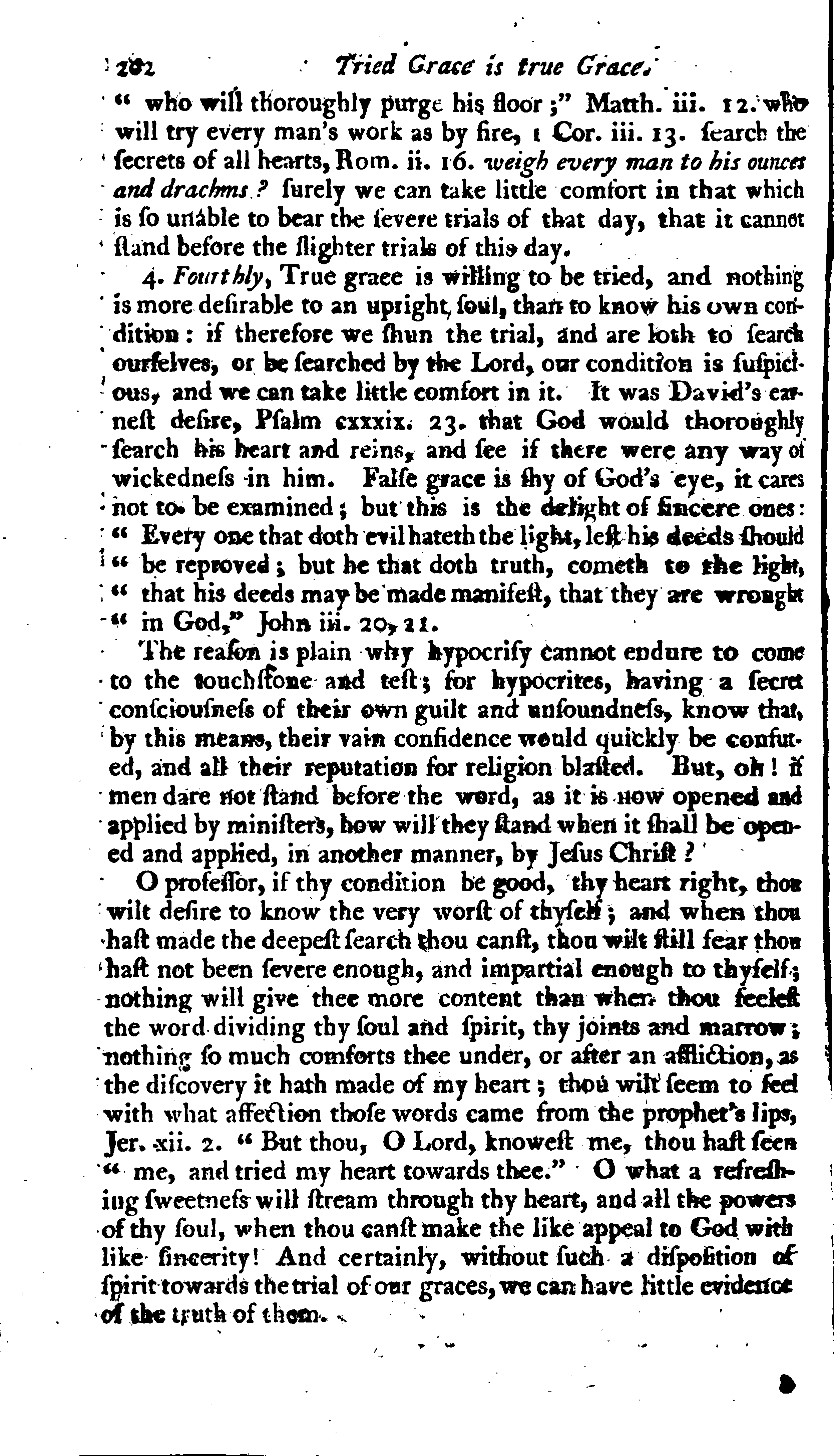
1202 Tried Grace is true Grace. *" who will thoroughly purge his floor ;" Matth. iii. 12.who will try every man's work as by fire, 1 Cor. iii. 13. search the secrets of all hearts,Rom. ii. 16. weigh every man to his ounces anddrachms ? furelywe can take little comfort in that which is so unable to bear the severe trials of that day, that it cannot * stand before the flighter trials of this day. 4. Fourthly, True grace is willing to be tried, and nothing ismoredefirable to an upright soul,than to know his own condition: if therefore we shun the trial, and are loth to search ourselves, or besearchedbythe Lord,our condition is suspicious, andwecantake little comfort in it. It was David's carneft desire, Psalm exxxix. 23. that God would thoroughly "search his heart and reins, and fee if there were any way of wickedness in him. False grace is thy of God's eye, it cares ⚫not to be examined; but this is the delightoffincere ones: " Every one that doth evilhateththelight,left his deeds should 1" be reproved ; but he that doth truth, cometh to the light, " that his deeds maybe made manifest,that they are wronght -" in God," John iii. 20, 21 .
The reason is plain why hypocrisy cannot endure to come to the touchstone and test; for hypocrites, having a secret consciousness of their own guilt and unfoundness, know that, by this means,theirvainconfidencewould quickly be confut. ed, and all their reputation for religion blasted. But, oh! if men dare not stand before the word, as it is now opened and appliedbyminifters,howwilltheystandwhen it shall be opened and applied, in another manner, by Jesus Christ ? Oprofeffor, if thy condition be good, thy heart right, thou wilt desire to know the very worst of thyself; and when thou haftmade the deepest search thou canst, thou wilt still fear thou haft not been severe enough,and impartial enough to thyself; nothingwillgive thee more content than when thou feelest the word dividing thy foul and spirit,thy joints and marrow; nothingsomuch comforts thee under, or after an affliction, as the discovery it hath made of my heart; thou wiltseem to feel with what affection those words came from the prophet's lips, Jer. xii. 2. " But thou, O Lord,knowest me, thou haftseen " me, and tried my heart towards thee." O what a refreshingsweetnesswill stream through thy heart, and all the powers of thy soul, when thou canstmake the like appeal to God with like sincerity! And certainly, without such a disposition of spirit towards the trial of our graces,we can have little evidence of the truth of them.
ParticularInferencesfrom the TrialofGrace. 203
CHAP. XI.
Containing divers practical instructive inferences from this doctrine ; with a serious exhortation to self-trial and thorough examination.
SECT. I. RE there such variety of trials appointed to Infer. 1.A examine the fincerityof mens graces ; how great a vanity then is hypocrisy, and to how little purpose do men endeavour to conceal and hide it ? We say, Murder will out; and we may as confidently affirm, Hypocrisy will out. WhenRebeccahad laidtheplot todisguiseherfon Jacob, and bypersonating his brother, to get the blessing, Jacob thus objects against it, " My father, peradventure, will feel me, " and I shall feemto him as a deceiver; and I shall bring a "curse upon me, and not a blessing," Gen. xxvii. 12. as if heshouldsay,but what if my father detect the cheat,how then
I look him in the face? How shall I escape a curse ? After the fame manner every upright foul scares itself from the wayofhypocrify. If I dissemble, and pretend to be what I am not, my Father will find me out. Ah 1 there is no darkness nor shadow of death that can conceal the hypocrite, but outitwillcome at last,let him use all the arthecan to hide it. OftentimesGoddiscovers him by the trials he appoints in this world; and men in that day shall" return anddifcern betwixt "the righteous and the wicked, between kim that ferveth "God, and him that serveth him not," Mal. iii. 18. But if hemakeanhard shift to get by a private way to hell, carrying this comfort with him to the last step, That nobody knows or thinks he is gone thither; yet there will be a day when God will strip him naked before the great assembly of angels and men, and all shall point at him, and say, Lo! this is the man that made not Godhishope. This is he that wore agarmentofprofession to deceive, but God hath now stript him out of it, and allmen seewhathe is: For, " There is nothing covered, that shall not be revealed, and hid, thatthall not be known," Matth.x. 26. And the apostle assures us, 1 Tim. v. 24, 25. "That they that are "otherwise, cannot be hid." If mensworks be not good, it is impoffiblethey shouldbehidlong: A gilded piece of bra is
CC2
204 Particular Inferences from the TrialofGrace. may pass from hand to hand a little while, but the touchstone will discover the base metal : If that do not, the fire will. O sinners ! away with your hypocrisy, be honest, sincere, plainandhearty in religion : If not, contufionofface shall be yourrecompence from the Lord ; that is what you shall get by it.
Infer. 2. Secondly, Are there such trialsappointedand permitted by the Lord for the discovery of his people's sincerity in this world ? Then let none of God'speopleexpectaquietstation in this world : Certainly you shall meet with noresthere, you must out of one fire into another; and it isa merciful condescension of the Lord topoorcreatures, thus toconcernhimself for their safety and benefit: "What is in an, that thou shouldst " magnify him ? and that thou shouldst set thine heart up- " on him? that thou shouldst visit him every morning, and " try him every moment ?" Job vii. 17, 18. O it is a great deal ofhonour put upon a poor worm, when Godwillevery moment try him and visit him ; it argues the great esteem the gold-smith hath of his gold, when he will fit by the furnace himself, and order the fire with his own hand; when he pries so often, and so curiously into the fining-pot, to see that none of his precious metal, upon which he sets his heart, be loft.
Think it not then adebasing to you to be so often exposed to trials. IfGoddid not value you highly, he would not try you so frequently ; What would become of you, ifyourconditionhere should be more settled and quiet than now it is? I believe you finddross enough in your hearts after all the fires into which God hath cast you: Surely there is filth enough in the best of God's people to take all this, it maybe a great deal moretroublethantheyhaveyet met with. We fancy it a brave life to live at ease; and if we meet with longer refpites and intervals of trial than usual, we are apt to say, We shall never be moved, as David did, Psal, xxx. 6. or we shall die in ourneft, as it is Job xxix. 18. Our hard anddifficultdays are over; but woe to us if God should give us the desire of our hearts in this. See whatthetemper of those mens spirits is, that meet with no changes, Psal. lv. 19. "Because they have " no changes, therefore they fear not God." O it is better to be preserved sweet inbrine, than to rot in honey !
Infer. 3. Thirdly, Let none boast ina carnal confidence of their own strength and stability. You are yet in a state of trial: Hitherto God hath kept you upright in all your trials ; bless God, but boast not ; you are but feathers in the wind of
Particular Inferences from the Trial of Grace. 205 temptation, if Godleaveyou to yourselves. PetertoldChrist, (and doubtless he spoke no more than he honestly meant) " Though all men forsake thee, yet will not I:" And you know what he did when the hour of his trial came, Matth. xxvi. 35. Angels left to themselves have fallen: It is better tobeanhumble worm, than a proud angel. Ah! how many Pendletons will this professing age shew, if once Godbringus to the fiery trial ? " Let him that thinks he " stands, take heed lest he fall." You have not yet resisted unto blood, striving against sin. None stand upon firmer ground than those that fee nothing in themselves to stand upon; hethatleans uponhisownarm, usuallybenumbs it, and makes it useless .
Infer. 4. Fourthly, Doth God kindle somanyfires in Sion, and set his furnaces in Jerusalem, to discover and feparatethe dross from the gold? How contrary are those men to God, that allow, yea, and prize the dross ofhypocrify, which God hates, and stick not to make the holy God a patronifer, and countenancer of it in the hearts and livesofmen ?
It is amazing to read what popish pens have impudently writtenaboutthis matter : * Sylvester puts the question, Whether it be a finto make a false shew of sanctity ? And answers it thus: I fit be for the honour of God, and profit of others, it is no fin. Nay, they have a reverence for hypocrisy, as an holy art. Vincent i us spends a whole chapter in commendation of the hypocrisy of St. Dominic, and entitles it, Defancta ejushypocrifi; i. e. of the holy hypocrisy of that saint ; reckoning it among his commendations, that he had the artofdifsembling. And yet,one peg higher, a religious person (faith † another) that feigns himself to have more holiness than he hath, that others maybe edified, fins not, butrathermerits.
Blush, O heavens ! that ever such factors for hell should openandvendfuch ware as this in the public market, and invitetheworld to hypocrisy, as that which makes for the glory of God, the edification of men, and a work meritorious in the hypocrite himself: This is the doctrine of devils indeed !
Infer. 5. Fifthly, If it be so, that allgracemust come to the test, and be tried as gold in the fire, eveninthisworld ; how areallmenconcerned to lay a solid foundation at first, and thoroughly deliberate the terms upon which they close with Christ,and engage in the profession of his name ? " Which of "you,(faith Christ)intendingtobuildatower, sittethnotdown
Afum advfimulatio, n. 4. ↑Rosella in v. hypacrisis,n.1.
206 AJeribus Exhortation to Self-examination. "first, and counteth the cost?" Luke xiv. 28. If some mert hadsetdown at first, and pondered the conditions and terms of Christ, they had not fat down now discouraged, and tired in the way. The apostle Paulwent to work at another rate; he accounted allbutdung and dross for Christ, Phil. iii. 8. and was of the same mind when the actual trial came; for then he tells us, " He counted not his life dear unto him," Acts xx. 24. And the apostle Peteradmonishes believers " not to think "it strangeconcerningthe fiery trial which was to try them,"
1 Pet. iv. 12. q.d. Let none of these things be surprisals to you; you are told before-hand whatyoumust trust to ; every Christian must bea martyr, at least inthedispositionand resolution of his heart. Othat menwouldbalance the advantages and disfadvantages of religion, and thoroughly ponder the matter in their deepest thoughts ! To the test you must come; the rain will fall, and the storm beat upon your buildings; look carefully therefore to the foundations.
Infer. 6. Sixthly, and lastly, Learn from this pointtheunavoidableness of scandals and offences in the way of religion ; for if there be a necessity of trial, there is also a necessity of scandal. " Itmustneeds be that offences come," Luke xvii.
1. Why, must it needs be ? The reason is evident ; all must come to the trial, and all are not able to bear it. Our Lord tells us, Matth. xxiv. 8, 9, 10. of a day of great straits and perplexitycoming: " And then (faith he) shall many be of- " fended." The dayoftrial is the day of scandal : By these offences some are put a searching themselves, and some fall a cenfuring all others; but the holy God brings about his end both ways in them that are saved, andinthemthat perish. W
SECT. II. ELL then, ifitbeso that all must into the furnace, leteverymantry his own work ; examine yourselves, professors, search your hearts, commune with your reins, nothingmoreconcerns you in all the world than this doth. O that you wouldbemore in your closets, and oftner upon your knees ! O that youwouldlook into the Bible, then into your hearts, and then to God, saying, with David, " Search me, " OGod, and know my heart; prove me, and try my reins, " and see if there be anyway of iniquity in me !" Never did religion thrive in the world sincemens heads have been so overheated with notions and controverfies, and their hearts to
Aferious Exhortation to Self-examination. 207 fenfiblycooledintheircloset-work. I have elsewhere ‡ more largely pressed this duty upon the professors of this generation, and thither shall refer the reader for the present, to seethe neceflityand importance of this work.
Here Ishallonlyurge the dutyoffelf-trial bysomepreffing motives, and awakening considerations.
Motive 1. And the first shall be, the exceeding difficulty of this work; difficulty insomecases maybe adiscouragement ; butwhere the matter is of absolute necesslity, as it is here, nothing provokes more to diligence;" Strive (faith our Lord) to " enter in at the strait gate, for many will seek to enter in, " and shall not be able," Luke xiii. 24. A double difficulty ' is found attending this work offelf-trial: Difficulty in bringing the heart to it ; and difficulty in the right and successful management of it. Who finds it not hard to persuade his heart to such work as this ? Nature declines it, flesh and blood relish it not: It isone of the great feverities in religion : It is no easy thingtobring am an and his own heart together. Itisinthis case, as inthestudyof geography ; we are more inquisitive to know, anddelightedwhenwe discover, the rarities of foreign countries, and strange things in the remote parts of the world, than those of our own native country. I fear there bemanyprofeffors of religion that can spenddayafter day in hearing, and love to be disputing fruitless controverfies, that never spentoneday in searching what influence all those sermons they have heard have had upon their hearts, orinrightlyftating anddeterminingthatgreat controversy, in whose right and possession their foulsare, andwhichwaythey
goas soon as death hathdividedthem from those mortal bodies ; yea, I doubt, many sinful hours are spent in prying into, reporting andcensuring the failings of others, and not one hour faithfully employedinjudging their own hearts before the Lord: Oh ! men had rather be about anyotherwork than this , there is no pleasure in it to the flesh.
And yet how difficult soever it be to bring our hearts to the work, it is certainly much moredifficultto manage it successfully, and bring the great question of our sincerity to a clear result and issue. O how many upright hearts have fat close tothisworkmanyayear, and lifted up many a cry to heaven, andshedmanyfecret undissembledtears about it; and yet sti'l are in the dark, and their minds greatly perplexed, and filled with fear about it! What would they not do ? What would ‡ See before, my Saint Indeed, .
208 Aferious Exhortation to Self-examination. they not suffer?What pleasant enjoymentwouldtheynotgladly part with, to arrive at the desire of their souls, thefullafsurance of their sincerity? It was the saying ofa pious woman, I have born faidshe, seven children,and they have cost me as dear as ever children cost a mother, yet I would be content to endure all that sorrow over again, to be assured of the love of God to my foul.
Motive 2. Secondly, And as the work is fullofdifficulty, fo the discovery of your sincerity will be full of sweetness and joy unspeakable: Itwillneverrepentyou, that you have prayedandmourned, that you have trembled and feared, that you have searched and tried :1: Nay, it will never repent you, that God hath tried you by thousands of sharp afflictions and deep
if, after all, your finceritymaybe fully cleared up to the satisfaction of your souls ; for in the same day your sincerity shall be cleared, your title to Christ will be made as clear to your souls as your sincerity is; you may then go to the promises boldly, and take your own Christ into the arms of your faith, and say, " My Beloved is mine, and I am his!" Yea, you may be confident, it shall be well with you in the judgment of thegreatday, for"God will not cast away the "uprightman," Job viii. 20. If the word clear you now, it cannot condemn youthen. Owhat an ease is it to the soul, when the fears and doubts that hang about it are gone !When a man sees what he is, and whathehath in Christ and the promises, and what he hath to do; even to spend the time betwixt this and heaven, in admiring the grace of God that hath delivered him from the ruining mistakes and miscarriages by which so great a part of theprofeffing world to all eternity.
Motive 3. Thirdly, The deep concernment of your souls in themattertobe tried, should awaken you to the utmost diligence about it. The trials of men for their life, at human bars, is but a trifle to this : It is your eternal happiness that stands or falls with your sincerity.
It is said in the trial of opinions, that if am an superstruct hay or stubble upon the foundation, he shall suffer loss ; yet hehimselfmaybe saved, 1 Cor. iii. 12. But if hypocrisy be in the foundation, there is no such relief,there is no possibility of salvation in that case.
Ah,reader, thou must be cast for ever according to the integrityorhypocrify of thy heart with God. Summon in then all the powers of thy foul: bringthythoughts as close as it is poffibletobringthemtothis matter: If there be anyfubject of con
Aferious Exhortation to Self-examination. 209 fideration abletodrinkupthefpirits of am an,here it is : Never was time put to an higher improvement; never were thoughts
than this is : Happy is the man that rescues the years, months, days, yea, the very moments of his life from otheremployments toconfecratethem unto this solemn, awful, and most important business !
Motive 4. Fourthly, How evidential will it be of your fin cerity, when you are willing to come to the trial of your own hearts?
doubtsandfears should infomedegree remain with you , yet in this you may take some comfort, that ifhypocrifybe in your heart, it is not thereby consent: You are not loth torife and come to trial, because, like Rachel, you fit upon your idols: Certainly it is a good sign thy heart is right,when it is filled with fomuch fear lest it should be false. You know all the disciples said, " Master, is it I ?" before Judas,who was the traitor, spake a word. " Last of all(faith the **text) Judas said, Is it I ?" Our willingness to be tried, is a good sign that the desire of our soul is to be right with God.
Motive 5. Fifthly, Conclude it to be your great advantage to be thoroughly tried, whatever you be found to be in the trial: If you be found sincere, you are richly rewarded for all your pains and labour: Neverdidthat man repentofdigging and toiling,thatafterallhit upontherichvein that hedigged for: What is avein of gold to a veinoffincerity!
If upon fearchyou find the contrary, afalfe,hypocritical, unfoundheart, yet in that very fad discovery you meet with the greatest advantage that ever you had in your lives for salvation. This discovery is your great advantge: For now your vain confidence being over-turned, and your ungrounded hopes destroyed ; you lie open to the stroke of a deep and effectual conviction of your fin and misery,which istheintroductive mercy to all other mercies to your souls; and surely till you come to that, to give up your false hopes, and quit your vain pretensions, there is no hope of you. Chrifttold the Pharifees, Matth. xxi. 31. Publicans and harlots enter intothekingdom of heaven before you : Publicans were the worst sortofmen, and harlotsthe worst fort of women, and yet they stood in a fairer way for heaven than the hypocritical Pharifees, because conviction had easier access to their confeiences :They had not thosedefences andpleas of duty and strictness towardoffthe word, that the self-cozening Pharifees had.
of your vain and groundless hopes, as Christ, in VOL. VII. Dd
210 Rules to be observed in the Trials of Grace, another sense, said to the officers that came to seize him in the garden, If you seek me, let thesego their way. So it is here, if you expect Christ, and salvation by him, let your vain confi. dences go their way; away with your masques and vizards, if ever you expect to see Christ. O it is your happiness to have all these things stript off, and your nakedness and poverty discovered, that you may be rich, as the text speaks.
Motive 6. Sixthly, Confider how near the day of death and judgment approach you. O these are searching days wherein you cannot be hid: Will your consciences, think you, be put off in a dying day as easily as they are now ? No, no, you know they will not.
I have heard of a good man that consumed notonlythegreatest part of the day, but a very considerable part of the night also in prayer, to the great weakening of his body; and being asked by a relation whyhedid so, and prayed to favour himself, he returned this answer, O I must die, I must die ; plainly intimating, that so great is the concernment of dying in a clear assured condition, that it is richly worth the expence of all our time and strength to secure it.
You know also that after death the judgment, Heb. ix. 27. you are hastening to the judgment of the great and terrible God, Death will put you into his balance to be weighed exactly ; and what gives the soul a louder call to search itself with all diligence, whilst it stands at the door of eternity, and its turn is not yet come to go before that awful tribunal : O that these considerations might have place upon our hearts !
CHAP. XII .
Containing divers helps for the clearing offincerity, and discovery of hypocrisy. Y
SECT . I. OU fee of what importance the duty of self-examination is, and how many things put a necessity and a solemnity upon that work. Now, in the close of all, I would offer you some helps for the due management thereof, that is as far as I can carry it; the Lord persuade your hearts to the diligent and faithful application and use of them. The general rules to clear sincerity are these that follow : Rule 1. We may not presently conclude we are in the state of
Rules to be observed in the Trials of Grace. 211 hypocrisy, because wefindsome workings of it, and tendencies to 't in ourfpirits : The best gold hath some dross and alloy in it.' Hypocrifyis a weed naturally springing in all ground, the best heart is not perfectly clear or free of it: It may be we are stumbled, when we feel some workings or grudgings of this disease in ourselves, and looking into such scriptures as these, John i. 47. " Behold an Ifraelite indeed, in whom there is no " guile:" and Psal. xxxii. 1. " Blessed is the man unto whom " the Lord imputeth not iniquity, and in whose spirit there is no guile." «
This I saymaystumblesome upright foul,not understanding in what an allayed and qualified sense those scriptures are to be understood : For by afpirit without guile, is not understood aperfon absolutely free from all deceitfulness, and falfeness of heart ; this was the sole prerogative of the Lord Jesus, who was separated from sinners, in whose mouth was no guile found: In whom the prince of this world, in all his trials and attempts upon him, found nothing: But we must understand it of reigning and allowed hypocrisy; there is nosuchguile in any of the saints : distinguish the presence from the predominance ofhypocrify,and the doubt is resolved.
Rule2. Every true ground ofhumiliationforfin, is not afufficient groundfordoubting and questioning our estate and condition.
There be manymorethings to humble us upon the account of our infirmity, than there are to stumble us upon the account of our integrity: It is the fin and affliction offomegood fouls tocalltheircondition in question, upon every flip and failing in the course of their obedience. This is the waytodebarourselves from all the peace and comfort of the Christian life : We find that Joseph was once minded to put away Mary his espousedwife, not knowing that the holy thing which was conceivedinherwasby the holy Ghost. It is the fin of hypocrites to takebrafs for gold, and the folly of faints to call their. gold brass: Be as severe to yourselves as you will, always provided you be just: " There is that maketh himself rich, and " yet hath nothing; and there is that maketh himself poor, " and yet hath great riches," Prov. xiii. 7. Hiram called the cities Solomon gave him, Cabul, Dirty, for they pleased him not, I King six. 13. It is but an ill requital, an ungrateful return to God for the best of mercies, to undervalue them in our hearts, and be ready upon alloccafions to put them away as worth nothing Dd2
212 Rules to be observed in the Trials of Grace. Rule 3. Aftronger propenfion in our nature, and more fre quent incidence in our practice to onefin than another, doth not presently infer ourhypocrify, and the unfoundness of our hearts in religion. It is true,every hypocrite hathsomewayofwickedness: Somepeccatum in deliciis, iniquity that he delights in and rolls as a sweet morsel under his tongue, some luftthathe is not willing to part with, nor can endure that the knife of mortification should touch it; and this undoubtedly argues the infincerityand rottenness of his heart : And it is true, also,that the nature and constitution of the most sanctified man inclines him rather to one fin, than to another, though he allow himself in none; yea, though he set himself more watchfully against that sin than another, yet he may still have more trouble and vexation, more temptation and defilement from it,thananyother. As every man hath his proper gift, one after this manner, and another after that, as the apostle speaks, 1 Cor. vii. 7. so everymanhath his proper fin also,one after this manner, and another after that ? For it is with original fin, as it is with the juice or sap of the earth, which though it be the common matter of all kinds of fruits, yet it is specificated according to the different forts of plants and feeds which it nourishes ; in one it becomes an apple, in another a cherry, &c. Just so it is in original corruption, which is turned into this or that tempt at i on, or fin, according to this or that constitution, or employment it finds us in; in one it is passion, in another lust, ina third covetousness, in a fourth levity, and so on. Now I fay the frequent assaults of this fin, provided we indulge it not, but, by setting double guards, labour to keep ourselves from our own iniquity, as as Daviddid, Psalm xviii. 23. will not infer the he hypocrily of our hearts, Rule4.A greater backwardness and indisposedness to onedu ty rather than another, dath not conchide the heart to be unsound, and false with God, provided we do not inwardly dislike and disapprove any duty of religion, or except against it in our agreement with Christ, but that it riseth merely from the present weakness anddistemper we labour under.
There are some duties in religion, as suffering for Christ, bearing sharp reproofs for fin, &c. that even an upright heart underapresent distemper, may find a great deal ofbackwardness and lothness to ; yet still he consents to the law, that it is good, is troubled that he cannot comply more chearfullywith his duty, anddefûres to stand complete in all the will of God: Perfection is his aim,and imperfections are his sorrows.
Rules to be observed in the Trials of Grace. 213 Some Christians have much ado to bring their hearts to fixed, solemn meditation ; their hearts fly off from it, but this is their burden, that it should be so with them. True, it is a very dangerous sign of hypocrisy, when a man's zeal runs out inonechannel of obedience only, and he hathnotrefpect to all
God's commandments ; as physicians observes, the sweating of one part of the body, when all the rest is cold, is symptomatical, and argues an ill habit : But whilst the soul heartily approves all the will of God, and sincerelydefires to come up to it, and mourns for its backwardness, anddeadness, to this or that duty, and this is not fixed, but occasional, under some present indisposition, out of which the soul riseth by the same degrees as fanctification riseth in him, and the Lord comes in with renewed strength upon him ; this, I say, may consist, and is very ordinarily found to be the case of upright-hearted ones.
Rule 5. The glances of the eye at self-ends in duties, whilst self is not the weight that moves the wheels, theprincipalendand design we drive at, and whilst thase glances are corrected, and mourned for, do not conclude the heart to be unsound, and bypecritical in religion : For even among the most deeply sanctified, few can keep their eye so steady and fixed, with pure, and unmixed respects, to the glory of God, but that there will be (alas! too frequently) some bye-ends, insinuating and creeping intotheheart.
like the fowls, seize upon the sacrifice, let the soul take what pains it can to drive them away : It is well that our High-priest bears the iniquities of ourholythings for us. Peter had too much regard to the pleasing of men, and did not walk with that uprightness towards the Gentile Christians, and the believing Jews, in the matter of liberty, as became him, Gal. ii. 13, 14. for which, as Paul faith, he ought to be blamed, and he did blame him: But yetfuchafailing as that in the end of his duty, did not condemn him. In public perform an ees there may be too much vanity, in works of charity too much oftentation; these are all workings of hypocrisy in us, and matters of humiliation to us; but whilst they aredisallowed, corrected, and mourned over, are confiftentwithintegrity.
Rule 6. The doubts and fears that hang upon, and perplex our spirits about the hypocrisy of our hearts, do not conclude that therefore we are what we fear ourselves to be. God will not condemn everyone for a hypocrite that suspects, yea, or charges himself with hypocrisy. Holy David thoughthisheartwas not right with God, after that great flip of his in the matter of Uriah; and therefore begs of God to renewaright spirit in
214 Heart-founding Questions. him, Psal. li. 10, 11, 12. his integrity was indeed wounded, and he thought destroyed by that fall.
Holy Mr. Bradford fo vehemently doubted the sincerity of his heart, that he subscribed some of his letters, as Mr. Fox tells us, John Bradfordthehypocrite ; a very paintedfepulchre: And yet in so saying, he utterly misjudged the state and temper of his own soul. W
SECT. II. TELL ELL then, let not the upright be unjust to them-
incenfuring their own hearts; they are bad enough, but let us notmakethem worse than they are, but thankfully own, and acknowledge the least degrees of grace and integrity in them; and possibly our uprightness might be sooner discovered to us, if, in a due composure of spirit, we would fit down, and attend the true answers of our own hearts to such questions as these are.
Quest. 1. Do I make the approbation of God, or the applause of men, the very end and main design of my religious performances, according to Theff. ii. 4. Col. iii. 23. will the acceptationof my duties with men fatisfyme, whether God accept my duties and períon, or not ?
Quest. 2. Is it the reproach and shamethatattends fin at present, and the danger and misery that will follow it hereafter, that restrains me from the commission of it ? Or is it the fear of God in my foul, and the hatred I bear to fin as it is fin ? ac cording to Psal. xix. 12. and Psal. cxix. 113.
Quest. 3. Can I truly and heartily rejoice to see God's work carried on in the world, and his glory promoted by other hands, though I have no share in the credit and honour of it, as Paul did? Phil. i. 18 .
Quest. 4. Is there no duty in religion so full of difficulty and self-denial, but Idefire to comply with it ? And is all the holy and goodwill of God acceptable to my soul, though I cannot rise up with like readiness to the performance of all duties; according to that pattern ? Psal. cxix . 6.
Quest. 5. Am I fincerelyrefolvedto follow Christandholiness at all seasons, however the aspects of the times maybeuponreligion ? Or do I carry myself so warily and covertly as to shun all hazards for religion ; having a secret reserve in my heart to launch out no farther than I may return with safety; contrary to the practice and resolution of upright fouls ? Psalm cxvi. 3. Psal. xliv. 18, 19. Rev. xxii. 11.
Rules to be observed in the Trials of Grace. 215
Quest. 6. Do I make no conscience of committing secret fins, or neglecting secret duties ? Or am I conscientious both in the one and other, according to the rules and patterns of integrity ? Matth. vi. 5, 6. Píal. xix. 12. Afewsuchquestions solemnlypropounded to our own hearts, in a calm and serious hour, would found them, and discover much of their sincerity towards the Lord.
SECT. III . ND as upright hearts are too apt to apply to themselves the threats and miseries of hypocrites, so hypocrites, on the contrary, are as apttocatch hold of the promises and privileges pertaining to believers. To detect therefore the soul-damning mistakes of such deceived fouls, O that these following rules might be studied, and faithfully applied to their conviction and recovery.
Rule 1. It is not enough to clear a man from hypocrisy, that he knows not himself to be an hypocrite. All hypocrites are not designing hypocrites; they deceive themselves as well as others : 66 Many will tay tome in that day, Lord, have we not prop he- " fied in thy name," &c. Matth. vii. 22. Hell will be a mere furprizal to multitudes of professors : am an may live and die in a blind, ungrounded confidence of his safe condition, and not fear his ruin, till he begins to feel it.
Rule 2. Zeal and forwardness in the cause of God, and for the reformation of his worship, will not clear a man from the danger of hypocrisy. Jehu was a zealous reformer, and yet but a painted sepulchre. In the year 1549, reformation grew fo much in reputation, even among the nobles and gentry in Ger. many, that many of them caused these five letters, V. D. M. I. Ae. being the initial letters of these words, Verbum Do mini manet in aeternum : i. e The word of the Lord abideth for ever, to be wrought, or embroidered, or set in plates, some upon their clokes, and others upon the sleeves of their garments ; tothew to all the world, faith * my author, that forsaking all Popish traditions, they would now cleave to the pure doctrine and discipline of the eternal Word.
And no doubt they would have been as good as their word, if what was embroideredontheirclokes,had beenengraven on their hearts ; but, Come, see my zeal, mars all.
Rule 3. It is nofufficient evidence ofa man'sown integrity, that * JohnWolfe, Left. Memor. Tom. 2. ad An no 1549.
216 Heart-founding Questions. he hates hypocrifyinanother : for, as oneproudmanmayhatea not her, and he that is covetoushimself, will be apt tocenfure another for being so; lusts maybe contrary to one another, as well as all of them contrarytograce; so may an hypocrite loath that in another, which yet he alloweth in himself : Nay, it is the policy of some todeclaim against the hypocrifyof others, thereby tohidetheirown. Hypocrites are none of the most modest cenfurers of others, Psal. xxxv. 16. Afalt jest seasoned their meat.
Rule 4. Themereperformance ofprivatedutieswillnot clear a man from hypocrisy. The influence of education, or support of reputation, or the impulse ofaconvincedconfciencemayinduce am an to it; and yet all this while his heart may not be carried thither with hungry and thirstydefires after God : it is not the matter of any duty that distinguishes the found and unsound professors; but the motives, designs, and ends of the soul in them.
Rule 5. Thevogueand opinionsyouhavegotamong Christians, ofyourfincerity, will not be sufficient to clearyoufrom the danger of hypocrisy. Christ tells the angel of Sardis, Rev. iii. r. "Thou hast a name that thou livest, andartdead." The fall of Hymeneus and Philetus,couldneverhave fhakenthe faith of the faints as it did,had they not had great credit in the church, and beenmen of renown for piety among them.
Rule 6. Your respects and love to them that are the sincere anduprightfervants of God, will not clear you from the danger of being hypocritesyourselves : for thebareloving ofa Christian is not characteristicalandevidential of am an'sown Christianity, except he love him, qua talis, as he is a Christian, or ashe belongs to Christ ; and so his finceritybecomes the attractive of thy affection. There are a thousand by-considerations, and respects, that may kindle a man's love to the saints, besides their integrity. SECT. IV. WELL, then, if thou wouldst indeedseetheunfoundness of thy own heart, propound such heart-founding questions as these, tothytelf.
Quest. 1. Do I engage my heart toapproachunto God in the course of my duties ? Or do I go in the round of duties, taking no heed to my heart in them ? If fo, compare this symptom of thy hypocrisy with that in 2 Kings x. 3. and that in Ezek. xxxiii. 31, 32.
1 Quest. 2. Am I not swayed and moved by self-interest and Carnal respects in the ways of religion, the accommodation of somewordly interest, or getting a name and reputation of godliness ? If so, how apparently do the same symptoms of hypocrisy appear upon my soul, which did upon Judas, John xii. 6. and on Jehu, 2Kings ix. 13, 14. Quest. 3. Have I not some secret reserves in my heart, notwithstanding that face and appearance of zeal which I put on ? Certainly if there be any sin that I cannot part with, any suffering for Christ which I resolve against in my heart; I am none of his disciples, my heart is not right with God, the searcher of hearts himself being Judge, Luke xiv. 26, 27.
Quest. 4. What conscience do I make of secret fins ? Do I mourn for a vain heart, wandering thoughts, spiritual deadness ? And do I conscientiously abstain from the practice of secret fins, when there is no danger of discovery, no fear of forfeiting my reputation by it ? Is it God's eye, or man's, that awes me from commission of fin ? Certainly, if I allow myself in secret fins, I am not of the number of God's upright people, whose spirits are of a contrary temper to mine, Psal. cxix. 113. and Plal. xii. 12.
SECT. V.
I Will shutupallwith five or fix concluding counsels, (which the Lord impress upontheheartofhim that writes, and those that shall read them) to preserve and antidote the soul against the dangerous insinuation and leavenof hypocrisy.
1. Intreat the Lordnightandday, for a renewed and right spirit. All the helps and directions in the world will not antidote and preserve you from hypocrisy, nothing will be found able tokeepyou right, till fanctification hath first set you right. Ezek. xxxvi. 27. " I will put my Spirit within you ; and cause " you to walk in my statutes." A bowl may keep bya strait line, so long as the impressed force of thehandthatdelivered it remains strong upon it; but as that wears off, so its motions fail, and its own biass sways and turns it. A fright of conscience, a pang of warm affection, or the influence of some great example, or a good education, may influence anunrenewed foul, and push it on in the way of religion for a season ; but the heart so influenced, must, and will return to its own natural course again. And I think there wants nothing but time, or a suitable temptation, todifcaverthetrue temper of many a professor's spirit : pray, therefore,
VOL. VII. Ec
218 Necessary Counsels to all Professors. asthatholyman did, Psal. cxix. 80. " Let my heart be found " in thy statutes, that I be not ashamed."
2. Always suspect and examine your ends inwhatyou do. Sincerity and hypocrisy lie much in your ends and designs ; as they are, so are you. The intentions of the heart lie deep; amanmaydothe same action to an holy end, and his person and service be accepted with God; which another doing for a corrupt end, it maybe reckoned his fin, and both his person and service beabhorredbythe Lord. We find twomenriding in one chariot, and both of them concerned in the fame expedition, Jehu, the son of Nimshi, and Jonadab, the son of Rechab, 2 Kings x. 15, 23. But though the work they engaged in was one, and the fame, yet the different ends they aimed at, made the fame action an excellent duty in Jonadab, and an act of vile hypocrisy in Jehu: Idem quodduo faciunt, non eft idem : It was the saying of agoodfoul, commended for a good action : the work indeed is good, but I fear the ends of it. Self ends are creeping, andinfinuatingthings into the belt actions.
3. Scare yourselves with the daily fears of the fin that is in, and the misery that will follow hypocrisy. Look up. on it as the most odious fin in the eyes of God and men : to want holiness, is bad enough, but to diffimulate and pretend it, when we have it not, is double impiety: to make religion, the most gloriousthing in the world, a mere stirrup to preferment, and a covert to wickedness : O how vile a thing is it! God made Christ a sacrifice for fin, and the hypocrite will make him a cloak for fin.
And as to the punishments that follow it, they are suitable to the nature of the fin; for as hypocrisy is out of measure sinful, so the rewardandpunishment of it will be out of measure dreadful. Matth. xxiv. 51. " He shall cut him asunder, and appoint " him his portion with hypocrites; there fhallbeweeping and gnashing of teeth." Counsel 4. Be daily at work in the mortification of those lusts that breed bypocrify. It is plain, without much sifting, that pride, vain-glory, self-love, and awordly heart, are the feeds out of which this cursed plant springs up in the souls of men. Dig but to the root, and you shall certainly find these things there; and till the Lord help you to kill and mortify these, hypocrisy will spring up in all your duties to God, and in all your converfes withmen. 1 Counsel 5. Attend the native voice of your own consciences in the day offickness, fear or trouble, and take special notice of its
Necessary Counsels to all Professors. 21.9 -checks, or upbraidings, which, like a Aitch in yourfide, will gird you at such times : Commonly in that lies your greatest danger : Beware of that evil which conscience brands and marks at such times, whether it be your living in the practice of some secret fin, or in the neglects of some known duty : These frights of conscience mark out the corruption, wherein your danger mostly lies.
6. Let us all that profess religion he uniform andfleadyin the profession and practice of it, without politic reserves, and bye-ends. O take heed of this Laodicean neutrality and indifferency which Christ hates: Be sure your ground be good, and then be sure you stand your ground. The religion of time-servers isbuthypocrify: They have sluices in their consciences which theycanopenor shut as occasion requires : Every fox will have at least two holes to his den, that if one be stopt, he may e-
the other. The hypocrite poseth himself so evenly in a mediocrity, that, as it is said of Baldwin, Let Anthony win, let Augustus win, all is one : So let Christ win, or let Antichrist win, he hopes to make every wind that can blow serviceable towaft him to the port of his own interest.
Thehypocritehath always more of themoonthanofthe sun; little light, many spots, and frequent changes: It is easier to him to bow to the cross, than to bear the cross , to fin, than to suffer.
Our own ftorytells us of a poor simple woman that lived both in the reigns of queen Mary and queen Elizabeth, and would constantly lay her prayers both in Latin and English, that the might be sure to please one side or other ; and let God, said she, take which likes him best. What is noted as an act of ridiculous simplicity in her, the time-serving hypocrite accounts a point of deep policy in himself.
1 The times under Dioclesian were Pagan; under Constantine, Christian; under Conftantius, Arian; under Julian, Apostate ; and under Jovian, Christian again : And all this within the space of seventy years, the age of one man. O what shifting and huffling was there among the men of that generation ! The changes of weather shew the unfoundness of men's bodies, and the changes of times, the unfoundness of their souls, Christian, if ever thou wilt manifest and maintain thine integrity, beam an but of one design, and be sure that be anhoneft and good design, to secure heaven, whatever becomes of Ee2
220 Necessary Counsels to all Professors. earth: To hold fast integrity, whatever thou art forced to let gofor its sake.
Take heed of pious frauds: Certainly it was the devil that first married these two words together, for they never did, nor can agree betwixt themselves, nor was ever such amarriagemade in heaven.
Never study to model religion, and the exercises thereof, in a consistency with, or subserviency to your fleshly interests : If your religion be but a mock religion, your reward shall be but amockheaven, that is a real hell. Othevanityand inutilityoftheseprojects and designs ! Men strive to cast themselves into such modes, and stint themselves to such measures of religion, as they think will best promote, or secure their earthly interests : but itoftenfalls out, contrary to their expectation, that their deep policies are ridiculous follies ; they become the grief and shame of their friends, and the scorn and song of their enemies. And often it fares with them, as with him that placed himself in the middle of the table, where he could neither reach the dish above him, nor thatbelowhim, Efuriunt medii, &c. and, which is the very best of it, if earthly interest be accommodatedby sinful neutrality, and a Laodicean indifferency in religion, yet no good man should once feel a temptation to embrace it, except he think what is wanting in the fsweetness of his sleep, may be fullyrecompenfed to him by the stateliness of his bed, and richer furniture of his chamber ; I mean, that a fuller and higher condition in the world, can make him amends for the loss of his inward peace, and the quiet repose of a good conscience: These bye-ends and self-interests are the little passages through which hypocrisy creeps in upon the professors of religion.
"Oletthisbe be your rejoicing, which was Paul's, " The testimony of yourconfcience, that in all fincerityand godly fim- " plicity, not in fleshly wisdom, but by the grace of God, you " have had your conversations in this world," 2 Cor. i. 12.
Let that be your daily prayer and crytoheaven, which was David's, Psal . xxv. 21. " Let integrity and uprightness preserve " me, for I wait on thee."
7. Keep your hearts day and night under the awe of God's all-feeingeye : Remember he beholds all your ways, and ponders all your thoughts; how covertly soever hypocrifymay be carried for a time, all must and will out at last, Luke xii. 3. Secrefy is the maininducement to hypocrisy, but it will fall out with the hypocrite, as it did with Ottocarthe king of Bohemia, who refused to do homage to Rodolphus the emperor, till at last
A Token for Mourners. 221 chastisedwith war, he was content to do him homage privately in a tent : But the tent was so contrived by the emperor's servants, that, by drawing one cord, it was taken all away; and fo Ottocar presented on his knees doing homage in view of three armies.
Reader, Awe thy heart with God's eye, know that he will bring every secret thing into judgment. Thus did Job, and it preserved him, Job xxxi. 1, 4. Thus did David, and itpreservedhim, Psal. xviii. 21, 22, 23. Thusdothou also, and it will preserve thee blameless, and without guile to the day of Christ.
A TOKEN
FOR MOURNERS.
OR, The Advice of CHRIST to a distressed Mother, bewailing the Death of her dear and only Son: Wherein the Boundaries of Sorrow are duly fixed, Excesses restrained, the common Pleas answered, and divers Rules for the support of God's afflicted Ones prescribed.
The EPISTLE DEDICATOR Y.
To his dearly beloved brother and sister, Mr. J. C. and Mrs. E. C. the Authorwishethgrace, mercy, and peace. DEAR FRIENDS, THE double tye of nature and grace, beside the many endearing passages that for so many years have linked and glewed our affections so intimately, cannot but beget a tender
in me with you, under all your troubles, and make
222 The Epistle Dedicatory... me say of every affliction which befals you, Half'smine..I find it is with our affections, as with the strings of musical instru ments exactly set at the fame height, if one be touched, the other trembles, though it be at some distance. Our affections are one, and so in a great measure have been our afflictions also. You cannot forget that in the years lately past, the Almighty visited my tabernaclewith the rod, and in one year, cut off from it the root, and the branch, the tender mother, and the only son. What the effects of those strokes, or rather of my own unmortified passions were, I have felt, and you and others have heard. Surely I was as a bullock unaccustomed to the yoke. Yea, I may say with them, Lam. iii. 19, 20. " Remembering mine affliction and my misery, the worm. " wood and the gall, my soul hath them till in remembrance, " and is humbled in me."
I dare not say that ever I felt my heartdiscontentedly rising and swelling against God ; no, I could still justify him, when I most sensibly smarted by his hand: If he had plunged me into a sea of sorrow, yetI could say, in all that sea of sorrow, there is not a drop of injustice: But it was the over-heating, and over-acting of my fondandunmortified affections and passions that made so sad impressions upon mybody, andcaftme under thosedistempers which soon embittered all my remaining comforts to me.
It was my earnest desire, so soon as I had strength and opportunity for so great a journey, tovisityou, that so, if the Lord. had pleased, I might both refresh, and be refreshed by you, after all my fadand disconsolate days. And you cannot imaginewhatcontent and pleasure I projected in that visit; but it proved to us, as all other comforts of the same kind ordinarily do,more in expectation than in fruition: For how soon after our joyful meeting and embraces did the Lord overcast and darken our day, by sending death into your tabernacle, to take away thedefireof your eyes with a stroke! To crop off that sweet and only bud from which we promised ourselves so much comfort. But no more of that, I fear I am gone too far already. It is not my design to exasperate your troubles, but to heal them; and for that purpose have I sent you these papers, which I hope may be of use both to you and many others in your condition, since they are the after-fruits of my own troubles ; things that I have not commended to you from another hand, but which I have, in some measure, proved and tasted in my own trials.
The Epistle Dedicatory. 223 But I will not hold you longer here, I have onlyafewthings to desire for, and from you, and I have done.
The things 1desire, are, First, That you will not be too hasty to get off the yoke which God hath put upon your neck. Remember when your child was in the womb, neither of you desired it should be delivered thence till God's appointed time was fully come; and nowthatyou travail again with sorrow for its death : O desire not to be delivered from your sorrows one moment before God'stime for your deliverance be fully come also. Let patience have its perfect work ; that comfort which comes in God'sway and season, will stick by you, and do you good indeed.
Secondly, I desire, that though you and your afflictionshad afad meeting, yet you and they may have a comfortable parting. If they effect that uponyourhearts which God fentthem for, I doubt not butyouwillgive them a fair testimony when theygooff.
If they obtain God's blessinguponthem in their operation, surely they will have your blessing too at their valediction. And what you entertained with fear, you will dismits with praise. How sweet is it to hear the afflicted foul say, when God is loofinghishands, " It is good for me that I have been afflicted."
Thirdly, I heartily with that these searching afflictions may make the more satisfying discoveries; that you may now fee more of the evil of fin, the vanity of the creature, and the fulness of Christ, than ever you yet saw. Afflictions are searchers, and put the soul upon searching and trying its ways, Lam. iii.
14. When our fin find us out by affliction, happy are we, if, by the light of affliction, we find out fin. Blessed is the man whom Godchasteneth, and teacheth out of his law, Psal. xciv. 12. There are unseen causes, many times, of our troubles; you have an advantage now to fist out the feeds, and principle from which they spring.
Fourthly, I wish that all the love and delight you bestowed on your little one, maynowbe placed, to your greater advantage, upon Jesus Christ ; and that the stream of your affection to him maybe so much the stronger, as there are now fewer channels for it to be divided into. If God will not have any part of your happiness to lie in children, then let it wholly lie in himself.
If the jealousy of the Lord hath removed that which drew away too much of your heart from him, and hath spoken by this rod, saying, Stand aside, child, thou art in my way, and filleftmore room in thy parents hearts than belongs to the
224 The Epistle Dedicatory.
O then deliver up all to him, and say, Lord, takethewhole heart entirely, and undividedly, to thyself. Henceforth let therebenoparting, sharing, or dividing of the affections betwixt God and the creature, let all the streams meet, and centre in thee, only.
Fifthly, That you may be strengthened with all might in the inner man; to all patience, that the peace of God may keep your hearts and minds. Labour to bring your hearts to a meek submission to the rod of your Father. We had fathers of the flesh, who corrected us, and we gave them reverence; shall we not much more be insubjection to the Father of spirits, and live ? Is it comely for children to contest, and strive with their father ? Or is it the way to be freed from the yoke, by struggling under it ? O that your hearts might be in a like frame with his that said, Lord, thou shalt beat, and I will bear. It was agoodobservation that one made, Animafedendo etquiescendofitfapiens : The soul grows wise by fitting still and quiet under the rod. And the apostle calls those excellent fruits which the saints gather from their sanctified afflictions, " The peace- " able fruits of righteousness," Heb. xii. 11.
Lastly, My heart's desire, and prayer to God for you, is, that you may die daily to all visible enjoyments, and by these frequent converses with death in your family, you maybe prepared for your own change and dissolution, when it shall come.
Ofriends ! how many graves have you and I seen opened for our dear relations ? How oft hath death come up intoyourwindows, and summoned the delight of your eyes ? It is but a little while, and we shall go to them; we and they are diftinguishedbutby short intervals.
Tranfiverepatres, fimulhinc tranfibimus omnes. Our dear parents are gone, our lovely and desirable childrenaregone, ourbosom relations, that were as our own souls, are gone ; and do not all these warning-knocks at our doors acquaint us, that we must prepare to follow shortly after them?
Othat by these things our own death might be both more easy, and familiar to us ; the oftner it visits us, the better we
be acquainted with it; and the more of our beloved relations it removes before us, the less of either snare or intanglement remains for us when our turn comes.
My dear friends, my flesh, and my blood, Ibeseechyou, for religion's fake, for your own sake, and for my fake, whofecom
A Token for Mourners
fort is, in great part, bound up in your prosperity, and welfare, that you read frequently, ponder seriously, and apply believingly these scripture confolations and directions, which, in some haste, I have gathered for your use; and the God of all consolation be with you.
I am,
Your most endeared brother,
JOHN FLAVEL.
A TOKEN
FOR MOURN ERS.
LUKEVii 13. And when the Lord saw her, he hadcompaffion on her, andfaidto her, Weep not. TO be above the stroke of passion, is a condition equal to angels: to be in a state of sorrow, without the sense of sorrow, is a disposition beneath beasts : but duly to regulate our sorrows, and bound our passions under the rod, is the wisdom, duty, and excellency of a Christian. He that is without natural affections, is deservedly ranked amongst the worst of heathens;and he that is able rightly to manage them, deserves to be numbered with the best of Christians. Though, when we are sanctified we put on the divine nature, yet, till we are glorified, we put not off the infirmities of our human nature.
Whilst we are within the reach of troubles, we cannot be without the danger, nor ought not to be without the fear of fin; and it is as hard for us to escape sin, being in adversity, as becalming in prosperity. VOL . VII. Ff
226 A Token for Mourners. Howapt are we totransgress the bounds, both of reason and religion, under a sharp affliction, appears, as inmost mens experience, so in this woman's example, to whose excessive sorrow Christ puts a stop in the text: " He saw her, and had " compassion on her, and said to her, Weep not."
The lamentations andwailings of this distressed mother, moved the tender compaffions of the Lord in beholding them, and stirred up more pityinhisheartforher, than could be in her heart for her dear, and only son.
In the words we are to confider, both the condition of the woman, and the counsel of Christ, with respect unto it.
First, The condition of this woman, which appears to be very dolorous and distressed; her groans and tears moved and melted the very heart of Christ to hear and behold them: " When he saw her,he had compassion on her."
How fad an hour it was with her when Christ met her, ap pearsbywhat is so distinctly remarked by the evangelist, in ver. 12. where it isfaid, "Now, whentheycame nigh to the " gate of the city, behold, there was adeadman carried out, " the only fonofhis mother, and the was a widow, and much " people of the city was with her."
In this one verse, divers heart piercing circumstances of this affliction are noted.
First, It was the death of afon *. To bury a child, any 'child, must needs rendthe heart ofa tender parent; for what are children but the parent multiplied ? A child is a part of the parent made up in another skin: Dutto lay a son in the grave, a fonwho continues the name, and supports the fami ly; this was ever accountedavery great affliction.
Secondly, This fonwas not carried from the craddle to the coilin, nor stripped out of its swathing, to be wrapped in its winding-cloth. Had he died in his infancy,before he had engaged affection, or raised expectation, the affliction had not been so pungent, and cutting as now it was death smore the foninthe flower, and prime of his time. He was a man, (faith the evangelist) ver. 12. a young man, (as Christ calls him) ver. 14. he was now arrived + at that agewhichmadehim ca-
Φιλίας μεγίσος δισμος ει τεκνων γονal. i. e. To be parents to children, is the firmes tye of affection, Graec.Com.
He died in his youth, and was therefore the more to be lamented, because he was cut off in the flower of his age, unto which he was conducted from a child, by the great care and labour of his Darents. Dion. Cat, on the place.
A Token for Mourners. 227 pable of yielding his mother all that comfort which had been the expectation, and hope ofmanyyears, and the reward and fruit of many cares, and labours : yet then, when the endearmentsweregreatest, and her hopes highest, even in the flower of his age, he is cutoff.
Thus Basil bewailed the death of his son : * I once had a son, who was a young man, myonlyfuccessor, the solace of • my age, the glory of his kind, the prop of my family, arrived to the endearing age ; then was he snatched away from • me by death, whose lovely voice but a little before 1I heard, •who lately was a pleasant spectacle to his parent.' Reader, if this hath been thine own condition, as it hath been his that writes it, I need say no more toconvincethee that it was a sorrowful state indeed, Christ met this tender mother in.
Thirdly, And which isyetmore, he was not only a son, but an only son : so you find, inver. 12. " He was the only son " of his mother †;" one in whom all her hopes and comforts, of that kind, were bound up. For, Omnis in Ascanioftat chari cura parent is, Virgil. All her affections were contracted into this one object. If we have never fo many children, we know not which of them to spare; if they stand, like olive-plants, about our tables, it would grieve us to fee the least twig amongst them broken down. But surely the death of one out of many, is much more tolerable than all in one †.
Hence it is notedinscripture as the greatest of earthly sorrows, Jer. vi. 26. " O daughter of my people, gird thee with " sackcloth, and wallow thyself in ashes. Make thee mourn- " in gas for anonlyfon, most bitter lamentation." Yea, fo deep and penetrating is this grief, that the Holy Ghoftborrows it to express the deepest spiritual troubles by it, Zech.
Ff2
Filius mihi erat, adolefcens, folus vitaefuccessor, folatium Senectae,gloria generis, flos aequalium,fulcrumdomus, aetatem gratiofiffimam age bat ; hicraptus per i it, qui paulo antejucundam vocem edebat, et jucundiffimum spectaculum parent is oculis crat.
Shewouldhaveborne his death more patiently, had he no been anonlyfon; or if the had had but another left behind him to mitigate her sorrow. Ambrose.
As there is nothing dearer than an only son, fo that grief upon the accountofhisdeath, must be the greatest of all. Carth. on the place,
228 A Token for Mourners. xii. 10. " They shall mourn for him, (namely Christ, whom " they pierced) as one mourneth for an only son."
Fourthly, And yet, to heighten the affliction, it is superaded, ver. 12. "And she was a widow." So that the staff of her age, on which she leaned, was broken * : she had now none left to comfort or assist her, in her helpless, comfortless
ofwidowhood; which is a condition not only void of comfort, but exposed to oppression, and contempt.
Yea, and being a widow, the whole burthen lay upon her alone; the had notanhusbandto comfort her, as Elkanah did Hannah, in 1 Sam. i. 8. "Why weepest thou, and why is " thy heart grieved ? Am not I better totheethanten sons?" ' This would have been a great relief; but her husband was dead, as well as her son, both gone, and the onlyfurviving, to lament the loss of those comforts that once she had. Her calamities came not single,but one after another, and this reviving, and aggravating the former. This was her case, and condition, when the Lord met her.
Secondly,Let us confiderthe counsel which Christ gives her, with respect to this her fad, and sorrowful case : " And when " the Lordfawher, he had compassion on her, and said unto " her, Weep not." Relieving and supporting words ; wherein we shall confider,
1. The occasion. 2. The motive. 3. The counsel itself. 1. The occasion of it, and that was his seeing of her. This meeting at the gate of the city,how accidental, and occasional soever it seems, yet, without doubt, it was providentially suited to the work intended to be wrought: The eye of his omniscience foresaw her, and this meetingwasbyhimdesigned as an occasion of that famous miracle which he wrought upon theyoungman. Christ hath a quick eye todifcern poor, mourning, anddisconsolate creatures:And though he be now in heaven, and stands out of our fight, so that we see him not; yet he fees us, and his eye (which is upon all our troubles)
still affects his heart, and moves his bowels for us.
2. The motive stirring him up to give this relieving, and comfortablecounseltoher, was his own compassion : She nei-
He was most dear to her on atwofold account, both because he was her only son, and that he was the comfort and support of her widowhood. Pifcator on the place.
ther expected, nordefired it from him ; but fo full of tender pity was the Lord towards her, that he prevents her with unexpected consolation : Her heart was nothing fo full of compassion for her son, as Christ was for her; he bore our infirmities,even natural, as well as moral ones, in the days of his flesh ; and though hebe now exalted to the highest glory, yet still he continues as merciful as ever, and as apt to be touched with thesenseofour iniferies, Heb. iv. 15.
Lastly, The counsel itself, Weep not ; herein fulfilling the office of a comforter to them that mourn, whereunto he was anointed, Ifa. xvi. 1, 2, 3. Yet the words are not an absolute prohibition of tears, and sorrow; he doth not condemn all mourning as inful, or all expressions of grief for dead relations, asuncomely; no,Christ would not have his people stus pid, andinsensate ; he only prohibits the excesses, and extravagancies of our sorrows for the dead, that it should not be such a mourning for the dead as is found among the heathen, who sorrow without measure, because without hope, beingignorantofthat grand relief by the resurrection, which the gospel reveals.
The resurrection of her son from the dead, is the ground upon which Christ builds her consolation, and relief; well might he say,Weep not, when he intended quickly to remove the cause of her tears, by restoring him again to life.
Now,though there be somewhat in this case extraordinary, and peculiar, for few or none that carry their dead children to the grave, may expect to receive them again from the dead immediately, by a special resurrection, as the did: I say, this is not to be expected by any that now lose their relations; the occasion and reason of such miraculous, special refurrections, being removed, by a sufficient and full evidence, and confirmation of Christ'sdivine power and Godhead ; yet those that now bury their relations, if they be such as die in Christ, have as good and sufficient reason to moderate their passions, as thismournerhad, and do as truly come within the reach and compass of this Christ's comfortable, and supporting counsel, Weep not, as she did : For do but confider, what offupport or comfort can a particular and present resurrection from the deadgiveus,more than that it is,and as it is,a specimen,hand-
or pledge of the general resurrection ? It is not the returning of the foul to its body, to live an animal life again, in this world of finand sorrow, and shortly after to undergo the agonies, and pains of death again, that is in itselfanysuchprivilege as may afford much comfort to the person raised, or his
230 A Token for Mourners. relations: It is no privilege to the person raised, for it returns him from rest to trouble, from the harbour back again into the ocean. It is matter of trouble to many dying saints, to hear of the likelihood of their returning again,when they are gotfo nigh to heaven.
It was once thecaseofagodly minister of this nation,who was much troubled at his return, and said, I am like a sheep driven out of the storm almost to the fold, and then driven back into the storm again ; or a weary traveller that is come hear his home, and then mustgo back to fetch somewhat he had forgotten ; or an apprentice,whose time is almost expired, and then mustbegina new term .
But to die, and then return again from the dead, hath less of privilege, than to return only from the brinkofthegrave; for the fickhath not yet felt the agonies and last struggles, or pangs of death;but such have felt them once, and must feel them again ; they must die twice, before they can be happy once;and, besides,during the little time they spend on earth betwixt,the first and second dissolution, there is a perfect
αμησια, forgetfulness, and insensibleness, ofallthatwhich they saw, or enjoyed, in their estate of separation : It being necessary, both for them and others, that it should be. For them selves it is necessary, that they maybe content to live, and endure the time of separation from that blessed and ineffable
quietly and patiently * ; and for others, that they may live by faith, and not by sense; and build upon divine, and not human authority and report.
So that here you fee, their agonies,andpangs are doubled, and yet their lives not sweetened by any sense of their happiness, which returns and remains with them; and therefore it can be no such privilege to them.
And for their relations : Though it be some comfort to receive them again from the dead; yet the consideration that they are returnedtothem into the stormy sea,to partake of new sorrows and troubles, from whichtheywere lately free: And ina short time they must part with them again, and feel the double sorrows ofa parting pull,which others feel but once; furelyfuch a particular resurrection, considered in itself, is no fuchgroundofcomfort as at first we might imagine it to be.
It remains, then, that the ground of allfolidcomfort and *Victurosque diicelant, ut viveredurent. Howlongorshortmen live is kept a mystery, To make us both live well and less afraid to die. ;
A Token for Mourners
relief, against the death of our relations, lies in the general and last resurrection, and what is ina particular one, is but, as it were, a specimen * and evidence of the general ; and there the apostle places our relief, I Thef. iv. 17. that we shall fee, and enjoy them again, at the Lord's coming. And furelythis is more than if(with this mother in the text) we should presently receive them from the dead, as shedidher son: And if we judge not fo, it is because our hearts are carnal, and measure things ratherbytime and sense, than by faithandetenity. Th Thus you see the counsel,with its ground, which, for the most part, is common to other Chriftianmourners with her'; the difference being but in considerable, and of little advantage.
Here, then, you find many aggravations of for row meeting together ; a son, an only son, is carrying to the grave; yet Christ commands the pensive mother, not to mourn. 2 Hence we note, Doct. That Christians ought to moderate theirforrowsfor theirdeadrelations, how many afflicting circumstances,and aggravationsfoever meet together in their death. Itisascommonwithmen,yea, with good men,to exceed in their sorrows for dead relations †, as it is to exceed in their love and delights to living relations; and both of the one, and the other, we may say, as they say of waters,It ishardtoconfinethemwithintheir bounds. It is therefore grave advice which the apostle delivers in this case, 1 Cor. vii. 29, 30.
" But this I fay,brethren,the time is short; itremaineth that "boththeythathavewives, be as though theyhadnone; and " theythatweep, as though they wept not ; and those that re- "joice, asthoughthey rejoiced not." As if he had said, the floating world is near its port ; God hath contracted the fails of man's life; it is but a point of time we have to live, and shortly it will not be a point to chuse whether we had wives or not, children or not. All these are time-eaten things, and before the expectedfruitofthesecomfortsbe ripe,we ourselves maybe rotten. It is therefore an high point of wisdom to look upon things which shortly will not be, as if already they were not, and to behave ourselves,in the loss of these carnal
Therein we have a noble specimen of the future resurrection. Calvin on the place.
† Whatever we love ardentlywhile we have it, we lament bitterly when we lose it. Greg mor. + Καιρος συνεςαλέθνος, 1. c. the time is contracted.
232 A Token for Mourners. enjoyments, as the natural man hehaves himself intheuseof fpiritualordinances ; he hears as ifheheardnot,and we should weep as if we wept not; their affections are a little moved, sometimes by spiritual things, but they never lay them soto heart, as to be broken-hearted for the fintheyhearof, or deeply affected with the glory revealed. We also ought to be sensible of the ftrokeof God upon our dear relations; but yet still we must weep, as if we wept not ; this is, we must keep due bounds, and moderation in our sorrows, and not to be too deeply concerned for these dying, short-lived things.
To this purpose the apostle exhorts,Heb. xii. 5. " My son, "despise not the chaftening of the Lord, neither faint when " thou art rebuked of him." These are two extremes, despising, and fainting : when God is correcting, to say, I do not regard it, let God take all, if he will; if my estate must go, let it go , if my children die, let them die: this is to despise the Lord's chastening; and Godcannotbear it, that we should bear it thus lightly.
There is alsoanotherextreme, and that is fainting: if, when goods are taken away, the heart be taken away, and when children die, then the fpiritofthe parent dies also ; this is faintingunderthe rod. Thou lamentest, saith Seneca, thy deceafedfriend; but I would not have thee grieve beyond what is meet: that thou shouldst not grieve at all, I dare not require thee; tears may be excused, if they do not exceed. Let thine eyes, therefore, be neither wholly dry, nor let them overflow : weep thou mayest, but wal thou must not.
Happyman, that still keeps the golden bridle of moderation upon his passions, and affections, and still keeps the possession of himself, whatsoever he lose the possession of.
Now the method in which I propose to proceed, shall be,
1. To discover the signs. 2. To dissuade from the fin.. 3. To remove the pleas. 4. To propose the cure ofimmoderate sorrow. First, I shall give you the signs ofimmoderate sorrow, and shew you when it exceeds its bounds, and becomes sinful, even a for row to be forrowed for ; and, for clearness sake, I will first allow what maybe allowed to the Christian mourner, and then youwillthebetter difcernwherein the excess and finfulness of your for row lies.
And, First, How much soever we censure, and condemn immoderate sorrow; yet the afflicted must be allowed an awa kened, and tender sense of the Lord's afflicting hand upon them.
A Token for Mourners. 233 It is no virtue to bear what we do not feel; yea, it is a most unbecoming temper, not to tremble when God is smiting.The Lord faith to Moses, in the case of Miriam, Numb. xii. 24. " If her father had spit in her face, should she not be " ashamed seven days ?" The face is the table, and feat of beauty andhonour; but when it is spit upon, it is made the fink of shame. Had her own father spit upon her face when thehaddifpleased him, would the not have gone aside, as one ashamed by such a rebuke, and not have shewed her face to him again,in seven days ? How much more should the take it to heart, and be sensible of this rebuke of mine, who have filled her face with leprous spots, the signs of my displeasure against her? SurelyGodwillbe ashamedofthosethat are not ashamed when he rebukes them.
It is notmagnanimity,but stupidity, to make light of God's corrections ; and for this the afflicted are smartly taxed, Jer. v. 3. " I have smitten them, but they have not grieved." When God smote Job in his person, children, and estate,he arose,and rent his mantle, and put dust upon his head, to shew he was not senseless, and unaffected, and yet blessed the afflicting God; which,as plainlyfhewed,he was not contumacious, andunfubmiflive.
Secondly, We must allow the mourning, afflicted foul, a due, and comely expression of his grief,and sorrow, in his complaints, both to God and men.
It ismuchmorebecoming a Christian, ingenuoufly to open his troubles,than fullenly to smother them. There is no fin in complaining to God, but much wickedness in complaining of him. Griefs are eased by groans, and heart-pressures relieved by utterance. This was David's course, and constant way, who was a man of afflictions, Psalm cxlii. 2, 3. " I " poured out my complaint before him, I shewed before him " my trouble; when my spirit was overwhelmed within me, " then thou knowest my path," To whom should children go, but to their father, to make.. theirmoan ? Whence may they expect relief, and comfort, but from him ? The 102d Psalm is intituled, " APfalm for " the afflicted, when he is overwhelmed, andpoureth out his " complaint before the Lord."
And happy were it, if every afflicted foulwouldchusethis waytoexpresshis sorrows. Did we complain more to God, hewouldcomplain less of us, and quickly abate the matters of VOL. VII. Gg
234 A Token for Mourners. our complaint. Oyou cannot think how moving, howmeite ing, how prevailing it is with God, when his poor, burdened, and afflicted people, in a dayofdistress,anddespondency,when deep calleth unto deep, and one wave drives on another, then for the opprefied foul, with humility, filial confidence, and faith, to turn itself to the Lord, andthusbetpeakhim : Father,what shall I do ? My soul is greatly boweddown by trouble; I am full to the brim, myvainhearthath looked *for reliefthisway, and that way,but none comes; every door of comfort is shut up against me: Thou hast multiplied my sorrows, and renewed my witnesses against me : Comfort is * removed from my outward,and peace from my inner man; •sharp afflictions without, and bitter reflections within. O Lord, I am opprefied, undertake for me. Fathers of the • flesh pity their distressed children, when they complain to them; and wilt not thou,O Lord, whose compaffions as far exceed creature-compaffions, as the sea exceeds a drop, O my Father! pity me, support me, deliver me. " Ohow acceptable is this to God! how advantageons to the soul!
We mayalfo make our complaint to men. So did Job, chap. xix. ver. 21. " Have pity, have pity on me, Oye my " friends, for the hand of God hath touched me." And it is amercyifwehave any friends that are wife, faithful, and experienced; they are born for such a time as this, Prov. xvii. 17 but be they what they will, they cannot pity as God, relieve, and fuccone as he; and oftentimes we may say, with Job, chap. xxi. ver. 4- "As for me,, is my complaint to men? " And if it were,why should not myfpirit be troubled?" q.d. What great advantage can I get by these complaints ? I may burden the heart of my friend,but how little doth that ease my own? Yet the very opening of the heart to an experienced, tender Christian, is some relief, and the engaging his prayers is more. Thus far you moan safely; in all this there is no danger.
Thirdly, The afflictedperfon may (ordinarily) accuse, judge, and condemn himself,for being the cause, andprocurer of his own troubles. He may lawfully be discontented, and vexed with himself for his own folly, when the iniquity of his heels com passeth him about. And truly it is butfeldom that any great affliction befals agraciousperson, but he fawthe needoffuch a rod,before he felt it.
Hath God smitten thy child, or friend, and didstthou not foresce some harp trial coming? Did not thy fond, fecurs
A Token for Mourners. carnal temper, need such a scourge, to awaken, quicken, and purge thee ? Or, if you did not foresee it, it is now your duty to search, and examine yourselves. So the church, in her affliction, resolved, Lam. iii. 40. " Let us search and try our " ways." When God issmiting, we should be a searching : Surely our iniquities will enquire after us, if we will not enquire after them : Yea, in the day of affliction, a gracious foul is inquisitive about nothing more than the procuring, and provoking cause of his troubles. Job x. 2. " Shew mewhere- " forethou contendest with me ;" q. d. Lord, what special corruption is it that this rod is sent to rebuke? What sinful neglect doth it come to humble me for ? O discover it now to me, and recover me now from it. And having found the root, and cause of their troubles, ingenuous foulswill shame themselves for it, and give glory to God, by an humble submission, and vindication of the equity of his proceedings. Job vii. 20. " I have finned, what shall I " do unto thee, thou preserver of men?" He thinks it no shame freely to discover unto God,and deeply to abasehimself -before him for this folly.
Irememberachoice note that * Mr. Brightmanhath,in his commentary upon the Canticles.
Holymen, faith he, after their hearts are renewed by repentance, are not ashamed to remember, and confess their flips, and shameful falls to the glory of God, for they account that glory which such confessions takefromthem, is not loft, whilst it goes to the glory of God. If his glory may rife out of our shame,how willing should we be to take such shame to us? Holy David was not ashamed to acknowledge, Psal. xxxviii. 5. "My wounds stink, and are corrupted, because of my foolishness." He is the wisest man that thus befools Mimselfbefore God.
It is true, God may afflict from prerogative, or for trial; but we may always fee cause enough in ourselves, and it is safest to charge it upon our own folly.
Lastly, The afflicted Christian may, in an humble, submissive manner, plead with God, and be earnest for the removal of the affliction.
enim pudet fanctos viros,postquam renovata cordafuerint perrefipifcentiam, lapsusfui &dedecoris ad Deigloriam meminisse.
Nihilnobis decedit, quod cedit in ill i us bonorem. Brightmanin Cant, c. 1. V. 4. P. 11. Gg2
236 A Token for Mourners. When affliction presseth us above strength, when it disables us for duty, or when it gives advantage to temptation ; then we may fay, with David,"Remove thy stroke from me, I am "confumedby the blow of thine hand," Psal. xxxix. 10. Even our Lord Jesus Christ, in thedayofhis troubles, poured out his foul with strong cries,andmanytears,saying, " Father, " if thou be willing, let this cup pass from me," Luke xxii. 42. Oppressednaturedefires ease,andevenourrenewed.nature desires freedom from those clogs, and temptations, which hinder us in duty, or expose us to snares.
Thus far we may safely go. But sorrow then becomes sinful,and excessive,when, First, It caufethus to flight, and despise all our other mercies, andenjoyments, assmallthings, in comparison of what we have lost.
It often falls out, that the setting of one comfort,clouds, ⚫and be nights all the rest. Our tears for our loft enjoyments, fo blind our eyes, that we cannot fee the many other mercies which yet remain: We take so much noticeofwhat is gone,. that we take little or no notice of what is left. But this is very sinful, for it involves in it both ignorance, ingratitude, and great provocation.
It is a fin springing from ignorance. Didweknow thedefertofour fins, we should rather wonder to fee one mercy left, than that twenty are cut off. They that know they have forefeitedevery mercy, should be thankful that they enjoy any, andpatientwhen they lose any of their comforts.
DidweknowGod, even that sovereign Lordatwhosedispose our comforts come and go, who can the next moment blast all that remain, and turn you into hell afterwards, you would prizethemercies he yet indulges to you, at an higher value.
Did you understand the fickle, vanithing, nature of the creature, what a flower, what a bubble it is; O how thankful would you be, to find so many yet lest in your possession!
Did you know the case of thousands, as good, yea, better than you, whosewholeharvestofcomfortinthis world is but a handful, to the gleanings of the comforts you still enjoy,whe in all their lives never were owners of such comfortable enjoy- : ments as you now overlook; furelyyou would not act as you
what vile ingratitude is in this? What, are all your remaining mercies worth nothing ? You have buried a child, a friend; well, but still you have a husband,a wife,
A Token for Mourners. . 337 other children; or, if not,you have comfortable accommodations for yourselves, with health to enjoy them ; or, if not, yet have you the ordinances of God, it may be, an interest in Chriftand in the covenant, pardon of fin, and hopes of glory. What,andyetfink at this rate, as if all your mercies, comforts, and hopes, even in both worlds, were buried in one grave.
written upon your best mercies, because mortality is written upon one ? Fy, fy, what shameful ingratitude is here?
And really, friend,such a carriage as this under the rod, is no small provocation to the Lord togo on in judgment, and make a full end of all that remains, so that affliction shall not rifeup the second time.
What if God, taking notice how little thou regardest the manyundeserved favours thou yet poslessest, should say, well, if thou thinkest them not worth the owning, neither do I think themworththe continuing ? Go, death, there is a husband,a wife, other children yet left, smitethem all. Go, sickness, and remove the health of his body yet left ; go, losses, and impoverish his estate yet left ; go, reproach, and blast his reputation,which is yet sweet ; what would you think of this ? And yet, if thou be out of Christ,you are in danger of a far sadder stroke than any, or all yet mentioned ; what if God should say, Prizest thou not my mercy? Hast thou no value for my goodness, and forbearance towards thee ? Is it nothing that I have spared thee thus long in thy fins, and rebellions ? Well, then, I will stretch out myhanduponthy life, cut off that threadwhichhath kept thee so many years from dropping into hell.
O think, then, whatyouhave done,by provoking the Lord, through your vile ingratitude! It is a dangerous thing to provoke God, when he is already in away of judgment. And if you be his own people,and so out of the danger of this last and worst stroke ; yet know, you have better mercies to lose than any you have yet loft. Should God cloud your souls with doubts, let loose Satan to buffet you, remove joy and peace from your innerman,how soon would you be convinced that the funeral of your dearest friend is but a trifle to this?
Well then,whatever God takes, be still thankful for what he leaves. It was the great fin of Ifraelinthe wilderness, that though God had delivered them from their cruel servitude in Egypt, miraculously fed them in the desart, and was leading them ontoaland flowing with milk and honey; yet as foor
238 A Token for Mourners . as any wantdidbut begin to pinch them,presently all these mercies were forgotten and flighted,Numb. xiv. 12. "Would " to God(faythey) we had died in Egypt." And,Numb. xi. 6. " There is nothing at all beside this manna." Beware of this,O ye mourning and afflicted ones. You fee both the fin that is in it, and the danger that attends it.
Secondly, And no less sinful are our sorrows,When theyfo wholly ingulphour hearts, that weeithermindnot at all, or are little or nothingsensibleofthe public evils and calamities, which lie upon the churchandpeople of God.
Some Christians have such public spirits,that the church's troubles swallow up their personal troubles. Melancthon seemed to take little notice of the death of his child which he dearly loved,being almost overwhelmed with the miseries lying on the church.
And it was a good evidence ofthegraciousness andpublicness of Eli's spirit,who sitting in the gate, anxiously waiting for tidings from the army,when the tidings came that Israel fled before the Philistines, that his two sons Hophui and Phinehas were dead, and that the ark of God was taken,just at the mention of that word, * The ark of God, before he heard out the whole narration, his mind quickly presaged the ifssue, he funkdown and died, 1 Sam. iv, 17. 18, O that was the finking, the killing word; had the messenger stopt at the death of his two sons, like enough he had supported that burden; but the loss of the ark was more to him than sons of daughters.
But how few such public spirits appear even among professors in this selfish generation ? May we not with the apostle complain, Phil. ii. 21. "Allfeektheirown,and not the things " that are of Christ:" Fewmen have any great cares orde signs, lying beyond the bounds oftheirownprivate interest. And what we say of cares,is as true offorrows: Ifa child die, we are ready to die too, but public calamities pierce us not.
How few suffer either their domestic comforts to be swallowed up in the church's troubles, or their domestic trou bles to be swallowed up by the church's mercies ! Now when it is thus with us,when we littleregardwhat mercies or miseries
Cumque ille nominasset arcam Dei. q. d. nondum integram, fed inchoatam audiens narrationem, mentepraevolanset exitum praefagiens ruebat. Merecz. inloc.
fieupon others, but are wholly intent upon our own afflictions, this isa sinful sorrow, and ought to be forrowed for.
Thirdly, Our sorrows then become sinful and exorbitant, When they divert us from, or distract us in, our duties, fo that our intercourse with heaven isftopt and interrupted by them.
How longcanwe fit alone musing uponadead creature? Here our thoughts easily flow; but how hard to fix them up. on the living God! when our hearts should be in heaven with our Christ, they are in the grave with our dead. May not many afflicted foulsjustly complain, that their troubles had taken away their Christ from them, (I mean as to sweet sensible communion) and laid the dead child in his room ?
Poor creature, cease to weep any longer for thy dead relation, and weep rather for thy dead heart. Is this thy compliance with God's design in afflicting thee? What, to grow a greater stranger to him than before ! Or is this the way to thycureandcomfort in affliction, to refrain prayer, and turn thy back upon God ?
Or if thou dareftnotwhollyneglect thy duty, yet thy af flictionspoils the success and comfort of it; thy heart iswandring,dead, distracted in prayer and meditation, so that thou haftno relief or comfort from it.
Rouze up thyself, Christian, andconfiderthis is not right. Surely the rod works not kindly now. What, did thy love to God expire when thy friend expired? Is thy heart as cold in duty, as his body is in the grave ?
Hathnaturaldeath seized him,and spiritualdeadness seized thee? Sure then thouhaft more reason to lament thy dead heart, than thy dead friend. Divert the stream of thy troubles
Speedily, andlabourtorecoverthyselfoutofthis temper quickly; left fadexperience shortly tell thee, that what thou now mournest for, is but at rifle to what thou shalt mourn for here after. To lose the heavenly warmth and spiritual liveliness ofthyaffections, is undoubtedly a far more considerable loss, than to lose the wife of thybosom, or the sweetest child that ever a tender parent laid in the grave.
Reader, if this be thy case, thou hast reason to challenge the first place among the mourners. It is better for thee to burytenfons,than to remitonedegree of love or delight in God. The end of God in smiting, was towinthy heart nearertohimby removing that which estranged it; howthendoft thou cross the very design of God inthisdifpenfation? Mult
240 A Token for Mourners. God then lose his delight in thy fellowship,because thouhaft loftthine in the creature ? Surely, when thy troubles thus ac company thee to thy closet, they are sinful and extravagant troubles.
Fourthly, Then you may also conclude your sorrows to he excessive and sinful, When they so overload and oppressyourbodies, as to endanger your lives, or render them useless and unfit for service.
Worldly sorrow works death, 2 Cor. vii. 10. that is, for row after the manner of worldly men * ; sorrow in a mere carnal, natural way, which is not relieved by any spiritual reasonings and considerations. This falls so heavy sometimes upon the body, that it finks under the weight, and is cast into such diseases as are never more wrought off, orhealedinthisworld. " Heaviness in the heart of a man makes it stoop," saith So lomon, Prov. xii. 25. The stoutest body must stoop under heart-pressures.
It is with the mind of man, faith one, as with the stone tyrhenus ; as long as it is whole it swimmeth ; but, oncebro ken, it finks presently. Grief is a moth, which, getting into the mind, will, ina short time, make the body, be it never for ftrongandwell-wrought apiece, like an old feary garment.
Philosophers and physicians generally reckon sorrow among the chief causes of shortning life. Christ was a man offorrows, and acquainted with grief, and this some think was the reason that he appeared as am an of fifty, when he was little more than thirty years old, John viii. 57. But his sorrows were of another kind †.
Many am an's foul is to hisbody, as as harp knifetoathin sheath,which easily cuts it through ; and what do we by poring and pondering upon our troubles, butwhetthe knife that itmaycutthe deeper and quicker ? Of all the creatures that ever God made (devils onlyexcepted) man is the most able andapttobehisown tormentor. Howunmercifully do we loadourbodies in times of afflictions?How do we not only waste their strengthbyforrow,but
sorrow is after the manner of the world, arifingfrom the love of it. Eftius on the place. † These things write 1unto you, whohaveweptso immoderately, that I am become an example (which I always abhorred) of those whom grief hath overcome. Yet this unreasonable conduct I now condemn myself for. Senes.
A Token for Mourners. 1 241 deny relief and necessary refreshment ? They must carry the load, but be allowed no refreshment : If they can eat the bread of affliction, and drink tears, they may feed to the full; but no pleasant bread, no quiet sleep is permitted them. Surely you would not burden a beast as you do your own bodies: You would pity and relieve abrutebeast, groaning and finking under an heavy burden, but you will not pity nor relieve your own bodies.
Somemens fouls have given such deep wounds to their bodies, that they are never like to enjoy many easy or comfortable days morewhilft they dwell in them.
Now,this is very sinful anddifpleasing to God;for if he have such a tender care for our bodies, that he would not have us
up of over much grief, no, though it be for fin, 2Cor. ii. 7. but even to that sorrow sets bounds ; how much less with outward sorrow for temporal loss ? May not your stock of natural strength be employed to better purposes, think you, than these ? Time may come, that you may earnestly with youhadthathealthand strength again to spend for God, which younowso lavishlywaste, and prodigallycaftawayupon your troubles, to no purpose or advantage.
It was therefore an high point of wisdom in David, and recordednodoubt for our imitation, who, when the child was dead, ceased to mourn, bat arose, washed himself, and eat bread, 2 Sam. xii. 20.
Fifthly, When affliction sowrs the spirit with discontent, and makes it inwardly grudge against the hand of God, then our trouble is full of fin, and we ought to be humbled for it before the Lord.
WhateverGoddothwith us, or ours, still we should maintain good thoughts of him. A gracious heart cleaves nearer and nearer to God in affliction, and can justify God in his severest strokes, acknowledging them to be all just and holy, Psal. cxix. 75. " I know also that thy judgments are right, "andthatthouin faithfulness haft afflicted me." And hereby thefoulmay comfortablyevidenceto itself its own uprightness and sincere love to God; yea, it hath been of singular use to some fouls, to take right measures of their love to God in such trials: to have lovely and well-pleased thoughts of God, even when he smites us in our nearest anddearestcomforts, argues plainly that we love him for himself,and not for his gifts only. And thus his interest in the heart is deeper than any creature interest is. And such is the comfort that hath resulted to some
VOL. VII. Hh
242 A Token for Mourners. from fuchdifcoveries of their own heartsbyclose smartingafflictions, that they would not part with it, to have their coinforts (whose removal occasioned them) given back in lieu of it.
But to swell with secret discontent, and have hard thoughts of God, as if he had done us wrong, or dealt more severely with us than any ; O this is a vile temper, cursed fruit springing from an evil root; a very carnal, ignorant, proud heart; or at least from averydistempered, if renewed,heart. So it was with JonahwhenGodfmotehis gourd: "Yea, (faith he) Ido " well to be angry, even unto death," Jonah iv. 9. Poor man, he was highlydistempered at this time, and out of frame ; this was not his true temper, or ordinary frame, but a fur prize; the effect of a paroxism of temptation, in which his passions had been over-heated.
: Few dare to vent it in such language: But how many have their hearts imbitteredby discontent, and secret rifings against the Lord? Which, i fever the Lord open their eyes to fee, will cost them more trouble than ever that affliction did, which gave the occafionof it.
I deny not but the bestheartmaybe tempted to think and speak frowardly concerning these works of the Lord ; that envious adversary, the devil, will blow the coals, and labour to blow up our spirits at such time into high discontents : The temptation was strong even upon Davidhimself, to take up hard thoughts of God, and to conclude,"Verily I have cleans- "edmyheart in vain ;" q. d. How little privilege from the worst ofevils hath a man by his godliness ? But he soon suppressed such motions : " IfI should say thus, I should offend " against the generation of thy children :" Meaning, that he
condemn the whole race of godly nen through the whole world ; for who isthereamong them all,but is, or hath, or maybe, afflicted as severely as myself? "Surely,it is meet to be faidunto God, I have born chastise- "ment, I will not offend any more," Job xxxiv. 31. Whatever God doth with you, speak well, and thinkwellofhim, and his works.
Sixthly, Ourforrows exceed due boundswhenwe continually excite and provoke them hy willing irritations.
Grief, like a lion,loves to play with us before it destroy'us. And strange it is that we should find some kind of pleasure in rouzing our sorrows . It is * Seneca's observation, and expe-
Sorrow itself hasacertainkindofpleasure attending it, when the
A.Token for Mourners. 243 rimentally true, that even sorrow itself hath acertainkind of delight attending it.
The Jews, that were with Mary in the house to comfort her, " When they saw that the went out hastily, followed her, fay " ing, the goeth to the grave to weep there," John xi. 32. as they do, faith †Calvin, that seek to provoke their troubles, by going to the grave, or often looking upon the dead bo dy.
Thus we delight to look upon the relics of our deceased friends, and often to mention their actions, and sayings, not so much for any matter of holy, and weighty instruction, or imitation, for that would warrant, and commend the action ; but rather to rub the wound, andfetchfresh blood from it, by piercing ourselves with fomelittle, trivial, yet wounding cir cumstances. I have known many that will fit and talk of the features, actions and sayings, of their children, for hours together, and weep at the rehearsal of them, and that for many months after they are gone ; so keeping thewoundcontinuallyopen, and excruciating their own hearts, without any benefit at all by them : A lock of hair, or some such trifles, must ⚫be kept for this purpose, to renew their forrowdaily, by look. ing on it. On this account, Jacob would not have his son called Benoni, left it should renew his sorrow, but Benjamin. I am far from commending a brutish oblivion of our dear relations, and condemn it as much as Ido this childish, and unprofitable remembrance. O friends ! we have other things to do under the rod, than these: Were it not better to be searching our hearts, and houses, when God's rod is upon us, andstudyinghow to answer the end of it, bymortifying those corruptions which provoke it ? Surely the rod works not kindly till it comes to this.
Seventhly, Lastly, Our sorrows may then be pronounced sinful,whentheydeafen our ears to all the wholesome, and seafonable words of counsel, and comfort, offered us for our relief, and support.
Jer. xxxi. 15. "A voice was heard in Ramah, lamentation " and bitter weeping ; Rachel weeping for her children,would " not be comforted for her children, because they were not." Hh2: the parents call to mind the pleasant sayings, the chearful conversation, and the filial affection of their children, then their eyes are refreshed as it were with a kind of joy.
Ex eorum more qui luctusfui irritamenta quaerunt. Calvin.
-244 A Token for Mourners. Shewilladmitno comfort, her disease is curable by no other means but the restoration of her children; give her them again, and the will be quiet; else you speak into air, the regards not whatever you say.
Thus Israel, in the cruel bondage in Egypt, Moses brings them the glad tidings of deliverance; " But they hearkened " not to him, be cause of the anguish of spirit, and their cruel "bondage," Exod. vi. 9.
Thus obstinately fixed are many, in their trouble, that no words of advice, or comfort, find anyplace with them ; yea, I have known some exceeding quick and ingenuous, even above the rate of their common parts and abilities, in invent ing shifts, and framing objections to turn off comfort from themselves, as iftheyhadbeen hired to plead against their own interest ; and if they be driven from those pleas, yet they are settled in their troubles, too fast to be moved ; fay what you will, they mind it not, or, at most, itabides not upon them. Let proper, seasonable advice, or comfort, be tendered, they refuse it ; your counsel is good, but they have no heart to it now. Thus, Psal. lxxvii. 10. "My foul(faith he) refused to be " comforted."
To want comfort in time of affliction, is an aggravation of our affliction ; but to refuse it when offered us, wants not fin. Time may come when we would be glad to receive comfort, or hear a word of support, and shall be denied it.
Oit is a mercy to the afflicted to have Barnabas with them, an interpreter, one among a thousand; and it will be the great fin, and folly of the afflicted, to spill, like water upon the ground, those excellent cordials, prepared and offered to them, out of a froward, or dead spirit, under trouble. Say not with them, Lam. iii. 18, 19. " My hope is perished from " the Lord, remembring mine affliction and my misery, the " wormwood and the gall." It isa thousand pities the wormwoodandgall of affliction should fodisgusta Christian, as that he should not at any time be able to relish the sweetness that is in Christ, and in the promises. And thus I have dispatched the first part of my design, in shewing you wherein the finof mourners doth not lie, and in what it doth. : Secondly, Having cleared this, and shewn you wherein the finanddanger lies ; my way is now prepared to the second thing proposed, namely, to dissuade mourners from these sin. fulexcesses offorrows, and keep the golden bridle of moderation upon their paflions in times of affliction. And O that my words may be as successful upon those pensive fouls that
A Token for Mourners. 245 shall read them, as Abigail's were to David, 1 Sam. xxv. 32. who,when he perceived how proper and seasonabletheywere, said, " Bleffedbe the Lord God of Israel, who sent thee this " day to meet me, and blessed be thy advice."
I am sensible how hard a task it is I here undertake, to charm down, and allaymutinous, raging, and tumultuous passions ; to give a check to the torrent of passion, is ordinarily but to provoke it, and make it rage and swell the more.
The work is the Lord's, it wholly depends upon his power, and blessing. He that faith to the sea,when the waves thereofroar, be still ; can also quiet, and compose the stormy, and tumultuous sea, that rages in the breasts of the afflicted, and caftsup nothing but the froth of vain and useless complaints of our misery, or the dirt of sinful and wicked complaints of the dealings of the Lord with us.
The rod of affliction goes round, and visits all forts of persons,without difference: it is upon the tabernacles of the just and the unjust, the righteous and the wicked; both aremourningundertherod.
The godly are not so to be minded,as that the other be wholly neglected; they have as strong and tender, though not as regular affections to their relations, and must not be wholly suffered to fink undertheirunrelievedburdens.
Here, therefore, I must have respect to two forts of persons, whom I find intearsupon the fame account ; I mean, the loss oftheirdearrelations, the regenerate, and the unregenerate. I am a debt or to both, and shall endeavour their support and -assistance, for even theunregenerate callforourhelp and pity, and must not be neglected, and wholly flighted, in their afflictions. We must pity them that cannot pity themselves *, The law of God commands us to help a beast, if fallen under its burden ; how much more a man sinking under a load offorrows ?
of comfort to the unregenerate are not (ordinarily) in use among us, and it may seem strange whence anything of support should be drawn for them, that have no special interest in Christ, or promises.
I confess, also, I find myself under great disadvantages for this work ; I cannot offer them those reviving cordials that are contained in Christ and the covenant, for God's afflicted people; but yet, such is the goodness of God even to his ene-
miferiusmiferonon miserantefeipfum, i.e. None is more to be pitiedthanapoor sinner that does notpityhimself.
246 A Token for Mourners. mies, that they are not left wholly without supports, or means to allay their sorrow.
If this, therefore, be thy case, who readest these lines ; af flicted and unfanctified,mourning bitterlyforthydead friends, and more cause to mourn for thydeadfoul, christless andgraceless, as well as childless, or friendless: nocomfortinhand,nor yet in hope; full of trouble, and no vent by prayer, or faith, to ease thy heart.
Poor creature, thy case is fad, but yet do not wholly sink, and suffer thyself to be swallowed up of grief: thou hast laid thy dear one in the grave, yet throw not thyself,headlong in, to the grave after him; thatwillnotbethe way to remedy thy misery: but fit down a while, and ponder these three things..
That of all persons in the world, thou hast most reason to be tender over thy life, and health, and careful to preferveit: for if thy troubles destroy thee, thou art eternally loft, undone for ever. "Worldly sorrow (faith the apostle) works death." And if it works thy death, it works thy damnation also ; for hell follows that pale horse, Rev. vi. 8. If a believer dies, there is no danger of hell to him, the second death hath no power over him ; but woe to thee, if it overtake thee in thy fin: beware, therefore, what thou dost against thy health, and life; do not put the candle of sorrow too near that thread by which thou hangestover the mouth of hell. O it is far better to be childless, or friendless on earth, than hopeless, and remediless, in hell .
Secondly, Own and admire the bounty and goodness of God, manifested to thee in this affliction ; that when death came into thy family to smite, and carry off one, it had not fallen to thy lot to be the person ; thy husband, wife, or child is taken, and thou art left: had thynamebeeninthe commission, thouhadst been now past hope. O the sparing mercy of God! the wonderful long-suffering of God towards thee ! Possibly that poor creature that is gone, never provoked God as thou hast done; thy poor child never abused mercies, neglected calls, treasuredupthetenthousandth part of that guilt that thou haftdone: so that thou mightest well imagine it should rather have cut thee down, that had it so provoked God, than thy poor little one.
But,O the admirable patience of God ! Othe riches of his long-suffering ! Thou art only warned, not smitten by it: is there nothing in this, worth thankful acknowledgment ? Is it not better to be in black for another on earth, than in the blackness of darkness for ever ? Is it not easier to go to the
A Token for Mourners . 247 gravewiththydeadfriend, and weep there, than togo to hell among the damned, where there is weeping, and wailing, and gnashing of teeth?
Thirdly, This affliction, for which thou mournest,may be the greatest mercy to thee, that ever yet befel thee in this world. God hath now made thy heart soft by trouble, thewedthee the vanity of this world, and what a poor trifle it is which thou madeft thy happiness: there is now a dark cloud
over all thy wordly comforts. Now, O now! if the Lord would but strike in with this affliction, and by it open thine eyes to fee thy deplorable state, and take off thy heart forever from the vain world, which thou now feest hath no thing in it; and cause thee to chuse Christ, the only abiding good, for thy portion. Ifnowthy affliction may but bring thy finto remembrance, and thy dead friend may but bring thee toa sense of thy dead foul, which is as cold to God, and spiritual things, as his body is to thee; and more lothfome in his eyes than that corpse is, or shortly will be to the eyes of men : then this day is certainly a day of the greatest mercy that ever yet thou fawest. Ohappydeath, that shall prove lifetothyfoul. Why this is sometimes the way of the Lord withmen, Job xxxvi . 8, 9. " If they be bound in fetters, and holden in cords " of affliction, then he sheweth them their work, and their " transgression, that they have exceeded: he openeth, also, " their ear to discipline, and commandeth them that they re- "turn from iniquity."
Oconfider, poor pensive creature, that which stole away thy heart from God, is now gone ; that which eat up thy time, and thoughts, that there was no room for God, foul, or eternity, in them, is gone: all the vain expectations that thou raifedstupunto thyself, from that poor creature which now lies in the dust, are inonedayquiteperished. O what an advantage haftthounow for heaven,beyond whatever thou yet hadst! if Godwillbutbless this rod, thou wilthave cause to keep mahy a thanksgiving day for this day.
I pray, let these three things beponderedbyyou. I canbestowno more comforts upon you, your condition bars the best comforts from you, theybelongto the people of God, and you haveyetnothing todowiththem.
therefore turn from you to them, and present some choicercomfortstothem, towhomtheyproperlybelong, which maybe of great use to you in reading, if it be but to convince you of the blessed privilege and state of the people of God in thegreatestplunges of troubles in this world,and what advan-
248 A Token for Mourners. tages their interest in Christ gives them for peace and settlement,beyond that state you are in. And here Ido with much more freedom, and hope of success, apply myself to the work ofcounfelling, and comforting the afflicted. You are the fearers of the Lord, and tremble at his word; the least sin is more formidable to you, than the greatest affliction: doubtless you would rather chuse to bury all your children, than provoke and grieve your heavenly Father. Your relations are dear, but Christ is dearer to you by far.
Well then, let me perfuadeyou to retire a while into your closets, redeem a little time from your unprofitable sorrows, ease and empty your hearts before the Lord, and beg his bleffingupon the relieving, quieting, and heart-composing considerations that follow; some of which are more general and common, some more particular and special ; but all of them such as, through the blessing of God,may be very useful, at this time, to your souls.
Consideration 1. Confider, in this day of for row, who is the framer, and author of this rod, by which you now smart ; is it not the Lord ? And if the Lord hath done it, it becomes you meekly to submit. Psal. xlvi. 10. " Be still, and know that I " am God."
upon even ground; if your fellow-creature does anything that displeases you, you may not only enquire who did it, but why he did it ? You may demand his grounds and reasons, for what he hath done ; but you may not do fo here : It is expected, that this one thing, The Lord hath done it, should, without any farther disputes,or contests, silence and quiet you, whatever it be that he hath done. Job xxxiii. 13. " Whydost thou strive against him ? For he giveth " not an account ofanyofhis matters." The Supreme Being must needs be an unaccountable and uncontroulable beirg.
It is a shame for a child to strive with his father ; a shame for a servant to contend with his master; but for a creature to quarrel and strive with the God that made him, O how shameful is it! Surely it is highly reasonable that you be subject to thatwillwhenceyou proceeded,and that he who formed you, and yours, shoulddifpofeofboth as seemethhim good. It is said, 2 Sam. iii. 36. "That whatsoever the king did,pleased " all the people:" And shall any thing the Lord doth difpleaseyou ? He candonowrong: If we pluck a rose in the bud,as we walk in our gardens,who shall blame us for it ?It is our own, and we may crop it off when we please: Is not.
A Token for Mourners. 249 this the case ? Thy sweet bud, which was cropt off before it was fully blown, was cropt offbyhim that owned it, yea, by him that formed it. If his dominion be absolute, sure his disposal should be acceptable.
It was so to good Eli, 1 Sam. iii. 18. " It is the Lord, let " him do what seemethhim good:" And it was so to David, Psal.xxxix. 9. " I was dumb, I opened not my mouth ; be- " cause thou didst it." O let it be for ever remembered, " That he whose name alone is Jehovah, is the most High o- " ver all the earth," Psalm lxxxiii. 18 .
The glorious sovereignty of God, is illustriously displayed in two things, his decrees and his providences: With respect to the first, he faith, Rom. ix. 15. " I will have mercy on whom " I will have mercy." Here is no ground ofdifputing with him ; for so it is said, ver. 20. "Who art thou,Ởman, that " repliest against God ? Shall thethingformedsay to him that " formed it, whyhaft thou made me thus ?" Hath not the potter power over the clay ? And as to his providences, wherein his sovereignty is also manifested; it is said, Zech. ii. 14. "Be silent, O all flesh, " before the Lord, for he is raised up out of his habitation." It is spokenofhisprovidentialworking in the changes of kingdoms, and defolations that attend them.
Now, seeing the case stands thus, that the Lord hath done it; it is his pleasure to have it so, and that if it had not been his will, it could never have been as it is ; he that gave thee (rather lent thee) thy relation, hath also taken him : O how quiet should this consideration leave thee ? If your landlord, who has many years fufferedyou to dwell in his house, does at last warn you out of it, though he tells you not why; you will not contendwithhim, or say he has done you wrong : Much less if he tells you it will be more for his profit,and accommodation, to take it into his own hand, than let it to you any longer.
will tell you, you ought quietly to pack up, and quit it. It is your great landlord, from whom you hold(at pleasure) your own, and your relations lives, that hath nowwarnedyou out from one of them, it being mose for his glory, it may be, to take it in his own hands, by death ; and must youdisputethe case with him ? Come, Christian, this no way becomes thee, but rather, " The Lord gave, and the Lord hath taken away, blessed be " thenameofthe Lord." Look off from a dead creature, lift VOL. VII.
250 A Token for Mourners. up thine eyes tothefovereign,wife,andholypleasure that ot dered this affliction : Confiderwho he is, and what thou art; yea, pursue this consideration till thou canst say, I am now filled with the will of God.
Consideration 2. Ponder well the quality of the comfort you are deprived of, and remember, that when you had it, it flood but in the rank and order of common and inferior comforts.
Children, and all other relations, arebutcommonblessings, which God indifferently bestows upon his friends, and enemies: and by the having or losing of them, no man knows either love or hatred. It is said of the wicked, Psal. Ixxvii. 14. that they are fullofchildren ; yea, and of children that do survive them too ; for, they leave their substance to their babes. Full of fin,yet fullofchildren, and these children live to inherit their parents fins andeftates together.
It is the mistaking of the quality, and nature of our enjoy. ments, that foplunges us intotroublewhenwe lose them.We think there is so neceflarya connection betwixt these creatures, and our happiness,that we are utterly undone when they fail us.
But this is our mistake; there is no such neceffaryconnec tion, ordependance; we may be happy without these things: It is not father, mother, wife, or child, in which our chiet good and felicity lies ; we have higher, better, and more en during things than these; all these may perish, and yet our foul be secure and safe ; yea, and our comfort in the way, as well as end, maybe safe enough, though these are gone: Godhathbetterthingstocomfort his people with, than these, and worse rods to afflict you with, than the removal of theft. HadGodlet your children live, and flourish; and given you ease and rest inyourtabernacle, butinthemeantime inflicted
how much more fadhad your case been?
But as long as our best mercies are all safe, the things that have salvation in them remain, and only the things that have vanity in them are removed ;you are not prejudiced, or much hindered as to the attainment of your last end, by the loss of these things.
Alas! it was not Christ's intent to purchase for you a fensualcontent in the enjoyment of these earthly comforts ; but to redeem you from all iniquity, purge your corruptions, fanctifyyournatures, we an your hearts from this vain world, and so to dispose and order your present condition, that, finding no rest and content here, you might, the moreardently pants
A.Token for Mourners. 251 and sigh after the rest which remains for the people of God. And are you not in as probable away to attain this end now, as you were before ? Do you think you are not as likely, by these methods of providence, to be weaned from the world, as by more pleasant and prosperous ones ? Every wife man reckons that station and condition to be best for him, which most promotes, and secures his last end, and great design.
Well then, reckon you are as well without these things as with them; yea, and better too, if they were but clogs and snares upon your affections ; you have really loft nothing, if thethingswhereinyour eternal happiness consistethbeyet safe. ManyofGod'sdearest childrenhavebeendenied such comforts as these, and manyhavebeendeprivedofthem, and yet never the farther from Christ, and heaven, for that.
Consideration 3. Always remember, that bowfoon andunexpectedfoeveryour parting with your relations was, yet your lease was expired before you lost them, and you enjoyed them every moment of the time that God intended themforyou.
Before this relation, whose loss you lament, was born, the time of your enjoyment, and separation, was unalterably fixed and limited in heaven, by the God of the spirits of all flesh; And although it was afecretto you, whilst your friend was with you; yet now it is a plain and evident thing, that this was the time of separationbeforeappointed; and that the life of your friendcouldbynomeans be protracted, orabbreviated, but must keep you company just so far, and then part with you.
This position wants no full and clear scripture authority for its foundation: How pregnant and full is that text, Job xxiv. 5,6. " Seeing his days are determined, the number of his "months are with thee: thou hast appointedhimhis bounds, "which he cannot pass."
The time of our life, as well as the place of our habitation, was prefixed, before we were born.
Itwillgreatlyconduce to your settlement, and peace, to be well established in this truth ; that the appointed time was fully come,when you and your dear relation parted; for it will preventandfave a great deal oftroublewhichcomes from our after-reflections . O it this had been done, or that omitted ; had it not been for fuchmiscarriages, and oversights, my dear husband, wife, or child,hadbeenalive, at this day ! No, no, the Lord's time
Jia
252 A Token for Mourners. was fully come, and all things concurred, and fell in together to bring about the pleasure of his will; let that satisfy you: Had the ablest physicians in the world been there, or had they that were there prescribed another course, as it is now, fo it would have been when theyhaddone all. Only it must be precautioned, that the decree of God no way excuses any voluntary, or sinful neglects, or miscarriages. God over-rules these things to serve his own ends, but nowayapproves them; but it greatly relieves, against all our involuntary, and una voidable over fights and mistakes about the use of means, or the timing of them; for it could not be otherwise than now it is.
Objection. Butmanythings arealledgedagainst this positi on, and that with much seeming countenance from such scrip tures as these; Psal. liv. 25. "Blood-thirstymen shall not live " outhalftheirdays." Ecclef. vii. 18. "Why shouldst thou " diebeforethytime." Psal.cii. 24. " O, my God, take me not away in the midst of my days." Ifa. xxvii. 10. " I am " deprived of the residue of my years." And,Prov. x. 27. " The fear of the Lordprolongeth days, but the years of the " wicked shall be shortened." It is demanded, what tolera ble sensewecangive these scriptures, whilst we assert an unal terable fixation of the term of death.
Solution. The sense of all these scriptures will be cleared up to full satisfaction, bydiftinguishing death, and the terms of it. . First, We must distinguish death into Natural, and Violent. The wicked, and blood-thirsty man, shall not live out half his days ; (i. e. ) half so long as he might live, according to the courseofnature, or the vigour, and foundness of his natural constitution ; for his wickedness either drowns nature in an excessofriotand luxury, or exposes him to the hand of ju
which cuts him off for his wickedness before he hathac compliihedhalfhisdays.
Again, we must distinguish of the term, or limit for death, which is either General, or
Special,
The general limits are now seventy, or eighty years, Plal. xc. 19. " The days of our years are threescore years and ten, and if by reason offtrength they are fourscore years, yet is their strength labour and sorrow." To this short limit the
A Token for Mourners. 253 lifeofmanis generally reduced, since the flood; and though there are some few exceptions, yet the general rule is not thereby destroyed.
limit is that proportion of time,which God, by hisowncounsel and will, hath allotted to every individualperfon ; and it is only known to us by the event : This we affirm to be a fixed, and immoveable term; withitallthings shall fall in, and observe the will of God in our dissolution at that time. But because the general limit is known, and this special limit is afecrethid in God's own breast; therefore man reckons by the former account, and maybe said, when he dies at thirty, or forty years old, to be cut off in the midst of his days : For it is so, reckoning by the general account, though he be not cut off tilltheendofhis days, reckoning by the special li mit.
Thus he that is wicked, dies before his time ; (i. e.) the time he might attain to in an ordinary way;but not before the time God hath appointed: And so in all other objected scriptures. : It is not proper at all, in a subject of this nature, to digress into a controversy: Alas ! the poor mourner, overwhelmed with grief, hath no pleasure in that ; it is not proper for him at this time, and therefore I shall, for the present, wave the controversy, and wind up this consideration with an humble, and serious motion to the afflicted, that they willwiselyconfiderthe matter. The Lord's time was come, your relations lived with you everymomentthat God intended them for you before you had them . Oparents ! mind this, Ibeseechyou ; the time of your child's continuanceinthewomb, was fixed to aminutebythe Lord; and when theparturient fulness of that time was come, were you not willing it should be delivered thence into the world ?
The tender mother would not have it abide one minute longer inthewomb, how well soever she loved it; and is is there not the same reason we should be willing, when God's appointed time is come to have it delivered by death out of this state, which, in respect of the life of heaven, is but as the life ofa child inthewomb,to its life in the open world.
And let none say the death ofchildrenisa premature death. Godhathways toripenthem for heaven,whom he intends to gatherthitherbetimes,the which we know not: in respect of fitness, they die ina full age, thoughtheybe cutoff in the bud of their time.
of the year, appointed the sea
254 A Token for Mourners. sons ofourcomfortinourrelations: And as those seasons cannot be altered,nomorecan these. All the course of providence is guided by anunalterable decree; what falls out casually to our apprehension, yet falls out necessarily in respect of God's appointment. O therefore be quieted in it,this must needs be as it is. Consider. 4. HathGodfmittenyourdarling, and taken away the delight of your eyes with this stroke ? Bear this stroke with patienceandquietfubmiffion : For how know you but your trouble might have beengreaterfrom the life, than it isnowfromthe death of your children?
Sad experience made a holy man once to say, It is better to weep for ten dead children, than for one living child: A living child may prove a continual dropping, yea, a continual dying to the parent's heart. What afadword was that of DavidtoAbishai, 2 Sam. xvi. 11. " Behold, (faith he) my son, "which came out of my bowels,seekoth my life." I remember Seneca, in his consolatory epistle to his friend Marullus, brings in his friend thus aggravating the death of his child. O, (faith Marullus) had my child lived with me, to how great modesty, gravity, and prudence, might my discipline ⚫have formed and mouldedhim ? But, faith Seneca, (which ⚫is more to be feared) he might have been as others mostly 4are; for look,(faith he) what children come even out of the ⚫worthiest families ; such who exercise both their own,and others lusts ; in all whose life there is notadaywithoutthe markoffomenotorious wickedness upon it.'
I know your tender love to your children will scarce admit fuchjealoufies of them; they are, for the present, sweet, lovely, innocent companions, and you doubt not but by your care of their education,and prayer for them, they might have been the joy of your hearts. Why doubtless Efau,when he was little,and in his tender age, promised as much comfort to his parents as Jacobdid; and Iquestionnotbut Isaac and Rebecca(a glorious pair) spent as many prayers, and bestowed as many holy counsels upon him, astheydiduponhisbrother: Butwhenthechild grew up toriper years, then he became a sharp affliction to his parents; for it is said,Gen. xxvi. 34. " That when Efauwas forty years "old,hetooktowife Judith the daughter of Berith the Hittite, "which was a grief of mind to Isaac and Rebecca." The word in the original comes from a root that signifies to im
Seneca's Epilles. p.84.4
bitter : This child imbittered the minds ofhisparentsbyhis rebellion against them,and despising their counsels.
And I cannot doubt but Abraham disciplined his family as strictly as any of you ; never man received a higher encomium from God, upon that account. Gen. xviii. 19. " I know him, " that he will command his children, and his houshold, after " him, and they shall keep the way of the Lord." Nor can I think but he bestowed as many, and as frequent prayers for his children, and particularly for his son Ishmael, as any of you : We find one, and that a very pathetical one, recorded, Gen. xvii. 18. " O that Ishmael might live before thee:" And yet, you know how he proved, a fonthat yielded him no more comfort than Efau did to Jacob and Rebeeca. Ohow much more common is it for parents to see the vices an devils of their children,than their virtues and graces ? And where one parent livestorejoice in be holding the grace of God
forth in the life of his child,there are twenty, it maybe an hundred, that live to behold, to their vexation and grief, theworkingsofcorruption in them.
It is a note of†Plutarch, in his morals, Nicoles (faith he) lived not to fee the noble victory obtained by Themistocles, his son ; nor Miltiades, to fee the battle his son Cimonwonin the field; nor Zantippus, to hear his son Pericles preach, and make orations. Arifton never heard his son Plato's lecturés anddisputations; but men (faith he) commonly live to fee their children falla gaming, revelling, drinking, and whoring : Multitudes live to fee such things to their sorrow. And if thou be a gracious soul,O what a cut would this betothyvery heart! to fee those(as David spake of his Abfalom)that came outofthybowels,to be sinning against God, that God,whom thou lovest, and whose honour is dearer to thee than thy very life!
But,admit they should prove civil, and hopeful children, yetmightest thou not live tofeemore miferycome upon them than thou couldest endure to fee ? O think what a fad and doleful fight was that to Zedekiah, Jer. 1. 10. " The king of " Babylonbroughthischildren,andflewthembeforehiseyes." Horrid spectacle ! and that leads to Confider. 5. How know you, but by this stroke which you So lament,God hath taken them away from the evil to come ?
Is is God's usual way, when some extraordinary calamities arecominguponthe world,to hide someofhisweak and ten-
*Erant amaritudo animi. Plutarch'sMorals,p. 222.
236% • A Token for Mourners. derones out of the way by death, Ifa. lvii. 1, 2. heleavés some,and removes others, but taketh care for the security of all. He provided a grave for Methuselah before the flood. 'The grave is an hiding-place to some, and God fees it better for them to be under ground,than above ground,in such evil days..
asa careful and tender father,who hath a son abroad at school, hearing the plague is broken out in, or near the place, sendshishorse presently to fetch home hisfon,before the danger and difficulty be greater. Death is our Father's pale horse, which he fendstofetch home his tender children, and carry them out of harm's way.
Surelywhennationalcalamities are drawing on,itisfarbetter for our friends to be in the grave in peace, than exposed to the miseries and distresses that are here,which is the meaning of Jer. xxii. 10. "Weep not for the dead, neither bemoan " him; but weep for him that goeth away, for he shall return " no more, nor see his native country."
And is there not a dreadful found of troubles, now in our ears ? Do not the clouds gather blackness ? Surely all things round about us seem to be preparing and disposing themselves for affliction. The days maybe nigh in which you shall say, " Blessed is the womb that never bare,and the paps that never " gave suck."
It was inthedaywhereinthefaith and patience of the saints were exercised, that John heard a voice from heaven, saying to him, " Write, blessed are the dead which die in the Lord " from henceforth ."
Thy friend by an act offavour is disbandedbydeath, whilst thou thyself art left to endure a great fight of affliction. And nowiftroubles come,thy cares and fears will be so much the less,andthyown death so much the easier to thee ; when fo much of thee is in heaven already. In this case the Lord, by a merciful dispensation,is providing both for their safety, and thy own easier paslage to them.
Inremovingthyfriends before-hand,he seems to saytothee, ashe did to Peter, John xiii. 7. " What I do thou know- " est not now, but thou shalt know hereafter." The eye of providencehathaprospect farbeyondthine ; probably it would be a harder task for thee to leave them behind,than to follow them. A tree that is deeply rooted in the earth, requires many strokes to fell it ; but when its roots are loosed before-hand, thenaneasy stroke lays itdownupon the earth.
A Token for Mourners. 257 Confider. 6. A parting time must needs come, and why is not this as good as another ? You knew before-hand your child or friend was mortal,and that the thread that linked you together must be cut. If anyone, faith Basil, had asked you,when your childwasborn, What is that which is born ? What would you have answered? Would you not have said, It is am an? And if a man, then a mortal, vanishing thing. And why then are you fur prized with wonder to fee a dying thing dead?
He, faith * Seneca,who complains thatone is dead,complains that he was a man. Allmen are under the fame condition, to whose share it falls to be born, to him it remains to die.
We are indeeddiftinguishedbythe intervals, butequalized in the issue: " It is appointedtoallmenoncetodie," Heb. ix. 27. There is a statute law of heaven inthecafe. Possibly you think this is the worst time for parting that could be; had you enjoyed it longer, you could have parted easier ; but how are you deceived in that? The longer you had enjoyed it, the more loth still you would have been to leave it ; the deeper it would have rooted itself in your affection.
Had God given you such a privilege as was once granted to the English parliament ; that the union betwixt you and your friend should not be dissolved till you yourselfwerewilling it should be dissolved; when,think you,would you have been * willing it should be dissolved? It is well for us and ours,that our times are in God's hand, and not in our own. And how immature soever it seemed to be when it was cut down ;yet it "came to the grave in a " full age, as a shock of corn in its season," Jobv. 26. hey that are in Christ, and in the covenant, neverdieunseasonably, whensoever they die (faith †one upon the the text), 'They die ina goodoldage; yea,though they die in the spring and flower of youth; they die in a good old age ; i. e. they are • ripe for death whenevertheydie. Whenever the godly die, it is harvest-time with him ; though in a natural capacity he ' be cutdownwhilehe is green, and crop tin the budorblof- ' som; yet in his spiritual capacity,he never dies before he is Bear the law of neceflity with an even mind, How many befidesyou must sorrow ? Seneca, Epifile 99.
+Caryl. on the place. VOL . VII. Kk
258 A Token for Mourners.
ripe;God canripen his speedily, he can let out such warm rays and beams of his Spirit upon them, as shall soon matu- ⚫⚫rate the feeds of grace into a preparedness for glory.' .
It was doubtless the most fit and seasonable time for them that ever they could die in, and as it isa fit time for them, fo for you also. Had it lived longer, itmighteither have engaged you more, and fo your parting would have been harder.; or else have puzzled and stumbled you more by discovering its natural corruption : and then what a stinging aggravation of your forrowwouldthathavebeen ?
Surely the Lord of time is the best judge of time; and in nothing do we more discover our folly and rashness, than in presuming to fix the times either of our comforts or troubles ; as for our comforts,we never think they can come too soon; we would have them presently, whether the season be fit or not, as Numb. xii. 13. " Heal her now, Lord." O let it be done speedily; we are in post-haste for our comforts, and for our afflictions, we never think they come late enough ; not at this time, Lord, rather at any other time than now.
But it is good to leave the timing both of the one and the other to him, whose works are all beautiful in their seasons, and never doth anything in an improper time.
Confider. 7. Call to mind in this day of trouble, the covenant you have with God, and what you solemnly promised him in the day you took bimfor your God.
Itwillbevery seasonable and useful for thee, Christian, at this time to reflect upon these transactions, and the frame of thy heart in those days, when an heavier loadofforrow preftthy heart, now than thou feelest.'
In those your spiritual distresses, when the burden of fin lay heavy, the curse of the law, the fear of hell, the dread of death andeternitybeset thee on every side,andshuttheeupto Christ, the only door of hope ; ah ! what good news wouldst thou then have accounted it, to escape that danger with the loss of all earthly comforts !
Was not this thy cry inthosedays ? Lord,give me Christ, and deny me whatever else thou pleasest. Pardon my fin, fave my foul, and, in order to both, unite me with Christ, and I will never repine or open my mouth. Do what thouwilt •with me; let me be friendless, let me be childless, let me be 6 poor, let me be any thing rather than achriftless, graceless, hopelcfs foul."
And when the Lord hearkened to thy cry, and shewed thee mercy; when he drew thee off from the world into thy closet,
A Token for Mourners.. 259 and there treated with thee in secret,when he was working up thy heart to the terms of his covenant, and made thee willing to accept Christ upon his own terms ; O then, how heartily did it thou fubmitto hisyoke, as most reasonable and easy, as at that time it seemed to thee?
Call to mind these days, the secret places where Christ and you made the bargain ; have not these words, or words to this
by thee into his ear with a dropping eye, andmeltingheart ?
Lord Jesus, here amJ,a poor guilty sinner, deeply laden with fin; fear and trouble uponone hand, and there is a just God, a severe law, and everlasting burnings, on the other hand: but blessed be God, Oblessedbe God for Jesus theMe. ' diator, who interposethbetwixtme and it. Thou art the only door of hope at which I can escape, thy blood the only ' means of my pardon and salvation. Thou hast said, " Come ' unto me allye that labour, and are heavy laden." Thou hast promised, that he thatcometh to thee, shall in no wife be • cast out. Blessed Jesus, thy poor creature cometh to thee upon these encouragements : I come,Obut it is with many staggerings, withmanydoubts and fears of the issue ; yet I am willing to ⚫comeandmake a covenant with thee this day.
I take thee this day to be my Lord, and submit heartily to all thydisposals ; do what thou wilt with me, or mine, let •me be rich or poor, anything or nothing in this world : I am ⚫willing to be as thou wouldst have me, and I do likewise give • myself to theethisday, to be thine ; all I am, all I have shall ' be thine, thine to serve thee, and thine to be disposed of at thy pleasure. Thou shalt henceforth be my highest Lord, my chiefest good, my last end." 6 Now, Christian,make good to Christ whatthouso solemnly promised him: He,I say,he hathdisposedofthis thy dear relation,as pleased him,and is thereby trying thy uprightness in the covenant which thou madest with him: Now where is the satisfaction and content thou promisedst to take in all his difposals ? Where is that covenanted submission to his will ? Didst thou except this affliction that is come upon thee ?
tell him, Lord, I will be content thou shalt,when thou pleasest, take any thing I have, save only this husband, this wife, or this dear child; I reserve this out of the bargain ? I shall never endure that thou shouldst kill this comfort. Iffo, thou didst in all this but prove thyself an hypocrite ; if thou Kk2 :
160 A Token for Mourners. wast sincere in thy covenant, as Christ hadnoreferves on his part, fo thouhadstnone on thine.
It was allwithoutanyexception thouthenrefignedsttohim, andnowwilt thougobackfrom thy word, as one thathadoutpromisedhimself, and repents the bargain ? Or, at least, as one that hath forgottenthesesolemntranfactions in the days of thy distress ? WhereinhathChrift failed in onetitlethathepromif edthee? Charge him, if thoucanst, with the leastunfaithfulness; he hath been faithful toa title on his part, O be thou fouponthine; this day it isputtotheproof,remeniberwhat thou hast promised him.
Confider. 8. But if thy covenant with God will not quiet thee, yet methinks God'scovenantwiththeemight beprefumedto doit.
Is thy family, which was lately hopeful, and flourishing, a peaceful tabernacle, now broken up and scattered ? Thy pof terity, from which thou raifeditup to thyself great expect at i ons of comfort in old age, cut off? So that thou art now like neither to have a name, or memorial left thee in the earth.
Doftthoufitalone,and mourntothinkwhitherto thy hopes and comforts are now come ?
words of Job,chap.xxix. ver. 1,2; 3,4, 5. andcommentuponthemwith many tears ; "O that I "wereasinmonthspaft,asinthedaywhen Godpreservedme! "when his candle shined upon my head, and when by his " light I walked through darkness ! as I was in the days of my " youth,whenthefecretof God was uponmytabernacle,when " the Almighty was yet with me, when my children were " about me."
Yet let the covenant Godhathmadewith thee, comfort thee in this thydesolatecondition.
You know what domestic troubles holy Davidmet with in a fad succession, not only from the death of children, but, which was much worse, from the wicked lives of his children.
There was incest, murder, and rebellion in his family ; a far forertrial than death in their infancy couldhavebeen: And yet feehowsweetly he relieves himself from the covenant of grace, in2Sam. xxiii. 5." Althoughmyhousebenot fowith "God, yet he hath made with me an everlasting covenant, "ordered in all things,and sure; for this is all my salvation, "andallmydefire,althoughhemake it not to grow."
I know this place principally refers to Christ, who was to spring out of David's family, according to God's covenant madewithhim in that behalf; and yet I doubt not but it hath
A Token for Mourners. 261 another, though less principal aspect upon hisownfamily,o verall the afflictions and troubles whereof the covenant of God withhimdid abundantly comfort him.
Andasitcomfortedhim,although hishousedid not increase, and those that were left were not such as he desired; so it mayabundantlycomfortyou also,whatever troubles,or deaths, are upon your families,who have an interest in the covenant. For, First, If you are God'scovenant people, the he may afflict, yethewillnever forget you, Psalm iii. 5. he is ever mindful of his covenant : You are as much upon his heart in your deepest afflictions, as in the greatest flourish of your prosperity.
You find it hard to forget your child, though it be now tur. - nedtoaheap of corruption,andloathsomerottenness : Ohow doth your mind run upon it night and day ! your thoughts tire not upon that object : Why surely it is much more easy fot -you to forget your dear child, whilst living,and most endearing,(much more when dead and undesirable)than it is for your God to forget you. Ifa. xlix. 15. " Can a woman forget "her fucking child,that she should not have compaffionon "the son ofherwomb ? Yea,they may forget, yet will not I " forget thee." : Canawoman, the more affectionate sex,forgetherfucking child,her own child, and not a nursing child? Her own child, whilst ithangsonthe breast, and,together with the milk from the breast,draws love from its mother's heart; can such athing asthisbeinnature? possibly it may,for creature-love is fickle, and variable : But,Iwillnotforget thee; it is an everlasting covenant.
Secondly, As he will never forget you in your troubles, so he will order all your troubles for your good: It is a well ordered-covenant, ora covenantorderlydisposed; so that every thing shall work together for your good.
The covenant foorders all your trials, ranks and disposes your various troubles so, as that they shall, in their orders and places, sweetly co-operate, and join their united influences to make you happy.
you cannot feehowthepresent affliction should be for your good; you are ready to fay,with Jacob, Gen. xlii. 36." Joseph is not,and Simeon is not ;an dye will take Ben- " jaminaway ; all these things are against me." But could youoncefeehow fwestly,andorderlyallthese afflictions work
262 A Token for Mourner's. under the blessing and influence of the covenant, to your eternal good, youwouldnot only be quiet, but thankful for that whichnowfomuch afflicts and troubles you.
Thirdly, This covenant isnotonlywellorderedinallthings, butfure; the mercies contained in it are called, " the sure " mercies of David," Ha. lv. 3. Now how sweet,how feafonablea fupportdoth this consideration give to God's afflicted under the rod! you lately made yourselves sure of that creaturecomfortwhich hath forsaken you. It maybe, youfaid of your child, which is now gone, as Lamech said of his son Noah, Gen. v. 29. " This same shall comfort us concerning our "work, and toilofour hands." Meaning, that his son should notonlycomfort them, by assisting them in the work of their hands, but also, in enjoying the fruitoftheirtoil and pains for him.
Probably such thoughts you have had, and raised up to yourfelves great expectations of comfort in your old age from it; but now you feeyoubuiltuponthe sand,and where were you now, if you had not a firinerbottom to build upon ? But blessed be God, the covenant-mercies are more sure, and solid! God, Christ, and heaven, never start, or fade,asthesethingsdo.
The sweetest creature-enjoyments you ever had or have in this world, cannot say to you, as your God doth, " I will never leave thee, nor forsake thee." You must part with your dear husbands,how well foeveryou love them; you must bid adieu to the wife of yourbosom,how nearly soever your affections be linked, and heart delighted in her. Your children and you must be separated, though they are to you as your own soul. : But though these vanish away, blessed be God there issomethingthatabides. "Though all flesh be as grass, and the "goodliness of it as the flower of the grass, though the grass "withereth, and the flower thereof fadeth, because the Spirit " of the Lord bloweth upon it; yet the word of our God shall " stand for ever," Ifa. xl. 6, 7, 8. There is so much of fupportcontained in this one consideration, that could but your faith fix here, to realize and apply it, I might laydownmypen at this period, and say, the work is done, there needs no more. : Consideration 9. The hope of the resurrection should powerfully restrain all excesses of for row in those that do profess it.
Let them only mourn without measure, who mourn without hope. The husbandman doth not mourn when he casts his feed-corn into the earth, because he sows in hope ; com mits it to the ground with an expectation to receive it again
A Token for Mourners. 263 with improvement. Why thus stands the case here, and just
apostle states it, 1 Theff. iv. 13, 14. " But I would not "have you to be ignorant, brethren, concerning them which " are asleep, that ye sorrow not even as others which have no "hope; for ifwebelievethat Jesus died, and rose again, even " so them also which sleep in Jesus will God bringwithhim."
2.d. Look not upon the dead as a loft generation ; think not that death hath annihilated, and utterly destroyed them : Ono, they are not dead, but only asleep; and if they sleep, they shall awake again. You do not use to make outcries and lamentations for your children, and friends, when you find themafleep upontheirbeds. Why, death is but a longer sleep, out of which they shall as surely awake, as evertheydid in the morning in this world.
I have often wondered at thatgoldensentence in Seneca *, "My thoughts of the dead(faith he)are not as others are ; I "have fair and pleasant apprehenfions of them ; for I enjoy- " edthem as one that reckoned I must part with them ; and I "partwiththem as one that makes account to have them."
He speaks, no doubt, of that enjoyment of them, which his pleasant contemplations of their virtuous actions could give him; for he was wholly unacquaintedwith the comfortable, and heart-supporting doctrine of the resurrection. Had he known the advantages which result thence, at what a rate may wethinkhewouldhave spoken of the dead, and of their state? But this you profess to believe, and yet fink at a strange rate. Ofuffer not Gentilism to outvie Christianity ; let not Pagans challenge the greatest Believers, to out-do them in a quiet, and chearful behaviour under afflictions . : I beseech thee, reader, if thy deceased friend have left thee anyfolidground of hope that he died interested in Christ, and the covenant; thatthouwilt diftinctlyponderthese admirable
supports which the doctrine of the resurrection affords.
First, That thefamebodywhich was so pleasant a spectacle to thee, shall be restored again; yea, the fame numerically, as well as the fame specifically ;; fo that it shall not onlybewhat it was, but the who it was. "These eyes small behold him, " and not another," Job xix. 27. The very famebodyyou laid, or are now about to lay in the grave, shall be restored again: Thou shalt find thine own husband, wife, or child, or friend again; I say the self-fame,and not another.
Habui enim illos tanquam amiffurus, am is i tanquam habeam.
Seneca, Ep. 63.
264 A Token for Mourners. Secondly, And farther, this is supporting, that as you shall seethe fame person that was so dear to you; so you fhallknow them to be the fame that were once endeared to you on earth in so near a tie of relation.
Indeed you shall know them no more in any carnal relation, deathdiffolyed that bond: But you shallknowthem to be such as once were your dear relations in this world,and be able to single them out among that great multitude,and say, this was my father, mother, husband, wife, or child; this was the person for whom Iwept, and made supplication,who was an instrument of good tome, or to whose salvation God then made me instrumental.
For we may allow, in that state, all that knowledge which is cumulativeandperfective, whatsoevermayenlargeandheightenour felicity and satisfaction, as this must needs be allowed to do. Luther'sjudgment, in this point,* being asked by his friends at supper the evening before he died, replies thus, What(faith he) befil Adam ? He never saw Eve, but was in a deep fleepwhen God formed her ; yet when he awaked, and saw her, he asked not what she was, nor whence the came? But faith, she was flesh of his flesh, and bone of his bone. Now, how knew he that ?He being full of the holy Ghost, and enduedwiththeknowledge of God,spakethus: after the same manner we also shall be in the other life renewed by Christ, and shall know our parents, our wives, and children. And this,amongotherthings,was that with which †Augustine comforted the lady Italica,afterthedeathofherdearhufband, telling her that she should know him in the world to come, among the glorified saints. Yea, and a greater than eitherofthese, ImeanPaul, comforted himself,that the Theffalonians,whom he had converted to Christ, should be " his " joy and crown of rejoicing, intheprefenceofthe LordJefus " Christ at his coming," I Theff. ii. 19, 20. which must needs implyhisdistinct knowledgeofthem in that day, which must be many hundred years after death hath separated them from each other. Whether this knowledge shall be by the glorified eyes discerning any lineaments, or propertyofindividuation, remaining upon the glorified bodies of our relations; or whether it shall be by immediate revelation, as Adam knew his wife,or as Peter,James, and John,knew Moses and Elias in the mount; as it is difficulttodetermine, so it is needless to puzzle ourselves about it.
1 *Melchior Adam, in the life of Luther. †Aug. Ep. 6.
A Token for Mourners. 265 It is the concurrent judgment of found divines, and it wants not countenance from scripture and reason, that such a knowledge of them shall be in heaven; and then the sadness of this parting will be abundantly recompensed by the joy of that meeting. Especially considering, Thirdly, That at our next meeting,they shall be unspeakably more desirable, sweet, and excellent, than ever they were in this world. They had a defirableness in them here, but they were not altogether lovely, and, in every respect, desirable ; they had their infirmities, both natural and moral ; but all these are removed in heaven, and for ever done away : No natural infirmities hang about glorified bodies, or sinful ones upon perfected spirits of the just. O what lovely creatures will they appear to you then,when that which is now sown in dish on our, shall be raisedinhonour ! 1 Cor. xv. 43. And then, to crown all, Fourthly, You shall have an everlasting enjoyment of them in heaven, never to part again. The children of the refurrectioncandie no more, Luke xx. 36. you shall kiss their pale lips, and cold cheeks, no more; you shall never fear another parting pull,but be together with the Lord for ever, I Theff. iv. 14. And this the apostle thought an effectual cordial in this case when he exhorted the Theffalonians to " comfort one " another with these words."
Confid. 10. Thepresentfelicity into which allthatdiein Christ arepresentlyadmitted,should abundantly comfort Christians over the death offuch as either carried a lively hope out of the world with them, or have left good grounds offuch an hopebehindthem.
Such there are,that carried a livelyhopeto heavenwiththem, who could evidence to themselves and friends, their interest in Christ, and in the covenant : Yea, though they had died in silence, yet their conversations would speak for them, and the tenor of their lives leave no groundofdoubting touching their death: Others dying in their infancy and youth,though they carried not such an actual hope with them, yet they have left good grounds of hope behind them.
Parents,now ponder these grounds; you have prayed for them, you have many times wrestled with the Lord on their behalf; you have taken hold of God's covenant for them, as well as for yourselves, and dedicated them to the Lord ; and they have not, by any actions of theirs, destroyed those grounds of your hope, but thatyoumaywith, much probability,conclude, they are with God.
VOL. VII. LI
266 A Token for Mourners. Why, if the case be so, what abundant reason have you to be quiet, and well satisfied with what God hath done? Can they bebetterthan where they are ? Had you better provisions and entertainment for them here,than their heavenly Father hath above?
There is no Christian parent in the world, but would rejoice to fee his child out-strip andgetbefore him in grace, that he maybemoreeminent in parts and service,thanever he was : Andwhatreason can be given,why we should not as much re joice to fee our children get before us in glory, as in grace? They are gotten to heaven a few years before you, and is that matter of mourning ? Would not your child (if he were not ignorant of you) say, as Christ did to his friends, a little before his death,when he saw them cast down at the thoughts of parting, John xiv. 28. " Ifye loved me,yewould rejoice, be- " cause I gounto the Father." 2. d. Do you value your own fensiblecomfort,from my bodily prefencewithyou,before my glory and advancement in heaven ? Is this love to me ? Or is it not rather self-love ?
So would your departed friend say to you : You have pro- • fefsed much love all along to me, my happiness seemed to be •very dear to you. How comes it to pass, then, that you •mourn so exceedingly now ? This is rather the effect ofa • fond and fleshly, than of a rational and spiritual love; if •you loved me with a pure spiritual love, ye would rejoice that I am gone to my Father. It is infinitely better forme to be here, than with you on earth, under fin and sorrow. •Weep not for me,but foryourselves .' Alas ! though you want your friend's company, he wants not yours ; your care was to provide for this child, but Jesus Christ hath provided infinitely better for it than you could ; you intended an estate,but he a kingdom for it ; you thought upon such or such a match, but Christ hath forbid all others, and married your child to himself. Would you imagine higher preferment for the fruit of your bodies ? AKingfromheaven hath,sent for your friend, and do you grudge at the journey ? O think, and think again, what an honour it is to you, that Christ hath taken them out of your bosom, and laid them in his own; stript them out of those garments you provided, and cloathed them in white robes, washed in the blood of the Lamb. Let not your hearts be troubled, rather rejoice exceedingly, that God made you in- struments to replenish heaven, and bring forth an heir for the kingdom of God.
A Token for Mourners
Your child is now glorifying God, inanhigherwaythan you can, and what though you have lost its bodily presence for a time; yet, I hope, you do not reckon that to be your loss, which turus to God's greater glory. WhenJacob heard his Joseph was lord of Egypt, he rather wished himself with Joseph, than his Joseph with him in wants and straits ; so should it be with you : You are yet rolling, and tossing upon a tempestuous sea, but your friend is gone into the quiet harbour; desire rather to be there, than that he were at sea with you again.
Consideration 11. Confiderhow vainathing all your troubles, and self-vexation is ; it no way betters your case, noreafesyour burden.
As a bullock, by wresthng and sweating in the furrow, makes his yoke to be more heavy, and galls his neck,and spends his strength the sooner, and no ways helps himself by that : Why thus stands the case with thee; if thou be as a bullock unaccustomed to the yoke, what Christ faith of caring,we may fay of grieving, (Matth. vi. 27.) " Which of you, by taking " thought, can add one cubit to his stature?"
Caresmaybreak our sleep, yea, break our hearts, but they cannot add to our stature, either in a natural, or in a civil notion: So our for rowing may sooner break our hearts, than the yoke God hath laid on you.
Alas! what is all this,but as the fluttering of a bird in the net, which, instead of freeing, doth but the more entangle itself. It was therefore a wife resolution of David, in this very case, when the will of God was signified in the death of his child, 2 Sam. xii. 23. "But now he is dead, wherefore should " I fast ? Can I bring him back again? I shall go to him, but " he shall not return to me."
Can I bring him back again ? No; I can no more alter the purpose, and work of God, than I can change the seasons of the year, or alter the course of the fun, moon, and stars, or disturbtheorderofthe day and night; which are all unalterably established by a firm constitution, and ordinance of heaven.
As these seasons cannot be changed by man, so neither can this course andwayofhis providences be changed. Jobxxiii. 13. "He is of one mind,and who can turn him ? And what " his soul defireth, even that he doth." Indeed, while his pleasure and purpose are unknown to us, there is room for faftingandprayer, to prevent the thing we fear: But when the L12
268 A Token for Mourners. purpose of God is manifested in the issue, and the stroke is given, then it is the vainest thing in the world to fret, andvex ourselves, as David's servants thought he would do, as soon as he should hear the child was dead : But he was wiser than fo, his tears and cries to God before,had the nature and use of means to prevent the affliction ; but when it was come, and could not be prevented,thentheywereof no use, to no purpose in the world ; " Wherefore should I fast?" 2. d. To what end, use, or purpose,will it be now ?
Well, then, cast not away your strength and spirits, to no advantage ; reserve them for future exercises and trials:Time may come, that you may need all the strength you have, and much more, to support greater burdens than this.
Consideration 12. The Lord is able to restore all your loft comforts in relations, double to you, if you meeklysubmit to him, and patiently wait upon him under the rod.
WhenEfauhadlost his blessing, he said, " Haft thou but " one blessing, my Father?" Gen. xxvii. 38. But your Father hathmorebleffings for you thanone ; his name is the" Father " of mercies," 2 Cor. xiii. 11. He can beget, and create, as many mercies for you as he pleaseth ; relations, and the comforts of them, are at his command.
It isbutafew months, or years past, and these comforts, whose loss you now lament, were not in being ; nor did you know whence they should arise to you, yet the Lord gave the word, and commanded them for you; and, if he please, he can make the death of these but like ascythetothe meadow that ismowndown, or a razor to the head that is shaved bare; which,though itlayyou under the present trouble and reproach ofbarrenness, yet doth but make way for a double increase, a second spring, with advantage.
So that even as it was with the captive church, in respect of her special children, in the day of her captivity and reproach, the Lord made up all with advantage to her, even to her own astonishment. Ifa. xlii. 20. " The children which thou shalt " have, after thou hast loft the other, shall fay again in thine " ears, the place is too strait for me : Give place to me that I " may dwell." 1 . Thus may he deal with you, as to your natural children, and relations ; so that what the man of God said to Amaziah, 1 Chron. xxv. 9. maybe applied to the cafeinhand. "Ama- " ziah said to the man of God, but what shall we do for the hundred talents ? And the man of God answered, the Lord " is able to give thee much more than this."
Ofay not,What shall I do for friends and relations ?Death hath robbed me of all comfort in them. Why, the Lord is able to give you much more. But then, as ever you expect to fee your future blessings multiplied, look to it, and be carefulthatyou neither dish on our God, nor grieve him, by your unfubmiflive, and impatient carriage, under the present rod.
God took away all Job's children, and that at one stroke, and the stroke immediate and extraordinary, and that when they were grown up,and planted (at least some of them) in distinct families ; yea, whilst they were indearing each other by mutual expressions of affection. This must be yielded to bean extraordinary trial, yet he meekly receives, and patiently bears it from the hand of the Lord.
You have heard of the patience of Job, (faith the apostle, James v. 11.) " and seen the end of the Lord." Not only the gracious end, or intention of the Lord in all his afflictions, but the happy end and issue the Lord gave to all his afflictions, of which you have the account, Job xlii. 10. " TheLordgave " Job twice as much as he had before." The number of his children was not double to what he had, as all his other comforts were: But though the Lord only restored the fame num. ber to him again that he took away, yet it is likely the comfort he had in these latter children was double to what he had in the former. There is nothing loft by waiting patiently, and submitting willingly to the Lord'sdispose.
It is as eafywith the Lord to revive, as it is to remove your comfortsinrelations. There is a sweet expreffionto this purpose, in Psal. lxxxi. 28. " For thou, Lord, will lightmycandle, " the LordmyGod will enlightenmydarkness."
Every comfortable enjoyment, whether it be in relations, estate, health, or friends, is a candle lighted by providence for our comfort in this world, and they are but candles, which will not always last ; and those that last longest will be consumed and wasted at last; but oftentimes it falls out with them as with candles, they are blown out before they are half consumed; yea, almost as soon as lighted up, and then we are in darkness for the present.
It is adarkhour with us,when these comforts are put out; but David's faith did, and ours may comfort us with this, thathethatblewoutthe candle,can light up another : "Thou, " Lord, shalt light my candle,the Lord my God shall enligh- " ten my darkness." That is, the Lord will renew my com . forts, alter the present sad estate I am in, and chase away that trouble and darkness which at present liesuponme: Only be
270 Token for Mourners. ware of offending him, atwhosebeck your lights and comforts come and go. Michal displeased the Lord, and therefore had no child unto the day of her death, 2Sam. vi. 23.
Hannah waited humbly upon the Lordforthebleffingof children, and the Lord remembered her ; he enlightened her condition with that comfort,when she was as a lamp despised. ' There is no comfort you have lost but God can restore it, yea, double it in kind, if he sees it convenient for you. And if not, then, Consideration 13. Confider, though he should deny you any more comforts of that kind, yet he hath far better to bestow upon you,such as these deserve not to be named with.
You have an excellent Scripture to this purpose, in Isa. lvi. 4,5 "For thus faith the Lord unto the eunuchs that keep my " fabbaths; and chuse the things that please me, and take hold " of my covenant; even to them will I give in my house, and " withinmywalls, a place, and a name better than of sons and " daughters; I will give them an everlasting name, that " fhallnot be cut off."
Mens names are to be continued in their Englifb issue, in their male issue especially, and confe
See Annotationson quently to fail in such as wanted issue, Num. the place. xvii. 4. and a numerous issueisdeemed no small honour, Psal. cxxvii. 4, 5. God therefore promised hereto
and make good the want of issue, and whatsoever, eitherhonour here, or memorial hereafter, might from it have accrued to them, by bestowing upon them matter of far greater honour, and more durable ; a name better, or before the names offons or daughters.
It is a greater honour to be the child of God,than to have the greatest honour, or comfort, that ever children afforded their parents in this world.
Poor heart, thou art now dejected by this affliction that lies upon thee, as if all joy and comfort were now cut off from thee in this world.
2 Aclouddwells uponallothercomforts, this affliction hath so imbittered thy soul, that thou tastest no more in any other earthly comforts, than in the white of an egg. O that thou didftbut confider the confolations that are with God for such as answer his ends in affliction, and patiently wait on him for their comfort ! he hath comforts for you far transcending the joy of children.
This some have found when their children have been cut off from them, and that in so eminent a degree, that they have
little valued their comfort in children, in comparison with this comfort.
I will therefore set down a pregnant instance of the point in hand, as I find it recorded by the grave and worthy author of that excellent book, intituled, The fulfilling of the scripture.
Fulfilling of thefcripture, p. 491 . Another notable instance of grace, with a very remarkable passage in his condition, I shall here mention. •One Patrick Mackewrath, who lived in the west parts ' of Scotland, whose heart, in a remarkable way, the Lord touched, and after his conversion (as he shewed to many • Christian friends) was in such a frame, so affected with a new ' world, wherein he was entered, the discoveries of God, and ' ofa life to come ; that for some months together he did seldom sleep, but was stilltakenupinwondering. His life was ' very remarkable for tenderness, and near converse with God ' in his walk ; and, which was worthy to be noted, one day, after a sharp trial, having his onlysonsuddenly taken away by death, he retired alone for several hours, and when he ' came forth did look fo chearfully, that to those who asked 'him the reason thereof, and wondered at the fame in such a ' time ; he told them, He had got that in his retirement with ' the Lord, that to have it afterwards renewed, he would be ' content to lose a son everyday.' Owhat a sweet exchange had he made! Surely he had gold for brass, a pearl for a pebble, a treasure for a trifle ; for fo great, yea, and far greater is the disproportion betwixt the sweet light of God's countenance, and the faint, dim light of the best creature-enjoyment.
Would it please the Lord to make this fun arise and shine upon you, now when the stars that shined with a dim and bor. - rowed light are gone down, you would fee such gain by the exchange, as would quickly make you cast in your votes with himwenowmentioned, and say, Lord, let everyday be such as this funeral day; let all my hours be as this, so that I may fee and taste what I now do. How gladly would I part with the dearest, and nearest creature-comfort I own in this world. The gracious and tender Lord hath his divine cordials refervedon purpose for such fad hours ; these are sometimes given before some sharp trial, to prepare for it, and sometimes after, tosupportunder it.
I have often heard it from the mouth, and found it in the diaryofafweet Christian now with God, that a little before the Lord removedherdearhusbandbydeath,there was such ana-
272 A Token for Mournets.. bundant outlet of the love of Goduntoherfoul, forseveraldays and nights following, that when the Lord took away ayherhus bandbydeath, though he was a gracious and sweet tempered (and by her most tenderly beloved) husband ; she was scarce
of the stroke,but carried quite above all earthly things, their comforts, and their troubles: fo that she had almost loft the thoughts of her dear husband in God. And had not the Lord taken this course with her, the concluded that blow had not been poffibleto be borne by her, she must have sunk without such apreparative. A husband, a wife, a child, are great, very great things, as they standby other creatures; but furelythey willfeem little things, and next to nothing, when the Lord shall set himself by them beforethefoul.
Andhowknowyou,but Godhathbidden these earthly comforts stand aside this day, to make way for heavenly ones ? It may be,God is coming tocommunicatehimselfmore sweetly, moresensiblythan ever to your souls; and these are theprovidenceswhich mustcastup, and prepare the way of the Lord. Possibly God's meaning in their death is but this ; child, stand aside, thou art in my way,and filleftmyplace in thy parent's heart.
Consideration 14. Becarefulyou exceed not in your grief for the loss of earthly things, considering that Satan takes the advantage of all extremes.
You cannot touch any extreme, but you will be touched by that enemy, whose greatest advantages lie in assaulting you here.
Satan is called, The ruler of the darkness of this world, Eph . vi. 12. (i e.) his kingdom is supported by darkness. Now, there is a twofold darkness, which gives Satan great advantage; the darkness of the mind, viz. ignorance ; and the darkness of the condition, viz. trouble and affliction. Of the former the apostle speaks chiefly in that text; but the latter also is by him often improved, to carry on his designs upon us. When it is a dark hour of trouble with us, then is his fittest season to tempt.
That cowardly spirit falls uponthepeopleof God,when they are down and low in spirit, as well as state. Satan would never have desired that the hand of God should have been stretched out upon Job's person, estate, and children, but that he promised himself a notable advantage therein, to poison his spirit with vile thoughts of God. " Do this (faith he) and "hewillcursethee to thy face."
A Token for Mourners. 273 What the Pfalmist observes of natural, is as true ofmetaphoricaldarkness, Psal. civ. 20. " Thou makest darkness, and " it is night, wherein all the beasts of the foreftdo creep forth, " the young lions roar after their prey." When it is darknightwith men, it is noon-day with Satan ; i. e. our suffering time is his busiest working-time; manyadifmal suggestion he then plants, and grafts upon your affliction, which are much more dangerous to us than the affliction itself.
Sometimes he injects desponding thoughts into the afflicted foul; "Then said I, I am cut offfrombefore thine eyes," Psal. xxxi. 22. and Lam. iii. 18, 19. " My hope is perished from " the Lord, remembring my affliction, and my misery, the "wormwood and the gall."
Sometimes he suggests bardthoughts of God. Ruth i. 20. " The Lord hath dealt very bitterly with me." Yea, that he hath dealt more severely with us, than any other, Lam. i. 12.
"Seeandbehold, if there be any sorrow like unto my sorrow, "which is done unto me, wherewith the Lord hath afflicted "me in thedayofhis fierce anger."
And sometimes murmuring and repining thoughts against the Lord; the soul is displeased at the hand of God upon it. Jonahwas angry at the hand of God, and said, " Ido well to " be angry, even unto death," Jonah iv. 9. What dismal thoughts are these ? and how much more afflictive to a gracious foul, than the loss of any outward enjoyment in this world.
And sometimes very irreligious, and atheistical thoughts, as if there were no privilege to be had by religion, and all our pains, zeal, and care about duty, were little better than loft labour, Psal. lxxiii. 13, 14. " Verily I have cleansed my heart "in vain, and washed my hands in innocency ; for all the day "long I have been plagued, and chastened every morning."
things Satan gets no small advantage upon the afflicted Christian; for albeit these thoughts are his burden, and God will not imputethemtothe condemnation of his people ; yet they rob the soul of peace, and hinder it from duty, and make it act uncomely under affliction, to the stumbling and hardening of others in their fin : beware therefore, left by your excesses of sorrow ye give place to the devil ; we are not ignorant of his devices.
Consideration 15. Give no way to excessive sorrows upon the account of affliction, if ye have any regard tothehonour of God, and religion, which will hereby be exposed to reproach.
If you flight yourownhonour, do not flight the honourof
VOL. VIL Mm
274 A Token for Mourners. God, and religion too; takeheedhowyou carry it in a day of trouble; many eyes areuponyou. It is a true observation that alateworthy * author hathmadeupon this case : What will the Atheist, and what will the profane scoffer say, when • they shall see this ? So fottish and malicious they are, that if ⚫they do but see you in affliction, they are straightway scorn- • fully demanding, Where is your God ? •Butwhatwouldthey say, if they shouldhearyouyourselves • unbelievingly cry out, Where is our God ? Will they not • be ready to cry, this is the religiontheymake such boast of, • which you see how little it does for them in adayofextremity : they talk of promises, rich and precious promises ; but ' where are they now ? Or to what purpose do they serve! • They said they had a treasure in heaven; what ails them to mourn so, then, if their riches are there ?" Obeware what you do before the world ; they have eyes to see what you can do, as well as ears to hear what you can fay : and as long as your carriage under trouble is so much like their own, they will never think your principles are better than theirs. Carnal worldlings will be drawn to think, that whatever fine talk you might have about God, and heaven, your hearts were most upon the fame things that theirs were, finceyour grief for their removal is as great as theirs.
They know by experience what a stay it is to the heart, to have an able, faithful friend to depend upon,or tohavehopesof a great estate shortlytofall to them; and they willneverbeperfuaded you have anyfuch ground of comfort, if they fee you as much cast down as they that pretend to no such matter.
By this means the precepts of Christ to constancy and con. tentment in all estates, will come to be looked upon (like those ofthestoics) only as magnifica verba, brave words ; but such as are impossible to be practised ; and the whole of the gospel will be taken for an airy notion, since they that profess greatest regard to it, are no morehelpedthereby. O what a shame is it that religion should, in this case,make no more difference betwixt man and man ! wherefore shew to the world (whatever their common censuresare) that it is not so much your care to differ from them in some opinions, and a little strictness, as in humility, meekness, contempt of the world, and heavenly-mindedness ; and now let these gracesdifplaythemselves by your chearful, patientdeportmentunderall your grievances .
* M. M. his appendix to Solomon'sprescription,p. 122.
A Token for Mourners. 275 * Wherefore hath God planted those excellent graces in your souls ? but that he might be glorified, andyoubenefitedby the exercises of them in tribulation : shouldthesebe suppressed and hid, and nothingbutthepride, passion, andumortified earthliness of your hearts set on work, and discovered in time of trouble, what a slur, what a wound will you give to the glorious name which is called upon by you? And then if your hearts be truly gracious, that will pierce you deeper than ever your affliction, which occasioned it, did.
you, therefore, be tender of the name of God, if youwillnotbe so of your own peace and comfort.
Confid. 16. Be quiet, and hold your peace, you little know how many mercies lie in the womb of this affliction.
Great are the benefits of a sharp, rouzing affliction to the people of God at sometimes, and all might have them at all times, were they more careful to improve them. Holy David thankfullyacknowledgeth, Psal. cxix. 71. " It is good for me " that I have been afflicted."
And surely there is as much good in them for you, as for him; if the Lordsanctifythem to such ends, and uses, as his were sanctified unto.
Such a smarting rod as this,came not before there was need enough of it, and possibly you saw the need of some awakening providence yourselves ; but if not, the Lord did : he took not up the rod to smite you, till his faithfulness, and tender love to your souls, called upon him to correct you.
You now fit pensive under the rod,sadly lamenting anddeploring the loss of some earthly comfort ; your heart is furchargedwith sorrow, your eyes rundown upon every menti- - on, and remembrance of your dear friend : why, if there were no more, this alone maydiscoverthe need you had of this rod ; for doth not all this sorrow at parting plainlyspeakhow much your heart was set upon,how fast your heart was glewed to this earthly comfort ?
Now you fee that your affections were funk many degrees deeper into the creature, than you are aware of : and what should God do in this cafeby you ? Should he suffer you to cleave to the creature, more and more ? Should he permit it topurloin, and exhaust your love and delight, and steal away your heart from himself? This he could not do, and love you. The more impatient you are, under this affliction, the more need you had of it.
Andwhatifbythis stroke the Lordwillawaken your drowzy Mm2
276 A Token for Mourners. foul, andrecoveryou out of that pleasant,but dangerous spi ritual slumber you were fallen into, whilst you had pillowed your head upon this pleasant, sensible creature-enjoyment ? Is not this really better for you, than if he should fay, Sleep on: he is joined to idols,lethimalone; he is departing from me, the fountain, to a broken cistern ; let him go.
Yea, what if by this stroke upon oneofthepleasantestthings you had in this world, God will discover to you, more sensibly and effectuallythan ever,the vanity both of that and all earthly comforts, so as that you shall from henceforth never let forth your heart, your hope, your love, and delight to any of them, as you did before ? You couldtalkbefore of the creatures va. nity, but I question whether ever you had to clear, and convin cing a fight of its vanity, as you have this day: and is not this aconfiderable mercy in your eyes ?
Now, if ever God is weaning you from all fond opinions, and vain expectations from this world; by this your judgment of the creatures is rectified, and your affections to all other enjoyments on earth moderated: and is this nothing ? O doubt less it is a greater mercy to you, than to have your friend alive again. And what if by this rodyourwandering, gadding heart shall be whipped home to God? your neglected duties revived ? your decayed communion with God restored ? a spiritual, heavenly frame of heart recovered ? What will you say then? •Surely you will bless that mercifulhandwhich removed the obstructions, and adore the Divine wisdom, and goodness,that by such a device as this recovered you to himself. Now you can pray more constantly, more spiritually, more affectionately than before, O blessed rod, which buds and blossoms with such fruits as these ! Let this be written among your best mercies, for you shall have cause to adore and bless God eternally for this beneficial affliction.
Consideration 17. Suffer not yourselves to be transported by impatience, and swallowed up of grief, because God bath exercised you under a smart rod; for, as fmartingas it is, it is comparatively a gentle stroke to what others, as good as yourselves, have felt.
Your dear relation is dead ; be it fo, here is but a single death before you, but others have seenmanydeaths contrived intooneupontheir relations, to which yours is nothing.
Zedekiah saw his children murdered before his eyes, and thenhadthose eyes (alas ! too late) put out. The fulfilling Theworthyauthor of that excellent book be
A Token for Mourners. 277 fore-mentioned, tells us ofa choice, and godly of the Scripgentlewoman in the north of Ireland, who, tures. when the rebellion broke out there, fled with three children, one of them upon the breast; they had not gone far beforetheywere stripped naked by the Irish, who, to their admiration, sparedtheirlives, (it is like,concluding that coldandhunger would kill them) afterwards going on at the foot of a river which runs to Locheach, others met them, and would have caftthem into the river; but this godly woman, not dismayed, asked a little liberty to pray, and as the laynakedon the frozen ground,got resolution nottogoonher own feet, to so unjust a death, upon which having called her, and the refusing, was dragged by the heels along that rugged way, to be cast in with her little ones, and company.
But she then turned, and on her knees says, You should, I am sure, be Christians, and men I fee you are, in taking away our miserable lives, you do us a pleasure ; but know, that as we never wronged you nor yours, you must remember to die also yourselves, and one day give an account of this cruelty, to the Judgeofheaven and earth. Hereupon they resolved not to murder them with their own hands, but turned them all naked upon a smallislandinthe river, without anyprovifion, thereto perish.
The next day, the two boys having crept aside, found the hide of a beast which had been killed, at the root of a tree, which the mother cast over them lying upon the snow. The next dayalittle boat goes by, unto whom the calls for God's faketotake them in, but they being Irish,refused ; the desired a little bread, but they said they had none; then the begs a coal of fire, which she obtained ; and thus, with some fallen chips, made a little fire, and the children taking a piece of the hide laid it on the coals, and began to gnaw the leather ; butwithoutanextraordinary Divine support,what could this do?
Thus they livedtendays,without any visible meansofhelp, having no bread, but ice and snow, nor drink, except water.
The two boys being near starved, she pressed them to go out of her fight, not being able to fee their death ; yet God delivered them as miraculously at last, ashe had fupportedthem all that while.
But judge whether anaturaldeath, in an ordinary way be comparable to such a trial as this ; and yet thus the Lord did by this choice and eminently gracious woman. AndMr. Wall, in his None-but-Christ, relates as fad a pas-
-278 A Token for Mourners. sage of a poor family in Germany, who were driven unto that extremity in the famine,that at last the parents made a motion one to the other to fell one of the children for bread to sustain themselves, and the reft; but when they came to confider which child it should be, their hearts so relented, and yerned upon every one, that they resolved rather all to die together. Yea, we read in Lam. iv. 10. " The hands of the pitiful wo- " men have sodden their own children."
But why speak I of these extremities ? How many parents, yea,somegodlyones too,have lived to see their children dying inprophaneness, and some by the hand of justice, lamenting their rebellions with a rope about their necks. Ah! reader, little dost thou know what stings there are in the afflictions of others ! surely you have no reason to think the Lord hath dealt more bitterly with you than any. It is a gentle stroke, a merciful dispensation,if you compare it with what others have felt.
Consideration 18. If God be your God, you have really left nothing by the removal of any creature-comfort.
God is the fountain of all true comfort ; creatures, the very best and sweetest, are but cisterns to receive, and convey to us what comfort God is pleased to communicate to them ; and if the cistern be broken, or the pipe cut off,so that no morecomførtcanbe conveyed to us that way, he hath other ways and mediums to do it by, which we think not of; and if he please hecanconveyhis comforts to his people without anyofthem: And it he do it more immediately, we shall be no losers by that; for no comforts in the world are so delectable, and ravishingly sweet, as those that flow immediately from the fountain.
And it is the sensuality of our hearts that causes us to affect them so inordinately, and grieve for the loss of them so immoderately, as if we had not enough in God,without these creature-supplements.
Is the fulness of the fountain yours ? And yet do you cast downyourselves, because the broken cistern is removed ? The best creatures are no better,Jer. ii. 13. Cisterns have nothing but what they receive, and broken ones cannot hold what is put into them. Why thendoyou mourn, as if your life were bound up in the creature ? You have as free an access to the fountain as you had before. It is the advice of an Heathen, (and letthemtakethecomfort of it) to repair, by a new earthly comfort, what we have lost in the former.
"Thou hast carried forth him whom thou lovedst, (faith * " Seneca) seek one whom thou mayest love in his stead: It is better to repair, than to bemoan thy loss." But if God never repair your loss,in things of the same kind, you know he can abundantly repair it in himself. Ah ! Christian, is not one kiss of his month, one glimpse of his countenance, one seal of his Spirit, a more sweet and sub-
comfort, than the sweetest relation in this world can afford you ? If the stream fail, repair to the fountain, there is enough still ; God is where he was, and what he was, though the creature be not.
Consideration 19. Though you may want a little comfort in your life, yet surely it may be recompensed to you by a more easy death.
The removal of your friends before you, may turn to your great advantage, when your hour iscomethatyou must follow them. O how have many good fouls been clogged, and ensnared, in their dying hour,by the loves, cares, and fears they have had about those they must leave behind them in a sinful, evil world!
Your love to them might have proved a snare to you, and caused you to hang back, as loath to go hence ; for these are the things that make men loath to die. And thus it might have been with you, except God had removed them beforehand, or should give you in that day such fights of heaven, and tastes of divine love, as should master, and mortify all your earthly affections to these things.
I knew a gracious person, now in heaven, who for many weeks in her last sickness, complained that she found it hard to part with a dear relation, and that there was nothing proved a greater clog to her soul, than this : It is much more easy to think of going to our friends, who are in heaven before us, thanofparting with them, and leaving our desirable and dear ones behind us.
And who knows what cares, and distracting thoughts you may then be pestered and distracted with, upon their account ? Whatshallbecome of these, when I am gone ? I am now to leave them, God knows to what wants, miseries, temptations, and afflictions in the midst of a deceitful, defiling, dangerous world.
I know it is our duty to leave our fatherless children, and * Quem amabas extulifti, quære quem ames : Sat i us eftamicum repararequamfere. Senec, Epift. p. 637 .
280 Token for Mourners. friendless relations, with God; to trust them with him that gave them to us: And some have been enabled chearfully to do so when they were partingfromthem. * Luther could fay, • Lord, thou haftgivenme a wife and children, I have little to ◄leave them ; nourish, teach,and keep them ; O thou Father
of the fatherless, and Judge of the widow.' But every Christian hath not a Luther's faith ; some find it a hard thing to disentangle their affections at such a time: But now, if God has sent all yours before you, you have so much the less to do; death maybe easier to you than others.
Consideration 20. But if nothing that hathbeenyetfaid will Stick with you, then, lastly, remember that you are near that state, and place, which admits no sorrows, norfad reflections, upon any such accounts as these.
Yet a little while, and you shall not miss them, you shall not need them, but you shall live as the angels of God: We now live partly by faith, partly by sense, partly upon God, and partlyuponthe creature ; our state is mixed,therefore our comforts are so too. But when God shall be all in all, and we shall be as the angels of God in the way and manner of our living; how much will the case be altered with us then, from what it is now ?
Angels neither marry, nor are given in marriage, neither shall the children of the resurrection ; when the days of our sinning are ended, the days of our mourning shall be fo too. No graves were opened till fin entered, and no more shall be opened when fin is excluded.
Our glorified relations shall live with us for ever ; they shal complainnomore, die no more; yea, this is the happiness of that state to which you are passing on, that your souls being in thenearestconjunction with God,the fountainofjoy, you shall have no concernment out of him. You shall not be put upon these exercises of patience, nor subjected to such sorrows as you now feel, any more. It is but a little while, and the end of all these things will come. O therefore bear up, as persons that expect such a day of jubilee at hand.
And thus I have finished the second general head of this discourse,which is a dissuasive from the finofimmoderate sorrow.
3. I now proceed to the third thing proposed, namely, to remove the pleas and excuses for this immoderate grief. It is natural to men, yea, to good men, to justify their excesses, or at least to extenuate them, by pleading for their passions, *MelchiorAdam, in the life of Luther.
A Token for Mourners. 281 as iftheywantednotcaute, and reason enough to excuse them. If these be fully answered, and the soul once convinced, and left without apology for its fin, it is then inafairway for its cure, which is the last thing designed in this treatise.
therefore, is, to satisfy those objections, and answer those reasons which are commonly pleaded in this case, to justify our excessive grief for lost relations. And thơ 1Chall carry it in that line of relation to which the text directs, yet it is equally applicable to all others.
Plea 1. You press me, bymanygreat considerations tomeekness, and quiet submission under this heavy stroke of God ; but you little know what stings my soul feels now in it.
This child was a child of many prayers, it was a Samuel begged of the Lord, and I concluded, when I had it, that it brought with it the returns, and answers of many prayers. But now I fee it was nothing less; God had no regard to my prayer about it, nor was it given me inthatspecialwayof mercy, as I - imagined it to be : My child is not only dead, but my prayers - in the fame day shut out, and denied.
Answer 1. That you prayed for your children before you had them, was your duty ; and if you prayed not for them fubmissively, referring it to the pleasure of God to give, or deny them, to continue, or remove them, as should seem good to him, that was your fin : You ought not to limit the HolyOne of Israel, not prescribe to him, or capitulate with him, for what term you shall enjoy your outward comforts : If you did so, it was your evil, and God hath justly rebuked it by this stroke.
If you did prayconditionally, and fubmiffively referring both the mercy asked, and continuance of it to the will of God, as you ought to do; then there is nothing in the death of your child, that crosses the true scope andintentinyour prayer. Answer 2 Your prayers may be answered, though the thing prayed for be with-held, yea, or though it should be given for a little while, and snatched away from you again. There are four ways of God's answering prayers ; by giving the thing prayed for presently, Dan ix 23. or by suspending the answer / for a time, and giving it afterwards, Luke xviii. 7 or by withholding from you that mercy which you ask. and giving you amuchbetter mercy in the room of it, Deut. iii. 24. compared with Deut. xxxiv. 4, 5. Or, lastly, by giving you patience to bear the loss, or want of it, 2 Cor xii. 9.
Now, if the Lord have takenawayyour child, or friend, and VOL. VII. Nn
282 A Token for Mourners. in lieu thereof givenyoua meek, quiet, submissive heart to his will, you need not say he hath shut out your cry.
Plea 2. But I have lost a lovely, obliging, and most endearing child, one that was beautiful, and sweet; it is a stony heart that would not dissolve into tears for the loss of one sodefireable, so engaging as this was : Ah ! itisnocommon loss.
Answer 1. The more lovely, and engaging, your relation was, the more excellent will your patience, and contentment with the will of God, in its death, be; the more loveliness, the more self-denial, the more grace. Had it been a thousand times more endearingly sweet than it was, it was not too good to deny for God. If therefore obedience to the will of God do indeed master natural affections, and that you look upon pa tience and contentment as much more beautiful than the sweetest, and most desire able enjoyment on earth, it may turn to you for a testimony of the truth and strength of grace : that you can, like Abraham, part with a child whom you so dearly love, in obedience to the will of your God, whom you love infinitely more .
Answer 2. The loveliness and beauty of our children, and relations, though it must be acknowledged a good gift from the hand of God ; yet it is but a common gift, and oftentimes becomes a snare, and is, in its own nature, but a transitory, vanishing thing, and therefore no such great aggravation of the loss as is pretended.
it is but a common gift ; Eliab, Adonijah, andAbsalom, had as lovelypresences as any in their generation. Yea, it is not only common to the wicked, with the godly, but to brute animals, as well as men, and to most that excel in it, it becomes a temptation; the souls of somehadbeen more beautiful and lovely, if their bodies had been less so. Besides, it is but a flower which nourishes in its month, and then fades. This therefore should not be reflected on as so great a circum-
stance to aggravate your trouble .
Answer 3. But if your relation sleep in Jesus, he will appear ten thousand times more lovely in the morning of the resurrection, than ever he was in the world. What is the exactest, purest beauty of mortals, to the incomparable beauty of the faints in the resurrection ? "Then shall the righteous shine forth " as the fun, in the kingdom of their Father," Matth xiii. 43. 'In this hope you part with them, therefore act suitably to your hopes.
Plea 3.Oh! but my child was nipped offbydeath in the verybud ; I did but fee, and love, and part: Had I enjoyed it
A Token for Mourners. 283 longer, and had time to fuck out the sweetness of such an enjoyment, I could have borne it easier ; but its months or years with me were so few, that they only served to raise an expectation which was quickly, and therefore the more sadly disappointed.
Answer 1. Did your friend die young, or was the bond of _ any other relation dissolved almost as soon as made ? Let not this seem so intolerable a Vide Mr. Baxter's Epistle to the Life of Mr. load to you ; for if you have ground to hope they died in Christ, then they lived
John Faneway. long enough in this world. It is truly said, he hath failed long enough, that hath won the harbour ; he hath fought long enough that hath obtained the victory ; he hath run long enough that hath touched the goal; and he hath lived long enough upon earth, thathathwon heaven, be his days here never so few.
Answer 2. The sooner your relation died, the less sin hath been committed, and the less sorrow felt : What can you fee in this world but fin, or sorrow ? A quick passage through it to glory, is a special privilege. Surely the world is not so defireable a place, that Christians should desire an hour's time longer in it for themselves, or theirs, than serves to fit them for a better.
: Answer 3. And whereas you imagine thepartingwould have been easier, iftheenjoymenthadbeen longer, it is a fond, and groundless suspicion: The longer you had enjoyed them, the stronger would the endearments have been. A young, and tender plant, maybe easily drawn up by a single hand; but when it hath spread, and fixed its root many years in the earth, it will require many a strong blow, and hard tug to root it up. Affections, like those under-ground roots, are fixed and strengthenedbynothing more than confuetude, and long possession; it is much easier parting now, than it would be hereafter, whatever you think. However, this should satisfy you, that God's time is the best time.
Plea 4. O but I have lost all in one, it ismyonlyone, I have none left in its room to repair the breach, and make up the loss: If God had given me other children to take comfort in, the loss had not been so great; but to lose all at one stroke, is insupportable.
Answer 1. Religion allows not unto Christians a liberty of expressing the death of their dear relations by so hard a word as Nn2
284 A Token for Mourners. the loss of them is; they are not loft, but sent before you : And it is a shameful thing for a Christian to be reproved for such an uncomely expression by a heathen ; it is enough to make us blush to read what an heathen said in this case †, ' Never • say thou hast lost any thing (faith Epictetus) but that it isre *turned Is thy son dead ? He is only restored. Is thy inheritance taken from thee ? It is also returned ' And a while after he adds, Ει τέτο θεοις Φιλον τέτο γενέσθω, i. e. Let every ⚫thing be as the gods would have it.'
Answer 2. It is no fit expression to say you have lost all in one, except that one be Christ; and he being once yours, can never be loft. Doubtless, your meaning is, you have lost all your comfort of that kind ; and what though you have ? Are there not multitudes of comforts yet remaining, of a higher kind, and more precious and durable nature? If you have no more of that fort, yet so long as you have better, what cause have you to rejoice !
Answer 3. You too much imitate the way of the world in this complaint ; they know not how to repair the loss of one comfort, but by another of the same nature, which must be putin its room to fill up the vacancy : But have you no other way to supply your loss ? Have you not a God to fill the place of any creature that leaves you ? Surely thiswouldbetter become a man whose portion is in this life, than one that pro fesses God is his all in all.
Plea 5. Obutmy only one is not only taken away, but there remains no expectation, or probability of any more : I must now look upon myself as a dry tree, never to take comfort in children any more, which is a cutting thought.
Answer : Suppose what you say, that you have no hope, nor expectation of another child remaining to you ; yet if you have a hope of better things than children, you have no reason to be cast down: Bless God for higher and better hopes than these. In Ifa. Ivi. 4, 5. the Lord comforts themthathaveno expectations of sons or daughters, with this ; " That he will " give unto them in his house, and within his walls, a place, "andanamebetter than of sons and daughters; evenanever- " lasting name that shall not be cut off" There are better mercies, and higher hopes than these ; though your hopes of children, or from children, should be cutoff, yet if your eter pal hopes are secure, and such as shall not make you ashamed, you should not be so cast down.
Answer2. If God will not have your comforts to lie any more in children then resolve to place them in himself, and you thall never find cause to complain of loss by such an exchange: You will find that in God which is not to be had in the creature ; one hour's communion with him, shall give you that which the happiest parent never yet had from his children ; you will exchange brass for gold, perishing vanity, for solid and * abiding excellency.
Plea6. But the suddenness of the stroke is amazing, God gave little or no warning to prepare for this trial : Death executed its commiffionas soon as it opened it. Mydearhusband, wife, or child, was snatched unexpectedly out of my arms, by a furprizing stroke; and this makes my stroke heavierthanmy complaint. : Answer 1. That the death of your relation was so sudden andsurprizing, was much your own fault, who ought to have lived in the daily sense of its vanity, and expectation of your separation from it ; you knew it to be a dying comfort in its best estate, and it is no such wonderful thing to see that dead, which you knew before to be dying: Besides, you heard the changes ringing about you in other families ; you frequently
parents, husbands, and wives, carrying forth their dead; and what were all these but warnings given you to prepare for the like trials ?
Surely, then, it was your own security and regardlessness that made this affliction so surprizing to you ; and who is to be blamed for that, you know.
Answer 2. There is muchdifferencebetwixtthe sudden death of infants, and that of grown persons ; the latter may have much work to do; many fins actually to repent of, and many evidences of their interest in Christ to examine and clear, in order to their more comfortable death; and sosuddendeath may be deprecatedby them.
But the case of infants, who exercise not their reason, is far different ; they have no such work to do, but are purely passive : All that is done in order to their salvation, is done by God immediately upon them, so it comes all to one, whether their deathbemore quick, or more flow.
Answer 3 You complain of the suddenness of the stroke: but another will be ready to say, had my friend died in that manner, my affliction hadbeennothing to what now it is ; I haveseenmany deaths contrived into one; I saw the gradual approaches of it upon my dear relation, who felt every thread of death as it came on toward him,whooftencriedwith Job, chap.
286 A Token for Mourners. iii . ver. 21, 22. " Wherefore is light giventohim that is inmi-
and life to the bitter in soul ? Which long for death, but " it cometh not, and dig for it more than for hid treasures : " Which rejoice exceedingly, and are glad when they can find " the grave."
That which you reckon the sting of your affliction, others would have reckoned a favour and privilege. How many tender parents, and other relations, who loved their friends as dearly as yourselves, have been forced to their knees, upon no other errand but this, to beg the Lord to hasten the separation, and put an end to that sorrow, which to them was much greater than the sorrow for the dead.
Plea 7. You press me to moderation of sorrows, and I know I ought to shew it; but you do not know how the case stands with me, there is a sting in this affliction, that none feels but myself; and, O ! how intolerable is it now ! I neglected proper means in season to preserve life, or miscarried in the use of means. I now fee such a neglect, or such a mistake about the means, as I cannot but judge greatly to contribute to that sad loss which I now, too late, lament.
Omy negligence, O my rashness, and inconfiderateness ! how doth myconfcience now smite me for my folly ! and by this aggravatemyburden beyond what is usually felt by others. Had I seasonably applied myself to the use of proper means, and kept strictly to such courses and counsels as those that are able and skilful might have prescribed, I might now have had a liv ing husband, wife, or child : whereas I am now not only be reaved, but am apt to think I have bereaved myself of them. Surely there is no sorrow like unto my sorrow.
Answer 1. Though it be an evil to neglect, and flight the means ordained by God for recovery of health, yet it is noless evil to ascribe too much to them, or rely too much on them : the best means in the world are weak and ineffectual, without God's assistance and concurrence, and they never have that his affiftanceor concurrence, when his time is come; and that it was fully come in your friend's case, is manifested now by the event. So that if your friend had had the most excellent helps the world affords, they would have availed nothing. This consideration takes place only in your case, who fee what the will of God is by the issue, and may not be pleaded by any whilst it remains dubiousanduncertain, as it generally doth in time of sickness.
Answer 2. Do you not unjustly charge, and blame yourselves for that which is not really your fault, or neglect ! How far you are chargeable in this case, will best appear by comparing
the circumstances you are now in, with those you were in when your relation was only arrested by sickness ; and it was dubious to you what was your duty, and best course to take.
you had observed so many to perish in physicians hands, and so many to recover without them, that you judged it safer for your friend to be without those means, than to be hazarded by them.
Or, if divers methods and courses were prescribed, and persuaded to, and you now see your error, in preferring that which was most improper, and neglecting what was more safe, and probable: yet as long as it did not soappeartoyour understanding at that time, but you followed the best light you had to guide you at that time, it were most unjust to charge the fault upon yourselves, for chusing that course that then seemed best to you, whether it were so in itself, or not.
To be angry with yourselves for doing, oromitting what was then done, or ommitted, according to your best discretion, and judgment, because you now fee it by the light of the event, far otherwise than you did before ; it is to be troubled that you are but men, or that you are not as God,who only can for see issues, and events ; and that you acted as all rational creatures are bound to do, according to the light they have, at the time and season of action .
Answer 3. To conclude, Times of great affliction are ordinarily times of great temptation, and it is usual with Satan then to charge us with more fins than we are guilty of, and also make those things to be sins, which, upon impartial examination, will not be found to be fo.
Indeed, had your neglect or miscarriage beenknownorvoluntary, or had you really preferred a little money (being able to give it) before the life of your relation, anddiddeliberately chuse to hazard this, rather than part with that ; no doubt, then, but there had been much evil of fin mixed with your affliction ; and your confciencemayjustlysmiteyou for it, as your fin; but in the other case, which is more common, and I presume yours; it is a false charge, and you ought not to a bet the design of Satan in it.
Judge by the forrowyou now feel by your friend, in what degree he was dear to you, and what you could now willingly give to ransom his life if it could be done with money. Judge, I fay, by this. how groundless the charge is that Satan now draws up against you, and you are but too ready to yield to the truth of it.
Plea 8. But my troubles are uponahigherscore, and account;
288 A Token for Mourners. my child or friend is passed into eternity, and I know not how it is with his soul : were I sure my relation were with Christ, I should be quiet; but my fears of the contrary are overwhelming; O it is terrible to think of the damnation of one to dear tome.
Answer 1. Admit what the objection supposes, that you have real grounds to fear the eternal condition of your dear relation; yet it is utterly unbeseeming you, even in such a case as this, to dispute with, orrepineagainst the Lord
Ido confess it isafore andheavytrial, and that there is no cause more sad, and sinking to the spirit of a gracious person: their death is but a trifle to this; but yet if you be fuchas feat the Lord, methinks his indisputable sovereignty over them, and his distinguishing love and mercy to you, should at least silence you in this matter.
First, His indisputable sovereignty over them, Rom. ix. 20. " Who art thou,Oman, who disputest with God ?" He speaks in the mattersofeternalelection, andreprobation. What if the Lord will not be gracious to those that are so dear to us ? Is there any wrong done to them or us thereby ? Aaron's two fonswere cut off in the act of fin, by the Lord's immediate hand, and yet he held his peace, Lev. x. 3. God told A bra ham plainly, that the covenant should not be established with Ishmael, for whom he so earnestly prayed, O let Ishmael live before thee! and he knew that there was no salvation out of the covenant, and yet he sits down filentunder the word of the Lord.
Secondly, But if this do not quiet you, yet methinks his distinguishing love and mercy to you should do it. Owhatdo you owe to God, that root and branch hath not been cast toge ther into the fire ! that the Lord had given you good hope, through grace that it shall be wellwithyou for ever. Let this stop your mouth, and quiet your spirit, though you would have grounds for this fear.
Answer 2. But pray examine the grounds of your fear, whe ther it may not proceed from the strength of your affections to the eternal welfare of your friend, or from the fubtilty of Satan, designing hereby to overwhelm and swallow you up in supposed, as well as from just grounds and causes ? In two cases it is very probable your fearmayproceedonly from your own affection, or Satan's temptation.
First, If your relationdiedyoung, before itdidanything to destroy your hopes . Or, Secondly, If grown, and in fomegooddegreehopeful; only
A Token for Mourners. 289 hedidnotinlife, or at death, manifest, and give evidence of grace, with that clearness as you desired. As to the care of infants in general, it is none of our concern to judge their condition ; and as for those that sprang from covenanted parents, it becomes us to exercise charity towards them; the scripture speaks very favourably of them.
And as for the more adult, who have escaped the pollutions of the world, and made conscience of fin and duty, albeit they never manifested what you coulddefire they had; yet in them, as in young Abijah, " may be foundfome good things towards ** the Lord," which you never took notice of. Reverence of your authority, bashfulness, and thame-facedness, reservedness of disposition, and many other things, may hide those small and weak beginnings of grace that are in children, fromtheobfervations of the parents God might fee that in them that you never saw; he despiseth not the day of small things .
However it be, it is now out of your reach ; your concernmentrather is to improve the affliction to your own good, than judge and determine their condition, which belongs not to you but to God.
Plea 9. O but I have finned in this relation, and God hathpunishedmy fin in dissolving it. O, faith one, my heart was let too much upon it, I even idolized it, that was my fin : and, faith another, I wanted due affections, and did not love my relation, at least not so spiritually as I ought; that was my fin. Now God is visiting me for all the neglects and defects that hath been in me towards iny relation.
Answer 1. There is noman so thoroughly sanctified, as not to fail, and come short in many things pertaining to his relative duties and to speak, as the thing is, the corruptions of the holiest persons are as muchdiscoveredinthis, asanyotherthing whatsoever; and it is a very common thing for conscience, not only to charge these failures upon us, but to aggravate them to the utmost when God hath made the separation. So that this is no more than what is usual, and very common, with persons in your case.
Answer 2. Admit that which the objection supposes, that God had afflicted you for your fin, and removed that comfort from you, which you idolized, and too much doted on; vet there is no reason you should be fo cast down under your affiction: For all this may be, and probably is the fruit of his love to, and care of your soul, Rev. iii. 19. He tells the afflicted, for their comfort, "Whom I love, I rebuke and chaften." How
VOL. VII.
290 A Token for Mourners. much better is it to have an idolized enjoyment taken from you, in mercy, than if God should fayconcerning you, as he did of Ephraim, Hofea iv. 17. " He is joined to idols, let him alone." O it is better for you that your Father now reckons with you for your follies with the rod in his hand, than to say ashe doth to some, let them goon, I will not hinder them in, or rebuke them for their sinful courses ; but will reckon with them for all together in hell at last .
Answer 3. And as to what you now charge upon yourself, that the neglect of duty did spring from the want of love to your relation ; your sorrow at parting may evidence that your relation was rooted deep in your affection ; but if your love was not so spiritual and pure, to love and enjoy them in God; that was undoubtedly your fin, and is the fin ofmostChristians, for which both you, and all others, ought to be humbled.
Plea 10. God hath blessed me with an estate, and outward comforts in the world, which I reckoned to have left to my po sterity; and now I have none to leave it with, nor have I any comfort to think of it; the purposes of my heart are broken off, and the comfort of all my other enjoyments blasted by this stroke in an hour. How are the pains and cares of many years perished.
Answer 1. How many are there in the world, yea, of our own acquaintance, whom God hath either denied, or deprived both of the comforts of children and estates too ? If he have left you those outward comforts, you ought to acknowledge his goodness therein, and not to flight these because he hath de prived you of the other.
Answer 2. Though your children are gone, yet God hath many children left in the world, whose bowels you may refresh with what he hath bestowed upon you ; and your charity to them will doubtless turn toa more considerable account, than if you had left a large estate to your own posterity.
Surely we are not sent into this world to heap up great estates for our children : and if you have beentooeager in this design, you may now read God's just rebuke of your folly. Bless God you have yet an opportunity to serve him eminently by your charity, and God deny you other executors, let your own hands be your executors, to distribute to the necessity of the saints, that the blessings of them that are ready to perish may come upon you .
Plea 11. O but the remembrance of its wittywords, and pretty actions, is wounding.
Answer 1. Let it rather lift up your hearts to God in praise,
that gave you so desirable a child, than fill your heart with discontent at his hand in removing it. How many parents are there in the world, whose children God hath deprived of reason and understanding, so that they only differ from the beasts in external shape and figure ? And how many thew betimes fo perverse a temper, that little comfort can be expected from them.
Answer 2. These are but small circumstances, and trivial things in themselves ; but by these little things Satan manages a great design against your soul, to deject or exasperate it : And surely this is not your business at this time; you have greater things than the words and actions of children to mind; to search out God's ends in the affliction, to mortify the corruption it is senttorebuke, to quiet your hearts inthewillof God; this is your work.
Plea 12. Lastly, It is objected, ObutGod hides his face from me in my affliction ; it is dark within, as well as without, and this makes mycafe more deplorable, greatly afflicted, and EX sadlydeferted.
Answer 1. Though you want at present sensible comfort, yet you have reason to be thankful for gracious supports. Though the light of God's countenance shine not upon you, yet you find the everlasting arms are underneath you ; the care of God worketh for you, when the confolations of God are withdrawn from you.
Answer 2. TohaveGodhidehisfaceinthe time of trouble, is no new or unusual thing ; God's dearest saints, yea, his own Son, hath experienced it, who in the deeps of inward and outward trouble, when wave called unto wave, felt not those sweet, * sensible influences of comfort from God, which had always filled his foul formerly. If Christ cry in extremity, " My God, " my God, why hast thou forsaken me !" Then sure we need not wonder, as if some strange thing had happened to us.
Answer 3. May not your submissive carriage under the rod provoke God to hide his face from you. Pray consider it well, nothing is more probable than for this to be the cause of God's withdrawment from you. Could you, in meekness and quietness, receive that cup your Father hath given you to drink : accept the punishment of your iniquities ; say, Good is the word of the Lord, It is the Lord, let him do what he will : You would soon find the case altered with you ; but the comforting spirit finds no delight, or rest, ina turbulent and tumultuous breast.
292 A Token for Mourners. And thus I have satisfied the most considerable plea surged, in justification of our excesses
4. I come now to the last thing proposed namely the means of curing and preventing these sinful excesses of sorrow for the death of our dear relations .
And although much hath been said already to dissuade from this evil, and I have enlarged already much beyond my first in tent i on ; yet I shall cast in some farther heip and assistance towards the healing of this distemper, by prescribing the following rules : Rule 1. If you would not mourn excessively for the loss of creature-comforts, then beware that you let not your delight and love excessively, or inordinately, upon them, whilst you do enjoy them.
Strong affections make strong afflictions ; the higher the tide, the lower theebb. According to the measure of our delight in the enjoyment, is our grief in the loss of these things. The apostleknits these two graces, temperance and patience, toge ther, in the precept, 2 Pet. i. 16. and it is veryobfervable how intemperance and impatience are inseparably linked in experi ence, yea, the experience of the best men You read, Gen. xxxvii. 3. " Now Israel loved Joseph more than all his children, " because he was the son of his old age; and made him a coat " of many colours ."
This was the darling; Jacob's heart was so exceedingly set upon him, his very life was bound up in the life of the lad. Now when the supposed death of his child was brought to him, how did he carry it ? See ver. 34, 35. " And Jacob rent his " clothes, and put sackcloth upon his loins ; and mourned for " his son many days : And all his sons, and all his daughters, "rose up to comfort him, but he refused to be comforted. And " he said, for I will go down into the grave to myfon mourn *" ing. Thus his father wept for him." Here, as in a glass, are the effects of excessive love toa child represented : Here you may fee what work immoderate love will make, even in a sanctified heart. O therefore let your moderation be known to all men, in your delights and sorrows about earthly things ; for ordinarily the proportion of the one is answerable to the other.
Rule 2. If you would not be overwhelmed with grief for the loss of your relations, be exact and careful in discharging your duties to them while you have them
The testimony of your conscience, that you have laboured in all things to discharge the duties you owed to your relations,
whilfttheywerewithyou, will prove an excellentallay to your sorrows for them when they are no longer yours. It is not fo much the single affliction, as the guilt charged upon us in times of affliction, that makes our load to heavy. Owhata terrible thing is it to look uponourdead friends, whilst conscience isaccusingandupbraidingus for our duties neglected, and such or such fins committed ? O you little think how dreadful a spectacle this will make the dead body of thy friend to thee !
if not quite stupid or dead, will speak at such a time. O therefore, as ever you would provide for a comfortable parting at death, or meet again at judgment ; be exact, punctual, and circumspect, in all your relative duties.
Rule 3. If you would not be overwhelmed by trouble for the loss of dear relations, then turn to God under your trouble, and pour out your sorrows, by prayer, into his bosom.
This will ease and allay your troubles. Blessed be God for the ordinance of prayer ; how much are all the saints beholden to it, at all times, but especially in heart-sinking and distressful times It is some relief, when in distress, wecanpour out our trouble into the bosom of a wife, or faithful friend; how much more when we leave our complaint before the gracious, wife, and faithful God ? I told you before of that holy man, who having loft bis dear and only son, got to his closet, there poured out his soul freely to the Lord, and when he came down to his friends, that were waiting below to comfort him, and fearing how he would bear that stroke, he came from his duty with a chearful countenance, telling them he would be content. to bury a son, if it were possible, every day, provided he might enjoy such comfort as his soul hadfoundinthat private hour.
Gothy way, Christian, to thy God, get thee tothyknees in the cloudy and dark day ; retire from all creatures, that thou mayest have thy fall liberty with thy God, and there pour out thy heart before him, in free, full, and broken-hearted confessions of fin: Judge thyself worthy of hell, as well as of this trouble: justify God in all his finartest strokes ; beg him, in this distress , to put under thee everlasting arms; intreat one
one gracious look, to enlighten thy darkness, and chear thy drooping spirit. Say, with the prophet, Jer. xvii. 17. " Be thou not a terror to me, thou art my hope in the day of " evil." And try what relief such a courte will afford thee. Surely, if thy heart be sincere in this course, thou shalt be able to say with that holy man, Piaim xciv. 29. " In the multitude
294 A Token for Mourners. " of my thoughts which I had within me, thy comforts have "delighted my soul."
Rule 4. If you would bear the loss of your dear relations with moderation, eye God in the whole process of the affliction more, and secondary causes and circumstances of the matter less- " I was dumb, I opened not my mouth, because thou didst " it," Psal. xxxix. 9. Confider the hand of the Lord in the whole matter : And that, First, As a sovereign hand, which hath right to dispose of thee, and all thy comforts, without thy leave or consent, Job xxxiii. 13.
Secondly, As a father's hand correcting thee in love and faithfulness. Prov. iii. 11. " Whom the Lord loveth he cor- " recteth, as a father the son in whom he delighteth." O if once you could but see affliction as a rod in a father's hand, proceeding from his love, and intended for your eternal good ; how quiet would you then be ?
And surely if it draws your heart nearer to God, and mortifies it more to this vain world, it is a rod in the hand of special love: If it end in your love to God, doubt not but it comes from God's love to you.
Thirdly, As a just and righteous hand. Hast not thou procured this to thyself by thy own folly ? Yea, the Lord is just in all that iscomeupon thee; whatever he hath done, yet he hath done thee no wrong.
Fourthly, Lastly, As a moderate and merciful hand that hath punished thee less than thine iniquities deserve: He that hath cast thee into affliction, might justly have cast thee into hell. It is of the Lord's mercy that thouartnotconfumed. Why doth the livingman complain ?
J Rule 5. If you would bear your affliction with moderation, compare it with the afflictions of other men, and that will great. lyquiet your spirits.
You have no cause to say God hath dealt bitterly with you, and that there is no sorrow like your sorrow : Look round about you, and impartially confiderthe condition that others are in; and they nothing inferior to you in any respect. You had one dead child, Aarenhadtwo ata stroke,Job all a tone stroke ; and both these by an immediate stroke from the hand of God. Some godly parents have lived to fee their children die in their finby the hand of justice; others have seen them live to the dish on our of God, and breaking of their own spirits, and would have esteemed it a mercy if they had died from the womb, and
A Token for Mourners. 295 given up the ghofst when they came out of the belly, as Job
speaks,
In what misery have some parents seen their children die ! God holding them as so many terrible spectacles of misery before their eyes ; so that they have begged the Lord, with importunity, to let loose his hands, and cut them off; death being, in their esteem, nothing to those continual agonies in which they have seen them lie weltering from day today. O you little know what a bitter cup others have had given them to drink ? Surely, if you compare, you must say, the Lord hath dealt gently and graciously with me.
Rule 6. Carefully shun, andavoidwhatsoevermay renewyour sorrow, arprovoke you to impatience.
not your for row by the sight of, or difcourses about sad objects ; and labour to avoid them, as occasions presented by the enemy of your souls, to draw forth the corruptions of your heart.
I told you before, why Jacob would not have the child of which Rachel died, called after the name his wife had given, Benoni, the son of my sorrow; lest it should prove a daily oс- ✔casion of renewing his trouble for the loss of his dear wife ; but he called his name Benjamin.
Your impatience is like tinder,or gun powder, so long as you can prevent the sparks from falling on it, there is no great danger; but you that carry fuchdangerous prepared matter in your own hearts, cannot be too careful to prevent them. Do by murmuring, as you do by blasphemous thoughts ; think quite another way, and give no occasion.
Rule7. In the day of your mourning for the death of your friends,seriously confider your own death as approaching, and that you, andyourdeadfriendare distinguisbed by a small intervalandpoint of time. 2 Sam. xi . 13. Ishallgo to him. Surely the thoughts of your own death, as approaching also, will greatly allay your sorrows for the dead that are gone before you.We are apt to fancy a long life in the world, and then the loss of those comforts which we promised ourselves so much of the sweetness and comforts of our lives from, seems an intolerable thing.
But would you realize your own deaths more, you would Could not be sodeeplyconcerned for their deaths as you are. you but look into your own graves more seriously, you would be able to look into your friend's grave more composedly.
296 Preparations for Sufferings. And thus I have finished what I designed from this scripture. The Father of mercies, and God of all comforts, whose sole prerogative it is to comfort them that are cast down, write all his truths upon your hearts, that they may abide there, and reduce your disordered affections to that frame which best suits the will of God, and the profeffionyou make ofsubjectionand resignation thereunto.
PREPARATIONS
FOR SUFFERINGS
OR, The best WORK in the worst TIMES .
Wherein the Necessity, Excellency, and Means of our read i ness for Sufferings are evinced and prescribed ; our Call to Suffering cleared, and the great unreadiness of many Professors bewailed.
THE EPISTLE TO THE READER. Twas the observation of the learned Gerfon(whentheworld was not fo old, by many years, as now it is) that mundus Jenescens patitur phantafias : The aged world, like aged per sous, dotes, and grows whimsical, in its old age; the truth of which observation isconfirmedbynoone thing more, than the fond and groundless dreams, andphantasms of tranquillity, and continuing prosperity, wherewith the multitude please them.
evenwhilit the sins of the times are so great, and the signs of the times so sad andlowringas they are.
It is not the design of this Manual to scare, and affrightany man, with imaginary dangers, much less to sow jealoufies, and foment thediscontents of the times; it being a just matter of lamentation, that all the tokens of God's anger produce with many of us no better fruit but bold censures, and loud cla mours, instead of humiliation for our own fins, and due pre
The Epiffle to the Reader. 297 parationtotakeupourown cross, and follow Christ in a suffering path, which is the only mark and aim of this tract. We read the histories of the primitive sufferers,but not with a spirit prepared to follow them. Some censure them as too prodigal of their blood, and others commend their courage, and constancy ; but where are they that sincerely resolve, and prepare to be followers of them, who through faith and pa. tience inherit the promises ? Heb. vi. 12. or take them for an - " example of suffering, affliction, and of patience," Jam. v. 10. It is as much our interest, as it is our duty, to be seasonably awakened out of our pleasant, but most pernicious drowziness. Troubles will be so much the more sinking, and intolerable, by how much they steal upon us by way of surprizal. For look, as expectation deflowers any temporal comfort, by fucking -out much of the sweetness thereof before-hand, and so we find the less in it when we come to the actual enjoyment : So the expectation of evils abates much of the dread and terror, by accustoming our thoughts before-hand to them, and making preparation for them: So that we find them not so grievous, amazing, and intolerable, when they are come indeed.
This was exemplified to us very lively by holy Mr. Bradford the martyr, when the keeper's wife came running into his chamber, saying, 'O, Mr Bradford, I bring you heavy tidings, ' for to-morrow you must be burned, your chain isnowbuying, *and presently you mustgo to New gate.' He put off his hat, and looking up to heaven, said, O Lord, I thank thee for it; I have looked for this a long time: It comes not suddenly to me, the Lord make me worthy of it. See in this example the singular advantage of a prepared and ready foul. Reader, The cup of sufferings is a very bitter cup, and it is but needful that we provide somewhat to sweeten it, that we maybe able to receive it with thanksgiving ; and what those fweetening ingredients are, and how to prepare them, you will have some direction and help in the following discourse; which hath once already been presented to the public view; and that it may at this time also(wherein nothingcanbemoreseasonable) become farther useful, and assisting, to the people of God in their present duties, is the hearty desire of
Thine,
and the church's servant in Christ,
JOHN FLAVEL
VOL. VII.
298 Preparations for Sufferings : Or, Acts xxi . 13 . Then Paul answered, What mean ye to weep, and to break my heart ? For I am ready not to be bound only, but also to die at Jerusalem for the name of the Lord Jejus.
CHAP. I.
Wherein the text is opened, and the doctrinepropounded. THE Divine providence is not more signally discovered in governing the motions of the clouds, than it is in dil poing and ordering the spirits and motions of the ministers of the gospel, who, in a mystical sense, are fruitful clouds, todif penfe the showers of gospel-blessings to the world. The mo tion of the clouds is not spontaneous, but they move as they are moved by the winds; neither can gospel-ministers chufe their own stations, and govern their own motions, but mustgo when and where the Spirit and providence of God directs and guides them ; as will evidently appear in that dangerous voyage to Jerusalem in which the apostle was at this time engaged. Acts xx. 22. " And now, behold, Igobound in the Spirit to " Jerusalem," [bound in the Spirit :) Alluding tothewateryva pours which are bound up in clouds, and conveyed according to the motions of the winds. This journey was full of danger; Paul foresaw his business was not only to plant the gospel al Jerusalem with his doctrine, but to water it also with his blood; but so effectually was his will determined by the will of God, that he chearfully complies with his duty therein, whatsoever difficulties and dangers did attend it.
And indeed it was his great advantage, that the will of God was so plainly, and convincingly revealed to him touching this matter ; for no sooner did he employ himself to obey this call of God, but he is presently assaulted by many strong temptations to decline it .
The first rub he met in his way, was from the disciples of Tyre, who pretending to speak by the Spirit, said unto Paul, that he should not go up to Jerusalem, Acts xxi. 4. The Lord by this trying the spirit of his apostle much, as he did the youngprophetcoming from Judea to Bethel, 1 Kings xiii. 18. but not with like success.
His next discouragement was at Caesarea, where Agabus (whom Dorotheus affirms to be of the seventy-two disciples, and had before prophefiedof the famine in the reign of Claudius,
The best Work in the worst Times. 299 which accordingly came to pass) takes Paul's girdle, and binding his own hands and feet with it, said, " Thus faith the Holy " Ghost, so shall the Jews at Jerusalem bind the man that own- " eth this girdle, and shall deliver him into the hands of the " Gentiles," Acts xxi. 11. And surely he was not ignorant what he must expect whenever he should fall into their hands ; yet neither could this affright him from his duty.
But then, last of all, he meeteth with the forest trial from his dearest friends, who fell upon him with passionate in treaties, and many tears, beseeching him to decline that journey : O they could not give up such a minister as Paul was ! this even melted him down, and almost broke his heart, which yet was easier to do, than to turn him out of the path of obedience : Where, by the way, we may note two things : First, That divine precept, not providence, is to rule out our way of duty.
Secondly, That no hindrances, or discouragements, whatsoever, will justify our neglect of a known duty.
All these rubs he passes over ; all these discouragements he overcame, with this heroic and truly Christian resolution in the text; " What meanye to weep, and to break my heart ? For " I am ready not to be bound only, but also to die at Jerusalem, " for the name of the Lord Jesus."
In which words we have,
1. A loving and gentle rebuke. 2. Aquieting and calming argument. First, He lovingly and gently rebukes their fond and inordinate sorrow for his departure, in these words, What mean ye to weep, and to break my heart ? As if he should say, What mean these passionate in treaties, and tempting tears ? To what purpose is all this a-do ? They are but fomany snares of Satan, to turn my heart out of the way of obedience : You do as much as in you lies to break my heart; let there be no more of this, I beseech you.
Secondly, He labours to charm their unruly passions with a veryquieting and calming argument ; For I am ready, &c. ετοίμως εχω, parate habeo. I am prepared, and fitted for the greatest sufferings which shall befal me in the pursuit of my duty; be it a prison, or be it death, I am provided for either : Liberty is dear, and life much dearer, but Christ is dearer than either.
But what was there in all this, to satisfy them whose trouble it was to fee him so forward ? Let the words be considered, Pp2
1 300 Preparations for Sufferings : Or, and we shall find divers things in them tofatisfyand quiet their hearts, and make them willing to give him up.
First, I am ready; that is, God hath fittedandpreparedmy heart for the greatest sufferings; this is the work of God: flefn and blood would never be brought to this, were not all its interests and inclinations subdued, and over-ruled by the Spirit of God. Whatdoye therefore in all this, but work against the design of God, who hath fitted and prepared my heart for this service ?
Secondly, I am ready; that is, my will and resolution stands ina full bent, my heart is fixed, you cannot therefore study to domeagreater injury, than to discompose and disorder my heart again, by casting such temptationsasthese in my way, to cause the flesh to rebel, and the enemy that is within to renew his opposition.
Thirdly, I am ready ; that is, my heart is so fixed to follow the call of God, whatever shall befal me, that all your tears and in treaties to the contrary are but cast away; they cannot alter my fixed purpose ; you had as good be quiet, andchearfullyre-
sign me to the will of God.
Thus you seethe equipage and preparation of Paul's spirit to receivebothbonds and death for Christ at Jerusalem; this made him victorious over the temptations of friends, and the malice and cruelty of his enemies : By this readiness , and preparation of his mind, he was carried through all, and enabled to finish his course with joy. From hence the observation is, Doct. That it isa blessed and excellent thing, for the people of God to be prepared, and ready for the hardest services, and worst of sufferings, to which the Lord may call them. This is that which every gracious heart is reaching after, praying, and triving to obtain; butah ! how few will attain it!
Certainly there are not many among the multitudes of the professors of this generation, that can fay as Paul here did, " I am " readytobebound, or to die for Christ ."
CHAP. II. Shews, that although God takes no delight in afflicting his people, yet hefometimes exposeth them to great and grievous sufferings; with a brief account why, and how he calls them thereunto. T
1 HE mercies and compassions of God over his people, are exceeding great and tender, Psal, ciii. 13. "Like as " a father pitieth his children, to the Lord pitieth them that
The best Work in the worst Times
" fear him." He delights not in afflicting and grieving them, Lam. iii. 33. " He doth not afflict willingly, nor grieve the " children of men." The scripture intimates to us a seeming conflict betwixt the justice and mercy of God, when he is about to deliver up his people into their enemies hands, Hofea xi. 8, 9. " How shall I give thee up, Ephraim ? How shall I deliver " thee, Israel ? How shall I make thee as Adma ? How shall " I set thee as Zeboim ? Mine heart is turned within me, my " repentingsare kindled together." Which thews us with what reluctance, and great unwillingness the Lord goes about such a work as this. The work of judgment is his Arangework, it pleases him better to execute the milder attribute of mercytowardshis children. Hence we find, when he is preparing to executehisjudgments,that he delays the execution as long as thehonourofhisname, andsafetyofhispeople will permit,Jer.xliv.23. of He bears tillhecan bear no longer: he often turns away his
Wat wrath from them, Psal. Ixxviii. 38, 39. He tries them by lesser judgments, and gentler corrections, to prevent greater, Amos iv. 6. When his people are humbled under the threatenings of his wrath, his heart is melted into compassion to them, Jer. xxxi . 17, 20. and whenever his mercy prevails against judgment, it is with joy and triumph, Jam. ii. 13. Mercy rejoiceth against judgment.
For he feels his own tender compassions yerning over them ; he foreseeth, and is nowaywilling to gratify the insulting pride of his, and their enemies. Deut. xxxii. 26, 27. I said I " would scatter them into corners, I would make the remem- " brance of them to cease from among men, were it not that I " feared the wrath of the enemy, lest their adversaries should " behave themselves strangely," &c.
Yet all this, notwithstanding, it often falls out, by the provocations of his sons and daughters, that the Lord gives them up into the hands of their enemies for the correction of their evils, and the manifestation of his own glory. Seneca, though a heathen, could say, that God loves his people with a mafcu . line love, not with awomanish indulgence, and tenderness: If need require, they shall be in heaviness through manifold temptations, 1 Pet. i. 6. He had rather their hearts should be heavy under adversity, thanvainand careless under prosperity ; the choicest spirits have been exercised with the sharpest sufferings, and those that now shine as stars in heaven, have been trode under foot as dung on the earth, 1 Cor. iv. 11, 12, 13. " Unto this present hour we both hunger and thirst, and are " naked, and buffeted, and have no certain dwelling-place,
302 Preparations for Sufferings: Or, " and labour, working with our own hands ; being reviled we " blets , being persecuted we suffer it,beingdefamed we intreat ; " we are made as the filth of the world, and the off-scouring of " all things unto this day." The eleventh chapter to the Hebrews is a compendium of the various and grievous sufferings of the primitive faints: They were tortured, they were fawn " asunder, were tempted, were slain with the sword, they "wandered about in sheep-skins and goat-skins, being afflicted, " destitute, tormented, of whom the world was not worthy ; they wandered in deserts, and in mountains, indens, and " caves of the earth." And since the earth hath dried up those rivers of precious blood, whereof the sacred records make men tion, what seas of Christians blood have fincethose days been Thed by bloody perfecutors ? Histories inform us, that in the ten primitive perfecutions, fo many of the saints and martyrs of Jesus Christ have been slain, as that you may allow five thousand a day to every day in the whole year. Those bloody emperors sported themselves with the deaths of God's dearest faints; many precious Christians were burnt by night at Rome, to serve as torches to light their enemies in their passage through the streets; eight hundred thousand martyrs are mentioned within the fpaceof thirty years, since the Jesuits arose out of the bottomless pit. To what grievous sufferings did the Lord give up those precious servants of Christ, the Waldenses, and Albigentes, who received the light of reformation about the year 1260, when thefogs of Antichristian darkness had overspread the earth ! a people found in judgment, as appears by their letters, catechisms, andconfeffions, which are extant; a people of a simple, plain, and in offensive behaviour: Yet, with what furyand rage did that impious pope Pius persecute them to destruction! driving them into the woods and mountains,except the aged, and children that could not flee, who were murdered in the way : Some famished in the caves, and clefts of the rocks ; others endured the rack for eight hours together; some beaten with iron rods, others thrown from the tops of high towers, and dashed to pieces.
What bloody shambles, and slaughter-houses, have France, Ireland, and England, been made by popish cruelty ! More might be related out of each story, than a tender-hearted reader is able to bear the rehearsal of. But what God hath done, he may do again : We are not better than our fathers, dismal clouds of indignation are gathering over our heads, charged with double destruction; should the Lord please to make them
The best Work in the worst Times. 303 break upon us ; we cannot imagine the rage of Satan to be abated, now that his kingdomhaftens to its period, Rev. xii. 12. nor are his instruments grown less cruel, and skilful to destroy. The land, indeed, hath enjoyed a long rest, and this generation tis acquainted with little more of martyrdom, than what thehi-
of former times inform us of: But yet let no man befool himself with a groundless expectation of continuing tranquillity. Augustine thinks that the bloody sweat which over-ranthebody of Christ in the garden, signified the snarp and grievous suffer- -ings which in his mysticalbody he should afterwards endure ; and indeed it is a truth, that these are also called the remains of
Col. i. 24. His personal sufferings were indeed compleated at his resurrection, that cup was full to the brim, to which no drop of sufferings can be added; but his sufferings in his mysticalbodyare not yet full; by his personal sufferings he fully fatisfiedthe wrath of God, but the sufferings of - his people have not yet satisfied the wrath of men : Though millions of precious saints have shed their blood for Christ, whose souls are now crying under the altar, How long, Lord!
10 how long! yet there are many more coming on behind, in the fame path of persecution, and much Christian blood must yet be shed, before the mystery of God be finished ; and notwithstanding this lucid interval, the clouds seem to be returning again after the rain. Thus you see to what grievous sufferings the merciful God hath sometimes called his dearest people.
Now God maybe said to call forth his people to suffer, when he fo hedgeth them in by providence, that there is noway to escape suffering, but by sinning; whatsoever providence labours with fucha dilemma as this, is a plain fignification of God's will to us in thatcafe. We may not now expect extraordinary calls to suffering work,as some of the faints had of old,Gen. xxii . 2. Acts ix. 16. but when our way is so shut up by providence, that we cannot avoid suffering, but by stepping over the hedge of the command, God will have us look upon that exigence as his call to suffer : And if the reasons be demanded, why the Lord, who is so inclined to mercy, doth often hedge in his own people, by his providence, in a suffering path; let us know, that in to doing, he doth both,
1. Illustrate his own glory. And, 2. Promote his people's happiness . First, Hereby the most wife God doth illustrate the glory of his own nam clearing up the righteousness of his ways by the sufferings of his own people : By this the world shall fee, that how well soever he loves them, he will not indulge or pa
304 Preparations for Sufferings : Or, tronize their fins ; if they will be so disingenuous to abuse his favours, he will be so just to make them suffer for their fins, and by those very sufferings will provide for his own glory, which was by them clouded in the eyes of the world. He hates not finajot the less, because it is found in his own people, Amos iii. 2. And though, for the magnifying of his mercy, he will pardon their fins, yet, for the clearing of hisrighteouf ness, he will take vengeance upon their inventions, Psal. xcix. 8.
Moreover, by exposing his people to such grievous suffer ings, he gives a fit opportunity to manifest the glory of his pow er in theirfupport, and of his wisdom, in the marvellous ways of their escape and deliverance. It is one of the greatest wor ders in the world, how the church subsists under such fierce and frequent assaults as are made upon it by its enemies. " I will "turn aside(saidMoses) and feet his great fight, why the bush " is notconfumed," Exod. iii. 3. That flaming bush was2 lively emblem of the oppressed church in Egypt; the crackling flames noted the heat of their persecution, the remaining of the bush unconfumed in the flames, signified the wonderful power of God in their preservation : No people are so privileg ed, so protected, so delivered, as the people of God. Much less opposition than hath been made against the church, hath overturned, and utterly destroyed, the mighty monarchies of the world.
- Sic Medus ademit Allyrio, Medoque tulit moderamina Perses, Subjecit Perfen Macedo, ceffurus et ipfe Romanis-
Affyria's empire thus the Mede did shake, • The Persian next, the pride of Media brake; • Then Perfia funkby Macedonia prest, •That, in its turn, fell by Rome at last.'- And no less admirable is the wisdom of God, in frustrating and defeating the most deep, and desperate designs of hell a gainst his poor people. Now, you may fee the most wife God going beyond a malicious and subtle devil, overturning in : moment the deep laid designs, and contrivances of many years, and that at the very birth and point of execution, Efth. vi. 1. soaring the wicked in the works of their own hands ; making their own tongues to fall upon them ; working out such mat
* Claudian, lib. 3. in laudes Stillicones.
The best Work in the worst Times 305 vellous salvations with his own hand, as fills them with astonishment and wonder. Psal. cxxvi. 7. " When the Lord turn- " ed back the captivity of Zion, we were like them that " dreamed."
Secondly, As God provides for his own glory, by the sufferings and troubles of his people; so he advanceth their happiness, and greatly promotes their interest thereby.
For, First, These troubles are ordered as so many occasions and means to mortify the corruptions that are in their hearts ; there are rank weeds springing up in the best soil, which need
winter weather to rot them : And, certainly, if we reckon humility, heavenly-mindedness, contempt of the world, and longing desires after heaven,tobethereal interest and advantage of the church ; then it is evident, nothing so much promotes their interest, as a suffering condition doth: Adversity kills thosecorruptions which prosperity bred.
Secondly, By these trials their sincerity is cleared, to the joy and satisfaction of their own hearts; manyadoubt and fear, which had long entangled and perplexed them, is removed and answered. When adversity hath given them proof, and trial of their own hearts, one sharp trial wherein God helps us to be faithful, will do more to satisfy our fears, and resolve our doubts, than all the sermons that ever we heard in our lives could do.
Thirdly, These sufferings and trials of the church, are ordained to free it of abundance of hypocrites, which were its reproach, as well as burden, Amosix. 9, 10. Affliction is a fur. nace to separate thedross from the more pure and noble gold. Multitudes of hypocrites, like flies inahotfummer, are gene ratedby the church's prosperity; but this winter weather kills them : Manygaudy professors grow within the in closure of the church, like beautiful flowers in the field, where they stand, during its peace and prosperity, in the pride and bravery of their gifts and professions ; but the wind passeth over them, and they are gone, and their places shall know them no more ; to allude to that in Plalm ciii. 16. Thunder and lightning is veryterribleweather, but exceeding useful to purify and cleanse ✓the air.
Fourthly, The church's sufferings are ordered and sanctified, to endear them to each other. Times of common suffering, are times of reconciliation, and greater endearments among the people of God ; never more endeared, than when most perfe- ✓cuted; never more united, than when most scattered, Mal. iii. VOL . VII. ९१
306 • Preparations for Sufferings : Or, 17. " Then they that feared the Lord, ipake often one to ano " ther." Certainly there is something in our fellowship in the fame sufferings, that is endearing and engaging ; but there is much more in the discoveries thatperfecution makes of the fio cerity of our hearts, which, it may be, was before entertained with jealousy ; and there is yet more than all this in the re proofs of the rod, whereby they are humbled for their pride, wantonness, and bitterness of their spirits to each other, and made to cry, in the sense of these transgressions, as Psal. lxx. 8. " Remember not against us former iniquities."
Lastly, By these troubles and distresses, they are awakened to their duties, and taught to pray more frequently, spiritually and fervently. Ah ! what drowsiness and formality is aptto creep in upon the best hearts, in the time of prosperity; but when the storm rises, and the sea grows turbulent and raging, now they cry, as the disciples to Christ, Lord, fave us, w perish. They say music is sweetest uponthewaters ; I am sure the sweetest melody of prayer is upon the deep waters of affic tion: For these, among many other righteous, wife, and hat ends, the Lord permits and orders the perfecutions and diftre
ses of his people.
CHAP. III.
Shews, that it is usual with God to premonish his people ofot pro aching trials andfufferings ; withfomeaccount of the mat nerhow, and the reason why he so forewarns them. Adaylar and forces SPaul had many clear premonitions and fore-notices of the not be furprizedby them when they came ; so it is usual with God (though not in such an immediate and extraordinary a mat ner) to admonish the world, and especially his own people, great trials and sufferings before hand. Amos iii. 7. " Surely " the Lord will do nothing, but he revealeth his secrets unt " his servants the prophets." Thus, when he was about to bring the flood upon the world, he gave one hundred and twenty years warning of it before it came, Gen. vi. 3. and when he was to destroy Sodom, he faith , Gen. xviii. 17. " Shall I hide from Abraham the thing " that I do ?" And the like discovery he made about the fame judgment to Lot, Gen.xix. 12, 13, 14. So when the captivi ty of the Jews was nigh at hand, the people had many fore
The best Work in the worst Times. 307 warnings of it; God forewarned them both minifterially and providentially ; he warned them by the prophets, Ezek. iii. 17. " Hear the word of my mouth, and give them warning from me" And when the time drew nigh to execute the judgment determined upon Jerusalem, and the temple, how plainly did Christ foretel them of it ? Luke xix. 43 , 44. " Thine " enemies shall cast a trench about thee, and compass thee " round, and keep thee in on every side, and shall lay thee even with the ground, and thy children within thee." And when the storm was just ready to fall, * their own historian tells us, a voice was heard in the temple, saying, Migremus hinc, Let usgohence. Which voice † Tacitus also men- * tions in his annals, affirming it to be more than a human ' voice, telling them God was departing, and that it was accompanied with a rushing noise, as of persons going out.. • These were extraordinary warnings.' The like signs have been given to divers other nations, by dreadful eclipses of the heavenly bodies, portentous comets , earthquakes , and other signs *of judgment. Now, though we have no ground to expect such extraordinary warnings, yet we have the most apparent and certain signs of approaching calamities ; after which, if they fur prize us, ✓the fault must lie in ourowninexcusablenegligence ; for we have a standing rule to govern ourselves in this matter, and that is this; When the same sins are found in one nation, which have ' brought down the wrath of God upon another nation, it is ' an evident sign of judgment at the door; for God is unchange- ' able, just, and holy, and will not favour that in one people, ' which he hath punished in another, nor bless that in one age, 'which he hath cursed in another. Upon this very ground it was, that the apostle warned the Corinthians,by the example of the Ifraelites, whose sins had ruined them in the wilderness, 1 Cor. x. 6. " Now these things were our examples, to the in66 tent we should not lust after evil things, as they also lusted." As if he should say, Look upon those dead bodies which are, as it were, cast up upon the same scripture-shore for a warning to you : Follow not the fame course, left you meet in the same curse; if you tread the fame paths, expect the fame punishment. God is as righteous now, as he was then ; he hates, and will punish sin in you, as much as he did in them.
Jofephus de bello Jud. lib. 7. cap. 2. † Audita major human a vox excedere Deos, fimul ingensmotus excedentium. Tacitus, lib. 21 .Qq2
308 Preparations for Sufferings : Or, Let us thereforeconfiderwhat those provocations were, that hastened the wrath of God upon his own Israel, a people that were nigh and dear unto him ; a people uponwhomhe spent as much of the riches of his patience, asuponanypeople in the world; that so we may reckon whereabout we are at this day, and what is like to be the lot of this sinful and provoking generation; and we shall find, by the consent of all the prophets, that these sinswerethe immediate førerunners, and proper catfes of their overthrow.
First, The great corruption of God's worship among them kindled his wrath, andhaftenedtheir ruin, Plal.cvi. 39,40, 41, 42. They were defiled with their own works, and went a " whoring with their own inventions; therefore was the wrath " of God kindled against his own people, info much that heab- "horred his own inheritance, andhegavethem into the hand " of the heathen, and they that hated them ruled over them; " their enemies alsooppressedthem, and they were brought into "subjectionunder their hand." They that will not bear the golden yoke of Christ, shall be galledwiththe ironyoke of men: nothing more provokes the anger of God, than the adulterating of his worship ; a man will bear a thousand infirmities in the wife of his bosom, but unfaithfulness in the marriage-covenant breaks his heart. After the mannerofmen, so abused and grieved, the Lord expresseth himself, Ezek. vi. 9. " I am broken with " their whorish heart, which hath departed from me, and with " their eyes thatgo a whoring after their idols." Men cannot invent a surer, and speedier way to their own ruin, than to bring their own inventions into God's worship. Secondly, Incorrigible obstinacy andimpenitency,under gentler strokes, and lesser judgments, makes way for utter ruin and desolation, Amos iv. from the 6th to the 12thverse. Scarcity, mildews, pestilence, and sword, had been tried upon them, but without effect ; for the remnant that escaped those judgments, (although plucked as so many brands out of the fire, in which their fellow sinners perished)were not reformed by those gentler andmoderated judgments.
Thirdly, Stupidity, and senselessness of God's hand, and the tokens of his anger, was a provoking cause, and forerunningof their national desolation; they neither law the hand of God when it was lifted up, nor humbled themselves under it when it was laid on ; the hand of Godisthensaid to be lifted up, when the providences of God prepare and posture themselves for our affliction. When the clouds of judgment gather overourheads, and grow blacker and blacker, as theirsdiduponthem, and do
up or i us at this day, but they took no notice of it, Isa. xxvi. 11. " Lord, when thy hand is lifted up, they will not see;" and (which is the height of stupidity) they all remained senseless, and regardless,when the hand of God was laid upon them. Ha. xlii. 24, 25. " WhogaveJacob for a spoil, andIsrael to the rob " bers ? Did not the Lord, he against whom we have finned ? " for they would not walk in his ways, neither were theyobe- " dient to his law. Therefore he hath poured upon them the " furyof his anger, and the strength of battle; and it hath set " him, on fire round about, yet he knew not; and it burned " him, yet he laid it not to heart." O prodigious sottisiness ! It was not some small drops of her God's anger, but the fury of his anger; not some lighter skir-
тор smith of his judgments with them, but the strength of battle : It was not some particular stroke upon single persons, or fami- - lies, but it set him on fire roundabout,a general conflagration ; yet all this would not awaken them. bee Fourthly, The persecution of God's faithful ministers, and ed people, was another fin that procured, and a sign that foretold ak the destructionoftheirnation. 2Chron. xxxvi. 15, 16. "And " the Lord God of their fathers sent tothembyhis messengers, " rising up betimes, and sending; because he hadcompaffion " on his people, and on his dwelling-place : but they mocked " the messengers of God, and despised his words, and misused " his prophets, until the wrath of the Lord arose against his people, till there was no remedy." There were also a number of upright fouls among them, who desired to worship God according to his own prescription; but asnare was laid for them in Mizpeh, and a net spread for them upon Tabor, Hos. v. 1. and this hastened judgment towards them : Mizpeh and Tabor were places lying in the way betwixt Samaria and Jerusalem, where the true worship of God was : and inthoseplaces spies were fetby the priests to observe, and inform against them; fo that it became very hazardous to attend the pure and incorrupt worship of God, which quicklyhattened on their ruin.
Fifthly, The removal of godly and useful men by death, in more than ordinary haste, was to them a sign of desolation at hand. Ifa. lvii. 1. " The righteous perisheth, and no man lay- " eth it to heart; and merciful men are taken away, none con- " side ring that the righteous is taken away from the evil to " come." In this case God acts towards his people, as the husbandman in a catching harvestdothbyhis corn; he hurries it with a shuffling haste into the barn, when he sees a storm coming : or as a careful father with his sons that are abroad at
310 Preparations for Sufferings: Or, school, who fends his horse to fetch them home speedily,when he hears the plague is begun in the place. Upon this ground the prophet Micah bewails himself, Micah vii. 1. " Wo is me, " for I am as when they have gathered the summer-fruits, as the " grape gleanings of the vintage, there is no cluster to eat ; my " foul desired the first ripe-fruit." 2d. Alas ! alas ! what miserable days are at hand! what miseries must I expect to fee ! The pleasant clusters, (i.e.)the societies of the saints, are gathered away by the hand of death; there are but few that remain, hereandthere a single saint, like grapes after the vintage is done, two or three upon the utmost branches.
Sixthly, The general decay of the life and power of godliness among them that were left, forebodeddestruction at the door: this is both a provoking fin, and a fore-running sign of national calamity. Hotea iv. 18. Their drink is fowre. Ame taphor lively expressing the deadness and formality of the people in the worship of God. It was like fowre, or dead drink, which hath loft its spirit and relith, and is become flat. Such were their duties ; no spiritual life, affection, or favour in them: they heard, as if they heard not, and prayed, as if they prayed not; the ordinances of God were to them as the ordinances of men, of which the apostle faith, that they perish in the using.
Seventhly, To conclude ; Mutual animosities, jars, and divisions, were to them manifest symptoms of national calamities and defolations : for then Ephraim envied Judah, and Judah vexed Ephraim, Isa. xi. 13. Hofea ix . 7. " The days of vifita- " tion are come, the days of recompence are come, Israel shall " know it : The prophet is a fool, the spiritual man is mad, for " the multitude of thine iniquities, and the great hatred."
When such symptoms of God's indignation do appear upon any people, the Lord, by them, as by so many glaring meteors, and blazing comets, forewarns the world that his judgments are near, even at the door. These signs all men ought to observe, and behold with trembling. If you ask, WhydothGod usually give such warnings of his indignation before it comes ? The realons are,
1. To prevent the execution. 2. To make them more tolerable. 3. To leave the incorrigible inexcusable.
First, Warning is given, with design to prevent the execu tion of judgments, Amos iv. 12. " Therefore thus will I do " unto thee, O Israel ; and because I will do this unto thee, "prepare to meet thy God, O Israel;" (i. e.) Prepare thyself
to meet me in the way of my judgments, by humiliation and intercession, to prevent the execution. And what else was the design of God in sending Jonah to that great city Nineveh, but to excite them to repentance for the prevention of their ruin. ThisJonah knew to be the Lord's meaning,how positive soever thewordsofhis commiffionwere ; and therefore he declined the message to secure his credit ; knowing, that if upon warning given they repented, the gracious nature of God would soon melt into compassion over them, and free-grace would make him appear as a liar ; for so we must expound his words, Jonah iv. 2. " Was not this my saying, when I was yet in my country ? " Therefore I fled before unto Tarshich for I knew that thou " art a gracious God, and merciful, flow to anger, and of great " kindness, and repentest thee of the evil." 2. d. Yea, Lord, I knew before-hand it would come to this; thou sendestme positively todenouncethy judgments to Nineveh, mean time desiring nothing more than that the execution of them might be prevented by their repentance. And thus thy mercy hath exposed my reputation, in saving them from destruction.
Secondly, God forewarns his people of judgments, to make them moretolerablewhentheycome : expected evils are nothing
heavy, as those that come by furprizal ; for look, as the long expectation of a mercy makes it less sweet, our thoughts having anticipated and fucked out much of the sweetness beforehand; so the expectation of judgments before they befal us, make them less bitter and burdensome than else they would be, the soul having inured and accustomed itself to them, by frequent thoughts, and prepared and made ready itself to entertain them, as Paul did in my text. To prevent the disciples furprizal, and offence, at those days of persecution that were coming upon them, Christ foretold them, and gave them fair - warning before-hand, John xvi . 4 .
Thirdly, He forewarns his people of approaching dangers, to leave the incorrigible wholly inexcusable, that those who havenosenseoffin, norcaretoprevent ruin, mighthavenocloke for their folly when judgments overtake them. " What wilt " thou say when he shall punish thee ?" Jer. xiii. 21, 22. As if he should say, What plea, or apology is left thee, after so many fair warnings, and timely premonitions ? Thou canst not say, I have surprized thee, or that thou waft ruined before thou wast warned. Thy destruction therefore is of thyself.
312 Preparations for Sufferings : Or, CHAP. IV.
Demonstrating the excellency of a prepared heart for the worst of sufferings ; and what a blessed thing it is to be ready to be bound, or to die for Christ, as Paulherewas. IAm ready.] Oblessedframeof spirit! how hard, but how happy is it to get a heart so tempered! Every Christian can say, I would be ready, and the Lord make me ready for sufferings; but few can say, I am ready, my heart is prepared and fitted for such a work : yet this example shews us it is attainable: and what a blessed thing it is to attain it, the following particulars will abundantly convince us.
First, Readiness for sufferings will bring the heart of a Christiantoanholy rest and tranquillity, in a suffering hour, and prevent that anxiety, perturbation, and distraction of mind, which puts the finkingweight into afflictions. The more cares, fears, and troubles, we have before our sufferings come, the more calm, quiet, and composed we are like to be when our -sufferings are come indeed. It is admirable to consider with what peace and patience Job entertained his troubles, which, confideringthekinds, degrees, and manner in which theybefel him, one would think they should at least have startled and a mazed him, and puthisfoul(asgraciousandmortified as it was) into great disorder and confusion; but you find the contrary: neverdidthepatience ofa man triumph at that rate over ad versity; he worships God, owns his hand, andresigns himself up to his pleasure, Job i. 20, 21. And whence was this? Surely had his troubles come by way of surprize, he could ne verhave carried it at that rate; but in the days of his peace andprofperityhe had prepared for suchadayas this, Job ill. 25, 26. " I was not in safety, neither had I rest; yet trouble came; the thing that I feared(faith he)iscomeuponme." He laid it to heart before it came, and therefore it neither di
nor brake the heart when it came. In like manner the prophet Habakkuk stood upon his watch-tower, (i. e.)he made his observationsbythewordupontheprobableeventsof providence, whereby he gotaclear foresight of those trouble fomedays that were at hand; which thoughitmade himtrem ble in himself, yetitgavehim rest in the day of evil, Hab. iii.
16, 17, 18. There isa twofoldrest inthedayof evil, viz. 1. A rest of deliverance. 2. A rest of contentation.
The best Work in the worst Times. 1 313 It is a fingularmercy to find rest in a man's own spirit; to enjoy inward peace, and tranquillity of mind, when there is ho rest without ; and thewaytoobtain this, is to foresee, count upon, and make due preparation for troublous times beforehand : evils that come by way of furprizal, are not only amazing, but very frequently destructive evils ; it is a fad ag gravation to feel a misery, before we fear it; those calamities thatfindmenfecure,do usually leave them desperate : the ene my that comes upon our backs hath a great advantage to ruin us, yet this is the common case of the world. " For man " knoweth no this time, but as the fishes are taken in an evil " net, and as the birds that are caught in the snare ; so are " the sons of men snared in an evil time, when it falleth on " them suddenly," Eccl. ix. 12. Thus perishedtheoldworld; there was but one Noah provided for the flood, and he only, with his family, was preserved in it : all the rest were eating and drinking , marrying, and giving in marriage, until the flood came and swept them all away, Matth. xxiv. 38. Men will not use their foreseeing faculties ; but because it is all quiet to-day, they conclude it shall be fo to-morrow. Those - that are at rest in theirhabitations, and have got a safe pillow under their heads, are apt to fall asleep in security, and dream pleasantly of continued rest and peace ; and loththey are to interrupt their sensual pleasure with melancholy thoughts of changes and sufferings. Philosophers tell us,that immediately before an earthquake the air is very quiet and serene; and before the great rain falls,the wind is usually still:were the aspect offecondcauses much more favourable and encouraging than it is; yet there is cause enough, for all that are wife in heart, to fear and tremble, under the consideration of that national guilt which is treasured up, and will certainly produce distress and trouble. OChriftians! look out for days of visitation ; prepare for a storm, and provide you an ark, an hiding-place in Christ, and the promises, as ever you expect rest, and peace in your own
whentheearth shall be full of tumults, uproars, and defolations.
Secondly, Our preparation for sufferings is an excellent argument of the honesty and sincerity of our hearts, in the mattersofreligion : he that makes account of sufferings, and is dailyatwork with his own heart, mortifying its corruptions, weaning its worldly affections, exciting and making ready its suffering-graces, resolving in the strength of God, to take his VOL.VII. 7
1 Rr
314 Preparations for Sufferings : Or, lot with Christ, where-ever, andhowsoever it shall fall; this is the man that hath deliberately closed with Christ upon his own terms, and is like to be the durable and victorious Christian.
As for hypocrites, (Christ's summer friends) they have either their exceptions against the severities of religion, and study to secure to themselves a retreat from danger, or else they rush inconfiderately into the profession of Christ, neverdebateing the terms which he proposes to all that will follow him, Mark viii. 34. The necessity ofa rational and well-advised closure with Chriftupon suffering and self-denying terms, is byhimselffully fetforth in that excellent parable, Luke xiv.
25, 26, 27, 28. There was a great multitude that followed him at that time ; Christ begantogrow in request among them ; they flocked from all parts to fee and hear him; but he foresaw, that if once a sharp trial should befal them, it would quickly thin, and diminish that great multitude, and reduce them like Gideon's host, into a little handful: and therefore he resolves to deal candidly and plainly with them; he propounds his terms, and sets down his conditions, which every oneofthem must subscribe, that will follow him ; the sum of which is this, " Let him deny himself, take up his cross, and " follow me." And to evince the rationalityofthese terms, he argues, from the most common and obvious practices of men in their civil affairs : no man, that exerciseth reason, will begin to build an house, and lay a large foundation, when he is not provided with a stock to carry up the walls, and complete the work: no man, inhiswits would engage with a handful of men, against a great armed multitude; possibly theymayintend to face, butnoman would think they intend to fight the enemy, on such adifadvantage. Just so stands the case in our profession of Christ ; if we really intend togo through with the business of religion, we must fit down, and compute the cost and charges of Christianity, think upon the worst, as well 23 the best, reckon upon reproaches, prisons, and death for his sake, as well as the easier andmorepleasantparts of active 0bedience; and having so done, if then we can be content to runallhazards, and forego all the rest upon his account, and accordingly manage ourselves in a dayoffuffering,thenwedeal sincerely with Christ, and clear ourselves from the danger of hypocrisy. It is for want of this, that so many profeflors faint, and fall away, in times of temptation, furnishing the devil withfo many triumphs over religion, and the more upright professors of it. It was forwantofdepth of earth, (i. e.) a deep
1 315 consideration, and well rooted resolution at first, that the sto- The best Work in the worst Times. ay-ground hypocrite so quickly withered away, when the fun ofperfecutionbegan to shine fervently upon him, Matth. xiii. 5,6. And doubtless it is to prevent this fatal issue of our profefion, that God makes such deep wounds by convictionuponhis beopleshearts at first ; it is for our establishment in future trials, and sufferings, that he so distresses, and humbles them; that he nakes sin so bitter and burdensome to them ; as well knowing hat all this is no more than needs, to prevent their returning again to fin, in the times of their temptation. O professor ! if thou be one that art come to Christ in this way, and hast thus deliberately closedwithhim ; if thou haft as well bethought thyself of bearing his cross, as of wearing ais crown ; thou hast then a fair evidence of the uprightness ofthyheart, than which, the world affords not a sweeter comfort.
Thirdly, The advantage of preparation for sufferings lies in thisthatitprevents, and cuts off the scandal and offence of the cross, with respect both to ourselves, and others.
First, It prevents our own offence at sufferings ; and by Christ's own testimony, that foul is blessed, that is not offendedinhim, Matth. xi. 6. Among the multitudes of professors, few are found that are no way offended at suffering for Christ ; theyexpectedmuchpeace, honour, and prosperity in the ways of religion,but finding their expectations frustrated, and their carnal interest rather exposed, thansecuredby their profession of Christ, they go back like those John vi. 66. and walk no morewithhim. And it is very remarkable, that Christ dates the offence that men shall take at him, from the first appearance of suffering, Matth. xxiv. 8, 9. " All these are the begin- " nings offorrows, and then shall many be offended." Sorrows and apoftacies commence together.
But, reader, if thou be one that makest it thy businesstoforefee, and prepare for an evil day,thou wilthave as good thoughts of Christ, and his ways at the lowest ebb, as ever thou hadst in the greatest flourish, and time of prosperity. "Great peace " (faith the Pfalmist) have they that lovethylaw, and nothing " shall offend them." O happy foul! whom no troubles, reproaches, or sufferings, are able to offend! thou mayeft meet with prisons, death, banishments, yea, but noneofthese things
offend, or stumble thee, but thou shalt peaceably, and fafelypafs over them, because they are nomorethan thou expectest, and providest for. Rr2
316 Preparations for Sufferings : Or, Secondly, And by this means thou wilt also prevent the of fence, and scandals of others at thewaysofreligion. It is a sad, and dangerous thing to be anoccafion of stumbling, either to the weak, or to the wicked. " Woe to the world because of " offences, for it must needs be that offences come; butwoe " to that man by whom the offence cometh," Matth. xviii. 7. The apostacies and sinful compliances ofungrounded professors, and weak Christians, in times of temptation, are thewo ful occasions ofprejudicing others against religion, and sheddingtheblood offouls. Ah! itweremuchbetter never to be in the ways of profession, than to be there only as a stone of stumbling, and a rock of offence to others : but all this mis chief will be prevented,by thy serious expectation of, and pro vision for the evil day.
Fourthly, A fourth excellency of preparation for sufferings lies in this, that it hath a tendency to convince, and awaken thedrowsyworld. O ! if the Lord's people would but engage in this work in earnest, and live as people that are providing for a storm, and resolve, in the strength of God, to run all hazards and hardships for Christ,I am persuaded it would be of more use, to startle, and convince the world, than all the fer mons that ever they heard for here is that which dashes and cuts the throat of all our labours. We preach up self-denial, and contempt of life, and liberty for Christ: now though they hcar us preach the necessity, and excellency of these things, andhearyou profess them as your principles ; yet when they look upon the lives of professors in times of danger, and find no proportion betwixt profession and practice ; whentheyfee us cling to the world, and are as loth to give it up as others i when they observe prisons and sufferings affright and terrify us as much as those that make no profession; when they see us
like hares, at every found, and that we live not loose from the world, as men prepared to let it go and give it up for Christ: why then they conclude that we dare not trust our own principles, when it comes to the push. And how can they be persuaded to believe that which they think we ourselves donotreallybelieve, although weperfuade them to believe it? My friends, the world hath eyes to see what you can do, as well as ears to hear what you canfay ; and as long as they fee youdonomore than others, you maytalkyourhearts out ere they will believe your way is better than others.
Butnowwhenperfecution arifeth, did they feeyouprovid ing yourselves for it, and putting on your harness to enter the lifts, carryyourdearestenjoymentsinyourhands,and put on
The best Work in the worst Times, 317 the shoe of preparation, to follow the Lord through the roughest ways of sufferings; this would convince to purpose, and preach the excellency of Christ, the vanity of the creature, the rationality and certainty of Christian principles, in a more intelligible, and rouzing dialect to them, than all our cheap, and - easy commendations ofthemdid. And hence it is, that Noah - was said to condemn the world, Heb. xi. 7. "By faith " Noah being wained of God, of things not seen as yet," (i. e.) of the deluge that was coming,though no appearance of it yet, the heavens being as clear as ever ; yet believing the -threatning, " He was moved with fear." The fear of God, an effect of his faith in the word of God, moved (i. e.)impelled him to his duty ; set him about his preparation work to provide an ark, and this was it by which he condemned the world, left them excuselefs. For they not only heard of an approaching flood by his ministry,but now saw he himself believed what he preached,by his daily preparations against it came. O confider this,how much it would tend to the world's conviction ; now they will fee that you are in good earnest, and that there is a reality in godliness: this will induce them to search into the matter more than ever, and remove those prejudices they have taken up against the good ways of God, as iftheywere but phantasms andconceits
5 In the next place, this forefightandpreparation,must needs be an excellent thing, because the Spirit of God everywhere sets an honourable character upon it, and always mentions such persons with some singular commendation and respect. These only were wife men in the judgment of God, and all the rest (what great politicians soever they are famed to be amongmen) are accounted fools, Prov. xxii.3. Ecclef. ii. 14. " The wise man's eyes are in his head;" that is, he is a foreseeing man ; " but the fool goes on,and is punished:" Rushes on without consideration, suspecting no danger that he atpre sent fees not, and so smarts for his folly. Beloved there are signs of the times, as well as of the weather, Mat. xvi. 3. You may fee the clouds of judgment gathering, before the storm falls upon you. And this is the meaning of Zeph. ii. 1, 2 . " Gather yourselves together, before the decree bring forth, " and the day pass as the chaff." Where there is a conception of judgment there will be a birth, unless the reformations and prayers of the saints cause it to miscarry. But it requires wisdom todifcern this ; they must be men of much observation, thatcandefcry it ata great distance; yet this maybe done, by considering what God hath done in like cases informer ages,
318 Preparations for Sufferings : Or, when nations havebeenguilty of the fame fins as now they are: For God is as just now as then, and hates fin as much as ever he did; and partly by attending to things present, to what fulness, and maturity, the fins of a nation are grown, Joel iii. 16. orwhatbeginnings of judgment arealreadyupon a people, as harbingers, and forerunners of more at hand.
Luke iii. 30, 31. 1 Sam. ii. 12. Or what is the universal vote, and cry of God's ministers, who are his watchmen to forefeedanger, Ezek. iii. 17. and histrumpeters to discover it, Numb. x. 8. Andwhenthesehave one mouth given them, certainly there is much in it, Luke i. 70. Or, lastly, by pondering those scripture-prophecies that yet remain to be fulfilled. They must all go outtheirtimes, and accomplish their full number of years and months; but certainly they shall be fulfilled in their seasons.
By attending to these things,a Christian may give a near guess at the judgments that are approaching a nation, and so order himself accordingly. Ecclef. viii. 5."A wife man's " heart difcerns both time and judgment." And this is (even in the judgment of God) a choice point of wisdom; whereas, on the contrary, heedless, and careless ones, that regard not these things, are branded for fools,and upbraided with more brutishness than the beasts of the field, or fowls of the air. Matth. xvi. 3. Jer. viii. 7. " The stork in the heavens, the swal- " low, turtle, and crane," observe their seasons of departing, and returning upon the approach of the winter and spring, and that by a natural instinct, whereby they prolong their lives, which else must perish. But though God hath made man wiferthan the fowls of the air, and beasts of the earth, which by instinct will quit colder climates, or run to the hedges when winter, or storms approach ; yet the heavens maybe aitonished at this, to fee nature cast by sin so far below itself; and that in reasonable creatures.
But now, if this be foreseen, then there is a singular adwantage in a man's hand, either to use the means of preventing those approaching calamities, Zeph. ii. 3. or if it cannot be prevented, yet to take sanctuary in Christ, Mic. v. 5. to run to the promises and attributes, Ifa. xxiv. 21. and fohave a good roof over his head while the storm falls and the weather is tempestuous abroad. And therefore certainly this preparation is an excellentthing. Whatever the Spirit of God speaks in the commendation offoreseeing evils, is with respect to this duty of preparing for them; for foresight ofevils without prepara-. tion, rather increases,than diminishes the misery.
The best Work in the worst Times. 319 6. A sixth excellency of preparation lies in the influence that it hath into a Christian's stability in the evil day. You cannotbutknow that your stability in that criticalhouroftemptation, is a choice and singular mercy, inasmuch as all you are worth in the other world depends upon your standing then. - Rev. xxi. 7, 8. Rom. ii. 6, 7. Luke xxii. 27. neither can you be ignorant how much you are like to be tried, and put to it then, whether you respect the enemy that engages you , Eph . vi. 12. or your own weakness, who have been so often foiled in lesser trials, Jer. xii. 5. All the grace you have will be little enough to keep the field and bear you up from finking ; and therefore it cannot but be a blessed thing, to be able to stand, and cope with the greatest difficulties, in such a time of trial as that will be. Now he that expects to do this, must " put on the whole armour of God." See Ephef. vi. 12, 13,
14. There is no expectation of standing in the evil day, except your foot beshod, that is your wills prepared,with the preparation of the gospel of peace.
It is true, that our ability to stand,is not from our own inherent grace; " For by his strength shall noman prevail," I Sam. ii.9. And yet it is as true, that without grace,both inherent in - us, and excited and prepared for a storm, we cannot expect to stand: For these two, grace inherent in us, and grace exciting * and assisting without are not opposed but, co-ordinated. Grace * in us, is the weapon by which our enemy falls; but then that weapon must be managed by the hand of the Spirit. Well, then, look upon this as a choice mercy, which tends so much to your stability.
excellency of a prepared heart, is that it is a very high teftification of our love to Jesus Christ, when we thus shew our willingness to take our lot with, him and follow him where-ever he goes. What an high expression of love was that of Ruth to her mother Naomi ? " I will notgo back, but " where thou lodgest I will lodge, and where thou goeft I will " go." It is excellent when a soul can say to Christ, as Ittai to David, 2 Sam. xv. 21. " Surely in what place my Lord the " king shall be, whether in death, or in life, even there also " will thy servant be." This is love indeed, to cleave to him in a time of such distresses and dangers. This is " love " which the waters cannot quench, nor the floods drown," Cant. viii. 7. Probatio am or is, est exhibitio operis : If you love Christ indeed, shewyour love by some fruits of it ; and surely this is a very choice fruit, and proof of it. There are many that profess a great deal of love to Christ,but when it comes to
320 Preparations for Sufferings ; Ot, this touch-stone, it appears false and counterfeit ; but a mers flourish, when no danger is near. But that foul which buckles on the shoe of preparation, to follow him through thorns and briars, and over the rocks and mountains of difficulties and troubles, loves him indeed, Jer. ii. 2, 3. Beloved, it is one of the choicest discoveries of your love to your master Christ, yea, it is such ateftification of love to him, as angels are not ca pableof. They shewtheir love by their readiness to do his will, in the execution of which they fly as with wings, Ezek. i. 24. but you only have the happiness of testifying your love by your readiness to suffer for him, and is not this ex cellent?
8. When the heart is prepared for the worst sufferings, it is an argument that your will is subdued to the will of God; for •till this be done,in a good measure, you cannot stand ready to suffer for him. But now,to have the will fubduedbygrace to the will of God, is a very choice,and excellent frame indeed; for in this the main power of grace lieth : Look in what faculty the chiefrefidence and strength of sin was, in the fame chief residence the power of grace, after conversion, is also: Now it is in the will, that the strength and power of fin (before conversion) lay. See John v. 40. Psalm lxxxi. 11. Jer. xliv. 16, 17. And indeed it was the devil's strong hold, which, in the day of Christ's power, he storms and reduces to his o bedience, Psal. cx. 3. O what a blessed thing is this ! The will rules the man, it hath the empire of the whole man; it commands the faculties of the soul, imperio politico ; and it commands the members ofthebody, imperio despotico. Now to have Christ and grace rule that which rules and commands your inner andouterman too, is no small mercy ; and a better evidence that it is so, cannot be given than this,that you stand ready, or do seriously prepare yourselves to suffer the hardest things for Christ: Ifyourwillcan like that work, it is an ar gument grace hath conquered and subdued your wills in deed.
9. This preparation of heart to sufferings, is an excellent thing, because God is so abundantly pleased with it, that he often excuses them from sufferings in whom he finds it, and accepts it, as if the service had been actually done. SoA. bra ham, Gen. xxii. 12. he was ready to offer up his Isaac's life to God; but God seeing his servant's heart really prepared, and ready for that difficult service, and high pointoffelf-denial, provided himself another sacrifice, instead of Isaac. Abraham shallhavehisfon Ifaacbackagain, and that with advantage; for
The best Work in the worst Times. 321 he hath with him not only a choice experiment of his love to God, but God's high approbation of him,and acceptation of his offering. It was all one; in respect of divine acceptance, as ifhehadbeenslain; and so the scripture represents it, Jam. ii. 21. And in this sense that promise is often made good to God'speople who stand ready to give up their Ifaacs, their lives, liberties, and dearest enjoyments,to the Lord; " He that " will lose his life for my name's fake, shall save it," Luke ix. 24. Now what a blessed thing is this ! you may this way have the crown of martyrdom, and yet not shed one drop of blood for Christ actually. Ah ! how kindly doth God accept it at his poor creatures hands,when he sees how willing they are to serve him with their best enjoyments ! " It is well (faith he to " David) that it was in thy heart," i Kings viii. 18.
10. And then, lastly, to add no more, it is beyond controversy an excellent and blessed thing; because should such a Christian, after all his pains and preparations,be over-borne, andfallbytemptation : yetthispreparation of his heart excuses his fall, from those aggravations that are upon the falls of others, and will give him bothfupport under such a condition, and encouragement to hope for a speedy recovery out of it. Ah! it is no small comfort,when a poor soul,that hath been over-bornebytemptation, can come to God, and say, Lord, ⚫thou knowest that this was not a wilful departure from my *duty, but contrary to the bent and resolutions of my heart's thou sawest mydiligencebefore-hand to prepare for it ; thou *sawestmy fears and tremblings of heart about it : O Lord, forgive, O Lord, recover thy servant wash away this spot, it * is one of the spots of thy children, an infirmity, not a rebel- 'lion:' 'This may much stay the soul.
Surely, in this case, thou haft many grounds of comfort thatanotherwants ; for thy fin being but aninfirmity, (1.) It is that which is common to all faints,Psal. ciii. 11, 12,13, 144 (2.) God hath mercyandpardons for such fins as these, else woe to the holiest soul, Psal. cxxx. 3, 4. Solomon, upon this ground, pleads for mercy for them that prepared their hearts, 2 Chron. xxx. 18, 19. And God hathlaidin sweet grounds of encouragement for such souls, Numb. xv. 27, 28. Heb. v. 24 Howtenderlydoth Christ deal with his disciples under this kind off in, Matth. xxvi. 41. and though they forsook him for a time, yet he received them again ; though they fledfromhim, yet they all returned again and appeared boldly for Christ af VOL. VII. ST
322 Preparations for Sufferings : Or, terwards, and fealedtheir confession of him with their blood. And that which recovered them again was this, that their fall and departure was contrary to the resolution, and standing frame, and bent of their hearts ; for they resolved all to cleave to him to the death, Matth. xxvi. 35. whereas those that engaged in a profession of him inconfiderately,and never resolved, nor prepared for the worst, fell off from him, and never returned anymore, Johnvi.66. So then,upon the whole, you cannot but grant, that it is a very blessed and excellent thing, to prepare thus for the greatest suffering that can befal us for Christ. We come next to shew wherein it lies.
CHAP. V.
Evincing the necessity of a sound, and real work of grace upon the heart, to fit a manforfufferingfor Christ. H
Aving shewed you that Goddothsometimesputhis dearest people upon very hard services for him, and what an excellent thing it is to prepare ourselves to obey the call of Godtothem: In thenextplace I come to shew you, wherein this preparation, or readiness for suffering consists, and how many things concur and contribute their assistance to this work. 1 Now there is a twofoldpreparation or readiness for suffer ing; the one is habitual, the other actual : That habitud! readiness is nothing else but the inclination ofa foul to suffer any thing for Christ ; which inclination arifeth from the prin ciples ofgraceinfused into the soul: But then as fire, though it have a natural inclination to ascend, yet may be violently depressed and hindered, that it cannot ascend actually, so may it be in this case; and therefore, before am an can be fitted for sufferings, as Paul was, there must, to this habitual, be fuperadded an actual readiness, which is nothing else but the rouzing of grace out of the sleepy and dull habits, and awakening it to its work in a time of need: as the lion is said to lash himself with his tail, to rouze up his courage before he fight. 'The former is a remote power, the latter aproxim and imme diate power. I must handle the former in this chapter, and you are to know that it confifteth in a found and real work of grace or conversion wrought upon the soul; without which,
The best Work in the Worst Times. 323 I shall make it evidently appear to you, that no man can be fit or ready to suffer as a Christ.
Whatever stock of natural courage, moral principles, or common gifts of the Spirit be lodged in any man's breast, yet all this (without special grace) can never fit him to suffer for Christ. And had not this work been really and soundly wrought upon the heart of this blessed man, as indeed it was, Acts ix. 3,4, 5. he had quickly fainted under his sufferings :" andsowilleveryfoul fooneror later do, that suffers not upon the fame principles he did.
1. For first, No man can suffer for Christ until he be able: to deny himself. See Matth. xvi. 24. Self-denial goes in order of nature before sufferings. Beloved, ina suffering hour, the interest of Christ and self meet, like two men upon a narrow bridge, one must of necessity go back, or the other cannot pass - on : If you cannotnowdenyfelfyou must deny Christ. The yokeanddominion offelfmustbe cast off, or else Christ's yoke and burden cannot be taken on.
It is confessed that self may not only consist with, but be a motive to some kind of sufferings: Ambition and applause may carry am an far this way; pride is afalamander that it seems can live in the flames of martyrdom, 1 Cor. xiii. 3. But to be afervantto felfand a truefufferer for Christ is incompatible. Self may make you the devil's martyrs, butgraceonly can make you Christ's martyrs. So that let a man be seemingly carried for awhile with never so high atideofzeal for Christ, yet iffelf be the spring that feeds it, those self-ends, like so many little ditches joined to the bank of a river, willfo fuck and draw away the water into themselves,that the lofty stream will fink and come to nothing ere it have ran far : So then, of necessity, felfmust be dethroned in the hearts of Christ's suffering servants..
But now it is real grace only that deposes self, and subjects its interest to Christ's ; for sanctification is nothing else but thedethroning ofexaltedfelf, andthefetting up of Christ's interest above it in the soul. This is it that alters the property of all am an hath, and superscribes them with anew title, Holiness to the Lord, Ifa. xxiii. 18. Zech. xiv. 20, 21. Thencefortha man looks at himself as none of his own, but past into another's right, 1 Cor. vi. 19.; and that he must neither live, nor aft ultimately for himself,but for Christ,Rom. xiv. 7. Heb. xiii. 7, 8. Phil. i. 20. He is no more as a proprietor, but a steward of all he hath ; and so holds upon these terms, to lay Sf2
324 Preparations for Sufferings : Or, it out, or lay it down, as may best serve his Master's ends and glory.
All that he is or hath, is by grace subordinated to Christ ; andifoncefubordinated, then no more opposed to him,fubordinata ronpugnant. This is it that makes him say, I çare not what becomes of me or mine, so Christmaybeglorified, " Let " Christ be magnified in my body, whether it be by life or " death," Phil. i. 20.
By conversion Christ enters the soul, as an army doth an enemy's garrifonby storm, and when he is pof: 2Cor. x. 5. seffed ofitbygrace, he presently, divides the whole spoil of self betwixt himself and his church. This is the first thing thatevinces the necessity ofa work of grace to prepare the heart for sufferings.
2. And then in the next place, it is as evident that am an canneverbe fit to suffer hard things for Christ, until his fpi rit be enlarged, raised, and ennobled so that he be able to de spise dangers, and look all difficulties in the face. That low and private spirit must be removed, and a public spirit, must possess him. If am an be of a feebleandeffeminate spirit,every petty danger will daunt and fink him ; delicacy and tender ness is as unsuitable toa Christian as to a soldier, 2Tim. ii.3. They that mean to enter into the kingdom of God, mustre solve to make their way through that brake of troubles betwixt them and it, 2Tim. iii. 12. They that will be crownedwithvic tory, muststandto it, and play the men, as that word imports, 1 Cor. xvi . 13. Look overallthesacredandhuman histories,and fee if you canfinda man that ever honoured Chriftby luffer ing, that was notofaraised and noble spirit, and, infomemea sure, able to contemn, both the allurements and threats of men. So those three noble Jews, Dan. iii. 16, 17. So Moses, Heb.xi. 27. Andsoourapostle, Acts xx. 24. And the fame heroic and brave spirit was found in the succeeding ages amongst the witnesses of Christ. When Valence the emperor endeavoured to draw Basil from the faith by offers ofpreferment, offer these things (faith he) to children; when he chreatenedhimwith torments, threatenthesethings (faith he) ✔to your purple gallants that live delicately. And the fame Bafilrelatingthestoryofthefortymartyrs, faith,That when'great honours and preferments were offered them to draw them from Christ, their answer was, Why offer you these small 4 things of the world to us, (O emperor) when you know the whole world is contemnedbyus! So Luther,money could not tempt him, nor the fear of man daunt him. Let me
(said he in his letter to Staupicius) be accounted proud, covetous, a murderer, guilty of all vices, rather than of wicked silence and cowardise in the cause of Christ.' Thus you see to what an height, and holy greatness, the spirits of luffering faints in all ages have been raised.
But now it is grace that thus raises the spirits of men above all the smiles and honours, frowns and fears of men ; and no other principle but grace can do it. There is indeed a natural Stoutness and generosity in some, which may carry them far, as it is said of Alexander, that when any great danger approached him, his courage would rife, and he would say, Jam periculum paranimo Alexandri; Here is a danger fit for Alexander to encounter : So Pompey, when diffuaded from a dangerous voyage answered, Neceffe est ut eam, nonutvivam. It is necessary that I go,not that I live, But this being fed only by a natural spring, can carry a man no higher than nature, and will flag at last. If applause, and the observation of the world supply it not, it quickly ebbs and fails.
But as grace raises men much higher ; so it maintains it evenwhenthere is nothing to encourage without; when for. faken of all creatures,and visible supports, 2 Tim. iv. 10. And this itdoththreeways : (1.) Bygivinghim that hath it a view offargreater things, which shrinks up all temporary things, and makes them appear but trifles and small matters, Rom. viii. 18. 2Cor. iv. 18. By grace am an rises with Christ, Col. iii. 1. It fetshim upon his high places, and thence he looks down upon things below, as very poor and in considerable.
The great cities of Campaniaseembuthttle spots to them that stand on the top of the Alps. (2.) By teaching him to value and measure all things by another rule than he was wont to do. He did once measure life, liberty, riches, honours, by senseandtime ; andthenthey seemed great things, and it was hard to deny them, or thus to flight them ; but now he values and measures all by faith and eternity; and esteems nothing great and excellent, but what hath a reference to the glory of God, and an influence into eternity. (3.) Grace raises and enobles the spirit thus, because it is the divine nature; it is the Spirit of Christ infused into a poor worm, which makes a strange alterationonhim,transforms him into another manner of person; as much difference betwixt his spirit now and what it was, as betwixt the spirit ofa child that is filled with small matters, and taken up with toys ; and of a grave statesman, that isdailyemployedaboutthe grand affairs of a kingdom.
326 Preparations for Sufferings : Or, 3. Amancannever suffer as a Christian, till his willbefubjectedto the will of God. He that suffers involuntarily, and outofnecessity, not out of choice, shall neither have acceptance nor reward from God. Of necessity the will must be subjected; am an can never say, Thy will be done, till he can first fay, Not my will.
But it is grace only that thus conquers and subjects the will of man to God's, Psal. cx. 3. This is that which exalts God's authority in the soul, and makes the heart to ftoopand tremble a this commands. It is this which makes our will to write itsfiat at the foot ofeverycommand, and its placet under every order it receives from God. No sooner was grace enteredintothe foul of Paul, but presently he cries out, " Lord, " what wilt thou have me to do ?" Acts ix. 6. The will is to the soul what the wheels are to the chariot; and grace is to the will what oil is to those wheels. When we receive the Spirit of grace, we are said to receive an unctionfrom the Holy One, 1 John ii. 20. And then the foul is made as the chariots of Aminadab, Cant. vi. 12. Non tardat uncia rota, it runs freely after the Lord, andchearfullyaddresseth itself to every service.
4. Am an can never suffer as a Christian, until his heart be composed, fixed, and determinatedto follow the Lord thro all hazards and difficulties. As long as a man is hesitating and unresolved what to do, whether to go forward, or turn back again to the prosperous world, when a man is at fucha pause, and stand in his way, he is very unfit for sufferings.
All suchdivfions do both weaken the soul, and strengthen the temptation : The devil's work is more than half done to his hand in such a soul, and he is now as unfit to endure hard-
for Christ, as a ship is to ride out a storm, that hath neither cable, anchor, nor ballast, to hold and settle it, but lies at the mercy of every wave, Jam. i. 8. " The double-minded " man is unstable in all his ways." But it is grace, and nothing besides it, that brings the heart to a fixed resolution and settlement to follow the Lord, it is grace that establishes the be art, Heb. xiii. 9. and unites it to fear the name of God, Psal. Ixxxvi. 11. This gathers all the streams into one channel, and then it runs with much strength, and sweeps away all obstacles before it. So that look as it is with a wicked man that hath fold himself to do wickedly, if he be set upon any one design off in, hepours out his whole heart and strength in the prosecution of that design, which is the ground of that saying, Liberet me Deus ab homine unius tantum negotii, let
The best Work in the worst Times. 327 God deliver me from a man of one only design. He will do - it to purpose: So is it also in grace ; if the heart be composed, fixed, and fully resolved for God, nothing shall then stand before him. And herein lies much ofa Christian's habitual fitness and ability to suffer.
5. The necessity of saving grace in all sufferers for Christ, will farther appear from this consideration, that he who will run all hazards for Christ, had need of a continual supply of strength and refreshment from timetotime. He must not depend on anything that is fail able ; for what shall he do then, when that stock is spent, and he hath no provision left to live - upon ? Now all natural qualifications, yea, all the common gifts of the Spirit, are fail able and short-lived things ; they are - like a sweet flower in the bosom, that is an ornament fora little while, but withers presently : Or like a pond or brook occafionedby a great fall of rain, which quickly finks and dries up, because it is not fed by springs in the bottom, as other -fountain-waters are ; and hence it is they cannot continue and hold out when sufferings come, Matth. xiii. 21. Because there is no root to nourish and support. The hypocrite will not always call upon God, Job xxvii. 10. Though they may keep company with Christ a few miles in this dirty way, yet they must turn back at last, and shake hands eternally with him, John vi. 66. These comets may seem to shine for a time among the stars, but when that earthly matter is spent, they must fall and lose their glory.
But now grace is an everlasting principle, it hath springs in ✓the bottom that never fail . " It shall be in him (faith Christ) " a well of water springing up into eternal life," John iv. 14.
The Spirit of God supplies it from time to time, as need requires. It hath daily incomes from heaven, 2Cor. i. 5. Phil. iv. 13. Col. i. 11. So that it is our union with Christ the fountain of grace, that is the true ground of our constancy and ✓long suffering *.
6. And then lastly, it will appear by this also, that there is an absolute necessity ofa real change by grace on all that will suffer for Christ ; because although we may engage ourselves in sufferings without out it, yet we can never manage our sufferings like Christians without it. They will neither be honourable or acceptable to God, nor yet beneficial and comfortable to ourselves or others, except they be performed from this princi- - ple of grace: Foruponwhatprinciple soeverbeside thisanyman
We are only fo farsafeasweare united to Christ,
328 Preparation for Sufferings : Or, is acted in religion, it will either cause him to decline suffer ings for Christ ; or, if he be engaged in them, yet he will little credit religion by his sufferings. They will either be spoiled by an ill management, or his own pride will devour the praise and glory of them. Idonotdeny, but am an that is graceless, may suffer many hard things upon the account of his profession, and suffer them all in vain, as these scriptures manifest. See 1 Cor. xiii. 3. Gal. iii. 4. And although you may find many sweet promises made to those that suffer for Christ, yet you must confiderthat thosepureand spiritual ends and motives, by which men ought to be acted in their sufferings, are always supposed and implied inallthesepromises that are made to the external action. And sometimes it is expressed, 1 Pet. iv. 16. To suffer [as a Christian] is to suffer from pure Christian principles, and in a Christian manner, with meekness, patience,self-denial, &c.; and this, grace only can enable you to do : Sothatbyallthis,I hope what I have undertaken in this character, viz. To evince the necessity ofa work of grace to passuponyou, before sufferings for religion come, is performed to satisfaction.
CHAP. VI.
Wherein the nature of this work of grace, in which our habitu al fitness for suffering lies, is briefly opened, and an account given of the great advantage the gracious person hath for a ny, even the hardest work thereby. HAving in the former chapter plainly evincedthe necef
of saving grace to fit am an for sufferings; it will be expected now that some account be givenyouof the nature of the work, and how it advantages am an for the discharge of the hardest services in religion : Both which I shall open in this chapter, by a distinct explication of the parts of this description of it.
This work of grace, of which I am here to speak, consists in therealchange of the whole man, by the Spirit
What saving grace is. of God, whereby he is prepared for every good work : Inwhichbriefdescription, I thallopen these four things to you.
1. That it is a change; this is palpablyevident, both from scripture and experience, 2Cor. v. 17. "Old things are past
The best Work in the worst Times. 329 *away, behold, all things are become new;" and it is fo sensible a change, that it is called a turning from darkness to light, Acts xxvi. 18. and a new creature formed and brought forth. But to be a little more distinct and particular, there are several other changes that pass upon men, which must not be mistaken for this; and therefore, (1.) It is not a mere change of the judgment from errortotruth, from Paganism to Chri-
Such a change Simon Magus had, yet still remained in the gallofbitterness, and fast bound in the bonds of iniquity, Acts viii. 23. (2.) Nor only of a man's practice, from profaneness to civility : This is common among such as live under the light of the gospel, which breaking into mens con-
thwarts their lusts and over-awes them with the fears - of hell: Which is no more than what the Gentiles had, Rom . ii. 15. (3.) Nor is it a change from mere morality, to mere formalityinreligion. Thus hypocrites are changed,by the common gifts of the Spirit, illuminating their minds, and slightly touching their affections, Heb. vi. 4, 5. (4.) Nor is it such a change as justification makes, which is relative, and only alters the state and condition, Rom. v. 1, 2. (5.) Lastly, It is not a change of the essence of a man ; he remains essentially the fame person still. But this change consists in the in fusion of new habitsofgrace into the old faculties ; which immediately depose sin from its dominion over the soul, and deliver up the foul into the hands and government of Christ, so that it lives no more to itself, but to Christ. This is that change whereof we speak: And this change (2.) I assert to be real, no fancy, nordelufion; not a groundless conceit, but it is really exiftent, extra mentem, whether you conceit it or not. Indeed the blind world would persuade us it isfuppofitious, andphantastic ; and that there is no such real difference betwixtonemanand another, as we affirm grace makes. And hence it is, that whoever profefseth it, is presently branded for aphanatic ; and that scripture, Ifa. lvi. 5. " Stand by thyself, " I am holier than thou," &c. clapt in their teeth, in their absurd and perverse sense of it. But I shall briefly offer these seven things to your consideration, which will abundantly evince the reality of it, and at once both stop the slanderous mouths of ignorant men, and filencethose atheiftical furmises, which at any time Satan may inject into the hearts of God's own people touching this matter. And first, let it be considered, that the Spirit of God hath represented to us this work of grace, under such names VOL. VII. Tt
Preparations for Sufferings : Or, and notions in scripture, as if they had been chosen purposely to obviate this calumny. It is called a creature, Gal. vi. 15am an, I Pet. iii. 4. a new birth, John iii. 3. Christ formed in us, Gal. iv. 19. All which express its reality, and that it is not a conceited thing. (2.) It appears to be real by the marvellous effects it hath upon a man, turning him both in judgment, will, affections, and practice, quite counter to what he was before. This is evident in that famous instance of Paul, Gal. i. 23. which is abundantly attested and sealed by the constant experience of all gracious fouls that are witnesses of the truth hereof. (3.) A divine and almighty power goes forth to produce and work it ; and hence faith is said to be of the operation of God, Col. ii. 12. Yea, that the fame power which raised Jesus Christ from the dead, goes to the product i on of it, Ephef. i. 19, 20. And if so, how much less than blasphemy is it, to call ita conceit or fancy ? Doth God set on work his infinite power to beget a fancy, or raise an imagination ? (4. ) Conceits andwhimsies abound most in men of weak reason : Children, and such as are crackt in their understandings, have most of them: Strength of reason banishes them, as thefundoth mists and vapours: But now the more rational any gracious person is,by so much the more he is fixed, settled, and fatisfiedinthe grounds of religion : Yea, there is the highest and purest reason in religion ; and when this change is wrought uponmen, it is carried on in a rational way, Ifa. i. 18. John xvi. 9. The Spirit over-powers the un derstanding with clear demonstrations, and silences all ob jections, pleas and pretences to the contrary. (5.) It is a real thing, and gracious souls know it to be so ; else so many thousands of the saints would never have suffered fo many cruel torments and miseries, rather than forsake a fancy, and so save all. They have been so wellfatisfiedofthe reality of that which the world calls a fancy, that they have chosen rather to embrace the stake than deny it. The constancy of Christians, in cleaving to religion, was common to a proverb among the heathen ; who when they would express the greatest difficulty, would say, ' You mayas foonturn a Christian • from Christ, as do it.' Surely no wifeman would sacrifice his liberty, estate, life, and all that is dear, for a conciet. (6.) Its reality appears in its uniformity in all those on whom it is wrought : " They have all obtained like precious faith," 2 Pet. i. 1. " They are all changed into the same image," 2 Cor. iii. 18. Three thousand persons affected in one and the fame manner at one sermon, Acts ii. 37. Could one and the
The best Work in the worst Times. 331 fame conceit possess them all together ? Take two Christians that live a thousand miles distant from each other, that never heard of one another, let these persons be examined, and their reports compared, and see if they do not substantially agree, and whether as face answers face in the water, so their experiences do not answer one to the other ? Which could never be, if it were a groundless conceit. (7.) And lastly, It is maní- = fest it is a reality, and puts a réal difference betwixt one and another, because God carries himself so differently towards them, after their conversion ; now he smiles, before he frowned; now they are under the promises, before they were under the threats and curses ; and what a vast difference will he put betwixt the one and the other in that great day ? See Matth . xxv. Surely, if these nominal Christians did but differ in conceit, not really from others, the righteous Judge of all ( the earth would not pass such a different judgment and doom upon them.
By all this you evidently fee,that grace is a real change, and not a conceited one.
3. We say that this real change passes uponthewhole man : he is changed in foul, body, and practice : all things are become new. (1. ) This change appears in his soul: For by it, (1.) His understanding is strangely altered, and receives things in anotherwaythanformerly. It did look at Christ and things eternal, as uncertain and light matters; the things that are seen and present, did mostly affect, and appeared great and excellent : It admired riches and honour, while Christ and glory were over-looked and despised. But now all these temporals are esteemed dung, dross, vanity, Phil. iii. 8, 11. Rom. viii.
18. And Jesus Christ is now esteemed " the wisdom and the " power of God," 1 Cor. i. 23, 24. It did look on the saints as despicable persons,but now as the " excellent of the earth,"
Psal. xvi. 3. Strictness and duty was once esteemed a needless thing, but now the only thing desirable,Psal.cxix. 14. "Oh, " faith the renewed foul,where were mine eyes, that I could " see no more excellency in Christ, his ways, and people ?" (2.) It stops not there (as it doth in hypocrites) but passes on further, and reduces the will ; that strong hold is taken, and delivered up to Christ. It did rebel against God, and could not be subject, but now it submits, Acts ix. 6. " Lord, what " wilt thou have me to do ?" In the day of Christ's power, he presents himself in all his drawing glory and loveliness before the will, and cries to that stubborn faculty, "Open to me, Tt2
332 Preparations for Sufferings : Or, " open to me;" with which word there goes forth an opening and fubduing power, which the will no sooner feels, but it spontaneously moves towards him,and faith, " Stand openye " everlasting gates, that the King of glory may come in." Henceforth it votes for God, subseribes and submits to his will as itsonlyrule and law; and indeed, it becomes the principal featwhere grace makes its residence; and where, for the molt part, it is more visiblethanin any other faculty. For after a man hath searched for it in all other faculties, and cannot discern it,yet here he ordinarily finds it; to will is present, Rom. vii. 18. (3. ) The will being thus gained to Christ, love comesinofcourse; it, feeling the power of grace also,pre
its object: It seizeth not sogreedily on earthly objects as before, but is strangely cooledanddeadned to them, by the appearance ofa far greater glory in Jesus Christ ; which hath so captivated the foul, and strongly attracted this affection, that it is now become very remiss in all its actings towards them; and often (especially at first) it is so weaned from all things on earth,that the temptation seems to lie on the other extreme, even in too great neglect of our lawful employments and comforts. Now Jesus Christ, Cant. i. 3 his ordinances, Psal. cxix. 97. and his saints, 1 John iii. 14. are the only delights, and sweetest companions ; he could fit from morning till night, to heardifcourses of Christ his beloved, and could live and die in the company of his people, whose company is now most delightful and sweet, Psal. cxix. 63. (4.) Thede fires are altered, they pant no more after the dust of the earth, Psal. iv. 6. butpant for God, as the hart after the water. " brooks," Psal. xlii. 1. Yea, so big is the soul with them, that it is sometimes ready to faint,yea, to break with the long ingit hath after him, Psal. cxix. 20. (5.) The thoughts are changed, Psal. cxix. 113. and the thoughts of God are now most precious, Psal. cxxxix. 47. musing, when alone, of him; and in its folitudes the soul entertains itself with a delightful feast, which its thoughts of God bring into refresh it, Psal. Ixiii. 5, 6. (6.) The designs and projects of the soul are changed; all are now swallowed up inonegranddesign, even toapprovehimselfto God,and be accepted of him, 2Cor.V. 9. and if he fail not there, it will not much trouble him, if allhisotherdesigns should be dashed. It were easytoinstance in the restoftheaffections, and shew how grace spreads and diffuses itselfintothem all,as light in the air, orleaven in the Jump; but this may suffice, to shew how it passes upon the whole foul, andenterstheseveral facultiesandaffections thereof. A
The best Work in the worst Times. 333 And the foulbeingthus possest for God,the body with all its members is consequently resigned up to him also : For the will hath the empire of the members of the body, as well as of the passions and affections of the soul. These are not any more delivered up to execute the lusts of Satan, but are yielded up to God for his ends and uses, Rom. vi. 19. And thus you havethethirdthing inthedescriptionmade out also, that it is an universal, as well as a real change. But then, 4. Lastly, Youmustknow that by this change God prepares am an for choice and excellent services; and this indeed is the mainthingdesignedin this chapter, and is the result and issue of all that hath hitherto been said about this work of grace.
Beloved, can you imagine that God could employ his infinite and glorious power, to produce this new creature in such an excellent nature, it being the master-piece ofallhisworks of wonder wrought upon man,andnotaimatsome fingularuse, and excellent end ? Every wife agent designs some end ; and what God aims at he hath told us, Ifa. xliii. 21. Eph. ii. 20. And accordingly he expects singular things from such persons, Matth. v. 47. If God had not aimed at some new service,he need not have made anew creature: the old creature was fit enough for the old use and service it was employed in. But God hath some choice service to be done,wherein he will be glorified. He will have his name glorified, even in this world, by the active and passive obedience of his people. But this being far above all the power of nature, God therefore brings them forth in a new and heavenly nature, endowed with rare supernatural and divine qualities, by which it is fitted and excellently prepared for any service of God, by doing or by suffering, which before,he had no fitness or ability for.
The very make and constitution of this new creature speaks its use and end: As now, if am an look upon a sword or knife, (supposing he had never seen either before) yet, I say, by viewing the shape, and properties of it, he will say, this was made to cut. Even so here, this new creature was formed for some glorious and singular service for God, to which it is exceedingly advantaged, whether God put you upon doing or suffering. If you ask wherein this advantage of the new creature to honour God either way lies ; I answer, it principally consists in its heavenly inclination, or natural tendency to God. This is its great advantage ; for, by virtue of this,
1. IfGodcall a man to any duty, there is a principle with in, clofingwith the command without, and moving the soul
334 Preparations for Sufferings : Or, freely and spontaneously to duty, Psal. xxvii. 8. If God say, Seek my face, such an heart echoes to the call, Thy face, Lord, will Ifeek : And this is it which is called, The writing of God's law in the heart, Jer. xxxi. 33. and must needs be a mighty advantage; for now its work is its delight and wages, Psal. xix. 11. The command to such a soul is not grievous, 1Johnv. 3. and by this itiskeptfrom tiring in duty, and being weary of its work. As you seewhatpains children can take at play, how they will run and sweat, and endure knocks and falls, and take no notice of it; put them upon any manual labour, and they cannot endure half so much : When our work is our delight, we never faint nor tire at it. This inclination to God, is to the soul, as wings to a bird, or fails to a ship. This carries the soul easily through every duty. O there is a vast difference betwixt a man that works for auges, or one whose work is wages to him. Andhereyou may at once fee wherein the principal difference betwixt the hypocrite and real Christian lies, in the performance of duty; and also have a true account of the reason why oneperseveres in his work to the end, when the other flags. Why, here is the true accountofboth ; the one is moved to duty from a natural inclination to it, the other is forced upon it by some external motives: For the hypocrite takes not delight in the spiritual and inward part of duty, but is secretly weary of it, Mal. i. 13. only his ambition and self-ends put him upon it as a task. But now the upright heart goes to God as his joy, Psal. xliii. 4. And faith, " It is good for me to draw nigh to God," Psal. Ixxiii. ult. When the sabbath comes, (thatgoldenspot of the week), oh how he longs to see the beauty of the Lord in his ordinances ! Psal. xxvii. 4. And when engaged in the worship of God, he cannot satisfy himself in bodily service, or to serve God in the oldness of the letter. He knoweth that this persuasion comes not of him that called him, Gal. v. 7, 8. He labours to engage his heart to approach to God, Jer. xxx.
21. And hence those mountings of heart, and violent fallies of the desires heavenward. Andthusyou fee one rare advantage to glorify God actively, flowing from the inclination of this new creature .
2. But then, secondly, hence in like manner hath the soul as great an advantage for sufferings ; for this new creature having such a natural tendency to God, will enable the soul in which it is, to break its way to God, through all the interpofing obstacles anddiscouragements. What are pesecutions, what are reproaches, what are the fears and frowns of ene
The best Work in the worst Times. 335 mies, but so many blocks thrown in the soul's way to keep it from Godandduty ? And indeed where this principle of grace is wanting, they prove inaccessible mountains. Graceless hearts are stalled, and quite discouraged by them : but now this tendency of the soul to God enables the Christian to break his way through all. You may say of him, in such a case, as the historian doth of Hannibal, (who forced a way over the Alps with fire and vinegar), either he will find away, or make away; " Shall sword or famine, or any other creature sepa- " rate me from Christ ?" faith an upright soul. No, no, it will make its way thro' all to him, and that from this tendency of his new nature. You seeinnature, everything hath a tendency to its centre ; fire will up,do what you can to suppress it; water will to the sea ; if it meet with dams, yea mountains in its way, if it cannot bear them down, it will creep - about some other way, and wind and turn to find a passage to the sea. God is the centre of all gracious spirits,and grace #will carry the soul thro' all to him. This is grace, and this is your advantage by it in the most difficult part of your work. It will carry you through all ; 1; make the hardest work easy and pleasant, 2 Cor. xii. 10. And if great sufferings or tempt a- - tions interpose betwixt you and your God, it will break thro
and enable you withstand all ; as it did Paulin the text, who forced his way not only through the furyofenemies, but also through the entreaties and tears of friends .
CHAP. VII. 1
In which the necessity of getting clear evidences of this work of grace in us, in order to our readiness for sufferings, is held forth; the nature of that evidence opened; and divers things, that cloud and obscure it, removed out of the way. I
Have done with habitual readiness, consisting in an inwrought work of grace. The following particulars are the things in which our actual readiness lies. And of them that which coines next to be handled, is the getting of clear evidences in our own souls, that this work hath been wrought onus: this will exceedingly tend to your strengthening, and comfort, inafufferinghour. Blessed Paul, who here profefseth himself ready both for bonds and death,was clear in this point; 2 Tim.i. 12. and iv. 6, 7. And indeed had he been cloudy and dark in this,he could not have said, I am
336 Preparations for Sufferings : Or, ready. No, no, he had been in an ill case to undertake that journey to Jerusalem: and thouwilt find it a singular advantage in dark and difficult days, to have all clear andrightwithin. Now, for the opening of this, I will shew: I. What the evidence or manifestation of the work of grace is. II. How it appears to be of such great advantage toa suffering saint. III. Prescribe some rules for the obtaining of it. I. What it is. And, in short,it is nothing else but the Spirit'sshining upon his own work in the hearts of believers, thereby enabling themfenfibly to fee and feel it to their ownfatisfaction. And this is expressed in Scripture under a pleasant varietyofmetaphors. Sometimes it is called the" shedding " abroad of the love of God, in the heart," Rom. v. 5. Sometimes " the lifting up of the light of God's countenance,' Psal. iv. 6. and sometimes it is expressed, without a trope, by Christ's manifestinghimselftothe soul, John xiv. 21 .
For the opening of it, Idefire you would confider these fix things.
1. That it is attainablebybelievers in this life,and that ina very high degree and measure. Many of the faints have had it in a full measure, 1 Cor. ii. 12. 1 John iii. 24. John xxi. 15.
2. Though it be attainablebybelievers,yet it is a thingseparablefrom true grace, and many precious foul shave gone mourning for the want of it, Ifa. 1. 10. This was sometimes the case of Heman, David,Job, and multitudes more.
3. During its continuance, it is the sweetest thing in the world. It swallows up all troubles, and doubles all other comforts: it puts more gladness into the heart,than the increase ofcornandwine, Psal. iv. 6. Suavis hora,fed brevis mora; fapit quidemfuaviffime,fedgustatur rariffime, Bernard.
4.Bothinthecontinuation andremovalofit the Spirit acts arbitrarily. No man cansayhow long he shall walk in this pleasant light, Psal. xxx. 7. " By thy favourthou hast made " my mountain stand strong,thou hideftthyface,and I was " troubled." Andwhenindarkness,nonecanfayhow long it will bee'er thatfweethghtbreak forth again. God can scatter thecloudunexpectedly in a moment,Cant. iii. 4. " It was but a little that Ipaffed from them,but Ifoundhimwhom my " foulloveth." There is such an observable difference in David's spirit in some Psalms,as ifoneman had written the beginning and another the end of them.
5.ThoughGodcanquicklyremove thedarknessanddoubts
The best Work in the Worst Times. 337 ofa foul, yet ordinarily the saints finditaveryhardand difficultthing to obtain and preserve the evidences of their graces. Such is the darkness , deadness, and deceitfulness of the heart ; so much unevenness and inconftancyin their practice, so many counterfeits of grace, and so many wiles and devices of Satan to rob them of their peace, that few (in comparison) live ina constant and quiet fruition of it.
6. Notwithstanding all these things, which increase the difficulty ; yet God hath afforded his people a sure light, and fuf ficientmeans, in the diligent use and improvement whereof theymayattaina certainty of the work of grace in them. And there is a threefold light by which it may most clearly and infallibly be discovered.
1. Scripture-light,which is able to discover the secrets ofa man's heart to him ; and is therefore compared to the Anatomizer's knife, Heb. iv. 12.
2. The innate light of grace itself; or, if you will, the light of experience, 1 John v. o. It hath some properties and operations which are as essential, necessary, and inseparable, as heat is to the fire, and may be as sensibly felt and perceived by the soul,Psal. cxix. 20.
3. The light of the Spirit, fuperadded to both the former, which is sometimes called its earnest, sometimes itsfeal. The Spirit doth but plant the habits, excite and draw forth the alts, and also spine upon his own work, that the soul may fee it ; and that sometimes with suchadegree of light as only begets peace, and quiets the heart, though it do not fully conquer all the doubts of it. And at other times the heart is irradiated with fo clear abeam of light, that it is able to draw forth a triumphant conclusion, and say, Now I know the things that are freely given me of God : I believe, and am sure, Andfomuch briefly for the opening of the nature of this ea vidence: II. I shall shewyou the advantage of it toa suffering faint, in order to the right management ofa suffering condition.
And this will appear by the consideration of five things.
1. You will readily grant, that the Christian's love to God hath a mighty influence into all his sufferings for God. This grace of love enables him victorioufly to break through alldif. ficulties anddiscouragements."The floodscannotdrownit, nor "the waters quench it," Cant. viii. 6, 7. It facilitates the greatest hardships, 1 Johnv. 3. And whatever am an suffers, VOL. VII. Uu
338 Preparations for Sufferings : Or, if it be not from this principle, it is neither acceptable to God nor available to himself, 1 Cor. xiii. 3 .
But now nothing more inflames and quickens the Christian's love to God, than the knowledge of his interest in him, and the sensible perception and taste of his love to the soul. Our love to God is but a reflection of his own love ; and the more powerful the stroke of the direct beam is, the more is that of the reflex beam also. Never doth that flame of Jah burn with a more vehement heat, than when the soul hath the most clear manifestations of its interest in Christ and his benefits, Luke vii. 47.
2. It must needs be of singular use to a suffering faint, because it takes out the finking weight of affliction. That which finks and breaks the spirit, is the conjunction and meeting of inward and outward troubles together; then if the Lordde not strangely and extraordinarily support the soul, it is wreckt and overwhelmed,as the ship in which Paul failed was, when it fell into a place where two seas met, Acts xxvii. 41. O how tempestuous afea doth that foul fail in, that hath sightings without, and fears within ! how must that poor Christian's heart tremble and meditate terror, that when he retires from troubles without, for some comfort and support within, shall find afad addition to his troubles from whence he expected relief against them ! hence it was that Jeremy so earnestlydeprecates such a misery, " Be not thou a terror to me, thou art " my hope in the day of evil," Jer. xvii. 17. This is prevented by this means : if a man have a clear breast, and all be quiet within, he is like one that hath a good roof over his head when the storm falls. " We glory in tribulation, because the " love of God is shed abroad in our hearts," Rom.v. 3,5.
3. It is a fountain of joy and comfort in the darkest and saddest hour. Hence the glorious triumphs of faints in their afflictions, Rom. v. 5. And in the Christian's joy in the Lord, lies much of his strength for sufferings, Neh.viii. 10. If once the spirit droop and fink, the man is in a bad ease to suffer: Holy joy, is the oil that makes the chariot-wheels of the soul free to follow the Lord, Non tardat uncta rota. To suffer with joyfulness for Christ is a qualification that God's eye is much upon in his suffering servants, Col. i. 11. How did the famous worthies that went before us magnify Christ, and glorify religion by the holy triumphs of their faith andjoyunder tribulation ! one kiss'd the apparitor that brought him news of his condemnation, and was like am an transported with an. excess of joy : Another upon the pronouncing of the fentenca
The best Work in the worst Times. 339 kneels down, and with hands and eyes lifted up, solemnly blesses God for such a day as that. Oh how is Christ magnified by this ! and this cannot be until interest be cleared. It is true, the faith ofrecumbency gives the soul a secret support, and enables the Christian to live ; but the faith of evidence keeps him lively, and prevents all those uncomfortable and uncomely sinkings and despondencies of spirit, 2 Cor. iv. 16,
17. and therefore cannot but be ofafingular use to a foul at such a time.
4. And, lastly, It is of special use to a Chriftianunder sufferings, inasmuch as it enables him to repel the temptations that attend upon sufferings. Nothing sets akeener edge upon his indignation against unworthy compliances, than this. Indeed a poor cloudy and dubious Christian will be apt to catch at deliverance, though upon terms dishonourable to Christ; but he that is clear in point of interest, abhors compositions and capitulations upon unworthy terms and conditions, Heb. xi. 35. and x. 34. He that fees the gain and reward of suffering, will think he is offered to his loss, when life and deliverance are setbeforehim upon such hard terms as sin is. And thus you see what influence it hath into a suffering condition.
III. In the next place I promised to prescribe some rules for the attaining of this evidence, and the dispelling of those doubts by which it is usually clouded in the souls of believers. Andoh, that by the faithful useofthem you may attain it, against a suffering day come upon you.
1. Rule. And the first rule I shall give you is this, make it your business to improve grace more; for the more vigorous it is, the more evidential it must needs be, 2 Pet. i. 5, 6, 7, 8,9, 10, 11. Oh how much time have many Christians spent in inquiring after the lowest signs offincerity, andwhatmay consist with grace ? Which hadtheyspent in the diligent improvement of the means of grace, for the increasing of it, they would have found it a shorter cut to peace and comfort by much.
2. Rule. Mistake not the rule by which you are to try yourselves, left you give a false judgment upon yourselves. Some are apt to make those things signs of grace, which are not; - and when the falseness of them is detected, how is that poor - foul plunged into doubts and fears, that leaned upon them ? -As now, if a man should conclude his sincerity from his diligence in attending on the word preached; this is but a paralogism, (as the apostle calls it), Jam. i. 22. By which am an
Uu2
340 Preparations for Sufferings : Or, deceiveth his own soul : For that which is note or mark, must be proper to the thing notified, and not common to any thing else. There are divers forts of marks ; some are exclusive, the principal use of which is to convince bold pretenders, and discover hypocrites , such is that, 1 Cor. ix. 9. It is a most certain signwherethese are, there is no grace; but yet it will not follow on the contrary, that where these are not, there is grace. See Luke xviii. 11. Others are inclusive, the use of which is not so much for trying of the truth, as the strength and degrees of grace. As now, when faith is described by the radi ancy of it, or by some of its heroic acts, and promises made to some raised degrees and operations of it ; as that, Eph. iii. 12. &c. here a mistake is easily made. Besides these, or ra therbetwixt these, are another fort of marks, which are called positive marks; and these agreeing to the lowest degree of grace, are for the trial of the truth and sincerity of it. Such are these, i John iv. 13. 1 John ii. 3. Matth. v. 3. Be sure to try by a proper mark.
3. Rule. Takeheedofsuch fins as violate and waste the conscience; for these will quickly raise a mist, and involve the soul in clouds and darkness, Psal. li. 8. &c. Such are fins against light, and the reclamations of conscience.
4. Rule. Lab our to shun those common mistakes that Christians make in judging of their state ; amongst which I shall select these five as principal ones.
17 1. Call not your condition into question upon every failing and involuntary lapse into fin. " Iniquities prevail against me, as for our transgressions, thou shaltpurgethem away, Psal. lxv. 3. In short, thou needeft not callthycondition into question, provided thou find thy spirit working as Paul's did under the surprizals of temptation: viz. If, ( 1. ) Thou do approve of and delight in the law, though thou fall short of it in thy practice, Rom. vii. 12, 14. (2.) If thy failings be involuntary, and against the resolution and bent of thy soul, ver. 15, 18, 19. (3.) If it be the load and burden of thy soul,ver. 24. (4.) If the thoughts of deliverance comfort thee, ver. 25. 2. Question not the truth of thy grace, because it was not wrought in the fame way and manner in thee, as in others: For there is a great variety, as to the circumstances of time and manner, betwixt the Spirit's operations upon one and another. Compare the history of Paul's conversion with that of the Jai lor, Zacheus, or Lydia, and fee the variety of circumstances.
3. Conclude not that you have no grace, because you feel pot those transports and ravishing joys that other Christians
The best Work in the worst Times. 34/ speak of. If thou canst not say as Paul doth, Rom. viii. 38. yet bless God, if thou canstbut breathe forth such language as that, Mark ix. 24. " Lord, I believe, help thou my unbelief."
4. Say not thou hast no grace, because of the high attainments of some hypocrites,who in some things may excel thee. Whensomepersons read the sixth chapter to the Hebrews, they are startled to fee to what a glorious height the hypocrite may soar; not considering that there are these three things wherein theyexcel the most glorious hypocrite in the world. (J.) That self was never dethroned in hypocrites, as it is in them. All thatanhypocritedoth is for himself. (2.) The hypocrite never hated every fin, as he doth ; but hath still some A gag,Rimmon, or Delilah. (3.) That the hypocrite never acted in duty from the bent and inclination ofa new nature, taking delight in heavenly employment, but is moved rather as a clock by the weight and poises of some external motives and advantages. 5. Conclude not you have no grace, because you grow not so sensibly as some other Christians do. You maybe divers ways mistaken about this. (1.) You may measureyourgrowth by your desires, and then it appears nothing ; for the Chriftianaims high, and grasps at all. (2.) Or by comparing yourselves with such as have larger capacities, time, and advantages, than you. (3.) Or by comparingyourgraces with othermens gifts, which you mistake for their graces. (4.) Or by thinking that all growth is upward in joy, peace, and comfort ; whereas you may grow in mortification and humility, which is as true a growth as the former. Oh ! take heed of these mistakes ; theyhavebeen veryprejudicialtothepeace of many Christians.
5. Rule. Lastly,Decline not sufferings when God gives you a fair call to them. Oh ! the Christian's suffering time is commonly his clearest and most comfortable time. "Then " the Spirit of God and gloryresteth on them," I Pet. iv. 14. That which hath been in suspence for some years, is decided and cleared in a suffering hour. And thus I have shewedyou how to attain this necessary qualification aljo.
CHAP. VIII .
Discovering the necessity of an improved faith for the right management offufferings, and directing to some special means for the improvement thereof.
HE next thing conducing to our actual readiness for I sufferings, is the improvement of faith to someconfi
342 Preparations for Sufferings : Or, derabledegree of strength. This is the grace that must do the main service in such an hour; and hath the principal hand in supporting the Christian under every burden. This is the grace that crowns our heads with victory in the day of battle, Eph. vi. 16. " Above all taking the shield of faith." It is true, every grace is of use, and contributes assistance: Suffering faints have been beholding to them all. But of this we may say, as Solomon of the virtuous woman; " Though many graces have " done excellently, yet this excels them all." In this grace Paul was very eminent; it was the life he daily lived, Gal. ii. 20. Oh! it is a precious grace, 2Pet. i. 1. So precious, that Christ, who seldom admired at anything, yetwonderedat this, Matth. viii. 10. A victorious grace it is that overcomes all difficulties, Mark ix. 23. By this sword it was that all those famous heroes, Heb. xi. atchieved all those glorious conquests; and in every distress it may say to the soul, as Christ to the dis ciples, John xv. 5. " Without meyecandonothing." This is that sword that hath obtained fo many victories over the world, 1 Johnv. 4. And that trusty shield that hath quenched so mamydeadlydarts of temptation, which have been levelled at the very heart of a Christian in the dayofbattle. By it a Christian lives, when all outward sensible comforts die, Hab. ii. 4. It is thegrounduponwhich the Christian fixes his foot, and never fails under him, 2 Cor. i. 24. The necessity of it will more clearly appear,by considering how many ways it relieves the soul in trouble, and disburdens the heart of all its finking loads and pressures : There are two things that fink a man's
under sufferings ; viz. The greatness of the troubles, and the weakness of the soul to bear them; against both which faith relieves the foul, viz. by making a weak foul strong, and heavy troubles light.
First, It makes a weak foul strong and able to bear; and this it doth divers ways.
1.By purging out of the soul those enfeebling andweakning distempers ; notonlyguilt in general, which is to the foul as a wound upon the bearing shoulder, Rom. v. 1. The removal whereof enables the soul to bear any other burden, Ifa. xxxiii.
24. But it also removes fear, that tyrant passion,that cuts the nerves of the soul. For as faith comes in, so fear goes out : Look in what degree the fear of God is ascendant in the soul, proportionably the sinful fear of the creature declines andvanisheth, Ifa. viii. 12, 13. This fear extinguishes that, as the fun-shine puts out fire, " The righteous is bold as a lion," Prov. xxviii. 1. The word signifies a young lion in ריפבב
The best Work in the worst Times. 343 his hot blood, that knows no such thing as fear : And look how much of the soul is empty of faith, so much it is filled with fear : " Why are ye fearful, O ye oflittlefaith ?" Matth. viii. 26. Certainly, it is a rare advantage, to be freed from the common distraction, in times of common destruction ; and this advantage the soul hath by faith.
2. It strengthens the soul to bear afflictions and hardships ; not only by purging out its weakning distempers, but by turn- -ing itself to Christ, in whom all its strength lies;and that suitably to the several exigencies of the soul, in all its distresses. Doth darkness, like the shadew of death, overspread the earth, and all the lights ofearthlycomforts disappear ? then faith supports the heart, by looking to the Lord, Micah vii. 7. And this look of faith exceedingly revives the heart, Psalm xxxiv.
5. and enlightens the soul. DothGodpluck away all earthly props from under your feet, and leave you nothing visible to rest upon? in that exigence faith puts forth a suitable act, viz. Resting or staying upon God, Ifa. xxvi. 3. and by this the soul f comes to be quieted and established,Psalm cxxv. 1. Do temptations strive to put off the foul from Christ, and discourage it from leaning upon the promise ? Then it puts forth an act of ( resolution, Job xiii. 15. And so breaks its way through that difcouragement ; or hath the soul been long seeking God for deliverance out of trouble, and still there is silence in heaven, no answer comes ; but instead of an answer comes a temptation, to throw up the duty, andseektodeliver itself ? Then faith puts forth another act upon Christ, suitable to this distress, viz. An act of waiting, Ifa. xlix. 23. which waiting is opposed to thatfinfulhastewhich the soul is tempted to, Isa. xxviii. 16. Or doth God at anytime call thefoulforth tosomedifficult service, against which the flesh and carnal reason dispute and plead? Now faith helps the soul,by putting forth an act of obedience : and that whilst carnal reason stands by dislatisfied, Gal. i. 16. And hence it is, that obedience carries the name of faith upon it, to shew its descent, Kom. xvi. 26. Faith encourages the soul to obey, not onlybyurging God's command,but by giving it God's warrant for its indemnity, Heb. xi. 24, 25, 26. Or doth a poor believer find himself over matched by troubles and temptations, and his own inherent strength begin to fail under the burden? Then faith leads him to an omnipotent God, and so secures him from fainting under his trouble, Psalm lxi. 2. In the Lord is everlasting strength. ElShaddai, is a name of encouragement to a feeble soul, Ifa.xl.29,30,31. And thus
344 Preparations for Sufferings : Or, you fee the first particular made good, viz. What a strength ning influence it hath upon a weak foul.
Secondly, In the next place, let us fee how it lightens the Christian's burdens, as well as strengthens his back to bear.
And certainly, this grace of faith doth strangely alter the very nature of sufferings, taking away both the heaviness and borror of them; and this it doth divers ways :
1. By committing the business to Christ, and leaving the matter with him; and so quitting the foul of all these anxieties andperturbations,which are theveryburden and weight ofaf fliction, Psalm xxxvii. 5. For certainly, that which finks us in days of trouble, is rather from within, from our unruly, fe ditious, andclamorous thoughts,than from the troubles themselves with which we conflict: But by committing the matter to God, the soul is quickly brought to reft.
2. By discovering much present good in our troubles; the more good faith discovers in a trouble,the more fupportable and easy it makes it to the foul. Now faith brings in acom for table report, that they are not only evils, as the troubles of the wicked are, Ezek. vii. 5. but have an allay and mixture of much good, Heb. xii. 10. Ifa. xxvii. 9.
3. By forefeeing the end and final removal of them, and that near at hand, 2 Cor. iv. 17. That which daunts and amazes men in times of trouble, is, thattheycan fee no end of them. Hence the heart faints, and hands hang down throughdifcouragement: But now faith brings thejoyfultid. ings of the end of troubles; and faith to the soul, "Why art " thoucastdown,O my foul ? and why so disquietedanddif " couragedwithin me ? as if thy sufferings were like the fuf " ferings of the damned, endless and everlasting,whereas they " are but for a moment; yet a little while,avery little while, " and he that shall come,will come,andwillnottarry,"Heb. x. 37. Yet a little while,and thenthedays of thy mourning shall be over.
4.By comparing ourfufferingswith the sufferingsofothersy which exceedingly diminisheth and shrinks them up; some times the believer compares his sufferings with Christ's, and then he is ashamed that ever he should complain and droop under them. Oh ! faith he, what is that, to that which the Lord Jesus suffered for me ? He suffered in all his members , head, hands, side, feet, from all bands, friends and enemies, in all his offices ; yea, in his soul, as well as in his body: And indeed the sufferings of his soul, were the very foul of his sufferings : Sometimes he compares them with the fuf
The best Work in the worst Times. 345 ferings of others of the saints in former ages : When he reads in faith the history of their perfecutions, he is shamed out of his complaints, and faith, Am I better than my fa- ' thers ?" Sometimes he compares them with the sufferings of the damned: 'Oh what is this to everlasting burnings ! What ' is a prison to hell ? How light and easy is it to suffer for * Christ, in comparison of those sufferings which are from • Christ ?' And thus the soul is quieted, and the terror offufferings abated.
5. Faith entitles Christ to the believer's sufferings, and puts them upon his score ; and so it exceedingly transforms and alters them: Ah ! it is no small relief,when a man can hold - up the Bible, as that martyr did at the stake, and say, ' This is that which hath brought me hither : Or as the Pfalmist ; " For thy sake we are killed all the day long :" Or as the apostle, Col. i. 24. " I fill up that which is behind of the suffer. " ings of Christ in my flesh."
6. Lastly, Faith engages the presence of God, to be and abide with the soul in all its folitudes and sufferings : It lays - hold upon the promises made to that purpose, Psalm xxiii. 2.
Ifa. xliii. 2. Heb. xiii. 5. John xiv. 18. And whilst a poor soul enjoys this, the very sense of troubles is swallowed up. And thus I have given some briefhints, how faith relieves and strengthens the soul in a suffering hour : The next thing is to direct you how to improve this excellent grace, that it may do you such service as this in a time of need: And, in order thereunto, I shall give you these seven directions.
1. Attend diligently upon the ministration of the gospel, which is not only the procreant, but also the conserving cause of faith, 1 Pet. ii. 2. The doctrine of faith, is the food and nutrimentof the grace of faith : There are its rules, its encouragements, its cordials : Thence faith takes and treasures up its michtams, to which it hath recourse in times of need : Every attribute, command, or promise, that shines forth there, is a dish for faith to feed on; but all together are a royal feast, Psalm lxiii. 5. Some say the land of Judea is called " the land of the living," in Psalm xxvii. 13. in respect of theordinances of God, which that people enjoyed. Certain it is, they are the great instruments of quickning fouls at first, and preserving that life it so begat in them: But then be sure they have Christ's stamp upon them, and that they beminiftredby his own officers, and in his own way: And so you may reasonably expect more fruits and influencesfromthem, VOL. VII. Xx
346 Preparations for Sufferings : Or, than from all private gifts and helps in the world : " For the " Lord loveth the gates of Zion, more than all the dwellings " of Jacob," Psalm lxxxvii. 2. And all private helps may fay, in comparison of Christ's public ordinances, as Gideon said to the men of Ephraim, Judges viii. 2. "What have we " done in comparison of you ?"
2. Improve well your sacrament seasons, those harvest-days of faith : This ordinance hath a direct and peculiar tendency to the improvement and strengthening of faith. It is a pledge super added to the promise for faith's fake : Heavenly and sublime mysteries do therein stoop down to your senses, that you may have the clearer apprehenfions of them ; and the clearer the apprehenfions are, the stronger the affent of faith must needs be: By this feal also the promise comes to be more ratified to us; and the firmer the promise appears to the soul, the more bold and adventurous faith is in casting itself upon it : Oh! howmanypoor doubting trembling fouls have in such a season gathered the full ripe fruits of assurance, from the top-boughs of that ordinance !
3. Frequent actings of faith, are rare and special means of improving it : " To him that hath," (i. e.) that improves and uses what he hath, " shall be given," Matth xxv. 29. This was the way by which Paul thrived in faith, and every other grace so exceedingly, that he outgrew them that were in Christ before him, 1 Cor. xv. 10. It is true, its beginning in the soul, is not after the manner of other habits, either moral, or natural : This is not of natural acquisition, but by divine in fusion : But yet its improvementisinthe fame manner. then! ifeveryou would have a flourishing faith, rouze it up out of the dull habit, and live in the daily exercise of it.
4. Go to Jesus Christ, who is the Author and finisher of faith, and cry to him, as Mark ix. 24. " Lord, increase my " faith:" Yea, beg the assistance of others prayers in this behalf, as the apostle did, I Theff. iii. 10. 2 Theff. i. 11. faith animates prayer, and prayer increaseth faith. 5. Improve times of affliction for the increase of faith : For certainly, sanctified afflictions do notably exercise and increase this grace, I Pet. i. 7. In times of prosperity,we know not what stock of faith we have: We live so much upon things seen,that wecannotmanytimes tell whether we have faith or no: Butwhendifficult days eome, then we must get out our whole fubfiftence and livelihood by faith,Hab. ii. 4. Yea,then we have many proofs and experiments of God's fidelity in the promises, which isa choice help to faith, 2Cor. i. 1o.
The best Work in the Worst Times. 347 6. Keep catalogues of all your remarkable experiences ; treafurethem up as food for your faith in time to come : Oh ! it is a singular encouragement and hearteningto faith, when it can turn over the records of God's dealing with you in years past, and say as Joshua, "Not one thing hath failed," Joshua xxiii. 14. When it can say so of promises, that have already had their accomplishments, then they will be apt to say concerning those yet to be accomplished, as Elizabeth said to Mary, Luke i. 45. "Blessed is the foulthatbelieveth, for there shall be " a performance ofthosethings which are told it by the Lord."
experiments are the food of faith: Psalm lxxiv. 14. " Thou breakest the heads of Leviathan in pieces, and gavest " him to be meat to thy people inhabiting the wilderness," (i. e.) That famous experience of the power and love of God in their red-sea deliverance, where he destroyed that sea-monster Pharaoh, and his host, was meat to the faith of God's Israel in the wilderness afterwards. We often find Christ charging the peoples unbeliefon a bad memory, Matth. xvi. 8, 9. And, hence it was, that the Lord commanded the Ifraelites to keep journals of everyday's occurrences, Numb. xiii. 1, 2. It is a thousand pities such choice helps should be lost. Oh ! if you - could but remember, how the Lord hath appeared for you in former exigencies, and how often he hath shamed you for your unbelief, it would exceedingly animate your faith, both in present, and future distresses, Micah vi. 5.
7. Lastly, Beware offense, which is the supplanter of faith. O if you live upon things earthly, you put your faith out of its - office: Things earthly have an enmity to faith . "This is the " victory by which we overcome the world, even our faith,"
1 Johnv. 4. Overcoming denotes a conflict, and conflicts infer oppositions. Oh you that live so much by fight and sense on things visible, what will you do when in David's, or Paul's case, Psal. cxlii. 4. 2 Tim. iv. 16. when all outward encouragements and stays shall utterly fail ? What had Abraham done, if he had not been able to believe against hope, i. e. such an hope as is founded in sense and reason.
Reader, I advise and charge thee in the name of the Lord,and as thou hopeft to live when visible comforts die, that thou be diligent in the improvement and preparation of this excellent grace of faith : if it fail, thou failest with it; and as thy faith is, so art thou. Consult all the cloud of witnesses, and fee if thou canst find am an amongst them, that did not atchieve the victory by his faith. Had they not all been rundown by the Xx2
348 Preparations for Sufferings : Or, furious assaultsoftemptation, and instead ofacloudofwitnesfes,been so many pillars offalt, and monuments of reproach and shame to religion, if their faith had failed in its trial.
CHAP. IX.
Wherein the necessity and usefulness of Christian fortitude in or der tofufferings is evinced, with a brief account of its na ture and the means of attaining it. Th HE next grace which concurs tothecompleteing of our actual readiness for sufferings, is Christian fortitude, of holy courage , which must say in thy heart, in a time of dan ger, as Elijah once did, "As the Lord lives, I will shew my " self." This also is a choice part of your preparation-work In this grace our apostle was eminent: when he was told, " Bonds and afflictions waited for him;" he could fay, That " none of these things moved him," Acts xx. 24. Yea,when he was to appear before the lion Nero, and not a man would own or stand by him, yet he stands his ground, resolving rather to die on the place, than dishonourablyto recede from hisprin ciples and profession, 2Tim. iv. 16, 17. He set the world, with all its threats and terrors, lower than it set him. Ohow conspicuous was this grace in all those berges that havepaft on before us ! And if ever you hope to stand in the evil day, and be fetched off the field with honour,you must rouze up and awaken your courage for God: And the necessity thereof will appear upon these four considerations.
the success and prevalence of Satan's temptations in the hour ofpersecutiondependsuponthe fainting and over. throw of this grace. Wherefore dothheraife perfecutions in the world, but because such terrible things are fitted to work upon the passion of carnal fear, which rises with those dangers, and makes the soul as a tumultuous sea. This is it heaims at, Neh. vị. 13. This is a multiplying passion, that represents dangers more and greater than they are, and so drives the soul into the very netandsnare laid by the devil to take it. Prov. xxix. 25. " The fear ofmanbrings a snare;" which was sadly exemplified in Abraham, Gen. xii. 12. and divers others of the saints. If he can but subdue this grace, he will quickly bring you to capitulate for life and liberty,upon the basfeft and most dishonourable terms; therefore the preparation of this grace is so exceedingly necessary.
2. Because this is the grace thathonours Jesus Christ abun-
1 -dantly, when you are brought upon the stage for him. - There is a great solemnity at the suffering and trial of a faint : heaven, earth, and hell, are spectators, observing the - issue, and how the saints will acquit themselves in that hour, We are made a spectacle, faith the apostle. The word is Θιατρον εγενήθημεν, we are set as upon a theatre in public view, 1 Cor. iv. 9. God, angels, and faints, wait to seetheglorious triumphs of their faith and courage, reflecting honour upon the name and cause of Christ. Devils and wickedmen gape for an advantage by their cowardise. Certainly very much lies now upon the Christian's hands. Should he faint and give ground, how will it furnish the triumphs of hell, and make
- Christ's enemies vaunt over him, as if his love ran so low in the hearts of his people, that they durst not adventure any thing for him ? Or, as if, notwithstanding their brave words and glorious profession, they durst not trust their own princi. pleswhenitcomes to the trial? But ifnowtheyplay the men, and discover an holy gallantryofspiritand resolution for Christ, how will itdauntthe enemies, and make them say as Marcus bishop of Aretheusa made one of Julian's nobles, present at his torments, tosayconcerning him, We are ashamed,Oemperor, the Christians laugh at your cruelty ! And how will God himself rejoice and glory over them, as he once did over Job when he fetched him with honour off that first field! Job ii. 3. " Still he holdeth fast his integrity."
3. Your own peace is wrapt up in it, as well as God's glory. Is it nothing, think you, to be freed from those vultures and harpies, that feed upon the hearts of men at such times ? Surely God reckons, that he promiseth a very great mercy to his people, when he promiseth it, Prov. i. ult. Psal. cxii. 7. WhenBorromaeus was told of some that lay in wait to take away his life, it troubled him not, but he said, An Deus eft inmundo pro nihilo ? What, is God in the world for nought ? And like to this was the answer of Silentiarius in the like case; Si Deus mei curam non habet, quid vivo ? If God take not care for me, how do I live ? Oh this is it that brings youtoanholyquietude of spirit intimesofconfufion anddif traction, which is achoicemercy.
4. Yourmagnanimity is of special use to other saints, who are following you in the fame path offufferings. If you faint, it is likethefainting of a standard-bearer in an army: you bring thereby an evil report upon the cross of Christ, asthefirstspies did upon the land of Canaan. And alike influence with that
350 Preparation for Sufferings : Or, it is like to have on your brethren; so that there is aneceffity of improving this grace also before you can fay with Paul you are ready.
2. But what is this Christian fortitude, andwhereindoth it consist.
I answer briefly, It is an holy boldness in the performance of difficult duties,flowingfromfaith in the call of God, and his promise to us in the discharge of them. Andfo you have the nature of it in these four particulars.
1. It is an holy boldness, not a natural or sinful boldness, arising either from the natural constitution, or evil disposition of the mind.
2. It is expressed about duties for truth, not error, Jer. ix. 3. for the interest of Christ, not of the flesh. 3. The season in which it appears is, when duties are surrounded and be set with difficulties and dangers, Dan. iii. 16. Dan. vi. 10.
4. The fountain whence it flows is faith, and that as it respects the command and call of God to duty, Acts xvi. 10. And his promise to us in the discharge thereof, Joth. i. 5,6. And this grace stands opposed, both to the fear of man in the cause of God, Heb. xi. 27. andtoapostacyfromthe truth for fear of suffering. Thus briefly of the nature of it. 3. In the last place, I shall lay down some rules forthepromotingand improvement of it, and fo finish this chapter. Now there are ten rules heedfully to be observed for the breeding of holy courage in the breast ofa faint in evil times. 1. Rule. And the first rule is this, Get a weaned heart from all earthly enjoyments. If the heart be inordinately fixed upon anyone thing that you possess in the world, that inordinate e-
and affection for it, will strangely effeminate, soften, and cowardize your spirit when your trial comes, 2Tim. ii.4. You meet not withamanofcourage for God,but had his heart dead toearthlythings ; so it was with Paul, Phil. iii. 8. Since the apostles, we scarce meet with a greater example of holymagnanimitythan Luther; and if you read his story, you will find few men ever set a lower rate on the world than he. All the Turkith empire in his eye was but a crumb cast to the dogs. German a est haec best i a pecuniam non curat. Money could not tempt him.
2. Rule. Suffer not guilt to lie upon yourconfciences : it is afountainoffears, and you can never attain boldness for God, till it be removed,Rom. v.1, 2, 3. The spirit of afoundmind
The best Work in the worst Times. 35x - is opposed to the spirit of fear, 2 Tim. i. 7. Now that found mind is a mind or spirit that is not wounded, and made sick and infirm by guilt. Owhat black fogs and mists arise out of guilt, which becloud our evidences, and fill us with fears anddiscouragements ! Gen. xlii. 21, 22.
3. Rule. Clear your call to difficult services,be well satisfied that you are in that way and posture God expects to find you in. Owhatcouragethis will give ! Joth. i.9. Then am an may promise himself God's presence and protection, 2 Chron. xv. 2. But whilst a man is dubious here, andcannottell whether it be his duty or not, that he is engaging in, how can he have * eourage to hazard any thing for it? For,thinks he, I may suffer much from men, and yet have no thanks of God for it, I Pet. ii. 9. And further, till a man be clear in this, he cannot commit his cause to God. And it is asadthingto be cut off from 5 so choice a relief as that is, 1 Pet. iv. 19. 4. Rule. Getrightnotions and apprehenfions of your enemies . We are apt to magnify the creature, as if he could do more than he can, and thereby disable ourselves from doing what we should. Possess your souls with the beliefofthesefive things concerning them. (1.) That they are poor weak enemies, Ifa. xl . 15, 17, 22. But as a swarm ofgnats in the air.
See how God describes them, Ifa. li. 13, 14.
(2.) That little power they have is limited by your God, who hath the bounding and ordering of it, Johnxix. 11. Psal. lxxvi . 10. (3.) They carry guilt upon them, which makes them more timorous than you, Ifa. viii. 12. Their fear is a strange fear. (4.) They only use carnal weapons against you, which cannot touch yourfouls. If they were praying enemies that could engage God against you, theywouldbe formidable * enemies indeed; but this they cannot do. The largest commission that anyofthemever had from God, extended but to the -bodies and bodily concernments of the saints, Luke xii. 4, 5.
They cannot thunder with an arm like God, nor blot your name out of the book of life, nor take away your part out of the New Jerusalem ; therefore fear not man. (5.) Your enemies are God's enemies ; and God hath espoused your cause and quarrel. The more cruel they are, the kinder he will be to you, John ix. 34, 35 . 5. Rule Labour to engage the presence of God with you in all places and conditions. Whilftyou enjoy this, your spirits will be invincible and undaunted, Josh. i. 9. Psal. cxviii. 6.A weak creature assisted and encouraged by the presence of a great God will be able to do and suffer great things. Poor
352 Preparations for Sufferings : Or, flesh in the hand of an almighty Spirit acts above itself. Alit tledog, if his master be by,and animates him, willfeize upon a greater beast than himself, though he would run from him were his master absent. Our courage ebbs and flows as the manifestations of the divine presence do. Oh get thyself once within the line of that promise, Ifa. xliii. 1, 2. and thou art invincible.
6. Rule. Get an high estimation of Jesus Christ, and all his concernments. They that value him highest, will adventure for him farthest. Magnanimous Luther, how inestimable a value did he set upon the truths of Christ! Ruat coelum, &c. Let heaven rush rather than a crumb of truth should perish. Thou wilt never be am an ofzeal and courage for Christ's in tereft, until that interest of Christ have swallowed up all thine own interests. No sooner is the soul acquainted with, and in terested in Christ, but he heartily wishes well to all his affairs andconcernments, Psal. xlv. 3, 4. This is that which puts metal and resolution for Christ into the soul.
7. Rule. Beware you be notcheatedwithmaxims of carnal policy, mistaken for Christian prudence. Many are so: and they prove destructive to all true zeal and courage for Christ. Never was religion professed with greater plainness and fimph city, than by the primitive Christians: and never was there an higher spring-tide of courage and zeal for God, than in those days. We are apt to call it prodigality, and are grown wiser to husband our lives and comforts, better than they did. But indeed our prudentials have even swallowed up our religi on. It is true, there is such a thing as Christian prudence; but this doth not teach men to shunall costly anddifficultdu ties, and prosttitute confcienceto save the skin. "Am an of " understandingwalketh uprightly," Prov. xv. 21 .
: 8. Rule. Look upon the inside of troubles for Christ, as well as upon the outside of them. If you view them by an eye of sense, there appeareth nothing but matter ofdifcouragement. To look on the outside ofa prison, banishment, or death, is affrighting and horrible: but then, ifye look into the inside of these things by faith, and see what God hath made them to his people, andhowjoyfulandcomfortable they have been in these conditions ; what honey they have found in the carcass ofa lion, what songs in the stocksanddungeons, what glory. ing intribulation, an hundred-fold reward even in their fuf ferings : Othen ! that which looked like a serpent at a distance, will appear but as a rod in hand. Howmanyhave found themselves quite mistaken in their apprehenfions offufferings;
The best Work in the worst Times. 353 - and been more loth to come out of a prison, than they were to go in! Ifyoudid but see your supports, and the comforts that - fouls ordinarily meet with in their troubles for Christ, you would not look on them as such formidable things.
9. Rule. View the issue and reward of sufferings by an eye of faith: this also will strongly abate the horror and dread of them, Heb. x. 34. Upon this account it is the saints have so flighted and contemnedthem, Rom. viii. 18. 2 Cor.iv. 16, 17. But then see that you act your faith, (1.) Upon the cer- ✓taintyof it: look at it as a most real and substantial thing, Heb.xi. 1. (2.) View it as a great and glorious reward : And, (3.) As near at hand: Andthensayto thy foul,come on my foul, come on, seest thouthejoy set before thee ! the crown ofgloryreadytobesetonthyheadby the hand of a righteous God. Oh, what compare is there betwixt those sufferings, and that glory !
10. Rule. Propoundtoyourselves the best patterns and examples. Keep your eye upon the cloud of witnesses ; these are of special use tobegetholy courage, Heb. xii. 1. James v.
10. Who would be afraid to enter the lifts, and grapple with that enemythathehathseenso often foiled,and that by a poor weak Christian ? See how the enemy, with whom you are to grapple, hath been beaten hand to hand, and triumphed over by poor women and children; they had as great infirmities, and you have as gracious assistances as those that are gone before you.
CHAP. Χ.
Discovering the necessity of an heart mortified to all earthly and temporal enjoyments, in order to the right managing of a fufferingcondition : withfeveral directions for the attaining thereof. THE HE nextthing wherein your actual readiness for bonds, or death confifteth, is in the mortification of your affections to all earthly interests and enjoyments ; even the best and sweetest of them : Till this be done, in some measure, you are not fit to be used in any such service for the Lord, 2 Tim. i. 21. The living world is the very life of temptations: the travailing pains of death are stronger and sharper upon none, than those that are full of sense and self. As you fee VOL . VII. Yy
354 Preparations for Sufferings : Or, in nature, what conflicts and agonies strong and lively persons fufferwhenthey die; when others, in whom nature is decayed and spent before-hand, die away without half that pain, even as a bird in a snell. Corruption in the saints, is like the sap in green wood, which resisteth the fire, and will not burn well, till it be dried up. Prepared Paul had an heart mortified in a very high degree, to all the honour and riches of the world, accounting them all but trifles, Gal. vi. 14
1 Cor. iv. 3, 4. The needofthiswill beevincedby these five considerations.
1. Unless the heart be mortified to all earthly enjoyments, they will appear great and glorious things in your eye and efti mation; and if fo, judge what a task you will have, to deny and leave them all in a suffering hour. It is corruption with in, that puts the lustre and glory upon things without: it is the carnal eye only that gazes admiringly after them, 2 Cor. v. 16. and hence the lust is putto express the affection, 1 John ii. 16. because all that inordinate affection we have to them, arises from our high estimation of them, and that estimation from our lusts, that represent them as great and glorious. Therefore, certainly, it will be difficult (if not impossible) to deny them, tilltheyhave loft their glory in your eye; and that they will never do, till those lusts within you, that put that beauty and necessityuponthem, be first crucified. As for in france, what a glory and necessity doth the pride of men put upon the honour and credit of the world, so that they willra ther choose to die, than survive it ? But to a mortified soul it is afmall matter, 1 Cor. iv. 3. So for riches,how much are they adored, till our lusts be mortified ?andthenthey areefteemed butdung anddrofs, Phil. iii. 8. It is our corruptions that paint andgildoverthesethings : when these are crucified,those will be lightly esteemed.
2. Mortification of corruptions is that which recovers an healthful state of foul: fin is to the soul, what a disease is to the body; and mortification is to fin, what physic is to adifcafe. Hence those that are but a little mortified, are in a comparative sense called carnal, 1 Cor. iii. 3. and babes, ver. 2. in refpectof weakness. Now, suffering work being some of the Christian's hardest labour and exercise,he cannot be fitted for it,until his foul be in an healthful state : a fickly man cannot carry heavy burdens, or endure hard laboursand exercises; the sick soldier is left behind in his quarters, or put into the hospital, whilst his fellows are dividing the spoils,and obtain ing glorious victories in the field. To this sense someexpound
46Rom. viii. 13.3. " Ifye live after the flesh, ye shall die; but if ye, through the Spirit, mortify the deeds of the body, ye " shall live." Whereas death is put to note a languishing state of foul, whilst mertification is neglected ; so life is put to express anhealthful and comfortable state ; viverepro valere ; fo that upon this account also the neceffityof it appears.
3. Your corruptions must be mortified, else they will be raging and violent in the time of temptation, and, like a torrent, sweep away all your convictions and resolutions. It is finunmortifiedwithin, that makes thehearthke gun-powder ; so that whenthesparksoftemptationflyabout it, (and they fall thick in a suffering hour) they do but touch and take. Hence the corruptions of the world are said to be through lust, 2 Pet. i. 4. With these internal unmortified lusts,the tempter holds corre
; and these be the traitors that deliver up our fouls - into his hands.
4. Unless youbediligentandsuccessfulin this work, though you should suffer, yet not like Christians ; you will but disgrace religion, and the cause for which you suffer ; for it is not simple suffering, but suffering as a Christian, that reflects credit on religion, and finds acceptationwith God. If you be envious, fretful, discontented, and revengeful, under your sufferings,what honourwill this bring to Christ ? Is not this altogether unlike the example of your Lord ? Ifa. liii. 7. and the behaviour of suffering faints ? 1Cor. iv. 13. Yet thus it will be, if your pride, passion, and revenge, be not first subdued: for what are the breakings forth of such diftempers of spirit, but as the flushes of heat in the face from an ill-affected liver ? Most certain it is,that all theseevils are in your natures, and as certain it is, they will rise like mude and filth from the bottom of a lake,when some eminent trials shall rake you to the bottom ; Natura vexata proditfeipfam.
5. Lastly, Mortification must be studied and pliedwith diligence ; else you will find many longings andhankerings after earthly enjoyments and comforts, which will prove a snare to you: what is fin,but the corrupt and vitiatedappetiteofthecreature, to things that are earthly and sensual, relishingmore sweetness and delight in them, than in the blessed God ? And what is fanctification, but the rectifying of these inordinate affections, and placing the mon their proper object ? A regenerate and mortified Christian tastes not half that sweetness in forbidden fruits that another doth: set but money before Judas, and fee kow eagerly he catches at it - " What will ye give me, Yy2
356 Preparations for Sufferings : Or, " and Iwillbetrayhim ?" Set but life, liberty, or any such bait before an unmortified heart, and how impotent is he to withstand them, as offered in a temptation ? Oh those unmortified lusts ! how do they make men hanker, long, and their lips water (as we use to say) after these things ? This makes them break prison,decline sufferings, though upon the basest terms : whereas a mortified Christian can see all these things
before him, yea, offered to him, and refuse them, Heb. x. 35. It is withthemmuch as it was with old Brazillai, 2Sam. xix. 35. When nature is decayed,they find but little pleasure in natural actions, Ecclef. xii. 1. And look as the body of fin decays and languishes, so do these longings also : Itweansthe foul from them all, and enables it to live very comfortably without them, Psal. cxxxi. 1. Phil. iv. 12. There needs no more to be faidto evincethe necessity ofniortification, and dis cover what influence it hath into a Christian's readiness for sufferings.
It remains therefore, that I open to you some of the prin cipal corruptions, about which it mostly concerns you to be stowpains ere sufferings come. Now look as there are four principal enjoyments, in which you are like to be tried, viz. Estate, name, liberty, life; so the Christian work in suffering times lies in mortifying these four special corruptions, viz. First,The love of the world. Secandly, Ambition. Thirdly, Inordinateaffectation of freedom and pleasure. Fourthly, Excel five love of life.
1. For the love of this world, away with it, crucify it, crucify it : down with this idol, and let it be dethroned in all that intend to abide with Christ in the hour of temptation : how else will you take the spoiling of your goods ? How will you be able to part with all for Christ, as these blessed souls did ? It grieves my heart to see how many professors of religion are carried captive at the chariot-wheels ofa bewitching world. Oh! good had it been for many professors, if they had never tasted so much of the sweetness of it. Sirs, I beg you, for the Lord's sake, down with it in your estimations, down with it in your affections, else temptations will down with you ere long. I shall offer five or fix helps for the crucifying of it.
First, Confider yourespousals to Christ, and how you have chosenandprofessedhim for your Lord and husband: there fore your doating upon the world is no less than adultery against Christ, James iv. 4. If Christ be your husband,he must be a covering to your eyes; anunchasteglanceupontheworld wounds him.
Secondly, The more you prize it, the more you will be tormented by it; did you prize and love it less, it would disquiet and vex you less : it is ourdoating on it, that makes it draw bloodatparting.
Thirdly, Get true scripture-notions of the world, and rectifyyourjudgments and affections by them. If you will have the true picture and representation of it drawn by the hand of God himself, see 1 John ii. 16. it is nothing else but lust that puts that lustre upon it: It hath but a phantastic glory, and that also passeth away. What is become of them that ruffled it out in the world but one hundred years ago ? What could the world do for them ? Are they not all gone down to the fides of the pit ? "But he that doth the will of God abideth " for ever,"
Fourthly, Study and contemplate Christ, and the things above more : this would veilt all its glory, and kill it at the root, Phil. iii. 18, 19. Just as a man that hath been gazing upon the fun, when he takes off his eye from that bright and glorious creature, and looks to the earth, there is a veil of darkness overspreadingthe face of it, that he can fee nothing. I wonder how such as pretend to live above, and enjoy communion with God, can ever relish such sweetness in the world, or have their hearts enticed and captivated by it.
Fifthly, Remember always, that by your love and delight in worldly things, you furnish the devil with the chiefeft bait he hath to catch and destroy yourfouls. Alas ! were your hearts but dead to these things, he would want an handle to catch hold on. What hath he more to offer you, and tempt you off from Christ with, but a little money, or some such poor temporal rewards ? and how littlewouldthat foulbemovedbysuch a temptation,that looks on it all but as dirt ?
Sixthly, Lastly, Take notice of the approaches of eternity : remember you are almost at the end of time: and when you come to launch out into that endless ocean, how will these things look then ? It seems glorious, whilst you are in the chaceand pursuit of it; but upon a death-bed, you will overtake and come up with it, and then you will fee what a deceitful and vainthing it is: stand by the beds of dying men, and hearhowthey speak of it. Oh ! the difference betwixt our apprehenfions then, and now! Thus labour to wean off your affections, and crucify them to the world.
2. Mortify your ambition and vain affectation of the repute and credit of the world: Oh stand not on so vain a
358 Preparations for Sufferings: Or, thing as this: judge it but a smallthingtobejudged of man, to have your names cast out as evil: letnotscoffs and reproaches be such terrible things to you. It is, without doubt, a great trial ; else the holy Ghost had not added a peculiar epithet to it,which is not given to any other of the sufferings of the saints: not cruel tortures, nor cruel stonings,burnings, flaying with the sword; but cruel mockings,Heb. xi. 36. Yet learn to be dead to, and unaffected with these things; set the reproaching world as light, and as low as it sets you: Despise thesbame, as your master Christ did, Heb. xii. 2. And to promote mortification in this, take these helps.
1. Confider this is no new or strange thing that hath happened to you : the holiest of men have past through the like, if not worse trials, Heb. x. 33. Psal. xliv. 14. Reproaches have been the lot of the best men. They called Athanafius, Sathanafius ; Cyprianus,Coprianus, a gathererofdung; blessed Paul, apeftilentfellow ; Dr. Story threw a faggot at sweet Mr. Den lie's face, as he was singing apsalm in the midst of the flames, saying, I have spoiled a good oldfong.
2. It maybe religion hath been reproached and scoffed at for your fakes; and if so, think it not much to be reproached for religion's fake.
3. It is much better to be reproachedby men for discharging duty, than by your own consciences for the neglect of it ; if all bequietwithin, never be moved at the noise and clamourwith out : If you have a good roof over your head, be not troubled though the winds and storms bluster abroad, 1 Pet. iv. 14. Take heedwhatyou do, and be heedless what the world says.
4. Always remember, that you neither stand nor fall at the world's judgment, and therefore have the less reason to be troubled at it, 1Cor. iv. 3. If your condition were to be cast to eternity by it, it were somewhat.
5. There is a worthandexcellencyinthereproaches of Christ, as bad as they seem ; and such an excellency, as is not to be matched by anyearthlyenjoyment, Hebxi. 26. The reproaches of Christ are of more worth than the treasures of Egypt, thơ' Egypt then was the magazine of the world for treasures. The apostles counted them their honours, Acts v. 41. When LudovicusMarsacus, a knight of France, fawthose that were to suffer with him in the chains, andthattheyput none upon him, because of the nobility of his birth, he said to the executioner, Gur me non quoque torquidonas, et illuftris ill i us ordinis militem non creas ? Why doye not honourme with a chain too, and ' create me a knight of that noble order ?"
The best Work in the worst Times. 359 6. Lastly, Should scoffs and reproaches scare you from - Christ and duty; then, though you should escape the reproaches of men, yet shall you fall under the everlasting con tempt of God, angels, and goodmen. Therefore, " Fear ye " not the reproaches of men that shall die, nor be afraid of their " revilings, for the moth shall eat them up like a garment, " and the worm shall eat them like wool, but my righte- " ousness shall be for ever, and my salvation from generation " to generation," Ifa. li. 7, 8 .
3. Mortify your inordinate affections of liberty, pleasure, and delicate living. O let not a prison seem so formidable to you. It is true, as Christ told Peter, in John xxi. 18. " When " thou wastyoung,thougirdedst thyself, and walkedst whither " thou wouldst ; but when thou shalt be old,thou shalt stretch " forth thy hands, and another shall gird thee, and carry thee " whither thou wouldst not." You have now your liberty to go whither you will, and it is a precious mercy if well improved; the birds of the air (as one faith)had rather be in the woods at liberty, though lean and hungry, than in a golden cage with the richest fare. But yet, if God will call you to deny this also for Christ, see that you be ready to be bound as Paul was, and receive the chainandbondsof Christwiththankffgiving : To which end, confider,
1. That the affliction, in such cases of restraint, is more from within, than from without you. There is no place but may be delectable to you, if your heart be heavenly, and the presence of God be engaged with you. What a sweet night had Jacob at Bethel! Paul and Silas in the stocks ! See that precious letter of PomponiusAlgerius. * Tranftulit in cælum Christi prafentia clauftrum ; Quidfaciet cælo ? quæ cælumjam creat antro. It is your own unbelief and impatiency, that gives you more trouble than the condition. 2. No keeper can keep the comforter from you, if you be the Lord's prisoners, Acts xvi. If they could bar out the Spirit from you, it would be a dismal place indeed : But ordinarily, there the saints have their clearest visions of God, and sweetest presence of the Spirit. You are the Lord's freemen, whilst men's prisoners : All the world cannotdivestyou of the state of liberty Christ hath purchased for you, John viii. 36.
If the presence of Christ once changed a prison into a kind of heaven,what will it do in heaven itself, which even here doth make a dungeon like heaven ?
360 Preparations for Sufferings : Or, 3. Though a prison looks fad and dismal,yet it is not hell: Ohbless God for that, that is a fadprison indeed ! Beloved, men have their prisons, and God hath his: God's prison is a terrible prison indeed, thousands are now there in chains, 1 Pet. iii. 19.,and there you deserved to have been sent long ago : If God exchange an hell for a prison,have you any cause to complain ?
4.How obdurate and cruel soevermen are to you, yet the Lord Jesus is kind and tender-hearted to his prisoners ; he puts the kindnesses that any shew them upon his own account, Matth. xxv. 36. " He looks down from heaven to hear the " fighings and groanings of his prisoners," Psal. cii. 20. He will tenderly sympathize with you inallyourprisonftraitsand troubles.
5. A prison hath beenhandselledand perfumed by the best and holiest of men in all ages, I Kíngs xxii. 27. Jer. xxxii. 2. Matth. iv. 12. Acts v. 18. andxxvi. 10. God hath made it a fettledfchool of discipline to them.
6. Should you, to avoid a prison, commit a fin, instead of beingman's prisoner, you shall be clapt up by God, for he hath a prison for your souls even in this world, Psal. cxlii. 7. And this is tenthousandtimes more dreadful, than any dungeon in the world. Oh it is a dark prison ! nothing to let intheleaft beam of God's countenance upon your poorfouls. What a fad exchange have you made then ?
ground of comfort God hath laid in that word, Rev. ii. 10. to obviate the fears and terrors incident to us in such a condition : God hath limited Satan and his in- struments, both for time, number, and all circumstances of the trial.
8. Lastly, You do not know what a mercy may be in it: It may be a time of retirement from the world, and the clamours and distractions that are abroad. These days ofimpri fonment may be your holy-days ; as a prisoner of Christ once called them .
4. Get an heart mortified to the excessive and inordinate love of life: This, I confess, is the highest and hardest point of self-denial, because it wraps up allotherfelf-interests in it. But yet consider, First,Though life be very dear, yet Jesus Christ istenthou fandtimes dearer than thy life: Ifthoubea faint, he is the life of thy life, and the length ofthydays; and in comparison of him, and his glory, faints should,andhavedespisedand flightedtheir lives, Luke xiv. 26. Rev. xii. 11 .
The best Work in the worst Times. 361 Secondly, Die you must : and if by shrinking from Christ, you should protract amiferable life for a few days longer, in the meantime losing that which is better than life, Psal. Ixiii. 3. Matth. x. 39. Oh! when you lie upon your death-bed, youwillwish that you had obeyed God's call, and fo have departed in peace.
Thirdly, If you have cordially covenanted with Christ, (as all sincere believers have done), then you have yielded up your lives to him, to be disposed of for his glory, Rom. xiv. 7. So that, look as Christ both livedanddied for you ; so ought you to live as Christ : And all the excellency you fee in life, consists in that reference and subserviency it hath to his glory. I fay then, if you have understandingly and cordially transacted in a covenant-way with him, your care will not be so much how to shun death, as by what death you may most glorify God, Johnxxi. 19. And certainly, you can never lay them down upon a more honourable or comfortable account than in his cause, and for his sake. It was a great trouble to Luther, that he carried his blood to his grave.
Fourthly, To die for Christ, is one of the highest teftifications of your love to Christ, that you are capable of, John xiii. 37. Yea, it is such ateftification of your love to the Lord Jesus, as angels are not capable of making.
Fifthly, Why should you decline even a violent death for Christ, when as the bitterness of death is past, and there is no hell following the pale horse ? It cannot separate you from Christ, Rom. viii. 38 .
Sixthly, Think what a death Christ suffered for you : In which the fulness of the wrath both of God and man met together, so that he was fore amazed; yet with desire, did he desire it for your fakes.
7. Lastly, Think what a life you shall have with Christ, as soon as this is delivered up to, and for him, 2Tim. ii. 12. It is but wink, and you shall see God.
Oh that these things might provoke you to follow on, and ply the work of mortification .
VOL . VII. Zz
362 Preparations for Sufferings : Or, CHAP.
Wherein is opened the singular advantage thatfufferingfaints have by their skill and insight into the methods and mysteries of Satan's temptations ; some of those wiles of Satan opened, and rules for the avoiding of the danger briefly prescribed. T
HE hazards and dangers of Christians in times of persecution, arise not so much from their sufferings, as from the temptations that always attend, and are by Satan planted upon their sufferings : for the most part, sufferings and temptationsgo together, Heb. xi. 37. And therefore it behoves such as are, or expect to be, called to sufferings, to dive into the mysteries of temptations, and be well acquainted with the enemy's designs upon them. So was Paul, and fo he supposes all others to be, that engage in the same cause: " We are not ignorant of his devices," 2 Cor. ii. 11 . is a manifold advantage redounding to suffering faints thereby.
There
1. He that is well acquainted with the methods of temptation, will be better able todescry the first approaches and beginnings of it, andatemptationdiscovered, is more than half conquered. It is a special artifice of Satan, to shuffle in his temptations as undifcernably as may be into the soul ; for he knows, that " in vain is the net spread in the fight of any " bird," Prov. i. 17. And therefore he ordinarily makes a suffering season to be a tempting season; because sufferings, like fire to iron, make it impressive and operable, they do ordinarily put the foul into an hurry and distraction, and fogives him an advantage to tempt the foul with less suspicion, and greater success . But now, a skilful Christian, that is acquainted with his wiles, willdifcern when he begins to enter into temptation ; as Christ's expression is, Luke xxii. 46. Andfo check the temptation in its firstrife, when it is weakest ; and most easily broken. Doubtless one reason why so many fall by temptation, is, because it is got within them, and hath prevailed far, before it be discovered to be a temptation. 2 He that is well acquainted with Satan's methods of tempting,will not onlydifcern it sooner than another; but also knows his work and duty, and how to manage the conflict with it, which is a great inatter. There are manypoorfouls that labour under strong temptations, and know not what to
The best Work in the worst Times. 363 do: They go up and down complaining, from Christian to Christian, whilftthe judicious Christian plies to the throne of grace with strong cries, see 2 Cor. xii. 8. keeps up his watch, Luke xxii. 46. countermines the temptation, by assaulting that corruption, by endeavours of mortification, which Satan affaultsby temptation, 1 Cor. ix. 27.
3. Lastly, To name no more; he that is best acquainted with the mystery of temptation, andcanmaintain his ground against it, he shall be the persevering Christian underpersecutions, and the victorious Christian over them. Here lies the main design of Satan, in raising persecution against the faints. It is not so much their blood that he thirsteth after, as their fall by temptation : and allperfecutionsare designed by him to introduce his temptations. These work upon our fear, and fear drives us into his trains and snares, Prov. xxix. 25. The devil'swork in raising persecution, is but as the fowler's work in beating the bush in the night, when the net is spread to take the birds, which he can affright out of their coverts. He that understands this, is not easily moved by the strongest opposition, from his place and duty; and so is like to prove the most constant and invincible Christian in times of persecution.
Oh! then, how necessary is it,that since all persecutions are intended as means to promote temptation, and that skill and insight intothesedesigns of Satan so advantages as to frustrate his designs in both ? I say, how necessary is it that you
all instructed wherein the strength of temptation lies ; as also how to resist those strong and dangerous temptations, which your sufferings only are intended tousherin, and make way for ?
It will not be unseasonable or impertinent, then, in this chapter, to fhewyou, First, Wherein the force and efficacy of temptation lieth ; Secondly, What you are to do, when in a suffering hour such temptation shallaffaultyou. And first, Quest. Wherein doth the efficacy and power of temptation lie?
Sol. I answer, It lies principally in three things. I. In the kind andnatureofthe temptation.
II. In the craft and policy of Satan in managing it. III. In that secret correspondencythat Satan hath with our corruptions.
I. It lies in the kind and nature of the temptation itself; for it is most certain, that all temptations are not alike forci-
Zz2
364 Preparations for Sufferings : Or, ble and dangerous. Some are ordinarily more successful than others ; and such are these that follow..
1. Strange and unusual temptations, I mean not such as none have been troubled with before us; for there is not a dart in Satan's quiver, but hath been let fly at the breasts of other saints, before it was levelled at ours, 1 Cor. x. 13. But by strange and unusual, I mean such as the people of God are but rarely troubled with,and possibly we were never exercised with before. These are the more dangerous, because they daunt and amaze the soul, and ordinarily beget despondency, even as some strange disease would do that we know not what to make of, nor can learn that others have been sick of.
2. Mark them for most dangerous temptations, that are adapted and suited to your proper fin, or evil constitution : For certainly that is the most dangerous crisis of temptation when it tries am an there. Now, if he be not truly gracious, he falls by the root irrecoverably, Luke xxii. 5,6. Or iffincere, yet without special assistance, and extraordinary vigilance, he falls
scandaloufly, 2 Sam. xi. 2. compared with 1 Sam. xvi. 12.
3. When it is a spiritual temptation, which rises undifcernably out of the Christian's duties. This is the less suspected, because temptations usually come from the strength and liveliness ofcorruptions; but this, from the slaughter and con quests we make of them, Duties,and enlargements in them, which are the poison of other lusts, proves the food and fuel of this, 1 Cor. iv. 7, 8. And how much the more covert and close any temptation is, by so much the more dangerous it is.
II. The strength and efficacy of temptation lies much in the skill and policy of Satan in the management of it : And hence they are called wiles, methods, and devices, 2 Cor. ii.
11. Eph. vi. 11. and himself an old serpent, Rev. xii. 9. And among the rest of his deep and desperate stratagemsthele following are remarkable.
1. In employing such instruments to manage his temptations as are least suspected, and have the greatest influence. A teacher, Gal. ii. 14. A wife, Gen. iii. 6. Job ii. 9. Friends, Acts xxi. 13. The devil knows it is a bad business, and therefore must make the best of it ; Paul's forest trial was by his dearest friends .
2. In the orderly disposition and ranging of his tempt at i ons, beginning with little things first, and then by degrees working over to greater. His first motions arecommonlymoft modest, Gen. iii. 1. Should he discover the depth of his de sign at first, it would startle the soul,and make it replyasHa-
The best Work in the worst Times. 365 zael, "Am I a dog that I should do thus ?" It is far easier to gain his end by parts, than putting for all at once.
3. Inendeavouring to engage the soul upon his own ground. I mean to tempt him from his station and duty where God
and expects to find him. He knows while you are with God, God is with you, 2 Chron. xv. 2. Whilst a man abides there,he abides with God, 1 Cor. vii. 24. Whilst he is there, the promise is a good breast-work to keep off all his darts : And therefore, as fishers, when they have spread their net in the river, beat the fishes out of their coverts and caverns ; fo doth Satan.
4. In not presenting the temptation, till the foul be prepar- ⚫ed to receive it. He loves to strike when the iron is hot. He first lets their troubles come to an height, brings them to the prison, gibbet, or fire, and then offers them deliverance, Heb. xi . 35, 37-
5. In tiring our fouls with along continuanceoftemptations. What he cannot win by afudden storm, he hopes to gain by a tediousfiege. Forty days together he afsfaulted the Captain of our salvation, Mark i. 13. And truly it is a wonder the soul yields not at last, that hath been tried long, Pial. cxxv. 3. "When the rod of the wicked lies long upon the back of the "righteous, it is much if he put not forth his hand to iniqui-
6. In falling most violently upon them,when they are lowest and mostproftrate in their spirits and comforts : So he assaulted Job with a temptation, to curse God and die, when he fat in that deplorable state uponthedunghill,Job ii. 8, 9. He loves to fall upon us, as Simeon and Levidid upon the Shechemites, when we are fore and wounded: And therefore ordinarily you find times of divine desertions to be times of diabolical temptations. So that,look, as the wild beasts of the defart come out of their dens in the night, and then rore after their prey, Psal. civ. 20. so doth Satan, when the foul seems to be benighted and lost in the darkness of spiritual troubles .
And this is the second thing wherein the efficacy and strength of temptation lies.
III. Lastly, It lies in that secret correspondency Satan holds with our bosom enemies. Were it not for this domestic ✓ traitor, he could not fur prize us so easily : As you fee in Christ ; he coulddonothing because he found nothing to faftena temptation on. He was like a chrystal glass filled with pure fountain water: So that though he should have been agitated and shaken never fo much by temptation, yet no fil
366 Preparations for Sufferings : Or, thy sediment could appear; but now we have an enemy withinthatholds intelligence with Satanwithout; and this would prove a devil to us, if there were no other devil to tempt us, Jam. i. 14, 15. It is a fountain of temptation in itself. Matth. xv. 19. and the chief instrument by which Satan doth all his tempting work, 2 Pet. i. 4 .
Our several passions and affections are the handles of his temptations . Every thing, faith Epictetus, hathδυο λάβας, two handles to take it by. Our affections are the handles of our souls. The temptation of self-confidence, and pride, takes hold of a daring and forward disposition, the temptation ofapostacy upon a timorous disposition, &c. These inbred lusts go over to the enemy in the day of battle, and fight against the soul, 1 Pet. ii. 11. This is a more dangerous enemy than the devil. It is true, they both work against us, but with a double difference. Satan works externally and objectively ; but lust internally and physically, i. e. quoadmateriale, as it is capable of physical efficiency. " Sin wrought in me all manner of " concupifcence," Rom. vii. 8. Yea, it is a subtle enemy that doth his business politicly, Rom. vii. 11. Sin deceived me; it betrays with a kiss, strangles with a silken halter, Heb. ii. 13. Eph. vii. 22. These be his agents fitting at the council-table in our own breasts, and there carrying on his designs effectually: Yea, it is the restless and perpetual enemy, no ridding your hands of him. Satan is sometimes put to flight by resistance, Jam. iv. 7. and sometimes ceases his tempt at i ons, Luke iv. 13. But when he ceaseth to tempt and inject, this ceaseth not to irritate and sollicit ; where we are, it will be; it is our fad lot to be tied to it, and perpetually assaulted by it, Rom. vii. 24. We may say of it as Hannibal said of Marcellus, that it is never quiet,whether a conqueror, or conquered ; yea, it is a potent enemy too, it hauls men away to the commission off in,Jam. i. 14. itseizeth the magazine of the soul, and de livers up the arms, I mean the members, to be οπλα άδικιας, weapons ofunrighteousness.
Thusyoufee wherein the efficacy and power of temptation consists. And it mightily concerns you that are, or expect to be sufferers for Christ, to be acquaintedwiththese things, and know where the strength of your enemy lies.
But how shallthefuffering faint so manage himselfinafuffering hour, as not to be captivated by temptations ? This bringsmeuponthe secondthingI promised; viz. to prescribe
rules for the escaping or conquering of those temptations that are incidental to a suffering state. And first,
1. Rule. Labour to cut off the advantages of temptations before they come. It is our inordinate love to life, estate, liberty,and ease, that gives the temptations so much strength upon us. Do not over-value them, and you will more easily part from them, Rev. xii . 11. Omortify self-love, and creature-love; let your heart be loosened and weaned from them, and then the temptation hath lost its strength .
2. Rule. Secure to yourselves an interest in the heavenly glory. When once you clearly see your propriety in the kingdom above,you will set the lighter and lower by all things on earth. That is a pregnant text to this purpose, Heb. x. 34. It is our darkness and uncertainties about those, that make us cling so fasttothese.
3. Rule. Settle this principle in your heart, as that which you will never depart from, that it is better for you to fall - into any suffering, than into the least sin, Heb. xi. 24, 25.
This all will acknowledge, but how few practise it ! Oh that you would practically understand and receive it! Suffering is but a respective, external, and temporal evil; but fin is an universal, internal, and everlasting evil.
4. Rule. Believe that God hath cursed and blasted all the ways of fin, that they shall never be a shelter to any foul that flies for refuge to them, Mark viii. 35. Prov. xiii. 15. The way oftransgressors is a hard and difficult way. There is no security in the way of iniquity. He that runs from suffering to sin, runs from the seeming to the real danger ; from the painted, to the living lion.
5. Rule. Live up to this principle, that there is no policy like sincerity and godly simplicity. This will preserve and secure you, when carnal wisdom will expose and betray you. Psal. xxv. 2. Job ii. 3. Sinful policy never thrives with saints.
6. Rule. Confider sadly what the consequence of yielding up yourselves to temptations will be : The name of God will be dreadfully reproached, 2 Sam. xii. 14. A fatal stumbling block is laid before the blind world, I Sam. ii. 36. The hearts of many upright ones made fad, Psal. xxv. 3. The fall of a ✓professor is as when a standard-bearer fainteth ; and a dreadful wound it will be to thine own conscience, 2 Cor. ii. 7.
Matth . xxv. 76. One hour's sleep of security, may keep you many days and nights waking upon the rack of horror.
7. Rule. Never engage a temptation in your own strength, but go forth against it trembling in yourselves, and relying on Divine aids and assistances, Eph. vi. 10. What ! are you to grapple with spirits, to enter the lifts withprincipalities and
368 Preparations for Sufferings : Or, powers? Or what is your strength that you should hope?
8. Rule. Let the days of your temptation be days of strong cries and fupplications. Thus did Paul, 2 Cor. xii. 8. Psal. cix. 4. Your best posture to wrestle with temptation, is upon your knees.
9. Rule. Dwell upon the consideration of those choice encouragements God hath laid up in the word for such a time. As, (1.) Though he give Satan leave to tempt you, yet you are still in his hand to preferveyou, Deut. xxxiii. 3. Johnx. 28. (2.) That whilst Satan is sifting and trying you on earth, Christ is interceeding for you in heaven, Luke xxii. 31, 32. (3.) That an eternal reward islaidupfor those that overcome, Luke xxii. 28, 29. Rev. xxi. 7, 8. And now is this reward to be won or loft.
Lastly, Be content till God open a door out of your temptations, Cor. x. 13. The time ofthepromisewillcome, Acts vii. 17. Wait for it, though ittarry, and feemto be deferred; in the end it will speak,and not lie, Hab. ii. 3. There was a fecretdoor in the ark,though it could not be seen whilst the waters prevailed: And so there is in all your temptations, though at present it be not discernible by you .
And thus I have brought you one step nearer to Paul's blessed frame. O give diligence to makeyourselves ready for sufferings.
CHAP. XII.
Sheweth, that a choice part of our preparation and readiness forfufferings consists in the improvement of our praying abili ties, and keeping close with God in that beavenly andexcel lent duty, in days of suffering ; wherein also is opened the nature and means of its improvement. is amongst graces. Doubtless it is of special use and service at all times to a Christian : But yet in suffering days it is of more than ordinary use and necessity, Heb. iv. 16. James v. 13. And therefore it is reckoned among those choice pieces of armour,which suffering saints are to put on, Eph. vi. 18. I will here briefly discover the neceflity of it, and then shewyou that aChriftian may improve himself to an excellent degree in it; and, lastly, prescribe some means for an improvement.
The necessity of it toa suffering faint will demonftratively appear, if you confider,
The best Work in the worst Times. 369 1. That this duty is the outlet of troubles, and the best way the poor Christian hath to ease his,heart when fur charged with sorrow. Griefs are easedby groans. Such evaporations disburden and cool the heart, as the opening ofa vein in some cases doth. Oh the sensible ease that comes in this way! Whengriefin the mind, like vapours in the air, are condensed into black clouds, that overspread the soul, and darken that beautiful light that once shone there, then prayer, like the fun, dispels and scatters them, 1 Sam. i. 18. Many a faint, by prayer, hathfuckedthe breast of a promise, and then fell asleep by Divine contentment in the bosom of God. A time may come, when thy heart is ready to break with trouble, and not a friend to whom thou canst open and ease it, and then blessed be God for prayer, Micah vii. 5, 6, 7. That which finks others is, that when troubles fill and overwhelm their hearts, they try what reason, merry company, or outward comforts can do : But, alas ! this is to palliate a cure, it returns again with the more violence: But prayer gives fenible relief, Psal. cii. title, Psal. Ixii. 8. For, (1.) This opens and gives a vent to troubles, Jer. xx. 12. (2.) It gives our troubles a diversion, and so a cure, Plal. v. 1. and the lait verse compared. Yea, (3.) By praying over them, they are not only diverted, but sanctified, and so cease to be distracting, or destroying troubles .
2.As it gives a vent to our troubles, so an in-let to unfpeak- ✓able comforts and confolations. See a pregnant instance of this, Acts xvi . 25. For, (1.) Herebytheyobtain gracious answers from the Lord concerning their troubles, 2 Cor. xii. 9.
In this also they meet the gracious smiles of God, which swat low up their troubles, Psal.lxxxv. 8. And, lafly,hereby they prevail with God to open a seasonable and effectual door out of all their troubles, Psalm xxxiv. 4, 6.
3. Prayer begets and maintains holy courage and magnanimityin evil times. When all things about you tend to difcowragement, it is your being with Jesus that makes you boid, Acts iv. 13. He that uses to be before a great God, will not be afraid to look such little things as men are in the face. The woman clothed with the fun, had the moon under her feer. And what need you have of courage in evil times,hath been already shewed.
4. This is a dutyyoumay perform at any time, or in any condition : No adversary can cut you off from it. It cannot befaid so of many other duties. None can hinder the inter VOL . VII. Aaa
370. Preparations for Sufferings : Or, course betwixt heaven and your souls: You may perform it in a prison, Acts xvi. 25. in a banished condition, Psal. lxi. 2.And so is fitted for a suffering condition. Lastly, You must strive to excel in this, forasmuch as no grace within, or service without, can thrive without it. God hath ordained the whole work of grace to grow up to perfec tionthisway, Judg. xix. 20. He will have all mercies fetchel out this way, Ezek. xxxvi. 37. Jer.xxix. 11, 12, 13. All that comes from God to you, or to you from God, must come in this channel. Beconvincedthen of the need you have to im proveyourselves herein, as everyouhope to stand in the evil day.
But how are these praying abilities capable of improvement in the people of God ?
Praying abilities are either externalandcommon,or elfein ternaland special. The external and common ability is nothing else but that dexterity and skillmenget to express themselves to God in prayer. Thus manycanput their meaning into apt anddecentexpressions, to which the Spirit sometimes adds his common touches upon the affections. And this hypocrites rest on, and glory in. Or else they are special and internal, wherebymen are enabled to pour out their fouls to God ina gracious manner. And this maybe considered either in the habit or the act. The habit is given by the Spirit, when the principles of grace are first infused into the soul, Zech. xii. 10. Acts ix. 1 r. By being sanctified we are made near, and by acting those principles in prayer we are said to draw near, Psal. x. 17. Now in our actual drawing near to God, the Spirit hath the chiefandprincipal hand: And his assistance there in is threefold.
1.He excites the heart to the duty; it is he that whispers to the foultodraw nigh to God, Psalm. xxvii. 8.
2. He suggests the matter of our prayers, and furnishes us with the materials, Rom. viii. 26. guiding us as to them at ter, not only to what is lawful,but alsotowhat is expedient for us.
3.He stirreth up suitable affections in prayer, Rom. vi 26.Andhencethose groans and tears, those gafpings and vehement anhelations. But notwithstanding all our abilities, both habitual and actual, be from the Spirit,and not from our selves,yet aretheycapable of improvement by us : For though in respect ofacquirement, there be a great difference be twist natural and supernatural habits, yet their improvement is in
The best Work in the worst Times. 374 the fame way and manner ; and this improvement may be made divers ways : For, First, Though you have the Spirit, and can pray, yet you may learn to pray more humblythanbefore : Though you rise no higher as to words, yet you may learn to lay yourselves lower before the Lord, as Abraham and Ezra did, Gen. xviii. 27. Ezra ix. 6. Secondly, You may learn to pray with more sincerity than formerly: Ah ! there is much hypocrisy and formality in our prayers, much of custom, &c. Now,you may learn to pour out more cordial prayers. See Psal. xvii. 1. Psal. cxix. 10. Thirdly, You may learn to pray with more zeal and earneftness than before: Somefaintshave excelled, and been remarkable for this, Dan. ix. 19. Hofea xii, 4. James v. 16.
Fourthly, With more affiduity and readiness at all times for it, Ephef. vi. 18. Praying always, with all prayer. Hence Christ gives that commendation to the church, Cant. iv. 11 . " Thy lips, O my spouse, drop as the honey-comb." The honey-comb often drops,but always hangs full of drops readytofall.
Fifthly, You may learn to pray with more faith : Oh the qualms ofunbelief,thatgo over our hearts in a duty; faith is the soul of prayer, and according to the faith God finds in them, he accepts and values them. Now in all these things you may improve yourselves abundantly.
1. By being more frequent in the duty, Job xxii. 21. " Ас- " quaint thyself with the Almighty ;" in the Hebrew it is, accustom thyself: Those that havebeenexcellent, have also been abundant in it, Psal. xv. 17.
2. By taking heed that you grieve not the Spirit, on whose influences and assistances you so intirelydepend : Even as much as a ship doth upon the gales of wind for its motion.
3. By honouring the Spirit which enables you to pray, and that especially two ways ; (1. ) By dependance on him ; go not forth in your own strength to the duty, trust not to your own promptness, or preparations. (2.) By returning, and with thankfulness ascribing the praiseofalltohim; be humble under all enlargements : fay,Not I, but grace.
4. By fearchingyourown hearts, and examining your necessities and wants, when you draw nigh to God ; this will be ✓a fountain of matter, and give you a deep resentment of the worth of mercies prayed for.
5. Lastly, By looking more at the exercise of graces, and less at the discovery of parts ; by labouring for impressions more, Дааг
372 Preparations for Sufferings : Or, and pumping for expressions less. And thus I have briefly shewed you, how toturnish yourselves with this needful quali fication also.
CHAP. XIII.
Wherein is shewed the necessity of going out of ourselves, eum when our habitual and actual preparations are at the greate height ; and depending as constantly and entirely upon the Spirit, who is Lord of all gracious influences, as if we had done nothing : Together with the means of working the be art to such a frame. T
Hus you have seen your habitual and actual readiness for sufferings ; and blessed is the soul that gives diligèner to this work : But now left all that I have said, and you have wrought, should be in vain ; I must let you know, that all this will not secure you, unless you can, by humility, faith, and self-denial, go out ofyourselves to Christ, and live upot him daily for tupply of grace, as much as if you had none of all this furniture and provision for sufferings. I confess, grace is a very beautiful and lovely creature, and it is hard for a man to look upon his own graces, and not do at upon them. But yet know, that if you had all these excellent preparations that have been mentioned, yea, and all angelical perfections fuperadded, yet are you notcompletewithout this dependance upon Christ, Col. ii. 10, Whenever you go forth to suffer for Christ, you should say at theheadofallyourexcellent graces, duties, and preparations, as Jehofaphat did, when at the head ofapuiflant and mighty army, 2Chron. xx. 12. " O Lord, "have no might nor strength, but my eyes are unto thee. This is one thing in which Paul excelled, and was a special part of his readiness. See 1 Cor. xv. 10. What a poor cre ture istheeminentestsaint, left to himself in an hour of trial? the hop, the ivy, and the woodbine, are taught by nature to cling about stronger props and supporters : What they do by nature, we should do by grace.
The necessity and great advantage of this will appear upon divers considerations.
Confid. 1. The Christian's own imbecilityand insufficiency, even in the strength and height of all his acquirements and preparations ; what are you, to grapple with such an adversary! Certainly, you are no match for him that conquered Adam hand to hand in his stateofintegrity. It is not your inherent
The best Work in the worst Times. 373
66 strength that enables you to stand, butwhatyou receive, and daily derive from Jesus Christ, John xv. 5. Without me," or never fo little separated from me, "yecando nothing ; all yourfufficiency is of God," 2 Cor. iii. 5. Upon this very consideration it was, that the apostle exhorts the Ephesians, to " be strong in the Lord, and in the power of his might," (i. e.) not to depend upon their own stock and furniture ; but Divine affistances , and daily communications ; " For we wrestle not " with flesh and blood, but principalities and powers," Eph. vi. 10, 12. In his own strength shall no man prevail. Confid. 2. It is the great design of God in the gospel, to exalthis Son,and to have all glory attributed and ascribedtohim, " That in all things he might have the pre-eminence," Col. i. 18. That Christ " might be all in all," Col. iii. 11. Hence, no saint must have a self-fufficiency, or be trusted with a stock as Adam was, but Christ being filled with all the fulness of God, and made the πρωτον δεκτικον, or first receptacle of all grace; " For it pleased the Father, that in him all fulness " should dwell;" all the saints are therefore to go to him for supplies, and of his fulness to receive, John i. 16. This fulness being a ministerial fulness, like that of the fun, or of a fountain, intended to supply all our wants. And hence is it that faith, a self-emptying and denying grace, is appointed to be the instrument of fetching our supplies from Christ. All must be derived from him, that all the praise and glory maybe ascribed to him, Phil. iv. 14. And this is a most wife and congruous ordination of God, for hereby not only are his people the better secured,but by this also, the reproach that lay upon Christ is rolled away. He was reproached on earth, as barren, empty, weak ; " Can any good come out of Naza- " reth ?" He was looked upon as a "Root springing out of a 66 dry ground," but by this shall his reproach be wiped away : So that unless you will go about to cross the great design of God, in the exaltation of his Christ, you must go out of your-
and humbly and constantly rely upon supplies from Christ, and his grace, to help in the times of need.
Confid. 3. A Christian is constantly todependupon Christ, notwithstanding all his own preparations, and inherent qualifications ; because the activity even of inherent grace depends upon him. Inherent grace is be holding to exciting and assisting grace for all it is enabled to do. You cannot act a grace without his Spirit, 1 Cor. xv. 10. 2 Cor. iii. 5. John xv. 5.
It maybe said of grace in us, as it was of the land of Canaan, Deut. xi. 10, 11, 12. " It is not as the land of Egypt, whence
374 Preparations for Sufferings: Or, τι yecame out, where thou sowedst thy feed, andwateredft it " with thy foot, as a garden of herbs : but a land of hills and " vallies, drinking water of the rain of heaven ; a land which " the LordthyGodcareth for: his eyes are always upon it, " from the beginning of the year, even to the endoftheyear." As the life and fragancyofvegetables depend on the influences of heaven, so do our graces upon Christ. And hence he is called, ( 1.) A root, Isa. xi. 10. (2.) An head, Col. i. 18. (3.) A fun, Mal. iv. 2. (4.) A fountain,Zech. xiii. 1. All which comparisons do fully carry this truth in them.
Confid. 4. Lastly, In this life ofdependance lies your security; and indeed this is the great difference betwixt the two covenants. In the first, Adam's stock was in his own hands, and so his security or misery depended upon the unconstrained choice of his own mutable and self-determining will. But now in the new covenant, all are to go to Christ, todependupon him for supplies,and are so secured against alldestructivedangers, Jude 1. 1 Pet. i. 5. Should you go forth in your own
against a temptation, either your grace would fail, and you fall in the conflict; or if you obtain any victory over it by your own strength, yet it is a thousand to one but your pridewouldconquer you, when you had conquered it : Like him that flew an elephant, but was himself slainby the fall of that elephant which he flew. But now, by this way, as God hath secured you against the dangers without; so also the frame and constitution of this new covenant is such as prevents the danger arising from our own pride too. Not Ego et Deus me-
2us; I and my Goddidthis; as was once faidby a prophane mouth; " but selfisabased, and the Lord lifted up in his own " strength," 1 Cor. iv. 7. And thus I have brieflyevinced the neceffityofthis dailydependance.
But next it concerns you to know, whatthisdependancewe speak of is: this also I shall briefly open to you, laying down somewhat negatively, and somewhat positively about it.
1. Negatively. It is not to deny the grace wrought in us by the Spirit; this were both injustice and ingratitude; we may know our own graces so as to be thankful for them, though not so as to be proud of them, I Cor. xv. 10.
2. Neg. It is not a lazy excuse from our duty: you do not depend, but rather dish on our Christ by so doing ; you must not say,because Christ must do all, therefore I must do nothing : but rather work out your salvation, because it is he that workethboth to will and to do,Phil. ii. 12, 13. These are not op posed, butfubordinated.
Butthenpositively, it lies in three things.
1. Positively. In seeing and acknowledging the infinite fuffi-' ciencyand fulness that is in Christ : to acknowledge him to be all in all ; notonlybyway ofimpetration procuring all,Heb. ix. 12. but alsobyway of application, bringing home to the soul all the blessings purchased by his blood,and setthng us in the possession of it, John xiv. 3. And fo from first to last to eyehimas the author and finisher of our faith.
2. Posit. In seeing the necessary dependance that allourgraceshave upon him. So that as you see the stream depending on the fountain, the beam upon the fun,the branch upon the root, the building upon the foundation,even so do our graces upon Christ: on him they live, and cut offfromhim they die. "Our life is hid with Christ in God," Col. iii. 3. When you feet his, and also fee that all your activity, and striving, is but as the hoisting up of the fails, in order to the motion of the ship,which candonothingtill there come a gale;when you look upon your grace as a creature that must be upheld, fed, acted, andprefervedby Christ, Col. ii. 19. then you are pre-- pared for this act ofdependance: As for instance,youcanneverdependupon Christ for the acting of that grace of hope, until you see Christ to be the prop and foundation of it, and that it depends upon him, as upon its cause, 1 Pet. i. 3. as upon its object, Heb. vi. 19. and as upon its foundation and groundwork, Col. i. 27.
You can neverdependupon Christ for your joy and comfort, until you fee what a necessary dependance this also hath upon him, Phil. iii. 3. and that, both as to its being and acting, John xvi. 22.
معا
You can never depend upon him, for strength inanyduty, untilyoufeehowyour duties depend upon Christ,not only for the strength by which they are performed, Johnxv.4,5. but also for acceptationwhentheyare performed, 1 Pet. ii. 5. It were easy to instance in anyothergrace.
(3.)It lies in * looking offfromyourowngrace whenever youareputuponthe acting of it, (I mean in regardofanydependanceuponit) and looking by an eye of faith for acceptation to Christ, Heb. xii. 2. Totheputtingforth of which act of dependanceupon Christ,holy ejaculations in our on-sets upon مسا duty, or those quick and vigorous lifting up of our souls to God that way, are of special use, it being a duty fitted for the
* Αφάρωντες τις τον της πίτεως αρχηγον. Looking off to the author of our faith,
348 Preparations for Sufferings: Or, purpose,when there is noroomforfetandfolemnprayer. And thus briefly of its nature. And tourgeyou to this duty, I shall offer these seven considerations : which,oh,that they i night prevailuponyourhearts, and make you for ever to clasp and cling about Christ more than ever you have done.
Consideration 1. You have little reason to rely upon the strength of your own graces, for you maybe easily deceived in that matter, and think you have much more grace than you have. How often are the common gifts of the Spirit mistaken for his special graces ! the sixth chapter to the Hebrews is able to make am an tremble in this thing.
Confid. 2. Suppose you have much grace, yet have you not strong corruptions, andmayyou not meet with strong temp. tations also ? He that hath less of other graces than you, may have more humility and self-denial than you,and so may stand when you fall. Great enlargements are often attended with great temptations of pride, &c.
Confid. 3. Whatever measures of grace you have arrived at, yet ail is not able to secure you from falling, if God with-hold or with-draw his aids and influences. Abraham had more faith than you, and yet he fell into a fin contrary to that very grace wherein he so excelled others,Gen. xx. 2. Jobhadmore patience than you ; which of you could behave yourselves as he did,hadyoubeeninthe like circumstances as he was ? chap. i. 2. he is renowned for it in the scripture, James v. 11. yet he fell into that fin which is contrary to this grace also, chap. iii. Moses had more meekness than you : "Now the man Mo- " ses was the meekestmanupon the earth." If you be but reproved, and thatjustlyforyour faults, howwaspish are you ? Yet see how this grace failed even in him, in an eminent trial of it, Numb. xi. 13, 14, 15. Adam was much more advantag ed in this respect than you, being made upright, and no cor. ruption inherent in him, yet he fell: the angels more again, yet they fell. Ohwhen will you learn the vanity offelf-dependance.
Confid. 4. Nothing more provoketh the Lord to withdraw his Spirit, and letyoufall,than this fin offelf-confidence doth, Luke xiv. 29, 30, 31. God will teach you by fad experience your own weakness,and what frail and vain things you be, it you will learn it by no other means.
Confid. 5. If God permit you to fall, (as doubtless he will, if you be self-conceited), then the more eminent you have been, or are for grace, the more will the name of God be reproached
The best Work in the worst Times. 377 by your fall. This will furnish the triumphs oftheuncircum cifed, and the lamentations of your brethren, and make them fay, " How are the mighty fallen !" What dismal consequents will attend your fall ?
Confid. 6. Have you not fad experience of your own weak. ness from day to day in your lesser trials ? Have you not said in some smaller conflicts, as David once did, " My feet had -" wellnigh flipt." Omethinks this should teach you to look more to God, and less to self. " If you have run with foot- " men, and they have wearied you in the land of peace, think "sadly how you should contend with horses in the swellings of " Jordan." Do not you fee that you are but feathers in the wind of temptation ? Consult your former experiences, and they will tellyouwhatweaklings you are.
Confid. 7. Lastly, Hath Christgivenyou more grace than o thers, then how much more hath he obliged you to honour him thereby ? And is this your requital of his love ? What ! to take the crown from his head, and put it upon your own! Certainly a greater injurycannotbedone to Christthanthis.
Well then,by all thisbe perfuadedto ceasefromyourselves, yea, from your religious selves ; and to all other your preparations, add this as a choice one; if you do these things, you
never fall. And thus you fee the complete Christian in his equipage for sufferings.
CHAP. XIV.
Containing the first use of the point by way of conviction, discovering the unreadiness of multitudes of professors for suffer ing-work. YOU have seen, by all that hath been spoken, what the necessary pre-requifites unto a suffering condition are: andwhatmanner of persons you must be, (both for habitual and actual readiness), if ever you honour Christ by bonds, or death for him. And I doubt not but your judgments and confciencesyieldtotheevidentnecessityofthesethings, where. in I have placed the Christian's readiness. But, alas ! where shall we find among the throngs and crowds of professors,any considerable numbers thus qualified and prepared ? To suffer for Christ, is a gift that few have received. We are fallen intothedregs of time. Oh how little of primitive zealand simplicity remains among the professors of this age! latter times VOL . VII. Bbb
378 Preparations for Sufferings : Or, have produced a fort of professors of another stamp and spirit.
have the light, but they had the love : these fee more, but they did and suffered more. Howmanythat are no ornament to religion, doadorn themselves with the name of it!
Now, according to this account given of a ready Christian, divers professing persons will be convicted of their unreadiness and inability to manage suffering-work : As first,
1. The politic and hypocritical professors,whose hearts were never set right at first, and therefore cannot be stedfaft when trials come, Psal. Ixxviii. 8. Their hearts were never found in God'sstatutes, and therefore no wonder if they be not only a shame to, but ashamed of their profession, Psalm cxix. 80. Never wonder if you fee that profession which began in hypocrisy, to end in apostasy. These want their habitual readiness for sufferings, and fo cannot drink of that cup: Needs must they fall when tried; and when they fall, they fall dreadfully, and often irrecoverably; for they neither have the feed of God in them, nor any promise of God made to them. And are there not many such to be found in every place For, ( 1.) How. difficult is it to persuade many of you to any duty that hath loss or hazard attending on it ? Doth not the sincere heart stand inclinable and disposed to all the known will of God ? Psalm cxix. 6. Do Christians use to enquire more what is cheap, easy, and safe for them, or what is their duty ? Gal. i. 16. Speak conscience, for to thee do I appeal ; artthounot conscious of some reserves, limitations,and excсер tions ? Doth not the man, like Naaman, desire the Lord to excuse and pardon him in this or that thing ? 2 Kings v. 17. And thinkest thou that this is consistent with sincere obedience, which excepts no duty, nor quarrels with any command, because they all flow equally from the sovereignty of God, James ii. 11. and so doth what it doth intuitu voluntatis, upon the fight of God's will. Say conscience, are there not great ftrug. glings, disputes, and contests betwixt thee,and fleshly interests insuchcafes ? And art thou not frequently over-borne ? Oh search your hearts in this particular.
Yea,secondly, I appealtoyou, whethertherebe not manyamongyou that choose sin rather than affliction ? This is always the hypocrite's option and choice: He judges sufferings the greatest evils, and fo orders himself in his election. It was merely to avoid persecution that those hypocrites, Gal. vi. 12. constrained others to be circumcised, only to gratify the Jews; that so, by a sinful compliance with them, the offence of the eress might cease. IfPaulwouldhave done fo, he might have
The best Work in the Worst Times. 379 avoided it too, but he durst not whatever he suffered, Gal. v.
11. Oh this is a shrewd sign of a false heart, Job xxxvi. 21. And the contrary disposition is always found in the upright heart, Heb. xi. 25.
Nay, are there not some that have, and others that are ready to throw up their profession, when they fee into what difficulties it involves them ? Whilst they could live upon theprofef-
of truth, they entertained it; but when truth comes to live upon them, they thrust it out, and cry, away with this profession, it will beggar and undo us : They then repent of their forwardness, and secretly wish they had never engaged in it. O examine whether your hearts be not thus turned back, and your steps declined. If so, it is manifest you are hypcritical professors, and that it was some outward self-respect at first engaged you in yourprofeffion, but can never enable you to hold out when difficult days come. I say it is manifest by this departure from your profession, that some outward felfrespect at first allured you to it. As now, when I behold the artificial motions of the wheels in a watch, and see how regularly the needle marks the journal-hours of the fun upon the flat of the quadrant, and fee nothing that moves or guides it ; it would cause admiration if I had never seen it before, or did not understand the cause and motion : but when I look upon the other side, and there find wheels, refforts, and counterpoises, and a spring that causes all those motions, I cease to wonder. Certainly some lust or other was the spring of all thy religious motions ; stop or take off that, and motion ceases: And if it be so, this scab of hypocrisy will at last break out into that botch of apoftacy. Thou canst never hold out long under trials, Matth. xiii. 21. Oh how many such sad fights may we live to fee as trials come! Difficult times are coming on, 2Tim, iii. 1. And woe to such then as want sincerity at the bottom of their profession.
2. And as these have no habitual readiness for sufferings, - and, consequently, must be ruined by them, so there are others that maybe truly godly, and have the root of the matter in them, who are yet far from an actual readiness, and fo continuing,are like to be a reproach toreligionwhen their trial comes ; for it is not a little grace in the sleepy habit that will secure you from falling scandalously by the hand of temptation: and although that feed of God which is in you, will re- - cover you again, and prevent total and final apoftacy, yet, Oh, -confiderwhat afad thing it is to enter into, and be conquered Bbb2
380 Preparations for Sufferings : Or, by temptation, to be led away in triumph bythetempter,and made a reproach to Christ. O it is afad consideration to think how many there be amongst the people of God,that discover little or no actual preparation for sufferings : As, first,
1. Upon how many of the saints is the spirit of slumber poured out ? Even the wife, as well as foolish, seem now to be asleep. There is a twofold spiritual sleep: the first is total, uponwickedmen : and it is one of God's forest and dreadful left strokes upon their fouls, Ifa.xxix. 10. * The Hebrew word there is the fame with that which is used of Adam,when God cast him into that deep sleep whilst he tookouthis rib. And in
2Tim . ii . 26. it signifies such a sleep as that which is occasioned by drunkenness ; out of such asleep doth the Lord awaken all that are saved, and they never fall into it any more. The o ther is partial, Cant. v. 2, and is incident to the people of God, Matth. xxv. 5. This is nothing else but thattorpor or fluggishness of Spirit which seizethupon the saints, and never did it prevail, I fear, among them more,than now. For where is their activity for God? Where is he thatftirreth up himself to take hold of God ? Ifa. lxiv. 7. Where is there such age neration as that, Psal. xxiv. 6.? We pray, confer, and hear, for the most part, but as men speak betwixt sleeping and waking. Where can you find, except here and there one, that hath a quick and lively sense of God's indignation upon him, or that trembles at his judgments ? Isnotthattheverycaseofthe most which God describes, Ifa. xlii. ult. ?
2.How many are seized by a private and worldly Spirit, e very man turning to his own house,and eagerly pursuing the world? Hab. i. 9. Jer. xlv, 4, 5. Oh ! how are we intang. led in the wilderness ? How doth the world eat up our time, and eat out our zeal ; cowardize and soften our spit its, and render us utterly unfit for theyoke and burden of Christ ? You that see so much beauty, and taste so much sweetness in the creature, you will have an hard task when called to deny it: You are not yet prepared to drink of the cup, or take up the cross of Christ.
3. How many poor Christians are of a low andtimorous Spirit, readytotrembleatthe shaking of a leaf? Ah poor hearts ! howunfit are you for bonds or death ! This passion of fear that sopredominates in you, is the very passion which Satan assaults, and lays siege to in the hour of temptation, as was before noted: And commonly it isoccasioned(where it flows
המריח תור
Ανανηψωσιν.
The best Work in the worst Times. 38г not from the natural constitution) from an excessive love to the world, or from some guilt upon the spirit. It is true, the Lord can so assist weak faith, and so subdue strong fears, as that you may be enabled to stand the shock when it comes : (For, asI noted formerly, our strength lies not in any thing inherent in us, but we are strong or weak, according to the divine presence and assistances that we enjoy) but yet if you labour not to mortify this evil, and stir not up yourselves in the use of all appointed means, to rouze your zeal and courage for God, I know no warrant you have to expect such assistances.
Lastly, How many poor Christians among us are to this day dark and cloudy in their evidences for heaven ? Hadtheywalked closely with God, been laborious in the disquifition and search of their own hearts, they had long finceobtained a clearness and satisfaction about the state of their own hearts : But as the case stands with them, how unfit are they for bonds or death. Oh ! it is a fad case, when inward and outward troubles meet together, as you may fee, Gen. xlii. 21, 22. when there shall be sightings without, and fears within : When such a pang as that, Lam. iii, 17, 18, shall come over thy heart, what wiltthou do ?
By all thathathbeen said, it appears, that the most of professors are in a very unready posture for sufferings; so that as troubles come to an height, we are like to see many fad spectacles : Many offences will come ; religion is like to be wounded in the house of its friends. Oh! what a day of merey have we enjoyed ? What helps and choice advantages, above any precedent age, and yet unready? Howfad and inexcufableisthis?
CHAP. XV.
Containing another use of the point, by way ofexhortation,persuading all the people of God, whilst the Lord refpites, and graciously delays their trials, to answer the end of God therein, and prepare themselves for greater trials : wherefeveral motives are propounded, to excite to the duty . UP then from your beds of sloth, awake from your security, O ye faints, get upon your watch-towers, trembleinyourselves, thatye may rest inthedayof evil, Hab. ii .
1, 3, 16. " Put on the whole armour of God, that yemaybe
382 Preparations for Sufferings : Or, " able to stand in the evil day, and when you have done all, " to stand," Eph. vi. 11. O let it never be said of your dwellings, as it is of the tabernacles of the wicked, Job xxi. 9. " Their houses are safe from fear."
of one that was deeply in debt, who yet slept heartily, sent for his pillow, supposing there was some strange virtue in that pillow. I wonderwhatpillow you have gotten, O ye drowsy saints, that you canfleep so quietly upon it, now that all things about you are conspiring trouble, andthreateningdanger. Can you sleep like Jonah, when seas of wrath are tumbling and roaring round about you, and threatentoentombyouandallyourenjoyments?Behold," The " stork in the heavens knows her appointed time," Jer. vii. 8. and hath not God made you wiser than thefowls of the air, Jobxxxv. 11. It maybe the found offome present judgment may a little startle you, like a sudden clap of thunder in the air; but how foondoth sloth and security prevail, and overcome you again. They say poison by being habituated, may be made innocent : We are soused to, or ratherhardenedunder calamities, that nothing moves or effectually awakens us.
Lord, what will the end of these things be ? Wilt thou furprizethypeople at unawares ? Shall thy judgments find them secure, and leave them desperate ? O that God would persuade you " to gather yourselves together, yea, to gather together," (not in an unlawful and seditious way,but inthewayofduty), " before the decree bring forth,and thedaypass as the chaff,"
Zeph. ii. 1, 2. O prepare to meet your God, Amos iv. 12. Prepare your faith, love, courage, &c. before God call you to the exercise of them. And to excite you to this duty, besides all the fore-mentionel benefits ofa prepared spirit, consider these following part i. cularsby way of motive.
1. Motive. The many calls which God hath given you to this work. The Lord hath uttered his voice, and called from heaven unto you ; will you be deaf to his calls ? He hath called upon you, (1.) By the word : God would have it cry to you first, because he would give the first honourtohis word He hath given all his prophets one mouth, Luke i. 70. and they havewarnedyou faithfully. (2.) By the rod : this also hath a loud voice, Micah vi. 9. Psalm ii 5. Men of understanding will hear this voice; and those that will not hear it, shall be Iashedby it even till they are fickwith smiting, verse 13. (3.) By prodigious andprotentous signs in the heavens and earth, such as no age can parallel, these have a loud voice to all that
The best Work in the worst Times. 383 regard the works of the Lord, or the operations of his hands. Eufebius calls them God'sfermons to the world *. Oh that we were wife to consider what God's ends are in these things ! one observes, That as they are the plainest and most obvious ⚫to sense, so they are commonly the last sermons which God
intends to preach to nations, before he inflicts his punishment on them, if they repent not ' O let not God, speaking in ordinary and extraordinary ways to you, still speak in vain.
Your preparation for sufferings, is the most probable means ofpreventingyourfallandruinbythosesufferings.
2.Motive. Sufferings prove fatalanddestructivetosome;but it is to secure and careless ones : Such as are diligent and faithful in the use of God's means, are secured from the danger. * Christ lays our constancy and perseverance very n.uch upon our forecasting the worst that may fall out, Luke xiv. 28. " Put on the whole armour of God, that ye may be able to " stand," Eph. vi. He that hath first severed Christ in his thoughts from all worldly advantages, and puts the case thus to * his own soul, O my soul, canst thou embrace or love a naked
? Canstthou be content to be impoverished, imprisoned, and suffer the loss of all for him? He is most likely to cleave - faithfully to him, when the case is reallypresentedtohim in- ✓deed. And can it seem a lightthing in your eyes, to be enabled to stand in such an evil day? If you fall away from Christ, then all you have wrought is lost, Ezek. xxxiii. 13. Gideon's one bastard destroyed all his seventy sons. This act renders all former actions and professions vain. If you fall, you shall thereby be brought into a more perfect bondage to the devil thanever, Matth.xii. 23. Yea, ordinarily, apoftates are judicially given up to be perfecutors, Hofeav. 12. 1 Tim. i. 20. and are seldom or neverrecoveredagainby grace,Heb. vi. 4, 6. They that lick up their vomit, seldom cast it up any more. It is a fall within a little as low as the unpardonable fin, whence never any rise again. In some cases the judge will not allow the offender his book. And is it not then a choice anddefireable mercy to escape and prevent such a fall as this ? O goodfouls, plyyour preparation-work close then ; prepare, or you perish .
3. Motive. This will best answer the grace of God, in afford ingyou such choice helps and advantages as you have enjoyed. How longhaveyou enjoyed the free liberty of the gospel, shin
* Τα το Θεκκηρύγματα. Eufeb. hist. lib. ii. cap. 8,
384 Preparations for Sufferings : Or, ing in its luftre among you ? This fun, which to some other nations hath not risen, and to divers on whom it hath shined, yet it is but as a winter's fun, remote, and its beams but feeble; but you have lived, as it were, under the line, it hath been over your heads, and shed its richest influences upon you. Yea, God's ministers, who are notonlyappointed to be watchmen, Ezek. iii. 16. but trumpeters to discover danger, Num. x. 8. These have faithfully warned you ofadayoftrouble, and given you their best assistance to make you ready for it. And is not their joy, yea, life, bound up in your stability in such a day of trial ? Doth not every one call upon you in the words of the apostle, Phil. iv. 1. " Therefore, my brethren, dearly " beloved, and longed for, my joy and crown, so stand fast " in the Lord, mydearlybeloved." Will it not cutthemto the very heart, if after all their spending labours among you, they still leaveyouunready? enemies still to the cross of Christ, impossible to be reconciled and persuaded to suffering-work for Christ.
I remember I have read of the Athenian Codrus, who being informed by the oracle, that the people whose king should be slain in battle should be conquerors: he thereupon difrobed himself, and in a disguise went into the enemies quarters,that he might steal a death to make his people victorious.
Oh! howgladwould your ministers be, if you might con. querand overcome in the dayoftemptation, whatever become of their lives and liberties ! Yea, and if they be offered up up onthefacrifice and service of your faith, they can rejoice, and joywithyou all. Such is their zeal and longing after your fe curityand welfare. But if still you remain anunready people, and do become a prey to temptation,Ohhow inexcusable will you be !
4. Motive. Remember how ready the Lord Jesus was to fufferthe hardest and vilest things for you. He had a bitter cup put into his hands to drink for you, into which the wrath both of God and man was squeezed out. Never hadman such sufferings to undergo as Christ *, whether you confider, (1.) The dignity of his person, who was in the form of God, and might have stood upon hispeerageand equality with him; he is the sparkling diamond of heaven, Acts vii. 56. the dar: -lingofthe Father's soul, Ifa. xlii. 1. glorious as the only begotten of the Father, John i. 14. yea, glory itself, James ii.1. yea, the very brightness of glory, Heb. i. 3. He is thedeliciae
Dolor Chrifti suit major omnibus doloribus, Aquia.
The best Work in the worst Times. 387 Chriftiani orbis, fairer than the sons of men : And for him to be so debased, below so many thousands of his own creatures, become a worm, and no man ; this was a wonderful humiliation. It was Jeremiah's lamentation, that such as were brought up in scarlet, embraced dunghills ; that princes were hanged up by the hands, and the faces of elders were not reverenced : But what was that to the humiliation of the Lord of glory ?
Or, (2.) That he suffered in the prime and flower of his years , when full of life and sense, and more capable of exquisite
ofpainthan others : for he was optime complexion at us t ofa singular constitution; and all the while he hanged on the tree, his sense of pain not at all blunted or decayed, Mark xv. 37, 39. Or, (3.) The manner of his death. It was the death of the cross, which was a rack to Christ : for in reference to the distention of his members upon the cross is that spoken,Pial. xxii. 17. " I may tell all my bones." Or, (4.) That all this while God hid his face from him. When Stephen suffered, he saw the heavens opened. The martyrs were many of them. ravished and transported with extafies of joy in their sufferings; but Christ in the dark. He suffered in his soul as well as in his body; and the sufferings of his soul were the very foul of his sufferings. It was the Father's wrath that lay fo heavy on him, as to put him into such an agony, that an in- stance was never given of the like nature ! for he sweat θρομβοί, great drops, or clodders of blood, which fell from his body to • the ground, Luke xxii. 44. " It amazed him, andmadehim very heavy ;" see Mark xiv. 33. yea," sorrowful even to " death," Matth. xxvi. 38 .
And yet, as bitter as the cup was, he freely and willingly drank it up, Johnxviii. 11. prepared himself to be offered up a sacrifice, Psal. xl. 6, 7. gave his back to the smiters," Ifa. 1.6. yea, longed exceedingly for thetimetillitcame, Luke xii. 50.
Now, if Christ so chearfully prepared andaddressedhimself to such sufferings as these for you, should you not prepare yourselves to encounter any difficulty or hardship for him ? O my brethren, doth not this seem a just and fair inference to you, from the sufferings of Christ for you ? 1 Pet. iv. 1 " Forasmuch then as Christ hath suffered for us in the flesh, " arm yourselves likewise with the same mind."
Oh, trifle no longer, feed not yourselves with fancies and * Aquinas. Cce
VOL. VII.
388 Preparations for Sufferings : Or, groundless presumptions ofimmunityandpeace,but foresee difficulties, and fit yourselves to bear them.
CHAP. XVI.
Containing the last useofthepoint, byway offupportandcomfort to poor tremblingfouls, who do take pains to make themselves readyforfufferings ; butyetfindingfuchstrength in Satan's temptations, and their own corruptions, fear that all their lab our is in vain, and that theyshallfaint, and utterly apostatize, when their troubles and trials come to an height. IN the last place, if it be such ablessedthing to be ready for bonds, or death for Christ, this may minister much comforttofuchfouls,who thoughtheycannot say as Paulheredid, that they are ready ; yet are at work daily upon their own hearts to make them ready, and strive, in the use of all means, toconquerthose corruptions that hinder it, and improve those graces in which it mainly consisteth. O poor soul, whatever presentunreadiness or indispositionthou findest,and complainest of in thine heart, yet thy condition is safe.
Objection. Oh ! but I cannot be satisfied in that: I fear I shall be over-borne by temptations, when they come to an height. I have such experience of the deceits andtreacheroufness of my own heart, that it seems impossible tome to do as these blessed souls did,when I come to the like trials.
Solution. It is well thou suspectest thine own heart, and tremblest in thyself; this fear will keep thee waking, when others are securely sleeping. It was a good saying ofa reverend minister, now with God, He that fears Mr.A. H. * to flinch, shall never flinch for fear.' It is true, seeminggracemay be totally loft, Luke vii 18 . Heb. vi. 4, 5. 2Pet. ii. 20. It is granted also, that the fins of believers deserve that God should forsake them, and that he mayfuffer grace in them to be sadly abated, and they may fall before a temptation, as Peter, and all the disciples did: but that thou shalt never be separated from Christ, or fall totus a toto, in totum, utterly away from God, thou mayest be abundantly satisfied, upon these five or fix grounds.
1. From God's eternal electing love, wherewithal gracious fouls are beloved and embraced,be their graces never so weak, or their corruptions never so strong. This is immutable, Heb. vi. 18. and hence it is said, Markxiii.22. "They shall deceive
The best Work in the worst Times. 389 (ifitwerepossible) the very elect." Now, this immutable purpose of God, is not founded upon anymutable ground or reason in thee, Rom. ix. 11. Yea, when he, Rom. viii. 29. elected thee, he saw what thou wouldst be, and yet that hindered him not.
2. From the covenant of grace,inthebosomofwhich thou art wrapped up: this is all thy salvation, and allthyhope ; it will afford thee abundant satisfaction, if thou do but weigh particularly these three things about it. 1. That the Author of this covenant is not a fickle creature, but a faithful God, with whom there is notyea and nay ; with whom there is no variableness, nor shadow of turning ; whose gifts and callings are without repentance : so that once within this blessed covenant, and in it for ever. 2, That God hath established the covenantwithyou in the blood of Christ ; therefore thefacramental cup, is called " the cup of the New Testament in his blood," - Luke xxii. 20. The everlasting merit and efficacy whereof, gives the soul ofabelieverthe highest satisfaction imaginable. Lastly,Add to this, that in this covenant God hath undertaken for us, as well as for himself: so that what is a condition in one
is the matter of a promise in another, Jer. xxxii. 40. い
3. From that strict and intimate union that is betwixt Christ and thee. And hence it is impossible thou shouldest be loft.
For, 1. Thy union with his person, brings interest in his properties along with it. Whatever he is, or hath, it is for thee : his eye of knowledge, arm of power, bowels of pity, it is all for thee.
2. This union with his person, secures thy feeble graces from perishing, John iv. 14, Thy graces have an everlasting spring. Whilst there is sap in this root, it will ascend into the branches..
3. It implies thy perseverance, because by this union thou becomest an integral part of Christ's body, which would be mutilate and defective, shouldst thou be cut off and lost.
4. From the prevalent interceffion of Jesus Christ in the heavens, for all his saints, in all their trials here on earth. From hence the apostle infers the certainty of our perseverance, Rom. viii. 34. and a pregnant instance ofityouhave in Peter's case, Luke xxii. 32. So Heb. vii. 25. speaks fully to the case. To strengthen this, confider, r. Who it is that intercedes : It is Christ, whose person is most dear and ingratiated with the Father, John xi . 42. 2. What he intercedes for : Surely for nothing but what is most suitable to his Father's will. The
390 Preparations for Sufferings: Or, will of Christ, and his Father's do not clash,John xvi. 26, 27 yea, whatheprays for,he prays not forgratis, or asks upon any dishonourable terms to the justice of his Father; but they are all mercies purchased and paid for; and therefore fear not the failing of your graces.
5. From the Spirit of Christwhichdwelleth and abideth in thee,andhathbegunhissavingworkuponthee.. I say,savings for else itwouldafford no argument. His common works on hypocrites cometonothing,but intheethey cannot fail. For
1. His honour is pledged and engaged to perfect it. That reproach of the foolish builder shall never lie upon him,that he began to build,but could not finish. Besides, this would make void all that the Father and the Sonhavedone for thee; both their works are complete and perfect in their kinds, and the Spirit is the last efficient in order of working. 2. Besides, the grace he hath already wrought in thee, maygivetheeyet further and fuller assurance of its preservation, inasmuch as it hath the nature ofafeal, pledge, and earnest of the whole,Rom. viii.
23. 2 Cor. i. 22. So that it cannot fail. 6. From those multitudes of affertory, promissory, and com parative scriptures, the rich veins whereof run through the book of God, as so many streams to refresh thy soul. Ofaffertory scriptures, see John vi. 39. John 10. 28. 1John ii. 19. Of promissory scriptures, see Ita. liv. 10. Jer. xxxiv. 40. 1 Cor. i. 8. &c. Of comparative scriptures, see Psal. i 3. Psal. cxxv. 1. John iv. 14. c. The principal scope of all which is to thew the indefectible nature of true grace in the saints.
And now, howshouldthis refresh thy drooping foul, make theegird up the loins of thy mind, fincethou dost "not run " as one uncertain, neither fightestas one that beats the air,"
1 Cor. ix. 26. but art so secured from total apostacy, as thou seest thou artbyallthesethings. O bless ye the Lord.
Obj, 2. But the Lord seems to be departed from my soul; God is afarofffrom me, and troubles are near. I seem to be insuchacaseas Saulwaswhen the Philistines made war upon him, and God was departed from him; and therefore I shall fall.
Sol. Not fo; for there are two forts of Divine desertions ; the one is absolute, when the Lord utterly forsakes his creatures, so that they shall never behold his face more : The other is limited and respective, and so he forsook his own Son, and often does his own elect : and of this kind, some are onAy cautional, to prevent fin;some are merely probational, to
The best Work in the worst Times. 391 try grace; and others caftigatory, to chastise our negligence - and carelessness. Now, though I have not a word of comfort to speak in the case of total and absolutedesertions ; yet of the latter (which doubtless is thy case) much may be said byway of support, be it of which of the three forts it will, or in what degree it will, For, 1. This hath been the case ofmanyprecious fouls, Psal. xxii. 1, 2. Psal. Ixxvii. 2. Psal. lxxxviii. 9. Job xiii. 24, 25, 26, This was poor Mr. Glover's case, as you will find in his story, and it continuedtillhe came within fight of the stake; therefore no new or strange thing hath happened to you.
2. The Lord by this will advantage thee for perseverance, - not orly as they are cautional against sin, but as they make thee hold Christ the faster, and prize his presence at an higher rate, when he shall please Cant. iii. 4. graciously to manifest himself to thee again.
3. This shall not abide for ever: it is but a little cloud, and will blow over. It is but for a moment, and that moment's darkness ushers in everlasting light, Isa. liv. 7.
Yea, lastly, the light of God's countenance shall not only be restored certainly, but it shall be restoredseasonably ; when the darkness is greatest, thy troubles at the highest, and thy hopes lowest. He is a God of judgment, and knows how to time his own mercies, Psal. cxxxviii. 3 .
Obj. 3.But I am a weak woman, or a young person, how shall I be able to confess Christ before rulers, and look great ones in the face ?
Sol. Christ delights to make his power known in such, 2Cor. xii . 9. for he affects not social glory.
2. " Thou shalt be holden up, for God is able to make thee " stand," Rom. xiv. 4. Thou that art sensible of thine own infirmity, mayest run to that promise.
3. Such poor weak creatures shall endure when stronger(if self-confident) fall, Ifa. xl. 30, 31. " Even the youths shall " faint, and be weary, and the young men utterly fall. But "theythatwait upon the Lord, shall renewtheir strength : "they shall mount up with wings as eagles, run and not be "weary, walk and not faint."
Youths, and young men, are bold, daring, and confident persons, that trust to their own strength ; to whom such as wait upon the Lord stand here opposed; they shall faint, but these shall renew their strength.
Art thou one that waitest and dependest upon an all-fuffici-
392 Preparations for Sufferings, &c. ent God, in the sense of thine own weakness ? This promise then is for thee.
4. You may furnish yourselves at pleasure,with examples of themightypower of Godreftingupon such as you are, out of our ownmartyrology.
Thomas Drowry, the poorblindboy, Fox, vol. 3. p. 703. What a presence ofspiritwaswithhim,whenexaminedbythe
Chancellor !
Eulalia, a virgin of about 12 years of age, see how she was actedabovethose years, yea,above the powerofnature. Fox, vol. 1. p. 120. Tender women,yea, children, act above them.
when assisted by a strong God.
Andthusyou have some help offered you by aweakhand, in your present and most important work.
The Lord carry home allwithpowerupon your hearts, that if God call you to suffer for him,you may say as Paul did, "I "am now ready to be offered up,and the time of my departure " is at hand. I have fought a good fight, I have finished my " course, I have keptthefaith:henceforth there is laid up for " me a crownofrighteousness,which God the righteous Judge " shall give me at that day; andnottome only,but to them " also which love his appearing," 2 Tim. iv. 6, 7,8. And as you expect so to finish your coursewithjoy; be diligent in the ufeofallmeans, to prepare andmakeyourselves ready to follow the call of God, whether it be to bonds, or to death, for the name of the Lord Jesus.

THE BALM OF THE COVENANT
Applied to the BLEEDING WOUNDS
OF AFFLICTED SAINTS.
To which is added,aSermonpreachedfor the Funeral of that excellent and religious Gentleman JOHN UPTON ofLUPTON, Esq;
To the Virtuous and Much HonouredMadam, URSULA
UPTON of LUPTON in DEVON.
MADAM,
F I find it an hard task to write on such adoleful subject, it cannot be imagined but your part must be abundantly harder, who feel over and over what is here written. Could I tell how to administer counsels, and comforts to you, without exasperatingyour sorrows, I would certainly take that way ; but seeing the one (in this case) cannot be done without the other, it is our duty to submit to the method Providence hath prescribed to us.
is toevince the truth of what seems averygreatparadoxto most men, namely,that the afflictions of the saints can do them no hurt, and that the wisdom of men and angels cannot lay one circumstance of their condition(how uneasy soever it seems to be) better, or more to their advantage than God hath laid it. I attempt not bya flourish of rhetoric to persuade you against the demon-
you can fetch from sense and feeling to the con trary,but to overthrow the false reasonings of flesh and sense, by the allowed rules of Scripture, and sure principles of religion.
Andmethinksyou, and every Christian, shouldgladlyenter.
394 The Balm of the Covenant tainthat comfortable conclusion,when you shall find the foun dation of it as strong, as the influences thereof are sweet and comfortable.
Certainly, Madam,the intent of the Redeemer's undertaking was not to purchase for his people riches, ease, and pleasures on earth; but to mortify their lusts, heal their natures, and spiritualize their affections ; and thereby to fit them for the eternal fruition of God. Upon this supposition the truth of this conclusion (how strange soever it seems) is firmly built.
It was not without Divine direction, that the subject of the enfuingdiscourse was as pertinently, as feasonably, recommended tome by your dear husband, in the day of your sorrows for your only son. He took, I hope, his portion of comfort outofitbeforehe died, and it is now left as a spring of comfort to you,who then mourned with him, and now for him.
Heavy pressures call for strong support,and fainting seasons for rich cordials. Your burden is indeed heavy: yet Imuft say it is much our own fault our burdens are so heavy as we feel them to be; for according to the measure of our delight in, and expectation from the creature, is our sorrow and dis appointment when we part from it. The highest tides are al ways followed with the lowest ebbs. We find temperance and patienceknit together in the fame precept, and intemperance and impatience as inseparably connected in our own experience. It maybe we did not suspect ourselves of any sinful excess in the time of their enjoyment; but it now appears the creature was gottendeeperinto our hearts than we imagined by the pain we feel at parting : Did we not lean too hard upon it, there wouldnotbefuch fhakings as we feel when it is flipt from us.
But, Madam, it is high time to recal your thoughts, and bound your sorrows, which the following considerations would greatlyassistyou in.
1. What is the very ground and reason of our excessive sorrows for the loss of earthly comforts? Is it not this, That they areperishing and transitory ? That is, that you find them to be as Godmadethem. And can we expect that God should alter the laws of nature to please andhumour us ? It is as na tural to our relations to die, as it is for flowers to wither, or the mion to wane.
2. That there is no such necessary connexion betwixt these things and our comfort, that whenever God removes the one,
The Epistle Dedicatory, page
Hemustneeds remove the other with it. Christ and comfort are indeed so united,but nothing beside him is or can be so. I hope you will shortly experience the truth of this conclusion,by the comfort Godwillgive you in the absence of those comforts you have loft. Can you not now have as free access to God as before ? Yea, do not these very afflictions send you oftenerintohis presence?AndifGodmeetyou inthoseduties, (as in days of distress he uses to meet his people),then it will be evident to you that your joy and comfort lives,though your husbandandchildren be laid in their graves.
3. That the removing of your earthly comforts hinders not but that you may still pursue the great end and business of your life, and carry on all yout designs for heaven as futcefsfully as ever. Indeed, Madam, had we been sent into this world to raise estates, contract relations, and then sit down in the midst of them as our portion, then our design had been utterly dashed and disappointed ; but you know this is not your main end, or great business upon earth, but to honour God by an holy fruitful life here,and make ready for the full enjoyment of him hereafter. And what hinders but you may as profperously manage and carry on this your design as ever? You do not think the traveller is disabled for his journey, because he hath fewer clogs andhindrances than before. I think few Christians find much furtheranceheavenward by their multiplicity of engagements or enjoyments in this world. Your cares and fears about these things, will now lie in a narrower compass than they did before,andtherebyyou may have your thoughts more about you, to attend the greatconcernsof God'sglory, and your own salvation.
4. But above all, you will certainly find your relief and confolationto lie in the everlasting covenant of God. Thence it was, that David fetched his support under a much heavier burden and smarter rod than yours : For your relations were
as gave you comfort in their lives,and left you many grounds of hope in their deaths: but his were taken away in their fins. But though the grounds of his sorrow (bleffedbe God) are not yours, yet I hope thegroundsofhis comfort in the text arefullyyours.
have prepared these things intoomuchhaste and distraction of thoughts, which in this juncture was unavoidable ; nor have I bestowed much of art or language upon them: And if I had, they would have been never the more effectual to your relief for that. But such as they are, I VOL. VII. Ddd
394 The Balm of the Covenant humbly present them to you, with my hearty prayers, that God would make them afovereign balm, by the blessing of his Spirit on them,to your wounded spirit,and to all othergodly families groaning under the like strokes of God with you, and remain, MADAM,
Your most faithful,
Sympathizingfriend and servant,
JOHN FLAVEL .
2SAM. xxiii. 5. Although my house be not so with God; yet he hath made with me an everlasting covenant, ordered in all things and sure : for this is all my salvation, and all my desire, although he make it not to grow. THHESE are part of David's last words. The last words of dying faints, but especially of dying prophets, are ponderous, memorable, and extraordinarily remarkable ; and such are these acknowledged to be, by all expositors : It is a golden sentence, a divine oracle, fit to be the last words of every dying faint, as well as of David.
: They are called his last words, not simply, and absolutely, as though he breathed them forth with his last breath ; (for he
things afterwards) but either they are the last he spake as a prophet, by Divine inspiration, or because he had them often in his mouth, to his last and dying day. They were his epicedium, his sweetswan-like song, in which his soul found singular refreshment, and strong support, amidst the manifold afflictions of his life,and against the fears of his approaching death .
"The whole chapter is designed for a coronis or honourable close of the life of David, and gives us an account both of the worthy expressions that droppedfromhim, and of the renowned worthies that were employed by him: But all the heroic atchievements recorded to the honour of their memories, in the following part of the chapter, are trivial and inglorious things, compared with this one divine sentencerecordedinmy text; in which we have two things to confider, viz.
1. The preface, which is exceeding solemn . 2. The speech itself, which is exceeding weighty. 1. In the preface, we have both the instrumental andprim-
applied to afflicted Saints. 395 cipal efficient cause of this divine sentence distinctly set down, ver. 1. and the efficient, or author of it, ver. 2.
The instrument or organ of its conveyance to us, was David; described by his descent or lineage, the Son of Feffe; by his eminent station, themanthatwas raised up on high, even to the top and culminating point of civil and spiritual dignity and honour, both as a king, and as a prophet ; by his divine unction, the anointed of the God of Jacob ; and lastly, by the flowing sweetness of his spirit and stile, in the divine psalms that were penned by him, whence he here gets the ti tle of the sweet pfalmist of Israel, the pleasant one, in the - psalms of Israel, as some read it. The principal efficient cause of this excellent passage, is here - likewise noted, and all to commend it the more to our special - observation and acceptance : " The Spirit of Godfpake by me, - " and his word was in my tongue." This stamps my text expressly with divine authority. The Spirit of God spake by David,he was not the Author, but only the Scribe of it. Thus the ensuing discourse isprefaced. Let us next see,
2. The matter or speech itself, wherein we shall find the maxims,and general rules of government prescribed, and the felicity of such a government elegantly described : "He that " ruleth over men must be just, ruling in the fear of God." Princes being in God's place, must exalt the righteousness of God,in the government of men; and when they do so, they
be as the light of the morning when the funriseth, even a morning without clouds, &c. Whathalcyondays shall that happy people fee, whose lot is cast into such times and places ! All this is typically spoken of David, and those pious princes who - succeeded him; but mysticallyand eminently points at Christ, who was to rise out of David'sfeed, Rom, i. 3. and to fit upon... his throne,Acts ii. 30. So that in this he was raised on high, to an eminency of glory and dignity indeed: he was so in his ordinary natural feed ; a royal race,deriving itself from him, and fittinguponhis throne in a lineal succession, till the Baby- -lonish captivity,which wasaboutfourhundred andthirtyyears, And after that, the Jews had governors of his line, at least rightfulheirsto that crown, till the promised Messiah came. But that which was the top of David's honour, the most spark- - lingjewel in his crown, was this, that the Lord Jesus was to defcendfromhim, according to the flesh, in whom all the glorious characters before given, should not only be exactly an I we red,but abundantly exceeded. And thus you findthena Ddd 2 :
398 The Balm of the Covenant tural line of the Messiah is drawn down by Matthew, from David to the virgin Mary, Matth. i. And his legal line by Luke, from David to Joseph, his supposed father, Luke ii. 23. Now, though the illustrious marks and characters of such a righteous,serene,and happy government, did not fully agree to his day, nor would do so in the reigns of his ordinary natural successors, his day was not without manycloudsboth of fin and trouble ; yet such a blesseddayhe foresaw and rejoiced in, when Christ, the extraordinary feed of David, should a rife, and set up his kingdom in the world, and with the ex pectationhereof, he greatly cheers and encourages himself: " Although my house be not fowith God, yet hath he made " with me aneverlastingcovenant," be. In which words four things are eminently remarkable. 1. Here is a fad concession of domestic evils . 2. Afingular relief, from God's covenant with him. 3. The glorious properties of this covenant displayed. 4. The high esteem and dear regard his househaduntoft. 1. Here is David's fad and mournful concession of the evils of his house, both maral and penal. "Altho' my house be not " so with God," i. e. neither so holy, nor so happy, as this description ofa righteous and flourishing government imports; alas! it answers not to it : For though he was eminent forgodlinesshimself, and had folemnlydedicated his house to God, Psal. xxx. as foonas it was built, yea,though he piouflyrefolved to walk in the midst of it with a perfect heart, and not to fufferanimmoralpersonwithin his walls ; yetgreatmifcarriages were found even in David's house and person, which Godchastisedhim for, by a thick succession of sharp and fore afflictions, Psalm ci. 2, 3, 4, 5,6, 7. Tamar was defiled by her brother Am non, 2Sam. xiii. 13. Am non was barbarous. lymurdered thereupon, by the advice of Absalom, 2 Sam. xiii. 28. Abfalomunnaturallyrebels against his father David, anddriveshim outoftheroyal city,andperishes in that rebel. lion, 2 Sam. xv. 1. then Adonijah, another darling-son, graspsatthecrown settled by DaviduponSolomon,and perish esforthat his ufurpation, 1Kings ii. 25. O what a heap of mischiefs andcalamitesdidthisgoodman live tofeewithin his own walls, besides themanyforeigntroubles that came from other hands ! How many flourishing branches did God lop off from him, and that in their fins too ? So that hisdaywasaday of clouds, even fromthemorninguntothe evening of it; Psal. cxxxii. 1. " Lord, remember David, and all his afflictions." Well might he say, " his house was not fo with God."
to afflicted Saints. 399 But what then, doth he faint anddespond under these manifold calamities ? Doth he refuse to be comforted,because his children are gone; and all things involvedintrouble ? No,but -you find,
2. He relieveshimselfbythe covenant God had made with - him: " Yet hath he made with me a covenant." He looks to Christ, "There is more in the covenant than this my house be- " fore God," as the Chaldee turns it. This little word yet, wraps up a greatandfovereigncordial in it. ThoughAmnon, Absalom, and Adonijah be gone, and gone with many smarting aggravations too; "yet hath he made with me a cove- " nant," yet I have this sheet-anchor left to secure me. God's covenant with me, in relation to Christ, this under-props and shores up my heart.
This covenant was, without controversy,a gospel-covenant. It was David's gospel: For all his salvation and all his desire were in it; which could never be, except Christ had been in it,who is the salvation of all the ends of the earth, andthedefireofall nations .
It is true, it was a more obscure and imperfect edition of the covenant of faith, yet clearer than those that were made before it; it came not up to the fulness and clearness ofthedifcoveries made by Jeremy and Ezekiel : But yet in this covenant with David,God revealed more of Christ, than had been ever revealed before; for the light of Christ, like that of the morning, increased still more and more, till it came to a perfect day. It is worthy our observation,how God made a gradual discovery of Christ from Adam, down along to the New-Testament times. It was revealed to Adam, that he should be the feedofthewoman but not of what nation,till Abraham's time ; nor of what tribe, till Jacob ; nor of what sex and family, till David; nor that he shouldbeborn ofa virgin, till Ifaiah ; nor in what town, till Micah. The first revelation of this covenant. with David, was by Nathan the prophet ; 2 Sam. vii. 12, 13,
14. afterwards enlarged and confirmed, Psalm lxxxix. By it heknewmuch of Christ, and wrotemuchof him. He spake of his person, Psalm xlv. 6, 11. Psalm viii. 4, 5, 6. of his offices,bothprophetical, Psalm xl. 8, 9, 10. priestly,Psalm cx. 4. and kingly, Psalm ii.6. of his incarnation, Psal. viii. 5. of his death on the cross, Psalm xxii. 16, 17. of his burial, Psalın xvi. 8,9, 10. resurrection, Psalm ii. 7. and triumphant ascension, Psalm lxviii. 18. there was the sum of the gospel discover-
Plus eft quamhæc domus mea ante Deum, Jon,
398 The Balm of the Covenant ed,though in dark and typical terms and forms of expression; but if out of this covenant, as obscure as its revelation was,Da vidfetchedfuch strong support and consolation, amidst such an heap of troubles, then the argument is good afortiori : What support and comfort may we not draw thence, who live undet the most full and perfect display of it, in all its riches and glory; enough hath been said to prove it a gospel-covenant ; but ifanydoubt should remain of that, it will be fully removed, by considering,
3. Theeximious properties and characters of the covenant, as we find them placed in the text ; and they are three, viz.
(1.) Everlasting. (2.) Ordered in all things, and (3.) Sure. (1.) It is an everlasting covenant, ora perpetual covenant, a covenant of eternity, * not in the most strict, proper, and absolute sense: For that is the incommunicable property of God himself, who neither hath beginning, nor end; but the meaning is, that the benefits and mercies of the covenant are durable and endless to the people of God: For Christ being the principal matter and substance of the covenant, there must be in it an everlasting righteousness, as it is called, Dan. ix. 24. everlasting kindness, Isa. liv. 8. everlasting forgiveness, Jer. xxxi. 34. and in consequence to all these, everlasting consolation, Ifa. li. 11. in all which the riches and bounty of free grace shine forth in their greatest glory and splendor. (2.) It is a covenant ordered in all things, or orderlyprepar ed,disposed, and set, as the word imports †. Every thing be ing here disposed and placed in the most comely order, both persons and things here keep their proper place : GodtheFatherkeeps the place of the mostwise contriver and bountiful donor of the invaluable mercies of the covenant ; and Christ keeps the proper place both of the purchaser and surety of the covenant ; and all the mercies in it; and believers keep their place, as the unworthy receivers of all the gratuitous mercies and rich benefits thereof, and the most obliged creatures in all the world to free grace, saying, although my house, yea, al though my heart and my life be not fo with God, yet hath he made with me an everlasting covenant. And as persons, lo things, all things in this covenant stand in the most exquisite order, and exact correspondence to each other. O it is a ra
διαθηκη αιώνέος, i. e. A covenant of age. + A ordinavit, difpofuit, aptauit.
םלוצ םירב
applied to afflicted Saints. 390 vishing fight to behold the habitudeand respect of the mercies in the covenant, to the fins and wants of all that are in it ! Here are found full and suitable supplies to the wants of all
God's people. Here you may fee pardon in the covenant, for guilt in the soul ;joy in the covenant, for sorrow in the heart ; ftrengthin the covenant, for all defects and weaknesses in the creature ;stability in the covenant, for the mutability in the creature. Never did the wisdom of God shine forth more in anycontrivance in the world, (except that of Christ, the surety and principal matter of the covenant) than it doth in the orderly dispose of all things in their beautiful order,and comely proportions in this covenant of grace.
(3.)It is afure covenant, or a covenant safely laid up and kept, as the word imports * ; and upon this account the mercies of it are called, " The sure mercies of David," Ifa. lv. 3 . And so Psalm lxxxix. 28. speaking of this very covenant,God faith, " My covenant shall stand fast with him ;" there shall be no vacillancy, no shaking in this covenant: and ver. 34.
" My covenant will I not break, nor alter the thing that is " gone out of my lips." Everything is as its foundation is. Now, God's covenant being founded in his unchangeable counsel and purpose, wherein there can be no lubricity, and Christ being the surety of it, it must needs be, as the text calls it, a sure covenant, wherein the faithfulness of God is as illustriously displayed, as his bounty and wisdom are in the two former properties of it. And such a covenant as this, so everlasting, aptlydisposed,and sure,must needs deservethatprecious respect and high esteem from every believing soul, which Davidheredoth pay it, in 4.The singular and high valuation he had of it, when he faith, " This is all myfalvation, and all mydefire," or as some translate + " all my delight, or pleasure ;" (i. e.) here I find all repaired with an infinite overplus, that I have lost in the crea ture : Here is life in death, fulness in wants, security in dangers, peace in troubles. It is all my salvation ; for it leaves nothing in hazard that is essential to my happiness ; and all my desire, for it repairs whatever I have loft, or can lose : It is fo full and complete a covenant, that it leaves nothing to be desired out of it. O it is a full fountain! Here I repose my weary foul with full satisfaction, and feed my hungry desires with sweetest delights ; so that my very foul is at rest and ease, inthebosom of this bless fed covenant. Thus you have the צפה לכז+
* custodivit, fervavit.
402 The Balm of the Covenant parts and sense of the text. The notes from it are three. Observation 1. That God's covenant people may be exercised with many sharp afflictions in their persons and families, Eccl. ix. 9. EvenDavid's housewasthehouse of mourning;"Although "my house be not fo with God, though he make it not to " grow." All forts of outward afflictions are incident to all fortsofmen. "All things (faith Solomon)comealiketo all: " There is one event to the righteous, andtothewicked; to " the clean, and unclean; to him that facrificeth, and to him "that facrificeth not." The providences seem one and the fame, though the subject on whom they fall be vastly different. Estates and children,health and liberty,will still be like themselves, vanishing comforts, whoever be the owners of them. No man's spiritual eftatecanbe knownbytheview of his tem poral estate. Agodly family cannot be a miserable,but it may be a mournful family. Religion secures us from the wrath, but it does not secure us from the rod of God. The Lord hath chosen anotherwayof expressing his love to his people, than by temporal and external things: Therefore "all things "come alike to all." The covenant excludes the curse, but includes the cross. " If his childrenforsakemylaw, &c. then " will I visit their iniquity with the rod, and their finwith " stripes : nevertheless my loving-kindness will I not utterly " take away." Nor indeed would it be the privilege of God's covenanted people, to be exempt from the rod; a mark ofbastardy can be no man's felicity, Heh. xii. 8. to go without the chastising discipline of the rod, were togowithoutthe needful instruc tions and blessed fruits that accompany and result from the rod, Psalm xciv. 12. Let us not therefore fay,as those irreligious personsdidin Mal. iii. 14. "It is in vain to serve God,and what profit is it "that we have kept his ordinances, and walked mournfully " before him ?" Surely none fervehim in vain, but those that serve him vainly. Godliness cannot fecureyou from afflicti on, but it can and will secure you from hell, and fanctifyyour afflictions tohelpyouto heaven. But I stay not here. Observation 2. Adecliningfamily is afarestroke from the hand of God, and so to be acknowledged, wherever it falls. It was a growing sorrow to David, that his house did not grow; and he eyed the hand of God in it, "He made it not to " grow," as he speaks in the text. He felt as many deaths as he had dead children. It is God that builds and destroys fami
applied to afflicted Saints. 401 lies; he enlargeth and straiteneth them again. Afamilymay decline two ways, viz. either,
1. By the death : or, 2. By the degeneracyofitsoffspring. 1. By their death, when Godlops offthehopeful springing branches thereof, especially the last and only prop of it, in whom not only all the care and love, but all the hope and expectation of the parents is contracted and bound up. For, The hearts of tender parents are usually bound up in the life of an only son *. As a man's wife is but himself divided, so his children are but himself multiplied ; and when all love and delight, hope and expectation, is reduced to one, the affect i on is strong, and that makes the affliction fotoo. If it were not an unparalleled grief among all earthly griefs and sorrows, the Spirit of God would never have chosen and singled it out from among all other sorrows, to illustrate sorrow for finby it, yea, sorrows for that special fin of piercing Christ, ashe doth, Zech. xii. 10. " They shall lookuponhimwhom they "have pierced, and shall mourn for him, as one that mourn- " eth for an only son." How naked are those walls, and how unfurnished is that house, wherethechildren (its best ornaments) are taken down and removed by death ? It is natural to allmen, to desire the continuanceoftheirnames and families in the earth; andthereforewhen God cuts off their expectations in that kind, they look upon themselves as dry trees, or as the withering stalks in the fields, when the flowers are fallen off, and blown away from them.
2. Or, which is yet much worse, a family maydeclineby thedegeneracy of its off-spring. When the piety, probity, and virtues of ancestors descend not with their lands to their posterity, here the true line ofhonour is cutoff, and the glory ofa family dies, though its children live; the family is ruined, though there be a numerous offspring. Surely it werebettermournfortendead children,than for onefuch living child. How many fuchwretched families can England shew this day!HowhathAtheism and debauchery ruined andfubverted many great and once famous families ! O it were better the arms of those families had been reversed, and their lands alienated, yea, better had it been a succession had failed, and thattheirnameshad been blotted out, than that Satan should rule by profaneness. in the placeswhere God was once fo feriouflyand sweetly worshipped.
Omnis in afcanioftat chari curaparentis. Virgil. VOL. VII. Ecc
402 The Balm of the Covenant a Whensoever therefore God shalleitheroftheseways subvert family, it becomes them that are concerned in the stroke, notonlytoown and acknowledge the hand of God in it, but to search their hearts and houses, to find out the fins which have so provoked him ; yet not so as to fall into an unbecomingdespondency of spirit, but withal to relieve themselves, as Davidhere doth, from the covenant of God ; " Yet hath he " made with me an everlasting covenant." Which brings us to the third and principal point I shall insist on.
3. That the everlasting, well-ordered, and sure covenant of grace, affords everlasting, well-ordered, and sure relief to all that are within the bond of it, how many or how great soever theirperfonal or domestic trials and afflictions are.
This point will be cleared to your understandings, andpre pared for your use, by clearing and opening threepropofitions, which orderly take up the sum and substance of it, viz .
Proposition 1. That the minds of men, yea, the bestmen, are weak and feeble things under the heavy pressures of affliction, and will reelandfink under them, except they be strongly relieved and under-propped. A bowing wall doth not more need a strong shore or buttress, than the mind of am an needs a strong support and stay from heaven, when the weight of affliction makes it incline and lean all one way. "Unless thy law had been my delights, " I should then have perished in my affliction," Psal. cxix.92. q. d. What shift other men make to stand the shock of their afflictions, I know not ; but this I know, that if God had not seasonably sent me the relief of a promise, I had certainly gone away in a faint fit of despondency. O how seasonablydid God administer the cordials of his word to my drooping finking foul
This weakness in the mind, to fupportthe burdens of affliction, proceeds from a double cause, viz .
1. From the sinking weight of the affliction . 2. From the irregularandinordinate workings of the thoughts of it.
1. From the sinking weight that is in affliction, especially in some forts of afflictions : they are heavy pressures, ponder. ousburdens in themselves. So Job speaks, "O that my grief " were thoroughly weighed, and my calamity laid in theba- " lances together ! For now it would be heavier than the sand " of the sea, therefore my words are swallowed up," Job vi.
2, 3, 4. q. d. If all the sand that lies upon all the shores in the world, were shovelled up into one heap, and cast into one
applied to afflicted Saints. 403 scale, and my sorrows into the other, my grief would weigh it all up. How heavy are the hearts of the afflicted ! what infupportable sorrows do they feel, and groan under, especially when God smites them in the dearest and nearest concerns they have in the world.
2. But especially the reelings and staggerings of the mind, are occasioned by the inordinate and irregular workings of its own thoughts. Were it but possible to keep the mind ina serene, sedate, and ordinate frame, our burdens would be comparatively light to what we now feel them to be; but the falling of the thoughts into confufions, and great distractions, spoils all. Upon this account it is, that afflictions are compared to a stupifying dose, which casts the soul into amazement. Psal. lx. 3. " Thou hast shewed thy people hard things, " thou hast made us to drink the wine of astonishment." Afflictions are called the wine of astonishment, from their effects upon the mind : for under a great and sudden stroke of God, it is like a watch wound up above its due height, so that for a time it stands still, neither grace nor reason move at all: and when it begins to move again, O how confused and irregular are its motions ! it is full of murmurs, disputes, and quarrels : these aggravate both our fin and misery. It is our own thoughts which take the arrow of God shot at us, (which did but stick before in our clothes, and was never intended to hurt us, but only to warn us), and thrust it into our very hearts .
For thoughts, as well as poniards, can pierce and wound the hearts of men, Luke ii. 35. " A sword shall pierce thro " thine own soul ;" (i. e.). Thy thoughts shall pierce thee. They can shake the whole fabric of the body, and loose the best compacted and strongly jointed parts of the body : Dan. v. 6. " His thoughts troubled him, and the joints of his loins " were loosed." And thus a man's own mind becomes a rack - of torment to him ; a misery which no creatures, exceptmen and devils, are subjected to. O how many bodies have been destroyed by the passions of the foul 1 they cut through it, asa keen knife through a narrow sheath. "Worldly sorrow works " death," 2 Cor. vii. ro .
Proposition 2. The merciful God, in condescension to the weakness of his people, hath provided the best supports and reliefs for their feeble and afflicted spirits .
" In the multitude of my thoughts within me, thy comforts. "delight my soul," Psal. xciv. 17. Carnal men seek their relief under trouble, from carnal things ; when one creature Eee 2
404 The Balm of the Covenant forsakes them, they retreat to another which is yet left thems till they are beaten out of all, and then their hearts fail, havingnoacquaintancewith God, or special interest in him : for the creatures will quickly spend all that allowance of comfort they have to spend upon us. Some trywhatreliefthe rules of philosophy can yield them, supposing aneatsentence of Seneca maybe as good a remedy as a text of David or Paul ;but, alas ! it will not do : submission from fatal necessity, will never ease the afflicted mind, as Christian resignation will do. It is not the eradicating, but regulating of the affections, that composes a burdened and distracted foul. One word of God will fignifymore to our peace, than all the famedand admired precepts of men.
To neglect God, and seek relief from the creature, is to forsake the fountain of living waters, and go to the broken cisterns which can hold no water, Jer. ii. 13. The best creature is but a cistern, not a fountain ; and our dependance on it makes it a broken cistern, strikes a hole through the bottom of it, so that it can hold no water. " I, even I (faith, " God) am he thatcomforteth you," Ifa. lvii. 12. The fame hand that wounds you, must heal you, or you can never be healed. Our compassionate Saviour, to assuage our sorrows, hath promised he will not leave us comfortless, John xiv. 18. Our God will not contend for ever, left the spirit fail before him, Ifa. lvii. 16. He knew how ineffectual all otherconforts and comforters would be, even physicians of no value, and therefore hath graciously prepared comforts for his distressed ones, that will reach their end.
3. Godhathgatheredallthe materials and principals of our relief into the covenant of grace, and expects that we betake ourselves unto it, in times of distress, as to ourfure, Jufficient, and only remedy.
As all the rivers run into the sea, and there is the congre gation of all the waters ; so all the promises and comforts of the gospel, are gathered into the covenant of grace, and there is the congregation of all the sweet streams of refreshment that are dispersed throughout the scriptures. The covenant is the store-house of promises, the shop of cordials and rare elixirs, to revive us in all our faintings ; though, alas ! most men know no more what are their virtues, or where to find them, thananilliterate rustic put into an apothecary'ssoap.
What was the cordial God prepared to revive the hearts of his poor captives groaning under hard and grievous bondage, both in EgyptandinBabylon? Was it no this covenant with
applied to afflicted Saints. 405 Abraham ? Andwhydidhe give itthefolemn confirmation by an oath, but that it might yield to him, and all his believing feed,strong consolation, Heb. vi. 17, 18. the very spirit of joy amidst all their sorrows.
And what was the relief God gave to the believing eunuchs that kept his Sabbaths, took hold of his covenant, and chose the things in which he delighted ? " To them(faith he)will L " give in my house, andwithinmywalls, a place, and a name, " better than thatoffons or of daughters," Ifa. lvi. 4,5. Tho they were deprived of those comforts other men have in their posterity, yet he wouldnothavethemlookuponthemselves as dry trees ; a covenant-interest would answer all, and recompense abundantly the want of children, or any other earthly comfort.
Certainly, therefore,Davidwas at the rightdoorofreliefand comfort, when he repairs to the covenant, as here in the text, "Yet hath he made with mean everlasting covenant." There, or no-where else, the relief of God's afflicted is to be found.
Now, to make anything become a complete and perfect relief to an afflicted spirit, these three properties must concur and meet in it, else it can never effectually relieve anyman.
I. It must be able to remove all the causes and grounds of troubles.
II. It must be able to do so at all times. III. It must be capable of a good personal security to us. For if it only divert our troubles, (as creature-comforts use to do), and do not remove the ground and cause of our trouble, it is but an anodyne, not a cure or remedy. And if it can remove the very ground,and cause of our trouble, for a time, but not for ever, then it is but a temporary relief: our troubles may return again, and we left in as bad case as wewerebefore. And if it be in itself, able to remove all the causes and grounds of our trouble, and that at all times, but not capable of a personal security to us, or our well established interest in it, allfignifies nothing to our relief.
But open your eyes and behold, O ye afflicted saints, all these properties of a complete relief meeting together in the covenant, as it is displayed in the text. Here is a covenant able to remove all the grounds and causes of your trouble ; for it is ORDERED in all things ; or aptly disposed by the wisdom andcontrivance of God, to answer every cause and ground of trouble and sorrow in our hearts. It is able to do this at all. times; as well in our day, as in David's or Abraham's day: for it is an everlasting covenant; its virtue and efficacy is not
406 The Balm of the Covenant decayedbytime. And, lastly, it is capable ofagoodpersonal
or assurance to all God's afflicted people ; for it is a sure covenant. The concurrence of these three properties in the covenant makes it a complete relief, and perfect remedy, to which nothingiswanting in the kindandnature ofa remedy. These three glorious properties of the covenant are my proper province to open and confirm, for your support and comfort in this day of trouble.
I. That the covenant of grace is able to remove all the causes and grounds of a believer's trouble, be they never so great or many. This I doubtnotwillbe convincinglyevidencedanddemonftrated by the following arguments, or undeniable reasons.
Argument I. Whatsoever disarms afflictions of the only sting whereby theywoundus, must needs be a complete relief and remedy to the afflicted foul.
But so doth the covenant of grace, itdisarms afflictions of the only sting by which they wound us.
Therefore the covenant of grace must needs be a complete relief and remedy to the afflicted foul.
The sting of all afflictions is the guilt of fin; when God fmites, confcienceusuallysmites too: and this is it that causes allthatpainand anguish in the afflicted. It is plainly so in the example of the widow of Zarephath, I Kings xvii. 18. when herfon, her only son, and probably her only child, died, how did that stroke of God revive guilt in herconfcience, and made the affliction piercing and intolerable ! as appears by her passionate expoftulation with Elijah, who then fojourned in her house : "What have I to do with thee,Oman of God ? art thou " come unto me to call my fin to remembrance, and to slay my " son ?" q. d. What injury have I done thee? Didstthou come hither to observe my fins, and pray down this judgment upon my child for them ? The death of her son revived her guilt, and so itgenerallydoth, even in the most holy men.
When Job looked upon his wasted body under afflictions, every wrinkle he saw upon it, seemed to him like a witness rising up to testify against him. "Thou hast filled me with "wrinkles, which is a witness against me; and my leanness " rising up in me, beareth witness to my face," Job xvi. 8.
Affliction is like a hue and cry after fin in the ears of conscience, and this is the envenomed poisonous sting of affliction: pluck out this, and the afflicted man is presently eased, though the matter of the affliction still abidewithhim, and lie upon him. He is afflicted still, but not caftdown by afflicti, on; the anguish andburdenisgone,thought he matter oftrou** ble remain.
applied to afflicted Saints. 407 This is plain both in scripture, and inexperience. Suitable hereunto is that strange, but sweet expression, " The inha- " bit ants shall not say I am sick, the people that dwell therein " fhallbeforgiven their iniquities," Ifa. xxxiii. 24. It is not to be imagined these people had found such a fortunate island, or happy climate, where no disease could touch or invade their bodies; no, sickness will find out the bodies of the best men, wherever they live; wherever sin hath been, sickness and death will follow it. Heaven is the only privileged place from these miseries : but the meaning is, though they be sick, they shall not feel the pains and burdens of sickness, " they shall not " say they are sick:" And why so? because their iniquities are forgiven ; plainly confirming what was before asserted, that the anguish of an affliction is gone as soon as ever the sting of guilt is pluckt out. And hence, pardoningof the soul, and healing of the body, areputtogether as conjugate mercies : " Bless the Lord, Omy soul, who forgiveth all thine iniqui- " ties, and healeth all thy diseases," Psal. ciii. 1, 3. When the soul is at ease, the pains of the body are next to nothing : Sickness can cloud all naturaljoys, but not the joy of a pardon.
Nay, which is yet more ; pluck out but the sting of fin, and there is no horror in death, the king of terrors, and worst of all outward evils. See how the pardoned believer triumphs over it : " O death, where is thy sting ? O grave, where is " thy victory ? The sting of death is sin," 1 Cor. xv. 55. They are words of defiance, as men use to deride and scorn a boasting insulting enemy, when they fee him cast upon his back, and his sword broken over his head *.
Where are your boasts and menaces now ? O death, thou haft lost thy sting and terror together. Thus the pardoned believer, with an holy gallantry of spirit, derides and contemus. his disarmed enemy death. So then it is manifest, that whatever plucks out the poisonous sting of affliction, must needs be an effectualremedy and cure to the afflicted person.
But this the covenant of grace doth ; it reveals and applies gospel-remission to them that are within the blessed bond of it. "This shall be the covenant that I will make with the house of " Israel ; I will forgive their iniquity, and I will remember their " finno more," Jer. xxxi. 33, 34. †Behold here a gracious, full, * Where is now thy threats ? See there thy fury laid. Ovid. +
חלמ
ιλεώς εσομαι, It respects the propitiatory expiationof fin by
408 The Balm of the Covenant and irrevocable pardon! I will forgive, or be propitioully bel merciful, as that word imports; pointing plainly to Christ our fru propitiation, our fins are forgiven us for his name's fake. And a pardon as full as it is free ; iniquity and sin, smaller and greater, are here forgiven; for God, in the remission of his people's fins,having respect to the propitiating blood of Christ, he pardons all, as well as some; thatblooddeferving and purchasing the most full and complete pardons for his people, 1 John i. 7. "The blood of Christ cleanseth us from all fin." And this covenant-pardon is as firm, as it is free and full. So run the expressions in the grant, I will remember theirfin no more : Or in the apostle's words,Heb. viii. 12. 8 μη μνησθω έτι, I will not remember them again: That is, not fo remem ber,as to impute them,or condemn my pardoned ones for them: For the pardoned persons come no more into condemnation, Jobv. 24. Their fins are cast into the depths of the sea, Mic. vii. 19. Sooner fhallthe East and the West, the two opposite points of heaven,meet, than the pardoned foul and its fins meet again in condemnation, Psal. ciii. 12.
Now, the case standing thus with all God's covenant people, all their fins being graciously, fully, and irrevocably forgiven them, how convincingly and sweetly doth this conclusion follow, that the covenant is a complete remedy to all afflicted believers ? As nothing can befal us before Christ and pardon be ours, which is sufficient to raise us, so nothing can befalus afterwards, whichshoulddeject and fink us. This is the first benefit afflicted believers receive from the covenant, and this alone is enough to heal all ourforrows.
Arg. II.As the covenant ofgracedisarms all the afflictionsof believers of the only ftingby which they wound them ; so it alters the very nature and property of their afflictions, and turns them from a curse into a blessing to them: And in so doing, it becomes more than a remedy, even a choice benefit and advantage to them.
All afflictions, in their own nature, are apart of the curse; they are the consequence and punishments of fin; they work naturally against our good: But when once they are taken intothecovenant, their nature and property is altered. As waters intheirfubterranean passages, meeting some virtuous mineral in their course, are thereby impregnated, and endowed with a rare healing property to the body; so afflictions passing through the covenant, receive from it an healing virtue to our by Christ, who is therefore called ιλασμος,and ελατηριων. 1John i i, 21 and Rom. iii. 25.
applied to afflicted Saints. 409 fouls. They are, in themselves, four and harsh, as wildhedge. fruits ; but being ingrafted into this stock, they yield the pleasant fruits of righteousness. " If his children break my sta- " tutes, and keep not my commandments, then will I visit " their iniquity with the rod, and their fins with stripes : Ne- " verthelets my loving-kindness will I not utterly take away, " nor suffer my faithfulness to fail," Psal. Ixxxix.30, 31. Here you may fee all the rods of affliction put into the covenant, as Aaron's rod was into the ark. And hence two things neceffarilyfollow.
(1.) That such afflictions can do the children of God no hurt. They may affright, but cannot hurt them: We may meet them with fear, but shall part from them with joy: An unsanctified rod never did anymangood, and a sanctified rod never did any man hurt: He may afflict our bodies with sickness, deny, or cut off our comfort in children, impoverish our estates, let loose perfecutors upon us; but in all this he really doth us no hurt. as he speaks in Jer. xxv. 6. No more hurt than a skilful furgeondoth in saving his patient's life, by cutting off a mortified gangrened member : No more hurt than frost and snow do the earth in killing the rank weeds that exhausted the sap and trength of it, and preparing andmellowing it to produce a fruitful crop of corn. By these he recals our minds from vanity, weans our fond and ensuaring affections from the world, discovers and mortifies those lusts which gentler methods and essays could not do : And is this for our hurt ?
thoughts and ours often differ upon thiscafe. We measure the good and evil of providences, by their respect to the ease and pleasure of our flesh, but God fees this is the way to cast our spirits into a dead formality, and in removing them, he doth but deprive us of the occafionsand instruments of spiritual mischiefs and miseries, in which certainly he doth us no hurt.
(2.) But that is not all. Afflictions once put into the covenant, must promote the good of the saints; they are beneficial, as well as harmless things. " We know (faith the apo- " fstle) that all things work together for good to them that love " God." This promise is the compass which sets the course, and directs the motion of all the afflictions of the people of God; and no ship at sea obeys the rudder so exactly, as the troubles of the righteous do the direction of this promise. Poffiblywe cannotdifcern this at present, but rather prejudge the works of God, and say all these things are against us; but here-
VOL.VII. Fff
410 The Balm of the Covenant after we shall fee, and with joy acknowledge them to be the happy instruments of our salvation. How often hath affliction sent the people of God to their knees, with such language as this, ' O my God, how vain and • sensual hath this heart of mine been under prosperity ! How • did the love of the creature, like a sluice cut in the bank of a river, draw away the stream of my affections from thee ! I • had gotten a soft pillow of creature-comforts under my head, • and I easily fell asleep, and dreamed of nothing but rest and • pleasure, in a state of absence from thee; but now thy rod hath awakened me, and reduced me to a right sense of my • condition. I was negligent or dead-hearted in the course of ' my duty, but now I can pray more fervently, feelingly, and
frequently, than before. O it was good for me, that I have • been afflicted. O, faith God, how well was this rod bestowed, which hath done my poor child so much good ; now I have more of his heart, and more of his time and company ' than ever ; now I hear the voice, and see the gracious work- • ings of the spirit of my child after me again, as in the days of •his first love. The sum of all this you may fee in the inge puous meltings of Ephraim under a sanctified rod, Jer. xxxi. 19, 20. and the founding of the bowels of mercy over him. Ephraim mourns at God's feet, and God falls upon Ephraim's ' neck. I have been as a beast, faith Ephraim : Thou art a dear son, a pleasant child, faith God. My bowels are trou • bled and pained for fin, faith Ephraim : And my bowels are ⚫troubled for thee, and my compassions rolled together, faith •God. O blessed fruits of sanctified rods ! such precious ef sects as these richly repay you for all the pain and anguish you feel. And thus, as the wound of a scorpion is healed by applying its own oil, so the evil of affliction is cured by the sanctified fruits that it produceth, when it is once put into the co venant.
Arg. III. The covenant doth not only alter the nature and property of the saints afflictions, but it also orderlydisposes, and aptly places them in the frame of providence, among the other means and instruments of our salvation ; so that a council of angels could never place them, or the least circumstance be longing to them, more aptly and advantageously than it hath done. The knowledge of this must needs quiet and fully relieve the afflicted foul : And who can doubt it, that believes it to be a covenant ordered in all things, as the text speaks ? Here all things, yea, the most minute circumstances that befal you, are reduced to their proper class, and place of service ; fo ex
applied to afflicted Saints. 411 actly ordered, that all the wisdom of men and angels knows not how to mend or alter any thing to your advantage.
If a small pin be taken out of the frame of a watch, and placed anywhere else, the motion is either presently stopped, or made irregular. And as Galen observes of the curious fabric of an human body, that if the greatest naturalists should
an hundred years to find out a more commodious situation, or configuration of any part thereof, it could neverbedone. It is so here : No man can come after God, and say, this or that had been better placed or timed than it is, if this affliction had been spared, and such an enjoyment stood in the room of it, it hadbeenbetter. All God's providences are the result and issues of his infinite wisdom : For " he works all things according to " the counsel of his own will," Eph . i. 11. The wheels, i. e. the motions and revolutions of providence are full of eyes, Ezek . i. 18. They are well advised, and judicious motions,Non caeco impetu volvuntur rotae ; they run not at random. The most regular and excellent working must needs follow the most deep and perfect counsel, Isa. xxviii. 29. "He is deep incoun- " fel, and excellent in working."
Now, every affliction that befals God's covenantedpeople,being placed by the most wise and infinite counsel of God in that very order, time, and manner, in which they befal them, this Tvery affliction, and not that, at this very time, and not at another, (it being always a time of need, 1Pet.i. 6.), and ushered in by such forerunning occasions and circumstances ; it must sol- #low, that they all take the proper places, and come exactly at the fittest seasons; and if one of them were wanting, some- ( thing would be defective in the frame of your happiness. As they now stand, they work together for your good, which displaced, they would not do.
" It is said, Jer. xviii. 11. " Behold, I frame evil, and I devise a device." It isfpoken of the contrivanceand frame of afflictions, as the proper works of God. The project of it is laid for his glory, and the eternal good of his people. It turns to their salvation, Phil. i. 19. ButO how fain would we have this or that affliction screwed out of the frame of providence, conceiving it would be far better out than in! O if God had spared my child, or my health, it had been better for me than now it is. But this is no other than a presumptuous correcting and controuling of the wisdom of God, and fo he interprets it, Job xl. 2. " He that reproveth God, let him answer " it." God hath put every affliction upon your persons, estates, Fff2
412 The Balm of the Covenant relations, just where you find and feel it; and that whole frame he hath put into the covenant, in the virtue whereof it works for your salvation : and therefore letalldisputings and reatonings, all murmurs anddiscontents cease; nothing can be better for you, than as God hath laid it; and this, one would think, should heal and quiet all. You yourselves would mar all, by presuming to mend any thing. " Who hath directed the Spi " rit of the Lord, or being his counsellor, hath taught him? " With whom took he counsel, and who instructed him , and " taught him in the path of judgment, and taught him know- " ledge, and shewed to him the way of understanding ?" Ifa. xl. 13, 14. Well then, be satisfied it is best as it is ; and nothing can be so advantageous to you, as God's projects and contrivance, which you are so uneasy under, and dissatisfied about.
Arg. IV. As the covenant forts and ranks all your troubles into their proper classes and places of service, so it secures the special gracious presence of God with you, in the deepest plun gesof distress that can befal you ; which presence is a full re lief to all your troubles, or else nothing in the world is, or can be so.
The very heathens thought themselves well secured against all evils and dangers, if they had their petty houshold-gods with them in their journies: but the great God of heaven and earth hath engaged to be with his people, in all their afflictions and distresses. As a tender father fits up himself with his sick child, and will not leave him to the care of a servant only; fo God thinks it not enough to leave his children to the tutelage and charge of angels, but will be with them himself, and that in a special and peculiar way: forun the express words of the covenant, Jer. xxxii . 40. " I will not turn away from them " to do them good, but I will put my fear into their hearts; " and they shall not depart from me." Here he undertakes for both parts, himself and them. I will not, and they shall not.
Here is the saints security for the gracious presence of God with them, a presence which dispels all the clouds of affliction and sorrow, as the fun scatters the morning mists. The God of all consolation is with you, O poor dejected believers, and will not such a presence turn the darkness into light round about you ? There is a threefold presence of God with his creatures.
1. Essential, which is common and necessary to all. 2. Gracious, which is peculiar to some on earth,
applied to afflicted Saints. 413 3. Glorious, which is the telicity of heaven. The first is not the privilege here secured; for it is necessary to all, good and bad: In him we all live, and move, and have our being. The vilest men on earth, yea, the beasts of the field, and the very devils in hell, are always in this presence of God, but it is their torment, rather than their privilege. The last is proper to the glorified saints and angels. Such aprefence embodied saints cannot now bear ; but it is his special gracious pretence which is made over and secured to them in the covenant of grace; and this presence of God is manifested to them two ways :
1. Internally, by the Spirit. 2. Externally, by Providence. 1. Internally, by the Spirit of grace dwelling and acting in them, this is a choice privilege to them in the day of affliction : for hereby they are instructed and taught the meaning of the rod, Psal. xciv. 12. " Blessed is themanwhom thou chaste nest, " and tea chest him out of thy law. " O it is a blessed thing to be taught so many lessons by the rod, as the Spirit teacheth them ! Surely they reckon it an abundant recompense of all that they suffer. " It is good for me that I have been afflicted, " that I might learn thy statutes," Psalm cxix. 71. Yea, he refreshes as well as teaches, and no cordials revive like his. " In " the multitude of the thoughts I had within me, thy com- " forts delight my soul," Plal. xciv. 19.
Yea, by the presence and blessing of his Spirit, our afflic tions are sanctified to subdue and purge out our corruptions. " By this shall the iniquity of Jacob be purged, and this is all " the fruit to take away fin," Ita. xxvii. 9. Now, ifa man be instructed in the ends and designs of the rod, refreshed and comforted under every stripe of the rod, and have his fins morfied and purged by the sanctification of the Spirit upon his afflictions ; then both the burdensomeness and bitterness of his afflictions are removed, and healed by the internal presence of the Spirit of God with his afflicted ones. But, 2. Besides this, God is providentially present with his people, in all their troubles, in a more external way ; ordering all the circumstances of their troubles to their advantage. He orders the degree and extent of our afflictions, Gill leaving us
and comforts to support and refresh us, when others are cut off. Inmeasuredothhe debate with his covenanted people, staying the rough wind in the day of the east-wind, Ifa. xxvii. 8. He might justly smite all our outward comforts at once, so that affliction should not rise up the second time:
414 The Balm of the Covenant for what comfort soever hath been abused by fin, is thereby forfeited into the hand of judgment. But the Lord knows our inability to sustain such strokes, and therefore proportions them to our strength. We have some living relations to mini-
Ger comfort to us when mourning over our dead: He makes not a full end of all at once. Yea, and his providence supports our frail bodies, enabling themtoendure the shocks and storms of so many afflictions, without ruin. Surely there is as much of the care of Providence manifested in this, as there is inpre-
poor crazy leaking barks, and weather-beaten vessels at sea, when the waves notonlycover them, but break into them, and they are ready to founder in the midst of them. Owhata fingularmercy is the gracious presence of God with men! even the special presence of that God, " who is above " all, and through all, and in you all," as the apostle speaks, Eph. iv. 6. Above all, in majesty and dominion ; through all, in his most efficacious providence ; and in you all, by his grace and Spirit. Ashe is above all, so he is able tocommandany mercy you want, with a word of his mouth; ashe is through all, so he must be intimately acquainted with all your wants, straits, and fears ; and as he is in you all, so he is engaged for your support and supply, as you are the dear members of Christ's mystical body.
Objection. But methinks IhearGideon's objection rolled into the way of this sovereign consolation : " If God be with us, why is all this evil befallen us ?" 66
Solution. All what ? If it had been all this rebellion and rage against God, all this apostacy and revolting more and more, all this contumacy and hardness of heart under the rod; then it had been a weighty and stumbling objection indeed : but to say, IfGodbewith us, why are all these chastening corrections and remporal crosses befallen us ? why doth he smite our bodies, children, or estates ? is an objection noway fit to be urgedby any that are acquainted with the scriptures, or the nature and ten or of the covenant of grace. Is afflicting and forsaking alt onewithyou ? must God needs hate, because he scourgeth you? I question whether Satan himself hath impudence enough to set
a note or comment upon Heb. xii. 6. " For whom the " Lord loveth, he chasteneth, and scourgeth every son whom " he receiveth."
No, no, Christian, it is not a chastening rod, but the denying of such a favour, and suffering men to fin with impunity, andgo on profperoufly in the way of their own hearts, that speaks a rejected man, as the next words, ver. 7. inform you.
applied to afflicted Saints
Ashe never loved you the better for your prosperity, fo you maybe confident he loves you never the less for your adversity : and will not this close and heal the wounds made by affliction ? What, not such a promise as this, I will be with him in trouble, Psal. xci, 15. Will not such a presence revive thee ? What then can do it ? Moses reckoned that a wilderness with God, was better than a Canaan without him. " If thy presence go not " with me, (faith he), then carry us not hence," Exod. xxxiii.
15. And if there bethe spirit of a Christian in thee, and God should give thee thine own choice,thou wouldst rather chuse to be in the midst of all these afflictions with thy God, than back again in all thy prosperity, and among thy children and former comforts, without him.
Arg. V. As this covenant assures you of God's gracious and special presence, so it fully secures all the essentials and substantials of your happiness, against all hazards and contingencies ; in which security lies your full relief and complete remedy against all your troubles for the loss of other things.
There be two forts of things belonging to all God's people, viz.
1. Essentials. 2. Accidentals . 1. They have some things which are essential to their happiness ; such are the loving-kindness of God, the pardon of fin, union with Christ, and eternal salvation. And they have other things which are accidentals, that come and go, live and die, without affecting or altering their happiness ; such are health, estates, children, and all forts of relations and earthly comforts. These are to our happiness, as leaves are to the tree, which fade and fall away without endangering the tree; but the other as the vital sap, without which it withers and dies at the very root. Now, if it can be made out that the covenant fully secures the former; then it will strongly follow, that it therein abundantly relieves us under all our sorrows for the latter : And that it doth so, will evidently appearbyreviewing the covenant, wherein you shall find all these substantial and essential mercies of believers, fully secured against all hazards and contingencies whatsoever.
There the loving-kindness of God is secured to their souls, whatever afflictions he lays upon their bodies. " Nevertheless " my loving-kindness will I not take away," Psal. Ixxxix. 33. And their pardon is as safe as the favour of God is ; it is safely locked up in that promise, " I will remember their fins no " more," Jer. xxxi. 34. Yea, heaven, together with our per
416 The Balm of the Covenant severance in the way to it, are both put out of hazard by that invaluable promise, " They shall never perish neither shall any man pluck them out of my hand," John x. 28. "
Thus are all the essentials of a believer's happiness secured in the covenant ; and these being safe, the loss of other enjoyments should not much affect or wound them, because if he enjoy them, they add nothing to his happiness; and if he lose them, he is still happy in God without them. And this unriddles that enigmatical expression of the apostle, 2 Cor. vi. 10. " As having nothing, yet possessing all things :" (i. e.) the substraction of all external things cannot make us miserable, who have Christ for our portion, and all our happiness entire in him.
Ifa mantravellingonthe road,fall intothehands of thieves, who rob him of a few Chillings, why this doth not much affect him ; for though he havelofthis spending money, yet his stock is safe at home, and his estate secure, which will yield him more. Or if a man has been at court, and there obtained a pardon for his life, or a grant of a thousand pounds per annum, and returning home should chance to lose his gloves, or his handkerchief, sure if the man be in his wits, he will not take on or mourn for the loss of these trifles, whilst the pardon or grant is safe. Surely these things are not worth the men tioning.
It is true, the loss of outward and earthly things are to a believer real trials, yet they are but seeming losses: and therefore they are expressed in the apostle'sphrase, with atanquam, ficut! " As chastened, and not killed; as sorrowful, yet always re " joicing," 2 Cor. vi. 9. And if your loffesbe but as it were losses, your sorrows should be but as it were sorrows : much like a physic-sickness, which we do not call a proper sickness, but as it were a sickness, becauseitconduceth to the health, and not to the hurt of the person ; as all God's medicinal afflictions on his people also do.
Indeed, if the stroke of God were at our souls, to cut them off from Christ and heaven, to raze our names out of the covenant, or revoke the pardon of fin; then we had cause enough to justify the extremity of sorrow; cause enough to weep out our eyes, and break our hearts for such a dismal blow as that would be. But blessed be God you stand out of the way of such strokes as these; let God strike round about you, or lay his hand upon any other comforts you possess he will never smite you in these essential things, which iscertainlyenough to allay and relieve all your other sorrows.
applied to afflicted Saints. 417 My name is blotted out of the earth, but still it is written in heaven. God hath taken my onlyfon from me, but he hath given his only Son for me, and to me. He hath broken off my hopes and expectations as to this world, but my hopes of heaven are fixed, sure, and immoveable for ever. My house and heart are both in confusion and great disorder, but I have still an everlasting covenant, ordered in all things, and sure. I cannot say my son liveth, but I can still say, " I know " that my Redeemer liveth. The grass withereth, and the " flower fadeth; but the word of the Lord abideth for ever,' Ifa. xl. 8.
Arg. VI. As God strikes none of the substantial mercies of hiscovenantpeople, so when he doth smite their external acci dental comforts, the covenant of grace assures them, that even those strokes are the strokes of love, and not wrath ; the wounds of a friend, and not of an enemy ; which is another singular relief to the afflicted foul.
The most frightfulthing in any affliction, is themarkorcharacter of God's wrath which it seems to bear : take away that, and the affliction is nothing "O Lord, rebuke me not in thine ४८anger, neither chasten me in thy hot displeasure," Psal. vi. 1 He doth notdeprecate the rebukes, but the anger of God ; not his chaftening, but his hot displeasure. God's anger is much more terrible than his rebuking, and his hot displeasure than his chastening. Therefore he in treats, that whatever God did to him in the way of affliction, he would do nothing in the way of wrath ; and then he could bear any thing from him. A mark of divine anger engraven upon any affliction, makes that affliction dreadful to a gracious foul.
But ifamanbe wellfatisfied, that whatever anguish there be, yet there is no anger, but that the rod is in the hand of love ; Ohow it eases the soul, and lightens the burden ! Now this desire able point is abundantly cleared in the covenant ; where wefindaclearconsistence, yea, a nécessary connection betwixt the love and the rod of God, Psal. Ixxxix. 31. and Heb. xii.
6. Nay, so rare are the afflictions of the saints from being marks of his wrath, that they are the fruits and evidences of his fatherly love. Twomenwalking through the streets, see acompanyofboys fighting, one of them steps forth, and singles out one of those boys, and carries him home to correct him ; which of the two, think you, is that child's father ? The case standing thus with VOL. VII. Ggg
418 The Balm of the Covenant all God's people, surely there is no reason for their desponden. cies whatever their afflictions be.
Arg. VII. Lastly, The covenant doth not only discover the confistence and connection betwixt the love and the rod of God, but it also gives full satisfaction to the saints, that whatsoever contemporary mercy they are deprived of, which was within the bond of the covenant whentheyenjoyed it, is not lost, but shall certainly be restored to them again with a rich improve ment, and that they shall enjoy it again to all eternity.
What a rare model or platform of confolatory arguments hath the apostle laid down to antidote our immoderate sorrows, for the death of our dear relatives which died interested in Christ and the covenant ! 1.Theff. iv. 13, 14, 15, 16, 17, 18. " 1 " would not have you ignorant, brethren, concerning them " which are asleep," they are not dead, but asleep. Sleep is but a parenthesis to the labours and travels of this life ; and it is but a partial privation, not of the habit, but acts of reason, to which, upon awaking, the soul returns again. Just suche thing is that which in believers is commonly called death. And we do not use to bewail our friends, because they are fallen aleep: and therefore it no way becomes us to sorrow as those that have no hope, nor to look upon them as loft ; for as he strongly argueth and concludeth (ver. 14.) their restoration to their bodies, yea, and to our enjoyment again, is fully secured both to them and us by the resurrection of Jesus from the dead. The influence of his resurrection is by the prophet Ifaiah compared to the morning-dew, lsa. xxvi. 19. to shew that what virtue there is in the morning-dew, to cause the languishing plants of the earth to revive and flourish, that, and much more, there is in the resurrection of Christ, to revive and quicken the dead bodies of these saints ; their bodies shall be restored by virtue of the warm animating dew or influence of his refur rection.
Objection. But the marvellous change which the resurrection makes upon glorified bodies, and the long separation of many ages betwixt us and them, seems to make it impossible for us to know them, as those that were once related to us upon earth; and, if fo, then that comfort which resulted from them, as in relation to us, is perished with them at death.
Solution. Whatever change the resurrection shall make on their bodies, and the length of time betwixt our parting with them on earth, and meeting them again in heaven shall be; neither the one or other seem sufficient to destroy the grounds of our hope, that we shall know them to be the very persons
that were once so dear to us upon earth. There may remain some lineament or property of inviduation, whereby the acute glorified eye may possibly discover who they were ; or if not, yet none can doubt but it may be discovered to us by revelation from God ; and that one way or other it will be discovered, is highly probable, because nothing will be denied to that perfect
which may contribute to, or complete the joy and happiness thereof, as we cannot but think this knowledge will do If Adam knew Eve to be esh of his fleth, and bone of his bone, in the state of innocence ; and if the apostles knew Moses and Elias upon the mount, yea, if Dives in hell knew Abraham and Lazarus in heaven; sure we may well allow that knowledge to the glorified saints in heaven, which we find in the state of innocence, or in the sinful state on earth, or in the state of the damned in hell.
And if fo, then the covenanted parents shall be able tofay in that day, this was our child for whom we prayed and travelled again, till Christ was formed in him; this is he whom we educated for God, and trained up in the nurture and admonition of the Lord ; and now we fee the fruit of our prayers, counsels, catechisings ; a child of fo many prayers perished not. And the covenanted child shall say, this was my pious Father, who took such care for my soul; and this my tender mother, who, like another Monica, was zealously concerned for my eternal happiness. These are they that sowed so many prayers, which God gave them not time to reap the fruits of on earth, but now they shall reap the fruit and comfort of them for ever. O joyful meeting in the kingdom of God ! The joy of such a meeting abundantly recompenfes for all the tears and groans of adolorous parting. Now, put all this together, and value the arguments producedtomake good the first thing propounded, namely, the fufficiency of the covenant to relieve and remedy all the sorrows and losses of believers, be they never so many, or so great ; this cannot be doubted, since it hath been proved, that it difarms all their afflictions of the only sting by which they wound; alters the very nature and property of their afflictions, turning them from curses into blessings ; ranks and disposes them into their proper class and place of service, so as the counsel of men and angels could never laythembetter to our advantage; engages the gracious and special presence of God with you in all your troubles ; secures all your essential and substantial mercies from all hazards andcontingencies; discovers a consistency, yea, Ggg 2
420 The Balm of the Covenant aconnectionbetwixt therodandthe love of God; andaffuret you, that whatever temporal mercy you ever enjoyed, in and by virtue of the covenant, shall be restored to you again with an admirable improvement, and singular advantage. It is by all this, I say, abundantly proved, that the covenant is a fove reign and effectual remedy to all the sorrows of God's people; and that it was no hyperbole in David's encomium, when he cal led it hisfalvation, and all his desire. But then, as hinted before.
II. It must be able to do these things at all times, and in all ages, or else it will be but a temporary relief to fomeonly, and not to all. Now, that the covenant hath this ability in all ages, and is as able to relieve us now, as it was to relieve David in his day, fully appears by the epithetgiven it in the text, it is an EVERLASTING COVENANT . " Yet hath " he made with me an everlasting covenant."
Time is the measure of other things; but everlastingness is the measure of the covenant. When the Lord espouseth a people to himself in covenant, "he betrothes them to himself for " ever," Hos. ii. 19. And from that day forward they may fay ongoodgrounds, "This God is our God for ever and ever; " he will be our guide even unto death," as it is in Pfai. xlvii.
14. Nothing in nature is so firmly established as the covenant is. Hills and mountains shall sooner start from their basis and centre, and by like wandering atoms up and down in the air, than this covenant shall Hart from its sure and stedfaft foundation, Isa. liv. ιο, The causes and reasons of the immutability of the newco venant, are,
1. The unchangeable purpose of God, which isa sure and stedfast foundation, 2 Tim. ii. 29. " Nevertheless, the found a " tion of God standeth sure, having this seal, the Lord knoweth " them that are bis." The first act of God's love to the crea ture, is that by which he chuseth suchaone to be his, and is therefore called the foundation of God, as being that on which he lays the superstructure of all other mercies. And this stands sure, there can be vacillancy or flipperiness in such a foundation; for he knows who are his ; he knows them as his creatures, and as his new-creatures in covenant with him; as his by election, and his by covenant-trap faction and compact. The purpose of hisgracebefore time, gave being to the covenant of grace in time, and is the foundation of it.
2. The free grace of God in Christ, is that which gives immutability to this covenant. It is not builtuponworks, bat
grace: " Therefore it is of faith, that it mightbebygrace ; to " the end the promise might be sure to all the feed," Rom. iv.
16. This covenant is not founded as the first was, upon the variable and inconstant obedience of man, but upon grace, which is a steddy and firm foundation of it.
3. The furetiship of Christ gives everlasting stability to this covenant, Heb. vii. 22. " He was made * the surety of abetter testament," or covenant : For διαθηκη signifies both; he struck hands, or engaged himself for the whole covenant, and every condition in it, and that both on God's part and ours ; to undergo all our punishments, to pay all our debts, and to work in us all that Godrequiredof us in the covenant of grace : And all this under the penalty that lay upon us to have undergone. And this not as other sureties, who enter intooneand the fame bond with the principal, so that the creditor may come upon which he will: but he lays all upon Christ, and relies wholly upon him for satisfaction, knowing he was able to perform it ; and so under the type of God'scovenantwith David, Christ is brought in, Psal. lxxxix. 19. "Thou spakest in vision " to thy holy One, and saidst, I have laid help on one who is " mighty:" q.d. I know thy ability, my Son, thou art able to pay me, and therefore I lay alluponthee.
It follows strongly from what hath been said, that the virtue of the covenant decays not by time, as other things do, but it is at this day, and will be to the end of the world, as potent and efficacious a relief to all God's people, as ever it was to David, or any of the believers of the first ages.
And if fo, certainlynothingcanbe more strongly supporting, or sweetly relieving in such a changeable world than this, he hath made with me an everlasting covenant. WhatDavid speaks of the natural heavens, will be found true, of things over- spread and covered by them, Psal. cii. 26, 27. They shall " perish, but thou shalt endure and all of them shallwaxold " like a garment; and as avesture shalt thou change them, " and they shall be changed. But thou art the fame, and thy "years shall have no end." The creature was, and is not; but my covenant God is the fame; his name is I am, and his covenant isthesamethat ever it was , which is the secondpropertyor ingredient of this complete remedy to the saints afflictions. The covenant hath not only all power, virtue, and efficacy in itself to relieve a distressed Christian, but it hath it in * Εγτυος, from εγraw which signifies to strike hands, εν γυιούς
422 The Balm of the Covenant all ages, as well for one as for another. The third and last follows, namely, III. That it is afure covenant : So David stiles it in my text. The certainty of the covenant is the glory of the covenant, and the comfort of all that are in it. The certainty of it in itself is past all doubt, by what hath been said before. It is certain God did make such an everlasting covenant with his people in Christ, and it must remain an eternal truth, that such a covenant there is betwixt God and them. It is as impossible that this everlasting covenant should not be made with them, as it is impossible for God to lie, Heb. vi. 18. If he might make himself not to have covenanted everlastingly with them when oncehehadfo covenanted, such a supposition would destroy the foundation of all faith and certainty, and overthrow the apostle's consequence on which the faith and comfort of be, lievers is built. Nor is it any infringement of the Almighty power, to say,God himself cannot do that which implies a plain contradiction, as factum infectum reddere, to make that which was done, not to be done.
But of this there is no doubt ; it is a sure covenant in itself. That which makes to my purpose here, is to prove it capable of personal security and certainty to us. David had, and all the federates, as well as he, may have a subjective or personal certaintyalfo. He speaks categorically and positively in the text, " Yet hath he made [with me] an everlasting covenant."
Objection. If it be said, he might have a personal certainty of it, because it was revealed to him in an extraordinary way by the prophet Nathan, 2 Sam. vii. 12, 13, 14. and extraordinaria non currunt in exemplum, this was a peculiar favour, which we may not expect.
Solution. I reply, andwhymaynot we know it with as foll a certainty to whom God is pleased to make it known in his ordinary way ? Think you his word and Spirit cannot ratify it as fully and firmly to our souls, as Nathan's discovery of it did to David'sfoul ? God give me but such a seal of it in his ordinary method and way of confirmation, and I will desire no more of him in this world for my relief and comfort, whatever afflic tions it thall please him to lay upon me.
And thus you fee all the properties of a complete remedy in the covenant, and of it every believer may say, " This is all 66 my salvation, and all mydefire, though he makenotmyhouse " to grow." And nowwhathinders, but that all God's afflic ted shouldfay from henceforth, "Return unto thy rest, O my " foul, for the Lord hath dealt bountifully with thee," Psal.
applied to afflicted Saints. 423 cxvi. 7. I have all the desires of my heart in the covenant of God, though he take away the desire of mine eyes upon earth with his stroke. In this covenant my soul is at rest, and my very heart is cent red. No affliction can be great enough to make the consolations of the Almighty sem small in mine eyes, Worldly sorrows may swallow up worldly comforts, but no sorrows upon earth can swallow up the confolations of the covenant.
I know many Christians droop and are dejected under the rod, notwithstanding such sovereign cordials are prepared for them in the covenant; but this is not for want of efficacy in the covenant, but for want of faith to clear their interest, and draw forth the virtue of it to their relief. Some are ignorant of their privileges, and others diffident about their interest. It is with many of God's children, as it is with our children in their infancy, they know not their father, nor the inheritance they arebornunto.
That which remains, is the improvement of this truth to our actual comfort and relief in the day of trouble. And this I shall assist you in, as God shall assist me, byway of,
1. Information. 2. Exhortation. 3. Examination, and 4. Consolation.
USE 1. For information, in three corollaries.
Corollary 1. By what hath been discoursed from this text, it appears, That God governs the spiritual part of the world by faith, and not by sense. He will have them live upon his covenantandpromises, and fetch their relief and comfort thence, underalltheirforrows and distresses in this life.
God never intended temporal things for his people's portion, therefore from them they must not expect their relief in times of trouble. He will have us read his love to us by things within us, not by things without us. He hath other ways of expreffinghis love to his people, than by the smiles of his providence upon them. How would earthly things be overvalued and idolized, if besides their conveniency to our bodies, they should be the marks and evidences of God's love to our souls ! A Christian is to value himself as the merchant, or the husbandmandoth. The merchant values himself by his bills and goods abroad, not by the ready cash that lies by him. And the hufbandman by his deeds and leases, and so many acres of corn he hath in the ground, and knows he hath a good estate, though sometimes he be not able to command twenty shillings. Chri-
424 The Balm of the Covenant
lies in good promises, and new-covenant securities, whether thou haft more or less of earthly comforts in thy hands.
Every creature feeds according to its nature; the fame plant affords food to several forts of creatures : The bee feeds upon the flower, the sheep upon the branch, the bird upon the feed, and the swine upon the root. One cannot live upon what the other doth . So it is here : A Christian can feed upon the pro mises, and make a sweet meal upon the covenant, which the carnal mind cannot relim. " The life that I now live, I live " by the faith of the Son of God;" faith the apostle, Gal. ii. 21. This is that mysterious and excellent life of faith, and the test of true Christianity, to relieve ourselves by our hopes of things to come, against present evils; to balance the sorrows and losses of this life, with the promises and expectations of the next. Thus did the renowned believers of the first age ; whenever they felt a pang or qualm upon their hearts, under their trialsandforrows from the world, they would presently run to their cordial, the promises, and, by faith, from thence would refresh and invigorate their souls with new life and power. " We faint not, whilst we look not at the things which are " seen, for they are temporal ; but at the things which are not " seen, for they are eternal," 2 Cor. iv. 16, 17, 18. And tru ly so must we also, when our hearts are faint within us in days of affliction, or our spirits will fail, and we shall go away in a faint fit of despondency.
Corol. 2. Learn hence the sovereign efficacy of the word, and what a choice privilege it is to have theje lively oracles of God in our hands, in a day of distress and trouble.
It is no ordinary mercy to be born in a land of Bibles and ministers; to have these choice supports and reliefs at hand, in all our fainting hours. " This is my comfort in my affliction, for " thy word hath quickened me," Psal. cxix 50. It was no small mercy gained by the reformation, that it put the oraclesof God into our hands. It affords us many cordials for the support of our souls. For this, among other great and excellent uses, the scriptures were written, " That we, through patience, " and comfort of the scriptures, might have hope," Rom xv. 4. In other parts of the world, it is a sealed book ; bless God it is not so to you. All creature-comforts have a double detect, they are neither suitable nor durable ; but the word is so. Compare the arguments that have been urged from the covenant, with such as these. It is in vain to trouble ourselves about
applied to afflicted Saints. 425 what we cannot help : We are not alone in trouble, others have their loss's and afflictions as well as we. Alas ! what dry and ineffectual comforts are these ! they penetrate not the heart, as pardon of fin, peace with God, and sanctification of troubles to our salvation do.
And no less is the mercy of an able New-testament ministry, to open, apply, and inculcate the confolations of the scriptures, to be esteemed. It is no common favour to the afflicted foul, to have with ornearhim an " Interpreter, oue among a thou- " sand, to shew unto him his uprightness," Job xxxiii. 23. O England, prize and improve these mercies, and provoke not thy God to bereave thee of them.
I can find no such settlement made of the gospel and ministry upon any place or people, but that God may remove both upon their abuse of them and it he do, sad will the case of such a people be, especially when a day of distress and trouble shall be upon them. It is sad to be in a storm at sea, without a compass or pilot to direct and advise the distressed passengers. Much so is the case of the afflicted, when deprived of the word and ministry.
Let it therefore be your care to hide the word in your hearts, and get the teachings of the Spirit; that whatever changes of providence be upon the world, you may have the light and comfort of the scriptures to direct and cheer your souls. Sanc- -tification is the writing of God's law in your hearts ; and what iswrittenthere is secure and safe. The word within you is more secure, sweet, and effectual, than the word without you.
Jerom faith of Nepotianus, that by long and affiduous meditation of the scriptures, his breast was at last become the library of Christ. Othat the breast of every Christian were so too. Corol. 3. How fadand deplorably miserable is their condition, who have no title to, nor comfort from the covenant of God, when a day of affliction and great distress is upon them!
Unrelieved miseries are the most intolerable miseries . To be over-weighed with troubles on earth, and want support and comfort from heaven, is a dismal state indeed; yet this is the case of multitudes in the world. If a believer be in trouble, his God bears his burden for him, yea, he bears up him and his burden too ; but he that hath no covenant-interest in God, must say as it is, Jer.x. 19. " This is my affliction, and I alone " must bear it."
There are but two ways they can take for relief, either to divert their troubles by that which will inflame them, or reft
VOL. VII. Hhh
426 The Balm of the Covenant their burdened spirits upon that which will fail them. To run to the tavern or ale-house, instead of the closet, is to quench the fire by pouring on oil ; and to run from one creature which is smitten and withered, to another which still continues with us, is to lean upon a broken reed, which not only deceives us, but wounds and pierceth us What a miserable plight was Saul in, and how doleful was his cry and complaint to Samuel, I Sam. xxviii. 15. " I am fore distressed, for the Philistines " make war against me, and God is departed from me, and an " swereth me no more." Heaven and earth forsook him at Reader, if this be thy case, I advise thee to rest no longer in fo miserable a condition. Thy very distress seems by an happy necessity to put thee upon God, and drive thee to him forte fuge; and it seems to be the very aim and design of God in blasting all thy earthly comforts, to necessitate thee to come to him, which thou wouldst never be persuaded to do, whillt thou hadst any creature-prop to stay and rest upon. And think not that thou shalt be rejected, because thou art brought bya plainneceffity to him ; come sincerely, and thou shalt not be upbraided, because a necessity threw thee upon him. USE II. Seeing then that the covenant of God is the great relief and support of all his afflicted people, let the afflicted toul goto this blessed covenant; study and apply it in all distresses.
It is in itself a sovereign cordial, able to revive a gracious spirit at the lowest ebb; but then it must be studied and applied, or it will never give forth its confolations to our refreshment. Ex treme sorrows are apt todeafen our ears to allvoicesofcomfort. The loud cries of affliction too often drown the sweet still voice of spiritual consolation ; but either here or no where our redress is to be found. Why seek we the living among the dead! Comfort from things that cannot yield it ? The covenant can discover two things which are able to pacify the mostdiscom posed heart, viz.
2. The end } of affliction .
1. It will discover to us the good of affliction, and so rectify our mistaken judgments about it. God is not undoing but con
our interest and happiness in all these difpenfations, It will satisfy us, that in all these things he doth no more than what we ourselves allow and approve in other cases. It is not merely from his pleasure, but for our profit, that these breaches are made upon our families and comforts, Heb. xii. 10. Who blames the mariner for casting the goods over-board to lave ship and life in a storm ? or the surgeon forlancing, yea,
applied to afflicted Saints. 427 orcuttingoff a leg or arm to preserve the life of his patient ? or soldiers for burning or beating down the suburbs, to save the city ina siege? And why must God only be censured, for cutting off those things from us which he knows will hazard us in the day of temptation ? He sees the less we have of entanglement, the more promptness and fitness we shall have to go through the trials that are coming upon us ; and that all the comforts he cuts off from our bodies, are for the profit and advantae of our souls.
2. Here you gain a fight not only of the good of affliction, but also of the comfortable end and issue of affliction. This cloudy and stormy morning will wind up in a serene and pleasant evening. There is a vast difference betwixt our meeting with afflictions, and our parting from them, " You have heard of " the patience of Job, and have seen the end of the Lord." O get but Job's spirit under affliction, and you may fee as happy an end of them as he did.
HadNaomi seen the end of the Lord in taking away herhufband, and starving her out of Moab, she would not have changed her name, or said the Lord had dealt bitterly with her, in grafting her daughter by that providence into the noble line, out of which the Saviour of the world was to rife; and could you but see that good in order to which all this train of trou- -bles is laid, you would not murmur ordespond as you do.
Objection 1. O but this is a grievous stroke; God hath smitten me in the apple of mine eye, and written bitter things against me. No sorrow is like my sorrow ; it is a mourning for an only son ; I have lost all in one.
Solution 1. You can never lose all in one, except that one be Christ ; and he being your's in covenant, can never be lost. But your meaning is, you have lost all of that kind in one, no more sons to build up your house, and continue your name.
2. But yet religion will not allow you to say that your dead children are a lost generation. Praemittuntur, non amittuntur : They are sent before, but not lost. For they are a covenant seed, by you dedicated to the Lord: They were children of many prayers ; a great stock of prayers was laid up for them ; in them also you, and all that knew them, discerned a teachable spirit, pious inclinations, and conscience of secret duties, some good things towards the Lord God of Israel, as was said of young Abijah, 1 Kings xiv. 13. So that you parted from them upon far easier terms than good David parted from his Am non, Abfalom, or Adonijah, who died in their fins and open rebel Hhh2
428 The Balm of the Covenant lions. There was a sting in his troubles which you feel not and if he comforted himself, notwithstanding, in the covenant of his God, in this respect you may much more.
Object. 2. Obut my fonwas cut off in the verybud,just when the fruits of education were ready to disclose and open.
Sol. Let not that consideration so incense your sorrows ; God knows the fittest time both to give and to take our comforts; and seeing you havegoodgrounds to hope your child died inte rested in the covenant of God, you have the less reason to in silt upon that afflicting circumstance of an immature death. He that dies in Christ,hath lived longenoughboth for himself and us. That mariner hath failed long enough that hath gained his port; and that soldier fought long enough that hath won the victory; and that child lived long enough, that hath won heaven, how early soever he died.
the sooner he died, the less sin he hath committed, and the less misery he saw and felt inthiswretchedworld, which we are left to behold and feel. And it is but a vanity to imagine that the parting pull with himwouldhave been easier, if the enjoyment of him had been longer : For the long enjoyment of defireable comforts doth not use to weaken, but abundantly to strengthen andfaftenthe ties of affection.
Submit your reason therefore, as is meet, to the wisdom of God, who certainly chose the fittest season for this affliction. Obut, No more buts and objections, I beseech you. Enough hath been offered from the covenant of your God, to Silence all your objections, and to give you the ease and pleasure of a resigned will. And what are all our buts and objections, but a spurning at divine sovereignty, and the thrusting in the affliction deeper into your own hearts, which are wounded but too deep already ?
Iperfuadeyou nottoputoff, but to regulate natural affec tions : To be without them, would deservedly rank us among the worst of heathens; but rightlytobound and manage them, would set you among the best of Christians.
I cannot imagine what ease or advantage holy * Basil gained by such a particular and heart-piercing account, as he gave ofa like affliction with this ; nor to what purpose it can be to you, to recal and recount thosethingswhich only incense and aggravate your troubles : Doubtless, your better way were to tura your thoughts from such subjects as these; to your God in co
I once had a son (said he), who was a young man, my only successor, the solace of my age, the glory of his kind, the prop of my family, arrived to the endearing age, &c.
applied to afflicted Saints. 429 venant, as David in the text did, and to recount the many great and inestimable mercies that are secured to you therein, which death shall never smite, or cut off from you, as it doth your other enjoyments.
Quest. But yet unless we can in some measure clear our covenant-interest, all these excellent cordials prepared, will signify no more to our relief, than water spiltupon the ground : Help us therefore to do that, or else all that hath been said is in vain? How may a person discern his covenant-right and interest ?
Anfw. This indeed is worthy of all consideration, and deserves a serious answer, foraimuch as it is fundamental to your comfort, and all actual refreshment in times of trouble; and will bring us to the next use, which is for trial of our covenant interest.
USE III. The great question to be decided, is, whether God be our covenant God, and we his people ? A question of the most tolemn nature, and such as requires awful attention. We cannot expect satisfaction in this matter by such an extraordinary way as David had it, but we mayknowitby, First, Our covenant-engagements. Secondly, Our covenant-impressions, Thirdly, Our covenant-conversations. First, By our covenant-engagements, or dedications of ourselves to God ; sometimes called our joining ourselves to the Lord, Zech. ii. 11. our yielding ourselves to him, Rom. vi. 19. our giving ourselves to him, 2 Cor. viii. 5. The soul that freely and deliberately consentstotakeorchusethe Lord to be his God, may warrantably conclude the Lord hath taken or chosen him: for our choice of God is but the result of his choice of us, John xv. 16. " You have not chosen me, but I have chosen " you ; " (i. e.) you could never have chosen me, but inconsequence to, and by virtue of my first choice of you .
Well then, let it be seriously considered, whether you have duly consented to take the Lord for your God, and Chriftfor your Redeemer. This includes two things in it. 1. Your relinquishing of all things inconsistent with him. 2. Youracceptation of all that promotes the glory and enjoyment of him.
1. Your relinquishing of all things that are inconsistent with an interest in him. Except we let these go, God cannot be our God, nor Christ our Redeemer. The things to be relinquished for Christ are, in short, both ourfinful, and our righteous Jelf. Sinful-self must be disclaimed and renounced : For we cannot be the servants of fin, and the servants of Christ too,
430 The Balm of the Covenant Rom. vi. 14, 18. And righteous-self mult be renounced also, or we can have no part or interest in his righteouiness, Rom. x. 3. These are two difficult points of self-denial, to part with every beloved lust, and to give up our own righteouiness. Thousands chuse rather to be damned for ever, than to do either of these.
2. Your acceptance and embracing of all things that promote his glory, and further the enjoyment of him. As all the painful ways of duty, hearing, praying, meditating, and all this with the intention of the inner-man, and offering up of the soul to God in these duties; and the more painful ways of suffering for God, and enduring all losses, reproaches, torments, and death for him, if his glory requires it, and you maybe thereunto called. All this is included in your chuling God to be your God. And upon our understanding and free consent, and sealing to these articles, we have right to call him our God. Matth. xxi. 24. " If any man will come after me, let him deny himself, and take up his cross and follow me." Now, have you considered the terms of the covenant, weighed and balanced all the conveniencies and inconveniencies of godliness, and then determined for Christ and holiness, let the cost be what it will ; then you have chosen him aright for your God. Many think they have chosen God for their God, that never under- stood or deliberated these terms. But non confentit, quinon fentit: He that neither knows nor ponders them, is not capable of giving adueconsent.
Secondly, We may discern our covenant-interest, in the covenant-impressions that are made upon our souls. All God's covenant-people have a double mark or impression made upon them, viz.
J. Upon their minds. 2. Upon their hearts. 1. Upon their minds, in a more spiritual and efficacious knowledge of God, Jer. xxxi. 33. "They shall all know me, " from the greatest of them, even to the least of them." This knowledge is said to be given, not acquired by mere strength of natural abilities and human aids ; and given as in the face of Christ, not by the footsteps of the creatures only, as he speaks, 2Cor. iv. 6. It is the choice teaching of the anointing, 1 John ii. 27. A knowledge springing from inward experience and spiritual sense ; as we know the sweetness of honey by tasting, better thanbyallthe descriptions and reports that can be made of it.
2. Upon their hearts, in that gracious tenderness and melt-
applied to afflicted Saints. 431 ingsof it for fin, or the discoveries of free-grace in the pardon of it. So you read in Ezek. xxxvi . 26. " A new heart also " will I give you, and a new spirit will I put within you, and " I will take away the stonyheart out of your flesh, and I will " give you an heart of flesh."
It is as easy to melt the obdurate rocks into sweet syrup, as it is to melt the natural heart into apenitential and tender melting for fin ; but now there is a principle or habit of tenderness implanted in the soul, whereby it is disposed and inclined to relent and thaw ingenuously upon any just occasion.
Thirdly, Our covenant-interest may be evinced in and by our covenant-conversations. All the knowledge which is communicated to our minds, and all the tenderness given to our hearts, do respect and tend to this : Ezek. xxxvi. 27. " I will " put my Spirit within you, and cause you to walk in my sta-- " tutes." Habits and principles are for action and practice : Grace in the heart is for obedience and holiness of life.
It is true, that as our graces are imperfect, so is our obedience also. Perfect working is not to be expected from imperfect creatures. God's own covenanted people do often grieve him, and provoke him to bring them under the rod of affliction ; but those their infirmities break not the bond of the covenant, Psal.
Ixxxix. 30, 31, 32. Care and watchfulness ordinarilygo before them, conflicts and resistance accompany them, and shame, grief, and renewed care, usually follow them, 2 Cor. vii. 11 . By these things (which deserves a more copious discourse than mypresentdesign can allow) we may be helped to clear our interest in the covenant of grace : Andthatbeingdone, it should be out of the power of all the afflictions in the world to fink your spirits. Let me therefore in the last place add, USE IV. A word of consolation to your dejected and drooping hearts, upon this fad and mournful occasion. Why are you so troubled ? And why do thoughts arise in your hearts ? Methinks there hath been so much of support and comfort already discovered to you in this blessed covenant, that could your faith but once fix upon it, and realize and apply it, I might lay down my pen at this period, and say, The work is done, there needs no more ; but knowing how obstinate deep sorrows are, and how difficult a task the comforting of an afflicted mind is, I will, for a close, superadd a few considerations more, to all that hath beenurged and argued before .
Consideration 1. Confider how small and trivial the comforts, whose loss you bewail, are in comparison with Jet us Christ, who is still your own, under the bond of a sure covenant. A
432 The Balm of the Covenant son, an only and a promising son, is a great thing, when he stands in comparison with other creature-comforts, but surely he will seem a small thing, and next to nothing, when set by, or compared with Jesus Christ. Behold the Father, Son, and Spirit ! Pardon and eternal salvation are this day presented in the covenant of grace before your souls, as your own. " even our own God, shall bless us," Psal. lxvii. 6. you feel your hearts wounded with such a thought as When this, I cannot embrace my children in my arms, they are now out of my reach ; then bless and admire God, that the arms of your faithcanembrace so great, so glorious a Saviour, and that you can say, "My beloved is mine, and I am his."
Confid. II. Consider what evil days are coming on, and what a mercy it is to your dead, that God hath taken them away from the evil to come, Ifa. lvii. 1, 2. There are two forts of evils to come, viz. Evils off in, and evils of sufferings ; and it is no small favour to be set out of the way of both. The grave is the hiding-placewhere Godsecuressome fromthedangersofboth. We are apt to promise ourselves times of tranquillity, and then it cuts us to think that our dear ones shall not partake with us in that felicity: But if we wisely confider the fins or the signs of the times, we have more cause to rejoice that God hath set them out of harm's way.
All things seem to conspire and work towards a day of great temptation and tribulation. Now as Christ told his disciples, who were so dejected, because he was to leave them, John xiv.
28. " If ye loved me, ye would rejoice, because I said, I go " to the Father :" So truly you would much better express and manifest your love to your children, in your satisfaction in the will and appointment of God, in taking them into rest and safety, than in your dejections and sorrows for their removal Surely they are better where they are, than where they were, whom God hath housed in heaven out of the storinand tempest. And could your dead friends that are with Christ, have anymore intercourse with this world, and fee your tears, and hear your sighs for them, they would say to you, as Christ did to those that followed him wailing and mourning, Weep not for us, but for yourselves, and such as remain in the world with you, to fee and feel the calamities that are coming on it. Confid. III. Confider how near you are to that blessed state yourselves, where God shall be all in all, and you shall feel no want of any creature-comfort, I Cor XV 28. Creature-comforts are only accommodated comforts to this animal life we now live, but shortly there will be no need of
applied to afflicted Saints. 433 them; for God will be all in all; That is, all the saints shall be abundantly satisfied in and with God alone. As there is water enough in one sea to fill all the rivers, lakes, and springs in the world: And light enough in one fun to enlighten all the inhabitants of the world : So there is enough in one God eternally to fill and satisfy all the blessed souls in heaven, without the addition of any creature-comfort. God is complete satisfaction to all the saints in the absence (I cannot say want) of wives and children, meats and drinks, estates and sensitive pleasures : There will be no more need of these things, than of candles at noon-day. You shall be as the angels of God, who have no concernment for relations.
Your fulness of years, infirmities of body, and, I hope, I may add, your improvements in grace, speak you not far short of this blessed state: And though you mayfeem to need these comforts in the way, your God thall supply all your wants.
Confid. IV. To conclude, Whatfoeveryour troubles, wants, fears, or dangers are, or may be in your passage to this blessed slate, the covenant of grace is your security, and by virtue thereof your troubles shall open and divide, as Jordan did, to give you a safe passage into your eternal reft.
Look, as when the fraelites came near the land of promise, there was a swelling Jordan betwixt it and them, which seemed to forbid their farther passage and progress ; but it is said, Josh. iii. 17. " The priests that bore the arkof the covenant of the " Lord, stood firm on the ground in the midst of Jordan ; and " all the Ifraelites passed over on dry ground, until all the peo- "plewere paffedclean over Jordan " Just so it is here: The covenant of grace stands on firm ground, in the midst of all the deep waters of tribulation you are to pass through, to secure unto you a safe passage through them all. Rejoice, therefore, and triumph in the fulness and firmness of thisblessedcovenant, and whatsoever affliction your God shall please to lay upon you, or whatsoever comfort he shall please to remove from you, still comfort and encourage yourselves, as Davidheredoth, " hath he made with me an everlasting covenant, ordered in all " things, and sure : For this is all myfalvation, and all myde " fire; although he make it not to grow."
VOL. VII.
Preached for the FUNERAL of that Excellent and Religious
GENTLEMAN, JOHN UPTON OF LUPTON, Esq;
Hisfervants therefore took him out of that chariot, and put him in the second chariot that he had ; and they brought him to Jerusalem, and he died, and was buried in one of the fepulchres of his fathers : and all Judah and Jerusalem mourned for Jofiah. And Jeremiah lamented for Fofiah, andallthefing. ing-men, and the singing-women spake of fofiah in their la mentations to this day, and made them an ordinance in Israel: and behold they are written in the lamentations.
INN this context we have the historyofthepious life, and tra gical death, of good king Jofiah. The history of his life gives us an account of both what he was, and what he did. As to his personal endowments and qualifications, they were singular and eximious, as appears by the fourfold character by which he is described in the context : For, First, He espoused the interest of religion betimes, even in his youth ; chap. xxxiv. ver. 3. " For in the eighth year of his " reign, while he was yet young, he began to seek after the " God of David his father:" And that under the great disadvantage of an ill education, such a morning promifeda glorious day.
Secondly, He hated all corrupt mixtures in the worship of God, and was answerably zealous for reformation ; "And in " the twelfth yearhebegan to purge Judah and Jerusalem from " the high places, and the groves," &c. as knowing well he and his people might expect no more of God'sblessing on the ordinances, thantherewasof his presence in them ; and no more of his presence can rationally be expected, than there is of his own order and institution.
A Sermon preached, &c. 435 Thirdly, Hewasofa very tender and impressive heart, mourningforpublicfins and dangers ; chap. xxxiv. 26, 27. "Because " thyheartwas tender, andthoudidsthumblethyselfbefore God, " when thou heardeft his words against this place, and against " the inhabitants thereof; and humbledst thyself before me, and " didst rend thy cloaths and weep before me," &c. He was not sointentuponhisown pleasures, (though in the sprightly vigour of youth) nor on the weighty concerns of the kingdom, as to forget the interest of God,and the greater concerns of his glory.
Fourthly, He was exceeding careful to propagate the interest of religion, and spread it far and wide among his people. Though he could not infuse the inward principle, (that was the work of God) yet he did enjoin the external practice of it upon all his subjects ; which was his part and duty: chap.xxxiv. ver. 33. " He made all that were present in Israel to serve, even not from the Lord their God. And all his days they departed
06 " to serve following the God of their fathers."
But yet good Josiah had his mistakes and failings. The best ofmenarebut men at best: He was too rash and hastyin resolving, and too stiff and obstinate when resolved ; and this was the occasion of his ruin. The case was thus : Pharaoh Necho king of Egypt, was at that time making war upon Charchemish, a place that belonged to him, but was taken from him by the king of Affyria , so the war of Necho was a just war ; and Judah lying between him and Charchemish, and being at peace with Judah, he requests leave of Jofiah to march his army peaceably through his country to the feat of war : Josiah takes an alarm from this message, and arms against him. - Hereupon Necho sent ambassadors to Josiah, chap. xxxv. ver.
21. saying, " What have I to do with thee, thou king of Ju- " dah? I come not against thee this day, but against the house " wherewith I have war : For God commanded me to make " haste; forbear thee from meddling with God, who is with " me, that he destroy thee not."
conceive Necho had this discovery of the mind of God, from the prophet Jeremiah, Per oraculum non fcriptum, fedviva voce editum * : even byword of mouth. If so, no doubt Jeremiah alsodiffuadedJosiahfrom going out against him : however, this is clear, Jofiah did not consult the mind of God about that expedition, as he ought, and was too hastyand resolute therein; chap. xxxv. 22. " Nevertheless Josiah would not turn
Jerom. a Lapide, Just. Mart. liiz
436 A.Sermon preached at the "his face from him," &c. By this means this excellentmancame to a tragical end, and that in the very flower of his days. He diesinthatunhappy expedition, from which he would not be diverted; is brought home to Jerusalem in the second chariot; dies, and is buried in the fepulchre of his fathers, totheuni vertal sorrow of allgoodmen in Israel, as you read in the text; wherein we have these two parts toconfider;
1. The nature and quality of the lamentation. II. The cause and ground of it. 1. For the lamentation here made, it was extraordinary; ne ver tuchcries heard before in Ifraelat any funeral, whether we consider it either,
1. Extensively, 2. Intensively, or, 3. Protensively. 1. Extensively, All Judah and Jerusalem, that is, city and country mourned that day ; not every individual, but all that had any fenfeof the worth of the man, the good that he did, or the evils that followed upon his removal. No doubt the priests of Baal, their abettors and associates, secretly rejoiced at his fall ; but all good men mourned. But among all the mourners, one is only specifiedbyname, and that is Jeremiahthe prophet, in whom all the faithful ministers of God were includ ed. To them he was a true and faithful friend; and in him they lost a father, and a famous instrument of reformation.
2. Confider it Intensively, as to the degree of the sorrow, it was a bitter lamentation; so pungent, intense, and deep, that the mourning of the Jews for Christ, at the time of their conver
is compared to this mourning for Jofiah, Zech. xii. 11. " In that day there shall be a great mourning in Jeru "falem, as the mourning of Hadadrimmon in the valley of " Megiddon." This Hadadrimmon was a little town in theval leyof Megiddon near the place of this fatal battle, whose inha bit ants receiving the first tidings of the fall of Jofiah, made the town ring with doleful cries and lamentations.
3. Lastly, Confider it Protenfively, in its continuance and duration, it was " made an ordinance in Israel;" and accord ingly " the singing-men and singing-women spake of Jofiahin their lamentations to this day: " i. e. Whenever anyfolema funeral or public calamity was solemnized in Israel, those persons that were skilful in lamentations, brought in the story ofJo fiah's death, as the burden of that doleful song or fuperal elegy.
Funeral of John Upton, Efq;
1. Let us confider the cause and ground ofthislamentation, which certainly was great and weighty enough to juflify that sorrow, as great and bitter as it was : for in him they lost a faithful, public, useful, zealous, and tender-hearted instrument, whose life had been eminently useful to the church of God, and whose death opened the gap to all the following calamities upon Judah.
Now, considering Josiah here, especially in his religious capacity, as fo faithful, industrious, and useful an instrument for the church of God, rather than in his political capacity as a king, the note from it will be this, Doct. That faithful, active, and public-spirited men in the church of God, should not be laid in their graves without great lamentations. When Jacob was buried, am an famous for religion, a great and fore lamentation was made for him, Gen. 1. 10. And when Aaron died, all the house of Israel mourned for him thirty days, Numb. xx. 29. When Stephen the pro to-martyr died, devout mencarriedhim to his grave with great lamentations, Acts viii.
2. and indeed for any good man to be laid in his grave without lamentation, is lamentable. The living faints have ever paid this respect and honour to dead saints, as men sensible of their worth, and how great a loss the world sustains by their removal.
I know the departed fouls of saints have no concernment in these things, yet respect is due to their very bodies, as the temples wherein God hath been served and honoured, as they are related to Christ, who will one day put great glory and honour upon them.
In the explication and confirmation of this point, I will shew you,
1. Negatively, On what account the death ofgoodmen is not to be lamented. 2. Positively, On what account tears and lamentations are due to them, with the grounds and reasons thereof. 1. Negatively, There is not a tear or sigh due to the death of any good man, upon the account of any real loss or detriment that he sustains thereby. No, no, in this case all tears are restrained, all sorrow prohibited, by the principles and rules of Christianity, I Theff. iv. 13, 14. Religion differences the sorrows, as well as the joys of its professors, from the common joy sand sorrows of the world. Dead saints are better where they are, than where they were ; to be with Christ is far better; death to them is gain and infinite advantage, Phil. i. 21 , 23. This world is the worst place thatever God designed h
438 A Sermon preached at the people to live in; for if a state of perfect holiness and purity, be better thana state of temptation and corruption ; if a state of rest and peace,be better than a state of labour and sorrow; if it be better to be triumphingabove, than sighing and groaning beneath ; then it is better for departed Christians to be where they are, than where they were. And could they now communicate their minds to us by words, as they lately did, they would say to us as Christ said, Luke xxiii. 28. " Daughters " of Jerusalem, weep not for me, but weep for yourselves, and " for your children." Or, as he spake to his disciples under their sad resentments of his departure, John xiv. 28. " If ye " loved me, ye would rejoice, because I go to the Father." So then no tears or sorrows are due to them, or becoming us, upon the account of any real loss or detriment they receive by death.
2. Positively. But the true grounds and causes of our lamentation, are upon divers other weighty accounts : as, First, Because so much of the SpiritofGodas dwelt in them, when amongst us, is now recalled and gathered up 1. Reason. from this lower world. Those precious graces which they exercised among us, in prayer, conference, and other beneficial duties, are now gone with them to heaven.
The church had the benefitofthemduring their abodewith men, butnownomore, except onlywhatthe remembrance of their holy words and instructive examples (whereby they still speak to us, though dead) may afford unto us.
There are choice effusionsof the Spirit, at the time of our fanctification, of which the church reapeth the benefit whilst we live ; but all these are recalled at our dissolution,andthenceforthwe can be no farther useful in this lower world : for as the soul is the subject in which these precious graces inhere, fo theyaccompanyandgo along with the soul into glory.
Now, as it is a real lofstoacompany, when any merchant withdraws a great stock he had running in trade, out of the bank; fo certainly it is a great loss to the church of God, when the precious gifts and graces of the Spirit, dwelling in the faints, are drawn out by death; so as the churchcanhave no farther benefit by them, their prayers for us, and with us, are now ended; Abraham,knoweth us not, and Israel is ignorant of us.
Secondly, The death of the saints deserves a bitter lamentation, because thereby a breach is made, a gap open2. Reason. ed,toletinthejudgmentsof Godupontheremnant
that is left. It is said of Moses, Psal. ovi. 23. " Therefore " he said, that he woulddestroythem, had notMoses his cho- " sen stood before him in the breach, lest he should destroy " them." A metaphor from a besieged city, when a breach is made in the walls, and an enemy ready to enter; but some champion stands in the breach to defend the city. Such a champion was Moses, who by his constant and fervent prayers, put a stop to the inundation of God's judgments against Israel. And such another was Lot, Gen. xix. 22. whose prayers for that wicked place he lived in, bound up the hand of judgment, info much as the Lord told him, I can do nothing till thou art gone. But when the Lord by death removes such men, he therebymakesa way to his anger, as the expression is, Psal.
Ixxviii. 50. Hence the death of eminent faints, especially when many are taken away at or near the fame time, hath been ever looked upon as a direful omen, and dreadful presage of ensuing judgments, and that not without good scripture-authority, Isa. lvii. 1. " The righteous perish, and no man layeth it " to heart ; and merciful men are taken away, none consider- " ing that the righteous is taken away from the evil to come."
Thus Methuselah, whose very name signified a flood cometh, died the year before the flood: Augustine, a little before the sacking of Hyppo : Paraeus, a little before the taking of Hydelberg: And Luther, before the wars broke out in Germany. Death, as a pioneer, clears the way to a troop of miseries following after. This, therefore, isa just and weighty ground of our lamentations for the death of useful and godly men.
Thirdly, The beauty and ornaments of the places they lived in, are defaced and removed by their death ; they look not like themselves, whenthegodlyare removed out of them : for as wicked men are the spots and blemishes, so good men are the beauty and ornaments of their country. A good man was wont to say of Mr. Barring ton of Barring ton-hall, in Essex, Methinks the town is not at home, when Mr. Barring ton is out of town. How desolate and dismal doth a family look (whatever other ornaments be about
3. Reason. it) when the religious governor of it is gone ! Take away good men from their families and country; and what are they but like a vineyard when the vintage is past ? as the prophet speaks , Micah vii . 1.
Fourthly, The death of good men deserves a bitter lamentation, because thereby the passage of the gospel, and propagation of religion, is obstructed in the places 4. Reason. fromwhencetheyareremoved. Of how great use
440 A Sermon preached at the ina country may one zealous public-spirited man be ? Hud dredsmay have cause to blessGodfor such am an. It was the apostle's desire to the Theffalonians, " to pray that the word of " the Lord may have its free course, that it might run and be " glorified," 2 Theff. iii. 1. The removal of such a person as naturally took care for the souls of those that were about him, to provide food for them, is no small loss, nor lightlytobepassedover.
Fifthly, The confiderationof the time in which good men die, aggravates the loss, and justly incenfes the for5.Reason. row of them that remain, and that upon a threefold account. ( 1.) That it falls out in the declining state of religion, when the spirit and power of godliness is so much weakened and impoverished. This is like the loss of good blood in a confumptive body, which must bring itverylow. (2.) That it falls outalfo in a time when the numbers of the godlyare somuchthinned and lessened, not when the church's children say in her ears, the place is too strait, give place thatwemaydwell : but when they are every where lamenting the paucity of goodmen, as the pfalmist did, Psal. xii. 1. Help, Lord, for the godly man ceaseth, for the righ66 teous fail from among the children of men." At a time when they are bewailing themselves in the language of the prophet, Micah vii. 1. " Woe is me, for I am as when they have ga.
" the red the summer fruits, as the grapegleanings of the vintage: there is no cluster to eat: my soul desired the first ripe fruit. " Alluding to a hungry man that goesintoavine yard to refresh his spirits with the fruit thereof; but, alas! there is not one pleasant bunch to be found, none but four grapes, to increase his hunger, and set his teeth on edge.
(3.) And that which more aggravates the loss, is this ; when it falls ina time wherein the spring and succession of good men is obstructed. In this case death, like a storm of wind, overturns the fairest, pleasantest, and most fruitful trees in the orchard, when there is no nursery, from whence others maybe taken to plant in their rooms.
Lastly, There is justcaufe to lament the removal of public and pious men, when we consider what incuence 6.Reason. our finsandprovocations havehaduponthosejudgments and calamities ; our unworthiness of them, unthankfulness for them, and non-improvements of such mercies, have bereaved us of them. I look upon every goodman, as a good book, lent by its owner to another to read, andtran. scribetheexcellentnotionsandgoldenpaffages that are in
Funeral of John Upton, Efq; 441 for his own benefit, that they may remain with him, when the owner hall call for the book again : But in case this excellent book shall be thrown intoacorner,and no use made of it, it justly provokes the owner to take it away in displeasure.
Thus you see upon what account our sorrows for the death of goodmen are restrained, and upon what accounts and reasons they are a due debt to the death of eminent and useful in- struments for God. What remains, is the application of this point. And, 1. Use. First, The point before us justlyreproves three forts of men.
1. The worst of men, such as secretly rejoice, and are inwardly glad at the removal of such men ; they took no delight in them while they lived, and are glad they are rid of them when they are dead. Those that persecuted and hated them when alive, maybe presumed to be pleased and gratified with their death. But, alas ! poor creatures, they know not what they do! The innocent preserve the island. Except the " Lordofhosts (faith the prophet) had left us as mall remnant, R we had been as Sodom, we had been like unto Gomorrah," Ifa. i. 3. It is a proverb among the very Jews, Sine fupplicationibus non Aaret mundus : The world stands by the prayers of thegodly Let the worldthinkwhat they will of them, I tell you these men are a screen, a partition wall, betwixt them and destruction .
2. It reproves the insensibleness of good men, who art apt too slightly to pass over such tremendous strokes of God : For this it was that God reproved his own people, Ifa. Ivii. 1. No man layeth it to heart. Where the want of affection is charged upon the want of consideration, none considering their worth, their use, or the confequencesof their fall. Such rebukes of God do certainly call for a deeper sense and sorrow, than is found in most men.
3. It reproves theverybest of men, who though they do bewail and lament the loss of such men, yet they do not lament it in the dite manner. They lament it one to another, saying, Alas! alas, such a worthy is fallen, such an eminent inftrumentin the church or state is dead; but they do not lament it in prayer to the Lord, they mourn not over the matter to him, as Daviddid, Psal. xii. 1. "Crying, Help, Lord, for the god- " ly man ceaseth." Help, Lord, the remnant that is left; help, Lord, to repair the breach made by their death; let the God of the spirits of all flesh raise up am an to fill the room, VOL . VII. Kkk
442 A Sermon preached at the and supply the want. Alas, how insignificant are the lamentations of most men upon this account.
Use 2. Secondly, This point invites us all this day to bewail the stroke of God that is upon us. I could with that he that looks upon this text, and then upon the countenance of this assembly, might be able to discern the agreeableness of the one to the other, on such a fad and solemn occasion. O let all that love Zion lament, this day, the fall of one of her true friends and lovers. I know funeral panegyrics are apt to be suspected of flattery; but as I want a rhetorical tongue for such a work, so if I had it, it should never be faleable for fobase a use and purpose. I am sure, by sending the generality that die to heaven, many are confirmed in the way to hell : Nor can I but think of that serious line in Chryfoftom, • What a poor comfort is it to be praised, where am an is not; and to be • tormented, where he is :' " But yet the righteous shall be had " in everlasting remembrance," Píal. cii. 6. Expect nothing from me on this occasion, but what may be spoken with the greatest assuranceoftruth, andthatintendedfor the benefit and imitation of all that hear it. Some may think it a strain too high, to compare a private person with such a glorious king as Jofiah was ; but if Christ compared and preferredthevery grass of the field to Solomon in all his glory, I know no reason why we may not compare and parallel the precious graces of a private person with a royal faint; especiallyfincethecomparison is made in the religious, not in the civil capacity.
I am sure the graces, and gracious performances of David, Hezekiah, and Josiah, with all the other dignified faints, were intended and propounded as patterns for our imitation ; and no doubt, but private Christians may measure by their patter a. Beside, it is abundantly more safe to relate the virtues of the saints when they are dead, than whilst they were alive ; for now there is no danger of provoking pride and vain-glory in them that are praised, but much hope of provoking a holy emulation and imitation in them that hear them.
Well then, Abfit invidia verbis : Suffer me this day to erect a pillar, to perpetuate the memory of this deceased worthy ; to pay the tribute of my tears due to that mournful hearse ; and to engage you to imitate those excellencies of his, which I shall, with equal truth and modesty, display this day; that we also may be duly affected with the rebuke of God upon us, and mourn over it before him.
If, when an eminent commander in any army falls, the whole army is affected with, and concerned at his death
Funeral of John Upton, Esq; 443 : Themourningdrum, the lance andensigns trail'd, The robes of honour all in fables vail'd.
Letitnotbe thought much, Christians should expresstheirsense and sorrow in sighs and tears, for so useful and worthy a man as God hath this day removed from among us ; whose character I
shall give you in the following imitable particulars.
1. That worthy man, whose fall we lament this day, was seasoned with religion in his youth, by God's blessing upon his pious education: In this he had the advantage of Josiah . His progenitors were men of piety, and himself a child of many prayers : and, as Monica said of her son Austin, it was not likely that a child of so many prayers should perish. How importunatelydid they request the fervent prayers of their pious - friends for him, in the time of his education ? Nor was it in vain, for they were manifestly answered in him : He to on difcoveredthat probity and piety in his youth, which, justly raised great expectations from him in his riper years.
2. Nor did he frustrate those hopes; for as soon as ever God had fixed him in a proper sphere of activity (I mean, a family of his own) those graces that were in him shone forth to the comfort and benefit of all that were about him: Josaua's pious resolution was his; " As for me, and my house, we will serve " the Lord."
He kept up the worship of God in his closet, as well as in his family : And truly, if religion languish in the closet, it will quickly die in the family. His house was a temple consecrated = to God ; there the morning and evening sacrifices of prayers and praises were offered up : He called his children and servants to those duties, not reckoning that time lost to him which was spent for God. The Lord had endowed him with an excellent spirit of prayer himself. I have sometimes accidentally heard him praying in his family, with such solidity of judgment, pertinency of expressions, and holy warmth of affection, that hath at once edified, refreshed, and reprovedme in hearing him.
He constantly read the scriptures in course before prayer, and oft-times with a commentary upon them, for his own and his 'family's edification.
The Lord's day he sanctified, not only in more public attendance on the ordinances, but in the duties of reading, repeating, singing, and catechising all his children and servants about him: And all this before he allowed himself or them any bodily refreshments, left the edge of their affections should be blunt-
Kkk2
444 A Sermon preached at the ed in duty, by the clogging of nature with creature-repafis. And thus did he, as Job, continually: to this course he was fevereandconstant; no incident occasions, how great or many soever, coulddiverthim from it.
3. Neither was his holy zeal and Christian care limited and circumfcribed within his own family, but was extended to the souls of all in his neighbourhood, who defiredhelps and means in the way of salvation.
His house was seldom without a godly minister in it; and loth he was to eat his pleasant morsels alone. It was the joy of his heart to fee his house filled on this account : How many witnesss to the truth of this are here this day! Like another Joseph, he provided food for your souls ; he loved, honoured, received, and encouraged the ministers of the gospel in their deepest sufferings; gave them opportunities of service, when fomedurst not own them, and others violentlyperfecutedthem.
4. When God called him to public employments inthecom mon-wealth, he neither purchased, nor abused that trust ; but with at rue English, rather a Christian, zeal and courage, he dedicated himself to the service of God and his country ; chearfullyquitting all domestic concerns, spent his estate, time, and pains, to heal the breaches of England. I know not a man, whose zeal for the commongoodwouldhave carried him nearer to the example of that noble Roman, who, when a chasm wasmadebyan earthquake, and the oracle had declared, that itcouldneverbe closed, except something of value was thrown into it, cast in himself to close it.
I could truly have said, had there been conveniency and opportunity for it, when he was laid in his grave, 'Here lies a man, that never betrayed nor deserted the public, for any private interest of his own."
5. He was am an that came as near Josjah in tenderness of heart, as ever I had the happiness to be acquainted with. The church's troubles were his troubles ; they all met in him as lines in a centre; hè even lived and died with the interest of religion : And of him I will say, as the apostle said of Timothy, Phil. ii. 20, 21. " I have no man like-minded, who will " naturally care for your state, for all seek their own, not the " things which are Jesus Christ's." Naturally, in this place, is not opposed to spiritually, but to artificially. Many can artificially act the part of a zealot, when their own interest lies in it ; but he naturally, and therefore, freely, chearfully, and constantly.
Funeral of John Upton, Efq; 449 6. But though these excellencies were in him, he had his noevi, blemishes, and imperfections. Elias was a man of like passions and weaknesses of spirit. All these, I doubt not, but God hath covered,and he is now perfectlyfreedfromthem all.
There is now no passion left within him to be stirred by temptation ; nodespondencies and sinkings of spirit underdifmal aspects of providence. His graces are perfected, and his corruptions finally eradicated.
7. To conclude; He was a man of great offlictions, as well as tender affections. And as the Lord greatly honoured him in the course of active obedience, so he greatly proved and tried him in a course of passive obedience. He not only gave the cross in his coat, but bare it upon his shoulders : For besides those troubles, which were properly Jympathetical, he had his idiopathetical sufferings also, and that both from the hands of men, and from the hand of God. His piety made and marked him for an object of persecution; the archers shot at him, and sorely grieved him; he and his family were hunted with a net:- The Lord lay it not to their charge ; Et hinc illae lachrymae. The fad effects thereof, I chose rather at this time to passover with a sigh, than in this place to commemorate.
And as the hand of man was upon him, so the hand of his God also: first lopping off allthepleasantbranches that sprang from him, and that one after another, when come to the endearing age, opening and disclosing the bud; and, as the complement and issue of all, breaking his constitutional strength with along languishing disease, which at last extinguished this bright lamp. and hath left his family and neighbourhood in darkness and sorrow. His poor heart was the anvil on which many hammers of affliction had been a long time beating; and no wonder it appeared relaxed and tumified, when it was inspected, having endured so many successive strokes of sorrow.
And now what the Lord spake of Israel, in Jer. xi. 16. is fulfilled upon this worthy person : " The Lord called thy name " a green olive tree, fair, and of goodly fruit : with the noise " of a great tumult he hath kindled a fire upon it, and the " branches of it are broken."
Use 3. Thirdly, I thall wind up the whole in several seasonable and necessary counsels ; some more general, others more particular, and some most particularly and especially.
First, Counsel to all in general, to awaken themselves, and recover a due sense of such fore rebukes of God as this is.
446 A Sermon preached at the When Saul fell, " David lamented it, saying, The beauty of " Israel was slain on thy high places."
God hath this'day stript off an ornament from this country. Suchdispensationsof Providence speak indignations coming on: It requires almost an age to breed and furnish a man with due qualifications for the service of the churchandcommon-wealth. England doth not so abound with pious, zealous, and faithful gentlemen at this time, but that itmaysensibly feel the loss of such am an.
Secondly, More particularly, let the ministers of Christ lament his fall, as Jeremiah did the fall of Josiah in the text. He was a true friend to Christ's faithful ministers, and had them in honour for their work's fake. It is true, he hath no more need of us, he is now wiser than his teachers; but we greatly need him, and men of his spirit, in such a dull degenerate age as we live in.
Thirdly, And most particularly, I hall apply and close all with a few words of counsel to the dear and now desolate relict of this worthy person, whose sad lot it is this day, to over-live the mercies and comforts the once enjoyed in him.
Madam, God hath this day covered you with sables, written bitter things against you, broken you with breach upon breach. Your sorrows need not be excited, but regulated. It is my trouble, that I cannot discharge my duty to the memory of your dear husband, without exasperating your griefs, which, alas, were too acute before ; but rods have their voices ; "Blessed is " the man whom God correcteth, and teacheth him out of his *" law." Hear you the rod, and who hath appointed it; and, oh! that your soul may this day take in these necessary counsels andcautions, without which your afflictions cannot be sanctified to the advantage of your soul ! And,
1. Learn from hence the vanity of the creature, the emptiness, and nothingness of the best things here below. How hath God made your best comforts on earth to shrink up and vanish into nothing ? How do our fancies varnish and gild over these empty bubbles ? What great expectations are we apt to raise from them ? How apt to fall asleep in the bosoms or laps of earthly enjoyments, and say, with Job, " I shall die in my nest, " and multiply my days as the sand ?" When lo, in a moment, the projects and expectations of many years are overturned. Owhat a difference will you find betwixt hope founded in Christ, comforts drawn out of the promises, and the flattering comforts and vain hopes founded in the creature, whole breath is in its nostrils ?
Funeral of John Upton, Efq; 447 It is time for you, and for us all, to we an off from this vain world; mortify our fancies and affections to it, and place them where they shall not be capable of disappointment.
2. Guard carefully, I beseech you, against those temptations which probably may accomplish this affliction. It may be Sat an will suggest to your heart, what he once putintotheir lips ; Mal. iii. 14. " What profit is it that we have kept his ordinan-
66 ces, and walked mournfully before him ?" Where is the fruit of prayer ? What good have I seen of fasting ? What hath religion availed ? Do not prayerless and ungodly families thrive and prosper ? Beware of this. Madam, I doubt not but you will acknowledge, there have been fins and provocations within your walls, yea, within your heart, for which God may as justly and severely judge your house as he did Eli's. Remember the rewards of religion are not in this world ; and should we speak thus, we shall offend against the generation of his children. All we must expect from religion, is to save our foulsby it.
3. Call not the love of God into question to yourself, or yours, because of these severe strokes of God upon you and them : You know Josiah was dear to God, yet he died in the prime of his days, by a violent hand, remote from his own home, and was brought home in the second chariot to Jerusalem; a spectacle of far greater sorrow than your dear husband was; and yet, notwithstanding all these sad circumstances of his death, the promise of his God was punctually performed to him, that he should die in peace, and not behold the evil that was to come. " There is a vanity (faith Solomon) which is " done upon the earth, that there be just menuntowhom it
61 happeneth according to the work of the wicked : Again, " there be wicked men, to whom it happenethaccording to the " work of the righteous," Eccl. viii. 14. Butthenremember, that it is but in the earth ; here, or no where, God must chastise his children.
4. See that you maintain that holy course of religious exercises in your family, and in your clotet, wherein he walked fo exemplarily before you. Let religion live, though he be dead; and convince the world, I pray you,that it was God's influence, and not your husband's only,which was the spring and principle of this holy course. -5. Strive not with your Maker, nor fret against the Lord, under this irksome and painful dispensation: Remember, there is awoe hanging over this fin; Jia. xlv. 9, 10. Woe to him that Arivethwith his Maker. There is a twofold striving of men
448 A Sermon preached at the with God, one lawful and commendable; whenwestrive with him upon the knee of importunity in prayer; thus Jacob wrestled with God, and prevailed, Hos. xii. 4. The other is highly sinful and dangerous, when we presume to censure, or accuse any of his works, as defective in wisdom or goodness. He that reproveth God, let him auswer it, i. e. At his peril be it. This sinful striving with God is two-fold; either vocal or men tal.
1. Vocal, When men, in bold blasphemous language, arraign the wisdom, power, goodness, or faithfulness of the Lord, at the bar of their own reason ; and there condemn them, setting their mouths against the heavens, Psalm Ixxiii. 8, 9. This is the fin of the wicked, yea, of the first-born sons of wickedness.
2. Mental, In inward frets, murmurs, repinings against God; Prov. xix. 3. " The foolishness of man perverts his way, and " his heart fretteth against the Lord." The heart may cry out impatiently against God, when the tongue is silent : And if the frets and murmurs of the heart be (as indeed they are) interpretativelynobetter than a striving with our Maker ; then this fin would be found more common among good men in the paroxysms of affliction, than we imagine. It will be necessary therefore, for your sake, and for the fakes of many more ina like state of affliction with you, to stay a while on this head, and confider these following queries.
Query I. How farmaywe enquire of God, expostulate, and complain in times of affliction, without fin ? Query II . Wherein lies the sinfulness and danger of exceeding these bounds ? Query III. What considerations are most proper and powerful to restrain the afflicted foul from this sinful excess ? Query 1. How far we may enquire of God, expostulate with him, and complaintohim in times of affliction, without fin?
Sol. 1. We may humbly enquire intothecausesand reasons of God'sdispleasure against us, not to seek matter for ourjuftification, but direction in the work of our humiliation : soDavid enquired about the three years famine, and the Lord informed him, for whose sake , and for what sin it was, 2 Sam. xxi. 1. And thus Job addressed to him in the day of his affliction, Job x . 2. Shew me wherefore thou contendest with me; i. e. convince me, what special sin it is, for which I am thus afflicted. This is so far from being our fin, that it is both our duty, and the excellency of our spirits : it is a child-like tem-
Funeral of John Upton, Efqs 449 per, willing to know, that we may be particularlyhumbledfor that fin, and for ever the more careful to shun it. " That " which I see not, teach thou me ; if I have done iniquity, I " will do so no more," Job xxxiv. 32. Thus far we are safe. 2. We may plead by prayer, and put him in mind of his mercies, relations,and promises, in order to the change of his providentialdispensations towards us : We may say to him under the smartest rod, as the church did, " Doubtless thou art " our Father," Psalm lxxiv. 20. Have respect to the covenant; or as Jacob, Gen. xxxii. 9, 12. Thou saidst, I will " surely do thee good."
3.WemaycomplaintoGod under ourfufferings,and spread them before him in all their circumstances and aggravations, as Job, Heman, saph, Hezekiah and David did. He allows his children to complain to him,but not of him: " I poured out τσ my complaint before him ; I shewed before him my trou- " ble," Psal. cxlii. 2. To whom should a child make his complaint, but to his father ? So far we are safe.
4. We may submissively pray for the removal of his hand from us, and entreat, that his anger may cease, and that he will turn again and heal us and our families, and not draw forth his anger for ever. So did David, Psalm xxxix. 10. " Remove thy stroke away from me ; I am confumedbythe "blow of thine hand ;" q. d Ah, Lord, I am not able to endure another stroke. All this while, we are safe, within the bounds of our duty. But then, Query 2. Wherein lies our finand danger, in exceeding these bounds ? I answer, Sol. When forgetting God's sovereignty, and the desert of our iniquities, we arrogantly censure his effecting, or permittingprovidences,as if they had noconducency to his own glory, or our good. This is both sinful and dangerous : For, 1. This is a proud exalting of our own reason and understanding above the infinite wisdom of God. God hath made ourreasonajudge and arbiter in matters within its own sphere and province ; but when it comes to summon God to its bar, and article against heaven, it is an insufferable arrogancy ; and we do it at our own peril. God will have all men know, that he is an unaccountable being, Job xxxiii. 13. Yea, he will have us to know, that the " foolishness of God is wiser than " men," 1 Cor. i. 25. That is, that those very works of God, whichman's proud reason adventures to censure as not so wife a method as their own would be, hath more wisdom in them,
VOL. VII. LIF
450 A Sermon preached at the than all the deep-laid designs of the greatest politicians in the world. And it is strange that men should dare to attempt such a wickedness as this, after God hath so severely punished it in the fallen angels.
2. It is no less than a spurning at the sovereignty of God, from whose pleasure we derive our beings, and all our mercies, Rev. iv. 11. In these quarrellings at providence, and frets at divine appointments, we invade his throne, and controul his sovereign pleasure. How monstrous were it to hear a child quarrelling with his father, that he was not so and so figured; or the clay to chide the potter for moulding it as it is ?
3. It is destructive to our inward peace and tranquillity of mind,which is part of the punishment of this fin ; and a smart
a fore rebuke it is from the hand of God upon us.
Contention is uncomfortable,though but with a neighbour, worse with a near relation ; but a quarrel with God is destructive to all comfort in the world. Afflictions may disturb a good man's peace ; but a mutinous spirit against God, destroys and stabs it at the very heart. What is the fin and torment of the devils, but their rage against the Lord, and swelling against the methods of his grace ?" "He seeketh rest, but findeth " none," Matth. xii. 43. The peace of our spirit is a choice mercy, and might be maintained amidst all our afflictions, were but our interest in his promises, and the true level ofhisprovidences cleared to us .
4. It is irrational, and highly unjust, to give the cause, and quarrel at the effects. God hath righteously and inseparably linked penal with moral evils ; fin and sorrow,by the laws of heaven are tacked and linked together; he that doth evil, shall feel evil, Gen. iv. 7. We adventure upon fin, and then fret at affliction, Prov. xix. 3. "The foolishness of man " perverts his way, and his heart fretteth against the Lord."
Is this becoming a reasonable creature ? Doth not every man reap as he foweth ? Can the feed of finbring forth a crop of peace and comfort ? " Why doth the living man complain, a " man for the punishment of his fins ?" Lam. iii. 39. Search your hearts, and search your houses, and you will quickly find that all your afflictions in this world, were theytenthousand times more, and heavier than they are, do not come near to the desert of one fin. All sorrows, losses, afflictions on this side hell, are quite below the value of fin, the meritorious and provoking cause of them all.
5. It is foolish and vain, to strive against God, and contest
Funeral of John Upton, Efq; 451 perversely with him. Can our difcontents relieve us *? Or our murmurs ease us ? Will they turn God out of his way? No, no, He is in one mind, and who can turn him aside ? Job xxiiis 13. The wheels of providence go straight forward, and turnnotwhen they go, Ezek. i. 17. We may bring them over us to crush us, by standing thus in their way; but cannot turn them out of their way.
" If they still walk contrary to me, then will I walk contrary " to you, and punish you yet seven times for your fins," Lev. xxiii. 14. Or I will walk in the rashness of mine an get t, smiting you without moderation, as men do in their rage and fury. This is all we shall get by fretting against God. Never expect relief under, or release from the yoke God hath laid on your necks, till you be brought to accept the punishment of your iniquities, Lev. xxvi. 41 .
6. It is a fin full of odious ingratitude towards your God: Which appears (1.) In murmuring because it is fo bad, when we should be admiring that it is no worse. Are there not millions in hell that never finned at higher rates than you have done ? Is this affliction as bad as hell ? Hath God pardoned you andsavedyou, and yet doth he deserve to be thus requited by you ? (2.) In murmuring that our condition is so bad, when we may every day see others in a far worse case, who - are equal with us by nature, and we are equal with them in guilt and provocation. If we speak of outward afflictions, certainly others would be glad to exchange conditions with us, and account themselves happy in our circumstances, Confider the description given of those persons, Job xxx. 3, 4, 5. And how little they differ in the manner of life from brute beasts: And if we speak of inward troubles, compare your own with those of Heman, and Afaph, in Psalm lxxvii. and Ixxxviii. and if both together, and that in an intense de gree, confider Job vi. 4. and you will soon find your condition full of sparing mercy : Those excellent persons that were
above you in grace, wereyetplunged so much deeperthanyou intoafflictions. And is it not then vile ingratitude in you, thus to mutiny and charge your God foolishly ? (3.) But especially here lies our ingratitude, in quarrelling and cenfuring those providences, whose very end and errand is L112
When a parient strugglesunderthe physician'shandhe receives asmartertouch.
ורקב temere ambulabo, i.e. I will walk rashly.
452 A Sermon preached at the our eternal good; Heb. xii. 10. " But he for our profit, that " we might be partakers of his holiness ."
7. It isa fin that deprives us of the fruits and benefits of our afflictions : A tumultuous raging spirit reaps no goodby the rod. The fruits of affliction are called thepeaceablefruits, Heb. xii. 11. because they are always gathered and reaped down by the afflicted foul in a quiet and peaceful temper: Animafedendo, & quiescendofit fapiens. Blofioms and flowers open not in the boisterous storms of winter, but in the mild andgentlespring.
Well then, be convinced of the sin anddangerofa discontented spirit under the hand of God, and instead of mourning over loft relations, now mourn for the loss of patience, the want of submission, and for the pride and arrogancy of your own reason, thatprefumes to correct the works of the Almighty ; and say to God, as Joseph did to his father, when hewittingly crossed his hands in blessfing Ephrain and Manaffeh, Notfo, my father. This is not fit, Query 3. But how may these evils be prevented or cured, and the tempestuous foul calmed under the rod ? How shall all ftrifes betwixt God and his people be ended, and the soul made quiet at his feet?
Reply. This blessed frame of spirit, may in a great degree and measure be attained in the use of the following directions : I say, in their use and application, not by the prescription or simple knowledge of them. And, Rule 1. The first rule, or direction is this : Study well the gloriousfovereignty of God over you, andaweyourhearts with the consideration of it. From his mere pleasure, you, and all that is yours, proceeded ; on his pleasure you depend, and into that good pleasure of his will, your wills therefore ought to be resolved : " Whatever the Lord pleased, that be "did, in heaven and inearth, in the sea and in all deep " places," Psalm cxxxv. 6. Man and man stand on equal ground ; and if our reason be not satisfied about the equity of mens dealings with us, we may ask who did it, and demand the reasons why he did it ; but when we have to do with God, we must not dispute his pleasure. Let the potsherd strive with the potsherds of the earth; but let not the clay dispute with the potter. Now the sovereignty of God is gloriously displayed in his decrees, laws, and providences. (1.) In his decrees, appointing the creatures to their ends,whether to be vessels of mercy, or of wrath, Rom. ix. 18, 19, 20. In this case there must be no disputing with God. (2.) In
Funeral of John Upton, Efq; 453 his laws, appointing the work and duty of the creature,asal-
the rewards and punishments ; James iv. 12. " There is one " Law-giver, that is able to save and to destroy." In this case his sovereignty immediately and indispensablybinds the con-
of man, and no human authority can dissolve that obligation : Nor must we snuffatthe severestcommand. (3.) The glorious sovereignty of God is displayed in his providential administrations, appointing everyman to that station and condition in which he is in this world ; whether it be high or low, prosperous or afflicted : Psalm lxxv. 6. " I said to the " fools, deal not foolishly, &c. for promotion cometh not from.. " the east, or the west, but God is Judge ; he putteth down " one, and setteth up another." Let not them that are at the top of the world be lifted up; nor those that are at the bottom be dejected ; for God casts every man's lot, and changeth their condition at his pleasure ; a word of his mouth plucks down the lofty, and exalts the lowly; he woundeth, and his hands make whole. Hence it becomes the afflicted to be still, and know that he is God, Psalm. xlvi. 10. to put his mouth in the dust, and quietly to wait for his salvation : All our fretting and struggling cannot shake off the yoke which he hath put upon us; but ameek and quiet submission to his will,and compliance with his designs, is the best expedient to procure our freedom. There is not one circumstance of trouble befals you, without his order ; nor can you expect deliverance, but by order from him.
Rule 2. Study the transcendent evil off in, and what the demerit of the least fin that ever you committed is. 'This will becalm your tempestuous spirits, and at once work them into contentation with your present state, and admiration that it is no worse, Lam. iii. 22, 39, 40.
Confider, thou querulous and discontented foul, that the wages of fin is death, Rom. vi. ult. that tribulation, anguish, and wrath, are due, by law, to every soul of man that doth evil; that so often as we have finned, fo. often have we de-
hell : and shall we then charge God with severity, for scourging us with the rods of gentle, fatherly, chastisements ? Is this hell ? Dare you say the severest affliction that ever was upon you, is above the demerit of your fin ?
It is true, indeed, the Lord tells Jerusalem, that she had " received of his hand double for all her sins," Isa. xl. 2. But that is not the language of strict justice, but of compassions rolled together. There is not a gracious soul in all the world, but will readily subscribe Ezra's confession, that God hath af-
454 A Sermon preached at the flicted it less than its iniquities deserve, Ezra ix. 13. Oh! if once we measure our afflictions by our sins, we shall admire they are so few, so mild and gentle as they are!
Rule 3. Confider, what a difference there is betwixt the saints meeting with afflictions, and their parting with them.
Youmeetthemwith trembling and astonishment,but you shall part with them with praise and thanksgiving ; blessing God for the manifold blessings they have instrumentally conveyed to your souls. It is good for me, faith David, that I have been afflicted. By these things sin is prevented, discovered, and mortified ; the infnaring world imbittered, and the reft to come sweetened.
Many other excellent rules maybe added : try these, and the blessing of the Spirit accompany them.
To conclude ; be not swallowed up offorrows for what you have loft, but balance all the troubles of this life with the hopes of the next. Your dear children are gone, your sweet husband is gone; but consider who took them, and whither. It is said of Enoch, Gen. v. 24. "He walked with God, and " was not, for God took him." Mr. Upton is not, and yet he is he is not with men, he is with God: he ceases not to be, though he ceases to breathe he is taken away, but God took him: he is better where he is, than where he was : though he be not in your bosom, he is in Christ's.
Imitate his zeal,plain-heartedness, diligence in duties, and you shall shortly meet him again, and never part any more; ITheff. iv. 15, 16, 17, 18. " For this we say by the word of " the Lord, that we which are alive, and remain to the com " ing of the Lord, shall not prevent them which are asleep. " For the Lord himself shall descend from heaven with a shout, " and with the voice of the archangel, and the trump of God: " and the dead in Christ shall rise first: Then we which are " alive, and remain, shall be caught up together with them " in the clouds, to meet the Lord in the air: And so shall we " ever be with the Lord. Wherefore comfort one another "with these words." Did you but know the deep emphasis ofthesewords, ever with the Lord; I doubt not, butyouwould find comfort enough in them for yourself, and a great over. plus for the comforting of others .
AN ΕΧΡOSITION
OF THE ASSEMBLY's CATECHISM,
With Practical Inferences from each Question : As it was carried on in the Lord's Days Exercises in Dartmouth, in the first Year of Liberty, 1688.
THE PREFACE.
HAT catechizing is an ordinance of God, few will doubt, when they confider the apostles did first lay the fundamentalsofreligion ; Heb. vi. 1. And" fed babes with "milk, teaching them the first principles of the oracles of " God," Heb. v. 12. and questionless taught them in that manner, which was most suitable to the capacity of the learners, which may well be supposed to be by plain and short questions, and suitable answers thereunto ; and therefore this has been a constant practice in the church of God ; and the primitive church had a particular person appropriated thereunto, whom they called Catechist.
Andfo all well-governed, and wifely managed churches, have still maintained and used it, as knowing the necessity and usefulness thereof; for the younger fort to inform them in the principles of that religionwhereinto they were baptized ; and for the establishment of the adult and more aged therein.
Hence have issued those little composures of all the fundamental doctrines of faith and practice so handled (which we call Catechisms) in the churches ; and particularly in ours, whereof there are many and divers, whose authors have well deserved for their endeavours to inform and edify the people thereby.
But among them all, none excel this little catechism of the Assembly, for orthodoxy, fulness, and method. And because the answers therein are some of them pretty
456 An Epistle to the Reader. large, andtreatofthe most profound mysteries of our religi on; therefore several persons have bestowed their good and laudable pains, some indescanting more largely, and proving byscripturalreasons the particulars: onehasshewn the harmony thereof with the articles andhomilies of the church of England(designed, I suppose, to remove the prejudice which some have taken against it) : others have parted the questions and answers into several littleones, under each,to make them more intelligible to younger ones, andmoreeasytoberemembred.
Among whom, worthy, orthodox, and excellent Mr. John Flavel may be ranked, who among other of his many most profitable labours, applied himself to the chewing of this bread of life, or crumbling it into smaller pieces, for the con venience of children, and, indeed, of all ; wherein(as in all his other works) he hath shewn himself a workman, that needs not to be ashamed.
There needs no other recommendation to this Posthumous piece, but the worthy author's name ; he was removed before he had completely finished it; he had prepared his questions and answers upon the second petition of the Lord'sPrayer; but lived not toproposethem in the public congregation. God thentranslatedhim into his kingdom of glory above, while he was so industriously endeavouring to promote the kingdom of grace below.
The other five remaining questionsandanswers(to complete the work) were done by a ruder hand; as maybe easily dis cernedby any observant reader, who will find himself transferred from a plain, clear, and delightful stile, method and manner, into more rough, disorderly and unpleasfant ones ; for, who, indeed, could equal this divine labourer ? Not the compleater; who would account himself to have made very great attainments in divinity and usefulness, if he were left but a few furlongs behind him.
Let the reader use and peruse this piece, and he will fee cause to bless God for the author. ALE.
TO THE READER. THE Divineprovidencehavingunexpectedlycaftmylot, for a few days, in Dartmouth,wherethatblessedman of God, Mr. John Flavel,did formanyyears honour Christ, and
An Epislle to the Reader. 457 was honouredbyhim ; I have been favoured with a fight of that most judicious explication of the Assembly's Catechism, which is emitted herewith.
Being desired to testify my respect to the worthy author, by prefacing this excellent labour of his with a few lines ; I can truly say, (as sometimes Beza of Calvin), Now Mr. Flavel is dead, life will be less sweet, and death less bitter to me. My heart bleeds to look on this desolate place, and not to fee him, that, whilst living, was the glory of it.
But neither the author, nor his writings, stand in need of the commendation of others, much less of mine.
His works, already published,have made his name precious in both Englands; and it will be so, as long as the earth shall endure.
There are some considerations which may cause the reader to expect (and he will not find himself disappointed therein) that which is extraordinary in this little manual; for the author's heart was very much engaged in doing this service for Christ, in thus feeding his lambs. And he did himselsdesign the publication of what is here committed to the press ; and was very desirous (with an holy submission to the will of God) to have perfected this work before his decease ; but had strange intimations that he should finish his course before that could be done.
Whenhedid, viva voce, deliver his meditations, there were many enlargements, and lively passages,which are not here inserted : nevertheless,here is as much as hethoughtneedful for public view, not being willing that his book should be voluminous.
In his last Catechetical exercise, concerning Hallowing the name of God, he was exceedingly enlarged; but he musthimfelfgo into the kingdom of glory, when he intended to have difcoursed on that petition, Thy kingdom come. He also began somemeditationson the Joys of heaven ; but before he had an opportunity to express what had been in his heart, the Lord Jesus said unto him, " Enter thou into the " joy of thy Lord." And thus doth it happen many times to the eminent and holy servants of God.
Another consideration, recommending what comes herewith, is, that it was amongst Mr. Flavel's last works. The (εξοδια ρημαία) last sayings of wife and great men have been esteemed oraculous ; and the Scripture puts an emphasis on the last words of David, the sweet finger of Israel, 2Sam. VOL . VII. Mmm
458 An Exposition of the Assembly's Catechism. xxiii. 1. Not that those were the last words that ever David spake, only theywerewritten not long before his death, when he was come near heaven .
So was what is now put into the reader's hand, written by Mr. Flavel not longbeforehis translation to the world offouls, where the spirits of just men are made perfect.
There was a more than ordinary presence of God with him to his last ; and in his last day, not the lastfermon that he preached (which was June 21, 1691.) he did more than once fur prize his hearers with an intimation, that that might be the last time he should speak to them in the name of the Lord. And was not then the secret of the Lord with him ?
Dartmouth will know, and Devonshire will know, that there has been a prophet among them. And now my soul bleeds to look on the dear flock of God, which are as theep without a shepherd. The Lord Jesus, the great Shepherd of the sheep, have compassion on them, and give them a shepherd like to his blessed servant Flavel, who did for many years feedthemwith knowledge,and with understanding.
Dartmouth, March 21st, 1692. INCREASE MATHER.
AN EXPOSITION
OF THE
ASSEMBLY's SHORTER CATECHISM W
Question I. Of Man's chief End. HAT is the chief end of man ?
A. Man's chief end is to glorify God, and to enjoy him for ever.
Q. 1. Seeing a chiefsupposeth an inferior end; what is that inferior end for which man was made ?
A. It was prudently, soberly, and mercifully, to govern, use, and dispose of other creatures in the earth, sea, and air, over which God gave man the dominion ; Gen. i. 26. And God said, let us make man in our image, after our likeness:
An Exposition of the Assembly's Catechism. : 459 and let him have dominion over the fish of the sea, and over the fowl of the air, and over the cattle, and over all the earth, and over every creeping thing that creepeth upon the earth.
So Psal . viii. 6. Thou madest him to have dominion over the works ofthyhands ; thou hast put all things under his feet.
Q. 2. What then is to be thought of those men,who being wholly intent upon inferior things, forget and neglect their principal end? : A. They are dead whilst they live ; 1 Tim. v. 6. But she that liveth in pleasure, is dead whilst she liveth : They have their portion in this life ; Psal. xvii. 14. From men of the world, which have their portion in this life, and their end is destruction ; Phil.
Q. 3.How can man glorify God,feeinghe is perfectly glorious in himself?
A. Man cannot glorify God by adding any new degree of glory to him ; Job xxxv. 7. If thou be righteous, what givest thou him, but by manifesting his glory with the lips ? Psal. 1.
23. Whoso offereth praise, glorifieth me ; or with the life; Matth. v. 16. Let your light so shine before men, that they may fee your good works, and glorify your Father which is in heaven.
Q. 4. Wherein consists the enjoyment of God ? A. It consists, first, in the facial vision of him in heaven. Secondly, in full conformity to him ; 1 John iii. 2. But we know, that when he snall appear, we shall be like him, for we
him as he is. Thirdly, in that full satisfaction which results from both the former ; Psal. xvii. 15. I shall be satisfied when I awake with thy likeness .
Q. 5. Can none enjoy him in heaven,who do not glorify him on earth ?
A. No adult person can scripturally expect happiness in heaven without holiness on earth ; Heb. xii. 14. And holiness, without which no man shall fee the Lord. Rom. viii. 30. Whom he justified, them he also glorified. Q.6. How comes the glory and enjoyment of God our chief end?
A. He is our Master, and rightful Owner and Benefactor ; we receiveourbeing and preservation from him, of him, and through him, and therefore to him be all things, Rom. xi. 36.
Q.7. Do all inen make God their chief end ?
A. No, they do not; some make their sensual pleasure their chief end: Phil. iii. 19. Whose God is their belly : and Mmm 2
460 An Exposition of the Assembly's Catechism. some the world, Col. iii. 5. Mortify therefore your members which are upon the earth, and covetousness, which is idolatry.
Q. 8. What are the signs of am an's making himself his chief end?
A. Those make themselves theirchiefend, who ascribe the glory of what they have, or do, to themselves, and not to God; Dan iv. 30. The king spake, and said, Is not this great Babylon which I have built? Ifa. x. 18. For he faith,By the strength of my hand have I done it ; and by my wisdom, for I am prudent; therefore they sacrifice to their own net, and burn incense unto their drag, Hab. i. 16.
Q. 9. Why are theglorifying and enjoying of God put together, as making up our chief end ?
A. Because nomancanglorify God, that takes him not for his God ; and none takes him for his God,that takes him not for his fupremegood ; and both these being effsentially included in this notion of the chief end, are therefore juftlyputtogether. Q10. What is the first truth inferred hence? A. ThatGodhath dignified in an above all other creatures on earth, in giving him a capacity of glorifying God here, and of enjoying him hereafter .
Q. 11. What is the second truth inferred hence ? A. That the soul of man is not annihilated by death, but advanced by it ; Phil i. 21. To die is gain. V. 23. Having a desire to depart, and to be with Christ, which is far better.
Q. 12. What is the third truth inferred hence ?
1 A. That it is the duty and wisdom of every Christian to renounce, deny, and forsake all inferior interests and enjoyments, whentheycome in competition with the glory of God, and our enjoyment of him: Luke xiv. 33. So likewise who. foeverhe be of you, that forsaketh not all that he hath, he cannotbemydisciple. Q. 13. What is the fourth inference hence? A. That we are to abhor and renounce all those doctrines and practices, that debase the glory of God, and exalt and magnify the creature.
Of the Scriptures as our Rule. WHat ☑Hat rule hath God given to direct us how
Quest. 2. we may glorify and enjoy him ? A. The word of God, which is contained in the scriptures of the OldandNew Testament, is the only rule to direct us botu wemayglorify and enjoy him.
An Exposition of the Assembly's Catechism. 461 Q1. How can the scriptures be called the word of God, seeing the things containtedthere, were spoken and written by men?
A. They are truly and properlycalledthe word of God, because they came not by the will of man ; but holy men of God spake as they were moved by the holy Ghost, 2 Pet. i.21 .
Q. 2. What are the principal arguments to persuade us that the scriptures are of divine authority and inspiration ?
A. Three things especially convince us : First, The holiness of the doctrine therein contained. Secondly, The awful efficacy thereof on the soul. Thirdly, The uncontroulable miracles by which they are sealed, put it beyond all rational doubt that they are the very words of God.
Q. 3. What is the holiness of the scriptures? and how doth thatprovethem to be God's word ?
A. The holiness of the scriptures doth appear in two things: First, In commanding and encouraging whatsoever is pure, and holy ; Phil. iv. 8. Whatsoever things are pure. Secondly, In forbidding all unholiness, under pain of damnation ; 1 Cor. vi. 9. Know ye not, that the unrighteous shall not inherit the kingdom of God, &c. This shews that they came not from Satan, being cross to his design ; nor from man, it being against his corrupt nature ; and therefore from God only.
Q. 4. What is their authority and efficacy on the foul ? and how doth that prove them divine ?
A. Their authority, and efficacyonthesoul,consists in three things : First, In the power they have to search and discover the secrets of men; Heb. iv. 12. The word of God is quick and powerful, and sharper than any two edgedsword, piercing even to the dividing asunder of foul and spirit, and of the joints and marrow; and is a difcerner of the thoughts and intents of the heart. Secondly, In their converting efficacy, changing and renewing the soul ; Psalm xix. 7. The law of the Lord is perfect, converting the soul. Thirdly, In their chearing and restoring efficacy,when the soul is castdownunder any inward or outward trouble; Psal. xix. 8. The statutes of the Lord are right, rejoicing the heart. No human power can do such things as these ; John xvii. 17. Sanctify them through thy truth ; thy word is truth.
Q. 5. How do miracles confirm it ? A. Because all proper miracles are wrought only by the band of God: John iii. 2. Andnomancandothese miracles
462 An Exposition of the Assembly's Catechism. that thou dost, except God be with him : and so are his feal to whatsoever he affixes them, and it consists not with his truth and holiness to set it to a forgery.
Q. 6. What was the end of writing the word ? A. That the church to the end of the world might have a sure, known, standing rule totryandjudge all things by, and not be left to the uncertainty of traditions ; John v. 39. Search the scriptures, for in them ye think ye have eternal life, and they are they which testify of me.
Q. 7. Doth not the authority of the scriptures depend on the church, fathers, and councils ?
A. No, the scriptures are not built on the authority of the church, but the church on them ; Eph. ii. 20. And are built on the foundation of the apostles and prophets, Jesus Christ himself being the chief corner-stone. And as for councils and fathers, the scriptures are not to be tried by them ; but they by the scriptures ; Ifa. viii 20. To the law and to the testimony; if they speak not according to this word, it is be cause there is no light in them
Q. 8. What may be fairly inferred from this proposition, that the scriptures are the word of God ?
A. Three things may be hence inferred. First, The per section of the scriptures, which being the only rule given by God, must therefore be perfect. Secondly, That it is the right of common people to read them ; John v. 39. Search the scriptures, Acts xvii. 11. These were more noble than those of Theffalonica, in that they received the word with all read i ness of mind, and searched the scriptures daily, whether those things were so. Thirdly, That we owe no obedience to the injunctions of men, farther than they are sufficiently warrant edby the written word ; Matth. xv. 9. But in vain do they worship me, teaching fordoctrines the commandments of men.
Quest. 3.W
Of Faith and Obedience. Hat do the scriptures principally teach?
A. The scriptures principally teach what man is to believe concerning God, and what duty God requires of man.
Q. 1. Why is faith conjoined with obedience, and put before it?
A. Because faith is the principle from whence all obedience flows; s; and no man can perform any duty aright in the estate ofunbelief; Heb. xi.6. But without faith it is impossible to please him ; for he that cometh to God,must believethatheis,
An Exposition of the Assembly's Catechism. 463 Q.2 . Can there be no saving faithwhere the scriptures are not known and preached ?
A. No ; for the apostle faith, Rom. x. 14, 15. How then shall they call on him in whom they have not believed ? and how shall they believe in him ofwhomthey have not heard ? and how shall they hear without a preacher ? and how shall they preach except they be sent ? And ver. 17. So then, faith comethby hearing, and hearing by the word of God.
Q. 3. Are not we bound to believe what learned men teach us, as points of faith, though the things they teach be not contained in the word of God.
A. No ; if the things they teach be not contained exprefly, or by necessary consequence in the word of God, we are not obliged to believe them as points of faith ; Ifa. viii. 20. To the law, and to the testimony, if they speak not according to this word, it is because there is no light in them : Gal. i. 8.. Though we, or an angel from heaven, preach any other gospel unto you, than that which we have preached unto you, let him be accursed. And Christ hath charged us, Matth. xxiii.
10. To call no man master, for one is your master, even Christ.
Q. 4. Are there somethings in scripture more excellent than others ; because it is said,the scriptures principally teach matters of faith and duty?
A. Every part of scripture is alike pure ; Prov. xxx. 5. Every word of God is pure, and of equal authority, but not of equal weight ; as several pieces of gold are alike pure, and of the same stamp, but not of equal value.
Q. 5. What may be inferred hence for use ? A. First, Hence it is our duty to examinewhatwe hear, by the word ; and not receive any doctrine because men confidently affirm it, but because the scriptures require it ; Acts xvii. 11. These were more noble than those of Theffalonica, in that they received the word with all readiness of mind, and searched the scriptures daily, whether these things were so. Secondly, That the Christian religion is not notional, but practical; and that impractical faith saves no man ; James ii. 20. Faith without works is dead.
God is a Spirit. Hat is God ?
Quest. 4.W
A. God is a Spirit, infinite, eternal and unchangeable in his being, wisdom, power, holiness, justice, goodness, and truth.
464 An Exposition of the Assembly's Catechism. Q. 1. Can the nature of God be defined, so as men may express properly and strictly what God is ?
A. No; Job xi. 7. Canstthou by searching find out God? canst thou find out the Almighty unto perfection ? We do then conceive most rightly of God, whenweac knowledge him to be unconceivable : and therefore, one being askedthequestion, what God is ? answered rightly ; IfI fully knew that, I should be a God myself; for God onlyknowshis own essence.
Q. 2. How many ways are thereby which men may know and describe the nature of God, though still with imperfect knowledge?
A. There are two ways of knowing God in this life. First, Byway of affirmation ; affirming that of God by way of emi nence, which is excellent in the creature ; as when we affirm him tobewile, good, merciful, &c. Secondly, Byway of ne: gation, when we remove from God, in our conceptions, all that is imperfect in the creature; so we say,God is immense, infinite, immutable ; and in this sense we also call him a Spirit, i, e. he is not a gross corporeal substance.
Q. 3. How many forts of spirits are there ? and of which fortis God?
A. There be two forts of spirits, created and finite, as an gels, and the souls of men are. Secondly, Uncreated, and in finite; and such a Spirit God only is, infinitely above allo therspirits.
Q. 4. If God be a Spirit, in what sense are we to understand all those scriptures whichspeakofthe eyes of the Lord, the eats and hands of God ?
A. We are to understand them as expressions of God, in condescension to the weakness of our understanding; even as the glory of heaven is expressed to us in scripture by a city, and the royal feast. These shadows are useful to us whilftwe are in the body; but we shallknowhim in heaven after a more perfect manner.
Q. 5. What may be inferred from the spiritual nature of God?
A. Hence learn, that it is both sinful and dangerous to frame an image or picture of God. Who can make an image of his soul, which yet is not so perfect a spirit as God is ? And as it is sinful to attempt it, so it is impossible to do it ; Deut. iv. 15, 16. Take ye therefore good heed unto yourselves; for ye saw no manner of fimilitude, on the day that the Lordspake to you in Horeb, out of the midst of the fire; lest ye corrupt
An Exposition of the Assembly's Catechism. 485 yourselves, and make you a graven image, the fimilitude of any figure, or.
Q. 6. What else maybe inferred from thence ? A. That our fouls are the most noble and excellent part of us, which most resembles God; and therefore our chief regard and care should be for them, whatever becomes of the vilebody ; Matth. xvi. 26. For what is a man profited, if he gain the whole world, and lose his own soul ? Or what shall a imangive in exchange for his soul ? Q. 7. What further truth maybe inferred hence ? A. Thatmen should beware of spiritual fins, as well as of gross and outward fins ; for there is a filthiness of the spirit, as well as of the flesh ; 2 Cor. vii. 1. Let us cleanse ourselves from all filthiness of flesh and spirit; and as God fees them, fo he greatly abhors them, as fins that defile the noblest part of man, on which he stamped his own image.
Q. 8. What also may be inferred from hence ? A. Hence we learn, that spiritual worship is most agreeable to his nature and will; and the more spiritual it is, the more acceptable it will be to him ; John iv. 24. God is a Spirit, and they that worship him, must worship him in spirit and in truth. Externals in worship are of little regard with God; as places, habits, gestures, &c.
Apply this, First, To superstitious men, Isa. lxvi. 1, 2, 3 . Secondly, To children, that say a prayer, but mind not to whom, nor what they say.
Of God's Infinity. HAT is the sense and meaning of this word, [infinity ?] Quest.J. WHA
A. It signifies that which hath no bounds or limits, within which it is contained, as all created things are.
Q. 2. Inhowmany respects is God infinite? A. God is infinite or boundless in three respects .
First, In respect of the perfection of his nature; his wisdom, power, and holiness, exceed all measure and limits ; as Sam. ii. 2 There is none holy as the Lord, &c . Secondly, In respect of time and place ; no time can measure him ; Ifa. Ivii. 15. Thus faith the high, and lofty One, that inhabiteth eternity ; 1 Kings viii. 27. Behold the heaven of heavens cannot contain thee, how much less this house which I have built ? The heaven of heavens contains all created beings ; but not VOL . VII. Nnn
466 An Exposition of the Assembly's Catechism. the Creator. Thirdly, In respect of his incomprehenfibleness, by the understanding of all creatures ; Job xi. 7. Canst thou by searching find out God ? Canst thou find out the Almighty to perfection ?
Q. 3. If God be thus infinite, and no understanding can comprehend him, how then is it said in I John iii. 2. We shall fee him as he is ?
A. The meaning is not, that glorified saints shall comprehend God in their understandings ; but that they shall have a true apprehensive knowledge of God ; and that we fall fee him immediately, and not as we do now through a glass darkly.
Q. 4. What is the first lesson to be learnt from God's infi nity?
A. That therefore men should tremble to fin even in secret; Psal. cxxxix. 11. If I fay, surely the darkness shall cover me, even the night shall be light about me .
Q. 5. What is the second instruction from hence ? A. The second instruction is, That there is an infinite evil in fin, objectively considered, as it is committed against an infinite God; and therefore it' deserves eternal punishment; and no satisfaction can possibly be made for it, but by the blood of Christ ; 1 Pet. i. 18. Forafmuch as ye know that ye were not redeemed with corruptible things, as silver and gold -but with the precious blood of Christ.
Q. 6. What is the third instruction from God's infinity? A. The third instruction is, that those who are reconciled to God in Christ, need not fear his ability to perform any mercy for them; for he is able to do exceeding abundantly above all that we can ask or think, Eph . iii. 20. And those that are not reconciled, are in a very miserable condition, having infinite power set on work to punish them ; 2 Theff. i. 9. Whe shall be punished with everlasting destruction from the pre fence of the Lord, and from the glory of his power.
Q. 7. What is the fourth instruction from God's infinity ? A. That no place can bar the access of gracious fouls te God : They are as near him in a dungeon, as when at liberty; and that he knows their thoughts, when their tongues cannot utter them .
[Eternal.] HAT is it to be eternal, as God is ? W A. The eternity of God is, tobewit without beginning, and without end; Psal. xc. 2. From everlasting
Quest. 1 . to everlasting thou art God.
An Exposition of the Assembly's Catechism. 467 Q. 2. How doth God's eternity differ from the eternity of angels, and human fouls ?
A. It differs in two respects ; First, In this, that though angels, and the souls of men shall have no end ; yet they had a beginning, which God had not. Secondly, Our eternity is by gift from God, or by his appointment ; but his eternity is necessary, and from his own nature. Q. 3. In what sense is the covenant called an everlasting covenant?
A. The covenant is called an everlasting covenant, 2 Sam. xxiii. 5. because the mercies of it, conveyed to believers, as pardon, peace, and salvation, are mercies that shall have no end. : Q.4. Inwhatsense is the gospel everlasting ? A. The gospel is called the everlasting gospel, Rev. xiv. 6. because the effects thereof, upon the souls it fanctifies, will abide in them for ever.
Q. 5. In what sense is the redemption of Christ called the eternal redemption? A.. The redemption of Christ is called eternal redemption in Heb. ix. 12. because those whom he redeems by his blood, shall never more come into condemnation ; John v. 24. Не that heareth my word, and believethon him thatfent me, hath everlasting life, and shall not come into condemnation, but is passed from death unto life.
Q. 6. Why is the last judgment of the world by Christ, calledeternaljudgment?
A. The last judgment is called eternal judgment, notbecauseGodjudgedmenfrom eternity, or because the day of judgment shall last to eternity ; but because the consequences of it will be everlasting joy or misery to the souls of men; therefore it is called eternal judgment ; Heb. vi. 2.
Q. 7. What may wicked men learn from the eternity of God?
A. Hence wicked men may fee their own misery in the perfection of it ; that they will have an eternal enemy to avenge himself upon them for ever, in the world to come ; 2 Theff. i. 9. Who shall be punished with everlasting destruction, from the presence of the Lord.
Q. 8. What may good men learn from it ? A. That their joy and happiness will be perfect and endless, who have the eternal God for their portion ; Psal. xvi. 1F.. Nnn 2
468 An Exposition of the Assembly's Catechism. In thy presence is fulness of joy, at thy right hand there are pleasures for evermore. Q9. What may all men, good and bad, learn from it ? A. All men may learn three things from the eternity of God: First, That their life is athing ofnoughtcomparedwith God ; Psal . xxxix. 5. Mine age is as nothing before thee.
Secondly, That sins, or duties, long since committed, or performed, are all present before God. Thirdly, That God can never want opportunity to do his work, and carry on his de signs in the world. All time is in the hand of the eternal God ; Rev. xii. 12. The devil is come down unto you, having great wrath, because he knoweth thathehathbut a short time.
The Epistle to the Reader,
Quest. W of God's Unchangeableness. HAT scriptures plainly assert this attribute?
A. Exod. iii. 14. And God said unto Moses, I AM that I AM. Dan. vi. 16. For he is the living God, and stedfast for ever ; James i. 17. With whom is novariableness, neither shadow of turning.
Q. 2. Whence doth God's immutability flow ? A. The immutability of God flows from the perfection of his nature, to which nothing can be added, and from which nothing can be taken away. If any thing could be added to make him better than he is ; or if anythingcouldbe taken away, tomakehim less good than he is, then he were not the chiefest good, and, consequently, not God. Q. 3. Bywhatother argument prove you his immutability? A. I prove it from the eternity of God. If God be eternal, he must be immutable : for if he change by addition of something to him he had not before, then there is something in God which he had not from eternity :And if he change by diminution, then there was something in God from eternity, which now is not , but from everlasting to everlasting he is the fame God, and therefore changeth not.
Q. 4. But it is said, God repents, and repentance is a change: How then is he unchangeable, and yet repents?
A. In those phrases God speaks to us, as we must speak of, and to him ; not properly, but after the manner of men ; and it only notes a change in his outward providence, not in his nature.
Q. 5. But how could God become man, and yet no change madeonhim ?
A. There is a twofold change ; one active, made by God, that we allow: He made a change upon our nature by uniting
An Exposition of the Afssembly's Catechism. 469 it to Christ; but a passive change made upon God,we deny. The nature of man was made more excellent, but the divine nature was still the fame.
Q. 6. What is the first instruction from God's immutability ? A. That those that are most unchangeable in holiness, are most like God : Lethimthat isholybeholy still.
Q. 7. What is the second instruction hence ? A. That the happiness of God's people is firm and sure,being stilluponthe word of an unchangeable God ; Mal. iii. 6. For I am the Lord ; I change not : therefore ye sons of Jacob are not consumed, Heb. vi. 18.
Q. 8. What is the third instruction from this attribute ?
A. That the hopes of all wicked men are vain, being built upon a presumption, that God will not deal with them as he hath threatened he will do.
Q. 9. What is the last instruction from God's immutability? A. That Christians may take as much encouragement now from the nature,word, and providence of God, as the saints in any former generation did, or might do ; for he is the fame now he was then.
Quest. 1. H of God's Wisdom. OW manifold is the wisdom of God?
A. There is a personal and essential wisdom of God; the personal wisdom is the Son of God; 1 Cor. i. 24. Christ, the power of God, and the wisdom of God ; Col. ii. 3.
In whom are hid all the treasures of wisdom and knowledge. The essential wisdom of God is the essence of God; of which this question speaks .
Q. 2. What is the essential wisdom of God? A. The essential wisdom of God is his most exact and perfect knowledge ofhimselfandall his creatures, and his ordering and disposing them in the most convenient manner, to the glory of his own name ; Eph. i. 11. According to the purpose of him who worketh all things after the counsel of his own will.
Q. 3. What is the first property of God'swisdom? A. The first property is, he is only wife; Rom. xvi. 27. To God, only wife, be glory: And whatsoever wisdom is in angels, or men, is all derived and borrowed from God, but his from none; Ifa. xl. 14. With whom took he counsel ? and who instructed him, and taught him in the path of judgment, and taught him knowledge, and shewed to him the way of understanding? Q4. What is the second property of God's wisdom ?
470 An Exposition of the Assembly's Catechism. A. The second property is, that he is incomprehensible in his wisdom ; Rom . xi. 33, 34. O the depth of the riches,both of the wisdom and knowledge of God, &c.
Q. 5. What is the thirdpropertyofthe wisdom of God ? A. The third property is, that God is perfectly wife, which no creatures, no, not the very angels in heaven are ; Job iv. 18. And his angels he chargeth with folly.
Q. 6. What is the most glorious and eminent discovery of the wisdom of God ?
A. The most glorious display of the wisdom of God, was in the work of our redemption by Jesus Christ ; Col. ii. 3. In whom are hid all the treasures of wisdom and knowledge; 1 Cor . i. 24. Christ the wisdom of God. Q. 7. What is the first instruction from God'swisdom ? A. The first instruction is, that God is a fit object of our trust, dependance, and resignation;Ifa. xxx. 18. And therefore will the Lord wait, that he may be gracious unto you; and therefore will he be exalted, that he may have mercy upon you ; for the Lord is a God of judgment; blessed are all they that wait for him.
Q. 8. What is the second instruction from hence ? A. Thefecondinstruction is,that it is a dangerous arrogancy in the creature, either to prescribe unto God, and direct his Maker ; Job xxi. 22. Shall any teach God knowledge, seeing he judgeth those that are high ? Or to quarrel with his providences, as not fo fit and convenient as they should be; Job xl.
2. Shall he that contendeth with the Almighty instruct him? He that reproveth God, let him answer it.
Q.9. What is the third instruction from it ? A. That the people of God have much reason to quiet, and encourage themselves, when crafty and fubtil enemies furroundthem ; for the foolishness of God is wiser than men, 1 Cor. i. 25. Q. 10. What is the fourth instruction from God's wisdom ? A. The fourth instruction is, that the true way to wisdom, istobesensible of your own folly ; 1 Cor. iii. 18. If any man among you feemeth to be wife in this world, let him become a fool, that he may be wife. And to apply ourselves by prayer to God the foundation of it, Jam. i. 5. If any man lack wisdom, let him ask it of God.
Q. 11. What is the last instruction from God's wisdom ? A. That the study of Christ, and of the scriptures, is to be preferred to all other studies in the world ; Col. ii. 3. In whom are hid all the treasures of wisdom and knowledge. And
1 47 the scriptures contain all that wisdom which is for our salvation ; An Exposition of the Assembly's Catechism.
1 Cor. ii . 17. But we speak the wisdom of God in a mystery, even the hidden wisdom which God ordained, before the world, unto our glory.
of God's Power. Quest. 1. What is the power of God? A.An essential property of his nature, wherebyhecando all things that he pleases to have done; Jer. xxxii.
17. Ah Lord God, behold, thou hast made the heavens and the earth by thy great power, and stretched-out arm ; and there is nothing too hard for thee.
Q. 2. What evidences have we before our eyes of the al- - mighty power of God ?
A. It appears in the creation of the world ; Rom. i. 20. For the invisible things of him, from the creation of the world, are clearlyfeen, being understood by the things that are made, even his eternal power and Godhead. And its fuftentation ; Heb. i. 3. Who upholdeth all things by the word of his power. Q.3. Did God's power ever act its utmost? A. No ; he can do more than ever he did, or ever will do ; Matth . iii. 9. God is able of these stones to raise up children unto Abraham, Matth. xxvi. 53 .
Q.4. Are there not some things which God cannot do ? A. Yes, there are; but they are such things as are inconsistent with his truth and holiness ; Tit i. 2.-which God, that cannot lie; 2 Tim. ii. 13. He cannot deny himself.
Q.5. What is the firstthing inferred from God's power ? A. That all the creatures necessarily depend on him for. what ability they have ; and without the permission of the supreme power they can do us no hurt ; John xix. 11. Thou couldest have no power against me, except it were given thee from above.
: Q. 6. What is the second inference from hence ? A. That the difficulties which lie in the way of the promises, need be no stumbling-blocks to our faith ; Rom. iv. 20, 21 . He staggered not at the promises through unbelief, being fully persuaded, that what he had promised he was able also to perform.
Q. 7. What is the third inference from this attribute ? A. The saints need not be scared at the greatness of their sufferings ; their God can carry them through ; Dan. iii. 17 . Our God, whom we serve, is able to deliver us from the burning fiery furnace.
1 Q. 8. What is the fourth inference ?
472 An Exposition of the Assembly's Catechism. A. That the salvation of God's people is certain, whatever their dangers be, being kept by this mighty power ; 1 Pet. i. 5. Who are kept by the power of God through faith unto falvati
011. Q. 9. What is the last inference hence ? A. That the state of the damned is unconceivably mise. rable,their punishment proceeding from the glory of the Almighty ; 2 Theff. i. 9. Who shall be punished with everlasting destruction, from the presence of the Lord, and the gloryofhispower.
of God's Holiness. OWmanifoldis the holiness of God? HOA. The holiness of God is twofold ;; communicable, or incommunicable; of his communicable holiness the apostle speaks, Heb. xii. 10. But he, for our profit, that we
1. might be partakers of his holiness. Of his incommunicable holiness that scripture speaks, I Sam. ii. 2. There is none holy as the Lord.
Q. 2. What is the essential and incommunicable holiness of God?
A.It is the infinitepurityofhis nature, whereby he delights in his own holiness, and the resemblance of it in his creatures, and hates all impurity ; Hab. i. 13. Thou art of purer éyes than to behold evil, and canst not look on iniquity.
Q. 3. What is the first property of God's holiness ? A.He is essentially holy: Holiness is not a separablequality in God, as it is in angels and men ; but his being and his holiliness are one thing.
Q. 4. What is the second property of God's holiness ? A. God is essentially holy, the author and fountain of all communicated holiness; Lev. xx. 8. I am the Lord which fanctifieth you.
Q. 5. What is the third property ? A. That the holiness of God is the perfect rule and pattern of holiness to all creatures ; 1 Pet. i. 16. Be ye holy, for I am holy.
Q.6. What is the first instruction ? A. That the holiest of men have cause to be ashamed and humbled, when they come before God ; Ifa. vi. 3, 5. And one cried unto another, saying, holy, holy, holy is the Lord of hosts, the whole earth is full of his glory. Then said I, Woe is me, for I am undone,because I am am an of unclean lips, Q.7. What is the second instruction from God's holiness ?
An Exposition of the Assembly's Gatechism. 473 A. That there is no coming near to God without a Mediator ; for our God is a consuming fire.
Q. 8.What is thethirdinstruction from God's holiness ? A. That holiness is indispensibly necessary, to all those which shall dwellwithhim in heaven; Heb. xii. 14. Andholinefs, without which no man shall fee the Lord.
Q. 9. What is the fourth instruction from hence ? A. That the gospel is ofinestimable value, as it is the instrument of conveying the holiness of God to us; 2 Cor. iii.
18. But we all with open face,beholding as it were in a glass the glory of the Lord, are changed into the fame image, from glory to glory, even as by the Spirit of the Lord: Johnxvii. 17. Sanctify them through thy truth, thy word is truth.
Q. 10. What is the last instruction from God's holiness ? A. That all the despisers of, and scoffers at, holiness, are deIpisers of God; for holiness is the very nature of God; and in the creature it is his represented image.
Quest. 1.W of God's Fustice. HAT is the justice of God ?
A. The justice of God is the perfect rectitudeand equity of his nature; whereby he is just in himself, and in all his ways towards the creatures ; Deut. xxxii. 4. He is the rock,his work is perfect ; for all his ways are judgment : a God of truth, and without iniquity : just and right is he.
Q. 2.What is the first property of God'sjustice ? A. That it infinitely excels allhumanjustice in the perfection of it. No creature can compare in justice with God; Job ix. 2. How shall man be just with God?
Q. 3. What is thesecondproperty of God'sjustice ? A. That he is universally righteous in all his administrati ons in the world; Psal. cxlv. 17. The Lord is righteous in all his ways, and holy in all his works.
Q. 4. What was the greatest demonstrationofthejustice of God, that ever was given to the world ?
A. The greatest evidence that ever was given of the justice of God, was in his exacting full satisfaction for our fins of Christ ; Rom. iii. 25, 26. Whom God hath set forth, to be a propitiation through faith in his blood, to declare his righteousness for the remission of fins that are past, through the forbearance of God. To declare, I say,at this time, his righteousness, that he mightbejust, andthejustifier of him which eVOL. VII. 000
474 An Exposition of the Assembly's Catechism. lieveth in Jesus, Rom. viii. 32. He spared not his own son, but delivered him up for us all.
Q. 5. What is the second discovery of God's justice? A. The second discovery of the justice of God, is in the eternal punishment of sin in hell, upon all that do not repent, and come to Christ by faith, in this world; Rom. ii. 5. But after thy hardness and impenitent heart, treasurest up unto thyself wrath against the day of wrath, and revelation of the righteous judgment of God.
Q. 6. What is the third evidence of God's justice ? A. The third evidence of the justice of God, is in making good all the mercies he hath promised to believers, exactly to tittle ; 1 John i. 9. If we confess our fins, he is faithful and just to forgive us our fins, and to cleanse us from all unrighteousness, 2Tim. iv. 8. Henceforth there is laid up for me a crown of righteousness,which the Lord, the righteous Judges will give me at that day.
Q. 7. What is the first inference from God's justice? A. That sinners have no cause to complain of God's judg. ments, though they be never fo terrible or durable ; Rom. ii . 5. But after thy hardness, and impenitent heart, treasurest up unto thyself wrath against the day of wrath, and revelation of the righteous judgment of God.
Q. 8. What is the second inference from God'sjustice? A. That without doubt there is a judgment to come in the next life, otherwise God would not have the glory of hisjuftice; Ecclef. iii. 16, 17. I fawunder the fun the place of judgment, that wickedness was there ; and the place of righteousness, that iniquity was there ; I said in mine heart, God shall judge the righteous, and the wicked.
Q. 9. What is the third inference from God'sjustice ? A.That penitent and believing sinners need not doubt of the forgiveness of their fins ; 1 John i. 9. If we confess our sins, he is faithful and just to forgive us our fins, and to cleanse us from all unrighteousness.
Q. 10. What is the last inference from it? A. The last inference is, that meekness and patience under afflictions, is our unquestionable duty ; and murmuring against God, is a great fin and evil ; Lam. iii. 39. Wherefore doth a living man complain, a man for the punishment of his fins ?
of God's Goodness. Hat is the goodness of God ? Quest. 1.WHat A. It is an essential propertyofhisnature,
An Exposition of the Assembly's Catechism. 475 whereby he is absolutely and perfectly good in himself, and the fountain of all communicated goodness to the creature ; Psal. cxix. 68. Thou art good, and dost good, teach me thy
statutes.
Q. 2. How doth the goodness of God differ from the mercy of God?
A. It differs in its objects ; for misery is the object of mercy ; but goodness extends to the creatures that are happy, as well as miserable, as the angels ; Psal. cxlv. 9. The Lord is good to all,and his tender mercies are over all his works.
Q.3. What is the first property of God's goodness ? A. That all his other attributes flow out of it as their fountain: the other acts of God are but the effluxes of his goodness ; Exod. xxxiii. 19. And he said, I will make all my goodness pass before thee, and I will proclaim the name of the Lordbeforethee, and I will be gracious to whom I will be gracious, and will shew mercy unto whom I will shew mercy. Exod. xxxiv. 6. And the Lord paffedbybefore him, and proclaimed, The Lord, the Lord God, merciful and gracious, long-suffering, and abundant in goodness and truth.
Q. 4. What is thesecondproperty of the divine goodness ?
A. That it is supreme, and perfect in itself, so as the goodness of no creature is, or can be; Luke xviii. 19. None is good save one,and that is God: Andconfequently above all additions from the creature ; Psal. xvi. 2. O my soul, thou haft
the Lord, My goodness extendeth not unto thee.
Q. 5. What is the third property of God's goodness ? A. That it is communicative with pleasure and delight to the creature : no mother draws out her breast to an hungry child with more pleasure than God doth his goodness to the saints ; Psal. cxlv. 9. The Lord is good to all, and his tender mercies are over all his works . 1 Q. 6. In what acts hath God first manifested his goodness ? A. He hath manifested it in the creation and government of the world ; Psal. civ. 24. O Lord, how manifold are thy works ! in wisdom haft thou made them all.
Q. 7. What was the principal work in which Godhathmanifefted his goodness to men ?
A. The principal manifestation of God'sgoodness, was in the work of redemption by Christ ; Rom. v. 8. God commended. his love towards us, in that while we were yet sinners, Christ died for us. I John iv. 9. In this was manifested the love of 0002
476 An Exposition of the Assembly's Catechism. God towards us, because that God hath sent his only begotten
Son into the world,that we might live through him.
Q. 8. But are not the judgments of God on the wicked, and his afflictions on the saints, impeachments of his goodness.
A. No; it is the property of goodness, to hate and punish evil in the impenitents; Exod. xxxiv. 7. Keeping mercy for thousands, forgiving iniquity, andtranfgreffion,and fin, and that will by no means clear the guilty, &c. And the afflictions of the saints flow from his goodness, and end in their trueandeternalgood; Heb. xii. 6. For whom the Lordloveth, he chaftneth, and scourgeth every son whom he receiveth, Psal. cxix. 71. It is good for me that I have been afflicted, that I might learn thy statutes. Q. 9. Whatmaywe inferfromthegoodness of God ? A. The first thing is, that fin hath made our natures base, anddisingenuous, in that we take no notice of his goodness ; Ifa. i. 3. The ox knoweth his owner, and the ass his master's crib ; but israel doth not know, my people doth not con-
not the design of it ;Rom. ii. 4. Not knowing that the goodness of God leadeth thee to repentance.
Q.to. What is the second inference from the goodness of God?
A. That therefore God is the fittest object of our delight, and love, and of our trust and confidence. (1.) Of our delight and love; Psal. cxvi. 1. I love the Lord, because he hath heard my voice, and my fupplications. (2.) of our truftand confidence; Psal. xxxiv. 8. O taste and fee that the Lord is good; blessed is the man that trusteth in him.
Q. 11. What is the third inference from God's goodness ? A. That Christians should imitate God in his goodness, in charity to our enemies ; Matth . v. 44, 45. But I say unto you, love your enemies,bless them that curse you, do good to them that hate you, pray for them which despite fully use you, and persecute you, that ye may be the children of your Father which is in heaven.
Q. 12. What is the last inference from God'sgoodness ? A. That Christians have great encouragement to go to God for pardon in case of fin; Psal. cxxx. 4. But there is forgiveness with thee, that thou mayest be feared ; and for refuge in dangers. The Lord is good, a strong hold in the day of trouble ; he knoweth them that trust in him, Nahum i. 7 . of God'sTruth. ☑Hat is the truth of God ? Quest: 1.W It is an essential property of his na-
An Exposition of the Assembly's Catechism. 477 zure, whereby he is perfectly faithful in himself, and in all that he hath spoken ; Deut. xxxii. 4. He is the rock, his word is perfect, for all his ways are judgment ; a God of truth, and without iniquity, just and right is he, Psal. cxix. 142. Thy righteousness is an everlasting righteousness, and thy law is the truth.
Q. 2. What is the first property of Divine truth ? A. The first property of it, is, That it is essential and necessary to God ; He cannot lie, Titus i. 2.
Q. 3. What is the second property of it ? A. The second property is, That it iseverlafting, and abiding to all generations ; Psal. c. 5. For the Lord is good, his mercy is everlasting, and his truth endureth to allgenerati-
Ifa. xxv. 1. O Lord, thou art my God, I will exalt thee -thy counsels of old are faithfulness and truth. Q4. What is the third property of Divine truth ? ons .
A. The third property is, that he is universally true in all his words and works. (1.) In all his words ; John xvii. 17. Thy word is truth. (2.) In all his works ; Psal.xxv. 10. All the paths of the Lord are mercy and truth, unto such as keep his covenant.
Q. 5. What is the firstlessonfrom God's truth to be learnt? A. That truth and sincerity of heart is that which is most suitable, and pleasing to God; Psal. li.6. Behold thou defirest truth in the inward parts.
Q. 6. What is the second lesson from God's truth ? A. ThatwhateverGod hath foretold, shall assuredly come to pass, and be fulfilled in his time ; Josh. xxiii. 14. Not one thing hath failed of all the good things which the Lord our Godspake, concerning you ; all are come to pass unto you, andnotonething hath failed thereof.
Q. 7. What is the third lesson from the truth of God? A. That a promise from God is full security to the faith of his people, and they may look upon it as good as a mercy in hand ; Heb. x. 23. For he is faithful that promised.
Q. 8. What is the fourth lesson from God's truth ? A. That whatever God hath threatned in his word against sinners, shall surely come upon them, except they repent; Zech. i. 6. But my word,and my statutes, which I commanded my servants the prophets, did they not take hold of your fathers ? and they returned and said, like as the Lord of hosts thoughttodounto us, according to our ways, and according to our doings, fo hath he dealt with us. Ezek. xii. 27, 28.
478 An Exposition of the Assembly's Catechism. The word which I have spoken, shall be done, faith the Lord God.
Q. 9. What is the fifth lesson from God's truth? A. That falsehood, in words and actions, is contrary to God's nature, and abhorred by him ; John viii. 44. Ye are of your father the devil, and the lusts of your father ye will do; he was a murderer from the beginning, and abode not in the truth, because there is no truth in him ; when he speaketh a lie, he speaketh of his own ; for he is a liar, and the father of it.
Q. 10. What is the last lesson from God's truth ? A. The day of judgment will rightly and justly state every man's condition; Rom. ii. 2. But we are sure that the judgment of God is according to truth, againstthemwhich commit such things.
OfoneGod. RE there more Gods than one ?
God? A
A. There is but one only, the livingandtrue
Q. 1. How doth it appear that there is but one God ? A. It is evident from scripture there is but one God; Deut. vi. 4. Hear, O Israel, the Lord our God is one Lord. Jer. x. 10. But the Lord is the true God; he is the living God, and an everlasting King: and as scripture reveals no more, so reason will allow no more.
Q. 2. Why will reason allow no more but one God ? A. Because God is the first being ; Rev. i. 11 Saying, I am Alpha and Omega, the first and the last ; and there can be but one first being, and God is the most perfect, and excellent being ; Psal. lxxi. 19. Thy righteousness, also, O God, is very high, who hath done great things : OGod, who is like unto thee? And there can be but one most perfect and excellent being.
Q. 3. But doth not the scriptures say, in 1 Cor. viii. 5. that there are gods many, and lords many?
A. Yes ; there are many in title, and many in opinion, but one only in truth ; Jer. x. 10. But the Lord is the true God, he is the living God, and an everlasting King.
Q. 4. Why is he called the true God ? A. Todistinguishhimfrom the idols and false gods of the heathens ; 1 Thef. i. 9. Howyeturned to God from idols, to serve the living and true God. Acts xiv. 15. We preach unto you, that ye should turn fromthefevanitiesunto the living
An Exposition of the Assembly's Catechism, 479 God, which made heaven and earth, and the sea, and all things that are therein.
Q. 5. Why is he called the living God? A. Because all life, natural, spiritual, and eternal, is in him, and from him only. First, Natural life ; Acts xvii. 28. For in him we live, and move, and have our being. Secondly, Spiritual life ; Eph. ii. 1. You hath he quickened, who were dead in trespasses and fins. Thirdly, Eternal life in glory , Col. iii. 4. When Christ, who is our life, shall appear, then shall ye also appear with him in glory.
Q. 6. What is the first instruction from hence ? A. If but one God, then all his children should be of one heart, having one and the fame Father ; Eph. iv. 5, 6. One Lord, one faith, one baptism, one God and Father of all, who is above all, and through all, and in you all.
Q. 7. What is the second inference from hence ? A. That it is idolatry to perform worship to anyotherbut God only; Psal. lxxxvi. 9, 10. All nations whom thou haft made, shall come and worship before thee, O Lord, and shall glorifythyname, for thou art great, and dost wondrous things, thou art God alone.
Q. 8. What is the third inference from it ? A. That our supreme love is due to God only, and it is very fiaful to place it on any other ; Deut. vi. 4, 5. Hear, OIfrael, The Lord our God is one Lord; and thou shalt love the Lord thy God with all thy heart, and with all thy foul, and withallthymight.
Q. 9. What is the fourth inference from God's unity? A. That God only must have the reliance and dependence of our souls ; Jer. xvii. 5, 7. Thus faith the Lord, cursed be the man that trusteth in man, that maketh flesh his arm, and whose heart departeth from the Lord. Blessed is the man that trusteth in the Lord, and whose hope the Lord is.
Q. 10. What is the last inference from it ? A. That we have great cause to be thankful for the gospel, which discovers the only true God to us ; and that we are not as the heathens, worshipping many and false gods ; 1 Cor. viii. 5, 6. For though there be that are called gods, whether in heaven or in earth, as there be gods many, and lords many; but to us there is but one God, the Father, of whom are all things, and we in him ; and one Lord, Jesus Christ, by whom are all things, andwebyhim.
480 An Exposition of the Assembly's Catechism.
Of three Persons in the Godhead. HOW many persons are there inthegodhead?
Quest. 6.
A. There are three persons in thegodhead, the Father, the Son,and the holy Ghost, and these three are one God, the fame in substance, equal in power and glory.
Q. 1. What mean you by the word, godhead ? A. It is the nature, essence, or being of God, as the apostle speaks, Acts xvi 29. Forasmuch then as we are the off-spring of God, we ought not to think that the godhead is like unto gold, or silver, or stone, graven by art, and man's device.
Q. 2. What isa person in the godhead ? A. It is the godhead distinguished by personal properties; eachpersonhaving his distinct personal properties ; Heb. i. 3. Who being the brightness of his glory, and the express image of his person, upholding all things by the word of his power. Q.3. How doth itappearthere are three persons, and no more ?
A. First, From Christ's baptism ; Mat. iii, 16, 17. And Jesus, when he was baptized, went up straightway out of the water, and lo, the heavens were opened unto him, and he saw the Spirit of God descending, like a dove, and lighting upon him ; and lo, a voice from heaven,saying, This is my beloved Son, in whom I am well pleased.
Q. 4. How else,in the second place, doth it appear ? A. From the institution of our baptism ; Mat. xxviii. 19. Go ye, therefore, and teach all nations,baptizing them in the name of the Father, of the Son, and of the holy Ghost.
Q.5. What is the thirdprooffrom scripture ? A. From the apoftolicalbenediction ; 2 Cor. xiii. 14. The grace of our Lord Jesus Christ, and the love of God, and the fellowship of the holy Ghost, be with you all, Amen: Where three distinct blessings are wished from the three divine persons in the godhead, grace from Christ, love from the Father, and communion with the Spirit.
Q. 6. What farther evidence is there of it in scripture? A. From plain, positive assertions of the scripture, asserting, First, A trinity of persons. Secondly, A unity of essence; 1 John v. 7. For there are three that bear record in heaven, the Father, the Word,and the holy Ghost, and these three are one.
Q. 7. What is the first instruction from the trinity ? A. That the doctrine of the gospel concerning Christ, is fully confirmed and ratified by three witnesses from heaven,
An Exposition of the Assembly's Catechism. 481 who are above all exceptions ; 1 John v. 7. For there are three that bear record in heaven, the Father, the Word, and the holy Ghost.
Q. 8. What is the second instruction from the trinity ? A. Hence we learn the true order and manner of worshipping God, in the Son ; John xvi. 23. Whatsoever ye shall ask the Father in my name,he shall give it you. And by the Spirit ; Eph. vi. 18. Praying always, with all prayer and supplication in the Spirit . Q9 . What is the third instruction from the trinity? A. That the covenant of grace conveys a rich portion to believers, in making over all three persons to them ; Jer. xxxi. 33. But this shall be the covenant that I will make with the house of Israel after those days, faith the Lord; I will put my law into their inward parts, and write it in their hearts and I will be their God, and they shall be my people.
Q. 10 What is the fourth instruction from the trinity ? A. That as it is the duty of all the saints to give distinct glory to the three persons in the Godhead ; so it will be a special part of their blessedness in heaven, to contemplate the distinct benefits received from them all; Rev. i. 5. And from Jesus Christ, who is the faithful witness, and the first begotten of the dead, and the prince of the kings of the earth ; unto him that loved us, and washed us from our fins in his own blood.
of God's Decrees. Hat are the decrees of God ? Quest . 7. What A. The decrees of God are his eternalpurpofe, according to the counsel of his will, whereby for his own glory hehathforeordained whatsoever comes to pass.
Q. 1. What things are decreed of God ? A. All things whatsoever come to pass, even the smallest ; Eph. i. 11. In whom also we have obtained an inheritance, being predeftinated according to the purpose of him who worketh all things after the counsel of his own will.
Q. 2. What is the end of God's decrees ? A. The glory of his own name; Eph. i. 11, 12. Who worketh all things according to the counsel of his own will, that we should be to the praise of his glory, who first trusted in Christ.
Q. 3. But there are some evil things done in the world ; Do they fall under God's decree ?
A. Though God doth neither approve them, nor necessitate VOL. VII, Ppp
482 An Exposition of the Assembly's Catechism. men to commit them, yet he doth permit and fufferthem to be done, and will turn them to his own glory; Acts iv. 27, 28. For of a truth, against thy holy child Jesus, whom thou hast anointed, both Herod, and Pontius Pilate, with the Gentiles, and the people of Israel are gathered together, for todowhatsoeverthyhand, and thy counsel determined before to be done.
Q. 4. Who are the objects of God's special decrees ? A.Angels and men are the objects of God's special decrees ; 1 Tim. v. 21. I charge thee before God, and the Lord Jesus Christ, and the elect angels, that thouobfervethesethings, &c. Rom . viii. 33. Who shall lay anything to the charge of God's elect?
Q.5 . What is the first property of God's decrees ? A. That they are most wife acts of God, laid in the depth of wisdom and counsel ; Rom.xi. 33. O the depth of the riches both of the wisdom and knowledge of God! How unsearchable are his judgments, and his ways are past finding out !
Q. 6. What is the second property of God's decrees ? A. The decrees of God are most free, all flowing from the mere pleasure of his will ; Rom. ix. 18. Therefore hath he •mercy on whom he will have mercy, and whom he will he hardeneth .
Q. 7. What is the third property of God's decrees ? A. They are most firm and stable ; 2Tim. ii. 19. Nevertheless, the foundation of God standeth sure ; having this seal, The Lord knoweth them that are his, Zech . vi . 1 .
Q. 8. What is the fourth property of God's decrees ? A They are eternal, and before all time ; Acts xv. 18 . Known unto God are all his works, from the beginning of the world.
Q9. What is the fifth property of God's decrees ? A. They are most pure, and altogether unspotted of fin; 1 John i. 5. This is the message which we have heard of him, and declare unto you, That God is light, and in him is no darkness at all .
Q. 10. What is the first instruction from God's decrees ? A. That we ought to ascribe nothing to chance, but to the appointment or providence of God ; Prov. xvi. 33. The lot is cast into the lap; but the whole disposing thereof is of the Lord.
Q. 11. What is the second instruction from God's decrees ? A. That God's hand is to be acknowledged in the greatest afflictions that befal us ; 2 Sam xvi. 11. And David said to Abishai, and to all his servants, behold, my son, which came
An Exposition of the Assembly's Catechism. 483 forth of my bowels, seeketh my life; how much more now may this Benjamite do it ? Let him alone, and let him curse, for the Lord hath bidden him .
Q. 12. What is the last instruction from God's decrees ? A. That we ought to be thankful to God for all the good, and patient under all the evils that befal us ; Job ii. 10. Shall we receive good at the hand of God, and shall we not receive evil?
OW doth God execute his decrees ?
A. God executeth his decrees in the works of creation and providence.
Of the Creation. HAT are the works of creation?
A. The work of creation is, God's making all things of nothing, by the word of his power, in the space of fix days, and all very good.
Q. 1. What is it to create ? A. To create, is to give a being to that which had no being ; or to bring something out of nothing ; Heb. xi. 3. Through faith we understand that the worlds were framed by the word of God ; so that things which are seen were not made of things that do appear.
Q. 2. How did God create the world ?
A. By his infinite power, executed in his word of command; Psal. xxxiii . 6, 9. By the word of the Lord were the heavens made, and all the host of them by the breath of his mouth ; for he spake, and it was done; he commanded, and it stood fast.
Q. 3. What attributes of God shine forth in the creation ? A. The wisdom of God shines forth gloriously, not only in their formation, but dependance one upon another ; Psal. civ. 24. O Lord, how manifold are thy works! In wisdom haft thou made them all : The earth is full of thy riches .
Q. 4. What may we learn from the creation ? A. That God perfectly knows all that is in the creature, be it never so secret ; Psal. xciv. 8, 9. Understand, O ye brutish among the people; an dye fools, when will ye be wife ? He that planted the ear, shall he not hear ? He that formed the eye, shall he not fee ?
Q. 5. What is the second instruction from the creation? A. That God is the rightful owner of us all, and may do - what he will with us ; Rom. ix. 20. Nay but, Oman, who artthouthat repliest against God! shall the thing formed say
1 Ppp2
484 An Exposition of the Assembly's Catechism. to him that formed it, why haft thou made me thus ? Hath not the potter power over the clay, of the fame lump to make one vessel to honour, and another to dish on our ?
Q. 6. What is the third instruction from the creation ? A. That God only is the proper object of worship ; Jer.x. 11. Thus shall he say unto them, The gods that have not made the heavens, and the earth, even they shall perish from the earth, and from under these heavens .
Q. 7. What is the fourth instruction from hence ? A. That Christians should not fear the power of creatures, fincethey derive their being and power from God ; Ifa. liv. 16, 17. Behold, I have created the smith that bloweth the coals in the fire,that bringeth for than instrument for his work; and I have created the wafter to destroy; no weapon that is formed against thee shall prosper.
Q. 8 What is the fifth instruction from hence ?
A. That Atheism is a fin against natural light and reason; Rom. i. 20. For the invisible things of him from the creation of the world are clearly seen, being understood by the things that are made, even his eternal power and godhead ; fo that they are without excuse.
Q.9. What is the sixth instruction from hence ? A. That God's glory is the end of all being ; Col. i. 16. For by him were all things created, that are in heaven, and that are in earth, visible and invisible, whether they be thrones, or dominions, or principalities, or powers: all things were created by him and for him .
Q. 10. What is the seventh instruction from hence ? A. That there is an unnatural rebellion in fin, smiting at him that made and preserves our being ; Isa. i. 6. I have nourished and brought up children, and they have rebelled against me.
Q. 11. What is the eighth instruction from hence ? A. That God can in a moment revive and save the church when at the lowest ebb ; Isa. lxv. 18. Behold, 1create Jerusalem a rejoicing, and her people a joy.
Q. 12. What is the last instruction from hence ? A. That it is easy with God to revive a dejected foul; Ifa. Ivii. 19. I create the fruit of the lips ; Peace, peace to him that is far off, and to him that is near, faith the Lord; and I willhealhim.
Quest. 1.H
Of Man's Creation . OW did God create man ?
A. God created man male and female, :
An Exposition of the Assembly's Catechism. 485 after his own image, in knowledge, righteousness, and holiness, with dominion over the creatures .
Q. 1. How did Godcreateman? A. God createdmanin his own image ; Gen. i. 27. So God createdman in his own image, in the image of God created he him, male and female created he them .
Q. 2. What is meant by the image of God ? A. Not a resemblance of God in any bodily thape or figure, but in holiness; Eph. iv. 24. And that ye put on the new man, which after God is created in righteousness and true holiness.
Q. 3. In what graces did man resemble God ? A. In such a knowledge of God himself, and the creatures, which made him happy ; Col. iii. 10. And have put on the newman, which is renewed in knowledge, after the image of him that created him.
Q. 4. In what other graces did this image consist? A. In righteousness as well as holiness ; Eph. iv. 24. And thatye put on the new man, which after God is created in righteousness andtrueholiness.
Q. 5. What is the first inference from hence ? A. The deplorable misery of the fall ; Rom. v. 12. Wherefore as by one man fin entered into the world, and death by fin, andfo death passed upon all men, for that all have finned.
Q. 6. What is the second instruction from hence? A. The beauty of holiness, which is the image of God, and the excellency of man ; Psalm xvi. 3. But to the saints that are in the earth, and to the excellent, in whom is all my delight. Q. 7. What is the third instruction from hence? A. We have infinite cause to bless God for Christ, who repairs this lost image in his people ; Eph. iv. 23. And be renewed in the spiritofyourmind.
Q. 8. What is the fourth instruction from hence ? A. That thedespisers of holiness are the despisers of God ; for holiness is God's image.
Q. 9. What is the fifth instruction from hence ? A. The excellency of fanctification, which defaces the image of Satan, and draws the image of God upon the foul of man.
Of Divine Providence.
HAT are God's works of providence ?
A. God's works of providence, are his
486 An Exposition of the Assembly's Catechism. most holy, wife, andpowerfulpreferving and governing all his creatures, and all their actions.
Q. 1. How doth it appear that there is a divine providence? A. It appears by plain scripture testimonies ; Heb. i. 3 . Upholding all things by the word of his power. Col. i. 17. By him all things consist. Luke xii. 6, 7. Are not five spar-_ rows fold for two farthings, and not one of them is forgotten before God ; but even the very hairs of your head are all numbered.
Q. 2. How else is providence evinced ? A. By scripture emblems ; as Jacob's ladder, Gen. xxviii. 12, 13. And he dreamed, and behold a ladder set upon the earth, and the top of it reached to heaven; behold the angels of God ascended and descended on it: And Ezekiel's wheels, Ezek. i. 20. Whitherfoever the spirit was to go, they went, thither was their spirit to go, and the wheels were lifted up over against them, for the spirit of the living creature was in the wheels.
Q.'3. What farther scripture evidence is there ? A. The sure accomplishment of scripture predictions ; as Israel's captivity, and deliverance from Egypt and Babylon ; Christ's incarnation ; the rife and ruin of the four monarchies ; Dan. ii. 31. Thou, O king, fawest, and, behold, a great image, whose brightness was excellent, stood before thee, and the form thereof was terrible. Dan. vii. 3. And four great beasts came up from the sea, diverse one from the other.
Q. 4. What is its first act about the creatures? A. It sustains, preserves, provides for them ; Psalm cxlv. 15,16. The eyes of all wait upon thee, and thou giveft them their meat indue season ; thou openestthine hand, and fatisfieft the desire of every living thing, anddefendeft them from danger. Psalm xxxvi. 6. Thy righteousness is like the great mountains, thy judgments are a great deep ; O Lord, thou preferveft man and beast. Q5. What is the second act of providence about the creatures?
A. It rules and governs the creatures and their actions ; Psalm lxvi. 7. He rulethby his power for ever, his eyesbeholdthe nations; let not the rebellious exalt themselves.
Q. 6. How manifold is divine providence ? A. It is common and general over all, or special and peculiar to some men ; 1 Tim. iv. 10. Who is the Saviour of all men, especially of those that believe .
Q. 7. How is providence exercised about sinful actions ?
An Exposition of the Assembly's Catechism. 487
A. Inpermittingthem ; Acts iv. 16. Inrestrainingthem ; Psalm lxxvi. 10. Surely the wrath of man shall praise thee, and the remainder of wrath shalt thou restrain. And overrulingthem to good; Gen. 1. 20. But as for you, ye thought evil against me, but God meant it unto good, to bring to pass, as it is this day, to save much people alive. Q. 8. What are the properties of providence ? A. It is (1.) Holy; Psalm clv. 17. The Lord is righteous, in all his ways, and holy in all his works. (2.) Wife; Psal. civ. 24. O Lord, how manifold are thy works ! in wisdom hast thou made them all. (3.) Powerful ; Dan. iv. 35. And all the inhabitants of the earth are reputed as nothing, and he doth according to his will, in the armies of heaven, and among the inhabitants of the earth, and none can stay his hand, or say unto him, What dost thou ? Q. 9. What is the first instruction from it ? A. That God's people are safe amidst all their enemies and dangers ; 2Chron. xvi. 9. For the eyes of the Lord run to and fro throughout the whole earth, to thew himself strong in the behalfofthem whose hearts are perfect towards him.
Q. 10. What is the second instruction ? A. That prayer is the best expedient to prosperity and success of our lawful affairs; Psalm cxlv. 18. The Lord is nigh unto all them that call upon him, to all that call upon him in truth.
Q. 11. What is the third instruction from it ? A. That God's people should rest quietly in the care of his providence for them in all their straits ; Matth. vi. 26. Behold the fowls of the air, for they sow not, neither do they reap, nor gather into barns; yet our heavenly Father feedeth them : are not ye much better than they ?
Q. 12. What is the last instruction from it ? A. That it is no small privilege to be adopted children of God, and the members of Christ ; for all is ordered for their eternal good ; Eph . i. 22, 23. And hath put all things under his feet, and gave him to be head over all things to the church, which is his body, the fulness of him that filleth all in all.
12.WHAT special act of providence did God
Of the Covenant of Works. exercise towards man, in the estate wherein he was created ?
A. When God had created man, he entered into a covenant of life with him, upon condition of perfect obedience, forbidding
488 An Exposition of the Assembly's Catechism. him to eat of the tree of knowledge of good and evil, upon pain of death.
Q.1 . What was God's covenant with Adambeforethe fall? A. It was to give life and happiness upon condition of perfect perfopal obedience ; Gal. iii. 12. The law is not of faith; but the man that doth them, shall live in them.
Q. 2. Was this covenant made only with Adam, or with him and his posterity?
A. It was made with him, and all his natural posterity, descending in the ordinary way of generation from him ; Rom. v. 12. Wherefore as by one man fin entered into the world, and death by fin, and to death paffedupon allmen, for that all have finned. Ver. 14, and 18. Nevertheless, death reigned from Adam to Moses, even over them that had not finned after the fimilitude of Adam's transgression, who is the figure of him that was to come: Therefore as by the offence of one, judgment came upon all men to condemnation ; even so by the righteousness of one, the free gift came upon all men untojuftification of life.
Q. 3. Was Adam able to performtheobedience required of him in that covenant?
A. Yes ; for he was made upright ; Eccl. vii. 29. God mademanupright; but they have fought out many inventions.
Q. 4. Had this covenant any Mediator ? A. No ; he neither had, nor needed any Mediator for satisfaction, because no finwas in him; nor interceffion, for he wanted nothing.
Q. 5. Did this covenant admit of no repentance, nor ac cept any short endeavours ?
A. No, it did not; but sentenceth and curseth the tranf greffors of it, for the least breach; Gal. iii. 10. Cursed is e veryone that continueth not in all things which are written in the book of the law to do them .
Q. 6. How was this threatening fulfilled, of dying the day he eat, seeing he lived 930 years ?
A. He died spiritually that day; and though the sentence on his body was respited in order to posterity, yet then his body received the death's wound, of which afterward he died.
Q. 7. What is the first inference from Adam's covenant ? A. Miserable are all they that grow on the natural root of the firstAdam : Gal. iv. 21, 22. Tell me, ye that desire to be under the law, do ye not hear the law ? For it is written, that Abraham had two sons, the one by a bond-maid, the other by a free-woman.
An Exposition of the Assembly's Catechism. 489 Q. 8. What is the second inference?
1 A. That God is just in all the punishments and miseries that come upon man; yea, infants that never finned after his fimilitude; Rom. v. 14. Nevertheless death reigned from Adam to Moses, even over them that had not finned after the fimilitude of Adam's transgression.
Q.9 What is the third inference ? A. The glorious privilege of believers, who are under a better covenant, established upon better promises ; Heb. viii.
6. But now hath he obtained a more excellent ministry, by how much also he is the Mediator of a better covenant, which is established upon better promises.
Q. 10. What is the last inference? A. That we should pity the unregenerate, especially our own among them ; and lab our to plant them in the second Adam: 57 Of the Fall of Man. ID our first parents continue in the estate
Quest. 13.D wherein they were created ? A. Our first parents being left to the freedom of their own will, fell from the estate wherein they were created, byfinning against God.
Q. 1. How doth it appear that man is fallen ? A. By the scripture history: An account of it is in Gen. iii.6, 7. And when the woman saw that the tree was good for food, and that it was pleasant to the eyes, and a tree to bedefired to make one wise, she took of the fruit thereof and did eat, and gave also unto her husband with her, and he did eat. And the eyes of them both were opened, and they knew that they were naked, and they sewed fig-leaves together, and made themselves aprons ; and they heard the voice of the Lord God walking in the garden in the cool of the day; and Adam and his wife hid themselves from the presence of the Lord God, amongst the trees of the garden. And the sad experience we all have of it in ourselves ; Rom. v. 12. Therefore as by one man fin entered into the world, and death by fin, and so death passed upon allmen, for that all have finned.
Q. 2 How could man fall, since he was made upright ? A Though he was upright, yet his will was mutable ; and by abusing that libertyhefell; Ecclef. vii. 29. Lo, this only have I found, that God hath made man upright,but they have foughtoutmany inventions. VOL. VII.
490 An Exposition of the Assembly's Catechism. Q. 3. How did God leave him to abuse the freedom of his will?
A. Not by inclining him to abuse it; but by with-holding that further grace which he was nowayobliged to continue to him.
Q. 4. Did the will of man lose its liberty to good, by the fall? A. Yes, it did, and is so wounded, that it cannot, without thy preventing andregenerating grace, putforthone spiritual and saving act ; Eph. ii. 8, 9, 10. For by grace are ye saved, through faith, and that not ofyourselves ; it is the gift of God, not of works, least any man shouldboast; for we are his workmanship, created in Christ Jesus unto good works, &c.
Q. 5. What was the aggravation of Adam's fin ? A. It was aggravated in his being a public innocent person, so newly placed in a state of happiness and liberty.
Q. 6. What is the first inference from the fall ? A. That the best creature left to himself, cannot be long safe ; as the angels, and Adam; Psal. xlix. 12. Nevertheless, man being in honour abideth not; he is like the beasts that perish.
Q. 7. What is the second inference ? A. That since man could not be his own keeper, he can be much less his own saviour ; 2 Cor. iii. 5. Not that we are sufficient of ourselves to think any thing as of ourselves ; but our fufficiency is of God.
Q. 8 What is the third inference ? A. That it is impossible for the covenant of works to justify any one ; Rom. iii. 20. Therefore by the deeds of the law there shall no flesh be justified in his fight ; Rom. viii. 3. For what the law could not do, in that it was weak, through the flesh ; God fending his own Son, in the likeness offinful flesh, and for fin condemned fin in the flesh .
Q. 9. What is the last inference ? A. What cause have we to bless God for Christ, who re.. covered us when the fall left us helpless ? Rom. v. 6. For when we were yet without strength, indue time Christ died for the ungodly.
Quest. 14.W
Of Sin. Hat is fin ?
A. Sin is any want of conformity unto, or transgression of the law of God.
Q. 1. What is meant by the law ? A. The commands and rules flowing from God'sfovereignty,
An Exposition of the Assembly's Catechism. 491 whereby his will is manifested, and the creature bound to obedience.
Q. 2. Where is this law written ?
A. It is written either in the heart ; Rom. ii. 15. Which shews the work of the law written in their hearts, (which we call the law of nature) ; or in the Bible, which we call the written moral law.
Q. 3. What conformityisdue to this law of God? A. A twofold conformity is due to it : First, Internal, in our hearts. Secondly, External, in our lives ; and the want of either is fin ; 1 John iii. 4. Whosoever committeth fin, tranfgreffeth also the law ; for fin is the transgression of the law. Q4. How doth it appear that the want of internal conformity is fin?
A. Because thelawrequiresit ; Mark xii. 30. And thou shalt love the Lord thy God with all thine heart, and with all thy soul, and with all thy mind, and with all thy strength ; for this is the first commandment : And condemns the want of it ? Rom . vii. 7. What shall we say then ? Is the law fin ? God forbid ! nay, I had not known fin but by the law ; for I had not known lust, except the law had said, Thou shalt not covet.
Q. 5. Is nothing a finbutwhat is against God's law ? A. No, nothing can be a fin but what God hath either exprefly, or by consequence forbidden in his word.
Q. 6. Wherein lies the evil oftranfgreffing God's law ? A. The evil of fin principally lies in the offence and wrong done to God, whose sovereignty it labours to shake off, and despises his will ; Psal. li. 4. Against thee, thee only have I finned, and done this evil in thy fight .
Q. 7. What further evil is in fin ? A. It highly wrongs the sinner's foul, by defacing, defiling, and damning it ; Prov. viii. 36. But he that finneth against me, wrongeth his own soul : all they that hate me, love death.
Q. 8. Wherein is the evil of fin manifested ? A. It is manifested in the death of Christ, the terrors of conscience, and torments of hell.
Q. 9. What course must the sinner take to recover himself out of his misery?
A. Repentance towards God, faith towards Christ, and both evidenced by new obedience ; Acts xx. 21. Testifying both to the Jews, and also to the Greeks, repentance towards God, and faith towards our Lord Jesus Christ .
Q.ro. What may we infer from hence ?
492 An Exposition of the Assembly's Catechism. A. That we have infinite cause to bless God for Christ's satisfaction of the law for our fins.
Of the Tree of Knowledge. W
Hat was the sinwherebyourfirst parents fell
15. from the estate wherein they were created? A. The fin whereby our first parents fell from the estate wherein they were created,was their eating theforbiddenfruit.
Q. 1. Why was this tree calledthetree of knowledge ? A. Not from any natural efficacy it had to give knowledge, but the knowledge he should have by eating, or not eating, was experimental knowledge. i. e. Knowledge to his for row.
Q.2 WhydidGod forbid him this tree?
SeA. First, For the discovery of his dominion over man . condly, For the trial of his subjection and obedience. Thirdly, For the aggravation of his fin, if he should eat.
Q. 3. What evil was there in eating of it? A. There was a twofold evil, the evil of fin, and the evil of punishment, both very great.'
Q. 4. What was the evil of fin ? A. Athreefold evil of fin. First, Against God, calleddifobedience'; Rom. v. 19. For as by one man's disobedience many were made sinners. Secondly, Against himself, soul, body, and estate. Thirdly, Against his posterity ; Rom.v. 12. Wherefore as by one man fin entered into the world, and death by fin ; and so death passed upon all men, for that all have sinned.; Q.5. What was the evil of punishment ? A. First, Loss of God's image. Secondly, Horror of conscience. Thirdly, Sorrow on the female sex. Fourthly, Curle on the creature. Fifthly, Expulsion from paradise. Sixthly, Death both of body and foul.
Q. 6. What is the first instruction from it ? A. To take heed of small beginnings of temptations, and to resist it in the first motions ; James iii. 5. Behold how great a matter a little fire kindleth.
Q. 7. What is the second inference ? A. Not to hold a parlywith the tempter; see2Cor. xi. 3. But I fear left by any means, as the sepent beguiled Eve, through his fubtilty, so your minds should be corrupted from the fimplicitythat is in Christ. Q. 8. What is the third inference?
A. That Satan's policy lies much in the choice of his tempting instruments; as Eve and Peter, &c.
An Exposition of the Assembly's Catechism. 493 Q. 9. What is the fourth inference ? A.Aneceffity of keeping strong guards on our senses ; Ifa. xxxiii. 15. That stoppeth his ears from hearing of blood, and shutteth his eyes from seeing evil, he shall dwellonhigh, his place ofdefence shall be themunition of rocks.
Q. 10. What is the fifth inference ? A. That covenant-breaking is a heinous sin, which God will punish ; Hofea viii. 1. He shall come as an eagle against the house of the Lord, because they havetranfgreffedmyco. venant, and transgressed againstmylaws.
Q. 11. What is the last inference ? A. That the corruption of our nature is much seen indefiring forbidden things ; Rom. vii. 7. What shall we say then? Is the law fin ? God forbid: Nay, I had not known fin, but by the law ; for I had not known lust, except the lawhadfaid, Thou shalt not covet.
Of the Fall of Adam, and ours in him. D
ID all mankind fall in Adam's first tranf-
16. greffion ? A.The covenant being made with Adam, not only for himself, but for his posterity, all mankind descending from him by ordinary generation,finned in him, and fell with him in his first transgression.
Q. 1. Didnoman everescapethe fin of Adam ? A. Yes, the man Christ Jesus did, and he only; Heb. vii. 26. For such an High Priest became us,who is holy, harmless, undefiled, separate from sinners.
Q. 2. Why was not Christ tainted with it ? A. Because he came into the world in an extraordinary way; Matth. i. 18. Now the birth of Jesus Christ was on this wife : When as his Mother Mary was espousedtoJoseph,before they came together, she was found with child of the holy Ghost. Q. 3. How doth it appear all others are tainted with it ? A. It appears by scripture-testimony, Rom. v. 12. Wherefore as by one man finentered into the world, and death by fin, and fo death passed upon all men, for that all have finned ; and experience of the best men, Rom. vii. 21. I find thenalaw, that when I would do good, evil is present with me.
Q. 4. How came allmen to fall with Adam ? A. Because all were included in Adam's covenant, asa man's covenant includes his children before they be born, or the freason of the father affects his posterity.
Q. 5. What inferyou from hence ?
494 An Exposition of the Assembly's Catechism.
A. The stupendous wisdom of Godinfending Christ in our nature, and yet without the sin and taint of it ; 1 Cor. i. 24. Christ the wisdom of God.
Q. 6. What is the second inference ? A. Hence we learn the admirable love of Christ in taking our nature, with all the finless infirmities thereof; Rom . viii. 3. For what the law could not do, in that it was weak through the flesh, God fending his own Son in the likeness offinful flesh, and for fin condemned fin in the flesh .
Q. 7. What is the third inference ? A. The necessity of our union with Christ, in order to our participation of his righteousness and redemption ; 1 Cor. xv. 22. For as in Adam all die, so in Christ shall all be made alive. Q. 8. What is the fourth inference ? A. Hence we learn the malignant and mortal nature of fin, inasmuch as one findefiled and destroyed a whole world.
Q. 9. What is the fifth inference ? A. That though all be not equally sensible of their need, yet one sinner needs Christ as much as another.
Q. 10. What is the last inference ? A. That no man hath any cause or reason to boast of the goodness of his nature, since the best were by nature under the fame fin and misery as the worst ; Eph. ii. 3. Among whom also we all had our conversation in times past, in the lusts of our flesh, fulfilling the desires of the flesh, and of the mind, and were by nature the children of wrath even as others.
Of Original Sin. Nto what estate did the fall bring mankind ?
Quest. 17. I finandmisery.
A. The fall brought mankind into an W
estate of
Herein consists the finfulness of that estate
18 . whereinto man fell ? A. Thefinfulness of that estate whereinto man fell, consists in the guilt of Adam'sfirstfin, the want of original righteousness, and the corruption of his whole nature, which is commonly called originalfin,together with all actual transgressions which proceed from it.
Q. 1. How many forts of fin are allmenunder ? A. Allmen are guilty before God of two forts of fin ; of original, and of actual ; Psal. li. 5. Behold, I was shapen in iniquity, and in fin did my mother conceive me. Ecclef. vii. 20. For there is not ajustman upon earth, that doth good, and finnethnot.
An Exposition of the Assembly's Catechism. 495 Q. 2. How can we be guilty of Adam's first fin ?
A. We are guilty of it, becauseAdam finned not only as a single, but also as a public person, and representative of all mankind : Rom. v. 15, 16, 17. But not as the offence, so al-
is the free gift : for if through the offence of one, many be dead; much more the grace of God, and the gift by grace, which is by oneman, Jesus Christ, hath abounded unto many : And not as it was by one that finned, so is the gift ; for the judgment was by one to condemnation.
Q. 3. How else came we under his guilt ? A. We are guilty of his fin by generation ; for we were in his loins, as treason stains the blood of the posterity, or parents leprosy the children ; Psalm li. 5. Behold, I was shapen in iniquity, and in fin did my mother conceive me.
Q. 4. Wherein doth it consist ? A. It consists in two things. First, In our aversation and enmity to that which is good ; Rom. vii. 18. In me, that is, in my flesh, there dwelleth no good thing. Secondly, In proneness to that which is evil ; Rom. vii. 14. But I am carnal, fold under fin.
Q. 5. Is this corruption of nature in allmen ? A. Yes ; in all mere men, and women, none exempted; Rom. iii. 10. and 23. As it is written, there is none righteous, no not one, for all have finned, and come short of the glory of God.
Q. 6. In what part of our nature doth this fin abide ?
A. Itabides in the whole man, in every part of man,both foul and body ; Gen. vi. 5. God saw that the wickedness of man was great in the earth, and that every imagination of the thoughts of his heart was only evil continually. 1 Thef. v. 23. Now the God of peace sanctify you wholly ; and I pray God your whole spirit, and foul, and body, be preserved blameless unto the coming of our Lord Jesus Christ.
Q. 7. How is the body infected by it ? A. In the readiness of the bodily members to further fin, and its temptations in the soul ; Rom. iii. 13, 14, 15. Their throat is an open fepulchre, with their tongues they have used deceit,the poison ofafps is under their lips, whose mouth is full of cursing and bitterness, their feet are swift to shed blood.
Q8 . What learn we from original fin ? A. To bear patiently the miseries we fee on our children, and their death also without murmuring ; Rom. v. 14. Nevertheless death reigned from Adam to Moses, even over ther
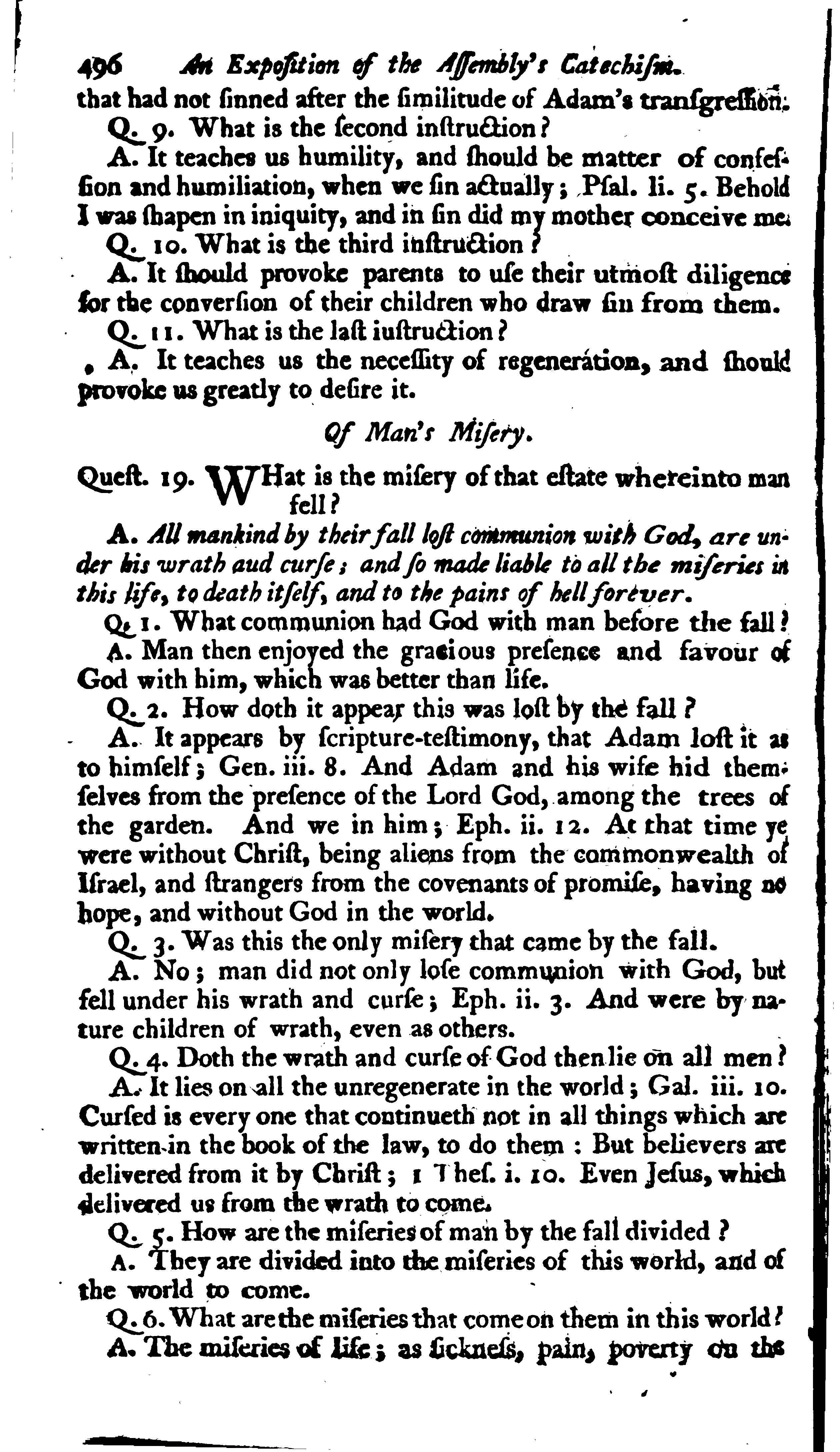
496 An Exposition of the Assembly's Catechism. that had not finned after the fimilitude of Adam's transgression. Q. 9. What is the second instruction ? A. It teaches us humility, and should be matter ofconfef fionandhumiliation,when we fin actually; Psal. li. 5. Behold I was shapen in iniquity, and in findidmymother conceive me.
Q. 10. What is the third instruction ? A. It should provoke parents to use their utmost diligence for the conversion of their children who draw fin from them.
Q. 11. What is the last iustruction ? •A. It teaches us the necessity of regeneration, and should provokeusgreatly to desire it.
of Man's Misery.
19. What isthemiseryofthatestatewhereintoman fell? A. All mankind by their fall lost communion with God, are under his wrath aud curse; andfo made liable to all the miseries in this life, to death itself, and to the pains of hell forever. Q1 . What communion had God withmanbefore the fall?
A.Manthenenjoyed the gracious presence and favour of Godwithhim, which was better than life.
Q. 2. How doth it appear this was lost by the fall? A. It appears by scripture-testimony,that Adam loftit as to himself ; Gen. iii. 8. And Adam and his wife hid them. selves from the presence of the Lord God, among the trees of the garden. And we in him; Eph. ii. 12. At that time ye were without Christ, being aliens from the commonwealth of Israel, and strangers from the covenants of promise,having no hope, and without God in the world.
Q. 3. Was this the only misery that came by the fall. A. No; mandidnotonly lose communion with God, but fell under his wrath and curse; Eph. ii. 3. And were by nature children of wrath, even as others.
Q.4. Doth the wrath and curse of Godthenlieon all men ? A. It lies on all the unregenerate in the world ; Gal. iii. 10. Cursed is everyone thatcontinueth not in all things which are written in the book of the law,to do them : But believers are delivered from it by Christ ; 1 Thes. i. 10. Even Jesus, which delivered us from the wrath to come.
Q. 5.How are the miseriesofmanby the fall divided ? A. They are divided into the miseries of this world, and of the world to come.
Q.6.What are the miseries that comeonthem in this world! A. The miseries of life; as sickness, pain, poverty on the
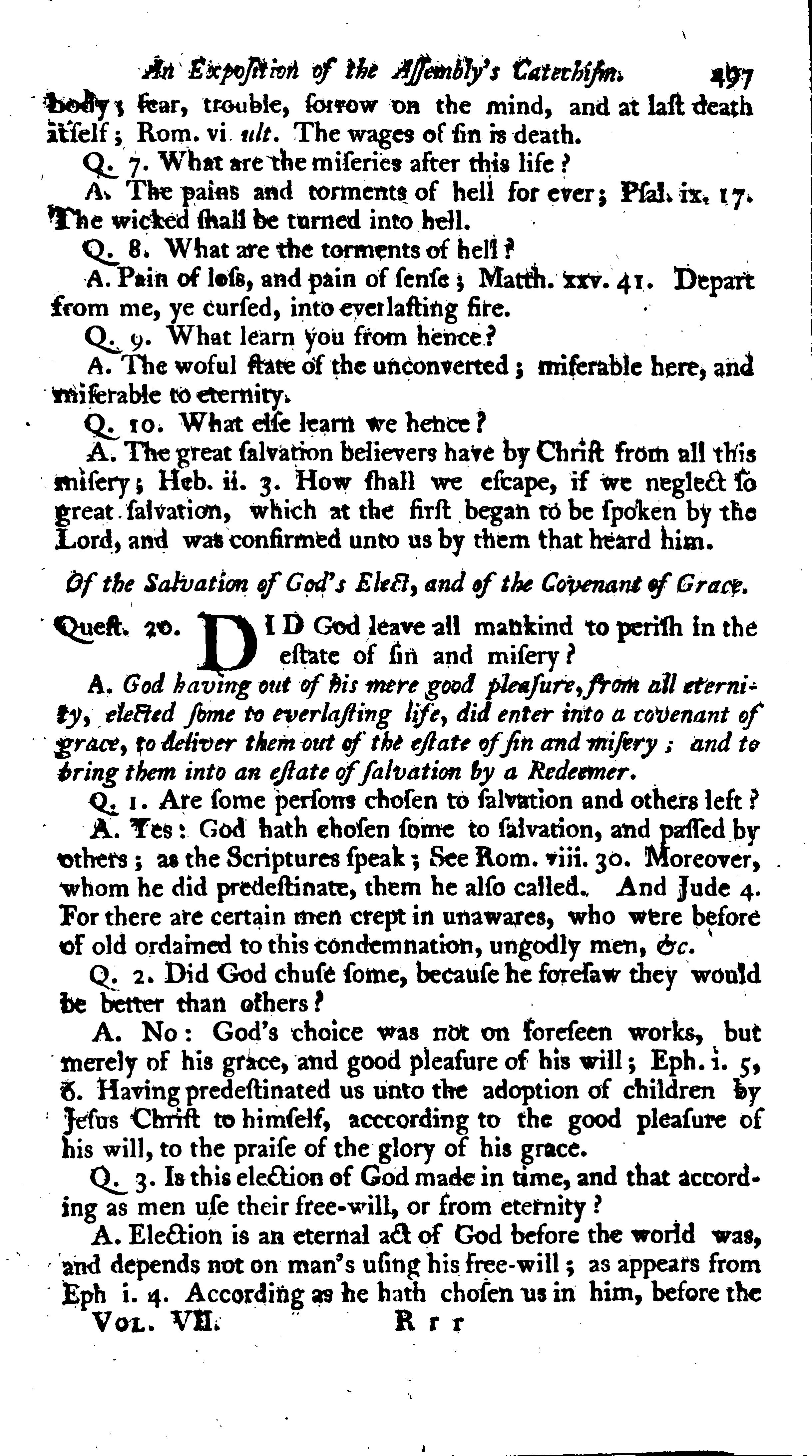
An Exposition of the Assembly's Catechism. 497 bodys fear, trouble, sorrow on the mind, and at last death itself; Rom. vi. ult. The wages off in is death.
Q. 7. What are the miseries after this life ? A. The pains and torments of hell for ever; Psal. ix. 17. The wicked shall be turned into hell.
Q. 8. What are the tormentsofhell? A.Painoflofs, and pain of sense; Matth. xxv. 41. Depart from me, ye cursed, into everlasting fire.
Q. 9. What learn you from hence? A. Thewoful state of the unconverted; miferablehere, and miserable to eternity.
Q. 10. What else learn we hence? A. The great salvation believers have by Christ from all this misery; Heb. ii. 3. How shall we escape, if we neglect fo great salvation, which at the first began to be spoken by the Lord,and was confirmed unto us by them thatheardhim.
of the Salvation of God's Elect, and of the Covenant of Grace. Quest. 20. IDGod leave all mankind to perish in the estate of fin and misery? D A. God having out of his mere good pleasure,from all eternity, elected some to everlasting life, did enter into a covenant of grace, to deliver them out of the estate off in and misery ; and to bring them into an estate offalvation by a Redeemer.
Q. 1. Are some persons chosen to salvation and others left ? A. Yes: God hath chosen some to salvation, and passed by others; as the Scriptures speak ; SeeRom. viii. 30. Moreover, whom he did predestinate,them he also called. And Jude 4. For there are certain men crept in unawares, who were before of old ordained to this condemnation,ungodly men, &c.
Q. 2. DidGodchuse some,because he foresaw they would be better than others ?
A. No : God's choice was not on foreseen works, but merely of his grace, and goodpleafure of his will ; Eph. i. 5, 6. Havingpredeftinated us unto the adoption of children by Jesus Christ to himself, acccording to the good pleasure of his will, to the praise of the glory of his grace. Q. 3. Is this election of God made in time,and that according as men use their free-will, or from eternity ? A.Election is an eternal act of God before the world was, and depends not on man's using his free-will ; as appears from Eph i. 4. According as he hath chosen us in him,before the VOL. VII. Rrr
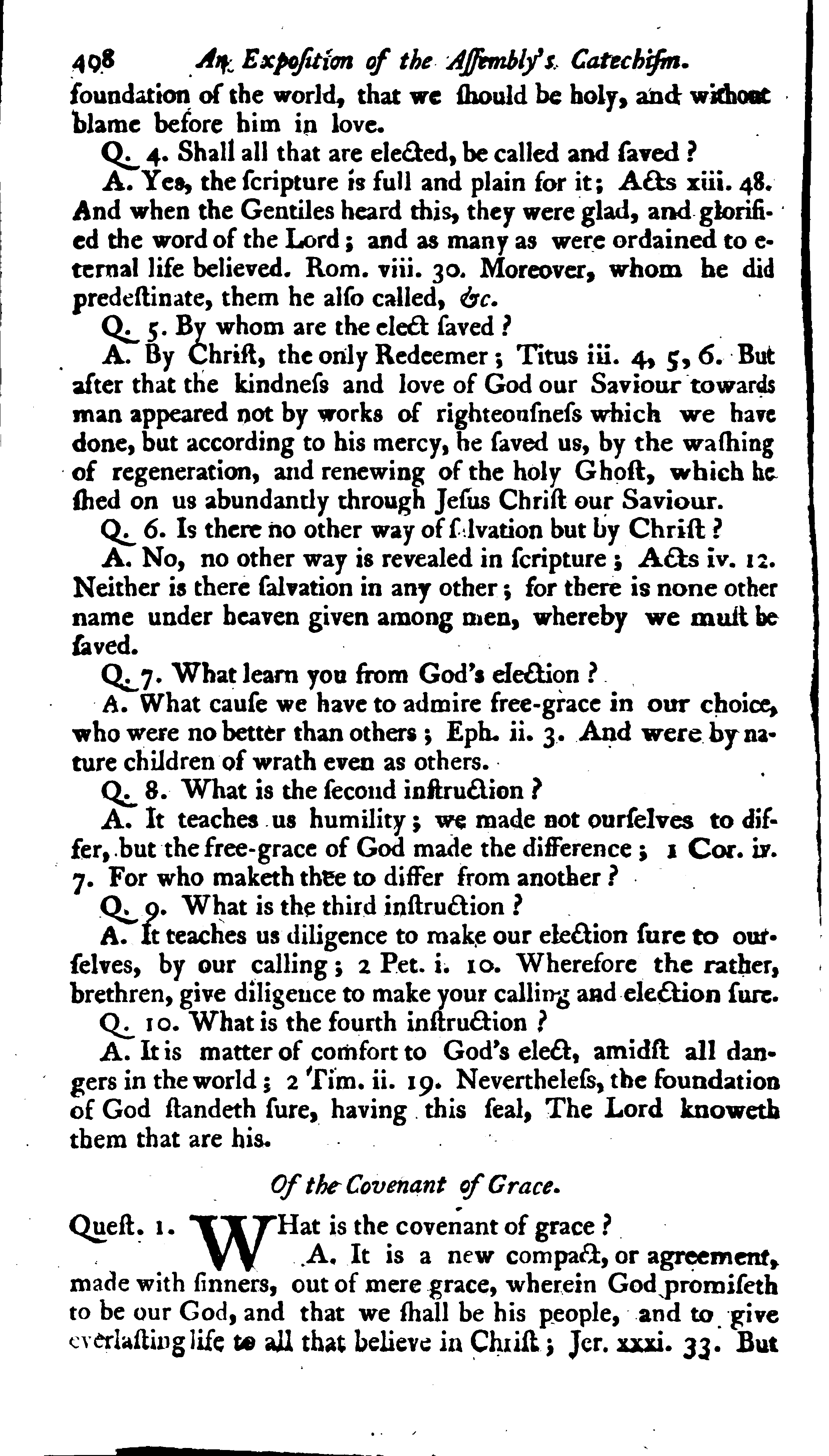
498 An Exposition of the Assembly's Catechism. foundation of the world, that we should be holy,and without blame before him in love.
Q. 4. Shall all that are elected,be called and saved ? A.Yes, the scripture is full and plain for it; Acts xiii. 48. And when the Gentiles heard this, theywereglad, andglorifiedthewordofthe Lord ; and as many as were ordained to eternal life believed. Rom. viii. 30. Moreover, whom he did predeftinate, them he also called, &c.
Q. 5. By whom are the elect saved ? A. By Christ, the only Redeemer ; Titus iii. 4, 5, 6. But after that the kindness and love of God our Saviour towards man appeared not by works of righteousness which we have done,but according to his mercy, he saved us, by the washing of regeneration, and renewing of the holy Ghost, which he shed on us abundantly through Jesus Christ our Saviour.
Q. 6. Is there no other way offalvation but by Christ ? A. No, no other way is revealed in scripture ; Acts iv. 12. Neither is there salvation in any other; for there is none other name under heaven given among men, whereby we must be saved.
Q.7. What learn you from God's election? A. What cause we have to admire free-grace in our choice, who were no better than others ; Eph. ii. 3. Andwerebynature children of wrath even as others.
Q. 8. What is the second instruction ? A. It teaches us humility ; we made not ourselves to differ, but the free-grace of God made the difference ; 1 Cor. iv. 7. For who makeththee to differ from another? Q. 9. What is the third instruction ? A. It teaches us diligence to make our election fureto our selves, by our calling ; 2Pet. i. 10. Wherefore the rather, brethren,give diligence to make your calling and election sure.
Q. 10. What is the fourth instruction ? A. It is matter of comfort to God's elect, amidst all dangers in the world; 2 Tim. ii. 19. Nevertheless,the foundation of God standeth sure, having this feal, The Lord knoweth them that are his.
Quest. 1.W
of the Covenant of Grace.
Hat is the covenantofgrace? A. It is a new compact,or agreement, made with sinners, out of mere grace, wherein Godpromiseth to be our God, and that we shall be his people, and to give everlasting life to all that believe in Christ; Jer. xxxi. 33. But
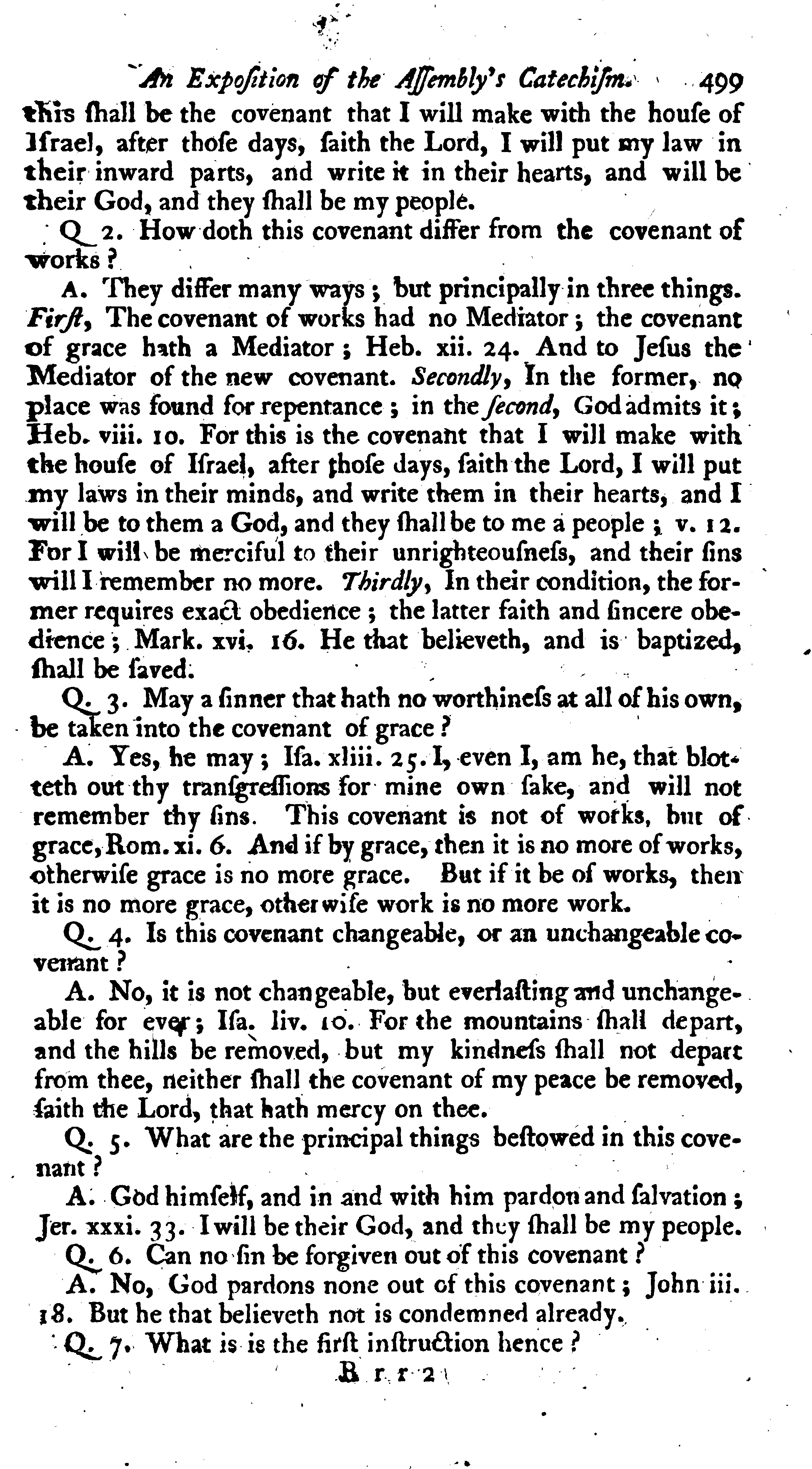
An Exposition of the Assembly's Catechism. 499 this shall be the covenant that I will make with the house of Israel, after those days, faith the Lord, I will put my law in their inward parts, and write it in their hearts, and will be their God, and they shall be my people. Q2. How doth this covenant differ from the covenant of works?
A. They differ many ways ; but principallyinthreethings. First, The covenant of works had no Mediator; the covenant of grace hath a Mediator ; Heb. xii. 24. And to Jesus the Mediator of the new covenant. Secondly, In the former, no place was found for repentance ; in the second, God admits it; Heb. viii. 10. For this is the covenant that I will make with the house of Israel, after those days, faith the Lord, I will put my laws in their minds, and write them in their hearts, and I will be to them a God, and they shall be tome a people ; v. 12.
For I will be merciful to their unrighteousness, and their fins will I remember no more. Thirdly, In their condition, the former requires exact obedience ; the latter faith and sincere obedience ; Mark. xvi. 16. He that believeth, and is baptized, shall be saved.
Q. 3. Maya sinner thathathnoworthinessat all of his own, be taken into the covenant of grace?
A. Yes, he may ; Ifa. xliii. 25. I, even I, am he, thatblotteth out thy transgressions for mine own sake, and will not remember thy fins. This covenant is not of works, but of grace,Rom.xi. 6. And if by grace, then it is no more of works, otherwise grace is no more grace. But if it be of works, then it is no more grace, otherwise work is no more work.
Q. 4. Is this covenant changeable, or an unchangeablecovenant ?
A. No, it is not changeable, but everlastingandunchangeable for ever ; Ifa. liv. 10. For the mountains shall depart, and the hills be removed, but my kindness shall not depart from thee, neither shall the covenant of my peace be removed, faith the Lord, that hath mercy on thee.
Q. 5. What are the principal things bestowed in this covenant?
A. God himself,andinandwith him pardonandfalvation ; Jer. xxxi. 33. I will be their God, and they shall be my people.
Q. 6. Can no fin be forgiven out of this covenant? A. No, God pardons none out of this covenant ; John iii.. 18. But he thatbelieveth not iscondemnedalready. Q.7. What is is the first instruction hence ? Brr2
500 An Exposition of the Assembly's Catechism. A. Humbled and believing sinners have singular fuppert from this new covenant, 1 John ii. 12. Iwriteuntoyou, little children,because your finsare forgivenyoufor his name'sfake.
Q. 8. What is the second instruction from hence ? A. That it is the great concern of allmen to examine whether they be in this covenant, or no ; 2 Cor. xiii. 5. Examine yourselves, whether yebeinthe faith; proveyourownselves; know ye not your ownselves, how that Jesus Christ is in you, except ye be reprobates ?
Q. 9. What is the third instruction ? A. See here the miserable state of the wicked, which have no interest in it ; Psalm 1. 16. But unto the wicked God faith, What hast thou to declare my statutes, or that thou shouldst take my covenant in thy mouth ?
Q. 10. What is the last instruction ? A. That Christians are obliged towalkaspeople in covenant with God ; 1 Pet. ii. 9. But ye are a chosen generation, a royal priesthood, an holy nation, a peculiar people, that ye shouldthew forth the praises of him who hath calledyouout of darkness into his marvellous light.
Quest. 21.W
Of the only Redeemer. HO is the Redeemer of God's elect?
A. The only Redeemer of God's elect, is the Lord Jesus Christ, who, being the eternal Son of God,became man, and so was, and continueth to be God and man, in two distinct natures, and onepersonforever.
Q. 1. What doth the name Redeemer signify ? A. It signifies one that frees another out of captivity and bondage, as Christ did us ; Matth. xx. 28. And to give his life aranfom for many.
Q. 2 What was the miferyfrom which Christdeliveredus?
A. Atwofold misery, viz . Sin and hell. First, Sin ;Matth. i. 21. Thou shalt call his name JESUS, for he shall fave his people from their sins. Secondly, Hell ; 1 Thes. i. 10. Even Jesus, who delivered us from the wrath to come.
Q. 3. How did Christ deliver us from this misery? A First, By price. Secondly, By power. By price ; 1 Pet. i. 18, 19. Ye are not redeemed with filverand gold from your. vain conversation, received by tradition from your fathers ; but with the precious blood of Christ, as of a lamb without blemish, and without spot. By power; Col. i. 13. Who hath delivered us from the power of darkness, and hath translated us intothekingdom of his dear Son.
An Exposition of the Assembly's Catechism. 501 4. When was the redemption wrought by Christ? A It was decreed from eternity ; it was actually wrought on the cross ; Col. i. 20. And (having made peace through the blood of his cross) by him to reconcile all things unto him-
by him, I say, whether they be things inearth, or things in heaven.
Q5. How then could they be redeemed that died before ? A. Though Christ's blood was actually shed after the Old Testament believers died ; yet the virtue of Christ's death extends to them, as well as us ; Heb. xi. 39,40. And these all, havingobtainedagood report through faith, received not the promise, God having provided some better things for us, that they without us should not be made perfect.
Q. 6. Why would not God deliver us without such a Redeemer?
A. Because it was not so much for the honour of his justice; Rom. iii. 25, 26. Whom God hath set forth to be a propitiationthrough faith in his blood,to declare his righteousness for the remission of fins that are past, through the forbearance of God. To declare, Ifay, at this time his righteousness, that he mightbejust, and the juftifier of him that believeth in Jesus. Q7. What is the first instruction from hence? A. That all that are out of Christ are inamiferablebondage and captivity ; John viii. 36. If the Son therefore shall make you free, ye shall be free indeed. Q. 8. What is the second instruction? A. Hence seethe heinous natureoffin,which required such a price to satisfy for it ; 1 Pet. i. 18, 19. We were not redeemed with corruptible things, as silver and gold, but with the precious blood of Christ, as ofa lamb without blemish, and without spot.
Q. 9. What is the third instruction from hence ? A. The wonderful love of Christ in redeeming us at such a rate ; Rev. i. 5. Who loved us, andwashedusfrom our fins in his own blood.
Q. 10. What is the last instruction ? A. This strongly obligeth us to an universal holiness ; Cor. vi. 20. Forye are bought with a price; therefore glorify Godinyourbody, and in your spirit, which are God's.
Of Christ's Incarnation. OW did Christ,being the SonofGod,becomeman?
A. Christ,the Son of God,became man, by taking to himself a
402 An Exposition of the Assembly's Catechism. true body, and a reasonable foul, being conceived by the power of the Holy Ghost in the womb of the virgin Mary, and born of her, yet withoutfin.
Q. 1. Who is the only Redeemer of God's elect ? A. The Lord Jesus Christ is their only Redeemer, and there is no other Redeemer besides him; Acts iv. 12. Neither is their salvation in any other; for there is none other name under heaven given among men, whereby we must be saved.
Q. 2. How is he the Son of God, or can be, as no other is fo?
A. He is the Son of God by nature, from all eternity, and so no angel or faint is ; Heb. i. 5. For unto which of the angels faidhe at any time, Thou art my Son, this day have Ibegottenthee?
Q. 3. Why was it necessary he should become man ? A. That he might be capable to suffer death in our room ; Heb. ii. 15, 16, 17. For verilyhetook not on him the nature of angels, but he took on him the feed of Abraham ; wherefore in all things it behovedhim to be made like unto his brethren, that he might be a merciful and faithful high priest, in things pertaining to God, to make reconciliation for the fins of the people.
Q. 4. Why must the Redeemer be God as well as man ? A. Because the blood of a mereman could not satisfy and redeem us ; Acts xx. 28. Feed the church of God, which he hath purchased with his own blood.
Q. 5. Do these two natures make two persons ? A. No, the human nature is united to the second person, and subsists in union with it ; John i. 14. And the word was made flesh , and dwelt among us, and we beheld his glory, the glory as of the only begotten of the Father, full of grace and truth.
Q. 6. Was the union only for a time ? A. No, it continues and abides for ever; Heb. vii. 24. But this man, because he continueth ever, hath an unchangeable priesthood.
Q. 7. What is the first instruction from hence ? A. Hence we learn the transcendent love of God to poor sinners ; John iii. 16. God so loved the world, that he gave his only begotten Son, that whosoeverbelieveth on him should not perish, but have everlasting life. Q.8 What is the second instruction ? A. Hence we learn the matchless love of Christ, that he should stoop to such a condition for us; 2Cor. viii. 9. For ye
An Exposition of the Assembly's Catechism. 503 knowthegrace of our Lord Jesus Christ, that though he was rich, yet for yoursakes he became poor, that ye through his povertymightbemade rich. Q.9. What is the third instruction ? A. That the greatest sins are capable of remission to believers ; John i. 29. Behold the Lamb of God which taketh away the sins of the world. Q. 10. What is the fourth instruction ? A. That those that be in Christ need not fear the denial or want of any other mercy ; Rom. viii. 32. He that spared not his own Son, but delivered him up for us all; how shall he not with him also freely give us all things ?
Q. 11. What is the fifth instruction ? A. Hence we learn how impious it is to ascribe any part of the glory of redemption to any other besides Christ. Q. 12. What is the sixth instruction ? A. This teaches us the miserable condition of all that are out of Christ, and the necessity of their damnation, he being the only Redeemer.
AS Christ's incarnation a Quest. 1.Whim? voluntary act in Of the Manner of Christ's Incarnation.
A. Yes, it was; for though he had a command to die for us, John x. 18. No man taketh it from me, but I lay it down of myself; I have power to lay it down, and I have power to take it again. Yet he came willingly; Psalm xl.6, 7. Sacrifice and offering thou didst not desire, mine ears haftthou opened; burnt-offerings, and fin-offerings hast thou not required; lo, I come; in the volume of thy book, it is written of me. Ver. 8. I delight to do thy will, O my God, yea, thy law is withinmyheart.
Q. 2. Was the body of Christ areal andtruehumanbody ? A. Yes, it was a true and real body, not the appearance and shape of a body only ; Luke xxiv. 38. And he said unto them, Whyareyetroubled, andwhydothoughts arise in your hearts ?
Ver. 39. Behold my hands, and my feet,that it is I myself ; handle me, and fee, for a spirit hath not flesh and bones as you fee me have. Q.3 . Had he a true human foul as well as a body ? A. Yes, he had a real human foul also, and all the natural faculties and powers thereof; Matth. xxvi. 38. Then faith he unto them, My soul is exceeding sorrowful, even unto death.
Q. 4. Was he then in all respects like to othermen ? A.No, his conception was not like others ; Ifa. vii. 14. Be
504 An Exposition of the Assembly's Catechism. hold, a Virgin shall conceive,and bear aS on,and shall call his name EMANUEL. And he had no fin in him as others have; Heb. vii. 26. For such an High Priestbecameus,who is holy, harmless, undefiled, separate from sinners.
Q.5. Did Christ put offthehuman nature at his ascension? A. No, he did not,but carried ituptoglory, and now is in our nature in heaven; 1 Tim. iii. 16. Received up into glory.
Q.6. Why did he assume our nature ? A. That he mightdiein it for our salvation ; Heb. ii.15. And deliver them, who through fear of death were all their lifefubject to bondage.
Q. 7. Why did herife in itafterdeath? A. He raised it from the dead for our justification; Rom. iv. 25. Who was delivered for our offences, and was raised-2gain for ourjuftification.
Q. 8. Whydidhe afcendin our nature into heaven? A. To be a Mediator of interceffion in our nature ; Heb. vii. 25. Wherefore he is able also tosavethemto theuttermost thatcomeunto Godbyhim, seeing he ever liveth to make interceffion for them .
Q. 9. What is the first instruction from hence ? A. Thatthebody of Christ is not everywhere,but is con tained in heaven ; Acts iii. 21. Whom the heaven must receive, untilthetimes of restitution of all things.
Q. 10.What is the second instruction ? A. That Christ is full of tender compassions to his people's infirmities; Heb. iv. 15. For we have not an high priest which cannot be touched with the feeling of our infirmities; but was in all points tempted like as we are, yet without fin.
Q. 11. What is the third instruction ?
4. That great and admirable is the glorydefigned for the bodesofbelievers ; Phil. iii. 21. Who shall change our vile bodies, that it maybe fashioned like unto his glorious body, according to the working whereby he is ableevento fubdueall things unto himself.
Q. 12. What is the last instruction ? A. That the bodily eyes of believers after the resurrection, shall fee Christ in glory ; Job xix. 26, 27. And though after my skin worms destroy this body, yet in my flesh shall I fee God, whom I shall fee for myself,andmineeyes shall behold, and not another.
The End of the Seventh Volume.



UNIVERSITY OF MICHIGAN
3 9015 06534 4544