
The Whole Works of the Reverend Mr John
This is a reproduction of a library book that was digitized by Google as part of an ongoing effort to preserve the information in books and make it universally accessible.
https://books.google.com

Presented to the
Univ. of Michigan
Oby Henry-le-Granger lekassof-71-
GENERAL LIBRARY
OF UNIVERSITY OF MICHIGAN
PRESENTED BY
Rer. HenryC.Granger Class of18.71 ㅋㅋㅋㅋㅋㅋㅋㅋㅋㅋㅋㅋㅋㅋㅋㅋㅋㅋㅋ Jan. 25 250 1900..

Sep.91790
1770 Shop Humphrieshisbook ZVollom


THE WHOLE
1WORKS
OF THE REVEREND41352 MR. JOHN FLAVEL,
Late MINISTER of the GOSPEL at Dartmouth in Devon.
IN EIGHT VOLUMES.
TO WHICH IS ADDED,
An Alphabetical TABLE of the principal Matters contained in the Whole.
THE EIGHT EDITION.
VOL. II.
PA I SLE Υ :
Printed by A. WEIR and A. M'LEAN.
And fold at the Shop of A. WEIR, near the Cross.
MDCCLXX.

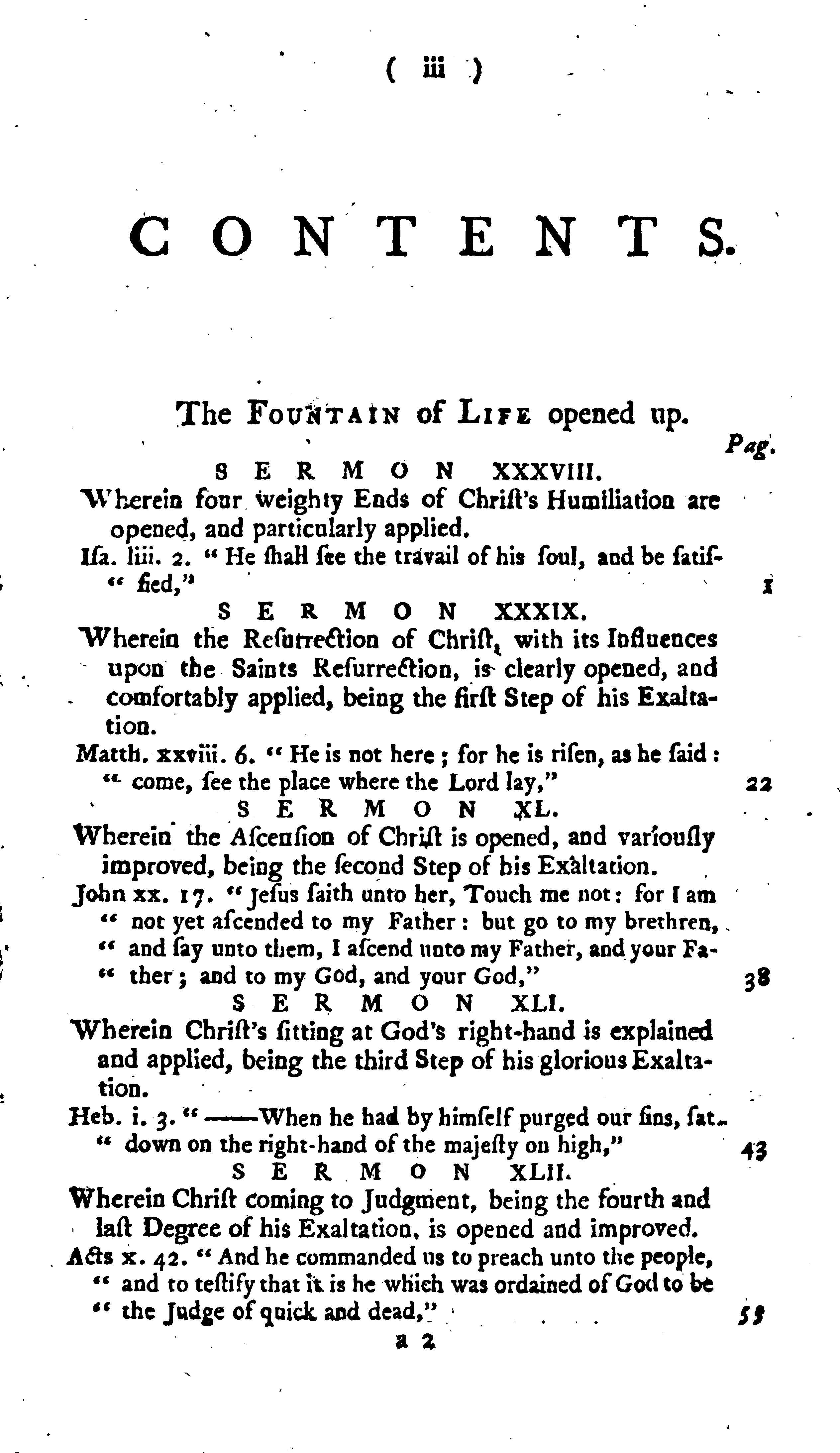
CONTENTS.
The FOUNTAIN of LIFE opened up.
Pag.
SERMON XXXVIII . Wherein four weighty Ends of Christ's Humiliation are opened, and particularly applied. Ifa. liii. 2. "He shall fee the travail of his soul, and be fat if-
" fied," SERMON ΧΧΧΙΧ . Wherein the Resurrection of Christ, with its Influences upon the Saints Resurrection, is clearly opened, and comfortably applied, being the first Step of his Exaltation. Matth. xxviii. 6. " He is not here; for he is risen, as he said :
66 come, fee the place where the Lord lay," SERMON XL. Wherein the Ascension of Christ is opened,and variously improved, being the second Step of his Exaltation . John xx. 17. "Jesus faith unto her, Touch me not : for I am not yet ascended to my Father : but go to my brethren, " and say unto them, I ascend unto my Father, and your Fa- " ther ; and to my God, and your God,"
SERMON XLI . Wherein Christ's fitting at God's right-hand is explained and applied, being the third Step of his glorious Exaltation. Heb . i . 3. " When he had byhimselfpurged our fins, fat... " down on the right-hand of the majesty on high," SERMON XLII. Wherein Christ coming to Judgment, being the fourth and last Degree of his Exaltation, is opened and improved. Acts x. 42. " And he commanded us to preach unto the people, " and to testify that it i she which was ordained of God to be
" the Judge of quick and dead,"
55 a 2
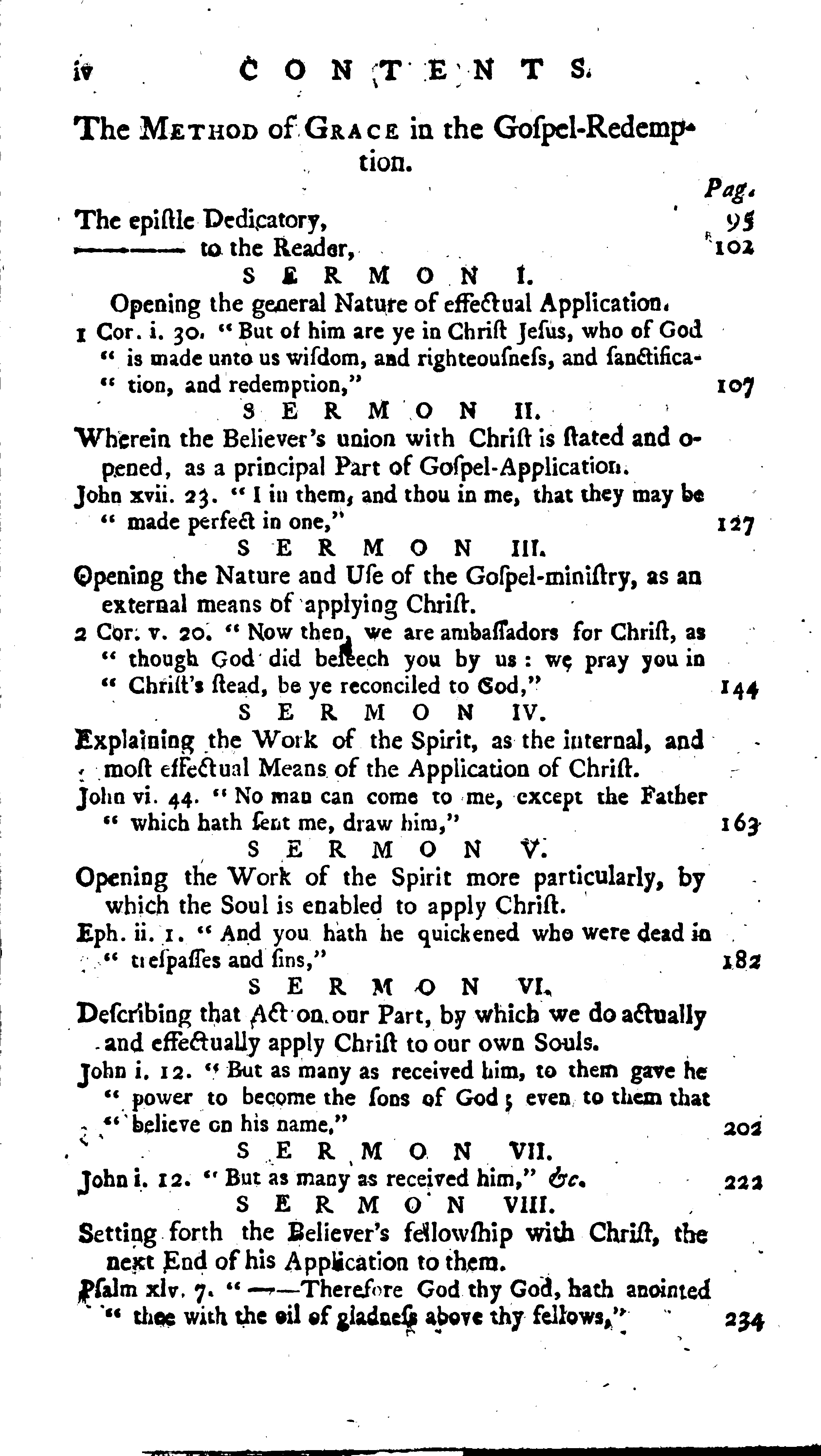
CONTENTS .
The METHOD OF GRACE in the Gospel-Redemp
tion.
Pag
95 102
The epistle Dedicatory,
to the Reader,
SERMON 1. Opening the general Nature ofeffectual Application. 1 Cor. i. 30. "But of him are ye in Christ Jesus, who of God " is madeuntous wisdom, and righteousness, and sanctifica- " tion, and redemption," SERMON II.. Wherein the Believer's union with Christ is stated and opened, as a principal Part of Gospel-Application . John xvii. 23. " I in them, and thou in me, that they may be
" made perfect in one," SERMON III. Opening the Nature and Use of the Gospel-ministry, as an external means of applying Christ. 2 Cor. v. 20. " Now then, we are ambassadors for Christ, as though God did beleech you by us : we pray you in "
" Christ's stead, be ye reconciled to God," SERMON IV. Explaining the Work of the Spirit, as the internal, and most effectual Means of the Application of Christ . John vi. 44. "No maucan come to me, except the Father
" which hath sent me, draw him, " SERMON v. Opening the Work of the Spirit more particularly, by which the Soul is enabled to apply Christ .
Eph . ii. 1. "And you hath he quickened who were dead in " trespasses and fins," SERMON VI. Describing that Act on our Part, by which we do actually -andeffectually apply Christ to our own Souls. John i. 12. " But as many as received him, to them gave he power to become the sons of God; even to them that " " believe on his name," SERMON VII . John i. 12. "But as many as received him," &c. SERMON VIII. Setting forth the Believer's fellowship with Christ, the next End of his Application to them. Psalm xlv. 7. "--Therefore God thy God,hath anointed " thee with the oil of gladness above thy fellows,"
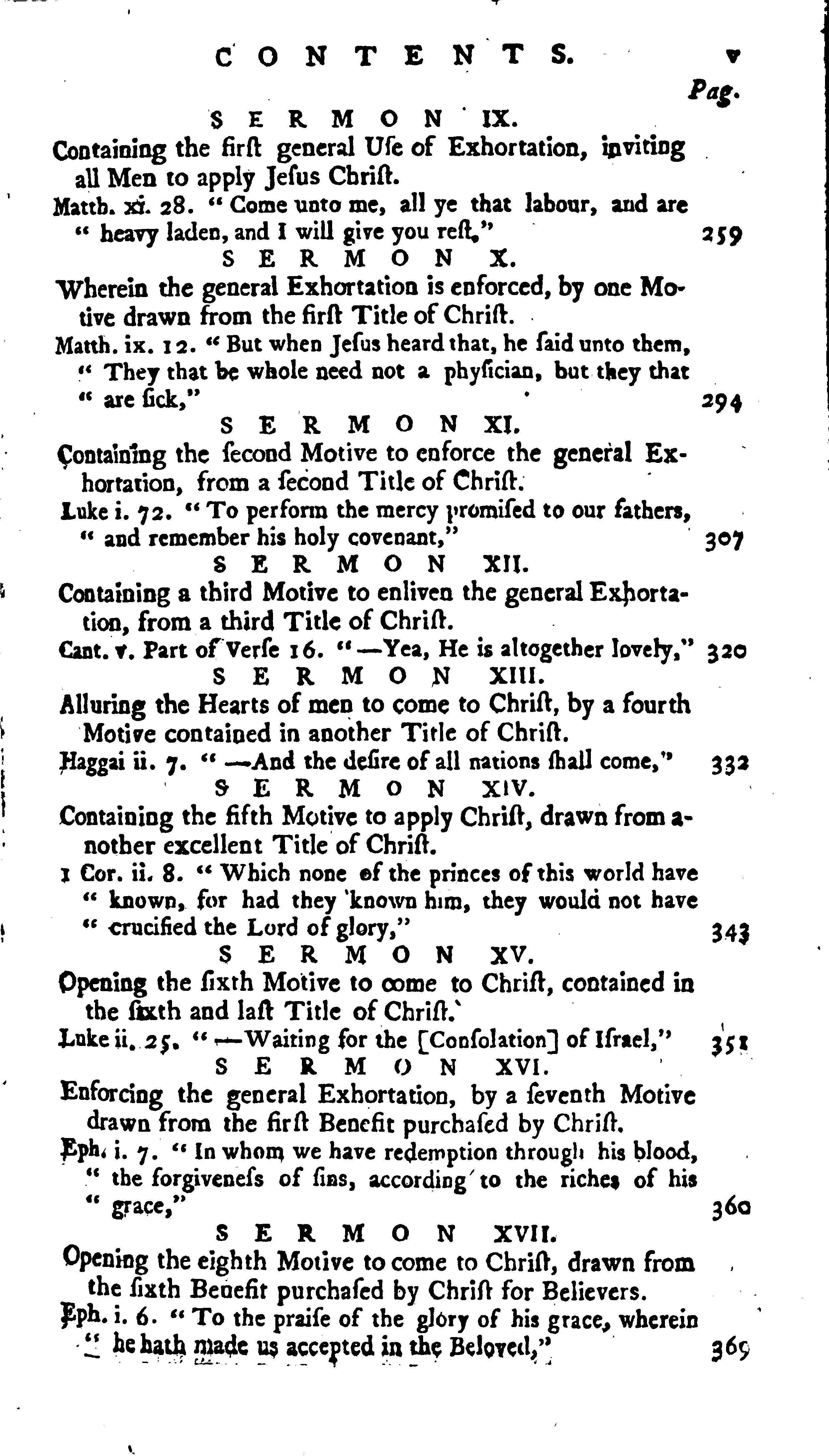
CONTENTS.
Pag.
SERMON IX. Containing the first general Use of Exhortation, inviting all Men to apply Jesus Christ. Matth. xi. 28. "Come unto me, all ye that labour, and are
" heavy laden, and I will give you rest," 259 SERMON Χ. Wherein the general Exhortation is enforced,by one Motive drawn from the first Title of Christ . Matth. ix. 12. " But when Jesus heard that, he said unto them,
" They that be whole need not a physician, but they that
" are sick," 294 SERMONXI . Containing the second Motive to enforce the general Exhortation, from a second Title of Christ. Luke i. 72. " To perform the mercy promised to our fathers,
" and remember his holy covenant," SERMON XII . Containingathird Motive to enliven the general Exhortation, from a third Title of Christ .
Cant. v. Part of Verse 16. " -Yea, He is altogether lovely," 320 SERMON XIII . Alluring the Hearts of men to come to Christ,by a fourth
Motive contained in another Title of Christ . Haggai ii . 7. "-And the desire of all nations shall come," 332 SERMON XIV. Containing the fifth Motive to apply Christ, drawn from another excellent Title of Christ . 1 Cor. ii. 8. " Which none of the princes of this world have " known, for had they known him, they would not have
" crucified the Lord of glory," SERMON XV. Opening the sixth Motive to come to Christ, contained in the sixth and last Title of Christ .
1 Luke ii. 25. " Waiting for the [Consolation] of Israel," 358 SERMON XVI . Enforcing the general Exhortation, by a seventh Motive drawn from the first Benefit purchased by Christ. Eph. i. 7. " In whom we have redemption through his blood, " the forgiveness of fins, according to the riches of his " grace," SERMON XVII. Opening the eighth Motive to come to Christ, drawn from the sixth Benefit purchased by Christ for Believers. Eph. i. 6. " To the praise of the glory of his grace,wherein 65 he hath made us accepted in the Beloved,"
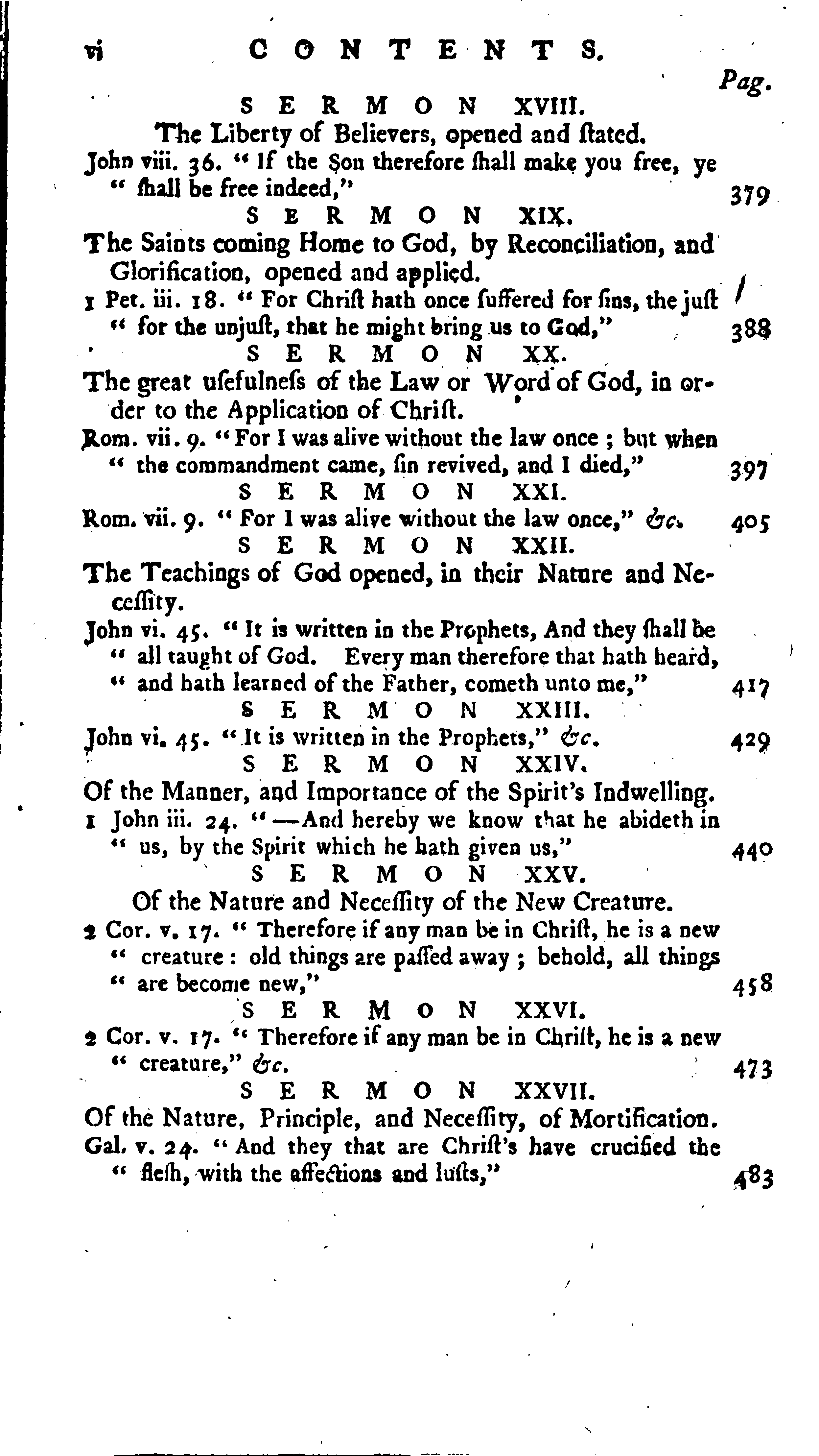
vi CONTENTS. SERMON XVIII . The Liberty of Believers,opened and stated. John viii. 36. " If the Son therefore shall make you free, ye " shall be free indeed," SERMON XIX . The Saints coming Home to God, by Reconciliation, and
Pag.
Glorification, opened and applied. 1 Pet .iii. 18. " For Chrifthathonce suffered forfins, the just / " for the unjust, that he mightbringus to God," SERMON XX . The great usefulness of the Law or Word of God, in order to the Application of Christ . Rom. vii . 9. " For I was alive without the law once ; but when
" the commandment came, fin revived, and I died,"
397 SERMON ΧΧΙ . Rom. vii . 9. " For I was alive without the law once," &c. 405 SERMON XXII . The Teachings of God opened, in their Nature and Necessity. John vi. 45. " It is written in the Prophets,And they shall be
" all taught of God. Every man therefore that hath heard, " and hath learned of the Father, cometh unto me,"
417 SERMON XXIII .
429 SERMON XXIV. John vi. 45. " It is written in the Prophets," &c.
Of the Manner, and Importance of the Spirit's Indwelling.
I John iii. 24. " --And hereby we know that he abideth in us, by the Spirit which he hath given us," SERMON XXV. Of the Nature and Necessity of the New Creature. 2Cor. v. 17. " Therefore if anyman be in Christ, he is a new creature : old things are passed away; behold, all things 66
" are become new," SERMON XXVI . 2Cor. v. 17. " Therefore if anyman be in Christ, he is a new " creature," &c. SERMON XXVII . Of the Nature, Principle, and Necessity, of Mortification . Gal. v. 24. " And they that are Christ's have crucified the
" flesh, with the affections and lusts,"
THE FOUNTAIN OF LIFE.
SERMON XXXVIII.
Wherein four weighty Ends of CHRIST'S Humiliation are opened, and particularly applied.
Isa. liii. 2. He shall fee the travail of his foul, andbefatisfied. WEE are now arrived at the last particular which we designed to speak to in Christ'sstate of humiliation, namely, the designs and blessed ends for which he was sodeeplyabafed. It is inconsistent with the prudence of a common agent, to beat vast expences of time, pains, and cost, and not to propound to himfelfadesign worthy of all those expences. And it is much less imaginable, that Christ should so stupendoufly abase himself, by stooping from the bosom of his Father to the state of the dead, where our lastdisconrse left him, if there had not been some excellent, and glorious thing in his eye, the attainment whereof, might give him a content and satisfaction, equivalent to all the sorrows, and a basements, he endured for it.
And so much isplainlyheld forth in this scripture, " He shall " see the travail of his soul, and be satisfied." In which words three things fall under our consideration.
First, The travailing pangs of Christ. So the agonies of his soul, and torments of his body are fitly called, not only because of the sharpness and acutenessofthem,being in that respect, like birth-pangs of a travailing woman, for so this * word signifies, butalsobecausethey fore-run, and make way for the birth,which abundantly recompences all those labours. I shall not here infiftuponthepangs and agonies endured by Christ in the garden, or upon the cross, which the prophet stiles " the travail of his
" foul," having, in the former sermons, opened it largely in its particulars, but pass to the,,This wordsignifiesboth the birth and pain attend. ingit. Strigel.- VOL. II.
למצ
2 SERM . XXXVIII . The Fountain of Life. Second Thing considerable in these words; and that is the assured fruits and effects of this his travail ; he shall fee the travail of his soul. By seeing, understand the fruition, obtainment, or enjoyment of the end of his sufferings. He shall not shed his blood upon an hazard : his design shall not mifcarry; but he shall certainly fee the ends he aimed at accom plished.
" And Thirdly, This shall yield him great satisfaction : as a woman forgets her sorrow, for joy that a man is born into " the world," John xvi. 21. he shall see it, and be satisfied. As God, when he had finished the work of creation, viewed that his work with pleasure and satisfaction ; so doth our exalted Redeemer, with great contentment, behold the happy issues *of his hard sufferings. It affords pleasure to am an to see great affairs, by orderly conduct, brought to happy issues. Much more doth it yield delight to Jesus Christ, to see the results of "that most profound wisdom and love, wherein he carried on redemption-work. All runs into this doctrine.
Doct. That all the blessed designs and ends for which the Lord
Jesus Christ humbled himself to the death of the cross, Shall certainly be attained, to his full content and satisfaction. MY present business is not to prove, that Christ shall certainly obtain what he died for ; nor to open the great satisfaction and pleasure which will arise to him out of those issues of his death, but to point at the principal ends of his death ; making some brief improvements as we pass along.
First, Then let us enquire into the designs and ends of Christ's humiliation, at least the main and principal ones ; and we shall find, that as the sprinkling of the typical blood in the Old Testament was done for four weighty ends or uses, an-
the precious and invaluable blood of the Teftator and surety of the New Testament is shed for four weighty ends also.
First, That blood was shed and applied to deliver from danger; Exod. xii. 13. " And the blood shall be to you for a
66. + token upon the houses where you are ; and when I fee " the blood, I will pass over you and the plague shall not be " upon you, to destroy you when I smite the land of Egypt."
The Jews implicitly acknowledged by this ceremony, that they were to be liberated from eternal death by the blood of the Meffial
Vatab.
SERM . XXXVIII . The Fountain of Life. 3 Secondly, That blood was shed to make an atonement betwixt God and the people; Lev. iv. 20. "And he thall do with the
" bullock as he did with the bullock for a fin-offering ; so shall " he do with this; and the priest shall make an atonement for " them, and it shall be forgiven them."
Thirdly, That blood was shed to purify persons from their ceremonial pollutions, Lev. xiv. 6. 7. "He shall dip the cedar
" wood, and scarlet, and hyffop, with the living bird, in the " blood of the bird that was killed over the running water, and " he shall sprinkle upon him that is to be cleansed from the " leprosy seven times ; and shall pronounce him clean, and " shall let the living bird loose in the open field,"
Fourthly, That † blood was shed to ratify and confirm the testament or covenant of God with the people, Exod. xxiv. 8. " And Moses tooktheblood, and sprinkled it on the people and " said, behold the blood of the covenant, which the Lord hath
" made with you concerning all these words." These were the fourmainends for shedding, and sprinkling that typical blood. Suitably, there are four principal ends for hedding and applying
Christ's blood. As that typical blood was shed to deliver from danger, so this was shed to deliver from wrath, even the wrath to come. That was shed to make an atonement, so was this. That was shed to purify persons from uncleanness, fowas this. That was shed to confirm the Testament, so was this. As will appear in the following particulars more at large.
First, One principal design and end ofthedding the blood of Christ was to deliver his people from danger, the danger of that wrathwhichburns down to thelowesthell. So you find, 1 Theff. i. 10. " Even Jesus who delivered us from the wrath to come." Here our misery is both specified and aggravated. Specified, in calling it wrath, a word of deep and dreadful fignification. The damned best understand the importanceofthatword. And aggravated, in calling it wrath to come, or coming wrath. Wrath to come implies both the futurity and perpetuity of this wrath. It is wrath that shall certainly and inevitably come upon sinners. As sure as the night follows the day. As sure as the winter follows the summer, so shall wrath follow fin, and the pleasures thereof. Yea, itisnotonly certainly future, but when
Seven times, Signifies perfect expiation; this number was consecrated to denote perfection. Menoch. + The shedding and sprinkling of blood signifies that the covenant would be sure and stable, even with the hazard of life. Rivet.
The Fountain of Life. SERM . XXXVIII.
it comes it will be abiding wrath, or wrath still coming.. When millions of years and ages are past and gone, this will still be wrath to come. Ever coming as a river ever flowing. Now, from this wrath to come, hath Jesus delivered his peoplebyhisdeath. For that was the price laid down for their redemption from the wrath of the great and terrible God, Rom. v. 9. " Much more then being justified by his blood, we shall " be saved from wrath through him." The blood of Jesus was the price that ransomedman from this wrath. And it was
only to deliver them from wrath to come, but to deliver them freely, fully, distinguishingly, and wonderfully from it.
First, Freely, by his own voluntary interpositionand susception of the mediatorial office, moved thereunto by his own bowels of compassion ; which yearned over his elect in their misery . The saints were once a lost generation, that had fold themselves, and their inheritance also ; and had not wherewithal to redeem either : but they had anear kinsman (even their elder brother by the mother's side) to whom the right of redemption did belong; who being a mighty man of wealth, the heir of all things, undertook to be their Goell; and out of his own proper substance to redeem both them and their inheritance. Them to be his own inheritance, Eph. i. 10. And heaven to be theirs, I Pet. i. 4. All this he did most freely, when none made supplication to him. No sighing of the prisoners came before him. Hedefigned it for us before we had a being. And when the purposes of his grace were come to their parturient fulness, then did he freely lay out the infinite treasures of his blood to purchase our deliverance from wrath.
Secondly, Christ by death hath delivered hispeoplefully. A full deliverance it is, both in respect of time and degrees. A full deliverance in respect of time. It was not a reprieve, but a deliverance. He thought it not worth the sheddingofhisblood torefpite the execution for awhile. Nay, in the procurement of their eternal deliverance from wrath, and in the purchase of their eternal inheritance, he hath but an even bargain, not a jotmorethan his blood was worth. Therefore is he become " the author of (eternal salvation) to them that obey him," Heb. v. 9. And as it is full in respect of time, so likewise in respect of degrees. He died not to procure a mitigation or abatement of the rigour or severity of the sentence, but to re-
people fully from all degrees of wrath. So that there
See Mr. Case's Mount Pisgah, p.85.
SERM . XXXVIII . 5 The Fountain of Life.
is no condemnation to them that are in Christ, Rom. viii. r . All the wrath of God to the last drop, was squeezed out into that bitter cup which Christ drank off, andwrung out the very dregs thereof..
Thirdly, This deliverance obtained for us by the death of Christ, is a special and distinguishing deliverance. Not common to all, but peculiar to some; and they by nature no better than those that are left under wrath. Yea, as to natural disposition, moral qualifications, and external endowments, oftentimes far inferior to them that perish . How often do we find a moral righteousness, an harmless innocency, aprettyingenuity, a read i.
, to allofficesoflove; in them that are notwithstanding left under the dominion of other lusts, and under the damning fentenceof the law; whilst, on the other side, proud, peevish, sensual, morose, and unpolished natures, are chosen to be the subjects of this salvation. " You fee your calling, brethren," 1 Cor.
i.26.
Fourthly, and lastly, It is a wonderful salvation. It would weary the arm of an angel to write down all the wonders that are in this salvation. That ever such a design should be laid, such a project of grace contrived in the heart of God, who might have suffered the whole speciestoperish. That it should only concern man, and not the angels, by nature more excellent than us; that Christ should be pitched upon to go forth upon this glorious design. That he should effect it in such a way, by taking our nature and suffering the penalty of the law therein. That our deliverance should be wrought our and finished when the Redeemer and his design seemed both to be lost and perished. These with many more are such wonders as will take up eternity itself to search, admire, and adore them.
Before I part from this first end ofthedeathof Christ, give me leave to deduce two useful corollaries from it, and then proceed toa second,
Coroll. 1. Hath Christ by death delivered his people from the wrath to come ? How ingrate and disingenuous athingmust it be then for those that have obtainedfuch a deliverance as this, torepineandgrudge at those light afflictions theyfufferforamomentupon Christ's account in this world !
Alas ! What are these sufferings, that we should grudge at them ? Are they like those which the Redeemer suffered for our deliverance ? Did ever any of us endure for him what he endured for us ? Or is there anything you can suffer for Christ in this world, comparable to this wrath to come, which you must
6 The Fountain of Life. SERM. XXXVIII. have endured,had he not, by the price of his own blood rescued you from it.
Reader, wilt thou but make the comparison in thine own thoughts, in the following particulars , and then pronounce when thou hast duly com-
Compare.
pared.
First, What is the wrath of man to the wrath of God ? What is the arm of a creature to the anger of a Deity ? Canmanthunder with an arm
The Natures.
like God ?
Secondly, What are the sufferings of the vile body here, to the tortures of a soul and body in
Subjects.
hell ? The torments of the soul are the very foul of torments.
Thirdly, What are the troubles of a moment to that wrath, which, after millions of years are
Duration .
gone, will still be called wrath to come ? O what compare betwixt a point of hasty time, and the interminable duration of vast eternity ?
Fourthly, What compare is there betwixt the Continuity. intermitting sorrows and sufferings of this life, and the continued uninterrupted wrath to come ? Our troubles here are not constant, there are gracious relaxations, lucid intervals here; but the wrath to come allows not a moment's ease or mitigation .
Fifthly, What light and easy troubles are those, Designs. which, being put into the rank and order ofadjuvant causes, work under the influence and blessing of the first cause, to the everlastinggoodofthem that love God, compared with that wrath to come, out of which no good effects or issues are possible to proceed to the souls on which it lies ?
Sixthly, and Lastly, How much more comfort Andcompaable is it, to suffer in fellowship with Christ and nions. his saints for righteousness sake, than to suffer with devils and reprobates for wickedness sake ? Grudge not then, O ye that are delivered by Jesus from wrath to come, at any thing ye do suffer, or shall suffer from Christ, or for Christ in this world.
Coroll. 2. If Jesus Christ hath delivered his people from the wrath to come, how little comfort can any man take in his present enjoyments and accommodations in the world, whilst it remains a question with him, whether he be delivered from the wrath to come? It is well for the present, but will it be so still ? Man is a prospecting creature, and it will not satisfy
SERM . XXXVIII . The Fountain of Life. 7 him that his present condition is comfortable, except he have some hope it thall be so hereafter. It can afford a man little content that all is easy and pleasant about him now, whilst such passages and terrible hints of wrath to come are given him by his own conscience daily. Oh, methinks such a thought as this, what if I am reserved for the wrath to come ? should be to him, as the fingers appearing upon the plaister of the wall were to Belteshazzar, in the height of a frolic *. It is a custom with some of the Indians, when they have taken a prisoner
(whom they intend not presently to eat) to bring him with great triumph into the village, where he dwelleth that hath taken him ; and placing him in the house of one that was slain in the wars, as it were to re-celebrate his funerals, they give himhiswives or sisters to attend on him, and use at his pleasure; they apparel him gorgeously, and feed him with all the dainty meats that maybe had ; affording him all the pleasure that can be devised; when he hath passed certain months in all these pleasures, and (like a capon) is made fat with delicate fare, they assemble themselves upon some festival day, and in great pomp bring him to the place of execution, where they kill and eat him.
Such are all the pleasures and enjoymentsofthe wicked, which feed them for the day of slaughter. How little stomach can a man have to those dainties that understands the end and meaning of them ! Give not sleep therefore to thine eyes, reader, till thou haft got good evidence, that thou art of that numberwhomJeJushath delivered from wrath to come. Till thou canst say, he isa Jesus to thee. This may be made out to thy satisfaction three ways.
First, If Jesus have delivered theefromfin, the cause of wrath, thoumayest conclude he hath delivered thee from the wrath, the effect and fruits off in. Upon this account the sweet name of Jesus, was imposed upon him, Matth. i. 21. " Thou shalt call his " name Jesus, for he shall fave his people from their fins." Whilst a man lies under the dominion and guilt of fin, he lies exposed to wrath to come ; and when he is delivered from the guilt and power of fin, he is certainly delivered from the danger of this coming wrath. Where sin is not imputed, wrath is not threatned.
Secondly, If thy soul dofet an inestimable value on Jesus Christ, and be endeared to him upon the account of that inexpreffible grace manifested in this deliverance, it is a goodfign thy
* Sir R. Barkley, on the felicity of Man, p. 12, 13 .
8: The Fountain of Life. SERM. XXXVIII. Joulhathashare in it. Mark what an epithet the saints give Christ upon this account, Col. i. 12, 13. "Giving thanks to the
" Father, who hath delivered us from the power of darkness, " and translated us into the kingdom of his [dear] Son. " Christ is therefore dear, and dear beyond all compare, tohisfavedones.
I remember it is storied of the poor enthralled Grecians, that when + Titus Flaminius had restored their ancient liberties, and proclamation was to be made in the market-place by an herald; they so pressed to hear it, that the herald was ingreatdanger of being stified and pressed to death among the people ; but when the proclamation was ended, there were heard such shouts and joyfulacclamations, that the very birds of the air fell down astonished with the noise, while they continued to cry, Σωτηρ , Σωτηρ, a Saviour, a Saviour ; and all the following night they continudancing and singing about his pavilion.
If such a deliverance so endeared them to Titus, how should the great deliverance from wrath to come, endear all the redeemed to love their dear Jesus ? This is the native effect of mercy on the soul that hath feit it.
: Thirdly,To conclude,A disposition and readiness of mind to do, or endure any thing for Christ'sfake, upon the account of his deliverance from the wrath to come ; isagoodevidenceyou arefodelivered, Col. i. 10, 11. " That we may walk worthy of the Lord " to all pleasing, being fruitful in every good work." There is readiness to do for Christ . " Strengthened with all might, according to his glorious power, unto all patience and long- " suffering with joyfulness." There is a chearful readiness to endure anything for Christ. Andhowboththese flow from the sense of this great deliverance from wrath, the 12th verse will inform you, which was but nowcited. Ohthen be serious and assiduous in the resolution of this grand case. Till this be resolved, nothing can be pleasant to thy soul.
End 2. As the typical blood was shed and sprinkled to deliver from danger, so it was shed to make atonement, Lev. iv. 20.
"He shall expiate(we translate, atone) the fin." The word imports both. And the true meaning is, that by the blood of the bullock, all whose efficacy stood in its relation to the blood of Christ, signified and shadowed by it, the people, for whom it was shed, should be reconciled to God, by the expiation and remission of their fins. And what was shadowed in this typical blood, was really designed and accomplished by Jesus Christ, in the shedding of his blood.
+ Plutarch. in vita T. Flaminii.
SERM . XXXVIII. 9 The Fountain of Life.
Reconciliation of the elect to God, is therefore another of those beautiful births which Christ travailed for. So you find it expressly, Rom. v. 10. " If when we were enemies, we were " reconciled to God by the death of his Son. " This (if) is not a word of doubting,but argumentation. The apostle supposes it is a known truth, or principle yielded by all Christians, that the death of Christ was to reconcile the elect to God. And again he affirms it with like clearness, Col. i. 20. "And having made 66 peacebytheblood of his cross, by him to reconcileallthings." And that this was a main and principal end designed both by the
Father and Son in the humiliation of Christ, is plain from 2 Cor. v. 18 , 19. "God was in Christ reconciling the world 66 to himself." Godfilledthe humanitywithgrace and authority. The spirit of God was in him to qualify him. The authority of God was in him by commission, to make all he did valid. The grace and love of God to mankind was in him, and one of the principal effects in which it was manifested, was this design upon which he came, viz. to reconcile the world to God. Upon which ground Christ is called the " propitiation for our "
" fins," I John ii. 2. " † Now reconciliation or atonement is nothing else but the making up of the ancient friendship betwixt God and men which fin had dissolved, and so to reduce " these enemies into a state of concord, and sweet agreement." And the means by which thisblesseddesign was effectually compassed, was by the death of Christ, which made compleat satisfaction to God, for the wrong he had done him. There was a breach made by fin betwixt God and angels, but that breach is never to be repaired or made up; since, as Christ took not on him their nature, so he never intended to be a mediator of reconciliation betwixt God and then. That will be an eternal breach . But, that which Christ designed, as the end of his death, was to reconcile God and man. Not the whole species, but a certain number, whose names were given to Christ. Here I must briefly open, 1. How Christ's death reconciles. 2.Why this reconciliation is brought about by his death, rather than any other way. 3. What are the articles according to which it is made. And 4 What manner of reconciliation this is. First, How Christ reconciles God and man by his death. And it must needs be by the satisfaction his death made to the justice
Reconciliare nihil aliud eft quam amicitiam offenfione aliqua gravi diremptam refacire, etfic inimicos inpriftinam concordiam reducere. B. Daven in Col. i. 20. VOL. II. B :
TO The Fountain of Life . SERM . XXXVIII. of God for our fins. And fo, reparation being made, the enmity ceases. Hence it is said, Ifa. liii. 5. " The chastisement of our " peacewasuponhim, and by his stripes we are healed." That is, (as our English Annotators well explain it) he was chastised to procure our peace, by removal of our fins, that set God and us asunder, the guilt thereofbeingdischarged with the price of his blood .
Now this reconciliation is made and continued betwixt God and us, three ways ; namely, by the oblation of Christ, which was the price that procured it, and so we were virtually or meritorioufly reconciled. By the application of Christ and his benefits to us through faith, and so we are actually reconciled. And by the virtual continuation of the sacrifice of Christ in heaven,by his potent and eternal interceffion, and so our state of reconciliation is confirmed, and all future breaches prevented. But all depends, as you fee, upon the death of Christ. For had not Christ died, his death could never be applied to us, nor pleadedinheaven for us. How the death of Christ meritorioufly procures our reconciliation, is evident from that fore-cited I scripture, Rom. v. 10. " When we were enemies, we were re- " conciled to God by the death of his Son," (i. e.) Christ's death didmeritoriouflyor virtually reconcile us to God, who, as to our state, were enemies long after that reconciliation was made. That the application of Christ to us by faith, makes that virtual reconciliation to become actual, is plain enough from Eph . ii.
16, 17. "And that he might reconcile both unto God in one " body by the cross, having slain the enmity thereby. And " came and preached peace to you that were afar off, and to " them that were nigh. Now therefore (as it is added, verse " 19.) Ye are no more strangers and foreigners, but fellow-ci- " tizens with the saints," &c. And that this state of friendship is still continued by Christ's interceffion within the vail, fo that there can be no breaches made upon the state of our peace, notwithstanding all the daily provocations we give God by our fins, is the comfortable truth which the Apostle plainly asserts, after he had given a necessary caution to prevent the abuse of it, in 1 John ii. 1, 2. " My little children, these things I write un-
" to you thatye fin not; and if any man fin, we have an Advocate with the Father, Jesus Christ the righteous ; and he is " the propitiation," &c. Thus Christ reconciles us to God by his death.
Secondly, And if you enquire why this reconciliationwasmade by the death of Christ, rather than any other way, satisfaction is at hand in these two answers.
SERM . XXXVII. 11 The Fountain of Life. First, That we can imagine no other way by which it could becompassed. And, Secondly, If God could have reconciled us as much by another way, yet he could not have obliged us so much by doing it in another way, as he hath by doing it this way. Surely, none but he that was God manifested in our flesh could offer a sacrifice of sufficient value to make God amends for the wrong done him by one fin, much less for all the sins of the elect. And how God should (especially after a peremptory threatning of death for sin) re-admit us into favour without full fatisfac tion, cannot be imagined. He is indeed inclined to acts of mercy, but none must suppose him to exercise one attribute in prejudice to another. That his justice must be eclipsed, whilst his mercy Shines. But allow the infinite wisdom could have found out another means of reconciling us as much, can you imagine, that in any other way he could oblige us as much, as he hath done by reconciling us to himself by the death of his own Son ? It cannot be thought possible. This therefore was the most effectual, just, honourable, and obliging way to make up the peace betwixt him and us.
Thirdly, This reconciliation, purchased bythebloodof Christ, is offered untomenby the Gospel, upon certain articles and conditions ; upon the performance whereof, it actually becomes theirs; and without which, notwithstanding all that Christ hath done and suffered, the breach still continues betwixt them and God. And let no man think this aderogation from the freeness and riches of grace, for these things serve singularly to illustrate and commend the grace of God to sinners.
As he consulted his own glory, in the terms on which he offers us our peace with him; so it is his grace which brings up fouls to those terms of reconciliation. And surely he hath not fu-
the mercy of our reconciliation upon unreasonable or impossible conditions. He hath not said, if you will do as much for me, as you have done against me, I will be at peace with you : But the two grand articles of peace with God, are repentance and faith. In the first, we lay down arms against God, and it is meet it should be so, before he re-admits us into a state of peace and favour; in the other, we accept Christ and pardon through him with a thankful heart, yielding up our-
to his government. Which is equally reasonable. These are the terms on which we are actually reconciled to God. " Let the wicked forsake his way, and the unrighteous
" man his thoughts; and let him turn to the Lord, and he will B2
12 SERM. XXXVIII . The Fountain of Life .
66" have mercy on him ; and to our God, for he will abundantly pardon." So Rom. v. 1. " Being justified by faith, we "have peace with God." And surely it would not become the holy God to own, as his friend and favourite, am an that goes on perverfely and impenitently in the way of fin; not so much as acknowledging, or once bewailing the wrong he hath done him, purposing to do so no more ; or to receive into amity one that flights and rejects the Lord Jesus, whose precious blood was shed to procure, and purchase peace and pardon for sinners.
But if there be any poor soul, that faith in his heart, it repentsme for sinning against God, and is sincerely willing to come to Christ, upon gospel-terms, he shall have peace. And that peace,
Fourthly, Is no common peace. The reconciliation which the Lord Jesus died to procure for broken-hearted believers, it is,
First, A firm well-bottomed reconciliation, putting the reconciled foul beyond allpossibilityofcomingunder God's wrath any more. Ifa. liv. Fo "Mountains may depart, and hills be " removed, but the covenant of this peace cannot be removed." Christ isafurety,bywayofcaution, topreventthenewbreaches, 2John i. 2. Secondly, This reconciliation with God, is the fountain out of which all our other comforts flow to us , this is plainly included in those words of Eliphaz to Job, chap. xxii. 21. "Ac-
" quaint now thyself with him, and be at peace, thereby good " shall come upon thee." As trade flourishes, and riches come inwhenpeace is made betwixt stares and kingdoms : So all spiritual and temporal mercies flow into our bosoms, when once we are reconciled to God. What the comfort offuch a peace will be in a day of straits and dangers,and what it will be valued at in a dying day, who but he that feels it can declare ? And yet suchanonecannot fully declare it, for it passes all understanding, Phil . iv. 7. We shall now make some improvement of this, and pass on to the third end of the death of Christ .
Inf. 1. If Christ died to reconcile Godandman ; how horrid an evil then isfin ! And how terrible was that breach made betwixt God and the creature by it, which could no other way be made up butbythedeath of the Son of God ! I remember I have read, that when a great chasm or breach was made in the earth by an earthquake, and the oracle was confultedhow it might be closed ; this answer was returned, That breach can never be closed, exceptfomething of great worth be thrown into it. Such a breach was that which finmade, it could never be reconciled but by
SERM . XXXVIII . The Fountain of Life. 13 the death of Jesus Christ,the most excellentthing in all the creation.
Infer. 2. How fad is the state ofallfuch as are not comprised vinthearticles of peace with God! The impenitent unbeliever is excepted. God is not reconciled to him : And if God be his enemy, how little avails it, who is his friend? For, if God be am an'senemy, he hath an Almighty enemy in him, whose very frown is destruction, Deut. xxxii. 40, 41, 42. " I lift up my " hand to heaven and say, I live for ever. If I whet my glit- " tering sword, and my hand take hold on judgment, I will " render vengeancetomyenemies, and I will reward them that " hate me . I will make mine arrows drunk with blood, (and 66 my sword shall devour flesh) and that with the blood of the " slain and the captives, from the beginning ofrevenges upon " the enemy.".
Yea, he is an unavoidable enemy. Fly to the utmost parts of the earth, there shall his hand reach thee, as it is Psal. cxxxix. 10. The wings of the morning cannot carry thee out of his reach. If God be your enemy, you have an immortal enemy, who lives for ever to avenge himself upon his adversaries. And what wilt thou do when thou art in Saul's case,
I Sam. xxviii. 15, 16. Alas, whither wilt thou turn ? To whomwiltthou complain ? Butwhatwilt thou do, when thou shalt stand at the bar, and fee that God, who is thine enemy, upon the throne? Sad is their case indeed, who are not comprehended in the articles of peace with God. Infer. 3. If Christ died to reconcile us to God, give diligence to clear up to your own souls, your interest in this reconciliation.
If Christ thought it worth his blood to purchase it, it is worth your care and pains to clear it. And what can better evidence it, than your conscientious tenderness of fin, left you make new breaches. Ah, if reconciled, you will fay, as Ezra ix. 14. " And now our God, seeing thou haft given us such a delive- " rance as this ; should we againbreakthy commandments ?" If reconciled to God, his friends will be your friends, and his enemies your enemies. If God be your friend, you will be diligent to please him, John xv. 10, 14. He that makes not peace with God, is an enemy to his own soul. And he that is at peace, but takes no pains to clear it, is an enemy to his own comfort. But I must pass from this to the third end of Christ's death.
End3. You have seen twoofthosebeautiful births of Christ's travail, and lo, a third cometh, namely, Thefanctification of his people. Typicalbloodwas shed, as you heard, to purify them
14 The Fountain of Life. SERM . XXXVIII. that were unclean; and so was the blood of Christ shed to purge away the sins of his people; so speaks the apostle expressly, Eph. v. 25, 26. " Christ gave himself for the church, that he
" might sanctify and cleanse it." And fo he tells us himself, John xvii. 29. " And for their fakes I sanctify myself," (i. e) consecrate or devote myself to death, " That they also might " be sanctified through the truth." Upon the account of this benefit received by the blood of Christ, is that Doxology, which, in a lower strain, is now founded in the churches, but will be matter of the Lamb's song in heaven, Rev. i. 5, 6. " To him
" that loved us, and washed us from our fins, in his own " blood,--be glory and honour for ever." Now, there is a two-fold evil in sin, the guilt of it, and the pollution of it. Justification properly cures the former, sanctification the latter; but both justification, and sanctification, flow unto sinners out of the death of Christ. And though it is proper to say the Spirit sanctifies, yet, it is certain, it was the blood of Christ that procured for us the Spirit of sanctification. Had not Christ died, the Spirit had never comedown from heaven upon any fuchdesign.
The pouring forth of Christ's blood for us, obtained the pouring forth of the spirit of holiness upon us. Therefore, the Spirit is said to come in his name, and to take of his, and few it unto us. Hence it is said, 1 John v. 6. " He came both by " blood and by water:" By blood, washing away the guilt; by water, purifying from the filth of sin. Now this fruit of Christ's death , even our fanctification, is a most incomparable mercy. For, do but consider a few particular excellencies of holiness.
First, Holiness is the image and glory of God. His image, Col. iii. 10. and his glory, Exod. xv. 11. Who is like unto " thee, O Lord, glorious in holiness : " Now, when the guilt and filthof fin is washed off, and the beauty of God put upon the soul in sanctification, O what a beautiful creature is the soul now! So lovely in the eyes of Christ, even in its imperfect holiness, that he faith, Cant. vi. 5. " Turn away thine eyes from 66 me, for they have overcome me." So we render it, but the * Hebrew word signifies, " they have made me proud, or pus- " fed me up." It is abeam ofdivineglory upon the creature, enamouringthe very heart of Christ .
Secondly, As it is the soul's highest beauty, so it is the soul's best evidence for heaven . **"Blessed are the pure in heart, for
* ינכחרה
SERM . XXXVIII. The Fountain of Life. 15 " they shall fee God," Mat. v. 8. " And without holiness no man thall see God," Heb. xii. 14. No gifts, no duties, no natural endowments will evidence a right in heaven, but the least measure of true holiness will secure heaven to the soul.
Thirdly, As holiness is the soul's best evidence for heaven, fo it is a continual spring of comfort to it, in the way thither. The purest and sweetest pleasures in this world, are the results of holiness. 'Till we come to live holily, we never live comfortably. Heaven is epitomized in holiness.
Fourthly, And to say no more; it is the peculiar mark, by which God hath visibly distinguished his own, from other men, Psal. iv. 3. " The Lord hath set apart him that is godly, for " himself," q. d. this is the man, and that the woman, to whom Lintend to be good for ever . This is am an for me. Oholiness, how furpassingly glorious art thou ?
Inference 1. Did Christ die to sanctify his people, how deep then is the pollution of fin, that nothing but the blood of Christ cancleanfe it ! All the tears of a penitent sinner, should he shed as many as there have fallen drops of rain, since the creation, to this day, cannot wash away one fin. The everlasting burnings in hell, cannot purify the flaming conscience, from the least fin. O guess at the wound by the largeness and length of this tent that follows the mortal weapon, Sin.
Inference 2. Did Christ die to sanctify his people ? Behold then the love of a Saviour. "He loved us, and washed us from our fins in his own blood." He did not shed the blood of beasts, as the priests ofolddid, but his own blood, Heb. ix . 12 . And that not common, but precious blood, 1 Pet. i. 1, 19.
The blood of God; one drop of which out-values the blood that runs in the veins of all Adam's posterity. And not some of that blood, but all; to the last drop. He bled every vein dry for us ; and what remained lodged about the heart of a dead Jesus, was let out by that bloody spear which pierced the Pericardium : fo that he bestowed the whole treasure of his blood upon us. And thus liberal was he of his blood to us, when we were enemies. This then is that heavenly Pelican that feeds hisyoungwithhis own blood. O what manner of love is this !
But I must hasten .
End 4. As Christ died to sanctify his people ; so he died also to confirm the New Testament to all thosefanctified ones. So it was in the type, Exod. xxiv. 8. and so it is in the text. "This is the New Testament in my blood," Matth. xxvi. 28. (i. e.) ratified and confirmed by my blood. For, where a testament is, there must also of necessity be the death of the teftator, Heb,
16 The Fountain of Life. SERM. XXXVIII. ix. 16. So that now all the blefssings and benefits bequeathed to believers in the last will and testament of Christ, are abundantly confirmed and secured to them by his death. Yea, he died on purpose to make that testament in force to them. Men make their wills and testaments , and Christ makes his. What they bequeath, and give in their wills, is a free and vo-
Juntary act, they cannot be compelled to do it. And what is bequeathed to us in this testament of Christ, is altogether a free and voluntary donation *. Other teftators use to bequeath their estates to their wives and children, and near relations ; fo doth this teftator, all is settled upon his spouse the church, upon believers, his children. A stranger intermeddles not with these mercies. They give all their goods and estates, that can that way be conveyed, to their friends that survive them. Christ giveth to his church, in this New Testament, three forts of goods.
First, All temporal good things, 1 Tim. vi. 1. Mat. vi. 33. (i. e.) the comfort and blessing of all, though not the poffeffionofmuch. "As having nothing, andyetpoffeffing all things," 2Cor. vi. 10. Secondly, All spiritual good things arebequeathedtothem in this testament, as remission of fin, and acceptation with God, which are contained in their justification, Rom. iii. 24, 25, 26.
Sanctification of their natures, both initial and progressive, 1 Cor.
1. 30. Adoption into the family of God, Gal. iii. 26. The ministry of angels, Heb. i. 14. Interest in all the promises, 2 Pet. i. 4. Thus all spiritual good things are in Christ's testament conveyed to them. And as all temporal, and spiritual, fo,
Thirdly, All eternal good things. Heaven, glory, and eternal life, Rom. viii. 10, 11. No such bequests as these were ever found in the teftaments of princes. That which kings and nobles fettle by will upon their heirs, are but trifles to what Christ hath conferred in the New Testamentuponhis people. And all this is confirmed and ratified by the death of Christ, fo that the promise is sure, and the estate indefeasible to all the heirs of promise. How the death of Christ confirmed the New Testament is worth our enquiry, The Socinians, as they allow no other end of Christ's death, but the confirmation of the New Testament, so they affirınhedid it only by way of testimony, or witness-
Nullo præfentis metu periculi. i. e. Without any fear of present danger. Coke's Instit. l.3. cap. 10.
SERM . XXXVIII . The Fountain of Life. 17 bearing in his death. But this is a vile derogation from the efficacy of Christ's blood, to bring it down into an equality with the blood of martyrs. As if there were no more in it than was in their blood.
But know, Reader, Christ died not only, or principally, to confirm the testament by his blood, as witness to the truth of those things, but his death ratified it as the death of a testator, which makes the New Testament irrevocable. And fo Christ is called in this text. Look as when a man hath made his will, and is dead, that will is presently in force, and can never be recalled. Besides, the will of the dead is sacred with men. They dare not cross it. It is certain the last will and testament of Christ is most sacred, and God will never annul or make it void. Moreover, it is not with Christ as with other teftators, who die, and must trust the performance of their wills with their executors, but as he died to put it in force, so he lives again to be the executor of his own testament. And all power to fulfil his will is now in his own hands, Rev. i. 18 .
Inference 1. Did Christ die to confirm the New Testament, in which such legacies are bequeathed to believers. How are all believers concerned then to prove the will of a dead Jesus t My meaning is, to clear their title to the
The probate of Christ's mercies contained in this blessed testa ment. And this maybe done two ways. By clearing to ourselves our covenant last will and testament.
relations to Christ. And by discovering those special covenant impressions upon our hearts, to which the promises therein contained, do belong.
First, Examine your relations to Christ. Are you hisspoufe ? Have you forsaken all for him ? Psal. xlv. 10. Are you ready to take your lot with him, as it falls in prosperity or adversity ? Jer. ii . 2. And are you loyal to Christ ? " Thou shalt be for me,
" and not for another," Hos. iii. 3. Do you yield obedience to him as your head and husband ? Eph . vi. 24. then you maybe confident you are interested in the benefits and blessings of Christ's last will and testament; for can you imagine Christ will make a testament and forget his spouse ? It cannot be. If he so loved the church as to give himself for her, much more what he hath is settled on her. Again, are you his spiritual feed, his children by regeneration ? Are you born of the Spirit ? John iii. Do you resemble Christ in holiness ? I Pet. i. 14, 15. Do you find a reverential fear of Christ carrying you to obey him in all things ? Mal. i. 6. Are you led by the Spirit of Christ ? " As many as VOL . II. C
18 The Fountain of Life. SERM . XXXVIII . " are so led, they are the sons of God," Rom. viii. 14. To conclude, Have you the spirit of adoption, enabling you to cry, Abba Father ? Gal. iv. 6. That is, helping you in a gracious manner, with reverence mixed with filial confidence, to open your hearts spiritually to your Father on alloccafions ? If so, you are children ; and if children, doubt mot but you have a rich legacy in Christ's last will and testament. He would not feal up his testament, and forget his dear children.
Secondly, You may discern your interest in the new testament or covenant (for they are substantially the saine thing)by the new covenant-impressions that are made on your hearts, which are so many clear evidences of your right to the benefits it contains. Such are spiritual illuminations, Jer. xxxi. 34gracious softness and tenderness of heart, Ezek. xi. 19. the awful dreadand fear of God, Jer. xxxii. 40. the copy or transcript of his laws on your hearts in gracious correspondent principles, Jer. xxxi. 33. These things speak you the children of the covenant, the persons on whom all these great things are settled. 1
Inference 2. To conclude, It is the indispensibleduty of all on whom Christ hath fettledsuch mercies, to admire his love, and walk answerably to it.
First, Admire the love of Christ. Ohow intense and ardent was the love of Jesus ! who designed for you such an in her i tance, with such a settlement of it upon you ! These are the mercies with which his love had travailed big from eternity, and now he sees the travail of his soul, and you also have seen somewhat of it this day. Before this love, let all the saints fall down astonished, humbly professing that they owe themselves, and all they are, or shall be worth, to eternity, to this love.
Secondly, And be sure you walk becoming persons for whom Christ hath done such great things. Comfort yourselves under present abafures with your spiritual privileges, James ii. 5. and let all your rejoicing be in Christ, andwhatyou have in him, whilst others are blessing themselves in vanity. Thus we have finished the state of Christ's humiliation, and thence proceed to the second state of his exaltation.
An Introduction to the State of Exaltation. HAving finished what I designed to speak to, about the work of redemption, so far as it was carried on by Christ in his humble state, we shall now view that blessed work as it is further advanced, and perfected in his state ofexaltation.
The whole of that work was not to be finished on earth in
SERM . XXXVIII. The Fountain of Life . 19 a state of suffering and abafure, therefore the aposle makes his exaltation, in order to the finishing of the remainder of his work,
a part of his priesthood, that without it he could not have been a priest, Heb. viii. 4. " If he were on earth he
" should not be a priest," (i, e.) if he should have continued always here, and had notbeenraisedagain from the dead, and taken up into glory, he could not have been a compleat and perfect priest.
For look, as itwasnotenoughforthe sacrifice to be slainwithout, and his blood left there ; but after it was shed without, it must be carried within the vail, into the most holy place before the Lord, Heb. ix. 7. so it was not sufficient that Christ thedhis own blood on earth, except he carryitbefore the Lord into heaven, and there perform his interceffion-work for us.
Moreover,GodtheFather stood engagedinafolemncovenant, cove to reward him for hisdeephumiliation, with a most glorious and illustrious advancement, Ifa. xlix. 5, 6, 7. And how God (as it became him) made this good to Christ, the apostle very clearly expresses it, Phil. ii. 9.
Yea, justice required it should be so. For how could our furetybe detained in the prison of the grave, when the debt for which he was imprisoned was by him fully discharged, so that the law of God must acknowledge itself to be fully satisfied in all its claims and demands ? His refurrectionfrom the dead was, therefore, but his discharge or acquittance upon full payment. Which could not injustice be denied him.
And, indeed,God the Father lost nothing by it, for there never was a more glorious manifestation made of the name of God to the world, than was made in that work. Therefore it is said, Phil. ii. 11. , speakingofone of the designs of Christ's exaltation, it was,(faith the apostle), " That every tongue should confels " that Jesus Christ is Lord, to the glory of God the Father." Ohow is the love of God to poor sinners illustriously, yea, astonishingly, displayed in Christ's exaltation. When, to thew the complacency and delight,which he took in our recovery, he hath openly declared to the world,that his exalting Christ to all that glory, such as no mere creature ever was, or can be exalted to, was bestowed upon him, as a reward for that work, that most grateful work, of our redemption, Phil. ii. 9. Wherefore, God alsohathhighlyexaltedhim ; there is an " *emphaticalpleonasin C2 * Υπερυψοσε, Pleonasmus emphatic us, Hieron. Multiplicavit fublimitatem ejus, Arab. Sublimitatefublimavit eum, Syr. Infigniter
20 The Fountain of Life. SERM . XXXVIII. " in that word," our English is too flat, to deliver out the elegancy of the original, it isfuper-exaltation . The Syriac, renders it, " he hath multiplied his fublimity." The Arabic, " he hath " heightned him with an height. " Justin, " he hath famous- " ly exalted him." Higher he cannot raise him, a greater argument of his high satisfaction and content, in the recovery of poor sinners, cannot be given. For this, therefore, God the Father, shall have glory and honour ascribed to him in heaven, to all eternity.
Now this singular exaltation of Jesus Christ, as it properly respects hishumannature, which alone is capable of advancement ; for, in respect of his divine nature, he never ceased to be the Most High. So it was done to him as a common person, and as the head of all believers, their representative in this, as well as in his other works. God therein shewingwhat, in due time, he intends to do with the persons of his elect, after they, in conformity to Christ, have suffered awhile. Whatever God the Father intendeth to do in us, or for us, he hath first done it to the person of our Representative, JesusChrift. And this, ifyouobserve, the scriptures carry in very clear and plain expressions, through all the degrees and steps of Christ's exaltation, viz . his resurrection, ascension, session at the right-hand of God, and returning to judge the world. Of which I purpose to speak distinctly in the following sermons.
He arose from the dead, as a common person,Col. iii. 1. " If " ye then be risen with Christ," saith the apostle; so that the saints have communion and fellowship with him in his resurrection.
He ascended into heaven, as acommonperson,for so it is said in Eph . ii . 6. " He hath raised us up," or exalted us together with Christ. He sits at God's right-hand, as a common person, for so it follows in the next clause, " and hath made us fittoge- " ther in heavenly places in Christ Jesus." We fit there in our Representative. And when he shall come again to judge the world, the faints shall come with him. So it is prophesied, Zech . xiv. 5. " The Lord my God shall come, and all the saints with " thee." And as they shall come with Christ from heaven, fo they shall fit on thrones with him, judging by way of suffrage. They shall be affeffors with the Judge, 1 Cor. vi. 2. This de-
a special remark, that all this honour is given to Christ, as our Head and Representative, for thence results abundance of figniter extulit, Justin. M. Secundum eandem naturam dicitur exaltatus,fecundum quam humiliatas suit. Zanch.
SERM . XXXVIII. 21 The Fountain of Life. comfort to the people of God. Carry it therefore along with you in your thoughts, throughout the whole of Christ'sadvancement. Think when you shall hear that Christ is risen from the dead, and is in all that glory and authority in heaven, how sure the salvation of his redeemed is. " For if when we were enemies, we were
"" reconciled to God, by the death of his Son ; much more, being reconciled, we shall be saved by his life." Surely, it cannot be supposed, but " he is able to save to the uttermoft, all them that " come to Godbyhim; seeing he ever lives to make interceffion," Heb. vii. 25. Think how fate the people of God in this world are, whose Head is in heaven. It was a comfortable expression ofoneofthe fathers, encouraging himself and others with this truth in a dark day ; " Come, (faidhe,) why do we tremble thus, " Do we not fee our head above water + ?" If he live, believers cannot die, John xiv. 19."Because I live, ye shall live also."
And let no man's heart suggest a suspicious thought to him, that this wonderful advancement of Christ, may cause him to forget his poor people, groaning here below under fin and misery. For the temper and disposition of his faithful and tender heart, is not changed with his condition. He bears the fame respect to us, as when he dwelt among us. For indeed he there lives and acts upon our account, Heb. vii. 25. 1 John ii. 1, 2. And how seasonable and comfortable will the meditations of Christ's exaltation be to thee, O believer, when sickness hath wasted thy body, withered its beauty, and God is bringing thee to the dust of death ! Ah ! think then, that that " vile body " shall be conformed to the glorious body of Christ," Phil. iii. 21. AsGodhath glorified, and highly exalted his Son, " whose " form was marred more than any man's ;" so will he exalt thee also. I do not say, to a parity, or equality, in glory with Christ, for, in heaven he will be discerned and distinguished, by his peculiar glory, from all the angels and faints ; as the fun is known by its excellent glory from the lesser stars. But we shall be conformed to this glorious Head, according to the proportion of members . O whither will love mount the believer in that day!
Having spoken thus much of Christ's exalted state, to cast some general light upon it, and engage your attentions to it, I shall now, according to the degrees of this his wonderful exaltation, briefly open it, under the fore-mentioned heads, viz. his resurrection, ascension, session at the Father's right-hand, and his return to judge the world.
Nonnevidemus caput noftrumfuper aquas. Greg.
22 The Fountain of Life. SERM . XXXIX. SERMONΧΧΧΙΧ.
Wherein the Resurrection of CHRIST, with its Influences upon the Saints Resurrection, is clearly opened, and comfortably applied, being the first Step of his Exaltation.
Маттн . xxviii . 6. He is not here ; for he is risen, ashes aid: come, fee the place where the Lord lay. WEhavefinishedthedoctrineof Christ's humiliation,whereing the Sun of righteousness appeared to you, as a setting fun, gone out of sight ; but as the fun when it is gone down to us, begins a new day in another part of the world; fo Christ, having finished his course and work in this world, rises again, and that, in order to the acting another glorious part of his work in the world above. In his death, he was upon the matter totally eclipsed ; but in his resurrection, he begins to recover his light and glory again. God never intended,that the darling of his soul should be lost in an obscure sepulchre. An angel de-
from heaven, to roll away the stone, and, with it,the reproachofhisdeath. And to be the heavenly herald, to proclaim his resurrection to the two Mary's, whose love to Christ had, at this time, drawn them to visit the sepulchre, where they lately left him.
At this time (the Lord being newly risen) the keepers were trembling, and become as dead men. So great was the terrible majesty, and awful solemnity, attending Christ's resurrection : but, to encourage these good fouls, the angel prevents them with these good tidings; " He is not here ; for he is risen, as " he said: come, see the place where the Lord lay :" q. d. Be not troubled, though you have not the end you came for, one fightmoreofyour dear, though dead, Jesus ; yet you have not loft your labour; for, to your eternal comfort, I tell you, " he " is risen, as he said." And to put it outofdoubt, come hither and fatisfyyourselves," See the placewhere the Lord lay."
In which words, we have both a declaration, and confirmation of the resurrection of Christ from the dead.
First, A declaration of it by the angel,both negatively and affirmatively. Negatively, He is not here. Here indeed you laid him, here you left him, and here you thought to find him as you left him ; but you are happily mistaken,He is not here.
SERM . XXXIX. The Fountain of Life. 23 1
However, this giving them nofatisfaction, fo he might continue dead still, though removed to another place, as indeed they suspected he was, John xx. 13. Therefore his resurrection is declared positively and affirmatively ; He is risen ; ηγερθε, the * word imports, the active power or self-quickening principle, by which Christ raised himself from the state of the dead. Which Luke takes notice of also, Acts i. 3. where he faith, HeShewed, or presented , himself alive after his passion. It was the divine nature, or Godhead of Christ,which revived and raised the manhood.
Secondly, Here is also a plain confirmation of Christ's resurrection, and that, first, From Christ's own prediction, He is risen, as he said. He foretold that, which I declare to be now fulfilled. Let it not therefore seem incredible to you. Secondly, by their own fight, " Come, see the place where the
" Lord lay. " The grave hath lost its guest; it is now empty ; death hath loft its prey. It received, but could not retain him. " Come, fee the place where the Lord lay." Thus the resurrection of Christ is declared, and confirmed. Hence our observation is,
Doct. That our Lord Jesus Christ, by the almighty power of his own Godhead, revived, and rose from the dead ; to the terror and consternation of his enemies, and the unspeakable consolation of believers. That our Lord Jesus Christ, though laid, was not loft in the grave; but the third day revived and rose again, is a truth confirmed to us by many infallible proofs, as Luke witnesseth, Acts i. 3. We have testimonies of it, both from heaven and earth, and both infallible. From heaven, we have the testimonyofangels, and to the teftimonyof an angel all credit is due; for angels are holy creatures, andcannotdeceive us . The angel tells the two Marys, in the text, " He is risen." We have testimonies of it from men, holy men, who where eye-witnesses of this truth, to whom he shewed himself alive by the space of forty days after his resurrection, by no less than † nine solemn apparitions to them. Sometimes five hundred brethren saw him
argument whereby we prove that Christ raised himself by hisownpower, is drawn from the very activity of his resurrection : Chriftus ηγερθε, i. e. Christ arose, Matth. xxviii. 6. παρεσησεν έαυτον ζωντα, Acts 1. 3. Maccov.loc. Com. p. 874. + John xx. 14. Mark xvi. 12. John xx.19 . 1 Cor. xv. 6, 7. 1Cor. xv. 8. John vii. 26. Jolm xxi. 1, 2. Luke xxiv. 36.
24 The Fountain of Life . SERM . XXXIX . at once, 1 Cor. xv. 6. These were holy persons, who durst not deceive, and who confirmed their testimony with their blood. So that no point of religion is of more confessed truth, and infallible certainty than this before us.
God it is fo. For if it were not, then were " the gospel in vain," I Cor. xv. 14. seeing it hangs the whole weight of our faith, hope, and salvation, upon Christ as risen from the dead t. If this were not so, then would the holy, and divinely inspired apostles be foundfalfe-witnesses, 1 Cor. XV. 15. For they all, with one mouth, constantly, and to the death affirmed it. If Christ be not risen, " then are believers " yet in their fins," I Cor. xv. 17. For our justification is truly ascribed to the resurrection of Christ, Rom. iv. 25. Whilst Christ was dying, and continued in the state of the dead, the price of our redemption was all that while but in paying, the payment was compleated, when he revived and rose again. Therefore for Christ to have continued always in the state of the dead, had been never to have compleatly satisfied; hence the whole force and weight of our justification depends upon his resurrection. Nay, had not Christ risen, " the dead had " perished," I Cor. xv. 17. Even the dead who died in the faith of Christ, and of whose salvation there now remains no ground to doubt. Moreover, Had he not revived, and risen from the dead, how could all the types that prefigured it have been satisfied ? Surely they must have stood as insignificant things in the scriptures, and so must all the predictions of his resurrection, by which it was so plainly foretold. See Matth. xii. 40. Luke xxiv. 46. Psal. xvi. 10. 1 Cor. xv. 4.
To conclude. Had he not risen from the dead, how could he have been installed in that glory whereof he is now possessed in heaven, and which was promised him before the world was, upontheaccount of his death and sufferings ? " For to this
" end Christ both died, and rose and revived, that he might " be Lord both of the dead and living," Rom. xiv. 9. And that, in this state of dominion and glorious advancement, he might powerfully apply the virtues and benefits of his blood to us, which else had been as a precious cordial spilt upon the ground.
Our deliverance, was in his death, put in motion ; or, as they say, in fieri, i. e. begun ; but was finished in bris resurrection, whence it is, that ourjuftification or absolution from debt is justly by the apostle afcribed not to his death but resurrection, &c. Maccov. loc. Com. p. 869.
SERM . XXXIX. 25 The Fountain of Life . So then, there remains no doubt at all of the certainty of Christ's resurrection ; it was so, and upon all accounts it must needs be fo ; for you see how great a weight the scriptures hang upon this nail. And blessed be God it is a nail fastened in a fureplace. I need spend no more words to confirm it ; but rather choose to explain and open the nature, and manner of his resurrection, which I shall do by shewing you four or five properties of it. And the first is this,
First, Christ rose from the dead with awful majesty. So you find it in Mat. xxviii. 2, 3, 4. " And behold, there was a great earthquake; for the angel of the Lord descended from heaven, and came and rolled back the stone from the door, " and fat upon it. His countenance was like lightning, and " his raimentwhite as snow. And for fear of him the keepers
" did shake, and became as dead men." Human infirmity was notable to bear such heavenly majesty as attended the business of that morning. Nature sank under it. This earthquake was, as one calls it, triumphalefignum : a sign of triumph, or token of victory, given by Christ, not only to the keepers, and the neighbouring city, but to the whole world, that he had overcome death in its own dominions, and, like a conqueror, lifted up his head above all his enemies. So when the Lord fought from heaven for his people, and gave them a glorious, though but temporal deliverance; see how the prophetess drives on the triumph in that rhetorical song, Judg. v. 4, 5. Alluding to the most awful appearance of God, at the giving of the law. Lord, when thou wentest out of Seir, when thou marchedst out of the field of Edom, the earth trembled, and the heavens dropped, the clouds also dropped water. The mountains melted from before the Lord, even that Sinai " from before the Lord God of Israel." Our Lord Jesus went out of the grave, in like manner, and marched out of that bloody field, with apomp and majesty ‡ becoming so great a conqueror.
Secondly, And to increase the splendorofthatday, and drive on the triumph, his resurrection was attended with the resurection of many of the saints; who had lept in their graves till then, and then were awakened and raised to attend the Lord at his rising. So you read, Mat. xxvii : 52. 53. "And the graves " were opened, and many bodies of the saints, which slept
Eft incedere cumpompa et majestate. i. e. It is to march with romp and majesty. VOL. II. D
26 The Fountain of Life . SERM . XXXIX. " arose, and came out of the graves, after his resurrection ; " and went into the holy city, and appeared unto many." This wonder was designed, both to adorn the resurrection of
Christ, and to give a specimen or pledge of our resurrection ; which also is to be in the virtue of his. This indeed was the resurrection of saints, and none but faints, the resurrection of many faints, yet it was but a special, resurrection, intended only to shew what God will one day do for all his saints. And, for the present, to give testimony of Christ's resurrection, from the dead. They were seen, and known of many in the city, who doubtless never thought to have seen them anymore in this world. To enquire curiously, as some do, who they were, whatdifcourse they had with those to whom they appeared, and what became of them afterwards, is a vain thing. God hath cast a veil of silence, and secrecy upon these things, that we might content ourselves with the written word, and he that " will not believe Moses and the prophets, neither will he be- " lieve though one rise from the dead," as these saints did.
Thirdly, As Christ rose from the dead with those satellites, or attendants, who accompanied him at his resurrection ; so it was by the power of his own Godhead that he quickened and raised himself; and by the virtue of his resurrection were they raised also, who accompanied him. It was not the Angel who rolledbackthe stone that revived him in the fepulchre, but he resumed his own life, fo he tells us, John x. 18. " I lay " down my life that I may take it again." Hence 1Pet, iii. 18. He is said to be put to death in the flesh, but quickned by the
Spirit, (i. e.) by the power of his Godhead, or divine nature, which is opposed there to flesh, or his human nature. By the eternal Spirit he offered himself up to God, when he died, Heb. ix. 14. (i. e.) by his own Godhead, not the third person in the Trinity, for then it could not have been ascribed to him as his own act, that he offered up himself. And by the fame Spirit he was quickned again. And, therefore, the apostle well observes,Rom. i. 4. "That " he was declared to be the Son of God with power, by his " resurrection from the dead. Now if he had been raised by the power of the Father, or Spirit only, and not by his own, howcouldhe be declared by his resurrection to be the Son of God? What more had appeared in him than in others ? For others are raised by the power of God, if that were all. So that in this respect also it was amarvellous resurrection. Never any did, or shall rise as Christ rose, by a self-quickning principle. For tho many dead saints rose at that time also, yet it
SERM. XXΧΙΧ . The Fountain of Life . 27 was by the virtue of Christ's resurrection that their graves were opened, and their bodies quickned. In which respect, he faith,
John xi . 25. when he raised dead Lazarus, I am the resur- " rection and the life," (i e.) the principle of life andquickning, by which the dead faints arė raised.
Fourthly,And therefore it maybe trulyaffirmed, that though some dead faints are raised to life before the resurrection of Christ, yet that Christ is " the first-born from the dead," as he is called, Col. i. 18. For though Lazarus and others were raised, yet not by themselves, but by Christ. It was by his virtue and power, not their own. And though they were raisedtolife, yet they died again. Death recovered them again, but Christ dieth no more. " Death hath no dominion over him." He was the first that opened the womb of the earth, the first-born from the dead, that in all things he might have thepre-eminence.
Fifthly, But lastly, Christ rose as a public or common person. "As the first fruits of them that slept," 1 Cor. xv. 20.
Idefire this maybe well understood; for upon this account it is that our resurrection is secured to us by the resurrection of Christ; and not a resurrection only, but a blessed and happy one, for the first-fruits, both assured and sanctified the whole crop or harvest. Now that Christ did rise, as a public person, representing and comprehending all the elect, who are called the children of the resurrection, is plain from Eph. ii. 6. Where we are said to be risen with, or in him. So that, we are said to die in Adam, (who also was a common person) as the * branches die in the death of the root; so we are said to be raised from death in
who is the head, root, and representative, of all his elect feed. And why i she called the first-born, and first-begotten from the dead, but with respect to the whole number of the elect, that are to be born from the dead in their time and order also, and as sure as the whole harvest follows the first fruits, fo thall the general resurrection of the saints to life eternal, follow this birth, of the first-born from the dead.
It shall surely follow it, I say, and that not only as a confequent follows an antecedent, but as an effect follows its proper cause. Now there is a three-fold cafuality, or influence that Christ's refurrectionhath upon the saints resurrection, of which it is both the meritorious, efficient, and exemplary cause. D 2 * Mankind putrifiedin their first parent, as the branches in the root. Greg.
28 The Fountain of Life. SERM . XXXIX. First, The resurrection of Christ, is the meritorious cause of the saints resurrection, as itcompleated his satisfaction, and finished his payment, and so our justification is properly assigned to it, as before was noted from Rom. iv. 25. This his resurrection was the receiving of the acquittance, the cancelling of the bond. And had not this been done,we had still been in our sins, as he speaks, 1 Cor. xv. 7. and so our guilthadbeen
a bar to our happy resurrection. But now, the price being paid in his death, which payment was finished when he revived; and the discharge then received for us, now there is nothing lies in bar against our resurrection to eternal life.
Secondly, As it is the meritorious cause of our resurrection, so it is the efficient cause of it also. For when the time shall come, that the saints shall rise out of the dust, they shall be raised by Christ, as their head, in whom the effective principle of their life is. " Your life is hid with Christ in God," as it is Col. iii . 3. As when a man awakes out of his sleep †, " the " animal spirits seated in the brain, being set at liberty by the
that bound them up, do play freely " through every part and member of the body;" so Christ, the believer's mystical-head, being quickned ; the spirit of life,which is in him, shall be diffused through all his members to quicken them also in the morning of the resurrection. Hence the warm animatingdew of Christ's resurrection is said to be to our bodies, as thedewofthe morning is to the withered, languishing plants, which revive by it, Ifa xxvi. 19. " Thy dew is as the dew of
" herbs;" and then it follows, " the earth shall cast forth her " dead." So that by the fame faith we put Christ's resurrection into the promises, we may put the believer's resurrection into the conclusion. And therefore, the apostle makes them convertibles, reasoning forward, from Christ's to ours ; and back again from ours to his, I Cor. xv. 12, 13. Which is also the sense of that scripture, Rom. viii. IC, II . " And if Christ be in " you, the body indeed is dead because of fin; but the spirit is " life because of righteousness." (i. e.) Though you are really united to Christ by the Spirit, yet your bodies must die as well
Proximum inftrumentumfivefedesfomni eft cerebrum, utpote in quofpiritus animalesfrigefiuntet condensantur, aut etiam refolvunturet dissipantur, proxime, tanquam in propriafpirituum animalium officina, et in quo etiam radices nervorum obftruuntur, per vapores, nespiritus an i males fenfui communi fervireaut in partes reliquas inferiores corporis propagari libere poffint. Keckerm. Syft. Phyf. p. (mihi) 441.
SERM . XXΧΙΧ . 29 The Fountain of Life: 1 as other mens ; but your souls shall be, presently, upon your dissolution, swallowed up in life. And then it follows, verse 11 .
" But if the Spirit of him that raised up Jesus from the dead, " dwell in you ; he that raised up Christ from the dead, shall " alsoquickenyour mortal bodies, by his Spirit thatdwelleth in " you," (i. e.) though your bodies must die, yet they shall live again in the resurrection ; and that by virtue of the Spirit of Christ which dwelleth in you ; and is the bond of your mystical union with him your head. You shall not be raised as others are, by a mere word of power, but by the spirit of life dwelling in Christ your head, which is a choice prerogative indeed.
Thirdly, Christ's resurrection is not only the meritorious and efficient cause, but it is also the exemplary cause, or pattern of our resurrection . " ‡ He being the first and best, is therefore " the pattern and measure of all the rest." So you read, Phil. iii. 21. " Who shall change our vile body that it may be fa-
" shioned like unto his glorious body." Now the conformity of our resurrection to Christ's, stands in the following particulars. Christ's body was raised substantially the fame, fo will ours. His body was raised first ; so will ours be raised before the rest of the dead. His body was wonderfully improved by the resurrection; so will ours. Hisbody was raised to be glorified; and so will ours .
First, Christ's body was raised substantially the same that it was before ; and so will ours . Not another, but the famebody. Upon this very reason the apostle uses that identical expression,
J Cor. xv. 53. "This corruptible must put on incorruption, " and this mortal, immortality." Pointing, as it were, to his own body when he spake it; the samebody, I fay, and that not only specifically the fame, (for indeed no other species of flesh is so privileged) but the same numerically, that very body, not a new or another body, in its stead. So that it shall be both the what it was, and the who it was. And indeed to deny this, is to deny the resurrection itself. For should God prepare another body to be raised instead of this ; it would not be a resurrection, but a creation; for non refurrectio dici poterit, ubi non refurgit quod cecidit. That cannot be called a resurrection, where onethingfalis, andanotherrises, as Gregory long sincepertinentlyobserved.
Secondly, His body was raised, notbyaword of power from the Father, but by his own Spirit. So will ours. Indeed the power of God shall go forth to unburrough sinners, and fetch
†Optimum inunoquoquegenere eftregula etmenfura caterorum.
30 The Fountain of Life. SERM. XXXIX. them forcibly out of their graves; but the resurrection of the saints is to be effected another way; as I opened but now to you. Even by his Spirit,which nowdwelleth in them. That very Spirit of Christ, which effected their spiritual resurrection from fin, shall effect their corporal resurrection also from the grave.
Thirdly, His body was raised first, he had in this, as well as in other things, thepre-eminence; so shall the saints, in respect of the wicked, have the pre-eminence in the resurrection, 1 Thef.
iv. 16. "The dead in Christ shall rise first." They are to attend the Lord at his coming, and will be brought forth sooner than the rest of the world, to attend on that service. As the Sheriff, with his men, goes forth to meet the judge, before thejaylor brings forth his prisoners.
Fourthly, Christ's body was marvellously improved by the resurrection, and so will ours. It fell in weakness, but was raised in power; no more capable of sorrows, pains and dishonours. In like manner our bodies are " sown in weakness, but raised " in strength, sown indishonour, raised in glory. Sown natu- " ralbodies, raised spiritual bodies," as the apostle speaks, 1 Cor.
xv. 43, 44. Spiritual bodies, not properly, but analogically. No distempershang about glorified bodies, nor are they henceforth
to any of those natural necessities, to which they are now tied. There are no flaws, defects , ordeformities, in the children of the resurrection. What members are now defective or deformed, will then be restored to their perfect being and beauty; " for, if the universal death of all parts be rescinded
66 by the resurrection, how much more the partial death of any single member?" || As Tertullian speaks,and from thenceforth theyarefreefrom the law of mortality," they candienomore," Luke xx. 35, 36. Thus shall they be improved by their resurrection.
Fifthly, To conclude, Christ's body was raised from the dead to be glorified, and crowned with honour. Oh it was a joyful day to him, and fo will the resurrection of the saints be to them, the day of the gladness of their hearts. It will be said to them in that morning,"Awake, and sing, ye that dwell in the dust," as Ha, xxvi. 19. O how comfortable will be the meeting betwixt the glorified foul, and its new raised body. Much more comfortable than that of Jacob's and Joseph's, after twenty years
Membri detruncatio vel obtufio nonne mors membri eft ? Si univerfalis mors refurrectione refcinditur, quanto magis portion a lis! Tertull. de Refur.
SERM . XXXIX. The Fountain of Life . 31 absence,Gen. xlvi. 29. Or that of David's with Jonathan,when he came out of the cave to him, I Sam. xx . 41. Or that of the father of the prodigal with his son,who "was dead and is a- " live, was loft, and is found." As he speaks, Luke xv. there are three things will make it fo.
And
First, The gratifications of the soul, by the satisfaction of its natural appetite of union with its own body. For even glorified fouls in heaven have such an appetition and desire ofre-union. Indeed, the angels, who are pure spirits, as they never had union with, so they have no inclination to matter; but fouls are otherwise tempered and disposed. We are all sensible of its affection to the body now, in its compounded state, we feel the tender care it hath for the body, the sympathy with it, and lothness to be separated from it. It is said, 1 Cor. v. 6. " To be at " home in the body." And had not God implanted such an inclination to this its tabernacle, in it, it would not have paid that due respect it owes the body while it inhabited in it, nor have regarded what became of it when it left it. This inclination remains still with it in heaven, it reckons not itselfcompleatly happy til itsolddear companion and partner be with it, and in that sense some understand those words, Job. xiv. 14. "All the " days of myappointedtime," i. e.of the time appointed for my body to remain in the grave, will I wait till my change (viz. that which will be made by the resurrection) come ; for it is manifest enough he speaks there of the resurrection. Now, when this its inclination to its own body, its longings and hankerings after it, are gratified with a fight and enjoy meet of it again, oh what a comfortable meeting will this make it ! especially if we confider,
Secondly, The excellent temper and state in which they shall meet each other. For, as the body shall be raised with all the improvements and endowments imaginable, which may render it amiable, and every way desirable, so the soul comes down immediately from God out of heaven, shining in its holiness and glory. It comes perfumed out of those ivory palaces, with a strong scent ofheavenuponit. And thus it re-enters itsbody, and animates it again. But, Thirdly, And principally, that wherein the chief joy of this meeting consists, is the end for which the glorified foul comes down to quicken and repossess it, namely, to meet the Lord, and ever to be with the Lord. To receive a full reward for all the labours and services it performed to God in this world. This must needs make that day, a day of triumph and exultation.
It comes out of the grave, as Joseph out ofhisprifon, to bead-
32 The Fountain of Life . SERM . XXXIX.
vanced to the highest honour. O do but imagine what an extafy of joy, and ravishing pleasure it will be, for afoul thus to resume its own body, and say as it were, unto it, come away, my dear, my ancient friend, who servedst and fufferedst with me in the world ; come along with me to meet the Lord, in whose presence I have been ever since I parted with thee. Now thy bountiful Lord hath remembred thee also, and the day of thy glorificationis come. Surely it will be a joyful awaking. For, do but imagine, what a joy it is for dear friends to meet after long separation, how do they use to give demonstrations of their love and delight in each other, by embraces, kisses, tears, &c. Or frame but to yourselves a notion of perfect health, when a sprightly vivacity runs through every part, and the spirits do, as it were, dance before us, when we go about any business ; especially to such a business as the business of that day will be, to receive a crown, and a kingdom. Do but imagine, then, what a fun-shine morning this will be, and how the pains and agonies, cold sweats, and bitter groans at parting will be recompensedby the joy offuch a meeting ? And thus I have shewed you the certainty of Christ's resurrection, the nature and properties of it, the threefold influence it hath on the saints resurrection, and the conformity of ours unto his, in these five respects. Hisbody rose substantially the same, so shall ours ; his body was raised by the Spirit, so shall ours. Not by the Godhead of Christ, as his was, but by the Spirit, who is the bondofourunion with Christ. He was raised as the first-begotten from the dead, so the dead in Christ shall rife first. His body was improved by the resurrection, so shall ours . From the consideration of all which, Inference 1. We infer, that if Christ was thus raised from the dead, then death is fairly overcome, and swallowed up in victory * ; were it not so, it had never let Christ escape out of the grave. The prey of the terrible had never been thus rescued outofits paws. Death is adreadfulenemy, it defies all the sons and daughters of Adam. Nonedurft cope with thiskingofter-
How far short do we come of the primitive Christians, whose faith in the resurrection, and contempt of death, Cyprian thus expresses : With a sound mind, firm faith, and undaunted courage, we are ready to submit to the whole will of God, all fear of death being excluded; we think on the immortality which follows ; and when the set time of God's sending for us approaches, we come to him at his call willingly and without delay. Cypr. sect. 5.deLaps. But when we come to die, we pass intoimmortalityby death : This is not a coming to our end but a translating of us. Cypr. ubifupra,
SERM. XXXIX. 33 The Fountain of Life.
rors but Christ, and he, by dying, went into the very den of this dragon, fought with it, and foiled it in the grave, its own territoriesanddominions, and came off a conqueror. For, as the apostle speaks,Acts ii. 24. " It was impossibleitshould hold " or detain him." Never did death meet with its over-match before it met with Christ, and he conquering it for us, and in our names, rising as our representative, now every single saint triumphs over it as a vanquished enemy, I Cor. xv. 55. " O " death, where is thy sting ? O grave where is thy victory ?
" Thanks be to God, who hath given us the victory through " our Lord Jesus Christ." Thus, like Joshua, they set the foot of faith upontheneckofthatking, and, with an holy scorn, derideits power. " O death, where is thy sting?" I fit be objected that it is said, I Cor. xv. 26. " The last enemy that is to " be destroyed is death." And if so, then it should seem the victory is not yet atchieved, and so we do butboast before the victory ; it is at hand to reply, that the victory over death, obtained by Christ's resurrection, is twofold, eitherperfonal and incompleat, or general and compleat. He actually overcame it at his resurrection, inhisownperson, perfectly and virtually for us, as our head ; but at the general resurrection of the saints(which his resurrection, as the first-fruits, assures them of) then it will beutterlyvanquished and destroyed. Till then, it will exercise some little power over the bodies of the saints, in which respect itiscalledthe last enemy. For fin, the chief enemy that let it in, that was conquered utterly and eradicated when they died ; but death holds their bodies in the grave till the coming of Christ, and then it is utterly to be vanquished. For after that they can die no more, Luke xx. 35. " And then shall be brought to pass " that saying that is written, Death is swallowed up in victo- " ryt." Then and not till then, will that conquest be fully compleatedinour persons, though it be already so in Christ's ; now incompleatly in ours, and thencompleatly and fully for ever. For the famewordwhich signifies victory doth also signify perpetuity, and in this place, a final or perpetual conquest. And, indeed, now it smites only with its dart, not with its sting, and that but the believer'sbody also, and the body but for a time remains under it neither. So that there is no reason why a believer should stand in a slavish fear of it.
Inference 2. Is Christ, and hath his resurrection such apo-
Absorpta est mors εις νικοςinperpetuam, ex Hebreo quod etvictoriamfignificat etperpetuitatem, Glass. Rhet. sac. p. 408. VOL. II. E
34 The Fountain of Life. SERM . XXΧΙΧ. tentandcomfortable influence into the resurrection of the saints ? Then it is the duty, and will be the wisdom of the people of God, fo to govern, dispose, and employ their bodies, as become men and women, that understand what glory is prepared for them at the resurrection of the just. Particularly, First, Be not fondly tender of them,but employ and use them for God here. How many good duties are loft and spoiled by sinful indulgence to our bodies? Alas ! we are generally more folicitous to live long, than to live usefully. How many faints have active, vigorous bodies, yet God hath little service from them. If your bodies were animated by tome other fouls that love God more than you do, and burn with holy zeal to his set vice, more work would be done for God by your bodies in a day, than is now done in a month. To have an able, healthy body, and not use it for God, for fear of hurting it, is as ifone
give you a strong and stately horse, upon condition you must not work or ride him. Wherein is the mercy of having a body, except it be employed for God ? Will not its reward at the resurrection be fufficientfor all the pains you now put it to in his service ?
Secondly, See that you prefervetheduehonourofyourbodies. " Possess them in sanctification and honour," I Thes. iv. 4. O let not these eyes be now defiled with fin,by which you shall fee God. Those ears be inlets to vanity, which shall hear the Allelujahs of the blessed. God hathdefigned honour for your bodies, O make them not either the instruments or objects of fin. There are sins against the body, I Cor. vi. 18. Preserve your bodies from those defilements, for they are the temples of God: " If any man defile the temple of God,him will Godde- " stroy," 1 Cor. iii . 17 .
Thirdly, Let not the contentment and accommodation of your bodies draw your souls into snares , and bring them under the power of temptations to fin. This is a very common case. how many thousands of precious souls perish eternally, for the satisfaction of a vile body for a moment ? Their souls must, because their bodies cannot, suffer. It is recorded to the immortal honour ofthoseworthies in Heb. xi. 35. " That they ac- " cepted not deliverance, that they might obtain a better refur-
" rection ‡." They might have had a temporal resurrection from death to life, from reproach to honour, from poverty to
No man can rejoice both in this life and that which is to come, buthemuft necessarily letgo the one, who would enjoy the other. Aug.
SERM . XXXIX. 35 The Fountain of Life.
riches, from pains to pleasure ; butuponsuch terms they judged it not worth acceptance. They would not expose their souls to secure their bodies. They had the same natural affections that other men have. They were made of as tender flesh as we are, but such was the care they had of their souls, and the hope of abetter resurrection, that theyliftned not to the complaints and whinings of their bodies. O that we were all in the fame resolutions with them.
Fourthly, With-hold not, upon the pretence of the wants your own bodies may be in, that which God and conscience bid you to communicate for the refreshment of the saints, whose present necessities require your assistance, O be not too indulgent to your own flesh, and cruel to others. Certainly, the confiderationofthat reward which shall be given you at the resurrection, for every act of Christian charity, is the greatest spur and incentive in the world to it. And to that end it is urged as a motive to charity, Luke xiv. 13, 14. " When thou makest a " feast, call the poor, the maimed, the lame, the blind, and thou
" shalt be blessed; for they cannot recompense thee, for thou " shalt be recompensed at the resurrection of the just." It was the opinion of an eminent modern divine , that no man living, fully understands and believes that scripture, Mat. xxv. 40. " In as much as you have done it to one of the least of these 66 my brethren, ye have done it unto me." How few faints would be exposed to dailywantsand necessities, if that scripture were but fully understood and believed ?
Inference 3. Is Christ risen from the dead, and that as a public person and representative of believers ? How are we all concerned, then, to secure to ourselves an interest in Christ, and, consequently, in this blessed resurrection ? What consolation would be left in this world, if the hope of the resurrection were taken away ? It is this blessed hope, that must support you under all the troubles of life, and in the agonies of death. The securing of a blessed resurrection toy ourselves, is, therefore the most deep concernment you have in this world. And it may be
to yourselves, if upon serious heart-examination, you candiscoverthefollowing evidences.
Evidence 1. First, If you are regenerated creatures, brought forth in a new nature to God, for we are " begotten again to " a lively hope, by the resurrection of Jesus Christ from the " dead." Christ's resurrection is the ground-work of our hope. And the new birth is our title or evidence of our interest in it,
Mr. Marshal.
36 The Fountain of Life. SERM . XXΧΙΧ.
Sothatuntilour fouls are partakers of the spiritual resurrection from the death of fin, we can have no assurance our bodies shall be partakers of that blessed resurrection to life.
" Blessed and holy, (faith the Spirit,) is he that hath part in " the first resurrection, on such the second death hath no pow- " er," Rev. xx. 6. Never let unregenerated fouls expect a comfortable meeting with their bodies again. Rise they shall by God's terrible citation, at the found of the last trump, but not to the fame end that the saints arise, nor by the fame principle. They to whom the spirit is now a principle offanctification, to them he will be the principle of a joyful resurrection. See then that you get gracious fouls now, or never expect glorious bodies then.
"Evidence 2. " If you be dead with Christ, you shall live again by the life of Christ. If we have been planted together " in the likeness of his death, we shall be also in the likeness of
" his resurrection," Rom. vi. 5. συμφυτοι, planted together. Some refer it to believers themselves; Jews and Gentiles are planted together in Christ. So * Erasmus, " Believers grow " together like branches upon the fame root." which should powerfully enforce the great gospel-dutyofunity among them-
But I would rather understand it, with reference to Christ and believers, with whom believers are, in other scriptures, said to suffer together, and be glorified together ; to die together, and live together; to be crucified together, and buried together ; all noting the communion they have with Christ, both in his death, and in his life. Now, if the power of Christ's death (i. e.) the mortifying influence of it, have been upon our hearts, killing their lusts, deading their affections, and flatting their appetites to the creature, then the power of his life, or resurrection, shall come (like the animating dew) upon our dead withered bodies, to revive and raise them up to livewithhim in glory.
Evidence 2. If your hearts and affections be now with Christ in heaven, your bodies indue time shall be there also, and conformed to his glorious body. So you find it, Phil. iii. 20, 21 , " For our conversation is in heaven, from whence we look for " the Saviour, the Lord Jesus Christ, who shall change our vilę "body, that it maybe fashioned likeuntohis own gloriousbo- " dyt." " The body is here called vile, or the body of our " vileness." Not as God made it, but as fin hath marred it.
* In unum concrefcere vel coalefceres † Το σωμα, της ταπεινώσεως.
The Fountain of Life:
Not absolutely, and in itself, but relatively, and in comparison of what it will be, in its second edition, at the resurrection. Then those scattered bones anddisperseddust, like pieces of old broken battered silver, will be new cast, and wrought in the best and newest fashion,even like to Christ's glorious body. Whereof we have this evidence, that our conversation is already heavenly. The temper,frame, anddispositionofour fouls is already fo; therefore the frame and temper of our bodies indue time shallbefo.
Evidence 4. If you strive now by any means to attain the resurrection of the dead, no doubt butyoushallthen attain what you nowstrivefor. This was Paul's great ambition, " that by any " means he might attain the resurrection of the dead," Phil. iii.
11. He means not simply a resurrection from the dead, for that allmen shall attain, whether they strive for it or no. But by a metonymy ofthesubjectfor the adjunct,he intends that complete holiness and perfection, which shall attend the state oftherefurrection, so it is expounded, ver. 12. So then, if God have raised in your hearts avehement desire, and assiduous endeavour after a perfect freedom from fin, and full conformity to God, in the beauties of holiness; that very love of holiness,your present pantings, and tendencies after perfection, speak you to be the persons designed for it.
Evidence 5. If you are such as do good in your generation. If you be fruitful and useful men and women in the world, you shall have part in this blessed resurrection,John v. 28, 29."All "
" that are in the graves shall hear his voice and shall come forth ; they that have donegoodunto the resurrection of life." Now it is not every act materially good, that entitles am an to this privilege; but the same requifites that the ‡ schoolmen assign to make a good prayer, arealsonecessary to every good work. The person, matter, manner, and end, must be good. Nor is it any finglegood act, butaferies and course of holy actions, that is here meant. What a spur should this be to us all, as (indeed, theapoftle makes it, closing up the doctrine of the resurrection, with this solemn exhortation, 1 Cor. xv. 58. with which I also close mine) " Therefore, my beloved brethren, be ye stedfast, " unmoveable, always abounding in the work of the Lord, " for as much as ye know that your labour is not in vain in " the Lord."
Thanks he to God for his unspeakable gift.
Si bonus bona facit benead bonum. i. e. If one is good, he does what is good, in a good manner, and for a good end.
38 SERM . XL. The Fountain of Life. SERMON XL.
Wherein the ASCENSION OF CHRIST is opened, and varioufly improved,being the second Step of his ExALTATION.
John xx. 17. Jesus faith unto her, Touch me not : for I am not yet ascended to my Father: but go to my brethren, andfay unto them, I ascend unto my Father and your Father, and to my God and your God.
N all the former sermons we have been following Christ thro his humiliation, from the time that he left theblessedbosom of the Father : And now having finished the whole course of his obedience on earth, and risen again from the dead; we must, in this discourse, follow him back again into heaven, and lodge him inthatbosom of ineffabledelight and love, which for our fakes, he fo freely left. For it was not his end in rising from the dead, to live such a low animal life as this is, but to live a most glorious life, as an enthroned King in heaven; upon which
he was now ready to enter, as he tells Mary in the text, and bids her tell it to the disciples, " Go, tell my brethren, " that I ascend to my Father," &c.
In the former verses you find Mary waiting at Christ's sepulchre, in a very pensive frame; exceedingly troubled, because she knew not what was become of Christ, ver. 15. In the next verse, Christ calls herby her name, Mary ; she knowing the voice, turned herself, and answered, Rabboni. And as afoul transported with joy *, rushes into his arms, as desirous to clasp and embrace him. But Jesus said, " Touch me not," c.
In which words we have Christ's inhibition, " Touch me " not:" Strange that Christ, who rendred himself so kind and tender to all, that not only admitted, but commanded Thomas to put his finger into his wounds, should forbid Mary to touch him; but this was not for want of love to Mary ; for he gives another reason for it presently, " I am not yet ascended;" i. e.
the time for embracing willbewhenwe are in heaven. Then and there shall be the place and time, we shall embrace one another for evermore. So August in. Or, thou do test too
Mary would embrace Christ, out of her great love to him, and joy that the had seenhimagain in the flesh. Bucer. on the place.
SERM . XL. 39 The Fountain of Life.
much upon my present state, as if I had now attained the very ακμη, culininating point of my exaltation. When as yet I am not ascended; fo Cameron and Calvin expound it. Or lastly, Christ would signify hereby, that it was not his will and pleasure in fo great a juncture of things as this, to spend time now in expressing (this way) her affections to him ; but rather to shew it by hasting about his service. Which is The second thing observable, viz. his injunction upon Mary, to carry the tidings of his resurrection to the disciples. In which injunction we have,
First, The persons to whom this message was sent, my brethren, fohe calls the disciples. A sweet compellation, and full of love. Much like that of Joseph to his brethren, Gen. xlv. 4. save only that there is much more tenderness in this than that; for he twits them in the fame breath with what they had done against him ; " I am Joseph your brother, whom ye fold ;" but in this it is, "Go, tell my brethren," without the leafst mention of their cowardice or unkindness. And,
" Secondly, The message itself. " Tell my brethren, I ascend to my Father, and your Father; to my God, and your God ;" αναβαινω, 1 ascend. It is put in the present tense, as if he had been ascending; though he did not ascend in some weeks after this; but he so expresses it, to shewwhat was the next part of his work, which he was to act in heaven for them; and how much his heart was set upon it, and longed to be about it, " I " ascend to my Father, and your Father ; to my God, and your " God." Not our Father, or God in common; but mine and yours in a different manner. Your's by right of donation, mine in a different manner. Your's by right of dominion, mine (in reference to my human nature) not only by right of creation, though so too ; but also by special covenant and confederation.
By predestinationofmymanhood, to the grace of personal uion, by designation of me, to the glorious office of Mediator. My Father, as I am God, by eternal generation. As man, by collation of the grace of union. And your Father by spiritual adoption and regeneration. Thus he is my God, and your God; my Father, and your Father. This is the substance of that comfortable message, sent by Mary to the pensive disciples. Hence the observation is,
Doct. That our Lord Jesus Christ, did not only rise from the
Mr. Henry Jeanes's Second part of the mixture ofscholaftical and practical divinity, p. 273 .
40 SERM. XL. The Fountain of Life. dead, but also ascended into heaven ; there to dispatch all that remained to be done for the compleating the salvation of his people.
So much the apostle plainly witnesseth, Eph. iv. 1o. "He " that descended, is the fame also that ascended up far above " all heavens," (i. e.) all the aspect able heavens. A full and faithful account whereof the several evangelists have given us, Mark xvi. 19. Lukexxiv. 51. This is sometimes calledhisgoingaway, as John xvi 7. Sometimes his being exalted, Acts ii. 33. Sometimes his being made higher than the heavens, Heb. vii. 26. And sometimes his entering within the veil, Heb. vi.
19, 20. All which are but so manyfynonymous phrases, expreffinghis ascension, in a very pleasant variety.
1. Who ascend Now for the opening this act of Christ, we will bind up the whole in the satisfaction of these fix questions ed? 2. Whence did he ascend ? 3. Whither ? 4. When ?
5. How ? 6. and lastly, Why did he ascend ? And these will take in what is needful for you to be acquainted with in this point.
First, Who ascended ? This the apofile answers, Eph . iv. 10. " the fame that descended," viz. Christ. And himself tells us in the text, " I ascend." + " And though the ascension " were of Christ's whole person, yet it was but a figurative " and improper expression, with respect to his divine nature,
" but it agrees most properly to the humanity of Christ, which " really changed places and conditions by it." And hence it is that it is said, John xvi. 28. " I came forth from the Father,
" and am come into the world; again, I leave the world, and " go to my Father." He goes away, and we see him no more. As God he is spiritually with us still; even to the end of the world. But as man, " the heavens must contain him till the " restitution of all things," Acts iii. 21 .
Secondly, Whence Christ ascended ? I answer,more generally,he isfaid to ascend from this world, to leave the world. That is the terminus a quo, John xvi. 28. Hut more particularly, it was from Mount Olivet, near unto Jerusalem. The very place where he began his last sorrowful tragedy. There, where his heart began to be sadded, there is it now made glad. O what a difference was there betwixt the
Afcenfio totiusfuit persone, naturæ tamen divinæ non convenit nisi figurate. Sed humanæ naturæ max i me proprie conve nit, &c. Amef. Med. p. 114.
SERM . XL. 41 The Fountain of Life. frame Christ was in, in that mount before his passion, and this he is now in, at his ascension ! But,
Thirdly, Whither did he ascend ?
It is manifest it was into the third heavens : the throne of God,andplaceofthe blessed : where all the faints shall be with him for ever. It is said to be far above all heavens; that is the heavens which we fee, for they are but the pavement of that
palace of the great King. He is gone (faith the apostle) within the veil, (i. e.) into the most holy place. And into his Father's house, John xiv.2. And he is also said togo to the " place where he was before," Johnvi. 62. back again to that
glorious bosom of delight and love, from whence at his incarnation he came.
Fourthly, WhendidChrist ascend ? Was it presently as soon ashe rose from the dead ?
No, not fo, for " after his resurrection (faith Luke) he was " seen of them forty days, speaking of the things pertaining " tothekindom of God." And truly the care and love of Christ to his people was very manifest in this his stay with them . He had ineffable glory prepared for him in heaven, and awaiting his coming, but he will notgo to possess it, till he had settled all things for the good of his church here. For in this time he confirmed the truth of his resurrection, gave charge to the apostles concerning the discipline and order of his house or kingdom: which was but needful, since he intended that their Acts
rules to future churches. So long it was necessary he should stay. And when he had set all things in order,he would stay no longer, " left he should seem to affect a terrene life ." And besides, he had work of great concernment to do for us in the other world. He desired to be no longer here, than he had work to do for God, and fouls. Agoodpattern for the saints.
Fifthly, How did Christ ascend into heaven? Here it is worthy our observation, that Christ ascended as a publicperfonorforerunner, in our names,anduponouraccounts *.
The weakness of his disciples requiredthedelayofhis separation from them. Ames. || Ne terrenam vitam videretur meditare. Amef. * He by his entrance into heaven gives us the strongest consolation, for as he came down from heaven, not on his own but our account, so he hath takenpoffeffionofheaven to prepare a place and habitation there for us. Pareus on the place.
VOL. II. F
42 The Fountain of Life . SERM. XL. So it is faidexpressly, Heb. vi. 20. speaking of the most holy place within the veil : whither (faith he) theforerunner is for us entred. His entring into heaven as our forerunner implies both his public capacity, and precedency.
First, His public capacity, as one thatwentupon our business to God. So he himself speaks, John xiv. 2. " I go before " to prepare a place for you." To take poffeffionofheaven in our names. The forerunner, hath respect to others that were to come to heaven after him, in their several generations ; for whom hehathtakenup mansions, which are kept for them against their coming.
Secondly, It notes precedency, he is ourforerunner, but he himself had no forerunner. Never any entred intoheavenbeforehim, but such as entred in the name, and through the virtue of his merits. He was the first, that ever entredheavendirectly, immediately, in his own name,and upon his own account. But all the fathers who died before him, entredin his name. To the holiest of them all, God would have said as Elisha to
Jehoram, 2 Kings iii. 14. Were it not that I had respect to the person of myfon, in whose name and right you come, I would not look upon you. You must go back again, heaven were no place for you. No not for you, Abraham, nor for you, Moses.
Secondly, He ascended triumphantly into heaven. To this, good expositors * refer that which in the type is spoken of David, when he lodged the ark in its own place, with musical instruments and shoutings; but to Christ, in the antitype, when he was received up triumphantly into glory, Psal. xlvii. 5. " God is gone up with a shout, the Lord with the found of a " trumpet ; sing praises to God, sing praises; sing praises un- " to our king, sing praises." A cloud is prepared, as a royal chariot, to carry up the King of glory to his princely pavilion †. "A cloud received him " out of their fight," Lukexxiv. 51. And then a royal guard of mighty angels surround the chariot, if not for support, yer for greater state and solemnity of their Lord's ascension. And oh whatjubilations of the blessed angels were heard in heaven ! How was the whole city of God moved at his coming ! For look as when " he brought his first-begotten into the world, " he said, let all the angels of God worship him," Heb. i. 6. So at his return thither again, when he had finished redempti-
in loc. Geirus. Aynsworth. † Mr. Case in his Pisgah.
SERM . XL. The Fountain of Life. 43 on-work, there were no less demonstrations given by those bleffedcreatures of their delight and joy in it. The very heavens echoed and refounded on that account. Yea, the triumph is not ended at this day, nor never shall.
It is said, Dan. vii. 13, 14. " I saw, (faith the prophet), in " the night visions, and behold one like the Son of man came "with the clouds of heaven, and came to the Ancient of days,
" and they brought him near to him. And there was given " him dominion, and glory, and a kingdom; that all people, " nations and languages should serve him." This vision of Daniel's was accomplished in Christ's ascension, when they, i. e.
the angels, brought him to the Ancient of days, i. e. to God the Father, who, to express his welcome to Christ, gave him glory, and a kingdom. And so it is and ought to be expounded *. The Father received him with open arms, rejoicing exceedingly to fee him again in heaven; therefore God is said to " receive him up into glory," 1 Tim. iii. 16. For that which, with respect to Christ is called ascension, is, with respect to the
Father, called assumption. He went up, and the Father received him. Yea, received so as none ever was received before him, or shall be received after him.
Thirdly, Christ ascended munificently, shedding forth, abundantly, inestimable gifts upon his church at his ascension. As in the Roman triumphs they did fpargere misfilia +, bestow their largest promises upon the people: so did our Lord when he ascended; "wherefore he faith, when heafcended up on high, he led captivity captive; and gave gifts unto men." The place to which the apostle refers, is Psal. lxviii. 17, 18 . where you have both the triumph and munificence, with which
Christ went up, excellently set forth together.
" The chariots of God, (faith the Pfalmist), are twenty " thousand, even thousands of angels ; the Lord is among " them, as in Sinai, in the holy place. Thou hast ascended "
" on high, thou hast led captivity captive, thou hast received gifts for men; yea, for the rebellious also, that God might " dwell among them." Which words in their literal sense, are a celebration of that famous victory and triumph of David over the enemies of God, recorded 2 Sam. viii. These con. F2
See Deodat, and English An not. &c. † Princes, when triumphing after victory, use to disperse great presents, andsumsofmoney among the people, congratulating their triumph with joyous shouts.
44 The Fountain of Life. SERM . XL. quered enemies bring him several forts of presents, all which he dedicated to the Lord. The spiritual sense is, that just fo our Lord Jesus Christ, when he had overcome by his death on the cross, and now triumphed in his ascension, he takes the parts and gifts of his enemies, and gives them, by their conversion to the church, for its use and service: thus he received gifts, even for the rebellious *, i. e. fanctifies the natural gifts and faculties of such as hated his people before, dedicating them to the Lord, in his peoples service. Thus, (as one observes), Tertullian, Origen, Austin, and Jerome, came into Canaan, laden with Egyptian gold. Meaning they came into the church richly laden with natural learning and abilities. Austin was a Manichee, Cyprian a magician, learned Bradwardine a scornful proud naturalist, who once said, when he read Paul's epistles, Dedignabar esseparvulus ; he scorned such childish things, but afterwards became a very useful man in the church of God. And even Paul himself was as fierce an enemy to the church as breathed on earth, till Christ gave him into its bosom by conversion, and then no mere man ever did the Lord and his people greater service than he. Men of all forts, greater and smaller lights, have been given to the church. Officers of all forts, were given it by Christ. Extraordinary and temporary, as prophets, apostles, evangelists ; ordinary and standing, as pastors and teachers, which remain to this day, Eph. iv. 8, 9. And those stars are fixed in the church-heaven by a most firm establishment, I Cor. xii. 28. Thousands now in heaven, and thousands on earth also, are blessing Christ at this day for these his ascension-gifts.
Fourthly, Our Lord Jesus Christ ascended most comfortably, for whilst he was blessing his people, he was parted from them, Luke xxiv. 50, 51. Therein making good to them what is said to him, John xiii. 1. " Having loved his own, he loved them to " the end." There was a great deal of love manifested by Christ in this very last act of his in this world. The last sighttheyhad of him in this world was a most sweet and encouraging one. They heard nothing from his lips but love, they saw nothing in his face but love, till he mounted his triumphant chariot, and was taken out of their sight.
Surely these blessings at parting were sweet and rich ones. For the matter of them, they were the mercies which his blood
Thou dost raise up teachers of thy church, among those who hateandperfecute thy people; and, from time to time, bring many ofthyenemies to this thy kingdom. Mol. on the place..
SERM. XL. The Fountain of Life. 45 had so lately purchased for them. And for their extent, they were not only intended for them, who had the happiness to be upon the place with him from whence he ascended; but they reach us as well as them; and will reach the last saint that shall be upon the earth, till he come again. For they were but representatives of the future churches, Matth. xxviii. 20.; and in blessing them, he blessed us also. And by this we may be satisfied that Christ carried an heart full of love to his peopleawaywith him to heaven; since his love so abounded in the last act that ever he did in this world: and left such a demonstration of his tenderness with them at parting.
Fifthly, He ascended, as well as rose again,by his own power. He was not merely passive in that his ascension, but it was his own act. He went to heaven. Therefore it is said, Acts i. 10. He went up, viz. by his own divine power t. And this plainly evinceth him to be God, for no mere creature ever mounted itself from earth, far above all heavens, as Christ did.
Sixthly, and lastly, Why did Christ ascend ? I answer : his afcenfionwas necessary upon many and great accounts. For, First, If Christ had not ascended, he could not have interceded, as now he doth in heaven, for us. And do but take away Christ's interceffion, and you starve the hope of the saints. For what have we to fuccour ourselves with, under the daily surprises of fin, but this, " That if any man fin, we have an " advocate [with the Father] : " mark that, with the Father : a friend upon the place: one that abides there, on purpose to transact all our affairs, and as afuretyfor the peace betwixt God and us,
Secondly, If Christ had not ascended, you could not have entered into heaven when you die. For he went to prepare a " place for you," John xiv. 2. He was, as I said before, the first that entred into heaven directly, and in his own name ; and hadhenotdone so, we could not have entered, whenwedie, in his name. The Forerunner made way for all that are coming on, in their several generations, after him. Nor could your bodies have afcendedafter their resurrection, but in the virtue of Christ's ascension. For he ascended, as was said before, in the capacity of our headandrepresentative; to his Father, and our Father : For us and himself too.
His divine power was the cause of his ascension.--but that which likewise contributed to it, was the condition of his glorified body,whichcanmove upwards, as well as downwards. Ames.
46 The Fountain of Life. SERM. XL, Thirdly, If Christ had not ascended, he could not have been inaugurated, and installed in the glory he now enjoys in heaven. This world is not the placewhereperfect felicity and glory dwell. And then, how had the promise of the Father been made good to him ? Or our glory, (which consists inbeing with, and conformed to him),where had it been ? " Ought not
" Christ to suffer,and to enter into his glory ?" Luke xxiv. 25.
Fourthly, If Christ had not ascended, how could we have been satisfied, that his payment on the cross made full satisfaction to God, and that now God hath no more bills to bring in against us ? How is it that the Spirit convinceth the world of righteousness, John xvi. 9. 10., but from Christ's going to the Father, and returning hither no more ? which gives evidence of God's fullcontentand satisfaction, both with his person and work.
Fifthly, How should we have enjoyed the great blessings of the Spirit and ordinances, if Christ had not ascended ? And surely we could not have been without either. If Christ had not gone away, " the comforter had not come," John xvi. 7. hebeginswhere Christ finished. For he takes of his, and shews it to us, John xvi. 14. And therefore it is said, John xvii. 39. " The holy Ghost was not given, because Jesus was not yet " glorified." He was then given as a fanctifying spirit, but not given in that measure, as afterwards he was, to furnish and qualifymen with gifts, for service. And indeed,by Christ's ascension, both his sanctifying, and his mini string gifts were shed forth, more commonly and more abundantly, upon men. These fell from him when he ascended, as Elijah's mantle did from him, so that whatsoever good of conversion, edification, support, or comfort you receive from spiritual ordinances, he hath shed forth that, which you now fee and feel. It is the fruit of Christ's ascension.
Sixthly, and lastly, IfChrift had not ascended, how had all the types and prophecies, that prefigured and foretold it, been fulfilled? " And the scriptures cannot be broken," John x. 35. So that, upon all these accounts, it was expedient that he should goaway. It was for his glory, and for our advantage. Though we loft the comfort of his bodily presence by it, yet if "we " loved him, we would rejoice he went to the Father," Joha xiv. 28. We ought to have rejoicedinhisadvancement, though it had been to our loss ; but when it is so much for our benefit, as well as his glory, it is matter of joy on both fides, that he is ascended to his Father, and our Father ; to his God, and to our God. From the several blessings flowing to us out of Christ's
SERM. XL. 47 The Fountain of Life.
ascension, it was that he charged his people not to be troubled at his leavingofthem,John xiv. And hence learn,
Inference 1. Did Christ ascend into heaven ? is our Jesus, our treasure, indeed there ? Where then should the hearts of believers be, but in heaven, where their Lord, their life, is ? Surely, faints, it is not good that your love, and your Lord should be in two several countries, said one that is now with him. Up, and hasten, after your lover, that he and you may be together. Christians, you ascended with him, virtually, when he ascended; you shallafcend to him, personally,hereafter; Oh that you would ascend to him, spiritually, in acts of faith, love, and desires daily. Surfum cord a, up with your hearts, was the form used by the ancient church at the sacrament. How good were it, if we could fay with the apostle, Phil. iii. 20. "Our conversation is " in heaven, from whence we look for the Saviour. " An heart ascendant, is the best evidence of your interest in Christ's ascension.
Inference 2. Did Christ go to heaven, as a forerunner ? What hafteshould we make to follow him ? He ran to heaven; he ran thither before us. Did he run to glory, and shall we linger ?did he flee as an eagle towards heaven, and we creep like snails ?
" Lay aside every weight, and the fin that doth " so easily beset you, and run with patience the race set before " you,looking unto Jesus," Heb. xii. 1, 2. The captain of our salvation is entered within the gates of the new Jerusalem, and calls to usoutofheaventohaften to him; proposing the greatest encouragements to them that are following after him, saying, He that overcomes shall fit with me in my throne, as I also overcame, and am set down with my Father in his throne," Rev. iii. 22. How tedious should it seem to us, to live so long at a distance from our Lord Jesus !
Inference 3.Did Christ ascend so triumphantly; leadingcaptivitycaptive ? How little reason then have believers to fear their conquered enemies ? Sin, Satan, and every enemy, were, in that day, led away in triumph, dragged at Christ's chariot wheels, brought after him as it were in chains. It is a lovely fight to fee the necks of those tyrants under the foot of our Joshua. He made, at that day, " an open shewof them," Col. ii. 15. Their strength is broken for ever. In this he shewed himself more thanaconqueror; for he conquered and triumphed too. Satan was then trod under his feet, and he hath promised to tread him under our feet also, and that shortly,Rom. xvi. 20. some power ourenemiesyetretain, theferpentmaybruise our heel,but Christ hathcrushedhishead.
48 SERM . XL . The Fountain of Life. Inference4. Did Christ ascend so munificently, shedding forth so many mercies upon his people ? mercies of inestimable value, reserved on purpose to adorn that day ? O then fee that you abuse not those precious ascension-gifts of Christ, but value and improve them, as the choicest mercies. Now, the ascension-gifts, as I told you, are either the ordinances and officers of the church, (for he then gave them pastors and teachers), or the Spirit that furnished the church with all its gifts. Beware you abuse not either of these.
First, Abuse not the ordinances and officers of Christ. This isa sin that no nation is plunged deeper into the guilt of, than this nation, and no age more than this. Surely God hath written to us the great things of his law, and we have accounted them Small things . We have been loose,wanton, sceptical professors , for the most part, that have had nice and coy stomachs, that could not relish plain, wholesome truths, except so and so modified to our humours. For this the Lord hath a controversy with the nation, and, by a forejudgment, he hath begun to rebuke this fin already. And I doubt not, before he make an end, plain truths will down with us, and we shall bless God for them.
Secondly, But in the next place, fee that you abuse not the Spirit, whom God sent from heaven, at his ascension, to supply his bodily absence among us, and is the great pledge of his care for, and tender love to his people. Now take heed that you do not vex him by your disobedience ; nor grieve him by your unkindnesses ; nor quench him by your sinful neglects of duty, or abuse of light. O deal kindly with the Spirit, and ebeyhis voice : comply with his designs, and yield up yourselves to his guidance and conduct. Methinks, to be in treated by the love of the Spirit, Rom. xv. 30., should be as great an argument as to be in treated for Christ's fake. Now, to persuade all the saints to be tender of grieving the Spirit by fin, let me urge a few considerations proper to the point under hand.
1. First, He was the first and principal mercy that Christ received for you at his first entrance into heaven. It was the first thing he asked of God when he came to heaven. So he speaks, John xiv. 16, 17. " I will pray the Father, and he " shall give you another comforter, that he may abide with
" you." No foonerhad he set foot upon the place, but the first thing, the great thing, that was upon his heart to ask the Father for us was, that the Spirit might forthwith be dispatched, and fentdown to his people. So that the Spirit is the first-
SERM . XL. 41 The Fountain of Life.
born of mercies ; and deserves the first place in our hearts and esteems .
Confid. 2. Secondly, The Spirit comes not in his own name to us,(though, if so, he deserves adearwelcome for his own sake, and for the benefits we receive by him, which are inestimable), but he comes to us in the name, and in the love, both of the Father, and the Son. As one authorized and delegated by them ; bringing his credentials under both their hands and seals, Johnxv. 26. " But when the Comforter is come, whom I will fend to you " from the Father ;" Mark, I will fend him from the Father ; and in John xiv, 26. the Father is said to " send him in Christ's " name." So that he is the messenger that comes from both these great and holy persons. And if you have any love for the God that made you, any kindness for the Christ that died for you, shew it by your obedience to the Spirit that comes from them both, and in both their names to us, and who will be bothoffendedandgrieved, if you grieve him. O therefore give him an entertainment worthy of one that comes to you in the name of the Lord. In the Father's name, and in the Son's name . Confid. 3. Thirdly, But that is not the only consideration that should cause you to beware of grieving the Spirit, because he is sent in the name of such great and dear persons, to you, but he deserves better entertainment than any of the faints give him,for his own fake, and upon his own account, and that upon a double score, viz. of his nature and office.
First, On the account of his nature; for he is God co-equal with the Father and Son in nature and dignity, 2 Sam. xxiii. 23.
The Spirit of the Lord spakeby me, and his word was in my tongue ; the God of Israel said; the rock of Israel spake to " me." So that you fee he is God. The Rock of Ifael. God omnipotent, for he created all things, Gen. i. 2. God omnipresent, filling all things, Psal. cxxxix. 7. God amniscient, who knows your hearts, Rom. ix. 1. Beware of him therefore, and grievehimnot, for in sodoingyou grieve God.
Secondly, Upon the account of his office, and the benefits we receivebyhim. We are obliged, evenonthescore of gratitude and ingenuity, toobeyhim; for he is sent in the quality of an advocate to help us to pray ; to indite our requests for us; to teachuswhatandhow to ask of God, Rom. viii. 26. He comes to us as a Comforter, John xiv. 16. And none like him. His work is to take of Christ's andshew it to us *, i. e, to take of
1 * John xvi . 14. VOL. II. G
42 The Fountain of Life. SERM. XL.
his death, resurrection, ascension, yea, of his very present interceffion in heaven, and shew it to us. He can be with us ina moment, he can, (as * one well observes), tell you what were the very last thoughts Christ was thinking in heaven about you.
It was he that formed the body of Christ in the womb, and fo prepared him to be a sacrifice for us . He filled that humanity with his unexampled fulness†. So fitting and anointing him for the discharge of his office.
It is he that puts efficacy into the ordinances, and without him they would be but a dead letter. It was he that blessed them to your conviction and conversion 1. For if angels had been the preachers, no converfionhad followedwithoutthe Spirit. It i she that is the vinculum union is, bond of union betwixt Christ and your souls, without which you could never have had interest in Christ, or communion with Christ. It was he that so often hath helped your infirmities, when you knew not what to say; comforted your hearts when they were overwhelmed within you, and you knew not what to do; preserved you many thousand times from fin and ruin, when you have been upon the slippery brink of it in temptations. It is he, (in his fanctifying-work), that is the best evidence your foul shave for heaven. It were endless toenumerate the mercies you have by him. And now, reader, dost thou not blush to think how unworthy thou haft treated such a friend ? For which of all these his offices or benefits dost thou grieve and quench him ? O grieve not the Holy Spirit whom Christ sent as soon as ever he came to heaven, in his Father's name, and in his own name, to perform all these offices for you.
Infer. 5. Is Christ ascended to the Father as our forerunner ? Then the door offalvation stands open to all believers, and by virtue of Christ's ascension, they also shall ascend after him, far above all visible heavens || . O my friends, what place hath Christ prepared and taken up for you ! what a splendid habitation hath he provided for you ! " God is not ashamed to be " called your God; for he hath prepared for you a city," Heb. xi.16. In that city Christ hath provided mansions, and reftingplaces for your everlasting abode, John xiv. 2., and keeps them
Mr. Tho. Goodwin. † Luke i. 35. Ifa. Ixi. 1. Col. i. 19. † 2 Cor. ix. 6. John xvi . 9. 1 Pet. i. 12. I Johniii. 24. Rom. viii. 9, 26. John xiv. 26. Ezek. xxxvi . 17 . The hope of future inheritance is most fully secured to us in our Head, and we are set down together with him in heaven, Eph. ii.
6. Synopsis purioris Theol. Difp. 28. p. 342.
SERM. XLI. The Fountain of Life. 43 for you till your coming. O how august and glorious àdwelling is that, where fun, moon, and stars, shall shine as much below your feet, as they are now above your heads ? Yea, such is the love Christ hath to the believer, that, as one faith, if thou only hadst been the chosen of God, Christ would have built that house for himself and thee. Now it is for himself, for thee, and for many more, who shall inherit with thee. God fend us a joyful meeting within the veil with our Forerunner, and sweeten our passage into it, with many a foresight and foretaste thereof. And, in the mean time, let the love of a Saviour enflame our hearts,sothatwheneverwe cast a look towards that place, where our Forerunner is for us entered,our souls may say, with melting affections, Thanks be to God for Jesus Christ ; and again, Blessed be Godforbis unspeakable gift .
ttocananattinni
SERMON XLI.
Wherein CHRIST's fitting at Gon's right-hand is explained and applied, being the third Step of his glorious EXALTATION.
HEB. 1. 3. When he had by himself purged ourfins, fat down on the right-hand of the majesty on high. CHRIST being returnedagaintohis Father, having finished his whole work on earth, is there bid by the Father to fit down in the featof honourand rest. A feat prepared for him at God's right-hand, that makes it honourable ; and all his enemies as a footstool under his feet that makes it easy. How much is the state and condition of Jesus Christ changed in a few days ! Here he groaned, wept, laboured, suffered, sweat, yea, fwearblood, and found no rest in this world, but when he comes to heaven, there he enters into rest. Sits down for ever in the highest andeasrestthrone, prepared by the Father for him, when hehaddonehis work. " When he had by himself purged our
" sins, he fat down," &c .
The scope of this epistle istodemonftrate Christ to be the fulness of all legal typesandceremonies, and that whatever light glimmered to the world through them, yet it was but as the light of the day-star, to the light of this fun.
In this chapter, Christ the subject of the epistle, is described, G2
44 The Fountain of Life. SERM . XLI. and particularly, in this third verse, he is described three ways.
First, By his effsential and primeval glory and dignity, he is απαύγασμα, the brightness of his Father's glory, the very splendor of glory, the very refulgency of that son of glory. " * The primary reason of that appellation is with respect to " his eternal and ineffable generation, light of light, as the " Nicenecreedexpresses it. As abeam of light proceeding from " the fun. And the secondary reason of it, is with respect to 66 men," for look as the fun communicates its light and influence to us, by its beams, which it projects ; so doth God communicate his goodness, and manifest himself to us, by Christ. "Yea, " he is the express image, or character of his person. Not as " the impressed image of the feal upon the wax, but as the en- " graving in the seal itselft." Thus he is described by his essential glory.
Secondly, He is described by the work he wrought here on earth, in his humbled state, and it was a glorious work, and that wrought out by his own single hand, " when he had by " himself purged our fins." A work that all the angels in heaven could not do, but Christ did it.
Thirdly, and lastly, He is described by his glory, the which (as a reward of that work) he now enjoys in heaven. "When
" he had by himself purged our sins, he fatdownon the right- " hand of the majesty on high," i. e. the Lord cloathedhim with the greatest power, and highest honour, that heaven itself could afford; for so much this phrase of" fitting down on the "right-hand of the majesty" imports, as will appear in the explication of this point, which is the result of this clause, viz.
Doct. That when our Lord Jesus Christ had finished his work on earth, he was placed in the feat of the highest honour, and authority ; at the right-hand of God in heaven.
This truth is transformingly glorious. Stephen had but a glimpse of Christ at his Father's right-hand, and it caused " his " face to shine, as it had been the face of an angel," Acts vii. 56. This, his high advancement, was foretold and promised
appellationes primaria eft respectu Patris cæleft isàquo abaterno, per ineffabilem generationem in star luminis, de lumine refplenduit, fecundaria respectu hominum, &c. Glass. Rhet. p. 174. †Χαρατειν infculpere dicitur, non tam imaginem exfigillo cera impress am, quam ipfumfigillum denotare, Glass.Rhet, sac. p. 159.
SERM . XLI. The Fountain of Life. 45 before the work of redemption was taken in hand, Psal. cx. r.
" The Lord taid unto my Lord, fit thou at my right-hand, " until I make thine enemies thy footstool." And this promise was punctually performed to Christ, after his resurrection and ascension, inhistupreme exaltation,far above allcreatedbeings, in heaven and earth, Eph. i. 20, 21, 22. We shall here open two things in the doctrinal part, viz. What is meant by God's right-hand, and what is implied in Christ's fitting there, with his enemies for a footstool.
First, What are we to understand here by God's right-hand? † It is obvious enough, that the expression is not proper, but figurative and borrowed. God hath no hand, right or left; butitisacondescending expression, wherein God stoops to the creature's understanding, and by i the would have us to understand honour, power, andnearness.
First, The right-hand is the hand of honour, the upper hand, where we place those whom we highly esteem and honour. So Solomon placed his mother ina feat, at his right hand, I Kings ii. 19. So, in token of honour, God sets Christ at his right-hand ; which, on that account, in the text is called the right-hand of Majesty. God hath therein expressed more favour, delight, and honour, to Jesus Christ, than everhedid to any creature. To which of the angels said he at any time, fit thou on my right-hand?" Heb. i. 13 . Secondly, The right-hand is the hand of power: we call it the weapon hand, and the working hand. And the setting of
there, imports his exaltation to the highest, authority, and most supreme dominion. Not that God the Father hath put himself out of his authority, and advanced Christ above himself; no, " for in that he faith he hath put all things un- " der him, it is manifest that he is excepted which did put all
" things under him," 1 Cor. xv. 27. But to fit as an enthronedking at God's right-hand, imports power, yea, the most
power ; and so Christ himself calls the right-hand at which he fits, Mat. xxvi. 64. " Hereafter ye " shall see the Son of man fitting on the right-hand of pow- " er."
Thirdly, And as it signifies honour and power, sonearness in
right hand of God denotes divine honour and glory, on which the Son of God, who existed before all ages, as God, in the highest, co-essential with the Father, and incarnate in the latter times, fatdownwithhis glorifiedbody. Damafc. lib. 4. c. 2. de orth. side.
46 The Fountain of Life. SERM. XLI.
66 place, as we use to say at one's elbow, and so it is applied to Christ, in Psal. cx. 5. The Lord at thy right-hand, shall " strike through kings in the day of his wrath;" that is, the
Lord, who is very near thee, present with thee, he shall subdue thine enemies. This then is what we are to understand by God'sright-hand, honour, power, and nearness.
Secondly, In the next place let us fee what is implied in Christ's fitting at God's right-hand, with his enemies for his foot-stool. And, if we attentively confider, we shall find that it implies and imports divers great and weighty things in it. As,
First, It implies the compleating and perfecting of Christ's work, that he came into the world about. After his work was onded, then he fat down and rested from those labours, Heb. x.
11, 12. "Every priest standeth daily mini string, and offering " oftentimes the same sacrifices ; which can never take away " fins: but this man when he had once offered one sacrifice for " fins, for ever fat down on the right-hand of God." Here he assigns a double difference betwixt Christ, and the Levitical priests; they stand, which is the posture of servants ; he sits, which is the posture of a Lord. They stand daily, because their sacrifices cannot take away fin; he did his work fully, by one offering; and after that fits, or rests for ever in heaven. And this (as the accurate and judicious Dr. Reynolds * observes) was excellently figured to us in the ark, which was a lively type of Jesus Christ, and particularly in this, it had rings by which it was carried up and down, till at last it rested in Solomon's temple, with glorious and triumphal solemnity, Psal. cxxxii. 8, 9. 2Chron. v. 13. So Christ, while he was here on earth, being anointed with the Holy Ghost and wisdom, went about doing good, Acts x. 38. and having ceased from his works, did at last enter into his rest, Heb.v. 10. which is the heavenly temple, Rev. xi . 19.
Secondly, His & fitting down at God's right-hand, notes the high content and satisfaction of God the Father in him, and in his work. "The Lord said to my Lord, fit thou on my right- " hand;" the words are brought in as the words of the Father, welcoming Christ to heaven; and(as it were) congratulating the
Dr. Edward Reynolds, on Psalm cx. p. 35, 36. +They are said to fit down, who rest from their labour, and therebyrefreshthemselves,Gen. xviii. 1. in which sense some understand what is said of Christ. To fit at God's right-hand, i. e. in the heavens, to rest in that eternal blessedness with God, from these Jabours and miseries to which he voluntarily subjected himself for us. Ravan. on the word to fit.
SERM . XLI. The Fountain of Life. 47 happy accomplishment of his most difficult work. And it is as if he hadfaid, "Omy Son, what shall be done for thee this day?
" Thou hast finished agreatwork, and in all the parts of itac- " quitted thyself as an able and faithful servant to me'; what "honours thall I now bestow upon thee nee? The highest glory in "heaven is not too high for thee; come fit at my right-hand." Ohowwell is he pleased with Christ, and what he hath done ! He delighted greatly to behold him here in his work on earth, and by a voice from the excellent glory he told him fo, when he spake from heaven to him, saying, " Thou art my beloved Son, " in whom I am well pleased," 2 Pet. i. 17. And himself tells us, Johnx. 17. "Therefore doth my Father love me, because " Ilaydown my life," &c. for it was a work that the heart of Godhadbeenupon from eternity. He took infinitedelightinit.
Thirdly, Christ's fitting down at God's right-hand in heaven, notes the advancement of Christ's human nature to the highest honour; even to be the object of adoration to angels and men. For it is properly his human nature that is the subject of all this honour and advancement ; and being advanced to the right hand of Majesty, it is become an object of worship and adoration. Not simply, as it is flesh and blood, but as it is personally united to the second person, andenthronedinthe fupremeglory of heaven.
Ohere is the mystery, that flesh andbloodshouldeverbe advanced to the highest throneofmajefty, and being there installed in that glory, we maynowdirectourworship to him as God-man; and to this end was his humanity so advanced, that it might be adored and worshipped by all. "The Father hath committed " all judgment to the Son, thatallmen shouldhonour the Son, " even as they honour the Father." And the Father will accept of no honour divided from his honour. Therefore it is added in the next clause," He that honoureth not the Sou, honoureth " not the Father which hath sent him," John v. 22, 23. Hence the apostles, in the salutations of their epistles, beg for grace, mercy, and peace, from God the Father, and our Lord Jesus Christ ; and in their valedictions, theydefire the grace of our Lord Jesus Christ to the churches.
Fourthly, It imports the sovereignty and supremacy of Christ over all. The investiture of Christ, with authority over the empire of both worlds : For this belongs to him that fits down upon his throne. When the Father said to him *, Sit at my
this fittingdownof Christ at the Father's right-hand, does
48 The Fountain of Life. SERM. XLI.
right-hand, he did therein deliver to him the dispensation and oeconomy of the kingdom. Put the awful fceptre of government into his hand, and so the apostle interprets and understands it, 1 Cor. xv. 25. " He must reign,till he have put all his ene- " mies under his feet." And to this purpose, the fame apostle accommodates, (if not expounds) the words of the Pfalmist,
" Thou madest him a little lower than the angels," (i. e.) in respect of his humbled state on earth," thou crownedsthimwith " glory and honour, and didst set him over the works of thy " hands, thou hast put all things in subjection under his feet," Heb. ii.7, 8. He is over the spiritual kingdom, the Church, absolute Lord there, Matth. xxviii. 18, 19, 20. He also is Lord over the providentialkingdom, the whole world, Psal. cx. 2. and thisprovidentialkingdom, being subordinate to his spiritual kingdom; he orders and rules this, for the advantage and benefit thereof, Eph. i. 22.
Fifthly, To fit at God's right-hand with his enemies for a footstool, implies Christ to be a conqueror over all his enemies. To have his enemies under his feet, notes perfect conquest and compleat victory. As when Joshua set his foot upon the necks of the kings : So Tamerlane made proud Bajazet his footstool*. They trampled his name, and his saints, under their feet, and
Christ will tread them under his feet. It is true indeed this victory is yet incompleat, and inconfummate ; for now " we fee " not yet all things put under him, (faith the apostle) but we fee
Jesus crowned with glory and honour," and that is enough. Enough to shew the power of his enemies, is now broken ; and though they make some opposition still, yet it is to no purpose at all; for he is so infinitely above them, that they must fall before him; it is not with Christ as it was with Abijah, against whom Jeroboam prevailed, because he was young and tenderhearted, and could not withstand them. His incapacity and weakness , gave the watchful enemy, an advantage over him. I fay, it is not so with Christ, he is at God's right-hand. And all does not signify properly that glory andessentialkingdom which was common to the Son of God with the Father from eternity, for in this respect even the Holy Spirit fits at the right hand of God; but the oeconomical and voluntary kingdom, over which he is appointed as
Θεανθρωπος, i. e. God-man and Mediator by the Father, for the gathering in and defending of his church. Synopf. pur. Theol. Difp. 28. P. 343 . *The man who so often terrified the city Conftantinople, was a dog and a footstool under Tamerlane. Aurel. Vect.
SERM. XLI. 49 1 The Fountain of Life.
the power of God stands ready bent to strike through his enemies, as it is Psal. cx. 5.
Sixthly, Christ's fitting in heaven notes to us the great and wonderful change, that is made upon the state, and condition of Christ, since his ascent i on into heaven. Ah, it is far otherwifewith him now, than it was in the days of his humiliation hereon earth. Quantum mutatus ab illo ! Oh what a wonderfullchange hath heavenmadeupon him ! It were good (as a †Worthyofoursspeaks) to compare in our thoughts the abasement of Christ, and his exaltation together; as it were in co. lumns, one over against the other. He was born in a stable, but now he reigns in his royal palace. Then he had a manger for his cradle, but now he fits on a chair of state. Then oxen and asses were his companions, now thousands of saints, and ten thousand of angels minister roun about his throne. Then, in contempt, theycalledhim the Carpenter's Son, now he obtains a more excellent name than angels. Then he was led away into the wilderness to be tempted of the devil, now it is proclaimedbeforehim; " let all the angels of God worship him." Thenhehadnota place to lay his head on,now he is exalted to be heir of all things. In his state of humiliation, "he en- " dured the contradiction of sinners;" in his state ofexaltation, " he is adored and admired by faints and angels." Then " he " had no form or comliness; and when we saw him, there was " no beauty, why we shoulddefire him:" Now the beauty of his countenance shall send forth such glorious beams, as shall dazzle the eyes of all the celestial inhabitants round about him, &c.
Owhat a change is this! Here he sweated,but there he fits. Herehegroaned, but there he triumphs. Here he lay upon the ground, there he fits in the throne of glory. When he came to heaven, his Father did, as it were, thus bespeak him .
My dear Son, what an hard travail hist thou had of it ? What a world of woe hast thou passed through, in the strength of thy love to me, and mine elect ? Thou hast been hungry, thirsty, weary ; Scourged, crucified, and reproached : Ah what badusagehast thou had in the ungrateful world ! Not a day's reft for comfort since thou wentest out from me ; but now thy suffering days are accomplished ; now thy rest is come, reftfor evermore. Henceforth fit at my right-hand. Henceforth thou Sbaltgroan, weep, or bleed no more. Sit thou at my right-hand.
Mr. T. Case, Pisgah, part 3. p. 21. VOL.II. H
50 SERM.XLI. The Fountain of Life. 4 Seventhly, Christ's fitting at God's right-hand, implies the advancement of believers to the highest honour : For this session of Christ's, respects them, and there he sits as our representative, in which regard we are made to fit with him inheavenlyplaces, as the apostle speaks, Eph. ii.6. How secure may we be (faith Tertullian) who do now already possess the kingdom ? meaning in our head, Christ. This (faith another) is all my hope, and all my confidence, namely, that we have a proportion in that flesh and blood of Christ, which is so exalted, and therefore where he reigns, we shall reign; where our flesh is glorified, we shall be glorified. Surely, it is matter of exceeding joy, to believe that Christ our head, our flesh, and blood, is in all this glory at his Father's right-hand. Thus we have opened the sense and importance of Christ'sfittingat his Father's right-hand. Hence we infer,
Inference 1. Is thissogreatanhonour to Christ, to fit enthroned at God's right-hand ? What honour then is reserved in heaven for those that are faithful to Christ, now on the earth? Christ prayed,and his prayer was heard, John xvii. 24- " That we maybe " with him to behold the glory that God hath given him ;" and what heart can conceive the felicity offuch a fight ? It made Stephen'sfaceshineas the face of an angel, whenhehadbut a glimpse of Christ at his Father's right-hand. " Thine eyes shall fee the king in his beauty," Ifa. xxxiii. 17. which respected Hezekiah in the type, Christ in the truth. Butthisisnot all, though this be much, to be spectators of Christ in his throne of glory ; we shall not only see him in his throne, but also sit with him enthroned in glory. To behold him is much, but to fit with him is more. I remember it was the saying ofa heavenly christian, now with Christ, I would far rather look but through the hole of Christ's door, to see but one half of his fairest and most comely face, [for he looks like heaven]suppose I should never win to fee his excellency and glory to the full ; than to enjoy the flower, the bloom and chiefeft excellency of the glory and riches of ten worlds. Andyouknow how the Queen of the South fainted at the fight of Solomon in his glory. But this fight you shall have of Christ, will change you into his likness. " We shall " be like him (faith the apostle) for we shall fee him as he is,"
1 John iii. 2. He will place us as it were in his own throne with him. So runs the promise, Rev. iii. 21. "To him that " overcometh , I will grant to fit with me in my throne; even as I " also overcame, and am set down with my Father in his throne ; " and fo 2 Tim. ii. 12. " If we suffer with him, we shall also " reign with him." The Father set Christ on his right-hand,
SERM. XLI. 51 The Fountain of Life. and Christ will set the saints on his right-hand. So you know the theep a replaced by the angels, at the great day, Matth. xxv. and so the church, under the figure of the daughter of Egypt, whom Solomon married, is placed " on the king's right-hand, " in gold of Ophir," Psal. xlv. This honourhave all the saints. O amazing love ! What, we seton thrones, while as good as we bynaturehowl in flames ! O what manner of love is this ! These expressions indeed do not intend, that the saints shall be set in higher glory than Christ ; or that they shall have a parity of glory with Christ, for in all things he must have the pre-eminence: But they note the greathonour that Christ willputupon the saints ; as also, that his glory shall be theirgloryinheaven.
" As the glory of the husband redounds to the wife; " ‡ and again, their glory will be his glory, 2 Thef. i. 10. and so it will be a social glory. O it is admirable to think, whither free grace hath already mounted up poor dust and ashes ! To think how nearly we are related now to this royal, princely Jesus ! But how much higher are the designs of grace, that are not yet come to their parturient fulness, they look beyond all this that we now know ! "Now are we the fonsof God, " but it doth not yet appear what we shall be," I John iii. 2. Ahwhat reason have you to honour Christ on earth, who is preparing such honours for you in heaven.
Infer. 2. 1s Christ Jesus thus enthroned in heaven, then how impossible is it, that ever his interest should miscarry orfink on earth? The church hath many subtle and potent enemies. True, but as Haman could not prevail against the Jews, whilst Esther their friend spake for them to the king, no more can they, whilst our Jesus fits at his, and our Father's right-hand. Will he suffer his enemies that are under his feet, to rise up and pull out his eyes, think you ? Surely they that touch his people, "touch the very apple of his eye," Zech. ii. 8. " He must reign " till all his enemies areputunder his feet," ICor. xv. 25. The enemy under his feet, shall not destroy the children in his arms. He fits in heaven on purpose to manage all to the advantage of his church, Eph. i. 22. Are our enemies powerful; lo our king fits on the right-hand of power. Are they subtle and deep in their contrivance; he that fits on the throne, overlooks all they do. Heaven overlooks hell. "He that fits in heaven beholds," and derides their attempts, Psal. ii. 4. He may permit his enemies to straiten them in one place, but it shall be for their en-
† Uxorsplendefcit in radiis mariti. H2
52 The Fountain of Life. SERM. XLI. largement in another. For it is with the church, as it is with the sea; what it loses in one place, it gets in another; and fo really loses nothing. He may suffer them also to distress us in outwards, but that shall be recompensedwith inward and better mercies; and so we shall lose nothing by that. A footstool you know is useful to him that treads on it, and serves to lift him up higher; so shall Christ's enemies be to him, and his; albeit they think not so. What sfingular benefits the oppositions of his enemies, occasion to his people; I have|| elfewere discovered, to which I refer my reader; and pass to
Infer. 3.Is Christsetdownon the right-hand of the Majesty in heaven ? O with what awful reverence should we approach him in the duties of his worship ! Away with light, and low thoughts of Christ. Away with formal, irreverent, and careless frames in praying, hearing, receiving, yea, in conferring and speaking of Christ. Away with alldeadness, anddrowsiness in duties; for he is a great King with whom you have to do. A King, to whom the kings of the earth, are but as little bits of clay. Lot he angels cover their faces in hisprefence. He is an adorable Majesty.
When John had a vision of this enthroned king, about sixty years after his ascension; such was the over-powering glory of Christ, as the fun when itshineth in its strength ; that when he
he fell at his feet as dead, and died it is like he had, if Christ had not laid his hand on him, and said, " Fear not, I am " the first and the last ; I am he that liveth, and was dead, " and behold I am alive for evermore," Rev. i. 17, 18. When he appeared to Saul in the way to Damascus, it was in glory above the glory of the fun, which over-powered him also, and laid him asonedead upon the ground. O that you did but know, what a glorious Lord you worship, and serve. Who makes the very place of his feet glorious, wherever he comes. Surely He is greatly to be feared in the assembly of his saints, and to be had in reverence of all that are round about him. There is indeed a παρρησια boldness or free liberty of speech allowed to the saints, Eph. iii. 12. But no rudeness or irreverance. We mayindeedcome, as the children ofakingcometothe father,who is both their awful sovereign, and tender father; which double relation causes a due mixture of love, and reverence in their hearts, when they come before him. Youmaybefree, but not rude, in his presence. Though he be your Father, brother, friend; yet the distance betwixt him and you is infinite.
SERM . XLI . 53 The Fountain of Life: Inference 4. If Christ be so gloriomfly advanced in the highest throne *, then none need to reckon themselves disbonoured, by suffering the vilest things for his fake †. The very chains and sufferings of Christ have a glory in them. Hence Moses " e- "steemedthe very reproaches of Christ greater riches than the
" treasures of Egypt," Heb. xi. 26. He saw an excellency in theveryworst things of Christ, his reproaches, and sufferings, asmadehim leap out of his honours, and riches into them. He did not (as one faith) only endure the reproaches of Christ, but counted them treasures. To be reckoned among his honours and things of value. So Thuanus reports of Ludovicus Marsacus, a noble knight of France, when he was led with other martyrs, that were bound with cords, to execution; and he for his dignity was not bound, he cried, give me my chain too, let me be a knight of the fame order ‡. Disgrace itselfishonourable, when it is endured for the Lord of Glory. And furelythere is (as one phraseth it) a little paradise, ayoungheaven, in sufferings for Christ. If there were nothing else in it, but that they are endured on his account, it would richly reward all wecanendure for him ; but if we consider howexceedingkind Christ is to them, that count it their glory to be abafed for him; that though he be always kind to his people, (yet if we may so speak) he overcometh himself in kindness, when they
for him; it would makemen in love with his reproaches.
Infer. 5. If Christ fat not down to reft in heaven, till be had finished his work on earth ; then it is in vain for us to think of reft, tillwehavefinisbed our work, as Christ also did his.
How willing are we to find rest here! To dream of that, which Christ never found in this world, nor any ever found before us. Othinknotof resting, tillyouhavedoneworking and done sinning. Your life and your labours must end together. " Write (faith the spirit)blessed are the dead that die in the Lord, " for they rest from their labours," Rev. xiv. 13. Here you must have the sweat, and there the sweet. It is too much to have two heavens. Here you must be content to dwell in the tents of Kedar, hereafter you shall be within the curtains of Solomon. Heaven is the place of which it may be truly said, that there the weary be at rest. O think not of fitting down on this
for us to suffer what Christ suffered, nor is it any glory for you to do what Judas did. Hieronym. †Dr. Man ton on Jam. p. 228. †Gur et non me quoque torque donas? Et infignis hujus ordinis militem creas ? Thuan, Hift.
54 The Fountain of Life . SERM . XLI.
fideheaven. There are four things will keep the saints from fitting down on earth, to rest, viz. grace, corruption, devils and wicked men.
First, Grace will notfuffer you to rest here. Its tendencies are beyond this world. It will be looking and longing for the blessed hope. A gracious person takes himself for a pilgrim,
a better country, and is always suspicious of danger in every place and state. It is still beating up the sluggish heart with such language as that, Mic. ii. 10. " Arise, depart, this " is not thy rest, for it is polluted." Its further tendencies and continualjealoufies, willkeepyou from fitting long still in this world.
Secondly, Your corruptions will keep you from rest here. They will continually exercise your spirits, and keep you upon your watch, Saints have their hands filled with work by their own hearts every day. Sometimes to prevent fin; and sometimes to lament it. And always to watch and fear to mortify and kill it. Sin will not long suffer you to be quiet, Rom. vii. 21, 22, 23, 24. And if a bad heart will not break your rest here, then
Thirdly, There is a busy devil will do it. He will find you work enough with his temptations, and suggestions, and except.
you can sleep quietly in his arms, as the wicked do, there is no reft to be expected. " Your adversary, the devil, goeth about as 6 " a roaring lion, seeking whom he may devour ; whom resist,"
Pet. v. 8 .
Fourthly, Nor will his servants and instruments let you be quiet on this side heaven. Their very name speaks their turbulent disposition. "My soul (faith the holy man) is among lions, and
" I lie even among them that are set on fire, even the sons of
66 men, whose teeth are spears and arrows," Psal. lvii. 4. Well then, be content to enter into your reft, as Christ did into his. Hefweat, then sat,and fo must you.
עשר
Inquietum esse. Turbulent us..
SERM. XLII. 55 The Fountain of Life. SERMON XLII.
Wherein CHRIST coming to Judgment, being the fourth and last Degree of his Exaltation, is opened and improved.
Acts x. 42. And he commanded us to preach unto the people, and to testify that it is he which was ordained of God to be the Judge of quick and dead. C
HRIST enthronedin the highest glory in heaven, is there to abide for the effectual and successful government, both of the world, and of the church, until the number given him by the Father, before the world was, and purchased by the blood of the cross, be gathered in; and then cometh the judgment of the great day, which will perfectly separate the precious from the vile; put the redeemed in full possession of the purchase of his blood in heaven, and " then shall he deliver up the kingdom to his Father, that God may be all in all." This last act of Christ, namely, his judging the world, is a special part of his exaltation and honour, bestowed upon him, " because he is the Son of man," John v. 27. In that day shall his glory, as king, and absolute Lord, shine forth as the fun when it shineth in its strength. O what anhonour will it be to the man Christ Jesus, who stood arraigned and condemned at Pilate's bar, to fit upon the great white throne, surrounded with thousands, and ten thousands of angels ! men and devils waiting upon him to receive their final sentence from his mouth. In this will the glory of Christ's sovereignty and power, be eminently and illuftrioufly displayed, before angels and men*, And this is thatgreattruth, which he commanded tobepreachedand testified to the people; namely, that it is " he which is " ordained of God, to be the Judge of quick and dead."
Wherein we have four things to be distinctly considered, viz. The subject, object, fountain and truth of the fupremejudiciary authority.
First, The subject of it, Christ, it is he that is ordained to be judge. Judgment is the act of the whole undivided trinity. The Father and Spirit judge, as well as Christ, in respect of
the royal dignity, doth belong that power, or authority, by which Christ is made the judge of allmen and angels. Amef. Med. p. 117.
56 The Fountain of Life . SERM. XLII.
authority and consent, but it is the act of Christ, in respect of visiblemanagementand execution,and so it is his per proprietatem, by propriety, the Father having conferred it upon him, as the Son of man; but no this per appropriationem,so as to exclude either the Father or Spirit from their authority, for they judgebyhim.
Secondly, The object of Christ's judiciary authority. The quick and dead, (i. e.) all that at his coming do live, or ever had lived. This is the Object personal. All the men and women that ever sprang from Adam; all the apostate spirits that fell from heaven, and are reserved in chains to the judgment of this great day. And in this personal object, is included the real object, viz. all the actions, both secret and open, that ever they did, 2 Cor. v. 5. Rom. ii. 16.
Thirdly, the Fountain of this delegated authority, which is God the Father ; for he hath ordained Christ to be the Judge, " He is appointed †," as the Son of man, to this honourable of.
fice and work. The word notes, a firm establishment of Christ in that office by his Father. He is now, by right of redemptir on, Lord and King. He enacts laws for government, then he comes to judge of mens obedience and disobedience to his laws.
Fourthly, And lastly, here is the infallible truth, or unquestionable certainty of all this. "He gave us commandment to preac hand testify it to the people." We had it in charge from his own mouth ; and dare not hide it. Hence the point of doctrine is plainly this.
Doct. That our Lord Jesus Christ is ordained by God the Fa ther, to be the Judgeofquick and dead.
This truth stands upon the firm basis of scripture authority, You have it from his own hand, John v. 22. " TheFatherjudg " eth no man, but hath committed all judgment to the Son," viz, inthesensebeforegiven. And so the apostle, Acts xvii. 31. " He hath appointed a day, in the which he will judge the world " in righteousness, by the manwhomhe hath ordained ; where-
" of he hath given assurance," &c. And again Rom. ii. 16. " In "the day when God shall judge the secrets of men by Jens " Christ." Three things will be opened here. First, The certainty of a judgment to come. Secondly, The quality and nature of it. Thirdly, That it is a special part of Christ's exaltation to be appointed Judge in this day.
+Ωπισκινος. Definitusfeu conftitutus.
SERM . XLII. 57 The Fountain of Life.
First, The certainty of a judgment. This is a truth of firm-, erestablishmentthanheaven and earth. It is nodevifedfable,no cunning artifice to keep The certainty of the world in awe! but a thing as confessedly a judgment. true as it is awfully solemn. For,
First, As the scriptures aforementioned (with these, 2 Cor. V. 10. Ecclef. xii. 14. Mat. xii. 36. and many other, the true and faithful sayings of God) do very plainly reveal it ; so the justice and righteousness of God require it should be fo. For the judge of all the earth will do right, Gen. xviii. 25. Now righteousness itself requires that a difference be made betwixt the righteous and the wicked: Sayye to the righteous, it " shall be well with him ; woe to the wicked, it shall be ill with " him," Ifa. iii. 10. But no such distinction is generally, and fully made betwixt one another in this world. Yea, rather the wicked prosper, and the righteous perish," There is a just man
" thatperisheth in his righteousness, and there is a wicked man " that prolongeth his life in his wickedness," Ecclef. vii. 15. Yea, not only in, but for his righteousness, as it maybe fairly rendered.
Here the " wicked devoureth the man that is more righteous " than himself," Hab. i. 13. As the fishes of the sea, where the great and strong swallow up the small and weak. And even in courts of judicature, where the innocent might expect relief; theretheyoftenmeetwith theworstoppreffions. How fairly and justlythereforedoth awise maninfer ajudgmenttocome from thisconfideration, Eccle. iii. 16, 17. " I saw under the fun the "placeofjudgment, that wickedness was there, and the place " of righteousness, that iniquity was there; I said in my heart, "God shall judge the righteous and the wicked ; for there is a "time there for every purpose, and for every work," q. d. the judgment to come, is the only relief and support, left to poor innocents, to quiet and comfort themselves withal*. To the famepurposealso is that, Jam. v. 6, 7. " Ye have condemned " and killed the just; and he doth not resist you ; be patient " therefore, brethren, unto the coming of the Lord." It is confessed, that sometimes Godvindicates his providence against
1 * In considering so great injustice, I have betaken myself to the judgment of God, who will declare who are guilty. Drufius. I have applied this remedy to this evil. Merc. I have comforted myself against this injustice, with the thought that God judgeth all,
Geirus.
VOL. II. I
58 The Fountain of Life. SERM. XLIK.
the Atheism of the world, by particular strokes upon the wicked; but this is but rare. And as the Father well observes, " † if no sin were punished here, no providence would be be- " lieved; again, if every sin were openly punished here, no "judgment hereafter could be expected." Besides, Secondly, Man is a reasonable being, and every reasonable being, is an accountable being. He isa subject capable of moral government. His actions have a relation toa law. He is swayed by rewards and punishments. He acts by counsel, and therefore of his actions, he must expect to give an account, as it is Rom. xiv. 12. " So then every one of us, shall give anac- " count of himself to God." Especially if we add, that all the gitts of body, mind, estate, time, &c. are so many talents, con credited and be trusted to him by God, and every one of us hathone talent at least; therefore a time to render an account for all these talents will come, Mat. xxv. 14, 15. We are but
and stewards must give an account, in order whereto, there must be a great audit day.
Thirdly, And what need we seek evidence of this truth, further than our own conscience ? Lo, it is a truth engraven legibly upon every man's own breast. Everyone hath a kind of little tribunal, or privy sessions in his own conscience, which both accuses, and excuses for good and evil, which it could never do, were there not a future judgment, of which it is now conscious to itself. In this court, records are now kept of all we do, even of our secret actions and thoughts, which never yet took air ; but if no judgment, what need of records ? Nor Jet any imagine, that this may be but the fruit of education and discourse. We have heard of such things, and so are scared by them. For if fo, how comes it to obtain so universally ? Who could be the author of such a common deception ?
Reader, bethink thyself a little; if thou hadst a mind (as ‡ one faith) to impose a lie upon all the world, what course wouldest thou take ? How wouldest thou lay the design ? Or whydost thou in this case imaginewhatthou knoweft not how to imagine ? It is evident that the very consciences of the Heathens, have these officesofaccufing and excusing, Rom. ii. 15. Anditishardtoimagine, (as an ingenious author|| speaks) that
Si nullum peccatum manifest a plecteretur pæna; nullam effe divinam providentiam crederetur. Rurfum fi omne peccatum apertepuniretur, nullumforejudicium crederetur. Aug. † Mr. Howe's Blessedness of the Righteous,p. 343 .
Sir Charles Woolfely's Unreasonableness of Atheism, p. 76.
SERM. XLII. The Fountain of Life. 59 a general cheat shouldbowdown the backs of all mankind, and induce fo many doubts and fears, and troubles, amongst them; and give an interruption to the whole course of their corrupt living, and that there should be no account of it? And therefore it is undoubted that such a day will come. But I shall rather chuse, in the
Second Place, to open the nature, and manner of this judgment, than to spend more time in proving a truth, that cannot be de-
The quality of the jugdment.
nied without violence offered to a man's own light. If then the question be, what manner of judgment will this be ? I answer,
First, It will be a great and awful day. It is called the "judgment of the great day," Jude 6. Three things will make it so, the manner of Christ's coming. The work he comes about. And the issues, or events of that work. The manner of Christ's coming, will be awfully solemn, " For the " Lord himself shalldescendfromheaven with a shout, with the " voice of the archangel, with the trumpof God; and the dead " in Christ small rise first. Then we which are alive and remain, " shall be caught up together with them in the clouds, to meet
" the Lordintheair,"&c. I Theff. iv. 16, 17. Here Christ breaks out of heaven, with the shouts of angels εν κελευσμαλι, it signifies fucha shout (* faith one) as is to beheardamong sea men,when after a longanddangerousvoyage, they first descry land, crying aloud, with united voices, a foore, ashore. As the poet describes the Italians when they saw their native country, " lift- " ing up their voices, and making the heavens ring again with
Italy, Italy ; or as armies shout when the signal of battle " is given." Above all which (as some expound it) shall the voice of the Archangel be distinctly heard. And after this shout, the trump of God shall found. By this tremendous blast, sinners will be affrighted out of their graves,but to the saints, it will carrynomore terror, than the roaringofcannons, when armies of friends approach a besieged city, for the relief of them that are within it. The dead being raised, they shall be gathered before the great throne on which Christ shall fit in his glory : and therebedividedexactly to the right and left-hand of Christ, by the angels. Here will be the greatest assembly that ever met. WhereAdammayseehis numerous offspring, even as the
Case's Pisgah .
Italiam, Italiam, lacto clamorefalutant. Virgil. Æneid.
60 The Fountain of Life. SERM . XLII. sand upon the sea shore, which no man can number. And never was there such a perfect division made, (how many divisions soever have been in the world) none was ever like it. The faints in this great Oecumenical affize (as the author stiles it) shall meet the Lord in the air, and there the Judge shall fit upon the throne, and all the saints shall be placed upon bright clouds, as on feats or scaffolds round about him ; the wick mainingbelowupon the earth, there to receive their finaldoom and sentence.
re-
preparatives will make it awful; and much more will the work itself, that Christ comes about, make it so. For it is to judge the secrets of men," Rom. ii. 16. To sever the tares from the wheat ; to make every man's whites and blacks appear; and according as they are found in that trial, to be sentenced to their everlasting and immutable state. O what a solemn thing is this! And no less will the execution of the sentence on both parts make it a great and solemn day. The heart of mancannotconceivewhat impressions the voice of Christ, from the throne, will make, both upon believers, and unbelievers.
uponhisglorious throne, surrounded withmyriads and legions of angels,his royal guard; a poor unbeliever trembling at the bar ; an exact scrutiny made into his heart and life; the dreadful sentence given; and then a cry; and then hisdeliveringhimovertothe executioners of eternal vengeance, never, never, to fee a glimpse of hope, or mercy any more.
Imagine Christ, like the generalofanarmy, mentioning with honour, on the head of allthehosts of heaven and earth, all the
that the saints have done for him in this world : then
thembyopen proclamation; then mountingwithhim to the third heavens, and entering the gates of that city of God, in that noble train of saints and angels intermixed; and fo for ever to be with the Lord. O what a great day must this be !
Secondly, As it will be an awful and solemn judgment, so it will be a critical and exact judgment, everyman will be weighed
το his ounces anddrams. The name of the Judge is Καρδιογνωσης, the searcher of hearts. The Judge hath eyes as flames of fire, which pierce to the dividing of the heart and reins. It isfaid, Matth. xii. 36. That men shall then "giveanaccountofevery
" idlewordthat they shall speak." It is a day that will perfectly fan the world. No hypocrite can escape ; Justice holds thebal Jances in an even hand : Christ will go to work so exactly, that
divines of good note think, the day of judgment will last
SRRM . XLII. σε The Fountain of Life. as long as this day ofthegofpel's administration hath lasted, or
shall last.
Thirdly, It will be anuniversaljudgment, 2Cor. v. 10. "We "must all appear before the judgment-feat of Christ." And Rom, xiv. 12. " Every one of us shall give an account of him- " self to God." Those that were under the law, " and those " that having no law, were a law to themselves," Rom. ii. 12.
that had many talents, and he that had but one talent, must appear at this bar; those that were carried from the cradle to the grave, with him that stooped for age: the rich, and poor ; the father, and the child; the master, and servant; the believer, and the unbeliever, must stand forth in that day. "I fawthe "dead, both small and great, stand before God, and the books
" were opened," Rev. xx. 12.
Fourthly, It will be a judgment full ofconvictive clearness. All things will be so sifted tobran, (as we fay,) that the sentence of Christ, both on saints and sinners, shall be applauded. " Righ- " teous art thou, O Lord, because thou hast judged thus." His judgments will be as the light that goeth forth. So that those poor sinners whom he will condemn, shall be first αυτοκα-
τακριτοι self-condemned. Their own consciences shall be forced to confess, that there isnotonedrop of injustice in all that sea of wrath, into which they are tobecaft.
Fifthly, and lastly, It will be a supreme and final judgment, from which lies no appeal. For it is thesentenceofthe highest, and only Lord. " For as the ultimate resolutionoffaith is in- " to the word, and truth of God, so the ultimate resolution of "justice is into the judgment of God*." This judgment is supreme and imperial. For Christ is the only Potentate, 1 Tim. vi. 5., and therefore the sentence once passed, its execution is infallible. And so you find it in that judicial process, Matth. xxv. ult.; just after the sentence is pronounced by Christ, it is immediatly added, "these shallgo away into everlasting punishment, but the righteous into life eternal." This is the judgment of the great day.
you, that God, in
Thirdly, In the last place, I must inform ordaining Christ to be the Judge, has very highlyexaltedhim. This will beverymuch
And then it follows, verse
That this judgment for his honour : for in this, Christ's royal dignity will be illustrated, beyond whatever makes for Christ's honour.
Ad Dei verbumfit ultima refolutio fidei, ad Dei tribunal ultima refolutiojudicii.
62 The Fountain of Life. SERM . XLII.
it was since he took our nature, till that day; now he will appear in his glory. For, First, This act of judging pertaining properly to the kingly office, Christ will be glorified as much in his kingly office, ashe hathbeenin either of the other. We find but some few glimpses of the kingly office, breaking forth in this world; as, his riding with Hosannahs into Jerusalem; his whipping the buyers and fellers out of the temple; his title upon the cross, &c. But these were but faint beams : Now that office will shine in its glory, as the fun in the midst of the heavens. For what were theHosannahs of little children, in the streets of Jerusalem, to the shouts andacclamations ofthousandsofangels, and ten thousands of saints ? what was his whipping the prophane out of the temple, to his turning the wicked into hell, and sending his angels to gather out of his kingdom every thing that offendeth ? what was a title written by his judge, and fixed on the ignominious tree, to the name that shall now be seen on his vesture, and on his thigh, King of kings, and Lord of lords.
Secondly, This willbeadisplayof his glory in the highest, before the whole world. For there will be present at once, and together, all the inhabitants of heaven, and earth, and hell ; angels must be there to attend and minister; those glittering courtiers of heaven must attend his person, so that heaven will, for a time, be left empty of all its inhabitants : men and devils must be there to be judged: and before this greatassemblywill Christ appear in royal Majesty. He will, (to allude to that text, Ifa.
xxiv. 23.), reign before his ancients gloriously. " For he will " come to be glorified in his saints, and to be admired in all them " that believe," 2 Thess. i. 10. The inhabitants of the three regions, heaven, earth, and hell, shall then rejoice, or tremble before him, and acknowledge him to be supreme Lord and King.
Thirdly, This will roll away for ever the reproach of his death: for Pilateandthe high-Priest, that judged him at their bars, shall now stand quivering at his bar ; with Herod that set him at nought, the soldiers and officers that traduced and abufedhim: there they thatreviledhimon the cross, wagging their heads, will stand,with trembling knees, before his throne. For every eye shall fee him,and they also that pierced him," Rev. i. 7. O what a contemptible person was Christ in their eyes once ? As a worm, and noman. Every vile wretch could freely treadandtrample on him ; but now such will be the brightness of his glory, such the awful beams of majesty, that the wicked
in his presence, or" be able to rise up," (as that
SERM. XLII . The Fountain of Life. 63 †word imports, Psal. i. 5.), " before him." So that this will be a full and universal vindication of the death of Christ, from all that contempt and ignominy that had attended it. We next improve it.
Inference 1. Is Jesus Christ ordained of God to be the Judge of quick and dead ? Great then is the security believers have, that they shall not be condemned in that day. Who shall condemn, when Christ is Judge ? If believers be condemned in judgment, Christ must give sentence against them : yea, and they must condemn themselves too. I say, Christ must give sentence, for that is the proper and peculiar office of Christ. And, to be sure, no sentence of condemnation shall, in that day, be given Christ against them. For, First, He died to save them, and he will never cross and overthrow the designs and ends of his own death. That cannot be imagined. Nay,
Secondly, They havebeencleared, and absolved already. And being once absolved by divine sentence, they can never be condemned afterward. For one divine sentence cannot cross and rescind another. He justified them here in this world by faith : Declared in his word, (which shall then be the rule of judgment,
Rom. ii.16.), that " there is no condemnation to them that are " in Christ," Rom. viii. 1. And surely he will not retract his own word, and give a sentence quite cross to his own statute book, out of which he hath told us that they shall be judged. Moreover,
Thirdly, The far greatest part of them will have passed their particular judgment, long before that day, and being therein acquitted by God, the Judge of all; and admitted into heaven upon the score and account of their justification; it cannot be imagined that Christ should now condemn them with the world. Nay,
Fourthly, He that judged them is their head,husband, friend, and brother : who loved them, and gave himself for them : O then, withwhatconfidence may theygo, evenuntohis throne ?
and say, with Job, " Though he try us as fire,we know we shall " come forth as gold." We know that we shall be justified. Especially, if we add, that they themselves shall be the affeffors with Christ in that day. And, (as a judicious author pertinently observes), not a sentence shall pass without their votes. " So as that they may by faith notonlylookupon themselves as alreadyinheaven, sitting with Christ, as acommonperson, in
ומקי אל+ .
‡ Goodwin's Triumph, p. 146.
64 The Fountain of Life. SERM . XLII. " their right; but they may look upon themselves as judges al- " ready. So that if any sin should arise to accuse, or condemn, " yet it must be with their votes. And what greater security
" can they have than this, that they must condemn themselves, " if they be condemned." No, no, it is not the the business of that day to condemn, but to absolve, and pronounce them pardonedandjustified, according to the sentence of Acts iii. 19. and
Mat. xii. 32. So that it must needs be a time of refreshing, (as all scriptures call it), to the people of God. You that now believe, shall not come into condemnation,Johnv. 24. You that now judge yourselves shall not be condemned with the world,
1 Cor . xi . 31 , 32 . Inference 2. If Christ be ordained of God to be the Judge of quick and dead, how miserable a case will Christless fouls be in at that day! They that are Christlefsnow, will be speechless, helpless, and hopeless then. How will their hands hang down, and their knees knock together ! O what pale faces, quivering lips, fainting hearts, and roaring consciences will be among them in that day ! Odreadful day ! O astonishing fight ! to see the world in a dreadful conflagration, the elements melting, the stars faling, the earth trembling, the judgment set,the prisoners brought forth ; O who shall endure in this day, but those that by union with Christ are secured against the danger and dread of it ! Let me demand of poor Christless souls, whom this day is like to Overtake unawares .
First, Do you think it possible to avoid appearing, after what terrible citation is given to the world by the trump of God? Alas, howcanyou imagine it ? is not the fame power that revived your dust, able to bring you before the bar ? There is a necessity that you must come forth, 2 Cor.v. 10. " We [must]
" all appear." It is not at the sinner's choice, to obey the summons or not .
Secondly, Ifyoumust appear, are there no accusers, nor witnesses, that will appear against you, and confront you in the court ? What think you, was Satan so often atempter to you here, and will he not be an accuser there ? Yes, nothing surer ; for that was the maindesignofallhis temptations. What think you of your own consciences ? are they not privy to your secret wickedness ; do not they now whisper sometimes in your ears, what you care not to hear of? If they whisper now, they will thunder then, Rom. ii. 15, 16. Will not the Spirit accuse you, for refiftinghis motions, and stifling thousands of his convictions ? Will not your companions in fin accuse you ? who drew, or were drawn by you to fin ? Will not your teachers be your
SERM . XLII. The Fountain of Life. 65 accufers ? How manytimeshaveyou made them complain, Lord, they are iron and brass, they have made their faces barder than a rock; they refuse to return. Will not your very relations be your accufers, to whom you have failed in all your relational duties ? Yea, and every onewhomyou have tempted to fin, abused, defrauded, over-reached ; all these will be your accufers. So that it is without dispute, you will have accufers enough to appear against you.
66 Thirdly,BeingaccusedbeforeJesus Christ, what will you plead for yourselves : will you confess, or will you deny the charge ? If you confess, what need more ? Out of thine own mouth " will I judge thee," faith Christ, Luke xix. 22. Ifyoudeny, and plead not guilty; thy Judge is the searcher of hearts, and knows all things. So that it will not at all help thee to make a lie thy last refuge. This will add to the guilt, but not cover it.
Fourthly, If no defence or plea be left thee, then what canst thou imagine shouldretardthe sentence ? Why should not Christ goon to that dreadful work ? " Must not the Judge of all the " earth do right?" Gen. xviii. 25. Must not he render to eve ry man according to his deeds ? 2 Cor. V. 10. Yes, no question but he will proceed to that sentence, how terrible soever it be to you to think on it now, or hear it then.
Fifthly, To conclude, if sentence be once given by Christ against thy foul, what in all the world canst thou imagine should hinder the execution ? Will he alter the thing that is gone out of his mouth ? No, Psal. lxxxix. 34. Dost thou hope he is more merciful and pitiful than so? Thou mistakest, if thou expectest mercy out of that way in which he dispenses it. There will be thousands, and ten thousands that will rejoice in, and magnify his mercy then; but they are such as obey his call, repented, believed, and obtained union with his person here ; but for unbelievers, it is against the settled law of Christ, and constitution of the gospel, to shew mercy to the despisers of it. But it may be, you think your tears, your cries, your pleadings with him, may move him; these, indeed, might have done somewhatintime, but they come out of season now. Alas, too late. What the success of such pleas and cries will be, you may fee, if you will but consult two scriptures, Job xxvii 8, 9. " What " is the hope of the hypocrite, tho' he hath gained, when "God taketh away his soul ? Will God hear his cry when "trouble cometh upon him ?" No, no: And Mat. vii. 22. "Manywillsay unto me in that day, Lord, Lord,have we not VOL. II. K
66 SERM . XLII. The Fountain of Life . " prophesied in thy name, and in thy name have cast outde- " vils, and in thy name done many wonderful works ? And " then will I profess unto them, I never knew you ; depart
" from me ye that work iniquity."
it come to this dismal issue with you indeed ? God forbid it should. Oh then, Inference 3. If Christ be appointed of God to be the Judge of all, how are all concerned tofeeure their interest in him, and therein an eternity of happiness to their ownfouls, by the work of regeneration ? Of all the business that men and women have in this world, there is none so solemn, so necessary, and important, as this. O my brethren, this is a work, able to drink up your spirits, while you do but think of the consequence of it. •Summon in then thy self-reflecting, and considering powers : get alone, reader, and, forgetting all other things, ponder with thyself this deep, dear, eternal concernment of thine. Examine the state of thy own soul. Look into the scriptures, then into thine own heart, and then to heaven, saying, Lord, let me not be deceived info great a concernment to me as this. O let not the trifles of time wipe off the impressions of death, judgment, and eternity, from thy heart. O that long word [Eternity,] that it might be night and day with thee. That the awe of it may be still upon thy spirit. A gentlewoman of this nation, having spent the whole afternoon, and a great part of the evening at cards, in mirth and jollity, came home late at night, and finding her waiting gentlewoman reading, she looked over hor shoulder upon the book, and said, Poor melancholy foul, why dostthou fithereporing solongupon thy book ? That night the could not sleep, but lay sighing and weeping; her servant asked heronceandagain what ailedher; at last she burst out into tears, and said, O ! it wasone word that I cast my eye upon in thy book , that troubles me; there I saw that word Eternity. How happy were I, if I were provided for eternity ! Sure it concerns us, seeing we look for such things, to be diligent that we may be foundofhim in peace. O let not that day come by furprizal upon you. Remember that as death leaves, so judgment will find you.
Infer. 4. Is Jesus Christ appointed Judge of quick and dead, then look to it, all you that hope to be found of him in peace, that you avoid thosefins, and live in the daily practice of those duties, which the consideration of that day powerfully persuades you to avoid or practise. For it not only presses to holiness in actu primo, in the being of it; but in actufecundo, in the daily exercise
SERM. XLII. 67 The Fountain of Life. and practice of it. then, Do you indeed expect such a day ? Oh,
First, See you be neek and patient under all injuries and abuses for Christ's fake. Avenge not yourselves, but leave it to the Lord,who will do it. Do not anticipate the work of God. " Be patient my brethren, to the coming of the Lord, " James V.7,8, 9.
Secondly, Be communicative, public-hearted Christians, studying and devising liberal things, for Christ's distressed members. And you shall have both an honourable remembrance of it, and a full reward of it in that day, Mat. xxv. 34, 35 .
Thirdly, Be watchful, and sober, keep the golden bridle of moderation upon all your affections; and see that you be not over-charged with the cares and love of this present life, Luke xxi. 34, 35. Will you that your Lord come, and find you in fuchaposture? " O let your moderation be known unto all,
" the Lord is at hand," Phil. iv. 5.
Fourthly, Improve all your Master's talents, diligently and carefully. Take heedofthenapkin, Mat. xxv. 14, 18. Then must you make up your account for them all.
Fifthly, But above all, be sincere in your profession. Let your hearts be found in God's statutes, that you may never be ashamed ; for this day will be the day of manifestation of all hidden things. And nothing is so secret, but that day will reveal it, Luke xii. 1 , 2, 3. " Beware of hypocrity, for there is " nothing covered, which shall not be revealed ; neither hid, " that shall not be made known. "--Thus I have finished, through divine aids, the whole doctrine of the impetration of redemptionbyJesus Christ; we shall windup the whole in a ge neral exhortation, and I have done.
The General USE .
AND now, to close up all, letmepersuade all those for whom the dear Son of God came from theblessedbosom of the Father ; assumed flesh, brake, by the strength of his own love, through all discouragements and impediments, laid down his own life a ransom for their souls ; for whom he lived, died, rose, ascended, and lives for ever in heaven to intercede ;
The general use of the whole, pressing to holiness, which is the main scope of the doc trineofredemption to live wholly to Christ, as Christ lived, and died wholly for them.
Obrethren, never was the Heathen world acquainted with K 2
68 The Fountain of Life. SERM . XLIF
arguments todeter them from sin; never acquainted with such motives to urge them to holiness, as I shall this dayacquaintyou with. My request is, to give up both your hearts and lives to glorify the Father, Son, and Spirit, whose you are, by the holiness and heavenliness of them. Other things are expected from you, than from other men. See that you turn not all thisgracethathathfoundedinyour ears, intowantonness. Think not because Chritt hath done to much for you, you may fit still; much less indulge your selves in fin, because Christ hath offered up such an excellent sacrifice for the expiation of it.
No, no, though Christ came to be a curse, he did not come to be a cloak for your fins. " Ifone died for all, then were all
" dead; that they that live, should not henceforth live to them- " selves; but to him that died for them," 2 Cor. v. 15. Ο keep your lives pure and clean. Do not make fresh work for the blood of Christ everyday. " If you live in the Spirit, fee " that you walk in the Spirit," Gal. v. 25. That is, (faith * Cornelius a Lapide very solidly) " Let us shape and order " our lives and actions according to the dictates, instinct, and " impulses of the Spirit, and of that grace of the Spirit put " within us, and planted in our hearts, which tendeth toprac- " tical holiness ." O let the grace which is in your hearts, issue out into all your religious, civil, and natural actions. Let the faith that is in your hearts appear in your prayers; the obedience of your hearts in hearing; the meekness of your hearts in suffering; the mercifulness of your hearts in distributing ; the truth and righteousness of your hearts in trading; the sobriety and temperance of your hearts in eating and drinking. These be the fruits of Christ's sufferings indeed, they are sweet fruits. Let grace refine, ennoble, and elevate all your actions ; that you may say, " Truly our conversation is in heaven." Let grace have theorderingofyourtongues, and of your hands ; themoulding of your whole conversation. Let not humility appear in some actions, and pride in others. Holy seriousness in some companies, and vain frothiness in others. Suffer not the fountain of corruption to mingle with, or pollute the streams of grace. Write as exactly as you can after your copy, Christ, Olet there not be (as + one well expresses it) here a line and there a blank ; here a word, and there ablot. One word of God, and two of the world. Now a spiritual rapture, and then
Secundum dictamen, instinctum, impulfum Spirit us eogratia immisse, et indita nobis a Spiritu Sancto.
† R. A. Vindicia Pietatis.
SERM . XLII. The Fountain of Life. 69 a fleshly frolic. This day an advance towards heaven, and tomorrow a slide back again towards hell. But be you in the fear of the Lord all the day long. Let there be a due proportion betwixt all the parts of your conversation. Approve yourselves the servants of Christ in all things . " Bypureness, by know- " ledge, long-suffering, by the Holy Ghost, by love unfeigned, " by the word of truth, by the power of God, by the armour of " righteousness, on the right-hand, and on the left," 2 Cor. vi. 6. See then how accurately you walk.--Cut offoccafion from them thatdefire occasion ; and in well-doing commityourselves to God, and commend religion to the world. That this is your great concernment and duty, I shall evidence to your consciences,by these following considerations. That of all persons in the world the redeemed of the Lord, are most obliged to be holy ; most assisted for a life of holiness; and that God intends to make great use of their lives, both for the conviction, and conversion of others .
Confider, First, God hath more obliged them to live pure and strict lives. I know the command obliges all men to it, even those that cast away the cords of the commands, and break Christ's bonds asunder, are yet bound by them ; and cannot plead a dispensation to live as they do. Yea, and it is not unusualforthem to feel the obligations of the command upon their consciences, even when their impetuous lusts hurry them on to the violation of them; but there are special tiesuponyour fouls, that oblige you to holiness more than others. Many special and peculiar engagements you are under. First, from God. Secondly, from yourselves. Thirdly, from your brethren. Fourthly, from your enemies .
First, God hath peculiarly obliged you to purity and strictness of life. Yea, every Person in the blessed Trinity hath cast his cord over your fouls, to bind up your hearts and lives to the most strict and precise obedience of his commands. The Father hath obliged you, and that not only by the common tie of the Father. creation, which is yet of great efficacy in
Obligations from itself; for, is it reasonable, that God should create and form fo excellent a piece, and that it should be employed against him ? That he should plant the tree, and another eat the fruit of it ? But, besides this common engagement, he hath obliged you to holiness of life.
First, By his wife and merciful designs and counsels for your recovery and salvation by Jesus Christ. It was he that laid the corner-stone of your salvation with his own hands. The first
70 The Fountain of Life. SERM . XLII.
motion sprang out of his breast. If God had not designed the Redeemer for you, the world had never feenhim ; he had never left that sweet Bosom for you. It was the act of the Father to give you to the Son to be redeemed, and then to give the Son to be a Redeemer to you. Both of them stupendous and astonishing acts of grace. AndinbothGod acted as a most free A. gent. When he gave you to Christ before the beginning of time, there was nothing out of himself that could in the least move him to it. When the Father, Son, and Spirit fat(as I may fay) at the counsel table, contriving and laying the design for the salvation of a few out of many of Adam's degenerate offspring, there was none came before him to speak one word for thee ; butfuch was the divine Pleasure to infertthy name in that catalogue of the saved. Oh how much oweft thou to the Lord for this ! And what an engagement doth it leave upon thy soul to obey, please, and glorify him ?
Secondly, By his bountiful remunerations of your obedience, which have been wonderful. What service didst thou ever perform for him, for which he hath not paid thee a thousand times more than it is worth ? Did it thou ever seek him diligently, and not find him a bountiful rewarder; none seek him in vain, unless such only as seek him vainly, Heb. xi. 6. Didst thou ever give a cup of cold water in the name of a disciple, and not receive a disciple's reward ? Mat. x. 42. Haft thou not found inward peace and comfort flowing into thy foul, upon every piece of sincere obedience ! Oh what a good master do faints serve ? You that are remiss and unconstant in your obedience, you that are heartless and cold in duties; hear how your God expoftulates with you, Jer. ii. 31. " Have I been a wilder-
" ness to Israel, or a land of darkness?" q. d. Have I been a hard Master to you ? Have you any reason to complain of me ?
To whomsoever I have been streight-handed, surely I have not been so to you. Are fruits of fin like the fruits of obedience ? Do you know where to find a better,Master ? Why then are you so shuffling and unconftant, so sluggish and remiss in my work ? Surely God is not behind-hand with any of you. May you not say with David, Psal. cxix. 56. This I had, because " I kept thy precepts." There are fruits in holiness, evenprefent fruit. It is a high favour to be employed for God. Reward enough that he will accept any thing thou dost. But to return every duty thou presentest to him with such comforts, such quickenings, such inward and outward blessings into thy bosom, fo that thou mayeft open the treasury of thine own experiences, view the variety of encouragements, and tokens of
SERM. XLII. 71 The Fountain of Life.
his love, at several times received in duties; and say, this I had, and that I had, by waiting on God, and serving him. Oh what an engagement is this upon thee, to be ever abounding in the work of the Lord ! Though thou must not work for wages ; yet God will not let thy work go unrewarded. For he is not unrighteous to forget your work and labour of love.
Thirdly, Your Father hath further obliged you to his holiness and purity of life, byfignifying to you (as he hath frequently done) the great delight and pleasure he hath therein. He hath told you, " that such as are upright in the way are hisde-
" light," Prov. xi. 20. That he would not have you " forget to do good, and to communicate, for with such sacrifices he " is well pleased," Heb. xiii. 16. You know you cannot walk worthy of the Lord to all pleasing, (except) ye be " fruitful in every good word and work," Col. i. 10. And oh what a bond is this upon you to live holy lives ! Can you please yourselves in displeasing your Father ? If you have the hearts of children in you, sure you cannot. O you cannot grieve his spirit by loose and careless walking, but you must grieve your own spirits too. How many times hath God pleased you, gratified and contented you, and will you not pleale and content him ? This mercy you have asked of him, and he gave it, that mercy and you were not denied ; in many things the Lord hath wonderfully condescended to please you, and now there is butone thing that he desires of you, and that most reasonable, yea, beneficial for you, as well as pleasing to him, Phil. i. 27. " Only let your conversation be asbecometh the gospel of Jesus
" Christ." This is the one thing, the great and main thing, he expects from you in this world, and will not you do it ?
Can you expect he should gratify your desires, when you make no more of grieving and displeasing him ? Well, if you know what will please God, and yet resolve not to do it, but will rather please your flesh, and gratify the devil, than him ; pray pull off your vizards, fall into your own rank among hypocrites ; and appear as indeed you are.
Fourthly, The Father bath further obliged you toftrictness and purity of conversation, by his gracious promises made to such as fo walk. He hath promised to do great things for you, if you will but do this one thing for him. If you will " order your conversation aright," Pial. 1. ult. He will be your fun and Soield, if you walk before him and be upright,Gen. xv. 1. "He
" will give grace and glory, and no good thing will he with-hold "from himthatwalketh uprightly," Plal. Ixxxiv. 11. And he promises no more to you than he hath made good to others,
72 The Fountain of Life. SERM. XLII, that have thus walked, and stands ready to perform to you also. If you look to enjoy the good of the promise, you are obliged by all your expectations and hopes, to order your lives purely and uprightly. This hope will fetyou on work to purge your lives, as well as your hearts, from all pollutions, 2 Cor. vii. 1. " Having these promises, let us cleanse ourselves from all fil- " thiness of flesh and spirit, perfecting holiness in the fear of " God."
Fifthly, Yea, Hehatbyet more obliged you to strict and holy lives, by his confidence in you, that you will thus walk and please him. He expresseth himself in scripture, as one that dares trust you with his glory, knowing that you will be tender of it, and dare do no otherwise. If but a man repose confidence in you, and trust you with his concerns, it greatly obliges you to be faithful. What an engagement was that upon Abraham to walk uprightly, when God said of him,Gen. xviii.
19. " I know him, that he will command his children, and his " houfhold after him, and they shall keep the way of the Lord," q. d. as for this wicked generation, whom I will speedily consume in my wrath, I know they regard not my laws, they will trample my commands under their feet, they care not how they provoke me, but I expect other things from Abraham, and I am confident he will not fail me . I know him, he is a man of another spirit, and what I promise myself from him, he will make good. And to the like purpose, is that in Isa. Ixiii. 7. " I will mention the loving-kindness of the Lord, and " the praises of the Lord; according to all that the Lord hath, " bestowed onus, and the great goodness towards the house of " Israel, which he hath bestowed on them; according to his " mercies, and according to the multitude of his loving-kind. " nesses. For he said, surely they are my people, children that " will not lie, (or fail me) so he was their Saviour." Here you have an ample account of the endearing mercies of God to that people, ver. 7. and the Lord's confident expectations of suitable returns from them, ver. 8. I said, (i. e.) (speaking after the manner of men in like cases) I made a full account, that after all these endearments, and favours, bestowed upon them, they wouldnotoffer to be disloyal and false to me. I have made them fureenough to myself, by fomanybondsoflove. Like to which is that expression, Zeph. iii. 7. " I said, surely thou wilt fear " me, thou wilt receive instruction." Oh! how great are the expectations of God from such as you ! I know Abraham, there is no doubt of him. And again, they are children that will not lie, (i. e.) they willnotfallerefidemdatam,break their covenant
SRRM . XLII. 73 The Fountain of Life. with me. Or they are my people that will not shrink, as Mr. Coverdalewell translates,filii non negantes, such as will be true tome, and answer their covenant-engagements. And again, surely thou wilt fear me, thou wilt receive instruction. And shall not all this engage you to God ? What! Neither the ancientandbountiful love of God, in contriving your redemption from eternity, nor the bounty of God, in rewarding all, and every piece offer vice you have done for him. Nor yet the pleasure he takes in your obedience and upright walking : Nor the encouraging promises he hath made thereto, nor yet his confident expectations of such a life from you, whom he hath so many ways obliged, and endeared to himself ? Will you forget your ancient friend, contemnhis rewards, take no delight or care to please him ? Slight his promises, and deceive and fail his expectations ? " Be astonished, O ye heavens, at this ! and be hor- " ribly afraid. " Consider how God the Father hath fastned this five-fold cord upon your souls, and thew yourselves christians ; yea, to use the prophet's words, Isa. xlvi. 8. " Remember this, " and shew yourselves men ."
Secondly, You are yet further engaged to this precise and holy life, by what the Son hath
Obligations from the Son.
done for you ; is not this pure and holy life the very aim, and nextendofhis death ? Did he not shed his blood to " redeem you from your vain conversa- " tions ?" I Pet. i. 18. Was not this the design of all his sufferings ? " That being delivered out of the hands of your enemies, 66 you might serve him in righteoufsness and holiness all the days " of your life," Luke i. 74, 75. And is not the apostle's inference, 2 Cor. v. 14, 15. highly reasonable ? " If on died for all, " then were all dead, and that he died for all, that they which
" live, should not henceforth live to themselves, but to him that " died for them. " Did Christ onlybuyyour persons, and not your services also ? No, no, whoever hath thy time, thy strength, or any part of either ; I can assure thee, christian, that Christ hath paid for it, and thou givest away what is noneofthine own to give. Every moment of thy time, is his. Every talent, whether of grace or nature, is his. And dost thoudefraudhim of his own ? O how liberal are you of your precious words and hours, as if Christ had never made a purchase of them! O think of this, when thy life runs muddy and foul, When the fountain of corruption flows out at thy tongue, in idle frothy discourfes; or at thy hand, in sinful unwarrantable actions ? Doth this become the redeemed of the Lord ? Did Christ come from the
VOL. II. L
74 The Fountain of Life. SERM. XLII. bosom of his Father for this ? Did he groan, sweat, bleed, endure the cross, andlaydown his life for this ? Was he so well pleased with all his sorrows and sufferings, his pangs and agonies, upon the account of that satisfaction he should have in seeing the travailofhis foul ? Ifa. liii. 11. as if he had said, "Welcome death,
" welcome agonies, welcome the bitter cup, and heavy burthen; " I chearfully submit to all this. These are travailing pangs, " indeed, but I shall fee the beautiful birth at last. These throws " and agonies shall bring forth many lovely children to God ; I " thallhavejoy in them, and glory from them, to all eternity.
" This blood of mine, these sufferings of mine, shall purchase to me, the persons,duties, services, and obedience of many thou- " sands that will love me, and honour me, serve me, and obey " me, with their souls and bodies which are mine." And doth not this engage you to look to your lives, and keep them pure ! Is not every one of Christ's wounds, a mouth open to plead for more holiness , more service, and more fruit from you ? Oh ! what will engage you if this will not ? But,
Thirdly, This is not all ; as a man when he Engagements from weigheth a thing, casteth in weight after the Spirit. weight, till the scales are counterpoised ; So doth God cast in engagement, after engagement, and argument upon argument, till thy heart, christian, be weighed up, and won to this heavenly life. And therefore, as Elihu said to Job, chap. xxxvi. 22. " Suffer me a little, and I " will shew thee what I have yet to speak on God's behalf." Some arguments have already been urged on the behalf of the
Father and Son, for purity andcleannessof life ; and next I have something to plead on the behalf of the Spirit. I plead now on his behalf, who hath so many times helped you to plead for yourselves with God. He that hath so often refreshed, quickened, and comforted you,he will be quenched, grieved, and displeased, by an impure, loose, and careless conversation ; and what will you do then ? Who shall comfort you, when the comforter is departed from you ? When he that should relieve your fouls, is far off? Ogrieve not the holy Spirit of God, by which you are sealed, to the day of redemption, Eph.iv. 30. There is nothing grieves him more than impure practices; for he is a holy Spirit. And look, as water damps andquenches the fire, fo-doth fin quench the spirit, I Thef. v. 19. Will you quench the warm affections andburningdefires which he hath kindled in your bosoms ? If you do, it is a question, whether ever you may recover them again to your dying day. The spirit hath a delicate sense. It is the most tenderthing in the whole world. He feels the least
SERM . XLII. The Fountain of Life. 75 touch of fin, and is grieved, when thy corruptions within, are
temptations, and break out to the defiling of thy life ; then is the holy Spirit of God, as it were, made fad, and heavy within thee. As that word μη λυπειθε, Eph. iv. 30. may be rendered. For thereby thou resistest his motions, whereby in the way of a loving constraint, he would lead and guide thee in the way of thy duty ; yea, thou not only resistest his motions, but crossest his grand design, which is to purge and sanctify thee wholly, and build thee up more and more to the perfection of holiness. And when thou thus forsakest his conduct, and crof. sest his design in thy soul, then doth he usually withdraw as a man that is grieved by the unkindness of his friend. He draws inthebeams of his evidencing and quickening grace. Withholds all his divine cordials,and faith, as it were, to the unkind anddisingenuous foul, " Hast thou thus requited me, for all "the favours and kindnesses thou hast " received from me ? Have I quickened
The Spirit's expostulation with careless Christians. greffions ? DidIdescendupon thee in " the preaching of the gospel, and communicate life, even the thee, when thou wast dead intranf66
" life of God, to thee; leaving others in the state of the dead ? " Have I shed forth such rich influences of grace and comfort " upon thee ? Comforting thee in all thy troubles, helping " thee in all thy duties ; satisfying thee in all thy doubts and perplexities of foul; saving thee, and pulling thee back from " so many destructive temptations and dangers ? What had " been thy condition, ifI had not come unto thee ? Could the "word have converted thee without me ? Could ministers, "could angels, have done that for thee which I did ? And when
" I hadquickened thee, and made thee a living foul, what couldst "thou have done, without my exciting and assisting grace? " Couldest thou go on in the way of duty, If I had not led
" thee ? How wouldest thou have waded through the deeps of " spiritual troubles, if I had not borne thee up ? Whither had " the temptations ofsatanand thine own corruptions, carried " thee before this day, If I had not stood thy friend, and come " in for thy rescue in the time of need? Did I ever fail thee " in thy extremities ? Did I ever leave thee in thy dangers ? "Have I not been tender over thee, and faithful to thee ? And " now, for which of all these kindnesses, dost thou thus wrong " and abuse me ? Why hast thou wounded me thus by thy un- " kindness ? Ah ! thou hast ill requited my love !And now thou L2
76 The Fountain of Life. SERM. XLII.
" shalteatthe fruit of thy doings. Let thy light now be dark- " ness ; thy songs turned into howhngs ; the joy of thine heart, " the light of thine eyes, the health of thy countenance, even " the faceofthy God, and the joy of salvation be hid from thee."
This is the fruit of careless and loose walking. To this sad issue it will bring thee at last, and when it is come to this, thou shalt go to ordinances, and duties, and findnogood in them ; no life-quickening comfort there. When thy heart which was wont to be enlarged, and flowing, shall be clung up and dry ; when thou saalt kneel down before the Lord, and cry, as Elisha, when with the mantle of Elijah, he smote the water,
66 Where
" is the Lord God of Elijah ?" So thou, where is the God of prayer ? where is the God of duties ? But there is no answer : When like Samfon, thou shalt go forth and shake thyself, as at other times ; but thy strength is gone; then tell me, what thou haftdone in resisting, quenching, and grieving the holy Spirit of God by impure and offensive practices ? And thus you fee what engagements lie upon you from the Spirit also to walk uprightly, and keep the issues of life pure. Icouldwillingly have enlarged myself upon this last branch, but that * a judicious hand hath lately improved this argument, to which I shall refer the reader. Thus God hath obliged you to circumspect and holy lives.
Secondly, You are under great engagements to keep your lives pure, even from yourselves, as well as from your God. As God hath bound you to purity of conversation, so you have bound yourselves. And there are several things in you, and done by you, which wonderfully increase, and strengthen your obligations to practical holiness.
First, Your clearer illumination is a strong bond upon your souls, Eph . v. 8. " Ye were sometimes darkness but now ye 66 are light in the Lord; walk as children of the light." You cannot pretend, or plead ignorance of your duty. You stand convinced in yourownconfciences before God, that this is your unquestionable duty. Christians, will you not all yield to this ? Iknowyou readily yield it. We live, indeed, ina contentious, disputing age. In other things, our opinions are different. One Christian is of this judgment, another of that ; but doth hedeferve the name ofa Christian that dare once question this truth ? In this we all meet and close in oneness of mind and judgment, that it is our indisputable duty, to live pure, strict, and clean lives. " The grace of God, which hath appeared to
* Mr. Polewheil's treatise ofquenching the Spirit.
SERM . XLII. 77 The Fountain of Life.
66 you, hath taught you this truth clearly, and convincingly," Tit. ii. 11, 12. " You have received how you ought to walk, " and to please God," I Thef. iv. 1. Well then, this being yielded, the inference is plain and undeniable ; that you cannot walk as others, in the vanity of their mind; but you must offer violence to your own light. You cannot suffer the corruptions of your hearts to break forth into practice, but you must flight, and put by the notices and rebukes of your own consciences, Jam. iv. 17. " He that knoweth to do good, and doth it not, to " him it is sin." Yea, sin with a witness. Aggravated fin. Sin of a deeper tincture than that of Heathens. Sin that sadly wastes and violates conscience. Certainly whoever hath, you have no cloak for your fin. Light and lust struggling together, great light, and strong lusts: these make the soul a troubled sea that cannot rest. O but when masterless lusts over-bear conscience, this impresses horror upon the soul. This brake David'she art, Psal. li. 6. " Thou hast put knowledge in my inner " parts," q. d. Ah, Lord ! I went against the rebukes of conscience, to the commission of this fin. I had a watchful light set up within me. I knew it was fin. My light endeavoured lovingly to restrain me, and I thrust it aside. Besides, what pleasure in sin can you have ? Indeed, such as, for want of light know not what they do, or such, whose consciences are feared, and past feeling; they may seek a little pleasure (such as it is) outoffin: but what content or pleasure can you have, so long as your light is ever breaking in upon you, and smiting you for what you do? This greatly increases your obligation to a precise,holy life. Again, Secondly, You are professors of holiness. You have given in your names to Christ, to be his disciples ; and by this your engagements to a life of holiness, are yet further strengthened, 2 Tim. ii. 19. " Let every one that nameth the name of Christ, " depart from iniquity." The name of Christ is called upon you, and it is, a worthy name, Jam. ii. 7. It is called upon you, as the name of the husband is called upon his wife, Ifa. iv.
1. " Let thy name be called upon us." Or, as the name ofa Father is called upon his child,Gen. xlviii. 16. " Let my name " be called on them, and the name of my fathers." Well then, you bear the name of Christ as his spouse or children ; and will you not live suitably to your name ? Every place and relation, every title ofhonour and dignity hath its decorum, and becomingness. Ohow will that worthy name of Christ be blafphemed through you, if you adorn it not with becomingdeportments? Better you had never professed any thing, than to set
78 The Fountain of Life. SERM. XLII. yourselves by your profession in the eye and observation of the world; and then to pour contempt on Jesus Christ, by your
before the eyes of the world ; who will laugh at it. I remember it was a memento given to one of his name by Alexander, record are nominis Alexandri. Remem ber(faidhe) thy name Alexander, and do nothing unworthy of that name. Othat is aheavycharge, Rom.ii. 24. " Through
" you is the name of God blafphemed among the Heathens." Unhappy man that ever thou shouldest be a reproach to Christ !
The herd of wickedmen, they are ignota capita ; men of no note, or observation. They may fin, and fin again ; drink, swear, and tumble in all uncleanness; and it passes away silently; the world takes little notice of it. Their wicked actions make but little noise in the world; but the miscarriages of professors, are like a blazing comet, or an eclipsed sun, which all men gaze at, and make their observations upon; oh then, what manner of persons ought you to be, who bear the worthy name of Christ upon you !
Thirdly, But more than this, You have obliged yourselves to this life of holiness by your own prayers. Howmanytimes have you lifted up your hands to heaven, and cried with David, Psal. cxix. 5. "O that my ways were directed to keep thy sta- " tutes. Order my steps in thy word, and let no iniquity have "dominion over me," ver. 133. Were you in earnest with God, when you thus prayed ? Did you mean as you said ? Or did you onlycomplimentwith God? If your hearts and tongues agreed in this request, doubtless it is as much your duty to endeavour, as to desire those mercies ; and, if not, yet do all those prayers stand onrecordbefore the Lord, and will be produced against you as witnesses to condemn you, for your hypocrisy and vanity. How often also have you in your prayers lamented, and bewailed your careless and uneven walkings ? You have said with Ezra, Chap. ix. 6. " O my God, I am ashamed and even
" blush to look up unto thee." And do not your confessions oblige you to greater circumspection,and carefortime to come? Will you confess, and fin? And fin, and confess ? Go to God andbewail your evils, and when you have bewailed them, return again to the commission of them ? God forbid, you should thusdissemble with God, play with fin, and dye your iniquities with a deeper tincture.
Fourthly, and lastly, to add no more, You have often reproved or censured others for their miscarriages and falls, which adds to your own obligation, to walk accurately, and evenly. Have you not often reproved your erring brethren ? or at least privately
SERM . XLII. The Fountain of Life . 79 censured them, if not duly reproved them, (for to these lefthandedblows of secret censurings, we are more apt, than to the fair and open strokes of just and due reproofs) and will you practise the fame things, you criminate and censure others for ?. "Thou that tea chest another, (faith the apostle) tea chest thou " not thyself ?" Rom. ii. 21. So say I, thou that censurest or rebukest another, condemnest thou not thyself? Will your rebukes ever do good to others, whilst you allow inyourselves what you condemn in them ? And as these reproofs, and cenfures can do them no good, so they do you much evil, by reafonofthem you are αυτοκατακριτοι, self-condemned persons ; and out of your own mouths God will judge you. For you need no other witness, than yourselves in this case. Your own tongues will fall upon you. Your cenfures and reproofs of others, will leave you without plea, or apology, if you look not to your lives with greater care. And yet will you be careless still? Fear you not the displeasure of God ? Nor the wounding anddisquietingyour own consciences ? Surely, these things are of no light valuewithyou, if you be Christians indeed.
Thirdly, You are yet further engaged to practical holiness upon the account of your brethren, who are not a little concerned, and interested therein. For if, through the neglect of your hearts, your lives be defiled and polluted, this will be thrown in their faces, and many innocent and upright ones, both reproached, and grieved upon your account. This mischievous effect holy David earnestlydeprecated, Psal. lxix. 5, 6.
" OGod, thou knowest my foolishness, and my fins are not hid "from thee; let not them that wait on thee, O Lord God of " hosts, be ashamed for my fake. Let not them that feekthee, " be confounded for my sake, OGod of Israel," q. d. Lord, thou knowest what a weak and foolish creature I am. And howapt tomiscarry, if left to myself, and should I, through my foolishness, act unbecoming a saint; how would this shame the faces, and fad the hearts of thy people! They will be as men confounded at the report of my fall. The fallofone Christian, is matter of trouble and shame to all the rest ; and, when they shall hear the sad and unwelcome news of your scandalous miscarriages, (which will certainly be the effect ofaneglectedheart and life) they will say as David concerning Sauland Jonathan, " tell it not in Gath, publish it not in the streets of Afkelon," c. Or as Tamar concerning Am non, " and we, whither shall " we cause our shame to go ?" And for them, they shall be as fools in Israel. Thy loose and careless life will cause them to estrange themselves from thee, andlookshy upon thee, as being
80 The Fountain of Life. SERM . XLII. ashamed to own thee, and canst thou bear that ? will it not grieve and pierce your very hearts to fee a cloud of strangeness and trouble over the countenances of your brethren ? To see yourselves disowned and lightly esteemed by them ? This very consideration struck a great favourite in the Persian court to the very heart. * It wasUstazanes,who had been governor to Sapores in his minority. And this man for fear denied the Christian faith; and complied with the idolatrous worship of the king. Andoneday(faith the historian) fitting at the court-gate, hefaw
Simon, the aged archbishop of Seleucia, drawing along to prison, for his constancy in the Christian faith, and though he durst not openly own the Christian faith he had bafely denied, and confess himself a Christian, yet he could not chuse but rise, and express his reverence to this holy man, in a respective and honourable salutation : but the zealous good man frowned upon him, and turned awayhisfacefrom him; as thinkingfuch an apoftate unworthy of the least respect from him; this presently struck Ustazanes to the heart, and drew from hin many tears and groans ; and thus he reasoned with himself: Simon will not own me, and can I think but that Godwilldisclaim me, when I appear before his tribunal ? Simon will not speak unto me, will not fo much as look upon me,and can I look for so much as a good word or look from Jesus Christ, whom I have so shamefully betrayed, and denied? Hereupon he threw off his rich courtly robes, and put on mourning apparel, and professed himself a Christian and died a martyr. O it is a piercing thing to an honest heart, to be cast out of the favour of God's people. If you walk loosely, neither God nor his people will look kindly upon you.
Fourthly, and lastly, Your very enemies engage you to this pure and holy life upon a double ground. You are obliged by them two ways, viz. as they are your boldcenfurers, and your watchful observers. They censure you as hypocrites, and will you givethemgroundand matter for such a charge ? They say, only your tongues are more holy than other mens, and shall they prove it from your practice? They also observe you diligently ; lieatcatch, and are highly gratified by your miscarriages. your lives be loose and defiled,you will not only be a shame to your friends, but the song of your enemies. You will make mirth in hell ; and gratify all the enemies of God. This is that they watch for. They are curious observers of your goings. And that which makes them triumph at your falls andmifcar-
* Sozomen. lib. 2. cap.8.
SERM. XLII. The Fountain of Life
riages, isnotonlythatdeeprootedenmitybetwixtthe two feeds, but because all your miscarriages an devils are so many absolutions to their consciences, andjuftifications (as they think) of their ways and practices. For look, as your strictness and holiness doth, as it were, cast and condemn them, as Noah, Heb. xi. 7. by his practice, condemned the world, their consciences Ay in their faces, when they fee your holy and pure conversations. It lays a damp upon them. It works upon their consciences, andcausesmany smart reflections. So when you fall, you, as it were, abfolvetheirconfciences, loose thebondsofconvictionyou had made fast upon them, andnowthere is matter ofjoyputbeforethem.
Oh, say they, whatever these men talk; we fee they are no better than we. They can do as we do. They cancozen and cheat for advantage. They can comply with any thing for their own ends; it is not conscience,as we once thought, but mere stomach and humour, that made them so precise. And oh, what afadthing is this! herebyyoushed foul-blood. You fasten the bonds of death upon their fouls. You kill those convictions, which, for any thing you know, might have made way to their conversion. When you fall, you mayrife again ; but they may fall at your example, and never rife more. Never have a good opinion of the ways of God, or of his people anymore. Upon this consideration, David begs of God, Psal.
v. 8. " Lead me, O Lord, in thy righteousness, because of my
" enemies ;" (or, as the Hebrew) my observers, make thy way straight before my face. And thus you fee how your very enemies oblige you to this holy and pure conversation also. Now put all this together, and see to what these particulars will amount. You have heard how God the Father hath engaged you to this purity of conversation, by his designment of your
rewarded your obedience; his pleasure in it; his promises to it; andhisgreatconfidenceinyou,that you will thus walk before him. The LordJesushath also engaged you thereuntoby his death andfufferings, whereby you were redeemed from your vain conversations. The Spirit hath engaged you, by telling you plainlyhowmuch you will grieveandwronghim, resist and quench him, if you do not keep yourselves pure. Yea, you are obliged further, by yourselves ; your clear illumination ; your high profession ; your many prayers and confessions; yourmanycenfures and reprehenfions of others; do all strengthen your obligation to holiness. Yea, you are obliged further to this holy life, by the shame, grief, and trouble, VOL. II. M
82 The Fountain of Life. SERM . XLII.
your loose walking will bring upon your friends; and the mirth it will make for, and mischief it will do to your enemies ; who, thereby, maybe made utterly to fall, where, it may be, you only have stumbled: who are justified and absolved, (as before you heard),by your miscarriages. And now, what think you of all this ? Are you obliged or not, to this purity of life ? Are all these bonds so tied, that you can get loose, and free yourselves at pleasure from them ? I fall these things are of no force with you, if none of these bonds can hold you, may it not be que-
(notwithstanding your profession),whether any spiritual principle, any fear of God, or love to Christ, be in your souls or no ? O you could not play fast and loose with God; if so, you could not, as Samson, snap these bonds asunder at your pleasure.
Confid. 2. Secondly, As you are more obliged to keep the issues of life pure than others are, soGodhath given you greater afsistances and advantages for it,than others have. God hath not been wanting to any in helps and means. Even the Heathen, who are without the gospel, will be yet speechless and inexcusable before God : But how much more will you be fo ? Who, besides the light of nature, and the general light of the gospel, have, First, such a principle put within you. Secondly, such patterns set before you. Thirdly, such an assistant ready to help you. Fourthly, so manyrods to quicken you and prevent your wandering : if notwithstanding all these helps, your life be still unholy.
First, Shall men offuch principles walk as others do ? Shall we lament for you, as David once did for Saul, saying, " There the shield of the mighty was vilely cast away, the shield of " Saul; as though hehadnotbeen anointed with oil." There thehonour of a Christian was vilely cast away, as though he had not been anointed with the Spirit ? " You have received an une- " tionfrom the holy One, which teacheth you all things," I John ii. 20. another Spirit, far above that which is in other men, 1Cor. ii. 12. And as this spirit which is in you, is fitted for this lifeofholiness, " (for ye are his workmanship, created in Christ "Jesus to good works," Ephef. ii. 10.); so this holy spirit or principle, infused into your souls, hath such a natural tendency to this holy life, that if you live not purely and strictly, you must offer violence to your own principles, and new nature. A twofoldhelp this principle affords you for a life ofho- - liness .
1. First, it pulls you back from fin, as in Joseph ; "How can " Ido this great wickedness, and fin against God?" And it also
inclinesyou powerfully to obedience. It is a curb to fin, and aspur to holiness. It is impossible for all others to livespirituallyandheavenly, because they have no new nature toinclinethem hereunto. And, methinks, it should be hard for you to live carnally, andfenfually; and therein cross the very bent and tendency of the new creature, which is formed in you. How can you neglect prayer, as others do, whilst the Spirit, by divine pulfations, isawakingand rousing up your sluggish hearts withfuch inward motions, and whispers, as that, Plal. xxvii. 8. " Seek my " face." Yea, whilst you feel, (during your omiffions of duty),
within that bemoans itself, and, as it were, cries for food, pains and gripes you, like an empty stomach, and will not letyoubequiet, till it be relieved. How can you let out your hearts to the world, as other men do ; when all that while your
is restless, and akes like a bone out of joint ? And you can neverbeatease, till you comeback to God, and say, as Psal. cxvi. " Return to thy rest,O my soul." I sit not hard, yea, natural . ly impossible to fix a stone, and make it abide in the fluid air ? Doth not every creature, in a restless motion, tend to its proper centre, and desire its own perfection ? So doth this new creature also. You see how the rivers in their course will not be checked, but bear down all the obstacles in their way, etfeavior ab obice i bit ; a stop doth but make them rage the more, and run the swifter afterwards. There isa central force in these natural motions, which cannot be stopped. And the like may you observe, in the motions of a renewed foul, John iv. 14. " It shall be in him as a well of "water springing up." And is it not hard for you to keep it down, or turn its course ? Howharddid Jeremy and David find that work ? If you do not live holy lives, you must cross your own new nature, and violate the law that is written in your own hearts, and engraven upon your own bowels. To this purpose a late * writer speaks ; Till you were converted, (faith he),the flesh was predominant, and therefore it was impossible for you to live any other than a fleshly life; for every thing will act according to its predominant principle. Should you not therefore live a spiritual life ? Should not the law of God written in your hearts, be legible in your lives ? O should not your lives be according to the tendency of your hearts ? Thus he : Doubtless this is no small advantage to practical holiness. But, Secondly, Besides this principle within, you have no small afM 2
*Mr. T. Mall's Exhortation to holy living,
1 The Fountain of Life. 84 SERM . XLII.
for the purityoflife,by these excellent patterns before you. The path of holiness, is nountrodden pathtoyou . Christ and his servants have beaten it before you. The life of Christ is your copy, and it is a fair copy indeed, without ablot, Oh ! what an advantage is this, to draw all the lines of your actions, according to his example ! This glorious grand example, is often pressed upon you for imitation, Heb.xii. 2. Looking to Jesus, he hath left you an example, that yesbould tread in his steps, 1 Pet. ii. 21. His life is a living rule to his people ; and besides Christ's example, (for you may say,who can live as Christ did? his example is quite above us) you have a cloud of witnesses. A cloud for its directive use,and these men of like pas
temptations, and constitutions with you ; who have gone before you in exemplary holiness. TheHolyGhost (intending therein your specialhelpandadvantage)hath set many industrious pens to work, to write the lives of the saints, and preserve for your use, their holy sayings, andheavenlyactions. Hebidsyou " take them for an example," James v. 10. Oh! whatexcel lent men are passed on before you ! what renowned Worthies have led the way ! Men, whose conversations were in heaven, whilst they tabernacledon earth. Whilst this lower world had their bodies, the world above had their hearts, and their affections. Their actions, and their designs were all for heaven, Men that improved troubles and comfort; losses and gains ;
and frowns, and all for heaven. Men that did extract heaven out of spirituals, out of temporals, out of all things ; their hearts were full of heavenly meditations, their mouths of heavenly communications,and their practices of heavenly inclipations : Owhat singular help is this ! Where they followed Christ, and kept the way, they are propounded for your imitation; and where any of them turned af.de, you have a mark set upon that action, for your caution and prevention. Doth any strange or unusual trial befal you, in which you are ready to say with the church, Lam. i. 12. "Was there ever any for- " row like unto my sorrow ?" Here you may fee "the fame
" affliction accomplished in your brethren," 1 Pet. v. 9. Here is store of good company to encourage you. Do the world and the devil endeavour to turn you from your duty, by loading it with shameful scoffs, orfufferings? In this case you may look to Jesus, who despised the shame; and to your brethren, "who countedittheirhonour to be dishonoured for the name
" of Christ *," as the original of the text, Acts v. 41. maybe
* Οτι υπερ τε ονοματος αυτά κατηξιώθησαν ατιμασθήναι
SERM. XLII. The Fountain of Life. 85 translated. Is it adishonour to thee, to be ranked with Abraham, Moses, David, and such as were the glory of the ages they lived in ? Art thou at any time under a faint fit ofdifcouragement; and ready todespondunder any burden ? Oh howmayest thou be animated by such examples, when such a qualm comes over thy heart ? Some sparks of their holy courage cannot chuse but ftealintothy breast, whilst thou confidereft them. In them, God hath set before thee the possibility of overcoming all difficulties, thou seest men of the fame mould,who had the fame trials, discouragements and fears, that now thou haft, and yet overcame all. How is thy unbelief checked, when thou tayest, Oh ! I shall never reach the end, I shallonedayutterly perish ! Whydost thou say fo? Why may not such a poor creatureasthou art, be carried through as well as they ? Had not they the fame temptations and corruptions with you ? Were they not all troubled with anaughtyheart, an enfnaringworld, andabufy devil, as well as you ? Alas ! when they put on the divine, they did not put off the human nature ; but complained, and feared, as you do, and yet were carried through all. O what an advantage have you this way ! They that first trusted in Christ,had not such helps as you. You stand upon their shoulders. You have the benefit of their experiences. You that are fallenintothe last times, have certainly the best helps to holiness ; and yet, will not you live trictly and purely? Will you put on the name and profession of Christians, and yetbelofty in your spirits; earthly in your designs; neglectiveof duty; frothy in your communications ? Pray, from which of all the saints did you learn to be proud ? Did you learn that from Christ, or any of his ? From which of his saints did you learn to be earthly and covetous,passionate or cenforious,over-reaching and crafty? If you have read of any such evils committed by them,have you not also read of their shame and sorrow, their repentanceandreformations ? If you have found any fuchblots in their lives, it was left there defignedly, to prevent the like in yours. O what an help to holiness is this !
Thirdly, And this is not all. You have not only a principle within you, and a pattern before you, but you have also an om nipotentassistant to help, and encourage you throughout your way. Are you feeble and infirm ? and is every temptation, even the weakest, strong enough to turn you out of the way of your duty ? Lo, God hath sent his Spirit to help your infirmities, Rom. viii. 26. no matter then how weak you are, how many and mighty your difficulties and temptations are, as long
86 The Fountain of Life. SERM . XLII.
as you have such an assistant tohelpyou. Great is your advantage for a holy life this way also. For, (1.) First, When a temptation to sin presses sore upon you, he pleads with your consciences within, whilst Satan is tempting without. How often hath he brought such scriptures to your remembrance, at the very opportunity, as have saved you out of the temptation ? If you attend his voice,you may hear such a voice within you, as that, Jer. xliv. 4. " O do not this abomi- " nablethingwhich I hate ! " What mighty strivings were there in the heart of Spira, as himself relates ? He heard, as it were, a voice within him, saying, Do not write, Spira, do not write. To this purpose is that promise, Ifa. xxx. 20, 21. " Thine eyes " shall behold thy teachers, and thine ears shall hear a word
"behind thee, saying, This is the way,walk ye in it ; whenye " turn to the right-hand, and whenye turn to the left." Here you have a two-fold help to holiness, the outward teaching of the word, ver. 20. and the inward teachings of the Spirit, ver. 21. He shall say this is the way, whenye are turning aside to the right-hand, or to the left. Alluding to a shepherd, faith one, who driving his sheep before him; whistles them in, when he fees them ready to stray.
(2.) Secondly, When ye walk holily and closely with God in your duties, and the Spirit encourages you to go on, by those inward comforts, sealings, and joys, you have from him at such times; how often does he entertain your souls in public ordinances, in private duties, with his hidden Manna, with marrow and fatness, with incomparable and unspeakable, comforts, and all this to strengthen you in your way, and encourage you to hold on ?
(3. ) Thirdly, When you are indisposed for duties, and find your hearts empty and dry, he is ready to fill them, quicken and raise them; so that oftentimes the beginnings and end of your prayers, hearing, or meditations, are as vastly different, as ifoneman had begun, and another ended the duty. O then, what assistances for a holy life have you ! Others indeed are bound to resist temptations, as well as you; but, alas, having no special assistance from the Spirit, what can they do ? It may be, they reason with temptation a little while, and in their own
resolve against it; but how easy a conquest doth Satan make, where no greater opposition is madetohim, than this ? Others are bound to hear, meditate, and pray as well as you ; else the neglect of those duties would not be their sin : But, alas, what pitiful work do they make of it ! being left to the hardness and vanity of their own hearts ; when you spread your
fails, you have a gale, but they lie wind-bound, heart-bound, and candonothing spiritually in a way of duty.
Fourthly, and lastly, to mention no more, You have a further advantage to this holy life, by all the rods of God, that are at anytime upon you . I might shew you in many particulars, the advantages this way also, but I shall only present these three to your observation at this time.
First, By these you are clogged, to prevent your straying and wandering. Others may wander even as far as hell, and God will not spend a sanctified rod upon them, to reduce or stop them; but faith, " Let them alone," Hos. iv. 17. But if you wanderoutof the way of holiness,he will clogyou with one trouble or other, to keep you within bounds, 2 Cor. xii. 7. " Lest I should be " lifted up, a thorn in the flesh; a messenger of Satan, was " sent to buffet me." So David, Psal. cxix. 67. " Before I was " afflicted, I went astray ; but now I have kept thy word." Afflictions are used by God, as thorns by husband-men, to stop the gaps and keep you from breaking out of God's way, Hos.
ii. 6. " I will hedge up her way with thorns, and build a wall, " that she shall not findherpaths." A double allusion; 1. To cattle that are aptto stray, Iwillhedgeup thy way with thorns.
2. To the sea, which is apt to overflow the country, I will build a wall to prevent inundations. HolyBasilwas a long timeforelyafflicted with an inveterate head-ach, he often prayed for the removal of it ; at last, God removed it, but, in the room of it, he was sorely exercised with the motions and temptations of lust ; which, when he perceived, he heartily desired his headach again, to prevent a worse evil. You little know the ends and ules of many of your afflictions. Are you exercised with bodily weakness ? it is a mercy you are so ; and if these pains and infirmities were removed, these clogs taken off, you may with Basil, wish for them again, to prevent worse evils. Are you poor ? why, with that poverty God hath clogged your pride. Are you reproached ? with these reproaches God hath clogged your ambition. Corruptions are prevented by your afflictions. And, is not this a marvellous help to holiness of life? Secondly, By your afflictions, your corruptions are not only clogged, but purged. By these God dries up and consumes that spring of fin, that defiles your lives, Isa. xxvii. 9. " By this
66 therefore shall the iniquity of Jacob be purged; and this is " all the fruit to take away fin." God orders your wants to kill yourwantonness; and makes your poverty poison to your pride. They are God's physic, to purge illhumours out of
88 The Fountain of Life. SERM. XLII. yourfouls. * " When they fall by the sword, and by famine, " and by captivity, and by spoil, it is to try them, and to purge " them, and to make them white ? " They are both purges and lavatories to your souls. Others have the fame afflictions that you have, but they do not work on them as on you ; they are to you as fire for purging, and water for cleansing ; and yet, shall not your lives be clean ? It is true, (as one well observes upon that place of Daniel), Christ is the only lavatory, and his blood the only fountain to wash away fin: but, in the virtue and efficacy of that blood, sanctified afflictions are cleanfers and purgers too.
without a Christ never made anyman better, but, with Christ, faints are much the better for the cross. Hath God been(as it were) so many days and nights a whitening you, and yet is not thehue of your conversation altered ? Hath he put you so many times into the furnace, and yet is not your drofs separated? The more afflictious you have been under, the more assistance you have had for this life of holiness.
Thirdly, By all your troubles, God hath been weaning you from the world, the lusts, loves, and pleasures of it ; and drawing out your souls to a more excellent life and state than this. He makes your sorrows, in this life, give a luftre to the glory of the next. Whoever hath, be sure you shall have no reft here; and all, that you may long more ardently for that to come. He often makes you groan, " being burdened, to be " cloathed with your house from heaven," 1Cor. v. 4. And yet will you not be weaned from the lusts, customs, and evils of it? O what manner of persons should you be for heavenly and holy conversations ? You stand upon the higher ground. You have, as it were, the wind and tide with you. None are assisted for this life as you are. Put all this together, and fee what this second argument contributes towards your further conviction, and persuasion to holiness of life. Have you received a supernatural principle, fitting you for, and inclining you to, holy actions, resisting and holding you back from fin ? HathGodalso set before you such eminent patterns to encourage, and quicken you, in your way ? Doth the Spirit himself stand ready,fo many ways, to assist and help you in all difficulties, and hath God hedged up the way of fin, with the thorns ofaffiction, to prevent your wandering, and yet will you turn aside? Will you offer violence to your own principles, and new nature ? Refuse to followfuch leaders as have beatentheway
* Dan. xi . 33, 34, 35-
SERM. XLII. 89 The Fountain of Life.
before you ? Resist, or neglect the gracious assistancesoftheblessed Spirit, which he offers you in every need, and venture upon fin, though God hathhedged up your way with afflictions ?Ohowcan you do such great wickedness, and fin against such grace as this !
Methinks, I need say no more to convince you how much you are concerned to keep the issues of life pure,none being fo much obliged to it, or assisted for it, as you are. But when I remember that Joash loft the compleat victory over the Syrians, because he smote not his arrows often enough upon the ground, 2 Kings xiii . 8. I shall level one arrow more at this mark : For, indeed, that can never be enough pressed, which can never be enough practised. And therefore,
Confid. 3. Thirdly, It will yet farther appear to be your high concernment, to exalt holiness in your conversations, because of the manifold and great uses which God hath to make of the visible holiness and purity of your lives,both in this world and that to come. The uses God puts the conversation-holiness of his people in this world, are these, among others.
To win overfouls to Christ, and bring them in love with religion. Practical holiness is a very lovely, attractive, and obliging thing. If the Heathen could call moral virtue verticordia, turn-heart, from that obliging and winning power it exercises upon the hearts of men: iftheycould say of it, that were it visible to human eyes, all men would adore it, and fall in love with it ; how much rather may we say so of true holiness, made visible in the lives of saints ! This is the turn-heart indeed. makes the souls of men to cling and cleave to the persons in whom it is ; as it is prophesied, Zech. viii. 23. of the Jews, when they shall be called (which shall be a time of great holiness) " in that day, ten men out of all languages of the nations " shall take hold of the skirt of him that is a Jew, saying, we " willgo with you, for we have heard that God is with you."
So much of God as appears in men, so much drawing excellency there is in them. And this is the apostle's argument, 1 John i. 3. " That ye may have fellowship with us." Why, what is there in your fellowship to invite men to you? " Truly our " fellowship is with the Father, and with his Son Christ Jesus." Who can choose but covet their company, that keep company everyday with God ? Great is the efficacy of visible holiness to work upon the hearts of men; either as a con cause, working in fellowship with the word, or as a single instrument, working folitarilywithout the word.
Where God is pleased to afford thewordunto men, there the VOL. II . N
90 SERM. XLII. The Fountain of Life. practical holiness of faints is offingular use, to assist and help it in its operation upon the hearts of men. When the lives of Christians fentibly exhibit that to the eyes of men, which the gospel doth to their cars ; when so we preach, and fo ye believe and live ; when we draw by our doctrines, and you draw with us by our examples,when we hold forth the word of lifedoctrinally, and you hold it forth practically; as Phil. ii. 16. Where is the heart that can fstand before us ? O ! when the plain and powerful gospel pierces the ears of men, and, at the fame time, the visible holiness of professors shines so full in their faces, that they must rather put out their own eyes, or elle be forced to acknowledge, that God is in you of a truth; then it will work to purpose uponfouls. ThenwillChriftfee of the travail of his soul daily .
Yea, if God deny the word to men, yet this practical holiness I am speaking of, may be to them an ordinance for conversion. This way, fouls may be won to Christ without the word, as the apostle speaks, 1 Pet. iii. 1. Though pulpits should be silent, and vision fail; yet, if you would thiswayturn preachers, if your lives may but preach the reality, excellency, and sweetness of Jesus Christ, and his ways ; and, if you would this way preach down the love of the world, and let men fee what poor vanities these are; and preach up the necessity andbeautyofholiness ; surely you, even you, might be honoured tobringmany fouls to Christ , to turn many to righteousness, and cause many to bless God, on your behalf, in the day of visitation. This is the use God hath for the holiness and purity of your lives, and doth not this engage you strongly to it ? What, not when it may prove the means of eternal life to others ? Surely, if you have any bowels of mercy in you, you cannot hide from others that whereby they may be saved. How can you instead of holding forth the word of life, (which is your manifest duty) visibly hold forth the works of death before men ? Have you been beholding to others, and shall none be beholding to you for help towards heaven ? Dare you fay, let others shift as well as they can, findtheway to heaven by themselves iftheycan, they thall have no benefit by your light ? If you be Christians, you are
of a different stamp and spirit from all those we find defcribedin scripture. Should not you rather say as the Lepers did, 2 Kings vii. 6. " Do we well to hold our peace," whilst
Others are perishing?.Shall the lips of ministers, audthe lives of Chriflians,be both filencedtogether ? Shall poor sinners neither hear anything from us, nor fee anything from you, that may help them to Christ ? The Lord have mercy then upon the
SERM . XLII. The Fountain of Life.
poor world, and pity it, for its case is desperate. O put on, as the elect of God, bowels of mercy. Destroy not, by the loose ness of your conversations, so many fouls ; for your scandalous miscarriages are like a bag of poison put into the spring, which supplies the whole city with water .
Secondly, Another use Godhathfor it, is to recover andfalve the credit of religion, which by the apostacies of hypocrites, and Scandalous falls of careless Christians, is wounded, and exposed to contempt. Much reproach by this means is brought upon religion, and how shall that reproach be rolled away, but by your strictness and purity ? By this the world must be convinced that all are not fo. Though some be ablot to the name of Christ, yet others are his glory. The more others slur and disgrace religion, the more God expects you tohonourand adorn it. I'remember Chryfoftome brings in the perfecutors speaking to two renowned martyrs, after this manner, Nonne videtis alios veftri ordinis hoc feciffe ? (i. e.) Why are you so nice and scrupulous ? See you not that others of your rank and profeffionhave done these things ? To which they returned this brave answer, Nos hacpotiffimum ratione viriliterftabimus, (i. e.) have they done it? For that very reason we will stand it out like men, and will never yield to it. There is an holy Antiperistasis in the zeal of a Christian, which makes it, like fire, burn most vehemently in the coldest weather. If men make void God's law, therefore will David love his commandments above gold, Psal. cxix. 127.
If there be many Pendletons among professors who will betray Christ and his truth to fave their flesh ; God will have some Sanders to repair that breach,by their conftancyandcourage in appearing for them. Thirdly, God makes use of it for the encouragement of his ministers, who tabour among you. And indeed it is of no small use to refresh their hearts, and strengthentheirhands, in their painful work: " Now we live (faith the apostle) ifye stand fast in
" the Lord," I Theff. iii. 8. He speaks, as if their very life lay at the mercy of the people, because so much of the joy and comfort of it iswraptupin their repularity and stedfaftness. God knows what an hard providence his poor ministers have, and howmanydifcouragements attend them in their work ; hear how *oneofthemexpresses it,"Ministers would not be gray-headed " so soon, nor die so fast, notwithstanding their great labours, if
" they were but successful ; but this cuts to the heart, and makes " us bleed in secret, that though we do much, yet it comes to nothing. Our work dies, therefore we die. Not so much N2 * Lockyer upon the Colofsians, p. 528 , 529.
92 The Fountain of Life. SERM . XLII.
1 " that we labour, as that we labour in vain: When our mini- " stry petrifies, turns hearts into stones, and these taken up
" and thrown at us, this kills us ; the recoiling of our pains " kills us. When our peace returns to us, when we spend
" our strength to make men more nought than they were; " this wounds our hearts : Which should be considered by sinners, to kill one's self, and one's minister too, which would " save them; what a bloody condition is this ? † Every drop
" that hath fallen from our heart and hand, from our eye-
" lids, and eye-brows, shall be all gathered up, and put as mar- " ginalnotes by all our labours, and all put inonevolume toge- " ther, and this volume put in your hands at the great day, and
" opened leaf after leaf, and read distinctly and exactly to you."
you hear our case, you see our work, now a little to chear our spirits in the midst of our hard and killing labours, God sends us to you for a little refreshment, that, by beholding your holy and heavenly conversation, your chearful obedience, and sweet agreement in the ways of God; we may be comforted over all these troubles, 2 Thef. i. 3, 4. And will you wound and kill our hearts too ? O what a cut will this be !
Fourthly, God hath further use for holiness of your lives ; this serves todaunt the hearts, and overawe the consciences of his, and your enemies. And sometimes it hath had a strange influence, and effect upon them. There is a great deal of awful Majesty in holiness, and when it shines upon the conscience of a wicked man, it makes him stoop, and do obeysance to it. Which turns toa testimony for Christ and his ways before the world. Thus Herod was over-awedby the strict and holy life of John, he feared him, knowing that he was a just and holy man,and observed (or preserved and saved) him.
That bloody tyrant was convinced in his conscience of the worth and excellency of that servant of God, and was forced to reverence him for his holiness. So Darius, Dan. vi. 14, 18, 19, 20. What conflicts had he himself about Daniel, whom he had condemned ; his conscience condemned him, for condemning so holy, and righteous a person. " Then the king went " to his palace, and past the night in fastings ; neither were in- " struments of music brought before him, and his sleep went
66 from him. He goes early in the morning to the den, and cries " with a lamentable voice, O Daniel, servant of the living God." How much is this for the honour of holiness, that it conquers the very perfecutors of it ; and makes them stoop to the meanest
* Lockyer, upon the Coloffians, p. 551.
SERM . XLII. The Fountain of Life. 93 servant of God ! It is said of Henry II. of France, that he was sodaunted by the heavenly majesty of a poor taylor that was burnt before him, that he went home sad, and vowed, that he would never be present at the death of such men any more.
When Valencethe emperor came in person to apprehend Basil, he fawsuch majesty in his very countenance, that he reeled at the very fight of him; and had fallen backward to the ground, had no this servant stept in to support him. O holiness, holiness, thou art a conqueror. So much, O Christians, as you shew of it in your lives, somuchyou preserve your interest intheconfciences of your enemies : cast off this, andtheydespiseyou presently.
Fifthly, and lastly, God will use the purity of your conversations, to judge and convince the world in the great day ‡. It is true, the world shall be judged by the gospel, but your lives
be produced as a commentary upon it; and God will not only thew them by the word how they ought to have lived, but bring forth your lives and ways to stop their mouths, by
how others did live. And this I suppose is intended in that text, I Cor. vi . 2. " The saints shall judge the world, yea, " we shall judge Angels ;" that is, our examples are to condemn their lives and practices, as Noah, Heb. xi. 7. is said tocondemntheworld by building the ark, i. e. his faith in the threatning, and obedience to the command, condemned their supineness, infidelity and disobedience. They saw him every day about that work, diligently preparing for a deluge, and yet were not moved with the like fear that he was; this left them inexcusable : fo when God shall say in that day to the careless world, did you not fee the care, and diligence, the holy zeal, watchfulness, and self-denial, of my people,who lived among you ? How many times have they been watching, and praying, when you have been drinking, or sleeping! Was it not easy to reflect when you saw their pains, and diligence; have not I a soul to look after as well as they ; a heaven to win or lose, as well as they ? O how speechless and inexcusable will this render wicked men, yea, it shall not onlybeused to judge them,but angels also. Howmanyshocks of temptations have poor saints stood ;whereas
When therefore the faithful are said to fit in judgment with Christ, it must be understood, not of any authority and power of judging of themselves, but, (1.) Of that which is given them in
Christ their lead. (2.) Of their approbation of the sentence pronounced by Christ. Apoc. xix. 1. (3.) Of their bearing witness by their ministry or conversation (against the wicked) and the comparison of their own lives with theirs, by which the justice of the
Judge shall be manifest,
94 The Fountain of Life. SERM. XLII. they fell without a tempter ? They stood not in their integrity, though created in such excellent natures ; how much then are you concerned on this very account also, to walk exactly ! if not instead of judging them, you shall be condemned with them.
And thus you fee what use your lives and actions shall be put to; and are these in considerable uses? Is the winning overfouls to God a small matter? Is the salving the honour, and reputa tion ofgodliness, a small matter ? Is the encouraging the hearts, and strengthening the hands of God's poor ministers, amidst their spending, killing labours, a small matter ? Is the awing of the consciences of your enemies, and judging them in the last day, a light thing ? Which of these can you call fo ? Othen, finceyou are thus obliged to holiness of life, thus singularly assisted for it ; and since there are such great dependencies upon it, and uses for it, both now, and in the world to come; fee that ye be holy in all manner of conversation, See that, " as yehave received Christ Jesus the Lord, soye walk in
" him;" always remembring, that, for this very end, Christ hath redeemed, or " delivered you out of the hands of your enemies, that you might serve him without fear, in righteous. " ness and holiness all the days of your lives," Luke i. 74, 75. And to how little purpose will be all that I have preached, and you have heard, of Christ, if it be not converted into practical godliness ? This is the scope and design of it all.
And now, Reader, thou art come to the last leaf of this trea tise of Christ, it will be but a little while, and thou shalt come to the last page or day of thy life ; and thy last moment in that day. Wo, to thee, wo and alas for ever, if an interest in this blessed Redeemer be then to get. The world affords not a sadder fight, than a poor Christless foul hivering upon the brink of eternity. To fee the poor soul that now begins to awake out of its long dream, at its entrance into the world of realities, to shrink back intothebody, and cry, O I cannot, I dare not die. And then the tears run down. Lord, what will become of me ? O what shall be my eternal lot ? This, I say, is as fad a fight as the world affords. That this may not be thy case, reflect upon what thou hast read in these sermons; judge thyself in the light of them. Obey the calls of the Spirit in them. Let not thy flight and formal spirit, float upon the furfaceofthese truths, like a feather upon pon the water; butgetthem deeply fixed upon thy spirit, by the Spirit of the Lord; turning them into life and power upon thee; and so animating the whole course and tenor of thy con. versation by them, that it may proclaim to all that know thee, that thou art one who esteemest all to be but dross, that thou mayst win Christ .
THE METHOD OF GRACE
IN THE
GOSPEL - REDEMPTION .
THE EPISTLE DEDICATORY,
To the Worshipful JOHN UPTON, of Lupton, Esq ; and the most accomplished and virtuous Lady, bisdear Consort, the Author wishes Grace, Mercy, and Peace.
Honoured and worthy Friends, ITTwas a comfortable expression, which Ambrose used in his funeral oration, at the death of Theodosius ; * " That though " he were gone, yet he was not wholly gone ; for he had left " Honor i us, with others of his children, behind him, in whom
" Theodofius still lived." Your renowned and worthy ancestors are gone, yet (bleffedbe God) they are not wholly gone ; whilst the prudence, piety, and publicness of their spirits, still lives and flourishes in you, the top branch of a renowned and religious family. It is a great truth, which Philo Judaeus recommends to the observation of all posterity , " + That it is not a natural " descent from the most honourable and illustrious progenitors,
66 nor the greatest affluence of riches and pleasures that makes a man eitherhonourable or happy ;but the in habitation of God " in his soul, as in his temple, tho' (faith he) those that never " tasted religion,nor have seen its glory, will not credit this af
Theodosius tantus imperator recess it a nobis, fed non totus receffit ; reliquit enim nobis liberosfuos, in quibus debemus eum agnofcere. Ambrof, in obit. Theod.
+ Τους ήυμνασι την ευγένειαν ως μέγιςον αγαθεν ης μεγαλων αγαθων αιτιον, ο μέτριως επίζιμητεον, ει πρωτον μεν οιονται τος εκ παλαιοπλότων κι
παλαίενδοξων ευγενείς , μητε των προγονων αρ ων αυχέσι γενέσθαι. Βοληθειςγαρ ὁΘεος δια ημεροτητα κι φιλανθροπιαν κι παρ ημιν τεθ ιδρυ σασθαι , νεων αξιοπρεπεςερον επι γης εχ ευρε λογισμε κρείτίω ο γαρ ναςα γαλμάζοφορει το αγαθον, καν απισωσι τίνες των μη γευσαμένων σοφας n
χείλεσιν ακροις. Philo Judaas περι Ευγενειας, a book fit for the hands of all gentlemen, translated by Laurent i us Humphredus in hisexcellenttract de Nobilitate,
96 The Epistle DEDICATORY.
"" sertion." "The soul which is filled with God, (faith *Plotinus) and brings forth the beautiful fruits of righteousness, this " is the truly noble foul :" Our new birth makes us more honourable than our natural birth, let our birthright dignities be what they will. The children of nobles are,by nature, the children of wrath, even as others : Omnis Sanguis con color, all blood is of onecolour: it is all tainted in Adam, and mingled together in his posterity. "There is no king, faith † Seneca, which rose not from a servant; there is no servant which rose not from a king : these thingshavebeenblended, and tossed to and fro bya long variety."
But though the privileges of natural birth signify nothing as to eternal salvation, yet in civil and political respects and considerations, those that by birth, education, or estate, possess an higher station in the world, differ from the vulgar, as stars of greater magnitude and lustre: their interest and influence are great in these things, and the welfare of kingdoms † greatly depends upon them.
It is therefore a great design of the enemy of mankind, to corrupt persons of eminent rank and quality both in religion and morality ; and by their influence and example, to infect and poison the whole body politic; and his success herein, deserves to be greatly lamented and bewailed. Persons of eminency are more especially || obliged toshun base and sordid actions. Hierom professed § he saw nothing desirable in nobilirinus.
Neminem regem non exfervis esseoriundum, neminemfervum non ex regibus : omnia ifta long a varietas mifcuit, etfurfum deorfumfortuna versavit . Sen. Ep. 44. Who manages the reins of government, who is present at, and presides over, both private and public matters, but persons of eminent rank and quality ? Who moderates in the senate, presides in courts, commands at home and abroad ? Chief men and nobles surely. Who commands and countermands, acts and overacts, manages and canvasses all affairs, who makes laws and rescinds them, who governs the state in time of peace, and commands the forces in time of war, but greatmen and nobles ? No wonder that the management of public affairs be committed to him, who both by personal merit and renown of his ancestors hath recommended himself to the good report and esteein of mankind. Laurent . Humphred. on Nobility . In maximafortuna, minima eft licentia. Saluft. § Nihil aliud video in nobilitate appetendum, nisi quod nobiles quadam
The Epistle DEDICATORY. 97 ty, except this, that such persons are bound by a certain kind of necessity, not to degenerate from the probity, or stain the glory of their ancestors. But alas ! how many in our times, havenotonlyexposed Christianitytocontempt, but obscured * the glory of their own families, and the kingdom in which they had their birth and breeding; so that if you will take right marks of your way to heaven you will have little direction from those of your own rank, but as † mariners take their direction at sea,by looking up to the heavens, fo must you. In this general corruption it is very hard toescapeinfection ; (many as Salvian complained) ‡ are compelled to be evil, lest they should be accounted vile, and incur the of fence of God, to avoid the flights andcensuresof men. Although there is no more reason why theyshouldbe offended at the rational and religious pleasures, you, and other pious gentlemen take in the ways of godliness, than there is, that you should envy the sinful pleasures they take in the ways of wickedness. It was an excellent apology, that Tertullian made for the Christians of his time, against the Gentiles, " Wherein (faith ( he) do we offend you, if we believe "there are other pleasures ? If we will not partake with you in your delights, it is only our own injury: we reject your plea- " fures, and you are not delighted with ours."
Butbyhowmuch the infection spreads and prevails among quadam necessitate conftringuntur, neab antiquorum probitate dés gene rent. Hieron. * God grant that the end proposed maybe obtained, that the ancient and truly venerable nobility may at length return, who by the honour of prudence and knowledge, and luftre of renowned deeds, may obscure the fame ofprogenitors, and quite remove and wipe off the stain brought on its august name. Humph. on Nobility .
In the same manner, you ought to seek the path of life, that the mariners at sea seek the designed course for their ships, who, if they observe not some luminary in the heavens, steer but an uncertain course, but whosoever is resolved to keep in the right path of life, must not look down to the earth but to heaven; and (to speak more plainly) he ought not to follow men but God; therefore if thou wouldst always keep thine eyes fixed on heaven, and observe the fun whence he ariseth, and take him as thy guide, thy feet of themselves will keep straight in the way. Lactant. lib. 1. c. 8. †Malleffe countur ne viles habeantur. Salv.deGubernat. § Quo vos offendimus fi alias præfumimus voluptates ?fi oblec tarinolumus, nostra injuria est : reprobamus quæ placent vobis, Recvosnoftradelectant. Tertul.Apolog. adv. Gent. VOL. II.
98 The Epistle DEDICATORY. those of your order, by so much the more we have reason tova lue you, and all those that remain found and untainted, both in religion and morality, as persons worthy of singular respect and honour : and blessed be God there is yet a number of such left.
Sir, It was a special happiness, which Chryfoftom earnestly recommended to persons of quality, that they would fo order their conversations, that their parents, might rather glory in them, than they in their parents ; "Otherwise (faith * he) it is
" better to rife tohonour, from a contemptible parent, than to 66 be contemptible from an honourable parent ;" but blessed be God, you and your worthy ancestors, mutually reflect honour uponeachother.
Had God fufferedyou to degenerate, as many do, it would have been but a poor consolation to havefaid, My progenitors were men of honour, the love and delight of their country. This, as † one excellently expresseth it, would be the fame thing, as if one that is blind himself, should boast what a sharp and piercing fight his father had; or one that is lame himself, should glory in those feats of activity his grandfather performed; but God (to whose bounty therefore you are doubly obliged) hath made you the inheritor of their virtues, as well as of their lands, and therein fulfilled many thousand prayers, which have been poured out to God upon your account. But I must forbear, lest I provoke others to envy, and draw upon myself the suspicion of flattery. What hath been already said, may serve for a sufficient reason of this dedication. I know the ‡ agreeableness of such difcourses, to the pious dispositions of your souls, is of itself sufficient to make it welcome to you. It is a treatise of Christ, yea, of the method of grace, intheapplicati-
Melius eft de contemptibilifieri clarum, quam de clarogenere contemptibilem effe, Chryfoft. in Mat. 4. Necfieri poteft quin hunc comitetur ignobilitas etiamfi vel avis, velproavis natusfit vita in culpatis, qui ab eorumftudiis alien us est,sequelongissime tum dictis, tumfactis a nobilitate disjungit .
profit is the sharp-fightedness of ancestors to the offspring, which is deprived of fight ? What help can it give the man that is dumb, for attaining the power of speech, that his parents and grandfathers had the voice of orators ? In like manner,just parents cannot help their unjust children; nor the temperate, those who are luxurious : nor at any rate, canthegood communicate goodness to the bad. Philo. περι Ευγενειας. ‡ When the mind of the hearer is good and gracious, it easily allents to speeches of truth. Chryfoft. Hom. 26. in Mat.
The Epistle DEDICATORY 90 on of Christ ; than which no subject can be more necessary to study, or sweet to experience. * All goodness is attractive, how powerfully attractive then must Jesus Christ be, who is the ocean of all goodness, from whom all streams off goodness are derived, and into whom, they all empty themselves ? † If Pindarus could fay of the lovely Theoxenus, that whosoever fawthat august and comely face of his, and was not surprised with amazement, and inflamed with love, must have an heart of adamant or brass, what then shall we resemble that man's heart unto, that hath no ferverous affections kindled in it by the incomparable beauty of Christ ! a beauty, which excels in lustreand brightness, that visible light which sodazzles our eyes
as that light doth darkness itself; as Plato speaks of the divine light Christ is υπερβαλλοντως καλος, an inexpressible beauty, and all other beauties are but εικον, και σκια an image, nay, a shadowofhisbeauty. How was holy Ignatius ravished with desires after Christ, when § he cried out, O how I long to be thrown into the jaws of those lions, which I hear roaring for me ! and iftheywillnotdispatch me the sooner, και προσβιασομαι, I will enforce them to it by violence, that I may enjoy the fight of my blessed Jesus . O my heart, (faith || another) how is it thou art not drawn up by the very root, by thy desires after Christ ? The necessity, and the trial of our union with, and interest in, this lovely LORD JESUS, is the main subject of this discourse. Without the personal application of Christ by faith, our hopes of heaven are but deluding dreams, Heb. iii. 11. " I sware in my
" wrath, ει εισελεύσονται, iftheyshallenter into my rest :" What then? Nay, there is all: but it is a dreadful Apofiopesis (as one calls it) such a pause, as may justly shake every vein of the unbeliever's heart : If they shall enter; as if he had said, If ever they come into my glory, then say, I am no God, for I have sworn the contrary. 02.
* Ουδεν αλλο εσιν & ερωσιν ανθρωποι η τε αγαθε ανελκει παντα κὶανασπαταις οικείαις ελαμψεσιν ωςηλιος. Plato. † Ακτίνας προσωπο μαρμαρτίζυσας δρακεις ος μη ποθω κυμαίνεται, ως αδαμαντος.
† Το νοητονφως, το αρχέτυπον σανζων τοσέτω το ορατό λαμπρότερον τε κή αυξοειδεςερον ωσπερ ηλιος σκοτες. Plato. § Ο εμος έρως εσαυρωται κι γκ εςιν εν εμοι το πυρ το φιλούλον , αλλ υδωρ αλλομένον, &c. ωναιμην των θηριων, ινατο ΙησεΧρισ8 επιτυχω. Ignatii Epift.
O cor meum quomodo non te evellis post tantum decorem ? Nieremberg. Vivere renuo, ut Chrifto vivam.
The Epistle DEDICATORY. Iwillnotbe tiresome, but conclude all in a few requests to you and to Godforyouboth. That which I request of you is,
(1.) That you will search and try your own hearts by these truths, especially now, when so great trials are like to be made ofeveryman's root and foundation in religion. Account that your first work, which Bellarmine calls the first error of " Protestants," to make sure your interest in Christ ; * every thing is as its foundation is : at rue diamond will endure the
of the hammer,but a false one will fly.
(2.) That you be humble under all that dignity and honour, which God hath put upon you; beye cloathed with humility,
It was the gloryoftheprimitive Christians, that they +did not speakbuthvegreat things: humility will be the luftre of your Other excellencies: eftatesand honours are but appendants and fine trappings, which add not any real worth, yet ‡ how are some vain minds puffed up with these things! Butyehave not fo learned Christ .
(3.) That you steadily persevere inthosegoodways of God,in which you have walked, and beware of heart, or life apostacy. You expect happiness whilst God is in heaven,and God expects holiness from you whilst you are one earth. It was an excellent truth which Toffanus § recommended to his posterity in his last-will and testament, from his own experience : " I beseech
66 you (faith he) my dear children and kindred, that you never "be ashamed of the truths of the gospel, eitherbyreasons of " scandals in the church,or perfecutions upon it; truthmayla " bour for a time, but cannot be conquered; and I have often " found Godtobewonderfully present withthemthatwalk be- "fore him in truth, though for a time they maybe opposed " with troubles and calumnies,"
Primus Hæreticorum error eft, posse fideles eam notitiam ha. beredesua gratia, ut certa side statuant fibi remiss a essepeccata. Bell arm. de Just. lib. 3. cap. 3 .
Non elaquimur magna, sed vivimus. Tertul. Apolog. † They report that Bucephalus without his furniture,wouldfufferagroomon his back, butwhendressed with royal trappings and
would suffer none to mount him but the king him self; so it istrulythecafe with these upstart noblesamongus, &c.
Obtefter etiamvosliberos, etgeneros carissimosne ill i us veritatis evangelicae unquam vospudeat : potest enim labor ate,fed non vinciveritas: etnonfemel expertusfum Dominum Deum mirabiliteradeffe iis qui coram ipfoambulunt, et infua vocationefeduloet integre verfantur; licet ad tempus, odiis, autfimultatibus, aut ca lumniis agitentur. Melch. A dam us, invita Toffani,
The Epistle DEDICATORY. (4.) Lastly, That you keep a strict and constant watch over your own hearts,left they be ensnared by the tempting, charming, and dangerous snares, attending a full and easy condition in the world. There are temptations suited to all conditions. Those that are poor and low inestateandreputation, are tempted tocozen, cheat, lie,and flatter, andalltogetup to the mount of riches and honours ; but those that were born upon that mount, tho' they be more free from those temptations, yet lie exposed to others no less dangerous, and therefore we find,"Not many mighty, not many noble are called," 1 Cor i. 26. Many great and stately ships, which spread much fail, and draw much water, perish in the storms, when small barks creep along the shore under the wind, and get safe into their port. Never aim at an higher station in this world, than that you are in|| : Somehavewished in their dying hour, they had been lower, but no wife manever wished himself at the top of honour, at the brinkofeternity.
I will conclude all with this hearty wish for you that as God hath set you in a capacity of much service for him in your generation, so your hearts maybe enlarged for God accordingly ; that you may be very instrumental for his glory on earth, and maygo safe, but late to heaven. That the blessings of heaven maybe multiplied upon you both, and your hopeful springing branches; and that you may live to see your childrens children, and peace upon Israel. In a word, that God will follow these truths in your hands with the blessing of his Spirit ; and that the manifold infirmities of him that ministers them, may be no prejudice or bar to their success with you, or any into whose hands they shall come; which is the heartydefire of
Your most faithful Friend,
and Servant in CHRIST,
JOHN FLAVEL.
Her man us, when dying, bewailed, that he had bestowed more time and pains on his palace than on the temple of God, and encouraged the luxury and wickedness of the court, which he ought to have restrained : Thus, with much grief for fin, his hope of mercy from God greatly wavering, by-standers being filled with great horror, andhimselfdoubtful of his state, his soul entered into eternity. Hist. Bohem. lib. II
102 THE EPISTLE TO THE READER.
EVERY creature, by the instinct of nature, or by the light of reason, strives to avoid danger, and get out of harm's way. The cattle in the fields presaging a storm at hand, fly to the hedges and thickets for shelter. Thefowls of heaven, by the fame natural instinct, perceiving the approach of winter, take their timely flight to a warmer climate. This * naturalists have observed of them, and their observation is confirmed by scripture-testimony : of the cattle it is said, Job xxxvii. 6, 7, 8 . " He faith to the snow; Be thou on the earth, likewise the small
" rain, and the great rain of his strength; then the beasts go " into dens, and remain in their places;" And of the fowls of the air it is said, Jer. viii . 7. "The stork in the heavens know- " eth her appointed times, and the turtle, and the crane, and " the swallow, observe the time of their coming."
But man being a prudent and prospecting creature, hath the advantage of all other cratures in his foreseeing faculty : " For " God hath taught him more than the beasts of the earth, and " made him wiser than the fowls of heaven," Job xxxv. 11 . " And a wife man's heart difcernethboth time and judgment," Eccl. viii. 5. For as there are natural signs of the change of the weather, Matth . xvi. 3. so there are moral signs of the changes of time and providences : yet such is the supineness and inexcusable regardlesness of most men, that they will not fear till they feel, nor think any danger very considerable, till it become inevitable. Weofthisnationhave long enjoyed the light of the glorious gospel among us; it hath shone in much clearness upon this sinful island, for more than a whole century of happy years : but the longest day hath an end, and we have cause to fear our bright fun is going down upon us; for the shadows in England are grown greater than the substance, which isone sign of approaching night, Jer. vi. 4. " The beasts of prey creep out of " their dens and coverts," which is another sign of night at hand, Psal. civ. 20. "And the workmen come home apace from " their labours, and go to rest ," which is as fad a sign as any of the reft, Job vii. 1, 2. Ifa. Ivii. 1, 2. Happy were it, if, in
* Plin. 1. 18, c. 35. Virg.Georg. 1. 1.
The Epistle to the RFADER. 103 such a juncture as this, everyman would make it his work, and business to secure himself in Chriftfromthestormof God's indignation, which is ready to fall upon these sinful nations. It is said of the Egyptians, when the storm of hail was coming upon the land, Exod. ix. 20. " He that feared the word of the Lord
" made his servants and cattle flee into the houses." It is but an old fight to fee the prudence of an Egyptian, out-vying the wisdom, and circumspection of a Christian.
God,who provides natural shelter and refuge for all creatures, hath not left his people unprovided with, and destitute of defence and security, in the most tempestuous times of national judgments. It is said, Mic. v. 5. " This man (meaning the " man Christ Jesus) shall be the peace, when the Assyrian shall 6 " come into our land, and when he shall tread in our palaces." And Isa. xxvi. 20. " Come, my people, enter thou into thy " chambers, and saut thy doors about thee; hide thyself as it " were for a little moment, until the indignation be overpaft."
My friends, let me speak as freely, as I am sure I speak, feafonably. A found of Judgment is in our ears.; " the Lord's
" voice crieth unto the city, and the man of wisdom shall fee " thy name : hear ye the rod, and who hath appointed it," Micah vi. 9. All things round about us seem to posture themselves for trouble and distress . Where is the man of wisdom that doth not foresee a shower of wrath and indignation coming ? " We have heard a voice of trembling, of fear, and not of peace. " Ask ye now, and fee whether a man doth travail with child ? " Wherefore do I fee every man with his hand on his loins, as
" a woman in travail, and all faces are turned into paleness ?
Alas, for that day is great, so that none is like it; it is even " the day of Jacob's trouble, but he shall be delivered out of it," Jer. xxx. 5, 6, 7.
Many eyes are now opened to see thecommondanger, but some foresaw it long ago; when they saw the general decayof Godliness every where, the notorious prophanity and atheism that overspread the nations ; the spirit of enmity and bitterness against the power of Godliness wherever it appeared: and tho therefeeined to be a present calm, and general quietness ; yet those that were wife in heart could not but discern distress of nations, with greatperplexity, in these seeds of judgment and calamity : But as the ephah fills more and more, so the determined wrath grows more and more visible to every eye : and it isafondthing to dream of tranquillity, in the midst of so much iniquity. Indeed, if these nations were once swept with the befom of reformation, we might hope God would not sweep
104 The Epiftle to the READER.
them with the befom of destruction ; but what peacecanbeex pected, whilst thehighestprovocations are continued ?
It is therefore the great andpresentconcernmentofall to pro vide themselves ofa refuge before the storm overtakes them: for, as August in well observes, Non facile inveniunturpraefidia in adverfitate, quae non fuerint in pace quaefita. O take up your lodgings in the attributes and promises of Godbeforethe night overtake you ; view them often by faith, and clear up your interest in them, that you may be able togo to them in the dark, when the ministers and ordinances of Christ have taken their leave of you, and bid you good night.
Whilst many are hafting on the wrath of God by profane ness, and many be smiting their fellow-servants ; and multitudes resolve, if trouble come, to fish in the troubled waters for safety and preferment, not doubting (whensoever the averflowing flood comes)but they shall stand dry. O that you would be mourning for their fins, and providing better for your own safety.
Reader, it is thy one thing necessary to get a cleared interest in Jesus Christ; which being once obtained, thou mayest face the storm with boldness, and fay, come troubles and distresses, losses and trials , prisons and death, I am provided for you ; do your worst , you can do me no harm : let the winds roar, the lightnings flash, the rains and hail fall never fo furiously, I have a good roof over my head, a comfortable lodging provided for me: My place of defence is the munition of rocks, where " bread shall be given me, and my waters shall be sure," Is a a хххій. 1б.
The design of the ensuing treatise, is to assist thee in this great work; and though it was promised to the world many years past, yet providence hath reserved it for the fittest season, and brought it to thy hand in a time of need.
It contains the methodofgrace in the application of the great redemption to the souls of men, as the former part contains the methodofgrace in the interpretation thereof by Jesus Christ. The acceptation God hath given the former part, signified by the desires of many, for the publication of this, hath at last prevailed with me (notwithstanding the secret consciousness of my inequality to so great an undertaking) to adventure thisfecond part also, upon the ingenuity and candour of the reader.
And I consent the more willingly to the publication of this, because the design I first aimed at, could not be entire and complete without it; but especially, the quality of the subject-matter, which (through the blessing and concurrence of the spirit)
The Epistle to the READER. 10 maybeusefulboth torouze the drowsyconfciencesofthis sleepy generation, and to assist the upright, in clearing the work of the ipiritupon their own fouls. These confiderationshaveprevailed with me against alldiscouragements .
And now, reader, it is impossible for me to speak particularly and distinctly to the case of thy soul, which I am ignorant of, except the Lord shall direct mydifcourse to it insomeofthe followingsuppositions.
If thou beone that hast sincerely applied, and received Jesus Christ by faith, this discourse (through the blessing of the Spirit) maybe useful to thee, toclearandconfirm thy evidences, to melt thyheartin the sense of thy mercies,and to engage and quicken theeintheway of thy duties. Here thou wilt see what great things the Lordhathdone for thy foul, and how these dignities, as thou art his son or daughter, by the double title of regenerationandadoption, do obtige thee to yield up thyself to God entirely, and to say from thy heart, Lord, whatever I am, I am for thee, whatever I can do, I will do for thee, and whatever I canfuffer, I will suffer the ; and all that I am, or, have, all that I can do, or suffer, is nothing to what thou hast done for my foul.
If thou be a stranger to regeneration and faith , a person that makest a powerless profession of Christ ; that haft a name to live, but art dead ; here it ispoffible thou mayest meet with something that will convince thee how dangerous a thing it is, to be an old creature, in the new creature's dress and habit ; and what it is that blinds thy judgment, and is likelieft to prove thy ruin ; a seasonable and full conviction whereof, will be the greatest mercy that can befal thee in this world, if thereby at last,God may help thee to put on Christ, as well as the name of Christ.
If thou be in darkness about the state of thy own soul, and willing to have it faithfully andimpartially tried by the rule of the word, which will not warp to anyman's humouror interest, here thou wilt find some weak assistance offered thee, to clear anddifentanglethydoubting thoughts, which(through thy prayer, and the supply of the Spirit of Jesus Christ) may lead thee to acomfortablesettlement and inward peace.
Ifthoubea proud, conceited,presumptuous foul, who hast too little knowledge, and too much pride and self-love, to admit any doubts or scruples of thy state towards God, there are many things in this treatise proper for thy conviction, and better in.
formation; for woe to thee, if thou shouldst not fear, till thou VOL . II. P
106 The Epistle to the READER. begin tofeelthy misery, ifthytroubles do not come on till all thy hopes are gone off.
I know all these things are performed by me with much infirmity ; and that the whole management is quite below the dignity of the subject. But when I confider the success of sermons and books in the world, hath but little relation to the elegancy of language, or accuracy of method, and that many maybe useful, who cannot be excellent, I am willing in all humility and sincerity to commit it to be the direction of providence, and the bleffingofthe spirit.
Onething I shall earnestly requestofallthe people of God, intowhosehands this shall fall, that now at last they will be persuaded to end all their unbrotherly quarrels and strifes among themselves, which have wasted so much precious time, and decayed the vital spirits of religion; hindredtheconversion of multitudes, and increased and confirmed the atheism of the times, and now at last opened a breach, at which the common enemy is ready to enter, and end the quarrel to our cost. O put on, as the elect of God, bowels of mercy, and a spiritofcharityand forbearance, if not for your own fakes,yet for the church's fake : Sin on vis tibi parcere, parce Carthagini.
I remember it is noted in our English history as avery remark. able thing, that when the Severn overflowed part of Somerset-
it was observed that dogs and hares, cats and rats, to avoid the common destruction, would swim to the next rising ground, and abide quietly together in that common danger,without the least discovery of their natural antipathy.
The story applies itself, and O that Christians would every where depose their animosities, that the hearts of the fathers might be turned to the children, and the children to the fathers ; left God come and smite the earth with a curse.
O that you would dwell more in your closets, and be more frequently and fervently uponyourknees. O that you would, fearchyour hearts more narrowly, and fist them more throughly than ever, before the day pass as the chaff, and the Lord's fierce anger come upon you: look into your Bibles, then into your hearts, and then to heaven, for a true discovery of your conditions ; and if this poor mite may contribute anything to that end, it will be a great reward of the unworthy labours of
Thy servant in CHRIST,
JOHN FLAVEL.
The Method of Gracc. 107 SERMON I.
Opening the general Nature of effectual Application.
1 Cor. i. 30. But of him are ye in Christ Jesus, who of God is made unto us wisdom, and righteousness, and fanctification, and redemption. H
E that enquires what is the just value and worth of Christ, asks a question which puts all the men on earth, and angels in heaven, to an everlasting non-plus. The highest attainment of our knowledge, in this life, is to know, that himself, and his love do pass knowledge, Eph . iii. 19. But how excellent soever, Christ is in himself, what treasures of righteousness soever lie in his blood, and whatever joy, peace, and ravishing comforts, spring up to men out of his incarnation, humiliation, and exaltation, they all give down their distinct benefits and coinforts to them, in the way of effectual application.
For never was any wound healed by a prepared, but unapplied plaister. Never any body warmed by the inost costly garment made, but not put on: Never any heart refreshed and comforted by the richest cordial compounded, but not received : Nor from the beginning of the world was it ever known, that a poor deceived, condemned, polluted, miserable sinner, was actually delivered out of that woful state, until of God, Christ was made unto him, wisdom and righteousness, sanctification and redemption.
For look * as the condemnation of the first Adam passeth not to us, except (as by generation) we are his ; so grace and remission pass not from the second Adam to us, except (as by regeneration) we are his. Adam's fin hurts none but those that are in him : And Christ's blood profits none but those that are in him: How great a weight therefore doth there hang upon the effectual application of Christ to the souls of men ! And P2
Parifienfis de caufis, cur Deus homo, cap. 9. Quemadmodum non transit Adæ damnatio, nifipergenerationem in carnaliter ex eo generatos: sic non transit Chrifti gratia, et peccatorum remiffio, nifi per regenerationem ad fpiritualiter per ipfum regeneratos. Sicut delictumAdæ nonnocet, nififuis, in eo quodfuifunt : sic neè gratia Chrifti prodeft, nififuis, in eo quodfuifunt.
108 The Method of Grace. SERM . I. what is there in the whole world so awfully solemn, so greatly important, as this is! Such is the strong consolation resulting from it, that the apostle, in this context, offers it to the believing Corinthians, as a fuperabundant recompense for the despicable meanness, and baseness of their outward condition in this world, of which he had just before spoken in ver. 27, 28. telling them, though the world contemned them as vile, foolish, and weak, yet " of God Christ is made unto themwif- " dom and righteousness, sanctification and redemption."
In which words we have an enumeration of the chief privileges of believers, and an account of the method whereby they come to be invested with them † .
First, Their privileges are enumerated, namely, wisdom, righteousness, fanctification, and redemption, mercies of inestimable value in themselves, and such as respect a fourfold misery lying upon sinful Man, viz. ignorance, guilt, pollution, and the whole train of miserable consequences and effects, let in upon the nature of men, yea, the best and holiest of men, by fin.
man is not only deep in misery, but grossly ignorant, both that he is so, and how to recover himself from it : Sin hath left him at once senseless of his state, and at a perfect loss about the true remedy.
To cure this, Christ is made to him wisdom, not only by improvement of those treasures of wisdom that are in himself, for the benefit of such fouls as are united to him, as an head, con-
the good of his own members ; but also, by imparting his wisdom to them by the Spirit of illumination, whereby they cometodifcernboth their sinanddanger ; as also the true way of their recovery from both, through the application of Christ to their souls by faith.
But alas ! simple illuminationdothbut increase our burden, and exasperate our misery, as long as sin in the guilt of it is, either imputed to our persons unto condemnation, or reflected by ourconfciences in a way of accusation.
With design therefore to remedy and heal this fore evil, Christ is made of Goduntous righteousness, complete and perfect righ teousness,whereby our obligation to punishment isdiffolved, and thereby a solid foundation for a well-settled peace of conscience firmly established .
Yea, but although the removing of guilt from our persons
He ascribes a fourfold commendation of Christ, which comprehends all his virtue,and all the good we receive from him. Cab vinon the place.
SERM. I. The Method of Grace. 109 and consciences be an inestimable mercy, yet alone it cannot make us completely happy: For though a man should never be damned for fin, yet what is it less thanhellupon earth, to be un.
derthedominion and pollution of every base lust ? It is misery enough to be daily defiled by fin, though am an should never be damned for it.
To complete thereforethehappiness of the redeemed ; Christ is not only made of God unto them wisdom and righteousness, the one curing our ignorance, the other our guilt; but he is madefanctification also, to relieve us against the dominion and pollutions of our corruptions : " He comes both by water and
66 by blood, not by blood only, but by water also," 1 Johnv. 6. purging as well as pardoning : How complete and perfect a cure is Christ !
required beyond all this to make our happiness perfect and entire, wanting nothing; and that is the removal of those doleful effects and consequences of fin, which (notwithstanding all the forementioned privileges and mercies) it ill lie upon the souls and bodies of illuminated, justified, and sanctified persons. For even with the best and holiest of men, what swarms of vanity, loads of deadness, and fits ofunbelief, do daily appear in, and oppress their souls ! to the imbittering of all the comforts of life to them ? And howmanydiseases, deformities, pains, oppress their bodies, which daily moulder away by them,till they fall into the grave by death, even as the bodies of other men do, who never received such privileges from Christ as they do ? For if " Christ be in us" (as the apostle speaks, Rom. viii. 10.) " the body is dead, because of fin:"
Sanctification exempts us not from mortality.
But from all these, and whatsoever else, the fruits and consequences of fin, Christ is redemption to his people also : This seals up the sum of mercies : This so completes the happiness of the saints, that it leaves nothing to desire.
four, wisdom, righteousness, sanctification, and redemption, take in all that is necessary or desirable, to make a soul truly and perfectly blessed.
Secondly, We have here the methodandway, by which the electcome to be investedwiththese excellent privileges: the account whereof, the apostle gives us in these words, ["Who " of God is made unto us"] in which expression, four things are remarkable,
First, That Christ and his benefitsgoinseparably andundividedly together: it is Christ himself is made all this unto us : we canhavenosaving benefit separate and apart from the per
110 SERM. I. The Method of Grace. son of Christ : many would willingly receive his privileges, who will not receive his person; but it cannot be; if we will have one, we must take the other too : Yea, we must accept his person first, and then his benefits : as it is in the marriage covenant, so it is here.
Secondly, That Christ with his benefits, must be personally and particularly applied to us, before we can receive any actual,
privilege by him ; he must be [made unto us] i. e. particularly applied to us ; as a sum of money becomes, or is made the ransom and liberty of a captive, when it is not only promised, but paid down in his name, and legally applied for that use and end. When Christ died, the ransom was prepared, the
laid down ; but yet the elect continue still in fin and misery, notwithstanding, till by effectual calling, it be actually applied to their persons,and then they are made free, Rom. v. 10,
11. reconciled by Christ's death, by whom " we have now re- " ceived the atonement."
Thirdly, That this application of Christ, is the work of God, and not of man : " Of God he is made unto us :" The same hand that prepared it, must also apply it, or else we perish, notwithstanding all that the Father hath done in contriving, and appointing, and all that the Son hath done in executing, and accomplishing the design thus far. And this actual application is the work of the Spirit, by a singular appropriation.
Fourthly, and Lastly, This expression imports the suitableness of Christ, to the necessities of sinners; what they want, he is made to them; and indeed, as money answers all things, and is convertible into meat, drink, raiment, physic, or what else our bodily necessities do require; so Christ is virtually, and eminently all that the necessities of our souls require ; bread to the hungry, and cloathing to the naked foul. In a word, God prepared, and furnished him on purpose to answer all our wants, which fully suits the apostle's sense, when he faith, " Who of
" God is made unto us wisdom and righteousness, sanctification " and redemption." The sum of all is,
Doct. That the Lord Jesus Christ, with all his precious benefits, becomes ours, by God'sSpecial and effectual application.
There is a twofold application of our redemption, one primary, the other secondary : The former is the act of God the Father, applying it to Christ our surety, and virtually to us in him; the latter is the act of the Holy Spirit, personally and actually applying it to us in the work of conversion : The for
SERM. T. 111 The Method of Grace.
mer hath the respect and relation of an example, model, or pattern to this, and this is produced and wrought by the virtue of that. What was done upon the person of Christ, was not only virtually done upon us, considered in him as a common public representative person, in which sense, we are said to die with him, and live with him, to be crucified with him, and buriedwithhim, but it was also intended for a platform, or idea, of what is to be done by the Spirit, actually upon our souls and bodies, in our single persons. As he died for fin, so the Spirit applying his death to us in the work ofmortification, causes us to die to fin, by the virtue of his death : And as he was quicknedby the Spirit, and raised unto life, so the Spirit applying unto us the life of Christ, causeth us to live, by spiritual vivification. Now this personal, secondary, and actual application of redemption to us by the Spirit, in his fanctifying work, is that which I am engaged here to discuss, and open ; which I shall do in these following propositions.
Prop. 1. The application of Christ to us, is not only comprehensive of our justification, but of all those works of the Spirit, which are known to us in scripture, by the names of regeneration, vocation, fanctification, and conversion.
Though all these terms have some small respective differences among themselves, yet they are all included in this general, the applying, and putting on of Christ, Rom. xiii. 14. " Put ye on the Lord Jesus Christ ." Regeneration expresses those supernatural, divine, new qualities, infused by the Spirit into the soul, which are the principles of all holy actions .
Vocation expresses the terms from which, and to which, the soul moves, when the Spirit works savinglyupon it, under the gospel-call.
Sanctification notes an holy dedication of heart and life to God: our becoming the temples of the living God, separate from all prophane sinful practices, to the Lord's only use and service.
Conversion denotes the great change itself, which the Spirit causethupon the soul, turning it by a sweet irrefsistable efficacy from the power of fin and Satan, to God in Christ.
Now all these are imported in, and done by the application of Christ to ourfouls: For when once the efficacy of Christ's death, and the virtue of his resurrection, come to take place upon the heart of anyman, he cannot but turn from fin to God, and become a new creature, living and acting by new principles and rules. So the apostle observes, 1 Thef. i. 5, 6. speaking of the
112 SERM. 1. The Method of Grace. effect of this work of the Spirit upon that people, " OurGof4 pel (faith he) came not to you in word only, but in power ; " and in the HolyGhoft:" There was the effectual application of Christ to them. " And you became followers of us, and
" of the Lord," ver. 6. there was their effectual call. "And "
" ye turned from dumb idols to serve the living and true God," ver. 9. there was their couversion. So that ye were ensamples to all that believe," ver. 9. there was their life of fanctification or dedication to God. So that all these are comprehended in effectual application.
Prop. 2. The application of Christ to thefouls of men, is that great project and design of God in this world, for the accomplishment whereof, all the ordinances, and all the officers of the gospel, are appointed and continued in the world.
This the gospel exprefly declared to be its direct end, and the great business of all its officers,Eph. iv. 11 , 12. " And he gave
" some apostles, and some prophets, and some evangelists, and " some pastors and teachers ; till we all come in the unity of
" the faith, and the knowledge of the Son of God; to a per- " sect man, unto the measure of the stature of the fulness of τι Christ," i. e. the great aim and scope of all Christ's ordinances and officers, are to bring men into union with Christ, and fobuild them up to perfection in him: or to unite them to, and confirm them in, Christ : And when it shall have finished this design, then shall the whole frame of gospel-ordinances be taken down, and all its officers disbanded. "The kingdom" (i. e. this present oeconomy, manner, and formofgovernment) " shall be delivered up," 1 Cor . xv. 24. What are ministers, but the bridegroom's friends, ambassadors for God, to beseech men to be reconciled? When therefore all the elect are brought home in a reconciled state to Christ, when the marriage of the Lamb is come, our work and office expire together.
Prop. 3. Such is the importance and great concernment of the personal application of Christ to us by the Spirit, that whatsoever the Father hath done in the contrivance, or the Son hath done in The accomplishment of our redemption, is all in available, and ineffectual, to ourfalvation, without this.
It is confefsedly true, that God's good pleasure appointing us from eternity to salvation, is, in its kind, a most full and sufficient impulsive cause of our salvation, and every way able (for so much as it is concerned) to produce its effect. And
humiliation and sufferings are a most complete, and sufficient meritorious cause of our salvation, to which nothing can be added to make it more apt, and able to procure our
SERM. I. The Method of Grace. 113 salvation, than it already is: Yet neither the one or the other can actually fave any foul, without the Spirit's application of Christ to it: for where there arediversfocial causes, or con causes, necessary to produce one effect, there the effect cannot be produced, until the last cause hath wrought. Thus it is here, the father hath elected, and the Son hath redeemed; but until the Spirit (who is the last cause) hath wroughthispart also, we cannot be saved. For he comes in the Father's and in the Son's name and authority, to put the lafthand to the work of our salvation,by bringing all the fruits of election and redemption home to our souls in this work of effectual vocation. Hence the apostle, I Pet i. 2. noting theorderofcauses in their operations, for the bringing about of our salvation, thus states it : "Elect, " acording to the foreknowledge of God the Father, through " sanctification of the Spirit unto obedience, and sprinkling of " the blood of Jesus Christ." Here you find God's election and Christ's blood, the two great causes of salvation, and yet neither of these alone, nor both together can fave us; there must be added the fanctification of the Spirit, by which God's decree is executed ; and the sprinkling (i. e. the personal application of Christ'sblood) as well as the shedding of it, before we can have the saving benefitofeither of the former causes.
Prop. 4. The application of Christ, with hisfaving benefits, is exactly of the fame extent and latitude with the Father's election, and the Son's intention in dying, and cannot possibly be extended to one foul farther.
" Whom he did predestinate, themhealso called," Rom. viii. 30. and Acts xiii. 48. " As many as were ordained to eternal " life, believed;" 2Tim. i. 9. "Who hath saved and called us with an holy calling, not according to our works, but according to his own purpose and grace,which was given us in " Christ Jesus, before the foundationoftheworld."
The Father, Son, and Spirit, (betwixt whom was the council of peace) work out their design in a perfect harmony and consent : As there was no jar in their council, so there can be none in the execution of it: those whom the Father, before all time,did chuse; they, and they only, are the persons, whom the Son, when the fulness of time for the execution of that decree was come, died for, John xvii. 6. " I have manifested " thy name unto the men, which thou gavest me out of the " world; thine they were, and thou gavest them me ;" andver. 19. " For their fakes I sanctify myself;" (i. e.) consecrate, devote, or set myself apart for a sacrifice for them. And those for VOL. II.
114 The Method of Grace. SERM. I whom Christ died, are the persons to whom the Spirit effectually applies the benefits and purchases of his blood : He comes in the name of the Father and Son : " But the world cannot re- " ceive him, for it neither fees, nor knows him," John xiv. 17.
They that are not of Christ's sheep, believe not," John x. 26.
indeed afulness of saving power, but the dispensation thereof is limited by the Father's will; therefore he tells us, Mat. xx. 23. " It is not mine to give,but it shall be given to " them for whom it is prepared of my Father:" In which words he noways denies his authority, to give glory as well as grace ; only shews that in the dispensation proper to him, as Mediator, he was limited by his Father's will and counsel. And thus also are the dispensations of grace by the Spirit, in like manner, limited, both by the counsel and will of the Father and Son. For as he proceeds from them, so he acts in the administration proper to him, by commission from both. Johnxiv.
26. " The holy Ghost whom the Father will fend in my name;" and as he comes forth into the world by this joint commission,
his difpenfations are limited in his commission; for it is said, John xvi. 13. " He shall not speak of himself, but whatsoever he " shall hear, that shall he speak;" (i. e.) He shall in all things act according to his commission, which the Father and I have given him.
The Son can do nothing of himself, but what he feeth the Father do, John v. 19. And the Spirit can do nothing ofhomself, but what he hears from the Father and Son : And it is impossible it should be otherwise, confideringnotonly the unity of their nature, but also of their will and design. So that you fee the applications of Christ, and benefits by the Spirit, are commen Surable with the Father's secret counsel, and the Son's design in dying, which are the rule, model, and pattern of the Spirit's working.
Prop. 5. The application of Christ tofouls, by the regenerating work of the Spirit, is that which makes the first internal difference, and distinction among men.
It is very true, that in respect of God's fore-knowledge and purpose, there was a distinction betwixt oneman and another, beforeanymanhad a being, one was taken, another left : And with respect to the death of Christ,there is a great difference betwixt one and another: He laid down his life for the sheep, he prayed for them, and not for the world; butal this while, as to any relative change of state, or real change of temper, they are upon a level with the rest of the miserable world. The elect them-
SERM. I. The Method of Grace. 115 selves are "by nature the children of wrath, even as others," Eph . ii . 3. And to the fame purpose the apostle tells the Corinthians, I Cor. vi. 11. (when he had given in that black bill, describing the most lewd, profligate, abominable wretches in the world, men whose practices did stink in the very nostrils of nature, and were able to make the more sober Heathens blush ; after this he tells the Corinthians) "And such were some of you, " but ye are washed," &c. q. d. look, these were your companions once : as they are, you lately were.
The work of the Spirit doth not only evidence, and manifest that difference which God's election hath made between men and man, as the apostle speaks, 1 Theff. i. 4, 5. But it also makes atwofold difference itself,namely instate and temper ; whereby they visibly differ, not only fromothermen, butalsofromthemselves: after this work, though a man be the who, yet not the what he was. This work of the Spirit, makes us new creatures, namely, for quality and temper, 2 Cor . v. 17. "Ifanyman be " in Christ, he is a new creature: old things are past away, be- " hold, all things are become new."
6. The application of Christ, by the workofregeneration, is that which yields unto men allthesensiblesweetness, and refresbingcomforts, that they have in Christ, and in all that he hath done, suffered, orpurchasedforfinners.
An unsanctified person may relish the natural sweetness of the creature, as well as he that is sanctified; he may also seem to relish and taste some sweetness in the delicious promises and discoveries of the gospel, by a misapplication of them to himself. But this is like the joy ofa beggar, dreaming he is a king ; but he awakes and finds himselfabeggar still: butfortherational, solid, and genuine delights, and comforts of religion, noman tastes them, till this work of the Spirit hath first passed upon his soul: it is an enclosed pleasure, a stranger intermeddles not with it. " The white stone, and the new name," (denoting the pleasant results and fruits of justification and adoption) "no
" man knows but he that receives it," Rev. ii . 7. There are all those things wanting in theunsanctified (though elect) fouls, that should capacitate and enable it to relish the sweetness of Christ and religion, namely, propriety, evidence, and suitableness of spirit.
Propriety is the sweetest part of any excellency; therefore Luther was wont to say, that the sweetness of the gospel lay mostly in pronouns, as me, my, thy, &c. who loved [me] and gavehimselffor me, Gal. ii. 20. Christ Jesus (my] Lord, Phil,
116 SERM. 1. The Method of Grace.
" iii. 18. SoMat, ix. 2. " Son, be of good cheer. [thy) fins are forgiven." Take away propriety, and you deflower the very gospel, of its beauty and deliciousness: and as propriety, fo
Evidence is requisite to joy and comfort; yea, so necessary, that even interest and propriety afford no sensible sweetness without it. For as to comfort, it isallone not to appear, and not to be. If I am registred in the book of life, and know it not, what comfort can my name there afford me ? Besides, to capacitate afoul for the sweetness and comfort of Christ there is also an agreeable temperofspirit required; for how can Christ be sweet to that man's foul, whose thoughts reluctate, decline, ornaufeatesoholyand pure an object ? Now, all these requifites being the proper effects and fruits of the Spirit's fanctifyingoperations upon us, itisbeyondcontroverfy, thar the confolations of Christ cannot be tasted, until the application of Christ be first made.
Prop of. 7. The application of Christ tothefouleffectually, though itbesofar wrought in thefirstsaving work of the Spirit, as truly to entitlethefoul to Cbrift, and save it from the dangerofperishing; yet it is a work gradually advancing in the believer's foul, whilst it abides on thisfideheavenandglory,
It is true, indeed, that Christ is perfectly and completely ap. plied to the soul in the first act, for righteousness, "Justifica- " tion being a relative change *, properly admits no degrees, " but is perfected together, and at once, in one only act ; thơ " as to its manifestation, and sense, it hath various degrees:" But the application of Christ to us, for wisdom, and fanctificatien, isnotperfectedinone single act, but rises by many, and flow degrees to its just perfection.
Andthoughweare truly said to he come to Christ when we first believe, John vi. 35.yet the soul after that is stillcomingto him by farther acts of faith, I Pet. ii. 4. " To whom [coming] " as unto a living stane:" theparticlenotes acontinuedmotion, by which the soul gains ground, and still gets nearer and nearer to Christ ; growing still more inwardlyacquainted with him. The knowledge of Christ grows upon the soul as the mornings light, from its first spring, to the perfect day, Prov. iv. 18. every grace of the Spirit grows, if not sensibly, yet really; for it is in discerning the growth of sanctification, as it is indifcerning the
Nullos proprie diétosgradus admittit,fed unico actufimul ac fomel exiftit perfecta, quamvis quoadmanifeftationem, fenfum, et effelta; varioshabetgradus. Amef.
SERM. I. The Method of Grace. 117 growth of plants, which we perceive rather creviffe, quam crefcere; to have grown, than to grow. And as it thrives in the foul, by deeper radications of the habits, and more promptitude and spirituality in the actings; so Christ, and the soul, proportionably, close more and more inwardly, and efficacioufly, till at last it is whollyiwallowed up in Christ's full and perfect enjoyment.
Prop of. 8. Lastly, Although the several privileges and benefits forementionedare alltrulyandreally bestowed with Gbrift upon believers, yet they are not communicated to them in oneandthefame way and manner ; but differently, anddiverfly, as their respective natures do require.
four illustrious benefits are conveyed from Christ to us inthreedifferent ways and methods : his righteousness is made ours by imputation : hiswisdomandfanctification by renovation: his redemption by ourglorification.
I know the communication of Christ's righteousness to us by imputation, is not only denied, but + scoffedatby Papifts ; who own no righteousness, but what is (at least) confounded with that which is inherent in us; and for imputative (blasphemoufly stiled by them putative) righteousness; they flatly deny it, and look upon it as a most absurd doctrine, every where en. deavouring to load it with these and such like abfurdities. That if God imputes Christ's righteousness to the believer, and accepts what Christ hath performed for him, as if he had per for. medit himself; thenwemaybe accounted as righteous as Christ. Thenwemay be theredeemersoftheworld. False and groundless consequences ; as ifa man should say, my debt is paid by by surety, therefore I am as rich as he. "When we say the " righteousness of Christ is made ours by imputation †, we think " not it ismadeours according to its universal value,but accord- " ing to our particular necessity : not to make others righteous " but to make us fo: not that we have formal intrinfical righ-
" teousness of Christ in us, as it is in him, but a relative righte- " ousness, which makes us righteous, even as he is righteous, " not as to the quantity, but as to the truth of it: nor is itim- " puted to us, as though Christ designed to make us the causes
phantom sprung of Luther's brain. Staple ton. $ Non formal i intrinfeca juftitia, fed relativa : non quoad quantitatemfed veritatem ; fit enimfinita applicatio infinitaejuftitiae; fi aliter, aeque just i essemus ut Christ us, at non : justitia Chriftifit nostra, non quoad univerfalem valorem, fed particularem neceffitatem; et imputatur nobis, no nut caufisfalvationis,fed ut Subjectisfalvandis.
118 The Method of Grace. SERM. I. " offalvation to others,but the subjects offalvation ourselves ;" it is inhesively in him, communicatively it becomes ours ; by imputation, the sin of the first Adam becomes ours, and the fame way the righteousness of the second Adam becomes ours, Rom. v. 17. This way the Redeemer became fin for us, and this way we are made the righteousness of God in him, 2 Cor. v. 21. This way Abraham the Father of believers was justified, therefore this way all believers, the children of Abraham, must be justified also, Rom. iv. 22, 23. And thus is Christ's righteousness made ours .
But in conveying and communicating his wisdom, and fanctification, he takes another method, for this is not imputed, but really imparted, to us,by the illuminating andregenerating work of the Spirit : these are graces really inherent in us : our righteousness comes from Christ, as afurety, but our holiness comes from him, as aquickening head, sending vital influences into all his members.
Now these gracious habits being subjected and seated in the souls of poor imperfect creatures, whose corruptions abide and work in the very same faculties where grace hath its residence, it cannot be, that our fanctification should be so perfect and complete, as our justification is, which inheres only in Christ.
See Gal. v. 17. Thus are righteousness,andsanctification, communicated and made ours : but then,
For redemption, that is to say, absolute and plenary deliverance from all the sad remains, effects, and consequents of fin, both upon foul and body; this is made ours, (or, to keep to the terms) Christ is made redemption to us by glorification ; then, and not before, are these miserable effects removed ; we put off these together with the body. So that look, as justification cures the guilt of fin, andfanctification the dominion and power of fin,
glorification removes, together with its existence and being, all those miseries which it let in (as at a flood-gate) upon our whole man, Eph . v. 26, 27.
And thus of God, Christ is made unto us wisdom andrighteousiness, fanctification and redemption; namely, by imputation, regeneration, and glorification.
I shall next improve the point in some useful inferences. Inference 1. Learn from hence what a naked, destitute, and
But it is said he is made unto us, wisdom, righteousness, fanc tification and redemption, therefore any worth or merit in us excluded. Whence it likewise follows, that we were foolish, unrighteous, unholy, and slaves of the Devil.
SERM. I. The Method of Grace. 119 empty thing, apoorfinner is, in his natural and unregenerate State.
He is one that naturally, and inherently, hath neither wisdom, nor righteousness, sanctification, nor redemption; all these must come from without himself, even from Christ ; who is made all this to a sinner, or else he must eternally perish .
As no creature (in respect of external abilities) comes under morenaturalweakness into the world thanman, naked, and empty, and more shiftless and helpless than any other creature : fo it is with his soul, yea, much more than fo : all our excellencies are borrowed excellencies, no reason therefore to be proud of any of them ; 1 Cor. iv. 7. " What haft thou that thou haft not " received ? Now, if thou didst receive it, why dost thou glo-
" ry, as if thou hadst not received it ?" q. d. What intolerable insolence, and vanity, would it be for am an that wears the rich and costly robe of Christ's righteousness, in which there is no tone thread of his own spinning ; but all madebyfree-grace, and not by free-will; to jet proudly up and down the world in it, as if himself had made it; and he were beholdentonone for it ? O man ! thine excellencies, whatever they are, are borrowed from Christ, they oblige thee to him, but he can be no more obliged to thee, who we a rest them, than the fun is obliged to him that borrows its light, or the fountain to him that draws its water for his use and benefit. 1 And it hath ever been the care of holy men, when they have viewed their own gracious principles, or best performances, still todisclaim themselves, and own free-grace, as the sole author of all. Thus holy Paul viewing the principlesofdivinelifeinhimfelf, (the richest gift bestowed upon man in this world by Jesus Christ) how doth he renounce himself, and deny the least part of the praise and glory as belonging to him, Gal. ii. 20. "Now
" I live, yet not I ; but Christ liveth in me :" and fo for the best duties that ever he performed for God; (and what mere man ever did more for God ?) Yet when, in a just and neceffarydefence, he was constrained to mention them, I Cor. xv. 10.
how carefully is the like [Yet not 1] presently added ? " I labouredmore abundantly than they all, yet not I; but the grace of God which was with me." "
Well then, let the sense of your own emptiness by nature, humble, and oblige you the more to Christ, from whom you receive all you have.
Infer. 2. Hence we are informed, that none can claim benefit by imputed righteousness, but those only that live in the power of
120 SERM. 1. The Method of Grace.
inherent holiness: to whomsoever Christ is made righteousness, to him he also is made fanctification.
The gospel hath not the least favour for licentiousness. It is everywayas careful to press men to their duties as to instruct them in their privileges, Tit. iii. 8. " This is a faithtul saying ;.
" and these things I will that you affirm constantly; that they "which have believed in God, might be careful to maintain "good works." It is a loose principle,divulged by libertines, to the reproach of Christ, and his gospel, that fanctification is not the evidence of our justification. And Christ is as much wronged by them who separate holiness from righteousness (as ifa sensual vile life were consistent with a justified state) ashe is in the contrary extreme,by those who confound Christ's righteousness with man's holiness, in the pointofjuftification ; or that own no other righteousness, but what is inherent in themselves. The former opinion makes him a cloak for fin, the latter a needlessfacrifice for fin.
It is true, our fanctification cannot justify us before God; but what then, cannot it evidence our justification before men ? Is there no necessity, or use for holiness, because it hath no hand in our justification ? Is the preparation of the soul for heaven, by altering its frame and temper, nothing ? Is the glorifying of our Redeemer, by the exercises of grace in the world, nothing ? Doth the work of Christ render the work of the Spirit needless? God forbid: "He came not by blood only,but by water also,"
1 Johnv. 6. And when the apostle faith, in Rom. iv. 5. " But " unto him that worketh not, but believeth on him that jush- " fieth the ungodly, his faith is counted for righteousness:" the scope of it is neither to characterize and describe the justified person, as one that is lazy, and slothful, and hath no mind to work, or rebellious and refractory, refusingobediencetothecommands of God ; but to represent him as an humbled sinner, who is convinced of his inability to work out his own righteousness by the law, and fees all his endeavours to obey the law fall short of righteousness, and therefore is said, in a law-sense, not to work, because he doth not work so as to answer the purpose and end of the law, which accepts of nothing beneath perfect obedience.
And when (in the fame text)the ungodly are said to be justified, that character describes not the temper and frame of their hearts and lives, after their justificaton, but what it was before, not as it leaves, but as it found them *.
the ungodly antecedentlynotconsequently. Par.
SERM. F. 121 The Method of Grace.
Infer. 3. How unreasonable, and worse than brutish, is the fin of infidelity ; by which the sinner rejects Christ, and with him all those mercies, and benefits, which alone can relieve and cure his misery!
He is by nature blind and ignorant, and yet refuses Christ, who comes to him with heavenly light and wisdom: he is condemned by the terrible sentence of the law to eternal wrath, and yet rejects Christ, who renders to him complete and perfect righteousness : he is wholly polluted and plunged into original and actual pollutions of nature and practice, yet will have none of Christ, who would become sanctification to him. He is oppressed in soul and body, with the deplorable effects and miseries sin hath brought upon him, and yet is so in love with his bondage, that he will neither accept Christ, nor the redemptionhebringswithhimto sinners. O! what monsters, what beasts, hath sin turned its subjects into ! " You will not come to me, that ye may have life," John v. 40. Sin hath stabbed the sinner to the heart, the wounds are all mortal, eternal death is in his face; Christ hath prepared the only plaitter that can cure his wounds, but he will not suffer him to apply it †. He acts like one in love with death, and that judges it sweet to perish. So Christ tells us, Prov. viii. 36." All they that hate me, love death:" not in itself, but in its causes; with which it is inseparably connected. They are loth to burn, yet willing to fin ; though fin kindle those everlasting flames. So that in two things the unbeliever shews himself worse than brutish, he cannot think of damnation, the effect of fin, without horror ; and cannot yet think of fin, the cause of damnation, without pleasure; he is loth to perish to all eternity without remedy, and yet refuses and declines Christ as if he were an enemy, who only can and would deliver him from that eternal perdition. How do men act therefore, as if they were in love with their own ruin ! Many poor wretches now in the way to hell, what an hard shift do they make to cast themselves away ! Christ meets them many times in the ordinances, where they studiouflyshunhim : many times checks them in their way by convictions, which they make an hard shift to overcome and conquer.
that anyone is so mad, as willingly and knowingly to love death, which we all naturally abhor ; but because that is the fruit of despising the wisdom of God, whichatlengthbringsdeath onus. Lavat. on the place.
VOL. II.
122 The Method of Grace. SERM . I. Ohhowwilling are they to accept a cure, a benefit, a remedy, for anything but their souls ! You see then that sinners cannot, (should they study all their days to do themselves a mischief), take a readier course to undo themselves, than by rejecting Christ in his gracious offers.
Surely the sin of Sodom and Gomorrah is less than this fin. Mercy itself is exasperated by it, and the damnation offuch as reject Chrict, (so prepared for them, with whatever they need, and so seriously and frequently offered to them upon the knee of gospel entreaty), is just, inevitable, and will be more intolerablethanany in the world beside them. It is just, for the sinner hath but his own option, or choice : he is but come to the end which he was often told his way would bring him to. It is inevitable, for there is no other way to salvation, but that "which is rejected. And it will be more intolerable than the damnation of others, because, neither Heathens nor devils, ever aggravated their fins by such an horrid circumstance, as the wilful refusing of such an apt, offered, and only remedy.
Infer. 4. What a tremendous symptom of wrath, andfad character of death, appears upon that man'sfoul, to which no effectual application of Christ can be made by the gospel.
with his benefits, is frequently tendered to them in the gospel; they have been beseeched once and again, upon the knee of importunity, to accept him, those entreaties and persuasionshavebeenurgedby the greatest arguments, the command of God, the love of Christ, the inconceivable happiness or mi-
which unavoidably follow the accepting or rejecting of those offers, and yet nothing will affect them: all their pleas for infidelity have been over and over confuted, their reasons and consciences have stood convinced; they have been speechless, as well as Christless: not one found argument is found with them to defend their infidelity: they confess in general, that such courses, as theirs are, lead to destruction. They will yield them to be happy fouls that are in Christ; and yet, when it comes to the point, their own closing with him, nothing will do; all arguments, allentreaties, return to us without success..
Lord! what is the reason of this unaccountable obstinacy ? In other things it is not so: if they be sick,they are so far from rejecting a physician that offers himself, that they will fend, and pray, andpayhim too. If they be arrested for debt, and any one will be a surety, and pay their debts for them, words can hardly express the sense they have of such a kindness : but though Christ wouldbeboth a physician and surety, and what
SERM. I. The Method of Grace. 123 ever else their needs require, they will rather perish to eternity, than accept him. What may we fear to be the reason of this, but because they are not of Christ's theep, Johnx. 26. The Lord open the eyes of poor sinners, to apprehend not onlyhowgreat a sin, buthowdreadful a sign, this is.
Infer. 5. If Christ, with all his benefits, bemadeours, by God's Special application, whataday of mercies then is the day of conversion! what multitudes of choice blessings visit the converted foulinthatday!
" This day, (faith Christ to Zaccheus, Luke xix. 9.), is sal- " vationcome to this house. In this day, Christ cometh into the soul, and he comes not empty, but brings with him all his treasuresofwisdom, and righteousness, sanctification and redemption. Troops of mercies yea,of the bestofmercies, come with him. It is a day of singular gladness and joy to the heart of Christ, when he is espoused to, and received by the believing foul ; it is a coronation-day to a king. So you read, Cant. iii.
11. " Go forth, O yedaughters of Zion, and behold king Solo- " mon with the crown wherewith his mother crowned him in " the day of his espousals, and in the day of the gladness of his "heart."
Where, under the type of Solomon in his greatest magnificence and glory, when the royal diadem was set upon his head, and the people shouted for joy, so that the earth did ring again, is shadowed out the joy of Christ's heart, when poor souls,by their high estimationofhim,andconsenttohisgovernment,do, as it were, crown him with glory and honour, and make his heart glad.
Now, if the day of our espousals to Christ, be the day of the gladness of his heart, and he reckons himself thus honoured and glorified by us, what a day of joy and gladness should it be to our hearts, and how should we be transported with joy, to fee a King from heaven, with all his treasures of grace and glory, bestowing himself freely, and everlastinglyupon us, as our portion ! No wonder Zaccheus came down joyfully, Luke xix. 6. ; that the eunuch went home rejoicing, Acts viii. 39.; that the jaylor rejoiced, believing in God with all his houshold, Acts xvi.
34.; that they that were converted, did eat their meat with gladness, praising God, Acts ii. 41, 46.; that there was great joy among them of Samaria, when Christ came among them in the preaching of the gospel, Acts viii. 5, 8. I say, it is no wonder we read offuchjoy accompanying Christ into the soul, when we consider, that, inoneday, somanyblessings meet to R2
124 The Method of Grace. SERM. I. get her in it, the least of which is not to be exchanged for all the kingdoms of this world, and the glory of them. Eternity itself will but suffice to bless God for the merciss of this one day.
Infer, 6. If Christ be made all this to every foul, unto whom he is effectually applied, what cause then have those fouls, that are under the preparatory work of the Spirit, and are comenigh to
Christ, and all his benefits, tostretchout their hands. withvehe ment desire, to Christ, and give him the most importunate invitation into theirfouls !
The whole world is distinguishable intothreeclasses,or forts of persons : such as are far from Christ; such as are not far from Christ ; and such as are in Christ. They that are in Christ,have heartily received him. Such as are far from Christ; will not opentohim; their hearts are fast barred by ignorance, prejudice, and unbelief against him: But those that are come under the preparatory workings of the Spirit, nigh to Christ, who fee their own indispensible necessity of him, and his suit ableness to their necessities, in whom also encouraging hopesbegintodawn, and their souls are waiting at the foot of God for power to receive him, for an heart to close sincerely and universally with him ; Oh what vehement desires ! what strong pleas ! what moving arguments should such persons urge, and plead to win Christ, and get possession of him! they are in fight of their only remedy; Christ and salvation are come to their very doors : there wants but a few things to make them blessed for ever. This is the day in which their souls are exercisedbetweenhopes and fears : Now they are much alone, and deep in thoughtfulness, they weep and make fupplication for a heart to believe, and that against the great discouragements with which they encounter.
Reader, if this be the case ofthyfoul, itwillnotbe the least piece of service I can do for thee, to suggest such pleasas in this case are proper to be urged for the attainmentof thy desires, and the closing of the match between Christ and thee.
First, Plead the absolute necessity which now drives thee to Christ: Tell him thy hope is utterly perished in all other res fuges. Thou art come like a starving beggar to the last door of hope. Tell him thou now begin nest to fee the absolute ne. ceffity of Christ. Thybody hath not somuchneed of bread, water, or air, as thy soul hath of Christ; and that wisdom and righteousness, sanctification and redemption, that are in him.
Secondly, PleadtheFather's graciousdefign in furnishing and sending him into the world,and hisowndesigninacceptingthe Father's call. Lord Jesus, wastthou not " anointed to preach
SERM. I. The Method of Grace. 125 "good tidings to the meek, to bind up the broken-hearted, and " to proclaim liberty to the captives, and the opening of the prison " to them that are bound?" Ifa. lxi. 1, 3. Beholdanobject suitable tothineoffice: whilst I was ignorant of my condition, I had a proud rebellious heart, but conviction and self-acquaintance have now melted it : my heart was harder than the nether in ill-stone, and it was as easy to dissolve the obdure rocks, as to thaw and melt my heart for fin; but now God hath made my heart soft, I sensibly feel the misery of my condition. I once thought myself at perfect liberty, but now I see what I conceited to be perfect liberty, is perfect bondage; and never did a poor prisoner sigh for deliverance more than I, Since then thou hast given me a soul thus qualified, though still unworthy, for the exercise of thine office, and execution of thy commission ; Lord Jesus, be, according to thy name, a Jesus unto me.
Thirdly, Plead the unlimited and general invitation made to such fouls as you are, to come to Christ freely. Lord, thou haftmade open proclamation; " Ho, every one that thirsteth, " comeye to the waters." Isa. lv. 1.; and Rev. xxii. 17. " Him " that is a-thirst come." In obedience to thy call, lo, I come ; had I not been invited,my coming to thee,dear Lord Jesus, had been an actofpresumption, but this makes it an act of duty and obedience.
Fourthly, Plead the unprofitableness of thy blood to God, Lord, there is no profit in my blood, it will turn to no more advantage totheetodestroy, than it will to save me ; if thou send me to hell, (as the meritof my sin calls upon thy justice to do),
be there dishonouring thee to all eternity, and the debt I owe thee never paid. But, if thou apply thy Christ to me for righteousness, satisfaction for all that I have done, will be laid down in one full, complete sum; indeed, if the honour of thy justice lay as a bar to my pardon, it would stop my mouth ; but when thy justice, as well as thy mercy, shall both rejoice together, and be glorified and pleased in the same act, what hinders but that Christ be applied to my foul, since,info doing,God can be no loser by it ?
Fifthly, and Lastly, Plead thy compliance with the terms of the gospel: tell him, Lord, my will complies fully and heartily to all thy gracious terms. Icannowfubscribe a blank : let God offer his Christ on what terms he will, my heart is ready to comply; I have no exception against any article of the gospel. And now, Lord, I wholly refer myself to thy pleasure ; do with me whatseemethgoodinthine eyes,only give me an interest in Je-
; as to all other concerns I lieatthy feet, in full re
126 The Method of Grace. SERM . I.
fignationofall tothypleasure. Neveryetdidany perish in that posture and frame; and I hope I shall not be made the first in-
stance and example.
Infer. 7. Lastly, If Christ, with all his benefits, bemadeours, byaspecialapplication; how contented, thankful, comfortable, and hopeful,should believers be, in every condition which God casts them intain this world!
After such a mercy as this, let them never open their mouths anymoretorepine and grudge at the outward inconveniencies of their condition in this world. What are the things you want, compared with the things you enjoy ? What is a little money, health, or liberty, to wisdom, righteousness, sanctification, and redemption? All the crowns and sceptres in the world, fold to their full value, are no price for the leastofthese mercies. But I will not insist here, your duty lies much higher than contentment.
Be thankful, as wellascontent, in every state. " Blessed be " God, (faith the apostle) the Father of our Lord Jesus Christ, " who hath blessed us with all [spiritual blessings] in heavenly " places in Christ :" O think what are men to angels, that Christ
by them to become a Saviour to men ! And what art thou among men, that thou shouldst be taken, and others left! And among all the mercies of God, what mercies are comparabletotheseconferreduponthee ? O bless God in the lowest ebb of outward comforts, for such privileges as these.
66 Andyetyou will not come up to your duty in all this, except you be joyful in the Lord, and rejoice evermore, after the receipt of such mercies as these, Phil. iv. 4. Rejoice in the " Lord ye righteous, and again I say rejoice." For hath not the poor captive reason to rejoice,whenhehath recovered his liberty? The debt or to rejoice when all scores are cleared, and he owes nothing ? The weary traveller to rejoice, though he be not owner ofa shilling, when he is come almost home, where all his wants shall be supplied ? Why this is our case, when Christoncebecomes yours : you are the Lord's freemen, your debts to justice are allfatisfied by Christ ; and you are within a little of compleat redemption, from all the troubles and in con veniences of your present state.
Thanks be to God for Jesus Christ.
SERM . II . 127 The Method of Grace.
SERMON I I.
Wherein the Believer's union with CHRIST is stated and opened, as a principle Part of Gospel-Application.
JOHN. xvii. 23. I in them, and thou in me, that they may be made perfect in one. THE design and end of the application of Christ to sinners isthecommunicationofhis benefits to them; but seeing all communications of benefits necessarily imply communion, and all communion as necessarilypresupposes unionwithhisperfon ; I shall therefore, in this place, and from this scripture, treat of the mystical union betwixt Christ and believers ; this union, being the principle act, wherein the Spirit's application of Christ consists,of which Ispake (as to its general nature) in the former sermon.
In this verse (omittingthecontext)wefindathreefoldunion, onebetwixtthe Father and Christ, a fecondbetwixt Christ and believers, a third betwixt believers themselves.
Thou in me : This is a glorious ineffable union, and is fundamental to theothertwo. The Fatherisnotonly in Christ, in respect of dear affections, as one dear friend is in another, who is as his own soul; nor only essentially, in respect of the identity and sameness of nature and attributes, in which respect, Christ is the express image of his person,Heb.i. 3. But he is in Christ also as Mediator, by communicating the fulness of the Godhead, which dwells in him as God-man, in a transcendent and singular manner, so as it never dwelt,nor candwellinany other,Col. ii. 9.
Secondly, I in them: Here is the mystical union betwixt Christ and the faints, q. d. thou and I are one essentially, they and I are one mystically : and thou and I areone by communication of the Godhead, and singular fulness of the Spirit to me as Mediator ; and they and I areone,by my communication of the Spirit to them in measure.
Thirdly, From hence results athirdunion betwixt believers themselves; that theymaybemadeperfectin one; the same Spirit dwelling in them all, andequallyuniting them all to me, as living members to their Headofinfluence,there mustneedebea
128 The Method of Grace. SERM. II. dear and intimate union betwixt themselves, as fellow-members of the famebody.
Now my business, at this time, lying in the second branch, namely, the union betwixt Christ and believers, I shall gather up the substance of it into this doctrinal proposition, to which I
apply this discourse.
Doct. That there is a strict and dear union betwixt Christ and all true believers .
The scriptures have borrowed from the book of nature, four elegant and lively metaphors, to help the nature of this mystical union with Christ into our understandings; namely, that of pieces of timber united by glue ; that of a grass taking hold of its stock, and making one tree; that of the husband and wife, by the marriage-covenant, becoming one flesh; and thatofthemembers and head animated by one soul, and so becoming one natural body. Every one of these is more lively and full than the other, and what is defective in one, is supplied in the other : but yet, neither any of these singly, or all of them jointly, can give us a full, and complete account of this mystery.
Not thatoftwopieces united by glue, 1 Cor. v. 17. "He that " is joined to the Lord is one Spirit," κολλωμένος, glewed to the Lord. For though this cementeth, and strongly joins them in one, yet this is but a faint and imperfect shadow of our union with Christ ; for though this union, by glue, be intimate, yet not vital, but so is thatofthefoul with Christ.
Not that of the grass and stock, mentioned Rom. vi. 5. for though it be there said, that believers are συμφυτοι, implanted, or ingraffed by way of incision, and this union betwixt it and the stock be vital, for it partakesof the vital sap and juice of it ; yet here also is a remarkable defect, for the grass is ofa more excellent kind and naturethanthe stock, and,upon that account, the tree receives its denomination from it, as from the more noble and excellent part ; but Christ into whom believers are ingraffed, is infinitely more excellent than they, and they are denominated from him .
Nor yet that conjugal union,by marriage-covenant, betwixt am an and his wife; for though this be exceeding dear and intimate, so that a man leaves father and mother, and cleaves to his wife, and they two becomeone flesh; yet this union is not indissolvable, but may and must be broken by death ; and then the relict lives alone without any communion with, or relation
SERM. H. The Method of Grace. 129 to, the person that was once so dear; but this betwixt Christ and the soul can never be dissolved by death, it abides to eternity.
Nor, lastly, that of the head and members united by one vital spirit, and so making one physical body, mentioned Eph .
iv. 15, 16. for though one soul actuates every member, yet it doth notknit every member alike near to the head, but some are nearer, and others removed farther from it; but here every member is alike nearly united with Christ the Head, the weak are as near to him as the strong.
Two things are necessary to be opened in the doctrinal part of this point. 1. The reality. 2. The quality of this union. First, For the reality of it, I shall make it appear, that there is such a union betwixt Christ and be livers; it is no Ens rat i on is, empty notion, or cunninglydevisedfable, but a most certain demonftrable truth, which appears,
First, From the communion which is betwixt Christ and believers ; in this the apostle is express, I John i. 3. " Truly our " fellowship is with the Father, and with his Son Jesus Christ ;" κοινωνία. It signifies such fellowship or copartnership, as persons have by a joint interest in one and the fame enjoyment, which isincommonbetwixt them. So Heb. iii. 14. we are μετοχοι; partakers of Christ. And Psal. xlv. 7. here the saints are called the companions, conforts or fellows of Christ ; "and that
66 not only in respect of his * assumption of our mortality, and " investing us with his immortality, but it hath a special refe- " rence and respect to the unction of the Holy Ghost, or graces
" of the Spirit, of which believers are partakers with him and
" through him." Now this communion of the saints with Christ, is entirely and necessarily dependent upon their union with him, even as much as the branch's participation of the sap and juice, depends upon its union and coalition with the stock ; take away union, and there can be no communion, or communications, which is clear from 1 Cor. iii. 22, 23. "All is yours, " and ye are Christ's, and Christ is God's." Where you fee how all our participation of Christ's benefits is built upon our union with Christ's person .
Secondly, The reality of the believers union with Christ, is e-
Ipfe venit in fortem noftræ mortalitatis, ut infortemnos adduceretfue immortalitatis : clarum autem eft, hic agideconfortibus unctionis : qualesfunt omnes fideles qui unctionis participesfiunt. Rivet. VOL . II. S
130 The Method of Grace. SERM. II.
vident from the imputation of Christ's righteousness to him for his justification. That a believer is justified before God by a righteousness without himself, is undeniable from Rom. iii. 24. " Being justified freely by his grace, through the redemption " that is in Christ Jesus." And that Christ's righteousness becomes ours by imputation, is as clear from Rom. iv. 23, 24. but it can never be imputed to us, except we be united to him, and become one with him : which is also plainly asserted in 1 Cor.
i. 30. " But of him areye (in Christ Jesus) who of God is made 6 " unto us wisdom and righteousness, sanctification andredemp- " tion ." He communicates his merits unto none but those that are in him. Hence all those vain cavilsofthe Papift's, disputing against our justification by the righteousness of Christ, and af serting it to be by inherent righteousness, are solidly answered.
When they demand, How can webejustifiedby therighte oufness of another ? Can I be rich with another man's money, or preferred by another's honours ? Our answer is, Yes, if that other be my surety or husband. Indeed Petercannot be justified by the righteousness of Paul; but both maybe justified by the righteousness of Christ imputed to them; they being members, jointly knit to one common Head. Principal and surety are one in obligation and construction of law. Head and members areone body, branch and stock are one tree; and it is no
thing, to see a grafflive by the sap of another stock, when once it is engraffed into it.
Thirdly, The sympathy that is betwixt Christ and believers, proves a union betwixt them ; Christ and the saints smile and sigh together. St. Paul in Col. i. 24. tells us, that he did " fill up that which is behind," τα υςερηματα,--the remainders of the " sufferings of Christ in his flesh:" not as if Christ's sufferings were imperfect, (" for by one offering he hath per- " fected for ever them that are sanctified," Heb. x. 14.) but in these two scriptures, Christ is considered in a twofold capacity ; he suffered once in corpore proprio, in his own person, as Media tor; these sufferings are complete and full, and in that sense he suffers no more ; he suffers also in corpore mystico, in his church and members; thus he still suffers in the sufferings of every faint for his fake; and though these sufferings in his mystical body are not equal to the other, eitherpondere et menfura, in their weight and value, nor yet designed ex officio, for the fame use and purpose, to satisfy by their proper merit, offended justice; nevertheless they are truly reckoned the sufferings of Christ, because the head suffers when the members do; and without this sup. position, that place, Acts ix. 5. is never to beunderftood,when
SERM. II. 131 The Method of Grace. Christ, the Head in heaven, cries out, " Saul, Saul, why perse- " cutest thou me ?" when the foot was trod upon on earth ; How doth Christ sensibly feel our sufferings, or we his, if there be not a mystical union betwixt him and us ?
Fourthly, and lastly, The way and manner in which the saints shall be raised at the last day, proves this mystical union betwixt Christ and them ; for they are not to be raised as others, by the naked power of God without them, but by the virtue of Christ's resurrection as their Head, sending forth vital quickening influences into their dead bodies, which are united to him as well as their souls . For so we find it, Rom . viii. II . "But if the " Spirit of him that raised up Jesus from the dead dwell in you, he that raised up Christ from the dead, shall also quicken your mortal bodies, by his Spirit thatdwelleth in you;" even as it is in our awaking out of natural sleep, first the animal-spirits in the head begin to rouze and play there, and then the senses and members are loosed throughout the whole body.
Now it is impossible the saints should be raised in the last resurrection, by the Spirit of Christ dwelling in them, if that Spirit did not knit and unite them to him, as members to their head. So then by all this, it is proved, that there is a real union of the saints with Christ .
Next, I shall endeavour to open the quality and nature of this union, and shew you what it is, according to the weak apprehenfions we have of so fublimea mystery ; and this I shall do in a general and particular account of it.
First, More generally, it is an intimate conjunction of believers to Christ, by the imparting of his Spirit to them, whereby they are enabled to believe and live in him.
All divine spiritual life is originally in the Father, andcomethnot to us, but by, and through the Son, John v. 26. to him hath the Father given to have an αυτοζωη,--a quickening, enlivening power in himself; but the Son communicates this life which is in him to none, but by, and through the Spirit, Rom. viii. 2. "The Spirit of life which is in Christ Jesus, hath made
66 me free from the law of fin and death ." The Spirit must therefore first take hold of us, before we can live in Christ, and when he doth so, then we are enabled to exert that vital act of faith, whereby we receive Christ ; all this lies plain in that one Scripture, John vi. 57. " As the living Fa- " ther hath sent me, and I live by the Father, fo he that eat-
" eth me (that is, by faith applies me) even he shall live by me." So that these two, namely, the Spirit, on Christ's part, and faith,
132 SERM.If The Method of Grace. his work on our part, are the two ligaments by which we are knit to Christ.
So that the Spirit's work in uniting or engraffing a soul into Christ, is like the cutting off the grass from its native stock
(which he doth by his illuminations and convictions) and closing it with the living, when it is thus prepared, and fo enabling it(by the infusionoffaith) to fuck and draw the vital sap, and thus it becomes one with him. Or as the many members in the natural body, being all quickened and animated by the fame vital spirit, become one body with the head, which is the principal member, Eph. iv. 4. " There is one body, and one spirit."
More particularly, we shall confider the properties of this union, that so we may the better understand the nature of it. And here I shall open the nature of it both negatively and affirmatively.
First, Negatively, by removing all false notions and mifapprehenfions of it. And we say,
First, The saints union with Christ, is not a mere mental union, only in conceit and notion, but really exists extra mentem, whether we conceit it or not. I know the atheisticalworld cenfures all these things as fancies and idle imaginations, but believers know the reality of them ; John xiv. 20. "At that day " you shall know that I am in my Father, and you in me, and " I in you. " This doctrine is not fantastical,but fcientifical. Secondly, The saints union with Christ is not a physical union, such as is betwixt the members of a natural body and the head; our nature indeed is assumed into union with the person of Christ, but it is the singular honour of that blessed and holy flesh of Christ, to be fo united as to make one person with him ; that union is hypostatical, this only mystical.
Thirdly, Nor is it an essential union, or union with the divine nature, so as our beings are thereby swallowed up and lost in the Divine Being.
Some there be indeed that talk at that wild rate, ofbeinggodded into God, and christed into Christ ; and those unwaryexpressions of Greg. Naz. Θεοποιειν, andΧρισοποιειν, do but too much countenance those daring spirits; but oh, there is an infinitedi-
betwixt us and Christ, in respect of nature and excellency, notwithstanding this union.
Fourthly, The union I here speak of, is not a foederal union, or an union by covenant only; such an union indeed, there is betwixt Christ and believers, but that is consequential to, and wholly dependent upon, this.
Fifthly, and lastly, It is not a mere moral union by love and
SERM. II. The Method of Grace. 133 affection ; thus we say, one soul is in two bodies, a friend is another self; the lover is in the person beloved; such an union of hearts and affections there is alto betwixt Christ and the saints, but this is of another nature; that we callamoral, this a mystical union ; that onlyknits our affections, but this our persons, to Christ.
Secondly, Positively. And first, Though this union neither makes us one person or essence with Christ, yet itknits our persons most intimately and nearly to the person of Christ. The church is Christ's body, Coloff. i. 24. not his natural, but his mysticalbody ; that is to say, his body is a mystery, because it is to him as his natural body. The saints stand to Christ in the fame relation that the natural members of the body stand to the head, and he stands in the fame relation to them, that the head
in to the natural members ; and consequently they stand related to one another, as the members ofa natural body, do to each other.
Christ and the saints are not one, as the oak, and the ivy that clafps it are one, but as the graffand stock are one ; it is not an union by adhesion, but incorporation. Husband and wife are not so near, foul and body are not so near, as Christ and thebelievingfoul are near to each other.
Secondly, The mystical union is wholly supernatural,wrought bythealonepower of God. So it is said, 1 Cor. i. 30. " But of " him are ye in Christ Jesus." We can no more unite ourselves to Christ, than a branch can incorporate itselfintoanother stock ; it is of him, i. e. of God, his proper and alone work .
There are only two ligaments, or bands of union betwixt Christ and the soul, viz. the Spirit on his part, and faith on ours. But when we fay faith is the band of union on our part, the meaning is not, that it is so our own act, as that it springs naturally from us, or is educed from the power of our own wills ; no, for the apostle exprefly contradicts it, Eph. ii. 8. " It is not " ofyourselves, it is the gift of God." But we are the subjects of it, and though the act on that account be ours, yet the power enabling us to believe is God's, Eph . i. 19, 20.
Thirdly, The mystical union is animmediateunion; immedi ate I fay, not as excluding means and instruments, for several means andmanyinstruments, are employed for the effecting of it; but immediate, as excluding degrees ofnearness among the members of Christ's mystical body.
Every member in the natural body stands not as near to the head as another, but fo do all the mystical members of Christ's body to him : every member, the smallestaswell as the greatest,
134 The Method of Grace. SERM . II . hath an immediate coalition with Christ, 1 Cor. i. 2. " To the " church of God, which is at Corinth, to them that are fanc-
" tified in Christ Jesus, called to be saints, with all that in every " place call upon the name of Jesus Christ our Lord, both theirs " and ours."
Among the factions, in this church at Corinth, those that said, I am of Christ, as arrogating Christ to themselves, were as much a faction, as those that said, I am of Paul, 1 Cor. i. 30. To cure this he tells them, he is both theirs and ours . Such inclofers are against law.
Fourthly, The saints mystical union with Christ is a fundamental union ; it is fundamental by way of fuftentation; all our fruits of obedience depend upon it, John xv. 4. " As the " branch cannot bear fruit except it abide in the vine, no more
" can ye, except ye abide in me." It is fundamental to all our privileges and comfortable claims, 1 Cor. iii. 23. "All is yours, " for ye are Christ's." And it is a fundamental to all our hopes andexpectattions of glory; for it is " Christ in you the hope of
" glory," Col. i. 27. Sothendeftroy this union, and with it you destroy all our fruits, privileges, and eternal hopes, at one stroke.
Fifthly, The mystical union is a most efficacious union, for through this union the divine power flows into our souls, both to quicken us with the life of Christ, and to conserve and secure that life in us, after it is so infused.
Without the union of the soul to Christ, which is to be conceived efficiently as the Spirit's act, there can be no union formally considered; and, without these, no communications of life from Christ to us, Eph. iv. 16. And as there is that ενεργεια, or effectual working of the spirit of life in every part, which he there speaks of, (as though you should say,the first appearances ofa new life, afpiritual vitality diffused through the soul, which ere while was dead in sin) yet still this union with Christ is as necessary to the maintaining, as before it was to the producing of it.
For why is it that this life is not again extinguished, and wholly suffocated in us, by so many deadly wounds as are given it by temptations and corruptions ? Surely no reason can be af. fignedmore fatisfyingthan that, which Christ himself gives us, in Johnxiv. 19. "Because I live, ye shall live also : " q. d. whilst there is vital sap in me the root, you that are branches in me cannot wither and die.
Sixthly, The mystical union is an indissoluble union; there is an everlasting tye betwixt Christ and the believer; and here
SERM . II . The Method of Grace. 135 in also it is beyond all other unions in the world; death dissolves the dear union betwixt the husband and wife, friend and friend, yea, betwixt foul and body, but not betwixt Christ and the soul, the bands of this union rot not in the grave. " What " shall separate us from the love of Christ ?" faith the apostle,
Rom. viii. 35, 38, 39. He bidsdefiance to all his enemies, and triumphs in the firmness of this union over all hazards that seem to threaten it. It is with Christ and us, in respect of the mystical union, as it was with Christ himself, in respect of the hypostatical union : That was not dissolved by his death, when the natural union betwixt his soul and body was, nor can this mystical union of our souls and bodies with Christ be dissolved, when the union betwixt us and our dearest relations, yea, betwixt the soul and body, are dissolved by death. God calls himself the God of Abraham, long after his body was turned into dust.
Seventhly, It is an honourable union*, yea, the highest honour that can be done unto men: The greatest honour that was ever done to our common nature, was by its assumption into union with the second personhypostatically, and the highest honour that was ever done to our single persons,was their union with Christ mystically. To be a servant of Christ, is a dignity transcendent to the highest advancement among men ; but to be a member of Christ, how matchless and singular is the glory thereof ! And yet such honour have all the saints, Eph. v. 30. " We are members of his body, of his stesh, and of his "bones."
Eightly, It is a most comfortable union : Yea, the ground of all solid comfort, both in life and death : Whatever troubles, wants, or distresses, befal such, in this is abundantreliefandfupport. Christ is mine, and I am his; what may not a good foul make out of that ! If I am Christ's, then let him take care for me, and, indeed, in so doing, he doth but care for his own : He is my head, and to him it belongs to consult the safety and welfare of his own members, Eph. i. 22, 23. He is not only an head to his own, by way of influence, but to all things else, byway of dominion, for their good. Howcomfortablymaywe
is the head, summit, and crown of all dignity, without whom there is nothing (truly) noble in all this sublunary world, who has heaven for his throne, and the earth for his footstool . The earth, I say, with all the persons of high rank and station in it are put under his feet. Laur. Humphred. on Nobility.
136 SERM. II. The Method of Grace. repose ourselves, under that cheering consideration, upon him at all times, and in all difficult cases!
Ninthly, It is a fruitful union : The immediate end of it is fruit, Rom. vii. 4. " We are married to Christ, that we should " bring forth fruit to God :" All the fruit we bear before our ingrafture into Christ, is worse than none: Till the person be in Christ, the work cannot be evangelically good and acceptable to God: We are made accepted in the Beloved," Eph. i. 6. Christ is a fruitful root, and makes all the branches, that live in him, so too, John xy. 8 .
Tenthly, and Lastly, It is an enriching union : For, by our union with his person, we are immediately interested in all his riches, 1 Cor. i. 30. How rich andgreataperson do the little arms of faith clasp and embrace ! "All is yours," 1 Cor. iii. 22. All that Christ hath becomes ours, either by communication to us, or improvement for us : His father, John xx. 17. His promises, 2 Cor. i. 20. His providences, Rom. viii. 28. His glory, John xvii. 24. It is all ours by virtue of our union with him.
Thus you fee, briefßy, what the mystical union is. Next we shall improve it.
Infer. 1. If there be such an union betwixt Christ and be. lievers, Oh then what transcendent dignity hath God put upon believers !
Well might Constantine prefer the honour of being a member of the church, before that of being head of the empire †; for it is not only above all earthly dignities and honours, but, in some respect, above that honour which God hath put upon the angels of glory.
Great is the dignity of the angelical nature: The angels are the highest and most honourable species of creatures : They alfohave the honour continually to behold the face of God in heaven, and yet, in this one respect, the saints are preferred to them, they have a mystical union with Christ, as their head of influence, by whom they are quickned with spiritual life, which the angels have not.
It is true, there is an ανακεφαλαιώσις, or gathering together of all in heaven and earth under Christ as a common head, Eph. i.
10. He is the Head of angels, as well as faints, but indifferent
If thou would'it be called a man of power, put on Christ who is the power and wisdom of God, and in all things join thyself to the Lord, that thou mayeftbe one spirit with him, and then thou
shalt become a man of power. Orig. Hom. in Num. xxxi.
SERM. II. 137 The Method of Grace.
To angels he is an head of dominion and government, but to faints he is both an head of dominion, and vital influence too: They are his chief and most honourable subjects, but not his mystical members : They are as the Barons and Nobles in his kingdom, but the saints as the dear spouse and wife of his bosom. This dignifies the believer above the greatest angel. And as the nobles of the kingdom think it a preferment and honour to serve the queen, so the glorious angels think it no degradation or dish on our to them to serve the saints; for to thishonourable office they are appointed, Heb. i. 14. to be mini string, or serviceable spirits, for the good of them that shall beheirs of salvation. The chiefest servantdisdains not to honourand serve the heir.
Some imperious grandees would frown, should fomeofthese persons but presume to approach their presence; but God sets them before his face with delight, and angels delight-to serve them.
Infer. 2. If there be such astrict and inseparable union betwixt Christ and believers, then the graces of believers can never totally fail: Immortality is the privilege of grace, because fanctifiedperfons are inseparably united to Christ the fountain of life : " Your life is hid with Christ in God," Col. iii. 3. Whilst the fapof life is in the root, the branches live by it. Thus it is betwixt Christ and believers, John xiv. 19. "Because I live, " ye shall live also." See how Christ binds up their life in one bundle with his own, plainly intimating, it is as impossible for them to die, as it is for himself, he cannot live without them.
True it is, the spiritual life of believers is encountredbymany ftrongand fierce oppositions: It is also brought to a lowebb in some,but we are always to remember, there are some things which pertain to the essence of that life, inwhichtheverybeing of it lies, and some things that pertain only to its well-being. All those things which belong to the well-being of the new creature, as manifestations, joys, spiritual comforts, &c. may, for a time, fail, yea, and grace itself may suffer great losses and remission sin its degrees, notwithstanding our union with Christ ; but still the essence of it is immortal, which is no small relief to gracious fouls : When the means of grace fall, as it is threatned, Amos viii. 11. When temporary, formal professors drop away from Christ likewitheredleaves from the trees in awindy day, 2Tim. ii. 18. And when the natural union of their souls and bodies is fufferingadiffolutionfromeach other by death, when VOL. II. T
138 The Method of Grace. SERM. II.
thatfilvercord isloofed, this golden chain holds firm, 1 Cor. iii. 23.
Infer. 3. Is the union so intimate betwixt Christ and believers ? How great and powerful a motive then is this, to make us openhandedand liberal in relieving the necessities and wants of every gracious person! For in relieving them we relieve Christ him Jelf.
personal is not the object of our pity and charity, he is at the fountain-head of all the riches in glory, Eph. iv. 10. but Christ mystical is exposed to necessities, and wants, he feels hunger and thirst,cold and pains, in his body the church * ; and he is refreshed, relieved, and comforted, in their refreshments and comforts. Christ the Lord of heaven and earth, in this consideration, is sometimes in need of a penny; he tells us his wants and poverty, and how he is relieved, Mat. xxv. 35, 40. A text believed and understood by very few. " I was an
" hung red, an dye gave me meat: I was thirsty, andyegaveme " drink : I was a stranger, an dye took me in. Then shall the " righteous answer, Lord, when fawwe thee anhungred, c. " And the King shall answer, and sayuntothem, verily I fay " unto you, in as much as ye have done it untooneofthe least " of these my brethren, yehavedone it unto me." :
It was the saying ofagreatdivine, that he thought scarce any man on earth did fully understand, and believe this truth, and heconceives so much hinted in the very text, where the righteous themselves reply, " Lord, when fawwe thee sick," &c. intimating in the question, thattheydid not thoroughly under-
the nearness, yea, oneness of those persons with Christ, for whomtheydid these things. And, indeed, it is incredible, that a Christian can be hard-hearted, and close-handed, to that necessitous Christian,in refreshing and relieving of whom,he verily believes, that he ministers refreshment to Christ himself. " Othink again and again, upon this scripture, consider what forcible and mighty arguments are here laid together, to engage relief to the wants of Christians.
Here you fee their near relation to Christ ; they are mysticallyone person ; what you did to them,you did tome. Here you fee alsohowkindly Christ takes it at our hands : acknow-
He who is not moved with the condition of a brother in the church, lethimbemoved with the contemplation of Christ: and he who does not regard his fellow servant in straits and want, let him regard the Lord, dwelling inthatmanwhomhe despises. Cyprian on Works and Charity.
SERM. II . The Method of Grace. 139 ledgingall those kindnesses that were bestowed upon him, even toabitofbread : He is, you fee, content to take it as a courtesy, who might demand it by authority, and bereave you of all immediately upon refusal.
Yea, here you fee one single branch or act of obedience, (our charity to the saints)is singled out from among all the duties of obedience, and made the test and evidence of our sincerity in that great day, and men blessed or cursed according to the love they have manifestedthisway to the saints. O then, henceforth, let none that understand the relation the saints have to Christ, as the members to the head, or the relationtheyhave to each other thereby, as fellow-members of the
body, from henceforth suffer Christ to hunger, if they have bread to relieve him, or Christ to be thirsty, if they have wherewith to refresh him: this union betwixt Christ and the
affords an argument beyond all other arguments in the world to prevail with us. Methinks, a little rhetoric might persuade a Christian to part with any thing he hath for Christ who parted with the glory of heaven,yea, and his ownbloodfor his fake.
Infer. 4. Do Christ and believers make but one mysticalperfon? How unnatural and absurd then are all those acts ofunkindness, whereby believers wound and grieve Jesus Christ ! This is as if thehandshouldwound his own head,from which it receives life, Sense, motion, andstrengtb. When satan smites Christ by awickedman, he then wounds himwiththehandofan enemy; but when his temptations prevail upon the faints to fin,he wounds him, as it were with his own hand: As the eagle and tree in the fable complained, the one that he was wounded by an arrowwingedwith his own feathers; the other, that it was cleaved asunder by awedge hewn out of its own limbs.
Now the evil anddisingenuity of such sins,are to be measured, not only by the near relation Christ sustains to believers as their Head; but more particularly, from the several benefits they receive from him as such; for in wounding Christ by their fins,
First,They wound theirheadofinfluence, through whom they live, andwithoutwhom they had still remained in the state off in and death, Eph. iv. 16. Shall Christ send life to us, and we return that which is death to him ! O how absurd, how disigenuous is this ; : Secondly,They wound their head of government. Christ is a T2
140 The Method of Grade. SERM.II. guiding, aswellasa quickeninghead, Col. i. 18. He is yout wisdom, he guides you by his counsels to glory : but must he be thus requitedfor all his faithful conduct ! Whatdoyou, when you fin, but rebel against his government, refusing to follow his counsels, and obeying, in the meantime,adeceiver, rather than him.
Thirdly, They wound their consulting head,who cares, pró vides, and projects, for the welfare and fafetyofthebody. Chris tians, you know your affairs below have not been steered and managed by your own wisdom,but that orders have been given from heaven for your securityandfupply from day today. "I " know, O Lord,(faith the prophet) that the wayofman is not " in himself, neither is it in him that walks to direct his own
66 steps," Jer. x. 23. It is true, Christ is out of your fight, and you see him not: but he fees you, and orders everything thatconcernsyou. And is this a due requital of all that care he hath taken for you ? Do you thus requite the Lord for all his benefits ? What, recom pense evil for good! O let shame cover you.
Fourthly, and lastly, They wound their head of honour. Christ your Head, is the fountain ofhonour to you : This is your glory that you relate to him as your head : You are, on this account, (as before was noted) exalted above angels,
Now then confider, how vile a thing it is to reflect the least dish on our upon him, from whom you derive all your glory. O confider and bewail it.
Infer. 5. Is there so strict and intimate a relation and union betwixt Christ and the faints ? Thenfurely they can never want what is good for theirfouls or bodies.
Everyone naturally cares and provides for his own, especially for his own body ; yet we can more easily violate the law of nature, and be cruel to our own flesh, than Christ can be soto his mystical body *. I know it is hard to rest upon, and rejoice in a promise, whennecessitiespinch,andwefeenot from whence relief should arise ; but O! what sweet fatisfactionand comfort, might a neceffitous believer find in these considerations, would he but keep them upon his heart in such a day of strait.
First, Whatever my distresses are for quality, number, or degree, they are all known even to the least circumstance, by Christ my Head: He looks down from heaven upon all myaf-
mifit filium, immifitspiritum, prom if it vultum, quid tan dem denegabit ? i. e. He who hath sent his Son, put the Spirit with in us, andpromifedhis countenance, What will he deny us ?
SERM II. The Method of Grace: 141 flictions, and understands them more fully than I that feel them, Psal. xxxviii 9. " Lord, all my desire is before thee, and my " groaning is not hid from thee."
Secondly, He not only knows them, but feels them, as well as knows them ; " We have not an High-priest that cannot be "touched with the feeling of our infirmities," Heb. iv. 15, In all your afflictions he is afflicted; tender sympathy cannot but flow from such intimate union ; therefore, in Matth. xXV, 35. he faith, I was an hung red, and I was a-thirst, and I was naked. For indeed his sympathy, and tender compassion, gave himasquick a resentment, and as tender a sense of their wants, asiftheyhadbeenhisown. Yea, Thirdly, He not only knows and feels my wants, but hath enough in his hand, and much more than enough to supply them all; for all things are delivered to him by the Father, Luke x. 22. All the storehouses in heaven and earth are his, Phil. iv. 19.
66 Fourthly, He bestows all earthly good things, even to superfluity and redundance, upon his very enemies, They have " more than heart can wish," Psal. lxxiii. 7. He is bountiful to strangers ; he loads very enemies with these things, and can it be supposed he will in the mean while frarve his own, and neglect those whom he loves as his own flesh? It cannot be, Moreover,
Fifthly, Hithertohehath not fufferedme to perish in any former straits ; when, and where was it, that he forsook me ? This is not the first plunge of trouble I have been in; have I not found him a God at hand ! How ofthave I seen him in the mount of difficulties !
Sixthly, and Lastly, I have his promise and engagement that he will never leave me nor forsake me, Heb. xiii. 5. and John xiv. 18. a promise which hath never failed, since the hour it was first made. If then the Lord Jesus knows and feels all my wants, hath enough, and more than enough to supply them, if hegiveseven to redundance untohisenemies, hath not hitherto forsaken me, and hath promised he never will ? Why then is my soul thus disquieted in me! Surely there is no cause it
should be fo.
Infer. 6. If the saints are so nearly united to Christ, as the members to the head: O then how great afin, and full of danger is it for any to wrong and persecute the faints ! For info doing, they must needsperfecute Christ himself. " Saul, Saul, (faith Christ)why perfecutestthou me ?" Acts
142 The Method of Grace. SERM. II.
ix. 4. + The righteous God holds himself obliged to vindicate oppressed innocency, though itbeinthe personsofwickedmen, how much more when it is in a member of Christ ? " He that *" touchethyou, toucheth the apple of mine eye," Zech. ii . 8. And is it to be imagined, that Christ will fit still, and suffer his enemies to hurt or injure the very apples of his eyes : No, no, " He hath ordained his arrows against the perfecutors," Psalm vii. 13. O it were better thine hand should wither,and thine arm fall from thy shoulder, than ever it should be lifted up against Christ, in the poorest of his members. Relieve it, firs, not only your violent actions, but your hard speeches, are all set down upon your doom's-day book ; and you shall be brought to an account for them in the great day, Jude 15. Beware what arrows you shoot, and be sure of your mark before you shoot them.
Inter. 7. Iftherebefuch a union betwixt Christandthefuints, as hath been described, upon what comfortable terms then, may believers part with their bodies at death?
Christ your head is risen, therefore you cannot be lost : nay, he is not only risen from the dead himself, but is also " become
the first-fruits of them that lept," 1 Cor. xv. 20. Believers are his members, his fulness, he cannot therefore be complete without you : a part of Chrilt cannot perish in the grave †, much less burn in hell. Remember, when you feel the natural union dissolving, that this mystical union can never be dissolv. ed: thepangs of death cannot break this tie. And as there is a peculiar excellency in the believer's life, so there is a singular support, and peculiar comfort in his death; To me to live is " Christ, and to die is gain," Phil. i. 21.
Infer. 8. If there be such a union betwixt Christ and believers, How doth it concern every man to try and examine his etate, whether he is really united with Christ or not, by the naturalandproper effects, which alwaysflowfrom this union? As,
Agefilaus was wont to say,That he very much wondered, that thosewerenot reckoned up in the number offacrilegious persons,who injured those who made fupplication to God, or worshipped him : By which he signified,that not onlythoseshould be reckoned injurious, who robbed the Gods themselves, or their temples, but even these chiefly who affronted their servants or heralds. Emyl. Prob. † To say that the temple of God, in which the Spirit of the Father dwells, and the members of Christ, shall not partake offalvation, but be brought into perdition, what is it but the greatest blasphemy ? Iren. lib. 5.
SERM II. 143 The Method of Grace.
First, The real communication of Christ's holiness to the soul. We cannot be united with this root, and not partake of the vital sap of sanctification from him; all that are planted into him, are planted into the likeness of his death, and of his resurrection, Rom. vi. 5, 6. viz.by mortification and vivification. - Secondly, They that are sonearlyunited to him, as members to the head, cannot but love him and value him, above their own lives; as we fee in nature, the hand and arm will interpose tofavethe head. The nearer the union, the stronger always is the affection.
Thirdly, The members are subject to the head. Dominion in the head must needs infer fubjection in the members, Eph. v. 24. In vain do we claim union with Christ as our head, whilftwe are governed by our own wills, and our lusts give us law.
Fourthly, All that are united to Christ, de bear fruit to God, Rom. vii. 4. Fruitfulness is the next end of our union : there are no barren branches growing upon this fruitful root.
Infer. 9. Lastly, How much are believers engaged to walk as the members of Christ, in the visible exercises of all those graces and duties, which the consideration oftheirnearrelation to him exacts from them. As, First, How contented and well pleasedshouldwebe with our outward lot, however providence hath cast it for us in this world. Odonot repine, God hath dealt bountifully with you ; upon others he hath bestowed the good things of this world ; upon you, himself in Christ.
Secondly,How humble and lowly in spirit should you be under your great advancement ! It is true, God hath magnified you greatly by this union, but yet do not swell, "You bear not " the root, but the root you," Rom. xi. 18. You shine, but it is as the stars, with a borrowed light.
Thirdly,How zealous shouldyoube tohonour Christ,who hath put so much honour upon you ! Be willing to give glory to Christ, though his glory should rise out of your shame. Never reckon that glory that goes to Christ, to be loft to you : when you lie at his feet, in the most particular heart-breaking confessions off in, yetletthis please you,that therein you have given him glory.
Fourthly, How exact and circumspect should you be in all your ways, remembringwhoseyou are, and whom you represent! Shall it be said, that a member of Christ was convicted of unrighteousness and unholy actions ! God forbid. " If we fay,
144 The Method of Grace. SERM. II..
" we have fellowship with him, and walk in darkness, we lie,"
1John i. 6. "And he that faith he abideth in him, ought al- " so himself to walk even ashe also walked," 1 John ii. 6.
Fifthly, How studious should you be of peace, among yourfolves, who are all so nearly unitedtosuch aHead, and thereby are made fellow-members of the same body ! The Heathen world was never acquaintedwithsuchanargument as the apostleurges for unity, in Eph . iv. 3, 4.
Sixthly, and lastly, How joyful and comfortable should you be, to whom Christ, with all his treasures and benefits, is effectually applied in this blessed union of your souls with him ! This brings him into your possession: Ohow great! how glorious a person do these little, weak arins of your faith embrace !
Thanks be to God for Jesus Christ.
SERMON III.
Opening the Nature and Use of the Gospel-ministry, as an external Means of applying CHRIST.
2 COR. V. 20. Now then, we are ambassadors for Christ, as though God did beseech you by us : we pray you in Christ's Stead, beye reconciled to God. THE effectual application of Christ, principally consists in our union with him, but, ordinarily, there can be no union without a gospel-tender, and overture of him to our souls; for, " How shall they believe in him, of whom they have not heard ? and how shall they hear without a preacher ? " and how shall they preach, except they be sent ?" Rom. x.
1.4. *If God be upon a design ofespoufing poor sinners to his Son, there must bea treaty in order to it; that treaty requires interlocution betwixt both the parties concerned in it; but such is our frailty, that, should God speak immediately to us himself, itwouldconfound and overwhelm us : God therefore graciously condescends, and accomodates himself to our infirmity, in treating with us in order to our union with Christ, by his ambafssadors, and these not angels,whose converseswe cannot bear, but men like ourselves, who are commissionated for the effecting of this great businels betwixt Christ and us. "Now then, we are ambassadors for God," &c. In which words you have,
SERM. III. 145 The Method of Grace.
First, Christ's ambassadors commissionated. Secondly, Their commission opened. First, Christ's ambassadors commiffionated. "Now then,we " are ambassadors for Chist." The Lord Jesus thought it not sufficient to print the law of grace, and blessed terms of our union with him in the scriptures, where men may read his willingness to receive them, and see the just and gracious terms and conditions upon which he offers to become theirs ; but hath also so set up and established a standing office in the church, to expound that law, inculcate the precepts, and urge the promises thereof; to wooand espouse souls to Christ, " I have espoused you to one Husband, that I may present you as a chaste virgin to Christ," 2Cor. xi. 20.; and this not simply from their own affections and compassious to miserable sinners, but also by virtue of their office and commission, whereby they are authorized and appointed to that work. " We then are ambassadors for " Christ."
Secondly, Their commission opened: Wherein we find,
1. Their work appointed. 2. Their capacity described. 3. And the manner of their acting in that capacity prescribed.
First, The work whereuntothe ministers of the gospel are appointed, is to reconcile the world to God; to work these sinful, vain, rebellious hearts, which have a strong aversation from God naturally in them; to close with him according to the articles of peace contained in the gospel, that thereby they maybe capable to receive the mercies and benefits purchased by the death of Christ, which they cannot receive in the state of enmity and alienation.
Secondly, Their capacity described: They act in Christ'sstead, as his vicegerents. He is no more in this world to treat personally with sinners, as oncehedidin the days of his flesh ; but yet he still continues the treaty with this lower world, by his officers, requiringmen to look upon them, and obeythenasthey would himself, if he were corporally present, Luke x. 16. " He
" that heareth you,heareth me; and he that despisethyou,de
Thirdly, The manner of their acting in that capacity prescribed; and that is, by humble, sweet, and condescending entreaties and beseechings. This best suits the meek and lamb-like Saviour whom they represent: thus he dealt with poor sinners himself, when he conversed among them; he " would not
VOL. II. U
146 The Method of Grace. SERM . III, " break a bruised reed, nor quench the smoaking flax," Ifa. xlii. 3. This is the way to allure and win the souls of sinners to Christ.
From hence the note is,
Doct. That the preaching of the gospel by Christ's ambassadors, is the means appointed for the reconciling and bringing home offinners to Christ.
This is clear from Rom. x. 14., 1 Cor. i. 21. and many other scriptures .
Here we shall take into consideration these three things.
First, What is implied in Christ's treating with sinners by his ambassadors or ministers.
Secondly, What is the great concernment they are to treat with sinners about.
Thirdly, What, and when is the efficacy of preaching, to bring sinners to Christ.
First, We will open what is implied and imported in Christ's treaty with sinners, by his ambassadors or ministers.
And here we find these fix things implied.
1. It necessarily implies the defection and fall of man, from his estate of favour and friendship with God: If no war with heaven, what need of ambassadors of peace ? The very office of the ministry, is an argument of the fall. Gospel-ordinances, and officers came in upon the fall, and expire with the Mediator'sdispensatory-kingdom, 1 Cor. xv. 2.4, 25. "Then shall he " deliver up the kingdom to God, even the Father :" Thenceforth no more ordinances, no more ministers ; What use can therebeofthem, when the treaty is ended ? They have done and accomplished all they were ever intended and designed for, when they shall have reconciled to God all the number of his elect, that dispersed among the loft and miserable posterity of Adam, and have brought them home to Christ in a perfect state, Eph.
2. It implies the singular grace and admirablecondefcenfion of God to sinful man. That God will admit any treaty with him at all, is wonderful mercy, it is more than he would do for the angels that fell, Jude 6. They are reserved in everlasting " chains, under darkness, unto the judgment of the great day."
took not on him their nature, but suffered myriads of them to perish, and fills up their vacant places in glory, with a number of sinful men and women, to whom the law awarded the fame punishment.
SERM. III. 147 The Method of Grace. But that God will not only treat, but entreat and beseech sinful men to be reconciled, is yet more wonderful. Barely to propound the terms of peace, had been an astonishing mercy ; but to woo and beseech stubborn enemies to be at peace, and accept their pardon, oh, how unparralleledwas this condescenfion!
3. It implies the great dignity and honour of the gospel-ministry. We are ambassadors for Christ *. Ambassadors represent andperfonate the prince that sends them; and the honours or contemptsdone to them, reflect upon, and are reckoned to the person of their master, Luke x. 16. " He that heareth you, "heareth me; and he that despisethyou, despiseth me."
Neither their persons, nor parts, are the proper ground and reason of our respects to them; but their office and commission from Jesus Christ .
We are fallen into the dregs of time,whereinavile contempt is poured, not onlyuponthepersons, but the very office of the ministry ; and I could heartily with that scripture, Mal. ii. 7,
8, 9., were thoroughly considered by us, possibly it might inform us of the true cause and reason of this fore judgment; but surely Christ's faithful ministers deserve a better entertainment than they ordinarily find in the world; and if we did but seriously bethink ourselves, in whose name they come, and in whose stead they stand, we should receive them as the Galatians did Paul, Gal. iv. 14., as angels of God, even as Christ Jesus.
4. Christ's treating with finnersby his ministers, who are his ambassadors, implies the strict obligation they are under, to be faithful in their ministerial employment. Christ counts upon their faithfulness, whom he puts into the ministry, 1 Tim. i.
12. They are accountable to him for all acts of their office, Heb . xiii. 17. If they be silent, they cannot be innocent : Necessity is laid upon them, and woe to them, if they preach
66 Yea, necessity is not only laid upon them to preach, but to keep close to their commission in preaching the gospel, I Thef.
not the gospel," 1 Cor. ix. 16.
ii . 3, 4, 5. " Our exhortation was not of deceit, norofunclean- " ness, nor in guile, but as we were allowed of God to be put U 2
We are ambassadors among those who serve the King of kings ; we represent the person of God and Christ : never any yet despised us with impunity, nay, without being injurious to God and Christ. Bowles, Præfat, ad Past. Evan.
148 SERM. III. The Method of Grace. " in trust with the gospel, even so we speak, not as pleasing " men, but God who trieth our hearts :" the word is not to be corrupted to pleasemen, 2Cor. ii. 17. their business is not to make them their disciples, but Chrifl's; not to seek theirs, but them, 2 Cor. xii. 14. to keep close to their instructions, both in the matter, manner, and end of their ministry. So did Christ himself, the treasure of wisdom and knowledge, yet being fentby God, he faith, John vii. 16. " My doctrine is not " mine, but his that sent me." And so he expects and requires that his ambassadors keep close to the commission he hath given them, and be (according to their measure) faithful to their trust, as he was to his. Paul is to deliver to the people, that which he also received from the Lord, 1 Cor. xi. And Timothy must keep that which was committed to him, 2 Tim, i. 14.
5. It implies the removal of the gospel-ministry to be a very great judgment to the people. The remanding of ambassadors, prefages an ensuing war. If the reconcilingoffouls to God be the greatest work, then the removal of the means and instruments thereof, must be the forest judgment. Some account " the falling of the salt upon the table" ominous, but surely the fallingofthem, whom Christ calls the salt of the earth, is fo indeed.
What now are those,once famous and renowned places, from whence Christ, (as he threatned),hath removed the candlestick, butmagna latrocinia, dens of robbers, and mountains of prey !
6. And lastly, It implies both the wisdom and condescension of God to sinful men,in carrying on a treaty of peace with them byfuchambassadors,negociatingbetwixthim and them : Without a treaty, there would be no reconciliation ; and no method to carry on such a treaty like this: for had the Lord treated with
personally, and immediately, they had been overwhelmed with his awful majesty. The appearances of God confound the creature, " Let me not hear again the voice of the Lord my " God, (faith Israel) neitherletme fee this great fire any more, " that I die not: Yea, so terrible was that fight, that Moses " said, I exceedingly fear and quake," Deut. xviii. 16. Heb.
xii.21 .
Or had he commissionated angels for this employment, though they stand not at fuchan infinite distance from us as God doth, yet such is the excellence of their glory (being the highest species and order of creatures) that their appearances would be more apt toaftonish than persuade us: besides, they being creatures of another rank and kind, and not partaking with us, ei-
SERM. III . The Method of Grace. 149 ther in the misery of the fall, or benefit of the recovery by Christ; it is not to be supposed, they should speak to us fo feelingly and experimentally, as these his ministers do ; they can open to you the mysteries of fin, feeling the workings thereof daily in their own hearts; they can discover to you the conflicts of the flesh and Spirit, as being daily exercised in that warfare ; andthenbeing men of the fame mouldandtemper, theycanfay to you as Elihu did to Job, Chap. xxxiii. 6, 7. " Behold, I am " according to thy wish, in God's stead, I also am formed out " of the clay; behold, my terror shall not make thee afraid, " neither shall my hand be heavy upon thee."
So that in this appointment, much of the divine wisdom and condefcenfion to sinners is manifested : " We have this treasure " inearthen vessels, that the excellency of the power may be of "God, and not of us," 2 Cor. iv. 7. God's glory and man's advantage are both promoted by this dispensation.
Secondly, Next we are to confider that great concernment, about which these ambassadors of Christ are to treat with sinners ; and that (as the text informs us) is their reconciliation to God..
Now reconciliation with God, is the restoring of men to that former friendship they had with God, which was broken by the fall , and is stillcontinuedby our enmity and aversation whilst we continue in our natural and unregenerate estate. Now this isthegreatestand mostblesseddesign that ever God had in the world; anaftonishingand invaluablemercytomen, as will clearly appear, by considering these particulars following.
First, That God should be reconciled after such a dreadful breach as the fall of man made,is wonderful ; no fin, all things considered,was ever like to this sin : other fins, like a single bullet, kill particular persons, but this, like a chain-shot, cuts off multitudes as the sand upon the sea-shore, which no man can number.
If all the posterity of Adam in their several generations, should do nothing else but bewail and lament this fin of his, whilst this world continues, yet would it not be enough lamented; for a man so newly created out of nothing, and admitted the first moment into the highest order, crowned a king over the works of God's hands, Psal. viii. 5. am an perfect and upright,without the least inordinate motion, or sinful inclination : amanwhosemindwas most clear, bright, and apprehensive of
To reconcile is nothing else, than to make up that friendship, which was broke by some grievous offence, and thus to bring ene.
mies back into their former state ofconcord. Dav. on Col. i. 20.
150 The Method of Grace. SERM . III. the will of God, whose will was free, and able to have easily put by the strongest temptation: a man in a paradise of delights,where nothing was left to desire for the advancing happiness of foul or body: a man understanding himself to be a public, complexive person, carrying not only his own, but the happiness of the whole world in,his hand: fo soon, upon fo light a temptation, to violate the law of his God, and involve himself and all his posterity with him, in such a gulph of guilt and misery; all which he might so easily have prevented ! O wonderful amazing mercy, that ever God should think of being reconciled, or have any purposes of peace towards so vile an apostate creature as man .
Secondly, That God should be reconciled to men, and not to angels, a more high and excellent order of creatures, is yet more astonishing : when the angels fell they were loft irrecoverably; no hand of mercy was stretched out to save one of those myriads of excellent beings, but chains of darkness were immediately clappedonthem, to reserve them to the judgment of the great day, Jude6.
That the milder attribute should be exercised to the inferior, and the feverer attribute to the more excellent creature, is just matter for eternal admiration. Who would cast away vessels of gold, and save earthen potsherds ! Some indeed undertake to
the reasons, why the wisdom of God made no provision for the recovery of angels by a Mediator of reconciliation ; partly from the high degree of the malignity of their fin, who finned in the light of heaven, partly because it was decent, that the first breach of the divine law should be punished, to secure obedience for the future. And besides, the angelical nature was not entirely lost, myriads of angels still continuing in their innocency and glory; when as all mankind was lost in Adam.
But we must remember fill the law made no distinction, but awarded the fame punishment, and therefore it was mercy alone thatmadethedifference, and mercy for ever to be admired by men; how astonishing is the grace of God, that moves in away of reconciliation to us, out of design to fill up the vacant places in heaven, from which angels fell, with such poor worms as we are! Angels excluded, and men received. O stupendous mercy !.
Thirdly, That God should be whollyandthoroughlyreconciled to man, so that no fury remains in him against us; according to that scripture, Isa. xxvii. 4. is still matter of farther won. der.
SERM. III. 151 The Method of Grace. Thedcfignhesends his ambassador to you about, is not the allayingand mitigating of his wrath, (which yet would be matter of great joy to the damned) but thoroughly to quench all his wrath, so that no degree thereof shall ever be felt by you. Ο blessed embassy ! "Beautiful upon the mountains are the feet of " them that bring such tidings." God offers you afullreconciliation, aplenary remission.
Fourthly, That God shouldbefreely reconciled to sinners, and discharge them without any the least satisfaction to his justice from them, is, and for ever will be, marvellous in their eyes.
Ohwhat mercy would thedamnedaccount it, if after athoufandyears torments in hell, God would at last be reconciled to them, and put an end to their misery ! But believers are discharged without bearing any part of the curse, not one farthing of that debt is levied upon them.
Object. If you fay,how can this be,when God stands upon full satisfaction to hisjusticebefore any foul be discharged and restored tofavour ? freely reconciled,and yet fully satisfied, how can this be?
Solut. Very well, for this mercy comes freely to your hands, how costly soever it proved to Christ; and that free remission, and full satisfaction, are not contradictory and inconsistent things, is plain enough from that scripture,Rom. iii. 24. "Being " justified freely by his grace, through the redemption that is " in Christ Jesus :" freely, and yet in the way of redemption.
For though Christ, your surety, hath made satisfaction in your name and stead, yet it was his life, his blood, and not yours, that went for it, and this surety was of God's own appointment, and providing, withoutyourthoughts or contrivance. Oblessed reconciliation, happy is the people that hear the joyful found of it.
Fifthly and lastly, That God should be finally reconciled to sinners, so that never any new breach shall happen betwixt him and them anymore, so as to dissolve the league of friendship, is a most ravishing andtransportingmessage.
: Two things give confirmation and full security to reconciled ones, viz. the terms of the covenant, and the interceffion of the Mediator.
The covenant of grace gives great security to believers, against new breaches betwixt God and them. It is said, Jer. xxxii. 40. "And I will make an everlasting covenantwiththem, " that I will not turn away from them to do them good, but I "will put my fear in their hearts, that they shall not depart
152 The Method of Grace. SERM. III . " from me." The fear of the Lord, is a choice preservative against second revolts, and therefore taken into the covenant. It is no hindrance, but a special guard to assurance.
There is no doubt of God's faithfulness: that part of the promite is easily believed, that he will not turn away from us to do us good: all the doubt is of the inconstancy of our hearts with God, and against that danger, this promise makes provision.
Moreover the interceffion of Christ in heaven secures the saints in their reconciled state, 1 John ii. 1, 2. " If anyman fin, " we have an Advocate with the Father, Jesus Christ the righ- " teous, and he is the propitiawon." He continually appears in heaven before the Father, " as a lamb that had been slain," Rev. v. 6. And as the bow in the clouds, Rev. iv. 3. So that as long as Christ thus appears in the presence of God for us, it is not possible our state of justification, and reconciliation can be againdiffolved. And this is that blessed embassy gospel-ministers are employ. ed about; he hath committed to them the word of this reconciliation.
In the last place, we are to enquire what, and whence, is this efficacy of preaching, to reconcile and bring home sinners to Christ.
"The That its efficacy is greatinconvincing, humbling, and changing the hearts of men, is past all debate and question.
weapons of our warfare (faith the apostle) are not carnal, but " mighty through God, to the pulling down of strong holds, caftingdown imaginations, and every high thing that exalt- " eth itself against the knowledge of God, and bringing into captivity every thought to the obedience of Christ," 2 Cor. x. 4, 5. No heart so hard, no conscience so stupid, but this sword can pierce and wound ; in an instant, it can cast down all those vain reasonings and fond imaginations, which the carnal heart hath been building all its life long, and open a fair passage for convictions off in, and the fears and terrors of wrath to come into that heart that never was afraidofthese things before. So Acts ii. 37. " When they heard this, they were pricked to the
65 heart, and said unto Peter, and to the rest of the apofiles, " men and brethren, what shall we do?"
What shall we do ? is the doleful cryofmenattheirwits end ; the voice of one in deepest distress : and such outcries have been no rarities under the preaching of the word ; its power hath been felt by persons of all orders and conditions ; the great andhonourable of the earth, as well as the poor andde-
- SERM . III. The Method of Grace. 153 spicable. The learned and the ignorant, the civil and profane, the young and the old, all have felt the heart-piercing efficacy of the gospel.
If you ask, whence hath the word, preached, this mighty power ? The answer must be, neither from itself, nor him that preaches it, but from the Spirit of God, whose instrument it is, by whose blessing and concurrence with it, it produceth its blessed effects upon the hearts of men .
First, This efficacy, and wonderful power, is not from the word itself; take it in an abstract notion, separated from the spirit, it can do nothing: it is called " the foolishness of preaching," 1 Cor. i. 21. Foolisiness, not only because the world so accounts it, but because in itself it is a weak and unsuitable, and therefore a very improbable way to reconcile the world to God; that the stony heart of one man should be broken by the words of another man ; that one poor sinful creature should be used to breathe spiritual life into another; this could never be, if this fwordwere not managed by an omnipotent hand.
And besides , we know what works naturally, works necessarily; if this efficacy were inherent in the word, so that we should suppose it to work as other natural agents do, then it must needs convert all to whom it is at any time preached, except its effect were miraculously hindered, as the fire when it could not burn the three children ; but alas, thousands hear it, that never feel the saving power of it, Ifa. liii. i. and 2 Cor. iv. 3, 4.
Secondly, It derives not this efficacy from the instrument by which it is ministred; let their gifts and abilities be what they will, it is impossible that ever such effects should be produced from the strength of their natural or gracious abilities, 2 Cor. iv. 7. "We have this treasure(faith the apostle) inearthen vessels, that the excellency of the power may be of God, and " not of us."
The treasure of the gospel-light is carried εν οςρακινοις σκευεσιν, in earthen vessels, as Gideon and his men had their lamps in earthen pitchers, or in oyster-shells, for so the word also signifies ; the oysterfhellis a base and worthless thing in itself; however, there lies the rich and precious pearl ofsogreatvalue. And why is this precious treasure lodged in fuchweak,worthless vessels ? Surely, it is upon no other design, but to convince us of the truth I am here to prove, that the excellency of the power is of God, and not of us ; as it follows in the next words. To the fame purpose speaks the fame apostle, 1Cor. iii. 7. " So then, neither is he that VOL. II. X
154 The Method of Grace. SERM . III. " planteth anything, neither he that watereth; but God that " giveth the increase."
Not any thing ! What can be more diminutively spoken of the golpel-preachers ? But we must not understand these words in a
and absolute, but in a comparative and relative sense ; not as if they were not necessary and useful in their place, but that how necessary soever they be, and what excellent gifts soever God hath furnished them with ; yet it is neither in their power nor choice, to make the word they preach effectual to men : if it were, then the damnation of all that hear us must needs lie at our door : then also, many thousands would have been reconciled to God, which are yet in the slate of enmity, but the effect of the gospel is not in our power.
Thirdly, But whatever efficacy it hath to reconcile men to God, it derives from the Spirit of God, whose co-operation and blessing (which is arbitrarilydifpenfed) gives it all the fruit it hath.
Ministers, faith one *, are like trumpets which make nо found, if breath be not breathed into them. Or like Ezekiel's wheels, which move not unless the Spirit move them; or Elitha's servant, whose presence doth no good except Elisha's spirit be there also. For want of the Spirit of God, how many thousands of fouls do find the ministry to be nothing to them ? If it be something to the purpose to any foul, it is the Lord that makes it fo. This Spirit is not limited by mens gifts or parts ; heconcurs not only with theirlabours who have excellent gifts, but oftentimes blesses mean, despicable gifts : with far greater success.
faith + Austin, there be two conduits in a town, one very plain and homely, the other built of polished marble, and adorned with excellent images, as eagles, lions, angels ; the water refreshes as it is water , and not as it comes from such or such a conduit. It is the Spirit that gives the word all that virtue it hath : he is the Lord of all saving influences : he hath dominion over the word, over ourfouls, over the times and seasons of conversion ; and if any poor creature attends the ministry without benefit, if he go away ashe came, without fruit, surely we may
Mr. Anthony Burgess . † What is the reason why of two adult ungodly persons, the one is so called as to follow him who calls, the other not ? Do not thou judge, if thou wouldst not err : the judgments of God are unsearchable, and he hath mercy on whom he will. Aug. de bono perfeca cap. 8.
SERM . III. 155 The Method of Grace.
this case, as Martha said to Christ, in reference to her bro ther Lazarus, Lord, if thou hadst been here, my brother had not died; fo, Lord, if thou had it been in this prayer, in this sermon, this poor soul had not gone dead and carnal from under it. And now what remains, but that we apply this truth in those uses that it gives us.
First use of information. Is the preaching ofthegospelby Christ's ambassadors, the way which God takes to reconcile sinners tohimfelt ? Then how inexcusable are all those that continue in their state of enmity, though the ambassadors of peace have been with them all their lives long, wooing and beseeching them to be reconciled to God? Oinvincible, obstinate, incurable disease, which is aggravated by the only proper remedy ! Hath God been wooing andbeseeching you by his ambassadors so many years to be reconciled to him, and will you not yield to any in treaties ? Must he be made to speak in vain, to charm the deaf adder ? Well, when the milder attribute hath done with you, the feverer attribute will take you in hand.
The Lord hath kept an account ofeveryyear and day of his patience towards you, Luke xiii. 7. " These three years I came
fruit on this fig-tree, and find none;" and Jer. xxv. 3. " These three and twentyyearshave I spoken unto you, rising early and speaking, but you have not hearkened." "
Well be you assured, that God hath both the glass of your time, and the vials of his wrath, by him; and so much of his abused patience as runs out of one, so much of his incensed wrath runs into the other. There is a time when this treaty of peace will end, when the Master of the house will rife up, and the doors be shut, Luke xiii. 25. Then will you be left without hope, and without apology. We read, indeed, offome poor and ineffectual pleas that will be made by some at the last day ; so Mat. vii. 22. " We have " prophesied in thy name," &c. These pleas will not avail ; but as for you, what will you plead? Possibly many thousand ideots , or poor weak-headed persons, may perish; many young ones that had little or no time in the world to acquaint themselves with matters of religion, or understand the way of salvation. Many millions of Heathens that never heard the name of
nor came within the found offalvation,who will yet perism, and that justly. Now whatsoever apologies any of these will make for themselves in the last day, to be sure you can make none. God hath X 2
156 The Method of Grace. SERM. III . given you a capacity, and competent understanding ; many of you are wife and subtle in all your other concernments, and only shew your folly in the great concernments of your salvation. You cannot plead want of time, some of you are grown gray. headed under the gospel; you cannot plead want of means and opportunities, the ordinances and ministers of Christ have been with you all your life long to this day; sure, if you be Chriftless now, you must also be speechless then.
Infer. 2. Hence it also follows,That the world owes better entertainment, than it gives, to the ministers of Christ : Christ's am baffadors deserve a better welcome than they find among men.
Your respects to them is founded upon their office and em. ployment for you, Heb. xiii. 17. and 1 Theff. v. 12. They watch for your souls, dare any of you watch for their ruin ? They bring glad tidings, shall they return with sad tidings to him that sent them ? They publish peace, shall they be reward. edwith trouble ? O ungrateful world ! We read in Eph. vi. 20. of an ambassador in bonds, and he no ordinary one neither. We read also a strange challenge, made by another at his own death, Acts vii. 52. "Which of all the prophets have not your fathers " persecuted ? And they have flainthemwhich shewed before " the coming of the just One." Some that brake the bread of life to you, might want bread to eat, for any regard you have to them. The office of the ministry speaks the abundant love of God to you ; your contemptandabuse of it, speaks the abundant stupidity or malignity of your hearts towards God. What afadprotestation doth Jeremy make against his ungrateful people, Jer. xviii. 20. " Shall evil (faith he) be recompensed for good ? for they have digged a pit for my soul; remember " that I stood before thee to speak good for them, and to turn away thy wrath from them." God's mercy is eminently discovered in the institution of, and Satan's malice is eminently discovered in the opposition to, the ministerial office. Satan is a great and jealous prince, and it is no wonder he should raise all the forces he can to oppose the ambassadors of Christ; when, faith *one, the gospel comes into his dominions, it doth, as it were, by found of trumpet, and beat of drum, proclaim liberty to all his slaves and vassals, if they will quit that tyrant that hath so long held their souls in bondage,and come under the sweet and easy government of Christ, And can the devil endure this, think you ? If Christ fends forth ambassadors, no wonder if Satan sends forth oppofers; he-certain
Mr. Gurnal's Christian Armour,
SERM . III. 157 The Method of Grace. lyowes them a spite, that undermine his government in the world.
Infer. 3.Hence it follows, That it nearly concerns all Christ's ambassadors, to fee that they be in a state of reconciliation with God themselves.
Shall we stand in Christ's steadby office, and yet not be in Chriftbyunion ? Shall we entreatmen to be reconciled to God, and yet be at enmity with him ourselves ? O let us take heed, " Lest after we have preached to others, we ourselves should be
66 cast-a-ways," 1. Cor. ix. 27. Of all men living we are the most miserable, if we be Christless and graceless : our consciences will make more terrible applications of our doctrine to us in hell, than ever we made to the vilest of sinners on earth. Ο it is far easier to study and press a thousand truths upon others, than to feel the power of one truth upon our own hearts ; to teach others facienda quam faciendo : duties to be done, than dutiesbydoing them .
They are fad dilemma's with which a learned † writer poses suchgraceless ministers ; If sin be evil, why do ye live in it ? If it be not, whydoyoudiffuade men from it ? Ifitbedangerous, how dare you venture on it? If it be not, why do you tell men fo? If God's threatningsbe true why do you not fear them ? If they be false, why do you trouble men needlesslywiththem, and put them into such frights without a cause ? - Take heed to yourselves, left you should cry down fin, and not overcome it ; lest while you seek to bring it down in others, you bow to it, and become its slaves yourselves : it is easier to chideat fin than to overcome it. That is a smart question Rom.
ii . 21. " Thou that teacheth another, tea chest thou not thyself?" A profane minister was converted by reading that text once, but how many have read it as well he, who never trembled at the confiderationofit ashe did!
2. Use for Conviction. Is this the method God uses to reconcile men to himsfelf ? O then examine yourselves, whether yet the preaching of the go-
reconciled you to God. It is too manifest that many among us are in the state of enmity unto this day. We may fay with the prophet, Ifa. liii. r. " Who hath believed our re66 port? and to whom is the arm of the Lord revealed ?" We offer you peace upon gospel-terms and articles, but our peace returns to us again; enemies you were to God, and enemies you fstill continue. The evidence is undeniable ; for,
† Gildas Salv. p . 15, 16,
158 The Method of Grace. SERM. III.
1. Evidence. Many of you were never convinced,to this day, of your state of enmity against God; and without conviction of this, reconciliation is impossible ; without repentance, there can be no reconciliation, and without conviction, there can be no repentance. When we repent, we lay down our weapons, Ifa. xxvii. 4, 5. But how few have been brought to this? Alas ! if a few poor, cold, heartless, ineffectual confessions of fin, may pass for a due conviction, and serious repentance, then have we been convinced, then have we repented; but you will find, if ever the Lord intend to reconcile you to himself, your convictions andhumiliations for fin, will be other manner of things; and will cost you more than a few cheap words against fin, 2 Cor . vii. 11. " In that ye forrowed after a godly fort, what " carefulness it wrought in you, yea, what clearing of your- " selves, yea, what indignation, yea, what fear, yea, whatve- " hement desire, yea, what zeal, yea, what revenge ?"
2. Evidence. Many of us never treated seriously with the Lord about peace, and how then are we reconciled to him ? What, a peace without a treaty? Reconciliation without any consideration about it? It can never be. When was the time, and where was the place,that you were found in secret upon your knees, mourning over the fin of your nature, and the evils of your ways ? Certainly you must be brought to this ; you must, with a broken heart, bewail your fin and unifery.
Friend, That stony heartofthine must feel remorse and anguish for fin, it will cost thee some sad days, and sorrowful nights, or ever thou canst have peace with God: it willcoft thee many a groan, many a tear, many a hearty cry to heaven : I fever peace be made betwixt God and thee, thou must "take " with thee words,and turn to the Lord,saying,Takeaway all " iniquity, and receive me graciously." O for one smile, one token of love, one hint of favour ! The child of peace is not born withoutpangs, and agonies of foul .
3. Evidence. Many of us are not reconciled to the duties of religion, and ways of holiness, and how then is it possible we should be reconciled to God ? What, reconciled to God, and unreconciled to the ways of God ? By reconciliation we are made nigh : in duties of communion we draw nigh, and can we be made nigh to God, and have no heart to draw nigh to God? it can never be.
Examine your hearts, and say, Is not the way of ftrictness a bondage to you ? Had you not rather be at liberty to fulfil the desires of the flesh, and of the mind? Could you not with that the scriptureshadnotmade somethings elfeyour fins, and
SERM . III . 159 The Method of Grace.
other things your duties : do you delight in the law of God after the inner man, and esteem his judgments, concerning all things to be right ? Do you love secret prayer, and delight in duties of communion with God; or rather, are they not an ungrateful burden, and irksom imposition ? Give conscience leavetospeak plain.
4. Evidence. Many of us are not enemies to fin, and how then are we reconciled to God ? What, friends with God, and our lusts too ? It cannot be. Psal. xcvii . 10. " Ye that love the " Lord hate evil:" The fame hour our reconciliation is made with God, there is an everlasting breach made with fin : this is one of the articles or conditions of our peace with God, Ifa. lv. 7. 66 Let the wicked forsake his ways, and the unrighteous man his thoughts, and let him turn to the Lord, and he will " have mercy on him; and to our God, and he will abundantly " pardon."
But it is manifest in many of us, that we are no enemies to fin, we secretly indulge it, what bad names soever we call it : We will commit ten fins to cover one : we cannot lendure the most serious, faithful, seasonable, private, tender, and necessary reproofs for fin, but our hearts swell and rife at it; sure we are not reconciled to God, whilst we embrace his enemy in our bosoms .
5. Evidence. We love not the children of God, nor are reconciled to them that bear his image, and how then can we be reconciled to God ? 1 John v. 1. " He that loveth him that " begat, loveth them also that are begotten: What, at peace with the Father, and at war with the children: it cannot be : Do not some that hope they have made their peace with God, hate, revile, and persecute the children of God ? Surely, in that day we are reconciled to the Lord, we are reconciled to all his people : we shall then love a Christian, as a Christian, and by this we know that we are passed from death to life.
6. Evidence. Lastly, How can anyman think himself to be reconciled to God, who never ciofed heartily with Jesus Christ by faith, who is the only days-man, and peace-maker: the alone Mediator of reconciliation betwixt God and man.
This is a sure truth, that all whom God accepts into favour, are " made accepted in the beloved," Eph. i. 6. If any man will make peace with God, he must take hold of his strength, accept and close with Christ, who is the power of God, or he cannevermake peace, Ifa. xxvii. He must be made " nigh by " the blood of Christ," Eph. ii. 13. But alas, both Christ
160 The Method of Grace. SERM . III. and faith are strangers to many fouls, who yet persuade themselves they are at peace with God : O fatal mistake !
3. Use of Exhortation. Lastly, This point deserves a close, vigorous application in athreefold exhortation .
First, To Christ's ambassadors, who treat with fouls in order to their reconciliation with God.
Secondly, To those that are yet in their enmity, and unreconciled state.
Thirdly, To those that have embraced the terms of peace, and submitted to the gospel-overtures.
First, To the ambassaders of reconciliation. God hath put a great deal of honour upon you in this high and noble employment: great is the dignity of your office, to some you are"the " favourofdeath unto death, and to others a savour of life unto life; and who is sufficient for these things ?" 2 Cor. ii. 16. But yet the duty is no less than the dignity. O what manner ofmenshould we be for judgment, seriousness, affections, patience, and exemplary holiness, to whom the management of so great a concern betwixt God and man is committed!
First, For judgment and prudence, how necessary are these in so weighty and difficult a business as this ! He had need be a man of wisdom, that is to inform the ignorant of the nature and necessity of this great work, and win over their hearts to consenttothearticles of peace propounded in the gospel ; that hath so many subtle temptations to answer, and so many intricate cases of conscience to resolve: there are many strong holds of Satan to be battered,and many stout and obstinate resistances made by the hearts of sinners, which must be overcome ; and hehadneedbenonoviceinreligion, to whom so difficult a province is committed.
Secondly, Let us be serious in our work as well as judicious. Remember, O ye ambassadors of Christ, you bring a message from the God of heaven, of everlasting consequence to the souls of men. The eternal decrees are executed upon them in your ministry: to some you are " the favour of life unto life, and to " some the favour of death unto death," 2 Cor. ii. 16. Heaven and hell are matters of most awful and solemn consideration.. Owhat an account have we also shortly to give unto him that fentus!
matters offuch deepconcernment, as should swallow up our very spirits; the least they can do, is to compose our hearts unto seriousness in the management of them.
SERM . III. 161 The Method of Grace.
Thirdly, Be filled with tender affections toward the souls of men, with whom you treat for reconciliation: you had need be men of bowels, as well as men of brains * : you fee a multitude of poor souls upon the brink of eternal misery, and they know it not, but promise themselves peace, and fill themselves with vain hopes of heaven: and is there a more moving, melting
in the world, than this ! O think with what bowels of commiferation Moses and Paul were filled, when the one desired rather to be blotted out of God's book, and the other to be accursed from Christ, than that Israel should not be saved, Exod. xxxii. 33. and Rom. ix. 3. Think how the bowels of Christ yearned over Jerusalem, Mat. xxiii. 37. And over the multitude, Mat. ix. 36." Let the samemindbe in you, which " also was in Christ Jesus."
Fourthly, Be patient and long-suffering toward sinners : such is the value of one soul, that it is worth waiting all our days to save it at last : " The servant of the Lord must not strive, but be gentle unto all men, apt to teach, patient, in meekness instructing them that oppose themselves, if God peradventure will give them repentance," 2 Tim. ii. 24, 25. The Lord waits with patience upon sinners, and well may you. Confider yourselves, how long was God treating with you, ere you were won to him ? Be not discouraged, if your success presently answer not your expectation.
Fifthly, and lastly, Be sure to back your exhortations with drawing examples ; else you may preach out your last breath before you gain one soul to God. The devil, and the carnal hearts of your hearers, will put hinderances enough in the way of your labours ; do not you put the greatest of all yourselves. O study not only to preach exactly, but to live exactly ; let the mifplacing of one action in your lives, trouble you more than the misplacing of words in your discourses : this is the way to succeed in your embassy, and give up your account with joy.
Secondly, The exhortation speaks to all those that are yet in a state of enmity, and unreconciled to God unto this day. O that my words might prevail, and that you would now be entreated to be reconciled to God! The ambassadors of peace are yetwithyou, the treaty is not yet ended, the Master of the house is not yet risen up, nor the door of mercy and hope finally shut: hitherto God hath waited to be gracious ; O that the long-suffering of God might be your salvation : a day is hafting when
* See Bowle's Pastor. Evang. p. 136. VOL . II. X
162 SERM. III. The Method of Grace. Godwilltreatwithyou no more, when a gulphshall be fix ed betwixt him and you for ever, Luke xvi. 26. O what will you do when the season of mercy, and all hopes of mercy,
end together ! When God thall become in accessible, inexorable, and unreconcilable to you for evermore. Owhat wilt thou do, when thou shalt find thyself shut up under eternal wrath 1 when thou shalt feel that misery thou art warned of ! Is this the place where I must be ! Are these the torments I must endure ! What, for ever ! yea, for ever : Will pot God be satisfied with the sufferings ofa thousand years ? no, nor millions of years ! Ah sinners, did you but clearly fee the present and future misery ofunreconciled ones, and what that wrath of the great and terrible God is, which is coming as salt as the wings of time can bring it upon you, it would certainly drive you to Christ, or drive you out of your wits. O it is a dreadtul thing to have God for your eternal enemy : to have the great and terrible God causing his infinite power to avenge the abuse of his graceandmercy.
Believe it, friends, it is a fearfulthing to fall into the hands of the living God : knowing the terrors of the Lord we persuade men: an eternal weight hangs upon an inch of time. O that youdidbut know the time of your visitation ! That you would not dare to adventure, and run the hazard of one day more in an unreconciled state.
Thirdly, and lastly, This point speaks to those who have be lievedour report, who have taken hold of God's strength, and made peace with him : who had not obtained mercy, but now have obtained mercy : who once were afar off, but now are made nigh by the blood of Christ : with you I would leave a few words ofexhortation, and I have done.
Firlt, Admire and stand amazed at this mercy. " I will " praise thee, O Lord, (faith the church, Ifa. xii. 1.) Though " thou wast angry with me, thine anger is turned away, and "thoucomfortest me." Ohow overwhelming a mercy is here before you ! God is at peace, at peace with you that were " enemies in your minds by wicked works," Col. i. 21 .
peace with you, and at enmity with millions as good by nature as you : at peace with you that fought it not: at peace for ever; no dissolving this friendship for evermore. O let this consideration melt your hearts before the Lord, and make you cry, What amI, Lord, that mercy should take in me, and shut out fallen angels, and millions of men and women as capable of mercy as myself ! O the riches ! O the depths of the mercy and goodness of God!
SERM. IV. The Method of Grace. 163
Secondly, Beware of new breaches with God: God will speak peace to his people, and to his saints: butletthem not turn again tofolly," Psal. lxxxv. 8. What tho' this stateoffriendshipcanneverbe dissolved, yet it is a dreadful thing to have it clouded: you may lose the sense of peace, and with it all the joy of your hearts, and comforts of your lives, in this world.
Thirdly, Labour to reconcile others to God: especially those that are endeared to you by the bonds of natural relation : When Paul was reconciled to God himself, his heart was full of heaviness for others that were not reconciled; for his " bre- "thren and kinsmen according to the flesh," Rom. ix. 2, 3. When Abraham was become God's friend himself, then,
" that Ihmael might live before thee!" Gen. xvii. 18.
Fourthly and lastly, " Let your reconciliation with God re- " lieve you under all burdens of affliction you shall meet with " in your way to heaven :" Let them that are at enmity with Goddroopunder crosses and afflictions; but do not you do so. Tranquillus Deus tranquillat omnia, Rom. v. 1, 2, 3. Let the peace of God keep your hearts and minds. As nothing can comfortamanthat must gotohell at last, so nothing should dejectaman that shall, through many troubles, at last, reach heaven.
5995 SERMONIV.
Explaining the Work of the Spirit, as the internal, and most effectual Means of the Application of CHRIST.
JOHN Vi. 44. Noman can come to me, except the Father which hathfent me, draw him. ΟUR last discourse informed you of the usefulness and influence of the preaching of the gospel, in order to the ape plication of Christ to the souls of men. There must be (in God's ordinary way) the external ministerial offer of Christ, before men can have union with him .
But yet, all the preaching in the world can never effect this union with Christ in itself, and in its own virtue, except a supernatural, and mighty power, goforth with it, forthatendand purpose. LetBoanerges and Barnabas try their strength, let Ya
164 The Method of Grace. SERM. IV the angels of heaven be the preachers ; till God draw, the soul cannot come to Christ.
No saving benefit is to be had by Christ, without union with his person, no union with his person without faith, no faith, ordinarily wrought, without the preaching of the gospel by Christ's ambassadors, their preaching hath no saving efficacy, without God'sdrawings, as will evidently appear, by considering these words, and the occasion of them.
The occasion of these words is found (as learned * Cameron well observes) in the 42dverse. "And they said, is not this Jesus " thefonof Joseph,whose fatherandmotherwe know ? " Christ had been pressing upon them in his ministry, the great andne.
duty of faith; but notwithstanding the authority of the preacher ; the holiness of his life ; the miracles by which he confirmed his doctrine ; they still objected against him, " is not this " the carpenter's Son ?" From whence Christ takes occasion for these words ; " No man can come unto me, except my Father " which hath sent me, draw him," q. d. In vain is the authority of my perfonurged; in vain are all the miracles wrought in your fight, to confirm the doctrine preached to you; till that secret, almighty power of the Spirit be put forth upon your hearts, you will not, you cannot, come unto me .
The words are a negative proposition.
In which the author, and powerful manner of divine operati ⚫on in working faith, are contained : there must be drawing before believing, and that drawing must be the drawing of God: everywordhath its weight: we willconfider them in the order they lie in the text.
Ουδεις--ΝοMan] not one, let his natural qualifications be what they will, let his external advantages, in respect of means and helps, be never so great : it is not in the power ofanyman: all persons, in all ages, need the same power of God, one as well as another; every man is alike dead, impotent, and averse to faith in his natural capacity. No man, or not one, among all the sons of men .
Δυναται ,--Can] or is able :he speaks ofimpotency to special and saving actions, such as believing in Christ is: no act that is saving, can be done without the concurrence of special grace. Other acts that have a remote tendency to it, are performed by a more general concourse and common assistance; so men may come to the word, and attend to what is spoken, remember, and confider what the word tells them; but as to believing or com
* Cameron is Myrothec. p. 139.
SERM. IV. 169 The Method of Grace. ing to Christ, thatnomancandoofhimself, or by a general and common assistance. No man can. Εγθείν προς με,--Come unto me] (i. e.) believe in me unto salvation. Coming to Christ, and believing in him, are terms aequipollent, and are indifferently used to express the nature of saving faith, as is plain ver. 35. "He that cometh tome, shall " never hunger, and he that believeth on me thall never thirst: " it notes the terms from which, and to which the soul moves, and the voluntarinessofthe motion, notwithstanding that divine power, by which the will is drawn to Christ.
Εαν μηο Πατηρ,---Except my Father] not excluding the other. two persons ; for every work of God relating to the creatures, is common to all the three persons : nor only to note that the Father is the first in order of working: but the reason is hinted in the next words.
Ο πεμψας με,--who hath sent me,] God hath entered into covenant with the Son, and sent him, stands obliged thereby, to bring the promised feed to him, and that he doth by drawing them to Christ by faith : so the next words tells us the Father doth.
Ελκυση αυτον .--Draw him.] That is powerfully and effectually incline his will to come to Christ : " † Not by a violent : " coaction, but by a benevolent bending of the will which was
" averse;" and as it is not in the way of force and compulsion, so neither is it by afimple moralfuafion, by the bare proposal of an object to the will, and so leaving the sinner to his own election; but it is such aperfuafion, as hath a mighty overcoming efficacy accompanying it : of which more anon ,
The words thus opened, the observation will be this :
Doct. That it is utterly impossible for any man to come to
Jesus Christ, unless he be drawn unto him by the special and mighty power of God,
Noman is compelled to come to Christ against his will, he that cometh, comes willingly, but even that will, and desire to come, is the effect of grace, Phil, ii. 13. " It is God that work-
" eth in you, both to will, and to do, of his own good pleasure."
" If we desire the help and assistance of grace, (faith | Ful-
Non violent a coactio immediata, fed voluntatis a Deo averse benevolaflectio . Glaf. Rhet. Sacra p . 236 . ‡ Ut ergo defideremus adjutorium, hoc quoque eft gratiæ ; ipfa namque incipit effundi, ut incipiat pofci. Fulgen. Epift. 6. ad Theod.
166 The Method of Grace. SERM. IV. " gentius) eventhedefire is of grace; grace must firstbeshed " forthuponus, before we can begin to desire it:" " By grace " are ye saved through faith, and that not ofyourselves, it is " the gift of God," Eph. ii. 8. suppose the utmost degree of natural ability ; leta man be asmuchdisposedand prepared, as naturecandispose or prepare him, and to all this, add the proposal of the greatest arguments, and motives, to induce him to come; let all these have the advantage of the fittest season to work upon his heart; yet no mancancometill God draw him: we move as we are moved; as Christ's coming to us, foour comingtohim are the pure effects of grace.
Three things require explication in this point before us.
First, What the drawing of the Father imports. Secondly, InwhatmannerhedrawsmentoChrist. Thirdly, How it appears that none can come till they be fo drawn.
First, What the drawing of the Father imports. To open this, let it beconfidered, that drawing is usually distinguished into physical and moral. The former is, either by co-action, force, and compulsion: or, by a sweet, congruous efficacy upon the will. As to violence and compulsion, it is none of God's way and method, itbeingboth against the nature of the will of man, which cannot be forced, and against the will of Jesus Christ, who loves to reign over a free and willing people, Psal. cx. 5. "Thy people shall be willing in
" the day of thy power." Or, as that word may be rendered, they shall be voluntarinesses, as willingaswillingnessitfelf. It is not then by a forcible co-action, but in a moral way of per-
that God the Father draws men to Jesus Christ : He draws with the bands ofa man, as they are called, Hos. xi. 14. (i. e.) in away of rational conviction of the mind and conscience, and effectual perfuafionofthe will.
But yet by moral persuasion, we must not understand a simple and bare proposal, or tender of Christ and grace, leaving it still at the sinner's choice,whether he will comply with it or no. For though God does not force the will contrary to its nature, yet there is a real internal efficacy implied in this draw-
not fee God preaching, writing, and teaching, yet we believe as if we saw thus; for all truth hath a power of inclining the mind to affent; the greater truth , the greater power, and the greatest truth, the greatest power of all; But why then do not all believe the gospel ? I answer, because all are are not drawn by God, Bape tist Mantuanus depatientia, lib. 3. cap.2,
SERM. IV. The Method of Grace. 167 ing, or an immediate operation of the Spirit upon the heart and will, which, in a way congruous and suitable to its nature, takes away the rebellion and reluctance of it, and of unwilling, makes it willing to come to Christ. And, in this respect, we own a physical, as well as moral influence of the Spirit in this work; and to the scripture,expresses it, Eph. i. 19, 20. "That " we mayknowwhat is the exceeding greatness of his power to- " ward us who believe, according to the working of his mighty " power, which he wrought in Christ,whenheraised him from " the dead." Here is much more than a naked proposal made to the will; there isa power as well asa tender; greatness of power; and yet more, the exceeding greatness of his power ; and this power hath an actual efficacy ascribed to it, he works upon our hearts and wills, according to the working of his mighty power, which he wrought in Christ, when he raised him from the dead. Thus he fulfils in us all the good pleasure of his will, and the work of faith with power, 2 Theff. i. 11. And this is that which the schools callgratia efficax, effectu al grace; and others victrix delectatio, an overcoming,conquering delight † : Thus the work is carried on with a most efficacious sweetness. So that the liberty of the will is not infringed, whilst the obstinacy of the will is effectually subdued and overruled. For want of this, there are so many almost Christians int the world ; hence are all those vanishing and imperfect works which cometonothing, called in scripture, a morning cloud, an early dew. Had this mighty power gone forthwith the word, they had never vanished or perished like embryo's as they do. So then,God draws not only ina moral way,by proposing a suitable object to the will, but also in a physical way, or by immediate powerful influence upon the will; not infringing the liber. tyof it, but yet infallibly and effectually persuading it to come to Christ.
Secondly, Next let us confider the marvellous way and man her, in which the Lord draws the souls of poor sinners to Jesus Christ, and you willfindhedoth it,
4. Effectually, and 5. Finally. First, This blessed work is carried on by the Spirit gradually ; bringing the soul step by step, in the due method and order of the gospel to Christ; illumination, conviction, compunction, prepare the way to Christ ; and then faith unites the soul to him :
1. Gradually, 2. Congruously, 3. Powerfully,
Jansenius Aug. lib. cap.
168 The Method of Grace. SERM. IVA Without humiliation, there can be no faith, Matth. xxi. 32. " Ye repented not, that ye might believe." It is the burdensome sense of fin, that brings the soul to Christ for rest, Matth. xi. 28. " Come unto me, allye that are weary and heavy laden." But without conviction there can be no compunction ; no humiliation ; he that is not convinced of his fin and misery, never bewails it, nor mourns for it : Never was there one tear of true repentance seen to drop from the eye of an unconvinced sinner. And without illumination, there can be no conviction ; for what is conviction, but the application of the light which is in the understanding, or mind of a man, to his heart and conscience ? Acts, ii. 37. In this order therefore, the Spirit (ordinarily) draws fouls to Christ, he shines into their minds by illumination ; applies that light to their consciences by effectual conviction ; breaks and wounds their hearts for fin in compunction; and then moves the will to embrace and close with Christ, in the way of faith, for life and salvation.
are more distinctly discerned in some Christians than in others ; they are more clearly to be seen in the adult convert, than in those that were drawn to Christ in their youth ; in such as were drawn to him out of a state of prophaneness, than in those that had the advantage of a pious education ; but in this order, the work is carried on, ordinarily, in all; however it differ in point ofclearnessin the one, and in the other.
Secondly, He draws sinners to Christ congruously, and very agreeably to the nature and way of man, fo he speaks, Hos. xi. 4. " I drew them with the * cords ofa man, with bands of " love:" Not as beasts are drawn ; but as men are inclined, and wroughttocompliance,by rational conviction of their judgments, and powerful persuasion of their wills; the minds of sinners are naturally blinded by ignorance, 2 Cor. iv. 3, 4. And their affections bewitched to their lusts, Gal. iii. 4. and whilst it is thus, no arguments or entreaties can possibly prevail, to bring them off from the ways off in to Christ.
The way therefore which the Lord takes to win and draw them to Christ, is by rectifying their false apprehenfions, and shewing them infinitely more good in Christ, than in the creature, and in their lusts ; yea, by satisfying their understandings, that there is goodness enough in Jesus Christ, to whom he is drawing them.
Funibus hominum (ie.) human is : non quibus trahi ac de ducifolent boves.
SERM. IV. 169 The Method of Grace.
First, Enough to out-bid all temporal-good, which is to be denied for his sake.
Secondly, Enough to preponderate all temporal-evils, which are to be suffered for his sake.
First, That there is more good in Christ than in all temporal good things, which we are to deny, or forsake, upon his account. This being once clearly, and convincingly discovered to the understanding, the will is, thereby, prepared to quit all that whichentangles, and with-holds it from coming to Christ : there isnoman that loves money so much, but he will willingly part with it, for that which is more worth to him, than the sum he parts with to purchase it : Matth. xiii . 45, 46. " The kingdom " of heaven is like to a merchant-man, seeking goodly pearls, " who when he hath found one pearl of great price, goeth and " felleth all that he hath andbuyeth it."
Such an invaluable pearl is Jesus Christ ; infinitely more worth than all that a poor sinner hath to part with for him ; and is a more real good than the creature. These are but vain shadows ; Prov. xxiii. 5. Christ is a solid, substantial good : yea, he is, and by conviction appears to be a more suitable good than the creature : The world cannot justify, and save, but Christ can . Christ is a more necessary good than the creature, which is only for our temporal conveniency, but he is of eternal necessity. He is a more durable good than any creature-comfort is, or can be: " The fashion of this world passeth away,"
1 Cor. vii. 13. But durable riches and righteousness are in him, Prov. viii. 17. Thus Christ appears in the day of conviction, infinitely more excellent than the world ; he out-bids all the offers that the world can make; and this greatly forwards the work of drawing a soul to Jesus Christ .
Secondly, And (then to remove every thing out of the way to Christ)God discovers to the foulenoughinhimtopreponderate, and much more than will recompense all the evils and sufferings it can endure for his sake.
It is true, they that close with Chrst, close with his cross also: they must expect to save no more but theirfouls by him. He tells us what we must trust to, Luke xiv. 26, 27. " If any " man come to me, and hate not his Father and mother, and " wife and children, and brethren and sisters ; yea, and his own life also, he cannot be my disciple: And whosoever " doth not bear his cross, and come after me, cannot be mydif- " ciple."
To readfuch a text as this, with such a comment upon it,as VOL. II. Z
170 The Method of Grace. SERM. IV.
our flesh can make; is enough to fright aM an from Christ for ever : Nor is it possible, by all the arguments in the world, to draw any foul to Christ upon such terms as these, till the Lord convince it, that there is enough, and much more than enough in Jesus Chritt to recompense all these sufferings, and losses, we endure for him.
But when the soul is satisfied, that these sufferings are but external, upon the vile body, but that the benefit which comes by Christ is internal, in a man's own soul; these afflictions are but temporal, Rom. viii. 18. But Christ and his benefits are eter nal: This must needs prevail with the will to come over to
Christ; notwithstanding all the evils of suffering that accompany him, when the reality of all this is discovered by the Lord, and the power of God goes along with these discoveries. Thus the Lord draws us in our own way, by rational convict i on soft he understanding, andallurementsof the will.
And it is possible this maybe the reason why some poor souls mif-judge the workings of the Spirit of God upon themselves, thinking they never had that wonderful and mighty power of Godinconverfion, acting upon their hearts, because they find all that isdoneupon their hearts that way, is done in the ordinary course and method of nature : Theyconfider, compare, are con vinced, and then resolve to choose Christ and his ways ; whereas they expect to feel some strange operations, that thall have the visible characters of the immediate power of God upon them, and such a power they might discern, if they would confider it as working in this way and method: But they cannotdiftinguishGod's acts from their own, and that puzzles them.
Thirdly, The drawings of the Father are very powerful. " The arın of the Lord is revealed in this work," Ifa. liii. 1.
It was a powerful word indeed, that made the light at first thine out of darkness, and noless power is required to make it thine into our hearts, 2 Cor. v. 14. That day in which the soul is made willing to come to Christ, is called " the day of " his power," Psal. cx. 3. The scripture expresseth the work of conversion, by a threefold metaphor, viz.
That of a resurrection from the dead, Rom. vi. 4. That of creation, Eph. ii. 10. And
That of victory or conquest, 2 Cor.x. 4, 5. All these set forth the infinite power of God in this work ; for no less than almighty Power is required to each of them; and if you strictly examine the distinct notions, you shall find the power of God more and more illustriously displayed in each of them.
To raise the dead, is the effect of almighty Power; but then
SERM. IV. The Method of Grace
the resurrection supposeth pre exiftent matter. In the work of creation, there is no pre-existent matter; butthenthere is no opposition : That which is not, rebels not against the power which gives it being. But victory and conquest supposes oppofi tion, all the power of corrupt nature arming itself, and fighting against God; but yet not able to frustrate his design.
Letthefoulwhom the Father draws, struggle, and reluctate as much as it can, it shall come, yea, and come willingly too, when the drawing power of God is upon it †. O the self-con-
Aicts, the contrary resolves, with which the soul finds itselfdiftracted, and rent asunder ! The hopes, and fears; the encouragements, anddiscouragements; they will, and they will not: but victorious grace conquers all opposition at last. We find an excellent example of this in blessed +August in, who speaks of this very work, the drawing of his soul to Christ, and how he felt in that day two wills in himself, " one old, the other
" new; one carnal, the other spiritual; and how in these their contrary motions, and conflicts, he was torn asunder in his " own thoughts and resolutions, suffering that unwillingly, " which he did willingly." And certainly, if we consider how deep the soul is rooted, by natural inclination, and long continued custom, in fin, how extremely averse it is to the ways of trict godliness, and mortification ; how Satan, that invidious enemy, that strong man armed, fortifies the soul to defend his possession, against Christ, and intrenches himself in the under-
will, and affections, by deep-rooted prejudices against Christ and holiness, it is a wonder of wonders, to see a soul quitting all its beloved lusts, and Aeshly interests and endearments, and coming willingly under Christ's yoke.
Fourthly, The drawings of God are very effectual : Thereisindeedacommon and ineffectual work upon hypocrites, and apostates, called in scripture a " morning cloud, an earlydew," Hos. vi. 4. These may believe for a time, and fall away ar last, Luke viii. 13. Their wills may be half won, they may
moving from the word, and a powerful drawing on God's part. For there is a certain kind of voluntary necessity. Moulin Amut . Arm in .
Ita duae voluntates meae, una vet us, alia vet us, alia nova, ill a carnal is illafpiritualis confligebant interfe, atque difcordando dissipabant animam me am----ibi enim magisjam non ego, quia, ex magna parteidpatiebar invitus, quodfaciebam volens. Aug. confef. lib. 8. sap. 5. Z2
172 The Method of Grace. SERM. IV. bedrawnhalfway to Christ, and return again. So it was with Agrippa, Acts xxvi. 28. εν ολιγω με πειθεις , within a very little, thou perfuadest me to be a Christian: But in God's elected ones, it is effectual : * Their wills are not only almost, but altogether persuaded to embrace Christ, and quit the ways of fin, how pleasant, gainful, and dear soever they have been to them. The Lordnotonlydraws, but draws home those souls to Christ, John vi . 37." All that the Father hath given me, shall come " to me."
It is confessed, that in drawing home of the very elect to Christ, there maybe, and frequently are, many pauses, stands, and demurs ; they have convictions, affections, and resolutions stirring in them, which, like early blossoms, seem to be nipt anddieawayagain. There is frequently, (inyoungones especially), an hopeful appearance of grace; they make conscience of avoiding fins, and performing duties : they have sometimes great awakenings under the word, they are observed to retire for meditation and prayer; and delight tobeinthe company of Christians: and after all this, youthful lusts and vanities are found to stifle and choak these hopeful beginnings, and the work seems to stand, (it maybe some years), ata pause; however, at last, the Lord makes it victorious over all opposition, and sets it home with power upon their hearts.
Fifthly, To conclude, those whom the Father draws to Christ, he draws them finally and for ever. " The gifts and calling of God are without repentance," Rom. xi. 29.: they are fo, as to God the giver; he never repents that he hath called his people into the fellowship of his Son Christ Jesus : and they are so on the believer's part; he is never sorry, whatever he afterwards meets with, that he is come to Christ.
There is a time when Christians are drawn to Christ, but there shall never be a time in which they shall be drawn away from Christ, John x. 29. There is no plucking them out of the Father's hand. It was common to a proverb, in the primitive times, when they would express an impossibility, to say, " You may as soon draw a Christian from Christ, as do it." When Christ asked that question of the disciples, " Will ye
" also go away ? Lord, (said Peter, in the name of them all), " to whom shall we go ? Thou hast the words of eternal life,"
Suafion is the act of one using endeavours; persuasion the act of an efficient cause. He uses fuafion, who gives advice; persuasion is the deed of him who determines am an to what he pleases. Eras mus.
SERM. IV. 173 The Method of Grace. John vi. 68. They are thus drawn, do with full-purpose of heart, cleave unto the Lord. And thus of the manner and quality of effectual drawing.
Thirdly, In the last place, I am to evince the impossibility of coming to Christ without the Father's drawings : and this will evidently appear upon the consideration of these two particulars.
First, The difficulty of this work is above all the power of nature to overcome .
Secondly, That little power and ability that nature hath, it will never employ to such a purpose as this ; till the drawing power of God be upon the will of a sinner.
First, If all the power of nature were employed in this design, yet such are the difficulties of this work, that it fur mounts all the abilities of nature. This the scripture very plainly affirms, Eph. ii. 8. " By grace are ye saved through faith, and " that not of yourselves, it is the gift of God." To think of Christ is easy, but to come to Christ, is, to nature, impossible : To fend forth cold and ineffectual wishes to Christ we may, but to bring Christ and the soul together, requires the almighty -power of God, Eph. i. 19. The grace of faith by which we come to Christ, is as much the free gift of God, as Christ himself,who is the object of faith, Phil. i. 29. " To you it is free- " lygiven to believe." And this will easily appear to your understandings, ifyoudobut consider
The {Act, and of this work of faith, or coming to Christ, Enemies }
First, Confider the subject of faith in which it is wrought ; or what it is that is drawn to Christ : It is the heart ofa sinner which is naturally as indisposed for this work, as the wood which Elijah laid in order upon the altar, was to catch fire, when he had poured so much water upon it, as did not only wet the wood, but also filled up the trench round about it, I Kings xviii. 33. For it is naturally a dark, blind, and ignorant, heart, Job. xi . 12. And such an heart can never believe, till he that commanded the light to shine out of darkness do shine into it, 2 Cor. v. 14.
Nor will it avail anything to say, though man be born in dark - nessand ignorance, yet afterwards he may acquire knowledge in the use of means, as we see many natural men do to a very high degree: For this is not that light that brings the soul to
yea, this natural, unsanctified lightblindsthe foul, and
174 SERM. IV. The Method of Grace.
prejudices it more against Christ than ever it was before, 1 Cor, i. 21, 26.
As it isa blind ignorant heart, so it is a selfish heart by na ture: Allitsdesigns and aims terminate in self: this is the cen ter and weight of the soul; no righteousness but its own is fought after, that, or none, Rom. x. 3. Now, for a soul to renounce and deny self, in all its forms, modes, and interesls, as every one doth thatcometh to Christ; to disclaim and deny natural, moral, and religious self, and come to Christ, as a poor, miserable,wretched,empty creature; to live upon hisrighteoufness forever, is as supernatural and wonderful, as to fee thethills and mountains start from their bases and centres, and fly like wandering atoms in the air.
Nay, this heart which is to come to Christ, isnotonlydark and selfish, but full of pride. O it is a desperate proud heart by nature, it cannot submit to come to Christ, as Benhadad's
tothekingof Israel, withsackcloth on their loins, andropesupon their heads. To take guilt, shame, and confufionof face to ourselves, and acknowledge the righteoufnels of God in our eternal damnation ; to come to Christ naked, and empty, as one that justifies the ungodly : I say, nature left to itself, would asfoonbedamnedas do this: the proud heart can never come to this, till the Lord have humbled and broken it by his power.
Secondly, Let us take the act of faith intoconfideration also, as it is here described by the soul's coming to Jesus Christ ; and you will find a necessity of the Father's drawings; for this evi dentlyimplies, that which is against the stream and current of corrupt nature, and that which is above the sphere and capacity of the most refined and accomplimed nature.
First, It is against the stream and current of our corrupt nature to come to Christ. For let us but confider the term from which the soul departs, when it comes to Christ. In that day it leaves all its lusts, and ways off in, how pleasant, sweet, and profitable soever they have been unto it, Isa. Iv. 7. "Let the " wicked forsake his way, and the unrighteousmanhis thoughts, " and let him return unto the Lord:" Way and thoughts, i. e. both the practice ofanddelighthe had in sin, must be forsaken, and the outward and inward man must be cleansed from it. Now there are in the bosoms ofunregenerate men such darling
that have given them so much practical and speculative pleasure, which have brought so much profit to them ; which havebeenbornandbred up with them; and which, upon all these accounts, are endeared to their souls to that degree, that
SERM. IV. 175 The Method of Grace.
it is easier for them to die, than to forsake them: yea, nothing ismorecommon among such men,than to venture eternal damnation, rather than suffer a separation from their fins.
And which is yet more difficult incoming to Christ, the soul forsakes not only its sinful self, but its righteous sfelf: i. e. not only its worst sins, butitsbestperformances, accomplishments, and excellencies. Now this is one of the greatest straits that nature can be put to: Righteousness,by works,was the drft liquorthatever was put into the vessel, and it still retains the tangand favour of it, and will totheendoftheworld, Rom. x. 3. "For they being ignorant of God's righteousness, and going " about to establish their own righteousness,have not submit- " ted themselves unto the righteoudness of God." εκ υπετάγησαν, they have not submitted: To come naked and empty to Christ, and receive all from him as a free-gift, is, to proud corruptna. ture, the greatest abasement and submission in the world.
Let the gospel furnish it stable with the richest and costhest dainties that ever the blood of Christ purchased,suchisthepride of nature, that itdisdains to taste them, except it may also pay for the fame. If the old hivebe removed from theplacewhere it was wont to stand, the bees will come home to the old place, yea, and many ofthemyou shall find will die there, rather than goto the hive, though it stand ina farbetterplace than it did before. Just so stands the case with men. The hive is removed, i. e. we are no more to expect righteousness as Adam did, by obeying and working, but by believing and coming to Christ ; butnaturehadas lievebe damnedasdothis: Itstillgoes about to establish its own rigteousness.
Virtues, duties, and moral excellencies, these are the ornaments of nature; here is nature set off in its sumptuous attire, and rich embellishments, and now to renounce it, disclaim and contemn it, as dross and dung, in comparison of Christ, as be.
lieversdo, Phil. iii. 8. This, I say, is against the grain of nature. We reckon it the strange effect offelf-denial in Mahomet the Great *, who being fo enamoured with his beautiful Irene, would be persuaded, upon reasons of state, with his own hand to strike off her head; and that, even when the appeared in all herrichornaments before him, rather like such a goddess, as the poets intheirextasies use tofeign, thanamortalcreature. And yet certainly this is nothing to that self-denial which is exercised in our coming to Christ.
Secondly,Aud if we look to the other term to which the soul i * Knolles History of the Turks.
176 The Method of Grace. SERM. IV. moves, we shall find it acting as much above the sphere and ability of improved nature, as here it acts and moves against the
and current of corrupted nature : for how wonderful and supernatural an adventure is that, which the soul makes in the day that it comes to Jesus Christ .
Surely, foranypoor foul to venture itself for ever upon Jesus Christ, whom it never saw, nay, upon Christ, whose very existence, its own unbelief calls in question whether he be or no : and thatwhenitis evenweigheddown to the dust, with theburdensome sense of its own vileness and total unworthiness, feeling nothing in itself but finand misery, the workings of death and fears of wrath : to go to Christ, of whose pardoning grace and mercy itneverhadany the least experience,nor can find any groundofhope in itself that it shall be accepted; this is as much above the power of nature, as it is for a stone to rife from the earth, and fix itself among the stars. Well might the apostle a. scribe it to that almighty Power which raised up Christ from the dead, Eph. i. 19, 20. If the Lord draw not the soul, and that omnipotently, it can never come from itself to Christ. And yet farther,
Thirdly, The natural impossibility of coming to Christ, will more clearly appear, if we consider the enemies to faith ; or what blocks are rolled by Satan and his instruments, into the way to Christ : to mention, in this place,no more but our own carnal reason, as it is armed and managed by thefubtilty of Satan, what a wonder is it that any foul should come to Christ ?
are the strongholds,(mentioned 2 Cor.x. 4 ) out of which those objections, fears, and discouragements sally, by which the soul is fiercely assaulted in the way to Christ.
Wiltthou forsake all thy pleasures, merry company, and sensible comforts, to live a sad, retired, pensive life ? Wilt thou beggar and undo thyself, letgo allthycomforts in hand, for an hope of that which thine eyes never saw, nor haft thou any certainty that it is any more than a fancy ? Wilt thou that haft lived in reputation and credit all thy life, now become the scorn and contempt of the world ? Thinkest thou thyself able to livefuch a strict, severe, mortified, and self-denying a life, as the word of God requires ? And what if persecution should arise, (as thou mayest expect it will),canstthou forsake father and mother, wifeandchildren,yea, and give up thine own life too, toa cruel and bloody death ! be advised better, before thou resolve in so.
important a matter. What thinkest thou of thy forefathers, that livedanddied in that way thou art now living? Art thou wiser than they ? Do not the generalityofmenwalk in the fame
SERM. IV. 177 The Method of Grace.
paths thou hast hitherto walked in ? If this way lead to hell, as thou feareft it may, think then how many millions of men must perish as well as thyself; and is such a supposition consistent with the gracious and merciful nature of God ? Besides, think what fort of people those are, unto whom thou art about to join thyself in this new way ? Are there not to be found among them many things todiscouragethee, and cool thy zeal ? They are generally of the lower andbaser fort of men, poor and despicable : Seeft thou not, though their profession be holy, how earthly, carnal, proud, factious, and hypocritical, manyofthem are found to be! And doubtless, the rest are like them, though their hypocrisy be not yet discovered.
Owhat stands anddemurs ? what hesitations and doubts, is the soul clogged with in its way to Christ ! But yet none of these can withhold and detain the soul, when the Father draws ; Greater, then, is he that is in us, than he that is in the world.
And thus you fee the nature, manner, and efficacy of divine drawings, and how impossible it is for any foul to come to Christ without them.
The inferences and improvements of the point follow. Infer. 1. How deeply and thoroughly is the nature of man corrupted, and what an enemy is every man to his own happiness, that he must be drawn to it ? John v . 40. " You will not come unto me, that ye might have life." Life is defireable in every man's eyes, and eternal is the most excellent life; yet, in this, the world is rather agreed to die and perish for ever, than come to Christ for life. Had Christ told us of fields and vineyards, sheep and oxen, gold and silver, honours and sensual pleasures, who would not have come to him for these ? But to tell of mortification, self-denial, strictness of life, andfufferings for his fake, and all this for an happiness to be enjoyed in the world to come, nature will never like such a propofitionas this.
You fee where it sticks, not in a simple inability to believe, but in an inability complicated with enmity; they neither can come, nor will come to Christ : It is true, all that do come to Christ, come willingly; but thanks be to the grace of God, that hath freed and persuaded the will, else they had never been willing to come : Who ever found his own heart first stir and move towards Christ ? How long may we wait and expect, before we shall feel our hearts naturally burn with desires after, and love to Jesus Christ ?
This aversion of the will and affections from God, is one of VOL. II. Aa
178 The Method of Grace. SERM. IV.
the main roots of original fin. No argument can prevail to bring the soul to Christ, till this be mattered and overpowered by the Father's drawing. In our motions to fin, we need re training, but in all our motions to Christ, we as much need drawing. He that comes to heaven may fay, Lord, if I had had my own way and will, I had never come here; if thou hadst not drawn me, I should never have come to thee. O the riches of the grace of God! Oh unparalleled mercy and goodness ! not only to prepare prep such a glory as this for an unworthy foul, but to put forth the exceeding greatness of thy power, afterwards / to draw an unwilling foul to the enjoyment of it.
Infer. 2. What enemies are they to God, and the souls of men, that do all they can to discourage and hinder the conversion of men to Christ ? God draws forward, and these do all that in them lies to draw backward, (i. e.) to prejudice and discourage them from coming to Jesus Christ in the way of faith : this isa direct opposition to God, and a plain confederacy with the devil. O, how many have been thus discouraged in their way to Christ, by their carnal relations, I cannot say friends ! Their greatest enemies have been the men of their own house. These have pleaded (as if the devil had hired and fee'd them) against the everlasting welfare of their own flesh. O cruel parents, brethren, and sisters, thatjeer, frown, and threaten, where they
encourage, assist, and rejoice ! Such parents are the devil's children. Satan chuses such instruments as you are, above all others, for this work : he knows what influence and autho- 'rity you have upon them, and over them ; and what fear, love, and dependance, they have for you, and upon you; so that none in all the world are like to manage the design of their damnation fo effectually, as you are like to do.
Will you neither come to Christ yourselves, nor suffer your dear relations that would? Had you rather find them in the alehoufe, than in the closet ? Did you inftrumentally give them their being, and will you be the instruments of ruining for ever those beings they had from you ? Did you so earnestly desire children, fo tenderly nurse and provide for them; take such delight in them ; and, after all this, do what in you lies to damn and destroy them; If these lines shall fall into any such hands, O that God would set home the conviction, and ferfe of this horrid evil upon their hearts. And no less guilty of this fin are scandalous and loose professors, who serve to furnish the devil with the greatest arguments he hath to dissuade men from coming to Christ : it is your loofunefs, andhypocrify,by which he hopes to scare others
SERM. IV. 179 The Method of Grace. from Christ. It is said, Cant. ii. 7. " I charge you by the rots " and hinds of the field, that ye stir not up, nor awake my be . " loved till he please."
Roes and hinds, like young converts and comers towards Christ, are shy and timerous creatures, that start at the least found, or yelp of a dog, and fly away. Take heed what you do in this case, left you go down to hell under the guilt of damning more fouls than your own .
Infer. 3. Learn hence, the true ground and reason of those trange, amazing, and supernatural effects, that you behold, and fo admire in the world, as often as youfeefinnersforfaking their pleasant, profitable corruptions, and companions, and embracing the ways of Christ, godliness, and mortification . 66 It is said, 1 Pet. iv. 4. They think it strange, that you run not with them into the same excess of riot ;" The word is, εν ὦξενίζονται ,they stand at a gaze, as the hen that hath hatch partridge eggs doth, when the fees them take the wing and fly away from her.
Beloved, it is the world's wonder to see their companions in fin forsake them; those that were once as prophane, and vain as themselves, it may be more, to forsake their society, retire into their closets, mourn for fin, spend their time in meditation and prayer, embrace the severest duties, and content to run the greatest hazard in the world for Christ; but they fee not that almighty power that draws them, which is too strong for all the sinful ties and engagements in the world to withhold and detain them.
66 A man would have wondered to see Elisha leave the oxen, and run after Elijah, saying, Let me go, I pray thee, and kiís my father and mother, and then I will follow thee ;" when Elijah had said nothing to persuade him to follow him, only, as he passed by him, he cast his mantle on him, 1 Kings x. 19, 20. Surely that foul whom God draws, must needs leave all and follow Christ, for the power of God resteth on it. All carnal ties and engagements to fin, break and give way, when the Father draws the soul to Christ in the day of his power.
Infer. 4. Is this thefirstspring ofspiritualmotion after Christ ? Learn then from bence, how it comes to pass that fomany excellentfermons, andpowerfulperfuafions are ineffectual, and cannot draw and win one foul to Christ. Surely it is because ministers drawatone ; and the specialfavingpower of Godgues not forth, at all times alike, with their endeavours .
Paul was a chosen vessel, filled with a greater measure of gifts Aaz
180 The Method of Grace. SERM . IV. and graces by the Spirit, than any that wentbeforehim, or followed after him; and, as his talents, so his diligence in improving them, was beyond any recorded example we read of a. mongst men ; " He rather flew like a seraphim, than travelled " upon his master's errand about the world*." Apollos was an eloquent preacher, and mighty in the scriptures, yet Paul is nothing, and Apollos nothng ; but God that gives the increase," I Cor. iii . 7. We are too apt to admire men, yea, and the best are but too apt to go forth in the strength of their own parts and preparations; but God secures his own glory, andmagnifies his own power, frequently, in giving success to weaker endeavours, and men of lower abilities, when he withholds it from men of more raised, refined, and excellent gifts and abilities.
It is our great honour, who are the ministers of the gospel, that we are συνέγροι, workers together with God, I Cor. iii. 9. in his strength we can prevail ; "the weapons of our warfare are " mighty through God," 2 Cor. x. 4. But if his presence, blessing, and assistance, be not with us, we are nothing, we can do nothing.
If we prepare diligently, pray heartily, preach zealoufly, and our hearers go as they came, without any spiritual effects and fruits of our labours, what shall we say, but as Martha said to Christ, " Lord, if thou hadst been here, my brother had not " died :" Had the Spirit of God gone forth with his especial efficacy and blessing, with this prayer, or that sermon, these fouls had not departed dead, and senseless from under it.
Infer. 5. Doth all success and efficacy depend upon the Father's drawings ? Let none then despair of their unregenerate, and carnal relations, over whose obstinacy they do, and have cause to mourn .
What, if they have been as many years under the preaching of the gospel, as the poor man lay at the pool of Bethesda, and hitherto to no purpose ? A time may come at last, (as it did for him) when the Spirit of God may move upon the waters ; I mean put a quickening and converting power into the means, and then the desire of your souls for them shall be fulfilled.
It may be, you have poured out many prayers, and tears to the Lord for them ; you have cried for them as Abraham for hisfon, " O that lihmael might live before thee ! " O that this poor husband, wife, child, brother, or sister, might live in thy fight ; and still you fee them continue carnal, dead, and sense
* Ως πτηνος την οικεμενην, και ως ασωματος διεδραμε. Chryfoft.
: Well, but yet give not up your hopes, nor cease your pious endeavours, the time may come when the Father may draw as well as you, and then you shall see them quit all, and come to Christ ; and nothing shall binder them. They are now drawn away of their own lusts ; they are easily drawn away by their sinful companions ; but when God draws, none of these shall withdraw them from the Lord Jesus, What is their ignorance, obstinacy, and hardness of heart, before that mighty power that subdues all things to itself ? Go therefore to the Lord, by prayer, for them, and say, Lord, I have laboured for my poor relations in vain, I have spent my exhortations to little purpose ; the work is too difficult for me, can I carry it no farther, but thou canst: O let thy power go forth ; they shall be willing day of thy power.
Infer 6. If none can come to Christ, except the Father draw them, then surely none can be drawn from Christ except the Father leave them : That power which at first drew them to
Christ, can secure and establish them in Christ to the end, John Χ. 20. " My Father which gave them me is greater than " all, andnoman is able to pluck them out of my Father's "hand."
When the power of God at first draws us out of our natural state to Christ, it finds us not only impotent, but obstinate, not only unable, but unwilling to come; and yet this power of God prevails against all opposition : How much more is it able to preserve and secure us, when his fear is put into our inward parts, sothatwedare not depart, we have no will to depart from him ? Well then, if the world fay, I will ensnare thee; If the devil say,
I will destroy thee; if the flesh say I will betray thee ; yet thou art secure and safe, as long as God hath said," I will never leave
" thee nor forsake thee," Heb. xiii. 5 .
Infer. 7. Let this engage you to a constant attendance upon the ordinances of God, in which this drawing power of Godisfometimes put forth upon the hearts of men.
Beloved, there are certain seasons in which the Lord comes nigh to men in the ordinances and duties of his worship ; and we know not at what time the Lord cometh forth by his Spirit upon this design: he many times comes in an hour when we think not of him ; " I am found of them that fought me not, " Isa. lxv. 1. It is good therefore, to be found in the way of the Spirit: Had that poor man, that lay so long at the pool of Bethesda, reasoned thus with himself,So long have I lain here invainexpecting a cure, it is to no purpose to wait longer, and so had been absent at that very timewhenthe angel came down,
182 The Method of Grace. SERM .V. he had, in all likelihood,carried his disease to the grave with him.
How dost thou know but this veryfabbath, this sermon, this prayer, which thou hast no heart to attend, and are tempted to neglect, may be the season, and instrument wherein, and by which, the Lord may do that for thy soul, which was never done before ?
Infer. 8. To conclude, How are all the faints engagedtoputforth all the power and ability they have for Gad, who hathputforth his infinite almighty power to draw them to Christ !
God hath done great things for your souls; he hath drawn you out of the miserable state of fin and wrath ; and that when he let others go, by nature as good as you, he hath drawn you into union with Christ, and communion with his glorious privi vileges. Othatyou would henceforth employ all the power you have, for God, in the duties of obedience, and in drawing others to Christ, as much as in you lies, and say continually with the Church, "Draw me, we will run after thee," Cant. i. 4.
Thanks be to God for Jesus Christ . 5995959
SERMON V.
Opening the Work of the Spirit more particularly, by which the Soul is enabled to apply CHRIST.
Eph. ii. 1. And you hath he quickened who were dead in trespasses andfins.
IN the former sermons we have feenourunionwith Christ in the general nature of it, and the means by which it is effected, both external, by the preaching of the gospel, and internal, by the drawing of the Father. We are now to bring our thoughts yet closer to this great mystery, and confider the bands, by which Christ and believers are knit together in a blessed union .
And if we heedfully observe the scripture-expressions, and ponder the nature of this union, we shall find there are two bands whichknit Christ and the soul together, viz.
1. The Spirit on Christ's part. 2. Faith on our part. The Spirit on Christ's part, quickening us with spiritual life, whereby Christ first takes hold of us, and faith on our part, when thus quickened, whereby we take hold of Christ : Accor
SERM . V. 183 The Method of Grace.
dingly, this union with the Lord Jesus, is expressed in scripture, sometimes by one, and sometimes by the other of these means or bands, by which it is effected. Christ is sometimes said to be in us ; fo Col i. 27. " Christ is in you the hope of glory." And Rom. viii. 10, " And if Christ be in you, the body is dead because of fin." And other times it is expressed by the other band on our part, as 1 John v. 20. " We are in " him that is true, even in his Son Christ Jesus." And 2 Cor. v. 17. " If any man be in Christ, he is a new creature.
The differencebetwixtboth these, is thus aptly expressed by alate author *. " Christ is in beleivers by his Spirit, 1 John " iv. 13. The believer is in Christ by faith, John i. 12. Christ
" is in the believer by in habitation, Rom. iii. 17. The believer
" is in Christ by implantation, Rom. vi. 35. Christ is in the " believer as the head is in the body, Col. i. 18. As the root " in the branches, John xv. 5. Believers are in Christ as the " members are in the head, Eph. i. 23. Or as the branches " are in the root, John xv. 1, 7. Christ in the believer, implieth life, and influence from Christ, Col. iii. 4. The be- " liever, implieth communion, and fellowship with Christ, 1 Cor.
i. 30. When Christ is said to be in the believer, we are to " understand it in reference to fanctification. When thebe- " liever is said to be in Christ, it is in order to justification ."
Thus we apprehend,being ourselves first apprehended by Jesus Christ, Phil. iii. 12. We cannot take hold of Christ, till first he take hold of us ; no vital act of faith can be exercised till a vital principle be first inspired: Of both these bands of union we maut speak distinctly ; and first of " Christ quickening "
" us by his Spirit, in order to our union with him," of which we have an account in the scripture before us, You hath he " quickenedwho were dead in trespasses and fius:" In which words we find these two things noted, viz .
1. The in fusion ofa vital principle of grace. 2.The total indifpotedness of the subject by nature. First, The in fusion of a vital principle of grace, You hath he quickened. These words [hath he quickened] are a supplement made to clear the sense of the apostle, which else would have been more obscure, by reason of that long parenthesis betwixt the first and fifth verses, " for as the + learned observe
* Mount Pisgah . p. 22, 23. + Illudvuas regitur a συνεζωοποιησε, ν. 5. eft igitur hoc loco et byperbaton itfynchysis et αποκοπη της περιοδε, que est species τοά
184 SERM . V. The Method of Grace. " this word uses, you, is governed of the verb συνεζωοποιησε, hath " be quickened, ver. 5. So that here the words are transposed " from the plain grammatical order, by reason of the interjec66 tion ofa long sentence, therefore, with good warrant our " translators have put the verb into the first verse, which is repeated ver. 5. and fokeeping faithfully to the scope, have ex- " cellently cleared the syntax and order of the words." Now this verb συνεζωοποιησε, hath he quickened, imports the first vital act of the SpiritofGod, or his first enlivening work upon the soul, in order to its union with Jesus Christ: For look, as the blood of Christ is the fountain of all merit, so the spirit of Christ is the fountain of all spiritual life: And until he quicken us,(i. e.) infuse the principle of the divine life into our souls, we can put forth no hand, or vital act of faith, to lay hold upon Jesus Christ.
This his quickening work, is therefore the first in order of nature to our union with Christ, and fundamental to all other acts of grace done, and performed by us, from our first closing with Christ, throughout the whole course of our obedience : and this quickeningact is said,ver. 5. to be together with Christ : Either noting (as some expound it) that it is the effect of the fame power by which Christ was raised from the dead, according to Eph . i. 19. or rather ,to be quickened together with Christ, notes that new spiritual life which is infused into our deadfouls in the time of our union with Christ : " For it is Christ to
" whom we are conjoined and united in our regeneration, out of " whom, as a fountain, all spiritual benefits flow to us, among " which, this vivification or quickening is one, * and a most " sweet and precious one."
Zanchy, Bodius, and many others will have this quickening to comprize, both our justification and regeneration, and to
oppofedboth to eternal and spiritual death, and it may well be allowed ; but it most properly imports our regeneration, wherein the Spirit, in an ineffable and mysterious way, makes the soul to live to God, yea, to live the life of God, which foul was before dead in trespasses andfins : In which words we have,
Secondly, In the next place, the total indisposedness of the
νανταποδοτε, cujus quidem anomalie caufa eft επεμβολη interjectio fententiæ prolixioris. Pifcator. Pool's Synop . * Ex Christo conjuncto nobifcum, ut capite cum membris. profluunt in nos omnia beneficia, in quorum numero eft vivificatio
Kolloc. in Loc.
SERM . V. 185
1 The Method of Grace. subjects by nature : For, as it is well noted by a † learnedman, " the apostle doth not say of these Ephesians that they were half
" dead, or sick, and infirm, but dead wholly; altogether dead, " destitute of any faculty or ability, fo much as to think one " good thought, or perform one good act." You were dead in respect of condemnation, being under the damning sentence of the law, and you are dead in respect of the privation of spiritual life; dead in opposition to justification, and dead in opposition to regeneration and sanctification : And the fatal instrument by which their souls died is here shewed them ; you were dead in, or by trespasses andfins ; this was the sword that killed your souls, and cut them off from God. Some do curiously distinguish betwixt trespasses and sins, as if one pointed at original, the other at actual fins; but I suppose they are promifcuously used here, and serve to express the cause of their ruin, or means of their spiritual death and destruction : this was their case when Christ came to quicken them, deadinfin, and being fo, they could not move themselves towards union with Christ, but as they were moved by the quickening Spirit of God. Hence the observation will be this,
Doct. That those fouls which have union with Christ, arequickened with a supernatural principle of life by the Spirit of God in order thereunto.
The Spirit of God is not only a living Spirit, formally considered; but he is also the Spirit of life, effectively or casually considered : And without his breathing, or infusing life into our souls, our union with Christ is impossible.
It is the observation of learned || Camero, " that there must " be an unit i on before there can be an union with Christ. Uni- " tion is to be conceived efficiently as the work of God's Spirit, " joining the believer to Christ, and union is to be conceived " formally, the joining itself of the persons together ;" We close with Christ by faith, but that faith being a vital act, pre-
1 Non vocat hiefemimortuosaut aegrotos ac infirmos, fedprorfus mortuos, omni facultate bene cogitandi aut agendi deftituti.
Rolloc. in Loc.
Obfervandum est unionem et unitionem inter sediffere : unio est rerum act us, quiforma rationem habet, nempe act us rerum unitarum qua unitæfunt : unitio autein act us fignificat caufæ efficient is, &c. Camero de Ecclef. p. 222 . VOL . II. Bb
186 The Method of Grace. SERM. V.
a principle of life communicated to us by the Spirit ; therefore it is said, John xi. 26. " Whosoever liveth and believeth in me, shall never die :" The vital act and operation of faith springs from this quickening Spirit: So in Rom. viii.
1, 2. The apostle, having in the first verse opened the blessed estate of them that are in Christ, shews us, in the second verse, how we come to be in him : " The Spirit of life (faith he) which
" is in Christ Jesus, hath made me free from the law of fin and " death ."
There is indeed a quickening work of the Spirit, which is fubfequenttoregeneration,consisting in his exciting, recovering, and actuating of his own graces in us: and from hence is the liveliness of a Christian ; and there is a quickening act of the Spirit in our regeneration, and from hence is the spiritual life of a Christian ; of this I am here to speak, and, that I may speak profitably to this point, I will in the doctrinal part labour to open these five particulars.
First, What this spiritual life is in its nature, and properties. Secondly,In what manner it is wrought or inspired into the soul. Thirdly, For what end, or with what design, this life is so inspired.
Fourthly, I shall shew this work to be wholly supernatural. And then, Fifthly, Why this quickening must be antecedent to our actual closing with Christ by faith.
First, We shall enquire into the nature and properties of this life, and discover (as we are able) what it is. And we find it to consist in that wonderful change which the Spirit of God makes upontheframe and temper of the foul,by his infusing or implanting the principles of grace in all the powers and faculties thereof. : A change it makes upon the soul, and that amarvellous one, no less than from death to life; for though a man be physically a livingman (i. e.) his natural foul hath union with hisbody, yet his foul having no union with Christ, heistheologically a dead man, Luke xv. 24. and Col. ii. 13. Alas, it deserves not the name of life, to have a soul serving only to season, and preserve the body a little while from corruption : To carry it up and down the world, and only enable it to eat and drink, and talk, and laugh, and then die : Then do we begin to live, when we begin to have union with Christ the fountain of life, by his Spirit communicated to us : From this time we are to reckon our life * as some have done: There be many changes made upon
Hic jacet fimilis, cujus aetas multorum annorumfuit, ipfe feptem duntaxat annos vixit.
SERM. V. 187 The Method of Grace.
this, many are changed from prophaneness to civility, and from mere civility to formality, and a shadow of religion,who still remain in the state, and power ofspiritualdeath, notwithstanding ; but when the Spirit of the Lord is poured out upon us, to quicken us with the new spiritual life, this is a wonderful change indeed: It gives us an effefupernaturale, a new
being, which is therefore called anew creature, the new man, the hidden man of the heart : The natural essence and faculties of the soul remain still, but it is divested of the old qualities, and endued with new ones, 2 Cor. v. 17. "Old "things are passed away,behold, all things arebecomenew."
And this change is not made by altering and rectifying the disorders of the life only, leaving the temper and frame of the heart still carnal; but by the infusion ofa supernatural permanent principle into the soul, John iv. 14. " It shall be in him a
" well of water :" principles are to a course of actions, as fountains or springs are to the streams and riversthatflow from them, and are maintained by them : and hence is the evenness, and constancy ofrenewedfouls in the course of Godliness. Nor is this principle or habit acquired by accustoming ourselves to holy actions, as natural habits are acquired by frequent acts, which be get a disposition, and thence grow up to an habit or second nature, but it is infused, or implanted in the foul by the Spirit of God. So we read, Ezek. xxxvi. 25, 26. " A new " heart also will I give you, and anew spirit will I put within 66 you :" It grows not up out of our natures, butisputor infused into us : as it is said of the two witnesses, Rev. xi. 11. who lay dead in a civil sense, three days and a half, that the spirit of life from God entered into them ; so it is here in a spiritual sense, the spirit of life from God enters into the dead, carnal heart: it is all by way offupernatural infusion. Nor is it limited to this, or that faculty of the soul, but grace or life is poured into all the faculties: " Behold all things
66 are become new," 2 Cor. v. 17. The understanding, will, thoughts, and affections, are all renewed by it: the whole inner man is changed; yea, the tongue and hand, the discourses and actions, even all the ways and courses of the outward man are renewed by it.
But more particularly, we shall discern the nature of this Spiritual life, by considering the properties of it ; among which, these are very remarkable.
First, The soul that is joined to Christ, is quickened with a divine life, so we read in 2 Pet. i. 4. Where believers are said Bb 2
188 The Method of Grace.
SERM . V. to be partakers of the divine nature : averyhigh expression, and warily to be understood. Partakers of the divine nature, not essentially ; so, it is wholly incommunicable to the creature, nor yet hypostatically, and personally ; so, Christ only was a partaker of it ; but our participation of the divine nature, must be understood in away proper to believers ; that is to fay, we partake of it by the in habitation of the Spirit of God in us, according to 1 Cor. iii. 16, 17. " Know ye not that ye are the " temple of God, and that the SpiritofGod dwelleth in you ?" The Spirit, who is God by nature, dwells in, and actuates the soul whom he regenerates, and by sanctifying causes it to live a divine life: from this life of God, the unfsanctified are said to be alienated, Eph. iv. 18. but believers are partakers of it.
Secondly, And being divine, it must needs bethe most excellent, and transcendent life that any creature doth, or can live in this world: it fur mounts the natural, rational, and moral life of the unsanctified, as much as the angelical life excels the life of flies, and worms of the earth .
Some think it a rare life to live in sensual pleasures; but the scripture will not allow so much as the name of life to them; but tells us, " they are dead whilst they live," 1 Tim. v. 6.
certainly it is a wonderful elevation of the nature of man, to be quickened with such a life as this. There are two ways wherein the blessed God hath honoured poor man above the very an gels of heaven. One was by the hypostatical union of our nature in Christ, with the divine nature; the other is by uniting our persons mystically to Christ, and thereby communicating spiritual life to us : this latter is a most glorious privilege, and in one respect a more singular mercy than the former ; for that honour which is done to our nature by the hypostatical union, is common to all, good and bad, even they that perish have yet that honour; but to be implanted into Christ by regeneration, and live upon him as the branch doth upon the vine, this is a peculiar privilege, a mercy kept from the world that is to perish, and only communicated to God's elect, who are to live eternally with him in heaven.
Thirdly, This life infused by the regenerating spirit, is a most pleasant life. All delights, all pleasures, all joys, which are not phantastic and delusive, have their spring and origin here, Rom. viii. 6. " To be spiritually minded is life and peace,' (i. e.) a most serene, placid life; such a soul becomes, fo far as it is influenced and sanctified by the Spirit, the very region of life and peace : when one thing is thus predicatedofanother, in cafu recto, (faith a learned man) it speaks their intimate
SERM . V. The Method of Grace. 189 connexion: peace is so connatural to this life, that you may either call it a life that hath peace in it, or a peace that hath life in it : yea, it hath its enclosed pleasures in it, " Such as a " stranger intermeddles not with," Prov. xiv. 10. Regeneration is the term from which all true pleasure commences ; you never live a chearful day, till you begin to live to God : therefore it is said, Luke xv. 24. When the prodigalfon was returned to his father, and reconciled, then they began to be merry.
Nonecanmake another, by any words, to understand what that pleasure is which the renewed foul feels diffused through all its faculties, and affections, in its communion with the Lord, and in the sealings and witnessings of his Spirit. That is a very apt and well known fimilitude which Peter Martyr used, and the Lord blessed to the conversion of that noble marquis Galeacus : if, said he, a man should fee a company of people dancing upon the top of a remote hill, he would be apt to conclude they were a company of wild distracted people; but if he draw nearer, and behold the excellent order, and hear the ravishing sweet music that are among them, he will quickly alter his opinion of them, and be for dancing him felt with them.
All the delights in the sensual life, all the pleasure that ever your lusts gave you, are but as the putrid, stinking waters of a corrupt pond, where toads lie croaking and spawning, compared to the crystal streams of the most pure and pleasant fountain.
Fourthly, This life of God, with which the regenerate are quickened in their union with Christ, as it is a pleasant, fo it is also a growing increasing life, John iv. 14. "It shall be in him a well of water springing up into everlasting life." "
It is not in our sanctification, as it is in our justification ; our - justification is complete and perfect, no defect is found there ; but the new creature labours under many defects : all believers are equally justified,but not equally sanctified : Therefore you read, 2 Cor. iv. 16. that " the inward man is renewed day by 46 day:" And 2 Pet. iii. 18. Christians are exhorted " to grow " in grace, and in the knowledge of our Lord and Saviour : " if this work were perfect, and finished at once, as justification is, there could be no renewing day by day, nor growth in grace.
Perfectum eft cui nihil deeft, & cui nihil add i potest : i. e. that is perfect which wants nothing, and to which nothing can be added. The apostle indeed prays for the Theffalonians, "that " God would sanctify them," ολοέλας, -wholly, perfectly,
1Theff. v. 23. And this is matter of prayer and hope; for, at
190 The Method of Grace. SERM . V.
it will grow up to perfection; but this perfect holiness is reserved for the perfect state in the world to come, and none but * deluded, proud spirits boast of it here: but when " that " which is perfect is come, then that which is in part shall be " done away," 1 Cor. xiii. 9, 10. And upon the imperfection of the new creature in every faculty,that warfare and daily con.
flict spoken of, Gal. v. 17. and experienced by every Christian, is grounded: grace rises gradually in the soul, as the sun doth in the heavens, "which shinethmore and more unto a perfect day," Prov. iv. 18.
Fifthly, to conclude; This life with which the regenerate are quickened, is an everlasting life. "This is the record, that God " hath given us eternal life, and this life is in his Son," I John V. 11. This principle of life is the feed of God; and that remains in the foul for ever, I John iii. 9. It is no transient, vanishing thing,but a fixed, permanent principle, which abides in the soul for ever ; am an may lose his gifts, but grace abides ; the soul may, and must be, separated from the body, but grace cannot be separated from the soul: when all forsake us, this will not leave us .
This infused principle is therefore vastly different, both from the extraordinary gifts of prophecy, wherein the Spirit sometimes was said tocomeupon men, under the Old Testament, I Sam. x. 6, 10. and from the common vanishing effects he somer times produceth in the unregenerate, of which we have frequent accounts in the New Testament, Heb. vi. 4. and John v. 35. It is one thing for the Spirit to come upon am an in the way of present influence,and assistance, and another thing to dwell in a manas in his temple.
And thus of the nature, and quality of this blessed work of the Spirit in quickening us.
Secondly, Having seen the nature and properties of the spiritual life, we are concerned in the next place to enquire into the way and manner in which it is wrought, and infused by the Spirit: and here we must say,
First of all, that the work is wrought in the soul very mysteriously; fo Christ tells Nicodemus, John iii. 8. "Thewindblow. " eth where it listeth, and thou he a rest the found thereof, but " canst not tell whence it cometh, or whither it goeth, fo is everyone that isbornofthe Spirit : " There be many opinions amongphilofophers about the original of wind; but we have no
Perfection of sanctification is not found in this life, unless in the dreams offomephanatics. Ames.
SERM . V. The Method of Grace. 191 certain knowledge of it : we describe it by its effects and properties, but know little of its original : and if the works of God in nature be so abstrufe, and unsearchable, how much more so are these sublime, and supernatural works of the Spirit ? We are not able to solve the Phaenomena of nature, we can givenoaccountofour own formation inthewomb, Ecclef. xi. 5. Who can exactly describe how the parts of the body are formed, and the soul infused ? " It is curiously wrought in the low- " est parts of the earth," as the Pfalmist speaks, Psal. cxxxix.
16. but how, we know not. Basil faith, divers questions may bemovedaboutafly, which may puzzle the greatest philosopher : we know little of the forms, and essences of natural things, much less of these profound, and abstruse spiritual things.
Secondly, But though we cannot pry into these secrets by the eye of reason , yet God hath revealed this to us in his word, that it is wrought by his own almighty power, Eph. i. 19. The apostle ascribes this work to the exceeding greatness of the power of God: and this must needs be, if we confider, how the Spirit of God expresses it in scripture by a new creation : (i. e.)a giving being to something out of nothing, Eph. ii. 10. In this it differs from all the effects of human power : for man always works upon some pre-existent matter, but here is no such matter: all that is in man,the subject of this work, is only apaffive capacity, or receptivity,but nothing is foundinhim to contribute towards this work: this supernatural life is not, nor can it be educed out of natural principles : this wholly transcends the
of all natural power: but of this more anon.
Thirdly, This also we may affirm of it; that this divine life is infused into all the natural faculties and powers of the soul, not one exempted, 1 Thef. v. 23. The whole foul and spirit is the recipient subject of it: and with respect to this general infusion into all the faculties and powers of the soul, it is called anew creature ; a new man; having an integral perfection, and fulness of all its parts and members: it becomes light in the mind; John xvii. 3. Obedience in the will ; 1 Pet. i. 2. In the affections an heavenly temper and tenderness, Col. iii. 1, 2. And so is variously denominated, even as the sea is from the
hores it washes, though it be one and thesamesea. And here, we must observe, lies one main difference betwixt are regenerate foul, and an hypocrite ; * the one is all of a piece, as
Ab uno defuperprincipio quodconvenienter voluntati operatur dependent prima, fecunda et tertia. Quemadmodumminimapars ferri
192 The Method of Grace. SERM. V.
I may say, the principle of spiritual life runs into all, and e very faculty and affection, and sanctifies, or renews the whole man; whereas the change upon hypocrites is but partial and particular ; he may have new light, but no new love; a new tongue, but not a new heart; this or that vice may be reformed, but the whole course of his life is not altered.
Fourthly and lastly, This infusion of spiritual life is done instantaneously ; as all creation-work is : hence it is resembled to that plastic power, which, in a moment, made the light to shine out of darkness ; just so God shines into our hearts, 2 Cor. iv. 6.
It is true, a soul may be a long time under the preparatory works of the Spirit, he may be under convictions and humilia. tions, purposes and resolutions a long time ; he may be waiting at the pool of. Bethesda, attending the means and ordinances, but when the Spirit comes once to quicken the soul, it is done in a moment : even as it is in the infusion of the rational foul, the body is long ere it be prepared and moulded, but when once the embryo or matter is ready, it is quickened with the spirit of life in an instant : so it is here : but O what a blessed moment is this ! Upon which the whole weight of our eternal happiness depends; for it is Christ in us, (i. e.) Christ formed in us, who is the hope of glory, Col. i. 27. And our Lord expresly tells us, John iii. 3. That except we be regenerate and born again, we cannot fee the kingdom of God. And thus of the way, and manner of its in fusion.
Thirdly, Let the design and end of God, in this his quickening work, be next considered; for what end, and with what design and aim this work is wrought. And if we consult the
in this matter, we shall find this principle of life is infused,in order to our glorifying God, in this world, by a life of obedience, and our enjoying of God in the world to come.
First, Spiritual life is infused in order to a course of obedience in this world, whereby God is glorified: So we read in Eph. ii, 10. Created in Christ Jesus unto good works, which God " hath before ordained that we should walk in them ;" habits are to actions, as the root is to the fruit, it is for fruit sake that we plant the root, and ingraffthe branches. So in Ezek. xxxvi. 26, 27. Anew spirit will I also put within you, and " ferri lapidis magnet is fpiritu movetur, per multos annulosferreos extent a : ita etiam qui funt virtute præditi, divino spiritu attract i, cum prima manfione, conjungantur, deinceps autem alii ufque adpoftremam. Clem, Alexand. Strom. hb. 7.
SERM. V. 103 The Method of Grace. " cause you to walk in my statutes, an dye shall keep myjudg-
" ments and do them." This is the next, or immediate design and end, not only of the first infusion of the principle of life into the soul, but of all the exciting, actuating, and assisting works of the Spirit afterwards. Now this principle of spiritual life infused, hath a twofold influence into obedience.
First, This makes it sincere and true obedience, when it flows from an inward vital principle of Grace. The hypocrite is moved by something ab extra, from without, as the applause of men, the accommodation of fleshly interests, the force of education; or if there be anythingfromwithinthatmoveshim, it is but self-interest, to quiet a disturbing conscience, and support his vain hopes of heaven : but he never acts from anew principle, anew nature, inclining him to holy actions. Sincerity mainly lies in the harmony and correfpondency of actions to their principles : from this infused principle it is, that men hunger and thirst for God, and go to their duties, as men do to their meals, when they find an empty, craving stomach. Oreader, pause a little upon this ere thou pass on, ask thy heart whether it be so with thee : are holy duties connatural to thee? Doth thy soul move and work after God by a kind of supernatural instinct ? This then will be totheeagood evidence of thy integrity.
Secondly, From this infused principle of life, results the ex cellency of our obedience, as well as the fincerityof it: forby virtue and reason thereof, it becomes free and voluntary, not forced and constrained, it drops like honey, and of its own accord, out of the comb, Cant. iv. 11. Or as waters from the fountain, without forcing, John iv. 14. An unprincipled professor must be pressed hard by some weight of affliction, erehe will yield one tear, or pour out a prayer, Psal. lxxviii. 34.
" When he flew them, then they fought him." Now the freedom of obedience is theexcellencyofit, God's eye is much upon that, I Cor. ix. 17. Yea, and the uniformity of our obedience, which is also a special part of the beauty of it, results from hence : he that acts from a principle, acts fluentlyanduniformly, and there is a proportion betwixt the parts of his conversation : this is it which makes us holy, εν παση ανατροφης in all manner of conversation, or in every point, and turning of our conversations, as the word imports, 1 Pet. i. 15. Where ashe that is moved by this, or that external accidental motive, must needs be very uneven, " like the legs ofa lame man," as the expression is, Prov. xxvi. 7."which are not equal:" Now a VOL . II. Cc
194 The Method of Grace. SERM . V.
word of God and then the discourse runs muddyand prophane, or carnal again : allthatevenness, anduniformity that are in the several parts of a Christian's life, are the effect of this infuled principle of spiritual life.
Thirdly, Another aim and design of God in the in fusion of this principle of life, is thereby to prepare and qualify the soul for the enjoyment of himself in heaven' : " Except a man be born " again he cannot fee the kingdom of God," John iii. 3. All that thall possess that inheritance must be begotten again to it, as the apostle speaks, 1 Pet. i. 3, 4. This principle of grace is theveryfeedof that glory; it is éternal life in the root and principle, John xvii. 2. by this the soul is attempered and qualified for that state and employment. What is the life of glory, but the vision of God, and the soul's assimilation to God by that vi fion ? From both which results that unspeakable joy and delight which passeth understanding : but what vision of God, assimilation to God, or delight in God, can that foul have,which was neverquickenedwith the supernatural principleofgrace ? The temper of such fouls is expressed in that fad character, Zech. xi. 8. "My soul loathed them, and their soul also abhorred me." For want of this vital principle it is, that the very fame duties andordinances, which are the delights and highest pleasures of the saints, are no better than a mere drudgery and bondage to o thers, Mal. i. 13. Heaven would be no heaven to a dead foul; this principleoflife, in its daily growth and improvement, is our meetness, as well as our evidence, for heaven: these are the main ends of its in fusion.
: Fourthly, In the next place, according to the method propo fed, I am obliged to thew you, that this quickeningwork is wholly supernatural; it is the sole and proper work of the Spirit of
God. So Christ himself exprefly afsserts it, in John iii. 6,8. " That which is born of the flesh is flesh, and that which is born
" of the Spirit is Spirit: the windbloweth where it lifteth, and " thou he a rest the found thereof, but canst not tell whence it " cometh, nor whither itgoeth ; so is every one that is born of
" the Spirit."
Believers are the birth or offspring of the Spirit, who produceth the new creature in them in an unintelligible manner, even to themselves. So far it is above their own ability to pro duce, that it is above their capacity to understand the way of its production : as if you shouldafk, Do you know from whence the wind comes ? No: Do you know whither it goes ? No : But you hear and feel it when it blows ? Yes : Why, fo is eve ty one that is born of the Spirit: he feels the efficacy, and dis-
SERM . V. The Method of Grace. 195 cerns the effects of the Spirit on his own foul, but cannot understand, or describe the manner of its production : This is not only above the carnal, but above the renewed mind to comprehend; we can contribute nothing, I mean actively, to the production of this principle of life : we may indeed be said to concur passively, with the spirit in it; that is, there is found in us a capacity, aptness, or receptiveness of this principle of life: our nature is endowed with such faculties and powers as are meet subjects to receive, and instruments to act this spiritual life: God only quickens the rational nature with spiritual life.
It is true also, that in the progress offanctification, a man doth actively concur with the Spirit, but in the first production of this spiritual principle he can do nothing : he can indeed perform those external duties that have a remote tendency to it, but he cannot by the power of nature perform any saving act, or contribute any thing more than a passive capacity to the im plantation of anew principle : as will appear by the following arguments.
Arg. 1. He that actively concurs to his own regeneration, makes himself to differ ; but this is denied to all regenerate men,
1 Cor . iv. 7. " Who maketh thee to differ from another ? And " what haft thou that thou didst not receive ?"
Arg. 2. That to which the scripture ascribes both impotency and enmity, with respect to grace, cannot actively, and of itself, concur to the production of it: but the scripture afcribes both impotency and enmity to nature, with respect to grace.
It denies to it a power to do any thing of itself, John xv. 5. And, which is less, it denies to ita power to speak a good word, Mat. xii. 34. And, which is least of all, it denies it power to think a good thought, 2 Cor. iii. 5. This impotency, if there were no more, cuts off all pretence of our active concurrence; but then if we confider that it ascribes enmity to our natures, as well as impotency, how clear is the case ! See Rom. viii. 7. "The carnal mind is enmity against God." And Col. i. 21. " And you that were enemies in your minds by
" wicked works." So then nature is fo far productive of this principle, as impotency and enmity can enable it to be fo.
Arg. 3. That which is of natural production, must needs be subject to natural dissolution ; that which is born of the flesh is flesh, a perishing thing, for every thing is as its principle is, and there can be no more in the effect, than there is in the cause : but this principle of spiritual life is not subject to dissolution, it is the water that springs up into everlasting life, John iv. 14,
CC 2
196 The Method of Grace. SERM.V. ThefeedofGod,which remainethinthe regenerate foul, 1John iii. 9. And all this,because it is " born not ofcorruptible, but " of incorruptible, feed," I Pet. i. 23.
Arg. 4 I four new birth be our resurrection, a new creation, yea, a victory over nature, then we cannot, actively, contribute to its production; but under all these notions it is represented to us in the scriptures ; it is our resurrection from the dead, Eph. v. 14. And you know the body is wholly passive in itsre furrection: but though it concurs not, yet it gives pre-exiftent matter : therefore the metaphor isdesignedly varied, Eph. iv. 24. where it is called a creation : in which there is neither active concurrence, nor pre-existent matter; but though creation excludes pre-exiftent matter, yet in producing something out of nothing, there is noreluctancynor opposition; therefore to shew how purely supernatural this principle of life is, it is cloathed and presented to us in the notion ofa victory, 2Cor. x. 4. And so leaves all to grace.
Arg. 5. If nature could produce, or but actively concur to theproductionofthis spiritual life, then the best natures would be soonest quickened with it; and the worst natures not at all, or at last, and least of all: but contrarily,we find the worst natures often regenerated, and the best left in the state of spiritual death: withhowmany sweet homiliticalvirtues was the young man adorned ? Mark x. 21. yet graceless : and what a sink of finwas Mary Magdalen, Luke vii. 37. yet sanctified. Thus beautiful Rachel is barren, while Leah bears children. And there is scarce any thing that affects and melts the hearts of Christians more than this comparative consideration doth, when they confider vessels of gold cast away, and leadenones chosen for such noble uses. So that itisplainenough to all wife, and humble fouls, that this new life is wholly of supernatural production.
Fifthly, and lastly, I shall briefly represent the necessaryante. cedency of this quickeningwork of the Spirit, to our first clof ingwith Christ,by faith and this will easily let itself into your understandings, if you but consider the nature of the vital act of faith; which is the soul's receiving of Christ, andrestingupon himforpardonandsalvation: in which two things are neceffari-
Jy included,viz.
1. The renouncing of all otherhopesanddependencies. 2.TheopeningoftheheartfullytoJesus Christ. First, The renouncing of all other hopes and dependencies whatsoever. Self in all its acceptations, natural, sinful, and moral, is now to be denied, and renounced for ever, else Christ can neverbereceived,Rom.x. 3. not onlyfelfin its vilest pol
SERM. V. The Method of Grace. 197 lutions, but self in its richest ornaments, and endowments : but this is as impossible to theunrenewed and natural man, as it is for rocks or mountains to start from their centre, and Ay like wandering atoms in the air : nature will rather chuse to run the hazard of everlasting damnation, than escape it bya total renunciation of its beloved lusts, or self-righteousness: this supernatural work necessarily requires a supernatural principle, Rom. viii. 2.
Secondly, The opening the heart fully to Jesus Christ, without which Christ can never be received, Rev. iii. 20. but this also is the effect of the quickening Spirit, the Spirit of life which is in Christ Jesus : sooner may we expect to see the flowers and blossoms openwithoutthe influence of the fun, than the heart andwillofa sinner opentoreceive Christ without a principle of
life first derived from him: and this will be past doubt to all that confider, not only the impotence of nature, but the ignorance, prejudice, and aversations of nature, by which the door of the heart is barred, and chained against Christ, John v. 40. So that nature hath neither ability, nor will, power, or desire, to come to Christ: if any have an heart opened to receive him, it is the Lord that opens it by his Almighty Power, and that in the way of an infused principle of life supernatural.
Quest. But here itmaybedoubted and objected, against this position. If we cannot believe till we are quickened with spiritual life, as you say, and cannot be justified till we believe, as all say, then it will follow, that are generate foul maybe in the
of condemnation for a time, and consequently perish, if death shouldbefal him in that juncture.
Sol. To this I return, That when we speak of the priority of this quickening work of the Spirit to our actual believing, we rather understand it of the priority of nature, than of time, the natureandorder of the work requiring it to be so: a vital principle must, in order of nature, be infused before a vital act can be exerted. First, Make the tree good, and then the fruit good: and admit we should grant some priority in time also to this quickeningprinciple, before actual faith, yet the absurdity mentioned would be no wayconsequent upon that concession: for as the vital act of faith quickly follows the regenerating principle, so the foul is abundantly secured against the danger objected; God never beginning any special work of grace upon the soul, and then leaving it, and the soul with it, in hazard, butprefervesboth to the finishing and compleatingofhis gracious design, Phil. i. 6.
198 SERM.V The Method of Grace.
First Use of Information. Infer. 1. If such be the nature and necessity of this principle of divine life, as you have heard it opened in the foregoing discourse, then hence it follows, That unregenerate men are no betterthandead men. So the text represents them. " You hath " he quickened who were dead in trespasses and fins:" (i. e.) spiritually dead, though naturally alive; yea, and lively too as any other persons in the world. There is a threefold consideration of objects, viz .
J. Naturally.
2. Politically. 3. Theologically. First Naturally, To all those things that are natural, they are alive: they can understand, reason, discourse, project, and contrive, as well as others ; they can eat, drink, and build, plant, and fuck out the naturalcomfortof these things, as much as any others. So their life is described, Job xxi. 12. " They " take the timbrel and harp, and rejoice at the found of the organ; they spend their days in wealth," &c. And James V. 5. " Ye have lived in pleasure upon earth," as the fish lives in the water its natural element, and yet this natural sensual life is not allowed the name of life, 1 Tim. v. 9. such persons are dead whilst they live ; it is a base, and ignoble life, to have a soul only to salt the body, or to enable a man for a few years to eat, and drink, and talk, and laugh, and then die.
Secondly, Objects may be considered politically, and with respect to such things, they are alive also : they can buy and fell, and manage all their worldly affairs with as much dexterity, skill, and policy, as other men ; yea, " the children of this " world are wiser in their generation than the children of light,"
Luke xvi. 8. The entire * stream of their thoughts, projects, and studies, running in that one channel ; having but onedefign to manage, they must needs excel in worldly wisdom: But then,
Thirdly, Theologically considered, they are dead ; without life, sense, or motion, towards God, and the things that are above: their understandings are dead, 1 Cor. ii. 14. and cannot receive the things that are of God: their wills are dead, and cannot move towards Jesus Christ, John vi, 65. Their affections are dead, even to the most excellent and spiritual objects ; and all their duties are dead duties, without life or spirit. This is the fad case of the unregenerate world.
free me from him who is a man only of one business. Bern.
SERM. V. 199 The Method of Grace.
Infer. 2. This speaks encouragement to ministers and parents, to wait in hopes offuccefs at last, even upon those that yet give them little hope of conversion at the present.
The work you fee is the Lord's, when the Spirit of life comes upon their dead fouls, they shall believe, and be made willing; till then, we do but plough upon the rocks : yet let not our hand flack in duty, pray for them, and plead with them ; you know not in which prayer, or exhortation, the Spirit of life may breathe upon them: Can these dry bones live ? Yes, if the Spirit of life from God breathe upon them, they can, and thall live: what though their dispositions be averse to all things that are spiritual and serious, yet even such have been regenerated, when more sweet and promising natures have been passed by, and left under spiritual death .
It was the observation of Mr. Ward, upon his brother Mr. Daniel Rogers, (who was a man of great gifts and eminent graces, yet of a very bad temper and constitution,) Though my brother Rogers, faith he, hath grace enough for two men, yet nothalfenough for himself.
It may be you have prayed, and striven long with your relations and to little purpose, yet be not discouraged. How often was Mr. John Rogers, that famous successful divine, a grief of heart to his relations in his younger years, proving a wild and lewd young man, to the great difcouragement of his pious friends; yet, at last, the Lord graciously changed him, so that Mr. Richard Rogers would say, when he could exercise the utmost degree of charity or hope, for any that at present were vile and naught, I will never despair of any man for John Roger's Jake.
" Infer. 3. How honourable are Christians by their new birth!
They are born not of blood, nor of the will of the flesh, nor " of the will of man, but of God," John i. 13. (i. e.) not in an impure, or mere natural way, but in a most spiritual and supernatural manner : they are the offspring of God, the children of the Most High, as well by regeneration as by adoption ; which is thegreatestadvancement of the human nature, next to its hypoftatical union with the second person. Oh what honour is this for a poor sinful creature, to have the very life of God breathed into his foul! All other dignities of nature are trifles compared with this ; this makes a Christian a sacred hallowed thing, the living temple of God, 1 Cor. vi. 19. The special object of his delight.
Infer. 4. How deplorable is the condition of the unregenerate world, in no better cafethan dead men ! Now to affect our
200 SERM.V. The Method of Grace. hearts with the miferyoffuch conditions, let us confiderand compare it in the following particulars.
First, There is no beauty in the dead, all their loveliness goes away at death ; there is no spiritual beauty or loveliness in any that are unregenerate: It is true, many of them have excellent moral homilitical virtues, which adorn their conversations in the eyes of men ; but what are all these, but so many sweet flowers
strewed over a dead corps ?
Secondly, The dead have no pleasure nor delight; even so the unregenerate are incapable of the delights of the Christian life: " To be spiritually minded is life and peace," Rom. viii. 6 (i. e.) thisistheonly serene,placid, and pleasant life : when the prodigal, who was once dead, was alive, then he began to be merry, Luke xv. 24. They live in sensual pleasures, but this is tobedeadwhilealive, in scripture-reckoning.
Thirdly, the dead have no heat, they are as cold as clay : fo are all the unregenerate towards God and things above: their huts are bot, but their affections to God cold and frozen : that which makes a gracious heart melt, will not make anunregene rate heart move.
Fourthly, Thedeadmustbeburied,Gen. xxiii.4. "Bury my " dead out of my fight :" So must the unregeneratebeburied out of God's fight for ever : buried in the lowest hell, in the place of darkness, for ever, John iii. 3. Wo to theunregene rate, good had it been for themtheyhadnever been born.
Infer. 5. How greatly are allmen concerned to examine their condition, with respect to spiritual life and death ! It is very com mon for men to * presume upon their union with, and interest in Christ : This privilege is,by common mistake,extendedgemerally to all that profess the Christian religion,and practise the external duties of it, when, in truth, no more are, or can be, united to Christ, than are quickenedby the Spirit of life which is in Christ Jesus, Rom. viii. 1, 2. O try your interest in Christ by this rule, if I am quickenedby Christ, I have union with Christ. And, First, If there be spiritual sense in your fouis, there is fpiri. tual life in them: there are αισθητηρια, senses belonging to the spiritual, as well as to the animal life, Heb. v. 14. They can feel, and sensiblygroan, under foul pressures and burdens of fin, Rom. vii. 24. The dead feel not, moannot, under the burdens of fin, but the living do: they may be sensible, indeed, of the evil off in,with respect to themselves, but not as against God; dam-
Byprefuming they hope, and by hoping they perish. Ames.
SERM. V. 201 The Method of Grace. nationmayscarethem,butpollutiondoth not; hell may frigh them, but not the offending of God.
Secondly, If there be spiritual hunger and thirst, it is a sweet sign of spiritual life; this sign agrees to Christians ofadayold,
1 Pet. ii. 2 . Even" new born babes desire the sincere milk of " the word:" If spiritual life be in you, you know how to expound that scripture, Psal. xlii. 1. without any other interpreterthanyour own experience: you will feelfomewhat like the gnawing of an empty stomach, making you restless during the interruption of your daily communion with the Lord.
Thirdly, If there be spiritual conflicts with fin, there is spiritual life in your soul, Gal. v. 17. Not only a combat betwixt light in the higher, and lust in the lower faculties ; not only opposition tomoregross external corruptions, that carry more infamy and horror with them, than other fins do : but the same faculty will be the feat of war ; and the more inward, and secret any lust is, by so much the more will it be opposed, andmournedover.
In a word the weakest Christian may,upon impartial observation, find such signs of spiritual life in himself (if he will allow himself time to reflect upon the bent and frame ofhisownheart) as desires after God, conscience of duties, fears, cares, and sorrows, about fin; delight in the societyofheavenly and spiritual men, a loathing andburdeninthe company of vain and carnal persons.
Object. O ! but I have a verydeadheart to spiritual things. Sol. It is a sign of life that you feel, and are sensible of that deadness; and besides, there is a great deal ofdifferencebetwixt Spiritual deadness and death : the one is the state of the unregenerate, the other is the disease of regenerate imen.
Object. Some signs of spiritual life are clear tome, but I cannot close with others.
Sol. If you can really close with any, it may satisfy you, though you be dark in others : for ifa child cannot go, yet if it can fuck; but if it cannot fuck, yet if it can cry ; yea, if it cannot cry, yet if it breathe, it is alive.
VOL. II. Dd
202 SERM . VI. The Method of Grace.
VI. SERMON
Describing that Act on our Part, by which we do actually and effectually apply CHRIST to our own Souls.
JOHN i. 12. But as many as received him, to them gave he power to become the sons of God ; even to them that believe on his name. NOfooner is the soul quickened by the Spirit of God, but it answers, in some measure, the end of God in that work, by its active reception of Jesus Christ, in the way of believing : What this vital act of faith is, upon which so great a weight depends, as our interest in Christ, and everlasting blefsedness, this scripture before us will give you the best account of; wherein, (omitting the consideration of the coherence and context of the words) we have three things to ponder.
First, The high and glorious privilege conferred, viz . " Pow- " er to become the sons of God."
Secondly, The subject of this privilege described, " As many " as received him ."
Thirdly, The description explained, by way of opposition, " even as many as believe on his name."
First, The privilege conferred is a very high and glorious one, than which no created being is capable of greater ; " power " to become the sons of God:" This word εξασιαν is of large extent and signification, and is,by some, rendered " this right, 66 by others this dignity, by others this prerogative, this pri- " vilege or bonour:" It implies a title or right to adoption, not only with respect to the present benefits of it in this life, but also to that blessed inheritance which is laid up in heaven for the sons of God. And fo Grotius rightly expounds it of our consummate sons hip, consisting in the actual enjoyment ofblessedness, as well as that which is inchoate : not only a right to pardon, favour and acceptance now, but to heaven, and the full enjoyment of God hereafter. O what an honour, dignity, and privilege is this !
Beza, hoc jus: Piscator, hanc dignitatem. Light foot, prærogativam. Heinsius, privilegium ; nec multo aliter voce εξεσίας Hellenista ufi videntur cum Chaldeorum
ןטלש
exprefferunt. Heinf.
SERM. VI. 203 The Method of Grace.
66 Secondly, The subjects of this privilege are described: " As many as received him." This text describes them by that very grace,faith, which gives them their title and right to Christ and his benefits ; and by that very act of faith, which primarily confers their right to his person, and secondarily to his benefits, viz. receiving him : there be many graces besides faith, but faith only is the grace that gives us right to Christ ; and there be many acts of faith besides receiving, but this receiving or embracing of Christ, is the justifying and saving act: " As many as " received him," [οσοι δε ελαβον αυτον,] as many, be they of any nation, sex, age, or condition. For " there is neither Greek, " nor Jew, circumcision, nor uncircumcifion, Barbarian, Scy- " thian, bond or free: but Christ is all, and in all," Col.
Nothing but unbelief bars men from Christ and his benefits. As many as [received + him ; the word signifies " to accept, " take," or, (as we fitly render), to receive, assume, or take to us, a word most aptly expressing the nature and office of faith, yea, the very justifying and saving act : and we are also heedfully to note its special object, ελαβον αυτον : The text faith not
αυτα, his, but αυτον, him, i. e. his person, as he is clothed with his offices, and not only his benefits and privileges. These are secondary, and confequential things to our receving him ‡. So that it is a receiving, assuming, or accepting the Lord Jesus Christ, which must have respect to the tenders and proposals of the gospel, " for therein is the righteousness of God revealed " from faith to faith," Rom. i. 17. therein is Jesus Christ revealed, proposed, and offered unto sinners, as the only way of justification and salvation; which gospel-offer, as before was opened, is therefore ordinarily necessary to believing, Rom. x.
11, 12, 13, &c. Thirdly, This description is yet further explained, by this additional exegetical clause, [even to them that believe in his name] ; here the terms are varied, though the things expressed in both be the fame ; what he called receiving there, is called believing on his name here, to shew us that the very essence of saving faith, consists in our receiving of Christ. By his name, Dd 2
Λαμβανειν and παραλαμβανειν, both signify to receive. ‡ The gospel offer is God's act, made by means of the word : ac ceptance is man's act ; yet so, as it is also the gift of God; for a man cannot receive the Mediator, unless faith, which is the instrument of this acceptance, be given him by God. t
204 The Method of Grace. SERM . VI. we are to understand Christ himself: it is usual to take these two, believing in him, and believing in his name, as terms convertible, and of the same importance,
ומשו ומש אוה אוח
nomen fuum, et nomen ejus ipfe eft * : His name is Himself, and himself is his name . So that here we have the true nature, and precious benefits, of saving faith, excellently expressed in this scripture; the sum of which take in this proposition:
Doct. That the receiving of the Lord Jesus Christ, is thatfavingand vital act of faith, which gives the soul right both to his perfonand benefits. We cannot act spiritually, till we begin to live spiritually : Therefore the spirit of life must first join himself to us, in his quickening work, (as was shewn you in the last sermon), which being done, we begin to act spiritually, by taking hold upon, or receiving Jesus Christ, which is the thing designed to be opened in this sermon.
The soul is the life of the body, faith is the life of the soul, and Christ is the life of faith, There are several forts of faith, besides saving faith, and in saving faith there are several acts, besides the justifying or saving act; but this receiving act,which is to be our subject this day, is that upon which both our righteousness and eternal happiness do depend. " This, as a form, " differences saving faith from all other kinds or forts of " faith †;" by this it is that we are justified and saved. " as many as received him, to them gave he power to become " the sons of God :" yet it dothnotjustify and save us by rea fonofany proper dignity that is found in this act, but by rea-
of the object it receives or apprehends. The same thing is often expressed in scripture by other terms, as " Coming to "
John vi . 35. Trusting or staying upon Christ, Ifa. 1. 10. But whatever is found in those expressions, it is all comprehended in this, as will appear hereafter. Now, the method into which I shall cast my discourse on this subject, that I may handle it with as much perfpicuity and profit as I can, shall be,
First, To explain and open the nature of this receiving of Christ, and shewyou what it includes.
Secondly, To prove, that this is the justifying and saving act of faith .
. † Form a vel aliquidformae analogumponitur differentiae laco.
SERM. VI. 205 The Method of Grace. Thirdly, To shew you the excellency of this act of faith.
Fourthly. To remove some mistakes, and give you the true account of the dignity and excellency of this act .
Fifthly, And then bring home all, in a proper and close application.
First, In the first place then, I will endeavour to explain and openthenature of this receiving of Christ, and thew you what is implied in it.
And, indeed, it involves many deep mysteries, and things of greatest weight. People are generally very ignorant and unacquainted with the importance of this expression, they have very flight thoughts of faith, who never passed under the illuminating, convincing, and humbling work of the Spirit : but we shall find, that saving faith is quite another thing, and differs in its whole kind and nature from that traditional faith, and common afssent, which is so fatally mistaken for it in the world‡.
For, First, It is evident, that no man can receive Jesus Christ in the darkness of natural ignorance : we must understand and difcernwho and what he is, whom we receive to be the Lord our righteousness. If we know not his person, and his offices, we do not take, but mistake Christ. It is a good rule in the civil law, Non consent it qui nonfentit : A mistake of the person invalidates the match. He that takes Christ for a mere man, or denies the satisfaction of his blood, or divests him of his human nature, ordeniesanyofhis most glorious and necessary of-
There are divers other expressions by which the nature of saving faith is expressed in scripture, viz . Eating Christ's flesh, and drinking his blood, John vi. 40. Coming to Christ, Mat. xi. 28. Having the Son, 1 John v. 12. Trusting or depending upon him, for which the Hebrew uses three emphaticalwords
חטב זא and non. The first signifies a firm and stable trust. The second, to lean or depend with security. The third, to betake one's self to a sanctuary for a protection. All which is supposed or included in our receiving of the Lord Jesus Christ : in eating and drinking we must receive meat and drink ; coming to Christ is necessarily supposed in receiving him, for there is no receiving at a distance. Having the Son, and receiving him, are notions of the same importance ; and for trusting, relying with security, and betaking ourselves to Christ for refuge, they are all involved in the receiving act ; for as God offers him to us as the only prop of our hearts and hopes, fo we receive him to rely upon him : And as he is held forth in the gospel as the only Asylum, or city of refuge, so we take or receive him, and accordingly betake our souls to him for refuge.
206 The Method of Grace. SERM . VI.
fices, let them cry up as high as they will his spirituality, glory, and exemplary life and death, they can never receive Jesus Christ aright : This is such a crack, such a flaw, in the very foundation of faith, as undoes and destroys all. Ignorant is non eft consensus : All saving faith is founded in light and knowledge, and therefore it is called knowledge, Ifa. liii. 11.; and seeing is inseparablyconnectedwith believing, John vi. 40. Men must hear and learn of the Father, before they can come to Christ, John vi. 45. The receiving act of faith is directed and guided by knowledge. I will not presume to state the degree of knowledge, which is absolutely necessary to the reception of Christ ; I know the first actings of faith are, in most Christians, accompanied with much darkness and confusion of understanding : but yet we must say in the general, that wherever faith is, there is so much light as is sufficient to discover to the soul, its own sins, dangers and wants; and the all-fufficiency, suitableness, and necessity of Christ, for the supply and remedy of all; and without this , Christ cannot be received. "Come unto me, all ye that labour, and areheavyladen, and I will give you rest," Mat. xi. 28 .
Secondly, The receiving Christ necessarily implies the affentofthe understanding of the truths of Christ revealed in the gospel, viz. his person, natures, offices, his incarnation, death, and satisfaction ; which affent, though it be not in itself saving faith, yet is it the foundation and ground-work of it ; it being impossible the soul should receive and fiduciallyembrace, what the mind doth not affent unto as true and infallibly certain || . Now, there are three degrees ofaffent; conjecture, opinion, and belief. Conjecture is but a flight and weak inclination to afsent to the thing propounded, by reason of the weighty objections that lie against it. Opinion is a more steady and fixed affent, when am an is almost certain, though yet some fear of the contrary remains with him, Belief is a more full and assured affent to the truth; to which the mind maybe brought four ways.
First, By the perfect intelligence of sense, not hindered or deceived. So I believe the truth of these propositions, Fire is hot, water moist, honey is sweet, gall is bitter.
Secondly, By the native clearness offelf-evidencing principles. So I believe the truth of these propositions, The whole is more than a part ; the cause is before the effect.
Thirdly, By dilcourse, and rational deduction. So I believe ۱
[ See Dr. Sclater, on Rom. iv. 3.
SERM. VI. 207 The Method of Grace.
the truth of this proposition, Where all the partsofathing are, there is the whole.
Fourthly, By infallible testimony, when any thing is witnessed or asserted, by one whose truth is unquestionable *. And of this fort is the affent of faith ; which is therefore called our receiving the witness of God, 1 John v. 9. our setting to our feal that God is true, John iii. 33. This prima veritas, divine verity, is the very formal object of faith: into this we resolve our faith. Thus faith the Lord, is that firm foundation upon which our affent is built. And thus we see good reason to believe those profound mysteries of the incarnation of Christ ; the hypostatical union of the two natures in his wonderful person ; the mystical union of Christ and believers; though we cannot understand these things,by reason of the darkness of our minds. Itfatisfies the soul to find these mysteries in the written word ; upon that foundation it firmly builds its affent; and without such an assent of faith, there can be no embracing of Christ : all acts of faith and religion, without affent, are but as so many arrows
at random into the open air, they signify nothing for want ofa fixed determinate object.
It is therefore the policy of Satan, by injecting or fomenting atheistical thoughts, (with which young converts use to find themselves greatly infested)to undermine and destroy the whole work of faith . But God makes his people victorious over them : yea, and even at that time they do affent to the truths of the word, when they think they do not : As appears by their tenderness and fear of fin, their diligence and care of duty. If I discern these things ina Christian's life, he must excuse me if I believe him not, when he faith he doth not affent to the truths of the gospel.
Thirdly, Our receiving Christ necessarily implies our hearty approbation, liking, and estimation; yea, the acquiefcence of our very fouls in Jesus Christ, as the most excellent, suitable, and complete remedy for all our wants, fins and dangers, that ever could be prepared by the wisdom and love of God for us: We must receive him with such a frame of heart as rests upon,
It is not becoming, that God, when he would speak to men, should confirm his words with arguments, as if otherwise he was not to be believed ; but, as becomes himself, he speaks as the supreme Judge of all things, whose (prerogative) it is, not to argue, but to pronounce what is truth, &c. Lactan. defalfa religione, p. (mihi)
179. Faith fails, where the divine authority of the scripture is wanting..
208 SERM . VI. The Method of Grace.
" and trusts in him, if ever we receive him aright; To them " that believe he is precious," 1 Pet. ii. 7. This is the only sovereign plaister in all the world that is large enough, and efficacious enough, to cure our wounds: And therefore as Christ is most highly esteemed, and heartily approved, as the only remedy for our souls; so the sovereign grace and wisdom of God are admired, and the way and method he hath taken to save poor souls, by Jesus Christ, most heartily approved, as the most apt and excellent method, both for his glory, and our good, that ever could be taken : For it is a plain case,that none will espouse themselves with conjugal affections, to that person whom they efsteem not as the best for them that can be chosen :
None will forsake and quit all for his sake, except they account him as the spouse did, The chiefest of ten thousand." There are two things in Christ, which must gain the greatest approbation in the soul ofa poor, convinced sinner, and bring it to rest upon Jesus Christ.
First, That it can find nothing in Christ that is distaftful, or unsuitable to it, as it doth experimentally find in the best creatures. In him is no weakness, but a fulness of all saving abilities; "Able to save to the uttermoft :" No pride, causing him toscorn andcontemn the most wretched fool that comes to him : No inconftancy or levity, to cause him to cast off the foul, whom he hath once received: No passion but a Lamb for meekness and patience: There is no spot to be found in him, but " He is alto- " get her lovely," Cant. v. 16.
Secondly, As the believer can find nothing in Christ that is distastful, so it finds nothing wanting in Christ that is necessary, or desire able : Such is the fulness of wisdom, righteousness, sanctification, and redemption, that is in Christ, that nothing is left to desire, but the full enjoyment of him. O faith the soul, how completely happy shall I be, if I can but win Christ ! I would not envy the nobles of the earth, were I but in Christ. I am hungry, and athirst, and Christ is meat indeed, and drink indeed ; this is the best thing in all the world for me, because so necessary, and so suitable, to the needs of a soul ready to perish. I am a law-condemned, and a self-condemned sinner; trembling for fear of the execution of the curse upon me every moment; in Christ is complete righteousness tojuftifymyfoul ; O there is nothing better for me than Christ. I fee myself plunged both in nature and practice, into the odious pollutionsof fin, and in Christ is a fountain opened for fin and for uncleanness : His blood is a fountain of merit, his spirit is a fountain of holiness and purity: None but Christ, none but
SERM . VI. The Method of Grace. 209 Christ. O the manifold wisdom, and unsearchable love of God, to prepare, and furnish such a Christ, so fully answering all the needs, all the distresses, all the fears and burdens ofa poor sinner ! Thus the believing foul approves of Christ as best for it. And thus in believing, it gives glory to God, Rom. iv. 21. Fourthly, Receiving Christ consists in the consent and choice of the will; and this is the opening of the heart and stretching forth of the soul to receive him : " Thy people shall be willing day of thy power," Psal . cx. 3. It is the great design, and main scope of the gospel, to work over the wills of poor sinners to this : And this was the great complaint of Christ against the incredulous Jews, Johnv. 40. " Ye will not come unto me that ye might have life."
It is disputed by some, whether faith can be seated in two distinct faculties, as we seem to place it, when we say it involves both the approbation of the judgment, and the consent of the will. I will not here in tangle my discourse with that fruitless dispute. I am of the fame judgment with those divines, that think faith cannot be expressed fully by any one single habit, or act of the mind or will distinctly, for that (as * one well notes) there are such descriptions given of it in scripture, such things are proposed as the object of it, and such is the experience of all that sincerely believe; as no one single act, either of the mind or will, can answer unto: Nor do I fee any thing repugnant tofcripture or philosophy if we place it in both faculties. Consent (faith + Vasquez) seems to denote the concourse of the will with the understanding ; but to leave that, it is most certain the saving, justifying act of faith lies principally in the consent of the will, which consent is the effect of the Almighty Power of God, Eph. i. 19. He allures and draws the will to Christ, and he draws with the cords ofa man, (i. e.) he prevails with it by rational arguments : For the soul being preparedbyconvictions of its loft and miserable estate by fin, and that there is but one door of hope open to it for an escape from the wrath to come, and that is Christ; being also satisfied of the
Dr. Owen in his doctrine of Justification, p. 135 . + Consent seems to denote the concurrence of the will with the understanding, by relishing the same thing which the understanding doth perceive. 12. 2. 15. a. 1. Faith is not a simple act, but consists of diverse parts, knowledge, affent, and trust, which do not all belong to the same faculty. Wendel. Theol. p. 450. VOL . II . Ec
210 The Method of Grace. SERM. VI.
completeness of his saving ability, and of his willingness to make it over for our salvation, upon such just and equal terms ; this cannot but prevail with the will of a poor distressed sinner, to consent, and choose him.
Fifthly and Lastly, The last, and principle thing included in our receiving of Christ, is the respect that this act of acceptance hath, unto the terms upon which Christ is tendered to us in the gospel †, to which it is most agreeable, 1 Cor. xv. 11. " So we " preach, and foye believed:" Faith answers the gospel-offer, as the impress upon thewaxdoth the engraving in thefeal; and this is of principal consideration, for there is no receiving Christ upon any other terms but his own, proposed in the gospel to us: He will never come lower, nor make them easier than they are, for any man's fake in the world; we must either receive him upon these, or part with him for ever as thousands do, who could be content to agree to some articles, but rather choose to be damned for ever, than submit to all: This is the great controversy betwixt Christ and sinners; upon this, many thousands break off the treaty, and part with Christ, because he will not come to their terms ; but every true believer receives him upon his own, (i. e.) their acceptanceofhim by faith, is in all things confentaneous to the overtures made of him in the written word. So he tenders himself, and so they receive him; as will be evident in the following particulars.
First, The gospel offers Christ to usfincerely and really, and fo the true believer receives and accepts him ; even with a faith unfeigned : 1 Tim. i. 5. If ever the soul be serious and in earneftin any thing, it is so in this: Can we suppose the heart of him that flies for his life to the refuge-city, to be serious and in carneft, to escape by flight the avenger of blood who pursues him ?
Then is the heart of a convinced sinner serious in this matter ; for under that notion is the work of faith presented to us,Heb. vi. 18.
Secondly, Christ is offered to us in the gospel entirely and undividedly, as cloathed with all his offices,priestly, prophetical, and regal ; as Christ Jesus the Lord, Acts xvi. 31. and so the true believer receives him : The hypocrite, like the harlot, is for divid. ing,but the sincere believer finds the need he hath of every office of Christ, and knows not how to want any thing that is in him.
† Rom. iv. 17. υπηκέσατε δε εκ καρδίας εις ον παρεδυθητε τυπον διδαχης. The will like melted metal, is delivered into the gospel. mould, where it receives the same form and figure that the mould gives.
SERM. VI, 211 The Method of Grace. His ignorance makes him necessary anddefireable to him as a prophet : His guilt makes him necessary as a priest : His strong and powerfullufts and corruptions make him necessary as a king, and in truth he sees not anything in Christ that he can spare ; he needs all that is in Christ, and admires infinite wisdom in nothing more, than the investing Christ with all these offices, which are fo suited to the poor sinner's wants and miseries. Look, as the three offices are undivided in Christ, so they are in the believer's acceptance; and before this trial no hypocrite can stand; for all hypocrites reject and quarrel with something in Christ; they like his pardon better than his government. Theycallhim, indeed, Lord and Master, but it is but an empty title they bestow upon him ; for let them ask their own hearts, if Christ be Lord over their thoughts, as well as words : over theirfecret, as well as open actions ; over their darling lusts, as well as others ; let them ask, who will appear to be Lord and Master over them, when Christ and the world come in competition ? When the pleasures of fin shallstanduponone side, and sufferings to death, and deepest points of self-denial,upon the other side ? Surely it is the greatest affront, that can be offered to the divine Wisdom and Goodness, to separate in our acceptance, what is so united in Christ, for our salvation and happiness. As without anyone of these offices, the work of our salvation could not be completed, fo without acceptance of Christ in them all, our union with them by faith cannot be completed.
The gospel-offer of Christ includes all his offices, and gospel faith just so receives him ; to submit to him, as well as to be redeemed by him; to imitate him in the holiness of his life, as well as to reap the purchases and fruits of his death. Itmult be an entire receiving of the Lord Jesus Christ || .
Thirdly, Christ is offered to us in the gospel exclusively, as the alone and only Saviour of sinners ; with whose blood and intercession nothing is to be mixed; but the soul of afinner is
to rely and depend on him, and no other, Acts iv. 2. 1 Cor. iii. 11. and fo faith receives him, Psal. Ixxi. 16. " I will make mention ofthyrighteousness, even of thine only." Phil. iii. 9. And be found in him, not having mine own righteousness, which is of the law, but that which is through the faith of
Ee 2
as lawfully join saints or angels in his mediation with Christ, as graces . It is gross idolatry to make the works of God a God, and it is but a more subtle idolatry to make the works of Christ, a Christ. Burgess de Lage.
212 The Method of Grace. SERM. VI.
" Christ:" To depend partly upon Christ's righteousness, and partly upon our own, is to set one foot upon a rock, and the other in a quick-sand; either Christ will be to us all in all, or nothing at all, in point of righteousness and salvation; he affects not social honour; as he did the whole work, so he expects the sole praise; if he be not able to fave to the uttermoft, why do we depend upon him at all? and if he be, why do we lean upon any beside him ?
Fourthly, The gospel offers Christ freely to sinners as the gift, not the sale of God, John iv. 10. Ifa. Iv. 1. Rev. xxii. 17 .
and even fo faith receives him . The believer comes to Christ with an empty hand, not only as an undeserving, but as an hell-deserving sinner; he comes to Christ as to one that justifies the ungodly, Rom. iv. 5. " Unto him that worketh not, but " believeth in him thatjustifieth the ungodly, his faith is count- " ed for righteousness:" Whereby him that worketh not, he means a convinced, humbled sinner, who finds himself utterly unable to do the task the law sets him, (i. e.) perfectly to obey it; and ,therefore in a law sense is faidnot to work ; for it is all one as to the intent and purpose of the law, not to work, and not to work perfectly : This he is convinced of, and therefore comes to Christ as one that is in himself ungodly, acknowledging the righteousness, by which alone he can stand before God, is in Christ, and not in himself, in whole, or in part; and by the way, let this encourage poor souls that are scared and daunted for want of due qualifications, from closing with and embracing Christ : There is nothing qualifies any man for Christ morethana sense of his unworthiness of him, and the want of allexcellencies or ornaments, that may commend him to divine acceptance.
Fifthly, The gospel offers Christ orderly to sinners, first his person, then his privileges . God first gives his Son, and then with him, or as aconsequent of that gift, he gives us all things, Rom. viii . 32. In the same order must our faith receive him. The believer doth not marry the portion first, and then the person,but to be found in him is the first and great care of a believer.
I deny not but it is lawful for any to have an eye to the benefits of Christ. Salvation from wrath is, and lawfully may be intended and aimed at : " Look unto me, and be saved all ye " ends of the earth," Ifa. xlv. 22. Nor do I deny but there are many poor souls, who being in deep distress and fear, may, and aften do, look mostly to their own safety at first ; and that there is much confusion, as well in the actings of their faith, as
SERM. VI . The Method of Grace. 213 in their condition; but sure I am, it is the proper order in believing, first to accept the person of the Lord Jesus : Heaven is no doubt very defireable, but Christ is more : "Whom have I in " heaven but thee ?" Pial. Ixxiii. 25. Union with Christ is, in order of nature, antecedent to the communication of his privileges, therefore so it ought to be in the order and method of believing.
Sixthly, Christ is advisedly offered in the gospel to sinners, as the result of God's eternal counsel, a project ofgraceuponwhich his heart and thoughts have been much set, Zech. vi . 13. The couniel of peace was betwixt the Father and Son. Andfo the believer receives him, mostdeliberatelyweighing the matter in his most deep and serious thoughts; for this is a time of much foli, citude and thoughtfulness. The soul's espousals are acts of judgment, Hos. ii. 19. on our part, as well as on God's : We are therefore bid to fit down and count the cost, Luke xiv. 28. Faith, or the actual receiving of Christ, is the result of many previousdebatesinthe foul : The matter hath been pondered over and over : The objections and discouragements, both from the self-denying terms of the gospel, and our own vileness and deep guilt, have been ruminated, and lain upon our hearts day and night, and after all things have been balanced in the most deep consideration, the soul is determined to this conclusion, I must have Christ, be the terms never so hard, be my fins never so great and many, I will yetgo to him, and venture my soul upon him ; if I perith, I perish. I have thought out all my thoughts, and this is the result, union with Christ here, or separation from God for ever must be my lot.
And thus doth the Lord open the hearts of his elect, and win the consent of their wills to receive Jesus Christ upon the deepest consideration, and debate of the matter in their own most solemn thoughts : They understand and know, that they must deeply deny themselves, take up his cross and follow him, Matth. xvi. 24. renounce not onlyfinful, but religious self; these are hard and difficult things, but yet the necessity and excellency of Christ make them appear eligible, and rational ; by all which you fee faith is another thing than what the found of that word(as it is generally understood) signifies to the under-
This is that fiducialreceiving of Christ hereto be opened.
Secondly, Our next work will be to evince this receiving of Christ as hath been opened, to be that special saving faith of God's elect : This is that faith of which such great and glorious things are spoken in the gospel, which, whosoever hath shall
214 The Method of Grace. SERM. VI. be saved, and be that hath it not shall be damned: and this I
evidently prove by the following arguments or reasons .
Arg. 1. First, That faith which gives the soul right and title to spiritual adoption, with all the privileges and benefits thereof, is true and saving faith.
But such a receiving of Christ as hath been described, gives the soul right and title to spiritual adoption, with all the privileges and benefits thereof.
Therefore such a receiving of Christ as hath been described, is true and saving faith .
The major proposition is undeniable, for our right and title to spiritual adoption, and the privileges thereof arise from our union with Jesus Christ ; we being united to the Son of God, are, by virtue of that union, reckoned or accounted sons,Gal.
iii. 26. " You are all the children of Godbyfaith in JesusChrift :" The effect of saving faith is union with Christ's person, the consequent of that union is adoption, or right to the inheritance.
The minor is most plain in the text : "To as many as re- " ceived him, to them gave he power or right to become the
" sons of God:" A false faith hath no such privilege annexed to it; no unbeliever is thus dignified: No stranger entitled to this inheritance.
Arg. 2. Secondly, That only is saving and justifying faith, which is in all true believers, in none but true believers ; and in all true believers at all times .
But such a receiving of Christ as hath been described, is in all true believers, in none but true believers, and in all true believers at all times.
Therefore such a receiving of Christ as hath been described, is the onlyfaving and justifying faith.
The major is undeniable, that must needs contain the essence of saving faith, which is proper to every true believer, at all times, and to no other.
The minor will be as clear, for there is no other act of faith, but this offiducial receiving Christ as he is offered, that doth agree to all true believers, to none but true believers, and to all true be livers at all times.
There be three acts of faith, * affent, acceptance, and assurance: The Papifts generally give the essence of saving faith to
The act of faith con fits in affent, by which one afsents to any proposition revealed by God on the authority of the revealer. Be can. Theol. Schol. Tom. 3. cap. 3. 2. 4.
SERM . VI. The Method of Grace. 215 the first, viz affent. The Lutherans, and some of our own, give it to the lait, viz. afsfurance : But it can be neither way fo.
Affentdothnot agree only to true believers, or justified persons. Alfurance agrees tojustifiedpersons, and them only, but not to alljüftified persons, and that at all times.
Affent is too low to contain the essence of saving faith ; it is found in the unregenerate as well as the regenerate : Yea, in devils as well as men, James ii. 19. it is supposed and included injullifying faith, but it isnotthejustifying or saving act. Assurance is as much too high, being found only in some eminent believers : and in them too but at some times : There is many a true believer, to whom the joy and comfortofafsurance are denied : They may say of their union with Christ, as Paul said of his vision; whether in the body or out of the body, I cannot tell ; so they, whether in Christ or out of Christ, they cannot tell†.
A true believer may " walk in darkness, and fee no light," Ifa. 1. 10. Nay a man must be a believer, before he know himself to be fo; the direct act of faith is before the reflex act; fo that the justifying act of faith lies neither in affent, nor in assurance. Affent faith, I believe that Christ is, and that he is the Saviour of the elect. Affsurance faith, I believe, and am sure that Christ died for me, and that I shall be saved through him. So that affent widens the nature of faith too much, and affuranceupon theotherhandtraitens it too much ; but acceptance, which faith, I take Christ in all his offices to be mine, this fits it exactly, and belongs to all true believers, and to none but true believers ; and to all true believers at all times: This therefore must be the justifying and saving act of faith. Arg. 3. Thirdly, That, and no other, is the justifying and saving act of faith, to which the properties and effects of saving faith do belong, or in which they are only found.
But in the fiducial receiving of Christ, are the properties and effects of saving faith only found.
This therefore must be the justifying and saving act of faith . First, By saving faith, Christ is said to " dwell in our hearts," Eph. iii. 17. but it is neither by affent, nor assurance, but by acceptance; and receiving him that he dwells in our hearts; not by affent, for then he would dwell in the unregenerate ;
Many new born Christians live like the new born babe, Vivit et eft vitae nescius ipfefuae: The whole stock of many a believer consists in the bare direct acts of faith,
216 The Method of Grace. SERM . VI.
nor by assurance, for he must dwell in our hearts before we can be assured of it: Therefore it is by acceptance.
Secondly, By faith we are justified, Rom. v. 1. But neither affent nor assurance, for the reasons above, do justify ; therefore it must be by the receiving act, and no other.
Thirdly, The scripture ascribes great difficulties to that faith by which we are saved, as being most cross and opposite to the corrupt nature of man; but of all the acts of faith, none is clogged with like difficulties, or conflicts with greater oppositions than the receiving act doth: this act is attended with the greatest difficulties, fears, and deepest self-denial. In affent, a man's reason is convinced, and yields to the evidence of truth, fothathe can do no other but assent to the truth. In assurance there is nothing against a man's will or comfort, but much for it; every one desires it: but it is not so in the acceptance of Christ, upon the self-denying terms of the gospel, as will hereafter be evinced. We conclude therefore, that in this consists the nature and essence of saving faith.
Thirdly, Having seen what the receiving of Jesus Christ is, and that it is the faith by which we are justified and saved: [ next come to open the dignity and excellency of this faith, whose praises and encomiums are in all the scriptures : there you find it renowned by the title of precious faith, 2 Pet. i. 7. en . riching faith, Jam. ii. 5. The work of God, John vi. 29. The great mystery of Godliness, 1 Tim. iii. 16. With many more rich epithets throughout the scriptures bestowed upon it.
Now faith maybe considered two ways, viz. either qualitatively, or relatively.
Considered qualitatively, as a saving grace, it hath the fame excellency that all other precious saving graces have: as it is the fruit of the Spirit, it is more precious than gold, Prov. viii. 11 ,
19. And so are all other graces as well as faith : in this sense they all thine with equal glory, and that a glory, transcending all the glory of this world: but then confider faith relatively, as the instrument by which the righteousness of Christ is apprehended and made ours, and in that consideration it excels all other graces.
This is the grace that is singled out from among all other graces, to receive Christ, by which office it is dignified above all its fellows : as Moses was honoured above the many thousands of Israel, when God took him up into the mount, admitted him nearer to himself, than any other of all the tribes might come ; for they stood without the rail, while Moses was received into the special presence of God, and was admitted to such views as
SERM.VI. The Method of Grace. 219 others must not have: fo faith is honoured above all its fellow graces, inbeing singled out, and solemnly anointed to this high office in our justification: this is that precious eye that looks unto Christ as the stung Ifraelites did to the brazen serpent, and deriveshealingvirtue from him to the soul. It is the grace which instrumentally saves us, Eph. ii. 8. As it is Christ's glory to be the door of salvation, so it is faith's glory to be the golden key that opens that door.
What shall I say of faith ? It is the bond of union ; the in Arument ofjuftification ; the spring of spiritual peace and joy ; the means of spiritual life and subsistence: and therefore the great scope and drift of the gospel ; which aims at, and preffethnothing more,than to bringmenandwomentobelieve.
First, This is the bond of our union with Christ : that union is begun in our vivification, and completed in our actual receiv ing of Christ : the first is a bond of union on the Spirit's part, the second a bond of union on our part. " Christ dwelleth in
" our hearts by faith," Eph. iii. 17. And therein it is a door opened to let in many rich blessings to the soul : for by uniting us to Christ, it brings us into special favour and acceptationwith God, Eph. i. 6. Makes us the special objects of Christ's conjugal love and delight, Eph. v. 29. Draws from his heart sympathy, and a tender sense of all our miseries and burdens, Heb .
iv. 15.
Secondly, It is the instrument of our justification, Rom. v. 1. Till Christ be received (thus received by us) we are in our fins; under guilt and condemnation; but when faith comes, then comes freedom: " By him all that believe are justified from all things, " * Acts xiii. 38 Rom. viii. 1. For it apprehends or receives the pure and perfect righteousness of the Lord Jesus, wherein the soul, how guilty and sinful soever it be in itself,
, and spotless, before the presence of God: all obligations to punishment, are, upon believing, immediately dissolved: a full and final pardon sealed. Oprecious faith ! Who can sufficiently value it.
What respect, reader, wouldst thou have to that hand that should bring thee a pardon when on the ladder, or block ! Why,
being found in Christ has a tacit reference to the judgment of God; to us there is no condemnation, because he finds uscloath. edwith a righteousness, such ashe requires, i. e. compleatlyperfect, eventherighteousness of Christ, by faith, imputed to us. Bern on the place.
VOL. II. Ff
218 The Method of Grace. SERM. VI .
such a pardon, which thou canst not read without tears of joy, is brought thee by the hand of faith. O inestimable grace ! This cloaths the pure righteousness of Jesus upon our defiled fouls, and so causes us to become the " righteousness of God in
" him ; " or as it is 1 John iii. 7. " Righteous as he is righte66 ous : " Non formal i & intrinsic a juftitia, fed relativa : Not with a formal inherent righteousness of our own, but with a relative imputed righteousness from another.
I know this most excellent and most comfortable doctrine of imputed righteousness, is not only denied, but derided by Papifts. Staple ton calls it spectrum cerebri Luther an i : The monstrous birth of Luther's brain ! But, blessed be God, this comfortable truthiswell secured against all attempts of its adversaries. Let their blasphemous mouths call it in derision, as they doputative righteousness, (i. e.) a mere fancied or conceited righteousness : Yet we know assuredly, Christ's righteousness is imputed to us, and that in the way of faith. If A dam's finbecame ours by imputation, then so doth Christ's righteousness also become ours by imputation, Rom. v. 17. If Christ were made a sinner by the imputation of our fins to him, who had no fin of his own, then we are made righteous by the imputation of Christ's righteousness to us, who have no righteousness of our own, according to 1 Cor. v. 21. This was the way in which Abraham, the Father of them that believe, was justified, and therefore this is the way in which all believers, the children of Abraham, must, in the like manner, be juttified, Rom. iv. 22, 23, 2.4. Who can express the worth of faith in this one respect, were this all it did for our souls ?
But, Thirdly, It is the spring of our spiritual peace and joy ; and that as it is the instrument ofourjuftification. If it be an instrument ofourjuftification, it cannot but be the spring of our consolation, Rom. v. 1. " Being justified by faith, we have peace with God:" In uniting us with Christ, and apprehending and applying his righteousness to us, it becomes the feed, or root of all the peace and joy of a Christian's life. Joy, the child of faith, therefore bears its name, Phil. i. 25. " The joy of " faith," So 1 Pet. i. 8 , 9. Believing we rejoice with joy " unspeakable: " We cannot forbear rejoicing when, by faith, we are brought to the fight, and knowledge offuch a privileged slate: when faith hath first given, and then cleared our title to Christ , joy is no more under the soul's command : we cannot but rejoice, and that with joy unspeakable.
Fourthly, It is the means of our spiritual livelihood and subfifience: all other graces, like birds in the nest, depend upon
SERM . VI . 219 The Method of Grace. what faith brings in to them: take away faith, and all the graces languish and die: joy, peace, hope, patience, and all the rest, depend upon faith, as the members of the natural body do upon the vessels by which blood and spirits are conveyed to them.
" The life which I now live (faith the apostle) is by the faith of the Son of God," Gal. ii. 20. It provides our ordinary food, and extraordinary cordials, Psal. xxvii. 13 . " had fainted unless I had believed." And seeing it is all this to our souls,
Fifthly, In the last place, it is no wonder that it is the main scope and drift of the gospel, to press and bring fouls to believing: it is the gospel's grand design to bring up the hearts of men and women to faith. The urgent commands of the gospel aim at this, I John iii. 23. Mark i. 14, 15. John xii . 36. Hither also look the great promises and encouragements of the gospel, John vi. 35, and 37. So Mark xvi. 16. And the opposite sin of unbelief is every where fearfully aggravated, and threatned, John xvi. 3, 9. John iii. 18, 35. And this was the third thing promised, namely, a discovery of the transcendent worth and excellency of saving faith .
Fourthly, But lest we commit a mistake here, to the prejudice of Christ's honour and glory, which must not be given to another, no not to faith itself; I promised you in the fourth place, to shew you upon what account faith is thus dignified and honoured : that so we may give unto faith, the things that are faith's ; and to Christ the things that are Christ's .
And I find four opinions about the interest of faith in our justification : some will have it to justify us formally, not relatively; i. e. upon the account of its own intrinsical value and worth; and this is the popish sense of justification by faith. Some affirm, that though faith be not our perfect legal righteousness, considered as a work of ours, yet the act of believing is imputed to us for righteousness, i. e. God graciously accepts it instead of perfect legal righteousness, and so, in his esteem, it is our evangelical righteousness. And this is the Arminian sense of Justification by faith.
Some there are also, even among our reformed divines, that contend that faith justifies and saves us, as it is the condition of the new covenant. And lastly, others will have it to justify us as an instrument apprehending or receiving the righteousness of Christ : with which opinion I must join: when Iconfider my text calls it a receiving of Christ : most certain it is, Ff2
220 SERM. VI. The Method of Grace. That, First, it doth not justify in the popish sense, upon the account of its own proper worth and dignity: for then,
First, Justification should be of debt, not of grace ; contrary to Rom. iii. 23, 24.
Secondly, This would frustrate the very scope and end of the death of Christ ; for if righteousness come by the law, i. e by the way of works and desert, then is Christ dead in vain, Gal. ii. 21 .
Thirdly, Then the way of our justification by faithwouldbe fo far from excluding, that it would establish boasting, expreflycontrary to the apostle, Rom. iii, 26, 27 .
Fourthly, Then there should be no defects or imperfections in faith, for a defective and imperfect thing can never be the matter ofourjuftification before God: ifitjustifyupon the account ofitsownworth, and proper dignity, it can have noflaw nor imperfection in it, contrary to the common sense of all believers. Nay, Fifthly, Then it is the fame thing to be justified by faith, and to be justified by works, which the apostle so carefully diftinguisheth and oppofeth, Phil. iii. 9. and Rom. iv. 6. So that we conclude it doth not justify in the Popish sense, for any worth or proper excellency that is in itself.
Secondly, And it is as evident, itdothnotjustify us in the Arminian sense, viz, as the to credere, the act of believing is imputed, or accepted by God, as our evangelical righteousness, instead of perfect legal righteousness. In the former opinion you have the dregs of Popery, and here you have refined Popery. Let all Arminians know, we have as high esteem for faith, as any men in the world, but yet we will not rob Christ tocloath faith. We cannot embrace their opinion, because,
First, We must then dethrone Christ to exalt faith : we are willing to give it all that is due to it, but we dare not defpoil
of his glory, for faith's fake : " He is the Lord our " righteousness," Jer. xxiii . We dare not set the fervantabove the master. We acknowledge no righteousness but what the obedience and satisfaction of Christ yields us . His blood, not our faith ; his satisfaction, not our believing it, is the matter ofourjuftification before God.
Secondly, We dare not yield this point, lest we undermine all the comfort of Christians, by setting their pardon and peace upon a weak, imperfect work of their own. Oh how tottering and unstable must their station be, that stand upon such a bottom as this ! What alterations are there in our faith, whatmixtures of unbelief at all times, and prevalency of unbelief at
SERM. VI. 221 The Method of Grace. some times; and is this a foundation to build our justification and hope upon? Debilefundamentum fall it opus : If we lay the stress here, we build upon verylooseground, and must be at a continual loss, both as to safety and comfort.
Thirdly, We dare not wrong the justice and truth of God at that rate, as to affirm that he esteems and imputes our poor weak faith for perfect legal righteousness *. We know that the judgment of God is always according to truth : if the justice of God requires full payment, sure it will not say, it is fully satisfied by any acts of ours, when all that we can do, amounts pottoone mite of the vast sum we owe to God. So that we deservedly reject this opinion also.
Thirdly, And for the third opinion, That it justifies as the condition of the new covenant, though some of great name and worth among our Protestant divines seem to go that way, yet
I cannot fee, according to this opinion, any reason why repentance may not as properly be said to justify us as faith, for it is a condition of the new covenant as much as faith ; and if faith justify as a condition, then every other grace that is a condition, must justify as well as faith. I acknowledge faith to be a condition of the covenant, but cannot allow that it justifies as a condition. And therefore must profess myself best satisfied in the last opinion, which speaks itaninftrument in our justification: it is the hand which receives the righteousness of Christ that justifies us, and that gives it its value above all other graces : as when we say a diamond ring is worth one hundred pounds, we mean not the gold that receives, but the stone that is set ia it, is worth so much. Faith considered as an habit, is no more precious than other gracious habits are, but considered as an in-
to receive Christ and his righteousness, so it excels them all ; and his instrumentality of faith is noted in these phrases, επι τη πισει, Rom. iii. 28. and δια της πισεως, Rom. iii. 22. By faith, andthroughfaith. And thus much of the nature and excellency of saving faith,
faith receives Christ our righteousness, and ascribes all to the grace of God in him, therefore we are said to be justified by it, only on account of Christ, and not as it is our work. Confef. Helv,
222 SERM . VII. The Method of Grace. SERMON VII.
JOHN i. 12. But as many as received him, to them gave he power to become the sons of God ; even to them that believe on his name. THE nature and excellency of saving faith, together with its relation to justification, as an instrument in receiving Christ and his righteousness, having beendiscoursed doctrinally already, I now come to make application of it, according to the nature of this weighty and fruitful point. And the uses I shall make of it, will be for our,
1. Information, 2. Examination, 3. Exhortation, And 4. Direction. First Use of Information. Use 1. And in the first, this point yields us many, and great, and useful truths, for our information : As,
Infer. 1. Is the receiving of Christ, the vital and saving act of faith, which gives the soul right to the person and privileges of Christ ? Then it follows, That the rejecting of Christ by unbe-- lief, must needs be the damning and foul-destroyingfin, which cuts am an off from Christ, and all the benefits purchased by his blood. If there be life in receiving,there must needs be death in rejecting Christ.
There is no grace more excellent than faith ; no fin more execrable, and abominable, than unbelief. Faith is the saving grace, and unbelief the damning fin, Mark xvi. 16. " He that
" believeth not, shall be damned." See John iii. 18, 36. and John viii. 24.
And the reason why this fin ofunbeliefis the damning fin is this, Because, in the justification ofa sinner, there must be a cooperation of all the con-causes that have a joint-influence on that blessed effect: As there must be free-grace for an impulsive cause, the blood of Christ as the meritorious cause, so, of necessity, there must be faith, the instrumental cause, to receive and apply what the free-grace of God designed, and the blood of Christ purchased for us. For where there are many social causes or con-causes, to produce one effect, there the ef sect is not produced till the last cause be in act. " To him give all the prophets witness, that through his " name, whosoever believeth in him shall receive remission of
Acts x. 43. Faith in its place, is as necessary as the blood of Christ in its place: " It is Christ in you the hope of
SERM . VII. 223 The Method of Grace. 66 glory," Col. i . 27. Not Christ in the womb, not Christ in the grave, nor Christ in heaven, except he be also Christ in you .
Though Christ be come in the flesh; though he died and rose again from the dead; yet if you believe not, you must for all that die in your fins, John viii. 24. And what a dreadful thing is this ! better die any death whatever, than die in your sins. If you die in your fins, you will also rife in your fins, and stand at the bar of Christ in your fins : you can never receive remission, till first you have received Christ. O cursed unbelief, which damns the soul : dishonours God, I John v. 10.flights Jesus Christ, the wisdom of God, as if that glorious design of redemption by his blood, the triumph and master-piece ofdivinewisdom, were mere foolishness, 1 Cor. i. 23, 24. frustrates thegreatdesign of the gospel, Gal. iv. 11. and consequently it must be the fin of fins ; the worst and most dangerous of all sias; leaving am an under the guilt of all his other fins.
Infer. 2. Iffuch a receiving of Christ, as hath been described, be saving and justifying faith, then faith is a work of greater difficulty than most men understand it to be, and there are but few found believers in the world.
Before Christ can be received, the heart must be emptied, and opened: but most mens hearts are full of self-righteousness and vain-confidence: this was the case of the Jews, Rom.x. 3. " Being ignorant of God's righteousness, and going about to esta- " blish their own righteousness, have not submitted themselves
" to the righteousness of God."
Man's righteousness was once in himself, and what liquor is first put into the vessel, it ever afterwards savours of it: It is with Adam's posterity as with bees, which have been accustomed togo to their own hive, and carry all thither ; if the hivebe removed to another place, they will still Ay to the old place, hover up and down about it, and rather die there, than go to a new place. So it is with most men. God hath removed their righteousness from doing, to believing ; from themselves to Christ ; but who shall prevail with them to forsake self? Nature will venture to be damned rather than do it : there is much fubmif fion in believing, and great self-denial : a proud self-conceited heart, will never stoop to live upon the stock of another's righteousness .
Besides, it is no easythingtoperfuademen to receive Christ as their Lord in all things, and submit their necks to his strict and holy precepts, though itbeagreat truth that " * Christ's yoke
Fugum Chrifti non deteritfed honeftat colla. Bern.
224 The Method of Grace. SERM. VII. "doth not gall, but grace and adorn the neck that bears it;" that the truest and sweetest liberty is in our freedom from our lasts, not in our fulfilling them; 'yet who can persuade the car. nal heart to believe this ? And much less will men ever be prevailed withal, to forsake father, mother, wife, children, in her i. tance, and life itself, to follow Christ : and all this upon the account of spiritual and invisible things: and yet this must be done by all that receive the Lord Jesus Christ upon gospel-terms; yea, and before the soul hath any encouraging experience of its own, to balance the manifold discouragements of sense, and carnal reason, improved by the utmost craft of Satan to dismay it; for experience is the fruit and confequentofbelieving. So that it may well be placed among the great mysteries ofgodliness, that Christ is believed on in the world, I Tim, iii.
16. Infer. 3. Hence it will follow,That there may be more true andfoundbelievers in the world, than know, or dare conclude themselves tobefuch.
For, as many run their own fouls by placing the essence of saving faith in naked affent, so some rob themselves of their own comfort, by placing it in full assurance. Faith, and sense of faith, are two distinct and separable mercies : you may have truly received Christ, and not receive the knowledge or assurance of it, Ifa. 1. 10. Some there be that fay, Thou art our God, of whom God never said, You are my people: these have noau thority to be called the sons of God: others there are, of whom God taith, These are my people, yet dare not call God their God : these have authority to be called the sons of God, but know it not. They have received Christ, that is theirfafety ; but they have not yet received the knowledge and assurance of it; that is their trouble : the Father owns his child in the cradle, who yet knows him not to be his father.
Now there are two reasons why many believers, who might argue themselves into peace,do yet live without the comforts of their faith: andthismaycome to pass, either from,
First, The in evidence of the premises. Secondly, Or the weighty importance of the conclusion. First, Itmaycome to pass from the in evidence of the premises. Assurance is a practical fyllogifm, and it proceeds thus :
All that truly have received ChriftJesus, they are the children of God.
I have truly received Jesus Christ, Therefore I am the child of God. The major proposition is found in the scripture, and there can
SERM. VII. The Method of Grace. 225 be no doubt of that. The affumptiondepends upon experience, or internal sense ; I have truly received Jesus Christ : Here usually is the stumble; many great objections lie against it, which they cannot clearly answer : As,
Obj. 1. Light and knowledge are necessarily required to the right receiving of Christ, but I am dark and ignorant, many carnal unregenerate persons know more than I do, and are more able todifcourse of the mysteries of religion than I am.
Sol. But you ought to distinguish of the kinds and degrees of knowledge, and then you would fee that your bewailed ignorance is no bar to your interest in Christ. There are two kinds of knowledge :
1. Natural . 1 2. Spiritual. There is a natural knowledge, even of spiritual objects, a spark of nature blown up by an advantageous education ; and though the objects of this knowledge be spiritual things,yet the light in which they are discerned, is but a mere natural light.
And there is a spiritual knowledge of spiritual things, the teaching of the anointing, as it is called, I John ii. 27. (i. e.) the effect and fruit of the Spirit's fanctifying work upon our souls, when the experience of a man's own heart informs, and teacheth his understanding, when by feeling the workings of grace in our own souls, we come to understand its nature : this is spiritual knowledge. Now, a little of this knowledge is a better evidence of a man's interest in Christ, than the most raised and excellent degree of natural knowledge : As the philosopher truly observes ; Praeftat paucula de meliori fcientia degustasse, quam de ignobiliori multa : One dram of knowledge of the best and most excellent things, is better than much knowledge of Jesus Christ, that hath life and favour in it, is more than all the common things. So it is here, a little spiritual knowledge of natural, fapless knowledge of the unregenerate,which leaves the heart dead, carnal, and barren : it is not the quantity, but the kind, not the measure, but thefavour : If you know so much of the eviloffin, as renders it the most bitter and burdensome thing in the world to you, and so much of the necessity and excellency of Christ, as renders him the most sweet and desirable thing in the world to you, though you maybe defective in many degrees of knowledge, yet this is enough to prove yours to be the fruit of the Spirit : you may have afanctified heart, though you have an irregular or weak head : many that knew more than you, are in hell; and some that once knew as little as you, are now in heaven : In abfoluto etfacili stat aeternitas : God hath not
VOL. II. Gg
226 The Method of Crace. SERM. VII, prepared heaven only for clear and subtle heads. A little fanc tified, and effectual knowledge of Christ's person, offices, fui tableness, and necessity, may bring thee thither, when others with all their curious fpeculationsandnotions,may perish for ever
Ohj. 2. But you tell me, that affent to the truths of the gospel is necessarily included in saving faith, which, though it be not the juflifying and saving act, yet it is pre-supposed and required to it. Now I have many staggerings and doubtings a. bout the certainty and reality of these things; many horrid atheistical thoughts,which snake the affenting act of faith in the very foundation, and hence I doubt Ido not believe.
Sol. There may be, and often is, a true and sincere affent found in the soul, that is assaulted with violent atheistical suggestions from Satan; and thereupon questions the truth of it. And this is a very clear evidence of the reality of our affent, that whatever doubts, or contrary suggestions there be, yet we dare not in our practice, contradict or flight those truths or duties which we are tempted to disbelieve, ex. gr. We are assaulted with atheistical thoughts, and tempted to flight and cast off all fears of fin, and practice of religious duties, yet when it comes to the point of practice, we dare not commit a known fin, the awe of God is upon us ; we dare notomita known duty, the tie of conscience is found strong enough to hold us close to it: in this case, it is plain we do really affent, when we think we do not. Am an thinks he doth not love his child, yet carefully provides for him in health, and is full of grief and fears about him in sickness : why now, fo long as I fee all fatherly duties performed, and affections to his child's welfare manifested, let him faywhat he will as to the want of love to him, whilst I fee this, he must excuse me if Ido not believe him, when he faith he hath no love for him. Just so is it in this case, am an faith Ido not affent to the being, necessity, or excellency of Jet us Christ; yet, in the mean time, his soul is filled with cares and fears about fecuringhis interest in him, he is found panting and thirsting for him with vehement desires, there is nothing in all the world would give him such joy, as to be well assured of an interest in him ; while it is thus with anyman, let him fay or think what he will of his affent, it is manifest by this he doth truly, and heartily affent, and there can be no better proof of it than these real effects produced by it.
Secondly, But if these, and other objections were never fo fullyantwered for the clearing of the assumption, yet it often falls out, that believers are afraid to draw the conclusion, and that fear partly arises from,
SERM. VII. 227 The Method of Grace.
First, The weighty importance of this matter. Secondly, The sense of the deceitfulness of their own hearts. First, The conclusion is of infinite importance to them, it is the everlasting happiness of their souls, than which nothing is, or can be, of greater weight upon their spirits : things in which we are most deeply concerned, are not lightly and hastily received by us: it seems so great and so good, that we are 1tillapt (if there be any room for it) to suspect the truth and certainty thereof, as never being sure enough.
Thus when the women that were the first messengers and witnesses of Christ's resurrection, Luke xxiv. 10, 11. came and told the disciples those wonderful and comfortable tidings, it is said, " That their words seemed to them as idle tales, and they " believed them not :" They thought it was too good to be true; too great to be hastily received; so it is in this case.
Secondly, The sense they have of the deceitfulness of their own hearts, and the daily workings of hypocrisy there, makes them afraid to conclude in so great a point as this is .
They know that very many daily cozen and cheat themselves in this matter ; they know also that their own hearts are full of falsenessanddeceit; they find them so in their daily observations of them; and what if they should prove so in this ? Why then they are loft for ever ! They also know there is not the like danger in their fears and jealoufies, that would be in their vain confidences and prefumptions: by the one, they are only deprived of their present comfort, but by the other, they would be ruined for ever: and therefore chuse rather to dwell with their own fears (though they be uncomfortable companions) than run the danger of fo great a mistake, which would be infinitely more fatal. And this being the common case of most Christians, it follows that there must be many more believers in the world than do think, or dare conclude, themselves to be such.
Infer. 4. If the right receiving of Jesus Christ, be true, saving,and justifying faith, then those that have the least, andlowestdegree and measure ofsavingfaith, have cause for ever to admire the bounty and riches of the grace of God to them therein.
If you have received never solittleofhisbountyby the hand of providence, in the good things of this life, yet if he have given you any measure of true saving faith, he hath dealtbountifully indeed with you : this mercy alone is enough to balance all other wants and inconveniencies of this life, poor in the " Gg2
228 The Method of Grace. SERM. VII.
" world, rich in faith," James ii. 5. O let your hearts take in the full sense of this bounty of God to you ; say with the apo-
Eph . i. 3. " Blessed be the God and Father of our Lord Je- " sus Christ, who hath blessed us with all spiritual blessings in " heavenly places in Christ Jesus :" and you will in this one mercy, find matter enoughofpraise and thanksgiving, wonder and admiration to your dying day, yea, to all eternity : for, do but confider,
First, The smallest measure of saving faith which is found in any of the people of God, receives Jesus Christ : and in receiving him, what mercy is there which the believing foul doth not receive in him, and with him ? Rom. viii. 32. Obeliever, though the arms of thy faith be small and weak, yet they embrace a great Christ, and receive the richest gift that ever God bestowed upon the world: no sooner art thou become a believer, but Christ is in thee the hope of glory ; and thou hast authority to become a son or daughter of God ? thou haft the broad seal of heaven to confirm thy title and claim to the privileges of adoption, for " to as many as received him, to them " gave he power to become the sons of God. " [To as many,] be they strong, or be they weak, provided they really receive Christ by faith; there is authority or power given, so that it is no act of presumption in them to say, God is our Father, heaven is our inheritance. O precious faith! the treasures of ten thousand worlds cannot purchase such privileges as these : all the crowns and scepters of the earth, fold at their full value, are no price for such mercies.
Secondly, The least degree of saving faith, brings the soul into a state of perfect and full justification. For if it receives Jesus Christ, it must therefore needs in him, and with him, receive a free, full, and final pardon of fin : the least measure of faith receives remission for the greatest sins. "By him all that " believe are justified from all things," Acts xiii. 39. it unites thy soul with Christ, and then as the necessary consequent of that union, there is no condemnation, Rom. viii. 1. 8δεν καλακριμα, no tone condemnation, how many soever our finshave been.
Thirdly, The least measure, or degree of saving faith, is a greater mercy than God hath bestowed, or ever will bestow upon many that are far above you in outward respects : All men have not faith : nay, it is but a remnant amongmen that believe. Few of the nobles andpotentates of the world, have such a gift as this: they have houses and lands, yea, crowns and fceptres, but no faith, no Christ, no pardon ; they have autho
SERM. VII. 229 The Method of Grace.
rity to rule over men, but no authority to become the sons of God, 1Cor. i. 26, 27.
Say therefore in thy most debased, straitned, afflicted condition, " Return to thy rest, O my foul, for the Lord hath dealt
" bountifully with thee."
Fourthly, The least degree of saving faith is more than all the power of nature can produce: There must be a special revelation of the arm of the Lord in that work, Ifa. lii. 1. Believers are not " born of the fleth, nor of blood, nor of the " will of man, but of God," John i. 12, 13. all believing motions towards Christ, are the effects of the Father's drawing,
John vi. 44. a glorious and irresistable power goes forth from God to produce it, whence it is called" the faith of the opera-
" tion of God," Col. ii. 12 .
So then, let not believers despise the day of small things, or overlook that great and infinite mercy which is wrapt up in the leaftdegree of saving faith.
Infer. 5. Learn hence the impossibility of theirfalvation, who neither know the nature, nor enjoy the means of saving faith.
My foul pities and mourns over the infidel world. Ah ! what will become of the millions of poor unbelievers ! there is but one door of salvation, viz. Christ ; and but one key of faith to openthatdoor : and as that keywasnevergiven to the Heathen world; so it is laid aside, or taken away from the people by their cruel guides, all over the Popish world; were you among them, you should hear nothing else pressed as necessary to your salvation but a blind, implicit faith, to believe as the church believes ; that is, to believe they know not what.
To believe as thepopebelieves ; that is, as an infidel believes, for so they confess he may be, * and though there be such a thing, as an explicit faith sometimes spokenofamongthem, yet it is very sparingly discoursed, very falsely described, and exceedingly flightedbythem, as the meerest trifle in the world.
First, It is but sparinglydiscoursed of: they love not to accustom the peoples ears to such a doctrine; one of themselves confesses that there is so deep a silence of explicit, particular faith in the Romish church, that you may find many everywhere, that believe no more of these things than Heathen philosophers t.
Secondly, When it is preached or written of, it is falfelyde-
For the Pope's internal faith is not necessary to the church. Can us in loc. Theol.p. 344.
† Navarr, cap. 11, P. 142.
230 The Method of Grace. SERM . VII.
for theyplacethewhole nature and essence of justifying and saving faith in a naked assent: which the devils have as well as men, James ii. 19. no more than this is pressed upon the peo ple at any time, as necessary to their salvation.
Thirdly, And even this particular explicit faith,when it is spoken or written of, is exceedingly slighted. I think if the devil himself were in the pulpit, he could hardly tell how to bring men to a more low and flight esteem of faith; to represent it more as a very trifle, or a quite needless thing, than these his agents have done. Some ‡ say, if a man believe with a particular explicit faith,(i. e.) if he actually affent to the scripture truths once in a year, it is enough. Yea, and others|| think it too much to oblige people to believe once in twelve months; and, for their ease, tell them, if they believe once in twelve years it is sufficient: and, left this should be too great a talk, others * affirm, that if it be donebutonce in their whole life, and that at the pointofdeath too, it is enough, especially for the rude and common people. Good God! what a doctrine is here ! It was a saying long ago of Gregory (as I remember) Malusminister eft nifus diaboli : A wicked minister is the devil's goofshawk, that goes abirdingfor hell; and O what game have these hawks ofhellamong such numerous flocks of peo ple ! O bless God, while you live, for your deliverance from Popery; and fee that you prize the gospel, and means of grace, you enjoy at an higher rate, lest God bring you once more under that yoke, which neither you nor your fathers could bear.
Second use for examination. Doth saving faith consist inadueandright receiving of the Lord Jesus Christ? then let me perfuadeyou to examine yourfelves in this great point of faith. Reflect solemnly upon the transactions that have been betwixt Christ and your souls : think close on this subject of meditation.
If all you were worth in the world lay in one precious stone, and that stone were to be tried by the skilful Lapidary, whether it were true or false, whether it would fly, or endure under the smart stroke of his hammer, sure your thoughts couldnotbeunconcerned about the issue : Why all that you are worth in both worlds depends upon the truth of your faith, which is now to be tried,
Otherefore read not these lines with a running careless eye,
Petr . a S. Joseph. sum. Art. 1. p. 6. Bonacina. Tom. 2. in i precept.
1 *Jo. San. Difp. 41. D. 324
SERM. VII. 231 The Method of Grace. butferiouslyponder the matter before you : You would be loth to put to lea, though it were but to cross the channel, in a rottenleaky bottom : And will you dare to venture into the ocean of eternity in a false rotten faith! God forbid : You know the Lord is coming to try every man's faith as by fire, and that we must stand or fall for ever with the sincerity orhypocrify of our faith. Surely, you can never be too exact and careful about. that, on which your whole estate depends, and that for ever.
Now there are three thingsuponwhich we thouldhave a very tender and watchful eye, for the discovery of the sincerity of our faith, and they are,
Antecedents The Concoinitants Confequents } of Faith .
As these are, so we must judge and reckon our faith to be. And, accordingly, they furnithus with three general marks or = trials of faith.
First, If you woulddifcern the sincerity of your faith, examine whether those antecedents, and preparative works of the spirit, were ever found in your souls, which use to introduce and uther it into the souls of God's elect : Such are illumination, conviction, self-despair, and earnest cries to God.
Illumination is a necessary antecedent to faith : You cannot believe till God hath opened your eyes to see your fin, your misery by fin, and your remedy in Jesus Christ alone: You find this act of the Spirit to be the first, in order both of nature and time, and introductive to all the rest, Acts xxvi. 18. " Το " turn them from darkness to light, and from the power ofSa- " tan to God." As faith without works (which must be a consequent to it) is dead, so faith without light, which must be an antecedent to it, is blind : Faith is the hand by which Christ is received, but knowledge is the eye by which that hand is directed.
Well then, hath God opened your eyes to see fin, and mifety in another manner than ever you saw them before ? For certainly, if God have opened your eyes by saving illumination, you will find as great a difference betwixt your former and present apprehenfions of fin and danger, as betwixt the painted lion upon the wall or sign-post, and the real living lion that meets you roaring in the way.
Secondly, Conviction is an antecedent to believing : Where this goes not before, no faith can follow after : The Spirit first convinces of fin, then of righteousness,John xvi. 8. So Mark i. 15. "Repentye, and believe the gospel :" Believe it, Oman,
232 The Method of Grace. SERM . VII. that breast of thine must be wounded, that vain and frothy heart ofthinemust be pierced and stung with conviction, sense, and sorrow for fin : Thou must have some sick days, and restless nights for fin, i fever thou rightly close with Christ by faith.
It is true, there is much difference found in the strength, depth, and continuance of conviction, and spiritual troubles in converts ; for sure it is, the child of faith is not ordinarily born without some pangs. Conviction is the application of that light which God makes to shine in our minds, to our particular case and condition, by the conscience ; and sure, when men come to see their miserable, and sad estate by a true light, it cannot but wound them, and that to the very heart.
Thirdly, Self-despair, or a total and absolute loss in our selves about deliverance, and the way of escape, either by our selves, or any other mere creature, doth, and mustgo before faith.
So it was with those believers, Acts ii. 37. "Men and bre- " thren what shall we do ?" They are the words of men at a total loss: It is the voice of poor distressed souls, that saw themselves in misery, but knew not, saw not, nor could devise any way of escape from it, by any thing they could do for themselves, or any other creature for them: And hence the apostle uses that emphatical word, Gal. iii. 23. συγκεκλεισμενοι, (i. e.) Shut up to the faith, (i. e.) as men besieged, and distressed in a garrifonintime of a storm, when the enemy pours in upon them through the breaches, and over-powers them : There is but onefally-port or gate, at which they can escape, and to that they all throng, as despairing of life, if they take any other course. Just so do mens convictions besiege them, distress them, beat them off from all their holds andintrenchments, and bring them to a pinching distress in themselves, shutting them up to Christ as the only way to escape. Duties cannot save me, reformation cannot fave me, nor angels, normencan save me; there is no way but one, Christ, or co lemnation for ever.
I thought once, that a little repentance, reformation, restitution, and a stricter life, might be a way to escape wrath to come, but I find the bed is too short, and the covering too narrow : All is but loss, dung, dross, in comparison with Jesus Christ ; If I trust to those Egyptian reeds, they will not only fail me, but pierce and wound me too, I fee no hope within the whole Horizon of sense.
Fourthly, Hence come vehement and earnest cries to God for faith, for Christ, for help from heaven, to transport the soul out of this dangerous condition, to that strong rock of salvation; to bring it out of this furious, stormy sea of trouble,
SERM . VII. 233 The Method of Grace.
: where it is ready to wreck every moment, into that safe and quiet harbour, Christ,
Owhen a man shall see his misery and danger, and no way of escape but Christ, and that he hath no ability in himself to come to Christ, to open his heart thus to receive him, but that this work of faith is wholly supernatural, the operation of God ; ' how will the soul return again, and again upon God, with such cries as in Mark ix. 24. " Lord, help my unbelief?" " Lord " enable me to come to Christ ; give me Christ or I perish for 66 ever ; What profit is there in my blood ? Why should I die " in the fight and presence of a Saviour ? O Lord, it is thine
" own work, a most glorious work : Reveal thine Arm in this " work upon my soul, I pray thee ; give me Christ, if thou deny me bread; give me faith, if thou deny me breath. " It is more necessary that I believe, than that I live."
O Reader, reflect upon days and nights that are past, the places where thou hast been conversant : Where are the bedfides, or the secret corners where thou haft besieged heaven with such cries ? If God have thus enlightened, convinced, diftreffedthy foul, and thus set thee a mourning after Christ, it will be one good sign that faith is come into thy soul ; for here are certainly the harbingers and fore-runners of it, that ordinarily make way for faith into the souls of men .
Secondly, If you would be satisfied of the sincerity and truth of your faith, then examine what concomitants it is attended with in your souls. I mean, what frames and tempers your souls were in, at that time when you think you received Christ . For certainly, in those that receive Christ, (excepting those into whose hearts, God hath in a more still and insensible way infused faith be time, by his blessing uponpious education) such concomitant frames ofspiritmaybe remarked, as these following.
First, The heart is deeplyferious, and as much in earnest in this matter, as ever it was, or can be, about any thing in the world. This you fee in that example of the Jaylor, Acts xvi.: 29." He came in trembling and astonished :" It is the most solemn and important matter that ever the soul had before it, in this world, or ever shall, or can have : How much are the hearts of men affected in their outward straits and distresses, about the concernments of the body ? Their hearts are not a little concerned in such questions as these, " What shall I eat ? " what shall I drink ?" wherewithal mall I and mine be fed and cloathed? but certainly the straits that fouls are in about salvaVOL. II. Hh
234 The Method of Grace. SERM. VII.
tion, must be allowed to be greater than these; and such question as that of the Jaylor's, " Sirs ! What must Ido to be " saved?" make deeper impressions upon the heart, than what shall I eat, or drink ? Some, indeed, have their thoughts finking deeper into these things than others: These thoughts lie with different degrees of weight upon men; but all are most solemnly and awfully concerned about their condition : All frothi ness and frolics are gone, and the heartfettles itself in the deepest earnest about its eternal slate.
Secondly, The heart that receives Jesus Christ, is in a frame of deep humiliation and self-abasement. O, when a man begins to apprehend the first approaches of grace, pardon, and mercy by Jesus Christ to his soul : When a soul is convinced of its utter unworthiness, and desert of hell; and can scarce expect any thing else from the just and holy God, but damnation, how do the first dawnings of mercy melt and humble them ! "0
" Lord, what am I that thou shouldest feed me and preserve " me! that thou shouldest but for a few years spare me, and " forbear me ! but that ever Jesus Christ should love me, and "give himself for me; that such a wretched sinner as 1, should " obtain union with his person, pardon, peace and salvation
" by his blood ! Lord, whence is this to such a worm as I ? " and will Christ indeed bestow himself upon me ? shall fo great " a blessing as Christ ever come within the arms offuch a soul 66 as mine ? will God in very deed be reconciled tome in his " Son ? what, to me ! to such an enemy as I have been ! shall my fins which are so many, fo horrid, so much aggravated, beyond the fins of most men, be forgiven ? O what am I, " vile dust ? base wretch, that ever God thould do this for
" me !" And how is that scripture fulfilled and made good, Ezek. xvi. 63. That thou mayest remember, and be con- " founded, and never open thy mouth anymore,becauseofthy " shame, when I am pacifiedtowards thee for all that thou haft " done, faith the Lord God." Thus, that poor broken-hearted believer stood behind Christ weeping,and washinghisfeet with tears, asonequite melted down,andovercomewiththe sense of mercy to such a vile sinner, Luke vii. 38 .
Thirdly, The foul that receives Jesus Christ is in a weary condition, restless, and full ofdisquietness, neither able to bear the burden of fin, nor knowing how to be discharged from it, except
will give it ease, Mat. xi. 28. " Come unto me," that is, believe in me, you that arewearyandheavyladen:" If they do not look into their own souls, they know there is nofafety, and if they do, there's no comfort.
SERM. VII. The Method of Grace. 235 offinoverweighs them; they are ready to fall, to finkunder it.
Fourthly, The soul that rightly receives Christ, is not only in a weary, but ina longing condition : never did the hart pant more earnestly for the water-brooks: never did the hirelingdefire the shadow : never did a condeinnedperfon long for apardonmore than the foul longs after Jesus Christ. O, taid David, that one would give me of the water of the well of Bethlehem to drink. O, taith the poor humbled sinner, that one would give me of the opened fountain of the blood of Christ to drink ! O for one drop ofthatpreciousblood ! O for one encouragingsmilefrom Christ ! Onow were ten thousand worlds at my command, and Christ to be bought, how freely would I lay them all down to purchase him! but he is the gift of God. O that God would give me
if I should go in rags, and hunger and thirst all my days in this world !
Fifthly, The soul in the time of its closing with, or receiving Christ, is in a state of conflict : It hangs between hopes and fears, encouragements and discouragements,whichoccafions many afad
in the way to Christ; sometimes the number and nature of its finsdiscourage it, then the riches and freeness of the grace of Christ, erects his hopes again; there's little hope, faith unbelief; nay, it is utterly impossible, faith Satan, thatever such a wretch as thou shouldst find mercy ; now the hands hang down. O but then there's a necessity, an absolute necessity ; I have not the choice of two, but am shut up to one way of deliverance : others have found mercy, and the invitation is to all that are weary, and to all that are athift: he faith, he that cometh to him, he will in no wife cast out; now new hopes in-
the soul, and the hands that did hang down are again strengthened.
These are the concomitantframes that accompany faith.
3. Mark. Lastly, Examine the confequents and effects of faith, if you would be satisfied of the truth and sincerity of it: And such are,
First, Evangelical meltings, and ingenuous thawings of the heart under the apprehenfions of grace and mercy : Zech. xii. 10. " They thall look upon me whom they have pierced, and shall " mourn."
Secondly, Love to Christ, bis ways and people,Gal .v. 6 Faith worketh by love, (i. e.) it represents the love of God, and then makes use of the sweetness of it by way of argument, to constrainthe foul to all acts of obedience,whereinitmay testify the reality of its love to God and Christ.
236 The Method of Grace. SERM . VII.
Thirdly, Heart purity, Acts xv. 9. " Purifying their hearts by " faith:" It doth not only cleanse the hands but the heart : No principle in man, besides faith, can do this : Morality may hide corruption, but faith only purifies the heart from it.
Fourthly, Obedience to the commands of Chritt, Rom. xvi. 26. the very name of faith is calleduponobedience; for it accepts Christ as Lord, and urges upon the foul the most powerful arguments in the world to draw it to obedience.
In a word, let the poor doubting believer, that questions his faith, reflect upon those things that are unquestionable in his own experience, which being well considered, will greatly tend to his satisfaction in this point.
It is very doubtful to you whether you believe, but yet in the meanwhile, it may be past doubt, (being a matter ofclearexpe rience) that you have been deeply convinced of fin, struck of from all carnal props and refuges, made willing to accept Jesus Christ upon whattermsfoever you might enjoy him ; you doubt whether Christ be yours, but it is past doubt that you have a most high and precious esteem of Christ, that you heartily long for him, that you prize and love all, whether persons or things, that bear his image, that nothing in the world would please your hearts like a transformation into his likeness ; that you had rather your souls should be filled with his spirit, than your houses with gold and silver. Itisdoubtfulwhether Chriftbe yours, but it is past doubt that one smile from Christ, one token of his love would do you more good than all the honours and smiles of the world ; and nothing so grieves you, as your grieving him by fin doth : You dare not say that you have received him, nor can you deny but that you have had many sick days and nights for him ; that you have gone into many secret places with earn ing bowels after him ; whether he be yours or not, you cannot tell; but that you are resolved to be his, that you can tell; whe ther he will fave you is but a doubt, but that you resolve to lie at his feet, and wait only on him, and never look to another for salvation, is no doubt.
Well, well ; poor pensive foul, if it be so, arise, lift up thy dejected head, take thine own Christ into thy arms. These are undoubted signs ofa real closure with Christ ; thou makestthyfelf poor, and yet haft great riches : Such things as thefeare not found in them that despise and reject Christ by unbelief.
3. Use of exhortation. 3. Use. This point is likewise very improve able by way of exhortation, and that both to
Unbelievers and Believers.
SERM. VII. 237 The Method of Grace. First, To unbelievers,who from hence must be pressed, as ever they expect to fee the face of God in peace, to receive Jesus
Christ, as he is now offered to them in the gospel. This is the very scope of the gospel, I shall therefore press it by three great considerations, viz. A First, What is in Christ whom you are to receive. Secondly, What is in the offer of Christ by the gospel. Thirdly, What is in the rejecting of that offer.
First motive. First, Confider well what is in Christ, whom I persuade you this day to receive : Did you know what is in Christ, you would never neglect or reject him as you do : For,
First,"God is in Christ," 2 Cor. v. 19. the Deity hath chosen to dwell in his flesh ; he is "God manifest in flesh," I Tim iii.
16. a Godhead dwelling in flesh, is the world's wonder : fo that in receiving Christ, you receive God himself.
" Secondly, The authority of God is in Christ, Exod. xxiii. 21 .
My name is in him: Him hath God the Father sealed," John vi. 27. he hath the commission, the great feal of heaven to redeem and save you : All power in heaven and earth is given to him, Matth. xxviii. 18. he comes in his Father's name to you, as well as in his own name.
Thirdly, The wisdom of God is in Christ, 1 Cor. i. 24. " Christ the wisdom of God:" yea, " in him are hid all the " treasures of wisdom and knowledge," Col. ii. 3. Never did the wisdom of God display itself before the eyes of angels and men, as it hath done in Christ. The " angels desire to look in66 to it," 1 Pet. 1. 12. yet yettheyarenotfo much concerned in the project and design of this wisdom in redemption, as you are.
Fourthly,The fulness of the Spirit is in Christ ; yea, it fills him so as it never did, nor will fill any creature, John iii. 34. " God giveth not the Spirit by measure to him : " all others have their limits, stints, and measures; some more, some less ; but the Spirit is in Christ without measure. O how lovely and desirable are those men that have a large measure of the Spirit in them ! but he is anointed with the Spirit of holiness, above all his fellows, Psal. xiv. 2, 7. Whatever grace is found in all the saints, which makes them desirable and lovely, wisdom in one, faith in another, patience in a third ; they all centre in Christ as the rivers do in the sea, que faciunt divifa beatum, in hocmixtafluunt.
Fifthly, The righteousness of God is in Christ, by which only a poor guilty finnercanbejustified before God, 2 Cor. v. 21. we are" madetherighteousnessof God in him:" he is
ובקרצ הויח
238 The Method of Grace. SERM. VII. "the Lord our righteousness," Jer. xxiii. 6. i. e. " * the author " of our righteouiness," or the Lord who justifies us ; by that name he will be known, and called by his people, than which nonecanbe sweeter.
Sixthly,The love of God is in Christ ; yea, the very yearning bowels of divine love are in him : What is Christ, but the love of Godwraptup in flesh and blood ? 1John iv. 9, ro. " In this " was manifested the love of God towards us;" and herein is love, that God sent his Son: this is the highest flight that ever divine love made; and higher than this it cannot mount. O love, unparalleled and admirable !
Seventhly , The mercies and compaffions of God are all in Christ, Jude ver. 21. Mercy is the thing that poor finnerswant, it is that they cry for at the last gasp; it is the only thing that can do them good. O what would they give to findmercyin that great day ? Why, if you receive Christ, you shall with him receive mercy; butoutofhim, there is no mercy to be expected from the hands of God ; for God will never exercise mercy to the prejudice of his justice; and it is in Christ that justice and mercy meet and embrace each other.
Eightly, To conclude, The salvations of God are in Christ, Acts iv. 12. " Neither is there salvation in any other." Christ is the door of salvation, and faith is the key that opens that door to men. If you therefore believe not, i. e. if you so receive not Jesus Christ, as God hath offered him, you exclude yourselves from all hopes offalvation. The devils have as much ground to expect salvation as you: you fee what is in Christ to induce you to receive him.
Motive 2 . Next, I beseech you, confider what there is in the offer of Christ to sinners, to induce you to receive him. Confider well to whom, and how Christ is offered in the gospel.
First, To whom he is offered ; not to the fallen angels, but to you; they lie in chains of darkness, Jude 6. as he took not their nature, so he designs not their recovery ; and therefore will have no treaty at all with them: but he is offered to you, creatures of an inferior rank and order by nature; nor is he of fered to the damned, the treaty of peace is ended with them : Chriftwill never make them another tender of salvation ; nor is he offered to millions of millions as good as you, now living in the world. The found of Christ, and salvation is not come to their ears, but he is offered to you by the special favour and
Autorem juftitiæ noftra. Calv. in loc.
SERM. VII. 239 The Method of Grace.
bounty of heaven; and will you not receive him ? O! then how will the devils, the damned, and the Heathens, upbraid yourfolly! and say, had we had one such tender of mercy, of which you have had thousands, we would never havebeennow in this place of torments.
Secondly, Confider how Christ is offered to you, and you shall find that he is offered,
1. Freely, as the gift of God, to your souls ; you are not to purchase him, but only to receive him. Ifa Iv. 1. "Ho, every " one that thirsteth, come ye to the waters, and he that hath " no money, let him come," &c.
" 2. Christ is offered importunately, by repeated in treaties. 2 Cor. v. 20 . As though God did beseech you, we pray you " in Christ's stead, be ye reconciled to God." O! what amazing condefcenfion is here in the God of mercy ! God now beseeches you, will you not yield to the in treaties of your God? Othen what wilt thou fay for thyself, when God will not hear thee,when thou shalt in treat and cry for mercy ? Which brings us to
Motive 3. Confider the finand danger that there is in refusing, or neglecting the present offers of Christ in the gospel, and surely there is much fin in it; the verymalignity off in, and the sum of all misery, lies here ; for in refusing Christ,
1. You put the greatest contempt and flight upon all the attributes of God that it is possible for a creature to do; God hath made his justice, his mercy, his wisdom, and all his attributes, to thine in their brightest glory in Christ. Never was there such a display of the glory of God made to the world in any other way.
O then, what is it to reject and despise Jesus Christ, but to offer the greatest affront to the glory of God, that it is possible for men to put upon it?
2. You hereby frustrate and evacuate the very design, and importance of the gospel to yourselves ; you " receive the grace " of God in vain," 2 Cor. vi . I. As good, yea, better had it been for you, that Christ had never come into the world, or, if he had, that your lot had fallen in the dark places of the earth, where you had never heard his name; yea, good had it been for that man if he had never been born .
" 3. Hereby a man murthers his own soul. " I faidtherefore unto you, that you shall die in your fins; for if ye believe not that I am he, ye shall die in your fins," John viii. 24.. Unbelief is self-murder; you are guilty of the blood of your
240 SERM. VII. The Method of Grace. own souls: life and salvation was offered you, and you rejected it. Yea, 4. The refusing of Christ by unbelief, will aggravate your damnation, above all others that perish in ignorance of Christ. O 'twill be more tolerable for Heathens, than for you ; the greatest measures of wrath are reserved to punish the worst of sinners, and among sinners, none will be found worse than unbelievers.
Seeondly, To believers, this point is very useful to persuade them to divers excellent duties; among which, I shall single out two principal ones, viz.
1. To bring up their faith of acceptance, to the faith ofaf furance .
2. To bring up their conversations to the principles and rules of faith. 3.
1. You that have received Jesus Christ truly, giveyourselves no rest till you are fully satisfied that you have done fo ; accep tance brings you to heaven hereafter, but assurance will bring heaven into your foul snow, O what a life of delight and pleasure doth the assured believer live ! What pleasure is it to him to look back and confider where once he was,and where he now is ? To look forward, and confider where he now is, and where shortly he shall be ! I was in my fins, I am now in Christ : I am in Christ now, I shall be with Christ, and that for ever, after a few days. I was upon the brink of hell, I am now upon the very borders of heaven ; I shall be, in a little while, among the innumerable company of angels and glorified saints, bearing part with them inthefong of Moses, and of the Lamb, forevermore.
Andwhymay not you, that have received Christ, receive the comfort of your union with him ? There be all the grounds and helps of assurance furnished to your hand ; there is a real union betwixt Christ and your souls, which is the very ground-work of assurance. + You have the scriptures before you which contain the signs of faith, and the very things within you that answer those signs in the word. So you read, and so, just so, you might feel it in your own hearts, would you attend to your own experience. The Spirit of God is ready to fealyou, it is his office and his delight so to do. O therefore give diligence to this work, attend the study of the scriptures, and of your own hearts more, and grieve not the holy Spirit of God, and you may ar rive to the very desire of your hearts.
The power and constancy ofa firm hope reigns in us. Serm. de patient is.
Cypr
SERM. VII. The Method of Grace. 241
66 2. Bring up your conversations to the excellent principles and rules of faith ; As you have received Christ Jesus the " Lord, so walk in him," Col. ii. 6. Live as you believe ; you received Christ sincerely in your first close with him, Omainin the like seriousness and sincerity in all your ways, to the end of your lives: you received him intirely and undividedly at first, let there be no exceptions against any of his commands afterward. You received him exclusively to all others, see that you watch against all self-righteousness, and self-conceitednefs now, andminglenothing of your own with his blood, whatever giftsorenlargements in duty God shall give you afterwards.
You received him advisedlyat first, weighing and considering the self-denying terms upon which he was offered to you ; O shew that it was real,and that you see no cause to repent the bargain, whatever you shall meet within the ways of Christ, and duty afterwards: convince the world of your constancy and chearfulness in all your sufferings for Christ, that you are still of the fame mind you were, and that Christ, with his cross, Christ, with a prison, Christ, with the greatest afflictions, is worthy of all acceptation : "Asyehavereceivedhim, so walk yë
" in him." Let him be as sweet, as lovely, as precious to you now, as he was the first momentyoureceivedhim ; yea, let your - love to him,delights in him, and self-denial for him, increase with your acquaintance with him,day by day. Use of direction. Use. Lastly, I will close all with a few words of directions to all that are made willing to receive the Lord Jesus Christ ; and fore it is but need that help were given to poor Christians ; in this matter, it is a time of trouble, fear, and great temptation; mislakes are easily made, and of dangerous consequence ; attend heedfully, therefore, toa few directions .
Direction 1. First, In your receiving Christ, bewareyoudonot mistake the means, for the end. Many do so,but seeyoudo not. Prayer, sermons, reformations, are means tobringyou to Christ, but they are not Christ; to close with those duties isone thing, and to close with Christ is another thing. If I go intoaboat, my design is not to dwell there, but to be carried to the place whereon I desire to be landed: so it must be in this case, all your duties must land you upon Christ ; they are means to bring you to Christ:
Direct. 2. Secondly, See that you receive not ChristforapreJent help, but for your everlasting portion. Manydofo; they will enquire after Christ, pray for Christ, cast themselves (in VOL. II. li
242 The Method of Grace. SERM. VII.
their way) upon Christ, and the satisfaction of his blood, when the efficacy and terror of conscience is upon them, and they feel the fling of guilt within them; but as soon as the storm is over, and the rod that conscience shaked over them laid by, there'sno more talk of Christ then : alas ! it was not Christ, but quietness, that they fought; beware of mistaking peace for Christ.
Direct. 3. Thirdly, In receiving Christ come empty handeduntohim : " believing on him who justifies the ungodly," Rom. iv. 5. and know that the deepest sense of your own vileness, emptiness, andunworthiness, is the best frame of heart that can accompany you to Christ. Many persons stand off from Christ for want of fit qualifications; they are not prepared for Christ as they should be, i. e. they would not come naked and empty, but have something to commend them to the Lord Jesus for acceptance. O ! this is the pride of mens hearts, and the snare of the Devil. Let him that hath no money come : You are not to come to Christ because you are qualified, but that you may be qualified with whatever you want; and the best qualification you can bring with you, is a deep sense that you have no worth nor excellency at all in you.
Direct. 4. Fourthly, In receiving Christ, beware of dangerous delays . O follow on that work till it be finished. You read offome that are almost persuaded, and others not far from the kingdom of God ; O take heed of what the prophet says, Hofea xiii. 13. Delays here are full of danger, life is uncertain, fo are means of grace too. The man-flayer needed no motives to quicken his flight to the city of refuge.
Direct. 5. Fifthly, See that you receive all Christ, with all your heart. To receive all Christ, is to receive his person cloathedwith all his offices; and to receive him with all your heart, is to receive him into your understanding, will, and affections, Acts viii . 37. As there is nothing in Christ that maybe refused, so there is nothing in you from which he must be excluded.
Direct. 6. Lastly, Understand that the opening of your hearts to receive the Lord Jesus Christ, is not a work done by any power of your own, but the arm of the Lord is revealed there in, Ifa, liii. 1. It is therefore your duty and interest to be daily at the feet of God, pouring out your souls to him in secret, for abilities to believe. And so much, as to our actual reception of Christ.
Thanks be to God for Jesus Christ.
SERM. VIII. 243 The Method of Grace. SERMON VIII.
Setting forth the Believer's Fellowship with CHRIST, the next End of his Application to them.
PSALM XIV. 7. Therefore God thy God, hath anointed thee with the oil of gladness above thy fellows. THE method of grace in uniting souls with Jesus Christ, hath been opened in the former discourses ; thus doth the Spirit (whose office it is) make application of Christ to God's elect, the result and next fruit whereof is communion with Christ in his graces and benefits. Our mystical union is theverygroundwork, and foundation of our sweet, foul-enriching communion, andparticipationofspiritual privileges ; we are first ingrafted into Christ, and then fuck the sap and fatness of the root : first married to the person of Christ, then endowed and in stated in the privileges and benefits of Christ. This is my properworktoopen at this time, and from this scripture.
" The words read, are a part of that excellentfong of love *, " that heavenly Epithalamium, wherein the spiritual espoufals " of Christ and the church are figuratively, and very elegantly, " celebrated and shadowed. The subject matter of this psalm " is the very fame with the whole book of the Canticles ;" and in this psalm, under the figure of king Solomon, and the daughter of Egypt, whom he espoused, the spiritual espousals of Christ and the church are set forth and represented to us. Among many rapturous and elegant expressions in praise of this glorious bridegroom, Christ, this is one, which you have before you : "God thy fellow hath anointed thee with the oil of gladness a- " bove thy fellows : " (i. e.) enriched and filled thee, inafingular and peculiar manner, with the fulness of the Spirit, whereby thouartconfecrated to thy office : andbyreasonwhereofthou out sminest and excelleft all the saints, who are thy fellows or copartners in these graces. So that in these words you have two parts; viz. First, The saints dignity, and Secondly, Christ's pre-eminency.
First, The saints dignity, which consists in this, that they
Ii 2
Hic Pfalmus prophetic us eft, continetque Epilathamium quo Chrifti cum ecclefia nuptiæ celebrantur, idemque habet argumentum quod canticum canticorum ejusque videtur effe epitome. Cocceius inloc.
244 The Method of Grace. SERM. VIII.
are Christ's fellows. The Hebrew word † is very full and copious, and is translated " conforts, companions, copartners, " partakers : or, as ours read it,felows :" (i. e ) such as are partakers with him in the anointing of the Spirit, who do, in theirmeafure, receive the fame Spirit, every Christian being anointed, modo fibi proportion a to, with the same grace, and dignified with the same titles, 1John ii. 27. Rev. i. 6. Christ and the saints are in common one with another : doth the spirit of holiness dwell in him ? So it doth in them too. Is Christ king and priest ? Why, so are they too by the grace of union with him. He hath made us kings and priests to God, and his Father. This is the faintsdignitytobe Christ's fellows, conforts, or copartners ; so that look, whatever spiritual grace or excellency is in Christ, it is not appropriated to himself,but they do
with him: for indeed he was filled with the fulness of the Spirit, for their sakes and use: as the fun is filled with light, not to shine to itself, but to others; so is Christ with grace. And therefore, some translate the text, notprae confortibus, above thy fellows; but propter confortes, for thy fellows ‡. Making Christ the first receptacle of grace, who first and immediately is filled from the fountain, the Godhead: but it is for his people, who receive and derive from him, according to their proportion.
This is a great truth, and the dignity of the saints lies chiefly in their partnership with Christ, though our translation, above thy fellows, suits best, both with the importance of the word, and scope of the place.
Secondly, But then, whatever dignity isascribedhereintothe saints, there is, and still must be, apre-eminency acknowledged, and ascribed to Christ: if they are anointed with the spirit of grace,much more abundantly in Christ: "God thy God hath "anointed thee with the oil of gladness above thy fellows."
By the oil of gladness, understand the spirit of holiness, compared herewith oil, of which there was a double use under the law, viz. a civil, and afacred use, It had a sacred and a solemn use, in the inauguration and confecration of the Jewish kings and high-priests; it had alsoacivil, andcommonuse, for the anointing their bodies||, to make their limbs more agile,
וירבחמ
Confortes,participes,fodales,focios. VoxHebraa quodcunquefocietatisfive communionisgenusfignificat. Muis. ‡ Rivet.
pureandclear ; which supplies and feeds the flame, with
SERM. VIII. 245 The Method of Grace.
expedite, and nimble; to make the face shine, for it gave a luftre, freshness, and liveliness to the countenance. It was also used in lamps, to feed and maintain the fire, and give them light. These were the principal uses of oil. Now, upon all these accounts, it excellently expresseth, and, figuratively, representstousthe spirit ofgracepouredforthupon Christ and his people. For, First, By the spirit poured out upon him, he was prepared for, and consecrated to his offices; he was anointed with the Holy Ghost, and with power, Actsx. 38.
Secondly, As this precious oil runs down from Christ, the head, to the borders of his garments, I mean, as it is sheduponbelievers, so itexceedinglybeautifies their faces, and makes them shine with glory.
Thirdly, It renders them apt, expedite, and ready to every good work ; Non tardat uncta rota.
Fourthly, It kindles and maintains the flame of divine love in their souls, and, like a lamp, enlightens their minds in the knowledge of spiritual things; the anointing teaches them. "And this oil is here called the oil of gladness †, because "it is the cause ofalljoyand gladness to them that are anoint-
" edwith it: " Oil was used (as you heard before) at the in-
of sovereign princes, which was the day of the gladness of their hearts; and, among the common people, it was liberallyufed at all their festivals, but never upon their days of mourning. Whence it becomes excellently expressive of the nature and use of the spirit of grace, who is the cause and author of all joy in believers, John xvii. 13.
And with this oil of gladness is Christ said to be anointed above his fellows, i. e, to have a far greater share of the fpiritof grace than they: " For to everyone of the saints isgivengrace according to the measure of the gift of Christ," Eph. iv. 7. But to him the Spirit is not given by measure, John iii. 34.
fuel; hence the metaphor of anointingwith oilufed in scripture, frequently signifies the internal illumination of the mind by the Holy Spirit, and the communication of the true knowledge of God, and suitable affections of foul to it. Moller. on the place. †Ελαίον αγαλλιασεως dicitur id quod caufam datfummigaudii. Grot. in Heb. i. 9. ᾿Αυτος υμιν αιτίος της δωρεας το πνευματος, και επισπασαμενος καθο εσιν ανθρωπος το πνεύμα και ημιν μεταδες. έ. ε. He is the cause of the gift of the Spirit to you, and being anointed with the Spirit as he is man, he communicates the Spirit to us allo.
Ecum.
246 The Method of Grace. SERM . VIII. " It hath pleased the Father, that in him should all fulness dwell," Col. i . 19. and " of his fulness we all receive grace " for grace," John i. 16. The saints partake with him, and through him, in the same spirit of grace, for which reason they are his fellows; but all the grace poured out upon believers, comes exceeding shortofthatwhich God hath poured out upon
The words being thus opened, give us this note...
Doct. That all true believers have a real communion, or fellowship, with the Lord Jesus Christ.
From the saints union with Christ, there doth naturally, and immediately, result a most sweet and blessed communion or fellowship with him in graces and spiritual privileges, Eph. i. 3. " Blessed be the God and Father of our Lord Jesus Christ, who " hath blessed us with all spiritual blessings in heavenly places
(or things) in Christ : in giving us his Son,he freely gives us " all things," Rom. viii. 32. So in 1 Cor. i. 30. " Of him are ye " in Christ Jesus, who of God is made unto us wisdom, righte- " ousness, fanctification and redemption." And once more,
I Cor. iii. 22, 23. "All are yours, and ye are Christ's." What Christ is, and hath, is theirs by communication to them, or improvement for them ; and this is very evidently implied in all those excellent scripture metaphors, by which our union with Christ is figured and shadowed out to us : as themarriageunion betwixt a man and his wife, Eph. v. 31, 32. You know that this conjugal union gives the wife interest in the estate and honourofthehusband,be she never so meanlydescended in her-
: The natural union betwixt the head and members of the body, by which also the mystical union of Christ and believers is set forth, 1 Cor. xii. 12. excellently illustrates this fellowship or communion betwixt them : for from Christ " the wholebo61 dy fitly joined together, and compacted by that which every " joint supplieth, according to the effectual working in the " measure of every part, maketh increase of the body," as the apostle speaks, Eph. iv. 16. The union betwixt the grass and the stock, which is another emblem of our union with Christ, John xv. 1. imports, in like manner, this communion, or partnership betwixt Christ and the saints; for no sooner doth the grass take hold of the stock, but the vital sap of the stock is communicated to the grass, and both live by one and the same juice.
ego Cajus tu Gaja. Uxor clarefcit in radiis mariti.
SERM. VIII. The Method of Grace. 247 Now, that the scope of this discourse be not mistaken, let the reader know that I am not here treating of the faints communion, or fellowship with God in his duties, as in prayer, hearing, sacraments, &c. but of that interest which believers have in the good things of Christ, by virtue of the mystical union betwixt them through faith: there is atwofoldcommunion of the saints with Christ.
The first is an act. The second is a state. There is an actual fellowship, or communion the saints have with Christ in holy duties, wherein Christians let forth their hearts to God by desires, and God lets forth his comforts and refreshments again into their hearts ; they open their mouths wide, and he fills them: this communion with God is the joy and comfort of a believer's life, but I am not to speak of that here. It is not any act of communion, but the state of communion, from which all acts of communion flow, and upon which they all depend, that I am now to treat of; which is nothing else but the joint interest that Christ and the saints have in the fame things : as when a ship, an house, or estate, is among many partners, or joints heirs, every one ofthemhath aright to it, and interest in it, though some of them have a greater, and others a lesser part. So it is betwixt Christ and his people ; there is a κοινωνία, (i. e.) a fellowship or joint interest betwixt them, upon which ground they are called coheirs with Christ, Rom viii. 17. This communion or participation in Christ's benefits, depends upon the hypoftaticalunionofour nature, and the mystical union of our persons with the Son of God : in the first he partakes with us, in the second we partake with him : the former is the remote, the latter the next cause thereof.
In the explication of this point, I shall speak to these four things :
1. What are those things in which Christ and believers have fellowship. 2. By what means they come to have such a fellowship with Christ. 3. How great a dignity this is to have fellowship with Jesus Christ. 4. And then apply the whole in divers practical inferences. First, What are those things in which Christ and believers have fellowship, to which I must speak both negatively and positively.
1. Negatively, The saints have no fellowship with Jesus Christ in those things that belong to him as God; such as his
248 1 The Method of Grace. SERM. VIII, consubstantiality, coequality, and coeternity with the Father : It is theblafphemy of the wicked Familifts to talkofbeinggodded into God, and christed into Christ. Neither men or angels partake in these things; they are the proper and incommunicableglory of the Lord Jesus.
2. The saints have no communion or fellowship in the họ nour and glory of his mediatory works, viz. his satisfaction ta God, or redemption of the elect. It is true, we have the benefit and fruit of his mediation and satisfaction ; his righteousness also is imputed to us for our personal justification, but we thare not in the least with Christ in the glory of this work : nor have we an inherent righteousness in us as Christ hath ; nor can we justify and save others as Christ doth : we have nothing to do with his peculiar honour,and praise in these things. Tho' we have the benefit of being saved, we may not pretend to the honour of being Saviours, as Christ is to ourselves or others,
" || Christ's righteousness is not made ours as to its universal value,but as to our particular necessity; nor is itimputed to " us as to so many causes of salvation to others, but as to so many subjects to be saved by it ourselves." "
Secondly, But then there are many glorious and excellent things, which are in common betwixt Christ and believers, tho' in them all he hath the pre-eminence, he shines in the fulness of them, as the fun, and we with a borrowed and lesser light, but of the fame kind and nature as the stars. Some of these I shall particularly, and briefly, unfold in the following particulars.
First, Believers have communion with Christ in his names and titles; they are called Christians from Christ, Eph. iii. 15. from him the whole family in heaven and earth is named : this is that worthy name the apostle speaks of, James ii. 7. He is the Son of God, and they also, by their union with him, have power or authority to become the SonsofGod,John i. 12. He is the heir of all things, and they are joint-beirs with him, Rom . viii.
17. He is both king and priest, and he hath made them kings and priests, Kev. i. 6. But they denot only partake in the names and titles, but this communion consists in things as well as titles. And therefore, Secondly, They have communionwithhim in his righteousness, ( i. e.) the righteousness of Christ is made theirs, 2 Cor. v. 21. and he is " the Lord our righteousness," Jer. xxiii. 6. It
Juftitia Chrifti fit nostra, non quoad universalemvaloremfed particularem neceffitatem,et imputatur nobis no nut caufisfalva tionis, fed utfubjectisfalvandis. Bradshaw de juftificatione.
SERM. VIII. The Method of Grace. 249 is true, the righteousness of Christ is not inherent in us, as it is in him ; but it is ours by imputation,Rom. iv. 5, 11. and our union with him is the ground of the imputation of his righteousness to us, 2 Cor. v. 21. " We are made the righteousness
" of God in him," Phil. iii. 9. for Christ and believers are considered as one person, in construction of law ; as am an and his wife, a debt or and surety, are one : and so his payment or satisfaction is in our name, or upon our account.
Now, this is a most inestimable privilege, the very ground of all our other blessings and mercies . O what a benefit is this to a poor sinner, that owes to God infinite more than he isever able to pay, by doing or suffering; to have such a rich treasure of merit as lies in the obedience of Christ, to discharge, in one entire payment, all his debts to the last farthing ? " Surely shall one say, " in the Lord I have righteousness," Isa. xlv. 24. even as a poor womanthatowes more than she is worth, in one moment is difchargedof all her obligations, by her marriage toawealthyman.
Thirdly, Believers have communion with Christ in his holiness or sanctification, for of God he is made unto them, not only righteousness, but fanctification also; and as in the former privilege they have a stock of merit in the blood of Christ to justify them, fohere they have the Spirit of Christ to sanctify them,
1Cor. i. 30. and therefore we are said of his fulness to receive " grace for grace,"John i. 16. (i. e.) say some, graceupongrace, manifold graces, or abundance of grace; or grace for grace, that is, grace answerable to grace: as in the feal and wax, there is line for line, and cut for cut, exactly answerable to each other; or grace for grace, that is, say others, the free grace of God in Christ, for the fanctification or filling of our souls with grace; be it in which sense it will, it shews the communion believers have with Jesus Christ in grace and holiness. Now, holiness is the most precious thing in the world, it is the image of God, and chief excellency of man : it is our evidence for glory, yea, and the first-fruits of glory. In Christ dwells the fulness of grace, and from him, our head, it is derived and communicated to us: thus he that sanctifieth, and they that are sanctified, are all of one, Heb. ii. 11. You would think it no small privilege to have bags of gold togo to, and enrich your selves with, and yet that were but avery trifle in comparison to have Christ's righteousness and holiness togo to for your justification, and fanctification. More particularly,
Fourthly, Believers have communion with Christ in his death: they die with him, Gal. ii. 20. " I am crucified with Christ,"
VOL. II. Kk
250 The Method of Grace. SERM . VIII.
(i. e.) the death of Christ hath a real killing and mortifyinginfluence upon the lusts, and corruptions of my heart and nature : true it is, he died for fin one way, and we die to fin another way: he died to expiate it, we die to it, when we mortify it: the death of Christ is the death of sin in believers : and this isa very glorious privilege ; for the death of sin is the lite of your souls: if fin do not die in you by mortification, you must die for finby eternal damnation : if Christ had not died, the Spirit of God, by whichyounow mortify the deeds of the body, could not have beengivenuntoyou ; then you must have lived vassals to your fins, and died at last in your fins; but the fruit, efficacy, and benefit of Christ's death is your's for the killing those fins in you, which else had been your ruin.
Fifthly, Believers have communion with Christ in his life, and resurrection from the dead: as he rose from the dead, fo do they; and that by the power and influence of his vivification and resurrection: it is the Spirit of life which is in Christ Jesus that makes us free from the law of sin and death, Rom. viii. 2. our spiritual life is from Christ, Eph . ii. 1. " And you hath he " quicknedwho were dead in trespasses and fins :" and hence Christ is faidto live in the believer, Gal. ii. 20. "Now, I live,
66 yet not I; but Christ liveth in me:" and it is no small privilege to partake of the very life of Christ, which is the most ex.
cellent life that ever any creature can live; yet such is the happinessofallthe faints, the life of Christ is manifest in them, and such a life as shall never fee death .
Sixthly, To conclude, believers have fellowship with Jesus Christ in his glory, which they shall enjoy in heaven with him : they " shall be ever with the Lord," I Thef. iv. 17. and that is not all, (though, as one faith, it were a kind of heaven but to look through the key-hole, and have but a glimpse of Christ's blessed face) but they shall partake of the glory which the Father hath given him; for so he speaks, John xvii. 22, 24. and more particularly, they shall fit with him in his throne,Rev.iii. 21. and when he comes to judge the world, he will come to be glorified in the saints, 2Thef. i. 10. So that you fee what gloriousandinestimablethings are, and will be in common betwixt Christ and the faints. His titles, his righteousness, his holiness, his death, his life, his glory. I do not say that Christ will make any faint equal with him in glory; that is impossible, he will be known from all the faints in heaven, as the fun is diftin guished from the stars ; but they shall partake of his glory, and be filledwithhisjoy there; and thus you fee what those things are that the faints have fellowship with Christ in.
SERM. VIII. 251 The Method of Grace.
Secondly, Next I would open the way and means by which we come to have fellowship with Jesus Christ, in these excellent privileges ; and this I shall do, briefly, in the following positions.
Position 1 . First, Noman hath fellowship with Christ in anyspecialfavingprivilege by nature, howsoever it be cultivated or improved; but only by faith uniting him to the Lord Jesus Christ : It is not the privilege of our first, butfecondbirth, * This is plain from John i. 12, 13. " But to as many as received him, tothemgave " he power to become the sons of God, even to as many as be- " lievedon his name, who are born not of flesh, nor of blood, nor of the will of man, but of God." We are by nature children of wrath, Eph. ii. 3. we have fellowship with Satan in fin and misery : the wild branch hath no communication of the sweetness and fatness of a more noble and excellent root, until it be ingrafted upon it, and have immediate union and coalition with it, John xv. 1 , 2 .
Position 2 . Believers themselves have not an equal share, one with another, in all the benefits and privileges of their union with Christ, but infomethere is an equality, and in others an inequality ; according to the measure and gift of Christ, to every one.
In justification they are all equal: the weak and the strong believer are alike justified, because it isone and the fame per-. sect righteousness of Christ, which is applied to the one and to the other, so that there are no different degrees ofjuftification, but all that believe are justified from all things, Acts xiii. 39.
and " there is no condemnation to them that are in Christ Je- " fus," Rom. viii. 1. be they never so weak in faith, or defective in degrees of grace. But there is apparent difference in the measures of their sanctification, some are strong men, and others are babes in Christ, 1 Cor. iii. 1. The faith offome flourishes and grows exceedingly, 2 Thes. i. 3. the things that are in others are ready to die, Rev. iii. 2. It is a plain case, that there is great variety found in the degrees of grace, and comfort among them that are jointly interested in Christ, and equally justified by him . Kk 2
The truly faithful only are members of Christ, not as they are men,but as they are Christians ; not by their first,but fecondbirth. Polan. Syntag, book 6. chap. 35 .
232 SERM. VIII. The Method of Grace.
Position 3 . The faints have not fellowship and communion with Christ, in thefore mentioned benefits and privileges by one and the same medium, but by various mediums and ways, according to the nature of the benefits, in which they participate.
For instance, they have partnership and communion with Christ, as hath been said, in his righteousness, holiness, and glory, but they receive these distinct blessings by divers mediums of communion : we have communion with Christ in his righteousness, by the way of imputation; we partake of his holiness, by the way of infusion ; and of his glory in heaven, by thebeatifical vision. Our justification is a relative change, our sanctification a real change, our glorification a perfect change, by redemption, from all the remains both of sin and misery.
Thus hath the Lord appointed several blessings for believers in Christ, and several channels of conveying them from him to us; by imputed righteousness, we are freed from the guilt of sin; by imparted holiness, we are freed from the dominion of fin, and by our glorification with Christ, we are freed from all the relics and remains both of sin and misery, let in by sin upon our natures.
Position 4. That Jesus Christ imparts to all believers, all the spiritual blessings that he is filled with,and with holds none from any that have union with him; be thesebleffings neversogreat, ortheythatre ceive them never so weak, mean, and contemptible in outward respects, Gal. iii. 27. " Ye are all the children of God by faith " in Jesus Christ" The salvation that comes by Christ is stiled thecommonfalvation, Jude 3.and heaven the inheritance of the saints in light, Col. i. 12. " There is neither Greek nor Jew,
(faith the apostle) circumcision nor uncircumsion, Barbarian,
Scythian, bond or free, but Christ is all and in all," Col. iii. 11. He means, there is no privilege in the one to commend them to God, and no want of any thing in the other to debar them from God; let men have or want outward excellencies, as beauty, honour, riches, nobility, gifts of the mind,
of nature, and all such like ornaments, what is that to God ? He looks not at these things, but respects them, and communicates his favour to them as they are in Christ : He is all, and in all. The gifts and blessings of the Spirit are given to men as they are in Christ, and without respect to any exter nal differences made in this world amongmen: hence we find excellent treasures of grace in meanandcontemptible persons in
SERM. VIII. 253 The Method of Grace. the world; poor in the world, and rich in faith, and heirs of the kingdom; and as all believers, without difference, receive from Christ, so they are not debarred from any blessing that is in Christ: " All is yours, for ye are Christ's," 1 Cor. iii . ult.; with Christ, God " freely gives us all things," Rom. viii. 32.
Position 5. The communion believers have with Christ, in spiritual benefits, isaverygreat mystery, far above the understanding of natural men. There are no footsteps of this thing in all the works of creation, therefore the apostle calls it " The unsearchable riches
" of Christ," Eph. iii. 8. ανεξιχνιασον πλετον τεΧρι58: The word signifies, that which hath no footsteps to trace it by: yea, it is -so deep a mystery, that the angels themselves stoopdown to look into it, I Pet. i. 12. " Eye hath not seen, nor ear heard, " neither have it entered into theheartofman the things which "God hath prepared for them that love him: but God hath "revealed them unto us by his Spirit," I Cor. ii. 9, 10. Thirdly, and lastly, I shall, in a few particulars, open the dignity and excellency of this fruit of our union with Christ, and shew you, that a greater glory and honour cannot be put upon man, than to be thus in fellowship with Jesus Christ, John xvii . 22. " The glory which thou gavest me, I havegiv- " en them, that they maybe one, as we are one:" And therefore, more particularly, let it be considered,
First, With whom we are associated; even the Son of God; with him that is over all, God blessed for ever. Our afssociation with angels is an high advancement, for angels and saints are fellow-servants in the same family, Rev. xix. 10. and through Christ we are come to an innumerable company of angels, Heb . xii . 22. But what is all this to our fellewship with Jesus Christ himself, and that in another manner than angels have ? For though Christ be to them an head of dominion, yet not an head of vital influences, as he is to his mystical body the church : this therefore is to them a great mystery, which they greatly affect to study and pry into.
Secondly, What we are that are dignified with this title, the fellows or co-partners with Jesus Christ : Not only dust by nature, (Dust thou art), but sinful dust; such wretched sinners, as, by nature, and the sentence of the law, ought to be associated with devils, and partakers with them of the wrath of the almighty God to all eternity.
Thirdly, The benefits we are partakers of, in and with the Lord Jesus Christ; and, indeed, they are wonderful and aftonishingthings, fo far as they do already appear, but yet we fee
254 The Method of Grace. SERM . VIII. but littleofthem, comparatively, to what we shall fee, 1 John Hì. 1, 2. " Now are we the sons of God, and it doth not yet
64 appear what we shall be, but we know that when he shall " appear, we shall be like him, for we shall see him as he is." Owhatwill that be! to see him as he is, and to be transformed into his likenels.
Fourthly, The way and manner in which we are brought into this fellowship with Christ : which is yet more admirable. The apostle gives us a strange account of it in 2 Cor. viii. 9. " For you know the grace of our Lord Jesus Christ, that ** though he was rich, yet for your fake she became poor, that ye through his poverty might be rich;" he empties himself of his glory, that we might be filled; he is made a curse, that we might enjoy the blessing; he submits to be crowned with thorns, that we might be crowned with glory and honour; he puts himselfintothenumber of worms, Plal. xxii. 6., that we might be made equal to the angels. O the unconceivablegrace of Christ!
Fifthly, The reciprocal nature of that communion which is betwixt Christ and believers : We do not only partake of what is his, but he partakes of what is ours : he hath fellowship with us in all our wants, sorrows, miseries, and afflictions ; and we have communion with him in his righteousness, grace, fonship and glory : he takes part of our misery, and we take part of his blessedness; our sufferings are his sufferings, Col. i. 24. O what anhonour is it to thee, poor wretch, to whom a great many would not turn aside to ask how thou dost ; to have a King, yea, the Prince of all the kings of the earth, to pity, relieve, sympathize, groan and bleed with thee, to fit by thee in all thy troubles, and give thee his cordials, to say thy troubles are my troubles, and thy afflictions are my afflictions : whatever toucheth thee, toucheth me also. O what name shall we give unto such grace as this is?
Sixthly, and lastly, Confider the perpetuity of this privilege: Your fellowship with Christ is interminable, and abides for ever. Christ and the saints shall be glorified together, Rom. viii. 17.
while he hath any glory they shall partake with him. It is said indeed, 1 Cor. xv. 24. that there shall be a time when Christ will deliver up the kingdom to his Father; but the meaning is not that ever he will cease to be an Head to his saints, or they from being his members: No, no, the relation never ceases; justification, sanctification, and adoption, are everlasting things, and we can never be divested of them .
Infer. 1. Are the faint's Christ's fellows ? What honourable
SERM. VIII. 255 The Method of Grace. persons thenarethey ! andhowshould they be esteemedandvalued in the world ! If a king, who is the fountain ofhonour, do but raise am an by his favour, and dignify him by bestowing some honourable titleuponhim,what respect and observance is pre sently paid him by all persons ? But what are all the vain and empty titles ofhonour, to the glorious and substantial privileges with which believers are dignified, and raised above all other men by Jesus Christ ? He is the Son of God, and they are the son's of God also : he is the heir of all things, and they are joint-heirs with Christ: he reigns in glory, and they shall reign with him : he fits uponthethrone, and they shall fit with him in his throne. Othat this vile world did but know the dignity of believers, they would never flight, hate, abuse, and persecute them as they do. An dO that believers did but understand their own happiness, and privileges by Christ, they would neverdroop, and fink under every small trouble at that ratetheydo.
Infer. 2. How abundantly hath Godprovidedfor all the ne ceffities and wants of believers ! Christ isa storehouse filled with blessings and mercies, and it is all for them from him they " receive abundance of grace, and of the gift of righteousness," Rom. v. 17. " of his fulness they all receive grace for grace,"
John i. 16. All the fulness of Christ is made over to them for the supply of their wants: " My God shall supply all your need " (faith the apostle), according to his riches in glory by Jesus
" Christ," Phil. iv. 19. I fall the riches of God can fupplyyour needs, then they shall be supplied. Say not, Christ is in the possession of consummate glory, and I am a poor creature, struggling with many difficulties, and toiling in the midst of many cares and fears in the world ; for care is taken for all thy wants, and orders given from heaven for their supply : My God Shallfupply all your need. O say with a melting heart, I have a full Christ, and he is filled for me: I have his pure and perfect righteousness to justify me, his holiness to sanctify me, his wisdom to guide me, his comforts to refresh me,his power to protect me, and his all-fufficiency to supply me. Obechearful, be thankful, you have all your hearts can with; andyetbehumble; itisallfromfree-grace to empty and unworthy creatures.
Infer. 3. How absurd, disingenuous, and unworthy of a ChriStian, is it to deny, or withhold from Christ any thinghehath, or by which he may beferved, or honoured? Doth Christ commu, nicateall he hath to you, and can you withhold any thing from Christ ? On Christ's part it is not mine, and thine, but ours, or mine and yours ; John xx. 17. " I ascend to my Father, and " your Father; to my God, and your God." But this cur
256 The Method of Grace. SERM.VIII.
fed idolfelf! which appropriates all to its own designs and uses How liberal is Christ ! and how penurious are we to him ! Some will not part with their credit for Christ, when yet Christ abafed himself unspeakably for them. Some will not part with a drop of blood for Christ, when Christ spent the whole treasure of his blood freely for us; yea, how loth are we to part with a shilling for Christ, to relieve him in his distressed members, when as yet we know the grace of our Lord Jesus Christ, " that though he was rich, yet for our fakes he became poor, " that we through his poverty might be rich !" O ungrateful return ! O base and disingenuous spirits ! The things Christ gives us are great, and the things we denytohim are small : he parts with the greatest, and yet is denied the least. The things he communicates to us, are none of ours, we have no right nor title by nature, or any desert of ours to them ; the thingswedeny or grudge to Christ, are by all titles his own, and he hath the fullest and most unquestionable title to them all: what he gives to us, he gives to them that never deserved it; what we withhold from him, we withhold from one that hath deserved that, and infinitely more from us, than we have, or are.
He interested you freely in all his riches when you were ene mies ; you stand upon trifles with him, and yet call him your best and dearest friend: he gave himself, and alt he hath to you, when you could claim nothing from him; you deny to part with these things to Christ, who may not only claim them upon the highest title, his own sovereignty,and absolute property, but by your own act, who profess to have given all in covenant to him : what he gives you, returns no profit to him ; but what you give or part with for him, is your greatest advantage. O that the consideration of these things might shame and humble yourfouls.
Infer. 4. Then certainly noman is, orcanbefupposed to be a loferby conversion, feeingfrom that day, whatever Christ is, or hath, becomes his.
Owhat an inheritance are men possessed of by their new birth ! Some men cry out, Religion will undo you; but with what eyes do these men fee ? Surely, you could never fo reckon, except your souls were fo incarnated, as to reckon pardon, peace, adoption, holiness, and heaven, for nothing ; that invisibles are non-entities, andtemporals the only realities. It is true, the converted foul may lose his estate, his liberty, yea, his life for Christ; but what then ? Are they losers that exchange brass for gold? or part with their prefentcomforts for
SERM. VIII. The Method of Grace. 257 an hundred-fold advantage ? Markx. 29. So that none need be frightned at religion, for the losses that attend it, whilst Christ and heaven are gained by it : they that count religion their loss, have their portion in this life.
Infer. 5. How securely is the saints inheritance settled upon them, seeing they are in common with Jesus Christ ? Christ and his saints are joint-heirs, and the inheritance cannot be alienated,but by his consent; he must lose his interest, if you lose yours. Indeed, Adam's inheritance was by a single title, and moreover, it was in his own hand, and so he might, (as indeed he soon did) divest himself and his posterity of it; but it is not fo betwixt Christ and believers, we are secured in our inheritance by Christ our co-heir, who will never alienate it: and therefore it was truly observed by the father, Foelicior Job insterquilinio, quam A dam us in paradiso : Job was happier upon the dunghill, than A dam was in paradise. The covenant of grace is certainly the best tenure ; as it hath the best mercies, so it gives the fullest security to enjoy them.
Infer. 6. How rich and full is Jesus Christ, who communicates abundantly to all the faints, and yet hath infinitely still more in himself, than hath ever been received by them all.
Take all the faith of Abraham, all the meekness of Moses, all the patience of Job, all the wisdom of Solomon, all the zeal of David, all the industry of Paul, and all the tender-heartedness of
add to this, all the grace that is poured, (tho' in lesser measure), into all the elect vessels in the world, yet still it is far
remains in Christ ; " He is anointed with the " oil of gladness above his fellows :" And in all things he hath, and must ever have the pre-eminence. There are many thousand stars glittering above your heads, and one star differs from another star in glory, yet there is more light and glory in one fun, than in the many thousand stars. Grace beautifies the children of men exceedingly, but still that is true of Christ, Psal. xlv. 2. " Thou art fairer than the childrenofmen, grace is poured into " thy lips." For all grace is secondarily, and derivatively in the saints, but it is primitively and originally in Christ, Johnv. 16. Grace is imperfect and defective in them, but in him it is in its most absolute perfection and fulness, Col. i. 19. In the saints it is mixed with abundance of corruption,but in Christ it is altogether unmixed, and exclusive of its opposite, Heb. vii. 26. So that as the Heathen said of moral virtue, I may much more
of Christ, That were he to be seen with mortal eyes, he would compel love and admiration from all men, for " he is altogether " lovely," Cant. v. 16.
VOL. II. LI
258 The Method of Grace. SERM. VIII.
Infer. 7. What delight, andfingularadvantage must needs be in the communion of the faints,who have communion with Jesus Christ in all his graces and benefits.
" That which we have seen and heard, declare we unto you, *" that ye also may have fellowship with us: And truly our fel- " lowship is with the Father, and with his Son Jesus Christ,"
1 John i. 3. O it is sweet to have fellowship with those that have tellowship with God in Jesus Christ. Christ hath communicated to the saints, varieties of graces, in different measures and degrees ; and as they all receive from Christ the fountain, Yo it is sweet and most delightful to be improving themselves by
communion one with another : Yea, for that end one is furnished with one grace more eminently than another, that the weak may be affitted by the strong, as a modern divine * well observes. Athanafius was prudent, and active, Basil of an heavenly, sweet temper, Chryfoftome laborious, without affectation, Ambrose resolved, and grave, Luther couragious, and Calvin acute, and judicious. Thus every one hath his proper gift from Christ, the fountain of gifts and graces, 1 Cor.
vii. 7. One hath quickness of parts, another folidity of judg.
ment, but not ready and presential ; one is zealous, but ungrounded; another well principled, buttimerous ; one iswary, and prudent ; another open and plain; one is trembling, and melting; another chearful and joyous ; one must impart his light, another his heat: The eye, the knowing man, cannot Tay to the hand, the active man, I have no need of thee. And Ohow sweet would it be, if gifts, graces, and experiences were frequently, and humbly imparted ! But idle notions, earth-
Iv-mindedness, self-interests, and want of more communion with
have, almost, destroyed the comfort of Christian fel. Jowship every where in the world.
Infer. 8. In a word, those only have ground to claim interest in Christ, who do really participate of his graces, and in whom are found the effects and fruits of their union and communion with him.
If you have interest in Christ, you have communion in his graces and benefits ; and if you have such communion, it will appear in your maintaining daily actual communion with God in duties; whereby will be produced,
First, The increase of your fanctification, by fresh participa. tions from the fountain ; as cloth which is oftendipt into the fat receives thedeeperdye, and livelier tincture; fo will your
SERM . IX. The Method of Grace. 259 fouls-by affiduous communion with God. It will also be dis cerned,
Secondly, In your deeper humiliation, and spiritual sense of your own vileness : The more anyman partakes of God, and is acquainted with him, and assimilated to him, the more base and vile in his own fight he still grows, Job xlii. 5, 6. Hạ. vi. 5.
Thirdly, It will appear in your more vehement longings after the full enjoyment of God in heaven, 1 Pet. i. 8. and Rom. viii. 23. You that have the first fruits, will groan within yourselves after the full harvest, and satisfying fruition ; you will not be
with things below, as to be content with the best lot on earth for your everlasting portion. O ! if these communi cateddrops be so sweet, what is there in Christ the fountain ?
And thus I have opened the method of grace in bringing home Christ and his benefits to God's elect by union, in order to communion with him.
Thanks be to God for Jesus Christ.
SERMON IX.
Containing the first general Use of Exhortation, inviting all Men to apply JESUS CHRIST .
MATTH . xi. 28. Come unto me, allye that labour, and are heavy laden, and I will give you reft . THE impetration of our redemption by Jesus Christ, be ing finished in the first part, and the way and means by which Christ is applied to sinners in the foregoing part of this treatise; I am now orderly come to the general use of the whole ; which in the first place shall be by way of exhortation, to invite and persuade all men to come to Christ ; who in all the former sermons, hath been represented in his garments of salvation, red in his apparel, prepared and offered to sinners as their all-sufficient and only remedy: And in the following fermonswill be represented in his perfumed garments coming out of his ivorypalaces, Psalm xlv. 8. to allure and draw all men unto him.
For a general head to this use, which will be large, I have chosen this scripture, " Come unto me all ye that labour, and " are heavy laden, and I will give you rest."
L12
260 SERM . IX. The Method of Grace. These words are the voice of our Lord Jesus Christ himself, in which there is a vital, ravishing found: It is your mercy to have such a joyful found in your ears this day. And in them I will confider their dependance, parts, and scope.
As to theirdependance, it is manifesttheyhave an immediate relation to the foregoing verse, wherein Christ opens his commission, and declares the fulness of this authority and saving power, and the impossibility of coming to God any other way. " All things are delivered to me of my Father, and no man " knoweth the Son but the Father : Neither knoweth any man " the Father fave the Son, and he to whomsoever the Son will. " reveal him," ver. 27.
This 28th verse is brought in prolepticallytoobviate the dis couragements of any poor, convinced, and humbled foul, who might thus object : Lord, I am fully satisfied of the fulness of thy saving power, but greatly doubt whether ever I shall have the benefit thereof; for I fee so much sin and guilt in myself, so great vileness and utter unworthiness, that I am over weighed, and even fink under the burden of it: My soul is discouraged because of fin. This objection is prevented in the words of my text, " Come unto me all ye that labour, and are heavy laden," q. d. Let not the sense of your sin andmiserydrive you from your only remedy : Be your fins never so many, and the sense and burden of them never so heavy, yet, for all that, Come unto me : You are the persons whom I invite and call. I came not to call the righteous, but sinners to repentance.
In the words, three things are especially remarkable.
1. The soul's spiritual distress andburthen : Weary and heavyladen.
2. Its invitation to Christ under that burthen : Come unto me. 3. Its encouragement to that great duty : Iwillgiveyou reft. First, The soul's spiritual distress and burthen, expressed in "Ye twoveryemphatical words *, οι κοπιωντες και πεφορτισμενοι. " that labour and are heavy laden." The word which we tran-
Οι κοπιωντες, i. e. They who labour even to fainting and tiring, for this Greek word το κοπιαν differs by this emphasis from the word πονειν, which signifies only in general to labour. Piscator on the place, explains it thus, Yewho feel the burden of your fins, and yet do not fink under the weight thereof. Chryfoftome expounds it of those whoareburdenedwith the legal ritesand ceremonies; but we understand it in general,of all those who being pressed with the burden of their fins, and the sense of the malignity of their corrupt natures. do strive with all their might to throw off this de pravity, and to obtain righteousness. Musculus on the place.
SERM. IX. The Method of Grace
slate labour, signifies alabouring even to faintness and tiring, to the consumption and waste of the spirits; and the other word signifies such a pressure by a burthen that is too heavy to be borne, that we do even fink down under it.
There is some difference among expositors about the quality of this burthen. Chryfoftome, and some others after him, expound itoftheburthen of the legal rites and ceremonies, which was a heavy burthen indeed, such as neither they, nor their fathers, could bear. Under the task and burthen of these legal observances, they did sweat and toil to obtain a righteousness to justify them before God, and all in vain; and this is a pious
But others expound it of the burthen of fin in general; the corruptionofnature, and evils of practice, which fouls are convincedhavebrought them under the curse, and will bring them to hell, and therefore labour, and strive, all that in them lies, by repentance, and reformation, to clear themselves from it: but all in vain, whilst they strive in their own strength. Such are they that are here called to come to Christ, which is the second thing ; namely,
Secondly, The invitation of burthened fouls to Christ : " Come unto me all ye that labour, and are heavy laden : Come " unto me," i. e. believe in me, lean and rest your burthened foulsupon me. I am able to ease all your burthens; in me is that righteousness and peace which you seek in vain in all the legal ritesandceremonies ; or in your repentance, reformations, and duties; but it will give you no ease, it will be no benefit to you except you come unto me. Faith is often expressed under this notion, see John vi. 37. and John vii. 37. and it is to be further noted, that [all] burthened fouls are invited to come, "Allye that labour." Whatever your fin or guilt have been, whatever your fears or discouragements are, yet come, (i. e.)believe in me.
Thirdly, Here is the encouragement Christ gives to this duty, And I will give you reft : αναπαυσω υμας . * I will refresh you, I will give you rest from your labour, your consciences shall be pacified, your heart at rest and quiet in that pardon, peace, and favour of God, which I will procure for you by my death. But here it must be heedfully noted, that this promise of rest in Christ is not made to men simply, as they are sinners, nor yet as they are burthened, and heavyladen sinners, but as they come to Christ ; i. e. as they are believers. For let a man break
Why dost thou seek that where thou canst not find it ? I am he only that can help thee. Muf. on the place.
262 The Method of Grace. SERM. IX.
his heart for fin, let him weep out his eyes, let him mourn as adove, and shed as many tears for fin (if it were possible) as ever there fell drops of rain upon the ground, yet if he come not to Christ by faith, his repentance shall not save him, nor all his sorrows bring him to true rest. Hence note,
Doct. 1. That somefouls are heavy laden with the burthenfomesense off in. Doct. 2. That allburthened fouls arefolemnly invited to come to Christ. Doct. 3. That there is rest in Christ for all that come tohimun derthe heavyburthen off in.
Doct. 1. Somefouls are heavy ladenwith the burthensomefenfe offir . Doct. 1. Ido not say all are so, for " fools make a mock at " fin," Prov. xiv. 9. It is so far from being burthensome to some, that it is as port to them, Prov. x. 23. But when a man's eyes are opened to see the evil that is in fin, and the eternal misery that follows it, (fin and hell being linked together with such strong chains as nothing but the blood of Christ can
then no burden is like that of fin: " A wounded con- " science who can bear ?" Prov. xviii. 14. For let us but confider the efficacy that the law of God hath upon the consciences of men, when it comes in the spirituality and power of it, toconvinceandhumble the foul of a sinner. For then, First, The memory off in, long since committed, What inward is refreshed and revived, as if it had been but troubles for yesterday : There are fresh recognitions of fin finare. long since acted and forgotten, as if they had never been : What was done in our youth is fetched back again,and by a new impression of fear, and horror, sethomeuponthetremblingconfcience. Job xiii. 26. " Thou " writeft bitter things against me, and makest me to possess the
" sins of my youth." Conscience can call back the days that are past, and draw up a new charge upon the score of old fins, Gen. xlii. 21. All that ever we did is recorded, and entered intothebookofconfcience,and now is the time to open that book, when the Lord will convince, and awaken sinners. We read in Job xiv. 17. of fealingup iniquities in a bag, which is an allusion to the Clerk of the offizes, that takes all the indictments that are made against persons at the affizes, and seals them up in a bag, in order to a trial. This is the first office and work of conscience; upon which
SERM . IX. 263 The Method of Grace. The second, namely, its accusations, do depend. These accusationsofconfcience are terrible things ; who can stand before them? They are full, they are clear, and all of them referring to the approaching judgment of the great and terrible God.
dives into all fins †, secret as well as open, and into all the circumstances and aggravations of fin, as being committed against light, against mercy, against the strivings, warnings, and regrets of conscience. So that we may say of the efficacy of conscience, as it is said, Plalm. xix. 6. of the influence of the sun, " nothing is hid from the heat and power " thereof." " Come(faith the woman of Samaria) see a man
" that hath told me all that ever I did," John iv. 29. Christ convinced her but of one fin, by this discourse,but conscience, by thatone, fetched in, and charged all the rest upon her. And as the accusations of conscience are full, so they are clear and undeniable : A man becomes self-convinced, and there remains no shift, excuse, or plea, to defend himself: A thousand witnessescannotprove any point more clearly than one testimony of conscience doth. Matth. xxii. 12. " The man was speechless, 66 amute ;" muzzled (as the word signifies †) by the clear testimony of his own conscience : These accusations are the second work or office of conscience, and they make way for the third, Dameły,
Thirdly, The sentence and condemnation of conscience : And truly this is an infupportable burthen: The condemnation of conscience is nothing else but its application of the condemning sentence of the law to a man's person : The law curseth every one that tranfgresseth it,Gal. iii. 10. Conscience applies this curse to the guilty sinnner. So that it sentences the sinner in God's name and authority,from whence there is no appeal : The voice of conscience is the voice of God, and what it pronounces in God's name and authority,he will confirmand ratify, i John iii.
20. " If our hearts, (i. e.) our consciences, condemn us,God is " greater than our hearts, and knoweth all things:" This is that torment which no man can endure. See the effects of it in Cain, in Judas, and in Spira ; it is a real foretaste of hell-torments : This is that Worm that never dies, Mark ix. 44. For look, asa worm in the body is bred of the corruption that is there, so the accusations and condemnations of conscience are bred in the soul by the corruption and guilt that is there: As the worm in the
This is the first punishment of fin, that no guilty person can be acquitted in his own conscience. Juv. lib. 13. 1. 2. † Ο δε εφιμωθη, et ille capistratus eft..
264 The Method of Grace. SERM . IX.
bodypreys andbitesuponthe tender, sensible, inward parts, fo doth conscience touch the very quick. This is its third effect, or work, to sentence and condemn; and this also makes way for a fourth, namely,
Fourthly, To upbraidandreproach thefinnerunderhis misery ; and this makes a man a very terror to himself: To be pitied in misery is some relief, but to be upbraided, and reproached, doubles our affliction : You know it was one of the aggravations of Christ's sufferings, to be reproached by the tongues of his enemies, whilst he hanged in torments upon the cursed tree; but all the scoffs and reproaches, the bitterjeers andfarcasms in the world, are nothing to those of a man's own conscience; which will cut to the very bone. O! when a man's conscience shall say to him in a day of trou. ble, as Reuben to his afflicted brethren,Gen. xliii. 22. " Spake I notuntoyou, saying,do not fin against the child, an dye would "
" not hear ; therefore behold also his blood is required." So conscience ; did I not warn you, threaten you, persuade you, in time, against these evils; butyouwould nothearken to me, therefore behold now you must suffer to all eternity for it. The wrath of God is kindled against thy soul for it : This is the fruit of thy own wilful madness and obstinacy. Now thou shalt know the price of sinning against God, against light, and conscience. O this is terrible ! every bite of conscience makes a poor soul to startle, and in a terrible fright to cry, O the worm! O the bitter foretaste of hell! A wounded spirit who can bear ?
This is a fourth wound of conscience, and it makes way for a fifth; for here it is as the pouring out of the vials, and the founding of those woe-trumpets in Revelations ; one woe is past, and another cometh. After all these deadly blows of conscience upon the very heart ofafinner, coines another as dread. ful as any that is yet named; and that is,
Fifthly, The fearful expectations of wrath to come, which it begets in the soul of a guilty sinner : of this you read, Heb. Χ. 27. " A fearful looking for of judgment, and fiery indigna- " tion:" And this makes the stouteft sinner faint and fink under theburthenof fin. For thetongueofmancannotdeclare what it is to lie down, and rise with those fearful expectations : The case offuch sinners is somewhat like that which is described in Deut. xxviii. 65, 66, 67. " The Lord shall give thee " there a trembling heart, and failing of eyes, and sorrow of " mind. And thy life shall hang indoubtbefore thee, and " thou shalt fear day and night, and shall have no assurance of
SERM. IX. 265 The Method of Grace.
" thy life. In the morning thou shalt say, would God it were " even : And at even thou shalt fay, would God it were mor- " ning: For the fear of thine heart, wherewiththou shalt fear," &c. Only in this it differs, in this scriptureyouhave the terror of those described, whose temporal life hangs in doubtful suspence, but in the persons I am speaking of, it is a trembling under the apprehenfions andexpectationsofthevengeance of eternal fire.
Believe it, friends, words cannot express what those poor creatures feel, that lie down, and rise up under these fears, and frights of conscience. Lord, what will become of me ! I am free among the dead, yea, among the damned. I hang by the frail thread of a momentary life, which will, and must, break shortly, and may break the next moment, over the everlasting burnings : No pleasant bread is to be eaten in these days, but what is like the bread of condemned men.
And thus you fee what the burden of sin is, when God makes it to bear upon the consciences of men, no burden of affliction is like it: Losses of dearest relations, sorrows for an only son, are not so pungent, and penetrating as these : For,
First, No creature enjoyment is pleasant under these inward troubles : In other troubles they may signify something to a man's relief ; but here they are nothing; the wound is too deep to be healed by any thing but the blood of Jesus Christ : conscience requires as much to satisfy it, as God requires to fatisfyhim. When God is at peace with thee, (faithconfcience) then will I be at peace with thee too; but till then, expect no rest nor peace from me: All the pleasures and diversions in the world shall never stop my mouth : Go where thou wilt, I will follow thee like thy shadow : Be thy portion in the world as sweet as it will, I will drop in gall andwormwood into thy cup, that thou shait taste no sweetness in any thing, till thou hast got thy pardon.
inward troubles for fin alienate the mind from all former pleasures and delights ; there is no more taste or favour in them, than the white of an egg. Music is out of tune ; all in-
jar and groan. Ornaments have no beauty ; what heart hath a poor creature to deck that body, in whichdwelis
miserable foul ! to feed and pamper that car case that hath been the soul's inducement to, and instrument in fin, and must be its companion in everlasting misery.
Secondly, These inward troubles for fin, put a dread into death, beyond whatever the soul saw in it before. Now it looks like the King of terrors indeed. You read in Heb. ii. 15. of VOL. II. Mm 5
266 The Method of Grace. SERM. IX. fomethat through fear of death are all their life long subject to bondage. O what a lively comment is a soul in this case able to make upon such a text! They would not scare at the pale horse, nor at him that fits on him, though his name be called Death, if it were not for what follows him, Rev. vi. 8. but when they confider that hell follows, they tremble at the very name, or thoughts of death .
Thirdly, Such is the nature of these inward troubles of spirit, that they swallow up the sense of all outward troubles : Alas! these are all loft in the deeps of foul-sorrows, as the little rivulets are in the vast sea; he that is wounded at the heart, will not cry Oh, at the bite of the smallest insect. And surely no greater is the proportion betwixt outward and inward sorrows. A small matter formerly would discompose a man, and put him into a fret ; now ten thousand outward troubles are lighter than a feather : For, faith he, "why doth the
" living man complain ?" Am I yet on this side eternal burnings ! O let me not complain, then, whatever my condition be : Have I lofsses in the world, or pains upon my body ? Alas ! these are not to be named with the loss of God, and the feeling of his wrath and indignation for evermore. Thus you fee what troubles, inward troubles for fin be.
Secondly, If you ask, in the second place, how it comes to pass that any foul is support-
How fouls are supported under such troubles.
ed under such strong troubles of spirit, that all that feel them do not sink under them; that all that go down into these deep waters of sorrow, are not drowned in them ? The answer is,
First, Though this be a very sad time with the soul (much like that of Adam, betwixt the breach of the first covenant, and the first promise of Christ made to him) yet the souls that are thus heavy laden, do not fink, because God hath a most tender care over them, and regard to them ; underneath them are the everlasting arms, and thence it is they sink not: Were they left to grapple with these troubles in their own strength, they could never stand. But God takes care of these mourners, that their spirits do not fail before him, and the souls that he hath made ; I mean those of his elect, whom he is this way preparing for, and bringing unto Christ.
Secondly, The Lord is pleased to nourish still some hope in the soul under the greatest fears and troubles of spirit : Though it have no comfort or joy, yet it hath some hope, and that keeps up the heart. The afflicted foul doth, in this case, as the afflicted church, Lam. iii. 29. "He puttethhis mouth in the dust,
SERM. IX. 267 The Method of Grace. " if yet there may be hope :" He faith, " It is good for am an " to hope, and quietly to wait for the salvation of God." There are usually some glimmerings or dawnings of mercy through Christ, in the midnight darkness of inward troubles ; nondantur purae tenebrae. In hell, indeed, there is no hope to enlighten the darkness, but it is not foupon earth.
Thirdly, The experiences of others, who have been in the samedeeps of trouble, are also of great use to keep up the soul above water. The experienceofanother is of great use to prop upadespondingmind, whilst, as yet, it hath none of its own; and, indeed, for the support of fouls in such cases, they were recorded. 1 Tim. i. 16. " For this cause I obtained mercy, " that in me first Jesus Christ might snewforth all long-suffer- " ing, for a pattern to them which should hereafter believe on " him to life everlasting :" For an encouraging * Pattern, an eminent precedent to all poor sinners that were to come after him, that none might absolutelydespairoffinding mercy through Christ. You know ifa man be taken sick, and none can tell what the disease is, none cansaythat ever they heard of such a disease before, it is exceeding frightful ; but if one and another, it may be twenty, come to the sick man's bed-side, and tell him, fir, be not afraid, I have been in the very same case that you now are, and so have many more, and all did well at last ; why this is half a cure to the fickman. So it is here a great support to hear the experiences of other saints.
Fourthly, As the experiences of others support the soul under these burdens, so the riches of free grace through Jesus Christ uphold it : It is rich and abundant, Psal. cxxx. 7, 8. plenteous redemption: and it is free, and to the worst offinners, Ifa. i. 18. And under these troubles it finds itself in the way, and proper method of mercy, for so my text (a text that hath upheld many thousand drooping hearts) states it: All this gives hope and encouragement under trouble.
Fifthly, and Lastly, Though the state of the soul be fad and finking, yet Jesus Christ usually makes haste in the extremity of trouble to relieve it, by sweet and seasonable discoveries of Mm.2
The word Ὑποτύπωσις as well as τυπος (which is the word rendered Pattern in 1 Tim. 16.) signifies the firstdraught of a picture, it is here taken for example, that men might fee what they might expect from God : That grace much more abounds, and is more powerful than fin, and that no believer maybe diffident of the forgiveness provided for him. Pol. Synopf. on the Place.
270 The Method of Grace. SERM. IX.- his grace; cumduplicantur lateres, venitMoses, in the mount of the Lord it shall be seen. It is with Christ as it was with Joseph, whose bowels yearned towards his brethren, and he was in pain till he had told them, I am Joseph your brother." This is sweetly exhibited to us in that excellent parable of the prodigal, Luke xv. when his father saw him, being yet a great way off, he ran and fell upon his neck, and kissed him. Mercy runs nimbly to help, when souls are ready to fall under the pressure of fin. And thus you see both how they are burthened, and how upheld under theburthen. WhydothGodmake the
Thirdly, If it be enquired, in the last place, why God makes the bur. den of fin press so heavy upon the hearts of poor sinners? It is answered, First, He doth it to divorce their hearts from fin, by giving them an experimental taste of the bitterness and evil that is in burden of fin lie so heavy upon the souls offomefinners?
Men's hearts are naturallyglewed with delight to their sinful courses; all the perfuafions and arguments in the world are too weak to separate them and their beloved lusts. The morsels of fingodown smoothly and sweetly, they roll them with much delectation under their tongues, and it is but need that such bitter potions as these should be administred " to make their
" stomachs rise against sin," as that + word used by the apostle in 2 Cor. vii. 11. signifies, in that ye forrowed after a godly fort, what indignation it wrought ? It notes the rising of the
with rage, a being angry even unto sickness; and this is the way, the best and most effectual way to separate the soul ofa sinner from his lusts ; for in these troubles, conscience faith, as it is in Jer, iv. 18. " Thy way and thy doings have procured " these things unto thee; this is thy wickedness, because it is " great, because it reacheth unto thy heart."
Secondly, the Lord doth this to make Jesus Christ most welcome and desirable to the soul, Christ is not sweet, till fin be made bitter to us. Matth, ix. 12. " They that be whole need " not a physician, but they that are sick." If once God wounds the heart of a sinner, with the stinging sense of fin, then nothing in the world is so precious, so necessary, so vehemently desired, and panted for, as Jesus Christ ! O that I had Christ, if I did go in rags, if I did feed upon no other food all my days, but the bread and water of affliction ? this is the language ofa foul filled with the sense of the eviloffin.
†'Αγανακτησις, indignatio, stomachatio. Leigh's Critic a, in verb,
Thirdly, The Lord doth this to advance the riches of his free grace in the eyes of sinners. Grace never appears grace till fin appears to be fin. The deeper our sense of the evil of fin is, the deeper our apprehenfions of the free grace of God in Christ will be. The louder our groans have been under the burden of fin, the louder will our acclamations and praises be for our salvation from it by Jesus Christ. " To me(faith Paul) " the chiefest of sinners, was this grace given," I Tim. i. 15. Never doth the grace of a prince so melt the heart ofa traitor, as when trial, sentence, and all preparations for his execution have passed, before his unexpected pardon comes.
Fourthly, The Lord doth this to preventrelapses into fin : " In that ye forrowed after a godly fort, what carefulness it wrought ! " 2 Cor. ii. 7. The burnt child dreads the fire, the bird that is delivered out of the talons of the hawk, trembles afterward at the noise of his bells. " After such a delive- " rance as this, should we again break thy commandments ?" Ezra ix. 13, 14. Ask a poor penitent soul, that hath been in thedeeps of sorrow for fin, Will you return to your former course of fin again ? And itfounds in his ears, as if you should ask him, Will you run into the fire, will ye go to the rack again ? O no, it hath cost him dear already *.
Fifthly, Lastly, This the Lord doth, to make them both skilfulandcompaffionate in relieving others that are under like inward troubles. None can speak so judiciously, so pertinently, fo feelingly to another's case, ashe thathathbeen in the fame case himself † ; this furnishes them with the tongue of the learned, to speak a word in season to the weary foul ; by this means they are able to " comfort others with the same comforts
" wherewith they themselves have been comforted of God," 2Cor. i. 4. Thus you have had a brief account, what the burden of fin is, how fouls are supported under that burden, and why the Lord causes sin to lie so heavy upon the souls of some sinners. The improvement of all will be in a double use, viz .
Of information, and direction.
First use for information. Infer. 1. Is there such a load and burden in fin ? What then
Nolo tanti emere pænitentiam. i. e. I will not purchase repentance at so dear a rate.
Haud ignara mali, miferisfuccurere dico. Virg. Like you, an alien in a land unknown, I learn topitywoes, fo like mineowo. Dryden.
270 The Method of Grace. SERM. IX. was the burden that our Lord Jesus Christ felt and bare for us, upon whom the whole weight of all the fins of all God's elect lay ! Ila. liii. 6. " He hath made the iniquities of us all to meet on " him." Our burden is heavy, but nothing to Christ's. O there is a vast difference betwixt that which Christ bare, and that which we bear. We feel but the single weight of our own fins; Christ felt the whole weight of all our fins. You do not feel the whole weight that is in any one fin ; alas, it would fink you, if God should let it bear in all its aggravations and effects upon you. Psal. cxxx. 2, 3. " If thou, Lord, shouldst mark " iniquity, O Lord who shall stand !" You would fink presently, you can no more stand under it, than under the weight ofa mighty mountain. But Christ bare all the burdenuponhimself; his understanding was deep and large ; he knew the extent of its evil, which we do not : we have many reliefs and helps underourburden, he had none; we have friends to counsel, comfort, and pity us ; all his friends and familiars forsook him, and fied in the day of his trouble : we have comforts from heaven, he had frowns from heaven : "My God, my God, (faith he in *" that doleful day) why haft thou forsaken me ?" There is no compare betwixt our load and Christ's .
Infer. 2. If there be such a burden in fin, then certainlyfinners will pay dear for all the pleasure they find in fin, in the days of their vanity. " What ‡ one faith of crafty counsels, we
" may say of all fins; though they seem pleasant in their first appearance, they will be found sad in the event: " they are honey in the mouth, but the gall of afps in the belly; they tickle the fancy; but rend the conscience. O sinner, thy mirth will certainly be turned into mourning, as sure as thou livest ; that vain and frothy breast of thine shall be wounded ; thou shalt feel the sting and pain, as well as relish the sweet, and pleasure of fin. O that thou wouldst but give thyself the leisure seriously to ponder those|| scriptures in the margin ; methinks they should have the same effect that the hand-writing upon the plaister of the wall had upon that jovial king in the height of a frolic, Daniel v. 5. Reason thus with thine own heart, and thou wilt find the conclusion unavoidable ; either I shall repent for fin, or I shall not: If I shall not, then must I howl under the wrath of God for fin, in the lowest hell for e-
Confilia callida prima specie laeta ; tractatu dura ; eventu triftia. Livy. Prov. xx. 7. I bid. xxiii . 31, 32. Job xx. 12, 13, 14. James i. 15. Rom. vi. 21.
SERM . IX. The Method of Grace. 271 vermore. If I shall, then by what I have now read, of the throbsand wounds of conscience, I fee what this heart of mine, this vain heart of mine, must feel in this world. O how much wiser was the choice that Moses made, Heb. xi. 25. the worst of sufferings, rather than the best of fin, the pleasures of fin, which are but for a season !
Infer. 3. Is there such a burden in fin, then the most tender compassion is a debt due tofouls afflicted and heavy laden withfin. Their condition cries for pity, whatever their tongues do; they seem to call upon you, as Job upon his friends ; " Have pity, " have pity upon me, O ye my friends, for the hand of God " hath touched me," Job xix. 21. And O let all that have felt the wounds, and anguish of an afflicted conscience themselves, learn from their own experience tenderlytopityand help others. Gal. vi. 1. "You that are spiritual, restore (* or set him " in joint again) in the spiritofmeekness, considering thyself."
was commanded to be kind to strangers, for, faith God, you know the heart of a stranger. And surely if any case in the world require help, pity, and all compassionate tenderness, this doth ; and yet how do some flight spiritual troubles upon others ? Parents flight them in their own children, masters in their servants ; the more brutish and wicked they. O had you but felt yourselves what they feel,you would never treat them as you do. But let this comfort such poor creatures, Christ hath felt them, and will pity and help them; yea,he therefore would feel them himself, that he might have compassion upon you. If men will not, God will pity you ; ifmen be so cruel to perfecutehimwhom God hath smitten,God will be so kind to pour balm into the wounds that fin hath made: if they pull away the
from you, and will not be concerned about your troubles, except it be to aggravate them,God will not serve you so : but certainly you that have passed through the same difficulties, you cannot be without compassion to them that are now grapplingwiththem.
Infer. 4. How unexpressibly dreadful is the state of the damned, who must bear the burden of all theirfins upon themselves, without relief, or hope of deliverance ! Mark. ix. 44. "where their worm
" dieth not, and the fire is not quenched." O! If fin upon the soul that is coming to Christ for deliverance, be so burdensome, what is it upon the soul that is shut out from Christ, and all hopes of deliverance for ever ! For, do but ponder these differences betwixt these two burdens .
* Καταρτιζής, laxta membra infuum locum reftituere.
274 The Method of Grace. SERM. IX.
First, No foul is so capacious now, to take in the fulness of the evil and misery of fin, as they are who are gone down to the place of torments. Even as the joys of God's face above are much unknown to them that have the foretastes and first fruits of them hereby faith, so the misery of the damned is much unknown,even to them that have in their consciences now, the bitterest taste and sense of sin in this world : as we have the visions of heaven, so we have the visions of hell also, but darkly throughaglass.
Secondly, No burden of fin presseth so continually upon the foul here as it doth there. Afflicted fouls, on earth, have intermissions, and breathing-times ; but in hell there are no lucid intervals, the wrath of God there is still flowing ; it is influxu continuo, Ifa. xxx. 33. a stream of brimstone.
Thirdly, No burden of fin lies upon any of God's elect so long as on the damned, who do, and must bear it : our troubles about fin are but short, though they should run parallel with the line of life; but the troubles of the damned are parallel with the endless line of eternity.
Fourthly, Under these troubles, the soul hath hope, but there, all hope is cut off: all the gospel is fullofhope, it breathes nothing but hope to sinners that are moving Christ-ward under their troubles ; but in hell the pangs of desperation rendtheir consciences for ever. So that, upon all accounts, the state of the damned is inexpressibly dreadful.
Infer. 5. If the burden off in be so heavy, how sweet then must the pardon off in be to afin-burdened foul ! Is it a refreshment to aprifoner, to have his chains knocked off? A comfort to a debt or to have his debts paid, and obligations cancelled? What joy must it then be to a fin-burthened foul, to hear the voice of pardonandpeace in his trembling conscience ! Is the lightofthemorning pleasant to a man after a weary tiresome night ? the spring oftheyearpleafant after a hard and tedious winter ? They are
indeed; but nothing so sweet as the favour, peace, and pardon of God, to a soul that hath been long restless, and anxious, under the terrors and fears of conscience. For, though after pardon and peace a man remembers sin still, yet it is as one that remembers the dangerous pits, and deep waters, from which he hath been wonderfully delivered, and had a narrow escape. O the unconceiveable sweetness of a pardon ! Who can read it, without tearsofjoy? Are we glad when the grinding pain of the stone, or racking fits of the cholic are over ? And shall we not be transported,when the accusations and condemnations of conscience are over ? Tongue cannot express what these things
SERM. IX. The Method of Grace. 273 are; his joy is something that no words can convey to the understandingofanother, that never felttheanguish off in .
Infer. 6. Lastly, Inhowfadacase are those that never felt any burdeninfin, that never were kept waking and restless one night for fin?
There is a burdened conscience, and there is a be numbed conscience. The first is more painful,but the last more dangerous. Oit isafearfulblow of God upon am an's soul, to strike it senseless and stupid, so that though mountains of guilt lie upon it, it feels no pain or pressure : and this is so much more sad,becauseitincapacitates the soul for Christ, and is apresageandforerunner of hell. It would grieve the heart ofa man, to fee a deliriousperfon in the rage and height of a fever, to laugh at those that are weeping for him,callthemfools, andtellingthem he is as well as any of them: much so is the case of many thousand fouls; the God of mercy pity them.
Second use for counsel. The only further use I shall make of this point here, shall be to direct and counsel fouls that are weary, and heavy ladenwith the burden of fin, in order to their obtaining true rest and peace. And first,
First counsel. Satisfy not yourselves in fruitless complaints to men. Many do so, but it isneverthenearer. I grant it is lawful in spiritual distresses to complain to men, yea, and it is agreatmercy if we haveanynear us in times of trouble, that are judicious, tender and faithful, intowhosebosomswe may pour out our troubles; but to rest in this, short of Christ, is no better thana snare of the devil to destroy us. Is there not a God to go to in trouble ? The best of men, in the neglect of Christ, are but physicians of no value. Be wife and wary in your choice of
friends, to whom you open your complaints ; some are not clear themselves in the doctrine of Christ, and faith, others are of a dark and troubled spirit, as you are, and will but entangleyou more. "As for me (faith Job) is my complaint to " man, and if it were so,why should notmyspiritbe troubled ?" Job xxi. 4. One hour betwixt Christ and thy soul in secret, will do more, to thy true relief, than allothercounsellors, and comforters in the world can do.
Second counsel. Bewareofafalsepeace, which is moredangerousthanyourtroubleforfincan be. Many men are afraid of their troubles, but I think they have more cause to fear their peace, a great deal.
VOL. II. Nu
274 The Method of Grace. SERM . IX. There is a twofold peace that ruins mostmen, peace in fin, and peace with fin : O how glad are some persons when their troubles are gone; but I dare not rejoice with them. It is like him that rejoices his ague is gone, though it hath left him in a deep consumption . You are got rid of your troubles, but God knows how you have left them ; your wounds are skinned over, better they were kept open. Surely they have much to answer for, that help on these delusions, healing the hurt of fouls slightly, by crying, Peace, peace, when there is no peace. The false peace you beget in them, will be a real trouble to yourselves in the issue, Jer. vi. 14.
Third counsel. Let all that are under inward troubles for fin, take heed of drawing desperate conclusions against themselves, and the final state of their ownfouls. Though your case be sad, it is not desperate; though the night be troublesome and tedious, keep on in the way to Christ, and light will spring up. To mourn for fin is your duty ; to conclude there is no hope for you in Christ, is your fin. You have wronged God enough already, do not add a farther andgreaterabuse to all the reft,by an absolute de-
of mercy. It was your fin, formerly, to presume beyond any promise, it is your fin, now, to despair against many commands. I would say as the apostle in another case, I would not have you mourn as men that have no hope your condition is sad as it is, but yet it is much better than once it was. were once full of fin, and void of sense; now you have the sense
You of fin, which is no small mercy. You were once quite out of the way and method of mercy, now you are in that very path wherein mercy meets the elect of God. Keep hope, therefore, at the bottom of all your troubles.
Fourth counsel.
whether your troublesforfin, producefuch fruits and effects in yourfouls, as theirs do, which end, at last, in Christ and everlasting peace.
First, One that is truly burdened with fin, will not allow himself to live in the secret practice of fin: either your trouble will put an end to your course of sinning, or your sinning will put an end to your troubles. Consult 2 Cor. vii. 11 . Secondly, True sorrow for fin will give you very low, and vile thoughts of yourselves ; as you were covered with pride before, fo you will be covered with shame, after God hath convinced, andhumbledyou, Rom. vi. 21 .
Thirdly,A soul really burdened with fin, will never stand in
SERM . IX. 275 The Method of Grace. his ownjuftificationbefore God, nor extenuate and mince it in his confessions to him, Psal. li. 3, 4.
Fourthly, The burdens of sin will make a man set light by all other burdens of affliction, Lam. iii. 22. Micah vii. 9. The more you feel fin, the less you feel affliction .
Fifthly, A soul truly burdened for fin, will take no hearty joy or comfort in any outward enjoyment of this world, till
and seek peace to the soul, Lam. iii. 28. Just so the soul fits alone, and keepeth silence; merry company is a burden, and music is but howhng to him.
Fifth counsel. Beware of those things that make your troubles longer than they ought to be. There be several errors and mistakes that hold poor souls much longer in their fears and terrors, than else they might be : and such are,
First, Ignorance of the nature of saving faith, and the necessity of it. Till you come to believe, you cannot have peace; and while you mistake the nature, or apprehend not the necessity of faith, you are not like to find that path of peace.
Secondly, Labouring to heal the wounds that the law hath made upon your consciences, by a more strict obedience to it for the future, in the neglect of Christ and his righteousness.
Thirdly, In observance of what God hath already done for you, in these preparatory works of the law, in order to your salvation by Jesus Christ. O ! if you would but compare what you now are, with what you lately were, it would give some relief. But the last and principal thing is this :
Sixth counsel, Hasten to Christ in the way of faith, and you shall find rest ; and, till then, all the world cannot give you rest. The sooner you transact with Christ, inthewayoffaith, the sooner you shall beat peace, and enter into his rest ; for those that believe, do now enter into rest. You may labour and strive, look this way and that, but all in vain ; Christ and peace come together. No sooner do you come to him, and roll your burden on him, receive him as he offers himself, but the soul feels itselfeased on a sudden; " beingjustifiedby faith, we have peace with God," Rom. v. 1. And thus in finishing the first, we are brought home to the second observation .
Doct. 2. Thatfin-burthened fouls arefolemnly invited to come to Christ . This point sounds sweetly in the ear of a distressed sinner; it is the most joyful voice that ever the soul heard : the voice of Nn 2
276 The Method of Grace. SERM. IX.
from mount Gerizim, the ravishing voice from mount Sion, "Ye are come to Jesus the Mediator." Inopeningofit, I will shew,
1. What it is to come to Christ . 2. How Christ invites men to come to him. 3. Why his invitation is directedtoburdenedsouls. First, We will enquire what it is to come to Christ, and how many things are included in it.
In general, to come to Christ, is a phrase equipollent, or of the same amount with believing in Christ. It is an expression that carries the nature and neceffityoffaith in it, and is reciprocatedwith believing. John vi. 35. "He that cometh to me, " shall never hunger; andhethatbelieveth in me, shall never " thirst." Coming to Christ, is believing in Christ ; and be lieving in Christ, is coming to Christ: they aresynonyma's, and import the self fame thing. Only in this notion of faith, there aremanyrichandexcellentthingshinted to us,which no other word can fo aptly convey to our minds. As,
First,It hints this to us, That the souls of convinced and burdened finnersdo not only discern the reality of Christ, or that he is, but also the necessity of applying Christ, and that their eternal life is in their union with him for this is most certain, that the object of faith must be determinate and fixed; the soul must believe that Christ is, or else there can be no emotionsofthefoul after him : all coming presupposes a fixed term to which we come. Heb. xi. 6. " He that cometh to God, mult " believe that God is." Take away this, and all motions after Christ presently stop. No wonder,then, that souls, in their first motions to Christ, find themselves clogged with fomanyathei
temptations, shaking their afsent to the truthofthegospel at the very root and foundation of it; but they that come to Christ, do fee that he is, and that their life and happiness lie in their union with him; else they would never come to him upon such terms as they do.
Secondly, Coming to Christ implies the soul's despair offalvation any other way. The way of faith is asupernaturalway, and fouls will not attempt it, until they have tried all natural ways to help, and fave themselves, and find it all in vain : therefore the text describes these comers to Christ as weary persons,that havebeenlabouring and striving in all other ways for rest, but can find none; and so are forcedtorelinquish all their fond expectations of salvation in any other way,and come to Christ as their last and only remedy.
Thirdly, Coming to Christ notes a supernatural and almighty
SERM. IX. 277 The Method of Grace. power, acting the soul quite above its own natural abilities in this motion. John vi. 44. " No man can comeuntome, except my Father which hath sent me draw him." It is as possible fortheponderous mountains to start from theirbafesandcentres, mount themselves aloft into the air, and there fly like wandering atoms hither and thither; as it is foranyman,of himself, i. c. bya pure natural power of his own, to come to Christ. It was not a stranger thing for Peter to come to Christ, walking upon thewavesofthe sea, than for his, or any man's foul, to come to Christ in the way of faith.
Fourthly, ComingtoChrist, notes the voluntariness of the soul in its motion to Christ. It is true, there is no coming without the Father's drawing; but that drawing hath nothingofcoactioninit; itdothnotdestroy,but powerfully, and with anovercomingfweetness, persuade the will. It is not forced or driven, but it comes ; being made" willing in the day of God's power, " Psal. cx. 3. Ask a poor distressed sinner, in that season,Are you willing to come to Christ ? O rather than live! life is not fo necessary as Christ is ! O ! with all my heart,ten thousand world's for Jesus Christ, if he couldbepurchased,were nothing answerable to his value in mine eyes ! The soul's motion to Christ is free and voluntary, it is coming.
Fifthly, It implies this in it, That no duties, or ordinances, (which are but the ways or means by which we come to Christ), are, or ought to be, central, and terminative to the soul : i. e. the foul of a believer is not to fit down, and rest in them, but to come, by them, or through them, to Jesus Christ, and take up his rest in him only. No duties, no reformations, no ordinances of God, how excellent soever these things are in them-
and how necessary soever they are in their proper place, and use, can give rest to the weary and heavy laden foul: it. cannot centre in any of them, and you may fee it cannot, because it still gravitates, and inclines to another thing, even Christ, and cannot terminate in its motiontillitbe come to him. Christ is the term to which a believer moves, and therefore he cannot fit down by the way; or be as well satisfied as if he were a this journey's end. Ordinances and duties have the nature and use of means to bring us to Christ, but not to be to any man instead of Christ.
Sixthly, * Coming to Christ, implies an hope or expectation from Christ in the coming foul. If he hath no hope, why doth
Come unto me, i. e. with the graces of faith, religious hope, and desire. Brugenfis on the place.
278 The Method of Grace. SERM. IX .
it move forward ? As good fit still, and resolve to perish where it is, as to come to Christ, if there is no ground to expect salvation by him. Hope is the spring of motion and industry ; if you cutoff hope, you hinder faith : it cannot move to Christ, except it be satisfied, at least, of the possibility of mercy and falvationby him. Hence it is, that when comers to Christ are struggling with the doubts and fears of the issue, the Lord is pleased to enliven theirfainthopes, by setting home such scriptures as these, John vi. 37. He that cometh to me, I will in 66 no wife cast out." And Heb. vii. 25. " He is able to fave to " the uttermoft, all that come unto God by him." This puts life into hope, and hope puts life into industry and motion.
Seventhly, Coming to Christ for rest, implies, that believers have, and lawfully may have an eye to their own happiness, in closing with the Lord Jesus Christ. The poor soul comes for reft; it comes for salvation ; its eye and aim are upon it ; and this aim of the soul, at its own good, is legitimated, and allowed by that expression of Christ, John v. 40. Ye will not 66
66 come unto me, that ye may have life." If Christ blame them for not coming to him, that they might have life, sure he would not blame them, had they come to him for life,
Eightly, but Lastly, and which is the principal thing in this expression; Coming to Christ, notes the all-fufficiency of Christ , to answer all the needs and wants of distressed souls, and their betaking themselves, accordingly, to him only, for relief, being content to come to Christ for whatever they need, and live upon that fulness that is in him. If there were not an all-fufficiency in Christ, no foul would come to him; for this is the very ground upon which men come. Heb. vii. 25. "He is " able to fave to the uttermoft, all that come to God by him :" Εις το παντελες, to the uttermoft: In the greatest plunges, difficulties, and dangers. He hath afulness of saving power in him, and this encourages fouls to come unto him. One beggar uses not to wait at the door of another, but all at the doors of them they conceive able to relieve them. And as this notes the fulness of Christ as our Saviour, so it must needs note the emptiness and humility of the soul as acomer to him. This is called submission, in Rom. x. 3. Proud nature must be deeply distressed, humbled, and moulded into another temper, before it will beperfuaded to live upon those terms, to come to Christ for every thing it wants, to live upon Christ's fulness in the way of grace and favour, and have no stock of its own to live upon. O! this is hard, but it is the way of faith.
Secondly, In the next place,let us fee how Christ invitesmen
SERM . IX. The Method of Grace. 279 to come to him, and you shall find the means employed in this work, are either internal, and principal, namely, the Spirit of God, who is Christ's vicegerent, and comes to us in his name and room, to persuade us to believe, John xv. 26.; or external, namely, the preachingofthegospelby commissionated ambassadors, who, in Christ'sstead, beseech men to be reconciled to God, i. e. to come to Chriftby faith, in order to their reconciliation and peace with God. But all means and instruments, employed in this work of bringing men to Christ, entirelydependuponthe blessing and concurrence of the Spirit of God, without whom they signify nothing. How long may ministers preach before one soul comes to Christ, except the Spirit cooperate in that work ! Now as to the manner in which men are persuaded, and their wills wrought upon to come to Christ, I will briefly note several acts of the Spirit, in order thereunto.
First, There is an illustrating work of the Spirit, upon the minds of sinners, opening their eyes, to fee their danger and misery ; till this be discovered, noman stirs from his place : It is sense of danger that rouzes the secure sinner, that distresses him, and makes him look about for deliverance, crying, What Shall Ido tobefaved? And it is the discovery of Christ's ability to fave, which is the ground and reason, (as was observed above), of its motion to Christ. Hence, seeing the Son, is joined with believing, or coming to him, in John vi. 40.
Secondly, There is the authoritative call, or commanding voice of the Spirit in the word; a voice that is full of awful majesty and power. 1 John iii. 23. " This is his commandment, that we should believe on the name of his Son Jesus Christ. " This call of the Spirit to come to Christ, removes one great ob-
namely, the fear of presumption out of the soul's way to Christ, and, instead ofpresumptionincoming, makes it rebellion, and inexcusable obstinacy, to refuse to come. This an-
all pleas against coming to Christ, from our unworthiness and deep guilt, and mightily encourages the soul to come to Christ, whatever it hath been, or done.
Thirdly, There are foul-encouraging, conditional promises, to all that do come to Christ in obedience to the command. Such is that in my text, Iwillgiveyou reft : And that in John vi. 37. " Him that cometh to me, I will in no wife cast out." And these breathe life and encouragement into poor souls, that fear, and are daunted through their own unworthiness.
Fourthly, There are dreadful threatnings, denounced by the Spirit in the word, against all that refuse or neglect to come to Christ, which are of great use to engage and quicken fouls in
280 The Method of Grace. SERM. IX.
their way to Christ. Mark xvi. 16. " He that believes not,shall " be damned. Die in his sins." John. viii. 14. "The wrath of "God shall remain on him," John iii. ult. Which is as if the Lord had said, Sinners, do notdally with Christ, do not be always treating, and never concluding, or resolving: for if there be justice in heaven, or fire in hell,every soul that comes not to Christ, must, and shall perish to all eternity. Upon your own heads let the blood and destruction of your own souls be for ever, if you will not come unto him.
Fifthly, There are moving examples set before souls in the word, to prevail with them to come, alluring and encouraging examples offuch as have come to Christ, under the deepest guilt anddiscouragement, and yet found mercy. 1 Tim. i. 15, 16, " This is a faithful saying, and worthy of all acceptation, that " Jesus Christ came into the world to save sinners, of whom I " am chief: howbeit, (or nevertheless) for this cause I have " obtained mercy, that in me first Jesus Christ might shew forth " all long-suffering, for a pattern to them which should here- " after believe in him to life everlasting." Who would not come to Christ after such an example as this ? And if this will not prevail, there are dreadful examples recorded in the word, setting before us the miserable condition of all such as refuse the calls of the word to come to Christ . 1 Pet. iii. 19, 20. "By " which also he went and preached to the spirits which are " in prison, which sometime were disobedient, when once the " long-suffering of God waited in the days of Noah ." The meaning is, the sinners that lived before the flood, but now are in hell, claptup in that prison,had the offers ofgracemade them, but despised them, and now lie for their disobedience in prison, under the wrath of God for it, in the lowest hell.
Sixthly, and lastly, There is an effectual persuading, over. coming, and victorious work of the Spirit upon the hearts and wills of sinners, under which they come to Jesus Christ. Of this I have spoken at large before, in the fourthfermon, and therefore shall not add any thing more here. This is the way and manner in which fouls are prevailed with to come to Jesus Christ.
Thirdly, In the last place, if you enquire why Christ makes his invitations to weary and heavyladen fouls, and to no other, the answer is briefly this :
First, Because in so doing, he follows the commission which he received from his Father ; for so you will find it runs, in Ha.
Ixi. 1. " The Spirit of the Lord is upon me, because the Lord "hath anointed me topreachgoodtidings to the meek,he hath
SERM. IX. The Method of Grace. 281 " sent me to bind up the broken-hearted, to proclaim liberty to the captives, and the opening of the prison to them that are " bound." You see here how Christ's commission directs him : his Father sent him to poor broken-hearted sinners, and he will keep close to his commission. "He came not to call the righ- " teous, but sinners, (i. e. sensible burdened sinners) to repen- " tance." Matth ix. 13. " I am not sent, (faith he), but unto " the loft sheep of the house of Israel." Thus his instructions and commissions from the Father, limit him only to sensible and burdened fouls, and he will be faithful to his commission.
Secondly, The very order of the Spirit's work in bringing men to Christ, shews us to whom the invitation and offers of grace in Christ are to be made. For none are convinced of righteousness, i. e. of complete and perfect righteousness, which is in Christ for their justification, until first they be convinced of fin ; and, consequently, no man will, or can come to Christ by faith, till convictions of sin have awakened anddistressedthem, John xvi.
8, 9. This being the due order of the Spirit's operation, the fame order must be observed in gospel-offers and invitations.
Thirdly, It behoves, that Christ should provide for his own glory, as well as for our safety ; and not expose one, to secure the other ; but save us in that way which will bring him most honour and praise. And certainly such a way is this, by first convincing, humbling, and burdening the souls of men, and then bringing them home to reft in himself.
Alas! let those that never saw, or felt the evil off in, be told of rest, peace, and pardon in Christ, they will but despise it, as athingofnovalue. Luke v. 31. " The whole need not a phy- " sician, but those that are sick." Bid a man that thinks him . felffoundandwhole, go to the physician, and he will but laugh at the motion; if you offer him the richest composition, he will refuse it, flight it, and, it maybe, spill it upon the ground : Ay, but if the fame man did once feel an acute disease, and were made to sweat and groanunder strong pains, i fever he come to know what sick days, and restless nights are, and to apprehend his life to be in imminent hazard ; then messengers are sent, one after another, in post-haste to the physician ; then he begs him, with tears, to do what in him lies for his relief: he thankfully takes the bitterest potions, and praises the care and skill of his physician, with tears of joy. And so the patient's safety and the physician's honour are both secured. So is it in this Method of grace. The uses follow. Infer. 1. If fin-burdened fouls are solemnly invited to come VOL . II.
282 The Method of Grace. SERM. IX.
to Christ, Then it follows, that whatever guilt lies upon theconfience of a poor humbledfinner, it is no presumption, but his duty, to come to Christ, notwithstanding his own apprehended vile ness, and great unworthiness.
Let it be carefully observed, how happily that universal particle all, is inserted in Christ's invitation, for the encouragement offinners : "Come unto me, [all] ye that labour :" q. d. Let no broken-hearted sinner exclude himself, when as he is not by me excluded from mercy: my grace is my own, I may befłow it where I will, and upon whom I will. It is not I, but Satan, that impales and incloses my mercy from humbled fouls that are made willing to come unto me : he calls thatyourprefumption, which my invitation makes your duty.
Object. 1. But I doubt my case isexceptedby Christ himself, in Matth. xii. 31. where blasphemy against the Holy Ghost is exempted from pardon ; and I have had many horrid blafphe. mous thoughts injected into my foul.
Sol. Art thou a burdened, and heavy ladensoul ? If so, thy case isnotinthat, or any other scripture exempted from mer cy; for the unpardonable fin is always found in an impenitent heart : as that fin finds no pardon with God, so neither is itfol lowed with contrition and sorrow in the soul that commits it.
Object. 2. But if I am not guilty of that fin, I am certainly guilty ofmanygreat and heinous abominationsofanother kind, too great for me to expect mercy for; and therefore I dare not go to Christ.
Sol. The greater your sins have been, the more needyouhave togo to Jesus Christ. Let not a motive to Christ be made an obstacle in your way to him. Great sinners are exprefly called,
Ifa . i. 18. great sinners have come to Christ, and found mercy, 1 Cor. vi. 7. and, to conclude, it is an high reproach, and dismo nour to the blood of Christ, and mercy of God, which flows fo freely through him, to object the greatness of fin to either of them. Certainly you have not finnedbeyondthe extent ofmer cy, or beyond the efficacy of the blood of Christ ; but pardon and peace may be had, if you will thus come to Christ for it.
Object. 3. Oh ! but it is now too late ; I have had many thou sand calls by the gospel, and refused them ; many purposes in my heart togo to Christ, and quenched them : my time, there fore, is past, and now it is to no purpose.
Sol. If the time of grace be past, and God intends no mercy for thee, how comes it to pass thy soul is now filled with troubleanddistress for fin ? Is this the frame of am an's heart that is past hope ? Do such signs as these appear in men that are hope
SERM. IX. The Method of Grace
? Beside, the time of grace is afecret hid in the breast of God; but coming to Christ is a duty plainly revealed in the text : And why will you object a thing that is secret and uncertain, against a duty that is so plain and evident ? Nor do you yourselves believe what you object; for at the same time that you say your seasons are over, it is too late, you are, not with-
found repenting, mourning, praying, and striving to come to Christ. Certainly, ifyouknew it were too late, you would not be found labouring in the use of means. Go on, therefore,and the Lord be with you. It is not presumption,but obedience, to come when Christ calls, as here he doth; " Come " unto me, allye that labour, and are heavy laden."
Infer. 2. Hence it follows,That none have cause to be troubled, when God makes thefouls of their friends or relationsfick with the Senseoffin. It was the saying (as I remember) of Hierom to Sabinian, Nothing (said he) makes my heart sadder, than that nothing can make my heart sad. It is matter of joy, to all that rightly understand the matter, when God smites the heart of any man with the painful sense of fin; of such sickness it may be said, " This sickness is not unto death, but for the " glory of God." Yet how do many carnal relations lament and bewail this, as a misery, as an undoing to their friends and acquaintance; as ifthenthey must be reckoned lost, and never till then, that Christ is finding and saving them. O ! if your hearts were spiritual, and wife, their groans for fin would be as music in your ears. Whentheygoalone tobewail their fin, you would go alone, also, to bless God for such a mercy ; that ever you should live to such ahappyday: You would fay, Now is my friend in the blessed pangs of the new birth; now is he in the very way of mercy: never in so hopeful a condition, as now. I had rather he should groan now, at the feet of Christ, thangroan hereafter, under the wrath of God, for ever . parents, beware, as you love the souls of your children, that you do not dampanddifcourage them, tempt or threaten them. divert or hinder them, in such cases as this; left you bring the
Ο !
blood of theirfouls upon your own heads.
Infer. 3. It also follows, from hence, That those to whomfin was never any burthen, are not yet come to Christ, nor have any interest in him. We may as well suppose a child to be born without anypangs, as a soul to be born again, and united to
without any sense or sorrow for fin. I know many havegreatfrights of conscience, that never were made duly sen-
of the eviloffin; many are afraid of burning, that never 002
284 The Method of Grace. SERM. IX. were afraid off inning. Slight and transient troubles some have had, but they vanished like an early cloud, or morning dew. Few men are without checks and throbs of conscience, at one time or other ; but, instead of going to the closet, they run to the alehouse or tavern, for a cure. If their sorrow for fin had been right, nothing but the sprinkling of the blood of Christ could have appeased their consciences, Heb. x. 22. How cold
consideration of this thing strike to the hearts offuch persons ! Methinks, reader, if this be thy case, it should send thee away with an a king heart; thou hast not yet tasted the bitterness of fin, and if thou do not, then shalt thou never taste the sweetness of Christ, his pardons, and peace.
Infer. 4. How great a mercy is it for fin-burthened fouls to be within the found and call of Christ in the gospel!
There be many thousands in the Pagan and Popish parts of the world, that labour under distresses of conscience, as well as we, but have no such reliefs, or means of peace and comfort, as we have, that live within the joyful found of the gospel. If the conscience ofa Papist be burdened with guiit, all the relief he hath, is, to afflict his body, to quiet his soul ; a penance, or pilgrimage, is all the relief they have: If a Paganbe in trouble for fin, he hath no knowledge of Christ, nor notion of a satisfaction made by him ; the voice of nature is, Shall I give my first born for my transgression, the fruit of my body for the fin of my soul ? The damned endure the terrible blows and wounds of conscience, for sin ; they roar under that terrible lash, but no voice of peace, or pardon is heard among them. It is not, " Come unto me, ye that labour, and are heavy " laden;" but " depart from me, ye cursed."
are your ears, for you hear the voice of peace ; you are come to Jesus the Mediator, and to the blood of sprinkling. Oyou can never set a due value upon this privilege.
Infer. 5. How sweet, and unspeakably relieving, is the closing ofa burthenedfoulwith Jesus Christ, by faith ! It is reft to the weary foul.
Soul-troubles are spending, wasting troubles; the pains ofa distressed conscience are the most acute pains. A poor soul would fain be at rest,but knows notwhere; he tries this duty, and that, but finds none: At last, in a way of believing, he casts himself, with his burthen of guilt and fear, upon Christ, and there is the rest his soul desired, Christ and rest come together; till faith bring you to the bosom of Jesus, you can findnotrue rest : The soul is rollingandtossing, sick and weary, upon the billows of its own guilt and fears. Now the soul
SERM. IX. 285 The Method of Grace.
is come like a ship tossed with storms and tempefts, out of a - raging ocean, into the quiet harbour ! or like a loftfbeep that hath been wandering in weariness, hunger, and danger, into the fold. Is a soft bed, in a quiet chamber, sweet, to one that is spent, and tired with travel ? Is the fight of a shore sweet to the shipwrecked mariner, that looks for nothing but death ? Much more sweet is Christ to a soul that comes to him pressed in conscience, and broken in spirit, under the sinking weight off in.
How did the Italians rejoice, after a long and dangerous voyage, to fee Italy again ! crying, with loud and united voices, which made the very heavens ring again, * Italy ! Italy ! But no shore is so sweet, to the weather-beaten passenger, as Christ is to a broken-hearted sinner : This brings the soul to a sweet repose. Heb . iv. 3. We which have believed, do enter into " rest." And this endears the way of faith to their souls, ever after.
Infer. 6. Learn hence, the usefulness of the law to bringfouls to Jesus Christ. It is utterly useless, as a covenant to justify us ; but exceeding useful, to convince and humble us : It cannot relieve, nor ease us; but it can, and doth awaken, and rouze us. It is a fair glass, to shew us the face off in, and, till we have seen that, we cannot fee the face of Jesus Christ.
The law, like thefieryferpent, smites, stings, and torments the conscience ; this drives us to the Lord Jesus, lifted up in the gospel, like the brazenferpent in the wilderness, to heal us. The use of the law, is, to make us feel ourfickness ; this makes us look out for a Physician : " I was alive once, without the " law, (faith Paul) but when the commandment came, sin re- "vived, and I died," Rom. vii. 9. The hard, vain, proud hearts, of men, require such an hammer, to break them to pieces..
Infer. 7. It is the immediate duty of weary and heavy-laden sinners to come to Christ, by faith, and not stand off from Christ, or delay to accept him, upon any pretence whatsoever.
invites, and commands such to come unto him ; it is therefore your sin to neglect, drawback, or defer, whatever seeming reasons, andpretences, there maybe to the contrary. WhentheGoalerwas brought(where I suppose thee now to be) to a pinching distress, that made him cry, Sirs, what must I " do to be saved?" the verynextcounsel the apostles gave him, Was, " Believe on the Lord Jesus Christ, and thou shalt be
Italiam, Italiam, lato clamorefalutant. Virg.
286 The Method of Grace. SERM. IX. " saved," Acts xvi. 30, 31. And, for your encouragement, know, he that calleth you to come, knows your burthen, what your sins have been, and troubles are, yet he calls you : If your sin hinder not Christ from calling, neither should it hinder you from coming. He that calls you, is able to ease you, "to " save, to the uttermoft, all that come to God by him," Heb, vii. 25. Whatever fulness of fin be in you, there is a greater fulness of saving power in Christ. Moreover, he that calls you to come, never yet rejected any poor burthened foul that came to him; and hath said he never will. John vi. 37. " He that " cometh unto me, I will in no wise cast out." Fear not, there, fore,he will not begin with thee, or make thee the first instance and example of the feared rejection.
And, Lastly, Bethink thyself, what wilt thou do, and whither wilt thou go, in this case, if not to Jesus Christ ? Nothing shall ease, orrelievethee, till thoudost come to him. Thou art under an happy necessity to go to him : with him, only, is found reft for the weary soul. Which brings us to the third and last observation.
Doct. 3. That there is rest in Christ,for all that come unto him, under the heavy burthen of in. Reft, is a sweet word, to a weary foul; all seek it, but none, but believers, find it. We which have believed, (faith the apostle) *do enter into rest, Heb. iv. 3. " He doth not say, they "shall, but they do, enter into rest: noting their spiritual rest " to be already begun, by faith, on earth, in the tranquility of " conscience, and shallbeconfummated in heaven, in the full
" enjoyment of God." There is a sweet calm upon the troubled foul after believing, an ease,or rest of the mind, which is an unspeakable mercy to awearypoor foul. Christ is to it, as the Arkwas to the Dove, when she wandered over the watery world, and found no place to rest the foal of her foot. Faith centers the unquiet spirit of man in Christ, brings it to repose itself, and its burthen, on him. It is the foul'sdropping anchor in a storm, which stays and settles it.
The great debate, which cost so many anxious thoughts, is now issued into this resolution ; I will venture my all upon Christ, lethimdowith me as seemeth him good. It was impofsiblefor the soul to find rest, whilst it knew not where to bestow itself, or how tobesecuredfrom the wrath to come ; but when
Non dicit εισηλθομεν, ingressifumus, sed εισερχομεθα, ingredimur, fignificans, initia quietisfideles nunc habere : Plenam quietemfuo temporeconfecuturos. Pareus inloc.
all is embarked, in Christ, for eternity, and the soul fully refol. ved toleanuponhim, and to trust to him, now it feels the very initialsofeternalrest in itself: It finds an heavy burthenunloaded from its shoulders ; it is come, as it were, into a new world; the case is strangely altered. The word reft, in this place, notes
(and is so rendered by some) a recreation; it is restored, renewed, and recreated, as it were, by that sweet repose it hath upon Christ. Believers, know, that faith is the sweetest recreation you can take. Others seek to divert and lose their troubles, by sinful recreations, vain company, and the like ; but they little know what the recreation, and sweet restoring rest, that faith gives the soul, is. You find, in Christ, what they seek, in vain, among the creatures. Believing is the highest recreationknownin this world. But to prevent mistakes, three Cautionsneedtobepremised, lest we do, in ipso limineimpingere,
at the threshold,and so lose ourwayallalongafterward.
Caution 1 . You are not to conceive, that all the soul'sfears, troubles, and sorrows,are presently over, and at an end, as soon as it is come to
Christ, by faith. † They will have many troubles in the world, after that, it may be, more than ever they had in their lives :
" Our flesh (faith Paul)had no rest," 2 Cor. vii. 5. They will be infested with many temptations, after that; that, it may be, the assaults offatanmaybe more violent,upon their souls, than ever. HorribiliadeDeo, terribiliadefide: injections that make the very bones to quake, and the belly to tremble ; They will not be freed from fin: that rest remains for the people of God; nor from inward trouble, and griefoffoul,about fin; These things are not to be expected presently.
Caution 2. We may not think all believers do immediately enterintothefull, actual sense of rest and comfort, but they presently enterintothe State of reft. " Beingjustifiedbyfaith, we have peace with God,"
Rom. v. 1. i. e. we enter into the state of peace immediately. " Peace is sown for the righteous, and gladness for the upright " in heart," Psal. cxvii. 11. And he is a rich man, that hath a thousand acres of corn in the ground, as well as he that hath fo much in his barn, or the money in his purse. They have rest and peace in the feed of it, when they have it not in the fruit ;
I will give you recreation from weariness,troubles, and burdens. Vatab.et Erafm. † Luther, upon his conversion, was so buffetedby Satan, that neither heat, blood,sensation,or speech remained.
288 The Method of Grace. SERM . IX.
they have rest in the promise, when they have it not in posses-
and he is a rich man that hath good bouds, and bilis, for a great fun of money, if he have not twelvepence in his pocket. All believers have the promise, have rest, and peace, granted them, under God's own hand, in many promises, which faith brings them under; and weknowthatthe truth and faithfulness of God stands engaged to make good every line, and word, of the promise, to them. So that though they have not a full, and clear actual sense and feeling of rest, they are, nevertheless, by faith, come into the state of reft .
Caution 3. We may not conceive, that faith itself is the soul's rest, but the means and instrument of it only. We cannot find rest in any work, or duty of our own, but we may find it in Christ, whom faith apprehends for justification and salvation.
Having thus regarded the point against misapprehensions, by these needful cautions, I shall next shew you, how our coming to Christ, by faith, brings us to rest in him. And here let it be considered, what those things are, that burden, grieve and dis quiet the soul, before its coming to Christ; and how it is relievedandeased in all those respects, by its coming to the Lord Jesus: And you thall find,
First, That one principal ground of trouble, is the guilt of finuponthe conscience, of which I spake in the former point. The curse of the law lies heavy upon the soul, foheavy, that nothing is found, in all the world, able to relieve it, under that burden; as you fee ina condemned man, spread a table in prison, with the greatestdainties, and fend for the rarest musicians, all will not charm his sorrow : but if you can produce an authentic pardon, you ease him presently. Just so it is here; faith plucks the thorn out of the conscience,which so grieved it, unites the soul with Christ, and then that ground of trouble is removed : for " there is no condemnation to them that are in " Christ Jesus," Rom. viii. 1. The fame moment the soul comes to Christ, it is passed from death to life, is no more under the law, but grace. If a man'sdebt be paid by this surety, he need not fear to shew his face boldly abroad; he may freely meet the ferjeant at the prison-door.
Secondly, The soul ofa convinced sinner is exceedingly bur dened with the uncleanness and filthiness, wherwith fin hath defiled and polluted it. Conviction discovers the universal pollutionofheart and life, so that a manloaths and abhors himself, byreasonthereof: if he do not look into his own corruptions, he cannot be safe; and if he do, he cannot bear the fight of
them; he hathnoquiet; nothingcangive rest, but what gives relief against this evil : And this, only, is done by faith, uniting the soul with Jesus Christ. For though it be true, that the pollution of finbe not presently, and perfectly taken away, by coming to Christ; yet the burden thereof is exceedingly eased : for, upon our believing, there is an heart-purifying principle planted in the soul, which doth, by degrees, cleanse that fountainofcorruption, and will, at last, perfectly free the soul from it. Acts xv. 9. "Purifying their hearts by faith;" and being once in Christ, he is concerned for the soul, as a member, now, of his own mystical body, to purify and cleanse it, that, at last, hemaypresent it perfect to the Father, without spot or wrinkle, or any such thing, Eph. v. 26. The reigning power of it is gone, immediately, upon believing,and the very existence and being of it shall at last be destroyed. O ! what rest must this give, under those troubles for fin ?
Thirdly, It was an intolerable burden to the soul, to be under the continual fears, alarms, and frights of death, and damnation; its life hath been a lifeofbondage, upon this account, ever since the Lord opened his eyes to see his condition. Poor souls lie down with tremblings, for fear what a night may bring forth. It is a sad life, indeed, to live in continual bondage to such fears; but faith sweetly relieves the trembling conscience, by removing the guilt which breeds its fears. The sting of death is fin. When guilt is removed, fears vanish. "Smite, 66 Lord, smite, said Luther, for my fins are forgiven *." Now, if sickness come, it is another thing than it was wont to be.
Ifa. xxxiii. 24. "The inhabitant shall not say, I am sick, the people that dwell therein shall be forgiven their iniquities." Am an scarce feels his sickness, in comparison to what he did, whilst he was without Christ and hope of pardon.
Fourthly, A convinced sinner, out of Christ, sees every thing against him ; nothing yields any comfort, yea, every thing increases and aggravateshis burden, when he looks to things past, present, or to come . If he reflects upon things past, his soul is filled with anguish, to remember the fins committed, and the seasons neglected, and the precious mercies that have been abused: if he looks upon things present, the case isdoleful and miserable; nothing but trouble and danger, Christless and comfortless ; and if he looks forward, to things to come, that gives him a deeper cut, to the heart, than anything else; for though
Feri, Do mine, feri, nama peccatis me is abfolutusfum. Luth. VOL. II . PP
290 The Method of Grace. SERM. IX.
it be fad and miserable, for the present, yet he fears it will be much worse hereafter; all these are but the beginning of sorrows. And thus the poor, awakened sinner, becomes aMagor Miffabib ; fear round about.
But, upon his coming to Christ, all things are marvellously altered; a quite contrary face of things appear to him; every thing gives him hope and comfort, which way soever he looks. So speaks the apostle, 1 Cor. iii. 22, 23. "All things are yours,
(faith he) whether life or death, or things present, or things to come; all is yours,an dye are Christ's, and Christ is God's:" They are ours, i. e. for our advantage, benefit, and comfort. More particularly upon our coming to Christ,
First, Things past are ours, they conduce to our advantage and comfort. Now the foul canbeginto read the gracious end and design of God, in all its preservations and deliverances; whereby it hath been reserved for such a day as this. O ! it melts his hearttoconfider, his companions in fin and vanity are cut off, and he spared; and that for a day of such mercy, as the day of his espousals with Christ, is. Now all his past sorrows, and deep troubles of spirit, which God hath exercised him with, begin to appear the greatest mercies that ever he received ; being all necessary and introductive to this blessed union with Christ.
Secondly, Things present are ours, though it be not yet with us as we would have it; Christ is not sure enough, the heart is not pure enough; fin is too strong, and grace is too weak ; many things are yet out of order; yet can the soul bless God, for this, with tears of joy and praise, being full of admiration and holy astonishment, that it is as it is; and that he iswhere he is, though he be not yet where he would be. O ! it is a blessed life to live as a poor recumbent, by acts of trust and affiance, though, as yet, it have but little evidence; that it is resolved to trust all with Christ, though it be not yet certain of the issue. Othis is a comfortable station,asweetcondition, to what it was, either when it wallowed in fin, in the days before conviction, or was swallowed up in fears and troubles for fin, after conviction : now it hath hope, though it want assurance; and hope is sweet, toa foul coming out of such deep distresses. Now it fees the remedy, and is applying it; whereas, before, the wound feemeddesperate. Now all hefitations, and debates, are at an end in the soul ; it is no longer unresolved what to do; all things have been deeply considered, and, after consideration, issued into this resolve, or decree of the will. I will go to Christ ; I will venture all, upon his command and call; I will embark my
SERM. IX. The Method of Grace. 291 eternal interests in that bottom ; here I fix, and here I resolve to live and die. O ! how much better, is this, than that floating life it lived before, rolling upon thebillowsof inward fears, and troubles, not able to drop anchor any where, nor knowing where to find an harbour ?
Thirdly, Things to come are ours; and this is the best, and sweetest of all : Man isa prospecting creature, his eye is much upon things to come, and it will not satisfy him, that it is well at present, except he have a prospect that it shall be fo hereafter. But now the soul hath committed itself, and all its concernments, to Christ, for eternity, and this being done, it is greatly relieved against evils to come.
I cannot (faith the believer) think all my troubles over, and that I shall never meet any more afflictions ; it were a fond vanity to dream of that; but I leave all these things where I have left my foul: he that hath supported me under inward, will carry me through outward troubles, also. I cannot think all my temptations, to fin, past ; O ! I may yet meet with fore assaults from Satan, yet it is infinitely better to be watching, praying, and striving against sin,than it was when I was obeying it in the lusts of it. God, that hath delivered me from the love off in, will, I trust, preserve me from ruin by fin. I know, also, death is to come ; I must feel the pangs and agonies of it: but yet the aspect of death is much more pleasant than it was.
I come, Lord Jesus, to thee, who art the death of death, whose deathhathdifarmed death of its sting ; for I fear not its dart, ifI feel not its sting. And thus you fee, briefly, how by faith, believersenterinto rest ; how Christ gives rest, even at present, to them that come to him, and all this but as a beginning of their everlasting rest.
Infer. 1. Is there rest in Christ for weary souls that come unto him ? Then, certainly, it is a design of Satan against the peace and welfare of men'sfouls, to discourage them from coming to Christ in the way of faith.
He is a restless spirit himself, and would make us so too; it is an excellent note of † Minutius Felix, " Those desperate and " restless spirits (faith he) have no other pleasure, but in bring- " ingus to the same misery themselves are in:" He goeth about as a roaring lion, seeking whom he may devour. It frets andgrates his proud and envious mind, to see others find rest, Pp2
folamen calamitatis fuae, nan definunt perditi perdere. Minut. Felix.
292 The Method of Grace. SERM. IX.
when he can find none ; an effectual plaister, applied to heal our wound, when his own must bleed to eternity: And he obtains his end fully, if he can but keep off souls from Christ. Look, therefore, upon all those objections, and discouragements, raised in your hearts against coming to Christ, as so many artifices, and cunning devices of the devil, to destroy and ruin your souls. 'Tis true, they have a very specious and colourableappearance; they are gildedoverwith pretences of the JufticeofGod, the heinous nature of sin, the want of due and befitting qualifications for fo holy and pure a God, the lapsing of the season of mercy, and an hundred others, of like nature : but, I beseech you, lay down this as a sure conclusion, and hold it fast; that whatever it be that discourages and hinders you from coming to Christ, is directly against the interest of your souls, and the hand of the devil is certainly in it.
Infer. 2. Hence, also, it follows, that unbelief is the true reason of all that disquietness, and trouble, by which the minds ofpoorfinners are so rack'd and tortur'd.
If you will not believe, you cannot be established ; till you come to Christ, peace cannot come to you : Christ and peace are undivided. Good fouls, consider this; you have tried all other ways, you have tried duties, and no rest comes ; you have tried reformation, restitution, and a stricter course of life ; yet your wounds are still open, and fresh bleeding : these things, I grant, are, in their places, both good, and necessary; but, of themselves, without Christ, utterly insufficient to give what you expect from them : why will you not try the way of faith ? Whywillyou not carry your burthen to Christ ? O! that you would be persuaded to it, how soon would you find, what so long you have been seeking in vain! How long will you thus oppose your own good ? How longwillyou keep yourselves upon the rackofconfcience? Is it easy to go under the throbs and wounds of an accusing and condemning conscience ; You know it is not : you look for peace, but no good comes ; for a time of healing, and behold trouble. Alas! it must, and will be so,
until you are in the way of faith, which is the true and only method to obtain rest.
Infer. 3. What cause have we all to admire the goodness of God, in providing for us a Christ, in whom wemayfind reft to ourfouls!
How hath the Lord filled and furnished Jesus Christ with all that is suitable to a believer's wants ! Doth the guilt of fin terrify hisconfcience ? Lo, in him is perfect righteousness, to remove that guilt, so that it shall neither be imputed to his per
SERM. IX. The Method of Grace. 293 son, nor reflected by his conscience, in the way of condemnation, as it was before. In him, also, is a fountain opened, for washing and for cleansing the filth of fin from our souls ; in him is the fulnessboth of merit, and of spirit, two sweet springs of peace to the souls of men: well might the apostle say, " Christ, " the wisdom of God," I Cor. i. 30. an andwellmight the Church say, " He is altogether lovely," Cant. v. 16. Had not God provided Jesus Christ for us, we had never known one hour's reft to all eternity.
Infer. 4. How unreasonable, and wholly inexcusable, in believers, is the fin of backsliding from Christ ! Have you found rest in him, when you could not find it in any other ! Did he receive, and ease your souls, when all other persons and things were physicians of no value? And will you, after this, backslide from him again ? O what madness is this! " Will a man " leave the snow of Lebanon, which cometh from the rock of
" the field ? Or shall the cold, flowing waters, that come from " another place, be forsaken ? " No man, that is in his wits, would leave the pure, cold, refreshing stream, of a crystal fountain, to go to a filthy puddle, lake, or an empty cistern ; such the best enjoyments of this world are, in comparison with Jesus Christ.
That was ameltingexpostulation of Christ'swith the disciples, John vi. 67, 68. whensomehad forsaken him, " will ye, also, " go away ?" And it was a very suitable return, they made, Lord, whither away from thee should we go ! q. d. From thee, Lord!
No, no; where can we mend ourselves? be sure of it, when ever you go from Christ, ye go from rest to trouble. Had Judas rest ? HadSpira rest? anddoyouthink you shall have rest? No, no, " The backslider in heart shall be filled with his " own ways," Prov. xiv. 14. "Cursed be the man that depart- " eth from him, he shall be as the heath in the defart, that " seeth not when good cometh, and shall inhabit the parched " places of the wilderness," Jer. xvii.5. If fear of sufferings, and worldly temptations, ever draw you off from Christ, you may come to those straits, and terrors of conscience, that will make you wish yourselves back again with Christ in a prison, with
Infer. 5. Let all that come to Christ, learn to improve him, to the restandpeace of their ownfouls, in the midst of all the troubles, and outward distresses, they meet with in the world.
Surely rest may be found in Christ, in any condition ; he is able to give you peace in the midst of all your troubles here.
So he tells you in John xvi. 33. "These things have I spoken to
294 SERM. X. The Method of Grace. " you, that in me you might have peace; in the worldye shall " have tribulation." By peace, he means not a deliverance from troubles, by taking off affliction from them, or taking them away, by death, from all afflictions ; but it is something theyenjoyfrom Christ, in the very midst of troubles, and amidst all their afflictions, that quiets, and gives them rest,so that troubles cannot hurt them. Certainly, believers,you have peace in Christ, when there is little in your own hearts ; and your hearts might be filled with peace, too, if you would exercise faith upon Chriftfor that end. 'Tis your own fault, if you be without reft, in any condition, in this world. Set yourselves to study thefulness of Christ, and to clear your interest in him ; believe what the scriptures reveal of him, and live as you believe, and you will quickly find the peace of God filling your hearts and minds.
Bleffedbe God for Jesus Christ.
1 SERMONX.
Wherein the general Exhortation is enforced, by one
Motive drawn from the first Title of CHRIST.
MATTH. ix . 12. But when Jesus heard that, hesaidunto them,
They that be whole need not a physician, but they that arefick. HAVING AVING opened, intheformerdiscourses, the nature, and method, of the application of Christ to sinners ; it remains, now, that I press it upon every soul, as it expects peace, and pardon from God, to apply and put on Jesus Christ ; (i. e.)to get union with him, by faith, whilst he is yet held forth in the free, and gracious tenders of the gospel. To which purpose, I shall now labour, in this general use of exhortation in which my last subject engaged me; wherein divers arguments will be further urged, both from
1. The titles , and 2. The privileges, of Jesus Christ. The titles of Christ are so many motives,or arguments, fitted toperfuademento come unto him. Amongst which, Christ, as the physician offouls, comes under our first consideration, in the text before us .
The occasion of these words of Christ, was the call of Matthew the publican, who having first opened his heart, next o-
SERM . X. The Method of Grace. 295 pened his house to Christ, and entertains him there. This trange and unexpected change,wrought upon Matthew, quickly brings in all the neighbourhood, and many Publicans and sinners resorted thither; at which the stomachs of the proud Pharisees began to swell. From this occasion, they took offence at Christ, and, in this verse, Christ takes off the offence,by such an answer as was fitted, both for their conviction, and his own vindication. But when Jesus heard that, he said unto them, The whole have no need ofa physician, but they that are sick."
He gives it, faith one, as a reason why he conversed so much with Publicans and sinners, and fo little among the Pharifees, because there was more work for him ; Christ came to be a physician to sick fouls ; Pharifees were fo well, in their own conceit, that Christ saw they would have little to do with him ; and fo he applied himself to those who were more sensible of their sickness .
In the words, we have an account of the temper, and state, both of,
1. The secure and unconvinced sinner. 2. The humbled and convinced sinner. And, 3.Of the carriage of Christ, and his different respect to both. First, The secure sinner is here described, both with respect to his own apprehenfions of himself, as one that is whole, and alfoby his low value and esteem for Christ,he fees noneedofhim ;
" The whole have no need of the physician."
Secondly, The convinced and humbled sinner, is here, also, described, and that both by his state and condition, he isfick ; and by his valuation of Jesus Christ, he greatly needs him: they that are sick need the physician.
Thirdly, We have here Christ's carriage, and different respect to both; the former he rejects, and passeth by, as those with whom he hath no concernment; the latter he converses with, in order to their cure.
The words, thus opened,are fruitfulinobservations. I shall neither note, nor infistupon any,beside this one, which suits the scope of my discourse, viz.
Doct. That the Lord Jesus Christ is the onlyphysicianforfick
Souls. The world is a great hospital, full of sick and dying fouls, all wounded by one and the fame mortal weapon, fin. Some are senseless of their misery, feel not their pains,value not a physician; others are full of sense, as well as danger; mourn under the apprehension of their condition,and sadlybewail it. The merciful God hath, in his abundant compassion to the perishing
296 The Method of Grace. SERM . X. world, sent a physician from heaven, and given him his orders, under the great seal of heaven, for his office, Ifa. Ixi. 1 , 2. which he opened, and read, in the audience of the people.
Luke iv. 18. " The Spirit of the Lord is upon me, because he " hath anointed me to preach good tidings unto the meek, he " hath sent me to bind up the broken-hearted," &c. He is the tree of life, whose leaves are for the healing of the nations : he is Jehovah Rophe, the Lord that healeth us ; and that as he is Jehovah Tzidkenu, the Lord our righteousness. The brazen ferpentthat healed the Ifraelites in the wilderness, was an excellenttypeofour great physician Christ, and is expresly applied to him, John iii. 14. He rejects none that come, and heals all whom he undertakes ; but, more particularly, I will,
First, Point at those diseases which Christ heals in sick fouls, and by what means he heals them.
Secondly, The excellency of this physician above all others : there is none like Christ, he is the only physician for wounded fouls.
First, We will enquire into the diseases which Christ, the physician, cures ; and they are reducible to two heads, viz.
1. Sin ; and, 2. Sorrow. First, The disease off in ; in which three things are found ex-, ceeding burdensfome to sick fouls.
1. The guilt, 2. The dominion, 3.The inherence of fin; all cured by this physician, and how. First, The guilt of fin; this is a mortal wound, a stab in the very heart of a poor sinner. It is a fond, and groundless distinction, that Papists make of sins mortal and venial; all fin, in its own nature, is mortal ; Rom. vi. 23. " The wages of " sin is death." Yet though it be so in its own nature, Christ can, and doth cure it, by the sovereign balsam of his own precious blood ; Eph. i. 7. " In whom we have redemption, through " his blood, the forgiveness of sins, according to the riches of " his grace." This is the deepest, and deadliest wound, the soul of man feels in this world : What is guilt, but the obligation of the foul to everlasting punishment and misery ? It puts the soul under the sentence of God to eternal wrath; the condemning sentence of the great and terrible God; than which, nothing is found more dreadful, and insupportable : put all pains, all poverty, all afflictions, all miseries, in one scale, and God's condemnation in the other, and you weigh but so many feathers, against atalentoflead.
SERM. X. 297 The Method of Grace.
This disease, our great physician, Christ, cures, by remission, which is the dissolving of the obligation to punishment; the loofing of the soul that was bound over to the wrath and condemnation of God, Col. i. 13, 14. Heb. vi. 12. Micah vii.
17, 18, 19. This remission being made, the soul is immediately cleared from all its obligations to punishment. Rom. viii. 1. " There is no condemnation." All bonds are cancelled, the guilt of all fins is healed, or removed, original and actual, great and small. This cure is performed upon souls, by the blood of Christ : nothing is found, in heaven, or earth, besides his blood, that is able to heal this disease. Heb. ix. 22. " Without shedding of blood there is no remission; " nor is it any blood that will do it, but that, only, which dropped from the wounds of Christ. Ifa. liii. 5. By his stripes we are " healed." His blood, only, is innocent, and precious blood, 1Pet. i. 19. blood of infinite worth, and value; blood of God, Actsxx. 18. blood prepared for this very purpose, Heb. x. 5. This is the blood that performs the cure; and how great a cure is it! for this cure, the souls of believers shall be praising and magnifying their great physician in heaven, to all eternity; Rev. i. 5, 6. " To him that loved us, and washed us from our fins, " in his own blood, &c. to him be glory and dominion, for ever and ever." "
Secondly, The next evil in sin cured by Christ, is the dominion of it over the souls of poor sinners. Where sin is in dominion, the soul is in a very fadcondition; for it darkens the understanding, depraves the conscience, stiffens the will, hardens the heart, misplaces and disorders all the affections ; and thus e very faculty is wounded,by the power and dominion of finover the soul. How difficult is the cureofthisdisease ! it passes the skill of angels, or men, to heal it; but Christ undertakes it, and makes a perfect cure of it, at last, and this he doth by his Spirit. As he cures the guilt of fin by pouring out his blood for us; fohe cures the dominion of fin,by pouring out his Spirit upon us. Justification is the cure of guilt, sanctification the cure of the dominion of fin. For, First, As the dominion of sin darkens the understanding, 1 Cor. ii. 14.so the Spirit of holiness, which Christ sheds upon his people, cures the darkness and blindness of that noble facul ty, and restores it again, Eph. v. 8. They that were darkness, are hereby light in the Lord ; the anointingofthe Spirit, teacheththem all things, 1 John ii. 27 .
Secondly, As the dominion of sin depraved and defiled the
298 The Method of Grace. SERM . X.
conscience, Tit. i. 15. wounded it to that degree, as to disable it to the performances of all its offices, and functions ; so that it was neither able to apply, convince, or tremble at the word : So, when the Spirit of holiness is shed forth, O what a tender sense fills the renewed conscience! For what small things will it check, smite, and rebuke ! How strongly will it bind to duty, and bar against sin !
Thirdly, As the dominion of sin stiffened the will, and made it stubborn, and rebellious ; so Christ, byfanctifying it, brings it to be pliant, and obedient to the will of God. " Lord(faith " the sinner,) what wilt thou have me to do!" Acts ix. 6.
Fourthly, As the power of finhardeneth the heart, so that nothing could affect it, or make any impression upon it; when fanctification comes upon the soul, it thaws, and breaks it, as hard as it was, and makes it dissolve, in the breast ofa sinner, in godly sorrow, Ezek. xxxvi. 26. " I will take away the heart " of stone out of your flesh, and I will give you an heart of " flesh." It will now melt, ingenuously,under the threatnings of the word, 2 Kings xxii. 19. or the strokes of the rod, Jer. xxxi. 18. or the manifestations of grace and mercy, Luke vii. 38.
Fifthly, As the power of fin misplaced anddisordered all the affections, so fanctification reduces them again, and sets them right, Psal. iv. 6, 7. And thus you see how fanctificationbecomes the rectitude, health, andduetemper of the soul, fo far as it prevails, curing the diseases that sin, in its dominion, filled the soul with. True it is, this cure is not perfected in this life ; there are still some remains of the old diseases, in the holiest fouls, notwithstanding fin bedethroned from its dominion over them: but the cure is begun, and daily advances towards perfection, and at last will be compleat, as will appear in the cure of the next evil of fin; namely,
Thirdly, The inherence of fin in the soul: this is a fore disease, the very core and root of all ourothercomplaints and ailes. This made the holy apostlebemoanhimself, and wail so bitterly, Rom. vii. 17. because of" sin that dwelt in him:" And the fame misery is bewailedby all sanctified persons, all the world over.
Tis a wonderful mercy to have the guilt anddominionoffin "cured, but we shall never be perfectly found, and well, till the existence, or in-dwelling of fin, in our natures, be cured too: when once that is done, then we shall feel no more pain, nor sorrows for fin : and this our great physician will at last perform for us , and upon us. But as the cure of guilt was by our justification, the cure of the dominion of finbyourfanctification ;
SERM. X. The Method of Grace.. 299 so the third and last, which perfects the whole cure, will be by our glorification; and, till then, it is not to be expected. For it is a clear case, that fin, like ivy in the old walls, will never be gotten out till the walls be pulled down, and then it is pulled up by the roots. This cure Christ will perform in a moment, upon our dissolution. For it is plain, First, That none but perfected fouls, freed from all fin, are admitted into heaven, Eph. v. 27. Heb. xii. 23. Rev. xxi. 27.
Secondly, It is as plain, that no such personal perfection, and freedom is found in any man, on this side death, and the grave,
1 John i. 8. 1 Kings viii. 46. Phil. iii. 12. a truth, sealed by the fadexperience of all the saints on earth.
Thirdly, If such freedom, and perfection must be before we can be perfectly happy,and no such thing be done in this life; it remains that it must be done immediately upon their dissolution, and at the very time of their glorification : as fin came in at the time of the union of their souls and bodies in the womb, fo it will go out at the time of their separation by death ; then will Christ put the last hand to this glorious work, and perfect thatcurewhichhath been so long under his hand, in this world : and thenceforth sin shall have no power upon them, it hall never tempt them more, it shall never defile them more, it shall never grieve and sadden their hearts any more : henceforth it shall never cloud their evidences, darken their understandings, or give the least interruption to their communion with God. When fin is gone, all these, its mischievous effects, are gone with it. So that I may speak it to the comfort of all gracious hearts, according to what the Lord told the Ifraelites, in Deut.
xii. 8, 9. (to which I allude, for illustration of this most comfortable truth) " Ye shall not do after all the things thatye do " here this day, everyman whatsoever is right in his own eyes, " for yeare not as yet come to the rest, and to the inheritance " which the Lord your God giveth you." Whilftyou are under Christ's cure upon earth, but not perfectly healed, your understandings mistake, your thoughts wander, your affections are dead, and your communion with God is daily interrupted; but it shall not be so in heaven,where the cure is perfect : you shall notthereknow, love, or delight in God, in the manner you do this day ; for you are not, as yet, come to the rest, and to the inheritance which the LordyourGodgivethyou. And so much as to the diseases off in, and Christ's method of curing them.
Secondly, As Sin is the disease of the saints, fo, also, is for row; the best faints must pass thro' the valley of Bacha, ta
Qq2
300 The Method of Grate. SERM .X. heaven. How many tears fall from the eyes of the faints,upon the account of outward, as well as inward troubles ; even after their reconciliation with God ? "Through much tribula-
" tionwe must enter intothekingdom of God," Acts xiv. 22. It would be too greatadigression, in this place, to note but the more general heads, under which almost infinite particulars, of troubles and afflictions, are found: it shall suffice only to thew, that whatever distress, or trouble, any poor soul is in,upon anyaccountwhatsoever; if that foul belongs to Jesus Christ, he will take care of it, for the present, and deliver it, at last,by a complete cure.
First, Christ cures troubles, byfanctifying them to the souls of his, that are under affliction, and makes their very troubles medicinal, and healing to them. Trouble is a scorpion, and hath a deadly sting; but Christ is a wife physician, and extracts a sovereignoiloutof this scorpion, thatheals the wounditmakes. By afflictions,our wife physician purges ourcorruptions,and so prevents, or cures, greater troubles, by lesser ; inward sorrows, by outward ones. Ha. xxvii. 9. "By this, therefore, shall the ini- " quityof Jacobbe purged; and this is all the fruit, to take "way his fin."
Secondly, Christ cures outward troublss, by inward confolations,which are made to rise in the inner man, as high as the waters of affliction do upon the outward man, 2Cor. i. 5. One dropofspiritual comfort, is sufficient to sweeten a whole ocean of outward trouble. It was an high expression of an afflicted father, whom God comforted, just upon the death of his dear and only son, † with some clearer manifestations of his love than was usual : "O, said he, might I but have such confolations as " these, I could be willing (were it possible) to lay an only son " into the grave everyday Ihavetolivein this world." Thus all the troubles of the world are cured by Christ. John xvi. 33. " In the world ye shall have trouble, butinmeye small "have peace."
Thirdly, Christ cures all outward sorrows and troubles in his people by death,which is theirremovalfromthe place offorrows, to peace and rest for evermore. Now God wipes all tears from their eyes, and the days of their mourning area tan end ; the then putoffthegarments and spirit of mourning, and enter into peace, Isa. lvii. 2. They come to that place, and state, where tears and sighs are things unknown to the inhabitants ;
Nihil corpusfentit innervo, cum animafit incalo. i. e. The body has no feeling,when the soul is in heaven.
SERM. X. The Method of Grace. 301 one stepbeyondthe state of this mortality,brings us quite out of the fight and hearing, of all troubles and lamentations. These are the diseases offouls; fin, and sorrow ; and thus they are cured by Christ, the physician.
Secondly, Next 1 shall shew you, that Jesus Christ is the only physician of fouls, none like him fora fickfinner : And this will be evident, in divers respects.
First, None fo wife, and judicious, as Jesus Christ, to understand, and comprehend the nature, depth, and danger offouldiseases. Ohow ignorant and unacquainted are men with the
and case of afflicted fouls ! But "Christ hath the tongue " of the learned, that he should know how to speak a word in " season to him that is weary," Ifa. 1. 4. He only understands the weight of fin, and depth of inward troubles of fin.
Secondly, None fo able to cure, and heal the wounds of af Aicted fouls, as Christ is; he, only, hath those medicines that can cure a sick foul. The blood of Christ, and nothing else, in heaven or earth, is able to cure the mortal wounds which guilt inflicts uponatrembling conscience: letmentry all other receipts, and costly experience shallconvincethem of their insufficiency. Conscience may be be numbed by stupefactivemedicines, prepared by the devil for that end; but pacified it can never be, but by the blood of Christ, Heb. xvi . 22.
Thirdly, None so tender-hearted, and sympathizing with sick fouls, as Jesus Christ ; he is full of bowels and tender compassions to afflictedfouls: he isone that can have compassion, becausehehathhad experience, Heb.v. 2. If I must come into the chirurgeon's hands with broken bones, givemefuch a none, tochuse, whose own bones havebeenbroken, who hath felt the anguish in himself. Christ knows what it is, by experience, having felt the anguish of inward troubles,the weight of God's wrath, and the terrors ofa forsaking God, more than any, or all the sons of men : this makes him tender over distressed souls.
xlii. 3. "A bruised reedhe will not break, and smoking flax
" he will not quench."
Fourthly, None cures, in fowonderful a method, as Christ doth; he heals us by his stripes, Ifa. liii. 5. The physician dies, that the patient may live; his wounds must bleed, that pursmaybe cured: he feels the smart and pain, that we might have ease and comfort. No physician, but Christ, will cure othersatthisrate.
Fifthly, None so ready to relieve a sick foul, as Christ ; he is within the call of a distressed soul at all times. Art thou sick for fin, wearyoffin,andmadetruly willing to part with fin ?
302 The Method of Grace. SERM . X.
lift up but thy sincere cry to the Lord Jesus for help, and he will quickly be with thee. When the prodigal, the emblem of a convinced, humbled sinner, said, in himself, I will return to my father, the father ran to meet him, Luke xv. 20. He can be with thee in a moment.
Sixthly, None so willing to receive and undertake all distres sedand afflicted souls, as Jesus Christ is : he refuses none that come to him. John vi. 37. " He that cometh unto me, I will " innowise cast out." Whatever their sins have been, or their sorrows are ; however they have wounded their own souls with the deepest gashes of guilt; how desperate and helpless soever their case appears, in their own, or others eyes ; he never puts them off, or discourages them, if they be but willing to come,
Ifa. i. 18, 19.
Seventhly, None so happy and successful, as Christ ; he never fails of performing a perfect cure upon those he undertakes: never was it known that any foul miscarried in his hands, John iii. 15, 16. , Other physicians, by mistakes, by ignorance, or carelessness, fill church yards, and cast away the lives of men; but Christ suffers none to perish,that commit themselves to him. Eightly, None so free and generous, as Christ ; he doth all gratis: he fellsnot his medicines, though they be of infinite value; but freely gives them; Ha. lv. 1." He that hath nomo " ney, let him come." If any be sent away, it is the rich, Luke i. 53. not the poor and needy: those that will not accept their remedy as a free gift, but will needs purchase it at a price.
Ninthly, and lastly, None rejoice in the recovery of fouls, more than Christ doth. O ! it is unspeakably delightful to him to fee the efficacy of his blood upon our souls ; Isa.liii. 11. "He " shall fee the travail of his soul, (i.e. the success of his death " and sufferings) and shall be satisfied." When he foresaw the success of the gospel upontheworld, it isfaid, Luke x. 21. " In " that hour Jesus rejoiced in Spirit." And thus you fee, there is no physician like Christ, for sick fouls.
The uses of this point are,
For information and direction" First, From whence we are informedofmanygreatand necessary truths, deducible from this : As,
Infer. 1. How inexprefssible is the grace of God, in providing such a physician as Christ,for the sick and dyingfouls offinners! Oblessedbe God, that there isabalm in Gilead, and a physician there! that their case is notdefperate, forlorn and remediless, as that the devils and damned is. There isbutonecafe except ed from cure, and that, such as is not incident to any sensible,
SERM . X. The Method of Grace. 303 afflicted foul, Mat. xii. 31. and this only excepted, all manner of fins and diseases are capable ofa cure. Though there be such a disease as is incurable, yet take this for thy comfort, never any foul was sick (i. e.) sensibly burthenedwith it, and willing to come to Jesus Christ for healing: for under that sin the will is so wounded, that they have no desire to Christ. O inestimablemercy ! that the sickest sinner is capable ofa perfect cure ! Therebethousands, and ten thousands, now inheavenandearth, who said once, Never was any case like theirs; so dangerous, fo hopeless. The greatestoffinners have been perfectly recovered by Christ, 1 Tim. i. 15. 1 Cor. vi. 11. O mercy, never to be dulyestimated!
1 Infer. 2. What a powerful restraintfromfin, is the very methodordainedby God for the cure of it ! Ifa. liii. 5. " By his stripes we are healed." The physician must die, that the patient might live; no otherthingbut the blood,the precious blood of Christ, is found in heaven or earth able to heal us, Heb. ix. 22,
26. This blood of Christ must be freshly applied to every new wound finmakes upon our souls, 1 John ii. 1, 2. every new fin wounds him afresh, opens the wounds of Christ anew. Othink of this, again and again, you that soeasilyyieldto thefolicitationsof Satan : Is it so easy, and so cheap, to fin, as you feemto make it ? Doth the cure offouls cost nothing? True, it is free to us, but was it so to Christ ? No, no, it was not; he knows thepriceofit, though you do not: Hath Christ healed you by his stripes, andcanyou put him under fresh sufferings for you fo easily? Have you forgot also your own fickdays and nights for fin, that you are careless in resisting and preventing it ? Sure it 'is not easy for saints to wound Christ, and their own souls, at one stroke. If you renew your fins, you must also renewyour sorrows and repentance, Psal. li.title. 2Sam. xii. 13.you must feel the anguish and pain of a troubled spirit again, things with which the faints are not unacquainted ; of which theymaysay, as the church, " Remembring my affliction,the wormwood and " the gall, my soul hath them stillinremembrance," Lam. iii.
19. Yea, and if you will yet be remiss in your watch, and fo easily incur new guilt, though a pardon in the blood of Christ may heal your souls,yet some rod or other, in the hand of a displeased father, shall afflict your bodies, or smiteyou in your outward comforts, Psal. lxxxix. 23. : Infer. 3. If Christ be theonlyphysician offickfouls, whatfin andfolly is it for men to take Christ's work out of his hands, and attempt to be theirownphysician ? TThus do those that fuperftitiously endeavour to heal their
304 The Method of Grace. SERM.X.
fouls, by afflicting their bodies; not Christ's blood, but their own, must be the plaister and as blind Papists, so, many carnal and ignorant Protestants strive,by confession, restitution, reformation, and stricter course of life, to heal those wounds that fin hath made upon their souls, without any respect to the blood of Christ: but this course shall not profit them at all. It may, for a time, divert, but can never heal them : the wounds, so skinned over, will open and bleed again. God grant it be not when our souls shall be out of the reach of the true and only remedy.
Ipfer. 4. Howfadis the case ofthosefouls, to whom Christ hath not yet been a physician ? They are mortally wounded, by fin, and are like to die of their sickness ; no saving, healing applications have hitherto been made unto their souls : and this is the cafeofthe greatest partofmankind, yea, of them that live under the discoveries of Christ in the gospel. Which appears by these fad symptoms.
First, In that their eyes have notyetbeenopened, to fee their fin and misery; in which illumination,the cure offoulsbegins, Acts xxvi . 18. To this day he hath not given them eyes to see, Deut. xxix. 4. but that terrible stroke of God, which blinds and hardens them, is too visibly upon them, mentioned in Ifa. vi. 9, 10. No hope of healing, till the sinner's eyes be opened to see his fin and misery.
Secondly, In that nothing will divorce and separate them from their lusts ; a sure sign they are not under Christ's cure, nor wereever made sick of fin. O if ever Christ be a physician to thy soul, he will make thee loathe what now thou lovest, and say to thy most pleasant and most profitable lusts,Getye hence,
Ifa. xxx. 22. Till then, there is no ground to think that Christ is a physician to you.
Thirdly, In that they have no sensible and pressing need of Christ, nor make any earnest enquiry after him, as, most certainly,youwoulddo, if you wereinthewayofhealingandrecovery. These, and many other fad symptoms, do too plainly discover the disease of fin, to be in its full strength upon your fouls; and if it so continue, how dreadful will the issue be? See Ifa. vi. 9,
10. Infer. 5. What cause have they to be glad, that are under the hand and care of Christ, in order toa cure, and who do find, or may, upon due examination, find their souls are in a very hopeful way of recovery ! Can we rejoice when the
ofa natural disease is broken, andnaturebegins to recover case and vigour again? And shall we not much more re-
SERM . X. The Method of Grace. 305 joice, when our fouls begin to mend, and recover sensibly, and all comfortable signs of health and life appear upon them ? particularly, when the understanding, which was ignorant and dark, hath the light of life beginning to dawn into it; such is that in
1 John ii. 27. When the will, which was rebellious and inflexible to the will of God, is brought to comply with that holy will, saying, " Lord, what wiltthou have me to do ?" Acts ix. 6. When the heart, which was harder than an adament, is now brought to contrition for fin, and can mourn as heartily over it, as ever a father did for a dead son, a beloved, and only son ; when its aversations from God are gone, at least have no such power as once they had; but the thoughts are now fixed much upon God, and spiritual things begin to grow pleasant to the soul; when times of duty come to be longed for, and the soul never better pleased than in such seasons : when the hypocrisy of the heart is purged out, so that we begin to do all that we do hear. tily,as unto the Lord, and not unto men, Col. iii. 23. 1 Theff.
ii. 4.: when we begin to make conscience offecret fins, Psal. cxix. 113., and of secret duties, Matth. vi. 5, 6.: when we have an equal respect to all God's commandments, Psal. cxix. 8., and our hearts are under the holy, and awful eye of God, which doth, indeed, over-awe our souls, Gen. xvii. 1. Owhat
of a recovering foul are these ! Surely such are in the skilful hand of the great Physician, who will perfect what yet remains to be done.
Second use for direction . In the last place, this point yields us matter of advice and direction to poor souls that are under the disease of fin; and they are of two forts, which I will distinctly speak to : viz. First, Such as are under their first sickness of spiritual sorrow for fin, and know not what course to take : or, Secondly, Such as have been longer in the hands of Christ the Physician, but are troubled to fee the cure advance so slowly upon them, and fear the issue.
First, As to those that are in their first troubles for fin, and know not what course to take for ease and safety ; I would address to them these following counsels.
First, Shut your ears against the dangerous counsels of carnal persons, or relations; for as they themselves are unacquainted with these troubles, so also are they with all proper remedies : and it is very usual with the devil to convey his temptations to distressed fouls, by such hands; because, by them, he can do it with least suspicion. It was Augustine's complaint, that his VOL. II. RE
306 The Method of Grace. SERM . X own father took little care for his soul ; and many parents act, in this case, as if they were employed by Satan.
Secondly, Be not too eager to get out of trouble, but be content to take God's way, and wait his time. No woman that is wife, would desire to have her travail hastened one day before theduetime; nor will it be your interest tohaften too soon out of trouble. It is true, times of trouble are apt to seem tedious ; but a false peace will endanger you more than a long trouble : am an may lengthen his own troubles to the loss of his own peace, and may shorten them to the hazard of his own soul.
Thirdly, Open your case to wife, judicious, and experienced Christians, and especially the ministers of Christ, whose office it is to counsel and direct you in these difficulties ; and let not your troubles lie, like a secret, smothering fire, always in your own breasts. I know men are more ashamed to open their fins under convictions, than they were to commit them before conviction : but this is your interest, and the true way to your reftand peace. If there be with you, or near you, an interpreter, one ofa thousand, to shew you your righteousness, and remedy, as it lies in Christ; neglect not your own souls, in a sinful concealment of your case : it will be the joy of their hearts to be employed in such work as this.
Fourthly, Be much with God in secret, open your hearts to him, and pour out complaints into his bosom. The eii . Psalm bears a title very suitable to your case and duty; yea, you will find if your troubles work kindly, and God intend a cure upon your souls, that nothing will be able to keep God and your souls asunder : whatever your incumbrances in the world be, some timewillbedaily redeemed, to be so spent betwixt you and God.
Fifthly, PleadhardwithGod, in prayer, for help and healing. " Heal my soul, (faith David) for I have finned against thee," Psal. xli. 4. Tell him Christ hath his commission sealed for such as you are: he was sent to " bind up the broken-hearted," На. Іхі. г. Tell him he came into the world, " to seek and " fave that which was loft," and fo are you now, in your own account and apprehenfions. Lord, what profit is there in my blood? Wilt thou pursue a dried leaf? And why is my heart wounded with the sense of fin, and mine eyes open to see my danger and misery? Are not these the first dawnings of mercy upon sinners ? O let it appear, that the timeofmercy, even the set time, is now come.
Sixthly, Understand your peace to be in Christ only, and faith to be the only way to Christ and reft; let the great enquiry of your souls be after Christ and faith; study the nature andne-
SERM . XI. 307 The Method of Grace."
and cry to God, day and night, for strength to carry you to Christ in the way of faith .
Secondly, As to those that have been longer under the hands of Christ, and yet are still in troubles, and cannot obtain peace, buttheirwoundsbleed still, and alltheyhear infermons, ordo in the way of duty, will not bring them to reft; to such I only add two or three words for a close.
First, Confider whether you ever rightly closed with Christ finceyour first awakening, and whether there be not some way off in, in which you still live: if so, no wonderyourwounds are kept open, and your souls are strangers to peace.
Secondly, If you be conscious of no such flaw in the foundation, consider how much of this trouble may arise from your constitution and natural temper, which being melancholy, will be doubtful and suspicious; you may find it so in othercafes of less moment, and be sure Satan will not be wanting to improve it.
Thirdly, Acquaint yourselves more with the nature of true jullifying faith; a mistake in that hath prolonged the troubles of many: if you look for it in no other act but assurance, you may easily overlook it, as it lies, in the meantime, in your affiance or acceptance. A true and proper conception of saving faithwouldgo far in the cure of many troubled fouls.
Fourthly, Be more thankfultofhun fin, than to get yourselves clear of trouble : it is sad to walk in darkness, but worse to lie under guilt. Say, Lord, Iwouldrather be grieved myself, than bea grief to thy Spirit. Okeep me from fin,how long soever thou keep me underforrow. WaitonGod in thewayoffaith, and in a tender spirit towards fin, and thy wounds shall behealedatlast by thy great Physician .
Thanks be to God for Jesus Christ .
SERMON XI.
Containing the Second Motive to enforce the general
Exhortation, from a second Title of CHRIST.
Luke i. 72. To perform the mercy promised to our fathers, and remember his holy covenant. THIS scripture is part of Zechariah's prophecy, at the rifingof that bright star John, the harbinger and foreRr2 1
308 The Method of Grace. SERM . XI.
runner of Christ : They are some of the first words he spake after God had loosed his tongue, which, for a time, was struck dumb for his unbelief. His tongue is nowunbound, and at liberty to proclaim to all the world, the unspeakable riches of mercy through Jesus Christ, ina fongof praise. Wherein note,
The mercy celebrated, viz. redemption by Christ, ver. 68. The description of Christ by place and property, ver. 69. The faithfulness of God in our redemption this way, ver. 70. The benefit of being so redeemed by Christ, ver. 71 .
The exact accomplishment of all the promises made to the fathers in fending Christ, the mercy promised into the world, ver. 72. " To perform the mercy promised to our fathers," &c.
In these words we find two parts, viz.
1. A mercy freely promiled. 2. The promised mercy faithfully performed. First, You have a mercy freely promised, viz. by God the Father, from the beginning of the world, and often repeated and confirmed in several succeeding ages, to the fathers, in his covenant-transactions.
This mercy is Jesus Christ, of whom he speaks in this prophecy; the fame which he stiles " An horn of salvation in the " house of David," ver. 69.
The mercy of God in scripture, is put either for,
1. His free favour to the creature. Or, 2. The effects and fruits of that favour. It is put for the free and undeserved favour of God to the creature, and this favour of God may respect the creature two ways, either as undeserving, or as ill-deserving.
It respected innocent man, as undeserving ; for Adam could putnoobligationuponhisbenefactor. Itrespectethfallenman, as ill-deserving. Innocent man could not merit favour, and fallenmandidmeritwrath: the favour or mercy of God to both is everyway free; and that is the first acceptation of the word mercy: but then it is also taken for the effects and fruits of God's favour, and they are either
1. Principal and primary : or, 2. Subordinate and secondary. Of secondary and subordinate mercies, there are multitudes, both temporal, respecting the body,and spiritual, respecting the
but the principal and primary mercy is but one, and that is Christ, the first born of mercy; the capital mercy, the comprehensive root-mercy, from whom are all other mercies ; and therefore called by a singular emphasis in my text, The mercy, is the mercy of all mercies ; withoutwhomnodrop of saving
SERM. XI. 309 The Method of Grace. mercy can flow to any of the sons of men ; and in whom are all the tender bowels of divine mercy yearning upon poor sinners. The mercy,and the mercy promised. The first promise of Christ was made to Adam, Gen. iii. 15. and was frequently renewed afterwards, to Abraham, to David, and, as the text speaks, unto the fathers, in their respective generations.
Secondly, We find here also, the promised mercy faithfully performed : " To perform the mercy promised." What mercy foeverthe love of God engaged him to promise, the faithfulness of God stands engaged for the performance thereof. Christ, the promised mercy, is not only performed, truly, but he is also performed, according to the promise in all the circumstances thereof, exactly. So he was promised to the fathers, and just so performed to us their children : Hence the note is,
Doct. That Jesus Christ, the mercy of mercies, was graciously promised, and faithfully performed by God to his people. Three things are here to be opened :
Secondly, What kind of mercy Christ is to his people. Thirdly, How this mercy was performed.
First, Christ is the mercy, emphatically fo called ; the peerless, invaluable, and matchless mercy : Because he is the prime fruit of the mercy of God to sinners. The mercies of God are infinite ; mercy gave the world, and us, our being ; all our protections, provisions,and comforts, in this world,are the fruits of mercy, the free gifts of divine favour : But Christ is the first and chief; all other mercies, compared with him, are but fruits from that root, and streams from that fountain of mercy ; the very bowels of divine mercy are in Christ, as in ver. 78. according to the tender mercies, or, as the Greek, the yearning bowels of the mercy of God.
Secondly, Christ is the mercy, because all the mercy of God to sinners, is dispensed, and conveyed through Christ to them, John i. 16. Col. ii. 3. Eph. iv. 7. Christ is the medium of all divine communications, the channel of grace; through him are both the decurfus et recurfus gratiarum; the flows of mercy from God to us, and the returns of praise from us to God. Fond and vain, therefore, are all the expectations of mercy out of Christ ; no drop of saving mercy runs beside this channel.
Thirdly, Christ is the mercy, because all inferior mercies derive both their nature, value, sweetness, and duration from Christ, the fountain-mercy of all other mercies.
First, They derive their nature from Christ ; for out of him, thosethingswhichmen call mercies, are rather traps, and snares,
310 SERM . XI The Method of Grace. than mercies to them, Prov. i. 32. The time will come, when the rich, that are christless, will with, O that we had been poor ! And nobles, that are not ennobled by the new birth, O that we hadbeenamong the low rank of men! All these things that pass for valuable mercies, like cyphers, signify much when such an important figure as Christ stands before them, else they fig. nify nothing to any man's comfort or benefit.
Secondly, They derive their value, as well as nature, from Christ : For how little, I pray you, doth it signify to any man to be rich, honourable, politic,and successful in all his designs in the world, if, after all, he must lie down in hell ?
Thirdly, All other mercies derive their sweetness from Christ, and are but insipid things without him. There is a twofold sweetness in things ; one natural, another spiritual: Those that are out of Christ can relish the first, believers only relish both : They have the natural sweetness that is in mercy itself, and a
from Christ and the covenant, the way in which they receive them. Hence it is, that some men taste more spiritual sweetness in their daily bread, than others do in the Lord's Supper; and the fame mercy, by this means, becomes a feast to foulandbodyatonce.
Fourthly, All mercies have their duration, and perpetuity, from Christ ; all christless personsholdtheir mercies upon the greatest contingencies,and terms of uncertainty; if they be con. tinuedduring this life, that is all: Thereisnotonedrop ofmer.
cy after death. But the mercies of the saints are continued to eternity; the end of their mercies on earth, is the beginning of their better mercies in heaven. There is a twofold end ofmer cies, one perfective, another deftruclive ; the death of the saints perfects and completes their mercies, the death of the wicked destroys and cuts off their mercies: For these reasons, Christ is called the mercy.
Secondly, In the next place, let us enquire what manner of mercy Christ is ; and we shall find many lovely, and transcendent properties to commend him to our souls.
First, He is a free, and undeserved mercy, called upon that account, The gift of God, Johniv. 10. And to shew how free this gift was,God gave him touswhenwewere enemies, Rom. v. 8. Needs must that mercy be free, which is given, not only to the undeserving, but to the ill-deserving; the benevolence of God was the sole, impulsive cause of this gift, John iii. 16.
Secondly, Christ is afullmercy, replenished with all that answers to the wishes, or wants of sinners ; in him, alone, isfoundwhatever the justice of an angry God requires for satisfaction, or the
SERM . XI. The Method of Grace. 311 necessities offouls require for their supply. Christisfull of mercy, both extensively, and intensively in him are all kinds, and forts of mercies ; and in him are the highest and most perfect. degrees of mercy; " For it pleased the Father, that in him thould " all fulness dwell," Col. i. 19.
Thirdly, Christ is theseasonable mercy, given by the Father to us in due time, Rom. v. 6. In the fulnessoftime, Gal. iv. 4 . a seasonable mercy in his exhibition to the world in general, and aseasonable mercy in his application to the soul in particular; the wisdom of God pitched upon the best time for his incarnation, and it takes the very propereft for his application. When a poor soul is distressed, lost, at its wits end, and ready to perich ; then comes Christ : All God's works are done in season, but none more feasonable than this great work of salvation by Christ.
Fourthly, Christ is the necessary mercy, there is an absolute necessity of Jesus Christ; hence in scripture he is called the " bread of life," John vi. 48. he is bread to the hungry ; he is the" water of life," John vii. 37. as cold water to the thirsty foul. He is a ransom for captives, Mat. xx. 28. a garment to the naked, Rom. xiii. ult. Bread is not so necessary to the hungry, nor water to the thirity, nor a ransom to the captive, nor a garment to the naked; as Christ is to the soul of a sinner: The breath of our noftriis, the life of our souls, is in JefusChrist .
Fifthly, Christ is a fountain-mercy, and all other mercies flow from him: A believer may say with Christ, " All my " springs are in thee;" from his merit, and from his spirit, flow our redemption, justification, sanctification, peace, joy in the Holy Ghost, and blessedness in the world to come : " In that day shall there be a fountain opened, Zech. xiii. 1.
66 Sixthly, Christ is afatisfying mercy; he that is full of Christ, can feel the want of nothing. I desire to know nothing, " but Jesus Christ, and him crucified," 1 Cor. ii. 2. Christ bounds and terminates the vast desires of the soul: He is the very sabbath of the soul. How hungry, empty, and straitned, on every side, is the soul of man, in the abundance and fulness of all outward things, till it come to Christ ? the weary mo. tionsofa refiless soul, like those of a river, cannot be at rest till they pour themselves into Christ, the ocean ofblessedness.
Seventhly, Christ is a peculiar mercy, intended for, and applied toa remnant amongmen; some would extend redemption as large as the world, but the gospel limits it to those, only, that believe; and those believers are, upon that account, called
312 The Method of Grace. SERM . XI. a peculiar people, 1 Pet. ii. 9. The offers of Christ, indeed, are large, and general ; but the application of Christ is but too few, Ifa. liii. 1. The greater cause have they, to whom Christ comes, to lie with their mouths in the dust, astonished,and overwhelmed with the sense of so peculiar and distinguishing a mercy.
Eightly, Jesus Christ is a suitable mercy, fitted, in every respect, to all our needs and wants, 1 Cor. i. 20. wherein the admirable wisdom of God is illustriouslydisplayed; " Ye are " complete in him," (faith the apostle) Col. ii. 20. Are we enemies ? He is reconciliation : Are we fold to fin and Satan ? He is redemption : Are we condemned by the law ? He is the Lord our righteousness: Hath fin polluted us ? He is a fountain opened for fin, and for uncleanness : Are we lost, by departing from God ? he is the way to the Father. Rest is not so suitable to the weary, nor bread to the hungry, as Christ is to the sensible sinner
Ninthly, Christ is an astonishing and wonderful merey ; his Name is called wonderful, lia. ix. 6. and as his name is, so is he, a wonderful Christ : His Person is a wonder. 1 Tim. iii. 16. " Great is the mystery of godliness, God manifested in the ", flesh:"
His abasement wonderful, Phil. ii. 6. His love is a wonderful love; his redemption full of wonders; angels desire to look into it. He is, and will be admired by angels and faints to all eternity.
Tenthly, Jesus Christ is an incomparable, and matchless mercy; " as the apple-tree among the trees of the wood, so is my be- " loved among the sons," (faith the enamoured spouse) Cant. ii. 3. Draw the comparison how you will, betwixt Christ and all other enjoyments, you will find none, in heaven or earth, to equal him : He is more than all externals, as the light of the fun is more than that of a candle : Nay, even the worst of Christ is better than the best of the world; his reproaches are better than the world's pleasures, Heb. xi. 25. He is more than all fpirituals, as the fountain is more thanthestream. He is more than justification, as the cause is more than the effect ; more than fanctification, as the person himtelf is more than the image, or picture. He is more than all peace, all comfort, alljoys, as the tree is more than the fruit. Nay, draw the comparison betwixt Christ and things external, and you will find him better than they; for what is heaven without Christ ? Psal. Ixxiii. 25. " Whom have I in heaven but thee ? " If Christ mould say to the saints take heavenamongyou, but as for me I will withdraw myselffromyou ; the faintswouldweep, even in heaven itself,
SERM. XI. The Method of Grace.
1 313 and say, Lord, heaven will be no more heaven to us, except thou be there ; who art by far the better half of heaven .
Eleventhly, Christ is an unfearchable mercy; who can fully express his wonderful name ? Prov. xxx. 4. Who can tell over his unsearchable riches ? Eph. iii. 8. Hence it is, that fouls never tire in the study or love of Christ, because new wonders are eternally rising out of him : He is a deep which no line of any created understanding, angelical or human, can fathom.
Twelfthly, and lafily, Christ is an everlasting mercy ; "the " fame yesterday, to day, and for ever," Heb. xiii. 8. All other enjoyments are perishable, time-eaten things ; time, like a moth, will fret them out: But the riches of Christ are durable riches, Prov. viii. 18. The graces of Christ are durable graces, Joho iv. 14. All the creatures are flowers, that appear and fade in their month; but this Rose of Sharon, this Lilly of the Valley never withers. Thusyousee the mercy performed, with its desirable properties .
Thirdly, The last thing to be opened,is the manner of God's performing his mercy to his people; which the Lord did,
1. Really, and truly, as he had promised him . 2. Exactly agreeable to the promises and predictions of him. First, Really, and truly: as he had promised, so he made good the promise. Acts ii. 36. " Let all the house of Israel know assuredly, that God hath made the fame Jesus,whom ye cruci " fied, both Lord and Christ."
The manifestation of Christ in the flesh, was no phantasm, or delusion, but a most evident and palpable truth. 1John i. 1. " That which we have heard,which we have seen with our eyes, " which we have looked upon, and our hands have handled." A truth so certain,that the affertors of it appealed to the very enemies of Christ for the certainty thereof, Acts ii. 22. Yea, not only the sacred, butprophane writers,witness to it; not on ly the evangelists and apostles, but even the heathen writers of those times, both roman and jewish, as Suetonius, Tacitus, Plinius the younger, and Josephus the jewish antiquary, do all ac knowledge it.
Secondly, AsGoddid really,and truly perform Christthepromised mercy, so he performed this promised mercy exa&tly, agreeable to the promises, types, and predictions made of him to the fathers, even the most minute circumstances thereof. This is a great truth for our faith to be established in : Let us therefore cast our eyes, both upon the promises, and performances of God,with respect to Christ, the mercy of mercies. See how he VOL . II. sf
314 The Method of Grace. SERM . XI. was represented to the fathers, long before his manifestation in the flesh ; and what an one he appeared to be when he was really exhibited in it..
First, As to his person and qualifications, as it was foretold, so it was fulfilled. His original was said to be unsearchable, and eternal, Micah v. 2. and fo he affirmed himself to be, Rev. i. 11 . " I am Alpha and Omega, the first and the last." John vi. 31, 32. " Before Abraham was, I am." His two natures, united into one person, were plainly foretold, Zech. xiii. 7. The man my Fellow; and such a one God performed, Rom ix.5. His immaculate purity and holiness were foretold Dan. ix. 24. To anoint the most Holy;" some render it, the great Saint, the Prince of Saints ; and such a one he was indeed, when he lived in this world. John viii. 46, " Which of you convinceth me of " fin?" His Offices were foretold, the prophetical Office predicted, Deut. xviii. 15. and fulfilled in him, John i. 18. His priestly Office foretold, Psal. cx. 4. fulfilled, Heb. ix. 14. his kingly Office foretold, Micah v. 2. and in him fulfilled ; his very ene mies being judges, Matth. xxvii. 37 .
Secondly, As to his birth, the time, place, and manner thereof were foretold to the fathers, and exactly performed, to a tittle.
First, The time prefixed, more generally in Jacob'sprophecy, Gen. xliv. 10 When the Scepter should depart from Judah, as, indeed, it did in Herod the Idumean : More particulary in Daniel's seventy weeks, from the decree of Darius, Dan. ix. 24. answering exactly to the time of his birth ; fo cogent, and full of proof, that Porphyry, the great enemy of Christians, had no other evasion, but that this prophecy was devised after the event : Which yet the Jews (as bitter enemies to Christ, as himself) will by no means allow to be true. And, lastly, the time of his birth was exactly pointed at in Haggai's prophecy, Hag. ii . 7, 9, compared with Mal. iii 1. He must come whilst the second temple stood ; at that time was a general expectation of him, John i. 19. and at that very time he came, Luke ii. 38,
Secondly, The place of his birth was foretold to be Bethlehem Ephrata, Micah v. 2. and so it was Mat. ii. 5, 6. to be brought up in Nazareth , Zech . vi . 12. " Behold the man whose name is
" the branch. " The word is Netzer, whence is the word Nazarite. And there, indeed, was our Lord brought up, Mat. ii. 23. Thirdly, His parent was to be a virgin, Isa, vii. 14. punctually fulfilled, Mat. i. 20, 21, 22, 23.
SERM. XI. 315 The Method of Grace. Fourthly, His stock, or tribe, was foretold to be Judah, Gen. xlix. 10. and it is evident (faith the apostle) " that our Lord
66 sprang out of Judah," Heb. vii. 14. Fifthly, His harbinger, or forerunner, was foreteld, Mal . iv. 5, 6. fulfilled in John the Baptist, Luke i. 16, 17 . Sixthly, The obscurity, and meanness of his birth were predicted, Ifa. liii. 2. Zech. ix. 9. to which the event answered, Luke ii . 12 .
Thirdly, His doctrine, and miracles were foretold, Ifa. xvi . 1 , 2. Ib. xxxv. 4, 5. the accomplishment whereof in Christ, is evident in the history of all the evangelists.
Fourthly, His death for us was foretold by the prophets, Dan. ix. 26. " The Messiah shall be cut off, but not for himself :" Ifa. liii. 5. " He was wounded for our transgressions." And fo he was, John xi. 50. The very kind, and manner of his death, was prefiguredin the brazenferpent, his type; and answered in his death upon the cross, John iii. 14.
Fifthly, His Burial in the tomb of a rich man, was foretold, Ifa. liii. 9. and accomplished most exactly, Mat. xxvii. 59, 60.
Sixthly, His resurrection from the dead was typed out in Jonah, and fulfilled in Christ's abode three days and nights in the grave, Mat. xii. 49.
Seventhly, The wonderful spreading of the gospel in the world, even to the Isles of the Gentiles, was prophesied of,
Ifa. xlix. 6. to the truth whereof we are not only the witnesses, but the happy instances and examples of it. Thus the promised inercy was performed.
Infer. 1. If Christ be the mercy of mercies, the medium of conveying all other mercies, from God to men : then, in vain, do men expect, and hope for mercy of God, out of Jesus Christ.
I know many poor sinners comfort themselves with this, when they come upon a bed of sickness ; I am sinful, but God is merciful: and it is very true, God is merciful; plenteous in mercy; his mercy is great above the heavens ; mercy pleaseth him : and all this they that are in Christ shall find experimentally, to their comfort and salvation. But what is all this to thee, if thou art Christless ? There is no tone drop of saving mercy that comes in any other channel than Christ, to the soul of any man .
But must I then expect no mercy out of Christ ? This is a hard case ; very uncomfortable doctrine. Yes, thou mayest be a Christless, and covenantless soul, and yet have variety of temporal mercies, as Ishmael had, Gen. xvii. 20, 21. God may give thee the fatness of the earth, riches, honours, pleasures, Sf2
316 The Method of Grace. SERM . XI. a numerous and prosperous posterity; will that content thee? Yes, yes, if I may have heaven too: No, no, neither heaven, nor pardon, nor any other ipiritual, or eternal mercy, may be expected out of Christ, Jude, ver. 21. O deceive not yourselves in this point ; there are two bars betwixt you and all spiritual mercies, viz. the guilt of fin, and the filth off in: and nothing, but your own union with Christ, can remove these, and so open the passage for spiritual mercies to your souls.
Why, but I will repent of fin, strive to obey the commands of God, make restitution for the wrongs I have done, cry to God for mercy, bind my soul with vows, and strong resolutions against fin, for time to come will not all this lay a ground. work for hope of mercy to my soul? No, no, this will not, this cannot do it.
First, All your sorrows, tears, andmournings for fin, cannot obtain mercy: could you shed as many tears for any one fin that ever you committed, as all the children of Adam have shed upon any account whatsoever, since the creation of the world; they will not purchase the pardon of that one fin: for the law accepts no short payment ; it requires plenary satisfaction, and will not discharge any foul without it : nor can it acknowledge, or own your souls to be such. The repentance ofa foul finds, through Christ, acceptance with God, but out of him 'tisno thing.
Secondly, All your trivings to obey the commands of God, and live more strictly for time to come, will not obtain mercy. Mat. v. 20. " Except your righteousness shall exceed the righte
" ousness of the Scribes and Pharisees, ye shall in nocafe enter " into the kingdom of heaven."
Thirdly, Your restitution, and reparation of wrongs you have done, cannot obtain mercy: Judas restored, and yet was damned. Man is repaired, but God is not. Remission is the act of God, 'tis he must loose your consciences from the boud of guilt, or they can never be loosed,
Fourthly, All your cries to God for mercy, will not prevail for mercy, if you be out of Christ, Mat. vii. 22. Job xxvii. 29. A righteous judge will not reverse the just sentence of the law, though the prisoner at the bar fall upon his knees, and cry, Mercy, mercy,
Fiftbly, Your vows and engagements to God for time to come, cannot obtain mercy ; for they being made in your own
'tis impoffibleyou should keep them; andifyoucould, yet it is impossible they should obtain remission and mercy:
never fin more for time to come, yet how shall God
SERM . XI . The Method of Grace. 317 be satisfied for sins past ? Justicemusthave satisfaction, or you can,never have remission, Rom. iii. 25, 26. and no work wrought by man can satisfy divine justice; nor is the satisfaction of Christ made over to any for their discharge, but to such, only, as are in him ; therefore, never expect mercy out of Christ.
Infer. 2. Is Christ, the mercy of mercies, greater, better, and more necessary than all other mercies; then let no inferior mercyfatisfyyouforyourportion.
God hath mercies of all forts to give, but Christ is the chief, the prime mercy of all mercies : O be not satisfied without that mercy. When * Luther had a rich present sent him, "he pro- " tested God should not put him off so: " and Davidwas of the fame mind, Psal. xvii. 14. If the Lord should give any of you the desires of your hearts in the good things of this life, let not that fatisfyyou, whilst you are Christless. For, First, What is there in these earthly enjoyments, whereof the vilest men have not a greater fulness than you ? Job xxi. 7, 8, 9, 10, 11. Psal. xvii. 10. and lxxiii. 3, 12. Secondly, What comfort can all these things give to a soul already condemned, as thou art ? John iii. 18 .
Thirdly, What sweetness can be in them, whilst they are all unsanctified things to you ? enjoyments, and sanctification, are two distinct things, Psal. xxxvii. 16. Prov. x. 22. Thousands ofunsanctified enjoyments will not yield your fouls one drop of solid spiritual comfort.
Fourthly, What pleasure can you take in these things, of which death must, shortly, strip you naked ? You must die, you must die; and whose then shall all those things be, for which you have laboured ? Be not so fond, to think of leaving a great name behind you ; 'tis but a poor felicity (as Chryfoftome well observes) to be tormented where thou art, and praised where thou art not f : the sweeter your portion hath been on earth, the more intolerable will your condition be in hell; yea, these earthlydlights do not only increase the torments of the damned, but also prepare (as they are instruments of fin) the souls of men for damnation, Prov. i. 32. " Surely the prosperity of fools shall " destroy them." Be restless, therefore, till Christ, the mercy of mercies, be the root and fountain, yielding and fanctifying all other mercies to you.
Infer. 3. 1s.Christ, the mercy of mercies, infinitely better than
sum, me nolleficab eofatiari. Luth. +For then thedevouringflame burns up those whom carnal pleaforepollutes.
318 The Method of Grace. SERM . XI. all other mercies ; then let all that be in Christ be content, and well satisfied, whatever other inferior mercies the wisdom of God fees fit to deny them. You have a Benjamin's portion, a plentiful inheritance in Christ; will you yet complain ? Others have houses, splendid and magnificent upon earth; but you have " an house made without hands, eternal in the heavens," 2 Cor. v. I. Others are cloathed with rich and costly apparel, your souls are clothed with the white, pure robes of Christ's righteousness . Ifa. Ixi. 10. " I will greatly rejoice in the Lord, ८८my foul shall be joyful in my God: for he hath cloathed me " with the garment of salvation, he hath covered me with the " robe of righteousness, as a bridegroom decketh himself with ornaments, and as a bride adorneth herself with jewels." Let those that have full tables, heavy purses, rich lands, but no Christ ; be rather objects of your pity, than envy : it is better, like store-cattle, to be kept lean and hungry ; than, with •the fatted ox, to tumble in flowery meadows, thence to be led away to the shambles. God hath not a better mercy to give than Christ, thy portion; in him all necessary mercies are secured to thee, and thy wants and straits sanctified to thy good. O! therefore, never open thy mouth to complain against the bountiful God.
Infer. 4. Is Christ the mercy, (i. e.) he in whom all the tender mercies of God towards poor sinners are ; then let none bedifcouraged in going to Christ, by reason of the fin and unworthiness that are in them : his very name is mercy, and as his name is, so is he. Poor drooping sinner,encourage thyself in the way of Faith; the Christ to whom thou art going, is mercy itself to broken-hearted sinners, moving towards him in the way of faith: doubt not that mercy will repulse thee; it is against both its name, and nature, so to do. Jesus Christ is so merciful to poor souls, that come to him, that he hath received and pardoned the chiefest of sinners ; men that stood as remote from mercy, as any in the world, 1Tim. i. 15. 1 Cor. vi. 11. Those that shed the blood of Christ, have yet been washed in that blood from their fin, Acts ii. 36, 37. Mercy receives sinners, without exception of great and heinous ones. John vii 37. " If any man thirst, let him come to me and drink." Gospel invitations run, in general terms, to all sinners that are heavy laden, Mat. xi. 28. When Mr. Bilney, the martyr, heard a minister preaching at this rate, O thou old sinner, who haft been serving the devil these fifty or sixty years; dost thou think that Christ will receive thee now ? O! said he, what a preaching of Christ is here ? HadChrift been thus preached tome in the day
SERM. XI . 319 The Method of Grace. of my trouble for fin, what had become of me ? But, blessed be God, there is a fufficiency, both of merit, and mercy, in Jesus Christ, for all sinners, for the vilest among sinners, whose hearts thall be made willing to come unto him. So merciful is the Lord Jesus Christ, that he moves first, Isa. lxii. 1, 2. so merciful, that he upbraids none, Ezek . xviii. 22. so merciful, that he will not despise the weakest, if sincere, desires offouls, Ifa. xlii. 3. fomerciful, that nothing more grieves him, than our unwillingness to come unto him for mercy, John'v. 40. so merciful, that hewaiteth, to the last, upon sinners, to thew them mercy, Rom. x. 21. Mat. xxiii. 37. in a word, so merciful, that it is his - greatest joy when sinners come unto him, that he may shew them mercy, Luke xv. 5, 22.
Object. But yet it cannot enter into my thoughts that I should obtain mercy.
Sol. First, You measure God byyourselves, I Sam. xxiv. 19. " If am an find his enemy, will he let him go well away ? " Man will not, but the merciful God will, upon the submission of the enemies to him.
Secondly, You are discouraged, because you have not tried. Go to Jesus Christ, poor distressed sinners ; try him, and then report what a Christ thou findest him to be.
Object. But I have neglected the time of mercy, and now it is too late.
Sol. How know you that ? Have youseenthe book of life, or turned over the records of eternity ? Or do you not unwarrantably intrude into the secrets of God, which belong not to you ? Besides, if the treaty were at an end, how is it that thy heart is now distressed for fin, and follicitous after deliverance from it ?
Object . But I have waited long, and yet see no mercy forme. Sol. May not mercy be coming, and you not fee it ? Or have you not waited at the wrong door ? If you wait for the mercy of God through Christ, in the way of humiliation and faith, and continue waiting; assuredly mercy shall come at last.
Infer . 5. Hath God performed the mercy promised to the Fathers, the great mercy, the capital mercy, Jesus Christ ; then let no man distrust God for the performance of lesser mercies, contained in any other promises of the scripture. The performance of this mercy secures the performance of all other mercies to us. For,
First , Christ is a greater mercy than any other which yet remains to be performed, Rom. viii. 32.
Secondly, This mercy virtuallycomprehends all other mercies, I Cor . iii. 21, 22, 23. 1
320 The Method of Grace. SERM . XII Thirdly, The promises that contain all other mercies, are ratified and confirmed to believers in Christ, 2. Cor. i. 20.
Fourthly, It was much more improbable that God would be. stow his own Son upon the world, than that he should bestow any other mercy upon it. Wait, therefore, in a comfortable expectation of the fulfilling of all the rest of the promises in their seasons. Hath he given thee Christ ? He will give thee bread to eat, raiment to put on, support in troubles, and what. soever else thy soul or body stands in need of: The blessings contained in all other promises, are fully secured by the per for mance of this great promise; thy pardon, peace, acceptance with God now, and enjoyment of him for ever, thall be fulfilled: The great mercy, Christ, makes way for all other mercies to the souls of believers.
Infer. 6. Lastly, How mad are they that part with Christ, the best of mercies, to secure and preserve any temporal leffermercies to themselves ! Thus Demas and Judas gave up Christ to gain a little of the world ; O foul-undoing bargain ! Howdeardothey pay for the world, that purchase it with the loss of Christ, and their own peace for ever !.
Blessed be God for Jesus Christ, the mercy of mercies.
SERMON XII.
Containing a third Motive to enliven the general Exhortation, from a third Title of CHRIST .
CANT. v. Part of Verse 16.--Yea, He is altogether lovely.
T the ninth verse of this chapter, you have a query pro A pounded to the spouse, by the daughters of Jerusalem; " What is thy beloved more than another beloved ?" To this question the spouse returns her answer in the following verses, wherein the asserts his excellency in general. Ver. 10. "He is " the chiefeft among ten thousands;" confirms that general af sertion, by anenumeration of his particular excellencies, to ver.
16. where the closes up her character and encomium of her beloved, with an elegant epiphonema, in the words that I have read;
Yea, he is altogether lovely." The words, you fee, are an affirmative proposition, setting forth the transcendent loveliness of the Lord JesusChrifl; and naturallyrefolvethemselves into three parts, viz.
SERM. XII. 321 The Method of Grace.
1. The subject. 2. The predicate. 3. The manner ofpredication. First, The subject, He, viz. the Lord Jesus Christ, after whom she had been seeking, for whom she was sick of love ; concerning whom these daughters of Jerusalem had enquired : whom she had endeavoured fographically to describe in his particular excellencies. This is the great and excellentfubject of whom the here speaks .
Secondly, The predicate, or what she affirmeth, or faith of him, viz. That he is a lovely one, Machamaddim, desires; according to the import of the * original, " which signifies earnestly
" to desire, covet ; or long after that which is most pleasant, " grateful, delectable, and admirable ;" The original word is both in the abstract, and of the plural number, which speaks Christ to be the very essence of all delights and pleasures; the very foul and substance of them. As all the rivers are gathered into the ocean, which is the congregation or meeting-place of all the waters in the world : fo Christ is that ocean in which all true delights and pleasures meet.
Thirdly, The manner ofpredication : He is [altogether] lovely, Totus, totus defiderabilis ; lovely in all, and in every part : as if
said, Look on him, in what respect or particular you will ; cast your eye upon this lovely object, and view him any way ; turn him in your serious thoughts, which way you will; confiderhis person, his offices, his works, or any otherthing belonging to him ; you shall find him altogether lovely : There is nothing ungrateful in him; there is nothing lovely without him. Hence note,
Doct. That Jesus Christ is the loveliest person souls can set their eyes upon. Psal. xlv. 2." Thou art fairer than the children " of men ." That is said of Jesus Christ, which cannot be saidofany creature; that he is " altogether lovely." In opening this lovely point, I thall,
1. Weigh the importance of this phrase, " altogether lovely." 2. Shew you in what respects Christ is sos First, Let us weigh this excellent expression, and particularly confiderwhat is contained in it, and you shall find this expref fion, " Altogether lovely:"
Significat appetere, expetere quod jocundum, gratum, volup
VOL. II. tuofum, utile et amabile est. Pag. Τι ;
322 SERM . XII. The Method of Grace.
First, That it excludes all unloveliness, anddistastefulness, from Jesus Christ. So + Vatablus ; " There is nothing in him " which is not amiable :" The excellencies of Jesus Christ are perfectly exclusive of all their opposites ; there is nothing of a contrary nature, or quality found in him, to alloy, or debase his excellency. And in this respect Christ infinitely transcends the most excellent and loveliest creatures . For whatsoever loveliness is found in them, it is not without a distastefultang; the fairest pictures must have their shadows : The most orient, and tranfplendent stones, must have theirfoils to setofftheir beauty; the best creature is but a bitter sweet, at best: If there be somewhat pleasing, there is also somewhatdistasting; if there be gracious and natural excellencies in the same person, to delight us, yet there is, also, some natural corruption intermixed with it, to distaste us. But it is not so in our altogether lovely Christ ; his excellencies are pure, and unmixed; he is a sea of sweetness, withoutonedrop of gall.
Secondly, Altogether lovely, (i.e.)as there isnothingunlovelyfound in him, foallthat is in him is wholly lovely ; as every ray of God is precious, so every thing that is in Christ is precious : Who can weigh Christ in a pair of balances, and tell you what his worth is ? " His price is above rubies, and all that thou " canstdefire is not to be compared with him," Prov. viii. 11.
Thirdly, Altogether lovely, (i. e.) He is comprehensive of all things that are lovely; he seals up the sum of all loveliness : Quae faciunt divisa beatum, in hoc mixta fluunt ; Things that thine as single stars, with a particular glory, all meet in Christ, as a glorious constellation. Col. i. 19. " It pleased the Father " that in him should allfulness dwell." Cast your eyes among all created beings, survey the univeric, observe strength in one, beauty in a second, faithfulness in a third, wisdom in a fourth ; but you shall find none excelling in them all, as Christ doth. Bread hath one quality, water another, raiment another, physic another; but none hath all in itself, as Christ hath : He is bread to the hungry, water to the thirsty, a garment to the naked, healing to the wounded; and whatever afoulcandefire, is found in him, I Cor. i. 30. Fourthly, Altogether lovely, (i. e.) Nothing is lovely in opposition to him, or in separation from him. If he be altogether lovely,then whatsoever isoppofite to,or separate from him, can
Nihil in eo quodnon est amabile. †The more excellent he is, the more is he to be fought after by earnest prayers and desires. Brightman.
SERM. XII. The Method of Grace. 323 have no loveliness in it; take away Christ, and where is the loveliness of any enjoyment ? The best creature-comfort out of Christ, is but a broken cistern ; it cannot hold one drop of true comfort, Psal. Ixxiii. 26. It is with the creature, the sweetest and loveliest creature, as with a beautiful image in the glass : turn away the face, and where is the image? Riches, honours, and comfortable relations, are sweet, when the face of Christ
upon us through them ; but without him, what empty trifles are they all ?
Fifthly, Altogether lovely, (i. e.) Transcending all created excellencies, in beauty and loveliness; so much it speaks. If you compare Christ and other things, be they never so lovely, never so excellent, and desirable; Christ carries away all loveliness from them : " He is (faith the apostle) before all things," Col. i. 17. Not only before all things, in time, nature and order; but before all things, indignity,glory, and true excellency :
In all things he must have the pre-eminence. For let us but compare Christ's excellency with the creatures, in a few particulars, and how evidently will the transcendent loveliness of Jesus Christ appear ! For,
First, All other loveliness is derivative and secondary; but the loveliness of Christ is original and primary. Angels and men, the world, and all the desirables in it, receive what excel. ency they have from him ; they are streams from the fountain : But as the waters, in the fountain itself, are more abundant; fo more pure and|| pleasant than the streams : And the farther any thing departs and is removed from its fountain and original, the less excellency there is in it.
Secondly, The loveliness and excellency of all other things, is but relative, and respective, consisting in its reference to Christ, and subserviency to his glory ; but Christ is lovely, considered absolutely in himself : He is desirable for himself, other things are so for him .
Thirdly, The beauty and loveliness of all other things, is fading and perishing; but the loveliness of Christ is fresh to all eternity: the sweetness of the best creatures is a fading flower ; if not before, yet certainly at death, it must fade away. Job iv. 21 .
Doth not their excellency,which is in them,go away ?" Yes, yes,whether natural excellenciesofthe body, or acquiredendowments of the mind, lovely features, amiable qualities, attracting Tt2
Dulcius ex ipfofonte bibuntur aque. Waters drink morepleafantly from the fountain itself.
324 The Method of Grace. SERM. XII.
excellencies ; all these, likepleasantflowers, are withered, faded, and destroyed, by death ; "but Christ is still the fame, yester- " day, to day, and for ever," Heb . xiii. 8 .
Fourthly, The beauty and lovelinessofcreatures are ensnaring, and dangerous ; am an may make an idolthereof, and dote, beyond the bounds of moderation,upon them ; but there is no danger of excess in the love of Christ : The soul is then in the healthiest frameandtemper,when it is molt sickos love to Christ,
Cant. v. 8 .
Fifthly, The loveliness of every creature is ofa cloyingand glutting nature; our estimation of it abates, and finks by our nearer approach to it, or longer enjoyment of it; creatures, like pictures, are fairest at a due distance: but it is not fo with Christ; the nearer the soul approacheth him, and the longer it lives in the enjoymentofhim, still the more sweet and desirable i she.
Sixthly, and Lastly, All other loveliness is unsatisfying, and straitening to the foulofman; there is not room enough in any one, or in all the creatures, for the soul of man to dilate and expatiate itself; but it fstill feels itself confined, and narrowed within those strait limits * : And this comes to pass from the inadequateness , and unsuitableness of the creature, to the nobler and more excellent foul of man; which like a ship in a narrow river, hath not room to turn; and, besides, is ever, and anon,
ground, and foundering in those shallows. ButJefus Christ is every way adequate to the vast desires of the soul ; in him it hath sea room enough ; there it may spread all its fails, po fear of touching the bottom. And thus you fee what is the importance of this phrase, Altogether lovely
Secondly, Next I promised to shewyou in what respects Je sus Christ is altogether lovely. And,
First, He is altogether lovely in his person ; a Deity dwel ling in flesh, John i. 14. The wonderful union and perfection of the divine and human nature in Christ, render him an object of admiration, and adoration to angels and men, Tim, iii. 16. God never presented to the world such a vision of glory before : And then, consider how the human nature of our Lord Jesus
is replenished with all the graces of the Spirit, so as never
Pellaojuveni non fufficit orbis ; Eftuat infelix angufto in limitemundi.
1 Oneworldisnot sufficient for the Macedonian youth; (viz.Alex ander) hefrets for being confined within the narrow boundary of the world.
SERM. XII. The Method of Grace. 325 any of all the saints was filled; O how lovely doth this render him! John iii. 34. "God giveth not the Spirit by measure un- " to him:" This makes him fairer than the children of men, grace being poured into his lips, Psal. xlv. 2. Ifa small measure of grace in the saints, makes them such sweet and desirable companions; what must the riches and fulness of the Spirit of grace, filling Jesus Christ without measure, make him in the eyes of believers ? Owhat a glory and a lustre must it stamp upon him !
Secondly, He is altogether lovely in his offices: for let us but confider the fuitableness, fulness, and comfortableness of them.
First, Thefuitableness of the offices of Christ to the miseries and wants of men; andwecannotbut adore the infinite wisdom of God in his investiture with them, we are, by nature, blind and ignorant, at best but groping in the dim light of nature after God, Acts xvii. 27. Jesus Christ isa light to lighten the Gentiles, Ifa. xlix. 6. When this great prophet came into the world, then did the day-spring from on high visit us, Luke i.
78. The state of nature is a state of alienation from, and enmity against God; Christ comes into the world an attoning sacrifice, making peace by the blood of his cross, Col. i. 20. All the world, by nature, are in bondage and captivity to Satan, a lamentable thraldom ; Christ comes, with a kingly power, to rescue sinners, as a prey from the mouth of the terrible one.
Secondly, Let thefulness of his offices be also considered, by reason whereof he is able " to fave to the uttermoft, all that 66 come to God by him," Heb. vii. 25. The three offices, comprising in them all that our souls do need, become an universal relief to all our wants; and therefore,
Thirdly, Unspeakably comfortable must the offices of Christ be tothefouls of sinners. If light be pleasant to our eyes, how pleasant is that light of life springing from the Sun of righteousness! Mal. iv. 2. If a pardon be sweet toa condemned male factor, how sweet must the sprinkling the blood of Jesus be to thetremblingconfcience of a law-condemned sinner ? If a rescue from a cruel tyrant be sweet to a poor captive, how sweet must it be to the ears of enslaved sinners, to hear the voice of liberty and deliverance proclaimed by Jesus Christ ? Out of the several offices of Christ, as out of fo many fountains, all the promises of the new covenant flow, as so many foul-refreshing streams of peace and joy : all the promises of illumination, counsel and direction how out of the prophetical office ; all the promises of reconciliation, peace, pardon and acceptation flow out of the priestly office, with the sweet streams of joy, and spiritualcom
325 The Method of Grace. SERM . XII.
forts dependingthereupon: all the promises of converting, increasing, defending, directing, and supplying grace, flow out of the kingly office of Christ; indeed, all promises may be reduced to the three offices : so that Jesus Christ must needs be altogether lovely in his offices.
Thirdly, Jesus Christ is altogether lovely in his relations.
First, He is a lovely Redeemer. Ifa. lxi. 1. He came to open the prison-doors to them that are bound. Needs must this Redeemer be a lovely one, if we consider the depth of misery from which he redeemed us, even " from the wrath to come,"
I Theff. i. 10. How lovely was Titus, in the eyes of the poor enthralled Greeks, whom he delivered from their bondage !
this endeared him to them untothatdegree, that when their liberty was proclaimed, they even trod one another to death to
the herald that proclaimed it; and all the night following, with instruments of music, danced about his tent, crying with united voices , " a Saviour, a Saviour." Or, whether we confiderthe numbers redeemed, and the means of their redemption. Rev. va 9. " And they sang a new song, saying, Thou art worthy to " take the book, and to open the seals thereof : for thou walt "
" fslain, and haft redeemed us to God by thy blood, out of every kindred and tongue, and people, and nation." He redeemed us not with silver and gold, but with his own precious blood, by way of price, 1 Pet. i. 18, 19. with his out-stretched and glorious arm, by way of power, Col. i. 13. he redeemed us freely, Eph. i. 7. fully, Rom. viii. 1.feafonably, Gal. iv. 4. and out of special and peculiar love, John.xvii. 9. In a word, he hath redeemed us for ever, never more to come into bondage, i Pet. i. 5. John x. 28. O how lovely is Jesus Christ in the relation of a Redeemer to God's elect !
Secondly, He is a lovely bridegroom to all that he espouses to himself. How doth the church glory in him, in the words following in my text; " This is my Beloved, and this is my
Friend, O ye daughters of Jerusalem !" q. d. Heaven and earth cannot shew such another: which needs no fuller proof than the following particulars.
First, That he espouses to himself, in mercy and in loving kindness, such deformed, defiled, and altogether unworthy fouls as we are; who have no beauty, no excellency to make us desirable in his eyes: all the springs of his love to us are in his own breast, Deut. vii. 7. he chuseth us, not because we were, but that he might make us lovely, Eph. v. 27. he passed by us when we lay in our blood, and said unto us, Live; and that was the time of love, Ezek. xvi. 5.
SERM . XII. 327 The Method of Grace.
Secondly, He expects nothing with us, and yet bestows himself, and all that he hath, upon us. Our poverty cannot enrich him, but he made himself poor to enrich us, 2 Cor. viii. 9. 1 Cor.iii. 22. Thirdly, No husband loves the wife of his bosom, as Christ loved his people, Eph. v. 25. He loved the church, and gave himself for it .
Fourthly, None bears with weaknesses and provocations as Christ doth; the church is stiled " the Lamb's wife," Rev. xix. 9.
Fifthly, No husband is so immortal and everlasting a husband as Christ is; death separates all other relations, but the soul's union with Christ is not dissolved in the grave : yea, the day of a believer's death, is his marriage day, the day of his fullest enjoyment of Christ. No husband can say to his wife, what Christ saith to the believer, " I will never leave thee, nor
" for lake thee," Heb. xiii. 5.
Sixthly, No bridegroom advanceth his bride to such honours by marriage,as Christ doth; he relates them to God as their father, and from that day the mighty and glorious angels think it nodishonour to be their servants, Heb. i. 14. they are brought in admiring the beauty and glory of the spouse of Christ, Rev. xxi. 9.
Seventhly, and lastly,No marriage was everconfummatedwith that triumphal solemnity, as the marriage of Christ and believers shall be in heaven, Psal. xlv. 14, 15. " She shall be brought " to the king in raiment of needle-work, the virgins, her companions that follow her, shall be brought unto thee ; with gladness and rejoicing shall theybebrought ; they shall enter " into the king's palace." Among the Jews the marriage-house was called Bethillula, the house of praise; there was joy upon all hands, but none like the joy that will be in heaven, when believers, the spouse of Christ, shall be brought thither : God the Father will rejoice, to behold theblessedaccomplishment and confummationof those glorious designs of his love. Jesus Christ, the Bridegroom, will rejoice, to see the travail of his soul, the blessed birth and issue of all his bitter pangs and agonies, Isa .
liii. 11. The Holy Spirit will rejoice, to see the completion and perfection of that sanctifying design which was committed to his hand, 2 Cor. v. 5. to see those souls whom he once found as rough stones, now to shine as the bright, polished stones of the
temple. Angels will rejoice: great was the joy when the foundation of this design was laid, in the incarnation of Christ, Luke ii. 13. great therefore must their joy be, when the
328 The Method of Grace. SERM. XII, top-stone is set up with shouting, crying, Grace, grace. The Saints themselves shall rejoice unspeakably,when they shall enter into the King's palace, and be for ever with the Lord,
I Theff. iv. 17. Indeed there will be joy on all hands, except among the devils and damned; who shallgnash their teeth with envy, at the everlasting advancement,and glory of believers .
Thus Christ is altogether lovely, in the relation ofa Bride. groom.
Thirdly, Christ is altogether lovely, in the relation of an Advocate. 1 John ii. 1. " If any man fin, we have an advocate " with the Father,Jesus Christ the righteous,and he is the pro-
66 pitiation ;" it is he that pleads the cause of believers in heaven; appears for them in the presence of God,to prevent all new breaches, and continues the state of friendship and peace be.
twixt God and us. In this relation Christ is altogether lovely. For,
First, He makes our cause his own, and acts for us in heaven, as for himself, Heb. iv. 15. He is touched with the tender sense of our troubles and dangers, and is not onlyonewithus, byway of representation, but alsoonewith us in respect of sympathy and affection.
Secondly, Christ our Advocate, follows our suit and business in heaven, as his great and main design and business; therefore, in Heb. vii. 25. he is said to " live for ever to make in- " terceffion for us ;" as if our concernments were so minded by him there, as to give up himself wholly to that work, as if all the glory and honourwhich is paid him in heaven, would not satisfy him, or divert him one moment from our business.
Thirdly, He pleads the cause of believers by his blood; it satisfies him not, as other advocates, to be at the expence of words andoratory, which is a cheaper way of pleading; but he pleads for us by the voice of his own blood, Heb. xii. 24. where we are said to be come " to the blood of sprinkling, that " speaketh better things than that of Abel:" Every wound he received for us on earth, is a mouth opened to plead with God on our behalf in heaven ; Quot vulnera, tot ora. And hence it is, that in Rev. v. 6. he is represented standing before God, as a lamb that badbeenflain : as it were, exhibiting, and opening, in heaven, those deadly wounds received on earth, from the justice of God, on our account. Other advocates spend their breath, Christ his blood.
Fourthly, He pleads the cause of believers freely. Other ad vocates plead for reward, and exhaust the purses, while they plead the causes of their clients.
SERM XII . 329 The Method of Grace. Fifthly, In a word, he obtaineth for us all the mercies for which he pleads; no cause miscarries in his hand, which he undertakes, Rom. viii. 33, 34. Owhat a lovely Advocate is Christ for believers !
Fourthly, Christ is altogether lovely in the relation of a friend, for in this relation he is pleased to own his people, Luke xii. 4, 5. There are certain things in which one friend manifests his affection and friendship to another, but none like Christ . For, First,No friend is so open-hearted to his friend, as Christ is to his peopie: he reveals the very counsels and secrets of his heart to them. John xv. 15. "Henceforth I call you not servants, " for the servant knoweth not what his Lord doth ; but I have " called you friends ; for all things that I have heard of my " Father, I have made known unto you."
Secondly, No friend in the world is so generous and bountiful to his friend, as Jesus Christ is to believers; John xvi. 13. he parts with his very blood for them ; "Greater love (faith he) " hath noman than this, that am an lay down his life for his " friends." He hath exhausted the precious treasures of his invaluable blood, to pay our debts. O what a lovely friend is Jesus Christ to believers !
Thirdly, No friendsympathizes so tenderly with his friend in affliction, as Jesus Christ doth with his friends : "In all our af-
66 Aictions he is afflicted," Heb. iv. 15. He feels all our sorrows, wants, and burthens, as his own . Whence it is, that the sufferings of believers are called thefufferingsof Christ, Col.i. 24.
Fourthly, No friend in the world takes that complacency in his friend, as Jesus Christ doth in believers. Cant. iv. 9. " Thou " hast ravished my heart, (faith he to the spouse) thou hast ra- " vished my heart with one of thine eyes, with one chain of " thy neck." The Hebrew, here rendered ravished, signifies topuffup, or to make one proud: how is the Lord Jesus pleased to glory in his people ! how is he taken and delighted with those gracious ornaments, which himself bestows upon them ! No friend so lovely as Christ.
Fifthly,No friend in the world loves his friend with so fervent and strong affection, as Jesus Christ loves believers. Jacob loved Rachel, and endured for her sake, theparching heat of summer, and cold of winter : but Christ endured the storms of the wrath of God, the heat of his indignation, for our fakes. Davidmanifestedhis love to Abfalom, in wishing, " O that I had " died for thee !" Christ manifested his love to us,not in wishes thathehaddied,but in death itself, inourstead, and for our fakes.
VOL. II.
330 The Method of Grace. SERM. XII.
Sixthly, No friend in the world is so constant and unchangeable in friendship, as Christ is. John xiii. 1. "Having loved his 66 own which were in the world, he loved them unto the end." He bears with millions of provocations and injuries, and yet will not break friendship with his people. Peter denied him, yet he will not disown him ; but after his resurrection he faith,
66 Go, tell the disciples, and tell Peter," q. d. Let him not think he hath forfeited, by that fin of his,his interest in me ; though he have denied me, I will not disown him, Mark xvi. 7. O how lovely is Christ in the relation ofa friend ! I might farther shew you the loveliness of Christ in his ordinances, and in his providences, in his communion with us, and communications to us; but there is no end of the account of Christ's loveliness : I will rather chuse to press believers to their duties towards this altogether lovely Christ, which I shallbrieflydispatch in a few words.
Use. First, Is Jesus Christ altogether lovely, then I beseech you set yourfouls upon this lovely Jesus. Methinks fuchanobject as hath been here represented, should compel love from the coldest breast, and hardest heart. Away with those empty nothings, away with this vain, deceitful world, which deserves not the thousandth part of the love you give it ; let all stand aside and give way to Christ. O did you but know his worth and excellency, what he is in himself, what he hath done for, and deserved from you ; you would need noargumentsofmine to persuade you to love him.
Secondly, Esteem nothing lovely, but as it is enjoyed in Christ, or improved for Christ : Affect nothing for itself, love nothing separate from Jesus Christ. In two things we all fin in love of creatures, viz. in the excess of our affections, loving them above the rate and value of creatures ; and in the inordinacy of our affections, (i. e.) in loving them out of their proper płaces.
Thirdly, Let us all be humbled for the baseness of our hearts, that are so free of their affections to vanities, and trifles ; andfo hard to be persuaded to the love of Christ, who is altogether lovely. Ohowmanypour out streams of love and delight upon the vain and empty creature ; whilst no arguments can draw forth one drop of love from their obdurate and unbelieving hearts to Jesus Christ ! I have read of one Joannes Mollius, who was observed togo often alone, and weep bitterly ; and being pressed by a friend to know the cause of his troubles ; O ! said he, it grieves me that I cannot bring this heart of mine to love Jesus Christ more fervently.
Fourthly, Represent Christ, as he is, to the world, by your carriage towards him. I she altogether lovely; letalltheworld
SERM . XII. 331 The Method of Grace. fee, and know that he is so, by your delights in him, and communion with him ; zeal for him, and readiness to part with any other lovely thing upon his account; proclaim his excellencies to the world, as the spouse here did ; convince them how much your beloved is better than any other beloved; display his glorious excellencies in yourheavenlyconversations; hold him forth to others, as he is in himself, altogether lovely. See that you " walk worthy of him unto all well-pleasing," Col. i. 10. " Shew forth the praises of Christ," 1 Pet. ii. 19. Let not that " worthy name be blafphemed through you," James ii. 7. He is glorious in himself, and will put glory upon you ; take heedye put not shame and dish on our upon him : he hath committed his honour to you, do not betray that trust.
Fifthly, Never be ashamed to own Christ : he is altogether lovely ; he can never be a shame to you ; it will be your great fin, to be ashamed of him. Some men glory in their shame ; be not you ashamed of your glory : if you be ashamed of Christ now, he will be ashamed of you when he shall appear in his own glory, and the glory of all his holy angels. Be ashamed of nothing but fin ; and among other sins, be ashamed, especially for this fin, that you have no more love for him who is altogether lovely.
Sixthly, Be willing to leave every thing that is lovely upon earth, that you may be with the altogether lovely Lord Jesus Christ, in heaven. Lift up your voices with the spouse, Rev. XX. 20. " Come Lord Jesus, come quickly." It is true, you must pass through the pangs of death into his bosom and enjoyment; but sure it is worth suffering much more than that, to be with this lovely Jesus . " The Lord direct your hearts into " the love of God, and the patient waiting for Jesus Christ," 2 Thef. iii. 5 . Seventhly, Strive to be Christ-like, as ever you would be lovely in the eyes of God and man. Certainly, my brethren, it is the Spirit of Christ within you, and the beauty of Christ upon you, whichonlycanmakeyou lovely persons; the more you refemblehim in holiness, the more will you discover of true excellency and loveliness : and the more frequent and spiritual your converse and communion with Christ is, the more of the beauty and loveliness of Christ will still be stamped upon your spirits, changing you into the same image from glory to glory.
Eightly, Let the loveliness of Christ draw all men to him. Is loveliness in the creature so attractive ? And can the transcepdent loveliness of Christ draw none ? O the blindness of man ! Uu2
332, The Met had of Grace. SERM. XIII.
If you fee no beauty in Christ,why you should defirehim, it is because the god of this world hath blinded your minds.
SERMON XIII,
Alluring the Hearts of Men to come to CHRIST, bya fourth Motive contained in another Title of CHRIST.
HAGGAI ii. 7. --And the desire of all nationssball come.
HE former chapter is mainly spent, inreproving the ne Tgligere heroin to time, had delayed the rebuilding the temple : and, in the mean time, employed their care and cost in building andadorn ing their own houses: but, at last,being persuaded to set about the work, they meet with thisdiscouragement, that such was the poverty of the present time, that the second structure would no wayanfwer the magnificence and splendor of the first. In Solo mon's days the nation was wealthy, now drained; so that there would be no proportion betwixt the second and the first. To this granddiscouragement, the prophet applies this relief; that whatsoever shouldbewantinginexternalpomp and glory, should be more than recompensed by the presence of Jesus Chriftin this second temple. For Christ, " the desire of all nations, faith he, shall come into it. Which, by the way, maygiveus this useful note ; That the presence of Jesus Christ gives a mora real and excellent glory to the places of his worship, than any external beauty, or outward ornaments, whatsoever, can bestow upon them. Our eyes, like the disciples, areapt to be dazzled with the goodly stones of the temple, and, in the meantime,to neglect and overlookthatwhichgives it thegreatesthonourand beauty.
But to return. In these words we have both the description of Christ, and an index pointing at the time of his incarnation: he is called, " the desire of all nations;" and the time of his coming, in the flesh, is plainly intimated to be whilst the second temple should be standing. Where, by the way, we find just caule to admire at, and bemoan the blindness that is happened to the Jews ; who owning the truth of this prophecy, and not able to deny the destruction of the second temple, many hundred years past, will not yet be brought to acknowledge the incarna tion of the true Messiah, notwithstanding.
SERM . XIII. 333 The Method of Grace. But to the point. The character, or description of Christ, stined the desire of all nations, who was to come into the world in the time of the second temple, Mal. iii. 12. and that, after grievous concussions, and shakings of the world, which were to make way for his coming; for so our prophet here speaks, "[.
" will shake all nations, and the desire of all nations small " come," to which the apostle alludes, in Heb, xii. 26. applying this prophecy to Jesus Christ, here called the " desire of all " nations:" purting the act for the object, desire for the thing desired; as in Ezek.xxiv. 16. " The desire of thine eyes," that is, the desirable wife of thy bosom so here, the " desire of " all nations," that is, Christ, the object of the desires of God's elect, in all nations of the world : a Saviour infinitely desirable in himself, and actually desired by all the people of God, dispersed among all kindreds, tongues, and nations of the world. From whence this note is,
Doct. That the desires of God's Elect, in all kingdoms, and among all people of the earth, are, and shall be drawn out after, andfixedupon the Lord Jesus Christ.
The merciful God beholding the universal ruins, of the world by fin, hath provided an universal remedy for his own elect, in every part of the earth. Christ is not impropriated to anyone kingdom, or nation in the world; but intended to be God's salvation to the ends of the earth; and accordingly,
speaks the apostle, Col. ii. 11. " There is neither Greek, nor
Jew, Barbarian, Scythian, bond nor free; but Christ is all " and in all." In the explication of this point, two things must be enquired into.
1. Why Christ is called the desire of all nations. 2. Upon what account the people of God, in all nations, desire him.
First, Why he is called the desire of all nations; and what thatphrafe may import and there are divers things that are
or included in it,
First, That God the Father hath appointed him as a common remedy, for the fins and miseries of his people, in all parts and quarters of the world. So in the covenant of redemption, betwixt the Father and the Son, the Lordexpresseth himself, Ifa, xlix. 6. and he said, " It is a light thing that thou shouldestbe
" my servant, to raise up the tribes of Jacob, and to restore the " preserved of Israel: I will also give thee for a light to the
" Gentiles, that thou mayest be my salvation unto the end of
1 The Method of Grace. SERM . XIII. " the earth." Suitable whereunto, is that prophecy, Ifa. lii15." He shall sprinkle many nations." IfGodhadnot appointed him for, he could not be desired by all nations.
And, indeed, herein the grace of God doth admirably shine forth in the freeness of it, that even the most barbarous nations are not excluded from the benefit of redemption by Christ. This is what the aposlle admires, that Christ should be preached to the Gentiles, I Tim. iii. 16. a people that seemed to be loft in thedarknessofidolatry; yet even for them, Christ was given by the Father, "Ask of me(faith he) and I will give thee the "Heathen for thine inheritance, and the uttermost parts of the " earth for thy possession."
Secondly, Christ, the desire of all nations, plainly notes the fufficiency that is in him, to supply the wants of the whole world : as the fun in the heavens suffices all nations, for light, and influence, so doth the Sunofrighteousness suffice for the redemption, justification, fanctification, and salvation of the people of God, all over the world ; Ifa. xlv. 22. " Look unto me, and be
66 ye saved, all ye ends of the earth ." Thirdly, It implies the reality that is ingodliness. It shews you, that religion is no fancy, as the atheistical world would persuade us; and this evidently appears, in the uniform effects of it upon the hearts of all men, in all nations of the world, that are truly religious: all their desires, like so many needles touched by one and the fame loadstone, move towards Jesus Christ, and all meet together in one and the same blessed object Christ. Were it possible for the people of God to come out of all nations, kindreds, and languages in the world, into one place, and there confer, and compare the desires and workings of their hearts; though they never faweach other's faces, nor heard of each other's names; yet, as face answers to face in a glass, fo would their desires after Christ answer to each other. All hearts work after him in the same manner ; what one faith, all fay :
are my troubles and burdens, thesemywantsand miseries ; thefamethings, mydefires and fears : one and the fame Spirit works in all believers throughout the world ; which could never be, if religion were but a fancy, as some call it ; or a combination,or confederacy, as others call it : fancies are as various as faces; and confederacies presuppose mutual acquaintance and conference.
Fourthly, Christ, the desire of all nations, implies the vast extent his kingdom hath, and snall have in the world, out of every nation, under heaven, some shall be brought to Christ, and toheavenbyhim and though the number of God's elect, com
SERM . XIII. The Method of Grace. 335 pared with the multitudes of the ungodly in all nations, is but a remnant, a little flock ; and, in that comparative sense, there are few that shall be saved: yet considered absolutely, and in themselves, they are a vast number, which no man can number, Mat. viii. II . "Many shall come from the East, and from the
" West, and shall fit down with Abraham, and Isaac, and Jacob, " in the kingdom of heaven." In order whereunto, the gospel, like the fun in the heavens, circuits the world. It arose in the East, and takes its course towards the western world: rising, by degrees, upon the remote, idolatrous nations of the earth : out of all which a number is to be saved, even Ethiopia small stretch 66 out her hands to God," Psal. lxviii. 31. And this consideration should move us to pray earnestly for the poor Heathens, who yet fit in darkness, and the shadow of death ; there is yet hope for them.
Fifthly, It holds forth this, that when God opens the eyes of men to fee their fin and danger by it ; nothing but Christ can give them satisfaction ; it is not the amenity, fertility, riches and pleasures, the inhabitants of any kingdom of the world do enjoy, that canfatisfy the desires of their fouls : when once God touches their hearts with the sense off in and misery : then Christ, and none but Christ, is desirable, and necessary, in the eyes of fuchpersons. Many kingdoms of the world abound with riches and pleasures ; the providence of God hath carved liberal por tions of the good things of this life to many of them, and scarce left any thing to their desires that the world can afford. Yet all this can give no satisfaction, without Jesus Christ, the desire of all nations, the one thing necessary, when once they come to see the necessity and excellency of him: then take the world, who will, so they may have Christ, the defireof their souls . Thus we fee upon what grounds, and reasons, Christ is stiled the desire of all nations.
Object. But there lies one great objection against this truth, which must be solved ; viz. If Christ be the desire of all nations, how comes it to pass, that Jesus Christ finds no entertainment insomanynationsof the world, among whom Christianity is hissed at, and Christians not tolerated to live among them ? Who see no beauty in him that they should desire him.
Sol. First, We must remember, the nations of the world have their times and seasons of conversion ; those that once embra. ced Christ, have now loft him, and idols are now set up, in the places where he once was sweetly worshipped. The fun of the gospel is gone down upon them, and now thines in another Hemisphere; and so the nations of the world are to have their
336 The Method of Grace. SERM . XIII.
distinct days, and seasons of illumination. The gospel, like the sea, gaineth in one place, what it loseth in another ; and in the times and seasons appointed by the Father, they come fucceffively to be enlightened in the knowledge of Christ ; and then shall that promise be fulfilled, Ifa. xlix. 7. " Thus faith the " Lord, the Redeemer of Israel, and his holy One, to him " whom man despiseth, to him whom the nation abhorreth, to a servant of rulers; kings shall fee and arise, princes also " shall worship, because of the Lord that is faithful. "
Secondly, Let it also be remembred, that altho' Christ be rejected by the rulers and body of many nations ; yet he is the desire of all the elect of God, dispersed, and scattered among those nations.
In the next place, Secondly, we are to enquire, upon what account Christ becomes the desire of all nations, (i. e.) of all those, in all the nations of the world, that belong to the election of grace. And the true ground, and reason thereof, is, because Christ, only, hath that in himself, which relieves their wants, and answers to all their need. As , First , They are all, by nature under condemnation, Rom. v. 16, 18. under the curse of the law; against which, nothing is foundinheaven or earth, able to relieve their consciences, but the blood of sprinkling, the pure and perfect righteousness of the Lord Jesus : and hence it is, that Christ becomes so desirable in the eyes of poor sinners, all the world over . If any thing in nature could be found to pacify and purge the consciences of men from guilt and fear, Christ would never be desirable in their eyes; but finding no other remedy but the blood of Jesus, to him, therefore, small all the ends of the earth look for righteousness, and for peace.
Secondly, All nationsoftheworld are polluted with the filth of fin, both in nature and practice, which they shall fee, and bitterly bewail, when the light of the gospel shall shine amongst them; and the same light, by which this shall be discovered, will, also, discover the only remedy of this evil to lie in the
of Christ, the only fountain opened to all nations for fanctification, and cleansing: and this will make the Lord Jesus incomparably desirous in their eyes. O how welcome will he be thatcometh unto them, not by blood only, but by water also !
John i. 5, 6.
Thirdly, When the light of the gospel shall shine upon the nations, they shall then see, that, by reason of the guilt and filth of fin, they are all barred out of heaven ; those doors are chained up against them, and that none but Christ can open an
SERM . XIII. The Method of Grace.
2 337 entrance for them, into that kingdom of God: that " no man
" cometh to the Father but by him," John xiv. 6. " Neither " is there any name under heaven given among men, whereby " they must be saved, but the name of Christ," Acts iv. 12. Hence the hearts of sinners shall pant after him, as a hart panteth for the water-brooks. And thus we fee upon what grounds
becomes the desire of all nations. The improvement of all followeth, in five several uses of the point; viz.
1. For information. 2. For examination. 3. For consolation. 4. For exhortation. 5. For direction. First use, for information. First, Is Christ the desire of all nations ; how vileafin is it, then, in any nation, upon whom the light of the gospel hath Shined, to reject Jesus Christ ? And say, as those in Jobxxi. 14. "Depart from us, we desire not the knowledge of thy ways." To thrust away his worship, government, and servants, from amongst them ; and, in effect, to say, as it is Luke xix. 14. " We will not have this man to reign over us." Thus did the Jews, Acts xiii . 46. they put away Christ from among them, and thereby judged themselves unworthy of eternal life. This is, at once, a fearfulfin, and a dreadfulfign. How foondid vengeance overtake them, like the overthrow of Sodom ? O let it be for a warning unto all nations, to the end of the world.
He would have gathered the children of Israel under his wings, as a hen doth her brood, even when the Roman Eagle was hovering over them, but they would not; therefore their houses were left unto them desolate, their city and temple made an heap.
Secondly, If Jesus Christ be the desire of all nations, how incomparably happy, then, must that nation be, that enjoys Christ, in the power, and purity of his gospel-ordinances ! If Christ, under a veil, made Canaanaglorious land (as it is called) Dan. xi. 41. what a glorious place must that nation be, that beholds him with open face, in the bright fun-shine of the gospel ! OEngland, know thy happiness, and the day of thy visitation ; what others desire, thou enjoyest : provoke not the Lord Jesus to depart from thee, by corrupting his worship, longing after idolatry, abusing his messengers, and oppressing his people, lest hisfouldepart from thee. Second use, for examination. If Christ be the desire of all nations, examine whether hebe VOL. II. Xx
338 The Method of Grace. SERM. XIII, the desire of your souls, in particular; else you shall have no benefit by him. Are your desires, after Christ, true, spiritual detires ? Reflect, I beleech you, upon the frames and tempers of your hearts. Can you fay, of your desires after Christ, as Peter did of his love to Christ ? Lord, thou knowest all things ; thou knoweft that Idefire thee. Try your desires, as to their sincerity, by the following characters :
First, Are they vehement, and ardent ? Hath Christ the supreme place, in your desires ? Do you esteem all things to be butdross, and dung, in comparison of the excellencies of Jesus Christ your Lord ? Phil. iii. 8. Is he to you, as the refuge-city to the man-flayer ? Heb. vi. 18, 19. As a spring of water in a dry place, as the shadow of a great rock in a weary land ? Ifa. xxxii. 2. Such vehement desires are true desires.
Secondly, Are your desires after Christ universal; (i. e.)Is every thing in Christ desirable in your eyes ? The hypocrite, like the harlot, is for a divided Christ; they would be called by his name, but live upon their own stock, Ifa. iv. 1. If his holiness, and government, his crols, and sufferings, be desirable for his sake ; such universal desires are right desires.
Thirdly, Are your desires after Christ, industrious desires, using all the means of accomplishing what you desire ! You say you desire Christ, but what will you do to obtain your desires? If you seek him carefully, and incessantly, in all the ways ofdu ty ; if you will strive in prayer, labour to believe, cut off right hands, and pluck out right eyes, fi. 8.) be content to part with the most profitable, and pleasant ways of fin, that you may enjoy Christ, the desire of your souls ; then are your desires right desires.
Fourthly, Are your desires after Christ permanent desires, or only a sudden motion, or fit which goes off again, without effect! If your desires after Christ abide upon your hearts; if your longings be after him at all times, though not in the fame height and degree; then are your desires, right desires. Christ always dwells in the desires of his people; they can feel him in their desires, when theycannotdifcern him in their love or delight.
Fifthly, Will your desires after Christ admit no satisfaction, nor find rest any where, but in the enjoyment of Christ ? Thea are your desires right desires. The soul thatdefires Christ, can never be at reft, till it come home to Christ, 2 Cor. v. 2, 6. Phil. i. 23. The devil can satisfy others with the riches and pleasures of this world, as children are quieted with rattles ; but if nothing but Christ can rest, and terminate your desires; surely such reltleis desires are rightdefires.
SERM . XIII. 339 The Method of Grace.
Sixthly, Do your desires after Christ spring from a deep sense of your need and want of Christ ? Hath conviction opened your eyes to fee your misery, to feel your burthens, and to make you sensible that your remedy lies only in the LordJefus ? Ther - are your desires right desires. Bread and water are made necessary and desirable, by hunger and thirst: by these things try the truth of your desires after Christ.
Third use, for consolation . Do you indeed, upon serious trial, find such desires after Christ, as were described above ? O bless the Lord for that day *wherein Christ, the desire of all nations, became the desire of your souls ; and, for your comfort, know that you are happy and blessed fouls at present.
First, Blessed in this, that your eyes have been opened to fee both the want and worth of Christ. Had not Christ applied his precious eye-salve to the eyes of your mind, you could never havedefired him; you would have said, with them in Ifa.
iii 2, 3. " He hath no form norcomelinefs, and when we shall " see him, there is no beauty that we should desire him : " Or, as they to the spouse, Cant. v. 9. "What is thy beloved more " than another beloved ?" O blessed souls, enlightened of the
Lord ; to fee those things that are hid from them that perish !
Secondly, You are blessed in this, that your desires after Christ are a sure evidence that the desire of Christ is towards you : had he not first defiredyou, you could never have desired him. We may say of desires, as it is said of love, we desire him because he first desired us : your desires after Christ are inflamed from the desires of Christ after you.
Thirdly, Blessed in this, that your desires shall surely be satisfied; Mat. v. 6. " Bieffed are they that hunger and thirst af46 ter righteousness, for they shall be filled." Prov.x. 24. "The " desires of the righteous thall be granted." God never raised such desires as these in the souls of his people, to be a torment to them for ever.
Fourthly, Blessed in this, that God hath guided your desires to make the best choice that ever was made in the world : whilst the desires of others are hunting after riches, pleasure, andhonours in the world; toiling themselves, like children, in pursuit ofa painted butter-fly, which, when they have caught, doth but daub their fingers : God, mean while, hath directed your desires to Christ, the most excellent object in heaven or earth . Any good will satisfy some men ; O happy foul, if none but Christ can fatisfythee ! Psal. iv. 6.
Xx 2
340 The Method of Grace. SERM . XIII.
in this, that there is a work of grace certainly wrought upon thy foul ; and these very desires after Christ, are apart thereof,
Sixthly, Blessed in this, that these desires after Christ, keep thy soul active, andworkingafterhim continually in the ways of duty ; Psal. xxvii. 4. " One thing have I desired, that will I " seek after." Desire will be a continual spring to diligence and industry, in the ways of duty: the desire of the end, quick. ens to the use of means, Prov. xviii. 1. Others may fall asleep, and cast off duty; but it will be hard for you to do fo, whose souls burn with desire after Christ.
Seventhly, Blessed in this, that your desires after Christ will make death much the sweeter and easier to you ; Phil . i. 23.
" I desire to be dissolved, and to be with Christ, which is far " better." When a Christian was once asked, Whether he was willing to die ? He returned this answer *, " Let him be " unwilling to die, who is unwilling to go to Christ." And much like it, was that of another, Vivererenuo,ut Christo vivam; I refuse this life, to live with Christ.
Fourth use, for exhortation. In the fourth place, let me exhort and persuade all to make Jesus Christ the desire and choice of their souls. And here !
fall in with the main scope and design of the gospel. An dO that I could effectually press home this exhortation upon your hearts: let me offer some moving considerations to you, and may the Lord accompany them to your hearts.
First, Every creature naturallydefires its own preservation; do not you desire the preservation of your precious and immor tal fouls ! If you do, then make Christ your desire and choice, without whom, they can never be preserved, Jude, ver. 1 .
Secondly, Do not your souls earnestly desire the bodies they live in ? How tender are they over them, how careful to pro vide for them? though they payadear rent for those tenements they live in. And is not union with Christ infinitely more de firable than the union of foul and body ? O covet union with him ! then shall your souls be happy, whenyourbodiesdrop off from them, at death, 2 Cor. v. 1, 3. yea, foul and body shall be happy in him, and with him, for evermore .
Thirdly, How do the men of this world desire the enjoyments of it ? They pant after the dust of the earth ; they rise early, fit up late, eat the bread ofcarefulness; and all this for very van i y: Shall aworldling do more for earth, than you for heaven!
Ill i us eft nolle mori, qui nolle ire ad Chriftum.
SERM. XIII. 341 The Method of Grace.
Shall the creature be so earnestly desired, and Christ neglected ?
Fourthly, What do all your desires in this world benefit you , if you go chrifttess ? Suppose you had the desire of your hearts in thele things, how long shall you have comfort in them, if you miss Christ ?
Fifthly, Doth Christ desire you, who have nothing lovely or desirable in you ? And have you no desires after Christ, the most lovely, and desirable one in both worlds ? " Hisdefires are to- " wards you," Prov. viii. 31. O make him the desire and choice of your souls.
Sixthly, How absolutely necessary is Jesus Christ to your souls ? Bread and water, breath and life, are not so necessary as Christ is ; " One thing is necessary," Luke x. 42. and that one thing is Christ. If you miss your desires in other things, you may yet be happy ; but if you miss Christ you are undone for ever.
Seventhly, How suitable a good is Christ to your souls ? comprising whatsoever they want, I Cor. i. 30. Set your hearts where you will, none will be found to match and suit them, as Christ doth,
Eigthly, How great are the benefits that will redound to you by Jesus Christ ! In him you shall have a rich inheritance settled upon you ; all things shall be yours, when you are Christ's,
1 Cor. iii. 22. And is not such a Christ worth desiring ? Ninthly, All your well-grounded hopes of glory are built upon your union with Christ, I Cor. i. 21. If you miss Christ, you must die without hope. Will not this draw yourdefires to him? い Tenthly, Suppose you were at the judgment-feat of God, where you must shortly stand, and saw the terrors of the Lord in that day; the sheep divided from the goats; the sentences of absolution and condemnation passed, by the great and awful
Judge, upon the righteous and wicked: would not Christ be then defireable in your eyes ? As ever you expect to stand with comfort at that bar, let Christ be the desire and choice of your souls now.
Fifth use, for direction. Do these, or any other considerations, put thee upon this enquiry; how shall I get my desires kindled and enflamed towards Christ ? Alas ! my heart is cold and dead, not a serious desire stirring in it after Christ. To such I shall offer the following directions.
Direct . 1. Redeem some time every day for meditation; get out of the noise and clamour of the world, Psal. iv. 4. and feri
342 SERM. XIII, The Method of Grace. ously bethink yourselves how the present state of your soul
and how it is like to go with you for ever : here all found conversion begins, Plal. cxix. 59.
Direct. 2. Confider seriously of that lamentable state, in which you came into the world; children of wrath by nature, under the curse and condemnation of the law: so that either your state must be changed, or you inevitably damned, John iii. 3.
Direct. 3. Confider the way and course you have taken since you came into the world, proceeding from iniquity to iniquity.
What command of God have you not violated a thousand times over? What siniscommittedin the world, that you are not, one way or other, guilty of before God ? How many secret fins upon your score, unknown to the most intimate friend you have in the world?Either this guilt mustbeseparatedfrom your souls, or your souls from God to all eternity.
Direct. 4. Think upon the severe wrath of God due to every fin; "The wages of sin is death," Rom. vi, 23. And how intolerable the fulness of that wrath must be, when a few drops sprinkled upon the confciencein this world, issounsupportable, that hath made some tochuse strangling, rather than life ; and yet this wrath must abide for ever upon you, if you getnotinterest in Jesus Christ, John iii. 36 .
Dirett. 5. Ponder well the happy state and condition they are in who have obtained pardon, and peace by Jesus Christ, Psal. xxxii. 12. And seeing the grace of God is free, and you are set under the means thereof; why may not you be as capablethereofas others ?
Direct. 6. Seriously confider the great uncertainty of your time, and preciousness of the opportunity of salvation, never to be recovered, when they are once past, John ix. 4. let this provoke you to lay hold upon those golden seasons whilst thy are yet with you ; that you may not bewail your folly and madness, when they are out of your reach.
Direct. 7. Associate yourselves with serious Christians ; get into their acquaintance,and beg their assistance; beseech them to pray for you; and fee that you rest not here, but be frequently upon your knees, begging of the Lord a new heart, and a new state.
In conclusion of the whole, let me beserch and beg all the people of God, as upon my knees, to take heed, and beware, left by the carelesness and scandal of their lives, they quench the weak desires beginning to kindle in the hearts of others. You know what the law of God awards for striking a woman with child, fo that her fruitgo from her,Exod. xxi: 22, 23.0
SERM. XIV. The Method of Grace. 343 shed not foul-blood,by stifting the hopeful desires of any after Christ.
Blessed be God for Jesus Christ, the desire of all nations.
SERMON
XIV.
Containing the fifth Motive to apply CHRIST, drawn from another excellent Title of CHRIST .
1 COR. ii. 8. Which none of the princes of this world have known, forbad they known him, they would not have crucified the Lord of glory.
IN this chapter, the apostle discourses to the Corinthians, of the excellency of his ministry, bothtoobviate the contempt which some caftupon it for wantofhumanornaments,and to give the greater authority unto it among all : and whereas the spiritual simplicity of his ministry laiditunderthe contempt offome, he removes that several ways, by shewing them,
First, That it was not suitable to the design and end of his ministry, his aim being " to know nothing among them, faveJe- " fus Christ, and him crucified, " ver. 1 , 2 .
Secondly, Neither was it for the advantage of their souls : it might indeed tickle their fancies,but could be no solid foundation to their faith and comfort, ver. 4, 5 .
Thirdly, Though his discourses seemed jejune and dry to carnal hearers, yet they had a depth and excellency in them, which spiritual and judicious Christians saw and acknowledged, ver. 6, 7.
Fourthly, Therefore this excellent wisdom which he preached far transcended all the natural wisdom of this world ; yea, the most raised and improved understandings of those that were most renowned and admired in that age for wisdom, ver. 8. " which none of the princes of this world knew." 66
In which words we have,
1.A negative proposition. 2. The proof of the proposition. First, A negative proposition : None of the princes of this worldknewthat spiritual wisdom which he taught. By princes of this world, or rather, principes feculi, the princes of that age, he means, as Cameron well notes, the learned Rabbi's,
Scribes, and Pharifees, renowned for wisdom and learning a
344 The Method of Grace. SERM . XIV. mong them; and honoured, upon that account, as so many princes: but he adds a diminutive term, which darkens all glo. ry. They are but the princes of this world, utterly unacquaintedwith the wisdom of the other world. To which he adds,
" Secondly, A clear and full proof; " For had they known it, they would not have crucified the Lord of glory." In which words we find one of Christ's glorious and royal titles, The Lord of glory : upon which title will be my present discourse. The words being fitly rendered, and nothing of ambiguity in them, they give us this observation.
Doct. That Christ crucified is the Lordofglory. Great and excellent is the glory of Jesus Christ, the scriptures every where proclaim his glory; yea, we may observe a notable climax, or gradation, in those scriptures that speak of his glory. The prophet Haiah, speaking of him, calls him glorious ; lla.
iv. 2. " In that day shall the branch of the Lord be beautiful and glorious." John, speaking of his glory, rises a step higher, andascribeth to him a " glory, as oftheonlybegotten Son of the " Father," John i. 14. i. e. a glory meet for, and becoming the Son of God: proper to him, and incommunicable to any other. The apostle James rises yet higher, and doth not only call him glorious, or glorious as the only begotten of the Father ; but the glory, James ii . 1. glory in the abstract; " My brethren, (faith
" he), have not the faith of our Lord Jesus Christ, the glory, " with respect of persons ;" For the word Lord, which is in our translation, is a supplement; Christ is glory itself, yea, the glory emphatically so stiled; the glory of heaven; the glory of Sion ; the glory of our souls for ever. The author to the Hebrews goes yet higher, and calls him not simply the glory, but " the " brightness of the Father's glory, " * Heb. i. 3. as though he should say, the radiancy, sparkling, or beaming forth of his Father's glory; the very splendor, or refulgency of divine glory. O what a glorious Lord is our Lord Jesus Chrft ! the bright,
diamond of heaven ; who shines inglorythere, above the glory of angels and faints, as the glory of the fun excels the lesser, twinkling stars. When he appeared to Paul, Acts xxvi.
13. " I saw, faith he, a light from heaven above the bright- " ness of the fun, shining round about me:" Needs must the glory of Christ be unspeakable, who reflects glory upon all that are with him, John xvii. 24. and stamps glory upon all that belong to him. His works on earth were glorious works, Luke xiii . 17. the purchased liberty of his people, a glorious liberty,
* Απαύγασμα της δόξης.
SERM . XIV. 345 The Method of Grace. Rom. viii. 21. the church his mystical body, a glorious church, Eph . v. 27. the gospel which reveals him, is a glorious gospel, 1Tim. i. 11. But, more particularly, let us consider the glory of Christ, as it is distinguished into his, either,
1. Essential , or, 2. Mediatorial glory. First, The essential glory of Christ, which he hath as God from everlasting ; which is unspeakable and unconceivable glory: For (faith the apostle, Phil. ii. 6.) " He being in the form
" of God, thought it no robbery to be equal with God," (i. e.) he had a peerage or equality with his Father in glory ; John *. 30. " I and my Father are one." And again, John xvi. 15. " All things that the Father hath, are mine:" the fame name, the fame nattire, the same essential properties, the fame will, and the fame glory.
Secondly, The mediatorial glory of Christ is exceeding great, This is proper to him, as the head of the church, which he hath purchased with his own blood. Of this glory the apostle speaks, Phil. ii. 9, 10. " Wherefore God also hath exalted him, and
66 given him a name, which is above every name," σι. υπερυψωσέ, exalted above all exaltation. Now the mediatorial glory of our Lord Jesus Christ consisteth either,
1. In the fulness of grace inherent in him : or, 2. In the dignity and authority put upon him. First, In the fulness of grace inherent in him : The humanity of Christ is filled with grace, as the fun with light : John 1. 14. " Full of grace and truth." Never any creature was filled by the Spirit of grace, as the man Christ Jesus is filled; for
" God gives not the Spirit to him by measure," John iii. 34. By reason of this fulness of grace inherent in him, he is " fairer
" than the children of men," Psal. xlv. 2. excelling all the saints in spiritual luftre and gracious excellencies.
Secondly, In the dignity and authority put upon him. He is crowned King in Sion; all power in heaven and earth is given unto him, Mat. xxviii. 18. he is a law-giver to the church, James iv. 12. all acts of worship are to be performed in his name ; prayer, preaching, cenfures, sacraments, all to be adminiftred in his name. Church-officers are commissioned by him, Eph. iv. II . The judgment of the world in the great day will be administred by him ; Mat. xxv. 31. "Then shall
" he fit upon the throne of his glory."
To conclude, Jesus Christ shall have glory and honour a VOL. II. Yy
346 The Method of Grace. SERM . XIV.
for evermore, by angels and saints, upon the account of his mediatorial work : this some divines call his passive glory, the glory which he is said to receive from his redeemed ones. Rev. v. 8, 9, 10. " And when he had taken the book, " the four beasts, and the four and twenty elders, fell down be- " fore the Lamb, having every one of them harps, and golden
" vials full ofodours, which are the prayers of the saints ; and
" they sung a new song, saying, Thou art worthy to take the book, and to open the seals thereof: for thou wast slain, and " haft redeemed us to God by thy blood, out of every kindred, " and tongue, and people, and nation," &c. And thus you fee, that our Lord Jesus Christ is, upon all accounts, the Lord of glory. The uses follow.
Inference 1. How wonderful was the love of Christ, the Lordofglory, to befo abusedandhumbled, ashe was for us , vile andfinfulduft? It is astonithing to conceive, that ever Jesus Christ should strip himself of his robes of glory, to clothe himself with the mean garment of our flesh : O what a stoop did he make, in his incarnation, for us! If the most magnificent monarch upon earth had been degraded into a toad; if the fun in the heavens had been turned into a wandering atom; if the most glorious angel in heaven had been transformed even into a fly; it had been nothing to the abasement of the Lord of glory. This act is every where celebrated in scripture, as the great mystery, the astonishing wonder of the whole world, 2 Tim. iii. 16. Phil. ii. 8. Rom .
viii. 3. The Lord of glory looked not like himself, when he came in the habit of a man ; Ifa. liii. 3. We hid, as it were, " our faces from him : " Nay, rather like a worm, than a man ;
Psal. xxii. 6. " A reproach of men,and despised of the people." The birds of the air, and beasts of the earth were here provided of better accomodations than the Lord of glory, Mat. viii.
" Ostupendous abasement ! Olove unspeakable ! Though " he was rich, yet for our fakes he became poor, that we through " his poverty might be rich," 2 Cor. viii. 9. He put off the crown of glory, to put on the crown of thorns: Quanto pro me vilior, tanto mihi charior, said Bernard ; The lower he humbled bimself for me, the dearer he shall be to me.
Infer. 2. How transcendently glorious is the advancement of believers, by their union with the Lord of glory! This, also, is an admirable and astonishing mystery; it is the highest dignity of which our nature is capable, to be hypostatically united; and the greatest glory of which our persons are capable, to be myfiically united to this Lord of glory; to be bone of his
SERM . XIV . 347 The Method of Grace. bone, and flesh of his flesh. O what is this ! Christian dost thou know and believe all this, and thy heart not burn, within thee, in love to Christ ? O ! then, what a heart haft thou ? What art thou, by nature, but finfuldust, a loathsome sinner, viler than the vilest creature, cast out to the loathing of thy person in the day of thy nativity ! O that ever the Lord of glory should unite himself to such a lump ofvileness ! take such a wretch into his very bosom ! Be astonished, O heavens and earth, at this ! this is the great mystery which the angels
down to look into: Such an honour as this, could never have entered into the heart of man . It would have seemed a rude blasphemy in us, to once have thought, or spoken of such a thing, had not Christ made first the motion thereof: Yet how long didst thou make this Lord of glory wait upon thy undetermined will, before he gained thy consent ? Might he not justly have spurned thee into hell, upon thy first refusal , and never have made thee such another offer ? Wilt thou not fay, Lord, what am I, and what is my father's house, that fo great a King should stoopso far beneath himself, to such a worm as I am ! That strength should unite itself to weakness, infinite glory to such baseness ! O grace, grace, for ever to be admired !
Infer. 3. Is Jesus Christ the Lord of glory ? Then let noman count himself dishonoured by suffering the vilest indignities for his fake : The Lord of glory putsgloryupon the very suffering you undergo in this world for him. " Moses esteemed the re-
66 proaches of Christ greater riches than the treasures of Egypt," Heb. xi. 26. he cast a kingdom at his heels, to be crowned with reproaches, for the name of Christ. The diadem of Egypt was nøt half so glorious, as self-denial for Christ. This Lord of glory freely degraded himself for thee, wilt thou stand hefitatingwith him upon terms ? It is certainly your honour to be difhonoured for Christ, Acts v. 41. to you it is given, in behalf of Christ, not only to believe, but also to suffer for his sake, Phil.
i. 29. The gift of suffering is there matched with the gift of faith; it is given as an honorarium, a badge ofhonour to suffer for the Lord of glory. As all have not the honour to wear the crown of glory in heaven, so few have thehonour to wear the chain of Christ upon earth. * Thuanus reports of LodovicusMarsacus, a knight of France, that, being led to suffer with other martyrs, who were bound, and he unbound, because a
Yy 2
Curme non quoque torque donas, et infignis bujus ordinis militem creas ? Thuanus.
348 The Method of Grace. SERM. XIV. person of honour ; he cried out, " Why don't you honour
" me with a chain, too, and create me a knight of that no- " ble order ?" My brethren, count it all joy when ye fall into divers temptations, James i. 2. (i. e.) trials by sufferings. David thought it an honour to be vile for God, and that is a true observation, that disgrace itself is glorious when endured for the Lordofglory.
Infer. 4. Is Christ the Lord of glory ? How glorious, then, Shall the faints one day be, when they shall be made like this glori ous Lord, and partake of his glory in heaven ? John xvii. 22, " The glory which thou gavest me, I have given them :" Yea, thevilebodies of believers shall be made like to the glorious body of Christ, Phil. iii. 21. What glory, then, will be communicated to their souls ? True, his essential glory is incommu. nicable ; but there is a glory which Christ will communicate to his people. "When he comes to judge the world, he will come 66 to be glorified in his saints, and to be admired in all them " that believe," 2 Thef. i. 10. Thus he seemeth to account his social glory, which shall result from his faints, a great part of his own glory : As we have now fellowship with him in his sufferings, so we shall have a fellowship, or communion with him, in his glory : When he shall appear, then shall we, also, appear with him in glory ; then the poorest believer shall be more glorious than Solomon, in all his royalty. It was a pious saying of Luther, that he had rather be Chriftianus rufticus, quam Ethnic us Alexander ; a Christian clown, than a Pagan em. per or. The righteous is more excellent than his neighbour, though he live nextdoor to a graceless nobleman : But it doth not yet appear what they shall be. The day will come, it certainly will come, for the Lord hath spoken it, when they shall
shine forth as the fun in the kingdom of their Father,
Infer. 5. How haththedevil blindfolded, and deluded them that arefrighted off from Christ, by the fears of being dishonoured by him? Many persons have halfamind to religion, but when they consider the generalityof its professors to be persons of the lowest, and meanest rank in the world, andthatreproaches and sufferings attend that way; they shrink back as men athamed, and as Salvian faith, Mali effe coguntur, neviles habeantur ; they chuse rather to remain wicked, than to become vile : But to them that believe, Christ is an honour ; as the word, which we translate precious, might be rendered, 1 Pet. ii. 7. Till God opensmens eyes thus, they will put evil for good, and good for evil. ButOdearbought honours, for which men stake their souls, and everlasting happiness ! Paul was not of your mind,
SERM . XIV. 349 The Method of Grace.
yet for birth he was an Hebrew of the Hebrews; for dignity, and esteem, a Pharisee ; for moral accomplishments, touching the law, blameless : Yet all this he trampled under his feet, counting it all but dross, and dung, in comparison of Jesus
Christ. Moses had morehonour, to lay down for Christ, than you; yet it was no temptation to him, to conceal or deny the faith of Christ . Noble Galeacius would not be with-held from Christ by the splendor and glory of Italy ; but O how doth the glory of this world dazzle, and blind the eyes of many : "How " can'ye believe (faith Christ) who receive honour one of ano- " ther ?" John v. 44. Saints and sinners, upon this account, are wonders one to the other, It is the wonder of the world, to see Christians glorying in reproaches ; they wonder that the saints run not with them into the fame excess of riot; and it is a wonder to believers, how such poor toys, and empty titles (rather than titles of honour) should keep the world, as it doth, from Jesus Christ, and their everlasting happiness in him.
Infer. 6. If Christ be the Lord of glory, how careful Should all be who profess him, that they do not dish on our Jesus Christ, whose name is called upon by them ? Christ is a glory to you, be not you a shame and dishononr to him. How careful had
need be, to draw every line, and action of their lives exactly : The more glorious Christ is, the more circumspect and watchful ye had need to be. How lovely would Jesus Christ appear to the world, if the lives of Christians did adorn the doctrine of God their Saviour, in all things ! Remember you represent the Lord of glory to the world ; it is not your honour only, but the honour of Christ which is engaged, and concerned in your actions. O let not the carelessness, or scandals of your life, make Jesus Christ ashamed to be called your Lord. When Israel had grievously revolted from God, he bids Moses rise and get down from thence; for(faith he) thy people, which thou hast brought forth out of Egypt, have corrupted themselves, Deut. ix. 12. as the Lord were ashamed to own them for his people any longer. It was a cutting question, James ii. 7. apt to startle the consciences of those loose professors; " Dotheynotblafpheme that worthynamebywhich " ye are called ? " Your duty is, to adorn the gospel by your conversations, Titus ii. 10. The words signify to deck, trim, or adorn the gospel, make it trim, neat, and lovely, to the eyes of beholders. When there is such a beautiful harmony, and lovely proportion betwixt Christ's doctrine and your practices, as there is in the works of creation, wherein the comeliness andelegancy of the world much consists, (for to this the
350 The Method of Grace. SERM. XIV.
word here alludes) then do we walk suitably to the Lordofglory.
Infer. 7. What delight should Christians take in their daily converse with Jesus Christ in the way of duty ? * Your converses in prayer, hearing, and meditation, are with the Lord of glory : The greatest peers in the kingdom, account it more honour to be in the presence of a king, bare-headed, or upon the knee at court, than to have thousands standing bare to them in the country. When you are called to the duties of communion with Christ, you are called to the greatest honour, dignified with the noblest privilege creatures are capable of in this world : Had you but a sense of that honour God puts upon you by this means, you would not need so much pressing and striving, to bring a deadandbackward heart into the specialprefenceofJesus Christ.
When he faith, Seek ye my face, your hearts should echo to his calls; Thy face, Lord, will we seek. But, alas ! the glory of Christ is much hid, and veiled, by ignorance, and unbelief, from the eyes of his own people; it is but seldom the best of faints, by the eye of faith, do fee the king in his glory.
Infer. 8. If Christ be so glorious, how should believers long to be with him, and behold him in his glory above ? Most men need patience to die, a believer should need patience to live. Paul thought it well worth enduring the pangs of death, to get a fight of Jesus Christ in his glory, Phil. i.23. " The Lord direct 66 your hearts into the love of God, and patient waiting for " Christ," (faith the apostle) 2 Theff. iii.5. intimating, that the faintshavegreat need of patience,to enable them to endure the
separation from Christ, so long as they must endure it in this world. The Spirit and the bride fay, come, and let him that heareth, fay, come, and let him that is a thirst come : even fo, come Lord Jesus, and be thou as a swift roe upon the mountains of separation.
Bleffedbe God for Jesus Christ, the Lord of glory.
(faith Mr. Rutherford) there were no letter of command, yet there is a suitableness betwixt the law engraven on the heart, and the spiritual matter commanded. There is an heaven in the bosom of prayer, though there were not a granting of the suit. Rutherford's Treatise of the Covenant, p
SERM. XV. 35 The Method of Grace. SERMON XV.
Opening the sixth Motive to come to CHRIST, contained in the sixth and last Title of CHRIST.
LUKE ii . 25.--Waiting for the [Consolation] of Israel.
Several glorious titles of Christ have been already spoken to, out of each of which, much comfort flows to believers : It is comfortable to a wounded foul, to eye him as a physician ; comfortable to a condemned and unworthy foul, to look upon him under the notion of mercy : The loveliness, the defirableness, and the glory of Christ, are all fo many springs of consolation. But now I am to shew you, from this scripture, that the saints havenotonlymuch consolation from Christ, but that Christ himself is the very consolation of believers : He is pure comfort wrapped up in flesh and blood.
In this context, you have an account of Simeon's prophecy concerning Christ ; and in this text, a description of the person, and quality of Simeon himself, who is described two ways..
1. By his practice. 2. By his principle. His practice was heavenly, and holy ; he was a just and devout man : The principle from which his righteousness and holiness did flow, was his faith in Christ ; " he waited for the consolation
" of Israel." In which words by way of periphrafis, we have, 1. A description of Christ, the consolation of Israel . 2. The description of a believer, one that waited for Christ. First, That the consolation of Israel is a phrase descriptive of Jesus Christ, is beyond all doubt, if you consult ver. 26. where he, (i. e.) Simeon is fatisfiedby receiving Christ into his arms, the consolation for which he had folongwaited.
Secondly, * And that waiting for Christ is a phrase describing the believers of those times that preceded the incarnation of Christ, is past doubt; they all waited for that blessed day: But it was Simeon's lot to fall just upon that happy point of time, wherein the prophecies and promises of his incarnation were fulfilled. Simeon, and others that waited with him, were sensible, that the time of the promise was come, which could not but
It is a phrase, common and well known among the Jews at that time, by which the coming of Christ was signified. Ludov. Capell.
352 The Method of Grace. SERM . XV.
(as indeed it did) a general expectation of him, John ix.
19. But Simeon's faith was confirmed, by a particular revelation, ver. 26. That he should fee Christ before he saw death, which could not but greatly encourage and raise his expectation to look out for him, whose coming would be the greatest consolation to the whole Israel of God. The consolation παρακλησις. The Spirit is frequently called in scripture, παρακλητης; the Comforter: But Christ, in this place, is called παρακληςι , comfort, or consolation itself: The reason of both is given in John xvi. 14. " He shall take of mine and (hew it unto you : " Where Christ is said to be the matter, and the Spirit, the applier of true comfort to the people of God. Now this consolation is here expressedbothwith a singular emphasis [the consolation] intimating that there is nothing of consolation in any thing besides him; all other comforts compared with this, are not worth naming. And as it is emphatically expressed, so it is also limited and bounded within the compass of God's Israel, (i. e.) true believers, stiled the Israel of God, whether Jews or Gentiles, Gal. vi.
16. From whence the point of doctrine is,
Doct. That Jesus Christ is the only consolation of believers, and of none besides them. So speaks the apostle, Phil. iii. 3. "For we are the circumcision, which worship God in the Spirit, and rejoice in Christ Jesus, and have no confidence in the slesh." Those thatwor Ship God in the Spirit are sincere believers ; to such fincerebelievers, Christ is consolation, our rejoicing is in Christ Jesus : And they have no consolation in any thing beside him ; nothing in the world cangivethem comfort without Christ, We have no confidence in the flesh. The gospel is glad tidings of great joy ; but that which makes it to be so, is Jesus Christ, whom it impart sand reveals to us, Luke ii. 10, 11. In the opening of this comfortable point, four things must be spoken to, for the right stating the method of our discourse, viz.
1. What is meant by consolation. 2. That Christ, and he only, is consolationtobelievers. 3. That believers only have consolation in Christ . 4. How it comes to pass, that any believer should be dejected, since Christ is consolation to all believers .
The first thing to be opened, is the nature of consolation, which is nothing else but the cheariness ofa man's spirit, whereby he is upheld, and fortified against all evils felt, or feared. Consolation is to the soul, what health is tothebody after wafting sickness ; or the reviving spring, to the earth, after a long and hard winter. And there are three forts of consolation, or
SERM . XV. 353 The Method of Grace.
comfort, suitable to the disposition and temper of the mind, viz.
Natural,
Sinful, and
Spiritual . Natural comfort is the refreshment of our natural spirits by the good creatures of God, Acts xiv. 17. " Filling their hearts 66 with food and gladness." Sinful comfort is the satisfaction and pleasure men take in the fulfilling of their lusts, by the abuse of the creatures of God, James v. 5. " Ye have lived in pleasure upon earth," (i. e.)your life hath been a life of sensuality and fin.
Spiritual comfort is the refreshment, peace,and joy, gracious souls have in Christ, by the exercise of faith, hope, and other graces, Rom. v. 2. And this only deserves the name of true folidconfolation : To which four things are required.
First, That the matter thereof be some spiritual, eminent, and durable good; else our consolation in it will be but as the crackling of thorns under a pot, a sudden blaze, quickly extinct with the failing matter of it. Christ only gives the matter of solid durable consolation ; the righteousness of Christ, the pardon of fin, the favour of God, the hopes of glory, are the sub-
materials ofa believer's consolation, Rom. v. 2. Matth. ix. 2. Plal. iv. 6, 7. 2 Pet. i. 8. Things are as their foundations be.
Secondly, Interest and propriety in these comfortable things, are requisite to our consolation by them ; Luke i. 47. " My spi- " rit rejoiceth in God my Saviour." It is no consolation to him that is hungry, to fee a feast ; to him that is poor to feeatreafure; if the one may not taste, or the other partake thereof.
Thirdly, Knowledge, and evidence of interest, in some degree, is requifice, to actual consolation,though without it a man may be in the stateofconfolation ; for that which appears not, is (in point of actual comfort) as if it were not.
Fourthly, In order hereunto, the work of the Spirit upon our hearts is requisite, both to give, and clear our interest in Christ, and the promises : And both these ways he is the Comforter, " The fruit of the Spirit is joy," Gal. v. 22. And thus briefly of the natureofconfolation.
Secondly, Next I will shew you that Christ, and he only, is matter of consolation to believers : which will demonstratively appear by this argument.
Arg. Hethatbringstotheir fouls all that is comfortable, and VOL . II. Zz
The Method of Grace. 354 SERM. XV removes from their fouls all that is uncomfortable, must needs be the only consolation of believers .
But Jesus Christ brings to their souls all that is comfortable, and removes from their souls all that is uncomfortable.
Therefore Christ only is the consolation of believers.
First, Jesus Christ brings whatsoever is comfortable to the souls of believers. Is pardon comfortable to a person condem ned? Nothing can be matter of greater comfort in this world, Why, this Christ brings to all believers, Jer. xxiii. 6. "And this
" is the name whereby he shall be called, the Lord our righte " ousness." This cannot but give strong consolation ; righte ousness is the foundation of peace, and joy in the Holy Ghost, Rom. xiv. 17. " The work of righteousness shall be peace ; and " the effect of righteousness,quietness, and assurance for ever," Ifa. xxxii. 17. Come to a dejected foul, labouring under the burden of guilt, and say, cheer up, I bring you good tidings, there is such an estate befallen you, or such a troublesome business comfort a by ended for you; alas ! this will not reach the heart: If you can bring me (faith he) good news from heaven, that my fius are forgiven, and God reconciled, how soon should I be comforted! And therefore (as one well observes) this was the usual receipt with which Christ cured the souls of men and women, when he was here on earth ; Son or daughter, " be
" of good cheer, thy fins be forgiven thee." And, indeed, it is as easy to separate light and warmth from the beams of the fun, as cheeriness and comfort from the voice of pardon.
Are the hopes and expectations of heaven and glory comfort able ! Yes sure, nothing is comfortable if this be not ; Rom. y.
2. " We rejoice in hope of the glory of God." Now, Chrill brings to the souls of men all the solid grounds, and foundations upon which they build their expectations of glory, Col. i. 27. " Which is Christ, in you, the hope of glory." Name any thing else that is solid matter of comfort to the souls of men, and the grounds thereof will be found in Christ, and in none but Christ: as might easily bedemonftratedbythe enumeration of multitudes of particular instances, which I cannot now insist upon.
Secondly, Jesus Christ removes from believers whatever is up comfortable; therein relieving them against all the matters of their affliction and sorrow....As namely,
First, Is fin a burden and matter of trouble, to believers ! Chritt, and none but Christ, removes that burden, Rom . vii. 24 O-wretched man that I am! (faith fin-burdened Paul) who will deliver me from the body of this death ? I thank 25. "
SERM . XV. The Method of Grace. 355 "God through Jesus Christ our Lord." The satisfaction of his blood, Eph. v. 2. The sanctification of his Spirit, John i. 5. 6. His perfect deliverance of his people from the very being of fin at last, Eph . v. 26, 27. This relieves at présent, and removes at last the inatter and ground of all their troubles and sorrows for fin.
Secondly, Do the temptations of satan burden believers ? Oyes by reason of temptations ; they go in trouble and heaviness of
Temptation is an enemy under the walls ; temptation greatly endangers, and therefore cannot but greatly afflict the souls of believers ; but Christ brings the only matter of relief against temptations. The interceffion of Christ is a singular relief at present, Luke xxii. 32. " But I have prayed for thee, that thy " faith fail not." And the promises of Christ are a full relief for the future ; " The God of peace shall shortly tread satan " under your feet," Rom. xvi . 20.
Thirdly, Is spiritual desertion, and the hiding of God's face, matter of affliction and caftingdown to believers ? Yes, yes, it distresses their hearts ; nothingcancomfort them ; "Thou hideft
" thy face, and I was troubled," Psal. xxx. 7. Outward afflictions do but break the skin, this touches the quick ; they like rain fall only upon the tiles, this soaks into the house ; but Christ brings to believers substantial matter of consolation against the troubles ofdefertion : He himself was deserted of God for a time, that they might not be deserted for ever. In him also the relieving promises are made to believers, that notwithstanding God maydefert them for a time, yet the unionbetwixthimand them shall never be dissolved, Heb. xiii. 4. Jer. xxxii. 40. Though he forsake them for a moment, in respect of evidenced favour, yet he will return again and comfort them, Ifa. liv. 7. Though fa tan pull hard, yet he will never be " able to pluck them out of "his Father's hand," John x. 20. Oh whatreliefis this ! What consolation is Christ to a deserted believer.
Fourthly, Are outward afflictions matter of dejection and trouble ? Alas, who finds them not to be fo ? How do our hearts fail and our spirits fink under the many finarting rods of God upon us ? But our relief and consolation under them all is in Christ Jesus; for the rod that afflicts us is in the hand of Christ that loveth us, Rev. iii, 29, "Whom I love, I rebuke " and chaften." His design in affliction is our profit, Heb. xii, 10. That design of his for our good shall certainly be accomplished, Rom. viii . 28. And after that no more afflictions for ever, Rev. xxi. 3, 4."God shall wipe away all tears from their eyes."
So that upon the whole, two things are most evident. Zz2
356 The Method of Grace. SERM . XV,
First, Nothingcancomfort the soul without Christ! he is the soul thatanimates all comforts, they would be dead things with out him. Temporal enjoyments, riches, honours, health, relations, yield not a drop of true comfort without Christ. Spiritual enjoyments, ministers, ordinances, promises, are fountains sealed and springs shut up; till Christ open them, am an may go comfortless in the midst of them all.
Secondly, No troubles, sorrows, or afflictions candeject or fink the soul that Christ comforteth, 2Cor. vi. 20. "As sorrow. " ful, yet always rejoicing." A believer may walk with a heart fullofcomfortamidit all the troubles of this world : Christ makes the darkness of troubles to be light round about his people. So that the conclusion stands firm, and never to be shaken, that Christ, and Christ only, is the consolation of believers ; which was the thing to be proved.
In the third place, I am to shewyou that believers, and none but believers, can have consolation in Christ ; which will con. vincingly appear from the consideration of those things which we laiddownbefore as the requisites to all true spiritual confola tion. For, First, No unbeliever hath the materials, out of which spiritual comfort is made, which (as I there told you) must be some solid, spiritual and eternal good, as Christ and the covenant are : what do unregenerate men rejoice in, but trifles and mere vanities, in athing of nought ? Amos vi. 13. See how their mirth isdefcrib ed in Job xxi. 12, " They take their timbrel and harp, and re " joice at the found of the organ." He doth not say, they take the Bible, turn to the promises, and rejoice in Christ and the Covenant; 'tis not the melody ofa good conscience, the joy of the holy Ghost ; no, no, they have no acquaintance with such music as that; but the rejoicing of believers is in those things, 2Cor. i. 12. and this is well-built consolation, which reaches the heart.
Secondly, I told you, that propriety and interest in Christ and the promises, are required to all spiritual consolation : but no un believer hath any title or interest in Christ and the promises, and sotheycan fignifynothing to him in pointofcomfort. 'Tis not another man's money, but my own, that must feed, cloth and comfort me; nor is it another man's Christ, but my own
that must justify, save and comfort my foul.
Thirdly, You were told, that evidence of a man's peace and reconciliation with God, is necessary to his actual consolation, which no unbeliever can possibly have ; he hath neither grace
Within him to make him a qualified subject of any special pro
SERM . XV. The Method of Grace. mise, nor any witness or feal of the Spirit, t his propriety in Christ; for he never seals,
359 brift, the.
next .Thin
fixed and
Selves
So that it is beyond all contradict i and none but believers, are partakers of the are in Christ Jesus.
CTS, Fourthly, and lastly, There is one inquiry r tisfied; namely, seeing Jesus Christ is confolati how it comes to pass, that so many believers in the world should walk so dejectedly as they do, without any spiritual consolation?
First, This need not be wonder'd at, if we consider, that the confolations of Christ are of two forts ;seminal and in preparation, or actual in present possession. Every believer in the world hath the root and feed of comfort planted and sown for him, Psal . xcvii. 11. " Light is sown for the righteous, and " gladness for the upright in heart." They have Christ and the promises, which are the feeds of consolation, and will bring forth joy at last, though at present they have have no actualconfolation; the feed of all joy is sown, and in due time they shall reap the full ripe fruit thereof,
Secondly, It must be remembered, that interest and evidence are distinct blessings, every believer hath interest in Christ ; but very believer hath not the evidence thereof, Ifa. 1. 10. " Who " is among you, that feareththe Lord, and obeyeth the voice " of his servant; that walketh in darkness, and hath no light?" Every child of God is not of sufficient age to know his father, or take comfort in that blessed inheritance whereunto he is begotten again, I Pet, i. 3, 4.
Thirdly, Every believer doth not walk with like strictness, and exact holiness: all do not exercise faith in a like degree. Among Christians some are strong in grace, rich in faith, strict in obedience, tender off in to an eminent degree ; these usually are owners of much consolation : but others are weak in grace, poor in faith, comparatively careless of their hearts and ways, frequently grieving the good spirit of God, and wounding their own consciences (the vessel into which spiritual consolation is poured) ; and these are usually denied the joy and comfort which others abound withal .
Fourthly, The confolations of Christ are arbitrarily dispensed by the Spirit, who is the Comforter, and giveth to every man in such proportions, and at such seasons, as pleaseth him : whence it comes to pass, that he that is rich in comfort today, maybe poor to morrow ; and, contrarily, the heart that is quite full of sorrow one hour, is filled with peace and joy in believing the
356 SERM. XV. The Method of Grace.
First, gs that are necessary to the being ofa Christian, are, foul to stable ; but things belonging only to the well-being puhristian, come and go, according to the good pleasure and pointment of the Spirit. The use of all follows . Infer. 1. Hence it follows, That the state of unbelivers is the mostfad and uncomfortable state in the world, having no interest in Christ, the consolation of Israel. It is true, they abound in creature-comforts ; they live in pleasure upon earth: joydif plays its colours in their faces; but for all this, there is not the least drop of true consolation in any of their hearts ; they have some comfort in the creature, but none in Christ: that little they gather from the creature now, is all their portion of joy, Luke vi. 24. " Ye have received your consolation :" as this is all they have, so they shall enjoy it but a little while, Job xxi . 13,
17. And while they do enjoy it, it is mixed with manygripes of conscience, Job xiv. 13. " Even in laughter the heart is for- " rowful, and the end of that mirth is heaviness." Whatever consolation any unbeliever speaks of besides this, is but by rote; for when the day of his distress cometh, and the terrors of conscience thall awake him out of his pleasant dreams, all his sensual joys willvanith from him, and the doors of true con folation will be shut against him. Let him go to Jesus Christ, knock at that door, and say, Lord Jesus, thy name is consolation: my heart is ready to burst within me ; haft thou no consolation for me ? O Lord, for one drop of spiritual comfort now; but alas there is none, no not in Christ himself, for any unbeliever. It is childrens bread, the saints privilege ; comfort and grace are undivided. Let him return into hiinself, search his own conscience for comfort, and say, O conscience ! thou art more thana thousand witnesses, and thousands have been 'comforted by thee; where thou speakest comfort, none can speak trouble; haft thou no consolation for me in my deepelt distress ? Alas, no; if God condemn thee, wherewithal shall I comfort thee ? I can speak neither more nor less than the scrip tures put into my mouth, and I find no tone word in all the book of God, warranting me to be thy comforter. Believe it as an undoubted truth (though the sense of the bewitched world o ver-rules it) that the state ofunbelievers, even at the best, is a fad and dismal state.
Iufer. 2. Let all believers fetch all their comfort out of Christ, who is the consolation of his people : "We rejoice (faith the apofile) in Christ Jesus, and have no confidence in the flesh." That is the true temper ofa believing foul : take heed you live not partly upon Christ, and partly upon the creature for your
SERM. XV. The Method of Grace. 359 comfort; much rather beware, that you forsake not Christ, the. fountain of living waters, and hew out cifterns for yourselves which can hold no water, Jer. ii. 13. If you make any creature the spring and fountain of your comfort, assuredly God will dry up that spring. If your souls draw their comfort from any creature, you know they must out-live that creature, and what then will you do for comfort ? Besides, as your comforts are, so are you . The food of every creature is suitable to its nature. You see divers creatures feeding upon several parts of the fame herb, the bee upon the flower, the bird upon the feeds, the theep upon the stalk,and the swine upon the root, according to their nature so is their food. Sensual men feed upon sensual things, spiritual men upon spiritual things; as your food is, fo are you. If carnal comforts can content thy heart, sure thy heart must then be a very carnal heart. Yea, and let Christians themselves take heed, that they fetch not their confolations out of themselves instead of Christ. Your graces and duties are excellent means and instruments, but not the ground-work and foundation of your comfort, they are useful buckets to draw, but not the well itself in which the springs of consolation rife.
If you put your duties in the room of Christ, Christ will pat your comforts out ofthereachofyourduties.
Infer. 3. If Christ be the consolation of believers, what a comfortable life should all believers live in the world ? Certainly, if the fault be not your own, you might live the happiest and comfortablest lives of all men in the world. If you would not bea discomfort to Christ, he would be a comfort to you every day, and in every condition, to the end of your lives. Your condition abounds with all the helps and advantages of consolation. You have the command of Christ to warrant your comforts, Phil. iv. 4. You have the Spirit of Christ for a spring of comfort ; you have the scriptures of Christ for the rules of comfort; you have the duties of religion for the means of comfort : Why is it then that you go comfortless ? If your afflictions be many in the world, yet your encouragements be more in Christ. Your troubles in the world may be turned into joy, but your comforts in Christ can never be turned into trouble. Why should troubles obstruct your comfort, when the blessing of Christ upon your troubles makes them subservient to promote your happiness ? Rom. viii. 28. Shake off the despondency then, and live up to the principles of religion. Your dejected life is uncomfortable to yourselves, and of very ill use to others..
Infer. 4. If Christ be the consolation of believers, then let all
360 The Method of Grace. SERM. XVI. thatdefire comfort in this world, or in that to come, embrace JefusChrift, and get real union with him. The fame hour you shall be in Christ, you shall also be at the fountain-head of all confolations : thy soul shall be then a pardoned foul, and a pardoned foul hath all reason in the world to be a joyful foul : in that day the conscience shall be sprinkled with the blood of Christ; and a sprinkled conscience hath all the reason in the world to be a comforting conscience: in that day you become the children of your Father in heaven, and he that hath a Father in heaven, hath all reason to be the joyfullest man upon earth; in that day you are delivered from the sting and hurt of death; and he that is delivered from the sting of death, hath the best reason to take in the comfort of life. O come to Christ! come to Christ! till you come to Christ, no true comfortcancome to you.
1 ** SERMON XVI.
Enforcing the general Exhortation, bya seventh Motive drawn from the first Benefit purchased by CHRIST.
EPH. i. 7. In whom we have redemption through his blood, the forgiveness offins, according to the riches of his grace. SIX great motives have been presented already from theti tles of Christ, to draw the hearts offinners to him ; more are now to be offered from the benefits redounding to believers by Christ ; essaying, by all means, to win the hearts of men to Christ. To this end I shall, in the first place,open that glorious privilege of gospel-remission, freely and fully conferred upon all that come to Christ by faith, "in whom we have-redemption by " faith," &c.
In which words we have, first, a singular benefit, or choice mercy bestowed, viz. redemption, interpretedbyway ofappofition, the remission offins : this is a privilege of the first rank, a mercy by itself; none sweeter, none more desirable among all the benefits that come by Christ. And therefore, Secondly, You have the price of this mercy, an account what it cost, even the blood of Christ, in whom we have redemption
[through his blood : precious things are of great price; the blood of Christ is the meritorious cause of remission.
Thirdly, You have here also the impulsive cause, moving God
SERM . XVI. 301 The Method of Grace.
to grant pardons at this rate to sinners, and that is said to be the riches of his grace : where, by the way, you fee, that the freeness of the grace of God, and the fulness of the satisfaction of Christ, meet together without the least jar in the remission of fin, contrary to the vain cavilof the Socinian adversaries : "In " whom we have redemption, even the remission of fins, ac-
" cording to the riches of his grace." -Fourthly, You have the qualifiedfubjects of this blessed privi- - lege, viz . Believers, in whose name he here speaks, [we] have remission, (i. e.) We the saints and faithful in Christ Jesus, ver. 1. We whom he hath chosen in Christ before the foundation of the world, and predestinated unto the adoption of children, ver. 4, 5. We that are made accepted in the beloved, ver. 6. It is we, and we only, who have redemption through his blood. Hence observe,
Doct. That all believers, and none but believers, receive the remission of their fins, through the riches of grace, by the blood of Jesus Christ. In the explication of this point, three things must be spoken to.
1. That all that are in Christ, are in a pardoned state. 2. That their pardon is the purchase of the blood of Christ. 3. That the riches of grace are manifested in remission. First, That all that are in Christ, are in a pardoned state : where I will first shewyou what pardon or remission of fin is.
Secondly, That this is the privilege of none but believers. First, Now remission of fin is the gracious act of God, in and through Christ, discharging a believing sinner from all the guilt and punishment of his fin,both temporal and eternal.
It is the act of God; he is the author of remission; none can forgive finsbut God only,Mark ii. 7. Against him only, (i. e.) principally and especially, the offence is committed, Psal. li. 4. To his judgment guilt binds over the soul ; and who can remit the debt, but the creditor ? Mat. vi. 12 .
It is an act of God, discharging the sinner; it is God's loofingofone that stood bound,the cancelling of his bond or obligation, called therefore remission, or releasing in the text; the blotting out of our iniquities, or the removing of our fins from us, as it is called in other scriptures ; see Psal. ciii. 11. Micah vii. 18, 19.
It is a gracious act of God, the effect of pure grace, done for his own name's fake, Isa. xliii. 25. discharging us without any satisfaction at all by us : there is much grace in that; and proVOL. II. Aaa
362 The Method of Grace. SERM . XVI, viding a surety for us every way able to pay our debt, there is more grace in that.
It is the gracious act of God in and through Christ : the satisfaction of Christ is the procuring cause of our remission, and fo God declares himself just in the remission of our fin, Rom. iii. 25. "Gracious is the Lord and righteous," Psal. cxvi . 5. Justice and mercy meet here, and embrace each other ; "in
"whom (faith the text) we have remission:" no other price could purchase this privilege, Micah vi. 6, 7. not rivers of oil, or of human blood.
And this gracious act of God discharges the pardoned fout both from guilt and punishment. Guilt is nothing else but the force and power that is in fin, to oblige the sinner to undergo the penalty due to fin; therefore sinners are said to be guilty of hell-fire, Mat. v. 22. Guilty of eternal judgment, Mark iii. 29. To be under the judgment of God, Rom. iii. 19. Remission takes away both guilt and punishment together ; it takes away all guilt, Acts xiii. 38, 39. and all punishment. And so much of the first thing to be opened, namely, what the remission of finis.
Secondly, Now that this remission of finis the privilege of believers, is most apparent; for all the causes ofremiffion are in conjunction to procure it for them: the love of God, which is the impulsive cause of pardon; the blood of Christ, which is the meritorious cause of pardon; and saving faith, which is the instrumental cause of pardon, do all co-operate for their remission, as is plain in the text.
Besides, all the promises of pardon are made to them, Jer. xxxi. 34. Micah vii. 18. And, lastly, all the signs of pardon are found in them, and in them only, that love God, Luke vii. 47. Mercifulness to others, Mat. vi. 14. A blessed calmness and peace in the conscience, Rom. v. 1. So that it is a truth beyond controversy, that all that are in Christ are in a pardoned
state.
Secondly, Next I will shewyou, that the pardon of believers is the purchase of the blood of Christ : nothing but the blood of Christ is a price equivalent to the remission of fin, for this blood was innocent and untainted blood, 1Pet. i. 19. the blood ofa Lamb without spot: this blood was precious blood, blood of infinite worth and value, the blood of God, Acts xx. 28. It was prepared blood for this very purpose, Heb. x. 5. Prepared by God's eternal appointment; prepared by Christ's miraculous and extraordinary production by the operation of the Spirit,
SERM . XVI. The Method of Grace. 363 prepared by his voluntary sequestration, or sanctification of himself to this very use and purpose.
The blood of Jesus is not only innocent, precious, andpreparedblood, but it is also blood actually shed, and sacrificed to the justice of God, for the expiation of guilt, and procurement of our discharge, Ifa. liii. 5. To conclude: the severe justice of God could put in no exception against the blood of Christ ; itisunexceptionable blood, being, (as before was noted), untainted by fin, and dignified above all estimation by the person whose blood it was : Justice required no less, and could demand no more; and this is the price at which our pardons are purchased, and without which no sin could be pardoned; for " without shedding of blood, (such blood as this) there is no " remission," Heb. ix. 22.
Thirdly, The last thing to be opened is, ThatGodhath ma nifested the riches of his grace,in the remission of our fins. So speaks the apostle, Rom. v. 20. " Where fin abounded, grace " did much more abound:" And, I Tim. i. 14. " The grace " of our Lord (viz. in the pardon of fin) was exceeding a- " bundant." Which will appear, if we bring our thoughts close to the matter, in several particulars.
First, From the nature of the mercy, which is the riches of all mercies, except Christ the purchaser of it : No mercy sweeterthanapardontoacondemned sinner: no pardon like God's pardon to am an condemned a this bar; all the goodness of God is made to pass before our eyes in his pardoning acts of grace, Exod. xxxiii . 19.
Secondly, The very riches of grace must needs be in the pardon of fin, if we consider the method in which pardons are dis pensed, which is, as the text speaks, " through his blood." Herein"God commends his love to us," Rom. v. 8. He commends it more than if he had pardoned sin without fucha sacrifice; for then he had only displayed his mercy, but notcaufed mercyandjustice to meet and triumph together,
Thirdly, The riches of his grace snine forth in the peculiarity of the mercy. Remission is no common favour ; it was never extended to the fallen angels, nor to the greater part of the children of men, but only to a little flock, a small remnant of mankind, Luke xii. 32. John xvii. 9.
Fourthly, The riches of grace are manifested in remission, if we consider the subjects of this privilege, who are not only equallyplungedinto fin and misery with others by nature, Eph, ii. 3. but many of the Lord's pardonedones, have been actual Aaa 2
364 The Method of Grace. SERM . XVI.
lyguilty of a deeper-dyed abomination, than many unpardoned ones, in the civilized world, are defiled with. " To me, (faith Paul), the greatest of sinners, one that was before a " blafphemer, a perfecutor, &c. yet to me is this grace given ; " I obtained mercy," I Tim. i. 15. "And such were some of " you, but ye are justified," I Cor. vi. 11. Yea, God singles out the most base, despised, poor, and contemptible ones among men, to be the subjects of this glorious privilege, 2 Cor. i. 26.
" You fee your calling brethren," &c.
Fifthly, More of the riches of grace still appear, if we view the latitude and extent of this act of grace. Ohow innumerable are our transgressions ! " Who can understand his errors?" Psal . xix . 12. " Yet the blood of Christ cleanseth us from all
" fin," 1 John i. 7. Small and great fins, open and secret sins, old and new fins, all pardoned without exception. O the riches of grace ! O the unsearchable goodness of God ! With the " Lord there is mercy, and with him is plenteous redemp-
" tion; and he shall redeem Israel from all his iniquities," Plal . CXXX. 7, 8.
Sixthly, and lastly, The riches of grace shine forth in the irrevocableness and perpetuity of remission. As grace pardons all fins without exception, so the pardons it bestows are without revocation : The pardoned foul shall " never come into " condemnation," John v. 24. " As far as the east is from " the west, so far hath he removed our transgressions from us," Psal. ciii. 10. The east and west are the two opposite points of heaven, which can never come together; neither shall the pardoned soul, and its fins, ever meet anymore. " Thou haft " cast, (faith Hezekiah), all my fins behind thy back." The penitent believer sets his fins before his face, but the merciful God casts them all behind his back, never to behold them more, fo as to charge them upon his pardoned people. And thus you see what the pardon of fin is, what the price that purchaseth pardon is, and what riches of grace God inanifesteth in the remission of a believer's fins ; which were the things to be explained and opened in the doctrinal part. The improvement of the whole you will have in the following uses.
Infer. 1. If this be fo, that all believers, and none but believers, receive the remission of their fins through the riches of grace, by the blood of Christ ; What a happy condition then are be livers in ! Those that never felt the load of fin, may make light of a pardon; but so cannot you, that have been in the deeps of trouble and fear about it: those that have been upon the rack of an accusing and condemning conscience, as David,
SERM . XVI. 365 The Method of Grace.
Heman, andmanyofthe faints have been,can never sufficiently value a pardon. " Blessed is the man whose transgression " is forgiven, whose sin is covered; blessed is the man unto " whom the Lord imputeth not iniquity," Psal. xxxii. 1 , 2, or, Othe blessedness and felicities of the pardoned man ! as in the
Hebrew *. Remission cannot but appear the wonder of mercies, if we consider through what difficulties the grace of God makes way for it to our souls ; what strong bars the love of God breaks asunder, to open our way to this privilege ; for there can be no pardon without a Mediator; no other Mediator but the Son of God: the Son of Godcannotdischarge our debts, but by taking them upon himself as our surety, and making full payment, by bearing the wrath of God for us ; and when all this is done, there can be no actual pardon, except the Spirit of grace open our blind eyes, break our hard hearts, and draw them to Christ in the way of believing. And as the mercy of remission comes to us through wonderful difficulties, so it is in itself a complete and perfect mercy: God would not be at such vast expence of the riches of his grace : Christ would not layout the invaluable treasures of his precious blood to pro cure a cheap and common blessing for us. Rejoice then, ye pardoned fouls, God hath done great things for you, for which you have cause to be glad.
Infer. 2.Hence it follows, That interest in Christ by faith, brings the conscience ofa believer into a state of rest and peace,
Rom. v. 1. " Being justified by faith, we have peace with God."
I say not that every believer is presently brought into actual peace and tranquility of conscience ; there may be many fears, and much trouble even in a pardoned foul: but this is an undoubted truth, that faith brings the pardoned foul into that condition and state, where he may find perfect rest in his con-
with respect to the guilt and danger of fin. The blood of Christ sprinkles us from an evil (that is, an accusing, condemning) conscience. We are apt to fear, that this or that
fin, which hath most terrified and affrighted our consciences, is not forgiven: but if there be riches enough in the grace of God, and efficacy enough in the blood of Christ, then the fins of believers, all their sins, great as well as small, one as well as another, without limitation or exception, are pardoned.
For let us but confider, If God remits no fin to any man, but with respect to the blood of Christ, then all fins are pardoned,
* יושבידשא
366 The Method of Grace. SERM. XVI. as well as anyone fin; because the dignity and desert of that blood is infinite, and as much deserves an universal pardon for all sins, as the particular pardon of any,even the least sin: moreover, remission is an act of God's fatherly love in Christ; and if it be so, then certainly no fin of any believercanbe retained or excluded from pardon; for then the fame foul should be in the favour of God, fofar as it is pardoned; and out of favour with God, so far as it is unpardoned,and all this at one and the fame instant of time; which is a thing both repugnant to itself, and to the whole strain of the gospel,
To conclude: What is the design and end ofremiffion, but the saving of the pardoned foul ? But if any sin be retained or excluded from pardon, the retaining of that sin must needs make void the pardon of all other fins ; and so the acts of God must cross and contradict each other, and the design and end of God milcarry and be lost ; which can never be. So then we conclude, faith brings the believing foul into a state of rest and peace.
Infer. 3.Hence it also follows,That no remiffionis to beexpectedbyanyfoul, without interest by faith in Jesus Christ : no Christ, no pardon; no faith, no Christ. Yet how apt are many poor deluded fouls to expect pardon in that way, where never any foul yet did, or ever can meet it. Some look for pardon from the absolute mercy of God,without any regard tothebloodof Christ, or their interest therein; we have finned,but God is merciful,
Some expect remission of finby virtue of their own duties,not Christ's merits : I have sinned, but I will repent, restore, reform, and God will pardon. Buthttledosuch men know how they therein diminish the evil of fin, undervalue the justice of God, flight the blood of Christ, and put an undoing cheat upon their own souls for ever. To expect pardon from abfolutemercy, or our own duties, is to knock at the wrong door, which God hath shut up to all the world, Rom. iii. 20. Whilst these two principles abide firm, that the price of pardon is only in the blood of Christ, and the benefit of pardon, only by the applicacation of his blood to us ; this must remain a sure conclusion, that no remission is to be expected by any foul, without interest by faith in Jesus Christ. Repentance, restitution, and reformation are excellent duties in their kind, and in their proper places, but they were never meant for saviours, or fatisfactions to God for fin.
Infer. 4. If the riches ofgracebethus manifested in the pardon of lin, How vile an abuse is it of the grace of God, to take the more liberty to fin, because grace abounds in the pardon of it !
SERM . XVI. 367 The Method of Grace. "Shall we continue in fin,thatgracemayabound? God for- " bid!" Rom. vi. 1, 2. Will nothing cheaper than the grace of God serve to make a cloak for fin ? O vile abuse of the most excellent thing in the whole world ? Did Christ shed his blood toexpiate our guilt, and dare we make a plea to extenuate our guilt ? God forbid !
If it be intolerable ingratitude, among men, to requite good with evil, sure that fin must want a name bad enough to express it, which puts the-greatest dishonourupon God, for the greatest mercy that ever was given by God to the world. "There is 66 mercy with thee,(faith the Pfalmist), thatthoumayest be fear- " ed," not that thou mayest be the more abused, Psal. cxxx. 4. Nay, let me say, the devils never finned at this rate; theycannotabuse the pardoning grace of God, because such grace was never offered unto them. And certainly,if the abuse ofthecommonmercies of God, as meat and drink, by gluttony and drunkenness, be anhenious fin,and highly provoking to God; then the abuse of the riches of his grace, and the precious blood of his Son, must be out of measure sinful, and the greatest affront we can putuponthe God of mercy.
Infer. 5. To conclude : If this befo, as ever you expect pardon and mercy from God, to come Christ in the way of faith; receive and embrace him now in the tenders of the gospel.
To drive home this great exhortation, I beseech you, as in the bowels of Christ Jesus, and by all the regard and value you have for your own souls, let these following considerations fink down into your hearts.
First, That all christless persons are actually underthecondemnation of God, John iii. 18. " He that believeth not, is condem.
" ned already: " and it must needs be so, for every soul is concludedunderthe curse of the law, till Christ make him free,John viii. 36. Till we are in Christ, we are dead by law ; and when we believe unto justification, then we pass from death to life. A blind mistakenconfcience may possibly acquit you,but assure yourselves,God condemns you.
Secondly, Confider whataterrible thing it is to lie under the condemnation of God; the most terrible things in nature cannot
forth the misery offuch a state: put all ficknesses, all poverty, all reproaches, the torments invented by all tyrants into one scale, and the condemnatiou of God into the other, and they will be all found lighter than a feather. Condemnation is the sentence of God, the great and terrible God ; it is a sentence huttingyou up to everlasting wrath; it is a sentence never to
368 The Method of Grace. SERM . XVI.
be reversed, but by the application of Christ in the season thereof. O fouls ! you cannot bear the wrath of God ; you do not understand it, if you think it tolerable : One drop of it upon your consciences now, is enough to distract you in the midst of all the pleasures and comforts of this world : yet all that are out of Christ, are sentenced to the fulness of God's wrath for ever.
Thirdly, There is yet a possibility of escaping the wrath to come ; a door of hope opened to the worst offinners; a day of grace is offered to the children of men, Heb. iii. 15. Goddeclareshimself unwilling that any should perish, 2 Pet. iii. 9. O what a mercy is this ! Who, that is on this side heaven or hell, fully understands the worth of it ?
Fourthly, The door of mercy will be shortly shut, Luke xii. 25. God hath many ways to shut it: he sometimes shuts it by withdrawing the means of grace, and removing the candle Sticks ; a judgment at this time to be greatly feared. Sometimes he shuts it, by withdrawing his Spirit and blessing from the means, whereby all ordinances lose their efficacy, 1 Cor. iii. 7. But if he shut it not by removing the means of grace from you, certain it is, it will be shortly shut by your removal from all the means and opportunities of falvationby death .
Fifthly, When once the door of mercy is shut, you are gone beyond all the possibilities of pardon and salvation forevermore. The night is then come, in which no man can work, John ix. 4. All the golden seasons,you now enjoy, will be irrecoverably gone out of your reach.
Sixthly, Pardons are now daily granted to others : some (and they once as far from mercy as you now are), are at this day reading their pardons with tears of joy dropping from them. The world is full of the examples and instances of the riches of pardoning grace. And whatever is needful for you to do in the way of repentance and faith to obtain your pardon, how easily
it be done, if once the day of God's power come upon you ? Psal. cx. 3. O therefore, lift up your cries to heaven, give the Lord no rest, takenodenial till he open theblindeye, break the
open and bow the stubborn will, effectually draw thy soul to Christ, and deliverthypardon signed in his blood.
SERM . XVII.
! The Method of Grace. 369
1 SERMON
XVII .
Opening the eighth Motive to come to CHRIST, drawn from the sixth Benefit purchased by CHRIST for Believers..
EPH. i. 6. To the praise of the glory of his grace, wherein he hath made us accepted in the Beloved. : IN our last discourse we opened to you the blessed privilege of remission of fin, from the following verse ; in this verse lies another glorious privilege, viz. the acceptation that believers have with God through Jesus Christ : both which comprise (as the two main branches) our justification before God. In the words read, (to omit many things that might be profitably observed from the method and dependance of the apostle's discourse) three things are observable, viz.
1. The privilege itself. 2. The meritorious cause. 3. The ultimate end thereof. First, The privilege itself, which is exceeding rich and sweet in its own nature; " he hath made us accepted ;" the word is εχαριτωσεν ημας, he hath ingratiated us, or brought us into grace, favour, and acceptance of God the Father ; endeared us to him, so that we find grace in his fight.
Secondly, The meritorious cause, purchasing and procuring this benefit for us, noted in the words, εν τω ηγαπημενω, in the Beloved; which words are a periphrafis of Christ, who is here emphatically stiled the Beloved, the great favourite of heaven, the delight of God's soul, the prime object of his love : it is he thatobtaineth this benefit for believers : he is accepted for his own sake, and we for his.
Thirdly, The ultimate end and aim of conferring this benefit upon believers ; " To the praise of the glory of his grace ;" or, to the end that his grace might be made glorious in praises : there are riches of grace in this act of God; and the work and business of believers, both in this world and in that to come, is to search and admire, acknowledge and magnify God for his abundant grace herein. Hence the note is,
Doct. That Jesus Christ hath purchased and procured special favour andacceptationwith God for all that are in him. This point lies plain in scripture, Eph. ii. 13. "But now in
VOL . II . Bbb
379 The Method of Grace. SERM. XVII,
"" Jesus Christ, ye who sometimes were afar off, are made nigh by the blood of Christ," εγυς εγενήθητε, Inade nigh, a term of endearedness: nothing is taken into the very bosom and embraces but what is very dear, precious and acceptable : and in Rev.
ii. 5, 6. believers are said to be made by Jesus Christ "kings " and priests unto God, and his Father," (i. e.) dignifiedfavourites, upon whom the special marks of honour are fetby God.
In opening of this point, three things must be doctrinally dis cuffed and opened, viz.
1. What the acceptation of our persons with God is ? 2. How it appears that believers are so accepted with God? 3.HowChrift the Beloved procures this benefit for believers ? First, What the acceptation of our persons with God is ? To open which, it may be proper to remember, that there is a two.
fold acceptance of persons mentioned in scripture.
1.One is the sinful act of corruptman . 2.The other the gracious act of a merciful God. First, Accepting of persons is noted in scripture as the sinful act ofa corrupt man; a thing which God abhors, being the corruption and abuse of that power, and authority which men have in judgment ; overlooking the merit of the cause through sinful respect to the quality of the person whose cause it is; so that the cause doth not commend the person,but the person the cause.
This God every where brands in men, as a vile perverting of judgment, and utterlydisclaims it himself, Gal. ii. 6. "Godac " ceptethno man's person ;" Rom. ii. 11. " There is no respect "ofperfonswith God."
Secondly, There is also an accepting of persons,which is the gracious act ofa merciful God ; whereby he receives both the persons and duties of believers into special grace and favour for Christ's fake ; and of this my text speaks. In which act off a vour three things are supposed or included.
First, It supposes an estateofalienationandenmity: those on Jy are accepted into favour, that were out of favour ; and indeed fo ftoodthe case with us, Eph. ii. 12, 13. " Ye were aliens and
" strangers, but now in ChriftJefus, ye who sometimes were a- " far off, are made nighbytheblood of Christ:" So the apofile Peter, in 1 Pet. ii. 10." Which in time past were not a people, " but now are the people of God ; which had not obtainedmer cy, but now have obtained mercy." The fall made a fearful breach betwixt God and man. Sin, like a thick cloud, interceptedallthebeams of divine favourfromus; thefatisfactionof Christ dissolves that cloud, Isa.xliv. 22." I have blotted out, as a thick
SERM . XVII . The Method of Grace. 371 " cloud, thy transgressions, and, as a cloud, thy fins." This darkcloudthus dissolved, the face of God thines forth again with cheerful beams offavour and love upon all, who, by faith, are interested in Jesus Christ .
Secondly,It includes the removing of guilt from the persons of believers, by the imputation of Christ's righteousness to them,
Rom. v. 1 , 2. " Being justifiedbyfaith,we have peace with God, " thro' our Lord Jesus Christ : by whom also we have access by " faith into this grace wherein we stand:" for the face of God cannot shine upon the wicked; the person must be first made righteous, before it can be made accepted.
Thirdly, It includes the offering up, or tend ring of our persons and duties to God by Jesus Christ. Accepting implies presenting or tend ring : believers indeed do present themselves to God,
Rom. xii. 1. But Christ's presenting them makes their tender of themselves acceptable to the Lord; Col. i. 22. " In the body. " of his flesh through death to present you holy, and unblame- " able, and unreprovable, in his fight." Christ leads every believer, as itwerebythehand, into the gracious presence of God; after this manner bespeaking acceptance for him : " Father, here " is a poor soul that was born in fin, hath lived in rebellion a- " gainst thee all his days ; he hath broken all thy laws, and de- " served all thy wrath; yet he is one of that number which thou " gavest me before the world was. I have made full payment " of my blood for all his fins: I have opened his eyes to fee the " sinfulness and misery of his condition; broken his heart for " his rebellions against thee; bowed his will in obedience unto " thy will; united him to my felfby faith, as a living member " of mybody: and now, Lord, since, he is become mine by regeneration, let him be thine also by special acceptation : let "the fame love with which thou lovest me embrace him also, " who is now become mine." And so much for the first particular, viz . What acceptation with God is.
Secondly, In the next place, I must shew you how it appears that believers are thus ingratiated, or brought into the special favour of God by Jesus Christ. And this will be evidenced divers ways .
First, By the titles of love and endearedness, with which the Lord graceth , and honoureth believers, who are sometimes called the houshold of God, Eph. ii. 19. the friends of God, James ii. 23. the dear children of God, Eph. v. 1. the peculiar people of God, Pet. ii. 9. a crown of glory, and a royal diadem in the hand of their God, Ifa. Ixii. 3. The object of his delight and pleasure, Bbb2
372 The Method of Grace. SERM. XVII Psal. cxlvii. 10, 11. O what terms of endearedness doth God use towards his people! Doth not all this speak them to be in special favour with him ? Which of all these alone,doth not signify a person highly in favour with God ?
Secondly, The gracious manner in which he treats them upon the throne of grace, to which he allows them to come with boldness, Heb. iv. 16. This also speaks them in the special favour of God : he allows them to come to him in prayer, with the liberty, confidence, and filial boldness of children to a father; Gal. iv. 6. " Because ye are sons, God hath sent forth " the spirit of his son into your hearts, crying, Abba, Father;" the familiar voice of a dear child: yea, which is a wonderful condescension of the great God to poor worms of the earth, he faith, Isa. xlv. 11. " Thus faith the Lord, the holy One of If- " rael, and his maker, ask me of things to come concerning " my sons, and concerning the work of my hands commandye " me:" an expression so full of grace, and special favour to be Jievers, that it needs great caution in reading and understanding such an high and astonishing expression, the meaning is, that God hath, as it were, subjected the works of his hands to the prayers of his saints : and it is as if he had said, if my glory, and your necessity shall require it, do but ask me in prayer, and whatever my Almighty Power can do, I will do it for you .
However, let no favourite of heaven forget the infinite distance betwixt himself and God. Abraham was a great favourite of heaven, and was called the friend of God; yet fee with what humility of spirit, and reverential awe he addresseth to God, Gen, xviii . 27. " Behold now I have taken upon me to speak unto the " Lord, which am but dust and ashes." So that you fee the titles offavour above-mentioned are no empty titles.
Thirdly, God's readiness to grant, as well as their liberty to ask, speaks them the special favourites of God. The heart of God is so propense, and ready, to grant the desires of believers, that it is but ask and have, Mat. vii. 7. The door of grace is opened by the key of prayer. That is a favourite indeed, to whom the king gives a blank to insert what request he will :
" If ye abide in me, and my words abide in you, ye small ask " what ye will,and it shall be done unto you," John xv. 7. O blessed liberty of the sons of God ! Daviddid but say, " Lord, " turn the counsel of Ahitophel into foolisiness," and it was done as soon as asked. 2 Sam. xv. 31. Joshua did but say, " thou fun stand still in Gibeon," and a miraculous stop was presently putto its swift motion in the heavens ; nay, which is wonderful toconfider, a prayer, yet unborn, I mean conceived
SERM . XVII. The Method of Grace. 373 in the heart, and not yet uttered by the lips of believers, is often anticipated by the propensiveness of free grace, Ifa. lxv. 24. " And it shall come to pass, that before they call I will answer,
" and whilst they are yet speaking I will hear." The prayers of others are rejected as an abomination, Prov. xv. 8. God casts them back into their faces, Mal. ii. 3. But free grace figus the petitions of the saints more readily than they are presented: we have not that freedom to ask, that God hath to give: it is true, the answer ofa believer's prayers may be a long time fufpendedfrom his sense and knowledge; but every prayer, according to the will of God, is presently granted in heaven, though, for wife and holy ends, they may be held in a doubtful suspense about them upon earth.
Fourthly, The free discoveries of the secrets of God's heart to believers, speak them to be his special favourites : men open not the counsels and secrets of their own hearts to enemies, or
but to their most inward and intimate friends : " The " secret of the Lord is with them that fear him, and he will " shew them his covenant," Psal. xxv. 14. When God was about to destroy Sodom, he would do nothing in that work of Judgment 'till he had acquainted Abraham his friend, with his purpose therein, Gen. xviii. 17. " And the Lord said, Shall I " hide from Abraham that thing which I do ? For I know " him," &c. So when a king was to be elected for Israel, and the person whom God had chosen, was yet unknown to the people, God, as it were, whispered that fecretunto Samuel the day before, 1 Sam. ix. 15. " Now the Lord had told Samuel " in his ear a day before Saul came :" according to the manner of prince with some special favourite.
Fifthly, The Lord's receiving every small thing that comes from them with grace and favour, when he rejects the greatest things offered by others, doth certainly bespeak believers the special favourites of God. There was but one good word in a whole sentence from Sarah, and that very word is noted and commended by God, I Pet. iii. 6. " She called him Lord." There were but some small beginnings, or buddings of grace in young Abijah, and the Lord took specialnoticethereof, I Kings xiv. 13." Because in him there isfoundsomegood thing toward
" the Lord God of Israel, in the house of Jeroboam. " Let this be an encouragement to young ones, in whom there are found any breathing desires after Christ : God will not reject them if any finceritybe found in them; afecret groan, uttered to God in sincerity, shall not be despised, Rom. viii. 26. The very bent of a believer's will, whenhehadno more to offer un-
374 The Method of Grace. SERM . XVII.
to God, is an acceptable present, 2. Cor. viii. 11. The very intent, and purpose that lie secretly in the heart ofa believer, not yet executed, are accepted with him, I Kings viii. 18. " Where- " as it was in thine heart to build an house to my name, thou " did it well that it was in thine heart." Thus small things offered to God by believers find acceptance with him, whilst the greatest presents, evenfolemn assemblies, sabbaths, and prayers from others are rejected: " They are a trouble unto me (faith " God) ; I am weary to bear them," Ifa. i. 14, 15. "Incense " from Sheba, the sweet cane from a far country" are not acceptable, nor sacrifices sweet unto God from other hands, Jer. vi . 20. From all which it appears, beyond doubt, that the per-
and duties of believers are accepted in the special favour of God by Jesus Christ: which was the fecondthing to be spoken to, and brings us to the third general, viz.
Thirdly, How Christ, the beloved, procures this benefit for believers ? And this he doth four ways.
" First, By the satisfaction of his blood, Rom. v. 10. " When we were enemies, we were reconciled to God by the death " of his Son." No friendship without reconciliation, no reconciliation, but by the blood of Christ: therefore the new and living way, by which believers come unto God with acceptance, is said to be consecrated for us through the veil of Christ's fleth; and hence believers have boldness to enter into the holiest by the blood of Jesus, Heb.x. 19, 20.
Secondly,Thefavour of God is procured for believers, by their mystical union with Christ, whereby they are made " members " of his body, of his flesh, and of his bones," Eph . v. 30. So that as Adam's posterity stood upon the fame terms that he, their natural head,did; so believers, Christ's mystical members, stand in the favour of God,by the favour which Christ their spiritual head hath, John xvii. 33. "I in them, and thou in me, that they
66 maybe made perfect in one,and that the world may know that " thou hast sent me, and hast loved them as thou hast loved me."
Thirdly, Believers are brought into favourwith God by Christ becoming their altar, upon which their persons and duties are all offered up to God : The altar sanctifies the gift, Heb. xiii. 10. And this was typified by the legalrite mentioned Luke i. 9, 10.
is that golden altar from whence all the prayers of the saints ascend to the throne of God, perfumed with the odours, and incense of his merits, Rev. viii. 34."And another angel came " and stood at the altar, having a golden censer, and there was 66 givenuntohim much incense that he should offer it, with the "prayers of all faints upon the golden altar which was before
SERM . XVII. 375 The Method of Grace.
the throne ; and the smoke of the incense which came with " the prayers of the saints afcendedup before God out of the angel's hand. " And thus you see how the persons, and duties of believers are brought into favour and acceptance with God by Jesus Christ. The uses follow. Infer 1. I fall believers be in favour with God, how great a mercy is it to have the prayers of such engaged on our behalf? Would we have our business speed in heaven, let us get into favourwith God ourselves,and engage the prayers of his people, the favourites of heaven, for us : Vis unitafortior, one believer candomuch, many can do more : when Daniel designed to get the knowledge of that secret,hinted in the obfcuredream of the king, which none but the God of heaven could make known, it is said, Dan. ii. 17. " Then Daniel went to his house, and
" made the thing known to Hananiah, Mishael, and Azariah, " his companions; that they would desire mercies of the God " of heaven concerning this secret." The benefits of such assistance in prayer by the help of other favourites with God, is plainly intimated by Jesus Christ to us, Mat. xviii. 19. " If two " of you shall agree on earth as touching any thing that they " shall ask, it shall be done for them of my Father which is in
" heaven." God sometimes stands upon a number of voices, for the carrying offome public mercy, because he delighteth in the harmony of many praying fouls; and also loves to oblige and gratify many in the answer, and return of the fame prayer. I know this usage is grown too formal, andcomplemental among professors : but certainly it is a great advantage to be sincere with them, who are so with God. St.Bernard prescribing rules for effectual prayer, closes them up with this with, et cum talis fueris, memento mei, when thy heart is in this frame, then remember me.
Infer. 2. If believers befuch favouritesin heaven, in what a desperate condition is that cause, and thoseperfons, against whom thegenerality of believers are daily engaged in prayers and cries to heaven?
Certainly Rome shall feel the dint, and force of the many millions of prayers that are gone up to heaven, from the saints, for many generations : the cries of the blood of the martyrs ofJe-
joined with the cries of thousands of believers, will bring downvengeanceat last upon the man of fin. It is said, Rev. viii. 4, 5, 6. " That the smoke of the incense which came with " the prayers of the saints, ascended up before God out of the angel's hand :" And immediately it is added, ver. 5. "And " the angel took the cenfer, and filled it with fire of the altar,
376 The Method of Grace. SERM . XVII . " and cast it into the earth, and there were voices, and thunder-
" ings, and lightnings, and earthquakes, and the seven angels, " which had the seven trumpets, prepared themselves to sound." The prayer ofa single saint is sometimes followed with wonderful effects, Psal. xviii. 6, 7. " In my distress I called upon the " Lord, and cried unto my God: he heard my voice out of his
" temple, and mycrycame before him,even into his ears : then " the earth shook and trembled; the foundation also of the hills " moved and were shaken,because he was wroth :" what then canathundering legion of such praying fouts do ? It was said of Luther, Iste vir potuit cum Deoquicquidvoluit thatmancould have of God what he would ; his enemies felt the weight of his prayers, and the church of God reaped the benefits thereof.
The queeen of Scots professed, she was more afraid of the prayers ofMr. Knox *, than of an army often thousandmen : these were mighty wrestlers with God, however contemned and vilified among their enemies. There will a time come, when God will hear the prayers of his people, who are continually crying in his ears, How long? Lord, how long ?
Infer. 3. Let no believer be dejected at the con tempts and flightings of men, so long as they stand in the grace andfavour of God. It is the lot of the best men to have the worlt usage in the world: those of whom the world was not worthy, were not thought worthy to live in the world, Heb. xi. 38. Paul and his companions were men of choice and excellent spirits ; yet faith he, 1 Cor. iv. 12. " Being defamed, we intreat; 66 we are made as the filth of the world, and are the off scouring " of all things unto this day." They are words signifying the basest, most contemptible, and abhorred things among men. How are heaven and earth divided in their judgments and estimations of the saints ? Those whom men call filth_and dirt, God calls a peculiar treasure, a crown of glory, a royal diadem. But trouble not thyself, believer, for the unjust cenfures of the blind world; they speak evil of the things they know not: "He that is spiritual judgeth all things, yet he himself
" is judged of no man," 1 Cor. ii. 14. You can discern the earthliness and baseness of their spirits, they want a faculty to difcerntheexcellency and choiceness of your spirits : he that carriesadark lanterninthenight,candifcernhim that comes against him, and yet is not discerned by him. A courtier regards not a
Jacobus Song i us, the Sorbonnedoctor, who wrote the lives of Luther, Knox and Calvin, speaks as if the devil had hired his pen to abuse those precious servants of Christ.
SERM . XVII. 377 The Method of Grace. light in the country, so long as he hath the ear and favour of his prince.
Infer. 4. Never let believers fear the want of any good thing neceffaryfor them in this world. The favourof God is the fountaie of all blessings, provisions, protections, even of all that you need. He hath promised that he will withhold no good thing from them that walk uprightly, Psal. lxxxiv. 11. He that is bountiful to his enemies will not withhold what is good from his friends. The favour of God will not only supply your needs, but protect your persons, Psal. v. 12. " Thou wilt bless
" the righteous, with favour wilt thou compass him as with a " shield."
Infer. 5. Hence also it follows, that thefins of believers are very piercing things to the heart of God. The unkindness of those whom hehathreceived into his very bosom, upon whom he hath
his special favour and delight, who are more obliged to him than all the people of the earth beside, O this wounds the very heart of God. What a melting expoftulation was that which the Lord used with David, 2 Sam. xii. 7, 8. " I anointed thee " king over Israel, and I delivered thee out of the hand of Saul, " and I gave thee thy master's house, and thy master's wives
" into thy bosom, and gave thee the house of Israel and Judah, " and if that had been too little, I would moreover have given " unto thee such and such things : wherefore haft thou defpisedthe commandment of the Lord ?" But reader, if thou be a reconciled person, a favourite with God, and haft grieved himbyany eminent transgression, how should it melt thy heart to hear the Lord thus expoftulatingwith thee: I delivered thee out of the hand of Satan ; I gave thee into the bosom of Christ ;
I have pardoned unto thee millions of fins ; I have bestowed upon thee the riches of mercy; my favour hath made thee great ; and, as if all this were too little, I have prepared heaven for thee : for which of all these favours dost thou thûs requite me ?
Infer. 6. How precious should Jesus Christ be to believers, by whose blood they are ingratiatedwith God, and by whose interceffion they are, and shall for ever be continued in hisfavour? When the apostle mentions the believers translation, from the fad
to the blessed privileged state of grace, see what a title he bestows upon Jesus Christ, the purchaser of that privilege, calling him the dear Son, Col. i. 13. Not only dear to God, but exceeding dear to believers also. Christ is the favourite in heaven, to him you owe all the preferment there : Take away Christ, and you have no ground on which to stand one
VOL. II. Ccc
378 The Method of Grace. SERM . XVII.
minute in the favour of God. O then let Jesus Christ, the foun tain of your honour, be also the object of your love and praise.
Infer. 7. Estimate by this, the state and condition ofa deserted faint, upon whom the favour of God is eclisped. If the favour of God be better than life, the hiding of it from a gracious foul must be more bitter than death : Deserted saints have reason to take the first place among all the mourners in the world : The darkness before conversion had, indeed, more danger, but this hath more of trouble. Darkness after light is dismal darkness. Since therefore the case is so sad, let your preventingcarebe the more ; grieve not the good Spirit of God,you prepare but for your own grief in fo doing.
Infer. 8. Lastly, Let this persuade all men to accept Jesus Christ, as ever they expect to be accepted with the Lord themselves. It is a fearful case, for a man's person, and duties to be rejected of God; to cry and not be heard: And much more terrible to be denied audience in the greatandterribleday. Yet, as sure as the scriptures are the sealed and faithful sayings of God, this is no more than what every Christless person must expect in that day, Mat. vii. 22. Luke xiii. 26. trace the history of all times, even as high as Abel, and you shall find that none but I believers did ever find acceptance with God; all experience confirms this great truth, that they that are in theflesb cannot please God.
Reader, if this be thy condition, let me beg thee to ponder the miferyofit in a few fad thoughts .
Confider how fad it is to be rejected of God, and forsaken by all creatures at once; what a day of straits thy dying day is like to be, when heaven and earth shall cast thee out together. Be assured whatever thy vain hopes for the present quiet thee withal, this must be thy case, the door of mercy will be shut against thee, no man comethto the Father but by Christ. Sad was the case of Saul, when he told Samuel, " the Philistines
" make war against me, and God is departed from me, " 1 Sam. xxviii. 15. The saints will have boldness in the day ofjudg ment, I John iv. 17. But thou wilt be a confounded Man; there is yet, blessed be the God of mercy, a capacity and opportunity of reconciliation, 2 Cor. v. 19. Ifa. xxvii. 5. But this canbeofno long continuance. O therefore, by all the regard and love you have for the everlasting welfare of your own fouls, come to Christ ; embrace Christ in the offers of the gospel, that youmaybemade accepted in the beloved.
If any one desires to know the will of God, let him be a friend of God. Aug.
SERM . XVIII . 379 The Method of Grace. SERMON XVIII.
The Liberty of Believers, opened and stated.
JOHN viii. 36. If the Son therefore shall make you free, yes hall be free indeed. FROM the 30th verse of this chapter unto my text, you have an account of the different effects which the words of Christ had upon the hearts of his hearers : Some believed, ver. 30. these he encourageth to continue in his word, ver. 31. giving them this encouragement, ver. 32. " Ye shall know the truth, " and the truth shall make you free." Hereat the unbelieving Jews take offence, and commence a quarrel with him, ver. 33. " We be Abraham's feed, and were never in bondage to any man." We are of no slavish extraction ; the blood of Abraham runs in our veins. This scornful boast of the proud Jews, Christ confutes, ver. 34.where he distinguishethon atwofoldbondage ; one to men, another to fin ; one civil, another spiritual : Whosoever committeth fin is the servant of fin, then tells them, ver.
36. " The servant abideth not in the house for ever, but the Son " abideth for ever." Wherein he intimateth two great truths, viz. That the servants, and slaves of fin may, for a time, enjoy the external privileges of the house, or church of God ; but it would not be long before the master of the house will turn them out of door: But if they were once the adopted children of God, then they should abide in the house for ever. And this privilege is only to be had by their believing in, and union with the natural Son of God, Jesus Christ : Which brings us fairly to the text ; " If the Son therefore shall make you free, ye shall be free indeed." In which words we have two parts ; 66
1. A fupppofition. 2. A concession . First, A supposition, " If the Son therefore shall make you " free," q. d. The womb of nature cast you forth into the world viz. { ina state of bondage; in that state you have lived all your days ; servants to fin; slaves to your lusts; yet freedom is to be obtained: And this freedom is the prerogative belonging to the Son of God to bestow : " If the Son shall make you free."
Secondly, Christ's concession upon this supposition, "Then " shallye be free indeed," (i. e.) you (nallhave a real freedom, an excellent, and everlasting freedom: No conceit only, as that
Ccc 2
380 The Method of Grace. SERM . XVIII . which you now boast of is : If ever therefore you will be free men indeed, believe in me. Hence note, Doct. That interest in Christ sets the soul at liberty from all that bondage whereinto it wasfubje&ted in its naturalftate. Believers are the children of the new covenant, the Denizons of Jerusalem which is above, which is free, and the mother of them all, Gal. iv. 26. The glorious liberty, viz. that which is spiritual and eternal, is the liberty of the children of God, Rom. viii. 21. Christ and none but Christ delivers his people out of the hand of their enemies, Luke i. 74.
In the doctrinal part of this point, I must shew you, First, What believers are not freed from by Jesus Christ in this world.
Secondly, What that bondage is from which every believer is freed by Christ .
Thirdly, What kind of freedom that is which commences upon believing.
Fourthly, Open the excellency of this state of spiritual freedom,
First, What those things are from which believers are not made free in this world : We must not think that our spiritual liberty by Christ , presently brings us into an absolute liberty, in all respects , For,
First, Christ, doth not free blievers from obedience to the moral law : It is true we are no more under it as a covenant for our justification ; but we are, and must still be under it, as a rule for our direction . The matter of the moral law is unchangeable, as the natureofgood and evil is, and cannot be abolished except that distinction could be destroyed, Mat. v. 17, 18. The precepts of the law are still urged under the gospel to enforce duties upon us, Eph. vi. 12. It is therefore a vain distinction, invented by Libertines, to say it binds us as creatures, not as Christians; or that it binds the unregenerate part, but not the regenerate ; but this is a sure truth, that they who are freed from its penalties, are still under its precepts. Though believers are no in ore under its curse, yet they are still under its conduct : The law fends us to Christ to be justified, and Christ sends us to the law to be regulated. Let the heart of every Christian join therefore with David's in that holy wish, Psal. cxix. 4, 5.
" Thou haft commanded us to keep thy precepts diligently; " O that my heart were directed to keep thy statutes." It is excellent when Christians begin to obey the law from life, which others obey for life; because they are justified, not that they may be justified, It is also excellent when duties are done in
SERM . XVIII . The Method of Grace. 381 the strength, and for the honour of Christ, which is evangelical; and not in our own strength, and for our own ends, which is servile, and legal obedience : Had Christ freed us from obedience, such a liberty had been to our loss.
Secondly, Christ hath not freed believers, in this world, from the temptations and assaults of Satan : even those that are freed from his dominion, are not free from his molestation. It is said indeed, Rom. xvi. 20. "God shall shortly bruise Satan under 66 your feet : " But mean time he hath power to bruise, and buffet us by his injections, 2 Cor. xii. 7. He now bruiseth Christ's heel, Gen. iii. 15 (i. e.) bruiseth him in his tempted, and afflicted members : Though he cannot kill them, yet he can, and doth afflict and fright them, by shooting his fiery darts of temptation among them, Eph. vi. 16. It is true, when the saints are got safe into heaven, they are out of gunshot; there is perfect freedom from all temptation. A believer may then fay, O thou enemy, temptations are come to a perpetual end. I am now arrived there, where none of thy fierydarts can reach me : But this freedom is not yet .
Thirdly, Christ hath not yet freed believers, in this world, from the motions of indwelling Sin: These are continually acting, and infesting the holiest of men, Rom. vii. 21, 23, 24. Corruptions, like Canaanites, are still left in the land to be thorns in your eyes, and goads in your fides. Those that boast most of freedom from the motions of fin, have most cause to
themselves still under the dominion of fin. All Christ's freemen are troubled with the fame complaint: who among them complains not as the apostle did, Rom. vii. 24. " Oh wretched
66 man that I am ! who shall deliver me from the body of this " death ?"
Fourthly, Jesus Christ doth not free believers in this world from inward troubles, and exercises of foul, upon the account of fin. God may let loose Satan, and conscience too, in the way of terrible accusations, which may greatly distress the soul of a believer, and woefully eclipse the light of God's countenance, and break the peace of their souls. Job, Heman, and David were all made free by Christ, yet each of them hath left upon record his bitter complaint upon this account, Job. vii.
19, 20. Psal. lxxxviii. 14, 15, 16. Píal. xxxviii. unto ver. 11. Fifthly, Christ hath not freed believers, in this world, from the rods of affliction. God in giving us our liberty, doth not abridge his own liberty, Psal. Ixxxix. 32. All the children of God are made free, yet what son is there whom the father chaftnethnot ? Heb. xii. 8. Exemption from affliction is so far from
38,2 The Method of Grace. SERM . XVIII.
being the mark of a freeman, that the apostle there makes it the mark ofa slave. Bastards not sons, want the discipline and blessing of the rod: To be free from affliction would be no benefit to believers, who receive so many benefits by it.
Sixthly, No believer is freed by Christ from the stroke of death, though they are all freed from the fling of death, Rom. viii. 10. The bodies of believers are under the fame law of mortality with other men, Heb. ix. 27. We must come to the grave as well as others ; yea, we must come to it through the fame agonies, pangs, and dolours that other men do : The foot of death treads as heavy upon the bodies of the redeemed, as of other men. Believers, indeed, are distinguished by mercy from others, but the distinguishing mercy lies not here. Thus you fee what believers are not freed from in this world : If you shall now say, what advantage then hath a believer, or what profit is there in regeneration ? I answer,
Secondly, That believers are freed from many great, and fad miseries, and evils, by Jesus Christ, notwithstanding all that hath been said. For, First, All believers are freed from the vigour, and curse of the law: The rigorous yoke of the law is broken off from their necks, and the sweet and easy yoke of Jesus Christ put on, Matth. xi. 28. The law required perfect working, under the pain ofa curse, Gal. iii. 10. accepted of no short endeavours ; admitted no repentance ; gave no strength : It is not so now, proportionable strength is given, Phil. iv. 13. Sincerity is reckoned perfection, Job i. 1. Transgression brings not under condemnation, Rom. viii. 1. O blessed freedom ! when duty be comes delight, and failings hinder not acceptance ! This is one partoftheblessed freedom of believers.
Secondly, All believers are freed from the guilt of fin; it may trouble, but it cannot condemn them, Rom. viii. 33. The hand-writing which was against us is cancelled by Christ, nailed to his cross, Colof. ii. 14. When the fealandhand-writing are torn off from the bond, the debtor is made free thereby : Believers are totally freed, Acts xiii. 39. Justified from all " things:" And finally freed, John v. 24. " They shall never " come into condemnation." O blessed freedom ! How sweet is it to lie down in our beds, yea, in our graves, when guilt shall neither be our bed-fellow, nor grave-fellow!
Thirdly, Jesus Christ frees all believers from the dominion, as well as the guilt of fin. " Sin shall not have dominion over you, forye are not under the law, but under grace," Rom . vi. 14. "The law of the Spirit of life which is in ChriftJesus
SERM . XVIII. The Method of Grace. 383 " hath made me free from the law offinanddeath," Rom. viii. 2. Now who can estimate such a liberty as this ? What slavery, what an intolerable drudgery is the service of divers lusts; from all which believers are freed by Christ ; not from the residence, but from the reign of fin. It is with finin believers as it was with those beasts mentioned Dan. vii. 12. "They had their
" dominion taken away, yet their lives were prolonged for a " season and time."
Fourthly, Jesus Christ sets all believers free from the power of Satan ; in whose right they were by nature, Col. i. 13. they are translated from the power of darkness into the kingdom of
Christ. Satan had the possession of them, as am an of his own goods; but Christ dispossesseth that strong man armed, alters the property, and recovers them out of his hand, Luke xi. 21, 22. There are two ways by which Christ frees believers out of Satan's power and possession ; namely,
1 1. By price. 2. By power. First, By price. The blood of Christ purchaseth believers out of the hands of justice, by satisfying the law for them, which being done, Satan's authority over them falls of course, as the power ofa jailor over the prisoner doth, when he hath a legal discharge, Heb. ii. 14. " Forasmuch then as children are part a- " kers of flesh and blood ; he also himself took part of the fame,
" that through death he might destroy him that had the power " of death, that is, the devil." The cruel tyrant beats, and burdens the poor captive no more after the ransom is once paid, and he thereby actually freed ; and therefore Christ delivers his.
Secondly, By power. Satan is exceeding unwilling to letgo his prey : He is a strong and a malicious enemy : every rescue, and deliverance out of his hand, is a glorious effect of the Almighty power of Christ, Acts xxvi. 18. 2 Cor. x. 5. How did our Lord Jesus Christ grapple with Satan at his death, and triumphed over him, Col. ii. 15. O glorious salvation ! blessed liberty of the children of God !
Fifthly, Christ frees believers from the poisonous sting and hurtofdeath : Kill us it can, but hurt us it cannot, I Cor xv.
55, 56. " O death ! where is thy sting ? O grave! where is thy victory ? The sting of death is fin, and the strength of fin is " the law : But thanks be to God which giveth us the victory through our Lord Jesus Christ." If there be not hurt, there should be no horror in death : It is guilt that arms death, both with its hurting and terrifying power. To die in ourfins,John viii. 24. To have our bones full of the fins of our youth,which small lie down with us in the dust, Job xx. 11. To have death,
384 The Method of Grace. SERM. XVIII, like a dragon, pulling a poor guilty creature as a prey into its dreadful den, Psal. xlix. 14. In this lies the danger and horror of death : But from death, as a curse, and from the grave, as a prison, Christ hath set believers at liberty, by submitting to death in their room, by his victorious resurrection from the grave, as the first-born of the dead: death is disarmed of its hurting power : The death of believers is but a sleep in Jesus.
Thirdly, The next thing to be briefly spoken to, is the kind and nature of that freedom and liberty purchased, and procured by Christ for believers .
Now liberty may be considered two ways ; viz.
2. As sacred. 1. As civil. As to civil freedom, or liberty, it belongs not to our present business : Believers, as to their civil capacity, are not freed from the duties they owe to their superiors. Servants, though believers, are fstill to be subject to their masters, according to the flesh, with fear and trembling, Eph. vi. 5. nor from obedience to lawful magistrates, whom we are to obey in the Lord, Rom . xii. 1, 4. Religion dissolves not the bonds of civil relations : nor is it to be used as an occasion to the flesh, 1 Pet. ii. 16. It is not a carnal, but a spiritual freedom Christ hath purchased for us : And this spiritual freedom is again to be considered, either as,
1. Inchoate. 2. Consummate. The liberty believers have at present is but a beginning liberty; they are freed but in part from their spiritual enemies : but it is a growing liberty every day, and will be consummate, and complete at last.
To conclude, Christian liberty is either,
1. Privative, or, 2. Positive. The liberty believers are invested with, is of both kinds : They are not only freed from many miseries, burdens and dangers, but also invested by Jesus Christ with many royal privileges and invaluable immunities.
Fourthly, And this brings us to the fourth and last thing: namely, the properties of this blessed freedom which the saints enjoy by Jesus Christ ; and, if we consider it duly, it will be found to be,
First, A wonderful liberty, never enough to be admired. How could it be imagined that ever those who owed unto God more than ever they couldpayby their own eternal sufferings ; those that were under the dreadful curse, and condemnation of the law, in the power and possession of Sat an the strongman armed; those that were bound with fo many chains in their spiritualpri-
their understanding bound with ignorance, theirwillswith
SERM . XVIII . The Method of Grace. 385 obstinacy, their hearts with impenetrable hardness, their affections with a thousand bewitching vanities, that flight their state of slavery fomuch, as industrioufly to oppose all instruments and means of deliverance ; for such persons to be set at liberty, notwithstanding all this, is the wonder of wonders, and will be deservedly marvellous in the eyes of believers for ever.
Secondly, The freedom,of believers is a peculiar freedom ; a liberty which few obtain; the generalityabiding still in bondage to Satan, who, from the multitude of his subjects, is stiled the god of this world, 2 Cor. iv. 4. Believers in scripture are often called a remnant, which is but a small part of the whole piece : The more cause have the people of God to admire distinguishing mercy. How many nobles and greatones of the world are but royal slaves to Satan, and their own lusts !
Thirdly, The liberty of believers is a liberty dearly purchased by the blood of Christ. What that captain said, Acts xxii. 28. " With a great sum obtained I this freedom," may be much more said of the believers freedom: It was not silver or gold ; but the precious blood of Christ that purchased it, I Pet. i. 18.
Fourthly, The freedom and liberty of believers is a growing andencreasing liberty ; they get more and more out of the power of fin, and nearer still to their complete salvation every day, Rom. xiii. 11. The body of fin dieth daily in them : they are said to be crucified with Christ: the strength of sin abates continually in them, after the manner of crucified persons, who die a flow, but furedeath : And look in what degree the power of fin abates, proportionably their spiritual liberty encreasesuponthem.
Fifthly, The freedom of believers isa comfortable freedom : the apostle comforts Christians of the lowest rank, poor servants, with this consideration, 1 Cor. vii. 22. " He that is called in the " Lord, being a servant, is the Lord's freeman," q. d. Let not the meanest of your outward condition, which is a state of subjection and dependance, a state of poverty and contempt, at all trouble you : you are the Lord's freemen, of precious account in his eyes. O it is a comfortable liberty !
Sixthly, and Lastly, It is a perpetual and final freedom; they that are once freed by Christ, have their manumiffion, and final discharge from that state of bondage they were in before : fin
never have dominion over them any more : it may tempt them, and trouble them, but shall never more rule and govern them, Acts xxvi. 18. And thus you fee what a glorious liberty the liberty of believers is .
Theimprovementwhereofwillbe in the following inferences.
Infer. 1. How rational is the Joy of Christians, above the joy VOL. II. Ddd
386 The Method of Grace, SERM . XVIIL of all others in the world? Shall not the captive rejoice in his recovered liberty ? the very birds of the air (as one observes) had rather be at liberty in the woods, though lean and hungry, than in a golden cage with the richest fare : every creature naturally prizes it; none more than believers, who have felt the burden and bondage of corruption : who in the days of their first illumination and conviction have poured out many groans and tears for this mercy. What was said of the captive people of God in Babylon, excellently shadows forth the state of God's people under spiritual bondage, with the way and manner of their deliverance from it, Zech. ix. 11. " By the blood of the covenant I " have sent forth thy prisoners out of the pit,wherein is no wa- " ter." Believers are delivered by the blood of Christ, out of a worse pit than that of Babylon ; and look, as the tribes in their return from thence were overwhelmed with joy and astonishment, Psal. cxxvi. 1, 2. " When the Lord turned again the
66 captivity of Sion, we were like them that dream : Then was " our mouth filled with laughter, and our tongue with singing." They were overwhelmed with the sense of the mercy : So should it be with the people of God. It is said, Luke xv. 24. when the prodigal son (there made the emblem of a returning, converting sinner) was returned again to his father's house, that there was heard music and dancing, mirth and feasting in that house. The angels in heaven rejoice when a soul is recovered out of the power of Satan: And shall not the recovered foul, immediately concerned in the mercy, greatly rejoice ? Yea, let them rejoice in the Lord, and let no earthly trouble or affliction ever have power to interrupt their joy, for a moment, after such a deliverance as this.
Infer. 2. How unreasonable, and wholly inexcusable is the fin ofapostacyfrom Jesus Christ ? What is it but for a delivered captive to put his feet again into the shackles; his hands into the manacles ; his neck into the iron yoke, from which he hath been delivered ? 'Tis said, Mat. xii. 44, 45. " When the un-
" clean spirit is gone out of am an, he walketh through dry places, seeking reftand findeth none : Then he faith, I will return into mine house from whence I came out ; and when " he is come, he findeth it empty, swept, and garnished; then
66 goeth he, andtaketh with him seven other spirits more wicked " than himself, and they enter in and dwell there, and the last
" state of that man is worse than the first." Even as a prisoner thathathescaped, and is again recovered, is loaded with double irons. Let the people of God be content to run any hazard, endure any difficulties in the way of religion, rather than return
SERM . XVIII . The Method of Grace. 387 again into their former bondage, to fin and Satan. O Christian! i fever God gave thee a fight, and a sense of the misery and danger of thy natural state, i fever thou hast felt the pangs of a labouring, and distressed conscience, and, after all this, tasted the unspeakable sweetness of the peace and rest that are in Christ, thou wilt rather choose to die ten thousand deaths, than to forsake Christ, and go back again into that fad condition.
Infer. 3. How suitable, and well becoming is a free spirit in believers, to their state of liberty and freedom ? Christ hath made your condition free, O let the temper and frame of your hearts be free also ; do all that you do for God with a spirit of freedom; not by constraint, but willingly. Methinks, Christians, the new nature that is in you should stand for a command, and be instead of all arguments that use to work upon the hopes, and fears of other men. See how all creatures work according to the principle of their natures. You need not command a mother to draw forth her breasts toa fucking child ; nature it-
teaches and prompts to that. You need not bid the feaebb and flow at the stated hours. O Christian ! why should thy heart need any other argument, than its own spiritual inclination, to keep its stated times and seasons of communion with God? Let none of God's commandments be grievous to you : let not thine heart need dragging and forcing to its own benefit and advantage. Whatever you do for God, do it chearfully ; and whatever you suffer for God, suffer it chearfully. It was a brave spirit which actuated holy Paul, " I am ready, (faith he), not only to be bound, but also to die at Jerusalem for the name of the Lord Jesus," Acts xxi. 13 .
Infer. 4. Let no man wonder at the enmity and opposition of Satan to the preaching of the gospel: for by the gospel it is that fouls are recovered out of his power, Acts xxvi. 18. 'Tis the express work of ministers " to turnmen from darkness to light, " and from the power of Satan unto God." Satan(as one faith) is a great and jealous prince : he will never endure to have liberty proclaimed by the ministers of Christ within his dominions. And, indeed, what is it less, when the gospel is preached in power, but as it were by beat of drum, and found of trumpet, to proclaim liberty, spiritual, sweet, and everlastaing liberty, to every soul that is made sensible of the bondage of corruption and cruel servitude of Satan, and will now come over to Jesus Christ ? Andoh what numbers and multitudes of prisoners have broken loose from Satan at one proclamation of Christ, Acts ii. 41. But Satan owes the servants of Christ a spite for this, and will be furetopaythem, i fever they come within his Ddd 2
388 The Method of Grace. SERM. XIX. reach; persecution is the genius of the gospel, and follows it as the shadow doth the body.
Infer. 5. How careful should Christians be to maintain their spiritual liberty in all and every point therefore ! " stand fast(faith " Paul) in the libertywherewith Christ hath made us free, and " be not againintangled in theyoke of bondage," Gal. v. 1. And again, " Ye are bought with a price,be not ye the servants of " men." 'Tis Christ's prerogative to prescribe the rules of his own house ; he hath given no man dominion over your faith, 2 Cor. i. 24. Oneman is no rule to another,but the word of Christ is a rule to all: follow not the holiest of men one step farther than they follow Christ, 1 Cor. 11. 4.Man is anambitiouscreature, naturallyaffectingdominion; and dominion over the mind rather than over the body. To give law to others, feeds pride in himself: fo far as any man brings the word of Christ to warrant his injunctions, so far we are to obey, and no farther: Christ is your Lord and Lawgiver.
Inference 6. Lastly, Let this encourage and persuade sinners to come to Christ ; for with him is sweet liberty for poor captives. Oh that you did but know what a blessed state Jesus Christ wouldbringyou into ! " Come unto me(faith he) ye that " labour and are heavy laden;" and what encouragement doth he give to comers ? Why this, " Myyoke is easy, and my burden " is light." The devil perfuadesyou, that the ways of obedience and strictgodliness area perfect bondage; but, i fever God regenerate you, you will find his ways, " ways of pleasantness, and " all his paths peace : you will rejoice in the way of his com- " mandments as much as in all riches:" you will find the worst work Christ puts you about, even suffering work, sweeter than all the pleasures that ever you found in fin. Otherefore open your hearts at the call of the gospel : Come unto Christ, thenfhallyou be free indeed.
SERMON ΧΙΧ. The Saints coming home to GOD, by Reconciliation, and Glorification,opened and applied.
PET. iii. 18. For Christ bath oncefufferedforfins, the just for the unjust, that he might bring us to God, HE scope of the apostle in this place is to prepare, and day of suffering. In order to TH fortify Christians for a
SERM XIX. The Method of Grace. 389 their chearful sustaining whereof, he prescribeth two excellent rules of mighty use for allfuffering Christians .
First, To get a good conscience within them, ver. 16, 17. hicmurus aheneus esto.
Secondly, To set the example of Christ's sufferings before them, ver. 18. " For Christ hath once suffered for sinners:" the sufferings of Christ for us, is the great motive engaging Chri stians to suffer chearfully for him.
In the words before us we have, First, The sufficiency and fulness of Christ's sufferings intimated in that particle (once) ; Christ needs to suffer no more, having finished and compleated that whole work at once.
Secondly, The meritorious cause of the sufferings of Christ, and that is fin, Christ once fufferedforfins; not his own fins, but ours : as it follows in the next clause, which is the third thing here observable, viz.
Thirdly, The admirable grace, andunexampled love of Christ to us sinners, the just for the unjust; in which words the substitution of Christ in the room and place of sinners, the vicegerence of his death is plainly expressed. Christ died not only nostro bono, for our good, but also nostro loco, in our stead.
Fourthly, Here is also the final cause, or design and scope of thefufferings of Christ, which was to bring us to God.
Fifthly, Here is also the issue of the sufferings of Christ, which was the death of Christ in the flesh, and the quickning of Christ after death by the Spirit. Many excellent observations are lodged in the bosom of this scripture; all which I must pass over in silence at this time, and confine my discourse to the final cause of the sufferings of Christ, namely, that he might bring us to God: where the observation will be plainly and briefly this.
Doct. That the end of Christ's cursed death, and bitterfufferings, was to bring all those for whom he died unto God. In the explication and preparation of this point for use, two things must be spoken unto, viz.
1. What Christ's bringing us to God imports ? 2. What influence the death of Christ hath upon this design of bringing us to God ?
First, What Christ's bringing us to God imports ? And certainly there be many great and excellent things contained in this expression: more generally it notes our state of reconciliation, and our state ofglorification. By reconciliation we are brought nigh to God, Eph. ii. 13. " Ye are made nigh," (i. e. ) reconciled, "by the blood of Christ," Heb. xii. 22, 23, we are said
390 The Method of Grace. " SERM . XIX, to come to God the Judge of all." By reconciliation we are broughtnigh unto God now; byglorificationwe shall be brought home to God hereafter, 1 Thef, iv. 17. " We shall be ever " with the Lord." But more particularly this phrase, "that " he might bring us to God," imports,
First, That the chief happiness of manconsisteth in the enjoyment of God: that the creature hath as neceffarydependance upon God for happiness, as the stream hath upon the fountain, or the image in the glass upon the face of him that looks into it. For as the sum of the creatures misery lies in this, depart from me; separation from God is the principal part of damnation :
on the contrary, the chief happiness of the creature confifteth in the enjoyment, andblessedvisionof God, 1 John iii. 2. Psal. xvii. 15. " I shall be fatisfiedwhen I awake with thy like- " ness."
Secondly, It implies man's revolt andapostacy from God, Eph. ii. 12. " But now in Christ Jesus, ye who were sometime afar off, " are made nigh by the blood of Christ." Those whom Christ bringeth unto God, were before afar off from him, both in state and condition,and intemperanddisposition: we were loft creatures, and had no desire to return to God * : The prodigal was said togointo a far country, Luke xv. 30.
Thirdly, Christ's bringing us to God, implies our inability to return to God of ourselves : we must bebroughtbackby Christ, or perish for ever in a state of separation from God : the loft
is made the emblem of the lost sinner, Luke xv. 5. The theepreturnsnot to the fold of itself,but the shepherd seeks it, finds it, and carries it back upon his shoulders. And the apostle plainly tells us, Rom. v. 6. That when we were withoutftrength (i. e.) any ability to recover, help, or save ourselves,in due time Chriftdiedfor the ungodly.
Fourthly, Christ'sbringing us to God, evidently implies this, that God's unsatisfied justice was once the great bar betwixt him and man. Man can have no access to God but by Christ: Christ brings us to God by no other way but the way of fat if faction by his blood: " He hath suffered for sins, the just for " the unjust, that he might bring us to God." Better ten thousand worlds should perish for ever, than God should lose thehonour of his justice, This great obex, or bar to our enjoyment of God, is effectually removed by the death of Christ;
Although the faculties of the soul were not extinguished by the fall,yet their inclination to spiritual objects was wholly loft. Zea em. on the image of God.
SERM . XIX. 391 The Method of Graces whereby God's justice is not only fully satisfied, but highly hooured and glorified, Rom. iii. 24. And so the way by which we are brought to God is again opened(to the wonder and joy of all believers) by the blood and sufferings of Christ.
Fifthly, and lastly, It shews us the peculiar happiness and privilege of believers above all people in the world; these only are they which shall be brought to God by Jesus Christ in a reconciled state: others, indeed, shall be brought to God as a Judge, to be condemned by him: believers only are brought to God in the Mediator's hand, as a reconciled Father, to be made blessed for ever in the enjoyment of him : every believer is brought singly to God at his death, Luke xvi. 22. And all believers shall be jointly and solemnly presented to God in the great day, Col. i. 22. Jude 24. They shall be all presented faultless before the presence of his glory with exceeding joy. Now the privilege of believers in that day will lie indiversthings.
First, That they shall be all brought to God together. This There will be the general assembly mentioned, Heb. xii. 22.
a collection of all believers, in all ages of the world, intoone blessed assembly: they shall come from the east, and west, and north, and south, and shall fit down in the kingdom of God, Luke xiii. 29. O what aglorioustrainwill be seen following the Redeemer in that day !
Secondly, As all the saints shall be collected intoone body; so they shall be all brought, or presented unto God, faultlefs and without blemish, Jude 24. "A glorious church, without spot
66 or wrinkle, or any such thing," Eph. v. 27. For this is the general assembly of the spirits of just men that are made perfect, Heb. xii. 23. All fin was perfectly separated from them,when death had separated their souls and bodies.
Thirdly, In this lies the privilege of believers, that as they shall be all brought together, and that in a state of absolute purity, and perfection, so they shall be all brought to God : they
his face, in the vision whereof is " fulness of joy, and " at whose right-hand are pleasures for evermore," Psal. xvi.
11 . The objective blessedness of the saints consisteth in their fruition of God, Psal. lxxii. 25. To see God in his word and works, is the happiness of the saints on earth ; but to see him face to face, will be the fulness of their blessedness in heaven,
1 John iii. 2. This is that intuitive, transforming, and sanctifying vision, of which the scripture frequently speaks, Psal. xvii.
15. 1 Cor. xv. 28. Rev. vii. 17. Fourthly, To be brought unto God,must needs implya state of perfect joy, and highest delight. So speaks the apostle, Jude
392 The Method of Grace. SERM . XIX.
14. Christ shall present,or bring them to God with exceeding joy. And more fully thejoyofthis day is expressed, Psal. xlv.
15. "With joy and rejoicing shall they be brought ; they shall " enter into the king's palace." It will be a day of universal joy, when all the faints are brought home to God in a perfected
For, 1.God the Father will rejoice when Christ brings home that precious number of his elect, whom he redeemed by his blood : he rejoiceth in them now, though imperfect, and under many distasteful corruptions and weaknesses, Zeph. iii. 17. How much more will herejoiceinthemwhen Christ presents them without fpotor wrinkle to him, Eph. v. 27.
2. Jesus Christ will exceedingly rejoice; it will be the day of the gladness, andfatisfactionofhis heart : for now, and not till now, he receives his mystical fulness, Col. i. 24. beholds all the blessed issues of his death, which connotbutgive him unspeakable contentment, Ifa. liii. 11. "He shall fee of the travail of " his soul, and shall be satisfied."
3. The day in which believers are brought home to God, will be a day ofunspeakablejoy to the Holy Spirit of God him-
For unto this, all his fanctifying designs, in this world, had respect: to this day he sealed them: towards this day he
up desires, and groanings that cannot be uttered, in their hearts, Eph. iv. 30. Rom. viii. 26. Thus the great and blessed persons, Father, Son, and Spirit, will rejoice in the bringing home of the elect to God. For as it is the greatest joytoaman to see the designs which his heart hath been long projecting, and intently set upon, by an orderly conduct, at laftbrought to the happy issue he first aimed at ; much more will it be so here: the counsel, and hand of each person being deeply concerned in this blessed design.
4. The angels of God will rejoice at the bringing home of believers to him : the spirits of just men made perfect, will be united in one general assembly, with an innumerable company of angels, Heb. ii. 22. Great is the affection and love of angels to redeemed ones : they greatly rejoiced at the incarnation of Christ for them, Luke ii. 13. They greatly delighted to pry into the mystery of their redemption, I Pet. i. 12. They were marvellouslydelighted at their conversion, which was the day of their efpousals to Christ, Luke xv. 10. They have been tender and careful over them, and very serviceable to them in this world, Heb. i. 14. and therefore cannot but rejoice exceedingly, to fee them all brought home in safety to their father's house.
5.To conclude,Christ'sbringing home all believers unto God,
SERM . XIX. 393 The Method of Grace. will be matter of unspeakable joy to themselves: for, whatever knowledge andacquaintancethey had with God here,whatever fights of faith they had of heaven, and the glory to come, in this world; yet the fight of God and Christ the redeemer, will be an unspeakable surprize to them in that day. This will be the day of relieving all their wants, the day of satisfaction to all their desires ; for now they are come where they would be, arrived at the very desires of their souls.
Secondly, In the last place, let it be considered, what influence the death of Christ hath upon this design, and you shall find it much every way. In two things especially, the death of Christ hath a blessed causality and influence in this matter, viz.
1. It effectually removes all obstacles to it. 2. It purchaseth (as a price) their title to it. First, The death of Christ removes all obstacles out of the way of his mercy: such were the bars hindering our access to Godasnothing but the death of Christ could remove, and thereby open a way for believers to come to God. The guilt of fin barred us from his gracious presence, Rom. i. 2, 3. Hos. xiv. 2. The filth of fin excluded us from God, Hab. i. 23. Heb. xii.
14. The enmity of our nature perfectly stopped up our way to God, Col. i. 21. Rom. viii. 7. by reason hereof fallen man hath no desire tocomeunto God, Job xxi. 14. The justice of God, like a flaming sword, turning every way, kept allmen from access to God. And Lastly, Satan, that malicious and armed adversary, lay as a lion in the way to God, 2 Pet. v. 8. Ohwith what strong bars were the gates of heaven shut against our souls ! The way of God was chained up with such difficulties, as none but Christ was able to remove; and he by death hath effectually removed them all : The way is now open, eventhenew and the living way,consecrated for us by his blood. The death of Christ effectually removes the guilt of fin, 1 Pet. ii. 24. washes off the filth off in, 1 Johnv. 6. takes away the enmity of nature, Col. i. 20, 21. satisfies all the demands ofjuttice, Rom. iii . 25, 26. hath broken all the power of Satan, Col. ii. 15. Heb. ii. 14. and consequently the way to God is effectually and fully opened to believers by the blood of Jesus,Heb. x. 20.
Secondly, The blood of Christ purchased for believers their rightandtitletothis privilege,Gal. iv.4, 5. " But when the ful- " ness of time was come,God sent forth his Son, made of awo- " man, made under the law ; to redeem them that were under " the law, that we might receive the adoption offons," i. e. both the relation and inheritance offons. There was value and VOL. II.
1 Eee
394 The Method of Grace. SERM . XIX. worth enough in the precious blood of Christ, not only to pay all our debts to justice, but, over and above the payment of our debts, to purchase for us this invaluable privilege. We must put this unspeakable mercy of being brought to God, as my text puts it, upon the account, and to the score of the death of Christ : no believer had ever tasted the sweetness of such a mercy, if Christ had not tasted the bitterness of death for him. The use of all you will have in the following deductions of truth.
Deduction 1. Great is the preciousness and worth offouls, that the life of Chriftshould be given to redeem and recover them to God: As God laid out his thoughts and counsel, from eternity, upon them, to project the way and method of their salvation ; fo the Lord Jesus in pursuanceofthat blessed design, came from the bosom of the Father, and spilt his invaluable blood, to bring them to God. No wife man expends vast sums to bring home trifling commodities : how cheap soever our souls are in our ef timation, it is evident by this they are of precious esteem in the eyes of Christ.
Deduction 2. Redeemed fouls must expect no rest, or satisfaction on this side heaven, and the full enjoyment of God. The life of a believer in this world, is a life of motion and expectation : they are nowcomingto God, I Pet. ii . 4. God,you
is the centre and rest of their souls, Heb. iv. 9. As the rivers cannot rest till they pour themselves into the bosom of the sea, so neither can renewed fouls find rest till they come into the bosom of God *. There are four things which do, and will break the rest, and disturb the souls of believers in this world; afflictions, temptations, corruptions, and absence from God. If the three former causes of disquietness were totally removed, fo that a believer were placed in such a condition upon earth, where no affliction should disturb him, no temptation trouble him,no corruption defile or grieve him, yet his very absence from God must still keep him restless and unsatisfied ; 2 Cor. v. 6. " Whilst we are at home in the body, yet ab- " sent from the Lord."
Deduction 3. Whatfweet and pleasant thoughts should all be. lievershave of death ! When they die, and never till they die, shall they be fullybroughthome to God. Death to the saints, is the door by which they enter into the enjoyment of God: the dying Christian is almost at home, yet a few pangs and agonies more, and then he is come to God, in whose presence
Thou hast made us for thyself, and our hearts are unsatisfied till they reft in thee. Aug. Confef. lib. 1. c. 1.
SERM . XIX . 395 The Method of Grace.
66 is the fulness of joy. " I desire, faith Paul, to depart, and to be with Christ, which is far better," Phil. i. 23. It should not affright us to be brought to death, the king of terrors, so long as it is the office ofdeathtobringus to God. Thatdreamingopinion of the soul sleeping after death, is as ungrounded as it is uncomfortable : the fame day we loose from this shore, we shall be landed upon the blessed shore, were we shall fee and enjoy God for ever. O, if the friends of dead believers did but understand where, and with whom their souls are, whilst they are mourning over their bodies, certainly a few believing thoughts of this would quickly dry up their tears, and fill the house of mourning with voices of praise and thanksgiving !
Deduction 4. How comfortable and sweet should the converses and communication of Christians be with one another, in this world! Christ is bringing them all to God, through this vale of tears ; they are now in the way to him ; all bound for heaven; going home to God, to their everlasting rest in glory : everyday, every hour, every duty brings them nearer and nearer to their journey's end ; Rom. xiii. 11. " Now, (faith the " apostle), is our salvation nearer than when we believed." O what manner of heavenly communications, andravishingdifcour-
believers have with each other, as they walk by the way ! Owhat pleasant and delightful converse should they have with one another about the place and state whither Christ is bringing them, and where they shall shortly be ! What ravishing transporting, transforming visions they shall have that day they are brought home to God! How surprizingly glorious to them the fight of Jesus Christ will be,who died for them to bring them unto God ! how should such discourses as these, shorten and sweeten their passage through this world; strengthen and encouragethedejected and feeble-minded, and exceedingly honour and adorntheirprofession ! Thus lived the believers of old ; Heb. xi. 9, 10. " By faith he sojourned in the land of promise, as in a " strange country, dwelling in tabernacles with Isaac and Jacob, " the heirs with him of the fame promise; for he looked for
" a city which hath foundations, whose builder and maker is " God." But, alas ! most Christians are either entangled in the cares and troubles, or fo ensnared by the delights and pleasures which almost continually divert and take up their thoughts by the way, that there is but little room for any difcourses of Christ and heaven, among many of them: but certainly this would be as much your interest as your duty. When the apostle had entertained the Theffalonians with a lovely discourse of their meet Ece2
396 The Method of Grace. SERM . XIX, ing the Lord in the air, and being ever with the Lord, he charges it upon them as their great duty, to comfort one another with those words, I Theff. iv. 17, 18 .
Deduction 5. How unreasonable are the dejections of believers, upon the account of those troubles which they meet with in this world! It is true, afflictions of all kinds do attend believers in their way to God; through many tribulations we must enter in. to that kingdom, But what then; must wedespondanddroop under them asothermen ? Surely no : If afflictions be the way through which you must come to God, then never be discou. raged at affliction; troubles and afflictions are of excellent use, under the blessings of the Spirit, to further Christ's great design ofbringingyou to God. Howoftenwouldyou turn out of that way which leads to God, if he did not hedge up your way with thorns, Hofea ii. 6. Doubtless when you come home to God, you shall find you havebeenmuch beholden, (it may be a great deal more), to your troubles than to your comforts, for bringing you thither; however, the sweetness of the end will infinitely more than recompense the sorrows and troubles of the way : nor are they worth to be compared with the glory that shall be revealed in you, Rom. viii. 18. Deduction 6. How much are all believers obliged, in paint of interest, to follow Jesus Christ whitherfoever he goes ! Thus are the saints described, Rev. xiv. 4. " These are they which follow
" the Lamb whithersoeverhe goeth: these were redeemed from " amongmen, being the first-fruits unto God, and to the Lamb." If it be the design of Christ to bring us to God, then certainly it is our duty to follow Christ in all the paths of active and passive obedience through which he now leads us, as ever we expect to be brought home to God at last : "We are inade par- " takers of Christ, if we hold the beginning of our confidence " stedfastunto the end," Heb. iii. 14. If we have followed him, through many sufferings and troubles, and shall turn away from him at last, we lose all that we have wrought, and suffered in religion, and shall never reach home to God at last. The crown of life belongs only to them who are faithfultothedeath. Deduction 7. Let all that desire, or expect to come unto God hereafter, come to Christ by faith now. There is no other way to the Father, but by Christ ; no other way to Christ but faith, How vain therefore are the hopes and expectations ofallunbelievers ? Be assured of this great truth, Death shall bring you to God as an avenging Judge, if Christ do not bring you now to God as a reconciled Father: without holiness no man shall fee God: the door of hope is shut againstallchristless persons, Joha
SERM. XX. The Method of Grace. 397 xiv. 6. " No mancomethunto the Father but by me." O what a sweet voice cometh down from heaven to your souls this day, saying, As ever you expect or hope to come to God, and enjoy the blessing that is here, come unto Christ, obey his calls, give upyourselves to his conduct and government, and you shall certainly be brought to God ! As sure as you shall now be brought to Jesus Christ by spiritual union, so sure shall you be brought to God in full fruition.
God for Jesus Christ, the new and living way to the Father.
And thus I have finished the motives drawn from the titles and benefits of Christ, serving to enforce and quicken the great gospel exhortation of coming to, and effectually applying the Lord Jesus Christ in the way of faith. O that the blessings of the Spirit might follow these calls, and fix these considerations as nails in sure places ! But seeing the great hindrance and ob-
to faith is the false opinion andperfuafion of most unregenerate men, that they are already in Christ ; my next work therefore shall be, inafecond use of conviction, to undeceive men in that matter ; and that, by shewing them the undoubted certainty of these two things :
First, That there is no coming, ordinarily, to Christ without theapplicationofthe law to our consciences, in away of effectualconviction.
Secondly, Nor by that neither, without the teachings of God, in the way of spiritual illumination. The first of these will be fullyconfirmedand opened in
SERMON XX.
The great usefulness of the Law or Word of God, in order to the Application of CHRIST.
Rom . vii . 9. For I was alive without the law once, but when the commandment came, fin revived, and I died. THE scope of the apostle inthisepistle,andmoreparticu Parly in this chapter, is to state the due use and excellency of the law, which he doth accordingly.
First, By denying to ita power to justify us, which is the peculiar honour of Christ.
398 SERM . XX. The Method of Grace. Secondly, By afcribing to it a power to convince us, and so prepare us for Christ.
Neither attributing to it more honour than belongeth to it, nor yet detracting from it that honour and usefulness which God hath given it. It cannot make us righteous, but it can convince us that we are unrighteous; it cannot heal, but it can open and discover the wounds that finhath given us ; which he proves in this place by an argument drawn from his own experience, confirmed also by the general experience of believers, in whoseperfonsand names we must here understand him to speak ; " For I was alive without the law once; but when the com- " mandment came, fin revived, and I died." Wherein three particulars are very observable.
First, The opinion Paul had, and all unregenerate men have of themselves before conversion: I was alive once. By life, understand here liveliness, chearfulness, and confidence of his good estate and condition : he was full of vain hope, false joy, and presumptuous confidence, avery brisk and jovial man.
Secondly, The sense and opinion he had, and all others will have of themselves, if ever they come under the regenerating work of the Spirit in his ordinary method of working : I died. The death he here speaks of, stands opposed to that life before mentioned; and signifies the sorrows, fears, and tremblings thatfeized upon his soul, when his state and temper were upon the change: the apprehenfions he then had of his condition struck him home to the heart, anddamped all his carnal mirth : I died.
Thirdly, The ground and reason of this wonderful alteration and change of his judgment, and apprehension of his own condition ; the commandment came, and fin revived : The commandment came, i. e. it came home to myconfcience, it was fixed with a divine and mighty efficacy upon my heart : the commandment was come before by way of promulgation, and the literal knowledge of it: but it never came, till now, in the spiritual sense, and convincing power to his soul: though he had often read, and heard the law before, yet he never clearly under-
the meaning and extent, he never felt the mighty efficacy thereof upon his heart before; it so came at this time, as it never came before. From hence the observations are, Doct. 1. That unregenerateperfons aregenerallyfull of groundless confidence, and chearfulness, though their condition be fadandmiferable. Doct. 2. That there is a mighty efficacy in the wordorlaw of God, to kill vain confidence, and quench carnalmirth in the hearts of men, when Godfets it home upon their consciences.
SERM. XX. 399 The Method of Grace.
1 We shall take both these points under consideration, and improve them to the design in hand.
Doct. 1. That unregenerate persons are generally full of groundless confidence, and chearfulness, though their conditionbefad and miserable ; Rev. iii. 17. Because thou sayest I am rich, and increased with goods, and have need of nothing ; and knowest not that thou art wretched, and miserable, and poor, and blind, and naked : This is the very life that unregenerate men do live. In opening whereof, I shall shew you,
1. What is the life of the unregenerate. 2. What maintains that life. 3. How it appears that this is the life the generality of the world do live.
4. the danger of living such a life as this: and then apply it. First, What is the life of the unregenerate, and wherein it consists ? Now there being, among others, three things in which the life of the unregenerate doth principally consist, viz.
Carnal security, Presumptuous hope, and False joy, Of these briefly in their order.
First, There is in unregeneratemenagreatdealofcarnal security; they dread no danger; Luke xi. 21. " When a strong
" man armed keepeth his palace, his goods are at peace :" There is generally a great stillness and silence in the consciences offuchmen : when others, in a better condition, are watching and trembling, they sleep securely; so they live, and so of times they die, Psal. Ixxiii. 4. " They have no bonds in their death," [Hebrew, no knots], no difficulties that puzzle them. It is true, the consciences of few men are so perfectly stupified, but that,
time or other, they twing and gird them; but it seldom works to that height, or continues with them so long, as to give anyconfiderable interruption to their carnal peace andquietness.
Secondly, The life of the unregenerate consisteth inpresumptuoushope : this is the very foundation of their carnal security. So Christ tells the Jews, John viii. 54, 45. " Of whom ye fay " that he is your God, and yetyehave not known him." The world is full of hope without a pronise, which is but as a spider's web, when a stress comes to be laid upon it, Job xxvii. 8.
Unregenerate men are said indeed to be without hope, Ephef.
ii. 12. but the meaning is, they are without any solid, well grounded hope; for in scripture-account, vain hope is no hope, except it be a lively hope, 1 Pet. i. 3. A hope flowing fromu
The Method of Grace. 300 SERM . XX. nionwith Christ, Col. i. 27. A hope nourished by experience,
Rom. v. 4. A hope for which a man can give a reason, 1 Pet, iii. 15. A hope that puts men upon heart-purifying endeavours, 1 John iii. 3. It is in the account of God a cypher, a vanity, not deserving the name of hope; and yet such a groundless, dead, Christless, irrational, idle hope is that which the unregenerate live upon.
Thirdly, The life of the unregenerate consisteth in false joy, the immediate offspring of ungrounded hope, Mat. xiii. 20. The stony ground receive the word with joy.
There are two forts of joy upon which the unregenerate live, viz.
1. A sensitive joy in things carnal. 2. A delusivejoy in things spiritual . They rejoice in corn, wine, and oil, in their estates and children, in the pleasant fruitions of the creature; yea, and they rejoice also in Christ and the promises, in heaven and in glory: with all which they have just such a kind of communion, as a man hath in a dream with a full feast, and curious music; and just so their joy will vanish when they awake. Now these three, security,hope, and joy, make up the livelihood of the carnal world.
Secondly, Next it concerns us to enquire what are the things that maintain and support this security, hope and joy in the hearts of unregenerate men; and if we consider duly, we shall find church-privileges, natural ignorance, false evidences of the love of God, flight workings of the gospel, self-love, comparing themselves with the more profane, and Satan's policy managing all these in order to their eternal ruin, are so many springs to feed and maintain this life of delusion in the unregenerate.
1. First, Church privileges lay the foundation to this strong delusion. Thus the Jews deceived themselves, saying in their hearts, " We have Abraham for our father," Mat. iii. 9. This proptup the vain hopes that Abraham's blood ran in their veins, though Abraham's faith and obedience never wrought in their hearts.
2. Secondly, Natural ignorance; this keeps all in peace: they that fee not, fear not. There are but two ways to quiet the hearts of men about their spiritual and eternal concernments, viz. the way of assurance and faith, or, the way of ignorance and self-deceit : by the one we are put beyond danger, by the other beyond fear, though the danger be greater. Satan could never quiet men, if he did not first blind them.
3. Thirdly, False evidences of the love of God is another spring feeding this security, vain hope and false joy in the hearts of men: fee the power of it to hush and still the conscience,
SERM . XX . The Method of Grace. 401 Mat. vii. 22. " Many will say to me in that day, Lord, Lord, " have we not prophesied in thy name ?" &c. The things upon which they built their evidence and confidence, were external things in religion ; yet they had a quieting power upon them, as if they had been the best evidences in the world.
4. Fourthly, Slight workings of the gospel; such are transient motions of the affections under the word, Heb. vi. 8. the working of their desires about spiritual objects, John vi. 34. Mat. xxv. 8. the external change, and reformation of their ways, Mat. xii. 43. all which serve to nourish the vain hopes of the unregenerate.
Fifthly, Self-love is an apparent reason and ground of security and false hope, Mat. vii. 3. It makes a man to overlook great evils in himself, whilst he is sharp-sighted to discover and censure lesser evils in others: self-love takes away the fight of fin, by bringing it too near the eye.
6. Sixthly, Mens comparing themselves with those that are more profane and grosly wicked than themselves, serves notably to quiet and hush the conscience asleep; " God, I thank thee, 66 (taid the Pharifee), I am not as other men, or as this publi- " can." O what a faint did he seem to himself, when he stood by those that were more externally wicked.
7. Seventhly, and lastly, The policy of Satan to manage all these things to the blinding and ruining of the souls of men, is another great reason they live so securely and pleasantly as they do, in a state of so much danger and misery, 2 Cor. iv. 3, 4. " The God of this world hath blinded the minds of them that " believe not ."
Thirdly, You have seen what the life of the unregenerate is, and what maintains that life. In the next place, I shall give you evidence that this is the life the generality of the world do live; a life of carnal security, vain hope, and false joy : this will evidently appear, if we confider,
First, The activity and liveliness of mens spirits in pursuit of the world. Ohow lively and vigorous are their hearts in the the management of earthly designs ! Psal. vi. 4. "Who will " shew us any good ? " The world eats up their hearts, time, and strength. Now this could never be, if their eyes were but opened to fee the danger, and misery their souls are in. How few designs for the world run in the thoughts ofa condemned man ? O if God had ever made the light of conviction to shine into their consciences, certainly the temptations would lie the quitecontraryway, even in too great a neglect of things of this VOL . II . Fff
402 SERM .XX. The Method of Grace.
life! But thisbriskness and liveliness plainly shew the great security which is upon most men.
Secondly, The marvellous quietnessand stillness that is in the thoughts and consciences of men, about their everlasting concernments, plainly shews this to be the life of the unregenerate : How few scruples, doubts, or fears shall you hear from them ? How many years may a man live in carnal families, before he
hear such a question as this seriously propounded, What " shall Ido to be saved ?" There are no questions in their lips, because no fear or sense of danger in their hearts.
Thirdly, The general contentedness, and profest willingness of carnal men to die, give clear evidence that such a life of security, and vain hope is the life they live ; " Like sheep they are laid in the grave, Psal. xlix. 14. O how quiet and still are their consciences, when there are but a few breaths more between them and everlasting burnings ! Had God opened their eyes to apprehend the consequences of death, and what follows the pale horse, Rev. vi. 8. it were impossible but that every unregenerateman should makethatbed on which he dies, shake and tremble under him .
Fourthly, and Lastly, The low esteem men have for Christ, and the total neglect of, at least the mere triffing with, those duties in which he is to be found, plainly discover this stupid, secure life to be the life that the generalityof the world do live : for were men sensible of the disease of fin, there could be no quieting them without " Christ the physician," Phil. iii. 8. All the business they have to do in this world could never keep them from their knees, or make them strangers to their closets : all which, and much more that might be taidof like nature, gives too full and clear proof to this sad assertion, that this is the life theunregenerate world generally lives.
Fourthly, In the last place, I would speak a few words to dis. coverthedanger of such a life, as hath been described ; to which purpose, let the following brief hints be seriously minded.
First, By these things fouls are inevitably betrayed into hell, and eternal ruin; this blinding is in order to damning, 2 Cor. iv. 3, 4. " If our gospel be hid, it is hidtothem that are loft; "whose eyes thegodofthisworldhath blinded." Those that are turned over into eternal death, are thus generallyhoodwinkedandblinded in order thereunto, Ifa. vi. 9, 10. " And he said goand tell this people, hearye indeed, but understand not : " and see ye indeed, but perceive not. Make the hearts of this " people fat, and make their ears heavy, and shut their eyes ; " left they fee with their eyes, and hear with their ears, and
SERM . XX. The Method of Grace. 403 " understand with their hearts, and convert, and be healed."
Secondly, As damning is the event of blinding, so nothing makes hell a more terrible surprize to the soul than this doth : By this means the wrath of God is felt before its danger be apprehended; am an is past all hope, before he begins to have any fear: his eternal ruin, like a breach ready to fall, swelling out in ahighwall, cometh fuddenlyat an instant, Isa. xxx. 13. and as it damns surely, and surprizingly, fo,
Thirdly, Nothing more aggravates a man's damnation than to fink suddenly into it, from amidst so many hopes, and high confidence of safety : For a man to find himself in hell, when he thought and concluded himself within a step of heaven, Owhat a hell will it be to such men ! The higher vain hopes lifted them up, the more dreadful must their fall be, Mat. vii. 22. And as itdamns surely, surprizingly, and with highest aggravations, so,
Fourthly, This life of security, and vain hope, frustrates all the means of recovery, and salvation in the only season wherein they can be useful and beneficial to us : Byreasonofthese things the word hath no power to convince mens consciences, nothing can bring them to a fight and sense of their condition : Therefore Christ told the self-confident, and blind Jews, Mat. xxi. 21.
" That the publicans and harlots go into the kingdom of God " before them:" And the reason is, because their hearts lie more open, and fair to the strokes of conviction, and compunction for fin than those do, who are blinded by vain hopes, and confidences.
Infer. 1. Is this the life that the unregenerate world lives? Then it is not to be wondered at, that the preaching of the gospel hathfo littlefuccefs : " Who hath believed our report? (faith the " prophet) and to whom is the arm of the Lord revealed ?" la. liii . 1. Ministers study for truths apt to awaken, and convince the consciences of them that hear them, but their words return again to them: They turn to God,and mourn over the matter; we have laboured in vain, and spent our strength for nought : And this security is the cause of all ; vain hopes bar fast the doors ofmens hearts against all the convictions and perfuafions of the word. The greater cause have they to admire the grace of God, who have found, or shall find the convictions of the word sharper than any two-edged sword, piercing to the dividing asunder of the soul and spirit; to whose hearts God brings home the commandment, by an effectual application.
Infer. 2. If this be the life of the unregenerate world ; what Fff2
404 SERM. XX. The Method of Grace. deadly enemies are they that nourish, and strengthen the groundless confidences, and vain hopes offalvation in men ? This the
calls the healing of the hurt offouls slightly, by crying " Peace, peace, when there is no peace," Jer. vi. 14. The sewing of pillows under their arm-holes, Ezek. xiii. 18. That they may lie soft and easy under the ministry : And this is the doctrine which the people love ; but oh, what will the end of these things be! And what an account have those men to give to God for the blood of those souls by them betrayed to the everlasting burnings ! Such flattery is the greatest cruelty : Those whom you bless upon earth, will curse you in hell, and the day in which they trusted their souls to your conduct .
Infer. 3. How great a mercy is it to be awakened out of that generalfleep, and security which is fallen upon the world!
You cannot estimate the value of that mercy, for it is a peculiar mercy. O that ever the Spirit of the Lord should touch thy soul under the ministry of the word, startle, and rouse thy conscience, whilst others are left in the dead sleep of security round about thee ! When the Lord dealt with thy soul much after the fame manner he did with Paul in the way to Damafcus, who not only saw a light shining from heaven,which those that travelled with him saw as well as he, but heard that voice from heaven which did the work upon his heart, though his companions heard it not. Besides, it is not onlyapeculiar mercy, but it isa leading, introductive mercy, to all other spiritual mercies that follow it to all eternity. If God had not done this for thee, thou hadst never been brought to faith, to Christ, or heaven : from this act of the spirit all other saving acts take their rife. So that you have cause for ever to admire the goodness of God, in in such a favour as this is .
Infer. 4. Lastly, Hence it follows, that thegenerality of the world are in the direct way to eternal ruin ; and whatever their vain confidences are, they cannot be saved : "Narrow is the
" way, and strait is the gate that leadeth unto life, and few " there be that find it." Hear me all you that live this dangerous life ofcarnalsecurity, and vain hope, whatever yourperfuafions and confidences are, except you give them up, and get better grounds for your hope, you cannot be saved. For, First, Such hopes and confidences, as yours, are directly contradictory to the established order of the gospel, which requires repentance, Acts v. 31. Faith, Acts xiii. 39. and regeneration, John iii. 3. in all that shall be saved: And this order shall never be altered for any man's fake.
Secondly, Iffuch as you be saved, all the threatnings in scrip
SERM . XXI. The Method of Grace. 405 ture must be reversed,which lie in full opposition to your vain hopes, Mark xvi. 16. John iii. 16. Rom. iii. 8, 9. Either the truth of God, in these threatnings, must fail, or your vain hopes must fail .
Thirdly, I fever such as you be saved,new conditions must be set to all the promises : For there is no condition of any special promise found in any unregenerate person. Compare your hearts with these scriptures, Mat. v. 3, 4, 5, 6. Psal. xxiv. 4. Plal. lxxxiv. 11. Gen. xvii. I , 2.
Fourthly, If ever such a hope as yours bring you to heaven, then the saving hope of God's elect is not rightly described to us in the scriptures. Scripture hope is the effect of regeneration, 1 Pet. i . 3. And purity of heart is the effect of that hope, I John iii . 3. Nay, Fifthly, The very nature of heaven is mistaken in scripture, if such as you be fsubjects qualified for its enjoyment : For assimilation, or the conformity of the soul to God in holiness, is, in thefcripture account, a principal ingredient of that blessedness : By all which, it manifestly appears that the hopes of most men are in vain, and will never bring them to heaven.
555555
SERMON
ΧΧΙ .
Rom . vii. 9. For I was alive without the law once : But when the commandment came, fin revived, and I died.
Doct . 2 .THAT there is a mighty efficacy in the word or law of God, to kill vain confidence, and quench carnal mirth in the hearts of men, when God sets it home upon their consciences. " The weapons of the word are not carnal, " but mighty through God ; to the pulling down of strong " holds, casting down imaginations, and every thing that ex- " alteth itself against the knowledge of God, and bringing into " captivity every thought to the obedience of Christ," 2 Cor. x. 4, 5.
In the opening of this point I shall,
1. Demonstrate the efficacy of the word or law of God. 2. Shew wherein the efficacy thereof lies. 3. From whence it hath all this mighty power and efficacy. First, I shall give you some demonstrations of the mighty power, and efficacy that there are in the word or law of God: which will appear with the fullest evidence.
First, From the various subjects upon whom it works : The
400 The Method of Grace. SERM. XXI, heartsandconfciences of men of all orders and qualities, have been reached, and wounded to the quick, by the two-edged sword of God's law. Some, among the great and honourable of the earth, (though indeed the fewest of that rank) have been made to stoop, and tremble under the word, Acts xxiv. 16. Mark vi. 20. Sam. xv. 24. The wife and learned of the world have felt its power, and been brought over to embrace the humbling, and self-denying ways of Christ, Acts xvii. 34. Thus Origen, Hierom, Tertullian, Bradwardine, and many more, came into Canaan laden with the Egyptian gold, as one speaks,
(i. e) they came into the church of God abundantly enriched, and furnished with the learned arts and sciences, devoting them all to the service of Christ : Yea, and which is as strange, the moftfimple, weak, and illiterate, have been wonderfully changed, andwroughtuponby the power of the word : " The testimonies " of the Lord make wife the simple: " Men ofweakunderstandings, in all other matters, havebeenmade wise to salvation by the power of the word, Mat. xi. 25. 1 Cor. i. 27. Nay, the most malicious and obstinate enemies of Christ have been wounded, and converted by the word, 1 Tim. i. 13. Acts xvi. 25.
that have been under the prejudice of the worst and most idolatrous education,have been the subjects of its mighty power, Acts xix. 26. To conclude, men of the most profligate, and debauched lives havebeenwonderfully changed, and altered by the power of the word, 1 Cor. vi . 10, 11 . Secondly, The mighty efficacy of the law of God appears in the manner of its operation ; it works suddenly; strikes like a dartthrough the hearts and consciences of men, Acts ii . 37. A wonderful change is made in a short time : And as it works quickly, and suddenly, so it works irresistibly, with an uncontrouled power upon the spirits of men, I Thef. i. 5. Rom. i. 16. Let the soul be armed against conviction with the thickest ignorance, strongest prejudice, or most obstinate resolution, the word of God will wound the breast even of such am an, when Godsends it forth in his authority and power.
Thirdly, The wonderful power of the law, or word of God is evidently seen, in the strange effects which are produced by it in the hearts and lives of men. For, First, It changes and alters the frameandtemper of the mind: It moulds a man into a quite contrary temper, Gal . i. 23. " He "which persecuted us in times past, now preacheth the faith, " which once he destroyed :" Thus a tyger is transformed into a lamb, by the power of the word of God.
Secondly, It makes the soul, upon which it works, to forego,
SERM. XXI. The Method of Grace. 407 and quit the dearest interest it hath inthisworldfor Jesus Christ, Phil. iii . 7, 8, 9. Riches, honours, self-righteousness, dearest relations, are denied and forsaken: Reproach, poverty, and death itself, are willingly embraced for Christ's fake, when once the efficacy of the word hath been upon the hearts of men, 1 Thel. i. 6. Those that were their companions in fin, are declined, renounced, and cast off with abhorrence, I Pet. iv. 3, 4. In such things as these the mighty power of the word discovers itself.
Secondly, Next, let us fee wherein the efficacy of the word, upon the souls of men, principally consisteth: and we find in scripture itexerteth its power, in five distinct acts upon the soul; by all which it strikes at the life, and kills the very heart of vain hopes. For, First, It hath an awakening efficacy upon secure and sleepy sinners: It rouzes the conscience, and brings am an toa sense, and feeling apprehension, Eph. v. 13, 14. The first effectual touchoftheword ftartles the drowsy conscience. A poor sinner lies in his fins, as Peterdid in his chains, fast asleep, though a warrant was signed for his executionthenextday: but the Spirit in the word awakens him, as the angel did Peter: And this awakening power of the word is in order, bothoftime, and nature, antecedent to all its operations, and effects.
Secondly, The law of God hath an enlightening efficacy upon the minds of men : It is eye-salve to the blinded eye, Rev. iii.
18. A light shining in a dark place, 2 Pet. i. 19. A light shining into the very heart of man, 2 Cor iv. 6. When the word comes in power, all things appear with another face: The fins that were hid from our eyes, and the danger which was concealed by the policy of Satan from our souls, now lie clear and open before us, Eph. v. 8 .
Thirdly, The word of God hath a convincing efficacy : It sets fin in order before the soul, Psal. 1. 21. As an army is drawn up in an exact order, so are the fins of nature and practice, the fins of youth and age, even a great and terrible army is drawn up before the eye of the conscience; the convictions of the word are clear and full, 1 Cor. xiv. 24, 25. The very secrets ofa sinner's heart are made manifest : his mouth is stopped; his pleas are silenced; his conscience yields to the charge of guilt, and to the equity of the sentence of the law. So that the soul stands mute, and self-condemned, at the bar of conscience : It hath got nothing to say why the wrath of God should not come upon it to the uttermoft, Rom. iii . 19.
Fourthly, The law of God hath a soul-wounding, anheartcutting efficacy : It pierces intotheveryfoul and spirit of man,
408 The Method of Grace.. SERM . XXI .
Acts ii . 37. " When they heard this, they were pricked at their hearts, and said unto Peter, and to the rest of the apostles ; men and brethren, what shall we do ?" A dreadful found is in the sinner's ears; his soul is in deep distress ; he knows not which way to turn for ease; no plaisterbut the blood of Christ can heal these wounds which the word makes : No outward trouble, afflic. tion, disgrace, or loss, ever touched the quick as the word of God doth.
Fifthly, The word hath a heart-turning, a soul-converting efficacy in it: It is a regenerating, as well as convincing word,
1 Pet. i. 32. 1 Thef. i. 9. The law wounds, the gospel cures ; the law discovers the evil that is in fin, and the misery that follows it; and the Spirit of God, working in fellowship with the word, effectually turns the heart from fin. And thus we fee in what glorious acts the efficacy of the word discovers itself upon the hearts of men ; and all these acts lie in order to each other : nor until the soul be awakened, it cannot be enlightned, Eph. v. 14. Till it be enlightned, it cannot be convinced, Eph . v. 13. Conviction being nothing else, but the application of the light that shines in the mind to the conscience ofa sinner; till it be convinced, it cannot be wounded for fin, Acts ii. 37. And until it be wounded for fin, it will never be converted from fin, and brought effectually to Jesus Christ. And thus you fee what the power of the word is.
Thirdly,In the last place,it will concern us to enquire, whence the word of God hath all this power: And it is most certain, that it is not a power inherent in itself, nor derived from the instrument by which it is managed; but from the Spirit of the Lord, who communicates to it all that power, and efficacy which it hath upon our souls.
1. Its power is not in, or from itself: It works not in a phy. ficalway, as natural agents do; for then the effect would always follow, except it were miraculously hindered : But this
efficacy is in the word, as the healing virtue was in the waters of Bethesda, John v. 4. "An angel went down at a cer " tain season into the pool, and troubled the water : Whosoever then first after the troubling of the water ftept in, was " made whole of whatsoever disease he had." It is not a power naturally inherent in it at all times, but communicated to it at some special seasons. How often is the word preached, and no man awaked or convinced by it !
2. The power of the word is not communicated to it by the instrument that manageth it, I Cor. iii. 7. " Neither is he that planteth any thing, neither he that watereth." Ministers are "
SERM . XXI . The Method of Grace. 409 nothing to such an effect and purpose as this is; he doth not mean that they are useless and altogether unnecessary, but insufficient of themselves to produce such mighty effects : It works not as it is the word of man, 1 Theff. ii. 13. Ministers may say of the ordinary, as Peter said of the extraordinary effects of the Spirit, Acts iii . 12. " Ye men of Israel, why marvel ye at this ? " or why look ye so earnestly on us, as though by our own pow- " er or holiness we had made this man to walk ?" If the effects of the word were in the power, and at the command of him that preacheth it, then the blood of all the souls that perish under our ministry must lie at our door, as was formerly noted.
3. If you say, whence then hath the word all this power? Our answer is, It derives it all from the Spirit of God, * 1 Thef.
ii. 13. " For this cause thank we God without ceasing, because " when ye received the word of God which ye heard of us, ye " received it not as the word of man, but (as it is in truth) the
" word of God, which effectually worketh also in you that be- " lieve." It is a successful instrument, only, when it is in the hand of the Spirit, without whose influence it never did, nor can convince, convert, or save any foul. Now, the SpiritofGod hath a sovereignty over three things in order to the conversion offinners.
1. Over the word which works. 2. Over the soul wrought upon. 3. Over the time and season of working. First, The Spirit hath a glorious sovereignty over the word itself, whose instrument it is, to make it successful or not ; as itpleaseth him, Ifa. lv. 10, 11. " For as the rain cometh down, " and the snow from heaven, &c. so shall my word be thatgo- " eth out of my mouth:" as the clouds, so the word is carried and directed by divine pleasure. It is the Lord that makes them both give down their blessings, or to pass away fruitless and empty : yea, it is from the Spirit that this part of the word works, and not another. Those things upon which ministers bestow greatest labour in their preparation, and from which accordingly they have the greatest expectation;thesedonothing, when, mean time, something that dropped occasionally from them, like a chosen shaft, strikes the mark, and doth the work.
Secondly, The Spirit of the Lord hath a glorious sovereignty over the souls wrought upon: it is his peculiar work " to take
What is commanded by the word, is given by the Spirit. Aug. Ep. 157.
VOL. II. Ggg
410 SERM . XXI. The Method of Grace.
66 away the stony heart out of our flesh, and to give us an heart " of flesh," Ezek. xxxvi. 26. We may reason, exhort, and reprove, but nothing will abide till the Lord set it home. The Lord opened the heart of Lydia under Paul's ministry : he opens every heart that is effectually opened to receive Christ in the word: if the word can get no entrance, if your hearts remain dead under it still, we may say concerning such fouls, as Martha did concerning her brother Lazarus ; " Lord, if thou " hadst been here, my brother had not died.", So, Lord, if thou hadst been in this sermon, in this prayer, or in that counsel, these fouls had not remained dead under them.
Thirdly, The Spirit hath dominion over the times and seasons of conviction and conversion. Therefore the day in which fouls are wrought upon is called " the day of his power," Psal. cx. 3. That shall work at one time, which had no efficacy at all at another time; because this, and not that, was the time appointed. And thus you fee whence the word derives that mighty power it hath .
Now this word of God, when it is set home by the Spirit, is mighty to convince, humble, and break the hearts of sinners,
John xvi . 9. " The Spirit when it cometh shall convince the " world of fin." The word signifies conviction by such clear demonstration as compelleth affent : it not only convinces men in general that they are sinners, but it convinceth men parricu Jarly of their own fins, and the aggravations of them. So in the text, Sin revived, that is, the Lord revived his fins, the very circumstances and aggravations with which they were committed: and fo it will be with us when the commandment comes; fins that we had forgotten, committed so far back as our youth or childhood; fins that lay flighted in our consciences, shall now be rouzed up as so many sleepy lions to affright and terrify us : for now the soul hears the voice of God in the word, as Adam heard it in the cool of the day, and was afraid, and hides itself : but all will not do; for the Lord is come in the word: fin is held up before the eyes of the conscience in its dreadful aggravations, and fearful consequences, as committed against the holy law, clear light, warnings of conscience, manifold mercies, God's long-suffering, Christ's precious blood, many warnings of judgments, the wages anddemeritwhereof,by the verdict ofa man's own conscience, is death, eternal death, Rom. vi. 23. Rom. i, 32. Rom. ii. 9. Thus the commandment comes, sin revives, and vain hopes gives up the ghost .
Infer. I. Is therefuch a mighty power in the word? then certainly the word is of divine authority. There cannot be a more
SERM. XXI. 411 The Method of Grace.
clear, andfatisfyingproofthat it is no human invention, than the commonsense that all believers have of the Almighty Power in which it works upon their hearts. So speaks the apostle, 1 Thef. ii . 13. " When ye received the word of God which ye heard " of us, ye received it not as the word of man, but (as it is in " truth) the word of God, which effectually worketh also in " you that believe." Can the power of any creature, the word of a mere man, so convince the conscience, so terrify the heart, so discover the very secret thoughts of the soul, as to put a man into such tremblings ? No, no, a greater than man must needs be here : none but a God can so open the eyes of the blind, fo open the graves of the dead, so quicken and enliven the conscience that was feared, so bind over the soul ofa sinner to the judgment to come, fo change and alter the frame and temper of am an's Spirit, or so powerfully raise, refresh and comfort a drooping dying foul : certainly the power of God is in all this ; and, if there were no more, yet this alone were sufficient to make full proof of the divine authority of the scriptures. -Infer. 2. Judge from hence what an invaluable mercy the preaching of the word is to the world: It is a blessing far above - our estimation of it: little do we know what a treasure God committeth to us in the ordinances, Acts xiii. 25. " To you is " the word of this salvation sent." It is the very power of God to salvation, Rom. i. 16. And salvation is ordinarily denied to whom the preaching of the word is denied, Rom. x. 14. It is called the word of life, Phil. ii. 16. and deserves to be valued by everyone of us as our life: the eternal decree of God's election is executed by it upon our souls : as many as he ordained to eternal life shall believe by the preaching of it. Great is the ingratitude of this generation, which so flights, and undervalues this invaluable treasure: which isafad presage of the most terrible judgment, even in the removing our candlestick out of its place, except we repent.
Infer. 3. Howfore and terribleajudgment lies upon thefouls of those men to whom no word of God is made powerful enough to convince and awaken them ! Yet so stands the case with thousands, who constantly fit under the preaching of the word; many arrows are shot at their consciences, but none goes home to the mark, all fall short of the end: the commandment hath come unto them many thousand times, by way ofpromulgation, and ministerial inculcation, but yet never came home to their souls by the Spirit's effectual application . O friends ! you have often heard the voice of man, but you never yet heard the voice of God :
Ggg 2
412 The Method of Grace. SERM. XXI. your understandings have been instructed, but your consciences to this day were never thoroughly convinced. "We have " mourned unto you, but ye have not lamented," Mat, xi. 17. " Who hath believed our report ? And unto whom is the arm " of the Lord revealed ? " Alas ! we have laboured in vain, we have spent our strength for nought, our word return unto us empty: butO what astupendousjudgment is here! Heb. vi. 7, 8. " The earth which drinketh in the rain that cometh oft upon " it, andbringth forth herbs meet for them by whom it isdref. " sed, receiveth blessing from God; but that which beareth " thorns and briars is rejected, and isnigh unto cursing, whose " end is to be burned." Whatsorejudgment,and sign of God's displeasure would you account it, if your fields were cursed ; if you should manure, dress, plough, and sow them ; but never reap the fruit of your labour ; the increase being still blasted ? And yet this were nothing, compared with the blasting of the word to your souls : that which is afavour of life unto life, unto some, becomes the savour of death unto death, to others, 2 Cor. ii . 16. The Lord affect our hearts with the terrible strokes of God upon the souls of men !
Secand use ofexhortation. I shall conclude this point with a few words of exhortation to three forts of men, viz.
1. To those that never felt the power of the word, 2. To those that have only felt some flight and common effects thereof, 3.Tothoseuntowhoseveryhearts the commandment is come, in its effectual aud saving power, First, You that never felt any power in the word at all, I beg you inthenameofhim that made you, and by alltheregardand value you have for those precious souls within you, that now at
considerations asthesemay find place inyo your souls, and that you will bethink yourselves.
Consideration I Whose word is that which cannot gain entrance into your hearts ? Is it not the ward of God which you despise and flight ? " Thou castest my word behind thy back," Psal. 1. 17. Owhat an affront and provocation to God is this ! You despise notman, but God; the great and terrible God, in whase hand your breath and foul is ; this contempt runs higher than you imagine,
Consideration 2. Confider, that however the word hath no power upon you, the commandment cannot come home to your hearts ; yet it doth work, and comes home with power to the hearts of others a
SERM. XXI. The Method of Grace. 413. whilst you are hardned, others are melted under it; whilst you
Deep, others tremble ; whilst your hearts are fast locked up, others are opened., How can you choose but reflect with fear and trembling uponthesecontrary effects of the word; especially when you consider that the eternal decrees, both of election and reprobation are now executed upon the souls men, by the preaching of the word? Some believe, and others are hardned.
Consideration 3. That no judgment of God, on this side hell, is greater than a hard heart, and stupid conscience under the word : it were much better that the providence of God should blast thy estate, take away thy children, or destroy thy health, than harden thy heart, and fear thy conscience under the word: fo much as thy soul is better than thy body, fo much as eternity is more valuable than time, so much is this spiritual judgment more dreadful than all temporal ones. God doth not inflict a more terrible
than this upon any man in this world. O therefore as you love your own souls, and are loth to ruin them to all eternity, attend upon every opportunity that God atfords you ; for you know not in which of them the Lord may work upon your hearts. Lay aside your prejudices against the word or the weaknesses and infirmities of them that preach it; for the word works not as it is the word of man, as it is thus neat and elegant, but as it is the word of God. Pray for the blessing of God upon the word; for except his word of blessing go forth with it, it can never come home to thy soul. Meditateuponwhatyou hear ; for, without meditation, it is not like to have any effectual operationuponyou. Search your souls by it, and consider whether that be not your very case and state which it describes : your very danger whereof it gives warning.
Take heed left after you have heard it, the cares of the world chokewhatyou have heard, and cause those budding convictions which begin to put forth, to blast and wither. Carefully attend to all those items, and memorandums your consciences give you under the word, and conclude that the Lord is then come nigh unto you,
Secondly, Let this be matter of serious consideration, and caution to all such as have only felt some flight, transient, and ineffectual operations of the gospel upon their souls : The Lord hath come nigh to some of our souls; we have felt a strange power in the ordinances, sometimes terrifying, and sometimes transporting our hearts ; but, alas ! it proves but a morningdew, or an early cloud, Hos. vi. 4. We rejoice in the word, but it is but for a season, John iii. 25. Gal. iv. 14, 15. They
414 The Method of Grace. SERM . XXI.
arevanithing motions, and come to nothing. Look, as in nature there are many abortives, as well as perfect children, so it is in religion ; yea, where the new creature is perfectly formed in one soul, there be many abortives and miscarriages in others : and there may be three reasons assigned for it, viz.
First, The fubtilty and deep policy of Satan, who never more effectuallydeceives and destroys the souls of men, than in such a method, and by such an artifice as this: for when men have once felt their consciences terrified under the word, and their hearts at other times ravished with the joys and comforts of it, theynowseem to have attained all that is necessary to conversion, and conftitutive of the new creature : these things look fo well like the regenerating effects of the Spirit, that many are easily deceivedbythem. The devilbeguiles the hearts of the unwary by such false appearances ; for it is noteveryman that can distinguish betwixt the natural, and spiritual motions of the affections under the word : it is very frequently seen that even carnal, and unrenewed hearts have their meltings and transports, as well as spiritual hearts . The subject-matteruponwhich the word treats, are the weighty things of the world to come heaven and hell are very awful and affecting things, and an unrenewed heart is apt tothaw and melt at them: now here is the cheat of Satan, to persuade a man that these must needs be spiritual affections, because the objects about which they are converfant are spiritual : whereas it is certain, the object of the affections may be very spiritual and heavenly, and yet the workings of am an's affections about them, may be in a mere natural way.
Secondly, The dampening efficacy of the world is a true and proper cause of these abortions and miscarriages under the word,
Luke viii. 12, 13 , 14. There are hopeful and promising beginnings and buddings of affections in some persons, especially in their youth; but when once they come to be engaged in the world, how soon are they damp'd and quenched ! As the cares of a family grow on, so does the care of salvation wear off. 'Tis not as it was wont to be, what shall Ido to be saved ? How
I get interest in Christ ? But what shall I eat, and drink, and wherewithal shall I, and mine, be maintained ? Thus earth justles out heaven, and the present world drowns all thoughts of that to come. Good had it been for many men, they had never been engaged so deep in the world as they are; their life is but a constant hurry of business, and a perpetual diversion from Christ, and things that are eternal,
Thirdly, and lastly, The deceitfulness, and treachery of the heart,which too easily giveswayto the designs of Satan, suffers
SERM. XXI. 415 The Method of Grace.
to be imposed upon by him, is not the least causewhyfo many hopeful beginnings come to nothing, and the effects of the word vanish. Pride,and self-love are very apt to over-rule every little good,and flight, or under-value every evil that is in us ; and so quickly choke those convictions that begin to work in our souls.
But oh ! that such men would confider that the dying away of their convictions, is that which threatens the life of their souls for ever ; now is the bud withered, the blossom blasted : and what expectation is thereof fruit after this, except the Lord revive them again ? The Lord open men's eyes, to discern the danger of such things as these are ! Jude 12. Heb. x. 58. Yet I deny not, but there are many stands, and pauses in the work of conversion; it seems to die away, and then revives again ; and revive it must, or we are lost. But how many are there who never recover it more ! This is a fore judgment of a most terrible consequence to the souls of men.
Thirdly, In the last place, let it be a word of counsel, and advice to them, upon whom the word works effectually, and powerfully ; to whose hearts the commandment is come home, to revive sin, and kill their vain hopes; and these are of two forts.
1. Embryo's, under the first workings of the spirit. 2. Compleat births of the spirit, regenerated fouls. First , Embryo's that are under the first workings of the spirit in the word. O let it not seem a misery, or unhappiness to you, that the commandment is come, and fin revived, and your former hopes overthrown. It must be thus, if ever God intend mercy for you. Had you gone on in that dangerous security you were in before, you had certainly been loft forever: God hath stopt you in that path that leads down to hell, and none that go in there do ever return again, or take hold of the paths of life. O it is better to weep, tremble, and be distressed now, than to mourn without hope for ever. Let it not trouble you that fin hath found you out; you could never have found out the remedy in Christ, if you had not found out the disease and danger, by the coming of the commandment. And I beseech you carefully to observe, whether the effects, and operations of the word upon your hearts be deeper, and more powerful, than they are found to be in such fouls as mifcarryunder it : the commandment comes to them, and shews them this or that more gross and starthng fin. Doth it come to you, and shew you not only this, or that particular fin, but all the evils of your heart and life; the corruption of your natures, as well as the transgressions of your lives ? Iffo, it promises
416 The Method of Grace. SERM. XXI. well, and looks hopefully, and comfortably to you. The commandment comes to others, and startles them with the fears of damnation for their fin: it puts them into a grievous fright at hell, and the everlasting burnings: but doth it come to thee and discover the infinite evil that is in thy fin, as it is committed against the great, holy, righteous, and good God, and fo melts thy heart into tears for the wrong that thou hast done him, as well as the danger into which thou hast brought thyself? This is a hopeful work, and may encourage thee. It comes to others, and greatly shakes, but never destroys and razes the foundation of their vain hopes : if it so revive sin, as to kill all vain hopes in thee, and send thee to Christ alone, as thy only door of hope, fear not; these troubles will prove the greatest mercies that ever befel thee in this world, if thus they work, and continue to work upon thy soul.
Secondly, Others there are upon whom the word hath had its full effect as to conversion. O bless God for ever for this mercy ; you cannot sufficiently value it! God hath not only made it a convincing, and wounding, but a converting, and healing word to your souls; he hath not only revived your fins, and killed your vain hopes, but begotten you again to a lively hope; fee that you be thankful for this mercy. How many have fate under the fame word, but never felt such effects of it ? As Christ said in another case, there were many widows in Israel in the time of Elijah, but unto none of them was the prophet sent, save unto Sarepta, a city of Sidon, to a certain widow there, Luke iv. 46. So I may say, in this case, there were many fouls in the fame congregation, at the fame time ; but unto none of them was the word sent with a commission to convince and save, but such a one as thyself; one as improbable to be wrought upon as any foul there. O let this beget thankfulness in your souls; and let it make you love the word as long as you live : " I will never forget thy precepts, førby them " thou haft quickened me," Psal. cxix. 93 .
But above all I beseech you make it appear that the commandment hath come home to your hearts, with power to convince you of the evil off in,by your tenderness and care to thun it as long as you live. If ever you have seen the face off in, in the glass of the law of God; if your hearts have been humbled and broken for it in the days of your trouble and distress, certainly you will choose the worst affliction rather than fin : It would be the greatest folly in the world to return again to iniquity, Psal. lxxxv. 8. You that have seen so much of the evil that is in it, and the danger that follows it; you that have had
SERM . XXII. The Method of Grace. 417 such inward terrors and fears of spirit about it, when that terrible representation was made you, will be loth to feel those gripes, and distresses of conscience again, for the best enjoyment in this world.
BleffedbeGodifany word has been brought home to our hearts, which hath been instrumental to bring us to Christ!
SERMON
ΧΧΙΙ .
The Teachings of God opened, in their Nature and
Necessity.
JOHN vi. 45. It is written in the Prophets, And they shall be all taught of God. Every man therefore that hath heard, and hath learned of the Father, cometh unto me. HOW necessary to our union with Jesus Christ, the application of the law, or coming home of the commandment to the heart of a sinner is, we have heard in the last discourse; and how impossible it is, either for the commandment to come to us, or for us to come to Christ, without illumination, and instruction from above, you shall hear in this .
This scripture hath much of the mind of God in it ; and he that is to open it, had need himself to be taught of God.
In the foregoing verses, Christ offers himself as the bread of life unto the fouls of men : against this doctrine they oppose their carnal reason, ver. 41, 42. Christ strikes at the root of all their cavils and objections in his reply, ver. 43, 44. " Murmur not " among yourselves : no man can come to me, except the Fa- " therwhichhath sent me draw him ;" q. d. you flightmebecause you do not know me ; you do not know me, because you are not taught of God ; of these divine teachings, the prophets of old have spoken, and what they foretold is at this day fulfilled in our fight ; so many as are taught of God, and no more, come unto me inthewayoffaith: it is impossible tocomewithout the teachings of God, ver. 44. It is as impossible not to come, or to mifcarry in their coming unto me, under the influence of these divine teachings, ver. 45 . The words read, consist of two parts, viz.
1. An allegation out of the prophets. 2. The application thereofmadeby Christ. VOL. II . Hhh
418 SERM . XXII . The Method of Grace.
First, An allegation out of the prophets : "It is written in " the prophets, And they shall be all taught of God." The places in the prophets to which Christ seems here to refer, are, Isa. liv. 13. " And all thy children shall be taught of the Lord ;" and, Jer. xxxi. 34. " And they shall teach no more every man his neighbour, and everyman his brother, saying, know the
Lord; for they shall all know me, from the least of them unto the greatest of them, faith the Lord." These promises contain the great blessings of the new covenant, viz. Divine instruction, and heavenly illumination, without which, no man can be brought up to the terms of the new covenant.
Secondly,We have here the application of these testimonies,out of the prophets, made by Christ himself ; " Every man therefore " that hath heard, and learned of the Father, cometh unto me."
In which words, we have, both the necessity, and the efficacy of these divine teachings ; without them no man can come, and under them no mancanmiscarry. The words being fitly rendred, and the sense obvious,
The notes are, Doct. 1. That the teachings of God are absolutely necessary to every man that cometh unto Christ, in the way of faith. Doct. 2. No man can miss of Christ, or miscarry in the way of faith, that is under the special instructions, and teachings of the Father .
Doct. 1. That the teachings of God are absolutely necessary to e very man that cometh unto Christ, in the way of faith. of the necessity of divine teaching, in order to believing, the apostle speaks, in Eph. iv. 20, 21. " But ye have not so learned " Christ, if so be that you have heard him, and been taught by
" him, as the truth is in Jesus ;" (i. e.) Your faith must needs be effectual, both to the reformation of your lives, and your perseverance in the ways of holiness, if it be such a faith as is begotten, and introduced into your hearts by divine teachings *. Now, in the explication of this point, I shall speak distinctly to the following enquiries.
1. How doth God teach men, or what is imported in our being taught of God ?
2. What those special lessons are, which all believers do hear, and are taught of God ?
They who believe,by means of the preacher speaking to them outwardly, hear and learn inwardly of the Father ; they who believe not, hear outwardly, but not inwardly. Aug. on Predeft. chap.8.
SERM . XXII. 419 The Method of Grace.
3. In what manner doth God teach these things to men, in the day of their conversion to Christ ?
4. What influence God's teaching hath upon our believing ? 5. Why it is impossible for any man to believe, or come to Christ, without the Father's teachings.
First, How doth God teach men, or what is imported in our being taught of God ? To this I will speak, both negatively and positively, for your clearer apprehension of the sense and meaning of the Spirit of God in this phrase.
First, The teaching of God, and our hearing and learning of him, is not to be understood of any extraordinary, visional appearances, ororaculousand immediate voice of Godtomen:God indeed hath so appeared unto some, Numb. xii. 8. Such voices have been heard from heaven ; but now these extraordinary ways are ceased, Heb. i. 1, 2. and we are no more to expect them ; we may sooner meet with fatanical delusions, than divine illumination, in this way. I remember, the learned Gerson tells us that the devil once appeared to an holy man in prayer, personating Christ, and saying, I am come in person to visit thee, for thou art worthy. But he with both hands shut his eyes, saying, Nolohic Christum videre,fat is eft ipfum in gloria videre ; (i. e.) I will not see Christ here; it is enough for me to fee him in glory. We are now to attend only to the voice of the Spirit in the scriptures: this is a more sure word than any voice from heaven, 2Pet. i. 19. Secondly, The teachings of God are not to be understood as opposite unto, or exclusive of the teachings of men. Divine teachings do not render ministerial teachings in vain, or useless. Paulwas taught of God, Gal. i. 12. and his conversion had
extraordinary in it, yet the ministry of Ananias was used, and honoured in that work, Acts ix. 4, 17. compared. Divine teachings do indeed excel, but not exclude human teachings. I know that scripture, Jer. xxxi. 24. to which Christ here refers, is objected against the necessity of a standing ministry in the church, " They shall teach no more every man his " neighbour, and every man his brother," &c. But if those words should be understood absolutely, they would not only overthrow all public ordinances of God's own istitution, 1 Cor. xii. 28. and deprive us of a principal fruit of Christ's ascension, Eph. iv. 11 , 12. but, for the fame reason, would destroy all private instructions, and fraternal admonitions also. Such a sense would make the prophet to contradict the apostle, and spoil the consent,and harmony of the scriptures : the sense thereof cannot
Hhh 2
420 The Method of Grace. SERM . XXII . be negative, but comparative; it shews theexcellencyofdivine, but doth not destroy the usefulness ofhumanteachings, Subordinata non pugnant. The teachings of men are made effectual 'by the teachings of the Spirit; and the Spirit in his teachings will use and honour the ministry of man,
Thirdly, But to speak positively, the teachings of God are nothing else, but that spiritual, and heavenly light, by which the Spirit of God shineth into the hearts of men, to give them " the light of the knowledge of the glory of God in the face of
" Jesus Christ," as the apostle speaks, 2Cor. iv. 6. And though this be the proper work of the Spirit, yet it is called the teachings of the Father,because the Spirit who enlightens us iscommiffioned, and sent by the Father to to do, John xiv. 26. Now these teachings of the Spirit of God, consist in two things, viz. in his,
1. Sanctifying impressions. 2. Gracious assistances . First, In his fanctifying impressions, or regenerating works upon the soul, by virtue whereof it receives marvellous light and insight into spiritual things; and that not only as illumination is the first act of the Spirit in our conversion, Col. iii. 10. but as his whole work offanctification is illuminative, and in-
to the converted foul, 1 John ii. 27. "The anointing " which you have received of him abideth in you, and ye need " not that any man teach you, but as the fame anointing teach- " eth you." The meaning is, that fanctificationgives the soul experience of those mysterious things, which are contained in the scriptures, and that experience is the most excellent key to unlock, and open those deep scripture-mysteries; no knowledge is so distinct, so clear, so sweet, as that which the heart com. municates to the head, John vii. 17. " Ifanymando his will, " he shall know the doctrine." A man that never read the nature of love in books of philosophy,nor the transports and ecstafies thereof in history, may yet truly describe and express it by the sensible motions of that passion in his own foul; yea, he that hath felt, much better understands, than he that hath only readorheard. O what a light doth spiritual sense, and expe rience, cast upon a great part of the scriptures! for indeed fanctification is the very copy or transcript of the word of God upon the heart of man; Jer. xxxi. 33, " I will write my law in " their hearts:" so that the scriptures, and the experiences of believers, by this means, answer to each other, as the lines and letters in the press, answer to the impressions made upon the paper; or the figures in the wax, to the engravings in the feal.
SERM. XXII. The Method of Grace. 421 When a sanctified man reads David's Plalms, or Paul's episiles, how is he surprized with wonder to find the very workings of his own heart, so exactly decyphered, and fully expressed there ! O, faith he, this is myverycafe; theseholymen speak what my heart hath felt.
Secondly, The Spirit of God teacheth us, as by his sanctifying impressions, so by his gracious assistances, which he gives us pro re nata, as our need requires, Mat. x. 19. " It shall be " given you in that same hour what ye shall speak," John xiv. 26. " He shall bring all things to your remembrance :" he afsisteth, both the understanding indue apprehenfions of truth, and the heart in the spiritual improvements of truth. And fo much briefly of the first particular.
Secondly, In the next place, we are to enquire what those special truths are which believers hear, and learn of the Father, when they come to Christ .
And there are divers great, and necessary truths, wherein the Spirit enlightens men in that day. I cannot say they are all taught every believer in the same degree and order ; but it is certain they are taught of God such lessons as these are, which they never so understood before.
Lesson 1. First, They are taught of God that there is abundantly more evil intheirfinfulnatures, and actions, than ever they discerned, or understood before : " the Spirit when he " cometh shall convince the world of fin," Johnxvi. 8, 9. Men have a general notion off in before; fo had Paul, when a Pharifee: but how vastly different were his apprehenfions of fin, from all that ever he had in his natural state,when God brought home the commandment to his very heart ! There isa threefold knowledge of fin, viz. traditional, discussive, and intuitive. The first is in the more rude, and illiterate multitude. The second in more rational and knowing men. The third is only found in those that are enlightened, and taught of God. And there is as great a difference betwixt this intuitive knowledge of fin, whereby God makes a soul todifcernthenature, and evil of it, ina spiritual light, and the two former, as there is betwixt the fight of a painted lion upon the wall, and the fight of a living lion that meets us roaring in the way. The intuitive fight of fin is another thing thanmen imagine it to be: 'tis such a fight as wounds am an to the very heart, Acts ii. 37. for God doth not only shew am an this, or that particular fin, but, in the day of convictions, he sets all his fins in order before him. Psal. 1. 21. yea, the Lord shews him the sinfulnessofhis nature, as well as practice. Conviction digs to the root, shews, and lays open
422 The Method of Grace. SERM. XXII. that original corruption, from whence the innumerable evils of the life do spring, James i. 14, 15. and, which is yet more, the Lord shews the man, whom he is bringing to Christ, the sinful and miserable estate which he is in by reason of both, John xvi. 9. And now all excuses, pleas, and defences of fin are gone, he shews them " how their iniquities have exceeded," Job xxxvi. 8, 9. exceeded in number, and in aggravation of finfulness ; exceeding many, and exceeding vile ; no such sinner in the world as 1 : can such fins as mine be pardon'd? The greatness of God greatens my fin; the holiness of God makes it beyond measure vile; the goodness of God puts unconceivable weight into my guilt. O can there be mercy for such a wretch as 1 ! If there be, then there will not be a greater example of the riches of free grace in all the world than I am. Thus God teacheth the evil of fin.
2. Secondly, God teacheth the soul, whom he is bringing to Christ, what that wrath, and misery are which hang over it in the threatnings, because off in. Scripture-threatnings were formerly flighted; now the soul trembles at them : They once apprehended themselves safe enough, Isa. xxviii. 15. Psal. 1. 21 . They thought, because they heard no more of their fins, after the commision of them, that therefore they should never hear more ; that the effect had been as transient athing as the act of fin was; or if trouble must follow fin, they should speed no worse than others, the generality of the world being in the
and besides, they hoped to find God more merciful, than fowre and precise preachers represented him. But when a light from God enters into the soul, to discover the nature of God, and of fin, then it fees, that whatever wrath is treasured up for sinners, in the dreadfulthreatnings of the law, is but the just demerit of fin, therecompence that is meet : " The wages
" of fin is death," Rom. vi. 23. The penal evil of damnation is but equal to the moral evil of fin : So that in the whole ocean of God's eternal wrath, there is not one drop of injustice ; yea, the foul doth not only fee the justice of God in its eternal damnation, but the wonderful mercy of God in the suspensionthereofso long. O what is it that hath with-held God from damning me all this while ! How is it that I am not in hell! Now do the fears and awful apprehenfions of eternity seize the soul, and the worst of sensitive creatures is supposed to be in a better condition than such a soul. Never do men tremble at the threatnings of God, nor rightly apprehend the danger of their condi tion, until fin, and wrath, and the wages of sin be discovered to them by a light from heaven.
SERM . XXII . 423 The Method of Grace. Lesson 3. Thirdly,God teaches thefoulwhomhebrings to Christ, that deliverance fromfin, and wrath to come, is the greatest and most important business it hath to do in this world. Acts xvi. 30. " What must I do to be saved ? " q. d. O direct me to some effectual way (if there be any) to secure my poor wretched soul from the wrath of God. Sin, and the wrath that follows it, are things that swallow up the souls, and drink up the very spirits of men : Their thoughts never conversed with things of more confessed truth and awful solemnity : these things float not upon their fancies as matters of mere speculation, but fettleupon their hearts day and night, as the deepest concernment in all the world : They now know much better than any mere scholar, the deep sense of that text, Mat. xvi. 26. " What is a man " profited, if he should gain the whole world, and losehisown " foul ? or what shall a man give in exchange for his soul?"
Five things thew how weighty the thoughts and cares of falvationareupon their hearts.
First, Their continual thoughtfulness, and follicitude about these things; if earthly affairs divert them for awhile, yet they a still returning again to this solemn business. Secondly, Their careful redeeming of time, and saving the very moments thereof to employ about this work : Those that were prodigal of hours, and days before, look upon every momentoftime as a precious and valuable thing now.
Thirdly, Their fears, and tremblings, left they should miscarry, and come short at last, shew how much their hearts are set uponthiswork.
Fourthly, Their inquisitiveness, and readiness to embrace all the help and assistance that they can get from others, evidently discovers this to be their great design .
Fifthly, and lastly, The little notice they take of all other troubles, and afflictions, tells you, their hearts are taken up about greater things. This is the third lesson they are taught of God. Lesson 4. Fourthly, The Lord teaches the soul that is coming to Christ, that though it be their duty to fstrive to the uttermostfor salvation ; yet allstrivings, in their own strength, are insufficient to obtain it. This work is quite above the power of nature : " It is not of him that willeth, nor of him that runneth, but of " God that sheweth mercy." The soul is brought to a full conviction of this, by the discovery of the heinous nature off in, and of the rig our and severity of the law of God. No repentance, nor reformation, can possibly amount unto a just satisfaction, nor are they within the compass and power of our will. It was asayingthatDr.Hill often used to his friends, speaking
424 The Method of Grace. SERM. XXII.
about the power of man's will ; he would lay his hand upon his breast, and say, " Every man hath something here to confute " the Arminian doctrine :" This fully takes off the soul from all expectations of deliverance that way; it cannot but firive, that is its duty; but to expect deliverance, as the purchase of its own strivings, that would be its fin.
Lesson 5. Fifthly, The foul that is coming to Christ by faith, is taught of God, that though the case it is in befad, yet it is not defperateand remediless : There is a door of hope, a way of escape for poor sinners, how black and fearful soever their own thoughts and apprehenfions are : there is usually at this time, a dawning light of hope in the soul that is under the Father's teachings : and this commonly arises from the general, and indefinite encouragements, and promises of the gospel, which though they do not presently secure the foul from danger, yet they prop, and mightily support it against despair : For though they be not certain that deliverance shall be the event of their trouble; yet the possibilities, and much more the probabilities of deliverance are a great stay to the sinking foul : The troubled foul cannot but acknowledge itself to be in a far better case than the damned are, whose hopes are perished from the Lord, and a death-pang of despair hath seized their consciences. And herein the merciful and compassionate nature of God is eminently discovered, in hasting to open the door of hope, almost as soon as the evil of sin is opened. It was not long, after Adam's eyes were opened to fee his misery, that God opened Christ, his remedy, in that first promise, Gen. iii. 15. And the same method of grace is still continued to his elect offspring, Gal.iii. 21 , 22. Rom. iii. 21 , 22. These supporting hopes, the Lord fees necessary to encourage industry in the use of means : it is hope that sets all the world a work : if all hope were cut off, every foul would fit down ina fullendespair, yielding itself for hell.
Lesson 6. Sixthly, The Lord teaches those that come to Christ, that there is a fulness of saving power in him, whereby any foul, that duly receives him, may be perfectly delivered from allitsfin and misery, Heb. vii. 25. Col. i. 19. Mat. xxviii. 18 . This is a great and necessary point, for every believer to learn and hear from the Father ; for unless the foul be satisfied of the fulness of Christ's saving power, it will never move forwardstowardshim: and herein also the goodness of God is most sweetly, and feafonably manifested; for, at this time, it is the great design of Satan, to fill the soul with despairing thoughts ofapar don; but all those black, and heart-finking thoughts, vanish
SERM. XXII. The Method of Grace. 425 before the discovery of Christ's all-fufficiency. Now the fin-sick foul faith with that woman, Mat. ix. 21. " If I may but touch thehem of his garment, I shall be healed:" How deep soever the guilt and stain of fin be, yet the soul which acknowledges the infinite dignity of the blood of Christ, the offering it up to God in our room, and God's declared satisfaction in it, must needs be satisfied that Christ is " able to save, to the uttermost, "all that come unto God by him ;" which is the sixth effon believers are taught of God.
7. Seventhly,Every man that cometh to Christ is taught of God, that it can never reap any benefit by the blood of Christ, except ye have union with the person of Christ, i Johnv. 12. Eph. iv. 16. Time was, when men fondly thought nothing was necessary to their salvation, but the death of Christ'; but now the Lord shews them that their union with Christ by faith, is as necessary in the place of an applying cause, as the death of Christ is, in the place of a meritorious cause : The purchase of salvation is an act of Christ without us, whilst we are yet sinners : the application thereof, is by a work wrought within us, when we are believers, Col. i. 27. In the purchase, all the elect are redeemed together, by way of price : In the application, they are actually redeemed, each person, bywayofpower. Look, as the fin of the first Adam could never hurt us, unless he had been our head, byway of generation; so the righteousness of Christ can never benefit us, unless he be our head, by way of regeneration. In teaching this lesson,the Lord, in mer cy, unteaches and blots out that dangerous principle, by which the greatest part of the Chriftianized world do perish, viz . that the death of Christ is, in itself, effectual to salvation, though a man be never regenerated, or united to him by saving faith.
Lesson 8. Eighthly, God teaches thefou', whom he is bringing to Christ, that whatever is necessary to be wrought in us, or done by us, in order to our union with Christ, is to be obtained from him in the way of prayer, Ezek. xxxvi. 37. And it is observable, that the soul no sooner comes under the effectual teachings of God, but the Spirit of prayer begins to breath in it, Acts ix. 8. " Behold, he prayeth:" Those that were taught to pray by men before, are now taught of the Lord to pray : to pray did I fay ? yea, and toprayfervently too, asmenconcerned for their eternal happiness ; to pray not only with others, but to pour out their souls before the Lord in secret : for their hearts are as bottles full ofnewwine, which must vent or break. Now the soul returns upon its God often in the fame day; now it can
VOL. II. lii
426 The Method of Grace. SERM . XXII, express its burdens, and wants, in words and groans which the Spirit teacheth : They pray, and will not give over praying, till Christ come with complete salvation.
Lesson 9. Ninthly, All that come to Christ, are taught of God, to abandon their former ways,and companions in fin, as ever they expect to be received unto mercy, Ifa. Iv. 7. 2 Cor. v. 17. Sins that were profitable, and pleasant, that were as the right hand, and right eye, must now be cut off. Companions in fin, who were once the delight of their lives must now be cast off. Christ faith to the soul concerning these, as he said in another case, John xviii. 8. " If therefore ye seek me, let these go their way: " And the soul faith unto Christ, as it is, Plal. cxix. 115. " De-
" part from me ye evil-doers, for I will keep the command-
" ments of my God:" And now pleasant fins, and companions in fin, become the very burden, and shame of a man's foul : Objects of delight are become objects of pity and compassion : No endearments, no union of blood, no earthly intereits whatsoever, are found strong enough to hold the soul any longer from Christ : Nothing but the effectual teachings of God, are found sufficient to diffolvesuch bonds of iniquity as these.
10. Tenthly, All that come unto Christ are taught of God, that there is such a beauty and excellency in the ways and people of God, as is not to be equalled in the whole world, Psal. xvi . 3. When the eyes of strangers to Christ begin to be opened, and enlightened in his knowledge, you may fee what a change of judgment is wrought in them, with respect to the people of God : and towards them especially, whom God hath anyway made instrumental for the good of their souls, Cant. v. 9. theythencalled the spouse of Christ, " the faire among women." The convincing holiness of the bride then began to enamour and affect them, with a desire of nearer conjunction and communion : We willfeek him with thee ; with thee, that hast so charged us; that haft taken so much pains for the good of our souls : now, and never before, the righteous appeareth more excellent than his neighbour. Change of heart is always accompanied with change of judgment, with respect to the people of God: thus the jaylor, Acts xvi. 33. wathed the apostle's
to whomhehadbeen so cruel before. The godly now seem to be the glory of the places where they live; and the glory of any place seems to be darkned by their removal ; as one said of holy Mr. Barring ton, " Methinks the town is not at
66 home, when Mr. Barring ton is out of town." They esteem it a choice mercy to be in their company and acquaintance ; Zech. viii. 23. " We will go with you, for we have heard that
SERM . XXII . 427 The Method of Grace. " God is with you." No people like the people of God now ; as one said, when he heard of two faithful friends, Utinam tertius effem ! O that I might make the third ! Whatever vile or low thoughts they had of the people of God before, to be sure now they are the excellent of the earth, in whom is all their delight : the holiness of the saints might have some interest in. their consciences before, but they never had such an interest in their estimations and affections, till this lesson was taught them by the Father .
11. Eleventhly, All that come to Christ are taught of God, that whatever difficulties they apprehend in religion, yet they must not, upon pain of damnation, be discouraged thereby, or return again to fin, Luke ix. 62. " No man having put his " hand to the plough, and looking back, is fit for the kingdom
" of God." Ploughing-work ishardwork ; aftrongand steady hand is required for it: he that ploughs, must keep on, and make no balks of the hardest and toughestgroundhe meets with. Religion also is the running of a race, 1 Cor. ix. 24.; there is no standing still, much less turning back, i fever we hope to wintheprize. The devil, indeed, labours everyway to discourage anddaunt the soul, by representing the insuperable difficulties of religion to it; and young beginners are but too aptto be discouraged, and fall under despondency; but the teachings of the Father are encouraging teachings ; they are carried on from strength to
against all the oppositions they meet with from without them, and the manydiscouragements they find within them. To this conclusion they are brought by the teaching of God, We must have Christ, we must get a pardon, we muststrivefor Salvation, let the difficulties, troubles, and sufferings in the way beneversogreat or many. Ashe said, Neceffe est ut eam, non ut vivam ; it is necessary that I goon, it is not necessary that 1 live : So faith the foul that is taught of God; it is easier for me to dispense with ease, honour, relations, yea, with life itself, than to part with Christ, and the hopes of eternal life.
Lesson 12. Twelfthly, They that come to Christ, are taught of God, that whatever guilt and unworthiness they discover in themselves, and whatever fears and doubts are upon their hearts, as to pardon and acceptance ; yet, as the cafestands, it is their wisdom and great interest, to venture themselves in the way of faith, upon Jesus Christ, whatever the issue thereof be.
Three greatdiscouragments are usuallyfounduponthe hearts of those that come to Christ in the way of faith.
Iii 2
428 SERM . XXI The Method of Grace.
First, The sensible greatness of guilt and fin. How can I go to Christ that am in such a case, that have been so vile a wretch ? And here measuring the grace and mercy of Christ, by what it finds in itself, or in other creatures, I Sam. xxiv. 19. the soul is ready to fink under the weight of its own discouraging, and misgiving thoughts.
Secondly, The sense they have of their own weakness, and inability to do what God requires, and must of neceffitybe done, i fever they be saved. My heart is harder than an adamant, how can I break it ? My will is stubborn, and exceeding obstinate, I am no way able to bow it ; the frame and temper of my spirit is altogether carnal, and earthly; and it is not in the power of my hand to alter and change it; alas ! I cannot subdue any one corruption, nor perform one spiritual duty, nor bear one of those sufferings and burdens, which religion lays upon all that follow Christ : this also proves a great discouragement in the way of faith.
Thirdly, And, which is morethanall, the soul that is coming to Jesus Christ, hath no assurance of acceptance with him, if it
adventure itself upon him : it is a great hazard, a great adventure ; it is much more probable, if I look to myself, that Christ will shut the door of mercy against me.
But under all these discouragements the soul learns this lesson from God, That, as ungodly as it is, nevertheless it is every way its great duty and concernment to go on in the way of faith, and make that great adventure ofitselfuponJesus Christ : and of this the Lord convinceth the soul by two things, viz.
1. From the absolute necessity of coming. 2. From the encouraging probabilities of speeding. First, The soul seeth an absolute necessity of coming: necessity is laid upon it, there isnootherway, Acts iv. 12. God hath shut it up by a blessed necessity to this only door of escape, Gal . iii. 23. Damnation lies in the neglect of Christ, Heb. ii. 3. The soul hath no choice in this case; angels, ministers, duties, repentance, reformation cannot save me; Christ, and none but Christ candelivermefrom present guilt, and the wrath to come. Why do I dispute, demur, delay, when certainruinmust inevitably follow the neglect or refusal of gospel-offers ?
Secondly, The Lord sheweth those that are under his teaching, the probabilities of mercy, for their encouragement in the way of believing. And these probabilities the soul is enabled to gather from the general and free invitations of the gospel, Isa. lv. 1, 7. Rev. xxii. 17. from the conditional promises of the gospel, John vi. 37. Math.xi. 28. Ifa. i. 18. from the vast ex
SERM . XXIII. The Method of Grace. 429 tent of grace, beyond all the thoughts and hopes of the creatures, Ifa. Iv.8, 9. Heb. vii. 25. from the encouraging examplesofother sinners, who have found mercy in as bad a condition as they, 1Tim. i. 13. 2Chron. xxxiii. 3. 2 Cor. vi. 10, 11. from the command of God, which warrants the action, and answers all the objections of unworthiness and presumption in them that come to Christ, I John iii. 23. and lastly, from the sensible changes already made upon the temper and frame of the heart. Time was,when I had no sense of fin, nor sorrow for fin; nodefire after Christ, nor heart to duties. But it is not so with me now; I now fee the evil of sin; so as I never saw it before; my heart is now broken in the sense of that evil; mydefires begin to be enflamed after Jesus Christ ; I am not at rest, norwhere I would be, till I am in secret mourning after the
Lord Jesus; surely these are thedawnings of the day of mercy; letmegoon in this way. It faith, as the lepers at the siege of Samaria, 2Kings vii. 3, 4. " If I stay here, I perish : " If I go to Christ, I can but perith. Hence believers bear up against all objecteddiscouragements, certum exitium commutemus incerto ; it is the dictate of wisdom,the vote of reason, to exchange a certain for an uncertain ruin. And thus you have herewhatthose excellent lessons are, which all that come to Christ are taught by the Father.
5555 SERMON XXIII.
JOHN vi. 45. It is written in the Prophets, And they shall be all taught of God. Every man therefore that hath heard, and bath learned of the Father, cometh unto me. IN the former sermon, you have been taught this great truth ; Doct. That the teachings of God are absolutely necessary to everyfoulthat cometh unto Christ, in the way of faith. What the teachings of God import, hath been formerly opened; and what those special lessons are, which all believers hear and learn of the Father, was the last thing discoursed : that which remains to be further cleared about this subject, before I come to the applicationofthewhole, will be toshewyou,
1. What are the properties of divine teachings. 2. What influence they have in bringing fouls to Christ.
430 SERM . XXIIL The Method of Grace. 3. Why it is impossible for any man to come to Christ without these teachings of the Father.
First, What are the properties of divine teachings? Concerning the teachings of God,we affirm in general, that, though they exclude not, yet they vastly differ from all human teach. ings : as the power of God in effecting transcends all human power, so the wisdom of God in teaching,transcends all human wisdom. For, 1.God teacheth powerfully; he speaketh to the soul with a ftronghand; when the word cometh accompanied with the Spirit, it is " mighty through God, to cast down all imaginations," 2Cor. x. 4. Now the gospel " comes not in word only, (as " it was wont to do), but in power," I Thef. i. 4, 5. a power that makes the soul fall down before it, and acknowledge that God is in that word, 1 Cor. xiv. 25 .
2. The teachings of God are sweet teachings. Men never relish the sweetness ofa truth, till they learn it from God, Cant. i. 3. "His name is as ointment poured forth ." Cant. v. 16. " His mouth is most sweet." O how powerfully and how
doth the voice of God slide into the hearts of poor melting sinners! howjejune, dry, and tasteless are the discourses of men, compared with the teachings of the Father !
3.Godteacheth plainly and clearly : He not only opens truths to the understanding, but he openeth the understanding also to perceive them, 2 Cor. iii. 16. In that day the vail is taken away from the heart ; alight shineth into the soul ; a clear beam from heaven is darted into the mind, Luke xxiv. 45. Divine teachings are fully satisfying ; the soul doubts no more, staggers and hesitates no more,butacquiefces in that which God teaches ; it is so satisfied, that it can venture all upon the truth of what i hath learned from God; as that martyr said, I cannot dispute, but Icandiefor Christ. SeeProv. viii. 8, 9 . Fourtbly, The teachings of God are infallible teachings. The wisest and holiest of men may mistake, and lead others into the
mistakes with themselves ; but it is not fo in the teachings of God. If we can be sure that God teacheth us, we may be as fureof the truth of what he teacheth ; for his Spiritguideth us into all truth, John xvi. 13. and into nothing but truth.
Fifthly, The teachings of God are abiding teachings ; they make everlasting impressions upon the soul, Psal. cxix. 98. they "are ever with it : The words of men vanish from us ; but the words of God abide by us : what Godteacheth,he writeth upon the heart, Jer. xxxi. 33. and that will abide ; literafcriptamanet. *Tis ufualwith fouls, whose understandings have been opened
SERM . XXIII. 43 The Method of Grace. by the Lord, many years afterward to say, I shall never forget such a scripture that once convinced, such a promise that once encouraged me.
Sixthly, The teachings of God arefaving teachings ; they make the soul wise unto salvation, 2 Tim. iii. 15. There is a great deal of other knowledge that goes to hell with men : The pavementofhell (as one speaks) is pitched with the skulls of many great scholars, but eternal life is in the teachings of God, John xvii. 3. " This is eternal life, to know thee the only true
66 God, and Jesus Christ, whom thou hast sent." This is deservedly stiled the light of this life, John viii. 12. " In this light we shall fee light," Psal. xxxvi . 9. 66
Seventhly, The teachings of God make their own way into the dullest, and weakest capacities, Isa. xxxii. 4. " The heart al- " so of the rash shall understand knowledge, and the tongue of
" the stammerers shall be ready to speak plainly : " Upon this account Christ said, Mat. xi. 25." I thank thee, O Father, Lord " of heaven and earth,because thou hast hid these things from " the wife and prudent, and hast revealed them unto babes :" 'Tis admirable to see what clear illuminations some poor illite.
rate Christians have in the mysteries of Christ and salvation,which others, of great abilities, deep and searching heads, can never discover with all their learning and study.
Eightly,To conclude, The teachings of God are transforming teachings, 2 Cor . iii. 18. they change the soul into the fame image : God casts them, whom he teacheth, into the very mould of those truths which they learn from him,Rom. vi. 17. These are the teachings of God, and thus he instructeth those that come to Christ.
Secondly, Next let us fee what influence divine teachings have upon fouls, in bringing them to Christ; and we shall find a three-fold influence in them.
1. They have an influenceuponthe external means, by which they come to Christ .
2. They have an influence upon the mind, to remove what hindred it from Christ .
3. They have an influence upon the will, to allure and draw it to Christ.
First, They have an influence upon the means, by which we come to Christ: the best ordinances are but a dead letter except the Spirit, the teaching and quickening Spirit of God, work in fellowship with them, 2 Cor. iii. 6. The best ministers, like the disciples, cast forth the net, but take nothing,win not one soul to God, till God teach as wellasthey. Paulis nothing, and A
432 The Method of Grace. SERM . XXIII.
pollos nothing, but God that giveththe increase, 1 Cor. iii. 7. Let the most learned, eloquent, and powerful orator be in the pulpit, yet no man's heart is persuaded, till it hears the voice of God; Gathedram in coelis habet, qui cord a docet.
Secondly, They have influence upon the mind, to remove what hindred it from Christ. Except the minds of men be firstuntaught those errors, by which they are prejudiced against Christ, they will never be persuaded to come unto him ; and nothing but the Father's teachings can unteach those errors, and cure those evils of the mind. The natural mind of man flights the truths of God, until God teach them; and then they tremble with an awful reverence of them. Sin is but a trifle, till God shews us the face of it in the glass of the law, and then it appears exceeding sinful, Rom. vii. 13. We think God to be such a one as ourselves, Psal. 1. 21. until he discover himself unto us in his infinite greatness, awful holiness, and severe justice ; and then we cry, who can stand before this great and dreadful God ! We thought it was time enough hereafter, to mind the concernments of another world, until the Lord open our eyes, to see in what danger we stand upon the very brink of eternity; and then nothing alarms us more, than the fears that our time will be finished before the great work of Salvation be finished. We thought ourselves in a converted state before, till God made us to see the necessity of another manner of conversation, upon pain of eternal damnation. We readily caughtholdupon the promises before, when we had no right to them; but the teachings of God make the presumptuous sinner let go his hold, that he may take abetter and furerhold of them in Christ. We once thought that the death of Christ, in itself, had been enough to secure our salvation ; but under the teachings of God, we discern plainly the necessity of a change of heart and state ; or else the blood of Christ can never profit us . Thus the teachings of God remove the errors of the mind, by which men are with-held from Christ.
Thirdly, The teachings of God powerfully attract, and allure the will ofa sinner to Christ, Hos. ii. 14. But of these drawings of the father I have largely spoken before, and therefore shall fay no more of it in this place, but hasten to the lastthing pro pounded, viz.
Thirdly, Why it is impossible for any man to come to Christ, without the Father's teachings ; and the impoffibilities hereof will appear three ways.
1. From the power of fin. 2.From the in disposition of man.
SERM. XXIII. 433 The Method of Grace. 3. From the nature of faith. By all which, the lastpointdesigned to be spokentofromthis scripture, will be fully cleared, and the whole prepared for application.
First, the impossibility of coming to Christ without the teachings of the father, will appear from the power of fin, which hath so strong an holdfast upon the hearts, and affections of allunregenerate men, that no human arguments, or perfuafions whatsoever, can divorce or separate them ; for,
First, Sin is connatural with the soul, 'tis born and bred with am an; Psal . li. 4. Ifa. xlviii. 8. It is as natural for fallen man to fin, as it is to breathe.
Secondly, The power of fin hath been strengtheningitselffrom the beginning, bya long continued custom, which gives it the force of a second nature, and makes regeneration and mortification naturally impossible, Jer. xv. 23. " Can the Ethiopian change " his skin, or the leopard his spots ? Then may he also do good " that is accustomed to do evil ."
Thirdly, Sin is the delight of the sinner: " it is a sport to a " fool to do mischief," Prov. x. 23. Carnal men have no other pleasure in this world, but what arises from their lusts ; to cut off their corruptions by mortification, were at once to deprive them of all the pleasure of their lives .
Fourthly, Sin being connatural, customary, and delightful, doth therefore bewitch their affections, and in chant their hearts, to that degree of madness and fascination, that they rather chuse damnation by God, than separation from sin : " Their hearts
66 are fully set in them to do evil," Ecclef. viii. 11. they rush into fin, as the " horse rusheth into the battle," Jer. viii. 6. And now, what, think you, can separate a man from his beloved lust, except the powerful and effectual teachings of God ? Nothing but a light from heaven can rectify, and reduce the in chanted mind; no power, but that of God, can change and alter the sinful bent, and inclination of the will ; ' tis a task above all the power of the creature .
Secondly, The impossibility of coming to Christ, without the Father's teachings, evidently appears from the indifpofedness of man, the subject of this change : " The natural man receives not " the things which are of God," 1 Cor. ii. 14. Three things must be wrought upon man, before he can come to Christ : his blind understanding must be enlightned; his hard and rocky heart must be broken, and melted; his stiff, fixed, and obstinate will must be conquered and subdued: but all these are effects
VOL . II. Kkk
434 The Method of Grace. SERM . XXIII . ofa supernatural power. The illumination of the mind is the peculiar work of God, 2 Cor. iv. 6. Rev. iii. 17. Eph . v. 8. The breaking and melting of the heart is the Lord's own work ;
'tis he that giveth repentance, Acts v. 31. 'Tis the Lord that " takes away the heart of stone, and giveth an heart of flesh," Ezek . xxxvi . 26. 'Tis he that poureth out the spirit of contritionuponman, Zech. xii . 10. The changing of the natural bent, and inclination of the will, is the Lord's sole prerogative, Phil. ii. 13. All these things are effectually done in the foul of man, when God teacheth it, and never till then.
Thirdly, The nature of faith, by which we come to Christ, plainly shews the impossibility of coming without the Father's teaching. Every thing in faith is supernatural; the implantation of the habit of faith is so, Eph. ii. 8. 'Tis not of ourselves, but the gift of God; 'tis not an habit acquired by industry, but infused by grace, Phil. i. 29. The light of faith, by which spiritual things are discerned, is supernatural ; Heb xi. 1, 27. It feeth things that are invisible. The adventures of faith are supernatural; for " against hope, a man believeth in hope, giving 66 glory to God," Rom. iv. 18. By faith a man goeth unto Christ, against all the dictates, and discouragements of natural sense and reason. The self-denial of faith is supernatural ; the cutting off the right-hand, and plucking out of right-eye-fins, must needs be so, Mat. v. 29. The victories and conquests of faith do all speak it to be supernatural : it overcomes the strongestoppofitions from without,Heb. xi. 33, 34. It fubdueth and purgeth the most obstinate and deep-rooted corruptions within, Acts xv. 9. Itovercometh alltheblandishments, and charming allurements of the bewitching world, I John v. 4. All which considered, how evident is the conclusion, that none can come to Christ without the Father's teachings ? The uses follow.
First use for information. Infer. I. How notoriously false and absurd is that doctrine, which afferteth the possibility of believing without the efficacy offupernaturalgrace ? The desire of self-fufficiency was the ruin of Adam, and the conceit of self-fufficiency is the ruin of multitudes of his posterity. This doctrine is not only contradictory to the current stream of scripture, Phil. ii. 13. 1 John i. 13. with many other scriptures; but it is also contradictory to the common sense and experience of believers : yet the pride of nature will strive to maintain what scripture and experience plainly contradict and overthrow.
Infer. 2. Hence we may also inform ourselves, how it cometh to pass that many rational, wife and learned men, miss Christ ; whilst
SERM . XXIII . The Method of Grace. 435 the simple and illiterate, even babes in natural knowledge, obtain interest in him, and salvation by him. The reason here of is plainly given us by Christ, in Mat. xiii. 11. " To you it is given to " know the mysteries of the kingdomofheaven, but to them it
" is not given." It is the dropping and dews of divine teaching upon one, and not upon another, that dryeth up the green tree, andmaketh the dry tree to flourish. Many natural men have very fine brains, searching wits, solid judgments, nimble fancies, tenacious memories ; they can search out the mysteries of nature, solve the phoenomena, satisfy the enquiries of the most curious ; they can measure the earth, discover the motions of the heavens : but after all take up their place in hell,when, in the mean time, the statutes of the Lord (by the help of his teachings) make wife the simple, Psal. xix. 17. It is no matter how dull and incapable the scholar be, if God undertake to be the teacher. I remember, Austin speaks of one who was commonly reputed a fool, and yet he could not but judge him to be truly godly, and that by two signs of grace which appeared in him ; one was, his seriousness when he heard any discourses of Christ : the other was, his indignation manifested against sin. It was truly faidby those two Cardinals (who, riding to the council of Constance, overheard a poor shepherd in the fields with tears bewailing his fins)
Surgent indocti et rapient coelum ; The unlearned will rise and take heaven, whilst we with all our learning shall descend into hell.
Here Infer. 3. This also informs us of the true reason of the strange and various successes of the gospel upon the souls of men. we fee why the ministry of one man becomes fruitful, and another's barren ; yea, why the labours of the fame man prosper exceedingly at one time, and not at another ; these things are according as the teachings of God do accompany our teachings. We often fee a weaker and plainer discourse blessed with success, whilst that which is more artificial, neat and laboured, comes to nothing. St. Austin hath a pretty fimilitude to illustrate this; Suppose, faith he, two conduits, the on every plain, the other curiously carved and adorned with images of lions, eagles, &c. the water doth not refresh, and nourish, as it cometh from such a curious conduit, but as it is water. Where we find most of man, we frequently find least of God. I speak not this to encourage carelessness and laziness, but to provoke the dispensers of the gospel to more earnestness, and frequent prayer for the assistance, and blessing of the Spirit upon their labours, and to make men less fond of their own gifts and abilities : blear Kkk 2
436 The Method of Grace.. SERM . XXIII. eyed Leah may bear children, when beautiful Rachel proves barren.
Infer. 4. Learn hence the transcendent excellency of saving,spiritual knowledge, above that which is merely literal and natural. One drop of knowledge taught by God, is more excellent, than the whole ocean of human knowledge, and acquired gifts, Phil.
iii. 8. John xvii. 3. 1 Cor. ii. 2. Let no man therefore be dejected at the want of those gifts, with which unfanctified men are adorned. If God have taught thee the evil of fin, the worth of Christ, the necessity of regeneration, the mystery of faith, the way of communion with God in duties ; trouble not thyself because of thine ignorance in natural, or moral things : thou haft that, reader, which will bring thee to heaven ; and he is a truly wife man that knows the way of salvation, though he be ignorant and unskilful in other things : thou knowest those things which all the learned doctors, and libraries in the world could never teach thee, but God hath revealed them to thee : others have more feience, thou hast morefavour and sweetness: bless God, and be notdifcouraged. Second use for examination. If there be no coming to Christ without the teachings of the Father; then it greatly concerns us to examine our own hearts, whether ever we have been under the saving teachings of God, during the many years we have fat under the preaching of the gospel. Let not the question be mistaken, Ido not ask what books you have read, what ministers you have heard, what
of natural, or speculative knowledge you have acquired; but the question is,whether ever God spake to your hearts, and hath effectually taught you suchleffons, as were mentioned in our last discourse ? O there is a vast difference betwixt that notional, speculative, and traditional knowledge which learneth from men, and that spiritual,operative, and transformman ing knowledge which a man learneth from God. If you ask how the teachings of God maybe discerned, from all other mere human teachings ; I answer, they may be discerned, and diftinguishedby these fix signs,
Sign 1. The teachings of God are very humbling to the foul that is taught. Human knowledge puffeth up, 1 Cor. viii. 1. but the teachings of God do greatly abase the soul, Job xlii. 5. " Г " have heard of thee by the hearing of the ear, but now mine " eye feeth thee ; wherefore I abhor myself, and repent in dust " andasnes :" the fame light which discovers to us the holiness, justice, greatness, and goodness of God, discovereth also the vile.
SERM . XXIII. The Method of Grace. 437 ness, baseness, emptiness, and totalunworthinessofmen; yea, of the best and holiest of men, Ifa. vi. 5.
Sign 2. The teachings of God are deeply affecting, andimprfefive teachings; they fully reach the heart of man, Hos. ii.
14. " I will allure her, and bring her into the wilderness, and speak comfortably unto her :" or, as it is in the Hebrew, I will speak to her heart. When God sheweth unto man the evil off in,he so convinceth the soul, that no creature-comforts have any pleasure, or fsweetness in them; and when he sheweth untoman his righteousness, pardon, and peace in Christ, the so comforteth, and refresheth the heart, that no outward afflictions have any weight, or bitterness in them : one drop of consolation from heaven, sweetens a sea of trouble upon earth, Psal. xciv. 19. " In the multitude of my thoughts within me, thy comforts delight my soul." Sign 3. The teachings of God are fanctifying and renewing teachings ; they reform and change the heart, Eph. iv. 21 , 22, 23. " If so be that you have heard him, and been taught by " him, as the truth is in Jesus; that ye put off concerning " the former conversation the old man, which is corrupt, ac- " cording to the deceitful lusts ; and be renewed in the spirit
" of your mind," &c. See here what holiness, and purity is the effect of divine teaching ! Holiness, both external and internal, negative and positive: holiness of every kind follows the Father's teachings : all the discoveries God makes to us of himself in Christ have an affimilatingquality, and change the soul into their own likeness, 2 Cor. iii. 18.
Sign 4. All God's teachings are practical, producing obedience. Idle notions and useless speculations are not learned from God. As God's creating words, so his teaching words are with effect : as when he said, " Let there be light, and there was light ;" so when he faith to the soul, Be comforted, be humbled; it is effectually comforted, Isa lxvi. 13. it is humbled, Job xl. 4, 5. As God hath in nature made no creature in vain, so he speaks no word in vain: everything which men hear, or learn from the Father, is for use, practice, and benefit to the soul.
Sign 5. All the teachings of God are agreeable with the written word : The Spirit of God, and the word of God do never jar, John xiv . 26. " He shall take of mine, and shew it unto you." When God fpeaketh unto the heart of man, whether in away of conviction, consolation, or instruction in duty, he always either maketh use of the express words of scripture, or speaks to the heart in language every way confentaneous and agreeable to scripture: So that the written word becomes the standard to
438 The Method of Grace. SERM. XXIII/ weigh, and try all divine teachings, Ifa. viii. 20. "To the law,
" and to the testimony : If they speak not according to this
" word, it is because there is no light (or morning) in them." Whatever is disagreeing, or jarringwith the scripture, must not pass for an inspiration of God, but a deluding fophifm, and insinuation of Satan.
Sign 6. The teachings of God are very satisfying teachings to the soul of man : The understanding faculty, like a dial, is en.- lightened with the beams of divine truth shining upon it : this, no man's teachings can do : Men can only teach objectively, by propounding truth to the understanding; but they cannot enlighten the faculty itself, as God doth, 1 Johnv. 20. He giveth man understanding, as well as instructions, to be understood; he opens the eyes of the understanding, as well as propoundeth the object, Eph. i. 18. And thus we may discern and distinguish the teachings of God, from all other teachings.
3. Use ofexhortation. The last use I shall make of this point, shall be a word of exhortation, both to them that never were yet effectually taught of God, and to them also that have heard his voice, and are come to Christ .
First, To those that never yet heard the voice of God speaking to their hearts ; and truly this is the general case of most men and women, in the professingworld: They have heard the found of the gospel, but it hath been a confused, empty, and ineffectual found in their ears : we have heard the voice of man, but have never yet heard the voice of God. The gifts and abilities of preachers have, ina notional and mere human way, improved their understandings, and sometimes slightly touched their affections: All this is but the effect of man upon man. O thatyouwould look for something which is beyond all this : satisfy not yourselves with what is merely natural, and human in ordinances ; come to the word with higher ends and more spiritual designs, than to get some notions of truth which you had not before, or to judge the gifts and abilities of the speaker : If God speak not to your hearts, all the ordinances in the world candoyouno good, I Cor. iii. 7. O remember what a solemn and awful thing it is to come to those ordinances, and attend upon that ministration,in and by which the eternal decrees of heaven are to be executed upon your souls, which must be to you the " favour of life unto life, or of death unto death :" Wrestle with God, by prayer, for a blessing upon the ordinances. Say, 66 Lord, speak thyself to my heart, let me hear thy voice, and " feel thy power in this prayer, or in this sermon : Others have
SERM . XXIII. 439 The Method of Grace.
" heard thy voice, cause me to hear it: It had beenmuchbetter for me if I had never heard the voice of preachers, except " I hear thy voice in them."
Secondly, Let all those that have heard the voice of God, and are come to Christ in the virtue of his teachings, admire the wonderful condescension of God to them. O that God should speak to thy soul,and be silent to others ! There be many thousands living at this day under ordinances, to whom the Lord hath not given anear to hear, or an heart to obey, Deut. xxix.
4. " To you it is given to know the mysteries of the kingdom " of heaven, but to them it is not given," Mat. xiii. 11. And I beseech you walk as men and women that have been taught of God. When Satan and your corruptions tempt you to fin, and , to walk in the ways of the carnal, and careless world ; remember then that scripture, Eph. iv. 20, 21. " But ye have not fo
" learned Christ, if so be that you have heard him, and have " been taught by him, as the truth is in Jesus." To con. clude, see that you be exceeding humble, and lowly in spirit . Humility qualifies you for divine teachings, Psal. xxv. 9. " The " meek he will teach;" and the more ye are taught of God, the more humble you will still be.
And thus you fee, that no man can come to Christ without the application of the law, and the teachings of the Father : which being considered, may be very useful to convince us,
(which indeed is the design of it) that among the multitudes of men and women, living under the ordinances of God, and the general profession of religion, there are but few, very few to be found, who have effectually received the Lord Jesus Christ by saving faith .
And now, reader, I suppose by this time thou art desirous to know by what signs and evidences thy union with Christ by faith may be cleared up, and made evident to thee; and how that great question, whether thou hast yet effectually applied Christ to thy soul, or no, may be clearly decided; which brings me to the third general use of the whole, viz.
The examination of our interest in Christ, by 1. The donation of the Spirit, from I John iii. 24. 2. The new creation, from 2 Cor. v. 17. 3. The mortification of fin, from Gal. v. 24. 4.The imitation of Christ, from 1 John ii. 6. Of each of these trials of our interest in Christ I shall speak in their order : And, first, of the donation of the Spirit.
440 SERM. XXIV. The Method of Grace. SERMON XXIV.
Of the Manner, and Importance of the SPIRIT'S
Indwelling.
1 JOHN iii. 24. --And hereby we know that he abideth in us, by the Spirit which he hath given us. THE HE apostle in this chapter is engaged in avery trying discourse; his scope is to difcriminatethe spirits, and states of sincere believers, from merely nominal, and pretended Chri-
; which he attempts not to do by any thing that is external, but by the internal effects and operations of the Spirit of God upon their hearts. His enquiry is not into those things which men profess, or about the duties which they perform, but about the frames,and tempers of their hearts, and the principles by which they are acted in religion. According to this test, he puts believers upon the search and study of their own hearts ; calls them to reflect upon the effects and operations of the Spirit of God, wrought within their own souls, assuring them, that these gracious effects, and fruits of the Spirit in their hearts, will be a solid evidence unto them of their union with Jesus Christ, amounting to much more than a general, conjectural ground of hope, under which it is possible there mayfubeffefalfum, lurk a dangerous and fatal mistake: But the gracious effects of the Spirit of God within them, are a foundation upon which they may build the certainty, and assurance of their union with Christ : Hereby we know that he abideth in us, by the Spirit which he hath given us. In which words we have three things to confider, viz.
1. The thing to be tried, our union with Christ. 2. The trial of it, by the giving of his Spirit to us. 3. The certainty of the trial this way : Hereby we know. First, The thing to be tried; which is indeed the greatest andweightiest matter that can be brought to trial in this world, orinthattocome, namely our union with Christ, expressed here by his abiding in us; a phrase clearly expressing the difference betwixt those that, by profession and common estimation, pass for Christians among men, tho' they have no other union with Christ, but by an external adhesion to him in the external duties of religion, and those whose union with Christ is real, vital and permanent, by the indwelling of the Spirit of Christ in their
SERM . XXIV. The Method of Grace. 44 fouls John xv. 5, 6. opens the force, and importance of this phrase, " I am the vine, ye are the branches; he that abideth in me, and I in him, the same bringeth forth much fruit: If am an abide not in me, he is cast forth as a branch, and is " withered." The thing then to be tried, is, whether we
in Christ as dead branches in a living stock, which are only bound to it by external ligatures, or bonds, that hold them fora while together ; or whether our souls have a vital union, and coalition with Christ, by the participation of the living sap of that blessed Root.
Secondly, The trial of this union, which is by the giving of the Spirit to us : The Spirit of Christ is the very bond of union betwixt him and our souls. I mean not that the very person of the Spirit dwelleth in us, imparting his essential properties to us ; it were a rude blasphemy so to speak ; but his saving influences are communicated to us in the way offanctifying operati ons; as the fun is said to come into the house, when hisbeams and comforting influence come there. Nor yet must we think that the graces, or influences of the Spirit abide in us in the self-famemeafure, and manner as they do in Christ ; " for God " giveth not the Spirit to him by measure;" in him all fulness dwells. He is anointed with the Spirit above his fellows ; but there are measures and proportions of grace differently communicated to believers by the same Spirit; and these communicated graces, and real operations of the Spirit of grace in our hearts, doundoubtedlyprove the reality of our union with Christ ; the communication of the self-fame vital juice, or sap of the
to the branch whereby it lives, and brings forth fruit of thefamekind, certainly proves it to be a real part, or a member of the fame tree.
Thirdly, Which brings us to the third thing ; namely, the certainty of the trial this way, εν τότωγνεισκομεν, in this, or by this we know : We so know, that we cannot be deceived. To clear this, let us confider two things in grace, viz,
1. Somewhat conftitutive, } of its being. 2. Somewhat manifeftative, There is something in grace which is essential,and conftitutive of its being; and somewhat that flows from grace, and ismanifeftative of such a being : We cannot immediately, and intuitively discern the essence of grace, as it is in its simple nature. So God only difcerns it, who is the author of it ; but we may discern it mediately andfecondarily, by the effects and operations of it. Could we see the simple essence of grace, or intuiVOL. II.
442 SERM . XXIV. The Method of Grace.
tively discern our union with Christ, our knowledge would be demonstrative, a prior i ad pofterius, by seeing effects, as they are lodged in their cause: But we come to know the being of grace, and the reality of our union with Christ, a pofteriori, as by ascending, in our knowledge, from the effects and operations, to their true cause and being.
And, accordingly, God hath furnished us with a power of self-intuition and reflection; whereby we are able to turn in upon our own hearts, and make a judgment upon ourselves, and upon our own acts. The soul hath not only a power to project, but a power also to reflect upon its own actions, not only to put forth a direct act of faith upon Jesus Christ, but to judge anddifcern that act also, 2 Tim. i. 12. " I know whom I have " believed:" And this is the way in which believers attain their certainty, and knowledge of their union with Christ : from hence the observation will be.
Doct. That interest in Christ may be certainly gathered, and concluded from the gift of the Spirit to us : " No man (faith the " apostle) hath seen God at anytime ; if we love one another,
"Goddwelleth in us, and his love is perfected in us : Hereby " know we that we dwell in him, and he in us, because he hath
66 given us of his Spirit," I John iv. 12, 13. The being of God is invisible, but the operations of his Spirit in believers, are
and difcernable. The soul's union with Christ is a supernatural mystery, yet it is discoverable by the effects thereof, which are very perceptible in and by believers. Two things require explication, and confirmation in the doc trinal part of this point.
1. What the giving of the Spirit imports and signifies. 2. How it evidences the soul's interest in Jesus Christ. First, As to the import of this phrase, we are to enquire what is meant by the Spirit, and what by the giving of the Spirit. Now the Spirit is taken in scripture two ways, viz.
; or personally. In the first sense it is put for the Godhead, 1 Tim. iii. 16. " Justified in the Spirit," i. e. By the power of his divine nature, which raised him from the dead. In the second sense it denotes the third person, or subsistence in the glorious and blessed Tri nity; and to him this word Spirit is attributed, sometimes pro perlyinthe sense before-mentioned, as denoting his personality: at other times metonymically, and then it is put for the effects, fruits, graces, and gifts of the Spiritcommunicatedby him unto men, Eph. v. II . " Be ye filled with the Spirit." Now the fruits or gifts of the Spirit are either,
SERM . XXIV. 443 The Method of Grace.
1. Common and assisting gifts: Or, 2. Special and sanctifying gifts. In the last sense and signification, it must be taken in this place; for, as to the common, assisting and mini string gifts of the Spirit, they are bestowed promiscuously upon one as well as another; such gifts in an excellent degree and a large measure, are found in the unregenerate, and therefore can never amount toa folidevidence of the soul's union with Christ : but his special fanctifyinggifts, being the proper effect and confequent of that union, must needs strongly prove and confirm it. In this sense therefore we are to understand the Spirit in this place; and by giving the Spirit to us, we are to understand more than the coming of the Spirit upon us : The Spirit of God is said to comeuponmen in a transient way, for their present assistance in some particular service, though in themselves they be unsanctified persons : Thus the Spirit of God came upon Balaam, Numb. xxiv. 2. enabling him to prophesy of things to come : And, although those extraordinary gifts of the Spirit be now ceased, yet the Spirit ceaseth not to give his ordinary assistances unto men, both regenerate and unregenerate, 1 Cor. xii. 8, 9, 10, 31.
compared : But, whatever gifts he gives to others, he is said to be given, to dwell, and to abide only in believers, 1 Cor. iii. 6. " Knowye not that ye are the temple of God,and that the Spi- "ritof God dwelleth in you ?" An expressiondenoting both his special propriety in them,and gracious familiarity with them. There is a great difference betwixt the assisting and the indwel ling of the Spirit ; the one is transient, the other permanent. That is a good rule the schoolmen give us, Ill a tantum dicuntur ineffe, quae infunt per modum quiet is: those things are only said to be in a man, which are in him by way of rest and permanency, and so the Spirit is in believers : Therefore they are said to live in the Spirit, Gal. v. 25. to be led by the Spirit, ver. 18. to be in the Spirit, and the Spirit to dwell in them, Rom. viii. 9. And so much of the first thing to be opened, viz. What we are to understand by the giving of the Spirit. Secondly, In the next place we are to enquire and satisfy ourselves, how this giving of the Spirit evidently proves, and strongly concludes, that foul's interest in Christ unto whom he is given: and this will evidently appear by the consideration of these five particulars.
1. The Spirit of God in believers is the very bond by which they are united unto Christ : If therefore we find in ourselves the bond of union, we maywarrantably conclude, that we have Lil 2
444 The Method of Grace. SERM . XXIV: union with Jesus Christ : This is evidently held forth in those words of Christ, John xvii. 22, 23. " The glory which thou "gavest me, have 1 given them, that they may beone, even as "we are one. I in them, and thou in me, that they may be " made perfect in one, and that the world may know that thou "hast sent me, and haft loved them as thou hast loved me." It is the glory of Christ's human nature to be united to the God head: "This (taid Christ) thou gavest me, and the glory thou
" gavest me, I have given them," i. e. By me they are united unto thee. And how this is done,he sheweth us more particu larly, I in them; there is Christ in us, viz.mystically : And, thou in me ; there is God in Christ, viz. hypostatically : So that in Christ,God and believers meet inablessedunion: It is Christ's glory to beone with God; it is our glory to be one with Christ, and with God by him : But how is this done ? Certainly, no other way but by the giving of his Spirit unto us ; for fomuch thatphrafe, I in them, must needs import : Christ isinusbythe
sanctifying Spirit, which is the bond of our union with him.
Secondly, The scripture every where makes this giving, or indwelling of the spirit, the great mark and trial of our interest in Christ ; concluding from the presence of it in us, positively, as in the text; and from the absence of it, negatively, as in Rom.
viii. 9. " Now ifanymanhave not the spirit of Christ, the same " is none of his," Jude ver. 19." Sensual, not having the fpi-
" rit." This mark therefore agreeing to all believers, and to none but believers, and that always, and at all times, it mult needs clearly infer the soul's union with Christ, inwhomfoever it is found.
Thirdly, That which is a certain mark of our freedom from the covenant of works, and our title to the privileges of the co venant of grace, must needs also infer our union with Christ, and special interest in him; but the giving,or indwelling of the
in us, isa certain mark of our freedom from the first covenant, under which all Christless persons still stand, and our title to the special privileges ofthefecond covenant, in which none but the members are interested ; and,consequently, it fully proves our union with the Lord Jesus. This is plain from the apostle's reasoning, Gal. iv, 6, 7. " And because ye are " sons, God hath sent forth the spirit of his son into your " hearts, crying, Abba Father: Wherefore thou art no more " afervant, but afon; and if a son, then heir of God, through " Christ." The spirit of the first covenant was a servile spirit, a spirit of fear and bondage, and they that were under that covenant were not fans, butfervants; but the spirit of the new
SERM. XXIV. The Method of Grace. 445 covenant is a free, ingenuous spirit, acting in the strength of God, and those that do so, are the children of God ; and children inherit the blessed privileges, and royal immunities contained in that great charter, the covenant of grace : they are heirs of God, and the evidence of this their inheritance, by virtue of the second covenant, and of freedom from the servitude, and bondage of the first covenant, is the Spirit of Christ in their hearts, crying, Abba Father ; So Gal. v. 18. " If ye be led by " the Spirit, ye are not under the law." : Fourthly, If the eternal decree of God's electing love be executed, and the virtues and benefits of the death of Christ applied by the Spirit, unto every foul in whom he dwelleth, as a
Ipirit of fanctification; then such a giving of the spirit unto us, must needs be a certain mark and proof of our fspecial interest in
; but the decree of God's electing love is executed, and the benefits of the blood of Christ are applied unto every foul in whom he dwelleth, as a Spirit of sanctification. This is plain from 1Pet. i. 2. " Elect according to the foreknowledge of God
" the Father, through sanctificationofthe Spirituntoobedience,
" and sprinkling of the blood of Jesus Christ:" Where you fee both God's election executed and the blood of Jesus sprinkled, or applied unto us by the Spirit, which is given to us as a Spirit of sanctification. There is a blessed order of working observed as proper to each person in the Godhead; the Father electeth, the Son redeemeth, the Spirit sanctifieth, The Spirit is the last efficient in the work of our salvation ; what the Father decreed, and the Son purchased, that the Spirit applieth ; and so puts the last hand to the compleat salvation of believers, And this some divines give as the reason why the fin against the Spirit is unpardonable, becausehebeing the last agent, in order of working, if the heart ofa man be filled with enmity against the Spirit, therecanbe no remedy for such a fin; there is no looking back to the death of Christ, or to the love of God, for remedy. This fin against the Spirit is that obex infernal is, the deadly stop and bar to the whole work of salvation; oppofitely, where the Spirit is received, obeyed, and dwelleth in the way of fanctification; into that foul the eternal love of God, the inestimable benefits of the blood of Christ run freely, without any interruption; and, consequently, the interest offuch afoul in Jesus Christ is beyond all dispute. * Fifthly, The giving of the Spirit to us, or his residing in us, as a fanctifying Spirit, is every where in scripture made the pledgeandearnest of eternal salvation, and, consequently, must abundantly confirm, and prove the foul's interest in Christ, Eph.
446 The Method of Grace. SERM . XXIV.
i. 13, 14. " In whom also after that ye believed, ye were sealed " with that holy Spirit of promise; which is the earnest of our " inheritance," &c. So, 2 Cor. i. 22. " who hath also sealed us, and given the earnest of the Spirit in our hearts." And thus you have the point opened and confirmed. The use of all followeth :
Use. Nowtheonlyuse I makeofthispoint, shall be that which liethdirectly, both in the view of the text, and of the design for which it was chosen ; namely, by it to try and examine the truth of our interest, and the validity of our claim to Jesus Christ. In pursuance of which design, I shall first lay down some general rules, and then propose some particular trials.
First, I shall lay down some general rules for the due information of our minds in this point, upon which somuchdepends.
Rule 1. Though the Spirit of God be given to us, andworketh in us, yet he worketh not as a natural, and necessary, but as a free and arbitrary agent : He neither assists, nor fanctifies, as the fire burneth, ad ultimumfui posse, as inuch as he can assist or sanctify, but as much as he pleaseth ; " dividing to every " man severally as he will," I Cor. xii. 11. Bestowing greater measures of gifts and graces upon some, than upon others ; and assisting the same person, more at one season than another : and all this variety of operation floweth from his own good pleasure: His grace is his own, he may give it as he pleaseth. Rule 2. There is a great difference in the manner of the Spirit's working before, and after the work of regeneration. Whilst we are unregenerate, he works upon us, as upon dead creatures that work not at all with him; and what motion there is in our souls, is a counter-motion to the Spirit; but after regeneration it is not so, he then works upon a complying, and willing mind : we work, and he assists, Rom. viii. 26. Our conscience witnesseth, and he beareth witness with it, Rom. viii. 16. It is therefore an error of dangerous consequence to think that fanctifiedpersons are not bound to stir, or strive in the way of duty, without a sensible impulse, or perverting motion of the Spirit,
Ifa. Ixiv. 7.
Rule 3. Though the Spirit of God be given to believers, and worketh in them,yet believers themselves may do or omitfuchthings as may obstruct the working, and obscure the very being of the Spirit of God in them : ita nos tractat, ut a nobis tractatur : He dealeth with us in his evidencing, and comforting-work, as we dealwithhiminpointoftenderness and obedience to his dictates: there is a grieving, yea, there is aquenching of the Spirit by the
SERM . XXIV. 447 The Method of Grace.
and corruptions of those hearts in which he dwelleth; and though he will not forsake his habitation, as a spirit of sanctification, yet he may for a time desert it is as a spirit of consolation, Psal. li. 11 .
Rule 4. Those things which discover the indwelling of the Spirit in believers are not so much the matter of their duties, or substance of their actions, as the morefecret springs, holy aims, and spiritual manner of their doing, or performing of them. It is not so much the matter of a prayer, the neat and orderly expressions in which it is uttered, as the inward sense and spiritual design of the soul : it is not the choice of elegant words, whereby our conceptions are cloathed, or the copiousness of the matter with which we are furnished; for even a poor stammering tongue, and broken language, may have more of the Spirit of God in it. This made Luther say, he saw more excellency in the duty ofa plain rustic Christian, than in all the triumphs of Cefar and Alexander. The beauty and excellency of spiritua duties is an inward hidden thing.
Rule 5. All the motions and operations of the Spirit are always harmonious, and suitable to the written word, Isa. viii. 20. " To the " law and to the testimony, if they speak not according to this " word, it is because there is no light in them." The scriptures are by the inspiration of the Spirit, therefore his inspiration into the hearts of believers, must either substantially agree with the
or the inspiration of the Spirit be self-repugnant, and contradictory to one another. It is very observable, that the works ofgracewrought by the Spirit in the hearts of believers, are represented to us in scripture, as a transcript, or copy of the written word, Jer. xxxi. 33. " I will write my law in their
" hearts." Now, as a true copy answers the original, word for word, letter for letter, point for point ; so do the works of the Spirit in our souls, harmonize with the dictates of the Spirit in the scriptures : whatsoever motion therefore shall be found repugnant thereto, must not be fathered upon the SpiritofGod, but laid at the door of its proper parents, the spirit of error and corrupt nature .
Rule 6. Although the works of the Spirit, in all fanctifiedper. sons, dofubftantially agree, both with the written word, and with one another, (as ten thousand copies, penned from one original, must needs agree within themselves); yet as to the manner of infufionandoperation, there arefoundmany circumstantial differences. The Spirit of God doth not hold one and the fame method of working upon all hearts : the work of grace is introduced intofome fouls with more terror and trouble for fin, than it is in
448 The Method of Grace. SERM . XXIV. others: hewroughtupon Pauloneway, upon Lydia in another way: he holds tome much longer under terrors and troubles thanhedothothers : inveterate and more prophane sinners find
troubles for fin, and are held longer under them, than those are, into whose hearts grace is more early and insensibly infused by the Spirit's blessing upon religious education: but as these have less trouble than the other at first, socommonlythey have less clearness, and more doubts and fears about the work of the Spirit afterwards.
Rule 7. There is a great difference found betwixt thefanctifying, and the comforting influences of the Spirit upon believers, in respect ofconstancy andpermanency. His sanctifying influences abide for ever in the soul, they never depart ; but his comforting influences come and go, and abide not long upon the hearts of believers. Sanctification belongs to the being ofa Christian, confolationonly to his well-being: the first therefore is fixing and abiding, the latter various and inconstant. Sanctificationbrings us to heaven hereafter, consolation brings heaven into us here: Ourfafety lies in the former, our cheerfulness onJy in the latter. There are times and seasons, in the lives of be Jievers, wherein the Spirit of God doth more signally and eminently seal their spirits, and ravish their hearts with joy unspeak.
able: But what Bernard speaketh is certainly true in the experience of Christians : " * It is a sweet hour, and it is but an hour; "a thing of thort continuance: the relish of it is exceeding sweet, "but it is not often that Christians taste it." And so much may suffice for the general rules about the inbeing, and workings of the Spirit in believers, for the better information of our under-
and prevention of mistakes in this matter : I hall next, according to promise, lay down the particular marks and trials, by which we maydifcern whether God hath given us his Spirit or no ; by which grown Christians, when they are ina due composed frame,may,by the assistance of the Spirit of God, (for which therefore they are bound to pray), discern his indwelling and working in themselves . Evidence 1. In whomsoever the Spirit of Christ is a Spirit offanctification, to thatman or woman he hath been, more or less, a Spirit of conviction and humiliation. This is the order which the Spirit constantly observes in adult, or grown converts, John xvi. 8, 9. " And when he is come, he willreprove the world of
" fin, and of righteousness, and of judgment : offinbecause
Rara hora, brevis mora ; fapit quidem fuavissime, fedgustatur rariffime. Bern.
SERM . XXIV. 449 The Method of Grace. " they believed not on me." This, you fee, is the method he observes all the world over ; he shall reprove, or convince the world of fin . Conviction of fin hath the fame respect unto fanctification, as the blossoms of trees have to the fruits that follow them : A blosson is butfructus imperfect us, et ordinabilis ; an imperfect fruit in itself, and in order to a more perfect and noble fruit. Where there are no blossoms, we can expect no fruit; and where we fee no conviction of fin, we can expect no conversion to Christ. Hath then the SpiritofGod been a Spirit of conviction to thee ? Hath he more particularly convinced thee of fin, " because thou hast not believed on him?" i. e. hath he shewn thee thy fin and misery, as an unbeliever ? Not only terrified and affrighted thy conscience with this or that more notorious act of fin, but fully convinced thee of the state of fin that thou art in by reason of thy unbelief; which holding thee from Christ, must needs also hold thee under, the guilt of all thy other sins. This gives, at least, a strong probability that God hath given thee his Spirit, especially, when this conviction remains day and night upon thy soul, so that nothing but Christ can give it rest, and consequently the great enquiry of thy soul is after Christ, and none but Christ.
66 Evidence 2. As the Spirit of God hath been a convincing, so he is a quickening Spirit, to all those to whom he is given ; Rom. viii. 2. The law of the Spirit of life in Christ Jesus hath made me free from the law of fin and death:" He is the Spirit of life, (i. e.) the principle of spiritual life in the souls whom he inhabiteth; for, uniting them to Christ,he unites them to the fountain of life; and this spiritual life, in believers,manifests itself as the natural life doth in vital actions and operations. When the Spirit of God comes into the soul ofa man that was dead and senseless under fin, " O (faith he) now I begin to feel " the weight and load of fin, Rom. vii. 24. now I begin to hunger and thirst after Christ, and his ordinances, 1 Pet, ii. 2. now I begin to breathe after God in spiritual prayer," Acts ix . 11. Spiritual life hath its spiritual senses, and suitable operations. O think upon this, you that cannot feel anyburthen in fin, you that have no hungerings or thirstings after Christ ;. how can the Spirit of God be in you ? Ido not deny but there. may,at some times, be much deadness and senselessnessupon the hearts of Christians, but this is their disease, not their nature ;.
it is but at sometimes, not always, and when it is so with them, they are burdened with it, and complain of it, as their greatest affliction in this world; their spirits are not easy and at rest, in VOL. II. Mmm
450 The Method of Grace. SERM. XXIV. such a condition as yours are; their spirits are as a bone out of joint, an arm dislocated, which cannot move any way without pain.
Evidence 3. Those to whom Godgiveth his Spirit have a tender sympathy with all the interests andconcernments of Christ. This must needs be so, if the fame Spirit which is in Christ dwelleth altointhyheart ; if thou be a partaker of his Spirit, then what he loves, thou lovest, and whathehateth, thou hatest. This is avery plain case; even in nature itself, we find that the many members of the same naturalbody being animated by one and the same spirit of life, " whether one member suffer, all the " members suffer with it; or one member be honoured, all the " members rejoice with it: now ye are the body of Christ, " and members in particular," I Cor. xii. 26, 27. For look, as Christ, the head of thatbody is touched with a tender sense and feeling of the miseries, and troubles of his people, he is persecuted, when they are persecuted, Acts ix. 4. so they that have the Spirit of Christ in them, cannot be without a deep, and tender sense of the reproach, anddishonours that are done to Christ : this is " as it were a sword in their bones," Psal. xlii. 3. If his public worship cease, or the assemblies of his people are scattered; itcannotbutgo to the hearts of all, in whom the Spirit of Christ is : " They will be sorrowful for " the solemn assemblies; the reproach of them will be a bur-
" den," Zeph. iii. 18. Those that have the Spirit of Christ do not more earnestly long after any one thing in this world, than the advancement of Christ's interest, by conversion, and reformation in the kingdoms of the earth, Psal. xlv. 3, 4. Paul could rejoice that Christ was preached, though his own afflictionswere increased, Phil. i. 16, 18. and John could rejoice that Christ increased, though he himself decreased ; yet therein was his joy fulfilled, John iii. 29. So, certainly, the concernments of Christ must, and will touch that heart which is the habitation of his Spirit. I cannot deny, but even a good Baruch maybe under a temptation to seek great things for himself, and betoomuch swallowed up in his ownconcernments,when God is plucking up and breaking down, Jer. xlv. 4, 5. But this is only the influence of a temptation: the true temper and spirit ofa believer inclines him to sorrow and mourning,when things are in this sad posture : Ezek. ix. 4. "Go through the midst of " the city, through the midst of Jerusalem, and set a mark up- "on the foreheads of the men that sigh, and that cry for all the " abominations that be done in the midst thereof." O reader, lay thine hand upon thine heart: Is it thus with
SERM . XXIV. The Method of Grace. 451 thee ? Dost thou sympathize with the affairs andconcernments of Christ in the world ? or, careft thou not which way things gowith the people of God, and gospel of Christ, so long as thine own affairs prosper, and all things are well with thee ?
Evidence 4. Wherever the Spirit of God dwelleth, he doth, in Some degree, mortify and subdue the evils and corruptions of the soul in which he resides. This spirit lusteth against the flesh, Gal. v. 7. and believers, " through the Spirit, do mortify,the " deeds of the body," Rom. viii. 13. This is one special part of his fanctifying work. I do not say he so kills, and fubdues fin in believers, as that it shall never trouble, or defile the many more : No, no, that freedom belongs to the perfect state in heaven, but its dominion is taken away, though its life be prolonged for a season: It lives in believers still, but not upon the provision they willingly make to fulfil the lust of it, Rom. xiii. 27. The design of every true believer, is co-incident with the design of the Spirit, to destroy, and mortify corruption : They long after the extirpation of it, and are daily in the use of all fanctifiedmeans and instruments, to subdue and destroy it; the workings of their corruption, are the afflictions of their souls, Rom. vii . 24. " O wretched man that I am, who shall deliver " me from the body of this death ?" And there isnoone thing that sweetens the thoughts of death to believers (except the fight, and full enjoyment of God) more than their expected deliverance from fin doth .
Evidence 5. Wherever the Spirit of God dwelleth in the way offanctification, in allfuchhe is the Spirit of prayer andfupplication, Rom. viii. 26. " Likwise the Spirit also helpeth our infirmities, for we know not what we should pray for as we ought, but the Spirit itself maketh intercession for us, with groanings which cannot be uttered:" Wherever he is poured out as the Spirit of grace, he is also poured out as the Spirit of fupplication, Zech. xii. 10. His praying, and his fanctifying in Auences are undivided. There is a threefold assistance that the Spirit gives unto sanctified persons in prayer. He helps them before they pray,by setting an edge upon their desires and affections: He helps them in prayer,by supplying matters of request to them, teaching them what they should ask of God : He af-
them in the manner of prayer, supplying them with suitable affections, and helping them to be sincere in all their desires to God. It is he that humbles the pride of their hearts, dissolves, and breaks the hardness of their hearts : Out of deadnessmakes them lively; out of weakness makes them strong. Mmm 2
452 The Method of Grace. SERM . XXIV. He assisteth the spirits of believers after prayer, helping them to faith and patience, to believe, and wait for the returns, and answers of their prayers. O reader, reflect upon thy duties, consider what spirituality, sincerity, humility, broken-heartedness, and melting affections after God, are to be found in thy duties : Is it so with thee ? Or dost thou hurry over thy duties as an interruption to thy business, and pleasures ? Are they an ungrateful talk, imposed upon thee by God, and thy own conscience ? Are there no hungerings, and thirstings after God in thy foul? Or, if there be any pleasure arising to thee out of prayer, is it not from the oftentation of thy gifts ? If it be so, reflect sadly upon the carnal state of thy heart; these things do not speak the Spirit of grace and supplication to be given thee.
Evidence 6. Wherever the Spirit of grace inhabits, there is an heavenly, spiritual frame of mind accompanying, and evidencing the indwelling of the Spirit,Rom. viii. 5, 6. " For they that areas- " ter the flesh,do mind the things of the flesh; but they that are
" after the Spirit, the things of the Spirit : For, to be carnally " mindedisdeath; but tobespirituallyminded is life and peace." By the mind, understand the musings, reasonings, yea, and the cares, fears, delights and pleasures of the soul, which follow the workings, and meditations of the mind. As these are,so are we ; if these be ordinarily, and habitually taken up, and exercifedabout earthly things, then is the frame, and state of the man carnal, and earthly : The workings of every ereature follow the being and nature of it. If God, Christ, heaven, and the world to come, engage the thoughts, and affections of the soul, and the temper of such a soul is spiritual, and the Spirit of Goddwelleth there ; this is the life of the regenerate, Phil. iii. 20. " Our conversation is in heaven;" and such a frame of heart is life, and peace : A serene, placid, and most comfortable life. No pleasures upon earth, nogratifications of the senses do relish, and favour, as spiritual things do. Confider, therefore, which way thy heart ordinarily works, especially in thy folitudes, and hours of retirement. These things will be a great evidence for, or against thy soul. David could say, "How precious are thy
" thoughts unto me,OGod ! How great is the sum of them: " If I should count them, they are more in number than the " sand; when I awake, I am Oill with thee," Psal. cxxxix. 17,
18. Yet it must be acknowledged, for the relief of weaker Christians, that there is a great difference and variety found in this matter, among the people of God: For the strength, steadi.
andconftancy ofa spiritual mind,result from the depth, and improvement of sanctification: The more grace, still the more
SERM . XXIV. The Method of Grace. 453 evenness, spirituality, and constancy, there is in the motions of the heart after God. The minds of weak Christians are more easily entangled in earthly vanities, and more frequently diverted by inward corruptions ; yet still there is a spiritual Pond us, inclination, and bent of their hearts towards God; and the vanity, and corruption which hinders their communion with him, is their greatest grief,andburthen under which they groan in this world.
Evidence 7. Those to whom the Spirit of grace is given, are led by the Spirit, Rom. viii. 14. "As many as are led by the
Spirit of God, they are the Sons of God:" Sanctified fouls give themselves up to the government, and conduct of the Spirit ; they obey his voice, beg his direction, follow his motion, deny the follicitations of the flesh and blood, in obedience to him,Gal.
i. 16. And they that do so, they are the sons of God. It is the office of the Spirit to guide us in all truth ; and it is our great duty to follow his guidance. Hence it is, that in all enterprises, and undertakings, the people of God so earnestly beg direction, and counsel from him. " Lead me, O Lord, in thy righteous66 ness, (faith David) make thy way straight before my face," Psal. viii. 5. They dare not, indoubtfulcafes, lean to their own understandings; yea, in pointsofduty,and in points off in, they dare not neglect the one, or commit the other, against the convictions, and perfuafions of their own consciences ; though troubles, and sufferings be unavoidable in that path of duty, when they have balanced duties with sufferings, in their most serious thoughts, the conclusion and result will still be, it is better to obey God, than man, the dictates of the Spirit, rather than the counsels of flesh and blood .
But, before I leave this point, I reckon myself a debt or unto weak Christians, and shail endeavour to give satisfaction to some special doubts and fears, with which their minds are ordinarily entangled in this matter ; for it is a very plain case, that many fouls have the presence, and sanctification of the Spirit without the evidence and comfort thereof. Divers things are found in believers, which are so many fountains of fears; and doubts to them. And, Objection 1. First, I greatly doubt the Spirit of God is not in me (faith a poor Christian) because of the great darkness, and ignorance which clouds my soul; for I read, 1 John ii. 27. that he enlightneth the foul which he inhabiteth. " The anointing which 66 yehave received of him abideth in you, and ye need not that anyman teach you, but as the fame anointing teacheth you " of all things," Gr. but, alas, my understanding is weak and
454 The Method of Grace. SERM . XXIV. cloudy, I have need to learn of the meanest of God's people : This only I know, that I know nothing as I ought to know.
Sol. Two things are to be regarded in spiritual knowledge; viz. the quantity, and the efficacy thereof. Your condition doth not so much depend upon the measures of knowledge; for, haply, you are undermanynatural disadvantages, and want those helps and means of encreasing knowledge, which others plentifully enjoy. It maybe you have wanted the helps of education, or have been encumbredby the necessities and cares of the world, which have allowed you but little leisure for the improvement of your minds : But if that which you do know, be turned into practice and obedience, Col. i. 9, 10. If it have influence upon your hearts, and transform your affections into a spiritual frame and temper, 2 Cor. iii. 17, 18. If your ignorance humble you, and drive you to God daily for the increase of knowledge, one drop of such knowledge, of Christ, and yourselves as this, is more worth than a sea of human, moral, unfanctified, and speculative knowledge : Tho' you know but little, yet that little being sanctified, is of great value : Though youknowbut little, time was whenye knew nothing of Jesus Christ, or the state of your own souls. In a word, though you know but little, that little you do know will be still increasing, " like the morning light, which shineth more and more unto the
" perfect day," Prov. iv. 18. If thou knowest so much as brings thee to Christ, thou shalt shortly be where thy knowledge
shall be as the light at noon-day.
Object. 2. I sometimes findmyheart raised, and my affections melted in duties,but I doubt itisina natural way, and not from the Spirit of God: could I be assured those motions of my heart were from the Spirit of grace, and not merely a natural thing, it would be singular comfort, and satisfaction tome.
Sol. First, Confider, whether this be not the ground of your fearanddoubting, because you are fain to take pains in the way of meditation, prayer, and other duties, to bring your hearts to relish and favour the things of God ; whereas, it maybe, you expect your spiritual enlargements and comforts should flow in upon you spontaneously, and drop from heaven immediately of their own accord, without any pains or industry of yours. Here maybe, (and probably is) a great mistake in this matter; for the Spirit of God works in the natural method, wherein affections use to be raised, and makes use of such duties as meditation and prayer, as instruments to do that work by, Ezek. xxxvi . 37. So David was forced to reason with, and chidehis own heart, Psal. xlii. 5. Thy comfort and enlarge
SERM . XXIV. The Method of Grace. 455 ment may nevertheless be the fruit of the Spirit, because God makes it spring up, and grow upon thy duties.
Secondly, Take this as a sure rule, whatsoever rises from self, always aims at, and terminates in self. This strean cannot be carried higher than the fountain; if therefore thy aim, and end in striving for affections and enlargements in duty, be only to win applause from men, and appear to be what in reality thou art not, this, indeed is the fruit of nature, and a very corrupt and hypocritical nature ; but if thy heart be melted, or desire to be melted in the sense of the evil of fin, in order to the farther mortification of it; and, under the apprehenfions of the free grace and mercy of God in the pardon of fin, in order to the engaging of thy foul more firmly to him; if these, or such like, be thy ends and designs, or be promoted and furtheredby thineenlargements, and spiritual comforts, never reject them as themerefruitsofnature : A carnal root cannot bring forth such fruits as these.
Object. 3. Upon the contrary, spiritual deadness, and indispofedness to duties, and to those especially which are more secret,
and self-denying than others, is the ground upon which many spiritual fouls, who are yet truly gracious, do doubt the indwelling of the Spirit in them. O, faith such a soul, if the Spirit of God be in me, Why is it thus ? Could my heart be so dead, so backward, and averse to spiritual duties ? No, no; these things would be my meat and my drink, the delights and pleasures of my life.
Sol. First, These things indeed are very fad, and argue thy heart to be out of frame, as the body is, when it cannot relish the most desirable meats, or drinks : But the question will be, how thy foul behaves itself in such a condition as this is ? whether this be easy orburdensome to be borneby thee ? * and if thou complain under it as a burden ; then, what pains thou takest to ease thyself, and get rid of it ?
Secondly, Know also, that there is a great difference betwixt spiritual death, and spiritualdeadness ; the former is the state of theunregenerate, the latter is the disease and complaint of many thousand regenerate fouls: IfDavid had not felt it as well as thee, he would never have cried out ninetimesinthe compass of one Psalm, Quicken me, quicken me. Besides,
He who inclines to that which is good, and is averse to that which is evil ; has adefire of pleasing God,though fometimesbeing seduced by evil concupifcence,through infirmityhe maycommitthat which isdispleasing to God. Daven.
456 The Method of Grace. SERM . XXIV.
Thirdly, Though it be often, it is not so always with thee; there are seasons wherein the Lord breaks in upon thy heart, enlarges thy affections, and sets thy soul at liberty ; to which times thou wiltdo well to have an eye, in these dark and cloudy days.
Object. 4. But the Spirit of God is the comforter as well as afanctifier : He doth not only enable men to believe, but after they believe, he also seals them, Eph. i. 13. But I walk in darkness, and am a stranger to the sealing and comforting work of the Spirit : How therefore can I imagine the Spirit of God should dwell in me, who go from day today in the bitterness of my soul, mourning as without the fun ?
Sol. There is a two-fold sealing, and two-fold comfort : The Spirit fealethboth objectively in the work of sanctification, and formally, in giving clear evidence of that work. Thou mayst be sealed in the first, whilst thou are not yet sealed in the second sense: If so, thy condition is safe, although it be at present uncomfortable. And, as to comfort, that also is of two forts, viz.seminal, or actual : in the root, or in the fruit; Light is sown for the righteous, Psal. xcvii. 11. though the harvest, to reap and gather in that joy and comfort, be not yet come, And there are many other ways beside that of joy and comfort, whereby the indwelling of the Spirit may evidence itself in thy soul: If he do not enable thee to rejoice, yet if he enable thee sincerely to mourn for fin ; if he do not enlarge thy heart in comfort, yet if he humble and purge thy heart by sorrows ; if he deny thee the assurance of faith, andyetgivethee the dependance of faith, thou haft noreasontocallin question, or deny the in. dwelling of the Spirit in thee for that cause.
" Object. 5. But the apostle faith, "Theythatwalkinthe Spirit, fulfil the lusts of the flesh," Gal. v. 16. but I find myself entangled, and frequently overcome by them : Therefore I doubt the Spirit of God is not in me.
Sol. It is possible the ground of your doubting maybe your mistake of the true sense and meaning of that scripture : It is not the apostle's meaning in that place, that finin believers doth not work, tempt, and oftentimes overcome, andcaptivate them; for thenhewould contradict himself in Rom. vii. 23. where he thus complains, " But I fee another law in my members, war- " ring against thelawofmy mind, and bringing me into captivity to the law of fin which is in my members." But two things are meant by that expression, " Ye shall not fulfil the " lusts of the flesh."
First, That the principle of grace will give a check to fin ia
SERM. XXIV. The Method of Grace. 457 its first motions, and cause it to miscarry in the womb, like an untimely birth, before it comes to its full maturity; it shall never be able to gain the full consent of the will, as it doth in the unregenerate.
Secondly, If, notwithstanding all the opposition grace makes to hinder the birth, or commission of it, it doth yet prevail, and break forth into act ; yet such acts of fin, as they are not committed without regret, so they are followed with shame,sorrow, and true repentance: And those very furprizals, and captivities of fin at one time, are made cautions and warnings to prevent it at another time. If it be so with thee, thou dost not fulfil the lusts of the fleth.
And now, reader, upon the whole, ifuponexamination of thy heart by these rules, the Lord shall help thee to discern the saving work of the Spirit upon thy soul, and thereby thine interest in Christ, What a happy man or woman art thou ! what pleasure will arisetothy foul from such a discovery ! Look upon the frame of thine heart absolutely as it is in itself at present, or comparatively, with what once it was, and others still are, and thouwilt find enough to transport and melt thy heart within thee: Certainly this is the most glorious piece of workmanship that ever God wrought in the world upon anyman,Eph. ii. 10.. The Spirit of God is come down from heaven, and hath hallowed thy soul to be a temple for himself to dwell in ; as he hath said, " I will dwell in them, and walk in them, and I will
" be their God, and they shall be my people," 2 Cor. vii. 16. Moreover, this gift of the Spirit is a sure pledge and earnest of thy future glory : Time was, when there was no such work upon thy foul. And, considering the frame and temper of it, the total aversation, strong opposition, and rooted enmity that was in it; it is the wonder of wonders, that ever such a work as this should be wrought upon such an heart as thine ; that ever the Spirit of God, whose nature is pure and perfect holiness,shouldchuse such an unclean, polluted, abominable heart to frame an habitation for himself there to dwell in ; to say of thy foul(now his spiritual temple) ashe once said of the material temple at Jerusalem, Psal. cxxxii. 13, 14. " The Lord hath chosen it, he hath desired it for his habitation. This is my reft for ever : Here will I dwell ; for I have desired it." O "
" what hath God done for thy soul!
Think, reader, and think again: Are there not many thousands in the world of more ingenuous, sweet, and amiabledifpositions than thyself, whom yet the Spirit of God paffeth by, VOL. II. Non
SERM . XXV. and leaveth them as tabernacles for Satan to dwell in ? Such a one thou lately wast, and hadst still remained, if God had not wrought for thee, beyond all the expectations and desires of thine own heart. O bless God, that you have received not the
458 The Method of Grace.
spirit of the world, but the Spirit which is of God; that ye might know the things which are freely given unto you of God.
55 SERMONXXV.
Of the Nature and Necessity of the NEW CREATURE.
2 COR. V. 17. Therefore if any man be in Christ, he is a new creature : oll things are paffedaway ; behold, all things are become new.
YOU have seen one trial of an interest in Christ, in our last discourse, namely, by the donation of the Spirit. We have here another trial of the fame matter, from one of the greatest, and most noble effects of the Spirit upon our souls ; namely, his work of renovation, or new creation : " If any man " be in Christ, he is a new creature." The apostle's scope in the immediate context, is to dissuade Christians from a carnal,
partiality, in their respects to men : Not to despise them after the manner of the world, according to the external differences, but the real internal worth, and excellency that is in men. This the apostle presses by two arguments ; one drawn from the end of Christ's death, verse 15. which was to take off from these selfish designs, and carnal ends, by which the whole world is swayed. Secondly, From the new Spirit, by which believers are actuated : they that are in Christ, are to judge, and measure all things by a new rule : " If any man be
" in Christ, he is a new creature: Old things are passed away;" q. d. we have done with that low, selfish spirit of the world, which was wholly governed by carnal interest ; we are now to judge by a new rule, to be actuated from a new principle, aim ata new, and more noble end ; end ; "Behold, all things are become " new." In these words we have three general parts, to be di stinctly considered , viz.
1. The great question to be determined, "If any man be in " Christ?"
SERM . XXV. 459 The Method of Grace. 2. The rule by which it may be determined ; viz. " he is a " new creature."
3. This general rule more particularly explained ; "Old things are passed away; behold, all things are become new."
First, We have here the great question to be determined, Whether a man be in Christ ? A question, upon the determination whereof, we must stand, or fall for ever. By [being in Christ] the apostle doth not here mean the general profession of Christianity, which gives a man the reputation of an interest in him ; but by being in Christ, he means an interest in him, by vital union with his person, and real participation of his benefits. Now this is the question to be determined, the matter to be tried ; than which, nothing can be more solemn, and important in the whole world.
Secondly, The rule by which this great question may be determined, viz. The new creation : " If any man be in Christ,
" he is a new creature." By this rule all the titles, and claims made to Christ in the professing world, are to be examined.
[If any man] be he what he will, high, or low, great, or small ; learned, or illiterate ; young, or old; if he pretend interest in Christ, this is the standard by which he must be tried: if he be in Christ, he is a new creature ; and if he be not a new creature, he is not in Christ, let his endowments, gifts, confidence, and reputation be what they will : [A new creature] not new physically, he is the same person he was ; but a new creature, that is, a creature renewed by gracious principles, newly infused into him from above, which sway him, and guide him in another manner, and to another end than ever he acted before ; and these gracious principles not being educed out of any thing, which was pre-existent in man,but infused de novo, from above, are therefore called, in this place, a new creature : This is the rule, by which our claim to Christ must be determined.
Thirdly, This general rule is here more particularly explained; " Old things are passed away; behold, all things are become " new." He satisfies not himself to lay down this rule concifely, or express it in general terms, by telling us, the man in Christ must be z new creature ; but more particularly, he shews us what this new creature is, and what the partsthereofare ; viz . Both
1. The privative part; "Old things are passed away." 2. The positive part thereof; " All things are become new." By old things, he means all those carnal principles, self-ends, and fleshly lusts, belonging to the carnal state, or the old man : Nnn 2
460 The Method of Grace. SERM. XXV. all these are passed away; " * not simply, and perfectly, but " only in parts at present, and wholly in hope, and expectation " hereafter." So much briefly of the privative part of the new creature, " Old things are passed away." A word or two must be spoken of the positive part ; "All things are become " new." He means not that the old faculties of the soul are abolished, and new ones created in their room: but as our bodies maybe said to be new bodies, by reason of their new endowments, and qualities super-induced, and bestowed upon them in their resurrection ; so our souls are now renewed by the infusion of new gracious principles into them, in the work of regeneration. These two parts, viz. the privative part, the passing away of old things ; and the positive part, the renewing of all things, do, betwixt them, comprize the whole nature of
which, in other scriptures, is expressed by equivalent phrases; sometimes by putting off the old, and putting on the new man, Eph. iv. 24. sometimes by dying unto fin, and living unto righteousness, Rom. vi. 11. which is the self-fame thing the apostle here intends, by the passing away of old things, and making all things new. And because this is the most excellent, glorious, and admirable work of the Spirit, which is, or can be wrought uponman in this world; therefore the apostle asserts it with an ecce, a note of special remark, and observation, Behold, all things are become new;" q. d. Behold and admire thissurprizing, marvellous change which God hath made upon men; they are come out of darkness into his marvellous light,
1. Pet. ii. 9. out of the old, as it were, into a new world; " Behold, all things are become new." Hence note, Doct. That God's creating of a newfupernaturalwork of grace in the foul of any man, is that man'sfure, and infallible evi dence ofafaving interest in Jesus Christ. Suitable hereunto are those words of the apostle, Eph. iv. 20, 21, 22, 23, 24. " Butye have not so learned Christ; if so be that " yehaveheard him, andhavebeentaught by him, as the truth " is in Jesus : Thatye put off, concerning the former conversa- " sat i on, the old man, which is corrupt, according to deceitful " lusts: and be renewed in the Spirit of your mind: and that " yeput on the new man,which after God is created in righte- " ousness and true holiness." Where we have, in other words of the same importance, the very self-famedefcription of them an that is in Christ, which the apostle gives us in this text. Now,
Non fimpliciter, es perfecte, fed partimfpe. Estius in lac.
SERM . XXV. 460 The Method of Graces fortheopeningand stating of this point, it will be necessary that
I shew you,
1. Why the regenerating work of the Spirit is called a new creation.
2. In what respects every soul that is in Christ is renewed, or made a new creature.
3. What are the remarkable properties, and qualities of this new creature,
4.Theneceffityofthis new creation to all that are in Christ. 5.How this new creation evidences our interest in Christ. 6. And then apply the whole in the proper uses of it. First, Why the regenerating work of the Spirit is called a new creation. This must be our first enquiry. And, doubtless, the reason of this appellation is the analogy, proportion, and fimilitude which is found betwixt the work of regeneration, and God's work in the first creation. And their agreement, and proportion will be found in the following particulars.
First, The same almighty Author who created the world, createth also this work of grace in the soul of man, 2 Cor. iv. 6. " God, who commanded the light to snine outofdarkness, hath
" shined into our hearts, to give the light of the knowledge of
" the glory of God in the face of Jesus Christ." The fame powerful word which created the natural, createth also the spiritual light. † It is equally absurd for any man to say, I make my self to repent, or to believe, as it is to say, I made myself to exist, and be.
Secondly, The first thing that God created in the natural world was light, Gen. i. 3. and the first thing which God createth in the new creation, is the light of spiritual knowledge, Col. iii. 10. "And have put on the new man, which is renewed
" in knowledge after the image of him that created him."
Thirdly, Creation is out of nothing; it requires no pre-exiftentmatter; it doth not bring onethingout of another, butfomethingoutof nothing ; it gives a being to that which before had no being : So it is also in the new creation, I Pet. ii 9, 10. " Who "hath called you out of darkness into his marvellous light ; " which in time past were not a people, but are now the people
" of God; which had not obtained mercy, but now have ob- " tained mercy." The work of grace is not educed out of the power and principles of nature, but it is apurework of creation.
Minus eft, tefecisse hominem, quamfanctum, i. e. We may sooner make ourselves men, than saints.
462 The Method of Grace. SERM . XXV. TheHeathenphilosophers could neither understand, nor acknowledge the creation of the world,because that notion was repugnant to this maxim of reason, ex nihilo nihilfit, out of nothing, nothing can be made. Thus did they infanirecum ratione, befool themselves with their own reasonings; and after the same manner some great pretenders to reason among us, voting it an absurdity to affirm, that the work of grace is not virtually, and potentially contained in nature, the new creation in the old.
Fourthly, It was the virtue and efficacy of the Spirit of God, which gave the natural world its being by creation ; Gen. i. 2.
the Spirit of God moved upon the face of the waters ; it hovered over the chaos, as the wings ofa bird do over her eggs, as the fame word is rendered, Deut. xxxii. 11. cherishing, as it were by incubation, that rude mass by a secret quickening influence by which it drew all the creatures into their several forms, and particular natures. So it is in the new creation ; a quickening influence must come from the Spirit of God, or else the new creation can never be formed in us ; John iii. 8. " So " is every one that is born of the Spirit." And ver. 6. " That " which is born of the Spirit, is spirit.'
Fifthly, The word of God was the instrument of the first creation : Psal xxxiii. 6, 9. "By the word of the Lord were " the heavens made, and all the host of them by the breath of " his mouth : For he spake, and it was done; he commanded, " and it stood fast." The word of God is also the instrument of the new creation, or work of grace in man ; 1 Pet. i. 23.
Being born again, not of corruptible seed, but of incorrupσε
" tible ; by the word of God, which liveth, and abideth for " ever." So James i. 18. " Of his own will begat he us, with " the word of truth :" Of his own will, that was the impulsive cause; with the word of truth, that is the instrumental cause. Great respect, and honour, love and delight, is due to the word upon this account, that it is the instrument of our regeneration, or new creation .
Sixthly, The same power which created the world, still under-props and supports it in its being: the world owes its conversation, as well as its existence, to the power of God, without which it could not subsist one moment. Just so it is with the new creation, which entirely depends upon the preserving power which first formed it ; Jude ver. 1. " Preserved in Christ " Jesus;" and 1 Pet. i. 5." Who were kept by the power of
God, through faith, unto salvation." As in a natural way we live, move, and have our being in God," Acts xvii . 28, foin a spiritual way, we continue believing, repenting, loving,
SERM . XXV. The Method of Grace. 463 anddelighting in God; without whose continued influence upon our fouls, we could do neither.
Seventhly, In a word, God surveyed the first creation with complacence and great delight ; he beheld the works of his hands, and approved them as very good, Gen. i. 31. So this also in the second creation; nothing pleaseth and delights God more than the works of grace in the souls of his people. It is not an outward privilege of nature, or gift of providence, which commends any man to God; " Circumcision is nothing, and
" uncircumcifion is nothing, but a new creature," Gal. vi. 15. And thus you fee upon what grounds the work of regeneration in man, is stileda new creature ; which was the first thing to be opened.
Secondly, Next we must enquire, in what respects every soul that is in Christ, is renewed, or made a new creature : and here we shall find a threefold renovation of every man that is in Christ, viz.
1. In his state and condition. 2. In his frame and constitution. 3. In his practice and conversation. First, He is renewed in his state and condition; for he passeth from death to life, in his justification, 1 John iii. 14. He was condemned by the law, he is now justified freely by grace, through the redemption which is in Christ: he was under the curse of the first covenant ; he is under the blessing of the new covenant: he was afar off, but is now made nigh unto God : an alien, a stranger once,now of the houshold of God, Eph. ii.
12, 13. O blessed change, from a fad to a sweet and comfortable condition ! " There is therefore no condemnation to them " which are in Christ Jesus," Rom. viii. 1.
Secondly, Every man in Christ is renewed in his frame and constitution; all the faculties and affections of his soul are renewed by regeneration: his understanding was dark, but now is light in the Lord, Eph. v. 8. his conscience was dead and secure, or full of guilt and horror, but is now become tender, watchful, and fullofpeace,Heb. ix. 14. his will was rebellious,
and inflexible; but is now made obedient, and complying with the will of God, Psal. cx. 2. his desires did once pant, and spend themselves in the pursuit of vanities, now they are set upon God, Ifa. xxvi. 8. his love did fondlydote upon ensnaring earthly objects, now it is swallowed up in the infinite excellencies of God and Christ, Psal. cxix. 97. his joy was once in trifles, and things of nought, now his rejoicing is in Christ Jesus, Phil. iii. 3. his fears once were about noxious
464 The Method of Grace. SERM. XXV.
creatures, now God is the object of the fear of reverence, Acts ix. 31. and sin the object of the fear of caution, 2 Cor. vii. 11. his hopes and expectations were only from the world present, but now from that to come, Heb. vi. 19. Thus the soul in its faculties and affections is renewed; whichbeingdone, themem bers and leuses of the body must needs bedestinated, and em ployed by it in new services ; no more to be the weapons ofunrightcousnefs, but instruments of service to Jesus Christ, Rom. vi. 19. And thus all that are in Christ are renewed in their frame and constitution .
Thirdly, The man in Christ is renewed in his practice and conversation : the mannerofoperation always follows the nature of beings. Now the regenerate not being what they were, cannot walk and act as once they did; Eph. ii. 1, 2, 3. " And you " hath hequickened, whowereoncedead in trespassesandfins; "wherein ye walkedaccordingto the course of this world." They were carried away, like water by the strength of the tide, by the influence of their own corrupt natures, and the customs and examples of the world; but the case is now altered. So in 1 Cor. vi. 11. the apostle shews believers their old companionsinfin,and tells them, " Such were some of you,but ye are "washed, but ye are sanctified," &c. q. d. the world is now well altered with you, thanks be to the grace of God for it. This wonderful change of practice, which is so universal, and remarkable in all the regenerate, and immediately confequent upon their conversion, sets the world a wondering at them ;
I Pet. iv. 4. Wherein they think it strange, that you run not "with them into the fame excess of riot, speaking evil of you . " They think it strange :" * The word signifies to fstand and gaze, as the hendoth which hath brooded, and hatched partridge eggs, when the feeth the chickens which the hath brought forth, take thewingandfly away from her. Thus do the men of the world stand amazed to fee their old companions in fin, whose language once was vain and earthly, it may be, profane and filthy, now to be praying, speaking of God, heaven, and things spiritual, having no more to do with them, as to fin, except by way of reprehenfion and admonition: this amazes the world, and makes them look with a strange admiring eye upon the people of God.
*Εν ω ξενίζονται, i. e. Then stand amazed, as at the fight of an unseen thing. Bern. Ils se trouvent to us noveaux, etcommeen un autre monde, i. e. They find themselves all new, and as in another world.
SERM . XXV. The Method of Grace. 465 Thirdly, In the next placeletusenquire intotheproperties and qualities of this new creature, and shewyou, as we are able, what they are : yet, reader, expect not here an exact and accurate account of that which is so great a mystery; for if questions maybe moved about a filly flie, which may puzzle the greatest philosopher to resolve them ; how much more may we conceive this great and marvellous work of God,the most mysterious and admirable of all his works, to surmount the understandings of the most illuminated Christians ? O how little do we know of the nature, properties and operations of this new creature ! So far as God hath revealed it to our weak understandings, we may speak of it. And, Y First, The scripture speaks of it as a thing ofgreatdifficulty tobeconceivedbyman, John iii. 8. " The wind bloweth where " it listeth, and thou he a rest the found thereof, but canst not " tell whence it cometh, and whither it goeth : So is every one " that is born of the Spirit." The original of winds is a question of great difficulty in philosophy : We hear the voice of the wind, feels its mighty force, and behold its strange effects; but neither know whence it comes, or whither it goes. Ask a man, Do you hear the wind blow ? Yes. Do you feel it blow? Yes, very sensibly. Do you see the effects of it, rending and overturning the trees ? Yes, very plainly. But can you describe its nature, or declare its original ? No, that is a mystery which I do not understand. Why just so it is with him that is born of the Spirit. The holy Spirit of God, whose nature, and operations we understand but little of, comes from heaven, quickens, and influences our souls, beats down, and mortifies our lusts by his almighty Power : These effects of the Spirit in us we experimentally feel, and sensibly discern : But how the Spirit of God, first entred into, and quickened our souls, and produced this new creature in them, we understand little more of it, than how the bones do grow in the womb of her that is with child, Ecclef. xi. 5. Therefore is the life of the new creature called a hidden life, Col. iii. 3. The nature of that life is not only hidden totally from all carnal men, but in a very great measure it is an hidden, and unknown life unto spiritual men, though themselves be the subjects of it. Secondly, But though this life of the new creature be a great mystery, and secret in some respects ; yet so far as it is known, and appears unto us, the new creature is the most beautiful, and lovely creature that ever God made ; for the beauty of the Lord himself is upon it : " The newman is created after God," VOL. II.
466 SERM. XXV. The Method of Grace.
Eph. iv. 24.As the picture is drawn after the man, it isa draught of God himself delineated by the Spirit, that admirable Artist, upon the foul of man. Holiness is the beauty, and glory of God; and in holiness the new creature is created after God's own image, Col. iii. 10. The regenerate foul hereby becomes holy, 1 John iii. 3. not essentially holy, as God is,nor yet efficiently holy; for the regenerate foul can neither make itself, nor others holy : But the life of the new creature maybe said to resemble the life of God in this, that as God lives to himself, so the new creature wholly lives to God; as God loves holiness, and hates the contrary, so doth the new creature ; it is in these things formed after the image of God that created it. When God creates this creature in the soul of man, we are said then to be " partakers of the divine nature," 2 Pet. i. 4. So that there can be nothingcommunicatedunto men, which beautifies, and adorns their souls as this new creation doth : Men do not resemble God as they are noble, and as they are rich, but as they are holy: no gift, no endowment of nature imbellishes the soul as this new creature doth : An awful Majesty lits upon the brow of the new creature, commanding the greatest, and worst of men to do homage to it, Mark vi. 20. Yea, such is the beauty of the new creature, that Christ, its author, is also its admirer, Cant. iv. 9. "Thou hast ravished mine heart with one of thine eyes." Thirdly, This new creature is created in man, upon the highest design that ever any work of God was wrought : the end of its creation and in fusion is high and noble : salvation to the soul in which it is wrought; this is both thefinis operis, and the finis operantis : It is the design,both of the work, and of the workman that wrought it. When we receive the end of our faith, we receive the salvation of our souls ; salvation is the end of faith: as death is the end of fin, so life eternal is the end of grace. The new creature doth, by the instinct and steady direction of its own nature, take its course as directly to God, and to heaven, the place of his full enjoyment, as the rivers do to the ocean ; it declares itself to be made for God, by its restless workings after him; and as salvation is the end of the new creature, so it is the express design, and endofhim that created it. 2Cor. v. 5. " Now he that hath wrought us for the self " fame thing, is God ;" by this workmanship of his upon our souls, he is now polishing, preparing, and " making them meet " to be partakersofthe inheritance of the saints in light," Col. 1.12. Fourthly, This new creation is the most necessary work that ever God wrought upon the soul of man: the eternal well-be-
SERM. XXV. 467 The Method of Grace. ing of his soul depends upon it; and without it no man shall see God, Heb . xii. 14. and John i. 3, 5. " Except yebe regene- " rate, and born again, you cannot fee the kingdom of God." Canyoube saved without Christ ? Youknowyou cannot. Can you have interest in Christ without the new creature ? My text exprefly tells you it can never be ; for, " If anymanbe in Christ, " he is a new creature." O reader, whatever flight thoughts of this matter, and with what a careless and unconcerned eye foover thou readest these lines ; yet know thou must either be a new creature, or amiferable and damned creature for ever.
civility without the new creature could fave thee, why are not the moral Heathens saved also ? If strictness of life without the new creature could save thee, why did it not save the Scribes and Pharifees also ? I fan high profession of religion without the new creature can save thee, why did it not save Judas, Hymenaeus and Philetus also ? Nothing is more evident than this, that no repentance, obedience, self-denial, prayers, tears, reformations or ordinances, without the new creation, avail any thing to the salvation of thy soul : the very blood of Christ himself without the new creature never did, and never will save any man. Oh how necessary a work is the new creation! " Circumcision a- " vails nothing, and uncircumcifion nothing : but a new crea- " ture."
Fifthly,The new creature is a marvellous and wonderful creature: there are many wonders in the first creation, " The " works of the Lord are great, fought out of all them that have " pleasure therein," Psal. cxi. 2. But there are no wonders in nature, like those in grace. Is it not the greatest wonder that ever was seen in the world (except the incarnation of the Son of God) to fee the nature and temper of man so altered and changed as it is by grace ? to see lascivious Corinthians, and idolatrous Ephesians become mortified and heavenly Christians ? to fee a fierce and cruel perfecutor, become a glorious confessor and sufferer for Christ ? Gal.i. 23. to see the carnal mind of man, which was lately fully set in a strong bent to the world, to be wholly takenofffrom its lusts, and set upon things that are spiritual and heavenly ? Certainly it was not a greater miracle to fee dead Lazarus come out of hisfepulchre, than it is to fee the dead and carnal mind coming out of its lusts to embrace Jesus Christ ; it was not a greater wonder to see the dead and dry bones in the valley to move and come together, than it is to fee a dead foul moving after God, and moving to Christ, in the way of faith.
Sixthly, The new creature is an immortal creature, a crea 0002
468 The Method of Grace. SERM. XXV. ture that shall never fee death, John iv. 14. it is in the soul of man, a well of water, springing up unto eternal life. I will not adventure to say, it is immortal in its own nature, for it is but a creature, as my text calls it; and we know, that essential interminability is the incommunicable property of God : The new creature hath, both a beginning,and succession; andthereforemight, also, have an end, as to any thing in itself, or its own nature : Experience, also, shews us, that it is capable, both of increasing, and decreasing, and may be brought nighuntodeath, Rev. iii. 2. The works of the Spirit, in believers, may be ready to die; but though its perpetuity flow not out of its own nature, it flows out of God's covenant and promises, which make it an immortal creature : when all other excellencies in mango away, as at death they will, Job iv. 21. this excellency, only, remains : our gifts may leave us, our friends leave us, our estates leave us ; but our graces will never leave us: they ascend with the soul, (in which they inhere), into glory,when the stroke of death separates it from the body.
Seventhly. The new creature is an heavenly creature : " It " is not born of flesh, nor of blood, or of the will of man, but
" of God," John i. 13. its descent and original is heavenly, it is spirit born of spirit, John iii. 6. its center is heaven, and thither are all its tendencies, Psal. lxiii. 8. its proper food, on which it lives, are heavenly things, Psal. iv. 6, 7. It cannot feed, as other creatures do, upon earthly things ; the object of all its delight, and love, is in heaven. Psal. lxxiii. 26. " Whom have " I in heaven but thee ? The hopes and expectations of the new creature are all from heaven; it looks for little in this world, but waits for the coming of the Lord. The life of the new creature upon earth, is a life of patient waiting for Christ ; his desires, and longings, are after heaven, Phil. i. 23. The flesh, indeed, lingers, and would delay, but the new creature haftens, and would fainbe gone, 2 Cor. v. 2. It isnotathome whilst it is here; it came from heaven, and cannot be quiet, nor suffer the soul, in which it dwells, to be so, until it comes thither again.
Eightly, The new creature is an active, and laborious creature: no sooner it is born, but it is acting in the soul. Acts ix. 6. Behold beprayeth ! Activity is its very nature. Gal. v. 25. " If we live in the Spirit, let us walk in the Spirit." Nor is it to be admired, that it should be always active, and stirring in the soul, feeingactivity in obedience was the very end for which it was created. " For we are his workmanship, created in Christ " Jesus unto good works, " Eph. ii. 10. and he that is acted in
SERM . XXV. The Method of Grace. 469 1 the duties of religion, by this principle of the new creature, or nature, will (fo far as that principle acts him) delight to do the will of God ; rejoice in the way of his commandments, and find the sweetest pleasure in the paths of duty.
Ninthly, The new creature is a thriving creature, growing from strength to strength, 1 Pet. ii. 2.and changing, the soul in which it is subjected, from glory unto glory, 2 Cor. iii. 18. The vigorous tendencies, and constant strivings, of this new creature, are to attain its just perfection and maturity, Phil. üi. 11.
It can endure no stints and limits to its desires, short of perfection; every degree of strength it attains, doth but whet and sharpenhisdefires after higher degrees : Upon this account, it greatly delights in the ordinances of God,duties of religion,and society of the saints ; as they are helps and improvements to it, in order to its great design.
Tenthly, The new creature, is a creature of wonderfulprefervations * : There are many wonders of divine providence, in the preservation of our natural lives, but none like those whereby the life of the new creature is preserved in our souls : There are critical times of temptation and desertion, inwhichitis ready to die, Rev. iii. 2. the degrees of its strength, and liveliness, are sometimes sadly abated, and its sweet and comfortable workings intermitted, Rev. ii. 4. the evidences by which its being in us, was wont to be discovered, may be, and often are darkened, 2 Pet. i. 9. and the soul, in which it is, may draw very fad conclusions, about the issue and event; concluding its life not only to be hazarded, but quite extinguished, Psal. li. 10. 11, 12. but though it be ready to die, God wonderfully preserves it from death; it hath as well its reviving, as its fainting seasons. And thus you fee, what are the lovely, and eximious properties of the new creature. In the next place, Fourthly, We will demonstrate the necessity of this new creation, to all that are in Christ, and by him expect to attain salvation; and the necessity of the new creature will appear divers ways.
First, From the positive and express will of God, revealed'n scripture, touching this matter: Search the scriptures, and you
Grace indeed cannotbetotally intermitted, nor finally lost, but there maybe an omission of the act, though not an omission of the habit, the act may be perverted though the faith cannot be subverted, it maybe shaken, though not shaken out ; its fruits may fall, but its sap lies hid in the root; the effect of justification maybe suspended, but the state of the justified cannot be dissolved. Suffrag. Brit.
470 SERM. XXV. The Method of Grace. 'shall find God hath laid the whole stress and weight of your eternal happiness, by Jesus Christ, upon this work of the Spirit in your souls. So our Saviour tells Nicodemus,John iii. 5. "Ve " rily, verily, I say unto thee, except a man be born of water, " and of the Spirit he cannot enter into the kingdom of God." Agreeablewhereunto are those words of the apostle, Heb. xii.
14. " Without holiness no man shall fee the Lord." And whereas some may think, that their birth-right privileges, enjoyment ofordinances, and profession of religion,may commend them to God'sacceptance, without this new creation; he thews them how fond, and ungrounded, all such hopes are. Gal. vi. 15. " For in Christ Jesus neithercircumcifion availeth any thing, nor " uncircumcifion, but a new creature." Christ, and heaven, are the gifts of God, and he is at liberty to bestow them, upon what terms and conditions he pleaseth; and this is the way, the only way, and stated method, in which he will bring men, by Christ, unto glory : Men may rase out the impressions of these things from their own hearts, but theycannever alter the settled course and method of salvation : Either we must be new creatures, as the precepts of the word command us, or lost, and damned creatures, as the threatenings of the word plainly tell us.
Secondly, This new creation, is the inchoative part of that great salvation which we expect, through Christ, and therefore, without this, all hopes, and expectations of salvation, must vanish : Salvation, and renovation, are inseparably connected. Our glory in heaven, if we rightly understand its nature, con-
in two things ; namely, our assimilation to God, and our fruition of God: and both these take their beginning, and rise, from our renovation in this world. Herewebegin to be changed into his image, in fomedegree, 2 Cor. iii. 18. for the new man is created after God, as was opened above. In the work of Grace, God is said to begin that good work, which is to be finished, or consummated, in the day of Christ, Phil. i. 6. Now nothing can be more irrational, than to imagine, that ever that Cefign, or work, should be finished, or perfected, which never had a beginning.
Thirdly, So necessary is the new creation, to all that expect salvation by Christ, that, without this, heaven would be no heaven, and the glory thereof no glory to us, by reason of the unfuitableness, and aversion of our carnal minds thereunto ;
The carnal mind is enmity against God," Rom. viii. 7. and enmity is exclusive of all complacency and delight : There is a necessity of a suitable and agreeable frame of heart to God, in
SERM. XXV. The Method of Grace. 471 order to that complacential rest of our souls in him : And this agreeable temper is wrought by our new creation. 2Cor.v.5. He that hath wrought us for the self-fame thing, is God:" Renovation, you fee, is the working, or moulding of am an's
into an agreeable temper, or, as it is in Col. i. 12. the making of us meet for the inheritance of the faints in light.
From all which, it follows, that seeing there can be no complacence, or delight in God,without fuitableness, and conformity to him, as is plain, from I John iii. 2. as well as from the reason and nature of the thing itself; either God must become, like us, suitable to our sinful, corrupt, and vain hearts, which were but a rude blasphemy once to imagine; or else we must be made agreeable and suitable to God, which is the very thing I am now proving the necessity of.
Fourthly, There is an absolute necessity of the new creature, to all that expect interest in Christ, and the glory to come;
all the characters, marks, and signs of such an interest, are constantly taken from the new creature wrought in us. Look over all the marks and signs of interest in Christ, or salvation by him, which are dispersed through the scriptures, and you shall still find purity of heart, Mat. v. 8. Holiness both in principle, and practice, Heb. xii. 14. Mortification off in, Rom. viii. 13 : Longing for Christ's appearance, 2 Tim. iv. 8. with multitudes more of the same nature, to be constantly made the marks, and signs of our salvation by Christ. So that either we must have a new bible, or a new heart : For if these scriptures bethe true and faithful words of God, no unrenewed creature can see his face; which was the fourth thing to be opened.
Fifthly,The last thing to be opened, is,how the new creation is an infallible proof, and evidence, of the soul's interest in Christ ; and this will appear divers ways.
First, Where all the saving graces of the Spirit are, there interest in Christ, must needs be certain ; and where the new creature is, there all the saving graces of the Spirit are: For what is the new creature, but the frame, or system of all special saving graces ? It is not this, or that particular grace, as faith, or hope, or love to God, which constitutes the new creature ; for these are but as so many particular limbs, or branches of it: but the new creature is comprehensive of all the graces of the Spirit. Gal. v. 22, 23. " The fruit of the Spirit is love, peace, joy, " long-suffering, gentleness, goodness, faith, meekness, temper- " ance," &c. Anyone of the saving, special graces of the Spirit gives proof of our interest in Christ : how much more, then,
472 The Method of Grace. SERM . XXV. the new creature, which is the complex frame, or system of all the graces together ?
Secondly, To conclude; Where all the causes of an interest in Christ are found, and all the effects and fruits of an interest in Christ do appear ; there, undoubtedly, a real interest in Christ is found : but wherever you find a new creature, you find all the causes, and all the effects of an interest in Christ : For there you shall find,
First, The impulsive cause, viz. The electing love of God, from which the new creature is inseparable, 1 Pet. i. 2.; with the new creature, also, the meritorious,efficient, and final causes of interest in Christ, and union with him, are ever found, Eph.
ii. 10. chap. i. 4, 5, 6.
Secondly, All the effects and fruits of interest in Christ, are found in the new creature; there are all the fruits of obedience, for we are created in Christ Jesus unto good works, Eph.
ii. 10. Rom. vii. 4. there is true, spiritual opposition to fin.
1Johnv. 18. " He that is begotten of God, keepeth himself, " and that wicked one toucheth him not." There is love to the people of God; 1 John iv. 7. "Every one that loveth, is born " of God." There is aconfcientious respect to the duties of both tables ; for the new creature is created after God in righteousness and true holiness, Eph. iv. 24. There is perseverance in the ways of God, to the very end, and victory over. all temptations; for whosoever is born of God, overcometh the world, I John v.4. It were easy to run overall other particular fruits ofourunionwith Christ, and thew you every one of them in the new creature. And thus much of the doctrinal part of this point.
SERM . XXVI. 473 The Method of Grace.
SERMON XXVI.
2 COR. v. 17. Therefore if any man be in Christ, he is anew creature : old things are paffedaway ; behold, all things are become new.
AFTER the explication of the sense of this scripture, we observed, Doct. That God's creating of a new supernatural work of grace, in the soul of any man, is that man'sfure, and infallible evidence of afaving interest in Jesus Christ. You have heard why the regenerating work of the Spirit is called a new creation ; in what respect every soul in Christ is renewed; what the eximious properties of this new creature are; the indispensibleness, and necessity thereof, hath been also proved; and how it evidences our interest in Christ, was cleared in thedoctrinal part: Which we now come to improve, in the several uses serving for our
1. Information. 2. Conviction . 3. Examination. 4. Exhortation. 5. Consolation. First use, for information . Is the new creature the sure and infallible evidence of our favinginterest in Christ ? From hence then we are informed,
Infer. 1. How miserable, and deplorable an estate, all unrenewedfouls are in ; who can lay no claim to Christ, during that state, and therefore are under an impossibility of salvation . O reader ! if this be the state of thy soul, better had it been for thee not to have been God's natural workmanship, as a man, except thou be his spiritual workmanship, also, as a new man. I know the schoolmen determine otherwise, and say, that damnation is rather to be chosen, than annihilation; a miserable being is better than no being: and it is very true, with re-
to the glory of God, whose justice shall triumph for ever, in the damnation of the unregenerate ; but, with respect to us, 'tis much better never to have been his creatures, in the way of generation, than not to be his new creatures, in the way of regeneration. So Christ speaks of Judas, that son of perdition, Mark xiv. 21. " Good had it been forthatman, if he had never
VOL . II . PPP
474 The Method of Grace. SERM . XXVI .
been born : For what is a being, without the comfort of it? What is life, without the joy and pleasure of life ? A damned ! being is a being without comfort; no glimpse of light thines into that darkness ; they shall, indeed, see, and understand the felicity, light an joy of the saints in glory; but not partake, in the least measure, of the comfort. Luke xiii. 28. " They " shall fee Abraham, and Isaac, and Jacob, in the kingdom of
" God, but they themselves shut out :" Such a fight is so far from giving any comfort, that it will be the aggravation, and increaseoftorinent, O it is better to have no being at all, than to have a being only to capacitate am an for misery ; to desire death, while death flies from him, Rev. iv. 6. The opinion of the Schoolmen will never pass for found doctrine among the damned. Think on it, reader, and lay it to thine heart, better thou hadst died from the womb, better the knees had prevented thee, and the breasts which thou hast fucked, than that thou shouldest live and die a stranger to the new birth, or that thy mother should bring thee forth only to increase, and fill up the number of the damned.
Infer. 2. And, on the contrary, we may hence learn, what cause regeneratefouls have to bless God, for the day wherein they were born. O what a privileged state doth the new birth bring men into ! 'Tis possible, for the present, they understand it not ; for many believers are like a great heir lying in the cradle, that knows not to what an estate, and honour he is born : nevertheless, on the same day, wherein we become new creatures, by regeneration, we have a firm title, and solid claim to all the privileges of the sons of God, John i. 12, 13. God becomes our Father, by a triple title, not only the Father of our beings, by nature, which was all the relation we had to him before,but our Father by adoption, and by regeneration : which is a much sweeter, and more comfortable relation. In that day the image of God is restored, Eph. iv. 24. this is both the health and beauty of the soul. In that day we are begotten again to a lively hope, 1 Pet. i. 3. a hope more worth thantenthousandworlds, in the troubles of life, and in the straits of death: this is a creature which lives for ever, and will make thy life happy for ever. Some have kept their birth day as a festival, a day of rejoicing ; but none have more cause to rejoice that ever they were born, than those that are new born.
Infer. 3. Learn from hence, that the work of grace is wholly supernatural; 'tis a creation, and a creation-work is above the power of the creature. No power, but that which gave being to the world, can give a being to the new creature : almighty
SERM . XXVI. The Method of Grace. 475 power goes forth togivebeingtothe new creature. This creature is not born of flesh, or of blood, nor of the will of man, but of God, John i. 13. The nature of this new creature speaks its originaltobeabovethe power of nature; theverynotionofanewcreation spoils theproudboasts of the great affertersof the power, and ability of the will of man. When God, therefore, puts the question, who maketh thee to differ ? And what hast thou, that thou hast not received ? Let thy soul, reader, answer it, with all humility, and thankfulness, 'Tis thou, Lord, thou only, that madest me to differ from another ; and what I have received, I have received from thy free grace.
Infer . 4. If the work of grace be a new creation, let not the parentsandfriendsoftheunregenerate utterly despair of the conversion of their relations, how great soever their present discouragements are. If it had been possible for am an to have seen the rude, and indigested chaos, before the SpiritofGodmoved upon it, would he not have said, can such a beautiful order of beings, such a pleasant variety of creatures, spring out of this dark lump ? Surely it would have been very hard for a man to have imagined it. It maybe, you fee nodispositions, or hopeful inclinations in your friends, towards God, and spiritual things; nay, possibly they are totally opposite, and filled with enmity, against them; they deride, and jeer allferious piety, wherever they behold it: this, indeed, is very sad; but yet remember the work of grace is creation-work : though there be no disposition at all in their wills, no tenderness in their consciences, no light, or knowledge in their minds ; yet God, that commanded the light to shine out of darkness, can shine into their hear to give them the light of the knowledge of the glory of God in the face of Jesus Christ: he can say to the dry bones, live; to the proud and stubborn heart, come down and yieldthyselfto the will of God; and if he command, the work is done. God can make thee yet to rejoice over thy most un comfortable relations, to say with the father of the prodigal, Luke xv. 24. " This my son was dead, and is alive again; he
" was lost and is found; and they began to be merry;" difficulties are for men, but not for God: he works, in conversion, by a power which is able to subdue all things unto itself.
Infer. 5. If none but new creatures be in Christ, howsmalla remnant, among men, belong to Christ, in this world! Among the multitude of rational creatures inhabiting this world, how few, how very few, are new creatures ? 'Tis the observation of the learned Mr. Brerewood, that if the world be divided into PPP2
476 The Method of Grace. SERM. XXVI.
thirty parts, nineteen parts are heathenish Idolaters: fix parts Mahometans ; and only five, out of thirty, which may be, in a large sense, called Christians ; of which, the far greater-part is overspread with Popish darkness : separate from the remainder, the multitudes ofprophane, merely civil, and hypocritical professors of religion ; and how few will remain for Jesus Christ, in this world ? Look over the cities, towns, and parisbes, in this populous kingdom; and how few shall you find that speak the language, ordo the works of new creatures ? How few have ever had any awakening convictions on them ? And how many of those, that have been convinced, have miscarried, and never come to the new birth ? The more cause have they, whom God hath indeed regenerated, to admire the riches of God's diftingui-
shing mercy to them.
Infer. 6. If the change, by grace, be a new creation, how universal, andmarvellous a change, doth regeneration make uponmen ! The new creation speaks a marvellous, and universal alteration, both upon the state, and tempers of men ; they come out of darkness, gross, hellish darkness, into light, a marvellous, and heavenly light, 1 Pet. ii. 9. Eph. v. 8. their condition, disposition,and conversation,(as you have heard) is all new ; and yet this marvellous change, as great and universal as it is, is not alike evident, and clearly discernible, in all new creatures : and the reasons are,
First, Because the work of grace is wrought in divers methods, and manners, in the people of God. Some are changed from a state of notorious prophaneness, unto serious godliness ; therethechange isconfpicuous, and very evident; all the neighbourhood rings of it: but, in others, it is more in afibly dis tilled in their tender years, by the blessing of God, upon religious education , and there it is more indiscernible.
Secondly, Though a great change be wrought, yet much natural corruption still remains for their humiliation and daily exercise; and this is aground of fear and doubtings ; they fee not how such corruptions are consistent with the new creature.
Thirdly, In some, the new creature shews itself, mostly, in the affectionate part, in desires and breathings after God; and but little in the clearness of their understandings, and strength of their judgments ; for want of which, they are entangled, and kept in darkness, most of their days .
Fourthly, Some Christians are more tried, and exercised, by temptation from Satan, than others are ; and these clouds darken the work of grace in them.
Fifthly, There is great difference, and variety, found in the
SERM. XXVI. The Method of Grace. 477 natural tempers and constitutions of the regenerate ; some are of a more melancholy, fearful, and suspicious temper, than others are; and are therefore much longerheldunderdoubtings, and trouble of spirit: nevertheless, what differences soever these things make, the change made by grace, is a marvellouschange.
Infer. 7. Lastly, How incongruous are carnal ways, and courses, to the Spirit of Christians ! who being new creatures, can never delight, orfindpleasureintheirformerfinfulcompanions and practices...Alas ! those things are now most unsuitable, loathsome, and detestable, how pleasant soever they once were ; that which they counted their liberty, would now be reckoned their greatest bondage; that which was their glory, is now their
Rom. vi. 21. " What fruit had ye, then, in those " things, whereofye are now ashamed; for the end of those " things is death:" theyneednot be pressed by others,but will freely confess, of themselves, what fools and mad men, they once were . None can censure their former conversation more severely than themselves do, I Tim . i. 13, 14.
Second use, for conviction. If none be in Christ, but new creatures, and the new creation makes such a change, as hath been described ; this may convince us, how many of us deceive ourselves, and run into dangerous and fatal mistakes, in the greatest concernment we have in this world. But, before I urge this use, Idefire none may make a perverse and ill use of it; let not the wicked conclude, from hence, that there is no such thing as true religion in the world, or that all who do profess it, are but hypocrites ; neither let the godly injure themselves, by that which is designed for their benefit: let none conclude, that seeing there are so many mistakes committed about this new creature, that therefore assurance must needs be impossible, as the Papists affirm it to be. The proper use that should be made of this doctrine, is, toundeceive false pretenders, and to awaken all, toa more deep, and thorough search of their own conditions ; which being precautioned, let all men beconvincedofthe following truths.
First, That the change made by civility, upon such as were lewd and prophane, is, in its whole kind and nature, a different thing from the new creature ; the power and efficacy of moral virtue is one thing, the influence of the regenerating Spirit is quite another thing; however some have studied to confound them. The Heathens excelled in moral and homilitical virtues : Plato, Aristides, Seneca, and multitudes more, have outvied many professed Christians,in justice,temperance, patience, &c. yet were perfect strangers to the new creation. Am an maybe
478 The Method of Grace. SERM . XXVI. very strict, and temperate, free from the gross pollutionsofthe world; and yet a perfect stranger to regeneration,all the while, John iii. to.
Secondly, That many strong convictions and troubles for fin, maybe found, where the new creature is never formed. Conviction, indeed, is an antecedent unto, and preparative for the new creature, as the blossoms of the tree are to the fruit that follow them; but as fruit doth not always follow, where those blessoms and flowers appear; so neither doth the new creature follow all convictions and troubles for fin. Conviction is acommonwork of the Spirit, both upon the elect and reprobates; but the new creature is formed only in God's elect. Convictions maybe blasted, and vanish away, and the man that was under troubles for fin,may return again,with " the dog to his vomit, and the sow that was washed, to her wallowing in the " mire," 2 Pet. ii. 22. but the new creature never perishes, nor can consist with such a return unto fin.
Thirdly, That excellent gifts and abilities, fittingmen for service in the church of God, maybe where the new creature is not; for these are promiscuously dispensed,by the Spirit, both to the regenerate and unregenerate: Mat. vii. 22. "Many will " say unto me, in that day, Lord, Lord, have we notprophefied
" in thy name?" Gifts are attainableby study, prayerandpreaching are reduced to an art; but regeneration is wholly supernatural. Sin, in dominion, is consistent with excellent gifts, but wholly incompatible with the new creature. In a word, these things are so different in nature from the new creature, that they oft-times prove the greatest bars and obstacles in the world, to the regenerating-work of the Spirit. Let no man, therefore, trust tothingswhereby multitudes deceive and destroy their own souls. Reader, it may cost thee many an a king head to obtain gifts,but thouwilt find an a king heart for fin, i fever God make thee anew creature.
Fourthly, Be convinced, that multitudes of religious duties maybe performed by men,in whom the new creature was never formed. Though all new creatures perform the duties of religion, yet all that perform the dutiesofreligion, are not new creatures; regeneration is not the only root from which the duties of religion spring. Ifa. lviii. 2. " Yet they seek me daily, and de- " light to knowmyways, as a nation thatdidrighteousness, and " forsook not the ordinances of their God, they ask of me the "ordinancesofjustice, they take delight in approaching to God. " These are but weak and slippery foundations formentobuild their confidence and hopes upon.
SERM . XXVI. 479 The Method of Grace.
Third use, for examination. Next, therefore, let me persuade every man to try the state of his own heart, in this matter, and closelyconfiderandweigh this great question ; Am I really and indeedanew creature ? or, am
I an old creature still, in the new creature's dressandhabit ? Some light may be given for the discovery hereof, from the confiderationofthe
1. Antecedents, 2. Concomitants, of the new creation. 3. Consequents, First, Weigh and confider well, the antecedents of the new creature: have those things passed upon your souls, which ordinarily makewayfor the new creature, inwhomsoeverthe Lord forms it ?
-1. Hath the Lord opened the eyes of your understanding, in the knowledgeoffin, and of Christ? Hath he shewedyou both your disease and remedy, by anew light shining fromheaveninto your souls ! Thus the Lord doth, wherever he forms the new creature, Acts xxvi. 18 .
2. Hath he brought home the word with mighty power and efficacy upon your hearts, to convince and humble them ? This is the method in which the new creature is produced, Rom. vii. 9. 1 Thef. i. 5. 3. Have these convictions over-turned your vain confidences, and brought you to a great concern, and inward distress of foul; making you to cry, What shall we do to befaved? These are the ways of the Spirit, in the formation of the new creature, Acts xvi. 29. Acts ii. 37. Ifnofuch antecedent works of the Spirit have passed upon your hearts,you have no ground for your confidence, that the new creature is formed in you.
Secondly, Confider the concomitant frames, and workings of Spirit, which ordinarily attend the production of the new creature, and judge impartially, betwixt God and your own souls, whether they have been the very fraines and workings of your hearts.
1.Have your vain Spiritsbeencomposed to the greatest seriousness, and most solemn consideration of things eternal, as the hearts of all those are, whom God regenerates ? When the Lord is about this great work, upon the foul of man, whatever vanity, levity, and sinful jollity, was there before, it is banished from the heart, at this time; for now heaven and hell, life and death, are before a man's eyes, and these are the most awful, and solemn things, that ever our thoughts conversedwith in this world. Now a man of the most airy, andpleasantconfti
480 The Method of Grace. SERM . XXVI.
tution,when brought to the fightandsense of those things, faith of " Laughter, It is mad; and ofmirth, What doth it ?" Eccl.
ii. 2.
2. A lowly, meek, and humble frame of heart, accompanies the new creation; the soul is weary, and heavy laden, Mat. xi.
28. Convictions offinhaveplucked down the pride, and loftinessofthe spirit of man, emptied him of his vain conceits ; those that were of lofty, proud, and blustering humours before, are meekened, and brought down to the very dust now: it is with them (to speak allusively) as it was with Jerusalem, that lofty city, Ifa . xxix. 1, 4. " Wo to Ariel, to Ariel, the city whereDa " vid dwelt; thou shalt be brought down, and shalt speak out
" of the ground, and thy speech shall be low out of the dust." Ariel signifies the Lion of God; so Jerusalem, in her prosperity, was ; other cities trembled at her voice; but when God brought her down, by humbling judgments, then the whispered out of the dust. So it is in this case . 3. A longing, thirsting frame of spirit, accompanies the new creation; the desires of the soul are ardent after Christ; never did the hireling long for the shadow, as the weary foul doth for Christ, and rest in him: if no such frames have accompanied that which you take for your new birth, you have the greatest reason in the world to suspect yourselves under a delusion.
Thirdly, Weigh well the effects, and confequentsof the new creature, and confider, whether such fruits as these are found in your hearts and lives.
1. Wherever the new creature is formed, there a man's course and conversation is changed; Eph. iv. 22. "That ye put off, concerning the former conversation, the old man, " which is corrupt, according to the deceitful lusts; and be " renewed in the spirit of your mind:" the new creature cannot but blush, and be ashamed of the old creature's conversation, Rom. vi. 21 .
2. The new creature continually opposes, and conflicts with the motions of sin in the heart ; Gal. v. 17. "The spirit lust-
" eth against the flesh." Grace can no more incorporate with fin, than oil with water: contraries cannot consist in the fame
longer than they are fighting with each other : if there be no conflict with sin in thy soul, or if that conflict be onlybetwixtthe confcienceand affections, light in the one, struggling with lust in the other; thou wantest thatfruitwhichshould evidence thee to be a new creature.
3. The mind and affections ofthenewcreature, are set upon
SERM . XXVI. 481 The Method of Grace. heavenly and spiritual things, Col. iii. 1, 2. Eph. iv. 23. Rom.
viii. 5. If, therefore, thy heart and affections he habitually earthly, and wholly intent upon things below, driving eagerly after the world, as the great business and end of thy life; deceive not thyself, this is not the fruit of the new creature, nor consistent with it.
4. The new creature is a praying creature, living by its daily communion with God, which is its livelihood and subsistence,
Zech. xii. 10. Acts ix. 11. If, therefore, thou be a prayerless foul, or if, in all thy prayers, thou art a stranger to communion with God : if there be no brokenness of heart for fin, in thy confessions, no melting affections for Christ, and holiness, in thy fupplications ; surely Satandoth but baffle, and delude thyovercredulous foul, in persuading thee that thou art a new creature.
Fifthly, The new creature is restless, after falls into fin, until it have recovered peace and pardon ; it cannot endure itsel in a state of defilement and pollution, Psal. li. 8, 9, 10, 11 , 12 . It is with the conscience of a new creature, under fin, as it is with the eye, when any thing offends it; it cannot leave twinkling, and watering, till it have wept it out: and in the very same restless state it is, under the hiding of God's face, and divinewithdrawments, Cant.v. 2, 3, 4, 5, 6, 7, 8. If, therefore, thou caust sin, and sin again, without such aburthensome sense off in, or restlessness, or follicitude how to recover purity and peace, with the light of God's countenance shining, as in days past, upon thy soul; delude not thyself, thou hast not the signs of a new creature in thee.
Fourth use, ofexhortation. If the new creation be a sound evidence of our interest in Christ, then, hence, let me persuade all that are in Christ, to evidence themselves to be so, by walking as it becomes new creatures.
The new creature is born from above, all its tendencies are heaven-ward ; accordingly, set your affections on things that are above, and let your conversation be in heaven : if you live earthly and sensual lives, as others do, you must cross your new nature therein: and can those acts be pleasant unto you, which are done with so much regret? wherein you must put a force upon your own spirits, and offer a kind of violence to your own hearts. Earthly delights and sorrows, are suitable enough to the unregenerate and sensual men in the world, but exceedingly contrary unto that spirit by which you are renoVOL . II . ९११
482 The Method of Grace.
SERM. XXVI. vated. Ifeveryou will act becoming the principles and nature of new creatures, then seek earthly things with submission, enjoy them with fear and caution, resign them with cheerfulness and readiness ; and thus " let your moderation be known unto
" all men," Phil. iv. 5. Let your hearts daily meditate, and your tongues discourse about heavenly things; be exceeding tender of fin, strict and punctual in ever duty ; and hereby convince the world, that you are men and women of another spirit.
Fifth use, for consolation. Let every new creature be cheerful and thankful : if God hath renewed your natures, and thus altered the frame and temper of your hearts, he hath bestowed the richest mercy upon you that heaven or earth affords. This is a work of the greatest rarity; a new creature may be called, One among a thousand: it is also an everlasting work, never to be destroyed, as all other natural works of God (how excellent soever) must be: it isa work carried on by almighty Power, through un-
difficulties and mighty oppositions, Eph . i. 12. The exceeding greatness of God's power goes forth to produce it ; and indeed no less is required to enlighten the blind mind, break the rocky heart, and bow the stubborn will of man ; and the fame almighty power, which at first created it, is necessary to be continued every moment, to preserve and continue it,
1 Pet. i. 5. The new creature is a mercy, which draws a train of innumerable and invaluable mercies after it, Eph. ii. 13, 14.
1 Cor. iii. 20. WhenGodhath given us a new nature, then he dignifies us with a new name, Rev. ii. 17. brings us into anew covenant, Jer. xxxi. 33. begets us again to a new hope, 1 Pet. i. 3. in titles us to a new inheritance, John i. 12, 13. It is the new creature which through Christ makes our persons and duties acceptable with God,Gal. vi. 15. In a word, it is the wonderful work of God, of which we may say, " This is the Lord's "doing, and it is marvellous in our eyes." There are unsearchable wonders in its generation, in its operation, and in its preservation. Let all therefore, whom the Lord hath thus renew. ed, fall down at the feet of God, in an humble admiration of the unsearchable riches of free grace, and never open their mouths tocomplainunder any adverse or bitter providences of God.
SERM . XXVII. 483 The Method of Grace. SERMON XXVII.
Of the Nature,Principle,and Necessity,of Mortification.
GAL.V. 24: And they that are Christ's, have crucified the flesh, with the affections andlufts. TWO great trials of our interest in Christ, are finished ; we now proceed to a third, namely, The mortification off in : " They that are Christ's, have crucified the flesh." The scope of the apostle, in this context, is, to heal the unchristian breaches among the Galatians, prevailing,by the instigation of Satan, to the breach of brotherly love. To cure this, he urges four weighty arguments.
First, From the great commandment, to loveone another ; upon which the whole law(i. e.) all the duties of the second table, do depend, ver. 15.
Secondly, He powerfullydissuades them,fromtheconfiderationofthe sad events of their bitter contests, calumnies,and detractions, viz . mutual ruin, and destruction, ver. 15.
Thirdly, He dissuades them, from the consideration of the contrariety of these practices, unto the Spirit of God,by whom they all profess themselves to be governed,from ver. 17. to ver. 23. Fourthly, He powerfullydissuadesthem from these animosities, from the inconsistency of these, or any other lusts of the flesh, with an interest in Christ : " They that be Christ's, have cru- " cified the flesh," &c. q. d. You all profess yourselves to be members of Christ, to be followers of him ; but how incongruous are these practices, to such a profession? Is this the fruit of the dove-like Spirit of Christ ? Are these the fruits of your faith, and professed mortification ? Shall the sheep of Christ snarl, and fight like rabid, and furious beasts of prey ? Tantaene animis caeleftibus irae ? So much rage in heavenly fouls ? O how repugnant are these practices with the study of mortifica tion *, which is the great study and endeavour, of all that are in
Q992
-------Nonfecus ac. Cumduo converfis inimica, in praelia tauri, Frontibus incurrunt-- Shall Christians one another wound and push,
Like furious bulls, when they together rush ?
484 The Method of Grace. SERM. XXVII. Christ ! " They that are Christ's have crucified the flesh, with the affections and lusts." So much for the order of the words ; the words themselves are a proposition wherein we have to confider, both
1. The subject. 2. The predicate. First, The subject of the proposition, they that are Christ's, viz. † " True Christian's, real members of Christ , such as truly " belong to Christ, such as have given themselves up to be go- " vernedby him," and are, indeed, acted by his Spirit ; such,all
(for the indefinite is equipollent to an universal) all such, and none but such.
Secondly, The predicate ; " They have crucified the flesh, " with the affections and lusts." By flesh, we are here to understand carnal concupifcence, the workings, and motions of corrupt nature; and by the affections,we are to understand, not the natural, but the inordinate affections ; for Christ doth not abolish, and destroy, but correct, and regulate the affections of those that are in him : And by crucifying the flesh, we are not to understand the total extinction, or perfect fubduing of corrupt nature ; but only the deposing of corruption from its regency, and dominion in the soul; its dominion is taken away, though its life be prolonged for a season; but yet, as death surely, tho' lowly, follows crucifixion, (the life of crucified persons gradually departing from them, with their blood) it is just so in the mortificationof fin ; andthereforewhatthe apostle, in this place, calls crucifying, he calls, in Rom. viii. 13. mortifying. " If " ye, through the Spirit, do mortify," θανατετε ; if ye put to death the deeds of the body : But he chuses, in this place, to call it crucifying, to shew, not only the conformity there is betwixt the death of Christ, and the death of sin, in respect of shame, pain, and lingering flowness; but to denote, also, the principle, means, and instrument of mortification, viz. the death, or cross of Jesus Christ, in the virtue whereof, believers do mortify the corruptions, of their flesh ; the great arguments, and perfuafives to mortification, being drawn from the sufferings of Christ for fin. In a word, he doth not say, They that believe Christ was crucified, for fin, are Christ's ; but they, and they only, are his, who feel, as well as profess the power, and efficacy, ofthefufferings of Christ, in the mortification, and sub-
) + Vere Chriftiani qui ad Chriftumpertinent, quife eidedere re geudes. Pol. Synop.
SERM . XXVII. 485 The Method of Grace. duingoftheir lusts, and sinful affections. And so much, briefly, of the parts, and sense of the words. The observation followeth .
Doct. That afaving interest in Christ, maybe regularly, and
Strongly inferred, and concluded,from the mortification of the flelb, with its affections, and lusts. This point is fully confirmed,by those words of the apostle, Rom. vi . 5, 6, 7, 8. " For if we have beenplantedtogether in " the likeness of his death, we shall be also in the likeness of his " resurrection; knowing this, that ouroldman is crucified with
" him, that the body off in might be destroyed, that henceforth we should not serve sin'; for he that is dead,is free from fin : " Now if we be dead with Christ, we believe that we shall also
" live with him."
Mark the force of the apostle's reasoning ; if we have been planted into the likeness of his death, viz. by the mortification of fin, which resembles, or hath a likeness to the kind and manner of Christ's death (as was noted above) then we shall be, also, in the likeness of his resurrection; and why so,but because this mortification of fin is an undoubted evidence of the union of such a soul with Christ, which is the very ground-work, and principle, of that blessed, and glorious resurrection : And therefore he faith, ver. II . " Reckon ye, also, yourselves to be dead, " indeed, unto fin, but alive unto God, through Jesus Christ
66 our Lord ;" q. d. Reason thus with yourselves, these mortifying influences of the death of Christ, are unquestionable presages of your future blessedness, God never taking this course with any, but those who are in Christ, and are designed to be glorified with him. The death of your fin is as evidential, as any thing in the world can be, of your spiritual life for the present, and of your eternal life with God hereafter. Mortification is the fruit, and evidence of your union, and that union is the firm ground-work, and certain pledge, of your glorification ; and so you ought to reckon, or reason the case with yourselves, as the word λογιζεσθε there signifies. Now for the stating, and explicating of this point, I shall, in the doctrinal part, labour to openandconfirm these five things.
1. What the mortification, or crucifixion of fin, imports. 2. Why this work of the Spirit is expressed by crucifying. 3. Why all that are in Christ, must be so crucified, or mor tified unto fin.
4. What is the true evangelical principle of mortification. 5. How themortification of fin evinces our interest in Christ. Andthenapplythewhole.
486 The Method of Grace. SERM . XXVII, First, What the mortification, or crucifixion of fin, imports. And, for clearness sake, I shall speak to it, both negatively, and positively ; thewingyou what is not intended, and what is principally aimed at,by the Spirit of God, in this expression.
First, "The crucifying of the flesh doth not imply the " total abolition of fiu, in believers, or the destruction of its " very being and existenceinthem, for the present; sanctified " fouls so put off their corruptions with their dead bodies at
" death:" This will be the effect of our future glorification , not of our present sanctification. Sin doth exist in the most mortified believer in the world, Rom. vii. 17. it still acteth, and lusteth in the regenerate foul, Gal. v. 17. yea, notwithsanding its crucifixion in believers, it still may, in respect of single acts, fur prize, and captivate them, Psal. lxv. 3. Rom. vii. 23. This, therefore, is not the intention of the Spirit of God, in this expression.
Secondly, Nor doth the crucifixion of finconsist in the suppression of the external acts of sin only; for sin may reign over the souls of men, whilst it doth not break forth into their lives, in gross, and open actions, 2 Pet. ii. 20. Mat. xii. 43. MoralityintheHeathens (as Tertuallian well observes) did abscondere, fed non abfcindere vitia, hide them, when it could not kill them;
a white, andfairhand, who yet hath a very foul, and black heart.
Thirdly, The crucifixion of the fleth doth not consist in the cessation of the external acts of fin; for, in that respect, the lusts of men may die of their own accord, even a kind of natural death. The members of the body are the weapons of unrighteousness, as the apostle calls them ; age or sickness, may foblunt, or break those weapons, that the foul cannot use them to such sinful purposes, and services, as it was wont to do, in the vigorous, and healthful season of life; not that there is less fin in the heart,but because there is less strength and activity in the body. Just as it is with an old soldier, who hath as much skill, policy, and delight, as ever in military actions ; but age, and hard services have so enfeebledhim, that he can no longer follow the camp.
Fourthly, The crucifixion of fin dothnotconfist in the severe castigation of the body, andpenancingitby stripes, fasting, and tiresome pilgrimages. This may pass for mortification among
carnem non efteam itaperimi,utautprorfus non fit, aut nullaprava in hominedefideria commoveat, quodin corpore mortishujus non contingit, &c. Estius in loc.
SERM . XXVII. The Method of Grace. 487 Papists, but never was any lust of the fleshdestroyedby this rigour. Christians, indeed, are bound not to indulge and pamper the body, which is the instrument of fin; nor yet must we think that the spiritual corruptions of the soul feel those stripes which are inflicted upon the body: See Col. ii. 23. it is not the vanity of superstition, but the power of true religion, which crucifies and destroys corruption ; it is faith in Christ's blood, not the spilling of our own blood, which gives finthe mortal wound.
Secondly, But if you inquire, what then is implied in the mortification or crucifixion off in, and wherein it doth consist? I answer,
First, It necessarily implies the soul's implantation into Christ, and union with him ; without which it is impossible that any one corruption should be mortified, they that are [Christ's] have crucified the flesh : * The attempts and endeavours of all others are vain and ineffectual : " When we were in the flesh,
68 (faith the apostle) the motions of sin which were by the law, " did work in our members, to bring forth fruit unto death," Rom. vii. 5. fin was then in its full dominion,no abstinence, rigour, or outward severity ; no purposes, promises, or solemn vows could mortify or destroy it; there must be an implantation into Christ, before there can be any effectual crucifixion of fin: What believer almost hath not in the days of his first convictions, tried all external methods and means of mortifying fin, and found all, in experience, to be to as little purpose as the binding of Sampson with green withs or cords ? But when he hath once come to act faith upon the death of Christ, then the design of mortification hath prospered, and succeeded to good purpose.
Secondly, Mortification of fin, implies the agency of the Spirit of God in that work, without whose assistances, and aids all our endeavours must needs be fruitless: of this work we may fay, as it was said in another case, Zech. iv. 6. " Not by might, " nor by power, but by my Spirit, faith the Lord." When the apostle therefore would shew by what hand this work of mortification is performed, he thus expresseth it, Rom. viii. 13. " Ifye through the Spirit do mortify the deeds of the body, ye
" shall live :" The duty is ours, but the power whereby we
They mistake the very nature of Christian mortification, who place it in afflicting and using violence to the body; whereas true mortification refers not principally to the body, or inferior part of the soul, but chiefly to the mind and will. Dav. en Col. p. 256.
488 The Method of Grace. SERM. XXVII perform it, is God's: The Spirit is the only successful combatant against the lusts that war in our members, Gal. v. 17. it is true, this excludes not, but implies our endeavours ; for it is we through the Spirit that mortifythedeeds of the body; but yet all our endeavours, without the Spirit's aid and influence avail nothing.
Thirdly, The crucifixion off in necessarily implies thefubverfion of its dominion in the soul : A mortified sin cannot be a reigning fin, Rom. vi. 12, 13, 14. Two things constitute the dominion of fin, viz. the fulness of its power, and the soul's fubjection to it. As to the fulness of its power, that rises from the fuitableness it hath, and pleasure it gives to the corrupt heart of man: It seems to be as necessary as the right hand, as useful and pleasant as the right eye, Mat. v. 29. but the mortified heart is dead to all pleasures and profits of fin; it hath no delight or pleasure in it; it becomes its burden and daily complaint. Mortification presupposes the illumination of the mind, and conviction of the conscience; by reason whereof, sin cannot deceive and blind the mind, or bewitch and ensnare the will and affections, as it was wont to do, and consequently its dominion over the soul is destroyed and lost .
Fourthly, The crucifying of the flesh implies a gradual weakningofthe power off in in the soul. The death of the cross was a flow and lingering death, and the crucified person grew weaker and weaker every hour ; so it is in the mortification of fin : The soul is still" cleansing itself from all filthiness of the flesh " and spirit, and perfecting holiness in the fear of God," 2 Cor.
vii. 1. And as the body of fin is weakened more and more; fo the inward man, or the new crearure, is " renewed day by day, 2 Cor. iv. 16. For sanctification is a progressive work of the Spirit: And as holiness increases, and roots itself deeper and deeper in the soul; sothepowerand interest of fin proportionably abates, and finks lower and lower, until at length it be swallowed up in victory.
Fifthly, The crucifying of the flesh, notes to us the believers designed application ofallspiritualmeans, and sanctified instruments, for the destruction of it : There is nothing in this world which a gracious heart more vehemently desires, and longs for, thanthedeathofsin, and perfect deliverance from it, Rom. vii.
24.the sincerity of which desires doth accordingly manifest itself in the daily application of all God's remedies : such are daily watching against the occasions of fin, Job xxxi. 1. " I have " made a covenant with mine eyes;" more than ordinary vigilancy over their special or proper fin, Psal. xviii. 23. " I kept
SERM . XXVII. The Method of Grace. 489 " myself from mine iniquity:" Earnest cries to heaven for preventing grace. Psal. xix. 13. " Keep back thy fervantalso from presumptuous sins, let them not have dominion over me:" Deephumblings of foul for finspast, which is an excellent pres ventive unto future sins, 2 Cor. ii. 11. " in that ye forrowed
" after a godly fort, what carefulness wrought it ?" Care to give no furtherance or advantage to the design off in, by making provision for the flesh, to fulfil the lusts thereof, as others do, Rom. xiii. 13, 14. Willingness to bear the due reproofsof fin, Psal. cxli. 5." Let the righteous smite me, it shall be a " kindness :" These, and such like means ofmortification, regenerate fouls are daily using, and applying, in order to the death of fin. And so much of the first particular, what the mortification of fin, or crucifying of the flesh implies.
Secondly, In the next place, we shall examine the reasons, why this work of the Spirit is expressed under that trope, or figurative expression, of crucifying the flesh. Now the ground andreasonofthe use of this expression, istheresemblancewhich, the mortification of fin bears unto the death of the cross : And this appears in five particulars.
First, The death of the cross was a painful death, and the mortification of sin isa very painful work, Mat. xxv. 29. it is as the cutting off our right hands, and plucking out our right eyes; it will cost many thousand tears, and groans, prayers, and strong cries to heaven, before one sin will be mortified. Upontheaccountofthe difficultyofthiswork, and mainlyuponthis account, the scripture faith, "narrow is the way, and " strait is the gate that leadeth unto life, and few there be that " find it," Mat. vii. 14. and that the righteous themselves are Scarcelyfaved.
Secondly,Thedeathofthe cross was universally painful; every member, every sense, every sinew, every nerve was the feat and subject of tormenting pain. So is it in the mortificationof sin; it is not this, or that particular member, or act; but the wholebodyof fin that is to be destroyed, Rom. vi. 6. and accordingly the conflict is in every faculty of the soul ; for the Spirit of God, by whose hand finis mortified, doth not com. bat with this, or that particular lust only, but with fin, as fin; and for that reason with every fin, in everyfacultyof the soul. So that there are conflicts, and anguish ineverypart.
Thirdly, The death of the cross was a flow, and lingering death; denyinguntothem that suffered it the favour ofa quick dispatch. Just so it is in the death of fin; though the Spirit of Rrr
490 The Method of Grace. SERM . XXVIE God be mortifying it day by day, † yet this is a truth sealed by the sad experience of all believers in the world, thatfin is long a dying : And if we ask a reason of this dispensation of God, among others, this seems to be one; corruptions in believers, like the Canaanites in the land of Israel, are left to prove, and to exercise the people of God,to keep us watching and praying, mourning and believing ; yea, wondering, and admiring at the riches of pardoning, and preserving mercy all our days.
Fourthly, The death of the cross was a very opprobrious, and Shameful death; theythatdied upon the cross were loaded with ignominy ; the crimes for which they died were exposed to the public view ; after this manner dieth fin, a very shameful, and ignominious death. Every true believer draws up a charge against it in every prayer, aggravates and condenins it in every confession, bewails the evil of it with multitudes of tears and groans, making fin as vile,and odious as they can find words to express it,though not so vile as it is in its own nature. "O my
God (faith Ezra) I am ashamed, and even blush to look up unto thee," Ezra ix. 6. So Daniel in his confession,Dan. ix. " O Lord, righteousness belongeth unto thee, but unto us confusion of faces, as at this day. " Nor can it grieve any believer in the world, to accuse, condemn, and shame himself for fin, whilst he remembers and confiders, that all that shame and confusion of face which he takes to himself, goes to the vindication, glory andhonour of his God: As Davidwas content to be more vile still for God, so it pleaseth the heart ofa Christian to magnify, and advance the name, and glory of God, by exposing his own shame, in humble, and broken-hearted confessions of fin.
Fifthly, In a word, the death of the cross was not a natural, but a violent death : Such also is the death of sin: fin dies nor of its own accord, as nature dieth in old men, in whom the balfamum radicale, or radical moisture is consumed; for if the Spirit of God did not kill it, it would live to eternity in the souls of men; it is not the everlasting burnings, and all the wrath of God which lies upon the damned for ever, that can destroy fin. Sin, like afalamander, can live to eternity in the fire of God's wrath; so that either it must die a violent death
of fin is not compleatedinonemoment, but is a daily conflict. Sin languishes as soon as the work of mortification is begun; in the progress of it, fin wastes and pines away, and in the end, even at our death, it is destroyed. Origen on Ep. te Rom.
SERM . XXVII. 491 The Method of Grace. by the hand of the Spirit, or it never dieth at all. And thus you fee, why the mortificationof finis, tropically, expressed by the crucifying of the flesh.
Thirdly, Why all that are in Christ must be so crucified, or mortified unto sin : And the necessity of this will appear divers ways.
First, From the inconsistency and contrariety that there is betwixt Christ and unmortified lust, Gal. v. 17. "These are contrary the one to the other." There is a threefold inconsistency betwixt Christ and such corruptions ; they are not only contrary to the holiness of Christ, I John iii. 6. " Whosoever a- " bideth in him finneth not ; whosoever finneth hath not seen
66 him, neither known him," (i. e.) whosoever is thus ingulphedandplunged into the lust of the flesh, canhavenocommunion with the pure and holy Christ ; but there is also an inconsistency betwixt such fin and the honour of Christ, 2 Tim. ii. 19. " Let every one thatnameth the name of Christ, depart from " iniquity:" As Alexander said to a soldier of his name, record are nominis Alexandri, remember thy name is Alexander, and do no nothing unworthy of that name. And unmortified lusts are also contrary to the dominion, and government of Christ, Luke ix. 23. " If any man will come after me, let him deny " himself and take up his cross daily, and follow me :" These are the self-denying terms upon which all men are admitted into Christ's service: And without mortification and self-denial, he allows no man to call him Lord and Master.
Secondly, The necessity of mortification appears, from the necessity of conformity betwixt Christ the head, and all the members of his mystical body; for how incongruous and uncomelywould it be to see a holy, heavenly Christ, leading a company of unclean, carnal, and sensual members ? Matth. xi. 29. " Take my yoke upon you, and learn of me, for I am " meek and lowly," q. d. it wouldbemonstrous to the world, to behold a company of lions and wolves following a meek and harmless lamb : Men of raging, and unmortified lusts, professing and owning me for their head of government : And again, I John ii. 6. " He that faith he abideth in him, ought himselfalfo
fo to walk, even as he walked," q. d. either imitate Christ in your practice, or never make pretensions to Christ in your profession : This was what the apostle complained of, Phil. iii.
many walk of whom I have told you often, and now *" tell you, even weeping, that they are the enemies of the cross " of Christ:" Mencannotstudy to put a greater dish on our and
18. for "
Rrr 2
492 SERM. XXVII. The Method of Grate. reproach upon Christ, than by making his name and profession acloke and cover to their filthy lusts.
Thirdly, The necessity of crucifying the flesh, appears from themethodoffalvation, as it is statedinthegospel. God every where requires the practice ofmortification, under pain of damnation. Mat. xviii. 8. " Wherefore if thy hand, or thy foot, " offend thee; cut them off, andcaftthemfromthee: it is bet- " ter for thee to enter into life halt, or maimed, rather than, " having two hands, or two feet, to be cast into everlasting fire." The gospel legitimates no hopes offalvation, but such as are accompanied with serious endeavours of mortification . I Joha iii. 3. " Every man that hath this hope in him, purifieth him- " self, even as he is pure." 'Twas one special end of Christ's coming into the world, " to save his people from their sins," Mat. i. 21. nor will hebe, a saviour untoanywho remain under the dominion of their own lusts.
Fourthly, The whole stream, and current of the gospel, puts us under the necessity of mortification; gospel-precepts have re-
unto this, Col. iii. 5. " Mortify your members, therefore, " which are upon the earth. " I Pet. i. 15. " Be ye holy, for I " am holy." Gospel presidents have respect unto this, Heb.xii.
1. " Wherefore seeing we, also, are compassedaboutwithsogreat " a cloud of witnesses, let us lay aside every weight, and the finwhich doth so easilybeset us," &c. Gospel threatenings are written for this end, and do all press mortification inathunderingdialect. Rom. viii. 13. " Ifye live after the flesh, ye shall " die." Rom. i. 18. " The wrath of God is revealed from hea- " ven, against all ungodliness, and unrighteousness of men." The promises of the gospel are writtendesignedly to promote it.
2Cor. vii. 1. " Having therefore these promises,dearly beloved, " let us cleanse ourselves from all filthiness of flesh and spirit, " perfecting holiness in the fear of God." But in vain are all these precepts, presidents, threatenings, and promises written in the scripture, except mortification,be the daily study, and practiceofprofeffors.
Fifthly, Mortification is the very scope and aim of our regeneration, and the infusion of the principles of grace. " If we live
" in the spirit, let us walk in the spirit,"Gal.v.25. Invainwere the habits of grace planted, if the fruits of holiness, and mortification, be not produced; yea, mortificationis not only the design, and aim,but it isa special part, even theonehalfofour sanctification.
Sixthly, If mortification be not the daily practice, and endeavour of believers, then the way to heaven, noway answers to
SERM . XXVII. The Method of Grace
in the gospel. He tells us,Mat. vii. 13.
14. " Wide is the gate, and broad is the way that leadeth tode- " struction, and many there be that go in thereat; because " strait is the gate, and narrow is the way which leadeth unto " life, and few there be that find it." Well, then, either Christ must be mistaken in the account he gave of the way to glory, or else allunmortified persons are out of the way : for what makes the way of salvation narrow, but the difficulties, and feverities ofmortification ?
Seventhly, In a word, he that denies the necessityofmortification, confounds all discriminating marks betwixt saints, and sinners; pulls down the pale of distinction, and lets the world in. to the church, and the church into the world: 'Tis a great de. sign of the gospel, to preserve the boundaries betwixt the one and the other, Rom. ii.7, 8. Rom. viii. 1, 4, 5, 6, 13. But if men may be Christians without mortification, we may aswellgo into the taverns, ale-houses, or brothel-houses,among the roaring, or fottishcrewoffinners,and say, here are those that are redeemedbytheblood of Christ; here are his disciples, and followers ; asgo to seek them in the purest churches, or most strictly religious families : by all which the necessity of mortification, unto all that are in Christ, is abundantly evidenced.
Fourthly, In the next place, we are to enquire into the true principle of mortification ; 'tis true, there are many ways attempted, by men, for the mortification of fin, and many rules laid down, to guide men in that great work ; some of which are very trifling, and impertinent things : such are those prescribed by Popish Votaries. But I shall lay down this as a sure conclusion, that the fanctifying Spirit is the only effectualprinciple of mortification ; and, without him, no resolutions, vows, abstinences, caftigations ofthebody, or any other external endeavours, can ever avail, to the mortification of one fin. The moral Heathens have prescribed many pretty rules, and helps, for the suppression of vice: Ariftides, Seneca, and Cato, were renowned, among them, upon this account : formal Christians, have, also, gone far in the reformation of their lives, but could never attain true mortification; formality pares off the excrefcences of vice, but never kills the root of it; it usually recovers itself again, and their souls, like abody not well purged, relapses intoaworse conditionthanbefore, Mat. xii. 43,44. 2 Pet. ii. 20.
This work of mortification, is peculiar to the Spirit of God, Rom. viii. 13.Gal.v. 17. and the Spirit becomes a principle of mortification in believers two ways, namely,
1.By the implantation ofcontraryhabits.
494 SERM . XXVII. The Method of Grace.
2. By assisting those implanted habits, in all the times of need.
First, The Spirit of God implants habits of a contrary nature, which are destructive to fin, and are purgative of corruption, 1 John v. 4. Acts xv. 9. Grace is, to corruption, what water is to fire ; betwixt which, there is both a formal and effective opposition ; a contrariety, both in nature, and operation, Gal. v. 17. There is a threefold, remarkable advantage, given us by grace, for the destruction, and mortificationoffin. For,
First,Grace gives the mind,and heartofman, a contrary bent, and inclination ; by reason whereof, spiritual, and heavenly things, become connatural, to the regenerate soul. Rom. vii.
22. " For I delight in the law of God, after the inner-man." Sanctification is, in the soul, as a living spring running with a kind of central force heaven-ward, John iv. 14.
Secondly, Holy principles destroy the interest that fin once had in the love, and delight of the soul; the sanctified soul cannot take pleasure in fin, or find delight in that which grieves God, as it was wont to do ; but that which was the object of delight, hereby becomes the object of grief, and hatred. Rom. vii.15. What I hate, that Ido.
Thirdly, From both these follow a third advantage for the mortification of fin, in as much as sinbeingcontrary to the new nature, and the object of grief, and hatred, cannot possibly be committed without reluctancy, and very sensible regret of mind; and actions done with regret, are neither done frequently, nor easily. The case of a regenerate foul, under the furprizals, and particular victories of temptation,being like that ofa captive in war, who marches, not with delight, but by constraint, among his enemies *. So the apostle expresseth himself, Rom. vii. 23 . " But I fee another law, in my members, warring against the law
" of my mind ; and bringing me into captivity unto the law of " fin, which is in my members." Thus the Spirit of God promotes the design ofmortification, by theimplantationofcontrary habits.
Secondly, By assisting those gracious habits, in all the times of need, which he doth many ways ; sometimes, notably awakening, and rouzing grace, out of the dull, and sleepy habit, and drawing forth the activity, and power of it, into actual, and successful resistances of temptations. As Gen. xxxix. 9.
Αιχμαλωτίζω , i. e. When one is so taken that he can neither struggle, nor resist him by whom he is taken captive.
" How can Ido this great wickedness, and sin against God ?" Holy fear awakens first and raises all the powers of grace in the soul, to make a vigorous resistance of temptation : the Spirit, also strengthens weak grace, in the soul. 2 Cor. xii. 9. "My " grace is sufficient for thee, for my strength is made perfect in " weakness :" And, by reason of grace, thus implanted, and thus assisted, " he that is born of God, keepeth himself, and " the wicked one toucheth him not."
Fifthly, The last query, to be satisfied, is, how mortification of fin solidly evinceth the soul's interest in Christ ; and this it doth divers ways, affording the mortified foul many found evidences thereof. As, Evidence. 1. Whatsoever evidences the indwelling of the holy Spirit of God in us, must needs be evidential ofa saving interest in Christ, as hath been fully proved before; but the mortification of sin doth plainly evidence the indwelling of the
Spirit of God ; for, as we proved but now, it can proceed from no other principle. There is as strong, and inseparable aconnexion betwixt mortification, and the spirit, as betwixt the effect, and its proper cause; and the self-fame connexion betwixt the inbeing of the Spirit, and union with Christ : So that to reason from mortification, to the in habitation of the Spirit, and from the in habitation of the Spirit to our union with Christ, is a strong fcriptural way of reasoning.
Evidence 2. That which proves a soul to be under the cavenant of grace, evidently proves its interest in Christ ; for Christ is the head of that covenant, and none, but found believers, are under the blessings, and promises of it: but mortification off in is a found evidence of the soul's being under the covenant of grace, as is plain, from those words of the apostle, Rom. vi. 12,
13, 14. "Let not fin, therefore, reign in your mortal body, " that ye should obey it in the lust thereof; neither yield ye your members, as instruments of unrighteousness unto fin; " but yield yourselves unto God, as those that are alive from " the dead, and your members as instruments of righteousness " unto God: for sin shall not have dominion over you ; for ye " are not under the law, but under grace." Where the apostle presseth believers unto mortification by this encouragement, that it will be a good evidence unto them ofa new covenant-interest ; for all legal duties, and endeavours, can never mortify fin: 'tis the Spirit, in the new covenant, which produces this. Whoever, therefore, hath his corruptions mortified, hath his interest in the covenant, and consequently in Christ,so far cleared unto him.
496 The Method of Grace. SERM . XXVIIEvidence 3. That which is the fruit and evidence of saving faith, must needs be a good evidence of our interest in Christ ; butmortification of fin, is the fruit, and evidence of saving faith. Acts xv. 9. " Purifying their hearts by faith." I John v. 4. "This is the victory whereby we overcome the world, e- " ven our faith." Faith overcomes both the allurements of the world, on the one hand; and the terrors of the world on the other hand; by mortifying the heart, and affections, to all earthly things : amortifiedheart is not easily taken with the ensnaringpleasures of the world, or much moved with the disgraces, losses, and sufferings, it meets with from the world; and so the
force of its temptations, is broken, and the mortifiedfoulbecomes victorious over it; and all this by the instrumentality of faith. Evidence 4. In a word, there is an intimate, and indissoluble connexionbetwixt the mortificationoffin, and the life of grace. Rom. vi. 11. " Reckon yourselves to be dead, indeed,unto sin, " but alive unto God, through Jesus Christ :" and the life of Christ must needs involve a saving interest in Christ. By all which, is fully proved, what was asserted in the obfervationfrom this text. Theapplicationfollows, in the next sermon.
The End of the Second Volume.



UNIVERSITY OF MICHIGAN
3 9015 06534 4353