
Selected Songs and Poems of Peter Abelard
SELECTED SONGS AND POEMS
PETER ABELARD
Of all the love songs which Abelard wrote to Heloise, and of which he said in his Calamities, "Many . . . are still popular, as you know, and are sung throughout the country, especially by those who like the sort of life I was living then," none has been transmitted under his name. Among love lyrics transmitted anonymously, however, the most persistent case for Abelardian authorship has been made for the poem "Dull Is the Star" (Hebet sidus laeti visus), preserved in the collection of the Carmina Burana, partly—but not solely—on the basis of the pun on Heloise's name in the second stanza. For a discussion of the poem and the possibility of its attribution to Abelard, see
Dronke (1968, 315 ff.) and Dronke and Orlandi (2005, 141).
DULL IS THE STAR
Dull is the star once bright with grace In my heart's dark cloud.
Faded is the smile from my face, With no joy endowed.
Justly I grieve, For though it is near, hidden to me Is the tender, blossoming tree To which I cleave.
In love this lovely girl outshines Every other one.
Her name reflects the beaming lines
Of Helios the Sun.
She is the mirror Of the sky. In her I rejoice.
She is my life, my only choice, Now and forever.
I rue the time, each day, each hour, Of my solitude, I who nightly pulsed with power, With such aptitude
For kissing lips That breathe with spices when they part, And from which, to bewitch the heart, Sweet cassia drips.
THE LETTERS AND OTHER WRITINGS
She wastes away and is without Hope of nourishment.
Her youth's flower withers with drought.
May this banishment In reparation Be annulled, and be it guaranteed That life together will succeed
This separation.
—translated by Stanley Lombardo Abelard was a prolific composer of liturgical songs, contributing over ninety hymns and several sequences for use at the Paraclete, text and melody alike. Of this great number, the music for only a few is recoverable in staff notation. The melody given below for the Hymn for Saturday Vespers,
"O Quanta Qualia—How Great the Sabbath," follows Weinrich (1969, 302).
For a sound recording of this and other melodies attributed to Abelard, see Monastic Song: 12th Century Monophonic Chant, performed by the Theatre of Voices; Paul Hillier, director.
HYMN FOR SATURDAY VESPERS
HYMN FOR SATURDAY VESPERS
How great the Sabbath, How holy is the day Observed in heaven's court For all eternity.
What rest for the weary, For the brave what reward When at last our God will be Everything in all.
That will be the city Of the true Jerusalem, Where peace is perpetual,
And happiness supreme.
Where neither does desire Outstrip its chosen prize, Nor does the prize fall short Of all our desires.
What King is this, what court, What palace may this be, What deep abiding peace, What sweet repose, what joy?
They who share this glory
Alone might ever tell, Only if they could express Everything they feel.
Meanwhile it is our duty To lift on high our minds, Seeking our fatherland With prayers of every kind; And after our exile Come out of Babylon, And return to the city
Of Jerusalem.
There will all our trials Be over at last and done, And chant we then in peace The canticles of Zion.
Then will your blessed people For your grace bestowed
THE LETTERS AND OTHER WRITINGS
Render unto Thee, O Lord Continual gratitude.
Then Sabbath after Sabbath, Sabbath without cease, Ever shall we celebrate In perpetual bliss.
Joy inexpressible, Everlasting jubilee, Sing we with the angels For all eternity.
Glory be forever To the everlasting Lord, From whom, to whom, in whom
Are all things that are.
All things are from the Father And come through the Son.
In the Father and Holy Spirit All things are one.
—translated by Stanley Lombardo
HYMN FOR THE FEAST OF THE
PRESENTATION OF JESUS IN THE TEMPLE
Adorn the chamber, Zion, As you await the Lord, Receive the bride and bridegroom With the candles' light.
You virgins wise,1 Now trim your lamps, Rise up, young girls, And to your lady run.
1 See the parable of the wise and foolish virgins, Matt. 25:1 ff., whose language pervades the first half of the hymn.
HYMN FOR THE NIGHT OFFICE AND VESPERS
Let the household kindle torches And to the world's true light Run with all your lanterns lit, All the household run.
Happy old man, hasten,2 Fulfill the promised joy, A revelation to the gentiles, Reveal the light to all.
The widow pledged to God3 And to his temple given, Prophetess with equal joy Profess unto the Lord.
To the Father and the Son With the Holy Paraclete As there is one substance So let one glory be.
—translated by Stanley Lombardo
HYMN FOR THE NIGHT
OFFICE AND VESPERS
After the Virgin's highest honor, So high she is the mother of God, With what virtue and what honor Are the ranks of women endowed In many ways and varied Sacred history teaches us.
First to live in paradise, Adam Was made outside, woman within, So the very place betokens How excelling their creation,
2 Simeon, who prophesied at the temple when Jesus was presented there; see Luke 2:25–35.
3 The prophetess Anna; see Luke 2:36–38.
THE LETTERS AND OTHER WRITINGS
Formed from the rib of a man, Their strength the strength of bone.
This strength wells up in many women When the courage of men runs dry, Deborah the Judge is witness, The widow who laid low Holofernes, The woman worthy of solemn Mass, The mother renowned of seven sons.
The daughter of victorious Jephtha Livened his hand to her own throat, Choosing death so that her father Would not defraud himself of grace.4
—translated by Stanley Lombardo The laments for Jephtha's daughter and for Saul and Jonathan belong to a sequence of six laments Abelard composed for the Paraclete. The subject of the first, taken from Judges 11:30–40, is the ancient yearly ritual of mourning for a young woman who embraced her own death at her father's hands rather than see him violate a vow he had made to God. The image it presents of her determination to sacrifice herself in order to save the integrity of even a rash and foolish man seems to have been particularly compelling to Abelard, who returns to it in the Second and Sixth Letters and in the hymn, "After the Virgin's Highest Honor." As Mary Martin McLaughlin writes (1975, 313), "We are inevitably reminded of another vignette, the picture of the young Heloise taking the veil at Abelard's command." For an extended discussion of the form and the themes of the poem, see Dronke and Alexiou (Dronke 1992, especially 377–84).
LAMENT OF THE VIRGINS OF ISRAEL
FOR THE DAUGHTER OF JEPHTHA
To the festive choral dances Come you virgins as accustomed.
4 All part of Abelard's standard catalog of heroic women. For Deborah, see Judg. 4:4 ff.; for the widow Judith, slayer of Holofernes, see Jth. 8; for the mother of seven sons,
"worthy of solemn Mass," see 2 Macc. 7; for Jephtha's daughter, see Judg. 11:30–40.
LAMENT OF ISRAEL FOR THE DAUGHTER OF JEPHTHA
As accustomed sing now dirges Mournful chants and melodies.
With your faces stained with tears now Like mourners at a funeral, Put away your gilded gowns, All your finery and jewels.
Jephtha of Gilead's virgin daughter, Pitiable sacrifice of her father Demands her yearly threnody, The virgin strains of melody Owed to virtue of a virgin:
Every year her dirge is due.
O virgin more held in awe than mourned!
How rare the man who can compare to her!
That her father's vow not be vain And he defraud our blessed Lord, For him she comforted the people And urges him to her own throat.
When he returned victorious From the battle with his army She ran ahead of all to greet him, Rejoicing with her timbrel.
Seeing her the anxious father groans, aware Of his vow, claps at first then beats his breast;
The people's triumph becomes lamentation.
"You've cheated me, daughter,"
The general says, "my only one,5 And will destroy my joy When it is cheated of you.
The victory the Lord gave Takes you away."
His daughter replied, "Would that my ignorance Of such a great thing Befit a victim so placid.
5 The Latin is unica, the term also used of Jephtha's daughter in the Second and Sixth
Letters, despite the Vulgate's use of unigenita, "only daughter" (Judg. 11:34); otherwise, it is a term Abelard reserves for Heloise, as unicus is her term reserved for him.
THE LETTERS AND OTHER WRITINGS
Abraham willing To sacrifice his son Did not have from the Lord This grace: that God Did not want the sacrifice Of the man's own son.
As the Lord rejected a boy So he now accepts a girl.
Please see my sex as something seemly As you look upon the fruit of your loins, And do that which will in fact bring you glory:
In spirit as well as in sex Be a man, I beg of you.
Do not, by preferring Me to your soul, harm your soul or mine.
Do not let your choice Injure others with a perverted example.
Prefer this girl to the Lord And you will offend the Lord As you harm your people.
Spare her, then, only By displeasing the Lord.
This is cruelty here But piety for the Lord.
Had he not wanted sacrifice He would not have made you victor.
So pay your debt And please the Lord, Father.
If he is not pleased It will not be right.
What a tender virgin
Does not fear, A man's strong right hand
Should bring to bear.
The promise that binds you Is what you yourself vowed.
But forbear for the space Of two months' time, And I will roam the valleys and hills With my companions and give loud lament
LAMENT OF ISRAEL FOR THE DAUGHTER OF JEPHTHA
That thus does the Lord deprive me of seed.
Let the penalty of law Be all my punishment.
Let the remedy not be A victim pure in flesh Whom no defilement Nor stain has sullied."
This done, his only one returned to her father, Entered the recesses of her chamber And took off the veils and garments of mourning.
When she went into the bath Surrounded by a circle of virgins She slowly began to refresh herself, Cleansing her body of all the dust, Of all the weary toil of the road, And then she rinsed herself off.
Cherished boxes containing Oils of various scent Weeping virgins brought her.
Some anointed her With these, while others Did her hair, readying her for the Lord.
A little later, coming out From the bath, the virgin, cleansed, Sent to her father a messenger:
Let him build an altar And light the fire While she prepared the victim for sacrifice.
What is meet for God Is fit for a prince.
O with how much wailing, Universal lamentation, The lord receives the awful message.
He urges on his people, They hasten to their work.
The virgins do their Reverent tending, Readying as if for marriage Themselves for death.
One holds forth a silken robe
THE LETTERS AND OTHER WRITINGS
Dampened by her tears, Another brings a purple veil Moistened with her weeping.
With gold, with gems, with pearls Is her necklace intricate That it may adorn her breast And be adorned the more thereby.
Earrings and finger rings With bracelets of solid gold Weigh down the slender Body of the tender virgin.
Impatient of ornate delay She rises from her bed, rejects The ponderous jewels, And proclaims for what remained:
"What is sufficient for a bride Is too much for one about to die."
The sword she soon brought to her father, The naked sword she now snatched up.
Why should we go on to say more, Why weep, lament, and beat our breasts?
Yet we will end what we've begun, Weeping, mourning shall go on.
Gathering her vestments round her, On the smoking altar's steps She herself the sword delivered And as she knelt the sword undid her.
O the mindless judge's mind, O the prince's zeal insane, O father hostile to your clan, To destroy your only one!
Hebrew virgins tell the story In memory of the virgin's glory, O girls in Israel renowned, With this virgin's splendor crowned.
—translated by Stanley Lombardo
LAMENT OF DAVID FOR SAUL AND JONATHAN
The lament for Saul and Jonathan is based on the events of 1 Kings 31 and David's song in 2 Kings 1:17–27.
LAMENT OF DAVID FOR
SAUL AND JONATHAN
Solace of sorrows, The cure for all woes Is my lyre for me.
Now woes are more dire And so my lyre Is more sorely needed.
An army slaughtered, A king and son dead, Our enemy victorious, The princes' desolation The people's desperation Fills everything with grief.
Amalech gains strength While Israel is forspent.
The Philistine infidel Rejoices while Judea laments And torments itself.
An infidel people Insults the faithful, The highest honor goes To the aggressor, Derision and scorn Are heaped on the people.
Insulting us they say:
"The god of whom they speak Has betrayed them— Their own true god— And has been cast down By gods who are many.
THE LETTERS AND OTHER WRITINGS
The king whom he appointed Has been brought low.
Such is the selection Of their own god, Such the consecration Of their great prophet."
Bravest of kings, O Saul, Jonathan, most virtuous of all, The enemy who could not conquer you Has been allowed to cut you down.
As if he were not consecrated, Anointed of the Lord, His throat has been cut in battle By a sword in an impious hand.
More than a brother, Jonathan, Your soul and mine were one, What crimes, what sins Have split our souls apart?
Mount Gilboa, may you thirst For dew and rain.
May fruits from your fields Never save your people.
Woe to you, woe to the soil Soaked with royal blood, The soil where an impious hand Laid you low, my Jonathan, Where the anointed of the Lord And the glory of Israel Lie in miserable death, Destroyed with all their people.
Jonathan, you above all Are worthy of my grief.
Amid my every joy Tears will fall perpetually.
LAMENT OF DAVID FOR SAUL AND JONATHAN
O Zion's daughters, now begin Your lamentation over Saul In honor of whose great largesse Purple shall adorn you.
Ah, why did I ever acquiesce In the worst counsel So that I was not there To protect you in battle,
Or be run through with you And so die happily?
For of all that love can do Nothing is greater.
And to outlive you is for me To perish constantly, Nor is half a soul Sufficient for life.
In return for friendship I should have rendered to you One of two services In your desperate plight, To share your triumph Or be with you in defeat, Come to your rescue Or lie down with you in death, And for your sake end my life Which you so often saved So that death unite us More than wrench us apart.
Meanwhile, having obtained An inauspicious victory I learned the joys that I had won Were all too transitory.
How quickly came The cruel messenger
THE LETTERS AND OTHER WRITINGS
Who in his pride Had caused the death That brought his own.
Sorrow's harbinger Soon joined those Whom he announced had died.
Now at last I still my lyre.
I wish my grief could rest as well.
My hands are worn from the strings.
My voice is hoarse from my lament, And all my spirits fail.
—translated by Stanley Lombardo The shaped or figurative poem had a long history in classical and medieval
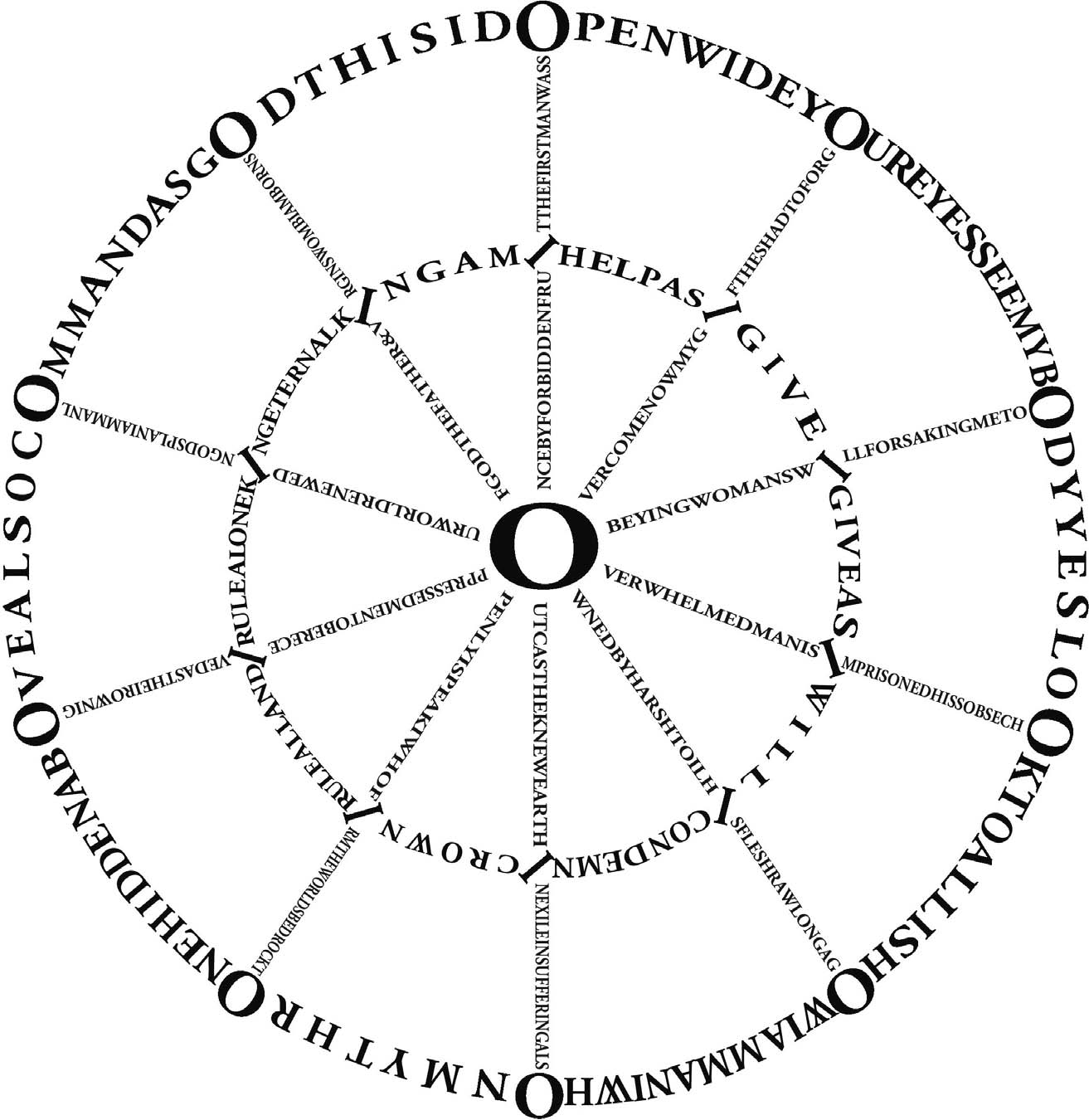
Latin verse. Often in such poems, the primary artifice of presenting form visually through the placement of letters on the page is supplemented by other devices—metrical, mathematical, aural, or visual—which lay stress on the materiality of language—the Word incarnate, in Christian terms—and which may rise to high levels of formal complexity and symbolic association. Such is the case in this poem, attributed to Abelard in the two manuscripts that preserve it. Its figure may derive from the mystic vision of Ezekiel 1:16: "And their appearance and their work were like a wheel in the midst of a wheel." Here, the outer wheel consists of two verses, each with the circular letter O at its beginning and end (and at the metrical caesura of the Latin original), so that they flow into each other, sharing a letter:
Open wide your eyes. See my body. Yes, look! To all, I show I am man, I wh(o), On my throne hidden above, also command as God. This I d(o).
These Os (and some other Os spaced with rough regularity across the lines) also end ten other verses, which run outward like spokes from the center of the wheel, where their initial letters, all again Os, have combined into the large central O of the figure, the axle of the wheels. The verses together make a continuous poem:
Once by forbidden fruit the first man was so Overcome; now my gift he's had to forgo,
Obeying woman's will, forsaking me, too.
Overwhelmed, man is imprisoned; his sobs echo.
OPEN WIDE YOUR EYES
OPEN WIDE YOUR EYES
A SHAPED POEM ON THE INCARNATION OF THE WORD
—translated by Barbara Thorburn
THE LETTERS AND OTHER WRITINGS
Owned by harsh toil, his flesh raw, long ago Outcast, he knew earth in exile, in suffering also.
Openly I speak, I who firm the world's bedrock; to Oppressed men to be received as their own I go.
Our world renewed in God's plan, I am made man. Lo!
Of God the Father and virgin's womb I am born so.
A last couplet forms the inner wheel, sharing ten letters with the verses of the spokes. In Latin, their initial, final, and caesural letters are all again Os, but the present translator has added an embellishment of her own, rendering each with the symmetrical letter I, thereby providing for an aural pun in this thoroughly visual poem:
I help as I give, I give as I will, I condemn, I crown, (I)!
I rule all and I rule alone. King, eternal king am (I).
The fullest discussion of this poem and its background is Ernst (1986).
Abelard composed the verses, "To Astralabe, My Son," sometime toward the end of his life—no more specific date or occasion can be given. The poem follows the genre of gnomic, or "advice," poetry, with a long, loose structure (1,042 lines in the latest critical edition) of many discrete sections offering moral instruction according to the terms of traditional maxims and precepts. Such a form is particularly susceptible to interpolation and also cannot usually be expected to present personal or idiosyncratic views apart from the general and conventional. Occasionally in "To Astralabe, My Son," however, one can see the unmistakable stamp of Abelard as an individual, in his characteristic concerns, terms of ethical and theological analysis, and in some autobiographical detail. The numbers in parentheses refer to the numbered verses as they appear in the edition of Rubingh-Bosscher (1987).
TO ASTRALABE, MY SON
(1–110) Astralabe, my son, your father's sweet joy, I bequeath a few words for your instruction.
Strive hard to learn rather than to teach:
One helps others, the other yourself.
Stop learning when there is no more for you to learn; Do not say or think you should stop before.
Attend to what is said, not to who says it:
TO ASTRALABE, MY SON
Words well spoken give their author his name.
Neither should you swear by a beloved teacher's words, Nor be bound to him by your affection.
It is the apple's fruit that nourishes, not its leaves.
So too the sense must be preferred to the word.
Men's hearts are persuaded by elaborate language; Learning owes more to speech that is plain.
When words abound there is no abundance of sense:
The wanderer must redouble his paths.
When you see that a teaching is not self-consistent There is nothing there that you can trust.
The unstable man changes like the face of the moon; The wise are always steady as the sun.
A fool in his blindness wanders here and there;
The prudent man's tread is everywhere firm.
He considers long how to be sound in his speech So that he is never untrue to himself.
Attend to the words of teachers, to good men's deeds; Let your heart be fervent with this desire.
Study long and hard but be slow to teach, And do not be too eager to write.
I would not have you learn from an upstart master Whose lessons must always be improvised.
Beware above all any damage to your name
And so remain useful to yourself and others.
Old accusations make new ones credible; Your earlier life vouches for your future.
Seek not your own glory but the Lord's, my son; Live not for yourself but for others and God.
Read Holy Scripture assiduously, I implore you, And other texts only for scripture's sake.
Your primary concern should be divine service; Let fear and love of God subdue you.
No one will fear or love God as he should
Without a proper understanding Of how just he is, how powerful, how good in himself,
How merciful to us, and how severe.
Let your will always be subject to God's; Dare to oppose it and you dare to be God.
THE LETTERS AND OTHER WRITINGS
Do not seek your own profit but what pleases him; The former is greed, the latter love.
It is enough that you seek only God's honor; He will remember to benefit you.
Just as wisdom is worth more than any treasure, So nothing is worth less than its opposite.
No one becomes wise through native intelligence.
A moral life is what makes a man wise.
Wisdom is nourished by deeds, not by words.
This grace is granted to the good alone.
A wise son is a blessing and boon to his parents; A foolish son, their sorrow and disgrace.
What an elders bears should not be hard for one younger; No one should put himself above others.
Cato brought water and slaked the thirst of his people
But would not allow his own thirst to be slaked.6
A foolish king is like a jackass sporting a crown, A bane to himself as well as to others.
Praise a prince's good sense rather than his army.
Judgment, not power, is the highest regime.
When a ruler is good, it is a gift from heaven; Bad rulers appear when the people are bad.
Take care first to do, only later to teach, what is good And so remain in tune with yourself.
What you do not want done to others, do not to others;
What you do want done, do also to them.
A simple man believes everyone is like himself.
He is easy to deceive but unwilling to do so.
To be deceived is a fault, to deceive an offense.
We cannot lack faults, but need not offend.
The wise cannot be deceived, and the good cannot deceive; To be deceived is a fault, deception an offense.
To think you are never deceived is the greatest deception; That is an attribute of God alone.
Do not liken yourself to God or seek the ether on high
While confined to this shadowy earthly abode.
6 See Lucan, Pharsalia 9.498 ff.
TO ASTRALABE, MY SON
A just man renders to each whatever is his by right, The brave do not fear adversity.
A temperate man curbs his illicit impulses, Especially at times of prosperity.
As temperance protects us in adversity, So too prosperity calls for this virtue.
A virtue does not endure unless supported by others; Else in bad times it fails, or is lost in good.
Examine well the nature of both virtue and vice:
Lose this judgment and you lose what you are.
A philosopher discerns the hidden nature of things And seeks out their practical applications.
Whoever wants to be justified before the Lord Should never think of himself as just.
Accuse yourself, acknowledge your faults and correct them; Do not mouth remorse, but confess with your heart.
To avoid pride always look at your betters And see in them what you so far lack.
Do not seek to be held great by one in power:
You will be small if he sees you desire this.
Humble through sin and through religion proud:
God makes us so or at some time will.
Work hard to avoid any scandal with men Lest you incur any scandal with God.
As much as God is better than all, so he should be more loved, And after him others according to degree.
Whom should we love except for the sake of God?
In all that you do let this be the end.
(247–56) Rate reason higher than law, law higher than custom; Decide each case by its proper degree.
As a judge you should temper the law's rigor at times:
This is what the lawmakers would want.
Utility is the highest purpose for a law being written;
Therefore nothing adverse should be done by law.
Believe not the greater but the better part of people:
The number of fools is numberless.
No one adduces bad, but only good examples; If anyone does, he is held to be worthless.
THE LETTERS AND OTHER WRITINGS
(293–304) A strange way of life should not make anyone proud:
It is more seemly to live an ordinary life.
Do not seek a higher place in paradise; Whatever corner you have will be enough.7
Don't curry people's favor by wearing a habit; A sheepskin does not fool the wise.
They can tell the skin of sheep from the hide of a wolf; It is the common people who go wrong in this.
No opinion of the learned is more definite:
The exterior does not commend us to God.
A habit will not make you holy; it can make you proud.
This is truly loathsome to the best of men.
(363–84) The world has so many religious sects That the path of life is hardly clear, So many conflicting religious doctrines That each makes his own from his own tradition.
But in the end no one dares rely on reason Since his desire is just to live at peace.
A man can sin only through contempt for God And is not guilty except through this contempt.
Ignorance is not contempt for God
Unless the ignorance is a man's own fault.
If you repent only when you can no longer offend, Sin abandons you, you do not abandon sin.
There are some whom their old sins still delight, So they never truly repent of them.
The sin's sweetness and pleasure may be so great That any amends are too much to bear.
This is our Heloise's constant complaint, Who often says to me and to herself:
"If, unless I repent of what I did in the past
I cannot be saved, there is no hope for me.
The memory of what we did then, the exceeding joy, Is still too pleasurable and sweet for me."8
7 Cf. the Third and Seventh Letters, p. 83 and p. 224.
8 Cf. the Third Letter, pp. 78–9.
TO ASTRALABE, MY SON
(637–48) Philosophers and common people have never thought alike; For the latter, sensation overrules reason.
The corporeal alone holds their attention; They think that God has a body like theirs
And could not see or hear without physical organs,
Or do anything if he did not have hands.
He is indeed all hand, eye, and ear, and from himself Creates all these for all his creatures.
He is in no place so that he may be everywhere at once And is himself the place for all places,
Nowhere confined, in potency everywhere, In whom all things have their subsistence.
(741–58) There is no fault where the will is not depraved:
It is the will alone that makes for guilt.
What we share with the wicked will not make us good; This has nothing at all to do with our merit.
When nature compels you to do good to someone, Do not count this among your good deeds.
When dumb animals' behavior is equal to humans', Do not think you are better but equal to them.
You should pay to Nature what is hers by right But still hold to God as the end in all things.
If you ever see anything cut off from this end,
Know it is wholly devoid of merit.
We have been given reason for just this purpose:
That our lives not be lacking in merit.
When you will what you do, even if under compulsion, Because you will it, count it to the good.
With a mind that is free foresee what must be done, So as not to be forced to live like a slave.
(845–58) Although some say that everything happens by chance, The fact is that God arranges all things.
You may say that some things are not under our control,
THE LETTERS AND OTHER WRITINGS
But all is under the control of God.
You would be rash to thing that things happen by chance, When God's mind most high is present to all.
Nothing that happens provokes a just man's anger:
He knows that all is well governed by God.
He is not perfect in his meditation on God Who even slightly doubts God's control.
I would not be surprised that those who believe in chance Do so only when misfortune befalls.
The just man consoles himself in every difficult strait That this, too, has been arranged by God.
(945–64) Your writing and study should go on together; Only then can a man have a work of his own.
Nothing is more fleeting than words that you speak, But what you write remains when you are gone.
Poets who die live on in their writing.
Life nature denied endures in their poems.
Learned men live on after death through their fame:
Philosophy can do more than Nature.
Some who hardly had a name when they were alive Earned one afterward through their writings.
Socrates was poor, but is still rich in reputation Because he put writing above material goods.
So too Aristotle and his teacher Plato Are present to us in their own writings.
So too others who once in their own voices spoke Never stop speaking through what they have written.
Through writing a man, however distant, is present;
There can be no faithful messenger.
A messenger can report only what you tell him; One may write much it would be awkward to speak.
(999–1006) The perfection of supreme good set out by Christ Is signified in the persons of the Trinity:
In God the Father divine power is expressed,
Wherefore he is called Omnipotent.
TO ASTRALABE, MY SON
The Holy Spirit is Goodness, the Word is Wisdom, One proceeding from the Father, one begotten.
A single substance unites these three persons, Who are distinct in their three properties.
—translated by Stanley Lombardo