
The Steps of Humility and Pride XIX: 48 75
The Steps of Humility and Pride XIX: 48
is fraudulent will show soon enough that it was a sham humility if he is given the slightest reproach or penance. He murmurs and growls and gets vexed. No, he is not in the fourth degree of humility but the ninth of pride which we have called hypocritical confession. You can judge for yourself what is now the state of this proud man's mind. His fraud has failed him, his peace of mind is gone, his reputation has been lowered, and his sin is unforgiven. Now everybody knows what he is,344 everyone condemns him, and they are all the more vexed because of the good opinion his fraud fooled them into holding for so long. In the end the superior will find himself forced to be unsparing so as to avoid general scandal.
THE TENTH STEP: REVOLT
XIX. 48. The divine mercy may yet rescue such a man and inspire him to submit to the judgment of the community;3451 but such a character finds this a very hard thing to do, and instead, he may take an attitude of brazen insolence and in desperation take the fatal plunge as far as the tenth step of pride. He has already shown his contempt for his brethren by insolence, and now his contempt for superiors flashes out in open revolt.
49. We may pause here to take notice that I have divided the descent of pride into twelve steps and these again may be grouped into three classes; in the first six contempt is
344. It would seem from this that Bernard, in this step, has in mind the public confession made in chapter. See note 337 above.
345. Bernard has undoubtedly in mind here RB 28: "If a brother who has been frequently corrected for some fault, and even excommunicated, does not amend, let a harsher correction be applied, that is, let the punishment of the rod be administered to him. But if he still does not reform or perhaps (which God forbid) even rises up in pride and wants to defend his conduct, then let the abbot do what a wise physician would do. Having used applications, the ointments of exhortation, the medicines of the Holy Scriptures, finally the cautery of excommunication and of the strokes of the rod, if he sees that his efforts are of no avail, let him apply a still greater remedy, his own prayers and those of all the brethren, that the Lord, who can do all things, may restore health to the sick brother. But if he is not healed even in this way, then let the abbot use the knife of amputation, according to the Apostle's words, 'Expel the evil one from your midst,' and again, 'If the faithless one departs, let him depart,' lest one diseased sheep contaminate the whole flock."
The Steps of Humility and Pride XX: 50 shown for the brethren, in the next four for the superior, in the last two, on which I have not yet touched, contempt for God. We may note too, that the first two steps of humility will have been climbed before entering the community, and, correspondingly, the last two steps of pride will not be reached while one still remains a member. The reason why the first two steps of humility must be climbed before entering is found in the Rule which says: "The third step is that a monk submit himself to a superior in all obedience for the love of God."346 This submission to a superior takes place when the novice enters the monastery, so he must already have climbed the first two steps. But if a monk refuses to live in harmony with his brethren or to obey his superior, what is he doing in the monastery except causing scandal?
THE ELEVENTH STEP: FREEDOM TO SIN
XX. 50. The man in revolt has reached the tenth step of pride and will leave or be expelled from the monastery. Without delay he goes down to the eleventh step. He then sets his feet on ways that seem to a man right347 but which will lead him, if God does not block his way,348 to the depths of hell, to contempt of God. "When wicked man reaches the depths of evil, he is full of contempt."349 We may style this eleventh step freedom in sinning. The monk has no longer a superior to fear nor brethren to respect, so with fewer qualms he happily gives himself up to his sinful desires which in the monastery fear and shame held in check. He has no abbot or fellow-religious to fear now, but he still keeps some scant fear of God. His conscience still gives some murmurs, however faint; he makes a few half-hearted resolutions, still hesitates a little in his first steps in evil. He does not plunge headlong into the torrent of vice but feels his way step by step like one trying a ford.
346. RB 7:34.
347. Prov 14:12, 16:25. Sec above, no. 19, p. 46.
348. Cf. Hos 2:6.
349. Prov 18:3 (Old Latin or Italic). Cf. Conv 23! OB 4:95; CF 43; Pre 40; OB
3:280; CF 1:135.
The Steps of Humility and Pride XXI: 51
THE TWELFTH STEP: THE HABIT OF SINNING
XXI. 51. The first steps in sin are taken apprehensively and no blow falls from the dreaded judgment of God.350 Pleasure in sin has been experienced. Sin is repeated and the pleasure grows. Old desires revive, conscience is dulled,3S1 habit tightens its grasp. The unfortunate man sinks into the evil depths,3" is tangled in his vices and is swept into the whirlpool of sinful longings while his reason and the fear of God are forgotten and "the fool says in his heart: There is no God."353 Good or evil means nothing to him now.354 He is ready to serve sin heart, hand, and foot with thoughts, acts, and plans unchecked.
He seeks new ways of sinning. The plans of his heart, the ready words of his mouth, the works of his hands, are at the service of every impulse. He has become malevolent, evilspeaking, vile.
The just man who has climbed all the steps of humility runs on to life with a ready heart and with the ease of good habit;355 the evil man who has dropped down to the bottom is ruled by evil habit, and unchecked by fear he runs boldly on to death. Those in mid-course, whether going up or down, are weary with the strain, torn now by the fear of hell and now by the attraction of old habits. Only at the top and at the bottom is there a free and effortless course, upward to life or downward to death; bounding on in the effortless energy of love, or hurried, unresisting, by the downward pull of cupidity. In one case love, in the other apathy ignores the 350. Heb 10:27.
351. Cf. Conv 5; OB 4:76; CF 43.
352. Prov 18:3.
353. Ps 13:1.
354. Cf. Pre 39; OB 3:280; CF 1:134.
355. Cf. RB 7:67ff: "Having climbed all these steps of humility, therefore, the monk will presently come to that perfect love of God which casts out fear. And all those precepts which formerly he had not observed without fear, he will now begin to keep by reason of that love, without any effort, as though naturally and by habit. No longer will his motive be the fear of hell; but rather the love of Christ, good habit and delight in the virtues which the Lord will deign to show forth by the Holy Spirit in his servant now cleansed from vice and sin." See also, RB Prol
49.
The Steps of Humility and Pride XXII: 52 labor of life. Perfect love or complete malice cast out fear.356
Security is found in truth or in blindness. So we can call the twelfth step the habit of sinning, by which the fear of God has been lost, replaced by contempt.
XXII. 52. "For such a one," says St John the Apostle, "I would not that anyone should pray."357 What then, O Blessed
Apostle, is he to despair? One who really loves him will still weep. Let him not dare to pray, nor cease to wail.
I am not suggesting that hope is entirely gone when prayer is forbidden. I can give you an example of one who believed and hoped even when the case seemed to be beyond prayer. "Lord," she said, "If you had been here my brother would not have died."358 She must have had faith, strong faith, if she believed that our Lord's presence could have saved her brother's life. Her next words leave us no room for thinking that there was a limit to her faith or that she thought that while our Lord could have saved her brother's life he could not raise him from the dead. She added: "But even now I know that whatever you ask from God he will give to you."359 When Jesus asked where they had laid him she answered: "Come and see."360 Why did she stop at that?
Martha, you have given us a wonderful example of faith, surely you do not begin to doubt now? When you said: "Come and see," was your hope not strong enough to add: "and raise him up?" If you had no hope you would not have troubled the Master with a useless visit. It is rather that faith will sometimes gain what prayer hardly dares ask. As he approached the grave you stopped him and said: "Lord, by this time there will be an odor for he has been now four days dead."361 Was it despair made you say that? I rather think you
356. 1 Jn 4:18; RB 7:67.
357. 1 Jn 5:16. See Augustine of Hippo, City of God 21:24, tr. G. Walsh and D.
Honan. Works of St Augustine 8, Fathers of the Church 24 (New York: Fathers of the Church, 1954) pp. 387ff.
358. Jn 11:21. The reference is to Martha speaking of Lazarus' death.
359. Jn 11:22.
360. Jn 11:34. These words however are attributed in the text to the crowd.
361. Jn 11:39.
The Steps of Humility and Pride XXII: 53
were making a timid suggestion; just as our Lord after his resurrection feigned to be going further when he really wanted to remain with his disciples.362 O you two holy sisters,363 friends of Christ, if you really love your brother why do you not ask for him the mercy of One whose power you cannot doubt, about whose love you can have no hesitation?364 But their answer comes: "We are praying, praying all the better when we voice no prayer. We trust all the more strongly when we seem to doubt. We show our faith, we show our love; and he who needs no telling knows what we desire.365 We know that he can do all things; even this great unheard-of miracle is well within his power; but it is far beyond all the merits of our lowliness. It is enough for us to have brought him, to have set the stage for this great wonder, to have given love its opportunity. We would rather wait patiently on his will than ask impudently for something he may not will to give. Perhaps our modesty will supply for our unworthiness." I think of the case of Peter, too, weeping after his great fall, with no express words of prayer, and leaving me no doubt about his pardon.366
53. Learn from the Mother of our Lord herself a lesson of how great faith in his wonderful powers can be expressed with modesty. She shows us how modesty, avoiding all presumption, is an ornament to faith. "They have no wine," she said.367 How briefly and modestly she suggested a request her kindness had so much at heart! And thus you learn that in such circumstances it is better to make a gentle complaint than to insist on a right, better to give modest and gentle expression to the impetuosity of kindly anxiety than to speak in the tone of one who takes it for granted that the request must be heard. She did not speak out unhesitatingly and boldly before everyone: "Listen, Son, they have no wine. The guests are disappointed, the bridegroom is upset; show what you can do." This would not have been too strong an expres362. Lk 24:28.
363. Martha and her sister, Mary. Jn 11:1.
364. Jn 11:3: "Lord, he whom you love is sick."
365. Wis 7:27, Mt 6:8.
366. Mt 26:75; Mk 14:72; Lk 22:61-62.
367. Jn 2:3.
The Steps of Humility and Pride XXII: 54-55 sion, certainly, for her affection for those concerned. But this loving mother went privately to her Son, not testing his power but enquiring about what he wished to do. "They have no wine," she said. Could it be expressed more modestly and more trustfully? Her love was sure, her words earnest, her desires prevailing.368 If then his mother would not presume on her motherhood to ask in so many words for the miracle of the wine, could a lowly slave like myself, honored enough by being the slave of Mother and Son, dare to ask for such a thing as the life of one four days dead?
54. We read in the Gospel of two blind men who were cured.
One had lost his sight,369 and other was born blind.370 To one sight was restored, to the other given for the first time. The one who lost his sight pleaded pitifully and merited marvelous mercy; but the mercy shown to the other appears more marvelous for he had never asked before receiving the gift of light from his Lord. Finally the former heard the words: "Your faith has made you whole;" but not the latter. We read of two recently deceased371 and one four days dead being raised to life.372 For one only, while she still lay in the house, was a plea made by her father, to the others it was the unasked-for gift of love.
55. So, if a similar case should arise—which God forbidthat one of our brethren should die the death, not of the body but of the soul, I, sinner though I be, would plead for him373 with my Savior with my own most earnest prayers and with the prayers of the brethren. If he returns to life374 we will have gained our brother.375 If we should not merit to be heard and he is borne out from among us—because, being dead, he cannot bear the company of the living, or because they cannot
368. Cf. O Asspt 10; OB 5:270; CF 26.
369. Mk 10:46-52; Lk 18:35-43.
37<X Jn 9.
371. Jairus' daughter (Mt 9: 18-26; Mk 5: 22-43; LK 8:41-56) and the son of the widow of Nairn (Lk 7:11-17).
372. Jn 11:1-44.
373. Bernard has "pulsabo . . . Salvatorem, literally "knock on my Savior," suggested by Mt 7:7.
374. Cf. Lk 15:24.
375. Mt 18:15.
The Steps of Humility and Pride XXII: 56
bear his company—I will still do my duty as a mourner though I cannot now pray with the same confidence. I do not dare to say: "Lord come, and raise up our dead brother," but to my fearful and anxious heart I continually repeat: "Perhaps, perhaps, perhaps, the Lord will listen to the desires of the poor and his ears will hear the preparation of their heart!" 3 7 7 With special reference to one who is four days dead I will say: "Is your steadfast love declared in the grave or your faithfulness in perdition?" 3 7 8 If he will, our Savior may, without warning and in an unhoped for way, meet us and, moved by the tears if not the prayers of the mourners, he may restore the dead man to the living379 or recall him from the very sepulchre,380
I count a man dead when, defending his sins, he slips down to the eighth step. "From the dead, as from one who does not exist, confession ceases."381 When he has passed the tenth step, the second after this, he is being carried away on the bier of reckless sin, he is expelled from the fellowship of the monastery. When he reaches the fourth of these last steps he is rightly said to be four days dead. Then a fifth step finds him hardened in sin, the grave closed over him.
56. God forbid that we should ever cease to pray for such men in our hearts even if we do not offer public prayers for them. St Paul prayed even for those whom he knew died impenitent.382 For although they exclude themselves from the prayers of the faithful,383 they can by no means exclude themselves from our affections. If only they would be warned of their terrible danger when they realize that the Church does not pray for them in her liturgy when she prays confidently even for Jews, heretics and pagans. For on Good Friday when
376. Ps 9bis: 17.
377. Ps 8 7 : H .
378. Ps 87:12.
379. Reference to the young man from Nairn. See above, note 371.
380. An allusion to Lazarus.
381. Sir 17:26.
382. 2 Cor 12:21.
383. The "common prayer" or the prayers of the faithful are offered at the Eucharistic liturgy after the proclamation of the Gospel, the homily and the confession of faith, at the beginning of the part called the "mass of the faithful."
The Steps of Humility and Pride XXII: 57 she prays for each class of sinners by name, she makes no mention of the excommunicated.384
A CONCLUDING NOTE TO THE RECIPIENT
57. Well, Brother Godfrey, you will, perhaps complain that I have not given you exactly what you asked and what I promised. It looks as if I had described the steps of pride rather than those of humility.385 All I can say is that I can teach only what I know myself. I could not very well describe the way up because I am more used to falling down than to climbing. St Benedict describes the steps of humility to you because he had them in his heart; I can only tell you what
I know myself, the downward path. However, if you study this carefully you will find the way up. If you are going to Rome who can tell you the way better than one you meet coming from there? He will describe the towns, villages, cities, rivers and mountains he has passed and as you go along you will meet and recognize them in the reverse order. So, we have described the stages of the downward road and you will see them as you climb up and down them better from your own experience than from the description of our book.
384. On Good Friday, when the central part of the mass, the re-presentation of Christ's saving death in the consecration of the bread and wine through the narration of the Lord's words from the Last Supper, is omitted, the other parts are more fully developed, especially the prayers of the faithful.
385. See above, Retractation, p. 25.
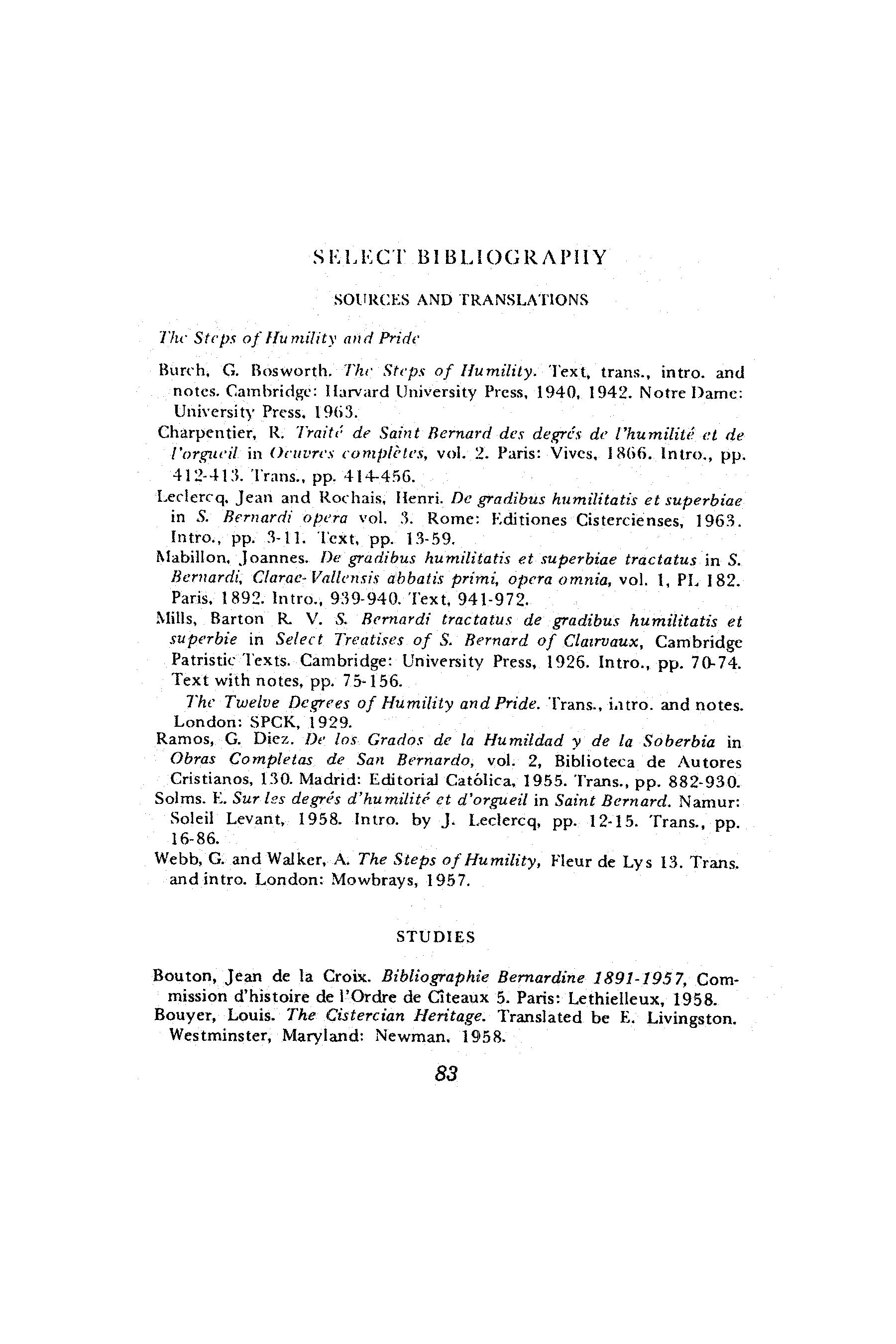
S K L K C T
B I B L I O G R A P H Y
SOURCES AND TRANSLATIONS
The Steps of Humility and Pride Burch, G. Rosworth. The Steps of Humility.
Text, trans., intro. and notes. Cambridge: Harvard University Press, 1940, 1942. Notre Dame:
University Press, 1963.
Charpentier, R. Traité de Saint Bernard des degrés de l'humilité et de l'orgueil in Oeuvres complètes, vol. 2. Paris: Vives, 1856. Intro., pp.
412-41:5. Trans., pp. 414-456.
Ledereq, Jean and Rochais, Henri. De gradibus humilitatis et superbiae in S. Bernardi opera vol. 3. Rome: Kditiones Cistercienses, 1963.
Intro., pp. 3-11. Text, pp. 13-59.
Mabillon, Joannes, lie gradibus humilitatis et superbiae tractatus in S.
Bernardi, ClaraeVnllensis abbatis primi, opera omnia, vol. 1, PL 182.
Paris, 1892. Intro., 939-940. Text, 941-972.
Mills, Barton R. V. S. Bernardi tractatus de gradibus humilitatis et superbie in Select Treatises of S. Bernard of Clairvaux, Cambridge Patristic Texts. Cambridge: University Press, 1926. Intro., pp. 70-74.
Text with notes, pp. 75-156.
The Twelve Degrees of Humility and Pride. Trans., i.itro. and notes.
London: SPCK, 1929.
Ramos, G. Diez. De los Grados de la Humildad y de la Soberbia in Obras Complétas de San Bernardo, vol. 2, Biblioteca de Autores Cristianos, 130. Madrid: Editorial Católica, 1955. Trans., pp. 882-930.
Solms. K. Sur les degrés d'humilité et d'orgueil in Saint Bernard.
Namur:
Soleil Levant, 1958. Intro. by J. Leclercq, pp. 12-15. Trans., pp.
16-86.
Webb, G. and Walker, A. The Steps of Humility, Fleur de Lys 13. Trans, and intro. London: Mowbrays, 1957.
S T U D I E S
Bouton, Jean de la Croix. Bibliographie Bernardine 1891-1957, Commission d'histoire de l'Ordre de Cîteaux 5. Paris: Lethielleux, 1958.
Bouyer, Louis. The Cistercian Heritage.
Translated be E. Livingston.
Westminster, Maryland: Newman. 1958.
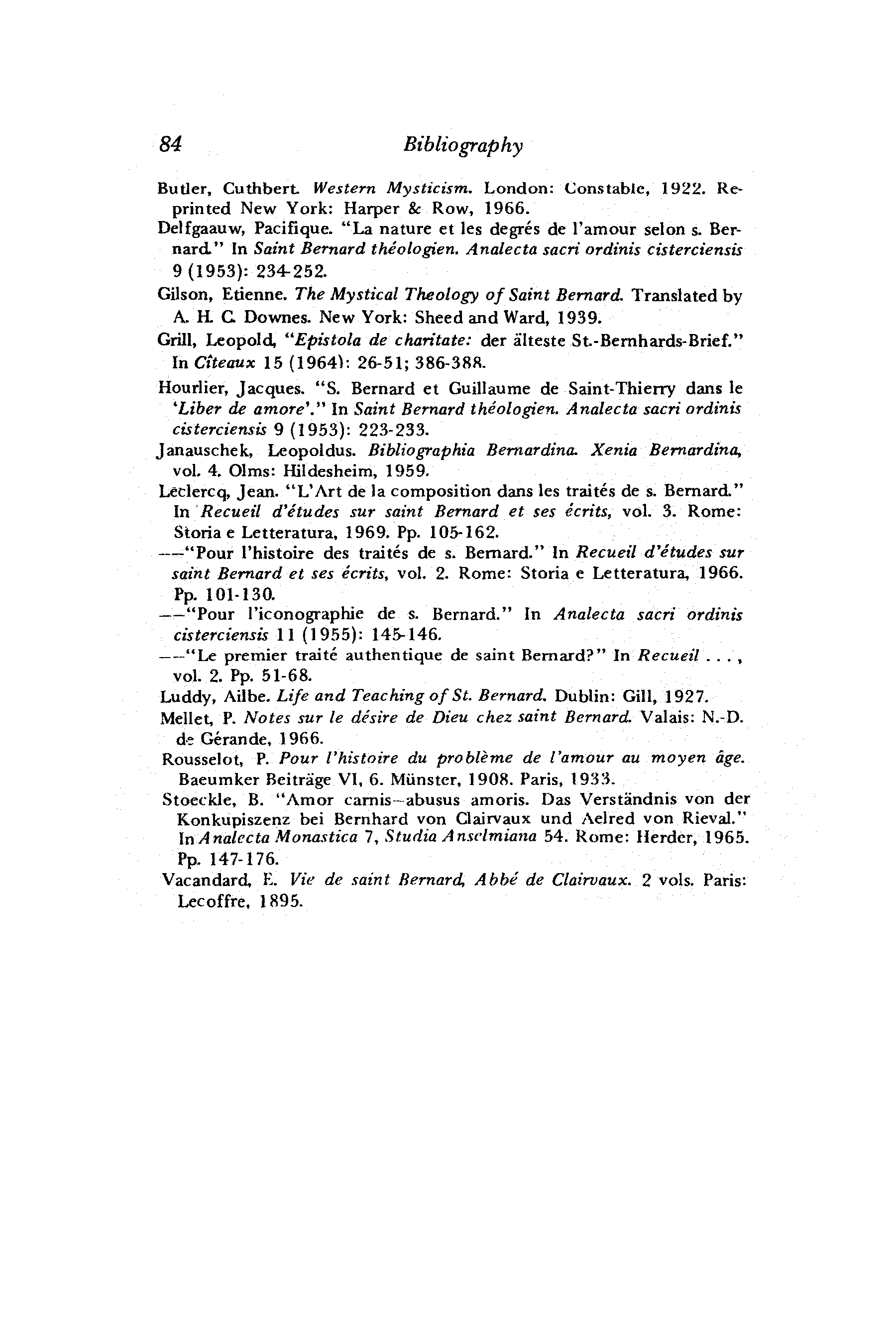
Bibliography Butler, Cuthbert Western Mysticism.
London: Constable, 1922. Reprinted New York: Harper & Row, 1966.
Delfgaauw, Pacifique. "La nature et les degrés de l'amour selon s. Bernard." In Saint Bernard théologien. Analecta sacri ordinis cisterciensis 9 (1953): 234-252.
Gilson, Etienne. The Mystical Theology of Saint Bernard. Translated by A. H. G Downes. New York: Sheed and Ward, 1939.
Grill, Leopold, "Epistola de charitate: der älteste St.-Bernhards-Brief."
In Citeaux 15 (1964Ì: 26-51; 386-388.
Hourlier, Jacques. "S. Bernard et Guillaume de Saint-Thierry dans le 'Liber de amore'." In Saint Bernard théologien. Analecta sacri ordinis cisterciensis 9 (1953): 223-233.
Janauschek, Leopoldus. Bibliographia Bernardina.
Xenia Bernardina, vol. 4. Olms: Hildesheim, 1959.
Leclercq, Jean. "L'Art de la composition dans les traités de s. Bernard."
In Recueil d'études sur saint Bernard et ses écrits, vol. 3. Rome:
Storia e Letteratura, 1969. Pp. 105-162.
"Pour l'histoire des traités de s. Bernard." In Recueil d'études sur saint Bernard et ses écrits, vol. 2. Rome: Storia e Letteratura, 1966.
Pp. 101-130.
"Pour l'iconographie de s. Bernard." In Analecta sacri ordinis cisterciensis 11 (1955): 145-146.
"Le premier traité authentique de saint Bernard?" In Recueil . . . , vol. 2. Pp. 51-68.
Luddy, Ailbe. Life and Teaching of St. Bernard. Dublin: Gill, 1927.
Mellet, P. Notes sur le désire de Dieu chez saint Bernard. Valais: N.-D. d; Gérande, 1966.
Rousselot, P. Pour l'histoire du problème de l'amour au moyen âge.
Baeumker Beiträge VI, 6. Münster, 1908. Paris, 1933.
Stoeckle, B. "Amor camis—abusus amoris. Das Verständnis von der Konkupiszenz bei Bernhard von Clairvaux und Aelred von Rieval."
\n Analecta Monastica 7, Studia Ansclmiana 54. Rome: Herder, 1965.
Pp. 147-176.
Vacandard, K. Vie de saint Bernard, Abbé de Clairvaux. 2 vols. Paris:
Lecoffre, 1895.
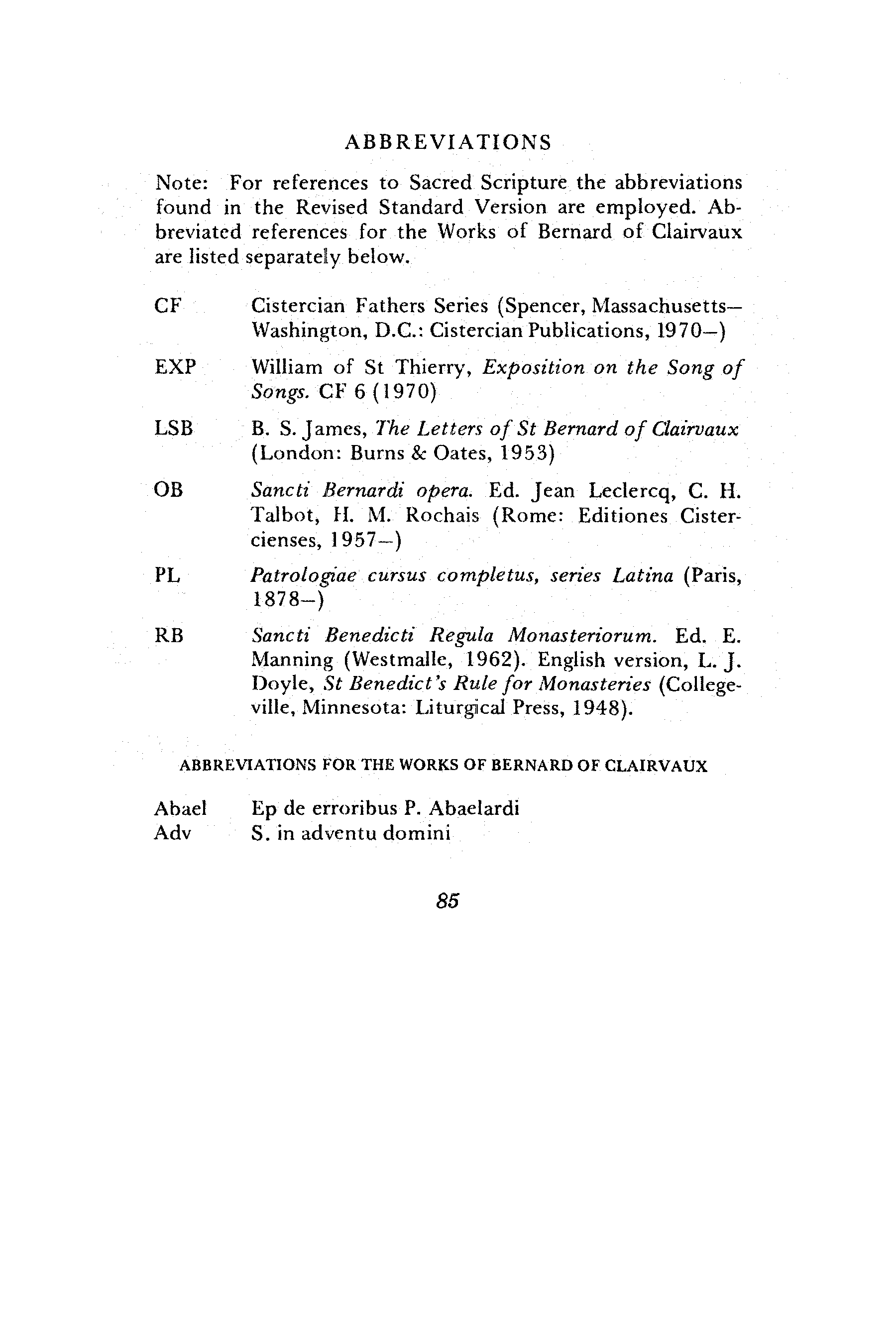
A B B R E V I A T I O N S
Note:
For references to Sacred Scripture the abbreviations found in the Revised Standard Version are employed. Abbreviated references for the Works of Bernard of Clairvaux are listed separately below.
CF Cistercian Fathers Series (Spencer, MassachusettsWashington, D.C.: Cistercian Publications, 1970—)
EXP William of St Thierry, Exposition on the Song of Songs. CF 6 (1970) LSB B. S. James, The Letters of St Bernard of Clairvaux (London: Burns & Oates, 1953) OB Sancti Bernardi opera.
Ed. Jean Leclercq, C. H.
Talbot, H. M. Rochais (Rome: Editiones Cistercienses, 1957—) PL Patrologiae cursus completus, series Latina (Paris, 1878—) RB Sancti Benedicti Regula Monasteriorum.
Ed. E.
Manning (Westmalle, 1962). English version, L . J .
Doyle, St Benedict's Rule for Monasteries (Collegeville, Minnesota: Liturgical Press, 1948).
ABBREVIATIONS FOR THE WORKS OF BERNARD OF CLAIRVAUX
Abael Ep de erroribus P. Abaelardi Adv S. in adventu domini
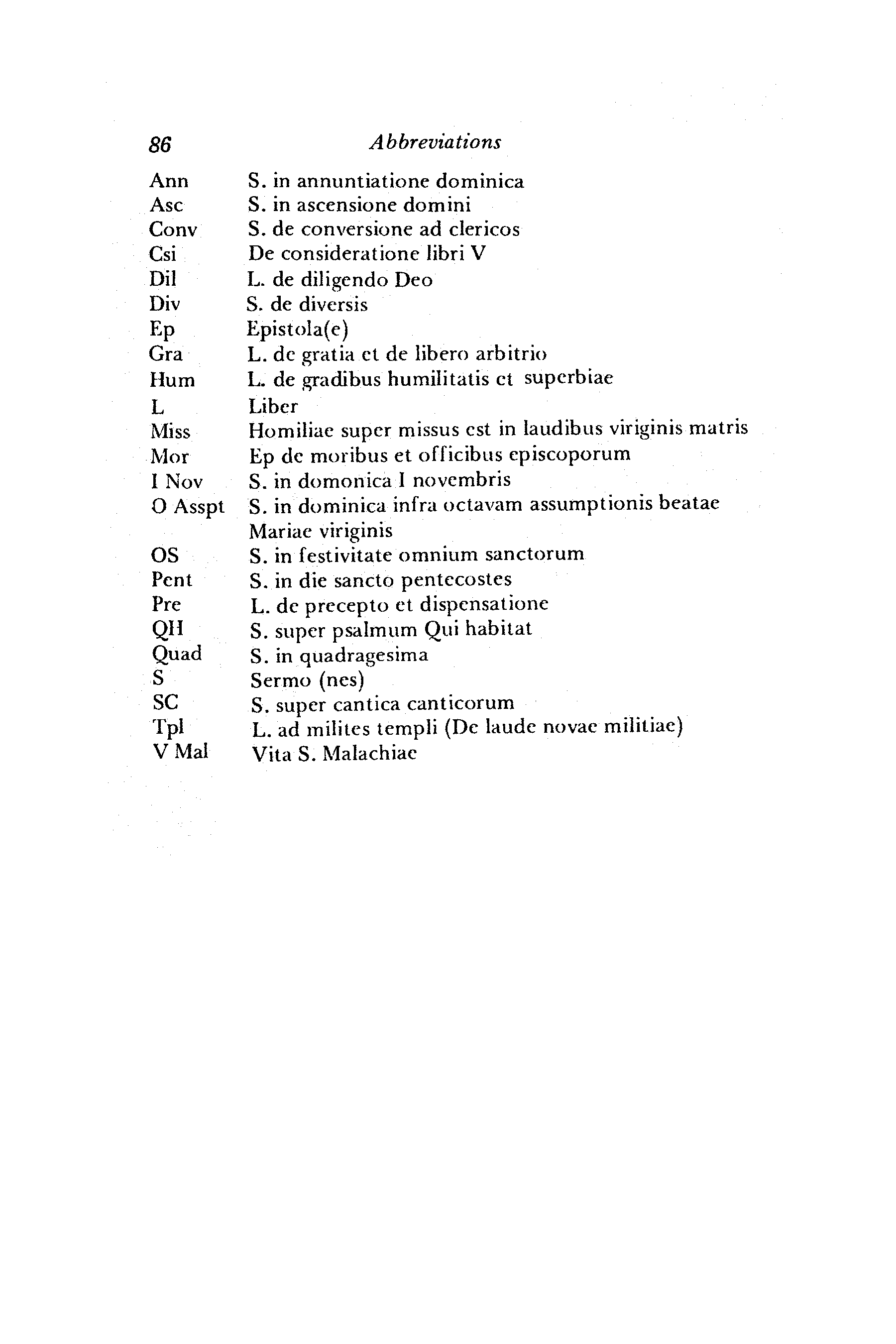
Abbreviations Ann S. in annuntiatione dominica Asc S. in ascensione domini Conv S. de conversione ad clericos Csi De consideratione libri V Dil L. de diligendo Deo Div S. de diversis Ep Epistola(e) Gra L. de gratia et de libero arbitrio Hum L. de gradibus humilitatis et superbiae L Liber Miss Homiliae super missus est in laudibus viriginis matris
Mor Ep de moribus et officibus episcoporum I Nov S. in domonica I novembris 0 Asspt S. in dominica infra octavam assumptionis beatae
Mariae viriginis OS S. in festivitate omnium sanctorum Pent S. in die sancto pentecostes Pre L. de precepto et dispensatione QH S. super psalmum Qui habitat Quad S. in quadragesima S Sermo (nes) sc S. super cantica canticorum Tpl L. ad milites templi (De laude novae militiae)
V Mai Vita S. Malachiae
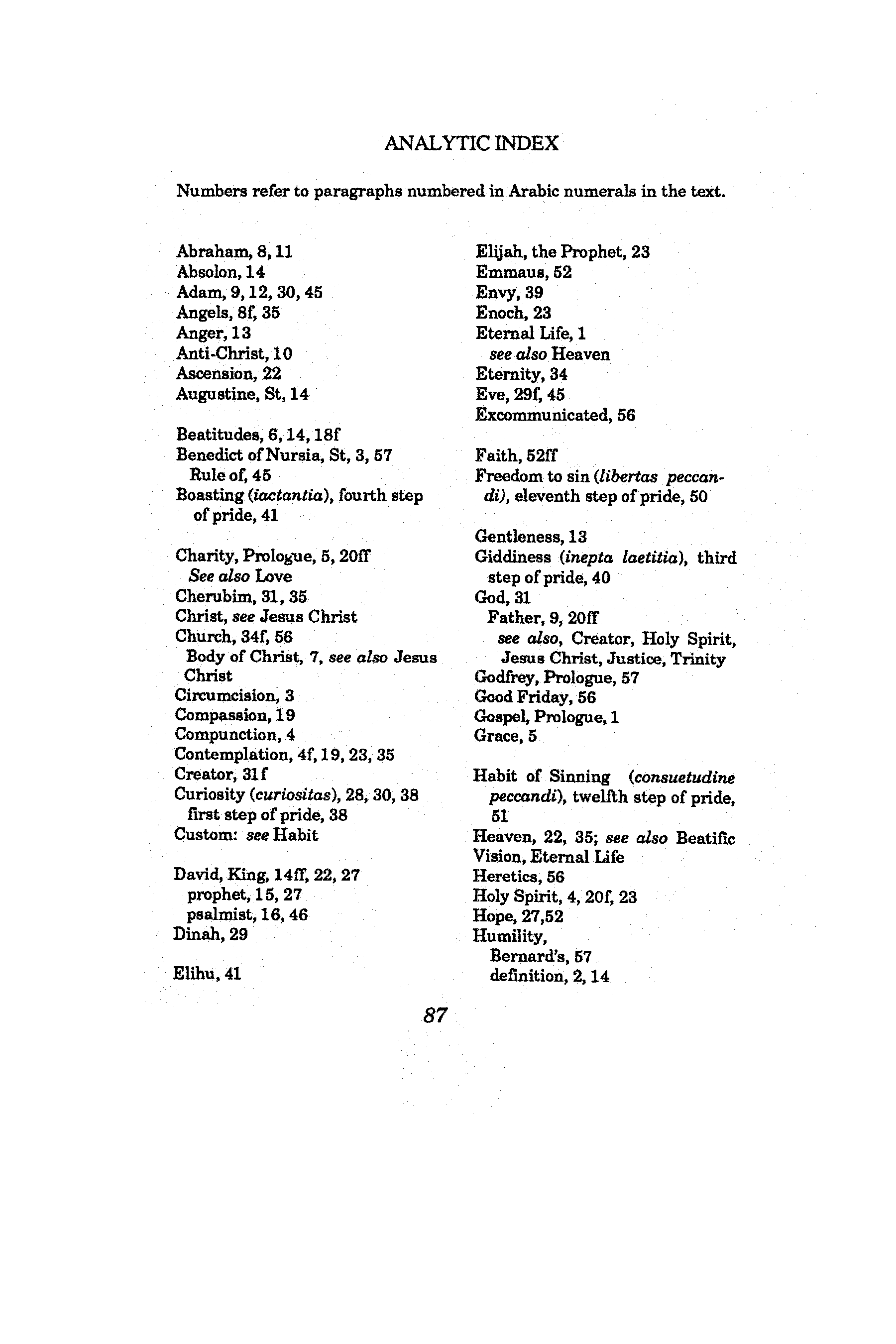
ANALYTIC INDEX
Numbers refer to paragraphs numbered in Arabic numerals in the text.
Elijah, the Prophet, 23 Emmaus, 52 Envy, 39 Enoch, 23 Eternal Life, 1 Abraham, 8,11 Absolon, 14 Adam, 9,12,30, 45 Angels, Sf, 35 Anger, 13 Anti-Christ, 10 Ascension, 22 Augustine, St, 14 see also Heaven Eternity, 34 Eve, 29 f, 45 Excommunicated, 56 Beatitudes, 6,14,18f Benedict of Nursia, St, 3, 57 Faith, 52ff Freedom to sin (libertas peccanRule of, 45
Boasting (iactantia), fourth step di), eleventh step of pride, 50 of pride, 41 Gentleness, 13 Giddiness (inepta laetitia), third Charity, Prologue, 5,20£f See also Love Cherubim, 31, 35 Christ, see Jesus Christ Church, 34f, 56 step of pride, 40 God, 31 Father, 9, 20ff see also, Creator, Holy Spirit, Body of Christ, 7, see also Jesus Christ Circumcision, 3 Compassion, 19 Compunction, 4 Contemplation, 4f, 19,23, 35 Creator, 31 f Curiosity (curiositas), 28, 30, 38 Jesus Christ, Justice, Trinity Godfrey, Prologue, 57 Good Friday, 56 Gospel, Prologue, 1 Grace, 5 Habit of Sinning (consuetudine peccandi), twelfth step of pride, first step of pride, 38 Custom: see Habit
Heaven, 22, 35; see also Beatific Vision, Eternal Life Heretics, 56 Holy Spirit, 4, 20f, 23 Hope, 27,52 Humility, David, King, 14ff, 22, 27 prophet, 15, 27 psalmist, 16,46 Dinah, 29 Bernard's, 57 definition, 2,14 Elihu, 41
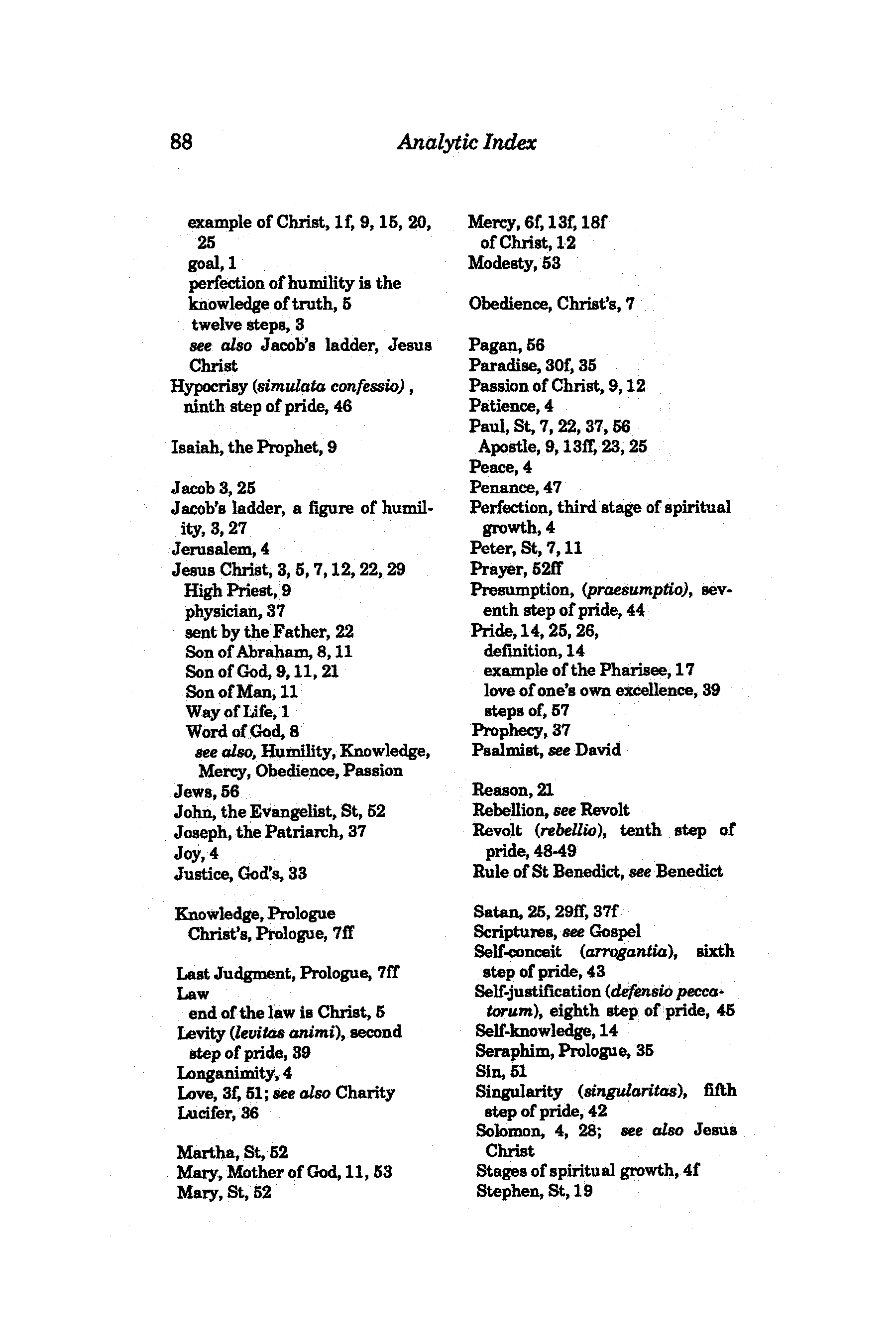
Analytic Index example of Christ, If, 9,15, 20, Mercy, 6f,13f,18f
goal, 1 perfection of humility is the knowledge of truth, 5 of Christ, 12 Modesty, 53 Obedience, Christ's, 7 twelve steps, 3 see also Jacob's ladder, Jesus Christ Hypocrisy (simulate confessio) , Pagan, 56 Paradise, 30f, 35 Passion of Christ, 9,12 Patience, 4 Paul, St, 7,22, 37, 56 ninth step of pride, 46 Apostle, 9,13ff, 23,25 Peace, 4 Penance, 47 Perfection, third stage of spiritual Isaiah, the Prophet, 9 Jacob 3, 25 Jacob's ladder, a figure of humilgrowth, 4
Peter, St, 7,11 Prayer, 52(f Presumption, (praesumptio), sevity, 3,27 Jerusalem, 4 Jesus Christ, 3,5,7,12,22,29 High Priest, 9 physician, 37 sent by the Father, 22 Son of Abraham, 8,11 Son of God, 9,11,21 Son of Man, 11 Way of life, 1 Word of God, 8 enth step of pride, 44 Pride, 14,25,26, definition, 14 example of the Pharisee, 17 love of one's own excellence, 39 steps of, 57 Prophecy, 37 Psalmist, see David see also, Humility, Knowledge, Mercy, Obedience, Passion Jews, 56 John, the Evangelist, St, 52 Joseph, the Patriarch, 37 Joy, 4 Justice, God's, 33 Reason, 21 Rebellion, see Revolt Revolt {rebellio), tenth step of pride, 48-49 Rule of St Benedict, see Benedict Satan, 25,29ff, 37f Scriptures, see Gospel Self-conceit (arrogantia), sixth Knowledge, Prologue Christ's, Prologue, 7 ff step of pride, 43 Self-justification (defensio pecca» Last Judgment, Prologue, 7ff Law torum), eighth step of pride, 45 Self-knowledge, 14 Seraphim, Prologue, 35 Sin, 51 Singularity (singularitas), fifth end of the law is Christ, 5 Levity (levitas animi), second step of pride, 39 Longanimity, 4 Love, 3f, 51; see also Charity Lucifer, 36 step of pride, 42 Solomon, 4, 28; see also Jesus Christ Stages of spiritual growth, 4f Stephen, St, 19 Martha, St, 52 Maiy, Mother of God, 11, 53 Mary, St, 52
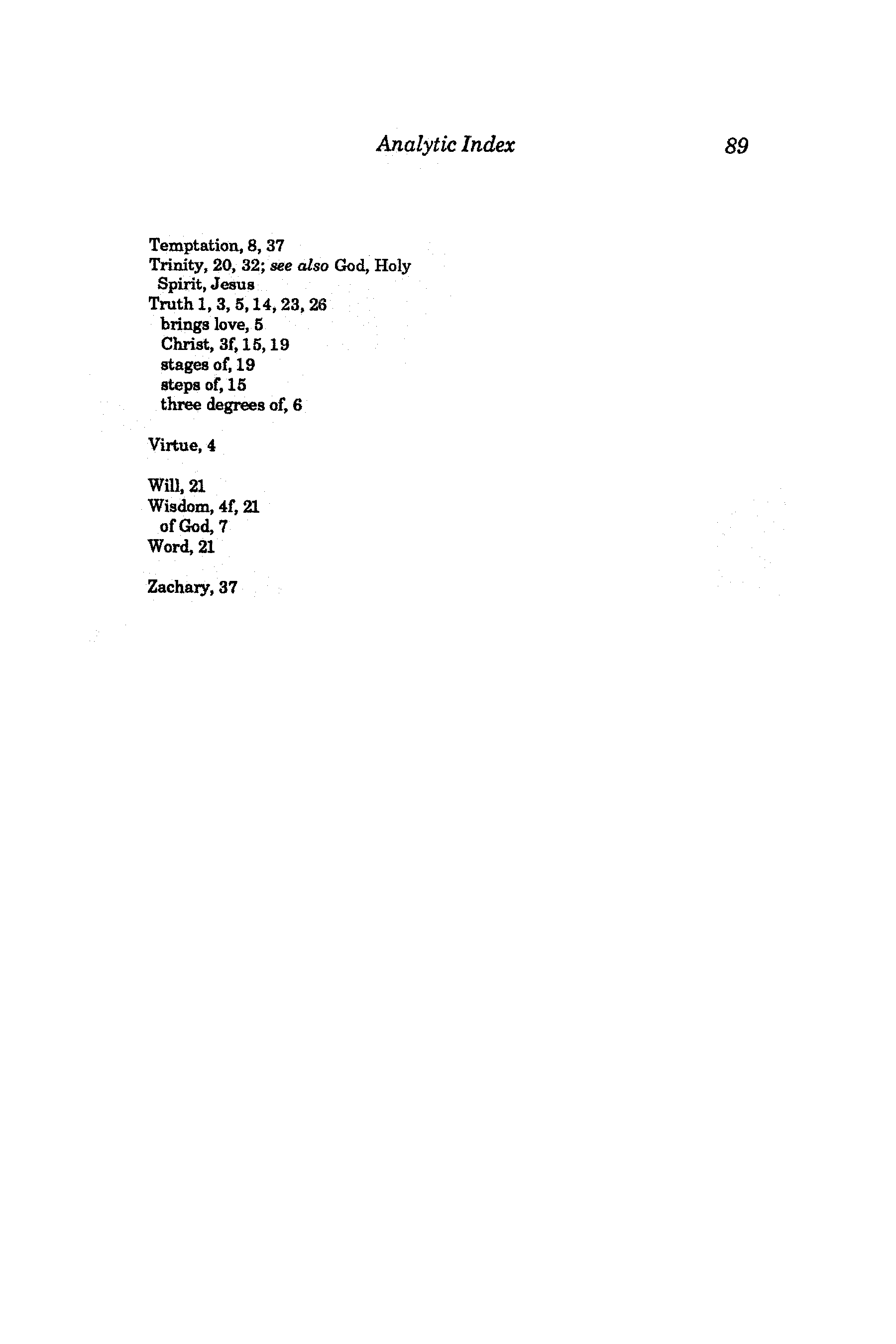
Analytic Index Temptation, 8,37 Trinity, 20, 32; see also God, Holy Spirit, Jesus Truth 1,3, 5,14,23, 26 brings love, 5 Christ, 3f, 15,19 stages of, 19 steps of, 15 three degrees of, 6 Virtue, 4 Will, 21 Wisdom, 4f, 21 of God, 7 Word, 21 Zachaiy, 37