
Front matter

The Steps of Humility and Pride
Monastic Studies Series
This series contains titles from monastic and ascetical writers throughout the history of monasticism. Both Eastern and Western
Christian saints and ascetics are featured as the writers of these classics of spirituality that explore various aspects of the cenobitic and eremitic lifestyles. Ancient and contemporary exemplars of the monastic ideal are the subjects and contributors to this series dedicated to the benefits of religious orders.
The Steps of Humility and Pride By Bernard of Clairvaux Introduction by Translated by M. Basil Pennington OCSO M. Ambrose Conway OCSO -äk 1 gorgias press
Gorgias Press LLC, 180 Centennial Ave., Piscataway, NJ, 08854, USA www.gorgiaspress.com Copyright © 2010 by Gorgias Press LLC Originally published in 1989 All rights reserved under International and Pan-American Copyright
Conventions. No part of this publication may be reproduced, stored in a retrieval system or transmitted in any form or by any means, electronic, mechanical, photocopying, recording, scanning or otherwise without the prior written permission of Gorgias Press LLC.
ISBN 978-1-60724-197-3
This book was first published under the same title by Cistercian Publications, 1989.
Printed in the United States of America

CONTENTS
THE STEPS OF HUMILITY AND PRIDE
Introduction by M. Basil Pennington OCSO
Text translated by M. Ambrose Conway OCSO
Select Bibliography
List of Abbreviations
Analytic Index


I N T R O D U C T I O N
T ^ H E STEPS OF HUMILITY is Bernard of Clairvaux's first published work.1 And yet surely it is not the work of an amateur as both its immediate popularity and its continued popularity through the centuries clearly attest.2 It has been published in English translation more frequently than any of his other works with the possible exception of his treatise, On Loving
God.3
The title of the treatise does not really prepare the reader for what is to be found in it.4 This is not a new discovery.
Bernard's first critics said the same. And the sensitive young Abbot felt the need to defend himself in his
Retractatio.5
1. Godfrey of Langres, to whom this Treatise is addressed, in the Fourth Book of the Life of St Bernard. (S. Bernardi Vita Prima) speaks of "his first work concerning the steps of humility."—c. 8, PL 185:320. For a fuller treatment of this question and indeed for an excellent introduction in general, see the Introduction in S. Bemardi Opera (hereafter OB) ed. J. Leclercq, H. Rocháis (Rome:Editiones
Cistercienses) vol. 3 (1963) pp. 3-11. On this particular point see also, J. Leclercq,
"Le premier traité authentique de saint Bernard?" Recueil d'études sur saint Bernard et ses écrits (Rome:Edizioni di Storia e Letteratura) vol. 2 (1966) pp.
51-67, reprinted from Revue d'histoire ecclésiastique 48 (1953): 196-210.
2. This is evident from the diffusion of the mss. See OB 3:4ff.
3. See the Bibliography below, pp. 133-135.
4. Mills echoes the sentiment of many when he says in his Introduction: "The title of the book is somewhat misleading." Saint Bernard, The Twelve Degrees of Humility and Pride, tr. B. It V. Mills (London: SPCK, 1929), p. viii.
5. "Some have objected to the title: "The Steps of Humility," on the ground that I have described the steps not of humility but of pride. They must not have understood or have not noticed my note at the end where I briefly explain the title."—below, p. 25.
The Steps of Humility and Pride
THE RETRACTATIO
A tradition going back to manuscripts contemporary with Bernard himself places the Retractatio6 at the head of the treatise.7 It is certainly an important document, not so much because of the correctives it brings to the text as for what it tells us about the author. It assures us that he "practices what he preaches." It may be spirited, but it certainly is the expression of a truly humble man. Where he had been wrong, he readily confessed it. He had no desire to conceal it; he wanted to right the wrong. We see a man who readily accepted himself as fallible, a man genuinely and courageously self-possessed.
He did not have to be right. This same spirit is evinced in his willingness to set forth a personal opinion as a personal opinion. Yet his was true humility, based on truth. Where his critics are wrong he was not ready to make any false protestations but firmly stood his ground. All the virtues are interconnected; the truly humble man is also truthful and courageous.
But the Retractatio tells us something else about the author, something it is well to keep in mind when reading not only this treatise but all his subsequent writings. Bernard tells us here that when he quoted Scripture he depended on his memory, and not a verbal memory, but rather a general sense of the passage.8 This was true even in a case where the text in question was the basis of his whole line of reasoning. Thus as we
6. The English "Retractation" does not do justice to the content of the Latin word; it is rather a reconsidering of the matter—in this case, in the light of some objections, which are answered with both a retractation and a spirited defense.
7. See OB 3:5ff.
8. "X quoted, as I thought, the text and then found that it was not in the Gospel at all. I had no intention of falsifying the text but I was depending on my memory of the general sense of the passage and made a slip in the words."—below, p. 25.
Dom Jean Leclercq has pointed out to me that Wordsworth and White in their Novum Testamentum latine (Oxford, 1889-98) indicate that at Mk 13:32, the text
Bernard quoted, filius hominis (Son of Man), is found in some mss, including the Book of Armagh (Dublinensis) and the Book of Kelts (Dublin) (see Wordsworth and White, 1:253) so a certain "Irish" tradition may have influenced the text first quoted by Bernard. I am grateful to Dom Jean Leclercq for this indication and for the other helpful suggestions he made after reading this Introduction.
Introduction
read St Bernard we should not be surprised at times to find that his Scriptural texts are not exactly those found in our
Bibles. He may have had in mind the Vulgate or the Old Latin version,9 or more likely texts from these employed in the liturgy where they are sometimes adapted to the context. Or he may, as he admits here, have been speaking from the general sense of the passage. Bernard was not usually too concerned with the literal sense of the Scriptural texts he employed
(though sometimes he certainly was, as we can see from this treatise). He was quite ready to leave this husk to get at the inner meat, the typological meaning.10 And even there, for this man so typically monastic, it was the practical moral sense that most interested him—what he and his brethren could be doing to respond to the reality revealed—rather than the allegorical or anagogic meanings.11
The Retractatio also tells us something about the diffusion of Bernard's works. We do not know exactly when it was writ9. Watkin Williams in his Preface quotes Dr White, Dean of Christ Church: " . . . his considered opinion is that St Bernard 'probably used an ordinary Vulgate text which had preserved a certain number of Old Latin readings, as so many of the Vulgate mss did; and also that he often quoted from memory.' " Williams goes on to say, still depending on White: "a salient instance of the former would'be the addition of 'quanto magis' in John xiii. 15." There is no indication that White considered the possibility that Bernard received some of his Scripture sources through the liturgy. See Select Treatises of St Bernard of Clairvaux, Cambridge
Patristic Texts, ed. W. Williams and B. Mills (Cambridge: University Press, 1926) pp. viif.
10. "Let us now endeavor, under the guidance of the Spirit of truth, to extract the mystical meaning which lies underneath the rind of the letter."—SC 51:2, OB 2
(1958) p. 84; CF 31; "Such is the literal sense, the portion of the Jews. But for me, following the counsel of the Lord I will search for the treasure of spirit and life hidden in the profound depths of these inspired utterances."—SC 73:1-2; OB
2:234; CF 40.
11. "I had indeed hoped that the discussion of the mystical sense of our text would not have detained us so long. I actually thought that one sermon would suffice, and that passing quickly through that shadowy wood where allegories lurk unseen, we should arrive, after perhaps one day's joumey, on the open plain of moral truth. " - S C 16:1; OB 1:89-90; CF 4:115. For an excellent and comprehensive treatment of the way in which the Cistercian Fathers and their contemporaries used the Scriptures with their four senses see H. de Lubac,
Exégèse Médiévale:
Les Quatre Sens de l'Ecriture, 4 vols. (Paris: Aubier, 19591964). There are many references to St Bernard in the indexes.
The Steps of Humility and Pride ten but it could have been only a matter of a few years after the initial publication.12 Yet already "many copies had been made." For those times this was significant. Copies were made only by the painstaking labors of a copyist. One did not undertake the expenditures and troubles involved in copying a book unless there was a real demand for it. Bernard's writings, even in his lifetime, were in great demand and widely read.13
Bernard would learn from his experience with the Steps of Humility. In the future he would be more cautious in publishing.14 Usually he would submit his work to friends for their judgment.15 He was however not always fortunate in his choice of critics. We know now that some of the sharpest passages in his Apologia were not originally his own but were inspired by one of these chosen critics.16 We find, too, that these critics sometimes could not resist the temptation to "leak" the work.17
12. The "long after" (multo post) of the Retractatio has to be understood in the context. It was much too late after publication for Bernard to introduce into the text the corrections he would like to make. It does not mean necessarily that many years had elapsed. After the publication of many more significant and controversial works he would not have been apt to concern himself about publishing a retractation concerning relatively minor matters in this first treatise.
13. The diffusion of the mas solidly establishes this.
14. Unlike most of his works there seem to have been no successive redactions of the treatise; the first one was published. See the Introductions in OB and CF.
15. Eg, in the case of his next treatise, the Apologia. He had sent it to Oger, a Canon Regular of Mont-Saint-Eloi, and wrote to him in this vein: ". . . do not, on any account, allow anyone to see or copy the aforesaid booklet until you have been through it with him (William of St Thierry), discussed it with him, and have both made such corrections as may be necessary that every word of it may be supported by two witnesses. I leave to you both to decide whether the preface you have put together out of my letters will stand, or whether it would not be better to compose another."-Ep 88:3; PL 182:213; tr. B. S. James, The Letters of St Bernard, of Clairvaux (Hereafter cited as LSB) (London: Burns and Oates, 1953),
Letter 91 (James' numbering is different from that of the PL), pp. 136f. This is cited in Leclercq's Introduction in CF l:7f. In his Prologue to the treatise, On Grace and Free Will, Bernard wrote to William of St Thierry: "You please read it first . . . if you notice something obscurely stated . . . do not hesitate either to emend it yourself or else to return it to me for emendation...." OB3:165, CF19.
See also two articles by Leclercq, "Les formes successives de la lettre-traité de s.
Bernard contre Abélard" in Revue bénédictine 78 (1968): 87-105 and "Les lettres de Guillaume de Saint-Thierry," ibid. 79 (1969): 375-391. Also, CF l:7ff.
16. See CF l:24f.
17. So Bernard had to write to Oger: "That other booklet I lent you, I had meant you only to read, but you tell me that you have had it copied. . . . I did not intend that you should send it to the abbot...."—Ep 88:3, loc. cit.
Introduction
GODFREY OF LANGRES
Like most of Bernard's works, this first one was written in response to the behest of a friend who had some title to make such a demand on the busy abbot. Besides the title of friendship, often there were other accompanying claims. In this case it was that of filiation. The Steps of Humility were written for Godfrey of Langres who was then abbot of Clairvaux's second foundation, Fontenay.18
We should know more about this man for he was perhaps the man closest to Bernard, the Abbot. For a time he was
Bernard's prior, then he was sent off to head the second foundation. Soon again we find him back at Clairvaux.19 We might well ask why? We have seen parallel instances in modern times and the reasons are various. Some men make excellent priors but poor first superiors. This may have been the case with Godfrey. But his subsequent election as Bishop of Langres in 1139 and his successful administration of that diocese for about twenty-three years would seem to indicate he had real ability to lead and govern. The reason for the return might have been the same as that which motivated his later resignation from the bishopric: a nostalgia for Clairvaux, a basic lifelong attraction to live the simple, free life of a monk. We have parallels to this, as for example in the case of the Blessed
Humbert, the founding abbot of Igny, who after ten years of service, in spite of Bernard's strong disapproval, laid down his charge and returned to the ranks of Clairvaux.20 But the real answer perhaps lay in the needs of Bernard and Clairvaux. It was a rapidly developing community. Young and old were flocking to it, foundations were going forth from it at a dis18. Fontenay was founded in 1119. See L. Janauschek, Originum Cisterciensium
(Vienna: Hoelder, 1877) p. 8, where all the details are given as well as a brief biographical sketch of Godfrey.
19. There is some discussion as to when he returned to Clairvaux. Leclercq (OB 3:3), citing Vacandard (Vie de saint Bernard, Abbé de Clairvaux [Paris:
Lecoffre, 1895] 1:166 note 4), sets his return sometime before 1126. Janauschek (loc. cit.) and Mills (op. cit. vii), citing Gallia Christiana (4:374) has him return around 1135.
20. See J. Morson and H. Costello, Introduction in Guerric of Igny, Liturgical Sermons I, CF 8:xvi.
The Steps of Humility and Pride turbing rate.21 Bernard would often be off on the business of Church and State.22 There was need of an exceptionally capable second-in-command. Yet he would have to be very truly a second-in-command, there was no room for undue independence. Bernard, the genius, even with all his commitments kept a close watch on things. Bernard, the spiritual father, knew his sons and kept in close personal contact with each one of them, as is evident from some of the stories that have come down to us.23 The prior would "perform respectfully the duties enjoined on him by his abbot and do nothing against the abbot's will or direction."24
THE YOUNG BERNARD
Whether we are reading the treatise to get better in touch with the exciting, unusual and extremely significant period of history during which it was written, or to get to know a fascinating personality better, or simply to deepen our own spiritual insight, we do well to consider the man who speaks to us, to have a real feel for him, so that, in a sense, we can enter into dialogue with him.25
Bernard of Fontaines was by origin a man of the upper classes. His family had its place among the nobility of the emerging
French nation. He was well educated. His writings give evidence of some familiarity with the classics and an excellent training
21. In the years Godfrey would have been prior, if we accept Leclercq's date, Clairvaux would have acquired 25 new daughter houses. In all it was to acquire
65 during Bernard's term of office. See the chart in the back of Janauschek.
22. It was during Godfrey's tenure that Bernard had among other things to struggle with the papal schism which was settled just prior to Godfrey's election as bishop, an election, incidentally, which was first given to Bernard who declined the office 23. See J. Leclercq, "St Bernard of Clairvaux and the Contemplative Community" in Contemplative Community:
An Interdisciplinary Symposium,
CF 21 (1972)
pp. 108-149.
24. RB 65:16.
25. Still perhaps the best biography of Bernard is that of Vacandard (cited above in note 19) but one should not overlook the Vita Prima PL 185:225-416, partial tr. G. Webb and A. Walker, Saint Bernard of Clairvaux (London: Mowbray, 1960J).
The most recent authoritative study on Bernard is that of Leclercq, St Bernard and the Cistercian Spirit, CS 16.
Introduction
in composition. He uses every literary form, is masterfully at home in all of them. In the fullest sense of the word, he is literate.
And he had extraordinary powers of leadership. When he decided Citeaux was the right answer, he did not go alone.
He led thirty relatives and friends into the marshes. He was not a naive lad, unfamiliar with the ways of the world. He pursued a married brother into a front-line army camp, he spoke frankly to uncle and brothers and friends alike. He would be well prepared and knowledgeable when he later offered advice and direction to kings and princes, bishops and clerics, knights and scholars. And he could identify with the poor.
The man who wrote the Steps of Humility was not humble by origin, nature or temperament. It was a virtue, he knew from experience, that had to be cultivated—and at a price.
The aspirant of twenty-three (we must remember that twentythree in those days represented a good bit more maturity than its parallel today) must have also been spiritually maturing.
Otherwise it would hardly have been possible for him to have reached so rapidly that spiritual maturity which would have allowed the Abbot of Citeaux, St Stephen Harding, to send him forth as the spiritual father of Citeaux's third daughter house.
When Bernard wrote the Steps of Humility he had been abbot for about ten years. He had known the rigor of a Cistercian novitiate, made more rigorous by his own zeal, a couple of years of community life as a simple monk, and then years of ever more weighty responsibility as the abbot of a rapidly growing community. He was plagued by serious ill health. He had to travel much—much for an ordinary Cistercian abbot though not much in comparison to what the future would demand of him—seeing bishops and nobles to get the permission, backing and finances for Clairvaux's initial foundations—the first in what would be a steadily growing stream. His life had been enriched by sharing it with some wonderful friends:
William of Champeaux, his bishop, William of St Thierry, who convalesced with him in the little hut in the garden, Guerric oflgny, who came to Clairvaux around 1123, a saintly scholar
The Steps of Humility and Pride with years of learning and prayerful solitude behind him, and Bernard's own remarkable brothers and uncle. Though still young, only thirty-five, the Abbot of Clairvaux had a lot to draw on when he set about responding to the Abbot of Fontenay.
THE STEPS OF HUMILITY
What Bernard dictated to his secretary was not wholly new.
Godfrey in making his request had in mind some conferences which he himself had heard from the lips of the abbot when he sat at his right in the chapter house at Clairvaux. Now
Godfrey found himself in a center chair and he wanted to provide equally good food for the community that had been entrusted to his care.
Bernard opens with a somewhat stylized exordium. Yet it has its truth. It undoubtedly was a great act of charity for a very busy abbot to take time out to prepare these many pages for Godfrey.
THREE STEPS OF TRUTH
Bernard is a good teacher. Before constructing his steps of humility he arouses his reader's interest by showing him the heights to which they can lead. After all, who is interested in a ladder except the man who wants to climb up to something.
And that something is truth, but truth taken in a very large and full sense; not just a moral habit or a quality of the mind, but the Incarnate Word, God himself known and contemplated, and that truth which in man operates by charity.
In speaking of his goal Bernard the teacher seeks a paradigm, and finds it again in steps. For him there are three steps or degrees of truth. Threefold divisions are a constant in this treatise, they occur again and again.26
Even before going into the three degrees of truth, Bernard 26. Eg: way, truth, life (1) [The numbers in parentheses refer to the paragraphs in the treatise] humility, charity, contemplation (3-5), truth, mercy, illumination
(13-19), humility of the Son, love of the Spirit, light of the Father (20-1). Even the 12 steps are divided into 3 groups: despising one's brethren, one's superiors, one's God See below note 36, p. 11.
Introduction
pauses to speak of the three fruits to be gained by mounting these steps of humility: humility itself, love and contemplation. These correspond to the three degrees of truth, or more accurately as Bernard notes, the three degrees of perception of truth; the truth in oneself, the truth in one's neighbor and the Truth in itself. Bernard asserts there is a precise order here and establishes this both by intrinsic reasons and by an appeal to authority. His authority is Christ Jesus teaching on the Mount, it is the Beatitudes.
Just as under the guidance of the Spirit the inspired writer or redactor gathered in summary form the full teaching of Christ into the three chapters of Matthew's Gospel that form the Sermon on the Mount,27 so the essence of that whole sermon is distilled in the Beatitudes that stand at the head of it. The Cistercian Fathers clearly perceived this and used this text to trace out a Cistercian way to holiness.28 Bernard would do this later in his First Sermon for the Feast of All Saints.29
But here in this first treatise he already makes use of the Beatitudes as a sure guide for the ascent in truth. First the poor, meek, sinner humbles himself with tears and thirsts for justice.30 He sees himself as he truly is, with all his sin and misery.
Such a heart that knows misery, knows mercy. Thus he can readily identify with his brother. Bernard demonstrates his understanding of human psychology here as he declares: "A brother who does not live in harmony with his brothers . . . has no sympathy with them because their feelings do not affect him, he can never really see the truth in others. . . . a brother's miseries are truly experienced only by one who has misery in his own heart." (6) The second degree of truth, a real understanding of others, is only attained by the merciful, and one is merciful only when he first perceives his own misery31. But 27. Mt 5-7.
28. See M. B. Pennington,' A Cistercian Way to Holiness," Cistercian Studies 6 (1971): 269-281.
29. OB 5:327-341; CF 34.
30. "Blessed are the poor in spirit, for theirs is the kingdom of heaven.
"Blessed are those who mourn, for they shall be comforted.
"Blessed are the meek, for they shall inherit the earth.
"Blessed are those who hunger and thirst for righteousness, for they shall be satisfied."—Mt 5:3-6.
31. Below, 6, p. 34.
The Steps of Humility and Pride once he is merciful, he will obtain mercy, as is said in the fifth
Beatitude: "Blessed are the merciful for they shall obtain mercy." 3 2 That mercy will purify him. Then as one clean of heart he will see God. 3 3 He will have reached the third degree of truth, he will know Truth in itself and go out of himself
(excessus) in contemplation of it.
Bernard teaches all of this quite concisely but his illustrations greatly amplify the text. Christ is always his prime exemplar. It is when showing Christ becoming acquainted with infirmity that he might be merciful that Bernard goes off on his longest digression, exploring the knowledge of Christ. It is here where his memory fails him, modifying a Scripture text, with the results that the argumentation flowing from it is unfounded. The point is not central and Bernard had already given other bases for his opinion. In actual fact it is a question still debated by theologians today—the question of the growth of Christ the man through the acquisition of new knowledge.
As the question is a bit off the point here, which Bernard himself admits in the text, 3 4 he does not have difficulty later when he must retract it. When it is merely a question of theological speculation Bernard has little difficulty in ceding a point.35
Besides the example of Christ he offers two others. The Psalmist also shows the humble man how to act (16), while the Pharisee shows exactly what not to do (17).
But Bernard, the contemplative, the mystic, the theologian, soars aloft to find even more lofty exemplars as he reaches into the Trinity itself and directs the reader's gaze to the op32. Mt 5:7.
S3. "Blessed are the pure in heart, for they shall see God-"-Mt 5:8.
34. No. 13, p. 41.
35. This is evident in many passages in his sermons, eg: "Whether I am right in assigning it to such a source, I leave it to you to judge. It is also for you to consider and decide whether I have correctly attributed the same kind of humility to the Savior. . . . Another question awaiting your determination is whether I am right in supposing. . . . " - S C 42:8; OB 2:38; CF 7; "Nevertheless, if you still insist...
I shall not quarrel with your conviction. . . ."—SC 50:2; OB 2:79; CF 31; "The Fathers seem to have held divergent views on the problem. . . . But I am of the opinion that knowledge of these matters would not contribute greatly to your spiritual progress."-SC 5:7; OB 1:24; CF 4:29.
Introduction 1 1 erations of the Father, Son and Holy Spirit. The Son^ by word and example, teaches humility. The Spirit pours out his compassionate love into the hearts of the humble. And the Father beatifies them through Truth. They progress from disciples to friends to sons. The Son who is Truth works in the mind, the Spirit who is love in the will, but the Father draws men out of themselves into ecstatic contemplation, to the third heaven, to the attainment of the third and highest degree of truth.36
TWELVE STEPS OF HUMILITY
It is the ladder of humility that gets a man up to the first step of truth. And Bernard now finally turns his attention to this ladder. It is not an unknown climb, for the way of humility and the way of pride are the very same. The way we have descended by pride we must ascend by humility.
It is a good pedagogical principle that one should go from the known to the unknown. Bernard does this using the opportunity to give further evidence of his own humility. Instead of describing the steps of humility in themselves, he exemplifies them by their opposites, saying this is the way he knows them best—not by climbing up the ladder, but by sliding down it through pride.
His paradigm here is Benedict's twelve degrees or steps of humility as they are sketched out in the seventh chapter of his Rule for Monasteries, something that would be very well36. What has been said here might be summed up in schematic fashion something like this:
Person operates in to make producing in them corresponding Beatitudes Son intellect disciples humility—knowledge 1-4 of self Holy Spirit will friends love, mercy—of neighbor Father rapture sons contemplation—of God,
Truth
The Steps of Humility and Pride known and familiar to his monastic audience. This is the Rule that was so dear to the early Cistercians, the observance of which they saw to be the very living of the Gospel.37 It was the desire to live this Rule more perfectly that animated the Founders of Cfteaux,38 the men who inspired and formed
Bernard as a monk. Chapter seven has always been considered the heart and center of the Rule, the essence of Benedictine ascesis, the Benedictine way to perfect love.39 It perhaps says something for the sureness of Bernard's insight into the meaning of his Cistercian vocation and the Cistercian way of life that his first treatise is concerned with the very center of the Rule. And the way he goes about it indicates something of the specific emphasis of the Cistercian spirit. For, as we have seen
Bernard clearly sees, the whole value of the ladder, of Benedictine ascesis, lies in its ability to bring us to the way of truth with its culmination in ecstatic contemplation. The Cistercians are Benedictine contemplatives.
If the reading has sometimes been heavy, even laborious, in the first part of this treatise, especially when Bernard struggled with the problem of the knowledge of Christ, it now takes a 37. Thurston of York, speaking of the founders of Fountains, speaks of: ". . . thirteen men who were determined to correct their way of life according to the Rule of Saint Benedict, or rather, according to the truth of the Gospel." And he goes on to put these words into the mouth of the leader, Robert of Fountains:
"We must undertake with all our strength to observe by God's grace the true and age-old service of our blessed Father Benedict, or rather, the more ancient Gospel of C h r i s t . . . " And Thurston goes on to comment: "We ought to recall what happened in the affair of the Molesme monks which is quite similar. The Cistercians went forth to establish and found a most perfect way of l i f e . . . . They faithfully undertook a renewal of the Holy Rule and a total living of it. . . . Indeed, it is clearer than light that in their wonderful way of life the truth of the whole Gospel shines forth."-nos. 3, 4, 22; PL 182:697-704; tr. M. B. Pennington, "Three Early
Documents," Cistercian Studies 4 (1969): 149-158.
38. This is evident throughout the Exordium Parvum: eg, "These men, while still living in Molesme and inspired by divine grace often spoke, complained and lamented among themselves over the transgression of the Rule of St Benedict, the Father of Monks. . . . That was the reason why they came into this solitude, namely to fulfill their vows through the observation of the Holy Rule."—c. 3,
Nomasticon Cisterciense, ed. M. Sejalon (Solesmes: S. Pierre, 1892), p. 55; tr. R.
Larkin in L. Lekai, The White Monks (Okauchee: Cistercians, 1953), p. 253.
39. See my article "Discerning the Spirit and Aims of the Founders of the Order of Citeaux" in The Cistercian Spirit: A Symposium,
CS 3:1-26, especially pp. 23ff.
Introduction
lighter turn—though certainly not frivolous. It is undoubtedly this latter part with its delightful vignettes that made the treatise so popular.
The order of Bernard's treatment then is wholly determined by that of his master, Benedict. At the end of the first part he indicates precisely how his twelve descending steps of pride correspond to Benedict's twelve ascending steps of humility.
Actually this is more fully presented at the head of the whole treatise where the two ladders or rather the two directions of the same ladder are presented in summary form. Whether this is the work of Bernard or a very early redactor we do not know but it is certainly part of the manuscript tradition.40
However even in his treatment of the twelve steps St Bernard reverts to his much favored tripartite division and shows, as an appendix to the tenth step of pride, how the first six steps show contempt for the brethren, the next four for the superiors and the last two for God. Conversely the first two steps of humility are in relation to God and it is only when a man has attained this humility will he want a superior over him and enter a monastery. Thus St Bernard argues that the last two steps of pride will be found only outside the monastery—some consolation for monks!
The reader immediately notices that Bernard's treatment of the first step of pride is as long as his treatment of the other eleven put together. This might have been forced on Bernard by external circumstances. He might have wanted to treat them all more fully, drawing abundantly on Scripture for illustrations as he does with the first, but the pressure of time or a waiting messenger or an impatient Godfrey may have forced him to hastily conclude his work.41 But we have no evidence that this was actually the case. His reason might have been that 40. There is no basis for asserting they are actually Bernard's work, yet they are contemporary to him. See OB 3:9f.
41. We have an example of this occuring in the case of the Apologia where Bernard says: "I am prevented from going on by the burdens of my office, and by your imminent departure, dear brother Oger. You will not agree to stay any longer, and you refuse to go without this latest little book."—Apologia 30; OB 3:
106f; CF 1:67.
The Steps of Humility and Pride he thought this was where most of his monastic hearers were or were in the greatest danger of being. Or it may have been simply that his charismatic freedom was spurred on by the abundance of relevant Scriptural passages that sprang to mind.
Certainly his long excursus on the apostate Seraph has much to do with the length. It parallels in some ways his long excursus on the knowledge of Christ found in the first part.
Perhaps in this balance we have a bit of subtle artistry which we do not readily perceive or appreciate. We could also note another parallel here, certainly one unintended by the author.
Of the two points treated in the Retractatio one is found in each of these sections. When Bernard launches out into speculation he is not only less interesting and lively but also more apt to err as he ventures to set forth his own opinions.
Since the text itself offers a summary schema of the twelve steps down and up42 there is no need to summarize them here.
After studying the schema one will want to enter simply into the reading and thoroughly enjoy the delightful illustrations with which Bernard colors his presentation. Bernard brings out clearly enough in the text how one step leads to another and how each step of pride corresponds to its relative step of humility. As we have already noted, after the tenth step he offers a brief three-part summary which is also helpful.43
At the conclusion of the twelfth step Bernard launches into another, perhaps more interesting, excursus, struggling with an exegetical problem. John the Evangelist has written—Bernard applies the text to the habitual sinner of the twelfth step—
"For such a one I would not that anyone should pray."44 This is a hard saying, especially for the loving heart of the abbot.
He subtly undermines the text by reducing its application to expressed petition. Modern exegetes come at the problem from another approach, but Bernard has the authority of Augustine for his.45 And it is a satisfying answer he gives, one that cor42. Below, pp. 26-27.
43. Below, pp. 75-76.
44. l j n 5:16.
45. See below, p. 78, note 357.
Introduction
responds to lived experience. The heart does not need words, nor can words and precepts obliterate the longings of a loving heart which God cannot fail to see.
As we finish reading the steps of pride we are inclined to expect our teacher to begin now the ascent. But a bit of reflection will make us realize that not only has he related the steps of pride to the corresponding steps of humility but in so doing he has fully instructed us in the latter. Nonetheless it is with a certain amount of disappointment that we bump into a conclusion.46 Bernard sensed this reaction and most of the brief concluding paragraph is devoted to showing how one knowing the descending steps of pride knows at the same time the ascending steps of humility. In spite of these concluding remarks there were readers who yet felt they had been deceived in their expectation (and so might we) This is evident from the fact that Bernard had to touch again on the matter in his Rétractation1 It might be useful to offer the reader here a schematic outline of the treatise:
Preface A.
The Goal of the Steps of Humility—Truth (doctrinal presentation 1. The Sources a. Scriptural: the teaching of Christ (l)48 b. Patristic: Augustine's definition of humility (2)
2. The Goal in general—the three fruits: humility charity, contemplation (3-5) 46.1 am aware that Leclercq has indicated this treatise as one where Bernard achieved a beautiful ending (J. Leclercq, "L'Art de la composition dans les traités de s. Bernard," Recueil, vol. 3 [ 1969), p. 117. This article is reprinted from Revue bénédictine 76 [1966J: 87-115.). I am not disagreeing with this. My "bump" is something more psychological. The treatise, even in its ending, is a beautiful masterpiece of literature.
47. "Some have objected to the title: 'The Steps of Humility,' on the grounds that I have described the steps not of humility but of pride. They must not have understood or have not noticed my note at the end where I briefly explain the title."-below, p. 25.
48. The numbers in paraenthesis refer to the paragraphs in the text.
The Steps of Humility and Pride 3. The Goal in detail a The three Steps of Truth (6-21) (1) True self-knowledge in humility (6-17)
(a) The example of Christ (7-12) Excursus on the knowledge of Christ (b) The teaching of St Paul (13-15) (c) Further examples of such humility: the Psalmist (16) of the opposite: the Pharisee (17) (2) Knowledge of one's neighbor through compassion (18) (3) Knowledge of Truth itself through contemplation (19) b Corresponding operations of the Trinity (2021) c The way (1) To the highest Truth-rapture (22) example of St Paul (23) (2) To the first degree of truth—Jacob's ladder(24-27) (transition to the second part of the treatise) B. The Steps of Pride (and Humility) (practical illustrations)
1. Curiosity (28-30) Excursus on the Apostate Seraph (31-38) 2. Levity (39) 3. Giddiness (40) 4. Boasting (41) 5. Singularity (42) 6. Self-conceit (43) 7. Presumption (44) 8. Self-justification (45) 9. Hypocritical confession (46-47) 10. Revolt (48)
Introduction
Summary (49) 11. Freedom to sin (50) 12. Habit of sinning (51) Excursus on Prayer (52-56) Conclusion (57) SOURCES One of the first things that usually strikes one when he first reads St Bernard is the copious use of Scripture. Texts flow from Bernard's pen without cease. When he is not actually quoting a text he is frequently using Biblical words and phrases to express his own ideas.
We have already mentioned the freedom Bernard takes when using Scriptural texts. He is always more intent on content.
Sometimes he does argue his point from a Biblical text employing the type of tight argumentation which we are inclined to associate with the scholastic method. We find some examples of this in the opening paragraph of this treatise. Although the "last of the Fathers" spoke disparagingly of the philosophers of the schools49 he knew the new methods and made some use of them.50 But it is evident that it is the Fathers who have more fully informed his mind and shaped his method and style. He usually employs Scripture in the more contemplative and existential way of the patristic tradition.
In this treatise his dependence on the Fathers is extensive right from the beginning where he employs Augustine's definition of humility (2). He weaves into his fabric themes and interpretations common to the Fathers, such as the interpretation of Isaiah 14:13 and Ezekiel 28:12 (31, 35) or the theme of Eve, mother of the dying (30).
49. Eg, Pent 3:5 (however it is interesting to note that even in this very sermon
Bernard examines his matter through what the philosophers would call the four causes, and does it in excellent philosophical form), OB 5:173, CF 25, IV 3 p 3,
OB 5:203, CF 25; SC 22:10, OB 1:136, CF 7.
50. In fact we can find in the second paragraph of this treatise a perfect syllogism with its major, minor (Sed) and conclusion (ergo). See OB 3:18. This has been somewhat lost in the translation.
The Steps of Humility and Pride The Fathers who seem to have the greatest influence on him in this treatise are men of the West, Augustine and Gregory the Great, but Origin is not absent. There are also evidences of Justin, Cyprian, Tertullian, Ambrose and Anselm.51 The works of all these Fathers, with the possible exception of Justine, were to be found in the amarium at Clairvaux.52
There are also quotations coming from pagan authors such as Terence (6) and Persius (40). Bernard may have remembered these from his school days, though there is greater likelihood that they came to him through the Fathers.
Obviously the primary source here is Benedict of Nursia who is responsible for the whole structure of the second part and even at times provides the very words Bernard uses.
The liturgy also provides Bernard with inspiration and content. As we have already indicated, his Scriptural texts come to him often through the liturgy. In paragraph twenty-two he employs a phrase that comes from the Sanctus of the Mass or the Te Deum, a phrase inspired by Isaiah: "The heavens and the earth are filled with your glory."53 And one of his final arguments in the treatise rests on liturgical practice, on the way the Church prays in the prayers of the faithful on Good
Friday (56).
THE STYLE OF THE TREATISE
Very much could be written about the style of St Bernard, even if one limited himself to the consideration of this initial treatise. I will touch on only a few points.54
One thing that is very evident is the order in the treatise. It is carefully planned and well executed. The outline offered aboveS5 makes this quite clear. Yet another facet of Bernard
51. The notes of the text should be consulted.
52. See A. Wilmart, "L'Ancienne biblithèque de Clairvaux," Collectanea OCR 11 (1949): 101-127, 301-319.
53. Is 6:3.
54. A fuller treatment of this matter can be found in J. Leclercq, "L'Art de la composition dans les traités de S. Bernard," Recueil, vol. 3 (1969), 105-162, reprinted from Revue bénédictine 76 (1966): 87-115.
55. Pp. 26-27.
Introduction
is equally in evidence: his freedom even when working within a structure. Besides the three main excursuses which we have already indicated (7-12, 31-38, 52-56), there are a number of other instances where he has rambled down a side road. It is something of which he is frankly aware: "But to come back to our subject." (13) "I am afraid I am 'speaking in my excess' now myself and have wandered away from my subject. . . .
Well let us come back to the point." (17-18) "How did we get on to this matter . . .? I wandered off into this by-path. . . ."
(38).
Basically though, even with his vagaries, the author of this treatise is a good teacher. The use of the twelve steps and the very frequent use of the tripartite division are good memory aids. The interrelationship of the different parts and aspects are clearly brought out.56 Principal terms such as humility and pride are clearly defined,57 distinctions are neatly made.58
Argumentation, flowing in good theological fashion from Scripture texts, is clearly pursued and brought to a conclusion.59
Even very deep theological questions such as the properties of the three divine Persons, concomitance and attribution are handled with a simplicity and clarity that is readily intelligible to the average lay reader.60
However, Bernard's pedagogical style, order and clarity detract not at all from the literary value of his treatise.61 Unfortunately much of the beauty of Bernard's Latin is not and probably can never be captured in translation. The emphasis and alliteration of Carnalis videlicitpopulisententiam de carne inquirens, nomen carnis posuit (11) is not found in "When he was enquiring what a carnal people thought about the human
56. See above, note 36.
57. "Humility is a virtue by which a man has a low opinion of himself because he knows himself well." (2) "For what else is pride but, as a saint (Augustine] has defined it, the love of one's own excellence." (14)
58. Eg, in relation to the two kinds of excess (16-17).
59. Eg, in no. 1. See Leclercq, "L'Art. . . . " p. 114.
60. See nos. 20-22.
61. Leclercq concludes his consideration of the treatise by saying: "One finds in this treatise of Bernard junior a doctrinal synthesis which will lose none of its value in the face of his more mature works. But also in regards to composition this first work is already a masterpiece."—"L'Art..." p. 117.
The Steps of Humility and Pride body that they saw before them he used the title that referred directly to the human nature. . . ,"62 Alliteration abounds in the Latin.63 The constant balancing of words, again often with alliteration, delights both ear and mind:
. . . sicut prius misericordes quam mundicordes, sic prius mites quam misericordes. . . . (14) Si non accessisset, non attraxisset; si non attraxisset, non extraxisset. (12) . . . se solum decipit, quem solum excipit. . . . (17)
. . . vel de virtute confidam, vel pro labore diffidam. (22) . .. ideoque nascimur morituri, quia prius morimur nascituri. (30) But even in translation Bernard's skill as a writer stands out in the delightful character sketches in the second part—delightful to the reader but one suspects that they might have caused more than one monk to squirm when they were first sketched out in the chapter house at Clairvaux. Not only are they full of humor, but paint their subject with such vividness that we can immediately see and hear the loquacious eccentric braggart: his eyes are wandering, his glance darts right and left, his ears are cocked (28) . . . he simply cannot stop laughing.
. . . He is like a well-filled bladder that has been pricked and squeezed. The air, not finding a free vent, whistles out through the little hole with squeak after squeak . . . In embarrassment he buries his face in his hands, tightens his lips, clenches his teeth. It is no use. The laughter must explode and if his hand holds it in his mouth, it bursts out through his nose. (40) While he is at his meal, he casts his eyes around the tables and if he sees anyone eating less than himself he is mortified. . . . He would rather starve. . . . He wonders what others think about the appearance of his face and as he
62. Below, p. 39.
63. Eg: Hauris virus peritura, et perituros paritura. (30) . . . ut scire sciatur quod scit ( 4 1 ) . . . miserabilius mirisque clamoribus miram misericordiam meruit.
. . . (54) Sapere enim malum, sapere non est, sed desipere. (30)
Introduction
cannot see it he can only guess whether it is rosy or wan by looking at his hands and arms, poking at his ribs, and feeling his shoulders and loins to see how skinny or fleshy they are. . . . He will stay awake in bed and sleep in choir.
After sleeping through the night office while the others were singing psalms, he stays on to pray alone. . . . He makes sure that those sitting outside know he is there, modestly hidden in his corner, clearing his throat and coughing and groaning and sighing. (42) He must have the first place in gatherings, be the first to speak in council. He comes without being called. He interferes without being asked. He must rearrange everything, re-do whatever has been done. (44) . . . when they64 are caught o u t . . . their eyes are cast down, they humble themselves to the very dust, they will wring out some tears if they can, sighs and groans interrupt their words. . . . They accuse themselves of things so great, so incredible, that you begin to doubt the charges you were certain of before. (46) The force of the satire is heightened by the realism of the descriptions.
The same mastery of description is to be found at work when Biblical scenes or personalities are brought in to illustrate a point.65
Through all this Bernard shows his depth of psychological insight. We have already noted this in the first part.66 We see it again in the last sentence just quoted above and again as he speaks of the community's reaction when the proud hypocrite is unmasked: "Now everyone knows what he is, everyone condemns him, and they are all the more vexed because of the good opinion his fraud fooled them into holding for so long."
B. R. V. Mills tells us that we have in Bernard a thinker, a theologian, a monk, a mystic and a moralist.67 I think quite a few additional adjectives could be added to even this impressive array.
64. Bernard switches back and forth from the singular to the plural in his illustrations.
65. Eg, Dinah (29), Eve (30).
66. See above, p. 11.
67. Select Treatises of S. Bernard, pp. xvff.
The Steps of Humility and Pride
THE SUBTITLES
The translation presented here is based on the critical Latin text prepared by Jean Leclercq and Henri Rochais and published in 1963 by Editiones Cistercienses in volume three of the Sancti Bernardi opera. In the translation the subtitles or chapter headings to be found in that edition are retained. Actually they go back to the twelfth century and probably are contemporaneous with Bernard himself.68 They are found in most of the ancient manuscripts, the one common set with few variations; though there are some later manuscripts where they do not appear. Sometimes they are listed at the head of the whole treatise rather than inserted in the text. And in some manuscripts they are both listed and inserted in the text.69
Whoever inserted the titles, and he quite possibly had Bernard's approval in the matter, was more concerned with utility and clarity than with symmetry. They are far more numerous in the second part, where each step commands its own title, and also the excursus on the apostate Angel. In the first part there are, besides the heading of the Preface, only two subtitles and these are drawn from the text itself.
CONTEMPORARY SIGNIFICANCE
Perhaps one of the clearest and most concrete indications of the perduring value of this treatise is the fact that there has been sufficient demand for it to warrent constant republication in many languages. In English alone in the last fifty years there has been Barton Mills' translation, based on his own edition, published by SPCK in 1929; G. Bosworth Burch's, with its long introductory study on Bernard's epistomology, published by Harvard in 1940 and 1942 and republished by Notre Dame in 1963, and G. Webb and A. Walker's version appearing in Mowbray's Fleur de Lys Series in 19 5 7.70 The present is the first based on the critical edition.
68. See Leclercq, "Pour l'histoire des traites de s. Bernard," Recueil 2:116ff.
The article is a reprint from Analecta SOC 15 (1959): 56-78.
69. See OB 3:5ff.
70. See the Bibliography, pp. 133-135.
Introduction
The reason for this popularity is within the treatise itself.
As we have seen, it is rich in humor; everyone can enjoy a bit of satire. It is perhaps the work of Bernard that is easiest to read. Again every man can find himself within it. It stoops down to the lowest sinner. But it not only stoops down, it points him toward the most sublime heights. There is hope for all.
Its attractiveness for many though, most fundamentally, lies in the fact that the author truly exemplifies what he teaches and with extraordinary literary skill conveys this effectively to the reader. The reader senses that Bernard has looked deeply into himself, knows himself and approaches the reader, his fellow man, with deep understanding and true compassion. The young Bernard has already come to love all men and in the sublime vision of man which he has seen in God he has a deeper respect and a greater appreciation for the greatness of each than most men have for themselves. As Bernard meets each on the rung of misery and pride on which he is presently lodged he does not fail to assure the poor wretch that he is not alone and that he has every reason to hope for great things. Every degree of pride has its corresponding degree of humility. If Bernard's satire is at times a bit stinging, and here we perhaps perceive some of the yet unmellowed zeal of youth, there is such good humor in it that we can enjoy it, just as the Black Monks of his time so enjoyed the Apologia.71
Although he may not naturally use Bernard's terminology every man finds within himself some of the experiences Bernard so graphically depicts. What is more, he quickly identifies his own deepest longings in Bernard's description of the goal: the freedom of truth, universal love, the experience of the Transcendent God. Bernard's straight forward assurance, his calm witness that God really cares, is personally involved in man's strivings and fulfillment
71. See CF 1:21 and note 51 there. Surviving mss of the Apologia seem to indicate it was perhaps even more widely circulated among the Black Monks than among the White (or Grey as they were then called). This should not be too surprising since Bernard's reprimands of the Black, though stinging, were delightfully satirical; his reproofs for his own brothers were more straight from the shoulder.
The Steps of Humility and Pride is like a cool mountain breeze wafted across a placid lake into a city of feverish activity. It is immensely refreshing and ofers one life and hope; it lifts eyes to the mountains and draws one out beyond the hustle to serene heights where he can perceive deeper meanings and experience true hope. Bernard very effectively communicates to his reader the invitation to glory in his infirmities for therein lies true strength and the hope of unending glory, meaning, fulfillment.
Enough has been said by way of introduction. Let the reader now proceed to the text and enjoy it to the full. For it offers him not only passing enjoyment, but, if he would have it, a way to a fuller—the fullest possible life and happiness.
M. Basil Pennington ocso St Joseph's Abbey Spencer, Massachusetts
RECONSIDERATION
(Retractatio) I N THE COURSE OF THIS LITTLE WORK I referred in support of one of my opinions to that passage of the Gospels where our Lord says that he does not know the day of the Last Judgement.1 I quoted, as I thought, the text and then found that it was not in the Gospel at all. I had no intention of falsifying the text but I was depending on my memory of the general sense of the passage and made a slip in the words.1 The true text simply says: "Not even the Son knows."3 I wrote: "Not even the Son of Man knows." I built my whole argument on this phrase, resting a true opinion on a false foundation. I discovered the mistake only long after I had published the book and many copies had been made.4
There is no chance of tracing all these copies and correcting the error so I suppose the only remedy is herewith to make my confession.
In another place5 I put forward an opinion about the Seraphim which I admit I never heard or read of anywhere. The reader, however, will take notice that I was cautious enough to use the words "I think." I simply expressed an opinion and made no claim to support it from the Scriptures.
Some have objected to the title: "The Steps of Humility," on the ground that I have described the steps not of humility but of pride. They must not have understood, or have not noticed my note at the end where I briefly explain the title.6
1. See below, no. 11, p. 39.
2. We have here an explicit admission on the part of Bernard that he did in practice quote Scripture from memory and that his quotations were not always precise. This should be kept in mind when one is trying to identify his Scriptural sources.
3. Mk 13:32.
4. We are not able to date the Retractatio but this sentence does indicate that Bernard's writings, even this first one, received rather immediate wide distribution.
5. See below, no. 35, p. 63.
6. See below, no. 57, p. 82.
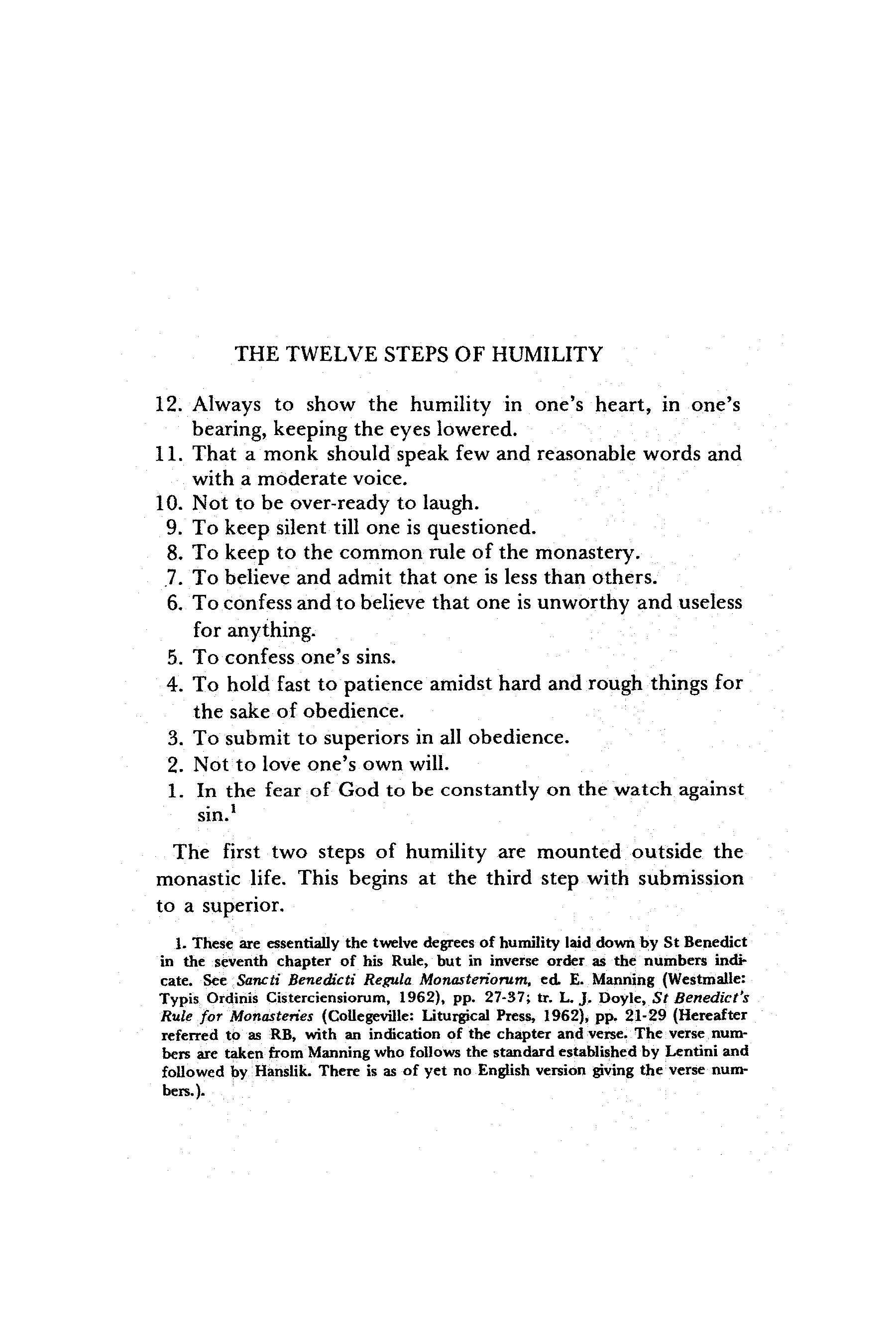
THE TWELVE STEPS OF HUMILITY
12. Always to show the humility in one's heart, in one's bearing, keeping the eyes lowered.
11. That a monk should speak few and reasonable words and with a moderate voice.
10. Not to be over-ready to laugh.
9. To keep silent till one is questioned.
8. To keep to the common rule of the monastery.
7. To believe and admit that one is less than others.
6. To confess and to believe that one is unworthy and useless for anything.
5. To confess one's sins.
4. To hold fast to patience amidst hard and rough things for the sake of obedience.
3. To submit to superiors in all obedience.
2. Not to love one's own will.
1. In the fear of God to be constantly on the watch against sin.1
The first two steps of humility are mounted outside the monastic life. This begins at the third step with submission to a superior.
1. These are essentially the twelve degrees of humility laid down by St Benedict in the seventh chapter of his Rule, but in inverse order as the numbers indicate. See Sancti Bene die ti Regula Monasteriorum, ed. E. Manning (Westmalle:
Typis Ordinis Cisterciensiorum, 1962), pp. 27-37; tr. L. J . Doyle, St Benedict's Rule for Monasteries (Cotlegeville: Liturgical Press, 1962), pp. 21-29 (Hereafter referred to as RB, with an indication of the chapter and verse. The verse numbers are taken from Manning who follows the standard established by Lentini and followed by Hanslik. There is as of yet no English version giving the verse numbers.).
RECONSIDERATION
(Retractatio) I N THE COURSE OF THIS LITTLE WORK I referred in support of one of my opinions to that passage of the Gospels where our Lord says that he does not know the day of the Last Judgement.1 I quoted, as I thought, the text and then found that it was not in the Gospel at all. I had no intention of falsifying the text but I was depending on my memory of the general sense of the passage and made a slip in the words.2 The true text simply says: "Not even the Son knows."3 I wrote: "Not even the Son of Man knows." I built my whole argument on this phrase, resting a true opinion on a false foundation. I discovered the mistake only long after I had published the book and many copies had been made.4
There is no chance of tracing all these copies and correcting the error so I suppose the only remedy is herewith to make my confession.
In another place5 I put forward an opinion about the Seraphim which I admit I never heard or read of anywhere. The reader, however, will take notice that I was cautious enough to use the words "I think." I simply expressed an opinion and made no claim to support it from the Scriptures.
Some have objected to the title: "The Steps of Humility," on the ground that I have described the steps not of humility but of pride. They must not have understood, or have not noticed my note at the end where I briefly explain the title.6
1. See below, no. 11, p. 39.
2. We have here an explicit admission on the part of Bernard that he did in practice quote Scripture from memory and that his quotations were not always precise. This should be kept in mind when one is trying to identify his Scriptural sources.
3. Mk 13:32.
4. We are not able to date the Retractatio but this sentence does indicate that Bernard's writings, even this first one, received rather immediate wide distribution.
5. See below, no. 35, p. 63.
6. See below, no. 57, p. 82.
PREFACE
OU A S K E D M E , B R O T H E R G O D F R E Y , 1 to
rite out at greater length the sermons I gave to the rethren on the steps of humility. I should very much like to have given a worthy response such as was due to your request, but I felt some doubts about my powers so, as the Gospel advises,2 I first sat down and reckoned up my assets to see if they were enough to bring me through the work.
Charity overcame this fear.3 Then immediately a new wave of terror swept over me from the other side. I began to fear more the terrible danger of pride if I did well than the disgrace if I did badly. There I was at a crossroad between fear and charity, not knowing which way was safe to take. If I spoke to any profit about humility I feared to be found lacking in it; if humility kept me silent I would be good for nothing. Neither course was safe; I had to take one or the other. Finally I decided it was better to send you this cargo of words than to seek safety by lying snug in the harbor of silence, feeling confident that if you find anything worth-while in what I write, you will pray that I may be saved from pride. If, on the other hand, you find nothing worth reading—which is what I expect—well, then I will have nothing about which to be proud.
1. Godfrey is a relative of St Bernard who accompanied him to Citeaux and Clairvaux. At the time this was written he was probably the Abbot of Clairvaux's second daughter house, Fontenay. He was to return to Clairvaux as prior and later to be elected Bishop of Langres. See above, Introduction, p. 5. This first work as most of Bernard's was written in response to a particular request.
2. Lk 14:28.
3. 1 Jn4:18.
T H E G O A L O F T H E S T E P S O F
H U M I L I T Y
B E F O R E I S P E A K of the different steps of humilitywhich indeed St Benedict does not ask us to count but to climb1—I will first try to show what we may expect to find at the top. The toil will be easier if we have the profit before our eyes. Our Lord shows us plainly both the difficulty and the reward of the work. " I am the Way, the Truth, and the Life." 2 The way is humility, the goal is truth. The first is the labor, the second the reward. But you may ask: " H o w do I know that he is speaking of humility? He only uses a general word, 'I am the Way' "? Well, I will give you a clearer test.
"Learn of me for I am meek and humble of heart."3 He points to himself as an example of humility, a model of meekness.
Imitate him and you will not walk in darkness but will have the light of life.4 What is the light of life but truth that enlightens every man that comes into this world5 and shows us where the true life is to be found? So, when he says: " I am the Way and the Truth," he adds, "and the Life." It is as if he said: " I am the Way, I lead to Truth; I am the Truth, I promise Life; and I myself am the very Life I give you." "For this is eternal life, that they may know you the one true God and Jesus Christ whom you have sent."6 Supposing, then, that you go on to object: " I see the way—humility; I long for the goal to which it leads—truth; but what if the way is so difficult that I can never reach the goal?" The answer comes promptly: " I am
1. RB 7. Cf. Mor IX, 36.
3. Mt 11:29.
5.Jn 1:9.
2. Jn 14:6.
4.Jn8:12.
6.Jnl7:3.
The Steps of Humility and Pride 1:2 the life," that is, I am the food, the viaticum,7 to sustain you on your journey.
There are some who go astray and cannot find the road.
He cries to them: "I am the Way." Some doubt and waver in their faith. His word to them is: "I am the Truth." To those who grow weary with the climbing his cry is: "I am the Life."
I think now I have dwelt long enough on this passage of the Gospel to show you that the knowledge of truth is the fruit of humility. Let us turn to another text. "I confess to you,
Father of Heaven and earth, because you have hidden these things (he means, of course, the secrets of truth) from the wise and prudent (meaning the proud) and revealed them to the little ones (the humble)."8 This shows us that truth is hidden from the proud and made known to the humble.
2. To define humility: Humility is a virtue by which a man has a low opinion of himself because he knows himself well.9
This is the virtue that belongs to those who have set their hearts to the climb and have gone from virtue to virtue, from step to step, until they reached the highest peak of humility10 and gazed upon truth from the watch-tower of Zion." "For the Lawgiver will give a blessing."12 This means that he who gives the law is the same who gives the blessing; he who commands humility will lead safely to the truth. Who is this lawgiver? Who but the good and sweet Lord who gives a law to those who wander from the way?13 They wander from the way
7. Bernard in using the word viaticum here probably intends it to be taken in its
Biblical sense only (Deut 15:14, Josh 9:5), as food for the journey, and is not making an allusion to Viaticum, Communion brought to the dying, even though this was a common meaning of the word at his time.
8. Mt 11:25. Cf. Jas 4:6, 1 Pet 5:5.
9. Cf Augustine, In Johannem, Tract 25:16; [tr J. H. Newman] Homilies on the Gospel according to St John, 2 vols, Library of the Fathers (Oxford: Parker,
1848), 1:393. For Bernard, humility is truth, the low opinion of self must be based on fact: "Humility is not praiseworthy when it is not in accordance with the facts."—Ep 201, to Abbot Baldwin, no. 2; LSB 259, p. 339.
10. RB 7:5. Cf. SC 34:3; CF 7.
11. Ps 83:6 (The Vulgate enumeration of the Psalms is used throughout as being that which was familiar to St Bernard.) Cf. Origin, Selecta in Psalmos X, 2:586;
PG 12:1187ff.
12. Ps 83:8.
13. Ps 24:8.