
UECF.NET › Books › Lutheran Missionaries, Landmarks and Legacies › Chapter 4
Landmark 2
Heyer Hall and Father J. C. F. Heyer
Landmark 2 — Heyer Hall Compound, and the founder of the American Lutheran Mission in Guntur (1793–1873) · Chapter 4 of 12 · PDF pp. 5–7 · 638 words · ≈ 3 min read
§ 1
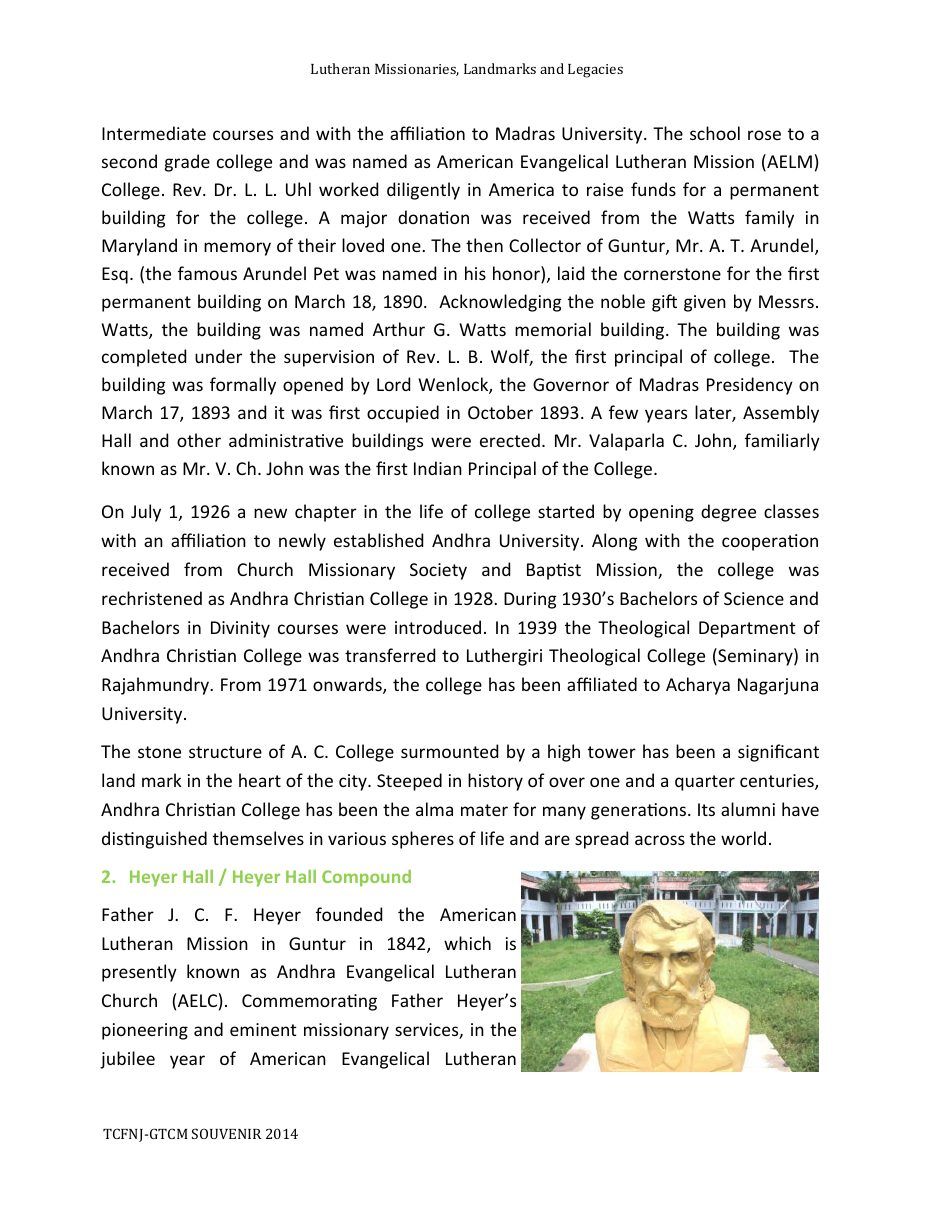
Heyer Hall / Heyer Hall CompoundFather J. C. F. Heyer founded the American Lutheran Mission in Guntur in 1842, which is presently known as Andhra Evangelical Lutheran Church (AELC). Commemorating Father Heyer’s pioneering and eminent missionary services, in the jubilee year of American Evangelical Lutheran Mission in Guntur, the corner stone for Heyer Memorial building was laid on November 5. Heyer Memorial building that served as boys’ boarding hostel was built entirely from the funds received by the congregations in India, and was dedicated on October 7, 1902. Afterwards, a new block was constructed with fine stones in 1937. Further, a bronze bust of Father Heyer was installed in the hostel on July 31, 2010, marking the 168th Gospel Day. The large compound in which this hostel situated is known as Heyer Hall compound.
§ 2
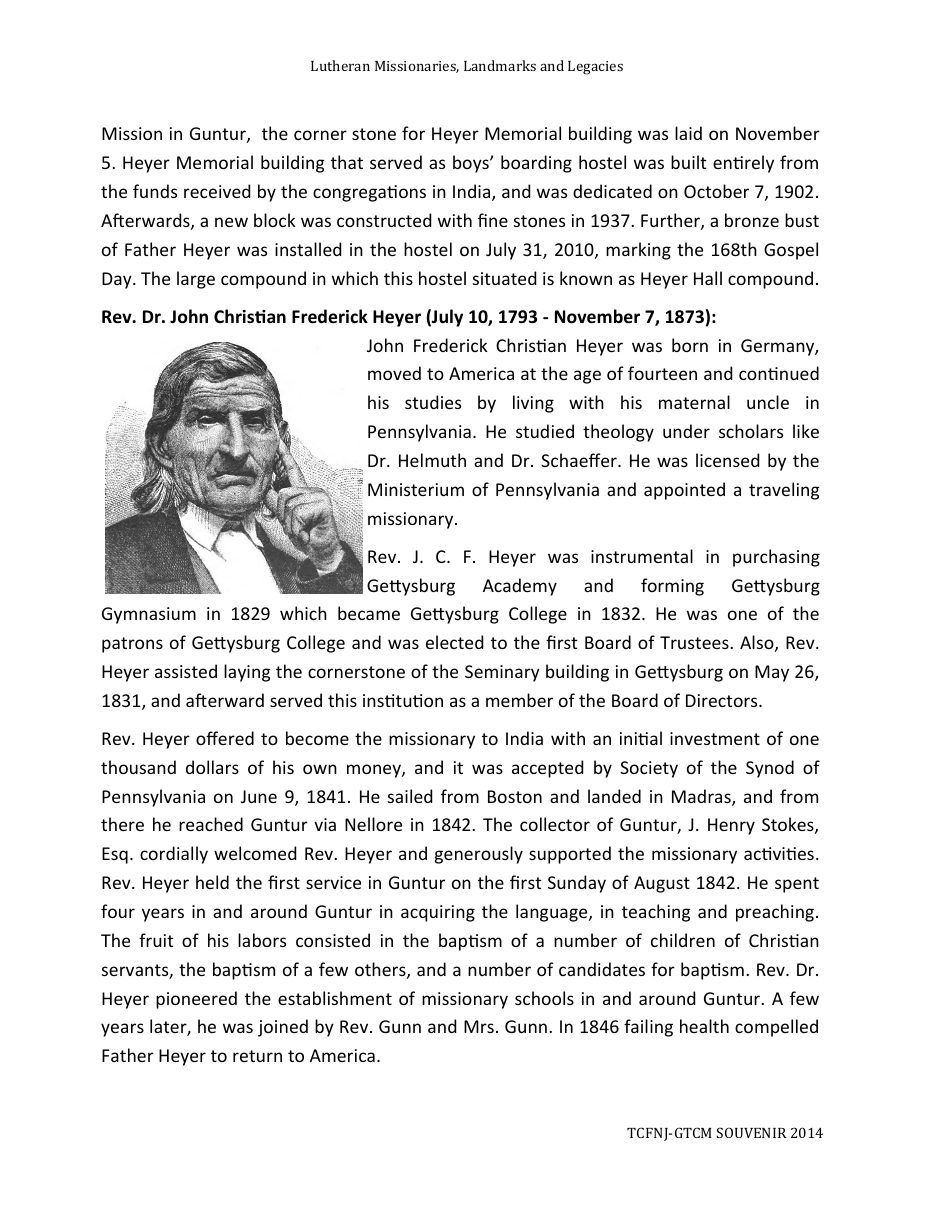
Rev. Dr. John Christian Frederick Heyer (July 10, 1793 – November 7, 1873)John Frederick Christian Heyer was born in Germany, moved to America at the age of fourteen and continued his studies by living with his maternal uncle in Pennsylvania. He studied theology under scholars like Dr. Helmuth and Dr. Schaeffer. He was licensed by the Ministerium of Pennsylvania and appointed a traveling missionary.
Rev. J. C. F. Heyer was instrumental in purchasing Gettysburg Academy and forming Gettysburg Gymnasium in 1829 which became Gettysburg College in 1832. He was one of the patrons of Gettysburg College and was elected to the first Board of Trustees. Also, Rev. Heyer assisted laying the cornerstone of the Seminary building in Gettysburg on May 26, 1831, and afterward served this institution as a member of the Board of Directors.
Rev. Heyer offered to become the missionary to India with an initial investment of one thousand dollars of his own money, and it was accepted by Society of the Synod of Pennsylvania on June 9, 1841. He sailed from Boston and landed in Madras, and from there he reached Guntur via Nellore in 1842. The collector of Guntur, J. Henry Stokes, Esq. cordially welcomed Rev. Heyer and generously supported the missionary activities. Rev. Heyer held the first service in Guntur on the first Sunday of August 1842. He spent four years in and around Guntur in acquiring the language, in teaching and preaching. The fruit of his labors consisted in the baptism of a number of children of Christian servants, the baptism of a few others, and a number of candidates for baptism. Rev. Dr. Heyer pioneered the establishment of missionary schools in and around Guntur. A few years later, he was joined by Rev. Gunn and Mrs. Gunn. In 1846 failing health compelled Father Heyer to return to America.
§ 3
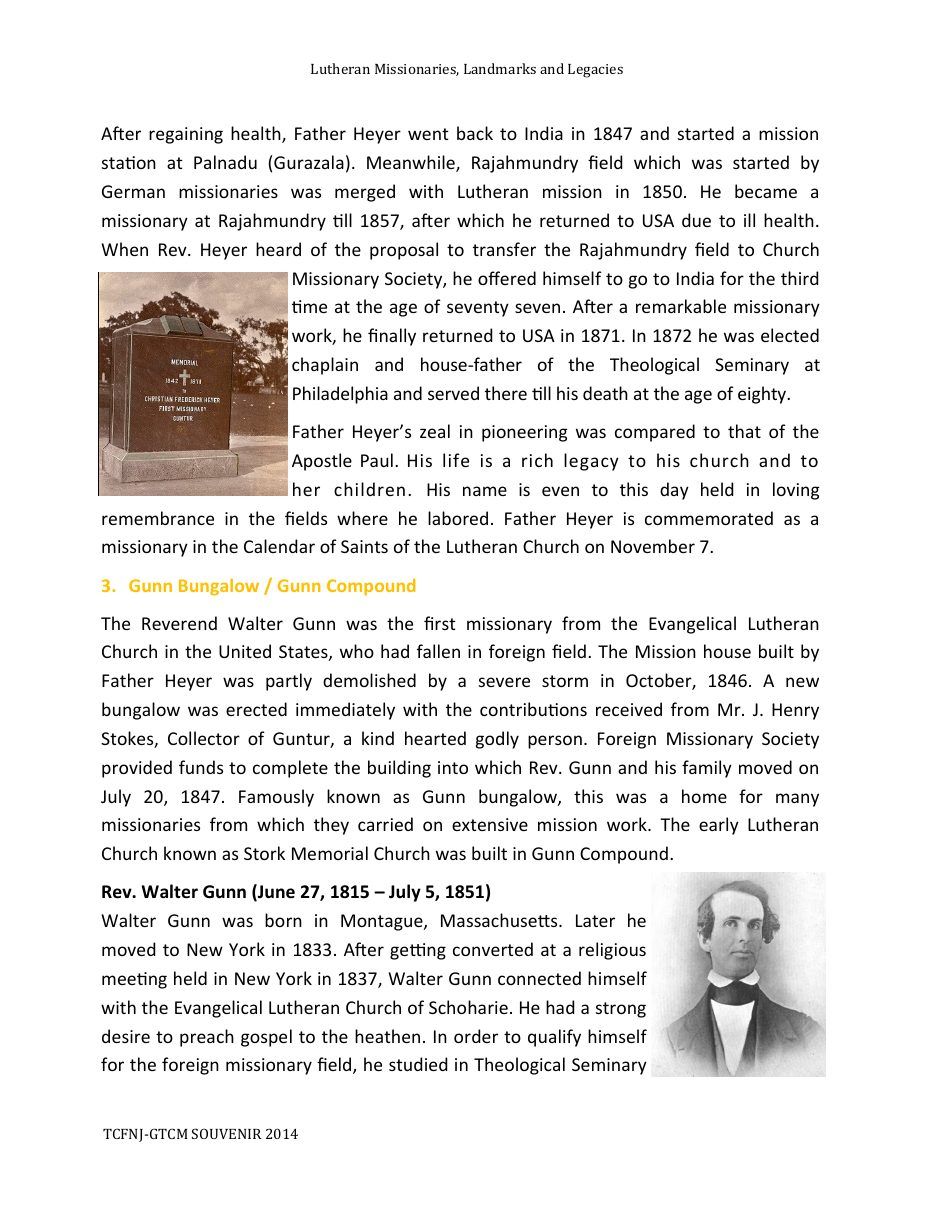
Three journeys to India and a lasting legacyAfter regaining health, Father Heyer went back to India in 1847 and started a mission station at Palnadu (Gurazala). Meanwhile, Rajahmundry field which was started by German missionaries was merged with Lutheran mission in 1850. He became a missionary at Rajahmundry till 1857, after which he returned to USA due to ill health. When Rev. Heyer heard of the proposal to transfer the Rajahmundry field to Church Missionary Society, he offered himself to go to India for the third time at the age of seventy seven. After a remarkable missionary work, he finally returned to USA in 1871. In 1872 he was elected chaplain and house-father of the Theological Seminary at Philadelphia and served there till his death at the age of eighty.
Father Heyer’s zeal in pioneering was compared to that of the Apostle Paul. His life is a rich legacy to his church and to her children. His name is even to this day held in loving remembrance in the fields where he labored. Father Heyer is commemorated as a missionary in the Calendar of Saints of the Lutheran Church on November 7.