
Blue Book Evidence
These preliminaries over, Dimples sets herself to pay for her seat. She smiles upon her Attai first, then upon all the company. If the Iyer is present, she notices him kindly: there is nothing in all nature so patronising as a baby. If in the mood, she will imitate her friends like her predecessor Scamp No. 1; or folding her fat arms will regard us all with a quizzical expression more comical than play. Her latest invention is drill. She stands straight up in her chair, and goes through certain actions intended to represent as much as she knows of that interesting exercise. We are kept anxious lest she should overbalance; but she is a wary babe, and always suddenly sits down when she gets to the edge of a tumble. Sometimes, however, when these diversions are in progress, we have wished that the family could see how very much more entertaining she is in her own nursery. There, from the beginning of the day till the sad moment when it ends, she seems to be engaged in entertaining somebody. Sometimes it is one of the Accals, those good elder sisters to whom the babies owe so much. Dimples thinks she looks tired. Tired people must be cheered, so Dimples devotes herself to her. Sometimes it is another baby who is dull. Dull babies are anomalies. Dimples feels responsible till the dull baby revives. Or it is just her own happy little self who is being entertained. If ever a baby enjoyed a game for its own sweet sake, it is Dimples.
But one thing she does not enjoy, and that is being put to bed at night. Our babies are anointed with oil, according to the custom of the East, before being put to sleep; but the moment Dimples sees the oil-bottle in her nurse's hand, she knows her fate is sealed and protests with all her might. Once she contrived to seize the bottle, pull out the cork, and spill the oil before she was discovered. She seemed to argue that as she was invariably oiled before being put to bed, the best way to avoid ever being put to bed would be to get rid of the oil. Another evening she succeeded in diverting her nurse into a long search for the cork, thereby delaying the fatal last moment; it was finally found in her mouth. When, in spite of all efforts to wriggle out of reach, she is captured, anointed, and put in her hammock, Dimples knows she must not get out; but her wails are so lamentable that it is difficult to restrain ourselves from throwing discipline to the winds, and if by any chance we do, her smiles are simply ravishing. But we hear about it afterwards.
If Dimples is asleep when we take charge of the nursery, we find things fairly quiet and almost flat. But she usually wakens early, and always in a good temper. It is instructive to see the way she scrambles out of her hammock before she is quite awake, and her sleepy stagger across the room is often interrupted by a tumble. Dimples does not mind tumbles. If her curly head has been rather badly knocked, she looks reproachfully at the floor, rubs her head, and gets up again. By the time she reaches us she is wide awake and most engaging.
In C. F. Holder's Life of Agassiz we are told that the great scientist "could not bear with superficial study: a man should give his whole life to the object he had undertaken to investigate. He felt that desultory, isolated, spasmodic working avails nothing, but curses with narrowness and mediocrity." This is exactly the view of one of our babies, already introduced, the little wise Lulla, who always knows her own mind and sticks to her intentions, unbeguiled by any blandishments.
This baby is a tiny thing, with a round, small head, covered with soft, small curls; and this head is very full of thoughts. Her face, which she rarely shows to a stranger, is like a doll in its delicate daintiness; but the mouth is very resolute, and the eyes very grave. Her hands and feet are sea-shell things of a pretty pinky brown, and her ways are the ways of a sea-anemone in a pool among the rocks.
Lulla, because of her anemone ways, is sometimes unkindly called "Huffs." She does not understand that there are days when those who love her most have little time to give to her. Lulla naturally argues that where there is a will there is a way, and desultory, isolated, spasmodic affection is worth little; so next time her friend appears, she explains all this to her by means of a single gesture: she draws her tentacles in.
But it is when Lulla has undertaken to investigate a tin of sweets that she most suggests Agassiz. The tin has a lid which fits tightly, and Lulla's fingers are very small and not very strong. The tin, moreover, is on the window-sill just out of reach, though she stands on tip-toe and stretches a little eager hand as far as it will go. Then it is you see persistence. Lulla finds another baby, leads her to the window and points up to the tin. The other baby tries. They both try together; if this fails, Lulla finds a taller one, and at last successful, sits down with the tin held tightly in both hands, and turns it over and shakes it. This process seems to inspire fresh hope and energy; for she sets to work round the lid, which is one of the fitting-in sort, and carefully presses and pulls. Naturally this does nothing, and she shakes the tin again. The joyful sound of rattling sweets stimulates to fresh attempts upon the lid. She tugs and pulls, and thumps the refractory thing on the floor. By this time the other babies, attracted by the hopeful rattle, have gathered round and are watching operations; some offer to help, but all such offers are declined. This oyster is Lulla's. She has undertaken to force it. Agassiz and his fishes are on her side. She will not give it up. But she is not getting on; and she sits still for a moment, knitting her brow, and frowning a little puzzled frown at the refractory tin.
Suddenly her forehead smooths, the anxious brown eyes smile, Lulla has thought a new good thought. The babies struggle up and offer to help Lulla up, but she shakes her head. She seems to feel if she herself unaided, of her own free will, hands her problem over to her Ammal or her Sittie, only so she may achieve her purpose without loss of self-respect.
Lulla's beloved nurse is a motherly woman, older than most of our workers. Her name is Annamai. When the nurses return from church, each makes straight for her baby; and the babies always respond with a cordial and pretty affection. But Lulla welcoming Annamai is something more than pretty. The big white-robed figure no sooner appears in the garden than the tiny Lulla is all a-quiver with excitement. But it is a quiet excitement; and if you take any notice, the tentacles suddenly draw in, and the little face is as wax. If no one seems to notice, then Lulla lets herself go. She all but dances in her eagerness, while Annamai is slowly sailing up the walk; and when she reaches the verandah, Lulla can wait no longer; one spring and she is in her arms, nestling, cuddling, burying her curls in her neck; then looking up confidentially, little Lulla begins to talk; everything we have done and said is being whispered into Annamai's ear. It does not matter that Lulla cannot yet speak any language known to men; she can make Annamai understand, and that is all she cares. Once we remember watching her, as she took the remnant of a sweet we had given her, out of her mouth and poked it into Annamai's. Could love do more?
Dimples and Lulla are quite inseparable. Lulla is to Dimples what Tara is to Evu. She immensely admires her vigorous little junior, and tries to copy her whenever possible. One delicious game seems to have been suggested by the arches in the garden. Dimples and Lulla stand on all fours close together. Then they lean over till their heads touch the ground, and look through the arch. If you are on the babies' level (that is on the floor), you will enjoy this game.
Another Sunday morning entertainment is kissing. Dimples advances upon Lulla. Lulla falls upon Dimples. Then Dimples hugs Lulla, nearly chokes her, almost certainly overturns her. The two roll over and over like kittens. Dimples seizes Lulla by her curls and vehemently kisses face, neck, and anything else she can get at; and then backs off, propelling herself on two feet and one hand, in which position she looks like a puppy on three paws. Lulla smooths her ruffled curls and person generally, regards Dimples with gravity, and, if in an affectionate humour herself, leads the attack upon Dimples, and the programme is repeated.
But the joy of the hour is to spin in the hammocks. These contrivances being hung from the roof swing freely, and the special excitement is to hold on with both hands, and run round so that the hammock twists into a knot and spins when released, with the baby inside it, in a giddy waltz till the coil untwists itself. This looks dangerous, and when the game was first invented we rather demurred. But we are wiser now, and we let them spin. Lulla especially enjoys this madness. It is startling to see the tiny thing whirl like a reckless young teetotum. But if you weakly interfere, Lulla thinks you want to learn the art, and goes at it with even madder zest, till her very curls are dizzy.
Dimples and Lulla in disgrace are a piteous spectacle. Dimples opens her mouth till it is almost square, and the most plaintive wail proceeds from it for about a minute and a half. Then she stops, looks sadly on the world, surprised and hurt at its unkindness to her, and then suddenly she discovers something interesting to do; and hastily rubbing her knuckles into her eyes to clear them as quickly as maybe of tears, she scrambles on to her feet, and forgets her injuries. Once she had been very naughty, and had to be smacked. It is never easy to smack Dimples, and fortunately she seldom requires it; but hard things have to be done, so that morning the fat little hands, to their surprise, knew the feel of chastening pats. "She daren't laugh, and she wouldn't cry"; this description, her Piria Sittie's, is the best I can offer of that baby's attitude. The thing could not possibly be a joke, but if meant otherwise, it was an indignity far past tears.
Lulla is quite different. She drops on the floor, if admonished, as if her limbs had suddenly become paralysed, and takes absolutely no notice of the offending disciplinarian. She simply ignores her, and gazes mutely beyond her. The offence is not one for explanation, and if invited to repent, her aloofness of demeanour is perfectly withering. But take her up in your arms, and she buries her curls in your neck, and coos her apologies (or is it forgiveness?) in your ear, and loves you all the better for the momentary breach.
Our babies are often parables. Lulla stands for the Single Eye. How often we have watched her and learned the lesson from her! She sees someone to whom she wants to go at what must seem to her an immense distance. And the distance is filled with obstacles, some of them quite enormous. But Lulla never stops to consider possibilities. Difficulties are simply things to be climbed over. She looks at the goal and makes straight for it. Her only care is to reach it. Sometimes at afternoon tea, when she is sitting on someone's lap, facing an empty, uninteresting plate, she sees another plate three chairs distant, and upon that plate there is a biscuit or some other sweet attraction. Upon such occasions Lulla all but plunges into space between the chairs, in her singleness of purpose. Having reached the lap nearest that plate, she turns and smiles at her late entertainer just to make sure she is not offended. But even if she knew she would be, Lulla would not hesitate. Curly head foremost, eyes on the goal: that is Lulla.
We have a custom at Dohnavur which perplexes the sober-minded. We call most of our possessions by names other than their own. These names are entirely private. We have to keep to this rule of privacy, otherwise we get shocks. "O Lord, look upon our beloved Puppy, and make her tooth come through; and bless Alice (in Wonderland), whose inside has gone wrong," was the petition offered in all seriousness, which finally moved us to prudence. We do not feel responsible for these names, for they come of themselves, and we see them when they come. That is all we have to do with them. Besides the Beetle and the Sea-anemone we have a dear Cockatoo, who screws her nose and her whole face up into a delightful pucker when she either laughs or cries, and then suddenly unscrews it in the middle of either emotion and looks entirely demure. This is the little Vimala, who, under God, owes her life to her Piria Sittie's splendid nursing. This baby has always got a private little secret of joy hidden away somewhere inside. We surprise her sometimes, sitting alone on the floor talking to herself about it; and then she tells us bits of it—as much as she thinks we can understand. But most of it is still hidden away, her own private little secret. And there is an Owlet, a Coney, a Froglet, and a Cheshire Cat, a Teddy-bear, a Spider, a Ratlet, and a Rosebud. We are aware that this list is rather mixed; but to be too critical would end in being nothing, so we are a Menagerie.
The Rosebud is like her name, small and sweet. When she wants to kiss her friends, which is whenever she sees them, her mouth is like the pink point of a moss-rose bud just coming through the moss. George Macdonald, perfect interpreter of babies, must have had our Preethie's double in his mind when he wrote:—
Three angels gave me at once a kiss.
How did you come to us, you dear?
God thought of you, and so I am here.
The Owlet is twin to that quaint little bird, so its name flew to her and stayed. This babe has round eyes with long curling lashes. When she is good, these round eyes beam, and every one forgets that anything so fascinating can ever be other than good. When she is naughty the case is exactly reversed. This baby's proper name is Lullitha, which means Playfulness, and illustrates a side of her character undiscovered by the visitor who only sees the Owlet sitting on her perch with serious, watchful, unblinking eyes, regarding the intruder. But most babies are complex characters, and are not known in an hour.
The Teddy-bear is a fine child with perfect lungs, a benevolent smile, and an appetite. Her ruling passion at present is devotion to her food. She feels unjustly treated because we do not see our way to feed her lavishly at her own five meal-times and also at the meal-times of all the other babies in the nursery.
On Sunday morning, when we are in charge, we hear her views upon this subject expressed in a manner wholly her own. She has just drained her own bottle, and is indignantly explaining that it is not nearly enough, when another bottle arrives for another baby, and this is too much for Teddy's equanimity. We all know how hard it is to keep up under the shock of adversity. Teddy does not attempt to keep up; she invariably topples over. But the way she does this is instructive. She sits stiff and straight for one brief moment, her milky mouth wide open, her hands outstretched in despairing appeal; then she clasps her head with her hands in a tragic fashion, absurd in a very fat infant, sways backwards and forwards two or three times till the desperate rock ends suddenly, as the poor Teddy-bear overbalances and bursts with a mighty burst. But the storm is too furious to last, and she soon subsides with a gusty sob and a short snort.
Poor little injured Teddy-bear! If it were not for her splendid health we might believe her oft-repeated tale of private starvation. "They only feed me when you are here to see! Other times they give me nothing at all!" She tells us this frequently in her own particular language, but the sturdy limbs belie it. This babe in matters of affection and mischief is as strenuous and original as she is about the one supreme affair pertaining to her elastic receptacle—to quote a Tamil friend's polite reference to the cavity within us—and many more edifying scenes might have been shown from her eventful life. But undoubtedly the predominating note at the present hour is her insatiable hunger, and when her name is mentioned in the nursery there is a smile and a new tale about her amazing appetite.
CHAPTER XXI
More Animals
 MORE ANIMALS: DEPRESSED.
Nurses: Karuna to left (the Duckling of "Things as They Are"); and Annamai, to right, Lulla's beloved.
However, the Coney can walk now. This triumph was effected with the help of an Indianised go-cart, which did what all our persuasions had entirely failed to do. But the process was not pleasant. The poor Coney would stand mournfully holding the handle of her instrument of torture, longing with a yearning unspeakable to sit down and give it up for ever. Someone would pass, and hope would rise in her heart. She would be carried now, carried out of sight of that detested go-cart. But no, the callous-hearted only urged her to proceed. She would howl then with a howl that told of bitter disappointment. Sometimes she would sit down flat and regard the thing with a blighting glance, the hatred of a gentle nature roused to unwonted vehemence. Always her wails accompanied the rumbling of its wheels.
"The Conies are but a feeble folk, yet they make their houses in the rocks." One day in deep depression of spirits the Coney arrived at the kindergarten. She sat down before the threshold, which is three inches high, and climbed carefully over it. She found herself in a new world, where babies were doing wonderful things and enjoying all they did. The Coney decided to join a class, and was offered beads to thread. Life with beautiful beads to thread became worth living, and it may be in the course of time that the tortoise will overtake the hare. In any case we find much cheer in the conclusion of the verse, for if our Coney builds in the Rock her being rather feeble will not matter very much.
Those who possess that friend of our youth, Alice, as illustrated by Sir John Tenniel, may find the photograph twice reproduced of our fat Cheshire Cat. This baby is remarkable for two things: she smiles and she vanishes. The time to see the vanishing conducted with more celerity than Alice ever saw it, is when the babies' warning call is sounded across the verandah and a visitor appears in the too near horizon. This baby then vanishes round the nearest corner. There is nothing left of her, not even a smile. In fact, the chief contrast between her and the cat among the foliage is that with our Cat the smile goes first.
Sunday morning, to return to the beginning, is full of possible misadventure. Sometimes the babies seem to agree among themselves that it would be well to be good. Then their admiring Sittie and Ammal have nothing to do but enjoy them. But sometimes it is otherwise. First one baby pulls her sister's hair, and the other retaliates, till the two get entangled in each other's curls. Piria Sittie flies to the rescue, disentangles the combatants and persuades them to make friends. Meanwhile three restless spirits in bodies to match have crept out through the open door (it is too hot if we shut the doors), and we find them comfortably ensconced in forbidden places. The Beetle is a quiet child. She retires to a corner and looks devout. Presently a sound as of scraping draws our attention to her. "Beetle! Open your mouth!" Beetle opens her mouth. It is packed with whitewash off the wall. Then a scared cry rings through the nursery, and all the babies, imagining awful things imminent, tumble one on top of the other in a wild rush into refuge. It is only a large grasshopper which has startled the Cheshire Cat, whose great eyes are always on the look-out for possible causes of panic. The grasshopper is banished to the garden and the Cheshire Cat smiles all over her face. Peace restored, Dimples and the Owlet remember a dead lizard they found in a corner of the verandah, and set off to recover it. These two walk exactly like mechanical toys; and as they strut along hand in hand, or one after the other, they look like something wound up and going, in a Christmas shop window. Presently they return with the lizard. Its tail is loose, and they sit down to pull it off. This is not a nice game, and something else is suggested. Dimple's mouth grows suddenly square; she wants that lizard's tail.
Then a dear little child called Muff (because she ought to be called Huff if the name had not been already appropriated), who has been solemnly munching a watch, decides it is time to demand more individual attention. She objects to the presence of another baby on her Sittie's lap. Why should two babies share one lap? The thing is self-evidently wrong. One lap, one baby, should be the rule in all properly conducted nurseries. Muff broods over this in silence, then slides off the crowded lap and sits down disconsolate, alone. Tears come, big sad tears, as Muff meditates; and it takes time to explain matters and comfort, without giving in to the one-lap-one-baby theory.
 TUBBING.
We have several helpful babies. Dimples has been discovered paying required attentions to things smaller than herself; and the Wax Doll pats the Rosebud if she thinks it will reassure her, when (as rarely happens) that pet of the family is left stranded on a mat. But Puck is the most inventive. It was one happy Sunday morning that we came upon her feeding the Ratlet on her own account. The Ratlet was making ungrateful remarks; and we hurried across to her and saw that Puck, under the impression doubtless that any hole would do, was pouring the milk in a steady stream down the poor infant's nose. Puck smiled up peacefully. She was sure we would be pleased with her. But the Ratlet continued eloquent for very many minutes.
Sometimes (but this is an old story now) our difficulties were increased by the Spider's habit of whimpering, which had a depressing effect upon the family. This poor baby was a weak little bag of bones when first she came to us. The bag was made of shrivelled skin of a dusty brown colour. Her hair was the colour of her skin, and hung about her head like tattered shreds of a spider's web. She sat in a bunch and never smiled. Something about her suggested a spider. Her Tamil name is Chrysanthemum, which by the change of one letter becomes Spider. So we called her Spider.
At first we were not anxious about her; for such little children pick up quickly if they are healthy to begin with, as we believed she was. But she did not respond to the good food and care, and only grew thinner and more miserable as the weeks passed, till she looked like the first picture in a series of advertisements of some marvellous patent food, and we wondered if she would ever grow like the fat and flourishing last baby of the series. For two months this state of things continued; she grew more wizened every day; and the uncanny spider-limbs and attitude gave her the air of not being a human baby at all, but a terrible little specimen which ought not to be on view but should be hidden safely away in some private medical place—on a shelf in a bottle of spirits of wine.
We are asked sometimes if such tiny things can suffer other than physically. We have reason to think they can. As all else failed, we took a little girl from school for whom the Spider had an affection, and let her love her all day long; and almost at once there was a change in the sad little face of the Spider. She had been cared for by an old grandfather after her mother's death, and it seemed as if she had fretted for him and needed someone all to herself to make up for what she was missing.
This little girl, the Cod-fish by name, was devoted to the Spider. She nestled her and played with her—or attempted to, I should say, for at first the Spider almost resented any attempts to play. "She doesn't know how to smile!" said the Cod-fish disconsolately after a week's petting and loving had resulted only in fewer whimpers, but not as yet in smiles. A few days later she came to us, and announced with much emotion: "She has smiled three times!" Next day the record rose to seven; after that we left off counting.
The Spider is fat and bonnie now. Her skin is a clear and creamy brown, and her hair has lost its dustiness; but she still likes to sit crumpled up, and a small alcove in the kitchen is her favourite haven when tired of the world. Seen unexpectedly in there, bunched in a tight knot, her dark, keen little eyes peering out of the light-coloured little face, she still suggests a spider. But it is a cheerful Spider, which makes all the difference.
CHAPTER XXII
The Parrot House
 RED LAKE AND HILL.
As seen (without the water) from the Taraha Nursery.
Shading your lantern, and walking carefully so as not to tread on more scattered limbs than may be, you wander round the nursery and meditate upon the beautiful ways of childhood. There is something so touching in sleeping innocence, and you are touched. Here two chubby babies are lying locked in each other's arms. You have to look twice before you see which limbs belong to which. There another is hugging a doll minus its head. Next to her a baby sleeps pillowed on another, and the other does not mind. In the middle of the floor, far from her mat, a sturdy three-year-old sprawls content. You pick her up gently and lay her on her mat. With an expression of determined resolution the baby rolls off again; and if you attempt another remove, an ominous pucker of the forehead warns you to desist. You wonder if the babies are quite as good as they seem. One of the dear, fat, devoted little pair you noticed at first, stirs, disentangles herself from her neighbour, and gives her a slight kick. There is a smothered, sleepy howl, and the kick is returned. "Water!" wails the first fat baby. "Water!" wails the second. You get water, give it, pat both fat babies till they go to sleep, and then cautiously retire. It would be a pity if all the babies were to waken thirsty and kick each other. At the door you turn and look back. Graceful babies, clumsy babies, babies who lie extended like young pokers, babies curled like kittens. All sorts of babies, good, bad, and middling, but all blessedly asleep.
Thy father guards his sheep,
Thy mother shakes the dreamland-tree
Down fall the little dreams for thee,
Sleep, baby, sleep!
Sleep, baby, sleep!
Our Saviour loves His sheep.
He is the Lamb of God on high,
Who for our sakes came down to die.
Sleep, baby, sleep!
The pretty German lullaby rises unbidden, and is pushed away by the quick, sad thoughts that will not listen to it. For under all the laughter and nursery frolic and happiness, we cannot but remember why these little ones are here. Round about the compound in a great triangle there are three Temple towers. They are out of sight though near us, but we cannot forget they are there. They stand for that which deprives these children of their birthright. Oh for the day when those Temple towers will fall and the reign of righteousness begin! There was a time when it seemed impossible to desire that the fire should be allowed to touch the stately and beautiful things of the world. Now there is something that satisfies as nothing else could in the vision of that purifying fire; and the promise that stands out like a light in the darkness is that which tells that the Son of Man shall send forth His angels, and they shall gather out of His kingdom, all things that offend.
In the tiny babies' nursery many a crooning Indian lullaby is sung to the babies in their swinging white cradles; but in the Taraha nursery we sing sweet old hymns, in Tamil and English, and then all sensible people are supposed to go to sleep. But one evening after the singing, two little tots settled down for a talk. Said one lying comfortably on her back with her two hands clasped behind her head: "Who takes care of us at night when we all go to sleep?" Said the other in a mixture of Tamil and English: "Jesus-tender-Shepherd takes care of us—Jesus-loves-me-this-I-know." The first baby rolled over upon her small sister with a crow of derision. "It is not! It is Accal! I woke one night and saw her!" The other baby insisted she was making a mistake. "Accal sleeps, all people sleep; they lie down like us and go to sleep. Only Jesus stays awake, and never, never goes to sleep." "Never, never?" questioned the first, and was quiet for a minute considering the matter; then with a sceptical little laugh, "Did you ever wake up and see Him?"
If the babies were always in a state of calm repose, the Taraha's pet name, Parrot-house, would be inappropriate: but for nearly ten hours of the day they are awake and talkative. Talk, however, is a mild word by which to describe their powers of conversation. Sometimes we wonder if they never tire of chattering, and then we remember they have only lately learned to talk. They have not had time to tire.
 CHILDREN WADING
Once we listened, hoping that the trailing clouds of glory so recently departed had left some trace of illumination in this their first expression in earth's language of their feelings and emotions. But we found them very mundane. Most of the conversation concerned their "saman," a comprehensive Indian word used by people with limited vocabularies to express all manner of things to play with. Their "saman" was various. Dolls, of course, and the remnants of dolls; tins and the lids thereof; bits of everything which could break; corks, stones, seeds, half cocoa-nut shells; rags of many ages and colours; scraped down morsels of brick; withered flowers and leaves; sticks of all sorts and sizes; English Christmas cards, sometimes with much domestic information on the back; unauthorised sundries from the kindergarten—delivered up with a smile intended to assure you that they were only being kept for Sittie; and pûchies. Pûchies are insects. We have one baby who collects pûchies. "Look!" she said, one morning before prayers, "Deah little five pûchies!" and she opened her hand and five red and black beetles crawled slowly out, to the delight of the devout, who scrambled up from their orderly rows with shrieks of appreciation.
But if the babies' conversation was unenlightening, their chosen avocations are not uninteresting. They are always busy about something, and, from their point of view, something important. There are, of course, some among the thirty who are unimaginative and unenterprising. These sit in the sand and play. Others have more to do. Life to them is full of the unknown. The unknown is full of possibilities. The great thing is to experiment. Nothing is too insignificant to explore, and all five senses are useful to the thoroughly competent baby.
They knew, of course, all the flowers, and the discovery of anything fresh was always followed by a scene which suggested a colony of small and active ants hauling some large object to their nest; for the nearest grown-up person was invariably hailed, and pulled, and pushed, and hurried along till the "new flower" was reached. Then, if the object was incautious enough to stoop down to examine it, the ants, ant-wise, would envelope it, climbing, swarming all over it, till there was nothing to be seen but ants.
 CHILDREN WADING.
They knew the habits of caterpillars, and especially they had knowledge about the wonderful silver chrysalis which pins itself to the pointed leaves of the oleander. They knew what was packed up inside, and some with wide-open eyes had watched the miracle slowly evolving as the butterfly unpacked itself, and sunned its crumpled velvet wings, till the crumples smoothed, and the wings dried, and the butterfly fluttered away. They knew, too, the less approachable ways of the wild bees, and where they hive, and what happens if they are disturbed; and they knew the private feelings of calves, and which likes to be treated as a brother and which resents such liberties. Crows they knew intimately, and squirrels a little; for infants fallen from their nests have often been taken care of, much against their foolish wills, until old enough to look after themselves. Their namesakes, the parrots, they knew very well; and the dainty little sunbirds that flash from flower to flower like little living jewels in the sunlight; and the clever tailor-bird, which sews its own nest, knotting its thread like a grown-up human being; and the wise leaf-insect that can hardly be found till it moves; and the great, green, frisky grasshopper that seems to invite a chase.
We found they knew, alas, too much about the misuse of everything growing in the field! The tamarind fruit makes condiment, but eaten raw it gives fever; and the babies think we are wrong here, and they are fond of forgetting our rules. Many kinds of grasses are very good to eat; and here again we are mistaken, for we know not the flavour of grasses. Seeds may be useful to plant; but those who think their use ends there, are short-sighted and ignorant people. Upon these and other matters the babies feel we have much to learn.
 ESLI AND LITTLE KOHILA.
Taken a year earlier.
One weird joy has been theirs, and they never will forget it. For one whole blissful afternoon they followed the snake-charmer about at a respectful distance; and they cannot understand why we are not anxious they should dance as he danced, and pipe as he piped, round the hopeful holes they discover in the red mud walls.
Other things they had learned to do, not wholly innocent. They must have made friends with the masons who built their new nursery, and persuaded them to do their work in a sympathetic spirit; for they knew the weak points hidden from our eyes, and how pleasant it is to scoop mortar out of cracks between the bricks of the floor. They had learned how most of their toys were made, and how a doll could be most easily dissected, and the particular taste of its inside. They knew, too, the lusciousness of divers sorts of sand—this last, however, being a mixture of crime and disease, and treated as such, is not a popular sin. Finally, to our lasting disgrace, they had learned, after a series of thoughtful experiments, how best to obey a command and yet elude its intention; thus on a wet day, when they were commanded not to go out, their Sittie found them lying full length in a long row on the edge of the verandah, their heads protruding so as to catch the lovely drip from the roof. And all these things they had carefully learned in spite of a certain amount of supervision; and, being entirely unsuspicious, they will take you into their confidence and let you share the forbidden fruit, if you are so inclined.
But, after all, perfection of goodness would make us more anxious than even these enormities; we should fear our babies were growing too good—a fear not pressing at present. The Parrot-house only overwhelms when the birds begin to sing. Then indeed all who can, flee far away, for the babies once started are difficult to stop. They are sure you like it as much as they do, and are anxious to oblige you when you visit their world. So they sing with the greatest earnestness, and as they invariably hang on to every available part of you, and punctuate their melodies with kisses and embraces, escape is not always practicable.
The Taraha nursery was our first substantial building. It is built upon foundations raised well off the ground, and has a wide verandah. When first it was opened and the children were invited to take possession, they did so most completely. One quaint little person of barely three, called Kohila, whose small, repressed face in the photograph gives no hint of character, used to stalk up and down the verandah with an air of proprietorship which left no doubt in any mind as to her opinion on the subject. Another (sharing the swinging cot with Kohila in the photo) sat on the top step and smiled encouragingly to visitors. It was nice to be smiled at, but there was something very condescending in the smile. Another stood guard over the plants, which grew in pots much bigger than herself all the way down the verandah. If any presumed to touch them, she would dart out upon them with an indignant chirrup. For days after the great event—the opening of the Taraha—small parties waited on visitors, formed in procession before and behind, and escorted them round, explaining all mysteries, and insisting upon due admiration. Everything had to be interviewed, from teaspoons to pots of fern. This concluded, the guests were politely dismissed, and departed, let us hope, properly penetrated with a sense of the kindness of the babies.
There have always been some who object to visitors. One of these showed her objection, not by crying and running away, as undignified babies do, but by sitting exactly where she was when she first caught sight of the intruder, and staring straight into space with a very stony stare. A sensitive visitor could hardly have had the temerity to pass her, but normal visitors are not sensitive. Sometimes they attempted to make friends. This was too much. One fat arm would be slowly raised till it covered the baby's eyes, and in this position she would sit like a small petrifaction, till the horror had withdrawn.
 PREETHA AWARE OF A FOE.
Tara on the left: the Coney on the right.
This baby, Preetha by name, has in most matters a way of her own. One of her little peculiarities is a strong preference for solo music as compared with concert. She listens attentively to others' performances, then disappears. If followed, she will be found alone in a corner, with her face to the wall and her back to the world; and if she thinks herself unobserved, you will be regaled with a solo. This experience is interesting to the musical. It is never twice alike. Sometimes it is a succession of sounds, like a tune that has lost its way; sometimes, a recognisable version of the chorus lately learned. At other times she delivers her soul in a series of short groans and grunts, beating time with her podgy hands. If she perceives through the back of her head that someone is looking or listening, she stops at once; and no persuasions can ever produce that special rehearsal again. Of late this baby, being now nearly three, has awakened to a sense of life's responsibilities, and she evidently wishes to prepare to meet them suitably. Yesterday evening she came to me with an exceedingly serious face, pointed in the direction of the kindergarten room, and then tapping herself, remarked: "Amma! I kindergarten." No more was said; but we know we shall soon see her solemnly waddling into the schoolroom, and we wonder what will happen. Will she continue to insist upon a corner to herself?
CHAPTER XXIII
The Bear Garden
 JULLANIE AMONG THE GRASSES.
A lotus-pool, a bear-garden—the connection is not obvious. Alice in her wanderings never wandered into bewilderment more profound than such a mixture of ideas. But this is the way we get to it: We have called these little children Lotus-buds—for such they are in their youngness and innocence; and the underlying thought runs deeper, as those who have read the first chapter know—but the Lotus-buds must grow into flowers and must be sown as living seeds, perhaps far away from the happy place they knew when they were buds. The little air-boat will come for them. The breath of the Spirit that bloweth where it listeth will carry them where it will, and we want them to be ready to be sown wherever the pools of the world are barren of lotus flowers. And this brings us straight to the newest of our beginnings in Dohnavur—the Kindergarten.
An ideal kindergarten is a place where the teachers train the scholars, and we hope to have that in time; at present the case is opposite, and that is why it has its name, the name that conflicts with the lotus-pool—the Bear-garden.
In this peaceful room Classes B, C, and D have taken their young teachers in hand—Rukma, Preena, and Sanda. Of these Rukma (Radiance) has the clearest ideas about discipline; Preena (the Elf) knows best how to coax; and Sanda, excellent Mouse that she is, has the gift of patience. These three (who after all are only school-girls, continuing their own education with their Préma Sittie) are attempting to instruct the babies on the lines of organised play; but the babies feel they have much to teach their teachers, and this is how they do it:—
Sittie goes into the room when the kindergarten is in progress, and from three classes at once babies come springing towards her with squeals of joy, and they clasp her knees and look up with eyes full of affection and confidence in their welcome. "Go back to your place!" she says, and tries to look severe; with a chuckle the children obey, and she looks round and takes notes.
Chellalu is lying full-length on the bench, with a look of supreme content on her face, and her two feet against the wall. Pyârie has turned her back to the picture that is being shown, and is tying a handkerchief round her head. Ruhinie, an India-rubber-ball sort of baby, has suddenly bounced up from her seat, and is starting a chorus, of which she is fond, at the top of her not very gentle voice; and Komala, a perfect sprite, is tickling the child who sits next to her. "Sittie!" exclaims the distracted teacher, "they won't learn anything!" Or if she happens to be the Mouse, she is calmly engaged with the one good child in her class.
The next group is stringing beads on pieces of wire. "Look, look!" and an eager babe holds out her wire for admiration, and probably spills her beads in her effort to secure attention. If she does, there is a general scramble, beads rolling loose on the floor being quite irresistible. One wicked baby sits by herself and strings her beads on her curls.
A few minutes later it is mat-plaiting; and the agile little fingers are diligently weaving pieces of blue and yellow material, bits over from their elder sisters' garments, beautifully unconscious that they are supposed to be working the colours alternately. Sometimes in the gayest way they exclaim: "Sittie! It's wrong! it's wrong!" Occasionally there is a howl from a child who has been pinched by another, or whose neighbour has helped herself to her beads. Sittie crosses the room hurriedly. "What's the matter?" With tears rolling down her cheeks the victim points to her oppressor. "May you do that?" is the invariable English question. It is answered by a shake of the head, the tiniest baby understanding that particular remark. The injured baby smiles. A reproof, or at worst a pat on the fat arm next to hers, satisfies her sense of justice, and she is content.
When an English lesson begins, those afflicted with delicate nerves are happier elsewhere. One class has a toy farmyard, another a set of tea-things, the third a doll which every member of the class is aching to embrace. The teachers and children alike are inclined to talk with emphasis; and if you stand between the three classes you hear queer answers to queerer questions, and wonder if the babies at Babel were anything like so bewildering.
But this vision of the kindergarten is hardly a fortnight old; for Classes B, C, and D are of recent development, and are made up of some heedless characters, as Chellalu and Pyârie, who could not keep up with class A, and a few more young things from the nursery who were wilder than wild rabbits from the wood when we began. Also it should be stated that from the babies' point of view white people are only playthings. "They were very good before you came!" is the unflattering remark frequently addressed to us; and as we discreetly retire, the babies do seem to become suddenly beautifully docile. But even so they might be better, as an unconscious comedy over-seen this morning proves. I was in the porch outside the door, when Rukma, pointing to a blackboard on which were written sundry words, told Chellalu to show her "cat," and I looked in interested to know if Chellalu really knew anything of reading. Chellalu brandished the pointer, then turned to Rukma with a confidential smile, "Cat? Where is it, Accal? Is it at the top or at the bottom?" Rukma, who has a keen sense of the comic, seemed to find it difficult to look as she felt she ought. Chellalu caught the twinkle in her eye, and throwing herself heartily into the spirit of the game, which was evidently intended to be a kindergarten version of Hunt the Mouse through the Wood, she searched the blackboard for cat. Then to Rukma: "Accal! dear Accal! Tell me, and I'll tell you!"
There is nothing that helps us so much to be good as to be believed in and thought better than we are; and the converse is true, so we do not want to be always suspecting Chellalu of sin; but this last was entirely too artless, and this was apparently Rukma's view, for she sent Chellalu back to her seat and called up another baby, who, fairly radiating virtue, immediately found the cat.
The next room—which Class A (the first to be formed) has to itself—is a haven of peace after the Bear-garden. It is a pleasant room like the other, pretty with pictures and with flowers. And the little bright faces make it a happy place, for this class, though serious-minded, is exceedingly cheerful. There is the demure little Tingalu, the good child of the kindergarten, its hope and stay in troublous hours, and the quaint little trio, Jeya, Jullanie, and Sella—this last is called Cock-robin by the family, for she has eyes and manners which remind us of the bird, and she hardly ever walks, she hops. Mala and Bala are in the class, and a lively scamp called Puvai.
The kindergarten is worked in English, helped out with Tamil when occasion requires. This plan, adopted for reasons pertaining to the future of the children, is resulting in something so comical that we shall be sorry when the first six months are over and the babies grow correct. At present they talk with delightful abandon impossible to reproduce, but very entertaining to those who know both languages. They tack Tamil terminations to English verbs, and English nouns make subjects for Tamil predicates. They turn their sentences upside down and inside out, and any way in fact which occurs to them at the moment, only insisting upon one thing: you must be made to understand. They apply everything they learn as immediately as possible, and woe to the unwary flounderer in the realm of natural science who offers an explanation of any phenomena of nature other than that taught in the kindergarten. The learned baby regards you with a tender sort of pity. Poor thing, you are very ignorant; but you will know better in time—if only you will come to the kindergarten, the source of the fountain of knowledge.
The ease and the quickness with which a new word is appropriated constantly surprises us. As for example: one morning two babies wandered round the Prayer-room, and, discovering passion-flowers within reach, eagerly begged for them in Tamil. One of the two pushed the other aside and wanted all the flowers. "Greedy! greedy!" I said reprovingly, in English. "Greedy mine!" was the immediate rejoinder, and the little hand was held out with more certainty than ever now that the name of the flower was known. "Greedy my flower! Mine!"
But some of the quaintest experiences are when the eloquent baby, determined to express herself in English, falls back upon scraps of kindergarten rhyme and delivers it in all seriousness. On the evening before my birthday I was banished from my room, and the children decorated it exactly as they pleased. When I returned I was implored not to look at anything, as it was not intended to be seen till next morning. Next morning the babies came in procession with their elders, and while I was occupied with them out on the verandah, Chellalu and her friend Naveena, discovering something unusual in my room, escaped from the ranks and went off to examine the mystery. I found them a moment later gazing in astonished joy at the glories there revealed. "Who did it all?" gasped Chellalu, whose intention, let us hope, was perfectly reverent. "God did it all!"
The one kindergarten class taught entirely in Tamil is the Scripture lesson, illustrated whenever possible by pictures; and being always taught about sacred things in Tamil, the babies have no doubt about the language in use in Bible days. But sometimes a little mind is puzzled, as an instructive aside revealed a day or two ago. For their teacher had told them in English, not as a Scripture lesson, but just as a story, about Peter and John and the lame man. The picture was before them, and they understood and followed keenly; but one little girl whispered to another, who happened to be the well-informed Cock-robin: "Did Peter and John talk English or Tamil?" "Tamil, of course!" returned Cock-robin, without a moment's hesitation.
The Scripture lessons are usually given by Arulai, whose delight is Bible teaching. "So that as much as lieth in you you will apply yourself wholly to this one thing, and draw all your cares and studies this way," is a word that always comes to mind when one thinks of Arulai and her Bible. She much enjoys taking the babies, believing that the impressions created upon the mind of a little child are practically indelible.
Sometimes these impressions are expressed in vigorous fashion. Once the subject of the class was the Good Samaritan. The babies were greatly exercised over the scandalous behaviour of the priest and the Levite. "Punish them! Let them have whippings!" they demanded. Arulai explained further. But one baby got up from her seat and walked solemnly to the picture. "Take care what you are doing!" she remarked impressively in Tamil, shaking her finger at the two retreating backs. "Naughty! naughty!"—this was in English—"take care!"
One of the favourite pictures shows Abraham and Isaac on the way to the mount of sacrifice. This story was told one morning with much reverence and feeling, and the babies were impressed. There were tears in Bala's eyes as she gazed at the picture, but she brushed them away hurriedly and hoped no one had noticed. Only Chellalu appeared perfectly unconcerned. She had business of her own on hand, and the story, it seemed, had not touched her. The babies are searched before they come to school, and all toys, bits of string, old tins, and sundries are removed from their persons. But there are ways of evading inquisitors. Chellalu knows these ways. She now produced a long wisp of red tape from somewhere—she did not tell us where—and proceeded to tie her feet together. This accomplished, she curled herself up on the bench like a caterpillar on a leaf, and to all appearances went to sleep. Why was she not awakened and compelled to behave properly? asks the reader, duly shocked. Perhaps because on that rather special morning the teacher preferred her asleep.
 ARULAI AND RUKMA, WITH NAVEENA.
The story finished, the children were questioned, and they answered with unwonted gravity. "What did Isaac say to his father as they walked alone together?" An awed little voice had begun the required answer, when Chellalu suddenly uncurled, sat up, and said in clear, decided Tamil: "He said, 'Father! do not kill me!' Yesh! that was what he said."
When first the babies heard about Heaven, they all wanted to go at once, and with difficulty were restrained from praying to be taken there immediately. There was one naughty child who, when she was given medicine, invariably announced, "I will not stay in this village: I am going to Heaven! I am going now!" But they soon grew wiser. It was our excitable, merry little Jullanie who summed up all desires with most simplicity: "Lord Jesus, please take me there or anywhere anytime; only wherever I am, please stay there too!" Some of the babies are carnal: "When I go to that village (Heaven), I shall go for a ride on the cherubim's wings. I will make them take me to all sorts of places, just wherever I want to go."
The latest pronouncement, however, was for the moment the most perplexing. "Come-anda-look-ata-well!" said Chellalu yesterday evening, the sentence in a single long word. The well is being dug in the Menagerie garden and is surrounded by a trellis, beyond which the babies may not pass, unless taken by one of ourselves. As we drew near to the well, Chellalu pointed to it and said: "Amma! That is the way to Heaven!" This speech, which was in Tamil, considerably surprised me, as naturally we think of Heaven above the bright blue sky. The yawning gulf of the unfinished well suggested something different.
But Chellalu was positive. "It is the way to Heaven. I may not go there, but you may! Yesh! you may go to Heaven, Amma, but I may not!" She had nothing more to say; and we wondered how she could possibly have arrived at so extraordinary a conclusion, till we remembered that it had been explained to the babies that any baby falling in would probably be drowned and die, and so until it was finished and made safe no baby must go near it. Chellalu had evidently argued that as to die meant going to Heaven, the well must be the way to Heaven; and as only grown-up people might go near it, they, and they alone apparently, were allowed to go to Heaven.
These babies are nothing if not practical. Arulai had been teaching the story of the Unmerciful Servant; and to bring it down to nursery life, supposed the case of a baby who snatched at other babies' toys, and was unfair and selfish. Such a baby, if not reformed, would grow up and be like the Unmerciful Servant. The babies looked upon the back of the offender as shown in the picture. "Bad man! Nasty man!" they said to each other, pointing to him with aversion. And Arulai closed the class with a short prayer that none of the babies might ever be like the Unmerciful Servant.
The prayer over, the babies rushed to the table where their toys were put during the Scripture lesson. Pyârie got there first, and, gathering all she could reach, she swept them into her lap and was darting off with them, when a word from Arulai recalled her. For a moment there was a struggle. Then she ran up to Tingalu, the child she had chiefly defrauded, poured all her treasures into her lap, and then sprang into Arulai's arms with the eager question: "Acca! Acca! Am I not a Merciful Servant?"
CHAPTER XXIV
The Accals
"This sacred work demands not lukewarm, selfish, slack souls, but hearts more finely tempered than steel, wills purer and harder than the diamond."—Père Didon.
 PONNAMAL, WITH PREETHA ON HER KNEE, AND TARA BESIDE HER.
Sometimes we are asked if we ever find an Indian fellow-worker whom we can thoroughly trust. The ungenerous question would make us as indignant as it would if it were asked about our own relations, were it not that we know it is asked in ignorance by those who have never had the opportunity of experiencing, or have missed the happiness of enjoying, true friendship with the people of this land. Those who have known that happiness, know the limitless loyalty and the tender, wonderful love that is lavished on the one who feels so unworthy of it all. If there is distance and want of sympathy between those who are called to be workers together with the great Master, is not something wrong? Simple, effortless intimacy, that closeness of touch which is friendship indeed, is surely possible. But rather we would put it otherwise, and say that without it service together, of the only sort we would care to know, is perfectly impossible.
 SELLAMUTTU AND SUSEELA.
In our work all along we have had this joy to the full. God in His goodness gave us from the first those who responded at once to the confidence we offered them. In India the ideal of a consecrated life is a life with no reserves—which seeks for nothing, understands nothing, cares for nothing but to be poured forth upon the sacrifice and service. Pierce through the various incrustations which have over-laid this pure ideal, give no heed to the effect of Western influence and example, and you come upon this feeling, however expressed or unexpressed, at the very back of all—the instinct that recognises and responds to the call to sacrifice, and does not understand its absence in the lives of those who profess to follow the Crucified. Who, to whom this ideal is indeed "The Gleam," that draws and ever draws the soul to passionate allegiance, can fail to find in the Indian nature at its truest and finest that kinship of spirit which knits hearts together? "And it came to pass when he had made an end of speaking, that the soul of Jonathan was knit with the soul of David, and Jonathan loved him as his own soul": this tells it all. The spring of heart to heart that we call affinity, the knitting no hand can ever afterward unravel—these experiences have been granted to us all through our work together, and we thank God for it.
Ponnamal's work lies chiefly among the convert-nurses and the babies. She has charge of the nurseries and of the food arrangements, so intricate and difficult to the mere lay mind; she trains her workers to thoroughness and earnestness, and by force of example seems to create an atmosphere of cheerful unselfishness that is very inspiring. How often we have sent a young convert, tempted to self-centredness and depression, to Ponnamal, and seen her return to her ordinary work braced and bright and sensible. We are all faulty and weak at times, and every nursery, like every life, has its occasional lapses; but on the whole it is not too much to say that the nurseries are happy places, and Ponnamal's influence goes through them all like a fresh wind. And this in spite of very poor health. For Ponnamal, who was the leader of our itinerating band, broke down hopelessly, and thought her use in life had passed—till the babies came and brought her back to activity again. And the joy of the Lord, we have often proved, is strength for body as well as soul.
Sellamuttu, who comes next to Ponnamal, is the "Pearl" of previous records, and she has been a pearl to us through all our years together. She is special Accal to the household of children above the baby-age—a healthy, high-spirited crow of most diverse dispositions; and she is loved by one and all with a love which is tempered with great respect, for she is "all pure justice," as a little girl remarked feelingly not long ago, after being rather sharply reproved for exceeding naughtiness: "within my heart wrath burned like a fire; but my mouth could not open to reply, for inside me a voice said, 'It is true, entirely true; Accal is perfectly just.'"
This Accal, however, is most tender in her affections, and among the babies she has some particular specials. One of these is the solemn-faced morsel of the photograph, to save whom she travelled, counting by time, as far as from London to Moscow and back; and the baby arrived as happy and well as when the friends at "Moscow" sent her off with prayers and blessings and kindness. But the photograph was a shock. "Aiyo!" she said, quite upset to see her delight so misrepresented, "that is not Suseela! There is no smile, no pleasure in her face!" We comforted her by the assurance that any one who understood babies and their ways would consider the camera responsible for the expression. And at least the baby was obedient. Had she not told her to make a salaam, and had not the little hand gone up in serious salute? A perfectly obedient baby is Sellamuttu's ideal, and she was satisfied.
 TO THE RIGHT, SUHINIE, AND HER BABY SUNUNDA
Both these sisters came to us at some loss to themselves, for both could have lived at home at ease if they had been so inclined. Ponnamal lost all her little fortune by joining us. She could, perhaps, have recovered it by going to law, but she did not feel it right to do so, and she suffered herself to be defrauded. "How could I teach others to be unworldly if I myself did what to them would appear worldly-minded?" That was all she ever said by way of explanation.
Next to Ponnamal and Sellamuttu come the motherly-hearted Gnanamal and Annamai. They came to us when we were in circumstances of peculiar difficulty. The work was just beginning, and we had not enough trustworthy helpers; so, wearied with disturbed nights, we were almost at the end of our strength. "Send us help!" we prayed, and went on each trying to do the work of three. It was one hot, tiring afternoon, when we longed to forget everything and rest for half an hour, but could not, because there was so much to do, that a bright, capable face appeared at the door of our room, and Annamai, Lulla's beloved, came in and said: "God sent me, and my relative" (naming a mission catechist) "brought me. And so I have come!"
And Gnanamal—we were in dire straits, for a dear little babe had suffered at the hands of one who thought first of herself and second of her charge, and the most careful tending was needed if the baby was to survive—it was then Gnanamal came and took charge of the delicate child, and became the comfort and help she has ever continued to be. When there is serious illness, and night-nursing is required, Gnanamal is always ready to volunteer; though to her, as to most of us in India, night work is not what the flesh would choose. Then in the morning, when we go to relieve her, we find her bright as ever, as if she had slept comfortably all the time. We think this sort of help worth gratitude.
The convert-workers, dear as dear children, but, thank God,
dependable as comrades, come next in age to the head Accals.
Arulai Tara (known to some as "Star") is what her name
suggests, something steadfast, something shining, something
burning with a pure devotion which kindles other fires. We
cannot imagine our children without their beloved Arulai.
Then there is Sundoshie (Joy), to the left next Suhinie in
the photo, a young wife for whom poison was prepared
three times, and whose escape from death at the hand of
husband and mother-in-law was one of those quiet miracles
which God is ever working in this land of cruelty in dark
places. And Suhinie (Gladness), whose story of deliverance
has been told before;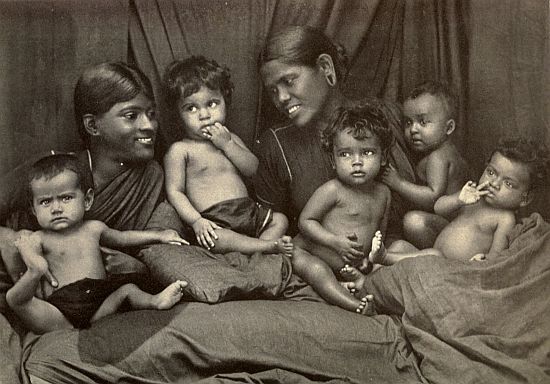
Among the recognised "fits" in our family is "the Accal who loves the unlovable babies." This is Suhinie. We tried her once with the Taraha children; but the terrible activity of these young people was altogether too much for the slowly moving machinery of poor Suhinie's brain, and she was perfectly overwhelmed and very miserable. For Suhinie hates hurry and sudden shocks of any sort, and the babies of maturer years discovered this immediately; and Suhinie, waddling forlornly after the babies, looked like a highly respectable duck in charge of a flock of impertinent robins.
 THREE CONVERT WORKERS.
It was quite a misfit, and Suhinie's worst came to the top, and we speedily moved her back again to the Prémalia nursery.
For there you see Suhinie in her true sphere. Give her a poor, puny babe, who will never, if she can help it, let her Accal have an undisturbed hour; give her the most impossible, most troublesome baby in the nursery, and then you will see Suhinie's best. We discovered this when Ponnamal was in charge of the Neyoor nursery. Ponnamal had one small infant so cross that nobody wanted her. She would cry half the night, a snarly, snappy cry, that would not stop unless she was rocked, and began again as soon as the rocking was stopped. Ponnamal gave her to Suhinie.
"Night after night till two in the morning she would sing to that fractious child"—this was Ponnamal's story to me when next I went to Neyoor. "She never seemed to tire; hymn after hymn she would sing, on and on and on. I never saw her impatient with it; she just loved it from the first." And a curious thing began to happen: the baby grew like her Accal. This likeness was not caught in the photograph, but is nevertheless so observable that visitors have often asked if the little one were her own child.
This baby, Sununda by name, is greatly attached to Suhinie. As she is over two years old now, she has been promoted to the Taraha, and being an extremely wilful little person, she sometimes gets into trouble. One day I was called to remonstrate, and a little "morning glory" was required, and I put her in a corner to think about it. Another sinner had to be dealt with, and when I returned Sununda was nowhere to be found. I searched all over the Taraha and in the garden, and finally found her in the Prémalia cuddled close to Suhinie. "She has told me all about it," said Suhinie, who was nursing another edition of difficult infancy; and she looked down on the curly head with eyes of brooding affection, like a tender turtle-dove upon her nestling. Then the roguish brown eyes smiled up at me with an expression of perfect confidence that I would understand and sympathise with the desire to share the troubles of this strange, sad life with so beloved an Accal.
The question of discipline is sometimes rather difficult with so many dispositions, each requiring different dealing. We try, of course, to fit the penalty to the crime, so that the child's sense of justice will work on our side; and in this we always find there is a wonderful unconscious co-operation on the part of the merest baby. But the older children used to be rather a problem. Some had come to us after their wills had become developed and their characters partly formed. Most of them were with us of their own free will, and could have walked off any day, for they knew where they would be welcome. Discipline under these circumstances is not entirely easy. But three years ago something of Revival Power swept through all our family. It was not the Great Revival for which we wait, but it was something most blessed in effect and abiding in result; and ever since then the tone has been higher and the life deeper, so that there is something to which we can appeal confident of a quick response. But children will be scampish; and once their earnestness of desire to be good was put to unexpected and somewhat drastic proof.
At that time the mild Esli had charge of the sewing-class, and the class had got into bad ways; carelessness and chattering prevailed, so Esli came in despair to me, and I talked to the erring children. They were sorry, made no excuses, and promised to be different in future. I left them repentant and thoroughly ashamed of themselves, and went to other duties.
 SEWING-CLASS IN THE COURTYARD.
Shortly afterwards Arulai found them in a state of great depression. They told her they had promised to be good at the sewing-class, but were afraid they would forget. Arulai's ideas are usually most original, and she sympathised with the children, but told them there was no need for them ever to forget. They asked eagerly what could be done to help them to remember. They had prayed, but even so had doubts. Was there anything to be done besides praying? Arulai said there was, and she expounded certain verses from the Book of Proverbs. "Sometimes the best way to make a mark upon the mind is to make a mark upon the body," she suggested, and asked the children if they would like this done. The children hesitated. They were aware that Arulai's "marks" were likely to be emphatic, for Arulai never does things by halves. But their devotion to her and belief in her overcame all fears; and being genuinely anxious to reform, they one and all consented. So she sent a small girl off to look for a cane; and presently one was produced, "thin and nice and suitable," as I was afterwards informed. The younger children were invited to take the cane and look at it, and consider well how it would feel. This they did obediently, but still stuck undauntedly to their determination, in fact, were keen to go through with it. Then Arulai explained that when the King said, "Chasten thy son while there is hope, and let not thy soul spare for his crying," he must have been thinking of a very little boy who had not the sense to know what was good for him. They had sense. The mark on the body would be waste punishment if it were not received willingly and gratefully; so if any child cried or pulled her hand away, she would stop. Then the children all stood up and held out their hands—what a moment for a photograph! Arulai's "mark upon the body" was a genuine affair, but the class received it with fortitude and gratitude.
When I heard this history, an hour or so after its occurrence, I rather demurred. The children had appeared to be sincerely sorry when I spoke to them, and if so, why proceed to extremities? But Arulai answered with wisdom and much assurance: "They have been talked to before and have been sorry, but they forgot and did it again. This time they will not forget." And neither did they. As long as that class continued, its behaviour was exemplary; and "the mark upon the mind," to judge by their demeanour, remained as fresh as it must have been on that memorable day when the "mark" upon the body effected its creation. The story ought to end here; but most stories have a sequel, and this has two.
The first occurred a few weeks later. A little girl, one of the sewing-class, had slipped into the habit of careless disobedience, followed too often by sulks. If we happened to come across her just when the thunder-clouds were gathering, we could usually divert her attention and avert the threatened trouble; but if we did not happen to meet her just at the right moment, she would plunge straight into the most outrageous naughtiness with a sort of purposeful directness that was difficult to deal with. Knowing the child well, we often let her choose her own punishments; and she did this so conscientiously that at last, as she herself mournfully remarked, "they were all used up," and there was nothing left but the most ancient—and perhaps in some cases most efficacious, which, the circumstances being what they were, I was naturally reluctant to try. But the child, trained to be perfectly honest with herself, apparently thought the thing over, and calmly made up her mind to accept the inevitable; for when, anxious she should not misunderstand, I began to explain matters to her, I was met by this somewhat astonishing response: "Yes, Amma, I know. I know you have tried everything else" (she said this almost sympathetically, as if appreciating my dilemma), "and so you have to do it. I do not like it at all, but Arulai Accal says it is no use unless I take it willingly, so Amma, please give me a good caning." (The idiom is the same in Tamil as in English, but there is a stronger word which she now proceeded to use with great deliberation.) "Yes, Amma, a hot caning—with my full mind I am willing. And I will not cry. Or if I do cry" (this was added in a serious, reflecting sort of way), "let not your soul spare for my crying!"
The second is less abnormal. Esli, whose placid soul had been sadly stirred at the time of the infliction of the "mark," was so impressed by its salutary effect that she conceived a new respect for the methods of King Solomon. The application of "morning glory" is a privilege reserved, as a rule, for ourselves; but one day, being doubtless hard pressed, Esli produced a stick—a very feeble one—and calling up the leader of all rebels, addressed herself to her. Chellalu, as might have been expected, was taken by surprise; and for one short moment Esli was permitted to follow the ways of the King. But only for a moment: for, suddenly apprehending the gravity of the situation, and realising that such precedent should not pass unchallenged, Chellalu, with a quick wriggle, stood forth free, seized the stick with a joyous shout, snapped it in two, and flourished round the room: then stopping before her afflicted Accal, she solemnly handed her one of the pieces, and with a bound and a scamper like a triumphant puppy, was off to the very end of her world with the other half of that stick.
When the Elf came to us on March 6, 1901, and we began to know some of the secrets of the Temple, we tried to save several little children, but we failed. The thought of those first children with whom we came into touch, but for whom all our efforts were unavailing, is unforgettable. We see them still, little children—lost. But we partly understand why we had to wait so long; we had not the workers then to help us to take care of them. We had only some of the older Accals, who could not have done it alone. These convert-girls, who now help us so much, were in Hindu homes; some of them had not even heard of Christ, whose love alone makes this work possible. For India is not England in its view of such work. There is absolutely nothing attractive about it. It is not "honourable work," like preaching and teaching. No money would have drawn these workers to us. Work which has no clear ending, but drifts on into the night if babies are young or troublesome—such work makes demands upon devotion and practical unselfishness which appeal to none but those who are prepared to love with the tireless love of the mother. "I do not want people who come to me under certain reservations. In battle you need soldiers who fear nothing." So wrote the heroic Père Didon; and, though it may sound presumptuous to do so, we say the same. We want as comrades those who come to us without reservations. But such workers have to be prepared, and such preparation takes time. "Tarry ye the Lord's leisure," is a word that unfolds as we go on.
Yet we find that the work, though so demanding, is full of compensations. The convert in her loneliness is welcomed into a family where little children need her and will soon love her dearly. The uncomforted places in her heart become healed, for the touch of a little child is very healing. If she is willing to forget herself and live for that little child, something new springs up within her; she does not understand it, but those who watch her know that all is well. Sometimes long afterwards she reads her own heart's story and opens it to us. "I was torn with longing for my home. I dreamed night after night about it, and I used to waken just wild to run back. And yet I knew if I had, it would have been destruction to my soul. And then the baby came, and you put her into my arms, and she grew into my heart, and she took away all that feeling, till I forgot I ever had it." This was the story of one, a young wife, for whom the natural joys of home can never be. But if there is selfishness or slackness or a weak desire to drift along in easiness, taking all and giving nothing, things are otherwise. For such the nurseries hold nothing but noise and interruptions. We ask to be spared from such as these. Or if they come, may they be inspired by the constraining love of Christ and "The Glory of the Usual."
FOOTNOTES:
CHAPTER XXV
The Little Accals
Thy word our hearts and hands did crave,
What it would come to at the worst
To save.
Perpetual knockings at Thy door,
Tears sullying Thy transparent rooms.
 THREE LITTLE ACCALS.
December 16, 1903, was spent by three of us in a rest-house on the outskirts of a Hindu town. We were on our way to Dohnavur from Madras, where we had seen Mr. and Mrs. Walker off for England. The two days' journey had left us somewhat weary; and yet we were strong in hope that day, for we knew there was special thought for us on board ship and at home, and something special was being asked as a birthday gift of joy. Arulai (Star) and Preena (the Elf), the two who were with me, were full of expectation. The day had often been marked by that joy of joys, a lost sheep found; and as we looked out at the heathen town with its many people so unconscious of our thoughts about them, we wondered where we should find the one our thoughts had singled from among the crowd, and we went out to look for her.
 PREENA AND PREEYA
(To left and right) getting ready for a Coming-Day Feast.
Up and down the long white streets we looked for her; on the little narrow verandahs, in the courtyards of the houses, in their dark inner rooms when we were invited within, out again into the sunshine—but we could not find her. That evening I remember, though we did not say so to each other, we felt a little disappointed. We had not met one who even remotely cared for the things we had come to bring.
No one had responded. There was not, so far as we knew it, even a little blade to point to, much less a sheaf to lay at His feet. After nightfall a woman came to see us. But she was a Christian, and beyond trying to cheer her to more earnest service among the heathen, there was nothing to be done for her. She left us, she told us afterwards, warmed to hope; and she talked to a child next morning, a little relative of her own, whose heart the Lord opened.
For three months we heard nothing; then unexpectedly a letter came. "The child is much in earnest, and she has made up her mind to join your Starry Cluster" (a name given by the people to our band, which at that time was itinerating in the district), "so I purpose sending her at once." The parents, for reasons of their own, agreed to the arrangement, and the little girl came to Dohnavur. It was wonderful to watch her learning. She is not intellectually brilliant, but the soul awakened at once, and there was that tenderness of response which refreshes the heart of the teacher. She seemed to come straight to our Lord Jesus and know Him as her Saviour, child though she was; and soon the longing to win others possessed her, and a younger child, who was her special charge among the nursery children, was influenced so gently and so willingly, that we do not know the time when, led by her little Accal, she too came to the Lover of children.
But one day, suddenly, trouble came. The parents appeared in the Dohnavur compound and claimed their daughter; and we had no legal right to refuse her, for she was under age. We shall never forget the hour they came. They had haunted the neighbourhood, as we afterwards heard, and prowled about outside the compound, watching for an opportunity to carry the child off without our knowledge. But she was always with the other children, so that plan failed. When first she heard they had come, she fled to the bungalow. "My parents have come! My father is strong! Oh, hide me! hide me!" she besought us. "I cannot resist him! I cannot!" and she cried and clung to us. But when we went out to meet them, she was perfectly quiet; and no one would have known from her manner as she stood before them, and answered their questions, without a tremble in her voice, how frightened she had been before.
"What is this talk about being a Christian?" the father demanded stormily. "What can an infant know about such matters? Are you wiser than your fathers, that their religion is not good enough for you?" And scathing mockery followed, harder to bear than abuse. "Come! Say salaam to the Missie Ammal, and bring your jewels" (she had taken them off), "and let us go home together." The child stood absolutely still, looking up with brave eyes; and to our astonishment said, as though it were the only thing to be said: "But I am a Christian. I cannot go home."
We had not thought of her saying this. We had, indeed, encouraged her as we had encouraged ourselves, to rest in our God, who is unto us a God of deliverances; but we had not suggested any line of resistance, and were not prepared for the calm refusal which so quietly took it for granted that she had no power to refuse.
The father was evidently nonplussed. He knew his little daughter, a timid child, whose translated name, Fawn, seems to express her exactly, and he gazed down upon her in silence for one surprised moment, then burst out in wrath and indignant revilings. "Snake! nurtured in the bosom only to turn and sting! Vile, filthy, disgusting insect, born to disgrace her caste!" And they cursed her as she stood.
Then their mood changed, and they tried pleadings, much more difficult to resist. The father reminded her of his pilgrimage to a famous Temple at her birth: "He had named her before the gods." Her mother touched on tenderer memories, till we could feel the quiver of soul, and feared for the little Fawn. Then they promised her liberty at home. She should read her Bible, pray to the true God, "for all gods are one." I saw Fawn shut her eyes for a moment. What she saw in that moment she told me afterwards: a fire lighted on the floor, a Bible tossed into it, two schoolboy brothers (whose leanings towards Christianity had been discovered) pushed into an inner room, the sound of blows and cries. "And after that my brothers did not want to be Christians any more." Poor little timid Fawn! We hardly wonder as we look at her that she shrank and shut her eyes. I have seen a child of twelve held down by a powerful arm and beaten across the bare shoulders with a cocoa-nut shell fastened to the end of a stick; I have seen her wrists twisted almost to dislocation—seen it, and been unable to help. I think of the child, now our happy Gladness, lover of the unlovable babies; and I for one cannot wonder at the little Fawn's fear. But aloud she only said: "Forgive me, I cannot go home."
The father grew impatient. "Get your jewels and let us be gone!" Fawn ran into the house, brought her jewels, and handed them to her father. He counted them over—pretty little chains and bangles, and then he eyed her curiously. A child to give up her jewels like this—he found it unaccountable. And then he began to argue, but Fawn answered him with clearness and simplicity, and he could not perplex her. She knew Whom she believed.
At last they rose to go, cursing the day she was born with a curse that sounded horrible. But their younger daughter, whom they had brought with them, threw herself upon the ground, tearing her hair, beating her breast, shrieking and rolling and flinging the dust about like a mad thing. "I will not go without my sister! I will not go! I will not go!" And she clung to Fawn, and wept and bewailed till we hardly dared to hope the child would be able to withstand her. For a moment the parents stood and waited. We, too, stood in tension of spirit. "They have told her to do it," whispered Fawn, and stood firm. Then the father stooped, snatched up the younger child, and departed, followed by the mother.
All this time two of our number had been waiting upon God in a quiet place out of sight. One of the two went after the parents, hoping for a chance to explain matters to the mother. As she drew near she heard the wife say in an undertone to her husband: "Leave them for to-day. Wait till to-night. You have carried off the younger in your arms against her will. What hinders you doing the same to the elder?" And that night we prayed that the Wall of Fire might be round us, and slept in peace.
As a dream when one awaketh, so was the memory of that afternoon when we awoke next morning. And as a dream so the parents passed out of sight, for they left before the dawn. But weeks afterwards we heard what had happened that night. They had lodged in the Hindu village outside our gate. There has never been a Christian there, and the people have never responded in any way. It is a little shut-in place of darkness on the borders of the light. But when the parents proposed a raid upon the bungalow that night they would not rise to it. "No, we have no feud with the bungalow. We will not do it." The nearest white face was a day's journey distant, and a woman alone, white or brown, does not count for much in Hindu eyes. But the Wall of Fire was around us, and so we were safe.
If the story could stop here, how easy life would be! One fight, one fling to the lions, and then the palm and crown. But it is not so. The perils of reaction are greater for the convert than the first great strain of facing the alternative, "Diana or Christ." Home-sickness comes, wave upon wave, and all but sweeps the soul away; feelings and longings asleep in the child awake in the girl, and draw her and woo her, and blind her too often to all that yielding means. She forgets the under-side of the life she has forsaken; she remembers only the alluring; and all that is natural pleads within her, and will not let her rest. "Across the will of Nature leads on the path of God," is sternly true for the convert in a Hindu or Moslem land.
And so we write this unfinished story in faith that some one reading it will remember the young girl-converts as well as the little children. Fawn has been kept steadfast, but she still needs prayer. These last five years have held anxious hours for those who love her, and to us, as to all who have to do with converts. "Perpetual knockings at Thy door, tears sullying Thy transparent rooms," are words that go deep and touch the heart of things.
CHAPTER XXVI
The Glory of the Usual
 AFTER HER BOTTLE.
The ancient voice and the new voice sing to the same sweet tune; and we in our little measure are learning to sing it too.
As we have said, India is a land where the secular does not appeal. When we were an Itinerating Band, we had many offers from Christian girls and women to join us, as many in one month as we now have in five years. Sometimes it has seemed to us that we were set to learn and to teach a new and difficult lesson, the sacredness of the commonplace. Day by day we learn to rub out a little more of the clear chalked line that someone has ruled on life's black-board; the Secular and the Spiritual may not be divided now. The enlightening of a dark soul or the lighting of a kitchen fire, it matters not which it is, if only we are obedient to the heavenly vision, and work with a pure intention to the glory of our God.
 NORTH LAKE AND HILLS.
The nursery kitchen is a pleasant little place. We hardly ever enter it without remembering and appreciating John Bunyan's pretty thought, for there things in the doing of them seem to cast a smile. Ponnamal, who, as we said, superintends the more delicate food-making work, has trained two of her helpers to carefulness; and these two—one a motherly older woman with a most comfortable face, the other the convert, Joy—look up with such a welcome that you feel it good to be there. Scrubbing away at endless pots and pans and milk vessels is a younger convent-girl, who, when she first came to us, disapproved of such exertion. She liked to sit on the floor with her Bible on her lap and a far-away look of content on her face until the dinner-bell rang. Now she scrubs with a sense of responsibility.
All the younger converts have regular teaching, for they have much to learn, and all, older and younger, have daily classes and meetings; above all, it is planned that each has her quiet time undisturbed. But it is early understood that to be happy each must contribute her share to the happiness of the family; and one of the first lessons the young convert has to learn is to honour the "Grey Angel," Drudgery, and not to call her bad names.
The kitchen has an outlook dear to the Tamil heart. A trellis covered with pink antigone surrounds it, but a window is cut in the trellis so that the kitchen may command the bungalow. "While I stirred the milk I saw everything you did on your verandah," remarked one of the workers lately, in tones of appreciation. The opposite outlook is the mountain shown in the photograph; only instead of water we have the kitchen-garden with its tropical-looking plantains and creeping marrows. "And the warm melon lay like a little sun on the tawny sand," is a line for an Eastern garden when the great marrows ripen suddenly.
The kitchen thus favoured without, is adorned within, according to the taste of its owners, with those very interesting pictures published by the makers of infant foods. "How do you choose them?" we asked one day. "The truest and the prettiest," was the satisfactory answer. Our Dohnavur text, which hangs in every nursery, looks down upon the workers, and, as they put it, "keeps them sweet in heart": "Love never faileth."
When first we began to cultivate babies we were very ignorant, and we asked advice of all who seemed competent to give it. The advice was most perplexing. Each mother was sure the food that had suited her baby was the best of all foods, and regarded all others as doubtful, if not bad. One whom we greatly respected told us Indian babies would be sure to get on anyhow, as it was their own land. And one seriously suggested rice-water as a suitable nourishment. Naturally we began with the time-honoured milk and barley-water, and some throve upon it. But we found each baby had to be studied separately. There was no universal (artificial) food. We could write a tractlet on foods, and if we did we would call it "Don't," for the first sentence in it would be, "Don't change the food if you can help it." This tractlet would certainly close with a word of thanks to those kind people, the milk-food manufacturers, who have helped us to build up healthy children; for feelings of personal gratitude come when help of this kind is given.
The nursery kitchen is a room full of reminders of help. "I have commanded the ravens," is a word of strength to us. Once we were very low. A little child had died under trying circumstances. One of the milk-sellers, instead of using the vessel sent him, poured his milk into an unclean copper vessel, and it was poisoned. He remembered that it would not be taken unless brought in the proper vessel, so at the last moment he corrected his mistake, but the correction was fatal, for there was no warning. The milk was sterilized as usual and given to the child. She was a healthy baby, and her nurse remembers how she smiled and welcomed her bottle, taking it in her little hands in her happy eagerness. A few hours later she was dead.
At such times the heart seems foolishly weak, and things which would not trouble it otherwise have power to make it sore. We were four days' journey from the nursery at the time, and had the added anxiety about the other babies, to whom we feared the poisoned milk might have been given, and we dreaded what the next post might bring. Just at that moment it was suggested, with kindest intentions, that perhaps we were on the wrong track, the work seemed so difficult and wasteful.
It was mail-day. The mail as usual brought a pile of letters, and the top envelope contained a bill for foods ordered from England some weeks before. It came to more than I had expected, in spite of the kindness of several firms in giving a liberal discount; and for a moment the rice-water talk (to give it a name which covers all that type of talk) came back to me with hurt in it: "To what purpose is this waste?" But with it came another word: "Take this child away (away from the terrible Temple) and nurse it for Me." And with the pile of letters before me, and the bill for food in my hand, I asked that enough might be found in those letters to pay it. It did not occur to me at the moment that the prayer was rather illogical. I only knew it would be comforting, and like a little word of peace, if such an assurance might even then come that we were not off the lines.
Letter after letter was empty. Not empty of kindness, but quite empty of cheques. The last envelope looked thin and not at all hopeful. Cheques are usually inside reliable-looking covers. I opened it. There was nothing but a piece of unknown writing. But the writing was to ask if we happened to have a need which a sum named in the letter would meet. This sum exactly covered the bill for the foods. When the cheque eventually reached me it was for more than the letter had mentioned, and covered all carriage and duty expenses, which were unknown to me at the time the first letter came, and to which of course I had not referred in my reply. Thus almost visibly and audibly has the Lord, from whose hands we received this charge to keep, confirmed His word to us, strengthening us when we were weak, and comforting us when we were sad with that innermost sense of His tenderness which braces while it soothes.
Surely we who know Him thus should love the Lord because He hath heard our voice and our supplication. Every advertisement on the walls of the little nursery kitchen is like an illuminated text with a story hidden away in it:—
It runs, it flies;
All things concur to give it a perfection.
The nursery kitchen, we were amused to discover, has a sphere of influence all its own. Our discovery was on this wise:—
One wet evening we were caught in a downpour as we were crossing from the Taraha nursery to the bungalow, and we took shelter in the kindergarten room, which reverts to the Lola-and-Leela tribe when the kindergarten babies depart. The tribe do not often possess their Sittie and their Ammal both together and all to themselves, now that the juniors are so numerous, and they welcomed us with acclamations. "Finish spreading your mats," we said to them, as they seemed inclined to let our advent interrupt the order of the evening; and we watched them unroll their mats, which hung round the wall in neat rolls swung by cords from the roof, and spread them in rows along the wall. Beside each mat was what looked like a mummy, and beside each mummy was a matchbox and a small bundle of rags.
Presently the mummies were unswathed, and proved to be dolls in more or less good condition. Each was carefully laid upon a morsel of sheet, and covered with another sheet folded over in the neatest fashion. "If we teach them to be particular when they are young, they will be tidy when they are old," we were informed. It was pleasant to hear our own remarks so accurately repeated.
The matchboxes were next unpacked; each contained a bit of match, a small pointed shell, a pebble (preferably black), and a couple of minute cockles. "I suppose you don't know what all these are?" said Lola, affably. "That," pointing to the match, "is a spoon; and this," taking the pointed shell up carefully, "is a bottle. This is the 'rubber,' of course," and the black pebble was indicated; "and these" (setting the cockle-shells on a piece of white paper on the floor) "are bowls of water, one for the bottle and the other for the rubber." We suggested one bowl of water would hold both bottle and rubber; but Lola's entirely mischievous eyes looked quite shocked and reproving. "Two bowls are better," was the serious reply; "it is very important to be clean." "What does your child have?" we inquired respectfully. "Barley-water and milk, two-and-a-half ounces every two hours—that's five tablespoonfuls, you know." "And Leela's?" "Oh, Leela's child is delicate. She has to have Benger. Two ounces every two hours; and it has to be a long time digested." "Do all your children have their food every two hours?" Lola looked surprised, and Leela giggled: how very ignorant we seemed to be! "No, only the tiny ones; our babies are very young. After they get older they have more at a time and not so often. That child there," pointing to another mat, "has Condensed, as we haven't enough cow's milk for them all. It suits her very well. She has six ounces at a time; once before she goes to sleep, and then none till she wakens in the morning. She's a very healthy child." "How do you know the time?" we asked, prepared for anything now. "Oh, we have watches. This is mine," and a toy from a Christmas cracker was produced; "Leela's watch is different" (it was indeed different—a mere figment of the imagination), "but she can look at mine when she wants to." "Why does your child sleep with Leela's?" (All the other infants had separate sleeping arrangements.) Lola looked shy, and Leela looked shyer. These little matters of affection were not intended for public discussion.
By this time the rain had cleared, so we prepared to depart, and the further entertainments provided for us by the cheerful tribe that evening do not belong to this story. We escaped finally, damp with much laughter in a humid atmosphere. "Come every evening!" shouted the tribe, as at last we disappeared, and we felt much inclined to accept the invitation.
The kitchen is a busy place in the morning, and again in the evening, when the fresh milk is carried to it in shining aluminium vessels to be sterilized or otherwise dealt with. But even in the busiest hours there is almost sure to be a baby set in an upturned stool, in which she sits holding on to the front legs in proud consciousness of being able to sit up. Or an older one will be clinging to the garments of the busy workers, or perched beside them on a stool. Once we found Tara and Evu seated on the window-sill. Ponnamal was making foods at the table under the window, and the little bare feet were tucked in between bowls and jugs of milk. "But, indeed, they are quite clean," explained Ponnamal, without waiting for remark from us, for she knew what we were thinking of her table decorations. "We dusted the sand off their little feet before we lifted them up." The babies said nothing, but looked doubtfully up at us, as if not very sure of our intentions. But Ponnamal's eyes were so appealing, and the little buff things in blue with a trellis of pink flowers for background made such a pretty picture, that we had not the heart to spoil it. Then the little faces smiled gratefully upon us, and everybody smiled. The kitchen is a happy place of innocent surprises.
CHAPTER XXVII
The Secret Traffic
"Sir, to leave things out of a book because they will not be believed, is meanness."—Dr. Johnson.
"It is useless to move without a body of evidence at your back," said a friend in the Civil Service to us at the close of a long conversation. "If you can get the children, of course they themselves will furnish the best evidence; but, anyhow, collect facts." And this was the beginning of a Note-book, into which we entered whatever we could learn about the Temple children, and in which we kept letters relating to them.
By Temple children throughout this book we mean children dedicated to gods, or in danger of being so dedicated. Dedication to gods implies a form of marriage which makes ordinary marriage impossible. The child is regarded as belonging to the gods. In Southern India, where religious feeling runs strong, and the great Temples are the centres of Hindu influence, this that I have called "The Traffic" is worked upon religious lines; and so in trying to save the children we have to contend with the perverted religious sense. Something of the same kind exists in other parts of India, and the traffic under another name is common in provinces where Temple service as we have it in the South is unknown. Again, in areas where, owing to the action of the native Government, Temple service, as such, is not recognised, so that children in danger of wrong cannot, strictly speaking, be called Temple children, there is yet need of legislation which shall touch all houses where little children are being brought up for the same purpose; so that the subject is immense and involved, and the thought of it suggests a net thrown over millions of square miles of territory, so finely woven as to be almost invisible, but so strong in its mesh that in no place yet has it ever given way. And the net is alive: it can feel and it can hold.
But all through this book we have kept to the South—to the area where the evil is distinctly and recognisably religious. Others elsewhere have told their own story; ours, though in touch with theirs (in that its whole motive is to save the little children), is yet different in manner, in that it is avowedly Christian. India is a land where generalisations are deceptive. So we have kept to the South.
We ourselves became only very gradually aware of what was happening about us. As fact after fact came to light, we were forced to certain conclusions which we could not doubt were correct. But at first we were almost alone in these conclusions, because it was impossible to take others with us in our tedious underground hunt after facts. So the question was often asked: "But do the children really exist?"
I have said we were almost alone, not quite. Members of the Indian Civil Service, who are much among the people, knew something of the custom of child-dedication, but found themselves unable to touch it. Hindu Reformers, of course, knew; and two or three veteran missionaries had come into contact with it and had grieved over their helplessness to do anything. One of these had written a pamphlet on the subject twenty years before our Nursery work began. He sent it to me with a sorrowful word written across it, "Result? Nil." But we do not often meet our civilian friends, for they are busy, and so are we; and the few missionaries whose inspiring sympathy helped us through those earlier years were in places far from us, and so were all the Reformers. So perhaps it was not wonderful that, beset by doubting letters from home and a certain amount of not unnatural incredulity in India, we sometimes almost wondered if we ourselves were dreaming. "Well, if they do exist, I hope you will be able to find them!"—varied by, "Well, if you do find them, they will be a proof of their own existence!"—were two of the most encouraging remarks of those early days.
From the beginning of this work, as stated before, we have tried to collect facts about the traffic and the customs connected with it. Notes were kept of conversations with Hindus and others, and these notes were compared with what evidence we were able to gather from trustworthy sources. These brief notes of various kinds we offer in their simplicity. We have made no attempt to tabulate or put into shape the information thus acquired, believing that the notes of conversations taken down at the time, and the quotations from letters copied as they stand, will do their work more directly than anything more elaborate would. Where there is a difference of detail it is because the customs differ slightly in different places. No names are given, for obvious reasons; but the letters were written by men of standing, living in widely scattered districts in the South. The evidence contained in them was carefully sifted, and in many cases corroborated by personal investigation, before being considered evidence: so that we believe these chapters may be accepted as fact. Dated quotations from the Madras Mail are sufficient to prove that we are not writing ancient history:—
January 2, 1909.—"The following resolution was put from the chair and carried unanimously: 'The Conference (consisting of Hindu Social Reformers) cordially supports the movement started to better the condition of unprotected children in general, and appreciates particularly the agitation started to protect girls and young women from being dedicated to Temples.'"
May 8, 1909.—"Once more we have an illustration from Mysore of the fact that the Government of a Native State are able to tread boldly on ground which the British Government in India are unable to approach. At various times, in these columns and elsewhere, has the cry raised against the employment of servants of the gods in Hindu Temples been uttered; but, as far as the Government are concerned, it has fallen, if not on deaf ears, on ears stopped to appeals of this kind, which demand action that can be interpreted as a breach of that religious neutrality which is one of the cardinal principles of British rule in India. The agitation against it is not the agitation of the European whose susceptibility is offended at a state of things that he finds hard to reconcile with the reverence and purity of Divine worship; but it is the outcry of the reverent Hindu against one of the corrupt and degrading practices that, in the course of centuries, have crept into his religion. In this particular instance the Mysore Government cannot be accused of acting hastily. As long ago as February, 1892, they issued a circular order describing the legitimate services to be performed in Temples by Temple women. In 1899, the Muzrai Superintendent, Rai Bahadur A. Sreenivasa Charlu, directed that the Temple women borne on the Nanjangud Temple establishment should not be allowed to perform tafe (or dancing) service in the Temple; but that the allowances payable to them should be continued for their lifetime, and that at their death the vacancies should not be filled up. Against this order the Temple women concerned memorialised H.H. the Maharajah as long ago as 1905, and the order disposing of it has only just been issued. In the course of the latter the Government say:—
"'From the Shastraic authorities quoted by the two Agamiks employed in the Muzrai Secretariat, it is observed that the services to be performed by Temple women form part and parcel of the worship of the god in Hindu Temples, and that singing and dancing in the presence of the deity are also prescribed. It is, however, observed that in the case of Temple women personal purity and rectitude of conduct and a vow of celibacy were considered essential. But the high ideals entertained in ancient days have now degenerated. . . . The Government now observe that whatever may have been the original object of the institution of Temple women in Temples, the state in which these Temple servants are now found fully justifies the action taken by them in excluding the Temple women from every kind of service in sacred institutions like Temples. Further, the absence of the services of these women in certain important Temples in the State has become established for nearly fifteen years past, and the public have become accustomed to the idea of doing without such services.'
"The exclusion of Temple women from Temple services obtains in Mysore in the case of a few large Temples whose Tasdik Pattis have been revised. But the time has come, the Government think, for its general application, and they therefore direct that the policy enunciated in the abstract given above should be extended to all Muzrai Temples in the State. It is to be hoped that the good example thus set will bear fruit elsewhere, where the Temple women evil is more notorious than it was in Temples of Mysore."
A copy of the Government document to which this cutting relates lies before me. It is bravely and clearly worded, and its intention is evident. The high-minded Hindu—and there are such, let it not be forgotten—revolts from the degradation and pollution of this travesty of religion, and will abolish it where he can. But let it be remembered that, good as this law is, it does not and it cannot touch the great Secret Traffic itself. That will go on behind the law, and behind the next that is made, and the next, unless measures are devised to ensure its being thoroughly enforced.
Cuttings from newspapers, quotations, evidence—it is not interesting reading, and yet we look to our friends to go through to the end with us. Let us pause for a moment here and remember the purpose of it all; and may the thought of some little, loved child make an atmosphere for these chapters!
CHAPTER XXVIII
Blue Book Evidence
"The daughters of the Caste who are brought up to follow the Caste profession are carefully taught dancing and singing, the art of dressing well, ;. . . and their success in keeping up their clientele is largely due to the contrast which they thus present to the ordinary Hindu housewife, whose ideas are bounded by the day's dinners and babies."
Closely allied to this Caste is that formed by the Temple musicians, who with the Temple woman are "now practically the sole repository of Indian music, the system of which is probably one of the oldest in the world." In certain districts the Report states that a custom obtains among certain castes, under which a family which has no sons must dedicate one of its daughters to Temple service. The daughter selected is taken to a Temple and married there to a god, the marriage symbol being put on her as in a real marriage. Henceforth she belongs to the god.
Writing in 1904, a member of the Indian Civil Service says: "I heard of a case of dedication (three girls) at A. at the beginning of this year, but I could not get any evidence. The cases very rarely indeed come up officially, as nearly every Hindu is interested in keeping them dark." We, too, have had the same difficulty, and the evidence we now submit is doubly valuable because of its source. It is very rarely that we have found it possible to get behind the scenes sufficiently to obtain reliable information from those most concerned in this traffic.
The head priest of one of our Temples admitted to a friend who was watching for opportunities to get information for us that the "marriage to the god is effected privately by the Temple priest at the Temple woman's house, with the usual marriage-symbol ceremony. To avoid the Penal Code (which forbids the marriage of children to gods) a nominal bridegroom is sometimes brought for the wedding day to become the nominal husband. This Caste is recruited by secret adoption."
A Temple woman's son, now living the ordinary life apart from his clan, explains the very early marriage thus: "If not married, they will not be considered worthy of honour. Before the children reach the age of ten they must be married. . . . They become the property of the Temple priests and worshippers who go to the Temple to chant the sacred songs."
A Temple woman herself told a friend of ours: "The child is dressed like a bride, and taken with another girl of the same community, dressed like a boy in the garb of a bridegroom. They both go to the Temple and worship the idol. This ceremony is common, and performed openly in the streets." In a later letter from the same friend further details are given: "The child, who should be about eight or nine years old, goes as if to worship the idol in the Temple. There the marriage symbol is hidden in a garland, and the garland is put over the idol, after which it is taken to the child's home and put round her neck." After this she is considered married to the god.
A young Temple woman in a town near Dohnavur told us she had been given to the Temple when she was five years old. Her home was in the north country, but she did not remember it. She had, of course, understood nothing of the meaning of the ceremony of marriage. She only remembered the pretty flowers and general rejoicing and pleasure. Afterwards, when she began to understand, she was not happy, but she gradually got accustomed to it. Her adopted relations were all the friends she had. She was fond of them and they of her. Her "husband" was one of the Temple priests.
A Hindu woman known to us left home with her little daughter and wandered about as an ascetic. She went to a famous Temple, where it is the custom for such as desire to become ascetics to enter the life by conforming to certain ceremonies ordained by the priests. She shaved her head, took off her jewels, wore a Saivite necklet of berries, and was known as a devotee. She had little knowledge of the life before she entered it, and only gradually became aware of the character borne by most of her fellow-devotees. When she knew, she fled from them and returned to her own village and the secular life, finding it better than the religious.