
The Menagerie
She stayed with us for another month, and was nursed day and night till more and more she became endeared to us; and then once more we heard the word that cannot be refused, and we let her go. We laid passion-flowers about her as she lay asleep. The smile that had left her little face had come back now. "She came with a smile, and she went with a smile," said one who loved her dearly; and the flowers of mystery and glory spoke to us, as we stood and looked. "Who for the joy that was set before Him ;. . . endured." The scent of the violet passion-flower will always carry its message to us. "Let us be worthy of the grief God sends."
And oh that such experiences may make us more earnest, more self-less in our service for these little ones! Someone has expressed this thought very tenderly and simply:—
With golden hair,
For evermore all fair young brows to me
A halo wear.
I kiss them reverently. Alas, I know
The pain I bear!
Because of dear but close-shut holy eyes
Of heaven's own blue,
All little eyes do fill my own with tears,
Whate'er their hue.
And, motherly, I gaze their innocent,
Clear depths into.
Because of little pallid lips, which once
My name did call,
No childish voice in vain appeal upon
My ears doth fall.
I count it all my joy their joys to share,
And sorrows small.
Because of little dimpled hands
Which folded lie,
All little hands henceforth to me do have
A pleading cry.
I clasp them, as they were small wandering birds,
Lured home to fly.
Because of little death-cold feet, for earth's
Rough roads unmeet,
I'd journey leagues to save from sin and harm
Such little feet.
And count the lowliest service done for them
So sacred—sweet.
But grief is almost too poignant a word for what is so stingless as this. And yet God the Father, who gives the love, understands and knows how much may lie behind two words and two dates. "Given ;. . . Taken ;. . ." Only indeed we do bless Him when the cup holds no bitterness of fear or of regret. There is nothing ever to fear for the little folded lambs. If only the veil of blinding sense might drop from our eyes when the door opens to our cherished little children, should we have the heart to toil so hard to keep that bright door shut? Would it not seem almost selfish to try? But the case is different when the child is not lifted lovingly to fair lands out of sight, but snatched back, dragged back down into the darkness from which we had hoped it had escaped. This work for the children, which seems so strangely full of trial of its own (as it is surely still more full of its own particular joy), has held this bitterness for us, and yet the bitter has changed to sweet; and even now in our "twilight of short knowledge" we can understand a little, and where we cannot we are content to wait.
Four years ago, after much correspondence and effort, a little girl was saved from Temple service in connection with a famous Temple of the South from which few have ever been saved. She had been dedicated by her father, and her mother had consented. Dévai got a paper signed by them giving her up to us instead. But shortly after she left the town, the father regretted the step he had taken, and followed Dévai, unknown to her. Alas, the child had not been with us an hour before she was carried off.
For two years we heard nothing of her. Old Dévai, who was broken-hearted about the matter, tried to find what had been done with her, but it was kept secret. She almost gave up in despair.
At last information reached her that the child was in the same town; and that her father having died of cholera, the mother and another little daughter were in a certain house well known to her. She went immediately and found the older child had not been given to the gods. Something of her pleadings had lingered in the father's memory, and he had refused to give her up. But the mother was otherwise minded, and intended to give both children to the Temple. Dévai had been guided to go at the critical time of decision. The mother was persuaded, and Dévai returned with two sheaves instead of one—and even that one she had hardly dared to expect. Once more we were called to hold our gifts with light hands. The younger of the welcome little two was one of ten who died during an epidemic at Neyoor. The elder one is with us still—a bright, intelligent child.
The only other one whom we have been compelled to give up in this most hurting way was saved through friends on the hills, who, before they sent the little child to us, believed all safe as to claims upon her afterwards. She was a pretty child of five, and we grew to love her very much; for her ways were sweet and gentle and very affectionate. Lala, Lola, and Leela were a dear little trio, all about the same age, and all rather specially interesting children.
But the father gave trouble. He was not a good man, and we knew it was not love for his little daughter which prompted his action. He demanded her back, and our friends had to telegraph to us to send her home. It was not an easy thing to do; and we packed her little belongings feeling as if we were moving blindly in a grievous dream, out of which we must surely awaken.
There was some delay about a bandy, but at last it was ready and standing at the door. We lifted the little girl into it, put a doll and a packet of sweets in her hands, and gave our last charges to those who were taking her up to the hills, workers upon whom we could depend to do anything that could yet be done to win her back again. Then the bandy drove away.
But we went back to our room and asked for a great and good thing to be done. We thought of little Lala, with her gentle nature which had so soon responded to loving influence, and we knew her very gentleness would be her danger now; for how could such a little child, naturally so yielding in disposition, withstand the call that would come, and the pressure that had broken far stronger wills? So we asked that she might either be returned to us soon or taken away from the evil to come. A week passed and our workers returned without her; they evidently felt the case quite hopeless. But the next letter we had from our friends told us the child was safe.
She had left us in perfect health, but pneumonia set in upon her return to the colder air of the hills. She had been only a few days ill, and died very suddenly—died without anyone near her to comfort her with soothing words about the One to whom she was going. Even in the gladness that she was safe now, there was the pitiful thought of her loneliness through the dark valley; and we seemed to see the little wistful face, and felt she would be so frightened and shy and bewildered; and we longed to know something about those last hours. But one of the heathen women who had been about her at the last told what she knew, and our friends wrote what they heard. "She said she was Jesus' child, and did not seem afraid. And she said that she saw three Shining Ones come into the room where she was lying, and she was comforted." Oh, need we ever fear? Little Lala had been with us for so short a time that we had not been able to teach her much; and so far as any of us know, she had heard nothing of the ministry of angels. We had hardly dared to hope she understood enough about our Lord Himself to rest her little heart upon Him. But we do not know everything. Little innocent child that she was, she was carried by the angels from the evil to come.
Old Dévai keeps a brave heart. When she comes to see us, she cheers herself by nursing the cheerful little people she brought to us, small and wailing and not very hopeful. She is full of reminiscences on these occasions. "Ah," she will say, addressing an astonished two-year-old, "the devil and all his imps fought for you, my child!" This is unfamiliar language to the baby; but Dévai knows nothing of our modern ideas of education, and considers crude fact advisable at any age. "Yes, he fought for you, my child. I was sitting on the verandah of the house wherein you lay, and I was preaching the Gospel of the grace of God to the women, when five devils appeared. Yea, five were they, one older and four younger. Men were they in outward shape, but within them were the devils. I had nearly persuaded the women to let me have you, my child; and till they fully consented, I was filling up the interval with speech, for no man shall shut my mouth. And the women listened well, and my heart burned within me—for it was life to me to see them listening—when lo! those devils came—yea, five, one older and four younger—sent by their master to confound me. And they rose up against me and turned me out, and told the women folk not to listen; and you—I should never get you, said they; and so it appeared, for with such is might, and their master waxes furious when he knows his time is short. But the Lord on high is mightier than a million million devils, and what are five to Him? He rose up for me against them and discomfited them"—Dévai does not go into secular particulars—"and so you were delivered from the mouth of the lion, my child!"
We are not anxious that our babies should know too much ancient history. Enough for them that they are in the fold—
Happy all day long I am;
He will keep me safe from harm,
For I'm His lamb—
CHAPTER XI
God Heard: God Answered
We think of the real India as we see it in the thinker—the seeker after the unknown God, with his wistful eyes. "The Lord beholding him loved him," and we cannot help loving as we look. And there is the Indian woman hidden away from the noise of crowds, patient in her motherhood, loyal to the light she has. We see the spirit of the old land there; and it wins us and holds us, and makes it a joy to be here to live for India.
The true India is sensitive and very gentle. There is a wisdom in its ways, none the less wise because it is not the wisdom of the West. This spirit which traffics in children is callous and fierce as a ravening beast; and its wisdom descendeth not from above, but is earthly, sensual, devilish. . . . And this spirit, alien to the land, has settled upon it, and made itself at home in it, and so become a part of it that nothing but the touch of God will ever get it out. We want that touch of God: "Touch the mountains, and they shall smoke." That is why we write.
For we write for those who believe in prayer—not in the emasculated modern sense, but in the old Hebrew sense, deep as the other is shallow. We believe there is some connection between knowing and caring and praying, and what happens afterwards. Otherwise we should leave the darkness to cover the things that belong to the dark. We should be for ever dumb about them, if it were not that we know an evil covered up is not an evil conquered. So we do the thing from which we shrink with strong recoil; we stand on the edge of the pit, and look down and tell what we have seen, urged by the longing within us that the Christians of England should pray.
"Only pray?" does someone ask? Prayer of the sort we mean never stops with praying. "Whatsoever He saith unto you, do it," is the prayer's solemn afterword; but the prayer we ask is no trifle. Lines from an American poet upon what it costs to make true poetry, come with suggestion here:—
The pastime of a drowsy summer day.
But gather all thy powers, and wreck them on the verse
That thou dost weave. . . .
The secret wouldst thou know
To touch the heart or fire the blood at will?
Let thine eyes overflow,
Let thy lips quiver with the passionate thrill.
"Arise, cry out in the night; in the beginning of the night watches pour out thine heart like water before the Lord; lift up thine hands towards Him for the life of thy young children!"
The story of the children is the story of answered prayer. If any of us were tempted to doubt whether, after all, prayer is a genuine transaction, and answers to prayer no figment of the imagination—but something as real as the tangible things about us—we have only to look at some of our children. It would require more faith to believe that what we call the Answer came by chance or by the action of some unintelligible combination of controlling influences, than to accept the statement in its simplicity—God heard: God answered.
In October, 1908, we were told of two children whose mother had recently died. They were with their father in a town some distance from Dohnavur; but the source from which our information came was so unreliable that we hardly knew whether to believe it, and we prayed rather a tentative prayer: "If the children exist, save them." For three months we heard nothing; then a rumour drifted across to us that the elder of the two had died in a Temple house. The younger, six months old, was still with her father. On Christmas Eve our informant arrived in the compound with his usual unexpectedness. The father was near, but would not come nearer because the following day being Friday (a day of ill-omen), he did not wish to discuss matters concerning the child; he would come on Saturday. On Saturday he came, carrying a dear little babe with brilliant eyes. She almost sprang from him into our arms, and we saw she was mad with thirst. She was fed and put to sleep, and hardly daring yet to rejoice (for the matter was not settled with the father), we took him aside and discussed the case with him. There were difficulties. A Temple woman had offered a large sum for the child, and had also promised to bequeath her property to her. He had heard, however, that we had little children who had all but been given to Temples, and he had come to reconnoitre rather than to decide.
The position was explained to him. But the Temple meant to him everything that was worshipful. How could anything that was wrong be sanctioned by the gods? The child's mother had been a devout Hindu; and as we went deeper and deeper into things with him, it was evident he became more and more reluctant to leave the little one with us. "Her mother would have felt it shame and eternal dishonour." We were in the little prayer-room, a flowery little summer-house in the garden, when this talk took place. On either side are the nurseries, and playing on the wide verandahs were happy, healthy babes; their merry shouts filled the spaces in the conversation. Sometimes a little toddling thing would find her way across to the prayer-room, and break in upon the talk with affectionate caresses. To our eyes everything looked so happy, so incomparably better than anything the Temple house could offer, that it was difficult to adjust one's mental vision so as to understand that of the Hindu beside us, to whose thought all the happiness was as nothing, because these babes would be brought up without caste. In the Temple house caste is kept most carefully. If a Temple woman breaks the rules of her community she is out-casted, excommunicated. "You do not keep caste! you do not keep caste!" the father repeated over and over again in utter dismay. It was nothing to him that the babes were well and strong, and as happy as the day was long; nothing to him that cleanliness reigned, so far as constant supervision could ensure it, through every corner of the compound. We did not profess to keep caste; we welcomed every little child in danger of being given to Temples, irrespective altogether of her caste. All castes were welcome to us, for all were dear to our Lord. This was beyond him; and he declared he would never have brought his child to us, had he understood it before. "Let her die rather! There is no disgrace in death." As he talked and expounded his views, he argued himself further and further away from us in spirit, until he became disgusted with himself for ever having considered giving the baby to us. All this time the baby lay asleep; and as we looked at the little face and noted the "mother-want," the appealing expression of pitiful weariness even in sleep, it was all we could do to turn away and face the almost inevitable result of the conversation. Once the father, a splendid looking man, tall and dignified, rose and stood erect in sudden indignation. "Where is the babe? I will take her away and do as I will with her. She is my child!" We persuaded him to wait awhile as she was asleep, and we went away to pray. Together we waited upon God, whose touch turns hard rocks into standing water, and flint-stone into a springing well, beseeching Him to deal with that father's heart, and make it melt and yield. And as we waited it seemed as if an answer of peace were distinctly given to us, and we rose from our knees at rest. But just at that moment the father went to where his baby slept in her cradle, and he took her up and walked away in a white heat of wrath.
The little one was in an exhausted condition, for she had not had suitable food for at least three days. It was the time of our land-winds, which are raw and cold to South Indian people; and it seemed that the answer of peace must mean peace after death of cold and starvation. It would soon be over, we knew; twenty-four hours, more or less, and those great wistful eyes would close, and the last cry would be cried. But even twenty-four hours seemed long to think of a child in distress, and her being so little did not make it easier to think of her dying like that. So on Sunday morning I shut myself up in my room asking for quick relief for her, or—but this seemed almost asking too much—that she might be given back to us. And as I prayed, a knock came at the door, and a voice called joyously, "Oh, Amma! Amma! Come! The father stands outside the church; he has brought the baby back!"
But the child was almost in collapse. Without a word he dropped the cold, limp little body into our arms, and prostrated himself till his forehead touched the dust. We had not time to think of him, we hardly noted his extraordinary submission, for all our thought was for the babe. There was no pulse to be felt, only those far too brilliant eyes looked alive. We worked with restoratives for hours, and at last the little limbs warmed and the pulse came back. But it was a bounding, unnatural pulse, and the restlessness which supervened confirmed the tale of the brilliant eyes—the little babe had been drugged.
From that day on till our Prayer-day, January 6th, it was one long, unremitting fight with death. We wrote to our medical comrade in Neyoor, and described the symptoms, which were all bad. He could give us little hope. Gradually the brilliance passed from the eyes, and they became what the Tamils call "dead." The film formed after which none of us had ever seen recovery. Then we gathered round the little cot in the room we call Tranquillity, and we gave the babe her Christian name Vimala, the Spotless One; for we thought that very soon she would be without spot and blameless, another little innocent in that happy band of innocents who see His Face.
On the evening of the 5th, friends of our own Mission who were with us seemed to lay hold for the life of the child with such fresh earnestness and faith, that we ourselves were strengthened. Next morning we believed we saw a change in the little deathlike face, and that evening we were sure the child's life was coming back to her.
It was not till then we thought of the father, who, after signing a paper made out for him by our pastor, who is always ready to help us, had returned to his own town. When we heard all that had occurred we saw how our God had worked for us. It was not fear of his baby's death that had moved the man to return to us. "What is the death of a babe? Let her die across my shoulders!" He was not afraid of the law. After all persuasions had failed, we had tried threats: the thing he purposed to do was illegal. The Collector (chief magistrate) would do justice. "What care I for your Collector? How can he find me if I choose to lose myself? How can you prove anything against me?" And in that he spoke the truth. There are ways by which the intention of the law concerning little children can be most easily and successfully circumvented. Our pleadings had not touched him. "Is she not my child? Was her mother not my wife? Who has the right to come between this child of mine and me her father?" And so saying he had departed without the slightest intention of coming back again. But a Power with which he did not reckon had him in sight; and a Hand was laid upon him, and it bent him like a reed. We hope some ray of a purer light than he had ever experienced found its way into his darkened soul, and revealed to him the sin of his intention. But we only know that he left his child and went back to his own town. God had heard: God had answered.
CHAPTER XII
To what Purpose?
For not all the chapters of the Temple children's story can be written down and printed for everyone to read. We think of the unwritten chapters, and remember how often when the pressure was greatest the thought of that undiscouraged comrade has been strength and inspiration. No one except those who, in weakness and inexperience, have tried to do something not attempted before can understand how the heart prizes sympathy just at the difficult times, and how such brave and steadfast comradeship is a thing that can never be forgotten.
Among the babies saved through this friend's influence was one with a short but typical story.
The little mite was seen first in her mother's arms, and the mother was standing by the wayside, as if waiting. Something in her attitude and appearance drew the attention of an Indian Christian, whom our friend had interested in the work, and she got into conversation with the mother, who told her that her husband had died a fortnight before the baby's birth, and she, being poor though of good caste, was much exercised about the little one's future. How could she marry her properly? She had come to the conclusion that her best plan would be to give her to the Temple. So she was even then waiting till someone from a Temple house would come and take her little girl.
The news that such a child is to be had soon becomes known to those who are on the watch, and it is improbable that the mother would have had long to wait. The Christian persuaded her to give up the idea, and the little babe was saved and sent to us. On the journey to Dohnavur a Temple woman chanced to get into the carriage where the little baby slept in its basket. There was nothing to tell who she was; and like the other women in the carriage, she was greatly interested in its story. But presently it became evident that her interest was more than superficial. She looked well at the baby and was quiet for a time; then she said to the Christian who was bringing it to us: "I see it is going to be an intelligent child. Let me have it; I will pay you." The Christian of course refused, and asked her how she knew it was going to be intelligent. "Look at its nose," said the Temple woman. "See, here is money!" and she offered it. "Let me have the baby! You can tell your Missie Ammal it died in the train!"
Sometimes our babies have to run greater risks than this in their journeys south to us. The distances which have to be covered by train and bullock-cart are great, and the travelling tedious. And there are many delays and opportunities for difficulties to arise; so that when we know a baby is on its way to us we feel we want to wrap it round in prayer, so that, thus invisibly enveloped, it will be protected and carried safely all the way. Once a little child, travelling to us from a place as distant, counting by time, as Rome is from London, was observed by some Brahman men, who happened to be at the far end of the long third-class carriage. Our worker, who was alone with the child, noticed the whispering and glances toward her little charge, and wrapped it closer in its shawl, and, as she said, "looked out of the window as if she were not at all afraid, and prayed much in her heart." Presently a station was reached. The language spoken there was not her vernacular, but she understood enough to know something was being said about the baby. Then an official appeared, and there was a cry quite understandable to her: "A Brahman baby! That Christian there is kidnapping a Brahman baby!" The official stopped at the carriage door. She was pushed towards him amidst a confused chatter, a crowd gathered at the door in a moment, and someone shouted in Tamil, above the excited clamour on the platform: "Pull her out! A Christian with a Brahman baby!"
"Then did my heart tremble! I held the baby tight in my arms. The man in clothes said, 'Show it to me!' And he looked at its hands and he looked at its feet, and he said: 'This is no child of yours!' But as I began to explain to him, the train moved, and he banged the door; and I praised God!"
India is a land where strange things can be accomplished with the greatest ease. As all went well it is idle to imagine what might have been; but we knew enough to be thankful.
Among the unwritten chapters is one which touches a problem. There are some little children—often the most valuable to the Temple women—who cannot live with us, but can live with them, because the baby in the Temple house is nursed by a foster-mother for the sake of merit, and thus it is given its best chance of life; whereas with us it is impossible to get foster-mothers. Indian children of the castes approved for the service are not, as a class, as robust as others; the secluded lives of their mothers, and the rigid rules pertaining to widows (girl-children born after the mother becomes a widow are, as has been seen, in special danger), partly account for this; and in other cases there are other reasons. Whatever the cause, however, the effect is manifest. The baby is seldom the little bundle of content of our English nurseries. It may become so later on, if all goes well. Often it lives upon its birth-strength for four months, or less, and then slips away. We have often hesitated about taking such babies; and then we have found that by refusing one who is likely to die we have discouraged those who were willing to help us, and the next baby in danger has been taken straight to the house where its welcome was assured. So we have hardly ever dared to refuse, and we have taken little fragile things whose days we knew were numbered unless a foster-mother could be found, for it seemed to us that death with us was better than life with the Temple people; and also we have not dared to risk losing the next, who might be healthy. "One dies, one lives," say the Temple women in their wisdom, and take all who are suitable in caste and in appearance. "She will be 'fair,'" or, "She will be intelligent," settles the matter for them. They give the baby a chance: should we do less?
One night I woke suddenly with the feeling of someone near, and saw, standing beside my bed out on the verandah, the friend who has sent us so many little ones. She had something wrapped in a shawl in her arms, and as she moved the shawl a thin cry smote me with a fear, for a baby who has come to stay does not cry like that.
It was a dear little baby, one of the type the Temple women prize, and will take so much trouble to rear. The little head was finely formed, and the tiny face, in its minute perfection of feature, looked as if some fairy had shaped it out of a cream rose-petal. Alas, there was that look we know so well and fear so much—that look of not belonging to us, the elsewhere, other-world look. But we could not do this work at all, we would not have the heart to do it, if we did not hope. So we go on hoping.
The baby filled the next half-hour, for a thing so small can be hungry and say so; and together we heated the water and made the food, till, satisfied at length that her little charge was comfortable, our friend lay down to rest. "Jesus therefore being weary with His journey, sat thus on the well." There is something in the utter weariness after a long, hot journey, ending with seven hours in a bullock-cart over rough tracks by night, which always recalls that word of human tiredness. How I wished that the morning were not so near as I saw my friend asleep at last! A few hours later she was on her homeward way, and we were left with our hopes and our fears, and the baby.
For three weeks we hoped against fear, till there was no room left for any more hope, or for anything but prayer that the child might cease to suffer. And after a month of struggle for life, the tiny, tossing thing lay still.
"To what purpose is this waste?" Was it strange that the question came again to ourselves, and to others too? Our dear friend's toilsome travelling—a journey equal in expenditure of time to one from London to Vienna and back again, and very much more exhausting, the faithful nurse's patience, the little baby's pain! And all the love that had grown through the weeks, and all the efforts that had failed, the very train ticket and bandy fare—was it all as water spilt on the ground? Was it waste?
We knew in our hearts it was not. The dear little babe was safe; and it might be that our having taken her, though she was so very delicate, would result in another, a healthy child, being saved, who, if she had been refused, would never have been brought. This hope comforted us; and we prayed definitely for its fulfilment, and it was fulfilled. For shortly after that little seed had been sown in death, information came from the same source through which she had been saved, that another child was in danger of being adopted by Temple women; and this information would not have been given to our friend had the first child been refused. Nundinie we called this little gift: the name means Happiness.
Sometimes in moments of depression and disappointment we go for change of air and scene to the Prémalia nursery; and the baby Nundinie, otherwise Dimples, of whom more afterwards, comes running up to us with her welcoming smile and outstretched arms; while others, with stories as full of comfort, tumble about us, and cuddle, and nestle, and pat us into shape. Then we take courage again, and ask forgiveness for our fears. It is true our problems are not always solved, and perhaps more difficult days are before; but we will not be afraid. Sometimes a sudden light falls on the way, and we look up and still it shines: and what can we do but "follow the Gleam"?
CHAPTER XIII
A Story of Comfort
 SEELA IS THE BABY IN THE MIDDLE.
She slipped into the picture at the last moment, and so was caught unawares. Mala is to the right; Nullinie to the left. (This little one's left hand and foot are partially paralyzed through drugging in infancy.)
All who have to do with babies know how different they can be in disposition and habits. There is the shop-window baby, who shows all her innocent wares at once to everyone kind enough to look. She is a charming baby. And there is the little wild bird of the wood, who will answer your whistle politely, if you know how to whistle her note; but she will not trust herself near you till she is sure of you. Seela is that sort of baby. We have watched her when she has been approached by some unfamiliar presence, and seen her summon all her baby dignity to keep her from breaking into tears of overwhelming shyness. Give her time to observe you from under long, drooping lashes; give her time to make sure—then the mischief will sparkle out, and something of the real child. But only something, never all, till you become a relation; with those who are only acquaintances Seela, like Bala, has many reserves.
Seela's joy is to be considered old and allowed to go to the kindergarten. She takes her place with the bigger babies, and tries to do all she sees them do. Sometimes a visitor looks in, and then Seela, naturally, will do nothing; but if the visitor is wise and takes no notice, she will presently be rewarded by seeing the eager little face light up again, and the fat hands busily at work. Seela is not supposed to be learning very seriously; but she seems to know nearly as much as some of the older children, and her quaint attempts at English are much appreciated. Seela has her faults. She likes to have her own way, and once was observed to slap severely an offender almost twice her own size; but on the whole she is a peaceful little person, beloved by all the other babies, both senior and junior. Her great ambition is to follow Chellalu into all possible places of mischief. Anything Chellalu can do Seela will attempt; and as she is more brave than steady on her little feet, she has many a narrow escape. Her latest escapade was to follow her reckless leader in an attempt to walk round the top of the back of a large armchair, the cane rim of which is a slippery slant, two inches wide.
On the morning of her arrival, not liking to leave her even for a few minutes, I carried her to the early tea-table, when she saw the Iyer and smiled her first smile to him. From that day on she has been his loyal little friend. At first his various absences from home perplexed her. She would toddle off to his room and hunt everywhere for him, even under his desk and behind his waste-paper basket, and then she returned to the dining-room with a puzzled little face. "Iyer is not!" "Where is he, Seela?" "Gone to Heaven!" was her invariable reply. When he returned from that distant sphere she never displayed the least surprise. That is not our babies' way. She calmly accepted him as a returned possession; stood by his chair waiting for the invitation, "Climb up"; climbed up as if he had never been away—and settled down to bliss.
Part of this bliss consists in being supplied with morsels of toast and biscuit and occasional sips of tea. Sometimes there is that delicious luxury, a spoonful of the unmelted sugar at the bottom of the cup. For Seela is a baby after all, and does not profess to be like grown-up people who do not appreciate nice things to eat, being, of course, entirely superior to food; but, excitable little damsel as she is in all other matters, her table manners are most correct, and she shows her appreciation of kind attentions in characteristic fashion. A smile, so quick under the black lashes that only one on the look-out for it would see it, a sudden confiding little nestle closer to the giver—these are her only signs of pleasure; and if no notice is taken of her, she sits in silent patience. Sometimes, if politeness be mistaken for indifference, a shadow creeps into her eyes, a sort of pained surprise at the obtuseness of the great; but she rarely makes any remark, and never points or asks, as the irrepressible Chellalu does in spite of all our admonitions. If, however, Seela is being attended to and fed at judicious intervals, and she knows the intention is to feed her comfortably, then her attitude is different. She feels a reminder will be acceptable; and as soon as she has disposed of a piece of biscuit, she quietly holds up an empty little hand, and glances fearlessly up to the face that looks down with a smile upon her. This little silent, empty hand, held up so quietly, has often spoken to us of things unknown to our little girl; and as if to enforce the lesson, the other babies, to our amusement, apparently noticing the gratifying result of Seela's upturned hand, began to hold up their little hands with the same silent expectancy, till all round the table small hands were raised in perfect silence, by hopeful infants of observant habits and strong faith.
 THE COTTAGE NURSERY.
Mala, the rather stolid-looking little girl to the right of the photograph, is Seela's elder sister. She is not so square-faced as the photograph shows her, and she is much more interesting. This little one seems to us to have in some special sense the grace of God upon her; for her nursery life is so happy and blameless and unselfish, that we rarely have to wish her different in anything. Her coming, with little Seela's, is one of the very gladdest of our Overweights of Joy.
We heard of the little sisters through a mission schoolmaster, who—knowing that they had been left motherless, and that a Hindu of good position had obtained something equivalent to powers of guardianship, and thus empowered had placed them with a Temple woman—was most anxious to save them, and wrote to us; and, as he expressed it, "also earnestly and importunately prayed the benign British Government to intervene."
The Collector to whom the petition was sent was a friend of ours. He knew about the nursery work, and was ready to do all he could; but he did not want a disturbance with the Caste and Temple people, and so advised us to try to get the children privately. We sent our wisest woman-worker, Ponnamal, to the town, and she saw the principal people concerned; but they entirely refused to give up the children. The man who had adopted them had got his authority from the local Indian sub-magistrate; and contended that as the Government had given them to him, no one had any right to take them from him; "and even if the Government itself ordered me to give them up, I never will. I will never let them go." This in Tamil is even more explicit: "The hold by which I hold them I will never let go." Ponnamal returned, weary in mind and in body, after three days of travelling and effort; she had caught a glimpse of the baby, and the little face haunted her. The elder child was reported very miserable, and she had seen nothing of her. The guardian, of course, had not dealt with her direct; but she heard he had taken legal advice, and was sure of his position. There was nothing hopeful to report. Once again we tried, but in vain. By this time a new bond had been formed, for the guardian had become attached to little Seela, and spent his time, so we heard, in playing with her. He let it be known that nothing would ever make him give her up. "She is in my hand, and my hand will never let go."
Then suddenly news came that he was dead. The baby had sickened with cholera. He had nursed her and contracted the disease. In two days he had died. He had been compelled to let go.
Then the feeling of all concerned changed completely. It hardly needed the Collector's order, given with the utmost promptitude, to cause the Temple woman to give the children up. To the Indian mind, quick to see the finger of God in such an event, the thing was self-evident. An unseen Power was at work here. Who were they that they should withstand it? A telegram told us the children were safe, and next day we had them here.
The baby was happy at once; but the elder little one, then a child of about three and a half, was very sorrowful. She was so pitifully frightened, too, that at first we could do nothing with her; and there was a look in her eyes that alarmed us, it was so distraught and unchildlike. "My mother did her best for them," wrote the kind schoolmaster to whose house the children had been taken when the Temple woman gave them up; "but the elder one has fever. She is always muttering to herself, and can neither stand nor sit." She could stand and sit now, only there was the "muttering," and the terrible look of bewilderment worse than pain. For days it was a question with us as to whether she would ever recover perfectly. That first night we had to give her bromide, and she woke very miserable. Next day she stood by the door waiting for her mother, as it seemed; for under her breath she was constantly whispering, "Amma! Amma!" ("Mother! Mother!") She never cried aloud, only sobbed quietly every now and then. She would not let us touch her, but shrank away terrified if we tried to pet her. All through the third day she sat by the door. This was better than the weary standing, but pitiful enough. On the morning of the fourth day she sat down again for a long watch; but once when her little hand went up to brush away a tear, we saw there was a toy in it, and that gave us hope. That night she went to bed with a doll, an empty tin, and a ball in her arms; and the next day she let us play with her in a quiet, reserved fashion. Next morning she woke happy.
The babies teach us much, and sometimes their unconscious lessons illuminate the deeper experiences of life. One such illumination is connected in my mind with the little trellised verandah, shown in the photograph, of the cottage used as a nursery when Mala and Seela came to us.
It was the hour between lights, and five babies under two years old were waiting for their supper—Seela, Tara, and Evu (always a hungry baby), Ruhinie, usually irrepressible, but now in very low spirits, and a tiny thing with a face like a pansy—all five thinking longingly of supper. These five had to wait till the fresh milk came in, as their food was special; that evening the cows had wandered home with more than their usual leisureliness from their pasture out in the jungle, and so the milk was late.
The babies, who do not understand the weary ways of cows, disapproved of having to wait, and were fractious. To add to their depression, the boy whose duty it was to light the lamps and lanterns had been detained, and the trellised verandah was dark. So the five fretful babies made remarks to each other, and threw their toys about in that exasperated fashion which tells you the limits of patience have been passed; and the most distressed began to whimper.
At this point a lantern was brought and set behind me, so that its light fell upon the discarded toys, miscellaneous but beloved—a china head long parted from its body, one whole new doll, a tin with little stones in it, a matchbox, and other sundries. If anything will comfort them, their toys will, I thought, as I directed their attention to the tin with its pleasant rattling pebbles, and the other scattered treasures on the mat. But the babies looked disgusted. Toys were a mockery at that moment. Evu seized the china head and flung it as far as ever she could. Tara sat stolid, with two fingers in her mouth. Seela turned away, evidently deeply hurt in her feelings, and the other two cried. Not one of them would find consolation in toys.
Then the pansy-faced baby, Prâsie, pointed out to the bushes, where something dangerous, she was quite sure, was moving; and she wailed a wail of such infectious misery that all the babies howled. And one rolled over near the lantern which was on the floor behind me, and for safety's sake I moved it, and its light fell on my face. In a moment all five babies were tumbling over me with little exclamations of delight, and they nestled on my lap, caressing and content.
Are there not evenings when our toys have no power to please or soothe? There is not any rest in them or any comfort. Then the One whom we love better than all His dearest gifts comes and moves the lantern for us, so that our toys are in the shadow but His face is in the light. And He makes His face to shine upon us and gives us peace.
"For Thou, O Lord my God, art above all things best; . . . Thou alone most sufficient and most full; Thou alone most sweet and most comfortable.
"Thou alone most fair and most loving; Thou alone most noble and most glorious above all things; in whom all things are at once and perfectly good, and ever have been and shall be.
"And therefore whatever Thou bestowest upon me beside Thyself, or whatever Thou revealest or promisest concerning Thyself, so long as I do not see or fully enjoy Thee, is too little, and fails to satisfy me.
"Because, indeed, my heart cannot truly rest nor be entirely contented unless it rest in Thee, and rise above all Thy gifts and all things created.
"When shall I fully recollect myself in Thee, that through the love of Thee I may not feel myself but Thee alone, above all feeling and measure in a manner not known to all?"
CHAPTER XIV
Pickles and Puck
 "PICKLES" AND HER FRIENDS.
"Pickles" sits with her thumb in her mouth, distrustful of photographers.
Her first great battle royal was with the new Sittie,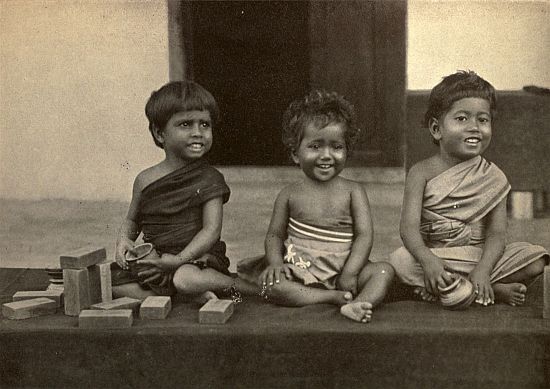
As a rule we avoid collisions at bedtime. The day should
end peacefully for babies; but the contest once begun had to
be carried through, for Sarala is not a baby to whom it is wise
to give in where a conflict of wills is concerned. Next morning
it was evident she remembered all about it. When the
new Sittie (now called Préma Sittie by the children)
But it was the other Sittie, Piria Sittie by name,
Sarala's private name is Pickles. Her twin in mischief is Puck, and she, too, is fond of paying visits to the bungalow. But she always comes as a surprise; she never announces herself. You are busy with your back to the door when that curious feeling, a sense of not being quite alone, comes over you, and you turn and see an elfish thing, very still and small and shy, but with eyes so comical that Puck is the only possible name by which she could be called. Seen unexpectedly, playing among the flowers in a fragment of green garment washed to the softness of a tulip leaf, you feel she only needs a pair of small wings and a wand to be entirely in character.
Puck has none of Pickles' faults, and a good many of her virtues. She is a most good-tempered little person, loving to be loved, but equally delighted that others should share the petting. She gives up to everybody, and smiles her way through life; such a comical little mouth it is, to match the comical eyes. All she ever asks with insistence is somewhere to play. Bereft of room to play, Puck might become disagreeable, though a disagreeable Puck is something unimaginable. Yesterday it was needful to keep her in the shade; and as a special policeman-nurse could not be told off to keep watch over her, she was tied by a long string to the nursery door. At first she was sorely distressed; but presently the comic side struck her, and she sat down and began to tie herself up more securely. If they do such things at all they should do them better, she seemed to think. And this is Puck all through. She will find the laugh hidden in things, if she can. Sometimes in her eagerness to make everybody as happy as she is herself she gets into serious trouble. She was hardly able to walk when she was discovered comforting a crying infant by taking a bottle of milk from an older babe (who, according to her thinking, had had enough) and giving it to the younger one who seemed to need it more. What the older baby said is not recorded.
Puck in trouble is a pitiful sight. She tries not to give in to feelings of depression. She screws her smiling lips tight, twists her face into a pucker, and shuts her eyes till you only see two slits marked by the curly eyelashes. But if her emotions are too much for her she gives herself up to them thoroughly. There is no whining or whimpering or sulking; she wails with a wail that rivals Pickles' howl. "What an awful child!" remarked a visitor one morning, in a very shocked tone, as she went the round of the nurseries and came upon Puck on the floor abandoned to grief. We wondered if our friend knew how much more awful most babies are, and we wished the usually charming Puck had chosen some other moment to disgrace herself and us. But no, there she sat, her two small fists crushed over her mouth—for we insist that when the babes feel obliged to cry, they shall smother the sound thereof as much as may be—and the visitor retired, feeling, doubtless, thankful the awful child was not hers. But Puck's griefs are of short duration. Ten minutes later she was climbing the chain from which the swing hangs, trying to fit her little toes into the links, and laughing, with the tears still wet on her cheeks, because the chain shook so that she could not climb it properly, though she tried it valiantly, hand over head, like a dancing bear on a pole. Puck's Guardian Angel, like Chellalu's, must be ever in attendance.
FOOTNOTES:
CHAPTER XV
The Howler
We heard of her first through our good Pakium, who, during a pilgrimage round the district, paid a visit to the family of which she was the youngest member. "She lay in her cradle asleep"—Pakium kindled over it—"like an innocent little flower, and she once opened her eyes—such eyes!—and smiled up in my face. Oh, like a flower is the babe!" And much speech followed, till we pictured a tender, flower-like baby, all sweetness and smiles.
Her story was such as to suggest fears, though on the surface things looked safe. Her grandfather, a fine old man, head of the house, was sheltering the baby and her mother and three other children; for the son-in-law had "gone to Colombo," which in this case meant he desired to be free from the responsibilities of wife and family. He had left no address, and had not written after his departure. So the old man had the five on his hands. A Temple woman belonging to a famous South-country Temple, knowing the circumstances, had made a flattering offer for the baby, then just three months old. The grandfather had refused; but the grandmother was religious, and she felt the pinch of the extra five, and secretly influenced her daughter, so that it was probable the Temple woman would win if she waited long enough. And Temple women know how to wait.
 THE DOHNAVUR COUNTRY IN FLOOD.
A year passed quietly. We had friends on the watch, and they kept us informed of what was going on. The idea of dedication was becoming gradually familiar to the grandfather, and he was ill and times were hard. But still we could do nothing, for to himself and his whole clan adoption by Christians was a far more unpleasant alternative than Temple-dedication. After all, the Temple people never break caste.
Once a message reached us: "Send at once, for the Temple women are about to get the baby"; and we sent, but in vain. A few weeks later a similar message reached us; and again the long journey was made, and again there was the disappointing return empty-handed. It seemed useless to try any more.
About that time a comrade in North Africa, Miss Lilias Trotter, sent us her new little booklet, "The Glory of the Impossible." As we read the first few paragraphs and roughly translated them for our Tamil fellow-workers, such a hope was created within us that we laid hold with fresh faith and a sort of quiet, confident joy. And yet, when we wrote to our friends who were watching, their answer was most discouraging. The only bright word in the letter was the word "Impossible."
"Far up in the Alpine hollows, year by year, God works one of His marvels. The snow-patches lie there, frozen into ice at their edges from the strife of sunny days and frosty nights; and through that ice-crust come, unscathed, flowers in full bloom.
"Back in the days of the bygone summer the little soldanella plant spread its leaves wide and flat on the ground to drink in the sun-rays; and it kept them stored in the root through the winter. Then spring came and stirred its pulses even below the snow-shroud. And as it sprouted, warmth was given out in such strange measure that it thawed a little dome of the snow above its head. Higher and higher it grew, and always above it rose the bell of air till the flower-bud formed safely within it; and at last the icy covering of the air-bell gave way and let the blossom through into the sunshine, the crystalline texture of its mauve petals sparkling like the snow itself, as if it bore the traces of the fight through which it had come.
"And the fragile things ring an echo in our hearts that none of the jewel-like flowers nestled in the warm turf on the slopes below could waken. We love to see the impossible done, and so does God."
These were the sentences which we read together. To the South Indian imagination Alpine snow is something quite inconceivable; but the picture on the cover and snow-scene photographs helped, and the Indian mind is ever quick to apprehend the spiritual, so the booklet did its work.
We have two seasons here, the wet and the dry. The dry is subdivided into hot, hotter, and hottest; but the wet stands alone. It is a time when the country round Dohnavur is swamp or lake according to the level of the ground; and we do not expect visitors—the heavy bullock-carts sink in the mud and make the way too difficult. If a letter had come just then asking us to send for the baby, we should certainly have tried to go; but no letter came, and it was then, when everything said, "Impossible," that suddenly all resistance gave way and the grandfather said: "Let her go to the Christians."
 PAKIUM AND NAVEENA.
We were sitting round the dinner-table one wet evening, thinking of nothing more exciting than the flying and creeping creatures which insisted upon drowning themselves in our soup, when the jingle of bullock-bells made us look at each other incredulously; and then, without waiting to wonder who it was, we all ran out and met Rukma running in from the wet darkness. "It's it! it's it!" she cried, and danced into the dining-room, decorum thrown to the pools in the compound. "Look at it!" and we saw a bundle in her arms. And it howled.
From that day on for nearly a week it continued consistently to howl. We called the little thing Naveena, for the name means "new"; and it was our nearest approach to Soldanella, which we should have called her if we did not keep to Indian names for our babies. New and fresh as that little flower of joy, so was our new little gift to us, a new token for good. But flowers and howlers—the words draw their little skirts aside and refuse to touch each other. From certain points of view, in this case as so often, the sublime and the ridiculous were much too close together. The very crows made remarks about the baby when she wakened the morning with her howls. Mercifully for the family's nerves she fell asleep at noon; but as soon as she woke she began again, and went on till both she and we were exhausted. There were no tears, the big dark eyes were only entirely defiant; and the baby stood straight up with her hands behind her back and her mouth open—that was all. But we knew it meant pure misery, though expressed so very aggressively; and we coaxed and petted when she would allow us, and won her confidence at last, and then she stopped.
It took months to tame the little thing. She had been allowed to do exactly as she liked; for she was her grandfather's pet, and no one might cross her will. We had to go very gently; but eventually she understood and became a dear little girl, reserved but very affectionate, and scampish to such a degree that Chellalu, discerning a congenial spirit, decided to adopt her as "her friend."
This fact was announced to us at the babies' Bible-class, when the word "friend," which was new to the babies, was being explained. It has four syllables in Tamil, and the babies love four-syllabled words. They were rolling this juicy morsel under their tongues with sounds of appreciation, when Chellalu pointed across to Naveena, and with an air of possession remarked, "She is my friend." The other babies nodded their heads, "Yes, Naveena is Chellalu's friend!" Naveena looked flattered and very pleased.
These friends in a kindergarten class are rather terrible. They are always separated—as the Tamil would say, if one sits north the other sits south—but even so there are means of communication. This morning, passing the door of the kindergarten room, I looked in and saw something not included in the time-table. We have a little yellow bellflower here which grows in great profusion; and some vandal taught the babies to blow it up like a little balloon, and then snap it on the forehead. The crack it makes is delightful. We do not like this game, and try to teach the babies to respect the pretty flowers; but there are so many sins in the world, that we do not make another by actually forbidding it; we trust to time and sense and good feeling to help us. So it comes to pass that the worst scamps indulge in this game without feeling too guilty; and now I saw Chellalu with a handful of the flowers, cracking them at intervals, to the distraction of the teacher and the delight of all the class. One other was cracking flowers too. It was Naveena, and there was a method in her cracks. When Rukma turned to Chellalu, Naveena cracked her flower. When she turned to Naveena, then Chellalu cracked hers. How they had eluded the search which precedes admission to the kindergarten nobody knew; but there they were, each with a goodly handful of bells. At a word from Rukma, however, they handed them over to her with an indulgent smile, and even offered to search the other babies in case they had secreted any; and as I left the room the lesson continued as before, but the friends' intention was evident: they had hoped to be turned out together.
CHAPTER XVI
The Neyoor Nursery
"The roads are rugged, the precipices steep; there may be feelings of dizziness on the heights, gusts of wind, peals of thunder, nights of awful gloom. Fear them not!
"There are also the joys of sunlight, flowers such as are not in the plain, the purest of air, restful nooks, and the stars smile thence like the eyes of God."—Père Didon (translated by Rev. Arthur G. Nash).
 ON THE ROAD TO NEYOOR.
Shortly before that time we had been brought into touch with the medical missionaries at Neyoor, in South Travancore. The senior missionary, Dr. Fells, was about to retire; but his successor, Dr. Bentall, cordially agreed to let us rent a little house in the village and fill it with babies, though he knew such a houseful might materially add to the fulness of his already overflowing day. He, and afterwards Dr. Davidson (now the only survivor at Neyoor of that kind trio of doctors), seemed to think nothing a trouble if only it helped a friend. So the little house was taken and the babies installed.
 ON THE OUTSKIRTS OF NAGERCOIL, WHERE WE STOPPED TO REST.
The first day, September 25, 1905, is a day to be remembered. I had gone on before to prepare the house, and for a day and a half waited in uncertainty as to what had happened to the little party which was to have followed close behind. I had left one baby ill. She was the first child sent to us from the Canarese country; and I thought of the friends who had sent her, newly interested and stirred to seek these little ones, and of what it would mean of discouragement to them if she were taken, and my heart held on for her.
At last the carts appeared in sight. It was the windy season, and six carts had been overturned on the road, so they had travelled slowly. Then a wheel came off one of their carts and an accident was narrowly averted. This had caused the delay. The baby about whom I had feared had recovered in time to be sent on. She was soon quite well, and has continued well from that day to this.
How familiar the road between Dohnavur and Neyoor became to us, as the months passed and frequent journeys were made with little new babies! Sometimes those journeys were very wearisome. There was great heat, or a dust-laden wind filled the bandy to suffocation and blew out the spirit-lamp when we stopped to prepare the babies' food. How glad we used to be when, in the early evening, the white gleam of the stretch of water outside Nagercoil appeared in sight! We used to stop and bathe the babies, and feed them under some convenient trees, and then go on to our friends with whom we were to spend the night, trusting that the soothing effect of the bathe and food would not pass off until after our arrival. Those friends, our comrades of the L.M.S., like the Medicals at Neyoor, seemed made of kindness. How often their welcome has rested us after the long day!
Next morning we tried to start early, so as to arrive at Neyoor before the sun shone in fever-threatening strength straight in through the open end of the cart. This plan, however, proved too difficult, so we found it better to travel slowly straight on from Dohnavur to Neyoor. In this way we missed the blazing sun; but we also missed the refreshment of our friends at Nagercoil, and arrived more or less tired out, after a journey which, because of slow progress and frequent stops, was equal in time to one from London to Marseilles. But the welcome at the nursery made up for everything.
How vividly the photograph recalls it! The house opened upon the main street of the village, and there was nearly always a watcher on the look-out for us. Sometimes it was Isaac, our good man-of-all-work, who never failed Ponnamal through the two years he was with us. Then we would hear a call, and Ponnamal (we used to call her the Princess, but dignity gives place to something more human at such moments) would come flying down the path with a face which made words superfluous. Then there was the scramble out of the bandy, and the handing down of babies and exclamations about them; and all the nurses seemed to be kissing us at once and making their amazed babies kiss us, and everything was for one happy moment bewilderingly delightful.
Then there was the run round the cradles in which smaller babies were sleeping, and an eager comparing of notes as to the improvement of each. And if there were no improvement, how well one remembers the smothered sense of disappointment—smothered in public at least, lest the nurses should be discouraged. Then came a cup of tea on the mat in the little front room, where four white hammock-cradles hung, one in each corner; while Ponnamal sat beside me with three babies on her knee and two or three more somewhere near her. The babies used to study me in their wise and serious fashion, and then make careful advances. And so we would make friends.
Ponnamal had always much to tell about the exhaustless kindness of the doctors and their wives and the lady superintendent of the hospital. And the chief Tamil medical Evangelist had been true to his name, which means Blessedness. Once, in much distress of mind, we sent a little babe to the nursery, hardly daring to hope for her. When she arrived, the doctors were both away on tour, and the medical Evangelist was in charge. He attended to her at once, and by God's grace upon his work was able to relieve the little child, who has prospered ever since.
But I must leave unrecorded many acts of helpfulness. In those early days of doubt and difficulty, almost forgotten by us now, we beckoned to our "partners which were in the other ship," and their Master and ours will not forget how they held out willing hands and helped us.
It was not always plain sailing, even at Neyoor. "You are fighting Satan at a point upon which he is very sensitive; he will not leave you long in peace," wrote an experienced friend. On Palm Sunday, 1907, our first little band of young girls, fruit of this special work, confessed Christ in baptism, and we stood by the shining reach of water, and tasted of a joy so pure and thrilling that nothing of earth may be likened to it. A fortnight later we were ordered to the hills, and then the trouble came.
The immediate cause was overcrowding. Why did we overcrowd?
Friends at home to whom the facts about Temple service were new, were stirred to earnest prayer. Out here fellow-missionaries helped us to save the children. God heard the prayer and blessed the work, and children began to come. Soon our one little room became too full. We had babies in the bungalow and on our verandah, babies everywhere. Then money came to build two more rooms, but they were soon too full. At Neyoor the pressure was worse, for we could only rent two small houses; and though we put up mat shelters, and the children lived as much as possible in the open air, it was difficult to manage. But how could we refuse the little children? The Temple women were ready to take them if we had refused. Their houses are never too full. There was no other nursery to which they could be sent. Little children who had passed the troublesome infant stage could sometimes find a home elsewhere; but only the Temple houses were open at all times to babies. Could we have written to the friend who had saved a little child: "Hand her back to the Temple. It is the will of our Father that this little one should perish"? Should we have done it? We dare not do it. We prayed that help would be sent to build new nurseries, and we went on and did our best; but it was difficult.
We had just reached the hills in early April, and were forbidden to return, when news reached us of a fatal epidemic of dysentery which had broken out in the Neyoor nursery. Unseasonable rains had fallen and driven the babies indoors; this increased the overcrowding. The doctors were away. Letters telling us about the disaster had been lost—how, we never knew—so that the second which reached us, taking it for granted we had the first, gave no details, only the names of the smitten babes—nineteen of them, and five dead. Then trouble followed trouble. "While he was yet speaking, there came also another." Some evil men who had sought to injure us before, caused us infinite anxiety. And for a time that cannot be counted in days or in weeks it was like living through a nightmare, when everything happens in painful confusion and the sense of oppression is complete.
 THE NEYOOR NURSERY.
Out of the maelstrom came a letter from Ponnamal. "We are being comforted," she wrote. "You will be longing to come to us, but oh, do not come! If you were here all your strength would be given to fighting this battle with death, and you would have no strength left for prayer. God wanted to have one of us free to pray; and so He has taken you up to the mountain, as He took Moses when the people were fighting down in the plain." This was the true inward meaning of it all, and I knew it. But Ponnamal is far from strong, and I feared for her; and to stay away with the babies ill—it was the very hardest thing I had ever been asked to do.
When the trouble passed there were ten in heaven. One, a little child of two, had been saved so wonderfully from Temple dedication that we had looked forward to a future of special blessing for her; and another was a very lovely babe, dear to the missionary who, after much toil and many disappointments, had been comforted by saving her. Each of the ten had cost someone much. But this is an earthly point of view. They had cost Him most who had taken them, and he is only an owner in name who has no right to do as he will with his own.
The other side, the purely human side, pressed heavily just then. The doctors had most kindly at once ordered a mission room, vacated at that season, to be lent to the nursery, and another little house was taken for the month. How Ponnamal kept all four houses going in an orderly fashion, how she kept her nurses together through that time of almost panic, and how she herself, frail and delicate as she is, kept up till all was over, we cannot understand from any point of view but the Divine. She only broke down once. It was when her dearest child, our merry, beautiful little Heart's Joy, who, having more strength than most, had battled longer and almost recovered, suddenly sank. The visible cause was that a special nutrient, which, being costly, we stocked in small quantities, ran short, and the fresh supply reached the nursery just too late. "If only it had come yesterday!" moaned Ponnamal, and we with her when we heard of the series of contretemps which had delayed its arrival. The torture of second causes is as the blackness of darkness, but the Lord gave deliverance from it; for just as she had to part with all that was left her of our little Heart's Joy, a letter came from Dr. Davidson which was God's own blessed comfort to a heart almost broken. She never refers to that letter without the quick tears starting. "I could let my little treasure go after I read that letter. It strengthened me."
While all this was going on in Neyoor, Chellalu, then just two years old, was very ill in Dohnavur. Mr. and Mrs. Walker were still there, and they nursed her night and day; but at last a letter came, evidently meant to prepare me for fresh sorrow. "Every little lamb belongs to the Good Shepherd, not to us," the letter said, and told of a temperature 106° and rising. The child, all spirit and frolic, had little reserve strength, and there was not much cause for hope. But we were spared this parting. Chellalu is with us still.
The sky was clearing again and we were beginning to breathe freely, when the worst that had ever touched us in all our years of work came suddenly upon us. How small things that affect the body appear when the point of attack wheels round to the soul! The death of all the babies seemed as nothing compared with the falling away of one soul. But God is the God of the waves and the billows, and they are still His when they come over us; and again and again we have proved that the overwhelming thing does not overwhelm. Once more by His interposition deliverance came. We were cast down, but not destroyed.
A time of calm succeeded this storm. Money came to build nurseries at Dohnavur, and buy more of the special nutrients we so much required. The Neyoor remnant picked up, and the nurses took heart again. I went out to them as soon as I could after our return from the hills, and found those who were left well and strong. "They shall see His face" had been the text in Daily Light, the evening the news reached me of the little procession heavenwards. I looked at the ten names written in the margin of my book; and, recalling the story of each, could be glad they have seen the face of the One who loves them best. Lower down on the page come the words, "We shall be satisfied." We thought of our babies satisfied so soon; and then we knelt together and said, "Even so, Father: for so it seemeth good in Thy sight."
Pretty pictures all in colours and bright sunshine tempt one to linger over that visit. I can see the white hammocks slung from the trees in the nursery compound, and happy baby-faces looking out of them. And another shows me one who had been like a sister to Ponnamal, lightening her load whenever she could; sitting with two dear babies in her arms, and another clinging round her neck. "She comes and helps us often in the mornings when we are very busy," said Ponnamal about the doctor's wife, as I noticed the babies' affection for her and her sweet, kind ways with them. "Sometimes when I am feeling down and home-sick, she comes in like this and plays with the babies, and cheers us all up." The Indian woman is very home-loving. Only devotion to the children could have kept the nurses and Ponnamal so long in exile for their sake; and there were times when even Ponnamal's brave heart sank. Then these love-touches helped.
When the time came for the nursery party to leave Neyoor and return to Dohnavur, after two and a half years in that hospitable mission, we were sorry to part. Days like the days we had passed through test the stuff of which souls are made, and they prove what we call friendship. After the fire has spent itself, the fine gold shines out purified, and there is something solemn in its light. We had grown close to our friends in Neyoor; but the cloud had moved, so far as we could read the sign, and it seemed right to return. The missionaries were away when the day came, but the Christians surrounded Ponnamal with tokens of goodwill. "The nursery has been like a little light in our midst," they said; and this word cheered her more than all other words. And so farewelled, they arrived home, all glad and warm with the glow that comes when hearts meet each other and each finds the other kind.
CHAPTER XVII
In the Compound and Near it
 THE OLD NURSERY. THE "ROOM OF JOY."
The speaker was a Christian friend from Palamcottah, an Indian lawyer who, for the first time, had come out to see us. He had found our approaches appalling, and had wondered at first why we lived in such an out-of-the-way place, three or four miles from the nearest road, and twenty-four from civilisation. When he saw the children he understood. Later, he helped us in an attempt to save two little ones in danger, and insisted not only upon paying his own and our worker's expenses, but in sending us a gift for the nurseries. With the gift came a letter full of loving, Indian sympathy; and again he added as before: "The Lord hid you in that quiet place for the little children's sake." Sometimes when the inconveniences of jungle life press upon us, we remember our friend's words: "This work could never have been done by the road-side, so He hid you."
We have children with us who would not have been safe for a day had we lived near a large town or near a railway. The stretch of open country between us and Palamcottah (the Church Missionary Society centre of the Tinnevelly district), to cover which, by bullock-cart, takes as long as to travel from London to Brussels, is not considered very safe for solitary Indian travellers, as the robber clan frequent it, and this is an added protection for the children. Several times, to our knowledge, unwelcome visitors have been deterred from making a raid upon us, by the rumour of the robbers on the road. We are also most mercifully quite out of the beat of the ordinary exploiter of missions; few except the really keen care for such a journey; so that we get on with our work uninterrupted by anything but the occasional arrival of welcome friends and comrades. These, when they visit us for the first time, are usually much astonished to find something almost civilised out in the wilds, and they walk round with an air of surprise, and quite inspiring appreciation, being kindly pleased with little, because they had looked for less.
 THE COURTYARD.
The compound in which the nurseries are built is a field, bounded on three sides by fields, and on the fourth by the bungalow compound. The Western Ghauts with their foothills make it a beautiful place.
The buildings are not beautiful. With us, as elsewhere, doubtless, even the break of a gable in the straight, barn-like roof makes a difference in the estimate, and we have never had a margin for luxuries. But the walls are coloured a soft terra-cotta, the roofs are a dull red; while the porches (hidden by the palm trunks in the photograph) are a mass of greenery and bloom; and the garden at the moment of writing is rejoicing in over a hundred lilies, brilliant yellow and flame colour, each head with its many flowers rising separate and radiant in the sunshine. Then we have oleanders, crimson and pink and white, and little young hibiscus trees, crimson and rose and cream. The arches in the new nursery garden are covered with the lilac of morning-glory; and the Prayer-room in the middle of the garden is a mass of violet passion-flower, the pretty pink antigone, and starry jessamine. The very hedges at this season are out in yellow flower, and a trellis round the nursery kitchen is a delight of colour; so though our buildings are simple, we think the lines have fallen unto us in pleasant places.
The first picture shows the old nursery, used now for the kindergarten. It opens off the courtyard shown in the second photo. This courtyard serves as an open-air room, a bright little place which is filled with merrier children than the sober photograph shows. Tamils old and young move when they laugh or even smile; in fact they wriggle. Being still, with them, meant being seriously subdued; and so, where time-exposures were required, we had to choose between solemn photos, or no photos at all.
Opening off the courtyard on the opposite side to the kindergarten is a room used as a store-room and Bible-class room combined. It was so very uncomfortable that last Christmas, as a surprise for the children, we divided the room into two halves with a curtain between. Their half is made pretty with pictures and texts, painted in blue on pale brown wood. The children call this part of the room the Tabernacle. The part beyond the curtain is the court of the Gentiles.
The Coming-Day Feasts are a feature of Dohnavur life. Now that there are so many feasts to celebrate, we find it more convenient to combine; and the photograph overleaf shows as much as it can of one such happy feast. The children who are being fêted are distinguished from the others by having flowers in their hair. No Indian feast is complete without flowers. Jessamine is the favourite, but the prettiest wreaths are made of pink oleander; and sometimes a girl will surprise us with a new and lovely combination, as of brown flowering grasses and yellow Tecoma bells.
 A COMING-DAY FEAST.
Opposite the kindergarten room is the first of the two new nurseries—the lively Parrot-house. This nursery, really the Taraha (Star, called after its English giver, whose name means "star") is the abode of the middle-aged babies, aged between two years and four. Most of these attend the kindergarten, and are very proud of the fact.
The Prémalia nursery (Abode of Love), given by two friends in memory of a mother translated, lies beyond the Taraha. Here the tiny infants live, and we call it the Menagerie. This nursery, like the other, looks out on the glorious mountains. If beautiful things can make babies good, ours should be very good.
On the eastern side of the field we have lately built two small sick-rooms, used oftener as overflow nurseries. These little rooms have names meaning "peace" and "tranquillity"; and those of us who have lived in them with our babies, sick or well, find the names appropriate. In the foreground there is a garden, in the background the mountain; and to give purpose to it all, the foreground is full of life. A new nursery now being built is a welcome gift from Australia; and a new field with a noble tree, in whose shade a hundred children could play, is the gift of a friend who stayed with us for one bright week last year.
All this is a later development, unthought of when our artist friend was with us. We have often wished for him since the nurseries filled. When he was with us our choice of subject was very limited: now, wherever we look we see pictures, which to be properly caught ask for colour photography.
The story of these buildings is the story of the Ravens, so old and yet so new. When first the work began, we had only one mud-floored room for nursery, kitchen, bedroom, and everything else that was needed. We hardly knew ourselves whereunto things would grow, and feared to run before the Lord by even a prayer for buildings. And yet we could not go on as we were. The birds were soon too many for the nest, and we needed more nests. No one knew of our need; for visitors at that time were few at Dohnavur, and we told no one. But money began to come. We ventured on a single room without a verandah or even foundations—built of sun-dried bricks as inexpensively as possible. But it was a palace to us. While we were building it, more little children came. We felt we should need more room, but had not more money; so we told the builders to wait for a day while we gave ourselves to prayer about the matter. Was the work going to grow much more? We were fearful of making mistakes. Were we right to incur fresh responsibility?—for buildings need to be kept in condition, and the cheaper they are the more care they need. No one at home was responsible for us. No one had authorised this new work. It would not be fair to saddle those on whom the burden might eventually fall with responsibilities for which they were not responsible. And yet surely the work of saving these little children had been given to us to do? Someone was responsible. Surely, unless we were utterly wrong and had mistaken the Shepherd's Voice, surely He was responsible! He could not mean us to search for the lambs for whom only the wolves had been searching, and then leave them out in the open, found but unfolded, or packed so close in the little fold that they could not grow as little lambs should?
We rolled the burden off that day as to the ultimate responsibility, and we asked definitely for all that was needed to build another room.
Three days later a registered letter came from a bank in Madras. It contained an anonymous gift of one hundred rupees, and was marked, "For a new nursery." The date showed that it had been posted in Madras on the day of our waiting upon God for guidance as to His wishes. A few days later, the same amount, with the same direction as to its use, was sent to us from the same bank. The giver, as we knew long afterwards, was a fellow-missionary in Tinnevelly, whose order to send these sums to us was given before even we ourselves had fully understood the meaning of the leading. The second room was built on to the first, and the children called it the Room of Joy.
 THE RED LAKE.
Water Palms, with Mountains in the background.
There are no secrets in India. The Hindu masons were amazed at what they at once recognised as the hand of the Lord upon the work, and they spread the story everywhere. Later, when they built the nursery where poor little Mala stood and mourned, they understood why they had to stop before the verandah was built. Only enough was in hand to build the bare room; but to their eyes, as to ours, a verandah was much needed, and they were content to wait till what was required for one came. In this land of blazing sunshine and drenching monsoon a house without a verandah is hardly habitable, and a small square room without one has a Manx-cat appearance.
The story of the rooms has been repeated in the story of the work ever since. "Do not thank us. It is only a belated tenth," wrote a fellow-missionary not long ago, as she sent a gift for the nurseries. Belated tenths have reached us sometimes when they have been like visible ravens flying straight from the blue above. All the long journeys in search of the children, all the expenses connected with their salvation, all that has been required to provide nurses and food (including the special nourishment without which the more delicate could not live at all), all that is now being needed for their education—all has come and is coming as the ravens came to Elijah. The work has been a revelation of how many hearts are sensitive and obedient to the touch of the Spirit; for sometimes help has reached us in such a way and in such form that we could not but stand and worship, awestruck by the token of the nearness of our God. There is many a spot marked in garden or in field or in the busy nursery or our own quiet room, where, with the open letter in our hand—the letter of relief from a pressure unknown even to the nearest fellow-worker—we have knelt in spirit with Jacob and said: "Surely the Lord is in this place!" and almost added, so dense are we in unilluminated moments, "and I knew it not."
Framed between red roofs and foliage, there are far blue glimpses of mountains shown in this lakeside photograph. We do not see the water from the compound. It lies on the other side of the boundary fields and hedges; but we see the mountains with perfect distinctness of outline, scarped with bare crags, which in the early morning are sometimes pink, and in the evening, purple. But the time to see the mountains in their glory is when the south-west monsoon is flinging its masses of cloud across to us. Then the mountains, waking from the lazy sleep of the long, hot months, catch the clouds on their pointed fangs, toss them back and harry them, wrap themselves up in robes of them, and go to sleep again.
The road that skirts the Red Lake leads through two ancient Hindu towns, from both of which we have children saved, in each case as by a miracle. In the first of these old towns there is a Temple surrounded by a mighty wall.
There are two large gates and one small side door in the wall; and, passing in through the small side door, one sees another wall almost as strong as the first, and realises something of the power that built it. The Temple is in the centre of the large enclosure. It is a single tower opening off the inner court. In the outer court a pillared hall is used as stable for the Temple elephant, and two camels lounge in the roughly kept garden in front. This Temple, with its double walls, its massive, splendidly-carved doors and expensive animal life, is somewhat of a surprise to the visitor, who hardly expects to see so much in a little old country town on the borders of the wilds. But Hinduism has not lost hold of this old remote India yet. There are some who think that the country town is the place to see it in strength.
 AT THE DOOR OF THE TEMPLE.
It was early in August, three years ago, that we heard of a baby girl in that town, devoted from birth to the god. We set wheels in motion, and waited. A month passed and nothing was done. We could not go ourselves and attempt to persuade the mother to change the vow she had made, as any movement on our part would only have riveted the links that fettered the child to the god. We had to be quiet and wait. At last, one evening in September, a Hindu arrived in the town with whom our friends who were on the watch had intimate connection. He, too, knew about the child; and he knew a way unknown to our friends by which the mother might be influenced, and he consented to try. His arrival just at that juncture appeared to us, who were waiting in daily expectation of an answer of deliverance, as the evident beginning of that answer; thus our faith was quickened and we waited in keen hope. Two days later, after dark, there was a rush from the nursery to the bungalow. "The baby has come!" Another moment, and we were in the nursery. A woman—one of our friends—was standing with what looked like a parcel wrapped in a cloth hidden under her arm. Even then, though all was safe, she was trembling; and outside, two men, her relations, stood on guard. She opened the white cloth, and inside was the baby.
The men assured us that all was right. The mother had been convinced of the wrongness of dedicating the little babe, and would give us no trouble. But a day or two later, she came and demanded it back. She could not stand the derision of her friends, who told her she had sinned far more in giving her child to those who would break its caste than she ever could have done had she given it to the Temple. We pacified her with difficulty, and were thankful when the little thing was safe in the Neyoor nursery. For in those days, before we learned how best to protect our children, we were often glad to have some place even more out of reach than Dohnavur.
The second of these old towns is famous for its rock, and its Temple built into the rock. Looking down from above one can see inside the courtyard as into an open well. Connected with this Temple, some years ago, there was a beautiful young Temple woman, who had been given as a child—as all Temple women must be—to the service of the gods. She had no choice as regarded herself—probably the idea of choice never entered her mind—but for her babe she determined to choose; and yet she knew of no way of deliverance.
But there was a way of deliverance, and if it had only been for this one child's sake, and for the sake of the relief it must have been to that fear-haunted mother, we are glad with a gladness too deep for words that the nursery was here. For the mother heard of it. There were lions in the path. She quietly avoided them, and through others who were willing to help she sent her child to us. She herself would not come. She waited a mile or so from the bungalow till the matter was concluded, then returned to her home alone.
A week later she appeared suddenly at the bungalow. It was only to make sure the little one was safe and well, and in order to sign a paper saying she was wholly given to us. This done she disappeared again, refusing speech with anyone, and for months we heard nothing of her. Then cholera swept our countryside, and we heard she had taken it and died. We leave her to God her Creator, who alone knows all the story of her life: we only know enough to make us very silent. And through the quiet we hear as it were a voice that chants a fragment from an old hymn: "We believe that THOU shalt come to be our Judge."
CHAPTER XVIII
From the Temple of the Rock
It was on a blazing day in June, when the very air, tired of being hot, leaned heavily upon us, and we felt unequal to contest, that a cough outside my open door announced a visitor. "Come in!" Another cough, and I looked out and saw a shuffling form disappear round the corner of the house. I called again, and the figure turned. It was a man who had helped us before, but about whose bonâ-fides we had doubts; so we asked without much hopefulness what he had to tell us. He said he had reason to believe a certain Temple woman known to him had a child she meant to dedicate to the god of a Temple a day's journey distant. Then he paused. "Do you know where she is now?" "She is on her way to the Temple." "It would be well if she came here instead." "If that is the Animal's desire it may be possible to bring her." "Has she gone far? Could you overtake her?" "She is waiting outside your gate."
At such a moment it is wise to show no surprise and no anxiety. All the burning eagerness must be covered up with coolness. But in the hour that intervened before the woman "at the gate" could be persuaded to come further, we quieted ourselves in the Lord our God and held on for the little child.
At last the shuffling step and the sound of voices told us they had come—two women, the man, and a child. The child was a baby of something under two, a sad-looking little thing, with great, dark, pathetic eyes looking out from under limp brown curls. She was very pale and fragile; and when the woman who carried her set her down upon the floor and propped her against the wall, she leaned against it listlessly, with her little chin in her tiny hand, in a sorrowful, grown-up fashion. I longed to take her and nestle her comfortably; but, of course, took no notice of her. Any sign of pity or sympathy would have been misunderstood by the women. All through the interminable talk upon which her fate depended, that child sat wearily patient, making no demands upon anyone; only the little head drooped, and the mouth grew pitiful in its complete despondency.
The ways of the East are devious. The fact that the child had been brought to us did not indicate a decision to give her to us instead of to the Temple. The woman and the man who had persuaded them to come had much to say to one another, and there was much we had to explain. A child given to Temple service is not in all cases entirely cut off from her people. If the Temple woman's hold on her is sure, her relations are sometimes allowed to visit her; so far as friendly intercourse goes she is not lost to them. But with us things are different. For the child's own sake we have to refuse all intercourse whatever. Once given to us, she is lost to them as if they had never had her. We adopt the little one altogether or not at all.
It is a delicate thing to explain all this so clearly that there can be no misunderstanding about it, without so infuriating the relations that they will have nothing more to do with us. Naturally their view-point is entirely different from ours, and they cannot appreciate our reasons. At such a time we lean upon the Invisible, and count upon that supernatural help which alone is sufficient for us; we count also upon the prayers of those who know what it is to pray through all opposing forces, till the battle is won by faith which is the victory.
It was strange to watch the women as the talk went on. The woman within them had died, there was nothing of it left to which we could appeal; everything about them was perverted, unnatural. I looked at the insensitive faces and then at the sensitive face of the child, and entered deeper than ever into the mercifulness of God's denunciations of sin.
Once towards the close of what had been a time of some tension, the leader of the two women suddenly sprang up, snatched at the tired baby, and flung out of the room with her. She had been gradually hardening; and I had felt rather than seen the shutting down of the prison-house gates upon that little soul, and had, as a last resource, appealed to the sense, not wholly atrophied, the sense that recognises the supernatural. God is, I told them briefly; God takes cognisance of what we are and do: God will repay: some time, somewhere, God will punish sin. The arrow struck through to the mark. Startled, indignant, overwhelmed by the sweep of an awful conviction, with a passionate cry she rushed away; and we lived through one breathless moment, but the next saw the child dropped into our arms, safe at last.
Facts about any matter of importance are usually other than at first stated; but we have reason to believe that in this instance our shuffling friend spoke the truth. The women were really on their way to the Temple when he waylaid them. The wonder was that they allowed themselves to be persuaded by him to come to us. But if nothing happened except what we might naturally expect would happen in this work, we might as well give it up at once. If we did not expect our Jericho walls to fall down flat, it would be foolish indeed to continue marching round them.
It was a relief when the women left the compound, after signing a paper committing the child to us. There is defilement in the mere thought of evil, but such close contact with it is a thing by itself. The sense of contamination lasted for days; and yet would that we could go through it every day if the result might be the same! For the child woke up to a new life, and became what a child should be. At first it was very pitiful. She would sit hour after hour as she had sat through that first hour, with her chin in hand, her eyes cast down, and the little mouth pathetic. We found that, in accordance with a custom prevailing in the coterie of Temple women belonging to the Temple of the Rock, she had been lent by her mother to another woman when she was an infant, the other lending her baby in exchange. This exchange had worked sadly; for the little one had asked for something which had not been given her, and her two years had left her starved of love and experienced in loneliness. But when she came to us everything changed; for love and happiness took her hands and led her back to baby ways, and taught her how to laugh and play: and now there is nothing left to remind us of those two first years but a certain droop of the little mouth when she feels for the moment desolate, or wants some extra petting.
CHAPTER XIX
Yosépu
 THE WATER CARRIERS.
This photograph shows the Indian equivalent of pumps and water-pipes. We have neither; so all the water required for a family of about a hundred has to be drawn from the well and carried to the kitchens and nurseries. The elder girls, who would otherwise help with the work, according to South Indian custom, are already fully employed with the babies. So at present the men do it all. They also buy the grain and other food-stuffs, look after the cows and vegetable garden—a necessity for those who dwell far from markets—and in all other possible masculine ways are of service to the family.
Chief of these men is Yosépu, whose seamed and wrinkled and most expressive face I wish we had photographed, instead of this not very interesting string of solemnities.
is not like a man, he is more like a dear dog. He has the ways of our dog-friends, their patience and fidelity, their gratefulness for pats.
He came to us in a wrecked condition, thin and weak and rather queer. He had been beaten by his Hindu brother for becoming a Christian, and it had been too much for him. The first time we saw him, a few minutes after his arrival, he was standing leaning against a post with folded hands and upturned eyes and a general expression of resignation which went to our hearts. We found afterwards he was not feeling resigned so much as hungry, and he was better after food.
For a week he slept, ate, and meditated. Sometimes he would hover round us, if such a verb is admissible for his seriousness of gait. He would wait till we noticed him, then sigh and extend his hand. He wanted us to feel his pulse—both pulses. This ceremony always refreshed him, and he would return to his corner of the verandah and meditate till his next meal came.
Sometimes, however, more attention was required. He would linger after his pulses were felt, and we knew he was not satisfied. One day a happy thought struck us. The Tamil loves scent. The very babies sniff our hands if we happen to be using scented soap, and tell each other rapturously what they think about that "chope." Scent is the one thing they cannot resist. A tin of sweets on our table may be untouched for days, few babies being wicked enough to venture upon it in our absence; but a bottle of scent is irresistible, and scented "chope" on our washing-stands has a way of growing thin. The baby will emerge from our bathrooms rubbing suspiciously clean hands, and in her innocence will invite us to smell them. Then we know why our "chope" disappears. So now that Yosépu needed something to lift him over the trials of life, we remembered the gift of a good Scottish friend, and tried the effect of eau-de-Cologne. It worked most wonderfully. Yosépu held out his two hands joined close lest a single drop should spill, and then he stood and sniffed. It would have made a perfect advertisement—the big brown man with his hands folded over his nose, and an expression of absolute bliss upon every visible feature. Now, when Yosépu is down-hearted, we always try eau-de-Cologne.
His first move towards being of use was when some of our children had small-pox and were put up in a half-finished room which was being built. "It has walls and it has a roof, therefore it is suitable," was Yosépu's opinion; and he offered to nurse the children. One evening we heard a terrible noise; it was like three cracked violins gone mad, all playing different tunes at the same time. It was only Yosépu singing hymns to the children. "For spiritual instruction is a thing to be desired, and there is nothing so edifying as music."
After this he announced his intention of becoming a water-carrier. "Water is a pure thing and a necessity. The young children demand much water if their bodies are to be"—here followed Scriptural quotations meant in deepest reverence. "I will be responsible for the baths of all the babes." And from that time Yosépu has been responsible. Solemnly from dawn to dusk, with breathing spaces for meals and meditation, he stalks across from nurseries to well and from well to nurseries. He is a man of few smiles; but he is the cause of many, and we all feel grateful to Yosépu for his goodness to us. Often on melancholy days he comes and comforts us.
It was so one anxious day before we went to the hills, when we were trying to plan for the safety of our family. We can only take a limited number of converts with us, and no babies; the difficulty is then which to take, which to hide, and which to leave in the nurseries. We were in the midst of this perplexity when Yosépu arrived. He stood in silence, and then sighed, as his cheerful custom is. We made the usual inquiries as to his health, physical and spiritual. Both soul and body (his invariable order, never body and soul) were well, he said; his pulse did not need to be felt to-day: no, there was something weightier upon his mind. There are times when it is like extracting a tooth to get a straight answer from Yosépu, for he resents directness in speech; he thinks it barbarous. At last it came. "Aiyo! Aiyo!" (Alas! Alas!) "My sun has set; but who am I, that I should complain or assault the decrees of Providence? But Amma! remember the word of truth: 'Then shall ye bring down my grey hairs with sorrow to the grave.'" And he slowly unwound his wisp of a turban, held it in his folded hands, and shook down his lanky, jet-black locks with a pathos that was almost sublime.
 THE BELOVED TINGALU.
It took time to pierce to the meaning of it: the children were being scattered—the reason must be that we felt the bath-water carrying too much for his powers through the hot weeks. It was not so! He was strong to draw and to bear. The babies should never be deprived of their baths! But to-day as he went to the well he had heard what broke his heart; and he laid his hand upon the injured organ, and sighed with a sigh that assured us his lungs at least were sound. "Tingalu is to go away! The apple of my eye! that golden child who smiles upon me, and says, 'Oh, elder brother, good morning!' You are not going to leave her with me! Therefore spake I the word of truth concerning my grey hairs." Then quoting the text again, he turned and walked away.
Once the beloved Tingalu was slightly indisposed. She has not often the privilege of being ill, and so, when the opportunity offers, she does the invalid thoroughly; it would be a pity, Tingalu thinks, to be anything but correct. But Yosépu was much concerned. He appeared in the early morning with his usual cough and sigh. "Amma! Tingalu is ill!" "She will soon be better, Yosépu; she is having medicine." "What sort of medicine, Amma?" and Yosépu mentioned the kind he thought suitable. "That is exactly what she has had; you will see her playing about to-morrow." "But no smile is on her face to-day; I fear for the babe." (Tingalu never smiles when ill. Invalids should not smile.) Yosépu suggested another medicine to supplement the first, and departed.
Next morning he came again, anxious and cast down in countenance. I had to keep him waiting; and when I came out, he was standing beside my verandah steps, head on one side, eyes shut, hands folded as if in prayer. "Well, Yosépu, what is it?" "Amma! the light of your eyes revives me!" "Well, tell me the trouble." "All yesterday I saw you not; it was a starless night to me!" This is merely the preface. "But, Yosépu, what is wrong?" "Tingalu, that golden child with a voice like a bird, she lies on her mat. I am concerned about the babe," (Tingalu, turned four, is as hardy as a gipsy), "I fear for her delicate interior. Those ignorant children" (the convert nurses would have been pleased if they had heard him) "know nothing at all. It may be they will feed her with curry and rice this morning. That would be dangerous. Amma! Let her have bread and milk, and I will pay for it!"
Yosépu came a few days ago with a request for a doll. "Who for?" "For myself." "But are you going to play with it?" Yosépu acknowledged he was, and he wished it to have genuine hair, a pink silk frock, and eyes that would open and shut. We had not anything so elaborate to give him, and he had to be contented with a black china head and painted eyes; but he was pleased, and took it away carefully rolled up in his turban, which serves conveniently for head-gear, towel, scarf, and duster. When and where he plays with the doll no one knows, but he assures us he does; and we have mentally reserved the first pink silk, with eyes that will open and shut, that a benevolent public sends to us, for Yosépu. . . . The words were hardly written when a shadow fell across the paper, and the unconscious subject of this chapter remarked as I looked up: "1 Corinthians vii. 31." "Do you want anything, Yosépu?" "Amma! 1 Corinthians vii. 31." "Well, Yosépu?" "As it is written in that chapter, and that verse: 'The fashion of this world passeth away.' Amma, if within the next two months a visitor comes to Dohnavur carrying a picture-catching box, I desire that you arrange for the catching of my picture. This, Amma, is my desire."
The Western mind is very dense; and for a moment I could not see the connection between the text and the photograph. Yosépu is never impatient. He squatted down beside me, dropped his turban round his neck, held his left foot with his left hand, and emphasised his explanation with his right.
"Amma, the wise know that life is uncertain. I am a frail mortal. You, who are as mother and as father to this unworthy worm, would feel an emptiness within you if I were to depart." "But, Yosépu, I hope you are not going to depart." This was exactly what Yosépu had anticipated. He smiled, then he sighed. "Amma! did I not say it before? 1 Corinthians vii. 31: 'The fashion of this world passeth away.' Therefore I said, Let me have my picture caught, so that when I depart you may hang it on your wall and still remember me."
Yosépu's latest freak has been to take a holiday. "My internal arrangements are disturbed; composure of mind will only be obtained by a month's respite from secularities." Yosépu had once announced his intention of offering himself to the National Missionary Society, and we thought he now referred to becoming an ascetic for a month and wandering round the country, begging-bowl in hand; for he solemnly declared as he stroked his bony frame: "The Lord will provide." But his intention was a real holiday. He would go and see the brother who had beaten him, and forgive him. We suggested the brother might beat him again. He smiled at our want of faith, and went for his holiday. A month was the time agreed upon, but within three days he was back. He could not stay away, he explained, with a shame-faced air of affection. "Within me pulled the strings of love; pulled, yea, pulled till I returned." Faithful, quaint, and wholly original Yosépu! He calls himself our servant, but we think of him as our friend.
CHAPTER XX
The Menagerie
How frivolous a baby man would be—
 TWO VIEWS OF LIFE.
These babies are of various dispositions and colour—nut-brown, biscuit, and buff; and there are two who, taken together, suggest chocolate-cream. Chocolate is a dear child, very good-tempered and easy to manage. Cream is a scamp. We see in her another Chellalu, and watch with mingled feelings her vigorous development.
Chocolate has another name. It is Beetle. This does not sound appreciative, but Beetle is beloved. The name was discovered by her affectionate Piria Sittie, who came upon her one morning lying on her back in the swinging cot, kicking her four limbs in the air in the agitated manner of that insect unexpectedly upset. But no beetle ever smiled as ours does.
Cream, whose real name is Nundinie, oftener called Dimples, because she dimples so when she laughs, is a baby of character. She early discovered her way to the bungalow, and scorning assistance or superintendence found her way over as soon as she could walk. Afternoon tea is never a sombre meal, for the middle-aged babies attend it in relays of four or five; and Dimples and her special chum, Lulla, like to arrive in good time for the full enjoyment of the function. Dimples sits down properly in a high chair close beside her Attai, who, according to her view of matters, was created to help her to sugar. Lulla, so as to be even nearer that exhaustless delight, insists upon her Attai's knee; and tapping her face with her very small fingers, immediately points to the sugar bowl.