
References
6 The zero acceleration discontinuity and absolute simultaneity
Franco Selleri
Summary
In the transformation of time between inertial reference frames the coefficient of the space variable, e1, describes the possible choices of clock synchronization with its different values. In the first part of the paper we review the proof of a zero acceleration discontinuity for rotating platforms: the velocity of light relative to inertial reference frames agrees with the zero acceleration limit of the velocity of light relative to rotating platforms only by assuming e1 = 0, that is by replacing the Lorentz by the ‘‘inertial’’ transformations based on absolute simultaneity. The second part of the paper contains the proof that the same discontinuity exists also for linearly accelerated reference frames. Absolute simultaneity again provides the cure.
Introduction
According to Poincaré (1898: 1); Reichenbach (1958); Mansouri and Sexl (1977: 497, 515, 809); and Jammer (1979: 202–36) the clock synchronization in inertial systems is conventional and the choice based on the invariance of the one way velocity of light made in the theory of special relativity (TSR) is only based on simplicity. Einstein explicitly agreed in considering this part of his TSR conventional (Einstein 1952: 37–65). In 1995 (Selleri 1995: 25; 1996a: 641) I introduced a suitable parameter e1 (the coefficient of the space variable in the transformation of time) to describe, with its different values, the various clock synchronization procedures in inertial reference frames. The TSR is obtained for a particular e1 ≠ 0.
The theory was applied to the rotating platform and to the Sagnac effect (Sagnac 1913: 708, 1410; 1914: 177) with the result that only the choice e1 = 0 could give a satisfactory explanation (Selleri 2004b: 57–77). This means that the space variable disappears from the transformation of time so that the ‘‘equivalent’’ transformations (reviewed below, in the second section) become the ‘‘inertial’’ transformations based on absolute simultaneity. In fact, if time transforms like this: t = t0R (R is the usual velocity dependent square root factor) two events in different points happening at the same t0 obviously take place also at the same t.
A consequence of this research was the discovery of a relativistic discontinuity between inertial systems and slowly accelerated systems (Selleri 1997: 73). The discontinuity goes away only if e1 = 0. Its existence in the TSR is the root of the difficulties met by Langevin (1921: 831; 1937: 304); Post (1967: 475); Anandan (1981: 338); and Landau and Lifschitz (1996: 82–87) in explaining the physics on a rotating platform. These difficulties gave rise to confusion, to the point that Hasselbach and Nicklaus, describing their own experiment (1993: 143), listed about twenty different explanations of the Sagnac effect and commented: ‘‘This great variety (if not disparity) in the derivation of the Sagnac phase shift constitutes one of the several controversies . . . that have been surrounding the Sagnac effect since the earliest days of studying interferences in rotating frames of reference.’’
There are several other good reasons to adopt e1 = 0, the so called ‘‘absolute synchronization’’ of Mansouri and Sexl:
The outcome of all this is that a satisfactory theory of the physics of space and time has to be based on absolute simultaneity. The present paper is a review of the reasons leading to e1 = 0, limited to the zero acceleration discontinuity. The second part of the paper extends the discontinuity argument to linear accelerations.
The inertial transformations imply absolute simultaneity: two events taking place in different points of an inertial frame S0 at the same time are judged to be simultaneous also in any other inertial frame S, this property being consequence of the absence of space variables in the transformation of time. Of course the existence of absolute simultaneity does not imply that time is absolute: on the contrary, the velocity dependent factor in the transformation of time gives rise to clock retardation phenomena similar to those of the TSR. In another sense if e1 = 0 clock retardation is, however, also absolute: a clock at rest in S is seen from S0 to run slower, but a clock at rest in S0 is seen from S to run faster. Both observers agree that motion relative to S0 slows down the pace of clocks, and the phenomenon loses the relativistic flavor it has in the TSR. The difference with respect to the TSR is, however, more apparent than real: a meaningful comparison of rates implies that a clock at rest in S0 must be compared with clocks at rest in different points of S, and the result depends on the synchronization adopted for the latter clocks.
Absolute length contraction is also obtained from the inertial transformations. A rod at rest on the x-axis of S is seen in S0 to have end points x´2 and x´1 at a common time t0 such that it appears to be contracted. The reasoning can be inverted by considering the rod at rest in S and observed from S0, and using the inverse inertial transformations. One gets then an elongated rod with the conclusion (on which both observers agree) that motion relative to S0 leads to contraction. This is obviously an absolute effect, but again the discrepancy with the TSR is conventional: the length of a moving rod can only be obtained by marking the simultaneous positions of its end points, and therefore depends on the definition of simultaneity of distant events.
The paper is organized as follows. The second section entitled ‘‘The equivalent transformations’’ contains a short review of the transformations (‘‘equivalent’’) containing the parameter e1. The third section entitled ‘‘Rotating disks’’ gives an elementary derivation of the ratio of light velocities relative to a rotating disk for propagations concordant and discordant with the disk rotation. The ratio turns out to be different from unity and dependent only on the rotational velocity (not on acceleration). The zero acceleration limit leads to inertial systems (see section entitled ‘‘Absolute simultaneity in inertial systems’’), where a ratio of velocities of light in opposite directions should thus be different from unity, in contradiction with the assumptions of the TSR. Only a theory accepting absolute simultaneity (e1 = 0) can avoid the discontinuity. The zero acceleration discontinuity argument is extended in the following section entitled ‘‘General proof of absolute simultaneity’’ to a more general set of transformations. In this way absolute simultaneity is proven to be a necessary consequence of the continuity of physical quantities in passing from slowly rotating disks to inertial systems, quite independently of the assumptions from which the equivalent transformations are deduced. In the section entitled ‘‘The linear acceleration discontinuity’’ it is shown that a relativistic discontinuity between slowly accelerated and inertial systems exists also in the case of linear motions and that absolute simultaneity (e1 = 0) is again the only way to save the continuity of the velocity of light. The section entitled ‘‘Export of relativistic simultaneity fails’’ deals with the concrete production of a new inertial system, made with a network of clocks initially at rest in a given system and accelerating equally until at rest in the new one. As the physical actions on the clocks are the same, one could naively expect to be able to ‘‘export’’ to the new system whatever synchronization existed in the old one. It is not so: relativistic simultaneity cannot be exported while it is easy to do so for absolute simultaneity (explained in section entitled ‘‘Export of absolute simultaneity succeeds’’). The possibility to resynchronize clocks in the new system does not help as the time marked by irreversible clocks cannot be modified (see section entitled ‘‘Irreversible processes cannot be synchronized’’). The final section entitled ‘‘Resynchronization of clocks’’ reviews recent results about the necessity of a weaker formulation of the relativity principle.
The equivalent transformations
In this section previous results are reviewed which provide a generalization of the Lorentz transformations. Given the inertial frames S0 and S one can set up Cartesian coordinates and make the following assumptions:
The isotropic reference system S0 turns out to have a privileged status in all theories satisfying the assumptions (i)–(vi), with the exception of the TSR.
These conditions were shown [6] to imply the following transformations of the space and time variables from S0 to S:
(2:1)
where
(2:2)
The transformations (2.1) contain only a free parameter, e1, the coefficient of x in the transformation of time, which remains undetermined after the assumptions (i)–(vi) are made, and which can be fixed by choosing the clock synchronization in S. Different choices of e1 imply different theories of space and time which are empirically equivalent to a very large extent. In fact, Michelson-type experiments (Selleri 1995: 25; 1996a: 641), Doppler effect and aberration (Hasselbach and Nicklaus 1993: 143), occultations of Jupiter satellites and radar ranging of planets (Selleri 2002b: 413–28) and elementary particle kinematics (Selleri 1996b: 43) were shown to be insensitive to the choice of e1.
Using (ii) and eq. (2.1), the one-way velocity of light relative to the moving system S for light propagating at an angle θ from the velocity  of S relative to S0 can be shown to be (Selleri 1995: 25; 1996a: 641):
(2:3)
with
(2:4)
while, of course, the two-way velocity of light relative to S is c in all directions.
Notice that for all theories with Г ≠ 0 the velocity of light in S is necessarily anisotropic, so that the assumed isotropic frame S0 is unique. In this sense S0 has a privileged status. This seems important, as one would be led to conclude that if a theory describes correctly the physical reality, a particular inertial system has to exist in which simultaneity and time are not conventional but truly physical. This would be expected to be the system in which the Lorentz ether is at rest, of course. It has been shown, however, that the equivalent transformations admit a relativistic property according to which the ‘‘privileged’’ system can be chosen arbitrarily: this point, anticipated by Mansouri and Sexl (1977: 497, 515, 809) and more recently by other authors (Ghosal et al. 2004: 457; Rizzi et al. 2005: 1835) is reviewed in the last section.
The TSR is a particular case, obtained for
(2:5)
giving Г = 0 and c1(θ) = c and reducing (2.1) to their Lorentz form.
Rotating disks
In this section we review earlier results (Ghosal et al. 2004: 457; Rizzi et al. 2005: 1835) showing that the comparison between the relativistic descriptions of rotating disks and inertial reference frames gives rise to a fundamental difficulty. In the next section it will be shown that this difficulty can be overcome only by substituting the Lorentz transformations between inertial frames with the ‘‘inertial’’ ones.
It is well known that no perfectly inertial frame exists in practice because of Earth rotation and orbital motion, and of Galactic rotation. All knowledge about inertial systems has been obtained in frames having small but non-zero acceleration a. For this reason the mathematical limit a → 0 taken in the theoretical schemes should be smooth and no discontinuities should arise. From such a point of view the existing relativistic theory has been shown to be inconsistent.
SConsider the isotropic inertial reference system S0 and a circular disk with radius r and center constantly at rest in S0 rotating around its axis with constant angular velocity ω and peripheral velocity v = ωr. On its rim consider a single clock CΣ (marking the time t) and assume it to be set as follows: when a clock of the laboratory momentarily very near CΣ shows time t0 = 0 then also CΣ is set at time t = 0. If the disk does not rotate, CΣ constantly shows the same time as the laboratory clocks. When it rotates, however, motion modifies the pace of CΣ and the relationship between the times t and t0 is taken to have the general form
(3:1)
where F is a function of velocity v and eventually acceleration a and higher derivatives of position (not shown). Eq. (3.1) is a consequence of the isotropy of S0. Its validity can be shown in three steps:
We are, of course, far from ignorant about the function F. There are strong experimental indications (Bailey et al. 1977: 301) that the dependence on a is totally absent and that:
(3:2)
Important as it is, eq. (3.2) is irrelevant for our present needs, because the results obtained below hold for all possible factors F.
On the rim of the disk there is also a light source Σ placed in a fixed position very near the clock CΣ . Two light flashes leave S at the time t1 of CΣ and are forced to move on a circular path by ‘‘sliding’’ on the internal surface of a cylindrical mirror placed at rest on the disk, all around it and very near its border. The light flashes propagate in the vacuum. The motion of the mirror cannot modify the velocity of light, because a mirror is a virtual source. Thus, relative to the laboratory, the light flashes propagate with the usual velocity c.
The laboratory description of light propagation is the following: two light flashes leave Σ at time t01. The first one propagates in the sense discordant from the disk rotation and comes back to Σ at time t02 after circling around the disk. The second flash propagates in the sense concordant with the disk rotation, and comes back to Σ at time t03. These laboratory times, all of events taking place on the disk very near CΣ are related to the CΣ times via (3.1):
(3:3)
The circumference length is L0 and L measured in the laboratory S0 and on the disk, respectively. Light propagating in the direction opposite to the disk rotation, must cover a distance smaller than L0 by x = ωr(t02 – t01), the shift of S during the time t02 – t01 taken by light to reach S. Therefore
(3:4)
From these equations it follows:
(3:5)
with β = ωr/c. Light propagating in the disk rotational direction, must instead cover a distance larger than L0 by y = ωr(t03 – t01), the shift of S during the time t03 – t01 taken by light to reach Σ. Therefore
(3:6)
One now gets
(3:7)
The difference between (3.7) and (3.5) gives the time delay separating the two flashes back in Σ:
(3:8)
We show next that these results fix to some extent the velocity of light relative to the disk. In fact eq. (3.3) applied to (3.5) and (3.7) gives
(3:9)
If  (0) and (π ) are the light velocities, relative to the disk, for the flash concordant and discordant with disk rotation, respectively, we have
(3:10)
From (3.10) it follows:
(3:11)
Notice that the function F has disappeared from the ratio.
Clearly, eq. (3.11) gives not only the ratio of the two global light velocities for full trips around the disk, but the ratio of the instantaneous velocities as well. In fact the isotropy of the inertial frame S0 ensures, by symmetry, the instantaneous velocities of light to be the same in all points of the rim of the disk with centre at rest in S0. With reference to Figure 6.1 we can then write for the instantaneous velocities:
(3:12)
where Ø1 and Ø2 are arbitrary values of the angle Ø.
Therefore the light instantaneous velocities relative to the disk will also coincide with the average velocities (0) and (π), and eq. (3.11) will apply also to the ratio of the instantaneous velocities:
(3:13)

The consequences of (3.13) are discussed in the next section, where it will be shown that the velocity of light in any inertial system cannot have the constant value predicted by the TSR.
Absolute simultaneity in inertial systems
Eq. (3.13) holds equally for disks having different radii, but the same peripheral velocity v. Let a set of circular disks be given with centers at rest in S0. Let their radii be r1; r2, . . . ri, . . ., with r1 < r2 < . . .<ri < . . ., and suppose they are spinning with constant angular velocities ω1, ω2, . . .ωi, . . . such that
(4:1)
Obviously, then, (3.13) applies to all such disks with the same β(β = v/c). The centripetal accelerations
(4:2)
decrease regularly with increasing ri. Therefore, a small part AB of the rim of a disk, having peripheral velocity v and a large radius, for a short time is completely equivalent to a small part of a ‘‘co-moving’’ inertial reference frame (endowed with the same velocity). For all practical purposes the segment AB will belong to that inertial reference frame. But the velocities of light in the two directions AB and BA satisfy (3.13). It follows that the one-way velocity of light relative to the co-moving inertial frame cannot be c and must instead satisfy
(4:3)
For a better understanding of the reasons why the TSR does not work consider that eq. (3.13) implies that the light velocities parallel and anti-parallel to the disk rotation are different. For the TSR this conclusion is unacceptable, as many disks having the same peripheral velocity, locally approximate an inertial system better and better with increasing radius. The logical situation is shown in 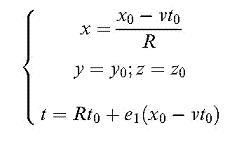
Thus the TSR predicts for r a discontinuity at zero acceleration (Selleri 2004b: 57–77). We can say that all experiments are performed in the real physical world [where a ≠ 0, ρ = (1 + β)=(1 – β)], but the theory has gone out of the world (a = 0; p=β = 1)!
This discontinuity is the origin of the problems met with clock synchronization on or near the Earth’s surface. This is not a surprise: after all, the Earth is also some kind of rotating disk!
Notice that a velocity of light satisfying eq. (4.3) is required for all inertial frames but one, the isotropic system S0. In fact, for any small region AB of any such system one can imagine a large rotating disk with the center at rest in S0 and the rim locally co-moving with AB and the result (4.3) can be applied. Therefore the velocity of light depends on direction in all inertial systems with the exception of S0.
General proof of absolute simultaneity
In the present section we will show that the absolute simultaneity condition e1 = 0 can by deduced in the very broad context of the ‘‘general transformations’’ (eqs. (5.1) and (5.2) below). In this way absolute simultaneity will be proven to be a necessary consequence of the continuity of physical quantities in passing from slowly accelerated to inertial systems, independently
of the particular assumptions leading to the equivalent transformations (Selleri 2004b: 57–77).
Given the inertial frames S0 and S one can set up Cartesian coordinates and make only the assumptions (i)–(iv) of the first section. The general transformations from S0 to are then necessarily
(5:1)
where f1; g2; e4 and e1 are v dependent parameters. The transformations inverse of (5.1) can easily be shown to be
(5:2)
A spherical wave front born at time t0 = 0 in the origin of the isotropic reference frame S0 satisfies the condition
(5:3)
The one-way velocity of light relative to the moving system S, c1(y), can be found by introducing the transformations (5.2) into eq. (5.3), which then becomes the following second degree equation in t
(5:4)
where β = v/c. From eq. (5.4) it follows
(5:5)
where the solution with the negative sign in front of the square root has been discarded because it gives negative propagation times. By introducing polar coordinates in which the x-axis of the previously introduced Cartesian coordinates is taken as a polar axis, we have
(5:6)
and eq. (5.5) gives
(5:7)
where
(5:8)
Clearly θ is the angle, in S, between the light propagation direction and the absolute velocity~ v of S. Introducing the one-way velocity of light c1(θ) = r=t, we have
(5:9)
Particular cases of eq. (5.9) are
(5:10)
whence
(5:11)
As we know, the continuity condition of the physical quantities in passing from slowly accelerated systems to inertial systems leads to eq. (5.3), which we repeat:
(5:12)
By comparing (5.11) and (5.12) it necessarily follows
(5:13)
We can conclude that the most general transformations of the space and time variables between inertial systems allowed by the continuity condition are
(5:14)
This implies the necessary existence of absolute simultaneity. In fact, according to the fourth eq. (5.14), two point-like events with coordinates x10 and x20 (x01 ≠ x02), taking place at the same time t0, are judged to happen at the same time also in S. Once more, absolute simultaneity is seen to be unavoidable. With e1 = 0 the velocity of light becomes
(5:15)
showing that the βcosθ term in the one-way velocity of light is a fixed ingredient in all theories of inertial systems satisfying the continuity condition with the accelerated ones. Such a term is present in Galilean physics. In fact, the Galilean transformations satisfy (5.1) with
(5:16)
Using (5.16) the one-way velocity of light of the Galilean theory follows from (5.15) and turns out to be
(5:17)
As we see, eq. (5.17) contains the term βcosθ, characteristic of all theories treating inertial systems in a way continuous with the accelerated ones. The absence of this term in the TSR, in which c1 = c is isotropic, gives rise to the discontinuity of Figure 6.2.
We can conclude that the famous synchronization problem is solved by nature itself: it is not true that the synchronization procedure can be chosen freely, as the usually adopted convention leads to an unacceptable discontinuity in the physical theory.
The linear acceleration discontinuity
In the previous sections we showed that the absolute simultaneity condition e1 = 0 can be deduced from the continuity of physical quantities in passing from slowly rotating platforms to inertial systems. We concluded that, in a way, the clock synchronization problem of inertial systems is solved by nature itself: it is not true that the synchronization procedure can be chosen freely, as all conventions but one lead to unacceptable discontinuities in the physical theory. In the present section we will show that exactly the same discontinuity exists in the case of linearly accelerated reference frames and that e1 = 0 is once more the only way to save the continuity of the physical quantities. The only assumptions needed are two well-known consequences of the equivalent transformations, clock retardation and length contraction.
In considering linearly accelerated systems it is necessary to remember that no perfectly rigid body can exist in nature so that the application of a force in a point does not transmit instantaneously to the other points of a system. A good approximation to a system equally accelerating in all its parts can be obtained by considering a set of separated equal objects equipped with similar engines programmed in such a way as to generate the same acceleration in all of them. The set can be as large as one desires, but we will limit our discussion to the simplest case of two objects (‘‘spaceships’’).
Two identical spaceships A and B are initially at rest on the x0 axis of the isotropic inertial system S0 at a distance ‘0 from one another. Their clocks are synchronized with those of S0. At time t0 = 0 they start accelerating in the +x0 direction, and they do so equally, having the same velocity v(t0) at any time t0 of S0. With respect to S0 the positions of A and B at time t0 are given by:
(6:1)
so that
(6:2)
As eq. (6.2) shows, the motions described by (6.1) do not modify the distance ‘0 separating A and B, as seen from S0. In this sense the accelerated reference frame provided by A and B can be considered ‘‘rigid’’.
Let a light signal σ leave A and reach B along the straight line joining A and B. The times of the events of emission and detection of σ are:
t0A: S0 time of departure of σ from A ;
t0B: S0 time of arrival of σ at B(t0B > t0A) ;
tA: time of departure of σ from A as marked by clocks aboard A ;
tB: time of arrival of σ at B as marked by clocks aboard B.
For simplicity we will later assume that v(t0) is a linear function of its argument at least in the time interval t0A ≤ t0 ≤ t0B, namely
(6:3)
where a ≥ 0 is the acceleration and vA = v(t0A). Of course, owing to the increasing inertial resistance of the kinetic energy, the acceleration has to be kept constant by suitably increasing forces; anyway, we will consider only small accelerations applied during a reasonably short time, so that v(t0B) < c.
Defining the usual Lorentz factor for clocks and rods as
(6:4)
we will use the following two basic consequences of the transformations (2.1):

(6:5)

(6:6)
Proof of eq. (6.6). Let P and Q be any two points at rest in Sa on the line joining A and B, and P0 and Q0 two points at rest in S0 chosen as follows. The point P0 coincides with P when σ passes near P at time t0. The point Q0 coincides with Q when s passes near Q at time t0 + dt0. Thus the observer in Sa sees the light signal σ propagating from P to Q, these points defining a segment of length dℓ, while the observer in S0 sees σ propagating from P0 to Q0 defining a segment of length dℓ0. At time t0 + dt0 the points P0 and P do not coincide anymore, P having shifted by v(t0)dt0 towards Q0 (see  vdt0, but the Lorentz contraction implies that the length measured to be dℓ in Sa is actually seen as R(t0)d‘ by the observers in S0. Hence eq. (6.6) is correct.
From eq. (6.5) we get
(6:7)
Therefore
(6:8)
By assuming eq. (6.3) we can write
(6:9)
This integral can be calculated. A useful change of variable is
(6:10)
Defining also
(6:11)
we obtain the time difference
(6:12)
Eq. (6.11) shows that in the limit of small accelerations also βB – βA is small. It is easy to see that to the first order in βB βA eq. (6.12) becomes
Eq. (6.11) shows that in the limit of small accelerations also βB – βA is small. It is easy to see that to the first order in βB βA eq. (6.12) becomes
(6:13)
which is finally the same as
(6:14)
Next we calculate the distance ‘ separating A and B. Relative to S0 the light signal propagates with velocity c, so that dℓ0 = cdt0. Therefore eq. (6.6) becomes
(6:15)
whence, by integration
(6:16)
Using eqs. (6.3), (6.10) and (6.11) we get
(6:17)
In the limit of small acceleration one gets
(6:18)
which can also be written
(6:19)
The velocity of light relative to Sa, ratio of ‘ given by eq. (6.19) and tB tA given by eq. (6.14), is therefore
(6:20)
This result, rigorous in the limit aA → 0, is not the relativistic result = c, but is what one would expect from the inertial transformations, since the straight line connecting A and B was taken parallel to their velocity (θ = 0 and e1 = 0 in eq. (2.3)). A similar result, with a negative sign in the denominator, is found for the velocity relative to S of a light pulse traveling from B to A, again in agreement with the inertial transformations (θ = π). These results can perhaps be found surprising, as they are not in agreement with the theory of relativity. In fact, the breakdown from the theory has probably been introduced with eq. (6.5) where a linear relation between the times of S0 and S does not contain the space coordinates. Notice, however, that eq. (6.5) is physically reasonable, besides being a necessary consequence of our assumptions. We can only conclude that the spontaneously established synchronization of clocks during the motion of the accelerated reference frame Sa is incompatible with relativity.
Our spaceships A and B, initially at rest on the x0 axis of the isotropic inertial system S0 at a distance d0 from one another, were supposed to have clocks aboard synchronized with those of S0. Let CA and CB be two clocks aboard A and B, respectively. Before the time of departure (t0 = 0) CA, CB are used to measure the velocity with which a pulse of light propagates between CA and CB. The result is bound to be c, of course. The same experiment is repeated after the acceleration has ended and the spaceships are at rest in the different inertial system S. Now, if the invariance of the velocity of light were a law of nature one should find the same result in S and in S0 given that the retardation of CA and CB due to velocity during the accelerated motion is exactly the same. Instead, as we saw, the velocity of light in S turns out to be given by eq. (6.22). Notice that the equal retardation of CA and CB is expressed by the equality of the proper times of CA and CB and is therefore an objective property on which all observers must agree. Thus everything goes as if we measured the velocity of light with two clocks, then set backwards their hands by the same amount, then measured again the velocity of light and found a different result. It is a surprise!
The result can only be understood in terms of inequivalence of the inertial systems, in the sense that the second postulate of the theory of relativity does not hold in nature and the velocity of light relative to an inertial system depends on the absolute motion of the latter. This seems to imply the existence of an objectively privileged system.
Export of relativistic simultaneity fails
In the previous section the two spaceships argument was used as a way to present the zero acceleration discontinuity for linear motions. In the present section we will use it again for showing that the Einstein synchronization of clocks cannot be exported from an inertial frame to another. We will assume that at some time the acceleration ends and the two spaceships, in a way, constitute a new inertial frame. As the physical actions on the clocks are the same, one could naively expect that it should be possible to ‘‘export’’ to the new frame whatever synchronization existed in the old one. It is not so: relativistic simultaneity cannot be exported.
As before A and B are initially at rest on the x0 axis of the (privileged) inertial system S0 at a distance d0 from one another. Their clocks are synchronous with the clocks at rest in S0. At time t0 = 0 they start accelerating
in the +x0 direction, and they do so equally, having the same velocity v(t0) at any time t0 of S0, until at t0 = 0 they reach a preassigned velocity v = v(0) parallel to +x0. At time t0 =0 the acceleration ends. For t0 ≥0 tħ the spaceships are at rest in a different inertial system S. The positions of A and B at time t0 ≥t0 are given by:
(7:1)
so that, as in eq. (6.2)
(7:2)
Again, motion does not modify the distance ‘0 separating A and B, as seen from S0. The same distance seen from S (call it ‘) instead increased, as the unit rod measuring it underwent a Lorentz contraction. One has
(7:3)
In fact the observer in S0 will check: (i) that the distance d0 between A and B remained the same after acceleration, in accordance with (7.2); (ii) that the unit rod at rest in S contracted by a factor R ; (iii) that the observer in S using his contracted rod to measure the A–B distance finds it larger by a factor 1=R than before departure. This measurement is an objective procedure and its result (= number of times the unit rod fits into the A–B distance) cannot depend on the subjective point of view of an observer. Therefore the observer in S finds indeed what the observer in S0 sees him finding, namely an A–B distance given by eq. (7.3). By the way, this is essentially the Lorentz contraction of the distance separating the two spaceships, as d0 is shorter than d by the usual factor R.
We can consider the trip of the two spaceships as an attempt to export to the system S the synchronization of distant clocks valid in S0. We will see that the attempt fails. In fact we will show that the transformations relating S0 and S are necessarily the inertial ones, if the synchronization actually transported by the two spaceships is adopted in S.
Motion is the same for A and B and all effects of motion will necessarily coincide. Therefore τ, the proper time marked by clocks aboard the two spaceships when the acceleration ends, is given by
(7:4)
The clocks aboard A and B accumulate exactly the same delay with respect to the clocks at rest in S0. Therefore two events simultaneous in S0 will be such also in S, even if they take place in different points of space near which A and B happen to pass at some time t0 >t0. Clearly we have here a case of absolute simultaneity and the condition e1 = 0 must hold in S, reducing the equivalent transformations to the inertial ones.
We will now show, in agreement with the previous section, that the velocity, relative to S, of a light pulse traveling from A to B when the two t spaceships are at rest in S is not c, but has the value demanded by the inertial transformations. Let a light signal leave A at time tA and reach B at time tB, these times being measured in S by the clocks aboard the two spaceships. For t0 ≥t0 clock retardation in S is due to the constant velocity v. Therefore one has:
(7:5)
where t0A and t0B are the S0 times of departure of the light signal from A and arrival at B, respectively (we assume 0 <t0 < t0A < t0B). By subtracting the first equation in eq. (7.5) from the second we get
(7:6)
We will next calculate the velocity ~c of the light signal in S, defined as
(7:7)
where ‘ is given by eq. (7.3).
The point  0B of S0 where the light pulse is detected in B can be considered either from the point of view of pulse propagation, or of B motion. Thus it must satisfy two equations:
(7:8)
where x0A and x0B are the positions of A and B, respectively, at the time t0A of emission of the light signal. from x0A to 0B with velocity c, B moves from x0B to 0B with velocity v. From the equations in eq. (7.8) follows:
(7:9)
where b = v/c. Remembering that eq. (7.2) holds for all times t0 one gets
(7:10)
By using eq. (7.3) for transforming the A–B distance and eq. (7.6) for transforming the time interval, we get from eq. (7.10)
(7:11)
from which it is easy to obtain
(7:12)
Comparing with eq. (7.4) we get finally:
(7:13)
This is what one expects from the inertial transformations, since the straight line connecting A and B is parallel to their velocity (y = 0). A similar result with a negative sign in the denominator is found for the velocity relative to S of a light pulse traveling from B to A, again in agreement with the inertial transformations (y = p). These results can perhaps be found surprising, as they are not in agreement with the Lorentz transformations of the TSR. In fact, the breakdown from the theory, we can now say, has definitely been introduced with eq. (7.5) where the transformations from S0 to S of t0A and t0B do not contain the space coordinates. Replacing eq. (7.5) with the Lorentz transformations of time leads of course to ~c = c. Notice, however, that eq. (7.5) is a necessary consequence of the equal behavior of the two spaceships. Once more we can conclude that the spontaneously established synchronization of clocks during the acceleration of A and B is not compatible with the TSR. The result implies the inequivalence of the inertial systems, in the sense that the second postulate of the theory of relativity does not hold and the velocity of light relative to an inertial system depends on the absolute motion of the latter. This implies the existence of an objectively privileged system.
It should also be stressed that the concrete performance of the above experiment with the two accelerating spaceships would not really allow one to detect the privileged inertial system, as an arbitrary inertial system could be assumed to be isotropical and used as a starting frame of A and B. In this sense the above considerations are compatible with the weak form of the relativity principle discussed in the last section.
Irreversible processes cannot be synchronized
We can show that the inertial transformations based on absolute simultaneity give the most natural description of the physical reality by considering irreversible processes on board the two spaceships. For example, a radioactive sample has an exponentially decreasing decay rate, which could be used to measure time. Such a ‘‘clock’’ cannot be synchronized and continues its running independently of human will. It is well known, however, that such a clock suffers the relativistic retardation, when in motion, just like man-made ordinary clocks.
A second example is provided by the ageing of biological structures. To develop this point, we will suppose that our spaceships A and B have two passengers PA and PB, who are twins. Of course in principle nothing can stop them from resynchronizing their reversible clocks once the acceleration has ended and the two spaceships are at rest in S. If they do so, however, they find that they have different biological ages at the same (resynchro-nized) S time, even if they started the space trip at the same S0 time and with the same acceleration, as stipulated above. Moreover, reversible and irreversible clocks will not agree anymore.
To make everything as clear as possible, suppose the twins PA and PB tħ were born in the point M of the x0 axis of S0 equidistant from the two points from which A and B start their trip. When the time of departure is near, PA and PB are brought from M to A and B, respectively, with the same speed. As said above, at time t0 = 0 the spaceships start accelerating in the +x0 direction, and they do so in the same way, until at time t0 of S0 they reach a preassigned velocity v parallel to +x0. At t0 ≥ħt0 the spaceships are at rest in the inertial system S moving with velocity v with respect to S0. We have seen that the clocks of A and B are retarded in the same way and that the S-S0 transformations must be the inertial ones. We can now add that also the ageing of the twins in A and B must be the same, given that they experience identical velocities. Therefore the twins have the same biological age when the times marked on their clocks are the same, if these were synchronized in S0 before departure and never resynchronized afterwards. Ageing is an irreversible way of time keeping and cannot be modified. The twins can of course inform one another about their ages by exchanging pictures (e.g. via telefax) in which the time is recorded at which they were taken. The receiving twin will check in his records that at the time shown on his brother’s picture he looked exactly the same, and therefore had the same age.
Naturally PA and PB can use a different synchronization of reversible clocks, if they wish, e.g. Einstein’s synchronization leading to the Lorentz transformations between S and S0. To do so they must send a light signal, e.g. from A to B, and they must reset at least one clock. We can even suppose that every twin has two clocks and keeps the first one set on absolute time, while regulating the second one to show the Lorentz time. More exactly we assume that:
PA has a first clock CA marking the absolute time tA
PA has a second clock ĈA marking the Lorentz time  A
PB has a first clock CB marking the absolute time tB
PB has a second clock ĈB marking the Lorentz time B
After the initial times t0 ≤0 of S0 for which tA =A = tB =B a resyn-chronization of ĈB is carried out as follows. At some preestablished time a light signal is sent from A to B. Of course it can be checked with CB that this signal arrives at B a time
(8:1)
later, as we saw that the velocity of light from A to B in S is given by eq. (7.13). Forcing the velocity of light to be c in his rest frame (‘‘Einstein synchronization’’), the observer in B will reset his clock ĈB at a time earlier by
(8:2)
in such a way that eq. (8.1) is indeed replaced by ‘=c, as required. If t is the delay generated by velocity and acceleration up to time0 (the same as in eq.
(7.4)), at time t0 of S0 (after resynchronization of ĈB so that t0 ≥0) the clocks mark the following times
CA marks tA =0 t + (t0 0)R
ĈCA marks A = tA
CB marks tB = tA Ĉ
CB marks B = tB ‘b=c
Clearly, at the same physical time one has
(8:3)
but
(8:4)
The simultaneity of CA and CB is different from that of ĈA and ĈB! If PA and PB exchange pictures in which the times marked by the clocks C and Ĉare both shown, they discover that they had the same age at the same t, but different ages at the same. This fact gives a clear prevalence to the inertial
transformations. Natural phenomena are once more better described by the inertial transformations when they take place in concretely produced inertial systems.
Export of absolute simultaneity succeeds
It will now be shown that, contrary to the case of relativistic simultaneity, the export of absolute simultaneity to a different inertial system is fully possible.
Once more, two identical spaceships A and B are initially at rest on the x tħ axis of the inertial system S (this time not the privileged one!) at a distance ‘ from one another. The system S has velocity v relatively to the privileged frame S0. The clocks at rest in S are synchronized in such a way that the inertial transformations hold between S0 and S. The clocks in A and B are synchronized locally, before departure, with nearby clocks of S. At time t = 0 the spaceships start accelerating in the +x direction, and they do so equally, having the same velocity v(t) at any time t of S, until at t =t they reach a preassigned velocity v´ ≡ v() parallel to +x. At t =ħtt acceleration t the spaceships are at rest in a different inertial system S´ ends. For t ≥ħ moving with velocity v´. With respect to S the positions of A and B at any time t ≥t are given by:
(9:1)
so that
(9:2)
As eq. (9.2) shows, the motion of A and B does not modify their distance ‘ as seen from S. The theory of the inertial transformations shows that the velocity of S´ (and then also of A and B after the end of acceleration) relative to S is given by
(9:3)
After the end of the acceleration the distance between A and B in S´ (call it ‘0) is different, as the unit rod measuring it undergoes a Lorentz contraction different from that applying to rods at rest in S. In this case one has from the inertial transformations
(9:4)
(9:5)
It will next be shown that the transformations relating S and S´ are necessarily the inertial ones, if no clock resynchronization is applied in S´ correcting what nature itself generated during the acceleration of the two spaceships. In other words the inertial transformations are maintained when A and B pass from S to S´ in the described way. Motion (relative and absolute) is the same for A and B and all effects of motion will necessarily coincide. Therefore the clocks aboard A and B will accumulate exactly the same delay with respect to the clocks at rest in S and two events simultaneous in S will be such also in S´, even if they take place in different points of space. Clearly we have once more a case of absolute simultaneity and the condition e´1 = 0 must hold in S´.
= In order to develop the point further we check next that the velocity, relative to S´, of a light pulse traveling from A to B when the two spaceships are at rest in S´ (and move with velocity v with respect to S) has the value demanded by the inertial transformations. Let a light signal leave A at time t0A and reach B at time t0B, these times being measured in S´ by the clocks aboard the two spaceships. The velocity ~c´ of the light signal in S´ is, by definition
(9:6)
where ‘0 is given by eq. (9.4). Now define, with 0 <ħtt < tA < tB :
t: proper time marked by clocks aboard A and B at the S timeħtt at which acceleration ends;
tA: S time of departure of the light signal from A;
tB: S time of arrival of the light signal at B.
t clock retardation in S´ is due to the constant velocity one has As for t ≥ħt from the inertial transformations between two moving systems:
(9:7)
By subtracting the first equation from the second one, one gets
(9:8)
We will next calculate ~c´ as defined by eq. (9.6). The point B of S where the light pulse is absorbed in B must satisfy:
(9:9)
if xA(tA)and xB(tA)are the positions of the spaceships A and B, respectively, at time tA of emission of the light signal. In fact, while the light signal goes from xA to B with velocity c=(1 + b), spaceship B moves from xB to B with velocity u given by eq. (9.3). By subtraction, from the equations in eq. (9.9) it follows:
(9:10)
Remembering that eq. (9.2) holds for all times t one gets
(9:11)
By using eq. (9.4) for transforming the A–B distance and eq. (9.8) for transforming the time interval, we get from eq. (9.11)
(9:12)
from which it is easy to obtain
(9:13)
Comparing with eq. (9.4) we get finally:
(9:14)
This is what one expects from the inertial transformations, since the straight line connecting the spaceships A and B has been assumed parallel to their velocity (y0 = 0). A similar result, with a negative sign in the denominator, is found for the velocity relative to S of a light pulse traveling from B to A, again in agreement with the inertial transformations (y = p). We can conclude that the export of the absolute synchronization of clocks during the motion with equal acceleration of A and B takes place spontaneously.
Resynchronization of clocks
The inertial transformations based on absolute simultaneity imply the existence of a single isotropic inertial reference system (‘‘privileged system’’). I have shown, however, that a resynchronization of clocks (ROC) in all inertial systems is possible leading to a different, arbitrarily chosen, isotropic ‘‘privileged’’ system (Selleri, 2005b: 325). Such a ROC does not modify any one of the empirical consequences of the theory, which is thus compatible with a formulation of the relativity principle weaker than adopted in Einstein’s theory of special relativity.
Assuming the inertial transformations, the S0 system is initially considered to be privileged, and the velocity of light relative to it isotropic. Other inertial systems (S, S´, . . .) are initially described as ‘‘moving’’ and relative to them the observers detect an anisotropic velocity of light given by equations like eq. (2.3). In Selleri (2005) I described a process of ROC showing that it is uniquely determined by the new inertial frame S chosen to replace S´ as ‘‘privileged’’ and by the requirement that absolute simultaneity should be preserved.
The first assumption is that ROC should change the velocity of light relative to S from the value given by eq. (2.3) with e1 = 0 to c. Therefore the time required by a point-like flash of light to cover the distance ‘ in a direction forming an angle y with respect to the x axis should be modified in the following way
(10:1)
Given the homogeneity of space one can assume, without loss of generality, that the flash of light is emitted in the origin, so that ‘cosy = x. Therefore the recipe is very simple: subtract xv=c2 to the time shown by the clock having a position with first coordinate x. Thus the new time~ tt that should replace t for the considered clock is
(10:2)
If this is done systematically for all clocks at rest in S a new situation is obtained in which the speed of light appears to be isotropic and equal to c.
We will also say how ROC should be implemented in the other inertial frames in order to preserve the validity of absolute simultaneity. It is well known that the absolute simultaneity can be obtained simply by choosing one system S to be privileged, synchronizing clocks according to the Einstein procedure in this system, and then synchronizing clocks in all other systems moving past S by adjusting these clocks to t´ = 0 whenever they fly past a clock in S which shows t = 0.
As far as the initially privileged frame S0 is concerned one can show that if the post-ROC time t˜0 is defined as follows
(10:3)
then the overlapping of clocks of S0 and S takes place at ~tt =~tt0 = 0, as required. After dealing with the post-ROC and pre-ROC privileged systems, one should say how ROC should be in the most general inertial system in order to preserve the absolute simultaneity. It has been possible to show that the ROC in S´ satisfies the following rule:
(10:4)
where R´ is given by eq. (9.5). Notice that eqs. (10.2) and (10.3) are particular cases of eq. (10.4) for v´ = 0 and v´ = v, respectively. Therefore the most general recipe for ROC is eq. (10.4).
It could be shown that the ROC given by eq. (10.4) maintains the validity of the inertial transformations with the new inertial system S replacing S0 in the role of ‘‘privileged’’ system and S0 becoming a regular ‘‘moving’’ inertial system also from the point of view of the new transformations. Furthermore any other system S0 obtains transformations appropriate to the new roles of S and S0.
As an example consider the inverse pre-ROC inertial transformations from S to S0 given by
(10:5)
According to eq. (10.1) the old time t should be replaced by~tt + xv=c2. If this is done in the first equation, a short calculation leads to
(10:6)
Similarly, if t and t0 as given by eqs. (10.1) and (10.2), respectively, are substituted in the pre-ROC transformation of time eq. (10.5), and eq. (10.6) is used, one easily gets
Clearly eqs. (10.6) and (10.7), together with the trivial transformations of y and z, are direct inertial transformations from an isotropic system S to an S0 moving with velocity v.
The possibility to choose freely the isotropic reference frame had been anticipated in the excellent paper by Rizzi, Ruggiero and Serafini (Rizzi et al. 2005: 1835), where one reads: ‘‘ . . . the ‘privileged role’ played by S0 . . . is a merely artificial element, S0 being just the IRF [inertial reference frame] in which, by stipulation, Einstein synchronization has been performed: as a matter of fact, any IRF S can play the role of S0 ’’.
Buonaura (2004: 627) used the inertial transformations to show that Maxwell’s equations, passing from the isotropic inertial system S0 (where they retain the usual form) to another inertial system S, acquire a generalized form depending on the velocity of S relative to S0 (‘‘absolute velocity’’). Thus Maxwell’s equations are affected by a change of reference frame given that the velocity of the frame to which these equations are referred is modified. In spite of this, the inertial transformations are compatible with a form of relativity (‘‘weak relativity’’), as the isotropic system can be chosen arbitrarily, meaning that nothing in the theory allows one to conceive an experiment leading to the discovery of the really isotropic system.
It is useful to distinguish two formulations of the relativity principle:
R1. Strong relativity, according to which the laws of physics are exactly the same in all inertial systems. This is Einstein’s formulation.
R2. Weak relativity, stating merely the impossibility to measure the absolute velocity of the Earth. This principle does not demand necessarily the validity of the Lorentz transformations and opens a logical space for new theories, such as the one based on the inertial transformations. It is amusing to notice that this formulation is essentially the original one given by Galileo.
In spite of the impossibility to detect experimentally a privileged frame it is necessary to insist that all the statements in favor of absolute simultaneity made in the present paper are correct. Furthermore I repeat that the theory with the free e1 applied to the rotating platform shows that only the choice e1 = 0 gives a satisfactory explanation of the Sagnac effect. Similarly, only with e1 = 0 one can obtain a reasonable description of aberration and of the differential retardation of separating and reuniting clocks. The paradoxes of the special theory of relativity disappear in a theory based on e1 = 0. The growing evidence for the existence in nature of superluminal signals can easily be accommodated in the same theory, while it is incompatible with relativity due to the presence of a famous causal paradox.
The need to adopt e1 = 0 is strong and clear. Nevertheless I must admit that this approach to the physics of space and time might seem somewhat contradictory. On the one hand it points to a theory of space and time in which such conceptions as absolute velocity, privileged frame and absolute simultaneity have a central role, while, on the other hand, relativism comes back in the arbitrariness of the choice of the ‘‘privileged’’ inertial reference
frame. Both sides of the contradiction (e1 = 0 and weak relativity) are absolutely necessary if the assumptions made in the second section are all correct.
As a final remark one can add that from the point of view of the inertial transformations the validity of weak relativity appears accidental, more than fundamental. It would be enough to discover a very small non-invariance of the two-way speed of light to make the whole game of ROC impossible.
References
Anandan, J. (1981) ‘Sagnac Effect in Relativistic and Nonrelativistic Physics’, Phys. Rev. D24, 338–46.
Bailey, J. et al. (1977) Nature 268, 301.
Builder, G. (1957) Austr. J. Phys. 10, 246.
Buonaura, B. (2004) Found. Phys. Lett. 17, 627.
Einstein, A. (1952) ‘On the Electrodynamics of Moving Bodies’, in A. Einstein, H.A. Lorentz, H. Weyl, and H. Minkowski, The Principle of Relativity, Dover, New York, pp. 37–65.
Ghosal, S.K., B. Raychaudhuri, A.K. Chowdhuri and M. Sarker (2004) Found. Phys. Lett. 17, 457.
Hasselbach, F . and M. Nicklaus (1993) ‘Sagnac Experiment With Electrons: Observation of the Rotational Phase Shift of Electron Waves in Vacuum’, Phys. Rev. A48, 143–51.
Jammer,M. (1979) ‘Some Fundamental Problems in the Special Theory of Relativity’, in G. Toraldo di Francia (ed.), Problems in The Foundations of Physics, Bologna and North Holland, Amsterdam: Societa` Italiana di Fisica, pp. 202–36.
Landau, L.D. and E.M. Lifshitz (1996) The Classical Theory of Fields, Oxford: Butterworth-Heinemann.
Langevin, P. (1921) Compt. Rend. 173, 831.
Langevin, P. (1937) Compt. Rend. 205, 304.
Mansouri, M. and R. Sexl (1977) General Relat. Gravit. 8, 497, 515, 809.
é, H. (1898) Rev. Metaphys. Morale 6, 1. Poincar
Post, E.J. (1967) ‘Sagnac Effect’, Rev. Mod. Phys. 39, 475–93.
Puccini, G. and F. Selleri (2002) ‘Doppler Effect and Aberration of Light from the Point of View of Absolute Motion’, Nuovo Cim.B, 117, 283.
Reichenbach, H. (1958) The Philosophy of Space & Time, Dover, New York.
Rizzi, G., M.L. Ruggiero and A. Serafini (2005) ‘Synchronization Gauges and the Principles of Special Relativity’, Found. Phys. 34, 1835–87.
Sagnac, M.G. (1913) Compt. Rend. 157, 708, 1410.
Sagnac, M.G. (1914) J. de Phys. 4, 177.
Selleri, F. (1995) ‘Space, Time and Their Transformations’,Chin. J. Syst.Eng.Electr. 6, 25. Selleri, F. (1996a) ‘Noninvariant One-Way Velocity of Light’, Found. Phys. 26, 641. Selleri, F. (1996b) ‘Noninvariant One-Way Velocity of Light and Particle Collisions’, Found. Phys. Lett. 9, 43.
Selleri, F. (1997) ‘Noninvariant One-Way Speed of Light and Locally Equivalent Reference Frames’, Found. Phys. Lett. 10, 73.
Selleri, F. (2002) ‘Bell’s Spaceships and Special Relativity’, in R.A. Bertlmann and A. Zeilinger (eds.), Quantum [Un]speakables, Berlin, pp. 413–28.
Selleri, F. (2004) ‘Sagnac Effect: End of the Mystery’, in G. Rizzi and M.L. Ruggiero (eds.), Relativity in Rotating Frames, Dordrecht: Kluwer, pp. 57–77.
Selleri, F. (2005a) ‘On the Differential Retardation Between Separating and Reuniting Clocks’, in: O. Nawrot et al. (eds.), Between Philosophy and Natural Sciences, Essays for L. Kostro’s 70th birthday, Gdansk University Press.
Selleri, F. (2005) ‘The Inertial Transformations and the Relativity Principle’, Found. Phys. Lett. 18, 325.
Selleri, F. (2006) ‘Superluminal Signals and the resolution of the causal paradox’, Found. Phys. 36, 443.