
References
11 The Special Theory and absolute simultaneity
John Lucas
Summary
The Special Theory has no place for absolute simultaneity. This seems to rule out the possibility of there being a God who knows everything that happens when it happens, and responds to the prayers of His children. Does this matter? Some theologians claim that it does not, because God is outside time. It is possible to argue that the Deity of the Greek philosophers is outside time, but implausible to maintain that the God of the Judaeo-Christian tradition is. Nevertheless that has been maintained by many theologians. Their arguments are not convincing. The only way a timeless Deity can be omniscient is for Its knowledge to be of timeless truths, and the only way for timeless truths to be ascribed to temporal propositions is to evacuate them, as in contemporary arguments against fatalism, of all substance. And if prayers are to result, as a consequence of the existence of a timeless Deity, in the boon asked for actually occurring, both must be the effect of the unchangeable structure of the universe. Not only must God’s knowledge be insubstantial, but Man’s freedom must be illusory.
The Special Theory is thought to downgrade time, but popular accounts are misleading. Although time is integrated with space in Minkowski space-time, Minkowski space-time has Lorentz signature (+++–), with time-like separations being fundamentally different from space-like separations. And although Minkowski space-time gives rise to the picture of a ‘‘block universe,’’ the case is no different, logically speaking, from that of Newtonian space and time, which can similarly be regarded as a space-time formed by the Cartesian product of the two.
The Special Theory relativises simultaneity and seems to undercut the distinction between past, present and future, but the threat this poses is exaggerated. Many of the arguments adduced to subvert the distinction between past, present and future are fallacious, depending on an equivocation between different sorts of relative simultaneity. Moreover, the Special Theory is a theory of electromagnetism, but electromagnetism is not the whole of physics. Maxwell’s equations, like Newton’s laws of motion, are invariant under time reversal. But this does not prove that time does not have a direction. We do not feel impelled to jettison thermodynamics on the grounds that the Second Law of Thermodynamics is incompatible with the direction-indifferent time of mechanics and electromagnetism. Rather, we recognize that mechanics and electromagnetism do not tell the whole story, and ‘‘throw away advanced potentials,’’ when we come to apply the theory to real situations.
Einstein formulated the principle that there are no privileged observers and elevated it from a truth about electromagnetism to a general metaphysical principle; whereas Newton, more cautiously, did not. And once we move from the Special Theory to the General Theory, privileged frames of reference are allowed: cosmic time flows generally and universally. Quantum mechanics likewise requires a real worldwide distinction between past, present and future. All over the universe wave functions collapse. There is a worldwide tide of co-presentness sweeping through the universe, as superposed wave functions, representing many alternative possibilities, collapse into one single eigen-function, representing what is, and remains, actually the case.
Modern physics vindicates our intuitive sense of the reality of time and does not require us to banish God to a timeless, insubstantial existence or to regard ourselves as mere worms crawling along a predetermined lifeline. Time is real: and we are free agents, responsible for the decisions we make.
The challenge
Einstein’s Special Theory of Relativity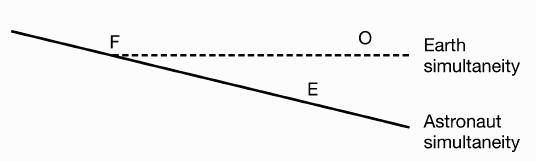
These claims bear weightily on our view of ourselves and our understanding of God. If time is unreal, the way we live now in the time of our mortal life is of no significance sub specie aeternitatis. All our notions of aspiration, achievement and responsibility are undercut, if there is no difference between the future and the past. God cannot know everything that is happening if there is no worldwide present tense, and cannot meaningfully hear our prayers or respond to them if the answers may equally well be given before the petitions as after them. The Special Theory threatens both the omniscience of God and any possibility of our having a real personal relation with Him. Modern physics, it seems, has dealt traditional theism a death blow.
Does this matter?
One strand of theological thought, going back to Plato and Parmenides, maintains that God is outside time, and that time is unreal, and hence that the findings of modern physics are nothing to be worried about. It is easy to say that God is outside time but difficult really to believe all its implications. The Judaeo-Christian account of God’s dealings with His people is a temporal narrative. God led His people out of Egypt, parted the Red Sea for them, spake by the Prophets, gave His only son to be incarnate, to suffer under Pontius Pilate, to be crucified, and on the third day raised from the dead; and He continues to guide His church, and answer the prayers of the faithful. It is difficult to see how the timeless Deity contemplated by the philosophers in Athens could have anything to do with the temporal God known in Jerusalem.
Nevertheless efforts have been made, notably by Augustine, Boethius and Aquinas in the past, and in recent years by Eleonore Stump and Norman Kretzmann (1981); Paul Helm (1988); and Brian Leftow (1991) to explain how a timeless Deity could nonetheless be an agent in history and have personal relationships with human beings. But in spite of heroic efforts to give an intelligible account, the concessions that have to be made to timelessness destroy the personality which makes God not only an object of reverence but also the source of love. No convincing reconciliation has been achieved between the God of the Philosophers and the God of Abraham, Isaac and Jacob. The history of salvation in the Old Testament and the New Testament is through and through temporal. If Christ did not die, and has not risen again, then is our hope vain?
Misapprehensions of the Special Theory
Some of the consequences popularly supposed to be implied by Einstein’s Special Theory are due to misunderstandings. The integration of time with space is a fundamental feature of the Special Theory. Whereas temporal duration was an invariant quantity under the Galilean transformations, it is not under the Lorentz transformation, which preserves only space-time separations, but not either spatial ones or temporal ones separately. In the excitement of discovery it was natural that exaggerated claims should be made – that all is relative, that time and space must fade away and be replaced by Minkowski space-time, that nothing can go faster than light. But despite its name, the Special Theory does not make out that all is relative: it stresses the absoluteness of space-time. Minkowski famously announced
Henceforth space by itself, and time by itself, are doomed to fade away into mere shadows, and only a kind of union of the two will preserve an independent reality.
(Minkowski 1923: 75)
But although Minkowski space-time can be described as a four-dimensional manifold, its metric (and hence also the topology based on it) is radically unlike that of a Euclidean 4-space. The topological difference between Minkowski space-time, with Lorentz signature (+++–), and a simple Euclidean 4-space, with Lorentz signature (++++), is profound. The Lorentz signature (+++–) marks an absolute distinction between time-like directions and time-like separations on the one hand and space-like directions and space-like separations on the other.
Mathematicians are sometimes tempted to discount this difference between time-like and space-like separations – they can transform Minkowski space-time into a simple 4-space by setting t = –ix4/c, which would enable them to regard time as simply a fourth dimension of four-dimensional space, with a standard metric and topology. True, but that transformation and its converse, x4 = ict are not transformations of no consequence; transformations that convert simple exponential functions into periodic ones and vice versa are clearly highly significant ones, and, as we have seen, the metric and topology of Minkowski space-time are radically different from those of a Euclidean 4-space. Although there are important similarities between time and space, they fall far short of showing that the dimension of time was simply a fourth dimension of space multiplied by ic.
Minkowski’s space-time lends strong support to the picture of a ‘‘block universe’’ and suggests that we should reject our ordinary experience of time in favor of a much more abstract and mathematical concept, in which time is a fourth dimension, analogous to the three dimensions of space, with the future already in existence, just waiting to occur. We are to picture world-lines in Minkowski space-time as already timelessly existing and ourselves as going along a world-line encountering our pre-determined future as it takes place – in Weyl’s words
The objective world simply is, it does not happen. Only to the gaze of my consciousness, crawling upward along the lifeline of my body, does a section of this world come to life as a fleeting image in space which continually changes in time.
(Weyl 1949: 116)
But this is only a picture. Although Minkowski space-time, a four-dimensional manifold with Lorentz signature, seems more integrated and solid than a Cartesian product of a three-dimensional space with a one-dimensional time, exactly the same picture can be imagined if we think of a world-line in Newtonian space-and-time – the Galilean transformation can be seen as just a special case of the Lorentz transformation in which the speed of light is infinite. Both are available, both misleading, both nonobligatory.
Frames of reference
The Special Theory teaches us that simultaneity is not, as we supposed, an absolute concept, but is always relative to some inertial frame of reference. If we change the inertial frame of reference, we change the events to be reckoned simultaneous. Putnam, Rietdijk and Lango have argued for a timeless view of time, because of inconsistencies in our ordinary concept of simultaneity, and hence of there being no absolute distinction between present, past and future (Rietdijk 1966: 341–44; 1976: 598–609; Lango 1969: 340–50; Putnam 1979: 198–205). If we consider two observers in two inertial frames of reference moving with a uniform velocity with respect to each other, they will have different lines of simultaneity, and an event that is future to one will be past with respect to the other. In
The event E is both past and present, since it is in O’s past, but is also simultaneous with an event F, say, which is itself simultaneous with the observer’s ‘‘Now’’. So, it seems, we are forced to concede that there can be no inherent characteristic distinguishing the future from the present or the past, and that they are differentiated by nothing inherent but only their relation to particular observers. From this it is a natural step to think of space-time as a timeless entity, in which all events, present, past and future, already in some sense exist; and to think of the apparent passage of time as nothing real, but only our becoming aware of what is already there, waiting for its moment of disclosure to us, in the way that Weyl suggests.
There is clearly something wrong with this argument, plausible though it sometimes seems. It depends on a confusion between two-termed and three-termed relations. It assumes that simultaneity is a two-termed relation, whereas in point of fact in the Special Theory, simultaneity is a three-termed relation, and we always have to ask ‘‘simultaneous with respect to what inertial frame of reference?’’ Simultaneity with respect to a given inertial frame of reference is an equivalence relation, so that if one event is simultaneous with another and that other is simultaneous with a third, then the first is simultaneous with the third. But simultaneity with respect to different inertial frames of reference is not an equivalence relation at all.

Plato was the first to spot the flaw in this type of argument. He was thinking about the foundations of geometry and came to realize that two figures being the same could be taken to mean that they were the same size, or that they were the same shape. Two congruent triangles are the same size: two similar triangles are the same shape, but need not be the same size. It is in fact a defining characteristic of Euclidean geometry that it allows for figures of the same shape to be of different sizes (on the surface of a sphere, if we know that a spherical triangle has each of its angles a right angle, we know that the triangle is an octant, and that each of its sides is one quarter of the circumference of a great circle). Had it not been for the problem of irrational numbers, the Academy might well have based geometry on the independence of shape and size instead of on the axiom of parallels. As it was, the distinction was used by Plato and Aristotle only in political philosophy to show that equality in one respect need not imply equality in all respects.
The first argument of Putnam, Rietdijk and Lango fails: no event in the past of an observer can also be simultaneous with his ‘‘Now’’; their argument depends on a simple equivocation in the use of the term ‘‘simultaneous’’. But still, it may be objected, there is an inconsistent ascription of dates, without appeal to lines of simultaneity. In
The ascription of futurity, presentness, or pastness is, therefore purely relative, and indicates no real property of the event. But that argument also fails. The lines of simultaneity for a given inertial frame of reference do not determine what is currently going on at distant places, but only what dates should be ascribed to them in order to make electromagnetic phenomena coherent. The Special Theory is a theory of electromagnetic radiation and determines distances and durations, and hence positions and dates, by means of light signals. As far as electromagnetic phenomena are concerned, we have no other means of telling exactly when a distant event – an event in the ‘‘Absolutely Elsewhere and Anywhen’’ – takes place; but for any given inertial frame of reference, if we ascribe the same date to all events on a particular line of simultaneity, then the laws of electromagnetism apply neatly and yield harmonious results. So far as the Special Theory goes, simultaneity is a rather superficial and frame-dependent property, which we find useful for assigning dates to different events in different places, but which is not of fundamental importance in accounting for the propagation of causal influence by means of electromagnetic radiation. The ascription of presentness, pastness, or futurity, to events outside the light cone is nominal rather than real, and has no bearing on their ontological status.
Because the Special Theory speaks of space and time, it has been assumed that what it says about them is a metaphysical truth rather than a tenet of a particular physical theory. But electromagnetism is not the whole of physics, and physics is not the whole of knowledge. Other physical theories bear upon the interpretation of our theory of electromagnetism; so also our understanding of concepts we use in everyday life. Time in our ordinary experience has a direction. Even Weyl has the gaze of my consciousness crawling upwards and does not suggest that the lifeline of my body could reverse its direction in time, as it frequently does in space. It is similarly ‘‘anisotropic’’ in thermodynamics. The anisotropy of time has long been a problem for physicists, because it is difficult to reconcile with the fact that Newtonian mechanics, and likewise electromagnetism, are time-reversible: if we substitute –t for t in the equations, the result is the same. Yet that is not how things happen – trees grow, plates break, fires radiate energy, milk mixes with tea, but not the reverse: we can tell at once if a film is being run backwards.
It was a great problem for classical physics how to re-insert ‘‘the arrow of time’’ into a physics that was apparently isotropic with respect to time. There were many attempts to explain the Second Law of Thermodynamics – that entropy increases – as a feature of boundary conditions. Causally antecedent conditions were more precisely specifiable than their effects, and so had higher negative entropy. If events were generally explicable, and if the sort of explanation that every event ought to have was a causal explanation, then just as the direction of explanation led to conditions of higher and higher negative entropy, so the passage of time led to conditions of higher and higher positive entropy.
But discomfort remains: the concept of explanation seems dangerously anthropocentric, and in the long-run entropy should decrease just as often as it increases. Twentieth-century physics, however, embeds the anisotropy of time more deeply in the structure of the universe. There could, so far as the theory of electromagnetism goes, be a reversal of the direction of time if there were also a change of parity, since the time-like dimension is integrated with a number of space-like dimensions that are all on a par. Professor Dummett could make warriors to have been brave and rain dances to have been performed, provided that their hearts were on the right and they danced their reels counter-clockwise (Dummett 1964: 338–59).
The directedness of time provides a further argument against assimilating time to space. For any space-like direction can be transformed by a continuous rotation into the opposite direction, whereas there is no continuous transformation of one direction of time into its opposite. The only transformation of one temporal direction into its opposite is a discontinuous reflection, and this is linked to the parity of the 3-space space-like sub-space of Minkowski space; and if, as we believe, that 3-space is orientable, its parity is a fundamental feature, not susceptible to change – a point reinforced by the concomitant connection with charge. So, again, however much it is convenient on occasion to treat time as a fourth dimension, it remains a significantly un-space-like one.
The implications of ontology
Difficulties remain. If we ascribe a difference of ontological status to what is present or past from what is future, it will have awkward consequences with our theory of electromagnetism. It will pick out some inertial frame of reference as the absolute one. Any God’s-eye view of what is past and unalterable, as opposed to what is future and still open and indeterminate, must impose a privileged frame of reference that is contrary to Einstein’s principle that there are no privileged observers. But Einstein propounded his Special Theory in the context of electromagnetism, and so long as we confine our attention to electromagnetism we have good reason for adopting the Lorentz transformation as our way of correlating positions and dates in different inertial frames of reference; but it does not follow that that is the way we must ascribe positions and dates to distant events, and that no other ascription could be correct (Capek 1961, 1968; Stein 1968: 5–23; 1970: 289– 94; Sorabji 1980: 114–19; Torretti 1983: 249–51).
Newton also had difficulties with Absolute Space. Newtonian mechanics is relativistic. Newton’s laws of motion come out the same in any uniformly moving frame, so that it is impossible to tell, within Newtonian mechanics, whether we are moving with respect to Absolute Space or not. Newton recognized this, but maintained, correctly, that Absolute Space was nevertheless a coherent notion, and opined that the center of the solar system might be at rest in it. Later, when electromagnetic theory was being developed, Michelson and Morley sought to determine the rest frame of the ether, and if they had succeeded, we should have undoubtedly taken that as being at rest in Absolute Space. Similarly now, if some superluminal velocity of transmission of causal influence were discovered, we should be able to distinguish inertial frames of reference and say which were at rest absolutely and which were moving. If, for instance, we were able to communicate telepathically with extra-terrestrial beings in some distant galaxy, or if God were to tell us what was going on in Betelgeuse now, then we should have no hesitation in restricting the Principle of Relativity to the phenomena of electromagnetism only. Hence it cannot be an absolute principle foreclosing absolutely any possibility of absolute time.
These are not mere possibilities. In many of the models that cosmologists use – solutions of the field equations of the General Theory – there is a worldwide cosmic time that flows, if not evenly and uniformly, at least generally and universally. There are thus also preferred hypersurfaces (not necessarily flat) of simultaneity constituting a worldwide present and separating a real unalterable past from a possible future not yet actualized. The Special Theory is countered not just by the General Theory, but more fundamentally by quantum mechanics. It is difficult to make sense of quantum mechanics, and the interpretation I adopt is rejected by many. But it is natural to try and interpret it realistically and to construe the collapse of the wave packet as a real event in which the many possible eigenvectors, with their associated eigenvalues, give way to a single eigenvector with one definite eigenvalue. If this is so, there is a definite moment of truth when possibilities become definitely true or definitely false. There is a fact of the matter, quite independent of whether we know it or not, and of how and when we know it. Knowledge may be unable to travel faster than the speed of light, but reality does not have to travel at all. Galaxies may be thousands of light-years away, and we shall be able to assign a date to a particular collapse only thousands of years after the event, and our assignment may well depend on an idiosyncratic choice of frame of reference, but nonetheless there will have been a definite moment at which the event occurred quite independent of any frame of reference. There is a worldwide tide of actualisation – collapse into ‘‘eigenness’’ – constituting a preferred foliation by hypersurfaces (not necessarily flat) of co-presentness sweeping through the universe: a tide which determines an absolute present. In this, quantum mechanics goes beyond anything that thermodynamics and cosmology suggest, which, although witnessing to there being a definite directedness in time, do not pick out any particular time as pre-eminently real – the moment of truth when possibilities become actual or else fade away. Quantum mechanics, however, does. Although we still do not understand it, and its interpretation is still much disputed, it now appears to be irremediably probabilistic, and not only insists on the arrow being kept in time, but distinguishes a present as the boundary between an alterable future and an unalterable past.
Reformulation of the Special Theory
The tension between the Special Theory and other parts of physics can be resolved by restricting the scope of the Special Theory. This is satisfactory to the working physicist. Different fields of research and their problems require different theories. We do not worry about the time reversibility of Newtonian mechanics when constructing a steam engine. It is quite reasonable to limit the application of the Special Theory to electromagnetism and simply say that when dealing with electromagnetic phenomena we should use ‘‘relativistic space-time’’ and ‘‘relativistic dates and durations’’ and ‘‘relativistic positions distances,’’ thus ensuring that all our calculations are covariant under the Lorentz transformations.
In our metaphysical moods, however, we may feel uncomfortable. If, after all, there is an absolute frame of reference, defining absolute dates and durations and absolute positions and distances, then surely these are the ones we ought to use, as expressing what is really the case. We are not absolutely obliged to conform to this requirement, but it is reassuring to see that we can. In standard formulations of the Special Theory, we ascribe to the arrival of a radio pulse at a distant object a date that is exactly half way between the date of its emission and the date of the return of its reflection. But we are not obliged to. All that the principle of causality requires is that the date of the arrival of the radio pulse at a distant location should be after its emission and before the return of its reflection. It need not be half way between the two, but could be any fraction between 0 and 1. We can accommodate this by generalizing the Lorentz transformations to ε-Lorentz transformations, where the value of ε is not assumed to be one half, but can take any value between 0 and 1. The mathematics becomes more clumsy, but still works out. For most practical purposes we need not use it, for the same reasons as justify our using simple Newtonian mechanics to describe deck quoits on a ship steaming at a uniform velocity across the sea, or for describing terrestrial phenomena on the Earth which, we believe, is moving rapidly along its orbit round the sun. For practical purposes then the availability of ε-Lorentz transformations need occasion no worry.
A theoretical objection may still be mounted. The standard formulation of the Special Theory posits that the speed of light is the same in all directions, whereas the modified formulation does not. It assumes only that the round trip speed of light to a distant object and back again, is the same in all directions. And this latter assumption is intuitively less appealing. Arguments of symmetry can be adduced for the speed of light being the same in all directions; but if once it is allowed that light travels faster when outward bound than when coming back again (or vice versa), it no longer seems reasonable to postulate that the differences between the outward and return journey always cancel out. But they do. And if we are led to accept the theory on other grounds, we can accept that the Special Theory is in the same case as Newtonian mechanics. Neither postulates the existence of
absolute space, but both are compatible with it. Although within each theory all inertial frames of reference are on a par, each theory is compatible with some being picked out on other grounds as being more privileged.4
Conclusion
The Special Theory led many philosophers to adopt an entirely tenseless view of time. They over-reified the Special Theory and extrapolated the Principle of Relativity beyond its proper sphere. So far as the Special Theory is concerned, distant events are distant. I cannot be there to know what happens when; I can only ascribe a position and a date on the strength of causal influences transmitted with a velocity no greater than the speed of light. If we ascribe positions and dates in accordance with the Lorentz transformation, then the laws of electromagnetism will come out the same whatever inertial frame of reference we adopt. But the laws of electromagnetism are not the only laws of nature, and other branches of physics give a different picture of time. Thermodynamics has time with a definite direction, cosmological versions of the General Theory postulate a cosmic time, and quantum mechanics is kind to the time of ordinary experience, regarding it mostly as an independent variable, not under pressure to be anything else, and as having a distinguished present and inherent directedness.
It is a good result. Far from undermining our intuitive sense of the reality of time, modern physics vindicates it. If we take science seriously, we are not required to banish God to a timeless insubstantial existence; nor are we required to regard ourselves as mere worms crawling along a predetermined lifeline. Time, as the concomitant of God being a person, is, as we have always known it to be, real: and we, as we always ought to acknowledge, are free agents, with minds of our own, able to decide what we are to do, and responsible for the decisions we make.
Notes
References
Capek, M. (1961) The Philosophical Impact of Contemporary Physics, Princeton University Press.
—— (1968) ‘Time in Relativity Theory: Arguments for a Philosophy of Becoming’, in J. T. Fraser (ed.), The Voices of Time, Penguin, pp. 434–54.
Dummett, M. A. E. (1964) ‘Bringing About the Past’, Philosophical Review 73, 338–59.
—— (1978) Truth and Other Enigmas, Duckworth.
Gardner, Martin (1964) The Ambidextrous Universe, Basic Books.
—— (1990) The New Ambidextrous Universe, W. H. Freeman.
Helm, Paul (1988) Eternal God, Oxford.
Lango, John W. (1969) ‘The Logic of Simultaneity’, Journal of Philosophy 66, 340–50.
Leftow, Brian (1991) Time and Eternity, Cornell University Press.
Le Poidevin, R. and M. MacBeath (1993) The Philosophy of Time, Oxford.
Minkowski, H. (1923) ‘Space and Time’, An Address delivered at the 80th Assembly of German Natural Scientists and Physicians, at Cologne, 21 September, 1908; reprinted in A. Sommerfeld (ed.), The Principle of Relativity, New York, 1923, p. 75.
Misner, C. W., K. S. Thorne and J. A. Wheeler (1973) Gravitation, W. H. Freeman. Nerlich, G. (1976, 1994) The Shape of Space, Cambridge.
Putnam, H. (1979) ‘Time and Physical Geometry’, Journal of Philosophy (1967) 64, 240–47; reprinted in H. Putnam (ed.), Mathematics, Matter and Method, Philosophical Papers, I, Cambridge, pp. 198–205.
Rietdijk, C. W. (1966) ‘A Rigorous Proof of Determinism Derived from the Special Theory of Relativity’, Philosophy of Science 33, 341–44.
—— (1976) ‘Special Relativity and Determinism’, Philosophy of Science 43, 598–609. Sorabji, R. (1980) Necessity, Cause and Blame, Duckworth.
Stein, Howard (1968) ‘On Einstein-Minkowski Space-time’, Journal of Philosophy 65, 5–23.
—— (1970) ‘A note on Time and Relativity Theory’, Journal of Philosophy 67, 289–94.
Stump, Eleonore and Norman Kretzmann (1981) ‘Eternity’, Journal of Philosophy 78, 429–58.
Tooley, M. (1997) Time, Tense, and Causation, Oxford.
Torretti, R. (1983) Relativity and Geometry, Oxford.
Weyl, H. (1949) Philosophy of Mathematics and Natural Science, Princeton.