
v ili. The printed editions lxx
lxx
T E X T U A L I N T R O D U C T I O N
and came into private hands. After a long sojourn in England as M S. Phillipps 2701, it was sold in London in 1948,1 and is now in Dr. Martin Bodmer's library at Cologny near Geneva. In this
Nonantola copy, the History is followed by Jerome's letter no. 73 to Evangelus (Euagrius) about Melchizedek, and the same is true of two others probably descended from it: (a) a fine Italian copy from the second half of the fourteenth century, which formerly belonged to the College de Navarre and is now in Paris, Bibliothéque de l'Arsenal 982; (b) one of the copies removed by the anti-pope Benedict X III from the Papal library at Avignon to Peniscola in 1409.2 If there is a copy in the public library of Bologna, it would not be surprising if this too had Nonantola in its pedigree.3
Two copies at Monte Cassino have been already mentioned.
Florence, Biblioteca Laurenziana Ashburnham 991 is an abbreviation.
At the revival of learning in Italy, the History was not wholly neglected. In the Biblioteca Nazionale at Naples is a text with the Piccolomini arms, whose history and affinities await investigation, and in 1460 there was a copy among the books of Poggio Bracciolini.4 v ili. The Printed Editions Bede's History first found its way into print in company with Rufinus's Latin translation of the Ecclesiastical History of Eusebius.
An anonymous press, identified by the type used as that of the Strasbourg printer Heinrich Eggestein between 1474 and 1482, put out both works in the same type and format, undated, but perhaps in the period 1475-80. This is the first edition of the History, and it was made from a single manuscript, which broke off near the beginning of v. 24 with the words in dedicionem accepit.s On 14 March 1500, another Strasbourg printer, Georg
1 Messrs. Robinsons' catalogue 77, no. 93.
2 M. Faucon, La Librairie des Papes d* Avignon, 11 (1887), p. 65, no. 244.
3 Laistner and King record a copy from Archiv, xii (1874), 576, under the number 131. The catalogue of the Biblioteca communale dell'Archiginnasio, so far as it has appeared in the Mazzatinti Inventori, lists only an early fifteenthcentury fragment under A 144.
4 E. Walser, Poggius Florentinus (Leipzig, 1914), p. 421, no. 49.
5 This makes it possible to identify as the editio princeps or one of its reprints the copy recorded in the 1513 catalogue of the Vienna Dominicans (Th. Gott lieb, Mittelalterliche Bibliothekskataloge Oesterreichs, I, Vienna, 1915, 335. 15).
T E X T U A L I N T R O D U C T I O N
lxxi Husner, finished a reprint, which incorporated both works in a single volume; the edition may have been a large one, for the book is by no means uncommon at the present day. A third edi tion, finished by Heinrich Gran for S. Rynman at Haguenau on 7 December 1506, was again only a reprint.1
Over forty years elapsed, and a new edition was inspired not so much by zeal for historical studies as by the troubles in religion.
In 1550 John de Grave published at Antwerp a handsome small folio, with a much improved text. This contains the History by itself, drawn from one of the manuscripts containing the Con tinuatio, with Bede's epitaph and death-date at the end (above, p. lxviii); the editor comments acidly on the Cimmerian darkness spread over the text by his incompetent predecessors, and expresses the hope that this proof of the antiquity of Christianity in England will discomfit those who think they can reform it. Gravius's im proved text was reprinted with an index in small octavo format at Louvain in 1566 by Stephen Valerius for Jerome Welle, and at Cologne in 1601 by the Birckman firm for Arnold Mylius.
Meanwhile at Basel in 1563 Johann Herwagen, assisted by Pamelius, had published the great eight-volume edition of the Opera Omnia, which was to have such a great, and on the whole perhaps unfortunate, effect on the study of Bede for over three hundred years. The History is in volume h i, and for some reason
Bede's list of his own works in v. 24 is omitted. Reprints followed at Cologne in 1612 (Antonius Hieratus and Johannes Gymnicus) and in 1688.
By this time the fashion had set in for great collections of historical texts. In 1583 at Paris Michael Sonnius published the Historia Christiana Veterum Patrum of René Laurent de la Barre, in which the History stands between Gregory of Tours and Sigebert of Gembloux. And at Heidelberg in 1587 Jerome Commelin included it in his admirable; Rerum Britannicarum Scriptores, between Gildas and an anonymous Continuation, which is in fact a continental abbreviation of the first edition of the Gesta
Regum of William of Malmesbury. Something was done for the text with the aid of a manuscript belonging to Nicolas Pithou, sieur de Changobert, which has not yet been identified.
Then at last we have an English edition, and one based on an early manuscript. This we owe to the Cambridge polymath
1 Chifflet mentions a Paris edition of 1544, which I have not seen.
lxxii
T E X T U A L I N T R O D U C T I O N
Abraham Whelock, and it is an impressive piece of printing, because the Old English version is given in a large fount in parallel columns with the Latin. Roger Daniel, the University printer, brought it out in 1643, and reissued the sheets with a new titlepage and followed by the Laws of the Anglo-Saxon kings in the next year. Three Latin manuscripts are mentioned, which have been identified as Sir Robert Cotton's Tiberius C. ii, and two at Cambridge, Trinity Coll. R. 5. 27, and Sidney Sussex Coll.
A. 5. 17.
What we now call the m-text first came to the surface in 1681, when the Paris Jesuit Pierre Fran5ois Chifflet in his Bedae pre sbyteri et Fredegarii scholastici Concordia published the History from the copy at St. Maximin's, Trier which is a ninth-century descendant of the Moore M S .; he tells us that he took pains even to follow its orthography.
That was the last contribution to be made by the Continent, but fortunately English historical scholarship, which had done so little for the History in the days of Matthew Parker, was now ready to contribute. A major attack on the manuscript sources of the text was planned by Thomas Gale, dean of York (1635-1702).1
Gale's hands were always full, and he passed on the task to John Smith, canon of Durham (1659-1715). Smith was an almost exact contemporary at St. John's College, Cambridge, of Richard
Bentley; and while Bentley was establishing the paramount role of reason in textual criticism, Smith made himself an example of the critic's other virtue: to reject late copies full of errors and go behind them to the earliest and most correct. It was his good fortune that John Moore, bishop of Ely, should just then have acquired what we still call the Moore M S. With this John Smith joined the two early
Cottonian copies, and consequently his text, published at Cam bridge in 1722 by his son George Smith, left little more to be done.
It was, in Plummer's weighty words, 'a truly monumental work, and its execution cannot be too highly praised'.2
Of the nineteenth-century editions, based mainly on Smith, little need be said: Joseph Stevenson's for the English Historical
Society in 1841; J. A. Giles's in his edition of Bede's Opera omnia in 1843; Robert Hussey's for the Clarendon Press at Oxford in 1 Gale's own copy of the Cologne edition of 1601, interleaved and annotated, is now Cambridge, Trinity College M SS. 0.2.63, 0.2.64.
2 See David C. Douglas, English Scholars (1939), pp. 72-75.
T E X T U A L I N T R O D U C T I O N
lx x iii 1846; Henry Petrie's in the Monumenta Historica Britannica edited in 1848 by Sir Thomas Hardy, who in vol. 1 of his Descrip tive Catalogue of Materials relating to the History of Great Britain
(1862), pp. 433-47, published a list of manuscripts which was a creditable achievement for its date. The text in Migne's Patrologia latina, xcv (1861), declares itself based on the Cologne edition of 1612 with Smith and Giles. Another Oxford edition, by George H.
Moberly, appeared in 1 8 6 9 the Cambridge edition of Books iii and iv by J. E. B. Mayor and J. R. Lumby (1878) contributed some more information about manuscripts in Cambridge; Alfred
Holder's of 1882 (Freiburg im Breisgau, as Heft vii of his Ger manischer Bücherschatz) is chiefly noteworthy for a brave but (as we should now think) unhistorical attempt to base the spelling on Bede's own school-book de Orthographia.
Then in 1896 came Charles Plummer's Venerabilis Beclae Opera Historica, a new text, with the first full commentary. He ignored the Leningrad M S., and showed little interest in those at Cam bridge or in foreign libraries (other than Namur); but this does not impair the value of his text, which can fairly be described as final.
The width of his interests and the accuracy of his learning must be the envy of any successor; and those who have spent many days in the company of 'Plummer's Bede' have learnt to recognize qualities of heart as well as head, which must have made Bede specially congenial to him.2
APPEND IX
Obituary Verses (a) Epitaph given in the Vita Bedae, and cut on the modern tomb in the Galilee of Durham Cathedral.
Hac sunt in fossa Bedae venerabilis ossa.
(b) Epitaph quoted by William of Malmesbury, Gesta Regum i. 63, as showing the depth to which scholarship fell immediately after Bede's death.
Presbyter hic Beda requiescit carne sepultus.
Dona, Christe, animam in celis gaudere per euum, 1 A reprint of 1881 is the basis of the text edited by J. E. King in the Loeb
Classical Library (1930).
2 Plummer's merits were not thought to deserve inclusion in the Dictionary of National Biography, nor does his memory require its assistance. A short memoir and list of his writings will be found in the Proceedings of the British
Academy, xv (1929), 463-76.
lxxiv
T E X T U A L I N T R O D U C T I O N
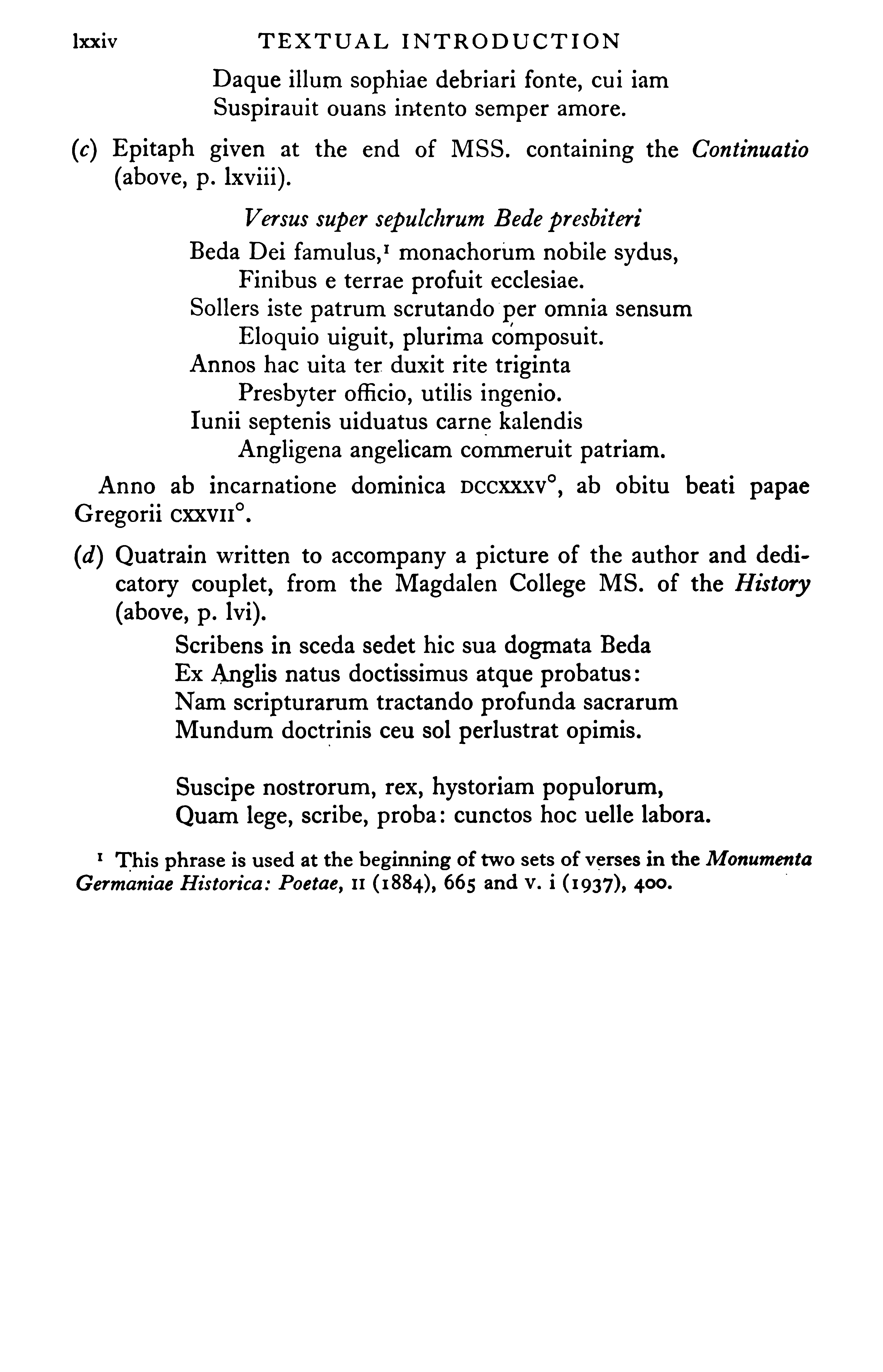
Daque illum sophiae debriari fonte, cui iam Suspirauit ouans intento semper amore.
(c) Epitaph given at the end of MSS. containing the Continuatio (above, p. lxviii).
Versus super sepulchrum Bede presbiteri Beda Dei famulus,1 monachorum nobile sydus,
Finibus e terrae profuit ecclesiae.
Sollers iste patrum scrutando per omnia sensum Eloquio uiguit, plurima composuit.
Annos hac uita ter duxit rite triginta Presbyter officio, utilis ingenio.
Iunii septenis uiduatus carne kalendis Angligena angelicam commeruit patriam.
Anno ab incarnatione dominica dccxxxv0, ab obitu beati papae Gregorii cxxvii0.
(d) Quatrain written to accompany a picture of the author and dedi catory couplet, from the Magdalen College MS. of the History
(above, p. lvi).
Scribens in sceda sedet hic sua dogmata Beda Ex Anglis natus doctissimus atque probatus:
Nam scripturarum tractando profunda sacrarum Mundum doctrinis ceu sol perlustrat opimis.
Suscipe nostrorum, rex, hystoriam populorum, Quam lege, scribe, proba: cunctos hoc uelle labora.
This phrase is used at the beginning of two sets of verses in the Monumenta Germaniae Historica: Poetae, ii (1884), 665 and v. i (1937), 400.