Cyril's Theology
ST. CYRIL OF JERUSALEM
Of the twelve clauses of the creed, all but the third and fourth are quoted verbatim in the Catecheses and can be reconstructed with considerable confidence from the following passages: 7.4, 9.4, 11.21, 14.24, 15.2, 17.3, 18.22.
Cyril died in 387.37 Commemorated among the blessed in the Eastern Church since the fifth century,3S Cyril was proclaimed a Doctor of the universal Church by Pope Leo XIII.
His feast is kept on March 18th.
5. Cyril's Theology Cyril's theology was highly apophatic. Pseudo-Denis the Areopagite spoke of an apophatic ("negative") theology as a way to the knowledge of God through negations. But by characterizing Cyril's theology as apophatic, I refer to his insistence that we can know of God only what has been revealed.! This position, implicit in the conception of a divine transcendent revelation, Cyril held in common with all the Fathers and classical theologians, and it was strongly reaffirmed by the First Vatican Council. It was probably this principle that caused Cyril to refuse for so long to accept the "consubstantial" as defined by the Council of Nicaea; it is likely that he held out until it was recognized that the "consubstantial" (homoousion) need not be interpreted as affirming anything more than is taught in Scripture. Not that in principle Cyril barred theological speculation, but he thought that its conclusions could not have the same certainty or authority as belonged to scriptural truth. In particular he emphasized (what, of course, all theologians assert) that the 37 P. Nautin, "La date du De viris illustribus," Revue d'histoire eccltisiastique 56 (1961) 33-35; Jerome, De vir. illus. 112.
38 See the calendar in Rituale Armenorum, edited by Conybeare and Maclean.
---cyrH'thought of the revelation in a "propositional" way, i.e., as the imparting of mysterious truths. Nevertheless he also understood it as God's self-disclosure in history; he had some grasp of revelation as "salvation history" (Heilsgeschichte).
GENERAL INTRODUCTION
divine nature and "the mysteries of Father, Son and Holy Spirit" (i.e., the Creed) are profoundly mysterious and beyond man's comprehension. It is quite characteristic of Cyril to say (6.2): "For concerning God it is high knowledge to confess our want of knowledge." Significantly he continues:
"Therefore glorify the Lord with me .... " Cyril thought that the purpose of the revelation was to guide aright our worship, devotion and conduct and that immoderate curiosity was doomed to remain unsatisfied and tended to produce strife in the Church. Such an apophatic theology tends to pile up negatives;2 we can deny of God anything that implies imperfection, but of the nature of God's inmost being we cannot have exact positive knowledge. The reader will find illustrations of this apophatic approach at 4.17; 5.12; 6.2,6.4-8;
7.5; 9.1-3; 11.9-12; 16.5.
In trinitarian theology Cyril belonged to the right wing of the Eusebian or Eastern school. This school, though its origins are obscure, seems to have been the product of the meeting of a diluted Origenist tradition with a (not very scientific) biblical theology, stressing the literal meaning and historical side of the scriptural record, as practiced at Antioch. While this school aimed at scientific exegesis, Cyril had rather more sympathy with the spiritual and allegorical senses of Scripture. To risk a generalization: while Latin theology translated into philosophical terms the biblical record of revelation as interpreted by tradition, this Eastern school constructed its theology more directly from the Scriptures. This procedure had its dangers on account of the great development within the New Testament's christology; if the biblical theologian failed to notice this development and the transformation in the New Testament, whether through their deepening, or hellenizing, of certain Old Testament Semitic categories (e.g., "Son of God" or "image"), he might find himself an Arian. But the method also had its advantages. It saved the theologian from what 1. A. Richards has called, in 2 Cf. Cat. 7.5.
ST. CYRIL OF JERUSALEM
relation to poetry, the "stock response," i.e., the interpreting of a poem simply on the basis of one's previous experience instead of being open to what is unique, original and excitingly new in the poem and allowing that to re-create one's ways of thinking and feeling. Eastern theology was more aware of the highly personalist Hebrew categories in the Bible and of the functional and historical, rather than metaphysical, character of the revelation. It read the Bible as a "salvation history," a story in which the leading role in the creation and new creation of mankind is played by three very exciting and distinctive Persons. It reacted sharply against any suggestion that the Three were really "substantially one."
Nor would it wish to see the story dissolved into philosophy.
Not only Cyril's silence about the "homoousion" shows that he belonged to the Eastern school. Though he was perhaps unaware of the logic underlying his position, he seems to have held the "Eastern" trinitarian theology approximately as described above. Cyril does not interpret John 10.30 as teaching a numerical unity of the (concrete) divine essence:
He says, not "I am the Father," but "the Father is in me" ... He did not say, "I and the Father am one," but "I and the Father are one" ... "One" they are because of the dignity proper to the Godhead, since God begat
God. "One" on account of the unity of their reign, for the Son's subjects are not different from the Father's, as if He were an Absalom in revolt .... "One" because of the absence of discord and disagreement, for their wills and purposes are the same. "One" because the handiwork of Christ is not different from that of the Father; rather there is a single production of the universe, the Father having made all things through the Son. "He spake ... ," for He who speaks speaks to one who heeds, and He who issues commands issues them to One who is present with Him.3
Although Cyril recognized a hierarchy in the Blessed Trinity, he recognized also that the three Persons all belong
3 Cat. 11.16.
GENERAL INTRODUCTION
absolutely to the side of the divine and the transcendent; they were partners in creation and redemption, together rule the world and history, and are uniquely the source of being, life and salvation. Their unity was a moral unity, a unity,
Cyril explains (11.16), of rule or reign; again, they acted, as it were, as a team under the captaincy of the Father, and the Son's and Spirit's relations of origin to the Father gave the necessary ontic unity. The pattern of rule and action corresponds to the relations of origin. As the Father begets the Son, so He commands and sends Him, while the Son performs the commands of the Father. The being and dignity or status of the Three are known from their names and functions.
Christ is God, but God the Son:
The Son, then, is Very God, having the Father in Himself, but not changed into the Father; for the Father was not made man, but the Son. For let the truth be freely spoken: the Father did not suffer for us Himself, but sent
Him who suffered. Let us beware either of saying that there was a time when the Son did not exist, or identifying the Son with the Father. Rather let us walk in the King's highway, turning aside neither to the right nor the 1e£t.4
We may, perhaps, find an analogy to this "unity of rule" in the system whereby the reigning Emperor admitted his sons to partnership in sovereignty, making them consortes imperii. In defining the divine unity, Eastern theology also sometimes toyed with the idea of a sort of "concrete universal,"5 rather as Scripture regards mankind as a collective, in a profound sense a single Man, fallen in Adam and restored in Christ, the New Man. Again, the East emphasized that there is but one, Unoriginated (agenetos or anarch os), the Father. This hierarchy and differentiation in the Godhead is found also, of course, in Western theology, but there it is less prominent, being overshadowed by the substantial identity
4 Cat. 11.17.
5 Cf. Gregory of Nyssa, Quod non sunt tres dii. Gregory's final answer, however, is not this.
ST. CYRIL OF JERUSALEM
of the three Persons. 6 But in Eastern theology the full (generic) divinity of Son and Spirit is safeguarded and expressed by their coordination in the creed, the baptismal formula and the doxology.
Cyril's regular formula is not the "coessential," but "like the Father in all things."7 Cyril teaches that the Son is anarch as (unoriginated) in the sense of "having no beginning in time." But the Father alone is anarchos in the sense of having absolutely no origin. In Cyril, "God" seems to be the proper name of the Father, though of course the Son is God.8
The Father is. the Unbegotten, the Son the Only-begotten.
"The Father is the beginning [origin, principle] of the Son, himself without beginning," i.e., the arche anarchos.9 A glance at Toutee's apparatus criticus shows that anarchos has been interpolated in a number of places (e.g., 11.4, 5, 7, 13), presumably to make Cyril teach that the Son is in every sense
Unoriginate. Cyril emphasizes that the Son's begetting was ineffable and "before all ages." He seems to have interpreted eternity in the Greek manner as a "timeless now," not as an infinitely long time (time in the sense of "a before and after"); certainly he makes it clear that "before all ages" means timelessly, outside time (achronos, aidios).
Origen sometimes said that the Son was begotten of the Father's will.1° Athanasius seems to have held or implied that the begetting was by an essential necessity; without the Logos, he says, the Father would have been alogos. Did the Father beget "by nature" or by deliberation and free choice? The Arians argued that the Father cannot have begotten unknowingly or involuntarily, yet free choice presupposes de6 Similarly in Western, as in Eastern, theology the Father is principal agent in redemption as well as in creation, performing both through the Son. It is only "by appropriation" that the Son is "the Redeemer."
The Father conceived and planned the operation and "sent" (com· missioned) the Son, who is the executive, the "commander in the field."
7 Cat. 4.7; 11.4, 18.
8 Cat. 4.4, 7, 16 fin.; 11.4,7,20.
9 Cat. 11.20.
10 Origen, De principiis 4.4.1.
GENERAL INTRODUCTION
liberation. Cyril answered that the Father begot neither unknowingly nor after consideration involving an interval; God begot knowingly and (apparently) voluntarily, but eternally;l1 and the Son was a natural Son. Correspondingly the Father was a perfectly free agent (autoproairetos) in bestowing the Lordship upon the Son, but the Son was the natural heir to it. Moreover, while the Lordship was "delivered unto Me of my Father," there never was a time when He was not Lord;
He ever shares His Father's throne.12 The whole thing is beautifully balanced. For Cyril's doctrine of the "Monarchy"
(the singleness and single rule of God) see Catecheses 6.1-11, 7.1 and 16.4. Here are two typical excerpts: 13
Let the thought of "Father" accompany the thought of "God," that the praise of the Father and the Son be indivisible. For Father and Son have not two different glories, but one and the same. For the Father has an Onlybegotten Son who, when the Father is glorified, shares his glory. For the glory of the Son flows from the Father's dignity.
Our hope is in Father, Son and Holy Spirit. Not that we proclaim three Gods ... ; no, we preach one God, with the Holy Spirit and through one Son. The faith is indivisible, the worship inseparable ...
O. Perler (LTK 6.710) is correct in saying that Cyril is somewhat subordinationist, as the following passages show: 7.5;
10.5,7, 9f.; 11.l0, 12-23; 12.16; 14.27; 15.25, 30. But although Cyril's theology is subordinationist in a pejorative sense by the norms, and within the pattern, of Western theology, need we pass the same judgment when we view it within the different pattern and presuppositions of Eastern theology?
In spite of the (original) Nicene Creed, Cyril never speaks of the Son being generated "from the substance of the Father," but simply "from the Father." He emphasizes strongly
11 Cat. 11.4, 7, 8, 20. The formula which has prevailed is "neither by necessity nor by free will, but by nature."
12 Cat. 10.9; Matt. 11.27.
13 Cat. 6.1; 16.4.
ST. CYRIL OF JERUSALEM
that neither men nor angels can know anything of the Father's essence, and that the generation of the Son is particularly mysterious, altogether ineffable: the Son is born as God "himself only knoweth."14
What is the relation of the Trinitarian theology of the Lectures to that of St. Athanasius and the West? It is notorious that the word "of-one substance" (homoousios) does not occur in St. Cyril's writings. But that may not be very significant, since St. Athanasius himself made little use of the word, even in his anti-Arian writings, before the revival of Arianism in 357-8. And in those same earlier writings Athanasius quite often used formulas equivalent to Cyril's "like the Father in all respects." In an article that is very illuminating on the historical side, Msgr. J. Lebon15 has maintained that, while
"politically" Cyril was for many years arrayed with the central Eastern bloc that was critical of the Nicene formula, theologically his position was indistinguishable from that of the Athanasian-Western party; while for adventitious reasons (e.g., because of reluctance to introduce a non-scriptural word into the Creed) Cyril eschewed the "homoousion," actually his theology was implicitly that of St. Thomas Aquinas and later
Scholasticism, insofar as he distinguished sharply, though not explicitly, between nature and person and even implied the doctrine of the "numerical" identity of the divine nature of the three divine Persons. But little evidence, and no convincing evidence, has been produced for this widely accepted view.
In what direction does the external evidence point? Apart from his silence about the "homoousion," Cyril flatters Constantius II, in his letter to him, more than courtly politeness demanded, saying (Ch. 3) that he surpasses the piety or orthodoxy (eusebeia) of Constantine. Again, although the date of Cyril's acceptance of formal Nicene orthodoxy is debatable, both Socrates and Sozomen seem to say pretty clearly that he
14 Cat. ll.8, 11.
15 Op. cit. (supra, Bibliogr.), in Rev. d'hist. eccl. 20 (1924) 181-210, 357386.
GENERAL INTRODUCTION
accepted it only on the eve of the second ecumenical council (only when the Emperor made it mandatory?). The Lectures themselves give some indirect clues to Cyril's position when he says repeatedly (4.8; 11.13, 16, 18; 16.4; 17.34) that orthodoxy stands midway between two heretical extremes. The two extremes are obviously those of the Arian and Sabellian type, but since, as Toutee noted,16 in 15.9 Cyril describes them as widespread and disguised, they cannot have been overt and explicit Arianism and Sabellianism. Presumably, therefore, one extreme was represented by the "Eastern" party or some group in it (Eusebius of Nicomedia? Acacius?), and the other was the Athanasian-Western party or some group in it, presumably Marcellus' since Cyril attacks him strongly in 15.27-30.
It is possible, however, that Cyril attacked Marcellus openly only because he could be attacked with safety, but was in fact also somewhat suspicious of the Western school.
Passages like 11.12 can only be directed against the Nicaeans.
Cyril's own orthodoxy can hardly be doubted, since he followed Scripture almost verbally and is a Doctor of the Church. The basic requirement for Trinitarian orthodoxy seems to be the recognition that the Son is truly, in the proper and strict sense, God. This requirement refers especially to the Son's divine nature; as a Person, precisely as the Son, it is allowable to say that He is, while truly divine, in some sense subordinate to the Father. The equality of nature means (at least) that the Son has all the same attributes or predicates
(omnipotence, eternity, etc.) as the Father, and shares the Father's divine titles and functions as creator and ruler of the universe and source of all saving grace. If, however, a distinction should not be drawn between nature and person, the requirements of orthodoxy may perhaps be safeguarded in a different way.
There are three prima facie possible ways in which the three divine Persons may be related to the divine nature. On any orthodox theory They must have "the same" nature; i.e., they
16 PG 33.43-44.
ST. CYRIL OF JERUSALEM
must be homoousioi; they must, in Aristotelian language, have the divine nature in common. But the unity of the divine nature might be specific, numerical, or generic. If the Three had "the same" specific nature, They would have it in common in the same way as three men have "the same" human nature. But this is impossible because (a) since individual instances of a species are distinguished from one another by their matter, no spiritual (immaterial) species can have more than one instance; hence St. Thomas Aquinas taught that every angel constitutes a species of its own;17 (b) originatedness (begottenness or procession) would on this analysis have to be classified as a merely "accidental" differentia, whereas it seems to be more than that; (c) the theory would be, or involve, tritheism.
To say that the divine Persons have numerically the same nature is to say that They have in common literally the same identical concrete nature. This is St. Thomas's theory and the theory which Lebon thinks Cyril held implicitly. On this theory a sharp distinction is drawn between person and nature, and the Three, while different ("distinct") as Persons, are yet each identical with the same thing, the one divine essence.
The Persons are held to be subsistent relations. St. Thomas's synthesis is brilliant and profound, but it seems to leave us ultimately (as the Orthodox East complain) with one thing instead of three. Moreover it is not easy to see how it does not involve a contradiction in terms. If in defence of the theory it is urged that the Three possess the identical nature in different ways, the First Person as begetting (it?), the Second as begotten, and the Third as proceeding, this seems to make some concession to the specific or generic view.
It is the third, the "gene1'ic unity or identity," view which 17 Sum. thea I. I, 76, 2, ad 1: "multi autem angeli unius speciei omnino esse non possunt." Not that St. Cyril supposed that angels are immaterial; in common with the Bible (at least usually) and a learned tradition that continued up to the seventeenth century (e.g., Milton), he held that angels are composed of a fine, subtle, spiritual substance; for the relevant passages, see Index, s. v. "angels."
GENERAL INTRODUCTION
provides the logical framework that, though never made explicit, seems to be required by all, or almost all, Cyril's
Trinitarian expositions. On this view the divine Persons are three, not individual instances of a species (like three men), but three individual subsistent species which are members of the same genus (deity); They have the same generic nature.
The Trinitarian logic, on this view, will be broadly similar to that governing three Thomistic angels. The relationship of the Persons to the divine nature will follow the same general logic as the relationship of a Cherub, a Seraph and a Domination to the (generic) angelic nature, or (if it may be said with reverence) as the relationship of the three species of triangle, isosceles, scalene and equilateral, to the genus triangle. In the three logics the relationship of the individuals' distinguishing characteristics (idiotetes, gnorismata) to the common nature is different. When, as in three men, the common nature is a species, it differs concretely in the three only accidentally. 1£ three beings have numerically the same common nature, clearly it does not differ in the three at all. But the distinguishing characteristics of individual species of one genus may modify the common nature internally; in any case they are likely to be of more than "accidental" importance.
A Cherub, a Seraph and a Domination are three different ways of being an angel, and perhaps the same applies to the three types of triangle. On this logic Father, Son and Holy Ghost will be three different ways of being God. While each will be
God in the proper and true sense, They will be God in the same generic sense, but not in the same specific sense. This logic does not allow the strong distinction between nature and person which enables one to draw sharp distinctions between the Persons in regard of origin while at the same time stressing the identity of nature. For on this logic the personal distinguishing characteristics (which are related to the question of origin) determine the nature and modify it internally. But the interrelationship of the members of a genus is not uniform; it depends upon the particular case. That is perhaps
ST. CYRIL OF JERUSALEM
why St. Cyril did not make explicit the genus-species model of his thinking. For it is open to abuse, as St. Athanasius pointed out when he remarked that the divine nature could not be paralleled with that of "animal," with its species of man, lion and wolf, or illustrated by three kinds of metal, for instance, the royal metal, gold, silver and base metal, copper.
The advantage, for theology, of the genus-species logic is that it is flexible. It does not, as the choice of the logic of specific or numerical identity of nature does, predetermine the whole pattern; the precise pattern is filled in accordance with the biblical data. Cyril, of course, by refraining from specifying any logic, retained a sovereign freedom to expound the doctrine of the Holy Trinity in entire fidelity to Scripture. But his exposition is compatible with, even seems to require, the genus-species logic; certainly within that framework it can be best understood. This also seems to be the logic of the Cappadocian Trinitarian theology, though even the Cappadocians never spelt it out fully.
A theology implicitly based on something like this genusspecies logic will be pluralist in the Eastern way of Origen.
It will take seriously the Son's character as the Son and the mystery of the divine begetting, and it will be, by the standards of modern Scholastic notions, somewhat subordinationist. Cyril's Trinitarian theology clearly has three characteristics. It is pluralist insofar as Cyril stresses that Son and Spirit are independent substantial beings (4.7, 8; 11.10; 17.5). Msgr.
Lebon18 has singled out 1l.l6, Cyril's exposition of John 10.30
("I and the Father are one") as a clear illustration that Cyril held implicitly the doctrine of numerical identity. But 11.16 offers four expositions of this text, and none of them approaches the idea of numerical identity. The point does not need discussion. Indeed 11.16 is one of the passages noted by Perler in the L TK as subordinationist. Its subordinationist and pluralistic character come out in the last sentence of the section.
18 op. cit. (n. 15 supra) 376·381.
GENERAL INTRODUCTION
Passages (e.g., 11.1 0-12, esp. 11.11) emphasizing the ineffability of the Son's generation and of the Father's substance
(ousia) probably provide the explanation of the puzzle why Cyril could not accept the homoousion. It is a puzzle because homoousios can designate community of generic as well as specific nature. But apparently by 350 it was naturally taken to refer to unity of specific nature or to sameness of concrete substance. Both interpretations would present difficulties for Cyril. The latter might be judged to be implied by N's "begotten from the Father, that is, from the substance of the Father." For Cyril, "God" was the proper name of the Father (even though Christ was properly and strictly God), and the divine substance was identical with the Father. For Cyril, it was this divine substance which was entirely transcendent, incomprehensible and ineffable, known only by the Son and the Spirit, and before which human speculation must be silent (6.5). Moreover, if the divine substance is defined as identical with God the Father, then the Father will beget according to (divine) genus, not according to species; else the Son too would be Unbegotten-a proposition which Cyril denies a score of times.
This ineffable mystery of the divine generation is central in Cyril's theology. The Arians held that the Son was begotten in the same, improper or metaphorical, sense as the creatures.
Orthodoxy says that the divine begetting is literal and proper though analogical. Cyril insists that this must be taken seriously; a son owes his existence to his father and (consequently) is bound to obey him. Moreover there is one important difference between human and divine begetting. A human son has exactly and specifically the same nature as his father. For his father too is a son; he is not unbegotten. Cyril discreetly makes this point in the many passages where he insists that the Son is not unbegotten; there is only one Unbegotten,
God the Father; see 4.4; 7.10; 11.2,4.
The nature and pattern of Cyril's theology roughly corresponds to the logic of three angelic species/individuals; the
ST. CYRIL OF JERUSALEM
divine Three have proper names which are also descriptions of the Individuals who own them (7.1; 8.1; 10.1, 2, 5). Thus the name of the first Person is God. He is further described as the Unbegotten or Ingenerate, the Father of the Son, and the Creator. Cat. 4.4 provides a good example: "There is but one God; He is unbegotten, unoriginate . . . not begotten of another ... There is one only God ... the Father of the Only-begotten Son." Compare 11.13: "neither two Unbegottens nor two Only-begottens ... ; to be unbegotten is to have no father." The last clause is significant; here, as often elsewhere, Cyril is trying to open our eyes, blinded by custom, to the significance of the New Testament's language. There is only one Unbegotten, Cyril insists; to be Unbegotten is not to have a father. The Only-begotten also is unique, not in having no Father, but in having no brother. Thus Cyril emphasizes the doctrine of the Monarchy, but not in a modalist
(Sabellian) but in an anti-modalist sense.
The Second Person is the Only-begotten: the Son, or God the Son, or the Son of God, or the Lord, or "the begotten
God"; only the eternal Son became man and suffered; Cyril protests against Patripassionism; 4.4, 7, 8 and passim. According to Socrates (1.23) and Sozomen (2.18; d. 3.18) very soon after 325 many Eastern bishops reached the view that Nicaea's
"consubstantial" and "begotten from the substance of the Father" were a blasphemy against the Son and destroyed His hyparxis-presumably either by implying His numerical identity with the Father, or by asserting the specific identity of two immaterial Beings, or, more likely, by denying His distinctive characteristic as the Son.19 The name of the Third is the Holy Spirit. Cyril insists on the uniqueness of each:
"There is only one Holy Spirit, the Paraclete ... There is 19 Of course, the Nicene "consubstantial"
("homoousion") need not have these implications. It depends on the meaning assigned to that highly ambiguous word. Cyril equivalently teaches the "coessential" in two senses: (1) "having the same essential predicates (or description)" and (2) "of the same divine nature," nature or essence being understood, as it must be in the case of spirits, as a genus.
GENERAL INTRODUCTION
one God, the Father ... and one Lord, Jesus Christ . . . and one Holy Ghost" (16.2).
It is a magnificent theology, a brilliant statement. Free from the self-conscious theorizing of the splendid Cappadocian theology which it essentially anticipates, it is concrete, attractive, devotional, biblical, Johannine in the tradition of Origen, but having a higher doctrine of the Son than Origen, whose theology, excessively dominated by the Logos concept and occasionally influenced by Middle Platonism, was somewhat minimizing. Cyril's concept of the "begotten God" somewhat resembles Origen's distinction between the supreme and absolute God (autotheos) and the second (deuteros) God.
Similarly, Cyril is influenced by Origen when he says (4.8; contrast 11.16 etc.) that the Son is creator of all who partake of reason; Origen taught that, while the Father was universal creator, the Logos made all rational creatures. Cyril's Trinitarian theology is also approximately that of Milton's Paradise
Lost. It is a masterly achievement; Cyril's superb theological style masks the extraordinary precision and finesse with which he expounds the central orthodoxy, the Royal Road (11.17).
His theology is a tritheism qualified and redeemed by subordinationism, and a subordinationism qualified and redeemed by tritheism. The two criticisms cancel out. The Eastern party was accused of teaching polytheism (Socrates
1.23) and subordinationism.
Cyril taught that the Son is perfect Son of the perfect Father, that He is Very God and perfect (teleios: 4.7; 7.5;
11.18) God. He is creator and Lord of all without exception.
While (16.4) "we preach not three Gods ... but one God, with the Son and the Holy Ghost," yet "their worship is inseparable." This is all very right. The Son is the natural
Son of God, and like begets like; the Father "begat God"
(11.18). As the "express image of the Father's substance," the Son has exactly the same attributes or predicates (eternity, etc.) as the Father. Therefore the "description" of the Son is the same as that of the Father. For "description," or sum
ST. CYRIL OF JERUSALEM
of predicates, may logically refer to essence and prescind from existence, the question of origin and existential status. As St.
John said, the Father is in the Son, and to see the Son is to see the Father. Moreover the Father has conferred upon the Son all His prerogatives, such as lordship, and has associated the Son with Himself in the creation and rule of the universe. But if unoriginatedness be included among the list of predicates, then, Cyril repeatedly emphasizes that the Son is neither unbegotten nor absolutely unoriginated (anarch os).
The Son is, however, both eternal and uncreate; and for Plato eternity was the hallmark of deity. Yet while, unlike the creatures, the Son has no arche (beginning, principle, origin) in time, He has an eternal arche in the Father. The Father alone is absolutely anarch os, the unbegun beginning or unoriginated origin (arche anarch os: 11.14, 18, 20). The unhappiness of the copyists at this doctrine is reflected by their interpolating (the manuscripts so far edited suggest) the word anarchos at 11.4, 5, 7, 13, 14, to make Cyril conform to the orthodoxy of a later, scholasticizing age. But Cyril's doctrine is the paradox of the derived, the begotten, though not created, God. "Son," alike in Scholastic and Hebraic thinking, implies on the one hand the inheritance of nature and rank, but also dependency and subordination. God begets God, but He cannot beget an Unbegotten. Certainly "there is nothing lacking (in deity)" to the Son (4.7; 11.13), but this refers to content, not the existential status or origin. Similarly in creation, the Son created all things "at His Father's bidding";
He rules the universe because the Father has committed to Him all authority. His rule is eternal and divine and by birthright (ek physeos), but it is delegated; He sits as Crown
Prince at the Father's right hand, who alone has absolute sovereignty (authentike exousia). Everywhere in his exposition of the Son's role as creator, lord and judge Cyril emphasizes that He is invested with these offices by His Father, holds them in dependence on the Father, and exercises them in submission to the Father (7.5; 10.5, 9; 11.10, 22, 23). The
GENERAL INTRODUCTION
Son's status and activity correspond exactly to His nature and being as the Only-begotten. It was not that Cyril was unaware of possible distinctions between the Son's person and nature, or between His divine and human nature; no, en pleine conscience he expounds his doctrine. For Cyril the Son's title, the Son or the Only-begotten, tells us both who and what He is. He emphasizes that the Son Himself glories in His position:
"He was not ashamed to call His Father 'His God'" (11.18).
When (11.16) Cyril quotes John 14.11, "the Father is in me," he explains it (11.18), with his profound feeling for Johannine theology, as meaning that, as the living image of His Father, the Son reflects and reveals Him; he correctly relates it to John 14.9. Similarly in 11.18, which is a magnificent summary of his position, Cyril explains the meaning of "separate" in his common formula, "we must neither confound nor separate Father and Son." In Cyril, as in most patristic
Trinitarian contexts, "separate" means of a foreign or contrasting nature; the Only-begotten is not a creature, but "own Son" (idios) of the Father. It is decidedly not a question of God and god, though perhaps of GOD and God. A score of passages show that St. Cyril reg;;trded any interpretation of the Son as a mode, manifestation or "presentation" of the Father as Sabellian. "Separate" has also a kind of local, or even social, sense in Cyril; he thinks of the Three Inseparables, for the Holy Spirit is always around too (aei symparon, d. Procat. 15; Cat. 15.24; 17.5).
The puzzle is that so many of Cyril's formulas can be paralleled almost verbally in Athanasius, even some of his
"subordinationist" passages, e.g., his quoting the Fourth Gospel to the effect that "the Son can do nothing by himself, he can only do what he sees the Father doing" (John 5.19; d. 5.21, with C. K. Barrett's commentary). But the emphasis in Athanasius is usually a little different, and in his later writings the trend is towards "numerical" identity, though he usually, perhaps always, avoids committing himself to it unambiguously. He may have come to think that the line as
ST. CYRIL OF JERUSALEM
drawn by Cyril could not be held, it was too subtle. But probably he never quite grasped the Cyrilline position; he could not quite match Cyril's intellectual distinction. The metaphysical approach was explicitly developed in the socalled Athanasian Creed, but this was never a recognized standard of orthodoxy in the East and scholarly opinion is hardening in the view that it was the theology of St. Cyril and the Cappadocians that was canonized by Constantinople I (A.D. 381), when, ratifying the Nicene "homoousion," it interpreted it in the sense of "three hypostases and one ousia," a formula which, like St. Cyril himself, was anathema to St.
Jerome, the admirer of Athanasius.
Is monotheism safeguarded in Cyril's system? The Greek Fathers' approach to the problem of the divine unity was not primarily arithmetical. In Cyril's system the "Monarchy" is safeguarded in many ways: (I) There is a single source of deity. (2) The divine Trinity is a single source of created being. (3) The Three possess a generic unity. (4) "God" is the proper name only of the Father. (5) There is a single harmonious and hierarchical divine action in creation, world-rule and salvation: the Father does all things by the Son in the Holy Spirit. (6) While standing absolutely on the divine side of the gulf dividing God and creatures and possessing all the essential predicates of deity, the Only-begotten and the Holy
Spirit derive their sovereignty from the Father. (7) There is a kind of (analogical) unity of "race" (genos). (8) The Three are Inseparables, and Their worship is indivisible. Howbeit, if haply I err in this matter, I declare my submission and adhesion to the holy Catholic and Apostolic faith.
The Cappadocian theology, which took up the torch, was probably more Eastern than Western, though its distinction between nature and idiotetes (the distinctive characteristics and relationships of the Persons) might presuppose the concept of either specific or generic nature. The definition by Constantinople I in 381 of "three hypostases in one ousia" was probably a compromise between Eastern and Western
GENERAL INTRODUCTION
trinitarian theology. Nicaea had used ousia and hypostasis as synonyms in its anathematism, and as late as 376 St. Jerome, a strong Westerner, was imploring Pope Damasus to resist a definition in these terms. Many, but probably not all, Roman
Catholic theologians hold that the Fourth Lateran Council (1215 A.D.), with its formula una summa res ("one supreme reality"), finally settled the question in favor of (numerical) substantial identity. Yet the Church made Cyril a Doctor of the Church quite recently.
It is regrettable that Cyril was not content with distinguishing sharply between revelation and speculation, but seems to have eschewed systematic theological reflection. For his trinitarian theology could be related in interesting ways to other dogmas, notably the incarnation and work of Christ and the restoration of man. Highlighting the functionally differentiated and hierarchical pattern within the Trinity and taking with full seriousness the eternal obedience of the Son, this theology suggests an intelligible inner continuity between the preexistent and the incarnate Christ "obedient unto death." Especially is this true when the redemption is conceived as the restoration in man of the divine image; for it is precisely as the obedient Son that the Word is the eternal Image, and it was precisely by disobedience that man lost the divine image-by-grace and divine sonship, and by his obedience as the second Adam and new Israel that Christ restored it. Again, if we think of man's task in Eastern terms as his divinization by grace, the Eastern theology, with its emphasis on the three Persons rather than the one divine nature, reminds us that God is not only the infinite Good but also the obedient and loving response to divine generosity and goodness.
Cyril reminds us that by his ascension Jesus is not removed from us, but rather is made universally available: 20
He both sits on high and is here present together with us ... His absence now in the flesh does not mean that 20 Cat. 14.30.
ST. CYRIL OF JERUSALEM
He is absent in the Spirit. He is here present in the midst of us ...
Thus Cyril concludes Catechesis 14 with Bonhoeffer's "transcendent in the midst." But it is in the "contemplative" or "mystical" exegesis,21 employing imagination in Coleridge's profound sense of the word, rather than in the catechizing, that such "existential" themes are best explored_ Cyril's
Homily on the Paralytic is a study in encounter with the Transcendent historically revealed in Christ. The dramatic suspense of this homily depends on the enigmatic personality of the Healer and the success or failure of the various characters to penetrate the disguise of Him who is "the true
Bread," "the Light which lightens every man," "the resurrection," "the physician of souls" and "the Lawgiver." The opening sentence abruptly proclaims jesus as "the Man for others": "Wherever jesus appears, there is salvation." This jesus "makes himself all things to all: to the hungry, bread, to the sick, a physician, to sinners, absolution," and He comes bringing not empty words but deeds, especially to those in desperate straits.22
Sozomen has an interesting passage: the emperor Constantius, he says, at first followed the Nicene beliefs of his father
Constantine, but was later converted to Homoeousianism. For the Eusebians and other Eastern bishops of the same generation whose life and intelligence commanded admiration drew a distinction between homoousios and homoiousios, teaching that the former properly applies only to material things like men, animals, and trees, which (severally) have the same specific nature and reproduce after their specific kind. But in the case of immaterial beings, such as God and angels, the proper term to express corresponding relationships is homoiousios, for here no species can include more than one member, but each existent individual is unique.23
21 theoretike, Cat. 13.9.
22 Homily on the Paralytic 1, 5, 7, 9.
23 Sozomen 3.18.1-3. It may be suspected that, quite soon after Nicaea,
GENERAL INTRODUCTION
The Eastern theologians were aware of the biblical usage by which a proper name is the clue to function, and function the clue to nature. They knew, too, that "father" in the Bible connotes authority, and that the essential characteristic of a son is to obey;24 and they thought of divinity to a large extent in terms of authority rather than ontologically.
Again, the idea of "father" and "unbegotten" is close to the idea of creator, the "self-existent" "uncaused" or "unoriginate," which common sense and philosophy both asserted to be an essential predicate of God. Thus they reached the idea that Christ, as the Son and heir of his Father's nature, has the divine nature and is truly and properly God, yet the Father (the Old Testament Creator God, Jehovah, the Lord of Hosts) is God par excellence. Here one can see how the divine begetting created a problem, and why Cyril insisted that it must be left shrouded in mystery. For while we have empirical knowledge about procreation in the human and animal world, where reproduction is according to species and "like begets like," the Father's specific nature includes Fatherhood; his genus is deity, but his specific differentia is to be a Father and the Unbegotten. But presumably as an individual member of a species begets according to his species, so an individual species begets according to genus. Therefore, the Father will beget God, but God the Son, not the Unbegotten but the Only-begotten. Yet "God" is the Father's proper name, and moreover one had begun on the assumption that to be self-existent, unoriginate and unbegotten was at least a primary predicate of deity. Still, reflection guided by revelation suggests that absolute and unqualified unoriginateness need be a predicate only of God par excellence; the unique Son of the Unbegotten and Unoriginate is truly
God; for the Father has communicated to Him all his divine Constantine changed over to the "Homoiousian" doctrine, though not then so called.
24 Israel's claim to sonship depended on its obedience. and by his obedience our Lord showed Himself, and created. the new Israel.
ST. CYRIL OF JERUSALEM
nature except unbegottenness; the Son remains within the charmed circle of deity. To be begotten by the Self-existent in such wise as to have exactly the same generic nature as He, is certainly to be God. This exact sameness of (generic) nature is sometimes illustrated by the Fathers by the image of two torches or lights, one of which has been kindled from the other. They are exactly alike, indistinguishable, "Light from Light." St. Athanasius, however, was not satisfied with this metaphor. One can see St. Cyril's Seleucian ally, Basil of Ancyra, reflecting on the question and the linguistic problem in his synodical epistle (358) and invoking the biblical distinction between theos and ho theos as exemplified in Philippians 2.6-11.25
Just as Christ, he says, "born in the likeness of men," was truly man, though not man in all respects (for He was not born, like men, from human seed and through marital intercourse), so He who before the ages was the Son is God, as being the Son of God, just as, incarnate, He was man, as being the Son of Man:
So being "the Son of God (tou theou)" and "being in the form of God (theou)" and being "equal to God
(theoi)," He had the essential predicates of Divinity, being like the Father in incorporeality, deity and the divine operations . . . [Paul does not say that] He is
"the form of ho theos," but "of theos," nor that He is "equal to ho theos" but "to theos" . . . Those who deny the essential likeness of the Son to the Father make Him not a Son but a creature ... The concept of "likeness," however, does not imply total likeness to the Father as an individual,26 but likeness in nature, just as "the likeness of sinful flesh"27 does not imply total similarity to historical man (who is a sinner) but specific sameness.
25 Epiphanius, Haer. 73.9. My translation abbreviates and paraphrases a little.
26 tautoteta. So Origen (Contra Celsum 8.12) speaks of tautoteti boules, i.e., not a single will (as faculty), but of several wills having the "same" decision or resolution.
27 Rom. 8.3.
GENERAL INTRODUCTION
Only the Father, Basil also says in this passage, is God authentikos, that is, "principally," par excellence or "as an original" (of which the Son is a replica). This passage incidentally illustrates what seems to be the normal meaning of tauto and tau totes in the Fathers in this context, i.e., specific identity or exact likeness without exception or qualification-and not, as is often assumed nowadays, the literal identity of two things. Similarly homoios seems normally to mean not some degree of resemblance, but exact likeness in all respects under consideration, though the likeness may be understood to be limited in range, intensity or substantiality.28
The passage probably also shows the nature of the orthodox Eastern objection to the "homoousion." Apparently by the fourth century the natural and usual meaning of homoousios was "of the same specific nature." Now, while the Father's generic nature was deity, his specific nature, they thought, included paternity. Moreover, as Basil goes on to say,29 Ousia
("Being") is practically the Father's name and indicates his personal and incommunicable identity.3Q Hence, within this terminological pattern, homoousios implies a Sabellian huiopatoria (Son-Fatherhood). Origen, however, had used homoousios in the sense of generic unity (a natural meaning of the word, since Aristotle had used [second] ousia for both species and genus) to express the common unity of the three Persons, whom he regarded as three real individual species.31 The learned Eusebius conveniently recalled this fact when called upon to sign the "homoousion" formula at Nicaea,32 as probably Acacius and Meletius also did when they accepted the "homoousion" in 363. In this pattern of thinking Father, Son and Holy Spirit are three different individual species, but have generically the same (divine)
28 The likeness or image may be only a picture or a reflection in water.
It may, further, be only analogical.
29 Ibid. 12.
30 Exod. 3.14 as (almost certainly) misinterpreted in LXX: "I AM he who Is." So also Athanasius.
31 Wolfson I 321.
32 Socrates 1.8.7 fin.
ST. CYRIL OF JERUSALEM
nature. The council reached the "homoousios" formula under the guidance of Constantine who, lately come from the West and knowing that Christian doctrine teaches the divinity of Christ, had been told by the Spanish theologian Hosius that the proper way to state this truth, within the context of Trinitarian doctrine, was to say that the Son was "consubstantial" with the Father. The East objected to the term because it was unscriptural and was commonly believed to have been misused by Paul of Samosata and, in consequence, to have been condemned by a great Eastern council at Antioch in 268. Moreover, both ousia and homoousios were philosophical words with a wide range of possible meanings, and several possible meanings of homoousios in this context were highly unorthodox.
Even one like Cyril, who presumably only signed the "homoousion" in the sense of generic unity, had always, even before he signed it, emphasized the adiairetotes (inseparability) of the Three in power, worship, sovereignty, and also in some further sense. The further sense he would have interpreted less ontically than Athanasius; "the Inseparables" would have had for him a more personal suggestion. But he thought of the Three also as seated together on the same throne. Probably Athanasius would have allowed this view.
Personally I prefer the image of a mystic dance whose weaving pattern provides a sufficient ontic unity; and the Cappadocians, with their ex halyseos,38 would have accepted this. Such metaphorical or mythological language is as far as we can get in the mystery of the divine Unity and Trinity-which is not to deny that for the more metaphysical mind the conception of a physical or mathematical unity may have its value. Or one may suggest the analogy of the way three chords combine into one musical phrase, or the question whether a Greek Trilogy may not with equal fitness be called either one or three, or the way in which in an orchestra the percussion,
33 Indeed this image ("linked") rather suggests a spiritual dance in which Power. Wisdom and Love commingle.
GENERAL INTRODUCTION
strings and wind form an essential and functional unity and co-create a single world of harmony. It is enough that we adore the Triune God.34
Eastern patristic theology had its roots in biblical and Platonic rather than Aristotelian thought-forms. Where Western theology, in its search for final statements, moves on to ontology, the Eastern Fathers, while not questioning the primacy of ontological categories, found it more fruitful to explore the biblical revelation in the symbolic, personalist, and functional categories in which it was given. Thinking of divinity in terms of spiritually creative and redemptive power, Eastern theology found no difficulty in finding room in the divine nature, at least among "the weak things of God," for filial devotion and obedience. On this view the Trinitarian dialogue already foreshadows the biblical "address (demand) and response," and a continuity is established between the eternal and the incarnate Word. We shall misunderstand both the Bible and the Greek Fathers if we invariably interpret their thought ontologically; it is, commonly, broader, open-ended, polyvalent. In this way of thinking God is revealed in what He does, and especially in what He did in Christ: "My Father worketh until now, and I work," "I am in the midst of you as one that serveth," "He who sees me sees the Father." Jesus is God, but also God is
Jesus.
Athanasius comes very near to saying, perhaps unclearly or ambiguously says, that the Son has numerically the same being as the Father. His profound discussion of the Son's eternal generation regards this generation as the Father's total communication of his own being to the Son, and Athanasius perhaps regarded this communication on the model of the replication of a Platonic "form." The question would then
34 Greek patristic theology would be prevented from interpreting John 10.30 in terms of a mathematical unity by such texts as Gen. 2.28,
Eph. 2.13-18, 1 Cor. 6.18. Similarly in the Greek Fathers achoristos may mean "not separate socially" or "in rank"; d. GaL 2.1lf., where
Peter for a time "practised apartheid" (aphorizen heauton).
ST. CYRIL OF JERUSALEM
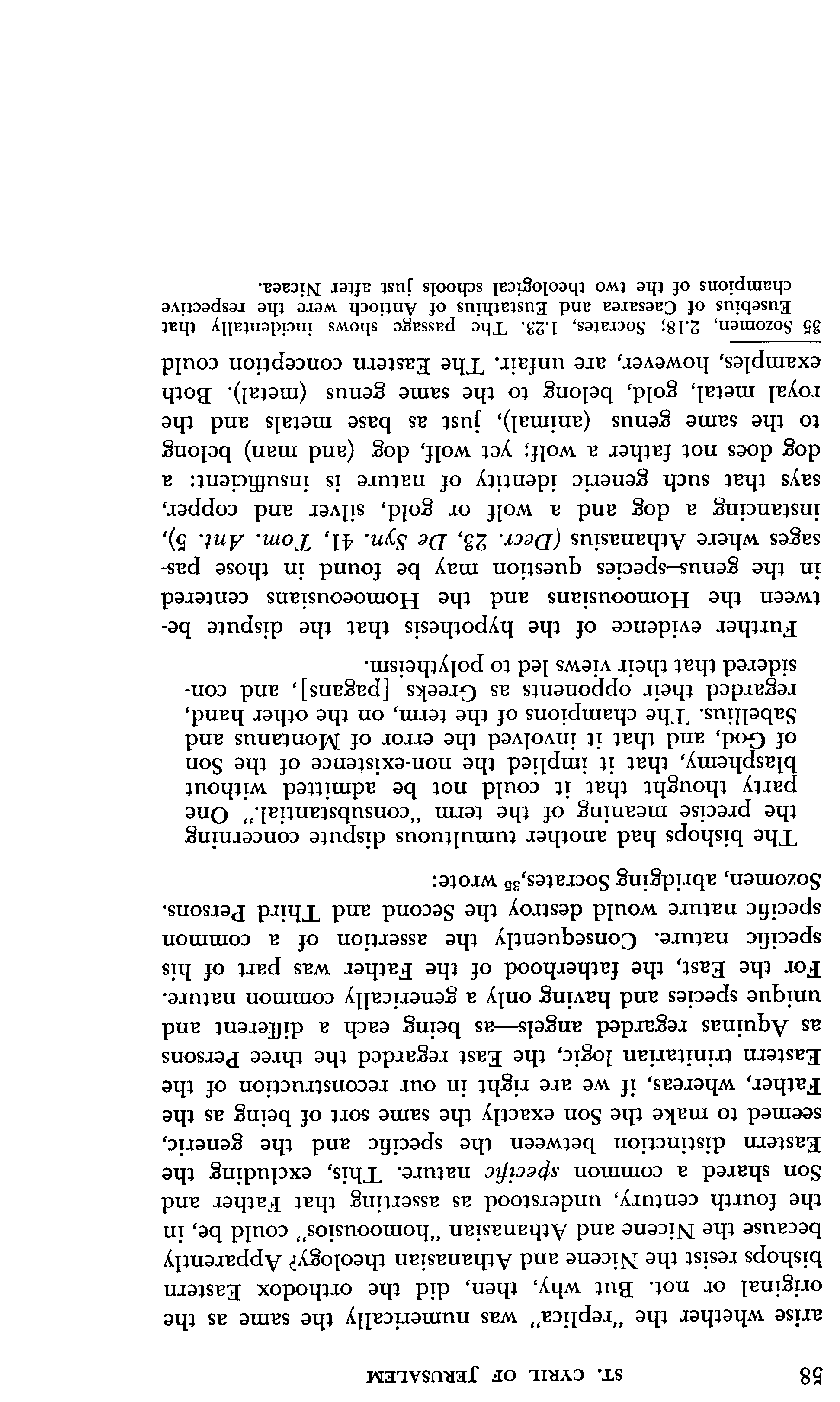
arise whether the "replica" was numerically the same as the original or not. But why, then, did the orthodox Eastern bishops resist the Nicene and Athanasian theology? Apparently because the Nicene and Athanasian "homoousios" could be, in the fourth century, understood as asserting that Father and Son shared a common specific nature. This, excluding the Eastern distinction between the specific and the generic, seemed to make the Son exactly the same sort of being as the Father, whereas, if we are right in our reconstruction of the Eastern trinitarian logic, the East regarded the three Persons as Aquinas regarded angels-as being each a different and unique species and having only a generically common nature.
For the East, the fatherhood of the Father was part of his specific nature. Consequently the assertion of a common specific nature would destroy the Second and Third Persons.
Sozomen, abridging Socrates,35 wrote:
The bishops had another tumultuous dispute concerning the precise meaning of the term "consubstantial." One party thought that it could not be admitted without blasphemy, that it implied the non-existence of the Son of God, and that it involved the error of Montanus and Sabellius. The champions of the term, on the other hand, regarded their opponents as Greeks [pagans], and considered that their views led to polytheism.
Further evidence of the hypothesis that the dispute between the Homoousians and the Homoeousians centered in the genus-species question may be found in those passages where Athanasius (Deer. 23, De Syn. 41, Tom. Ant. 5), instancing a dog and a wolf or gold, silver and copper, says that such generic identity of nature is insufficient: a dog does not father a wolf; yet wolf, dog (and man) belong to the same genus (animal), just as base metals and the royal metal, gold, belong to the same genus (metal). Both examples, however, are unfair. The Eastern conception could
35 Sozomen, 2.18; Socrates, 1.23. The passage shows incidentally that Eusebius of Caesarea and Eustathius of Antioch were the respective champions of the two theological schools just after Nicaea.
GENERAL INTRODUCTION
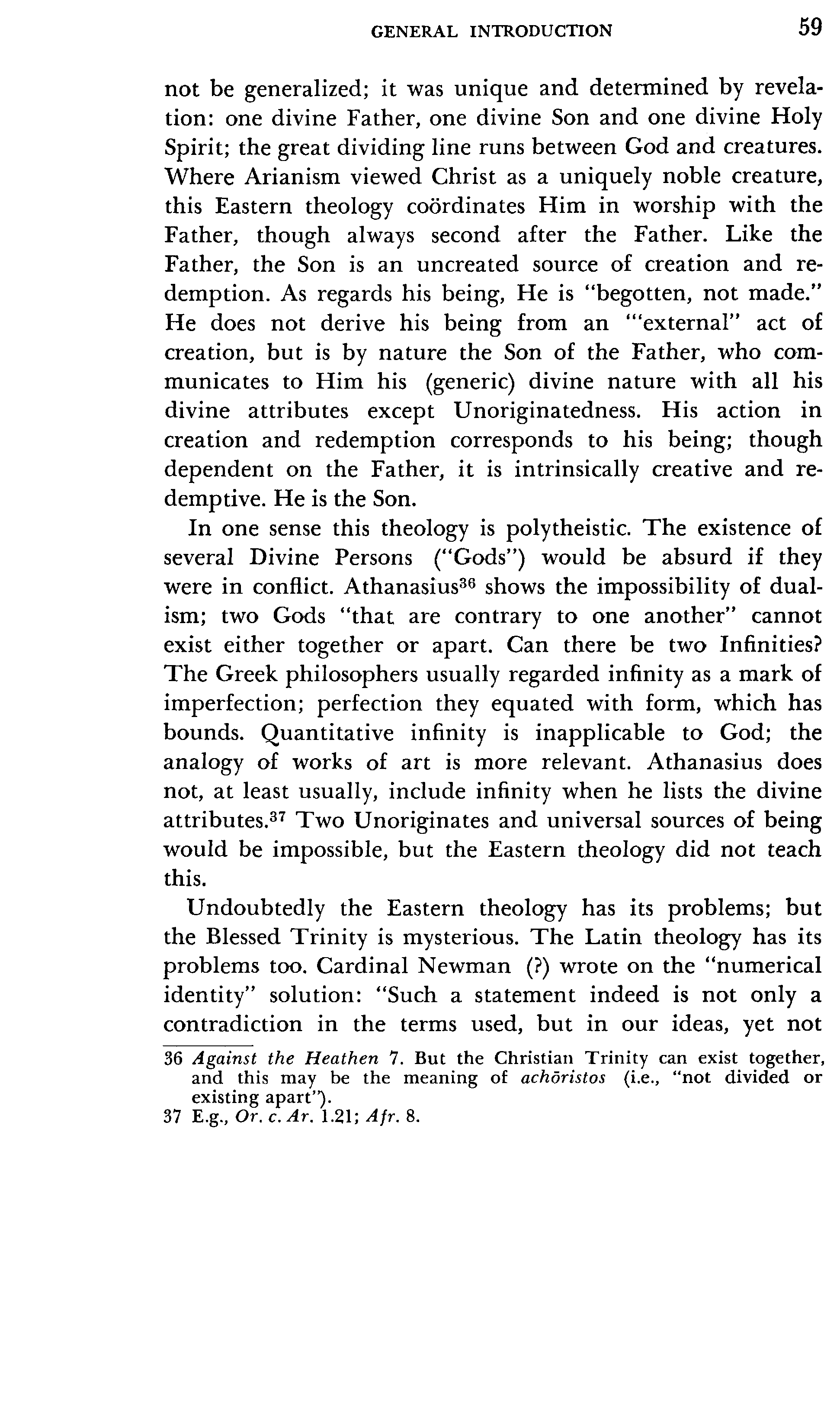
not be generalized; it was unique and determined by revelation: one divine Father, one divine Son and one divine Holy
Spirit; the great dividing line runs between God and creatures.
Where Arianism viewed Christ as a uniquely noble creature, this Eastern theology coordinates Him in worship with the Father, though always second after the Father. Like the Father, the Son is an uncreated source of creation and redemption. As regards his being, He is "begotten, not made."
He does not derive his being from an "'external" act of creation, but is by nature the Son of the Father, who communicates to Him his (generic) divine nature with all his divine attributes except Unoriginatedness. His action in creation and redemption corresponds to his being; though dependent on the Father, it is intrinsically creative and redemptive. He is the Son.
In one sense this theology is polytheistic. The existence of several Divine Persons ("Gods") would be absurd if they were in conflict. Athanasius36 shows the impossibility of dualism; two Gods "that are contrary to one another" cannot exist either together or apart. Can there be two Infinities?
The Greek philosophers usually regarded infinity as a mark of imperfection; perfection they equated with form, which has bounds. Quantitative infinity is inapplicable to God; the analogy of works of art is more relevant. Athanasius does not, at least usually, include infinity when he lists the divine attributes.37 Two Unoriginates and universal sources of being would be impossible, but the Eastern theology did not teach this.
Undoubtedly the Eastern theology has its problems; but the Blessed Trinity is mysterious. The Latin theology has its problems too. Cardinal Newman (?) wrote on the "numerical identity" solution: "Such a statement indeed is not only a contradiction in the terms used, but in our ideas, yet not 36 Against the Heathen 7. But the Christian Trinity can exist together, and this may be the meaning of achoristos (i.e., "not divided or existing apart'').
37 E.g., Or. c. Ar. 1.21; Afr. 8.
ST. CYRIL OF JERUSALEM
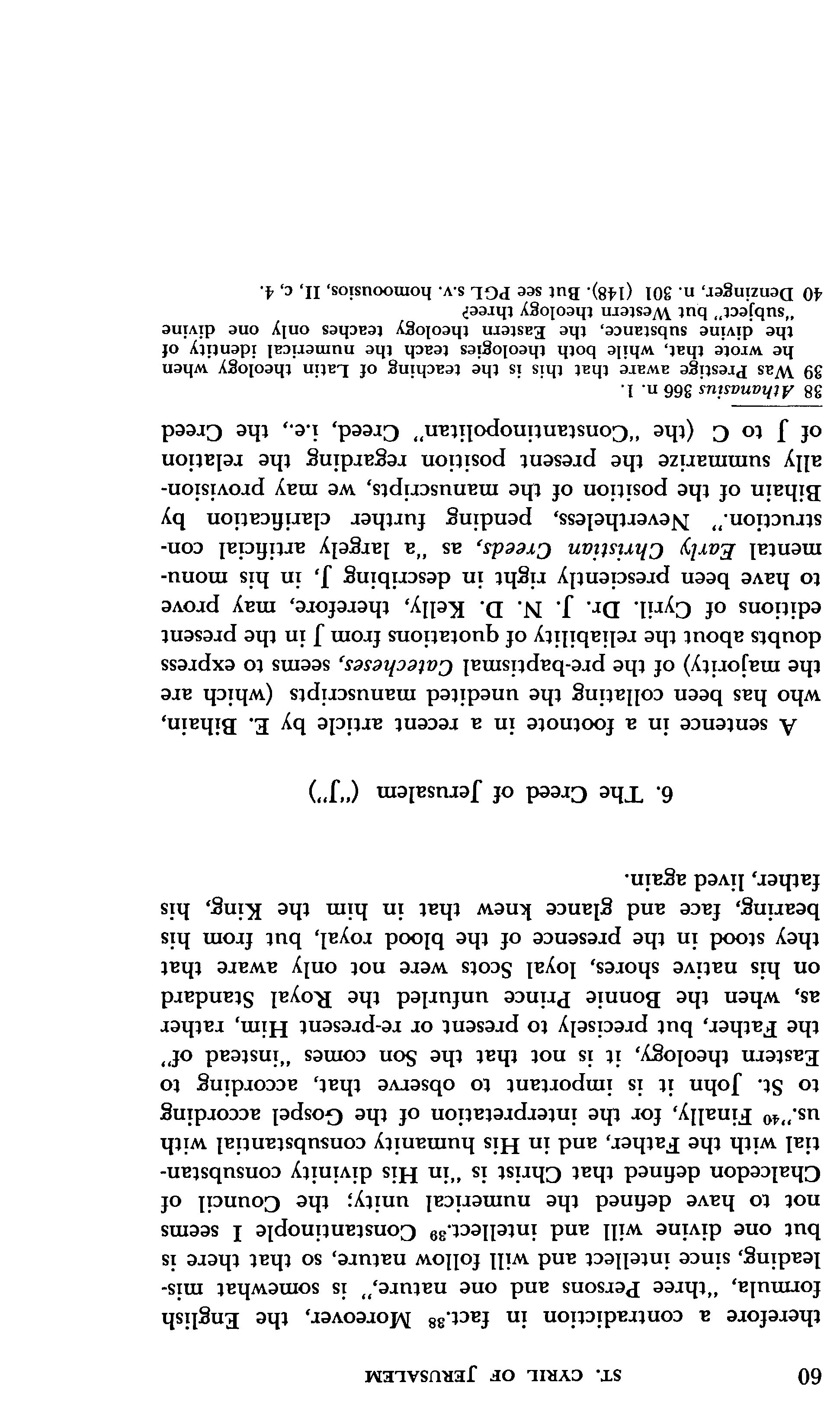
therefore a contradiction in fact. as Moreover, the English formula, "three Persons and one nature," is somewhat misleading, since intellect and will follow nature, so that there is but one divine will and intellect.39 Constantinople I seems not to have defined the numerical unity; the Council of Chalcedon defined that Christ is "in His divinity consubstantial with the Father, and in His humanity consubstantial with US."4Q Finally, for the interpretation of the Gospel according to St. John it is important to observe that, according to Eastern theology, it is not that the Son comes "instead of" the Father, but precisely to present or re-present Him, rather as, when the Bonnie Prince unfurled the Royal Standard on his native shores, loyal Scots were not only aware that they stood in the presence of the blood royal, but from his bearing, face and glance knew that in him the King, his father, lived again.
6. The Creed of Jerusalem ("]") A sentence in a footnote in a recent article by E. Bihain, who has been collating the unedited manuscripts (which are the majority) of the pre-baptismal Catecheses, seems to express doubts about the reliability of quotations from J in the present editions of Cyril. Dr. J. N. D. Kelly, therefore, may prove to have been presciently right in describing J, in his monumental Early Christian Creeds, as "a largely artificial construction." Nevertheless, pending further clarification by Bihain of the position of the manuscripts, we may provisionally summarize the present position regarding the relation of J to C (the "Constantinopolitan" Creed, i.e., the Creed
38 Athanasius 366 n. 1.
39 Was Prestige aware that this is the teaching of Latin theology when he wrote that, while both theologies teach the numerical identity of the divine substance, the Eastern theology teaches only one divine
"subject" but Western theology three?
40 Denzinger, n. 301 (148). But see PGL s.v. homoousios, II, c, 4.
GENERAL INTRODUCTION
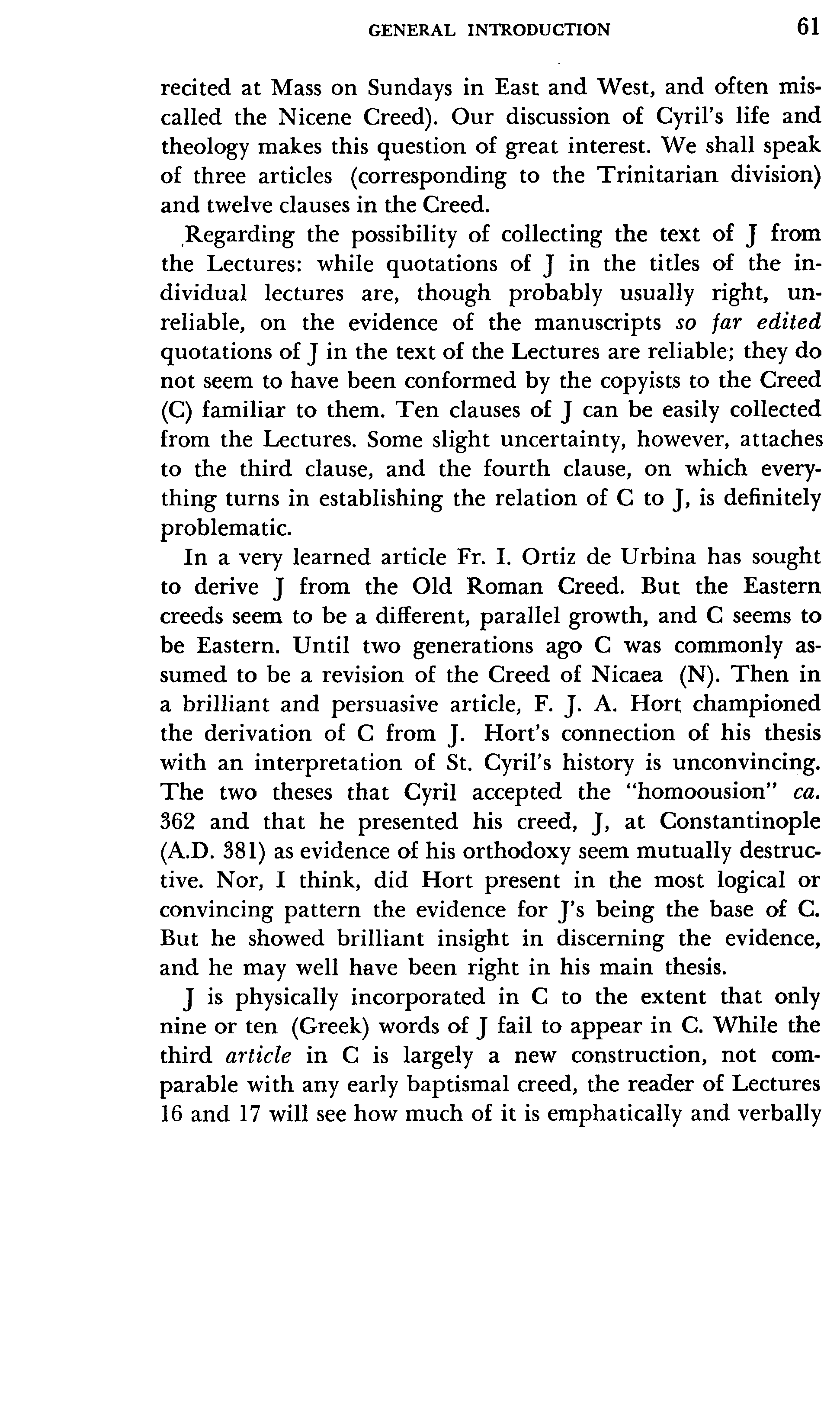
recited at Mass on Sundays in East and West, and often miscalled the Nicene Creed). Our discussion of Cyril's life and theology makes this question of great interest. We shall speak of three articles (corresponding to the Trinitarian division) and twelve clauses in the Creed.
,Regarding the possibility of collecting the text of J from the Lectures: while quotations of J in the titles of the individual lectures are, though probably usually right, unreliable, on the evidence of the manuscripts so far edited quotations of J in the text of the Lectures are reliable; they do not seem to have been conformed by the copyists to the Creed
(C) familiar to them. Ten clauses of J can be easily collected from the Lectures. Some slight uncertainty, however, attaches to the third clause, and the fourth clause, on which everything turns in establishing the relation of C to J, is definitely problematic.
In a very learned article Fr. I. Ortiz de Urbina has sought to derive J from the Old Roman Creed. But the Eastern creeds seem to be a different, parallel growth, and C seems to be Eastern. Until two generations ago C was commonly assumed to be a revision of the Creed of Nicaea (N). Then in a brilliant and persuasive article, F. J. A. Hort championed the derivation of C from J. Hort's connection of his thesis with an interpretation of St. Cyril's history is unconvincing.
The two theses that Cyril accepted the "homoousion" ca.
362 and that he presented his creed, J, at Constantinople (A.D. 381) as evidence of his orthodoxy seem mutually destructive. Nor, I think, did Hort present in the most logical or convincing pattern the evidence for J's being the base of C.
But he showed brilliant insight in discerning the evidence, and he may well have been right in his main thesis.
J is physically incorporated in C to the extent that only nine or ten (Greek) words of J fail to appear in C. While the third article in C is largely a new construction, not comparable with any early baptismal creed, the reader of Lectures
16 and 17 will see how much of it is emphatically and verbally
ST. CYRIL OF JERUSALEM
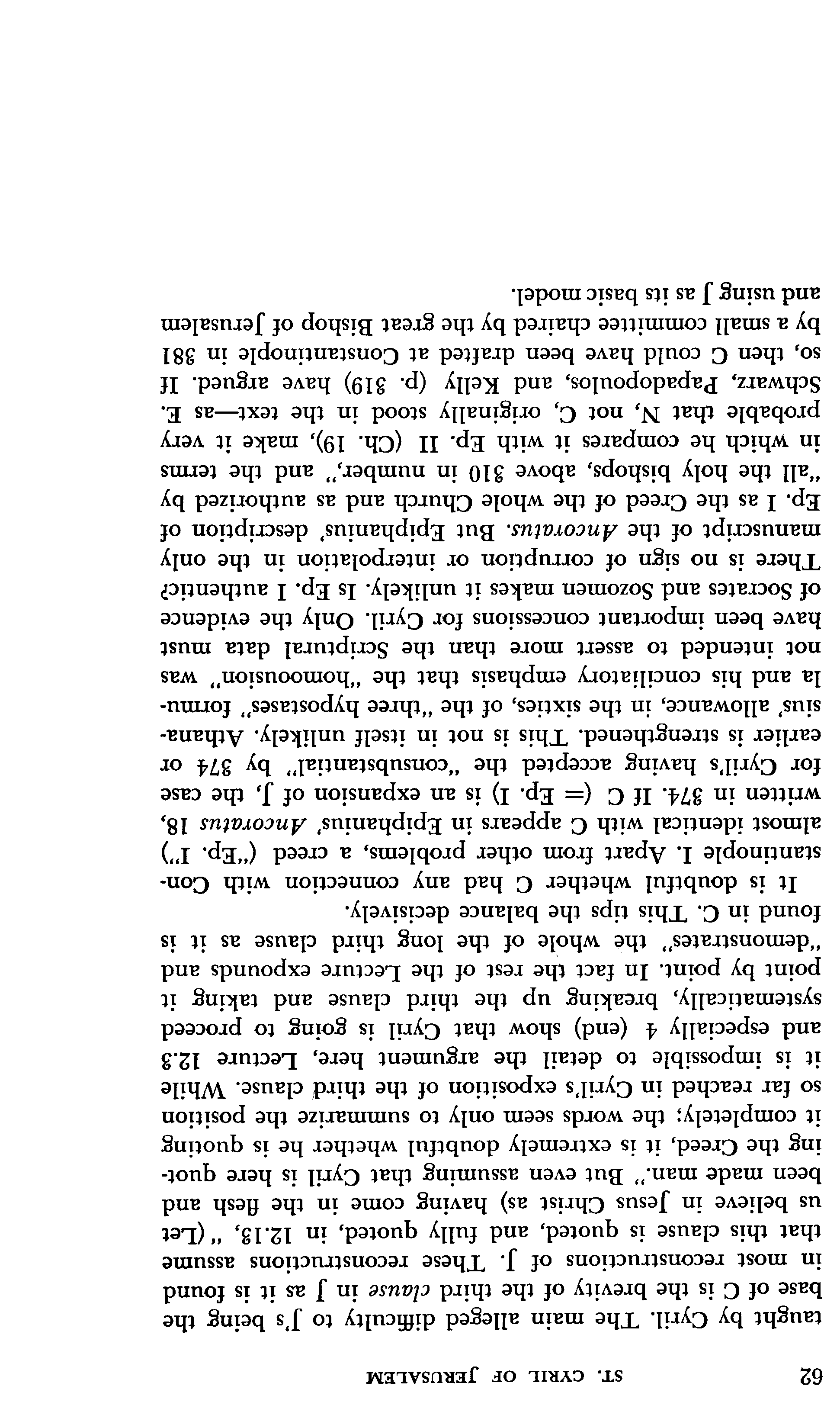
taught by Cyril. The main alleged difficulty to ],s being the base of C is the brevity of the third clause in J as it is found in most reconstructions of J. These reconstructions assume that this clause is quoted, and fully quoted, in 12.13, "(Let us believe in Jesus Christ as) having come in the flesh and been made man." But even assuming that Cyril is here quoting the Creed, it is extremely doubtful whether he is quoting it completely; the words seem only to summarize the position so far reached in Cyril's exposition of the third clause. While it is impossible to detail the argument here, Lecture 12.3 and especially 4 (end) show that Cyril is going to proceed systematically, breaking up the third clause and taking it point by point. In fact the rest of the Lecture expounds and "demonstrates" the whole of the long third clause as it is found in C. This tips the balance decisively.
It is doubtful whether C had any connection with Constantinople I. Apart from other problems, a creed ("Ep. I") almost identical with C appears in Epiphanius' Ancoratus 18, written in 374. If C (= Ep. I) is an expansion of J, the case for Cyril's having accepted the "consubstantial" by 374 or earlier is strengthened. This is not in itself unlikely. Athanasius' allowance, in the sixties, of the "three hypostases" formula and his conciliatory emphasis that the "homoousion" was not intended to assert more than the Scriptural data must have been important concessions for Cyril. Only the evidence of Socrates and Sozomen makes it unlikely. Is Ep. I authentic?
There is no sign of corruption or interpolation in the only manuscript of the Ancoratus. But Epiphanius' description of Ep. I as the Creed of the whole Church and as authorized by "all the holy bishops, above 310 in number," and the terms in which he compares it with Ep. II (Ch. 19), make it very probable that N, not C, originally stood in the text-as E.
Schwarz, Papadopoulos, and Kelly (p. 319) have argued. If so, then C could have been drafted at Constantinople in 381 by a small committee chaired by the great Bishop of Jerusalem and using J as its basic model.
GENERAL INTRODUCTION
THE TEXTS
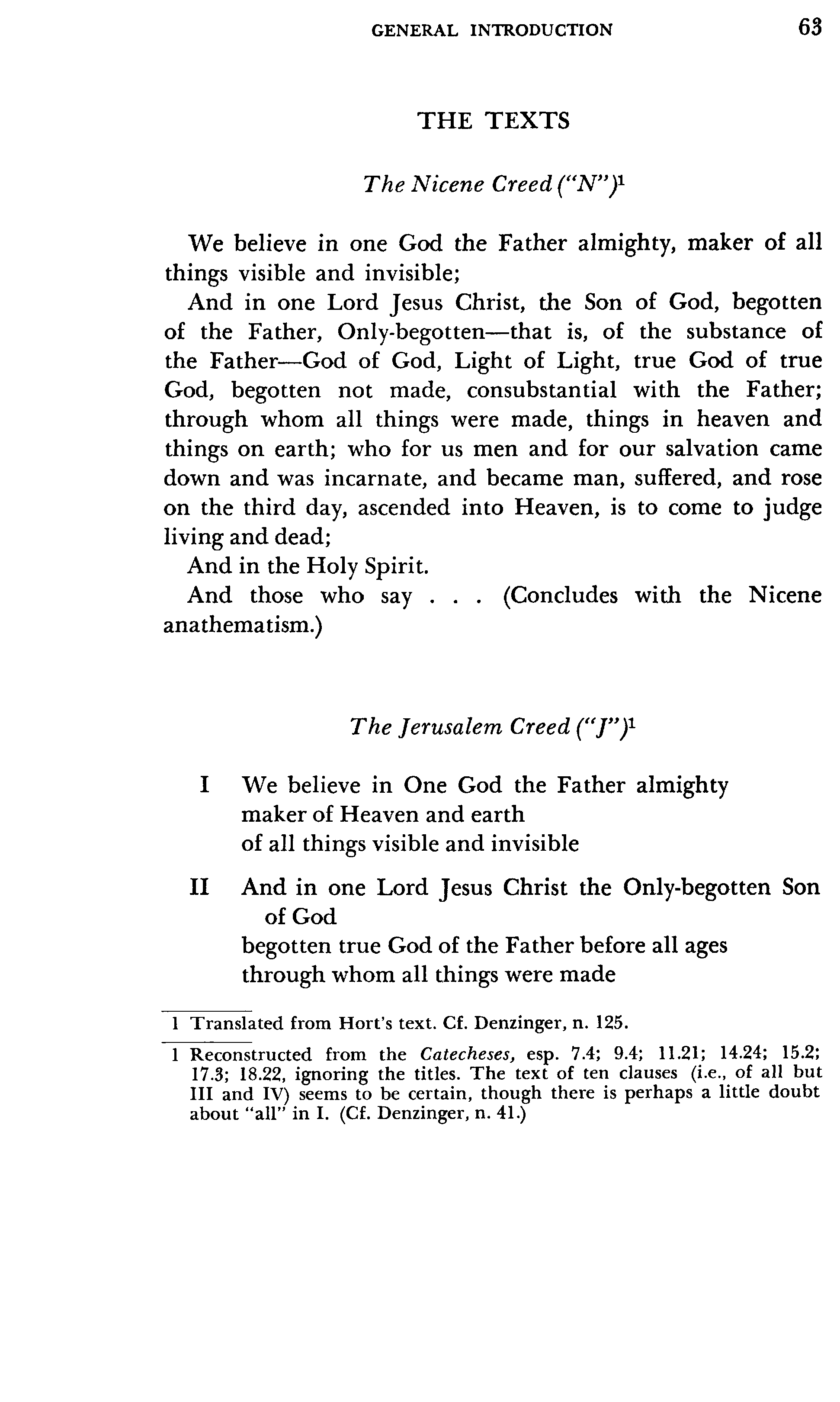
The Nicene Creed ("N")1 We believe in one God the Father almighty, maker of all things visible and invisible; And in one Lord Jesus Christ, the Son of God, begotten of the Father, Only-begotten-that is, of the substance of the Father-God of God, Light of Light, true God of true
God, begotten not made, consubstantial with the Father; through whom all things were made, things in heaven and things on earth; who for us men and for our salvation came down and was incarnate, and became man, suffered, and rose on the third day, ascended into Heaven, is to come to judge living and dead; And in the Holy Spirit.
And those who say . . . (Concludes with the Nicene anathematism.) The Jerusalem Creed ("1")1 I We believe in One God the Father almighty maker of Heaven and earth of all things visible and invisible II And in one Lord Jesus Christ the Only-begotten Son of God begotten true God of the Father before all ages through whom all things were made 1 Translated from Hort's text. Cf. Denzinger, n. 125.
I Reconstructed from the Catecheses, esp. 7.4; 9.4; 11.21; 14.24; 15.2; 17.3; 18.22, ignoring the titles. The text of ten clauses (i.e., of all but III and IV) seems to be certain, though there is perhaps a little doubt about "all" in I. (Cf. Denzinger, n. 41.)
ST. CYRIL OF JERUSALEM
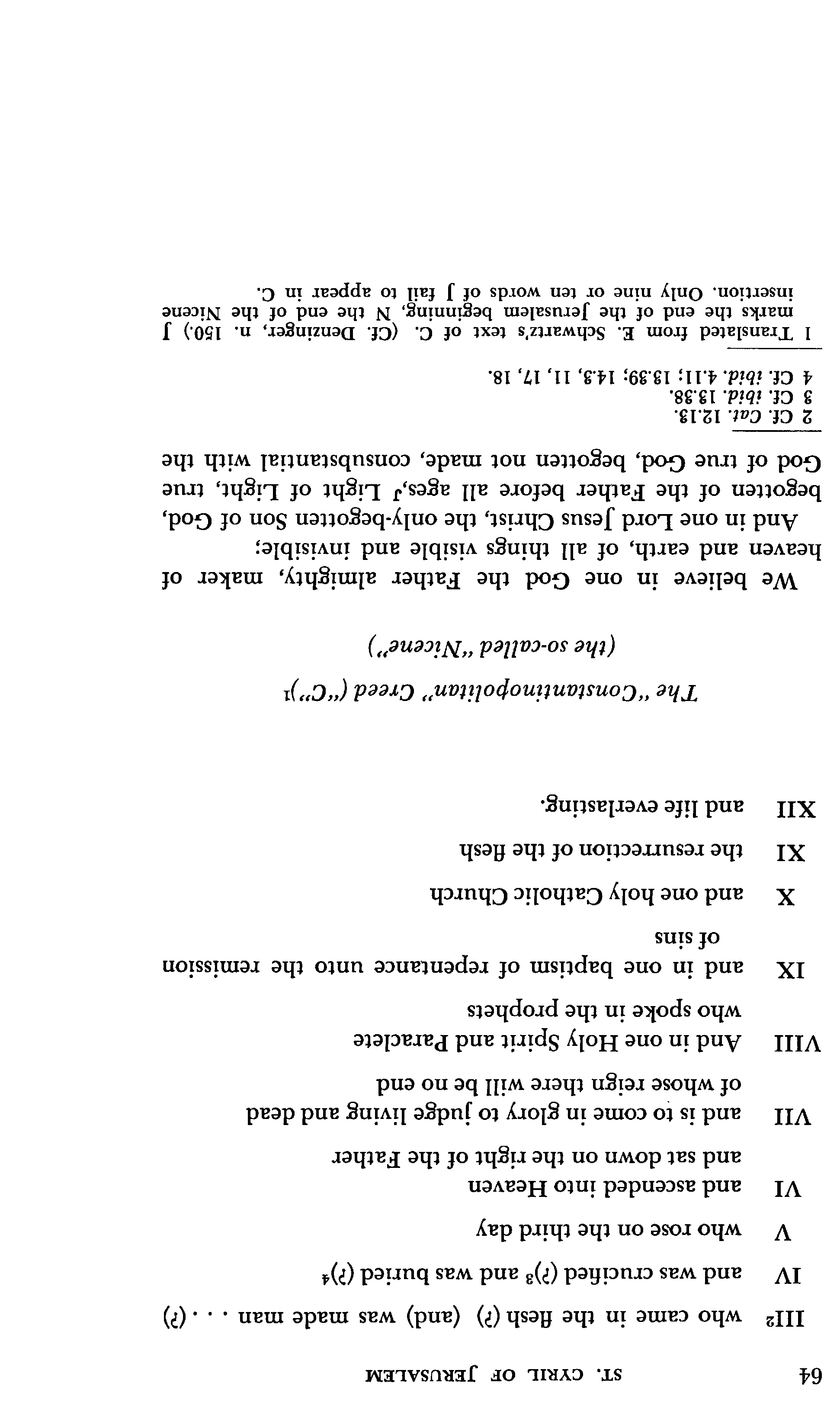
lIP who came in the flesh (?) (and) was made man ... (?) IV and was crucified (?)3 and was buried (?)4
V who rose on the third day VI and ascended into Heaven and sat down on the right of the Father VII and is to come in glory to judge living and dead of whose reign there will be no end VIII And in one Holy Spirit and Paraclete who spoke in the prophets IX and in one baptism of repentance unto the remission of sins X and one holy Catholic Church XI the resurrection of the flesh XII and life everlasting.
The "Constantinopolitan" Creed (tiC")!
(the so-called tlNicene") We believe in one God the Father almighty, maker of heaven and earth, of all things visible and invisible;
And in one Lord Jesus Christ, the only-begotten Son of God, begotten of the Father before all ages,J Light of Light, true
God of true God, begotten not made, consubstantial with the 2 Cf. Cat. 12.13.
3 Cf. ibid. 13.38.
4 Cf. ibid. 4.II; 13.39; 14.3, II, 17, 18.
Translated from E. Schwartz's text of C. (Cf. Denzinger, n. 150.) J marks the end of the Jerusalem beginning, N the end of the Nicene insertion. Only nine or ten words of J fail to appear in C.
GENERAL INTRODUCTION
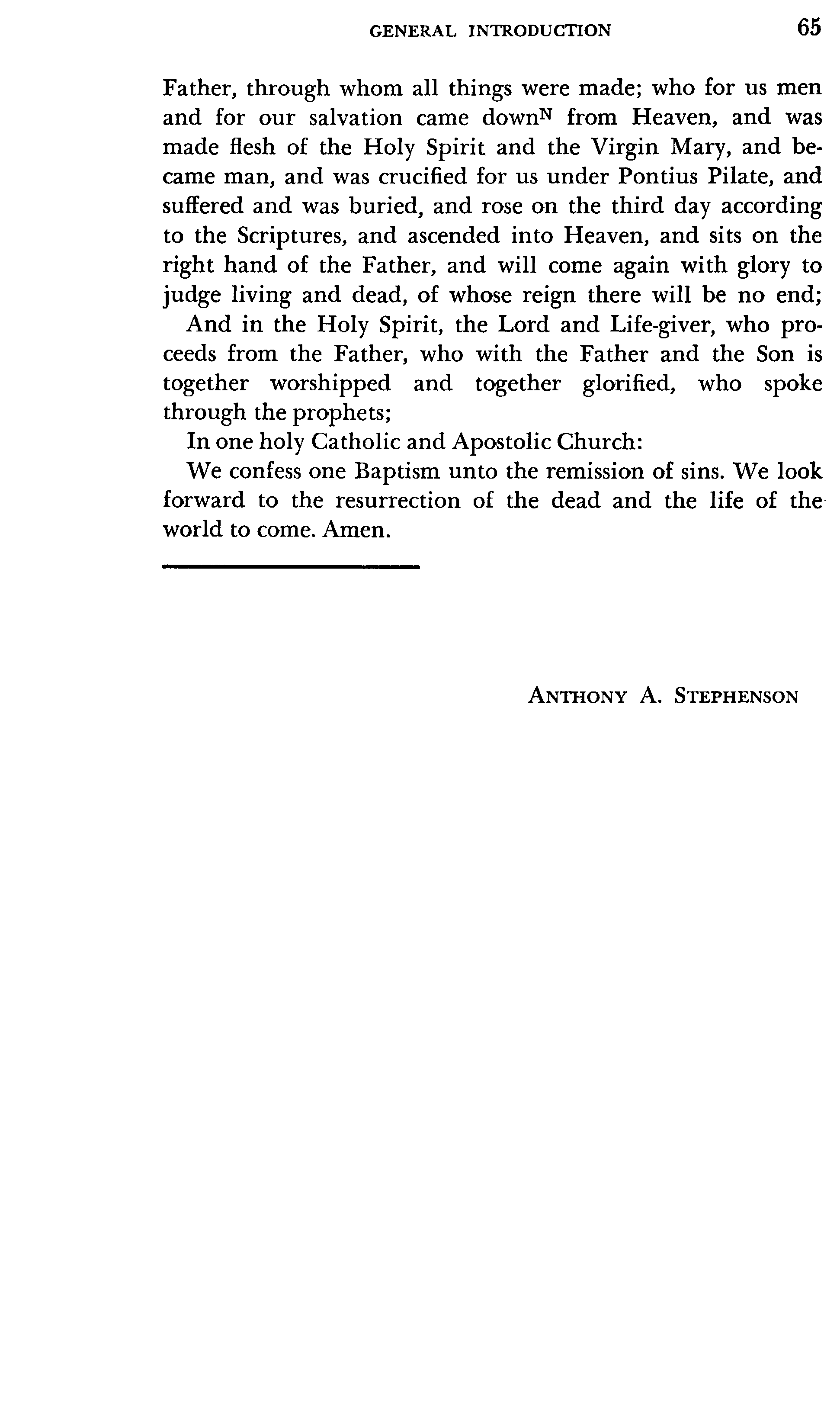
Father, through whom all things were made; who for us men and for our salvation came downN from Heaven, and was made flesh of the Holy Spirit and the Virgin Mary, and became man, and was crucified for us under Pontius Pilate, and suffered and was buried, and rose on the third day according to the Scriptures, and ascended into Heaven, and sits on the right hand of the Father, and will come again with glory to judge living and dead, of whose reign there will be no end;
And in the Holy Spirit, the Lord and Life-giver, who proceeds from the Father, who with the Father and the Son is together worshipped and together glorified, who spoke through the prophets; In one holy Catholic and Apostolic Church:
We confess one Baptism unto the remission of sins. We look forward to the resurrection of the dead and the life of the world to come. Amen.
ANTHONY A. STEPHENSON

THE INTRODUCTORY
LECTURE (Procatechesis) Translated by
ANTHONY A. STEPHENSON
University of Exeter England