
1. Mackintosh. The Natural History of the Christian Religion
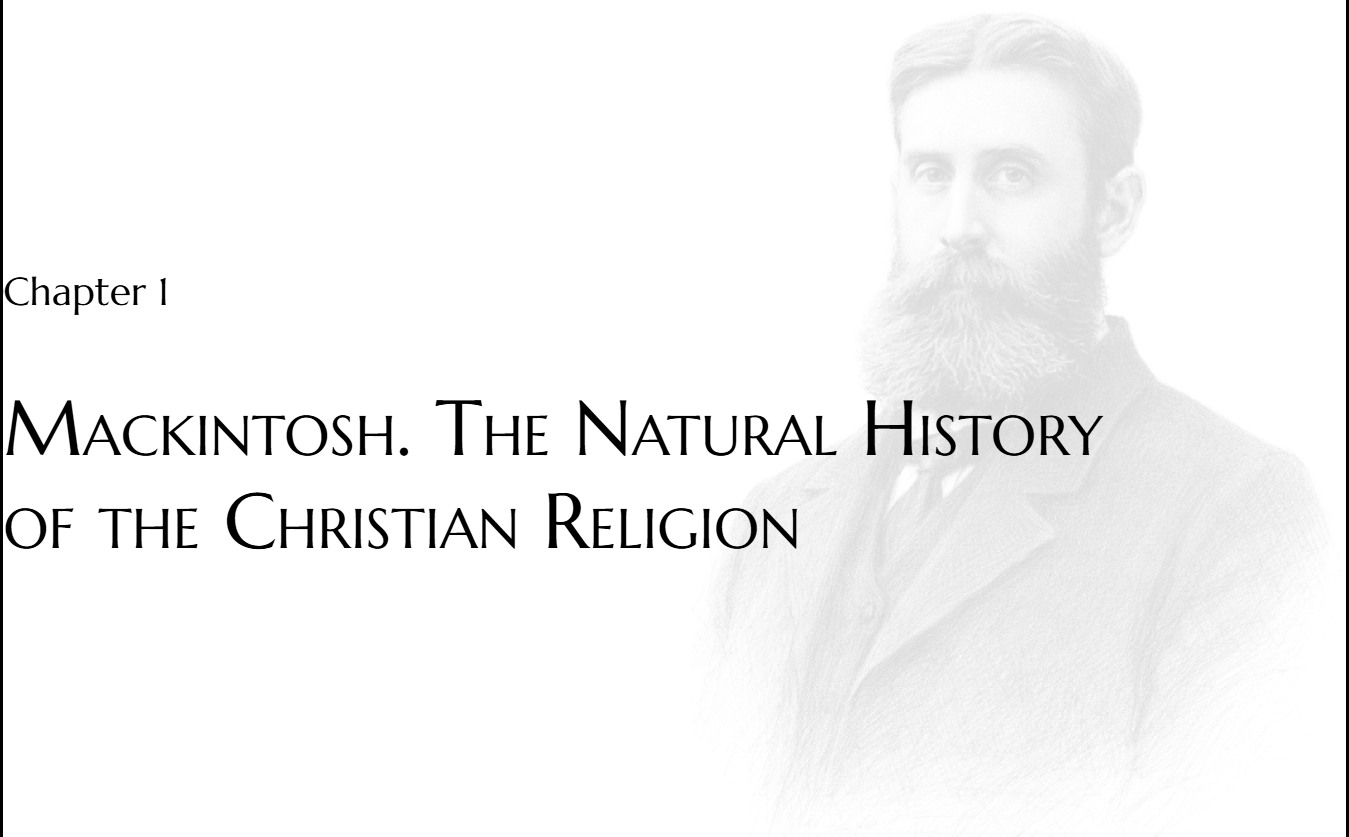
William Mackintosh, M.A., D.D.
Glasgow:
James Maclehose & Sons; New York: Macmillan & Co. 1894. 1 ome fifteen years ago, the religious world was startled by the S appearance of a volume bearing the simple title of "Scotch Sermons,
1880." It was a collection of twenty-three sermons by thirteen "clergymen of the Church of Scotland," and was designed to acquaint the public with "a style of teaching" which the editor thought was "increasingly prevalent amongst the clergy of the Scottish Church," and which made it its object so to present "the essential ideas of Christianity" as to show that they are "in harmony with the results of critical and scientific research." A good object, surely. The trouble with these sermons, however, was that they did not seek to consider the results of recent "critical and scientific research" in the light of the revealed truth of God, and to exhibit the harmony of all truth, whether derived from revelation or from nature; but, taking their point of view from current theorizing, pared down "the essential ideas of
Christianity" to fit the assumed "results of the most recent critical and scientific research." The volume was appropriately estimated by Dr. A. A.
Hodge in the issue of The Presbyterian Review for January, 1881 (ii. pp.
212–214). "The collection, as a whole," he said, "is utterly valueless, except as 'specimens of a style of teaching' which is said to 'increasingly prevail amongst the clergy of the Scottish Church.' Neither the learning nor the logic of these sermons avails to throw light upon any other subject of human interest under the sun. And neither the hearing nor the reading of such discourses could ever avail to promote any other valuable practical quality than that of patience. Some of these sermons do not contain any statements absolutely opposed to the essential truths of Christianity, but not one sets forth any doctrine or duty which can be in any special sense classed as Christian."
One of the writers represented in the volume was the Rev. William Mackintosh, D.D., of Buchanan, who contributed two sermons on the text, "Whatsoever a man soweth, that shall he also reap" (Gal. 6:7). With reference to these sermons, but more especially the latter of them, Dr.
Hodge remarks: "Rev. William Mackintosh, D.D., Buchanan, discourses concerning the 'renovating power of Christianity.' He asks: 'What is the Gospel good for? What title has it to that designation? What service does it render?' (p. 162). This he answers thus: 'The problem of human life—the task appointed to us—is our deliverance from the sway of our lower nature, our surrender to the control of our higher nature. The powers by which we are enabled to accomplish this task are three. First. Our own higher nature itself. Secondly. The beneficent constitution of things in general, their tendency in favor of what is good. Thirdly. These two factors are brought into full operation by the revelation to our consciousness, of that which was implicitly contained in them of the Divine good-will, or paternal relation towards us, given us by Christ' (pp. 171–173). That is, all that
Christ does for us is to assure us of God's good-will. With this encouragement we save ourselves, by the use of natural powers acting under natural conditions." Dr. Mackintosh's sermons, in a word, fairly illustrated the hint of the editor of the volume, that the sermons included in it belong to a class which are seeking to bring "the essential ideas of Christianity" into "harmony with the results of critical and scientific research." He himself describes his aim in them in such words as these: "Our endeavour has been to show what modifications of the popular construction of Christianity are needed to bring it into harmony with the laws of mental physiology" (p. 172). "The light which science sheds upon human destiny" is the light in which he would walk. And "science" with him is above all the investigation of physical nature: it is from this sphere that he would borrow his governing idea. "In these later times," he tells us with extreme naïveté,
"science, in its researches into the material world, has lighted everywhere upon the traces of an all-pervading continuity" (p. 145); and this being true, we may now "confidently postulate" "the existence in the moral and spiritual worlds of an analogous principle." Wherefore, that a step may be taken towards the reconciliation of faith and science he devotes these sermons to showing that "the principle of continuity obtains in the moral sphere no less than in the material, and rules the succession of religious as of other phenomena" (p. 145; cf. p. 134).
The former of the two sermons is occupied with an attempt to demonstrate this "law of moral continuity." "The law of the spiritual harvest," we are told, "is that evil is the natural," nay, the inevitable,
"product of evil; that nothing either good or evil ever perishes of itself, but must, in some way, influence, or enter as an element into, the future" (p.
146). This is an article of natural religion, and "underlies Christianity as much as does the existence and unity of God, or any other article of natural religion" (p. 134). It cannot be "shaken or removed by any subsequent
revelation"; it is rather one of the tests of the truth of systems (p. 134). If we speak of God's judgment on sin, we must still think merely of this direct and infallible action of moral continuity, "without the intervention of any supplementary or epicyclical contrivance" (p. 139): for "the judgment of God is only another name for the natural and inevitable consequence of our lives" (p. 143). Divine judgment is therefore continuous and progressive, and all supernatural action is out of place in it: no divine fiat can interfere with moral development here or hereafter. "Such interference on the day of judgment is as inadmissible, because as inconsistent with human liberty, and with an inviolable order, as at any other crisis in the history of man" (p. 140). No, it is impossible to remove sin by a sovereign or forensic fiat: "the chain of moral sequence … is carried on in unbroken continuity" (p. 144)—we are under the operation of a universal law which acts, like all law, uniformly.
Under such circumstances we may well ask, What service, then, can the gospel render? The second sermon essays to offer a reply. "The gospel," we are told, "does not profess to exempt us from the law of … moral continuity" (p. 146), although it does show us the way from evil to good (p.
147). Certainly it does not offer us a supernatural change. But even physiology knows something of reversal of process; and there is a latent spiritual force within us to which the gospel may appeal. The dominance of sin indeed never becomes absolute and undisputed; so that the better principle has within itself the potency of a reactive force. Doubtless after evil habit has become confirmed, the better principle may seldom or never be led so to act by the mere sense of duty or moral obligation: it needs some new hope or new affection to arouse it. But under the stimulus of "the revelation to our mind of the paternal character of God, and of the gracious relation in which He stands to us," it is capable of very energetic reaction
(pp. 153, 163, 165, 168). Thus a complete revolution is produced in our
feelings and relations towards Him, and our religious life is elevated to a higher level (p. 153). "The problem of human life" then, "—the task appointed to us—is our deliverance from the sway of our lower nature, our surrender to the control of our higher nature. The powers by which we are enabled to accomplish this task are three: First. Our own higher nature itself, which is never wholly effaced, and which reacts against the evil, and makes us receptive of all the higher influences that may be brought to bear upon us from without. Secondly. The complex of all those higher influences
—the beneficent constitution of things in general, their tendency in favor of what is good, which operates upon us more or less, even when we are unconscious of it.… Thirdly. These two factors for the accomplishment of the Divine purpose are consummated, or brought into full operation, by the revelation to our consciousness of that which was implicitly contained in them, but of which we had otherwise remained unconscious; by that revelation, we mean, of the Divine good-will, or paternal relation towards us, by which Christ has reënforced our better nature, enabling us to be intelligent fellow-workers with God in our conflict with evil, and giving a higher aim to our life.… It is … through our reason, through our conviction that God wills the triumph of our better nature, that we are animated to a triumphant forth-putting of its latent energies" (pp. 153–156).
So viewed, it is apparent that "the gospel can only be regarded as a revelation or discovery to man of a method of salvation which had always been possible in the nature of things" (p. 157); and doubtless many have used it apart from what we call the gospel (pp. 156, 157, 159). The gospel is not some new power which comes to our salvation; it is only an instrumentality to stir us up to save ourselves: "it will be distinctly apparent that the gospel can be a means of supplanting evil by good, only by discovering and evoking powers which had always existed.… The gospel deserves its name simply because it teaches and persuades us to cease from
evil and to do well; to change the seed which we sow, and thus to obtain a better harvest" (p. 158). We call ourselves Christians, not because we fancy
Christ has saved us by some sort of "expiation," but simply because we have obtained our knowledge of God as Father, which calls out our latent reaction against sin, "in some historical connection with the impulse given by Christianity" (p. 156). All that Christ did for us, "in the strict and literal sense, was to reveal to us the infinite placability of the Divine nature" (p.
158; cf. pp. 161, 162–163, 170). His teaching amounts to no more than "that nothing stands in the way of those who desire to break off their sins by righteousness, except the outward and inward opposition, which has been arrayed by the law of recompense against their better endeavours" (p.
167); and His work amounts only to this teaching. We may reverence His memory "as Mediator between God and man"; but only in the sense that "He it was who, from the depths of His own experience, imparted to men the knowledge of God as our Father in heaven; whose property it is to forgive the trespasses of His Children, and to incline their feet into the path of righteousness" (p. 170). How "humanity rose at length in Christ to the thought of God's absolute goodness" would be inexplicable to us, were it not that we have reason to believe that God has impressed on creation itself evidences of "His design to secure the triumph of what is good, and to deliver us from evil" (p. 155). But humanity in Christ having obtained this knowledge of the divine paternity, it is able in its power to react against sin and sow its seed unto righteousness. And so the very law of moral continuity will operate to bring it to moral perfection.
It is evident that Dr. A. A. Hodge was thoroughly justified in finding nothing either novel or distinctively Christian in this teaching. It is just the purest form of Socinian thought. The Unitarian layman, Mr. George
William Curtis, gives perfectly clear expression to the same conceptions in that confession of his faith which leads his biographer to say that to him
"conscience" (not Christ) was "the divinely appointed saviour of the world": "I believe in God, who is love; that all men are brothers; and that the only essential duty of every man is to be honest, by which I understand his absolute following of the conscience when duly enlightened" ("George
William Curtis," by Edward Cary, 1894, pp. 7, 334, 339). Dr. Mackintosh could not express his own doctrine better: even down to the emphasis on honesty, it is quite the same. "Only he who feels that a necessity is laid upon him of bearing his own burden, and helping others to bear theirs," says Dr.
Mackintosh, "may hope to grow into that noblest work of God, the simply honest man, the genuine disciple of Christ" (p. 172). To be simply honest is to be Christ's genuine disciple: not to depend on Him for "escaping responsibility for our vices." In this case, of course, any pagan may be a "genuine disciple of Christ." How entirely apart from all that is distinctively Christian Dr. Mackintosh's whole scheme of doctrine is, indeed, may be illustrated for us by a remark of Mr. Edmund Gosse, in his interesting "portrait" of Walter Pater. "When I had known him first," he says, "he was a pagan, without any guide but that of the personal conscience; years brought gradually with them a greater and greater longing for the supporting solace of a creed" (The Contemporary Review, lxvi. 1894, p. 805). Dr. Mackintosh is dominated on the contrary by a desire "to reduce the dimensions of dogma," to strip off everything from his creed but the one article of "moral continuity" (p. 170). Walter Pater, in other words, was moving upwards from his paganism to Christianity: Dr. Mackintosh had moved down from the heights of Christian truth to a merely pagan position. This is fairly illustrated again by an incident recorded by Dr.
Denney, in his recent "Studies in Theology" (New York, 1895, p. 130). He tells us of a Hindu society, which was formed for much the same object which Dr. Mackintosh doubtless thinks he has secured in his sermons—"to appropriate all that is good in Christianity without burdening itself with
the rest." "Among other things which it appropriated, with the omission of only two words, was the answer given in the Westminster Shorter
Catechism to the question, What is repentance unto life? Here is the answer. 'Repentance unto life is a saving grace, whereby a sinner, out of a true sense of his sin, and apprehension of the mercy of God in Christ, doth with grief and hatred of his sin turn from it unto God, with full purpose of, and endeavour after, new obedience.' The words the Hindus left out were in Christ; instead of 'apprehension of the mercy of God in Christ,' they read simply, 'apprehension of the mercy of God.' … They were acute enough to see [continues Dr. Denney] that in the words they left out the whole Christianity of the definition lay.… I entirely agree with their insight.
If the mercy of God is separable from Christ, independent of Christ, accessible apart from Christ, … there is no need and no possibility of a Christian religion at all." In a word, salvation by repentance and amendment is not Christianity—just because Christianity is specifically salvation by Christ. The essence as well as the glory of Christianity is that it provides for sinful man a Saviour.
We have dwelt thus fully on Dr. Mackintosh's contributions to the volume of "Scotch Sermons" because the treatise at present before us stands in such express relation to the earlier sermons that a clear apprehension of their teaching will greatly conduce to an understanding of this treatise. It is not merely that the present work occupies the same standpoint with the sermons and proclaims the same meager teaching, although now as "the religion of Jesus" rather than as the doctrine of Paul. It is that it is in effect a serious attempt to supply a rational basis for the teaching of the sermons.
The sermons taught that the essence of Christianity is, Every man his own saviour. But they left the truth of this teaching dependent on Dr.
Mackintosh's assertion. He said, This is Christianity; this is God's method of dealing with the soul; this is what Paul and Jesus teach us. But it was
obviously not what Christians believed to be Christianity; what the creeds of the Churches set forth as God's method of dealing with the soul; what the founders of Christianity proclaimed as its substance; what the records of the New Testament represent as the teaching of either Paul or Jesus. In what alembic and by the aid of what reagents Dr. Mackintosh had been able to reduce Christianity to this "essence" remained hidden from his readers. On further reflection, he himself preceived that he had run beyond his warrant (p. 149): Paul, at least, taught a "heterosoteric" doctrine—to use E. von Hartmann's term. Otherwise, however, his original conception remained unchanged; and remained hanging in the air. After fourteen years, he gives the world at last an attempt to supply a foundation for his teaching. This is the real function of the present volume. It sets forth the conception of the origin and development of Christianity, which alone will harmonize with his teaching as to the nature of Christianity. He had taught that Christianity provided only for a natural salvation. Conformably to this he now argues that it is merely a natural religion, and, being a natural religion, can have had no other than a natural origin. The task which the author has set before himself in this volume is, thus, none other than to account for the rise of Christianity as a purely natural religion. There is no lack of frankness or of thoroughness in the manner in which this task is approached and prosecuted. "The attempt made in this volume," he says, is
"to trace the origin of Christianity to the common religious instinct, working under the influence of natural forces and amid historical conditions" (p. v.). More specifically it attempts "to show that Christianity took its rise in a great spiritual and religious movement among the Jewish people, or in a great transformation of Jewish ideas effected by Jesus, and spreading from him to his disciples; and to find in that movement and in certain favouring circumstances and historical conditions, without looking beyond to any supernatural or transcendental causes, an explanation of the
whole relative phenomena" (p. 4). Dr. Mackintosh means by the phrase, "the whole relative phenomena," all that it is capable of expressing. At no point and through no channel does he allow that anything above nature has entered into the formation of Christianity. Not in the person of Jesus
Himself, and not in aught that preceded or followed Him. Jesus was no doubt the founder of Christianity; but His rising to whatever height of thought He attained, is entirely explicable from "the reaction of his mind upon the inherited and environing conditions, social and spiritual, present in Judea in his day" (p. vii.). All that had gone before was merely a natural spiritual and religious development, providing these inherited and environing conditions. All that came after was merely the progressive mythical and dogmatic corruption of the teaching of Jesus, through the working upon it of the imaginative and ratiocinative faculties of His followers.
Now of course Dr. Mackintosh does not suppose that the records of Christianity represent it as the merely natural religion which he conceives it to be. He freely admits that the account of the origin and nature of Christianity given in these records, if treated as trustworthy, would entirely justify the common conception of Christianity as supernatural both in origin and method. He even declares that if Christianity be the merely natural religion which he supposes, its genesis "must have differed widely, nay, enormously, from that which can possibly be gathered from a literal or textual exegesis, and an unsceptical study of the New Testament" (p. 586).
He declares it therefore to be evident that "something more than a sound exegesis and hermeneutic will be needed to extract from" "the primitive records," "the proximate facts regarding the origin and development of the Christian system," if that origin and development are to be conceived as purely natural. "We have only to make the attempt," he adds, "to find that we cannot effect the removal of the supernatural element, as if it were a
mere appendage or external fixture, so as to leave the residuum standing as it was. That element is, so to speak, chemically combined with the history, and can be discharged only by a process which involves a change or dissolution of the entire fabric, or, if this be thought to be an exaggerated representation, let us say rather that it is an element woven like a strand into the texture of the history, so as to be removable only by a general disturbance and dislocation of the evangelical narrative" (p. 45).
But if the case be such, surely it is incumbent on us to inquire, on the one hand, whence arises the justification for the attempt to remove so pervading and determining an element out of the primitive records, and, on the other, after the fabric has been dissolved, whence can be derived the clue for the recombination of the elements, into a new and now purely natural history of the origin and development of Christianity. Our author seeks his justification in the postulate of the impossibility of the supernatural. On the assumption of the impossibility of the supernatural, the supernaturalistic account of the origin of Christianity given in its primitive records cannot be true, and necessity is laid upon us to attempt to conceive its origin as a natural development. The clue for the reconstruction of the history, on the other hand, is sought at the hands of modern criticism: "the history, be it observed, being such as is arrived at by submitting the canonical records to the ordeal and sifting of modern criticism" (p. vi.). By the aid of these two assumptions—the assumption of the impossibility of the supernatural and the assumption of the validity of all the conclusions of the extremest type of modern criticism—Dr. Mackintosh supposes that he can reconstruct the history of the origin of Christianity so as to exhibit it as a purely natural religion. It would be too gross a circle to suppose that thus
Christianity is directly proved to be a natural religion. What is apparently in Dr. Mackintosh's mind is that the success of his reconstruction of the origin and development of Christianity under these assumptions will react
to give him increased confidence in the assumptions themselves. He seems to point to the consistency, the naturalness, the likelihood of his construction of the history as an evidence of its truth, and thus as an evidence that Christianity is not a supernatural religion. Why this should need evidencing if the supernatural is really impossible, is not, however, easy to see.
It must be admitted, to be sure, that Dr. Mackintosh does not make clear to us why we must assume the supernatural to be impossible. We are told that "the critical necessity of getting rid of the supernatural element" is so "imperative," that it justifies any conjectural reconstruction of the history which accomplishes it (p. 262). But when we inquire what this imperative necessity rests upon we never get much beyond the simple dictum that it is "in accordance with the demands of modern science." In the brief passage which is given to the formal treatment of the subject, this declaration is somewhat expanded (pp. 19 ff.). We are told that "science has brought into view certain considerations which strongly imply the impossibility of any infraction of the immanent laws of existence"; that it has found in every department of existence which it has investigated, "that all occurrences, phenomena, and sequences bear invariable witness to the control of law and to the sway of order—that what is called divine action never operates irrespective of such order, or otherwise than naturally—i.e., through, or in accordance with such order": and that therefore, "modern thought holds, in the form of a scientific conviction, what was matter of surmise or divination to a few of the leading minds in ages long past, viz., that the universe is governed by immutable laws inherent in the very nature and constitution of things—by laws which are 'never reversed, never suspended, and never supplemented in the interest of any special object whatever' " (pp. 23, 24). The stringency of the steps in this reasoning does not lie, however, on the surface. How we can infer from any study of the
ordinary course of things, however protracted, prolonged, or complete, that an extraordinary event never occurs, and much more that it can never occur, it is not easy to see. An extraordinary event is by definition outside the ordinary course: and whether it occurs or not is not a matter of inference from the ordinary course, however completely investigated and understood, but a matter of observation; while whether it can occur or not is certainly not a matter of inference from its observed non-occurrence, but must rest on some principle deeper than experience can supply. The fact is that the impossibility of the supernatural can be affirmed only on a priori grounds, and no theist is entitled to affirm it. We may hold it to be improbable to the verge of the unprovable, but its possibility is inherent in the very conception of God as the personal author and governor of the universal frame. And if it is possible, then its actual occurrence is simply a question of experience and a proper subject for testimony. So soon, however, as it is once admitted that the actual occurrence of the supernatural is a proper subject for testimony it will be hard to contend that such wealth and variety of testimony as is available for the occurrence of supernatural events in the origin of Christianity can be mistaken. This,
Dr. Mackintosh himself understands. "When a critic like Küenen," he remarks, "professes to believe, or not to dispute, the possibility of miracle in the abstract, and to be willing to leave that as an open and unsettled question, but at the same time shows himself very exacting as to the evidence for the miraculous element in Christianity as a whole, or for the miraculous works recorded of Jesus in particular, and declares that the evidence for these does not satisfy his canons of credibility, the likelihood is that, unconsciously to himself, there is an arrière pensée in his mind equivalent to the denial of the possibility of miracles; at least, that is the impression which the rigour of his criticism will make on the minds of others" (p. 23). An instinct for safety, therefore, leads him to deny the
possibility of miracles. "Indeed," he exclaims, "it is easy to see that to grant the possibility of miracle in the abstract, is to surrender the whole position to the orthodox theologian. To say the very least, it is to place the supernatural character of Christianity among the things which cannot be disproved" (p. 22). But however inconvenient this fact may be for those who are determined to deny the reality of the supernatural in Christianity, it hardly supplies a philosophical basis for asserting the impossibility of miracles. Miracles remain a matter of observation and testimony. And if anything can be proved by testimony, the supernatural origin and nature of Christianity must be held to be proved.
It is possible, of course, to demur that this testimony evaporates in the caldron of modern criticism: and we must remember that our author, along with the impossibility of miracles, assumes the truth of the conclusions announced by this criticism. To him the Biblical accounts are not history but philosophy—the crude philosophy of men who could not but share in the errors and superstitions of their age. The true course of the history can be obtained only by seeking the kernel of fact concealed within this philosophizing envelope. "The religious movement as it went on from age to age created for itself a miraculous history, just because it knew not how otherwise to place itself on record." But "underlying the miraculous records of the Old and New Testaments there is the secret history of that great, non-miraculous religious movement which was of secular duration and ran through many stadia." "The historical records do not so much show the phases of the religious evolution as rather the religious standing of the writers who compiled them as a vehicle for the utterance and propagation of their own religious ideas." It is the task of "what is called the 'higher criticism,' " to eliminate these crude conceptions of the Biblical writers, and "trace and follow out the course of the underlying history" (p. 6), the result being, of course, the substitution of a non-miraculous for a miraculous
account of the origin of Christianity. That Dr. Mackintosh's antisupernaturalism cannot get along without this critical reconstruction of the Biblical histories, is obvious enough, and is clearly recognized by himself:
"The volume which is here placed before the public could not possibly have been written until the new criticism had so far done its work, and may be regarded as an outcome of that great movement" (p. v.). It is only on the assumption of the full conclusions of the extremest form of this criticism that his work can claim consideration at all. To plead this critical reconstruction, however, as a support to his anti-supernaturalism, would involve a peculiarly gross form of the argumentum in circulo. The very principle of this criticism in the form in which alone its results would be available for such a purpose, is the denial of the supernatural; and results which depend on the rejection of the supernatural can scarcely be made a support for its rejection. Nor is an appeal to these critical results calculated to add strength to his case. They are themselves matters of pure assumption. Dr. Mackintosh simply adopts them and nowhere seriously attempts to justify them. No one else has succeeded in justifying them. Not only are they wholly without historical evidence; they possess no historical probability, they supply no natural historical sequence, and they cannot be made to coalesce with known historical facts or to fit into the known historical framework. A scheme which requires the assumption of their truth, stands condemned as impossible by its association with a congeries of such impossibilities. It is perhaps worth while to observe further, that even if these critical conclusions were admitted in their full extent as assumed, they would still fail to rid Dr. Mackintosh of the most stringent testimony to the supernatural. This is true even of that form of the supernatural which consists in miraculous occurrences in the origin of Christianity. The confessedly genuine epistles of Paul, by themselves, bear a testimony which cannot be gainsaid to the occurrence of supernatural events at the
foundations of Christianity, culminating in that greatest of all supernatural events, the resurrection of Jesus. It is true equally of that form of the supernatural which consists in the manifested glory of the divine founder of Christianity. No critical reconstruction of Christian literature has yet availed—none which does not destroy not merely its texture but the very threads of which it is woven can avail—to eliminate from it its ineradicable testimony to the supernatural impression of that unique figure, or to the supernatural impulse that streams from it. It is the testimony not merely of one of His disciples, but of every line of Christian record and of every event of Christian history: "We beheld His glory, a glory as of an only begotten of the Father, full of grace and truth." Still less will the whole body of assumed critical results avail to rid Dr. Mackintosh of that form of the supernatural which is equally an offense to him—a supernatural salvation, wrought out by Jesus and offered by Him through His followers to the world. When the most violent forms of critical reconstruction have done their worst, the results still embalm for us a Jesus who is and who claims to be a Redeemer and a Saviour, who does not proclaim an "autosoteric" but a "heterosoteric" salvation. Dr. Mackintosh, indeed, is constrained to admit as much. The critical residuum brought to his hands requires still further criticism that he may obtain from it an unmiraculous Jesus who requires men to save themselves and does not undertake to save them. The Jesus and the Christianity which Dr. Mackintosh offers us, therefore, is not the product of even the most radical criticism, but simply the creation of his own mind. What he believes to be sober, Jesus may be allowed to teach: but beyond the line of his own judgment as to sobriety of doctrine, no record can convince him that Jesus taught. "So long as we credit Jesus with sobriety of judgment, our guiding principle of criticism, viz., the rejection of the supernatural element, forbids us to regard these sayings as genuinely his" (p. 64). Here is Dr. Mackintosh's principle of criticism. It may not
seem unlikely that if we are to make our Jesus on the pattern of our own souls, we may have to content ourselves with an unmiraculous Jesus. But if we are to have the Jesus of historical testimony, in any degree, we cannot escape acknowledging a supernatural Jesus—who Himself came from heaven and brings a message from heaven of redemption in His blood.
May not, then, the results of Dr. Mackintosh's reconstruction of the origin and development of Christianity serve as their own sufficient testimony? It is on this possibility that Dr. Mackintosh apparently places his dependence. He seems to say, Look at this picture of how Christianity was prepared for, how it was originated, how it was developed, how it was corrupted; and see if its naturalness, coherency, consistency do not justify the presuppositions on which the picture is founded. The plausibility of the suggestion arises from the happy use which is made of hypothesis in all forms of scientific investigation: the positing of a supposition, the deducing of the results which would follow on the assumption of its truth, the comparison of these results with observed fact, the establishment of the truth of the original supposition by the conformity of the results with known fact and the discovery through their suggestion of further facts not hitherto observed. The fallaciousness of such an appeal to this method as is at present proposed, however, is too glaring to require to be shown. Here the proposed assumptions are not suggested by the observed phenomena, but are dragged in from without and lack all inherent probability; the results they yield by deduction confessedly differ enormously from the facts as witnessed by testimony; their assumption does not put us in the road to the discovery of independent evidence of their truth, but sets us in opposition to the whole body of evidence. The sole appeal is made to the inner consistency of the results; and this obviously, so far as it exists, is an artificial product and the inevitable effect of the process by which they are obtained. Such an appeal, indeed, involves the grossest confusion between
the verisimilitude of fiction and the verity of fact. If valid in a case like the present, it would be valid to demonstrate the objective reality of the whole mise en scène and action of every successful fiction: the "wizard of the north" would become a "creator" in the strictest sense, and his product would no longer be romances but actualities; and the objective reality of the world of Flat-Land would require to be affirmed. Self-consistency and "naturalness" may be carried to the point of that "inevitableness" which is the mark of the action of the best fiction, and they argue only the genius of the author: actuality is not reached on this road. After all, history is not an a priori but an a posteriori science, and the test of reality in its sphere is nothing else than conformity to fact as experienced and witnessed. Even then, did Dr. Mackintosh's reconstruction of the history of the origin and development of Christianity possess the qualities of self-consistency, naturalness, "inevitableness" to the highest conceivable degree, it would remain a mere idle sketch of what might have been on certain contingencies; it might fairly be contemplated by him with sadness as what he could well wish might have occurred—the poet tells us that "the saddest words of tongue or pen" are these, "It might have been"; but it could gain thence no claim whatever to be considered as what was.
What, then, are we to say of the claims of his reconstruction to be the actual history of the rise and development of Christianity, when we are obliged to deny to it, as we are, even this inner consistency and naturalness?
It is only when stated generally and in the vague that it has the least verisimilitude. It sounds quite attractive to speak of Christianity as taking its rise "in a great spiritual and religious movement among the Jewish people," so that "Judaism and Christianity denote the successive stages of one long evolution of religious thought and sentiment": to represent the phase of this development which is specifically called Christianity, to have
"been founded, proximately, in the great religious experience which befell
Jesus in its purest form" and to have been "reflected in his life and teaching"; and to explain "that that experience was transmitted and propagated to the minds of his disciples, not, however, in its pure and original form, but through the medium of the impression made by the personality of Jesus on their emotional nature; and that that impression, acting on their imaginative and ratiocinative faculties, was what gave to Christianity the mythical and dogmatic construction which is presented to us in the New Testament and in the creeds of the Churches" (p. 4). But so soon as an attempt is made to fill in these vague outlines with a detailed history of the progress of this great religious movement—as it passed from heathenism into Judaism; through the various stages of the religion of Israel into Christianity; from the religion of Jesus to the doctrine of Paul and the mythology of John: all appearance of verisimilitude passes away and we are asked to leap all sorts of historical chasms and to assume repeatedly the most impossible sequences, in order that not a natural but a contra-natural evolution may be substituted for a supernatural history. The author enters, of course, into the labors of his predecessors and founds his attempted reconstruction of the history of this secular development on the assumed results of the critical schools of Wellhausen and Reuss, of Weizsäcker and Pfleiderer. All the historical impossibilities for which these schools are responsible in their efforts to eliminate the supernatural from the history of the Christian religion lie then, from the beginning, at his door. But these are not enough. From their results he merely takes his starting-point, and proceeds to cleanse the history of the last remnants of the evil leaven of supernaturalism and with it of the last traces of verisimilitude. Everything now hangs in the air: the most stupendous events, turning the whole course of the world's history, spring causelessly into existence; historical
Christianity itself becomes a mighty beneficent force released out of a fermentation of delusion, error, and fraud.
We are dealing here with a mass of details which it is impossible to transfer to our pages in justification of our remarks, much more to examine with any fullness. We are reduced to the adduction of an illustration or two.
Consider, for example, then, the lame and impotent explanation which is offered of the undeniable identity of the Christ of prophecy with the Christ of history. "In this fulfilment … we do not see the evidence of a prophetic fore-knowledge of events which took place five or six hundred years after the prophets lived; for that would manifestly be a supernatural prevision.
But yet, the correspondence between the prophetic embodiment of the ideal, and the general features of the life of Jesus as reported by the synoptists, is so close, that no sane person can regard it as purely accidental.
We therefore explain the fulfilment to ourselves as due fundamentally to the evolution of that religious idea of which Israel and the early Church were the organs" (p. 329). In other words, the correspondence between the prophets and synoptists is due to the simple fact that they shared the same ideal, and therefore expressed their ideal alike: the actual Jesus had nothing to do with either picture. " 'The prophets impersonated their ideal, while the Church idealized the person,' thus between them completing the circle of thought" (p. 330). That we may escape the admission of the supernatural here, therefore, we are asked to conceive the whole fundamental portrait of Jesus, even as given by the synoptists, as myth.
Consider again the explanation that is offered of the conversion of Paul.
"Our explanation, then, of the Apostle's conversion is that it was occasioned by the moral and spiritual ideas introduced into his mind by contact and intercourse, though of a hostile kind, with the little band of men whom he persecuted.… When speaking of the doctrine of Jesus, we pointed out that it was his discovery of the evangelic view of the religious relation which satisfied him, that he himself, as the discoverer of that relation, was the promised Messiah. And our position now is that St. Paul,
conscious of having derived this view, however mediately and indirectly, from Jesus, was satisfied that his claim to be the Messiah was well founded.
The moment of Paul's conversion was just the moment at which, after much inward debate and misgiving, the evangelic view as taught by Jesus took absolute possession of his mind. As by a flash of inward light, he recognized the immense import of that new relation which formed the core of that teaching. The doctrine was so novel, so revolutionary in the religious sphere, of such startling range and gravity, and of such beneficent consequence to himself, that he readily believed all that the disciples alleged of the resurrection of him who had revealed it.… In the moment of crisis, when the new ideas gained the upper hand, it would appear to him as if Jesus had wrestled and prevailed, and cast him to the ground. The light, the fall, and the voice were but the form into which his sense of mental illumination and of subjugation by one who was stronger than he had thrown itself. And when he afterwards reflected on that wonderful experience, it would seem to him as if the struggle which had gone on within him had been brought to an issue by an act of self-manifestation on the part of Jesus, by an act of condescension to him personally, if not on his account, yet to him as a chosen instrument to transmit 'the benefit' to others" (pp. 370–372). In this subjective experience of Paul's, Dr.
Mackintosh bids us find the sole "sight" of the "risen Jesus" on which the deathless conviction of His resurrection which animated the primitive disciples could be founded.
We say the "sole 'sight' of the 'risen Jesus,' " although we read in this paragraph itself of Paul's accepting the doctrine of the resurrection at the hands of those who were disciples before him. For, when we turn to the earlier passage where the origin of the belief in the resurrection on the part of the earlier disciples is treated, we learn that their language as to a "resurrection" is represented as purely figurative, and that they are
supposed to have made no pretension of having seen even an apparition; but that now Paul is thought to have erroneously imputed his own experience to them. In such a passage as 1 Cor. 15:1 ff., then, the Apostle simply misrepresents the matter when he attributes "Christophanies" essentially like his own to others. The query, of course, inevitably arises,
How, granting that Paul may have so misconceived the facts at first, is it conceivable that he should not soon have been set right? Dr. Mackintosh thinks it enough to reply that it is not at all likely that Paul and Peter ever found out their difference. "It is by no means likely that the conference of the two men would turn upon the nature of their experiences. St. Paul's mind would be prepossessed with the idea that the experience of Peter and his companions had been the same with his own, and he would feel no curiosity upon the subject, nor think of scrutinizing the details. On the other hand, Peter had by this time, we presume, accepted the sensuous representation of that experience in place of the real explanation; or, for the sake of convenience, he had adopted the figurative mode of describing it, and would naturally suppose that St. Paul in any allusion which he might make to a vision, might only be referring to a similar experience and employing that figurative style of expression which seemed to come naturally to all who spoke of that crisis of the spiritual life" (pp. 364 f.). The desperation of this hypothesis of mutual misunderstanding and of no intercourse between Paul and his fellow disciples on the foundations of his faith—especially in face of the explicit historical statements of his epistles— is evident on its face, and is illustrated by the looseness of its hold on Dr.
Mackintosh's own mind. Shortly afterwards it suits his purpose, in a new turn of the argument, to assume the exact contrary: and the existence of this previous passage, or its essential place in the central argument of the book, does not prevent him from writing: "But as, by the time that the Apostle wrote his great Epistles, he had conversed with the earlier apostles,
and no doubt with many of the first disciples, there is, to say the least, a huge unlikelihood that he could have remained ignorant of the leading events of the life of Jesus. It is hardly conceivable that he should not have taken care to inform himself as to the earthly life and teaching of one whom he adored as the Lord from heaven. His omission to do so would argue a state of mind so incurious and indifferent as to be unnatural and incomprehensible" (p. 377). And yet, though he professes to be informed as to Christ's resurrection appearances, we are to believe that he was not so informed, and never felt the need of becoming so!
We are at the center of Dr. Mackintosh's argument, we say, when we envisage his account of the rise of the belief in the resurrection of Jesus, and it may repay us to consider what he expects us to believe with reference to it. That no such resurrection ever took place is of course given at once, in his fundamental postulate of the impossibility of the supernatural. That not even a subjective vision occurred in the case of any but Paul, we have already incidentally seen to be his contention. How then does he account for the rise of that belief in the resurrection of the Master which was the dominating force in Christianity from the very beginning? The answer is to be found in observing that he subtly transmutes the problem into the essentially different one of how the disciples regained their belief in Jesus'
Messiahship after the deadly blow inflicted by His death. Then he operates with platitudes like these: "the human mind is endowed with marvelous elasticity" and "does not willingly surrender itself to despair," so that a reaction is sure to supervene shortly after any deep depression. This inherent tendency of the mind was reinforced by the impression made on His disciples by Jesus, "which was too deep to be effaced by a single blow."
And this was further reinforced by the great impression made by the nobility of His death, so that it is truer to say that the cross glorified Christ than that He glorified the cross. "The spiritual sense of the disciples had
been so far trained and educated by their intercourse and association with Jesus as to discern the hidden 'glory' of the cross—i.e., of the death of Jesus upon it. No act of his life 'became him' or exalted him so much in their eyes, or so revealed his true greatness, as his death. It was not the Christ who, in the first instance, transfigured the cross, but the cross which transfigured the Christ.… The mode and spirit in which Jesus laid down his life was what above all else transfigured him in the eyes of his disciples and confirmed his claim to be the Messiah or the Christ" (p. 278). The reaction from their sensuous hopes which was consequent on Christ's death clarified their vision, and led them on to look for a spiritual kingdom, in which Jesus, though dead, might still reign: "When Jesus died, it was to the disciples inconceivable that a life of such divine beauty should have lapsed.… All that had been visible of him, all that was mortal of him, had been consigned to the tomb; but this undeniable fact could not prevent the rising conviction that the spirit within him had escaped, and soared into a new life in a higher and happier sphere. The sudden birth of this conviction in the minds of the disciples we hold to have been the true. Christophany, the apotheosis of Jesus" (pp. 285 f.). The disciples, then, did not suppose that Jesus had in any physical sense "risen again"; this was but a figurative mode of expressing their own resurrection to new hope: "What then actually took place on a day or days immediately subsequent to the crucifixion was, not that Jesus rose again from the dead, but that the disciples, commencing with Peter, emerged suddenly, as in a moment, from the more than sepulchral gloom, into which they had been plunged by the death of Jesus, and in which it seemed as if the light of faith had been forever extinguished"
(p. 287). Thus the resurrection of Jesus is transmuted into simply the rise of a new hope in the minds of the disciples, unattended by any event in any way extraordinary. The subsequent discussion is occupied with an attempt
to show how this hope propagated itself, and how it was, through a figurative use of language, altered into a belief in a physical resurrection.
It must not be overlooked what an important part the nobility of Christ's death on the cross plays in this construction. It was the cross that transfigured Christ to His first disciples. It was the cross that glorified Him to them. It was by the mode and spirit in which He laid down His life that His claim to be the Messiah was confirmed to them (p. 278). It is probably a vice inseparable from the mode of argumentation adopted in this volume that elsewhere, when the needs of the argument require it, precisely the contrary is asserted with reference to the effect of Christ's crucifixion upon His followers. "The crucifixion," we read (p. 374), "was in fact a sort of puzzle to the disciples, which, however, did not shake their faith in him as the Messiah, and in the truth of his doctrine and the reality of his resurrection." It was "an offense" which they could only hope would be removed by a glorious second coming. It is difficult to see how the cross could have been both one of the chief causes of the continued faith of Christ's first followers in His Messiahship and a difficulty to their faith in Him as the Messiah; both an offense and Christ's chief glory. But it is not very difficult to see how it happens that it is alternately represented as each in turn by our author. By the one representation he seeks to help himself over the difficulty of explaining, as a mere subjective fact, the rise of belief in Christ's resurrection in the hearts of His dejected followers, left forlorn by their Master's death. By the other representation, he seeks to help himself over the difficulty of explaining, as a Pauline invention, the rise of faith in Christ as a Redeemer, who died that we might live. For the former purpose he enlarges on the grandeur of Christ's death on the cross and its potent effect in enheartening His followers. For the latter purpose he enlarges on the offense of the cross to the first disciples, that the emphasis placed on it in Paul's theology may be made to appear singular. In spite,
then, of the declaration on the one page that it was the cross which "above all else" "confirmed Jesus' claim to be the Messiah" to His first followers, he does not hesitate to say on another that they "maintained their faith in the Messiahship of Jesus, in spite of his ignominious death," while "he became the Messiah for Paul in consequence of it" (pp. 450 f.). So slight a hold on reality has Dr. Mackintosh's whole construction.
Could anything indeed possibly be more "unreal" than this whole explanation of the rise of faith in Christ's resurrection? The chasm that yawns between despair and enthusiasm is to be bridged over. Our author proposes to bridge it by postulating—nothing. Nothing occurred, he says: the disciples simply recovered their tone. They preached the resurrection: their followers believed in it. They themselves did not: they were merely using figurative language. By this figurative language they meant to express only their own recovery of hope. If we ask what occurred to mediate their recovery of hope and to lead them so to express it, he replies simply, nothing occurred. Nothing occurred! Nothing occurred at the root of the greatest revolution in the human heart and in the history of mankind the world has ever seen. No sun arose between that black Friday and that glorious Sunday to account for the new splendor which illuminated the world. Nothing occurred to create the Christian Easter and the Christian
Sabbath. Nothing occurred to deflect the whole course of human life, to ring out the old and ring in the new, to implant in man new hopes, new ideals, new life. There is nothing in "Alice in Wonderland," half so incredible, half so contrary to the "order of nature." As certain as it is that new life and hope came to the disciples' hearts on that Sunday morning, as certain as it is that through this new life and hope Christianity sprang into existence, as certain as it is that Christianity still persists in the world, so certain is it that something occurred in Jerusalem on that Sunday morning,
of so stupendous a nature as to bear in its bosom the promise and potency of all these stupendous results.
Not only, however, is Dr. Mackintosh's construction thus incapable of being carried through on any simple and consistent view of the history; it is incapable of being carried through without the imputation of dishonest intention and deed to the chief actors in the development of the Christian religion. This imputation is again already involved, of course, in Dr.
Mackintosh's adoption of the conclusions of the most radical forms of modern criticism as the foundation of his structure: for those conclusions include no little imputation of fraud to the writers of the Biblical books.
But Dr. Mackintosh is compelled to go yet farther in the same pathway.
Not only is it found by him impossible to exonerate the procedure of the fourth evangelist in the forum of the modern conscience (pp. 532, 543), but Jesus Himself must stand convicted in the same court, guilty of one of the worst faults of religious innovators—the employment of familiar language to hide the novelty of a new proclamation (p. 140). The accusation is softened as far as possible: such conduct is represented as perhaps a virtue—certainly as but "the following of an instinct common to all religious reformers." But it remains an accusation of the use of a deception from which the truly honest man will shrink. A naturalistic origin for Christianity, it seems, cannot be obtained, save at the cost of something more important than even historical verity: it involves also the ruin of the moral character of its founders and builders. This surely cannot be held to be a recommendation of the construction, derived from the character of the results obtained by it.
But if Dr. Mackintosh's assumptions have nothing in themselves to recommend them, and are not confirmed by the results obtained on the supposition of their truth, where shall we go to find support for his construction of Christian history? He himself points out that his attempt
to provide Christianity with a naturalistic account of its origin may have an alternative issue. "Either it may discredit the supernaturalistic theory of Christianity; or it may go far, in the way of a reductio ad absurdum, to demonstrate the untenableness of the anti-supernatural theory." The marked ability and unwonted thoroughness with which he has prosecuted his task—shrinking from no extremity of conclusion legitimately involved in his premises—offer certainly an unusual opportunity for a fair comparison between the two theories. No one possessed of any historical insight ought to hesitate an instant in deciding between them. The naturalistic construction is renewedly exhibited here as historically incredible: things do not happen so, cannot happen so in a world where the law of adequate causes rules. The intrusion of supernatural causes into the affairs of men may be difficult to believe: the multiplication of contranatural effects in a chain of ever increasing complexity is impossible to believe. Dr. Mackintosh's volume thus acts, "in the way of a reductio ad absurdum, to demonstrate the untenableness of the anti-supernatural theory." The reader must conclude that Christianity cannot be explained as a natural religion: the "common religious instinct, working under the influence of natural forces," is inadequate to its production. But Dr.
Mackintosh not only assumes, as we have seen, but solidly argues, that the supernatural origin and the supernatural nature of Christianity stand or fall together. The anti-supernaturalistic assumption must operate all through or nowhere. If it is admitted in the matter of the origin of Christianity, it must involve, as is shown in a very lucid Appendix, an antisupernaturalistic construction also of the person of Jesus, of the nature of His work, and of the method of salvation. The converse is, of course, equally true. It would be difficult to refute the representation which Dr.
Mackintosh makes of the implication of the Divinity of Christ in the conception of His work as expiatory (pp. 415, 416). His real starting-point,
for this volume, it will be remembered, did not lie in a conviction of the naturalistic origin of Christianity, but in a conviction of the naturalistic character of the saving process (pp. 212, 149, note). The real object of the book is to support this conviction. That he may believe that "salvation" under Christianity is "autosoteric," he seeks to show that Christianity is itself a human product. The failure to show the latter will necessarily react on the possibility of believing the former. A supernatural Christianity is as unconformable with an "autosoteric" salvation, as a natural Christianity is with a "heterosoteric" salvation. The attempts to seek a middle ground, Dr.
Mackintosh's trenchant logic grinds to powder: and here is likely to be found the chief service that his book will render. He who ponders the argument as he has wrought it out with such boldness and care, is likely to rise from its perusal with the conviction that the whole leaven of Socinian thought on the mode of salvation has gone to its judgment with Dr.
Mackintosh's attempt to construct an anti-supernaturalistic Christianity. If we begin, for example, with the soteriological conceptions of McLeod
Campbell, or let us rather say specifically of Dr. John Young—for it is from something like these, it would seem, that Dr. Mackintosh took his starting point—we must logically proceed to something like Dr. Mackintosh's conceptions of the origin and history of Christianity. Conversely, if the most elaborate attempts to conceive Christianity as in origin a purely natural religion go up in smoke, the fires which consume them must inevitably eat their way back to the correlated conceptions of the method of salvation.
The failure of Dr. Mackintosh's effort to construe Christianity as a natural religion, however, will react on his attempt to explain Christian salvation as "autosoteric" in other and more direct ways also, as well as by this logical correlation. For it must be evident that the failure of the attempt to explain away the supernatural in the origin of Christianity, will discredit
beforehand the use of the same methods which are relied on for that result, to explain away the expiatory nature of Christ's saving work. The contrast which Dr. Mackintosh seeks to erect, in dealing with this matter, between "the religion of Jesus" and "the doctrine of Paul," is a purely artificial one, with no ground in fact. All of Christ's followers understood Him to teach that He came into the world to save the world by the outpouring of His blood: all the records of His teaching represent Him as offering Himself as a ransom for sin: the sacramental ordinances which He instituted for His
Church embody the sacrificial and cleansing nature of His work in vivid object lessons. This witness cannot be eliminated. If we are to credit any historical testimony, it is quite certain that Jesus represented Himself as rendering the Father placable to sinful man by His own expiatory work, and not as merely discovering the Father's inherent "infinite placability."
And if we are to credit Jesus in this, Dr. Mackintosh himself being judge, He must needs be more than man, and Christianity, as instituted by Him, is a supernatural religion, not merely as originating in supernatural acts, but also as supported by supernatural sanctions, and as operating in supernatural modes and with supernatural powers. The failure to explain away the supernatural in the origin of Christianity not only, however, discredits the process of explaining away this testimony, it also removes the motive to refuse credit to the testimony of Jesus to His redemptive work in what Dr. Mackintosh calls "the dogmatic or supernatural sense." It does indeed even more, as we have seen: it leaves this as the only conception of the nature of His work which will harmonize with the origin of Christianity, now shown to be supernatural, and therefore predisposes us to credit it. Supernatural pomp and display accompanying the advent of Jesus might have been unnecessary, unsuitable, incredible, if all that He came to do was to teach anew what men by feeling after had often before discovered without His teaching, and would often again discover without
His teaching. But if He came truly as a redeemer of a lost race, to reverse the course of history and restore to men the favor of God, then it was fitting that He should bring heaven to earth with Him. So Dr. Mackintosh perceives; and we do not see that the argument can be resisted by which he exhibits it. He rightly therefore acts on the assumption that if salvation is
"autosoteric," Christianity must be a natural religion, and must have its origin like other natural religions only in the religious instincts of men.
And if we act rightly it must be on the parallel assumption that since Christianity, as is renewedly exhibited in this volume, cannot be construed as a merely natural religion in origin, neither can the salvation it offers men be construed as "autosoteric." Dr. Mackintosh has bravely thought himself through and correlated the parts of his system: the result is that in the collapse of a part the whole system is involved.
1. 1 The Presbyterian and Reformed Review, vi. 1895, pp. 507–522.