
3. HOW MANY WORKERS SOLOMON HAD IN THE WORK: Of The Temple
BOOK ONE
the Lord, but the gentiles, converted from error and brought into conformity with the truth of the Gospel, had a better knowledge of the actual errors of the gentiles, and the surer their knowledge the more skilfully they learned to counteract and refute them. Paul indeed had a better knowledge of the mystery of the Gospel, which he had learned through revelation, but Dionysius was better able to refute the false teachings of Athens whose syllogisms as well as errors and all of whose arguments he knew since a boy. With this explanation the statement which follows is fully in keeping:
2.5
(5:6) For you know that there is not a man among my people who has skill to hew wood like the Sidonians. For when the Lord was bodily present teaching, there was not one among the Jewish people who knew so well how to refute the errors of the gentiles as the actual gentile converts to the faith and those of the gentiles who had become Christians. For the Sidonians and Vrians are rightly taken as a type of the gentiles because they were gentile peoples.
3. HOW MANY WORKERS SOLOMON HAD IN THE WORK
OF THE TEMPLE
3.1 How many slaves our Solomon sent for this work is told in the following verse in mystical terms when it says,
(5:13-14) And king Solomon chose workmen out of all Israel, and the levy numbered thirty thousand men. And he sent them to Lebanon, ten thousand every month in relays, so that they would be two months at home. The first thing to note here is that it was not for nothing that Solomon chose workmen from all Israel, nor was there any section of the people from which men fit for such a great task were not taken, because, of course, priests nowadays are not to be chosen from the stock of Aaron alone; rather people are to be sought from the whole Church who, whether by example or word, are competent to build the house of the Lord, and wherever they are found they are to be promoted to the office of teachers without any exception of persons. And when such people are ordained to instruct the infidel and those who are to be called into the joint pastorate of the Church, they are sent as energetic and picked men, as it were, to hew in Lebanon the materials for the temple. And indeed the number of thirty thousand which was the tally of the hewers of wood can be aptly applied figuratively to those who are perfect in the faith
[I511
BEDE: ON THE TEMPLE
of the holy Trinity, because it is most appropriate for teachers. But because the thirty thousand were organized in such a way that ten thousand should set about the holy work every month, we ought to consider further the mystery of the number ten. For ten thousand men of Israel were sent to hew timber for the work of the Lord's house, because whatever teachers and instructors of the ignorant are to be ordained, must themselves in all things observe the ten precepts of the law and show their listeners what must be observed as well as the future rewards in heaven which are customarily represented by the number ten, and they themselves must hope and always show their hearers what must be hoped for. The three months, the term allotted to each of the lumbermen, represent figuratively the perfection of the three evangelical virtues, namely, almsgiving, prayer and fasting. For when the Lord said in the Gospel, Beware ofpractising your piety in public to be seen by people,' in the rest of the same sentence he makes no mention of anything else except almsgiving, prayer and fasting, which were not to be performed for human show but solely for the glory of the one who sees inwardly, otherwise they would remain barren of the fruit of eternity.' By these words he openly taught that all the fruits of virtues are intimated by these three, as branches issuing from the one root of charity. For almsgiving comprises all that we do out of goodwill for the brethren to put the love of our neighbour into practice; prayer comprises everything that joins us to our creator by interior compunction, and fasting every means we use to keep ourselves from the contagion of vices and from the allurements of the world so that we can always give ourselves with freedom of spirit and chastity of body to the love both of our creator and our neighbour. And these are the three months of the temple workers. For since the month is completed by the total of the days of the lunar cycle, by it (i.e. by the month) is shown the fulness of each spiritual virtue in which the mind of the faithful is solicitously cared for by the Lord by daily illumination as the moon is by the sun. But the one month when they cut timber for the work of the temple stands for almsgiving, i.e. the work of mercy whereby, through teaching and reproving, sacrificing our temporal comforts and giving the example of a good life, we labour for the salvation of the neighbour that by making good progress people may attain
Mt 6:l cf. Mt 62-18
BOOK ONE
the unity of the holy Church. The two other months, during which they were allowed to stay in their homes and have time to attend to their own needs, are prayer and fasting, whereby in addition to those external activities which we engage in for the needs of the brethren, we concern ourselves with our own salvation, by turning our mind inward towards the Lord.
3.2 And since only those who humbly submit themselves to divine grace attend perfectly to their own or their brethren's salvation, there rightly follows the verse:
[I521 (5:14) And Adoniram was over this levy. For whom does Adoniram (which in Latin means 'my lord is lofty'), whom does he more aptly suggest than the one whom by his name he imitates, namely, the Lord our ~aviour?~ And Adoniram is put in charge of the temple workers in order that by his arrangement it may be duly determined which months they each go out to work and also which months they return to look after their own home; this happens when our Lord and saviour forms the minds of his holy preachers more intimately by his light to discern when the work of building the Church should be undertaken by preaching or performing other services of piety, and when one ought to return again to the examination of one's own conscience as if to inspect his house, and by prayer and fasting render it fit for the inspector and visitor from above.
3.3 (515-16) And Solomon had seventy thousand to carry burdens, and eighty thousand to hew stones on the mountain; besides, the overseers (three thousand in number) who supervised each operation, and three hundred who were in charge of the people and of those who did the work. He calls the stonemasons latomi. These stonemasons, who also figuratively represent the woodcutters, are the holy preachers who train the minds of the ignorant by the work of the word of God and strive to change them from the baseness and deformity in which they were born, and when they have been duly instructed, endeavour to render them fit to join the body of the faithful, i.e. for the building of the house of God. The fact that the wood and stones were both cut on the mountain, and that, after being cut and dressed, both materials were transferred to the mountain of the house of the Lord, obviously means that all of us human beings were cf. Jer., Nom. Hebr: CCSL 72:109,21
BEDE: ON THE TEMPLE
born on the mountain of pride because we take our carnal origin from the first human being's prevarication which pride was the cause of; but those of us preordained to life4 by God's grace, who were hewn by being catechized and by receiving the mysteries of the faith, were transferred from the mountain of pride to the mountain of the house of the and, rescued from the power of darkness,s we reached the citadel of virtues, which is in the unity of the holy Church. But it is to be noted that the same workers were distributed in such a way that some cut stones on the mountain, others carried burdens. For the gifts of the Spirit are different and some have greater constancy in speaking and refuting the arrogant, others are gentler for the task of encouraging the timid and lifting up the weak, some are endowed with the gift of both virtues and are fitted for the work of the house
[I531 of the Lord. Such did the Apostle wish those to become to whom he spoke the words: Admonish the disorder&, encourage the faint-hearted, support the weak, be patient towards all.?
3.4
Now the overseers who were in charge of each operation are the writers of sacred scripture by whose teaching authority we are instructed in all things as to how best to teach the ignorant and correct the contemptuous, to bear each other's burdens so that we may fulfil the law of Christ.s But the more each one labours in giving his neighbours support in their needs or in correcting their mistakes, the more surely may he expect in the life to come the rewards whether of peace of soul after death or of blessed immortality of body. Consequently, the aforesaid overseers are rightly recorded as numbering seventy thousand and eighty thousand: seventy thousand because of the sabbath rest of soulsg for the seventh day is consecrated to the Ac 13:48 cf. Is 2:2 cf. Col 1:13
1 Th 5:14 cf. Ga 6:2,5 cf. Heb 4:9 infru 8.2 ** The expression "sabbath rest of souls", which also occurs below at 8.2. renders the word which appears in the Latin in the form subbufissimum.(subbufissimo 8.2). The spelling, which at first sight suggests a superlative form. is disconcerting until one realises that it is a misspelling of the form subburismwn
Whether the misspelling goes back to Bede himself or is the error of a later scribe is difficult to say. The uppumrus criricus of the Corpus Chrisfiunonun edition on which the present translation is based, gives no variants at either pint in the text. So
BOOK ONE
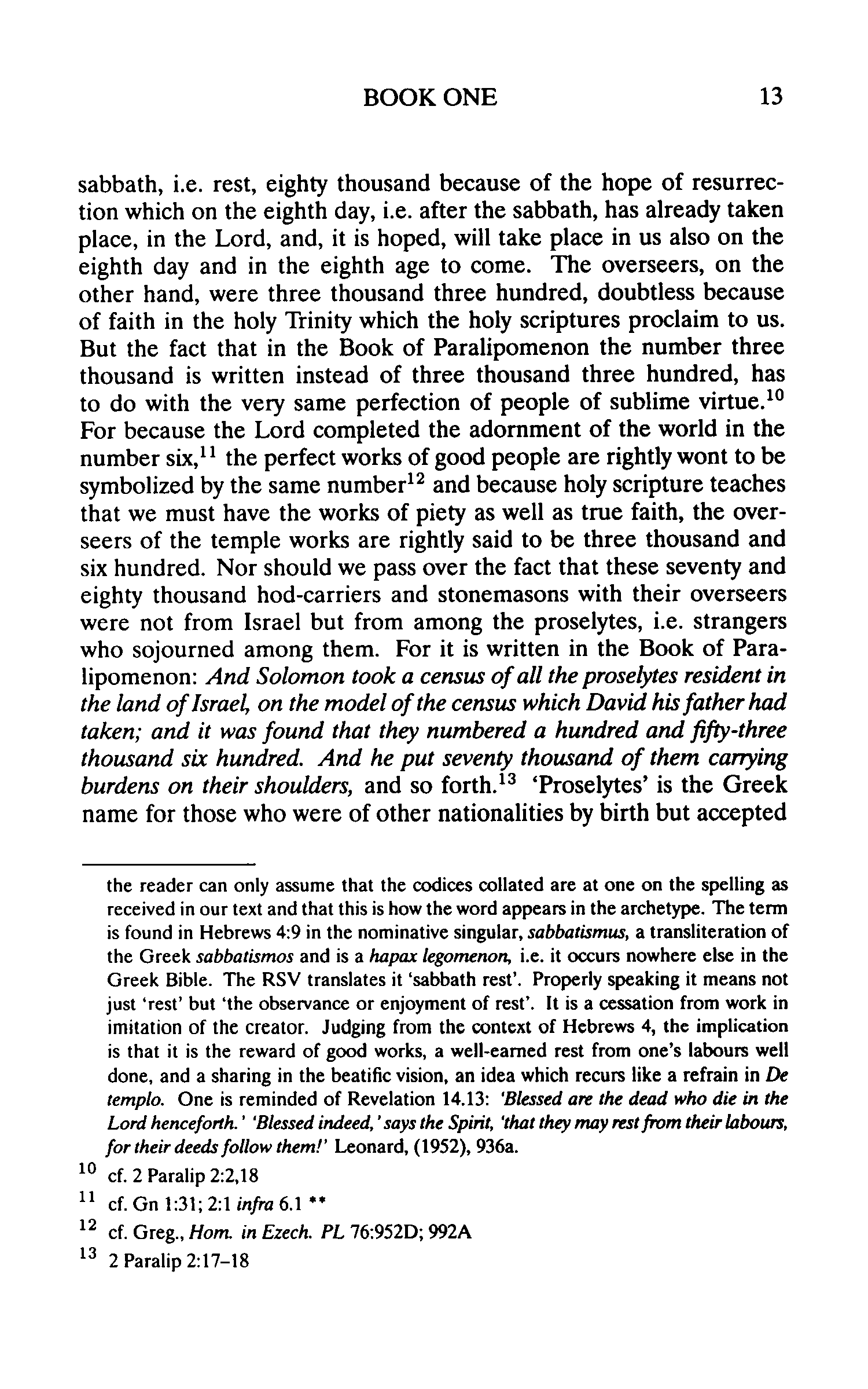
sabbath, i.e. rest, eighty thousand because of the hope of resurrection which on the eighth day, i.e. after the sabbath, has already taken place, in the Lord, and, it is hoped, will take place in us also on the eighth day and in the eighth age to come. The overseers, on the other hand, were three thousand three hundred, doubtless because of faith in the holy Trinity which the holy scriptures proclaim to us.
But the fact that in the Book of Paralipomenon the number three thousand is written instead of three thousand three hundred, has to do with the very same perfection of people of sublime virtue."
For because the Lord completed the adornment of the world in the number six," the perfect works of good people are rightly wont to be symbolized by the same number12 and because holy scripture teaches that we must have the works of piety as well as true faith, the overseers of the temple works are rightly said to be three thousand and six hundred. Nor should we pass over the fact that these seventy and eighty thousand hod-carriers and stonemasons with their overseers were not from Israel but from among the proselytes, i.e. strangers who sojourned among them. For it is written in the Book of Paralipomenon: And Solomon took a census of all the proselytes resident in the land of Israel, on the model of the census which David his father had taken; and it was found that they numbered a hundred and fijiy-three thousand six hundred. And he put seventy thousand of them canying burdens on their shoulders, and so forth.13 'Proselytes' is the Greek name for those who were of other nationalities by birth but accepted the reader can only assume that the codices collated are at one on the spelling as received in our text and that this is how the word appears in the archetype. The term is found in Hebrews 4 9 in the nominative singular, sabbarismus, a transliteration of the Greek subburismos and is a hupu legomenon, i.e. it occurs nowhere else in the Greek Bible. The RSV translates it 'sabbath rest'. Properly speaking it means not just 'rest' but 'the observance or enjoyment of rest'. It is a cessation from work in imitation of the creator. Judging from the context of Hebrews 4, the implication is that it is the reward of good works, a well-earned rest from one's labours well done, and a sharing in the beatific vision, an idea which recurs like a refrain in De remplo. One is reminded of Revelation 14.13: 'Blessed are rhe dead who die in rhe
Lord henceforth. ' 'Blessed indeed, 'says the Spirit, 'rhar rhey may resrfrom their labows, for their deeds follow them!' Leonard, (1952), 936a. lo cf. 2 Paralip 2:2,18 l1 cf. Gn 1:31; 2:1 infm 6.1 ** l2 cf. Greg., Horn in Ezech. PL 76:952D; 992A l3 2 Paralip 2:17-18