
A Trinitarian Theology of Nature Is Natural-Revealed Knowledge
13
A Trinitarian Theology of Nature
Is Natural-Revealed Knowledge
In order to conclude the argument, what is being proposed here is a dynamic and unified divine action account of the Father, Son, and Holy Spirit in the continuous, moment-by-moment manifestation of what we know and experience as the natural world. This proposed view is new in the sense that it takes the workings of each Person of the Trinity into account when attempting to decipher two things. First, namely, unlike other extant divine action views, it attempts to account for how God is acting within God’s Trinitarian essence, in the manifestation of the natural world in its structures, processes and mechanisms, as well as the intentional communication of the knowledge of spiritual things embedded therein. Second, it attempts to show how this action provides an explanation of what nature is, in terms of the physical reality that we encounter each day as the natural world. The natural world, then, when viewed through a Trinitarian lens, incorporates an intentionality that began in the mind of the Creator as exemplars, or ideas intending to be manifested into the creation. As part of God’s Original Ultimate End (as proposed initially by Jonathan Edwards), knowledge of the divine excellencies is emanated or communicated in the form of natural onto-types that prefigure ontological antitypes in the spirit realm. All natural types exist by Christ, in Christ, through Christ, and for Christ. It is then the role of the Spirit to reveal this knowledge to the creature, created to receive it and delight in it, thus satisfying God’s end for creating the world.
From this constructive theology we can affirm what Emil Brunner proposed regarding revisiting the traditional notions of natural knowledge of God and revealed knowledge of God. He states in a subsection of his Christian Doctrine of Creation and Redemption titled “Natural Knowledge and Revealed Knowledge,”
First of all, however, we must look at the purely theological problem which concerns the dualism of scientific knowledge and religious knowledge, or knowledge derived from revelation. The world as created by God can only be known through God’s revelation: but as created by God, it is the sphere of legitimate natural, or scientific knowledge. How are we to understand this two-fold character of knowledge, without destroying the unity of knowledge?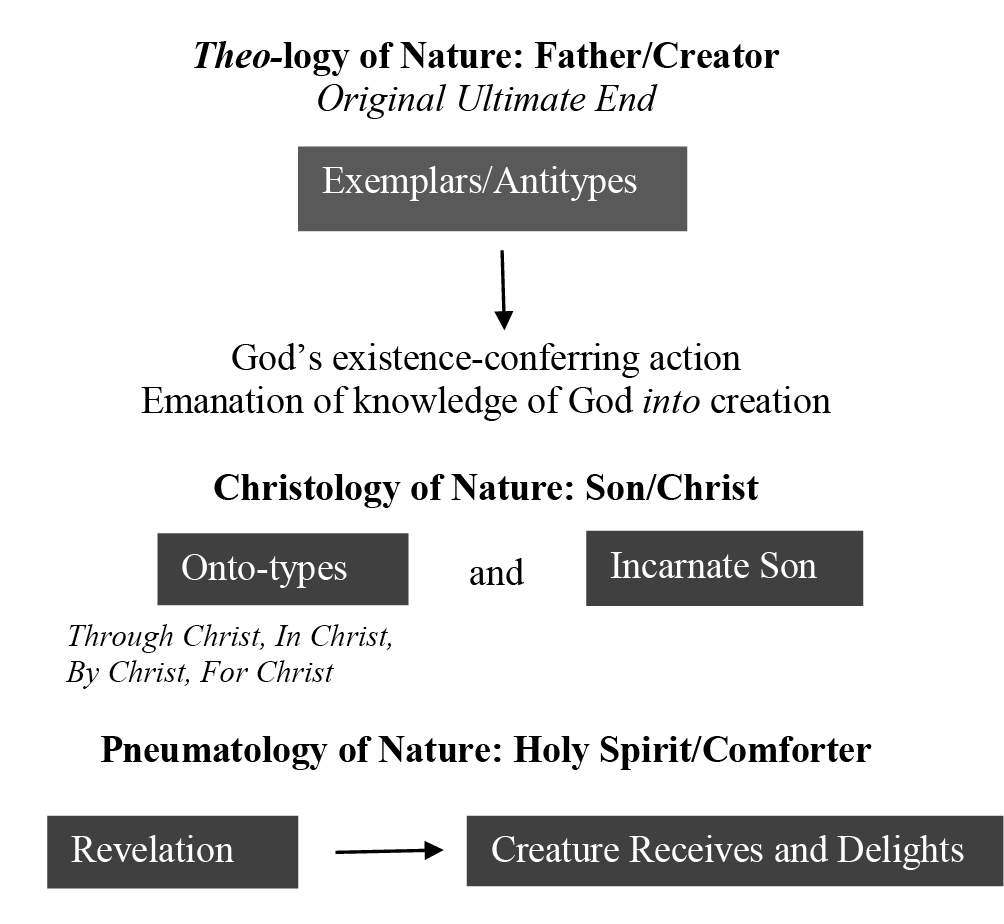
Brunner is proposing for us to revisit the dualism in separating scientific knowledge and revealed knowledge. I appreciate his emphasis distinguishing “the world as created by God,” and “the world as created by God.” In the former, the creation created by God implies something. It implies that the elements of the natural world will have some form of reflection of its Maker, which can only be revealed by God. In other words, nature does not stop at only providing endless science books giving descriptions of how things work. Nature also holds another layer of knowledge for the human being to receive. It is proposed here that this refers to knowledge of the spirit realm revealed through the onto-types embedded therein. It is a form of revealed knowledge through the workings of nature. Brunner also indicates in the latter that “the world as created by God” also implies something. It implies that the findings that science gives us provide a working knowledge of the knowable, step-wise mechanisms and structures that allow the natural world to function in balance and harmony. This natural knowledge also has something to tell us, beyond the mechanics. In this constructive theology, it is proposed that the natural knowledge science discovers and reports are simply the ways that God is acting moment-by-moment, willing the creation into existence on condition. Hence, we no longer need an artificial distinction, or dualism, between natural and revealed knowledge, at least in terms of the elements of the natural world. We have arrived at a natural-revealed knowledge of one accord. Said another way, natural knowledge, or the knowledge derived from scientific findings are a form of revealed knowledge of God.
This natural-revealed knowledge of the divine Creator contained in the natural world, as affirmed throughout the scriptures, is a complex working that can best be explained in the Trinitarian sense of God’s Being. As such, we can construct a model to demonstrate the interrelation of these aspects of the Trinitarian Theology of Nature. Such a model may give insight into the structured unity of a natural-revealed knowledge of God that originated with the intention of God to communicate God’s great, reaching love to the creature. Let us proceed with the proposed model in Figure 2.
We shall begin with God’s Original Ultimate End in creating. The ideas that constitute all possibilities for the actual world, all of the subordinate and consequential ends necessary for God’s Original Ultimate End, are represented as exemplars in God’s mind. Exemplars in God’s mind carry the sublime totality of knowledge of all that God intended to create, including: a) what the structures are, such as the mass of an electron, the elliptical orbit of Mars, etc., and b) how they are what they are—God’s willing them into existence moment-by-moment, emanating knowledge of himself and the divine glory, according to his plans and purposes in Christ. These are the ontological antitypes. Since everything in the universe belongs to God,
Next, the model suggests that God emanates/communicates knowledge of God’s Self into the creation in two unified ways: in the incarnate Son and through onto-types embedded in the natural world. These are two unified but unequal revelations since God’s own essence is in Christ, being one with Christ, but it is the knowledge and glory of God emanated into the creation by Christ, in Christ, through Christ, and for Christ. All the messages of God’s divine nature are embedded as shadows of divine things and prefigure their ontological antitypes. Since the types originated in the mind of God as exemplars, they are also ontologically real. Thus, they are onto-types, not merely human assignments. This is God’s communication of the spiritual reality, the antitypes. God is the ultimate reality and this world is the analogy.
In this communication, science, then, exists as a discipline ordained by God. Science seeks to discover the intricacies of the mechanisms of nature and thus reveals knowledge of God, even if it does not acknowledge it, or even denies such. Science is in the “service of God,” as claimed by Emil Brunner, by disclosing God’s present moment acting and communication of the Divine Self, through its findings and discoveries. In such an integrated theology, natural knowledge is a kind of revealed knowledge of God. This can be inferred by reading Edwards, who claimed that God has instantiated the created realm with analogies, shadows, images of divine things. We have extended this idea by proposing that these analogies are real, not anthropomorphic human assignments, and are given to the creature only in divine revelation to the human intellect. This is a bona fide natural-revealed knowledge indeed.
Perhaps we can see it in this way; everything the creature encounters is analogical in the sense that it is a representation of, or reflection of, eternal and infinite knowledge and glory of God. Viewed as such, onto-types in the natural world embedded in all scientific discoveries in nature, from gluons to galaxies, are realizations of the divine exemplars. That is, they are a communication of divine intention and attributes, as Scripture teaches us, through Christ, in Christ, for Christ, and by Christ. The resultant exemplar causation was purposed or intended by God (and according to Edwards, delighted in by God). The onto-types, then, are a manifestation of God’s acting according to his plan for the world in Christ. It is Christ who emanates/communicates the knowledge and glory of God into the created realm. Christ himself in his incarnate existence is also an onto-type pointing to the antitype of the Father. This aspect is a Christology of Nature in that it represents the economic office of the Son/Christ, the second person of the Trinity.
Lastly, the model refers to the third person of the Trinity. The Holy Spirit acts by revealing both the truth of salvation in Christ, and truth of the knowledge of God embedded in the creation. While natural onto-types are embedded in the creation, they would have remained unknown to the creature without the work of the Holy Spirit. The Holy Spirit is revealing the knowledge and glory of God to individuals who have the free will to accept, or reject, this knowledge. If rejected, humankind is left with the scientific ontology alone, with physical descriptions of systems and mechanisms, without a complete understanding of the dynamic underlying reality of God’s divine continuous, compositional acting and self-disclosure.
However, it is the contention of this view that what science discovers is God’s acting whether it is acknowledged as such or not. When it is acknowledged as God’s divine Trinitarian acting by one who believes, it provides the highest level of being and joy a human can know. This revelation to the human mind and heart, where onto-types are grasped, is accomplished by the work of the third person of the Trinity. This aspect is a Pneumatology of Nature in that it represents the economic office of the Holy Spirit/Comforter, the third person of Trinity. When this is received by the creature in faith, and delighted in by the creature, this brings God’s glory back to its source. This work of the Holy Spirit results in the remanation of God’s glory according to Jonathan Edwards’ end for which God created the world.
Thus, this model represents a constructive Trinitarian Theology of Nature where the acting of each divine Person of the Trinity is represented: Exemplars referring to the divine action of the Father/Creator, Types referring to the divine action of the Son/Christ, and Revelation referring to the divine action of Spirit/Comforter, as one unified, intentional and coordinated act of God. This model extends and expands Edwards’ proposal for a Trinitarian account of nature, which I will include once again here:
The whole Trinity is concerned in every work of God. All the persons of the Trinity are concerned in the creation of the world. Each person [of the Trinity] has a distinct part, and as it were, sustains a distinct character and charge in that affair. They are all not only concerned as joint actors and co-workers in the affairs of creation but each has a distinct part in the affair assigned to him. There is this order that is observed by the persons of the Trinity in their acting in all affairs pertaining to the glory of the Godhead in the creation of the world.
In putting forth this model, it is important to note that any model is only a figurative representation of ideas, placed in a context for ease of viewing and discussion. It is by no means exhaustive, and will contain flaws needing to be further explored, revised, and refined with future research. In this model, each person of the Trinity is acting together, coordinately and intentionally, in perfect unity, based upon God-in-three-persons from a unified and intended will. The quote above seems to be indicating a consistency between Edwards’ proposal of a Trinitarian Theology of Nature without diverting from the Doctrine of Appropriation. Edwards, as outlined in the quote above came to a realization late in his ministry: that is, that God is acting in the creation in a dynamic fashion within and among the three persons of the Godhead. In Edwards’ metaphysics of creation, the Triune God is acting within the “triunity” (Barth’s term) of the three distinct persons of the Godhead.
To be clear, as mentioned above, a Trinitarian Theology of Nature is put forth as a “perichoretic doctrine of creation”
Hence, the actions of the Trinity, while being distinct, are indivisible. Barth’s Doctrine of Appropriation as introduced in the Chapter 5 is applicable here in terms of the perichoretic shared life within the Trinity. Adam McIntosh, in his essay “The Contribution of Karl Barth’s Doctrine of Appropriation to a Trinitarian Ecclesiology,”
Then, in applying a Trinitarian Theology of Nature to the church, we have given language to the unspeakable ways of God’s unified divine action in nature. Nature as divine willing, communicating and revealing gives language toward an understanding of a God who reaches to believers whose lives are growing in him. As MacIntosh describes, “This hermeneutic offers a variegated ecclesiology by presenting intensified perspectives of the church as it corresponds to God’s works.”
This interworking of the persons of the Trinity in nature reflects the ontology of God’s internal being as one of infinite and inexhaustible beauty and love. This may be thought of as an efflux of the intra-Trinitarian love ad extra, in cooperative fellowship and union toward one end. As Olson and Hall state,
There is a beauty in the concept of the Trinity itself that points toward the beauty of God himself. It is the beauty of love reflected in a truth: God is love. Whom did he love before there was a world? Himself—within the fellowship of three mutually loving persons. The Trinity thus becomes a model of creaturely love and fellowship.
This quote is closely related to what we have already seen in Edwards’ metaphysics of creation where it is out of God’s supreme regard for himself, as the most highly valued and most valuable in all of existence that the intra-Trinitarian love exists. There is nothing more beautiful, more valuable, more worthy than God’s existence. It is the efflux of that mutual intra-Trinitarian love ad extra, when it is received, delighted in, and appropriated by faith, that the end in creation is accomplished. That efflux of inexhaustible agape includes distinct, yet unified and interrelated ways of divine acting in that the Father wills eternally real ideas into existence, the Son communicates/emanates knowledge and glory of God into the structures of the creation in the forms of natural types, and the Spirit reveals those real-ized types and their antitypes to created minds. In this way, a Doctrine of Creation, viewed as a Trinitarian Theology of Nature, is thus a doctrine of God’s acting.
Figure 2. Model of A Trinitarian Theology of Nature