
ATrinitarian Theology of Nature Requires aView of Divine Action That Is also Trinitarian
6
A Trinitarian Theology of Nature Requires
a View of Divine Action That Is also Trinitarian
We have just argued that the creation is God’s divine Trinitarian acting. Among the current divine action theories, which would hold the best explanatory power to share this Christological grammar and reflect the Trinitarian acting of God? Then, can that same theory address by what means God is understood to be acting in a Trinitarian fashion which constitutes a functional natural world?
Traditionally, God’s divine action, according to extant theories of divine action (see Figure 1) is attributed to the Father/Creator God with no mention of the involvement of the Son or the Spirit. However, let us return to the quote from Jonathan Edwards. He seems to be saying that each divine Person of the Trinity is uniquely, intentionally, and specifically involved in the creation as we encounter it, as we saw in the quote in the previous chapter, “All the persons of the Trinity are concerned in the creation of the world. Each person [of the Trinity] has a distinct part, and . . . There is this order that is observed by the persons of the Trinity in their acting in all affairs pertaining to the glory of the Godhead in the creation of the world.”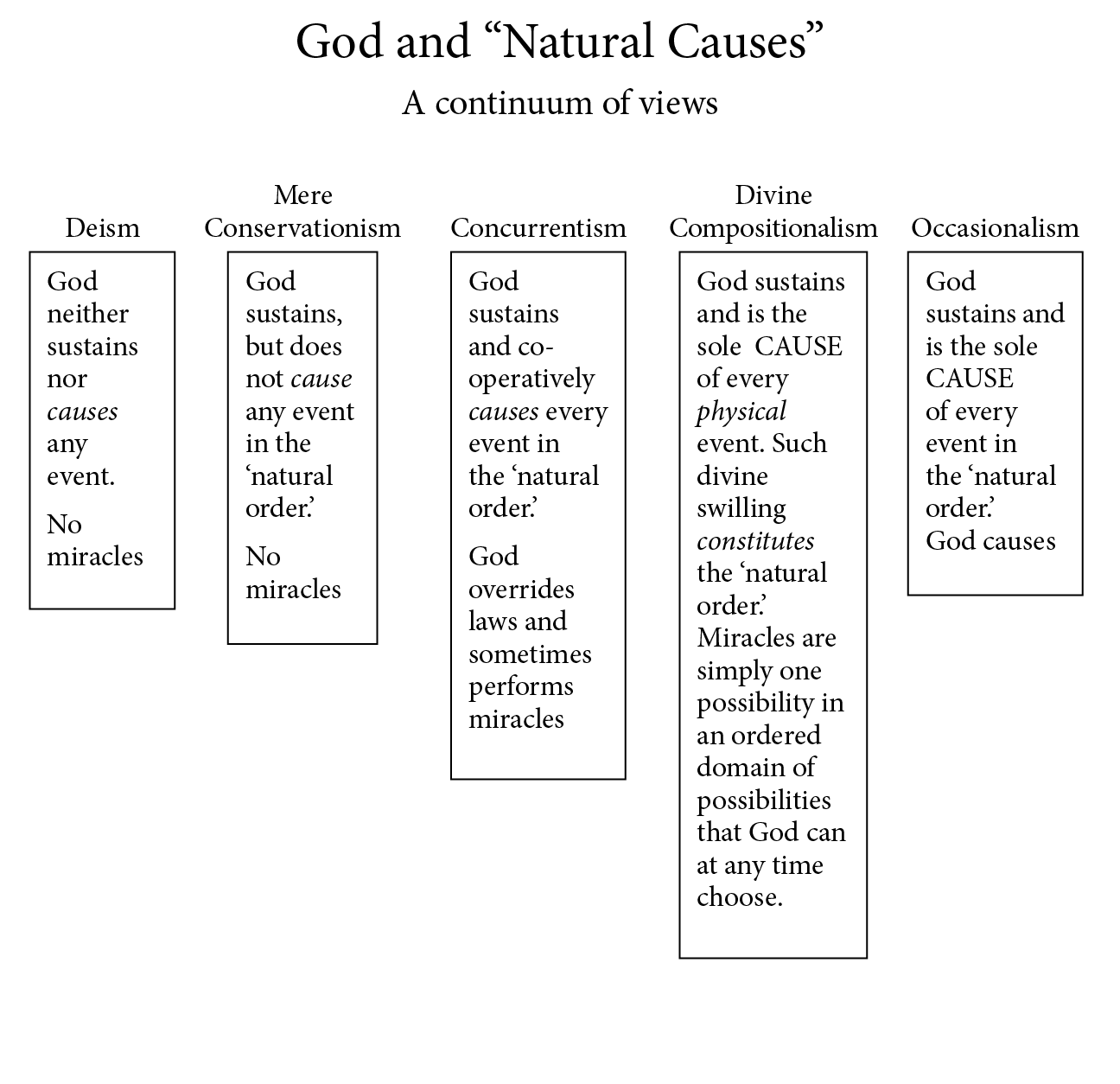
One such view, Divine Compositionalism, at its foundation, states that God’s plan for the universe is God’s plan in Christ for redemption and revelation.
Biblical Theology
Ontology
God
God
God’s awareness of his
omni-competence
An ordered domain of real possibilities
God’s commitments to:
act on condition
Dispositions
act constantly
Forces
act coordinately
Structures
At its foundation, Divine Compositionalism states that the dispositions, structures, and forces that comprise the natural world are ways that God acts upon condition. All elements of creation (quantum events and mechanisms, cellular and molecular biological mechanisms, such as cell motility, respiration, macromolecular metabolism, protein synthesis and so on, all the way through ecosystem dynamics, and cosmological events) may be understood in terms of dispositions, forces, and structures, which are ways God acts according to his plan. God’s plan in Christ is God’s plan for the universe for redemption and revelation by the Holy Spirit. Thus, this view of divine action is fully Trinitarian.
In other words, the structures of creation, and all physical events/mechanisms within the creation (apart from human actions), are accounted for in terms of God acting moment-by-moment, upon condition, according to God’s plan in Christ. What science discovers regarding structures, mechanisms, and events in nature is describing the ways God acts. In other words, all mechanisms, structures and processes found in nature are a result of God’s immediate and present-moment acting on commitment based on previously established dispositions that have their origination in the mind of God. The forces we perceive such as gravity, electromagnetism, small and weak nuclear forces are not brute powers unto themselves, but are ways God acts consistently and faithfully. Molecular structures and higher ordered processes and pathways are ways God acts in a coordinated fashion. In this way, the creature encounters the fully ongoing processes of life and death and regeneration which represent the ways God is continuously acting to produce the moment-by-moment reality in which we exist. On the grounds of this ontology, then, it is possible to account for the concepts of space, time, event, laws of nature, causality, mechanism, and (in)determinism.
In light of all such scientific mechanisms and processes, Divine Compositionalism conceives that all things in the universe are created by the Trinitarian God; by, in, through, and for Christ according to the Scriptures. Since it is through Christ all things “hold together” we cannot separate natural law, powers, or causality from the sovereignty of God in Christ, through the power of the Holy Spirit. Divine Compositionalism concurs with this by conceiving all dispositions, structures, and forces, and therefore all events in the natural world as God’s acting upon established commitments, which is God’s plan for the actual world.
Furthermore, if the whole of creation according to Divine Compositionalism is God acting according to his commitments, then the Edwardsean understanding of emanation/communication of the knowledge and glory of God into the creation can be restated along similar lines. Edwards construed nature as a communication to the creature in the form of shadows of divine things. In Edwards’ hands, nature holds embedded messages of the divine that serve a kind of analogy pointing to heavenly truths. As we have seen earlier, Torrance, Edwards, and others have seen nature as a language of God, a communication of God’s divine attributes to the creature. In this way, communication itself is a divine act. Christoph Shwobel says it this way, “understanding creation as a divine act and as the created result, in other words in terms of communicative relationship.”
Therefore, not only willing a creation into existence is an action of God’s power and design, but communicating through those created structures is also an act. However, knowledge of God cannot be received nor understood by the creature apart from revelation, yet another divine act. One way to understand this might be to correlate God’s divine action in a three-fold manner as Edwards suggests in the quote above. The creation holds the messages of spiritual things, or as Schwöbel says, “everything in creation is divine words,”
At first glance, this view may seem to harken to an occasionalist position. However, it overcomes the primary inherent problem that occasionalism cannot escape, namely that if every event is an “occasion” for God to act, then how to account for evil acts?
Divine Compositionalism: A Preferred Divine Action
View for a Trinitarian Theology of Nature
We have just explored Divine Compositionalism as a view of divine action that can account for God’s Trinitarian action in the world. But what of other views? How to they fare in serving a Trinitarian Theology of Nature?
On these grounds we depart again from traditional Natural Theology which could be served by views of divine action such as mere-conservationism or concurrentism.
However, there are many incoherences in the deist, mere-conservationist, or concurrentist views associated with older versions of Natural Theology. One incoherence is the premise of creation as self-sufficient and autonomous. This is counter to the God-world relation presented throughout Scripture revealing God as interacting with the creation moment-by-moment in intimate ways, such as in Psalm 104:14, “He makes grass grow for the cattle, and plants for people to cultivate, bringing forth food from the earth.” Scripture reveals all of creation as contingent and fully dependent on God. Creation as depicted in the scriptures is not self-sustaining nor does it operate on its own; such a construction would confer self-sufficiency to the creation, making creation a se. Only God is a se. The concurrentist idea that God can convey a kind of aseity to the creation is inconsistent in-and-of itself since the very notion of aseity implies an inherent autonomy, not given or created.
Torrance works to find coherence in this tension by indicating that nature has a created “contingent intelligibility” allowing it to be known.
Taken separately, “contingent intelligibility” and “contingent freedom” represent two distinct conceptual sides of the Natural Theology coin. Contingent intelligibility aligns well with the Trinitarian Theology of Nature proposed here in allowing nature to speak, and that this message is centered on God’s revelation alone. Torrance’s “contingent intelligibility” serves a Trinitarian Theology of Nature well by designating the correct God-human relation in full contingency of the intelligibility of the structures of the natural world. In concordance with this aim, Torrance is yet affirming the idea that nature does, in fact, speak, “Indeed, the goal is to allow nature to reveal itself to us ‘without imposing upon it the presuppositions hidden in our questions’”
This seems to harken to the Thomistic position of concurrentism which entails secondary causality that relies on a separatist view such that there is a transcendent separation between God and creature. In a concurrent view of the natural world, one is committed necessarily to an anthropocentric position where the creation can operate secondarily according to its own laws, albeit given by God the primary cause.
Humankind through reason alone can discern and decipher God’s acting in the physical world as well as in the communication of God through analogy. However, this view of divine acting counters a reliance on God’s sole uncreated aseity. Divine Compositionalism, offers an alternative position that entails a transcendent view of God who created ex nihilo, while preserving God’s immanence in a moment-by-moment continuous creation where God is willing structures into their very existence, communicating through natural structures, and revealing truths to the creature. This fully theocentric view relies on dispositions, forces, and structures in the natural world as acts of God, as well as revealing the analogies they convey. In this way, nature itself is a complex, triune array of God’s acting.
In addition, Divine Compositionalism may in fact fare stronger among the competing divine action views in relation to natural causation. William Vallicella, summarizes that “Deism and mere conservationism have not fared well in recent discussion, and I take them to be, if not definitely refuted, at least rendered implausible. This leaves concurrentism and occasionalism as the only plausible options of a broadly orthodox sort for understanding God’s involvement in nature.”
Divine Compositionalism accounts for basic concepts in natural science, dispositions, and scientific mechanisms. For example, some views hold that the range of manifestations of multi-track, higher-level dispositions (molecular or macroscopic) is rooted in indeterminacy at the subatomic level. However, Divine Compositionalism takes the “indeterminacy” to be nothing other than God’s intentional (and therefore, rational) action. Such indeterminacy reflects God’s freedom in sustaining the physical world, which underlies God’s providential control of history, and the contingency of all events and structures upon God.
In this model, random processes at the molecular level are only seemingly random processes since these mechanisms are in fact under direct divine guidance. Divine Compositionalism precisely reconciles providence and randomness in the mechanisms of nature by attributing such processes to the volition of God acting upon condition depending on specific environmental, organismal, cellular and molecular needs in any given situation in the biosphere at any given moment. In this way, Divine Compositionalism represents neither a “top-down” nor a “bottom-up” causality. It represents God’s coordinated, continual, committed action everywhere in the universe at every Plank-scale moment. In other words, our perception of events that constitute random and non-random natural processes simply represents a range of manifestations of dispositions that just are God’s freedom in acting. In this way, Torrance’s “limited freedom” is not necessary since the manifestations of every physical event (not taking into account agent free will) is contingent on God, including the revelation of such knowledge to the creatures.
Divine Compositionalism holds that all things in the universe are created by the Trinitarian God, by, in, through, and for Christ according to the Scriptures. Since it is through Christ all things “hold together,” we cannot separate natural law, powers or causality from the sovereignty of God in Christ, through the power and revelation of the Holy Spirit. All of the creation, as reflected in the language and discovery of science, is contingent upon God. Wolfhart Pannenberg posits that any discussion of God’s action in the world must take into account causality, laws of nature, and contingency. He states, “The traditional doctrine of God is related to many philosophical issues that imply some relation to the language of science. This is the case in the notions of causality, law, and contingency. These notions are indispensable in any discussion about God’s action in the world.”
Pannenberg asserts that particular events (which he denotes as “local”) as well as global events in nature and throughout history are contingent upon God’s action and that God’s plan for all events must be considered. Divine Compositionalism concurs with this, namely, that all dispositions, structures, and forces, and therefore all events involving the physical structures of the world, are contingent upon God, based on God’s acting upon established commitments, God’s plan for the actual world. Without such contingency on God, any ontology is forced to consider dispositions and forces in particular to be brute, non-contingent aseities in themselves. Thus, Divine Compositionalism holds that God is the only aseity, whereby all things are contingent. This is how Divine Compositionalism can take Torrance’s “contingent freedom” construal to a deeper level of understanding contingency in terms of events in the natural world. Let’s see how.
The creation, in the sense of the mechanisms of the natural world, is not free. God is free. The creation is contingent upon God’s plans and purposes for the course of temporal history. Thus, dispositions, forces, and structures are contingent upon God’s divine acting according to God’s pre-ordained commitments, under conditions of the natural world according to God’s plan. If dispositions, forces, and structures are non-contingent, or contingent with some “limited freedom,” then we are faced with two further problems: first, that dispositions, forces, and structures are aseities, in and of themselves, and second, we are presented with a universe of total receivers. In our ontological understanding of a scientific mechanism, and the processes within the natural world, a universe of total receivers of existence simply cannot exist, as handed down to us from the tradition of Aquinas. I align with Pannenberg’s view insomuch as the laws of nature, the fundamental forces, are God’s constant acting, as he states, “rooted in the faithfulness of God.”
Pannenberg goes on to say in Toward a Theology of Nature that every creature is in need of conservation of its existence every moment, and as such, a continuous creation is occurring moment-by-moment. However, the activity of every creature is dependent on divine cooperation, a concursus divinus.
Additionally, it follows that it is mistaken to think of divine action and “natural causation” in terms of concurrence or intervention. God does not encounter creation. God creates it. Furthermore, there will be situations in which God does not act according to perceived regularities, but is still acting upon commitments which represent a range of manifestations within a range of conditions. These are perceived as miracles. In this way, Divine Compositionalism accounts for special divine action, or miracles, as simply God acting within a range of manifestations, one of which is different from a perceived regularity. God does not ‘violate a law’ as is prescribed in some accounts of special divine action theories; rather, God is acting within a range of possible outcomes, depending upon the condition. As Denis Alexander states, “Miracles are unprecedented events. Whatever the current fashions in philosophy or revelations in the opinion polls may suggest, it is impossible to affirm that science (based as it is upon the precedents of observations) can have nothing to say on the subject of our experience. Its ‘laws’ are only generalizations of our experience. Faith rests on other grounds.”
In other words, what we perceive as a miracle is simply God acting in such a way that allows for a different manifestation (call it ‘mx’) within a set range of pre-ordained manifestations {m1, m2, m3, mx,…mn} where mn represents the total possible outcomes for any physical event according to God’s awareness of his omni-competence, and mx represents one of those manifestations that is not regularly observed. For example, Jesus walking on water is not a violation of the law of gravity, but is God acting upon condition, choosing a different ‘m’ from God’s set of manifestations {mn} for that time and that purpose. In this case it would be one of the manifestations that are not part of the set of regularities typically encountered, but is a possible ‘m’ in God’s plan nonetheless (or, mx in our discussion above). Jesus walking on the water, and Peter also, simply represents one manifestation within a range of manifestations. To us, walking on water seems to violate a natural law, only because our perceived regularities only show us one possible outcome such that when a mass with greater density than water alights on the surface of water it sinks.
However, in God’s economy, a range of manifestations are possible, all operating even if we only regularly perceive a set of possible outcomes {mn} where n =1. We can say, then, that God consistently willing the creation into existence, moment-by-moment, is the ontological ground of an alternative account of natural law, as well as what science deems as an apparent deviation from natural law in what we call miracles. This is corroborated by John Polkinghorne in his book, Science and Providence,
Those regularities discerned by science as the laws of nature are, in fact, signals of God’s reliability and faithfulness, made known. God is not an intervener in the world’s process, yet surely if he is the Christian God, He is in continuous interaction with it.
And again,
There is a temptingly simple answer to this question. It is to assert that God is active in the world as Creator and Sustainer but His action is limited to that great single Act which caused and keeps in being the universe. We can make best sense of this whole complex of experience and ideas if we think of the whole continuing creation of the world as God’s one act . . . The world in this way is in its basic pattern because God wills it so.
Here, we see a view of the God-world relation is taken where God is not intervener, fixer, or merely present in the “great single act” of creating. Rather, As Polkinghorne asserts, we do better if we think of the natural order as “God’s one act.” Divine Compositionalism engages this view by asserting that the moment-by-moment existence of the universe is a matter solely of God’s acting—in particular, God’s commitments to act on condition, to act constantly, and to act coordinately, bringing into existence dispositional properties, laws, forces, causal processes, objects, and mechanisms; all according to his plan in Christ. Thus, based on its Christological ground, Divine Compositionalism provides a view of divine action that may well serve as a preferred view of divine action for a Trinitarian Theology of Nature.
What is left before us is to explore by what means God is acting in willing the creation into existence and communicating his Trinitarian Self into it and revealing this information to sentient creatures who have been fashioned to receive that information. How can the creature learn and experience the knowledge of God and the glory of God through a Trinitarian Theology of Nature? In the next chapter, we will take up these questions and explore how God’s communication to the creature is wholly analogical, the analogia with which God bridges the finitum non capax infinitum.
Figure 1. The Range of Divine Action Views