
Jonathan Edwards: A Life
George M. Marsden · Yale University Press, 2003
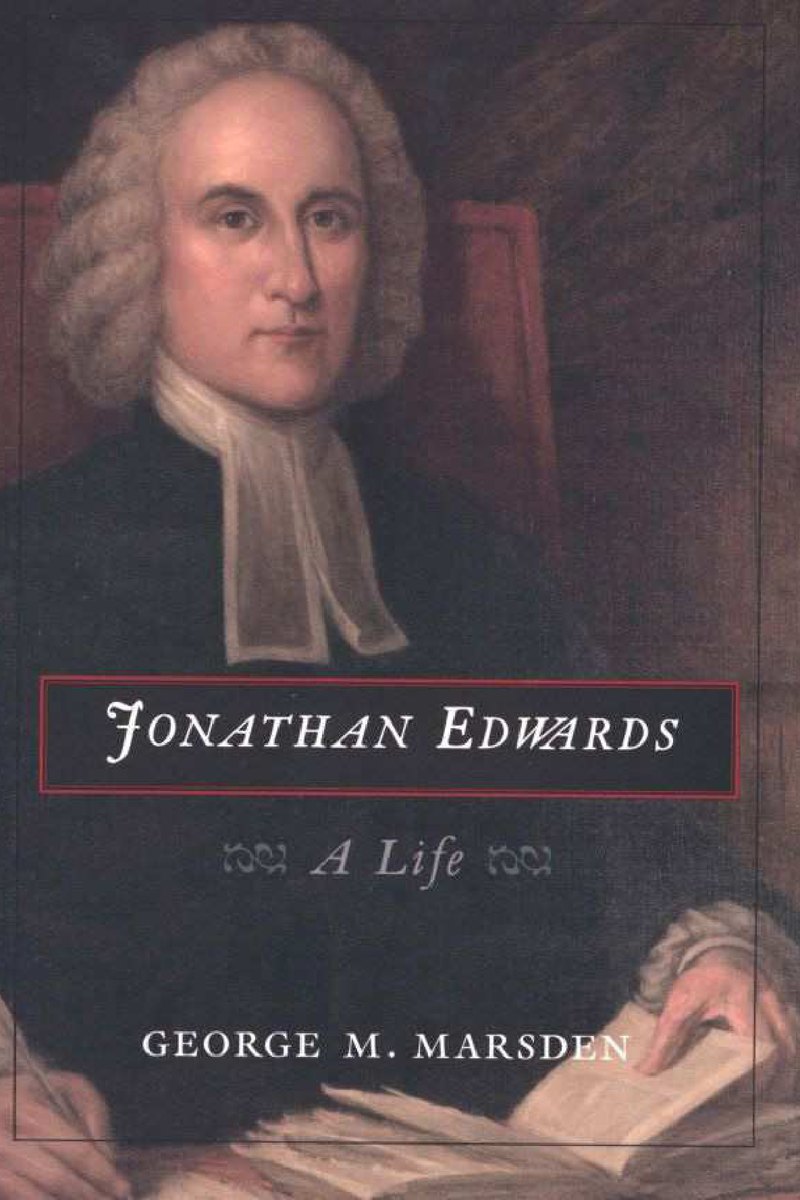
About this book
Jonathan Edwards: A Life by George M. Marsden
George M. Marsden’s Jonathan Edwards: A Life (Yale University Press, 2003) is widely regarded as the definitive modern biography of the New England theologian, philosopher and revivalist Jonathan Edwards (1703–1758). Drawing on Edwards’s manuscripts and the scholarship gathered around the Yale edition of his Works, Marsden follows Edwards from his Connecticut boyhood and precocious years at Yale College, through his settlement as pastor at Northampton, Massachusetts under his grandfather Solomon Stoddard, the Northampton revival of 1734–35, the wider Great Awakening of the early 1740s and the sermon Sinners in the Hands of an Angry God, the communion controversy that ended his twenty-three-year Northampton pastorate in 1750, his years as a missionary among the Mohican and Mohawk peoples at Stockbridge, and his brief, fatal presidency of the College of New Jersey (Princeton) in 1758. Marsden sets Edwards’s major philosophical and theological writings — among them Freedom of the Will, Religious Affections and Original Sin — within the intellectual world of colonial New England and the early Enlightenment.
- 30 Chapters
- 638 pages
- 1703–1758 Subject’s life
- English
Source: George M. Marsden, Jonathan Edwards: A Life (New Haven: Yale University Press, 2003). ISBN 978-0-300-09693-4 (cloth); paperback ed. ISBN 978-0-300-10596-4 (2004). © 2003 by Yale University. All rights reserved. This work is still in copyright and is not reproduced here in full — this page is a UECF.NET library entry with bibliographic information, an original synopsis and table of contents. The complete book is available from Yale University Press, booksellers and libraries.
Table of Contents తెలుగు About Jonathan Edwards
📥 PDF Publisher page (Yale University Press) Google Books preview ← Books
About the Author
Jonathan Edwards (1703–1758) was a Congregationalist pastor, revivalist and philosophical theologian, and one of the most important thinkers in American religious history. He preached at the center of the Great Awakening, was dismissed from his Northampton pulpit over the terms of church membership, served as a missionary at Stockbridge, and died just weeks into his presidency of the College of New Jersey (Princeton). Read the full author profile →
Table of Contents
The book’s chapter structure, with a one-line note on each chapter’s place in Edwards’s life. Chapters are not separately reproduced online (see the copyright notice above); read the full text in the PDF or a print/library copy.
- Introduction — Marsden’s framing of Edwards’s life and legacy.
- 1. A Time to Be Born — Edwards’s birth in East Windsor, Connecticut, in 1703, and his Puritan family background.
- 2. The Overwhelming Question — his boyhood wrestling with the Calvinist doctrine of God’s sovereignty.
- 3. The Pilgrim’s Progress — his years as a Yale undergraduate and the ideas that shaped him.
- 4. The Harmony of All Knowledge — his early fascination with Newtonian science and Lockean philosophy.
- 5. Anxieties — uncertainties of his early ministry as a young pastor.
- 6. “A Low, Sunk Estate and Condition” — his conversion experience.
- 7. On Solomon Stoddard’s Stage — becoming assistant, then successor, to his grandfather at Northampton.
- 8. And on a Wider Stage — his growing reputation beyond Northampton.
- 9. The Mighty Works of God and of Satan — the Northampton revival of 1734–35.
- 10. The Politics of the Kingdom — church and town politics surrounding the awakening.
- 11. “A City Set on a Hill” — Edwards’s vision of Northampton’s spiritual mission.
- 12. God “Will Revive the Flame Again, Even in the Darkest Times” — the years between revivals.
- 13. The Hands of God and the Hand of Christ — his theological writing in the mid-1730s.
- 14. “He That Is Not with Us Is Against Us” — controversies attending the Great Awakening.
- 15. “Heavenly Elysium” — George Whitefield’s 1740 visit and the height of the Awakening, including Sinners in the Hands of an Angry God (1741).
- 16. Conservative Revolutionary — Edwards’s defense and critique of the revival.
- 17. A House Divided — growing division within the Northampton congregation.
- 18. A Model Town No More — the unraveling of Edwards’s standing in Northampton.
- 19. Colonial Wars — the backdrop of King George’s War.
- 20. “Thy Will Be Done” — the controversy over qualifications for church communion.
- 21. “I Am Born to Be a Man of Strife” — the conflict that led to his 1750 dismissal from Northampton.
- 22. The Crucible — the aftermath of his dismissal.
- 23. The Mission — his move to Stockbridge as missionary to the Mohican and Mohawk peoples.
- 24. Frontier Struggles — hardships of frontier life and mission politics at Stockbridge.
- 25. Wartime — the French and Indian War’s impact on Stockbridge.
- 26. Against an “Almost Inconceivably Pernicious” Doctrine — writing Freedom of the Will (1754).
- 27. Original Sin “in This Happy Age of Light and Liberty” — The Great Christian Doctrine of Original Sin Defended.
- 28. Challenging the Presumptions of the Age — his engagement with Enlightenment thought.
- 29. The Unfinished Masterworks — The Nature of True Virtue and The End for Which God Created the World, published posthumously.
- 30. The Transitory and the Enduring — his brief Princeton presidency and death in 1758.
- Appendix A–C — genealogical tables of Edwards’s relatives and family.
- Notes, Credits & Index — scholarly apparatus (pp. 513–638).
More by and about Jonathan Edwards on UECF.NET
Public-domain and reference PDFs already in the UECF.NET library.
- The Works of Jonathan Edwards, Vol. 1
- The Works of Jonathan Edwards, Vol. 2
- The Freedom of the Will
- Writings on the Trinity, Grace, and Faith
- Samuel Hopkins, Life and Character of the Late Reverend Mr. Jonathan Edwards (1765)
- The Theology of Jonathan Edwards
- The Oxford Handbook of Jonathan Edwards
- Jonathan Edwards: A Reformed-Arminian Engagement