
3. The Westminster Doctrine of Holy Scripture
here is certainly in the whole mass of confessional literature no more T nobly conceived or ably wrought-out statement of doctrine than the chapter "Of the Holy Scripture," which the Westminster Divines placed at the head of their Confession and laid at the foundation of their system of doctrine. It has commanded the hearty admiration of all competent readers. Dean Stanley thinks that no council or synod has ever argued and decided any single theological question with an ability equal to that shown by the great theologians in their private treatises. But he immediately adds:
"The nearest approaches to it are the chapters on Justification in the Decrees of Trent, and on the Bible in the Westminster Confession." 1 Dr.
Schaff considers it "the best Protestant counterpart of the Roman Catholic doctrine of the rule of faith," and remarks: "No other Protestant symbol has such a clear, judicious, concise, and exhaustive statement of this fundamental article of Protestantism." 2 Such a statement of a fundamental doctrine is a precious heritage, worthy not only to be cherished but understood. That it may be at once highly praised and seriously misunderstood has been made sufficiently evident in the course of certain recent controversies. But apart from all reference to recent controversies, it
cannot be otherwise than useful to subject so admirable a statement of doctrine to a close scrutiny, with a view to obtaining as clear an understanding of its true purport as possible. Something of this kind is attempted in this article. And that the formulas may be looked at discolored as little as possible by the haze which may rise from the years that have intervened since their composition, an effort is made to place them in their historical setting and to illustrate them from discussions contemporary with themselves.
I. The Preparation of the Chapter "If any chapter of the Westminster Confession of Faith," says Dr. Mitchell,
"was framed with more elaborate care than another, it was that which treats 'Of the Holy Scripture.' It was considered paragraph by paragraph—almost clause by clause—by the House of Commons as well as by the Assembly of Divines, before it was finally passed; and its eighth paragraph was deemed worthy to be made the subject of a special conference between certain
Members of the House and the Divines of the Assembly." 3 The meager Minutes of the Assembly scarcely enable us to trace this careful work. As early as the 20th August, 1644, a Committee, consisting of Drs. Gouge,
Temple, and Hoyle, Messrs. Gataker, Arrowsmith, Burroughs, Burgess, Vines, and Goodwin, together with the Scotch Commissioners, was appointed "to prepare matter for a joint Confession of Faith." 4 A fortnight later (September 4), Dr. Smith and Messrs. Palmer, Newcomen, Herle,
Reynolds, Wilson, Tuckney, Young, Ley, and Sedgewick were added to the Committee or constituted an additional Committee. 5 Baillie was therefore justified in writing in October: "The Confession of Faith is referred to a committee, to be put in severall the best hands that are here." 6 How much
of the matter was prepared by this Committee we do not know. On November 21, Baillie reports that though "the Catechise is drawn up," he fears "the Confession … may stick longer"; 7 while on December 26 he thinks "that we must either passe the Confession to another season, or, if God will help us, the heads of it being distribute among many able hands, it may in a short time be so drawn up, as the debates of it may cost little time." 8 By April 25, 1645, some reports concerning the Confession had been made to the Assembly, 9 and on the 4th of May Baillie writes: "Our next work will be the Confession and Catechisme, upon both which we have alreadie made some entrance." 10 Accordingly, on the 12th of May,
1645, "the report of the Confession of Faith" was "read and debated," 11 and a Committee was appointed to draw up the first draft of the Confession. This Committee consisted apparently of Drs. Temple and Hoyle, Messrs. Gataker, Harris, Burgess, Reynolds, Herle, and the Scotch
Commissioners. On July 7, the first report was made: "Dr. Temple made report of that part of the Confession of Faith touching the Scriptures. It was read, debated." 12 This chapter on the Scriptures occupied the attention of the Assembly thenceforward until July 18; but it is impossible to trace more than the general outlines of their work. On the 11th of July it is recorded: "Debate about the Scriptures where we left; about the knowledge of the divine authority of the Scripture." 13 From this we may learn that the Assembly had got as far as the fifth section by this date. From the note on the 14th of July 14 we learn that the statement about the necessity of the inward illumination of the Spirit for the saving understanding of the Scriptures was not a part of the original draft, but was inserted by the Assembly in the debate. It was debated on this day and on July 15, when also the word "saving" was added, confining this necessity to "the saving understanding" of the Word. 15 The debate was continued on the 16th of July and on the 17th of July, on which latter occasion section 9
was before the house: "Proceed in the debate about 'literal sense.' " 16 The last notice of the continuance of the debate is that of the 18th of July. 17
Early in January, 1647, the proof-texts were added to the first chapter of the Confession. Those for the first paragraph on January 7; 18 for the second on January 8; for the third, fourth, and part of the fifth on January 11; for the rest of the fifth on January 12; for the sixth and seventh on January 14, and for the rest on January 15. 19
In the meantime, on July 8, 1645, Messrs. Reynolds, Herle, and Newcomen had been appointed "to take care of the wording of the Confession of Faith, as it is voted in the Assembly from time to time, and to report to the Assembly when they think fit there should be any alteration in the words," after having consulted with at least one of the Scotch
Commissioners. 20 And on December 8, 1645, it was ordered that Messrs.
Tuckney, Reynolds, Newcomen, and Whitaker be a Committee "to review the Confession of Faith as it is finished in the Assembly." 21 The final phrasing of this chapter was, therefore, due to these Committees, or this
Committee, for it is probable that it was all one Committee. 22 Its final form was debated and approved by the Assembly on June 17 and 18,
1646. 23
The outline of their labors undoubtedly bears out the statement that great care was taken in the composition of the chapter, but apparently not that any special or unusual discussion was given to it. There are no great debates recorded concerning it; and the Divines seem to have been more than usually at one concerning its propositions. We are surprised, indeed, by the rapidity and unanimity with which they did their work. The whole first draft passed through the Assembly between July 7 and 18: and debates are signalized only on the knowledge of the divine authority of the Scriptures
(§ 5), the need of supernatural illumination for the saving understanding of the Word (§ 6), and the literal sense of Scripture (§ 9). To these may be
added the conference with the House of Commons on section 8. The impression is very strong that, in the case of this chapter at least, Baillie's prevision proved correct and the Confession came before the Assembly in a form that roused little discussion and cost but little time in debate.
II. The Sources of the Chapter It belonged to the historical situation of the Westminster Divines that their doctrinal work should take much the form of a consensus of the Reformed theology. That theology had grown to its maturity during the controversies of the first century of its life. Everywhere there was a strongly felt desire for a comprehensive and universally acceptable creed statement of the Reformed faith, which would unify the scattered Churches and supersede or supplement the multitude of Confessions which had been produced in the first age of the Reformation; and this desire had already found expression in collections and harmonies of the Confessions. The special history of the British Churches—including the Anglo-Catholic and Arminianizing irruption under the leading of Laud—brought to the aid of this general tendency of the times both the impulse to seek support from the universal faith of other Reformed Churches and the necessity of vindicating unity of belief with them. It was in the nature of the case, therefore, that the Westminster Divines placed consciously before themselves as their dominant purpose, the task "of setting forth the whole scheme of Reformed doctrine in harmonious development, in a form of which their country should have no cause to be ashamed in the presence of any of the sister Churches of the continent." Dr. Mitchell does not overstate the matter when he represents the Westminster Assembly as having been "called together chiefly for two purposes: viz., first, to vindicate
the doctrine of the Church of England from misrepresentation, and to show that it was in harmony with that of the other Reformed Churches; and, second, to effect such changes on her polity and worship as would bring her into closer union with the Church of Scotland and the Reformed
Churches on the Continent." 24 To this, indeed, it was practically bound by the ordinance by which it was called, which set forth as its purpose "the settling of the Government and Liturgy of the Church of England, and … vindicating and clearing of the doctrine of the said Church from false aspersions and interpretations," reference being had (as is explicitly stated in its first paragraph) to securing "nearer agreement with the Church of Scotland and other Reformed Churches abroad"; while the Solemn League and Covenant included the vow that they would "endeavor to bring the Churches of God in the three kingdoms to the nearest conjunction and uniformity in religion, confession of faith" and catechising, as well as in government and worship.
The Fundamental Source This conscious reference in the work of the Assembly to the Reformed theology in general, while it adds interest to a search after the sources of its doctrinal statements, renders it almost impossible, in the chapter on the Scriptures at least, to determine them with any exactness. The difficulty is greatly increased by the circumstance that the Reformed theologians, whether on the Continent or in Britain, did not write in ignorance or independence of one another; so that it is a matter of merely literary interest to determine who was the originator of arguments or modes of statement that are common to all, or through what precise channels they came into the Confession of Faith. No reader of the Puritan literature of
the seventeenth century will fail to observe how hard it leans upon the great Reformed divines of the Continent—freely appropriating from them lines of argument, forms of expression and points of view, while also, no doubt, freely adapting them to its own purposes. The consequence is that the sources of the several sections of the Confession of Faith can with almost equal readiness be found in Ball or Du Buc, in Cartwright or Calvin, according as we choose to look near or far for them. There is scarcely a leading divine of the first three-quarters of a century of Reformed theology, who has written at large on the Scriptures, from whom statements may not be so drawn as to make them appear to be the immediate sources of some of the Westminster sections. For example the following sentences from Calvin might very well lie as the basis of the first section:
"Ergo quanquam hominum ingratitudinem satis superque omni patrocinio spoliat fulgor ille qui in coelo et in terra omnium oculis ingeritur, … aliud tamen et melius adminiculum accedere necesse est quod nos probe ad ipsum mundi creatorem dirigat. Itaque non frustra verbi sui lumen addidit, quo innotesceret in salutem.… Nec frustra eodem remedio nos in pura sui notitia continet; quia mox alioqui diffluerent etiam qui videntur prae aliis firmi stare.…
Tandem ut continuo progressu doctrinae veritas saeculis omnibus superstes maneret in mundo, eadem oracula quae deposuerat apud patres, quasi publicis tabulis consignata esse voluit.… Sed quoniam non quotidiana e coelis redduntur oracula, et scripturae solae exstant quibus visum est Domino suam perpetuae memoriae veritatem
consecrare: non alio iure plenam apud fideles autoritatem obtinent, quam ubi statuunt e coelo fluxisse, ac si vivae ipsae
Dei voces illic exaudirentur." 25
This is but to say that the chief source of the Westminster doctrine of Holy Scripture is the general teaching of the Reformed theology; and it is better for us to recognize this at the outset than to lose ourselves in the perhaps vain task of endeavoring to find the proximate origin of its several clauses.
That we may realize how entirely the Westminster teaching on Scripture is the common possession of the Reformed theology, it will be well to draw out the Reformed doctrine on the subject in its salient points. In order to do this we shall purposely rely on Heppe's statement, because it is framed out of the Continental divines only, and will serve, therefore, to advise us, in the most pointed way, of the unity of the faith in Britain and abroad.
This course is naturally attended, no doubt, with the incidental difficulty that Heppe has not been able to retain so perfect an objectivity in stating the Reformed doctrine that his own conceptions do not sometimes enter into his statement and color the doctrine of his authorities. When this personal equation is allowed for, however, it ceases to be a disadvantage; the essential agreement of the Westminster Confession with the general
Reformed doctrine of Scripture becomes all the more striking when it is seen to be so conspicuous even from Heppe's statement of the latter. The following is a translation of Heppe's outline, with the omission, of course, of the passages from representative Reformed theologians, which he gives in his notes in support of the several statements: 26
Conf. of Faith, I. 1a. "The consciousness that there is a God and that it is his duty to worship Him, is a natural and essential possession of man. This innate knowledge of God, the notitia Dei insita, frames itself in man, by the action of his reason and conscience, into the notitia acquisita. Hence
there is a religio naturalis. Reason causes man to apprehend the idea of God immanent to it, and teaches him to rise by inference from the visible world, as the work of God, to its invisible author and ruler. At the same time, conscience teaches man to apprehend God as Him who loves and rewards what is good, abhors and punishes what is wicked, and to whom he is absolutely responsible. Man's natural knowledge of God, therefore (as distinguished from what it becomes through revelation), most completely shapes itself through this—that man looks upon himself as the image of God.
Conf. of Faith, I. 1b. "This natural knowledge of God is, no doubt, insufficient for attaining eternal blessedness. For man, who is convicted of his sinfulness by his conscience, learns by this, indeed, that God punishes wickedness, but from himself knows nothing of what God's gracious purpose with the sinner may be. The religio naturalis is, therefore, not salutaris, and avails only to render man, if he does not receive revelation, inexcusable. Moreover, man cannot of himself apprehend what he apprehends of God by reason and conscience as it ought to be apprehended. Nevertheless, what natural religion teaches of God, although it is incomplete, is true and also useful; for, on the one side, every excuse is taken from man, as over against God, if he does not believe in God and keep His law; and, on the other hand, the natural man who seeks peace with God by the religio naturalis will the more joyfully and thankfully receive the revelation of God's grace when it is imparted to him; and the regenerate man who has received the gracious revelation, and believes it, will be able then the better to understand and comprehend the natural revelation of God.
"Since man knows himself in his conscience as breaker of God's command, and, therefore, guilty before God, and yet, through his natural knowledge of God, apprehends God only as righteous Judge of the good and bad, it
follows that the religio naturalis can afford man no peace with God, and that it cannot be a sufficing religio in itself or for man. It itself points above itself, in that it awakens in man the need of and the longing for a revelation, through which he may first rightly understand what it means that a God exists, and through which he may apprehend that God can be the God even of the sinner, that God wishes to be sought by the sinner and how He will be found by the sinner. Thus only as faith in revelation does religion become what it should be, according to its conception: not a knowledge of God, nor yet an observance of the divine commandment in itself, but a determination of immediate self-consciousness, a feeling (Schleiermacher) which rests on the experience of God as absolute love.
*** "Since theology is to recognize and present what belongs to natural religion too, a distinction may be drawn between articuli simplices (puri), which rest simply on revelation, and articuli mixti, in the presentation of which reason also has its material part. Only we must hold fast to the fact that the fundamental doctrines of theology (of the Trinity, of the fall of the human race, of the Redeemer, of the true blessedness and of the only way to it) can be apprehended only out of revelation, and that, therefore, the holy
Scriptures are of absolute authority in all the sections of the system of doctrine.
I. 2a, 3. "The sole source and norm of all Christian knowledge is Holy Scripture, i.e. the sum of the contents of all those books which God has caused to be written through prophets, evangelists and apostles. Scriptura
S. est verbum Dei, autore Spir. S. in veteri test, per Mosen et prophetas, in novo vero per evangelistas et apostolos descriptum atque in libros canonicos relatum, ut de Deo rebusque divinis ecclesiam plene et perspicue erudiat, sitque fidei et vitae norma unica ad salutem (Heidegg., ii. 6). To Holy
Scripture belong, therefore, only those books which were written by prophets and apostles, i.e. by such men as God has illuminated in a special manner by His Spirit, in order to make use of them as instruments of revelation. Since these books have been recognized and numbered from antiquity down by a canon of the Church as prophetic and apostolic, they are called canonical. The writings preserved and handed down with them, which are not of prophetic or apostolic origin, are called, on the other hand, apocryphal books. Libri apocryphi sunt et dicuntur, qui nec prophetas nec apostolos habent auctores (Wendel., Coll., p. 44). Such apocryphal books occur, however, only in the Old Testament, as an appendix to it. For those books of the New Testament which were looked upon by the Reformers, and in part by their disciples, as apocryphal (i.e. as not proceeding from the apostles) …, have long been recognized and received by the Church as canonical.
I. 2b. "These canonical books of the Old and New Testament not only contain the Word of God, but are themselves God's written Word; for their penning was brought about by special and immediate agency of the Holy
Spirit, who incited the authors to the writing, suggested to them the thoughts and words which should be penned, and guarded them from every error in the writing—that is, the canonical books were inspired by the Holy Ghost to their authors, in both contents and form. Upon this unparalleled peculiarity of the origin of Holy Scripture—i.e. upon its divinity—rest its peculiar properties (to wit, proprietates, quibus divinitas eius sufficienter declaratur [L. Croc., Synt., iv. 1]). These are: auctoritas et certitudo, sufficientia et perfectio, necessitas and perspicuitas.
I. 4, 5., I. 8, 10. "The divinity or the inspired character of the Holy Scriptures represents itself to the believer primarily as the property of its authority. Auctoritas s. scripturae est dignitas et excellentia soli sacrae scripturae prae omnibus aliis scriptis competens, qua est et habetur authentica
i.e. infallibiliter certa, sic ut necessitate absoluta ab omnibus ei sit credendum atque obtemperandum propter auctorem Deum (Polan., i. 14). By virtue of this the Holy Scriptures are the principle of the whole of theology, the exclusive norm of Christian doctrine, and the infallible judge of all controversies; and that in such a manner that all that is contained in the language (Wortlaut) of Scripture, or follows by indubitable consequence from it, is dogma, while what is contrary to it is error, and everything else, even if it does not contradict Holy Scripture, is indifferent for the soul's welfare. This authority, i.e. its divinity and authenticity, rests in no sense
(not even quoad nos) on the recognition of the Church, but wholly and only upon the Scripture itself, which as God's Word is αὐτοπίσος and ἀνυπεύθυνος. The sole witness which certifies Christians of the divinity and authority of the Holy Scriptures with absolute assurance, is, therefore, the witness which Scripture bears to itself, or God to it in the conscience of the believer, to wit, the witness of the Holy Spirit. This is given to the believer in the fact that the longing for salvation which fills him obtains complete satisfaction by means of the Holy Scriptures, that the Spirit of God which quickens him recognizes itself in the Holy Scriptures, and that his own life of faith finds itself promoted by them more and more and in ever more quickening manner. On this very account, however, the divinity and authority of the Scriptures can be apprehended only by Christians.… Other evidences which are used for the proof of the divine authenticity of the Scriptures have value for Christians, therefore, only in so far as they can be used for the defense of the authority of Scripture externally. Among them belong the witness of the Church, which delivers the Holy Scripture to the individual Christian as the Word of God, recognized by it as such in all ages
(which tradition, nevertheless, has no more value than the witness of heretics, Jews and heathen, which likewise attests that the Holy Scripture was recognized by the Church from the beginning as God's Word), as well
as the fulfilled prophecies of Holy Scripture (especially the destruction of Jerusalem and the earlier divine guidance and the later dispersion of the Jewish people) and the miracles, through the performance of which the writers of Holy Scripture are attested, by God Himself, as men of God.
"Since the authority of Scripture coincides with the authority of God, it is absolute authority. Nevertheless, there is a distinction drawn in the contents of Scripture in the matter of authority. Inasmuch as, to wit, all that Scripture records is absolutely certain historical truth, auctoritas s. authentia historica belongs to it; inasmuch, however, as it contains the absolutely divine rule of faith and life, auctoritas s. authentia normativa belongs to it: whence it appears that the auctoritas historica extends further than the auctoritas normativa. The former belongs to the whole contents of Scripture; the latter, on the other hand, only to a part of it, since what
Scripture reports as to the works, words and thoughts of the devil and the godless has certainly auctoritas historica, but no auctoritas normativa.
I. 6., I. 8. "On the divinity of the Holy Scriptures rests further their perfection. Perfectio scripturae est perfectio partium, qua omnia fidei et morum capita continet, et graduum, qua omnes gradus revelationis (Burm.,
45). With respect to the purpose of Scripture, its perfection presents itself as sufficiency, since Scripture contains all that is needful for man, in order that he may be able so to learn God's nature and will as well as himself, that thereby his consciousness of sin shall be awakened and the salvation which he needs be mediated to him. Yet this is not to say that Scripture presents all truths in express words, but that it (implicite or explicite) reveals the truth in a perfection which leads the believer into all truth, since it instructs man in all that it is necessary for him to know for the attainment of eternal life. A distinction is to be drawn between the perfectio essentialis, according to which Holy Scripture contains sufficingly the truths of revelation which are necessary for the attainment of eternal salvation, and the perfectio integralis,
according to which the Holy Writings have been so preserved by God's grace from destruction and corruption, that no canonical book and no essential part of one has been lost. Of a tradition which may increase the doctrinal contents of Scripture, therefore, the Christian has no need. Only for the organization, discipline and worship of the Church can tradition come into consideration.
I. 1. "Just as essentially as the properties of perfectio and sufficientia belongs also that of necessitas to the Scriptures, since the Scriptures, on account of the weakness of the human heart and the power of error which rules in the world, are necessary for the preservation in the earth of the pure knowledge of revealed truth. Scripture is necessary, therefore, not only for the wellbeing, but especially for the very being of the Church, which would pass out of existence if it had not an absolutely certain record of the revealed truth. Nevertheless, it must be observed that the necessity of Scripture is not an absolute one, but a necessitas ex hypothesi dispositionis, since, had it been the good pleasure of God, He could have preserved the pure knowledge and conviction of His truth, even without the means of a Holy
Scripture.
I. 7. "If now the Scriptures are necessary for the attainment of eternal life and for the preservation of the Church on earth, in like manner must their most essential contents be presented with sufficient clearness to be understood by even the unlearned man who reads the Scriptures with believing heart as one seeking salvation. Therefore there belongs to the Scriptures the property of perspicuitas, qua, quae ad salutem sunt scitu necessaria, in scriptura ita perspicue et clare sunt explicata, ut ab indoctis quoque fidelibus, devote et attente legentibus intelligi possint (Wendel.,
Proleg., cap. 3). By this is, however, not to be understood that all the several words and sentences of Scripture are clear beyond doubt; rather is the perspicuity of Scripture to be referred only to the fundamental doctrines of
revelation affecting salvation, which are contained in it; and it must be further noted that the true knowledge of them is possible only to the reader who is seeking salvation, while others can obtain at the best only a theoretical and purely external knowledge of the truths of faith. For just as the brute can perceive the body but not the spirit of man, because he himself has none, so also the unspiritual man can see and understand, no doubt, the letters but not the spirit of Scripture.
"Neither does the perspicuity of Scripture exclude the necessity of interpreting it. Interpretatio S. Scripturae est explicatio veri sensus et usus illius, verbis perspicuis instituta, ad gloriam Dei et aedificationem ecclesiae
(Pol., i. 45).
I. 9., I. 6. "It likewise follows from the divinity of the Scriptures, that the interpretation of those passages which present difficulties is not to be made dependent on some other judge, as possibly on the authority of the Church, but only on the Spirit of God, the work of whom alone Scripture is, or on itself. Since now all doctrines, the knowledge of which is necessary for eternal life, are presented in Scripture with undoubtable clearness for those who read it with believing mind, i.e. according to the regula fidei et caritatis, it follows that the darker passages of Scripture are to be interpreted according to the indubitably clear ones, or according to the analogia fidei which rests on these: Analogia fidei est argumentatio a generalibus dogmatibus, quae omnium in ecclesiae docendorum normam continet (Chamier, i. 17). It is to be held fast at the same time, that not only what stands in the express language of Scripture, but also what flows from that by necessary consequence, is to be recognized as Scriptural content
(Schriftinhalt) and revealed truth.
"In the interpretation of Scripture two things are included which, indeed, are expressed in the very idea of it, viz.: (1) The enarratio veri sensus
Scripturae; and (2) the accommodatio ad usum (Pol., i. 45).
I. 9. "The true sense of Scripture, which interpretation has established, can always be only single, and, in general, only the real, literal sense, the sensus literalis, which is either sensus literalis simplex or sensus literalis compositus.
The former is to be firmly held as a rule; the latter, on the other hand, is to be recognized wherever Scripture presents anything typically; and only when the sensus literalis would contradict the articuli fidei or the praeceptis caritatis, where therefore Scripture itself demands another interpretation of its words, is the figurative meaning of them, the sensus figuratus, to be sought. Besides this, the allegorical interpretation has its right in the application of the language of Scripture to the manifold relations of life in the accommod. ad usum.
"For the right interpretation of Scripture there are, of course, requisite all sorts of human preparations, knowledges, fitnesses (general and spiritual training, knowledge of languages and history, etc.); but the essential qualification is, nevertheless, faith and life in communion with the Holy
Ghost, who teaches us to understand the complete harmony of Scripture, even in the apparent contraditions of Scripture (in the ἐναντιοφανή). For the Holy Spirit leads all those who are of believing heart, and who call on Him for the purpose of receiving enlightenment only from Him, into all truth.
Therefore the believer has the comfort of knowing that God really grants him the true understanding of Scripture, and that the true knowledge of the Word will be preserved forever on earth by God's gracious care."
Even so brief an abstract as this, framed for a far different purpose, illustrates the fact that no single assertion is made in the first chapter of the Confession which is not the common faith of the whole Reformed theology; and this could be vindicated, if there were need to do so, to the minutest detail. A fair case could be made out—if the anachronism of two centuries did not stand in the way—that Heppe's statement was the source of the Westminster chapter. A statement drawn up, from its most
representative Continental teachers, by one heartily in accord with all the details of Reformed doctrine, would even more conspicuously show the minuteness and completeness of the relation. The great source of this chapter is, therefore, the recognized Reformed theology of the time.
The Proximate Sources The most important proximate source of the chapter on Holy Scripture, as it is also the main proximate source, as Dr. Mitchell has shown, 27 of the whole Confession, was those Irish Articles of Religion which are believed to have been drawn up by Usher's hand, and which were adopted by the Irish Convocation in 1615. As no doubt can exist as to this fact, so, says Dr.
Mitchell, 28 "as little doubt can be entertained in regard to the design of the framers in following so closely in the footsteps of Ussher and his Irish brethren. They meant to show him and others like him, who had not had the courage to take their place among them, that though absent they were not forgotten nor their work disregarded. They meant their Confession to be in harmony with the consensus of the Reformed Churches, and especially of the British Reformed Churches, as that had been expressed in their most matured symbol. They desired it to be a bond of union, not a cause of strife and division, among those who were resolutely determined to hold fast by 'the sum and substance of the doctrine' of the Reformed Churches—the Augustianism so widely accepted in the times of Elizabeth and James."
Accordingly we might expect that in framing this chapter, too, while resting primarily on the Irish Articles, the Westminster Divines would not neglect the earlier Reformed creeds; and that they actually did their work in full view of what had been done in the way of creed-expression of the doctrine of Scripture before them, Dr. Mitchell shows elsewhere by means
of a carefully framed parallel statement of the creeds on this subject. 29 So much of this as seems needful for our purpose, we borrow:
Earlier Confessions We know God by two means. First, by the creation, and preservation, and government of the whole world … by which the invisible things of God may be seen and known unto us, namely, his everlasting power and Godhead, as Paul the apostle speaketh, Rom. 1:20, which knowledge sufficeth to convince all men, and make them without excuse. But much more clearly and plainly he afterwards revealed himself unto us in his holy and heavenly word, so far forth as is expedient for his own glory, and the salvation of his in this life ["The Belgic Confession," 1561].
["The French Confession" like the Belgic, but far more brief.] All this Holy Scripture is contained in the canonical books of the Old and New Testament, the catalogue whereof is this: [Catalogue follows] ["The French Confession," 1559].
Westminster Confession I. Although the light of nature, and the works of creation and providence, do so far manifest the goodness, wisdom, and power of God, as to leave men inexcusable; yet are they not sufficient to give that knowledge of God, and of his will, which is necessary unto salvation; therefore it pleased the Lord, at sundry times, and in divers manners, to reveal himself, and to declare that his will unto his church; and afterwards, for the better
preserving and propagating of the truth, and for the more sure establishment and comfort of the church against the corruption of the flesh, and the malice of Satan and the world, to commit the same wholly unto writing; which maketh the Holy Scripture to be most necessary; those former ways of God's revealing his will unto his people being now ceased.
II. Under the name of Holy Scripture, or the word of God written, are now contained all the books of the Old and New Testament, which are these:
Irish Articles of 1615 I. The ground of our religion, and the rule of faith and all saving truth, is the word of God, contained in the Holy Scripture.
II. By the name of Holy Scripture, we understand all the canonical books of the Old and New Testaments, viz.:
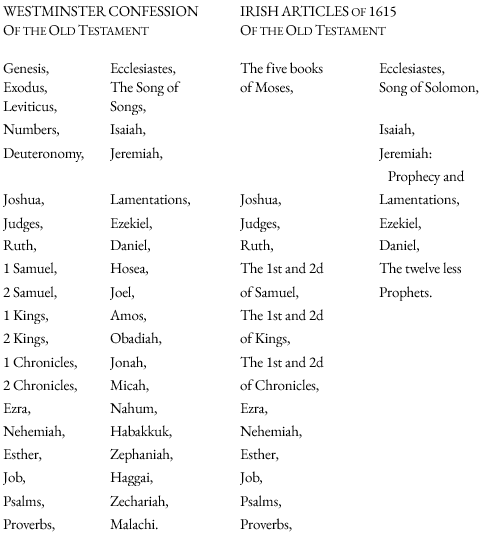
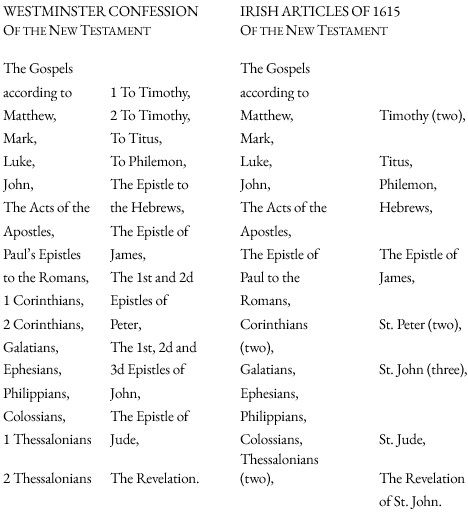
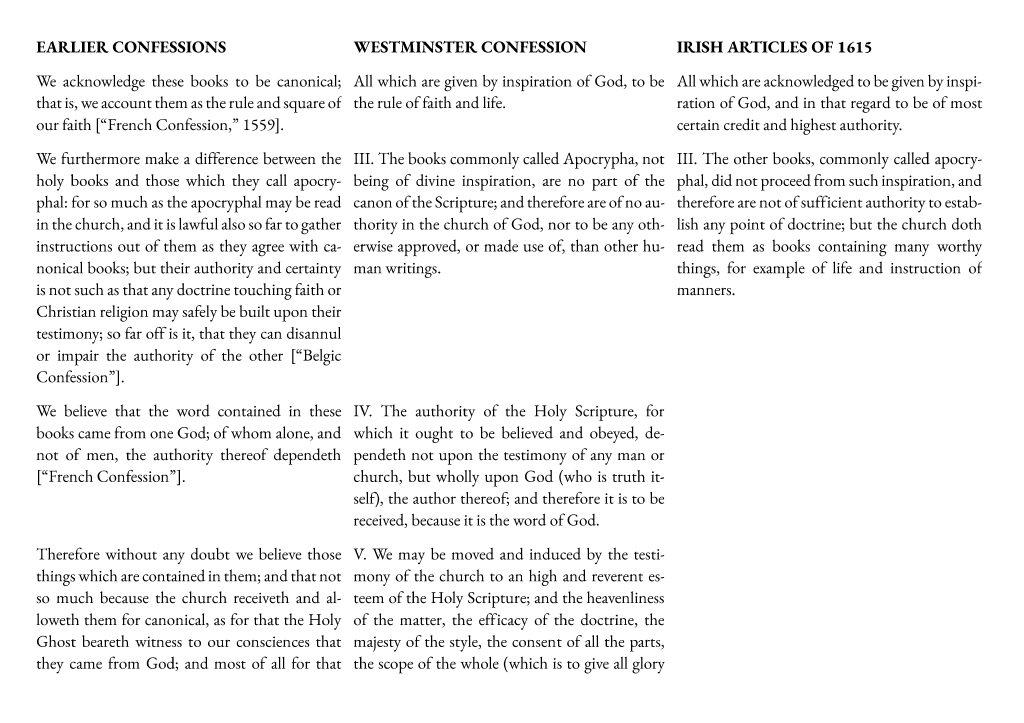
Our knowledge that the Westminster Divines did make use of the Irish Articles, both in determining the general outline of the Confession and (in places) its more detailed phraseology, helps us to perceive that it underlay their work in this chapter too. But it is no more clear that they used it than that they used it very freely and only so far forth as served their purpose; they looked to it for advice, not authority.
In one of the passages of this chapter, the rich phraseology of which has been much admired, and to which the Irish Articles have no corresponding section, Dr. Candlish 30 has discovered the traces of a Scotch hand. He points out that section 5 bears so close a resemblance to a passage in Gillespie's "Miscellany Questions" 31 as to suggest that the two came from the same pen. 32 Dr. Mitchell takes up the hint and feels sure that we may here trace Gillespie's authorship. 33 We place the two in parallel columns:
Confession of Faith
"The heavenliness of the matter, the efficacy of the doctrine, the majesty of the style, the consent of all the parts, the scope of the whole (which is to give all glory to God), the full discovery it makes of the only way of man's salvation, the many other incomparable excellencies, and the entire perfection thereof, are arguments whereby it doth abundantly evidence itself to be the word of God."
Gillespie "The Scripture is known to be indeed the word of God by the beams of divine authority which it hath in itself … such as the heavenliness of the matter; the majesty of the style; the irresistible power over the conscience; the general scope, to abase man and to exalt God; nothing driven at but God's glory and man's salvation; … the supernatural mysteries revealed therein, which could never have entered into the reason of men; the marvellous consent of all parts and passages (though written by divers and several penmen), even where there is some appearance of difference, … these, and the like, are characters and marks which evidence the Scriptures to be the word of God."
There is much here that belongs to the commonplaces of the time, and almost as close parallels to section 5 may be derived from the writings of several others of the Westminster Divines. Nevertheless the phraseology seems too closely similar for there not to have been some literary connection.
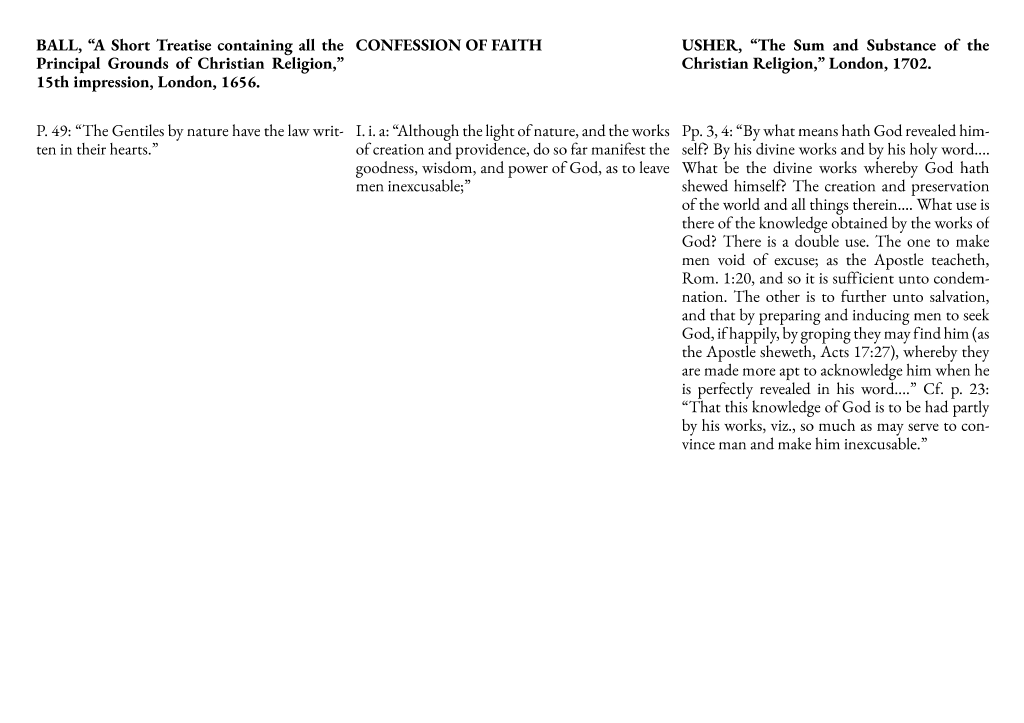
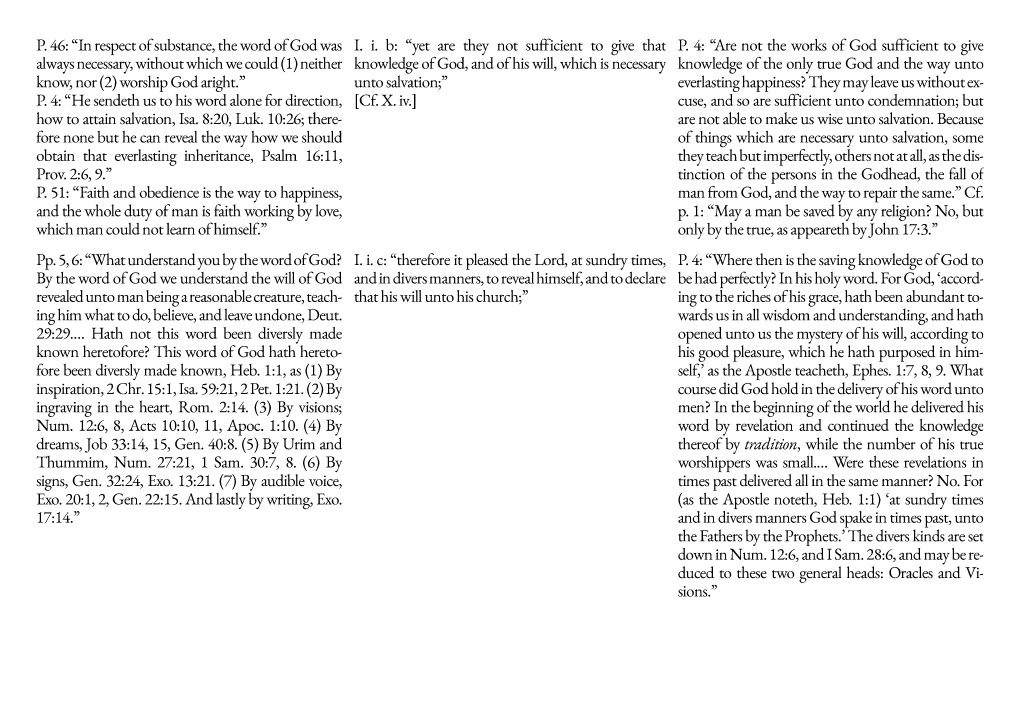
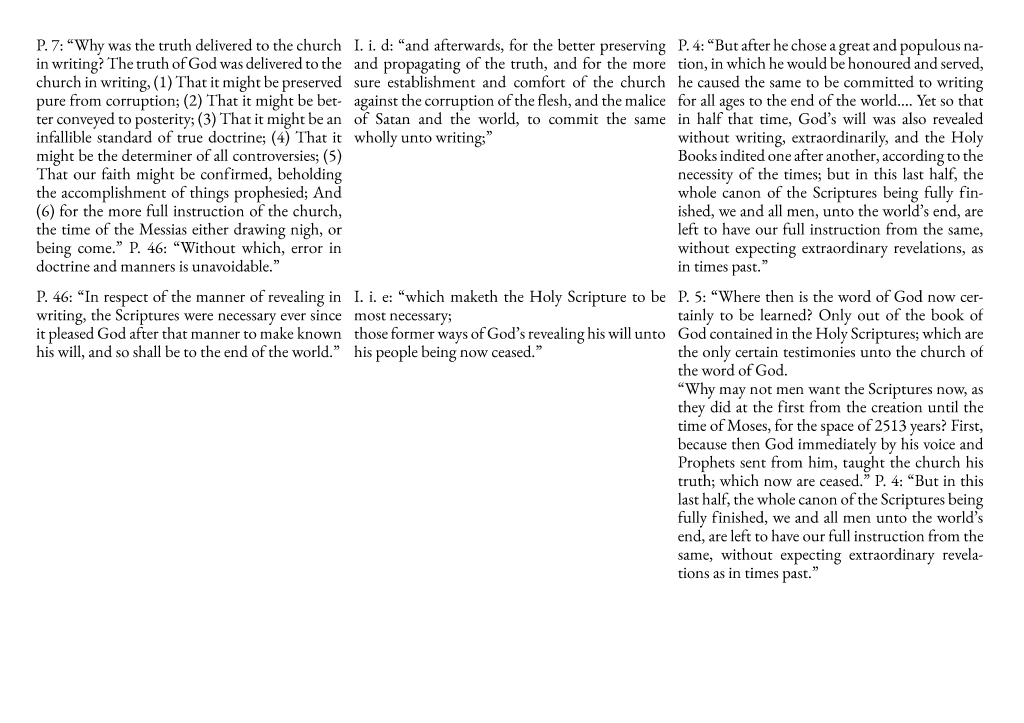
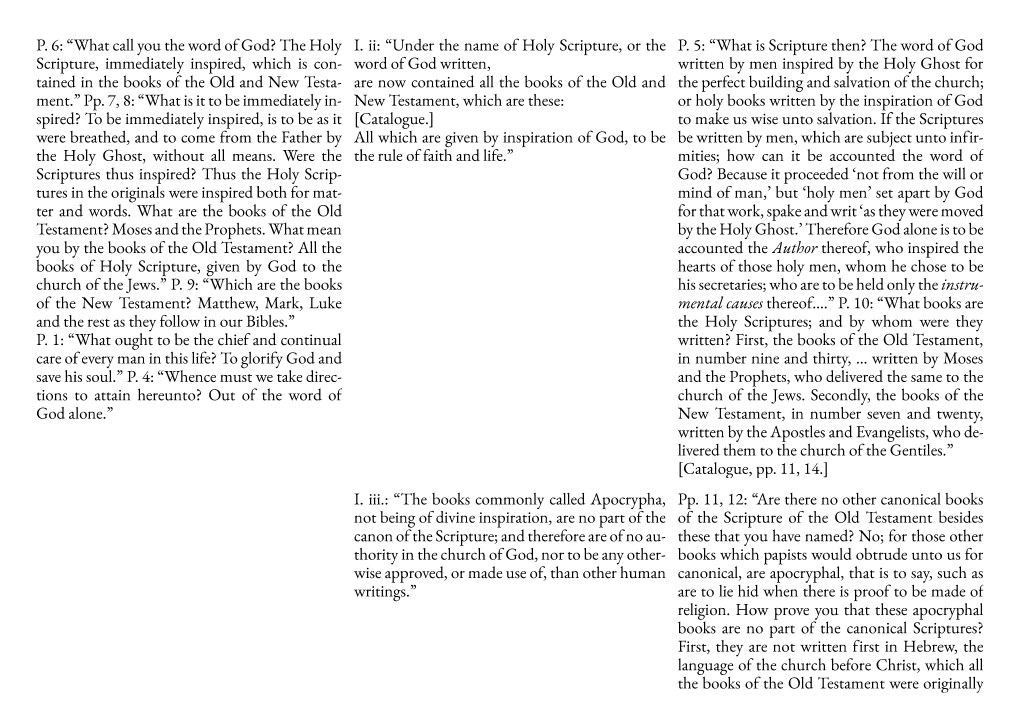
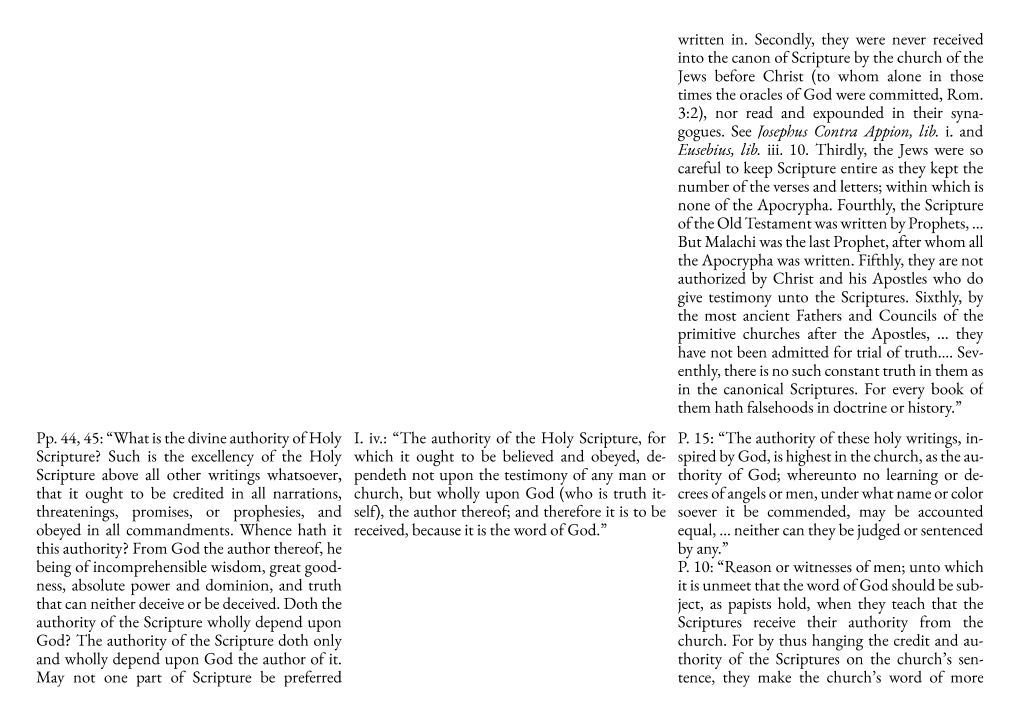
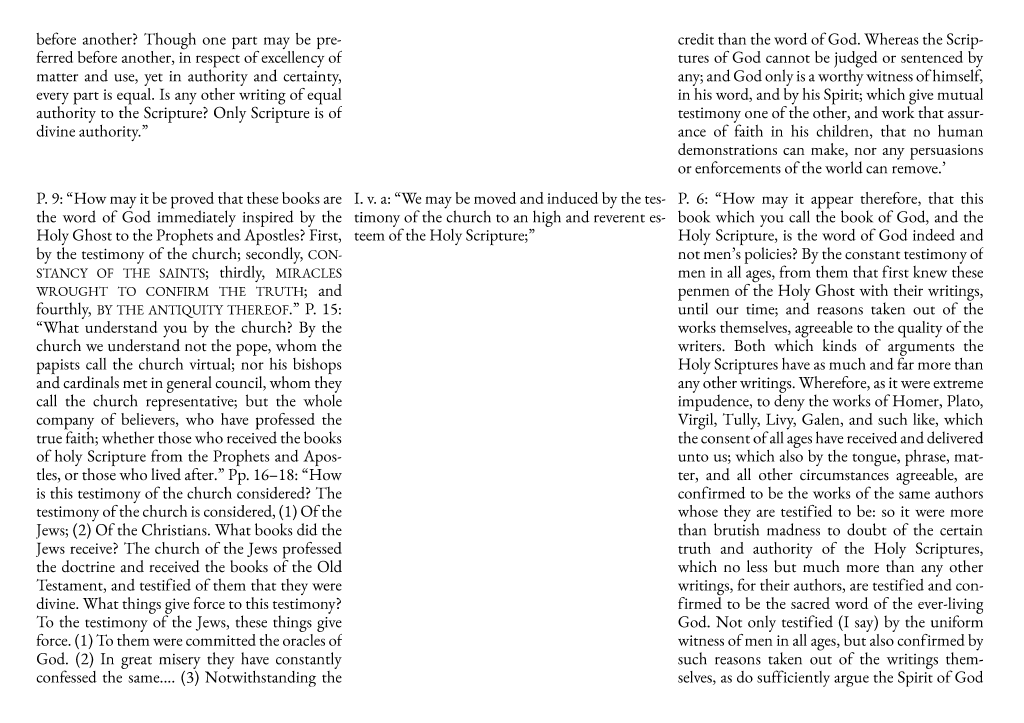
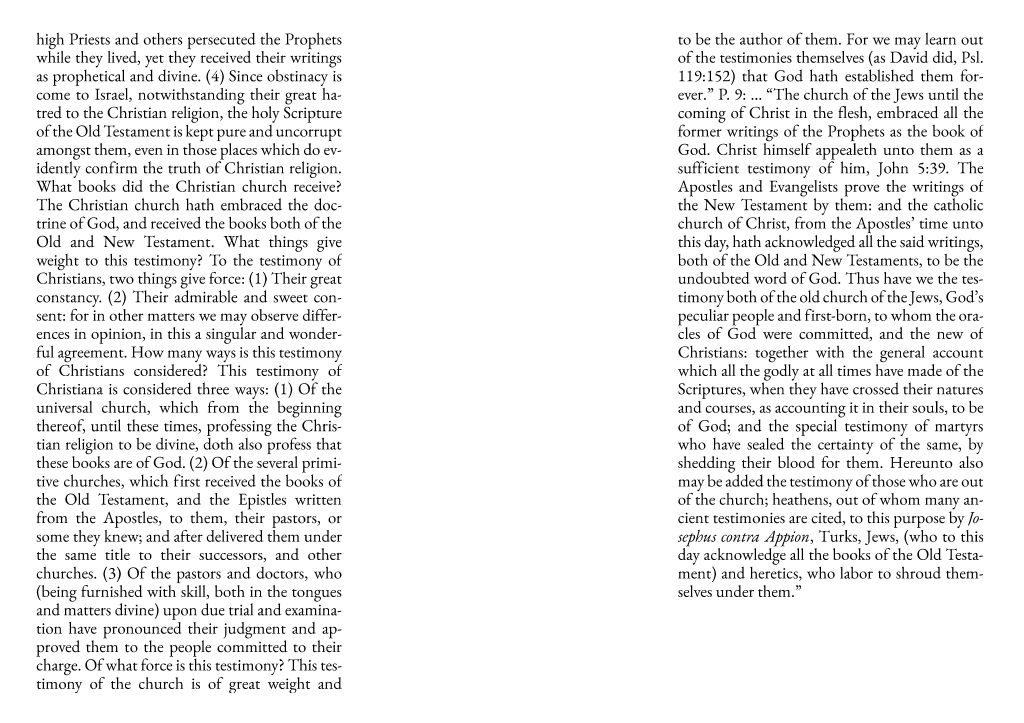
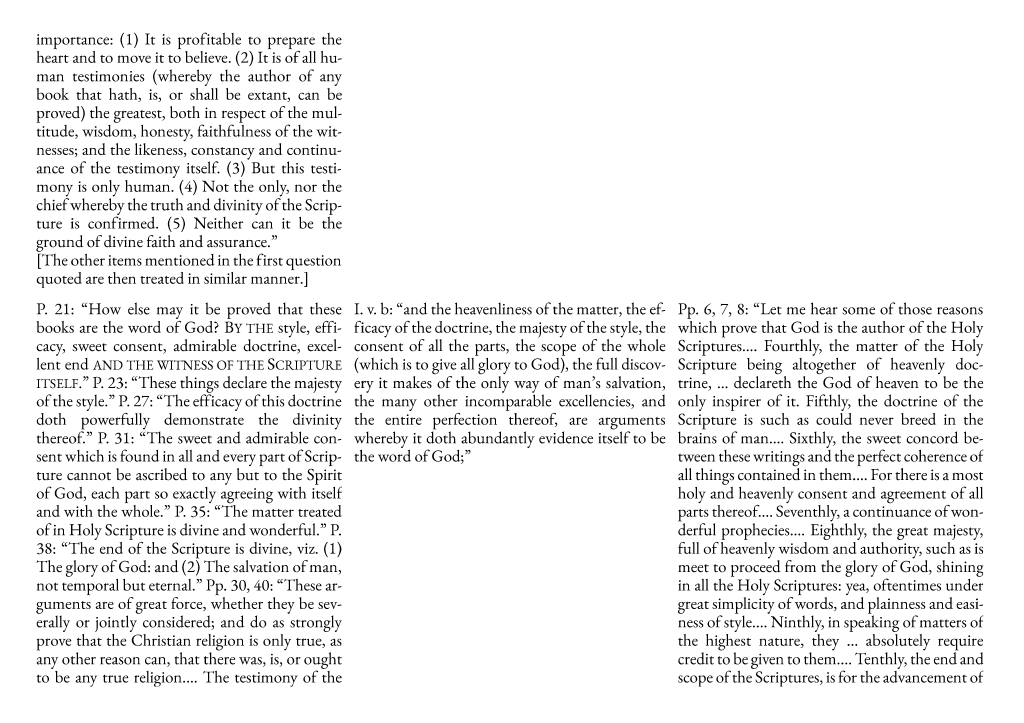
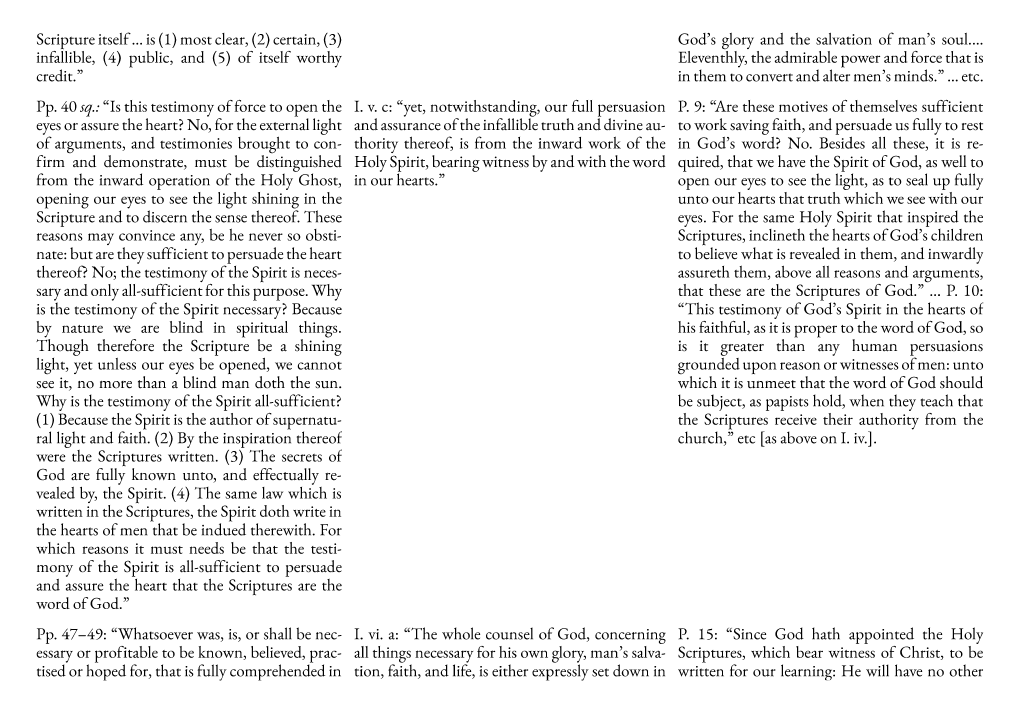
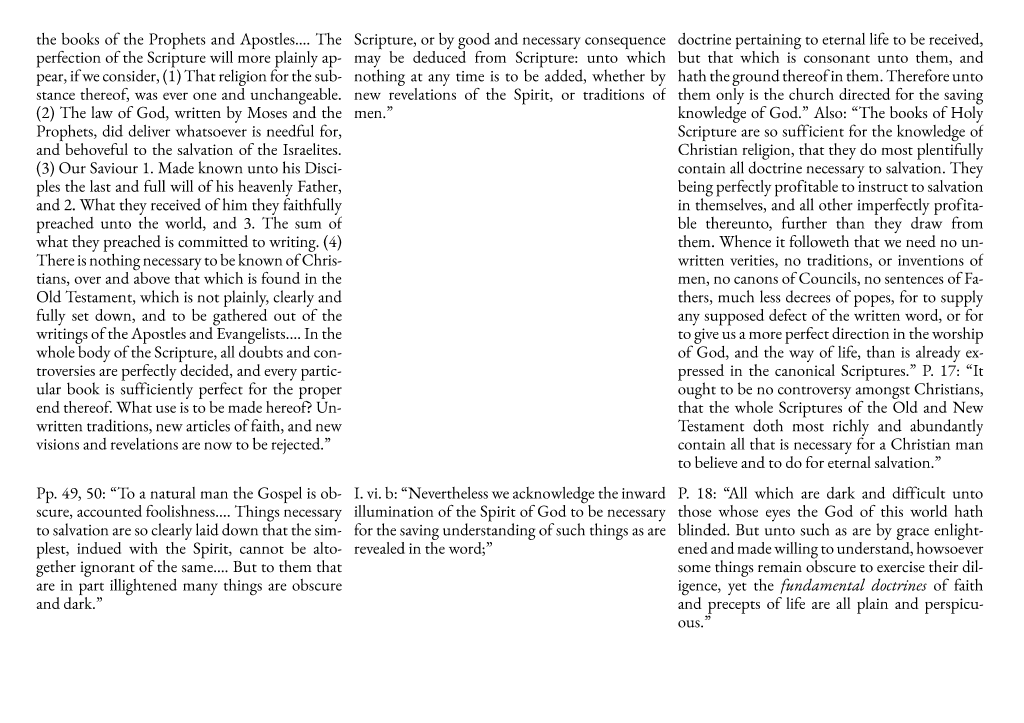
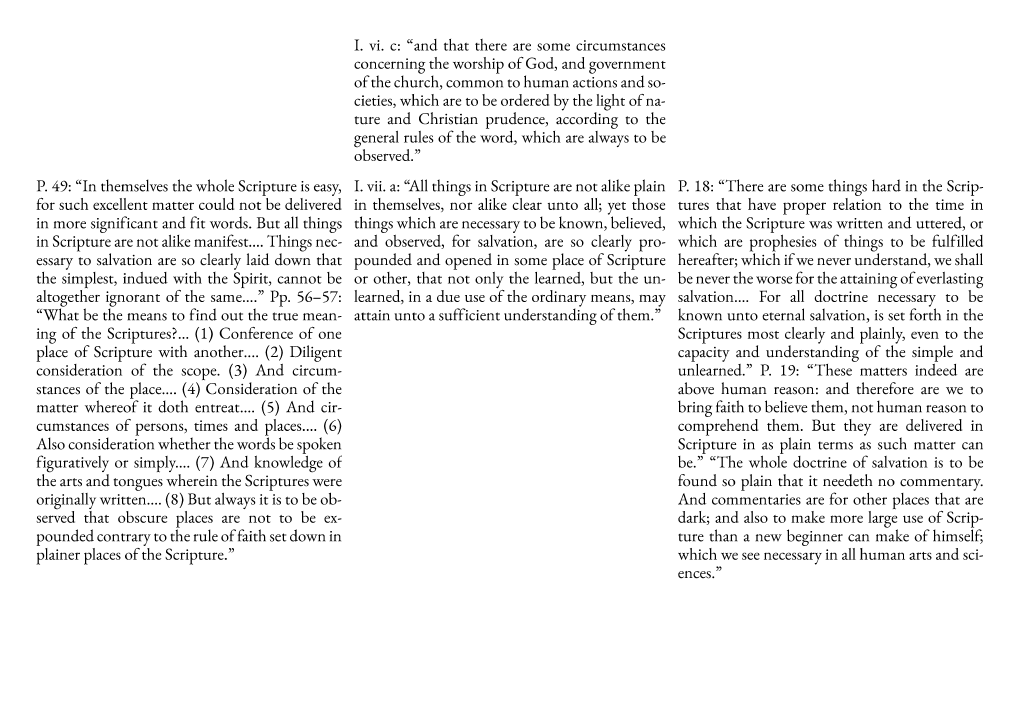
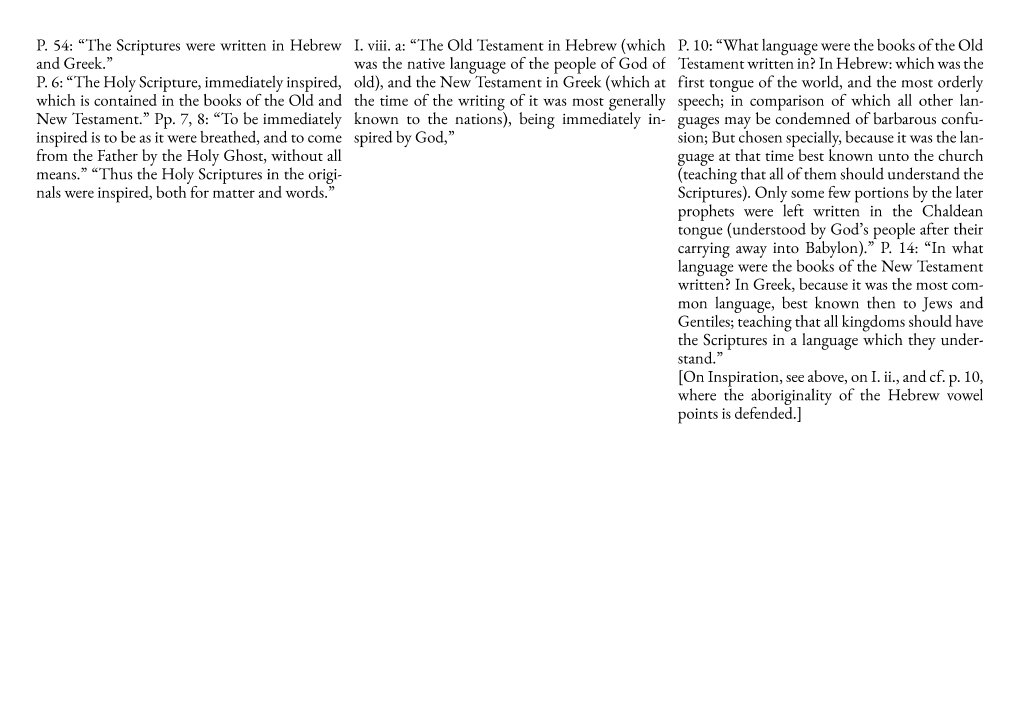
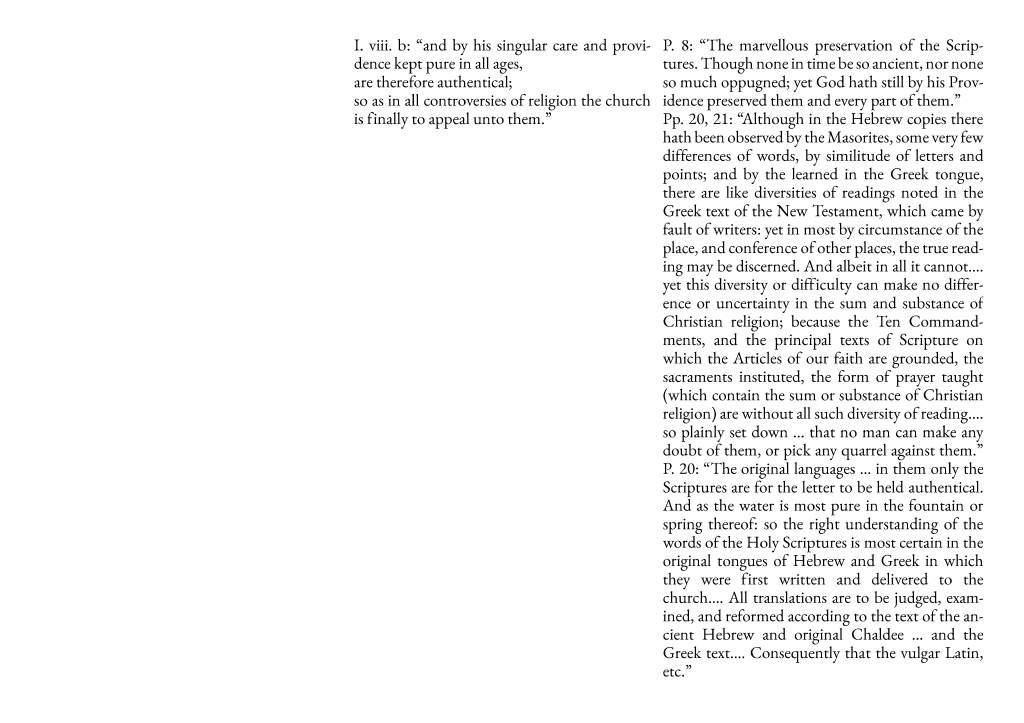
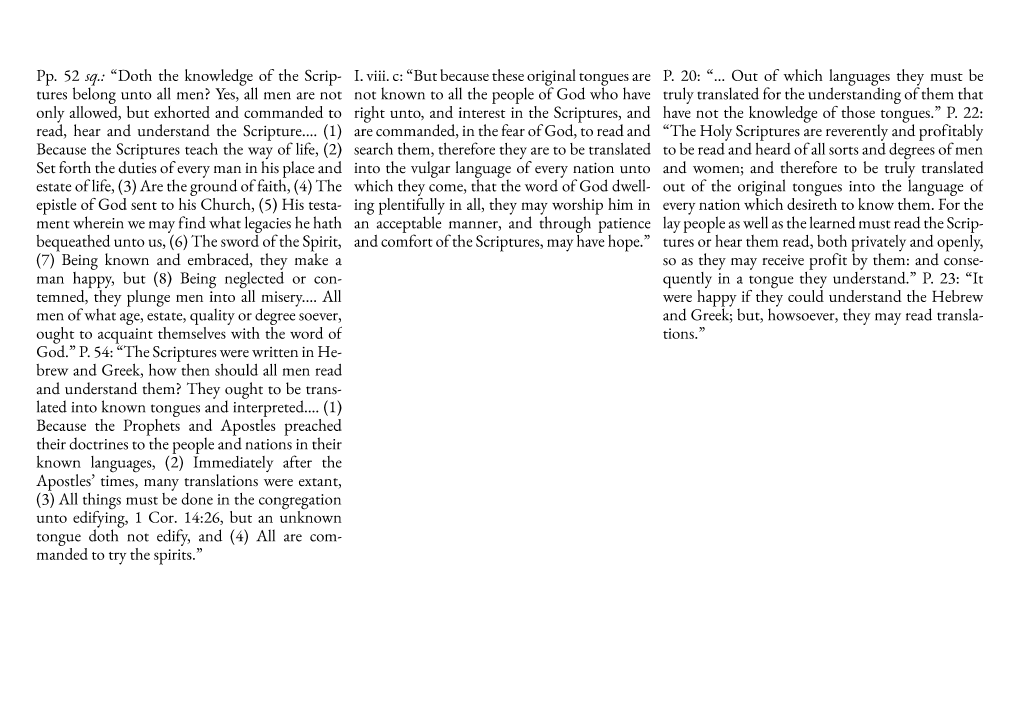
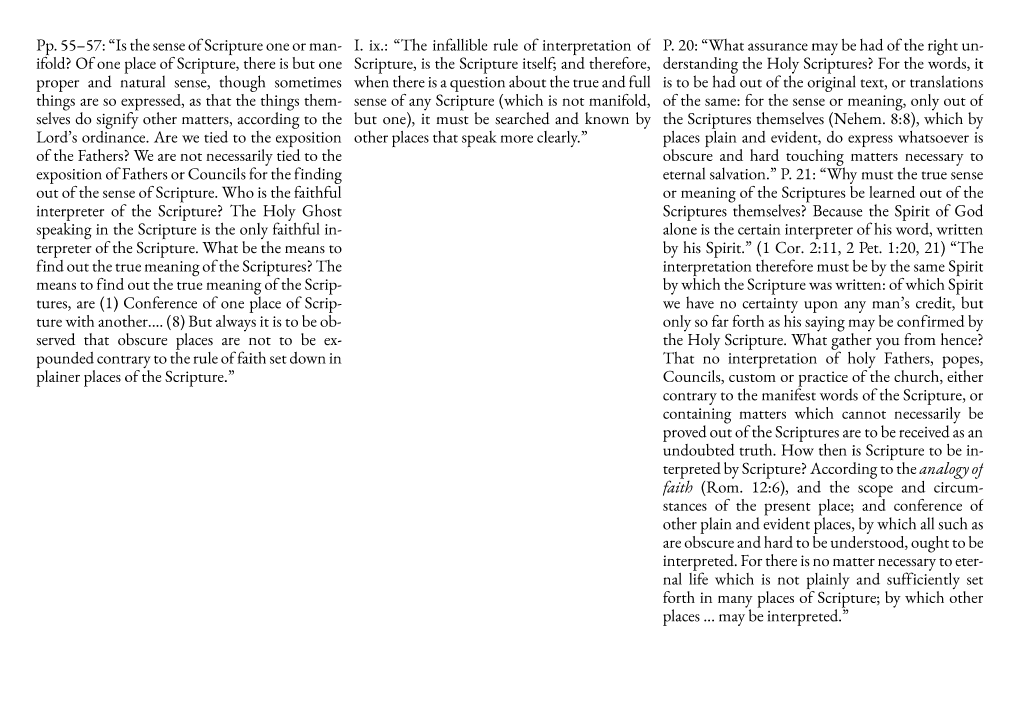
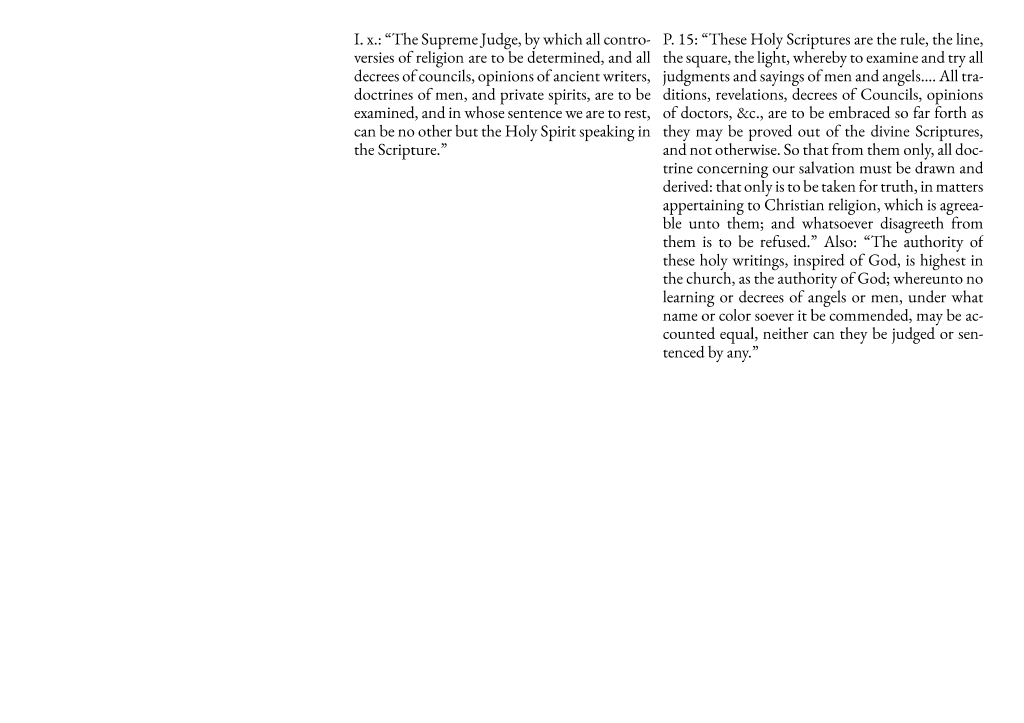
How closely the Westminster Confession held itself to the theological thought of its day may be illustrated from another parallel which we shall immediately give, in which the Confession is placed side by side with two of the chief popular dogmatic handbooks of the age. Ball's "Catechism" was
in everybody's hand and is a very fair representative of the Puritan trend of thought. The "Body of Divinity," published by Downame in 1645, under Archbishop Usher's name, may not have been before the framers of this chapter before their work was well on its way. 34 The parallelism is so close, however, that it is hard to believe that it did not affect some of the matter or even the phraseology. If not, the closeness of the parallels is a pointed indication of the great indebtedness of the Confession to the same general sources from which Usher drew the material for his "commonplace book."
In any case, this parallel will measure for us the accord of the Westminster doctrine of Scripture with the current doctrine of the times among the pronounced Protestant party in England. 35
III. The Contents of the Chapter As the Confession accords with the fundamental idea and ordinary practice of the Reformed theology, in beginning its exposition of doctrine with the doctrine of Holy Scripture, as the root out of which all doctrine grows, because the Scriptures are the fountain from which all knowledge of God's saving purpose and plan flows; so in stating the doctrine of Scripture it follows the logical and natural order of topics which had been wrought out by and become fixed in the Reformed theology. First, the necessity of the Scriptures is asserted and exhibited (section 1). Then Scripture is defined, both extensively, or in relation to its general contents, in other words as to the Canon, and intensively, or in relation to its essential character, in other words as to its inspiration; and this definition is applied to the exclusion of the apocryphal books (sections 2 and 3). Then the three great properties of
Scripture are taken up: its authority (sections 4 and 5), its completeness or perfection (section 6), and its perspicuity (section 7). The chapter closes with a statement of certain important corollaries, as to the use that is to be made of Scripture, with especial reference to its transmission, whether in the originals or translations, to its interpretation, and to its final authority in controversies (sections 8, 9, and 10).
In somewhat greater detail, the scheme of the chapter is, therefore, the following:
1. THE NECESSITY OF SCRIPTURE, § 1.
a. Reality and Trustworthiness of Natural Revelation. b. Insufficiency of Natural Revelation. c. Reality and Importance of Supernatural Revelation. d. Its complete Commitment to Inspired Scriptures. e. Consequent Necessity of Scripture.
2. THE DEFINITION OF SCRIPTURE, §§ 2 and 3.
a. Extensively: The Canon, § 2a. b. Intensively: Inspiration, § 2b. c. Exclusively: The Apocrypha, § 3.
3. THE PROPERTIES OF SCRIPTURE, §§ 4–7.
a. The Authority of Scripture, §§ 4 and 5.
i. The Source of the Authority of Scripture, § 4. ii. The Proof of the Authority of Scripture, § 5.
1. The Reality and Value of the External Evidence.
2. The Reality and Value of the Internal Evidence, 3. The Necessity and Function of the Divine Evidence. b. The Perfection of Scripture, § 6. i. Absolute Objective Completeness of Scripture, for the purpose for which it is given. ii. Need of Spiritual Illumination for its full use. iii. Place for Christian Prudence and Right Reason. c. The Perspicuity of Scripture, § 7. i. Diversity in Scripture in Point of Clearness.
ii. Clear Revelation of all Necessary Truth. iii. Accessibility of Saving Truth by Ordinary Means.
4. THE USE OF SCRIPTURE, §§ 8–10.
a. In Relation to Its Form and Transmission, § 8. i. Primary Value and Authority of the Originals.
1. The immediate Inspiration of the Hebrew and Greek Scriptures.
2. Their Providential Preservation in Purity. ii. The Right, Duty, and Adequacy of Translations. b. In Relation to Interpretation, § 9. i. Scripture Alone the Infallible Interpreter of Scripture. ii. The Single Sense of Scripture.
c. In Relation to Controversies, § 10. i. Scripture the Supreme Judge in Controversy. ii. Scripture the Test of all Other Sources of Truth.
Within this scheme, the common Reformed doctrine of Scripture is developed with great richness and beauty of thought and expression. We shall seek to outline the matter of the statement as briefly as possible. 36 To this outline we shall add (under each head, successively) a few illustrative extracts from the writings of the members of the Westminster Assembly, which may serve to enable the reader to enter more readily into the atmosphere of their symbolical statements. These extracts could be almost indefinitely increased in number, but it is hoped that enough are given to serve the purpose in view.
The Necessity of Scripture I. First, then, the Confession expounds the necessity of Scripture, in a paragraph which has always been admired, no less for the chaste beauty of its language than for the justness of its conception.
The paragraph opens with the recognition of the reality and trustworthiness of the natural revelation of God. The scope of this natural revelation is briefly defined as embracing "the goodness, wisdom, and power of God." This is afterwards more fully stated in chapter xxi. 1: "The light of nature showeth that there is a God, who hath Lordship and
sovereignty over all; is good, and doeth good unto all; and is therefore to be feared, loved, praised, called upon, trusted in, and served with all the heart, and with all the soul, and with all the might." The effect of this natural revelation, in rendering men inexcusable for not yielding God the service which is His due, is pointed out. Then its insufficiency "to give that knowledge of God, and of His will, which is necessary unto salvation" is explained. This fundamental point, also, is returned to at a later place in the Confession (x. 4), when, in exact harmony with what is here said, it is declared that "men not professing the Christian religion" cannot "be saved in any other way whatsoever, be they never so diligent to frame their lives according to the light of nature, and the law of that religion they do profess." The parallel question and answer of the Larger Catechism (Q. 60) still further exhibits the care of the framers of the Confession to hold forth the Gospel of the grace of God as the only saving power on earth. "Q. Can they who have never heard the Gospel, and so know not Jesus Christ, nor believe in Him, be saved by living according to the light of nature? A. They who, having never heard the Gospel, know not Jesus Christ, and believe not in Him, cannot be saved, be they never so diligent to frame their lives according to the light of nature, or the laws of that religion which they profess; neither is there salvation in any other but in Christ alone, who is the Saviour only of His body, the Church."
It was because of this insufficiency of the natural revelation, that (so the Confession teaches) God in His goodness was led to give a supernatural revelation to His Church, of "His will which is necessary unto salvation."
The manner of this supernatural revelation is suggested; it was in parts and by stages, i.e. progressive—"at sundry times and in divers manners." Nor was the goodness of God exhausted in merely making known the saving truth unto men; he took means to preserve the knowledge of it and to propagate it. The Confession teaches that "for the better preserving and
propagating of the truth, and for the more sure establishment and comfort of the Church against the corruptions of the flesh, and the malice of Satan and of the world," God, after revealing Himself and His will necessary unto salvation, was pleased "to commit the same wholly unto writing." This declares the written Scriptures to be, at least in part, subsequent to the revelation of God's will; and so far distinguishes them from, and makes them, in this sense, the record of, revelation; a "record," however, made by God Himself, since it was He who committed the revelation to writing.
The importance and value of such a commitment to writing is also moderately and winningly stated. It is not affirmed that it was necessary for God to commit His revelation to writing, in order to do justice to man on the one side, or in order to prevent the truth from perishing utterly on the other. It was a matter of "good pleasure" for Him to fix His revelations in writing as truly as it was for Him to give them at all. It was only for "the better preserving and propagating of the truth, and for the more sure establishment and comfort of the Church" that He committed His revelations wholly to writing. Had they been left unwritten and been committed for safe-keeping and transmission to the native powers of men, they might possibly have been (in some form or other) by God's good providence preserved and propagated, but not so well, so surely, or so safely as in written form. Inspiration is in order to the accurate preservation and wide propagation of the truth, not in order to its very existence, nor (had
God chosen so to order it) to its persistence. 37
All this is the groundwork for the proof of the necessity of the Scriptures.
This comes in the further declaration: "Which maketh the Holy Scripture to be most necessary; those former ways of God's revealing His will unto
His people being now ceased." The necessity of Scripture is thus made to rest on the insufficiency of natural revelation and the cessation of supernatural revelation—the record of which latter Scripture is declared to
be, though a record of such sort that it is itself a revelation of God, since it was God and not merely man who committed His will "wholly unto writing." By this statement the Scriptures are contrasted, not with revelation as something different in kind and quality from it, but with other forms of revelation, as being themselves a substantive part of God's revelation: "Those former ways of God's revealing His will unto His people being now ceased." Among the ways in which God has revealed His will, the Scriptures thus are set forth as one way; and as the complete, permanent, and final way, in no respect subordinate to the other ways, except in the matter of time. And their necessity is made to rest on nothing else than that they are the permanent embodiment and sole divinely safeguarded and, indeed, only trustworthy, extant form in which the revelation of God and of His will which is necessary to salvation exists.
They are, therefore, something more than the "record" of revelation—they are the revelation itself fixed in written form for its better preservation and propagation. And they are something more than useful—they are necessary, since this alone saving revelation is extant now only in their pages.
"Now that God by the works of his Creation and Providence in the world, doth teach and convince men, and so in that general way call men, is plain,
Rom. 1.… So then, the whole world, in the excellent harmony of it, doth necessarily teach a God.… This invitation Paul considers of in his Sermon at Athens, Acts 17:27.… Now there have been some of old, yea, and many in these days, that would stretch these Texts too far, as if the invitation by the creatures, were immediately saving, or that men might obtain salvation by looking into these: They have not been afraid to say, That by the Sun and Stars we may come to be effectually called, as well as by the Apostles, and the preaching of the Gospel: But how senselesse and absurd is this? For
"First, This invitation and call by the creatures, doth not, nor cannot reveal anything of Christ, the onely cause of salvation: Without Christ there is no Salvation; Now how is it possible by the Creatures, in a natural way of discourse, that ever we should come to know or believe in a Christ?…
"Secondly, The call by the creatures is not saving, because it discovers not the way of Salvation, no more than the cause; viz., Faith: As Christ is wholly a Supernatural object, and by revelation, so is faith the way to come to him, the hand to lay hold on him, onely by revelation … where then there is no Christ, nor no faith, there must necessarily be no call to salvation.
"Thirdly, This call could not be saving, for the furthest and utmost effect it had upon men, was onely outwardly to reform their lives: It restrained many from gross sins, and kept them in the exercises of temperance and justice, and such Moral vertues.… But you may say, To what purpose is this call of God by the Creatures, and the work of his providence, if it be not to salvation? Yes, it is much every way:
"First, Hereby even all men are made inexcusable: As the Apostle urgeth, God had not left them without a witness or testimony.… Men therefore are made inexcusable by this way; they cannot say, God hath left them without any conviction or manifestation of himself: No, the creatures they call, all the works of Gods justice and Gods mercy, they call; and then conscience, which is implanted in every man, the dictates and reasonings thereof, they also call: Thus there will be enough to clear God, and to stop every mans mouth.
"Secondly, Gods purpose in these calls, is to restrain sin, and to draw men on further then they do: There is no man that hath no more than this remote and confuse call, that doth what he may do, and can do; He doth not improve, no, not that natural strength that is in him: (I do not say) to spiritual good things; for so he hath no natural strength: but to such objects as by nature he might: He willfully runneth himself in the committing of
sins, against his conscience and knowledge; he doth with delight and joy, tumble himself in the mire and filth of sin: Now God calleth by these natural ways, to curb and restrain him, to put a bound to these waves: For if there were not these general convictions, no Societies, no Commonwealths could consist."—A. Burgess, "Spiritual Refining: or a Treatise of Grace and Assurance," London, 1652, pp. 692–694.
"As for that dangerous opinion, that makes Gods calling of man to repentance by the Creatures, to be enough and sufficient, we reject, as that which cuts at the very root of free grace: A voyce, indeed, we grant they have, but yet they make like Pauls Trumpet, an uncertain sound; men cannot by them know the nature of God and his Worship, and wherein our
Justification doth consist."—A. Burgess, "Spiritual Refining, etc.,"
London, 1652, p. 588.
"For to maintain (as some do) that a man may be saved in an ordinary course (I meddle not with extraordinary dispensations, but leave the secrets of God to himself) by any Religion whatsoever, provided he live according to the principles of it, is to turn the whole world into an Eden; and to find a Tree of life in every garden, as well as in the paradise of God" (p. 71). He argues "the insufficiency of all exotick doctrines," from the failure of pagan philosophy to find saving truth (pp. 72 sqq.). "The Scriptures … contain the minde of Jehovah. Somewhat of his nature we may learn from the creatures, but should have known little or nothing of his will, had not canonical
Scripture revealed it" (pp. 86, 87). There are "six several acts" through which men come by nature to know God—"respicere, prospicere, suspicere, despicere, inspicere, and circumspicere" (p. 120): "But notwithstanding all this, as it fared with the wise men from the east, who, although they were assured by the appearance of a star that a King of the Jews was born, yet needed the prophets manuduction to give them notice who he was, and where they might finde him: so though natural reason improved can make
it appear that there is a God, yet there is a necessity of Scripture-revelation to inform us who and what he is, in regard of his Essence, Subsistence, and Attributes" (p. 128).—John Arrowsmith, "A Chain of Principles,"
Cambridge, 1659.
"There are two great Gifts that God hath given to his people. The Word Christ, and the Word of Christ: Both are unspeakably great; but the first will do us no good without the second" (pp. 55, 56).… "If the Word of God be of such invaluable excellency, absolute necessity, and of such admirable use, … Blessed be God who hath not only given us the book of the Creatures, and the book of Nature to know himself and his will by; but also, and especially the book of the Scriptures, whereby we come to know those things of God, and of Christ, which neither the book of Nature nor of the Creatures can reveal unto us. Let us bless God, not only for revealing his Will in his Word, but for revealing it by writing. Before the time of Moses, God discovered his Will by immediate Revelations from Heaven.
But we have a surer word of Prophesie, 2 Pet. 1:19, surer (to us) than a voice from Heaven. For the Devil (saith the Apostle) transforms himself into an Angel of light. He hath his apparitions, and revelations.… And if God should now at this day discover his way of Worship, and his Divine Will by revelations, how easily would men be deceived, and mistake Diabolical
Delusions, for Divine Revelations? and therefore let us bless God for the written Word, which is surer and safer (as to us) than an immediate
Revelation: There are some that are apt to think, that if an Angel should come from heaven, and reveal God's will to them, it would work more upon them than the written Word; but I would have these men study the conference between Abraham and Dives, Luke 16:27, 28, 29, 30, 31.
Habent Mosen et Prophetas, etc. They have Moses and the Prophets; if they will not profit by them, neither would they profit by any that should come out of Hell, or down from Heaven to them: for it is the same God that
speaks by his written Word, and by a voice from Heaven. The difference is only in the outward cloathing; and therefore if Gods speaking by writing, will not amend us, no more will Gods speaking by a voice. O bless God exceedingly for the written Word! Let us cleave close to it, and not expect any Revelations from Heaven of new truths but say with the Apostle, Gal.
1:8, 9" (pp. 90–93).—Edward Calamy, "The Godly Mans Ark, etc.," seventh ed., London, 1672.
"Though Humane Reason be a Beam of Divine Wisdom, yet if it be not enlightened with an higher Light of the Gospel, it cannot reach unto the things of God as it should.… For though Reason be the Gift of God, yet it doth proceed from God as he is God, and General Ruler of the World: But the Gospel, and the Light thereof, did proceed from the Father, by the Son, to the Church, Rev. 22:1.… John 1:17, 18. Though Reason be the Gift of God, and a Beam of the Wisdom of God; yet it cannot sufficiently discover a mans Sins unto him; … And as meer Humane Reason cannot make a sufficient discovery of Sin, so it cannot strengthen against Sin, and Temptation.… Though the Light of Reason be good, yet it is not a saving
Light.… Tis Revelation-Light from the Gospel, that doth bring to Heaven: meer Humane Reason cannot do it."—William Bridge, "Scripture-Light, the Most Sure Light," London, 1656, pp. 32, 33.
"It is true, that the very light of nature, which God hath planted in every man, will discover unto him some of the chief heads of the duties, that he requires of him, as to love the Lord with all our hearts, and to fear, and serve him, Deut. 10:12. And to serve one another through love, Gal. 5:13.
But in what particular services we are to express our piety to God, or love to men, what can man prescribe or imagine?" (p. 13). "Whatsoever was impossible to be known by any creature, or to be found out by discourse of naturall reason, that must of necessity be discovered and made known by God himself. But it will appear, as evidently as the very light, that most of
the grounds of faith, which the Scripture proposeth unto us, are such as neither eye hath seen, nor eare heard, nor ever entered into mans heart, 1
Cor. 2:9, and therefore could never be either revealed or discovered by man.
Wherefore, seeing we finde them discovered in the Scriptures, we can doe no lesse then acknowledge them to be the word of God" (p. 25). The necessity for a written word is argued under the following heads (marginal analysis): "1. As the most easie way to make it publike. 2. As the safest way to prevent corruption. 3. As the best way to win credit to his Word. 4. And as the most honorable" (pp. 67, 68).—John White, "A Way to the Tree of Life," London, 1647.
"But yet the whole world in the frame thereof, was sufficient evidence of the Eternall power and Godhead, Rom. 1:20, and Psal. 19:1. The heavens declare the glory of God, and the firmament sheweth his handy worke. And albeit Aristotle, the greatest of Philosophers, maintained the eternity thereof without beginning; yet he confesseth ingeniously in his Book De cœlo, that all that went before him maintained mundum genitum esse; neither was his discourse of power to raze out that naturall instinct hereof, which seems to be graven in the hearts of men, and was the chiefe ground of that universall acknowledgment of a divine power supreame. Now as God made himself known by his works so I nothing doubt but herewithall it was their duty to know him, and according to their knowledge to serve him and glorifie him, in acknowledgment of his glorious nature, so farre as they took notice of it;
But as for a rule whereby they should worship him, I know none that God had given them, or that they could gather from contemplation of the creatures. And surely the knowledge of God, as a Creator only, is nothing sufficient to salvation; but the knowledge of him as a Redeemer: And therefore seeing the World by wisdome knew not God in the wisdome of God, it pleased God by the foolishnesse of Preaching to save them that believe, 1 Cor.
1:21. And the Gentiles are set forth unto us in Scripture, as such who knew
not God, 1 Thes. 4:5; 2 Thes. 1:8. And had they means sufficient without, and ability sufficient within to know him? How could it be that none of them should know him?… Yet were they inexcusable (and thus farre their knowledge brought them, Rom. 1:20) in changing the glory of the incorruptible God, to the similitude of the image of a corruptible man, and of birds, and of fourefooted beasts, and of creeping things.… Yet what shall all such knowledge profit a man, if he be ignorant in the knowledge of him as a redeemer?" (pp. 188, 189). "And yet I see no great need of Christ, if it be in the power of an Heathen man to know what it is to please God, and to have an heart to please him; For certainly as many as know what it is to please
God, and have an heart to please him, God will never hurt them, much lesse damne them to hell. Yet the Apostle telleth us, that they that are in the flesh cannot please God …" (p. 190). "No question but The word of God is the sword of the spirit, Ephes. 6, And the Law of the Lord is a perfect Law, converting the soule, Psal. 19. And it seemes to be delivered in opposition to the Book of the creatures, as if he had said, though The Heavens declare the glory of God, and the firmament sheweth his handy work, yet this is the peculiar prerogative of the Book of God's word, and the Doctrine contained therein, that it converteth the soule: and upon this is grounded the great preferment of the Jews above the Gentiles, chiefely that unto them were committed the Oracles of God" (p. 194).—William Twisse, "The Riches of Gods Love, etc.," Oxford, 1653 (written 1632, see p. 258).
The Definition of Scripture II. Having thus exhibited the indispensableness of the written form of God's revealed will, which is known under the name of Holy Scripture, the Confession naturally proceeds to define this Holy Scripture, which has
been shown to be necessary. The designation used for it is determined by the precedent statement: "Holy Scripture or the Word of God written."
God's revelation of Himself and of His will is the Word of God; the Scriptures are this revelation wholly committed unto writing; and, therefore, they are appropriately called "the Word of God written."
The definition of them is framed, first, extensively by the enumeration of the writings which constitute the volume called "Holy Scripture or the word of God written." These are first designated generally as "all the books of the Old and New Testament"; and then to prevent all mistake they are enumerated, one by one, by name. Of these books it is then affirmed, by way of intensive definition, that they are, one and all, in their entirety,
"given by inspiration of God, to be the rule of faith and life." The definition having thus been made quantitatively and qualitatively, i.e. both as to the canon and as to inspiration, it is finally applied to the exclusion of "the books commonly called Apocrypha," which, "not being of divine inspiration," "are no part of the canon of the Scripture." They are, therefore, declared, in accord with the ordinary Reformed doctrine, to be
"of no authority in the Church of God, nor to be any otherwise approved, or made use of, than other human writings."
In this definition of Scripture the fact of inspiration is very sharply asserted as the distinguishing characteristic of Scripture. "All the books of the Old and New Testament," in their entirety, are declared to be "given by inspiration of God"; and only because they are thus, as wholes and in all their parts, "of divine inspiration," are they "part of the canon of the Scripture" and of "authority in the Church of God." It is due to this fact of inspiration that they are not of the category of "human writings," to which category the "books commonly called Apocrypha" are ascribed, expressly because they are not "of divine inspiration." Here is a strong assertion of the fact of inspiration as the distinguishing characteristic of Scriptural
books; but here is no definition of inspiration. The thing in definition is Scripture, not inspiration, and inspiration is the defining, not the defined fact.
The last clause of the second section, "All which are given by inspiration of God, to be the rule of faith and life," is not, therefore, to be taken as a formal definition of inspiration, although it is an express assertion of inspiration; and much less is it to be read as if it were intended to limit inspiration to matters of faith and practice. It is not a definition of inspiration, but part of the definition of Scripture; and what it affirms is that "all the books of the Old and New Testaments" just enumerated in detail, and, therefore, severally and in their entirety, have been fitted by inspiration to be in their entirety, without discrimination of parts or elements, "the rule of faith and life." Inspiration is asserted to be pervasive, to belong to all the books enumerated without exception, and to all their parts and elements without discrimination; and its result is said to be that it fits these books to be "the rule of faith and life," that is, constitutes them parts of the "canon of the Scripture." Accordingly, the Apocrypha are immediately afterwards excluded from "the canon of the Scripture" on the express ground that they are not of "divine inspiration," but "human writings." The fact of inspiration is asserted, its pervasiveness, and its effect in making the books of which it is affirmed divine and not "human" books; but no definition of it is here given.
The misinterpretation of this clause, which would use it as a definition of inspiration, in the hope of confining inspiration in the definition of the Confession to matters of faith and practice, moreover, is discredited as decisively on historical as on exegetical grounds. This view was not the view of the Westminster Divines. It had its origin among the Socinians and was introduced among Protestants by the Arminians. And it was only on the publication, in 1690, of the "Five Letters concerning the Inspiration of the
Holy Scriptures, translated out of the French," which are taken from Le Clerc, that it began to make a way for itself among English theologians. 38
But, although this special passage presents no formal definition of the nature of inspiration, the Confession by no means leaves its own conception of the nature of inspiration undefined. Already in the first section it had declared that it was God who constituted Scripture by Himself committing His will wholly unto writing, thereby making another way of revelation in addition to those other supernatural ways formerly used by Him. And in the third section this inspiration, so strongly affirmed in the second section as the characteristic of all the books of the Old and New Testaments, is declared to make these books divine and not human writings. In conformity with this, the Confession subsequently declares that the Biblical books have "God (who is truth itself)" for their "author" (§
4), that they are "immediately inspired by God" (§ 8), so that they are "the very Word of God" (Larger Catechism, Q. 4), that they are of "infallible truth and divine authority" (§ 5), and are to be believed to be true by the Christian man in everything that is revealed in them (xiv. 2). As the historical meaning of the word "Inspiration," conferred on the Scriptures in our present section, is not doubtful, so neither is the meaning of these phrases, further describing its Confessional sense. For example, the phrase, to be "immediately inspired," which is used in section 8, is of quite settled and technical connotation. We may find it, for instance, in Calov ("Syst. loc. theol.," i. p. 463): "Nec ea tantum credenda verissima, quae ad fidem et mores spectantia in Scriptura traduntur, sed etiam alia quaecunque in eadem occurrentia, quam ab immediato divino impulsu profecta sint." Or, in Hollaz ("Examinis Theologici, etc.," p. 94): "Inspiratio diuina, qua res et verba dicenda non minus, quam scribenda prophetis atque apostolis a spiritu sancto immediate suggesta sunt." Or, if this seems to be going too far afield, we may find it in the plainest of English in John Ball, the Puritan
catechist, held in the highest honor by all the Westminster men. "What is it to be immediately inspired?" he asks in his "A Short Treatise, etc." (15th ed., 1656, pp. 7 and 8), and answers: "To be immediately inspired, is to be as it were breathed, and to come from the Father by the Holy Ghost, without all means." And again: "Were the Scriptures thus inspired? A.
Thus the Holy Scriptures in the Originals were inspired both for matter and words." The Westminster Confession contains in itself, therefore, the material by which we may be assured that the inspiration, which it affirms in our present sections to be the characteristic of all the Biblical books, was conceived by it as constituting the Scriptures in the most precise sense, the very Word of God, divinely trustworthy and divinely authoritative in all their parts and in all their elements alike.
"29 Q. From whence must wee learne to know God and serve him rightly? 29
A. To know God, and to serve him rightly, wee must be taught out of Gods Word. 30 Q. Which book is Gods Word? 30 A. The Bible or the Scripture of the Old and New Testament is the very word of God."—Herbert Palmer,
"An Endeavour of Making the Principles of Christian Religion … plaine and easie, etc.," London, 1644, p. 7.
"The only rule of faith and obedience is the written Word of God, contained in the Bible or the Scriptures of the Old and New Testament."—
First Draft of Catechism of Westminster Assembly ("Minutes," p. 281, for September 14, 1646).
"… Hebrew. (In which tongue the Prophets left their doctrine as the Canon of the Church)." "For the Original Copies, I must subscribe to that of Canus a Papist, who tells us, That we are not to receive into the holy Canon both for the Old and New Testament, but such books as the Apostles did allow, and deliver over to the Church of Christ."—Richard Capel, "Remains, etc.,"
London, 1658, pp. 37 and 65.
"So that the Spirit of God inspired certain persons, whom he pleased, to be the revealers of his will, till he had imparted and committed to writing what he thought fit to reveal under the Old Testament; and when he had completed that, the Holy Ghost departed, and such inspirations ceased.
And when the gospel was to come in, then the Spirit was restored again, and bestowed upon several persons for the revealing farther of the mind of God, and completing the work he had to do, for the settling of the gospel, and penning of the New Testament: and that being done, these gifts and inspirations cease, and may no more be expected, than we may expect some other gospel yet to come" (p. 371). "From these men's [those that companied with Christ] sermons and relations, many undertook to write gospels, partly for their own use, and partly for the benefit of others: which thing though they did lawfully and with a good intent, yet because they did it not by inspiration, nor by divine warrant; albeit what they had written, were according to truth, yet was the authority of their writings but human, and not to be admitted into the divine canon" (p. 19).—John Lightfoot,
"Works," ed. Pitman, iii. 1822.
"The word λόγια, whereby heathen writers had been wont to express their oracles … was enfranchised by the holy Ghost, and applied to the books of Scripture to intimate (as I conceive) that these books were to be of like use to Christians, as those oracles had been to Infidels" (p. 86). "These
Scripture-Oracles differ from and excel those other.… I. In point of perspicuity.… II. In point of piety.… III. In point of veracity.… IV. In point of duration.… V. In point of authority.… Scripture is of divine authority:
Holy men of God (saith Peter) spake as they were moved by the Holy Ghost.
They wrote accordingly. All Scripture, saith Paul, was given by inspiration of God. It is not more true that they are oracles for their use, then that they have God for their authour" (pp. 95–103). "I answer, Although the penman did not, the inditer, viz. the Holy Ghost did exactly know whose
names were written in the book of life, and whose were not. Now he it was that in the history of the Acts suggested and dedicated to his secretary both matter and words" (p. 299).—John Arrowsmith, "A Chain of Principles,"
Cambridge, 1659.
"The Scripture, and the Word of God is [the Rule of Lawfulness or Unlawfulness], it is the only Rule whereby I may, and must make up my
Judgment of Lawfulness, and Unlawfulness; it is that only which doth stamp Lawfulness upon an Action" (p. 32). "Now this Duty is urged, and amplified; urged by divers Arguments: some taken from the excellency of the Word it self. First, It is λόγος προφητικός, a Word of Prophesie, or a Prophetical Word, written by Divine Inspiration; the same that is spoken of in verse 20 [2 Peter 1], called Prophesie of Scripture. Secondly, It is λόγος βεβαιότερος, a more sure Word: Some think the Comparative, is put for the Superlative.… But I take it rather to be meant Comparatively; for the Word of God written, is surer than that Voyce which they heard in the Mount
(whereof he spake in the former Verse). More sure is the Word written, than that Voyce of Revelation; not ratione veritatis, not in regard of the Truth uttered, for that Voyce was as true as any word in the Scripture; but more sure, ratione manifestationis, more certain, setled, and established" (pp. 1,
4). "What must we do, that we may take heed, and attend unto Scripture?… First, for your knowledge in, and understanding of the Scripture, and the written Word of God, ye must, [1.] Observe, keep, and hold fast the Letter of it; for though the Letter of the Scripture be not the Word alone, yet the Letter with the true sense and meaning of it, is the Word. The Body of a Man, is not the Man; but the Body and Soul together, make up the whole
Man: the Soul alone, or the Body alone, is not the Man. So here; though the Letter of the Scripture alone, do not make up the Word; yet the Letter, and sense together, do; and if ye destroy the Body, ye destroy the Man; so if ye destroy the Letter of the Scripture, you do destroy the Scripture; and if you
deny the Letter, how is it possible that you should attain to the true sense thereof, when the Sense lies wrapped up in the Letters, and the words thereof?… [2.] If you would have the true knowledge, and understand the Scripture, and so behold this great Light in its full glory and brightness; you must diligently enquire into the true sense and meaning of it: for the true sense and meaning, is the soul thereof" (pp. 46, 47).—William Bridge,
"Scripture-Light, The Most Sure Light," London, 1656.
"These holy writings are the Word of God himself, who speaks unto us in and by them. Wherefore when we take in hand the Book of the Scriptures, we cannot otherwise conceive of our selves, then as standing in God's presence, to hear what he will say unto us" (p. 1). "Of the pen-men of the Scriptures, that they were holy men, inspired and guided in that work infallibly and wholly, by the Spirit of God" (p. 57). "Who the most of these holy men were, it is well known to the Church, the titles of their Books bearing their names.… And that the rest, whose names are either concealed, or doubtful, were such likewise, will be evident to any indifferent person that shall consider two things.… It addes something to the estimation of the Scriptures, that they were written by such holy men, as we have formerly mentioned … but that which procures unto them divine reverence, which ought to make all hearts stoop unto them, is that they were written by the direction of the holy Spirit, the Spirit of truth, especially if we throughly consider what manner of direction it was which was given unto these holy
Pen-men of these sacred Oracles, in the composing thereof. The Apostle, 2 Pet. 1:20, 21, describes that kinde of assistance of the holy Ghost, in the delivery of the Scriptures, two ways. First, by way of negation, that they were neither of private interpretation, nor came by the wil of man.
Secondly, he describes the same assistance affirmatively, testifying that they spake as they were moved by the holy Ghost. In the former of these, wherein he expresseth this manner of delivering the Scriptures by way of
negation, the Apostle excludes the working of the naturall faculties of mans minde altogether.… So that both the understanding, and will of man, as farre as they were meerly naturall, had nothing to doe in this holy work, save onely to understand, and approve that which was dictated by God himselfe, unto those that wrote it from his mouth, or the suggesting of his
Spirit.… For we may not conceive that they were moved in writing these Scriptures, as the pen is moved by the hand that guides it, without understanding what they did; For they not onely understood, but willingly consented to what they wrote.… But the Apostles meaning is, that the Spirit of God moved them in this work of writing the Scriptures, not according to nature, but above nature, shining into their understandings clearly, and fully, by an heavenly and super-naturall light, and carrying and moving their wils thereby with a delight, and holy embracing of that truth revealed, and with a like desire to publish and make known the secrets and counsels of God, revealed unto them, unto his Church. Yea, beyond all this, the holy Ghost not only suggested unto them the substance of that doctrine which they were to deliver and leave upon record unto the Church, … but besides hee supplyed unto them the very phrases, method, and whole order of those things that are written in the Scriptures, … Thus then the holy Ghost, not only assisted holy men in penning the Scriptures, but in a sort took the work out of their hand, making use of nothing in the men, but of their understandings to receive and comprehend, their wils to consent unto, and their hands to write downe that which they delivered"
(pp. 57–61).—John White, "A Way to the Tree of Life," London, 1647.
"All the Scriptures are θεόπνευστοι by Divine inspiration; and therefore the breathings of Gods spirit, are to be expected in this Garden: and those commands of attending to the Scripture onely, and to observe what is written, is a plain demonstration that God hath tyed us to the Scriptures onely: so that as the child in the womb liveth upon nourishment
conveighed by the Navel cleaving to it, so doth the Church live onely upon Christ by the Navel of the Scripture, through which all nourishment is conveighed."—A. Burgess, "Spiritual Refining, etc.," London, 1652, p.
132.
"It is certain that all Scripture is of Divine inspiration, and that the holy men of God spake as they were guided by the Holy Ghost.… It transcribes the mind and heart of God. A true Saint loveth the Name, Authority, Power,
Wisdom, and goodness of God in every letter of it, and therefore cannot but take pleasure in it. It is an Epistle sent down to him from the God of Heaven" (p. 55). "The Word of God hath God for its Author, and therefore must needs be full of Infinite Wisdom and Eloquence, even the Wisdom and Eloquence of God. There is not a word in it, but breathes out God, and is breathed out by God. It is (as Irenæus saith) κανων τὴς πίστεως ἁκλινὴς, an invariable rule of Faith, an unerring and infallible guide to heaven. It contains glorious Revelations and Discoveries, no where else to be found" (p. 80). "Before the time of Moses, God discovered his Will by immediate Revelations from Heaven. But we have a surer word of Prophesie, 2 Pet. 1:19, surer (to us) than a voice from Heaven.… For it is the same God that speaks by his written Word, and by a voice from Heaven"
(pp. 91–93).—Edward Calamy, "The Godly Mans Ark," seventh ed., London, 1672.
"If Solomon mistooke not. (And how could hee mistake in that, which the spirit himselfe dictated vnto him)."—Cornelius Burgess, "Baptismall
Regeneration of Elect Infants," Oxford, 1629, p. 277 (quoting from Proverbs).
"The Apocrypha speaks for itself, that it is not the finger of God, but the work of some Jews. Which got it so much authority among Christians; because it came from them, from whom the lively oracles of God indeed came also. But the Talmud may be read to as good advantage, and as much
profit, and far more."—John Lightfoot, "Works," ed. Pitman, ii. p. 9. "The words of the text are the last words of the Old Testament,—there uttered by a prophet, here expounded by an angel: there concluding the law, and here beginning the gospel.… Thus sweetly and nearly should the two
Testaments join together, and thus divinely would they kiss each other, but that the wretched Apocrypha doth thrust in between.… It is a thing not a little to be admired, how this Apocrypha could ever get such place in the hearts and in the Bibles of the primitive times, as to come to sit in the very centre of them both.… But it is a wonder, to which I could never yet receive satisfaction, that in churches that are reformed, they have shaken off the yoke of superstition, and unpinned themselves from off the sleeve of former customs, or doing as their ancestors have done,—yet in such a thing as this, and of so great import, should do as first ignorance, and then superstition, hath done before them. It is true, indeed, that they have refused these books out of the canon, but they have reserved them still in the Bible: as if God should have cast Adam out of the state of happiness, and yet have continued him in the place of happiness."—John Lightfoot, "Works," ed.
Pitman, vi. pp. 131, 132.
The Properties of Scripture III. Having thus defined Scripture as the very Word of God given by divine inspiration, and, therefore, not a human, but a divine book, the Confession proceeds next to exhibit the properties that belong to it as such (§§ 4–7).
The Authority of Scripture
1. The first property of a divine book to be adduced is, naturally, its authority (§§ 4–5). (A) Just because the book is God's Book, revealing to us
His will, it is authoritative in and of itself; and it ought to be believed and obeyed, not on the ground of any borrowed authority, lent it from any human source, but on the single and sufficient ground of its own divine origin and character, "because it is the Word of God," and "God (who is truth itself)" is "the author thereof" (§ 4). So the Confession asserts, in unison with the whole body of Protestant theology, not as if it held that Scripture is to be believed and obeyed as God's Word before we know it to be such, but as basing its right to be believed and obeyed on its divine origin and character already established by definition in the preceding sections.
Because inspired, Scripture is the Word of God; and because the Word of God, it exercises lawful authority over the thought and acts of men.
"The former Position being once granted, that the Scriptures are Gods Word, no man can question their Authority, whether that be of him or no."—John White, "A Way to the Tree of Life," London, 1647, p. 45.
"Scripture is of divine authority.… It is not more true that they are oracles for their use, then that they have God for their authour."—John
Arrowsmith, "A Chain of Principles," Cambridge, 1659, p. 103.
"The Scripture resolves our faith on Thus saith the Lord, the only authoritie that all the Prophets alledge, and Paul, 1 Thes. 2:13.…"—Samuel
Rutherford, "A Free Disputation against pretended Liberty of Conscience," London, 1649, p. 364.
"The Scriptures are to be believed for themselves, and they need not fetch their credit from any thing else.… They are the truth.… The reason of the Scriptures' credibility is, because they are the word of God.… It is not proper to say, We believe Scriptures are Scriptures, because of the church, without distinguishing upon believing.… We may satisfy this by an easy distinction, betwixt believing that Scripture is Scripture, and believing that
the church all along hath taken them for Scripture.… We believe the church owns the Scriptures; but he is but a poor Christian, that believes the Scriptures are the Scriptures upon no other account.… God gives his word; and whether men will hear, or whether they will forbear, it is, and will be, the word of God for ever."—John Lightfoot, "Works," ed. Pitman, vi. pp.
56, 62, 63, 351.
(B) But men are not so constituted as readily to yield faith and obedience even to lawful authority. Their minds are blinded, and their consciences dulled, and their wills enslaved to evil. The Confession accordingly devotes a paragraph of unsurpassed nobility of both thought and phrase to indicating how sinful men may be brought to full conviction of and practical obedience to the infallible truth and divine authority of the Scriptures. The value of the external testimony of the Church is recognized: the assurance of the Church that they are the very Word of God may move and induce us to a high and reverent esteem for the Holy Scriptures. The greater value of the witness of the Scriptures themselves, in form and contents, to their supernatural origin is affirmed and richly illustrated: by the miracle of Scripture itself, it abundantly evidences itself to be the Word of God. "Abundant evidence" one must suppose to be sufficient; and objectively it is sufficient and more than sufficient; and this is what the Confession means to affirm. But, according to the Reformed theology, man needs something more than evidence, however abundant, to persuade and enable him to believe and obey God's Word; he needs the work of the Holy
Spirit accompanying the Word, ab extra incidens. And, therefore, the Confession proceeds to point out that something more is needed, besides this abundant evidence, to work within us a "full persuasion and assurance of the infallible truth and divine authority" of God's Word—to lead us to commit ourselves wholly to it, trusting its every word as true and obeying its every command as authoritative. What is needed is, in ordinary language,
a new heart; in the Confession's language, "the inward work of the Holy Spirit bearing witness by and with the Word in our hearts."
This beautiful statement of the Confession has sometimes of late been strangely misunderstood. It is no more than to say, what every Reformed thinker must be ready to say, that faith in God's Word is not man's own work, but the gift of God; and that man needs a preparation of the spirit, as well as an exhibition of the evidences, in order to be persuaded and enabled to yield faith and obedience. If this be not true the whole Reformed system falls with it. It is, then, neither to be misunderstood as mysticism, on the one hand, as if "the testimony of the Holy Spirit" were to be expected to work faith in the Word apart from or even against the evidences; nor, on the other hand, is it to be explained away in a rationalizing manner as if it meant nothing more than that the Holy Spirit, as the immanent spring of all life and activity, is operative in all human thought. It is simply the Reformed doctrine of faith, stated here in explanation of the origin of faith in the Scriptures. It is, therefore, naturally returned to in the chapter on Saving Faith (chapter xiv.). The first half of the second section of that chapter is nothing more than a restatement of the declaration here: "By this faith"—which (§ 1) "is the work of the Spirit of Christ" in the heart—"a Christian believeth to be true, whatsoever is revealed in the Word, for the authority of God Himself speaking therein; and acteth differently, upon that which each particular passage thereof containeth; yielding obedience to the commands, trembling at the threatenings, and embracing the promises of God for this life, and that which is to come." The only difference between the two passages is that difference of form which springs necessarily from the difference in general subject; here the subject is the Scriptures, and we are told how men are brought to a full faith in them— there the subject is faith, and we are told how this faith acts with reference to the Scriptures. Both passages alike, however, speak simply of that fides
generalis, which is a topic treated at large in all Reformed systems; 39 and both ascribe, in harmony with all Reformed thought, this fides generalis to the testimony of the Holy Spirit, without which no evidences would suffice to awaken it.
"Q. What special proofs are there that the Scriptures of the Old and New Testament are the very Word of God? A. The Scriptures are [specially] 40 proved to be the very Word of God by their majesty and holiness of doctrine, and the fulfilling of the prophecies, by their exalting God and debasing man, and yet offering him sufficient means of comfort and salvation, and by their light and power in convincing and converting.
"[Q. May not all these excellencies and perfections be found in other books besides the Scriptures? A. No words or writings of men have all these excellencies and perfections in them but as they agree unto and are taken from the Scriptures.]41 "5 Q. Are all these proofs sufficient of themselves to persuade a man to believe that the Scriptures are the Word of God? A. It is only the Spirit of God that makes any proofs effectual to assure the soul of this truth, that the Scriptures are the Word of God."—Original Draft of Catechism,
"Minutes," pp. 281–283.
"It is a right, a safe, a sure way to seek after and to enjoy assurance of our interest in Christ, and in the covenant of grace, by the marks and fruits of sanctification.… All thy marks will leave thee in the dark if the Spirit of grace do not open thine eyes that thou mayest know the things which are freely given thee of God. Hagar could not see the well, though she was beside it, till her eyes were opened. Marks of grace are useless, undiscernible, unsatisfactory to the deserted and overclouded soul.… Whereas, to make no trial by marks, and to trust an inward testimony, under the notion of the Holy Ghost's testimony, when it is without the least evidence of any true
gracious mark, this way (of its own nature, and intrinsically, or in itself) is a deluding and ensnaring of the conscience.
"Quest. But it may be asked, and it is a question worthy to be looked into (though I must confess I have not read it, nor heard it handled before),
How doth this assurance by marks agree with, or differ from assurance by the testimony of the Holy Ghost? May the soul have assurance either way, or must there be a concurrence of both (for I suppose they are not one and the same thing) to make up the assurance?
"Ans. For answer whereunto I shall first of all distinguish a twofold certainty, even in reference to the mind of man, or in his conscience (for I speak not here de certitudine entis, but mentis): the one may be called ἀσφάλεια, when the conscience is in tuto, may be secure; needeth not fear and be troubled. The Grecians have used the word ἀσφάλεια when they were speaking of giving security and assurance by safe conducts, or by pledges, or by sureties, or the like (H. Steph. in Thes. Ling. Gr., tom. 3, p.
1173). The other is πληροφορια, a full persuasion, when the soul doth not only steer a right and safe course, and needeth not fear danger, but saileth before the wind, and with all its sails full. So there is answerably a double uncertainty, the one may be called ἀποριὰ, when a man is in himself perplexed and difficulted, and not without cause, having no grounds of assurance; when a man doth doubt and hesitate concerning a conclusion, because he hath no reasons nor arguments to prove it; when a man is in a wilderness where he can have no way, or shut up where he can have no safe escaping. The other is ἐποχὴ, which is a doubting that ariseth not from want of arguments, or from the inextricable difficulty of the grounds, but from a disease of the mind, which makes it suspend or retain its assent, even when it hath sufficient grounds upon which it may be assured. Now it is the evidence of signs of marks of grace which giveth that first kind of certainty, and removeth that first kind of uncertainty; but it is the
testimony of the Spirit of the Lord which giveth the second kind of certainty, and removeth the second kind of uncertainty. Take two or three similes for illustration.
"The Scripture is known to be indeed the word of God, by the beams of divine authority which it hath in itself, and by certain distinguishing characters, which do infallibly prove it to be the word of God; such as the heavenliness of the matter; the majesty of the style; the irresistible power over the conscience; the general scope, to abase man and to exalt God; nothing driven at but God's glory and man's salvation; the extraordinary holiness of the penmen of the Holy Ghost, without respect to any particular interests of their own, or of others of their nearest relations
(which is manifest by their writings); the supernatural mysteries revealed therein, which could never have entered into the reason of men; the marvellous consent of all parts and passages (though written by divers and several pen-men), even where is some appearance of difference; the fulfilling of prophecies; the miracles wrought by Christ, by the prophets and apostles; the conservation of the Scriptures against the malice of Satan and fury of persecutors;—these, and the like, are characters and marks which evidence the Scriptures to be the word of God; yet all these cannot beget in the soul a full persuasion of faith that the Scriptures are the word of God; this persuasion is from the Holy Ghost in our hearts. And it hath been the common resolution of sound Protestant writers (though now called in question by the sceptics of this age (Mr. J. Godwin in his Hagiomastix) that these arguments and infallible characters in the Scripture itself, which most certainly prove it to be the word of God, cannot produce a certainty of persuasion in our hearts, but this is done by the Spirit of God within us, according to these scriptures, 1 Cor. 2:10–15; 1 Thess. 1:5; 1 John 2:27;
5:6–8, 10; John 6:45.…
"I heartily yield that the Spirit of the Lord is a Spirit of revelation, and it is by the Spirit of God that we know the things which are freely given us of God, so that without the Comforter, the Holy Ghost himself, bearing witness with our spirit, all our marks cannot give us a plerophory or comfortable assurance; but this I say, that that which we have seen described by the Antinomians as the testimony of the Spirit of the Lord, is a very unsafe and unsure evidence, and speaks beside, yea, contrary, to the written word.… But it is another which is here in question, for clearing whereof observe, that the efficient cause, or revealing evidence, which makes us believe and be assured, is one thing, the objectum formale fidei, or that for which we believe and are assured, is another thing. In human sciences, a teacher is necessary to a young student, yet the student doth not believe the conclusions because his teacher teacheth him so, but because these conclusions follow necessarily from the known and received principles of the sciences; and although he had never understood either the principles or the conclusions without the help of a teacher, yet he were an ill scholar who cannot give an account of his knowledge from demonstration, but only from this, that he was taught so. In seeking a legal assurance or security we consult our lawyers, who peradventure will give us light and knowledge of that which we little imagined; yet a man cannot build a well-grounded assurance, nor be secure, because of the testimony of lawyers, but because of the deeds themselves, charters, contracts, or the like.
So we cannot be assured of our interest in Christ without the work of the Holy Ghost, and his revealing evidence in our hearts; yet the ground and reason of our assurance, or that for which we are assured, is not his act of revealing, but the truth of the thing itself which he doth reveal unto us from the word of God."—George Gillespie, "A Treatise of Miscellany
Questions," chapter xxi. 1649: Edinburgh reprint, 1844, pp. 104–110, in "The Presbyterian's Armoury," ii. 1846.
"Scripture is of divine authority.… It is not more true that they are oracles for their use, then that they have God for their authour. Many large volumes have been written for to make good this assertion. It is a thing wherein the Spirit of God, who indited the Scripture, gives such abundant satisfaction to the spirit of godly men, as to make other arguments, though not useless, yet to them of less necessity; He alone bearing witness to the divinity of holy writ, and to the truth of his own testimony, so putting a final issue to that controversie. But because there is need of other reasons for the conviction of other men, I have produced certain arguments elsewhere" [in "Tactica Sacra," lib. 2, cap. ult.], "and shall here make an addition of two more, which are not mentioned in that discourse, one from consent, another from continuance" (pp. 103, 104). Under "consent," he continues: "Writings of men differ exceedingly one from another, which made Seneca say, Philosophers would then be all of one minde when all clocks were brought to strike at one and the same time. Yea it is hard finding an author that doth not differ from himself more or less, if he write much, and at various seasons. But here is a most harmonious consent. The word since written fully agrees with that which in former times was delivered to the Patriarchs, and transmitted by word of mouth. As the Word God is the same to-day, yesterday and for ever, although not incarnate till the fulness of time came, and then made flesh: So the word of God, although till Moses received a command to put it in writing, there wanted that kinde of incarnation, was for substance the same before and after. And as the written word agreed with the unwritten, so doth one part of that which is written harmonize with another. The two Testaments, Old and New, like the two breasts of the same person give the same milk. As if one draw water out of a deep well with vessels of different mettal, one of brass, another of tin, a third of earth, the water may seem at first to be of a different colour; but when the vessels are brought near to the eye, this diversity of colours
vanisheth, and the waters tasted of have the same relish: So here, the different style of the historiographers from Prophets, of the Prophets from Evangelists, of the Evangelists from Apostles may make the truths of Scripture seem of different complexions till one look narrowly into them and taste them advisedly, then will the identity both of colour and relish manifest it self" (pp. 104–106).—John Arrowsmith, "A Chain of Principles," Cambridge, 1659.
The passage in "Tactica Sacra" referred to above, opens by stating that Protestants and Papists agree in believing that the "Sacred Volume is the word of God and not of man," but differ as to the ultimate ground of faith
—as to "quidnam illud sit in quod ultimò resolvitur ista fides, id est, quod sistit credulitatem nostram, ità ut quando illuc pervenitur non opus sit ulteriore scrutinio" (p. 206). In order to elucidate the matter, he distinguishes a "triplex principium" of the faith we owe to the divine authority of the Scriptures:
"unum Introductivum, alterum Argumentativum, tertium, verò Productivum." (1) The Introducing source of faith is the testimony of the Church: "It may happen, and often does happen, that the testimony of the church is the introducing source of faith, i.e. that some believe the Scriptures to be the very word of God by means of the church as the first to point them to it, but not on account of the church as the palmary basis of assent, but rather on the Scripture's own account"
("per Ecclesiam, ut primum indicem," not "propter Ecclesiamut palmarium assensûs argumentum," but "propter Se," p. 207). (2) The Probative source of faith is defined as "ipsius Scripturæ genius et indoles, sive innata" (p.
210). As light makes both other things and itself manifest, so the Scriptures.
He lays stress especially on these three qualities as eminently proving Scripture to be the word of God—the majesty of the style, the sublimity of the matter, and the efficacy of the doctrine. (3) The Producing source of faith in the Scriptures is "the operation of the Holy Spirit and it alone."
"Let the church testify all it is able to; let the Scripture shine with its own inherent light all it is wont to; if nevertheless, there be present no operation of the Holy Ghost, touching the heart with its own afflatus so that it may recognize the divinity that shines in the sacred volume, Divine Faith will still be absent; the testimony of the church cannot produce more than human faith, nor can the genius of Holy Scripture itself produce more than theological opinion" (p. 212). He then summons to the support of his teaching Calvin ("Institutes," I. vii. 4), Chamier (lib. VI. De Canone, cap. i.
§ 7), Whitaker ("Opera," in fol., tom. i. pp. 10, 78) and Baronius (p. 212), and defends himself from the charge of enthusiasm or mysticism.—John
Arrowsmith, "Tactica Sacra," Cambridge, 1657 (Amsterdam ed. of 1700, pp. 206–212).
"It must be considered that at present, we have nothing to doe with Atheists, Pagans, Jews, or Turks, that deny the Scriptures, either wholly, or in part, so far are they from acknowledging them to be Gods word; but onely with such persons, as admitting and allowing them to be the word of God, doe yet want some clearer light, and fuller evidence, to work into their hearts a more certain perswasion, and more feeling impression of that truth whereof they are convinced, that all that is within them, even their whole heart, may not onely bow and stoop, but be wholly thrown down, and laid flat on the earth before this mighty scepter of the kingdom of Christ.
Wherefore, we shall not need to bring in all the arguments that are used and taken up by others, to prove the Scriptures to be Gods word, but passing by amongst them such as are more obscure and farther deduced, shall content our selves with such plain evidences of this truth, as may be best understood of the simple, and appear at the first view, as being lively characters imprinted on the face and body of this sacred Book, by that divine Spirit that composed it" (pp. 7, 8).… The arguments adduced are: 1.
That the Scriptures are a law to the church, and "neither could nor were fit
to be given by any other than by God himself"; 2. "That the holy Scriptures appear evidently to be the word of God." Under the latter: "The marks, or notes, by which the holy Scriptures are evidently discovered to be Gods word, are divers, of which we shall for the present content our selves with three only, and those which are most easie to be discerned. The first is, the style and phrase of speech, wherein the Scriptures apparently differ from all other writings, composed by men. The second is, the subjects or matter which the Scriptures handle, which are many times beyond the compasse of mans reason to finde out, and therefore must be revealed by God himself.
The third evidence, is taken from the wonderfull effectuall power, which the Scriptures appear to have upon the hearts of men, in terrifying, comforting, subduing, and renuing them" (p. 18). These marks are then developed at large. Subsequently he develops the difference between Historical and Justifying faith: "Amongst Divines, Faith is commonly taken for a full perswasion of any truth upon Divine testimony.… The cause of faith is … the Spirit of Grace flowing unto a regenerate man from Christ his head.… And here we meet with the first difference between Historicall, and Justifying Faith, that they proceed from different causes, the one being infused by the spirit of Christ, dwelling in us, the other the effect onely of naturall reason, further inlightned (at the most) by the assistance of that Spirit.… The kind of assurance which true faith is built upon, we call an evidence.… How justifying faith hath an evidence of the things which it apprehends, we have seene: Historicall wants this evidence … as having no further assurance of what it beleeves, then that which Reason suggests, which may rather be tearmed a conviction that such things must be, then an evidence what they be.… To cleare this truth fully, we must consider the different testimonies, upon which justifying and historicall faith are built.
For we shall find that true faith is built upon a Divine, the other upon a Humane testimony.… We call that a Divine testimony which is given of the
Spirit of God to that spirit which is within a regenerate person. For unto any testimony two things are required, First, the manifesting, and presenting that which is to be credited, or beleeved: Secondly, an ability in him to whom it is witnessed to understand it.… It is evident then that true
Faith is grounded upon a Divine testimony. In the next place we must make it appeare, that Historicall faith relies onely upon an humane testimony.
Now it cannot be denied that the truths of Divine mysteries though they cannot be found out by mans reason, … yet are they all consonant to right reason: and it is as evident that the testimony of reason, is an humane testimony. I say then, that historicall faith rests not upon the evidence or demonstration, but upon the reasonablenesse of divine truths, which therefore mans reason cannot but assent unto.… It is evident, that an Historicall faith beleeving these things for the Reasonablenesse of them, is but meerely upon an Humane Testimonie. Nay, if he should goe a steppe further and beleeve any thing that is written in the Scriptures, for the Testimony of the Scriptures, yet still he beleeves upon an Humane testimony, because he beleeves the Scriptures themselves upon Humane testimony, as upon the generall consent of the Church which receives the Scriptures, as the Word of God; or upon the probability and reasonablenesse of the things therein delivered; lastly, upon the observation of the Truth of those holy writings in most things, which makes them beleeved to be true in all.… We see then a wide Difference between Justifying, and Historicall faith, in the cause, subject and ground of Assurance; we shall finde no lesse in the Object. Now the generall Object of Faith, we know, is Gods Word and Promise, which onely is a sure ground to build Faith upon, as being the Word of the God of truth, Deut. 3:2, 4, who cannot lye, Tit. 1:2, or denie himselfe, 2 Tim. 2:13, or change his minde,
Num. 23:19. So that his Word must needs be Everlasting, Psal. 119:144, founded for ever, v. 132, upon two unfailing foundations, his Everlasting
Truth, and unresistable Power. But the particular Object of justifying Faith is Gods Promise of Reconciliation, and Salvation by Christ, in whom onely we are Justified, Rom. 3:24. In these Promises, both generall, and particular, an Historicall faith may beleeve both the truth, and the goodnesse of them:
But the goodnesse of them to himselfe in particular he beleeves not, which a justifying Faith assents unto, and embraceth" (pp. 90–99).—John White,
"A Way to the Tree of Life," London, 1647.
"In your first and main part, concerning the Scriptures, your discourse beares a comely suitablenesse to the nature and scope of that subject also.
For as the Historicall beleefe of their authority, end, and use, is the foundation of all: so your demonstrations thereof are formed out of, and framed into a congeniall Harmony and consonancy to right Reason, and containe a naturall Genealogy and story of divine Truth about them … which way of setting forth divine Truths, as it carries with it the greatest conviction, and (as your selfe (in that forementioned Treatise) expresse it) begets faith Historicall, which hath for its ground a rationality, and consonancy to reason; so it is made use of by the holy Ghost, as a blessed subservient to that which you make the immediate proper cause of saving
Faith, The Demonstration of the Spirit."—Thomas Goodwin, in the letter "To the Author," prefixed to John White's "A Way to the Tree of Life,"
1647, as above.
"The only preaching of the word, it alone without the Spirit, can no more make an hair white or black, or draw us to the Son, or work repentance in sinners, then the sword of the Magistrate can work repentance.… What can preaching of man or angel doe without God, is it not God and God only who can open the heart?"—Samuel Rutherford, "A Free Disputation, etc.," p. 351.
"And that this light in the word is manifested unto us, 1. By the manuduction and ministry of the church, pointing unto the star, which is
seen by its own light. 2. Because we bring not such an implanted suitableness of reason to scripture, as we do to other sciences … therefore, to proportion the eye of the soul to the light of the word, there is required an act of the spirit opening the eyes, and drawing away the vail, that we may discern the voice of Christ from strangers: for having the mind of Christ, we do, according to the measure of his spirit in us, judge of divine truths as he did."—Edward Reynolds, "Works," 1826, v. p. 154.
"Q. How are we assured that the Scripture is Gods Word? A. Not onely by the Testimony of the Church, which cannot universally deceive, but especially by the Testimony of the Spirit, working strange and supernaturall effects in us by the Word, giving us such joy, contentment, and satisfaction touching spirituall and eternall things, by way of tast and feeling, as is not possible for humane reason to doe: Joh. 4:42; Joh. 6:68, 69; 1 Thes. 1:5; 2 Pet
1:18, 21; 2 Cor. 4:6."—W. Lyford, "Principles of Faith and Good Conscience, etc.," fifth ed., Oxford, 1658, p. 2.
"There remaines one Question to be resolved, 'for the close of this whole matter (namely) Into what then is our Faith finally resolved, and whereupon doth it stay it selfe, seeing the fore mentioned things, the Church, the Spirit, Reason and Providence, though their help and Ministery be needfull, yet our Faith is not built upon them, as hath been shewed?
"The Authority and Truth of God speaking in the Scripture, is that upon which our Faith is built, and doth finally stay it selfe; the Ministery of the Church, the Illumination of the Spirit, the right use of Reason, are the choicest helps, by which we believe, by which we see the Law and will of God; But they are not the Law it selfe; the Divine Truth and Authority of Gods Word, is that which doth secure our Consciences.
"To the grounding of Faith it is necessary, that we know, first, what is the truth revealed, for else we cannot believe it, nor rest upon an unknown
Truth; Secondly that God hath indeed revealed and declared those truths; and then the soul resteth upon it, as a sure Anchor of faith and hope.… If you ask further, How I know that God hath revealed them? I answer, by a two-fold certainty; one of Faith, the other of Experience; First I do infallibly by faith believe the Revelation, not upon the credit of any other Revelation but for it selfe, the Lord giving Testimony thereunto, not only by the constant Testimony of the Church, which cannot universally deceive, nor only by miracles from heaven, bearing witnesse to the Apostles doctrine, but chiefly by its own proper divine light, which shines therein. The truth contained in Scripture is a light, and is discerned by the Sons of light: It doth by its own light perswade us, and in all cases, doubts, and questions, it doth clearly testifie with us, or against us; which light is of that nature, that it giveth Testimony to it selfe, and receiveth Authority from no other, as the Sun is not seene by any light but his own, and we discerne sweet from sowre by its own Taste. And the meanes for opening our eyes to see this light
(whereby our consciences are assured that we rest in God,) are diverse: first, some private, as Reading, Prayer, conference of places, consent of Churches in all Ages, Helps of learning, and reason sanctified. Secondly, some publike, as the Ministery of the Word.… Thirdly, But the chiefe helpe, to shew me and assure me of this light, is the Holy Spirit, given to Gods children, in, and by the use of the former meanes to open our understandings, to enlighten our mindes, that we may know and believe the words of this life, and the things which are freely given unto us of God;
In which light thus shewn unto us, Faith staieth it selfe, without craving any further testimony or proofe, in the same manner that the Philosopher proveth, that with the same sense we see, and are assured we see: Thus I know by the certainty of Faith, resting upon its object, that the Doctrine of Scripture is from God: This is a certainty in respect of the understanding.
"2. Whereunto adde, that other certainty of experience, which is a certainty in respect of the Affections and of the spirituall man, This is the spirits
Seale set to Gods truth, (namely) the light of the word; when it is thus shewen unto us, it doth worke such strange and supernaturall effects upon the soul … so that the things apprehended by us in Divine knowledge, are more certainly discerned in the certainty of experience, than anything is discerned in the light of naturall understanding.… And thus much of my first doctrine; the supreame and divine Authority of the Scripture, to determine in all matters of faith, and practice."—William Lyford, "The Plain Mans Senses Exercised, etc.," London, 1657, pp. 37–40.
"And now we will draw towards the main conclusion, How a simple Countrey-man is to believe our Bible to be the Word. Doctor Jackson, and Master John Goodwin have set downe many, and many excellent things, but they flie so high, that they are for Eagles.… Now all the considerations these great Sophies have, and let there be as much more added to them, yet they will not do the work, till they come to the testimony of the spirit: They may and do work, and acquire in us an humane faith, which may stand free from actual hesitation, and doubting, but not from possible dubitation, for lay them all together, yet they may deceive, or be deceived.… So that when we have all done, and got all the help we can to rest on the Scriptures, the work is not done, till we by the Spirit of God have this sealed by infused faith in our souls that these books (which we have translated) are the very words of God.… Well then, though all humane reasons, the consent of all the world, will not help us to that faith in the Word, which will help us to heaven, yet they are a preparation, and such a preparation to this faith infused, that we cannot ordinarily look for faith infused, but by the way of this faith which is gotten by the arguments, reasons, considerations, convictions, and helps wrought by the Argumentations, and considerations proposed by men which do work (as most often it doth) in us an acquired
humane faith free from actual (though not from possible) mistake and doubting. This may be and is, a faire meanes to bring us to look on the Scripture without any actual question made of it as the Word of God. And then by the use of the Word to attain to a Divine faith, which is infallible by reason of the Divine infallible truth rightly conceived and believed by it."—
Richard Capel, "Remains, etc.," London, 1658, pp. 69–73.
The Completeness of Scripture 2. The second property of Holy Scripture which the Confession adduces is its perfection or completeness (§ 6). Here the absolute objective completeness of Scripture for the great and primary purpose for which it is given is affirmed; and the necessity of any supplement to it is denied, with reference especially to the "new revelations" of the sectaries and the "traditions" of Rome. It is not affirmed that the Scriptures contain all truth, or even all religious truth; or that no other truth, or even religious truth, is attainable or verifiable by man through other sources of knowledge. This would be inconsistent with the frank recognition in section 1 of the light of nature as a real and trustworthy source of knowledge concerning God. There is only a strong assertion of the completeness and the finality of the Scriptural revelation of truth, for the specific purpose for which Scripture is given. God may give men knowledge concerning Him through the forms of the reason; and the amount of knowledge so attainable, as outlined by the Confession in the first section, is asserted to be enough to render men inexcusable for withholding from God the worship and service which is His due. The memory of the revelations which He may have supernaturally given to men in the past may be, more or less fully or purely, preserved in historical records or
institutions; and this is especially true of those revelations which He has embodied in the institution, and in the institutions, of the Church which He has established in the world: the truths so preserved will exert their power over men's consciences, when conveyed to their knowledge by the ordinary testimony of men or by the offices and testimony of the Church.
The Confession does not deny either the existence or the value of truth so obtained or so preserved for man. But it does deny the need of such sources of knowledge to supplement what is set down in Scripture, in order to instruct us what "man is to believe concerning God and what duty God requires of man." It does affirm the absolute objective completeness of Scripture as a guide to the service of God, to faith, and to life. And it does deny that aught in the way of truth required by God to be believed, or in the way of duty required by Him to be performed, in order that we may attain salvation, is to be added from any other source whatever to what is revealed in Scripture.
This, it is to be observed, is to make Scripture something more than a rule of faith and practice; something more than the rule of faith and practice, in the sense of merely the fullest and best extant rule; something more even than a sufficient rule of faith and practice. It is to make it the only rule of faith and practice, to which nothing needs to be added to fit it to serve as our rule, and to which nothing is to be added to make it altogether complete as our authoritative law. It contains not only enough to serve all the purposes of a rule of faith and practice, but all that is to be laid as the authoritative law of life on the consciences of Christians. Therefore, the Larger Catechism defines (Q. 3): "The Holy Scriptures of the Old and New
Testament are the Word of God, the only rule of faith and obedience"; and the Shorter Catechism: "The Word of God, which is contained in the Scriptures of the Old and New Testaments, is the only rule to direct us how we may glorify and enjoy Him." One of the chief effects of this declaration
of the Confession is, therefore, to protect the people of God from the tyranny of human requirements, which lay upon men's consciences burdens that God has not laid upon them, and that are too grievous to be borne. It is the doctrinal basis of the subsequent assertions that "good works are only such as God hath commanded in His holy Word, and not such as, without the warrant thereof, are devised by men out of blind zeal, or upon any pretence of good intention" (xvi. 1); and that "God alone is
Lord of the conscience, and hath left it free from the doctrines and commandments of men which are in anything contrary to His Word, or beside it in matters of faith and worship: so that to believe such doctrines or to obey such commandments out of conscience, is to betray true liberty of conscience" (xx. 2). In a word, the Confessional doctrine of the sufficiency or completeness of Scripture is the charter of liberty of conscience; God's prescriptions for faith and conscience are required to be received with humility of heart, and none but God's.
It must be observed, however, that the teachings and prescriptions of Scripture are not confined by the Confession to what is "expressly set down in Scripture." Men are required to believe and to obey not only what is
"expressly set down in Scripture," but also what "by good and necessary consequence may be deduced from Scripture." This is the strenuous and universal contention of the Reformed theology against Socinians and Arminians, who desired to confine the authority of Scripture to its literal asseverations; and it involves a characteristic honoring of reason as the instrument for the ascertainment of truth. We must depend upon our human faculties to ascertain what Scripture says; we cannot suddenly abnegate them and refuse their guidance in determining what Scripture means. This is not, of course, to make reason the ground of the authority of inferred doctrines and duties. Reason is the instrument of discovery of all doctrines and duties, whether "expressly set down in Scripture" or "by good
and necessary consequence deduced from Scripture": but their authority, when once discovered, is derived from God, who reveals and prescribes them in Scripture, either by literal assertion or by necessary implication.
The Confession is only zealous, as it declares that only Scripture is the authoritative rule of faith and practice, so to declare that the whole of Scripture is authoritative, in the whole stretch of its involved meaning. It is the Reformed contention, reflected here by the Confession, that the sense of Scripture is Scripture, and that men are bound by its whole sense in all its implications. The reëmergence in recent controversies of the plea that the authority of Scripture is to be confined to its expressed declarations, and that human logic is not to be trusted in divine things, is, therefore, a direct denial of a fundamental position of Reformed theology, explicitly affirmed in the Confession, as well as an abnegation of fundamental reason, which would not only render thinking in a system impossible, but would discredit at a stroke many of the fundamentals of the faith, such e.g. as the doctrine of the Trinity, and would logically involve the denial of the authority of all doctrine whatsoever, since no single doctrine of whatever simplicity can be ascertained from Scripture except by the use of the processes of the understanding. It is, therefore, an unimportant incident that the recent plea against the use of human logic in determining doctrine has been most sharply put forward in order to justify the rejection of a doctrine which is explicitly taught, and that repeatedly, in the very letter of Scripture; if the plea is valid at all, it destroys at once our confidence in all doctrines, no one of which is ascertained or formulated without the aid of human logic.
It is further to be observed that the Confession, in asserting the perfection or completeness of Scripture, forgets neither the subjective disabilities of fallen man, nor his needs outside the sphere of "things necessary for God's glory, man's salvation, faith and life," in which sphere alone Scripture is asserted to be objectively complete or perfect. The Confession explicitly
recognizes the "inward illumination of the Spirit of God" as necessary to man's "saving understanding of such things as are revealed in the Word."
And it as explicitly recognizes that there are "circumstances concerning the worship of God and government of the Church, common to human actions and societies, which are to be ordered by the light of nature and Christian prudence."
While strenuously asserting the completeness of the Scriptural revelation of faith and duty, considered objectively, it adopts the principle, "credo ut intelligam," and as clearly asserts that a preparation of spirit is necessary to its saving understanding. As the Minutes of the Assembly show, the word
"saving" is significant here. It is not denied that men, in the exercise of their natural powers of understanding, may attain to a knowledge from Scripture of what is revealed in Scripture. It is only denied, as Dr. James S. Candlish admirably phrases it, 41 that it is possible to attain, without the Spirit's illumination, "such a knowledge as is not merely intellectual and inoperative, but accompanied with a relish and love for the truth, and leading to a life of holy obedience."
And while jealously guarding the uniqueness of the authority of Scripture in divine things, and its completeness in the sphere of faith and duty, the Confession equally clearly asserts that its prescriptions do not cover in detail every circumstance "concerning the worship of God and government of the Church." All that is in Scripture, by express statement or necessary implication, must be obeyed; and all that must be obeyed is in Scripture; but outside of and beyond what Scripture prescribes, there is a sphere of what may properly be done in worshiping God and governing His Church in which the principle of Christian liberty reigns, and in which the ordering is left to the light of nature and Christian prudence. How wide this sphere is, may be a matter of dispute: it is enough that the Confession explicitly recognizes its existence; and specifies "circumstances concerning the
worship of God and government of the Church" as matters which fall within it. The limitation it suggests is that these circumstances are such as are "common to human actions and societies"; which probably means that the Church, as a society in the world, is free to take such order for its activities and government as are open to other human societies, though always, of course, because it is a divine society and under a divinely given charter, with regard to "the general rules of the Word, which are always to be observed."
Unless the declaration here be pressed beyond all bounds, no inconsistency will emerge with the position taken in chapter xxi. 1, that "the acceptable way of worshiping the true God is instituted by Himself, and so limited by His own revealed will, that He may not be worshiped according to the imaginations and devices of men, or the suggestions of Satan, under any visible representation or any other way not prescribed in the Holy
Scripture." Much less will inconsistency emerge with the teaching of chapters xxx. and xxxi. that "the Lord Jesus, as King and Head of His
Church, hath therein appointed a government," established offices, and authorized synods. On the contrary, the same provision for the prudent regulation of worship and government which is here made, is there repeated, it being expressly set forth as one of the duties of synods and councils, "to set down rules and directions for the better ordering of the public worship of God, and government of His Church"—which appears to be an authoritative commentary on our present passage. A distinction apparently is intended to be drawn between "a way of worship" and the "ordering of worship": the ordination of the former, in strong anti-Romish polemic, is reserved to God, while the latter alone is placed in the sphere of the prudent and reasonable regulation of the Church itself. The extreme position is excluded that nothing is to be done in the ordering of God's house except what is warranted by explicit provisions of the Word; but a
sharp line of distinction is drawn between the duty of conforming in all things to the provisions of the Word and the liberty to be exercised outside of and beyond these provisions.
There is an inferential application of this declaration to the affairs of daily life also, which it may be wise for us to note. "In other words," says Dr.
Alexander F. Mitchell, in his Lecture on "The Westminster Confession of Faith," 42 "the Westminster divines were so far from holding, as the earlier
Puritans are accused of doing, that one must have an express text of Scripture for everything he says or does in common life; that they directly assert there are circumstances in regard both to the worship of God, and the government of His Church, for which no such sanction is to be sought, but which are left to be regulated by the dictates of reason and Christian prudence, if only care is taken that all be done decently and in order; and, while they directly grant this much, they leave it clearly to be inferred, farther, that merely human actions and the doings of civil societies, are to be regulated in the same way, or, as they elsewhere have it, according to justice, faithfulness, and truth."
"Chapter XX. That necessary consequences from the written word of God do sufficiently and strongly prove the consequent or conclusion, if theoretical, to be a certain divine truth which ought to be believed, and, if practical, to be a necessary duty which we are obliged unto, jure divino.
"This assertion must neither be so far enlarged as to comprehend the erroneous reasonings and consequences from Scripture which this or that man, or this or that church, apprehend and believe to be strong and necessary consequences (I speak of what, is, not of what is thought to be a necessary consequence): neither yet must it be so far contracted and straitened as the Arminians would have it, who admit of no proofs from Scripture, but either plain explicit texts, or such consequences as are nulli non obviæ, as neither are, nor can be, controverted by any man who is
rationis compos (see their Præf. ante Exam. Cens., and their Examen, cap.
25, p. 283); by which principle, if embraced, we must renounce many necessary truths which the reformed churches hold against the Arians,
Antitrinitarians, So cinians, Papists, because the consequences and arguments from Scripture brought to prove them are not admitted as good by the adversaries.
"This also I must, in the second place, premise, that the meaning of the assertion is not that human reason, drawing a consequence from Scripture, can be the ground of our belief or conscience; for although the consequence or argumentation be drawn forth by men's reasons, yet the consequent itself, or conclusion, is not believed nor embraced by the strength of reason, but because it is the truth and will of God, which Camero, Præl., tom. i. p. 364, doth very well clear.…
"Thirdly, Let us here observe with Gerhard, a distinction between corrupt reason and renewed or rectified reason.… It is the latter, not the former reason, which will be convinced and satisfied with consequences and conclusions drawn from Scripture, in things which concern the glory of God, and matters spiritual or divine.
"Fourthly, There are two sorts of consequences which Aquinas, part 1, quest. 32, art. 1, distinguisheth: 1. Such as make a sufficient and strong proof, or where the consequence is necessary and certain.… 2. By way of agreeableness or convenience.… This latter sort are in divers things of very great use; but for the present I speak of necessary consequences." He next proves his point: 1. From the example of Christ and His Apostles. 2. From the custom of the people of God. 3. "If we say that necessary consequences from Scripture prove not a jus divinum, we say what is inconsistent with the infinite wisdom of God; for although necessary consequences may be drawn from a man's word which do not agree with his mind and intention, and so men are oftentimes ensnared by their words; yet (as Camero well
noteth) God being infinitely wise, it were a blasphemous opinion to hold that anything can be drawn by a certain and necessary consequence from his holy word which is not his will." … 4. That great absurdities follow from the denial of this principle. 5. That the principle is conceded and acted on by those who deny it. 6. We would by denying it, deny "to the great God that which is a privilege of the little gods, or magistrates."—George
Gillespie, "A Treatise of Miscellany Questions," 1649 (Edinburgh reprint of 1844, pp. 100–103, in "The Presbyterian's Armoury," vol. ii.).
"Now things may be contained in Scripture, either expresly, and in plain tearms, or by consequence drawn from some grounds that are delivered in Scripture, and one of these two ways all grounds of faith, or rules of practise, are to be found in these holy writings" (p. 65).… "two conclusions.
The first is acknowledged by all men without contradiction, which is, That there can be no infallible interpreter of the Scriptures but God himselfe. The second, though it be somewhat more questioned, yet is as true as it in all points, namely, That every Godly man hath in him a spirituall light, by which he is directed in the understanding of Gods mind revealed in his word in all things needfull to salvation" (p. 161).—John White, "A Way to the Tree of Life," London, 1647.
"But you will say unto me, Now it is given by those holy apostles and prophets, and laid up in the Scriptures, may not all men, or any man, understand it? No; for as you have it in 2 Pet. 1:20, the Scripture is not of private interpretation (and he speaks especially of the gospel), that is, it is not in the power of any man's understanding to apprehend or know the meaning of the word. 'But,' saith he, 'holy men of God spake as they were moved by the Holy Ghost'; and, therefore, as the Scripture was written by the Holy Ghost, so it must be the Holy Ghost that must interpret it. Take all the wise men in the world, they are not able to understand one
Scripture: it is but private interpretation. The Holy Ghost, therefore, the
same Spirit that guided the holy apostles and prophets to write it, must guide the people of God to know the meaning of it; and as he first delivered it, so must he help men to understand it."—Thomas Goodwin, "Works," ed. Nichol, iv. 1862, p. 295.
"But Secondly, and more practically: If you would so understand the Scripture, that you may take heed thereunto, as to a Light shining in your dark state: then, First: you must go to God for the Spirit; for without it, ye cannot understand the Mind of God in the Scripture.… And seeing God hath promised to give this Spirit unto them that ask it, go unto God for the same. Secondly: Take heed of a worldly, fleshly mind; fleshly sins do exceedingly blind the mind from the things of God."—William Bridge,
"Scripture-Light, the Most Sure Light," London, 1656, p. 52.
"It is the spirit of wisdom and revelation, which both openeth the heart to the word, giving an understanding to know the scriptures, and openeth the scriptures to the heart; for he takes of Christ's, and sheweth it unto us.…
The spirit doth not reveal truth unto us, as he did in the primitive patefaction thereof to the prophets and apostles,—by divine and immediate inspiration, or in a way of simple enthusiasm: but what he reveals, he doth it by and out of the scriptures, which are the full and perfect rule of faith and obedience; as Christ opened to his disciples in the scriptures the things which concerned himself (Luke 24:27)."—Edward Reynolds, "Works," v.
1826, pp. 152, 153.
The Perspicuity of Scripture 3. The third property of Scripture adduced, is its perspicuity (section 7): and here again the Confession is no less precise and guarded than clear and decided in its assertions. The perspicuity of Scripture is sharply affirmed, in
the sense that the saving truth is declared to be placed in Scripture within the reach of all sincere seekers after it. But the limitations of its perspicuity are very fully and carefully stated. It is only "those things which are necessary to be known, believed, and observed, for salvation" that are said to lie perspicuously in Scripture. Even these things are not said to be plainly delivered on every occasion in which they fall to be mentioned or treated in Scripture; but only "in some place of Scripture or other." Nor is it even stated that they all are anywhere so clearly propounded and opened as that they may easily be understood unto perfection; but only so as that "a sufficient understanding of them" may be attained. Nor yet are they affirmed to be equally understandable by all; but only that they are so clearly spread on the face of Scripture that every man, learned or unlearned, may attain a sufficient understanding of them to secure his salvation and peace. The variety of Scripture is here fully recognized—its frequent obscurities, its difficulties, its problems, and its profound depths darkening to all human gaze. The variety of mental acumen and teachableness of heart brought to the study of Scripture, is sufficiently recognized. But the fact that the Scriptures, despite all their obscurities, are a people's book, is sharply and decisively asserted; and with it the right of the unlearned man to them, and his capacity to make full use of them for the main purpose for which they were given; and as well, the openness of the Scriptures to the "due use of the ordinary means." In a word there is combined here an adequate recognition of the profundity of the Scriptures and their occasional obscurity, with an equally clear assertion of the popular character of the Word of God as a message to every one of His children.
We must not overlook, in passing, that it is by "a due use of the ordinary means" that the learned and unlearned alike are said to be able to attain a sufficient knowledge of the saving message of Scripture. By the phrase, "a due use of the ordinary means," not only is the need of an infallible
interpreting Church denied; but also all dependence on extraordinary revelations, the "inner light" of the mystical sectaries, and the like, is excluded. Within the "ordinary means" is included that "inward illumination of the Spirit of God," which is declared to be necessary to the saving understanding of Scripture in section 6, and which is here declared to be an ordinary endowment of the children of God. Within them is included all the religious and gracious means which God has placed at the disposal of His people, in the establishment of His Church and its teaching functions. But in this phrase is also included the implication that Scripture is to be interpreted, as other books are interpreted, in the ordinary processes and by means of the ordinary implements of exegesis. There is included here, therefore, the charter of a sound and rational system and method of exposition; and we are accordingly not surprised to find the Westminster
Divines dealing constantly in their extant writings with the question of "how to read the Scriptures," and laying down well-considered and reasonable canons of interpretation.
"The word is perspicuous, and hath 'notas insitas veritatis' in all necessary truth, as being written not for scholars only, but for vulgar and illiterate men."—Edward Reynolds, "Works," v. 1826, p. 154.
"Scripture is so framed, as to deliver all things necessary to salvation in a clear and perspicuous way. There are indeed some obscure passages in it to exercise our understandings, and prevent our lothing of overmuch plainness and simplicity: yet whatsoever is needfull for us to satisfie hunger, and nourish our souls to life eternal, is so exprest (I do not say that it may be understood, but so) as men that do not wilfully shut their eyes against the light, cannot possibly but understand it."—John Arrowsmith, "A Chain of Principles," Cambridge, 1659, p. 96.
"As it is a ful, and sufficient Light; so is it a cleer Light, a Light that shineth;
… not that there are no hard things therein, and difficulties; where is the
man that ever was able to untie al the knots and difficulties of Scripture?
Pauls Epistles have their hard things to be understood, even in the Eyes of Peter, Epist. 2. Chap. 3. Verse 16. Yet what Truth is in all the Scripture, which is necessary to Salvation, but doth lie plain and cleer?… Deut. 30:11,
12, 13, 14. Ro. 10:6, etc.… 1 Cor. 2:16. Surely therefore this Light is a cleer, and a shining light" (p. 14). "Is there then no use of Reason, and of the Light thereof? Yea, much: Not only in Civil things; but in the things of God, comparing Spiritual things, with Spiritual. Did not Christ himself make use of Reason to prove the Resurrection: … So the Apostles after him. Surely therefore, we are not so to adhere to the Letter of the Scripture, as to deny the use of our Reason in finding out the true sense and meaning of the Scripture.… Reason is of great use, even in the things of God: and wel hath he said, Contra Rationem nemo sobrius" (p. 33). [Clear rules for interpreting Scripture are laid down, pp. 50 sq.]—William Bridge,
"Scripture-Light, the Most Sure Light," London, 1656.
"It is true that this inward light, or anointing (as Saint John calls it) may be much cleered and enlarged by such helps as God is pleased to afford us, by the ministery of his word, by private conferences, and reading of godly mens writings, which are therefore to be made full use of diligently and constantly." [Good and sound rules for interpreting follow on pp. 164 sq.]
—John White, "A Way to the Tree of Life," p. 163.
"Thus they fly from the Word written, to their owne revelations; which (as Melanchthon doth truly and wisely observe) doth draw after it three maine and mischievous conclusions. 1. A losse of the certainty of the doctrine of the Law, and the Articles of our faith. 2. An utter uncertainty of Christian consolations. 3. An extinction and destruction of true faith, and the exercises of faith: whereas there are now no revelations (sith all is written,) nor no need of any extraordinary revelations to expound the Word, but ordinary only, to expound the Scripture by the Scripture, and so give the
sense, comparing places with places" (pp. 245, 246). "That one meaning of the Word is plaine, and a plaine heart shall have a plaine answer from God by his Spirit, which is which" (p. 243).—Richard Capel, "Tentations," (The fourth Part), London, 1655.
The Use of Scripture IV. On the basis of this exposition of what Scripture is, in its origin and characteristics, the Confession next propounds certain important corollaries as to its use, with especial reference, as we have seen, to its form and transmission in text and translation, to its interpretation, and to its final authority in controversies (sections 8–10). These sections contain the application of the principles laid down in the preceding sections, to the burning practical questions raised by the very existence of the Reformed religion. Their declarations enunciate the fundamental principles of Protestantism: that the appeal for doctrine is not to be to the Latin
Vulgate, but to the original Scriptures; that the people have right to the Scriptures in the vernacular; that Scripture, and not an infallible interpreting Church, is the Supreme Interpreter of Scripture; and that Scripture and not the Church is the Supreme Judge in religious controversy. There is a true sense in which the whole preceding portion of the chapter was written in order to furnish firm groundwork for these three closing sections.
The Transmission of Scripture
1. The object of the first of these sections (section 8) is to indicate the proper place in the Church of God, both of the original Scriptures and of translations of them into vernacular tongues. The originals are asserted to be the only final appeal in the defining and defense of doctrine. The translations are asserted to be competent channels for the transmission of saving truth to the people at large.
In both matters, the impelling motive of the Confessional statement was, of course, the contentions of the Church of Rome, which on the one hand declared that the Latin Vulgate was to be held "pro authentica" in all
"public reading, disputation, preaching, and exposition"; and on the other, discountenanced the free use by the people of the Scriptures in vernacular versions. In defense of both contentions, the Romanist controversialists made much of the uncertainties in the transmission of Scripture, pointing to the various readings in the original text and to the mistranslations in the versions, with the general design of leaving the impression that the Scriptures have been to such a degree corrupted in their transmission that no one can safely commit himself to their teaching, except under the safeguard of an infallible Church attesting and assuring of the truth. 43 The Westminster Divines were the more driven formally to oppose this assertion of the practical loss of the divine Scriptures under the errors of transmission, that it had been taken up by the sectaries of the day in their plea for toleration: how absurd, it was argued, to punish a man for not believing in the divine authority of Scripture, when you have no certainty that you have the true inspired Scripture in this or that passage appealed to.
In opposition to both bodies of opponents alike, the Confession affirms the providential preservation of the inspired Scriptures in purity in the originals, and the adequate purity of the Word of God in translations.
The necessity of looking upon the original Scriptures only as "authentical," that is, authoritative in the highest sense, 44 and appealing to them alone as
final authorities "in all controversies of religion," is based by the Confession on the fact that these original Scriptures, and they alone, are the inspired
Bible. The Confession uses the strongest phrase of technical theological terminology to express their divine origin: "Being immediately inspired by God." It thereby points to the originals as the very Word of God, authoritative, as such, in every one of their deliverances of whatever kind.
The possibility of appealing to the original Scriptures, as we now have them, as the Word of God, is based on the further fact that they have been
"by God's singular care and providence kept pure in all ages." The Confession thus distinguishes between the autographic text of sacred
Scripture, which it affirms was "immediately inspired by God," and its subsequent transmission in copies, over the course of which it affirms, not that an inspiring activity of God, but that a providential care of God has presided, with the effect that they have been kept pure and retain full authority in religious controversy. This distinction cannot be overlooked or explained away; it was intentional, as is proved by the controversies of the day in which the framers of the Confession were actively engaged. 45
When it is affirmed that the transmission has been "kept pure," there is, of course, no intention to assert that no errors have crept into the original text during its transmission through so many ages by hand-copying and the printing press; nor is there any intention to assert that the precise text
"immediately inspired by God," lies complete and entire, without the slightest corruption, on the pages of any one extant copy. The difference between the infallibility or errorlessness of immediate inspiration and the fallibility or liability to error of men operating under God's providential care alone, is intended to be taken at its full value. But it is intended to assert most strongly, first, that the autographs of Scripture, as immediately inspired, were in the highest sense the very Word of God and trustworthy in every detail; and, next, that God's singular providential care has preserved
to the Church, through every vicissitude, these inspired and infallible Scriptures, diffused, indeed, in the multitude of copies, but safe and accessible. "What mistake is in one copy is corrected in another," was the proverbial philosophy of the time in this matter; and the assertion that the inspired text has "by God's singular care and providence been kept pure in all ages," is to be understood not as if it affirmed that every copy has been kept pure from all error, but that the genuine text has been kept safe in the multitude of copies, so as never to be out of the reach of the Church of God, in the use of the ordinary means. In the sense of the Westminster
Confession, therefore, the multiplication of copies of the Scriptures, the several early efforts towards the revision of the text, the raising up of scholars in our own day to collect and collate MSS., and to reform the text on scientific principles—of our Tischendorfs and Tregelleses, and Westcotts and Horts—are all parts of God's singular care and providence in preserving His inspired Word pure.
No doubt the authors of the Confession were far from being critics of the nineteenth century: they did not foresee the course of criticism nor anticipate the amount of labor which would be required for the reconstruction of the text of, say, the New Testament. Men like Lightfoot are found defending the readings of the common text against men like
Beza; as there were some of them, like Lightfoot, who were engaged in the most advanced work which up to that time had been done on the Biblical text, Walton's "Polyglott," so others of them may have stood with John
Owen, a few years later, in his strictures on that great work; and had their lot been cast in our day it is possible that many of them might have been of the school of Scrivener and Burgon, rather than of that of Westcott and Hort. But whether they were good critics or bad is not the point. It admits of no denial that they explicitly recognized the fact that the text of the Scriptures had suffered corruption in process of transmission, and affirmed
that the "pure" text lies therefore not in one copy, but in all, and is to be attained not by simply reading the text in whatever copy may chance to fall into our hands, but by a process of comparison, i.e. by criticism. 46 The affirmation of the Confession includes the two facts, therefore, first that the Scriptures in the originals were immediately inspired by God; and secondly that this inspired text has not been lost to the Church, but through God's good providence has been kept pure, amidst all the crowding errors of scribes and printers, and that therefore the Church still has the inspired
Word of God in the originals, and is to appeal to it, and to it alone, as the final authority in all controversies of religion.
The defense of the right of the people to translations of Scripture in their mother tongue, is based by the Confession on the universality of the Gospel and the inability of the people at large to read and search the Scriptures in the original tongues. In making good this right, the competence of translations to convey the Word of God to the mind and heart is vigorously asserted; and as well the duty of all to make diligent use of translated Scripture, to the nourishing of the Christian life and hope.
The sharp distinction that is drawn between the inspired originals and the uninspired translations is, therefore, not permitted to blind men to the possibility and reality of the conveyance in translations, adequately for all the ordinary purposes of the Christian life and hope, of that Word of God which lies in the sense of Scripture, and not in the letter save as in a vessel for its safe conduct. When exactness and precision are needed, as in religious controversies, then the inspired originals only can properly be appealed to. But just because of the doctrine of the perspicuity of Scripture, as set forth in section 7, and that of its perfection, as set forth in section 6, translations suffice for all ordinary purposes, and enable those who truly seek for it to obtain a thorough knowledge of what is "necessary to be known, believed, and observed, for salvation." The use of translations is,
thus, vindicated by the Confessional doctrine of the properties of Scripture.
But something more than the right of translations is here vindicated. The duty of making translations "into the vulgar language of every nation" under heaven, is laid upon the consciences of the people of God—a duty to which the great Bible Societies are a part of the splendid response. And the duty of that personal searching of and feeding upon the Scriptures out of which alone a vigorous Christian life can be nourished, is laid upon the individual heart. The characteristic of Westminster piety is distinctly set forth as Bible piety; and everything is said here which could be said, to secure that the teachings of those who should acquire the right to teach under the sanction of this document, should be purely Bible teaching, and that the life of those who should live under it should draw its springs from a personal, vital, and constant contact with "the Word of God, which liveth and abideth forever."
"If you will dispute in Divinity, you must be able to produce the Scriptures in the Original Languages. For no Translation is simply Authentical, or the undoubted word of God. In the undoubted word of God there can be no error. But in Translations there may be, and are errors. The Bible translated therefore is not the undoubted Word of God, but so far only as it agreeth with the Original" (p. 1). "They [the Anabaptists] can alledge no Scripture but that which is translated into their Mother-tongue, in which there may be and are some errors; for, though the Scriptures be the infallible Word of God, yet the Translators were men subject to error, and they sometimes mistook" (p. 15). To the Anabaptist objection: "Though we cannot prove the Letter to be well translated, that matters not much, for the Letter of the Scripture is not Scripture," Featley answers: "That is blasphemy, I pray take notice of it, he denieth the letter of the Text to be Scripture. (Anabaptist.)
The letter of the Word of God is not Scripture, without the revelation of
the Spirit of God: the Word revealed by the Spirit is Scripture. (D. Featley.) Very fine Doctrine; if God reveal not to us the meaning of the Scripture, is not the letter of the Text Scripture? By this reason, the greatest part of the Revelation, and other difficult Texts of Scripture should not be Scripture, because God hath not revealed to us the meaning of them" (p. 16).—
Daniel Featley, "The Dippers dipt," London, 1660.
Usher, in his "Catholica Assertio Integritatis Fontium" (1610), lays down the propositions:—1. "Ea editio quæ ab ipso Spiritu Sancto profecta est, et a Prophetis atque Apostolis Ecclesiæ primum tradita, pro authentica agnoscenda est; normaque esse debet, ad quam translations humana industria elaboratæ examinari debeant" (p. 211). 2. These fountains are not so contaminated as to have lost their αὐθεντέια for their normative function
(p. 213).
The argument for the preservation of Scripture in integrity is drawn from providence, a priori applied (p. 215): it is not likely that God would have suffered the words of such illustrious Prophets and Apostles to be generally falsified; merely profane writings have been preserved through longer periods. And the argument may be made a fortiori: God's providence is over all His works, least of all will it fail with the "divina oracula, præcipuum manus opus ejus," and thus it is incredible that "utriusque
Testamenti verba a Sancto ipsius Spiritu dictata ita corrumperentur, ut amissa primæva αὐθεντέια …" (p. 216). He argues further against the possibility of a perfect translation (pp. 216–218).—James Usher, "Works," ed. Elrington, xiv. 1864, pp. 211–218.
"To believe the Scriptures (which we are bid to search) whether in the Originals, or in the English translations, to be the Word of God (that is) to contain in them the Mind and Will of God, concerning Mans Salvation, is a necessary foundation of Christian Religion, that is, of our Faith, and worship of our Profession and Practise.… Obj. Yea, but to believe the English
scriptures, or the Bible translated into English to be the word of God; This is no foundation of Christian Religion. This is but an old piece of Popery in an Independent dresse.… For answer hereunto, I lay down these two
Conclusions: First, that Divine Truth in English, is as truly the Word of God, as the same Scriptures delivered in the Originall, Hebrew or Greek; yet with this difference, that the same is perfectly, immediately, and most absolutely in the Originall Hebrew and Greek, in other Translations, as the vessels wherein it is presented to us, and as far forth as they do agree with the Originalls: And every Translation agreeing with the Originall in the matter, is the same Canonicall Scripture that Hebrew or Greek is, even as it is the same Water, which is in the Fountain, and in the Stream; we say this is the Water of such or such a Well, or Spring, because it came from thence; so it is in this business, when the Apostles spake the wonderfull works of God in the languages of all Nations (that were at Jerusalem) wherein they were born; the Doctrine was the same to all, of the same truth and Divine
Authority in the severall Languages: And this Doctrine is the Rule we seek for, and the foundation upon which our Religion is grounded, and it is all one thing, whether it be brought to my understanding in Welch, or English, or Greek, or Latine: All Language, or Writing, is but the Vessell, the Symbole, or Declaration of the Rule, not the Rule it self: It is a certain form or means by which the divine Truth cometh unto us, as things are contained in their words, and because the Doctrine and matter of the Text is not made known unto me but by words, and a language which I understand; therefore I say, the Scripture in English is the rule and ground of my Faith; whereupon I relying, have not a humane, but a Divine
Authority for my Faith. Even as an unbeliever coming to our Sermons, is convinced of all, and judged of all, and he will acknowledge the Divine
Truth of God, although by a humane voice in preaching, it be conveyed
unto him, so we enjoy the infallible Doctrine of the Scripture, though by a mans Translation it be manifested unto me.…
"O, but I cannot believe them to be true, because the Translators were not assisted immediately by the holy Ghost.
"Such extraordinary assistance is needfull to one, that shall indite any part of Scripture, but not to a Translator, for a man by his skill in both
Languages, by the ordinary helps of prayer and industry is able to open in the English tongue, what was before lockt up in the Originall Hebrew, or Greek. As a Spanish or Danish Embassadour, delivers his Message, and receives his answer by an Interpreter.—The interpreter needs not any inspiration, but by his skill in both languages, and his fidelity, he delivers the true mind of one Nation to another: So it is in this case, the Translator is Gods interpreter to a strange people.
"Oh! But by the often change and variable Translations, it seems that some have erred.… "We do not say that this or that Translation is the Rule and Judge, but the Divine Truth translated; the knowledge whereof is brought to us in the Translation, as the vessell, wherein the Rule is presented to us, as is above said."—William Lyford, "The Plain Mans Senses Exercised," London,
1657, pp. 46–51.
"Now by Scripture is meant the Word of God written. Written then, Printed now; … It is consented unto by all parties, that the Translators and Transcribers might erre, being not Prophets, nor indued with that infallible spirit in translating, or transcribing, as Moses and the Prophets were in their Original writings. The tentation lies on this side, … Sith there are no Prophets, no Apostles, no nor any infallible spirits in the Church, how can we build on the foundation of the Prophets and Apostles now, sith the Scriptures in their translated Copies are not free from all possible corruptions, in the Copies we have either by transcribers or translators.…
For the Originals, though we have not the Primitive Copies written by the finger of God in the Tables, or by Moses and the Prophets in the Hebrew, or by the Apostles, and the rest in the Greek for the New Testament, yet we have Copies in both languages, which Copies vary not from the Primitive writings in any matter which may stumble any. This concernes onely the learned, and they know that by consent of all parties, the most learned on all sides amongst Christians do shake hands in this, that God by his providence hath preserved them uncorrupt. What if there be variety of readings in some Copies? and some mistakes in writing or Printing? this makes nothing against our doctrine, sith for all this the fountaine runs clear, and if the fountain be not clear all translations must needs be muddie.… "For if an Ambassadour deliver his minde by an Interpreter, are not the words of the Interpreter the words of the Ambassadour? Right, say you, if the Interpreter do it truely: So, say I, a Translation, is a translation no further then he doth translate, and interpret truely: for a false translation, so farre as it is false, is no translation.… God being in his providence very careful, that his Church shall not want sufficient provision for their soules, hath ever, doth, and will ever so assist Translators, that for the main they shall not erre. I am of minde, that there was never any Christian Church, but the Lord did so hold the hands, and direct the pens of the translators, so that the translations might well be called the Word of God, … subject I confesse to some errour, but not such errour, but that it did serve to help the Church to faith, for the salvation of their souls.…
"I cannot but confesse that it sometimes makes my heart ake, when I seriously consider what is said, That we cannot assure our selves that the Hebrew in the Old Testament, and the Greek in the New, are the right
Hebrew and Greek, any further then our Masters and Tutors, and the General consent of all the Learned in the world do so say, not one
dissenting. But yet say these, since the Apostles, there are no men in the world but are subject to deceive, and to be deceived. All infallibility in matters of this nature having long since left the world.… And to the like purpose is that observation, That the two Tables written immediately by Moses and the Prophets, and the Greek Copies immediately penned by the Apostles, and Apostolical men are all lost, or not to be made use of, except by a very few. And that we have none in Hebrew or Greek, but what are transcribed. Now transcribers are ordinary men, subject to mistake, may faile, having no unerring spirit to hold their hands in writing.
"These be terrible blasts, and do little else when they meet with a weak head and heart, but open the doore to Atheisme and quite to fling off the bridle, which onely can hold them and us in the wayes of truth and piety: this is to fill the conceits of men with evil thoughts against the Purity of the Originals: And if the Fountains run not clear, the Translation cannot be clean.… It is granted that translators were not led by such an infallible spirit as the Prophets, and Apostles were.… Well then, as God committed the Hebrew Text of the Old Testament to the Jewes, and did and doth move their hearts to keep it untainted to this day: So I dare lay it on the same
God, that he in his providence is so with the Church of the Gentiles, that they have and do preserve the Greek Text uncorrupt, and clear: As for some scapes by Transcribers, that comes to no more, than to censure a book to be corrupt, because of some scapes in the printing, and 'tis certaine, that what mistake is in one print, is corrected in another.… Therefore I make no question, but the sweet providence of God hath held the hearts, and hands, and pens of translators, so in all true Churches in all times, that the virnacular, and popular translation into mother tongues, have been made pure, without any considerable tincture of errour to endanger the soules of his Church. For what if Interpreters and Translators were not Prophets, yet God hath and doth use so to guide them, that they have been, are, and shall
be preserved from so erring in translating the Scriptures, that the souls of his people may have that which will feed them to eternal life, that they shall have sufficient for their instruction, and consolation here, and salvation hereafter.… Translations are sufficient with all their mistakes to save the Church. I will deliver this in the words of Master Baine (Spiritual armory.
263, 264). Faith cometh by hearing of the word from a particular Minister, who by confession of all is subject to errour; As God hath not immediately and infallibly assisted Ministers, that they cannot erre at all, so we know that he is in some measure with them, that they cannot altogether erre. A Translation that erreth cannot beget faith, so farre forth as it erreth, The word Translated, though subject to errour, is Gods Word, and begetteth, and increaseth faith, not so farre forth, as man through frailty erreth, but as he is assisted through speaking, and translating to write the truth. So he,
This gives full satisfaction to me, and I hope it will to others."—Richard Capel, "Remains," London, 1658, pp. 3, 12–13, 19–20, 29–33, 38–40, 43, and 79–83.
"But to goe on, That cannot be the way of God which necessarily inferreth the darkeness, inevidence, and inextricable difficultie of understanding the Scriptures. But such is the way of Libertie of Conscience.… For Master
John Goodwin, undeniably the learnedst and most godly man of that way, hath said in a marginall note, of men for piety and learning, I cannot admire enough.
"The Vindicators call the denying of Scriptures to be the word of God a damnable Heresie, and we have no certainty that the Scriptures of the Old and New Testament which we now have, either the English translation, or the Originall of Hebrew and Greek copies are the word of God. So then holding the Scriptures to be the Word of God in either of these two senses, or significations of the words (either translations, or originall) can with no tolerable pretext or colour be called a foundation of Christian Religion,
unlesse their foundations be made of the credit, learning and authoritie of men.
"Because there is need to wonder, by the way, at this, Let the reader observe, that Libertines resolve all our faith, and so the certaintie of our salvation on Paper and Inke; and Mr. John Goodwin will allow us no foundation of faith, but such as is made of grammars and Characters, and if the Scripture be wrong pointed, or the Printer drunke, or if the translation slip, then our faith is gone: Whereas the meanes of conveying the things beleeved may be fallible, as writing, printing, translating, speaking, are all fallible meanes of conveying the truth of old and new Testament to us, and yet the Word of GOD in that which is delivered to us is infallible, 1. For let the Printer be fallible, 2. The translation fallible. 3. The Grammer fallible. 4. The man that readeth the word or publisheth it fallible, yet this hindreth not but the truth it self contained in the written word of God is infallible; … Now in the carrying of the doctrine of the Prophets and Apostles to our knowledge, through Printers, translators, grammer, pens, and tongues of men from so many ages, all which are fallible, we are to look to an unerring and undeclinable providence, conveying the Testament of Christ, which in it self is infallible and begs no truth, no authoritie either from the Church as Papists dreame, or from Grammer, Characters, Printers, or translator, all these being adventitious, and yesterday accidents to the nature of the word of God, and when Mr. Goodwin resolves all our faith into a foundation of Christian Religion (if I may call it Religion, made of the credit, learning and authority of men, he would have mens learning and authoritie either the word of God, or the essence and nature thereof, which is as good as to include the garments and cloathes of man, in the nature and definition of a man, and build our faith upon a paper foundation, but our faith is not bottomed or resolved upon these fallible meanes.…
"The Scripture resolves our faith on, Thus saith the Lord, the only authoritie that all the Prophets alledge, and Paul, 1 Thes. 2:13. For this cause also thanke we God without ceasing because when ye received the word of God which ye heard of us, ye received it not as the word of man
(made of mens credit and learning as Mr. Goodwin saith), but (as it is in truth) the word of God.
"Weak, dry, and saplesse should be our faith, all our patience and consolation of the Scriptures, Rom. 15:4, all our hope on the word of God,
Ps. 119:49, 50, 52, 54, 55, all our certainty of faith, if it were so as Mr.
Goodwin averreth. But we have βεβαιότερον λόγον a more sure word of prophesie, surer than that which was heard on the Mount for our direction, and the establishing of our faith, 2 Pet. 1:19, Joh. 5:39.… Undoubtedly
Christ appealeth to the Scriptures as to the onely Judge of that controversie, between him and the Jewes, whether the Son of Mary was the eternall Son of God, and the Saviour of the world, he supposed the written
Scriptures which came through the hands of fallible Printers and Translatours, and were copies at the second, if not at the twentieth hand from the first copy of Moses and the Prophets, and so were written by sinfull men, who might have miswritten and corrupted the Scripture, yet to be a judge and a rule of faith, and fit to determine that controversie and all others, and a Judge de facto, and actually preserved by a divine hand from errours, mistakes and corruptions, else Christ might, in that, appealed to a lying Judge, and a corrupt and uncertaine witnesse; and though there be errours of number, genealogies, etc. of writing in the Scripture, as written 47 or printed, yet we hold providence watcheth so over it, that in the body of articles of faith, and necessary truths, we are certaine with the certainty of faith, it is that same very word of God, having the same speciall operations of enlightening the eyes, converting the soule, making wise the simple, as being lively, sharper than a two-edged sword, full of divinity, life,
Majesty, power, simplicity, wisdome, certainty, etc. which the Prophets of old, and the writings of the Evangelists, and Apostles had.
"Mr. Goodwins argument makes as much against Christ, and the Apostles, as against us, for they could never in all their Sermons and Writings so frequently, bottome and found the faith on καθῶς γέγραπται as it is written in the Prophets, as David saith, as Isaiah saith, and Hosea, as Daniel saith, as Moses and Samuel, and all the Prophets beare witnesse, if they had had no other certainty, that the writings of the Prophets, that came to their hands, was the very word of God, but the credit, learning and authority of men, as Mr. Goodwin saith, for sure Christ and the Apostles, and Evangelists, had not the authentick and first copies of Moses and the Prophets, but only copies written by men, who might mistake, Printers and Translators not being then, more then now, immediately inspired Prophets, but fallible men, and obnoxious to failings, mistakes, and ignorance of ancient
Hebraismes, and force of words; and if ye remove an unerring providence, who doubts but men might adde a ֹל or subtract, and so vitiate the fountaine sense? and omit points, change consonants, which in Hebrew and Greek, both might quite alter the sense: … May not reading, interpunction, a parenthesis, a letter, an accent, alter the sense of all fundamentals in the Decalogue? of the principles of the Gospel? and turne the Scripture in all points (which Mr. Doctour [Jeremy Taylor] restricts to some few darker places, whose senses are off the way to heaven, and lesse necessary) in a field of Problemes, and turne all beleeving into degladiations of wits? all our comforts of the Scriptures into the reelings of a Windmill, and phancies of seven Moons at once in the firmament? this is to put our faith and the first fruits of the Spirit, and Heaven and Hell to the Presse.
But though Printers and Pens of men may erre, it followeth not that heresies should be tolerated, except we say, 1 That our faith is ultimately resolved upon characters, and the faith of Printers. 2 We must say, we have
not the cleare and infallible word of God, because the Scripture comes to our hand, by fallible means, which is a great inconsequence, for though
Scribes, Translators, Grammarians, Printers, may all erre, it followeth not that an [un-] erring providence of him that hath seven eyes, hath not delivered to the Church, the Scriptures containing the infallible truth of God. Say that Baruch might erre in writing the Prophesie of Jeremiah, it followeth not that the Prophesie of Jeremiah, which we have, is not the infallible word of God; if all Translatours and Printers did then alone watch over the Church, it were something, and if there were not one with seven eyes to care for the Scripture. But for Tradition, Councells, Popes, Fathers, they are all fallible means, and so far forth to be beleeved, as they bring
Scripture with them."—Samuel Rutherford, "A Free Disputation Against pretended Liberty of Conscience," London, 1649, pp. 360–366, 370–371.
"How can we hold, and keep fast, the Letter of the Scripture, when there are so many Greek Copies of the New Testament? and those diverse one from another?" "Yes, well: For though there are many received Copies of the New Testament; yet there is no material difference between them. The four Evangelists do vary in the Relation of the same thing; yet because there is no contradiction, or material variation, we do adhere to al of them, and deny none. In the times of the Jews, before Christ, they had but one
Original of the Old Testament; yet that hath several readings: there is a Marginal reading, and a Line reading, and they differ no less than eight hundred times the one from the other; yet the Jews did adhere to both, and denied neither; Why? Because there was no material difference. And so now, though there be many Copies of the New Testament; yet seeing there is no material difference between them, we may adhere to all: For whoever wil understand the Scripture, must be sure to keep, and hold fast the Letter, not denying it" (p. 47). [By "material" difference, Bridge means, not difference of moment, but difference in matter or in sense, as the opposite
to difference in letter. For his teaching as to the importance of the letter see the quotation above, p. 206: "Though the Letter of the Scripture be not the Word alone, yet the Letter with the true sense and meaning of it, is the Word.… So if ye destroy the Letter of the Scripture, you do destroy the Scripture; and if you do deny the Letter, how is it possible that you should attain to the true sense thereof, when the Sense lies wrapped up in the Letters, and the words thereof?… If you would have the true knowledg, and understand the Scripture, and so behold this great Light in its full glory and brightness; you must diligently enquire into the true sense and meaning of it: for the true sense and meaning, is the soul thereof" (pp. 46, 47).]—
William Bridge, "Scripture-Light, the Most Sure Light," London, 1656.
"Consider how many copies were abroad in the world. The Old Testament was in every synagogue: and how many copies would men take of the New?
So that it is impossible, but still Scripture must be conveyed" (vi. p. 61).
"Admirable is their [the Masorites'] pains, to prove the text uncorrupt, against a gainsaying Papist.… So that, if we had no other surety for the truth of the Old Testament text, these men's pains, methinks, should be enough to stop the mouth of a daring Papist" (iv. p. 20). "It was their great care and solicitousness … to preserve the text in all purity.… Yet could they not, for all their care, but have some false copies go up and down amongst them, through heedlessness or error of transcribers.… To which may be added, that the same power and care of God, that preserves the church, would preserve the Scriptures pure to it: and he that did, and could, preserve the whole,—could preserve every part, so that not so much as a tittle should perish" (iii. pp. 405–408).—John Lightfoot, "Works" (ed. Pitman).
"The antient Jews preserved the letter of Scripture entire, but lost the sense; as the Papists now keep the text, but let go the truth" (p. 93). "Yet the bible hath been continued" [in spite of persecution] "still by the over-ruling hand
of heaven" (p. 107).—John Arrowsmith, "A Chain of Principles,"
Cambridge, 1659.
The Interpretation of Scripture 2. Out of the same properties of Scripture follows also, logically, the Confessional doctrine of the interpretation of Scripture. This cuts off at once the greater part of the difficulty of interpretation, by declaring that Scripture has but one sense; and puts the chief instrument of interpretation in the hands of every Bible reader, by declaring that Scripture is its own interpreter, and that more obscure Scriptures are to be explained by plainer
Scriptures. Of course, it is not meant that thus all difficulties of Scripture are cleared up; the Confession is not so immediately concerned here with the detailed scientific exposition of Scripture as with its practical and doctrinal use. What is intended is to affirm, in accord with the doctrines of the perfection and perspicuity of Scripture as set forth in sections 6 and 7, that the plain man, by paying heed to the clear passages of Scripture and by passing provisionally over those of doubtful interpretation, may come to a full and saving knowledge of its teaching in all "things which are necessary to be known, believed, and observed, for salvation." If he stumbles upon dark statements, yet "in some place of Scripture or other" the saving doctrines may be found "so clearly propounded and opened" that he may obtain "a sufficient understanding of them." And this rule, thus commended to the plain man seeking light, is commended also to the scholar seeking his way through the obscurities of the letter. Human learning may give him aid; parallel passages alone will give him infallible guidance: and while the one is not to be neglected, certainly to the other he may be required docilely to bow. Of course, the rule here set forth is that
which is known as "interpreting by the analogy of faith," and its foundation is the assumption of the common authorship of Scripture by God, who is truth itself. If we once allow the Confessional doctrine of the divine authorship of Scripture, it becomes only reasonable that we should not permit ourselves to interpret this divine author into inconsistency with Himself, without compelling reason. This is the Confession's standpoint; and from this standpoint the rule to interpret Scripture by Scripture is more than reasonable—it is necessary.
Having quoted Rom. 11:2: "God hath not cast away his people whom he foreknew," Arrowsmith adds: "The infallible meaning whereof may be gathered from that in Peter, Elect according to the foreknowledge of God the Father (1 Pet. 1:2). And more plainly yet in verse the seventh and eighth of the same chapter."—John Arrowsmith, "A Chain of Principles,"
Cambridge, 1659, p. 333.
"The same Scripture hath but one intire Sense. Indeed Papists tel us, that one Scripture hath many Senses; but the Protestants hold, That there is but one Sense of a Scripture, though divers applications of it.… Though the sense of the Scripture be but one intire sense, yet somtimes the Scripture is to be understood Literally, sometimes Figuratively, and Metaphorically
(but alwaies Spiritually, for when it is taken Literally, it is taken Spiritually) for saies the Apostle; If thy Brother offend thee, heap coals of fire upon his head: that is not to be taken Literally, but Metaphorically" (pp. 48, 49).
"Something you must do by way of Observation; something by way of Practice. [1.] As for Observation, in case you be able, you must consult the Original.… If you would understand the true sense and meaning of a controverted Scripture; then look wel into the Coherence, the Scope, and the Context thereof.… If you would understand the Scripture rightly, then compare one Scripture with another.… And be sure that you swerve not
from the proportion of Faith" (pp. 50, 51).—William Bridge, "ScriptureLight, the Most Sure Light," London, 1656.
"There are that make many senses of Scripture, but upon no sufficient ground, whereas it is apparent, there can be but one true and right sense.
Yet we grant that some places may have a proper sense, or a mysticall or allegoricall, as it is called, Gal. 4:24. But if we weigh it well, there is but one sense of the words, which is proper, the other is the sense of the Type expressed by those words, which represents unto us some mysticall thing.…
Such Allegoricall senses of Scripture, we must not easily admit, unless the Scripture it self warrant them." Neither must we "obtrude our Allegories upon others, as the sense of the Holy Ghost, much less to build upon them any ground of faith, or rule of life."—John White, "A Way to the Tree of Life," London, 1647, pp. 167, 168.
"The same Spirit which assureth an honest heart, that the Bible is the Word of God, will guide him to finde out the right sense of the Word. The sense of the Law is the Law; and of the Word of God there is but one sense: it is the easier found out, because there is but one sense."—Richard Capel,
"Tentations," (The fourth Part), London, 1655, p. 243.
The Finality of Scripture 3. The whole exposition of the doctrine of Scripture is appropriately closed
(section 10) with the assertion that the Holy Spirit, who speaks in every part of Scripture, is the Supreme Judge in all controversies of religion. This is, of course, nothing more than the application of the property of authority laid down in section 4, to the use of Scripture, which is here in discussion. But there is a sense in which, as Turrettin reminds us, this is the palmary point in the whole controversy as to the Scriptures. For with both
the Romanist and the Enthusiast, everything else of the Protestant doctrine of Scripture which was brought into dispute—its authority, integrity, purity, perspicuity, or perfection—was brought into dispute only that Scripture might be declined as the Supreme Judge in controversies of religion. The Confession therefore most fitly closes its statement with a perfectly explicit affirmation that religious controversies are to be decided, not on the ground of "decrees of councils, opinions of ancient writers, doctrines of men, and private spirits," under whatever names they may masquerade in the changing modes of speech which the passage of years brings to controversies—whether as traditions, deliverances of reason, the voice of immanent divinity, the "testimony of the Spirit," the "Christian consciousness," private or corporate, or the consensus of scholarship—but on the ground of the unrepealable "Thus said the Lord" of Scripture itself.
By this indisputable authority all other assumed authorities are to be tested, and in its "sentence we are to rest."
The mode of expression is worth our notice. The Supreme Judge is not said to be Scripture, but "the Holy Spirit speaking in Scripture." It is not, however, to be imagined that a distinction is here drawn between the Scriptures and the Holy Spirit speaking in them. The phraseology is determined by the form which the controversy with Rome had taken. The Romanists distinguished between the Rule and the Judge, and were ready to allow the Scriptures to be the Rule, though an incomplete Rule, but asserted that a Judge was also required to apply the Rule; and this Judge they argued must be a present and living one. The Protestants rejoined that the Holy Spirit who speaks in Scripture is a Living and the sole Supreme
Judge. This language cannot be interpreted, therefore, as if it instituted a distinction between Scripture as a whole and that part of it in which the Holy Spirit speaks, so that it is only affirmed that He speaks somewhere in Scripture, and His utterances are to be sought out from the mass of human
speech in or under which they are buried, and only they held to be authoritative. Nor yet can it be read as if it were intended to say that the Holy Ghost speaks in Scripture only when, by His power, its words are driven home to our hearts and consciences and so "find us"; so that then, and then only, is Scripture a judge in controversies, when our spirits recognize its words as utterances of God. The passage deals with the objective right of Scripture to rule, not with the subjective recognition of that right on our part. Nor, even yet can it be read as Dr. Candlish appears to read it, 48 as if the phrase were intended to express the twofold fact that Scripture is given by the Holy Spirit and our eyes opened to its meaning by the same Spirit; so that it is He, the combined inspirer and illuminator, who is the Judge in all controversies. In accordance with the whole context of this chapter, and with the ordinary Protestant usage as well, 49 the phrase must be read as asserting that, as a matter of fact, whenever and wherever
Scripture speaks, that is the Holy Ghost speaking; and as a matter of duty, every controversy in religion shall be held to be settled by the Word of Scripture, and every other assumed authority shall be brought to the test and sentence of the decisive "It is written."
Nevertheless, the choice of this phrase, as has already been hinted, is not without significance. As Dr. Candlish points out in the article already quoted, Chillingworth, in his "The Religion of Protestants a Safe Way to Salvation," sought to meet the demand of Romish controversialists for a living Judge by suggesting that the Bible is not a dead rule, but the Judge's sentence put on record, and, being plain in all things necessary, is all that we require. The Confession seems to go a step further, and to declare that the living Spirit speaks in His Word, which is "quick and powerful, and sharper than any two-edged sword." If this is all that Dr. Candlish means by his language criticised above, then doubtless it is true that the Spirit is conceived of as more than the Word; but it needs to be recognized that it is
wholly as in the Word that He is here spoken of, and not as also in the heart, and that the representation is that the Word of God acts as a living thing because the Spirit is in it, and speaks out from it His decisions in all controversies. The words of Scripture, in brief, are not dead words, but are instinct with life.
"The scriptures … are the alone rule of all controversies." "So then the only light by which differences are to be decided, is the word, being a full canon of God's revealed will: for the Lord doth not now, as in former times, make himself known by dreams, or visions, or any other immediate way."—
Edward Reynolds, "Works," v. 1826, pp. 152, 153.
"The Scripture makes it self the judge and determiner of all questions and controversies in religion."—Samuel Rutherford, "A Free Disputation, etc.,"
London, 1649, p. 361.
"The holy Scripture is called 'a more sure word' than that voice of God which came from heaven concerning his well-beloved Son, 2 Pet. 1:17–19, and so by parity of reason, if not a fortiori, the written word of God is surer than any voice which can speak in the soul of a man, and an inward testimony may sooner deceive us than the written word can; which being so, we may and ought to try the voice which speaks in the soul by the voice of the Lord which speaks in the Scripture."—George Gillespie, "A Treatise of Miscellany Questions," chapter xxi. 1649: Edinburgh reprint, 1844, p.
110, in "The Presbyterian's Armoury," ii. 1846.
" 'How may Christians inquire of God in their doubtings, as Israel did … in theirs?' I must answer briefly, and that in the words of God himself, 'To the law and to the testament': to the written word of God, 'Search the Scriptures.' … There is now no other way to inquire of God, but only from his word."—John Lightfoot, "Works," ed. Pitman, vi. p. 286.
Such is the doctrine of Holy Scripture taught in the Westminster Confession. If it be compared in its details with the teachings of Scripture,
it will be found to be but the careful and well-guarded statement of what is delivered by Scripture concerning itself. If it be tested in the cold light of scientific theology, it will commend itself as a reasoned statement, remarkable for the exactness of its definitions and the close concatenation of its parts. If it be approached from the point of view of vital religion, it will satisfy the inquirer by presenting him with a formula in which he will discover all the needs of his heart and life met and safeguarded. Numerous divergences from it have been propounded of late years, even among those who profess the Westminster doctrine as their doctrine. But it has not yet been made apparent that any of these divergences can commend themselves to one who would fain hold a doctrine of Scripture which is at once
Scriptural and reasonable, and a foundation upon which faith can safely build her house. In this case, the old still seems to be better.
1. Contemporary Review, for August, 1874, p. 499 (as quoted by Dr.
Schaff).
2. "The Creeds of Christendom," i. 1877, p. 767.
3. "The Creeds of Christendom," i. 1877, p. 767.
4. Lightfoot ("Works," ed. Pitman, xiii. 1824, p. 305) says: " 'Mr. Palmer reported from the grand committee, desiring this … (2) A committee to join with the commissioners of Scotland, to draw up a confession of faith.…'
Hereupon we fell to choose a committee.… There was some debate about the matter, because we have no order yet to enable us to such a thing: and, at last, when it was resolved, there was some debate about the number: and, at last, nine were fixed by vote."
5. We are quoting here from Dr. Mitchell's "The Westminster Assembly: its History and Standards," the Baird Lecture for 1882, Philadelphia, 1884, pp. 357 sq. (ed. 2, 1897, pp. 367 sq.). Compare the excerpts in Mitchell and Struthers, "Minutes," 1874, pp. lxxxvi.–lxxxvii. Lightfoot (as above, p.
308), under date of Wednesday, September 4, says: "The first thing done was, that Dr. Temple, chairman of the committee for the drawing up of a confession of faith, desired, that that committee might be augmented: which was done accordingly."
6. "Letters and Journals," ed. Laing, ii. 1841, p. 232.
7. "Letters," ii. p. 242.
8. P. 248.
9. P. 266.
10. P. 272.
11. "Minutes," p. 91.
12. P. 110.
13. P. 111.
14. P. 113.
15. P. 113.
16. P. 114.
17. P. 115.
18. Pp. 319 and 473.
19. Pp. 319–322.
20. P. 110.
21. P. 168.
22. Mitchell, "The Westminster Assembly," 1884, p. 358 (ed. 2, 1897, p.
368).
23. "Minutes," p. 245.
24. "Minutes," p. xxvii.
25. "Institutio," I. vi. 1 and 2; vii. 1: "Opera Calvini," ed. Baum, Cunitz, and Reuss, ii. pp. 53, 54, and 56.
26. Heppe, "Die Dogmatik der evangelisch-reformirten Kirche," 1861, pp.
1 sqq.
27. See Mitchell, "The Westminster Assembly," 1884, pp. 376 sq. (ed. 2, 1897, pp. 386 sq.); also "Minutes," pp. xlvii. sqq.
28. "The Westminster Assembly," 1884, pp. 379–380 (ed. 2, 1897, pp.
389–390).
29. "Report of Proceedings of the First General Presbyterian Council," held at Edinburgh, 1877, Appendix vi. pp. 371 sqq.
30. British and Foreign Evangelical Review for January, 1877, p. 173.
31. Chapter xxi. pp. 105–106, ed. 1844 (in "The Presbyterian's Armoury," ii. 1846).
32. Gillespie's work was published posthumously in 1649, but may have been composed during the Assembly.
33. "The Westminster Assembly," 1884, pp. 429 sq. (ed. 2. 1897, p. 441).
34. Exactly when the "Body of Divinity" was published is difficult to determine. Parr says, simply, during Usher's stay in Wales. Elrington helps us to come a little nearer. He tells us that Usher left Oxford in the spring of 1645 ("Life," etc., in his edition of Usher's "Works," i. 1864, p. 242) and was back in London in June, 1646. The date of Usher's letter to Downame repudiating responsibility for the work is May 13, 1645 (Elrington, p. 249); but this letter is apparently an answer to one which only contemplated publishing the book. It cannot be certain, however, that it was not already published when Usher wrote. On the other hand, the Committee on the Confession of Faith was first appointed as early as August 20, 1644; the actual drafting of the Confession was, however, committed to a Committee only on May 12, 1645. The first report of the chapter on the Scriptures was made on July 7, 1645. On the whole, it is not impossible that the "Body of Divinity" may have been published in time to affect the draft. Nor is it impossible that it may have been known to the drafters in manuscript.
35. Some of the phraseology, which seems specially suggestive of the relation of the Confession to Ball and Usher, has been put into broad-faced type, to attract the eye. In quoting, it may be added, certain liberties have been taken: the punctuation and orthography have not been followed strictly, and Scripture passages have been noted—when not passed over—in our usual way.
36. Formal expositions of this chapter may be found in Shaw's (Whitburn, 1845; Philadelphia, 1846), Hodge's (Philadelphia, 1869), and Macpherson's (Edinburgh, 1881) commentaries on the Confession. The first is the most practical, the second the most doctrinal, and the third the most historical. See also an article by Dr. James S. Candlish, on "The Doctrine of the Westminster Confession on Scripture," in The British and Foreign Evangelical Review, for 1877; the chapters on the Internal Evidence and the Testimony of the Spirit, in Dr. Cunningham's "Theological
Lectures"; and Dr. Alexander F. Mitchell's remarks in his lecture on "The Westminster Confession" in his Baird Lectures on "The Westminster
Assembly," and in his Introduction to the "Minutes of the … Westminster Assembly."
37. Mr. Macpherson, in his useful "The Westminster Confession of Faith,"
Edinburgh, 1881, in "Handbooks for Bible Classes" edited by M. Dods and A. Whyte, properly says (p. 31): "That the written word should take the place of oral revelations handed down, or frequently renewed by direct divine utterances, is not viewed as in itself necessary." This is what the Confession says. But the inferences which Mr. Macpherson founds on this are not just, and are contradicted by the Confession itself and by as many of its authors as have written on this subject. He has confused the two widely different questions, of the necessity of the Scriptures in the sense of whether it was necessary for God to commit His revelations to writing, and the necessity of the Scriptures in the sense of whether the knowledge of the Scriptures, as the only trustworthy record of those revelations, is necessary to salvation now, when the revelations themselves have ceased. The Confession denies the former necessity and affirms the second. Mr.
Macpherson, by confusing the two, mistakenly interprets the Confession as denying both.
38. See the interesting historical sketch in Cunningham's "Theological Lectures," 1878, pp. 304 sq.
39. For example, and most accessibly, in Dr. Charles Hodge's "Systematic Theology," 1874, iii. p. 95. See the same distinction in the extract from John White quoted below, p. 220, under the terms of General and Particular Objects of Faith. The difficulty which Prof. H. P. Smith has found in conceiving the doctrine of fides generalis ("Inspiration and Inerrancy," 1893, p. 230) is as astonishing as the mystical sense read into our section by Dr. C. A. Briggs, although all the Westminster men do their
best to guard against it. Dr. Briggs's representation that the position of the Westminster Confession has been "abandoned" by the Presbyterian
Church is only an indication of his misapprehension of it. The exact method indicated by the Confession is taken, for example, by Dr. Charles
Hodge in his "The Way of Life"; and one must have read the "Systematic Theology" of the same author to little purpose who has not met with such explicit affirmations of this doctrine of the Confession as those made at i. p.
129 and iii. pp. 60, 68, 69, 74. Dr. William Cunningham's exposition of the matter, in chapters xxii.–xxv. of his "Theological Lectures," again, might have been written by George Gillespie.
40. The words enclosed in brackets were subsequently omitted.
41. "The Doctrine of the Westminster Confession on Scripture," in The British and Foreign Evangelical Review, xxvi. 1877, p. 174.
42. Third ed., Edinburgh, 1867, p. 48.
43. It is somewhat amusing to find a modern controversialist pointing to the repetition of this stock argument of the Jesuits by Richard Simon
(1678), as its origination (Professor George F. Moore, D.D., in The Independent for March 30, 1893).
44. Such appears to the present writer to be its sense here. Compare the word in the Oxford Dictionary, edited by Dr. Murray. It is obviously used here with direct reference to the deliverance of the Council of Trent on the Vulgate, where too the meaning is disputable. Professor Candlish (in The British and Foreign Evangelical Review of 1877, p. 176) takes it here as "attested as a correct copy of the author's work," which he thinks is the point mainly in view in this context.
45. It is surprising, therefore, that Professor E. D. Morris writes: "As a Professor in a Theological Seminary, it has been my duty to make a special study of the Westminster Confession of Faith, as I have done for twenty years; and I venture to affirm that no one who is qualified to give an
opinion on the subject, would dare to risk his reputation on the statement that the Westminster divines ever thought of the original manuscripts of the Bible as distinct from the copies in their possession" (The Evangelist
[newspaper], No. 2379, for January 26, 1893). Yet they explicitly make this distinction. When one who has given so much time to the study of the Confession could make this mistake, it is the less surprising that others, with less extended opportunity for learning the doctrine of the Confession, could share it (cf. e.g. Dr. Teunis S. Hamlin, in The Evangelist for February
16, 1893; Dr. Simon T. McPherson, do., and in pamphlet form; Dr. Henry Van Dyke, in pamphlet entitled, "The Bible As It Is," 1893). But it is a source of mortification that such an obvious error should be given permanent record in the "Minutes" of the General Assembly, by the repetition of it in a protest to the action of the Assembly of 1893, signed by a number of names. This may give future historians the impression that the study of the Westminster Confession, to say nothing of the Westminster
Divines, had fallen into some desuetude in the American Church, towards the end of the nineteenth century.
46. Dr. Mitchell (Lecture on "The Westminster Confession of Faith," as cited, p. 48) says justly: "It does not, at first sight, look as if they were afraid of sound criticism, or meant to commit themselves to oppose its progress, when they thus vindicate for the originals of the Old and New Testament
Scriptures the place which was their due, and it was the least a council of thoughtful divines, meeting after that of Trent, could do to indicate dissent from its decrees respecting the Latin Vulgate. There were scholars in the Westminster Assembly who knew more about the state of the text than of late they have got credit for, and even those of them who were less skilled in such studies, with the common Hebrew and Greek Bibles of the age, nay, with the common English Bibles (which contained references to some various readings among their marginal annotations), were not left in total
ignorance of the existence of such readings, and, therefore, when they asserted, that by God's singular care and providence the originals had been kept 'pure,' they could not mean to ignore the existence of various readings." But what they did mean, Dr. Mitchell seems to us less accurately to divine. They meant to assert that the various readings in the several copies did not prevent the preservation of the text absolutely pure in the multiplicity of copies; not that the text has been, despite various readings, kept adequately pure in every copy—which no doubt is also true, within certain limits. Dr. Briggs recognizes that: "The Westminster divines … knew, as well as we know, that there were variations of reading and uncertainties and errors in the Greek and Hebrew texts in their hands. The great Polyglotts had settled that" ("The Bible, the Church, and the Reason," 1892, p. 76). It might not be a bad thing for those who find difficulty in apprehending the attitude of the Westminster Divines on this subject, to consult Walton's "Prolegomena" and his "Considerator
Considered," as the best sources of information as to the knowledge of the times. In the latter, for example, we read such passages as these: "The whole
Prolegom. 7. is spent in proving that the Original Texts are not corrupted either by Jews, Christians or others, that they are of Supream authority in all matters, and the rule to try all translations by, That the copies we now have are the true transcripts of the first ἀυτόγραφα written by the sacred Pen-men.
That the speciall providence of God hath watched over these books, to preserve them pure and uncorrupt against all attempts of Sectaries, Hereticks and others, and will still preserve them to the end of the world, for the end for which they were at first written. That the errors or mistakes which may befall by negligence or inadvertency of Transcribers or Printers, are in matters of no concernment (from whence various readings have risen) and may by collation of other copies and other means there mentioned be rectified and amended"
(London, 1659, p. 14). "I do not onely say, that all saving fundamentall
truth is contained in the Originall Copies, but that all revealed truth is still remaining entire; or, if any error or mistake have crept in, it is in matters of no concernment, so that not onely no matter of faith, but no considerable point of Historicall truth, Prophesies or other things, is thereby prejudiced, and that there are means left for rectifying any such mistakes where they are discovered" (p. 66). "To make one Copy a standard for all others, in which no mistake in the least can be found, he cannot, no Copy can plead this privilege since the first ἀυτόγραφα were in being" (p. 68). So Walton, too, is among the prophets. These remarks might have been penned by Rutherford or Capel. Compare Usher, above, pp. 187–188.
47. I.e. Manuscript.
48. British and Foreign Evangelical Review, 1877, pp. 178, 179. Cf. Featley, above, p. 242.
49. E.g. Turrettin, Loc. ii., qu. 20 (in his "Institutio Theologiæ Elenc."), where Scriptura and Deus in Scriptura loquens are used convertibly as the supremus et infallibilis controversiarum Judex.