
Theodore Beza's Supralapsarian Predestination
This document was supplied for free educational purposes.
Unless it is in the public domain, it may not be sold for profit or hosted on a webserver without the permission of the copyright holder.
If you find it of help to you and would like to support the ministry of Theology on the Web, please consider using the links below:
https://www.buymeacoffee.com/theology https://patreon.com/theologyontheweb
PayPal https://paypal.me/robbradshaw
A table of contents for Reformation & Revival can be found here: htps://biblicalstudies.org.uk/arƟcles_ref-rev-01.php
JOURNAL
\ A Quarterly for Church Leadership
VOLUME 12 . NUMBER 2 . SPRING 2003
Theodore Beza's Supralapsarian Predestination Joel R. Beeke later Reformed theologians would discuss God's governance of the world in terms of the three general categories of preservation, concursus or sustaining activity, and the governance of the world. Generally these theologies were more precise and exact than those of Augustine or Calvin, but they lack the awareness of mystery and a sense of the openness of the world to the freedom of God.
(( /f"'alvin versus the Calvinists" is the battle cry in vogue lI::.... with much of modern Reformation and post-Reformation scholarship. Since the 1960s many scholars have argued that the supposed Calvin-Calvinist cleavage finds its real culprit in Theodore Beza (1519-1605)-Calvin's hand-picked successor and apparent transformer of his theology. From Ernst Bizer through Johannes Dantine and Walter Kickel to Basil Hall, Brian Armstrong, Robert Kendall, and Philip
Holtrop, the thesis is championed that Beza, as the father of Reforme.d scholasticism, spoiled Calvin's theologyl by reading him through Aristotelian spectacles.2 Beza's departure from Calvin has been described repeatedly as scholastic, nonChristological rigidity-not only in ecclesiastical discipline and doctrinal loci in general, but, more specifically, in the Bezan innovation of supralapsarian predestinarianism.3
JOHN H. LEITH
1 f we see God's grace in Christ as the basis for our "election" to salvation, we will not dream of looking for it in ourselves and in our superiority to other people.
SHIRLEY C. GUTHRIE
In this article I aim to show that Beza's supra1apsarian tendencies did not cause him to abandon Christ-centeredness in his theology. To reach this goal, I will first describe the most common Reformed views on the order of God's decrees in late sixteenthand early seventeenth-century Protestantism, after which I will focus on Beza's major treatises on predestination.
THEODORE BEZA'S SUPRALAPSARIAN PREDESTINATION
THEODORE BEZA'S SUPRALAPSARIAN PREDESTINATION
righteous passing by of others, leaving them to their eternal rejection and condemnation. Thus, the decree of predestination must come after or below the decree of the fall (infra=below).
LAPSARIAN OPTIONS
Though the "lapsarian question" (lapsus=the fall) has roots Supralapsarians believe that the decree of divine predestination must morally precede the decree concerning mankind's creation and fall. They teach that God's predestination is in its deepest sense a pure, sovereign act of good pleasure, in which God elected certain individuals and reprobated certain individuals, contemplating them in his decree as "creatible and fallible," but not as already created and fallen. Supralapsarians stress that everything, including all decrees, flows out of sovereign good pleasure. Thus the decree of predestination must come before or above the decree of the fall (supra=above). prior to the Reformation,4 it first came into focus during the Reformation. Concerned with the question of the relationship between divine predestination and the fall, firstand second-generation reformers asked: Was the fall of man in Paradise actively willed or only passively foreseen by God in his eternal counsel and decree? Luther, Zwingli, Calvin, and the majority of the reformers argued for an active willing of God in the lapsarian question. Heinrich Bullinger and a few minor reformers refused to go this far, teaching instead that only
God's foreknowledge could be linked with the fall. Subsequent reformers and Puritans realized that Bullinger's reasoning could not offer a solution for the relationship between the counsel of God and sin. Eventually a Reformed consensus
The point at issue in the infra-supra debate is the conceptual and moral order of the decrees of God prior to creation and the fall. Neither infras nor supras support the concept of a chronological ordering of God's decrees. All God's decrees are from eternity; thus, it is impossible to posit a chronologically first or last decree. Both infras and supras agreed that predestination was "before the foundation of the world" (Ephesians
1 :4), notwithstanding their different emphases.6 Though both decretal orders stress God's sovereign grace in Christ toward his elect, supralapsarianism places its stress on the sovereignty of God and decretal theology. Infralapsarianismaccents the mercy of God and soteriological theology, in conjunction with the responsibility of man. developed that the fall must not be divorced from the divine decree.s This consensus generated additional questions: Was divine reprobation ultimately based on the mere good pleasure of God or was it an act of divine justice exclusively connected with sin? Were both election and reprobation to be considered equally ultimate as acts of pure sovereignty, or was election to be viewed as an act of divine grace and reprobation as an act of divine justice? In connection with questions such as these
(Le., questions which concerned the moral order of God's decree related to man's eternal state), the main difference between what came to be called infralapsarianism and supra lapsarianism (often abbreviated as infra and supra) came more sharply into focus.
THEODORE BEZA
Calvin's Genevan legatee, Theodore Beza (1519-1605),7 pursued humanism, classical studies, literature, and law before he converted to Protestantism during "a crisis of mind, heart and body" in the late-1540s.8 He then taught Greek at the Lausanne Academy for ten years; all the while he retained close ties with Calvin, seldom, if ever, publishing anything that was not first submitted to Calvin for approval.9
Infralapsarians maintain that the decree of predestination must morally follow the decree of creation and the fall, believing it to be inconsistent with the nature of God for him to reprobate any man without first contemplating him as created, fallen, and sinful. The infralapsarian proposes that God's election is in its deepest sense a loving act of grace in which God decreed to save certain individuals whom he already contemplated as created and fallen, while his reprobation is a Beza accepted a call to the new Genevan Academy to serve as its first rector (1559-63) and as professor of theology
(1559-99). He moderated Geneva's venerable Company of
THEODORE BEZA'S SUPRAlAPSARIAN PREDESTINATION
THEODORE BEZA'S SUPRAlAPSARIAN PREDESTINATION
theology.13 Second, modern scholars have erred in dwelling more on the diagram than on his exposition. Without warrant, Kickel suggests that Beza's diagram forms the base of a necessitarian system and summarizes his Christian theology.14
Pastors (Compagnie des Pasteurs) from Calvin's death until 1580, served as chief counselor to the French Reformed churches, and produced a varied literary corpus. When he died at age eighty-six, he had outlived by decades all the reformers who had labored to establish Protestantism throughout Europe. His long life, his position in the Geneva academy, his extensive correspondence and activity on behalf of the Reformed cause throughout Europe, his graceful style and prolific writings assured his transitional role between the turbulent era of Calvin and the new age of Protestant orthodoxy, as well as his profound influence on many seventeenthcentury theologians and pastors. In this article I will examine
Beza's doctrinal treatises which deal most explicitly with predestination: Tabula praedestinationis, Confessio christianae fidei, and De praedestinationis doctrina.lO Beza's appended commentary, however, reveals that the Tabula praedestinationis was written with a very different emphasis. In chapter one, Beza explains why predestination must be preached: "in order that those who have ears may hear and be assured of God's eternal gracious purpose."lS
From the outset, Beza's concern with predestination is pastoral and consolatory; it centers upon the election of the individual. His stated purpose in preaching the "double decree" is the elect's assurance. 16
This strong soteriological note runs throughout the entire work, despite the implicit supralapsarianism that unfolds in chapters two and three. In fairness to Beza, note that he did not intend to set forth an explicit uordering of decrees" in these chapters nor anywhere else in the Tabula. Full-fledged seventeenth-century supralapsarianism was not yet evident in
TABULA PRAEDESTINATIONIS (1555)11
The Tabula praedestinationis, which contains Beza's influential diagram of the order of predestination, was probably written as a polemical tract to counter the arguments of Jerome Bolsec (c. 1524-1584), a French physician and opponent of Calvin. In his diagram, Beza divides mankind into elect and reprobate, and posits God's decree as foundational for such cardinal doctrines as divine calling, conversion, grace, faith, justification, sanctification, the glorification of believers and the damnation of sinners, eternal life and eternal death.
1555. Rather, his sense of moral priority in the ordering of the decrees flows out of a recognition of the temporal reality of sin and thefall. He makes no attempt to separate an eternal ordering of God's decree to permit the fall from the actual human event of the fall. His focus is on salvation and damnation as present, temporal, and individual concerns.l7
Though chapters two and three do not represent fullfledged supralapsarianism, they anticipate the supra position by their systematic balance between election and reprobation as proceeding from God's eternal decree. Thus, on the one hand, Beza argues that the secret "first cause of [the reprobate's] damnation is God's decree," while he affirms, on the other hand, that from man's perspective the reprobate are damned for their own sins and stubborn refusal to break with the yoke of unbelief. IS He distinguishes the public promUlgation of the decree of reprobation from reprobation per se,19 which,. in turn, would lead to his parallel distinction between the divine decree from eternity and its execution in time.20
From this Tabula modern scholarship gathers most of its ammunition against Beza, labeling him as rigidly theocentric, coldly deterministic, and overwhelmingly scholastic. 12 Beza is judged to be the transformer of Calvinian thought into a Reformed scholasticism that structured all theology under supralapsarian predestination, but most modern scholars have neglected to take into account two important considerations: First, Beza wrote the Tabula in response to severe attacks on Calvin's doctrine of predestination; consequently, Beza would naturally focus on predestination more in this work than if he had written a non-polemical work of Christian
THEODORE BElA'S SUPRALAPSARIAN PREDESTINATION
THEODORE BElA'S SUPRAlAPSARIAN PREDESTINATION
lationship of various doctrines shortly after he published his now controversial Tabula. In the Confessio, Beza arranges doctrinal heads under seven major divisions: (1) the unity and trinity of God, (2) the Father, (3) the Son, (4) the Holy Ghost,
This distinction sets the stage for Beza's move from eternity to the unfoldings of God's decree in time. Beza reasons that the eternal decree necessitated the fall of mankind into sin and disobedience. Though the decree of reprobation always leads to just condemnation, and the decree of election always leads to merciful salvation, both the decree of election and of reprobation flow ultimately out of God's sovereign pleasure.21
(5) the Church, (6) the last judgment, and (7) the contrast between "the doctrine of the Papists and those of the holy
Catholic Church."
The only reference Beza makes to predestination in his first division of theology in Confessio deals with angels as In chapter four and onward, Beza deals with the execution of the decree. Throughout these chapters, he, like Calvin, emphasizes Christ and the believer's apprehension of redemption offered in Christ. When he argues that the distinction between the eternal decree and its execution in time raises the issue of mediation between the holy God and unholy sinners, Beza stresses Christ as foundational in election. In chapter five he states forthrightly, "Christ is the second heavenly Adam, the foundation and very substance of the elect's salvation."22 The Christo centric character of Beza's theology is crystal clear, notwithstanding the refusal of Barth ianinclined scholars to acknowledge it.23
"messengers for the preservation of the elect. "26 He places the doctrine of providence in conjunction with that of the Trinity but separate from predestination. He places Creation, the Fall, and the decrees of God, including election and reprobation, under the third head of Christo logy. Though he establishes a relationship between the attributes of God, providence, and predestination under Christology, thereby making his structure somewhat more rationalistic than Calvin's, he does not draw this line out of metaphysical principles. On the contrary, he makes such connections to provide a foundational ground for the mediatorial ordination of Christ rather than to subsume predestination under providence,27
Beza also argues for a larger Christological structure, capable of containing the doctrine of predestination. Therefore he denied the charge that his speaking of Christ as election's executor negated the foundational role of Christ in the decree.
He resolved this tension by distinguishing Christ as Mediator on the one hand, and as Son of God on the other. Thus, Christ is both the efficient cause of predestination together with the Father and the Spirit and the first effect of predestination itself on account of those who are mercifully elected in him. As Muller points out, this formulation demonstrates Beza's soteriological impulse which offsets deterministic implications of some of his other formulations.24
Three important observations may be made at this juncture: First, in Beza's most comprehensive doctrinal treatise, predestination serves as one basic concept, not as the overarching principle of all theology. Dantine attempts to sidestep this contradiction of his basic view of Beza by noting that Beza's lack of emphasis upon predestination in Confessio may have risen out of fear of offending his Roman Catholic father.28 But, as Maruyama pointed out, this theory does not explain why the entire Confessio is so polemically antiCatholic nor why its Latin edition, designed for the educated, retained a non-predestinarian scheme.29
CONFESSIO CHRISTIANAE FIDEI (1558}25
Second, instead of Beza parting roads with Calvin on soteriological predestination, is it possible that Beza himself influenced Calvin in the location of predestination in the last edition of the Institutes (1559)? Not only was Confessio written three years prior to Calvin's soteriological placement of predestination in the Institutes, but we also know that Beza
Beza wrote his Confessio to persuade his father of the reasonableness of his renouncing Romanism and embracing the Reformed faith, as well as a personal statement of faith. Confessio represents Beza's most comprehensive and systematic theological work. It reveals the stand he took on the interre-
THEODORE BEZA'S SUPRALAPSARIAN PREDESTINATION
THEODORE BEZA'S SUPRALAPSARIAN PREDESTINATION
discussed his work with Calvin prior to publication. 3D Though both sides of this question could be argued, one thing is certain: In the late 1550s Beza himself viewed predestination from a primarily Christological-soteriological context; otherwise he would not have placed predestination between his doctrine of the divinity of Christ and his explanation of the incarnate Lord.31
Paul ... alludes to the creation of Adam, and rises up to the eternal purpose of God, who, before he created mankind, decreed of his own mere will and pleasure, to manifest his glory, both in saving of some whom he knew, in a way of mercy, and in destroying others, whom he also knew, in righteous judgment. And verily, unless we judge this to be the case, God will be greatly injured; because he will not be sufficiently wise, who first creates men, and looks upon them corrupt, and then appoints to what purpose he has created them: nor sufficiently powerful, if when he has taken up a purpose concerning them, he is hindered by another, so that he obtains not what he willed; nor sufficiently constant, if willingly and freely he takes up a new purpose, after his workmanship is corrupted.33
Finally, modern scholarship's accusations against Beza as being rigid and cold in his doctrine of predestination run contrary to even a cursory reading of Confessio. Throughout this treatise, Beza refuses to divorce predestination from the Christian's comfort, the walk of godly piety, and the work of redemption as a whole. One quotation will suffice:
Nevertheless, even this treatise does not prove that the doctrine of predestination was the central dogma of Beza's thought or theological method. 34 Interestingly, Maruyama attributes an increasing rationalization of predestination in Beza's writings more to his "traditionalism" than to his
" scholasticism. "35
Seeing that good works are for us the certain evidences of our faith, they also bring to us afterwards the certainty of our eternal election. For faith necessarily depends on election. Faith lays hold of Christ, by which, being justified and sanctified, we have the enjoyment of the glory to which we have been destined before the foundation of the world (Romans 8:39; Ephesians 1:3-4). This is so much the more important because the world holds it in less esteem, as if the doctrine of particular election were a curious and incomprehensible thing. On the contrary, faith is nothing other than that by which we have the certainty that we possess life eternal; by it we know that before the foundation of the world God has destined that we should possess, through Christ, a very great salvation and a most excellent glory. This is why all that we have said of faith and of its effects would be useless if we would not add this point of eternal election as the sole foundation and support of all the assurance of Christians. 32
CONCLUSIONS
Four major conclusions about Beza's supralapsarian predestination may be drawn from his writings:
First, Beza's supralapsarianism can easily be overestimated. Bangs's charge that Beza went beyond supralapsarian is irresponsible; rather, Kendall's observation that he showed supralapsarian tendencies which would later emerge into fullfledged supralapsarianism is more accurate.36 These tendencies are most apparent in his polemical writings in which Beza felt obliged to defend Calvinian predestination in the arena of theological debate, and ultimately moved increasingly into supralapsarian thought. Interestingly, supralapsarian tendencies are wholly absent in his eighty-seven extant sermons, which are consistently Christological, soteriological, and anti-speculative. Beza's sermons, which emphasize Christology and soteriology significantly more than theology proper, are further evidence that his theology was not subsumed
DE PRAEDESTINATIONIS DOCTRINA (1582)
In this last treatise on the doctrine of predestination, Beza appears to have moved in a more supralapsarian direction.
On several occasions he asserts that the elect and reprobate are predestined from a mass "yet unshapen." In an exposition of Romans 9, he writes:
THEODORE BEZA'S SUPRALAPSARIAN PREDESTINATION
THEODORE BEZA'S SUPRALAPSARIAN PREDESTINATION
than Calvin himself Beza was prone to lean toward supralapsarianism, scholasticism, and rationalism to a greater extent than Calvin; nevertheless, the times and the defense of the Reformed faith called him to take this route. Increasing pressure was placed on the secondand third-generation reformers to expound questions relative to God's decrees and will.
Beza's interest in expounding such questions does not apply to his whole thought but only to a few treatises, and even those treatises manifest no greater interest in that subject than shown by other sixteenth-century Calvinist theologians, such as Wolfgang Musculus (1497-1563), Peter Martyr Vermigli
(1499-1562), and Girolamo Zanchi (1516-1590).40 entirely under supralapsarian predestination. Nor did Beza hold supralapsarian views so narrowly that he could not unite with infralapsarians in authentic communion. The infralapsarian Confessio Gallicana was adopted by the Synod of La
Rochelle in 1561 without objection from its chairman, Theodore Beza.37 Cunningham summarizes the issues well:
The fuller discussion which this important subject [of predestination] underwent after Calvin's death, led, as controversy usually does when conducted by men of ability, to a more minute and precise exposition of some of the topics involved in it. And it has been often alleged that Beza, in his very able discussions of this subject, c;;trried his views upon some points farther than
Calvin himself did, so that he has been described as being Calvino Calvinior. We are not prepared to deny altogether the truth of this allegation; but we are persuaded that there is less ground for it than is sometimes supposed, and that the points of alleged difference between them in matters of doctrine, respect chiefly topics on which Calvin was not led to give any very formal or explicit deliverance [such as the supra-infra debate, JRB], because they were not at the time subjects of discussion, or indeed ever present to his thoughts.38
In no case does Beza's theology differ qualitatively from Calvin's; in fact, a quantitative distinction is the only cleavage an accurate historian could safely place between them. It is most remarkable that the work from which modern scholarship builds its case against Beza, the Tabula, was not published without Calvin's approval.
Third, Beza's attempt to move from a Christological to a trinitarian framework was not mere speculation; but a serious attempt to make an improvement upon, and enlargement of,
Calvinian theology in toto. Beza did not forfeit Calvinian Christology by moving to a more thorough trinitarian framework; on the contrary, he always insisted that predestination must be treated in connection with salvation in Christ and with the comfort of the believer.41 His theocentrism does not Second, Beza's departure from Calvin can be easily overestimated. Neither Calvin nor Beza had an inkling of any differences between them. Nor did the sixteenth-century reformers. In England, for example, O. T. Hargrave notes: deny Christocentrism. Rather, one could argue that Reformed soteriology remained Christo centric as a fruit of insisting on a theocentric causality, in contrast to Arminian soteriology which fails to be Christocentric as a result of insisting on an anthropocentric causality.42
After those of Calvin, the works of Theodore de Beza were the most important for the Calvinist predestinarian movement in England. As with Calvin, Beza was also widely read by Elizabethan Englishmen, something over forty separate editions of his various works seeing publication during the period. And in a number of those Beza was led to expound upon the doctrine of predestination and related topics, on which points he was one of the ablest defenders of the Calvinist position, going even further if anything than Calvin himself.39
Finally, some of the confusion of scholarship's widely varied interpretations of Beza's thought must be charged to Beza himself, for, as Muller notes, "Beza is by turns polemical and homiletical, rigid and flexible, speculative and soteriological./143
Tension does exist in his theology. For example, on the one hand Beza is prone to start his theology with predestination; on the other hand, he earnestly desires to be scriptural. Rather
Here lies the key to the Calvin-Beza debate: going further
THEODORE BEZA'S SUPRALAPSARIAN PREDESTINATION
THEODORE BEZA'S SUPRALAPSARIAN PREDESTINATION
than being inconsistent in this tension, however, he walks the tightrope of Scripture. He does not start with predestination merely because it is a handy springboard for theology, nor because it provides him with a metaphysical and abstract starting point; rather, when he does begin with predestination he is motivated by his core belief that predestination is foundational in Scripture. et de Philosophie 16 (1966):365-77; Basil Hall, "Calvin Against the Calvinists," in John Calvin, edited byG. E. Duffield (Grand Rapids: Eerdmans, 1966), 25-28; Walter Kickel, Vernunft und Offenbarung bei Theodor
Beza: Zum Problem des Verhiiltnisses von Theologie, Philosophie und Staat .
(Neukirchen: Neukirchener Verlag des Erziehungsvereins, 1967); Brian G. Armstrong, Calvinism and the Amyraut Heresy: Protestant Scholasticism and Humanism in Seventeenth-Century France (Madison: University of Wisconsin Press, 1969), xvi, 38-42, 128-33, 158ff.; R. T. Kendall, Calvin and English Calvinism to 1649 (Oxford: UhiversityPress, 1979), 1-41 and 209ff., and "The Puritan Modification of Calvin's Theology," in John
Calvin: His Influence in the Western World, edited by W. Stanford Reid (Grand Rapids: Zondervan, 1982), 199-216; Philip Holtrop, The Bolsec
Controversy on Predestination, from 1551-1555 (Lampeter: Mellen, 1993).
Beza warns against a metaphysical use of predestination.
If reason contradicts Scripture, he is adamant that reason must be sacrificed. Like Calvin, he maintains that not only the will but also human reason has been seriously impaired by the Fall-so seriously that even calls reason "blindness." Consequently, he warns against vain speculation about predestination. "The secrets of God," he writes, flare to be highly reverenced, rather than to be searched into deeply." Following
Calvin's hermeneutical principle of interpreting Scripture by Scripture, Beza spells out the limits of theology: "We may go no farther than God's Word limits us in setting forth a doctrine of Scripture in a spirit of edification."44
For responses in defense of Beza, see Richard Muller, "Predestination and Christology in Sixteenth Century Reformed Theology" (Ph.D. dissertation, Duke University, 1976), revised as Christ and the Decrees:
Christology and Predestination in Reformed Theology from Calvin to Perkins (Grand Rapids: Baker, 1988); Herman Hanko, "Predestination in Calvin, Beza, and Later Reformed Theology," Protestant Reformed Theological Journal, X/2 (1977): 1-24; Ian McPhee, "Conserver or Transformer of Calvin's Theology? A Study of the Origins and Development of Theodore Beza's Thought, 1550-1570" (Ph.D. dissertation, University of Cambridge, 1979); Paul Helm, Calvin and the Calvinists (Edinburgh:
Banner of Truth Trust, 1982); Dewey D. Wallace, Jr., Puritans and Predestination: Grace in English Protestant Theology (Chapel Hill: University of North Carolina Press, 1982); Richard Gamble, "Switzerland: Triumph and Decline," in John Calvin: His Influence in the Western World, 55-73;
Joel R. Beeke, Assurance of Faith: Calvin, English Puritanism, and the Dutch Second Reformation (New York: Peter Lang, 1991), 78-104; idem, "The'
Order of the Divine Decrees at the Genevan Academy: From Bezan Supralapsarianism to Turretinian Infralapsarianism,' in The Identity of Geneva: The Christian Commonwealth, 1564-1864, edited by John B.
Roney and Martin I. Klauber (Westport, Connecticut: Greenwood Press, 1997), 57-75; idem, The Quest for Full Assurance of Faith: The Legacy of'
Calvin and His Successors (Edinburgh: Banner of Truth Trust, 1999), 7281. These contemporary responses augment William Cunningham's careful study of the relationship of Calvin and Beza which has never been answered (The Reformers and the Theology of the Reformation [1862; reprint London: Banner of Truth Trust, 1967],345-412).
Author Dr. Joel R. Beeke (Ph.D.Westminster Theological Seminary) is president and professor of systematic theology and homiletics at Puritan Reformed Theological Seminary, pastor of the Heritage Netherlands Reformed Congregation in Grand
Rapids, . Michigan, and editor of Banner of Sovereign Grace Truth. He has written numerous books, most recently Truth that Frees: A Workbook on Reformed Doctrine for Young Adults; A Reader's Guide to Reformed Literature; Puritan Evangelism; and The Quest for Full Assurance: The Legacy of Calvin and His Successors. He is frequently called on to teach at seminaries and speak at Reformed conferences. He and his wife Mary have been blessed with three children.
For a mediating response on the Calvin vs. Beza thesis, see Jill Raitt, The Eucharistic Theology of Theodore Beza: Development of the Reformed
Doctrine (Chambersburg, Pennsylvania: American Academy of Religion, 1972); John Bray, Theodore Beza's Doctrine of Predestination (Nieuwkoop:
B. DeGraaf, 1975); Tadataka Maruyama, The Ecc/esiology of Theodore Beza: The Reform of the 1Tue Church (Geneva: Librairie Droz, 1978); Peter
White, Predestination, Policy and Polemic: Conflict and Consensus in the English Church from the Reformation to the Civil War (Cambridge: University Press, 1992).
Notes 1. Ernst Bizer, Frilhorthodoxie und Rationalismus (Zurich: EVZ-VerJag, 1963),
6-15; Johannes Dantine, "Die Pradestinationslehre bei Calvin und Beza" (Ph.D. dissertation, G6ttingen, 1965) and "Les Tabelles sur la
Doctrine de la Predestination par Theodore de Beze," Revue de Theologie
THEODORE BEZA'S SUPRALAPSARIAN PREDESTINATION
THEODORE BEZA'S SUPRALAPSARIAN PREDESTINATION
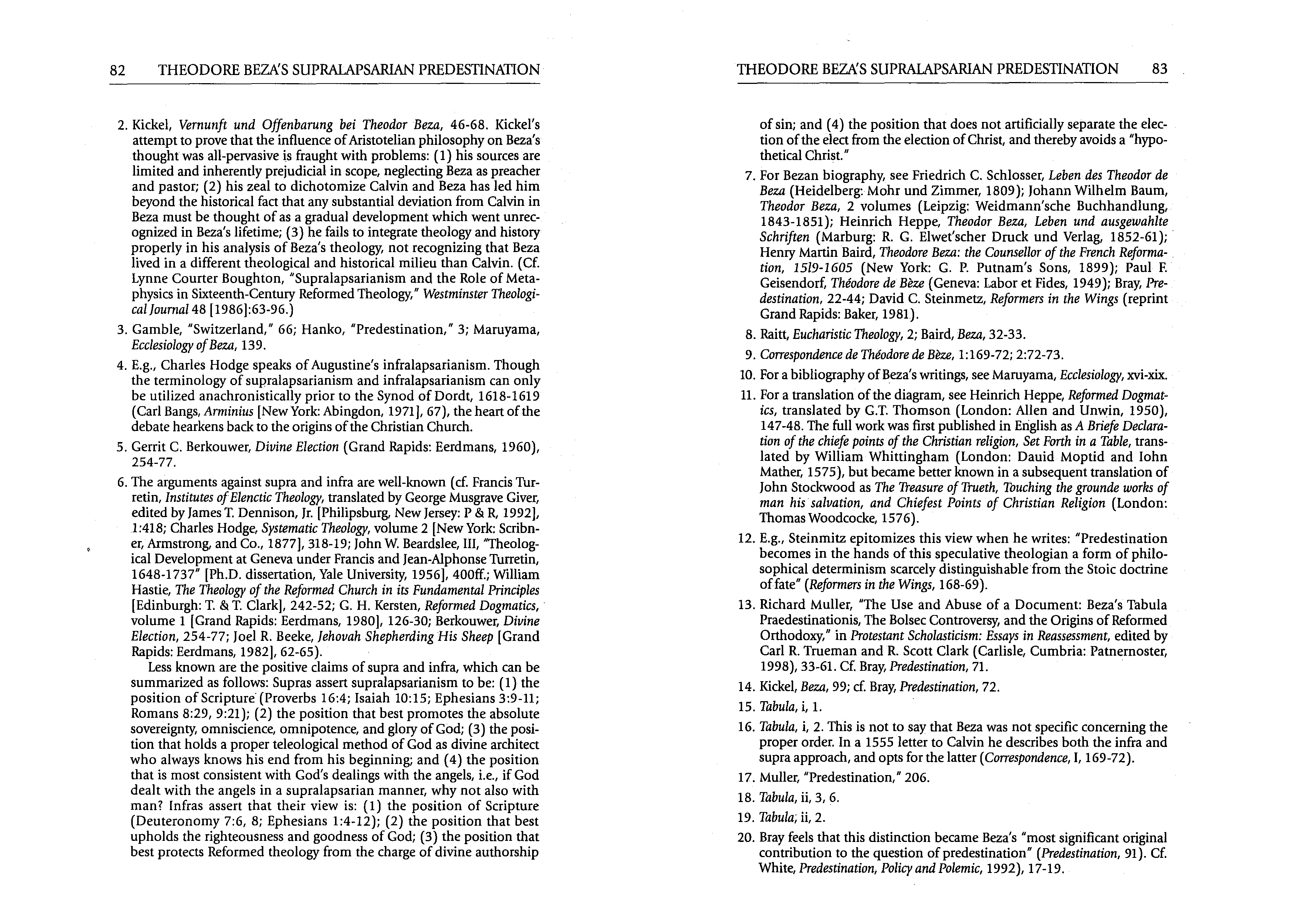
of sin; and (4) the position that does not artificially separate the election of the elect from the election of Christ, and thereby avoids a "hypothetical Christ. "
2. Kickel, Vernunft und Offenbarung bei Theodor Beza, 46-68. Kickel's attempt to prove that the influence of Aristotelian philosophy on Beza/s thought was all-pelVasive is fraught with problems: (1) his sources are limited and inherently prejudicial in scope, neglecting Beza as preacher and pastor; (2) his zeal to dichotomize Calvin and Beza has led him beyond the historical fact that any substantial deviation from Calvin in Beza must be thought of as a gradual development which went unrecognized in Beza/s lifetime; (3) he fails to integrate theology and history properly in his analysis of Beza/s theology, not recognizing that Beza lived in a different theological and historical milieu than Calvin. (Cf.
Lynne Courter Boughton, "Supralapsarianism and the Role of Metaphysics in Sixteenth-Century Reformed Theology/" Westminster Theological Journal 48 [1986]:63-96.)
7. For Bezan biography, see Friedrich C. Schlosser, Leben des Theodor de Bew (Heidelberg: Mohr und Zimmer, 1809); Johann Wilhelm Baum,
Theodor Beza, 2 volumes (Leipzig: Weidmann'sche Buchhandlung, 1843-1851); Heinrich Heppe, Theodor Beza, Leben und ausgewahlte
Schriften (Marburg: R. G. Elwet'scher Druck und Verlag, 1852-61); Henry Martin Baird, Theodore Bew: the Counsellor of the French Reformation, 1519-1605 (New York: G. P. Putnam's Sons, 1899); Paul F.
Geisendorf, Theodore de Beze (Geneva: Labor et Fides, 1949); Bray, Predestination/ 22-44; David C. Steinmetz, Reformers in the Wings (reprint
Grand Rapids: Baker, 1981).
3. Gamble, "Switzerland/" 66; Hanko, "Predestination/" 3; Maruyama, Ecclesiology of Bew, 139.
4. E.g., Charles Hodge speaks of Augustine/s infralapsarianism. Though the terminology of supralapsarianism and infralapsarianism can only be utilized anachronistically prior to the Synod of Dordt, 1618-1619
(Carl Bangs, Arminius [New York: Abingdon, 1971]/ 67)/ the heart of the debate hearkens back to the origins of the Christian Church.
5. Gerrit C. Berkouwer, Divine Election (Grand Rapids: Eerdmans, 1960)/ 254-77.
8. Raitt, Eucharistic Theology, 2; Baird, Bew, 32-33.
9. Correspondence de Theodore de Beze, 1:169-72; 2:72-73.
10. For a bibliography of Beza's writings, see Maruyama, Ecclesiology, xvi-xix.
11. For a translation of the diagram, see Heinrich Heppe, Reformed Dogmatics, translated by G.T. Thomson (London: Allen and Unwin, 1950),
147-48. The full work was first published in English as A Briefe Declaration of the chiefe points of the Christian religion, Set Forth in a Table, translated by William Whittingham (London: Dauid Moptid and Iohn
Mather, 1575), but became better known in a subsequent translation of John Stockwood as The ITeasure of Trueth, Touching the grounde works of man his· salvation, and Chiefest Points of Christian Religion (London:
Thomas Woodcocke, 1576).
6. The arguments against supra and infra are well-known (cf. Francis Turretin, Institutes ofElenctic Theology, translated by George Musgrave Giver, edited by James T. Dennison, Jr. [Philipsburg, New Jersey: P & R, 1992],
1:418; Charles Hodge, Systematic Theology, volume 2 [New York: Scribner, Armstrong, and Co., 1877],318-19; John W. Beardslee, III, "Theological Development at Geneva under Francis and Jean-Alphonse Turretin,
1648-1737" [Ph.D. dissertation, Yale University, 1956], 400ff.; William Hastie, The Theology of the Reformed Church in its Fundamental Principles
[Edinburgh: T. & T. Clark], 242-52; G. H. Kersten, Reformed Dogmatics, volume 1 [Grand Rapids: Eerdmans, 1980], 126-30; Berkouwer, Divine
Election, 254-77; Joel R. Beeke, Jehovah Shepherding His Sheep [Grand Rapids: Eerdmans, 1982],62-65).
12. E.g., Steinmitz epitomizes this view when he writes: "Predestination becomes in the hands of this speCUlative theologian a form of philosophical determinism scarcely distinguishable from the Stoic doctrine offate" (Reformers in the Wings, 168-69).
13. Richard Muller, "The Use and Abuse of a Document: Beza's Tabula Praedestinationis, The Bolsec Controversy, and the Origins of Reformed
Orthodoxy," in Protestant Scholasticism: Essays in Reassessment, edited by Carl R. Trueman and R. Scott Clark (Carlisle, Cumbria: Patnernoster,
1998),33-61. Cf. Bray, Predestination, 71.
Less known are the positive claims of supra and infra, which can be summarized as follows: Supras assert supralapsarianism to be: (1) the position of Scripture· (Proverbs 16:4; Isaiah 10:15; Ephesians 3:9-11;
Romans 8:29,9:21); (2) the position that best promotes the absolute sovereignty, omniscience, omnipotence, and glory of God; (3) the position that holds a proper teleological method of God as divine architect who always knows his end from his beginning; and (4) the position that is most consistent with God's dealings with the angels, i.e., if God dealt with the angels in a supralapsarian manner, why not also with man? Infras assert that their view is: (1) the position of Scripture
(Deuteronomy 7:6, 8; Ephesians 1:4-12); (2) the position that best upholds the righteousness and goodness of God; (3) the position that best protects Reformed theology from the charge of divine authorship
14. Kickel, Bew, 99; cf. Bray, Predestination, 72.
15. Tabula, i, 1.
16. Tabula, i, 2. This is not to say that Beza was not specific concerning the proper order. In a 1555 letter to Calvin he describes both the infra and supra approach, and opts for the latter (Correspondence, I, 169-72).
17. Muller, "Predestination," 206.
18. Tabula, ii, 3, 6.
19. Tabula; ii, 2.
20. Bray feels that this distinction became Beza's "most significant original contribution to the question of predestination" (Predestination, 91). Cf.
White, Predestination, Policy and Polemic, 1992), 17-19.
THEODORE BEZA'S SUPRALAPSARIAN PREDESTINATION
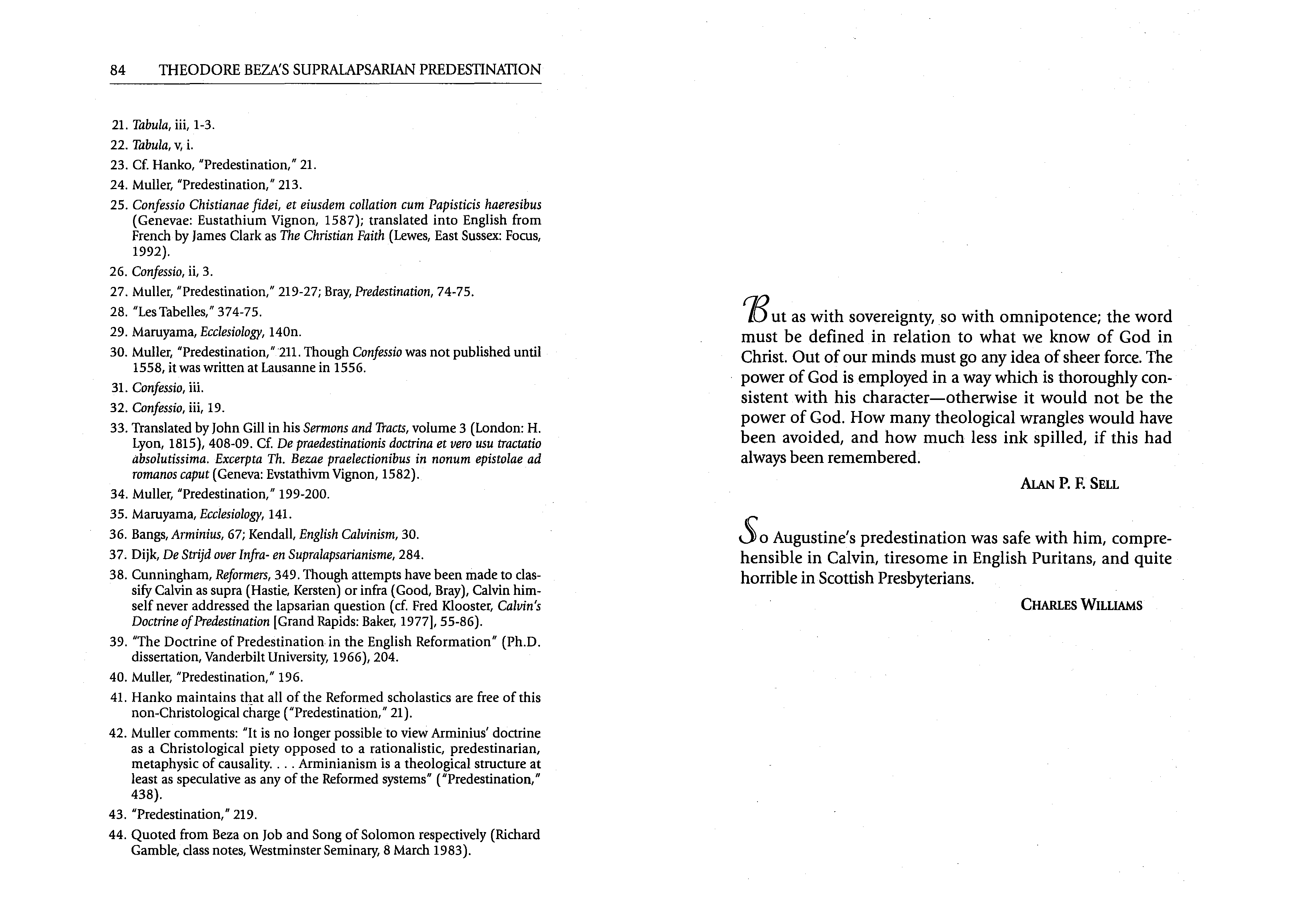
21. Tabula, iii, 1-3.
22. Tabula, v, i.
23. Cf. Hanko, "Predestination," 21.
24. Muller, "Predestination," 213.
25. Confessio Chistianae fidei, et eiusdem collation cum Papisticis haeresibus (Genevae: Eustathium Vignon, 1587); translated into English from French by James Clark as The Christian Faith (Lewes, East Sussex: Focus,
1992).
26. Confessio, ii, 3.
27. Muller, "Predestination," 219-27; Bray, Predestination, 74-75.
28. "Les Tabelles," 374-75.
29. Maruyama, Ecc1esiology, 140n.
30. Muller, "Predestination," 211. Though Confessio was not published until 1558, it was written at Lausanne in 1556.
31. Confessio, iii.
32. Confessio, iii, 19.
33. Translated by John Gill in his Sermons and Tracts, volume 3 (London: H.
Lyon, 1815),408-09. Cf. De praedestinationis doctrina et vero usu tractatio absolutissima. Excerpta Th. Bezae praelectionibus in nonum epistolae ad romanos caput (Geneva: Evstathivrn Vignon, 1582).
34. Muller, "Predestination," 199-200.
35. Maruyama, Ecc1esi%gy, 141.
36. Bangs, Arminius, 67; Kendall, English Calvinism, 30.
37. Dijk, De Strijd over Infraen Supralapsarianisme, 284.
38. Cunningham, Reformers, 349. Though attempts have been made to classify Calvin as supra (Hastie, Kersten) or infra (Good, Bray), Calvin himself never addressed the lapsarian question (cf. Fred Klooster, Calvin's
Doctrine of Predestination [Grand Rapids: Baker, 1977], 55-86).
39. "The Doctrine of Predestination in the English Reformation" (Ph.D. dissenation, Vanderbilt University, 1966), 204.
40. Muller, "Predestination," 196.
18 ut as with sovereignty, so with omnipotence; the word must be defined in relation to what we know of God in Christ. Out of our minds must go any idea of sheer force. The power of God is employed in a way which is thoroughly consistent with his character-otherwise it would not be the power of God. How many theological wrangles would have been avoided, and how much less ink spilled, if this had always been remembered.
ALAN P. F. SELL
So Augustine's predestination was safe with him, comprehensible in Calvin, tiresome in English Puritans, and quite horrible in Scottish Presbyterians.
CHARLES WILLIAMS
41. Hanko maintains that all of the Reformed scholastics are free of this non-Christological charge ("Predestination," 21).
42. Muller comments: "It is no longer possible to view Arminius' doctrine as a Christological piety opposed to a rationalistic, predestinarian, metaphysic of causality .... Arminianism is a theological structure at least as speculative as any of the Reformed systems" ("Predestination,"
438).
43. "Predestination," 219.
44. Quoted from Beza on Job and Song of Solomon respectively (Richard Gamble, class notes, Westminster Seminary, 8 March 1983).