
The Temptations of Christ
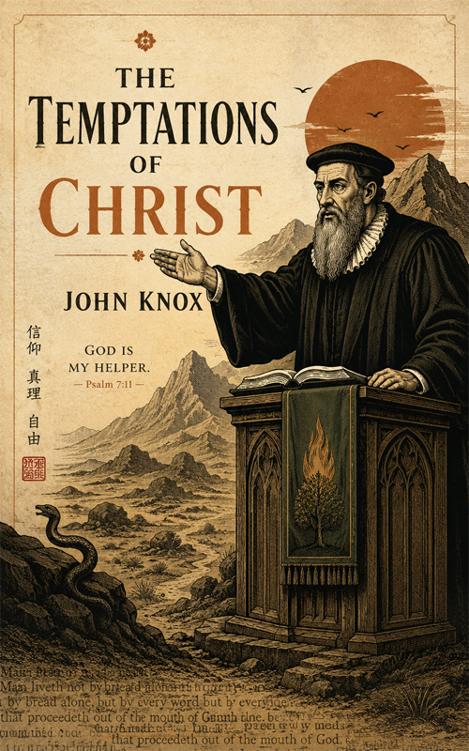
The Temptations of Christ A notable and comfortable exposition of Mr. John Knox's, upon the fourth of Matthew, concerning the temptations of Christ: First delivered in the public Church, and then subsequently written for the comfort of certain private friends, but now published in print for the benefit of all who fear God.
GOD IS MY HELPER.
Psalm 7:11
AT LONDON, Printed by Robert Waldegrave, for Thomas Man, dwelling in Pater-noster-row, at the sign of the Talbot.
TO THE VIRTUOUS and my very godly friend, Mrs. Anne Prouze OF EXETER: JOHN Field, Prayeth increase of Grace, and constancy in that blessed truth of God, which by his grace, she hath received, to the end. Amen.
I Beseech you think not much (good Mistress Prouze) that having kept your papers so long, and not restored them. I do also now at the length adventure without your knowledge, to make that common to more and many, which was private to yourself and some few others. I
do it not (God knoweth) to seek any commodity to myself; but that I may profit the whole church of God. And methinks, it is not meet, that that which was first publicly done in the Church, by so worthy and notable an instrument of God, as Mr. John Knox was: although in respect of particular friendship himself, did only at the first communicate it with you, and some few of his friends: it also being a thing that would be so fruitful and comfortable to many: that it should lie any longer in the dust, in secret, and not be published to the comfort of all. For first amongst the rest, it is a seal of his godly and wonderful labours, carrying in the forehead thereof, of what an heroic and bold spirit he was: how painfully and constantly he stood for the glorious truth and religion of Jesus Christ, and how mightily in the end after many and tedious troubles, persecutions & calamities, God gave him yet a victory, so that he prevailed against all those bulls of Basan. And although all this be testified in his sundry works already published, by that story of his life which Mr. Smeaton, a godly minister hath already set forth in the Latin tongue yet if ever
God shall vouchsafe the church so great a benefit (when his infinite letters, and sundry other Treatises shall be gathered together) it shall appear, what an excellent man he was: and what a wonderful loss, that Church of Scotland sustained, when that worthy man was taken from them. In mean time, I shall desire you, that if you have anything, besides those that I have received already, you will communicate them with me. He maketh mention in a letter to you, of the last part of this Treatise, if you have it, I pray you give it again to the Church, from whence you had it. And if by yourself or others, you can procure any other his writings or letters, here at home or abroad,
in Scotland, or in England, be a mean that we may receive them. It were great pity, that any the least of his writings should be lost. For he evermore wrote both godly and diligently, in questions of divinity, and also of Church policy And his letters being had together, would together set out a whole history of the Churches where he lived. I am bold with you (because I know I may be thus bold with modesty) to employ anything, that is yours to the good of the Church. I know you live to your God, and as you have in times past; being no young scholar in his school, given sufficient testimony to the Church of God, of your sincere faith and holy profession, when you lived in exile to enjoy it: so I persuade myself, that in this peace you will not forsake it, nor think anything that you have too precious to bestow upon it. I keep also by me, many of the writings, labours and letters, of that worthy & godly man's, your late & dear husband, Mr. Edward
Dering (whom I name even for honour's sake,) and gather them in daily, as I can get them, of his & my good friends: One day the Lord may give opportunity, that as he liveth still by those notable readings of his in Paul's Church, so he may live in his other writings, and all may thoroughly see what a man also he was, & what a loss we received when God took him from amongst us. In mean time, I beseech you; do you as you do: continue the Lord's dutiful and faithful remembrancer. Remember the hope of your calling, and being now nearer your salvation than at the first, strive on forward with good courage. Beware of the world, and let those be an example to you to stand fast, whom you have seen and see daily to fall from the love of the truth. A day shall come, when you shall reap, in joy, that which you sow now in mourning and sorrow, and he that hath
strengthened you here to fore to endure strong temptations, afflictions, and troubles, and to overcome them, will strengthen you still, if you still lean upon him. Assure yourself, that he cannot deceive you. He that loved us for himself, and for his own name's sake, before we were, and before the foundation of the world was laid, he will love us still, because his love is unchangeable, built upon his own goodwill, and not upon our works either good or evil. Be therefore of good comfort in your profession, let not the wicked grieve you, but look up to him, that guideth all things for his own glory, and hath made the wicked for a day of vengeance, that he may be magnified in his judgments.
The Lord Jesus evermore assist us, and seal the reconciliation which he hath wrought for us in our hearts, with the seal of his own spirit, that we may feel it, and be comforted with that comfort that none can take from us. Amen. Fare you well. London this first day, of the first month, in the year 1583.
Yours as you know, assured in Christ.
John Field.
The Temptations of Christ
Then Jesus was led by the spirit into the desert, that he should be tempted of the Devil. The cause moving me to entreat this place of scripture is, that such as by the inscrutable providence of God, do fall in diverse temptations judge not themselves by reason thereof less acceptable in God's presence, but contrariwise having the way prepared to victory by Christ Jesus, shall not fear above measure the crafty assaults of that subtle serpent Satan, but with joy and bold courage, having such a guide as here is painted forth, such a champion: and such weapons as here are to be found: (if with obedience we will hear, and with unfeigned faith believe) may assure ourselves of God's present favours, and of final victory by the means of him, who for our safe guard and deliverance hath entered in the battle, and triumphed over his adversary, and all his raging fury. And that the subsequents heard and understand may the better be kept in memory: this order by God's grace we purpose to observe in treating this matter.
[1] First, what this word Temptation meaneth, & how it is used within the scriptures.
[2] Secondarily, who is here tempted, and at what time, this temptation happened.
[3] Thirdly, how and by what means he was tempted. And last, why he would suffer these temptations, [4] and what fruit ensueth to us of the same.
Temptation, or to tempt, in the scriptures of God, is called, to try, to prove, or to assault, the value, the power, the will, the pleasure or the wisdom, whether it be of God or of creatures. And it is taken sometimes in good part, as when it is said that God tempted
Abraham, God tempted the people of Israel: That is God did try and examine, not for his own knowledge to whom nothing is hid, but for the certification of others, how obedient Abraham was to God's commandment, and how weak and infirm the Israelites was in their journey towards the promised land. And this temptation is always good, because it proceedeth immediately from God, to open and make manifest the secret motions of men's hearts, the puissance and power of God's word, and the great lenity and gentleness of God towards the infirmities (yea horrible sins and rebellions) of those whom he hath received into his regiment and care. For who would have believed that the bare word of God could so have moved the heart and affections of Abraham (that to obey God's commandment) he determined to kill with his own hand, his best beloved son Isaac?
Who could have trusted that under so many torments as Job did suffer, he should not speak in all his great temptation one foolish word against God? Or who could have thought that God so mercifully should have pardoned so many, and so manifest transgressions committed by his people in the desert. And yet that his mercy, did never utterly leave them, but still continued with them, till at length he did perform his promise made to Abraham. To whom I say, could these things have been persuaded, unless by trial and temptation, taken of his creatures by God, they had come by revelation made in his holy scriptures to our knowledge. And so this kind of temptation
is profitable, good and necessary, as a thing proceeding from God, who is fountain of all goodness to the manifestation of his glory, and to the profit of the sufferer, howsoever the flesh judge in the hour of temptation.
Otherwise temptation or to tempt, is taken in evil part, that is, he that doth assault or assail, intendeth destruction and confusion to him that is assaulted: As when Satan tempted the woman in the garden. Job, by diverse tribulations, and David by adultery. The Scribes and Pharisees tempted Christ by diverse means, questions and subtleties: and of this manner saith S. James, God tempteth no man: that is, by temptation proceeding immediately from him, he intendeth no man's destruction. And here you shall note, that albeit
Satan appear sometimes to prevail against God's elect: yet is he ever frustrated of his final purpose. By temptation he led the woman and David from the obedience of God: but he could not retain them forever under his thralldom. Power was granted to him to spoil Job of his substance and children, and to strike his body with a plague of sickness most vile and fearful: but he could not compel his mouth to blaspheme God's majesty: and therefore albeit we be laid open sometimes as it were, even to the mouth of Satan: let us not think therefore that God hath abandoned us, and that he taketh no care over us. No, he permitteth Satan to rage, and as it were, to triumph for a time, that when he hath poured forth the venom of his malice against God's elect, it may return to his own confusion. And that the deliverance of God's children may be more to his glory and comfort of the afflicted: Knowing that his hand is so puissant, his mercy and
good will so prompt, that he delivereth his little ones from their cruel enemy, even as David did his sheep and lamb from the mouth of the lion. For a benefit received in extreme danger, doth more move us, than the preservation from ten thousand perils, that we fall not in them. And yet to preserve from dangers and perils, that we fall not in them, whether they be of body or spirit is no less the work of God, than to deliver from them. But the weakness of our faith doth not espy that. But this I omit to better time.
Last to tempt, betokeneth simply, to prove or try without any determined purpose of profit or damage to ensue. As when the mind doubteth of anything, and therein desireth to be satisfied without great love, or yet extreme hatred of the thing that is tempted or tried.
As the Queen of Sheba came to tempt Solomon, in subtle questions.
David tempted (that is) tried himself, if he could go in harness. And Gideon saith, let not thy anger burn against me, if I tempt thee yet once again. this famous Queen not fully trusting the brute and fame, that was spread of Solomon, by subtle questions, desired to prove his wisdom, at the first neither extremely hating, nor fervently loving the person of the king. And David as a man not accustomed to harness, would try how he was able to go, and behave or fashion himself therein, before that (so armed) he would hazard battle with Goliath.
And Gideon not satisfied in his conscience, by the first sign that he received, desired without contempt or hatred of God, the second time, to be certified of his vocation. And in this sense must the Apostle be expounded, when he commands us to tempt (that is) to
try and examine ourselves, if we stand in faith. And thus much for the term.
Now to the person tempted and to the time and place of his temptation. The person tempted, is the only well-beloved son of God.
The time was immediately after his baptism. And the place, was the desert or wilderness. But of intent, we may make our fruit of the premises, we must consider the same more profoundly. That the Son of God was thus tempted, giveth to us instruction, that temptations, though they be never so grievous and fearful, do not separate us from God's favour & mercies. But rather they declare the great graces of God to appertain to us, which makes Satan to rage as a roaring Lion: for against none doth he so fiercely fight, as against those in whose hearts Christ hath taken possession. The time of Christ's temptation, is here most diligently to be noted. Then that is (as Mark, and Luke do witness) immediately after the voice of God the father, had commanded his Son to the world, and had visibly appointed him by the sign of the holy Ghost, he was led or moved to go by the spirit to a wilderness, where forty days he remains fasting, among the wild
Beasts. This spirit which led Christ into the desert, was not the Devil, but the holy spirit of God the Father, by whom Christ as touching his human and manly nature was conducted, and led likewise, as by the same spirit he was strengthened and made strong, and finally raised up from the dead. The spirit of God I say, led Christ to the place of his battle, where long time he endured that combat for the whole forty days & nights, as Luke says he was tempted, but in the end most vehemently, after his continual fasting, and that he began to be
hungry. Upon these forty days, and this fasting of Christ, do our papists found & build their Lent. For say they: all the actions of Christ are our instructions, what he did we ought to follow: but he fasted forty days: therefore, we ought to do the like. I answer, if that we ought to follow all Christ's actions, then ought we neither to eat or drink the space of forty days, for so fasted Christ. We ought to go upon the waters with our feet, to cast out Devils by our word, to heal and cure all sorts of Maladies, to call again the dead to life: for so did
Christ. This I write only that man may see the vanity of these men, who boasting themselves of wisdom, are become mad fools. Did
Christ fast these forty days to teach us a superstitious fasting? Can the Papists assure me or any other man, which were the forty days that Christ fasted? Plain it is he fasted the forty days and nights, that immediately did follow his Baptism, but which they were, or in what month was the day of his Baptism the scripture do not express. And albeit the day were expressed, am I or any Christian bound to counterfeit Christ's actions? as the Ape counterfeits the act or work of man? He himself requires no such obedience of his true followers, but says to his apostles. Go and preach the Evangel, to all nations baptising them in the name of the father, the son, and the holy ghost.
Command them to observe or keep, all that I have commanded you.
Here Christ Jesus requires the observation of his precepts and commandments, & not of his actions, except in so far as he has also commanded them, & so must the Apostle be understood, when he says: Be followers of Christ: For Christ has suffered for us, that we should follow his footsteps: which cannot be understood of every
action of Christ, neither in the mystery of our redemption, neither in his actions and marvellous works, but only of those which he has commanded us to observe.
But when the Papists are so diligent in establishing their dreams and fantasies, they lose the profit which here is to be gathered: that is, why Christ did fast those forty days: which were a doctrine more necessary for Christians, than to corrupt the simple hearts with superstition: as though the wisdom of God Christ Jesus, had taught us no other mystery by his fasting then the abstinence from flesh, or once upon the day to eat flesh, the space of forty days. God hath taken a just vengeance upon the pride of such men, while he thus confounds the wisdom of those that do most glory in wisdom, and does strike with blindness, such as will be guides and lanterns to the feet of others, and yet refuse themselves to bear or follow the light of God's word. From such deliver the poor flock (O Lord).
The causes of Christ's fasting these forty days, I find chiefly to be two.
The former, to witness to the world the dignity and excellency of that vocation, which Christ after his baptism was to take upon him openly. Secondarily to declare, that he enters in battle, for our cause willingly, & does as it were, provoke his adversary to assault him.
Although Christ Jesus in the eternal counsel of his father, was appointed to be the Prince of peace, the angel (that is the messenger) of his Testament, and he alone that should fight our battles for us.
Yet did he not enter in execution of it in the eyes of men, till that he was commended to mankind, by the voice of his heavenly father. And
as he were placed, and anointed by the holy Ghost, by a visible sign given to the eyes of men: after which time, he was led to the desert, & fasted as before is said. And this he did to teach us with what fear, carefulness & reverence, ought the messengers of his word enter in the vocation: which is not only most excellent, (for who is worthy to be God's Ambassador) but also subject to most extreme troubles & dangers. For he that is appointed pastor, watchman, or preacher, if he feed not with his whole power, if he warn and admonish not when he sees the sword come, & if in doctrine he divide not the word righteously, the blood & souls of those that perish for lack of food, admonition, & doctrine shall be required of his hand. If our horned & mitred bishops did understand, and firmly believe this, I think they should be otherwise occupied, than they have been this long time by past. But to our purpose. That Christ exceeds not the space of forty days in his fasting, he does it to the imitation of Moses and Elijah, of whom, the one before the receiving of the law, & the other before the communication & reasoning which he had with God in Mount Horeb.
(In which he was commanded to anoint Hazael king over Syria, and Jehu king over Israel, and Elisha to be prophet) fasted the same number of days. The thing that ensued and did follow the supernatural fasting of these two servants of God Moses and Elijah, did impair and diminish the tyranny and kingdom of Satan. For by the law came the knowledge of sin. The damnation of such impieties
(specially of idolatry and as the devil had invented) and finally, by the law came such a revelation of God's will, that no man justly could afterward excuse his sin by ignorance, by which the devil before had blinded many. So that the law albeit it might not renew and purge
the heart (for that works the spirit of Christ Jesus by faith only): yet it was a bridle that did let and stay the rage of external wickedness in many: And was a schoolmaster also, that led unto Christ. For when man can find no power in himself to do that which is commanded, and perfectly does understand and believe that the curse of God is pronounced against all those that abide not in everything that is commanded, in God's law to do them: The man I say, that understands and knows his own corrupt nature, and God's severe judgment: most gladly will receive the free redemption offered by Christ Jesus, which is the only victory that overthrows Satan and his power. And so by the giving of the law, did God greatly weaken, impair, and make feeble the tyranny and kingdom of the devil. In the days of Elijah, had the devil so prevailed, that kings and rulers made open war against God, killing his Prophets, destroying his ordinances, & erecting up idolatry, which did so prevail that the prophet complained that of all the true fearers & worshippers of God, he was left alone. And wicked Jezebel sought his life also. After this his fasting and complaint, he was sent by God, to anoint these persons aforenamed, who took such vengeance upon the wicked and obstinate idolaters (God grant our eyes may see the like to his glory and comfort of his afflicted flock): that he that escaped the sword of Hazael, fell into the hands of Jehu, & those whom Jehu left, escaped not God's vengeance under Elisha. The remembrance of this was fearful to Satan. For at the coming of Christ was impiety in highest degree, amongst those that pretended most knowledge of God's will, and Satan was at such rest in his kingdom, that the priests, Scribes, and Pharisees, had taken away the key of knowledge: that is, they
had so obscured & darkened God's holy scriptures by false glosses, and vain traditions, that neither would they enter themselves into the kingdom of God: neither suffer and permit others to enter, but with violence restrained, and with Tyranny bet back from the right way, (that is from Christ Jesus himself) such as would have entered into possession of the life everlasting by him. Satan (I say) having such dominion over the chief rulers of the visible Church, and spying in Christ such graces as before he had not seen in man, and considering him to follow in fasting the footsteps of Moses and Elijah: No doubt did greatly fear, the quietness and rest of his most obedient servants the Priests and their adherents, to be troubled by Christ. And therefore by all engine and craft does he assault him, to see what advantage he could have of him. And Christ did not repel him, (as by the power of his Godhead he might) that he should not tempt him, but permitted him to spend all his artillery, and did receive the strokes and assaults of his temptations in his own body, to the end he might weaken and make feeble, the strength and tyrannous power of our adversary by long suffering. For thus me think our master and champion Christ Jesus, does provoke our enemy to battle:
Satan, you boast of your power and victory over mankind: that there is none able to withstand your assaults, nor escape your dart, but at one time or another, you give him a wound: Lo I am man, like to my brethren, having flesh and blood and all properties of man's nature
(sin which is your venom excepted): Tempt, try and assault me: I offer you here a place most convenient (the wilderness), there shall
be no mortal creature to comfort me against your assaults: You shall have time sufficient, do what you can, I shall not flee the place of battle: If you become victor, you may still continue in possession of your kingdom in this wretched world: But if you cannot prevail against me, then must your prey, and unjust spoil be taken from you: you must grant yourself vanquished and confounded, and must be compelled to leave off from all accusation of the members of my body
For to them does appertain the fruit of my battle, my victory is theirs. as I am appointed to take the punishment of their sins in my body. O dear sisters what comfort ought the remembrance of these things be to our hearts. Christ Jesus has fought our battle, he himself has taken us in his care and protection, however the devil rages by temptations, be they spiritual or corporal, he is not able to bereave us out of the hand of the potent son of God: to him be glory for his mercies most abundantly poured forth upon us.
There rests yet to be spoken of the time, when our head was tempted, which began immediately after his baptism. Whereupon we have to note and mark, that albeit the malice of Satan does never cease, but always seeks the means to trouble the godly, yet sometimes he rages more fiercely than others. And that is commonly when God begins to manifest his love & favours towards any of his creatures, & at the end of their battle, when they are nearest to obtain final victory.
The devil no doubt, did at all times envy the humble spirit, which was in Abel, but he did not stir up the cruel heart of Cain against him till
God did declare his favours towards him by acceptance of his
sacrifice. The same we find in Jacob, Joseph, David, and most evidently in Christ Jesus. How rages Satan at the tidings of Christ's nativity? what blood caused he to be shed of purpose, to have murdered Christ in his infancy? the evangelist S. Matthew doth witness. That in all the coasts and borders of Bethlehem, were the children of two years, & of less age murdered without mercy A fearful spectacle and horrible example of insolent and unaccustomed tyranny. And what is the cause moving Satan thus to rage against innocents, considering that by reason of their imperfections they could not hurt his kingdom at that instant. O the crafty eye of Satan looked further then to the present time. He heard bruted by y e three wise men, y t they had learned by the apparition of a star, y t the king of Jews was born, and he was not ignorant, that the time prophesied of Christ's coming was then instant: for a stranger was clothed with y e crown and sceptre in the kingdom of Jud. The Angel had declared the glad tidings to the Pastors, that a Saviour (which was Christ y e
Lord) was born in the city of David. All these tidings enflamed the wrath and malice of Satan. For he perfectly understood that y e coming of the promised seed was appointed to his confusion, & to the breaking down of his head & tyranny. And therefore he rages most cruelly, even at y e first hearing of Christ's birth, thinking that albeit he could not let nor withstand his coming, yet should he shorten his days upon earth, lest by long life and peaceable quietness in it, the number of good men, by Christ's doctrine and virtuous life, should be multiplied. And so he pretends before that ever he can open his mouth in his father's message, to cut him away amongst the other children. O cruel Serpent, in vain dost thou spend thy venom:
for the days of God's elect thou canst not shorten. And when the wheat corn is fallen in the ground, then doth it most multiply But of these precedents, mark (dear sisters) what hath been the practice of the devil from the beginning most cruelly to rage against God's children, when God begins to show them his mercy. And therefore marvel not dearly beloved, albeit the like chance unto you, if Satan fume and roar against you, whether it be against your bodies by persecution, or inward in your consciences by a spiritual battle, be not discouraged, as though ye were less acceptable in God's presence, or as that Satan might at any time prevail against you. No, your temptations and storms that do arise so suddenly, argue and do witness, that the seed that is sown is fallen in good ground, begins to take root, and shall by God's grace bring forth fruit abundantly in due season and convenient time, and that is it which Satan doth fear and therefore thus he rages (and shall rage) against you, thinking that if he can repulse you now suddenly in the beginning, that then ye shall be at all times an easy prey, never able to resist his assaults.
But as my hope is good, so shall my prayer be, that so ye may be strengthened, that the world and Satan himself may understand and perceive: that God fights your battle. For you remember sisters, that being present with you and entreating the same place, I admonished you, that Satan could not long sleep when his kingdom was opposed.
And therefore I willed you if that ye were in mind to continue with Christ, to prepare yourselves for the day of temptation. The person of the speaker is wretched, miserable, and nothing to be regarded, but the things that were spoken, are the infallible & eternal truth of God: without observation of which, never can, nor shall come life to
mankind. God grant you continuance to the end. Thus much have I briefly spoken of y e temptation of Christ Jesus, who was tempted: of the time and place of his temptation. Now resteth to be spoken, how he was tempted, and by what means. The most part of expositors do think that all this temptation was in spirit & imagination, only y e corporal senses being nothing moved I will contend with no man in such cases, but patiently will I suffer every man to abound in his own knowledge, & without prejudice of any man's estimation. I offer my judgment to be weighed and considered by Christian charity.
It appears to me by the plain text that Christ suffered this temptation in body and spirit. Likewise, as the hunger which Christ did suffer, and the desert in which he remained, were not things objected to the imagination, but that the body did verily remain in wilderness among beasts: and after forty days did hunger, and faint for lack of food, so the external ear shall hear the tempting words of Satan, which did enter into the knowledge of the soul, which repelling the venom of such temptations caused the tongue to speak and confute
Satan to our unspeakable comfort and consolation. It appears also, that the body of Christ Jesus, was carried by Satan from the wilderness unto the temple of Jerusalem, and that it was placed upon the pinnacle of the same temple, from whence it was carried to a high mountain, and there tempted. If any man can show the contrary hereof by the plain scriptures of God, with all submission & thanksgiving, I will prefer his judgment to my own, but if the matter stand only in probability & opinion of men, then is it lawful for me to believe as the scripture here speaketh: that is, that Satan spake, and
Christ answered. And Satan took him, and carried him from one place to another. Besides the evidence of the text affirming these presidents, that Satan was permitted to carry the body of Christ from place to place, and yet was not permitted to execute any further tyranny against it, is most singular comfort to such as be afflicted or troubled in body or spirit. The weak and feeble conscience of man under such temptations, doth commonly gather and collect a false consequent: For thus doth man reason: The body or the spirit is vexed by assaults and temptations of Satan, and he doth carry or molest it. Therefore God is angry with it, and taketh no care over it. I answer: tribulations and grievous vexations of body or of mind, are not ever signs of God's displeasure against the sufferer, neither yet doth it follow that God hath cast away the care of his creatures, because he permits them to be molested and vexed for a time. For if any sort of tribulations were the infallible sign of God's displeasure, then should we condemn the best beloved children of God. But of this matter we may chance to speak after this more amply. Now to the temptations.
And when he had fasted forty days and forty nights he afterward hungered. And Satan said, if thou be the son of God, command these stones to be bread. Why Christ fasted forty days and would not exceed the same, (without sense and feeling of hunger) is partly before touched: That is, he would provoke the devil to battle, by the wilderness, and long abstinence: but he would not usurp, or arrogate no more to himself in that case, then God had wrought with others his servants and messengers before. Nor, but that Christ Jesus (as S.
Augustine doth more amplie declare) without feeling of hunger, might have endured the whole year (yea time without end) as well as he did endure the space of forty days. For the nature of that mankind, was sustained those forty days by the invisible power of God, which is at all times of equal power. But Christ willing to offer further occasion to Satan to proceed in tempting of him, permitted the human nature to crave earnestly that which it lacked that is to say, refreshing of meat, which perceived: Satan taketh occasion (as afore) to tempt & assault. Some judged that Satan tempted Christ in gluttony, but that appeareth little to agree with the purpose of the holy Ghost, who showeth us this history to let us understand, that Satan never ceaseth to oppose the children of God, but continually, by one mean or other, driveth & provoketh them to some wicked opinions of their God. And to have desired stones to have been converted in bread, or to have desired the hunger to have been satisfied, hath neither been sin, neither yet wicked opinion of God,
And therefore I doubt not but the temptation was more spiritual, more subtle, and more dangerous. Satan hath respect to the voice of God, which hath pronounced Christ to be his well-beloved son &c.
Against this voice he fights as his nature is ever to do, against the assured & immutable word of God: for such is his malice against God and against his chosen children. That where, and to whom God pronounceth love and mercy, to these threateneth he displeasure, and damnation: And where God threateneth death, there is he bold to pronounce life, and for this cause is Satan called a liar from the beginning. And so the purpose of Satan is to drive Christ into
desperation, that he shall not believe the former voice of God his father. And so this appeareth to be the meaning of this temptation.
Thou hast heard (would Satan say) a voice proclaimed in the air, that thou wast the beloved son of God, in whom his soul was well pleased, but mayest thou not be judged more than mad, and more foolish than the brainless fool, if thou dost believe any such promise? Where are the signs of his love? Art thou not absent from comfort of all creature? Thou art in a worse case than the brute beasts: for every day they hunt for their prey, and the earth produces grass and herbs for their sustenance: So that none of them are pined and consumed away by hunger. But thou hast fasted forty days and nights, ever awaiting some relief & comfort from above: but thy best provision is hard stones. If thou dost glory in thy God, and dost truly believe the promise that is made: command that these stones be bread. But evident it is, that so thou canst not do, for if thou couldst, or if thy
God would have shown any such pleasure to thee, thou mightest long ago have removed thy hunger, and needed not to have endured this languishing for lack of food: but seeing thou hast long continued, and no provision is made for thee, vanity it is longer to believe any such promise: and therefore despair of any help from God's hand, and provide for thyself by some other means.
Many words have I used here (dear sisters) but I cannot express the thousandth part of the malicious despite which lurked in this one temptation of Satan. It is a mocking of Christ and of his obedience. It is a plain denial of God's promise. It is the triumphing voice of him
that appears to have gained victory. O how bitter this temptation is, no creature can understand, but such as feel the dolour of such darts as Satan casts at the tender conscience of those that gladly would rest, and repose in God, and in the promises of his mercy. But here is to be noted the ground and foundation of this temptation. The conclusion of Satan is this: Thou art none of God's elect, much less his well-beloved son, his reason is this. Thou art in trouble, and findest no relief. Then the foundation of the temptation was Christ's poverty, and the lack of food, doubt and suspicion of my father's promise which was openly proclaimed in my baptism, by reason of my hunger, and that I lack all carnal provision. Thou art bold to affirm that God taketh no care over me. But thou art a deceitful and false corrupt sophist, and thy argument is vain and full of blasphemies: for thou bindest God's love, mercy, and providence to the having or wanting of corporal provision which no part of God's scriptures do teach us, but rather they express contrary. As it is written, Man liveth not by bread only, but by every word that proceedeth from the mouth of God. That is, the very life and felicity of man consisteth not in abundance of corporal things, for the possession and having of them, maketh not man blessed nor happy: neither shall the lack of them cause his final misery. but the very life of man consisteth in God, and in his promises pronounced by his own mouth, unto the which who so cleaveth and sticketh unfeignedly, shall live the life everlasting. And although all creatures on earth forsake him, yet shall not his corporal life perish, till the time appointed by God approach. For God hath means to feed, preserve, & maintain, unknown to man's reason, and contrary to the
common course of nature. He fed his people Israel in the desert forty years, without the provision of man. He preserved Jonah in the whale's belly, and maintained and kept the bodies of the three children in the furnace of fire.
-----
MONERGISM BOOKS
The Temptations of Christ, by John Knox. Copyright © 2024 All rights reserved under International and Pan-American Copyright
Conventions. By downloading this eBook, you have been granted the non-exclusive, non-transferable right to access and read the text of this e-book on-screen. No part of this text may be reproduced, transmitted, downloaded, decompiled, reverse engineered, or stored in or introduced into any information storage and retrieval system, in any form or by any means, whether electronic or mechanical, now known or hereinafter invented, without the express written permission of Monergism Books. ePub, .mobi & .pdf Editions February 2024. Requests for information should be addressed to: Monergism Books, PO Box 491,
West Linn Or 97068
Table of Contents