
CHAPTER XI.

The Lake discharges its water north-westward or rather nor-north-westwards. We observe weeds going in that direction, and as the Lonzua, the Kowé, the Kapata, the Luazé, the Kalambwé, flow into it near the east end, and the Lovu or Lofubu, or Lofu, from the south-west near the end it must find an exit for so much water. All these rivers rise in or near the Mambwé country, in lat. 10° S., where, too, the Chambezé rises. Liemba is said to remain of about the same size as we go north-west, but this we shall see for ourselves.
Elephants come all about us. One was breaking trees close by. I fired into his ear without effect: I am too weak to hold the gun steadily.
30th April, 1867.—We begin our return march from Liemba. Slept at a village on the Lake, and went on next day to Pambété, where we first touched it. I notice that here the people pound tobacco-leaves in a mortar after they have undergone partial fermentation by lying in the sun, then they put the mass in the sun to dry for use.
The reason why no palm-oil trees grow further east than Pambété is said to be the stony soil there, and this seems a valid one, for it loves rich loamy meadows.
1st May, 1867.—We intended to go north-west to see whether this Lake narrows or not, for all assert that it maintains its breadth such as we see it beyond Pemba as far as they know it; but when about to start the headman and his wife came and protested so solemnly that by going N.W. we should walk into the hands of a party of Mazitu there, that we deferred our departure. It was not with a full persuasion of the truth of the statement that I consented, but we afterwards saw good evidence that it was true, and that we were saved from being plundered. These marauders have changed their tactics, for they demand so many people, and so many cloths, and then leave. They made it known that their next scene of mulcting would be Mombo's village, and there they took twelve people—four slaves, and many cloths, then went south to the hills they inhabit. A strict watch was kept on their movements by our headman and his men. They trust to fleeing into a thicket on the west of the village should the Mazitu come.
I have been informed on good authority that Kasonso was on his way to us when news arrived that his young son had died. He had sent on beer and provisions for us, but the Mazitu intervening they were consumed.
The Mazitu having left we departed and slept half-way up the
ridge. I had another fit of insensibility last night: the muscles
of the back lose all power,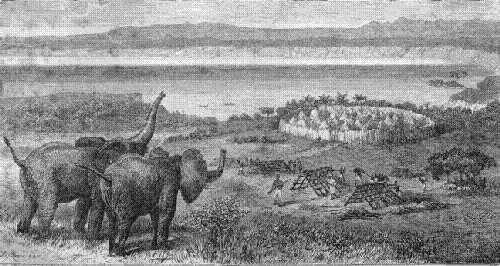
Mombo's village. It is distressingly difficult to elicit accurate information about the Lake and rivers, because the people do not think accurately. Mombo declared that two Arabs came when we were below, and inquired for us, but he denied our presence, thinking thereby to save us trouble and harm.
The cotton cultivated is of the Pernambuco species, and the bushes are seven or eight feet high. Much cloth was made in these parts before the Mazitu raids began, it was striped black and white, and many shawls are seen in the country yet. It is curious that this species of cotton should be found only in the middle of this country.
In going westwards on the upland the country is level and covered with scraggy forest as usual, long lines of low hills or rather ridges of denudation run. N. and S. on our east. This is called Moami country, full of elephants, but few are killed. They do much damage, eating the sorghum in the gardens unmolested.
11th May, 1867.—A short march to-day brought us to a village on the same Moami, and to avoid a Sunday in the forest we remained. The elephants had come into the village and gone all about it, and to prevent their opening the corn safes the people had bedaubed them with elephant's droppings. When a cow would not give milk, save to its calf, a like device was used at Kolobeng; the cow's droppings were smeared on the teats, and the calf was too much disgusted to suck: the cow then ran till she was distressed by the milk fever and was willing to be relieved by the herdsman.
12th and 13th May, 1867.—News that the Arabs had been fighting with Nsama came, but this made us rather anxious to get northward along Liemba, and we made for Mokambola's village near the edge of the precipice which overhangs the Lake. Many Shuaré Raphia palms grow in the river which flows past it.
As we began our descent we saw the Lofu coming from the west and entering Liemba. A projection of Liemba comes to meet it, and then it is said to go away to the north or north-west as far as my informants knew. Some pointed due north, others north-west, so probably its true course amounts to N.N.W. We came to a village about 2' W. of the confluence, whose headman was affable and generous. The village has a meadow some four miles wide on the land side, in which buffaloes disport themselves, but they are very wild, and hide in the gigantic grasses. Sorghum, ground-nuts, and voandzeia grow luxuriantly. The Lofu is a quarter of a mile wide, but higher up three hundred yards. The valley was always clouded over at night so I could not get an observation except early in the morning when the cold had dissipated the clouds.
We remained here because two were lame, and all tired by the descent of upwards of 2000 feet, and the headman sent for fish for us. He dissuaded us strongly from attempting to go down the Liemba, as the son of Nsania (Kapoma) was killing all who came that way in revenge for what the Arabs had done to his father's people, and he might take us for Arabs. A Suaheli Arab came in the evening and partly confirmed the statements of the headman of Karambo; I resolved therefore to go back to Chitimba's in the south, where the chief portion of the Arabs are assembled, and hear from them more certainly.
The last we heard of Liemba was that at a great way north-west, it is dammed up by rocks, and where it surmounts these there is a great waterfall. It does not, it is said, diminish in size so far, but by bearings protracted it is two miles wide.
18th May, 1867.—Return to Mokambola's village, and leave for Chitimba's. Baraka stopped behind at the village, and James ran away to him, leaving his bundle, containing three chronometers, in the path: I sent back for them, and James came up in the evening; he had no complaint, and no excuse to make. The two think it will be easy to return to their own country by begging, though they could not point it out to me when we were much nearer to where it is supposed to be.
19th May, 1867.—Where we were brought to a standstill was miserably cold (55°), so we had prayers and went on S. and S.W. to the village of Chisáka.
20th May, 1867.—Chitimba's village was near in the same direction; here we found a large party of Arabs, mostly black Suahelis. They occupied an important portion of the stockaded village, and when I came in, politely showed me to a shed where they are in the habit of meeting. After explaining whence I had come, I showed them the Sultan's letter. Harnees presented a goat, two fowls, and a quantity of flour. It was difficult to get to the bottom of the Nsama affair, but according to their version that chief sent an invitation to them, and when they arrived called for his people, who came in crowds—as he said to view the strangers. I suspect that the Arabs became afraid of the crowds and began to fire; several were killed on both sides, and Nsama fled, leaving his visitors in possession of the stockaded village and all it contained. Others say that there was a dispute about an elephant, and that Nsama's people were the aggressors. At any rate it is now all confusion; those who remain at Nsama's village help themselves to food in the surrounding villages and burn them, while Chitimba has sent for the party who are quartered here to come to him. An hour or two after we arrived a body of men came from Kasonso, with the intention of proceeding into the country of Nsama, and if possible catching Nsama, "he having broken public law by attacking people who brought merchandise into the country." This new expedition makes the Arabs resolve to go and do what they can to injure their enemy. It will just be a plundering foray—each catching what he can, whether animal or human, and retiring when it is no longer safe to plunder!
This throws the barrier of a broad country between me and Lake "Moero" in the west, but I trust in Providence a way will be opened. I think now of going southwards and then westwards, thus making a long détour round the disturbed district.
The name of the principal Arab is Hamees Wodim Tagh, the other is Syde bin Alie bin Mansure: they are connected with one of the most influential native mercantile houses in Zanzibar. Hamees has been particularly kind to me in presenting food, beads, cloth, and getting information. Thami bin Snaelim is the Arab to whom my goods are directed at Ujiji.
24th May, 1867.—At Chitimba's we are waiting to see what events turn up to throw light on our western route. Some of the Arabs and Kasonso's men went off to-day: they will bring information perhaps as to Nsama's haunts, and then we shall move south and thence west. Wrote to Sir Thomas Maclear, giving the position of Liemba and to Dr. Seward, in case other letters miscarry. The hot season is beginning now. This corresponds to July further south.
Three goats were killed by a leopard close to the village in open day.
28th May, 1867.—Information came that Nsama begged pardon of the. Arabs, and would pay all that they had lost. He did not know of his people stealing from them: we shall hear in a day or two whether the matter is to be patched up or not. While some believe his statements, others say, "Nsama's words of peace are simply to gain time to make another stockade:" in the mean time Kasonso's people will ravage all his country on this eastern side.
Hamees is very anxious that I should remain a few days longer, till Kasonso's son, Kampamba, comes with certain information, and then he will see to our passing safely to Chiwéré's village from Kasonso's. All have confidence in this last-named chief as an upright man.
1st June, 1867.—Another party of marauders went off this morning to plunder Nsama's country to the west of the confluence of the Lofu as a punishment for a breach of public law. The men employed are not very willing to go, but when they taste the pleasure of plunder they will relish it more!
The watershed begins to have a northern slope about Moamba's, lat. 10° 10' S., but the streams are very tortuous, and the people have very confused ideas as to where they run. The Lokhopa, for instance, was asserted by all the men at Moamba's to flow into Lokholu, and then into a river going to Liemba, but a young wife of Moamba, who seemed very intelligent, maintained that Lokhopa and Lokholu went to the Chambezé; I therefore put it down thus. The streams which feed the Chambezé and the Liemba overlap each other, and it would require a more extensive survey than I can give to disentangle them.
North of Moamba, on the Merengé, the slope begins to Liemba. The Lofu rises in Chibué's country, and with its tributaries we have long ridges of denudation, each some 500 or 600 feet high, and covered with green trees. The valleys of denudation enclosed by these hill ranges guide the streams towards Liemba or the four rivers which flow into it. The country gradually becomes lower, warmer, and tsetse and mosquitoes appear; so at last we come to the remarkable cup-shaped cavity in which Liemba reposes. Several streams fall down the nearly perpendicular cliffs, and form beautiful cascades. The lines of denudation are continued, one range rising behind another as far as the eye can reach to the north and east of Liemba, and probably the slope continues away down to Tanganyika. The watershed extends westwards to beyond Casembe, and the Luapula, or Chambezé, rises in the same parallels of latitude as does the Lofu and the Lonzna.
The Arabs inform me that between this and the sea, about 200
miles distant, lies the country of the Wasango—called:
Usango—a fair people, like Portuguese, and very friendly to
strangers. The Wasango possess plenty of cattle: their chief is
called Meréré.
What we understand by primeval forest is but seldom seen in the interior here, though the country cannot be described otherwise than as generally covered with interminable forests. Insects kill or dwarf some trees, and men maim others for the sake of the bark-cloth; elephants break down a great number, and it is only here and there that gigantic specimens are seen: they may be expected in shut-in valleys among mountains, but on the whole the trees are scraggy, and the varieties not great. The different sorts of birds which sing among the branches seem to me to exceed those of the Zambesi region, but I do not shoot them: the number of new notes I hear astonishes me.
The country in which we now are is called by the Arabs and natives Ulungu, that farther north-west is named Marunga. Hamees is on friendly terms with the Mazitu (Watuta) in the east, who do not plunder. The chief sent a man to Kasonso lately, and he having received a present went away highly pleased.
Hamees is certainly very anxious to secure my safety. Some men came from the N.E. to inquire about the disturbance here and they recommend that I should go with them, and then up the east side of the Lake to Ujiji; but that would ruin my plan of discovering Moero and afterwards following the watershed, so as to be certain that this is either the watershed of the Congo or Kile. He was not well pleased when I preferred to go south and then westwards, as it looks like rejecting his counsel; but he said if I waited till his people came, then we should be able to speak with more certainty.
On inquiring if any large mountains exist in this country, I was told that Moufipa, or Fipa, opposite the lower end of the Lake, is largest—one can see Tanganyika from it. It probably gives rise to the Nkalambwé River and the Luazé.
There is nothing interesting in a heathen town. All are busy in preparing food or clothing, mats or baskets, whilst the women are cleaning or grinding their corn, which involves much hard labour. They first dry this in the sun, then put it into a mortar, and afterwards with a flat basket clean off the husks and the dust, and grind it between two stones, the next thing is to bring wood and water to cook it. The chief here was aroused the other day, and threatened to burn his own house and all his property because the people stole from it, but he did not proceed so far: it was probably a way of letting the Arab dependants know that he was aroused.
Some of the people who went to fight attacked a large village, and killed several men; but in shooting in a bushy place they killed one of their own party and wounded another.
On inquiring of an Arab who had sailed on Tanganyika which way the water flowed, he replied to the south!
The wagtails build in the thatch of the huts; they are busy, and men and other animals are active in the same way.
I am rather perplexed how to proceed. Some Arabs seem determined to go westwards as soon as they can make it up with Nsama, whilst others distrust him. One man will send his people to pick up what ivory they can, but he himself will retire to the Usango country. Nsama is expected to-day or to-morrow. It would be such a saving of time and fatigue for us to go due west rather than south, and then west, but I feel great hesitation as to setting out on the circuitous route. Several Arabs came from the Liemba side yesterday; one had sailed on Tanganyika, and described the winds there as very baffling, but no one of them has a clear idea of the Lake. They described the lower part as a "sea," and thought it different from Tanganyika.
Close observation of the natives of Ulungu makes me believe them to be extremely polite. The mode of salutation among relatives is to place the hands round each other's chests kneeling, they then clap their hands close to the ground. Some more abject individuals kiss the soil before a chief; the generality kneel only, with the fore-arms close to the ground, and the head bowed down to them, saying, "O Ajadla chiusa, Mari a bwino." The Usanga say, "Ajé senga." The clapping of hands to superiors, and even equals, is in some villages a perpetually recurring sound. Aged persons are usually saluted: how this extreme deference to each other could have arisen, I cannot conceive; it does not seem to be fear of each other that elicits it. Even the chiefs inspire no fear, and those cruel old platitudes about governing savages by fear seem unknown, yet governed they certainly are, and upon the whole very well. The people were not very willing to go to punish Nsama's breach of public law, yet, on the decision of the chiefs, they went, and came back, one with a wooden stool, another with a mat, a third with a calabash of ground-nuts or some dried meat, a hoe, or a bow—poor, poor pay for a fortnight's hard work hunting fugitives and burning villages.
16th June, 1867.—News came to-day that an Arab party in the south-west, in Lunda, lost about forty people by the small-pox ("ndué"), and that the people there, having heard of the disturbance with Nsama, fled from the Arabs, and would sell neither ivory nor food: this looks like another obstacle to our progress thither.
17th-19th June, 1867.—Hamees went to meet the party from the south-west, probably to avoid bringing the small-pox here. They remain at about two hours' distance. Hamees reports that though the strangers had lost a great many people by small-pox, they had brought good news of certain Arabs still further west: one, Seide ben Umale, or Salem, lived at a village near Casembe, ten days distant, and another, Juma Merikano, or Katata Katanga, at another village further north, and Seide ben Habib was at Phueto, which is nearer Tanganyika. This party comprises the whole force of Hamees, and he now declares that he will go to Nsama and make the matter up, as he thinks that he is afraid to come here, and so he will make the first approach to friendship.
On pondering over the whole subject, I see that, tiresome as it is to wait, it is better to do so than go south and then west, for if I should go I shall miss seeing Moero, which is said to be three days from Nsama's present abode. His people go there for salt, and I could not come to it from the south without being known to them, and perhaps considered to be an Arab. Hamees remarked that it was the Arab way first to smooth the path before entering upon it; sending men and presents first, thereby ascertaining the disposition of the inhabitants. He advises patience, and is in hopes of making a peace with Nsama. That his hopes are not unreasonable, he mentioned that when the disturbance began, Nsama sent men with two tusks to the village whence he had just been expelled, offering thereby to make the matter up, but the Arabs, suspecting treachery, fired upon the carriers and killed them, then ten goats and one tusk were sent with the same object, and met with a repulse; Hamees thinks that had he been there himself the whole matter would have been settled amicably.
All complain of cold here. The situation is elevated, and we are behind a clump of trees on the rivulet Chiloa, which keeps the sun off us in the mornings. This cold induces the people to make big fires in their huts, and frequently their dwellings are burned. Minimum temperature is as low as 46°; sometimes 33°.
24th June, 1867.—The Arabs are all busy reading their Koran, or Kurán, and in praying for direction; to-morrow they will call a meeting to deliberate as to what steps they will take in the Nsama affair. Hamees, it seems, is highly thought of by that chief, who says, "Let him come, and all will be right." Hamees proposes to go with but a few people. These Zanzibar men are very different from the slavers of the Waiyau country.
25th June, 1867.—The people, though called, did not assemble, but they will come to-morrow.
Young wagtails nearly full-fledged took wing, leaving one in the nest; from not being molested by the people they took no precautions, and ran out of the nest on the approach of the old ones, making a loud chirping. The old ones tried to induce the last one to come out too, by flying to the nest, and then making a sally forth, turning round immediately to see if he followed: he took a few days longer.
It was decided at the meeting that Hamees, with a few people only, should go to Nsama on the first day after the appearance of the new moon (they are very particular on this point); the present month having been an unhappy one they will try the next.
28th June, 1867.—A wedding took place among the
Arabs to-day. About a hundred blank cartridges were fired off,
and a procession of males, dressed in their best, marched through
the village. They sang with all their might, though with but
little music in the strain. Women sprinkled grain on their heads
as wishes for plenty.
Nsama is said to be waiting for the Arabs in his new stockade. It is impossible to ascertain exactly who is to blame in this matter, for I hear one side only; but the fact of the chiefs in this part of the country turning out so readily to punish his breach of public law, and no remonstrance coming from him, makes me suspect that Nsama is the guilty party. If he had been innocent he certainly would have sent to ask the Bulungu, or Bäulungu, why they had attacked his people without cause.
[Here is an entry concerning the tribe living far to the East.]
The Wasongo seem much like Zulus; they go naked, and have prodigious numbers of cattle, which occupy the same huts with their owners. Oxen two shukahs each; plenty of milk. Meréré is very liberal with his cattle, and gives every one an ox: there is no rice, but maize and maëre. Hamees left the people to cultivate rice. Meréré had plenty of ivory when the Arabs came first, but now has none.
1st July, 1867.—New moon to-day. They are very particular as to the time of offering up prayers, and in making charms. One to-night was at 10 P.M. exactly.
A number of cabalistic figures were drawn by Halfani, and it is believed that by these Nsama's whereabouts may be ascertained; they are probably remains of the secret arts which prevailed among Arabs before Mahomet appeared. These Suaheli Arabs appear to have come down the coast before that Prophet was born.
3rd July, 1867.—Kasonso's people are expected. All the captives that were taken are to be returned, and a quantity of cloth given to Nsama in addition: so far all seems right. The new moon will appear to-night. The Arabs count from one appearance to the next, not, as we do, from its conjunction with the sun to the next.
4th July, 1867.—Katawanya came from near Liemba to join the peacemakers. He and his party arrived at Liemba after we did; he sent his people all round to seek ivory; they don't care for anything but ivory, and cannot understand why I don't do the same.
6th July, 1867.—An earthquake happened at 3.30 P.M., accompanied with a hollow rumbling sound; it made me feel as if afloat, but it lasted only a few seconds. The boys came running to ask me what it was. Nowhere could it be safer; the huts will not fall, and there are no high rocks near. Barometer 25.0. Temperature 68° 5'. Heavy cumuli hanging about; no rain afterwards.
7th July, 1867.—Hamees started this morning with about 300 followers dressed in all their finery, and he declares that his sole object is peace. Kasonso, Mombo, Chitimba send their people, and go themselves to lend all their influence in favour of peace. Syde stops here. Before starting Syde put some incense on hot coals, and all the leaders of the party joined in a short prayer; they seem earnest and sincere in their incantations, according to their knowledge and belief. I wished to go too, but Hamees objected, as not being quite sure whether Nsama would be friendly, and he would not like anything to befall me when with him.
8th July, 1867.—Kasonso found an excuse for not going himself. Two men, Arabs it was said, came to Chibué's and were there killed, and Kasonso must go to see about it. The people who go carry food with them, evidently not intending to live by plunder this time.
While the peacemakers are gone I am employing time in reading Smith's 'Bible Dictionary,' and calculating different positions which have stood over in travelling. I don't succeed well in the Bäulungu dialect.
The owners of huts lent to strangers have a great deal of toil in consequence; they have to clean them after the visitors have withdrawn; then, in addition to this, to clean themselves, all soiled by the dust left by the lodgers; their bodies and clothes have to be cleansed afterwards—they add food too in all cases of acquaintanceship, and then we have to remember the labour of preparing that food. My remaining here enables me to observe that both men and women are in almost constant employment. The men are making mats, or weaving, or spinning; no one could witness their assiduity in their little affairs and conclude that they were a lazy people. The only idle time I observe here is in the mornings about seven o'clock, when all come and sit to catch the first rays of the sun as he comes over our clump of trees, but even that time is often taken as an opportunity for stringing beads.
I hear that some of Nsama's people crossed the Lovu at Karambo to plunder, in retaliation for what they have suffered, and the people there were afraid to fish, lest they should be caught by them at a distance from their stockades.
The Bäulungu men are in general tall and well formed, they use bows over six feet in length, and but little bent. The facial angle is as good in most cases as in Europeans, and they have certainly as little of the "lark-heel" as whites. One or two of the under front teeth are generally knocked out in women, and also in men.
14th July, 1867.—Syde added to his other presents some more beads: all have been very kind, which I attribute in a great measure to Seyed Majid's letter. Hamees crossed the Lovu to-day at a fordable spot. The people on the other side refused to go with a message to Nsama, so Hamees had to go and compel them by destroying their stockade. A second village acted in the same way, though told that it was only peace that was sought of Nsama: this stockade suffered the same fate, and then the people went to Nsama, and he showed no reluctance to have intercourse. He gave abundance of food, pombe, and bananas; the country being extremely fertile. Nsama also came and ratified the peace by drinking blood with several of the underlings of Hamees. He is said to be an enormously bloated old man, who cannot move unless carried, and women are constantly in attendance pouring pombe into him. He gave Hamees ten tusks, and promised him twenty more, and also to endeavour to make his people return what goods they plundered from the Arabs, and he is to send his people over here to call us after the new moon appears.
It is tiresome beyond measure to wait so long, but I hope to see Moero for this exercise of patience, and I could not have visited it had Hamees not succeeded in making peace.
17th July, 1867.—A lion roared very angrily at the village last night, he was probably following the buffaloes that sometimes come here to drink at night: they are all very shy, and so is all the game, from fear of arrows.
A curious disease has attacked my left eyelid and surrounding parts: a slight degree of itchiness is followed by great swelling of the part. It must be a sort of lichen; exposure to the sun seems to cure it, and this leads me to take long walks therein. This is about 30° 19' E. long.; lat. 8° 57' 55" S.
24th July, 1867.—A fire broke out at 4 A.M., and there being no wind the straw roofs were cleared off in front of it on our side of the village. The granaries were easily unroofed, as the roof is not attached to the walls, and the Arabs tried to clear a space on their side, but were unable, and then moved all their ivory and goods outside the stockade; their side of the village was all consumed, and three goats perished in the flames.
Chitimba has left us from a fear of his life, he says; it is probable that he means this flight to be used as an excuse to Nsama after we are gone. "And I, too, was obliged to flee from my village to save my life! What could I do?" This is to be his argument, I suspect.
A good many slaves came from the two villages that were destroyed: on inquiry I was told that these would be returned when Nsama gave the ivory promised.
When Nsama was told that an Englishman wished to go past him to Moero, he replied, "Bring him, and I shall send men to take him thither."
Hamees is building a "tembé," or house, with a flat roof, and walls plastered over with mud, to keep his ivory from fire while he is absent. We expect that Nsama will send for us a few days after the 2nd August, when the new moon appears; if they do not come soon Hamees will send men to Nsama without waiting for his messengers.
28th July, 1867.—Prayers, with the
Litany.
[The above is an episode of every-day occurrence in the wake of the slave-dealer. "Two fathoms," mentioned as the price of the boy's life—the more valuable of the two, means four yards of unbleached calico, which is a universal article of barter throughout the greater part of Africa: the mother was bought for two yards. The reader must not think that there are no lower prices; in the famines which succeed the slave-dealer's raids, boys and girls are at times to be purchased by the dealer for a few handfuls of maize.]
29th July, 1867.—Went 2 1/2 hours west to village of Ponda, where a head Arab, called by the natives Tipo Tipo, lives; his name is Hamid bin Mahamed bin Juma Borajib. He presented a goat, a piece of white calico, and four big bunches of beads, also a bag of Holcus sorghum, and apologised because it was so little. He had lost much by Nsama; and received two arrow wounds there; they had only twenty guns at the time, but some were in the stockade, and though the people of Nsama were very numerous they beat them off, and they fled carrying the bloated carcase of Nsama with them. Some reported that boxes were found in the village, which belonged to parties who had perished before, but Syde assured me that this was a mistake.
Moero is three days distant, and as Nsama's people go thither to collect salt on its banks, it would have been impossible for me to visit it from the south without being seen, and probably suffering loss.
The people seem to have no family names. A man takes the name of his mother, or should his father die he may assume that. Marriage is forbidden to the first, second, and third degrees: they call first and second cousins brothers and sisters.
A woman, after cupping her child's temples for sore eyes, threw the blood over the roof of her hut as a charm.
[In the above process a goat's horn is used with a small hole in the pointed end. The base is applied to the part from which the blood is to be withdrawn, and the operator, with a small piece of chewed india-rubber in his mouth, exhausts the air, and at the proper moment plasters the small hole up with his tongue. When the cupping-horn is removed, some cuts are made with a small knife, and it is again applied. As a rough appliance, it is a very good one, and in great repute everywhere.]
FOOTNOTES:

CHAPTER IX.
Peace negotiations with Nsama. Geographical gleanings. Curious spider. Reach the River Lofu. Arrives at Nsama's. Hamees marries the daughter of Nsama. Flight of the bride. Conflagration in Arab quarters. Anxious to visit Lake Moero. Arab burial. Serious illness. Continues journey. Slave-traders on the march. Reaches Moero. Description of the Lake. Information concerning the Chambezé and Luapula. Hears of Lake Bemba. Visits spot of Dr. Lacerda's death. Casembe apprised of Livingstone's approach. Meets Mohamad Bogharib. Lakelet Mofwé. Arrives at Casembe's town.
1st August, 1867.—Hamees sends off men to trade at Chiweré's. Zikwé is the name for locust here. Nsigé or Zigé and Pansi the Suaheli names.
A perforated stone had been placed on one of the poles which form the gateway into this stockade, it is oblong, seven or eight inches long by four broad, and bevelled off on one side and the diameter of the hole in the middle is about an inch and a half: it shows evidence of the boring process in rings. It is of hard porphyry and of a pinkish hue, and resembles somewhat a weight for a digging stick I saw in 1841 in the hands of a Bushwoman: I saw one at a gateway near Kasonso's. The people know nothing of its use except as a charm to keep away evil from the village.
2nd August, 1867.—Chronometer A. stopped to-day without any apparent cause except the earthquake.
It is probably malaria which causes that constant singing in the ears ever since my illness at Lake Liemba.
3rd August, 1867.—We expect a message from Nsama every day, the new moon having appeared on the first of this month, and he was to send after its appearance.
5th August, 1867.—Men came yesterday with the message that Hamees must wait a little longer, as Nsama had not yet got all the ivory and the goods which were stolen: they remained over yesterday. The headman, Katala, says that Lunda is eight days from Nsama or Moero, and in going we cross a large river called Movue, which flows into Luapula; another river called Mokobwa comes from the south-east into Moero. Itawa is the name of Nsama's country and people.
A day distant from Nsama's place there is a hot fountain called "Paka pezhia," and around it the earth shakes at times: it is possible that the earthquake we felt here may be connected with this same centre of motion.
6th August, 1867.—The weather is becoming milder. An increase of cold was caused by the wind coming from the south. We have good accounts of the Wasongo from all the Arabs, their houses built for cattle are flat-roofed and enormously large; one, they say, is a quarter of a mile long. Meréré the chief has his dwelling-house within it: milk, butter, cheese, are in enormous quantities; the tribe, too, is very large. I fear that they may be spoiled by the Arab underlings.
7th August, 1867.—Some of my people went down to Karambo and were detained by the chief, who said "I won't let you English go away and leave me in trouble with these Arabs."
A slave had been given in charge to a man here and escaped, the Arabs hereupon went to Karambo and demanded payment from the chief there; he offered clothing, but they refused it, and would have a man; he then offered a man, but this man having two children they demanded all three. They bully as much as they please by their fire-arms. After being spoken to by my people the Arabs came away. The chief begged that I would come and visit him once more, for only one day, but it is impossible, for we expect to move directly. I sent the information to Hamees, who replied that they had got a clue to the man who was wiling away their slaves from them. My people saw others of the low squad which always accompanies the better-informed Arabs bullying the people of another village, and taking fowls and food without payment. Slavery makes a bad neighbourhood!
Hamees is on friendly terms with a tribe of Mazitu who say that they have given up killing people. They lifted a great many cattle, but have very few now; some of them came with him to show the way to Kasonso's.
Slaves are sold here in the same open way that the business is carried on in Zanzibar slave-market. A man goes about calling out the price he wants for the slave, who walks behind him; if a woman, she is taken into a hut to be examined in a state of nudity.
Some of the Arabs believe that meteoric stones are thrown at Satan for his wickedness. They believe that cannon were taken up Kilimanjaro by the first Arabs who came into the country, and there they lie. They deny that Van der Decken did more than go round a portion of the base of the mountain; he could not get on the mass of the mountain: all his donkeys and some of his men died by the cold. Hamees seems to be Cooley's great geographical oracle!
The information one can cull from the Arabs respecting the country on the north-west is very indefinite. They magnify the difficulties in the way by tales of the cannibal tribes, where anyone dying is bought and no one ever buried, but this does not agree with the fact, which also is asserted, that the cannibals have plenty of sheep and goats. The Rua is about ten days west of Tanganyika, and five days beyond it a lake or river ten miles broad is reached; it is said to be called Logarawá. All the water flows northwards, but no reliance can be placed on the statements. Kiombo is said to be chief of Rua country.
Another man asserts that Tanganyika flows northwards and forms a large water beyond Uganda, but no dependence can be placed on the statements of these half Arabs; they pay no attention to anything but ivory and food.
25th August, 1867.—Nsama requested the Arabs to
give back his son who was captured; some difficulty was made
about this by his captor, but Hamees succeeded in getting him and
about nine others, and they are sent off to-day. We wait only for
the people, who are scattered about the country. Hamees presented
cakes, flour, a fowl and leg of goat, with a piece of eland meat:
this animal goes by the same name here as at
Kolobeng—"Pofu."
A fig-tree here has large knobs on the bark, like some species of acacia; and another looks like the Malolo of the Zambesi magnified. A yellow wood gives an odour like incense when burned.
A large spider makes a nest inside the huts. It consists of a piece of pure white paper, an inch and a half broad, stuck flat on the wall; under this some forty or fifty eggs are placed, and then a quarter of an inch of thinner paper is put round it, apparently to fasten the first firmly. When making the paper the spider moves itself over the surface in wavy lines; she then sits on it with her eight legs spread over all for three weeks continuously, catching and eating any insects, as cockroaches, that come near her nest. After three weeks she leaves it to hunt for food, but always returns at night: the natives do not molest it.
A small ant masters the common fly by seizing a wing or leg, and holding on till the fly is tired out; at first the fly can move about on the wing without inconvenience, but it is at last obliged to succumb to an enemy very much smaller than itself.
A species of Touraco, new to me, has a broad yellow mask on the upper part of the bill and forehead; the topknot is purple, the wings the same as in other species, but the red is roseate. The yellow of the mask plates is conspicuous at a distance.
A large callosity forms on the shoulders of the regular Unyamwesi porters, from the heavy weights laid on them. I have noticed them an inch and a half thick along the top of the shoulders. An old man was pointed out to me who had once carried five frasilahs (= 175 lbs.) of ivory from his own country to the coast.
30th August, 1867.—We marched to-day from Chitimba's village after three months and ten days' delay. On reaching Ponda, 2-1/2 hours distant, we found Tipo Tipo, or Hamidi bin Mohamad, gone on, and so we followed him. Passed a fine stream flowing S.W. to the Lofu. Tipo Tipo gave me a fine fat goat.
31st August, 1867.—Pass along a fine undulating district, with much country covered with forest, but many open glades, and fine large trees along the water-courses. We were on the northern slope of the watershed, and could see far. Crossed two fine rivulets. The oozes still full and flowing.
1st September, 1867.—We had to march in the afternoon on account of a dry patch existing in the direct way. We slept without water, though by diverging a few miles to the north we should have crossed many streams, but this is the best path for the whole year.
Baraka went back to Tipo Tipo's village, thus putting his intention of begging among the Arab slaves into operation. He has only one complaint, and that is dislike to work. He tried perseveringly to get others to run away with him; lost the medicine-box, six table-cloths, and all our tools by giving his load off to a country lad while he went to collect mushrooms: he will probably return to Zanzibar, and be a slave to the Arab slaves after being a perpetual nuisance to us for upwards of a year.
2nd September, 1867.—When we reached the ford of the Lofu, we found that we were at least a thousand feet below Chitimba's. The last six hours of our march were without water, but when near to Chungu's village at the ford we came to fine flowing rivulets, some ten feet or so broad. Here we could see westwards and northwards the long lines of hills of denudation in Nsama's country, which till lately was densely peopled. Nsama is of the Babemba family. Kasonso, Chitimba, Kiwé, Urongwé, are equals and of one family, Urungai. Chungu is a pleasant person, and liberal according to his means. Large game is very abundant through all this country.
The Lofu at the ford was 296 feet, the water flowing briskly over hardened sandstone flag, and from thigh to waist deep; elsewhere it is a little narrower, but not passable except by canoes.
4th and 5th September, 1867.—Went seven hours west of the Lofu to a village called Hara, one of those burned by Hamees because the people would not take a peaceful message to Nsama. This country is called Itawa, and Hara is one of the districts. We waited at Hara to see if Nsama wished us any nearer to himself. He is very much afraid of the Arabs, and well he may be, for he was until lately supposed to be invincible. He fell before twenty muskets, and this has caused a panic throughout the country. The land is full of food, though the people have nearly all fled. The ground-nuts are growing again for want of reapers; and 300 people living at free-quarters make no impression on the food.
9th September, 1867.—Went three hours west of
Hara, and came to Nsama's new stockade, built close by the old
one burned by Tipo Tipo, as
Hamidi bin Mohamed was named by Nsama.
Nsama's people have generally small, well-chiseled features, and many are really handsome, and have nothing of the West Coast Negro about them, but they file their teeth to sharp points, and greatly disfigure their mouths. The only difference between them and Europeans is the colour. Many of the men have very finely-formed heads, and so have the women; and the fashion of wearing the hair sets off their foreheads to advantage. The forehead is shaved off to the crown, the space narrowing as it goes up; then the back hair, is arranged into knobs of about ten rows.
10th September, 1867.—Some people of Ujiji have come to Nsama's to buy ivory with beads, but, finding that the Arabs have forestalled them in the market, they intend to return in their dhow, or rather canoe, which is manned by about fifty hands. My goods are reported safe, and the meat of the buffaloes which died in the way is there, and sun-dried. I sent a box, containing papers, books, and some clothes, to Ujiji.
14th September, 1867.—I remained at Hara, for I was ill, and Hamees had no confidence in Nsama, because he promised his daughter to wife by way of cementing the peace, but had not given her. Nsama also told Hamees to stay at Hara, and he would send him ivory for sale, but none came, nor do people come here to sell provisions, as they do elsewhere; so Hamees will return to Chitimba's, to guard his people and property there, and send on Syde Hamidi and his servants to Lopéré, Kabuiré, and Moero, to buy ivory. He advised me to go with them, as he has no confidence in Nsama; and Hamidi thought that this was the plan to be preferred: it would be slower, as they would purchase ivory on the road, but safer to pass his country altogether than trust myself in his power.
The entire population of the country has received a shock from the conquest of Nsama, and their views of the comparative values of bows and arrows and guns have undergone a great change. Nsama was the Napoleon of these countries; no one could stand before him, hence the defeat of the invincible Nsama has caused a great panic. The Arabs say that they lost about fifty men in all: Nsama must have lost at least an equal number. The people seem intelligent, and will no doubt act on the experience so dearly bought.

In the midst of the doubts of Hamees a daughter of Nsama came this afternoon to be a wife and cementer of the peace! She came riding "pickaback" on a man's shoulders; a nice, modest, good-looking young woman, her hair rubbed all over with nkola, a red pigment, made from the camwood, and much used as an ornament. She was accompanied by about a dozen young and old female attendants, each carrying a small basket with some provisions, as cassava, ground-nuts, &c. The Arabs were all dressed in their finery, and the slaves, in fantastic dresses, flourished swords, fired guns, and yelled. When she was brought to Hamees' hut she descended, and with her maids went into the hut. She and her attendants had all small, neat features. I had been sitting with Hamees, and now rose up and went away; as I passed him, he spoke thus to himself: "Hamees Wadim Tagh! see to what you have brought yourself!!"
15th September, 1867.—A guide had come from Nsama to take us to the countries beyond his territory. Hamees set off this morning with his new wife to his father-in-law, but was soon met by two messengers, who said that he was not to come yet. We now sent for all the people who were out to go west or north-west without reference to Nsama.
16th-18th September, 1867.—Hamidi went to Nsama to try and get guides, but he would not let him come into his stockade unless he came up to it without either gun or sword. Hamidi would not go in on these conditions, but Nsama promised guides, and they came after a visit by Hamees to Nsama, which he paid without telling any of us: he is evidently ashamed of his father-in-law.
Those Arabs who despair of ivory invest their remaining beads and cloth in slaves.
20th September, 1867.—I had resolved to go to Nsama's, and thence to Moero to-day, but Hamees sent to say that men had come, and we were all to go with them on the 22nd. Nsama was so vacillating that I had no doubt but this was best.
Hamees' wife, seeing the preparations that were made for starting, thought that her father was to be attacked, so she, her attendants, and the guides decamped by night. Hamees went again to Nsama and got other guides to enable us to go off at once.
22nd September, 1867.—We went north for a couple of hours, then descended into the same valley as that in which I found Nsama. This valley is on the slope of the watershed, and lies east and west: a ridge of dark-red sandstone, covered with trees, forms its side on the south. Other ridges like this make the slope have the form of a stair with huge steps: the descent is gradually lost as we insensibly climb up the next ridge. The first plain between the steps is at times swampy, and the paths are covered with the impressions of human feet, which, being hardened by the sun, make walking on their uneven surface very difficult. Mosquitoes again; we had lost them during our long stay on the higher lands behind us.
23rd September, 1867.—A fire had broken out the night after we left Hara, and the wind being strong, it got the upper hand, and swept away at once the whole of the temporary village of dry straw huts: Hamees lost all his beads, guns, powder, and cloth, except one bale. The news came this morning, and prayers were at once offered for him with incense; some goods will also be sent, as a little incense was. The prayer-book was held in the smoke of the incense while the responses were made. These Arabs seem to be very religious in their way: the prayers were chiefly to Harasji, some relative of Mohamad.
24th September, 1867.—Roused at 3 A.M. to be told that the next stage had no water, and we should be oppressed with the midday heat if we went now. We were to go at 2 P.M. Hamidi's wife being ill yesterday put a stop to our march on that afternoon. After the first hour we descended from the ridge to which we had ascended, we had then a wall of tree-covered rocks on our left of more than a thousand feet in altitude; after flanking it for a while we went up, and then along it northwards till it vanished in forest. Slept without a fresh supply of water.
25th September, 1867.—Off at 5.30 A.M., through the same well-grown forest we have passed and came to a village stockade, where the gates were shut, and the men all outside, in fear of the Arabs; we then descended from the ridge on which it stood, about a thousand feet, into an immense plain, with a large river in the distance, some ten miles off.
26th September, 1867.—Two and a half hours brought us to the large river we saw yesterday; it is more than a mile wide and full of papyrus and other aquatic plants and very difficult to ford, as the papyrus roots are hard to the bare feet, and we often plunged into holes up to the waist. A loose mass floated in the middle of our path; one could sometimes get on along this while it bent and heaved under the weight, but through it he would plunge and find great difficulty to get out: the water under this was very cold from evaporation; it took an hour and a half to cross it. It is called Chiséra, and winds away to the west to fall into the Kalongosi and Moero. Many animals, as elephants, tahetsis, zebras, and buffaloes, graze on the long sloping banks of about a quarter of a mile down, while the ranges of hills we crossed as mere ridges now appear behind us in the south.
27th September, 1867.—The people are numerous and friendly. One elephant was killed, and we remained to take the ivory from the dead beast; buffaloes and zebras were also killed. It was so cloudy that no observations could be taken to determine our position, but Chiséra rises in Lopéré. Further west it is free of papyrus, and canoes are required to cross it.
28th September, 1867.—Two hours north brought us to the Kamosenga, a river eight yards wide, of clear water which ran strongly among aquatic plants. Hippopotami, buffalo, and zebra abound. This goes into the Chiséra eastwards; country flat and covered with dense tangled bush. Cassias and another tree of the pea family are now in flower, and perfume the air. Other two hours took us round a large bend of this river.
30th September, 1867..—We crossed the Kamosenga or another, and reach Karungu's. The Kamosenga divides Lopéré from Itawa, the latter being Nsama's country; Lopéré is north-west of it.
1st October, 1867.—Karungu was very much afraid of us; he kept every one out of his stockade at first, but during the time the Arabs sent forward to try and conciliate other chiefs he gradually became more friendly. He had little ivory to sell, and of those who had, Mtété or Mtéma seemed inclined to treat the messengers roughly. Men were also sent to Nsama asking him to try and induce Mtéma and Chikongo to be friendly and sell ivory and provisions, but he replied that these chiefs were not men under him, and if they thought themselves strong enough to contend against guns he had nothing to say to them. Other chiefs threatened to run away as soon as they saw the Arabs approaching. These were assured that we meant to pass through the country alone, and if they gave us guides to show us how, we should avoid the villages altogether, and proceed to the countries where ivory was to be bought; however, the panic was too great, no one would agree to our overtures, and at last when we did proceed a chief on the River Choma fulfilled his threat and left us three empty villages. There were no people to sell though the granaries were crammed, and it was impossible to prevent the slaves from stealing.
3rd-4th October, 1867.—When Chikongo heard Tipo Tipo's message about buying ivory he said, "And when did Tipo Tipo place ivory in my country that he comes seeking it?" Yet he sent a tusk and said "That is all I have, and he is not to come here." Their hostile actions are caused principally by fear. "If Nsama could not stand before the Malongwana or traders, how can we face them?" I wished to go on to Moero, but all declare that our ten guns would put all the villages to flight: they are terror-struck. First rains of this season on the 5th.
10th October, 1867.—I had a long conversation with Syde, who thinks that the sun rises and sets because the Koran says so, and he sees it. He asserts that Jesus foretold the coming of Mohamad; and that it was not Jesus who suffered on the cross but a substitute, it being unlikely that a true prophet would be put to death so ignominiously. He does not understand how we can be glad that our Saviour died for our sins.
12th October, 1867.—An elephant killed by Tipo Tipo's men. It is always clouded over, and often not a breath of air stirring.
16th October, 1867.—A great many of the women of this district and of Lopéré have the swelled thyroid gland called goitre or Derbyshire neck; men, too, appeared with it, and they in addition have hydrocele of large size.
An Arab who had been long ill at Chitimba's died yesterday, and was buried in the evening. No women were allowed to come near. A long silent prayer was uttered over the corpse when it was laid beside the grave, and then a cloth was held over as men in it deposited the remains beneath sticks placed slanting on the side of the bottom of the grave; this keeps the earth from coming directly into contact with the body.
A feast was made by the friends of the departed, and portions sent to all who had attended the funeral: I got a good share.
18th October, 1867.—The last we hear of Nsama is that he will not interfere with Chikongo. Two wives beat drums and he dances to them; he is evidently in his dotage. We hear of many Arabs to the west of us.
20th October, 1867.—Very ill; I am always so when I have no work—sore bones—much headache; then lost power over the muscles of the back, as at Liemba; no appetite and much thirst. The fever uninfluenced by medicine.
21st October, 1867.—Syde sent his men to build a new hut in a better situation. I hope it may be a healthful one for me.
22nd October, 1867.—The final message from Chikongo was a discouraging one—no ivory. The Arabs, however, go west with me as far as Chisawé's, who, being accustomed to Arabs from Tanganyika, will give me men to take me on to Moero: the Arabs will then return, and we shall move on.
23rd October, 1867.—Tipo Tipo gave Karungu some cloth, and this chief is "looking for something" to give him in return; this detains us one day more.
When a slave wishes to change his master he goes to one whom he likes better and breaks a spear or a bow in his presence—the transference is irrevocable. This curious custom prevails on the Zambesi, and also among the Wanyamwesi; if the old master wishes to recover his slave the new one may refuse to part with him except when he gets his full price: a case of this kind happened here yesterday.
25th October, 1867.—Authority was found in the Koran for staying one day more here. This was very trying; but the fact was our guide from Hara hither had enticed a young slave girl to run away, and he had given her in charge to one of his countrymen, who turned round and tried to secure her for himself, and gave information about the other enticing her away. Nothing can be more tedious than the Arab way of travelling.
26th October, 1867.—We went S.W. for five hours through an undulating, well-wooded, well-peopled country, and quantities of large game. Several trees give out when burned very fine scents; others do it when cut. Euphorbia is abundant. We slept by a torrent which had been filled with muddy water by late rains. It thunders every afternoon, and rains somewhere as regularly as it thunders, but these are but partial rains; they do not cool the earth; nor fill the cracks made in the dry season.
27th October, 1867.—Off early in a fine drizzling rain, which continued for two hours, and came on to a plain about three miles broad, full of large game. These plains are swamps at times, and they are flanked by ridges of denudation some 200 or 300 feet above them, and covered with trees.
The ridges are generally hardened sandstone, marked with madrepores, and masses of brown haematite. It is very hot, and we become very tired. There is no system in the Arab marches. The first day was five hours, this 3-1/2 hours; had it been reversed—short marches during the first days and longer afterwards—the muscles would have become inured to the exertion. A long line of heights on our south points to the valley of Nsama.
28th October, 1867.—Five hours brought us to the Choma River and the villages of Chifupa, but, as already mentioned, the chief and people had fled, and no persuasion could prevail on them to come and sell us food. We showed a few who ventured to come among us what we were willing to give for flour, but they said, "Yes, we will call the women and they will sell." None came.
Rested all day on the banks of the Choma, which is a muddy stream coming from the north and going to the south-west to join the Chiséra. It has worn itself a deep bed in the mud of its banks, and is twenty yards wide and in some spots waist deep, at other parts it is unfordable, it contains plenty of fish, and hippopotami and crocodiles abound. I bought a few ground-nuts at an exorbitant price, the men evidently not seeing that it would have been better to part with more at a lower price than run off and leave all to be eaten by the slaves.
30th October, 1867.—Two ugly images were found in
huts built for them: they represent in a poor way the people of
the country, and are used in rain-making and curing the sick
ceremonies; this is the nearest approach to idol worship I have
seen in the country.
31st October, 1867.—We marched over a long line of hills on our west, and in five and a half hours came to some villages where the people sold us food willingly, and behaved altogether in a friendly way. We were met by a herd of buffaloes, but Syde seized my gun from the boy who carried it, and when the animals came close past me I was powerless, and not at all pleased with the want of good sense shown by my usually polite Arab friend.
Note.—The Choma is said by Mohamad bin Saleh to go into Tanganyika (??). It goes to Kalongosi.
1st November, 1867.—We came along between ranges of hills considerably higher than those we have passed in Itawa or Nsama's country, and thickly covered with trees, some in full foliage, and some putting forth fresh red leaves; the hills are about 700 or 800 feet above the valleys. This is not a district of running rills: we crossed three sluggish streamlets knee deep. Buffaloes are very numerous.
The Ratel covers the buffalo droppings with earth in order to secure the scavenger beetles which bury themselves therein, thus he prevents them from rolling a portion away as usual.
We built our sheds on a hillside. Our course was west and 6-1/4 hours.
2nd November, 1867.—Still in the same direction, and in an open valley remarkable for the numbers of a small euphorbia, which we smashed at every step. Crossed a small but strong rivulet, the Lipandé, going south-west to Moero, then, an hour afterwards, crossed it again, now twenty yards wide and knee deep. After descending from the tree-covered hill which divides Lipandé from Luao, we crossed the latter to sleep on its western bank. The hills are granite now, and a range on our left, from 700 to 1500 feet high, goes on all the way to Moero.
These valleys along which we travel are beautiful. Green is the prevailing colour; but the clumps of trees assume a great variety of forms, and often remind one of English park scenery. The long line of slaves and carriers, brought up by their Arab employers, adds life to the scene, they are in three bodies, and number 450 in all. Each party has a guide with a flag, and when that is planted all that company stops till it is lifted, and a drum is beaten, and a kudu's horn sounded. One party is headed by about a dozen leaders, dressed with fantastic head-gear of feathers and beads, red cloth on the bodies, and skins cut into strips and twisted: they take their places in line, the drum beats, the horn sounds harshly, and all fall in. These sounds seem to awaken a sort of esprit de corps in those who have once been slaves. My attendants now jumped up, and would scarcely allow me time to dress when they heard the-sounds of their childhood, and all day they were among the foremost. One said to me "that his feet were rotten with marching," and this though told that they were not called on to race along like slaves.
The Africans cannot stand sneers. When any mishap occurs in the march (as when a branch tilts a load off a man's shoulder) all who see it set up a yell of derision; if anything is accidentally spilled, or if one is tired and sits down, the same yell greets him, and all are excited thereby to exert themselves. They hasten on with their loads, and hurry with the sheds they build, the masters only bringing up the rear, and helping anyone who may be sick. The distances travelled were quite as much as the masters or we could bear. Had frequent halts been made—as, for instance, a half or a quarter of an hour at the end of every hour or two—but little distress would have been felt; but five hours at a stretch is more than men can bear in a hot climate. The female slaves held on bravely; nearly all carried loads on their heads, the head, or lady of the party, who is also the wife of the Arab, was the only exception. She had a fine white shawl, with ornaments of gold and silver on her head. These ladies had a jaunty walk, and never gave in on the longest march; many pounds' weight of fine copper leglets above the ankles seemed only to help the sway of their walk: as soon as they arrive at the sleeping-place they begin to cook, and in this art they show a good deal of expertness, making savoury dishes for their masters out of wild fruits and other not very likely materials.
3rd November, 1867.—The ranges of hills retire as we advance; the soil is very rich. At two villages the people did not want us, so we went on and encamped near a third, Kabwakwa, where a son of Mohamad bin Saleh, with a number of Wanyamwesi, lives. The chief of this part is Muabo, but we did not see him: the people brought plenty of food for us to buy. The youth's father is at Casembe's. The country-people were very much given to falsehood—every place inquired for was near—ivory abundant—provisions of all sorts cheap and plenty. Our headmen trusted to these statements of this young man rather, and he led them to desist going further. Rua country was a month distant, he said, and but little ivory there. It is but three days off. (We saw it after three days.) "No ivory at Casembe's or here in Buiré, or Kabuiré." He was right as to Casembe. Letters, however, came from Hamees, with news of a depressing nature. Chitimba is dead, and so is Mambwé. Chitimba's people are fighting for the chieftainship: great hunger prevails there now, the Arabs having bought up all the food. Moriri, a chief dispossessed of his country by Nsama, wished Hamees to restore his possessions, but Hamees said that he had made peace, and would not interfere.
This unfavourable news from a part where the chief results of their trading were deposited, made Syde and Tipo Tipo decide to remain in Buiré only ten or twenty days, send out people to buy what ivory they could find, and then, retire.
As Syde and Tipo Tipo were sending men to Casembe for ivory, I resolved to go thither first, instead of shaping my course for Ujiji.
Very many cases of goitre in men and women here: I see no reason for it. This is only 3350 feet above the sea.
7th November, 1867.—Start for Moero, convoyed by all the Arabs for some distance: they have been extremely kind. We draw near to the mountain-range on our left, called Kakoma, and sleep at one of Kaputa's villages, our course now being nearly south.
8th November, 1867.—Villages are very thickly studded over the valley formed by Kakoma range, and another at a greater distance on our right; 100 or 200 yards is a common distance between these villages, which, like those in Londa, or Lunda, are all shaded with trees of a species of Ficus indica. One belongs to Puta, and this Puta, the paramount chief, sent to say that if we slept there, and gave him a cloth, he would send men to conduct us next day, and ferry us across: I was willing to remain, but his people would not lend a hut, so we came on to the Lake, and no ferry. Probably he thought that we were going across the Lualaba into Rua.
Lake Moero seems of goodly size, and is flanked by ranges of mountains on the east and west. Its banks are of coarse sand, and slope gradually down to the water: outside these banks stands a thick belt of tropical vegetation, in which fishermen build their huts. The country called Rua lies on the west, and is seen as a lofty range of dark mountains: another range of less height, but more broken, stands along the eastern shore, and in it lies the path to Casembe. We slept in a fisherman's hut on the north shore. They brought a large fish, called "mondé," for sale; it has a slimy skin, and no scales, a large head, with tentaculae like the Siluridie, and large eyes: the great gums in its mouth have a brush-like surface, like a whale's in miniature: it is said to eat small fish. A bony spine rises on its back (I suppose for defence), which is 2-1/2 inches long, and as thick as a quill. They are very retentive of life.
The northern shore has a fine sweep like an unbent bow, and round the western end flows the water that makes the river Lualaba, which, before it enters Moero, is the Luapula, and that again (if the most intelligent reports speak true) is the Chambezé before it enters Lake Bemba, or Bangweolo.
We came along the north shore till we reached the eastern flanking range, then ascended and turned south, the people very suspicious, shutting their gates as we drew near. We were alone, and only nine persons in all, but they must have had reason for fear. One headman refused us admission, then sent after us, saying that the man who had refused admission was not the chief: he had come from a distance, and had just arrived. It being better to appear friendly than otherwise, we went back, and were well entertained. Provisions were given when we went away. Flies abound, and are very troublesome; they seem to be attracted by the great numbers of fish caught. The people here are Babemba, but beyond the river Kalongosi they are all Balunda.
A trade in salt is carried on from different salt springs and salt mud to Lunda and elsewhere. We meet parties of salt-traders daily, and they return our salutations very cordially, rubbing earth on the arms. We find our path lies between two ranges of mountains, one flanking the eastern shore, the other about three miles more inland, and parallel to it: these are covered thickly with trees, and are of loosely-coherent granite: many villages are in the space enclosed by these ranges, but all insecure.
12th November, 1867..—We came to the Kalongosi, or, as the Arabs and Portuguese pronounce it, Karungwesi, about 60 yards wide, and flowing fast over stones. It is deep enough, even now when the rainy season is not commenced, to requite canoes. It is said to rise in Kumbi, or Afar, a country to the south-east of our ford. Fish in great numbers are caught when ascending to spawn: they are secured by weirs, nets, hooks. Large strong baskets are placed in the rapids, and filled with stones, when the water rises these baskets are standing-places for the fishermen to angle or throw their nets. Having crossed the Kalongosi we were now in Lunda, or Londa.
13th November, 1867.—We saw that the Kalongosi went north till it met a large meadow on the shores of Moero, and, turning westwards, it entered there. The fishermen gave us the names of 39 species of fish in the Lake; they said that they never cease ascending the Kalongosi, though at times they are more abundant than at others: they are as follows.
Mota; Lasa; Kasibé; Molobé; Lopembé; Motoya; Chipansa; Mpifu; Manda; Mpala; Moombo; Mfeu; Mendé; Seusé; Kadia nkololo; Etiaka; Nkomo; Lifisha; Sambamkaka; Ntondo; Sampa; Bongwé; Mabanga; Kisé; Kuanya; Nkosu; Palé; Mosungu; Litembwa; Mecheberé; Koninchia; Sipa; Lomembé; Molenga; Mirongé; Nfindo; Pende.
14th November, 1867.—Being doubtful as to whether we were in the right path, I sent to a village to inquire. The headman, evidently one of a former Casembe school, came to us full of wrath. "What right had we to come that way, seeing the usual path was to our left?" He mouthed some sentences in the pompous Lunda style, but would not show us the path; so we left him, and after going through a forest of large trees, 4-1/2 hours south, took advantage of some huts on the Kifurwa River, built by bark-cloth cutters.
15th November, 1867.—Heavy rains, but we went on, and found a village, Kifurwa, surrounded by cassava fields, and next day crossed the Muatozé, 25 yards wide, and running strongly towards Moero, knee deep. The River Kabukwa, seven yards wide, and also knee deep, going to swell the Muatozé.
We now crossed a brook, Chirongo, one yard wide and one deep; but our march was all through well-grown forest, chiefly gum-copal trees and bark-cloth trees. The gum-copal oozes out in abundance after or during the rains, from holes a quarter of an inch in diameter, made by an insect: it falls, and in time sinks into the soil, a supply for future generations. The small well-rounded features of the people of Nsama's country are common here, as we observe in the salt-traders and villages; indeed, this is the home of the Negro, and the features such as we see in pictures of ancient Egyptians, as first pointed out by Mr. Winwood Reade. We sleep by the river Mandapala, 12 yards wide, and knee deep.
18th November, 1867.—We rest by the Kabusi, a sluggish narrow rivulet. It runs into the Chungu, a quarter of a mile off. The Chungu is broad, but choked with trees and aquatic plants: Sapotas, Eschinomenas, Papyrus, &c. The free stream is 18 yards wide, and waist deep. We had to wade about 100 yards, thigh and waist deep, to get to the free stream.
On this, the Chungu, Dr. Lacerda died; it is joined by the Mandapala, and flows a united stream into Moero. The statements of the people are confused, but the following is what I have gleaned from many. There were some Ujiji people with the Casembe of the time. The Portuguese and Ujijians began to fight, but Casembe said to them and the Portuguese, "You are all my guests, why should you fight and kill each other?" He then gave Lacerda ten slaves, and men to live with him and work at building huts, bringing firewood, water, &c. He made similar presents to the Ujijians, which quieted them. Lacerda was but ten days at Chungu when he died. The place of his death was about 9° 32', and not 8° 43' as in Mr. Arrowsmith's map. The feud arose from one of Lacerda's people killing an Ujijian at the water: this would certainly be a barrier to their movements.
Palm-oil trees are common west of the Chungu, but none appeared east of it. The oil is eaten by the people, and is very nice and sweet. This is remarkable, as the altitude above the sea is 3350 feet.
Allah is a very common exclamation among all the people west of Nsama. By advice of a guide whom we picked up at Kifurwa, we sent four fathoms of calico to apprise Casembe of our coming: the Arabs usually send ten fathoms; in our case it was a very superfluous notice, for Casembe is said to have been telegraphed to by runners at every stage of our progress after crossing the Kalongosi.
We remain by the Chungu till Casembe sends one of his counsellors to guide us to his town. It has been so perpetually clouded over that we have been unable to make out our progress, and the dense forest prevented us seeing Moero as we wished: rain and thunder perpetually, though the rain seldom fell where we were.
I saw pure white-headed swallows (Psalidoprocne albiceps) skimming the surface of the Chungu as we crossed it. The soil is very rich. Casembe's ground-nuts are the largest I have seen, and so is the cassava. I got over a pint of palm oil for a cubit of calico.
A fine young man, whose father had been the Casembe before this one, came to see us; he is in the background now, otherwise he would have conducted us to the village: a son or heir does not succeed to the chieftainship here.
21st November, 1867.—The River Lundé was five miles from Chungu. It is six yards wide where we crossed it, but larger further down; springs were oozing out of its bed: we then entered on a broad plain, covered with bush, the trees being all cleared off in building a village. When one Casembe dies, the man who succeeds him invariably removes and builds his pembwé, or court, at another place: when Dr. Lacerda died, the Casembe moved to near the north end of the Mofwé. There have been seven Casembes in all. The word means a general.
The plain extending from the Lundé to the town of Casembe is level, and studded pretty thickly with red anthills, from 15 to 20 feet high. Casembe has made a broad path from his town to the Lundé, about a mile-and-a-half long, and as broad as a carriage-path. The chief's residence is enclosed in a wall of reeds, 8 or 9 feet high, and 300 yards square, the gateway is ornamented with about sixty human skulls; a shed stands in the middle of the road before we come to the gate, with a cannon dressed in gaudy cloths. A number of noisy fellows stopped our party, and demanded tribute for the cannon; I burst through them, and the rest followed without giving anything: they were afraid of the English. The town is on the east bank of the Lakelet Mofwé, and one mile from its northern end. Mohamad bin Saleh now met us, his men firing guns of welcome; he conducted us to his shed of reception, and then gave us a hut till we could build one of our own. Mohamad is a fine portly black Arab, with a pleasant smile, and pure white beard, and has been more than ten years in these parts, and lived with four Casembes: he has considerable influence here, and also on Tanganyika.
An Arab trader, Mohamad Bogharib, who arrived seven days before us with an immense number of slaves, presented a meal of vermicelli, oil, and honey, also cassava meal cooked, so as to resemble a sweet meat (I had not tasted honey or sugar since we left Lake Nyassa, in September 1866): they had coffee too.
Neither goats, sheep, nor cattle thrive here, so the people are confined to fowls and fish. Cassava is very extensively cultivated, indeed, so generally is this plant grown, that it is impossible to know which is town and which is country: every hut has a plantation around it, in which is grown cassava, Holcus sorghum, maize, beans, nuts.
Mohamad gives the same account of the River Luapula and Lake Bemba that Jumbé did, but he adds, that the Chambezé, where we crossed it, is the Luapula before it enters Bemba or Bangweolo: on coming out of that Lake it turns round and comes away to the north, as Luapula, and, without touching the Mofwé, goes into Moero; then, emerging thence at the north-west end it becomes Lualaba, goes into Rua, forms a lake there, and afterwards goes into another lake beyond Tanganyika.
The Lakelet Mofwé fills during the rains and spreads westward, much beyond its banks. Elephants wandering in its mud flats when covered are annually killed in numbers: if it were connected with the Lake Moero the flood would run off.
Many of Casembe's people appear with the ears cropped and hands lopped off: the present chief has been often guilty of this barbarity. One man has just come to us without ears or hands: he tries to excite our pity making a chirruping noise, by striking his cheeks with the stumps of his hands.
A dwarf also, one Zofu, with backbone broken, comes about us: he talks with an air of authority, and is present at all public occurrences: the people seem to bear with him. He is a stranger from a tribe in the north, and works in his garden very briskly: his height is 3 feet 9 inches.
FOOTNOTES:
CHAPTER X.
Grand reception of the traveller. Casenibe and his wife. Long stay in the town. Goes to explore Moero. Despatch to Lord Clarendon, with notes on recent travels. Illness at the end of 1867. Further exploration of Lake Moero. Flooded plains. The River Luao. Visits Kabwawata. Joy of Arabs at Mohamad bin Saleh's freedom. Again ill with fever. Stories of underground dwellings.
24th November, 1867.—We were called to be presented to Casembe in a grand reception.
The present Casembe has a heavy uninteresting countenance, without beard or whiskers, and somewhat of the Chinese type, and his eyes have an outward squint. He smiled but once during the day, and that was pleasant enough, though the cropped ears and lopped hands, with human skulls at the gate, made me indisposed to look on anything with favour. His principal wife came with her attendants, after he had departed, to look at the Englishman (Moenge-résé). She was a fine, tall, good-featured lady, with two spears in her hand; the principal men who had come around made way for her, and called on me to salute: I did so; but she, being forty yards off, I involuntarily beckoned her to come nearer: this upset the gravity of all her attendants; all burst into a laugh, and ran off.
Casembe's smile was elicited by the dwarf making some uncouth antics before him. His executioner also came forward to look: he had a broad Lunda sword on his arm, and a curious scizzor-like instrument at his neck for cropping ears. On saying to him that his was nasty work, he smiled, and so did many who were not sure of their ears a moment: many men of respectability show that at some former time they have been thus punished. Casembe sent us another large basket of fire-dried fish in addition to that sent us at Chungu, two baskets of flour, one of dried cassava, and a pot of pombe or beer. Mohamad, who was accustomed to much more liberal Casembes, thinks this one very stingy, having neither generosity nor good sense; but as we cannot consume all he gives, we do not complain.
27th November, 1867.—Casembe's chief wife passes frequently to her plantation, carried by six, or more commonly by twelve men in a sort of palanquin: she has European features, but light-brown complexion. A number of men run before her, brandishing swords and battle-axes, and one beats a hollow instrument, giving warning to passengers to clear the way: she has two enormous pipes ready filled for smoking. She is very attentive to her agriculture; cassava is the chief product; sweet potatoes, maize, sorghum, pennisetum, millet, ground-nuts, cotton. The people seem more savage than any I have yet seen: they strike each other barbarously from mere wantonness, but they are civil enough to me.
Mohamad bin Saleh proposes to go to Ujiji next month. He waited when he heard of our coming, in order that we might go together: he has a very low opinion of the present chief. The area which has served for building the chief town at different times is about ten miles in diameter.
Mofwé is a shallow piece of water about two miles broad, four or less long, full of sedgy islands, the abodes of waterfowl, but some are solid enough to be cultivated. The bottom is mud, though sandy at the east shore: it has no communication with the Luapula. (28th November, 1867.) The Lundé, Chungu, and Mandapala are said to join and flow into Moero. Fish are in great abundance (perch). On the west side there is a grove of palm-oil palms, and beyond west rises a long range of mountains of the Rua country 15 or 20 miles off.
1st December, 1867.—An old man named Pérémbé is the owner of the land on which Casembe has built. They always keep up the traditional ownership. Munongo is a brother of Pérémbé, and he owns the country east of the Kalongosi: if any one wished to cultivate land he would apply to these aboriginal chiefs for it.
I asked a man from Casembe to guide me to south end of Moero, but he advised me not to go as it was so marshy. The Lundé forms a marsh on one side, and the Luapula lets water percolate through sand and mud, and so does the Robukwé, which makes the path often knee deep. He said he would send men to conduct me to Moero, a little further down, and added that we had got very little to eat from him, and he wanted to give more. Moero's south end is about 9° 30' S.
Old Pérémbé is a sensible man: Mohamad thinks him 150 years old. He is always on the side of liberality and fairness; he says that the first Casembe was attracted to Mofwé by the abundance of fish in it. He has the idea of all men being derived from a single pair.
7th December, 1867.—It is very cloudy here; no observations can be made, as it clouds over every afternoon and night. (8th and 11th December, 1867.) Cleared off last night, but intermittent fever prevented my going out.
13th December, 1867.—Set-in rains. A number of fine young girls who live in Casembe's compound came and shook hands in their way, which is to cross the right over to your left, and clasp them; then give a few claps with both hands, and repeat the crossed clasp: they want to tell their children that they have seen me.
15th December, 1867.—To-day I announced to Casembe our intention of going away. Two traders got the same return present from him that I did, namely, one goat and some fish, meal and cassava. I am always ill when not working; I spend my time writing letters, to be ready when we come to Ujiji. (18th December, 1867.) We have been here a month, and I cannot get more than two lunars: I got altitudes of the meridian of stars north and south soon after we came, but not lunars. Casembe sent a big basket of fire-dried fish, two pots of beer, and a basket of cassava, and says we may go when we choose.
19th December, 1867.—On going to say good-bye to Casembe, he tried to be gracious, said that we had eaten but little of his food; yet he allowed us to go. He sent for a man to escort us; and on the 22nd December, 1867. we went to Lundé River, crossed it, and went on to sleep at the Chungu, close by the place where Casembe's court stood when Dr. Lacerda came, for the town was moved further west as soon as the Doctor died. There are many palm-oil palms about, but no tradition exists of their introduction.
23rd December, 1867.—We crossed the Chungu. Rain from above, and cold and wet to the waist below, as I do not lift my shirt, because the white skin makes all stare. I saw black monkeys at this spot. The Chungu is joined by the Kaleusi and the Mandapala before it enters Moero. Casembe said that the Lundé ran into Mofwé; others denied this, and said that it formed a marsh with numbers of pools in long grass; but it may ooze into Mofwé thus. Casembe sent three men to guide me to Moero.
24th December, 1867.—Drizzly rain, and we are in a miserable spot by the Kabusi, in a bed of brakens four feet high. The guides won't stir in this weather. I gave beads to buy what could be got for Christmas.
25th December, 1867.—Drizzly showers every now and then; soil, black mud.
About ten men came as guides and as a convoy of honour to Mohamad.
27th December, 1867.—In two hours we crossed Mandapala, now waist deep. This part was well stocked with people five years ago, but Casembe's severity in cropping ears and other mutilations, selling the children for slight offences, &c., made them all flee to neighbouring tribes; and now, if he sent all over the country, he could not collect a thousand men.
[Livingstone refers (on the 15th Dec.) to some writings he was engaged upon, and we find one of them here in his journal which takes the form of a despatch to Lord Clarendon, with a note attached to the effect that it was not copied or sent, as he had no paper for the purpose. It affords an epitomised description of his late travels, and the stay at Casembe, and is inserted here in the place of many notes written daily, but which only repeat the same events and observations in a less readable form. It is especially valuable at this stage of his journal, because it treats on the whole geography of the district between Lakes Nyassa and Moero, with a broad handling which is impossible in the mere jottings of a diary.]
Town Of Casembe, 10th December, 1867..
Lat. 9° 37' 13" South; long. 28° East.
The Right Honourable the Earl of Clarendon.
My Lord,—The first opportunity I had of sending a letter to the coast occurred in February last, when I was at a village called Molemba (lat. 10° 14' S.; long. 31° 46' E.), in the country named Lobemba. Lobisa, Lobemba, Ulungu and Itawa-Lunda are the names by which the districts of an elevated region between the parallels 11° and 8° south, and meridians 28°-33° long. east, are known. The altitude of this upland is from 4000 to 6000 feet above the level of the sea. It is generally covered with forest, well watered by numerous rivulets, and comparatively cold. The soil is very rich, and yields abundantly wherever cultivated. This is the watershed between the Loangwa, a tributary of the Zambesi, and several rivers which flow towards the north. Of the latter, the most remarkable is the Chambezé, for it assists in the formation of three lakes, and changes its name three times in the five or six hundred miles of its course.
On leaving Lobemba we entered Ulungu, and, as we proceeded northwards, perceived by the barometers and the courses of numerous rivulets, that a decided slope lay in that direction. A friendly old Ulungu chief, named Kasonso, on hearing that I wished to visit Lake Liemba, which lies in his country, gave his son with a large escort to guide me thither; and on the 2nd April last we reached the brim of the deep cup-like cavity in which the Lake reposes. The descent is 2000 feet, and still the surface of the water is upwards of 2500 feet above the level of the sea. The sides of the hollow are very steep, and sometimes the rocks run the whole 2000 feet sheer down to the water. Nowhere is there three miles of level land from the foot of the cliffs to the shore, but top, sides, and bottom are covered with well-grown wood and grass, except where the bare rocks protrude. The scenery is extremely beautiful. The "Aeasy," a stream of 15 yards broad and thigh deep, came down alongside our precipitous path, and formed cascades by leaping 300 feet at a time. These, with the bright red of the clay schists among the greenwood-trees, made the dullest of my attendants pause and remark with wonder. Antelopes, buffaloes, and elephants abound on the steep slopes; and hippopotami, crocodiles, and fish swarm in the water. Gnus are here unknown, and these animals may live to old age if not beguiled into pitfalls. The elephants sometimes eat the crops of the natives, and flap their big ears just outside the village stockades. One got out of our way on to a comparatively level spot, and then stood and roared at us. Elsewhere they make clear off at sight of man.
The first village we came to on the banks of the Lake had a grove of palm-oil and other trees around it. This palm tree was not the dwarf species seen on Lake Nyassa. A cluster of the fruit passed the door of my hut which required two men to carry it. The fruit seemed quite as large as those on the West Coast. Most of the natives live on two islands, where they cultivate the soil, rear goats, and catch fish. The Lake is not large, from 15 to 20 miles broad, and from 30 to 40 long. It is the receptacle of four considerable streams, and sends out an arm two miles broad to the N.N.W., it is said to Tanganyika, and it may be a branch of that Lake. One of the streams, the Lonzua, drives a smooth body of water into the Lake fifty yards broad and ten fathoms deep, bearing on its surface duckweed and grassy islands. I could see the mouths of other streams, but got near enough to measure the Lofu only; and at a ford fifty miles from the confluence it was 100 yards wide and waist deep in the dry season.
We remained six weeks on the shores of the Lake, trying to pick up some flesh and strength. A party of Arabs came into Ulungu after us in search of ivory, and hearing that an Englishman had preceded them, naturally inquired where I was. But our friends, the Bäulungu, suspecting that mischief was meant, stoutly denied that they had ever seen anything of the sort; and then became very urgent that I should go on to one of the inhabited islands for safety. I regret that I suspected them of intending to make me a prisoner there, which they could easily have done by removing the canoes; but when the villagers who deceived the Arabs told me afterwards with an air of triumph how nicely they had managed, I saw that they had only been anxious for my safety. On three occasions the same friendly disposition was shown; and when we went round the west side of the Lake in order to examine the arm or branch above referred to, the headman at the confluence of the Lofu protested so strongly against my going—the Arabs had been fighting, and I might be mistaken for an Arab, and killed—that I felt half-inclined to believe him. Two Arab slaves entered the village the same afternoon in search of ivory, and confirmed all he had said. We now altered our course, intending to go south about the district disturbed by the Arabs. When we had gone 60 miles we heard that the head-quarters of the Arabs were 22 miles further. They had found ivory very cheap, and pushed on to the west, till attacked by a chief named, Nsama, whom they beat in his own stockade. They were now at a loss which way to turn. On reaching Chitimba's village (lat. 8° 57' 55" S.; long. 30° 20' E.), I found them about 600 in all; and, on presenting a letter I had from the Sultan of Zanzibar, was immediately supplied with provisions, beads, and cloth. They approved of my plan of passing to the south of Nsama's country, but advised waiting till the effects of punishment, which the Bäulungu had resolved to inflict on Nsama for breach of public law, were known. It had always been understood that whoever brought goods into the country was to be protected; and two hours after my arrival at Chitimba's, the son of Kasonso, our guide, marched in with his contingent. It was anticipated that Nsama might flee; if to the north, he would leave me a free passage through his country; if to the south, I might be saved from walking into his hands. But it turned out that Nsama was anxious for peace. He had sent two men with elephants' tusks to begin a negotiation; but treachery was suspected, and they were shot down. Another effort was made with ten goats, and repulsed. This was much to the regret of the head Arabs. It was fortunate for me that the Arab goods were not all sold, for Lake Moero lay in Nsama's country, and without peace no ivory could be bought, nor could I reach the Lake. The peace-making between the people and Arabs was, however, a tedious process, occupying three and a half months—drinking each other's blood. This, as I saw it west of this in 1854, is not more horrible than the thirtieth dilution of deadly night-shade or strychnine is in homoeopathy. I thought that had I been an Arab I could easily swallow that, but not the next means of cementing the peace—marrying a black wife. Nsama's daughter was the bride, and she turned out very pretty. She came riding pickaback on a man's shoulders: this is the most dignified conveyance that chiefs and their families can command. She had ten maids with her, each carrying a basket of provisions, and all having the same beautiful features as herself. She was taken by the principal Arab, but soon showed that she preferred her father to her husband, for seeing preparations made to send off to purchase ivory, she suspected that her father was to be attacked, and made her escape. I then, visited Nsama, and, as he objected to many people coming near him, took only three of my eight attendants. His people were very much afraid of fire-arms, and felt all my clothing to see if I had any concealed on my person. Nsama is an old man, with head and face like those sculptured on the Assyrian monuments. He has been a great conqueror in his time, and with bows and arrows was invincible. He is said to have destroyed many native traders from Tanganyika, but twenty Arab guns made him flee from his own stockade, and caused a great sensation in the country. He was much taken with my hair and woollen clothing; but his people, heedless of his scolding, so pressed upon us that we could not converse, and, after promising to send for me to talk during the night, our interview ended. He promised guides to Moero, and sent us more provisions than we could carry; but showed so much distrust, that after all we went without his assistance.
Nsama's people are particularly handsome. Many of the men have as beautiful heads as one could find in an assembly of Europeans. All have very fine forms, with small hands and feet. None of the West-coast ugliness, from which most of our ideas of the Negroes are derived, is here to be seen. No prognathous jaws nor lark-heels offended the sight. My observations deepened the impression first obtained from the remarks of Winwood Reade, that the typical Negro is seen in the ancient Egyptian, and not in the ungainly forms; which grow up in the unhealthy swamps of the West Coast. Indeed it is probable that this upland forest region is the true home of the Negro. The women excited the admiration of the Arabs. They have fine, small, well-formed features: their great defect is one of fashion, which does not extend to the next tribe; they file their teeth to points, the hussies, and that makes their smile like that of the crocodile.
Nsama's country is called Itawa, and his principal town is in lat. 8° 55' S., and long. 29° 21' E. From the large population he had under him, Itawa is in many parts well cleared of trees for cultivation, and it is lower than Ulungu, being generally about 3000 feet above the sea. Long lines of tree-covered hills raised some 600 or 700 feet above these valleys of denudation, prevent the scenery from being monotonous. Large game is abundant. Elephants, buffaloes, and zebras grazed in large numbers on the long sloping, banks of a river called Chiséra, a mile and a half broad. In going north we crossed this river, or rather marsh, which is full of papyrus plants and reeds. Our ford was an elephant's path; and the roots of the papyrus, though a carpet to these animals, were sharp and sore to feet usually protected by shoes, and often made us shrink and flounder into holes chest deep. The Chiséra forms a larger marsh west of this, and it gives off its water to the Kalongosi, a feeder of Lake Moero.
The Arabs sent out men in all directions to purchase ivory; but their victory over Nsama had created a panic among the tribes which no verbal assurances could allay. If Nsama had been routed by twenty Arab guns no one could stand before them but Casembe; and Casembe had issued strict orders to his people not to allow the Arabs who fought Nsama to enter his country. They did not attempt to force their way, but after sending friendly messages and presents to different chiefs, when these were not cordially received, turned off in some other direction, and at last, despairing of more ivory, turned homewards. From first to last they were extremely kind to me, and showed all due respect to the Sultan's letter. I am glad that I was witness to their mode of trading in ivory and slaves. It formed a complete contrast to the atrocious dealings of the Kilwa traders, who are supposed to be, but are not, the subjects of the same Sultan. If one wished to depict the slave-trade in its most attractive, or rather least objectionable, form, he would accompany these gentlemen subjects of the Sultan of Zanzibar. If he would describe the land traffic in its most disgusting phases he would follow the Kilwa traders along the road to Nyassa, or the Portuguese half-castes from Tette to the River Shiré.
Keeping to the north of Nsama altogether, and moving westwards, our small party reached the north end of Moero on the 8th November last. There the Lake is a goodly piece of water twelve or more miles broad, and flanked on the east and west by ranges of lofty tree-covered mountains. The range on the west is the highest, and is part of the country called Rua-Moero; it gives off a river at its north-west end called Lualaba, and receives the River Kalongosi (pronounced by the Arabs Karungwesi) on the east near its middle, and the rivers Luapula and Rovukwé at its southern extremity. The point of most interest in Lake Moero is that it forms one of a chain of lakes, connected by a river some 500 miles in length. First of all the Chambezé rises in the country of Mambwé, N.E. of Molemba. It then flows south-west and west till it reaches lat. 11° S., and long. 29° E., where it forms Lake Bemba or Bangweolo, emerging thence it assumes the new name Luapula, and comes down here to fall into Moero. On going out of this Lake it is known by the name Lualaba, as it flows N.W. in Rua to form another Lake with many islands called Urengé or Ulengé. Beyond this, information is not positive as to whether it enters Tanganyika or another Lake beyond that. When I crossed the Chambezé, the similarity of names led me to imagine that this was a branch of the Zambesi. The natives said, "No. This goes south-west, and forms a very large water there." But I had become prepossessed with the idea that Lake Liemba was that Bemba of which I had heard in 1863, and we had been so starved in the south that I gladly set my face north. The river-like prolongation of Liemba might go to Moero, and where I could not follow the arm of Liemba. Then I worked my way to this Lake. Since coming to Casembe's the testimony of natives and Arabs has been so united and consistent, that I am but ten days from Lake Bemba, or Bangweolo, that I cannot doubt its accuracy. I am so tired of exploration without a word from home or anywhere else for two years, that I must go to Ujiji on Tanganyika for letters before doing anything else. The banks and country adjacent to Lake Bangweolo are reported to be now very muddy and very unhealthy. I have no medicine. The inhabitants suffer greatly from swelled thyroid gland or Derbyshire neck and elephantiasis, and this is the rainy season and very unsafe for me.
When at the lower end of Moero we were so near Casembe that it was thought well to ascertain the length of the Lake, and see Casembe too. We came up between the double range that flanks the east of the Lake; but mountains and plains are so covered with well-grown forest that we could seldom see it. We reached Casembe's town on the 28th November. It stands near the north end of the Lakelet Mofwé; this is from one to three miles broad, and some six or seven long: it is full of sedgy islands, and abounds in fish. The country is quite level, but fifteen or twenty miles west of Mofwé we see a long range of the mountains of Rua. Between this range and Mofwé the Luapula flows past into Moero, the Lake called Moero okata = the great Moero, being about fifty miles long. The town of Casembe covers a mile square of cassava plantations, the huts being dotted over that space. Some have square enclosures of reeds, but no attempt has been made at arrangement: it might be called a rural village rather than a town. No estimate could be formed by counting the huts, they were so irregularly planted, and hidden by cassava; but my impression from other collections of huts was that the population was under a thousand souls. The court or compound of Casembe—some would call it a palace—is a square enclosure of 300 yards by 200 yards. It is surrounded by a hedge of high reeds. Inside, where Casembe honoured me with a grand reception, stands a gigantic hut for Casembe, and a score of small huts for domestics. The Queen's hut stands behind that of the chief, with a number of small huts also. Most of the enclosed space is covered with a plantation of cassava, Curcus purgaris, and cotton. Casembe sat before his hut on a equate seat placed on lion and leopard skins. He was clothed in a coarse blue and white Manchester print edged with red baize, and arranged in large folds so as to look like a crinoline put on wrong side foremost. His arms, legs and head were covered with sleeves, leggings and cap made of various coloured beads in neat patterns: a crown of yellow feathers surmounted his cap. Each of his headmen came forward, shaded by a huge, ill-made umbrella, and followed by his dependants, made obeisance to Casembe, and sat down on his right and left: various bands of musicians did the same. When called upon I rose and bowed, and an old counsellor, with his ears cropped, gave the chief as full an account as he had been able to gather during our stay of the English in general, and my antecedents in particular. My having passed through Lunda to the west of Casembe, and visited chiefs of whom he scarcely knew anything, excited most attention. He then assured me that I was welcome to his country, to go where I liked, and do what I chose. We then went (two boys carrying his train behind him) to an inner apartment, where the articles of my present were exhibited in detail. He had examined them privately before, and we knew that he was satisfied. They consisted of eight yards of orange-coloured serge, a large striped tablecloth; another large cloth made at Manchester in imitation of West Coast native manufacture, which never fails to excite the admiration of Arabs and natives, and a large richly gilded comb for the back hair, such as ladies wore fifty years ago: this was given to me by a friend at Liverpool, and as Casembe and Nsama's people cultivate the hair into large knobs behind, I was sure that this article would tickle the fancy. Casembe expressed himself pleased, and again bade me welcome.
I had another interview, and tried to dissuade him from selling his people as slaves. He listened awhile, then broke off into a tirade on the greatness of his country, his power and dominion, which Mohamad bin Saleh, who has been here for ten years, turned into ridicule, and made the audience laugh by telling how other Lunda chiefs had given me oxen and sheep, while Casembe had only a poor little goat and some fish to bestow. He insisted also that there were but two sovereigns in the world, the Sultan of Zanzibar and Victoria. When we went on a third occasion to bid Casembe farewell, he was much less distant, and gave me the impression that I could soon become friends with him; but he has an ungainly look, and an outward squint in each eye. A number of human skulls adorned the entrance to his courtyard; and great numbers of his principal men having their ears cropped, and some with their hands lopped off, showed his barbarous way of making his ministers attentive and honest. I could not avoid indulging a prejudice against him.
The Portuguese visited Casembe long ago; but as each new Casembe builds a new town, it is not easy to fix on the exact spot to which strangers came. The last seven Casembes have had their towns within seven miles of the present one. Dr. Lacerda, Governor of Tette, on the Zambesi, was the only visitor of scientific attainments, and he died at the rivulet called Chungu, three or four miles from this. The spot is called Nshinda, or Inchinda, which the Portuguese wrote Lucenda or Ucenda. The latitude given is nearly fifty miles wrong, but the natives say that he lived only ten days after his arrival, and if, as is probable, his mind was clouded with fever when he last observed, those who have experienced what that is will readily excuse any mistake he may have made. His object was to accomplish a much-desired project of the Portuguese to have an overland communication between their eastern and western possessions. This was never made by any of the Portuguese nation; but two black traders succeeded partially with a part of the distance, crossing once from Cassangé, in Angola, to Tette on the Zambesi, and returning with a letter from the Governor of Mosambique. It is remarkable that this journey, which was less by a thousand miles than from sea to sea and back again, should have for ever quenched all white Portuguese aspirations for an overland route.
The different Casembes visited by the Portuguese seem to have varied much in character and otherwise. Pereira, the first visitor, said (I quote from memory) that Casembe had 20,000 trained soldiers, watered his streets daily, and sacrificed twenty human victims every day. I could hear nothing of human sacrifices now, and it is questionable if the present Casembe could bring a thousand stragglers into the field. When he usurped power five years ago, his country was densely peopled; but he was so severe in his punishments—cropping the ears, lopping off the hands, and other mutilations, selling the children for very slight offences, that his subjects gradually dispersed themselves in the neighbouring countries beyond his power. This is the common mode by which tyranny is cured in parts like these, where fugitives are never returned. The present Casembe is very poor. When he had people who killed elephants he was too stingy to share the profits of the sale of the ivory with his subordinates. The elephant hunters have either left him or neglect hunting, so he has now no tusks to sell to the Arab traders who come from Tanganyika. Major Monteiro, the third Portuguese who visited Casembe, appears to have been badly treated by this man's predecessor, and no other of his nation has ventured so far since. They do not lose much by remaining away, for a little ivory and slaves are all that Casembe ever can have to sell. About a month to the west of this the people of Katanga smelt copper-ore (malachite) into large bars shaped like the capital letter I. They may be met with of from 50 lbs. to 100 lbs., weight all over the country, and the inhabitants draw the copper into wire for armlets and leglets. Gold is also found at Katanga, and specimens were lately sent to the Sultan of Zanzibar.
As we come down from the watershed towards Tanganyika we enter an area of the earth's surface still disturbed by internal igneous action. A hot fountain in the country of Nsama is often used to boil cassava and maize. Earthquakes are by no means rare. We experienced the shock of one while at Chitimba's village, and they extend as far as Casembe's. I felt as if afloat, and as huts would not fall there was no sense of danger; some of them that happened at night set the fowls a cackling. The most remarkable effect of this one was that it changed the rates of the chronometers; no rain fell after it. No one had access to the chronometers but myself, and, as I never heard of this effect before, I may mention that one which lost with great regularity 1.5 sec. daily, lost 15 sec.; another; whose rate since leaving the coast was 15 sec., lost 40 sec.; and a third, which gained 6 sec. daily, stopped altogether. Some of Nsama's people ascribed the earthquakes to the hot fountain, because it showed unusual commotion on these occasions; another hot fountain exists near Tanganyika than Nsama's, and we passed one on the shores of Moero.
We could not understand why the natives called Moero much larger than Tanganyika till we saw both. The greater Lake lies in a comparatively narrow trough, with highland on each side, which is always visible; but when we look at Moero, to the south of the mountains of Rua on the west, we have nothing but an apparently boundless sea horizon. The Luapula and Rovukwé form a marsh at the southern extremity, and Casembe dissuaded me from entering it, but sent a man to guide me to different points of Moero further down. From the heights at which the southern portions were seen, it must be from forty to sixty miles broad. From the south end of the mountains of Rua (9° 4' south lat.) it is thirty-three miles broad. No native ever attempts to cross it even there. Its fisheries are of great value to the inhabitants, and the produce is carried to great distances.
Among the vegetable products of this region, that which interested me most was a sort of potato. It does not belong to the solanaceous, but to the papilionaceous or pea family, and its flowers have a delightful fragrance. It is easily propagated by small cuttings of the root or stalk. The tuber is oblong, like our kidney potato, and when boiled tastes exactly like our common potato. When unripe it has a slight degree of bitterness, and it is believed to be wholesome; a piece of the root eaten raw is a good remedy in nausea. It is met with on the uplands alone, and seems incapable of bearing much heat, though I kept some of the roots without earth in a box, which was carried in the sun almost daily for six months, without destroying their vegetative power.
It is remarkable that in all the central regions of Africa visited, the cotton is that known as the Pernambuco variety. It has a long strong staple, seeds clustered together, and adherent to each other. The bushes eight or ten feet high have woody stems, and the people make strong striped black and white shawls of the cotton.
It was pleasant to meet the palm-oil palm (Elais Guineaensis) at Casembe's, which is over 3000 feet above the level of the sea. The oil is sold cheap, but no tradition exists of its introduction into the country.
I send no sketch of the country, because I have not yet passed over a sufficient surface to give a connected view of the whole watershed of this region, and I regret that I cannot recommend any of the published maps I have seen as giving even a tolerable idea of the country. One bold constructor of maps has tacked on 200 miles to the north-west end of Lake Nyassa, a feat which no traveller has ever ventured to imitate. Another has placed a river in the same quarter running 3000 or 4000 feet up hill, and named it the "NEW ZAMBESI," because I suppose the old Zambesi runs down hill. I have walked over both these mental abortions, and did not know that I was walking on water till I saw them in the maps.
[The despatch breaks off at this point. The year concludes with health impaired. As time goes on we shall see how ominous the conviction was which made him dread the swamps of Bangweolo.]
28-31st December, 1867.—We came on to the rivulet Chirongo, and then to the Kabukwa, where I was taken ill. Heavy rains kept the convoy back. I have had nothing but coarsely-ground sorghum meal for some time back, and am weak; I used to be the first in the line of march, and am now the last; Mohamad presented a meal of finely-ground porridge and a fowl, and I immediately felt the difference, though I was not grumbling at my coarse dishes. It is well that I did not go to Bangweolo Lake, for it is now very unhealthy to the natives, and I fear that without medicine continual wettings by fording rivulets might have knocked me up altogether. As I have mentioned, the people suffer greatly from swelled thyroid gland or Derbyshire neck and Elephantiasis scroti.
1st January, 1868.—Almighty Father, forgive the sins of the past year for Thy Son's sake. Help me to be more profitable during this year. If I am to die this year prepare me for it.
I bought five hoes at two or three yards of calico each: they are 13-1/2 inches by 6-1/2 inches; many are made in Casembe's country, and this is the last place we can find them: when we come into Buiré we can purchase a good goat for one; one of my goats died and the other dried up. I long for others, for milk is the most strengthening food I can get.
My guide to Moero came to-day, and I visited the Lake several
times, so as to get a good idea of its size. The first fifteen
miles in the north are from twelve or more to thirty-three miles
broad. The great mass of the Rua Mountains confines it. Thus in a
clear day a lower range is seen continued from the high point of
the first mass away to the west south-west, this ends, and sea
horizon is alone visible away to the south and west; from the
height we viewed it at, the width must be over forty, perhaps
sixty miles. A large island, called Kirwa,
At the Kalongosi meadow one of Mohamad's men shot a buffalo, and he gave me a leg of the good beefy flesh. Our course was slow, caused partly by rains, and partly by waiting for the convoy. The people at Kalongosi were afraid to ferry us or any of his people in the convoy out of Casembe's country; but at last we gave a good fee, and their scruples yielded: they were influenced also by seeing other villagers ready to undertake the job; the latter nearly fought over us on seeing that their neighbours got all the fare.
We then came along the Lake, and close to its shores. The moisture caused a profusion of gingers, ferns, and tropical forest: buffaloes, zebras and elephants are numerous, and the villagers at Chukosi's, where we slept, warned us against lions and leopards.
12th January, 1868.—Sunday at Karembwé's village. The mountains east of him are called Makunga. We went yesterday to the shore, and by protraction Rua point was distant thirty-three miles. Karembwé sent for us, to have an audience; he is a large man with a gruff voice, but liked by his people and by strangers. I gave him a cloth, and he gave me a goat. The enthusiasm with which I held on to visit Moero had communicated itself to Tipo Tipo and Syde bin Alle, for they followed me up to this place to see the Lake, and remained five days while we were at Casembe's. Other Arabs, or rather Suahelis, must have seen it, but never mentioned it as anything worth looking at; and it was only when all hope of ivory was gone that these two headmen found time to come. There is a large population here.
13th January, 1868.—Heavy rains. Karembé mentioned a natural curiosity as likely to interest me: a little rivulet, Chipamba, goes some distance underground, but is uninteresting.
Next day we crossed the Vuna, a strong torrent, which, has a hot fountain close by the ford, in which maize and cassava may be boiled. A large one in Nsama's country is used in the same way, maize and cassava being tied to a string and thrown in to be cooked: some natives believe that earthquakes are connected with its violent ebullitions. We crossed the Katétté, another strong torrent, before reaching the north end of Moero, where we slept in some travellers' huts.
Leaving the Lake, and going north, we soon got on to a plain flooded by the Luao. We had to wade through very adhesive black mud, generally ankle deep, and having many holes in it much deeper: we had four hours of this, and then came to the ford of the Luao itself. We waded up a branch of it waist deep for at least a quarter of a mile, then crossed a narrow part by means of a rude bridge of branches and trees, of about forty yards width. The Luao, in spreading over the plains, confers benefits on the inhabitants, though I could not help concluding it imparts disease too, for the black mud in places smells horribly. Great numbers of Siluridae, chiefly Clarias Capensis, often three feet in length, spread over the flooded portions of the country, eating the young of other fishes, and insects, lizards, and worms, killed by the waters. The people make weirs for them, and as the waters retire kill large numbers, which they use as a relish to their farinaceous food.
16th January, 1868.—After sleeping near the Luao we went on towards the village, in which Mohamad's son lives. It is on the Kakoma Eiver, and is called Kabwabwata, the village of Mubao. In many of the villages the people shut their stockades as soon as we appear, and stand bows and arrows in hand till we have passed: the reason seems to be that the slaves when out of sight of their masters carry things with a high hand, demanding food and other things as if they had power and authority. One slave stole two tobacco pipes yesterday in passing through a village; the villagers complained to me when I came up, and I waited till Mohamad came and told him; we then went forward, the men keeping close to me till we got the slave and the pipes. They stole cassava as we went along, but this could scarcely be prevented. They laid hold of a plant an inch-and-a-half thick, and tore it out of the soft soil with its five or six roots as large as our largest carrots, stowed the roots away in their loads, and went on eating them; but the stalk thrown among those still growing shows the theft. The raw roots are agreeable and nutritious. No great harm is done by this, for the gardens are so large, but it inspires distrust in the inhabitants, and makes it dangerous for Arabs to travel not fully manned and armed.
On reaching the village Kabwabwata a great demonstration was made by Mohamad's Arab dependants and Wanyamwesi: the women had their faces all smeared with pipeclay, and lullilooed with all their might. When we came among the huts, they cast handfuls of soil on their heads, while the men fired off their guns as fast as they could load them. Those connected with Mohamad ran and kissed his hands, and fired, till the sound of shouting, lullilooing, clapping of hands, and shooting was deafening: Mohamad was quite overcome by this demonstration, and it was long before he could still them.
On the way to this village from the south we observed an extensive breadth of land, under ground-nuts which are made into oil: a large jar of this is sold for a hoe. The ground-nuts were now in flower, and green maize ready to be eaten. People all busy planting, transplanting, or weeding; they plant cassava on mounds prepared for it, on which they have sown beans, sorghum, maize, pumpkins: these ripen, and leave the cassava a free soil. The sorghum or dura is sown thickly, and when about a foot high—if the owner has been able to prepare the soil elsewhere—it is transplanted, a portion of the leaves being cut off to prevent too great evaporation and the death of the plant.
17th January, 1868.—The Wanyamwesi and people of Garaganza say that we have thirteen days' march from this to the Tanganyika Lake. It is often muddy, and many rivulets are to be crossed.
Mohamad is naturally anxious to stay a little while with his son, for it is a wet season, and the mud is disagreeable to travel over: it is said to be worse near Ujiji: he cooks small delicacies for me with the little he has, and tries to make me comfortable. Vinegar is made from bananas, and oil from ground-nuts. I am anxious to be off, but chiefly to get news.
I find that many Unyamwesi people are waiting here, on account of the great quantity of rainwater in front: it would be difficult, they say, to get canoes on Tanganyika, as the waves are now large.
24th January, 1868.—Two of Mohamad Bogharib's people came from Casembe's to trade here, and a body of Syde bin Habib's people also from Garaganza, near Kazé, they report the flooded lands on this side of Lake Tanganyika as waist and chest deep. Bin Habib, being at Katanga, will not stir till the rains are over, and I fear we are storm-stayed till then too. The feeders of the Marungu are not fordable just now, and no canoes are to be had.
26th and 27th January, 1868.—I am ill with fever, as I always am when stationary.
28th January, 1868.—Better, and thankful to Him of the Greatest Name. We must remain; it is a dry spot, and favourable for ground-nuts. Hooping-cough here.
30th January, 1868.—The earth cooled by the rain last night sets all to transplanting dura or sorghum; they cut the leaves till only about eighteen inches of them are left, but it grows all the better for the change of place.
Mohamad believes that Tanganyika flows through Rusizi to Lohindé. (Chuambo.)
Seyd Seyd is said to have been the first Arab Sultan who traded, and Seyed Majid follows the example of his father, and has many Arab traders in his employment. He lately sent eight buffaloes to Mtéza, king of Uganda, son of Sunna, by way of increasing his trade, but if is not likely that he will give up the lucrative trade in ivory and slaves.
Susi bought a hoe with a little gunpowder, then a cylinder of dura, three feet long by two feet in diameter, for the hoe: it is at least one hundredweight.
Stone underground houses are reported in Rua, but whether natural or artificial Mohamad could not say. If a present is made to the Rua chiefs they never obstruct passengers.
Chikosi, at whose village we passed a night, near Kalongosi, and Chiputa are both dead.
The Mofwé fills during the greater rains, and spreads over a large district; elephants then wander in its marshes, and are killed easily by people in canoes: this happens every year, and Mohamad Bogharib waits now for this ivory.
7th to 21st February, 1868.—On inquiring of men who lave seen the underground houses in Rua, I find that they are very extensive, ranging along mountain sides for twenty miles, and in one part a rivulet flows inside. In some cases the doorways are level with the country adjacent: in others, ladders are used to climb up to them; inside they are said to be very large, and not the work of men, but of God. The people have plenty of fowls, and they too obtain shelter in these Troglodyte habitations.
23rd February, 1868.—I was visited by an important chief called Chapé, who said that he wanted to make friends with the English. He, Chisapi, Sama, Muabo, Karembwé, are of one tribe or family, the Oanza: he did not beg anything, and promised to send me a goat.
FOOTNOTES:
CHAPTER XI.
Riot in the camp. Mohamad's account of his long imprisonment. Superstitions about children's teeth. Concerning dreams. News of Lake Chowambé. Life of the Arab slavers. The Katanga gold supply. Muabo. Ascent of the Rua Mountains. Syde bin Habib. Birthday 19th March, 1868. Hostility of Mpwéto. Contemplates visiting Lake Bemba. Nile sources. Men desert. The shores of Moero. Visits Fungafunga. Beturn to Casembe's. Obstructiveness of "Cropped-ears." Accounts of Pereira and Dr. Lacerda. Major Monteiro. The line of Casembe's. Casembe explains the connection of the Lakes and the Luapula. Queen Moäri. Arab sacrifice. Kapika gets rid of his wife.
24th February, 1868.—Some slaves who came with Mohamad Bogharib's agent, abused my men this morning, as bringing unclean meat into the village to sell, though it had been killed by a man of the Wanyamwesi. They called out, "Kaffir, Kaffir!" and Susi, roused by this, launched forth with a stick; the others joined in the row, and the offenders were beat off, but they went and collected all their number and renewed the assault. One threw a heavy block of wood and struck Simon on the head, making him quite insensible and convulsed for some time. He has three wounds on the head, which may prove serious. This is the first outburst of Mohamadan bigotry we have met, and by those who know so little of the creed that it is questionable if one of them can repeat the formula: "La illaha illa lahu Mohamad Rasulela salla lahu, a leihi oa Salama." Simon recovered, but Gallahs are in general not strong.
25th February, 1868.—Mohamad called on me this morning to apologise for the outrage of yesterday, but no one was to blame except the slaves, and I wanted no punishment inflicted if they were cautioned for the future. It seems, plain that if they do not wish to buy the unclean meat they can let it alone,—no harm is done. The Wanyamwesi kill for all, and some Mohamadans say that they won't eat of it, but their wives and people do eat it privately.
I asked Mohamad to-day if it were true that he was a prisoner at Casembe's. He replied, "Quite so." Some Garaganza people, now at Katanga, fought with Casembe, and Mohamad was suspected of being connected with them. Casembe attacked his people, and during the turmoil a hundred frasilahs of copper were stolen from him, and many of his people killed. Casembe kept him a prisoner till sixty of his people were either killed or died, among these Mohamad's eldest son: he was thus reduced to poverty. He gave something to Casembe to allow him to depart, and I suspect that my Sultan's letter had considerable influence in inducing Casembe to accede to his request, for he repeated again and again in my hearing that he must pay respect to my letter, and see me safe at least as far as Ujiji. Mohamad says that he will not return to Casembe again, but will begin to trade with some other chief: it is rather hard for a man at his age to begin de novo. He is respected among the Arabs, who pronounce him to be a good man. He says that he has been twenty-two years in Africa, and never saw an outburst like that of yesterday among the Wanyamwesi: it is, however, common for the people at Ujiji to drink palm toddy, and then have a general row in the bazaar, but no bad feeling exists next day.
If a child cuts the upper front teeth before the lower, it is killed, as unlucky: this is a widely-spread superstition. When I was amongst the Makololo in 1859 one of Sekelétu's wives would not allow her servant's child to be killed for this, but few would have the courage to act in opposition to public feeling as she did. In Casembe's country if a child is seen to turn from one side to the other in sleep it is killed. They say of any child who has what they consider these defects "he is an Arab child," because the Arabs have none of this class of superstitions, and should any Arab be near they give the child to him: it would bring ill-luck, misfortunes, "milando," or guilt, to the family. These superstitions may account for the readiness with which one tribe parted with their children to Speke's followers. Mohamad says that these children must have been taken in war, as none sell their own offspring.
If Casembe dreams of any man twice or three times he puts the man to death, as one who is practising secret arts against his life: if any one is pounding or cooking food for him he must preserve the strictest silence; these and other things show extreme superstition and degradation.
During, his enforced detention Mohamad's friends advised him to leave Casembe by force, offering to aid him with their men, but he always refused. His father was the first to open this country to trade with the Arabs, and all his expenses while so doing were borne by himself; but Mohamad seems to be a man of peace, and unwilling to break the appearance of friendship with the chiefs. He thinks that this Casembe poisoned his predecessor: he certainly killed his wife's mother, a queen, that she might be no obstacle to him in securing her daughter.
We are waiting in company with a number of Wanyamwesi for the cessation of the rains, which have flooded the country between this and Tanganyika. If there were much slope this water would flow off: this makes me suspect that Tanganyika is not so low as Speke's measurement. The Arabs are positive that water flows from that Lake to the Victoria Nyanza, and assert that Dagara, the father of Rumanyika, was anxious to send canoes from his place to Ujiji, or, as some say, to dig a canal to Ujiji. The Wanyamwesi here support themselves by shooting buffaloes, at a place two days distant, and selling the meat for grain and cassava: no sooner is it known that an animal is killed, than the village women crowd in here, carrying their produce to exchange it for meat, which they prefer to beads or anything else. Their farinaceous food creates a great craving for flesh: were my shoes not done I would go in for buffaloes too.
A man from the upper part of Tanganyika gives the same account of the river from Rusisi that Burton and Speke received when they went to its mouth. He says that the water of the Lake goes up some distance, but is met by Rusisi water, and driven back thereby. The Lake water, he adds, finds an exit northwards and eastwards by several small rivers which would admit small canoes only. They pour into Lake Chowambé—probably that discovered by Mr. Baker. This Chowambé is in Hundi, the country of cannibals, but the most enlightened informants leave the impression on the mind of groping in the dark: it may be all different when we come to see it.
The fruit of the palm, which yields palm-oil, is first of all
boiled, then pounded in a mortar, then put into hot or boiling
water, and the oil skimmed off. The palm-oil is said to be very
abundant at Ujiji, as much as 300 gallons being often brought
into the bazaar for sale in one morning; the people buy it
eagerly for cooking purposes. Mohamad says that the Island of
Pemba, near Zanzibar, contains many of these palms, but the
people are ignorant of the mode of separating the oil from the
nut: they call the palm Nkoma at Casembe's, and Chikichi at
Zanzibar.
No better authority for what has been done or left undone by Mohamadans in this country can be found than Mohamad bin Saleh, for he is very intelligent, and takes an interest in all that happens, and his father was equally interested in this country's affairs. He declares that no attempt was ever made by Mohamadans to proselytize the Africans: they teach their own children to read the Koran, but them only; it is never translated, and to servants who go to the Mosque it is all dumb show. Some servants imbibe Mohamadan bigotry about eating, but they offer no prayers. Circumcision, to make halel, or fit to slaughter the animals for their master, is the utmost advance any have made. As the Arabs in East Africa never feel themselves called on to propagate the doctrines of Islam, among the heathen Africans, the statement of Captain Burton that they would make better missionaries to the Africans than Christians, because they would not insist on the abandonment of polygamy, possesses the same force as if he had said Mohamadans would catch more birds than Christians, because they would put salt on their tails. The indispensable requisite or qualification for any kind of missionary is that he have some wish to proselytize: this the Arabs do not possess in the slightest degree.
As they never translate the Koran, they neglect the best means of influencing the Africans, who invariably wish to understand what they are about. When we were teaching adults the alphabet, they felt it a hard task. "Give me medicine, I shall drink it to make me understand it," was their earnest entreaty. When they have advanced so far as to form clear conceptions of Old Testament and Gospel histories, they tell them to their neighbours; and, on visiting distant tribes, feel proud to show how much they know: in this way the knowledge of Christianity becomes widely diffused. Those whose hatred to its self-denying doctrines has become developed by knowledge, propagate slanders; but still they speak of Christianity, and awaken attention. The plan, therefore, of the Christian missionary in imparting knowledge is immeasurably superior to that of the Moslem in dealing with dumb show. I have, however, been astonished to see that none of the Africans imitate the Arab prayers: considering their great reverence of the Deity, it is a wonder that they do not learn to address prayers to Him except on very extraordinary occasions.
My remarks referring to the education by Mohamadans do not refer to the Suahelis, for they teach their children to read, and even send them to school. They are the descendants of Arab and African women and inhabit the coast line. Although they read, they understand very little Arabic beyond the few words which have been incorporated into Suaheli. The establishment of Moslem missions among the heathen is utterly unknown, and this is remarkable, because the Wanyamwesi, for instance, are very friendly with the Arabs—are great traders, too, like them, and are constantly employed as porters and native traders, being considered very trustworthy. They even acknowledge Seyed Majid's authority. The Arabs speak of all the Africans as "Gumu" that is hard or callous to the Mohamadan religion.
Some believe that Kilimanjaro Mountain has mummies, as in Egypt, and that Moses visited it of old.
Mungo Park mentions that he found the Africans in the far interior of the west in possession of the stories of Joseph and his brethren, and others. They probably got them from the Koran, as verbally explained by some liberal Mullah, and showed how naturally they spread any new ideas they obtained: they were astonished to find that Park knew the stories.
The people at Katanga are afraid to dig for the gold in their country because they believe that it has been hidden where it is by "Ngolu," who is the owner of it. The Arabs translate Ngolu by Satan: it means Mézimo, or departed spirits, too. The people are all oppressed by their superstitions; the fear of death is remarkably strong. The Wagtails are never molested, because, if they were killed, death would visit the village; this too is the case with the small Whydah birds, the fear of death in the minds of the people saves them from molestation. But why should we be so prone to criticise? A remnant of our own superstitions is seen in the prejudice against sitting down thirteen to dinner, spilling the salt, and not throwing a little of it over the left shoulder. Ferdinand I., the King of Naples, in passing through the streets, perpetually put one hand into his pockets to cross the thumb over the finger in order to avert the influence of the evil eye!
On the 6th, Muabo, the great chief of these parts, came to call on Mohamad: several men got up and made some antics before him, then knelt down and did obeisance, then Muabo himself jumped about a little, and all applauded. He is a good-natured-looking man, fond of a joke, and always ready with a good-humoured smile: he was praised very highly, Mpwéto was nothing to Muabo mokolu, the great Muabo; and he returned the praise by lauding Tipo Tipo and Mpamari, Mohamad's native name, which means, "Give me wealth, or goods." Mohamad made a few of the ungainly antics like the natives, and all were highly pleased, and went off rejoicing.
Some Arabs believe that a serpent on one of the islands in the
Nyanza Lake has the power of speaking, and is the same that
beguiled Eve. It is a crime at Ujiji to kill a serpent, even
though it enters a house and kills a kid! The native name, for
the people of Ujiji is Wayeiyé, the very same as the
people on the Zouga, near Lake Ngami. They are probably an
offshoot from Ujiji.
There are underground stone houses in Kabiuré, in the range called Kakoma, which is near to our place of detention. 15th March, 1868.—The roots of the Nyumbo or Noombo open in four or five months from the time of planting, those planted by me on the 6th February have now stalks fifteen inches long. The root is reported to be a very wholesome food, never disagreeing with the stomach; and the raw root is an excellent remedy in obstinate vomiting and nausea; four or five tubers are often given by one root, in Marungu they attain a size of six inches in length by two in diameter.
16th March, 1868.—We started for Mpwéto's village, which is situated on the Lualaba, and in our course crossed the Lokinda, which had a hundred yards of flood water on each side of it. The river itself is forty yards wide, with a rude bridge over it, as it flows fast away into Moero.
Next day we ascended the Rua Mountains, and reached the village of Mpwéto, situated in a valley between two ridges, about one mile from the right bank of the Lualaba, where it comes through the mountains. It then flows about two miles along the base of a mountain lying east and west before it begins to make northing: its course is reported to be very winding, this seems additional evidence that Tanganyika is not in a depression of only 1844 feet above the sea, otherwise the water of Lualaba would flow faster and make a straighter channel. It is said to flow into the Lufira, and that into Tanganyika.
18th March, 1868.—On reaching Mpwéto's yesterday we were taken up to the house of Syde bin Habib, which is built on a ridge overhanging the chiefs village, a square building of wattle and plaster, and a mud roof to prevent it being fired by an enemy. It is a very pretty spot among the mountains. Sariama is Bin Habib's agent, and he gave us a basket of flour and leg of kid. I sent a message to Mpwéto, which he politely answered by saying that he had no food ready in his village, but if we waited two days he would have some prepared, and would then see us. He knew what we should give him, and he need not tell us I met a man from Seskéké, left sick at Kirwa by Bin Habib and now with him here.
A very beautiful young woman came to look at us, perfect in
every way, and nearly naked, but unconscious of indecency; a very
Venus in black. The light-grey, red-tailed parrot seen on the
West Coast is common in Rua, and tamed by the natives.
19th March, 1868.
The favourite son of Mpwéto called on us; his father is said to do nothing without consulting him; but he did not seem to be endowed with much wisdom.
20th and 21st March, 1868.—Our interview was put off; and then a sight of the cloth we were to give was required. I sent a good large cloth, and explained that we were nearly out of goods now, having been travelling two years, and were going to Ujiji to get more. Mpwéto had prepared a quantity of pombe, a basket of meal, and a goat; and when he looked at them and the cloth, he seemed to feel that it would be a poor bargain, so he sent to say that we had gone to Casembe and given him many cloths, and then to Muabo, and if I did not give another cloth he would not see me. "He had never slept with only one cloth." "I had put medicine on this one to kill him, and must go away."
It seems he was offended because we went to his great rival, Muabo, before visiting him. He would not see Syde bin Habib for eight days; and during that time was using charms to try if it would be safe to see him at all: on the ninth day he peeped past a door for some time to see if Bin Habib were a proper person, and then came out: he is always very suspicious.
At last he sent an order to us to go away, and if we did not move, he would come with all his people and drive us off. Sariamo said if he were not afraid for Syde bin Habib's goods, he would make a stand against Mpwéto; but I had no wish to stay or to quarrel with a worthless chief, and resolved to go next day. (24th March.) He abused a native trader with his tongue for coming to trade, and sent him away too. We slept again at our half-way village, Kapemba, just as a party of salt-traders from Rua came into it: they were tall, well-made men, and rather dark.
25th March, 1868.—Reached Kabwabwata at noon, and were welcomed by Mohamad and all the people. His son, Sheikh But, accompanied us; but Mohamad told us previously that it was likely Mpwéto would refuse to see us.
The water is reported to be so deep in front that it is impossible to go north: the Wanyamwesi, who are detained here as well as we, say it is often more than a man's depth, and there are no canoes. They would not stop here if a passage home could be made. I am thinking of going to Lake Bemba, because at least two months must be passed here still before a passage can be made; but my goods are getting done, and I cannot give presents to the chiefs on our way.
This Lake has a sandy, not muddy bottom, as we were at first informed, and there are four islands in it, one, the Bangweolo, is very large, and many people live on it; they have goats and sheep in abundance: the owners of canoes demand three hoes for the hire of one capable of carrying eight or ten persons; beyond this island it is sea horizon only. The tsébula and nzoé antelopes abound. The people desire salt and not beads for sale.
2nd April, 1868.—If I am not deceived by the information I have received from various reliable sources, the springs of the Nile rise between 9° and 10° south latitude, or at least 400 or 500 miles south of the south end of Speke's Lake, which he considered to be the sources of the Nile. Tanganyika is declared to send its water through north into Lake Chowambé or Baker's Lake; if this does not prove false, then Tanganyika is an expansion of the Nile, and so is Lake Chowambé; the two Lakes being connected by the River Loanda. Unfortunately the people on the east side of the Loanda are constantly at war with the people on the west of it, or those of Rusisi. The Arabs have been talking of opening up a path through to Chowambé, where much ivory is reported; I hope that the Most High may give me a way there.
11th April, 1868.—I had a long oration from Mohamad yesterday against going off for Bemba to-morrow. His great argument is the extortionate way of Casembe, who would demand cloth, and say that in pretending to go to Ujiji I had told him lies: he adds to this argument that this is the last month of the rains; the Masika has begun, and our way north will soon be open. The fact of the matter is that Mohamad, by not telling me of the superabundance of water in the country of the Marungu, which occurs every year, caused me to lose five months. He knew that we should be detained here, but he was so eager to get out of his state of durance with Casembe that he hastened my departure by asserting that we should be at Ujiji in one month. I regret this deception, but it is not to be wondered at, and in a Mohamadan and in a Christian too it is thought clever. Were my goods not nearly done I would go, and risk the displeasure of Casembe for the chance of discovering the Lake Bemba. I thought once of buying from Mohamad Bogharib, but am afraid that his stock may be getting low too: I fear that I must give up this Lake for the present.
12th April, 1868.—I think of starting to-morrow for Bangweolo, even if Casembe refuses a passage beyond him: we shall be better there than we are here, for everything at Kabwabwata is scarce and dear. There we can get a fowl for one string of beads, here it costs six: there fish may be bought, here none. Three of Casembe's principal men are here, Kakwata, Charley, and Kapitenga; they are anxious to go home, and would be a gain to me, but Mohamad detains them, and when I ask his reason he says "Muabo refuses," but they point to Mohamad's house and say, "It is he who refuses."
[A very serious desertion took place at this time amongst Dr. Livingstone's followers. Not to judge them too harshly they had become to a great extent demoralised by camp life with Mohamad and his horde of slaves and slavers. The Arab tried all he could to dissuade the traveller from proceeding south instead of homewards through Ujiji, and the men seem to have found their own breaking-point where this disappointment occurred.]
13th April, 1868.—On preparing to start this morning my people refused to go: the fact is, they are all tired, and Mohamad's opposition encourages them. Mohamad, who was evidently eager to make capital out of their refusal, asked me to remain over to-day, and then demanded what I was going to do with those who had absconded. I said, "Nothing: if a magistrate were on the spot, I would give them over to him." "Oh," said he, "I am magistrate, shall I apprehend them?" To this I assented. He repeated this question till it was tiresome: I saw his reason long afterwards, when he asserted that I "came to him and asked him to bind them, but he had refused:" he wanted to appear to the people as much better than I am.
14th April, 1868.—I start off with five attendants, leaving most of the luggage with Mohamad, and reach the Luao to spend the night. Headman Ndowa.
15th April, 1868.—Amoda ran away early this morning. "Wishes to stop with his brothers." They think that, by refusing to go to Bemba, they will force me to remain with them, and then go to Ujiji: one of them has infused the idea into their minds that I will not pay them, and exclaims "Look at the sepoys!"—not knowing that they are paid by the Indian Government; and as for the Johanna men, they were prepaid 29l. 4s. in cash, besides clothing. I sent Amoda's bundle back to Mohamad: my messenger got to Kabwabwata before Amoda did, and he presented himself to my Arab friend, who, of course, scolded him: he replied that he was tired of carrying, and no other fault had he; I may add that I found out that Amoda wished to come south to me with one of Mohamad Bogharib's men, but "Mpamari" told him not to return. Now that I was fairly started, I told my messenger to say to Mohamad that I would on no account go to Ujiji, till I had done all in my power to reach the Lake I sought: I would even prefer waiting at Luao or Moero, till people came to me from Ujiji to supplant the runaways. I did not blame them very severely in my own mind for absconding: they were tired of tramping, and so verily am I, but Mohamad, in encouraging them to escape to him, and talking with a double tongue, cannot be exonerated from blame. Little else can be expected from him, he has lived some thirty-five years in the country, twenty-five being at Casembe's, and there he had often to live by his wits. Consciousness of my own defects makes me lenient.
16th April, 1868.—Ndowa gives Mita or Mpamañkanana as the names of the excavations in Muabo's hills, he says that they are sufficient to conceal all the people of this district in case of war: I conjecture that this implies room for ten thousand people: provisions are stored in them, and a perennial rivulet runs along a whole street of them. On one occasion, when the main entrance was besieged by an enemy, someone who knew all the intricacies of the excavations led a party out by a secret passage, and they, coming over the invaders, drove them off with heavy loss. Their formation is universally ascribed to the Deity. This may mean that the present inhabitants have succeeded the original burrowing race, which dug out many caves adjacent to Mount Hor—the Jebel Nébi Harin, Mount of the Prophet Aaron, of the Arabs—and many others; and even the Bushman caves, a thousand miles south of this region.
A very minute, sharp-biting mosquito is found here: the women try to drive them out of their huts by whisking bundles of green leaves all round the walls before turning into them.
17th August, 1868.—Crossed the Luao by a bridge, thirty yards long, and more than half a mile of flood on each side; passed many villages, standing on little heights, which overlook plains filled with water. Some three miles of grassy plains abreast of Moero were the deepest parts, except the banks of Luao. We had four hours of wading, the bottom being generally black tenacious mud. Ruts had been formed in the paths by the feet of passengers: these were filled with soft mud, and, as they could not be seen, the foot was often placed on the edge, and when the weight came on it, down it slumped into the mud, half-way up the calves; it was difficult to draw it out, and very fatiguing. To avoid these ruts we encroached on the grass at the sides of the paths, but often stepping on the unseen edge of a rut, we floundered in with both feet to keep the balance, and this was usually followed by a rush of bubbles to the surface, which, bursting, discharged foul air of frightful faecal odour. In parts, the black mud and foul water were cold, in others hot, according as circulation went on or not. When we came near Moero, the water became half-chest and whole-chest deep; all perishable articles had to be put on the head. We found a party of fishermen on the sands, and I got a hut, a bath in the clear but tepid waters, and a delicious change of dress. Water of Lake, 83° at 3 P.M.
18th April, 1868.—We marched along the north end of Moero, which has a south-east direction. The soft yielding sand which is flanked by a broad belt of tangled tropical vegetation and trees, added to the fatigues of yesterday, so finding a deserted fisherman's village near the eastern hills, we gladly made it our quarters for Sunday (19th). I made no mark, but the Lake is at least twenty feet higher now than it was on our first visits, and there are banks showing higher rises even than this.
Large fish-baskets made of split reeds are used in trios for catching small fish; one man at each basket drives fish ashore.
20th April, 1868.—Went on to Katétté River, and then to a strong torrent; slept at a village on the north bank of the River Vuna, where, near the hills, is a hot fountain, sometimes used to cook cassava and maize.
21st April, 1868.—Crossed the Vuna and went on to Kalembwé's village, meeting the chief at the gate, who guided us to a hut, and manifested great curiosity to see all our things; he asked if we could not stop next day and drink beer, which would then be ready. Leopards abound here. The Lake now seems broader than ever.
I could not conceive that a hole in the cartilage of the nose could be turned to any account except to hold an ornament, though that is usually only a bit of grass, but a man sewing the feathers on his arrows used his nose-hole for holding a needle! In coming on to Kangalola we found the country swimming: I got separated from the company, though I saw them disappear in the long grass not a hundred yards off and shouted, but the splashing of their feet prevented any one hearing. I could not find a path going south, so I took one to the east to a village; the grass was so long and tangled, I could scarcely get along, at last I engaged a man to show me the main path south, and he took me to a neat village of a woman—Nyinakasangaand would go no further, "Mother Kasanga," as the name means, had been very handsome, and had a beautiful daughter, probably another edition of herself, she advised my waiting in the deep shade of the Ficus indica, in which her houses were placed. I fired a gun, and when my attendants came gave her a string of beads, which made her express distress at my "leaving without drinking anything of hers." People have abandoned several villages on account of the abundance of ferocious wild beasts.
23rd April, 1868.—Through very thick tangled Nyassi grass to Chikosi's burned village; Nsama had killed him. We spent the night in a garden hut, which the fire of the village had spared. Turnips were growing in the ruins. The Nyassi, or long coarse grass, hangs over the paths, and in pushing it aside the sharp seeds penetrate the clothes and are very annoying. The grass itself rubs on the face and eyes disagreeably: when it is burned off and greensward covers the soil it is much more pleasant walking.
24th April, 1868.—We leave Chikosi's ruins and make for the ford of the Kalungosi. Marigolds are in full bloom all over the forest, and so are foxgloves. The river is here fully 100 yards broad with 300 yards of flood on its western bank; so deep we had to remain in the canoes till within 50 yards of the higher ground. The people here chew the pith of the papyrus, which is three inches in diameter and as white as snow: it has very little sweetness or anything else in it. The headman of the village to which we went was out cutting wood for a garden, and his wife refused us a hut, but when Kansabala came in the evening he scolded his own spouse roundly and all the wives of the village, and then pressed me to come indoors, but I was well enough in my mosquito curtain without, and declined: I was free from insects and vermin, and few huts are so.
25th April, 1868.—Off early west, and then on to an elevated forest land, in which our course was S.S.W. to the great bend of the rivulet Kifurwa, which enters Moero near to the mouth of the Kalungosi.
26th April, 1868.—Here we spent Sunday in our former woodcutters' huts. Yesterday we were met by a party of the same occupation, laden with bark-cloth, which they had just been stripping off the trees. Their leader would not come along the path because I was sitting near it: I invited him to do so, but it would have been disrespectful to let his shadow fall on any part of my person, so he went a little out of the way: this politeness is common.
27th April, 1868.—But a short march to Fungafunga's village: we could have gone on to the Muatizé, but no village exists there, and here we could buy food. Fungafunga's wife gave a handsome supper to the stranger: on afterwards acknowledging it to her husband he said, "That is your village; always go that way and eat my provisions." He is a Monyamwezi trading in the country for copper, hoes, and slaves. Parrots are here in numbers stealing Holcus sorghum in spite of the shouts of the women.
We cross Muatizé by a bridge of one large tree, getting a good view of Moero from a hill near Kabukwa, and sleep at Chirongo River.
29th April, 1868.—At the Mandapala River. Some men here from the Chungu, one of whom claimed to be a relative of Casembe, made a great outcry against our coming a second time to Casembe without waiting at the Kalungosi for permission. One of them, with his ears cropped short off, asked me when I was departing north if I should come again. I replied, "Yes, I think I shall." They excited themselves by calling over the same thing again and again. "The English come the second time!" "The second time—the second time—the country spoiled! Why not wait at the Kalungosi? Let him return thither." "Come from Mpamari too, and from the Bagaraganza or Banyamwezi!!" "The second time—the second time!" Then all the adjacent villagers were called in to settle this serious affair. I look up to that higher Power to influence their minds as He has often done before. I persuaded them to refer the matter to Casembe himself by sending a man with one of mine up to the town. They would not consent to go on to the Chungu, as the old cropped-eared man would have been obliged to come back the distance again, he having been on the way to the Kalungosi as a sentinel of the ford. Casembe is reasonable and fair, but his people are neither, and will do anything to mulct either strangers or their own countrymen.
30th April, 1868.—The cold of winter has begun, and dew is deposited in great quantities, but all the streams are very high in flood, though the rains have ceased here some time.
1st May, 1868.—At the Mandapala River. I sent a request to Mohamad Bogharib to intercede with Casembe for me for a man to show the way to Chikumbi, who is near to Bangweolo. I fear that I have become mixed up in the Lunda mind with Mpamari (Mohamad bin Saleh), from having gone off with him and returning ere we reached Ujiji, whither ostensibly we were bound. I may be suspected of being in his confidence, and of forwarding his plans by coming back. A deaf and dumb man appears among the people here, making signs exactly as I have seen such do in England, and occasionally emitting a low unmodulated guttural drawl like them.
3rd May, 1868.—Abraham, my messenger, came back, while we were at afternoon prayers, with good news for us, but what made Cropped-ears quite chopfallen was that Casembe was quite gracious! He did not wish me to go away, and now I am welcome back; and as soon as we hear of peace at Chikumbi's we shall have a man to conduct us thither. The Mazitu were reported to have made an inroad into Chikumbi's country; and it was said that chief had fled, and Casembe had sent messengers to hear the truth. Thanks to the Most High for His kindness and influence.
4th May, 1868.—We leave the Mandapala. Cropped-ears, whose name I never heard, collapsed at once on hearing the message of Casembe: before that I never heard such a babbler, to every one passing, man or woman, he repeated the same insinuations about the English, and "Mpamari," and the Banyamwezi,—conspiracy—guilt—return a second time,—till, like a meddling lawyer, he thought that he had really got an important case in hand!
The River Chungu we found to be from fifteen to eighteen yards broad and breast deep, with at least one hundred yards of flood, before we reached the main stream, the Mandapala. The Chungu and the Lundi join in the country called Kimbafuma, about twelve miles from our crossing-place of Mandapala, and about west of it. The Lundi was now breast deep too, and twelve yards broad.
On reaching Casembe's, on the Mofwé, we found Mohamad Bogharib digging and fencing up a well to prevent his slaves being taken away by the crocodiles, as three had been eaten already. A dog bit the leg of one of my goats so badly that I was obliged to kill it: they are nasty curs here, without courage, and yet they sometimes bite people badly. I met some old friends, and Mohamad Bogharib cooked a supper, and from this time forward never omitted sharing his victuals with me.
6th May, 1868.—Manoel Caetano Pereira visited Casembe in 1796, or seventy-two years ago: his native name was Moendo-mondo, or the world's leg—"world-wide traveller!" He came to Mandapala, for there the Casembe of the time resided, and he had a priest or "Kasisé" with him, and many people with guns. Pérémbé, the oldest man now in Lunda, had children even then: if Pérémbé were thirty years of age at that period he would now be 102 years old, and he seems quite that, for when Dr. Lacerda came he had forty children. He says that Pereira fired off all his guns on his arrival, and Casembe asking him what he meant by that, he replied, "These guns ask for slaves and ivory," both of which were liberally given.
I could not induce Pérémbé to tell anything of times previous to his own. Moendo-mondo, the world's leg (Pereira), told Dr. Lacerda that the natives called him "The Terror!"—a bit of vanity, for they have no such word or abstract term in their language.
When Major Monteiro was here the town of Casembe was on the same spot as now, but the Mosumba, or enclosure of the chief, was about 500 yards S.E. of the present one. Monteiro went nowhere and did nothing, but some of his attendants went over to the Luapula, some six miles distant. He complains in his book of having been robbed by the Casembe of the time. On asking the present occupant of the office why Monteiro's goods were taken from him, he replied, that he was then living at another village and did not know of the affair. Mohamad bin Saleh was present, and he says that Monteiro's statement is false: no goods were forced from him; but it was a year of scarcity, and Monteiro had to spend his goods in buying food instead of slaves and ivory, and made up the tale of Casembe plundering him to appease his creditors.
A number of men were sent with Monteiro as an honorary escort. Kapika, an old man now living, was the chief or one of the chiefs of this party, and he says that he went to Tette, Senna, and Quillimane with Monteiro: this honorary escort seems confirmatory of Mohamad's explanation, for had Casembe robbed the Major none would have been granted or received.
It is warmer here than we found it in the way; clouds cover the sky and prevent radiation. The sorghum is now in full ear. People make very neat mats of the leaves of the Shuaré palm. I got lunars this time.
9th May, 1868.—Eight or ten men went past us this morning, sent by the chief to catch people whom he intends to send to his paramount chief, Matiamvo, as a tribute of slaves. Pérémbé gives the following list of the Casembes:—
I. KANYIMBE, came from Lunda,
attracted by the
fish of Mofwé and Moero,
and conquered
Pérémbé's
forefather, Katéré, who planted the
first palm-oil palms here from
seeds got in
Lunda. It is probable that the
intercourse
then set afoot led to
Kanyimbé's coming and
conquest.
II. KINYANTA.
III. NGUANDA
MILONDA.
IV. KANYEMBO.
V. LEKWISA.
VI. KIRÉKA.
VII. KAPUMBA.
VIII. KINYANTA.
IX. LEKWISA, still alive, but a
fugitive at Nsama's.
X. MUONGA, the present ruler, who
drove Lékwisa
away.
The Portuguese came to Kiréka, who is said to have been very liberal with presents of ivory, slaves, and cattle. The present man has good sense, and is very fair in his judgments, but stingy towards his own people as well as strangers: nevertheless I have had good reason to be satisfied with his conduct to me. Maiyé, not in the list, and 7, 8, 9, 10 are the children of Kiréka. Muonga is said by the others to be a slave "born out of the house," that is, his mother was not of the royal line; she is an ugly old woman, and greedy. I got rid of her begging by giving her the beads she sought, and requesting her to cook some food for me; she begged no more, afraid that I would press my claim for provisions!
10th May, 1868.—I sent to Casembe for a guide to Luapula, he replied that he had not seen me nor given me any food; I must come to-morrow: but next day he was occupied in killing a man for witchcraft and could not receive us, but said that he would on the 12th. He sent 15 fish (perch) from Mofwé, and a large basket of dried cassava. I have taken lunars several times, measuring both sides of the moon about 190 times, but a silly map-maker may alter the whole for the most idiotic of reasons.
13th May, 1868.—Mohamad Bogharib has been here some seven months, and bought three tusks only; the hunting, by Casembe's people, of elephants in the Mofwé has been unsuccessful.
We did not get an audience from Casembe; the fault lay with Kapika—Monteiro's escort—being afraid to annoy Casembe by putting him in mind of it, but on the 15th Casembe sent for me, and told me that as the people had all fled from Chikumbi's, he would therefore send guides to take us to Kabaia, where there was still a population; he wished me to wait a few days till he had looked out good men as guides, and ground some flour for us to use in the journey. He understood that I wished to go to Bangweolo; and it was all right to do what my own chief had sent me for, and then come back to him. It was only water—the same as Luapula, Mofwé, and Moero; nothing to be seen. His people must not molest me again, but let me go where I liked. This made me thank Him who has the hearts of all in His hand.
Casembe also admitted that he had injured "Mpamari," but he would send him some slaves and ivory in reparation: he is better than his people, who are excessively litigious, and fond of milandos or causes—suits. He asked if I had not the leopard's skin he gave me to sit on, as it was bad to sit on the ground; I told him it had so many holes in it people laughed at it and made me ashamed, but he did not take the hint to give me another. He always talks good sense when he has not swilled beer or pombe: all the Arabs are loud in his praises, but they have a bad opinion of the Queen Moäri or Ngombé or Kifuta. The Garaganza people at Katanga killed a near relative of Casembe and herself, and when the event happened, Fungafunga, one of the Garaganza or Banyamwezi being near the spot, fled and came to the Mofwé: he continued his flight as soon as it was dark without saying anything to anyone, until he got north to Kabiuré. The Queen and Casembe suspected Mpamari of complicity with the Banyamwezi, and believed that Fungafunga had communicated the news to him before fleeing further. A tumult was made; Mpamari's eldest son was killed; and he was plundered of all his copper, ivory, and slaves: the Queen loudly demanded his execution, but Casembe restrained his people as well as he was able and it is for this injury that he now professes to be sorry.
The Queen only acted according to the principles of her people. "Mpamari killed my son, kill his son—himself." It is difficult to get at the truth, for Mohamad or Mpamari never tells the whole truth. He went to fight Nsama with Muonga, and was wounded in the foot and routed, and is now glad to get out of Lunda back to Ujiji. (16th May.) Complete twenty sets of lunars.
11th May, 1868.—Mohamad Bogharib told Casembe that he could buy nothing, and therefore was going away, Casembe replied that he had no ivory and he might go: this was sensible; he sent far and near to find some, but failed, and now confesses a truth which most chiefs hide from unwillingness to appear poor before foreigners.
18th and 19th May, 1868.—It is hot here though winter; but cold by night. Casembe has sent for fish for us. News came that one of Syde bin Habib's men had come to Chikumbi on his way to Zanzibar.
20th May, 1868.—A thunder-shower from the east laid the dust and cooled the ground: the last shower of this season, as a similar slight shower was the finish up of the last on the 12th of May. (21st May.) This cannot be called a rainy month: April is the last month of the wet season, and November the first.
22nd May, 1868.—Casembe is so slow with his fish, meal, and guides, and his people so afraid to hurry him, that I think of going off as soon as Mohamad Bogharib moves; he is going to Chikumbi's to buy copper, and thence he will proceed to Uvira to exchange that for ivory; but this is at present kept as a secret from his slaves. The way seems thus to be opening for me to go to the large Lake west of Uvira.
I told Casembe that we were going; he said to me that if in coming back I had found no travelling party, I must not risk going by Nsama's road with so few people, but must go to his brother Moenempanda, and he would send men to guide me to him, and thence he would send me safely by his path along Lake Moero: this was all very good.
23rd May, 1868.—The Arabs made a sort of sacrifice of a goat which was cooked all at once; they sent a good dish of it to me. They read the Koran very industriously, and prayed for success or luck in leaving, and seem sincerely religious, according to the light that is in them. The use of incense and sacrifices brings back the old Jewish times to mind.
A number of people went off to the Kanengwa, a rivulet an hour south of this, to build huts; there they are to take leave of Casembe, for the main body goes off to-morrow, after we have seen the new moon. They are very particular in selecting lucky days, and anything unpleasant that may have happened in one month is supposed to be avoided by choosing a different day for beginning an enterprise in the next. Mohamad left Uvira on the third day of a new moon, and several fires happened in his camp; he now considers a third day inauspicious.
Casembe's dura or sorghum is ripe to-day: he has eaten mapemba or dura, and all may thereafter do the same: this is just about the time when it ripens and is reaped at Kolobeng, thus the difference in the seasons is not great.
24th May, 1868.—Detained four days yet. Casembe's chief men refuse to escort Mohamad Bogharib; they know him to be in debt, and fear that he may be angry, but no dunning was intended. Casembe was making every effort to get ivory to liquidate it, and at last got a couple of tusks, which he joyfully gave to Mohamad: he has risen much in the estimation of us all.
26th May, 1868.—Casembe's people killed five buffaloes by chasing them into the mud and water of Mofwé, so he is seeing to the division of the meat, and will take leave to-morrow.
28th May, 1868.—We went to Casembe; he was as gracious as usual. A case of crim. con. was brought forward against an Arab's slave, and an attempt was made to arrange the matter privately by offering three cloths, beads, and another slave, but the complainant refused everything. Casembe dismissed the case by saying to the complainant, "You send your women to entrap the strangers in order to get a fine, but you will get nothing:" this was highly applauded by the Arabs, and the owner of the slave heaped dust on his head, as many had done before for favours received. Casembe, still anxious to get ivory for Mohamad, proposed another delay of four days to send for it; but all are tired, and it is evident that it is not want of will that prevents ivory being produced.
His men returned without any, and he frankly confessed inability: he is evidently very poor.
30th May, 1868.—We went to the Kanengwa rivulet at the south end of Mofwé, which forms a little lagoon there fifty yards broad and thigh deep; but this is not the important feeder of the Lagoon, which is from two to three miles broad, and nearly four long: that has many large flat sedgy islands in it, and its water is supplied by the Mbérézé from south-east.
31st May, 1868.—Old Kapika sold his young and good-looking wife for unfaithfulness, as he alleged. The sight of a lady in the chain-gang shocked the ladies of Lunda, who ran to her, and having ascertained from her own mouth what was sufficiently apparent, that she was a slave now, clapped their hands on their mouths in the way that they express wonder, surprise, and horror: the hand is placed so that the fingers are on one cheek and the thumb on the other.
The case of the chieftainess excited great sympathy among the people; some brought her food, Kapika's daughters brought her pombe and bananas; one man offered to redeem her with two, another with three slaves, but Casembe, who is very strict in punishing infidelity, said, "No, though ten slaves be offered she must go." He is probably afraid of his own beautiful queen should the law be relaxed. Old Kapika came and said to her, "You refused me, and I now refuse you." A young wife of old Pérémbé was also sold as a punishment, but redeemed.
There is a very large proportion of very old and very tall men in this district. The slave-trader is a means of punishing the wives which these old fogies ought never to have had.
Casembe sent me about a hundredweight of the small fish Nsipo, which seems to be the whitebait of our country; it is a little bitter when cooked alone, but with ground-nuts is a tolerable relish: we can buy flour with these at Chikumbi's.