
CHAPTER IX.
FOOTNOTES:
CHAPTER VII.
Determines to continue his work. Proposed route. Refits. Robberies discovered. Mr. Stanley leaves. Parting messages. Mteza's people arrive. Ancient geography. Tabora. Description of the country. The Banyamwezi. A Baganda bargain. The population of Unyanyembé. The Mirambo war. Thoughts on Sir S. Baker's policy. The cat and the snake. Firm faith. Feathered neighbours. Mistaken notion concerning mothers. Prospects for missionaries. Halima. News of other travellers. Chuma is married.
By the arrival of the fast Ramadân on the 14th November, and a Nautical Almanac, I discovered that I was on that date twenty-one days too fast in my reckoning. Mr. Stanley used some very strong arguments in favour of my going home, recruiting my strength, getting artificial teeth, and then returning to finish my task; but my judgment said, "All your friends will wish you to make a complete work of the exploration of the sources of the Nile before you retire." My daughter Agnes says, "Much as I wish you to come home, I would rather that you finished your work to your own satisfaction than return merely to gratify me." Rightly and nobly said, my darling Nannie. Vanity whispers pretty loudly, "She is a chip of the old block." My blessing on her and all the rest.
It is all but certain that four full-grown gushing fountains rise on the watershed eight days south of Katanga, each of which at no great distance off becomes a large river; and two rivers thus formed flow north to Egypt, the other two to Inner Ethiopia; that is, Lufira or Bartle Frere's River, flows into Kamolondo, and that into Webb's Lualaba, the main line of drainage. Another, on the north side of the sources, Sir Paraffin Young's Lualaba, flows through Lake Lincoln, otherwise named Chibungo and Lomamé, and that too into Webb's Lualaba. Then Liambai Fountain, Palmerston's, forms the Upper Zambesi; and the Lunga (Lunga), Oswell's Fountain, is the Kafué; both flowing into Inner Ethiopia. It may be that these are not the fountains of the Nile mentioned to Herodotus by the secretary of Minerva, in Sais, in Egypt; but they are worth discovery, as in the last hundred of the seven hundred miles of the watershed, from which nearly all the Nile springs do unquestionably arise.
I propose to go from Unyanyembé to Fipa; then round the south end of Tanganyika, Tambeté, or Mbeté; then across the Chambezé, and round south of Lake Bangweolo, and due west to the ancient fountains; leaving the underground excavations till after visiting Katanga. This route will serve to certify that no other sources of the Nile can come from the south without being seen by me. No one will cut me out after this exploration is accomplished; and may the good Lord of all help me to show myself one of His stout-hearted servants, an honour to my children, and, perhaps, to my country and race.
Our march extended from 26th December, 1871, till 18th February, 1872, or fifty-four days. This was over 300 miles, and thankful I am to reach Unyanyembé, and the Tembé Kwikuru.
I find, also, that the two headmen selected by the notorious, but covert slave-trader, Ludha Damji, have been plundering my stores from the 20th October, 1870, to 18th February, 1872, or nearly sixteen months. One has died of small-pox, and the other not only plundered my stores, but has broken open the lock of Mr. Stanley's storeroom, and plundered his goods. He declared that all my goods were safe, but when the list was referred to, and the goods counted, and he was questioned as to the serious loss, he at last remembered a bale of seven pieces of merikano, and three kaniké—or 304 yards, that he evidently had hidden. On questioning him about the boxes brought, he was equally ignorant, but at last said, "Oh! I remember a box of brandy where it went, and every one knows as well as I."
18th February, 1872.—This, and Mr. Stanley's goods being found in his possession, make me resolve to have done with him. My losses by the robberies of the Banian employed slaves are more than made up by Mr. Stanley, who has given me twelve bales of calico; nine loads = fourteen and a half bags of beads; thirty-eight coils of brass wire; a tent; boat; bath; cooking pots; twelve copper sheets; air beds; trowsers; jackets, &c. Indeed, I am again quite set up, and as soon as he can send men, not slaves, from the coast I go to my work, with a fair prospect of finishing it.
19th February, 1872.—Rest. Receive 38 coils of brass wire from Mr. Stanley, 14-1/2 bags of beads, 12 copper sheets, a strong canvas tent, boat-trowsers, nine loads of calico, a bath, cooking pots, a medicine chest, a good lot of tools, tacks, screw nails, copper nails, books, medicines, paper, tar, many cartridges, and some shot.
20th February, 1872.—To my great joy I got four flannel shirt from Agnes, and I was delighted to find that two pairs of fine English boots had most considerately been sent by my friend Mr. Waller. Mr. Stanley and I measured the calico and found that 733-3/4 yards were wanting, also two frasilahs of samsam, and one case of brandy. Othman pretended sickness, and blamed the dead men, but produced a bale of calico hidden in Thani's goods; this reduced the missing quantity to 436-1/2 yards.
21st February, 1872.—Heavy rains. I am glad we are in shelter. Masudi is an Arab, near to Ali bin Salem at Bagamoio. Bushir is an Arab, for whose slave he took a bale of calico. Masudi took this Chirongozi, who is not a slave, as a pagazi or porter. Robbed by Bushir at the 5th camp from Bagamoio. Othman confessed that he knew of the sale of the box of brandy, and brought also a shawl which he had forgotten: I searched him, and found Mr. Stanley's stores which he had stolen.
22nd February, 1872.—Service this morning, and thanked God for safety thus far. Got a packet of letters from an Arab.
23rd February, 1872.—Send to Governor for a box which he has kept for four years: it is all eaten by white ants: two fine guns and a pistol are quite destroyed, all the wood-work being eaten. The brandy bottles were broken to make it appear as if by an accident, but the corks being driven in, and corks of maize cobs used in their place, show that a thief has drunk the brandy and then broken the bottles. The tea was spoiled, but the china was safe, and the cheese good.
24th February, 1872.—Writing a despatch to Lord Granville against Banian slaving, and in favour of an English native settlement transfer.
25th February, 1872.—A number of Batusi women came to-day asking for presents. They are tall and graceful in form, with well-shaped small heads, noses, and mouths. They are the chief owners of cattle here. The war with Mirambo is still going on. The Governor is ashamed to visit me.
26th February, 1872.—Writing journal and despatch.
27th February, 1872.—Moene-mokaia is ill of heart disease and liver abscess. I sent him some blistering fluid. To-day we hold a Christmas feast.
28th February, 1872.—Writing journal. Syde bin Salem called; he is a China-looking man, and tried to be civil to us.
5th March, 1872.—My friend Moene-mokaia came yesterday; he is very ill of abscess in liver, which has burst internally. I gave him some calomel and jalap to open his bowels. He is very weak; his legs are swollen, but body emaciated.
6th March, 1872.—Repairing tent, and receiving sundry stores, Moenem-okaia died.
7th March, 1872.—Received a machine for filling cartridges.
8th and 9th March, 1872.—Writing.
10th March, 1872.—Writing. Gave Mr. Stanley a cheque for 5000 rupees on Stewart and Co., Bombay. This 500l. is to be drawn if Dr. Kirk has expended the rest of the 1000l. If not, then the cheque is to be destroyed by Mr. Stanley.
12th March, 1872.—Writing.
13th March, 1872.—Finished my letter to Mr. Bennett of the New York Herald, and Despatch No. 3 to Lord Granville.
14th March, 1872.—Mr. Stanley leaves. I commit to his care my journal sealed with five seals: the impressions on them are those of an American gold coin, anna, and half anna, and cake of paint with royal arms. Positively not to be opened.
[We must leave each heart to know its own bitterness, as the old explorer retraces his steps to the Tembé at Kwihara, there to hope and pray that good fortune may attend his companion of the last few months on his journey to the coast; whilst Stanley, duly impressed with the importance of that which he can reveal to the outer world, and laden with a responsibility which by this time can be fully comprehended, thrusts on through every difficulty.
There is nothing for it now but to give Mr. Stanley time to get to Zanzibar, and to shorten by any means at hand the anxious period which must elapse before evidence can arrive that he has carried out the commission entrusted to him.
As we shall see, Livingstone was not without some material to afford him occupation. Distances were calculated from native report; preparations were pushed on for the coming journey to Lake Bangweolo; apparatus was set in order. Travellers from all quarters dropped in from time to time: each contributed something about his own land; whilst waifs and strays of news from the expedition sent by the Arabs against Mirambo kept the settlement alive. To return to his Diary.
How much seems to lie in their separating, when we remember that with the last shake of the hand, and the last adieu, came the final parting between Livingstone and all that could represent the interest felt by the world in his travels, or the sympathy of the white man!]
15th March, 1872.—Writing to send after Mr. Stanley by two of his men, who wait here for the purpose. Copied line of route, observations from Kabuiré to Casembe's, the second visit, and on to Lake Bangweolo; then the experiment of weight on watch-key at Nyañgwé and Lusizé.
16th March, 1872.—Sent the men after Mr. Stanley, and two of mine to bring his last words, if any.
[Sunday was kept in the quiet of the Tembé, on the 17th March. Two days after, and his birthday again comes round—that day which seems always to have carried with it such a special solemnity. He has yet time to look back on his marvellous deliverances, and the venture he is about to launch forth upon.]
19th March, 1872.—Birthday. My Jesus, my king, my life, my all; I again dedicate my whole self to Thee. Accept me, and grant, Gracious Father, that ere this year is gone I may finish my task. In Jesus' name I ask it. Amen, so let it be.
DAVID LIVINGSTONE.
[Many of his astronomical observations were copied out at this time, and minute records taken of the rainfall. Books saved up against a rainy day were read in the middle of the "Masika" and its heavy showers.]
21st March, 1872.—Read Baker's book. It is artistic and clever. He does good service in exploring the Nile slave-trade; I hope he may be successful in suppressing it.
The Batusi are the cattle herds of all this Unyanyembé region. They are very polite in address. The women have small compact, well-shaped heads and pretty faces; colour, brown; very pleasant to speak to; well-shaped figures, with small hands and feet; the last with high insteps, and springy altogether. Plants and grass are collected every day, and a fire with much smoke made to fumigate the cattle and keep off flies: the cattle like it, and the valleys are filled with smoke in the evening in consequence. The Baganda are slaves in comparison; black, with a tinge of copper-colour sometimes; bridgeless noses, large nostrils and lips, but well-made limbs and feet.
[We see that the thread by which he still draws back a lingering word or two from Stanley has not parted yet.]
25th March, 1872.—Susi brought a letter back from Mr. Stanley. He had a little fever, but I hope he will go on safely.
26th March, 1872.—Rain of Masika chiefly by night. The Masika of 1871 began on 23rd of March, and ended 30th of April.
27th March, 1872.—Reading. Very heavy rains.
28th March, 1872.—Moenyembegu asked for the loan of a "doti." He is starving, and so is the war-party at M'Futu; chaining their slaves together to keep them from running away to get food anywhere.
29th, 30th, 31st March, 1872.—Very rainy weather. Am reading 'Mungo Park's Travels;' they look so truthful.
1st April, 1872.—Read Young's 'Search after Livingstone;' thankful for many kind words about me. He writes like a gentleman.
2nd April, 1872.—Making a sounding-line out of lint left by Mr. Stanley. Whydah birds are now building their nests. The cock-bird brings fine grass seed-stalks off the top of my Tembé. He takes the end inside the nest and pulls it all in, save the ear. The hen keeps inside, constantly arranging the grass with all her might, sometimes making the whole nest move by her efforts. Feathers are laid in after the grass.
4th April, 1872.—We hear that Dugumbé's men have come to Ujiji with fifty tusks. He went down Lualaba with three canoes a long way and bought much ivory. They were not molested by Monangungo as we were.
My men whom I had sent to look for a book left by accident in a hut some days' journey off came back stopped by a flood in their track. Copying observations for Sir T. Maclear.
8th April, 1872.—An Arab called Seyed bin Mohamad Magibbé called. He proposes to go west to the country west of Katanga (Urangé).
[It is very interesting to find that the results of the visit paid by Speke and Grant to Mtéza, King of Uganda, have already become well marked. As we see, Livingstone was at Unyanyembé when a large trading party dropped in on their way back to the king, who, it will be remembered, lives on the north-western shores of the Victoria Nyassa.]
9th April, 1872.—About 150 Waganga of Mtéza carried a present to Seyed Burghash, Sultan of Zanzibar, consisting of ivory and a young elephant. He spent all the ivory in buying return presents of gunpowder, guns, soap, brandy, gin, &c., and they have stowed it all in this Tembé. This morning they have taken everything out to see if anything is spoilt. They have hundreds of packages.
One of the Baganda told me yesterday that the name of the Deity is Dubalé in his tongue.
15th April, 1872.—Hung up the sounding-line on poles 1 fathom apart and tarred it. 375 fathoms of 5 strands.
Ptolemy's geography of Central Africa seems to say that the science was then (second century A.D.) in a state of decadence from what was known to the ancient Egyptian priests as revealed to Herodotus 600 years before his day (or say B.C. 440). They seem to have been well aware by the accounts of travellers or traders that a great number of springs contributed to the origin of the Nile, but none could be pointed at distinctly as the "Fountains," except those I long to discover, or rather rediscover. Ptolemy seems to have gathered up the threads of ancient explorations, and made many springs (six) flow into two Lakes situated East and West of each other—the space above them being unknown. If the Victoria Lake were large, then it and the Albert would probably be the Lakes which Ptolemy meant, and it would be pleasant to call them Ptolemy's sources, rediscovered by the toil and enterprise of our countrymen Speke, Grant, and Baker—but unfortunately Ptolemy has inserted the small Lake "Coloe," nearly where the Victoria Lake stands, and one cannot say where his two Lakes are. Of Lakes Victoria, Bangweolo, Moero, Kamolondo—Lake Lincoln and Lake Albert, which two did he mean? The science in his time was in a state of decadence. Were two Lakes not the relics of a greater number previously known? What says the most ancient map known of Sethos II.'s time?
16th April, 1872.—Went over to visit Sultan bin Ali near Tabora—country open, plains sloping very gently down from low rounded granite hills covered with trees. Rounded masses of the light grey granite crop out all over them, but many are hidden by the trees: Tabora slopes down from some of the same hills that overlook Kwihara, where I live. At the bottom of the slope swampy land lies, and during the Masika it is flooded and runs westwards. The sloping plain on the North of the central drain is called Kazé—that on the South is Tabora, and this is often applied to the whole space between the hills north and south. Sultan bin Ali is very hospitable. He is of the Bedawee Arabs, and a famous marksman with his long Arab gun or matchlock. He often killed hares with it, always hitting them in the head. He is about sixty-five years of age, black eyed, six feet high and inclined to stoutness, and his long beard is nearly all grey. He provided two bountiful meals for self and attendants.
Called on Mohamad bin Nassur—recovering from sickness. He presented a goat and a large quantity of guavas. He gave the news that came from Dugumbé's underling Nseréré, and men now at Ujiji; they went S.W. to country called Nombé, it is near Rua, and where copper is smelted. After I left them on account of the massacre at Nyañgwé, they bought much ivory, but acting in the usual Arab way, plundering and killing, they aroused the Bakuss' ire, and as they are very numerous, about 200 were killed, and none of Dugumbé's party. They brought fifty tusks to Ujiji. We dare not pronounce positively on any event in life, but this looks like prompt retribution on the perpetrators of the horrible and senseless massacre of Nyañgwé. It was not vengeance by the relations of the murdered ones we saw shot and sunk in the Lualaba, for there is no communication between the people of Nyañgwé and the Bakuss or people of Nombé of Lomamé—that massacre turned my heart completely against Dugumbé's people. To go with them to Lomamé as my slaves were willing to do, was so repugnant I preferred to return that weary 400 or 600 miles to Ujiji. I mourned over my being baffled and thwarted all the way, but tried to believe that it was all for the best—this news shows that had I gone with these people to Lomamé, I could not have escaped the Bakuss spears, for I could not have run like the routed fugitives. I was prevented from going in order to save me from death. Many escapes from danger I am aware of: some make me shudder, as I think how near to death's door I came. But how many more instances of Providential protecting there may be of which I know nothing! But I thank most sincerely the good Lord of all for His goodness to me.
18th April, 1872.—I pray the good Lord of all to favour me so as to allow me to discover the ancient fountains of Herodotus, and if there is anything in the underground excavations to confirm the precious old documents (τἁ βιβλἱα), the Scriptures of truth, may He permit me to bring it to light, and give me wisdom to make a proper use of it.
Some seem to feel that their own importance in the community is enhanced by an imaginary connection with a discovery or discoverer of the Nile sources, and are only too happy to figure, if only in a minor part, as theoretical discoverers—a theoretical discovery being a contradiction in terms.
The cross has been used—not as a Christian emblem certainly, but from time immemorial as the form in which the copper ingot of Katañga is moulded—this is met with quite commonly, and is called Handiplé Mahandi. Our capital letter I (called Vigera) is the large form of the bars of copper, each about 60 or 70 lbs. weight, seen all over Central Africa and from Katañga.
19th April, 1872.—A roll of letters and newspapers, apparently, came to-day for Mr. Stanley. The messenger says he passed Mr. Stanley on the way, who said, "Take this to the Doctor;" this is erroneous. The Prince of Wales is reported to be dying of typhoid fever: the Princess Louise has hastened to his bedside.
20th April, 1872.—Opened it on 20th, and found nine 'New York Heralds' of December 1-9, 1871, and one letter for Mr. Stanley, which. I shall forward, and one stick of tobacco.
21st April, 1872.—Tarred the tent presented by Mr. Stanley.
23rd April, 1872.—Visited Kwikuru, and saw the chief of all the Banyamwezi (around whose Boma it is), about sixty years old, and partially paralytic. He told me that he had gone as far as Katañga by the same Fipa route I now propose to take, when a little boy following his father, who was a great trader.
The name Banyamwezi arose from an ivory ornament of the shape of the new moon hung to the neck, with a horn reaching round over either shoulder. They believe that they came from the sea-coast, Mombas (?) of old, and when people inquired for them they said, "We mean the men of the moon ornament." It is very popular even now, and a large amount of ivory is cut down in its manufacture; some are made of the curved tusks of hippopotami. The Banyamwezi have turned out good porters, and they do most of the carrying work of the trade to and from the East Coast; they are strong and trustworthy. One I saw carried six frasilahs, or 200 lbs., of ivory from Unyanyembé to the sea-coast.
The prefix "Nya" in Nyamwezi seems to mean place or locality, as Mya does on the Zambesi. If the name referred to the "moon ornament," as the people believe, the name would be Ba or Wamwezi, but Banyamwezi means probably the Ba—they or people—Nya, place—Mwezi, moon, people of the moon locality or moon-land.
Unyanyembé, place of hoes.
Unyambéwa.
Unyangoma, place of drums.
Nyangurué, place of pigs.
Nyangkondo.
Nyarukwé.
It must be a sore affliction to be bereft of one's reason, and the more so if the insanity takes the form of uttering thoughts which in a sound state we drive from us as impure.
25th and 26th April, 1872.—A touch of fever from exposure.
27th April, 1872.—Better, and thankful. Zahor died of small-pox here, after collecting much ivory at Fipa and Urungu. It is all taken up by Lewalé.
The rains seem nearly over, and are succeeded by very cold easterly winds; these cause fever by checking the perspiration, and are well known as eminently febrile. The Arabs put the cause of the fever to the rains drying up. In my experience it is most unhealthy during the rains if one gets wet; the chill is brought on, the bowels cease to act, and fever sets in. Now it is the cold wind that operates, and possibly this is intensified by the malaria of the drying-up surface. A chill from bathing on the 25th in cold water gave me a slight attack.
1st May, 1872.—Unyanyembé: bought a cow for 11 dotis of merikano (and 2 kaniké for calf), she gives milk, and this makes me independent.
Headman of the Baganda from whom I bought it said, "I go off to pray." He has been taught by Arabs, and is the first proselyte they have gained. Baker thinks that the first want of Africans is to teach them to want. Interesting, seeing he was bored almost to death by Kamrasi wanting everything he had.
Bought three more cows and calves for milk, they give good quantity enough for me and mine, and are small shorthorns: one has a hump—two black with white spots and one white—one black with white face: the Baganda were well pleased with the prices given, and so am I. Finished a letter for the New York Herald, trying to enlist American zeal to stop the East Coast slave-trade: I pray for a blessing on it from the All-Gracious. [Through a coincidence a singular interest attaches to this entry. The concluding words of the letter he refers to are as follows:—]
"All I can add in my loneliness is, may Heaven's rich blessing come down on everyone, American, English, or Turk, who will help to heal the open sore of the world."
[It was felt that nothing could more palpably represent the man, and this quotation has consequently been inscribed upon the tablet erected to his memory near his grave in Westminster Abbey. It was noticed some time after selecting it that Livingstone wrote these words exactly one year before his death, which, as we shall see, took place on the 1st May, 1873.]
3rd May, 1872.—The entire population of Unyanyembé called Arab is eighty males, many of these are country born, and are known by the paucity of beard and bridgeless noses, as compared with men from Muscat; the Muscatees are more honourable than the mainlanders, and more brave—altogether better looking and better everyway.
If we say that the eighty so-called Arabs here have twenty dependants each, 1500 or 1600 is the outside population of Unyanyembé in connection with the Arabs. It is called an ivory station, that means simply that elephant's tusks are the chief articles of trade. But little ivory comes to market, every Arab who is able sends bands of his people to different parts to trade: the land being free they cultivate patches of maize, dura, rice, beans, &c., and after one or two seasons, return with what ivory they may have secured. Ujiji is the only mart in the country, and it is chiefly for oil, grain, goats, salt, fish, beef, native produce of all sorts, and is held daily. A few tusks are sometimes brought, but it can scarcely be called an ivory mart for that. It is an institution begun and carried on by the natives in spite of great drawbacks from unjust Arabs. It resembles the markets of Manyuema, but is attended every day by about 300 people. No dura has been brought lately to Ujiji, because a Belooch man found the son of the chief of Mbwara Island peeping in at his women, and beat the young man, so that on returning home he died. The Mbwara people always brought much grain before that, but since that affair never come.
The Arabs send a few freemen as heads of a party of slaves to trade. These select a friendly chief, and spend at least half these goods brought in presents on him, and in buying the best food the country affords for themselves. It happens frequently that the party comes back nearly empty handed, but it is the Banians that lose, and the Arabs are not much displeased. This point is not again occupied if it has been a dead loss.
4th May, 1872.—Many palavers about Mirambu's death having taken place and being concealed. Arabs say that he is a brave man, and the war is not near its end. Some northern natives called Bagoyé get a keg of powder and a piece of cloth, go and attack a village, then wait a month or so eating the food of the captured place, and come back for stores again: thus the war goes on. Prepared tracing paper to draw a map for Sir Thomas Maclear. Lewalé invites me to a feast.
7th May, 1872.—New moon last night. Went to breakfast with Lewalé. He says that the Mirambo war is virtually against himself as a Seyed Majid man. They wish to have him removed, and this would be a benefit.
The Banyamwezi told the Arabs that they did not want them to go to fight, because when one Arab was killed all the rest ran away and the army got frightened.
"Give us your slaves only and we will fight," say they.
A Magohé man gave charms, and they pressed Mirambo sorely. His brother sent four tusks as a peace-offering, and it is thought that the end is near. His mother was plundered, and lost all her cattle.
9th May, 1872.—No fight, though it was threatened yesterday: they all like to talk a great deal before striking a blow. They believe that in the multitude of counsellors there is safety. Women singing as they pound their grain into meal,—"Oh, the march of Bwanamokolu to Katañga! Oh, the march to Katañga and back to Ujiji!—Oh, oh, oh!" Bwanamokolu means the great or old gentleman. Batusi women are very keen traders, and very polite and pleasing in their address and pretty way of speaking.
I don't know how the great loving Father will bring all out right at last, but He knows and will do it.
The African's idea seems to be that they are within the power of a power superior to themselves—apart from and invisible: good; but frequently evil and dangerous. This may have been the earliest religious feeling of dependence on a Divine power without any conscious feeling of its nature. Idols may have come in to give a definite idea of superior power, and the primitive faith or impression obtained by Revelation seems to have mingled with their idolatry without any sense of incongruity. (See Micah in Judges.)
The origin of the primitive faith in Africans and others, seems always to have been a divine influence on their dark minds, which has proved persistent in all ages. One portion of primitive belief—the continued existence of departed spirits—seems to have no connection whatever with dreams, or, as we should say, with "ghost seeing," for great agony is felt in prospect of bodily mutilation or burning of the body after death, as that is believed to render return to one's native land impossible. They feel as if it would shut them off from all intercourse with relatives after death. They would lose the power of doing good to those onceloved, and evil to those who deserved their revenge. Take the case of the slaves in the yoke, singing songs of hate and revenge against those who sold them into slavery. They thought it right so to harbour hatred, though most of the party had been sold for crimes—adultery, stealing, &c.—which they knew to be sins.
If Baker's expedition should succeed in annexing the valley of the Nile to Egypt, the question arises,—Would not the miserable condition of the natives, when subjected to all the atrocities of the White Nile slave-traders, be worse under Egyptian dominion? The villages would be farmed out to tax-collectors, the women, children and boys carried off into slavery, and the free thought and feeling of the population placed under the dead weight of Islam. Bad as the situation now is, if Baker leaves it matters will grow worse. It is probable that actual experience will correct the fancies he now puts forth as to the proper mode of dealing with Africans.
10th May, 1872.—Hamees Wodin Tagh, my friend, is reported slain by the Makoa of a large village he went to fight. Other influential Arabs are killed, but full information has not yet arrived. He was in youth a slave, but by energy and good conduct in trading with the Masai and far south of Nyassa, and elsewhere, he rose to freedom and wealth. He had good taste in all his domestic arrangements, and seemed to be a good man. He showed great kindness to me on my arrival at Chitimbwa's.
11th May, 1872.—A serpent of dark olive colour was found dead at my door this morning, probably killed by a cat. Puss approaches very cautiously, and strikes her claws into the head with a blow delivered as quick as lightning; then holds the head down with both paws, heedless of the wriggling mass of coils behind it; she then bites the neck and leaves it, looking with interest to the disfigured head, as if she knew that therein had lain the hidden power of mischief. She seems to possess a little of the nature of the Ichneumon, which was sacred in Egypt from its destroying serpents. The serpent is in pursuit of mice when killed by puss.
12th May, 1872.—Singeri, the headman of the Baganda here, offered me a cow and calf yesterday, but I declined, as we were strangers both, and this is too much for me to take. I said that I would take ten cows at Mtésa's if he offered them. I gave him a little medicine (arnica) for his wife, whose face was burned by smoking over gunpowder. Again he pressed the cow and calf in vain.
The reported death of Hamees Wodin Tagh is contradicted. It was so circumstantial that I gave it credit, though the false reports in this land are one of its most marked characteristics. They are "enough to spear a sow."
13th May, 1872.—He will keep His word—the gracious One, full of grace and truth—no doubt of it. He said, "Him that cometh unto me, I will in nowise cast out," and "Whatsoever ye shall ask in my name I will give it." He WILL keep His word: then I can come and humbly present my petition, and it will be all right. Doubt is here inadmissible, surely.—D.L.
Ajala's people, sent to buy ivory in Uganda, were coming back with some ten tusks and were attacked at Ugalla by robbers, and one free man slain: the rest threw everything down and fled. They came here with their doleful tale to-day.
14th May, 1872.—People came from Ujiji to-day, and report that many of Mohamad Bogharib's slaves have died of small-pox—Fundi and Suliman amongst them. Others sent out to get firewood have been captured by the Waha. Mohamad's chief slave, Othman, went to see the cause of their losses received a spear in the back, the point coming out at his breast. It is scarcely possible to tell how many of the slaves have perished since they were bought or captured, but the loss has been grievous.
off to Mfutu to loiter and not to fight. The Bagoyé don't wish Arabs to come near the scene of action, because, say they, "When one Arab is killed all the rest ran away, and they frighten us thereby. Stay at M'futu; we will do all the fighting." This is very acceptable advice.
16th May, 1872.—A man came from Ujiji to say one of the party at Kasongo's reports that a marauding party went thence to the island of Bazula north of them. They ferried them to an island, and in coming back they were assaulted by the islanders in turn. They speared two in canoes shoving off, and the rest, panic-struck, took to the water, and thirty-five were slain. It was a just punishment, and shows what the Manyuema can do, if aroused to right their wrongs. No news of Baker's party; but Abed and Hassani are said to be well, and far down the Lualaba. Nassur Masudi is at Kasongo's, probably afraid by the Zula slaughter to go further. They will shut their own market against themselves. Lewalé sends off letters to the Sultan to-day. I have no news to send, but am waiting wearily.
17th May, 1872.—Ailing. Making cheeses for the journey: good, but sour rather, as the milk soon turns in this climate, and we don't use rennet, but allow the milk to coagulate of itself, and it does thicken in half a day.
18th-19th May, 1872.—One of Dugumbé's men came to-day from Ujiji. He confirms the slaughter of Matereka's people, but denies that of Dugumbé's men. They went to Lomamé about eleven days west, and found it to be about the size of Luamo; it comes from a Lake, and goes to Lualaba, near the Kisingité, a cataract. Dugumbé then sent his people down Lualaba, where much ivory is to be obtained. They secured a great deal of copper—1000 thick bracelets—on the south-west of Nyangwé, and some ivory, but not so much as they desired. No news of Abed. Lomamé water is black, and black scum comes up in it.
20th May, 1872.—Better. Very cold winds. The cattle of the Batusi were captured by the Arabs to prevent them going off with the Baganda: my four amongst them. I sent over for them and they were returned this morning. Thirty-five of Mohamad's slaves died of small-pox.
21st May, 1872.—The genuine Africans of this region have flattened nose-bridges; the higher grades of the tribes have prominent nose-bridges, and are on this account greatly admired by the Arabs. The Batusi here, the Balunda of Casembe, and Itawa of Nsama, and many Manyuema have straight noses, but every now and then you come to districts in which the bridgeless noses give the air of the low English bruiser class, or faces inclining to King Charles the Second's spaniels. The Arab progeny here have scanty beards, and many grow to a very great height—tall, gaunt savages; while the Muscatees have prominent nose-bridges, good beards, and are polite and hospitable.
I wish I had some of the assurance possessed by others, but I am oppressed with the apprehension that after all it may turn out that I have been following the Congo; and who would risk being put into a cannibal pot, and converted into black man for it?
22nd May, 1872.—Baganga are very black, with a tinge of copper colour in some. Bridgeless noses all.
23rd May, 1872.—There seems but little prospect of Christianity spreading by ordinary means among Mohamadans. Their pride is a great obstacle, and is very industriously nurtured by its votaries. No new invention or increase of power on the part of Christians seems to disturb the self-complacent belief that ultimately all power and dominion in this world will fall into the hands of Moslems. Mohamad will appear at last in glory, with all his followers saved by him. When Mr. Stanley's Arab boy from Jerusalem told the Arab bin Saleh that he was a Christian, he was asked, "Why so, don't you know that all the world will soon be Mohamadan? Jerusalem is ours; all the world is ours, and in a short time we shall overcome all." Theirs are great expectations!
A family of ten Whydah birds (Vidua purpurea) come to the pomegranate-trees in our yard. The eight young ones, full-fledged, are fed by the dam, as young pigeons are. The food is brought up from the crop without the bowing and bending of the pigeon. They chirrup briskly for food: the dam gives most, while the redbreasted cock gives one or two, and then knocks the rest away.
24th May, 1872.—Speke at Kasengé islet inadvertently made a general statement thus: "The mothers of these savage people have infinitely less affection than many savage beasts of my acquaintance. I have seen a mother bear, galled by frequent shots, obstinately meet her death by repeatedly returning under fire whilst endeavouring to rescue her young from the grasp of intruding men. But here, for a simple loin-cloth or two, human mothers eagerly exchanged their little offspring, delivering them into perpetual bondage to my Beluch soldiers."—Speke, pp. 234,5. For the sake of the little story of "a bear mother," Speke made a general assertion on a very small and exceptional foundation. Frequent inquiries among the most intelligent and far-travelled Arabs failed to find confirmation of this child-selling, except in the very rare case of a child cutting the upper front teeth before the under, and because this child is believed to be "moiko" (unlucky), and certain to bring death into the family. It is called an Arab child, and sold to the first Arab, or even left at his door. This is the only case the Arabs know of child-selling. Speke had only two Beluch soldiers with him, and the idea that they loaded themselves with infants, at once stamps the tale as fabulous. He may have seen one sold, an extremely rare and exceptional case; but the inferences drawn are just like that of the Frenchman who thought the English so partial to suicide in November, that they might be seen suspended from trees in the common highways.
In crossing Tanganyika three several times I was detained at the islet Kasengé about ten weeks in all. On each occasion Arab traders were present, all eager to buy slaves, but none were offered, and they assured me that they had never seen the habit alleged to exist by Speke, though they had heard of the "unlucky" cases referred to. Everyone has known of poor little foundlings in England, but our mothers are not credited with less affection than she-bears.
I would say to missionaries, Come on, brethren, to the real heathen. You have no idea how brave you are till you try. Leaving the coast tribes, and devoting yourselves heartily to the savages, as they are called, you will find, with some drawbacks and wickednesses, a very great deal to admire and love. Many statements made about them require confirmation. You will never see women selling their infants: the Arabs never did, nor have I. An assertion of the kind was made by mistake.
Captive children are often sold, but not by their mothers. Famine sometimes reduces fathers to part with them, but the selling of children, as a general practice, is quite unknown, and, as Speke put it, quite a mistake.
25th and 26th May, 1872.—Cold weather. Lewalé sends for all Arabs to make a grand assault, as it is now believed that Mirambo is dead, and only his son, with few people, remains.
Two Whydah birds, after their nest was destroyed several times, now try again in another pomegranate-tree in the yard. They put back their eggs, as they have the power to do, and build again.
The trout has the power of keeping back the ova when circumstances are unfavourable to their deposit. She can quite absorb the whole, but occasionally the absorbents have too much to do; the ovarium, and eventually the whole abdomen, seems in a state of inflammation, as when they are trying to remove a mortified human limb; and the poor fish, feeling its strength leaving it, true to instinct, goes to the entrance to the burn where it ought to have spawned, and, unable to ascend, dies. The defect is probably the want of the aid of a milter.
27th May, 1872.—Another pair of the kind (in which the cock is redbreasted) had ten chickens, also rebuilds afresh. The red cock-bird feeds all the brood. Each little one puts his head on one side as he inserts his bill, chirruping briskly, and bothering him. The young ones lift up a feather as a child would a doll, and invite others to do the same, in play. So, too, with another pair. The cock skips from side to side with a feather in his bill, and the hen is pleased: nature is full of enjoyment. Near Kasanganga's I saw boys shooting locusts that settled on the ground with little bows and arrows.
Cock Whydah bird died in the night. The brood came and chirruped to it for food, and tried to make it feed them, as if not knowing death!
A wagtail dam refused its young a caterpillar till it had been killed—she ran away from it, but then gave it when ready to be swallowed. The first smile of an infant with its toothless gums is one of the pleasantest sights in nature. It is innocence claiming kinship, and asking to be loved in its helplessness.
28th May, 1872.—Many parts of this interior land present most inviting prospects for well-sustained efforts of private benevolence. Karagué, for instance, with its intelligent friendly chief Rumainyika (Speke's Rumanika), and Bouganda, with its teeming population, rain, and friendly chief, who could easily be swayed by an energetic prudent missionary. The evangelist must not depend on foreign support other than an occasional supply of beads and calico; coffee is indigenous, and so is sugar-cane. When detained by ulcerated feet in Manyuema I made sugar by pounding the cane in the common wooden mortar of the country, squeezing out the juice very hard and boiling it till thick; the defect it had was a latent acidity, for which I had no lime, and it soon all fermented. I saw sugar afterwards at Ujiji made in the same way, and that kept for months. Wheat and rice are cultivated by the Arabs in all this upland region; the only thing a missionary needs in order to secure an abundant supply is to follow the Arab advice as to the proper season for sowing. Pomegranates, guavas, lemons and oranges are abundant in Unyanyembé; mangoes flourish, and grape vines are beginning to be cultivated; papaws grow everywhere. Onions, radishes, pumpkins and watermelons prosper, and so would most European vegetables, if the proper seasons were selected for planting, and the most important point attended to in bringing the seeds. These must never be soldered in tins or put in close boxes; a process of sweating takes place when they are confined, as in a box or hold of the ship, and the power of vegetating is destroyed, but garden seeds put up in common brown paper, and hung in the cabin on the voyage, and not exposed to the direct rays of the sun afterwards, I have found to be as good as in England.
It would be a sort of Robinson Crusoe life, but with abundant materials for surrounding oneself with comforts, and improving the improvable among the natives. Clothing would require but small expense: four suits of strong tweed served me comfortably for five years. Woollen clothing is the best; if all wool, it wears long and prevents chills. The temperature here in the beginning of winter ranges from 62° to 75° Fahr. In summer it seldom goes above 84°, as the country generally is from 3600 to 4000 feet high. Gently undulating plains with outcropping tree-covered granite hills on the ridges and springs in valleys will serve as a description of the country.
29th May, 1872.—Halima ran away in a quarrel with Ntaoéka: I went over to Sultan bin Ali and sent a note after her, but she came back of her own accord, and only wanted me to come outside and tell her to enter. I did so, and added, "You must not quarrel again." She has been extremely good ever since I got her from Katombo or Moene-mokaia: I never had to reprove her once. She is always very attentive and clever, and never stole, nor would she allow her husband to steal. She is the best spoke in the wheel; this her only escapade is easily forgiven, and I gave her a warm cloth for the cold, by way of assuring her that I had no grudge against her. I shall free her, and buy her a house and garden at Zanzibar, when we get there. Smokes or haze begins, and birds, stimulated by the cold, build briskly.
30th May, 1872, Sunday.—Sent over to Sultan bin Ali, to write another note to Lewalé, to say first note not needed.
31st May, 1872.—The so-called Arab war with Mirambo drags its slow length along most wearily. After it is over then we shall get Banyamwezi pagazi in abundance. It is not now known whether Mirambo is alive or not: some say that he died long ago, and his son keeps up his state instead.
In reference to this Nile source I have been kept in perpetual doubt and perplexity. I know too much to be positive. Great Lualaba, or Lualubba, as Manyuema say, may turn out to be the Congo and Nile, a shorter river after all—the fountains flowing north and south seem in favour of its being the Nile. Great westing is in favour of the Congo. It would be comfortable to be positive like Baker. "Every drop from the passing shower to the roaring mountain torrent must fall into Albert Lake, a giant at its birth." How soothing to be positive.
1st June, 1872.—Visited by Jemadar Hamees from Katanga, who gives the following information.
UNYANYEMBÉ, Tuesday.—Hamees bin Jumaadarsabel, a Beluch, came here from Katanga to-day. He reports that the three Portuguese traders, Jão, Domasiko, and Domasho, came to Katanga from Matiamvo. They bought quantities of ivory and returned: they were carried in Mashilahs by slaves. This Hamees gave them pieces of gold from the rivulet there between the two copper or malachite hills from which copper is dug. He says that Tipo Tipo is now at Katanga, and has purchased much ivory from Kayomba or Kayombo in Rua. He offers to guide me thither, going first to Meréré's, where Amran Masudi has now the upper hand, and Meréré offers to pay all the losses he has caused to Arabs and others. Two letters were sent by the Portuguese to the East Coast, one is in Amran's hands. Hamees Wodin Tagh is alive and well. These Portuguese went nowhere from Katanga, so that they have not touched the sources of the Nile, for which I am thankful.
Tipo Tipo has made friends with Merosi, the Monyamwezé headman at Katanga, by marrying his daughter, and has formed the plan of assaulting Casembe in conjunction with him because Casembe put six of Tipo Tipo's men to death. He will now be digging gold at Katanga till this man returns with gunpowder.
[Many busy calculations are met with here which are too involved to be given in detail. At one point we see a rough conjecture as to the length of the road through Fipa.]
On looking at the projected route by Meréré's I seethat it will be a saving of a large angle into Fipa = 350 into Basango country S.S.W. or S. and by W., this comes into Lat. 10' S., and from this W.S.W. 400' to Long. of Katanga, skirting Bangweolo S. shore in 12° S. = the whole distance = 750', say 900'.
[Further on we see that he reckoned on his work occupying him till 1874.]
If Stanley arrived the 1st of May at Zanzibar:—allow = 20 days to get men and settle with them = May 20th, men leave Zanzibar 22nd of May = now 1st of June.
On the road may be 10 days
Still to come 30 days, June 30 "
—
Ought to arrive 10th or 15th of July 40 "
14th of June = Stanley being away now 3 months; say he left Zanzibar 24th of May = at Aden 1st of June = Suez 8th of June, near Malta 14th of June.
Stanley's men may arrive in July next. Then engage pagazi half a month = August, 5 months of this year will remain for journey, the whole of 1873 will be swallowed up in work, but in February or March, 1874, please the Almighty Disposer of events, I shall complete my task and retire.
2nd June, 1872.—A second crop here, as in Angola. The lemons and pomegranates are flowering and putting out young fruits anew, though the crops of each have just been gathered. Wheat planted a month ago is now a foot high, and in three months will be harvested. The rice and dura are being reaped, and the hoes are busy getting virgin land ready. Beans, and Madagascar underground beans, voandzeia and ground-nuts are ripe now. Mangoes are formed; the weather feels cold, min. 62°, max. 74°, and stimulates the birds to pair and build, though they are of broods scarcely weaned from being fed by their parents. Bees swarm and pass over us. Sky clear, with fleecy clouds here and there.
7th June, 1872.—Sultan bin Ali called. He says that the path by Fipa is the best, it has plenty of game, and people are friendly. By going to Amran I should get into the vicinity of Meréré, and possibly be detained, as the country is in a state of war. The Beluch would naturally wish to make a good thing of me, as he did of Speke. I gave him a cloth and arranged the Sungomazé beads, but the box and beads weigh 140 lbs., or two men's loads. I visited Lewalé. Heard of Baker going to Unyoro Water, Lake Albert. Lewalé praises the road by Moeneyungo and Meréré, and says he will give a guide, but he never went that way.
10th June, 1872.—Othman, our guide from Ujiji hither, called to-day, and says positively that the way by Fipa is decidedly the shortest and easiest: there is plenty of game, and the people are all friendly. He reports that Mirambo's headman, Merungwé, was assaulted and killed, and all his food, cattle, and grain used. Mirambo remains alone. He has, it seems, inspired terror in the Arab and Banyamwezi mind by his charms, and he will probably be allowed to retreat north by flight, and the war for a season close; if so, we shall get plenty of Banyamwezi pagazi, and be off, for which I earnestly long and pray.
13th June, 1872.—Sangara, one of Mr. Stanley's men, returned from Bagamoio, and reports that my caravan is at Ugogo. He arrived to-day, and reports that Stanley and the American Consul acted like good fellows, and soon got a party of over fifty off, as he heard while at Bagamoio, and he left. The main body, he thinks, are in Ugogo. Hecame on with the news, but the letters were not delivered to him. I do most fervently thank the good Lord of all for His kindness to me through these gentlemen. The men will come here about the end of this month. Bombay happily pleaded sickness as an excuse for not re-engaging, as several others have done. He saw that I got a clear view of his failings, and he could not hope to hoodwink me.
After Sangara came, I went over to Kukuru to see what the Lewalé had received, but he was absent at Tabora. A great deal of shouting, firing of guns, and circumgyration by the men who had come from the war just outside the stockade of Nkisiwa (which is surrounded by a hedge of dark euphorbia and stands in a level hollow) was going on as we descended the gentle slope towards it. Two heads had been put up as trophies in the village, and it was asserted that Marukwé, a chief man of Mirambo, had been captured at Uvinza, and his head would soon come too. It actually did come, and was put up on a pole.
I am most unfeignedly thankful that Stanley and Webb have acted nobly.
14th June, 1872.—On 22nd June Stanley was 100 days gone: he must be in London now.
Seyed bin Mohamad Margibbé called to say that he was going off towards Katanga to-morrow by way of Amran. I feel inclined to go by way of Fipa rather, though I should much like to visit Meréré. By the bye, he says too that the so-called Portuguese had filed teeth, and are therefore Mambarré.
15th June, 1872.—Lewalé doubts Sangara on account of having brought no letters. Nothing can be believed in this land unless it is in black and white, and but little even then; the most circumstantial details are often mere figments of the brain. The one half one hears may safely be called false, and the other half doubtful or not proven.
Sultan bin Ali doubts Sangara's statements also, but says, "Let us wait and see the men arrive, to confirm or reject them." I incline to belief, because he says that he did not see the men, but heard of them at Bagamoio.
16th June, 1872.—Nsaré chief, Msalala, came selling from Sakuma on the north—a jocular man, always a favourite with the ladies. He offered a hoe as a token of friendship, but I bought it, as we are, I hope, soon going off, and it clears the tent floor and ditch round it in wet weather.
Mirambo made a sortie against a headman in alliance with the Arabs, and was quite successful, which shows that he is not so much reduced as reports said.
Boiling points to-day about 9 A.M. There is a full degree of difference between boiling in an open pot and in Casella's apparatus.
205°.1 open pot }
} 69° air.
206°.1 Casella }
About 200 Baguha came here, bringing much ivory and palm oil for sale because there is no market nor goods at Ujiji for the produce. A few people came also from Buganda, bringing four tusks and an invitation to Seyed Burghash to send for two housefuls of ivory which Mtéza has collected.
18th June, 1872.—Sent over a little quinine to Sultan bin Ali—he is ailing of fever—and a glass of "Moiko" the shameful!
The Ptolemaic map defines people according to their food. The Elephantophagi, the Struthiophagi, the Ichthyophagi, and Anthropophagi. If we followed the same sort of classification our definition would be the drink, thus:—the tribe of stout-guzzlers, the roaring potheen-fuddlers, the whisky-fishoid-drinkers, the vin-ordinaire bibbers, the lager-beer-swillers, and an outlying tribe of the brandy cocktail persuasion.
[His keen enjoyment in noticing the habits of animals and birds serves a good purpose whilst waiting wearily and listening to disputed rumours concerning the Zanzibar porters. The little orphan birds seem to get on somehow or other; perhaps the Englishman's eye was no bad protection, and his pity towards the fledglings was a good lesson, we will hope, to the children around the Tembé at Kwihara—]
19th June, 1872.—Whydahs, though full fledged, still gladly take a feed from their dam, putting down the breast to the ground and cocking up the bill and chirruping in the most engaging manner and winning way they know. She still gives them a little, but administers a friendly shove off too. They all pick up feathers or grass, and hop from side to side of their mates, as if saying, "Come, let us play at making little houses." The wagtail has shaken her young quite off, and has a new nest. She warbles prettily, very much like a canary, and is extremely active in catching flies, but eats crumbs of bread-and-milk too. Sun-birds visit the pomegranate flowers and eat insects therein too, as well as nectar. The young whydah birds crouch closely together at night for heat. They look like a woolly ball on a branch. By day they engage in pairing and coaxing each other. They come to the same twig every night. Like children they try and lift heavy weights of feathers above their strength.
[How fully he hoped to reach the hill from which he supposed the Nile to flow is shown in the following words written at this time:—]
I trust in Providence still to help me. I know the four rivers Zambesi, Kafué, Luapula, and Lomamé, their fountains must exist in one region.
An influential Muganda is dead of dysentery: no medicine had any effect in stopping the progress of the disease. This is much colder than his country. Another is blind from ophthalmia.
Great hopes are held that the war which has lasted a full year will now be brought to a close, and Mirambo either be killed or flee. As he is undoubtedly an able man, his flight may involve much trouble and guerilla warfare.
Clear cold weather, and sickly for those who have only thin clothing, and not all covered.
The women work very hard in providing for their husbands' kitchens. The rice is the most easily prepared grain: three women stand round a huge wooden mortar with pestles in their hands, a gallon or so of the unhusked rice—called Mopunga here and paddy in India—is poured in, and the three heavy pestles worked in exact time; each jerks up her body as she lifts the pestle and strikes it into the mortar with all her might, lightening the labour with some wild ditty the while, though one hears by the strained voice that she is nearly out of breath. When the husks are pretty well loosened, the grain is put into a large plate-shaped basket and tossed so as to bring the chaff to one side, the vessel is then heaved downwards and a little horizontal motion given to it which throws the refuse out; the partially cleared grain is now returned to the mortar, again pounded and cleared of husks, and a semicircular toss of the vessel sends all the remaining unhusked grain to one side, which is lifted out with the hand, leaving the chief part quite clean: they certainly work hard and well. The maize requires more labour by far: it is first pounded to remove the outer scales from the grain, then steeped for three days in water, then pounded, the scales again separated by the shallow-basket tossings, then pounded fine, and the fine white flour separated by the basket from certain hard rounded particles, which are cooked as a sort of granular porridge—"Mtyéllé."
When Ntaoéka chose to follow us rather than go to the coast, I did not like to have a fine-looking woman among us unattached, and proposed that she should marry one of my three worthies, Chuma, Gardner, or Mabruki, but she smiled at the idea. Chuma was evidently too lazy ever to get a wife; the other two were contemptible in appearance, and she has a good presence and is buxom. Chuma promised reform: "he had been lazy, he admitted, because he had no wife." Circumstances led to the other women wishing Ntaoéka married, and on my speaking to her again she consented. I have noticed her ever since working hard from morning to night: the first up in the cold mornings, making fire and hot water, pounding, carrying water, wood, sweeping, cooking.
21st June, 1872.—No jugglery or sleight-of-hand, as was recommended to Napoleon III., would have any effect in the civilization of the Africans; they have too much good sense for that. Nothing brings them to place thorough confidence in Europeans but a long course of well-doing. They believe readily in the supernatural as effecting any new process or feat of skill, for it is part of their original faith to ascribe everything above human agency to unseen spirits. Goodness or unselfishness impresses their minds more than any kind of skill or power. They say, "You have different hearts from ours; all black men's hearts are bad, but yours are good." The prayer to Jesus for a new heart and right spirit at once commends itself as appropriate. Music has great influence on those who have musical ears, and often leads to conversion.
[Here and there he gives more items of intelligence from the war which afford a perfect representation of the rumours and contradictions which harass the listener in Africa, especially if he is interested, as Livingstone was, in the re-establishment of peace between the combatants.]
Lewalé is off to the war with Mirambo; he is to finish it now! A continuous fusilade along his line of march west will expend much powder, but possibly get the spirits up. If successful, we shall get Banyamwezi pagazi in numbers.
Mirambo is reported to have sent 100 tusks and 100 slaves towards the coast to buy gunpowder. If true, the war is still far from being finished; but falsehood is fashionable.
26th June, 1872.—Went over to Kwikuru and engaged Mohamad bin Seyde to speak to Nkasiwa for pagazi; he wishes to go himself. The people sent by Mirambo to buy gunpowder in Ugogo came to Kitambi, he reported the matter to Nkasiwa that they had come, and gave them pombe. When Lewalé heard it, he said, "Why did Kitambi not kill them; he is a partaker in Mirambo's guilt?" A large gathering yesterday at M'futu to make an assault on the last stockade in hostility.
[A few notes in another pocket-book are placed under this date. Thus:—]
24th June, 1872.—A continuous covering of forests is a sign of a virgin country. The earlier seats of civilization are bare and treeless according to Humboldt. The civilization of the human race sets bounds to the increase of forests. It is but recently that sylvan decorations rejoice the eyes of the Northern Europeans. The old forests attest the youthfulness of our civilization. The aboriginal woods of Scotland are but recently cut down. (Hugh Miller's Sketches, p. 7.)
Mosses often evidence the primitive state of things at the time of the Roman invasion. Roman axe like African, a narrow chisel-shaped tool, left sticking in the stumps.
The medical education has led me to a continual tendency to suspend the judgment. What a state of blessedness it would have been had I possessed the dead certainty of the homoeopathic persuasion, and as soon as I found the Lakes Bangweolo, Moero, and Kamolondo pouring out their waters down the great central valley, bellowed out, "Hurrah! Eureka!" and gone home in firm and honest belief that I had settled it, and no mistake. Instead of that I am even now not at all "cock-sure" that I have not been following down what may after all be the Congo.
25th June, 1872.—Send over to Tabora to try and buy a cow from Basakuma, or northern people, who have brought about 100 for sale. I got two oxen for a coil of brass wire and seven dotis of cloth.
FOOTNOTES:
This elephant was subsequently sent by Dr. Kirk to Sir Philip Wodehouse, Governor of Bombay. When in Zanzibar it was perfectly tame. We understand it is now in the possession of Sir Solar Jung, to whom it was presented by Sir Philip Wodehouse.—Ed.
Lewalé appears to be the title by which the Governor of the town is called.
Halima followed the Doctor's remains to Zanzibar. It does seem hard that his death leaves her long services entirely unrequited.—ED.
The Portuguese name for palanquin.
It will be seen that this was fully confirmed afterwards by Livingstone's men: the fact may be of importance to future travellers.—ED.
CHAPTER VIII.
Letters arrive at last. Sore intelligence. Death of an old friend. Observations on the climate. Arab caution. Dearth of missionary enterprise. The slave trade and its horrors. Progressive barbarism. Carping benevolence. Geology of Southern Africa. The fountain sources. African elephants. A venerable piece of artillery. Livingstone on Materialism. Bin Nassib. The Baganda leave at last. Enlists a new follower.
[And now the long-looked for letters came in by various hands, but with little regularity. It is not here necessary to refer to the withdrawal of the Livingstone Relief Expedition which took place as soon as Mr. Stanley confronted Lieutenant Dawson on his way inland. Suffice it to say that the various members of this Expedition, of which his second son, Mr. Oswell Livingstone, was one, had already quitted Africa for England when these communications reached Unyanyembé.]
27th June, 1872.—Received a letter from Oswell yesterday, dated Bagamoio, 14th May, which awakened thankfulness, anxiety, and deep sorrow.
28th June, 1872.—Went over to Kwikuru yesterday to speak about pagazi. Nkasiwa was off at M'futu to help in the great assault on Mirambo, which is hoped to be the last. But Mohamad bin Seyed promised to arrange with the chief on his return. I was told that Nkasiwa has the head of Morukwé in a kirindo or band-box, made of the inner bark of a tree, and when Morukwé's people have recovered they will come and redeem it with ivory and slaves, and bury it in his grave, as they did the head of Ishbosheth in Abner's grave in Hebron.
man, who went off to Ujiji to bring ivory, returned to-day, having been attacked by robbers of Mirambo. The pagazi threw down all their loads and ran; none were killed, but they lost all.
29th June, 1872.—Received a packet from Sheikh bin Nasib containing a letter for him and one 'Pall Mall Gazette,' one Overland Mail and four Punches. Provision has been made for my daughter by Her Majesty's Government of 300l., but I don't understand the matter clearly.
2nd July, 1872.—Make up a packet for Dr. Kirk and Mr. Webb, of Zanzibar: explain to Kirk, and beg him to investigate and punish, and put blame on right persons. Write Sir Bartle Frere and Agnes: send large packet of astronomical observations and sketch map to Sir Thomas Maclear by a native, Suleiman.
3rd July, 1872.—Received a note from Oswell, written in April last, containing the sad intelligence of Sir Roderick's departure from among us. Alas! alas! this is the only time in my life I ever felt inclined to use the word, and it bespeaks a sore heart: the best friend I ever had—true, warm, and abiding—he loved me more than I deserved: he looks down on me still. I must feel resigned to the loss by the Divine Will, but still I regret and mourn.
Wearisome waiting, this; and yet the men cannot be here before the middle or end of this month. I have been sorely let and hindered in this journey, but it may have been all for the best. I will trust in Him to whom I commit my way.
5th July, 1872.—Weary! weary!
7th July, 1872.—Waiting wearily here, and hoping that the good and loving Father of all may favour me, and help me to finish my work quickly and well.
Temperature at 6 A.M. 61°; feels cold. Winds blow regularly from the east; if it changes to N.W. brings a thick mantle of cold grey clouds. A typhoon did great damage at Zanzibar, wrecking ships and destroying cocoa-nuts, carafu, and all fruits: happened five days after Seyed Burghash's return from Mecca.
At the Loangwa of Zumbo we came to a party of hereditary hippopotamus hunters, called Makembwé or Akombwé. They follow no other occupation, but when their game is getting scanty at one spot they remove to some other part of the Loangwa, Zambesi, or Shiré, and build temporary huts on an island, where their women cultivate patches: the flesh of the animals they kill is eagerly exchanged by the more settled people for grain. They are not stingy, and are everywhere welcome guests. I never heard of any fraud in dealing, or that they had been guilty of an outrage on the poorest: their chief characteristic is their courage. Their hunting is the bravest thing I ever saw. Each canoe is manned by two men; they are long light craft, scarcely half an inch in thickness, about eighteen inches beam, and from eighteen to twenty feet long. They are formed for speed, and shaped somewhat like our racing boats. Each man uses a broad short paddle, and as they guide the canoe slowly down stream to a sleeping hippopotamus not a single ripple is raised on the smooth water; they look as if holding in their breath, and communicate by signs only. As they come near the prey the harpooner in the bow lays down his paddle and rises slowly up, and there he stands erect, motionless, and eager, with the long-handled weapon poised at arm's length above his head, till coming close to the beast he plunges it with all his might in towards the heart. During this exciting feat he has to keep his balance exactly. His neighbour in the stern at once backs his paddle, the harpooner sits down, seizes his paddle, and backs too to escape: the animal surprised and wounded seldom returns the attack at this stage of the hunt. The next stage, however, is full of danger.
The barbed blade of the harpoon is secured by a long and very strong rope wound round the handle: it is intended to come out of its socket, and while the iron head is firmly fixed in the animal's body the rope unwinds and the handle floats on the surface. The hunter next goes to the handle and hauls on the rope till he knows that he is right over the beast: when he feels the line suddenly slacken he is prepared to deliver another harpoon the instant that hippo.'s enormous jaws appear with a terrible grunt above the water. The backing by the paddles is again repeated, but hippo. often assaults the canoe, crunches it with his great jaws as easily as a pig would a bunch of asparagus, or shivers it with a kick by his hind foot. Deprived of their canoe the gallant comrades instantly dive and swim to the shore under water: they say that the infuriated beast looks for them on the surface, and being below they escape his sight. When caught by many harpoons the crews of several canoes seize the handles and drag him hither and thither till, weakened by loss of blood, he succumbs.
This hunting requires the greatest skill, courage, and nerve that can be conceived—double armed and threefold brass, or whatever the Æneid says. The Makombwé are certainly a magnificent race of men, hardy and active in their habits, and well fed, as the result of their brave exploits; every muscle is well developed, and though not so tall as some tribes, their figures are compact and finely proportioned: being a family occupation it has no doubt helped in the production of fine physical development. Though all the people among whom they sojourn would like the profits they secure by the flesh and curved tusks, and no game is preserved, I have met with no competitors to them except the Wayeiye of Lake Ngami and adjacent rivers.
I have seen our dragoon officers perform fencing and managing their horses so dexterously that every muscle seemed trained to its fullest power and efficiency, and perhaps had they been brought up as Makombwé they might have equalled their daring and consummate skill: but we have no sport, except perhaps Indian tiger shooting, requiring the courage and coolness this enterprise demands. The danger may be appreciated if one remembers that no sooner is blood shed in the water than all the crocodiles below are immediately drawn up stream by the scent, and are ready to act the part of thieves in a London crowd, or worse.
8th July, 1872.—At noon, wet bulb 66°, dry 74°. These observations are taken from thermometers hung four feet from the ground on the cool side (south) of the house, and beneath an earthen roof with complete protection from wind and radiation. Noon known by the shadows being nearly perpendicular. To show what is endured by a traveller, the following register is given of the heat on a spot, four feet from the ground, protected from the wind by a reed fence, but exposed to the sun's rays, slanting a little.
Noon. Wet Bulb 78° Dry Bulb 102°
2 P.M. 77° 99°
3 P.M. 78° 102°
4 P.M. 72° 88° (Agreeable marching now.)
6 P.M. 66° 77°
9th July, 1872.—Clear and cold the general weather: cold is penetrating. War forces have gone out of M'futu and built a camp. Fear of Mirambo rules them all: each one is nervously anxious not to die, and in no way ashamed to own it. The Arabs keep out of danger: "Better to sleep in a whole skin" is their motto.
Noon.—Spoke to Singeri about the missionary reported to be coming: he seems to like the idea of being taught and opening up the country by way of the Nile. I told him that all the Arabs confirmed Mtesa's cruelties, and that his people were more to blame than he: it was guilt before God. In this he agreed fully, but said, "What Arab was killed?" meaning, if they did not suffer how can they complain?
6 A.M. Wet Bulb 55° Dry Bulb 57° min. 55°
9 A.M. 74° 82°
Noon. 74° 98° (Now becomes too hot to march.)
3.30 P.M. 75° 90°
10th July, 1872.
6 A.M. 59° 65° min. 55°
Noon. 67° 77° shady.
3 P.M. 69° 81° cloudy.
5 P.M. 65° 75° cloudy.
10th July, 1872.—No great difficulty would be encountered in establishing a Christian Mission a hundred miles or so from the East Coast. The permission of the Sultan of Zanzibar would be necessary, because all the tribes of any intelligence claim relationship, or have relations with him; the Banyamwezi even call themselves his subjects, and so do others. His permission would be readily granted, if respectfully applied for through the English Consul. The Suaheli, with their present apathy on religious matters, would be no obstacle. Care to speak politely, and to show kindness to them, would not be lost labour in the general effect of the Mission on the country, but all discussion on the belief of the Moslems should be avoided; they know little about it. Emigrants from Muscat, Persia, and India, who at present possess neither influence nor wealth, would eagerly seize any formal or offensive denial of the authority of their Prophet to fan their own bigotry, and arouse that of the Suaheli. A few now assume an air of superiority in matters of worship, and would fain take the place of Mullams or doctors of the law, by giving authoritative dicta as to the times of prayer; positions to be observed; lucky and unlucky days; using cabalistic signs; telling fortunes; finding from the Koran when an attack may be made on any enemy, &c.; but this is done only in the field with trading parties. At Zanzibar, the regular Mullams supersede them.
No objection would be made to teaching the natives of the country to read their own languages in the Roman character. No Arab has ever attempted to teach them the Arabic-Koran, they are called guma, hard, or difficult as to religion. This is not wonderful, since the Koran is never translated, and a very extraordinary desire for knowledge would be required to sustain a man in committing to memory pages and chapters of, to him, unmeaning gibberish. One only of all the native chiefs, Monyumgo, has sent his children to Zanzibar to be taught to read and write the Koran; and he is said to possess an unusual admiration of such civilization as he has seen among the Arabs. To the natives, the chief attention of the Mission should be directed. It would not be desirable, or advisable, to refuse explanation to others; but I have avoided giving offence to intelligent Arabs, who have pressed me, asking if I believed in Mohamad by saying, "No I do not: I am a child of Jesus bin Miriam," avoiding anything offensive in my tone, and often adding that Mohamad found their forefathers bowing down to trees and stones, and did good to them by forbidding idolatry, and teaching the worship of the only One God. This, they all know, and it pleases them to have it recognised.
It might be good policy to hire a respectable Arab to engage free porters, and conduct the Mission to the country chosen, and obtain permission from the chief to build temporary houses. If this Arab were well paid, it might pave the way for employing others to bring supplies of goods and stores not produced in the country, as tea, coffee, sugar. The first porters had better all go back, save a couple or so, who have behaved especially well. Trust to the people among whom you live for general services, as bringing wood, water, cultivation, reaping, smith's work, carpenter's work, pottery, baskets, &c. Educated free blacks from a distance are to be avoided: they are expensive, and are too much of gentlemen for your work. You may in a few months raise natives who will teach reading to others better than they can, and teach you also much that the liberated never know. A cloth and some beads occasionally will satisfy them, while neither the food, the wages, nor the work will please those who, being brought from a distance, naturally consider themselves missionaries. Slaves also have undergone a process which has spoiled them for life; though liberated young, everything of childhood and opening life possesses an indescribable charm. It is so with our own offspring, and nothing effaces the fairy scenes then printed on the memory. Some of my liberados eagerly bought green calabashes and tasteless squash, with fine fat beef, because this trash was their early food; and an ounce of meat never entered their mouths. It seems indispensable that each Mission should raise its own native agency. A couple of Europeans beginning, and carrying on a Mission without a staff of foreign attendants, implies coarse country fare, it is true, but this would be nothing to those who, at home amuse themselves with fastings, vigils, &c. A great deal of power is thus lost in the Church. Fastings and vigils, without a special object in view, are time run to waste. They are made to minister to a sort of self-gratification, instead of being turned to account for the good of others. They are like groaning in sickness. Some people amuse themselves when ill with continuous moaning. The forty days of Lent might be annually spent in visiting adjacent tribes, and bearing unavoidable hunger and thirst with a good grace. Considering the greatness of the object to be attained, men might go without sugar, coffee, tea, &c. I went from September 1866 to December 1868 without either. A trader, at Casembe's, gave me a dish cooked with honey, and it nauseated from its horrible sweetness, but at 100 miles inland, supplies could be easily obtained.
The expenses need not be large. Intelligent Arabs inform me that, in going from Zanzibar to Casembe's, only 3000 dollars' worth are required by a trader, say between 600l. or 700l., and he may be away three or more years; paying his way, giving presents to the chiefs, and filling 200 or 300 mouths. He has paid for, say fifty muskets, ammunition, flints, and may return with 4000 lbs. of ivory, and a number of slaves for sale; all at an outlay of 600l. or 700l. With the experience I have gained now, I could do all I shall do in this expedition for a like sum, or at least for 1000l. less than it will actually cost me.
12th July, 1872.—Two men come from Syde bin Habib report fighting as going on at discreet distances against Mirambo.
Sheikh But, son of Mohamad bin Saleh, is found guilty of stealing a tusk of 2-1/2 frasilahs from the Lewalé. He has gone in disgrace to fight Mirambo: his father is disconsolate, naturally. Lewalé has been merciful.
When endeavouring to give some account of the slave-trade of East Africa, it was necessary to keep far within the truth, in order not to be thought guilty of exaggeration; but in sober seriousness the subject does not admit of exaggeration. To overdraw its evils is a simple impossibility. The sights I have seen, though common incidents of the traffic, are so nauseous that I always strive to drive them from memory. In the case of most disagreeable recollections I can succeed, in time, in consigning them to oblivion, but the slaving scenes come back unbidden, and make me start up at dead of night horrified by their vividness. To some this may appear weak and unphilosophical, since it is alleged that the whole human race has passed through the process of development. We may compare cannibalism to the stone age, and the times of slavery to the iron and bronze epochs—slavery is as natural a step in human development as from bronze to iron.
Whilst speaking of the stone age I may add that in Africa I have never been fortunate enough to find one flint arrowhead or any other flint implement, though I had my eyes about me as diligently as any of my neighbours. No roads are made; no lands levelled; no drains digged; no quarries worked, nor any of the changes made on the earth's surface that might reveal fragments of the primitive manufacture of stone. Yet but little could be inferred from the negative evidence, were it not accompanied by the fact that flint does not exist in any part south of the equator. Quartz might have been used, but no remains exist, except the half-worn millstones, and stones about the size of oranges, used for chipping and making rough the nether millstone. Glazed pipes and earthenware used in smelting iron, show that iron was smelted in the remotest ages in Africa. These earthenware vessels, and fragments of others of a finer texture, were found in the delta of the Zambesi and in other parts in close association with fossil bones, which, on being touched by the tongue, showed as complete an absence of animal matter as the most ancient fossils known in Europe. They were the bones of animals, as hippopotami, water hogs, antelopes, crocodiles, identical with those now living in the country. These were the primitive fauna of Africa, and if vitrified iron from the prodigious number of broken smelting furnaces all over the country was known from the remotest times, the Africans seem to have had a start in the race, at a time when our progenitors were grubbing up flints to save a miserable existence by the game they might kill. Slave-trading seems to have been coeval with the knowledge of iron. The monuments of Egypt show that this curse has venerable antiquity. Some people say, "If so ancient, why try to stop an old established usage now?" Well, some believe that the affliction that befel the most ancient of all the patriarchs, Job, was small-pox. Why then stop the ravages of this venerable disease in London and New York by vaccination?
But no one expects any benevolent efforts from those who cavil and carp at efforts made by governments and peoples to heal the enormous open sore of the world. Some profess that they would rather give "their mite" for the degraded of our own countrymen than to "niggers"! Verily it is "a mite," and they most often forget, and make a gift of it to themselves. It is almost an axiom that those who do most for the heathen abroad are most liberal for the heathen at home. It is to this class we turn with hope. With others arguments are useless, and the only answer I care to give is the remark of an English sailor, who, on seeing slave-traders actually at their occupation, said to his companion, "Shiver my timbers, mate, if the devil don't catch these fellows, we might as well have no devil at all."
In conversing with a prince at Johanna, one of the Comoro islands lying off the north end of Madagascar, he took occasion to extol the wisdom of the Arabs in keeping strict watch over their wives. On suggesting that their extreme jealousy made them more like jailers than friends of their wives, or, indeed, that they thus reduced themselves to the level of the inferior animals, and each was like the bull of a herd and not like a reasonable man—"fuguswa"—and that they gave themselves a vast deal of trouble for very small profit; he asserted that the jealousy was reasonable because all women were bad, they could not avoid going astray. And on remarking that this might be the case with Arab women, but certainly did not apply to English women, for though a number were untrustworthy, the majority deserved all the confidence their husbands could place in them, he reiterated that women were universally bad. He did not believe that women ever would be good; and the English allowing their wives to gad about with faces uncovered, only showed their weakness, ignorance, and unwisdom.
The tendency and spirit of the age are more and more towards the undertaking of industrial enterprises of such magnitude and skill as to require the capital of the world for their support and execution—as the Pacific Railroad, Suez Canal, Mont Cenis Tunnel, and railways in India and Western Asia, Euphrates Railroad, &c. The extension and use of railroads, steamships, telegraphs, break down nationalities and bring peoples geographically remote into close connection commercially and politically. They make the world one, and capital, like water, tends to a common level.
[Geologists will be glad to find that the Doctor took pains to arrange his observations at this time in the following form.]
A really enormous area of South Central Africa is covered with volcanic rocks, in which are imbedded angular fragments of older strata, possibly sandstone, converted into schist, which, though carried along in the molten mass, still retain impressions of plants of a low order, probably the lowest—Silurian—and distinct ripple marks and raindrops in which no animal markings have yet been observed. The fewness of the organic remains observed is owing to the fact that here no quarries are worked, no roads are made, and as we advance north the rank vegetation covers up everything. The only stone buildings in the country north of the Cape colony are the church and mission houses at Kuruman. In the walls there the fragments, with impressions of fossil leaves, have been broken through in the matrix, once a molten mass of lava. The area which this basalt covers extends from near the Vaal River in the south, to a point some sixty miles beyond the Victoria Falls, and the average breadth is about 150 miles. The space is at least 100,000 square miles. Sandstone rocks stand up in it at various points like islands, but all are metamorphosed, and branches have flowed off from the igneous sea into valleys and defiles, and one can easily trace the hardening process of the fire as less and less, till at the outer end of the stream the rocks are merely hardened. These branches equal in size all the rocks and hills that stand like islands, so that we are justified in assuming the area as at least 100,000 square miles of this basaltic sea.
The molten mass seems to have flowed over in successive waves, and the top of each wave was covered with a dark vitreous scum carrying scoriæ with angular fragments. This scum marks each successive overflow, as a stratum from twelve to eighteen inches or more in thickness. In one part sixty-two strata are revealed, but at the Victoria Falls (which are simply a rent) the basaltic rock is stratified as far as our eyes could see down the depth of 310 feet. This extensive sea of lava was probably sub-aerial, because bubbles often appear as coming out of the rock into the vitreous scum on the surface of each wave: in some cases they have broken and left circular rings with raised edges, peculiar to any boiling viscous fluid. In many cases they have cooled as round pustules, as if a bullet were enclosed; on breaking them the internal surface is covered with a crop of beautiful crystals of silver with their heads all directed to the centre of the bubble, which otherwise is empty.
These bubbles in stone may be observed in the bed of the Kuruman River, eight or ten miles north of the village; and the mountain called "Amhan," west-north-west of the village, has all the appearance of having been an orifice through which the basalt boiled up as water or mud does in a geyser.
The black basaltic mountains on the east of the Bamangwato, formerly called the Bakaa, furnish further evidence of the igneous eruptions being sub-aerial, for the basalt itself is columnar at many points, and at other points the tops of the huge crystals appear in groups, and the apices not flattened, as would have been the case had they been developed under the enormous pressure of an ocean. A few miles on their south a hot salt fountain boils forth and tells of interior heat. Another, far to the south-east, and of fresh water, tells the same tale.
Subsequently to the period of gigantic volcanic action, the outflow of fresh lime-water from the bowels of the earth seems to have been extremely large. The land now so dry that one might wander in various directions (especially westwards, to the Kalahari), and perish for lack of the precious fluid as certainly as if he were in the interior of Australia, was once bisected in all directions by flowing streams and great rivers, whose course was mainly to the south. These river beds are still called by the natives "melapo" in the south, but in the north "wadys," both words meaning the same thing, "river beds in which no water ever now flows." To feed these a vast number of gushing fountains poured forth for ages a perennial supply. When the eye of the fountain is seen it is an oval or oblong orifice, the lower portion distinctly water worn, and there, by diminished size, showing that as ages elapsed the smaller water supply had a manifestly lesser erosive power. In the sides of the mountain Amhan, already mentioned, good specimens of these water-worn orifices still exist, and are inhabited by swarms of bees, whose hives are quite protected from robbers by the hardness of the basaltic rocks. The points on which the streams of water fell are hollowed by its action, and the space around which the water splashed is covered by calcareous tufa, deposited there by the evaporation of the sun.
Another good specimen of the ancient fountains is in a cave near Kolobeng, called "Lepélolé," a word by which the natives there sometimes designate the sea. The wearing power of the primeval waters is here easily traced in two branches—the upper or more ancient ending in the characteristic oval orifice, in which I deposited a Father Mathew's leaden temperance token: the lower branch is much the largest, as that by which the greatest amount of water flowed for a much longer period than the other. The cave Lepélolé was believed to be haunted, and no one dared to enter till I explored it as a relief from more serious labour. The entrance is some eight or more feet high, and five or six wide, in reddish grey sandstone rock, containing in its substance banks of well rounded shingle. The whole range, with many of the adjacent hills on the south, bear evidence of the scorching to which the contiguity of the lava subjected them. In the hardening process the silica was sometimes sweated out of this rock, and it exists now as pretty efflorescences of well-shaped crystals. But not only does this range, which stands eight or ten miles north of Kolobeng, exhibit the effects of igneous action, it shows on its eastern slope the effects of flowing water, in a large pot-hole called Löe, which has the reputation of having given exit to all the animals in South Africa, and also to the first progenitors of the whole Bechuana race. Their footsteps attest the truth of this belief. I was profane enough to be sceptical, because the large footstep of the first man Matsieng was directed as if going into instead of out of this famous pot-hole. Other huge pot-holes are met with all over the country, and at heights on the slopes of the mountains far above the levels of the ancient rivers.
Many fountains rose in the courses of the ancient river beds, and the outflow was always in the direction of the current of the parent stream. Many of these ancient fountains still contain water, and form the stages on a journey, but the primitive waters seem generally to have been laden with lime in solution: this lime was deposited in vast lakes, which are now covered with calcareous tufa. One enormous fresh-water lake, in which probably sported the Dyconodon, was let off when the remarkable rent was made in the basalt which now constitutes the Victoria Falls. Another seems to have gone to the sea when a similar fissure was made at the falls of the Orange River. It is in this calcareous tufa alone that fossil animal remains have yet been found. There are no marine limestones except in friths which the elevation of the west and east coasts have placed far inland in the Coanza and Somauli country, and these contain the same shells as now live in the adjacent seas.
Antecedently to the river system, which seems to have been a great southern Nile flowing from the sources of the Zambesi away south to the Orange River, there existed a state of fluvial action of greater activity than any we see now: it produced prodigious beds of well-rounded shingle and gravel. It is impossible to form an idea of their extent. The Loangwa flows through the bed of an ancient lake, whose banks are sixty feet thick, of well-rounded shingle. The Zambesi flows above the Kebrabasa, through great beds of the same formation, and generally they are of hard crystalline rocks; and it is impossible to conjecture what the condition of the country was when the large pot-holes were formed up the hillsides, and the prodigious attrition that rounded the shingle was going on. The land does not seem to have been submerged, because marine limestones (save in the exceptional cases noted) are wanting; and torrents cutting across the ancient river beds reveal fresh-water shells identical with those that now inhabit its fresh waters. The calcareous tufa seems to be the most recent rock formed. At the point of junction of the great southern prehistoric Nile with an ancient fresh-water lake near Buchap, and a few miles from Likatlong, a mound was formed in an eddy caused by some conical lias towards the east bank of this rent within its bed, and the dead animals were floated into the eddy and sank; their bones crop out of the white tufa, and they are so well preserved that even the black tartar on buffalo and zebra's teeth remain: they are of the present species of animals that now inhabit Africa. This is the only case of fossils of these animals being found in situ. In 1855 I observed similar fossils in banks of gravel in transitu all down the Zambesi above Kebrabasa; and about 1862 a bed of gravel was found in the delta with many of the same fossils that had come to rest in the great deposit of that river, but where the Zambesi digs them out is not known. In its course below the Victoria Falls I observed tufaceous rocks: these must contain the bones, for were they carried away from the great tufa Lake bottom of Seshéké, down the Victoria Falls, they would all be ground into fine silt. The bones in the river and in the delta were all associated with pieces of coarse pottery, exactly the same as the natives make and use at the present day: with it we found fragments of a fine grain, only occasionally seen among Africans, and closely resembling ancient cinerary urns: none were better baked than is customary in the country now. The most ancient relics are deeply worn granite, mica-schist, and sandstone millstones; the balls used for chipping and roughing them, of about the shape and size of an orange, are found lying near them. No stone weapons or tools ever met my eyes, though I was anxious to find them, and looked carefully over every ancient village we came to for many years. There is no flint to make celts, but quartz and rocks having a slaty cleavage are abundant. It is only for the finer work that they use iron tongs, hammers, and anvils and with these they turn out work which makes English blacksmiths declare Africans never did. They are very careful of their tools: indeed, the very opposites to the flint implement men, who seem sometimes to have made celts just for the pleasure of throwing them away: even the Romans did not seem to know the value of their money.
The ancient Africans seem to have been at least as early as the Asiatics in the art of taming elephants. The Egyptian monuments show them bringing tame elephants and lions into Egypt; and very ancient sculptures show the real African species, which the artist must have seen. They refused to sell elephants, which cost them months of hard labour to catch and tame, to a Greek commander of Egyptian troops for a few brass pots: they were quite right. Two or three tons of fine fat butcher-meat were far better than the price, seeing their wives could make any number of cooking pots for nothing.
15th July, 1872.—Reported to-day that twenty wounded men have been brought into M'futu from the field of fighting. About 2000 are said to be engaged on the Arab side, and the side of Mirambo would seem to be strong, but the assailants have the disadvantage of firing against a stockade, and are unprotected, except by ant-hills, bushes, and ditches in the field. I saw the first kites to-day: one had spots of white feathers on the body below, as if it were a young one—probably come from the north.
17th July, 1872.—Went over to Sultan bin Ali yesterday. Very kind, as usual; he gave me guavas and a melon—called "matanga." It is reported that one of Mirambo's chief men, Sorura, set sharp sticks in concealed holes, which acted like Bruce's "craw-taes" at Bannockburn, and wounded several, probably the twenty reported. This has induced the Arabs to send for a cannon they have, with which to batter Mirambo at a distance. The gun is borne past us this morning: a brass 7-pounder, dated 1679. Carried by the Portuguese Commander-in-Chief to China 1679, or 193 years ago—and now to beat Mirambo, by Arabs who have very little interest in the war.
Some of his people, out prowling two days ago, killed a slave. The war is not so near an end as many hoped.
[Mtesa's people on their way back to Uganda were stuck fast at Unyanyembé the whole of this time: it does not appear at all who the missionary was to whom he refers.]
sends off the Baganda in a great hurry, after detaining them for six months or more till the war ended, and he now gets pagazi of Banyamwezi for them. This haste (though war is not ended) is probably because Lewalé has heard of a missionary through me.
Mirambo fires now from inside the stockade alone.
19th July, 1872.—Visited Salim bin Seff, and was very hospitably entertained. He was disappointed that I could not eat largely. They live very comfortably: grow wheat, whilst flour and fruits grace their board. Salim says that goat's flesh at Zanzibar is better than beef, but here beef is better than goat's flesh. He is a stout, jolly fellow.
20th July, 1872.—High cold winds prevail. Temperature, 6 A.M., 57°; noon, on the ground, 122°. It may be higher, but I am afraid to risk the thermometer, which is graduated to 140° only.
21st July, 1872.—Bought two milch cows (from a Motusi), which, with their calves, were 17 dotis or 34 fathoms. The Baganda are packing up to leave for home. They take a good deal of brandy and gin for Mtesa from the Moslems. Temperature at noon, 96°.
Another nest of wagtails flown. They eat bread crumbs. The whydahs are busy pairing. Lewalé returns to-day from M'futu on his own private business at Kwikuru. The success of the war is a minor consideration with all. I wish my men would come, and let me off from this weary waiting.
Some philosophising is curious. It represents our Maker forming the machine of the universe: setting it a-going, and able to do nothing more outside certain of His own laws. He, as it were, laid the egg of the whole, and, like an ostrich, left it to be hatched by the sun. We can control laws, but He cannot! A fire set to this house would consume it, but we can throw on water and consume the fire. We control the elements, fire and water: is He debarred from doing the same, and more, who has infinite wisdom and knowledge? He surely is greater than His own laws. Civilization is only what has been done with natural laws. Some foolish speculations in morals resemble the idea of a Muganda, who said last night, that if Mtesa didn't kill people now and then, his subjects would suppose that he was dead!
23rd July, 1872.—The departure of the Baganda is countermanded, for fear of Mirambo capturing their gunpowder.
interdicts them from going; he says, "You may go, but leave all the gunpowder here, because Mirambo will follow and take it all to fight with us." This is an afterthought, for he hurried them to go off. A few will go and take the news and some goods to Mtesa, and probably a lot of Lewalé's goods to trade at Karagwé.
The Baganda are angry, for now their cattle and much of their property are expended here; but they say, "We are strangers, and what can we do but submit?" The Banyamwesi carriers would all have run away on the least appearance of danger. No troops are sent by Seyed Burghash, though they were confidently reported long ago. All trade is at a standstill.
24th July, 1872.—The Bagohé retire from the war. This month is unlucky. I visited Lewalé and Nkasiwa, putting a blister on the latter, for paralytic arm, to please him. Lewalé says that a general flight from the war has taken place. The excuse is hunger.
He confirms the great damage done by a cyclone at Zanzibar to shipping, houses, cocoa-nut palms, mango-trees, and clove-trees, also houses and dhows, five days after Burghash returned. Sofeu volunteers to go with us, because Mohamad Bogharib never gave him anything, and Bwana Mohinna has asked him to go with him. I have accepted his offer, and will explain to Mohamad, when I see him, that this is what he promised me in the way of giving men, but never performed.
27th July, 1872.—At dawn a loud rumbling in the east as if of thunder, possibly a slight earthquake; no thunder-clouds visible.
Bin Nassib came last night and visited me before going home to his own house; a tall, brown, polite Arab. He says that he lately received a packet for Mr. Stanley from the American Consul, sealed in tin, and sent it back: this is the eleventh that came to Stanley. A party of native traders who went with the Baganda were attacked by Mirambo's people, and driven back with the loss of all their goods and one killed. The fugitives returned this morning sorely downcast. A party of twenty-three loads left for Karagwé a few days ago, and the leader alone has returned; he does not know more than that one was killed. Another was slain on this side of M'futu by Mirambo's people yesterday, the country thus is still in a terribly disturbed state. Sheikh bin Nassib says that the Arabs have rooted out fifty-two headmen who were Mirambo's allies.
28th July, 1872.—To Nkasiwa; blistered him, as the first relieved the pain and pleased him greatly; hope he may derive benefit.
Cold east winds, and clouded thickly over all the sky.
29th July, 1872.—Making flour of rice for the journey. Visited Sheikh bin Nassib, who has a severe attack of fever; he cannot avoid going to the war. He bought a donkey with the tusk he stole from Lewalé, and it died yesterday; now Lewalé says, "Give me back my tusk;" and the Arab replies, "Give me back my donkey." The father must pay, but his son's character is lost as well as the donkey. Bin Nassib gave me a present of wheaten bread and cakes.
30th July, 1872.—Weary waiting this, and the best time for travelling passes over unused. High winds from the east every day bring cold, and, to the thinly-clad Arabs, fever. Bin Omari called: goes to Katanga with another man's goods to trade there.
31st July, 1872.—We heard yesterday from Sahib bin Nassib that the caravan of his brother Kisessa was at a spot in Ugogo, twelve days off. My party had gone by another route. Thankful for even this in my wearisome waiting.
CHAPTER IX.
Short years in Baganda. Boys' playthings in Africa. Reflections. Arrival of the men. Fervent thankfulness. An end of the weary waiting. Jacob Wainwright takes service under the Doctor. Preparations for the journey. Flagging and illness. Great heat. Approaches Lake Tanganyika. The borders of Fipa. Lepidosirens and vultures. Capes and islands of Lake Tanganyika. Higher mountains. Large bay.
1st August, 1872.—A large party of Baganda have come to see what is stopping the way to Mtesa, about ten headmen and their followers; but they were told by an Arab in Usui that the war with Mirambo was over. About seventy of them come on here to-morrow, only to be despatched back to fetch all the Baganda in Usui, to aid in fighting Mirambo. It is proposed to take a stockade near the central one, and therein build a battery for the cannon, which seems a wise measure. These arrivals are a poor, slave-looking people, clad in bark-cloth, "Mbuzu," and having shields with a boss in the centre, round, and about the size of the ancient Highlanders' targe, but made of reeds. The Baganda already here said that most of the new-comers were slaves, and would be sold for cloths. Extolling the size of Mtesa's country, they say it would take a year to go across it. When I joked them about it, they explained that a year meant five months, three of rain, two of dry, then rain again. Went over to apply medicine to Nkasiwa's neck to heal the outside; the inside is benefited somewhat, but the power will probably remain incomplete, as it now is.
3rd August, 1872.—Visited Salem bin Seff, who is ill of fever. They are hospitable men. Called on Sultan bin Ali and home. It is he who effected the flight of all the Baganda pagazi, by giving ten strings of beads to Motusi to go and spread a panic among them by night; all bolted.
4th August, 1872.—Wearisome waiting, and the sun is now rainy at mid-day, and will become hotter right on to the hot season in November, but this delay may be all for the best.
5th August, 1872.—Visited Nkasiwa, and recommended shampooing the disabled limbs with oil or flour. He says that the pain is removed. More Baganda have come to Kwihara, and will be used for the Mirambo war.
In many parts one is struck by the fact of the children having so few games. Life is a serious business, and amusement is derived from imitating the vocations of the parents—hut building, making little gardens, bows and arrows, shields and spears. Elsewhere boys are very ingenious little fellows, and have several games; they also shoot birds with bows, and teach captured linnets to sing. They are expert in making guns and traps for small birds, and in making and using bird-lime. They make play guns of reed, which go off with a trigger and spring, with a cloud of ashes for smoke. Sometimes they make double-barrelled guns of clay, and have cotton-fluff as smoke. The boys shoot locusts with small toy guns very cleverly. A couple of rufous, brown-headed, and dirty speckle-breasted swallows appeared to-day for the first time this season, and lighted on the ground. This is the kind that builds here in houses, and as far south as Shupanga, on the Zambesi, and at Kuraman. Sun-birds visit a mass of spiders' web to-day; they pick out the young spiders. Nectar is but part of their food. The insects in or at the nectar could not be separated, and hence have been made an essential part of their diet. On closer inspection, however, I see that whilst seeming to pick out young spiders—and they probably do so—they end in detaching the outer coating of spiders' web from the inner stiff paper web, in order to make a nest between the two. The outer part is a thin coating of loose threads: the inner is tough paper, impervious web, just like that which forms the wasps' hive, but stronger. The hen brings fine fibres and places them round a hole 1-1/2 inch in diameter, then works herself in between the two webs and brings cotton to line the inside formed by her body.
—What is the atonement of Christ? It is Himself: it is the inherent and everlasting mercy of God made apparent to human eyes and ears. The everlasting love was disclosed by our Lord's life and death. It showed that God forgives, because He loves to forgive. He works by smiles if possible, if not by frowns; pain is only a means of enforcing love.
If we speak of strength, lo! He is strong. The Almighty; the Over Power; the Mind of the Universe. The heart thrills at the idea of His greatness.
—All the great among men have been remarkable at once for the grasp and minuteness of their knowledge. Great astronomers seem to know every iota of the Knowable. The Great Duke, when at the head of armies, could give all the particulars to be observed in a cavalry charge, and took care to have food ready for all his troops. Men think that greatness consists in lofty indifference to all trivial things. The Grand Llama, sitting in immovable contemplation of nothing, is a good example of what a human mind would regard as majesty; but the Gospels reveal Jesus, the manifestation of the blessed God over all as minute in His care of all. He exercises a vigilance more constant, complete, and comprehensive, every hour and every minute, over each of His people than their utmost selflove could ever attain. His tender love is more exquisite than a mother's heart can feel.
6th August, 1872.—Wagtails begin to discard their young, which feed themselves. I can think of nothing but "when will these men come?" Sixty days was the period named, now it is eighty-four. It may be all for the best, in the good Providence of the Most High.
9th August, 1872.—I do most devoutly thank the Lord for His goodness in bringing my men near to this. Three came to-day, and how thankful I am I cannot express. It is well—the men who went with Mr. Stanley came again to me. "Bless the Lord, my soul, and all that is within me, bless His holy name." Amen.
10th August, 1872.—Sent back the three men who came from the Safari, with 4 dotis and 3 lbs. of powder. Called on the Lewalé to give the news as a bit of politeness; found that the old chief Nksiwa had been bumped by an ox, and a bruise on the ribs may be serious at his age: this is another delay from the war. It is only half-heartedly that anyone goes.
[At last this trying suspense was put an end to by the arrival of a troop of fifty-seven men and boys, made up of porters hired by Mr. Stanley on the coast, and some more Nassick pupils sent from Bombay to join Lieut. Dawson. We find the names of John and Jacob Wainwright amongst the latter on Mr. Stanley's list.
Before we incorporate these new recruits on the muster-roll of Dr. Livingstone's servants, it seems right to point to five names which alone represented at this time the list of his original followers; these were Susi, Chuma, and Amoda, who joined him in 1864 on the Zambesi, that is eight years previously, and Mabruki and Gardner, Nassick boys hired in 1866. We shall see that the new comers by degrees became accustomed to the hardships of travel, and shared with the old servants all the danger of the last heroic march home. Nor must we forget that it was to the intelligence and superior education of Jacob Wainwright (whom we now meet with for the first time) that we were indebted for the earliest account of the eventful eighteen months during which he was attached to the party.
And now all is pounding, packing, bargaining, weighing, and disputing amongst the porters. Amidst the inseparable difficulties of an African start, one thankful heart gathers, comfort and courage:—]
15th August, 1872.—The men came yesterday (14th), having been seventy-four days from Bagamoio. Most thankful to the Giver of all good I am. I have to give them a rest of a few days, and then start.
16th August, 1872.—An earthquake—"Kiti-ki-sha!"—about 7.0 P.M. shook me in my katanda with quick vibrations. They gradually became fainter: it lasted some 50 seconds, and was observed by many.
17th August, 1872.—Preparing things.
18th August, 1872.—Fando to be avoided as extortionate. Went to bid
adieu to Sultan bin Ali, and left goods with him for the return journey,
and many cartridges full and empty, nails for boat, two iron pillars,
&c.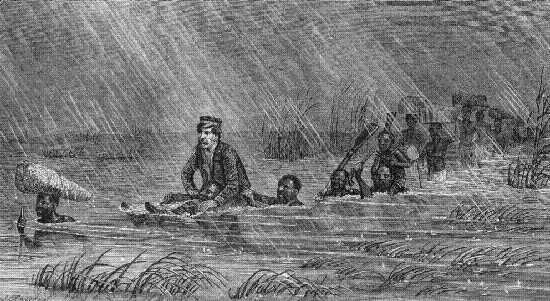
19th August, 1872.—Waiting for pagazi. Sultan bin Ali called; is going off to M'futu.20th August, 1872.—Weighed all the loads again, and gave an equal load of 50 lbs. to each, and half loads to the Nassickers. Mabruki Speke is left at Taborah with Sultan bin Ali. He has long been sick, and is unable to go with us.
21st August, 1872.—Gave people an ox, and to a discarded wife a cloth, to avoid exposure by her husband stripping her. She is somebody's child!
22nd August, 1872.—Sunday. All ready, but ten pagazi lacking.
23rd August, 1872.—Cannot get pagasi. Most are sent off to the war.
[At last the start took place. It is necessary to mention that Dr. Livingstone's plan in all his travels was to make one short stage the first day, and generally late in the afternoon. This, although nothing in point of distance, acted like the drill-sergeant's "Attention!" The next morning everyone was ready for the road, clear of the town, unencumbered with parting words, and by those parting pipes, of terrible memory to all hurrying Englishmen in Africa!]
25th August, 1872.—Started and went one hour to village of Manga or Yuba by a granite ridge; the weather clear, and a fine breeze from the east refreshes. It is important to give short marches at first. Marched 1-1/4 hour.
26th August, 1872.—Two Nassickers lost a cow out of ten head of cattle. Marched to Borna of Mayonda. Sent back five men to look after the cow. Cow not found: she was our best milker.
27th August, 1872.—Started for Ebulua and Kasekéra of Mamba. Cross torrent, now dry, and through forest to village of Ebulua; thence to village of Kasekéra, 3-1/2 hours. Direction, S. by W.
28th August, 1872.—Reached Mayolé village in 2 hours and rested; S. and by W. Water is scarce in front. Through flat forest to a marshy-looking piece of water, where we camp, after a march of 1-1/2 hour; still S. by W.
29th August, 1872.—On through level forest without water. Trees present a dry, wintry aspect; grass dry, but some flowers shoot out, and fresh grass where the old growth has been burnt off.
30th August, 1872.—The two Nassickers lost all the cows yesterday, from sheer laziness. They were found a long way off, and one cow missing. Susi gave them ten cuts each with a switch. Engaging pagazi and rest.
31st August, 1872.—The Baganda boy Kassa was followed to Gunda, and I delivered him to his countrymen. He escaped from Mayolé village this morning, and came at 3 P.M., his clothes in rags by running through the forest eleven hours, say twenty-two miles, and is determined not to leave us. Pass Kisari's village, one and a half mile distant, and on to Penta or Phintá to sleep, through perfectly flat forest. 3 hours S. by W.
1st September, 1872.—The same flat forest to Chikulu, S. and by W., 4 hours 25 m. Manyara called, and is going with us to-morrow. Jangiangé presented a leg of Kongolo or Taghetsé, having a bunch of white hair beneath the orbital sinus. Bought food and served out rations to the men for ten days, as water is scarce, and but little food can be obtained at the villages. The country is very dry and wintry-looking, but flowers shoot out. First clouds all over to-day. It is hot now. A flock of small swallows now appears: they seem tailless and with white bellies.
2nd September, 1872.—The people are preparing their ten days' food. Two pagazi ran away with 24 dotis of the men's calico. Sent after them, but with small hopes of capturing them.
3rd September, 1872.—Unsuccessful search.
4th September, 1872.—Leave Chikulu's, and pass a large puff-adder in the way. A single blow on the head killed it, so that it did not stir. About 3 feet long, and as thick as a man's arm, a short tail, and flat broad head. The men say this is a very good sign for our journey, though it would have been a bad sign, and suffering and death, had one trodden on it. Come to Liwané; large tree and waters. S.S.W. 4-1/2 hours.
5th September, 1872.—A long hot tramp to Manyara's. He is a kind old man. Many of the men very tired and sick. S.S.W. 5-3/4 hours.
6th September, 1872.—Rest the caravan, as we shall have to make forced marches on account of tsetse fly.
7th September, 1872.—Obliged to remain, as several are ill with fever.
8th September, 1872.—On to N'gombo nullah. Very hot and people ill. Tsetse. A poor woman of Ujiji followed one of Stanley's men to the coast. He cast her off here, and she was taken by another; but her temper seems too excitable. She set fire to her hut by accident, and in the excitement quarrelled all round; she is a somebody's bairn nevertheless, a tall, strapping young woman, she must have been the pride of her parents.
9th September, 1872.—Telekéza
10th September, 1872.—On to Mwéras, and spent one night there by a pool in the forest. Village two miles off.
11th September, 1872.—On 8-1/2 hours to Telekéza. Sun very hot, and marching fatiguing to all.
Majwara has an insect in the aqueous chamber of his eye. It moves about and is painful.
We found that an old path from Mwaro has water, and must go early to-morrow morning, and so avoid the roundabout by Morefu. We shall thus save two days, which in this hot weather is much for us. We hear that Simba has gone to fight with Fipa. Two Banyamwezi volunteer. 12th September, 1872.—We went by this water till 2 P.M., then made a march, and to-morrow get to villages. Got a buffalo and remain overnight. Water is in hæmatite. I engaged four pagazi here, named Motepatonzé, Nsakusi, Muanamazungu, and Mayombo.
15th September, 1872.—On to near range of hills. Much large game here. Ill.
16th September, 1872.—Climbed over range about 200 feet high; then on westward to stockaded villages of Kamirambo. His land begins at the M'toni.
17th September, 1872.—To Metambo River: 1-1/4 broad, and marshy. Here begins the land of Méréra. Through forest with many strychnus trees, 3-1/4 hours, and arrive at Méréra's.
18th September, 1872.—Remain at Méréra's to prepare food.
[There is a significant entry here: the old enemy was upon him. It would seem that his peculiar liability during these travels to one prostrating form of disease was now redoubled. The men speak of few periods of even comparative health from this date.]
19th September, 1872.—Ditto, ditto, because I am ill with bowels, having eaten nothing for eight days. Simba wants us to pass by his village, and not by the straight path.
20th September, 1872.—Went to Simba's; 3-1/2 hours. About north-west. Simba sent a handsome present of food, a goat, eggs, and a fowl, beans, split rice, dura, and sesame. I gave him three dotis of superior cloth.
21st September, 1872.—Rest here, as the complaint does not yield to medicine or time; but I begin to eat now, which is a favourable symptom. Under a lofty tree at Simba's, a kite, the common brown one, had two pure white eggs in its nest, larger than a fowl's, and very spherical. The Banyamwesi women are in general very coarse, not a beautiful woman amongst them, as is so common among the Batusi; squat, thick-set figures, and features too; a race of pagazi. On coming inland from sea-coast, the tradition says, they cut the end of a cone shell, so as to make it a little of the half-moon shape; this is their chief ornament. They are generally respectful in deportment, but not very generous; they have learned the Arab adage, "Nothing for nothing," and are keen slave-traders. The gingerbread palm of Speke is the Hyphene; the Borassus has a large seed, very like the Coco-de-mer of the Seychelle Islands, in being double, but it is very small compared to it.
22nd September, 1872.—Preparing food, and one man pretends inability to walk; send for some pagazi to carry loads of those who carry him. Simba sends copious libations of pombe.
23rd September, 1872.—The pagazi, after demanding enormous pay, walked off. We went on along rocky banks of a stream, and, crossing it, camped, because the next water is far off.
24th September, 1872.—Recovering and thankful, but weak; cross broad sedgy stream, and so on to Boma Misonghi, W. and by S.
25th September, 1872.—Got a buffalo and M'juré, and remain to eat them. I am getting better slowly. The M'juré, or water hog, was all eaten by hyænas during night; but the buffalo is safe.
26th September, 1872.—Through forest, along the side of a sedgy valley. Cross its head water, which has rust of iron in it, then W. and by S. The forest has very much tsetse. Zebras calling loudly, and Senegal long claw in our camp at dawn, with its cry, "O-o-o-o-o-o-o-o-o-o."
27th September, 1872.—On at dawn. No water expected, but we crossed three abundant supplies before we came to hill of our camp. Much game about here. Getting well again—thanks. About W. 3-3/4 hours. No people, or marks of them. Flowers sprouting in expectation of rains; much land burned off, but grass short yet.
28th September, 1872.—At two hills with mushroom-topped trees on west side. Crossed a good stream 12 feet broad and knee deep.
Buffaloes grazing. Many of the men sick. Whilst camping, a large musk cat broke forth among us and was killed. (Ya bude—musk). Musk cat (N'gawa), black with white stripes; from point of nose to tip of tail, 4 feet; height at withers, 1 foot 6 inches.
29th September, 1872.—Through much bamboo and low hills to M'pokwa ruins and river. The latter in a deep rent in alluvial soil. Very hot, and many sick in consequence. Sombala fish abundant. Course W.
30th September, 1872.—Away among low tree-covered hills of granite
and sandstone. Found that Bangala had assaulted the village to which we
went a few days ago, and all were fugitives. Our people found plenty of
Batatas
1st October, 1872, Friday—On through much deserted cultivation in rich damp soil. Surrounded with low tree-covered ranges. We saw a few people, but all are in terror.
2nd October, 1872.—Obtained M'tama in abundance for brass wire, and remained to grind it. The people have been without any for some days, and now rejoice in plenty. A slight shower fell at 5 A.M., but not enough to lay the dust.
3rd October, 1872.—Southwards, and down a steep descent into a rich valley with much green maize in ear; people friendly; but it was but one hour's march, so we went on through hilly country S.W. Men firing off ammunition, had to be punished. We crossed the Katuma River in the bottom of a valley; it is 12 feet broad, and knee deep; camped in a forest. Farjella shot a fine buffalo. The weather disagreeably hot and sultry.
4th October, 1872.—Over the same hilly country; the grass is burnt off, but the stalks are disagreeable. Came to a fine valley with a large herd of zebras feeding quietly; pretty animals. We went only an hour and a half to-day, as one sick man is carried, and it is hot and trying for all. I feel it much internally, and am glad to more slowly.
5th October, 1872.—Up and down mountains, very sore on legs and lungs. Trying to save donkey's strength I climbed and descended, and as soon as I mounted, off he set as hard as he could run, and he felt not the bridle; the saddle was loose, but I stuck on till we reached water in a bamboo hollow with spring.
6th October, 1872.—A long bamboo valley with giraffes in it. Range on our right stretches away from us, and that on the left dwindled down; all covered with bamboos, in tufts like other grasses; elephants eat them. Travelled W. and by S. 2-3/4 hours. Short marches on account of carrying one sick man.
7th October, 1872.—Over fine park-like country, with large belts of bamboo and fine broad shady trees. Went westwards to the end of the left-hand range. Went four hours over a level forest with much hæmatite. Trees large and open. Large game evidently abounds, and waters generally are not far apart. Our neighbour got a zebra, a rhinoceros, and two young elephants.
8th October, 1872.—Came on early as sun is hot, and in two hours saw the Tanganyika from a gentle hill. The land is rough, with angular fragments of quartz; the rocks of mica schist are tilted up as if away from the Lake's longer axis. Some are upright, and some have basalt melted into the layers, and crystallized in irregular polygons. All are very tired, and in coming to a stockade we were refused admittance, because Malongwana had attacked them lately, and we might seize them when in this stronghold. Very true; so we sit ontside in the shade of a single palm (Borassus).
9th October, 1872.—Rest, because all are tired, and several sick. This heat makes me useless, and constrains me to lie like a log. Inwardly I feel tired too. Jangeangé leaves us to-morrow, having found canoes going to Ujiji.
10th October, 1872.—People very tired, and it being moreover Sunday we rest. Gave each a keta of beads. Usowa chief Ponda.
11th October, 1872.—Reach Kalema district after 2-3/4 hours over black mud all deeply cracked, and many deep torrents now dry. Kalema is a stockade. We see Tanganyika, but a range of low hills intervenes. A rumour of war to-morrow.
12th October, 1872.—We wait till 2 P.M., and then make a forced march towards Fipa. The people cultivate but little, for fear of enemies; so we can buy few provisions. We left a broad valley with a sand river in it, where we have been two days, and climbed a range of hills parallel to Tanganyika, of mica schist and gneiss, tilted away from the Lake. We met a buffalo on the top of one ridge, it was shot into and lay down, but we lost it. Course S.W. to brink of Tanganyika water.
13th October, 1872.—Our course went along the top of a range of hills lying parallel with the Lake. A great part of yesterday was on the same range. It is a thousand feet above the water, and is covered with trees rather scraggy. At sunset the red glare on the surface made the water look like a sea of reddish gold; it seemed so near that many went off to drink, but were three or four hours in doing so. One cannot see the other side on account of the smokes in the air, but this morning three capes jut out, and the last bearing S.E. from our camp seems to go near the other side. Very hot weather. To the town of Fipa to-morrow. Course about S. Though we suffer much from the heat by travelling at this season, we escape a vast number of running and often muddy rills, also muddy paths which would soon knock the donkey up. A milk-and-water sky portends rain. Tipo Tipo is reported to be carrying it with a high hand in Nsama's country, Itawa, insisting that all the ivory must be brought as his tribute—the conqueror of Nsama. Our drum is the greatest object of curiosity we have to the Banyamwezi. A very great deal of cotton is cultivated all along the shores of Lake Tanganyika; it is the Pernambuco kind, with the seeds clinging together, but of good and long fibre, and the trees are left standing all the year to enable them to become large; grain and ground-nuts are cultivated between them. The cotton is manufactured into coarse cloth, which is the general clothing of all.
14th October, 1872.—Crossed two deep gullies with sluggish water in them, and one surrounding an old stockade. Camp on a knoll, overlooking modern stockade and Tanganyika very pleasantly. Saw two beautiful sultanas with azure blue necks. We might have come here yesterday, but were too tired. Mukembé land is ruled by chief Kariaria; village, Mokaria. Mount M'Pumbwé goes into the Lake. N'Tambwé Mount; village, Kafumfwé. Kapufi is the chief of Fipa.
Noon, and about fifty feet above Lake; clouded over. Temperature 91° noon; 94° 3 P.M.
15th October, 1872.—Rest, and kill an ox. The dry heat is distressing, and all feel it sorely. I am right glad of the rest, but keep on as constantly as I can. By giving dura and maize to the donkeys, and riding on alternate days, they hold on; but I feel the sun more than if walking. The chief Kariaria is civil.
16th October, 1872.—Leave Mokaia and go south. We crossed several bays of Tanganyika, the path winding considerably. The people set fire to our camp as soon as we started.
17th October, 1872.—Leave a bay of Tanganyika, and go on to Mpimbwé; two lions growled savagely as we passed. Game is swarming here, but my men cannot shoot except to make a noise. We found many lepidosirens in a muddy pool, which a group of vultures were catching and eating. The men speared one of them, which had scales on; its tail had been bitten off by a cannibal brother: in length it was about two feet: there were curious roe-like portions near its backbone, yellow in colour; the flesh was good. We climbed up a pass at the east end of Mpimbwé mountain, and at a rounded mass of it found water.
18th October, 1872.—Went on about south among mountains all day till we came down, by a little westing, to the Lake again, where there were some large villages, well stockaded, with a deep gully half round them. Ill with my old complaint again. Bubwé is the chief here. Food dear, because Simba made a raid lately. The country is Kilando.
19th October, 1872.—Remained to prepare food and rest the people. Two islets, Nkoma and Kalengé, are here, the latter in front of us.
20th October, 1872.—We got a water-buck and a large buffalo, and remained during the forenoon to cut up the meat, and started at 2 P.M.
Went on and passed a large arm of Tanganyika, having a bar of hills on its outer border. Country swarming with large game. Passed two bomas, and spent the night near one of them. Course east and then south.
21st October, 1872.—Mokassa, a Moganda boy, has a swelling of the ankle, which prevents his walking. We went one hour to find wood to make a litter for him. The bomas round the villages are plastered with mud, so as to intercept balls or arrows. The trees are all cut down for these stockades, and the flats are cut up with deep gullies. A great deal of cotton is cultivated, of which the people make their cloth. There is an arm of Tanganyika here called Kafungia.
I sent a doti to the headman of the village, where we made the litter, to ask for a guide to take us straight south instead of going east to Fipa, which is four days off and out of our course. Tipo Tipo is said to be at Morero, west of Tanganyika.
22nd October, 1872.—Turned back westwards, and went through the hills down to some large islets in the Lake, and camped in villages destroyed by Simba. A great deal of cotton is cultivated here, about thirty feet above the Lake.
23rd October, 1872.—First east, and then passed two deep bays, at one of which we put up, as they had food to sell. The sides of the Tanganyika Lake are a succession of rounded bays, answering to the valleys which trend down to the shore between the numerous ranges of hills. In Lake Nyassa they seem made by the prevailing winds. We only get about one hour and a half south and by east. Rain probably fell last night, for the opposite shore is visible to-day. The mountain range of Banda slopes down as it goes south. This is the district of Motoshi. Wherever buffaloes are to be caught, falling traps are suspended over the path in the trees near the water.
24th October, 1872.—There are many rounded bays in mountainous Fipa. We rested two hours in a deep shady dell, and then came along a very slippery mountain-side to a village in a stockade. It is very hot to-day, and the first thunderstorm away in the east. The name of this village is Lindé.
25th October, 1872.—The coast runs south-south-east to a cape. We went up south-east, then over a high steep hill to turn to south again, then down into a valley of Tanganyika, over another stony side, and down to a dell with a village in it. The west coast is very plain to-day; rain must have fallen there.
26th October, 1872.—Over hills and mountains again, past two deep bays, and on to a large bay with a prominent islet on the south side of it, called Kitanda, from the chiefs name. There is also a rivulet of fine water of the same name here.
27th October, 1872.—Remained to buy food, which is very dear. We slaughtered a tired cow to exchange for provisions.
28th October, 1872.—Left Kitanda, and came round the cape, going south. The cape furthest north bore north-north-west. We came to three villages and some large spreading trees, where we were invited by the headman to remain, as the next stage along the shore is long. Morilo islet is on the other or western side, at the crossing-place. The people brought in a leopard in great triumph. Its mouth and all its claws were bound with grass and bands of bark, as if to make it quite safe, and its tail was curled round: drumming and lullilooing in plenty.
The chief Mosirwa, or Kasamané, paid us a visit, and is preparing a present of food. One of his men was bitten by the leopard in the arm before he killed it. Molilo or Morilo islet is the crossing-place of Banyamwezi when bound for Casembe's country, and is near to the Lofuko River, on the western shore of the Lake. The Lake is about twelve or fifteen miles broad, at latitude 7° 52' south. Tipo Tipo is ruling in Itawa, and bound a chief in chains, but loosed him on being requested to do so by Syde bin Ali. It takes about three hours to cross at Morilo.
29th October, 1872.—Crossed the Thembwa Rivulet, twenty feet broad and knee deep, and sleep on its eastern bank. Fine cold water over stony bottom. The mountains now close in on Tanganyika, so there is no path but one, over which luggage cannot be carried. The stage after this is six hours up hill before we come to water. This forced me to stop after only a short crooked march of two and a quarter hours. We are now on the confines of Fipa. The next march takes us into Burungu.
30th October, 1872.—The highest parts of the mountains are from 500 feet to 700 feet higher than the passes, say from 1300 feet to 1500 feet above the Lake. A very rough march to-day; one cow fell, and was disabled. The stones are collected in little heaps and rows, which shows that all these rough mountains were cultivated. We arrive at a village on the Lake shore. Kirila islet is about a quarter of a mile from the shore. The Megunda people cultivated these hills in former times. Thunder all the morning, and a few drops of rain fell. It will ease the men's feet when it does fall. They call out earnestly for it, "Come, come with hail!" and prepare their huts for it.
31st October, 1872.—Through a long pass after we had climbed over Winelao. Came to an islet one and a half mile long, called Kapessa, and then into a long pass. The population of Megunda must have been prodigious, for all the stones have been cleared, and every available inch of soil cultivated.
The population are said to have been all swept away by the Matuta.
Going south we came to a very large arm of the Lake, with a village at the end of it in a stockade. This arm is seven or eight miles long and about two broad. We killed a cow to-day, and found peculiar flat worms in the substance of the liver, and some that were rounded.