
Lenten Sermons On The Psalm 'He Who Dwells
LENTEN SERMONS ON THE PSALM
'HE WHO DWELLS'
[IN THE SHELTER OF THE MOST HIGH]

INTRODUCTION
I N THE PAST when one set out to write something, it was the thing to do to say that one was incapable. And the finished work was to be rounded off by a plea for pardon for its imperfections. Today I am obliged to do just that. The only difference between now and then is that with me this is not just a literary cliché, but a simple truth. Anyone who knows anything about the existing state of bernardology will realize that obscure folk like myself have one common source of knowledge: the extensive writings of Jean Leclercq OSB who, since over twenty years ago he first discovered a bernardine manuscript at Engelberg between two falls in the snow, has never ceased to enlighten us on the texts and writings of St Bernard.
His waters are poured abroad for strangers to drink. Instead of giving at every step the precise reference to these studies, therefore, I prefer to indicate a select but substantial bibliography available to those who not only read French, but also have both the taste and the leisure for diving into what may at first glance appear dry sources. Experts will recognize when I am referring to one or other of these authorities. Those who are not experts, or who do not read French will, I hope, be pleased to have at least something to go by in English.
It was only after great hesitation that I set out on the venture of writing an Introduction to the texts which I have translated.
Not much experience was needed to convince me that it was highly clownish of me to introduce the first two works, the four homilies In Praise of the Virgin Mother
[published as Magnificat:
Homilies in Praise of The Blessed Virgin Mary in 1979], and On Conversion.
A Sermon to Clerics.
I resolved for the future to mind my own business of translating, and to let
Sermons on Conversion someone more qualified get on with the introducing. However, man proposes and God disposes. Circumstances being what they are, and a more qualified authority having begged off for legitimate reasons, the love of Christ incites me and has the upper hand. May it cover the multitude of imperfections in this and the other introductions, and may the Holy Spirit convey to the reader that inner sweetness which springs from experience and leads to a deeper, existential understanding of Bernard's message. That having been said, let us get on with the business to hand.
The translation presented here goes by the title Lenten Sermons on the Psalm 'He who dwells! The Latin text is to be found in Sancti Bernardi Opera IV, edited by Jean Leclercq OSB and Henri Rochais (Rome, 1966) pages 383-492. In commenting upon this work, the first thing I must do, following Bernard's own example, is to examine the title.1 According to it we would seem to be in presence of a series of spoken exhortations given to monks during a specific liturgical season. The group of seventeen sermons which forms a commentary on Psalm 902 is not only one of the most famous texts composed by Bernard, but also one of the most beautiful. Together with the homilies In Praise of the Virgin Mother, this group of sermons is considered one of the jewels of medieval christian literature.
These sermons contain more than a doctrine of the spiritual life: they also offer us a typical example of St Bernard's style at its purest and loftiest. Its sprightliness might mislead the reader into thinking that this text as a whole is the fruit of improvised, spontaneous preaching and that they were uttered in a close time sequence. Any attentive reader, however, and even more any translator, cannot help wondering how Bernard managed to give forth such exquisite and untranslatable eloquence, even if we make allowances for the gift of the gab, as an English poet once called it. This leads us to ask whether the sermons were indeed preached. Are they not more akin to written sermons like the four homilies In Praise of the BVM, which in fact make
Introduction
up a sort of treatise written in the literary style of sermons but never pronounced by Bernard viva voce to any audience, monastic or other. This first question being set, we may widen the breach of critical assessment and ask whether the group of 'sermons' on psalm ninety does not form instead a treatise, written at ease and over a longer time space than would be allowed by a single lenten season. The various references which Bernard makes to his multiple occupations seem, if not to substantiate this query, at least to bring it within the realm of possibility. To pose these questions is to pose not only the problem of the genesis of the sermons on psalm ninety—to ask for the story of the text, if you like — but also that of the literery genre of the complete series, seventeen sermons in all, preceded by a preface.
Before tackling technical details, let us try to get some idea of St Bernard's basic insight. The fundamental theme of these sermons is the christian pilgrimage from conversion to consummation, the consummatum est of the divinized soul led by grace to the threshold of the eternal city. This journey is the natural pathway of the soul who sets out to follow Christ. We follow in the steps of the Master as he goes up secretly to Jerusalem for the feast. The journey starts in the wilderness where Christ was tempted. Out of this trackless waste, paths emerge. It is in the valley of death that there begins the long and winding uphill path which connects with the royal road, the way of the Cross leading to the City of the King of heaven and earth. But though we walk in the valley of the shadow of death, we have no reason to fear: God is there to protect those who hope in him and run forward by prayer, sustained by faith and humility.
There are snares hidden along the way; the enemy lies in ambush. Prudence, humility and obedience will safeguard our steps; the lamp of God's word will enlighten our eyes. We must have recourse to the sacraments, penance and the holy eucharist, sharing in Christ's sufferings and imitating his life. The food of angels, the bread come down from heaven will be our viaticum. The only hurdle which might discourage us from
Sermons on Conversion setting out, i.e., the length of the journey, is thus forestalled.
Yet in the desert even the bread of angels may become a source of temptation, as it was for Jesus. Let us but follow his example, resist the demon, and angels will come and minister to us, sojourners that we are in a foreign land. We know that the life of man on earth is one long temptation; therefore we pray our heavenly Father that we may not be led into temptation. Once we have turned back to the Lord in our hearts, we shall be beset by trials from all sides. Yet we have nothing to fear in our journey, neither during the night of adversity nor in the light of day, unless perhaps we are for a brief moment afraid and thus purified, for fear is a fiery furnace. And when all fear has been driven out, we are children of light walking by day and progressing along the path of salvation. But a terrible and subtle danger lies in the way: pride. If pride does not trip us up, then the crafty enemy will attack us with the love of money: this is the business that walks about in the darkness disguised as an angel of light. He waits in ambush for the heedless runner.
At all times, now and at the hour of our death, we have need of the invisible protection of truth. Christ remains hidden and absent, as it were. But this seeming divine absence must not perturb us. God will not abandon us. We must not worry, but carry Christ humbly in our bodies: he is a gentle weight. Along the road to Jerusalem, let us be like that little ass upon which the Saviour once graciously deigned to sit: 'Happy is the man who carries Christ in this way and merits to be led into the holy city by the Holy of holies himself. He has nothing at all to fear, he will suffer neither obstacles on the way nor rejection at the gate! (qh 7.4) Whether we journey by land, sea or air, we have nothing to fear for he has given his angels such charge of us to guard us in all our ways that the enemy cannot even approach us. God our Father watches over his faithful until they arrive at that perfect and holy city whose borders are peace (qh 8:5 ).
Faith, hope and charity are there to preserve us, if we will (qh 10.1). We need discernment as well to distinguish the way
Introduction
to go. We need help from on high because all the ways of the sons of Adam are corrupt, oriented to the necessity and avarice which lead to destruction and unhappiness (QH 11.3).
We must turn away from the pernicious heights of vanity and cruelty and follow the humble, lowly paths of mercy and truth
(QH 1 1 . 8 ) , directing our steps in these ways of the Lord. The first step along the path to the heavenly Jerusalem is the tender mercy which inclines a man to lament and repent, to weep and thus to reap the harvest of eternity. This first act of mercy is the first step of a man's return to the heart. It enables him to enter the secret places of the soul. All that remains for him now is to link up with the royal road. He must bring his actions into line with his thoughts. He must become as a little child; otherwise he will never enter the kingdom of heaven. 'In this way man will enter the ways of the Lord, ways of mercy and truth, the ways of life. And the end of all these ways is the salvation of the wayfarer' (QH 11.9). Although we are children and have a long and dangerous way to go, there is no need to fear: our angels, our guardians and trustees, are faithful, prudent, powerful. Even after death, they will carry us in their hands into Abraham's bosom, that is heaven, the bosom of the Father where dwells the eternal Son. Here below we must walk on the asp and the basilisk, trample underfoot the lion and the dragon, opposing the four virtues — courage, prudence, temperance, and humility — to these four dangers.
And then, sweet Lord Jesus, full of compassion towards his saints in tribulation, towards those who are running the last lap of the course, encourages us gently, saying, 'Come to me, all who labor and are heavy laden and I will refresh you! (QH 15.1)
We weep no longer for sin, but for joy and glad surprise. Tears well up in the eyes which are suddenly illumined and perceive, beyond the disguise, Christ who has purified his saint, substituting a burden of kindliness for the burden of sin. A man remains a beast of burden all his life long even though he may be a saint:
God burdens us when he pardons us (QH 15.1). No longer
Sermons on Conversion content with the company of angels, such a soul aspires to the Lord of angels himself. He prays for this, longs that God who speaks to him should no longer be content to be present in his messenger, be no longer content to kiss him as it were by an intermediary, but to kiss him with the very kiss of his mouth
(qh 15.2).
The fight is nearly over, the journey's end in sight: 'because he hoped in me, I will deliver himj says the Lord. We are approaching the end of our life-long Lent, we are drawing near the eternal Paschal Feast when God himself will be with us, when he will wipe away every tear from our eyes. Already we are assured of our resurrection, for Christ our Lord is risen.
God is going to fill us with length of days, for tribulation leads to glory. He came down that he might be near the brokenhearted, the time is coming, dies venit, dies tua in qua reflorent omnia, when we shall 'be caught up together in the clouds to meet the Lord in the air; and so we shall always be with the Lord! This happens on the condition, that here below we are anxious to have him as our fellow traveller, 'he who will restore the homeland to us in the future, or rather, who will be the way to the homeland! (qh 17.4) Let us strive then for peace and holiness, for without these no one can see God (qh 17.6). And it is precisely that which is our journey's end: the face to face encounter with the Risen Christ, the blessed vision of peace accorded to the pure of heart.
Should anyone, entirely devoid of spiritual experience, wonder whether or not St Bernard's message is still relevant today, let him read these lines of a monk of the Russian Orthodox
Church:
Innumerable crowds of people have lovingly, obediently, walked in the footsteps of Christ, treading the long way, the tragic way which is shown by our Lord, a way tragic but which leads from this earth to the very throne of God, into the Kingdom of God. They walk, carrying their
Introduction
crosses, they walk now for two thousand years, those who believe in Christ. They walk on, following him, crowd after crowd, and on the way we see crosses, innumerable crosses, on which are crucified the disciples of Christ.
Crosses, one cross after the other, and however far we look, it is crosses and crosses again. We see the bodies of the martyrs, we see the heroes of the spirit, we see monks and nuns, we see the priests and pastors, but many, many more people do we see, ordinary, simple, humble people of God who have willingly taken upon themselves the cross of Christ. There is no end to this procession. They walk throughout the centuries knowing that Christ has foretold us that they will have sorrow on the earth, but that the Kingdom of God is theirs. They walk with the heavy cross, rejected, hated, because of truth, because of the name of Christ. They walk, they walk, these pure victims of God, the old and the young, children and grownups. But where are <we? Are we going to stand and look; to see this long procession, this throng of people with shining eyes, with hope unquenched, with unfaltering love, with incredible joy in their hearts, pass us by? Shall we not join them, this eternally moving crowd, that is marked as a crowd of victims, but also as little children of the Kingdom? Are we not going to take up our cross and follow
Christ? Christ has commanded us to follow him. He has invited us to the banquet of his Kingdom and he is at the head of this procession. Nay, he is together with each of those who walk. Is this a nightmare? How can blood and flesh endure this tragedy, the sight of all these martyrs, new and old? Because Christ is risen, because we do not see in the Lord who walks ahead of us the defeated prophet of Galilee as he was seen by his tormentors, his persecutors.
We know him now in the glory of the Resurrection. We know that every word of his is true. We know that the Kingdom of God is ours if we simply follow him.3
Sermons on Conversion This is the message which Bernard transmitted to his monks.
It is the eternal theme of exodus, exile, and repatriation, the alternation of sorrow and joy, light and darkness. It is the divine command given to Abram, 'Go from your country to the land that I will show youj echoed across the centuries. Exodus, exile, repatriation, enacted by the mighty Word of God who leapt down from heaven, who came to his own who received him not.
Christ, come from his Father and, going back to his Father, is the perfect model for every exile, every member of the pilgrim
Church wandering and wondering here below till He come again. In that day night shall be no more, for the Lord God will be our light. He, the bright morning star, is coming, bringing his recompense, to repay every one of us for what we have done. Behold, he is coming soon. Such, in substance, is Bernard's experience.
T H E LITERARY GENRE
The Middle Ages inherited from the ancient world of classical Latin certain rules to be followed depending whether one intended writing a sermon, a letter, a treatise, or any other of the then commonly accepted literary forms. In monastic literature — and thus a priori, in St Bernard's works — the sermon is the most frequent literary genre. We have the type of sermon which is strictly a homily, e.g. the style Bernard chose for writing his homilies on The Virgin Mother, in which the author was bent on explaining a given scriptural passage and on directing the sermons, spoken or written, or both, to some pastoral end. The sermon, which could be one of several types, was part and parcel of the monastic observance. We must not forget that many sermons were spoken, and have been lost to posterity. Of those which were written, the first copy often consisted of notes taken down by someone in the audience. And as the art of tironian shorthand known in patristic times had been lost and the system adopted in the thirteenth century had not yet
Introduction
come into being, these notes were more often than not only fragmentary. All that the auditor could hope to do was to take down more or less faithfully a sentence here and there. These fragmentary, skeletal sermons were sometimes left in this form and sometimes called in by the preacher who proceeded to correct them and occasionally to add his own profuse afterthoughts. Another possibility was that the preacher himself prepared his sermon on tablets of wax, jotting down the guidelines, often using mnemonic devices. He later completed and revised these block-note jottings, which were then copied in their emended form by a notary, a copyist, or, more rarely, the author himself.
In this connection, the examination of the manuscripts of St Bernard and his biographers reveals two tell-tale words: dictate
(to dictate) and scribere (to write). In the twelfth century of St Bernard dictare meant in general to write, to compose, whereas scribere meant to recopy. The first step, the composition, was done on wax tablets which permitted numerous modifications; the second copy was definitive and therefore done on parchment. After it was finished only minor changes could be made. Dictare, when applied to St Bernard or any other author could mean one of two things: to dictate a rough copy or to dictate the finished text. The same word applied to a notary meant either to take notes from dictation or to compose a complete and full text with the help of these dictated notes. In order to understand this distinction, we must realize that in those days the sense of 'dictate' was not as restricted as in our time. Today we dictate to someone else a text which we may or may not have composed, whereas in the twelfth century one dictated to oneself or to someone else a text in the process of composition.
An author composed aloud in such manner that his mouth dictated to a hand, his own or that of another person. In modern parlance we could compare the medieval 'dictation' to the elaboration of the manuscript (or first typescript) composed by an author.
Sermons on Conversion The medieval scribere, 'writing^ would be equivalent to work done by the modern copy-typist or printer. An example of this is offered us by the preface of the homilies on The Virgin. The Latin text begins Scribere me aliquid et devotio iubet, et prohibet occupatio.
('My devotion has been urging me to write something but so far my occupations have hindered me!) It would seem that we have here an instance in which Bernard himself was the copyist. Perhaps he had already 'dictated' a rough copy, an outline of something in praise of the Virgin
Mother, but he had never found time to copy, or have it copied, that is to write or to have it written, on parchment. But now that illness prevented him from being in night choir, he had found a suitable opportunity for saying something by writing.
(Scribere me aliquid .. . loqui videlicet aliquid . ..) If this supposition is true, there must have existed a no longer extant autograph of St Bernard in praise of the Virgin Mother. Whatever may be the case, there is no doubting that Bernard's oratorical activity is made up not only of sermons which he actually spoke, but also of those which he composed in writing without preaching them and still others which were composed more or less under his supervision but which again he never preached.
In this last case, Bernard would have prepared a short outline giving the major themes and certain key-words, perhaps even paragraph headings followed by a brief summary which he wrote on wax and then confided to a faithful disciple wellacquainted with his styles — for he had more than one — and the lines along which his mind and heart worked. Some of these written sermons were then never preached, at least in their final form. Such seems to be the case with the final draft of the present work, which is really a sort of treatise dressed up as a series of sermons. Put more scientifically, this means that we have here a work whose literary genre is that of the sermon.
What, we may wonder, distinguishes the sermon from the treatise? Putting forward a tentative hypothesis we can suggest that the major distinction is rooted in the history of the
Introduction
development of expressed thought, and even in the history of thought itself. Man spoke before he wrote, and consequently he heard before he read. Originally the spoken word, the sermo, must have been direct spontaneous speech expressing the thought of one person and destined to seize the mind of one or more persons by the instrumentality of the ear. Being spontaneous, the original sermo would scarcely have had any preconceived structure. Its spontaneous regeneration and development would have blended with the hearer's reaction. A treatise, tractatus, on the other hand, would seem to have marked a development in the organization of thought leading to a preconceived structure and classification into mental categories. With the progress of time and the development of man's aesthetic senses there came to be certain rules of eloquence as well as certain norms for composing correctly. In the past, one never wrote without composing, without first drawing up a plan.
Bernard inherited this art of composition from the great masters of classical Latin who in turn had inherited it from ancient
Greece. Remember that originally literature was a spontaneous work of authors of genius: after them others, commenting on their works, drew up the laws of literary genre and principles of composition. As we have already seen, the sermon came to be one such genre and this itself was subdivided into various species. As for the treatise, it is difficult to define it precisely for it varied not only according to its source, but also according to the subject treated. But whatever the case, a treatise is always a methodical written discussion of some matter.
We are now in a position to understand the literary genre of qh. St Bernard refers to 'sermons' and we do seem at first appearance to be dealing with seventeen sermons. Yet some ancient manuscripts classify them as a treatise, and indeed when you take the thing to pieces, or try to translate it, you readily see that on the whole it is a methodical discourse on the spiritual combat revealing refinements of style which could hardly have been uttered on the spur of the moment. What then? We have
Sermons on Conversion a work which may be a 'hybrid'4 — without this word being abusive. QH is neither a series of sermons nor a treatise nor a scriptural commentary. The intrinsic structure is that of a methodical plan of the spiritual combat, but the extrinsic form is that of the sermon. St Bernard had learnt rhetoric, the art of speaking well. He had the gift of eloquence, the gift of persuading by speech; he had learnt the art of writing in the school of the masters of ancient latinity. He loved God and his brethren. It was Lent, a season of unusual hardship and labour. And all that put together accounts for the commentary in the form of sermons which is QH, a treatise written in the literary genre of the sermon.
GENESIS OF THE TEXT
We have already seen that a more than cursory reading of QH poses the problem of the history of the text as we have it today.
In order to solve it we must examine the manuscript tradition, which is extremely rich and complicated. The text was frequently copied, but the evidence afforded by one copy is sometimes contradicted by that of another manuscript, so much so that the editor of the 1966 edition found himself confronted with what seemed to be an inextricable tangle. After patient unsnarling it emerged that these sermons had been written in three stages: there are three recensions, from a first rough draft to the final complete series. Reading through the sermons, one readily conjectures that they cover a complete lenten period, even though this may have been made up of three successive
Lents. Another conjecture, more probable, is that the 'writing' of the complete series had been interrupted, even though Bernard may, or may not, have dictated to himself or to a secretary the rough drafts.
Before going further into this delicate and possibly tedious question of manuscript evidence concerning the existence of three authentic recensions, let us settle the date of the finished
Introduction
product. This may be done on the basis of the internal evidence offered by the text itself.
Date The Preface and the first sermons suggest the beginning of Lent. Paragraph 2 of the Preface mentions 'these days during which, as is only right, your fatigue is somewhat greater^ and this is a reminiscence of chapter 49 of the Rule of St Benedict, concerning the observance of Lent. In this chapter St Benedict advises monks to add something to their usual ascetical practices. St Bernard's Preface is a sort of commentary on this chapter of the Rule, customarily read in cistercian monasteries on the first Sunday in Lent. Another witness in favour of this
Sunday is found in the same paragraph of the Preface, 216:5 'I have chosen that very psalm from which the enemy took occasion for tempting^ says St Bernard referring to the Gospel narration for the first Sunday in Lent. Again, in paragraph one there are certain reminiscences of St Paul's second letter to the Corinthians, part of which was read on this same Sunday. Sermon 2.110 refers to the sheep and the goats mentioned in the Gospel for Monday of the first week of Lent. Sermon 3.13,
3.211, 3.51 contains quotations and reminiscences of (Vulgate) Psalms 48, 56, 54,6 all three of which are chanted at divine
Office on Tuesdays in keeping with the plan suggested by the Rule of St Benedict. Sermon 4.15-? refers to an event in the life of Elijah as told in 1 Kings 19 and read on Ember Wednesday in Lent, the first week. All this evidence seems to point to the fact that the first four sermons make up a homogeneous group.
In the introductory paragraph of Sermon Eight St Bernard in 'a few words of introduction' excuses himself for 'the length of yesterday's sermon' which seems to have caused him some trouble with the monks. And in Sermon 9.84 he cites from a paragraph of Lamentations which used to be read in cistercian monasteries on Thursday of the second week in Lent. Again, in Sermon 10.6, Bernard cites an incident in the life of St Bene-
Sermons on Conversion diet as related by St Gregory in his Dialogues II, 11 formerly read during the third nocturn of Benedict's feast [21 March],
There is no reason to suppose for certain that this passage had been read on the day Bernard preached this sermon, but it lies within the realm of possibility, and even probability. Were this to be the case, it would offer us a valuable factor towards finding an exact date. If we now refer to Sermon 6.720, we see that Bernard winds up his preaching about the four temptations with the words: 'That is all I wanted to say about these temptations, for I remember having dealt with them in one of the sermons on the Song of Songs when the occasion cropped up in connection with the noonday rest of the bridegroom after which the bride was inquiring! Now, this theme is developed in Sermon Thirty-three on the Song of Songs, and we know that sc 24 was given after Bernard's return from Rome in the fall of 1138: Sermon Thirty-three was probably written shortly afterwards. It so happens that in the years between 1139 and 1153, the year Bernard died, if we exclude the years when he was away from Clairvaux during Lent, the feast of St Benedict,
21 March, coincided with the second week of Lent — on Tuesday, to be precise — only in 1139. This then may be taken as the probable date for the completed manuscript of QH. It is understandable that Bernard would not have repeated his teaching on the four temptations, but simply referred to a sermon written a few months previously.
There is more such exciting evidence. If we take QH Sermon Eleven, for example, we find that it opens with a reference to the same pericope of Lamentations III read on Thursday in the second week of Lent and mentioned in Sermon 9.84. This same
Sermon 11.112 comes back again on this scriptural passage. The following day Bernard gave Sermon Twelve — at least if we may assume that he spoke the truth when he began: 'Yesterday, if you remember . . . .' In Sermon 13.11 he brings in witnesses to testify to the fact that in the life to come the angels bear us up on their hands. The first witness is St Benedict: 'Only a
Introduction
little while ago you read of our blessed Father Benedict . . . !
Jean Leclercq points out that although this passage of St Gregory's Dialogues (II, 31) is not to be found in MSS 114 at Dijon as part of the allotted office readings for the feast, it could well have been read in the refectory that day. Moreover, the eighth responsory and the Benedictus antiphon mention Germanus, bishop of Capua. In Sermon 16.2 Bernard connects the threefold help which we are to receive 'with the great triduum which we are soon going to celebrate! But it was not yet Holy Week, for the sermon closes with two lines from the hymn Summi largitor praemii which was sung at Compline during Lent according to the hymnary of St Bernard. Finally, at the beginning of Sermon Seventeen, the last of the series, St Bernard says that 'we are about to celebrate the resurrection of the Lord!
Recensions Having settled by internal evidence and cross references to sc the date of the final recension of QH, let us now tackle the problem of the three different forms, the three recensions, in which these sermons are found. The study will seem a bit 'speleological,' so to speak, but the results will be worth the trouble.
There are seventy-five primitive, i.e. twelfth and thirteenth century manuscripts of QH. They reveal that the series existed in three forms: a short one (s), a longer one (L) and a final perfect form (PF). The major characteristics of each group may be summarized as follows:
/. The Short Form (s) 1) The Preface is slightly shorter than in the final edition and the opening word is not Considero (I consider, rendered in this translation by the present participle Considering) but Scio (I know); the rest of the text has minor variations from L and PF.
2) The entire commentary comprises only the first six sermons which are presented as thirty fairly short fragments—sort
Sermons on Conversion of sentences distinguished by their initials and often separated by titles such as, On the first verse: He who dwells in the aid of the Most High.
This presentation will not surprise us if we recall that a preacher prepared his sermons, jotting down ideas and making use of mnemonic devices. Nor must we forget that people in the audience sometimes took down notes as best they could.
3) The text has many variants from the second and third editions. Sermon Six is particularly different, being a shortened version of sc 3 3.11 -16 on the four temptations of the Church.
There exist nine ancient manuscripts of this short form, five of which were retained with a view to the establishment of the critical edition. Generally these manuscripts are found in collections of the liturgical sermons among those for Lent; often they are sandwiched between the sixth sermon for Lent and the Sermon for the Feast of St Benedict, 21 March.
II. The Longer Form (L) 1) The opening word of the Preface is Considero.
2) The text for Sermons One-Six is, on the whole the same as that in the short edition; it has the same divisions, but some specific modifications.
3) A kind of summary of Sermon Three is inserted between the closing words of this same sermon and Sermon Four. The gist of the sentence is that according to St Paul (Tm 6:9) the snare of the hunter means riches, and whoever flees and spurns them will be out of reach of the sharp word. But if someone should have become entangled in riches, he can strive to shake himself free by doing works of mercy and thus escape the sharp word of damnation.
4) The reference to sc 33.11-16 at the end of Sermon Six is followed by a short recapitulation of the passage referred to.
5) The commentary is continued up to verse 10, 'No evil shall befall you, no scourge come near your tent! This supple-
Introduction
ment to the short recension coincides with Sermons Seven-Ten of the final edition, except for minor variants.
111. The Complete and Perfect Form (PF) This is the one edited form and is the basis of the 1966 edition.
The opening word is Considero; the sentence inserted after Sermon Three (see 11,3 above) is suppressed. Sermons Four and Five are longer, but the recapitulation of sc 33.11-16 (see
11,4 above) is omitted. The commentary is carried through to the end giving a total of seventeen sermons. Two sermons, Thirteen and Fourteen, are devoted to verse 13: 'You will walk on the asp and the basilisk; you will trample underfoot the lion and the dragon!
A glance at the accompanying map will show that QH manuscripts found their way to or were copied in over forty different monasteries in Europe. The perfect text was the only one kept at Clairvaux and this is quite normal. During the last years of his life, Bernard set to work on a careful literary revision of the greatest of his works. Once this editing had been done, there was no reason for the librarian to keep the two incomplete copies.

Sermons on Conversion Provenance of early manuscripts of Lenten Sermons on the Psalm 'He Who Dwells' (see p. 99)
Introduction
BERNARD AS A WRITER
Without going into too much detail, let us take just a few examples from the Preface to show how Bernard proceeded with the very important stage in editing which is called in Latin emendatio.
The examples, few as they are, testify to the presence of a cloud of other witnesses to Bernard's care to leave to posterity a work where, as he might have said, beauty and truth kiss each other in perfect harmony.
We have already seen that the first draft began with Scio, which became Considero in the second and the third versions.
This change is significant: the use of the verb to consider suggests that Bernard was not only aware of the rough time his monks were having at the beginning of Lent, but was even preoccupied by it, turning it over in his mind and wondering what he could do for them. This change in the choice of the opening word gives an insight into Bernard's psychology as well as into his carefulness in expressing the full depth of his thought. Another, slighter, change is to be noticed in the substitution of intrinsecus (within) for extrinsecus (without). All Bernard did was to change the prefix (in for ex) but the new word alters the whole balance of meaning of the phrase. Today we read:
. . you are being killed all the day long by much fasting and frequent labors in unusual watchings, in addition to all that is going on within you, contrition of heart and a multitude of temptations! In the first draft the meaning of the text is'... by much fasting and frequent labors in unusual watching; in addition to all those things going on without, there is contrition of heart and a multitude of temptations.' The difference is slight but meaningful. In this same phrase we have another variant: in the first version there was temptation, whereas we now read about temptations, in the plural. The elegance of the change does not appear so clearly in English, but in Latin it helps reveal
Bernard's artistry, for the use of the Latin plural ending in um not only gave greater force to the sentence but allowed a
Sermons on Conversion rhyme: the phrase also acquired swing—rhythm, if you prefer.
Then again, a minor addition made for the final edition emphasizes the reason for everything that had gone before. Bernard, towards the end of paragraph one of the Preface explains that since what the brethren are putting up with is above their strength, then it must be because of the help of divine power that the enemy is defeated. The words ex hoc (in this way), which he added for the third edition make it evident that our victory against the devil is due to grace. This minor addition suggests a theology of the christian combat. Again, a little further on in this same first paragraph of the Preface we read,
'Who is it who upholds (sustinet) the entire bulk of the earth?'
Had the translation been done on a manuscript of the first or second recension, we should have, 'Who is it who carries (portat) the entire bulk of the earth?' The verb 'to uphold' is certainly more apt in this context than 'to carry! Moreover, it provides a logical internal lead for the twice-repeated use of sustinere in the Latin where we read,'Nam si est aliquid quod sustineat cetera, ipsum a quo sustinetur?'' In the English rendering the repetition of the verb is a trifle ungracious, but shows Bernard's sense of sonority retained: 'And if there exists one single being upholding all the others, then by whom is he himself upheld?'' The portat (carries) ousted by sustinet (upholds) in the first of these phrases comes into its own at the last: Non invenitur nisi verbum virtutis omnia portans: It is none other than the word of power which bears up all things. Here, the English 'bears upj selected on account of its use in the RSV of the Bible at Hebrews 1:3, is intended to get over to the reader a triple sense of carrying (conveyed by the Latin portare), upholding and sustaining (both suggested by sustinere).
Just one more example of Bernard's artistry, if you will. To sense more easily the finesse of the Latin, let us set out from the English. The phrase we have translated as 'Who is it that upholds the entire bulk of the earth?' (cf. Is 40:12) could just as well have been rendered, 'Who is it who upholds the earth's
Introduction
entire bulk?' The inversion allowed by the use of the genitive helps us to understand why Bernard in his final edition inverted the totam terrae molem of the first and second and wrote totem molem terrae-. the inversion brought his sentence more into line with the biblical reminiscence he had in mind; another possible cause is that, for reasons of euphony, his sensitive ear rejected the succession of dentals in totam terrae molem.
It would be out of place, and tedious too, to continue dissecting texts testifying to Bernard's talent as a writer. There is however more to good writing than just fiddling around with words; there is also the art of composition. Bernard knew this. He knew that a careful, though flexible, framework or skeleton was necessary to good prose. Let us lay bare the bones of Sermon Two, which is built up on a succession of binary factors, and we shall see how he used his talent and his learning.
The doctrine of St Bernard in Sermon Two may be schematised in the following way:
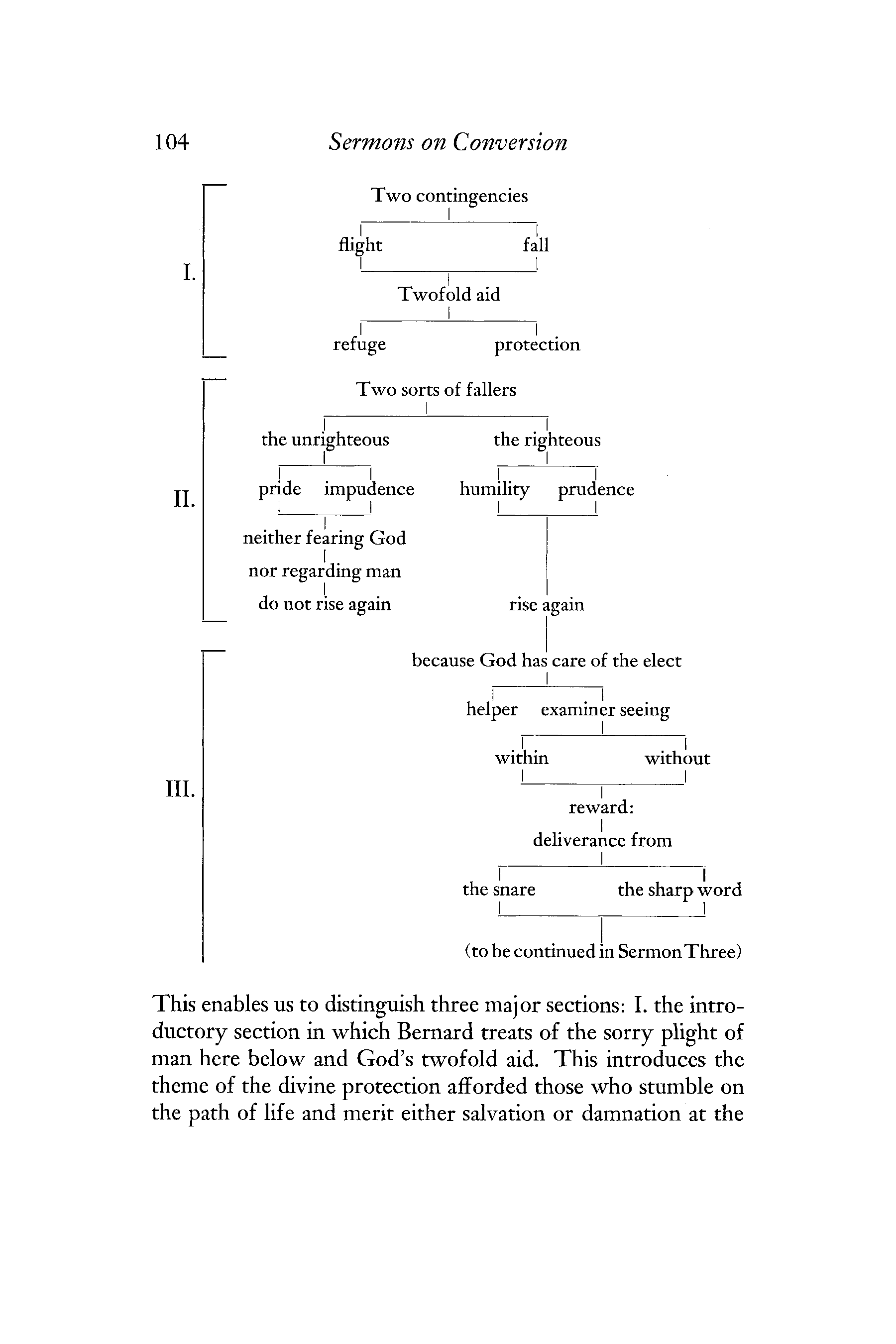
Sermons on Conversion Two contingencies flight fall Twofold aid I I refuge protection Two sorts of fallers I the unrighteous I the righteous I !
I pride impudence humility prudence neither fearing God nor regarding man do not rise again rise again because God has care of the elect I helper examiner seeing . I . within without I I I reward:
I deliverance from ! the snare the sharp word (to be continued in Sermon Three) This enables us to distinguish three major sections: I. the introductory section in which Bernard treats of the sorry plight of man here below and God's twofold aid. This introduces the theme of the divine protection afforded those who stumble on the path of life and merit either salvation or damnation at the
Introduction
final judgement. II. These are the goats, the unrighteous on the left hand, and the sheep, the righteous on the other. The goats are condemned because of their self-sufficiency, the pride and impudence of those who neither fear God nor regard men. This
God-man couplet recalls part I on the economy of salvation, God saving fallen man, which is the dominant note of the sermon. Parallel to the fall of the wicked is that of the righteous who, because of their humility and prudence, fall into God's hands and thus rise again. This comparison completes section
II and Bernard takes the notion of God as his springboard for section III dealing with the recompense of the righteous. God's all-seeing eye perceives man's inward and outward reactions to grace. The reward is deliverance from temptation and damnation, which is what is meant by the snare and the sharp word — as Bernard goes on to explain in Sermon Three.
THE DOCTRINE OF QH
When Bernard set out to preach to his monks he had in view their salvation in Christ through the Church and the sacraments.
He devoted the complete series of sermons to God's will to save and our will to be saved, our readiness to share in Christ's passion and cross and thus share if possible in the glory of his resurrection.
Our first step along the way of salvation is to dwell in the aid of the Most High, not trusting in our own strength (1.1 J) but giving ourselves up to watching, fasting and prayer. Our eyes must be firmly fixed on God so that we are not led to morbid introspection, to seeing our own weakness instead of counting on grace (1.2). Once we are under the protection of the God of heaven — which is not to be confused with his presence, enjoyed only by the angels (1.4) — we may confidently expect that in temptation God will be our refuge and our protector, provided we remain humble and prudent, knowing that temptation lies on every side. We must be constantly mindful that
Sermons on Conversion God looks down upon the righteous and the unrighteous (2.3).
Temptations lie on every side, up and round and down and about, but if we are like prudent harts we shall long after flowing streams and live on in God's love by humbling ourselves under his mighty hand and obeying our superiors (3.1). Avoiding avarice by the practice of poverty we shall live in thanksgiving, being delivered from the sharp word, eternal damnation, by the merits of Christ's sufferings. But this implies our hearing with a ready ear the hard word calling us to do the penance
(3.3) which will make us worthy to share in Christ's passion, to eat his flesh and drink his blood in the Sacrament of the altar, living for God by faith and abiding in him through love. We have every right to rejoice in the grace thus proposed to us, but we may not yet feel secure like St Andrew running to meet his cross. We are a long way from our passion, and we might fall back before the end of our lifelong Lent, failing to cross the Red Sea and turning back in our hearts to Egypt.
We know the way. It is long and beset with dangers, but there is nothing to fear. Besides the bread of angels received in the Sacrament of the altar there is the bread of the word of God to comfort us. This should encourage us to resist the temptations which our divine Lord underwent before us (3.2).
Our hidden life of penance and prayer is a holy mystery (4.3).
And the promise of the future life is assured us if we live the hidden life totally content to be rebuffed and rebuked, if we dwell under the shadow of the Holy Spirit by whom Blessed
Mary bore fruit for the salvation of the world.
Satan is ready to sift us as wheat (5.1), but no temptation will overcome us if we watch and pray, for we are shielded by divine grace. However dark may be the night of temptation and adversity (6.1) the shield of grace is always there to protect us, especially at the beginning of our conversion. Like little children in a storm, we may sometimes be afraid, but even this fear will work for our purification (6.2). Even those of us who are in the illuminative way (6.3) must be on our guard against
Introduction
the swift flying arrow of vainglory. There will be no danger if we shelter behind the shield of truth, the greatest enemy of vanity. Examination of conscience will help us fight this vice
(6.3). A final ruse of the enemy of mankind is illusion (6.6) but truth will have the upper hand.
We need the protection of truth during our life and at the moment of death; hope gives us confidence. Yet we must do our bit during life's journey and manfully carry our luggage like some beast of burden. Our burden is Christ himself riding into the Holy City — how could we go astray? (7.4). Christ is on our backs and yet he has already gone ahead to prepare a home for us.
The way to Heaven is sure. God himself has predestined us to glorification. No devilish trick can mislead us for God has given his angels charge to guard us in all our ways, to be to our right and to our left, behind and before, as long as we ourselves do not become drowsy and fall asleep, but keep to the hard ways for God's sake. And there is no special merit here, for God loved us before we loved him; and he loves us so much that at the resurrection of the dead he will render to every man his due so that, like the stars in the firmament, each one will shine with an eternal light differing from all others in brightness.
Whatever may be the circumstances here below, however dark the night, however stormy the sea, God is our hope (9.5).
For him we count everything as loss, we throw everything away, for God is our great and only hope. To live by hope, in hope, is faith. Our hope, our faith are founded on the rock of Christ's passionate love. He said, 'Greater love has no man than this, that a man lay down his life for his friends! Perfect love thirsts after the Most High (9.8) and the singleness of purity leads the soul to seek him. This is perfection, and perfect detachment. Ardent love rejoices that the Beloved ascends to the Father, where he will take his place as the co-equal of the Most High.
Although Christ has ascended on high, we must never forget
Sermons on Conversion that we are still pilgrims and therefore able to lose our way, to wander about here and there instead of keeping to the king's highway. Discernment is necessary for us if we are to select the right path, to avoid not only our own ways but also those of the demons: presumption and obstinance. Therein lies the danger of contempt, impenitence and a hardened heart (11.5). The remedy is humility and self-knowledge. In contrast to the demonic ways there are the ways of the angels, ascending and descending: ascending to the contemplation of God; descending for man's protection. Then there are the ways of the Lord: mercy and truth. When he comes again he will bow down the swollen hills, trampling down the pernicious heights of vanity and cruelty, treading lightly on the paths of mercy and truth.
Men and angels may also walk along these holy ways. For man, mercy is the beginning of the return to his heart, and is thus the path of salvation (11.9). To return to one's heart is to become like a little child and to walk in the ways of humble truth. For angels, the path of truth is contemplation of the divine face, the path of mercy is to keep us in all our ways. This is the charge they have received from God, a singular proof of his esteem and love (12.4). Little children though we may be, we have nothing to fear under such guardians. They will help us over the dangers of this mortal life and carry us up to heaven, provided we ourselves are vigilant to the very end, watching against the obstinance which is the ruin of all true religion (13.3). We must be pure, peaceable and gentle, free of envy and anger, and giving place to meekness and longanimity (13.4-6).
All these things are a gift of grace for which we must thank the Father from whom comes every perfect gift. Is not man as great as the gift itself? (14.1). We have every reason to be grateful, for the two gifts, being and having, are entirely gratuitous, received without either our meriting them or toiling for them (14.2). Finally, there is the gift of redemption. O happy fault! And the blessed Incarnation. Four free gifts and ten holy commandments (14.4). Fourfold thanks be to God. Let the
Introduction
hosts of wickedness not prevent us from giving thanks or lead us to seal God's graciousness with our ungraciousness. Beware the sins of the flesh, vain glory, deceit and all root of bitterness, anger, rebellion, greed and vanity (14.9).
But this makes heavy going! The road is long and winding.
'Come to me, all who labor and are heavy laden, and I will refresh youj says the Lord (15.1). Christ's burden is sweet, and grace is the greatest burden he lays upon us. It is the burden of his kindness that weighs us down: no wonder that we weep!
We are accustomed to sin and unkindness, and the gentle Lord Jesus gives grace and kindliness. No longer content to kiss us by an intermediary, whether sinful man or winged messenger, he kisses us with the very kiss of his mouth. The road was long and wound uphill all the way, but at dawn, the Sun of righteousness has risen for us, pledge of the fruit of our own participation in his paschal mystery. He will fill us with length of days and show us his salvation. The hope of glory lies in present tribulation, 'this slight momentary affliction is preparing for us an eternal weight of glory!
Emmanuel, God with us, let me be with you in tribulation; break my heart that I may have you near me in my tribulation; let me embrace you in tribulation: for who have I in heaven but you and there is nothing I desire on earth beside you. Fill me with length of days. God eternal, show me your salvation, your Jesus so that for all eternity I may see him in whom I have believed, whom I have loved, for whom I long, your Jesus, our Lord, who is God blessed for ever.
MARIE-BERNARD-SAID OSB
Abbayedu Sacre-Coeur Oriocourt
Sermons on Conversion NOTES 1. SCI: IV.6: 'Sed quid? Titulum praeterimus?'.
2. Psalm 90 in the Vulgate enumeration familiar to St Bernard is by the Hebrew numbering psalm 91. While direct references to it in the sermons have been left in the form by which Bernard knew the psalm, scriptural citations in the margins here, as elsewhere in this volume, conform to the numbering of The Jerusalem Bible, which follows the Hebrew text.
3. Anthony Bloom, Meditations on a Theme. A Spiritual Journey (London:
A. R. Mowbray, 1972) 124-5.
4. I would like to thank Monsieur Robert Bultot, researcher at the Institut Interfacultaire des Études Médiévales of the University of Louvain, for the Note which he communicated to me on the subject of literary genres. I found his word 'hybrid', applied to QH, very enlightening.
5. Because QH contains so many biblical references, I have adopted a method of reference using Sermon, paragraph, and number of citation within that paragraph. For example, 3.13 means Sermon Three, paragraph one, the third citation.
6. As cited, Ps 49:12, 57:5, 55:6.
LENTEN SERMONS ON THE PSALM
'HE WHO DWELLS'

T H E PSALM
1. He who dwells in the shelter of the Most High will abide under the protection of the God of Heaven.
2. He will say to the Lord: you are my protector and my refuge; my God, in him will I hope.
3. For he has delivered me from the snare of the hunters and from the sharp word.
4. He will overshadow you with his shoulders: and under his wings you will hope.
5. His truth will cover you with a shield: you will not fear the terror of the night; 6. Nor the arrow that flies by day, nor the bogy that prowls in the darkness, nor assault, nor the noonday devil.
7. A thousand may fall at your side, ten thousand at your right hand, but you it will not approach.
8. You will but consider with your eyes and see the sinners' recompense.
9. Because you, O Lord, are my hope: you have made the Most High your refuge.
10. No evil shall befall you, no scourge come near your tent.
11. For he has given his angels charge of you to guard you in all your ways.
12. On their hands they will bear you up, lest you dash your foot against a stone.
13. You will walk on the asp and the basilisk; you will trample underfoot the lion and the dragon.
14. Because he hoped in me I will deliver him, I will protect him because he has known my name.
15. He will call to me and I shall answer him; I am with him in trouble, I shall rescue him and honor him.
16. With length of days will I satisfy him and show him my salvation.

PREFACE
1. / C O N S I D E R I N G Y O U R EFFORTS,
I brothers, not without great stirrings of compassion, I wonder what comfort I may offer you, and there comes to my mind something to do with the flesh. But this would be of no profit,* and in fact may even be
Jn 6:64 harmful. For, however slight the cheating we do in sowing, the loss in harvesting is not slight, and if I were to lessen your penance out of cruel compassion, your crown would gradually come to lose its jewels.
What are we to do then? Where is the prophet's tidbit?* For there is death in the pot,t and *2 K4:4i/l7Wi. you are being killed all the day long* by much
Rm 8:36 fasting and frequent labors* in unwonted 2 Co 11:27-8 watchings,* in addition to all that is going on 2 Co 11:23 within you, contrition of heart and a crowd of temptations. You are being killed, but for the sake of him who died for you. In this way, if for him you share abundantly his sufferings, you will also share abundantly in comfort through him,* and thus your soul will come to 2 Co 1:5 delight in him and refuse to be comforted by anything else.* Close to him, this great tribulaPs 77:2-3 tion* will discover sure consolation. Are you
Rev 7:14 not, in fact, enduring something beyond human strength, beyond nature, and quite different from what you are accustomed to? Someone else is bearing it for you, therefore, and without any doubt it is he who bears all things by his
Sermons on Conversion Heb 1:3 word of power.* The enemy is now being struck down by his own sword, and the greatness of the tribulation by which he usually tempts you is instead overcoming temptation; is this not the surest proof of divine presence?
For what need have we to be afraid when he who upholds all things is with us? The Lord is the defender of my life; of whom shall I be
Ps 27:1 afraid?* For even though I walk through the valley of the shadow of death, I fear no evil, for Ps 23:4 you are with me.* Who is it that upholds the Is 40:12 whole weight of the earth? * And upon whom does the whole world rest? Now if there exists some being who upholds all others, then by whom is he himself upheld? It is none other
Heb l:3 than the word of power which bears all things.* For by the word of the Lord were the heavens made and all their power by the breath of his
Ps 33:6 mouth.* 2. Therefore, that you may find consolation in God's word, particularly in these days during which, as is quite right, your fatigue is somewhat greater, I trust it will be not unuseful to talk to you about something in Holy Scripture, as some of you have already asked me to do. To this purpose I have chosen that very psalm by which the enemy seized an opportunity for Mt 4:10-11 tempting,* so that thereby the arms of the Ps 74:14 wicked one will be crushed* with the passage which he presumed to usurp to his own ends.
Rm 1:13
And here, brothers, I want you to know* that those people who usurp for unholy purposes any part of Holy Scripture and hold back the Rm 1:18 truth of God by lies,* as some are sometimes given to doing, are clearly imitators of the
Preface enemy. Beware of this, dear ones, for it is a very devilish thing, and those who, for their own ruin, attempt to pervert the saving writ prove that they are on his side. But I will not linger over this. It is enough, I believe, to have touched upon the matter briefly. Now, with the Lord's help, let us try to examine and explain something about the psalm we have chosen.

SERMON ONE
On the First Verse:
HE WHO DWELLS IN THE SHELTER OF THE
MOST HIGH WILL ABIDE UNDER
THE
PROTECTION OF THE GOD OF HEAVEN
1. 1—l"-!HE BEST MEANS of recognizing someone who dwells in divine shelter is by looking at those who do not dwell there. You will find they are of three types: the first do not hope; the second have given up hoping; and the third hope in vain.
For if anyone fails to make God his refuge, trusting in his own strength and the abundance of his riches,* he does not dwell in the shelter of Ps 52:8,49:6
God. He turns a deaf ear to the advice of the prophet, 'Seek the Lord while he may be found, call upon him while he is near!* And seeking
Is 55:6 only temporal goods, he is envious of wrongdoers;* seeing the prosperity of the wickedt he
*Ps 37:1/tPs 73:3 is far removed from the help of God,* which he Cf. Ps 22:9 supposes he does not need.
But what have we to do with judging outsiders?* My fear, brothers, is that among us there l Co 5:12 may be someone who is not dwelling in the shelter of the Most High, but trusting in his strength and in the abundance of his riches. Possibly someone who is zealous and much given to
Sermons on Conversion 2 Co 6:5 watching, fasting, and labors* and other such things, but who thinks that he has long since amassed a whole wealth of merits and, trusting in this, has grown less than careful about the 2 Co 7:l fear of God.* In this dangerous security he has slipped into idle and curious habits and goes about grumbling, slandering, and criticizing.
Had he but made a habit of dwelling in the shelter of God, he would now look to himself and fear to offend Him whom he would realize full well is still necessary to him. He ought to fear
Cf. Tob i: 10, God* all the more, and be all the more careful, in that he has received so many more of His gifts. Without Him, we cannot hold or preserve what we have received from Him. But—and this is something which I am unable to speak of or regard without sorrow—there are some people who at the beginning of their conversion are fairly god-fearing and careful until they have made a good start in their new way of life, and then, although they ought to yearn for much more—in keeping with the words, 'Those who Sir 24:29 eat me will hunger for more'*—they start behaving as if to say: 'Why should we go on doing our service when we have now received all that Jn4:10 is to be given?! Oh, if you only knew* how little what you have is and how quickly you will lose it if he who gave it to you does not also preserve it for you. Those two thoughts are salutary and can make us careful and subject
Ps 62:2,6 enough to God* as not to be among those who do not dwell in the shelter of the Most High just because they fail to consider how necessary it is to them. These are the people who do not Pr 16:20 hope in the Lord.*
Sermon One
2. But there are also some who have lost hope.
At the sight of their own weakness, they falter and stumble from faintness of spirit,* dwelling
Ps 55:8 in their own bodies and always harping on their own frailty and ever ready to pour out all their woes. As soon as you take notice of them, their imagination flares up. They certainly do not dwell in the shelter of God, and they do not even know what it is because they are unable to stretch up far enough to think about it. There are still others who, though they hope in God, do so in vain because they flatter themselves in the hope of his mercy so much that they neglect to mend their sinful ways. Altogether vain is this hope.* It leads to their downfall because
Sir 34:1 there is no love in it. Against these the prophet says: 'Cursed the man who sins in hope!* And not scriptural another says: 'The Lord takes pleasure in those who fear him, and those who hope in his mercy!* Before saying 'those who hope' he expressly mentions 'those who fear him! A man's hope is vain indeed when he rejects grace out of contempt and empties his hope out completely.
Ps 147:11
3. None of these three dwells in the shelter of the Most High. The first dwells in his merits, the second in his woes, and the third in his vices.
The third person's dwelling is unclean, the second's is uneasy, the first's is foolish and reckless.
What could be more foolish than to take up one's dwelling in a house which has hardly been begun? Do you think it has already been finished?* But when a man has finished, he is just then beginning.* What is more, this dwelling place is crumbling to ruins. What you ought to do is to prop it up and reinforce it rather than
Lk 14:30
Sir 18:6
Sermons on Conversion live in it. Is not this present life frail and unstable? And anything founded upon it must necessarily resemble it. Does anyone think he can build a solid building on a shaky foundaLk 6:49 tion? * So the dwelling of those who place their hope in their own merits is dangerous; dangerous because falling to ruins. As for those who despair when they think about their own infirmities, their house is uneasy and, as we have said, they dwell in torments. For besides suffering from troubles which beset them day and night, they are tormented still more by troubles which have not yet fallen on them, and to such an extent that the day's trouble is not sufficient
Cf. Mt 6:34 to the day,* but they are overwhelmed by trouble which they will probably never experience.
Can anyone think of a more unbearable hell?
Especially when they are overwrought with so much effort and take no comfort in the bread from heaven?* These people do not dwell in the shelter of the Most High because they despair. The first do not even seek to do so, because they feel no necessity for it. But the second are far from it because they seek God's help in such a way they can never get to it. The only people who dwell in the shelter of the Most High are those whose sole desire is to receive it, whose sole fear is to lose it, and who ponder it carefully and diligently—which surely is piety, the worship of God.* Happy indeed is he who dwells in the shelter of the Most High, for he will abide under the protection of the God of heaven. Is there under heaven* anything that can harm the person whom the God
Gen 24:7 of heaven* has decided to protect and preserve?
Jn 6:31
Augustine, De Trinitate XII.14; Cf. William of St Thierry, Ep aur
279; CF 12:100
Gen 1:9, Jb 28:24
Sermon One
The powers of the air are under heaven, this present evil age* is under heaven and also the Gal I-A spirit lusting against the flesh.* Gal J: 17
4. Nothing better could be said than 'under the protection of the God of heavenj because anyone who deserves to have this protection will be able to fear nothing under heaven, and thus, as the prayer goes on in the next verse:
HE WHO DWELLS IN THE SHELTER OF THE
MOST HIGH WILL ABIDE UNDER THE PROTEC-
TION OF THE GOD OF HEAVEN. HE WILL SAY
TO THE LORD, 'YOU ARE M Y PROTECTOR?
And in this way, the words 'he will abide under the protection of the God of heaven' explain the preceding ones: HE WHO DWELLS IN THE SHELTER OF THE MOST HIGH. Perhaps more than that it is meant to teach us that we should seek not only shelter in order to do good, but also the protection which will deliver us from evil.* Pay careful attention,! too, that it says *Mt6:i3/+Pr23:i 'under the protection' and not 'in the presence!
An angel rejoices in His presence; all I ask is to be able to abide under his protection! The angel is happy in his presence; all I ask is to be secure under his protection. And [the psalmist] says
'the God of heaven! There is, of course, no doubt about his being everywhere, but he is in heaven in such a way that, by comparison, he does not seem to be on earth. So when we pray, we say,'Our Father, who art in heaven!* So it
Mt6:9 is with our soul: for though it is in the whole body, it is more especially localized in the head where all the senses meet, whereas in the rest of the members there seems to be only one sense — namely, touch — and insofar as it is in some way
Sermons on Conversion in the head, it seems rather to govern the other members than to dwell in them. So, in the same way, when we think of that presence which gives joy to the angels, we can scarcely put the same name to the protection of God. And 'he will say to the Lord, you are my protector! But let us hold that over for another sermon.
SERMON T W O
On the Second Verse:
HE WILL SAY TO THE LORD: YOU ARE
M Y PROTECTOR AND M Y REFUGE:
M Y GOD, IN HIM SHALL I HOPE
and my refuge: my God, in him shall I hope!* He will say it with thanksgiving,* praising God and his mercy* for his twofold shelter. Everyone who is still dwelling in this shelter, and not yet in the Kingdom, often needs to take flight,
Ps 91:1-2 2 Co 4:15
Ps 107:8 and yet sometimes he falls. Yes, I tell you, while we are in the body,* we have to flee from the presence of pursuing temptation. And if we sometimes do not flee quickly enough, as happens, we are buffeted and thrown down, but the Lord protects us.* When someone comes along to pelt us in our pressing flight with the dung of plodding oxen, He is our refuge, and we are enabled to escape the filthy stoning.* He is our protector, too, so that, even when we fall, we are not bruised, because the Lord stays us with his hand.* Therefore, when we feel the urge to temptation in our thoughts, let us at once flee to him and humbly ask help. And if it should
2 Co 5:6
Ps 3:5
Sir 22:1-2 Ps37:24
Sermons on Conversion happen, as it sometimes does, that we flee to him less swiftly than we ought, let us be all the more
Ps 18:35 solicitous that the Lord's hand may hold us up.* For everyone, as long as he is detained in this present age, must necessarily fall sometimes, but whereas some are bruised in their falling, others are not because the Lord upholds them with Ps 37:24 his hand.* And how may we distinguish the one from the other so we may, following the Lord's own example, separate the sheep from Mt 25:32 the goats,* the righteous from the unrighteous?
Pr 24:16
Even the righteous man falls seven times a day.* 2. In fact, the only difference in their falls is that the righteous is protected by the Lord, and therefore rises again stronger than before, whereas when the wicked stumbles, he finds
Ps 41:8 no help in arising again.* Truth to tell, he falls either into shameful harm or into shamelessness.
Either he makes excuses for what he has done — Sir 4:25 and this is shame bringing in sin* —or else he
Jer 3:3 has the harlot's brow* and neither fears God Lk 18:4 nor regards man,* but proclaims his sin like
Is 3:9
Sodom.* But the righteous falls into God's hands, and in some marvelous way even his sin works for his justice. For we know that everything works for the good of those who love
Rm 8:28
God.* Does not that very fall work for our good, when by it we become more humble and more cautious? Does not the Lord protect anyone who falls, who is protected by humility?
'I was pushed hard and falling^ says the prophet, but he who pushed me gained nothing because
Ps 112:13 the Lord protected me!* Thus may the faithful soul say to the Lord: 'You are my protector! All creatures may say, 'You are my creator'; even
Sermon Two
the animals may say, 'You are my shepherd'; all men may say, 'You are my redeemer!* But only
Ps 19:15 he who dwells in the shelter of the Most High may say, 'You are my protector! So he adds,
'And my God! Why not 'our God'? Because, though he is the God of all* in creation, reSir 36:1 demption, and other benefits common to us all, yet in their temptations it is the elect alone who have him, as it were, as their own. For he is ready to protect the falling soul, to draw to himself the fleeing soul in such a way that he seems to have left everything else,* to take care
Lk 5:11 of that single soul.
3. Therefore every soul should look upon God as being his very own, not only helper, but also examiner. Who could ever become careless if he had his eyes constantly fixed upon God whose eyes are constantly turned towards him?
Again, when God is looking down on him, never at any moment failing to see what is going on both within and without, searching and judging not only his actions, but even the most subtle motions of his soul, how could he fail to consider him specifically his God? And therefore, not without grounds can he say, MY GOD,
IN HIM WILL I HOPE. Notice that he did not say, 'I hoped^ or 'I hope^ but 'I will hope! As much as to say, this is my vow and my resolution, this is the intention of my heart.* This is my hope,
Heb 4:12 laid up in my bosom,* and in this will I persejb 19:27 vere, for 'In him will I hope! I shall not despair, nor shall I hope in vain, for 'woe to the man who sins in hope'* and no less to him who sins
Cf. 1.2 supra in despair. I will not be one of those who do not hope in the Lord: in him will I hope. This
Sermons on Conversion is what he says. But now, what about the fruit, the reward, the prize?
HE SHALL DELIVER ME
FROM THE SNARE OF THE HUNTERS, AND FROM
THE SHARP WORD. But we will put off explaining this snare and this word to another day and, if you do not mind, to another sermon.
SERMON T H R E E
On the Third Verse:
FOR HE HAS DELIVERED ME FROM THE
SNARE OF THE HUNTERS AND
FROM THE SHARP WORD
1. - p v R O T H E R S , BY THIS WORD,* 'he Rm 13:9
I - / has delivered me from the snare of the } u ) hunters^ I am stung to kindness towards myself and I take great pity on my own soul.*
Sir 30:24
Does this mean that we are beasts? Beasts through and through, for man when he was in honor did not understand: he is compared to senseless beasts.* Yes, men are beasts, straying
Ps49:i2 sheep without a shepherd.* How can you be Mt9:36 proud, O man?* How can you puff yourself
Sir 10:9 up for your smattering of knowledge? Look, you have become a beast for whom the hunters lay snares. And who are these hunters? They are the worst and most wicked, the most callous and cruelest hunters. They are hunters who, in order not to be heard, never sound the horn but shoot the blameless from ambush.* They are
Ps64:io the leaders of this present darkness,* so extraEph6:l2 ordinarily cunning in their slyness and wicked in their devilish deceit that in comparison to them even the most astute man is like a beast before hunters. Those who, like the apostle, are not ignorant of their designs,* and those whom
2 Co 2:11
Sermons on Conversion 1 Co 1:21 the wisdom of God* has allowed to discover the *2 Co 2-8 wiles of the wicked, are the exception. I beg tPs 144:12 you,* new plants of God,t you have senses not Heb 5:14 yet trained to distinguish good from evil,* do not follow the judgment of your heart, do not Rm 14:5 luxuriate in your senses,* lest the wily hunter deceive you, as yet inexperienced. For the beastly beasts of the forest — I mean men of the world—he lays his snares fairly openly, because
*Cf Augustine n e v e r doubts he will easily catch them. But En.inPsAi-3-, for you, who are like warier harts, deadly* serpents longing after flowing streams,! he hides his snares with greater skill, and beguiles you
Est 16:6 with the false trickery of his arguments.* I beg you, then, humble yourselves under the mighty
CCh 38:461
I Ps 42:1
IP5:6 hand of God* your shepherd, and obey the Gen 27:8 words* of those who, having been taught by daily practice and long experience—both their own and many others' — have come to know better this hunter's craftiness.
2. But now that we recognize both hunters and beasts, let us examine the snares. I do not want to make up anything, or pass along anything doubtful. The apostle points out this snare
2 Co 2: li to us; he is not ignorant of the hunters' designs.* Tell us, I beg you, holy Paul, what is this snare of the devil from which the faithful soul rejoices to have been delivered? 'Those who desire to be rich in this worldj he answers, 'fall into temptal Tm 6:9 tion and into the devil's snare!* Does this mean that this world's riches are the devil's snare?
How few there are, alas, who would rejoice for having been delivered from this snare!
How many there are who regret not being more caught up in it and who strive with might and
Sermon Three
main to become more ensnarled and entangled!
But you, you who have left everything* to folMt 19:27-8 low the Son of Man who has nowhere to lay his head,* rejoice and say, 'He has delivered me
Mt8:20 from the snare of the hunters! Give thanks to him* with all your heart and with all your soul,
Ps 100:3 and with all your strength* and give him thanks Mk 12:30 from the very marrow of your heart, saying,
'He has delivered me from the snare of the hunters! And in order to grasp how great are these benefits and to know they are given you by God, listen to the next words: AND FROM THE SHARP WORD. O man, or rather, O beast, are you not afraid of the snare? Then fear the axe!
Did he not say, 'From the sharp word'? And what is this word if not that of insatiable hell:
'Bring them along, bring them along, cut them down, tear them to bits, kill them off quickly, hasten to drag away the spoils! What else is this, if not a sharp word: 'Let the wicked be carried off so he may not see the majesty of the Lord'?* Is this not how hunters gloat over a Is26:10 captured beast, crying out and saying, 'Away with it, away with it! Poke in the spit, bring along the coals and dump it into boiling cauldrons'? Again, it was a sharp word which the *Ezk2 J rebellious house,* the people the Jews,t howled: ti Mac 8:20
'Away with him, away with him!'* How terJni9:i5 rible that word, how sharp, how cruel! Their teeth are indeed spears and arrows, and their tongues are sharp swords.* Lord, you bore this
Ps57:5 sharp word. Why did you do it, if not to deliver us from the sharp word? Of your kindness, grant that we do not endure what you deigned to endure for our sakes.
Sermons on Conversion Mt 3:2
3. When we encourage them to do penance,* men of the world may answer, 'This is a hard
Jn 6:61 saying!* This is what we read in the Gospel.
The Lord was speaking of penance, but in parables, as though to those to whom it is not given
Mk4:ii to know the secret of the kingdom of God.* And when they had heard him say, 'Unless you eat the flesh of the Son of Man, and drink his
Jn 6:54 bloodj* they answered, 'This is a hard saying! J Jn 6:67 and they drew back.* But what does it mean to eat his flesh and drink his blood, if not to share l P 4:13 in his sufferings* and to imitate the way of life he led in the flesh? So the holy Sacrament of the altar in which we receive the body of the Lord teaches us that just as the bread enters our body, so our Lord enters us, in order to dwell in our
Eph 3:17 hearts through faith.* For when justice enters, he whom God the Father made our righteousl Co 1:30 ness* enters. And he who abides in love abides
1 Jn 4:16 in God, and God in him.* But there are still many who say to us, 'This is a hard saying! But is this hardness not merely a slight, momentary affliction working within us an eternal weight
2 Co 4:17 of glory beyond comparison? * Is it so hard to buy back by a very brief and fleeting labor those torments and sufferings which will last eternally and which no mind can ever conceive? Does it
Mt 3:2 seem sharp to you to be told 'Repent' ? * You are mistaken. Listen to another sharp word, anPs 112:7 other hard saying, an evil tiding: * 'Depart, you
Mt 25:41 cursed, into eternal fire!* Yes, I tell you, fear Lk 12-.5 this,* consider this a hard saying and you will find that the yoke of the Lord is sweet and his
Mt 11:30 burden light.* If you are not yet able to believe that it is sweet in itself, then at least ac-
Sermon Three
knowledge that by comparison it is very sweet indeed.
4. But as for you, my brothers, you who are winged and before whose eyes* the snare has
Gal 3:1 been cast in vain, you who have entirely abandoned the riches of this world,* what have you l Tm 6:17 to fear from the sharp word, now that you have already been delivered from the snare? Happy are you, O Jeduthun, for whom some of the psalms were written,* you who have leaped
Cf.Pss39,62,77 over the snare, and are thus far removed from the sharp word. For to whom will it be said,
'Depart, you cursed, into eternal fire, for I was hungry and you gave me no food'?* To whom,
Mt 25:41-2 I say, will this be said, if not to those who have enjoyed this world's goods?* At this word do l Jn 3:17 your hearts not exult and become filled with spiritual joy?* Is your poverty not more preAc 2:28 cious than this world's treasures which you left behind? Surely it is your poverty that sets you free from the sharp word. For how can God demand of you what you have left for love of him? And yet you give him this too, and by the labor of your hands Christ is fed and clothed, and so wants for nothing. Give thanks, therefore, rejoice and say, 'He delivered me from the snare of the hunters and from the sharp word!
Rejoice, I tell you, but still for a while with trembling.* I want you to feel joyful, but not Ps 2:11 yet secure, rejoicing in the Holy Spirit,* yet still
Rm 14:17 fearful and on your guard lest you slide back.
5. Is there anything you ought still to fear?
Just one thing, something very serious, the sin of Judas, the sin of apostasy. It is a good thing that you have received wings like the dove and
Sermons on Conversion Ps 55:6 have flown away to be at rest.* But on earth Ps 90:10 there will be no rest, only toil and trouble* and Qo l: 14 affliction of spirit.* For the soul that flies away what is there then to fear, if not that he may perhaps see a dead body or something of the sort on the ground, stretched out by these wicked hunters to stir his appetite, that he be captured iji the snare they have set, and that the Mt 12:45 last state of that man be worse than the first.*
This, I tell you, is profoundly to be feared, lest someone by his heart alone, or even by his body,
Pr26:11,2P2:22 turn back to his own vomit.* We read of the children of Israel that in their hearts they went
Nb 14:3 back to Egypt.* They could not return in body because they were prevented by the Red Sea closing in on their heels. This is what each one of us must fear to the core, that we somehow offend God to such an extent that we come to be manifestly repudiated and vomited up by Rev 3:16 him. * And if shame prevents us from apostasizing in body, lukewarmness will gradually cause apostasy of the heart and the heart will live like a secular in religious habit and embrace whatever worldly consolations it can find. We are not holier than the apostle, who was afraid that, after having preached to others, he might himl Co 9:27 self become a castaway.* And this is somePs 124:6 thing to be afraid of until the snare is broken,* until the soul has laid aside this body. The body itself is a kind of snare, which is why we read
Lam 3:51 that the eye causes grief to the soul.* It behooves a man therefore to feel secure when he carries his own snare about with him. But it is good to dwell in the aid of the Most High and so through him be capable of avoiding the snare.
SERMON FOUR
On the Fourth Verse:
HE WILL OVERSHADOW YOU WITH HIS
SHOULDERS AND BENEATH HIS
WINGS YOU WILL HOPE
IR BLESSINGS should deserve dly be promised the man who humbly praises and devoutly gives thanks. Now, he who has been faithful over little is by right set over much,* just as, on the contrary, he who is ungrateful for what he receives is unworthy to receive more. Therefore the Spirit will answer devout thanksgiving, saying, 'Not only will he do this, but he will also overshadow you with his shoulders! I believe that these shoulders must be taken to mean the Lord's double promise, that is to say, for this life which now is and the life which is to come.
Had he simply promised the kingdom without giving us food for the journey, men would complain bitterly and say, 'It is indeed a great thing you have promised us, but we have no means of getting to it! And that is why he who has promised eternal life after this age has also promised that he himself will, by his very provident kindness, give us the hundredfold even now in this age. * What excuse do you still have, O man? t
Mt 25:21
*Mk 10:30
+Rm 2:1
Sermons on Conversion For the mouth of him who speaks lies has been Ps 63:12 stopped.* What else could the enemy bring up to tempt you except that your life lies far ahead l K 19:7 of you?* And why should you be afraid if a great journey lies ahead, you who have received the food of the strong so you do not faint on the Mt 15:32 way? * Elijah was served food by an angel, food which by human standards is the most common: bread and water. And yet he gathered so much strength from that food that he walked for forty l K 19:5-8 days without feeling fatigue or hunger.* Would
Mt 4:11 you like the angels to minister* this food to you? It will surprise me if you do not.
2. But if you long for this food, and seek it simply by an ambition more humble, and not in order to boast of angelic service, then listen to how it is written of the Lord that, when the devil tempted and coaxed him to change stones
Mt 4:3-4 into loaves of bread,* he resisted and said, 'Man does not live by bread alone, but by every word
Mt 4:4 that proceeds from the mouth of God!* Then, once the temptation had been overcome and the tempter put to flight, angels came and minisMt 4:11 tered to him.* So you, too, if you want to be served by angels, fly the consolations of this jm 4:7 world and resist the temptations of the devil.*
Let your soul refuse to be comforted by other things if you want it to take pleasure in the rePs 77:2-3 membrance of God.* When you are hungry the devil coaxes you to run ofF for bread; but you ought rather to listen to him who said, 'Man does not live by bread alone! Apart from the sole necessity of sustaining the body, what other reason have you to be so distracted by so many things that you look now for food, now for
Sermon Four
drink, and now for clothing or a bed, when you are able to find all that you need in a single thing: the word of God. This is the manna having all sweetness* and a delicious smell; it is a Wis 16:20 rest true and sincere, sweet and savoury, joyful and holy.
3. This is the promise made for this present life. But who can disclose the promise of the life to come? If the anticipation of the righteous is joy,* and such joy that everything that can be
Pr 10:28 desired in this world is not worthy to be compared to it, what will be that joy which we anticipate? Eye has not seen, O God, beside you, what things you have prepared for those who love you.* Beneath these shoulders we receive
Is 64:4 then four benefits: beneath them we are hidden; beneath them we are protected from the attacks of hawks and kites —the powers of the air—;*
Eph2:2 beneath this saving shadow we are refreshed and shaded from the excessive heat of the sun; beneath them too, we are fed and nurtured. For in another psalm the prophet has said, 'He hid me in his tent in the day of trouble^* that is to Ps 27:5 say, while these days are still evil* and we are
Eph5:i6 sojourners in a foreign land* given into the Ex 2:22 hands of the wicked,* where there is no reign
Jb9:24 of peace, and where the God of peace* does not 2 Co 13:11 reign. If he does reign, why do we say, 'Your kingdom come'? * And so it is necessary for us
Mt 6:10 in the meantime to lie hidden if we have a precious thing, for it is the treasure of the kingdom of heaven which a man found and hid away.* ibid.
This is why we hide bodily in cloisters and in forests. Do you wonder what we gain by this hiddenness? There is no one here, I believe,
Sermons on Conversion who, were he to do in the world a quarter of what he does here, would not be revered as a saint, reckoned as an angel, whereas now he is
2 Tm 4.2 daily rebuked and chided* as negligent. Do you think it no small advantage not to be taken for Cf. RB 4:62 a saint before actually being one? Would you not be afraid that, having already received this cheap reward, you would have no future reCf. Mt. 6:1-2,5 ward?* So it is necessary for all this to lie hidden not only from other people's eyes but from your own as well, and even more necessary.
For there is a saying of the Lord: 'When you have done all that is commanded you, say, "we are worthless servants; we have only done what
Lk 17:10 was our duty" '* Woe to us indeed if we did lCo9:16 not do this!* In this lies great virtue and the Tt 2:12 best security: that while you live faithfully,* forgetting what lies behind and straining forPh 3:13 ward to what lies ahead,* you do not so much see what you have already obtained as wait for what you still lack. This hiddenness, which we have already said is afforded beneath the Lord's shoulders, is something very similar to the overshadowing which came upon Mary from the Lk 1:35
Holy Spirit* to conceal an incomprehensible mystery.
4. And this same prophet also says of this protection, 'You have covered my head in the Ps 140:7 day of battle!* For just as the mother, when
Dt 32:11 she sees the hawk coming, spreads her wings* to let the little birds come under them and find sure refuge, so for us also, in some way, the immense and ineffable kindness of our God is spread out in an ever-widening embrace. And this is why it was said further up, 'You are my
Sermon Four
refuge!* Now truly, under his shoulders we Pss 31:4,71:2 have both saving shade and protection.
The physical sun, although it is good and very necessary, yet if it is not shaded, its heat will harm the weak head and its brightness affect weak eyes; and this is not the fault of the sun, but of weakness. And it is the same with the Sun of justice.
This is why it is said, 'Be not righteous overmuch^* not because righteousness is not good,
Qo7:i7 but because while we are still weak* we need to Rm 5:6 moderate that good grace lest perhaps we fall into the vice of pride or indiscretion. W h y is it that though we pray and entreat without ceasing we cannot receive that abundance of grace*
Rm 5:17 we desire? Do you think that God has become miserly or needy, powerless or merciless? No indeed, certainly not! But he knows our frame,*
Ps 103:14 and he overshadows us with his shoulders. Yet we must never on that account cease from entreaty, because even though he does not give enough to satisfy us, he gives what is necessary to sustain us. And even though he guards against too great a fervor, he nevertheless enfolds us with his warmth like a mother.* And this is the iTh2:7 fourth thing which we said stands ready for us beneath his shoulders, that we may be enfolded like chicks in the warmth of their mother's body, lest we wander outside* and die as grows
Jb 38:41 cold the love* which cannot be poured out in us Mt 24:12 save through the Spirit who is given us.* Secure
Rm 5:5 beneath these wings, therefore, we shall hope, because the sight of present gifts strengthens our anticipation of those to come. Amen.
S E R M O N F I V E
On the First Part of the Fifth Verse:
HIS TRUTH WILL COVER YOU
WITH A SHIELD
Mt 26:41 when, for these were the Lord's words as his passion approached. And notice how, though it was he who was about to suffer, and not his disciples, he prayed not for himself, but for them. This was why he said to Peter, 'Behold,
Satan sought to have you, to sift you like wheat, but I have prayed for you that your faith may not fail; and when you have turned again, strengthen your brothers!* And if it behooved them to be so afraid of the Lord's passion, how much more ought we to be afraid, brothers, in our passion. Watch, therefore, and pray, that you do not enter into temptation, for you are hemmed about by temptations. This is why you read that the life of man on earth is a temptation.* Therefore, if our life is so full of temptations that it can deservedly be called a temptation, we must keep constant watch warily and prayerfully, lest we fall into it. This is why we say in the Lord's prayer, 'lead us not into temptation!* Yet, even though you are surrounded
Lk 22:31-2 Jb 7:1
Mt 6:13
Sermon Five by temptations, his truth will surround you with a shield,* so that just as there are wars on all sides, so on all sides there are strongholds, too.
And this makes it quite evident that this shield must be a spiritual one which can surround us on all sides. Truth surrounds us because it was truth who made the promise, and he proves himself to be as he promised. The apostle says,
'God is faithful, and he will not let you be tempted beyond your strength!* 2. And it is not incongruous that the grace of divine protection be compared to a shield which is broader and bigger at the top, in order to cover the head and shoulders, but narrower at the bottom, so that it weighs less, especially as the legs, being slenderer, are not so easily wounded, and anyway, it is not so dangerous to be wounded in these limbs. It is for the same sort of reason, if I may say so, that Christ gives his soldiers* scant and scarce temporal supplies to guard their lower parts, that is to say the flesh; for he does not want them to be weighed down with a lot of such things, but wants them to have food and clothing,* as the apostle says, and to be content with that. But for the higher parts he gives spiritual gifts* in greater abundance and breadth. So you read: 'Seek first the kingdom of God and his righteousness and everything will be given youj* including the food and clothing for which he said we were not to be anxious.* Our Father in heavent in his gracious kindness gives them to us for two reasons; lest thinking he is angry with us if he refused us these things, we should despair, or lest excessive anxiety about them should be
Sermons on Conversion harmful to our spiritual exercises. Without Ph 3:3 them one cannot live or serve God.* But the scantier they are the better.
3. His truth will surround you with a shield
then: YOU WILL NOT FEAR THE TERROR OF THE
NIGHT, NOR THE ARROW THAT FLIES BY DAY, NOR
THE BOGY THAT PROWLS IN DARKNESS, NOR AS-
SAULT, NOR THE NOONDAY DEVIL. These are the four temptations by which we are surrounded on all sides, and we need to be surrounded by the Lord's shield in such a way that it is to the Ex 14:29 right and to the left,* at the back and at the l Mac 13:27 front.* Furthermore, I want you to be forewarned that no one can live on earth without temptation, so when one is perhaps taken away, we may be sure that another will come along.
Rather than feel secure, we ought to be wary of temptation and so beg to be delivered from it.
I dare not promise perfect liberty or rest as long Rm 7:24 as we are in the body of this death.* And in connection with this, we should consider how
God's kindness is so well-disposed towards us that he sometimes allows us to suffer certain temptations for a while lest more dangerous ones perhaps beset us. But he delivers us more speedily from some so we may be tried by different ones which he foresees will be more useful to us. It now remains for us to consider—but not right now — the four temptations we have mentioned. I believe that it is in the order they are enumerated that they beset those who have
Ps 85:8—qui turned [to God] * and that they are, so to speak, convertuntur , , . r r ,, , . r the chief of all other temptations.
SERMON SIX
On the Second Fart of This Verse, and on the Sixth:
YOU WILL NOT FEAR THE TERROR OF THE
NIGHT; NOR THE ARROW THAT FLIES BY
DAY, NOR THE BOGY THAT PROWLS IN
THE DARKNESS, NOR ASSAULT, NOR
THE NOONDAY DEVIL
r 1. y x HOLY SCRIPTURE adversity is usually betokened by night, and we know that against those who turn to God* the Ps85:8 first struggle is generally against vexations of the body. The flesh, never hitherto subdued,*
1 Co 9:27 will never with good will put up with being chastised and brought into servitude. But remembering still the liberty only recently lost, it will lust bitterly against the spirit,* especially
Gal 5:13 amid those pains by which you die every day,* 1 Co 15:31 or rather by which you are being killed all day long,* for they are not only above your strength
R m 8:36 and beyond nature, but also contrary to what you are accustomed. Is it astonishing that they cause you trouble, particularly those among you who are not yet used to them and do not have recourse to prayer quickly enough, and do not take refuge in holy meditations in order to lighten the burden of the day and the scorching
Sermons on Conversion Mt 20:12 heat?* The shield of the Lord is plainly necessary to us at the beginning of our conversion so that we do not fear the terror of the night.
Furthermore, it is exact to say the terror of the night, and not night itself, because this affliction is not so much temptation itself as the fear arising from it. We all struggle, but this does not mean we are all being tempted, and those who are tempted suffer more from the fear of pain to come than from present grief.
2. Because fear itself constitutes the temptation, it is appropriate to say that anyone who is surrounded by the Lord's shield will perhaps be attacked, will perhaps be tempted, will perhaps be afraid of the night, but this fear can do him no harm. Moreover, if it does not dominate
Ps 19:14 him, then he will be blameless* and cleansed, as jb 41:25 it is written, 'the terrified will be made pure!*
This fear is a furnace, but truth brings it about that it does not sear but refines. This fear is surely dark and nocturnal, but the ray of truth easily overcomes it. This allows the eyes of the heart to see the sins we have committed in such a way that, as the prophet said of himself, we are even ready to be whipped, declaring our
Ps 38:18 iniquity and thinking upon our sin.* Sometimes Mt 25:46 we think about the eternal punishment* which we have deserved until, by comparison with what we have escaped, we consider delightful everything we are now undergoing. Sometimes, too, — frequently — we think about the heavenly reward towards which we are straining, for the sufferings of this present time are not worth comparing with the glory that is to Rm 8:18 be revealed to us.* Sometimes, again, we think
Sermon Six
about the things Christ bore for us, in order that, frequently meditating upon all that his majesty endured for his worthless servants,* we
Lk 17:10 may blush at not being able to suffer even a little on our own behalf.
3. But perhaps truth has prevailed, already surrounding us in so many ways and on so many sides that it enables us not only to push this fear away, but even to cast it out* altogether. The l Jn4:i8 night is now far gone,* but still, as a child of Rmi3:i2 light* now walking honestly as in the day,t
*Eph5:8 fear the arrow. It flies lightly and pricks lightly.
+ R m 1 3 1 3 Yet I tell you, it inflicts no slight wound; it kills fast. This arrow is none other than vain glory, which is why it does not attack the wavering and the careless. It is those who appear more fervent who must look out for themselves; they must be afraid on this score, and be extremely cautious never to leave the invincible shield of truth.* For what could be more opposed to Wis 5:20 vanity [than truth] ? We are not required to protect ourselves from this arrow with the hidden and intimate secrets of truth. The soul should know itself and be conscious of the truth about itself. For, unless I am mistaken, a man cannot easily be misled by someone who praises him during his lifetime, and thus become toplofty,* if he carefully examines himself within Rm 11:20 in the light of truth. Surely if he thinks about his own condition, he will say to himself, 'How can you, who are but dust and ashes, be proud?'*
Sir 10:9
Surely, if he considers his own corruption, he must necessarily admit that there is no good in him. Or, if he does perhaps seem to find some good,* he will not, I think, be able to argue
Pr25:27
Sermons on Conversion against the apostle when he says, 'What do you 1 Co4:7 have that you have not received?'* and elsewhere, 'Let him who stands look out lest he l Co 10:12 fall!* Finally, if he reckons faithfully, he will have no difficulty in acknowledging that he cannot go out with ten thousand men to meet someone coming against him with twenty thouLk 14:31 sand,* and that all his righteous deeds are to be
Is 64:6 thought of as filthy rags.* 4. Furthermore, truth must be opposed to the temptations which ensue. Our ancient enemy is not going to cease for all that: he will have recourse to craftier arguments. He has verified that the tower is firm on every side: he cannot get at it either on the left by the indecision arising from fear, or on the right by battering it with human praise, but is frustrated in both attempts. So he says, 'Well, if I cannot overthrow it by force, then perhaps I shall be able to deceive it by the traitor's ruse! Who do you think will be this traitor? Obviously the l Tm 6:io love of money, the root of all evils;* ambition, a subtle evil, a secret virus, a hidden pest, the craftsman of deceit; the mother of hypocrisy, the begetter of spite, the source of vices, the Mt 6:19 tinder of crimes, the rust of virtue, the moth* of Is 6:10 holiness, the blinker of hearts,* producing sickness from remedies, and begetting illness from medicine. 'He has spurned vain glory because it is vain. Maybe he will conceive a fondness for more solid food: honors, perhaps, or maybe riches! That is what he says. How many people
Mt 22:13 have been thrust into outer darkness* by this bogy prowling in the darkness, stripping them
Mt 22: ii of the marriage garment* and emptying the
Sermon Six
exercises of virtue of any fruit of piety? So many have been wickedly deceived by this pest and shamefully overthrown that others for whom he lies in ambush should tremble at the thought of sudden ruin. But what fosters this worm, if not estrangement from reason and obliviousness to truth? And what else but truth will disclose this looming enemy and show it up as a bogy of darkness? Surely that was meant by the words: 'What will it profit a man if he gain the whole world* and loses or forfeits himMt 16:26 self? '* And again, 'Mighty men will be tempted
Lk 9:25 mightily.'* It is by such unremitting suggestions Wis 6:7 that [truth] reminds us how silly is the consolation of ambition, how serious its condemnation, how short-lived its utility, and how uncertain its end.
5. These were the Lord's temptations; the enemy did not dare bring up the fourth. For that springs from ignorance, and he knew only too well that a person who gave answers so measured that he could not trip him up by anything he asked must be extremely wise. By the first temptation [the enemy] tried to persuade a hungry man to change stones into loaves of bread;* but He, without either denying or afMt 4:2-3 firming that He could do so, held out another bread saying, 'Not in bread alone'* and so forth.
Mt 4:4
In the second temptation* the devil coaxed him Mt 4:5-7 to throw himself down, promising that if he were the Son of God, he would come to no harm and the whole city would praise and honor him; here again, He neither denied nor affirmed who He was. The third [temptation] was one of ambition, when [the devil] promised
Sermons on Conversion all the kingdoms of this world, if he would fall Mt 4:8-io down and worship him.* Do you see now how ambition leads to worship of the devil, for he promises the honor and glory of this world to those who will worship him? He withheld the fourth temptation from our Lord, as I have said, because he saw from the prudence of his answers that he was a man of experience.
6. But what does he do against others, those Ps45:8 who love righteousness and hate wickedness?*
What else but dress vice up as virtue? For when he recognizes perfect lovers of good he attempts to persuade them to do evil under the appearances of good; not just ordinary good, but something perfect, so that someone who really loves to do good may consent more easily, and in this way he easily trips up the runner. This devil is not just the day devil, but the noonday devil. Was not he the one Mary was afraid of when she took fright at the angel's unusual
Lk 1:29-30 greeting?* Was not he the one the apostle was alluding to when he said, 'We are not ignorant
2 Co2:11 of their designs?* For this angel of Satan dis2 Co ii: 14 guises himself as an angel of light!* Lastly, was not he the one the disciples feared when they saw the Lord walking upon the sea and cried
Mt 14:25-6 out thinking he was a ghost? * And notice how fitting it is that the disciples were enjoined during the fourth watch to watch against the fourth temptation. Nor do I think it necessary for me to say much about this, which is only the simple truth that discloses veiled fraud.
7. No one who considers them carefully will have difficulty in discovering these four temptations in the general state of the Church. Did not
Sermon Six
the terror of the night keep the young plant* of Ps 144:12 the Church busy in those days when all who killed the servants of God* thought they were
Ac 16:17 offering God service?* Then, when persecution Jni6:2 ceased and day had returned, the flying arrow troubled her more and afflicted her more grievously; then some people left the Church, puffed up* by the spirit of the flesh, hankering after Gal 5:26 vain and fleeting honor and wanting to make a name for themselves; they magnified their tongues* and forged perverse doctrines. And Ps 12:4 nowadays, there is peace from pagans, peace from heretics, yet there is no peace* from her Jer6:i4,Ezki3:io false sons. You have multiplied the people*
Is 9:3
Lord Jesus,* but you have not multiplied its Ac7:59,Rev 22:20 joy,* for many are called but few are chosen.t
*ls 9:3
All are christians, and almost all look after their + M t 2 0 : 1 6' 2 2 : 1 4 own interests* and not those of Jesus Christ.
Ph2:2i For they even pursue their nefarious quest and the business of darkness in running after positions of ecclesiastical dignity, and in this they are seeking not the salvation of souls, but the extravagance of riches. This is why they get themselves tonsured, this is why they go to church all the time, celebrate masses, and sing psalms. Today people scrap shamelessly to get archbishoprics and archdeaconries in order to dissipate church revenues in wanton waste and vain pursuits. Now it remains for us to disclose the man of sin, the son of perdition,* who is no 2 Th 2:3 longer simply the day devil, but the noonday devil disguised as an angel of light and exalting himself above all that is called God or that is worshipped.* How cruelly he waits in ambush
2 Co 11:14 at the heel of Mother Church, grieving at hav-
Sermons on Conversion Gen 3:5 ing had his head bruised.* This is clearly going to be a very serious assault! Yet from this too,
*Jn 8:32
Truth will free* the Church of the elect,t shortiMt 29:22 ening the day± for them and destroying the 2 Th 2:8 midday devil by the light of His coming.*
Enough said about these temptations. Now I remember having dealt with them in one of my sc 33.8-16 sermons on the Song of Songs,* where mention was made of the noonday devil in connection with the noonday rest of the bridegroom after Sg 1:6 which the bride was inquiring.*
SERMON SEVEN
On the Seventh Verse:
A THOUSAND MAY FALL AT YOUR SIDE,
TEN THOUSAND AT YOUR RIGHT HAND,
BUT YOU IT WILL NOT APPROACH
LW!
"E L I V E IN HOPE, brothers, and we do not lose heart in this present tribulation* because we are looking forward to never-ending joys. Our expectation is not vain, nor should our hope seem doubtful, for it rests upon the promises of eternal truth. So the very fact of receiving gifts now undergirds the expectation of those to come. And the power of present grace is the surest proof that, beyond all doubt, we are going to receive the promised happiness to come. None other than the Lord of Hosts is the King of Glory,* and to him we also address this prayer in the hymn, Eph 3:13
Ps 24:7, 9 The Father of perennial glory, The Father of powerful grace.* Splendor paternae gloriae 3.3-4:
Hymn of Sunday Lauds Again, in a psalm we sing that 'God loves mercy and truth, the Lord will give grace and glory!*
Therefore let our sense of duty put up manfully with the combat in this world and suffer calmly any persecution. Why indeed should it not bear all this when it makes us strong for all things*
Ps 84:12
Sir 50:31
Sermons on Conversion and holds out promise for the present life and also for the life to come?* Let it courageously resist the assailant, because for him who resists there shall be an unwearied champion and for him who overcomes a surpassingly bountiful rewarder. It is said: HIS TRUTH WILL SURROUND
1 Tm 4:8
YOU WITH A SHIELD.
2. Clearly we have need of the invincible protection of his truth, not only now while we are still in this base flesh and pummeled with dangers, but also then, when after leaving this life we are assailed by the monstrosities of evil spirits. The enemy horde sought to harm even the most holy soul of glorious Martin,* and the cruel beast, knowing that his time was short,* was not afraid to bring up all the fury of unflagging evil against someone over whom he had no power. He presumed to make a rash and impudent attack on the King of Glory,* as He himself bears witness: 'The prince of this world is coming, but he has no power over me!* Happy the soul who with the shield of truth so repels the darts of temptation here below, that he need never fear poison taking hold in him. He will never be confounded when he speaks to his enemies in the gate.* 'Fatal enemy, you will find nothing in me!* Happy the man who is so surrounded with the buckler of truth that it preserves his going out and his coming in:* his going out from this life and his coming into the life to come, where he will no longer be set upon from the rear, and where the enemy can never rush him from the front. But in spite of this, he will still need a guardian. He will still need a faithful leader. He will still need a great of Tours (t397) Rev 12:12
Ps24:i Jn 14:30
Ps127:6
Sulpicius Severus, Ep. 3.16 (on St Martin),CSEL 1:149
Ps 121:8
Sermon Seven
comforter because of the horrible visions, no less than he now needs someone to help and defend him against invisible tempters.
3. Meanwhile, dear ones, glorify and bear Christ in your bodies.* He is a delightful burl Co 6:20 den, a gentle weight, a salutary pack even though sometimes he may seem to weigh heavily and even though from time to time he whacks your flanks and whips the laggard, and occasionally even curbs you with bit and bridle* and urges
Ps32:io you successfully on. Be like a beast of burden,* Ps 73:21 you who bear the Saviour,* but do not be just
Mt 21:7 like a beast. It has been said that 'Man when he is in honor does not understand; he is compared to a senseless beast and becomes like one!* But Ps49:i2 why does the prophet strike out so at the man who has become like a beast of burden, and reprove him so, especially when in another place he says to God, speaking of himself with no little happiness, 'I am made a beast before you, yet am I always by you!* I think — or rather I do
Ps 73:21-2 not think, I know — that a likeness to beasts is recommended to man, but this consists not in being unintelligent, certainly, not in imitating its stupidity, but rather its patience. Nor do I detect a note of complaint or irritation in the words, 'When a man was beneath God's burden, he did not buck: he became like a beast before him! Who would not greatly envy that beast upon whose lowly back our Saviour graciously deigned to sit* in order to recommend his own
Mt2i:7 inexpressible gentleness, if, while it was carrying so precious a burden, it had also understood the extraordinary honor? Be like a beast of burden, then, but not in everything. Be patient in
Sermons on Conversion carrying the burden, but understand the honor; wisely and lovingly ponder less your own comfort than the value of your burden. of Antioch 4. The great Ignatius,* who used to listen to jn 19:26 the disciple whom Jesus loved,* our martyr whose precious relics have enriched our poverty, in several letters which he wrote to her greets a certain Mary as Christophora. This is certainly a wonderful title and an immense acclamation of the honor that was hers. For to bear him, whom to serve is to reign, is an honor rather than an encumbrance. Moreover, need we fear that the little ass we mentioned just now, the one on which our Saviour sat, should
Mt 15 3 2 ever f aint by the way* under suchaload? Need we fear a wolf leaping out, or robbers attacking,
(te. 107) or any danger or declivity under such guidance?
Happy is the person who carries Christ in such a way that he deserves to be led into the holy city* by the Holy of Holies.t He need have no fear that he will suffer any obstacle on the way, or rejection at the gate. For that other beast the j\lt 21:8 faithful people prepared the way,* for this one the holy angels will do it. 'He has given his angels charge of you to keep you in all your ways lest you dash your foot against a stone! But we must not go into this now; it is better to follow the order of the scriptural narration.
*Mt4:5
IDan 9:24
A THOUSAND MAY FALL AT YOUR SIDE, it
says, TEN THOUSAND AT YOUR RIGHT HAND; BUT
YOU IT WILL NOT APPROACH. This, as you are not unaware, is the verse we will be discussing today. In the preceding section we last dealt with, if you remember, we said that the protecjn8:32 tion of truth will set us free* from the four
Sermon Seven
greatest and most serious temptations of this life, that is to say, 'From the terror of the night, from the arrow that flies by day, the bogy that prowls in darkness, and from assault and the noonday devil! I think then that what comes next — A THOUSAND M A Y F A L L AT YOUR SIDE, and so on — should be taken more as referring to the life to come. This was why at the beginning of this sermon—I suppose you still remember—we recalled the phrase of the Apostle which says that godliness counts for everything,* holding iTm4:8 out promise to the life which now is and is to come. Listen, therefore, and listen in the gladness of your heart* to what relates to the promJer 15:16 ise of the life to come and to your expectations.
Where your treasure is, there will your heart be also.* I have not forgotten how carefully you
Mt6:2i listened to what I said about present times; yet you should listen still more carefully to what concerns the future. For the false prophet —I mean Balaam: mull over his story,* you who N u m 2 2 : 5 already know it — even he, I tell you, though wicked, wished for the death of the righteous*
Num 23:10 and prayed that his last end would be similar.
The fruit of godliness is so great, and so great the recompense of righteousness, that even the wicked and unrighteous could desire nothing else. Yet a song of Sion is less comforting than the willows of Babylon. So we must hang up our harps among them and lament instead by the waters of Babylon,* in the hope of persuadPs 137:1-3 ing them to mourn. Clearly I must sing only where there are those who at the sound of the psaltry,* at the sound of a song of Sion, leap in Am 6:5 quickness of spirit and in the ardor of holy de-
Sermons on Conversion sire for it rejoice to fly away, saying: 'Who will give me wings like a dove that I may fly away
Ps 55:6 a nd be at rest?' * Is rej oicing anything else than e^seipso saltare l e aP i ng OUt ° f oneself? * T h o s e w h o a r e s t i 1 1 i n jo 1:4 peril at sea,* tossed about by the waves, battered by the billows, take scant pleasure in the promise of the tranquility and pleasantness of the shore, however agreeable it may be, because they are still far away and almost in despair. In the same way, the verse which is proposed to us today does not concern the soul, for it does not yet deserve to hear, A THOUSAND SHALL FALL AT
YOUR SIDE, TEN THOUSAND ON YOUR RIGHT HAND.
Remember to whom this promise was made, for
HE WHO DWELLS IN THE SHELTER OF THE MOST
HIGH W I L L ABIDE UNDER THE PROTECTION OF
THE GOD OF HEAVEN.
6. If someone is approaching the port of salvation by meditation and ardent desire, having,
Heb 6:19 as it were, let down the anchor of his hope* and thus moored himself unwaverably to that desirPs 106:24 able land,* let him listen to this verse throughout every one of his fighting days, waiting until
Gen 49: io his hoped-for exchange shall come.* This is the surest and straightest approach to port. This present life in which you are placed is a preparation for your leaving, that is to say, of your divine calling and justification. For between these two things there has been set a certain link, a link of eternity to eternity, of glorification to predestination, for just as there is no precise beginning to predestination, so there will never be any end to glory. In case you should think I have invented this middle connection between twin eternities, listen to the
Sermon Seven
apostle and see whether he does not tell you the same thing even more clearly: 'Those whom he foreknew^ he says, 'he also predestined to be conformed to the image of his Son!* How, or Rm8:29 in what order, do you think he will glorify us?
Now, anything coming from God is ordered.
Do you imagine that you will suddenly jump from predestination to glory? Provide yourself with a middle bridge, or rather step on the one already prepared for you. 'Those whom he predestined, he also called; and those whom he called, he also justified; and those whom he justified he also glorified!*
Rm 8:30
7. This seems a very good way to not a few men. And it is a good way, there is no need to worry over its end. The issue of this way must not cause you suspicion; go along in security, go along more vigorously as you are more sure of drawing near the issue. For if you hold to the means, how can the issue fail to get closer?
'Repent,' he said, 'for the kingdom of heaven is at hand!* And you answer, 'But the kingdom
MT3:2 of heaven suffers violence, and men of violence take it by force! * No approach to it lies open to MT 11:12 me, except through the intervening wedges of the enemy. Giants stand in the middle of the road: they hover in the air, they obstruct the passage, they spy on all who pass by. Nevertheless, conduct yourself faithfully;* do not be
Ps 12:6 afraid.* They are great and numerous, but A LKL:30
THOUSAND W I L L FALL AT YOUR SIDE, AND TEN
THOUSAND AT YOUR RIGHT HAND. They will fall on all sides and will never for all eternity harm you. Even more: they will not come near you.
Of course, the wicked man sees this and is an-
Sermons on Conversion Ps 112:10 gry>* but God will come to your side, for His Ps 59:10 mercy comes forth to meet you,* and this same
Ps 23:6 mercy follows you,* guarding your going out Ps 121:8 and your coming in,# as you no doubt remember from earlier. Otherwise, what human faculty could withstand the terrible assault of spiriEph 6:12 tual wickedness* without being shaken to the core by that unbearable horror?
8. Do you think, brothers, that any faculty of body or heart could bear it if even a single
Ibid. one of the many rulers of darkness* were to rush into your midst in all his fierceness and appear in darksome physical bulk? Only a few days ago — as you know — one of you woke up after having fallen asleep. And he had been so gravely vexed by nocturnal visions that he could scarcely keep control of himself and be comfortable the entire day. The terror-stricken fellow even scared the whole lot of you when he yelled in a terrible voice. It is a great shame that your faith seems to have slept to such an extent even while you slumbered. But probably this happened so we would be careful to remember against whom we are fighting, lest we be
Ibid. found unwary of their hostile enmity* or ungrateful for divine protection. Under the extreme torment of his own spite, his inveterate malice erupts into fury, especially during these holy days, showing that he is racked bitterly by your devotion. In the heat of this same consuming rage, but still more daringly, he attends holy souls going out of this world; but he is only at their side; he is not allowed to attack them head on and take them by force, or to sneak up from the rear to entrap them.
Sermon Seven
9. Nor shall he even set snares for you by the wayside,* for HE WILL NOT COME NEAR YOU.
PS 140:5
Not only shall he not reach out far enough to strike you, but he shall not even come near enough to scare you. For I think you are afraid of being overcome with horror at such monstrous spectres and such a multitude of ghostly shapes. But the Paraclete will be there by you, an eminent and most effective comforter, for it is of him you read, 'Ethiopians bow down before him and his enemies lick the dust!* In his
Ps 72:9 eyes the reprobate is despised* and he will therePs 15:4 fore honor those who fear him. When you are present, Lord Jesus, however many enemies may rush us, they will not rush us but be routed; they will march in from all sides only to melt away and perish in the sight of God, as wax melts in the presence of fire.* What have I to Ps68:2 fear from a deserter, what have I to dread from a trembler, why should I be in awe of a fumbler?
Though I walk through the valley of the shadow of death, I will fear no evil* while you are
Ps23:4 with me, O Lord my God.* For very soon the Ps 7: l day will dawn and the shadows bend,* and then
Sg 4:6 the rulers of darkness* will fall away. For Eph6:i2 though we now walk by faith* amid their veiled
2 Co 5:7 and wicked suggestions, and not by sight, yet faith triumphs victorious; how much more easily still shall the clear recognition of the truth which is to be revealed blow away those dark and gloomy shadows? Do not bicker about their numbers, nor have the slightest fear of their array. Remember how, at one command from the Saviour, a whole legion of demons left the body of a man who had been possessed and
Sermons on Conversion obsessed for a long time past, and how not one Lk 8:26-33 of them dared without his order to enter swine.*
How much more then, under his leadership, however many they may be, will they not fall down on all sides and exclaim in great amazement, 'Who is this who is coming up, rising like the dawn, fair as the moon, bright as the sun,
Sg 6:9 terrible as an army with banners!* Intrepid and entirely unafraid, yes, rejoicing and giving praise, you will look upon them with your own eyes; no longer suffering attack fearing their rage, you will see the recompense of the wicked.
10. And now, what has already been said today would seem enough; but I think that several of you are waiting in suspense. For, unless I am mistaken, the more zealous among you are anxious to know why ten thousand will fall at your right hand, but only one thousand at the left.
For when it says simply 'at your sidej I think we may take it to mean the left, especially as the right is immediately and specifically mentioned. And indeed it seems surely to be for some mysterious reason that though many are said to fall at the left, many more fall at the right. Unless of course some one should be so silly and so insipid as to imagine that one thousand and ten thousand signify the appraisal of a fixed number instead of an incalculable comparison. But this is not the usual way in which we l Co li: 16 and the Church of God* interpret divine Scripture. They fall, a thousand will fall at your left, but ten thousand at your right hand, therefore, because they always push with greater wickedness and a heavier hand to the right, and grab the right side. And if we consider the great
Sermon Seven
body of the Church,* we shall easily notice that Col 1:18 the spiritual men in the Church are far more bitterly attacked than are the carnal. I think that we may not unfittingly take these two sorts of men to be the two sides, right and left. This is what proud and ever jealous malice does, hitting harder the more perfect, according to the saying 'his food is choice'* and, again, that 'the Hab 1:16 river is turbulent yet he is not afraid; he is confident though the Jordan rushes into his mouth!*
Jb 40:18
He only acts, I tell you, in keeping with the sure dispensation of the divine plan, which does not allow the imperfect to be tempted beyond their strength,* making them grow by temptation; iCoio-.B and thus for the more perfect he prepares not only more glorious, but even more numerous, triumphs over the enemy. Therefore the whole
Church of the elect will be equally crowned because she will have fought on both sides according to the rules,* so powerfully tossing her
2 Tm 2:5 enemies with both horns that it will soon be evident that a thousand are falling at her side and ten thousand at her right. So it was in days of old when the more perfect virtue of David was tested* and the repudiation of Saul had not yet Wis 1:3 been divulged in Israel: 'They sing in dances, saying Saul has slain a thousand and David ten thousand!* i s 21: n 11. But if you prefer to apply this to each of you, we lack no means to a spiritual understanding of this verse if only you consult your own experience. With far greater anxiousness and craftiness do the enemy hordes try to wound us on the right than on the left, striving to carry off the substance, not of our bodies, but of our
Sermons on Conversion hearts. We all know that they are jealous of any prosperity of the human race, and they struggle to defraud it of any happiness on earth or in heaven, but of the dew of heaven far more than
Gen 27:28 of the fatness of earth.* It is for you to judge whether we can fittingly apply these two sides to the dual substance of mankind. When I set spiritual goods to the right and carnal to the left, I have little fear of being criticized, especially by those of us who are constantly wary of taking right for left or left for right. True wisdom proves just this, that whereas riches and honor are in the left hand, long life is in the Pr 3:16 right.* It will never do for you to be ignorant of where the determined enemy horde will attack most furiously. It must be resisted all the more earnestly there where the need presses most urgently, where the whole thrust of war threatens, where the entire cause of battle takes its stand. There you will be led into shameful captivity if vanquished, or achieve a glorious triumph if victorious.
12. This is why, and not out of some sort of stupidity, you appear to men more willingly to expose the left flank to enemy batteries: to give all your attention to defending the right. This
Mt 10:16 is nothing but the wisdom of the serpent,* which Christ commended and proposed that all
Christians imitate: if need be, one exposes the whole body to keep the head safe. This is true philosophy, the advice of the Sage: 'Keep your
Pr 4:23 heart with all vigilance; for from it comes life!* And lastly, 'God's grace and mercy are on his
Wis 4:15 servants, and he watches over his chosen ones!* He remains forever a zealous protector of the
Sermon Seven
right, all the while, as it were, feinting with the left. Of this the prophet bears witness when he says of him, 'I kept the Lord always in my sight; because he is at my right hand, I shall not be moved!* Do you think he was not holding the Ps 16:9 right hand,* and only the right, of the man
Ps 73:22 whom he allowed to suffer in all his possessions as well as in his flesh anything the enemy liked?
'But yet^ he said,'spare his life!* O good Jesus, Jb2:6 if only you would always be at my right hand!
If only you would always hold my right hand!
I know and I am sure* that no adversity will 2Tmi:l2 harm me if no iniquity holds sway over me. Let my left side be fleeced and flogged; let it be smitten with insults and taunted with shame: willingly shall I expose it while I am kept by you, as long as you are my protection on my right side.* Psi2l:5
13. It may be also that these thousand who are to fall at the left are to be understood as men, rather than as demons. For most of them beset us because of temporal and transient goods which they either begrudge our having out of malicious jealousy, or, out of unjust greed, bewail not having themselves. Perhaps they will endeavor to make off with this world's goods,* l Jn 3:17 or man's good opinion, perhaps even physical life. Human persecution can rage even that far, but it can do nothing more* against souls. For Lk 12:4 we know the demons begrudge us eternal and supernal things, not in order to gain for themselves what they have irretrievably lost, but to keep that poor being raised from dust* from acl S 2:8 ceding to the place to which they were created in glory and from which they have irretrievably
Sermons on Conversion fallen. Obdurate malice is indignant and consumed with spite that human frailty gains what it did not deserve to keep. And if they perhaps attempt, from time to time, to inflict temporal punishment on someone, or rejoice when it befalls him, this is their whole strategem, that the outward loss will be the occasion of an inward, either for himself or for someone else. And in the same way in the human sphere, as often as people take pains to flatter us or to do something harmful to our right hand, they seem to act not chiefly for spiritual ends but in order thereby to acquire some projected temporal profit for themselves or us or someone else, or to ward off some disadvantage. That is, unless they have passed from being men to devils who can now somehow hope to cudgel into eternal damnation man, their worst enemy.
14. W h y have we wretches grown drowsy in spiritual zeal, we who are so beset by spiritual wickedness? I am ashamed to speak of this, yet the force of my suffering prevents me from being silent. How many people there are, brothers, even among those who continue in the habit of religion and the intention of perfection, to whom can be applied the prophet's terrible statement: 'If I forget you, Jerusalem, let my
Ps 137:5 right hand be forgotten:* At brooding attentively on the care of their left they are very exl Co 2:6 pert, but that is the wisdom of this age,* which they ought to have renounced, which flesh and Gal 1:16 blood have revealed,* to which, according to the apostle, they seem not to wish to give way.
They are so keen to grab the lucre of this age, so worldly in enjoying transient advantage, that
Sermon Seven
you see them all distraught at even the slightest loss of temporal possessions, and competing for them so carnally, chasing them so foolishly, entangling themselves so irreverently in worldly pursuits* — as if their entire heritage and sub2Tm2:4 stance were in them. It is true a farmer tends a poor plot of land more carefully, but he has no greater or more precious possession. A beggar hides a crust of bread on his person* because in Jb 23:2 his sack such fodder would get mouldy. But you, why do you lean towards such extreme poverty, and wear yourself out uselessly laboring for this? There is another possession awaiting you, though perhaps [you think it] far away. You are wrong. Nothing is as near us as that which is within us.* Perhaps you plead
Lki7:2i that even if it is not far off, it is useless for you to trouble yourself about it, so you think you have already done enough searching here below. You are mistaken: this is where you will best find it; in fact, you will find it nowhere else.
Or perhaps you think you have no need to work at it, or that it does not yield enough to your labor? Or else you believe that it is laid away safely and you can keep it there without vigilant care? If you entertain any of these thoughts, know that you are being extremely foolish. For here especially 'whatever a man sows, that shall he also reap!* And, 'he who sows sparingly will
Gal 6:8 also reap sparingly, but he who sows bountifully will also reap bountifully^* — a yield of 2 Co 9:6 thirtyfold, sixtyfold, an hundredfold.* But you
Mk4:8 have this treasure in earthen vessels,* if you still 2 Co 4:7 have it at all. I think you may already have lost it; f think it has already been carried off; I
Sermons on Conversion think that aliens have already devoured your Hos 7:9 strength* without your knowing it. And you
Ps 62:10 are not able to set your heart on your treasure,* for you do not possess the treasure. Otherwise,
I beg you, if you are so anxious, if you spurn no triviality, if you so prudently save your chaff, then remember to guard your barn. Indeed, you do not leave your treasure exposed when you hatch it in a dungheap. A thousand may begrudge you the latter, but ten thousand besiege the former, and they outnumber the others in craftiness and cruelty no less than in count.
Turn on them the eyes of faith. They may already have breached the gate, they may already be freely plundering everything, they may alLk ii:22 read be dividing the spoils.* Why do you, a careful observer, hold to the left side so badly, if not because [these treasures] are not at your side but in front of you; because you keep
Ps 16:9 them always before your eyes?* Anyone who touches them, you think has touched not your
Ps 17:8 side, but the apple of your eye. * 15. Look out for this now, whoever you may be who neglect the right and foster the left, for fear you may receive with the goats the place to Mt 25:33 the left which you have chosen.* This is a harsh word, brothers, you have every reason to tremble. Yet you must be as careful as you are fearful. For my Lord Jesus, after having bestowed so many benefits on me in his inestimable kindJn 19:34 ness, even suffering his right side to be pierced* for me, because he wanted me to drink only from his right, has prepared a refuge for me to his right. If only I might deserve to be like the Sg 2:14 dove which dwells in the cleft of the rock,* in
Sermon Seven
the cleft of his right side! Consider that He did not feel this wound inwardly. Nor did he will to receive it before falling asleep in death, in order to warn you that as long as you live you must watch over this right side, and that the soul which pretends — because of some evil numbness — that it has been wounded in the right side, is to be considered dead. Rightly is it said that man's heart is on the left because his affections are forever inclined and tilting earthwards.*
Gen8:21
And anyone knows this who has groaned miserably, 'my soul cleaves to the dust; quicken me according to your word!* But the man who adPsii9:25 monished us, 'Let us lift up our hearts and hands to God'* did not want us to be weighed down
Lam 3:41 by our human condition and heaviness of heart.
He persuaded us rather to move up from the left side to the right. Brothers, the troops of this world carry their shields to the left. Do not imitate them if you do not wish to be counted among those who agree to fight for this world and not for Christ. No one battling for God gets entangled in civilian pursuits.* This means
2Tm2:4 that he puts his shield on the right instead of on the left.
16. And yet, brothers, we must cover both sides, if you remember,
WITH A SHIELD
HIS TRUTH W I L L COVER YOU, says [the psalm] ,* and Ps 91:5 the apostle says, 'With weapons of righteousness to the right hand and to the left!* Again,
2 Co 6:7 listen to Righteousness himself. Maybe he will advise a different tactic for each side. On the one hand he commands, 'Beloved, never defend yourselves, but give place to wrath!* And on Rmi2:i9 the other hand he orders us to 'give no place to
Sermons on Conversion Eph 4:27 the devil',* and again, 'Resist the devil, and he
Jn 4:7 will flee from you!* Now listen to how you are to cover both sides: 'Provide what is good not Rm 12:17 only in the sight of God, but also of men!* For l Th 4:3 this is the will of God,* that by doing good you should not only wither the envy of devils but l P 2:15 also put to silence the ignorance of foolish men.*
Shall the hostile host forever assail us from both sides? There will come a time when they not only will not assail, but will not even abide.
A THOUSAND WILL FALL AT YOUR SIDE AND TEN
THOUSAND ON YOUR RIGHT HAND. Human malice will then no longer have the power to harm us, and we shall be no more frightened of a thousand devils than of a swarm of worms or gnats.
We shall pay no more attention to them than the sons of Israel paid to the dead Egyptians lying all around, once they had crossed the Red
Sea and spied the wheels of their chariots sinkEx 14:25-31 ing into the deep.* Far more securely and delightedly than they, shall we sing to the Lord because he shall have triumphed gloriously,
Ex 15:3 throwing horse and rider down into the abyss.* Amen.
SERMON EIGHT
On the Eighth Verse:
YOU W I L L BUT CONSIDER WITH YOUR EYES
AND SEE THE SINNERS' RECOMPENSE
1. T WOULD SPEAK to you more briefly I once in a while, dear ones, if only I had
X the opportunity of doing so more frequently, as I believe you have sometimes noticed. How often, the day's own trouble being sufficient thereto,* have I been obliged, someMT6:34 times for days, to endure the very vexing silence of not encouraging and consoling you.* It
L CO 14:3
never occurred to me that anyone would be surprised if I wanted to make the most of the time*
EPH J: 16
by giving longer sermons less frequently. These few words of introduction are intended as an excuse to you for the length of yesterday's sermon and the shortness of today's. I fear some of you were not very pleased with yesterday's and some will not be pleased with today's, and perhaps it would have been better had they been of equal length.
HIS TRUTH WILL COVER YOU WITH A SHIELD,
it says, YOU WILL NOT FEAR THE TERROR OF THE
NIGHT, NOR THE ARROW THAT FLIES BY DAY, NOR
THE BOGY THAT PROWLS IN DARKNESS, NOR AS-
SAULT, NOR THE NOONDAY DEVIL. A THOUSAND
M A Y FALL AT YOUR SIDE, TEN THOUSAND AT YOUR
Sermons on Conversion
RIGHT HAND; BUT YOU IT WILL NOT APPROACH.
In the preceding sermons I have spoken to you about all that in the measure that Truth itself graciously allowed me to do so. I told you how the faithful soul is guarded against temptations now and later against difficulties. This is what the same prophet states more briefly in another psalm: 'By you I shall be rescued from temptaPs 18:29 tion, and in my God I shall leap over the wall!*
If God is your guide, no stumbling-block will get in the way as you go along in this world, nor shall any obstacle obtrude as you go out from it.
The first psalm shows how often the soul is rescued from danger, and the second how fully and securely it is set free. Now, in my opinion the words in the third, YOU WILL BUT CONSIDER
WITH YOUR EYES, contain the promise of very great happiness, A THOUSAND M A Y FALL AT YOUR
SIDE, TEN THOUSAND AT YOUR RIGHT HAND; BUT
YOU IT WILL NOT APPROACH.
YOU WILL BUT
CONSIDER WITH YOUR EYES. Let it be so, I pray, Lord, let it be so. Let them fall, yet may I not fall. Let them tremble, yet may I not tremble.
Let them be dismayed, yet may I not be disCf.Jer 17:18 mayed.* 2. Obviously, these few words suggest the immortality of the soul and affirm our belief in the resurrection of the body. Surely, when my enemies have been overthrown, I shall be there to see them, and in good time I shall even have eyes with which to see their final recompense.
For he did not say merely 'with eyesj but 'with your eyes will you consider^ with these very same eyes which now grow dim through debilPs 88:9 ity* and fail while waiting in hope for your
Sermon Eight
God.* And truly, brothers, our eyes do grow Ps 69:3 dim while we wait in hope. If someone sees, what does he hope for?* Is it not said, 'Hope
Rm8:24 that is seen is not hope'?* Therefore, you will Ibid. consider with those very eyes which now you do not even dare to lift up to heaven,* these
Lki8:i3 very same eyes which now gush tears and are so often rubbed sore in compunction. Do not imagine that new ones are going to be generated; your own are going to be regenerated.
But what else is there for me to say about the eye which, though the smallest part of the human body, is its most eminent and excellent? A blessed hope is laid up in our bosoms,* on the Jb 19:27 promise of Truth himself, that not so much as a single hair of our head will perish.* Lk 21:18
3. Therefore if such a vision is expressly promised to the eyes, surely it is because the soul's greatest desire is to see goodness. 'I believe' it is said, 'that I shall see the goodness of the Lord in the land of the living!* Anyone
Ps 27:15 who yearns to walk more by sight than by faith, longs to have the very best windows of his body opened to supernal truth.* Faith comes by hear2 Co 5:7 ing,* not by seeing. It is'the assurance of things
Rmi0:i7 hoped for, the conviction of things not seen!* Heb n :i And in faith therefore, as in hope, the eye fails us; the ear alone avails. The prophet said, 'The Lord God opened my ear!* But the time will is 50:5 come when he will also unveil the eye. The time will come when it will no longer be said,
'Hear, O daughter, and incline your earj* but Ps45:ii rather, 'Lift up your eyes* and contemplate!
Jn4:35
What ? Surely the gladness and rej oicing* which Sir 15:6 your God has stored up for you. What? Surely
Sermons on Conversion not only those things which you may now hear and believe, but do not yet see, but such things as God has prepared for those who love him,
Is 64:4 things which eye has not seen, nor ear heard,* animus which have never been conceived by the mind* l Co 2:9 of man.* The eye of the resurrection will grasp what neither hearing nor the mind itself can ever grasp here. And I think, too, that in function of the soul's ardent desire to see what it now hears and believes, there is in the very mention of the eyes another very evident proclamation of future resurrection: 'I shall be clothed again with my skin and in my flesh I shall see
God my Saviour, whom I myself shall see and not another and my eyes shall behold'; and, he
Jb 19:26 adds, 'This my hope is laid up in my bosom!* 4. Perhaps we should pay closer attention to the fact that he says 'my eyesj as in the psalm it is said 'with your eyes will you consider! But do my eyes not already seem to be mine? Not really mine. They once seemed to be mine, for they were known to be part of the paternal substance which I received, but kept badly. It was
Lk 15:12-13 very soon wasted; I quickly dissipated it all.* Rm 7:23
The law of sin took hold of my members,* Jer 9:21 death came at will through my windows,* and Rm 26:20
I, even I, became its slave.* I was a wretched servant, serving not a man, but foul and unclean beasts. I did not attend them as a hired servant, but as a slave. Far from receiving my hire, I was denied even food, for fear I should be even hungrier on account of the food. No one gave me the husks of the swine when I craved them, so I fell in with swine yet did not fall to with swine.* Finally, was my eye not my own, when vtvo-convivo
Sermon Eight
it plundered my own soul? Being reduced to such extreme necessity, I was obliged to put into the hands of the master the good things given me, that he might protect them from the tyrranical enemy — something I simply could not do.
5. Consider attentively, dear ones, and take note by what power it was that you escaped the unbearable yoke of Pharaoh,* that your memEx 1:8-10 bers be no more arms of iniquity for sin and that it no longer reign over your mortal bodies.*
Rm6:i2-3 This is not your doing, brothers: 'The right hand of the Lord accomplishes virtue';* he alone can
Ps 118:16 do this, he to whom nothing is impossible. Do not say, 'our hand is triumphant'* but truly and Dt 32:27 salutarily confess that it is the Lord who has done all these things.* Finally, let no one of you
Jb 12:9 doubt in the slightest that as long as the days are evil* man is never secure and he will have to be
Eph 5:16 on his guard against presuming to want to take back his possessions from so kind a hand and so provident a tutor to strike out rashly towards a dangerous and delusive freedom. Though yours is a jealous Father, his jealousy for you comes not from envy, but from providence. He orders your whole substance to remain in his keeping for fear you should lose it. When at last you arrive at that great and holy city whose borders are in peace,* where there will no longer be any
Ps 148:14 need to fear enemy incursions; not only will all these things be given back to you, but he will bestow far more, and his very self. Meanwhile then, turn away from your own desires,* and Sir 18:30 be never so rash as to keep for yourself the members you have consecrated to God, know-
Sermons on Conversion ing that since they have been set apart for godliness, it is only with great sacrilege that you use them for vanity, curiosity, sinful pleasure, or any other works of this world. 'Do you not know,' says the apostle, 'that your bodies are a temple of the Holy Spirit which you have from l Co 6:19
God and you are not your own?'* And again, l Co 6:13
'The body is not meant for immorality!* Then for what? Would it be for yourself? Yes, it is yours to dispose of, but only if you are able by your own forces to snatch it away from the onslaught of immorality or, if already snatched away, to safeguard it. But, if perhaps you cannot do this, or rather because you cannot do it, let it be 'a body not meant for immorality, but for the LordJ and let it serve here below in your sanctification, lest it go on still worse to serve in your corruption. The apostle said, 'I am speaking in human terms because of the weakness of your flesh. As once you yielded your members to serve greater and greater iniquity, so now yield your members to righteousness for sanctiRm 6:19 fication.'* It was indeed on account of our weakness that he spoke this way. But when God shall raise up in power what we now sow in weakl Co 15:43 ness,* there will be no need to go on being slaves. For when we have free security and secure freedom, will not each one of us be given back to himself? With what greater freedom could our Mighty Father endow his faithful servant than he does when he sets him over all His
Mt 24:45-7 possessions ? * 6. In times to come then, YOU WLL CONSIDER WITH YOUR EYES, if only you acknowledge in the meantime that they belong to him and not
Sermon Eight
to you. Now, you think over what I have already said to you, that, renouncing your own will, you have by your vows set apart for divine service the members you were unable to drag away from the tyranny of sin; surely you cannot consider these same members still in your possession when a law contrary to God is still in them, even though it may not reign over them, and when in them your second enemy, the penalty of sin, not only remains but prevails and holds sway? Can you call spiritual a body which is dead because of sin* and which conRm8:io tinually weighs down your soul? Surely, if anyone is keen to say this, he is only declaring his own burden, his own prison. Moreover, how can you call your eyes your own when, whether you will or not, sleep completely closes them, smoke stings them, a speck of dust wounds them, harmful fluid clouds them, painful itching torments them, and finally death itself blinds them? Only then when all these other things are no more, will you be able truly to consider with your eyes, for they will be free for you to use freely and safely for any purpose you want.
You shall no longer need to turn away your eyes lest they behold vanities,* for they will gaze
Psii9:37 upon purest truth. Death will no longer come in through these windows,* for even this last
Jer9.-2i enemy* will have been destroyed. But are you l Co 15:26 perhaps afraid that your eyes will one day be blinded by the intensity of light where each of the righteous shall shine like a sun?* Of course,
Mt 13:43 this would be something to fear if the resurrection were not going to glorify our eyes, just as it shall other members of the human body.
Sermons on Conversion
7. AND YOU W I L L SEE T H E SINNERS'
R E C O M -
P E N S E . This surely is going to cause them terrible torment and there will be a great heap of evildoers. Perhaps if, in their torment, they could forget those against whom they had so wickedly fought, or at least keep them out of sight, they would then have some sort of comfort. Yet even though it may cause them immense suffering to see us observing them, what good can it do us, of what use or pleasure is it?
However cruel our enemies may be, we cannot imagine anything more unchristian, indeed more inhuman and more detestable, than to feast our eyes on the blood of the wicked or to relish the sight of poor wretches suffering. But yet, just as the sinner shall see and be angry, gnashing his
Ps 112:10 teeth and melting away,* — for the blessed shall be called into the kingdom before the accursed
Mt25:34, 41-2 are cast into the furnace of fire* — so too the Ps 107:42 upright shall see and be glad* when they consider what they have escaped. In that final separation then, as the sight of the lambs will occaMt 25:32 sion fury in the goats,* so on the other hand the consideration of the damned will provide the chosen immense cause for praising and thanksIs 51:3 giving.* Why else would the just be so overwhelmedly thankful, if not because they compare the unimaginable happiness which they now enjoy to the recompense of sinners, from which they remember they have been separated solely by the Redeemer's most steadfast and devoted mercy? And what greater cause could wicked souls have to shrivel in anger than to see others being led before their very eyes into the kingdom of highest bliss while they themselves
Sermon Eight
are condemned to groan in the misery of undying death, in the stench, the horrors, the agonies of eternal fire? 'There will be weeping and gnashing of teeth':# weeping because of the fire
Mt 13:42 which is never quenched;* gnashing of teeth Mk9:43 because of the worm which never dies. Weeping from pain, gnashing of teeth from fury. The intensity of their torments will wrench tears from them; the vehemence of consuming envy*
Wis 6:25 and obdurate evil, the gnashing of teeth. And
thus YOU SHALL SEE THE RECOMPENSE OF THE
WICKED, lest, unmindful of so great a danger, you should ever become ungrateful to him who set you free.
8. The righteous will see the recompense of sinners not only for this, but also so that they maybe perfectly secure. When a thousand have fallen at their side and ten thousand at their right, there will no longer be any need for them to fear human or devilish malice, for they will see them not just falling, but falling into hell.
For remembering the serpent, the craftiest of all animals, and knowing only too well how he once seduced the woman in paradise,* do you
Gen3:i think they could stop fearing him unless they saw him and all his cohort thrown into the flames and a great chasm fixed* between him
Lk 16:26 and them?
9. There is still a third advantage to your consideration of sinners: that in comparison with their deformity you may shine more gloriously* and more strikingly. Contrasts, when
Qo43:9 compared, cause each to stand out more clearly, as, for example, when you compare black and white the latter appears more dazzling and the
Sermons on Conversion former more dismal. But listen to an even surer testimony of this, the prophetic word: 'The righteous will rejoice when he sees the vengeance! And why? 'He will wash his hands in the Ps 58:9 blood of the wicked!* Clearly he will not be stained by the blood, but washed; thus whereas one is bloodstained, the other will appear more glistening; whereas one gets filthier, the other shines more beautifully.
10. In the life to come, human sensibility will not shrink from all this as it does now, and it is for none of these three reasons will wisdom
Pr 1:26 laugh* at their ruination, as it assuredly will do.
Utterly incapable of deceit, wisdom will say:
'I have called and you refused to listen, I have stretched out my hand and no one paid any heed! And a little further on, 'I also shall laugh at your ruination; I shall mock when panic assails you, when calamity strikes without warnPr 1:26-7 ing and ruination sweeps in like a whirlwind!*
What do we believe will be so pleasing to wisdom in the ruination of the foolish, if not the very just disposing and the faultless ordering of events? And what pleases wisdom must needs also please the wise. So do not find so harsh the words, 'You will consider with your eyes] when you too are going to laugh at the ruination of sinners, not from some sadistic cruelty but from zeal for justice and a love of equity which delights in the exquisite harmony of the divine ordering of things. And when all things are ordered, each one set in its proper place, or Cf. Heb. 9:ii rather when you completely and fully* realize by the light of truth that each is in its right place, how will you refrain from giving praise
Sermon Eight
in all things to the governor of all? Peter the apostle put it prettily when he affirmed that the son of perdition* had gone to his own place,t for he who burst asunder* in mid-air had been
Judas: Ac 1:18 the abettor of the powers of the air,* and he Eph2:2 who had wickedly betrayed him who was both true God and true man come from heaven* into Jn 3:31 the midst of the earth* to work our salvation
Ps74:i3 was rejected by heaven and spurned by earth.
Jn 17:12
+Ac 1:25
11. Therefore, YOU W I L L CONSIDER WITH
YOUR EYES AND SEE THE SINNERS' RECOMPENSE.
First of all, for your escape; secondly, for your complete security; thirdly, for the sake of comparison; and fourthly, for the perfect emulation of righteousness. There will come a time, no longer of mercy, but of judgement, because once all hope of amendment is gone there can be absolutely no question of compassion for the wicked. We shall be far removed from any softness due to human weakness, even though charity, like the open bosom of some widespread net taking in good fish and bad,* that is to say both
Mt 13:47-8 comfortable and uncomfortable sensibilities, makes use of it for a time here below for the purposes of salvation. This is while we are still at sea. Once ashore, she* will keep only the charity good fish, rejoicing so much with those who rejoice that she cannot weep with those who weep.* Otherwise, how is this world to be
Rmi2:l5 judged by us,* if we are still softhearted and l Co 6:2 have not been led into the cellar of wine?* Is
Sg2:4 this not the meaning of the words, 'I will enter into the strength of the Lord. O Lord, I shall speak of your righteousness alone' ? * Even now
Ps 71:14 we are not allowed to be partial to the pauper,* Ex iv.i
Sermons on Conversion or to take pity on him when he comes to trial.
However much it may vex us, we must control this human sensibility and pronounce a just sentence. Once our mind is no longer subject to divided feelings and we can be free of any vexation, then shall these words find their fulfilLk 22:37 ment:* 'Their judges have been swallowed up
Ps 141:7 by the rock to which they are joined!* They will be swallowed up, clearly, in their sensitivity for justice and they will emulate the solidness of the Rock to which they are joined. It says that 'they are joined to the Rock! To folMt 19:27 low him alone they left everything else.* When
Peter asked what they were going to get, this Rock replied, 'When the Son of Man shall sit on the throne of his majesty, you will also sit on twelve thrones, judging the twelve tribes of Mt 19:28
Israel!* This was what the prophet was predicting when he said, 'The Lord will enter into Is 3:14 judgement with the elders of his people!* Do you think there was any flexibility in those judges joined to the Rock? The apostle said,
'He who cleaves to the Lord is one spirit with l Co 6:17 him!* And anyone joined to the Rock is one stone with him. It was to this that the prophet aspired when he said, 'For me it is good to cleave
Ps 73:27 to God!* So then, 'Their judges have been swallowed up by the Rock to which they are joined!
What an intimacy of grace! What a pinnacle of honor! What a privilege of confidence!
What a prerogative of perfect security!
12. What more need we fear? Can we think of anything more anxiety-ridden and nervewracking than having someday to stand before so formidable a tribunal and wait for the unpre-
Sermon Eight
dictable sentence of so severe a Judge? 'It is a fearful thing' the apostle says, 'to fall into the hands of the living God!* Brothers, let us judge
Heb 10:31 ourselves now and by present judgement strive to avoid that fearful prospect. 'God will not give judgement twice for the same thing!*
Nah 1:9
There are certain sins, and certain good deeds, which are conspicuous* prior to judgement. i T m 5 : 2 5 Thus some, not waiting for the sentence,* are
Jb 29:21 at once cast down into the nether regions by the weight of their own crimes, whereas others mount up with no delay at all, in full freedom of spirit to the thrones prepared* for them.
Ps93:3
How happy is the voluntary poverty of those who leave all things to follow you,* Lord
Mt 19:27
Jesus! * It is indeed happy, for it will make them Ac 7:59, Rev 22:20 fully secure, indeed fully glorious, on that day when all creation is being dashed to smithereens and merits severely examined and judgements meted out. Now let us listen to what the devout and faithful soul replies to such promises. You will see that it is neither diffident nor less confident than it ought to be 'For you, O Lord, are my hopej* it says. What could it say that would
Ps 91:9 be soberer or more godly?* To this there is no Tt 2:12 more fitting reply than the words which foll o w :
YOU HAVE MADE THE MOST HIGH YOUR
REFUGE.
Forgive me once more, brothers. Today again I seem to have gone a little overtime.
SERMON N I N E
On the Ninth Verse:
BECAUSE YOU, O LORD, ARE M Y HOPE:
YOU HAVE MADE THE MOST HIGH
YOUR REFUGE
\ ND TODAY, BROTHERS, let us A" hear something of the promise of the Father,* the expectation of his sons,t the end of this, our pilgrimage, the reward of Wis 10:17 our labors,* the fruit of captivity. Ours is indeed a very hard captivity; it is not only the one we bear in common with the condition of the human race, but also one by which we surrender ourselves to rigid shackles of discipline and to a prison of hard servitude, wishing to mortify our own wills and even hastening to lose our
*Mt 10:39 souls* in this world, t This is obviously a pitiable servitude, but only if it is forced on us, not if it is voluntary. But since you make this offerps 54:6 ing voluntarily to God,* you do your will no violence except by that same will. There must be some reason for this: and I imagine it is one which surpasses any other. If it is for him we have undertaken something, however great, however laborious it may be, is there any reason to groan and moan? And even if the great hard- *Ac 1:4 tRm 8:19 tjn 10:25 ness of our labor now and then arouses compassion, a consideration of the reason for it will
Sermon Nine
occasion congratulations. What good do we do which is not done not only for him but also by him? 'It is God at work in you, both to will and to work his good pleasure!* He, then, provides
Ph 2:13 our works with their origin and their reward; he is himself our whole reward. And so it happens that this supreme good, perfect simplicity in himself, appears in us to be two-fold, being both the efficient and the final cause of any good we do. It is a good thing, then, brothers, that in all these, your many labors, you should not only persevere, but also overcome, because of him who loves you. Is it not through him? Yes, obviously! As the apostle says, 'As we have abundant trials for Christ, so through him we have abundant comfort too!* 2 Co 1:5
2. 'For God's sake'* is a much-used phrase, 1P2:13 a commonplace. But, surely, when it is not uttered meaninglessly, it is an extremely profound phrase. We often hear it in men's mouths, even when it is demonstrably far from their hearts.
Every one asks to be helped 'for God's sake'; 'for God's sake' every one solicits support. All too easily things are asked 'for God's sake' which are not according to God; people implore 'for God's sake' that something be done to them which they do not want for God's sake, or want even perhaps in opposition to God. For others, it is a living and powerful word,* when
Heb 4:12 it arises neither perfunctorily, nor unwarrantedly, nor in keeping with a manner of speaking or the art of persuasion, but out of the fullness of devotion, as it should, and the pure intention of the mind. The world passes away, you know, and its lusts,* and none of the things which were
1 Jn 2:17
Sermons on Conversion done for it will seem advantageously settled or firmly established enough not to fall with it.
For when the cause itself fails, how can anything based upon it escape crumbling along with it? For those who sow in the flesh will
Gal 6:8 from the flesh reap only corruption* of the flesh, because all flesh is grass and its beauty is like the flower of the field; and when the grass withers, then the flower too must necessarily
Is 40:6-7 fade.* He alone who is the never-failing cause, not the flower of grass, but the word of God
Is 40:8 will remain for ever.* This was why he said, 'Heaven and earth will pass away, but my words
Lk 21:3 3 will not pass away! * 3. Therefore, dearly beloved, it is prudent and useful for you to have chosen to keep to hard ways for the sake of the words of his mouth, sowing there where your share of the seed will suffer the least loss. 'He who sows sparingly' will reap, of course, but 'he will reap
2 Co 9:6 sparingly!* Now if someone sows, he will have Mt 10:41 a reward.* And we know who promised that no one who gives a cup of water to a thirsty man for the sake of his name will be deprived of Mt 10:42 his own reward.* Will he get back the same
Mt 7:2 measure which he gave* or, if he is not content merely to offer water, but pours out his blood, drinking the cup the Saviour offers him, will his recompense be greater? This is no cup of cold water he offers, but a cup as intoxicating as it is
Ps 23:5 excellent,* a cup of undiluted wine, yet wellPs 75:9 mixed.* M y Lord Jesus Christ alone had undiluted wine; he alone was perfectly pure and is always able to make pure the person conceived
Jb 14:4 of unclean seed.* He alone had unadulterated
Sermon Nine
wine, who as God is all pervasive wisdom because of his pureness—and nothing defiled gains entrance to him*—and as man 'committed no Wis 7:24-5 sin; nor was guile found on his lips!* He alone
1P 2:22 tasted death* not as an obligation of his condiHeb 2:9 tion, but simply by the good pleasure of his will.
He did this not for his own advantage — for he has no need of our goods*—nor even in order to Ps 16:2 pay us grace for grace,* but he laid down his life
Jn l: 16 for his friends* only so that he might make of Jn 15:13 his enemies, friends. For while we were yet enemies, we were reconciled to God by the blood of his Son.* Or rather, he did it for those
Rm5:8-io already his friends, for even though they did not yet love him, they were already loved. In this lies grace, not that we loved God, but that he loved us first.* Do you want to know to Jn4:io what extent he was first? The apostle tells us:
'Blessed be the God and Father of Our Lord Jesus Christ who has blessed us in Christ with every spiritual blessing in the heavenly places, even as he chose us in him before the foundation of the world!* And after that, 'He freely beEph 1:3-4 stowed his grace on us in his beloved Son!*
Eph 1:6
How then was it possible for us not to be loved already in him, when we were chosen in him?
How could we fail to be acceptable to him by whom we had been accepted? So then, in the temporal order Christ died for the ungodly;*
Rm 5:6 but in that of predestination he died for his brothers and friends.
4. In all this, then, he alone has the unadulterated wine.* Let no one ever dare presume to Ps75:9 say that this is not so and apply to him this word of the prophet: 'Your wine is mixed with water!* is l: 22
Sermons on Conversion Firstly, because here below, 'No one can bring Jb 14:4 a clean thing out of an unclean'* no one can
Pr 20.-9 boast that he has a perfectly pure heart.* Then, because the day will come when everyone shall have to pay his debt to death. Thirdly, because
Jn 13:37 those who lay down their lives for Christ,* deserve in return the reward of eternal life; but woe to those who are ashamed to witness to 2 Tm l: 8 him! * Fourthly, because they repay a very tiny and unequal part of so privileged and freelyoffered a love. Yet, he who is without mixture does not disdain their mixture, so long as they faithfully do what the apostle says, complete in Col l: 24 their bodies what is lacking in Christ's passion. *
In this way, all those chosen will together reMt 20:1-15 ceive the one same penny* of eternal life. And yet, just as star differs from star in glory, and just as the brightness of the sun is one thing, the brightness of the moon another, and the brightness of the stars yet another, so it will be
1 Co 15:41-2 with the resurrection of the dead.* And although there is one house there are in it many jn 14:2 rooms,* so that as regards eternity and sufficiency, he who has gathered little will have no lack, and he who has gathered much will have
2 Co 8:15 nothing over.* But with regard to preeminence and the distinction of merits, each shall receive l Co 3:8 according to his labors,* so that nothing whatever which has been sown in Christ may be lost.
5. I have said all this, brothers, that grace may prepare us for that very spiritual answer which we must consider today, BECAUSE YOU, o LORD,
ARE M Y HOPE. Whatever must be done, whatever must be refused, whatever must be borne, whatever must be chosen, YOU, O LORD, ARE M Y
Sermon Nine
HOPE. This is the only reason for all the promises made to me, this is the whole reason for my expectation. Someone else may pretend to have merit, he may pride himself on having borne the burden and heat of day,* he may say he has
Mt 20:2 fasted twice a week, and finally he may boast that he is not like other men.* But'for me it is
Lki8:11-12 good to cling to my God; to place my hope in the Lord my God!* Let others hope in other
Ps 73:27 things: one may trust in the knowledge of literature, one in the cleverness of the world, and someone else in some other vanity. Because of you I have incurred the loss of everything and counted it as dung,* FOR YOU, o LORD, ARE M Y
Ph 3:8
HOPE. Let anyone who likes hope in uncertain riches* but as for me, I hope for nothing other
1 Tm6:i7 than the bare necessities* from you, for I trust Pr 30:8 your word, on which I threw everything else away: 'Seek first the kingdom of God and his righteousness, and all these things shall be yours as well!* For 'the hapless beggar commits himMt 6:33 self to you; you will be the helper of the fatherless!* If rewards are promised me, it is through Psi0:i6 you I hope to obtain them; if a host encamps against me,* if the world fumes, if the evil one
Ps 27:3 rages, if the flesh itself lusts against the spirit,* Gal 5:17
I will hope in you.
6. Brothers, to savor this is to live by faith.* Rm l: 17
No one can pronounce the sentence, BECAUSE YOU, o LORD, ARE M Y HOPE, except the person who is inwardly persuaded by the Spirit that, as a prophet admonishes, he casts his burden upon the Lord, knowing that he will be cared for by him,* as is in keeping with what the aposps 55:23 tie Peter said, 'Cast all your anxieties on him, for
Sermons on Conversion 1PJ:7 he cares about you.* Why then, if we have savored all this, do we hesitate to throw away all our wretched, vain, useless, seductive hopes, and cling with all the fervor of our spirit, with all the devotion of our mind to this one so solid, so perfect, so blessed hope? If there is something impossible to him, if there is anything difficult, then look for someone else in whom to Heb 1:3 hope. But he can do all things by his word.*
What is easier than to speak? Yet I want you to understand this speaking. If he decides to save
Est 13:9 us,* then we shall at once be set free. If it pleases Ps 30:5 him to quicken us, life is in his will.* If he wants to bestow eternal rewards, then he can do what he wants. You probably have no doubt about the ease with which he can do all this, but do you perhaps wonder whether it is his will?
Surely the testimonies to this will are very credPs 93:6 itable.* 'Greater love has no man than this, that Jn 15:13 a man lay down his life for his friends!* And when did that majesty ever forsake those who Ps 9:10 hope in him,* those whom he so carefully urges to hope in him? No, he will not abandon those who hope in him. 'He will help them and deliver them and save them, and he will rescue
Ps 37:41 them from sinners!* Why? By what merits?
Listen to what follows: 'Because they hoped in Ibid. him! * This is a sweet reason; yet one that is both effective and indisputable. This surely is justice,
Ph 3:9 but one based on faith, not on law.* He has said, From the Introit 'They will call to me in any tribulation whatSalumpopulitoT e v e r , and I will hear them!* Look at how many
Thursday in the .. . .
, .
, third week of Lent tribulations there are. According to the number of them, his consolations are going to cheer
Ps 94:19 your soul,* as long as you do not turn aside to
Sermon Nine
others, as long as you call out to him,* as long Ps4:3 as you hope in him and take your refuge in the Most High and not in any lowly or earthly thing. 'Who ever hoped in him and was put to shame ?' * It is easier for heaven and earth to pass
Sir 2:11 away than for his word* to be cancelled out.
Mt 24:35
7 .
YOU HAVE MADE THE MOST HIGH YOUR
REFUGE, it says. The tempter shall not reach it, nor the slanderer get up to it, nor the terrible accuser of the brethren* come near it. For this
Rev 12:10 was said to him — remember the first words of the Psalm — it was said to him who dwells in the protection of the Most High, taking refuge there from indecisiveness of spirit and from the tempest.* The need for flight is twofold: fightPsJ5:8 ing without and fear within.* And we should
2 Co 7:5 have less need to flee if inward strength of soul were able manfully to support exterior tumult, or if outward calm nurtured our own faintheartedness.
YOU HAVE MADE THE MOST HIGH
YOUR REFUGE. Brothers, let us fly there frequently: it is a fortified place* where no enemy ps 71:2 is to be feared. If only we were able to stay there always! But that is not for the present.
What is now a refuge will one day be a dwelling place and an eternal dwelling place. Meanwhile, even though we may not tarry there, we may however frequently have recourse to it. In every temptation, in every trial, and in any need of any kind whatever, it is an open city of refuge for us, a mother's open bosom. The clefts of the rock* are ready, the bowels of the tender
Sg 214 mercy of our God* accessible. If anyone should Lk 1:78 turn away from this refuge, it will be no wonder if he does not deserve to escape.
Sermons cm Conversion 8. Now, brothers, if the prophet had said, as we find in another psalm, 'Because I have hoped
Ps 16:1 in you J* then what we have already said in explaining this verse would be sufficient. But because he said YOU, o LORD, ARE M Y HOPE, something different and deeper resounds, because it is not just in him that the soul hopes, but for him. For what has been said about our hope concerns more what we hope than in whom we hope. There are, as it happens, people who yearn to obtain spiritual or physical l Jn 4:18 benefits from the Lord, but perfect love* thirsts after the Most High alone, crying out with all the might of that desire: 'Whom have I in heaven, and what is there upon earth that I desire except you? God is the strength of my heart
Ps 73:24-5 and my portion forever!* Today's reading from Jeremiah the prophet says all this beautifully in a few words, 'You are good, O Lord, to those
Lam 3:25 who wait for you, to the soul that seeks you!* Notice carefully this distinction of numbers: whereas it says in the plural that many hope in him, this being general to many, it says in the singular that one seeks him, because it is unique to purity, unique to grace, unique to perfection, not only to hope for nothing except from him, but to seek nothing except him. And if the one is good, how much better is the other?
9. Is is right then that the soul seeking him should be answered, YOU HAVE MADE THE MOST
Ps 42:2
HIGH YOUR REFUGE. A SOul thirsting for God* like this does not want with Peter to make a Mt 17:4 shrine on the earthly mountain,* nor wish with Jn 20:17
Mary to touch him on earth,* but it cries out simply 'Fly, my beloved; be like a gazelle or a
Sermon Nine
young stag atop the mountains of Bethel!* For Sg 8:14 it has heard him say, 'If you loved me, you would have rejoiced, because I go to the Father; for the Father is greater than I!* It has heard
Jn 14:28 him say, 'Do not touch me, for I have not yet ascended to my Father!* And now, not unaJn20:i7 ware of the heavenly plan, it cries with the apostle, 'Even though we once recognized Christ according to the flesh, we no longer recognize him that way!* 'Atop the mountains of Bethel^
2 Co 5:16 it says. That is, atop all power and dominion,* Ephi:2i atop the angels and the archangels, even the cherubim and the seraphim — for the mountains are the house of God,* which is the meaning of Is 2:2
Bethel*—surely at the right hand of the Father, *Cf. Jerome, where the Father will no longer be greater than hebr nom • he,t the soul goes, desiring to grasp the right ed.deLagarde,p.3 hand of him who is co-equal with the Most
' Jn 14:28
High. This then, brothers, is eternal life, that we should know the Father, the true God, and him whom he has sent, Jesus Christ,* true God
Jn 17:3 and one with him, God over all and blessed for ever. Amen.* Rm9:5
SERMON TEN
On the Tenth Verse:
NO EVIL SHALL BEFALL YOU,
NO SCOURGE COME NEAR YOUR TENT
1. T T IS NOT UNIQUE to me or new to I you, but a very well-known watchword 1 that in the most important matters of our faith it is easier to know, and more perilous not to know, what is not than what is. I see no reason why we should not apply this to hope as well. The human mind, having some experience of misfortunes, is far more conscious of the things it lacks than of those it is going to enjoy.
For faith and hope are such close kin that the one believes shall be what the other already begins to hope shall be for itself. The apostle quite rightly then defined faith as the substance of Heb ii:i things hoped for,* because no one can hope for something without first believing in it, anymore than he can paint on empty space. Faith therefore says: 'God has prepared great and imponderable things for his faithful! Hope says: 'All these things are being kept for me! And charity, the third, affirms, 'I am gaining on them! But, as I have just reminded you, it is very difficult, and even impossible, to analyze the nature of all those good things — unless, of course, the l Co 2:io Spirit himself reveals to someone* what, as the
Sermon Ten
apostle says, 'no eye has seen, nor ear heard, nor the heart of man conceived, what God has prepared for those who love him!* Even Paul himself, almost perfect while still in mortal flesh,* was obliged to confess, 'Now I know in partj and again, 'Now we see in a mirror dimly, but then face to facej* because this was, as it were, only a sort of imperfect perfection; otherwise the apostle would not have said 'Let those of us who are perfect be of one mind'* when he had said just before, in speaking of himself, 'Not that I have already obtained this or am already perfect!* Whatever man is capable of knowing here below, therefore, is best commended by good and foresighted inculcation. For it is characteristic of those who suffer to consider deliverance from pain the pinnacle of happiness and to think of the absence of misery as perfect bliss.
Therefore the prophet says in the psalm, 'Return, O my soul, to your rest; for the Lord has dealt kindly with youj* and, instead of enumerating the various gifts assembled for happiness, he adds, 'For he has delivered my soul from death, my eyes from tears, my feet from stumbling!* These words show clearly that he considers he has received great rest and benefit from the Lord in being freed from trials and dangers.
Cf. 1 Co 2:9
2 Co 4:11
1 Co 13:12
Ph 3:15
Ph 3:12
Ps 116:7
Ps 116:8
2. In the phrase of psalm ninety* which we must discuss today surely we find the same
By VulgateSeptaguint enumeration; Psalm 91 in the
t h i n g : NO EVIL SHALL BEFALL YOU, NO SCOURGE
Hebrew text COME NEAR YOUR TENT. T h i s verse, as f a r as I can see, is easy to understand, and perhaps some of you have already thought about it. For you are not so uncultured or untutored in spiritual studies that you do not easily distinguish be-
Sermons on Conversion tween yourselves and your tent, or between what is called evil and what a scourge. You have heard the apostle say that after having fought
*2 Tm 4:7 the good fight,* he will soon put offt his tent.
12 P i. 14
But what need is there for me to recall the apostle's words? As if a soldier could be ignorant of what is meant by his tent or need to be told about it by an outsider. We do indeed see some who have changed their tents into dwellings of the worst possible captivity, and instead of fighting in them, endure a miserable slavery.
And what is more — and utterly ridiculous — there are others who have gone so astray and come to be so forgetful and so spiritually frenzied that they seem to think they are nothing more than their outward tent. Are they anyl Co 15:34 thing but unacquainted not only with God* but also with themselves, when, like people dead ps 31:14 from the heart,* they spend all their energy in looking after the body, and take such pains over the tent as if they thought it was never going to collapse? Yet collapse it must, and very shortly, too. Do not these people so devoted to flesh
Gal 1:16 and blood,* as though they imagine that they are only flesh, appear to have no knowledge of themselves? Have they not taken their souls so lightly as to seem not to know they have souls?
'If you separate the precious from the vile, you Jer 15:19 will be as my mouthy * says the Lord; this means,
'if you shrewdly discriminate between outer and inner substance, so that you have no more to fear for your tent from a scourge than you do from evil for yourself! This is what 'evil' means, which is why it has been said, 'Turn ps 37:27 away from evil and do good!* It is evil because
Sermon Ten
amma animam privât it deprives the soul of animate life,* because it separates you from God until, once it reigns in us, our body is, as it were, soulless; and our soul is godless, truly dead to herself,* like one of Jm2:i7 those whom the apostle represents as being without God in this world.* Eph 2:12
3. I do not want to say that you should hate your own flesh.* Love it as something given
Eph 5:28-9 you as a helper* and a partner prepared to share Gen 2:18 in eternal happiness. What is more, the soul should so love the flesh that she not be thought to change into it, and thus hear the Lord say,
'My spirit shall not abide in man, for he is flesh!* Gen 6:3
The soul should love the flesh, but should even more tend her own animate life. Let Adam love his Eve, but he must not love her so much that he obeys her voice rather than God's.* Finally,
Gen 3:17 it is not good for him to love her in such a way that while you protect her against the scourge of paternal reproof, you store up the wrath* of Rm 2:5 eternal damnation. 'You brood of vipers!' says
John. 'Who warned you to flee from the wrath to come? Bear fruit befitting repentance!* As Mt 3:7-8 though he would say more openly, 'Learn discipline, lest the Lord be angry!* Bear the scoldPs2:i2 ing rod,* lest you feel the shattering hammer.t
*Pr 29:15
Why do carnal men say to us, 'Your life is cruel; 1 Jer 22.29 won't you spare your flesh?' 'Right you are!
We will not spare the seed. How could we spare it more? Is it not better for it to be renewed and multiplied in the field than to rot in the barn?
Alas, "The beasts have rotted in their dung!'* ji 1:17
Is this how you are going to spare your flesh?
We are cruel now by not sparing it, whereas by sparing it you are even crueler. Our body even
Sermons on Conversion Ps 16:10 now, dwells in hope.* But you will see what shame yours suffers here, and what misery awaits it in the future!
NO EVIL WILL BEFALL YOU,- NO SCOURGE COME
NEAR YOUR TENT. These words signify a double garb and a twofold immortality. For how does death occur if not by the separation of body and soul? This is why a dead body is said to be exanime inanimate.* Yet how does this separation come about if not through present scourges, through some acute pain, through the corruption of the body itself, through the penalty of sin? Rightly does our flesh hate and fear the scourge by which it suffers bitter divorce from its own soul, a beloved and honored companion. Here below, until it is recalled, it must willy nilly suffer this separation. It is to your advantage to put up with it, so that you may soon be delivered, and henceforth no scourge may come near your tent.
4. But here and now, as we remembered earlier and as we should constantly remember, the true life of the soul is God. And there is one only evil which separates them, but it is an evil of the soul: none other than sin. Alas, brothers, we toy with trifles, we delight in indulging in idle pastimes, when this forked serpent is at hand, ready to deprive us of both our lives, that of the body and that of the soul. How shall we sleep securely, unless this negligence in such grave peril indicates less security than despair?
And yet, it is up to us to choose to be delivered from both; but here below, we must guard more against sin than the penalty of sin, and therefore turn aside more assiduously from evil than from
Sermon Ten
the scourge, because it is far more dangerous, and a far sorrier plight for the soul, to be separated from God than from the body. Doubtless, when all sin has been taken away from our midst, the cause having been removed, then the effect as well will no longer remain; so then no evil will be able to approach you, and no scourge come near your tent, because once fault is far removed from the inner man, penalty will be removed from the outer. Nor did he say,
'There will be no evil in you, no scourge in your tent,' but, 'it shall not befall you, it shall not come near!
5. But we must consider that there are men in whom sin not only resides, but also reigns.*
Rm 5:21
And it seems hardly able to be closer or more intimate, than when it has got such a hold that it cannot be shaken off at all. But one can find others whom sin, though it yet dwells in them, does not dominate or hold sway over, but is on the way to being plucked out, but is not yet pushed out, cast down, not yet completely cast out. It is evident that it was not like this from the beginning,* for before that initial deceit, sin
Mt 19:8 not only did not reign in our first parents, but it did not even exist. Yet it seems somehow to have been very near them, since it got in so quickly.
What else was he warning them about, except that this penalty for sin, though not yet in their bodies, was however already, as it were, on the threshold, when he said: 'In the day that you eat of the tree of the knowledge of good and evil, *qci1 Ij y as cited you shall die the death!* What happy expectabyFautusofRiez, tion and blessed hopet indeed is ours, for we
^PL^s'mB await a resurrection which will so surpass in +Tt2:i3
Sermons on Conversion glory our first condition that no fault whatever, no penalty, no evil, no scourge shall dwell in or reign over, or even at any time be able to dwell in or to reign over, our bodies or our souls.
6. But what are we to do, brothers? I fear I am going to be caught out again. You know, of course, that our and your great abbot general* appointed this time to be spent in not preaching but in manual labor.* But I think he will forgive me easily when he remembers that holy fraud by which once long ago Romanus brought him food during the three years he spent in the cave. As we read, 'This holy man stole out of his father's sight for some hours, and on certain days brought to Benedict some food of which he had deprived himself!* I, too, have no doubt, brothers, that several of you have a greater abundance of spiritual wealth; but what I share with you, I do not steal from myself. Rather, with you I eat more sweetly and surely what the Lord may give me, and this food is not diminished by being shared around, but multiplied by being served up. Yet if I occasionally address you contrary to the usage of our Order, I do not do so out of my own presumption, but by the will of our venerable brothers and fellow-abbots, who even urge me to do what they would never wish to have permission to do themselves. They know that I have another reason and a special need to act like this. I would not be talking to you if I could work with you.* Perhaps my words then would have more effect; they would at least be more acceptable to my conscience. However, since this is denied me because of my sins and,
St Benedict RB 49 Gregory the Great, Dial. II, 1 Cf. Vita prima I.
23,24;PL185:240

Sermon Ten
as you know, the many weaknesses of my burdensome body, as well as by demands on my time, may I, one of those who preach and do not practice,* deserve to be one of the least in the Mt23:3 kingdom of God.
SERMON E L E V E N
On the Eleventh Verse:
FOR HE HAS GIVEN HIS ANGELS CHARGE OF
YOU TO GUARD YOU IN ALL YOUR W A Y S
1. T T IS W R I T T E N , and truly written, that L a m 3 : 2 2 I it is 'By the mercies of the Lord that we
X are not consumed^* that he has not given Ps 41:2 us over into the hands of our enemies.* The untiring and ever-watchful eye of his extraJer31:28 ordinary kindness watches over us:* he who Ps 121:4 keeps Israel neither slumbers nor sleeps.* This is requisite. He who assails Israel neither slumbers nor sleeps either. And just as the former is l P 5:7 anxious about us and concerned for us,* the latJn 10: io ter is anxious to slaughter and destroy* us, and this is his only concern, that someone who has
Jer 8:4 turned away might be turned back.* Yet we either are heedless or scarcely pay attention to the deference due our defender, to the watchfulness of our protector, to the benefits from our benefactor. We are ungrateful for the graces received, or rather for the many graces by which he anticipates and helps us. Now he fills our souls with splendors through himself, now he visits us through his angels, he teaches us through men, now he even consoles and instructs us by the Scriptures. 'For whatever was written was written for our instruction, that by patience and the encouragement of the Scrip-
Sermon Eleven
tures we might have hope!* Well said,'for our Rmi5:4 instruction^ that by patience we might hope; for, as it is said elsewhere, 'A man's teaching is recognized by patience!* And again,'patience
Prl9:ii produces character, and character hope!* Why Rm 5:4 are we the only ones to be absent from ourselves? Why are we the only ones to neglect ourselves? Should we disregard ourselves because we are surrounded by help on all sides?
Surely we ought on that account to be all the more vigilant. Had God not seen that we had great need, he would not have shown such great solicitude for us on earth as in heaven.* He
Mt6:io would not have set so many guardians over us had there not been so many obstacles.
2. Blessed are our brothers who have already been set free from the snare of the hunter, who have passed from the tents of the militant to the courts of the recumbent; once the fear of evil has been allayed they are singularly settled in hope.* To one, or rather to all, of them it is
Ps4:9
said: NO EVIL SHALL BEFALL YOU, NO SCOURGE
COME NEAR YOUR TENT. But consider well: this promise was made not to someone living according to the flesh,* but to someone who,
Rm8:4,2 though living in the flesh, walks according to the spirit,* so it is impossible to distinguish be2 Co 10:3 tween himself and his tent. Everything is confused in him, as in a son of Babylon.* He is Still
Jer 50:2 a man of the flesh and the spirit does not abide* Gen 6:3 in him. And where there is no good spirit,* will ps 143:10 evil ever be absent? And where evil is, the scourge will necessarily come near as well. For evil is always accompanied by penitence, NO
EVIL SHALL BEFALL YOU, NO SCOURGE COME NEAR
Sermons on Conversion YOUR TENT. A great promise; but what reason have I to hope for it? How do I escape both
Ps 55:6 evil and the scourge, how do I fly away,* how do I go so far away that they shall not come near me? By what merit, wisdom, or virtue shall
I be able to do this?
HE HAS GIVEN HIS ANGELS
CHARGE OF YOU TO KEEP YOU IN ALL YOUR W A Y S .
In all what ways? Those by which you turn Ps 37:27 away from evil,* by which you flee the wrath to Mt 3:7 come.* There are many ways, and many kinds of ways; there is indeed great danger for a wayfarer. How easy it is to wander along one's own
Is 47:15 way* when so many intersect, if one lacks the ability for discerning ways. Now he has not given his angels charge to help us in all possible ways, but in all our own ways. Yet there are some ways from which, rather than in which, they ought to guard us.
3. Let us examine our ways, brothers. Let us also investigate the ways of devils, the ways of Ps 18:21 the blessed spirits, and the ways of the Lord.*
I am about to undertake something far beyond me; but you must help me by your prayers, that God may open up for me the treasures of his understanding and make the offerings of my
Ps 119:108 mouth pleasing to himself.* So then, the ways Jer 32:19 of the sons of Adam* are directed to necessity and greed. By both these things are we led, by both are we dragged along; the only difference is that we seem to be pushed by need but dragged by greed. Necessity seems especially concerned with the body. It is not straight but very winding and very roundabout: it has very few, if any, short cuts. What man does not know that the needs of man are many indeed? Who could
Sermon Eleven
manage to explain how many there are? Experience itself teaches us, hardship itself bestows understanding. By these are we taught that we need to cry aloud to the Lord,* asking to be dePs 3:4 livered, not from necessity, but 'from my necessities!* Anyone not deaf will lend his ear to the Ps 25:17 warnings of wisdom and desire to be delivered not only from the ways of necessity but also from those of greed. What did it say? 'Avoid your base desires!* And again, 'Do not chase
Sir 18:30 after your lusts!* These two evils it is indeed Ibid. far better to live in need of than in greed for.
We have many necessities, but we have more, far many more, forms of greed. Greed is something rooted in the heart, and therefore it is so much greater because the soul is so much more*
Mt 6:25 than the body. Finally, these are the ways which seem right to men,* but they have no end until
Pr 16:25 they plunge into the depths of hell. If you have discovered the ways of men, consider too that it was said probably of them: 'Sorrow and unhappiness are in their ways'*—sorrow in necessity,
Ps 14:7 unhappiness in greed. How is it that greed causes unhappiness and not happiness, as one would think?
Does happiness seem to smile on someone rich in the earthly possessions he yearned for? He is all the more unhappy because he has mistaken unhappiness for happiness, clinging to it, or rather wallowing in it and being swallowed up by it. Woe to the sons of men on account of this false and fickle happiness. Woe to him who says,* 'I am rich and Cf. Is 5:20,45:10 lack nothing^* although he is poor and naked,
Rev 3:17 wretched and pitiable.
Necessity arises, of course, from the weakness of the flesh; greed
Sermons on Conversion proceeds from penury of heart and forgetfulness. And because the soul has forgotten to eat
Ps 102-.4 her bread,* she begs for someone else's. She yearns for earthly goods because she meditates as little as possible on heavenly ones.
4. Now let us take a look at the ways of the demons: let us look and beware; look and flee, for in these ways lie presumption and stubbornness. Do you want to know how I know this?
Consider who their sovereign is: as he is, so are his servants. Consider the source of his ways: did he not leap straight into the most monstrous presumption, saying, 'I will sit on the mount of the covenant, on the banks of the far north. I Is 14:13-4 will be like the Most High'?* What heedless and what horrible presumption! Are not 'Evildoers falling prostrate, thrust down, unable to Ps 36:12 rise'?* Presumption was their downfall. His stubbornness brought him low and 'he will not Ps 41:8 rise now that he lies!* Because of these he is a Ps 78:40 passing wind that comes not again.* The demons' presumption is amazing enough, but their stubbornness is no less amazing: their pride
Ps 74:24 mounts continually,* so for them there is no Ps 55:20 change.* Because they refused to turn aside from presumptuous ways, they fell into the way of stubbornness. How perverted and depraved of heart are those sons of men who follow in the demons' steps, who walk in demonic ways! And this is the whole struggle against us by the spiriEph 6:12 tual hosts of wickedness,* to seduce us into their ways, to induce us into their ways, to reduce us
Mt 25:41 to the fated end that is prepared for them.* Man, flee presumption lest your enemy gloat
Ps 41:11,Sir 23:3 over you.* He gloats especially in tripping you
Sermon Eleven
into these vices, for he knows by experience how difficult it is for you to catch your breath in such a whirlpool.
5. But I would not have you not know* how Rm l: 13 we go down, brothers, or rather fall into these ways. The first step of the descent that comes to my mind is shutting one's eyes to his own frailty, iniquity, and uselessness. When a man excuses himself, flatters himself, or persuades himself that he is something, when he is nothing,* he has already seduced himself. The secGal 6:3 ond step is self-ignorance. For when someone at the first step has sewn himself a useless apron out of leaves,* what is left but not to see his
Gen 3:7 covered wounds, especially someone who sewed it chiefly so he would not see them? And so it happens that when someone else points them out to him, he argues that they are not wounds, having turned to evil words to make excuses for sins.* And he is now very near to the third step,
Ps 141:4 already bordering on presumption. Is someone who presumes to defend himself going to blush to do evil? Moreover, it will be difficult for him to stand firm in darkness and slippery places,*
Ps35:6 especially as the evil angel of the Lord is there hounding and impelling him to evil. And the fourth step, or rather the fourth precipice, is contempt; as Scripture says, 'The wicked man when he comes into the depths of evil, contemns!* And from here on the sink-holet en- *Pri8:3 gulfs him more and more. Contempt leads his tPs69:i6 soul to impenitence, impenitence settles him in stubbornness. Now this sin will not be forgiven either in this age or in the age to come,* for the Mt 12:32 hard and hardened heart* neither fears God nor Ex 4-.2V
Sermons on Conversion Lk 18:4 regards man.* And whoever clings like this to the devil in all his ways is manifestly made one spirit with him.* The ways of men,t with which we dealt further up, are those of which it has been said, 'No temptation overtakes you that is l Co 10:13 not common to manj* and it is human to sin.
Does anyone not know that the ways of the devil are foreign to man's nature? Unless, of course, habit has some power to change his nature. Anyway, even though it happens to some men, to persevere in evil is not human but Augustine, diabolic.* oCTTflOfl 164 14*
PL 38:901-2 '
6. And what are ways of the holy angels?
Jn 1:18
Surely those spoken of by the Only-begotten* when he said, 'You will see the angels ascending
Jn l: 51 and descending upon the Son of man!* So their ways consist in ascent and descent: they ascend because of him, and they descend, or rather they condescend, because of us. Just as those blessed spirits ascend by the contemplation of God, so they descend out of compassion for you, that they may guard you in all your ways.
They ascend to his face, and descend at his nod, *1 Co6:17
+Qo 23:28 for he has given his angels charge over you. Yet in their descent they are not deprived of the vision of his glory, because they always behold
Mt 18:10 the face of the Father.* 7. I think you would also like to hear something about the ways of the Lord. I should appear most presumptuous if I were to promise to show them to you. Still, we read that he himPs25:8 self will teach us his ways.* Who else indeed is to be believed? Thus he taught us his ways when he opened the mouth of his prophet to say, "All the ways of the Lord are mercy and
Sermon Eleven
truth'* To each and every one alike he comes in Ps 25:9 his mercy and truth. When we presume upon his mercy and forget his truth, straightaway
God is absent. Nor is he where great terror follows the recollection of truth yet there is no consolation from the remembrance of his mercy.* Nor does anyone hold truth who fails to Ps 106:7 recognize present mercy; nor can there be real mercy without truth. Therefore, where mercy and truth have met, there justice and peace have kissed each other* and he who has made his
Ps85:io dwelling in peace* cannot not be present, too.
Ps76:2
We have heard and known* all these things conPs 78:3 cerning the blissful union of truth and mercy because our fathers have told them to us.* The Ps 44: l prophet says, 'Your mercy and your truth have received me!* And in another place, 'Your
Ps40:i4 mercy is before my eyes, and I am well pleased with your truth!* And the Lord himself has
Ps26:3 said of it, 'My mercy and my truth shall be with him!* Ps 89:25
8. But consider too the manifest comings of our Lord,* how in him who is now looked for1 Co 1:18 ward to you have a merciful Saviour, but in him who is promised for the end of time, an uncompromising judge. This seems meant by the saying: 'God loves mercy and truth: the Lord will give grace and glory!* However mindful he
Ps84:i2 was in his first coming of his mercy and his truth to the house of Israel,* in his final coming, alPs 98:4 though he will have to judge the world with righteousness and the peoples in truth,* this
Ps 96:13 future judgement will not be without mercy,* jm 2:13 except perhaps for those who have not been merciful. These are the pathways of eternity
Sermons on Conversion of which you read in the prophet: 'The hills of the world were bowed down by the pathways
Hab 3.6 of his eternity!* At hand are ways by which I can easily prove this, for, 'The mercy of the Ps 103:17
Lord is from everlasting to everlasting^* and Ps 117.-2 'the truth of the Lord endures for ever!* By these pathways have been bowed down the hills of the world — the proud devils, the rulers of *Enh2:3i2 w o r ^ # ' t s darknesst who do not 1Eph 6.12 know the way of truth and mercy, or remember his paths. What can there be between truth
Jn 8:44 and him who 'is a liar and the father of lies'?* Then too you see it clearly written that 'There
Ibid. is no truth in him!* And how far removed he was from mercy is proved by our wretchedness, inflicted on us by him. How could he ever have been merciful when he was a murderer from the beginning? Finally, 'If a man is cruel to himself,
Sir 14-.5 to whom will he be good?'* Surely he is very cruel to himself, he who never laments his own iniquity, never feels a twinge over his own damnation. His false presumption has driven him
Wis 5:6 away from the way of truth,* his cruel stubbornness has blocked up the way of mercy. He can never attain this mercy by himself nor obl Co 7:25 tain it from the Lord.* In this way then the swollen hills have been bowed down by the Hab 3:6 pathways of eternity,* while they have turned
Hos 14: io aside from the ways of the Lord,* which are straight, by their roundabout and devious, not so much pathways, as steep slopes. But how much more profitably and prudently the other hills were bowed down and brought low, to their salvation, from these pathways. For they did not stoop down as though they were depart-
Sermon Eleven
ing from their own uprightness, but they were bowed down by the pathways of his eternity.
Do we not see these hills bowing down when the high and mighty bend low* before our Lord
Is 60:14 and adore his footsteps?
Do they not bow down when they turn away from the pernicious heights of vanity and cruelty toward the humble pathways of mercy and truth? *
Cf. Ps 85:10
9. It is not only the good spirits, but also the elect among men who direct their steps in these ways of the Lord.* And the first step for the Ps 18:21 wretched man extricating himself from the depths of vice is the mercy* which makes him
Lk 1:79 merciful to the son of his mother,* to be merciIs 49:15 ful to his soul,* and thereby pleasing to God.
Sir 30:24
In this way he emulates the great work of divine pity, being moved to tears with him who was pierced for him, somehow dying for his own salvation, and sparing himself no longer. This first act of pity sustains the person returning to his heart,* and enables him to enter the secret
Is 46:8 places of his being. It now remains for him to link up with the royal road* and go forward to Num 21:22 truth, and join confession of the lips to contrition of heart, as I have so often urged you to do.
'For man believes with his heart and so is justified, and he confesses with his lips and so is saved.'* Turned back to his heart,! he must be- #RmiO:io t P s 85 • 8 come little in his own eyes, as Truth himself has said, 'Unless you turn back and become like little children, you will never enter the kingdom of heaven!* May he not choose to hide what he
M t i 8 : 3 knows only too well, that he is reduced to nothing.* May he not be ashamed to bring into the Ps 73:21 light of truth what he cannot see in secret with-
Sermons on Conversion out being moved to pity. In this way man enters the ways of mercy and truth, the ways of the Lord, the ways of life.* And the fruit of these ways is the salvation of the wayfarer.
10. That the angels also walk these same ways is obvious. For when they ascend to contemplation, they seek truth, in desiring which they find satisfaction and in satisfaction they desire.
But when they descend to us, they show us mercy, that they may guard us in all our ways.
These spirits are our ministers, sent to serve us.* Clearly they are our ministers and not our masters. And in this they imitate the example given by the Only-begotten who came not to be served, but to serve,* who stood among his disciples as one who serves.* The fruit of these angelic ways for themselves is their happiness and obedience in love. The fruit for us is that by them we obtain divine grace and are guarded in our ways here below. So then, HE HAS GIVEN
HIS ANGELS CHARGE OF YOU TO GUARD YOU IN ALL
YOUR WAYS, in all your needs, in all your desires.
Otherwise you would easily run into the ways of death,* that is to say, either charge into stubbornness out of necessity, or out of greed into presumption, which are the ways no longer of men but of demons. For when are men usually found to be most obstinate, if not in things which they pretend or esteem to be necessary?
As someone has said, 'If you warn such a man, he answers I can do what I can do, and I cannot do more than that. If you can, then you may feel differently!* Yet how do we come to fall into presumption if not because we tear off on an impulse from our hotter desires?
Sermon Eleven
11. Meanwhile, therefore, God has charged his angels not with turning you from your ways, but with keeping you in them, and directing you as it were by their ways into his ways. How do they do this, you ask? Surely just as an angel acts purely out of charity alone, you too, alerted at least by your own necessity, descend and condescend. That is, you strive to show mercy towards your neighbor,* and then, lifting up
Lk 10:27 your desires with the same angel, you strive to acsend with all the greediness of your soul to sublime and eternal truth. Here we are admonished to lift up our hearts with our hands;* here
Lm 3:41 every day we hear, 'Lift up your hearts;'* here ^Eucharistic we are reproached in our negligence and told,
Canon 'O Sons of men, how long will you be dull of heart? Why do you love vanity and seek after lying?'* An unburdened and a lightened heart
Ps4:2 is better lifted up to seek and love truth.* Do Ps 84:12 not be astonished that they who deign to keep watch over us deign to admit us with them into the ways of the Lord, or better, that they do not disdain to direct us into them. How much more happily, how much more securely do they walk in them! And yet as they follow in mercy and truth, they are far inferior to him who is
Truth itself, Mercy itself. * Ps 40:14
12. How aptly God has set each of the competitors at his own level. He himself is sovereign Being, at the summit; beyond him there is nothing, above him there is nothing. Next he has placed his angels, not at the top, but in safety, that clinging very closely to him who is at the summit, they may be confirmed with strength from on high.* Now men are neither
Lk 24.29
Sermons on Conversion at the summit nor in safety, but on alert. In fact, they are on something solid, that is to say the earth, and have the bottom but not the basest place, and this is why it is necessary and possible for them to be on their guard. The demons, however, waft suspended on the windy, worthless air. While unworthy to ascend to Rom 10:6-7 heaven, they still deign to descend to earth.*
And that will do for today. May he from whom comes our sufficiency give us grace enough to thank him. For we are not sufficient
2 Co 3:5 of ourselves* to think anything by ourselves or of ourselves, unless he grants it, who gives to Jm 1:5 all generously,* and is above all, God blessed
Rm 9:5 for ever and ever.*
S E R M O N
T W E L V E
On the Twelfth Verse:
ON THEIR HANDS THEY WILL BEAR YOU U P
LEST YOU DASH YOUR FOOT
AGAINST A STONE
1. T N Y E S T E R D A Y ' S S E R M O N , if you reI member, I spoke to you about the ways of 1 demons, presumption and stubbornness, nor did I mince words about why I spoke of them. I can, however, if you think it necessary, track down their ways another way. For though they do their very best to hide them from us, the Holy Spirit points them out in many ways and in many ways in the sacred Scriptures explains the paths of the wicked.* Of all of them
Pr 4:14 we read that 'the wicked prowl on every side!* Ps 12:9
Of their prince we read 'he circles around seeking someone to devour!* And this is what he
1P5:8 himself was forced to confess when he stood in the presence of the divine majesty among the sons of God and was asked where he came from:
'I have been circling the earth, and walking up and down it!* We say then that his ways are a Jb 1:7 circuit and a circumvention. The one concerns us, and the other him. He is always being raised up, and always being thrown down; he is always climbing up by pride,* and always being huPs 74:24 miliated.
Is that not a circuit? Anyone who
Sermons on Conversion Ps 12:9 prowls around* in circles sets out, but never Mt 18:7 gets anywhere. Woe to the man* who follows this circuit, who never steps back from his own will. If you try to drag him away, he will seem to follow for a little while, but it will be a ruse.
He is in a circuit, he is on the point of returning from somewhere but he cannot be led out of it.
He bustles around everywhere, he flies around, but he clings forever to his own will.
2. But yet, if one's own circuit is a bad thing, someone else's circumvention is far worse. This is what the devil mostly does. But how is it, brothers, that he who is so proud condescends to circumvent a wretched man? Even in this, look at the circuit of the godless. His eyes behold everything lofty, yet he pries curiously into the basest things, but only in order to climb higher, to puff harder; and when he has trodden a humble person underfoot, he fancies he is more exalted; as it is written, 'When the godPs 10:2 less shows off, the poor man is burned!* How depravedly does the bad angel ape the ascendGen 28:12 ing and the descending of the good angels.* He ascends by his eager vanity and he descends by jealous spite. His ascent is counterfeit and his descent is cruel. As we said yesterday, he is devoid of mercy and truth. Yet, if wicked spirits
Ps 40:5 descend to circumvent us,* we have every reason to be grateful to God by whose command good angels also come down to help us, to guard us in all our ways. And not only this, but he
said, ON THEIR HANDS THEY WILL BEAR YOU UP,
LEST YOU DASH YOUR FOOT AGAINST A STONE.
3. What great instruction, warning, and encouragement there is for us, brothers, in these
Sermon Twelve
words of Scripture. What other psalm so wonderfully encourages the weak-willed, warns the careless, and instructs the ignorant? This is why divine providence desires his faithful have the verses of this psalm constantly on their lips especially during the lenten season. And from their very usurpation by the devil, opportunity was snatched to make that thoroughly wicked and unwilling servant* serve the sons. What
Mt 18:32 could be more vexing for him or happier for us than that even his evil should work for our good?*
HE HAS GIVEN HIS ANGELS CHARGE OF
Rm8:28
YOU TO GUARD YOU IN ALL YOUR WAYS. 'Let them thank the Lord for his mercy, for his wonderful works for the sons of men!* Let them give
Ps 107:8 thanks and say 'among the nations, "The Lord has done great things for them'.'* O Lord, what
Ps 126:3 is man that you should regard him,* and set Ps 144:3 your heart upon him ?' * You have set your heart
Jb 7:17 upon him, you attend to his needs* and take i M a c i 6 : i 4 care of him.* And so you sent your only Son,t *LkiO:35/+iJn4:9 you sent out your spirit,* and you even show
Ps 104:29 forth your own countenance.* And so that Ps 89:16 nothing in heaven should rest from efforts on our behalf, you send those holy spirits to serve us,* you assign them as our guardians, and you
Heb 1:14 order them to be our tutors. And this is not all, you not only made your spirits* angels,t you
*i.e. messengers also made them the guardians of little ones, + P s 104 4 whose 'angels always behold the face of the Father!* You make these blessed spirits not only
Mt 18:10 your angels to us, but ours to you.
4 . HE HAS GIVEN HIS ANGELS CHARGE OF YOU.
What marvelous esteem and what truly great love of charityi For who gives charge, to
Sermons on Conversion whom, of whom, and to what end? Let us consider this carefully, brothers, and fix diligently in our memory this very great charge. Who gives the charge? Whose angels are they? With whose charge do they comply? Whose will do they obey? Surely, HE HAS GIVEN HIS ANGELS
CHARGE OF YOU, TO GUARD YOU. Nor do they Ps 91:12 hesitate to bear you in their hands.* Sovereign
Majesty has charged, and charged his angels — those sublime, those blessed beings, intimately united, closely cleaving to himself, those true
Eph 2:9 members of the household of God.* He has Jn 8:25 charged them with you. Who are you?* 'Lord,
Ps 8:4 what is man* that you are mindful of him, or Ps 144:3 the son of man that you should regard him?'*
As if man were not 'a maggot and the son of Jb 25:6 man a worm!* Now what do you think he charged them to do for you? Has he assigned
Jb 13:26 them bitter tasks against you?* Have they shown his power to you, as against a leaf that is snatched up by the wind and chased you like
Jb 13:25 dry chaff?* Did he charge them to carry off the wicked so that he should not see the glory
Jn 11:40 of God?* They will be charged with this one day, but this is not his charge. Do not draw away from the aid of the Most High, linger in the protection of the God of heaven, lest someday he give this charge against you. For he whom the God of heaven protects will not have this charged against him; all will be for him.
And if this charge is put off till later, it is all for Mt 24:33 the sake of his elect.* The provident householder says to his servants, ready and willing to go gather scattered weeds, 'Wait until the harvest, lest in gathering the weeds you root up the
Sermon Twelve
wheat along with them!* How then will the wheat be preserved until then? That clearly is the present task, the charge of the present time.
5. HE HAS GIVEN HIS ANGELS CHARGE OF YOU
TO GUARD YOU. O wheat among the weeds! O grain among chaff! * O lily among brambles! t
Mt 3-.12
Thank him, brothers, thank him. He has ensg2-22 trusted to us a precious deposit, the fruit of his cross, the price of his blood.* He is not satisfied
Mt27:6 with this guardianship so little sure and so very useless, so frail, so ineffective. 'Upon your walls,
O Jerusalem, he has set watchmen!* Even those Is 62:6 who are reputed to be walls, or pillars* in the Gal 2:9 walls, need these watchmen, they most of all.
6. HE HAS GIVEN HIS ANGELS CHARGE OF YOU
TO GUARD YOU IN ALL YOUR WAYS. How this word ought in you to produce respect to promote devotion and to provide confidence! Respect because of the presence of angels, devotion because of their friendliness, and confidence because of their guardianship. Walk cautiously;* his angels are everywhere, as he has
Eph5:i5 charged them, in all your ways. In every little nook or cranny, respect your angel. Would you dare to do in his presence what you would not dare in my sight? Perhaps you doubt he is present because you do not see him? What if you heard him? What if you touched him? What if you smelled him? Notice that things are not proved present only by sight. Not even all material things are open to sight. So how much more removed from physical senses are spiritual things, which need to be sought by spiritual senses? Your faith, if you refer to it, proves that the angels are never absent from you. I make
Sermons on Conversion no apology for saying that this is proved by faith, which the apostle defines as being 'the Heb 11:1 conviction of things not seen!* They are present then, and present to you; not only with you, but even for you. They are present to protect you and to benefit you. What shall you repay
Ps 116:11 to the Lord for all he has given you?* If anyl Tm i: 17 thing, honor and glory* to him alone. Why to him alone? Because it is he who has given the Jm 1:17 charge, and because every perfect gift* comes from him alone.
7. But even if it is he who has given them this charge, we would do ill to be ungrateful to them as well for the great love with which they obey and come to our help in such necessity.
So let us show devotion to our guardians and be grateful to them. Let us love them in return.
Let us honor them as much as we can and we should. But our whole love and our whole honor must go to him from whom they as well as we receive everything that enables us to give honor and to love and makes them worthy of being honored and loved. When the apostle l Tm l: 17 says, 'To him alone be honor and gloryj* we should not imagine that he is contradicting the words of the prophet who stated that the friends
Ps 139:17 of God are greatly to be honored.* I think this sentence of the apostle is like another where he says, 'Owe no one anything, except to love one
Rm 13:8 another!* He did not want to make this an excuse for disclaiming other obligations, especially as he himself said, 'honor to whom honor
Rm 13:7 is duej* and other things of the sort. In order to understand more fully what he meant and taught in both these sentences, mark how the
Sermon Twelve
rays of the sun blot out the lesser luminaries.
Do we for all that think that the stars have been taken away? Or put out? Of course not. They have been covered up, as it were, by a brighter light and cannot be seen for the moment. Thus love outranks all other obligations then, and it alone should so reign in us that whatever we owe to others love claims to itself, that we may do everything out of love. Thus God's honor must prevail over and somehow prejudge everything else, so that he alone is glorified not only before everything but in everything.* The same l P 4:11 thing should be said about love. For what does someone leave behind for others once he has given his whole heart, his whole mind, and his whole strength* to the Lord his God in love?
Mk 12:30
In Him then, brothers, let us love the angels affectionately, as our future fellow heirs,* though
Rm 8:17 here below our guardians and tutors* estabGal 4:2 lished by the Father and set over us. For now we are God's children, even though it may not yet appear so,* because we are still children ijn3:2 under guardians and tutors, no different meanwhile than servants. *
Gal 4:1-2 8. Still, even though we are children having a long, a very long, and dangerous way to go, what have we to fear under such guardians?
They who guard us in all our ways cannot be overcome or led astray, or much less lead us astray. They are faithful, they are prudent, they are powerful. What should we fear? Let us simply follow them, stay close to them, and we shall dwell in the protection of the God of heaven. See how necessary their protection is, their guardianship over all your ways, ON THEIR
Sermons on Conversion
HANDS THEY WILL BEAR YOU UP, it SayS, LEST
YOU DASH YOUR FOOT AGAINST A STONE. Does it
seem to you a little thing, a stone of offence set ls8:I4,Rm9:32 intheway?* Consider what follows, YOU WILL
W A L K ON THE ASP AND THE BASILISK: YOU W I L L
TRAMPLE UNDERFOOT THE LION AND THE DRAGON.
How necessary is a tutor or even a porter, especially for a child clambering among these things. He says, ON THEIR HANDS THEY WILL
BEAR YOU UP. They will keep you in your ways, and they will lead the child where a child can walk. Moreover, they will not allow you to be l Co 10:13 tempted beyond what you can bear,* but they will lift you on their hands, that you may pass over any snag. How easily someone borne on their hands passes over. As a popular saying goes, how blithely someone swims when another is holding up his chin.
9. Each time you feel some great temptation pushing you and strong tribulation pressing in, call on your guardian, your guide, him who is your helper in tribulation and opportunity.
Call upon him and say, 'Save us, Lord, we are Mt 8.25 perishing!* He does not sleep, nor does he slumps 121:4 ber,* even though he may pretend to do so for a time, for fear you might tumble out of these hands into some greater danger simply because you were not aware that you were being borne up by them. These hands are spiritual, and the aids surely spiritual, which are allotted to each of the elect by their judgement according to the various difficulties encountered—like so many heaps of stones, this is done in many and spiritual ways by the angels set over them. I mention those difficulties, which I think the most
Sermon Twelve
frequent, and few among you will not have experienced them. Is someone grievously disturbed either by some physical infirmity or by some worldly tribulation or by lukewarmness of spirit and the listlessness of mental fatigue?
Already, he would be beginning to be tempted beyond what he can bear,* already he would be
1 Co 10:13 stubbing his toe and stumbling over a stone, if someone did not come to help. But what is this stone? I understand it to be the stone of offence and rock of stumbling* which bruises anyone
Is 8:14 who falls over it, but crushes anyone upon whom it falls;* it is the cornerstone, chosen and Mt 21:44 precious; it is the Lord Christ.* To murmur
1P2.-6 against him is to dash our foot against this stone, stumbling from weakness of spirit and the storm.* There is a need for angelic work, for Ps55:8 angelic comfort, for angelic hands, when someone is already fainting, already close to stumbling over the stone. And someone who murmurs and blasphemes does stumble against the stone, bruising himself, not the stone he furiously runs into.
10. I think that men are sometimes borne up by angels as if by two hands, so that almost unconsciously they pass over the temptations and dangers which terrify them most. And afterwards they are not a little astonished at how easily they got over what at first seemed so difficult. Do you want to know what I understand these two hands to be? A double indication of the brevity of tribulation here below and the eternity of reward later on, or rather, painting and imprinting it on the heart so that it feels by some intimate disposition how this 'slight mo-
Sermons on Conversion mentary affliction is preparing for us a far surpassing and eternal weight of glory!*
Who could not believe that such good thoughts are produced in us by the good angels, when it is certain, on the contrary, that wicked innuendos come from bad angels?* Be familiar with the angels, brothers, visit with them often by careful meditation and devout prayer, for they are always near to comfort and protect you.
SERMON THIRTEEN
On the Thirteenth Verse:
YOU W I L L W A L K ON THE ASP AND THE BASI-
LISK: YOU W I L L TRAMPLE UNDERFOOT
THE LION AND THE DRAGON
"E CAN APPLY this verse, 'On "W! their hands they will bear you upj and so forth, not only to present comfort, but even to that to come. Of course the holy angels guard us in our ways, but once this way is finished, that is, once this life is finished, they carry us in their hands. We have no lack of reliable witnesses.* Only a little while ago you read of our blessed Father Benedict, truly blessed in all things, that 'while the piercing gaze of his eyes seemed to behold the brightness of lightning, he saw the soul of Germanus, bishop of Capua, carried by angels into heaven in a fiery ball!* But why do we need this kind of witness? t Truth himself said in the Gospel that Lazarus, poor and covered with sores, 'was carried by angels into Abraham's bosom! t We could never walk by ourselves in such new and unknown territory, especially when there is such a great stone in the way. What stone? He who in times past was adored in stones, who offered stones to the Lord, saying, 'Command these stones to become loaves of bread!* Moreover,
Is 8:2
•Gregory the Great, Dial. 11.35, used as the Benedictus antiphon at Lauds on the feast of St Benedict (21 March) +Mk 14:63 iLk 16:22
Mt 4:3
Sermons on Conversion your foot is your affection, the foot of the soul borne up by angels lest it stub that foot against a stone. How could a soul not be greatly troubled if it had to sally forth alone, if it set out along that way without comfort, clambering on foot among those stones?
2. And now hear even more clearly how necessary it is to be borne up by other hands, those of the angels, YOU WILL WALK ON THE ASP
AND THE BASILISK: YOU WILL TRAMPLE UNDER-
FOOT THE LION AND THE DRAGON. What Can the human foot do amid such things? What human affection could remain unperturbed among such horrible monsters? For they are spiritual abomEph 6:12 inations* and are not inappropriately given such names. Yet I suppose you have not let slip that it was said of them: A THOUSAND M A Y FALL AT
YOUR SIDE, TEN THOUSAND AT YOUR RIGHT HAND.
But who can know whether the works of malice and the ministers of iniquity are divided among these spirits to represent their different crafts, or better craftinesses, by these different names?
One may be called the asp, another the basilisk; one the lion, another the dragon, because they do their harm in some unique unseen manner: one by biting, one by glancing, another by roaring, or by pouncing, another by breathing. I have read that one kind of demon can only be cast
Mk9:28 out by prayer and fasting.* The apostles' rebuke did nothing to it. Could it not have been an asp, that deaf asp in the psalm which stops its
Ps 58:4-5 ears so it does not hear the voice of the charmer? * Do you want not to be afraid of so fearful a monster? Do you want to tread safely on this asp after death? Then take care not to follow it
Sermon Thirteen 2 2 5 here and now. Take care not to imitate it, and you will have no need to fear it hereafter.
3. There is indeed a vice which I suppose is dominated by this sort of spirit. And if you want to know what, it is the going around in circles we warned you against in yesterday's sermon, the stubbornness we spoke against the day before. I do not tire at every opportunity of warning you against this very grave plague,*
Ex 9:3 so that you can fly from it by every means possible. This is the greatest ruination of all religion and surely, as the Lawgiver testified, it is the 'incurable poison of the asp!* The asp is said
Dt 32:33 to press one of its ears as hard as it can to the ground, and stop up the other with its tail, so as not to hear. So what can the voice of the charmer, the words of the preacher do about it? I will pray over it, I will humble my soul by fasting.*
Ps 35:13
On behalf of the dead I will baptize myself with a flood of tears, for I see that no wisdom of a human charmer, no effort of warning is of any avail. Let the obstinate man realize that he is not raising his head to heaven, but affixing it to the ground. The wisdom which comes from above is not only pure, but also peaceable,* whereas
Jm3:i7 his is, if I may say so, asp-like and can only be earthy. But this asp would not be so deaf if it did not stop up its hearing with its tail. What is this tail? It is the tail-end of human determination. The hopeless deafness of someone who clings to his own will here, as if stuck to the ground, and, as if bending his tail back, contemplates some end and sets his mind on getting it.
Do not do this, brothers, I beg you, do not block your ears this way, do not blunt your heart.*
Ps9S-.8
Sermons on Conversion It is for this reason that we find such biting and bitter speech in the mouth of an obstinate man, because no well-meaning warning can ever get through to him. It is because he has stopped his ears so zealously against the tongue of the charmer that the venom from the strike of the asp's tongue takes effect.
Isidore of Seville, Origines XII. 4.6;
PL 82:443
4. And the basilisk, they say,* has poison in his eyes — the worst and most detestable animal.
Are you anxious to know about this poisonous eye, this wicked eye, this hypnotic eye? Think about envy. What is envy if not seeing evil?*
If the devil were not a basilisk, death would never have entered our world through his envy. *
Woe to the wretched man who has not forestalled envy. Let us combat this vice, too, as long as we live if we do not want to fear this servant of iniquity after our death. Let no one look with envious eyes upon the goods of another. For this is, as best one can, to inject toxin into someone and somehow kill him. Anyone who hates a man, murders him. Truth himself bears witness. What did he say about someone who hates the good in a man? Can he not be called a murderer?* The man he hates is still living, and already he is guilty of his death.*
The fire which the Lord Jesus sent into the world is still burning,* and the envious person, like someone who has already extinguished the spirit, is already damned. inviderei malum videre Wis 2:24
1 Jn3:15
Mt 26:60
Lk 12:49
5. Woe to us because of the dragon! It is a savage beast. Anything it touches with its fiery breath, it destroys, not only the beasts of the field, but even the birds of the air.* What else is it, I suppose, but the spirit of anger. We grieve
Ezk 38:20
Sermon Thirteen
at how many men who seemed to be important in life have fallen basely into the mouth of this monster and been miserably scorched by its breath. What could be better than to be angry with themselves and yet not sin?* Anger is a Ps4:4 natural emotion of man, but those who abuse a good thing of nature will be grievously punished and perish miserably. Let us be prepared for this, brothers, wherever expedient, lest it burst out illicitly and uselessly. As love generally blots out love, so fear usually drives out fear.
'Do not fear those who kill the body' the Lord said, 'and after that have no more that they can do!* And immediately he adds, 'I will show you
Lk 12:4 whom to fear: fear him who has the power to cast body and soul into hell. Yes, I tell you, fear him'* —as if he would say more openly, fear
Lki2:5 him and not the others. Let the spirit of the fear of the Lord fill you,* and any other fear will
Is ii:3 have no place in you. I tell you* yet not I, but Lk 11:9 etc.
Truth; not I,* but the Lord: t Do not be angry *i Co iS:io with those who take away passing goods, who C o 7 : 1 0 outrage you, who perhaps cause you to suffer, but after that can do no more. I will warn you whom to fear.* Be angry with that one which Lki2:5 alone can harm you, do that alone, so all the others will have no power over you. Do you want to know what this is? It is your own iniquity. So I tell you, be angry against it. For 'no adversity shall harm them if no iniquity dominates them!* Anyone really angry against this
Lk n-.s is not moved by others, even more, he embraces them. 'I am ready for scourging^ it says.* For Ps 38:18 condemnation, for insult, for physical injury:
I am ready and 'I am not troubled^* for my grief Ps H9-.60
Sermons on Conversion is always before me.* Why should I not make light of all outward affliction when I consider this sorrow? 'The son of my own body persecutes me, shall I worry about a reproachful servant? * My heart fails me, my strength fails me, and the light of my eyesj* and should I moan over temporal loss or take any notice of physical discomfort?
6. From this surely comes not only meekness, which the dragon's breath cannot harm, but even magnanimity, which the lion's roar does not terrify. Peter says 'Your adversary is like a roaring lion!* Thanks to the Lion of the tribe of Judah,* the other can roar but not maul. Let him roar as much as he likes. The sheep of Christ need not flee, no matter how much he menaces, how much he exaggerates, or how much he threatens! But let us not be beasts who let this empty roaring lay us low. Those who study these things curiously say that a beast unable to bear his roaring cannot stand up to the lion to fight boldly back against his pouncing and survive his mauling. Truly it is to be like a beast, devoid of reason, to be so weak-witted as not only to give way to fear alone but, overcome by the mere thought of future effort, to be laid low not by the lance but by the trumpet. 'You have not yet resisted to the point of bloodshed^* said that very energetic leader who knew how empty the lion's roar is. And someone else has said,
'Resist the devil and he will flee from you!*
SERMON F O U R T E E N
On the Thirteenth Verse:
YOU WILL W A L K ON THE ASP AND THE BASI-
LISK: YOU W I L L T R A M P L E UNDERFOOT
THE LION AND THE DRAGON
l . T E T US G I V E THANKS, brothers, to I our Maker, our Benefactor, our Re- -L_l deemer, our Rewarder, to him who is our hope. He is our rewarder; he is our reward, nor should we expect from him anything save himself. In the first place, he preserves us; we are his; for 'it is he who made us, and not we ourselves!* Does it seem to you a little thing
Ps 100:2 that he made you? Think of what quality he made you. For even with regard to your body he made you a noble creature; and still more so with regard to your soul, inasmuch as you are the extraordinary image of the Creator,* sharGen 1:26 ing his rationality, capable of eternal happiness.
In both body and soul man is the most admirable of all creatures, being integrated with himself by the incomprehensible ingenuity and unsearchable wisdom* of the Creator. Man is then as Rmii:33 great as this gift itself. But do you realize how gratuitous this is? It is obvious that man did not deserve it beforehand because he simply did not exist. And once he existed, how could he hope to repay the gift to the bestower? 'I said to the Lord, you are my God, for you have no need of
Sermons on Conversion Ps 16:2 my goods!* So there was no need for man to repay him who is self-sufficient in every way.
But there remained the hope of being able to render heartfelt thanks to him who deserved it.
W h y not give thanks? If someone had helped you in some way to recover the use of your
Tob 10:4 eyes,* your ears, your noses, your hands, if someone had healed a limping foot, if someone had restored your addled reason, would he not be aroused to indignation against you if you were heedless of such great gifts or ungrateful to your benefactor? Surely the Lord your God, the bestower of all these, has made all these
Dt 32:27 things out of nothing.* Not only did he make them, but he also knit them together and formed them, and he showed them their functions.
How should he not, by every right, demand yet more gratitude?
2. Not content merely with this gift—however great — he who granted you being when you were not, once you were, gave you everything necessary to subsist. And he was no less generous in this than he was awesome in the other. He said, 'Let us make man in our image
Gen 1:26 and likeness!* And then what did he say? 'And let him have dominion over the fish of the sea
Ibid. and the beasts on the land'* and so on. That he had created the elements for your use he had already taught. For, if you remember, he made them to 'be for signs and for seasons and for Gen 1:14 days and years!* And for whom, do you think?
For no one but you. All the other creatures either had no use for all these things or else were incapable of understanding them. How generous, and how extraordinarily liberal, he showed
Sermon Fourteen 2 3 1 himself in this second gift. How many things he lavished on you for your subsistence, how many for your instruction, how many for your consolation, and how many even then for your correction, and how many too for your delight!
Truly indeed these two graces are doubly gratuitous. W h y do I say 'doubly gratuitous'?
Without deserving on your part, or effort on his. 'For he spoke and it was done!* Are we to Ps33:9 be less devout, less indebted, less thankful because he made them out of nothing and for nothing? But it is characteristic of a perverse heart to seek occasions for ingratitude. Only a man who is ungrateful even for gifts does such a thing. I do not think either of these gifts is any less useful just because it was less difficult to bestow. If you fancy perhaps that a laborious gift would be more useful to you, this is only your own judgement on yourself. You more willingly render your brother service when it does not inconvenience you. Even when you do something for nothing, you nevertheless expect gratitude in return.
3. And now mark the third work: your redemption. There is no excuse for ingratitude; great effort went into it. Freely was it accomplished, but free on your part. Clearly it was not without cost to him. You were saved for nothing, but not by nothing. How can affection doze in these circumstances? What is more, it has died out; it is not dozing when it fails to respond to so great a benefit, when it does not pour itself out in thanksgiving and songs of praise.* This third [gift] very clearly gauges
Ps26.-7 the other two and proves that true love under-
Sermons on Conversion lay them, and it is easily eminent not because he did not choose to do it some other way, but because no other way was suitable. So then, your
God made you, he made many things for your benefit, and he even, as it were, made himself for you: 'The Word was made flesh and dwelt
Jn l: 14 among us!* What was left after that? He himself became one flesh with you: may he also l Co 6:16-7 make you one spirit with him.* Let these four things never fade from your heart, from your memory, from your affection. Think on them always, forever delight in them. Let them be as so many goads spurring your soul on, like torches setting it afire to return love to him who has commended to you his love for you in so many ways. Remember that he said, 'If Jn 14:15 you love me, keep my commandments!* Keep the commandments of your Creator therefore.
Keep the commandments of your Benefactor, your Redeemer, your Rewarder.
4. But if these gifts are four, how many commandments are there? We all know there are ten. And if you multiply the decalogue of the quadragesima law by the four gifts, you get forty,* and you quadragesima have the spiritual lent.* Only, 'Keep yourself
Sir 2:1 in fear and prepare your soul for temptation!* Beware the craftiness of the serpent, look out for the enemy's ambushes. By four trials will he try to prevent us from making the fourfold thanksgiving which we owe. Christ was tempted by all of them, that the apostle could truthfully write, 'He was tempted in every respect as we
Heb 4:15 are, yet without sin!* Perhaps there is someone surprised at this, who says that he has never read about the Lord's four temptations? In fact, I
Sermon Fourteen 2 3 3 think, no one would say this if he remembered having read that 'the life of man on earth is a temptation!* Anyone who bears this in mind will not contend that our Lord's triple temptation of fasting in the desert, [being carried to] the pinnacle of the temple, and to the top of the mountain* was all there was. Of course, in all these he was obviously tempted. But what is more, from then until his death on the cross*
Jb 7:1
Mt 4:3 ff.
Ph 2:8 he bore a temptation less obvious, yet stronger.
Nor was he seen to shrink from being like us in this. The three benefits which are already passing away are evident and perceived with great certitude. But the one bearing on the hope of eternal life,* has not yet been shown, has not T t 3 : 7 yet been divulged to us. No wonder then that the corresponding temptation is less apparent than the others, when even the cause for this temptation was hidden. And it was longer-lasting and stronger because the enemy brought up all his reserves of wickedness to combat our hope.
5. Thus he first, in order to make us ungrateful to the author of nature, engenders a heightened concern for nature, just as he dared to say to Christ when he was hungry, 'Command these stones to become breadj* as if he who mouldedt
*Mt4:3/+Rm9:20 us were unaware of our constitution, or as if he who feeds the birds of the air* took no care of Mt6:26 man. How ungrateful to him who made the whole world for man is anyone who shamelessly falls down to worship the devil in order to acquire the goods he covets? What did he say? 'All these I will give you, if you will fall down and worship me!* Wretch, did you make
Mt 4:9 those things? How can you give what another
Sermons on Conversion has created? How can we hope to receive from you, how can we seek by worshipping you, things created by him and placed in his keeping?
Now, about the words, 'Throw yourself Mt 4:6 down!* Watch out for yourself, any of you who have climbed up to the pinnacle of the Mt 4:5 temple.* Watch out for yourself, supervisor of Ezk3:l7,33:7 the house of the Lord,* watch out, you who hold in the Church of Christ the highest rank.
How ungrateful, indeed how harmful, to the l Tm 3:16 great mystery of godliness* you are, if you conl Tm 6:5 sider godliness a means to gain.* How unfaithful [you are] to him who consecrated this minHeb 9:12 istry by his own blood,* if in it you seek your jn 7:18 own glory,* which is nothing; if you look after your own interests and not those of Jesus
Ph 2:21
Christ.* How unworthily you respond to his condescension, when he made you sublime by the dispensation of his own humility, when he gave you charge of heavenly mysteries, when he delivered to you a heavenly power even greater than that of the heavenly spirits themselves;
[how ungrateful you are] if you throw yourself down, setting your mind not on the things
Col 3:2 that are above but on those of the earth.* Yet all those who cast themselves down from the Gal 5:26 heights of virtue to the void of vainglory* and seek their own satisfaction, offend the Lord of hosts instead of thanking him when he bore among us so very much in order to impress on us the likeness of his own holiness.
6. Now, brothers, let us consider more carefully whether that first temptation, which disturbs the mind with physical needs, may not be compared to the asp. This animal injures people
Sermon Fourteen
somehow with its bite, and stops up its ear so as not to hear the voice of the charmer.* Does not Ps 58:4-5 the tempter try to do something like this, except that he stops up and hardens the ear of the heart against the consolation of faith? But against Christ the enemy made no gains; he did not stop up his hearing, but replied, 'Man shall not live by bread alone, but by every word that proceeds from the mouth of God.'* To this he said,
Mt 4:4
'All these things I will give you, if you will fall down and worship me!* Pay attention here to Mt4:9 the persuasive hissing of the insidious dragon.
They say it lies hidden in the sand and attracts even birds with its poisonous breath. How dead this breath is: 'All these things I will give you, if you will fall down and worship me! But Christ was no ordinary bird: the dragon's breath could do nothing to him.
7. What shall we say about the basilisk? It is said he infects and kills people even more monstrously, simply by a glance. Unless I am mistaken, this is vain glory. 'Beware of practising your piety before men to be seen by themj* it
Mt6:i says, as if to say, 'Watch out for the eye of the basilisk! But whom do they say the basilisk harms? The person who does not see the basilisk. Otherwise, if you see it first, so they say, it cannot harm you but itself dies. So it is, brothers. Empty conceit* injures those who do not Gal 5:26 see it; the blind and careless, those who show off, those who expose themselves instead of being on the lookout; those who do not watch out and do not dispel it and fail to see how frivolous, perishable, vain, and futile it is. If anyone looks at it this way, the basilisk dies; then conceit
Sermons on Conversion does not kill the person, it is itself put to death, being as it were turned to dust, even brought to Ps72:22 (Vulg.) nothing.* I do not think it necessary to go into the way in which vain glory is involved when it was said: 'If you are the Son of God, throw
Mt 4:6 yourself down!* What other reason could there be except that to be praised would be to be spied by the basilisk?
8. And see how this basilisk disguised himself in order not to be seen beforehand. He said, 'It is written, "He has given his angels charge over Mt 4 .6 you, and on their hands they will bear you up" !*
What is written, wicked fellow, what is written?
HE HAS GIVEN HIS ANGELS CHARGE OVER YOU.
What did he charge? Attend carefully and see that he deceitfully omits what would have destroyed the fabrications of his own deceit. Well, what did he charge? In the psalm it follows,
TO KEEP YOU IN ALL YOUR WAYS. Isn't this from precipices? What sort of way is this, to cast oneself down from the pinnacle of the temple?
This is no way, it is ruin. And if it is a way, then it is yours, not his. Foolishly do you twist things to tempt the Head with something written to console the body. This [body] had to be guarded for fear it might dash its foot against a stone. There is nothing to guard against when there is nothing to fear. So why do you pass over in silence the words which follow: YOU
WILL WALK ON THE ASP AND THE BASILISK: YOU
WILL TRAMPLE UNDERFOOT THE LION AND THE
DRAGON? For this parable concerns you. By monstrous names is designated monstrous cruelty deserving to be trodden underfoot, not only by the head but also by the whole body. [This merciless enemy] having been confounded
Sermon Fourteen
three times, employs snake-like craftiness no longer but leonine cruelty against the Lord: insults, whippings, blows, death, even the death of the cross.* But clearly the Lion of the tribe
Ph 2:8 of Judah* will trample underfoot even you, Rev 5:5 lion. As our adversary sees himself frustrated by all the others, he will with full fury stir up against us, brothers, persecution such as has not been from the beginning of the world,* with Mt 24:21 the intention of blockading us from the heavenly kingdom by the very violence of these tribulations. Happy is the soul which treads this lion underfoot with powerful courage and succeeds in snatching the kingdom by violence. *
Mt 11:12
9. From now on then, dearest ones, let us walk more carefully and cautiously, as if treading on asps and basilisks. Let us be on our guard against every root of bitterness* that no one of Heb 12:15 us may be found biting in his words, no one defiant or seething, no one inflexible or rebellious.
And let us never throw ourselves down, but rather leap beyond and transcend the lethal speculation of temporal glory, that as it is written 'In vain is a net spread in the sight of the bird,'* we may tread upon the lion and the dragPr l: 17 on as well, so the one's roaring does not alarm nor the other's breath destroy us.
These four monsters seem to generate four vices like themselves. Whom does the dragon most easily ambush? To my way of thinking, it is the greedy person because we know greed is the root of all evil,* and it most perverts the l Tm6:io heart. That was why Satan wheedled, 'all these
I will give you! * As to the lion, it is obvious that Mt 4:9 it lets out its terrifying roars only at the gate of fear. The asp, moreover, lies in wait at the portal
Sermons on Conversion of dejection, esteeming it the best entry way for his bite. This was why he did not sidle up to the Lord Christ until he noticed he was hungry. On the other hand, elation must watch out for the basilisk, because it is by that access that he usually injects his venomous glance, just as vain glory injures us by elation tinged with vanity.
10. Consider then whether we ought not to set up four virtues against these four dangers.
Am 3:8
'The lion roars, who will not fear!* If anyone, it will be the courageous man. But once the lion has been foiled, the dragon lies hidden in the sand to attract the soul by its stinking breath, inspiring him, somehow, with the lust for earthly things. Who do you think will survive these ambushes? No one at all, except the prudent.
And perhaps, as soon as you are on your guard against falling into them, some vexation troubles you, and immediately the asp pops up; he sees that this is just the right moment for him. Who can escape being irritated by the asp? Surely the temperate and modest man who knows how
Ph 4:12 to suffer want and enjoy abundance.* I think the evil hypnotic eye will seize this occasion to fascinate you evilly. Who will turn away his gaze? The just person, of course, who not only refuses to appropriate to himself the glory which is God's, and who refuses to accept it when it is offered by another: if he is just, he justly pursues what is just; he does not practise
Mt 6: i his justice before men* and, even though he is just, he does not lift up his head. This virtue consists especially in humility. It purifies his intention, and obtains greater and more effective merit in arrogating less to self.
SERMON FIFTEEN
On the Fourteenth Verse:
BECAUSE HE HOPED IN M E I WILL DELIVER
H I M , I WILL PROTECT H I M BECAUSE
HE KNOWS M Y NAME
1. y ^ l O M E T O ME, ALL W H O LABOR
I and are heavy laden, and I will refresh you' says the Lord. 'Take my yoke upon you, you will find rest for your souls, for my yoke is easy, and my burden light!* He inMt 11:28-30 vites laborers to refreshment, he summons the heavy laden to rest. Yet he does not here below withdraw either the burden or the labor; rather he changes one burden for another, one labor for another, but for a light burden and an easy yoke in which we find rest and refreshment, even though at first this may not seem so. Iniquity is a heavy burden resting on a leaden weight;* groaning beneath this load wastheman
Zech 5:7 who said: 'My iniquities have gone over my head; they weigh like a burden too heavy for me!* What then is Christ's burden, what is this
Ps 38:4 light burden? As I feel it, it is the burden of his benefits. A sweet burden, but only to him who feels it, who has experience of it. Otherwise, if you do not find it so, if you do not perceive it so, it is exceedingly heavy and dangerous. Man is a beast of burden all his life long. If he still bears his sin,* his burden is heavy. But if he is
Lev 30:20 disburdened from his sin, it is less heavy; but if
Sermons on Conversion he has good sense, he will find disburdenment from sin no less a burden, as I have said. God burdens us when he disburdens us: he burdens us with grace when he disburdens us of sin. The voice of the burdened man [cries]: 'What shall
Ps 116:11
I repay to the Lord for all he has given me?'* The voice of the burdened man [cries]: 'Depart
Lk 5:8 from me, for I am a sinful man, O Lord!* The voice of the burdened man [cries]: 'I have alJb 31:23 ways feared God as waves swelling over me!*
He says, 'I have always feared' before as well as after receiving forgiveness of sin. Blessed is the Pr 28:14 man who is always this timid* and is no less distressed at being overwhelmed by benefits than by sins.
2. Such unremitting and lavish divine liberality is shown toward us to stimulate us to grace and to invite us to love, HE HAS GIVEN HIS AN-
GELS CHARGE OVER YOU TO GUARD YOU IN ALL
YOUR WAYS. What more can he do for you and Is 5:4 has not done?* I know what you are thinking, noble creature. You are grateful for the angels of the Lord, but you aspire to the Lord of angels himself. You pray, you plead that, not content with messengers, he who spoke might be present, that he might kiss you, not as it were through an intermediary, but with the very kiss
Sg 1:1 of his mouth.* You have heard that you will walk on the asp and the basilisk, and on the lion and the dragon as well, and you know all about the victory of Michael and his angels over the Rev 12-.7-8 dragon.* Yet your desires cry out not to Michael, but to the Lord. 'Deliver me and set me beside you; and let any man's hand fight against Jb 17:3 me!* This is no longer a seeking after any ordi-
Sermon Fifteen
nary shelter, but a striving to reach the highest of all refuges, so that the words, 'Because you,
O Lord, are my hopej may deserve the reply, 'You have made the Most High your refuge!
3. The kind and merciful Lord does not disdain being the hope of the wretched. He does not refuse to be both the liberator and the protector of those who hope in him. BECAUSE HE
HOPED IN M E I W I L L DELIVER H I M ; I W L L PRO-
TECT H I M BECAUSE HE KNOWS M Y N A M E .
F o r , 'Unless the Lord watches over the city, the watchman keeps watch in vainj* be he man or ps 127 :i angel. Mountains are round about Jerusalem; but this would be of little avail, even of no avail at all, if the Lord were not round about his people.* Rightfully, likewise, is the bride described
Ps 125:2 in the Canticle as having found the watchmen— or rather, as having been found by them, since she was not looking for them; she was not satisfied at being with the watchmen, but, having inquired briefly of the beloved, she fled after him more swiftly. For her heart had set all its trust in the Lord, not in the watchmen, and had anyone coaxed her otherwise she would have said, 'In the Lord I trust; how can you say to me, "Fly like a sparrow to the mountains"?'*
Psii:l The Corinthians were less watchful about doing that when, having come up against watchmen as it were, they fell out among themselves and progressed very little, 'I belong to Cephas' they said. 'I belong to Paul, I belong to Apollos!* l Col: 12
But what did these sober watchmen, these vigilant watchmen do? They could not take the bride for themselves, these watchmen who envied her in the best sense, who envied her with
Sermons on Conversion God's envy, who had pledged to deliver her a 2 Co 11:2 chaste virgin to one husband, Christ.* She says,
Sg 5:7
'They beat me, they wounded me!* Why did they do that? Unless I am mistaken, they were urging her to go on her way to find the beloved.
Ibid.
Then too 'they took away my mantle',* she says, doubtlessly so that, unencumbered, she might run more swiftly. Notice how strongly the apostle beats those who seemed to turn aside to amuse themselves with the watchmen, and with what arrows he wounds them: 'Was Paul crucified for you? Or were you baptized in Paul's l Co 1:13 name?'* And again, 'When someone says, "I belong to Paul" and another, "I belong to Apollos" are you not merely men? What then is
Apollos? What is Paul? Servants through whom l Co 3:4-5 you believed!* BECAUSE HE HOPED IN M E I W I L L
DELIVER HIM. Not in watchmen, not in a man, not in an angel, but in me he hoped, he says, expecting no good thing except from me, not by them. 'Every good endowment and every perfect gift is from above, coming down from the Jm 1:17
Father of lights!* It is because of me that men's watches are useful, at any rate those having to do with work open to view; it is I who have deputized men as watchmen. From me comes the wardship of angels observing the more secret movements of the soul, especially careful to turn aside wicked suggestions. On the other hand, the intimate keeping of the most secret places of the heart is accomplished not only because of me but by me, because the eyes of neither men nor angels are able to penetrate them.
4. Let us acknowledge this triple guardianship, brothers, and live in fitting harmony with
Sermon Fifteen
each. Let us bring forth good things in the sight of men,* of angels, and of God. Let us strive to 2 Co 8:21 please all in all things, but most of all him who is highly exalted above all. In the sight of angels, let us sing psalms to him, so what is written in Scripture may be accomplished: 'Those who fear you shall see me and rejoice, because I have set all my hope in your word!* Let us obey
Ps 119:74 those set over us, who keep watch and shall have to render account for our souls,* so that they Hebi3:i7,cf.RB2 may do this without grief. But at least — thank
God from whom alone all gifts come —I need not exhort you much, I need not fear much for you in this regard. What else is my joy* and my
Ph 4: l honor, except your prompt obedience and your irreproachable way of life?* What if I knew convertatio for certain that not even the angels could find anything unseemly in you, anything among any of you connected with the curse laid on Jericho;* what if I were sure that no one murmurs
Josh 6:18 or disparages in secret, behaves hypocritically or negligently, ever mulls over in his mind wicked thoughts which, alas, sometimes are physically disquieting? My joy would be greatly increased, but not yet quite full. For we are not so great that we can consider it a very small thing to be judged by men, and even be unaware of anything against ourselves.* Again, if even imporl Co 4:3-4 tant people are afraid of the most secret Judge, how much more does it behoove us to tremble at the very thought of his examination? Oh, if only
I could be certain that there is nothing in any of us to offend that eye which alone knows full well what is in a man,* seeing in each what he
Jn2:25 does not even see in himself. Let us especially
Sermons on Conversion ponder this judgement, brothers, and consider it frequently in fear and trembling, that we may be able to comprehend the unsearchable depths of God's judgements and his irrevocable dispensation. Hope gains from fruitful fear.
5. If any one stops to ponder carefully, he will find that this very fear contains the soundest and most effectual grounds for hope. For this fear is God's greatest gift; from the unwavering perception of things present rises the anticipation of things to come. Lastly, 'The Lord
Ps 147:ll takes pleasure in those that fear him';* and 'Life Ps 30:5 is in his will'* and in his good pleasure life etern a l .
BECAUSE HE HOPED IN ME I WILL DELIVER
HIM. What wonderful generosity: he never fails those who hope in him. Man's whole merit consists in placing all his hope in him who has saved thewhole man. 'Inyou our fathers trusted; they trusted and you delivered them. They cried to you and were saved; they trusted in you, and Ps 22:4-5 were not disappointed!* 'Has anyone hoped in Sir 2:11 him and been disappointed ?' * 'Hope in him all
Ps 62:8 you peoples!* 'Every place on which your foot Dt ii:24 treads shall be yours!* Your foot surely is your hope. However far it advances, it shall possess, if only it is firmly fixed in God, so firmly set that it cannot totter. What has it to fear from the asp and the basilisk? Why should it shrink at the lion's roar and the dragon's hiss?
6. BECAUSE HE HOPED IN ME I WILL DELIVER
HIM. And so that the person once freed will not again be assailed and again need to be set free, i WILL PROTECT HIM and keep him safe, if only he has known my name, not attributing to himPs 115: l self his freedom, but giving praise to my name.*
Sermon Fijteen
I WILL PROTECT H I M BECAUSE HE KNOWS
M Y NAME. In the presence of God's countenance glorification is made manifest and protection in the knowledge of his name. In the name is hope, the thing hoped for is in his presence. Who hopes for what he sees?* Faith comes by hearRm 8:24 ing,* and, according to the same apostle, is the Rm 10:17 assurance of things hoped for.* i WILL PROTECT
H e b n a
H I M BECAUSE HE HAS KNOWN M Y N A M E .
N o one knows this name who takes it in vain;* he Ex 20:7 merely says Lord, Lord, and does not do what he says.* No one knows his name who neither
Lk6:46 honors him as Father nor fears him as Lord. No one knows his name who turns aside to vanities and false follies. 'Blessed is the man whose hope is the name of the Lord and who does look back at vanities and false follies!* Peter knew this
Ps40:5 name and he said, 'There is no other name given among men by which we may be saved!* We Ac 4:12 are too, if we know this holy name called down upon us,* which we should desire always to be
Jer 14:9 sanctified in us, and should pray according to the teaching of the Saviour, 'Our Father, you are in heaven, hallowed be your name!* So Mt6:9 listen to what follows in the psalm: 'He has called upon me and I will hear him! Calling out in prayer is the fruit of knowing his name; and the fruit of calling out is the Saviour's listening.
For how can someone be heard who does not call out* or invoke the name of the Lord, withRm 10:43 out knowing it? Thanks be to Him who showed men the Father's name, placing the fruit of salvation* in the invocation of this name, as it is
Sir 1:22 written, 'Whoever calls upon the name of the Lord shall be saved! * J12:32
SERMON SIXTEEN
On the Fifteenth Verse:
HE HAS CALLED TO ME, I WILL ANSWER HIM;
I AM WITH HIM IN TROUBLE, I W I L L
RESCUE HIM AND GLORIFY HIM
H 1. T
T E HAS CALLED T O ME AND
i WILL HEAR HIM! This is clearly a covenant of peace,* a treaty of godliness, a pact of compassion and mercy.* 'He has hoped in me, I will deliver him; he has known my name, I will protect him; he has called upon me and I will answer him.* He did not say, 'He has been worthy, just and upright has he been,+ innocent of hands and pure of heart;t therefore will I deliver him, protect and hear him! For if he had said this or other like things, who would not despair? 'Who can boast that he has made his heart pure?'* But now, 'With you there is forgiveness, and because of your law I have relied on you, Lord!* An easy law, indeed which has set the price at being heard in a cry of appeal. 'He has called to mej he says, 'and I will answer him! No one is heard, deservedly, if he pretends to call, or does not ask at all, or asks lukewarmly and indifferently. To God's ears burning desire is a mighty shout, whereas an indifferent intention is a whimper. How can that ever pierce the clouds? How can that be heard
Sir 45:30
Jer 16:5
*Introit of the Mass for the first Sunday in Lent, cf. Ps 91:15
+Dt 32:4
+Ps 24:4
Pr 20:9
Ps 130:5
Sermon Sixteen
in heaven? Surely man should have realized this need for clamoring when, right at the beginning of the Lord's own prayer, he was clearly told to pray to the Father who is in heaven; this was to remind him to hurl his prayer up as if by the force of his spirit. 'God is spirit'* and anyone
Jn4:24 who wants his crying out to reach up to him must cry in spirit. For just as he does not look at a man's face, as a man would do, but peers instead at the heart,* so his ear attends more the l K 16:7 voice of the heart than of the body; of him it has been rightly said: 'The God of my heart!* This
Ps 73:25 is how Moses, outwardly silent, was heard inwardly, and the Lord said, 'Why do you cry tome?'* Ex 14:15
2. HE HAS CALLED TO M E AND I W I L L ANSWER
HIM. Not undeservedly. The magnitude of our need forces out a mighty cry. And what does the person who cries out seek, if not consolation, liberation, glorification? Otherwise how will he be answered in these areas, if he cries out for something else? i W I L L ANSWER HIM. HOW will you answer, O Lord, and in what circumstances?
I A M WITH HIM IN TROUBLE, I W I L L
RESCUE H I M AND GIVE HIM GLORY. It seems to me this threefold help should be related to the great triduum we are soon to celebrate, inasmuch as it was for our sakes that he suffered distress and anguish* when 'for the joy that was set before ps 116:4 him he endured the cross, despising the shame!*
Heb 12:2
And yet the things he had to do, as he foretold before his death, came to an end, and as he said at his death: 'They are finished^* and then he
Jn 19:30 rested. Nor was the glory of his resurrection long delayed: the third day, at the crack of
Sermons on Conversion Mai4:2 dawn, the Sun of righteousness* rose from the grave for us. Thus, in the showing forth of his glorification appeared both the fruit of his suffering and the reality of his deliverance. This triduum seems no less to be alloted as well to us. i am Wi l li him in trouble. When is this, if not in the day of our tribulation, the day of our cross, when what he said will be fulfilled: 'In Jn 16:33 the world you will face oppression^* and what his apostle said, 'All those who choose to live
2 Tm 3:12 committed to Christ will suffer persecution!* There can be no complete and perfect deliverance before the day of our burial, for there remains 'a heavy yoke upon the sons of Adam from the day they leave their mother's womb until the day they are buried in the mother of Sir 40:1 all!* Even on that day 'I will rescue him', he says, when the world has nothing more it can do against either his body or his soul. Truly glorification waits for the last day, the day of resurrection, when what is meanwhile sown in l Co 15:43 dishonor will rise in glory.* 3. How do we know that he is with us in tribulation?
From being in that tribulation.
Who would endure, who would hold out, who persevere without him? We must consider it a Jm 1:2 great joy when we fall into various tribulations,* my brothers, not only because 'it behooves us through many tribulations to enter the kingdom
Ac 14:21 of God'* but because 'the Lord is near the brokPs 34:18 enhearted!* As someone said,'Even though I walk through the valley of the shadow of death,
Ps 23:4
I fear no evil, for you are with me!* He is indeed with us every single day until the end of the world. But when shall we be with him?
Sermon Sixteen
When 'we shall be caught up in the clouds to meet Christ in the air, of course, then shall we be always with the Lord!* When shall we ap1 Th 4:17 pear with him in glory? Surely when Christ, our life, appears.* Meanwhile he must remain
Col 3:4 hidden, that tribulation may precede rescue, and rescue glorification. The voice of the freedman [says], 'Return, my soul, to your rest; for the Lord has dealt bountifully with you. He has rescued my soul from death, my eyes from tears, my feet from stumbling!* I SHALL RESCUE
PS 116:7-8
HIM AND I SHALL GLORIFY HIM. Happy are you who have even now someone to comfort and help you, 'a helper in good times [and] in tribulation!* But how much happier is someone alPs9:9 ready free from the snare of the hunters, already
'caught up lest malice change his understanding or guile deceive his soul!* By far the happiest
Wis4:il of all will be he whom you have filled with the good things of your house and conformed to your own brightness. * Ph 3:21
4. So now, my wee sons, let us call out to heaven, and our God will take pity on us. Let us call out to heaven, because under heaven all c f Ps 10.7 is effort and grief, vanity and affliction of spirit.*
Qo l: 14,9:3
For the heart of man is perverse and unsearch- *jer 17.9 able,* and his senses incline to evil.t There is in tjer8:2i me nothing good, that is in my flesh.* The law of sin dwells in it,* lusting against the spirit.!
Finally 'my heart fails mej* and my body is Ps40:i5 dead because of sin.* But sufficient unto the day
Rm 8:10 is its own malice,* and the world is set in maliMt 6:34 ciousness.* How wicked this world is in every
1 Jn 5:19 way! How wickedly worldly desires are known to war against the soul. Then there are the Rm 7:18
Rm 7:23
+Gal 5:17
Sermons on Conversion Jn 12:31 princes of this world,* of its darkness, evil spirits of wickedness, powers of the air, and among them the serpent more coldblooded than any other living thing. All these then under the sun, all these under heaven. Where are you going to find a haven from all this? How do you hope for any comfort, any help amid all these? If you look within yourself, your heart will wither away and you will find that you are forgotten as one dead from the heart. If you look beneath yourself, 'the corruptible body weighs down
Wis 9:5 the soul!* If you look around yourself, 'this Ibid. earthly habitation burdens the ability to think!*
Seek above then, but be careful to skirt the inflated army. They know that every excellent
Jm l: 17 and every perfect gift comes only from above,* and robbers are lying in ambush along the way.
Pass by therefore, pass by these ever watchful wicked creatures who so untiringly besiege and spy on that city in the hope of being able to turn someone away from it. If they smite you, if Sg 5:7 they wound you,* leave them your coat, as Joseph in Egypt once abandoned his to an adulGen 39:12 teress;* leave your shirt to flee naked from them
Mk 14:52 like the young man in the Gospel.* Surely into the hands of the ungodly was given more than the coat of the fellow of whom God said: 'Only jb 9:24 spare his life!* Lift up your heart, lift up your cry, lift up your desires, lift up your way of life, lift up your determination, and let all your expectation come down from above. Cry out to heaven that you may be heard, and your Father who is in heaven 'will send you help from the Ps^0:2 sanctuary, and watch over you from Zion!* He
Ps 60:11 will send you help in tribulation,* he will rescue
Sermon Sixteen you from tribulation,* he will glorify you in the resurrection. These are great expectations, but you, great Lord, have promised them. We hope because of your promise, so we dare to say:
If we cry out with a godly heart then surely you must keep your promise. Amen.* #From the hymn Summi largitor praemii, sung at Compline during Lent in Bernard's lifetime. During the seventeenth century it became the hymn at lenten Vigils.
SERMON S E V E N T E E N
On the Sixteenth Verse:
W I T H L E N G T H OF DAYS S H A L L I SATISFY H I M
AND SHOW H I M M Y SALVATION
1. - p v R O T H E R S , THIS CONCERNS US
l-C very much: this verse of the psalm is I J quite in keeping with the season. We are about to celebrate the Lord's resurrection, and already each one of us is assured of his own.
In this way the members celebrate more merrily what was accomplished in their head, and prepare for it to be accomplished one day in them.
An appropriate ending to this psalm, where a blissful end is promised the psalm-singers. It ends on a joyful note, as it promises happy fulfilment: WITH LENGTH OF DAYS SHALL I SATISFY
HIM AND SHOW H I M M Y SALVATION.
I have often warned you, brothers, that in Paul's opinion, godliness contains the promise of the life which now is as well as of the life to l Tm 4:8 come.* For this reason the same apostle says,
'You will have your fruit in holiness now, but at Rm 6:22 the end, eternal life!* It is this fulness which is here promised, this length of days. What could be as long as something eternal? What could be as long as something cut off by no end? A good end, eternal life; a good end which has no end.
And, of course, anything that has a good end is
Sermon Seventeen
itself good. So let us embrace holiness because it is good, because its end is life without end.
Let us strive for the holiness and the peace without which no one shall see God.* WITH LENGTH
Heb 12:14
OF DAYS SHALL I SATISFY HIM AND SHOW HIM M Y
SALVATION. This is the promise of God's right hand;* the gift of his right hand which a holy
Ac 2:33 man once longed to have extended to him: 'To the work of your handj he said, 'shall you extend your right hand!* In this right hand are
Jb 14:15 delights until the end. This right hand he hoped God would extend to him and he achieved it; as the psalmist says: 'He asked life of you and you gave him length of days in this world and in the world without end!* And theSage said the same
Ps 21:4 thing more openly: 'In his left hand are riches and honor; but in his right hand is length of life! *
Pr 3:16
Who is the man who desires life, and would love to see good days.* This life we are living is more
Ps 34:12 like death: it is not simply life, but mortal life.
A man is dying, we say, when actually he is on the point of dying. Yet what do we really do from the very moment we begin living except move closer to death and begin to die?* The Jn4:47 days of this life are short and evil,* as the holy
Eph J: 16
Patriarch bears witness. One is truly alive when life is lively and vital; days are good when there is unending length of days. Let us give thanks to him who has disposed all things not only strongly, but also sweetly:* for the day's own
W i s 8 : i trouble is sufficient for the day,* and these few Mt 6:34 days* will shortly come to an end: but where
Jb 10:20 there is goodness of days, there also is eternity.
WITH LENGTH OF DAYS SHALL I SATISFY
HIM. What he had earlier said, 1 WILL GLORIFY
Sermons on Conversion HIM, he now says more explicitly. Who would not be content at being glorified by him whose works are perfect? Yet such great Immensity could not do otherwise than glorify immensely.
The glorification which comes down from such magnificent glory must necessarily be great.
Peter said, 'The voice issued down from mag2 P l: 17 nificent glory!* Magnificent glory indeed, thus magnificently glorifying him, in length and number of days and fullness of light. Glory is
Pr 31:30 deceitful and brightness vain,* the day of a man is short. The Sage did not aspire to this; he spoke rather from the heart to him who gazes l K 16:7 into the heart,* 'I have not desired the day of Jer 17:16 man, y ou know!# As for me I do not desire what he did not desire, nor do I wish even to receive it. I know whose voice it is who said, 'I do not Jn 5:41 receive brightness from men!* How wretched we are to seek glory from one another and reJn 5:44 fuse that which comes from God alone.* That glory alone, the only one we neglect, has length of days and that alone fulfilment. The days of Jb 14:5 man are short,* and his day blooms 'as the Ps 103:15 flower of the field!* 'The grass withers, the flower fades, but the word of the Lord endures
Is 40:8 forever!* The true day, of course, knows no dusk: eternal truth, true eternity, and in like wise true and eternal satisfaction. How can a Cf. Pr 31:30 glory which is deceitful and vain* give satisfacGal 5:26 tion? This is precisely why it is called hollow,* because you know that by it you can never be fulfilled but only drained. Here below therefore abjection is a greater good than elevation.
Need is a greater good than cravings, because though both will pass swiftly away, the latter
Sermon Seventeen
brings sorrow in its wake* while the former ijn4:i8 will impart a crown.
3. Tribulation which produces endurance* is Rm 5:3-4 useful; it leads to glory,
I AM WITH HIM IN
TROUBLE, he says, I WILL RESCUE HIM AND GLORIFY HIM. Let us give thanks to the Father of mercies who is with us in tribulation and consoles us in all our tribulations.* A necessary
2 Co 1:3-4 thing, as I have said, is the tribulation which will be changed into glory, as is the sadness which will be turned into joy, a long lasting joy indeed, which no one will take from us,* a manifold joy,
Jn 16:20-4 a full joy. This need is a necessary thing: it produces the crown. Let us not be scornful, brothers; the seed is tiny,* but a great fruit will grow
Mt 13:32 up from it. Perhaps it is a bitter seed, perhaps a tasteless seed, perhaps a mustard seed. Let us consider not what we see, but what within it is not seen, 'for the things that are seen are temporal, but those that are not seen are eternal!* Let
2 Co 4:18 us have a foretaste of the first-fruits of glory, let us glory in the hope of the glory of our great
God.* Yet not only this but, as I have expressly Rm 5:2-3 said, let us glory in tribulation, for in it lies the hope of glory. See whether this is what the apostle wanted to teach you when he added,
'because tribulation produces endurance^* and R m 5 : 3 so forth. Obviously what he intended, since previously he had urged us to glory in hope, is not to say something different but merely to explain things more fully by saying: 'Yet not only this, but we glory also in tribulation!* He is ibid. not commending a different glory, but adding instead that where there is hope of glory there must also be the hope of glorification. The hope
Sermons on Conversion of glory lies in tribulation, and surely glory itself is contained within that same tribulation, just as the hope of the fruit lies in the seed, and as the fruit itself is in the seed. In this way too
Lk 17:21 the kingdom of God is now within us,* a trea- *2 Co 4:7 sure in a clay vessel,* in a worthless field.t It is there, I tell you, but it is hidden. Happy is the person who shall find it. Who is he? Surely it is he who gives more thought to the harvest than to the sowing. The eye of faith discovers this treasure, not judging according to appearances, but seeing what is not apparent, discerning things as yet unseen. How true it is that he found a treasure which he wanted others to discover as well and therefore said, 'This slight momentary tribulation produces in us an eternal
2 Co 4:17 weight of glory beyond all comparison!* He did not say, will be awarded us, but 'produces in us an eternal weight of glory! The glory is hidden, my brothers, concealed from us in tribulation. In this moment eternity lies hidden, in this slight thing a sublime and matchless weight.
Let us therefore hasten to buy this field, to buy Mt 13:44 this treasure lying hidden in the field.* Let us count it utter joy when we fall into various trib- *jmi:2 ulations.* Let us say from our soul,t let us say l'Mt 13:44
^animus from conviction: 'It is better to go to the house Qo 7:3 of mourning than to the house of feasting!*
4. I W I L L B E W I T H H I M IN TRIBTJLATON, S a y S
God. Shall I then seek anything here below apart from tribulation? 'For me to cleave to Ps 73:27
God is good,* and not that alone, but also 'to put my hope in the Lord God' because he has
said, I W I L L R E S C U E H I M AND GLORIFY H I M .
I W I L L B E W I T H H I M IN TRIBULATION. 'My delight
Sermon Seventeen
is in the sons of men!* he says. Emmanuel, God Pr 8:31 with us.* 'Hail, full of grace J said the angel to Mt 1:23
Mary, 'the Lord is with you!* In the fullness of Lk 1:28 grace he is with us; in the fullness of glory shall we be with him. He came down* to be near iTh4:i6 those who are brokenhearted,* so that he might
Ps 34:18 be near those who are troubled at heart, that he might be with us in our tribulation. The time will come, however, when we shall 'be caught up in the clouds to meet Christ in the air; and so shall we be forever with the Lord!* On condi1 Th 4:16 tion, however, that we be careful here below to have him with us, so that he may accompany us on the way, who shall restore the homeland to us in the future, who in fact will be the way and is now the homeland.
It is good for me to be troubled, Lord, as long as you are with me, better than reigning without you, of feasting without you, of being glorified without you. It is good for me to embrace you in tribulation, to have you with me in the furnace, better than being without you even in heaven. 'For whom have I in heaven but you?
And there is nothing on earth that I desire beside you!* The furnace tests gold, and the trial
Ps 73:24 of tribulation just men!* There, yes, there you Sir 27:6 are present with them, Lord. You are there in the midst of those gathered in your name,* as Mti8:20 you once deigned to appear [in the fiery furnace] with the three young men even to a heathen, so that he might say 'the appearance of the fourth is like the son of God!* Why should
Dan 3:92 we tremble, why should we hesitate, why flee this furnace? The fire rages, but the Lord is with us in tribulation. 'If God is with us who
Sermons on Conversion Rm8:31 can be against us?'* If he snatches us out of their hands, who can grab us out of his? Is there
Jn 10:28 anyone who can pluck us out of his hand?* Lastly, if he glorifies us, who will humiliate us?
5. Then hear about the glory with which God glorifies us: WITH LENGTH OF DAYS W I L L I SATISFY HIM. First of all, in using the word days in the plural, he wished to emphasize not so much their alternation as their great number.
You might suppose he meant alternation, did you not know that one day in the courts of the Ps 84:10
Lord is better than a thousand.* And we read that holy and perfect men leave our lifespan full of days, by which we understand that they were filled with virtues and graces. Surely until they attain this fullness, they are being transformed day by day, from brightness to bright2 Co 3:18 ness,* not by their own spirit but by the Spirit of the Lord. So if day signifies grace and if, as we recalled above, man's day signifies the brightness which comes from man and glistens with a fell glory which we seek from one another, how much more is the fullness of true glory to be likened to true day and full midday?
And if we call the many days diverse graces, how can we not understand by number of days manifold grace? Finally, listen to this very clear explanation of the unchanging length of days:
'The light of the moon will be as the light of the sun J says the Prophet, 'and the light of the sun
Is 30:26 will be sevenfold, as the light of seven days!* Unless I am mistaken, it was during all these days of [eternal] life that the Lord's faithful king hoped to sing psalms in the house of the Ps 27:4
Lord.* Being grateful to God for the gifts
Sermon Seventeen
of such abundant glory, and giving unending thanks for them will be like singing psalms to his name all the days of our life.
6. WITH LENGTH OF DAYS WILL I SATISFY HIM.
This is as if he said openly, 'I know what he would like. I know what he thirsts for, what his tastes are. He has no taste for silver or gold, for pleasure or curiosity, for any worldly dignities. He has considered them all as loss, he has despised them all, reckoning them dung.* He
Ph3:8 has utterly emptied himself,* nor has he allowed Ph 2:7 himself to get involved with these things which he knows can never satisfy him. He is not unaware in whose image he has been made,* of Gen i:27 whose greatness he is capable, and he will not put up with increasing the little and thereby decreasing the greatest. So WITH LENGTH OF DAYS
WILL i SATISFY HIM, who can be refreshed only by true light,* and satisfied with eternal things;
Jn 1:9 its duration has no ending, its daylight no waning, and its satisfaction no surfeit. For assurance will be founded on eternity, glorying on truth, exultation on satisfaction,
AND I WILL SHOW
HIM M Y SALVATION.
This means that he will deserve to see what he desired when the King of glory* presents to Ps 24:7 himself his bride, the glorious church without spot or wrinkle* against the brightness of the Eph5:27 day and his own all-encompassing fullness. To the radiance of his light will soar the soul which, as it is not impure, is also neither anxious nor agitated. That is why, as I remarked above, we are advised to strive for peace and virtuousness alike, for without these no one shall see God.*
Heb 12:14
When he has satisfied you with the good things
Sermons on Conversion ps 103:5 you desire,* therefore, until there is nothing left for you to hanker for, your mind having become entirely serene by this very fullness, then, having been made like to God, you will be able to see the serenity and the fullness of maji jn 3:2 esty, for you will see him as he is.* Or perhaps once he is filled with all that glory himself, the completely delighted dweller of a completely delightful world shall spy outside the salvation
God has wrought and see all about him the whole earth filled with his majesty. And we might also take this to be what is referred to by what follows: i WILL SHOW HIM M Y SALVATION.
7. Or, if you prefer, let us take it this way: that to those whom he has promised he shows the days of salvation by this very revelation.
W I T H LENGTH OF DAYS W I L L I SATISFY H I M ,
h e says. And you may wonder how these days can exist in a city where we read that the sun
Rev 21:23 will not shine by day,:* and in it there will be no night, i WILL SHOW HIM M Y SALVATION, he says.
Just as it says in the same [passage] of Scripibid. tures, 'Its lamp is the lamb!* 'I will show him my salvation! I shall no longer instruct him by faith, or drill him by in specie hope, but I shall fill him with sight.* i W I L L
SHOW HIM M Y SALVATION: I will show him my Jesus, so that for all eternity he may see him in whom he has believed, whom he has loved, whom he has longed for. 'Show us your mercy, ps 85:7
O Lord, and grant us your salvation!* Show us your salvation, O Lord, and we shall be satisJn 14:8-11 fied.* Anyone who sees him, sees you too, because he is in you and you are in him.' For this is life eternal, that we know you the one true
Sermon Seventeen
God, and Jesus Christ whom you have sent!* Jni7:3
And then you will let your servant depart in peace, O Lord, according to your word, for my eyes shall have seen your salvation,* your Jesus,
Lk 2:29-30 our Lord, who is God over all, blessed for ever and ever.* Rm9:5