
I say (avoiding terms, as that I am said
FAITH. May I speak a few words in my own defence?
JUDGE. Sirrah! sirrah! thou deservest to live no longer, but to be slain immediately upon the place; yet, that all men may see our gentleness towards thee, let us hear what thou, vile runagate, hast to say.
FAITH. 1. I say, then, in answer to what Mr. Envy hath spoken, I never said aught but this, That what rule, or laws, or customs, or people, were flat against the Word of God, are diametrically opposite to Christianity. If I have said amiss in this, convince me of my error, and I am ready here before you to make my recantation.
2. As to the second, to wit, Mr. Superstition, and his charge against me, I said only this, That in the worship of God there is required a Divine faith; but there can be no Divine faith without a Divine revelation of the will of God. Therefore, whatever is thrust into the worship of God that is not agreeable to Divine revelation, cannot be done but by a human faith, which faith will not be profitable to eternal life.
3. As to what Mr. Pickthank hath said, I say (avoiding terms, as that I am said to rail, and the like) that the prince of this town, with all the rabblement, his attendants, by this gentleman named, are more fit for a being in hell, than in this town and country: and so, the Lord have mercy upon me!
Then the Judge called to the jury (who all this while stood by, to hear and observe): Gentlemen of the jury, you see this man about whom so great an uproar hath been made in this town. You have also heard what these worthy gentlemen have witnessed against him. Also you have heard his reply and
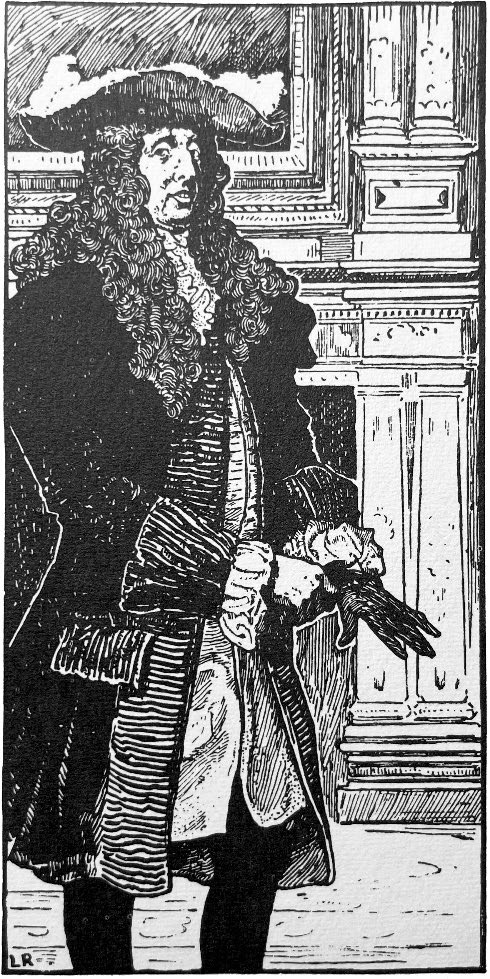
The Lord Luxurious.
confession. It lieth now in your breasts to hang him or save his life; but yet I think meet to instruct you into our law.
There was an Act made in the days of Pharaoh the Great, servant to our prince, that lest those of a contrary religion should multiply and grow too strong for him, their males should be thrown into the river. [Exo. 1:22] There was also an Act made in the days of Nebuchadnezzar the Great, another of his servants, that whosoever would not fall down and worship his golden image, should be thrown into a fiery furnace. [Dan. 3:6] There was also an Act made in the days of Darius, that whoso, for some time, called upon any god but him, should be cast into the lions' den. [Dan. 6] Now the substance of these laws this rebel has broken, not only in thought, (which is not to be borne), but also in word and deed; which must therefore needs be intolerable.
For that of Pharaoh, his law was made upon a supposition, to prevent mischief, no crime being yet apparent; but here is a crime apparent. For the second and third, you see he disputeth against our religion; and for the treason he hath confessed, he deserveth to die the death.
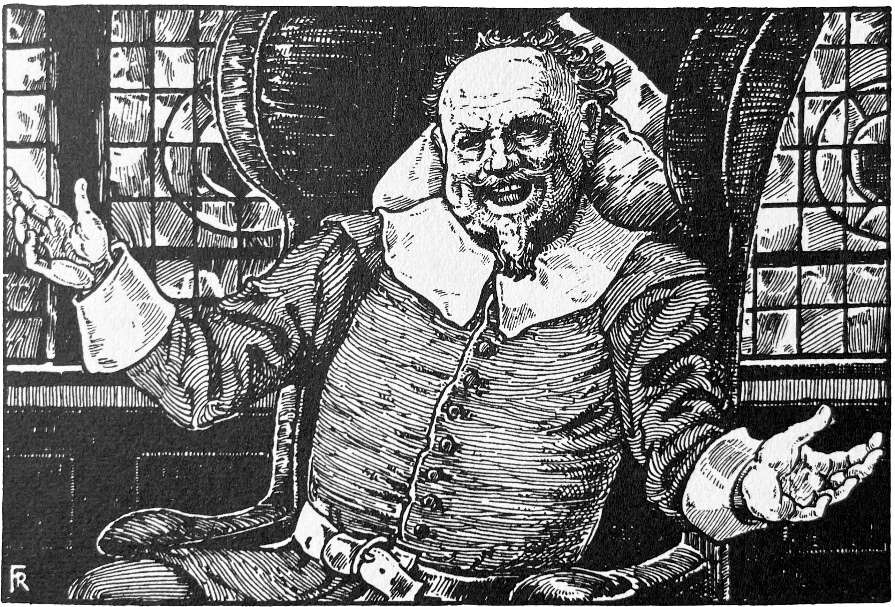

The Lord Carnal-delight.
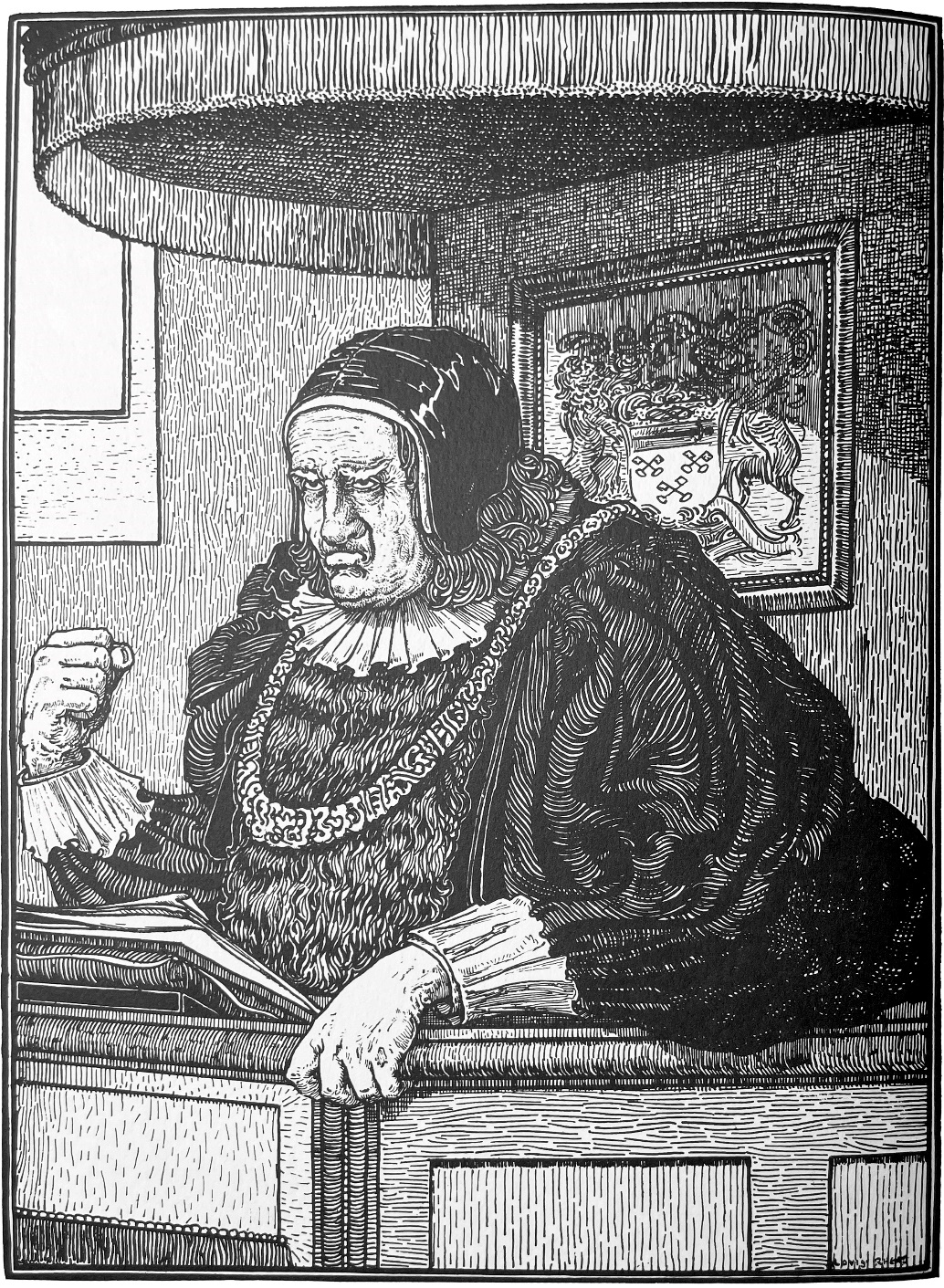
He deserveth to die the death.
FAITHFUL DIES AT THE STAKE
Then went the jury out, whose names were, Mr. Blind-man, Mr. No-good, Mr. Malice, Mr. Love-lust, Mr. Live-loose, Mr. Heady, Mr. High-mind, Mr. Enmity, Mr. Liar, Mr. Cruelty, Mr. Hate-light, and Mr. Implacable; who every one gave in his private verdict against him among themselves, and afterwards unanimously concluded to bring him in guilty before the Judge. And first, among themselves, Mr. Blind-man, the foreman, said, I see clearly that this man is a heretic. Then said Mr. No-good, Away with such a fellow from the earth. Ay, said Mr. Malice, for I hate the very looks of him. Then said Mr. Love-lust, I could never endure him. Nor I, said Mr. Live-loose, for he would always be condemning my way. Hang him, hang him, said Mr. Heady. A sorry scrub, said Mr. High-mind. My heart riseth against him, said Mr. Enmity. He is a rogue, said Mr. Liar. Hanging is too good for him, said Mr. Cruelty. Let us despatch him out of the way, said Mr. Hate-light. Then said Mr. Implacable, Might I have all the world given me, I could not be reconciled to him; therefore, let us forthwith bring him in guilty of death. And so they did; therefore he was presently condemned to be had from the place where he was, to the place from whence he came, and there to be put to the most cruel death that could be invented.
They therefore brought him out, to do with him according to their law; and, first, they scourged him, then they buffeted him, then they lanced his flesh with knives; after that, they stoned him with stones, then pricked him with their swords; and, last of all, they burned him to ashes at the stake. Thus came Faithful to his end.
Now I saw that there stood behind the multitude a chariot and a couple of horses, waiting for Faithful, who (so soon as his adversaries had despatched him) was taken up into it, and straightway was carried up through the clouds, with sound of trumpet, the nearest way to the Celestial Gate.
Brave FAITHFUL, bravely done in word and deed; Judge, witnesses, and jury have, instead Of overcoming thee, but shown their rage: When they are dead, thou'lt live from age to age*.
But as for Christian, he had some respite, and was remanded back to prison. So he there remained for a space; but He that overrules all things, having the power of their rage in his own hand, so wrought it about, that Christian for that time escaped them, and went his way. And as he went, he sang, saying--
Well, Faithful, thou hast faithfully profest Unto thy Lord; with whom thou shalt be blest, When faithless ones, with all their vain delights, Are crying out under their hellish plights:
Sing, Faithful, sing, and let thy name survive; For though they kill'd thee, thou art yet alive!
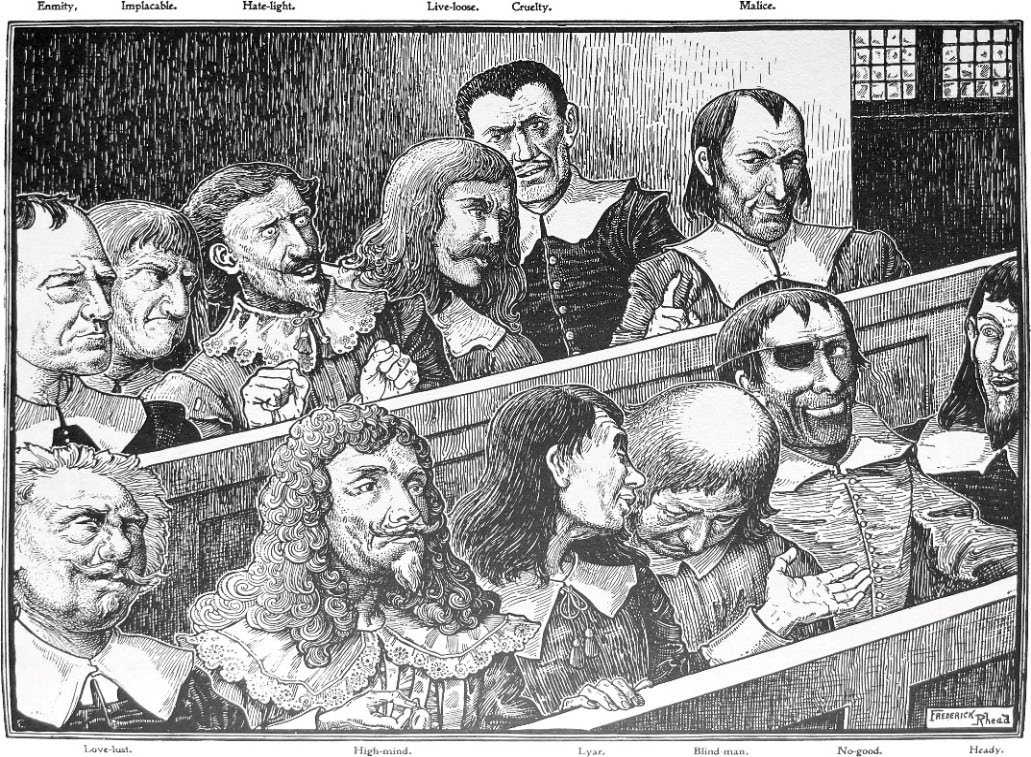
The Jury.
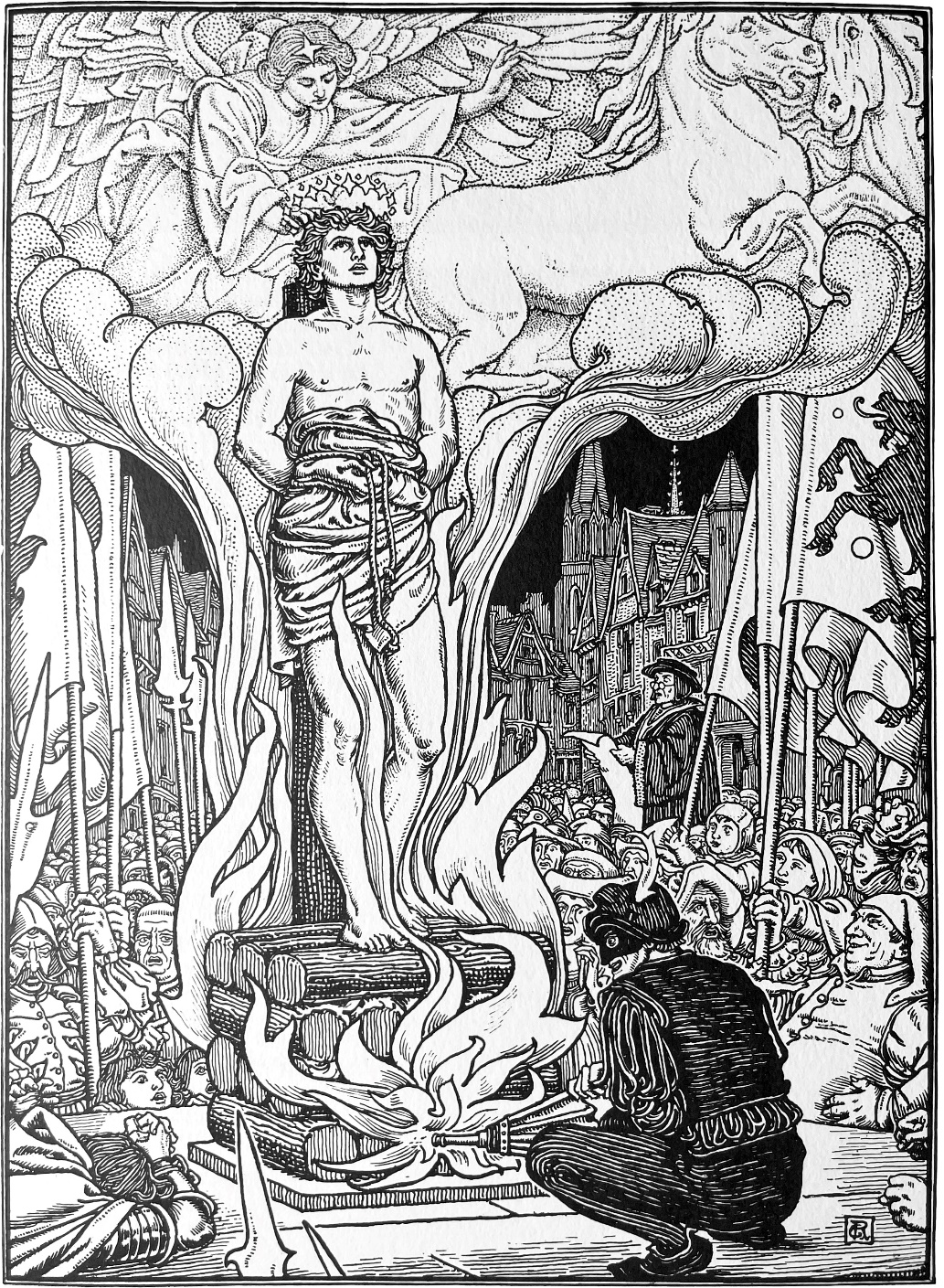
And last of all they burned him to Ashes at the Stake. Thus came Faithful to his end.
Chapter 7
Now I saw in my dream, that Christian went not forth alone, for there was one whose name was Hopeful (being made so by the beholding of Christian and Faithful in their words and behaviour, in their sufferings at the fair), who joined himself unto him, and, entering into a brotherly covenant, told him that he would be his companion. Thus, one died to bear testimony to the truth, and another rises out of his ashes, to be a companion with Christian in his pilgrimage. This Hopeful also told Christian, that there were many more of the men in the fair, that would take their time and follow after.
BY-ENDS OF FAIR SPEECH
So I saw that quickly after they were got out of the fair, they overtook one that was going before them, whose name was Byends: so they said to him, What countryman, Sir? and how far go you this way? He told them that he came from the town of Fairspeech, and he was going to the Celestial City (but told them not his name).
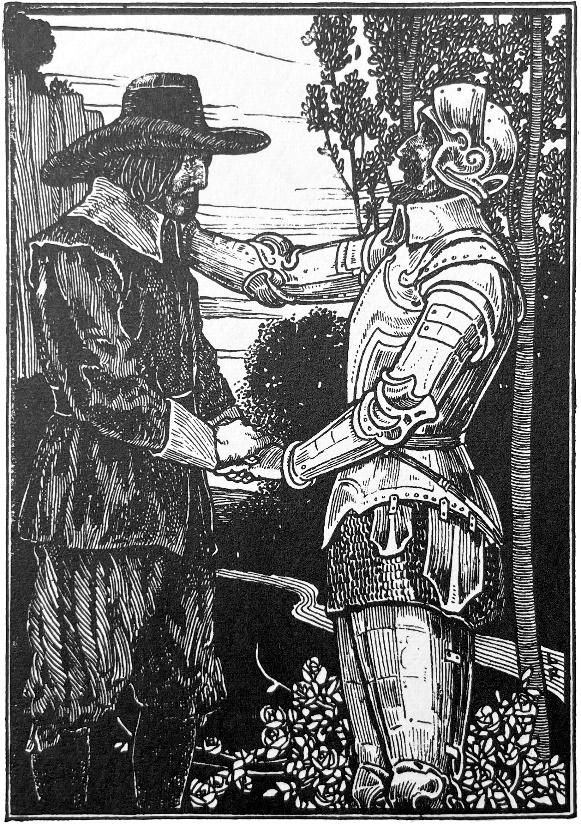
From Fair-speech! said Christian. Is there any good that lives there? [Prov. 26:25]
BY-ENDS. Yes, said By-ends, I hope.
CHR. Pray, Sir, what may I call you? said Christian.

There was one whose name was Hopeful, who joined himself unto him.
BY-ENDS. I am a stranger to you, and you to me: if you be going this way, I shall be glad of your company; if not, I must be content.
CHR. This town of Fair-speech, said Christian, I have heard of; and, as I remember, they say it is a wealthy place.
BY-ENDS. Yes, I will assure you that it is; and I have very many rich kindred there.
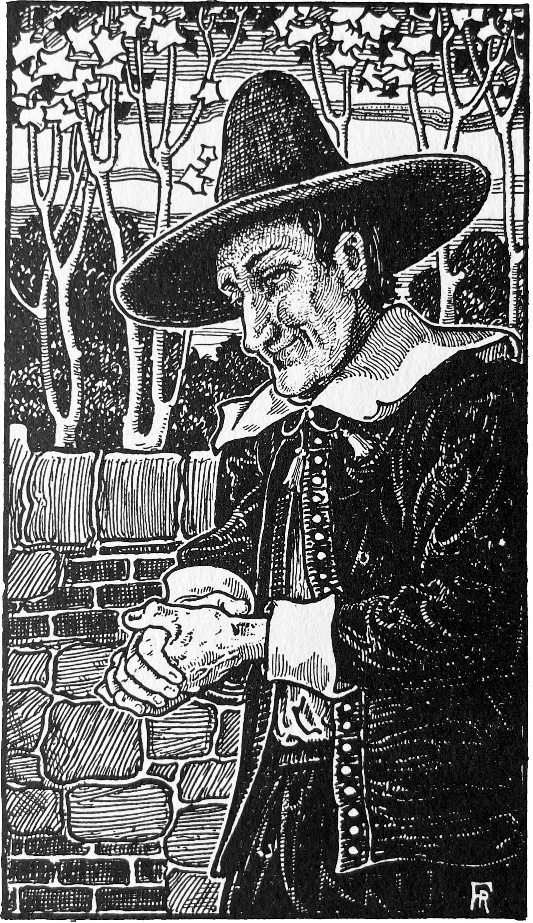
CHR. Pray, who are your kindred there? if a man may be so bold.
BY-ENDS. Almost the whole town; and in particular, my Lord Turn-about, my Lord Time-server, my Lord Fair-speech, (from whose ancestors that town first took its name), also Mr. Smooth-man, Mr. Facing-both-ways, Mr. Any-thing; and the parson of our parish, Mr. Two-tongues, was my mother's own brother by father's side; and to tell you the truth, I am become a gentleman of good quality, yet my great-grandfather was but a waterman, looking one way and rowing another, and I got most of my estate by the same occupation.
CHR. Are you a married man?
BY-ENDS. Yes, and my wife is a very virtuous woman, the daughter of a virtuous woman; she was my Lady Feigning's daughter, therefore she came of a very honourable family, and is arrived to such a pitch of breeding, that she knows how to carry it to all, even to prince and peasant. It is true we somewhat differ in religion from those of the stricter sort, yet but in two small points: first, we never strive against wind and tide; secondly, we are always most zealous when

They overtook one that was going before them, whose name was By-ends.
religion goes in his silver slippers; we love much to walk with him in the street, if the sun shines, and the people applaud him.
Then Christian stepped a little aside to his fellow, Hopeful, saying, It runs in my mind that this is one By-ends of Fair-speech; and if it be he, we have as very a knave in our company as dwelleth in all these parts. Then said Hopeful, Ask him; methinks he should not be ashamed of his name. So Christian came up with him again, and said, Sir, you talk as if you knew something more than all the world doth; and if I take not my mark amiss, I deem I have half a guess of you: Is not your name Mr. By-ends, of Fairspeech?
BY-ENDS. This is not my name, but indeed it is a nick-name that is given me by some that cannot abide me: and I must be content to bear it as a reproach, as other good men have borne theirs before me.
CHR. But did you never give an occasion to men to call you by this name?
BY-ENDS. Never, never! The worst that ever I did to give them an occasion to give me this name was, that I had always the luck to jump in my judgment with the present way of the times, whatever it was, and my chance was to get thereby; but if things are thus cast upon me, let me count them a blessing; but let not the malicious load me therefore with reproach.
CHR. I thought, indeed, that you were the man that I heard of; and to tell you what I think, I fear this name belongs to you more properly than you are willing we should think it doth.
BY-ENDS. Well, if you will thus imagine, I cannot help it; you shall find me a fair company-keeper, if you will still admit me your associate.
CHR. If you will go with us, you must go against wind and tide; the which, I perceive, is against your opinion; you must also own religion in his rags, as well as when in his silver slippers; and stand by him, too, when bound in irons, as well as when he walketh the streets with applause.
BY-ENDS. You must not impose, nor lord it over my faith; leave me to my liberty, and let me go with you.
CHR. Not a step further, unless you will do in what I propound as we.
Then said By-ends, I shall never desert my old principles, since they are harmless and profitable. If I may not go with you, I must do as I did before you overtook me, even go by myself, until some overtake me that will be glad of my company.
MONEY-LOVES PRINCIPLES
Now I saw in my dream that Christian and Hopeful forsook him, and kept their distance before him; but one of them looking back, saw three men following Mr. By-ends, and behold, as they came up with him, he made them a very low conge {conge'}; and they also gave him a compliment. The men's names were Mr. Hold-the-world, Mr. Money-love, and Mr. Save-all; men that Mr. By-ends had formerly been acquainted with; for in their minority they were schoolfellows, and were taught by one Mr. Gripe-man, a schoolmaster in Love-gain, which is a market town in the county of Coveting, in the north. This schoolmaster taught them the art of getting, either by violence, cozenage, flattery, lying, or by putting on the guise of religion; and these four gentlemen had attained much of the art of their master, so that they could each of them have kept such a school themselves.
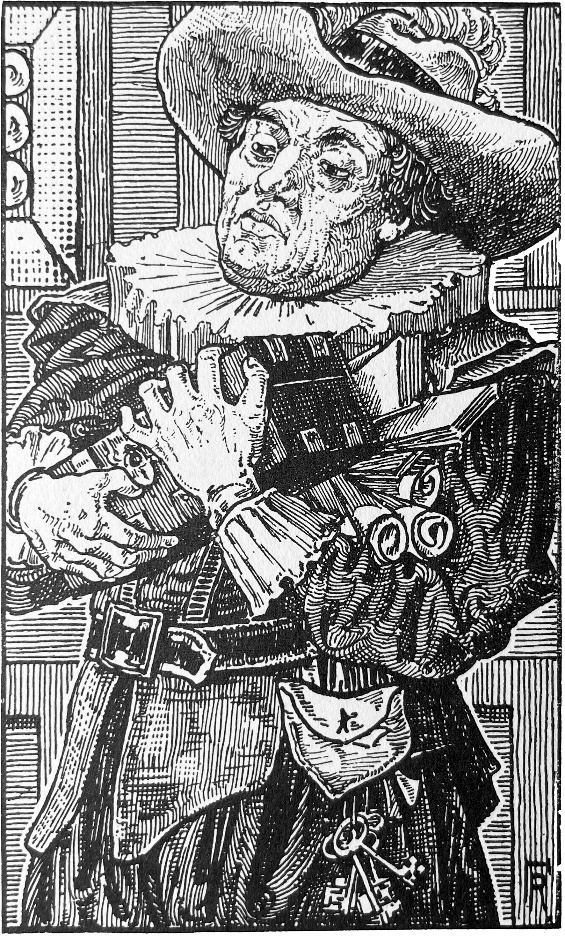
Well, when they had, as I said, thus saluted each other, Mr. Money-love said to Mr. Byends, Who are they upon the road before us? (for Christian and Hopeful were yet within view).
BY-ENDS. They are a couple of far countrymen, that, after their mode, are going on pilgrimage.
Mr. Money-love.
MONEY-LOVE. Alas! Why did they not stay, that we might have had their good company? for they, and we, and you, Sir, I hope, are all going on pilgrimage.
BY-ENDS. We are so, indeed; but the men before us are so rigid, and love so much their own notions, and do also so lightly esteem the opinions of others, that let a man be never so godly, yet if he jumps not with them in all things, they thrust him quite out of their company.
SAVE-ALL. That is bad, but we read of some that are righteous overmuch; and such men's rigidness prevails with them to judge and condemn all but themselves. But, I pray, what, and how many, were the things wherein you differed?
BY-ENDS. Why, they, after their headstrong manner, conclude that it is duty to rush on their journey all weathers; and I am for waiting for wind and tide. They are for hazarding all for God at a clap; and I am for taking all advantages to secure my life and estate. They are for holding their notions, though all other men are against them; but I am for religion in what, and so far as the times, and my safety, will bear it. They are for religion when in rags and contempt; but I am for him when he walks in his golden slippers, in the sunshine, and with applause.
HOLD-THE-WORLD. Ay, and hold you there still, good Mr. By-ends; for, for my part, I can count him but a fool, that, having the liberty to keep what he has, shall be so unwise as to lose it. Let us be wise as serpents; it is best to make hay when the sun shines; you see how the bee lieth still all winter, and bestirs her only when she can have profit with pleasure. God sends sometimes rain, and sometimes sunshine; if they be such fools to go through the first, yet let us be content to take fair weather along with us. For my part, I like that religion best that will stand with the security of God's good blessings unto us; for who can imagine, that is ruled by his reason, since God has bestowed upon us the good things of this life, but that he would have us keep them for his sake? Abraham and Solomon grew rich in religion. And Job says, that a good man shall lay up gold as dust. But he must not be such as the men before us, if they be as you have described them.
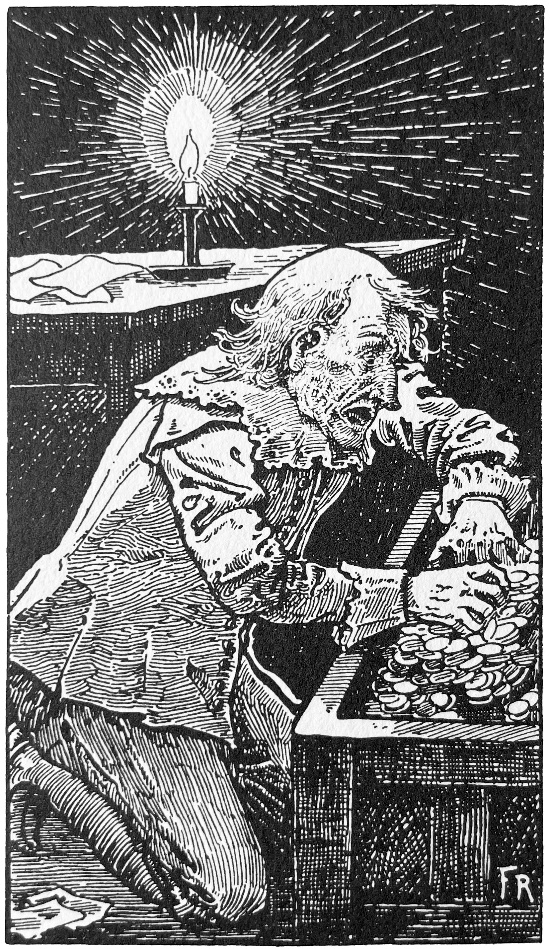
SAVE-ALL. I think that we are all agreed in this matter, and therefore there needs no more words about it.
MONEY-LOVE. No, there needs no more words about this matter, indeed; for he that believes neither Scripture nor reason (and you see we have both on our side) neither knows his own liberty, nor seeks his own safety.
BY-ENDS. My brethren, we are, as you see, going all on pilgrimage; and, for our better diversion from things that are bad, give me leave to propound unto you this question:--
Suppose a man, a minister, or a tradesman, &c., should have an advantage lie before him, to get the good blessings of this life, yet so as that he can by no means come by them except, in appearance at least, he becomes extraordinarily zealous in some points of religion that he meddled not with before, may he not use these means to attain his end, and yet be a right honest man?
Mr. Save-all.
MONEY-LOVE. I see the bottom of your question; and, with these gentlemen's good leave, I will endeavour to shape you an answer. And first, to speak to your question as it concerns a minister himself: Suppose a minister, a worthy man, possessed but of a very small benefice, and has in his eye a greater, more fat, and plump by far; he has also now an opportunity of getting of it, yet so as by being more studious, by preaching more frequently and zealously, and, because the temper of the people requires it, by altering of some of his principles; for my part, I see no reason