
single point of duty; but to take in the
) 4« You are sensible what figures those make, who flay in the university till they are fuperannuated. I cannot think drowfmefs promotes holiness.
How commonly do they drone away their life, either in a college or a country parfonage, where they can only give God the ftmffs of them; having nothing of life or vigour left, to make them useful in the world.
5. We are not to fix out eye on one single point of duty; but to take in the complicated view of all the circumstances in every state of life that offers.
Thus, in the case before us, put all the circumstances together. If you are not indifferent whether the labours of an aged father for above forty years, in God's vineyard, be loft, and the fence of it trodden down and deftroycd; if you confider that Mr M mud in all https://doi.org/10.1017/CBO9781139644792.006 Published online by Cambridge University Press
C probability succeed me, if you do not ;• and that the profpeft of that mighty Nimlod's coming hither, shocks my soul, and is in a fair way of bringing down my grey hairs with fonfo"» to the gravd; if you have any care for OUT family, whichmu(V be difrnally Shattered, as soon as I am dr6pt; if you reflect on the dear lovt and longing of this poor people for you, whereby you will be enabled to do God she more service, and the pknteoufnefs of the harvest, confiding of near two thousand fouls, whereas you have not many more scholars in the university, you may perhaps alter your will, and bend your mind to him, who has promised, " if in all our ways we acknowledge him, he will direct our paths."
This pathetic letter was followed by another from his son Samuel. His brohttps://doi.org/10.1017/CBO9781139644792.006 Published online by Cambridge University Press
( 1*5 ) ther's chief objection was, as we have seen already, th?«t he could not leave Oxford, upon ths principle of doing good, because he was convinced, that where ibe could reap the most benefit himself, he could more eiFe&ually promote the good of others. But, fays he^
" I am equally aflured there is no place under heaven, fo fit for my improvement as Oxford."
A paflage in Samuel's letter, where he contrafts his own obedience to his father's injunctions, with the inflexible behaviour of his brother, gives a finking view of the opinion he had of his refoiute and determined fpirk.
The expressions are very remarkable. " After this declaration, I believe no one can move your mind, but him that made it: much Iefs do I think myself qualified for that purpose. https://doi.org/10.1017/CBO9781139644792.006 Published online by Cambridge University Press
"You may fay, I have been too paffivc 1 left Oxford, with all the opportunity of doing gbodj on a worldly account, at my father's desire. I left my last settlement, by the fame determination; and I mould have thought I finned both times, if I had not followed it.
" You are not at liberty to resolve againfl: undertaking a cure of fouls. You are solemnly engaged to do it, before God, and his high priest, and his church.
Are you not ordained ? Did you not deliberately and openly promise to inftruft, to admonish, to exhort those committed to your charge ? Did you equivocate then, with fo vile a reservation, as to propose in your heart, that you would never have any fo committed ?
5Tis not an university; 'tis not a college.; 'tis the order of the church according to which you were called. Let Charles, if https://doi.org/10.1017/CBO9781139644792.006 Published online by Cambridge University Press
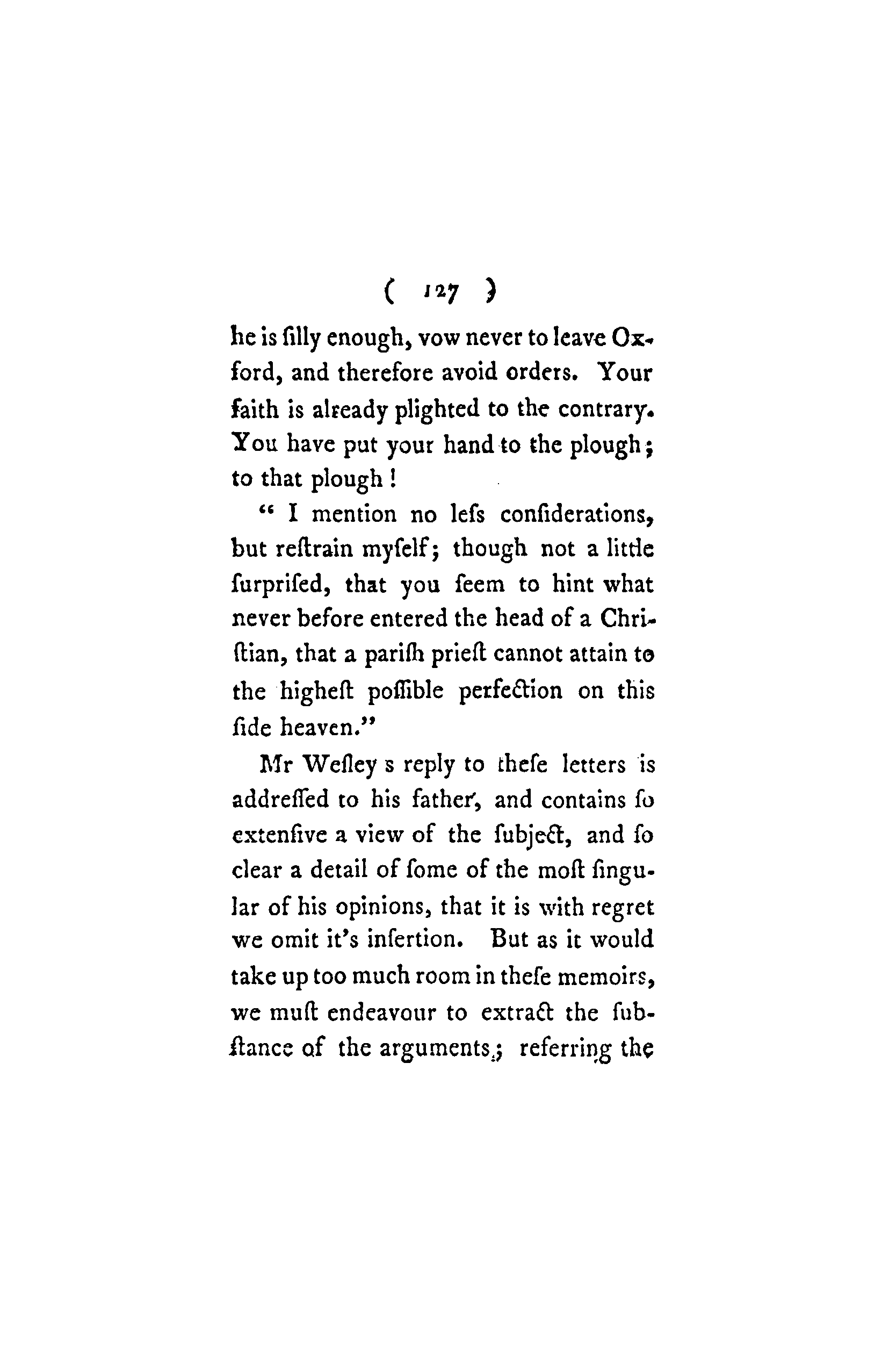
he is filly enough, vow never to leave Oxford, and therefore avoid orders. Your faith is already plighted to the contrary.
You have put your hand to the plough; to that plough!
" I mention no less considerations, but restrain myself; though not a little surprised, that you feetn to hint what never before entered the head of a Christian, that a parish priest cannot attain to the highefl: poflible perfection on this side heaven."
Mr Wesley s reply to these letters is addrefled to his father", and contains fo extensive a view of the subject:, and fo clear a detail of some of the mod singular of his opinions, that it is with regret we omit it's insertion.
But as it would take up too much room in these memoirs, we mud endeavour to extraft the fubilance of the arguments.; referring the https://doi.org/10.1017/CBO9781139644792.006 Published online by Cambridge University Press