
Front matter
Letters of Peter Abelard, Beyond the Personal
medieval texts in translation editorial director Thomas F. X. Noble University of Notre Dame editorial board Paul Dutton Simon Fraser University Geoffrey Koziol University of California at Berkeley Carol Lansing University of California at Santa Barbara
Barbara H. Rosenwein Loyola University of Chicago
Letters of Peter Abelard, Beyond the Personal Translated by Jan M. Ziolkowski The Catholic University of America Press
Washington, D.C.
Copyright © 2008 The Catholic University of America Press All rights reserved The paper used in this publication meets the minimum requirements of American National Standards for Information Science—Permanence of Paper for Printed Library Materials, ansi z39.48-1984.
∞ Library of Congress Cataloging-in-Publication Data Abelard, Peter, 1079–1142.
[Letters. English. 2008]
Letters of Peter Abelard, Beyond the Personal / translated by Jan M.
Ziolkowski.
p. cm.
Includes bibliographical references and index.
isbn 978-0-8132-1505-1 (pbk. : alk. paper) 1. Abelard, Peter, 1079– 1142—Correspondence—Translations into English. I. Ziolkowski, Jan
M., 1956– II. Title. III. Title: Beyond the personal.
b765.a24a4 2007
189'.4—dc22 2007012248
[B]
To Liz, with love, these letters in lieu of my own
Contents
Acknowledgments ix
Abbreviations xi
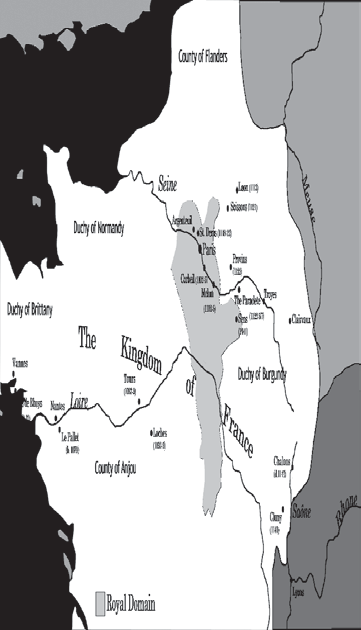
Map of Abelard's France xii
General Introduction: Life and Works xiii part i. Heloise and the Nuns
of the Paraclete
1. letter nine. To the Nuns of the Paraclete
Letter Nine
2. prefaces to the Three Books of
The Paraclete Hymnal
Preface to the First Book
Preface to the Second Book
Preface to the Third Book
3. dedication letter to The Commentary
on the Six Days of Creation
Dedication Letter
4. letter sixteen. Prologue to The Sermons
Letter Sixteen
part ii. Bernard of Clairvaux
5. letter ten. To Bernard of Clairvaux
Letter Ten
viii contents
6. letter fifteen. To His Comrades, against
Abbot Bernard
Letter Fifteen
7. apologia against Bernard of Clairvaux
Apologia
part iii. Other Controversies
8. letter eleven. To Abbot Adam and
the Monks of St. Denis
Letter Eleven
9. letter twelve. To a Regular Canon
Letter Twelve
10. letter thirteen. To an Ignoramus in the
Field of Dialectic
Letter Thirteen
11. letter fourteen. To Bishop G[ilbert]
and the Clergy of Paris
Letter Fourteen
Bibliography
General Index
Index of Scriptural References
Acknowledgments Although I alone hold blame for the present book, Peter Dronke has responsibility for having proposed it to me fifteen years ago, and I thank him for both that initial incitement and for his meticulous reading of a recent draft. For their thoughtful attention to the same version, I am also grateful to the other reader for the Catholic University of America Press, Paul Dutton, as well as to the series editor. While the book was in production, I was fortunate to have the painstaking editing of Philip Gerard Holthaus.
Together with anyone else who works with most of the materials translated here, I owe a debt to the late Edmé Smits for his impeccable edition of the Latin. Originally, when my plan was a dual-language edition, he graciously extended to me the right to reprint his text. After Edmé's sadly sudden death, his literary executor, L. C. Engels, reaffirmed the permission with equal generosity.
At that stage, since scanning was not yet a possibility, Lenore Parker keyboarded for me the Latin of Edmé Smits's text and textual notes. (About the same time she also inputted on the basis of my longhand the rough drafts of the English translations: my warm thanks go to her for everything.) Years later Philip Kim proofread the Latin material (just as he later did the page proofs of this book), for which I am grateful even if it is not appearing alongside the English as I had once envisaged. It is splendid that the Latin will appear shortly in the Corpus Christianorum Continuatio Mediaevalis, where far more than a mere corpusculum of Peter Abelard's works has now come together. ix
acknowledgments Completion of the present project would have been inconceivable without the simultaneous sedation and stimulation that the Netherlands Institute for Advanced Study provided me for ten months in 2005–2006. For the privilege of being ensconced in the soothing environs of Wassenaar, I am deeply beholden. The librarians of the institute worked wonders in supplying me rapidly and copiously with books and articles, and my fellow medievalists in the attic bore with my occasional unsolicited monologues about Abelard's writings. In addition, Emily Vasiliauskas helped me ably again and again from afar as my research assistant in Cambridge to secure items and verify references more readily handled through Widener and other collections in the Harvard College Library. Finally, I thank Sarah Watson for generating the map. As the project was rounding the final bend, Chrysogonus Waddell did me the kindness of identifying two snippets from hymns that had been eluding my grasp, and I am glad to offer him my appreciation.
My greatest debt is owed to the dedicatee. A topos of acknowledgments would have me express appreciation to her for having borne with me as I talked over the years about the details of the project. Instead, I appreciate that she has allowed me to be absent.
To her I send these letters.
Abbreviations AH Analecta hymnica medii aevi. Edited by Guido Maria Dreves,
Clemens Blume, and Henry Marriott Bannister. 55 vols. Leipzig,
Germany: Fues's Verlag (R. Reisland), 1886–1922.
CCSL Corpus Christianorum, Series Latina. Turnhout, Belgium:
Brepols, 1953–.
CCCM Corpus Christianorum, Continuatio Mediaevalis. Turnhout,
Belgium: Brepols, 1966–.
CSEL Corpus Scriptorum Ecclesiasticorum Latinorum. Vienna:
apud C. Geroldi filium etc., 1866–.
PL Patrologiae cursus completus. Series Latina. Edited by Jacques-Paul
Migne. 221 vols. Paris: apud Garnier Fratres, 1844–1855 and
1862–1864.
Schaller/ Schaller, Dieter, and Ewald Könsgen. Initia carminum Latinorum Könsgen saeculo undecimo antiquiorum. Göttingen, Germany: Vandenhoeck &
Ruprecht, 1977. xi
general introduction.
Life and Works Life The twelfth century has benefited from a disproportionate share of the curiosity, romantic attraction, and even daydreams and fantasies that have been elicited by the extraordinarily vibrant and variegated millennium to which the label the "Middle Ages" has been affixed. Attempts have been made to validate earlier spans of time within this thousand years as having undergone equivalently consequential and productive renewals, so that the terms "Carolingian
Renaissance" and "Ottonian Renaissance" have sometimes been bandied about, but the first such formulation, and the most abiding one, remains the "Twelfth-Century Renaissance."
This period, often tacitly protracted to a hundred fifty years by appending at either end an additional quarter century (1075–
1225), has been and continues to be scrutinized for such disparate phenomena as the creation of new religious institutions; the rise of universities; the salience of love (or at least of talk about love) in both secular and religious culture; changes in relations between women and men; the flowering of vernacular literature, especially but by no means solely lyric poetry; and even the discovery or alleged discovery of the individual.1 The century calls to mind
1. The expression "Twelfth-Century Renaissance" owes its existence and dissemination to Charles Homer Haskins (1870–1937), The Renaissance of the Twelfth Century (Cambridge, Mass.: Harvard University Press, 1927). To bring Haskins's findings closer to the present day, an invaluable collection (linked explicitly with the earlier xiii
xiv general introduct ion contrasts and clashes in thought, such as nominalism and realism, reason and faith, and dialectic and Platonism. In all of these developments and debates the title character of this book played a role, sometimes on center stage.
Peter Abelard (1079–1142) ranks among the best-known thinkers, teachers, and personages of the entire medieval period. Although he is often designated tout court as Abelard (also spelled in English as "Abaelard" and "Abailard") and will be called so here, that name appears to be a cognomen he acquired only during or after his student years.2 A person wishing to refer to him formally in his own day would have addressed him by the Latin Petrus or magister Petrus. Beyond being a logician, philosopher, and theologian of the first order, Abelard earned fame as a poet and songwriter.3
His reputation has only been enhanced by the controversy he provoked, both through the shocking outcome of the affair he had with a young woman who had been entrusted to him for private inbook) is Robert L. Benson and Giles Constable, eds., Renaissance and Renewal in the Twelfth Century (Cambridge, Mass.: Harvard University Press, 1982).
2. For a list of thirty-seven medieval spellings of the name, see David E. Luscombe, The School of Peter Abelard: The Influence of Abelard's Thought in the Early Scholastic Period,
Cambridge Studies in Medieval Life and Thought: New Series 14 (Cambridge, U.K.:
Cambridge University Press, 1969), 315. On the nickname, see Constant J. Mews, "In Search of a Name and Its Significance: A Twelfth-Century Anecdote about Thierry and Peter Abaelard," Traditio 44 (1988): 175–200; repr. in Mews, Reason and Belief in the Age of Roscelin and Abelard, Variorium Collected Studies CS730 (Aldershot, U.K.: Ashgate, 2002).
3. On his logic and philosophy, the best starting place is John Marenbon, The Philosophy of Peter Abelard (Cambridge, U.K.: Cambridge University Press, 1997). On his achievements as a theologian, a compact introduction is furnished by Jean Jolivet, La théologie d'Abélard (Paris: Editions du Cerf, 1997). On Heloise's and Abelard's accomplishments and reputations in literature, some fundamental works by Peter Dronke have been gathered in his Intellectuals and Poets in Medieval Europe, Storia e letteratura:
Raccolta di studi e testi 183 (Rome: Edizioni de Storia e Letteratura, 1992), 247–342.
On what can be discerned of his skills in music, see Lorenz Weinrich, "Peter Abaelard as Musician I" and "Peter Abaelard as Musician II," Musical Quarterly 55 (1969):
295–312 and 464–86, and Gerard Le Vot, "Que savons-nous sur la musique des Planctus d'Abelard?," in Paul Zumthor, trans., Abélard. Lamentations. Histoire de mes malheurs.
Correspondance avec Héloïse, Babel 52 (Arles, France: Actes Sud, 1992), 107–22.
life and works xv struction, Heloise (often rendered as "Eloise" or "Héloïse"), and through his having been tried twice thereafter for heresy in his theological teachings and writings.4 Although his encounters with the Church could call to mind the earlier trial of Socrates in 399 b.c.e. or the later one of Galileo in 1633, and although he has been coopted as a kind of precursor to the Reformation and the Enlightenment, it must not be overlooked when drawing such anachronistic analogies that Abelard not only became a monk and served as abbot of a monastery, but also helped to shape—if "founded" is too strong a word—a female religious order. There is no sense in tagging him so as to imply that he is exclusively conservative or innovative, orthodox or heterodox, monk or magister, or at the one or the other end of any other such polarities. His life and works have too many intricacies and idiosyncrasies to permit such reductionism.
Knowledge of his life has increased thanks to the continued mining and sifting of a rich and possibly growing but ultimately frustrating lode of twelfth-century materials about him, including an autobiographical letter as well as a subsequent correspondence between him and Heloise (around 1100–1164), which have secured them places among the most famous men and women of the twelfth century.5 A few of the key dates in Abelard's biography remain hotly contested, and Heloise's age at the time of their love story has been estimated variously. For want of evidence, such details may never be fixed definitively.6 Still more unsettling, spe4. The relationship between Heloise and Abelard has elicited vast amounts of attention, not all of it reliable as scholarship. For a recent specimen, see James Burge,
Heloise and Abelard: A Twelfth-Century Love Story (London: Profile Books, 2003).
5. For an insightfully synthetic but not chronologically linear biography of Abelard, see Michael T. Clanchy, Abelard: A Medieval Life (Oxford, U.K.: Blackwell, 1997).
The most recent appreciation of Abelard (with close scrutiny of Heloise as well) is
Constant J. Mews, Abelard and Heloise (Oxford, U.K.: Oxford University Press, 2005).
6. For the common opinion on many major dates in Abelard's life as they are now generally accepted, see Michael T. Clanchy, "Chronology," in The Letters of Abelard and Heloise, trans. Betty Radice, rev. Clanchy (London: Penguin Books, 2003), ix–xi.
xvi general introduct ion cialists have been sharply divided at times in their opinions on the authenticity of these letters. Yet despite all the uncertainties, the long-past affair that hangs over them and their lives long afterward has taken on an existence of its own in translations, adaptations of varying degrees of freedom, and even plays, operas, and films.7 If it is an exaggeration, it is only a slight one to contend that Abelard and Heloise have gained the cultural status of Lancelot and Guinevere, Dante and Beatrice, Petrarch and Laura, or even Romeo and Juliet. The first four letters in this book pertain to the relations between Abelard and Heloise, but stem from a period somewhat after the better known correspondence.
Many basic facts of Peter Abelard's life can be pieced together from an autobiographical letter, or apologia, the Historia calamitatum (The Story of My Disasters; written around 1132), as well as from mentions in other texts.8 He was born in 1079 at Le Pallet, a village about a dozen miles east of Nantes in Brittany. Although an eldest son of noble background, he was drawn to the world of learning or, to be more precise, to the domain of reasoning and debating.9 Eventually he forsook his birthright as a knight to become a philosopher. Initially he devoted himself especially to logic or dialectic. Letter Thirteen in this volume does not date from this earliest stage in his career, but it gives an eloquent testimonial to the lifelong conviction Abelard cherished in the powers of dialectic, as well as to the impatience he evidenced for those who were not like-minded and who failed to grasp the utilities of formal
7. On the final three categories, see Raffaella Asni, "Abélard et Héloïse sur l'écran et la scène de 1900 à nos jours," in Pierre Abélard. Colloque international de Nantes, ed. Jean
Jolivet and Henri Habrias (Rennes, France: Presses Universitaires de Rennes, 2003),
185–203.
8. The generally cited edition of the Latin is Jacques Monfrin, ed., Abélard, Historia calamitatum (Paris: J. Vrin, 1959). The standard translation is in Letters of Abelard and Heloise, trans. Radice, 3–43.
9. His father and mother belonged to the minor nobility. On Abelard's parentage and genealogy, see Brenda M. Cook, "Abelard and Heloise," Genealogists' Magazine
26 (1999): 205–11.
life and works xvii logic as a tool for problem solving and intellectual discovery and advancement.
Although the schools of Paris became paramount in his professional life, Abelard first journeyed to other places to obtain and offer an education in philosophy, especially in logic.10 Letter
Fourteen gives a picture of his combative relations, a quarter century later, with one of his principal instructors during this early phase of his education. His itinerancy in learning and teaching was at least a contributing factor in one of his nicknames, Peripateticus Palatinus. He qualified as "the Peripatetic" by virtue of both his traveling ways and of course his close acquaintance with (and resemblance to) Aristotle, the Greek philosopher of the fourth century b.c.e. whose followers were so called after the arcade in the ancient Athenian Lyceum where they walked about (peripatos in Greek) while debating. The epithet of "the Palatine" Abelard merited by way of his birthplace, Le Pallet, and perhaps by his own nobility as well as by his connections with the higher nobility
(since the adjective associated him with the palace and would have carried undertones similar to "courtier").11
Abelard's earliest education in logic took place sometime in the 10. On his relations with the schools (particularly of Paris), see Jean Châtillon, "Abélard et les écoles," in Abélard en son temps. Actes du colloque international organisé à l'occasion du 9e centenaire de la naissance de Pierre Abélard (14–19 mai 1979), ed. Jean Jolivet (Paris: Les Belles Lettres, 1981), 133–60, and Stephen C. Ferruolo, The Origins of the University: The Schools of Paris and Their Critics, 1100–1215 (Stanford, Calif.: Stanford University Press, 1985), 18–22.
11. Early in the Historia calamitatum (ed. Monfrin, p. 64, line 30; trans. Radice, p. 3), Abelard terms himself "Peripateticorum emulator" (emulator of the Peripatetics). The full nickname appears in John of Salisbury (about 1110–1180), Metalogicon 1.5,
2.10, 2.17, 3.1, 3.4, and 3.6, ed. J. B. Hall, with K. S. B. Keats-Rohan, Ioannis Saresberiensis
Metalogicon, CCCM 98 (1991): 20, line 13; 70, line 5; 81, line 22; 103, line 6; 116, line 35; and 122, line 21; and John of Salisbury, Policraticus 2.22, ed. K. S. B. Keats-Rohan, Ioannis Saresberiensis Policraticus, CCCM 118 (1993): 129, lines 99–100. For a good introduction to John, see Southern, Scholastic Humanism, 1: 214–21. On the relationship between the two men as well as on the name, see François Lejeune, "Pierre Abélard et Jean de
Salisbury," in Pierre Abélard. Colloque international de Nantes, 63–75.
xviii general introduct ion final decade of the eleventh century (1093–1099) in Loches (Indreet-Loire), which lies south of Blois and Tours, and in Tours itself under Roscelin of Compiègne (about 1050–about 1120), a logician and theologian who had formulated controversial thoughts on Trinitarian theology and who had been induced to recant them at Soissons in 1092. Beyond his notions on the Trinity, Roscelin also maintained that words and names are only a means of describing realities, both physical and conceptual, from which they remain discrete. His beliefs in this regard, which belong to an important school of medieval thought known as nominalism (or more precisely as vocalism), left an enduring mark on Abelard; but this is not to suggest that Roscelin had a true disciple in the younger man for long, if ever. On the contrary, Abelard later went out of his way to dissociate himself from Roscelin. Letter Fourteen, the one that caps this collection, relates to their final sparring, apparently just before Roscelin's death or retirement.12
In about 1100 Abelard studied in the cathedral school of Paris under William of Champeaux (about 1070–1122), archdeacon of Paris and master of the school of Notre Dame.13 Abelard reacted just as strongly, and hostilely, against the realism of William and other twelfth-century Platonists as he had chafed against the nominalism of Roscelin, and he undertook to devise his own solu12. For details on Roscelin's thought and on the intellectual relationship between Abelard and Roscelin, see Constant J. Mews, "Nominalism and Theology before Abaelard: New Light on Roscelin of Compiègne," Vivarium 30 (1992): 4–33, and "The Trinitarian Doctrine of Roscelin of Compiègne and Its Influence: Twelfth-Century
Nominalism and Theology Reconsidered," in Langages et philosophie. Hommage à Jean Jolivet, ed. Alain de Libera, Abedelali Elamrani-Jamal, and Alain Galonnier, Etudes de philosophie médiévale 74 (Paris: J. Vrin, 1997), 347–64, both repr. in Mews, Reason and Belief. Many of Jean Jolivet's numerous publications on Abelard's philosophy grapple with the task of situating the master's thought vis-à-vis the nominalists.
13. On William, see Jean Jolivet, "Données sur Guillaume de Champeaux, dialecticien et théologien," in L'abbaye parisienne de Saint-Victor au Moyen Age: Communications présentées au XIIIe Colloque d'humanisme médiéval de Paris (1986–1988), ed. Jean Longère,
Bibliotheca Victorina 1 (Turnhout, Belgium: Brepols, 1991), 235–51.
life and works xix tion to the old problem of universals.14 More important in practical terms, he soon set up shop as master of his own school (about 1102–about 1105). He began to lecture in the royal towns of Melun and Corbeil.
Abelard's disagreements with William of Champeaux had consequences that extended far beyond the strictly intellectual, since
Abelard's hounding of his onetime teacher contributed to William's decision in 1108 to resign his position at Notre Dame and to take refuge with some companions in the hermitage of St. Victor, not far outside the city walls, on the left bank of the Seine, where they became Augustinian canons and he headed the school.15 Later, as bishop of Châlons, William installed Bernard (1090–1153) as abbot of Clairvaux (1115–1153), and the two grew to become friends.
St. Victor became a breeding ground for canons distinguished in theology, foremost among whom was Hugh of St. Victor (died
1141), who taught there from 1115 until his death. Because Hugh 14. On Abelard and William, see Yukio Iwakuma, "Pierre Abélard et Guillaume de Champeaux dans les premières années du XIIe siècle: Une étude préliminaire," in Joël Biard, ed., Langage, sciences, philosophie au XIIe siècle: Actes de la Table ronde internationale organisée les 25 et 26 mars 1998 par le Centre d'histoire des sciences et des philosophies arabes et médiévales (UPRESA 7062, CNRS/Paris VII/EPHE) et le Programme international de coopération scientifique (France-Japon) "Transmission des sciences et des techniques dans une perspective interculturelle" (Paris: J. Vrin, 1999), 93–123.
On Abelard's responses to Plato and Platonism, see Tullio Gregory, "Abélard et Platon," in Peter Abelard. Proceedings of the International Conference, Louvain, May 10–12, 1971, ed. Eligius M. Buytaert, Mediaevalia Lovaniensia Series 1, Studia 2 (Leuven, Belgium:
University Press, 1974), 38–64, repr. in Tullio Gregory, Mundana sapientia: Forme di conoscenza nella cultura medievale, Storia e letteratura 181 (Rome: Edizioni di storia e letteratura, 1992), 175–99; John Marenbon, "The Platonisms of Peter Abelard," in Néoplatonisme et philosophie médiévale: Actes du Colloque international de Corfou 6–8 octobre 1995, organisé par la Société internationale pour l'étude de la philosophie médiévale, ed. Linos G. Benakis, Rencontres de philosophie médiévale 6 (Turnhout, Belgium: Brepols, 1997), 109–29; and Lawrence Moonan, "Abelard's Use of the Timaeus," Archives d'histoire doctrinale et littéraire du moyen âge 56 (1989): 7–90.
15. On the establishment of the abbey, see Robert-Henri Bautier, "Les origines et les premiers développements de l'abbaye Saint-Victor de Paris," in L'abbaye parisienne de
Saint-Victor au Moyen Age, ed. Jean Longère, 23–52.
xx general introduct ion and Abelard flourished in Paris during the same decades, it is often illuminating to juxtapose their writings.16 At the same time, it must not be overlooked that there seems to have been scant love lost between Abelard and any of the Victorines.17 Consequently, comparison between them often brings out contrasts.
Eventually the pressures of teaching, probably exacerbated by tensions with William, Roscelin, and others, led to a failure of health that may have constituted what would be termed today a nervous breakdown (about 1105–about 1108), and Peter Abelard retreated to his native region for a few years to recover. It is likely that the concerns oppressing him exceeded the medieval equivalent of mere academic wrangles, since beyond the intellectual differences and teaching rivalries he and his antagonists had patrons in the highest reaches of contemporary politics who were themselves in conflict. William of Champeaux, associated first with the episcopally supported schools of Notre Dame and St. Victor, stood opposite to Stephen of Garlande, an archdeacon of Paris and chancellor (1106/7–1127/8) and seneschal to King Philip I (1052–1108, king of France 1059–1108), and Louis VI the Fat (1081–1137, king of France 1108–1137), who backed Abelard. Both Melun and Corbeil, the towns where Abelard taught, were affiliated with the king, and the public school of Mont Ste. Geneviève, out of which the University of Paris arose, was located in the cloister of secular canons where Stephen of Garlande was dean.18 Thus it lay outside episcopal jurisdiction. It was on Mont Ste. Geneviève that Abelard became master of his own school (about 1110–about 1112) after his return from convalescence.
16. For a panoptic approach to Hugh's worldview through his Didascalicon, see Ivan
Illich, In the Vineyard of the Text: A Commentary to Hugh's "Didascalicon" (Chicago: University of Chicago Press, 1993).
17. On Hugh of St. Victor in general, see Southern, Scholastic Humanism, 2: 56–65.
On his criticism of Abelard's teachings, see Luscombe, School of Peter Abelard, 183–97.
18. On the importance of Stephen in Abelard's career, see Robert-Henri Bautier, "Paris au temps d'Abélard," in Abélard en son temps, 21–77.
life and works xxi Around 1113, Abelard determined that he needed to progress from what could be caricatured as a single-minded pursuit of logic, particularly the logic of Aristotle as mediated through Boethius
(about 480–524). His interests had already ranged deeply into ethics and metaphysics, but his reputation rested on his teachings and writings on dialectic.19 Now he began also to amplify his scope to accommodate the investigation of theology. To this end, he traveled in 1113 to the cathedral school of Laon to learn from Anselm of Laon (about 1055–1117), an exegete and theologian who was renowned among his many followers and who had initiated an undertaking to outfit the whole Bible with a continuous commentary
(the so-called ordinary gloss, or Glossa ordinaria) that would supersede the partial ones that already existed.20 Anselm had a reputation as a very successful pedagogue, but Abelard found his methods boringly dissatisfying and his erudition painfully pedantic.
With the benefit of hindsight, the incompatibility of the two men seems to have been preordained. Anselm was text-driven, in that the information he imparted and the questions he posed emerged from within individual texts and the commentaries upon them; and he could be described as being allegorically inclined. In contrast, Abelard was question-driven, with a proclivity to favor logical analysis over all other forms of interpretation.
As Abelard had already done with both Roscelin and William of Champeaux, he made no bones about his quarrels with both the style and the content of the lectures his new teacher gave. At his most temperate, Abelard regarded Anselm as having acquired his authority mostly thanks to his advanced age.21 Going further, the young upstart probably made known his opinion that Anselm was a fool.22 Abelard managed, at least according to his own as19. On his ethics and metaphysics, see Marenbon, Philosophy of Abelard.
20. See Beryl Smalley, The Study of the Bible in the Middle Ages, 3rd ed. (Oxford, U.K.:
Blackwell, 1983), and Southern, Scholastic Humanism, 2: 25–48.
21. Historia calamitatum, ed. Monfrin, p. 67, lines 161–63; trans. Radice, pp. 6–7.
22. Otto of Freising, Gesta Frederici seu rectius Chronica, 1.50, ed. Franz-Josef Schmale,
xxii general introduct ion sessment, to outshine the revered old sage through his own teaching and thus instigated enduring hostility between his adherents and those of Anselm, particularly Alberic of Rheims (died 1141), who later led the cathedral school of Rheims and ultimately held office as archbishop of Bourges (from 1136/7 until his death), and Lotulf of Novara (also known as Lotulph of Lombardy).23 Alberic and Lotulf pressed Anselm to ban Abelard from teaching in Laon, which as head of the school the older man was able to do in short order.
After the rift with Anselm, Abelard returned to Paris in late 1113 or 1114 and resumed lecturing. Students were enthralled by the novelty of his pedagogy, which challenged them not just to absorb the definitive statements (auctoritates) in revered authors (auctores), but also to interrogate the texts and passages with the strength of their own logic. His magnetism as a master at the cathedral school of Notre Dame contributed to the eventual ascendancy of Paris as a major university town, preeminent in the teaching of dialectic.
By about 1116 he had completed a textbook, the Dialectica, that gave room to his own creativity qua logician as his earlier teaching had not done, which had hewed more closely to the set texts by Aristotle; Porphyry, the Neoplatonic philosopher (about 232–304); and Boethius. At the same time, his popularity also made him a lightning rod for monastic criticism, since many brethren would have regarded Abelard himself as well as the schooling and thinking he embodied as being irredeemably worldly.
Under these active and tense circumstances unfolded the cause célèbre of Abelard and Heloise. Fulbert, a canon of the chapter
2d ed., Ausgewählte Quellen zur deutschen Geschichte des Mittelalters: Freiherr vom
Stein-Gedächtnisausgabe 17 (Darmstadt, Germany: Wissenschaftliche Buchgesellschaft, 1974), pp. 224, line 31–226, lines 1–3; The Deeds of Frederick Barbarossa, by Otto of Freising and His Continuator, Rahewin, 1.49 (47), trans. Charles Christopher Mierow,
Records of Civilization: Sources and Studies 49 (New York: Columbia University Press, 1953), 83. For a sense of Otto, see Southern, Scholastic Humanism, 1: 208–12.
23. John R. Williams, "The Cathedral School of Rheims in the Time of Master Alberic, 1118–1136," Traditio 20 (1964): 93–114, at 108–9.
life and works xxiii of Notre Dame cathedral, arranged for the rising star of logic to be lodged in his quarters and to tutor his niece, Heloise, privately.
Sometime between 1115 and 1117 the renowned master and the considerably younger Heloise began a love affair under the good canon's very nose.24 At first Fulbert failed or refused to recognize the romance, even when it evolved from being merely budding to being in full bloom, but eventually he learned or admitted the truth.
Despite the obstacles that Fulbert raised, the two lovers persevered in their lovemaking and as a natural consequence conceived a child.
Their son paid the price for having two unconventional parents by receiving from his mother the name of Astralabe, which refers at least in part to the astronomical device still designated now as the astrolabe.25
Abelard had sent Heloise to his sister in Le Pallet, where Astralabe was born (around 1118). When Heloise came back to Paris,
Abelard and she were wedded secretly; the matrimony was a gesture to placate Fulbert, while the secrecy was a play to keep intact
Abelard's reputation and career. Among other things, to be openly married would have ruled out most possible promotions within the Church. But Heloise seems to have been concerned with mar24. Her age has been estimated between the teens and late twenties.
25. The full import of the name remains murky. The astrolabe could have had symbolic meaning to Heloise (and Abelard?) since it used the positions of the stars to determine dates, to navigate, and to enable other calculations. Etymologically the two Greek elements of which the word is formed could have been construed together as meaning roughly "reach for the stars." Additionally, its letters (since it was probably written with an "a" instead of an "o" in the second syllable) could be rearranged to form an approximation to Abelard's name in the spoken language, such as Abalarts. Another, more elaborate anagram has been proposed, that resolves Astralabius. puer.Dei into Petrus.Abaelardus.II; see William G. East, "Abelard's Anagram," Notes and Queries 240 (1995): 269, and Brenda M. Cook, "The Shadow on the Sun: The Name of Abelard's Son," in The Poetic and Musical Legacy of Heloise and Abelard: An Anthology of Essays by Various Authors, ed. Marc Stewart and David Wulstan, Wissenschaftliche Abhandlungen/ Musicological Studies 78 (Ottawa, Canada: Institute of Mediaeval Music,
2003), 152–55. The last-mentioned hypothesis would carry more conviction if either of the Latin phrases in question had ever been attested.
xxiv general introduct ion riage as an impediment to a philosophical ideal that Abelard and she shared, rather than to any particular ecclesiastic advancement that either of them coveted for him. Before finally yielding, she pleaded forcefully against marriage, with supporting quotations from Jerome's (about 340–420) Book against Jovinian (393).
Whatever the motivations behind it had been, the wedding led to an even worse disaster than Heloise had feared. Fulbert tried to break the confidentiality about the marriage, which his niece, to protect Abelard's interests, then denied even existed. When Fulbert grew abusive toward Heloise, Abelard removed her from Fulbert's dwelling to the nunnery of Argenteuil, where she had been raised. Fulbert, convinced (and perhaps not incorrectly) that Abelard meant to repudiate the marriage, directed hoodlums to emasculate Abelard. Once his thugs had executed their mission successfully, Abelard insisted that Heloise become a nun, which she did at Argenteuil in about 1118.
After the castration and scandal rendered impossible the continuation of his secular career in Paris, Abelard retired to the Benedictine monastery of St. Denis. In personal terms, becoming a monk afforded a means to attain spiritual peace. Politically, it may have offered him a way to free himself from episcopal jurisdiction, since at St. Denis he would have been answerable to the abbot but not to the bishop. Even after taking his vows, he continued to teach—a not altogether monastic pursuit that only worsened his troubled relations with his fellow monks, with whom he seems to have had friction from his very arrival or soon thereafter.
While at St. Denis Abelard put together a first version of the Sic et non (Yes and No), a sourcebook of 158 chapters that placed extracts from the Bible and Church Fathers alongside others that were contradictory or at least inconsistent on many points, particularly with regard to Christian belief.26 Although the main body
26. For a detailed analysis of the underlying interpretative principles set forth in the prologue, see Cornelia Rizek-Pffister, "Die hermeneutischen Prinzipien in Abae-
life and works xxv of the book contains nothing but quotations from earlier authors, the Prologue sets forth his motives, methods, and conclusions in presenting the excerpts, the authoritative texts. Since the excerpts, texts, and prestige vested in them all passed under the name of auctoritas, Abelard's undertaking involved wrestling with concepts and practices at the very heart of medieval culture.27 A similar effort to collect systematically had been made by the canonist Ivo of Chartres (about 1040–1115/6), with whose modus operandi in the Panormia (also called the Pannomia) Abelard was familiar,28 but no one before the Peripatetic Palatine had employed in the study of theology a deliberate confrontation of quotations that arrive or at least hint at opposite conclusions.
Abelard next applied his energies to problems pertaining to the natures of God and of the Trinity. He presented his findings in a treatise now known, in reference to its opening words, as the Theologia "Summi boni" and alternatively, following a description of it that Abelard himself gives, as the Tractatus de unitate ac Trinitate divina (Treatise on the Unity and Trinity of God).29 By choosing the lards Sic et non," Freiburger Zeitschrift für Philosophie und Theologie 47 (2000): 484–501. Abelard probably revised and expanded the work in subsequent years, perhaps during his teaching at the Paraclete.
27. On the semantic range of auctor and its derivatives, see Mariken Teeuwen, The Vocabulary of Intellectual Life in the Middle Ages, CIVICIMA Etudes sur le vocabulaire intellectuel du moyen âge 10 (Turnhout, Belgium: Brepols, 2003), 222–23.
28. The first form of the title plays on the Greek for "All" and the Latin for "Rules" or "Norms," while the second Latinizes the Greek for "All the Laws." For a sketch of Ivo's activities and writings, see Southern, Scholastic Humanism, 1: 252–61. On Ivo and other possible sources for Abelard, see Marenbon, Philosophy of Peter Abelard, 61–
62. For a tabulation of correspondences among the Sic et non, Decretum, and Panormia, see
Paul Fournier, "Les collections canoniques attribuées à Yves de Chartres," Bibliothèque de l'École des Chartes 58 (1897): 624–76, at 661–64. A thorough investigation of instances throughout Abelard's writings in which he relied on Ivo would be well worthwhile.
On earlier exegetes who had occasionally organized evidence according to a Sic et non dichotomy (or, in their terminology, "Quod . . . et contra"), see Ermenegildo
Bertola, "I precedenti storici del metodo del Sic et non di Abelardo," Rivista di filosofia neo-scolastica 53 (1961): 495–522.
29. Historia calamitatum, ed. Monfrin, pp. 82–83, lines 692–93; trans. Radice, p. 20.
xxvi general introduct ion Trinity as his central topic, Abelard was almost inevitably doomed to incite the wrath of his many foes. Recall that his first teacher,
Roscelin, had been condemned in 1092 at Soissons for work on the Trinity. Roscelin himself was bitterly critical of Abelard's treatise, and he and Abelard struggled in at least a small volley of letters to besmirch each other's reputation and reasoning and thereby to win the upper hand with the ecclesiastic authorities. As mentioned above, Letter Fourteen in this collection relates to their disputes.
But being entangled in a contention with a heretic did not suffice to immunize Abelard against the taint of unorthodoxy. He still incurred suspicion and, like Roscelin nearly two decades earlier, was found guilty (and was compelled to consign his book to the flames) in Soissons in March or April of 1121 after being put on trial before Bishop Cono of Palestrina (ancient Praeneste), the papal legate in France from 1111 until his death in 1122. Both Alberic and Lotulf, the two protégés of Anselm's of whom Abelard had fallen afoul in Laon, played contributing parts, by prevailing upon Raoul le Vert (died 1124), archbishop of Rheims, to have the council convoked. Despite its condemnation and burning, The Theologia "Summi boni" survived. In addition, Abelard incorporated approximately nine-tenths of it into a much-expanded revision that is entitled the Theologia Christiana, which he revised in turn into the Theologia "Scholarium."30 What Abelard could not undo was the humiliation of having been forced to recite the Athanasian
Creed, which affirmed all the divine persons to be omnipotent: the great magister was constrained to avow his faith before one and all, like a schoolboy being catechized.
After his public abasement, Abelard was sentenced to a short confinement in the monastery of St. Médard in Soissons. There, to add insult to injury, he was placed under the supervision of Prior Goswin (about 1086–1166), a former student at Mont Ste.
Geneviève who had been antagonistic toward him. Before too long 30. Marenbon, The Philosophy of Peter Abelard, 58–61.
life and works xxvii Abelard returned to St. Denis, but the stay lasted only one or two years. If he had not already merited the hostility of his fellow monks, he now earned it by not merely chastising them for indiscipline but also arguing, in vintage Abelardian fashion, that the patron of the abbey, St. Denis, bishop of Paris, the protomartyr and apostle of France (died about 250), was an altogether different person from the Dionysius the Areopagite, bishop of Athens in the first century, touched upon in the Acts of the Apostles (17.34).
Long after the fact he cursorily described the imbroglio in the Historia calamitatum.31 He dealt with the challenge much more fully in a letter (Letter Eleven in this book) he addressed to the abbot,
Adam (1099–1122), and to his fellow monks. By teasing apart the various Dionysiuses, he simultaneously diminished the prestige of the monastery and rendered himself persona non grata among the brethren.
After fleeing to Provins (and probably in particular to the priory of St. Ayoul there) in the realm of Count Thibaud of Champagne (1107–1152), and after the death of Abbot Adam on 19 January 1122, Abelard negotiated permission from Suger (1081–1151),
Adam's successor as abbot of St. Denis (1122–1151), to withdraw permanently from the abbey so long as he did not enter obedience to another abbot.32 Thus he became a kind of monastic free agent, answerable fully neither to a bishop nor an abbot, able to establish himself where he wanted and to act as he wished. He was exempt from the sorts of obedience and stability that hemmed in most monks.
Thereafter he settled in a wilderness in Champagne on the bank of the river Ardusson, near Quincey (northwest of Troyes) and not far from the Seine, where he established a hermitage; but 31. See Historia calamitatum, ed. Monfrin, pp. 89–91, lines 941–81; trans. Radice, pp. 26–27.
32. Thibaud, or Theobald, was also count palatine, count of Blois and Chartres (1107–1152), and count of Troyes (1125–1152).
xxviii general introduct ion the hermitic life did not last long, since soon students sought him out in droves. They constituted a community devoted to learning, modeled upon the way of life that Jerome had ascribed to Greek philosophers of antiquity, but the utopia of an apostolicity based on the alleged modus vivendi of ancient sages lasted only a few years (1122–1125/7) before its dissolution. In the meantime the young men built a small chapter or oratory that Abelard dedicated first to the Holy Trinity but that he settled eventually on designating the Paraclete or "Comforter," an appellation of the Holy
Spirit (John 14.16 and 14.26). This choice of name was itself unprecedented and controversial, probably because it plainly reflected
Abelard's convictions about the Trinity, which galvanized excitement in some of his followers and decidedly more mixed reactions among many other contemporaries.
By sometime between 1125 and 1127 Abelard felt isolated and vulnerable, as a result of what he suspected to be a smear campaign against him by two "new apostles," perhaps by Bernard of Clairvaux and Norbert of Xanten (about 1085–1134), founder of the Premonstratensian Order, who (according to Abelard) had been whetted on by old rivals of his.33 To make matters worse, in 1127–1128 Stephen of Garlande, who had sometimes backed Abelard, fell from grace with King Louis VI. To escape the deteriorating situation, Abelard departed to become abbot of St. Gildas on the Rhuys peninsula, near Vannes on the west coast of Brittany. An undated broadside in the present collection, Letter Twelve, gives vent to Abelard's vehement but coolly argued belief in the superiority of the monastic over the canonical way of life. His advocacy of rigor in monastic conduct had led to grief at least once before, at St. Denis, but throughout his life Abelard consistently refused to allow the foreseeably unappreciative reactions of others to dissuade him from any given course of action or self-expression. His efforts to strengthen discipline in the monastery met resentment and resistance to the 33. Historia calamitatum, ed. Monfrin, p. 97, lines 1196–1212; trans. Radice, pp. 32–33.
life and works xxix point where (if we credit Abelard) the mutinous monks schemed to assassinate him.
Around this time, in 1129, Heloise's community was displaced from the convent of Argenteuil, which had been expropriated by Abbot Suger.34 Whether the expulsion by Suger had anything to do with Heloise's ties to Abelard is an intriguing question, but the most obvious motivation would have been greed rather than animosity. The paths of the two men seem to have intersected seldom, and their interests and ambitions differed greatly, to put it mildly.35 Suger is now best known for the conception and construction of St. Denis chapel, which have earned him a reputation as the founder of Gothic architecture.36 But in his own day his reputation (or disrepute) may well have owed most to the fundraising necessitated by such building enterprises. Argenteuil was located very close to the abbey of St. Denis, just down the Seine, and possessed valuable property. Discipline in the convent was sufficiently lax to have allowed Heloise and Abelard at least once to have sex in the refectory, during Holy Week no less, and Suger assailed the nuns on moral grounds; but he required and found (or fabricated) a more telling claim to arrogate its properties. In early spring of 1129 he attended a synod on monastic reform at St. Germain des Prés. There he achieved a coup by flourishing a forged docu34. See Thomas G. Waldman, "Abbot Suger and the Nuns of Argenteuil," Traditio 41 (1985): 239–72.
35. See Louis Grodecki, "Abélard et Suger," in Pierre Abélard et Pierre le Vénérable. Les courants philosophiques, littéraires et artistiques en occident au milieu du XIIe siècle—Abbaye de Cluny, 2 au 9 juillet 1972, ed. René Louis, Jean Jolivet, and Jean Châtillon, Actes et mémoires des colloques internationaux du Centre National de la Recherche Scientifique
546 (Paris: Centre National de la Recherche Scientifique, 1975), 279–86.
36. See Charles M. Radding and William W. Clark Jr., "Abélard et le bâtisseur de
Saint-Denis. Études parallèles d'histoire des disciplines," Annales ESC: Economies, sociétés 43 (1988): 1263–90. For the same material in an expanded form in English (with better plates), see Radding and Clark, Medieval Architecture, Medieval Learning: Builders and Masters in the Age of Romanesque and Gothic (New Haven, Conn.: Yale University Press,
1992), 57–76.
xxx general introduct ion ment to establish the original title of St. Denis to Argenteuil.37
Soon thereafter, the papal legate, Matthew of Albano (1085–1135, cardinal-legate 1127–1135), issued a decree to authorize the transfer of Argenteuil to St. Denis, and Pope Honorius II (1124–1129) confirmed this decree in a document dated 23 April 1129. At least some of the nuns lodged at Ste. Marie de Footel, in Malnouë in Brie, but others seemed to have been scattered.
When the convent found itself homeless, Abelard volunteered the Paraclete as a haven to Heloise and some of the nuns. After two or three years there, Heloise embarked upon a correspondence with Abelard, at the outset mainly for personal reasons but later partly on the basis of (or on the pretext of) her duties administering the convent and her questions about theological and liturgical concerns. These letters have been widely disseminated in translation for decades, usually in tandem with the Historia calamitatum, and they have accounted for most of the notoriety the two lovers continue to have.
Building upon the epistolary exchange, Abelard composed for the Paraclete, in response to repeated requests from Heloise, a cluster of writings that had the potential to make the convent a paragon of a new female monasticism, one designed on distinctively Abelardian lines. This volume presents a translation of a long text (Letter Nine) Abelard directed to the nuns of the Paraclete on his ideals for their education, with special praise for Heloise's linguistic and interpretative qualifications for delivering such instruction. Alongside Letter Nine is presented the English of prefaces and dedicatory letters to Heloise and sometimes to her fellow nuns that accompanied a hymnal, a commentary on the opening of Genesis, and a collection of sermons, all composed by Abelard at Heloise's instigation for the sisters in her convent. Later in this volume appears Letter Ten, half of which, though addressed to Bernard of 37. For the story, see Lindy Grant, Abbot Suger of St-Denis: Church and State in Early
Twelfth-Century France (London: Longman, 1998), 191–93.
life and works xxxi Clairvaux rather than the nuns, is taken up with the wording of the Lord's Prayer that Abelard had established for the Paraclete.
For nearly two hundred years debate, like a volcano that refuses to slip into dormancy, has raged intermittently over the authenticity of the letters between Abelard and Heloise. One of the three principal theories maintains that the correspondence was concocted by a later author in the thirteenth century to make an example of the two. Another holds that Abelard wrote all the letters, both the ones that bear his name and those that are ascribed to Heloise.
A third advocates that the correspondence is genuine. The manuscript tradition, references to the letters in texts by other authors, and verbal and stylometric analysis are among the tools of analysis that have been brought to bear on this much-vexed question, with the result that a consensus (though far from unanimous) now holds Abelard and Heloise indeed to be the authors of the letters that begin with the Historia calamitatum. But let us return from the byways of philology to the vicissitudes of Abelard's existence, which from this stage on are no longer chronicled in the Historia calamitatum or letters.
After not a decade as abbot of the forsaken (and seemingly God-forsaken) cloister of St. Gildas, Abelard gravitated back to the environs of Paris to resume teaching on Mont Ste. Geneviève. This move would have occurred about 1133.38 During this phase he addressed himself to two audiences, one being his students and colleagues in Paris and the other being Heloise and the nuns of the Paraclete. In sending forth texts he seems to have been feverishly productive. Once again, he aroused acrimony through his personality, his writings, and, perhaps especially, his teachings.
This time the opposition against him rallied around a most formidable opponent, Bernard of Clairvaux, who took his anxieties and grievances to the highest reaches of the Church.
38. It is disputed how long he remained in Paris. Marenbon, Philosophy of Peter Abelard, 25–26, puts the case for 1139, while most others argue for 1136 or 1137.
xxxii general introduct ion In the end, Abelard sought to defend himself at the Council of Sens against charges based on the alleged content of his theological doctrines and treatises. The council took place in 1141, after Abbot William of St. Thierry (about 1085–1148, abbot 1119/21–1148) brought to the attention of his fellow Cistercian Bernard of Clairvaux as well as of the papal legate, Geoffrey of Lèves, bishop of Chartres (1116–1149), purportedly heterodox passages in what William believed (or maintained) were writings of Abelard.39 Nearly twenty years earlier Geoffrey had been a supporter of Abelard's at the Council of Soissons, but in the two intervening decades much had changed.40 Among other things, Geoffrey had been acquainted with Norbert of Xanten since 1114 or even earlier and had become at the latest by 1126 a close intimate of his, and Abelard and Norbert seem, to judge by remarks in the writings of the former, to have attacked each other. Count Thibaud of Champagne, who had thrown his weight behind Abelard in the past, had been an active antagonist of Geoffrey's and had driven him from Chartres after his appointment to the episcopacy in 1116, although there is no evidence that attests to subsequent battles between them. Geoffrey had been among the bishops who had favored the arrogation of Argenteuil by Suger.
But it would be wrong to overemphasize the role of Geoffrey of Lèves, since the council was filled with men who had ample cause to dislike or resent Abelard. Abelard would have been a fool not to take countermeasures against the likelihood that many ecclesiastics hostile to him would participate. In the present collec39. On the relations between William of St. Thierry and Abelard, see Ambrogio M. Piazzoni, Guglielmo di Saint-Thierry: Il declino dell'ideale monastico nel secolo XII, Studi storici 181–83 (Rome: Istituto storico italiano per il Medio Evo, 1988), 157–79.
40. The definitive source for the facts of Geoffrey's life are set forth in Wilfried
M. Grauwen, "Gaufried, bisschop van Chartres (1116–1149), vriend van Norbert en van de 'Wanderprediger,'" Analecta Praemonstratensia 58 (1982): 161–209. On the length of Geoffrey's acquaintance and close friendship with Norbert, see 161–62 and 165; on Thibaud, 166–67 and 173.
life and works xxxiii tion, Letter Fifteen records Abelard's ultimately futile endeavors to ensure, by rallying students and supporters, a favorable forum for the presentation and defense of his doctrines. The socii upon whom he called in this letter may have trooped to Sens, but the council failed to live up to any of Abelard's hopes or schemes. Responsibility for its outcome must be accorded above all others to one potentate of the Church, Bernard of Clairvaux.
Bernard's participation made Sens a collision between two notabilities of the first order, as well as between two value systems.
The abbot of Clairvaux was not just among the most charismatic men of his times but also a redoubtable broker of political and ecclesiastic power. Both he and Abelard professed to revere the essential dogmas of Christianity and not to wish to subvert them.
Both were magnetic speakers who attracted and motivated devoted retinues.41 Both wrote extensively about love, gave and received it in good measure, and yet were capable simultaneously of fiery and even nasty intolerance toward others, perhaps most particularly toward each other. Both were monks who served as abbots.
Yet the manifold differences between the two outweigh the likenesses. From Bernard and most monastic brethren Abelard diverged not only because he held views perceived to be unorthodox and inflammatory on theological topics such as the nature of the Trinity, but also because he had been married, had been unmanned, persevered in teaching, and, perhaps most important, valued above all the application of reason to the solution of problems and answering of questions. He and Bernard had locked horns even before Sens, as Letter Ten in this volume demonstrates fascinatingly. The text captures Abelard's barely controlled fury that Bernard would dare to take exception to the modalities of worship that he, Abelard, had instituted for the nuns of the Paraclete.
Abelard departed from Sens without mounting a public de41. On Abelard's followers, see Luscombe, School of Peter Abelard, and David E. Luscombe, "The School of Peter Abelard Revisited," Vivarium 30 (1992): 127–38.
xxxiv general introduct ion fense, once it dawned on him belatedly that he would not be allowed to engage with Bernard openly over the points of contention, and once he had realized that far from being a debater, he was to play the role of the convicted at a tribunal with sentencing but with no trial. No doubt he felt compelled to withdraw before suffering an encore of what had befallen him two decades earlier in Soissons. Initially he set off on a trip to lobby Rome in his defense, but even in this measure he was foiled. Because after his departure nineteen propositions ascribed to him were condemned at Sens, and because Bernard managed swiftly to obtain papal support for the condemnation from Innocent II (pope 1130–
1143), Abelard abandoned his journey to the Vatican and instead took refuge in Burgundy with Peter the Venerable (1092/94–1156, abbot of Cluny 1122–56). Peter the Venerable acted as an intermediary in bringing about a rapprochement between Abelard and the Church, even with Bernard of Clairvaux himself. Abelard's health soon deteriorated and he died at St. Marcel, a Cluniac priory at Châlons-sur-Saône, on 21 April 1142, as reported by Peter to Heloise in a letter that is still extant.42 Heloise saw to it that Abelard's body was brought to the Paraclete. After she passed away in 1163 or 1164, she was buried near him there. Eventually, after the destruction of the gravesite during the French Revolution, their remains were transferred in the early nineteenth century to be entombed together in Père Lachaise in Paris, reputedly the most visited cemetery in the world.
Works As the bouquets of flowers attest that are often tossed upon the statues of Heloise and him that rest upon the tomb in Paris, Abe42. On Heloise's letters to Peter the Venerable, see Christopher Baswell, "Heloise," in The Cambridge Companion to Medieval Women's Writing, ed. Carolyn Dinshaw and David Wallace, Cambridge Companions to Literature (Cambridge, U.K.: Cambridge
University Press, 2003), 161–71, at 162–63.
life and works xxxv lard is indebted for his enduring fame above all to the romance and its personal and literary aftermath. But beyond the correspondence with her about their relationship (and much else), he left an impressive panoply of writings that attests to the multiplicity of his interests, versatility of his intellect, and powerful appeal of his self-expression. A decent share of these can now be consulted in translation, and not all will be enumerated here, but most will be found in the bibliography at the end of this volume.43 In theology and philosophy, his most renowned work is the Sic et non, a kind of sourcebook in 158 chapters that collocates excerpts from authoritative Church writers who articulated discordant views on points of biblical interpretation and theological doctrine. Paradoxically,
Abelard's Sic et non embeds none of its author's own writings or views, with the striking exception of the Prologue, where he educes principles to guide readers in evaluating authorities and in determining which to prefer in cases of such discrepancies.
However salient the Sic et non may be today, the theological text Abelard wrote that elicited the fiercest reactions in his own day was undoubtedly his Theologia, not so much a single product as a body of thoughts that evolved over many years. This Theologia is extant in three different main forms, first the Theologia "Summi boni," then the Theologia Christiana, and finally the Theologia "Scholarium." To compound the complexities of the Theologia, each of these has come down in more than one redaction. Though the word theologia was not Abelard's coinage, he imparted to it a distinctive character and infuriated some of his coevals by using it.44
43. The manuscripts of writings by Abelard and by others who recorded his teachings are not enumerated in the bibliography. For them, see the indispensable, even if now dated, listing in Julia Barrow, Charles S. F. Burnett, and David E. Luscombe, "A Checklist of the Manuscripts Containing the Writings of Peter Abelard and Heloise and Other Works Closely Associated with Abelard and His School," Revue d'histoire des textes 14–15 (1984–1985): 183–302.
44. On the slowness with which the noun established itself and on Abelard's role in the process, see Teeuwen, Vocabulary of Intellectual Life, 379–81.
xxxvi general introduct ion In logic Abelard left the Logica "Ingredientibus" (Logical Treatise, opening with the phrase "To those beginning") and the Dialectica, as well as various other works. In ethics his Ethica seu Liber "Scito te ipsum" (Ethics, or the Book "Know Thyself") survives. In addition, he produced biblical commentaries on the six days of creation (the so-called hexaemeron) in Genesis 1–2.25 and on the epistle of Paul to the Romans. Along similar lines, he left analyses (even if not all of them qualify as full-fledged expositions) of liturgical texts, namely, the Athanasian Creed, the Lord's Prayer, and the Apostles'
Creed. Finally, he composed and assembled nearly three dozen sermons which are still extant.
Alongside his scholarly writings, Abelard left a spectacular set of writings that could be called (anachronistically) "creative." Closest to his other prose texts would be the Collationes (Discussions), formerly known as the Dialogue between a Christian, a Philosopher, and a Jew, which could be grouped with his ethical oeuvre, because of its preoccupation with the highest good and with the nature of happiness, but which takes the unconventional expression of two dream debates, one between a Philosopher and a Jew and the other between a Philosopher and a Christian. It may be compared with his
Soliloquium (Soliloquy), in which a character speaking in the guise of "Peter" discusses matters of faith and reason with an interlocutor designated "Abelard."
From the Historia calamitatum and personal letters we infer that Abelard was a celebrated poet and songwriter. Of his early output we possess no certain remnants, but from the phase in his life after Heloise was established at the Paraclete we have poetry that is compellingly varied in form as well as in content. Abelard created a cycle of hymns for the convent; a cluster of six lament poems
(planctus) in the voices of Old Testament personages (also presumably meant for Heloise and her nuns); the Carmen ad Astralabium
(Poem to Astralabe), a didactic poem replete with gnomic admonitions and dedicated to his son Astralabe; and the Carmen figuratum, a "pattern poem" (verse in which the elements are arranged
life and works xxxvii visually to form a recognizable shape). Numerous other poems have been attributed to Abelard (and Heloise), but often on tenuous grounds.45
The Letters, to Heloise and Beyond Last but not least in Abelard's oeuvre come his prose letters, among which is to be subsumed the autobiographical Historia calamitatum, written when Abelard was in his fifties. The most immediately arresting of these letters are the ones to Heloise, which are conventionally split into the personal letters (Letters One through Five) and the letters of direction (Letters Six through Eight). The personal letters in particular have been both blighted and blessed by controversies. As was suggested above, past scholarship is a landscape pocked by sinkholes of disputes over whether the letters were indeed written by the notorious former lovers, whether they were forgeries or even an epistolary novel by a later anonymous, or whether they were all written by Abelard and none by Heloise, but now a consensus holds that the letters by Abelard and Heloise were indeed penned by those two historically attested people.46
At the same time the questions cannot be reduced to a binary de45. Both literature and music supposedly by one or the other have been treated in recent publications that rely substantially on analysis of texts the Abelardian ascriptions of which have not been proven or universally accepted—for examples, see Poetic and Musical Legacy, ed. Stewart and Wulstan; David Wulstan, "Novi modulaminis melos:
The Music of Heloise and Abelard," Plainsong and Medieval Music 11 (2002): 1–23; and David Wulstan, "Novi modulaminis melos: The Music of Heloise and Abelard," Plainsong and Medieval Music 11 (2002): 1–23. For a skeptical assessment of these ascriptions, essential reading is Peter Dronke and Giovanni Orlandi, "New Works by Abelard and Heloise," Filologia mediolatina 12 (2005): 123–77, at 123–46.
46. For overviews of the authenticity debate, see John Marenbon, "Authenticity Revisited," in Listening to Heloise: The Voice of a Twelfth-Century Woman, ed. Bonnie
Wheeler (New York: St. Martin's Press, 2000), 19–33, and John Marenbon, Philosophy of Peter Abelard, 82–93. For a philological perspective, see Ileana Pagani, "Il problema dell'attribuzione dell'Epistolario di Abelardo ed Eloisa. Status quaestionis," Filologia
Mediolatina 6–7 (1999–2000): 79–88.
xxxviii general introduct ion cision about authenticity or inauthenticity, since the correspondence—even if "real," as is today commonly accepted—has not come down to us without modifications introduced by a reviser, who may have been Heloise, Abelard, or an unknown third party.47
Furthermore, the present has become enmired in other polemics and uncertainties about the constitution of the correspondence between the two, particularly regarding the so-called Lost Love Letters of Heloise and Abelard, whose ascription to the two by some has been roundly rejected by many others.48 Loosely related to the letters of direction are the Problemata Heloissae cum Petri Abaelardi solutionibus (Heloise's Problems, with Peter Abelard's Solutions), a list of forty-two questions about the Bible that Heloise posed to Abelard in her capacity as leader (she styles herself deaconess and abbess in Letter Four) of the Paraclete and that he answered.49 In their pres47. This point is expressed lucidly by Peter von Moos, Abaelard und Heloise, Gesammelte Studien zum Mittelalter 1, ed. Gert Melville, Geschichte: Forschung und Wissenschaft 14 (Munster, Germany: Lit Verlag, 2005), 210–13 (as well as elsewhere in the volume).
48. The study and English translation that have sparked the controversy are to be found in Constant J. Mews, with Neville Chiavaroli, The Lost Love Letters of Heloise and Abelard: Perceptions of Dialogue in Twelfth-Century France (New York: St. Martin's Press,
1999). The best edition of the Latin remains Ewald Könsgen, ed., Epistolae duorum amantium. Briefe Abaelards und Heloises?, Mittellateinische Studien und Texte 8 (Leiden,
The Netherlands: E. J. Brill, 1974). For an assessment (with references to the burgeoning scholarship on the authorship question) that tends toward rejecting the ascription or at a minimum remaining agnostic, see Jan M. Ziolkowski, "Heloise, Abelard, and the Epistolae duorum amantium: Lost and Not Yet Found," Journal of Medieval
Latin 14 (2004): 171–202.
49. Heloise's use of the term deaconess has caused perplexity. Abelard in Letter
Seven refers to the history of the words abbess and deaconess and sees the latter as having come into usage much earlier, which may explain why he switches to it in Letter
Eight ("the deaconess, who is now called the abbess"). He cites 1 Timothy 3.10–12, the scriptural basis for the word deaconess, and comments upon it in Sermon 31, in PL
178: 569C–73B, at 572CD. Heloise herself is nothing if not fiendishly deliberate in her choice of terminology in salutations. Since here she pairs deaconess with a word for a male who fulfills a liturgical function, she may have it in mind to refer to her role as a reader in services. For background, see Mary M. McLaughlin, "Peter Abelard and the Dignity of Women: Twelfth-Century Feminism in Theory and Practice," in Pierre Abélard—Pierre le Vénérable, 287–333, at 298–301.
life and works xxxix ent contours the Problemata in no sense constitute a letter, but they originated in queries from Heloise to which Abelard replied. Furthermore, the Problemata cites two passages verbatim from Letter
Eight and additionally takes for a given Abelard's promise in Letter Three to respond to queries from Heloise.50 If the queries and responses were ever sent individually, those documents have disappeared without a trace. The redaction of the Problemata as a whole is now thought to have happened in 1137 and 1138.51
No one of the twelfth century, with the possible exceptions of Hildegard of Bingen (1098–1179) and Thomas Becket (1118–1170), has captured the emotions and imaginations of people in our day as have Peter Abelard and Heloise. The sheerly human aspects of Abelard's love affair with Heloise and its torturous end, as chronicled in the Historia calamitatum and in the so-called personal correspondence, intertwine vigorously with the less romantic but equally persistent intellectual dimensions of his passion for dialectic, which is memorialized in the title of his often invoked Sic et non.
Yet although the Latin of both the Historia calamitatum and the correspondence with Heloise (Letters One through Eight) has been printed and reprinted, and although the texts have been translated repeatedly into English and other European languages, Abelard's other letters (Letters Nine through Fourteen, a letter against Bernard, and other letterlike documents to Heloise's convent and to Bernard) have not garnered the attention that they merit. It is high
50. See Damien Van Den Eynde, "Chronologie des écrits d'Abélard à Héloïse,"
Antonianum 37 (1962): 337–49, at 340–44; Peter Dronke, "Heloise's Problemata and Letters: Some Questions of Form and Content," in Petrus Abaelardus (1079–1142). Person, Werk und Wirkung, ed. Rudolph Thomas, Trierer Theologische Studien 38 (Trier,
Germany: Paulinus-Verlag, 1980), 53–73, repr. in Dronke, Intellectuals and Poets, 295–
322; Peter Dronke, Women Writers of the Middle Ages: A Critical Study of Texts from Perpetua
(d. 203) to Marguerite Porete (d. 1310) (Cambridge, U.K.: Cambridge University Press,
1984), 107–43; and Maria Cipollone, "In margine ai Problemata Heloissae," Aevum 64
(1990): 227–44.
51. Paola De Santis, I sermoni di Abelardo per le monache del Paracleto, Mediaevalia
Lovaniensia 1/31 (Leuven, Belgium: Leuven University Press, 2002), 167.
xl general introduct ion time that this omission be remedied by translation, since in their very heterogeneity these other texts open one of the best possible entries into the life and times of Abelard.
Whereas the authenticity of the correspondence with Heloise has been questioned repeatedly, the other letters are unassailably the work of Abelard. And while the exchange with Heloise reflects the perspectives of Abelard during a single period of a few years (1132–1136), the other letters afford insight into his thinking over a longer sweep of time—at least twenty years. Letters
Nine through Fourteen, the letter against Bernard, and the other missives may not have the coherence of Letters One through Eight, since they were not directed to a single addressee and were not compiled during the Middle Ages as an integrated correspondence, but they have the appeal of illuminating Abelard's brilliant and willful mind as he trained it upon several of the major confrontations that he and other twelfth-century intellectuals faced.
Some of them are interesting because they emanate from controversies or enterprises to which Abelard alludes in the Historia calamitatum, while others hold the opposite attraction of introducing us to vicissitudes in his life that fell outside the scope of his autobiographical letter. Having these letters accessible in English translation may enable general readers who are curious about Abelard to transcend the admittedly stirring qualities of the so-called personal letters and to gain an appreciation of Abelard's mind, creativity, and passions as they manifest themselves in dealings at once less revealing and more typical of his life as a whole, when he negotiates not only with Heloise and not only in the kind of intimacy that makes the main body of letters so beguiling.
More than a dozen of the letters that have been associated with Abelard were assigned numbers when they were printed in the nineteenth century in the so-called Patrologia Latina, often abbreviated to PL. (A more complete title of the series, although still not in all its cumbersome glory, is Patrologiae cursus completus: Series Latina.)
In the PL numbers are given not only to those letters Abelard is al-
life and works xli leged to have written but also to those he was supposed to have received, although less exhaustively for the latter. Here the PL count is followed for Letters One through Fourteen.52 Of these Letters
One through Eight have been translated in their entirety (with the exception of Letter Seven, which is only summarized) in the Penguin translation by Betty Radice, the paperback that without doubt gives most Anglophone readers nowadays their fullest exposure to the famous lovers, husband and wife, and fellow religious.
The present collection of letters comprises three parts. The first part brings together letters and letterlike texts bound up with Heloise and the Paraclete. The initial one is a lengthy letter to the nuns of the Paraclete, which was probably written after Letters Seven and Eight between the years 1132 and 1135. It is Letter Nine in the PL numbering. Although transmitted separately from Letters One through Eight, in many ways it brings the correspondence with Heloise to a logical conclusion (at least from what can be surmised to have been Abelard's perspective). What began as largely personal and retrospective has metamorphosed, or has been redirected consciously by Abelard, into collective and prospective. Thereafter follow the prefaces to the three books of the Hymnarius Paraclitensis
(The Paraclete Hymnal); the dedicatory letter to his Expositio in 52. In that numeration, the personal letters, as has been noted already, comprise
Letters One through Five: Letter One, the Historia calamitatum, incipit "Ad amicum suum consolatoria" ([Letter] of Consolation to His Friend); Letter Two, Heloise's first letter to Abelard, incipit "Heloisae suae ad ipsum deprecatoria" (Heloise's [Letter] of Complaint to Him); Letter Three, Abelard's first to her, "Dilectissime sorori sue in Christo" ("Rescriptum ipsius ad ipsam," His Reply to Her); Letter Four, Heloise's second to him, "Unico suo post Christum" ("Rescriptum ipsius ad ipsum,"
Her Reply to Him); and Letter Five, Abelard's second to her, "Sponsae Christi servus ejusdem" ("Ipse rursus ad ipsam," He Again to Her). The letters of direction encompass Letters Six through Eight: Letter Six, Heloise's third letter to Abelard, "Suo specialiter sua singulariter" ("Item eadem ad eundem," Again, She to Him); Letter
Seven, Abelard to Heloise, De ordine sanctimonialium ("Rescriptum ad ipsam de auctoritate vel dignitate ordinis sanctimonialium," His Reply to Her on the Authority or Worthiness of the Order of Nuns); and Letter Eight, Abelard to Heloise, a letter that leads into the Institutio seu regula sanctimonialium (Institution or Rule of Nuns).
xlii general introduct ion Hexaemeron (The Commentary on the Six Days of Creation); and the prologue to the book of Sermones (The Sermons).
The hymnal, commentary, and sermons stand on an equal footing in Abelard's corpus in being outfitted with dedications to Heloise. What is more, the texts were very much gifts bestowed upon Heloise by the author, and the prefaces or dedications can be construed as letters to accompany writings he put together (and in some instances composed) with Heloise as the recipient in the forefront of his mind. Whatever generic label we affix to them, these texts are stimulating for both their human and their intellectual complications. They let us glimpse Abelard as he labors to satisfy Heloise's petitions to him for writings—writings by which he aspires to shape the formation, liturgy, and theology of the nuns in the Paraclete, but also writings that Heloise seeks to coax out of him because they gratify her own intellectual predilections, because she intuits they will keep his mind (and vanities) piqued so that he will continue communicating with her and work his way out of the other crises in his life, or all of this at once.
The standard translation of the earlier correspondence may leave an unsuspecting reader with the misimpression that once Heloise has taken the veil, Abelard has no interest in communicating with her. He may come across as being coolly logical and as having no niche for her in his mind and even less in his heart, now that he has been castrated and has turned to religion. Such a construction would be badly misguided. These later letters and the long writings that they accompanied bear witness to an altered but continued devotion to Heloise and thus complicate our understanding of their relationship as it evolved after the affair.
In general the division between "The Personal Letters" and "The Letters of Direction" (as they have been flagged in the Penguin Classics paperback) has had unhappy effects on the reception not only of the latter but also of the even later and more disparate letters to Heloise and the nuns of the Paraclete on the education of nuns (Letter Nine) and on points of liturgy and exegesis.
life and works xliii The distinction between personal and public is at best less applicable to letters from the Middle Ages than to those of our own times, and it may even be downright anachronistic. "The Personal
Letters" may have had relevance not just for Heloise but for the other nuns of the Paracelete as well, while "The Letters of Direction" contain strongly personal elements that it would be an error to overlook.53
Going beyond both all the correspondence between Heloise and Abelard and the Penguin volume itself, the second part of this volume assembles three letters relating to Bernard of Clairvaux. Letter Ten, dispatched to Bernard himself, conveys fascinating insights into the later frictions between the men, because it shows Abelard defending, very convincingly, his choice of a nonstandard text of the Lord's Prayer for use by the nuns of the Paraclete. His approach entails close textual analysis, at once consistent with his procedures in the Sic et non and at the same time not worlds apart from the methods of textual evaluation and constitution applied by philologists even today. Abelard manages to be right while simultaneously displaying an utter unawareness of his correspondent's character and of institutional realpolitik. From a psychological vantage point, it is painful to see how the great logician, though now a eunuch, having laid down the law in liturgy for the female protégée who had been his student, lover, and wife
(and who took the veil at his command), bristles in a very masculine way at her reported adulation of a man he contemns as his intellectual inferior. However likely or unlikely the conjecture may be that Bernard and Abelard had met and crossed swords or words earlier in their lives, Letter Ten furnishes the first indisputable tes53. On the former possibility, see Morgan Powell, "Listening to Heloise at the Paraclete: Of Scholarly Diversion and a Woman's 'Conversion,'" in Listening to Heloise,
255–86. On the latter, see Alcuin Blamires, "Caput a femina, membra a viris: Gender Polemic in Abelard's Letter 'On the Authority and Dignity of the Nun's Profession,'" in The Tongue of the Fathers: Gender and Ideology in Twelfth-Century Latin, ed. David Townsend and Andrew Taylor (Philadelphia: University of Pennsylvania Press, 1998), 55–79.
xliv general introduct ion timony of a personal and intellectual engagement between them, and the incompatibilities between their respective characters, religious outlooks, and casts of mind are already searingly apparent.
Two letters, written ten years later, afford perspectives into Abelard's views on the Council of Sens and on the theological disputes that it brought to a head. Letter Fifteen (not so numbered in the PL count, since the letter was not yet known), written a decade later than Letter Ten, is a short call to arms that convokes Abelard's partisans to come support him against Bernard at the Council of Sens. In conjunction with the council, Abelard also produced a much longer document, a full-scale Apologia against Bernard of Clairvaux (also translated here). Only fragments survive, but they suffice to allow us to limn the contours of both the prosecution and defense in the trial that never took place but that led nonetheless to a very real sentence.
It is tempting to interpret the Apologia as having taken shape originally as a script that Abelard drafted in preparation for the public debate with Bernard in which he never had an opportunity to engage. This Apologia, the capstone to the section on Abelard and Bernard, is in essence an open letter in which Abelard strove to refute the nineteen charges of heresy against him that were first sustained in the Council of Sens and later upheld by the pope. It must have been written very close to the time of the events in 1141. The other voice in the polemics between Abelard and Bernard can be heard in the letters of Bernard, which have been put into English.54
54. The Letters of St Bernard of Clairvaux, trans. Bruno Scott James, Cistercian Fathers
Series 62 (Kalamazoo, Mich.: Cistercian Publications, 1998). Since the foregoing was originally produced (1953), a heavily annotated new edition and Italian translation of Bernard's correspondence has appeared: Opere di San Bernardo, ed. Ferruccio Gastaldelli, trans. Ettore Paratore, 6:1–2 (Milan, Italy: Scriptorium Claravallense, 1986–1987).
It would be valuable to have in English a new translation of the letters connected with Abelard that took into account the Italian commentary. In Italian there exists a now outdated collection along these lines, Bernard of Clairvaux, Le lettere contro Pietro Abelardo, ed. and trans. Albino Babolin, Collana di "Testi e saggi" 3 (Padua, Italy:
Liviana editrice, 1969).
life and works xlv The third part of this collection is even more variegated than either of its predecessors, in that it draws together letters to four entirely different addressees on four entirely different topics. The addressees include the abbot and monks of St. Denis (Letter Eleven), an unidentified regular canon (Letter Twelve), an equally anonymous ignoramus in the field of dialectic (Letter Thirteen), and the bishop and clergy of Paris (Letter Fourteen). It will be noted that, like the Historia calamitatum, two of these letters have unspecified addressees who may be no more than straw men for public (and self-serving) airing of Abelard's views.
Two of the letters in this cluster draw back curtains and throw open windows to let us gaze upon major intellectual, social, and religious preoccupations of the twelfth century. Letter Twelve seeks to determine the essential characteristics that define monasticism and that differentiate monks from members of other religious communities governed by rules. In it Abelard gives utterance to a typically twelfth-century craving to reinstate the apostolic life of early
Christians among the cenobites of his day—but how emphatically his idealization differs from those of Bernard of Clairvaux and Norbert of Xanten!
Letter Thirteen, by the best-known exponent of dialectic in the century, elaborates the justifications for the pursuit of aptitude in this discipline. Audaciously, he positions logic as being the study of the logos, the word of God. The enterprise that concerns the logician therefore pulses at the heart of philosophy, which with a similar etymological explanation he glosses as a "love for the wisdom" (sophia) of God the Father.
Each of the remaining two letters sheds light on events or relationships discussed only fleetingly in the Historia calamitatum. In Letter Eleven to Abbot Adam and the monks of St. Denis, Abelard brings to bear his considerable gifts as logician in an endeavor that will be instantly recognizable to many in the humanities, but especially to historians. In Letter Ten to Bernard of Clairvaux,
Abelard operated as a philologist would do, by collating different
xlvi general introduct ion texts with a view toward establishing the best text. In Letter Eleven he quotes his texts, much as he did in the Sic et non, before proceeding to weigh them for their superiority as historical sources, in determining which of several Dionysiuses lived when and where. A technical name for what he produces would be prosopography, but it is more immediately and simply recognizable as good old history. In Letter Fourteen, Abelard seeks to defend himself against assaults on him by Roscelin, a former teacher who had become perhaps his most vitriolic foe—no small feat, in the light of the many antagonisms Abelard inspired during the many controversies in which he was embroiled. Roscelin is never mentioned in the Historia calamitatum, though his presence can be intuited in its early pages, and the episode to which Letter Fourteen pertains goes altogether unremarked there.
Excluded from this volume are the Confessio fidei ad Heloisam (Confession of Faith to Heloise, Letter 17 in the PL count) and the Confessio fidei "Universis" (Confession of Faith with the First Word "To Everyone").55 Both of these, which like the Apologia date from the last two years of Abelard's life, have some loose claim to be construed in our terms as letters, the one personal and the other public, but to do so would be to distend the definition of letter so far as to render it amorphous and nearly all-inclusive. Since the preface to the Problemata is a letter from Heloise to Abelard, his "solutions" to her "problems" could be regarded fairly as membra disiecta of letters.56 But in this instance what matters is not theory but practice:
55. The "Confession of Faith to Heloise" is most readily to hand in The Letters of Abelard and Heloise, trans. Radice, 211–12. Its Latin text is found with full trimmings in Charles S. F. Burnett, "'Confessio fidei ad Heloisam'—Abelard's Last Letter to Heloise? A Discussion and Critical Edition of the Latin and Medieval French Versions," Mittellateinisches Jarhbuch 21 (1986): 147–55. The "Confession of Faith with the First Word 'To Everyone'" can be found in Charles S. F. Burnett, "Peter Abelard,
Confessio fidei 'Universis': A Critical Edition of Abelard's Reply to Accusations of Heresy," Mediaeval Studies 48 (1986): 111–38.
56. The Latin text, which cries out for a new edition with commentary, is available in Victor Cousin, with Charles Jourdain and Eugène Despois, eds., Petri Abaelardi
life and works xlvii because the main body of the Problemata lacks any salutations or valedictions, and because their content is exclusively exegetic, they are not included here.
For obvious reasons, this book cannot incorporate two letters that do not exist. One, which has been designated the Epistola ad beati Martini Turonensis ecclesiam (Letter to the Church of St. Martin), is a letter to the chapter of St. Martin in Tours, which is known only through its mention in a reply to it by Roscelin of Compiègne (discussed in the introduction to Letter Fourteen in this volume). The other is an Exhortatio ad fratres et commonachos (Exhortation to His Brothers and Fellow Monks) to which Abelard himself adverts in his Soliloquium. This "exhortation" need not have been a letter. In fact, it may have been identical or at least similar to Sermon 33.
A little background is in order to situate Abelard's letters within the context of the epistolary genre in his times. Large letter collections became almost a vogue in the late eleventh and twelfth centuries. Some promoted themselves primarily as models of style (such is the case with the letters of Hildebert of Lavardin, 1056–1134), others for their content (those of Ivo of Chartres served well in the study of law). In occasional instances the authors themselves edited their correspondence for posterity (here John of Salisbury, about 1115/20–1180, and Peter of Blois, about 1130/35–1211/12, suggest themselves as examples). A few of the most important collections were compiled, owing to the prominence of their authors, by teams of devoted editors and scribes; the enthusiasm for this type of initiative was especially lively when the authors were saints who opera, 2 vols., vol. 1 (Paris: A. Durand, 1849), 237–94, as well as in PL 178: 677–730.
For an English translation, see Elizabeth Mary McNamer, The Education of Heloise:
Methods, Content, and Purpose of Learning in the Twelfth-Century [sic], Mediaeval Studies 8
(Lewiston, N.Y.: Edwin Mellen Press, 1991). For discussion, see Dronke, "Heloise's
Problemata and Letters." The most recent treatment is Anne Collins Smith, "The Problemata of Heloise," in Women Writing Latin, Vol. 2: Medieval Women Writing Latin, ed. Laurie J. Churchill, Phyllis R. Brown, and Jane E. Jeffrey (New York: Routledge, 2002),
173–96.
xlviii general introduct ion had behind them the full manpower of a monastery or even a monastic order, as held true for Bernard of Clairvaux and Thomas
Becket. As is so often true, Abelard occupies an anomalous place in this regard. Although Letters One through Eight are preserved together as a unity in medieval manuscripts, his other letters survive apart from them. Letter Fourteen appears with Letters One through Eight in Paris, Bibliothèque nationale de France, MS lat.
2923 (thirteenth century), but none of the rest is extant in a medieval manuscript with the main set of letters exchanged by Abelard and Heloise. In other words, Letters One through Eight have been transmitted as a corpus, while the others have come down much more haphazardly. Sometimes (Letter Nine is representative) they are attested in clutches of Abelardiana, but not with the letters.
In the case of the personal letters and the letters of direction, it seems worth speculating that Heloise herself kept her letters as well as copies of his, so as to create if not a systematic correspondence, then at least a miniarchive of his writings. As for the rest, Abelard stood at a disadvantage when compared with either
Thomas Becket, who was martyred rather than castrated, or Bernard of Clairvaux, who (like Becket) profited posthumously from having behind him, or after him, the editorial and copying resources of mighty monastic scriptoria. It is a tribute to the allure exercised by Abelard's force of personality and quality of mind that despite the scandals of his life and condemnations of his work, well more than a dozen of his letters have escaped extinction. With the publication of this volume, interested readers without fluent
Latin and large libraries will have the chance at last to explore the whole spectrum of Abelard's letters: put together, the Penguin volume and this one comprehend the entire dossier.
A next stage among the many that need to be traversed in Abelardian scholarship would be to complete the translation into English, with commentary, of letters that others in the twelfth century wrote to Abelard and about him. In the first category belong the letter that Prior Fulk of Deuil sent Abelard in 1118 after the cas-
life and works xlix tration; the virulent missive that Roscelin dispatched during their final skirmish with each other in 1120 or thereabouts; a courteous letter that Walter of Mortagne (died 1174, bishop of Laon 1155–
1174), a fellow dialectician and theologian, composed, probably about 1132–1135, to criticize points in a draft of the Theologia and to caution Abelard against the views being ascribed to him by his students;57 and a letter that Hugh Metel (about 1080–1157), an Augustinian Canon of St. Léon in Toul, wrote him during the brouhaha that peaked in the Council of Sens.58 In the second group falls, most obviously, the dossier about Sens—not only Bernard of Clairvaux's letters about Abelard but also those of others who took an interest in the Council of Sens, both before and after, such as William of St. Thierry, Thomas of Morigny (1080–1145, abbot of Morigny, 1100–1139), Hugh Metel, Archbishop Samson of Rheims (1140–1161), Archbishop Henry Sanglier of Sens (1122–
1142), and Pope Innocent II. The Apologia against Bernard of Berengar of Poitiers (born about 1120) belongs in this group.59
Notes on Translation Style and Conventions In the hands of some medieval authors, Latin is a language replete with particles, adverbs, and conjunctions that resonate strangely in today's English and that may be omitted or at least reworded without hazard. The translator may scratch out a "nevertheless" here and a "moreover" there, may globally delete "aforesaid" and "aforementioned," and need lose no sleep afterward.
Furthermore, many passages of formal Latin prose take the form 57. On Walter, see Southern, Scholastic Humanism, 2: 104–12.
58. On Hugh, see Constant J. Mews, "Hugh Metel, Heloise, and Peter Abelard:
The Letters of an Augustinian Canon and the Challenge of Innovation in TwelfthCentury Lorraine," Viator 32 (2001): 59–91.
59. For bibliography, see Constant J. Mews, "Peter Abelard," in Authors of the Middle
Ages: Historical and Religious Writers of the Latin West, vol. 2/5, ed. Patrick Geary (Aldershot,
U.K.: Variorum, 1995), 45–47 (37–39).
general introduct ion of long sentences or periods, in which dependent clauses fork off one another like branches on a particularly prolific family tree.
Fortunately, the person translating into a modern language may often act as a dutiful tree surgeon, who lops and prunes these elaborate ramifications, so that what begins as a centuries-old specimen in danger of tumbling down emerges as a still-living growth, but with much dead wood stacked discreetly on the ground and with many new supporting cables.
The prose style in most of these letters is quintessentially Abelardian and consequently remarkable, and it calls out for special treatment. Abelard is extraordinarily careful with his words, and his Latin style has been characterized as having "exceptional clarity and force."60 For his prose to have such qualities should take no one by surprise, considering that he devoted his life from his youth until his death to a form of logic that was intensely verbal
(and equally intensely Latin). To him the arts of language (artes sermocinales) or arts of eloquence (artes eloquentiae) were one and the same as the logical arts, in that all were caught up in words (logoi). In early drafts of these translations I occasionally opted to omit a small word that seemed superfluous, but almost invariably, when later checking the passage yet again against the Latin, I perceived that whatever had been left out in my English was a signal of one sort or another. The seemingly fusty monosyllables and disyllables all serve a purpose. By the same token, I realized in many cases that by breaking apart long sentences to bring their syntax into closer line with the shorter ones predominant in most twenty-first-century English (even academic prose), I obscured logical relationships Abelard sought to accentuate. As a result, I have endeavored to tamper as little as feasible with Abelard's style.
Even so, the two languages are so different that some adjustments have been unavoidable.
60. Christopher Brooke, The Twelfth Century Renaissance (London: Thames & Hudson, 1969), 28.
life and works li What sorts of changes have I made? Abelard sometimes employed short and simple demonstrative pronouns to specify antecedents where exactitude in English would require the use of "the former" and "the latter," but I have tried to minimize such cumbersomeness. The same goes for his characteristically medieval insistence upon adjectives that would most faithfully (but also most stiltedly) be put into English as "abovementioned," "aforesaid," or the like. Furthermore, Abelard's precise use of short words compensated for inconsistencies and lackings in twelfth-century punctuation that have been solved in the meantime. These surrogates for paragraphing or semicolons have been dropped without any ado. Finally, I have made a concession to uniformity and simplicity in rendering many of Abelard's editorial we's as the singular first-person pronoun.
In vocabulary I have striven not to use the English word that is the immediate cognate of the Latin word being translated, but without making an aspiration into a hard-and-fast rule. In general I hope that my translations will be both intelligible to those with absolutely no Latin and that they will function as a helpful and trustworthy commentary to those who wish to wrestle with the original language. If Abelard traveled across time to assess my work, I hope that he would not feel outraged and make me bear the full brunt of his often scathing criticism.
A caveat about the Bible references must be issued. The version of the Bible most often read, cited, and quoted by Abelard and his contemporaries was the Vulgate Latin of Jerome. Accordingly,
I have geared the references to it rather than to any of the Bibles more commonly used today. This policy means that the inexperienced should proceed cautiously in pursuing references, notably in the Books of Kings (of which there are four, at Samuel's expense) and in the Psalms. For similar reasons, translations follow the socalled Douay-Rheims Bible, which was put together at nearly the same time (1609–1610) as the King James version (1611) but which unlike it rested upon the text of the Vulgate Latin. However, I
lii general introduct ion have sometimes, when not quoting Scripture, employed more familiar forms of proper names in the Bible. And a smaller word about the seemingly erratic handling of Greek (which is not extensive) is relevant. The policy of the best Abelardian manuscripts and editions determines what I have printed. When they have a Greek word in Greek letters (which is most seldom), the translation follows them. By the same token, when they transliterate, a transliteration appears in my English.
All the letters are translated in their entirety, but I have put square brackets with ellipses [. . .] to mark points at which Abelard himself has left out (either by choice or by fault of the texts he had at his disposal) portions of texts he quotes. Square brackets that contain other information flag when I have inserted brief explanatory information, such as names, dates, or titles of sources.
To avoid clutter, I have not used any brackets in the rare instances when I have supplied an inconsequential word (such as a noun omitted where a neuter adjective suffices in Latin) to make the sense of the original easier to follow. Note numbers signal what would have been more intrusive details. Such additional material ranges from precise information on sources or parallels (with direction to the best Latin edition and often to an English translation as well) to basic background required for the text to be understood and appreciated.
A final note: Letters in collections are regularly designated by Arabic numerals. An exception is made for the letters of Heloise and of Abelard, where the numbers are spelled out. This convention creates occasional incongruities, especially in the notes, where numbers spelled out and numerals may sit somewhat uncomfortably in close proximity. At the same time it allows the text to have a smoother appearance.
part i Heloise and the Nuns of the Paraclete