
Chapter 1 of 1

lessons from luke

lessons from luke

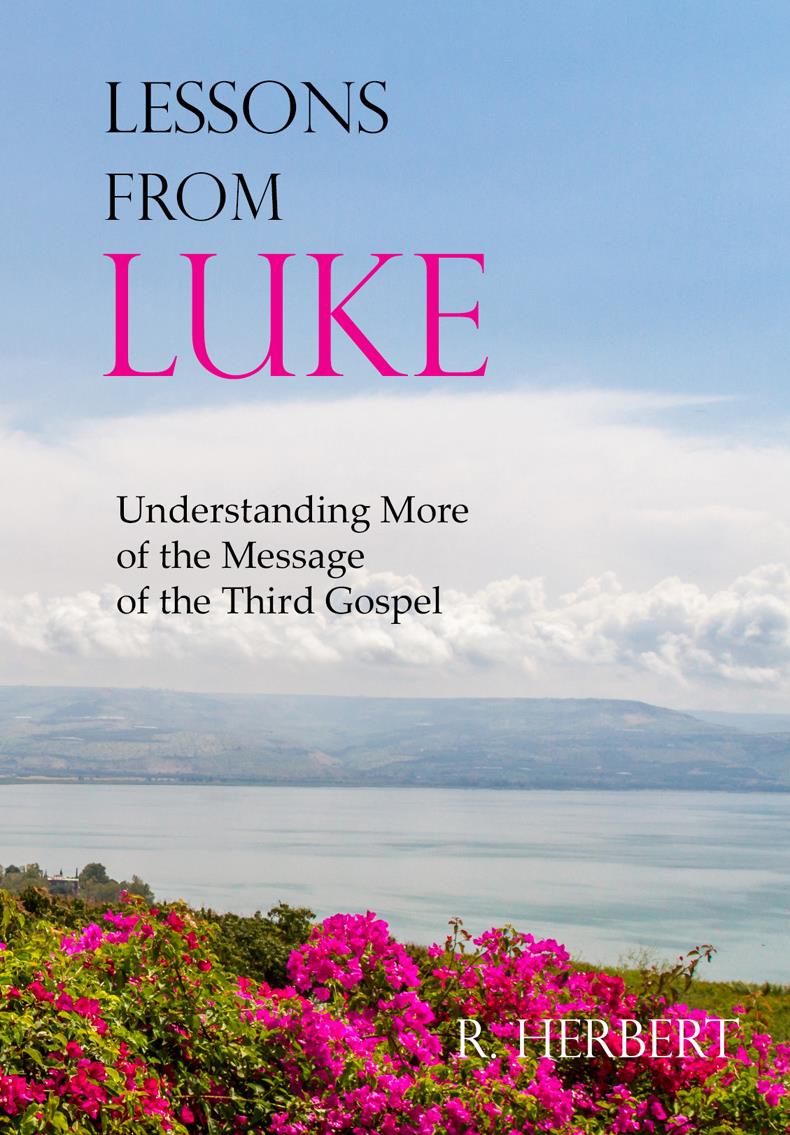
LESSONS FROM

LUKE

Understanding More of the Message of the Third Gospel

R. Herbert

© 2024, Living Belief Books – an imprint of LivingWithFaith.org

The text and images in this e-book are copyright. All rights reserved. ISBN 979-8-89298-007-4 This book is not to be sold. It is made available by the publisher without charge and free copies can be downloaded from: LivingWithFaith.org, or FreeChristianEBooks.org. Unless otherwise indicated, all Scripture quotations are from THE HOLY BIBLE, NEW INTERNATIONAL VERSION® NIV® Copyright © 1973, 1978, 1984 by International Bible Society® Used by permission. All rights reserved worldwide. All italicized emphases in quotations from the Bible have been added by the author.

Note: In this book, the word gospel is only capitalized when it refers to an actual title of one of the four gospels (e.g., the Gospel of Luke), or the Synoptic Gospels.

About the Author: The author served as an ordained minister and church pastor for a number of years and holds an earned Ph.D. degree in the languages, cultures and archaeology of the ancient Near East and biblical world. He writes for a number of Christian publications and for the websites TacticalChristianity.org and LivingWithFaith.org. His other e-books are available for free download from those websites and from FreeChristianEBooks.org.

Cover: Base image © by alefbet.

CONTENTS

Introduction: The Uniqueness of Luke

PART ONE: THE BOOK

1. Pairs in Luke

2. Repetitions in Luke

3. "Crossovers" and "Sandwiches" in Luke

PART TWO: THE CHARACTERS

4. The Prophets

5. The Disciples

6. Rich and Poor

PART THREE: THE CONNECTIONS

7. Listening in Luke

8. Meals in Luke

9. Service in Luke

PART FOUR: THE THEMES

10. The Gospel of Prayer

11. The Gospel of Humility

12. The Gospel of Joy

Conclusion: The Enduring Value of Luke

Appendix: Unique Material In Luke

INTRODUCTION The Uniqueness of Luke

Each of the four gospels is, of course, tremendously important. Each has unique aspects and contains information on the life of Jesus that the others do not. But if we were to award "points" for the unique aspects of each account, and for every unique piece of information they contain, there is no question that among the three Synoptic Gospels – Matthew, Mark, and Luke – Luke stands above all the other accounts. We can see this is true when we consider the simple fact that almost half of the content of Luke is not found in any of the other three gospels.

Much of the unique material in Luke is central to our understanding of the life and ministry of Jesus and lies at the heart of our mental image of what Christianity is all about. If it were not for Luke, we would not have important facts regarding Christ's birth such as the story of the shepherds who came to the nativity, and the angels' song of Peace on Earth. We would have virtually no information about Jesus' early life, and know far less about his ministry and the events that occurred after his resurrection. We would also not have many of Jesus' most famous teachings – such as the parables of the Good Samaritan, the Prodigal Son, the Rich Man and Lazarus, the Pharisee and the Tax Collector, and many others (see the Appendix: Unique Material in Luke).

A Uniquely Qualified Writer We might ask how it can be that Luke – who was not one of the twelve disciples like Matthew, or a close confidant of the apostle Peter like Mark – could access and record so much information not found in the other gospels. The answer is to be found at least partly in the skills of Luke himself. Luke was undoubtedly the most educated of the gospel writers. He wrote the most refined Greek found in the New Testament (alongside that of the author of the book of Hebrews), and Luke's scholarly, historical, and medical training can be seen throughout the book. In fact, he uses more specialized medical terms in his writing than Hippocrates, the "father" of Greek medicine.

Luke's knowledge of the Scriptures is also both extensive and deep. For example, his first two chapters are written in a way to mimic the style of the Septuagint Greek translation of the Old Testament – in order to bridge the gap between the Old and New Testaments, and to skillfully bring the two stories together. Luke was also a skilled researcher who weighed evidence carefully (Luke 1:3) and who relied on the primary sources of trusted eyewitness accounts (Luke 1:2).

As a physician (Colossians 4:14) Luke was particularly interested in people, and he notices and records many things no other gospel writer did. This can also be seen in Luke's frequent focus on individuals – he has a much larger cast of characters than any other gospel (over a hundred individual people appear in his gospel) giving immense human interest to his work.

Another aspect of Luke's scholarship that we should not overlook is that his gospel was written with a specific aim of showing the historical proof of the things he records (Luke 1:4). As such, his account is not only the best story of Jesus' life for new Christians to read, but it is also a continually encouraging and affirming account for even the most established believer.

A Uniquely Written Gospel There are, in fact, a great many reasons why Luke's gospel is both unique and uniquely helpful for those who read it carefully. The chapters of this book explore twelve of the most important unique aspects of the third gospel. Part One looks at some of the literary techniques Luke utilizes so effectively to teach us. Part Two looks at Luke's central cast of characters and the lessons they teach. Part Three examines some of the subtle yet important connections Luke makes in his account that can help us understand his message in new ways. And Part Four examines the great underlying themes of the third gospel from which we can learn so much. May each of the following chapters help you understand more of the message of this unique and wonderful gospel than you ever have before.

PART ONE:

THE BOOK

1. PAIRS IN LUKE

We tend to think of Luke as the most universal of the four gospels – the life of Jesus that begins its genealogy with Adam rather than Abraham, and that stresses the importance of Samaritans and other Gentiles. But there is a less noticeable yet equally pervasive inclusion to be found in his gospel that was just as revolutionary for his day: the inclusion of women.

Women are not simply injected into the story that Luke tells to give them a presence as "token female believers," however. What Luke does is more surprising. He carefully arranges his gospel to include a woman at every key point in the narrative in which a man is found. In other words, Luke structures his gospel around carefully arranged male and female pairs. Pairs in Luke's Account of Jesus' Life We find male-female pairs from the very beginning of Luke's gospel. Among the gospel writers he alone tells of the angel Gabriel appearing to both Zechariah and Mary to announce the conception of Jesus (Luke 1), and he shows both a man and a woman – Simeon and Anna – testifying in the temple about the Messiah's birth (Luke 2). At the end of his gospel, when we reach the death of Jesus, we see pairs or groups of both men and women as witnesses of his death, burial (Luke 23:50-56), and resurrection (Luke 24:1-12).

Between these opening and closing frames, Luke fills his gospel with carefully selected pairs of men and women. Not only is this pattern found in the key reference to the fact that the disciples who travelled with Jesus included a group of women as well as a group of men (Luke 8), but we find it time and again in the description of Christ's miracles.

In Luke 4:31-39 we find that the healing of a possessed man is followed by the healing of Simon Peter's mother-in-law. In Luke 7:117 the healing of the centurion's servant is followed by that of the son of the widow of Nain. And in Luke 13:10-17 the healing of a crippled

woman on the Sabbath day is directly followed by the healing of a crippled man on another Sabbath (Luke 14:1-6).

The pattern is clear. From the birth of Jesus through his ministry to his death and resurrection Luke is clearly intentional in balancing stories that give equal inclusion of women and men in the same or similar circumstances. Pairs in Luke's Account of Jesus' Teaching The conscious pairing of men and women in the events of Christ's life is also found in Luke's description of the teachings of Jesus. Instead of simply using single-gender examples to illustrate his teachings – as was usual in the culture of the time – Luke shows that Jesus frequently used pairs: "men and women," "husbands and wives," "fathers and mothers," "fathers-in-law and mothers-in-law," "sons and daughters," and "sons-in-law and daughters-in-law" in his teaching.

Luke also shows that Jesus continually utilized both male and female oriented illustrations to convey his teachings. For example, in the story of Jesus' first public teaching in his hometown synagogue, he uses two stories with the same underlying message – that of the widow woman at Zarephath and the Syrian General Naaman (Luke 4:25-27). In the same way, Luke shows Jesus using both the story of the prophet Jonah and that of the Queen of Sheba as examples of Gentiles who believed (Luke 11:29-32).

Even clearer than these instances of paired examples taken from the Old Testament is Luke's recording of the paired nature of the parables of Jesus. For example, the parable of the shepherd and his lost sheep is paired with the parable of the woman with a lost coin (Luke 15:3-10). The same pattern is found in the parables of the growth of the kingdom of God being like a man who plants a mustard seed in his garden and that of the woman who puts yeast into her bread dough (Luke 13:18–21). The example of two men resting together at night is directly followed by the example of two women grinding grain in the day (Luke 17:34–35).

In these and in many other examples, Luke recorded parables that not only present their lesson from the point of view of both men and women, but also stress, by their conscious balancing, the equality of the experience of both male and female hearers. Pairs as a Part of Luke's Message Scholars refer to this technique of repeating statements, changing the gender each time, as "complementary discourse" – a teaching method in which a statement or lesson is applied equally to both men and women. We find it recorded occasionally in the other gospels, so it seems clear that Jesus used the technique in teaching mixed groups of men and women. But it is also clear that Luke, more than any other gospel writer, went to great lengths to show Jesus' continual use of the technique.

This can only mean that the message of the full inclusion of women in the gospel story was one that was particularly important to Luke. That is doubtless one of the reasons Luke begins his account of the ministry of Jesus by recording his sermon based on the prophecy of Isaiah:

The Spirit of the Lord is on me, because he has anointed me to preach good news to the poor. He has sent me to proclaim freedom for the prisoners and recovery of sight for the blind, to release the oppressed, to proclaim the year of the Lord's favor. (Luke 4:18–19) Judean women in the time of Jesus were unquestionably frequently oppressed, but in the use of paired examples throughout his gospel we see that Luke presents women in a new way – as a group set free through the life and work of Christ and equal participants in the community of Jesus' followers.

2. REPETITIONS IN LUKE Luke's gospel appears to repeat several incidents or sayings, and these repetitions are often used to suggest that the Evangelist did not know which of two accounts he had available to him was true, so he inserted both of them in his gospel.

For example, Luke records Jesus taught that his disciples needed to take up their crosses and carry them in two places in his gospel. In Luke 9:23 we read Jesus said "Whoever wants to be my disciple must deny themselves and take up their cross daily and follow me" while in Luke 14:27 he says "whoever does not carry their cross and follow me, cannot be my disciple." In the same way, in Luke 9:24 Jesus says, "whoever wants to save their life will lose it, but whoever loses their life for me will save it" while in Luke 17:33 he says, "Whoever tries to keep their life will lose it, and whoever loses their life will preserve it." Repetitions With Purpose The first thing we should notice about these supposed "repetitions" is that none of them is identical with any other one. In every case the wording is slightly different although the thought being conveyed is clearly the same. The simplest explanation for this is that Jesus likely often taught the same things in different locations as he went through the villages of Galilee and Judea, and that Luke was aware not of conflicting accounts – but of complementary accounts of things said on different occasions.

That this is the case can be seen quite clearly in examples where the context of what is said is very different. Luke records that Jesus taught "all those who exalt themselves will be humbled, and those who humble themselves will be exalted" relative to guests choosing the most important seats at a banquet he attended (Luke 14:11); while he also records that Jesus said "all those who exalt themselves will be humbled, and those who humble themselves will be exalted"

(Luke 18:14) as the moral of his parable of the self-righteous Pharisee and the repentant tax collector given on a different occasion.

Once we understand this simple answer to the so-called repetitions in Luke's gospel we realize that he may well have purposely recorded multiple instances where Jesus taught essentially the same thing so Luke could show things that Jesus emphasized and repeated in his teaching (Matthew 13:52). That Was Then – This Is Different The principle also helps us understand the often commented-upon difference between Jesus' Sermon on the Mount in Matthew's gospel (Matthew 5–7) and in Luke's (Luke 6:20-49). In this instance the differences are so obvious that Luke's version is often called the "Sermon on the Plain." It is possible to understand the two accounts as recording different aspects of the same event: that Jesus first went up a mountain and sat to teach his disciples (Matthew 5:1), and then came down and stood to teach a condensed version of the same message to the crowds at the foot of the mountain (Luke 6:17).

However, it is perhaps more likely that the two accounts record two different events where the same sermon was preached in different locations with a number of differences in what was said in each. If we look carefully, we see that the audience in Matthew's account apparently came from different places than the audience in Luke's account (compare Matthew 4:25 with Luke 6:17) and this strengthens the possibility that two events, in different locations, were involved.

Putting this all together, we see that it is more than likely that the so-called repetitions in the Gospel of Luke are often no more than accounts of similar teachings given at different times and in different locations. As a skilled historian, Luke researched and handled his sources carefully (Luke 1:3), and his care in correctly situating the various events and helping us see which teachings Jesus repeated and emphasized adds greatly to the value of his gospel.

3. "CROSSOVERS" AND "SANDWICHES" IN LUKE

Throughout his gospel, Luke skillfully utilized a number of literary techniques that enabled him to develop and emphasize important parts of his message. There are too many of these techniques to cover in a single chapter, but we will examine two of the most important – and helpful to us.

The first teaching technique we will look at is what we will call "crossovers." The technical term for this literary technique is "chiasmus," but "crossovers" nicely summarizes the idea of stories told in two mirror-image parts – in which the first half is given and then the second half completes the story in the reverse order.

"Crossovers"

Example 1: Zacchaeus The Tax Collector (Luke 19:1–10).

The nine-part summary of this event given below shows how the second part of the story reverses each part of the first half in exact mirror-image:

1. Jesus – arrives.

2. Zacchaeus — took money from others.

3. The crowd – follows Jesus.

4. Zacchaeus – climbs up the sycamore tree.

5. Jesus extends acceptance to Zacchaeus.

6. Zacchaeus – climbs down the sycamore tree.

7. The crowd – rejects Jesus.

8. Zacchaeus — gives money to others.

9. Jesus – leaves.

Notice how this structure highlights the key fact of the event, and compare this with the following example.

Example 2: A Sabbath Sermon (Luke 4:14–20).

1. "He went to Nazareth and on the Sabbath day he went into the synagogue.

2. He stood up to read,

3. and the scroll of the prophet Isaiah was handed to him.

4. Unrolling it, he found the place where it is written:

5. "The Spirit of the Lord is on me, because he has anointed me to proclaim good news to the poor. He has sent me to proclaim freedom for the prisoners and recovery of sight for the blind, to set the oppressed free, to proclaim the year of the Lord's favor."

6. Then he rolled up the scroll

7. handed it back to the attendant

8. and sat down.

9. The eyes of everyone in the synagogue were fastened on him."

Here again we see how Luke is able to highlight the main point of the story by placing it in the middle of the two-part construction. But there was doubtless also another reason for organizing the material in this way – to help disciples memorize the details of the story correctly and to stress the central teaching point – which is always at the center of the story.

"Sandwiches"

A second major technique Luke utilized is what we will call "sandwiches." The literary term for this technique is "intercalatians," but once again we will use the more user–friendly term. Literary sandwiches differ from crossovers in that they have a completely different event inserted at the center of the story – making a "sandwich" from two slices of one story with a "filling" taken from another story in the middle!

Example: A Faith Sandwich (Luke 8:40–56).

1. "Then a man named Jairus, a synagogue leader, came and fell at Jesus' feet, pleading with him to come to his house because his only daughter, a girl of about twelve, was dying.

2. As Jesus was on his way a woman who had been subject to bleeding for twelve years came up and touched the edge of his cloak, and immediately her bleeding stopped... Then he said to her, "Daughter, your faith has healed you. Go in peace."

3.While Jesus was still speaking, someone came from the house of Jairus "Your daughter is dead," he said. "Don't bother the teacher anymore." … Meanwhile, all the people were wailing and mourning for her. "Stop wailing," Jesus said. "She is not dead but asleep." They laughed at him, knowing that she was dead."

The purpose of verbal sandwiches such as this one is to contrast some aspect of the first story with the same aspect in the second story that is inserted in the middle. In this case it is the faith of the woman with ongoing bleeding contrasted with the lack of faith of those associated with the synagogue leader. Whenever we read a story in the gospels with this kind of structure, we should always look to see what the intended contrast is.

Crossovers and sandwiches are only two of the literary techniques that Luke skillfully utilized in his account of the ministry of Jesus, but recognizing them can often help us better see and understand the point the third gospel is trying to get across to us.

PART TWO: THE CHARACTERS

4. THE PROPHETS

We are all familiar with the characterization of Luke's gospel as a portrait of Jesus as a man – as opposed to Matthew's account of Jesus as messianic king, Mark's of Jesus as humble servant, and John's of Jesus as the true Son of God. These characterizations all contain a great deal of truth, and Luke's gospel certainly does highlight the aspect of Jesus' humanity in many ways.

Yet we limit our understanding of Luke (and the other gospels) if we do not look beyond these basic characterizations to see what else the gospel writers show about Jesus. In Luke's account of Jesus' ministry, we need not look far to see that just as much as the Messiah is shown in terms of his humanity, he is also shown in the role of a prophet. Luke has much to say about prophets – including John the Baptist and earlier messengers of God (Luke 7:24–26; etc.) – but we will concentrate on a single important example here. What the Prophet Taught Three of the gospels tell how Jesus spoke in the synagogue in his hometown of Nazareth but was rejected by the people there (Matthew 13:53–58; Mark 6:1–6, Luke 4:16–27). Each account mentions that Jesus told the people "Truly I tell you … no prophet is accepted in his hometown," but only Luke tells us what Jesus preached in the synagogue regarding the role of the prophets:

Truly I tell you … no prophet is accepted in his hometown. I assure you that there were many widows in Israel in Elijah's time, when the sky was shut for three and a half years and there was a severe famine throughout the land. Yet Elijah was not sent to any of them, but to a widow in Zarephath in the region of Sidon. And there were many in Israel with leprosy in the time of Elisha the prophet, yet not one of them was cleansed—only Naaman the Syrian. (Luke 4: 24–27)

In this message, Jesus reminded his hearers that God cares for and sometimes works with those who do not know him, and even with those whom God's people regard as their enemies. To do this he used the examples of the widow of Zarephath in Phoenicia and Naaman the Syrian general who were helped through the great prophets Elijah and Elisha. Jesus' underlying point was that both Elijah and Elisha helped these Gentile individuals even though they were themselves "prophets not accepted in their own land." Parallel Prophets It is easy to continue through the gospel accounts after reading of this event without noticing the striking parallels between the examples Jesus gave and two of his own miracles in similar circumstances. Matthew 15 and Mark 7 tell how Jesus travelled to the Phoenician area and there healed the daughter of a Syrophoenician woman, just as Elijah had traveled to Phoenicia and raised up the son of a widow in the city of Sidon (1 Kings 17:17–24). In Matthew 8, we find that Jesus also healed the servant of the Roman centurion at Capernaum.

There it is the servant of the military leader who is healed rather than the military leader himself (as was the case in Elisha's healing of Naaman the Syrian general in 2 Kings 5), but the stories are clearly parallel. Naaman was an officer of Israel's enemy Syria just as the centurion was an officer of Judea's enemy Rome – both were not only Gentiles, but also of the same hated profession. Both widows were Gentiles of Phoenicia – regarded by the Jews as religiously and socially inferior in terms of both gender and ethnicity. There are further similarities: Naaman was a highly valued servant of the King of Syria who is told he need not go all the way to the prophet's house. In the centurion's case, the servant is said to be highly valued by his master, and the centurion sends word that Jesus need not go all the way to his house.

However, neither Matthew nor Mark connect the stories of the widow or the military man with the healings of Jesus. But Luke uses a different one of Jesus' miracles – that of the raising of the son of a widow in Nain near Nazareth – and records it directly next to the

story of the centurion's servant in order to make the connection with the healings by the prophets Elijah and Elisha clear (Luke 7:1–17). In the case of the widow of Nain, it was her only son and support who Jesus raised from the dead, rather than a daughter, and thus even more closely comparable to the story of the widow of Zarephath helped by Elijah.

But by placing these two stories of the widow and the military man together, Luke not only strengthens the connection with the two Old Testament examples Jesus gave in the synagogue at Nazareth, but he also makes a clear connection between Jesus and two of the greatest prophets of the Hebrew Bible. Luke underscores this connection by recording, in the same chapter, that after these specific healings by Jesus the people excitedly proclaimed that "A great prophet has appeared among us" (Luke 7:16).

A Greater Prophet

In these stories Luke shows that Jesus was indeed a great prophet – accomplishing deeds just like the greatest of the prophets before him. And in doing so, Luke also reminds us that, like those prophets, Jesus came not only to speak, but also to heal and to save. In these and in many other examples, Luke shows us Jesus not only as a man, but also as the greatest prophet of God with the greatest power to heal and to save.

5. THE DISCIPLES

As we read the gospel accounts of the ministry of Jesus, we get repeated views of his disciples – their calling, service, problems, and successes. But Luke's account tells the story of the disciples in much greater detail than any of the other gospels, and we are indebted to Luke for many of the insights we have regarding the individual disciples' lives and characters. In fact, a number of the episodes Luke records concerning the disciples are found only in his gospel.

Luke begins his narrative with a dedication to Theophilus – an otherwise unknown disciple of his day, though the name might possibly symbolize disciples in general. Luke alone tells us, for example, about the seventy (or seventy–two) disciples Jesus sent out (Luke 10:1–2); he alone tells us about the calling of Zacchaeus (19:1– 10); and about Jesus' post–resurrection appearance to two disciples on the road to Emmaus (Luke 24:13–35).

Luke also uniquely gives us a great deal of information about Jesus' female disciples. He alone tells us about the role of the women who accompanied Jesus (Luke 8:2–3), and of certain events involving some of these disciples (Luke 10:38–42). Interestingly, Luke also tells us far more about the mother of Jesus than any other gospel. Mary is barely mentioned in Mark, and only appears in Matthew in the events surrounding the birth of Jesus. But in Luke, Mary is the central character in much fuller birth and infancy narratives (1:1–2:52) and is clearly characterized as a model of faith (Luke 1:45; etc.).

Fuller Accounts, Greater Insights Even the stories about the disciples that are also found in the other gospels are often much more detailed in Luke. For example, if we look at the story of how Jesus called some of the disciples from their fishing nets, we find that while Matthew and Mark give only the essential details (Matthew 4:18–22; Mark 1:16–20), Luke's account

(Luke 5:1–11) is over twice as long and provides many details not found in the other gospel accounts.

Such details often give us fascinating glimpses into the characters of the disciples that we would not otherwise have. For example, all readers of the gospels are familiar with the story of how the disciples argued over who would be the greatest in the kingdom of God, and how Jesus placed a small child before them and told his disciples that "it is the one who is least among you all who is the greatest" (Matthew 18:1–5; Mark 9:33–41; Luke 9:46–48). But only Luke and Mark mention that the youngest of the disciples, John, suddenly projects himself into the conversation (Luke 9:49). Mark's account shows that this was not later, but at the same time (Mark 9:42), and Luke adds that soon after this James and John both wanted to bring fire down from heaven (Luke 9:54).

When we connect these details, we see that it is very likely that John – the youngest disciple – may have taken Jesus' words that the "least among you" would be greatest, personally! Luke shows that John, who is not recorded as having spoken till that point, suddenly is filled with confidence and desire to do great things! Luke's portrayal of the disciples is certainly candid, but overall it is a positive one. Because he presents them in more detail than the other gospels, Luke is able to more fully balance the disciples' "image" against the mistakes and problems the disciples so frequently exhibited.

In contrast to Mark, and even more so than Matthew, Luke improves the portrayal of Jesus' core disciples: they have more understanding and are more faithful than in Mark, and their frequent lack of faith is not stressed as it is in Matthew. Overall, the disciples are shown as being positive role models for believers.

Discipleship for Everyone Another notable aspect of Luke's gospel is that the disciples are not shown as representing a closed group. Although he shows the importance of the twelve disciples, in Luke discipleship is more clearly open to everyone who chooses to follow Christ. Luke stresses the roles of many of Jesus' other disciples – as we have seen, the

women followers, especially Mary and Martha of Bethany, are mentioned earlier and are more actively involved in Jesus' work in Luke's account than in Matthew or Mark. The seventy–two disciples sent out by Jesus, and their success, are also uniquely emphasized (10:1–12).

Luke also adds a great number of unique parables not found in the other gospels (see Appendix), and when we look at the themes and messages of these extra parables, we see that he is particularly interested in recording teachings that show what disciples should understand and how they should act. Luke gives us a realistic portrayal of discipleship – for example, he alone records Jesus' words regarding the costs of discipleship (Luke 14:25–35), and the eventual necessity of taking a purse and a sword (Luke 22:35–38). But Luke also emphasizes the successes of the disciples despite the challenges of their calling.

In these, and in many other ways, we can confidently think of Luke as the gospel of discipleship – and for those of us who are disciples today, Luke's account gives us both realism and encouragement that we can apply to our own lives.

6. RICH AND POOR

The Gospel of Luke is frequently seen as the "Gospel of the Lowly." It is said to be the gospel that champions the marginalized in society – women, the sick, tax collectors, and perhaps especially, the poor. And it is easy to see Luke as the gospel with a social conscience: it is Luke the physician who notices and looks with care at the lowly – often recording their words when no other gospel does.

Near the very beginning of his account Luke alone records the words of Mary that God has looked with favor on "the humble state of his servant ... He has brought down rulers from their thrones but has lifted up the humble. He has filled the hungry with good things but has sent the rich away empty" (Luke 1:48, 52–53). In Luke, we are told Jesus was commissioned to preach good news to the poor (Luke 4:16; 7:22); and while the beatitudes in Luke speak of the blessing of the poor and the hungry, there are corresponding woes (only in Luke) on the rich and full (Luke 6:20–26).

Similarly, in Luke's Acts, among other examples, we are told about poor individuals begging for alms (Acts 3:2–3), that some believers sold their possessions to help the poor and needy (Acts 4:32–35), and that the churches sent financial help to the poor in Jerusalem (Acts 24:17). So we can be forgiven if we see all these (and many more) examples in Luke–Acts and presume that Luke champions the poor and needy. But is this really what Luke does? Luke often shows the poor in a favorable light and also gives examples of the rich abusing their power and refusing to part with their riches (for example, the parable of the "rich fool" living a life of greed in Luke 12:16–21, and that of the rich man and Lazarus in Luke 16:19–31). Looking at Luke Again But this is not all that Luke does. Of the four gospel writers, Luke has the most to say about riches and poverty, but if we look closely, Luke speaks not only for the poor, but for the rich also. We should not

forget that Luke was doubtless not a poor man himself (physicians were as well paid in his day as they are in ours), and we should remember that Luke and Acts were apparently written for a rich man – the "noble" Theophilus (Luke 1:3; Acts 1:1). More importantly, while Luke gives examples of the righteous poor, he actually gives more examples of the righteous rich.

Luke details and praises the works of a number of individuals who unquestionably qualified as being very well–off in that society. We need only look at the centurion whose servant Jesus healed and who, as a benefactor, had built a synagogue for the Jews (Luke 7:2–4) or the centurion Cornelius who Luke tells us was "devout and God– fearing" and who "gave generously to those in need and prayed to God regularly" (Acts 10:2). We read also of Zacchaeus who had become wealthy as a tax collector, but who gave half of what he had and displayed great generosity when he heard the gospel (Luke 19:1– 10). Likewise, Luke 8:1–3 lists a number of women (including the doubtless well–off Joanna, the wife of the manager of King Herod's household) who we are told supported Jesus' ministry financially. These and other well–to–do individuals were all rich yet living righteously. And we should not forget Joseph of Arimathea, the wealthy man (Matthew 27:57), who gave his own tomb for Jesus and who Luke describes unequivocally as a "good and upright man" (Luke 23:50–53). Blessed Are the Rich? When we see all these rich but righteous individuals, we realize that Luke's negative examples from among the wealthy are not a criticism of the rich, but of the rich who are captive to their worldly riches – as with the story of the rich young ruler who did not follow Christ when he had opportunity to do so (Luke 18:18–30).

Looking closer still, we find that Luke not only mentions godly rich men and women, but also he often seems to alternate examples of unrighteous rich and righteous rich individuals (for example, the rich young ruler in Luke 18 and Zacchaeus in Luke 19; etc.). This pattern can hardly be coincidental and indicates that Luke was consciously

showing both righteous wealthy and impoverished – purposefully setting one alongside the other and showing the universal acceptance of the gospel by rich and poor alike.

The realization of this fact gives us a clearer understanding of Luke's message. Luke does not "champion the poor and put down the rich" as is so often said. Rather, Luke levels the field – he equalizes rich and poor before God, showing the poor that they are elevated in God's calling and reminding the rich they are humbled in theirs (as James 1:9–12 so clearly states). The rich are not put down in Luke's writings – they are shown as having special responsibilities and opportunities to help others. But in showing this Luke emphasizes that there are many righteous rich, just as there are many righteous poor.

PART THREE: THE CONNECTIONS

7. LISTENING IN LUKE

It is interesting that while all the gospels record Jesus exhorting people to listen to his message (for example, Matthew 15:10: "Jesus called the crowd to him and said, "Listen and understand."), Luke is almost the only gospel writer who remarks about whether people were, in fact, listening to what Jesus said. Apart from Luke, only Mark comments on Jesus' audience listening to him, and then only a single time (Mark 12:37), while Luke comments on this a number of times, as we will see.

We can only wonder if Luke's background as a physician (Colossians 4:14) influenced his awareness of the importance of listening to people, and if they were listening or not. But in any case, Luke is particularly interested in this aspect of Jesus' teaching and what he tells us is instructive.

Luke doesn't just tell us what Jesus said. His is the only gospel that tells us that God instructed the disciples to listen to Jesus (Luke 9:35), and Luke alone records Jesus' instructions to his followers "Listen carefully to what I am about to tell you" (Luke 9:44).

But Luke also tells us specifically whether people were listening to what was said: "When Jesus had finished saying all this to the people who were listening" (Luke 7:1), and a little earlier he records how Jesus himself commented on this point: "But to you who are listening I say: Love your enemies, do good to those who hate you" (Luke 6:27). This clearly shows that Jesus was aware that some people were listening to what he said, while others were probably just in the crowd out of curiosity to see what was going on.

In fact, Luke seems to indicate that Jesus paced his teaching according to whether people were really paying attention to what he was saying. The Evangelist tells us that "While they were listening … [Jesus] went on to tell them a parable" (Luke 19:11). It was precisely because people were paying attention – really listening – that Jesus extended his teaching to give them more understanding.

We can apply this understanding in at least two areas of our relationship with God. First, in our study of God's word it is imperative that we do in fact listen and not just read. Despite our best intentions, it is possible to sit and read several chapters of the Bible without really listening to what is being said, just as our minds may drift during an actual conversation with a person in the same room. The safeguards against reading and not hearing are to take frequent pauses to analyze or summarize what we have read and to review it when finished. This isn't always necessary in Bible reading of course, but the more we can do it, the more it can help us to truly listen.

The same principle applies to prayer. If our prayer is to be closer to a conversation than a monologue, we should be willing to pause occasionally and think over what we have said, let our minds be receptive to thoughts and ideas that may be placed there. Many Christians find it profitable to pray with a notepad – not just to list things they wish to pray about, but also to record things that come to mind as they do pray.

It is not that we cannot study or pray without using such strategies, but if we are truly desirous to hear God in our lives, we must be willing to focus on listening. It is interesting that in the parable of the Good Shepherd recorded in John 10, Jesus repeatedly describes his "flock" as those who listen to him. And we might remember, in this regard, the striking words of Christ which are only recorded – as we might guess – by Luke: "Therefore consider carefully how you listen. Whoever has will be given more; whoever does not have, even what they think they have will be taken from them" (Luke 8:18). We have all been given much, and it is as we listen that we are given more.

8. MEALS IN LUKE Luke's gospel indicates that the Evangelist may have particularly appreciated good food – at least it shows clearly that he noticed and commented on food more than any other gospel writer! For example, while Matthew uses the word "eat" eighteen times, and John only fifteen times, Luke uses the word thirty–three times. Mark also uses this word quite frequently (twenty-five times), but overall Luke uses a number of eating and food–related words twice as many times as Mark and the other gospels, so his emphasis on this is clear.

In fact, Luke weaves much of his account around eating – in most of his stories, Jesus is either going to a meal, at a meal, or coming from a meal. But Luke does not simply mention food and meals – he draws lessons from them. Uniquely, he describes ten meals in which Jesus participated:

1. Luke 5: Jesus eats with tax collectors and sinners at the home of Levi (Matthew). 2. Luke 7: Jesus is anointed during a meal at the home of Simon the Pharisee. 3. Luke 9: Jesus feeds the five thousand. 4. Luke 10: Jesus eats in the home of Martha and Mary. 5. Luke 11: Jesus condemns the Pharisees and teachers of the law at a meal. 6. Luke 14: Jesus is at a meal when he urges people to invite the poor to their meals. 7. Luke 19: Jesus invites himself to dinner with the tax collector Zacchaeus. 8. Luke 22: Jesus eats the Last Supper with the disciples. 9. Luke 24: The resurrected Jesus sits for a meal with two disciples in Emmaus. 10. Luke 24: Jesus eats some food with the disciples in Jerusalem.

Luke shows that even when Jesus was not eating, he frequently made reference to food in his teaching. Jesus used food to describe salvation and judgment (Luke 1:53; Luke 6:21, 25), and described people in terms of good food and bad food (Luke 3:17; Luke 6:43– 46; Luke 12:1). When he was asked if few are saved, Jesus warned that on the last day people will say, "We ate and drank with you, and you taught in our streets." But he will reply, "I don't know you or where you come from. Away from me, all you evildoers!" Instead "People will come from east and west and north and south, and will take their places at the feast in the kingdom of God." (see Luke 13:22–30). In Luke 14 Jesus tells a parable of a great banquet. In Luke 15 he tells the parable of the prodigal son, which ends with a banquet. In Luke 16 he contrasts a rich man "who feasted sumptuously every day" with a beggar "who desired to be fed with what fell from the rich man's table" (Luke 16:19 ESV). In Luke 22 Jesus tells his disciples: "I assign to you, as my Father assigned to me, a kingdom, that you may eat and drink at my table in my kingdom" (Luke 22:29–30 ESV).

So throughout the Gospel of Luke we see that Jesus' meals were not just eating food, and they were far more than just symbols. Luke shows that Jesus used meals to engage with people and to teach important lessons. This last fact is particularly important, because if we read the accounts of the ten meals he records, we find that every one of them was used to teach something.

But the meals in Luke were often also exercises in friendship and spiritual community. In a very real way they also often prefigured the kingdom of God itself. Perhaps this was the reason for the emphasis the early Christians placed on their so–called "love feasts" – they were not only reminders of how Jesus connected with his followers through meals, they were also expressions of the coming kingdom in miniature. Certainly we see that in the meals in Luke.

9. SERVICE IN LUKE We find Jesus serving and urging his followers to serve throughout the four gospels, of course, but this aspect of his ministry is nowhere clearer than in Luke. The third gospel tells us more about serving than any other gospel (using the NIV as an example, we find Luke mentions service as many times as all the other gospels combined). Luke also contains some important passages about service that are not found in the other gospel accounts, or are much more detailed.

For example, all three Synoptic Gospels give us a key story about how servants must conduct themselves as they wait for their Lord's return. In Mark this is only a few verses (Mark 13:34–37), and while Matthew gives a fuller version (Matthew 24:42–51), Luke has the most complete account (Luke 12:35–48). Consider the first few verses of what Luke records:

Be dressed ready for service and keep your lamps burning, like servants waiting for their master to return from a wedding banquet, so that when he comes and knocks they can immediately open the door for him. It will be good for those servants whose master finds them watching when he comes. Truly I tell you, he will dress himself to serve, will have them recline at the table and will come and wait on them. It will be good for those servants whose master finds them ready, even if he comes in the middle of the night or toward daybreak … You also must be ready, because the Son of Man will come at an hour when you do not expect him. (Luke 12:35–40) Here, while the other accounts record little more than Jesus' injunction to "watch," Luke shows that Jesus stressed both being prepared and diligently exercising the roles the servants were given – as well as Jesus' words showing the connection between the master being served and the service the master returns to the servant. Luke also more clearly shows the responsibility of service that is placed on the servant. In another passage he records Jesus saying:

Suppose one of you has a servant plowing or looking after the sheep. Will he say to the servant when he comes in from the field, "Come along now and sit down to eat"? Won't he rather say, "Prepare my supper, get yourself ready and wait on me while I eat and drink; after that you may eat and drink"? Will he thank the servant because he did what he was told to do? So you also, when you have done everything you were told to do, should say, "We are unworthy servants; we have only done our duty." (Luke 17:7–10) In this case, Luke's words show us that service requires a proper attitude toward the One we serve, toward ourselves ("We are [his] unworthy servants"), and toward service itself ("we have only done our duty"). Luke also gives us something else to meditate upon – the difference between serving and service. It is one thing to serve when we want and as we want – but the words Luke records remind us true service is given even when it is not convenient or enjoyable for us: that true service is an ongoing responsibility of dedication for the follower of Jesus.

Later in his gospel, Luke reminds us that this is the way of Christ himself when he tells us Jesus said: "For who is greater, the one who is at the table or the one who serves? Is it not the one who is at the table? But I am among you as one who serves" (Luke 22:27).

Luke not only has this and other unique material regarding the necessary dedication of true service, but – lest we burn ourselves out through unrelenting work – he reminds us that the Son of God inspires us to serve, but he is not a harsh taskmaster. Luke does this by way of his unique account of how Jesus gently reprimanded the overly busy Martha by telling her that we should be willing to stop when it is appropriate, just as much as we should be willing to serve (Luke 10:38–42).

So, while Luke does have a great deal to say about service, it is not so much as an ongoing theme of his gospel, but rather in unique and detailed passages that can well repay our study and thought – verses

that emphasize more than any of the other gospels a living, working, connection between God, ourselves, and others.

PART FOUR: THE THEMES

10. THE GOSPEL OF PRAYER There is a noticeable stress on prayer in Luke's writing – in fact, Luke mentions prayer twice as often as any of the other gospel accounts. While prayer is mentioned (depending on the translation) around fourteen times in Matthew, twelve times in Mark, and six times in John, in Luke prayer appears on some twenty-six occasions. Luke also includes much unique material regarding prayer. For example, in Luke alone we find the parable of the tax collector and the Pharisee who went to the temple to pray. Luke notices prayer, comments on it, puts it in context, and ultimately uses it as a major underlying theme for his gospel.

The Evangelist begins his account of the life of Jesus, not with the Messiah's birth, but with the prayer that preceded it. He tells us that it was as the devout people of Jerusalem were worshiping and praying in the temple (1:10) that an angel appeared to the priest Zechariah to inform him of the coming birth of his son – John the Baptist – who would prepare the way for the Messiah (1:17). In the same way, Luke closes his gospel, not with Christ's ascension, but with the fact that it was followed by the disciples returning to pray and worship in the temple (24:53), where his gospel's prayer– focused narrative began.

Between these starting and ending points, as Luke recounts the life and ministry of Jesus, he weaves into his narrative continued references to prayer – and especially the prayers of Jesus himself. In fact, Luke tells us more about the prayer life of Jesus than any other New Testament writer. To read the Gospel of Luke is to hear Jesus praying just as much as it is to hear him teaching the crowds. Only Luke tells us that Jesus prayed continually (5:16), and he includes seven accounts of Jesus praying that are not found in any of the other gospels.

Luke tells us that Jesus was praying when the Holy Spirit descended upon him at the beginning of his public ministry (3:21). It is Luke who tells us that Christ spent the whole night in prayer before he chose his twelve disciples (6:12). Only Luke gives us the added

details that when Jesus took his closest disciples – James, Peter, and John – up the mountain to allow them to see him transfigured as he would be in the kingdom of God, he first ascended the hill to pray (9:28), and the three disciples experienced Jesus' private prayer before they witnessed his transfiguration (9:29).

The third gospel makes it clear that Jesus often prayed in the presence of his disciples and that he taught them how to pray not only by his example (9:18), but also by giving them the prayer outline we call "The Lord's Prayer" (11:1–4) and a number of parables on prayer that teach us not to lose heart and to pray with shameless persistence (11:5–8, 18:1–14). In these ways and in others (6:28, 10:2, 22:40, 46, etc.), Luke shows Jesus constantly urged his disciples to pray.

In Luke we continually catch sight of the importance of prayer in Jesus' own life and work. We see him praying in every circumstance, from formal blessings (9:16) to informal and spontaneous expressions of joy (10:21). We see that he prayed before important events, and also after them – apparently especially after performing miracles (5:15–16). Jesus often withdrew at such times, Luke says, to lonely places and prayed (5:16). By the time we come to the end of Jesus' ministry, there can be no doubt in our minds, if we are attuned to Luke's message, that it is through prayer that Jesus performed his works – not through his own strength (John 5:19, 30), but through a close relationship with God based on ongoing empowering prayer.

As we reach the end of Jesus' life, we see his agonizing prayer in the Garden of Gethsemane (22:39–46) not as a unique situation, but yet another example of Jesus' regular reliance on prayer, expressed at a crucial moment in his life. Luke gives us details of the Gethsemane prayer of Jesus that no one else records – such as the fact that "…his sweat was like drops of blood falling to the ground" (22:44). It is typical that although all the gospel writers tell us that Jesus returned from praying and found his followers sleeping, only Luke records that Jesus urged the disciples "Get up and pray…" (22:46). Luke alone then records some of the prayers of Jesus on the cross. He alone records Jesus' words: "Father, forgive them, for they do not know what they are doing" (Luke 23:34) – a prayer so radical

and vital to Christianity that it is amazing that it appears only in this one gospel. And Luke alone lets us hear Jesus' final prayer: "Father, into your hands I commit my spirit" (23:46).

It should not surprise us, then, that when Luke tells the post– resurrection story of the disciples who met Jesus on the road to Emmaus, he provides a detail that we might easily miss, but one that is of clear significance. Even though those disciples apparently walked and talked with the risen Jesus for hours, it was only when he prayed that they recognized him (24:13–31). Perhaps, by analogy, we can say it is to the degree that we follow the examples and teachings of Christ in the "Gospel of Prayer" that others will recognize the Son of God in us, also.

11. THE GOSPEL OF HUMILITY Humility is a central aspect of the Christian faith and not surprisingly it is displayed in all the gospel accounts of the life of Jesus. For example, although we tend to think of Matthew as the gospel of kingship – the gospel that frequently alludes to the messianic kingly role of Christ – Matthew also records many examples of humility in the lives of Jesus and others. But no other gospel focuses as clearly on the humility of the Son of God and his teachings on the subject as the book of Luke. A Life of Humility Luke alone describes the humble nature of the physical birth of Jesus – beginning with Mary's affirmation of her humble state (Luke 1:48, 52), and the details of Jesus' birth that underscore the relative poverty of his parents (Luke 2:24, etc.). Like Matthew, Luke tells us that Jesus had no fixed home (Luke 9:58), but alone among the gospels Luke tells us that Jesus' ministry was only possible because of the support of others who were better off (Luke 8:1–3).

Luke also stresses how Jesus lived a life of spiritual humility, and this is frequently seen not only in the Evangelist's words about Jesus himself (Luke 22:27; etc.), but also in his accounts of Jesus' interaction with others.

Examples of Humility Perhaps the greatest example of humility – other than in the life of Jesus – that is found in the gospels and in the entire Bible is seen in the story of the centurion who implored Jesus to heal his servant. Only Matthew and Luke record this story (Matthew 8:5–13; Luke 7:1–10), but Luke's additional details are informative. In addition to the great humility of the Roman officer who declared "I do not deserve to have you come under my roof. That is why I did not even consider myself worthy to come to you" (Luke 7:6–7), this story also

shows the humility of Jesus – not only in his willingness to go to the sick rather than having them brought to him, but also because Luke tells us the sick man was not an important servant, but simply a lowly slave (doulos). In similar ways, Luke provides us with many examples of humility in action. Teachings on Humility Luke also shows us Jesus emphasized that the defining character of his disciples was to be humility. While Matthew records Jesus' words "those who humble themselves will be exalted" (Matthew 23:12), Luke gives this same teaching not once, but twice (Luke 14:11; 18:14) showing its importance for Luke's presentation of Jesus' teaching.

Some of Jesus' most memorable teachings on humility are also recorded in Luke. Early in his gospel, Luke tells how the disciples argued as to which of them would be the greatest, and how Jesus said "it is the one who is least among you all who is the greatest" (Luke 9:46–50). Importantly, Luke shows that late in Jesus' ministry the disciples were still arguing in this way and Jesus retaught them in even more detail:

The kings of the Gentiles lord it over them … But you are not to be like that. Instead, the greatest among you should be like the youngest, and the one who rules like the one who serves … I am among you as one who serves. (Luke 22:24–27) Luke also records Jesus' instruction to those who picked the places of honor at a banquet – "all those who exalt themselves will be humbled, and those who humble themselves will be exalted" (Luke14:7–11). And to those who were confident of their own righteousness and looked down on everyone else, Jesus told the parable of the Pharisee and the tax collector to teach the same lesson: "all those who exalt themselves will be humbled, and those who humble themselves will be exalted" (Luke 18:9–14).

A Gospel of Humility

In both the teachings of Jesus he records, and in examples drawn from Jesus' ministry, Luke focuses on humility more frequently than any other gospel – or any other book in the New Testament. And many of the clearest teachings on humility that Luke records actually do not mention humility directly, but show how this quality affects every aspect of our Christian lives. For example, in Luke 17, although the words "humble" and "humility" appear nowhere in the chapter, the concept underlies a great deal of what Luke tells us.

So it is worth remembering – it is to Luke that we should turn if we want a handbook of practical and applied humility, and we will also see much more in this gospel if we remember that even when it is not obviously focusing on this quality, Luke is the "Gospel of Humility."

12. THE GOSPEL OF JOY The word "gospel" means "good news" and in that sense, all the four gospels contain a joyful message. But there is one gospel that focuses on joy – we might almost say it is filled with joy – and that gospel is Luke. Joy may not be as noticeable as some of Luke's other themes, but it is a very real emphasis of his gospel, nonetheless. Luke begins and ends his account of the life of Jesus by focusing on joy, and between these two "bookends" he mentions joy more than any other gospel – in fact, more than any other book of the New Testament.

At the beginning of his gospel, Luke (alone) records two events in which great joy is evident. Luke gives us a "prequel" to his account by recording the birth story of John the Baptist – whose parents are told "He will be a joy and delight to you, and many will rejoice because of his birth" (Luke 1:14). Luke notes that while still in Elizabeth's womb, John "leaped for joy" (Luke 1:44) at the sound of Mary's voice, and that even her neighbors and relatives shared her joy (Luke 1:58).

In the same way, in Luke's account of the nativity of Christ, joy is equally evident when the angel announces the birth of Jesus to the shepherds with the words: "I bring you good news that will cause great joy for all the people" (Luke 2:10). That "good news" was, of course, the beginning of the "gospel" – a message of potentially unparalleled joy for everyone ("for all the people") that through Jesus Christ those who were lost and doomed could now be saved.

Once we enter the body of Luke's gospel, we find multiple references to joy. Luke records Jesus' admonition that we find joy even in times of persecution (Luke 6:23), that those like the seed that fell on rocky ground only temporarily receive the word with joy (Luke 8:13), that the seventy–two Jesus sent out returned with joy (Luke 10:17), and that Jesus himself was full of joy through the Holy Spirit (Luke 10:21).

But it is the joy of the lost being found that underlies much of what the Evangelist writes. Joy is at the heart of the three parables he records regarding the shepherd who goes in search of the lost sheep

(Luke 15:3–7), the woman who searches for a lost coin (Luke 15:8– 10), and the father who daily looked for the return of his lost son (Luke 15:11–32). Each of these parables ends with a joyful celebration: the shepherd invites everyone to rejoice with him, as does the woman when she finds her coin, and the father whose son had been lost has finally returned.

But while Matthew records, for example, some of the parable of the lost sheep (Matthew 18:12–14), Luke alone includes Jesus' words "I tell you that in the same way there will be more rejoicing in heaven over one sinner who repents than over ninety–nine righteous persons who do not need to repent" (Luke 15:7). In the same way, all four gospels record the miracles of Jesus, and the resurrected Jesus appearing to the disciples, but only Luke records the joy of the people at Jesus' works (Luke 19:37), and only Luke (Luke 24:41) and John (John 20:20) record the disciples' great joy at seeing their resurrected Lord.

When we look for it, we find joy throughout the third gospel. Given what we have seen of this continued focus, it is perhaps not surprising that Luke's account ends in exactly that way – with the words "Then they worshiped him and returned to Jerusalem with great joy ..." (Luke 24:52).

If we want to read a gospel account that highlights the joy that Jesus and his disciples had, or we would simply like to read the Bible's most joy–filled book, we need look no further than Luke.

CONCLUSION: THE ENDURING VALUE OF LUKE

We have seen in this book that the Gospel of Luke contains a vast amount of material not found in any of the other gospel accounts. There is also a great deal of other unique material in Luke that we have not covered – such as many additional short sayings of Jesus. For example, Jesus' question "when the Son of Man comes, will he find faith on the earth?" (Luke 18:8) occurs nowhere else in the New Testament, and even minor additions such as this add to the value of what Luke wrote.

We have also seen that the extra material that Luke was able to gather and present for us consists of far more than minor details omitted in the other gospels. This is evident in that Luke gives us much that we would not otherwise know about the life of Jesus, and a number of his teachings that would otherwise not have survived. As we said in the Introduction of this book, the unique material Luke provides often lies at the heart of our mental image of what Christianity is all about.

But even beyond the value of all the unique material Luke's account contains, the preceding chapters have shown that the way in which Luke skillfully arranged the facts he had gathered also helps us. For example, his pairing of stories of male and female disciples, and of rich and poor individuals, or the way he weaves his stories around the meals he describes, and the unique "sandwiches" found in his gospel, all teach additional lessons we can learn if we look for them.

We can also learn from aspects of Luke's gospel such as his unique focus on the other disciples of Jesus – the lesser known and the unknown people Jesus also interacted with during his ministry beyond the twelve apostles. These other individuals were often everyday people with lives like ours, and reading about them can give us both instruction and inspiration.

In all of these ways, and others, Luke offers us invaluable lessons we cannot find elsewhere in the New Testament. That is why so many Christians throughout history have agreed – the Gospel of Luke is an account that can richly reward repeated reading and continued application in our lives. May it do so in yours.

APPENDIX: UNIQUE MATERIAL IN LUKE

The following list gives seventy–two of the especially important passages that are uniquely found in the third gospel. There are many other smaller, and more minor passages that are not included in this list.

Dedication to Theophilus (1:1–4) The birth of John foretold (1:5–25) The birth of Jesus foretold (1:26–38) Mary visits Elizabeth (1:39–45) Song of Mary (the Magnificat) (1:46–56) Birth and naming of John (1:57–66) Song of Zechariah (1:67–80) Angels appear to shepherds (2:8–20) Circumcision and dedication of Jesus (2:21–24) Simeon's song and prophecy (2:25–35) Anna's thanksgiving (2:36–38) The missing Jesus is found in the temple (2:39–52) Date of John's ministry (3:1–2) Genealogy of Jesus traced from Adam (3:23–38) John's instructions to various groups (3:10–14) Jesus claims Isaiah's prophecy in his home synagogue (4:17–21) Faith of the Phoenician widow and Naaman the Syrian (4:25–30) "Physician heal yourself" (4:23) Miraculous catch of fish (5:1–11) The woes (6:24–26) Raising of widow of Nain's son (7:11–17) Woman anoints Jesus's feet, two debtors (7:36–50) The women who helped Jesus (8:1–3) Jesus talks with Moses and Elijah at the transfiguration (9:31–32) Rejection by Samaritans (9:51–56) The objection to following, to say farewell (9:61–62)

Sending out of seventy disciples (10:1–12) Return of the seventy disciples (10:17–20) Parable of the good Samaritan (10:25–37) At the home of Martha and Mary (10:38–42) Parable of the friend at midnight (11:5–8) True blessedness (11:27–28) True cleansing (11:37–41) Repent or perish (13:1–5) Parable of the barren fig tree (13:6–9) Healing of a woman with a spirit of infirmity (13:10–17) Who will be in the kingdom? (13:22–30) Reply to Herod (13:31–33) Healing of a man with dropsy (14:1–6) Regarding invitations to banquets and places of honor (14:7–14) Examples of counting the cost (14:28–33) Parable of the lost coin (15:8–10) Parable of the prodigal son (15:11–32) Parable of the unjust steward (16:1–9) Covetous hypocrisy of Pharisees (16:14–15) Parable of the rich man and Lazarus (16:19–31) Worthless slaves (17:7–10) Healing of ten lepers (17:11–19) Kingdom in midst of you (17:20–21) Example of judgement on Sodom, Lot's wife (17:28–32) Parable of the unjust judge (18:1–8) Parable of the Pharisee and the tax–collector (18:9–14) Story of Zacchaeus (19:1–10) Parable of the pounds (19:11–27) Lament over Jerusalem (19:39–44) Warning at end of Olivet discourse (21:34–36) Summary of time in Jerusalem (21:37–38) Jesus eats the Passover before suffering (22:15–16) The two swords (22:35–38) Accused of teaching not to pay tax to Caesar (23:2) Pilate's first declaration of Jesus' innocence (23:4–5) Jesus before Herod (23:6–12)

Pilate's second declaration of Jesus' innocence (23:13–16) Daughters of Jerusalem weep (23:27–31) The two criminals crucified with Jesus (23:39–43) Jesus' words on the cross "Father, forgive them, for they do not know what they do" etc. (23:34–46) The centurion's witness (23:47–48) Women prepare spices, then rest on the Sabbath (23:56) Apostles do not believe the report of the resurrection (24:10–11) Jesus appears to two disciples on the road to Emmaus, teaches them how he fulfilled prophecies, and sits for a meal (24:13–49) The ascension of Jesus (24:50–53)

ABOUT OUR BOOKS This book is distributed without charge by the publisher. Its material is copyright, but sections may be reproduced in fair–use quotation, and the book may be freely distributed as long as it is given without charge. "Freely you have received; freely give" (Matthew 10:8).

If you do not have access to a Bible to read the additional verses given in each chapter of this book, to continue your study, or for Bible study at any time, we recommend using websites such as BibleHub.com or BibleGateway.com, which provide free access to many translations of the Bible in numerous languages.

You can also download free Bibles, as well as free Christian e–books, from the publisher's websites, including: FreeChristianEBooks.org, TacticalChristianity.org and LivingWithFaith.org. New books are added to these sites periodically.

↑ Back to top

↑