
And I thank Christ Jesus our Lord, Who hath enabled me, for
H O M I L Y
III.
1 TIM. i. 12, 13, 14.
And I thank Christ Jesus our Lord, Who hath enabled me, for that He counted me faithful, 'putting me into the ministry; who was before a blasphemer, and a persecutor, and injurious: but I obtained mercy, because I did it ignorantly in unbelief.
And the grace of our Lord was exceeding abundant, with faith and love which is in Christ
Jesus.
THE advantages arising from humility are generally acknowledged, and yet it is a thing not easily to be met with. There is affectation of humble talking enough and to spare, but humbleness of mind is no where to be found.
This quality was so cultivated by the blessed Paul, that he is ever looking out for inducements to be humble. They who are conscious to themselves of great merits must struggle much with themselves if they would be humble. And he too was one likely to be under violent temptations, his own good conscience swelling him up like a gathering humour. Observe therefore his method in this place.
' I was intrusted,' he had said, ' with the glorious Gospel of God, of which they who still adhere to the law have no right to partake; for it is now opposed to the Gospel, and their difference is such, that those who are actuated by the one, are as yet unworthy to partake of the other; as we should say, that those who require punishments, and chains, have no right to be admitted into the train of philosophers.'
Being filled there-
St. Paul magnifies Grace, but asserts Free Will.
fore with high thoughts, and having used magnificent exHOM. pressions, he at once depresses himself, and engages others
1J1*a1so to do the like. Having said therefore that "the Gospel was committed to his trust;" lest this should seem-to be said from pride, he checks himself at once, adding by way of correction, I thank Christ Jesus our Lord, Who hath enabled me, for that He counted me faithful, 'putting me into the ministry.
Thus every where, we see, he conceals his own merit, and ascribes every thing to God, yet so far only, as not to take away free will. For the unbeliever might perhaps say, If every thing is of God, and we contribute nothing of ourselves, while He turns us, as if we were mere wood and stone, from wickedness to th§ love of wisdom, why then did He make Paul such as he was, and not Judas?
To remove this objection, mark the prudence of his expression, Which was committed, he says, to my trust.
This was his own excellence and merit, but not wholly his own; for he says, I thank Christ Jesus, Who enabled me.
This is God's part: then his own again, Because He counted me faithful.
Surely because he would be serviceable of his own part.
Ver. 13. Putting me into the ministry, who was before a blasphemer, and a persecutor, and injurious; but I obtained mercy, because I did it ignorantly in unbelief.
Thus we see him acknowledge both his own part and that of God, and whilst he ascribes the greater part to the providence of God, he v extenuates his own, yet so far only, as we said before, as was consistent with free will. And what is this, Who enabled me? I will tell you.
He had so heavy a burden to sustain, that he needed much aid from above.
For think what it was to be exposed to daily insults, and mockeries, and snares, and dangers, scoffs, and reproaches, and deaths; and not to faint, or slip, or turn backward, but though assaulted every day with darts innumerable, to bear up manfully, and remain firm and imperturbable.
This was the effect of no human power, and yet not of Divine influence alone, but of his own resolution also. For that Christ chose him with a foreknowledge of what he would be, is plain from the testimony He bore to him before the commencement of his preaching.
He is a chosen vessel unto Me, to bear My Acts 9 name before the Gentiles and kings.
For as those who bear 15'
St. Paul trusted because faithful.
His humility.
L TIM. the royal standard in wara require both strength and address, that they may not let it fall into the hands of the enemy; so those who sustain the name of Christ, not only in war but in peace, need a mighty strength, to preserve it uninjured from the attacks of accusers. Great indeed is the strength required to bear the name of Christ, and to sustain it well, and bear the Cross. For he who in action, or word, or thought, does any thing unworthy of Christ, does not sustain His name, and has not Christ dwelling in him.
For he that sustains that name bears it in triumph, not in the concourse of men, but through the very heavens, while all angels stand in awe, and attend upon him, and admire him.
I thank the Lord, Who hath enabled me.
Observe how he thanks God even for that which was his own part.
For he acknowledges it as a favour from Him that he was a chosen vessel.
For this, O blessed Paul, was thy own part.
For God is no respecter of personsb.
But I thank Him that He thought me worthy of this ministry.
For this is a proof that He esteemed me faithful.
The steward in a house is not only thankful to his master that he is trusted, but considers it as a sign that he holds him more faithful than others: so it is here. Then observe how he magnifies the mercy and lovingkindness of God, in describing his former life, who was formerly, he says, a blasphemer, and a persecutor, and injurious.
And when he speaks of the still unbelieving Rom.io, Jew, he rather extenuates their guilt.
For I bear them 2' record that they have a zeal for God, but not according to knowledge.
But of himself he says, Who was a blasphemer and a persecutor.
Observe his lowering of himself! So free was he from self-love, so full of humility, that he is not satisfied to call himself a persecutor and a blasphemer, but he aggravates his guilt, shewing that it did not stop with himself, that it was not enough that he was a blasphemer, but in the madness of his blasphemy he persecuted those who were willing to be godly0. a One copy has, ' which is usually who, without regard to a man's qualicalled Laburum,' perhaps a mistake ties, should arbitrarily (or on external for Labaiuin, but Socrates has Labogrounds, such as birth, wealth, &e.) rum. The first standard known to have prefer him to others; God therefore been so called was that of Constantine, does not do this. Rom. 2, 11. Col. 3, which bore the Christian symbol.
25. Acts 10, 34. b He would be a respecter of persons, c eixxefieh, 1 to worship aright.'
Jewish Rulers sinned not in ignorance like St. Paul.
J3ut I obtained mercy, because I did it ignorantly in HOM. unbelief. m"
Why then did other Jews not obtain mercy?
Because what they did, they did not ignorantly, but wilfully, well Rowing what they did.
For this we have the testimony of the Evangelist.
Many of the Jews believed on Him, but-1 ohni2, because of the Pharisees they did not confess Him.
For they loved the praise of men more than the praise of God.
And Christ again said to them, How can ye believe, who receive John 5, honour one of another? and the parents of the blind man44' said these things for fear of the Jews, lest they should be John 9, put out of the synagogue.
Nay the Jews themselves said,22'
Perceive ye how we avail nothing ? behold, the world is gone Johni2, after Him.
Thus their love of power was every where in their way.
When they admitted that no one can forgive sins but God only, and Christ immediately did that very thingd, which they had confessed to be a sign of divinity, this could not be a case of ignorance.
But where was Paul then ? Perhaps one should say he was sitting at the feet of Gamaliel, and took no part with the multitude who conspired against Jesus: for Gamaliel does not appear to have been an ambitious man.
Then how is it that afterwards Paul was found joining with the multitude? He saw the doctrine growing, and on the point of prevailing, and being generally embraced.
For in the lifetime of Christ, the disciples con-1 i. e. sorted with Him, and afterwards with their t e a c h e r s b u t
^ ^ when they were completely separated, Paul did not act asers. the other Jews did, from the love of power, but from zeal.
For what was the motive of his journey to Damascus ? He thought the doctrine pernicious, and was afraid that the preaching of it would spread every where.
But with the Jews it was no concern for the multitude, but the love of John 11, power, that influenced their actions.
Hence they say, The48'
Romans will come and take away both our place and nation.
What fear was this that agitated them, but that of man ?
But it is worthy of inquiry, how one so skilful in the law as Rom. 4
Paul could be ignorant? For it is he who says, which He had2' promised before by His holy prophets. How is it then that thou knowest not, thou who art zealous of the law of their fathers, d i. e. proved that He had done it, by a direct appeal to God.
2<j Mercy implies ill desert; Grace is more than Mercy.
L TIM. who wert brought up at the feet of Gamaliel ? Yet they who i i i i - spent their days on lakes and rivers, and the very publicans, have embraced the Gospel; whilst thou that studiest the law art persecuting it! It is for this he condemns himself, l Cor. y, saying, I am not meet to be called an Apostle.
It is for this 9" he confesses his ignorance, which was produced by unbelief.
For this cause, he says, that he obtained mercy. What then does he mean when he says, He counted me faithful?
He would give up no right of his Master's: even his own part he ascribed to Him, and assumed nothing to himself, nor claimed for his own the glory which was due to God.
Hence in Acts 14, another place we find him exclaiming, Sirs, why do ye these things to us? we also are men of like passions with you.
So l Cor. again, He counted me faithful.
And again, I laboured more 1 '10, abundantly than they all, yet not I, but the grace of God
Philip, which was with me.
And again, It is He that worketh in 2 13 •7 '
" us both to will and to do.
Thus in acknowledging that he obtained mercy, he owns that he deserved punishment, since mercy is for such. And again in another place he says of the Rom.ll, Jews, Blindness in part is happened to Israel.
Yer. 14. And the grace of our Lord was exceeding abundant with faith and love which is in Christ Jesus.
This is added, lest hearing that he obtained mercy, we should understand by it only, that being deserving of punishment, as a persecutor and blasphemer, nevertheless he was not punished.
But mercy was not confined to this, that punishment was not inflicted; many other great favours are implied by it.
For not only has God released us from the impending punishment, but He has made us righteous too, and sons, and brethren, and heirs, and joint-heirs.
Therefore it is he says, that grace was exceeding abundant.
For the gifts bestowed were beyond mercy, since they are not such as would come of mercy only, but of affection and excessive love. Having thus enlarged upon the love of God which, not content with shewing mercy to a blasphemer and persecutor, conferred upon him other blessings in abundance, he has guarded against that error of the unbelievers which takes away free will, by adding, with faith and love which is in Christ Jesus.
Thus much only, he says, did we contribute.
We have believed that He is able to save us.
Love to God through Christ.
Apathy of Men.
Let us then love God through Christ.
What means HOM.
'through Christ'?
That it is He, and not the Law, who JJAS enabled us to do this.
Observe what blessings we MOHAL.
0we to Christ, and what to the Law.
And he says not merely that grace has abounded, but abounded exceedingly, jn bringing at once to the adoption those who deserved infinite punishment.
And observe again that ine is used for throughe.
For not only faith is necessary, but love.
Since there are many still who believe that Christ is God, who yet love Him not, nor act like those who love Him.
For how is it when they prefer every thing to Him, money, nativity, fate, augury, divinations, omens?
When we live in defiance of Him, pray, where is our love?
Has any one a warm and affectionate friend? Let him love Christ but equally.
So, if no more, let him love Him who gave His Son for us His enemies, who had no merits of our own.
Merits did I say ? who had committed numberless sins, who had dared Him beyond all daring, and without cause! yet He, after numberless instances of goodness and care, did not even then cast us off. At the very time when we did Him the greatest wrong, then did He give His Son for us.
And still we, after so great benefits, after being made His friends, and counted worthy through Him of all blessings, have not loved Him as ourfriendf! What hope then can be ours? You shudder perhaps at the word, but I would that you shuddered at the fact! What? How shall it appear that we do not love God even as our friends, you say?
I will endeavour to shew you—and would that my words were groundless, and to no purpose! but I am afraid they are borne out by facts.
For consider: friends, that are truly friends, will often suffer loss for those they love.
But for Christ, no one will suffer loss, or even be content with his present state.
For a friend we can readily submit to insults, and undertake quarrels; but for Christ, no one can endure enmity: and the saying is,
"Be loved for nothing—but be not hated for nothing."
» iv—8t&—see Hom. i. p. 6.
Stat. X X . Tr. p. 325, and Herbert's 1 See next paragraph, and Hom. on Poems, No. LXVIII.
We treat not Christ even as our Friend.
1 TIM.
None of us would fail to relieve a friend who was hunger. ingt but when Christ comes to us from day to day, and asks no great matter, but only bread, we do not even regard hii^ yea though we are nauseously over full, and swollen with gluttony .* though our breath betrays the wine of yesterday} and we live in luxury, and waste our substance on harlots and parasites and flatterers, and even on monsters, ideots, and dwarfs; for men convert the natural defects of such into matter for amusement.
Again, friends, that are truly such, we do not envy, nor are mortified at their success, yet we feel this
See on toward (the minister of) Christ, and our friendship for men HOM. is S E E N to be more powerful than the fear of God, for the Ox,T, envious and the insincere plainly respect men more than God.
P* ' And how is this ? God sees the heart, yet man does not forbear to practise deceit in His sight; yet if the same man were detected in deceit by men, he thinks himself undone, and blushes for shame.
And why speak of this ? If a friend be in distress, we visit him, and should fear to be condemned, if we deferred it for a little time.
But we do not visit Christ, though He die again and again in prison ; nay, if we have friends among the faithful, we visit them, not because they
(4) are Christians, but because they are our friends.
Thus we do nothing from the fear or the love of God, but some things from friendship, some from custom.
When we see a friend depart on travel, we weep and are troubled, and if we see his death, we bewail him, though we know that we shall not be long separated, that he will be restored to us at the Resurrection.
But though Christ departs from us, or rather we reject Him daily, we do not grieve, nor think it strange, to injure, to offend, to provoke Him by doing what is displeasing to Him; and the fearful thing is not that we do not treat Him as a friend; for I will shew that we even treat Him as an Kom. 8, enemy.
How, do you ask ? because the carnal mind is enmity against God, as Paul has said, and this we always carry about us. And we persecute Christ, when He advances towards us, and comes to our very doorsg.
For wicked actions in effect do this, and every day we subject Him to 8 This idea is beautifully illustrated by the Christusklopf of Overbeck.
Envying of Christ.
Love to enemies possible.
insults by our covetousness and our rapacity.
And does any HOM. one by preaching His word, and benefiting His Church, obtain a good reputation ? Then he is the object of envy, because he does the work of God.
And we think that we envy him, but our envy passes on to Christ.
We aifect to ffish the benefit to come not from others, but from ourselves, gut this cannot be for Christ's sake, but for our own: otherwise, it would be a matter of indifference, whether the good were done by others or ourselves.
If a physician found himself unable to cure his son, who was threatened with blindness, would he reject the aid of another, who was able to effect the cure ? Far from it!
( Let my son be restored,' he would almost say to him, ' whether it is to be by you or by me.' And why? Because he would not consider himself, but what was beneficial to his son.
So, were our regard to Christ, it would lead us to say, " Let good be done, whether by ourselves or by any other."
As Paul said, Whether in Philip. pretence or in truth, Christ is preached.
In the same spirit '
Moses answered, when some would have excited his displeasure against Eldad and Modad, because they prophesied,
Enviest thou for my sake ?
Would God that all the Lord's Numb. people were prophets!
These jealous feelings proceed from ' vainglory; and are they not those of opponents and enemies?
Doth any one speak ill of you ? Love him! It is impossible, you say.
Nay, if yoti will, it is quite possible.
For if you love him only who speaks well of you, what thanks have you? It is not for the Lord's sake, but for the sake of the man's kind speech that you do it.
Has any one injured you?
Do him good! for in benefiting him who has benefited you, there is little merit.
Have you been deeply wronged and suffered loss ? Make a point of requiting it with the contrary.
Yes, I entreat you. Let this be the way we do our own part.
Let us cease from hating and injuring our enemies. He commands us to love our enemies: but we persecute Him while Matt.5,
He loves us.
God forbid! we all say in words, but not so 4 4 , in deeds. So darkened are our minds by sin, that we tolerate m our actions what in words we think intolerable.
Let us desist then from things that are injurious and ruinous to our salvation, that we may obtain those blessings which as His
Christ brings His friends to Glory.
\ T U w e «iay obtain. For Christ says, I will that where. J Jo'hl]]^ am, there My disciples may be also, that they may behold My
24. glory, which may we all attain, through the grace and love of Jesus Christ.
H O M I L Y
IV.
1 TIM. i. 15, 16.
This is a faithful saying, and worthy of all acceptation, that Christ Jesus came into the world to save sinners ; of whom
I am chief.
Howbeit for this cause I obtained mercy, that in me first Jesus Christ might shew forth all long suffering ^ for a pattern to them which should hereafter believe on Him to life everlasting.
THE favours of God so far exceed human hope and expectation, that often they are not believed.
For God has bestowed upon us such things as the mind of man never looked for, never thought of. It is for this reason that the Apostles spend much discourse in securing a belief of the gifts that are granted us of God.
For as men, upon receiving some great good, ask themselves if it is not a dream, as not believing it; so it is with respect to the gifts of God.
What then was it that was thought incredible ? That those who were enemies, and sinners, neither justified by the law, nor by works, should immediately through faith alone be advanced to the highest favour.
Upon this head accordingly Paul has discoursed at length in his Epistle to the Romans, and here again at length.
This is a faithful saying, he says, and worthy of all acceptation, that Christ Jesus came into the world to save sinners.
As the Jews were chiefly attracted by this, he persuades them nota to give heed to the law, since they could not attain
& Sav. omits ' not;' so the sense will would prove that men could not be be)that a due consideration of the Law saved by it.
Justice and Mercy meet only in the Gospel.
L TIM. salvation by it without faith.
Against this he contends; f0r 15— it seemed to them incredible, that a man who had mis-spent all his former life in vain and wicked actions, should after, wards be saved by his faith alone.
On this account he says, It is a saying to be believed.
But some not only disbelieved, but even objected, as the Greeks do now.
Let us then ¿0 evil, thai good may come.
This was the consequence they R°™^3>drew in derision of our faith, from his words, Where sin
5, 20. abounded, grace did much more abound.
So when we discourse to them of Hell, they say, How can this be worthy of God?
When man has found his servant offending, he forgives it, and thinks him worthy of pardon; and does God punish eternally ? And when we speak of the Laver, and of the remission of sins through it, this too they say. is unworthy of God, that he who has committed oifences without number should have his sins remitted.
What perverseness of mind is this, what a spirit of contention does it manifest!
Surely if forgiveness is an evil, punishment is a good; but if punishment is an evil, remission of it is a good.
I speak according to their notions, for according to ours, both are good.
This I shall shew at another time, for the present would not suffice for a matter so deep, and which requires to be elaborately argued.
I must lay it before your Charity at a fitting season.
A t present let us proceed with our proposed subject.
This is a faithful saying, he says.
But why is it to be believed ?
This appears both from what precedes and from what follows.
Observe how he prepares usb for this assertion, and how he then dwells upon it.
For he hath previously declared that He shewed mercy to me a blasphemer and a ;persecutor; this was in the way of preparation.
And not only did He shew mercy, but He accounted me faithful.
So far should we be, he means, from disbelieving that He shewed mercy.
For no one, who should see a prisoner admitted into a palace, could doubt whether he obtained mercy.
And this was visibly the situation of Paul, for he makes himself the example.
Nor is he ashamed to call himself a sinner, but rather delights in it, as he thus can best demonstrate the miracle of God's regard for him, and that He had thought him worthy of such extraordinary kindness. b Or, ' gives proof beforehand.'
St. Paul a sinner, though righteous in the Law.
But how is it, that he here calls himself a sinner, nay, the Boitf. cj,ief of sinners, whereas he elsewhere asserts that he was touching the righteousness which is in the law blameless ? Phil. 3, gecause with respect to the righteousness which God has6" nought, the justification which is really sought, even those are righteous0 in the law are sinners, for all have Rom. 3, finned, and come short of the glory of God.
Therefore he 2 3 , does not say righteousness simply, but the righteousness which is in the law.
As a man that has acquired wealth, with respect to himself appears rich, but upon a comparison with the treasures of kings is very poor and the chief of the poor; so it is in this case.
Compared with Angels, even righteous men are sinners; and if Paul, who wrought the righteousness that is in the law, was the chief of sinners, what other man can be called righteous? For he says not this to condemn his own life as impure, let not this be imagined; but comparing his own legal righteousness, with the righteousness of God, he shews it to be nothing worth, and not only so, but he proves those who possess it to be sinners.
Ver. 16. Howbeit for this cause I obtained mercy, that in me first Jesus Christ might shew forth all long suffering, for a pattern to them which should hereafter believe on Him to Ufe everlasting.
See how he further humbles and depreciates himself, by (2) naming a fresh and less creditable reason.
For that he obtained mercy on account of his ignorance, does not so much imply that he who obtained mercy was a sinner, or under deep condemnation; but to say that he obtained mercy in order that no sinner hereafter might despair of finding mercy, but that each might feel sure of obtaining the like favour, this is an excess of humiliation, such that even in calling himself the chief of sinners, a blasphemer and a persecutor, and one not meet to be called an Apostle, he had said nothing like it.
This will appear by an example.
Suppose a populous city, all whose inhabitants were wicked, some more so, and some less, but all deserving of condemnation; and let one among that multitude be more deserving of punishment than all the rest, and guilty of every kind of wickedness.
If it were declared that the king was willing to pardon all, it c The word 'righteous' seems to be understood in 'righteousness,'just before.
St. Paul's humility in representing his own case. l TIM. would not be so readily believed, as if they were to see this
—-—— most wicked wretch actually pardoned.
There could then be no longer any doubt.
This is what Paul says, that God, willing to give men full assurance that He pardons all their transgressions, chose, as the object of His mercy, him who was more a sinner than any; for when I obtained mercy, he argues, there could be no doubt of others: as familiarly speaking we might say, ' If God pardons such an one, He will never punish any body;' and thus he shews that he himself, though unworthy of pardon, for the sake of others' salvation first obtained that pardon.
Therefore, he says, since I am saved, let no one doubt of salvation.
And observe the humility of this blessed man; he says not, that in me He might shew forth His long suffering, but all longsuffering ; as if he had said, greater longsuffering He could not shew in any case than in mine, nor find a sinner that so required all His pardon, all His longsuffering; not a part only, like those who are only partially sinners, but all His longsuffering.
For a pattern to those who should hereafter believe.
This is said for comfort, for encouragement*1. But because he had spoken highly of the Son, and of the great love which He hath manifested, lest he should be thought to exclude the Father from this, he ascribes the glory to Him also.
Yer. 17. Now unto the King eternal, immortal, invisible, the only wise God, be honour and glory for ever and ever.
Amen.
For these things, then, we glorify not the Son only, but the Father.
Here let us argue with the heretics.
Speaking of the Father, he says, To the only God. Is the Son then not ' lit. inGod? The only immortal\ Is the Son then not immortal ?
S E T d o e s H e n o t possess that Himself, which hereafter He will give to us? Yes, they say, He is God and immortal, but not such as the Father. What then ? is He of inferior essence, and therefore of inferior immortality 1 What then is a greater and a less immortality ? For immortality is nothing else than the not being subject to destruction.
For there is a greater and a less glory; but immortality does not admit of being greater or less: as neither is there a greater and a less health. d irpoTpoirijw al. ¿TTKTTpSipr)!', ' bringing about conversion.'
Heretical inference from Doxology disproved.
por a thing must either be destructible, or altogether inHOM. destructible.
A r e we men then immortal even as He ?
— (Jod forbid! Surely not! Why ? because He has it by nature, but we adventitiously.
Why then do you make the difference? Because the Father, he says, is made such as He is by no other: but the Son is what He is, from the Father.
This we also confess, not denying that the Son is generated from the Father incorruptibly e. And we glorify the Father, he means, for having generated the Son, such as He is. Thus you see the Father is most glorified, when the Son hath done great things.
For the glory of the Son is referred again to {Jim. And since He generated Him omnipotent and such as He is in Himself, it is notf more the glory of the Son than of the Father, that He is self-sufficient, and self-maintained, and free from infirmity. It has been said of the Son,
By whom He made the worlds.
Now there is a distinction Heb. 1» observed among us between creation and workmanship8.2'
For one works and toils and executes, another rules; and why? because he that executes is the inferior. But it is not so there; nor is the sovereignty with One, the workmanship with the Other.
For when we hear, By Whom He made the worldsh, we do not exclude the Father from creation.
Nor when we say, To the King immortal1, do we deny dominion to the Son. For these are common to the One and the Other, and each belongs to Both.
The Father created, in that He begat the creating Son; the Son rules, as being Lord of all things created. For He does not work for hire, nor in obedience to others, as workmen do among us, but from His own goodness and love for mankind. But has the Sonk ever been seen ? No one can affirm this.
What means then, To the King immortal, invisible, the only wise1 God?
Or when it is said, There is no other name whereby we must be saved ; Acts 4, and again, There is salvation in no other $ e a], 'out of time.' which we have no word but ' worlds' f It is necessary here to insert a taken in an extended sense.) negative, or to read otiicovv for OVKOVV. k i. e. in His Divine Nature. g KTÍffis.
Hales conjectures Krrjcrts, 1 B. omits wise throughout, and possession.
But this may be doubted, then only applies to the words before, as ktifap means £ to found,' as a king and the argument here is complete; viz. founds a city.
The workmen build, that there is One God, of Whom all ''lit do not found. this is said, that is, the Ever Blessed h or 'the ages.' Heb. 1, 2.
Trinity.
Some good Mss. favour this ¡ or 'King of Ages.' {aUmv, for reading in the text.
D 2
How to glorify God in our body and our spirit.
1 TIM.
TO Him be honour and glory for ever.
Amen.
11/ —1—— Now honour and glory are not mere words; and since He has honoured us not by words only, but by what He has done for us, so let us honour Him by works and deeds.
Yet this honour touches us, while that reaches not Hii^ for He needs not the honour that comes from us, we do need that which is from Him.
(3) In honouring Him, therefore, we do honour to ourselves.
He who opens his eyes to gaze on the light of the sun, receives delight himself, as he admires the beauty of the star, but does no favour to that luminary, nor increases its splendour, for it continues what it was; much more is this true with respect to God.
He who admires and honours God does so to his own salvation, and highest benefit; and how ? Because he follows after virtue, and is honoured by l Sam. Him.
For them that honour Me, He says, I will honour.
How then is He honoured, if He enjoys no advantage from our honour ? Just as He is said to hunger and thirst.
For He assumes every thing that is ours, that He may in any wise attract us to Him.
He is said to receive honours, and even insults, that we may be afraid.
But with all this we are not attracted towards Him !
MOIUL.
Let us then glorify God, and bear Godm both in our body 6,20/ and in our spirit.
And how is one to glorify Him in the body ? saith one, and how in the spirit ? The soul is here called the spirit to distinguish it from the body. But how may we glorify Him in the body and in the spirit? He glorifies Him in the body, who does not commit adultery or fornication, who avoids gluttony and drunkenness, who does not affect a shewy exterior, who makes such provision for himself as is sufficient for health only: and so the woman, who does not perfume nor paint her person, but is satisfied to be such as God made her, and adds no device of her own.
For why dost thou add thy own embellishments to the work which God made? Is not His workmanship sufficient for thee? or dost thou endeavour to add grace to it, as if forsooth thou wert m &pwfiep. St. Chrys. ia almost the only Greek authority for the reading of the Vulgate, well known as the Capitulum of the 9th hour, ' glorificate et portate Deum in corpore vestro.' On the passage his reading so seems not quite decided.
See Scholz, and Horn, xviii. on 1 Cor. vi. 20. Tr. p. 237.
Paint condemned.
Danger and right use of Beauty.
TJJE better artist"? It is not for thyself, but to attract crowds HOM.
0f lovers, that thou thus adornest thy person, and insultest " jky Creator, And do not say, 'What can I do? It is no wish of my own, but I must do it for my husband. I eannot win his love except I consent to this ?' God made thee beautiful, that He might be admired even in thy beauty, and not that JJe might be insulted.
Do not therefore make Him so ill a return, but requite Him with modesty and chastity.
God made thee beautiful, that He might increase the trials of thy modesty. For it is much harder for one that is lovely to be modest, than for one who has no such attractions, for which to be courted. Why does the Scripture tell us, that Joseph Gen.39, was a goodly person, and well favoured, but that we might6" the more adrhire his modesty coupled with beauty ? Has
God made thee beautiful ? Why dost thou make thyself otherwise ? For as though one should overlay a golden statue with a daubing of mire, so is it with those women that use paints.
Thou besmearest thyself with red and white earth!
But the homely, you say, may fairly have recourse to this.
And why ?
To hide their ugliness ?
It is a vain attempt.
For when was the natural appearance improved upon by that which is studied and artificial?
And why shouldest thou be troubled at thy want of beauty, since it is no reproach ? For hear the saying of the Wise Man, Commend not a man for his beauty, 7ieither Ecdus. abhor a man for his outward appearance.
Let God be 1 1' 2* rather admired, the best Artificer, and not man, who has no merit in being made such as he is. What are the advantages, tell me, of beauty ? None. It exposes its possessor to greater trials, mishaps, perils, and suspicions.
She that wants it escapes suspicion; she that possesses it, except she practise a great and extraordinary reserve, incurs an evil report, and what'is worse than all, the suspicion of her husband, who takes less pleasure in beholding her beauty, than he suffers pain from jealousy.
And her beauty fades in his sight from familiarity, while she suffers in her character from the imputation of weakness, dissipation, and wantonness, and her very soul0 becomes degraded and full of " (rod never made his work for man " Stopping the passage thus, the to mend.
Dryden. present reading may stand.
Health and utility of members is above beauty.
^ j T h a ugh^ n e s s* To these evils personal beauty is exposed, — — - But she who has not this attraction, escapes unmolested.
The dogs do not assail her; she is like a lamb, reposino in a secure pasture, where no wolf intrudes to harass her because the shepherd is at hand to protect her.
The real superiorityp is, not that one is fair, and the other homely, but it is a superiority that one, even if she is not fair, is unchaste, and the other is not wicked. Tell me wherein is the perfection of eyes ?
Is it in their being soft, and rolling, and round, and dark, or in their clearness .and quick, sightedness ?
Is it the perfection of a lamp to be elegantly formed, and finely turned, or to shine brightly, and to enlighten the whole house ?
We cannot say it is not this, for the other is indifferent, and this the real object.
Accordingly we often say to the maid whose charge it is, ' You have made a bad lamp of it.'
So entirely is it the use of a lamp to give light.
So it matters not what is the appearance of the eye, whilst it performs its office with full efficiency.
W e call the eye bad, which is dim or disordered, and which, when open, does not see.
For that is bad, which does not perform its proper office—and this is the fault of eyes.
And for a nose, tell me, when is it a good one?
When it is straight, and polished on either side, and finely proportioned ? or when it is quick to receive odours, and transmit them to the brain ?
Any one can answer this!
Come now, let us illustrate this by an example—as of gripers, I mean the instruments so called; we say those are well-made, which are able to take up and hold things, not those which are only handsomely and elegantly shaped.
So those are good teeth which are fit for the service of dividing and chewing our food, not those which are beautifully set.
And applying the same reasoning to other parts of the body, we shall call those members beautiful, which are sound, and perform their proper functions aright.
So we think any instrument, or plant, or animal good, not because of its form or colour, but because it answers its purpose.
And he is 1 Ka\bs thought a good' servant, who is useful and ready for our P v\eoifcj;ta seems hero to be used for best sense.
Otherwise, it must stand ' superiority,' it the reading ot' JB. (not for ' excess.' wicked) is correct; ami this makes the
Modesty really most engaging.
gervice, not one who is comely but dissolute.
I trust ye HOM. understand how it is in your power to be beautiful.
I V'
And since the greatest and most important benefits are equally enjoyed by ail, we are under no disadvantage.
Whether we are beautiful or not, we alike behold this universe, the sun, the moon, and the stars; we breathe the same air, we partake alike of water, and the fruits of the earth.
And if we may say what will sound strange, the homely are more healthy than the beautiful. For these, to preserve their beauty, engage in no labour, but give themselves up to indolence and delicate living, by which their bodily energies are impaired; whilst the others, having no such care, spend all their attention simply and entirely on active pursuits.
Let us then glorify God, and take and bear Him in our l Cor. body. Let us not affect a beautiful appearance; that care 6> 20, is vain and unprofitable.
Let us not teach our husbands to admire the mere outward form; for if such be thy adornment, his very habit of viewing thy face will make him easy to be captivated by a harlot.
But if thou teachest him to love good manners, and modestj^, he will not be ready to wander, for he will see no attractions in a harlot, in whom those qualities are not found, but the reverse. Neither teach him to be captivated by laughter, nor by a loose dress, lest thou prepare a poison against thyself.
Accustom him to delight in modesty, and this thou wilt do, if thy attire be modest.
But if thou hast a flaunting air, an unsteady manner, how canst thou address1 him in a serious strain? and who will1 Ben. not hold thee in contempt and derision ?
^K&V, But how is it possible to glorify God in our spiritq? By Savpractising virtue, by adorning the soul. For such embellish-7rpoe"' ment is not forbidden.
Thus we glorify God, when we are good in every respect, and we shall be glorified by Him in a much higher degree in that great day.
For I reckon that Rom. 8, the sufferings of this present time are not worthy to be cornfared with the glory that shall be revealed in us.
Of which that we may all be partakers, God grant, by the grace and lovingkindness of our Lord Jesus Christ.
' Ben. ' to bear God in our body.' has been already discussed.
See the But this seems rather the subject that beginning of the Moral.
H O M I L Y
1 TIM. i. 18, 19.
This charge I commit unto thee, son Timothy, according to the prophecies which went before on thee, that thou by them mightest war a good warfare; holding faith, and a good conscience; which some having put away concerning faith have made shipwreck.
(1) THE office of a Teacher and that of a Priest is of great dignity, and to bring forward one that is worthy requires a divine election.
So it was of old, find so it is now, when we make a choice without human passion, not looking to any temporal consideration, swayed neither by friendship, nor enmity. For though we be not partakers of so great a measure of the Spirit as they, yet a good purpose is sufficient to draw unto us the election of God.
For the Apostles, when they elected Matthias, had not yet received the Holy Ghost, but having committed the matter to prayer, they chose him into the number of the Apostles.
For they looked not to human friendships. And so now too it ought to be with us.
But we have advanced to the extreme of negligence; and even what is clearly evident, we let pass.
Now when we overlook what is manifest, how will God reveal to us what Lukel6, is unseen ? as it is said, If ye have not been faithful in that which is little, who will commit to you that which is great and true ? But then, when nothing human was done, the appointment of Priests too was by prophecy.
What is by prophecy?
By the Holy Spirit.
For prophecy is not only the telling of things future, but also of the present.
It was
Timothy how appointed.
Good and bad Warfare.
by prophecy that Saul was discovered hidden among the Hom. p f ' r e v e a^ s things to the righteous.
So it was 1 g a m ggid by prophecy, Separate Me Barnabas and Saul.
In this 10,22. tfay Timothy also was chosen, concerning whom he speaks 2.°tS 1 3 ?
0f prophecies in the plural; that, perhaps, upon which11M«^faj,e took and circumcised him, and when he ordained him, aS Jje himself says in his Epistle to him, Neglect not the gift 1 Tim. that is in thee.
Therefore to elevate him, and prepare him '
{0 be sober and watchful, he reminds him by whom he was chosen and ordained, as if he had said, f God hath chosen thee. He gave thee thy commission, thou wast not made by human vote.
Do not therefore abuse or bring into disgrace the appointment of God.'
When again he speaks of a charge, which implies something burdensome3, he adds, This charge
I commit to thee, son Timothy.
He charges him as his son, his own son, not so much with arbitrary or despotic authority as like a father, he says, my son Timothy.
The committing, however, implies that it is to be diligently kept, and that it is not our own.
For we did not obtain it for ourselves, but God conferred it upon us; and not it only, but also faith and a good conscience.
What He hath given us then, let us keep. For if He, had not come, the faith had not been to be found, nor that pure life which we learn by education.
A s if he had said, * It is not I that charge thee, but He who chose tliee,' and this is meant by the prophecies that went before on thee.
Listen to them, obey them.
And say, what chargest thou ? That by them thou shouldest war a good warfare.
They chose thee, that then for which they chose thee do thou, war a good warfare.
He named a good warfare, since there is a bad warfare, of which he says, As ye have yielded your members instrumentsb to uncleanness Rom. 6, and to iniquity.
Those men serve under a tyrant, but9' thou servest under a King.
And why calls he it a warfare ?
To shew how mighty a contest is to be maintained by all, but especially by a Teacher; that we require strong arms, and sobriety, and awakenedness, and continual vigilance: that we must prepare ourselves for blood and conflicts, must be in battle array, and have nothing relaxed.
That thou 4 Or ' g a l l i n g t h e word charge is in b The word used, Rom. 6,13. which the sense of ' injunction.' may mean arms, (SirKa.)
A had Conscience leads to Unbelief.
L TIM. shouldest war in them, he says. For as in an army all do U0J — s e r v e in the same capacity, but in their different stations; ^ also in the Church one has the office of a Teacher, anothe* that of a disciple, another that of a private man.
But thou art in this.
And, because this is not sufficient, he adds, Ver. 19. Holding faith, and a good conscience.
For he that would be a Teacher must first teach himself, For as he who has not first been a good soldier, will neve* be a general, so it is with the Teacher ; wherefore he says l Cor. 9, elsewhere, Lest when I have preached to others, I myself should be a cast-away.
Holding faith, he says, and a good conscience, that so thou mayest preside over others.
Whefc we hear this, let us not disdain the exhortations of our superiors, though we be Teachers. For if Timothy, to whom all of us together are not worthy to be compared, receives commands and is instructed, and that being himself in the Teacher's office, much more should we.
Which some hatting put away, concerning faith have made shipwreck.
And this follows naturally.
For when the life is corrupt, it engenders a doctrine congenial to it, and from this circumstance many are seen to fall into a gulph of evil, arid to turn aside into Heathenism.
For that they may not be tormented with the fear of futurity, they endeavour to persuade their souls, that what we preach is false.
And some turn aside from the faith, who seek out every thing by reasoning ; for reasoning produces shipwreck, while faith is as a safe ship.
(2) They then who turn aside from thé faith must suffer shipwreck ; and this he shews by an example.
Ver. 20. Of whom is Hymenœus and Alexander» And from them he would instruct us.
You see how even from those times there have been seducing Teachers, curious inquirers, and men holding off from the faith, and searching outc by their own reasonings.
As the shipwrecked man is naked and destitute of all things, so is he that falls away from the faith without resource, he knows not where to stand or where to stay himself, nor has he the advantage of a good life so as to gain any thing from that quarter. For when the head is disordered, what avails the rest of the body ? and if c al. * searching into divine Mysteries by.'
Offending Christians why delivered to Satan.
^jth without a good life is unavailing, much more is the HUM, ^verse true.
If God despises His own for our sakes, :— „rich more ought we to despise dur own for His saked. pr so it is, where any one falls away from the faith, he has
JJ0 steadiness, he swims this way and that, till at last he iâ |oSt in the deep.
Jfhom I have delivered to Satan, that they may leûm not 0 blaspheme! Thus it is blasphemy to search into divine things by our own reasonings.
For what have human Reasonings in common with them?
But how does Satan instruct them not to blaspheme ? can he instruct others^ who has not yet taught himself, but is a blasphemer still ? It is not that ' he should instruct,' but that they should be instructed.
It is not he that does it, though such iâ the result. As elsewhere he says in the case of the fornicator t
To deliver such an one to Satan for the destruction of the l Cor, 5, psh.
Not that he may save the body, but that thé spirit5" map be saved.
Therefore it is spoken impersonally» How therl is this effected ? As executioners, though themselves laden with numberless crimes, are made the correctors of others ; so it is here with the evil spirité
But why didst thou not punish them thyself, as thou didst that Bar-Jesuâj and as Peter did Ananias, instead of delivering them to Satan ? It was not that they might be punished, but that they might be instructed.
For that he had the power appears from other passages : What will yè ? Shall I come l Cor. 4, unto you with a rod? and again, Lest I should use sharpness, ^Cor. according to the power which the Lord hath git en me to 13>10edification, and not to destruction< Why did he then call upon Satan to punish them ? That the disgrace might be greater, as the severity and the punishment Was more striking.
Or rather, they themselves chastised those who did not yet believe, but those who turned aside, they delivered to Satan.
Why then did Peter punish Ananias ?
Because whilst he Was tempting the Holy Ghost, he Was still an unbeliever.
That the unbelieving therefore might learn that they could not escape, they themselves inflicted
4 i. e. if God regards not our faith, selves on any such duties, while we which is most towards Him of all we neglect that duty to Him.
See St. do, unless we perform the duties of life, Chry?. on Rom. 4, 1. 2. Hotti. viii.
®ach more ought we not to pride ourTr. p. 112.
God judges unworthy Communicants, if man does not.
L TIM. punishment upon them; but those who had learnt this, YEJ — a f t e r w a r d s turned aside, they delivered to Satan; shewing that they were sustained not by their own power, but foj their care for them; and as many as were lifted up ii^ arrogance were delivered to him.
For as kings with thei* own hands slay their enemies, but deliver their subjects to executioners for punishment, so it is in this case. And these acts were done to shew the authority committed to the Ap0. sties.
Nor was it a slight power, to be able thus to subject the devil to their commands.
For this shews that he served and obeyed them even against his will, and this was no little proof of the power of grace.
And listen how he delivered l Cor.5, them: When ye are gathered together, and my spirit, with the jpower of our Lord Jesus Christ, to deliver such an one unto
Satan.
He was then immediately expelled from the common assembly, he was separated from the fold, he became deserted and destitute; he was delivered to the wolf. For as the cloud designated the camp of the Hebrews, so the Spirit distinguished the Church.
If any one therefore was without, he was consumed e, and it was by the judgment of the Apostles that he was cast out of the pale. So also the Lord delivered
John 13, Judas to Satan. For immediately after the sop Satan entered into him. Or this may be said; that those whom they wished to amend, they did not themselves punish, but reserved their punishments for those who were incorrigible. Or otherwise, that they were the more dreaded for delivering them up to others.
Job also was delivered to Satan, but not for his sins, but for fuller proof of his worth.
(3) Many such instances still occur.
For since the Priests cannot know who are sinners, and unworthy partakers of the holy Mysteries, God often in this way delivers them to Satan.
For when diseases, and attacksf, and sorrows, and calamities, and the like occur, it is on this account that they are inflicted, l Cor. This is shewn by Paul.
For this cause many are weak and n'
30' sickly among you, and many sleep.
But how ? saith one, when we approach but once a year!
But this is indeed the evil, that you determine the worthiness of your approach, not e See Ex. 14, 20.
The converse is those of Satan.
Of affliction as a not stated here, but is implied of the warning against sin.
See on Stat.
Christian Chuich in Zech. 2, 5, Hon), iii. p. 73. and Hoin. iv. p. 82. f imfiovXal.
He seems to mean
The Eucharist always a holy Passover.
^ the purity of your minds, but by the interval of time. HOM. think it a proper caution not to communicate often ;
— considering that you are seared by partaking unworthily, t^0ugh only once, but to receive worthily, though often, is plutary.
It is not presumptuous to receive often, but to ^eive unworthily, though but once in a whole life.
But rfP are so miserably foolish, that, though we commit numberjggs offences in the course of a year, we are not anxious torbe
^solved from them, but are satisfied, that we do not often make bold impudently to insult the Body of Christ, not remembering that those who crucified Christ, crucified Him but once.
Is the offence then the less, because committed but once?
Judas betrayed his Master but once.
What then, did that exempt him from punishment?
Why indeed is time to be considered in this matter? let our time of coming be when our conscience is pure.
The Mystery at Easter is not of more efficacy than that which is now celebrated.
It is one and the same.
There is the same grace of the Spirit, it is always a Passover e. You who are initiated know this.
On the Preparation11, on the Sabbath, on the Lord's day, and on the day of Martyrs, it is the same Sacrifice that is performed.
For as often, he saith, as ye eat this bread i Cor. and drink this cup, ye do shew the Lord's death.
No time is 11' 26 limited for the performance of this Sacrifice, why then is it then called the Paschal feast *? Because Christ suffered for us then. Let not the time, therefore, make any difference in your approach.
There is at all times the same power, the same dignity, the same grace, one and the same body; nor is one celebration of it more or less holy than another.
And this you know, who see upon these occasions nothing new, save these worldly veils, and a more splendid attendance.
The only thing that these days have more is, that from them commenced the day of our salvation when Christ was sacrificed. But with respect to these mysteries, those days have no further pre-eminence.
When you approach to take bodily food, you wash your bands and your mouth, but when you draw nigh to this spiritual food, g See Horn. iii. of St. Chrys. against » irdtrxa. He seems to allude to the toe Jews, §. 4. Ben. t. i. p. Gil.
Greek word for suffering, though the Tupacrictvfj, Friday. reason will hold otherwise.
Fasting cleanses in vain if we return to sin.
L TIM. you do not cleanse your soul, but approach full of uncleanness —5—— But you say, Are not the forty days' fastings sufficient ^ cleanse the huge heap of our sins ? But of what use is it tell me ? If wishing to store up some precious unguent, y0lJ should make clean a place to receive it, and a little after having laid it up, should throw dung upon it, would not the fine odour vanish ? This takes place with us too. We make ourselves to the best of our power worthy to approach; then we defile ourselves again!
What then is the good of it?
This we say even of those who are able in those forty days to wash themselves clean.
Let us then, I beseech you, not neglect our salvation, that our labour may not be in vain.
For he who turns from his Prov. sins, and goes and commits the same again, is like a dog that 26'1,1 returneth to his vomit.
But if we act as we ought, and take heed to our ways, we shall be thought worthy of those high rewards, which that we may all obtain, God grant through the grace and lovingkindness of our Lord Jesus Christ, with Whom, &c.
H O M I L Y
VI.
1 TIM. ii. 1, 2, 3, 4.
J exhort therefore that, first of all, supplications, prdyers, intercessions, and giving of thanks be made for all men; for kings, and for all that are in authority; that we may lead a quiet and peaceable life in all godliness and honesty.
For this is good and acceptable in the sight of God our Saviour; Who will have all men to be saved, and to come unto the knowledge of the truth.
THE Priest is the common father, as it were, of all the (1) world; it is proper therefore that he should care for all, even as God, Whom he serves1.
For this reason he says, I1 v'^paexhort therefore that, first of all, supplications, prayers,™1' intercessions, and giving of thanks be made for all men.
From this, two advantages result.
First, hatred towards those who are without is done away; for no one can feel hatred towards those for whom he prays: and they again are made better by the prayers that are offered for them, and by losing their ferocious disposition towards us.
For nothing is so apt to draw men under teaching, as to love, and be loved.
Think what it was for those who persecuted, scourged, banished, and slaughtered the Christians, to hear that those whom they treated so barbarously offered fervent prayers to ®od for them3.
Observe how he wishes a Christian to be superior to all ill-treatment.
As a father who was struck on the face by a little child which he was carrying, would not i i l U r £ e d by Tertnllian, Apol.
Scapula, §. 2. Tr. p. 144. See also S.
' * .iU. I r. p. 69. and Address to Justin. M. Apol. i. §. 23.
Daily Service.
Prayers for all men.
L TIM. Jose any thing of his affection for it; so we ought not t0 — 1 abate in our good will towards those who are without, evei, when we are stricken by them.
What is, first, of all ? means in the daily Service; and the initiated know how inj, is done every day both in the evening and the morning, ho\y we offer prayers for the whole world, for kings and all that are in authority.
But some one perhaps will say, he meant not for all men, but for all the faithful. How then does he speak of kings? for kings were not then worshippers of God, for there was a long succession of ungodly princes.
And that he might not seem to flatter them, he says first, for ajf men, then for kings; for if he had only mentioned kings, that might have been suspected.
And then since the soul 0f 1 va.pK%v some Christians might be slow1 at hearing this, and reject the exhortation, if at the celebration of the holy
Mysteries it was necessary to offer prayers for a heathen king, he shews them the advantage of it, thus at least to reconcile them to the advice, that we may lead a quiet and peaceable life; as much as to say, Their safety is a security to usb; as also in his Epistle to the Romans, he exhorts them
Rom.13, to obey their rulers, not for wrath but for conscience sake, 5'
For God has appointed government for the public good.
When therefore they make war for this end, and stand on guard for our security, were it not unreasonable that we should not offer prayers for their safety in wars and dangers?
It is not therefore flattery, but agreeable to the rules of justice.
For if they were not preserved, and prospered in their wars, our affairs must necessarily be involved in confusion and trouble; and if they were cut off, we must either serve ourselves, or be scattered up and down as fugitives.
For they are a sort of bulwarks thrown up before us, within which those who are inclosed are in peace and safety.
He says, supplications, prayers, intercessions, and giving oj thanks.
For we must give thanks to God for the good that befalls others, as that He maketh the sun to shine upon the evil and the good, and sendeth His rain both upon the just and the unjust.
Observe how he would unite and bind us together, not only by prayer but by thanksgiving.
For be who is urged to thank God for his neighbour's good, is als° b See on Rom. 13, 6. Horn, xxiii. Tr. p. 398, and note g.
Praying for enemies.
Sin of praying against them.
bound to love him, and be kindly disposed towards him. ^P^'
\nd if w e m u s t give thanks for our neighbour's good, much fliore for what happens to ourselves, and for what is unknown, flnCl even for things against our will, and such as appear grievous to us, since God dispenses ail things for our good.
Let every prayer of ours, then, be accompanied with MfJ] x thanksgiving.
And if we are commanded to pray for our neighbours, not only for the faithful, but for the unbelieving
¡¿so, consider how wrong it is to pray against your brethren, What ? Has He commanded you to pray for your enemies, and do you pray against your brother ? But your prayer is not against him, but against yourself.
For you provoke God by uttering those impious words, 'Shew him the same!'
'So ¿0 to him 1' ' Smite him!' ' Recompense himP Far be such Words from the disciple of Christ, who should be meek and mild.
From the mouth that has been vouchsafed such holy.
Mysteries, let nothing bitter proceed1.
Let not the tongue James that has touched the Lord's Body utter any thing offensive,3» 13• let it be kept pure, let not curses be borne upon it.
For if ^ ^ g revilers shall not inherit the kingdom of God, much lessio. those who curse.
For he that curses must be injurious; and injuriousness and prayer are at variance with each other, cursing and praying are far apart, accusation and prayer are wide asunder.
Do you propitiate God with prayer, and then utter imprecations?
If you forgive not, you will not be is. ' ' forgiven. But instead of forgiving, you beseech God not to forgive; what excessive wickedness is this!
If the unforgiving is not forgiven, he that prays his Lord not to forgive, how shall he be forgiven ? The harm is to yourself, not him.
For though your prayers were on the point of being heard for yourself, they would never be accepted in such a case, as offered with a polluted mouth.
For surely the mouth that curses is polluted with all that is offensive and unclean.
When you ought to tremble for your own sins, to wrestle earnestly for the pardon of them, you come to move God against your brother—do you not fear, nor think of what concerns yourself? do you not see what you are doing?
Imitate even the conduct of children at school.
If they see their own class within giving account of their lessons, and all beaten for their idleness, and one by one severely exF.
Fear hinders quarrels.
St. Stephens Prayer.
^Tim. amined and chastised with blows, they are frightened t0 L death, and if one of their companions strikes them, and th^j severely, they cannot have while to be angry, nor complain to their master; so is their soul possessed with fear.
They only look to one thing, that they may go in and come o^j without stripes, and their thoughts are on that time. A.n<J when they come out, whether beaten or not, the blows they have received from their playfellows never enter their min^ for the delight.
And you, when you stand anxiously con. cerned for your own sins, how can you but shudder at making mention of others'faults0 ? How can you implore pardon of God ? For your own case is made worse on the terms of your imprecations against another, and you forbid
Him to make allowance for your own faults. Might He not say, " If thou wouldest have Me so severe in exacting offences against thee, how canst thou expect Me to pardon thy offences against Me ?" Let us learn at last to be Christians!
If we know not how to pray, which is a very simple and easy thing, what else shall we know ? Let us learn to pray like
Christians.
Those are the prayers of Gentiles, the supplications of Jews.
The Christian's are the reverse, for the 1 Cor. 4, forgiveness and forgetting of offences against us.
Being 12*13# reviled, it is said, we bless; being persecuted, we suffer it; Acta 6, being defamed, we intreat.
Hear Stephen saying, Lord, lay 60* not this sin to their charge. Instead of praying against them, he prayed for them. You, instead of praying for them, utter imprecations against them.
You then are wicked in the degree that he was excellent. Whom do we admire, tell me; those for whom he prayed, or him who prayed for them?
Him certainly! and if we, much more then God. Would you have your enemy stricken ? pray for him: yet not with such intention, not to strike him. That will indeed be the effect, but let it not be your object.
That blessed martyr suffered all unjustly, yet he prayed for them: we suffer many things justly from our enemies.
And if he who suffered unjustly durst not forbear to pray for his enemies, what punishment c Iu the Apostolical Constitutions, Upright before the Lord with fear and b. viii. c. 12. the Deacon says, just trembling let us stand to offer !" The before the Offertory Prayer, " N o man first sentence shews that the like abase against another I no man in hypocrisy ! was apprehended.
fflose who judge judged.
The Lord's Prayer is for all. 51
¿¿we deserve, who suffer justly, and yet do not pray for Hom. theW) nay, pray against them? Thou thinkest indeed that — yjoii a rinflicting a blow upon another, but in truth thou art
^rusting the sword against thyself.
Thou sufferest not the Jttdge t° be lenient to thy own offences, by this way of fligjng Him to anger against others. For, with what measure Matt. 7, p mete, He saith, it shall be measured to you again ; and 0h what judgment ye judge, ye shall be judged.
Let us therefore be disposed to pardon, that God may be so disposed towards us.
These things I wish you not only to hear, but to observe, for now the memory retains only the words, and perhaps hardly those.
And after we are separated, if any one who was not present were to ask you, what had been our discourse, sortie could not tell: others would know merely the subject we had spoken of, and answer that there had been a Homily upon the subject of forgiving injuries, and praying for our enemies, but would omit all that had been said, as they could not remember: others remember a little, but still somewhat.
If therefore you gain nothing by what you hear, I entreat you not even to attend at the discourse. For of what use is it? The condemnation is greater, the punishment more severe, if after so many exhortations, we continue in the same course.
For this reason Grod has given us a definite form of prayer* that we might ask for nothing human, nothing worldly. And you that are faithful know what you ought to pray for, how the whole Prayer is common.
But one says, ' It is not commanded there to pray for unbelievers.' This you would not say, if you understood the force, the depth, the hidden treasure of that1 Prayer.
Only unfold it, and you find thisiGr.the, also comprised within it.
For it is implied, when one says in prayer, Thy will be done in earth, as it is in heaven.
Now, because in heaven there is no unbeliever, nor offender; if therefore it was for the faithful alone, there would be no reason in that expression. If the faithful were to do the will
°f Grod, and the unbelievers not to do it, His will were not done in earth as it is in heaven.
But it means; As there is none wicked in heaven, so let there be none on earth ; but draw all men to the fear of Thee, make all men angels, even those who hate us, and are our enemies. Dost thou not see how
E 2
God's forbearance our example. l TIM. God is daily blasphemed and mocked by believers and ^ believers, both in word and in deed ? What then ? Has J^ for this extinguished the sun ? or stayed the course of the moon? Has He crushed the heavens and uprooted the earth?
Has He dried up the sea? Has He shut up the fountains 0{ waters ? or confounded the air ? Nay, on the contrary, J{e makes His sun to rise, His rain to descend, gives the fruits of the earth in their seasons, and thus supplies yearly nourish, ment to the blasphemers, to the insensible, to the polluted, to persecutors; not for one day or two, but for their whole lif6i
Imitate Him then, emulate Him as far as human powers admit.
Canst thou not make the sun arise ? Abstain from evil speaking.
Canst thou not send rain ? Forbear reviling, Canst thou not give food? Refrain from insolence. Such gifts from thee are sufficient.
The goodness of God to His ene. mies is shewn by His works. Do thou so at least by words; pray for thine enemies, so wilt thou be like thy Father which is in heaven.
How many times have we discoursed upon this subject! nor shall we cease to discourse; only let something come of it. It is not that we are drowsy, and weary of speaking; only do not you that hear be annoyed.
Now a person seems to be annoyed, when he will not do what one says.
For he who practises, loves often to hear the same thing, and is not annoyed by it; for it is his own commendation.
But annoyance arises simply from not doing what is prescribed.
Hence the speaker is troublesome.
If a man practises almsgiving, and hears another speak of almsgiving, he is not weariedd, but pleased, for he hears his own good actions recommended and proclaimed.
So that when we are displeased at hearing a discourse upon the forgiveness of injuries, it is because we have no interest in forbearance, it is not practised by us; for if we had the reality, we should not be pained at its being named. If therefore you would not have us wearisome or annoying, practise as we preach, exhibit in your actions the subject of our discourses.
For we shall never cease discoursing upon these things till your conduct is agreeable to them.
And this we do more especially from our concern and affection for you.
For the trumpeter must sound his trumpet, though no one should go out to war; he d ¿7rowalei. Dounseus conjectures airouve?. The other is usually transitive.
fhe Preacher s duty.
Our interest to pray for others.
ust fulfil his part.
We do it, not as wishing to bring HOM.
I^vier condemnation upon you, but to avert it from o u r — i i - ,jves.
And besides this, love for you constrains us, for it tear and torture our hearts if that should befal you, ffhich C"0^ a v e r t - It is not any costly process that we regoiBinend to you: it does not require the spoiling of goods, nor a l°n£ toilsome journey.
It is only to will.
It is a flord, it is a purpose of the mind.
Let us only set a guard 0n our tongues, a door and a bar upon our lips, that we may utter nothing offensive to God.
It is for our own advantage, not for theirs for whom we pray, to act thus.
For let us ever consider, that he who blesses his enemy, blesses himself, he who curses his enemy, curses himself, and he who prays for his enemy, prays not for him, but for himself.
If we thus act, we shall be able to reduce to practice this excellent virtue®, and so to obtain the promised blessings, through the grace and lovingkindness of our Lord Jesus Christ.
• He evidently hints at a higher mies, and therefore pray for them. See degree of Christian feeling, in which a on Phil. i. 30. Hom. iv. Tr. p. 47. and man would simply wish well to his eneon Rom. 12,20. Hom. xxii. Ti. p. 387.
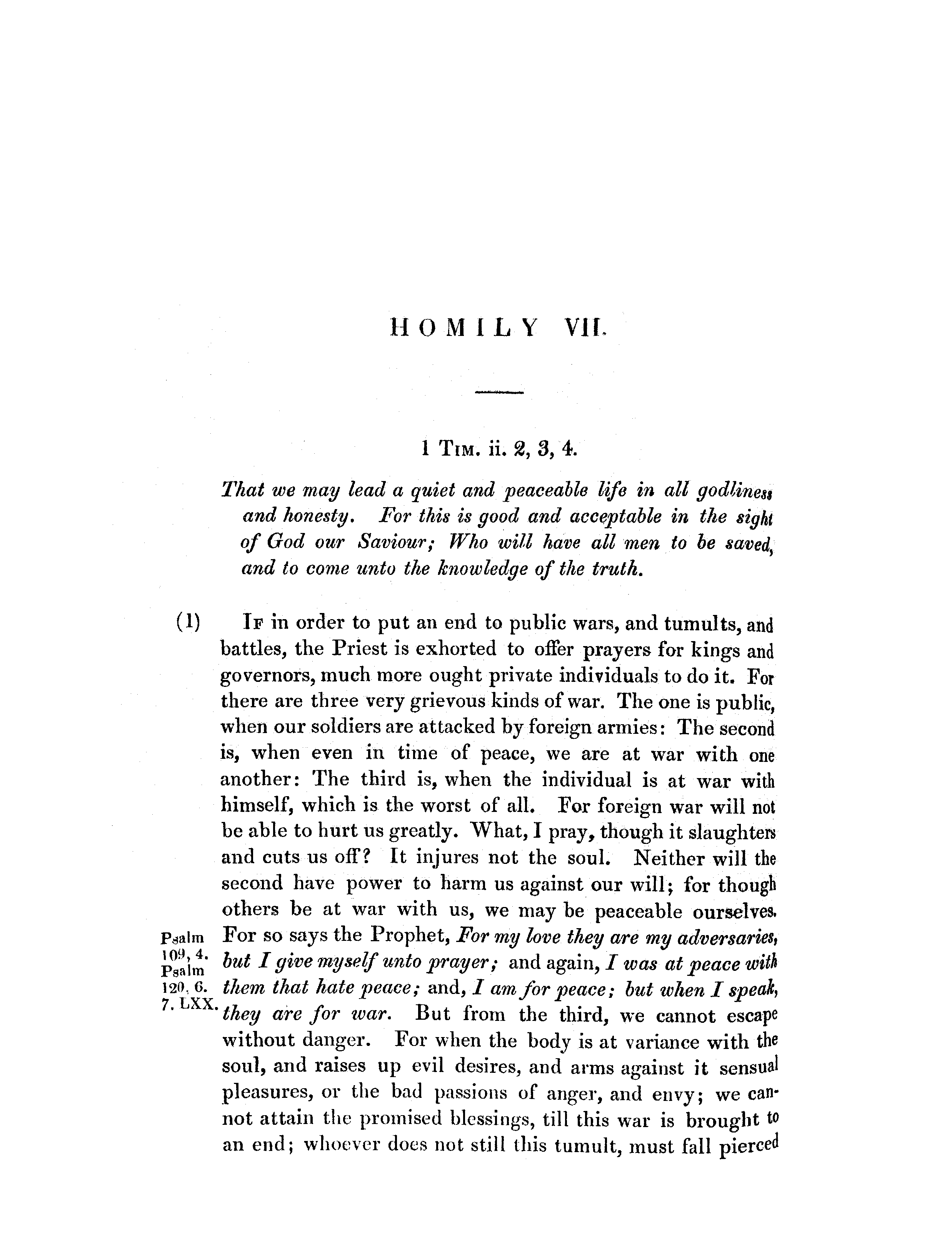
H O M I L Y
V I L 1 TIM. ii. % 3, 4.
That we may lead a quiet and peaceable life in all godliness and honesty.
For this is good and acceptable in the sight of God our Saviour; Who will have oil men to be saved and to come unto the knowledge of the truth.
(1) IF TO order to put an end to public wars, and tumults, and battles, the Priest is exhorted to offer prayers for kings and governors, much more ought private individuals to do it. For there are three very grievous kinds of war. The one is public, when our soldiers are attacked by foreign armies: The second is, when even in time of peace, we are at war with one another: The third is, when the individual is at war with himself, which is the worst of all.
For foreign war will not be able to hurt us greatly. What, I pray, though it slaughters and cuts us off?
It injures not the soul.
Neither will the second have power to harm us against our will; for though others be at war with us, we may be peaceable ourselves.
Psalm For so says the Prophet, For my love they are my adversaries pSim I y*ve myse¥ unto prayer; and again, I was at peace with 120, 6. them that hate peace; and, I am for peace; but when I speak,
7. LXX. a r e j-or w a r .
B u t from the third, we cannot escape without danger.
For when the body is at variance with the soul, and raises up evil desires, and arms against it sensual pleasures, or the bad passions of anger, and envy; we cannot attain the promised blessings, till this war is brought to an end; whoever does not still this tumult, must fall pierced
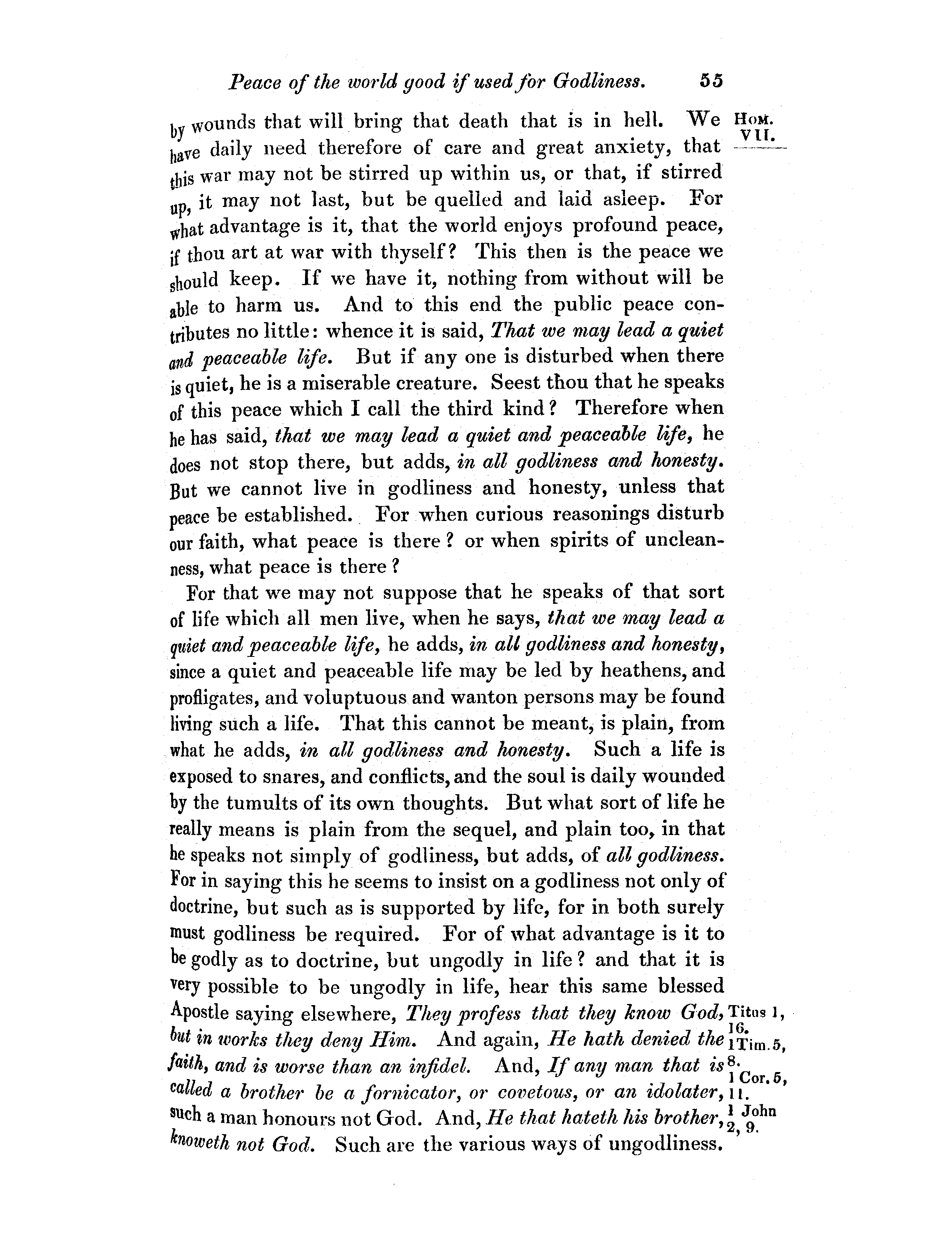
Peace of the world good if used for Godliness.
ky wounds that will bring that death that is in hell.
We Hom. have daily need therefore of care and great anxiety, that "war may not be stirred up within us, or that, if stirred up} it may not last, but be quelled and laid asleep.
For tfhat advantage is it, that the world enjoys profound peace, |f thou art at war with thyself ? This then is the peace we should keep.
If we have it, nothing from without will be able to harm us.
And to this end the public peace contributes no little: whence it is said, That we may lead a quiet and peaceable life.
But if any one is disturbed when there is quiet, he is a miserable creature. Seest thou that he speaks of this peace which I call the third kind ? Therefore when he has said, that we may lead a quiet and peaceable Ufe, he does not stop there, but adds, in all godliness and honesty.
But we cannot live in godliness and honesty, unless that peace be established.
For when curious reasonings disturb our faith, what peace is there ? or when spirits of uncleanness, what peace is there ?
For that we may not suppose that he speaks of that sort of life which all men live, when he says, that we may lead a quiet and peaceable life, he adds, in all godliness and honesty, since a quiet and peaceable life may be led by heathens, and profligates, and voluptuous and wanton persons may be found living such a life. That this cannot be meant, is plain, from what he adds, in all godliness and honesty.
Such a life is exposed to snares, and conflicts, and the soul is daily wounded by the tumults of its own thoughts. But what sort of life he really means is plain from the sequel, and plain too, in that he speaks not simply of godliness, but adds, of all godliness.
For in saying this he seems to insist on a godliness not only of doctrine, but such as is supported, by life, for in both surely must godliness be required.
For of what advantage is it to be godly as to doctrine, but ungodly in life ? and that it is very possible to be ungodly in life, hear this same blessed
Apostle saying elsewhere, They profess that they know God, Titus ], but in works they deny Him.
And again, He hath denied the ixjm.5( faith, and is worse than an infidel.
And, If any man that is g wiled a brother be a fornicator, or covetous, or an idolater, 11. such a man honours not God. And, He that hateth his brother, * g°hn knoweth not God.
Such are the various ways of ungodliness.
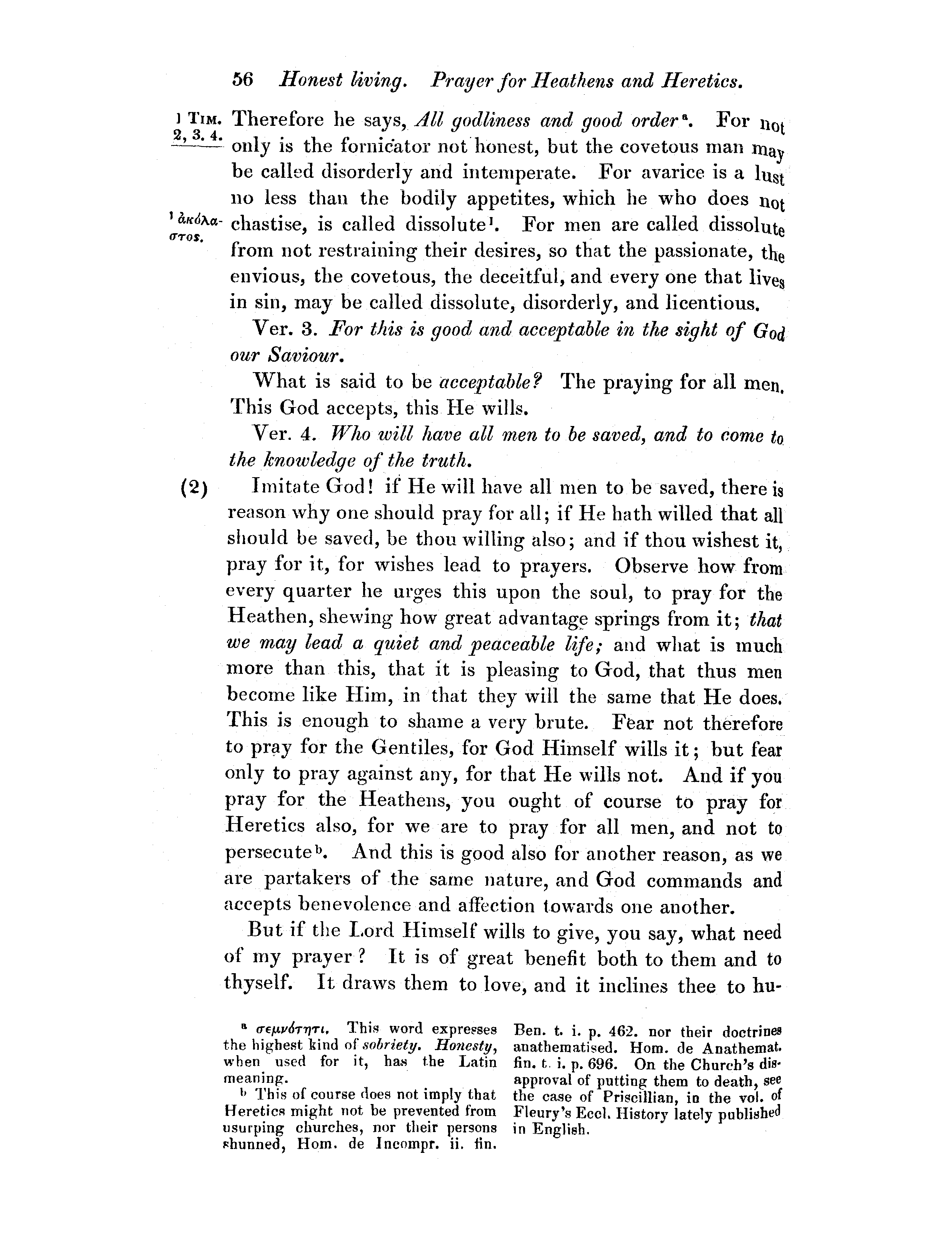
Honest living.
Prayer for Heathens and Heretics.
] TIM. Therefore he says, All godliness and good order\ For N0J -——• only is the fornicator not honest, but the covetous man may be called disorderly and intemperate. For avarice is a luSj.
110 less thau the bodily appetites, which he who does not '«fcdA«- chastise, is called dissolute1.
For men are called dissolute (TTOS, .
. from not restraining their desires, so that the passionate, the envious, the covetous, the deceitful, and every one that lives in sin, may be called dissolute, disorderly, and licentious.
Ver. 3. For this is good and acceptable in the sight of God our Saviour.
What is said to be acceptable?
The praying for all men.
This God accepts, this He wills.
Ver. 4. Who will have all men to be saved, and to come to the knowledge of the truth.
(2) Imitate God! if He will have all men to be saved, there is reason why one should pray for all; if He hath willed that all should be saved, be thou willing also; and if thou wishest it, pray for it, for wishes lead to prayers.
Observe how from every quarter he urges this upon the soul, to pray for the Heathen, shewing how great advantage springs from it; that we may lead a quiet and peaceable l i f e ; and what is much more than this, that it is pleasing to God, that thus men become like Him, in that they will the same that He does.
This is enough to shame a very brute.
Ffear not therefore to pray for the Gentiles, for God Himself wills it; but fear only to pray against any, for that He wills not. And if you pray for the Heathens, you ought of course to pray for Heretics also, for we are to pray for all men, and not to persecuted And this is good also for another reason, as we are partakers of the same nature, and God commands and accepts benevolence and affection towards one another.
But if the Lord Himself wills to give, you say, what need of my prayer ? It is of great benefit both to them and to thyself.
It draws them to love, and it inclines thee to huB o-e^TriTi, This word expresses Ben. t. i. p. 462. nor their doctrines the highest kind of sobriety.
Honesty, anathematised. Horn, de Anathemat. when used for it, has the Latin fin. t. i. p. 696.
On the Church's dismeaning. approval of putting them to death, see l> This of course does not imply that the case of Priscillian, in the vol. of Heretics might not be prevented from Fleury's Eccl. History lately published usurping churches, nor their persons in English, shunned, Horn, de Incompr. ii. fin.
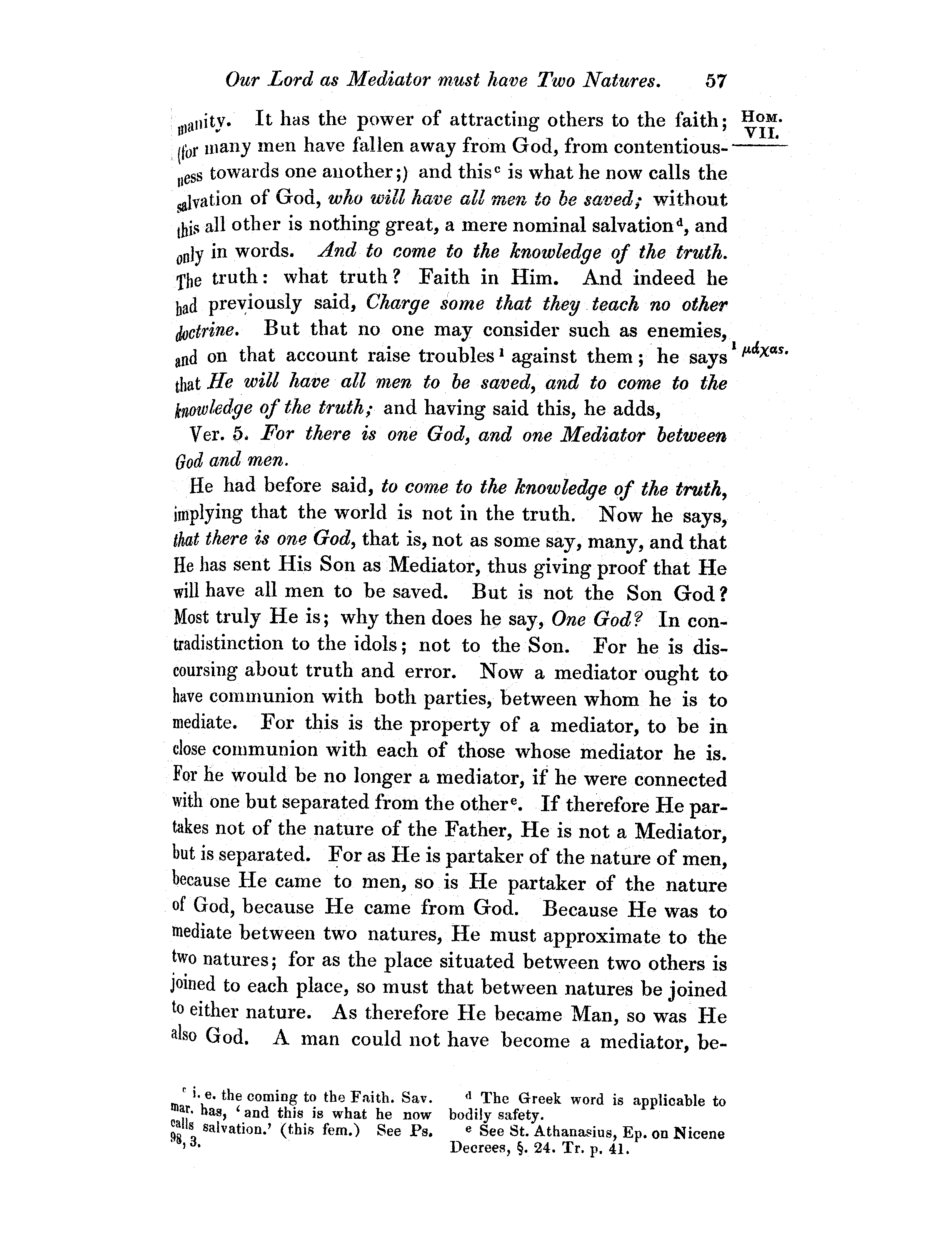
Our Lord as Mediator must have Two Natures.
]!)anity.
It has the power of attracting others to the faith; Hom. jfor in any men have fallen away from God, from contentious- ~ ,,ess towards one another;) and this0 is what he now calls the Ovation of God, who will have all men to be saved; without ,jjis all other is nothing great, a mere nominal salvationd, and on]y in words.
And to come to the knowledge of the truth.
Xhe truth: what truth? Faith in Him.
And indeed he jjad previously said, Charge some that they teach no other foctrine. But that no one may consider such as enemies, and on that account raise troubles1 against them; he says1 that He will have all men to be saved, and to come to the knowledge of the truth; and having said this, he adds,
Ver. 5. For there is one God, and one Mediator between God and men.
He had before said, to come to the knowledge of the truth, implying that the world is not in the truth.
Now he says, that there is one God, that is, not as some say, many, and that He has sent His Son as Mediator, thus giving proof that He will have all men to be saved.
But is not the Son God ?
Most truly He is; why then does he say, One God? In contradistinction to the idols; not to the Son.
For he is discoursing about truth and error.
Now a mediator ought to have communion with both parties, between whom he is to mediate.
For this is the property of a mediator, to be in close communion with each of those whose mediator he is.
For he would be no longer a mediator, if he were connected with one but separated from the othere. If therefore He partakes not of the nature of the Father, He is not a Mediator, but is separated. For as He is partaker of the nature of men, because He came to men, so is He partaker of the nature of God, because He came from God.
Because He was to mediate between two natures, He must approximate to the two natures; for as the place situated between two others is joined to each place, so must that between natures be joined to either nature. As therefore He became Man, so was He also God.
A man could not have become a mediator, bec i. e. the coming to the Faith. Sav.
<> The Greek word is applicable to has, < and this is what he now bodily safety, rails salvation.' (this fem.) See Ps. e See St. Athanasius, Ep. on Nicene ' > D e c r e e s , §. 24. Tr. p. 41.
Avian reasonings.
Our Lord's witness of the Truth. l Tim. cause he must also plead with God.
God could not have '
-*• been mediator, since those could not receive Him, toward whom He should have mediated. And as elsewhere he savs l Cor. 8, There is one God the Father, and one Lord Jesus Christ; so also here One God, and One Mediator; he doeg not say two; for he would not have that number wrested to Polytheism, of which he was speaking. So he wrote One and One. You see how accurate are the expressions of Scripture!
For though one and one are two, we are not to say this, though reason suggests it.
And here thou sayest not one and one are two, and yet thou sayest what reason does not suggest.
' If He begat He also sufferedf.' For there is one God, he says, and one Mediator between God and men, the Man Christ Jesus.
Yer. 6. Who gave Himself a ransom for all, to be testified« in due time.
Was Christ then a ransom for the Heathen? Undoubtedly Christ died even for Heathen; and you cannot bear to pray , for them. Why then, you ask, did they not believe ? Because they would not: but His part was done.
His suffering was a Testimony, he says; for He came, it is meant, to bear witness to the truth of the Father, and was slainb.
Thus not only the Father bore witness to Him, but He to the Father.
John 5, For I came, He saith, in My Father's name. And again, No John l, man hath seen God at any time. And again, That they might
Jo'hnir ^now Thee, the only true God.
And, God is a Spirit.
And 3.
' H e bore witness even to the death.
But this, in due time, John 4, m e a n S j Jjj t h e fittest time.
Yer. 7. Whereunto I am ordained a preacher and an Apostle, {I speak the truth in Christ, and lie not:) a teacher of the Gentiles in faith and verity.
(3) Since therefore Christ suffered for the Gentiles, and I was separated to be a teacher of the Gentiles, why dost thou refuse to pray for them ? He fully shews his own credibility,
Acts 13, by saying that he was ordained, that is, separated, for this f eiraOev. Not in ¿he sense implied in See St. Ath. against Arians, Disc, h Sabell ianism.
He refers to an Arian Ben.
16. t. i. p. 421. a. Tr. c. v. argument against the proper Divinity §. 6. p. 204. of the Son, which he means is less s Lit. the Testimony. plausible than one which this passage h He seems to mean, ' was slain for of St. Paul shews not to be legitimate, that purpose.'
Extension of Grace.
Christ's love should shame us.
urpose, the other Apostles being backward' in teaching the HOM.
0entiles ; he adds, in faith and verity, to shew that in that faith there was no deceit. Here is observable the extension
0f grace. For the Jews had no prayers for the Gentiles; but cow grace is extended to them : and when he says that he was separated to be a Teacher of the Gentiles, he intimates that grace was now shed over every part of the world.
}{e gave himself a ransom, he saith, how then was He delivered up by the Father? Because it was of His goodness.
And what means ransom ? God was about to punish them, but He forbore to do it. They were about to perish, but in their stead He gave His own Son, and sent us as heralds to proclaim the Cross. These things are sufficient to attract all, and to demonstrate the love of Christ. So truly, so inexpresMOEAL. sibly great are the benefits which God has bestowed upon us.
He sacrificed Himself for His enemies, who hated and rejected Him. What no one would do for friends, for brethren, for children, that the Lord hath done for His servants; a Lord not Himself such an one as His servants, but God for men; for men not deserving.
For had they been deserving, had they done His pleasure, it would have been less wonderful; but that He died for such ungrateful, such obstinate creatures, this it is which strikes every mind with amazement.
For what men would not do for their fellow men, that has God done for us! Yet after such a display of love towards us, we hold back1, and are not in earnest in our love1 ¿«««0of Christ.
He has sacrificed Himself for us; for Him w e ^ " " make no sacrifice.
W e neglect Him when He wants necessary food; sick and naked we visit Him not.
What do we not deserve, what wrath, what punishment, what hell ? Were there no other inducement, it should be sufficient to prevail with every one that He condescended to make human sufferings His own, to say I hunger, I thirst.
O the tyranny of wealth! or rather the wickedness of those who are its willing slaves! for it has no great power of itself, but through our weakness and servility15: it is we that are mean and grovelling, that are carnal and without understanding. For what power has money ? It is mute and insensible.
' tvdpKcov.
Montf. observes that all of the Apostles, but not universally. c°pies agree, and that this may be true k One Ms aud old Lat. ' dissoliite- °> the countries mentioned in the Acts ness.'
Folly of hoarding silver.
Gold chains still chains.
L TIM. If the devil, that wicked spirit, that crafty confounder of ajj 2,-~- things, has no power1, what power has money ? Wheft you look upon silver, fancy it is tin ! Cannot you ? Then hold it for what it really is; for earth it is.
But if y0ll cannot reason thus, consider that we too shall perish, that many of those who have possessed it have gained scarce ariy advantage by it, that thousands who gloried in it are now dust and ashes.
That they are suffering extreme punish» ment, and far more beggarly than they that fed from glass and earthenware; that those who once reclined on ivory couches, are poorer now than those who are lying on the dunghill. But it delights the eyes! How many other things i delight them more! The flowers, the pure sky, the firmament, the bright sun, are far more grateful to the eye. For it hath much of rust, whence some have asserted that it was black, which appears from the images that turn black.
But there is no blackness in the sun, the heaven, the stars.
Much greater delight is there in these brilliants1" than in its colour.
1 lit. ^ It is not therefore its brilliancy1 that makes it please, but covetousness and iniquity; these, and not money, give the pleasure.
Cast these from thy soul, and what appeared so precious will seem to thee more worthless than clay.
Those who are in a fever long for mud when they see it, as if it were spring water; but those in sound health seldom wish even for water.
Cast off this morbid longing, and thou wilt see things as they are.
And to prove that I do not speak falsely, know, that I can point out many who have done so.
Quench this flame, and thou wilt see that these things are of less worth than flowers.
Is gold good ? Yes, it is good for almsgiving, for the relief of the poor; it is good, not for unprofitable use, to be hoarded up or buried in the earth, to be worn on the hands or the feet or the head. It was discovered for this end, that with it we should loose the captives, not form it into a chain for the image of God.
Use thy gold for this, to loose him tljat is bound, not to chain her that is free.
Tell me, why dost thou value above all things what is of so little worth?
Is it the less a chain, because it is of gold? does the material 1 i. e. over those who resist him, ix. (3.) Tr. p. 179. m L i t . ' flowers.' See on Stat. Horn.
Bonds of gold tend to the chains of Hell.
^ake any difference11 ? whether it be gold or iron, it is still Hom. a chain ; nay the gold is the heavier.
What then makes it light, hut vain-glory, and the pleasure of being seen to wear a chain, of which you ought rather to be ashamed ? To make t]jjg evident, fasten it, and place the wearer in a wilderness or where there is no one to see, and the chain will at once be felt heavy, and thought burdensome.
Beloved, let us fear, lest we be doomed to hear those terrible words, Bind him hand and foot.
And why, O Mat.22, woman, dost thou now do so to thyself? No prisoner has 1 3 , both his hands and his feet bound.
Why bindest thou thy head too ? For thou art not content with hands and feet, but bindest thy head and thy neck with many chains.
I pass over the care that comes of these things, the fear, the alarm, the strife occasioned by them with thy husband if ever he wants them, the death it is to people when they lose any of them.
Canst thou call this a pleasure ? To gratify the eyes of others, dost thou subject thyself to chains, and cares, and perils, and uneasiness, and daily quarrels ? This is deserving of every censure and condemnation.
Nay, I entreat you, let us not do thus, let us burst every bond of Acts 8, iniquity; let us break our bread to the hungry, and let us do 2 3' all other things, which may ensure to us confidence before God, that we may obtain the blessings promised through Jesus Christ our Lord, with Whom, &c. n Lit. 1 Is it the material that mates (an iron chain) a chain ?'
H O M I L Y
VIII.
1 TIM. ii. 8, 9, 10.
I will therefore that men pray every where, lifting up holy hands, without wrath and doubting.
In like manner also, that women adorn themselves in modest apparel, with shamefacedness and sobriety; not with broidered hair, or gold, or pearls, or costly array; but (which becometh women professing godliness) with good works.
(1) WHEN thou pray est, saith Christ, thou shalt not be as the Matt. 6, }iyp0crites are . jfor they love i0 pmy standing in the synagogues and in the corners of the streets, that they may be seen of men.
Verily I say unto you, they have their reward.
But thou, when thou prayest, enter into thy closet, and when thou hast shut thy door, pray to thy Father, which is in secret; and thy Father, which seeth in secret, shall reward thee openly.
What then says Paul ? I will therefore that men pray every where, lifting up holy hands, without wrath and doubting.
This is not contrary to the other, God forbid, but quite in harmony with it.
But how, and in what way ? We must first consider what means, enter into thy closet, and why Christ commands this, if we are to pray in every place ? or whether we may not pray in the church, nor in any other part of the house, but the closet ? What then means that saying ? Christ is recommending us to avoid ostentation, when He bids us offer our prayers not only privately, but secretly.
For, when Matt. 6, f£ e says, Let not thy left hand know what thy right hand doeth, it is not the hands that He considers, but He is bidding them use the utmost caution against ostentation: and
Praying every where.
What are holy hands.
jje js doing the like here; He did not limit prayer to one Host, «lace, hut required one thing alone, the absence of vain- --jory.
The object of Paul is to distinguish the Christian £0111 the Jewish prayers, therefore observe what he says: In ^gry place lifting up holy hands, which was not permitted
^g Jews, for they were not allowed to approach God, to sacrifice and perform their services, elsewhere, but assembling from all parts of the world in one place, they were bound to perform all their worship1 in the temple.
In opposition to \ ra rrjs this he introduces his precept, and freeing them from this^J"™^ necessity, he says in effect, Our ways are not like the Jewish; for as Christ commanded us to pray for all men because He died for all men, and I preach these things for all men, s0 it is good to pray every where.
Henceforth the consideration is not of the place but of the manner of the prayer; pray every where, but every where lift up holy hands.
That is the thing required.
And what is holy2?
Pure. And what5 6<r(ovs is pure ? Not washed with water, but free from covetousness, murder, rapacity, violence, without wrath and doubting.
What means this ? Who is angry when he prays ? It means, without bearing malice.
Let the mind of him that prays be pure, freed from all passion» Let no one approach God in enmity, or in an unamiable temper, or with doubting.
What is without doubting f Let us hear.
It implies that we should have no misgiving, but that we shall be heard.
For it is said, whatever ye ask believing ye shall receive.
And Matt, again, when ye stand praying forgive, if ye have ought against Mark2' any one. This is to pray without wrath and doubting.
But 1 1» 25. how can I believe that I shall obtain my request? By asking nothing opposed to that which He is ready to grant, nothing unworthy of the great King, nothing worldly, but all spiritual blessings; if you approach Him without wrath, having pure hands, holy hands: hands employed in almsgiving are holy.
Approach Him thus, and you will certainly obtain your request. For if ye being evil know how to give good gifts to 7, your children, how much more shall your Father which is in Heaven give good things to them that ask Him ?
By doubthe means misgiving.
In like manner he says, I will that women approach God without wrath and doubting, lifting up holy hands: that they should not follow their own
Ornaments inconsistent with penitence.
L TIM. desires, nor be covetous or rapacious.
For what if a W O I N ^ does not rob or steal herself, but does it through means <jf her husband?
Paul however requires something more 0( women, that they adorn themselves in modest apparel with shamefacedness and sobriety; not with broidered hair or gold or pearls or costly array; but (which becometh women professing godliness) with good works.
But what is this modest apparel f Such attire as covers them completely, and decently, not with superfluous ornaments, for the one i8
MoEATi. becoming, the other is not.
What ? Dost thou approach God to pray, with broidered hair and ornaments of golcl?
Art thou come to a dance ? to a marriage ? to a gay procession ?
There such a broidery, such costly garments, had been seasonable, here not one of them is wanted.
Thou art come to pray, to supplicate for pardon of thy sins, to plead for thine offences, beseeching the Lord, and hoping to render Him propitious to thee.
Why dost thou adorn thyself ? This is not the dress of a suppliant.
How canst thou groan ?
How canst thou weep ?
How pray with fervency, when thus attired ? Shouldest thou weep, thy tears will be the ridicule of the beholders.
She that weeps ought not to be wearing gold.
It were but acting, and hypocrisy.
For is it not acting to pour forth tears from a soul so overgrown with extravagance and ambition ?
Away with such hypocrisy!
God is not mocked!
This is the attire of actors and dancers, that live upon the stage. Nothing of this sort becomes a modest woman, who should be adorned with shamefacedness and sobriety.
(2) Imitate not therefore the courtesans.
For by such a dress they allure their many lovers; and hence many have incurred a disgraceful suspicion, and, instead of gaining any advantage from their ornaments, have injured manya by bearing this character.
For as the adulteress, though she may have a character for modesty, derives no benefit from that character, in the Day, when He who judges the secrets of men shall make all things manifest; so the modest woman, if she contrive by this dress to pass for an adulteress, will lose the advantage of her chastity.
For many have suffered harm by this opinion. ' What can I do,' thou sayest, ' if another susn He means either by jealousy or temptation.
Virgins not to seek admiration by their dress.
cts nie V But thou givest the occasion by thy dress, thy HOM.
|C>fcs> thy gestures. It is for this reason that Paul discourses jjiich of dress, and much of modesty. And if he would remove those things which are only the indications of wealth, jggold, and pearls, and costly array; how much more those jjjjngs which imply studied ornament, as painting, colouring jjje eyes, a mincing gait, the affected voice, a languishing jI)C[ Wanton look; the exquisite care in putting on the cloak and bodice, the nicely-wrought girdle, and the closely-fitted jhoes? For he glances at all these things, in speaking of q/odest apparel and shamefacedness.
For such things are shameless and indecent.
Bear with me, I beseech you, for it is not my aim by this plain reproof to wound or pain you, but to remove from my flock all that is unbecoming to them. But if these prohibitions are addressed to those who have husbands, who are rich, and live luxuriously; much more to those who have professed virginity. But what virgin, you say, wears gold, or broidered hair ? Yet there may be such a studied nicety in a simple dress, as that these are nothing to it. You may study appearance in a common garment more than those who wear gold. For when a very dark coloured robe is drawn closely round the breast with the girdle, (as dancers on the stage are attired,) with such nicety that it may neither spread into breadth nor shrink into scantiness, but be between both; and when the bosom is set off with many folds, is not this more alluring than any silken robes ? and when the shoe, shining through its blackness, ends in a sharp point, and imitates the elegance of painting, so that even the breadth of the sold is scarce visible—or when though you do not indeed paint the face, you spend much time and pains on washing it, and spread a veil across the forehead", whiter than the face itself
—and above that put on a h o o d o f which the blackness1 fiposset off the white by contrast—is there not in all this the vanity of dress ? What can one say to the perpetual rolling the eyes ? to the putting on of the stomacher so artfully
®s sometimes to conceal, sometimes to disclose, the fastening?
For this too they sometimes expose, so as to shew the ex- . b /isrcfe rod HCTSTTOV. The reading ' so as to make one effect with the 18 suspected, but it seems to mean forehead.'
Display of Virgins adultery against Christ.
2' 9110 ^.u^^eness of the cincture, winding the hood entirely r o ^ the head. Then like the players, they wear gloves so closej^ fitted, that they seem to grow upon the hands: and we migfy speak of their walk, and other artifices more alluring th^ any ornaments of gold.
Let us fear, beloved, lest we al^ hear what the Prophet said to the Hebrew women who weig
Is.3,24. so studious of outward ornament; Instead of a girdle, th^ shalt be girded with a halter, instead of well-set hair, baldness
These things and many others, invented only to be seen ami to attract beholders, are more alluring than golden ornament^
These are no trifling faults, but displeasing to God, and enough to mar all the self-denial of virginity.
(3) Thou hast Christ for thy Bridegroom, O virgin, why dost thou seek to attract human lovers? He will judge thee as an adulteress.
Why dost thou not wear the ornament that is pleasing to Him; modesty, chastity, orderliness, and sober apparel? This is meretricious, and disgraceful.
We can no longer distinguish hai'lots and virgins, to such indecency have they advanced. A virgin's dress should not be studied, but plain, and without labour; but now they have many artifices to make their dress conspicuous.
O woman, cease from this folly. Transfer this care to thy soul, to the inward adorning.
For the outward ornament that invests thee, suffers not that within to become beautiful. He that is concerned for that which is without, despises that which is within, even as he that is unconcerned about the exterior, bestows all his care upon the interior. Say not, * Alas! I wear a threadbare garment, mean shoes, a worthless veil; what is there of ornament in these?' Do not deceive thyself.
It is possible, as I said, to study appearance more by these than by costlier! dresses ; especially when they are close-fitted to the body,
1 So B. fashioned to an immodest shew, and of shining neatness1. fui°readThou excusest thyself to me, but what canst thou say to >ng.) God, Who knows the heart and the spirit with which thou doest these things ?
' It is not done for fornication!'
Perhaps not, but for admiration ; and dost thou not blush for shame to be admired for such things ? But thou sayest,
' It is but chance I am so dressed, and for no motive of this kind.'
God knoweth what thou sayest to me : is to me thou must give account ? Nay, it is to Him Who is
A Virgin's warfare requires the whole mind.
at thy actions, and will One Day inquire into them, HOM.
\Vhom all thing's are naked and open.
It is on this l^ount that we now urge these things, that we may not let l^j be amenable to those severe judgments.
Let us fear gierefore lest He reprove you in the words of the Prophet p the Jewish women: They come to be seen of me wantoning ls.3,16. mincing as they go, and making a tinkling with fheir
^ Ye have taken upon you a great contest, where wrestling, jiot ornament, is required; where the battle awaits you, not lloth and ease. Observe the combatants and wrestlers in the games. Do they concern themselves about their walk, or their dress? No, but scorning all these, and throwing about them a garment0 dripping with oil, they look only to one thing, to wound, and not be wounded.
The devil stands grinding his teeth, watching to destroy thee every way, and thou remainest unconcerned, or concerned only about this satanic ornament.
I say nothing about the voice, though much affectation is shewn in this also, nor about perfumes, and other such luxuries.
It is for these things we are ridiculed by the women of the world.
The respect for virginity is lost.
No one honours a virgin as she ought to be honoured.
They have given occasion to their own dishonour. Ought not they to be looked up to in the Church of God, as women coming from heaven ? but now they are despised, and deservedly, though not those among them who are discreet.
But when one who has a husband and children, and presides over a household, sees thee, who ought to be crucified to the world, more devoted to the world than herself, will she not ridicule and despise thee ?
See what care ! what pains!
In thy humble dress, thou exceedest her who wears the costliest ornament, and art more studious of appearance than she who is arrayed in gold. What is becoming to thee thou seekest not; that which misbecomes thee thou pursuest, when thou oughtest to be occupied in good works.
On this account virgins are kss honoured than women of the world.
For they do not perform works worthy of their virgin profession.
This is n°t said to all; or rather it is said to all; to those who are c See on Stat. Horn. i. 16. Tr. p. 18. note a.
F 2
Admonition not meant to grieve, but to correct.
1 TIM. in fault, that they may learn modesty; to those who are F^ -L-:—" from blame, that they may teach modesty to others.
^ beware lest this rebuke be verified in deed. For we have ^ said these things that we may grieve, but that we may corrg^ you, that we may glory in you.
And may we all do tho^ things which are acceptable to God, and live to His g]0ry that we may obtain the blessings promised by the grace a^ lovingkindness of our Lord Jesus Christ, with Whom, &c>
H O M I L Y
IX.
1 TIM. ii. 11—15. let the woman learn in silence with all subjection.
But I suffer not a woman to teach, nor to usurp authority over the man, but to be in silence.
For Adam was first formed, then Eve.
And Adam was not deceived, but the woman being deceived was in the transgression.
Notwithstanding she shall be saved in childbearing, if they continue in faith and charity and holiness with sobriety.
GREAT modesty and great propriety does the blessed Paul require of women, and that not only with respect to their dress and appearance: he proceeds even to regulate their speech. And what says he? Let the woman learn in silence; that is, let her not speak at all in the church; which rule he has also given in his Epistle to the Corinthians, where he
®ys, It is a shame for women to speak in the church; and l Cor. the reason is, that the law has made them subject to men.14' 35*
And again elsewhere, And if they will learn any thing, let Ibid.
Mem ask their husbands at home.
Then indeed the women, from such teaching, kept silence; but now there is apt to be fl^at noise among them, much clamour and talking, and no *here so much as in this place.
They may all be seen here Wking more than in the market, or at the bath.
For, as tf they came hither for recreation, they are all engaged in ^versing upon unprofitable subjects. Thus all is confusion,
7 0 Silence in Church.
Women not to teach.
\ Tim, and they seem not to understand, that unless they are qui ej "1 they cannot learn any thing that is useful.
For when discourse strains against the talking, and no one minds w}-^ is said, what good can it do to them ? To such a degre^ should women be silent, that they are not allowed to spea^ not only about worldly matters, but not even about spirit^ things, in the church.
This is order, this is modesty, t^j, will adorn her more than any garments.
Thus clothed, s^ will be able to offer her prayers in the manner most be. coming.
But I suffer not a woman to teach.
I do not suffer, says. What place has this command here ? The fittest. JJe was speaking of quietness, of property, of modesty, ^ having said that he wished them not to speak in the church, to cut off all occasion of conversation, he says, let them not teach, but occupy the station of learners. For thus they will shew submission by their silence.
For the sex is naturally somewhat talkative : and for this reason he restrains the® on all sides.
For Adam, says he, was first formed, then Eu, And Adam was not deceived, but the woman being deceivd was in the transgression.
If it be asked, what has this to do with women of the present day ? it shews that the male sex enjoyed the higher honour. Man was first formed; and elsewhere he shews theii l Cor. superiority.
Neither was the man created for the womaii, ' ' but the woman for the man. Why then does he say this ? He wishes the man to have the preeminence in every way; both for the reason given above, he means, let him have precedence, and on account of what occurred afterwards. For the woman taught the man once, and made him guilty ofl disobedience, and wrought our ruin.
Therefore because shd made a bad use of her power over the man, or rather befl equality with him, God made her subject to her husband
Gen. 3, Thy desire shall be to thy husband.
This had not been sail 16, to her before.
But how was Adam not deceived ? If he was not deceived he did not then transgress ? Attend carefully. The won«* said, The serpent beguiled me. But the man did not say, T^1 woman deceived me, but, she gave me of the tree, and / ^ eat.
Now it is not the same thing to be deceived by a fell0*'
Eves bad teaching.
Salvation by Childbearing.
FEATURE, one of the same kind, as by an inferior and suborH O M .
¿inate animal.
This is truly to be deceived.
Compared I x ' . therefore with the woman, he is spoken of as not deceived.
V * * "
_ for she was beguiled by an inferior and subj ect, he by an equal.
Again, it is not said of the man, that he saw the tree was g o o d - f o r food, but of the woman, and that she did eat, and gave it to her husband: so that he transgressed, not captivated by appetite, but merely from the persuasion of his wife. The woman taught once, and ruined all. On this account therefore he saith, let her not teach.
But what is it to other women, that she suffered this ? It certainly concerns them ; for the sex is weak and fickle, and he is speaking of the sex collectively. For he says not Eve, but the woman, which is the common name of the whole sex, not her proper name.
Was then the whole sex included in the transgression for her fault? As he said of Adam, After the similitude of Adam's Rom. 5, transgression, who is the figure of Him that was to come ; so14' here the female sex transgressed, and not the male.
Shall not women then be saved ? Yes, by means of children. For it is not of Eve that he says, If they continue in faith and charity and holiness with sobriety. What faith ? what charity ? what holiness with sobriety ? It is as if he had said, ' Ye women, be not cast down, because your sex has incurred blame. God has granted you another opportunity of salvation, by the bringing up of children, so that you are saved, not only by yourselves, but by others.' See how many questions are involved in this matter. The woman, he says, being deceived was in the transgression.
What woman? Eve. Shall she then be saved by childbearing ? He does not say that, but, the race of women shall be saved.
Was not it then involved in transgression ? Yes, it was, still Eve transgressed, but the whole sex shall be saved, notwithstanding, by childfaring. And why not by their own personal virtue ? For has she excluded others from this salvation? And what will be the case with virgins, with the barren, with widows who have lost their husbands, before they had children ? will they perish? is there no hope for them ? yet virgins are held in the highest estimation.
What then does he mean to say ?
Some interpret his meaning thus.
As what happened to (2) first woman occasioned the subjection of the whole sex,
72 Women may be saved without Children, or rewarded for them I TIM. (for since Eve was formed second and made subject, he
— s a y s , let the rest of the sex be in subjection,) so because she transgressed, the rest of the sex are also in transgression
But this is not fair reasoning; for at the creation all was the gift of God, but in this case, it is the consequence of the woman's sin.
But this is the amount of what lie says. all men died through one, because that one sinned, so the whole female race transgressed, because the woman was in the transgression.
Let her not however grieve.
God hath given her no small consolation, that of childbearing. And if it be said that this is of nature, so is that3 also of nature; for not only that which is of nature has been granted, but also the bringing up of children.
If they continue in faith and charity and holiness with sobriety; that is, if after childbearing, they keep themb in charity and purity. By these means they will have no small reward on their account, because they have trained up wrestlers for the service of Christ. By holiness he means good life, modesty, and sobriety.
Chap. iii. ver. 1. This is a faithful saying.
This relates to the present subject, not to what follows, respecting the office of a Bishop.
For as it was doubted, he affirms it to be a true saying, that fathers may be benefited by the virtue of their children, and mothers also, when they have brought them up well.
But what if she be herself addicted to wickedness and vice ? Will she then be benefited by the bringing up of children ? Is it not probable that she will bring them up to be like herself ?
It is not therefore of any woman, but of the virtuous woman, that it is said she shall receive a great recompense for this also.
MORAI,.
Hear this, ye fathers and mothers, that your bringing up of children shall not lose its reward.
This also he says, as I Tim. he proceeds. Well reported of for good works; if she have
5'10' brought up children.
Among other commendations he reckons this one, for it is no light praise to devote to God those children which are given them of God.
For if the basis, the foundation which they lay be good, great will he a T h e sense is obscure, bnt he seems of sin.
See on Stat. Horn. ii. 19. Tito mean ' t h e ordinary way of salvap. 47. and irapafi.v0la elsewhere, tion,' and by 'consolation,' a way of b i. e. their children.
C'olb, eavroh, obtaining relief from the consequences which cannot be right.
Punishment for neglect of Children.
^ir reward; as great,- if they neglect it, will be their HOM. unishment.
It was on account of his children that Eli. 1 X Lrished.
For he ought to have admonished them, and jndeed he did admonish them, but not as he ought; but fj.0m his unwillingness to give them pain he destroyed both himself and them.
Hear this, ye fathers, bring your children up with great care in the nurture and admonition of the Eph. 6,
Ifird. Youth is wild, and requires many governors, teachers,4" directors, attendants, and tutors; and after all these, it is a happiness if it be restrained.
For as a horse not broken in, or a wild beast untamed, such is youth.
But if from the beginning, from the earliest age, we fix it in good rules, much pains will not be required afterwards; for good habits formed will be to them as a law.
Let us not suffer them to do any thing which is agreeable, but injurious; nor let us indulge them, as forsooth but children.
Especially let us train them in chastity, for there is the very bane of youth.
For this many struggles, much attention will be necessary.
Let us take wives for them early, so that their brides may receive their bodies pure and unpolluted, so their loves will be more ardent.
He that is chaste before marriage, much more will he be chaste after it; and he that practised fornication before, will practise it after marriage.
All bread, it Ecclus. is said, is sweet to the fornicator.
Garlands are wont to be ' worn on the heads of bridegrooms, as a symbol of victory, betokening that they approach the marriage bed unconquered by pleasure.
But if captivated by pleasure he has given himself up to harlots, why does he wear the garland, since he has been subdued?
Let us admonish them of these things.
Let us employ sometimes advice, sometimes warnings, sometimes threatening. In children we have a great charge committed to us.
Let us bestow great care upon them, and do every thing that the Evil one may not rob us of them.
But now our practice is the very reverse of this.
We take all care indeed to have our farm in good order, and to commit it to a faithful manager, we look out for it an ass-driver, and muleteer, and bailiff, and a clever accomptant.
But we do not look out for what is much more important, for a person to whom we may
74 No inheritance like virtue. A mother s duty to daughters.
L TIM. commit our son as the guardian of his morals, though this 3> - is a possession much more valuable than all others.
It is f ^ him indeed that we take such care of our estate, We take care of our possessions for our children, but of the children themselves we take no care at all.
What an absurdity |s this!
Form the soul of thy son aright, and all the rest will be added hereafter.
If that is not good, he will derive no advantage from his wealth; and if it is formed to goodness he will suffer no harm from poverty.
Wouldest thou leave him rich ? teach him to be good: for so he will be able to acquire wealth, or if not, he will not fare worse than they who possess it.
But if he be wicked, though you leave him boundless wealth, you leave him no one to take care of it, and you render him worse than those who are reduced to extreme poverty. For poverty is better than riches for those children who are not well-disposed.
For it retains them in some degree of virtue even against their will.
Whereas money does not suffer those who would be sober to continue so, it leads them away, ruins them, and plunges them into infinite dangers.
Mothers, be specially careful to regulate your daughters well; for the management of them is easy.
Be watchful over them, that they may be keepers at home.
Above all, instruct them to be pious, modest, despisers of wealth, indifferent to ornament. In this way dispose of them in marriage.
For if you form them in this way, you will save not only them, but the husband who is destined to marry them, and not the husband only, but the children, not the children only, but the grandchildren.
For the root being made good, good branches will shoot forth, and still become better, and for all these you will receive a reward.
Let us do all things therefore, as benefiting not only one soul, but many through that one.
For they ought to go from their fathers' house to marriage, as combatants from the school of exercise, furnished with all necessary knowledge, and to be as leaven able to transform the whole lump to its own virtue.
And let your sons be so modest, as to be distinguished for their steadiness and sobriety, that they may receive great praise both from'
God and men.
Let them learn to govern their appetites, to

Character to be formed in sons.
avoid extravagance, to be good economists, affectionate, and HOM. submissive to rule.
For so they will be able to secure a good reward to their parents, so all things will be done to the glory of Grod, and to our salvation, through Christ Jesus oUr Lord, with Whom, &c.
H O M 1 L Y
X .
1 TIM. iii. 1, % 3, 4.
If a man desire the office of a Bishop, he desireth a good work.
A Bishop then must be blameless, the husband of one wife, vigilant, sober, of good behaviour, given to hospitality, apt to teach; not given to wine, no striker, not greedy of filthy lucre; but patient, not a brawler, not covetous; one that ruleth well his own house, having his children in subjection with all gravity.
(1) As now proceeding to discourse of the Episcopal office, he sets out with shewing what sort of a person a Bishop ought to be. And here he does not do it as in the course of his exhortation to Timothy, but addresses all, and instructs others through him.
And what says he ? If a man desire the office of a Bishop, I do not blame him, for it is a work of protection.
If any one has this desire, so that he does not covet the dominion and authority, but wishes to protect the Church, I blame him not.
For he desireth a good work.
Even Moses desired the office, though not the power, and Acts 7, his desire exposed him to that taunt, Who made thee a ruler
Exod.2,mi(l a, judge over us f If any one, then, desire it in this way, 14. let him desire it. For the Episcopate is so called from having the oversight of all.
A Bishop then, he says, must be blameless, the husband of one wife.
This he does not lay down as a rule, as if he must not be without one, but as prohibiting his having more
'á/xethan one1.
For even the Jews were allowed to contract rpla v.
Character required in Bishops.
sec0nd marriages, and even to have two wives at one time. HOM. for marriage is honourable.
Some however say, that this is g ^ ^ •u] that gvery virtue is implied in this word; so that if any one be conscious to himself of any sins, he doth not well to desire an office for which his own actions have disqualified him. for such an one ought to be ruled, and not to rule others, for he who bears rule should be brighter than any luminary; his life should be unspotted, so that all should look up to him, and make his life the model of their own.
But in employing this exhortation, he had no common object in vjew.
For he too1 was about to appoint Bishops, ( w h i c h 1 i.e. also he exhorts Titus to do in his Epistle to him,) and as itthy.°* was probable that many would desire that office, therefore he urges these admonitions.
Vigilant, he says, that is, circumspect, having a thousand eyes about him, quicksighted, not having the eyes of his mind dimmed.
For many things occur which permit not a man to see clearly, to see things as they are.
For care and troubles, and a load of business on all sides, press upon him. He must therefore be vigilant, not only over his own concerns, but over those of others.
He must be well awake, he must be fervent in spirit, and, as it were, breathe fire; he must labour and attend upon his duty by day and by night, even more than a general upon his army; he must be careful and concerned for all.
Sober, of good behaviour, given to hospitality.
Because these qualities are possessed by most of those who are under their rule, (for in these respects they ought to be equal to those who rule over them,) he, to shew what is peculiar to the Bishops, adds, apt to teach. For this is not required of him that is ruled, but is most essential to him who has this rule committed to himb.
Not given to wine: here he does not,so much mean intemperate, as insolent and impudent.
No striker: this too does not mean a striker with the hands.
What means then no striker? Because there are some who unseasonably smite " This is literal from the Greek, but (Ecumenius says that some take it of the sense is difficult to make out from one see. Comp. Ez. xliv. 22. the seeming tautology, unless he means b irdpou'op.
A word often used as that some supposed marriage enjoined, he here explains it; and irapoivla is The Greek will bear, < and some say, used even for contumely «part from let him be the husband of one wife, was insolence.
Theodoret. Eecl. Hist. v. said with a view to this.'
See below.
17.
Why higher attainments are not required.
1 TIM. the consciences of their brethren, it seems to be said w i t h ' reference to them.
Not greedy of filthy lucre, but 'patient not a brawler, not covetous; one thai ruleth well his own house, having his children in subjection with all gravity. l Cor. 7, Jf then he who is married cares for the things of the world
OtJ,
and a bishop ought not to care for the things of the world, why does he say the husband of one wife ? Some indeed think that he says this with reference to one who remains i Cor. 7, freec from a wife. But if otherwise, he that hath a wife may
29' be as though he had none.
For that liberty was then properly granted, as suited to the nature of the circumstances then existing.
And it is very possible, if a man will, so to regulate his conduct. For as riches make it difficult to enter into the kingdom of Heaven, yet rich men have often entered in, so it is with marriage. But why does he say, speaking of a Bishop, that he should be not given to wine, hospitable, when he should name greater things ? Why said he not that he should be an Angel, not subject to human passions ?
Where are those great qualities of which Christ speaks, which even those under their rule ought to possess ? To be crucified to the world, to be always ready to lay down
John 10, their lives, as Christ said : The good Shepherd giveth His life Mat. l t h e sheep/ and again, He that taketh not his cross and 38. foUoweth after Me, is not worthy of Me.
But not given to wine, he says; a good prospect indeed, if such are the things of which a Bishop is to be admonished! Why has he not said that he ought to be already raised above the world ?
But dost thou demand less of the Bishop, than even of those Coloss. in the world ? For to these he saitb, Mortify your members
Rom. 6, which are upon the earth, and, He that is dead, is freed from Luke 15 sm' t^at are Christ's have crucified the flesh; and 33.
' Christ again says, Whosoever forsaketh not all that he hath, he is not worthy of Me.
Why are not these things required by Paul ? Plainly because few could be found of such a character, and there was need of many Bishops, that one might preside in every city.
(2) But because the Churches were to be exposed to attacks'1, he requires not that superior and highly exalted virtue, but c H e seems to mean without a second The reading is not quite certain, marriage.
See 1 Cor. 7, 27.
An old 11 i. e. And therefore to want many Latin translation has this expressly, guardians.
fke Church a household.
Novices not to be advanced.
9 moderate degree of it; for to be sober, of good behaviour, HOM. and temperate, were qualities common to many. Having his
X' c0dren in subjection with all gravity.
This is necessary, tjiat an example might be exhibited in his own house.
For would believe that he who had not his own son in subjection, would keep a stranger under command ?
One that fileth well his own house.
Even those who are without say this, that he who is a good manager of a house will be a good statesman.
For the Church is, as it were, a small11 Doun. household, and as in a house there are children and wife and <Cgreat. domestics, and the man has rule over them all; just so in the Church there are women, children, servants.
And if he that presides in the Church has partners in his power, so hath the man a partner, that is, his wife. Ought the Church to provide for her widows and virgins? so there are in a family servants, and daughters, to be provided for. And, in fact, it is easier to rule the house; therefore he asks, if a man know not how to rule his own house, how shall he take care of the Church of God ?
Yer. 6. Not a novicee.
He does not say, not a young man, but not a new convert.
For he had said, I havei Cor. 3, 'planted, Apollos watered, but God gave the increase.
Wishing then to point out such an one, he used this word.
For, otherwise, what hindered him from saying, 'Not a young man?'
For if youth only was an objection, why did he himself appoint Timothy, a young man ? (and this he proves by saying to him, Let no man despise thy 1 Tim. youth.) Becausef he was aware of his great virtue, and his 4' 1 2' great strictness of life.
Knowing which he writes, From a 2 Tim. child thou hast learned the holy Scriptures.
And that he 3' 15' practised intense fasting is proved by the words, Use a little wine for thine often infirmities; which he wrote to him amongst other things, as, if he had not known of such good works of his, he would not have written, nor given any such charge to his disciple.
But as there were many then who came over from the Heathen, and were baptized, he says, ' Do not immediately advance to a station of dignity a novice, that is, one of these new converts.'
For, if before ' veA<j>vTov, one newly planted. are not in Sav. they are supplied from* f These words, down to ' disciple,' a Colb. Ms. in the last Paris Ed.
A Bishop must be well reported of by all.
Objections. l TIM. he had well been a disciple, he should at once be made a ——— Teacher, he would be lifted up into insolence. If before he had learnt to be under rule, he should be appointed one 0f the rulers, he would be puffed up: therefore he adds, Zest being lifted up with pride, he fall into the condemnation of the devil, that is, into the same condemnation which Satan incurred by his pride.
Yer. 7. Moreover, he must have a good report of them which are without; lest he fall into reproach and the snare of the devil.
This is rightly said, as he was certain to be reproached by them, and for the same reason perhaps he said, the husband
1 Cor. 7, of one wife, though elsewhere he says', I would that all men were even as I myself; that is, practising continency.
That he may not therefore confine them within too narrow a limit, by requiring an over-strict conversation, he is satisfied to prescribe moderate virtue.
For it was necessary to appoint Titus l, one to preside in every city, as he writes to Titus, That *5' thou shouldest ordain elders in every city, as I had appointed thee.
But what if he should have a good report, and fair reputation, and not be worthy of it ? In the first place, this would not easily happen. It is much for good men to obtain a good report among their enemies. But, in fact, he has not left this to stand by itself; a good report also, he says, that is, besides other qualities. What then, if they should speak evil of him without a cause from envy, especially as they were
Heathens ? This was not to be expected.
For even they will reverence a man of blameless life. Why then does he 2 Cor. 6, say, speaking of himself, Through evil report and good report?
Because it was not his life that they assailed, but his preaching.
Therefore he says, through evil report.
They were slandered as deceivers and impostors, on account of their preaching, and this because they could not attack their moral characters and lives.
For why did no one say of the Apostles, that they were fornicators, unclean, or covetous persons, but that they were deceivers, which relates to their preaching only ? Must it not be that their lives were irreproachable ?
It is manifest.
Therefore so let us too live, and no enemy, no unbeliever, will be able to speak evil of us. For he whose life is virtuous,
A good life honoured by Heathens.
. r evered even by them.
For truth stops the mouths even H O M . jf enemies.
^ ^ gat how does he fall into a snare ? By falling often into jj,e same sins, as those who are without. For if he be such a jjjaracter, the evil one soon lays another snare for him, and they
^on effect his destruction.
But if he should have a good ^port from his enemies, much more will he have it from his fiends. For that it is not likely that he, whose life is blameJess, should be ill-reported of, we may infer fro in the words
0f Christ; Let your light so shine before men, that they may Matt. 5, 0 your good, works, and glorify your Father which is in l6* ffeaven. But what if one be falsely accused, and from peculiar circumstances be slandered ? Well, this is a possible ease; but even such an one ought not to be promoted.
For the result is much to be feared.
Therefore it is said he should have a good report, for your good works are to shine.
As therefore no one will say that the sun is dark, not even the blind, (for he will be ashamed to oppose the opinion of all,) so him that is of remarkable goodness no one will blame.
And though, on account of his doctrines, the Heathen will often slander him, yet they will not attack his virtuous life, but will join with others in admiring and revering it.
Let us then so live, that the name of God be not biasMORAL. phemed. Let us not, on the one hand, look to human reputa- (3) tion; nor on the other, subject ourselves to an evil report, but on both sides let us observe moderation; as he saith,
Among whom ye shine as lights in the world.
For on this Phil. 2, account He left us here, that we may be as luminaries, that we may be appointed Teachers of others, that we may be as leaven; that we may converse as angels among men, as men with children, as spiritual with natural men, that they may profit by us, that we may be as seed, and may bring forth much fruit.
There were no need of words, if we so shone forth in our lives, there were no need of Teachers, did we but exhibit works. There would be no Heathen, if we were such
Christians as we ought to be. If we kept the commandments Christ, if we suffered injury, if we allowed advantage to be token of us, if being reviled we blessed, if being ill-treated l Cor.4,
We did good; if this were the general practice among us, no G
Bad Christians hinder conversion of Heathens. l TIM. one would be so brutal as not to become a convert to godlj
— n e s s .
And to shew this; Paul was but one man, yet how many did he draw after him?
If we were all such as he how many worlds might we not have drawn to us ? Behold
Christians are more numerous than Heathens.
And in other arts, one man can teach a hundred boys together; but here where there are many more teachers, and many more than the learners, no one is brought over.
For those who are taught, look to the virtue of their teachers: and when they see us manifesting the same desires, pursuing the same objects, power and honour, how can they admire Christianity?
They see our lives open to reproach, our souls worldly. "We admire wealth equally with them, and even more. W e have the same horror of death, the same dread of poverty, the same impatience „of disease, we are equally fond of glory and of rule.
W e harass ourselves to death from our love of money, and serve the time.
How then can they believe?
From miracles ? But these are no longer wrought.
From our conversation ? It has become corrupt.
From charity ?
Not a trace of it is any where to be seen.
Therefore we shall have to give an account not only of our own sins, but of the injury done by them to others.
Let us then return to a sound mind; let us watch, and • shew forth a heavenly conversation upon earth.
Let us say, Phi). 3, Our conversation is in heaven, and let us upon earth main20' tain the contest.
There have been great men, it may be said, amongst us, b u t ' how,' says the Greek, 4 shall I believe it? for I do not see any thing like it in your conduct.
If this is to be said, we too have had our philosophers, men admirable for their lives.'
' B u t shew me another Paul, or a John : you cannot.'
Would he not then laugh at us for reasoning in this manner? Would he not continue to sit still in ignorance, seeing that the wisdom we profess is in words, not in works ? For now for a single halfpenny ye are ready to slay or be slain! For a handful of earth thou raisest lawsuit after lawsuit! For the death of a child thou turnest all upside down! I omit other things that might make us weep; your auguries, your omens, your superstitious observances, your casting of nativities, your signs, your amulets»
Misery 'of Hell not the less for numbers.
FOUR divinations, your incantations, your magic arts.
These H O M . crying sins, enough to provoke the anger of God; that — after He has sent His own Son, you should venture on such things as these.
What then can we do but weep ? For hardly is a small portion of the world in the way of salvation, and they who gre perishing hear it, and rejoice that they are not destined to suffer alone, but in company with numbers.
But what cause js this for joy ? That very joy will subject them to punishment. For do not think that it is there as here, that to have companions in suffering affords consolation.
And whence is this manifest? I will make it clear. Suppose that a man were commanded to be burnt, and that he saw his own son burning with him, and that the smell of his scorched flesh rose to his nostrils; would it not be of itself death to him ? No doubt.
And I will tell you how it is. If those who are not suffering, yet seeing those things are benumbed and faint with terror, much more will they be so affected, who are themselves sufferers. Wonder not at this.
Hear a certain wise one saying, Art thou become weak as we ? art thou become like Is. 14, unto us?
For human nature is disposed to sympathy, and the affections of others move us to pity. Will then a father seeing his son in the same condemnation, or a husband his wife, or a man his fellow man, receive consolation, and not rather an aggravation of his sufferings ? Are not -we in such case the more overcome ? But there, you say, there are no such feelings.
I know there are not; but there are others much more wretched.
For there will be wailing inconsolable, all witnessing each other's torments.
Do they who are famishing derive comfort in their distress from the participation of others ? It is no consolation surely to see a son, a father, a wife, or grandchildren, suffering the same punishment.
If one sees friends in such case, is it any comfort ?
None! None!
It rather adds to the intensity of our own sufferings! Besides, there are evils, which by reason of their severity cannot be mitigated by being common.
If two men were together thrown into the fire, would they comfort one another ? Tell me; if we have ever been attacked by a Solent fever, have we not found that all consolation has failed us ? for there are calamities, so overwhelming as to g 2
No real hope but in Repentance. l TIM. leave no room for comfort in the soul. When a wife has losj. her husband, is it a lessening of her grief to number up tlie many who have suffered the like loss ? Let us not therefore be supported by any such hope, rather let us find our sole consolation in repenting of our sins, in pursuing the good path that leads to Heaven, that we may obtain the kingdom of Heaven, by the grace and lovingkindness of Jesus Christ our Lord, with Whom, &c.
H O M I L Y
XI.
1 TIM. iii. 8 , 9 , 1 0 .
Uhewise must the deacons be grave, not doubletongued, not given to much wine, not greedy of filthy lucre; holding the mystery of the faith in a pure conscience.
And let these also first be proved: then let them use the o f f i c e of a deacon, being found blameless.
DISCOURSING of Bishops, and having described their character, and the qualities which they ought to possess, and having passed over the order of Presbyters, he proceeds to that of deacons. The reason of this omission was, that between Presbyters and Bishops there was no great difference.
Both had undertaken the office of Teachers and Presidents in the Church, and what he has said concerning Bishops is applicable to Presbyters.
For they are only superior in having the power of ordination, and seem to have no other advantage over Presbyters.
Likewise the deacons.
That is, they should have the same qualities as Bishops.
And what are these same. To be Nameless, sober, hospitable, patient, not brawlers, not covetous. And that he means this when he says likewise,
•s evident from what he says in addition, grave, not doubletongued; that is, not hollow or deceitful. For nothing so Abases a man as deceit, nothing is so pernicious in the Church as insincerity. Not given to much wine, not greedy filthy lucre; holding the mystery of the faith in a pure
Trials and qualities of Deacons.
Deaconesses.
] TIM. conscience.
Thus he explains what he means by blameless —-—— And here he requires, though in other words, that he be not a novice, where he says, Let these also first be proved, where the conjunction also is added, as connecting this with what had been said before of Bishops, for nothing intervenes between. And there is the same reason" for the not a novice in that case. For would it not be absurd, that when a newly purchased slave is not intrusted with any thing in a house, till he has by long trial given proofs of his character, yet that one should enter into the Church of God from a state of heathenism, and be at once placed in a station of preeminence ?
Yer. 11. Even so must the womenb be grave, not slanderers,, sober, faithful in all things.
Some have thought that this is said of women generally, but it is not so, for why should he introduce any thing about women to interfere with his subject? He is speaking of those who hold the rank of Deaconesses.
Yer. 12. Let the Deacons be the husband of one wife. i i.e. the This1 must be understood therefore to relate to Deaconesses, before. that order is necessary and useful and honourable in the Church. Observe how he requires the same virtue from the Deacons, as from the Bishops, for though they were not of equal rank, they must equally be blameless ; equally pure.
Ruling their children and their own houses well.
Yer. 13. For they that have used the office of a Deacon well purchase to themselves a good degree, and much boldness in the faith which is in Christ Jesus.
Every where they are required to rule their children well, that others may not be scandalized by their misconduct.
They that use the office of a Deacon well, purchase to themselves a good degree, that is, advancement, and much boldness in the faith of Jesus Christ; as if he would say, that those who have been found vigilant in the lower degreec will soon ascend to the higher.
Yer. 14, 15. These things write I unto thee, hoping to come unto thee shortly.
But if I tarry long, that thou may est know a H e had not noticed this reason on literal, the passage, probably because he conc Or, 'in things below.'
He may sidered that St. Paul purposely deferred refer to the Deacon's temporal mi»* it to this place, istry. b E. V.
Their wives.
The other is
The Church a pillar of Truth in the world.
thou ought est to behave thyself in the house of God, HOM.
•¿¡¿ch is the Church of the living God, the pillar and ground J the truth.
That he may not plunge Timothy into dejection by .giving j,jm orders about such matters, he says, I write thus not as though I were not coming, but I will indeed come, still in c3Se I should be delayed, that thou mayest not be distressed.
And this he writes to him to prevent his being ¿ejected, but to others in order to rouse them to greater earnestness. For his presence, though only promised, would have great effect.
Nor let it seem strange that, though foreseeing every thing through the Spirit, he was yet ignorant of this, and only says, I hope to come, but if I tarry, which implies uncertainty.
For since he was led by the Spirit, and did not act from his own inclination, he was naturally uncertain about this matter.
That thou mayest know, he says, how thou oughtest to behave thyself in the house of God, which is the Church of the living God, the pillar and ground of the truth.
Not like that Jewish house.
For it is this that maintains the faith and the preaching of the Word.
For the truth is the pillar and the ground of the Churchd.
Yer. 16. And without controversy great is the mystery of godliness; God was manifest in the flesh, justified in the Spirit.
Here he speaks of the Dispensation® in our behalf.
Tell me not of the bells, nor of the holy of holies, nor of the high priest.
The Church is the pillar of the world.
Consider this mystery, and thou mayest be struck with awe : for it is indeed a great mystery, and a mystery of godliness, and that without controversy or question, for it is beyond all doubt.
Since in his directions to the Priests he had required nothing like what is found in Leviticus, he refers the whole matter to Another, saying, God was manifest in the flesh. The Creator was seen incarnate.
He was justified in the Spirit.
As it is said, Wisdom is justified of her children, or because He practised no guile, as the Prophet says, Because he had done Is.53,9. no violence, neither was guile found in his mouth.
Seen A i. e. the truth in itself supports supports the world, the Church, the Church through it e i. e. the Incarnation.
Danger of wine.
Mystery of the Incarnation.
1 TIM. Angels.
So that Angels together with us saw the Son of -15' God, not having before seen Him. Great, truly great, wag this mystery S Preached unto the Gentiles, believed on in the world.
He was heard of and believed in through all parts Ps.19,4. of the world, as the Prophet foreshewed, saying, Their sound is gone out into all the world.
Think not that these things are mere words, for they are not, but full of hidden realities.
Acts j, Received up into glory.
He ascended upon clouds.
This Jesus, it is said, Who is taken up from you, shall so come i% like manner as ye have seen Him go into heaven.
The discretion of the blessed Paul is observable.
When he would exhort the Deacons to avoid excess in wine, he does not say, ' Be not drunken,' but not even given to much wine.
A proper caution ; for if those who served in the Temple did not taste wine at all, much more should not these.
For wine produces disorder of mind, and where it does not cause drunkenness, it destroys the energies and relaxes the firmness of the soul.
The dispensation in our behalf he calls a mystery, and well may it be so called, since it is not manifest to all, nay, it was not manifest to the Angels, for how could it, when it
Eph. 3, was made known by the Church.
Therefore he says, without l0controversy great is the mystery.
Great indeed was it. For God became Man, and Man became God. A Man was seen without sin!
A Man was received up, was preached in the world!
Together with us the Angels saw Him.
This is indeed a mystery! Let us not then exposef this mystery.
Let us not lay it forth every where, but let us live in a manner worthy of the mystery.
They to whom a mystery is intrusted are great persons. We account it a mark of favour, if a king intrusts a secret to us. But God has committed
His mystery to us, yet are we ungrateful to our Benefactor, as if we had not received the greatest benefits. Our insensibility to such a kindness should strike us with horror. And how is that a mystery which all know ? In the first place all do not know it, and before then too they knew it not, but now it is made manifestg.
' The word ¿Ktrof.i.ireva>ti.ev seems to doctrine, be used in a bad sense, as of disgracing, e So B. Sav. mar. and Old Lat. or irreverently handling the sacred The printed text is, ' It is a mystery
Sacrifice of goods rewarded in this life.
In keeping this mystery, then, let us be faithful to our HOM. trllSt.
So great a mystery has He entrusted to us, and X 1 , do not trust Him even with our money, though He
],as bid us lay up our wealth with Him, where none can talte it away, neither can moth nor thief waste it.
And jje promises to repay us a hundred-fold, yet we obey Him ¡iot. Yet here if we entrust any with a deposit, we receive nothing back in addition, but are thankful if that is restored which we deposited.
If a thief steals it there, He saith, set that to My account; I say not to thee, a thief has taken it, or moth devoured it.
He repays a hundred-fold here, and eternal life is superadded hereafter, yet do we not lay up our treasure there! ' But,' you say,4 He repays slowly.' Well, this too is a proof of the greatness of His gift, that He does not repay here in this mortal life; or rather He does repay even here a hundred-fold.
For did not Paul leave here his tools1, Peter his rod and hook, and Matthew his seat of l^fA^. custom ? and was not the whole world opened to them more than to kings ? Were not all things laid at their feet ? Were they not appointed rulers2, and lords? Did not men com-2 submit their lives into their hands ? suspend themselves wholly upon their counsel, and enlist in their service ? And do we not see many similar occurrences even now ? Many men of poor and humble means, who did but handle the spade, and had hardly a sufficiency of necessary food, having but the character of monks, have been celebrated above all men, and honoured of kings.
Are these things inconsiderable ? Well, consider that these are but additions, the principal sum is stored up for the life to come.
Despise riches, if thou wouldest have riches.
If thou wouldest be truly rich, become poor.
For such are the paradoxes of God.
He would not have thee rich from thy own care, but from His grace.
Leave these things to Me, He says; make spiritual things thy concern, that thou mayest know My power.
Flee from that yoke of slavery, which riches impose.
As long as thou cleavest to them, thou art poor.
When thou despisest them, thou art doubly rich, in that such things shall flow in upon thee from which all know, yea rather which all made manifest to all.'
«new not before, but which is now i> See on Stat. Hom. i. (9.) Tr. p. 22.
True riches.
How to take riches hence with us.
1 TIM. every side, and in that thou shalt want none of those things which the multitude want. For not to possess much, but toneed little, is to be rich indeed.
The tin jr. so loner as '
" O '
O — « C wants aught, differs not from the poor man.
For this is poverty, to stand in need of others;, and by this argument the king is poor, in so far as he stands in need of his subjects.
But he that is crucified to the world is not so ; he wants f 0 r nothing; for his hands are sufficient for his subsistence, as Acts 20, Paul said, These hands have ministered to my necessities, and to them that were with me.
These are his words who says, 2 Cor. 6,As having nothing, yet possessing all things.
This is he 20, who was thought a God by the inhabitants of Lystra.
If thou wouldest obtain worldly things, seek Heaven; if thou Matt. 6, wouldest enjoy things here, despise them. For, Seek ye first
33the kingdom of God, He saith, and all these things shall be added unto you.
Why dost thou admire these trifles ? Why long for things 1 See on n o r eal worth ? How long is one poor1 ? how" long a beggar ?
JJ11'1' Raise thine eyes to heaven, think of the riches there, and Hom.ii. smile at gold; think of how little use it is; that the enjoyment
Tr'p'27, ^ lasts but for the present life, and that compared with eternity, the present life is as a grain of sand, or as a drop of water to the boundless ocean.
This wealth is not a possession, it is not property, it is a loan for use.
For when thou diest, willingly or unwillingly, all that thou hast goes to others, and they again give it up to others, and they again to others.
For we are all sojourners; and the tenant of the house is more truly perchance the owner of it, for the owner dies, and the tenant lives, and still enjoys the house. And if the latter hires it, the other might be said to hire it too: for he built it, and was at pains with it, and fitted it up.
Property, in fact, is but a word: we are all owners in fact but of other men's possessions.
Those things only are our own, which we have sent before us to the other world.
Our goods here are not our own; we have only a life interest in them; or rather they fail us during our lives. Only the virtues of the soul are properly our own, as alms-giving and charity.
Worldly goods, even by those without, were called external things, "because they are without us.
But let us make them internal.
For we cannot take our wealth with
Lands change owners.
Pomp absurd and despicable.
ig) when we depart hence, but we can take our charities. HOM. gut let us rather send them before us, that they may prepare for us an abode in the eternal mansions.
Groods1 are named from use2, not from lordship, and are (-3) n0t our own, and possessions are not a property but a loan.1 for how many masters has every estate had, and how many 2 nexpvwjll it have! There is a sensible proverb, (and popular proff0ai' verbs, when they contain any wisdom, are not to be despised,)
0 field, how many men's hast thou been, and how many men's gilt thou be?
This we should say to our houses and all our goods. Virtue alone is able to depart with us, and to accompany us to the world above. Let us then give up and extinguish that love of wealth, that we may kindle in us an affection for heavenly things.
These two affections cannot possess one soul. For it is said, Either he will hate the one, Matt.6, and love the other; or else he will hold to the one, and despise 24m the other.
Seest thou a man with a long train of attendants, clearing a way3 along the streets, clothed in silken garments, tffo&ovvriding aloft, and stiffening his neck? Be not overawed, but1"0, smile. As we laugh when we see children playing at kings, so laugh at his state, for it is no better than theirs, nor indeed so pleasant, for there is not the same innocence and simplicity as with children.
With them it is laughter and pleasure, here is a man made ridiculous and contemptible.
Glorify God, Who has kept thee free from this theatrical ostentation. For, if thou wilt, humble as thy station is, thou mayest be higher than he who is exalted in his chariot. And why? because, though his body is a little raised from the earth, his soul is fixed upon it, for My strength, he saith, Ps. 102, cleaveth to my Jlesh, but thou in thy spirit walkest in heaven.5'
What though he has many attendants clearing his way ? is he more honoured by this than his horse? and what an absurdity is it, to drive men before one to clear the way for a beast to pass 1 Then what sort of honour is it to bestride ahorse? an honour shared by his slaves! Yet some are so vain of this, that they have it led after them even though they do not want it. What greater folly can there be ? To wish to be distinguished by their horses, by the costliness of their garments, by their retinue!
What can be more contemptible than glory which consists in horses, and servants ?
Graces of the soul the true ornaments.
L TIM. Art thou virtuous ? use not such distinctions.
Have orna- >,U"15:ments in thyself.
Be not indebted for thy glory to the presence of others.
To such honour the most wicked, corrupt, and base of men may attain; all indeed who are rich.
Actors and dancers may ride on horseback with a servant running before them, yet are they but actors and dancers still.
Their horses and attendants procure them no respect.
For when the graces of the soul are wanting to such persons, the addition of these external things is superfluous and vain.
And as when a wall is weak, or a body disordered, whatever you put upon it, it still remains unsound and decayed; so in this case; the soul continues the same, and receives no advantage from things without, not though the man wear a thousand ornaments of gold.
Let us not therefore be anxious for such things.
Let us withdraw ourselves from temporal things, and pursue greater, even spiritual distinctions, which will render us truly objects of veneration, that we also may obtain the blessings of futurity, through the grace and lovingkindness of our Lord
Jesus Christ, with Whom, &c.
H O M I L Y
X I I .
1 TIM. iv. 1, 2, 3.
JVow the Spirit speaketh expressly, that in the latter times some shall depart from the faith, giving heed, to seducing spirits, and doctrines of devils; speaking lies in hypocrisy; having their conscience seared with a hot iron ; forbidding to marry, and commanding to abstain from meats, which God hath created to be received with thanksgiving of them which believe and know the truth.
As those who adhere to the faith are fixed on a safe anchor, so those who fall from the faith can no where rest; but, after many wanderings to and fro, they are borne at last into the very gulph of perdition.
And this he had shewn before, saying, that some had already made shipwreck concerning the faith, and now he says, Now the Spirit speaketh expressly, that in the latter times some shall depart from the faith, giving heed to seducing spirits.
This is said of the Manichseans, the Encratites®, and the Marcionites, and the whole of their tribeb, that they should hereafter depart from the faith.
Seest thou that this departure from the faith is the cause of all the evils that follow !
4 St. Chrys, often speaks of the they did not acknowledge St. Paul's Manichees and Marcionites, but rarely Epistles.
Eusebius, iv. 28, 29. that °fthe Encratites. They are mentioned Tatian was the author of this heresy, ®ore than once by Clem. Al. who and so Epiphanius, who treats of its 'ays, (Strom. 7.) that they are named several points at length.
Her. 26. from ' Temperance.' (iyKpareia.) Ori- (Montf.) (cont. Cel. v. 65. p. 628.) says, b Literally ' shop.'
94 Heresies foretold.
Commanding to abstain from meats.
1 T I M .
But what is expressly ? Plainly, clearly, and beyond DOUBT —'
Marvel not, he says, if some having departed from the fait^ still adhere to Judaism.
There will be a time, when even those who have partaken of the faith will fall into a worse error, not only with respect to meats, but to marriages, and other such things, introducing the most pernicious notions
This refers not to the Jews, (for the latter times, and a departure from the faith, is not applicable to them ;) but to the Manichees, and the founders of these sects.
And he calls them very justly, seducing spirits, since it was by these they were actuated in speaking such things.
Speaking lies in hypocrisy.
This implies that they utter not these falsehoods through ignorance and unknowingly, but as acting a part, knowing the truth, but having their conscience seared, that is, being men of evil lives.
But why does he speak only of these heretics? Christ had Mat. 18, before said, Offences must need come, and He had predicted the same in his parable of the sower, and of the springing up of the tares.
But here admire with me the prophetic gift of Paul, who, before the times in which they were to appear, specifies tbe time itself.
And if he had said, Do not wonder, if, at the commencement of the faith, some endeavour to bring in these pernicious doctrines; since, after it has been established for a length of time, many shall depart from the faith.
Forbidding to marry, and commanding to abstain from meats.
Why then has he mentioned no other heresies ? Though not particularized, they are implied by the expressions of seducing spirits and doctrines of devils.
But he did not wish to instil these things into the minds of men before the time; but that which had already commenced, the case of meats, he specifies.
Which God hath created to be received with thanksgiving of them which believe and know the truth.
Why did he not say, by the unbelievers too ?
How by the unbelievers, when they exclude themselves from them by their own rules ? But is not luxury forbidden ? Certainly it is.
But why ? if good things are created to be received.
Because He created bread, and yet too much is forbidden; and wine also, and yet excess is forbidden ; and we are not commanded to avoid dainties as if they were unclean in themselves, but as they corrupt the soul by excess.
No creature unclean.
Meats how sanctified.
Ver. 4. For every creature of God is good, and nothing to Hom. fe refused, if it be received with thanksgiving.
_ Xf it be the creature of God, it is good. For all things, it Gen. 1, •m Q 1 js said, were very good. By speaking thus of things eatable, " jje by anticipation impugns the heresy of those who introduce an uncreated matter, and assert that these things proceed fr0m it.
But if it is good, why is it sanctified by the word 0j God and prayers?
For it must be unclean, if it is to be sanctified ? Not so, here he is speaking to those who thought that some of these things were common; therefore he lays down two positions: first, that no creature of God is unclean: secondly, that if it were become so, you have a remedy, seal itc, give thanks, and glorify God, and all the uncleanness passes away.
Can we then so cleanse that which is offered to an idol ? If you know not that it was so offered.
But if, knowing this, you partake of it, you will be unclean; not because it was offered to an idol, but because contrary to an express command, you thereby communicate with devils.
So that it is not unclean by nature, but becomes so through your wilful disobedience.
What then, is not swine's flesh unclean ? By no means, when it is received with thanksgiving, and with the seal; nor is any thing else.
It is your unthankful disposition to God that is unclean.
Yer. 6. If thou put the brethren in remembrance of these things, thou shalt be a good minister of Jesus Christ, nourished up in the words of faith and of good doctrine, whereunto thou last attained.
What are the things here meant ? The same which he had before mentioned, that great is the mystery ; that to abstain from meats is the doctrine of devils, that they are cleansed by the word of God and prayer.
Ver. 7. But refuse profane and old wives' fables, and exercise thyself rather unto godliness.
Putting them in remembrance, he says; here you observe no authority; but all is condescension: he does not say ' commanding' or 'enjoining,' but reminding them: that is, suggest these things as matter of advice, and so enter into discourses
With them concerning the faith, being nourished wp, he says, leaning to imply constancy in application to these things. c i. e. with the sign of the cross, crtppayiffov,
Spiritual food and exercise. i TIM.
For as we set before us day by day this bodily nourish, ment, so he means, let us be continually receiving discourse«
' ' concerning the faith, and ever be nourished with them. W]i;,t is this, being nourished up? Ruminating upon them; attend, ing ever to the same things, and practising ever the same, f 0 l it is no common nourishment that they supply.
But refuse profane and old wives' fables.
By these are meant Jewish traditions, and he calls them fables, either because of their falsehood or their unseasonableness.
For what is seasonable is useful, but what is unseasonable is not only useless but injurious.
Suppose a man of adult age to be suckled by a nurse, would he not be ridiculous, because it is unseasonable? Profane and old wives' fables, he calls them, partly because of their obsoleteness, and partly because they are impediments to faith. For to bring souls under fear, that are raised above these things, is an impious commandment. Exercise thyself unto godliness.
That is, unto a pure faith and a moral life; for this is godliness. So then we need exercise.
1 yvuvaVer. 8. For bodily exercise* profiteth little.
This has by some been referred to fasting; but away with such a notion! for that is not a bodily but a spiritual exercise.
If it were bodily it would nourish the body, whereas it wastes and makes it lean, so that it is not bodily.
Hence 2 hatchhe is not speaking of the discipline2 of the body. What we 3 yvfivaneed> therefore, is the exercise3 of the soul. For the exercise
*ia of the body hath no profit, but may benefit the body a little, but the exercise*1 of godliness yields fruit and advantage both here and hereafter.
This is a faithful sayingt that is, it is true that godliness is profitable both here and hereafter.
Observe how every where he brings in this, he needs no demonstration, but simply declares it, for he was addressing Timothy.
So then even here, we have good hopes ? For he who is conscious to himself of no evil, and who has been fruitful in good, rejoices even here: as the wicked man on the other hand is punished here as well as hereafter.
He lives in perpetual fear, he can look no one in the face with cond &(TKr)(ris, the proper word for spiribecause bodily exercise for bodily pur* tual exercise.
St. Paul uses the other, poses was familiar to all Greeks.
God the Preserver of all men.
Virginity not enjoined.
gdence, *s PaleJ trembling, and full of anxiety. Is it not ^ wjth the fraudulent, and with thieves, who have no satisfaction even in what they possess ? Is not the life of murders and adulterers most wretched, who look upon the ^ itself with suspicion ? Is this to be called life ?
No; ^ber a horrid death!
HOM.
XIIVer. 10. For therefore we both labour and suffer reproach, ycause we trust in the living God, who is the Saviour of all specially of them that believe.
This in effect is to say, wherefore do we mortify ourselves, ^ess we expect future blessings ? Have we endured so many evils, submitted to so many reproaches, suffered such insults and calumnies, and such numerous calamities in vain? for if we did not trust in the living God, on what account
¿id we submit to these things ? But if God is "here the Saviour6 of the unbelieving, much more is He of the faithful hereafter. What salvation does he speak of ? That to come'? jfho is the Saviour, he says, of all men, specially of them ihat believe.
At present he is speaking of that which is here. But how is He the Saviour of the faithful? Had he not been so, they must long since have been destroyed, for all men have made war upon them.
He calls him here to endure perils, that having God for his Saviour he may not faint, nor need any aid from others, but willingly and with fortitude endure all things.
Even those who eagerly grasp at worldly advantages, supported by the hope of gain, cheerfully undertake laborious enterprises.
It is then the last time.
For in the latter times, he says, ime shall depart from the faith.
Forbidding to marry.
And do not we forbid to marry ?
God forbid.
We do not forbid those who wish to marry, but those who do not wish to marry, we exhort to virginity.
It is one thing to forbid, and another to leave one to his own free choice.
He that forbids, does it once for all, but he who recommends virginity as a higher state, does not forbid marriage, because he prefers virginity.
Forbidding to marry, he says, and commanding to abstain e or Preserver. or so taken in the old Translation.
B. f The Editor ventures to mark this once had ov, which gives this sense W a question, though not so printed, with or without a question.
Meats typical.
Useless arguing to be shunned. l TiiA. from meats, which God hath created to be received wit\
-iii^Lthanksgiving of them, which believe and know the truth It is well said, who know the truth.
The former things then were a type.
For nothing is unclean by nature, but it he. comes so through the conscience of him that partakes of ^
And what was the object of the prohibition of so many meats ? To restrain excessive luxury.
But had it been said, 'eat not for the sake of luxury,' it would not have been borne. They were therefore shut up under the necessity of the law, that they might abstain from the stronger principle of fear.
The fish was not forbidden, though it was mani. festly more unclean than the swine.
But they might have learned how pernicious luxury was from that saying of Deut.
Moses, Jeshurun waxed fat, and kicked.
Another cause of 32> I5' these prohibitions might be, that being straitened for other food, they might be reduced to slaughter sheep and oxen; he therefore restrained them from other things, on account of Apis and the calf, which was an abomination, ungrateful, polluted, and profane8.
(4) Put them in remembrance of these things, meditate uponk these things, for by the expression, nourished up in the words of faith and sound doctrine, is implied that he should not only recommend these things to others, but himself practise them.
For he says, Nourished up in the words of faith, and of good doctrine, whereunto thou hast attained,.
But refuse profane and old wives' fables.
Why does he not say, abstain from them, but refuse ? He thus intimates that they should be utterly rejected.
His meaning is, that he should not enter into any disputation with the teachers of them, but recommend to his own people the things prescribed above.
For nothing is to be gained by contending with perverse men, unless where it might have an injurious effect, if we were supposed from weakness to decline arguing with them.
But exercise thyself unto godliness, that is, unto a pure life, and the most virtuous conversation. He that exerciseth himself, even when it is not the season of contest, acts always as if he were contending, practises abstinence, endures all toils, s This is scarcely intelligible.
B. thankful, wicked, and profane.' has, ' for he is unclean, who is unh Or, practice, v. 15.
Spiritual exercise rewarded.
Worldly labour vain.
JS always anxious, endures much labour.
Exercise thyself, H O M . gaith, unto godliness; for bodily exercise profiteth little,
XI1* fait godliness is profitable for all things, having the promise of the Ufe thut now is> and °f ihui which is to come.
And why.
^ys one, does he mention this bodily exercise ? To shew by c0mparison the superiority of the other, in that the former is
Ofno solid advantage, though it is attended with many toils, ffjiilst the latter has a lasting and abundant good. As when
],e bids women adorn themselves, not with broidered hair, or gold, or costly array: but which becometh women possessing godliness; with good works.
9Tio 2'
This is a faithful saying, and worthy of all acceptation.
MORAJ,. for therefore we both labour and suffer reproach.
Did Paul then suffer reproach, and art thou impatient ? Did Paul labour, and wouldest thou live luxuriously ? But had he lived luxuriously, he would never have attained such great blessings. For if worldly goods, which are uncertain and perishable, are never gained by men without labour and pains, much less are spiritual. Well, saith one, but some inherit them. Yet even when inherited they are not guarded and preserved without labour, and care, and trouble, no less than those have that have gained them. And I need not say that many who have toiled and endured hardships have been disappointed at the very entrance of the harbour, and an adverse wind has caused the wreck of their hopes, when they were upon the point of possession, But with us there is nothing like this.
For it is (rod who promised, and that hope maketh not ashamed. Rom. 5, Ye who are conversant with worldly affairs, know ye not how many men, after infinite toils, have not enjoyed the fruit of their labours, either being previously cut off by death, or overtaken by misfortue, or assailed by disease, or ruined by false accusers, or some other cause, which amidst the variety of human casualties, has forced them to go with empty hands?
But do you not see the lucky men, says one, who with little labour acquire the good things of life ? What good things ?
Money, houses, so many acres of land, trains of servants, heaps of gold and silver ? Can you call these good things, not hide your head for shame ? A man called to the Pursuit of heavenly wisdom, and gaping after worldly things,
Riches no real good, and never justly gathered. i^Tim. and calling them f goods,' which are of no value! If the$e
— 1— things are good, then the possessors of them must be call^ good.
For is not he good, who is the possessor of what j, good ? But when the possessors of these things are guilty 0| fraud and rapine, shall we call them good ? For if wealth i, a good, but is increased by grasping, the more it is increased the more will its possessor be considered to be good. Is the grasping man then good? But if wealth is good, and increases by grasping, the more a man grasps, the better he must be
Is not this plainly a contradiction ? But suppose the wealth is not gained wrongfully.
And how is this possible ? g0 destructive a passion is avarice, that to grow rich without Luke 16, injustice is impossible.
This Christ declared, saying, Make to yourselves friends of the Mammon of unrighteousness.
But what if he succeeded to his father's inheritance ? Then he received what had been gathered by injustice.
For it was not from Adam that his ancestor inherited riches, but, of the many that were before him, some one must probably have unjustly taken and enjoyed the goods of others.
What then ? he says, did Abraham hold unrighteous wealth; and Job, that blameless, righteous, and faithful man, who feared
God and eschewed evil?
Theirs was a wealth that consisted not in gold and silver, nor in houses, but in cattle.
Besides 1 9e4this, he was enriched by G o d A n d the author of that book, relating what happened to that blessed man, mentions the loss of his camels, his mares and asses, but does not speak of treasures of gold or silver being taken away.
The riches of Abraham too were his domestics.
What then ? Did he not Gen. 19,buy them?
No, for to this very point the Scripture says, that the three hundred and eighteen were born in his house.
G r e n . 2 4 . H e had also sheep and oxen.
Whence then did he send 16.'
' gold to Rebekah? From the gifts which he r e c e i v e d from Egypt without violence or wrong.
(4) Tell me, then, whence art thou rich?
From whom didst thou receive it, and from whom he who transmitted it to thee? From his father and his grandfather. But canst thou, ascending through many generations, shew the a c q u i s i t i o n just ? It cannot be. The root and origin of it must have been injustice.
Why ? Because God in the beginning made not
Wealth, however gained, is God's, not ours.
flDe man rich, and another poor.
Nor did He afterwards ^e and shew to one treasures of gold, and deny to the other
^ right of searching for it: but He left the earth free to all ¡¿ike. Why then, if it is common, have you so many acres
0f land, whilst your neighbour has not a portion of it ?
It was transmitted to me by my father. And by whom to him ? jjy his forefathers.
But you must go back and find the original owner.
Jacob had wealth, but it was earned as the hire of his labours.
But I will not urge this argument too closely.
Let your fiches be justly gained, and without rapine.
For you are not responsible for the covetous acts of your father. Your wealth may be derived from rapine; but you were not the plunderer.
Or granting that he did not obtain it by robbery, that his gold was cast up somewhere out of the earth.
What then ?
Is wealth therefore good ? By no means.
At the same time it is not bad, he says, if its possessor be not covetous; it is not bad, if it be distributed to the poor, otherwise it is bad, it is ensnaring.
' But if he does not evil, though he does no good, it is not bad,' he argues.
True.
But is not this an evil, that you alone should have the Lord's property, ¿at you alone should enjoy what is common ? Is not the earth God's, and the fulness thereof ? If then our possessions belong to one common Lord, they belong also to our fellow servants. The possessions of one Lord are all common. Do we
Dot see this the settled rule in great houses ? To all is given an equal portion of provisions, for it proceeds from the treasures of their lord.
And the house of the master is opened to all.
The King's possessions are all common, as cities, marketplaces, and public walks.
We all share them equally.
Mark the wise dispensation of God.
That He might put mankind to shame, He hath made certain things common, as the sun, air, earth, and. water, the heaven, the sea, the light,
'he stars; whose benefits are dispensed equally to all as brethren.
We are all formed with the same eyes, the samé the same soul, the same structure in all respects all things from the earth, all men from one man, and all in the 1 ' Hath not a Jew the same organs, Merchant of Venice.
De same dimensions ?'
Shakespeare,
Chief things common by nature.
Real good. same habitation.
But these are not enough to shame ^s —1—L Other things then {as we have said) He hath made common as baths, cities, market-places, walks.
And. observe, that concerning things that are common there is no contention but all is peaceable.
But when one attempts to possess himself of any thing, to make it his own, then contention is introduced, as if nature herself were indignant, that when
God brings us together in every way, we are eager to divide and separate ourselves by appropriating things, and by using those cold words ' mine and thine.'
Then there is conten. tion and uneasiness.
But where this is not, no strife or con. tention is bred.
This state therefore is rather our inheritance and more agreeable to nature.
Why is it, that there is never a dispute about a market-place ? Is it not because it is com. mon to all ?
But about a house, and about property, men are always disputing.
Things necessary are set before us in common; but even in the least things we do not observe a community.
Yet those greater things He hath opened freely to all, that we might thence be instructed to have these inferior things in common.
Yet for all this, we are not instructed.
But as I said, how can he, who is rich, be a good man?
When he distributes his riches, he is good, so that he is good when he has ceased to have it, when he gives it to others; but whilst he keeps it himself, he is not good.
How then is that a good which being retained renders men evil, being parted with makes them good?
Not therefore to have wealth, but to have it not, makes one appear to be good.
Wealth therefore is not a good.
But if, when you can receive it, you receive it not, again you are good.
If then we are good, when having it, we distribute it to others; or when offered to us we refuse it, and if we are not good, when we receive or gain it, how can it be a good thing in itself ?
Call it not therefore a good.
You possess it not, because you think it a good, because you are anxious to possess it.
Cleanse thy mind, and rectify thy judgment, and then thou wilt be good.
Learn what are really goods.
What are they ? Virtue and benevolence.
These and not that, are truly good.
According to this rule, the more

That truly good which makes us good.
charitable thou art, the more good thou wilt be considered. Hom. jat if thou art rich, thou art no longer good.
Let us L jj-erefore become thus good, that we may be really good, jjjd may obtain the good things to come in Jesus Christ, with Whom, &c.
H O M I L Y
XIII.
1 TIM. iv. 11—14.
These things command and teach.
Let no man despise thy youth; but be thou an example of the believers, in word, in conversation, in charity, in spirit, in faith, in purity.
Till I come, give attendance to reading, to exhortation, to doctrine.
Neglect not the g i f t that is in thee, which was given thee by prophecy, with the laying on of the hands of the presbytery„ IN some cases it is necessary to command, in others to teach; if therefore you command in those cases where teaching is required, you will become ridiculous. Again, if you teach where you ought to command, you are exposed to the same reproach. For instance, it is not proper to teach a man not to be wicked, but to command; to forbid it with all authority.
Not to profess Judaism, should be a command, but teaching is required, when you would lead men to part with their possessions, to profess virginity, or when you would discourse of faith. Therefore Paul mentions both : Command and teach.
When a man uses amulets, or does any thing of that kind, knowing it to be wrong, he requires only a command; but he who does it ignorantly, is to be taught his error.
Let no one despise thy youth.
Observe that it becomes a priest to command and to speak authoritatively, and not always to teach. But because, from
Strict life makes Youth respected.
Of Reading.
cotnmon prejudice, youth is apt to be despised, therefore he HOM.
Let no man despise thy youth.
For a teacher ought not X111'
^ije exposed to contempt.
But if he is not to be despised, ffhat room is there for meekness and moderation : Indeed tjje contempt that he falls into personally he ought to bear; f0r teaching is commended by long-suffering.
But not so, where others are concerned; for this is not meekness, but coldness.
If a man revenge insults, and ill language, and injuries offered to himself, you justly blame him. But where the salvation of others is concerned, command, and interpose ffjth authority.
This is not a case for moderation, but for aUthority, lest the public good suffer.
He enjoins one of the other as the case may require.
Let no one despise thee on account of thy youth. For as long as thy life is a counterpoise, thou wilt not be despised for thy youth, but even the more admired: therefore he proceeds to say,
But be thou an example of the believers in word, in conversation, in charity, in faith, in purity.
In all things shewing thyself an example of good works : that is, be thyself a pattern of a Christian life, as a model set before others, as a living law, as a rule and standard of good living, for such ought a teacher to be.
In word, that he may speak with facility, in conversation, in charity, in faith, in true purity, in temperance.
Till I come give attendance to reading, to exhortation, to doctrine.
Even Timothy is commanded to apply to reading.
Let us then be instructed not to neglect the study of the sacred writings. Again, observe, he says, Till I come.
Mark how he consoles him, for being as it were an orphan, when separated from him, it was natural that he should require such comfort.
Till I come, he says, give attendance to reading the divine writings, to exhortation of one another, to teaching of all.
Neglect not the gift that is in thee, which was given thee by prophecy.
Here he calls teaching prophecy8.
With the laying on of the hands of the presbytery.
He 1 He means that it was a gift of Prophecy, which the Greek Sih may bear.
] 06 If Apostles studied, what should be our diligence f L TIM. speaks not here of Presbyters, but of Bishops. For Presby..
—— ters cannot be supposed to have ordained a Bishop.
Ver. 15. Meditate upon these things; give thyself wholly to them.
Observe how often he gives him counsel concerning the same things, thus shewing that a teacher ought above all things to be attentive to these points.
Ver. 16. Take heed, he says, unto thyself\ and unto the doctrine: continue in them.
That is, take heed to thyself and teach others also.
For in so doing thou shalt both save thyself and them that hear thee.
It is well said, Thou shalt save thyself.
For he that is nourished up in the words of sound doctrine, first receives the benefit of it himself.
From admonishing others, he is touched with compunction himself. For these things are not said to Timothy only, but to all.
And if such advice is addressed to him, who raised the dead, what shall be said to us ? Christ also shews the duty of teachers, when He says,
Mat.is, The kingdom of heaven is like unto an householder, who bringeth forth out of his treasure things new and old.
And Rora.iñ, the blessed Paul gives the same advice, that we through patience and comfort of the Scriptures might have hope.
This he practised above all men, being brought up in the law of his fathers, at the feet of Gamaliel, whence he would afterwards naturally apply to reading: for he who exhorted others would himself first follow the advice he gave.
Hence we find him continually appealing to the testimony of the prophets, and searching into their writings.
Paul then applies to reading, for it is no slight advantage tTiat is to be reaped from the Scriptures.
But we are indolent, and we hear with carelessness and indifference. What punishment do we not deserve!
That thy profiting may appear, he says, to all.
(2) Thus he would have him appear great and admirable in this respect also, shewing that this was still necessary for him, for he wished that his profiting should appear not only in his life, but in the word of doctrine.
Chap. v. ver. 1. Rebuke not an elder.
Is he now speaking of the order ? I think not, but of any
Of Rebuke.
Of Purity.
' Widows indeed'
elderly man.
What then if he should need correction ? Do Hom.
!!0t rebuke him, but address him as you would a father XTI*'
/ending.
Ver. 2. The elder women as mothers, the younger men as brethren; the younger women as sisters, with all purity.
Rebuke is in its own nature offensive, particularly when it js addressed to an old man, and when it proceeds from a y o u n g man too, there is a threefold shew of forwardness. By the manner and the mildness of it, therefore, he would soften
¡t. For it is possible to reprove without offence, if one will only make a point of this: it requires great discretion, but it may be done.
The younger men as brethren.
Why does he recommend this too here? With a view to the high spirit natural to young men, whence it is proper to soften reproof to them also with moderation.
The younger women as sisters; he adds, with all purity.
Tell me not, he means, of merely avoiding sinful intercourse with them.
There should not be even a suspicion.
For since intimacy with young women is always suspicious, and yet a Bishop cannot always avoid it, he shews by adding these words, that all purity is required in such intimacy.
But does Paul give this advice to Timothy ? Yes, he says, for I am speaking to the world through him. But if Timothy was thus advised, let others consider what sort of conduct is required of them, that they should give no ground for suspicion, no shadow of pretext to those, who wish to calumniate.
Ver. 3. Honour widows, that are widows indeed.
Why does he say nothing of virginity, nor command us to honour virgins ? Perhaps there were not yet any professing that state, or they might have fallen from it.
For some, he 1 Tim says, are already turned aside after Satan.
For a woman5'15' may have lost her husband, and yet not be truly a widow.
As in order to be a virgin, it is not enough to be a stranger to marriage, but many other things are necessary, as blamelessness and perseverance; so the loss of a husband does not constitute a widow, but patience, with chastity and separation trom all men.
Such widows he justly bids us honour, or rather support.
For they need support, being left desolate,
108 Domestic duty of Widows.
God their stay if desolate.
L TIM. and having no husband to stand up for them.
Their state 5' 4~ 5~ appears to the multitude despicable and inauspicious - -.o.
Therefore he wishes them to receive the greater honour fro^ the Priest, and the more so, because they are worthy of it.
Yer. 4. But if any widow have children or grandchildren let them learn first to shew piety at home, and to requite their parents.
Observe the discretion of Paul; how often he urges from human considerations. For he does not here lay down any great and lofty motive, but one that is easy to be understood : to requite their parents.
How ? For bringing them up and educating them. As if he should say, Thou hast received from them great care. They are departed.
Thou canst not requite them. For thou didst not bring them forth, nor nourish them.
Requite themb in their descendants, repay the debt through the children. Let them learn first to shew piety at home.
Here he more simply exhorts them to acts of kindness; then to excite them the more, he adds,
For that is good and acceptable before God.
And as he had spoken of those who are widows indeed, he declares who is indeed a widow.
Yer. 5. Now she that is a widow indeed, and desolate, trusteth in God, and continueth in supplications and prayers night and day.
But she that liveth in pleasure is dead while she liveth.
She who being a widow has not made choice of a worldly life, is a widow indeed; she who trusts in God as she ought, and continues instant in prayer night and day, is a widow indeed.
Not that she, who has children, is not a widow indeed.
For he commends her who brings up children as she ought.
But if any one has not children, he means, she is desolate, and her he consoles, saying, that she is most truly a widow, who has lost not only the consolation of a husband, but that arising from children, yet she has God in the place of all.
She is not the worse for not having children, but he fills up her need with consolation, in that she is withb avTov seems unintelligible, read herself, except it be from a grateful avrobs: B. has ¿Kelvov, which would be remembrance of his own mother's de- ' in his (her husband's) grand-children.' voting herself to him as she did. TheoIt is not easy to sea why St. Chrys. doret follows him, but says more of the takes this as a direction to the widow corresponding duty of the children.
Life known from death by its acts.
FLT children.
What he says amounts to this.
Grieve not, HOM. fflien it is said that a widow ought to bring up children, as jf because thou hast no children, thy worth were on that account inferior.
Thou art a widow indeed, whereas she ffjj0 liveth in pleasure is dead while she liveth. gut since many who have children choose® the state of (3) widowhood, not to cut off the occasions of a worldly life, but rather to enhance them, that they may do what they
^jll with the greater license, and indulge the more freely in worldly lusts: therefore he says, She that liveth in jf dead while she liveth.
Ought not a widow then to live in pleasure ? Surely not. If then when nature and age is weak, a life of pleasure is not allowable, but leads to death, eternal death; what have men to say, who live a life of pleasure?
But he says with reason, She that liveth in pleasure is dead while she liveth.
But that thou mayest see this, let us now see what is the state of the dead, and what of the living, and in which shall we place such an one ? The living perform the works of life, of that future life, which is truly life.
And Christ has declared what are the works of that future life, with which we ought always to be occupied.
Come, Mat.25, inherit the kingdom prepared for you from the foundation of34*35' the world. For I was an hungered, and ye gave me meat.
I was thirsty, and ye gave me drink.
The living differ from the dead, not only in that they behold the sun, and breathe the air, but in that they are doing some good.
For if this be wanting, the living are not better than the dead.
That you may learn this, hear how it is possible that even the dead should live.
For it is said, God is not the God of the Mat.22, dead, but of the living?
But this again you say is a riddle.32.
Let us therefore solve them both.
A man who liveth in pleasure, is dead whilst he liveth.
For he liveth only to his belly. In his other senses he lives not.
He sees not what he ought to see, he hears not what he ought to hear, he speaks not what he ought to speak.
Nor does he perform the actions of the living.
But as he who is stretched upon a bed, with his eyes closed, and his eyelids fast, perceives nothing that is passing; so it is with this man, or rather not So> hut worse.
For the one is equally insensible to things c 2 Mss. ' renounce.'
Gluttony and drunkenness drown and bury the soul.
1 TIM. good and evil, but the latter is sensible to things evil only 5*5' - but as insensible as the former to things good.
Thus he ^ dead.
For nothing relating to the life to come moves 0iaffects him.
For intemperance, taking him into her ov^ bosom, as into some dark and dismal cavern, full of a]j uncleanness, causes him to dwell altogether in darkness, li]Ce the dead.
For when all his time is spent between feasting and drunkenness, is he not dead, and buried in darkness?
Even in the morning when he seems to be sober, he is not sober in reality, since he has not yet rid and cleansed himself of yesterday's excess, and is still longing for a repetition; and in that his evening and noon he passes in revels, and all the night, and most of the morning, in deep sleep.
Is he then to be numbered with the living ? Who can describe that storm that comes of luxury, that assails his soul and body ? For as a sky continually clouded admits not the sunbeams to shine through it, so the fumes of luxury and wine enveloping his brain, as if it were some rock, and casting over it a thick mist, suffer not reason to exert itself, but overspread the drunken man with profound darkness.
With him who is thus affected, how great must be the storm within, how violent the tumult.
As when a flood of water has risen, and has surmounted the entrances of the workshops d, we see all the inmates in confusion, and using tubs and pitchers and sponges, and many other contrivances to bale it out, that it may not both undermine the building, and spoil all that is contained in it: so it is when luxury overwhelms the soul; its reasonings within are disturbed.
What is already collected, cannot be discharged, and by the introduction of more, a violent storm is raised.
For look not at the cheerful and merry countenance, but examine the interior, and you will see it full of deep dejection. If it were possible to bring the soul into view, and to behold it with our bodily eyes, that of the luxurious would seem depressed, mournful, miserable, and wasted with leanness; for the more the body grows sleek and gross, the more lean and weakly
1 ed\n(- is the soul; and the more one is pamperedJ, the more is sflLrio t^ i e r hampered2.
As, when the pupil of the eye has TM, the external coats over it too thick, it cannot put forth the buried. d 'Epyatrrrjplwv, probably cellars.
Mans true life is that of the soul.
Ill of visione, and look out, because the light is excluded HOM. f the thick covering, and darkness often ensues; so when
' the body is constantly full fed, the soul must be invested with "oSsness.
But the dead rot, and are corrupted, you say:
^d an unwholesome moisture distills from them. So in her.
^ liveth in pleasure, may be seen rheums, and phlegm, catarrh» hiccough, vomitings, eructations, and the like, which,,
0 too unseemly, I forbear to name. For such is the dominion of luxury, that it makes one endure things, which we do not e?en think proper to mention. gut you still ask, how is the body dissolved whilst it yet (4) eats and drinks? Surely this is no sign of human life, since creatures without reason too eat and drink. Where the soul lies dead, what do eating and drinking avail ? The dead body, tbat is invested with a flowery garment, is not benefited by it, and when a blooming body invests a dead soul, the soul is not benefited. For when its whole discourse is of cooks, and caterers, and confectioners, and it utters nothing piousf, is it not dead ? For let us consider what is man ? The Heathens say that he is a rational animal, mortal, capable of intelligence and knowledge.
But let us not take our definition from them, but whence ? From the sacred writings.
Where then has the Scripture given a definition of man ?
Hear its words.
There was a man perfect and upright, one Job 1,2. that, feared God, and eschewed evil.
This was indeed a man!
Again, another says, Man is great, and the merciful man is Prov.20, precious. Those who answer not to this description, though they partake of mind, and are never so capable of knowledge, the Scripture refuses to acknowledge them as men, but calls them dogs, and horses, and serpents, and foxes, and wolves, and if there be any animals more contemptible.
If such then is man, he that liveth in pleasure is not a man; for how can he be, who never thinks of any thing that he
°ught ? Luxury and sobriety cannot exist together: they ®re destructive of one another.
Even the Heathens say, A heavy paunch bears not a subtle mind s.
^ch as these the Scripture calls men without souls.
My e It was commonly thought that a ism for loose and profane talking.
'Wain effluence from the eye was re8 The English proverb is, < Fat iwed to meet the light. paunches make lean pates.'
H7l$hp fiareffh, perhaps an euphem-
Men of flesh. Disgusting effects of gluttony. i Tim. Spirit (it is said) shall not always abide in these men, because
Geni6*3 ^ey a r e fles^" Yet they had a soul, but because it wag LXX. dead in them, He calls them flesh* For as in the case nt the virtuous, though they have a body, we say, ' he is all soul, he is all spirit,' so the reverse is said of those who are otherwise. So Paul also said of those, who did not fulfil the Rom. 8, works of the flesh, Ye are not in the flesh. Thus those who live in luxury are not in the soul or in the Spirit.
Mobal.
She that liveth in pleasure is dead whilst she liveth.
Hear this, ye women, that pass your time in revels, and intemperance and who neglect the poor, pining and perishing with hunger whilst you are destroying yourselves with continual luxury
Thus you are the causes of two deaths, of those who are dying of want, and of your own, both through ill measure. But if out of your fulness you tempered their want, you would save two lives. Why do you thus gorge your own body with excess, and waste that of the poor with want; why pamper this above measure, and.stint that too beyond measure? Consider what comes of food, into what it is changed. Are you not disgusted at its being named ? Why then be eager for such accumulations ? The increase of luxury is but the multiplication of dung! For nature has her limits, and what is beyond these is not nourishment, but injury, and the increase of ordure.
Nourish the body, but do not destroy it.
Food is called nourishment, to shew that its design is not to injure the body, but to nourish it.
For this reason perhaps food passes into excrement, that we may not be lovers of luxury.
For if it were not so, if it were not useless and injurious to the body, we should not cease from devouring one another.
If the belly receive as much as it pleased, digested it, and conveyed it to the body, we should see wars and battles innumerable.
Even now when part of our food passes into ordure, part into blood, part into spurious and useless phlegm, we are nevertheless so addicted to luxury, that we spend perhaps whole estates on a meal.
What should we not do, if this were not the end of luxury ? The more luxuriously we live, the more noisome are the odours with which we are filled. The body is like a swollen bottle, running out every way. The eructations are such as to pain the head of a bystander. From the heat of fermentation within, vapours are sent forth, as from a
The body so created that gluttony is nauseous.
furnace, if by-standers are pained, what, think you, is the HOM.
I^n within continually suffering, assailed by these fumes?
— say nothing of the channels of the heated and obstructed blood? of those reservoirs, the liver and the spleen, and of the canals by which the faeces are discharged.
The drains in o0r streets we take care to keep unobstructed.
We cleanse our sewers with poles and drags, that they may not be stopped, o r o v e r f l o w , but the canals of our bodies we do not keep clear, but obstruct and choke them up, and when the filth yjses to the very throne of the king, I mean the brain, we do not regard it, treating it not like a worthy king, but like an unclean brute.
God hath purposely removed to a distance ¿ose unclean members, that we might not receive offence from them.
But we suffer it not to be so, and spoil all by 0ur excess. And other evils might be mentioned. To obstruct the sewers is to breed a pestilence: but if a stench from without is pestilential, that which is pent up within the body, and cannot find a vent, what disorders must it not produce both to body and soul ?
Some have strangely complained, wondering why God has ordained that we should bear a load of ordure with us.
But they themselves increase the load.
God designed thus to detach us from luxury, and to persuade us not to attach ourselves to worldly things.
But thou art not thus to be persuaded to cease from gluttony, but though it is but as far as the throat, and as long as the hour of eating, nay not even so long, that the pleasure abides, thou continuest in thine indulgence.
Is it not true, that as soon as it has passed the palate and the throat, the pleasure ceases ?
For the sense of it is in the taste, and after that is gratified, a nausea succeeds, the stomach not digesting the food, or not without much difficulty.
Justly then is it said, that she that Iweth in pleasure is dead while she liveth.
For tbe luxurious soul is unable to hear or to see any thing.
It Incomes weak, ignoble, unmanly, illiberal, cowardly, full of impudence, servility, ignorance, rage, violence, and all kinds
°fevil, and destitute of the opposite virtues.
Therefore he lays, Ver. 7. These things give in charge, that they may be He does not leave it to their choice.
Command them, he i
Intemperate Widows threatened.
1 TIM. says, not to be luxurious, assuming it to be confessedly g' 7' evil, as not holding it lawful or admissible for the luxuri0lls to partake of the holy Mysteries.
These things command, he says, that they may be blameless. Thus you see it is reckoned among sins.
For if it were a matter of choice, though 'jj were left undone, we might still be blameless.
Theref 0 r e in obedience to Paul, let us command the luxurious widow not to have place in the list of widows'1.
For if a soldier who frequents the bath, the theatre, the busy scenes of life is judged to desert his duty, much more the widows.
L e t us then not seek our rest here, that we may find it hereafter.
Let us not live in pleasure here, that we may hereafter enjoy true pleasure, true delight, which brings no evil with it, but infinite good.
Of which God grant that we may all be partakers, in Jesus Christ, with Whom, &c. h Of the ' list of widows' relieved by Priesthood, book iii. c. 16. Ben. p. 396 the Church, see St. Chrys. on the A.
H O M I L Y
XIV.
1 T I M . V. 8 .
But if any provide not for his own, and especially for those of Us own house, he hath denied the faith, and is worse than an infidel.
MANY consider that their own virtue is sufficient for their ( 1 ) salvation, and if they duly regulate their own life, that nothing further is wanting to save them.
But in this they greatly err, which is proved by the example of him who buried his one talent, for he brought it back not diminished but entire, and just as it had been delivered to him.
It is shewn also by the blessed Paul, who says here, If any one provide not for his own.
The provision of which he speaks is universal, and relates to the soul as well as the body, since both are to be provided for.
If any provide not for his own, and especially for those of his own house, that is, those who are nearly related to him, is worse than an infidel.
And so says Isaiah, the chief of the Prophets, Thou shalt not overlook thy kinsmen of thy is 58 7. own seed. For if a man deserts those who are united by LXX. ties of kindred and affinity, how shall he be affectionate towards others ? Will it not have the appearance of vainglory, when benefiting others he slights his own relations, an<i does not provide for them ? And what will be said, if tostructing others, he neglects his own, though he has greater facilities, and a higher obligation to benefit them ? Will it n°t be said, These Christians are affectionate indeed, who 1 2
The Faith denied by neglecting plain duties. l TIM. neglect their own relatives3? He is worse than an infid^
Wherefore ? Because the latter, if he benefits not aliens does not neglect his near kindred.
What is meant is this The law of God and of nature is violated by him w}j0 provides not for his own family. But if he who provides not for them has denied the faith, and is worse than an infidel where shall he be ranked who has injured his relatives?
With whom shall he be placed ? But how has he denied the Tjtus 1,faith? Even as it is said, They profess that they know God but in works they deny Him.
What has God, in Whom they Is. 58, , believe, commanded? Hide not thyself from thine own flesh
How does he then believe who thus denies God ? Let those consider this, who to spare their wealth neglect their kindred.
It was the design of God, in uniting us by the ties of kindred to afford us many opportunities of doing good to one another.
When therefore thou neglectest a duty which infidels perform hast thou not denied the faith? For it is not faith merely to profess belief, but to do works worthy of faith.
And it is possible in each particular to believe and not to believe \ For since he had spoken of luxury and self-indulgence, he says that it is not for this only that such a woman is punished, because she is luxurious, but because her luxury compels her to neglect her household.
This he says with reason; for she that liveth to the belly* perishes hereby also, as having denied the faith.
But how is she worse than an infidel ? Because it is not the same thing to neglect our kindred, as to neglect a stranger.
How should it be ? But the fault is greater here, to desert one known than one who is unknown to us, a friend than one who is not a friend.
Ver. 9, 10. Let not a widow be taken into the number under threescore years old, having been the wife of one man.
WoJl reported of for good works.
He had said, Let them learn first to shew piety at home, and to requite their parents.
He had also said, She that liveth in pleasure is dead whilst she liveth.
He had said, I f she'provides not for her own, she is worse than an infidel.
\ i C ° l b ' S ! h l h e a ^ W i l 1 P r e' b C o ! b" o m i t s this sentence, sently say, Well! these Christians are c The feminine is not marked, but affectionate indeed, to neglect their own implied by his comment, see p. 108. relatives ! And he well said, &c.' r
Age of Church-widows.
Duties of women.
living mentioned the qualities which not to have would HOM.
^nder a woman unworthy to he reckoned among the widows, ——j,e now mentions what she ought to have besides.
What tj,en ? are we to receive her for her years ? What merit is jj,ere in that?
It is not her own doing that she is threescore years old.
Therefore he does not speak of her age merely, jj if she has even reached those years, she may not yet, he jjys, without good works, be reckoned among the number.
Bat why then is he particular about the age 1 H e afterwards issigns a cause not originating with himself, but with the fidows themselves.
Meanwhile let us hear what follows. fell reported of for good works, if she have brought up thildren. Truly, it is no unimportant work to bring up children; but bringing them up is not merely taking care of them; they must be brought up well; as he said before,
If they continue in faith, and charity, and holiness.
Observe l Tim. how constantly he sets kindnesses to our own relatives2' before those to strangers. First, he says, If she have brought ip children, then, If she have lodged strangers, if she have mshed the Saints' feet, if she have relieved the afflicted, if the have diligently followed every good work.
But what if the be poor?
Not even in that case is she debarred from bringing up children, lodging strangers, relieving the afflicted.
She is not more destitute than the widow who gave the two mites. Poor though she be, she has an house, she does not lodge in the open air.
I f , he says, she have washed the Saints' feet. This is not a costly work.
If she have diligently followed every good work.
What precept does he give here ?
He exhorts them to contribute bodily service, for women are peculiarly fitted for such attendance,, for making the bed of the sick, and composing them to rest.
Strange! what strictness does he require of widows; (2) ¿most as much as of the Bishop himself.
For he says, tf she have diligently followed every good work.
This is as Aough he meant that, if she could not of herself perform it, ^e shared and co-operated in it.
When he cuts off luxury, ^ would have her provident, a good economist, and at the ®me time continually persevering in prayer.
Such was W .
Such strictness does he require of widows.
Greater ?ven than of virgins, from whom he yet requires much
Duties of the unmarried.
Cheerful hospitality.
I TIM. strictness, and eminent virtue.
For when he speaks of thai which is comely, and that she may attend upon the Lord witfr,
35- ' ' out distraction, he gives, in a manner, a summary of all virtió You see that it is not merely the not contracting a second marriage that is enough to make a widow, many other thing¡ are necessary. But why does he discourage second marriages]
Is the thing condemned ? By no means.
That is heretical Only he would have her henceforth occupied in spiritUaj tilings, transferring all her care to virtue.
For marriage is not an impure state, but one of much occupation. He speaks of their having leisure, not of their being more pure bv remaining unmarried.
For marriage certainly implies much secular engagement.
If you abstain from marriage that you may have leisure for the service of God, and yet do not so employ that leisure, it is of no advantage to you, (if you do not use your leisure,) to perform all services to strangers and to the Saintsd.
If you do not thus, you abstain from marriage not for any good end, but as though you condemned the state.
So the virgin, who is not truly crucified to the world, by declining marriage, appears to condemn it as accursed and impure.
Observe, the hospitality here spoken of is not merely a friendly reception, but one given with zeal and alacrity, with readiness, and going about it as if one were receiving Christ
Himself.
The widows should perform these service's themselves, not commit them to their handmaids.
For Christ John 13, said, If I your Master and Lord have washed your feet, ye ought also to wash one another's feet.
And though a woman may be very rich, and of the highest rank, vain of her birth and noble family, there is not the same distance between her and others, as between God and the disciples.
If thou receivest the stranger as Christ, be not ashamed, but rather glory : but if you receive him not as Christ, receive him not Mat ,0, at all. He that receiveth you, He said, receiveth Me.
If you do not so receive him, you have no reward.
Abraham was receiving men that passed as travellers, as he thought, and he did not leave to his servants to make the preparations adlu?oVnn ler^Cler ' í^ the Greek This translation supposes an abrupt
Good best done in person.
The poor are benefactors.
jor their entertainment, but took the greater part of the HOM. jgrvice upon himself, and commanded his wife to mix the
jj0ur, though he had three hundred and eighteen servants |j0rn in his house, of whom there must have been many® maidservants; but he wished that himself and his wife should jj8ve the reward, not of the cost only, but of the service.
Thus ought we ever to exercise hospitality by our own personal exertions, that we may be sanctified, and our hands be blessed. And if thou givest to the poor, disdain not thyjelf to give it, for it is not to the poor that it is given, but to Christ; and who is so wretched, as to disdain to stretch out his own hand to Christ ?
This is hospitality, this is truly to do it for God's sake, gut if you give orders with pride, though you bid him take the first place, it is not hospitality, it is not done for God's sake. The stranger requires much attendance, much encouragement, and with all this it is difficult for him not to feel abashed; for so delicate is his position, that whilst he receives the favour, he is ashamed. That shame we ought to remove by the most attentive service, and to shew by words and actions, that we do not think we are conferring a favour but receiving one, that we are obliging less than we are obliged.
So much does good will multiply the kindness.
For as he who considers himself a loser, and thinks that he is doing a favour, destroys all the merit of it; so he who looks upon himself as receiving a kindness, increases the reward.
For God loveth a cheerful giver.
So that you are rather 2 Cor. 9, indebted to the poor man for receiving your kindness.
For if there were no poor, the greater part of your sins would not be removed.
They Eire the healers of your wounds, their hands are medicinal to you.
The physician, extending his hand to apply a remedy, does not exercise the healing art more than the poor man, who stretches out his hand to receive your alms, and thus becomes a curef for your ills.
You give your money, and with it your sins pass away. kuch were the Priests of old, of whom it was said, They eat Hosea4,
UP the sin of My people.
Thus thou receivest more than thou givest, thou art benefited more than thou benefitest.
Thou 'Old Lat. 'Many wives that were.' tively of the household.
Of whom' may also be taken collecf ¿Kfiaye7oy as if wiping a sore clean.
Objects of alms-giving.
Doing it in person best.
L TIM. lendest to God, not to men.
Thou increasest thy wealth —: rather than diminishest it. But if thou dost not lessen it by divine-. then it, is indeed diminished !
O '
If she have received strangers, if she have washed the Saints'1 feet.
But who are these ? The distressed saints, not any saints whatever. For there may be saints, who are much waited on by every one.
Do not visit these, who are in the enjoyment of plenty, but those who are in tribulation, who Mat. 25, are unknown, or known to few.
He who hath done it unto 40' the least of these, He saith, hath done it unto Me.
MORAL.
Give not thy alms to those who preside in the Church to (3) distribute.
Bestow it thyself, that thou mayest have the reward not of giving merely, but of kind service. Give with thine own hands.
Cast into the furrow thyself.
Here it is not required to handle the plough, to yoke the ox, to wait the season, nor to break up the earth, or to contend with the frost.
No such trouble is required here, where thou so west for heaven, where there is no frost nor winter nor any such thing.
Thou sowest in souls, where no one taketh away what is sown, but it is firmly retained with all care and diligence.
Cast the seed thyself, why deprive thyself of thy reward.
There is great reward in dispensing « even what belongs to others.
There is a reward not only for giving, but for dispensing well the things that are given. Why wilt thou not have this reward ? For that there is a reward for Acta 6, this, hear how we read that the Apostles appointed Stephen to the ministry of the widows.
Be thou the dispenser of thine own gifts. Thine own benevolence and the fear of God appoint thee to that ministry.
Thus vainglory is excluded.
This refreshes the soul, this sanctifies the hands, this pulls down pride.
This teaches thee philosophy, this inflames thy zeal, this makes thee to receive blessings.
Thy head, as thou departest, receives all the blessings of the widows.
Be more earnest in thy prayers.
Inquire diligently for holy men, men that are truly such, who, in the retirement of the desert, cannot beg, but are wholly devoted to God.
Take a long journey to visit them, and give with thine own hand.
For thou mayest profit much in thine own person, if thou S Gr. ' being able to dispense.'
Benefit of visiting the Poor and the Monks.
gjvest.
Dost thou see their tents, their lodging ? dost thou Hom.
^e the desert? dost thou see the solitude? Often when thou X I V '
¡jgst gone to bestow money, thou givest thine whole soul, fjxou art detained, and hast become his fellow captive, and |ast been alike estranged from the world.
It is of great benefit even to see the poor* It is better, he Ecclea. saith, to go to the house of mourning, than to the house of ' jeasting. By the latter the soul is inflamed. For if thou canst imitate the luxury, then thou art encouraged to self-indulgence, and if thou canst not, thou art grieved.
In the house of mourning there is nothing of this kind. If thou canst not afford to be luxurious, thou art not pained; and if thou canst, thou art restrained. Monasteries are indeed houses of mourning. There is sackcloth and ashes, there is solitude, there is no laughter, no pressure of worldly business. There is fasting, and lying upon the ground; there is no impure savour of rich food, no blood shedh, no tumult, no disturbance, or crowding.
There is a serene harbour.
They are as lights shining from a lofty place to mariners afar off. They are stationed at the port, drawing all men to their own calm, and preserving from shipwreck those who gaze on them, and not letting those walk in darkness who look thither.
Go to them, and make friends with them, embrace their holy feet, more honourable to touch than the heads of others. If some clasp the feet of statues, because they bear but a likeness of the king, wilt thou not clasp his feet who has Christ within him, and be saved ? The Saints' feet are holy, though they are poor men, but not even the head of the profane is honourable.
Such efficacy is there in the feet of the Saints, that when they shake off the dust of their feet, they inflict punishment. When a saint is among us, let us not be ashamed of any thing that belongs to him'.
And all are saints, who unite a holy life with a right faith: and though they do not work miracles nor cast out devils, still they are saints.
Go then to their tabernacles.
To go to the monastery of a holy mank is to pass, as it were, from earth to heaven. Thou h They commonly abstained from k ¡xovairriipiOv.
The monasteries of all animal food; see p. 124. that date were formed by those who 1 Sav. mar. rwv airrov.
The other gathered round some holy man.
For fading is scarcely intelligible. instances see Theodoret. Hist. Eelig.
Morning in 'Town, and at a Monastery.
L TIM. seest not there what is seen in a private house.
That com.
5' 9' 1 0' pany is free from all impurity. There is silence and profound quiet.
The words ' mine and thine' are not in use among them. And if thou remainest there a whole day or even two, the more pleasure thou wilt enjoy.
There, as soon as it js day, or rather before day, the cock crows, and you see it not as you may see it1 in a house, the servants snoring, the doors shut, all sleeping like the dead, whilst the muleteer without is ringing his bells.
There is nothing of all this.
All, immediately shaking off sleep, reverently rise when their President calls them, and forming themselves into a holy choir, they stand, and lifting up their hands all at once sing the sacred hymns.
For they are not like us, who require many hours to shake off sleep from our heavy heads.
We indeed, as soon as we are awaked, sit some time stretching our limbs, go as nature calls, then proceed to wash our face and our hands; afterwards we take our shoes and clothes, and a deal of time is spent.
(4) It is not so there.
No one calls for his servant, for each waits upon himself: neither does he require many clothes, nor need to shake off sleep.
For as soon as he opens his eyes, he is like one who has been long awake in collectednessm.
For when the heart is not stifled within by excess of food, it soon recovers itself, and is immediately wakeful. The hands are always pure; for his sleep is composed and regular.
No one among them is found snoring or breathing hard, or tossing about in sleep, or with his body exposed; but they lie in sleep as decently as those who are awake, and all this is the effect of the orderly state of their souls. These are truly saints and angels among men. And marvel not when you hear these things.
For their great fear of God suffers them not to go down into the depths of sleep, and to drown their minds, but it falls lightly upon them, merely affording them rest.
And as their sleep is, such are their dreams, not full of wild fancies and monstrous visions.
But, as I said, at the crowing of the cock their President 'al.each comes, and gently touching the1 sleeper with his foot, rouses them all. For there are none sleeping naked. Then as soon as they have arisen they stand up, and sing the prophetic
1 some words added from Colb. m rijy y^ews eveuey.
Psalmody of the Monks.
Common life.
jjynms with much harmony, and well composed tunes. And Hom. neither harp nor pipe nor other musical instrument utters
X I V ' guch sweet melodies, as you hear from the singing of these gaints in their deep and quiet solitudes.
And the songs themselves too are suitable, and full of the love of God. the night, they say, lift up your hands unto God.
With is.26,9. my soul have I desired Thee in the night, yea with my spirit within me will I seek Thee early.
And the Psalms of David, that cause fountains of tears to flow. For when he sings, lam weary with my groaning, all the night make I my bed to Ps. 6,6. swim; I water my couch with my tears : and again, I have ps. 102, eaten ashes like bread. What is man, that Thou art mindful of®ps 8 4 him ? Man is like to vanity, his days are as a shadow that Ps. 104, passeth away.
Be not afraid when one is made rich, when pg_ the glory of his house is increased: and, Who maketh men to p®'6g g be of one mind in a house; and, Seven times a day do I praise ps. io9,
Thee, because of Thy righteous judgments: and, At midnight ^ lig will I rise to give thanks unto Thee, became of Thy righteous 62. judgments: and, God will redeem my soul from the power of Vs. 49, the grave: and, Though I walk through the valley of the ps"234i shadow of death, I will fear no evil, for Thou art with me : and, I will not be afraid for the terror by night, nor for the Pa. 91, arrow that flieth by day, nor for the pestilence that wal/ceth5' 6' in darkness, nor for the destruction that wasteth at noon day : and, We are counted as sheep for the slaughter: he expresses ps# 44j their ardent love to God.
And again, when they sing with22the Angels, (for Angels too are singing then,) Praise ye the ps.i48,
Lord from the Heavens.
And we meanwhile are snoring, or scratching our heads, or lying supine meditating endless deceits".
Think what it is for them to spend the whole night in this employment.
And when day is coming on, they take rest again; for when we begin our works, they have a season of rest
But each of us, when it is day, calls upon his neighbour, takes account of his outgoings, then? goes into the forum; trembling he appears before the magistrate, and dreads a reckoning. n He means not self-deceits, but ° Not their principal rest, but an actual frauds, for lie is now as it interval.
_ were on a sally, among the enemy's P SO Old Lat. (prob. from elra eis) works.
Edd. el els, ' if he goes.' Golb. om. et.
Devotions, industry, meals, and sleep of the Monks.
\ TIM. Another visits the stage, another goes about his own business.
JL~-—* But these holy men, having performed their morning prayers and hymns, proceed to the reading of the Scriptures.
There are some too that have learned to write out books, each having his own apartment assigned to him, where he lives in perpetual quiet; no one is trifling, not one speaks a word. Then at the third, sixth, and ninth hours, and in the evening, they perform their devotions, having divided the day into four parts, and at the conclusion of each they honour God with psalms and hymns, and whilst others are dining, laughing, and sporting, and bursting with gluttony, they are occupied with their hymns.
For they have no time for the table, nor for these things of sense.
After their mealq they again pursue the same course, having previously given themselves a while to sleep.
The men of the world sleep during the day : but these watch during the night.
Truly children of light are they!
And while the former, having slept away the greater part of the day, go forth oppressed with heaviness,
1 vfiQovthese are still collected1, remaining without food1 till the iy evening, and occupied in hymns.
Other men, when evening overtakes them, hasten to the baths, and different recreations, but these, being relieved from their labours, then betake themselves to their table, not calling up a multitude of servants, nor throwing the house into bustle and confusion, nor setting before them high-seasoned dishes, and richsteaming viands, but some only partaking of bread and salt, to which others add oil, whilst the weakly have also herbs and pulse.
Then after sitting a short time, or rather after concluding all with hymns, they each go to rest upon a bed made for repose only and not for luxury.
There is no dread of magistrates, no lordly arrogance, no terror of slaves, no disturbance of women or children, no multitudes of chests, or superfluous laying by of garments, no gold or silver, no guards and sentinels, no storehouse.
Nothing of all these, but all there is full of prayer, of hymns, and of a spiritual savour.
Nothing carnal is there.
They fear no attacks of robbers, having nothing of which they can i &piarov. See on Stat. Horn. ix. (1.) said just before, but it need not be Tr. p. 158. note e. and x. (1.) Tr. p. taken quite strictly, as the former 173. note a. meal was not at table, and extremely r This seems to contradict what was light.
Death and sickness in a Monastery*
^ deprived, no wealth, but a soul and body, of which if they HOM.
8re robbed, it is not a loss but a gain.
For it is said, To me p ^ lo live is Christ, and to die is gain.
They have freed them-21. selves from all bonds.
Truly, The mice of gladness is in the Ps. 118, laibernacles of the righteous.
,5"
There is 110 such thing to be heard there as wailing and (5) lamentation.
Their roof is free from that melancholy and those cries.
Deaths happen there indeed, for their bodies are not immortal, but they know not death, as death.
The departed are accompanied to the grave with hymns.
This they call a procession1, not a burial*; and when it is reported1 that any one is dead, great is their cheerfulness, great theirs^^T pleasure; or rather not one of them can bear to say that one p*" is dead, but that he is perfected.
Then there is thanksgiving, and great glory, and joy, every one praying that such may be his own end, that so his own combat may terminate, and he may rest from his labour and struggles, and may see
Christ. And if any is sick, instead of tears and lamentations they have recourse to prayers.
Often not the care of physicians, but faith alone relieves the sick.
And if a physician be necessary, then too there is the greatest firmness and philosophy.
There is 110 wife tearing her hair, nor children bewailing their orphan state before the time, nor slaves entreating the dying man to give them an assurance that they shall be committed to good hands.
Escaping from all these, the soul looks but to one thing at its last breath, that it may depart in favour with God.
And if disease occurs, the causes of it are matter of glory rather than of reproach, as in other cases.
For it proceeds not from gluttony nor fulness of the head, but from intense watchfulness and fasting, or the like causes; and hence it is easily removed, for it is sufficient for its removal to abate the severity of these exercises.
Tell me then, you will say, whether any one could wash (6) the Saints' feet in the Church? whether such are to be found among us? Yes: undoubtedly there are such.
Let us not, however, when the life of these Saints is described, despise those that are in the Churches.
There are many such often among us, though they are in secret.
Nor let us despise them, because they go from house to house, or go into the
Saints various as jewels.
Concealing good works. l TIM. forum, or stand forth in public8. God hath even commanded lsTT7 s u c h services, saying, Judge the fatherless, plead for the '
<3ii¿rlnni IV/Tanv are> tV»p W3vs nf lipincr virínrms as tVipro «'HH/IV.
— O '
* v.. dig 1 /xapyamany varieties of jewels1, though all are called jewels ; one pearls, is bright and round on all sides, another has some different beauty.
And how is this? As coral has, by a kind of art, its line extended, and its angles shaped off, and another colour more delicious than white, and the prasius above every green, another has the rich colour of blood, another an azure surpassing the sea, another is more brilliant than the purple, and thus rivalling in their varieties all the colours of flowers or of the sun.
Yet all are called jewels.
So it is with the 2 ¿«neosSaints.
Some discipline2 themselves, some the Churches.
<rt"
Paul therefore has well said, If she have washed the Saints' feet, if she have relieved the afflicted.
For he speaks thus, that he may excite us all to imitation.
Let us hasten then to perform such actions, that we may be able hereafter to boast that we have washed the Saints' feet.
For if we ought to wash their feet, much more ought we to give them our money with our own hands, and at the same time study to Matt.6, be concealed. Let not thy left hand know, He says, what thy
3' right hand doeth.
Why takest thou so many witnesses ? Let not thy servant know it, nor, if possible, thy wife.
Many are the impediments of the deceitful one.
Often she who never before interfered, will impede such works, either from vainglory, or some other motive.
Even Abraham, who had an admirable wife, when he was about to offer up his son, concealed it from her, though he knew not what was to happen, but was fully persuaded that he must slaughter his son.
What then would any one that was but an ordinary man have said ?
Would it not be, ' Who is this that perpetrates such acts?
Would he not have accused him of cruelty and brutality 1 His wife was not even allowed to see her son, to receive his last words, to witness his dying struggles.
But he led him away like a captive.
That just man thought not of any such thing, inebriated as he was with zeale, so that he looked only how to fulfil that which was commanded.
No servant, 8 irpotffTuvrai. ' Stand forth in be1 ir¿0<p.
Love of God, or desire to half of another.'
See p. 76. doHis will.
Abraham concealed his purpose about Isaac.
00 wife was present, nay, he himself knew not what would HOM. j>e the issue.
But intent upon offering up a pure victim, ijg would not defile it with tears, or with any opposition, jy^ark too with what gentleness Isaac asks, Behold the fire
0,d the wood, but where is the lamb for a burnt offering : and ^hat was the father's answer.
My son, God will provide Gen. 22, Himself a lamb for a burnt offering.
In this he uttered7'8, a prophecy that God would provide Himself a burnt offering in His Son, and it also came true at the time.
But why did he conceal it from him who was to be sacrificed ?
Because he feared lest he should be astounded, lest he should prove "«p«^»unworthy.
With such care and prudence did he act throughout this affair!
Well then hath the Scripture said, Let not thy left hand know what thy right hand doeth.
If we have one dear to us as one of our own members, let us not be anxious to shew to him our charitable works, unless it be necessary.
For many evils may arise from it.
A man is excited to vainglory, and impediments are often raised.
For this reason let us conceal it, if possible, from our own selves, that we may attain the blessings promised, through the grace and lovingkindness of Jesus Christ our Lord, with Whom, &c.
H O M I L Y
XV.
1 TIM. V. 11—15.
But the younger widows refuse: for when they have begun to wax wanton against Christ, thiey will marry; having damnation, because they have cast off their first faith.
And withal they learn to be idle, wandering about from house to house; and not only idle, but tattlers also and busy bodies, speaking things which they ought not.
I will therefore that the younger widows marry, bear children, guide the house, give none occasion to the adversary to speak reproachfully.
For some are already turned aside after Satan.
{I) PAUL having discoursed much concerning widows, and having settled the age at which they were to be admitted, saying, Let not a widow be taken into the number under threescore years old, and having described the qualifications of a widow, If she have brought up children, if she have lodged strangers, if she have washed the Saints' feet, proceeds now to say, But the younger widows refuse.
But concerning virgins, though the case of their falling is a much more gross one, he has< said nothing of this kind, and rightly.
For they had enrolled themselves on higher views, and the work with them proceeded from a greater elevation of mind.
Therefore the receiving of strangers, and the washing of the Saints' feet, l Cor. 7, he has represented by attending upon the Lord without dispfoJraction\ and by saying, The unmarried carethfor the things elipov.
Better not profess than forsake Widowhood.
(hat belong to the Lord.
And if he has not limited a partiHOM. ftilar age for them, it is most likely because that point is f ^ r y - .oftled by what he has said in this case.
But indeed, as 134. 35.' said, the choice of virginity proceeded from a higher purpose. Besides, in this case there had been falls, and thus they had given occasion for this rule, but nothing of that kind had occurred among the virgins.
For that some had already fallen away is plain, in that he says, When they have begun to wax wanton against Christ, they will1 marry : and m\ov<n. again, For some have already turned aside after Satan.
The younger widows refuse, for when they have begun to wax wanton against Christ, they will marry; that is, when they have become scornful8 and luxurious.
For as in the2 wad' case of a just man, we might say, " Let her depart, for she<r0uffivhas become another's1." He shews therefore that though they chose widowhood, it was not the choice of their judgment.
So then a widow, by the state of widowhood, is espoused to Christ.
For He has said, I am the defender of the widows ps. 68, and the father of the orphans.
He shews that they do6, not choose widowhood as they ought, but wax wanton: however he bears with them.
Elsewhere indeed he says, I have espoused you to one husband, that I may present you 2 Cor. as a chaste virgin to Christ. After having given their names
' to Himb, they will marry, he says ¡having damnation, because they have cast off their first faith.
By faith he means, fidelity to their covenant.
As if he had said, They have been false to Christ, they have dishonoured Him, and transgressed His covenant.
And withal they learn to be idle.
Thus he commands not only men, but women also, to work.
For idleness is the teacher of every sin.
And not only are they exposed to this condemnation, but to other sins.
If therefore it is unbecoming for a married woman to go from house to house, much more is it for a virgin.
And not only idle, but tattlers also and busy bodies, speaking things which they ought not. I will therefore that the younger widows marry, bear children, guide the house.
What then happens, when the care for the husband is a He seems to mean, that a professed to another, widow, giving up her profession, is like b i. e. by the profession of a devout a woman betrothed to a man, and then widowhood, disliking him, and giving her affections
130 Marriage of Widows recommended to prevent evil. i Tim, withdrawn, and the care to please God does not constrain
5' lf?~- them ?
They naturally become idle, tattlers, and busy, bodies. For he who does not attend to his own concerns will be meddling with those of others, even as he who minds his own business will take no account of and have no care about the affairs of another. And nothing is so unbecoming to a woman, as to busy herself in the concerns of others, and it is no less unbecoming to a man. This is a great sign of impudence and forwardness.
I will therefore, he says, (since they themselves wish it,) that the younger widows marry, bear children, guide the house.
This course is at least preferable to the other.
They ought indeed to be concerned for the things of God, they ought to preserve their faith. But since they do not this, it is better to avoid a worse course. God is not dishonoured by their marrying again, and they do not fall into those practices, which have been censured. From such a widowhood, no good could arise, but good may come out of this marriage.
Hence the women will be able to correct that indolence and vanity of mind.
But why, since some have fallen away, does he not say that much care is to be taken of them, that they may not fall into the error he has mentioned? Why has he commanded them to marry ? Because marriage is not forbidden, and it is a safeguard to them. Wherefore he adds, that they give none occasion, or handle, to the adversary to speak reproachf u l l y . For some are already turned aside after Satan.
Such widows as these then he would have refused, not meaning that there should be no younger widows, but that there should be no adulteresses, that none should be idle, busy bodies, speaking things that they ought not, that no occasion should be given to the adversary.
Had nothing of this kind taken place, he would not have forbidden them.
Yer. 16. If any man or woman that believeth have widows, let them relieve them, and let not the Church be charged, that it may relieve them that are widows indeed.
Observe how again he speaks of those as widows indeed, who are left destitute, and have no resource from any other quarter. It was better to have it so. For thus two °reat
Widows with relations.
Maintenance of Clergy.
jects were attained.
Those" had an opportunity of doing Hom.
'^oA, whilst these were honourably maintained, and the — piurcli not burthened. And he has well said, If any believer.
|0r it is not fit that believing women should be maintained unbelievers, lest they should seem to stand in need of t(,em. And observe how persuasively he speaks; he has not jaid, 'let them maintain them expensively,' but let them refieve them.
That the Church, he says, may relieve them that 0 widows indeed.
She therefore has the reward of this jjelp also, for she that helps the Church, helps not her only, but those widows too whom the Church is thus enabled to maintain more bountifully. I will therefore that the younger widows—do what? live in luxury and pleasure?
By no means; hut—marry, bear children, guide the house.
That he may not be supposed to encourage them to live luxuriously, he adds, that they give no occasion to the adversary to speak reproachfully.
They ought indeed to have been superior to the things of this world, but since they are not, let them abide in them at least upright.
Ver. 17,18. Let the elders that rule well be counted worthy of double honour, especially they who labour in the word and doctrine. For the Scripture saith, Thou shalt not muzzle the ox iJiat treadeth out the corn.
And, The labourer is worthy of his reward.
The honour of which he here speaks is attention to them, (2) and the supply of their necessities, as is shewn by his adding,
Thou shalt not muzzle the ox that treadeth out the corn; and, Deut.
25 4.
The labourer is worthy of his reward.
So when he says, Lukeio, Honour widows, he means, 'support' them in all that is necessary.
Thus he says, That it may relieve those that are widows indeed; and again, Honour widows that are widows indeed, that is, who are in poverty, for the greater their poverty, the more truly are they widows.
He alleges the Law, he alleges the words of Christ, both agreeing herein. For the Law says, Thou shalt not muzzle the ox that treadeth out the corn.
See how he would have the teacher labour!
For there is not, indeed there is not, any c Grr. fem. referring to the widows them.
See below, 1. 9. of this page.
*ept by their relations, see Hom. xiii.
Downes, missing the sense, guesses 'id xiv. or perhaps to women relieving it should be ¿KUVOI.
K 2
Clergy not to be stinted—not to spare themselves.
1 TIM. other labour such as his.
But this is from the Law.
JJ^ —1—~ how does he quote from Christ ? The labourer is worthy 0 j his reward.
Let us not then look only to the reward, but +_ the terms of the commandment.
The labourer, he says, ^ worthy of his reward.
So that if any one lives in sloth and luxury, he is unworthy of it.
Unless he is as the ox treading out the corn, and bearing the yoke, in spite of heat and thorns, and ceases not till he has carried the corn into the granary, he is not worthy. Therefore to teachers should be granted a supply of their necessities without grudging} that they may not faint nor be discouraged, nor by attention to inferior things deprive themselves of greater; that they may labour for spiritual things, paying no regard to worldly things.
It was thus with the Levites; they had no worldly concerns, because the laity took care to provide for them, and their revenues were appointed by the law, as tythes, offerings of g o l d f i r s t fruits, vows, and many other things.
And the law properly assigned these things to them, as seeking things present.
But I shall say no more than that those who preside ought to have food and raiment, that they may not be distracted by care for these things.
But what is double support ? Double that of the widows, or of the deacons, or simply, liberal support.
Let us not then think only of the double maintenance granted them, but of what is added, Those who rule well.
And what is it to rule well ?
John 10, Let us hear Christ, Who says, The good shepherd giveth his 1L life for his sheep.
Thus to rule well is, from our concern for them, never to spare ourselves.
Especially those who labour in the word and doctrine.
Where then are those who say that there is no occasion for the word and doctrine?
Whereas he says to Timothy, iTim.4, Meditate upon these things; give thyself wholly to them; and,
15.16. Qive attendance to reading, to exhortation, to doctrine; for in doing this thou shalt save both thyself, and them that hear thee.
These are the men whom he wishes to be honoured most of all, and he adds the reason, for they sustain great labour.
For when one is neither watchful, nor diligent, but merely ffvv*- sits in his stall easy and unconcerned, whilst another wears d Colb. omits this clause; it is perhaps making it, ' the share of the too bold to guess TO, curb TWV Ovalwy for sacrifices.'
Difficulties of preaching.
Of Accusations.
jjjmself out with anxiety and exertion % especially if he is HOM. jgnorant of profane literature, ought not the latter to be ••• --••'jjonoured above all others, who more than others gives himself up to such labours?
For he is exposed to numberless tongues.
One censures him, another praises him, a third mocks him, another finds fault with his memory and his composition, and it requires great strength of mind to endure all this. It is an important point, and contributes much to the edification of the Church, that the rulers of it should be apt to teach.
If this be wanting, many things in the Church go to ruin. Therefore in addition to the qualifications of hospitality, moderation, and a blameless life, he enumerates this also, saying, Apt to teach.
For why else indeed is he called a teacher ? Some say, that he may teach philosophy by the example of his life, so that all else is superfluous, and there is no need of verbal instruction in order to proficiency. But why then does Paul say, especially they who labour in the word and doctrine ? For when doctrines are concerned, what life will answer the purpose ? And of what word is he speaking ? Not of pompous language, nor of discourse set off with externalf decorations, but that which possesses the mighty power of the Spirit, and abounds with wisdom and understanding.
It needs not set phrases, but thoughts to give it utterance, not skill in composition, but power of mind.
Yer. 19. Against an elder receive not an accusation, but before two or three witnesses.
May we then receive an accusation against a younger man, or against any one at all without witnesses ? Ought we not in all cases to come to our judgments with the greatest exactness ? What then does he mean? Do not so, he means, with any, but especially in the case of an elder.
For he speaks of an elder not with respect to office, but to age, since the young more easily fall into sin than their elders.
And it is manifest from hence that the Church, and even the whole people of Asia, had been now intrusted to Timothy, which is the reason why he discourses with him concerning elders. e fitKeruv.
He seems to mean in f Or perhaps ' heathenish.' preparing his discourses.
Careful enquiry and decisive censure.
\ Tim.
Yer. 20. Them that sin rebuke before all, that others also 5, 20. may fear.
Do not, he says, hastily cut them off, but carefully inquire into all the circumstances, and when thou hast thoroughly informed thyself, then proceed against the offender with rigour, that others may take warning.
For as it is wrong to condemn hastily and rashly, so not to punish manifest offences is to open the way to others, and embolden them to offend.
Rebuke, he says, to shew that it is not to be done lightly, but with severity.
For thus others will be deterred.
How Mat. 18, is it then that Christ says, Go and tell him his fault between him and thee alone, if one sin against thee.
But Christ (3) Himself permits him to be censured in the Church.
What then ? is it not a greater scandal, that one should be rebuked before all ? How so ? For it is a much greater scandal, that the offence should be known, and not the punishment.
For as when sinners go unpunished, many commit crimes; so when they are punished, many are made better.
God Himself acted in this manner.
He brought forth Pharaoh, and punished him openly.
And Nebuchadnezzar too, and many others, both cities and individuals, we see visited with punishment.
Paul therefore would have all stand in awe of their Bishop, and sets him over all.
And because many judgments are formed upon suspicion, there ought, he says, to be witnesses, and men to convict the DeuU offender according to the ancient law.
At the mouth of two or three witnesses shall every matter be established.—Against an elder receive not an accusation.
He does not say, * do not condemn,' but receive not an accusation, bring him not to judgment at all.
But what if the two witnesses are false ?
This rarely happens, and it may be discovered upon examination on the trial.
For since offences are committed in secret, we ought to be satisfied with two witnesses, and this is sufficient proof of investigation.
But what if the offences be notorious, and yet there are no witnesses, only a strong suspicion?
It has been said above iTim.3, that he ought to have a good report of them which are without.
Let us therefore love God with fear.
The law indeed is
God threatens in Mercy.
n0t made for a righteous man; but since the greater part HOM. jj-e virtuous from constraint rather than from choice, the ' principle of fear is of great advantage to them in eradicating jheir desires.
Let us therefore listen to the threatenings of jiell fire, that we may be benefited by the wholesome fear of jt, For if God, intending to cast sinners into it, had not previously threatened them with it, many would have plunged jnto it. For, if with this terror agitating our souls, some sin as readily as if there were no such thing in existence, what enormities should we not have committed, if it had not been declared and threatened ?
So that, as I have ever said, the threatenings of hell shew the care of God for us no less than the promises of heaven. For the threat co-operates with the promise, and drives men into the kingdom by means of terror.
Let us , not think it a matter of cruelty, but of pity and mercy; of God's concern and love for us.
If in the days of Jonah the destruction of Nineveh had not been threatened, that destruction had not been averted.
Nineveh would not have stood but for the threat, Nineveh shall be overthrown.
Jonah And if hell had not been threatened, we should all have3' 4' fallen into hell. If the fire had not been denounced, no one would have escaped the fire. God declares that He will do that which He desires not to do, that He may do that which He desires to do. He willeth not the death of a sinner, and therefore He threatens the sinner with death, that He may not have to inflict death.
And not only has He spoken the word, but He has exhibited the thing itself, that we may escape it.
And lest it should be supposed to be a mere threat, He has manifested the reality of it by what He has already done on earth.
Dost thou not see in the flood a symbol of hell, in that rain of all-destroying water an image of the all-devouring fire8?
For as it was in the days Mat.24. of Noah, He says, they were marrying and giving in mar- ' riage, so is it even now.
It was then predicted11 longbefore it took place, and it is now predicted four hundred years or more beforehand1: but no one heeds it.
It is s The construction is too involved h i. e. the deluge, for such a passage; a slight change » See Horn. xx. on S. Matt. fin. would refer the whole latter clause to where he says the end of the world the Judgment, or to the destruction of might now come at any time, the cities of the plain.
Vanity of earthly things.
1 TIM. looked upon as a mere fable, as a matter of derision; no one fears it, no one weeps or beats his breast at the thought of it.
The stream of fire is boiling up, the flame is kindled, and We are laughing, taking our pleasure, and sinning without fear.
No one even bears in mind That Day. No one considers that present things are passing away, and that they are but temporal, though events are every day crying out and uttering a fearful voice.
The untimely deaths, the changes that take place in our lives, our own infirmities and diseases, fail to instruct us.
And not only in our own bodies are these changes visible, but in the elements themselves.
Every day in our different ages we experience a kind of death, and in every case instability is the characteristic of things we see.
Neither winter, nor summer, nor spring, nor autumn, is permanent j all are running, flying, and flowing past»
Why should I speak of fading flowers, of dignities, of kings that are to-day, and to-morrow cease to be, of rich men, of magnificent houses, of night and day, of the sun and the moon? for the moon wanes, and the sun is sometimes eclipsed, and often darkened with clouds.
Of things visible, in short, is there any thing that endures for ever ? Nothing! No, nor any thing in us but the soul, and that we neglect. Of things subject to change we take abundant care, as if they were permanent: but that which is to endure for ever we neglect, as if it were soon to pass away.
Some one is enabled to perform mighty actions, but they shall last till to-morrow, and then he perishes, as we see in the instances of those who have had yet greater power, and are now to be seen no more.
Life is a dream, and a scene ; and as on the stage when the scene is shifted the various pageants disappear, and as dreams flit away when the sunbeams rise, so here when the end comes, whether the universal or that of each one, all is dissolved and vanishes away. The tree that you have planted remains, and the house that you have built, it too stands, on.
But the planter and the builder go away, and perish.
Yet these things happen without our regarding it, and we live on in luxury and pleasure, and are ever furnishing ourselves with such things, as if we were immortal.
(4) Hear what Solomon says, who knew the present world by f C416b" a c t u a l experience.
I builded me houses, I planted me vine-
Solomons experience.
Heavenly Mansions.
yards, I made me gardens and orchards and pools of water. HOM.
I gathered me also silver and gold.
I gat myself men-singers, and women-singers, and flocks, and herds.
There was no one 2, 4. 6. who lived in greater luxury, or higher glory.
There was no one so wise or so powerful, no one who saw all things so succeeding to his heart's desire.
What then ? He had no enjoyment from all these things.
What after all does he say of it himself?
Vanity of vanities, all is vanity.
Vanity Eceles. not simply but superlatively. Let us believe him, who knew i 2' 8' by experience.
Let us believe him, and lay hold on that in which there is no vanity, in which there is truth; and what is based upon a solid rock, where there is no old age, nor decline, but all things bloom and flourish, without decay, or waxing old, or approaching dissolution.
Let us, I beseech you, love God with genuine affection, not from fear of hell, but from desire of the kingdom.
For what is comparable to seeing Christ ? Surely nothing!
What to the enjoyment of those good things ? Surely nothing!
Well may there be nothing; for eye hath not seen, nor ear heard, neither have 1 Cor, 2, entered into the heart of man the things which God hath prepared for them that love Him.
Let us be anxious to obtain those things, and let us despise all these.
Are we not continually complaining that human life is nothing?
Why art thou solicitous for what is nothing ? Why dost thou sustain such toils, for what is nothing ? Thou seest splendid houses, does the sight of them delude thee?
Look up to heaven.
Raise thy view from pillars of stone to that beautiful fabric, compared with which the others are as the works of ants and pismires.
Learn philosophy from that spectacle, ascend to heavenly things, and look thence upon our splendid buildings, and see that they are nothing, the mere toys of little children. Seest thou not how much finer, how much lighter, how much purer, how much more translucent, is the air the higher thou ascendest? There have they that do alms their mansions and their tabernacles. These that are here are dissolved at the resurrection, or rather before the resurrection destroyed by the stroke of time.
Nay, often in their most flourishing state and period an earthquake overthrows, or fire entirely ruins them.
For not only the bodies of men, but their very buildings are liable to untimely deaths.
Public buildings.
Man gifted with creative power.
1 TIM. Nay3 sometimes things decayed by time stand firm under the 5' 2°" shock of an earthquake, whilst glittering edifices, firmly fixe^ and newly constructed, are struck but by lightning and perish
And this, I believe, is the interposition of God, that we may not take pride in our buildings.
Would you again have another ground for cheerfulness ?
Go to the public buildings, in which you share equally with others.
For the most magnificent private houses, after all, are less splendid than the public edifices.
There you may remain, as long as you please. They belong to you as much as to others, since they are common to you with others; they are common, and not private. But those, you say, delight you not. They delight you not, partly because you are familiar with them, and partly from your covetousness.
So the pleasantness is not in the beauty, but in the appropriating!
So the pleasure is in greediness, and in the wish to make every man's goods your own! How long are we to be nailed to these things ? How long are we to be fastened to the earth, and grovel, like worms, in the dirt? God hath given us a body of earth, that we might carry it with us up to heaven, not that we should draw our soul down with it to earth. Earthy it is, but if we please, it may be heavenly.
See how highly God has honoured us, in committing to us so excellent a frame. I made heaven and earth, He says, and to you I give the power of creation.
Make your earth heaven.
For it is Amos 5, in thy power.
I am He that maketh and transformeth all S'LXX-things, saith God of Himself. And He hath given to men a similar power; as a painter, being an affectionate father, teaches his own art to his son. I formed thy body beautiful, he says, but I give thee the power of forming something better.
Gen. i, Make thy soul beautiful.
I said, Let the earth bring forth 1L grass, and every fruitful tree.
Do thou also say, Let this earthk bring forth its proper fruit, and what thou wiliest to Ps. 74, produce will be produced. I make the summer and the cloud.
Ps 104 ^ c r e a t e the lightning and the wind.
I formed the dragon, 26. that is, the devil1, to make sport with him.
Nor have I grudged thee the like power. Thou, if thou wilt, canst sport with him, and bind him as thou wouldest a sparrow. I make the sun to rise upon the evil and the good: do thou imitate k i. e. the body.
1 So St. Aug. on Ps. 103. "Vulg. taking formed of his degradation.
Union of Man with God in Christ.
by imparting of that is thine to the good and the evil. Hom. flfben mocked, I bear with it, and do good to those who — jpock Me: do thou imitate Me, as thou canst.
I do good, BOt to be requited, do thou imitate Me, and do good, not to be repaid.
I have lighted luminaries in the heavens, po thou light others brighter than these, for thou canst, by enlightening those that are in error.
For to know Me is a greater benefit than to behold the sun.
Thou canst not create a man, but thou canst make him just and acceptable to God.
I formed his substance, do thou beautify his will.
See how I love thee, and have given thee the power in the greater things.
Beloved, see how we are honoured! yet some are so unreasonable and so ungrateful as to say, f "Why are we endowed with free will?'
But how in all the particulars which we have mentioned could we have imitated God, if there had been no free will ? I rule Angels, He says, and so dost thou, through Him who is the First-fruits.
I sit on a l Cor. royal throne, and thou art seated with Me in Him who is15' 23* the First-fruits.
As it is said, He hath raised us up together Ephes. and made us sit together in heavenly places in Christ Jesus.2'
Through Him who is the First-fruits, Cherubim and Seraphim adore thee, with all the heavenly host, principalities and powers, thrones and dominions.
Disparage not thy body, to which such high honours appertain, that the unbodied Powers tremble at it.
But what shall I say ? It is not in this way only that I have shewn My love to thee, but by what I have suffered.
For thee I was spit upon, I was scourged. I emptied Myself of glory, I left My Father and came to thee, who dost hate
Me, and turn from Me, and art loth to hear My Name.
I pursued thee, I ran after thee, that I might overtake thee.
I united and joined thee to Myself, 4 eat Me, drink Me,' I said. Above I hold thee, and below I embrace thee.
Is it not enough for thee that I have thy First-fruits above ? Doth not this satisfy thy affection ? I descended below: I not only am mingled with thee, I am entwined in thee.
I am masticated1, broken into minute particles, that the inter-} rpdyospersion2, and commixture, and union may be more complete. ^¿Kpa
Things united remain yet in their own limits, but I am <m
Sacramental Union with Christ.
I TIM. interwoven with thee.
I would have no more any division 6, 2°' between us.
I will that we both be one.
Therefore knowing these things, and remembering Jjjs abundant care for us, let us do all things which may proVe us not unworthy of His great gift, which God grant that we may all obtain, through the grace and lovingkindness 0f
Christ Jesus our Lord, with Whom, &c.
H O M I L Y
X V I .
I TIM. v. 21, 22, 23.
I charge thee before God and the Lord Jesus Christ and the elect Angels, that thou observe these things without preferring one before another, doing nothing by partiality.
Lay hands suddenly on no man, neither be partaker of other meris sins: keep thyself pure.
Drink no longer water, but use a little wine for thy stomach's sake and thine often infirmities.
H A V I N G spoken of Bishops and Deacons, of men and women, of widows and elders, and of all others, and having shewn how great was the authority of a Bishop, now he was speaking of judgment, he has added, I charge thee before God and the Lord Jesus Christ and the elect Angels, that thou observe these things without preferring one before mother, doing nothing by partiality.
Thus fearfully he charges him.
For though Timothy was his beloved son, he did not therefore stand in awe of him.
For as he was not ashamed to say of himself, Lest by any means when I have 1 Cor. 9, preached to others, I myself should be a cast-away; much less would he be afraid or ashamed in the case of Timothy.
He called the Father and the Son to witness. But wherefore the elect Angels ? From great moderation, as Moses said,
I call heaven and earth to witness; and again, Hear ye, ODeut.4, mountains, and strong foundations of the earth.
He calls the ^ jcah Father and the Son to witness what he has said, making his6J2-
Responsibility in Laying on of hands.
2iI23 aPP e al Them against that future Day, that if any thin
1 j i j i _ _ , 1 j l , _ , ,
i O — should be done that ought not to be done, he was clear from the guilt of it.
That thou observe these things without preferring one before another, doing nothing by partiality.
That is, that thou deal impartially and equally between those who are upon trial and are to be judged by thee, that no one may preoccupy thy mind, or gain thee over to his side beforehand.
But who are the elect Angels ? It is because there are Gen.3i, some not elect. As Jacob calls to witness God and the heap so we often take at once superior and inferior persons to witness; so great a thing is testimony.
As if he had said, I call to witness God and His Son and His servants, that I have charged thee: so before them I charge thee.
He impresses Timothy with fear; after which he adds, what was most vital®, and bears most on the maintenance of the Church, the matter of Ordinations.
Lay hands, he says, suddenly on no man, neither be partaker of other men's sins.
What is suddenly ? Not upon a first, nor a second, nor a third trial, but after frequent and strict examination and circumspection.
For it is an affair of no common peril.
For thou wilt be responsible for the sins committed by him, as well his past as his future sins, because thou hast delegated to him this power.
For if thou overlook the past unduly, thou art answerable for the future also, as being the cause of them, by placing him in that station, and of the past too, for not leaving him to mourn over them, and to be in compunction.
For as thou art a partaker of his good actions, so art thou of his sins.
Keep thyself pure.
This he says with reference to chastity.
Drink no longer water, but use a little wine for thy stomach's sake and thy often infirmities.
If one who had practised fasting to such an extent, and used only water, so long that he had brought on infirmities and frequent infirmities, is thus commanded to be chaste, and does not refuse the admonition, much less ought we to be offended when we receive an admonition from any one. But why did not Paul restore strength to his stomach ? Not because he could not— a Or' seasonable.'
Timothy why not cured.
Open and secret sinners.
for he whose garment had raised the dead was clearly able HOM.
^ ¿0 this too,—but because he had a design of importance X V I '
;n withholding such aid.
What then was his purposeb? rfjiat even now, if we see great and virtuous men afflicted
0th infirmities, we may not be offended, for this was a profitable visitation.
If indeed to Paul himself a messenger of 2 Cor. gatan was sent that he should not be exalted above measure,12' n* much more might it be so with Timothy.
For the miracles |je wrought were enough to have rendered him arrogant, for this reason he is left to be subject to the rules of medicine, that he may be humbled, and others may not be offended, but may learn that they who performed such excellent actions were men of the same nature as themselves.
In other respects also Timothy seems to have been subject to disease, which is implied by that expression, Thy often infirmities, as well of other parts as of the stomach.
He does not however allow him to indulge freely in wine, but as much as was for health and riot for luxuryc.
Ver. 24. Some meris sins are open beforehand, going before to judgment; and some they follow after.
In speaking of ordination, he had said, Be not partaker of other men s sins.
But what, he might say, if I be ignorant of them ? Why, some men's sins are open beforehand, going before them to judgment, and some they follow after.
Some men's, he means, are manifest, because they go before, whilst others' are unknown, because they follow after.
Yer. 25. Likewise also the good works of some are manifest beforehand, and they that are otherwise cannot be hid.
Chap. vi. ver. I. Let as many servants as are under the yoke count their masters worthy of all honour, that the Name of God and His doctrine be not blasphemed.
Let them count them worthy of all honour, he says; for do not suppose, because thou art a believer, that thou art therefore a free man: since thy freedom is to serve the more faithfully.
For if the unbeliever sees slaves conducting themselves insolently on account of their faith, he will blaspheme, as if the Doctrine produced insubordination. But b A Paris Ms. adds, ' in not curing « This whole passage is treated more Wm,' and is stated to vary much in at length in the first Homily on the this passage, but its readings are not Statues, where most of these remarks given. are expanded and illustrated.
Duties of slaves.
The Bishop's concern in them. i TIM. when he sees them obedient, he will be more inclined to hp
6 2.
' •*• lieve, and will the rather attend to our words. But God, an^ the Gospel we preach, will be blasphemed, if they are dig. obedient.
But what if their own master be an unbeliever?
Even in that case they ought to submit, for God's Name's sake.
Ver. 2. And they that have believing masters, let them not despise them because they are brethren, but rather do them, service, because they are faithful and beloved partakers of the benefit.
(2) As though he had said, If ye are thought worthy of so great a benefit, as to have your masters for your brethren, on this account ye ought more especially to submit.
Going before to judgment.
This he had said, implying that of evil actions here some are concealed, and some are not; but there neither the good nor the bad can be concealed.
And what is that going before to judgment? When one commits offences that already condemn him, or when he is incorrigible, and when one thinks to set him right and cannot succeed.
What then ? What is the use of mentioning this? Because if here any escape detection, they will not hereafter.
There all things are laid open; and this is the greatest consolation to those who do well.
Then because he had said, Do nothing by partiality, as if under the necessity of interpreting it, he adds, As many servants as are under the yoke.
But you will say, What has a Bishop to do with this ? Much surely, for it is his office to exhort and to teach these too. And here he makes excellent regulations with respect to them. For we see him every where commanding the servants rather than their masters, shewing them the ways of submission, and treating them with great regard4. He exhorts them therefore to submit with great meekness.
But the masters he recommends to forbear the Ephes. use of terror.
Forbearing threatening, he says.
And why ' ' does he thus command ? In the case of unbelievers, naturally, because it would have been unreasonable to address those who would pay no heed to him; but where believers were concerned, what was his reason? Because masters contribute greater benefits to their servants, than servants to their masters. For the former furnish the money to purchase for them d Or making a great point of them, i. e. of the ways of submission.
God the best Master, but ill served.
slJ{gcient food and clothing; and bestow much care upon HOM. in other respects, so that the masters pay them the larger
X V I" jgrvice, which is here intimated, where he says, they are ¡¿thful and beloved, partakers of the benefite.
They suffer piuch toil and trouble for your repose, ought they not in return to receive much honour from their servants ? gut if he exhorts servants to render such implicit obeMORAL. dience, consider what ought to be our disposition towards oUr Master, who brought us into existence out of nothing, jjjd who feeds and clothes us.
If in no other way then, let flS render Him service at least as our servants render it to us. po not they order their whole lives to afford rest to their masters, and is it not their work and their life to take care of their concerns ? Are they not all day long engaged in their masters' work, and only a small portion of the evening in their own?
But we, on the contrary, are ever engaged in our own affairs, in our Master's hardly at all, and that too, though He needs not our services, as masters need those of their servants, but those very acts redound to our own benefit.
In their case the master is benefited by the ministry of the servant, but in ours the ministry of the servant profits not the Master, but is beneficial on the other hand to the servant.
As the Psalmist says, My goods are nothing unto Thee.
For Ps. 16> say, what advantage is it to God, that I am just, or what injury, that I am unjust ? Is not His nature incorruptible, incapable of injury, superior to all suffering ? Servants have nothing of their own, all is their masters', however rich they be. But we have many things of our own.
And it is not merely so great honour f, that we enjoy from the King of the universe.
What master ever gave his own son for his servant?
No one, but all would rather choose to give their servants for their sons.
Here, on the contrary, He spared not His own Son, but gave Him up for us all, for His enemies who hated Him.
Servants, though very hard service is exacted of them, are not impatient; at least, not the well-disposed.
But how many times do we utter dise The words oi TTJS evepyetrias avriOld Lat. and Ben. that in the text lafi&wáfievoi may mean such as set seems more intelligible.
The other themselves to confer benefits. might be explained by the sequel: see { Or, ' and it is not without reason Rom. viii. 32. that we enjoy so great h o n o u r a n d so L
Obedience of slaves puts ours to shame. content'?
The master promises to his servants nothing »aTrosJffwhat God promises to us; but what?
Freedom here, whiclj verovjs often worse than bondage; for it is often embittered bv famine beyond slavery itself8. Yet this is their greatest boon.
But with God there is nothing temporal, nothing mortal, but what? wouldest thou learn?
Listen then, He says, John 15, Henceforth I call you not servants.
Ye are my friends.
Beloved, let us be ashamed, let us fear. Let us only serve our Master, as our servants serve us.
Rather not even h the smallest portion of service do we render!
Necessity makes them philosophers. They have only food and lodging; but we, possessing much and expecting more, insult our Benefactor with our luxury.
If from nothing else, from them at least let us learn the rules of philosophy.
The Scripture is wont to send men not even to servants, but to irrational creatures, as when it bids us imitate the bee and the ant.
But I advise you but to imitate servants: only so much as they do from fear of their masters, let us do from the fear of God ; for I cannot find that you do even this.
They receive many insults from fear of us, and endure them in silence with the patience of philosophers.
Justly or unjustly they are exposed to our violence, and they do not resist, but entreat us, though often they have done nothing wrong.
They are contented to receive no more and often less than they need; S o 7 s t r a w 2 for their bed, and only bread for their food, they do not complain or murmur at their hard living, but through fear of us are restrained from impatience.
When they are entrusted with money, they restore it all.
For I am not speaking of the worthless, but of the moderately good.
If we threaten them, they are at once awed.
Is not this philosophy?
For say not they are under necessity, when thou too art under a necessity in the fear of hell.
And yet dost thou not learn wisdom, nor render to God as much honour, as thou receivest from thy servants.
Of thy servants each has the apartment assigned to him by thy rules, and he does not invade that of his neighbour, nor do any injury from a desire of more than he has.
This * The slaves, as he had said before, than if they had been independent, were wholly provided for by their h The negative is added in Colb. masters, and so suffer less in a scarcity and B.
The sense requires it.
Slavery under man but an accident.
forbearance the fear of their master enforces among domestics, H O M .
^ seldom will you see a servant robbing or injuring a ——^ ^low-servant. But among free men it is quite the reverse. yfe bite and devour one another. We fear not our Master: rob and plunder our fellow-servants, we strike them in jfjjs very sight.
This the servant will not do ; if he strikes, jt is not when his master sees him ; if he reviles, it is not ffhen his master hears him.
But we dare do any thing, though God sees and hears it all.
The fear of their master is ever before their eyes, the fear 0f our Master never before ours.
Hence the subversion of all order, hence all is confusion and destruction.
And we never take into consideration the offences we have committed, but if our servants do amiss, we call them to a rigorous account for every thing, even to the least misdemeanour.
I say not this to make servants remiss, but to chide our supineness, to rouse us from our sloth, that we may serve our
God with as much zeal as servants do their master; our Maker, as faithfully as our fellow-creatures1 serve us, from1 6fiooiwhom they have received no such gift.
For they too are""0'* free by nature.
To them also it was said, Let them have Gen. l, dominion over the fishes.
For this slavery is not from 2 6 , nature: it is the result of some particular cause, or circumstances.
Yet, notwithstanding, they pay us great honour; and we with great strictness exact services from them, whilst to God we hardly render the smallest portion, though the advantage of it would redound to ourselves.
For the more zealously we serve God, the greater gainers we shall be.
Let us not then deprive ourselves of such important benefits.
For God is self-sufficient, and wants nothing; the recompense and the advantage reverts altogether to us.
Let us therefore, I beseech you, be so affected, as serving not God but ourselves, and with fear and trembling let us serve Him, that we may obtain the promised blessings, through Jesus
Christ our Lord, with Whom, &c. l 2
H O M I L Y
X V I I .
1 T I M . vi. 2—7.
These things teach and exhort.
If any man teach otherwise, and consent not to wholesome words, even the words of our Lord Jesus Christ, and to the doctrine which is according to godliness; he is proud, knowing nothing, but doting about questions and strifes of words, whereof cometh envy, strife, railings, evil surmisings, perverse disputings of men of corrupt minds, and destitute of the truth, supposing that gain is godliness: from such withdraw thyself
But godliness with contentment is great gain.
For we brought nothing into this world, and it is certain we can carry nothing out.
A TEACHER has need not only of authority, but of gentleness, and not only of gentleness, but of authority.
And all l Tim. these the blessed Paul teaches, at one time saying, These 4'11' things command and teach; at another, These things teach
1 or enand exhort\ For if physicians entreat the sick, not for the treat. cf their own health, but that they may relieve their sickness, and restore their prostrate strength, much more ought we to observe this method, of entreating those whom we teach.
For the blessed Paul does not refuse to be their 2Cor.4,servant: We preach not ourselves, he says, but Christ Jesus
5' the Lord; and ourselves your servants for Jesus' sake; and 1 Cor. 3, again, All things are yours, whether Paul or Apollos.
And in 12, this service he serves with alacrity, for it is not slavery, but
Pride comes of ignorance, ignorance of questioning. 149 sllperior to freedom.
For He says, Whoever committeth sin Hom.
¿the servant of sin.
_ Tf anv man teach otherwise, and consent not to wholesome 34.
-V "
0ords, even the words of our Lord Jesus Christ, and to the doctrine which is according to godliness, he is proud, knowing filling.
Presumption therefore arises not from knowledge, jjiitfrom knowing nothing.
For he that knows the doctrines 0f godliness is. also the most disposed to moderation.
He ffho knows sound words, is not unsound. For what inflammation is in the body, that pride is in the soul.
And as we do not in the first case say that the inflamed part is sound, so neither do we here consider the arrogant.
It is possible then to be knowing, and yet to know nothing.
For he that knows not what he ought to know, knows nothing.
And that pride arises from knowing nothing is manifest from hence.
Christ made Himself of no reputation, he therefore who knows this Phil. 2, will not be high-minded.
Man hath nothing except from^"
God, therefore he will not be high-minded.
For what hast l Cor.4, thou that thou didst not receive ? He washed the feet of His disciples, how can he who knows this be setting himself up?
Therefore He says, When ye have done all, say we are unLuke 17, profitable servants.
The publican was accepted only from his humility, the Pharisee perished by his boastfulness.
He who is puffed up knoweth none of these things.
Again, Christ Himself says, If I have spoken evil, bear witness of the John 18, evil; but if well, why smitest thou Me?
23* Doting1 about questions.
To question then is to dote.1 voaw And strifes of words; this is justly said.
For when the soul is fevered with reasonings, and stormy, then it questions, but when it is in a sound state, it does not question, but receives the faith. But from questionings and strifes of words nothing can be discovered.
For when the things which faith only promises are received by an inquisitive spirit, it neither demonstrates them, nor suffers us to understand them.
If one should close his eyes, he would not be able to find any thing he sought: or if, again with his eyes open, he should bury himself, and exclude the sun, he would be unable to find any thing, thus seeking.
So without faith nothing can be discerned, but contentions must needs arise.
Whereof come railings, evil surmisings; that is, erroneous opinions and
Those who make Religion a trade incorrigible.
7 doctrines arising from questionings.
For when we begin to —L—- question, then we surmise concerning God things that we tU U ^ l l b U U t » Perverse disputing sa, that is, leisure or conversation, or he may mean intercommunication, and that as infected sheep
1 ttopaby contact1 communicate disease to the sound, so do these bad men.
Destitute of the truth, thinking that gain is godliness.
Observe what evils are produced by strifes of words.
The love of gain, ignorance, and pride; for pride is engendered by ignorance.
From such withdraw thyself.
He does not say, engage and contend with them, but withdraw thyself, turn away Titus 3, from them; as elsewhere he says, A man that is an heretic
• after the first and second admonition reject.
He shews that they do not so much err from ignorance, as they owe their ignorance to their indolence.
Those who are contentious for the sake of money you will never persuade.
They are only to be persuaded, so long as you give, and even so you Ecclus. will never satisfy their desires.
For it is said, The covetous ' man's eye is not satisfied with a portion.
From such then, as being incorrigible, it is right to turn away.
And if he who had much obligation to fight for the truth, is advised not to engage in contention with such men, much more should web avoid it, who are in the situation of disciples.
Having said, They think that godliness is a means of gain, he adds, But godliness with contentment is great gain, not when it possesses wealth, but when it has it not.
For that he may not despond on account of his poverty, he encourages and revives his spirit.
They think, he says, that godliness is a means of gainc, and so it is; only not in their way, but in a much higher.
Then having demolished theirs, he extols the other.
For that worldly gain is nothing, is manifest, because it is left behind, and does not attend us, or go along with us at our departure. Whence is this plain?
Because we had nothing when we came into this world, therefore we shall have nothing when we depart from it. a HiairapaTpifial, rec. wapaStarpifial. c This is undoubtedly the true sense, b This he would hardly have said at as the article is attached to godli• Constantinople, when he was Bishop. ness.
We want here only what we can use here.
for nature came naked into the world, and naked she will go HOM.
0ut of it. Therefore we want no superfluities; if we brought X V I 1 , nothing with us, and shall take nothing away with us.
Ver. 8. And having food and raiment, let us be therewith content.
Such things and so much ought we to eat, as will suffice to nourish us, and such things should we put on, as will cover us, and clothe our nakedness, and nothing more; and a common garment will answer this purpose. Then he urges them from the consideration of things here, saying,
Ver. 9. But they that will be rich; not those that are rich, (2) but those who wish to be. For a man may have money and make a good use of it, not overvaluing it, but bestowing it upon the poor. Such therefore he does not blame, but the covetous.
They that will be rich fall into temptation and a snare, and into many foolish and hurtful lusts, which drown men in destruction and perdition.
He has justly said, they drown men, since they cannot be raised from that depth.
In destruction and perdition.
Ver. 10. For the love of money is the root of all evil; which while some coveted after, they have erred from the faith, and pierced themselves through with many sorrows.
Two things he mentions, and that which to them might seem the more weighty he places last, their many sorrows.
And to learn how true this is, the only way is to sojourn with the rich, to see how many are their sorrows, how bitter their complaints.
Ver. 11. But thou, O man of God.
This is a title of great dignity.
For we are all men of God, but the righteous peculiarly so, not by right of creation only, but by that of appropriation1. If then thou art a man1 oiKtuiof God, seek not superfluous things, which lead thee not to Grod, but Flee these things, and follow after righteousness.
Both expressions are emphatic; he does not say turn from one, and approach the other, but flee these things ? pursue righteousness, so as not to be covetous.
Godliness, that is, soundness in doctrines'1.
Faith, which is opposed to questionings. d See on Stat. Hom. IV. (3.) Tr. p. 84, and note h.
152 Foolish desires, and many sorrows, from earthly aims, L TIM.
Love, patience, meekness.
- ' i2'~ Ver. 12. Fight the good fight of faith, lay hold on eternai life.
Lo. there is thv reward, whereunto thou art also o.o710j and hast professed a good profession, in hope of eternal life before many witnesses.
That is, do not put that confidence to shame.
Why dost thou labour to no profit ? But what is the temptation and snare, which he says, those that would be rich fall into ? Jt causes them to err from the faith, it involves them in dangers, it renders them less intrepid. Foolish desires, he says. And is it not a foolish desire, when men like to keep idiots and dwarfs, not from benevolent motives, but for their pleasure^ when they have receptacles for fishes in their halls, when they bring up wild beasts, when they give their time to dogs, and dress up horses, and are as fond of them as of their children ? All these things are foolish and superfluous, no wise necessary, no wise useful.
Foolish and hurtful lusts! What are hurtful lusts? When men live unlawfully, when they desire what is their neighbour's, when they do their utmost ine luxury, when they long for drunkenness, when they desire the murder and destruction of others.
From these desires many have aimed at tyranny, and perished.
Surely to labour with such views is both foolish and hurtful.
And well has he said, They have erred from the faith.
Covetousness attracting their eyes to herself, and gradually stealing away their minds, suifers them not to see their way. For as one walking on the straight road, with his mind intent on something else, proceeds on his way indeed, but, often without knowing it, passes by the very city to which he was hastening, his feet plying on at random and to no purpose: such like a thing is covetousness.
They have pierced themselves through with many sorrows.
Dost thou see what he means by that word pierced?
What he means to express by the allusion1 is this.
Desires are thorns, and as when one touches thorns, he gores his hand, and gets him wounds, so he that falls into these lusts will be wounded by them, and pierce his soul with griefs. And what cares and troubles attend those who are thus pierced, it is e irpoairaXaiaxriv, lit. wrestle with. ing something not directly expressed. f ¿(itpdaews, a form of speech imply-
Perseverance needful.
Right use of wealth.
POT possible to express.
Therefore he says, Flee these HOM. things, and follow after righteousness, godliness, faith, love, i^Y1*' patience, meekness. For meekness springs from love.
Ver. 1'2. Fight the good fight.
Here he commends His boldness and manliness, that before a]l he confidently made profession, and he reminds him of jjjs early instruction.
Zay hold on eternal life.
There is need not only of profession, but of patience also to persevere in that profession, and of vehement contention, and of numberless toils, that you be not overthrown.
For many are the stumbling-blocks, and impediments, therefore the way is strait and narrow.
It is necessary therefore to Matt. 7, be self-collected1, and well girt on every side.
All around appear pleasures attracting the eyes of the soul.
Those of <rrpd<f>beauty, of wealth, of luxury, of indolence, of glory, of revenge,0CU of power, of dominion, and these are all fair and lovely in appearance, and able to captivate those who are unsteady", and who do not love the truth.
For truth has but a severe and uninviting countenance.
And why ? Because the pleasures that she promises are all future, whereas the others hold out present honours, and delights, and repose; though all are false and counterfeit.
To these therefore adhere gross, effeminate, unmanly minds, indisposed to the toils of virtue.
As in the games of the heathens, he who does not earnestly covet the crown, may from the first give himself up to revellings and drunkenness, and so do in fact the cowardly and unmanly combatants, whilst those who look stedfastly to the crown, sustain blows without number. For they are supported and roused to action by the hope of future reward.
Let us then flee from this root of all evils, and we shall (3) escape them all. The love of money, he says, is the root; thus MORAL. says Paul, or rather Christ by Paul, and let us see how this is. The actual experience of the world testifies it.
For what evil is not caused by wealth, or rather not by wealth, but by the wicked will of those who know not how to use it ?
For it is possible to use wealth in well doing, and even through means of it to inherit the kingdom. But now what was given us for the relief of the poor, to make amends for our past sins, to win a good report, and to please God, this we employ
Love of money a universal madness.
L TIM. against the poor and wretched, or rather against our own —-—~ souls, and to the high displeasure of God.
For as for the other, a man robs him of his wealth, and reduces him to poverty, but himself to death; and him he causes to pine i n penury here, but himself in that eternal punishment.
Are they equal sufferers, think you ?
What evils then does it not cause! what fraudulent practices, what robberies! what miseries, enmities, contentions, battles! Does it not stretch forth its hand even to the dead, nay, to fathers, and brethren ? Do not they who are possessed by this passion violate the laws of nature, and the commandments of God? in short, every thing? Is it not this that renders our courts of justice necessary? Take away therefore the love of money, and you put an end to war, to battle, to enmity, to strife and contention.
Such men ought therefore to be banished from the world, as wolves and pests.
For as opposing and violent winds, sweeping over a calm sea, stir it up from its foundations, and mingle the sands of the deep with the waves above, so the lovers of wealth confound and unsettle every thing.
The covetous man never knows a friend: a friend, did I say? he knows not God Himself, driven mad, as he is, by the passion of avarice. Do ye not see the Titans going forth sword in hand ? This is a representation of madness.
But the lovers of money do not counterfeit, they are really mad, and beside themselves; and if you could lay bare their souls, you would find them armed in this way not with one or two swords, but with thousands, acknowledging no one, but turning their rage against all; flying and snarling at all, slaughtering not dogs®, but the souls of men, and uttering blasphemies against heaven itself.
By these men all things are subverted, and ruined by their madness after wealth.
For whom indeed, whom I should accuse, I know not!
It is a plague that so seizes all, some more, some less, but all in a degree. Like a fire catching a wood, that desolates and destroys all around, this passion has laid waste the world.
Kings, magistrates, private persons, the poor, women, men, * There was a heathen festival at was done in the warlike dance c a l l e d
Argos, called Cynophontis, (AthenaeTitanes, (which was practised even by us, 1. 3. Cas. p. 99.) in which dogs met persons of rank. Lucian de Salt.§. 21, abroad were killed, but whether this p. 37. and 79.) does not appear.
Cure of Covetousness.
Values imaginary.
cliildren, are all alike affected by it.
As if a gross darkness HOM.
JJJKJ overspread the earth, no one is in his sober senses. Yet hear, both in public and private, many declamations11 gainst covetousness, but no one is mended by them.
What then is to be done ? How shall we extinguish this flame ? For though it has risen up to heaven itself, it is t0 be extinguished. We have only to be willing, and we shall foe able to master the conflagration.
For as by our will it has got head, so it may be brought under by our will.
Did not our own choice cause it, and will not the same choice avail to extinguish it ? Only let us be willing. But how shall that willingness be engendered ? If we consider the vanity and the unprofitableness of wealth, that it cannot depart hence with us, that even here it forsakes us, and that whilst it remains behind, it inflicts upon us wounds that depart along with us.
If we see that there are riches There, compared to which the wealth of this world is more despicable than dung.
If we consider that it is attended with numberless dangers, with pleasure that is temporary, pleasure mingled with sorrow.
If we contemplate aright the true riches of eternal life, we shall be able to despise worldly wealth.
If we remember that it profits nothing either to glory, or health, or any other thing; but on the contrary drowns men in destruction and perdition.
If thou consider that here thou art rich, and hast many under thee, but that when thou departest hence, thou wilt go naked and solitary.
If we often repreivdsent these things to ourselves, and listen to them from others,Sa>fiey there will perhaps be a return to a sound mind, and a deliverance from this dreadful punishment.
Is a pearl beautiful? yet consider, it is but sea water, and was once cast away in the bosom of the deep.
Are gold and silver beautiful ? yet they were and are but dust and ashes.
Are silken vestments beautiful ? yet are they nothing but the spinning of worms.
This beauty is but in opinion, in human prejudice, not in the nature of the things.
For that which possesses beauty from nature, needs not any to point it out.
If you see a coin of brass that is but gilded over, you admire it at first, fancying that it is gold; but when the cheat is shewn to you by one who understands it, your wonder h See Libanius, Or. 7.
Moral beauty and worth real.
I TIM. vanishes with the deceit.
The beauty therefore was not ——-the nature of the thing.
Neither is it in silver; you m a v admire tin for silver, as you admired brass for gold, and y0ll need some one to inform you what you should admire. Thus our eyes are not sufficient to discern the difference.
It js not so with flowers, which are much more beautiful.
If y 0 u see a rose, you need no one to inform you, you can of yourself distinguish an anenome, and a violet, or a lily, and every other flower. It is nothing therefore but prejudice. And to shew, that this destructive passion is but a prejudice; tell me, if the Emperor were pleased to ordain that silver should be of more value than gold, would you not transfer your love and admiration to the former?
Thus we are every where under the influence of covetousness and opinion1.
And that it is so, and that a thing is valued for its rarity, and not for its nature, appears hence. The fruits that are held cheap among us are in high esteem among the Cappadocians, and among the Seriansk even more valuable than the most precious among us, from which country these garments are brought; and many such instances might be given in Arabia and India, where spices are produced, and where precious stones are found.
Such preference therefore is nothing but prejudice, and human opinion.
We act not from judgment, but at random, and as accident determines.
But let us recover from this intoxication, let us fix our view upon that which is truly beautiful, beautiful in its own nature, upon godliness and righteousness; that we may obtain the promised blessings, through the grace and lovingkindness of Jesus Christ our
Lord, with Whom, &c. k Seres, a people on the borders of China.
In Tae. Ann. ii. 33. A. D. 16• we find a law at Rome against men's wearing silk, vest is Serica.
• irAeove^las teal viropoias.
The latter is literally suspicion, but in ver. 4. he seems to render it opinions, in the sense of imaginations bred by selfishness.
H O M I L Y
XVIII.
1 TIM. vi. 13—16.
J give thee charge in the sight of God, Who quickeneth all things, and before Christ Jesus, Who before Pontius
Pilate witnessed a good confession ; that thou keep this commandment without spot, unrebukeable, until the appearing of our Lord Jesus Christ: which in His times He shall shew, Who is the blessed and only Potentate, the King of kings, and Lord of lords; Who only hath immortality, dwelling in the light which no man can approach unto; Whom no man hath seen, nor can see; to Whom be honour and power everlasting.
Amen.
AGAIN he calls God to witness, as he had done a little before, at once to increase his disciple's awe, and to secure his safety, and to shew that these were not human commandments, that receiving the commandment as from the Lord Himself, and ever bearing in mind the Witness1 before Whom he heard it, he may have it more fearfully impressed upon his mind.
I charge thee, he says, before God, Who quickeneth all things.
Here is at once consolation in the dangers which awaited him, and a remembrance of the resurrection awakened in him.
1 Edd. a<j>' ol, from whom; but B. has i<p' ov, and Old Lat. sub quo, which is much better.
Our Lord's good Confession, His Appearing. l TIM.
And before Jesus Christ, Who before Pontius Pilate wit«,
' nessed a good confession.
The exhortation again is derived from the example of his Master, and what he means is this; as He had done, s0 l Pet. 2, ought ye to do, for for this cause He witnessed, that we might tread in His steps.
A good confessionm.
What he does in his Epistle to the Heb.l2, Hebrews,—Looking unto Jesus, the Author and Finisher of our faith; Who for the joy that was set before Him endured the cross, despising the shame, and is set down at the right hand of the throne of God.
For consider Him that endured such contradiction of sinners against Himself, lest ye be wearied and faint in your minds,—that he now does to his disciple Timothy.
As if he had said, Fear not death, since thou art the servant of God, Who can give life to all things.
But to what good confession does he allude ? To that which Johnis, He made when Pilate asked, Art Thou a King ? To this end, He said, was I born.
And again, I came, that I might bear witness to the Truth.
Behold, these have heard Me.
Luke22, He may mean this, or that when asked, Art thou the Son of God? He answered, Thou sayest that I am {the Son of God).
And many other testimonies and confessions did He make.
Ver. 14. That thou keep this commandment without spot, unrebukeable, until the appearing of our Lord Jesus Christ.
That is, till thy end, thy departure hence, though he does not so express it, but that he may the more arouse him, says, till His appearing.
But what is to keep the commandment without spot?
To contract no defilement, either of doctrine or of life.
Ver. 15. Which in His times He shall shew, Who is the blessed and only Potentate, King of kings, and Lord of lords,
Who only hath immortality, dwelling in the light which no man can approach unto.
Of whom are these things said ? Of the Father, or of the Son? Of the Son, undoubtedly: and it is said for the consolation of Timothy, that he may not fear nor stand in awe of the kings of the earth.
In His times, that is, the due and fitting times, that he may m Savile's punctuation.
Ben. joins is scarcely grammatical, this to the preceding clause, but so it
Words cannot set forth the Divine Nature.
N0T be impatient, because it has not yet come.
And whence HOM. js it manifest, that He will shew it ? Because He is the X V IH: potentate, the only Potentate.
He then will shew it, Who is blessed, nay blessedness itself; and this is said, to shew
¿hat in that appearing there is nothing painful or uneasy.
But he says, only, either in contradistinction to men, or because He was unoriginated1, or as we sometimes speak of1 hyh- ¡t man whom we wish to extol. vyrov.
Who only hath immortality.
What then? hath not the Son immortality?
Is He not immortality itself?
How should not He, who is of the same substance with the Father, have immortality ?
Dwelling-Hn the light which no man can approach unto.
Is He then Himself one Light, and is there another in which He dwells ? is He then circumscribed by place ? Think not of it.
By this expression is represented the Incomprehensibleness of the Divine Nature.
Thus he speaks of God, in the best way he is able.
Observe, how when the tongue would utter something great, it fails in power.
Whom no man hath seen nor can see.
As, indeed, no one hath seen the Son, nor can see Him".
To Whom be honour and power everlasting.
Amen.
Thus properly, and much to the purpose, has he spoken of God.
For as he had called Him to witness, he speaks much of that Witness, that his disciple may be in the greater awe.
In these terms he ascribes glory to Him, and this is all we can do, or say.
We must not inquire too curiously, who He is.
If power everlasting is His, fear not.
Yea though now it take not place0, to Him is honour, to Him is power evermore.
Ver. 17. Charge them that are rich in this world that they be not high minded.
He has well said-, rich in this world.
For there are others rich in the future world.
And this advice he gives, knowing n That is, in His divine nature, conthough not yet fully come, His King- "dered apart from the human. See on dom when come, shall be eternal, or Phil. ii. 5—11. Hom. vii. p. 78. and puts y4ve<r0cu, 1 to take place,' in optote g. and compare John i. 14—18. position to ehai, ' to be.'
The former ^ 46. xiv. 7, 9. Luke xxiv. 39. John word refers to events in time, the latter
24. 2 Cor. iii. 17. 1 Tim. iii. 16. to the real constitution of things. Phil.
1 John iii. 2. ii. 10. Heb. ii. 8.
0 fiif ytvijrai. He either means that
Duties of the Rich.
The Faith a deposit.
TIM. that nothing so generally produces pride and arrogance a s wealth.
To abate this, therefore, he immediately adds, JVbr trust in uncertain riches; since that was the source
0f pride; inasmuch as he who hopes in God, is not elated.
Why dost thou place thy hopes upon what is instantly transferable ? For such is wealth! and why hopest thou on that of which thou canst not be confident ? But you say how can they avoid being high-minded ? By considering the instability and uncertainty of riches, and that hope in God is infinitely more valuable ; God being the Author of wealth itself.
Yer. 17. But in the living God, he says, Who giveth us richly all things to enjoy.
This all things richly is justly spoken, in reference to the changes of the year, to air, light, water, and other gifts.
For how richly and ungrudgingly are all these bestowed!
If thou seekest riches, seek those that are stable and enduring, and which are the fruit of good works.
He shews that this is his meaning by what follows.
Yer, 18, That they do good, he says, that they be rich in good words, ready to distribute, willing to communicate.
The first phrase refers to wealth, the second to charity.
For to be willing to communicate, implies that they are sociable and kind.
Yer. 19. Laying up in store for themselves a good foundation against the time to come.
There nothing is uncertain, for the foundation being firm, there is no instability, all is firm, fixed, immoveable, fast, and enduring.
Yer. 19. That they may lay hold, he says, on eternal life.
For the doing of good works can secure the enjoyment of eternal life.
Ver. 20. O Timothy, keep that which is committed to thy trust.
Let it not suffer diminution.
It is not thy own.
Thou art entrusted with the property of another, do not lessen it.
Ver. 20. Avoiding profane and vain babblings, and oppositions of science f alsely so called.
(2) Well did he thus call it.
For where there is not faith, there is not knowledge; when any thing springs from our
Self-command, and spiritual wealth, unfailing.
rgasonings, it is not knowledge.
Or perhaps he says this, because some then assumed the name of Gnostics, as know- ~ jDg more than others.
Ver. 21. Which some professing have erred concerning the jaith.
You see how again he commands Timothy not even to fleet them. Avoiding oppositions. There are therefore oppositions to which we ought not to vouchsafe an answer, because they turn men from faith, and do not suffer one to be firmly established or fixed in it. Let us not then pursue this science, but adhere to faith, that unshaken rock. For neither floods nor winds assailing will be able to harm us, since we stand on the roek immoveable. Thus even in this life, if we choose Him, Who is truly the foundation, we stand, and no harm assails us.
For what can hurt him who hath chosen the riches, the honour, the glory, the pleasure of the life to come ? They are all firm, in them there is no variableness; all things here are subject to reverse, and are for ever changing.
For what wouldest thou have? glory ? The Psalmist says, His glory shall not descend after him.
And often it abides Pf not with him whilst he lives.
But it is not so with virtue, all things which pertain to her are permanent. Here, he who obtains glory from his oifice, upon another succeeding to his office, becomes a private man and inglorious.
The rich man is reduced to poverty by the attack of robbers, or the snares of sycophants and knaves.
It is not so with Christians, The temperate man, if he take heed to himself, will not be robbed of his virtue.
He who rules himself, cannot become a common man and a subject.
And that this rule is superior to any other, will appear upon examination.
For of what advantage, tell me, is it to reign over nations of our fellow men,, and to be the slaves of our own passions ? or what are we the worse for having no one under our rule, if we are superior to the tyranny of the passions ? That indeed is Freedom, that is Rule, that is Royalty and Sovereignty. The contrary is slavery, though a man be invested with countless diadems.
For when a multitude of masters sway him from within, the love of money, the love
°f pleasure, and anger, and other passions, what avails his diadem ? The tyranny of those passions is more severe, when
16*2 Slavery to Passions most wretched in greatness. l Tim. not even his crown has power to deliver him from their ti'-21' jection.
As if one who had been a king should be reduCea to slavery by barbarians, and they wishing to shew their power the more absolutely, should not strip him of hispurp]e robe and his diadem, but oblige him to work in them, and to perform all menial offices, to draw water, and to cook their food, that his disgrace and their honour might be the more apparent: so do our passions domineer over us more barbarously than any barbarians.
For he that despises them can despise the barbarians too; but he that submits to them, will suffer more severely than from barbarians.
The barbarian, when his power prevails, may afflict the body, but these passions torture the soul, and lacerate it all over. When the barbarian has prevailed, he delivers one to temporal death, but these to that which is to come.
So that he alone is the free man, who has his freedom in himself; and he who submits to these unreasonable passions, is the slave.
No master, however inhuman, imposes such severe and inhuman commands.
They say to him, in effect, ' Disgrace thy soul without end or object,—offend thy God,—be deaf to the claims of nature; though it be thy father or thy mother, be not ashamed to set thyself against them.'
Such are the commands of avarice. ' Sacrifice to me, she says, not calves, Hosea but men.'
The prophet indeed says, Sacrifice men, for the LXX. ca^ves have failed.
But avarice says, e Sacrifice men, though there are yet calves. Sacrifice those who have never injured thee, yea slay them, though they have been thy benefactors.'
Or again, ' Be at war, and go about as the common enemy of all, of nature herself, and of God.
Heap up gold, not that thou mayest enjoy it, but that thou mayest keep it, and work greater torture to thyself.'
For it is not possible that the lover of money should be able to enjoy it, since he fears lest his gold should be diminished, lest his hoards should fail.
4 Be watchful,' it says, < be suspicious of every one, even domestics and friends.
Have an eye to the goods of other men.
Though you see the poor man perishing with hunger, give him nothing; but strip him, if it be possible, even of his skin. Break thine oaths, lie, swear. Be an accuser, a false informer.
Refuse not, if it be necessary, to rush into fire, to submit to a thousand deaths, to perish
Services of God mid Mammon contrasted.
(fjth hunger, to straggle with disease.' Does not avarice Hom. impose these laws ? 'Be offensive and impudent, shameless— bold, villainous and wicked, ungrateful, unfeeling, unfriendly, faithless, devoid of affection, a parricide, a beast rather than a man.
Surpass the serpent in bitterness, the folf in rapacity.
Exceed in brutality even the beast, nay jliould it be necessary to proceed even to the malignity of the devil, refuse not.
Be a stranger to thy benefactor.'
Does not avarice say all this, and is it not listened to? God on the contrary says, Be a friend to all, be gentle, beloved by all, give offence causelessly to no one. Honour thy father aid thy mother.
Win an honourable reputation.
Be not a man, but an angel. Utter nothing immodest, nothing false, nor even think of it.
Relieve the poor.
Bring not trouble on thyself, by ravaging others.
Be not bold nor insolent.
God says this, but no one hearkens.
Is not hell then justly threatened, and the fire, and the worm that dieth not ? How long are we thus to thrust ourselves down the precipice ?
How long are we to walk upon thorns, and pierce ourselves with nails, and be grateful for it ? We subject ourselves to cruel tyrants, and refuse the gentle Master, who imposes nothing grievous, nor barbarous, nor burdensome, nor unprofitable, but all things such as are useful, and valuable, and beneficial. Let us then arouse ourselves, and be selfcollected, and gather our forces.
Let us love God as we ought, that we may obtain the blessings promised to those that love Him, through the grace and mercy of our Lord
Jesus Christ, with Whom, to the Father, &c.

HOMILIES OP
S. JOHN CHRYSOSTOM,
ABCHBISHOP OF CONSTANTINOPLE,
ON THE
S E C O N D E P I S T L E O F S. P A U L T H E
A P O S T L E
TO TIMOTHY.
H O M I L Y
2 TIM. i. 1, 2.
Paul, an apostle of Jesus Christ by the will of God, according to the promise of life which is in Christ Jesus, to Timothy, my dearly beloved son: Grace, mercy, and peace, from God the Father and Christ Jesus our Lord.
WHAT is the reason of his writing this second Epistle to (l) Timothy? He had said, I hope to come unto thee shortly, and iTim.3, as this had not taken place, instead of coming to him, he14" consoles him by a letter, when he was grieving perhaps for his absence, and oppressed from the cares of the government, which he had now taken in hand.
For even great men, when they are placed at the helm, and are charged with the direction of the Church, feel the strangeness of their position, and are overwhelmed, as it were, by the waves of business. This was particularly the case when the Gospel was first preached, when the ground was every where unturned, and all was opposition and hostility.
There were, besides, heresies commencing from the Jewish teachers, as he has shewn in his
10ö Timothy encouraged.
Praise of him implied.
2 TIM. former Epistle. Nor does he only comfort him by letters* «^¡¿^p he invites him to come to him: Do thy diligence, he says, to 9.andi3. come shortly unto me, and, when thou contest, bring with thee the books, but especially the parchments.
And he seems to have written this Epistle when his end was approaching, jr o r h e says, I am now ready to be offered up; and again, At my first answer no man stood with me.
To set all this right, he both offers consolation from his own trials, and also says, Paul, an apostle of Jesus Christ by the will of God, according to the promise of life which is in Christ Jesus.
Thus at the very commencement he raises up his mind.
Tell me not, he says, of the dangers here. These obtain for us eternal life, where there is 110 peril, where grief and mourning flee away.
For He hath not made us Apostles only that we might encounter dangers, but that we might even suffer and die".
And as it would not be a consolation to recount to him his own troubles, but rather an increase of his grief, he begins immediately with offering comfort, saying, According to the promise of life which is in Jesus Christ.
Rom. 8, But if it is a promise, seek it not here. For, hope that is seen is not hope.
Ver. 2. To Timothy, my dearly beloved son.
Not merely his son, but, dearly beloved; since it is possible for sons not to be beloved. Not such, he means, art thou; I call thee not merely a son, but a dearly beloved son.
As he calls the Galatians his children, but at the same time corneal. 4, plains of them; My little children, he says, of whom 1 travail in birth again.
And he bears particular testimony to his virtue by calling him beloved.
For where love does not arise from nature, it must arise from the merit of the object.
Those who are born of us, are loved not only on account of their virtue, but from the force of nature; but when those who are of the faith are beloved, it is on account of nothing but their merit, for what else can it be? And this especially in the case of Paul, who never acted from partiality.
And further, he shews by calling him his beloved son, that it was * If the reading is correct, ird<rx<enev suffer, for it is harsh to render it of the must be emphatic, meaning actually good things to come.
Painful topics reserved.
St. Paul's pure conscience.
16'7
,)0t because lie was offended with him, or despised him, or HOM. c0ndemned him ; that he did not come to him»
-—-— Ver. 2. Grace. mercy y and peace, from God the Father, 0d Christ Jesus our Lord.
These things which he before prayed for, he again invokes upon him.
And observe how, at the very beginning, he excuses himself for not having come to him, nor seen him. for his words, Till I come, and, Hoping to come to thee shortly, had led Timothy to expect his coming soon.
For this he excuses himself, but he does not immediately mention the cause of his not coming, lest he should grieve him mightily.
For he was detained in prison b}r the emperor.
But when at the end of the Epistle he invited him to come to him, then he informed him of it.
He does not at the outset plunge him into sorrow, but encourages the hope that he shall see him.
Greatly desiring to see thee, and, Do thy 2Tim.it diligence to come unto me shortly.
Immediately therefore he \' 9and raises him up, and proceeds to praise him.
Yer. 3,4. I thank God, Whom I serve from my forefathers with pure conscience, that without ceasiflg I have remembrance of thee in my prayers night and day; greatly desiring to see thee, being mindful of thy tears, that I might be filled with joy.
" 1 thank God, he says, that I remember thee, so much do I love thee."
This is a mark of excessive love, when a man glories in his affection from loving so much.
I thank God, he says, Whom I serve; and how? With a pure conscience, for he had not violated his conscience.
And here he speaks of his blameless life, for he every where calls his life his conscience.
Or because I never gave up any good that I purposed, for any human cause, not even when I was a persecutor.
Wherefore he says, I obtained mercy, because i Tim. r, I did it ignorantly in unbelief; all but saying, Do not13' suspect that it was done of wickedness.
He properly commends his own disposition, that his love may appear sincere.
For what he says is in fact, ' I am not false, 1 do not think one thing and profess another.'
So in the book of Acts we read he was compelled to praise himself.
For when they slandered him as a seditious man and an innovator, he said 'n his own defence, Ananias said to me, The God of our 22, J 1 4 . 1 5 .
St. Paul's care to prevent mistrust.
^Tm. fathers hath chosen thee that thou shouldest know His will —!— and see that Just One, and shouldest hear the voice of His s\ 11.
. , Wj\J wvtv* uth.
For thou shalt be His witness unto all men of what thou hast seen and heard.
In the same manner here, that he may not, as if he had been forgetful, have the character of one void of friendship and conscience, he justly praises himself, saying, that without ceasing I have remembrance of thee, and not simply that, but in my prayers.
That is, it is the business of my prayers, that which I constantly continue to perform. For this he shews by saying, For this I besought
God day and night, desiring to see thee.
Mark his fervent desire, the intensity15 of his love.
And again, his humility, how he apologizes to his disciples, and then he shews that it was not on light or vain grounds; and this he had shewn us before, but again gives proof of it.
Being mindful of thy tears. It was natural for Timothy, when parting from him% to mourn and weep, more than a child torn away from the milk and from the breast of its mother.
That I may be filled with joy; greatly desiring to see thee.
I would not willingly have deprived myself of so great a pleasure, though I had been of an unfeeling and brutal nature, for those tears coming to my remembrance would have been enough to soften me.
But such is not my character.
I am one of those who serve God purely; so that many strong motives urged me to come to thee.
So then he wept.
And he mentions another cause, and that of a consolatory kind.
Ver. 5. When I call to remembrance the unfeigned faith that is in thee.
(•2) This is another commendation, that Timothy came not of Gentiles, nor of unbelievers, but of a family that served
Acts 16, Christ from the first.
L 3'
Which dwelt first in thy grandmother Lois, and thy mother Eunice.
For Timothy, it says, was the son of a certain woman which urns a Jewess, and believed.
How a Jewess ? how believing ?
Because she was not of the Gentiles, but on b fiaviav. lit. ' marines.«.' recently apprehended in the presence ' The present tense implies that it of Timothy : see his work on the Harwas at the time of parting.
Mr. Gresmony of the Gospels.
Vol. 2. Diss. well supposes that St. fanl had been p. 97—8.
Faith of Timothy.
God's gifts to be improved.
account of his father, who was a Greek, and of the Jews HOM.
¡¡¡at were in those quarters, he took and circumcised him.——— fhus, as these mixtures of Jews and Gentiles took place, the Law began gradually to be dissolved. And mark in how
¡jjany ways he shews that he did not despise him.
I serve Qod, he says, 1 have a true conscience for my part, and thou j,ast thy tears, and not thy tears only, but for thy faith, because thou art a labourer for the Truth, because there is no deceit in thee. As therefore thou shewest thyself worthy of love, being so affectionate, so genuine a disciple of Christ; and as I am not one of those who are devoid of aifection, but of those who earnestly pursue the Truth; what hindered me from coming to thee ?
And I am persuaded that in thee also.
From the beginning, he means, thou hast had this excellency.
Thou receivedst from thy forefathers the faith unfeigned.
For the praises of our ancestors, when we share in them, redound also to us.
Otherwise they avail nothing, but rather condemn us; wherefore he has said, I am persuaded that in thee also.
It is not a conjecture, he means, it is my persuasion; I am fully assured of it.
If therefore from no human motive thou hast embraced it, nothing will be able to shake thy faith.
Ver. 6. Wherefore I put thee in remembrance that thou stir up the gift of God, which is in thee by the putting on of my hands.
You see how greatly dispirited and dejected he considers him to be. He almost says, * Think not that I despise thee, but be assured that I do not condemn thee, nor have I forgotten thee. Consider, at any rate, thy mother and thy grandmother. It is because I know that thou hast unfeigned faith that I put thee in remembrance.
For it requires much zeal to stir up the gift of God.
As fire requires fuel, so grace requires our alacrity, that it may be ever fervent. I put thee in remembrance that thou stir up the gift of God, that is in thee by the putting on of my hands, that is, the grace of the Spirit, which thou hast received, for presiding over the Church, for the working of miracles, and for every service.
For this grace it is in our power to kindle or to extinguish; wherefore he elsewhere says, Quench not the Spirit.
For by i Thes?
170 Love opposed to fear.
All men have their sorrows.
2 TIM, sloth and carelessness it is quenched, and by watchfulness and diligence it is kept alive.
For it is in thee indeed, hut
A ^ 4-1-1
won /I £ti* 1 f m nvo irfiViiim anf fli of 15! "fill 1 W1 UU IUU U ICUU^i lb luviv r ^iiviuvia uj wiwv
" tUilfidence, with joy and delight.
Stand manfully.
Yer. 7. For God hath not given us the spirit of fear, but of power, and of love, and of a sound mind.
That is, we did not receive the Spirit, that we should shrink from exertion, but that we may speak with boldness.
For to many He gives a spirit of fear, as we read in the wars Exod. of the Kings.
A spirit of fea,r fell upon them.
That is, he is, 16 ? -n£use(j t e r r o r i n t o them.
But to thee He has given, on the contrary, a spirit of power, and of love toward Himself.
This, then, is of grace, and yet not merely of grace, but when we have first performed our own parts.
For the Spirit that rnaketh us cry, Abba, Father, inspires us with love both towards Him, and towards our neighbour, that we may love one another.
For love arises from power, and from not fearing.
For nothing is so apt to dissolve love as fear, and a suspicion of treachery.
For God hath not given us the spirit of fear, but of power, 1 <roxppoand of love, and of a sound mind1: he calls a healthy state vifffxov. s q u j a s o u n ( j jjjju^ o r jt m a y mean sobriety of mind, or else a sobering of the mind, that we may be sober-minded, and that if any evil befall us, it may sober us, and cut off superfluities.
M O R A L .
Let us then not be distressed at the evils that happen to Eccius. us.
This is sobriety of mind.
In the season of temptation, 2' 2# he says, make not haste.
Many have their several griefs at home, and we share in each other's sorrows, though not in their sources.
For one is unhappy on account of his wife, another on account of his child, or his domestic, another of his friend, another of his enemy, another of his neighbour, another from some loss.
And various are the causes of sorrow, so that we can find no one free from trouble and unhappiness of some kind or other, but some have greater sorrows and some less.
Let us not therefore be impatient, nor think ourselves only to be unhappy.
(3) For there is no such thing in this mortal life as being exempt from sorrow. If not to-day, yet to-morrow; if not tomorrow, yet some later day trouble comes. For as one cannot
Each man thinks his own trouble the worst.
^ I mean, over a long sea, and not feel disquietude, so it is HOM. n0t possible to pass through this life, without experience of——sorrow, yea though you name a rich man; for in that he is rjch, he hath many occasions of inordinate desiresd, yea, though the king himself, since he too is ruled by many, and cannot do all that he would. Many favours he grants contrary to his wishes, and more than all men is obliged to do what he ffould not.
How so ? Because he has many about him who «rish to receive his gifts.
And just think how* great is his chagrin, when he is desirous to effect something, but is unable, either from fear or suspicion, or hindered by enemies
0r by friends.
Often when he has succeeded in achieving some end, he loses all the pleasure of it, from many becoming at enmity with him.
Again, do you think that they are free from grief, who live a life of ease ? It is impossible.
As a man cannot escape death, so neither can he escape sorrow.
How many troubles must they endure, which we cannot express in words, and which they only can know by experience! How many have prayed a thousand times to die, in the midst of their wealth and luxury!
For luxury by no means puts men out of the reach of grief: it is rather the very thing to produce sorrows, diseases, and uneasiness, often when there is no real ground for it. For when such is the habit of the soul, it is apt to grieve even without a cause.
Physicians say that from a weak state of the stomach arise sorrowsf without any occasion; and does not the like happen to ourselves, to feel uneasy, without knowing any cause for it ? In short, we can find no one who is exempted from sorrow. And if he has less occasion for grief than ourselves, yet he thinks otherwise, for he feels his own sorrows more than those of other men. As they who suffer pain in any part of their bodies, think that their sufferings exceed their neighbour's.
He that has a disease of the eye, thinks there is nothing so painful, and he that has a disorder in the stomach, considers that the sorest of diseases, and each thinks that the heaviest of sufferings, with which he is himself afflicted. So it is with sorrow, each thinks his own present grief the most severe.
For of this he judges by his own exa B. and Sav. Mar. Mvfxi5>i>, ' of dejections.' Edd. imQviiiwv.
" Sav. Tr. ' and how great.' f Or, ' pains.'
Sorrow cannot be escaped, but may be a gain.
2 TIM. perience.
He that is childless considers nothing so sad as to — b e without children; he that is poor, and has many children, complains of the extreme evils of a large family.
He who has but one, looks upon this as the greatest misery, because that one, being set too much store by, and never corrected, becomes wilful, and brings grief upon his father. He who has a beautiful wife, thinks nothing so bad as having a beautiful wife, because it is the occasion of jealousy and intrigue.
He who has an ugly one, thinks nothing worse than having a plain wife, because it is constantly disagreeable.
The private man thinks nothing more mean, more useless, than his mode of life.
The soldier declares that nothing is more toilsome, more perilous, than warfare; that it would be better to live on bread and water than endure such hardships.
He that is in power thinks there can be no greater burden than to attend to the necessities of others.
He that is subject to that power, thinks nothing more servile than living at the beck of others.
The married man considers nothing worse than a wife, and the cares of marriage.
The unmarried declares there is nothing so wretched as being unmarried, and wanting the repose of a home. The merchant thinks the husbandman happy in his security. The husbandman thinks the merchant so in his wealth.
In short, all mankind are somehow hard to please, and discontented and impatient.
Ps. 144, When condemning the whole race, he saith, Man is a thing 4' of nought, implying that the whole kind is a wretched unhappy creature.
How many long for old age! How many think youth a happy time! Thus each different period has its unhappiness.
When we find ourselves censured on account of our youth, we say, why are we not old ? and when our heads are hoary, we ask, whither has our youth flown ? Numberless, in short, are the occasions of sorrow. There is one path only by which this unevenness can be escaped.
It is the path of virtue.
Yet that too has its sorrows, only they are sorrows not unprofitable, but productive of gain and advantage.
For if any one has sinned, he washes away his sin by the compunction that comes of his sorrow.
Or, if he has grieved in sympathizing with a fallen brother, this is not without its recompense.
For sympathy with those that are in misery gives us great confidence towards God.
Of sympathy.
Of joint almsgiving.
Hear therefore what philosophy is taught by the example HOM. of Job in holy Scripture! Hear also what Paul saith: Weep with them that weep; and again, Condescend to men of low Rom'12, estate. For, by the communication of sorrow, the extreme15-16* burthen of it is lightened.
For as in the case of a heavy load, he that bears part of the weight relieves him who was bearing it alone, so it is in all other things.
But now, when any one of our relatives dies, there are many who sit by and console us.
Nay, we often raise up even an ass that has fallen; but when the souls of our brethren are falling, we overlook them and pass by, as if they were of less value than an ass. And if we see any one entering into a tavern indecently; nay, if we see him drunk, or guilty of any other unseemly action, we do not restrain him, we rather join him in it.
Whence Paul has said, They not only ¿oRom.i, these things, but have pleasure in them that do them.
The 8 2' greater part even form associations for the purposes of drunkenness.
But do thou, O man, form associations to restrain the madness of inebriety.
Such friendly doings are beneficial to those who are in bonds or in affliction.
Something of this kind Paul enjoined to the Corinthians, alluding to which he says, That there be no gatherings when I come. J6 c°r"
But now every thing is done with a view to luxury, revelling, ' and pleasure. We have a common seat, a common table, we have wine in common, and common expenses, but we have no community of alms. Such were the friendly doings in the time of the Apostles; they brought all their goods into the common stock.
Now I do not require you to bestow all, but some part.
Let each lay by him in store on the first day of the week, as God has prospered him, and lay it down as a tribute for the seven days. In this way give alms, whether more or less.
For thou shalt not appear before the Lord empty.
This was said to the Jews, how much more then to us. For this cause the poor stand before the doors, that no one may enter empty, but each may do alms at his entrance.
Thou enterest to implore mercy.
First shew mercy.
He that comes later owes the more. For when we have been first, f avfi/jLoplas. See" 011 Stat. Hom. xi.
Clubs, on Kom. 13,14. Horn. xxiv. 14.
"o. See also St. Chrysostom's advice to Tr. p. 412.
Alms make way for prayer.
2JTi
^ a t second pays down mores.
Make God thy debtor ' " and then offer thy prayers.
Lend to Him, and then ask a return, and thou shalt receive it with usury.
God wills this and does not retract.
If thou ask with alms, He holds Himself obliged.
If thou ask with alms, thou lendest and receivest interest.
Yes, I beseech you!
It is not for stretching out thy hands thou shalt be heard! stretch forth thy hands, not to heaven, but to the poor.
If thou stretch forth thy hand to the hands of the poor, thou hast reached the very summit of heaven.
For He who sits there receives thine alms.
But if thou liftest them up without a gift, thou gainest nothing.
If the king, arrayed in purple, should come to thee and ask an alms, wouldest thou not readily give all that thou hast ? But now when thou art entreated through the poor, not by an earthly but a heavenly King, dost thou stand regardless, and defer thy gift? What punishment then dost thou not deserve?
For the being heard depends not upon the lifting up of thy hands, nor on the multitude of thy words, but upon thy works.
For hear (he Is. 1,15. prophet, When ye spread forth your hands, I will hide mine eyes from you: yea, when ye make many prayers, I will not hear.
For he ought to be silent, who needs mercy, and not even to look up to heaven; he that hath confidence may sayh
Is. 1,17. much.
But what says the Scripture, Judge for the fatherless, plead for the widow, learn to do good.
In this way we shall be heard, though we lift not up our hands, nor utter a word, nor make request.
In these things then let us be zealous, that we may obtain the promised blessings, through the grace and lovingkindness, &c. s He means in human transactions, propriety,' for irapprifflav ex*>v ,s where money advanced always has a usual expression for one who has real certain value beyond a deferred payclaims.
B. reads 6 8« &s trap. ' but ment. this man, as if he had claims.' b Gr. ' says,' but he means ' with
H O M I L Y
IL 2 TIM. i. 8, 9, 10.
Be not thou therefore ashamed of the testimony of our Lord, nor of me His prisoner : but be thou partaker of the afflictions of the Gospel according to the power of God ;
Who hath saved us, and called us with an holy calling, not according to our works, but according to His own purpôsè and graces which was given us in Christ Jesus before thé world began ; but is now made manifest by the appearing of our Saviour Jesus Christ.
THERE is nothing worse than that man should measure and judge of divine things by human reasonings.
For thus he will fall from that rocka a vast distance, and be deprived of the light.
For if he who wishes with human eyes to apprehend the rays of the sun will not only not apprehend them, but, besides this failure, will sustain great injury; so, but in a higher degree, is he in a way to suffer this, and abusing the gift of God, who would by human reasonings gaze intently on that Light.
Observe accordingly how Marcion, and Manes, and Valentinus, and others who introduced their heresies and pernicious doctrinesb into the Church of God, measuring divine things ty human reasonings, became ashamed of the Divine ®conomy.
Yet it was not a subject for shame, but * wtrpas, the rock of faith, but one 'Uipects iretpas, 1 that endeavour,' to "e the true reading. b B. ' those who gave birth to the other heresies, and introduced pernicious doctrines.'
The Cross a rebuke to mistaken shame.
TIM. rather for glorying; I speak of the Cross of Christ. For there — i s not so great a sign of the love of God for mankind, not heaven, nor sea, nor earth, nor the creation of all things out of nothing, nor all else beside, as the Cross. Hence it is
Gal. 6, the boast of Paul, God forbid that I should glory, save in the Cross of our Lord Jesus Christ.
But natural men, and those who attribute to God no more than to human beings, stumble, and become ashamed. Wherefore Paul from the first exhorts his disciple, and through him all others, in these words: Be not thou ashamed of the testimony of our Lord, that isc, " Be not ashamed, that thou preachest One that was crucified, but rather glory in it." For in themselves death and imprisonment and chains are matters of shame and reproach.
But when the cause is added before us, and the mystery viewed aright, they will appear full of dignity, and matter for boasting.
For it was that death which saved the world, when it was perishing.
That death connected earth with heaven, that death destroyed the power of the devil, and made men angels, and sons of God: that death raised our nature to the kingly throne. Those chains were the conversion of many. Be not therefore ashamed, he says, of the testimony of our Lord, nor of me His prisoner: but be thou thou shouldest suffer the same things, be not thou ashamed.
For that this is implied appears! from what he said above; God hath given us a spirit of power, and of love, and of a sound mind; and by what follows, Be thou partaker of the sufferings of the Gospel: not merely be not ashamed of them, but be not ashamed even to experience them.
And he does not say, * Do not fear,' but, the more to encourage him, 'be not ashamed,' as if there were no further danger, if he could overcome the shame. For shame is only then oppressive, when one is overcome by it. Be not therefore ashamed, if I, who raised the dead, who wrought miracles, who traversed the world, am now a prisoner. For I am imprisoned, not as a malefactor, but for the sake of Him who was crucified. If my Lord was not ashamed of the Cross, e B. 'He means the death of Christ.' original idea of Martyrdom, see Euseb.
The word ' Testimony' might be renEccl. Hist. v. 2. dered ' Martyrdom,' and such is the
God ever ready to help us under trials.
„either am I of chains.
And with great propriety, when he H O M , ^horts him not to be ashamed, he reminds him of the Cross.
—~ jf thou art not ashamed of the Cross, he means, neither be thou of chains; if our Lord and Master endured the Cross,
0.ch more should we chains.
For he who is ashamed of ffhat He endured, is ashamed of Him that was crucified, flow it is not on my own account that I bear these chains; therefore do not give way to human feelings, but bear thy part in these sufferings.
Be partaker of the afflictions of foe Gospel.
He says not this, as if the Gospel could suffer injury, but to excite his disciple to suffer for it.
According to the power of God; Who hath saved us, and galled us with a holy calling, not according to our works, fait according to His own purpose and grace, which was given us in Christ Jesus before the world began.
More especially because it was a hard thing to say, Be partaker of afflictions, he again consoles himd.
Reckon that thou sustainest these things, not by thine own power, but by the power of God.
For it is thy part to choose and to be zealous, but God's to alleviate sufferings and bid them ceasee.
He then shews him the proofs of His power.
Consider how thou wast saved, how thou wast called.
As he elsewhere says, According to His power that worketh in us.
So much Ephes. was it a greater exercise of power to persuade the world to 3' 20' believe, than to make the Heavens.
But how was he called with a holy callingf?
This means, He made them saints, who were sinners and enemies.
And this not of ourselves, it was the gift of God.
If then He is mighty in calling us, and good, in that He hath done it of grace and not of debt, we ought not to fear.
For He Who, when we should have perishedsaved us, though enemies, by grace, will He not much more cooperate with us, when He sees us working ?
Not according to our own works, he says, but according to his own purpose and grace, that is, no one compelling, no one counselling Him, but of His own purpose, from the impulse of His own goodness, He saved us; for this is the meaning of d Thus Old Lat. and B. The printed f Sav. How was he called P With a copies add, " by saying, Not according holy calling. ta our works, that is," which is not & So B. Edd. when we needed to be to the purpose. saved. e B. omits but &e.
Grace freely given.
Death conquered. fiT/'^i according to His own purpose.
Which was given us before w o r i ^ ])egan% That is, it was determined without begin., ning that these things should be done in Christ Jesus, TV,;» is no light consideration, that from the first He willed it. was not an after-thought. How then is not the Son eternal? for He also willed it from the beginning.
Yer. 10. But is now made manifest by the appearing of our Saviour Jesus Christ, Who hath abolished death, and hath brought life and immortality to light by the Gospel.
(2) Thou seest the power, thou seest the gift bestowed not by works, but through the Gospel. These are objects of hope: for both were wrought in His Body. And how will they be wrought in ours ? By the Gospel.
Yer. 11. Whereunto I am appointed a preacher and an Apostle, and a teacher of the Gentiles.
Why does he so constantly repeat this, and call himself a teacher of the Gentiles? Because he wishes to persuade them that they also ought to draw close to the Gentiles.
Be not therefore dismayed at my sufferings.
The sinews of death are unstrung.
It is not as a malefactor that I suffer, but because I am a teacher of the Gentiles.
At the same time he makes his discourse: worthy of credit.
Ver. 12. For the which cause I also suffer these things, nevertheless I am not ashamed.
For I know Whom I have believed, and am, persuaded that He is able to keep that which I have committed unto Him against that day.
I am not ashamed, he says. For are chains, are sufferings, a matter for shame ? Be not then ashamed! Thou seest how he illustrates his teaching by his works.
These things, he says, I suffer: I am cast into prison, I am banished; For I know Whom I have believed, and am persuaded that He is able to keep that which I have committed to Himh against That Bay.
What is' that which is committedThe faith, the preaching of the Gospel.
He, who committed this to him, he says, will preserve it unimpaired.
I suffer every thing, that I may not be despoiled of this treasure, and I am not ashamed at these things, so long as it is preserved uninjured.
Or he calls the Faithful the charge which God comh Lit. my deposit. ris r). which last is best.
1 Sav. has ri err; TT. Ben. ri w n , B. k irapuicaraBriKr).
A Teacher s responsibilities and claims.
fitted to him, or which he committed to .God. For he says, Hom. goto I commit you to the Lord.
That is, these things will - „0t be unprofitable to me. And in Timothy is seen the fruit 32,
0f the charge thus committed.
You see that he is insensible {0 sufferings, from the hope that he entertains of his disciples.
Such ought a Teacher to be, so to regard his disciples, to Morai,. think them every thing.
Now we live, he says, if ye stand 1 ghess d* jast in the Lord.
And again, What is our hope, or joy, or 2' 19. crown of rejoicing ? are not even ye in the presence of our lord Jesus Christ ? You see his anxiety in this matter, his regard for the good of his disciples, not less than for his ownk.
For teachers ought to surpass natural parents, to be more zealous than they.
And it becomes their children to be kindly affectioned towards them.
For he says, Obey them Heb.13, that have the rule over you, and submit yourselves: for they watch for your souls as they that must give account.
For say, is he subject to so dangerous a responsibility, and art thou not willing to obey him, and that too, for thy own benefit ? For though his own state should be good, yet as long as thou art in a bad condition his anxiety continues, he has a double account to render. And consider what it is to be responsible and anxious for each of those who are under his rule. What honour wouldest thou have reckoned equal, what service, in requital of such dangers ? Thou canst not offer an equivalent.
For thou hast not yet devoted thy soul for him, but he lays down his life for thee, and if he lays it not down here, when the occasion requires it, he loses it
There.
But thou art not willing to submit even in words.
This is the prime cause of all these evils, that the authority of rulers is neglected, that there is no reverence, no fear.
He says, Obey them that have the rule over you, and submit yourselves. But now all is turned upside down and confounded. And this I say not for the sake of the rulers; (for what benefit will they have of the honour they receive from Qs1, except so far as we are rendered obedient;) but I say it for your advantage.
For with respect to the future, they k al. no less than for his own kin- ' This expression shews that he was drednot yet Bishop.
N 2
The Priest's Office to be honoured for God's sake.
2iT™ n o t benefited by the honour done them, but receive
the greater condemnation, neither will they be injured as to the future by ill treatment, but will have the more excuse
But all this I desire to be done for your own sakes.
J?^ when rulers are honoured by their people, this too is reckoned l Sam. against them; as in the case of Eli it is said, Did I not choose
' him out of his father's house ? But when they are insulted 1 Sam. as in the instance of Samuel, God said, They have not rejected
' ' thee, but they have rejected Me.
Therefore insult is their gain, honour their burden. What I say, therefore, is for your sakes, not for theirs. He that honours the Priest, will honour
God also ; and he who has learnt to despise the Priest, will Mat, 10, in process of time insult God.
He that receiveth you, He Ecelus. saith, receiveth Me.
Hold my priests in honour, He says.
7,31P Xhe Jews learned to despise God, because they despised Moses, and would have stoned him.
For when a man is piously disposed towards the Priest, he is much more so towards God. And even if the Priest be wicked, God seeing that thou respectesthim, though unworthy of honour, through Mat. 10, reverence to Him, will Himself reward thee. For if he that receiveth a prophet in the name of a prophet shall receive a prophet's reward; then he who honoureth and submitteth and giveth way to the Priest shall certainly be rewarded.
For if in the case of hospitality, when thou knowest not the guest, thou receivest so high a recompense, much more wilt thou be requited, if thou obeyest him whom He requires thee
Mat.23, to obey.
The Scribes and Pharisees, He says, sit in Moses 2 3 seat; all therefore, whatsoever they bid you observe, that observe and do, but do not ye after their works.
Knowest thou 1 or, a not what the Priest is ? He is an Angel1 of the Lord. Are they mesben- ^ o w n w o r d s that he speaks? If thou despisesthim, thou despisest not him, but God that ordained him. But how does it appear, thou askest, that he is ordained of God ? Nay, if thou suppose it otherwise, thy hope is rendered vain. For if God worketh nothing through his means, thou neither hast any Laver, nor art partaker of the Mysteries, nor of the benefit of Blessings; thou art therefore not a Christian. What then, you say, does God ordain all, even the unworthy ? God indeed doth not ordain all, but He worketh through all, though they be themselves unworthy, that the people may b e saved-
Balaam a prophet.
Aaroris fault saved not Corah.
?0r if He spoke, for the sake of the people, by an ass, and by HOM. jalaam, a most wicked man, much more will He speak by :— jje mouth of the Priest.
What indeed will not God do or ay for our salvation ? By whom doth He not act ? For if Je wrought through Judas and those other that prophesied,
0 whom He will say, I never knew you; depart from Me, ye Matt. 7, corkers of iniquity; and if others cast out devils; will He not ps", eg, jiuch more work through the Priests ? Since if we were to Dake inquisition into the lives of our rulers, we should then become the ordainers1 of our own teachers, and all would1 x«p°t>e confusion; the feet would be uppermost, the head below.Twr,Tai dear Paul saying, But with me it is a very small thing that / i C o r . 4 , iJiould be judged of you, or of mans judgment.
And again, fhy dost thou judge thy brother?
For if we may not judge Rom. 14, our brother, much less our teacher.
If God commands this 10* indeed, thou doest well, and sinnest if thou do it not; but if the contrary, dare not to do it, nor attempt to go beyond the lines that are marked out. After Aaron had made the golden calf, Corah, Dathan, and Abiram raised an insurrection against him.
And did they not perish ? Let each attend to bis own department.
For if he teach perverted doctrine, though he be an Angel, obey him not; but if he teach the truth, take heed not to his life, but to his words. Thou hast
Paul to instruct thee in what is right both by words and works.
But thou sayest, " He gives not to the poor, he does not govern well."
Whence knowest thou this?
Blame not, before thou art informed.
Be afraid of the great account.
Many judgments are formed upon mere opinion.
Imitate thy Lord, who said, I will go down now, and see whether they Gen. 18, me done altogether according to the cry of it, and if not, /2l" nil know.
But if thou hast enquired, and informed thyself, ind seen; yet await the Judge, and usurp not the office of Christ. To Him it belongs, and not to thee, to make this inquisition.
Thou art an inferior servant, not a master.
Riou art a sheep, be not curious concerning the shepherd, lest thou have to give account of thy accusations against him. fiat you say, How does he teach me that which he does not practise himself ? It is not he that speaks to thee.
If it ta he whom thou obey est, thou hast no reward. It is Christ foat thus admonishes thee.
And what do I say?
Thou
Strictness best at home.
Sin of self-preference.
2 TIM. oughtest not to obey even Paul, if he speaks of himself, 0 r — — - a n y thing human, but the Apostle, that has Christ speaking in him.
Let not us judge one another's conduct, but each his own.
Examine thine own life.
But thou sayest,' He ought to be better than 1/ Wherefore?
' Because he is a Priest.'
And is he not superior to thee in his labours, his dangers, his anxious conflicts and troubles ?
But if he is not better, oughtest thou therefore to destroy thyself?
These are the words of arrogance m.
For how is he not better than thyself ?
He steals, thou sayest, and commits sacrilege !
Howknowest thou this? Why dost thou cast thyself down a precipice ?
If thou shouldest hear it said that such an one hath a purple robe", though thou knewest it to be true, and couldest convict him, thou declinest to do it, and pretendest ignorance, not being willing to run into unnecessary danger.
But in this case thou art so far from being backward, that even without cause thou exposest thyself to the danger.
Nor think thou art not responsible Mat. 12, for those words.
Hear what Christ says, Every idle word that men shall speak, they shall give account thereof in the day of judgment.
And dost thou think thyself better than another, and dost thou not groan, and beat thy breast, and bow down thy head, and imitate the Publican ?
And then thou destroyest thyself, though thou be better.
Be silent, that thou cease not to be better.
If thou speak of it, thou hast done away the jnerit; if thou thinkest it, I do not say so; if thou dost not think it, thou hast added much. For if a notorious sinner, when he confessed, went home justified, he who is a sinner in a less degree, and is conscious of it, how will he not be rewarded?
Examine thy own life. Thou dost not steal; but thou art rapacious, and overbearing, and guilty of many other such things.
I say not this to defend theft j God forbid!
I deeply lament if there is any one really guilty of it, but I do not believe it.
How great an evil is sacrilege, it is impossible to say.
But I spare you.
For I would not that our virtue should be rendered vain by accusing others.
What was worse than the Publican ? For it is true that he was a m Or 'desperation/ if it be taken n This was treason in a subject. with the precedingsentence.
Gibbon, c. xl.
The Priest, by his office, a spiritual Father.
publican, and guilty of many offences, yet because the HOM.
Pharisee only said, I am not as this publican, he destroyed all his merit.
I am not, thou sayest, like this sacrilegious Priest.
And dost not thou make all in vain ?
This I am compelled to say, and to enlarge upon in my discourse, not so much because I am concerned for them, but because I fear for you, lest you should render your virtue vain by this boasting of yourselves, and condemnation of others.
For hear the exhortation of Paul, Let every one Gal. 6, prove his own work, and then shall he have rejoicing in himself4' done, and not in another.
If you had a wound, tell me, and should go to a physician, would you stay him from salving and dressing your own wound, and be curious to inquire whether the physician had a wound, or not ? and if he had, would you mind it ? Or because he had it, would you forbear dressing your own, and say, A physician ought to be in sound health, and since he is not so, I shall let my wound go uncured ? For will it be any palliation1 for him that is under rule, that his Priest IS • irapawicked ? By no means.
He will suffer the destined punishment, and you too will meet with that which is your due.
For the Teacher now only fills a place. For it is written, They John 6, shall all be taught of God.
Neither shall they say, Know the ^' 54
Lord.
For all shall know Me from the least to the greatest. 13.
Why then, you will say, does he preside?
Why is he set3"* 3 1' over us ? I beseech you, let us not speak ill of our teachers, nor call them to so strict an account, lest we bring evil upon ourselves. Let us examine ourselves, and we shall not speak ill of others.
Let us reverence that day, on which he enlightened1 us.
He who has a father, whatever faults he i.e.bap. has, conceals them all.
For it is said, Glory not in the disEcchis. honour of thy father; for thy father's dishonour is no glory 3,10.12. unto thee.
And if his understanding fail, have patience with him. And if this be said of our natural fathers, much more of our spiritual fathers.
Reverence him, in that he every day ministers to thee, causes the Scripttires to be read, sets the house in order for thee, watches for thee, prays for thee, stands imploring God on thy behalf, offers supplications for thee, for thee is all his worship.
Reverence all this, think of this, and approach him with pious respect.
Say
God's work not impaired by the Instrument.
2 TIM. not, he is wicked.
What of that?
He that is not wicked0 — — - doth he of himself bestow upon thee these great benefits ?
By no means.
Every thing worketh according to thy faith Not even the righteous man can benefit thee, if thou art unfaithful, nor the unrighteous harm thee, if thou art faithful.
God, when He would save His people, wrought for the ark by Oxen?.
Is it the good life or the virtue of the Priest that confers so much on thee ? The gifts which God bestows are not such as to be effects of the virtue of the Priest.
All is of grace.
His part is but to open his mouth, while God worketh all: the Priest only performs a symbol*1.
Consider how wide was the distance between John and Jesus.
Hear Matt. 3, John saying, I have need to be baptized of Thee, and, Whose John l, shoe's latchet I am not worthy to unloose.
Yet notwithJoim l s t a n c^ n& difference, the Spirit descended.
Which John 16.
' had not.
For of His fulness, it is said, we all have received.
Yet nevertheless, It descended not till He was baptized.
But neither was it John who caused It to descend.
Why then is this done ? That thou mayest learn that the Priest performs a symbol*.
No man differs so widely from another man, as »¿f avJohn from Jesus, and yet with him1 the Spirit descended, rov' that we may learn, that it is God who worketh all, that all is
God's doing.
I am about to say what may appear strange, but be not astonished nor startled at it.
The Offering is the same, whether a common man, or Paul or Peter offer it.
It is the same which Christ gave to His disciples, and which the Priests now minister.
This is no wise inferior to that, because it is not men that sanctify even this, but the Same who sanctified the one sanctifies the other also.
For as the words which God spake are the same which the Priest now utters, so is the Offering the same, and the Baptism, that which He gave.
Thus the whole is of faith.
The Spirit immediately fell upon Cornelius, because he had previously fulfilled his
° Sav. mar. 'he that is wicked,' which supposes the objection to be somewhat differently put. tise on the Priesthood, and his comments on 1 Tim. iii. 1. aDd pp. 77,1 of this vol. &c. &o.
P 1 Sam. vi. 12. i trififSoKov. This is said evidently of the act of the Priest considered in itself, and as distinct from the accompanying grace.
For St. Chrysostom's view of the Priest's responsibility, see his Trear Suicer collects passages on this word.
It may mean a pledge, but certainly has also the sense of symbol.
It seems to be used of the material elements before and after consecration.
flie Holy Eucharist Christ's Body as when He gave it. 185 l^JT, and contributed his faith.
And this is His Body, as HOM. ie\\ as that.
And he who thinks the one inferior to the iji'uer, knows not that Christ even now is present, even now operates.
Knowing therefore these things, which we have ^t said without reason, but that we may conform your
!0nds in what is right, and render you more secure for the future, keep carefully in mind what has been spoken.
For if we are always hearers, and never doers, we shall reap no ^vantage from what is said.
Let us therefore attend diligently to the things spoken. Let us imprint them upon our minds. Let us have them ever engraved upon our consciences, and let us continually ascribe glory to the Father, and to the Son, and to the Holy Ghost.
II O M I L Y
III.
2 TIM. i. 13—18.
Hold fast the form of sound words, which thou hast heard of me, in faith and love which is in Christ Jesus.
That good thing which was committed unto thee keep by the Holy Ghost Which dwelleth in us.
This thou knowest, that all they which me in Asia be turned away from me; of whom are Phygellus and Hermogenes.
The Lord give mercy unto the house of Onesiphorus; for he oft refreshed me, and was not ashamed of my chain: but, when he was in Rome, he sought me out very diligently, and found me.
The Lord grant unto him that he may find mercy of the Lord in that day: and in how many things he ministered unto me at Ephesus, thou knowest very well, (1) NOT by letters alone did Paul instruct his disciple in his duty, but before by words also; which he shews, both in 2 Thess.many other passages, as where he says, whether by word or > ' our Epistle, and especially here. Let us not therefore suppose that any thing relating to doctrine was spoken imperfectly.
For many things he delivered to him without writing.
Of these therefore he reminds him, when he says, Hold fast the form of sound ivords, which thou hast heard of me.
After the manner of artists, I have impressed on thee the image of virtue, fixing in thy soul a sort of rule, and model, and outline of all things pleasing to God.
These things
The Spirit guards those who hold by Him.
|IEN hold fast, and whether thou art meditating any matter HOM. jf faith or love, or of a sound mind, form from hence your
— |:{eas of them.
It will not be necessary to have recourse to ,thers for examples, when all has been deposited within |hyself.
That good thing which was committed unto thee keep,— ?—by the Holy Ghost which dwelleth in us.
For it is lot in the power of a human soul, when instructed with |hings so great, to be sufficient for the keeping of them, j^nd why ? Because there are many robbers, and thick darkless, and the devil still at hand to plot against us ; and we
Itnow not what is the hour, what the occasion for him to set lipon us. How then, he means, shall we be sufficient for the peeping of them ? By the Holy Ghost; that is, if we have the Spirita with us, if we do not expel grace, He will stand by us.
For, Except tKe Lord build the house, they labour Ps. 127, in vain that build it.
Except the Lord keep the city, the watchman waketh but in vain.
This is our wall, this our castle, this our refuge.
If therefore It dwelleth in us, and ¡s Itself our guard, what need of the commandment ? That we may hold It fast, may keep It, and not banish It by our evil deeds.
Then he describes his trials and temptations, not to. depress his disciple, but to elevate him, that if he should ever fall into the same, he may not think it strange, when he looks back and remembers what things happened to his Teacher.
What then says he?
Since it was probable that Timothy might be apprehended, and be deserted, and be relieved by no friendly attention, or influence, or assistance, but be abandoned even by his friends and the faithful themselves, hear what he says, This thou knowest, that all they which are in Asia be turned away from me.
It seems that there were then in Rome many persons from the regions of Asia.
But no one stood by me, he says, no one acknowledged me, all were alienated. And observe the philosophy of his soul.
He only mentions their conduct, he does not curse them, but lie praises him that shewed kindness to him, and invokes a thousand blessings upon him, without any curse on them.
Of whom is Phygellus and Ilermogenes.
The Lord give a B. and Sav. mar. add ' abiding.'
Conflicts of the Saints shared by aiding them.
.2 mercy to the house of Onesiphorus, for he oft refreshed nu» — and was not ashamed of my chain.
But, when he was ^ Rome, he sought me out diligently. and found me.
Observ» how he every where speaks of the shame, and not of the danger, lest Timothy should he alarmed.
And yet it was a thing that was full of peril.
For he gave offence to Nero by making friends with one of his prisoners.
But when h# was in Rome, he says, he not only did not shun intercourse with me, but sought me out very diligently, and found me.
The Lord grant unto him that he may find mercy of thé Lord in that day : and in how many things he ministered unto me at Ephesus, thou knowest very well.
Such ought the faithful to be.
Neither fear, nor threats, nor disgrace, should deter them from assisting one another, standing by them and succouring them as in war.
For they do not so much benefit those who are in danger, as themselves, by the service they render to them, making themselves partakers of the crowns due to them. For example, is any one of those who are devoted to God visited with affliction and distress, and maintaining the conflict with great fortitude; whilst thou art not yet brought15 to this conflict? It is in thy power if thou wilt, without entering into the course, to be a sharer of the crowns reserved for him, by standing by him,
' preparing his mind1, and animating and exciting him. Hence PhTv i f c is that Paul elsewhere says, Ye have done well that ye
14. 16. did communicate with my affliction.
For even in Thessalonica ye sent once and again unto my necessity.
And how could they that were far off share in the affliction of him that was not with them ? How ? He says, ye sent once and again unto my necessities.
Again he says, speaking of EpaphroPhil. 2, ditus, Because he was nigh unto death, not regarding his life,
30, that he might supply your lack of service toward me.
For as in the service of kings, not only those who fight the battle, but those who guard the baggage, share in the honour; and not merely so, but frequently even have an equal portion of the spoils, though they have not imbrued their hands in blood, nor stood in array, nor even seen the ranks of the enemy ; so it is in these conflicts.
For he who relieves the b û\Kv<rOris, drawn.
See on Stat. Horn. i. (8.) Tr. p. 18.
St. Paul's prayer for Onesiphorus.
pibatant, when wasted with hunger, who stands by him, Horn, pcouraging him by words, and rendering him every service,
| is not inferior to the combatant.
For do not suppose Paul the combatant, that irresistible §d invincible one, but some one of the many, who, if he had
|t received much consolation and encouragement, would not *>rhaps have stood, would not have contended.
So those |Jio are out of the contest may perchance be the cause of Ictory to him, who is engaged in it, and may be partakers
|f the crowns reserved for the victor.
And what wonder, if §e who communicates to the living is thought worthy of the |me rewards with those who contend, since it is possible to Communicate after death even with the departed, with those jho are asleep, who are already crowned, who want for jothing.
For hear Paul s a y i n g , Partaking in the memories gf the Saints*.
And how may this be done ? When thou pdmirest a manc, when thou doest any of those acts for ifhich he was crowned, thou art evidently a sharer in his
(abours, and in his crowns.
The Lord grant unto him that he may find mercy of the Lord w that day.
He had compassion on me, he says, he shall therefore have the like return in that terrible Day, when we shall have need of much mercy.
The Lord grant him to find mercy from the Lord.
Are there two Lords then ? By no means. But to us there is one Lord Christ Jesus, and one l Cor. 8,
Sod.
Here those who are infected with the heresy of '
Marcion assail this expression; but let them learn that this node of speech is not uncommon in Scripture; as when it is aid, The Lord said unto my Lord; and again, I said unto Ps. 110, 'he Lord, Thou art my Lord: and, The Lord rained fire from pg.]^. fa Lord.
This indicates that the Persons are of the same <fen-19> 24» substance, not that there is a distinction of nature.
For we are not to understand that there are two substances differing from each other, but two Persons, each being of the same substance.
Observe too, that he says, The Lord grant him mercy.
For as he himself had obtained mercy from Onesiphorus, so 11 Rom. xii. 13. where some read Rom. Horn. xxi.Tr. p. 377. and note g.
Stilus, On tbe passage, however, he c B. adds, ' when thou buildest hia 'earls xpeiais, necessities, as E . V. see on monument.'
190 God threatens in mercy.
Perseverance in good works 2 TIM. he wished him to obtain the same from God.
AN(| MokiL Onesiphorus, who exposed himself to danger, is saved by mercy, much more are we also saved by the same, j i ^ terrible indeed, terrible is that account, and such as needs great love for mankind, that we may not hear that awful
Matt. 7, sentence, Depart from me . . . . . I never knew you, ye that Mat. 25, work iniquity ; or that fearful word, Depart, ye cursed, into 40everlasting fire, prepared for the devil and his angels: that we
Luke! 6, may not hear, Between us and you there is a great gulph Mat. i % f i x e d •* that w e may not hear that voice full of horror,
Take 13. and kim away, and cast him into outer darkness: that we may '
' not bear those words full of terror, Thou wicked and slothful servant.
For awful truly and terrible is that tribunal.
And 2Cor.l,yet God is gracious and merciful.
He is called a God of 3" mercies and a God of comfort; good as none else is good,
Ez. 18, and kind, and gentle, and full of pity, Who willeth not the 24 • 33 . nt'
' death of a sinner, but that he should be converted and live.
Whence then, whence is that Day so full of agony and anguish ? A stream of fire is rolling before His face.
The books of our deeds are opened.
The day itself is burning as an oven, the angels are flying around, and many furnaces are prepared.
How then is He good and merciful, and full of lovingkindness to man? Even herein is He merciful, and He shews in these things the greatness of His lovingkindness.
For He holds forth to us these terrors, that being constrained by them, we may be awakened to the desire of the kingdom.
And observe how, besides commending Onesiphorus, he specifies his kindness, he oft refreshed me; like a wearied wrestler overcome by heat, he refreshed and strengthened him in his tribulations. And in how many things he ministered to me at Ephesus, thou knowest very well. Not only at Ephesus, but here also he refreshed me. For such ought to be the conduct of one on the watch and awakened to good actions, not to work once, or twice, or thrice, but through the whole of life.
For as our body is not fed once for all, and so provided with sustenance for a whole life, but needs also daily food, so in this too, godliness requires to be supported every day by good works. For we ourselves have need of great mercy. It is on account of our sins that God, the Friend of man, does all these things, not that He needs them Himself, but He does
Justice universal on earth, though incomplete.
for us.
For therefore it is that He has revealed them Host. and made them known to us, and not merely told us
-11' pf them, but given us assurance of them by what He has jone.
Though He was worthy of credit upon His word jply, that no one may think it is said hyperbolically, or in ¡he way of threatening merely, we have further assurance ly His works.
How?
By the punishments which He has ¡pflicted both publicly and privately. And that thou mayest learn by the very examples, at one time he punished pharaoh, at another time He brought a flood of water upon ¡be earth, and that utter destruction, and again at another
¡¡me a flood of fire: and even now we see in many instances ¡he wicked suffering vengeance, and punishments, which things are figures of Hell.
For lest we should slumber and be slothful, and forget His (3) flord, He awakens our minds by deeds; shewing us, even here, courts of justice, judgment seats, and trials.
Is there then among men so great a regard for justice, and doth God, whose ordinance even these things are, make no account of it? Is this credible ? In a house, in a market-place, there is a court of justice.
The master daily sits in judgment upon his slaves, calls them to account for their offences, punishes some and pardons others.
In the country, the husbandman and his wife are daily at law.
In a ship, the master is judge, and in a camp the general over his soldiers, and every where one may see judicial proceedings.
In trades, the master judges the learner.
In short all, publicly and privately, are judges to one another.
In nothing is the consideration of justice overlooked, and all in every place give account of their actions.
And is the inquisition for justice here thus spread through cities, through houses, and among individuals; and is there no regard for what is justice there, where the right hand of God is full of righteousness, andPs. 48, His righteousness is as the mountains of God ? ps*.36,6.
How is it then that God, the righteous Judge, strong «wiP^iipatient, bears thus with men, and does not exact punishment ? Here thou hast the cause, He is long-suffering, and thereby would lead thee to repentance.
But if thou continuest in sin, thou after thy hardness and impenitent heart Rom. 2, treasurest up unto thyself wrath.
If then H e is just, H e
Judgment deferred.
Great sin in small matters.
2 Tim. repays according to desert, and does not overlook those WH0 -—"—' suffer wrongfully, but avenges them. For this is the part of one who is just. If He is powerful, He requites after death and at the Resurrection: for this belongs to him who is powerful.
And if because He is long-suffering He bears with men, let us not be disturbed, nor ask, why He does not persecute vengeance here ? For if this were done, the whole human race before this would have been swept away, jf every day He should call us to account for our transgressions, since there is not, there is not indeed, a single day pure from sin, but in something greater or less we offendso that we should not one of us have arrived at our twentieth year, but for His great long-suffering, and His goodness, that grants us a longer space for repentance, that we may put off our past transgressions.
Let each therefore, with an upright conscience, entering into a review of what he has done, and bringing his whole life before him, consider, whether he is not deserving of chastisements and punishments without number? And when he is indignant that some one, who has been guilty of many bad actions, escapes with impunity; let him consider his own faults, and his indignation will cease. For those crimes appear great, because they are in great and notorious matters; but if he will enquire into his own, he will perhaps find them more numerous.
For to rob and to defraud is the same thing, whether it be done for gold or silver; since both proceed from the same mind.
He that will steal a little would not refuse to steal much, if it fell in his way; and that it does not, is not his own choice, but an accidental circumstance. A poor man, who robs a poorer, would not hesitate to rob the rich if he could.
His forbearance arises from weakness, and not from choice.
Such an one, you say, is a ruler; and takes away the property of those who are under his rule.
And say, dost not thou steal?
For tell me not » S4KU. that he steals talents, and you as many1 pence.
In giving alms, some cast in gold, while the widow threw in two mites, yet she contributed not less than they. "Wherefore? Because the intention is considered, and not the amount of the gift.
And then, in the case of alms, thou wilt have God judge thus, and wouldest, because of thy poverty, receive no less a
Small sins guiltier from slight temptation.
^ward for giving two mites than he who lays down many HOM. jjlents of gold ? and is not the same rule applicable to I I L wrongful dealings? How is this consistent? As she who contributed two mites was considered equal to the greatest givers, because of her good intention, so thou, who stealest
Iflro mites, art as culpable as those mightier robbers.
Nay, jf I may give utterance to something strange, thou art a ,irorse robber than they.
For a man would be equally an adulterer, whether he committed the sin with the wife of a king, or of a poor man, or of a slave: since the offence is got judged by the quality of the persons, but by the wickedness of his will who commits it; so is it likewiselin this case. Nay, I should call him who committed the sin with an inferior perhaps more guilty, than him who intrigued with the queen herself. For in this case, wealth, and beauty, and other attractions might be pleaded, none of which exist in the other. Therefore the other is the worse adulterer. Again, he seems to me a more determined drunkard, who commits that excess with bad wine ; so he is a worse defrauder, who does not despise small thefts; for he who commits great robberies, would perhaps not stoop to petty thefts, whereas he who steals little things would never forbear greater, therefore he is the greater thief of the two.
For how should he despise gold, who does not despise silver ? So that when we accuse our rulers, let us recount our own faults, and we shall find ourselves more given to wrong and robbery than they : unless we judge of right and wrong rather by the act, than by the intention of the mind, as we ought to judge.
If one should be convicted of having stolen the goods of a poor man* another those of a rich man, will they not both be punished alike ? Is not a man equally a murderer, whether he murder a poor and deformed, or a rich and handsome, man ? When therefore we say that such an one has seized upon another person's land, let us reflect upon our own faults, and then we shall not condemn other men, but we shall admire the long-suffering of God.
We shall not be indignant that judgment does not fall upon them, but we shall be more slow to commit wickedness ourselves. For when we perceive ourselves liable to the same punishment, we shall no longer o
Seeing our own sins a cure for discontent.
2 TIM, feel such discontent, and shall desist from offences, and SHALL - obtain the good things to come, through the grace and lovingkindness of our Lord Jesus Christ, to Whom with the Father, &c.
H O M I L Y
IV.
2 TIM. ii. 1—7. fkou therefore, my son, be strong in the grace that is in Christ Jesus.
And the things that thou hast heard of me among many witnesses, the same commit thou to faithful men, who shall be able to teach others also.
Thou therefore endure hardness, as a good soldier of Jesus Christ.
No man that warreth entangleth himself with the affairs of this life f that he may please him who hath chosen him to be a soldier.
And if a man also strive for masteries, yet is he not crowned, except he strive lawfully.
The husbandman that laboureth must be first partaker of the fruits.
Consider what I say; and the Lord give thee understanding in all things.
THE young sailor at sea is inspired with great confidence, (1) if the Master of the ship has been preserved in a shipwreck.
For he will not consider that it is from his inexperience that fe is exposed to the storm, but from the nature of things; tod this has no little effect upon his mind. In war also the Captain, who sees his General wounded and recovered again, s much encouraged. And thus it produces some consolation to the faithful, that the Apostle should have been exposed to ipeat sufferings, and not rendered weak by the utmost of And had it not been so, he would not have related
^s sufferings. For when Timothy heard, that he who possessed so great powers, who had conquered the whole o 2
St. PauVs trials an encouragement to others.
2 TIM. world, is a prisoner, and afflicted, yet is not impatient, N0F discontented upon the desertion of his friends; he, if exposed to the same sufferings himself, would not consider that it proceeded from human weakness, nor from the circuit stance of his being a disciple, and inferior to Paul, since hig teacher too suffered the like, but that all this happened from the natural course of things. For Paul himself did this", and related what had befallen him, that he might strengthen
Timothy, and renew his courage.
And he shews that it was for this reason he mentioned his trials and afflictions, in that he has added, Thou therefore, my son, be strong in the grace that is in Christ Jesus.
What sayest thou ? Thou hast shaken us with terrors, thou hast told us that thou art in chains, in afflictions, that all have forsaken thee, and, as if thou hadst said thou hadst not suffered any thing, nor been abandoned by any, thou addest, Thou therefore, my son, be strong f—And j ustly too.
For these things were to thy strengthening more than to his\ For if I, Paul, endure these things, much more oughtest thou to bear them. If the master, much more the disciple. And this exhortation he introduces with much affection, calling him son, and not only so, but my son.
If thou art a son, he means, imitate thy father.
If thou art a son, be strong in consideration of the things which I have said, or rather be strong, not merely from what I have told you, but of God.
Be strong, he says, in the grace that is in Christ Jesus; that is, through the grace of Christ.
That is, stand firmly.
Thou knowest the battle.
Eph. 6, For elsewhere he says, We wrestle not against flesh and 12' blood.
And this he says not to depress but to excite them.
Be sober therefore, he means, and watch, have the grace of the Lord cooperating with thee, and aiding thee in thy contest, contribute thy own part with much alacrity and resolution.
And the things that thou hast heard of me among many witnesses, the same commit thou to faithful men; to faithful men, not to questioners, nor to reasoners, to faithful.
How faithful? Such as betray not the Gospel they should a So B. Sav.' these things,' but with ¿kuvov, ' more than the other,' and a mark of authority for omitting ' did Old Lat. paraphrases it, ' more than these things, and.' if I had suffered nothing.' b So Edd. hut B. has eVwa for
Succession of Teachers.
Striving lawfully.
f6ach.
The things which thou hast heard, not which thou H O M .
,jSt searched out.
J?ox faith cometh by hearing, and hearing 0 the word of God, But wherefore, among many witnesses ? 17.
|Sif he had said: Thou hast not heard in secret, nor apart, ¡,ut in the presence of many, with all openness of speech,
»for does he say, Tell, but commit, as a treasure committed js deposited in safety.
Again he alarms his disciple, both from things above and things below.
But he says not only 0imit to faithful men; for of what advantage is it that one
¡5 faithful, if he is not able to convey his doctrine to others ? ffhen he does not indeed betray the faith; but does not render others faithful ? The teacher therefore ought to have two qualities, to be both faithful, and apt to teach; wherefore he says, who shall be able to teach others also.
Thou therefore endure hardness as a good soldier of Jesus Christ. Oh, how great a dignity is this, to be a soldier of Jesus Christ! Observe the kings on earth, how great an ton our it is esteemed to serve under them. If therefore the soldier of the king ought to endure hardness, not to endure hardness is not the part of any soldier.
So that it behoves thee not to complain, if thou endurest hardness, for that is the part of a soldier; but to complain, if thou dost not endure hardness.
No man that warreth entangleth himself with the affairs of this life, that he may please him who hath chosen him to be a toldier. And if a man also strive for masteries, yet is he not crowned except he strive lawfully.
These things are said indeed to Timothy, but through him they are addressed to every teacher and disciple.
Let no one therefore of those who hold the office of a Bishop disdain to hear these things, but let him be ashamed not to do them. If any one strive for masteries, he says, he is not downed, except he strive lawfully.
What is meant by lawfully? It is not enough that he enters into the lists, that he
•s anointed, and even engages, unless he comply with all the laws of the exercise, with respect to diet, to temperance and sobriety, and all the rules of the wrestling school, unless, in short, he go through all that is befitting for a wrestlerc, he
18 not crowned.
And observe the wisdom of Paul.
He c See Hom. iii. on Stat. Tr. p. 61. note q.
Various illustrations.
The Teacher's reward.
2 TIM. mentions wrestlers and soldiers, the one to prepare him f 0 t 2> - slaughter and blood, the other with reference to endurance that he might bear every thing with fortitude, and be ever in exercise.
The husbandman that lahoureth must be first partaker of the fruits.
He had first spoken from his own example as a teacher.
He now speaks from those that are more common, as wrestlers and soldiers, and in their case he sets before him the rewards. First, that he may please him who hath chosen him to be a soldier; secondly, that he may be crowned; now he proposes a third example that more particularly suits himself.
For the instance of the soldier and the wrestler corresponds to those who are under rule, but that of the husbandman to the Teacher.
(Strive) not as a soldier or a wrestler only, but as a husbandman too.
The husbandman takes care not of himself alone, but of the fruits of the earth.
That is, no little reward of his labours is enjoyed by the husbandman.
(2) Here he both shews, that to God nothing is wanting, and that there is a reward for Teaching, which he shews by a common instance.
As the husbandman, he says, does not labour without profit, but enjoys before others the fruits of his" own toils, so is it fit that the teacher should do : either he means this, or he is speaking of the honour to be paid to teachers, but this is less consistent.
For why does he not say the husbandman simply, but him that laboureth? not only that worketh, but that is worn with toil ? And here with reference to the delay of reward, that no one may be impatient, he says, thou reapest the fruit already, or there is a reward in the labour itself. When therefore he has set before him the examples of soldiers, of wrestlers, and husbandmen, and all figuratively, No one, he says, is crowned except he strive lawfully.
And having observed that the husbandman who laboureth must first be partaker of the fruits, he adds,
Consider what I say, and the Lord give thee understanding in all things.
It is on this account that he has spoken these things in proverb and parable.
Then again to shew his a f f e c t i o n a t e disposition, he ceases not to pray for him, as fearing for liis own son, and he says,
The Gospel conquers as Christ, through sufferings.
Ver. 8, 9. Remember that Jesus Christ, of the seed of David, HOM.
0s raised from the dead, according to my Gospel.
Wherein ••• I suffer trouble as an evil-doer, even unto bonds.
On what account is this mentioned? It is directed chiefly against the heretics, at the same time to encourage Timothy, by shewing the advantage of sufferings, since Christ, our
Master, Himself overcame death by suffering. Remember this, he says, and thou wilt have sufficient comfort. Remember that Jesus Christ, of the seed of David, was raised from the dead. For upon that point many had already begun to subvert the dispensation, being ashamed at the immensity of God's love to mankind. For of such a nature are the benefits fhich God has conferred upon us, that men were ashamed to ascribe them to God, and could not believe He had so far condescended. According to my Gospel.
Thus he every where speaks in his Epistles, saying, according to my Gospeld, either because they were bound to believe him, or because there were some who preached another Gospel.
Gal.1,6.
Wherein I suffer trouble, he says, as an evil-doer, even unto bonds. Again he introduces consolation and encouragement from himself, and he prepares1 his hearer's mind with these »lit.oils, two things; first, that he should know him to endure hardness ; and, secondly, that he did not so but for a useful purpose, for in this case he will gain, in the other will even suffer harm.
For what advantage is it, that you can shew that a Teacher has exposed himself to hardship, but not for any useful purpose ? But if it is for any benefit, if for the profit of those who are taught, then it is worthy of admiration®.
But the word of God is not bound. That is, if we were soldiers of this world, and waged an earthly warfare, the chains that confine our hands would avail.
But now God lias made us such that nothing can subdue us.
For our hands are bound, but not our tongue, since nothing can bind 'he tongue but cowardice and unbelief alone; and where these are not, though you fasten chains upon us, the preaching of the Gospel is not bound.
If indeed you bind a husd As Rom. ¡i. 16. xvi. 25.
Other differently, and Old Lat. differently Phases to the same purpose occur, from them; no one of the readings 'Cor. xv. 1. 1 Tim. 1, 11. &c. seems right, unless perhaps this.
* B. and Sav. mar. read this passage
The Word not bound. All done for the Elects 2 TIM. bandman, you prevent his sowing, for he sows with his hand:
— b u t if you bind a Teacher, you hinder not the word, for it sown with his tongue, not with his hand.
Our word therefore is not subjected to bonds. For though we are bound, that is free, and runs its course. How? Because though bound^ behold, we preach.
This is for the encouragement of those that are free.
For if we that are bound preach, much more does it behove you that are loose to do so. You have heard that I suffer these things, as an evil-doer*
Be not dejected.
For it is a great wonder, that being bound I do the work of those that are free, that being bound I overcome all, that being bound I prevail over those that bound me.
For it is the word of God, not ours.
Human chains cannot bind the word of God.
These things I suffer on account of the elect.
Ver. 10. Therefore I endure all things, He says, for the elect's sakes, that they may also obtain the salvation which is in Christ Jesus with eternal glory.
Behold another incentive. I endure these things, he says* not for myself, but for the salvation of others. It was in my power to have lived free from danger; to have suffered none of these things, if I had consulted my own interest.
On what account then do I suffer these things? For the good of others, that others may obtain eternal life. When then dost thou promise thyself ? He has not said, simply on account of these particular persons; but for the elect's sake.
If God has chosen them, it becomes us to suffer every thing fox their sakes. That they also may obtain salvation. By saying, they also., he means, as well as we.
For God hath chosen us also; and as God suffered for our sakes, so should we suffer for their sakes. Thus it is a matter of retribution, not of favour* On the part of God it was grace, for He having l'eceived no previous benefit, hath done us good: but on our parts it is retribution, we having previously received benefits from God, suffer for these, for whom we suffer, in order that they may obtain salvation.
What sayest thou ? What salvation ? Art thou who wast not the author of salvation to thyself, but wast destroying thyself, art thou the author of salvation to others ? Surely not, and therefore he adds, salvation that is in Christ Jesus; that which is truly salvation, with eternal glory.
Present things are afflictive, but
True Glory.
Nero compared with St. Paul.
they are but on earth.
Present things are ignominious, but HOM.
¿hey are temporary.
They are 'full of bitterness and pain; — but they last only to-day and to-morrow.
Such is not the nature of the good things, they are eternal, (3) they are in heaven.
That is true glory, this is dishonour, FOR observe, I pray, beloved, that is not glory which is on MOBAL. earth, the true glory is in heaven. But if any one would be glorified, let him be dishonoured.
If he would obtain rest, let him suffer affliction.
If any one would be for ever illustrious, would enjoy pleasure, let him despise temporal things.
And that dishonour is glory, and glory dishonour, let us now get before us to the best of our power, that we may see what is real glory.
It is not possible to be glorified upon earth ; if thou wouldest be glorified, it must be through dishonour.
And let us prove this in the examples of two persons, Nero and Paul.
The one had the glory of this world, the other the dishonour.
How? The first was a tyrant, had obtained great success, had raised many trophies, had wealth ever flowing in, numerous armies every where; he had the greater part of the world and the imperial city subject to his sway, the whole senate crouching to him, and his palace toof was advancing with splendid show. When he must be armed, he went forth arrayed in gold and precious stones.
When he was to sit still in peace, he sat clothed in robes of purple.
He was surrounded by numerous guards and attendants.
He was called Lord of land and sea, EmperorAugustus, 1 AvroCaesar, King, and other such high sounding names as kP^Ta>P implied B flattery and courtship; and nothing was wanting that might tend to glory.
Even wise men and potentates and sovereigns trembled at him.
For beside all this, he was said to be a cruel and violent man.
He even wished to be thought a god, and he despised both all the idols, and the very God Who is over all. He was worshipped as a god.
What greater glory than this ? Or rather what greater dishonour ? For—I know not how—my tongue is carried away by the force of truth, and passes sentence before judgment.
Meanwhile let us examine the matter according to the opinion f One suspects the stops.
Read & Gr. ' devised,' whence it seems 'and the palace itself, He walked in that flattery, &c. should be in the splendid attire.' nominative.
St. Paul, even at the time, conquered Nero.
2 TIM. of the multitude, and of unbelievers, and the estimation of —-—- flattery.
What is greater in the common estimation of glory than to be reputed a god ? It is indeed a great disgrace that any human being should be so mad, but for the present let us consider the matter according to the opinion of the multitude.
Nothing then was wanting to him, that contributes to human glory, but he was worshipped by all as a god. Now in opposition to him, let us consider Paul. He was a Cilician, and the difference between Rome and Cilicia, all know.
He was a tent-maker, a poor man, unskilled in the wisdom of those without, knowing only the Hebrew tongue, a language despised by all, especially by the Italians.
For they do not so much despise the Barbarian, the Greek, or any other tongue as the Syriac, and this has affinity with the Hebrew. Nor wonder at this, for if they despised the Greek, which is so admirable and beautiful, much more the | c®rHebrew.
He was a man that often lived in hunger, often 5 ' • • went to bed without food, a man that was naked, and had not clothes to put on; in cold, and nakedness, as he says of himself. Nor was this all; but he was cast into prison at the command of Nero himself, and confined with robbers, with impostors, with grave-breakers, with murderers, and he was, as he himself says, scourged as a malefactor. Who then is the more illustrious ? The name of the one the greater part have never heard of. The other is daily celebrated by Greeks, and Barbarians, and Scythians, and those who inhabit the extremities of the earth.
But let us not yet consider what is the case now, but even at that time who was the more illustrious, who the more glorious, he that was in chains, and dragged bound from prison, or he that was clothed in a purple robe, and walked forth from a palace ? The prisoner certainly. For the other, who had armies at his command, and sat arrayed in purple, was not able to do what he would. But the prisoner, that was like a malefactor, and in mean attire, could do every thing with more authority. How? The one said, " Do not disseminate the word of God." The other said, " I cannot forbear; the word of God is not bound."
Thus the Cilician, the prisoner, the poor tent-maker, who lived in hunger,
Christ's power shewn when His servants are oppressed. 208 despised the Roman, rich as he was, and emperor, and ruling HOM. over all, who enriched so many thousands; and with all
I V' his armies he availed nothing.
Who then was illustrious? who venerable ? He that in chains was a conqueror, or he that in a purple robe was conquered?
He that standing below, smote, or he that sitting above, was smitten? He that commanded and was despised, or he who was commanded and made no account of the commands ? He who being alone was victorious, or he who with numerous armies was defeated ? The king therefore so came off, that his prisoner triumphed over him.
Tell me then on whose side you would be ? For do not look to what comes afterwards, but to what was then their state.
Would you be on the side of Nero, or of Paul ? I speak not according to the estimate of faith, for that is manifest; but according to the estimate of glory, and reverence, and preeminence.
Any man of right understanding would say, on the side of Paul.
For if to conquer is more illustrious than to be conquered, he is more glorious. And this is not yet much, that he conquered, but that being in so mean a state he conquered one in so exalted a condition.
For I say, and will not cease to repeat it, though bound with a chain, yet he smote him that was invested with a diadem.
Such is the power of Christ.
The chain'surpassed the (4) kingly crown, and this apparel was shewn more brilliant than that.
Clothed in filthy rags, as the inhabitant of a prison, he turned all eyes upon the chains that hung on him, rather than on the purple robe.
He stood on earth bound down and stooping low, and all left the tyrant mounted on a golden chariot to gaze on him.
And well they might.
For it was customary to see a king with white horses, but it was a strange and unwonted sight to behold a prisoner conversing with a king with as much confidence as a king would converse with a pitiful and wretched slave.
The surrounding multitude were all slaves of the king, yet they admired not their lord, but him who was superior to their lord.
And he before whom all feared and trembled, was trampled upon by one solitary man.
See then how great was the brightness of these very chains!
And what need to mention what followed after these things ?
Honour of St. Paul in the Resurrection* 2 TIM. The tomb of the one is no where to be seen; but the other
2 10 ' •-' - lies in the royal city itself, in greater splendour than any king, even there where he conquered, where he raised his trophy.
If mention is made of the one, it is with reproach, even among his kindred, for he is said to have been profligate. But the memory of the other is every where accompanied with a good report, not amongh us only, but among his enemies.
For when truth shines forth, it puts to shame every one's enemies, and if they admire him not for his faith, yet they admire him for his boldness and his manly freedom.
The one is proclaimed by all mouths, as one that is crowned, the other is loaded with reproaches and accusations.
Which then is the real splendour ?
And yet I am but praising the lion for his talons, when I ought to be speaking of his real honours.
And what are these ? Those in the heavens.
How will he come in a shining vesture with the King of Heaven! How will Nero stand then, mournful and dejected! And if what I say seems to thee incredible and ridiculous, thou art ridiculous for deriding that which is no subject for laughter.
For if thou disbelievest the future, be convinced from what is past. The season for being crowned is not yet come, and yet how great honour has the combatant gained! What honour then will he not obtain, when the Distributor of the prizes shall come!
Heb.il,He was among foreigners, a stranger and a sojourner, and 13' thus is he admired: what good will he not enjoy, when he
Col. 3, is amongst his own ? Now our life is hid with Christ in God; yet he who is dead worketh more and is more honoured than the living. When that our life shall come, what will he not participate ? What will he not attain ?
On this account God made him enjoy these honours, not because he wanted them.
For if when in the body he despised popular glory, much more will he despise it now that he is delivered from the body.
Nor only on this account has He caused him to enjoy honour, but that those who disbelieve the future may be convinced from the present.
I say that when the Resurrection shall be, Paul will come with the King of Heaven, and will enjoy inh B. reada Trap' for yh,p, as the sense
'kindred' just before) may mean c fel* requires.
Perhaps oiitelwp (rendered low-idolaters,'
Present honour of Saints a sign of the future.
finite blessings.
But the unbeliever will not be convinced. HOM.
Let him believe then from the present.
The tent-maker I V' is more illustrious, more honoured than the king.
No emperor of Rome ever enjoyed so great honour.
The emperor is cast out, and lies, no one knows where.
The tent-maker occupies the midst of the city, as if he were a king, and living.
From these things believe, even with respect to the future.
If he enjoys so great honour here, where he was persecuted and banished, what will he not be when he shall come hereafter ? If when he was a tent-maker, he was so illustrious, what will he be when he shall come rivalling the beams of the sun ? If in so much meanness he overcame such magnificence, to whom, at his coming, will he not be superior?
Can we avoid the conclusion?
Who is not moved by the fact, that a tent-maker became more honourable than the most honoured of kings ? If here things happened so beyond the course of nature, much more will it be so hereafter.
If thou wilt not believe the future, O man, believe the present.
If thou wilt not believe invisible things, believe things that are seen: or rather believe things which are seen, for so thou wilt believe things which are invisible.
But if thou wilt not, we may fitly say with the Apostle, We are pure from your Acts 20, blood: for we have testified to you of all things, and have left 2 6' out nothing that we should have said.
Blame yourselves therefore, and to yourselves11 will ye impute the punishment of Hell.
But let us, my beloved children, be imitators of Paul, not in his faith only, but in his life, that we may attain to heavenly glory, and trample upon that glory that is here.
Let not any things present attract us.
Let us despise visible things, that we may obtain heavenly things, or rather may1 through these obtain the others, but let it be our aim preeminently to obtain those, of which God grant that we may be all accounted worthy, through the grace and lovingkindness, &c. h Such must be the meaning, though the construction seems to require filling up. The change of tense may be rhetorical.
' B. 1 rather we shall.'
H O M I L Y
2 TIM. ii. 11—14.
It is a faithful saying: for if we be dead with Him, we shall also live with Him: if we suffer, we shall also reign with Him: if we deny Him, He also will deny us: if we believe not, yet He abideth faithful:
He cannot deny Himself.
Of these things put them in remembrance, charging them before the Lord, that they strive not about words to no profit, but to the subverting of the hearers.
MANY of the weaker sort of men give up the effort of faith, and do not endure the deferring of their hope,
They seek things present, and form from these their judgment of the future.
When therefore their lot here was death, torments, and chains, and yet he says, they shall come to eternal life, they would not have believed, but would have said, " What sayest thou?
When I live, I die; and when I die, I live?
Thou promisest nothing on earth, and dost thou give it in iieaven ? Little things thou dost not bestow; and dost thou offer great things ?" That none therefore may argue thus, he places beyond doubt the proof of these things, laying it down beforehand already, and giving certain signs.
For, remember, he says, that Jesus Christ was raised from the dead; that is, rose again after death.
And now shewing the same thing he says, It is a faithful saying, that he who has attained a heavenly life, will attain eternal life also.
Whence is it faithful?
Because, he says, If we be dead with
Dying with Christ a pledge of Life with Him.
j{im, we shall also live with Him.
For say, shall we parHOM. take with Him in things laborious and painful; and shall vV-e not in things beneficial ? But not even a man would act thus, nor, if one had chosen to suffer affliction and death with him, would he refuse to him a share in his rest, if he had attained it.
But how are we dead with Him?
This death he means both of that in the Laver, and that in sufferings. For he says, Bearing about in the body the dying of 2 Cor. 4, the Lord Jesus; and, We are buried with Him by baptism j^m. 6, into death; and, Our old man is crucified with Him; and,4* We have been planted together in the likeness of His death.
6, But he also speaks here of death by trials: and that more especially, for he was also suffering trials when he wrote it.
And this is what he says, ' If we have suffered death on His account, shall we not live on His account ? This is not to be doubted.
If we suffer, we shall also reign with Him,' not absolutely, we shall reign, but if we suffer, shewing that it is not enough to die once, (the blessed man himself died daily,) but there was need of much patient endurance; and especially Timothy had need of it.
For tell me not, he says, of your first sufferings, but that you continue to suffer.
Then on the other side he exhorts him, not from the good, but from the evil. For if wicked men were to partake of the same things, this would be no consolation.
And if having endured they were to reign with Him, but not having endured were not indeed to reign with Him, but were to suffer no worse evil, though this were terrible, yet it would not be enough to affect most men with concern.
Wherefore he speaks of something more dreadful still.
If we deny Him, He will also deny us.
So then there is a retribution not of good things only, but of the contrary.
And consider what it is probable that he will suffer, who is denied in that kingdom. Whosoever shall deny Me, him will I also deny.
And Mat. 10, the retribution is not equal, though it seems so expressed.
For we who deny Him are men, but He who denies us is God ; and how great is the distance between God and man, it is needless to say.
Besides, we injure ourselves; Him we cannot injure. (2) And to shew this, he has added, If we believe not, He abideth
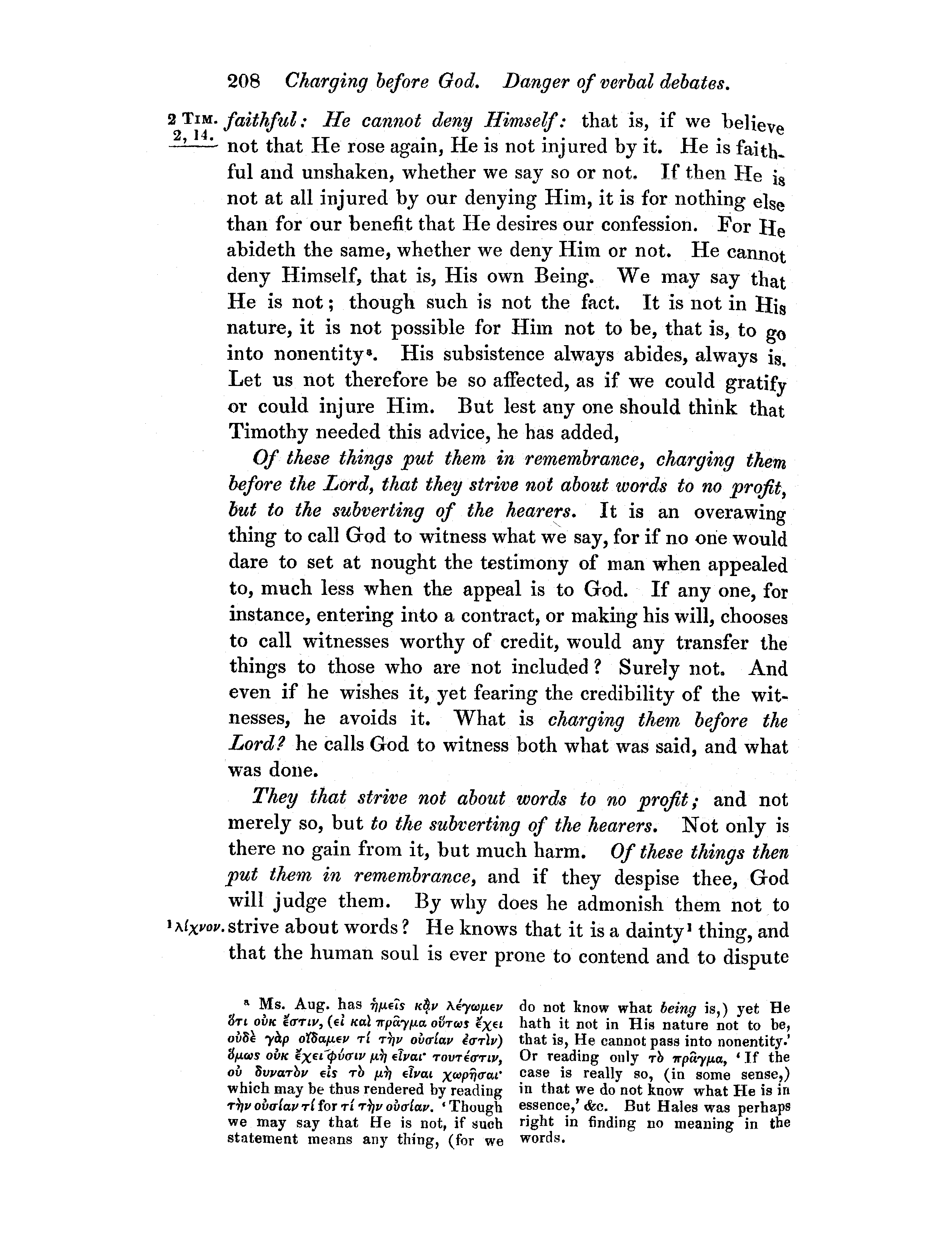
Charging before God.
Danger of verbal debates.
2 TIM. faithful:
He cannot deny Himself: that is, if we believe ——- not that He rose again, He is not injured by it. He is faithful and unshaken, whether we sav so or not.
If then He i* '
*J ^ lis not at all injured by our denying Him, it is for nothing else than for our benefit that He desires our confession. For He abideth the same, whether we deny Him or not. He cannot deny Himself, that is, His own Being.
We may say that He is not; though such is not the fact.
It is not in His nature, it is not possible for Him not to be, that is, to go into nonentity8.
His subsistence always abides, always is.
Let us not therefore be so affected, as if we could gratify or could injure Him.
But lest any one should think that Timothy needed this advice, he has added, Of these things put them in remembrance, charging them before the Lord, that they strive not about words to no profit, but to the subverting of the hearers.
It is an overawing thing to call God to witness what we say, for if no one would dare to set at nought the testimony of man when appealed to, much less when the appeal is to God.
If any one, for instance, entering into a contract, or making his will, chooses to call witnesses worthy of credit, would any transfer the things to those who are not included ? Surely not.
And even if he wishes it, yet fearing the credibility of the witnesses, he avoids it.
What is charging them before the Lord? he calls God to witness both what was said, and what was done.
They that strive not about words to no profit; and not merely so, but to the subverting of the hearers.
Not only is there no gain from it, but much harm.
Of these things then put them in remembrance, and if they despise thee, God will judge them.
By why does he admonish them not to J\lXvov.strive about words ? He knows that it is a dainty1 thing, and that the human soul is ever prone to contend and to dispute a Ms.^Aug. has fifxels k&v \4yw/xev do not know what being is,) yet He ov8e yhp oiSa.fj.tv ri ri)v ovaiap i<n\v) that is, He cannot pass into nonentity.' ov Svvarbv els rb fxr) zlvai vprj<rai' case is really so, (in some sense,) which may be thus rendered by reading in that we do not know what He is in r)jv ovaiav ri for ri t^v overlap. «Though essence,'&c.
But Hales was perhaps we may say that He is not, if such right in finding no meaning in the statement means any thing, (for we words.
Causes of false shame.
Guarding the truth.
bout words.
To guard against this, he has not only H^m.
^arged them not to strive about words, but to render his -- ^course more alarming, he adds, to the subverting of the \earers.
Ver. 15. Study to shew thyself approved unto God, a ^rlcman that needeth not to be ashamed, rightly dividing word of truth.
Every where this ' not being ashamed [' And why is he eyer so careful to guard him against shame? Because it was natural for many to be ashamed both of Paul himself, as ¡¡eing a tent-maker, and of the preaching, since its teachers perished. For Christ had been crucified, himself was about jo be beheaded, Peter was crucified with his head downwards, and these things they suffered from audacious and despicable men.
Because such men were in power, he says, 'Be not ashamed;' that is, fear not to do any thing tending to godliness, though it be necessary to submit to slavery or any other suffering. For how does any one become approved?
By being a workman that needeth not to be ashamed.
As the workman is not ashamed of any work, so neither should he be ashamed who labours in the Gospel.
He should submit to any thing.
Rightly dividing the word of truth.
This he hath well said.
For many distort it, and pervert it in every way, and many additions are made to it.
He has not said directing it, but rightly dividing, that is, cut away what is spurious, with much vehemence assail it, and Extirpate it. With the sword of the Spirit cut off from your preaching, as from a thong, whatever is superfluous and foreign to it.
Ver. 16. And shun prof ane novelties of speechb.
For they will not stop there.
For when any thing new lias been introduced, it is ever producing innovations, and the error of him who has once left the safe harbour is infinite, and never stops.
For they will increase unto more ungodliness, he says, Ver. 17. And their word will eat as doth a canker.
It is an evil not to be restrained, not curable by any Medicine, it destroys the whole frame.
He shews that b Gr. Kaivoipoovias, for xevoipwvias.
False doctrine a growing evil.
M. novelty of doctrine is a disease, and worse than a disease — And here he implies that they are incorrigible, and that they erred not weakly but wilfully.
Of whom is Hymeneus and Philetus, Ver. 18. Who concerning the truth have erred, saying that the resurrection i past already, and overthrow the faith of some.
He has well said, They will increase unto more ungodliness For it appears indeed to be a solitary evil, but see what evils spring out of it.
For if the Resurrection is already past, not only do we suffer loss in being deprived of that great glory, but because judgment is taken away, and retribution also. For if the Resurrection is past, retribution also is past.
The good therefore have reaped persecutions and afflictions, and the wicked have not been punished, nay verily, they live in great pleasure0.
It were better to say that there is no resurrection, than that it is already past.
And overthrow, he says, the faith of some.
Of some, not of all.
For if there is no resurrection, faith is subverted. Our preaching is vain, nor is Christ risen; and if He is not risen, neither was He born, nor has He ascended into heaven.
Observe how this error, while it seems to oppose the doctrine of the Resurrection, draws after it many other evils.
What then, says one, ought we to do nothing for those who are subvertedd?
Yer. 19. Nevertheless, he says, the foundation of God standeth sure, having this seal, The Lord knoweth them, that are His.
And, Let every one that nameth the name of the Lorde depart from iniquity.
He shews that even before they were subverted, they were not firm. For otherwise, they would not have been overthrown at the first attack, as Adamf was firm before the c Old Lat. here has, 'so then the See however on Rom, v. 5. Horn. ix. just hare suffered tribulations and griefs
Tr. p. 140. in vain.
But that is so far from being d al. ' Thus much of those who are the truth, that contrariwise even in this subverted, but of those who are not so, life the good are fed with their own what says he?' hopes, and have a foretaste of eternal e E. V. of Christ. felicity, persevering always with a f So Sav. but B. and one Lat. ' as serene and tranquil spirit, and the neither Adam.'
Another Lat. has wicked, persecuted by the scourge of ' neither was Adam before the attack their own conscience, begin to suffer as he says on Rom. 7, 9. Horn. xii. Tr. even here what they are to suffer for p. 194. 'neither was the Tree the ever.' But this seems an interpolation, cause.'
Christian perseverance. Prevalence of injustice,
c0inmandment.
For those who are fixed not only are not HOM.
(jarmed through deceivers, but are even admired.
—— And he calls it sure. and a foundation; so ought we to adhere to the faith; having this seal, The Lord knoweth them that are His.
What is this ? He has taken it from peuteronomyS; that is, Firm souls stand fixed and immoveable. But whence are they manifest? From having these characters inscribed upon their actions, from their being fcnown by God, and not perishing with the world, and from their departing from iniquity.
Let every one, he says, that nameth the name of the Lord depart from iniquity.
These are the distinguishing marks of the foundation. Ash a foundation is shewn to be firm, and as letters are inscribed upon a stone that the letters may be significant. But these letters are shewn by works, Having, he says, this seal fixed thereon, Let every one that nameth the name of the Lord kpart from iniquity.
Thus if any one is unrighteous, he is not of the foundation. So that this too is of the seal, not to do iniquity.
Let us not therefore put off from us the royal seal and MORAL. token, that we may not be of those who are not sealed, that we may not be unsound, that we may be firmly grounded, that we may be of the foundation, and not carried to and fro.
This marks them that are of God, that they depart from iniquity.
For how can any one be of God Who is just, if he does iniquity, if by his works he opposes Him, if he insults Him by his misdeeds ? Again we are speaking against injustice, and again we have many that are hostile to us.
For this affection, like a tyrant, has seized upon the souls of all, and, what is worse, not by necessity nor violence, but by persuasion and gentle insinuation, and they are grateful for their slavery. And this is indeed the misery; for if they were held by constraint and not by love, they would soon depart. And whence is it, that a thing which is most bitter, appears to be sweet? whence is it that righteousness, which s Numb. 16, 5? when one writes on a stone, one writes h Downes prefers the reading of Ms. that the characters may signify someAug. ' Such an one, as a foundation, what, so he that hath these characters "¡firmly fixed, having this seal stamped in himself is made manifest by works.
°Q him.
Well said he, seal.
For as And let,'' &c. which seems better. p 2
Misery of an unrighteous mans conscience.
2 T I M . is a most sweet thing, becomes bitter? It is the fault of OVJR -2'
'- senses.
Thus some have thought honey bitter, and havP + oIron Tin fli nl ngcn v«o nflipv fliinrrc< fli of irovp n n v i r\no A ucixv^IJL »»ilil Uix^cloui u uiiui viiiiiLo L>I.JLCI.L n u i c
I I W A X U U O »
the cause is not in the nature of things, but in the perverse-
ness of the sufferers.
The judging faculty of the soul1 js disordered1.
Just as a balance, if its beam be unsteady' moves round, and does not shew accurately the weight of things placed in it; so the soul, if it has not the beam of it8 own thoughts fixed, and firmly riveted to the law of God being carried round and drawn down, will not be able to judge aright of actions.
For if any one will examine carefully, he will perceive the great bitterness of injustice, not to those who suffer it, but to those who practise it, and to these more than to the others.
And let us not speak of things future, but for the present of things here.
Hath it not battles, judgments, condemnation, ill will, abuse? what is more bitter than these?. Hath it not enmities, and wars, and accusations? what is more bitter than these ?
Hath it not conscience continually scourging and gnawing us?
If it were possible, I could wish to draw out from the body the soul of the unrighteous man, and you would see it pale and trembling, ashamed, hiding its head, anxiously fearful, and self-condemned.
For should we sink down into the very depths of wickedness, the judging faculty of the mind1 is not destroyed, but remains unbribed.
And no one pursues injustice thinking it to be good, but he invents excuses, and has recourse to every artifice of words to shift off the accusation. But he cannot get it off his conscience.
Here indeed the speciousness of words, the corruption of rulers, and multitudes of flatterers, is often able to throw justice into the shade; but within, the conscience™ has nothing of this sort, there are no flatterers there, no 5 B. reads Noire?, which Hales had And oft 'tis seen, the wicked prize conjectured.
Sav. has Ntiet, ' consider itself the judging faculty.'
Buys out the law: but 'tis not so k irapacra\fvo/j.<iv7)v.
He seems to above mean ' liable to slip toward one side.'
There is no shuffling—there the action 1 rod i>ov, which he seems to distinlies guish here from the soul. See Rom. 7, In its true nature—and we ourselves 23. 1 Cor. 2, 14. compell'd m In the corrupted currents of this E'en in the teeth and forehead of world offence Offence's gilded hand may shove by To give in evidence, justice, Hamlet, act iii. sc. 3.
Natural fear of punishment here or hereafter.
WEALTH to corrupt the judge.
For the faculty of judging is H O M .
„aturally implanted in us by God, and what comes from God — cannot be so corrupted.
But uneasy slumbers, thick-coming (4) fancies, and. the frequent recollections of guilt, destroy our repose. Has any one, for instance, unjustly deprived another
0f his house ? not only is he that is robbed rendered unhappy, but the man who robbed him.
If he is persuaded of a future judgment, (if indeed any one is so persuaded,) he groans exceedingly, and is in misery.
But if he believes not in futurity, yet he blushes for shame; or rather there is no man, whether Greek, Jew, or heretic, who is not afraid of a judgment to come.
And although he is not a philosopher with respect to futurity; yet he fears and trembles at what may befal him here, lest he may have some retribution in his property, his children, his family, or his life.
For many such visitations (rod inflicts.
For since the doctrine of the Resurrection is not sufficient to bring all men to reason, He affords even here many proofs of His righteous judgment, and exhibits them to the world. One who has gained wrongfully is without children, another falls in war, another is maimed in his body, another loses his son.
He considers these things, on these his imagination dwells, and he lives in continual fear.
Know you not what the unrighteous suffer ?
Is there no bitterness in these things ? And were there nothing of this sort, do not all condemn him, and hate and abhor him, and think him less rational than a beast, even those who are themselves unrighteous ? For if they condemn themselves, much more do they condemn another, calling him rapacious, fraudulent, a pestilent fellow.
What pleasure then can he enjoy ? He has only the heavier care and anxiety to preserve his gains, and the being more anxious and troubled.
For the more wealth any one gets about him, the more painful watchfulness does he store up for himself. Then what are the curses of those whom he has wronged, their pleadings against him1 ?
And what, if sickness should» hnvbefal him ?
For it is impossible for one, who has fallen into x'lal sickness, however atheistically he may be inclined, not to be anxious about these things, not to be thoughtful, when he is unable to do any thing.
For as long as we are
Conscience freed by sickness.
Spiritual medicine.
2 TIM. here, the soul enjoying itself, does not tolerate painful ——-thoughts: but when it is about to take its flight fr0lll iWArtTQH Trtnti y | / M t n f w n i n n i <\n nvi * titc uuujj uiuli a gitat^i luai Lunowamo itj ao ciiicnn^ lllto the very portals of judgment.
Even robbers, whilst they are in prison, live without fear, but when they are brought to the
very curtain of the court1, they sink with terror.
For when ireTa(r'ua thg fear of death is urgent, like a fire consuming all things besides, it obliges the soul to philosophize, and to take thought for futurity. The desire of wealth, the love of gain, and of bodily pleasures, no longer possesses it. These things passing away like clouds, leave the judging faculty clear, and grief entering in softens the hard heart. For nothing is so opposite to philosophy, as a life of pleasure; nor, on the other hand, is any thing so favourable to philosophy as affliction. Consider
Ecclus. what the covetous man will then be.
For, an hour of afflic2 2 7. . . .
' " tion, it is said, maketh a man forget much pleasure.
What will then be his state, when he considers those whom he has robbed, and injured, and defrauded, when he sees others reaping the fruits of his grasping, and himself going to pay the penalty.
For it cannot, indeed it cannot be, that when fallen into sickness he should not reflect upon these things.
For often the soul of itself is distracted with agony and terror.
What a bitterness is this, tell me!
And with every sickness these things must be endured.
And what will he not suffer when he sees others punished or put to death ?
These things await him here.
And as to what he must undergo hereafter, it is not possible to say what punishment, what vengeance, what torments, what racks are reserved for Lute 8, him There.
These things we declare.
He that hath ears to 8" hear, let him hear.
We are for ever discoursing of these things, not willingly, but of necessity.
For we could wish there were no obligation to mention such things at all.
But since it must be, we would at least, by a little medicine, deliver you from your disease, and restore you to health.
But whilst you remain in this sickness, it would shew a mean and weak spirit, not to say cruelty and inhumanity, to desist from the healing treatment.
For if when physicians despair of our bodies, we beseech them not to neglect us, not to cease to our last breath applying whatever is in their power, shall we not much more exhort ourselves ? For perhaps
Seemingly sudden effects after long labour.
„HEN we have come to the very gates of Hell, the vestibule H O M . wickedness itself, it may be possible to recover, to renew - Vl fllir strength, to lay hold on eternal life ! How many, who l,ave heard ten times and remained insensible, have afterwards at one hearing been converted ! Or rather, not at one faring; for though they seemed insensible at the ten discourses, yet they gained something, and afterwards shewed all at once abundant fruit.
For as a tree may receive ten strokes, and not fall; then afterwards be brought down all jt once by a single blow: yet it is not done by that one blow, but by the ten which made that last successful.
And this is known to him who sees the root, though he who takes his view of the trunk above knows it not.
So it is in this case. And thus often, when physicians have applied many remedies, no benefit is perceived ; but afterwards some one comes in and effects an entire cure.
Yet it is not the work of him alone, but of these who have already reduced the disorder.
So that, if now we do not bring forth the fruits of hearing the word, yet hereafter we shall.
For that we shall bring them forth, I am fully persuaded.
For it is not, indeed it is not possible that such eager desire, such a love of hearing, should fail of its effect.
Grod forbid! But may we all, having become worthy of the admonitions of Christ, obtain the everlasting blessings, &c.
H O M I L Y
VI.
2 TIM. ii. 20, 21.
But in a great house there are not only vessels of gold and of silver, but also of wood and of earth; and some to honour, and some to dishonour.
If a man therefore purge himself from these, he shall be a vessel unto honour, sanctified, and meet for the master's use, and prepared unto every good work.
( I ) MANY men are still even now perplexed to accournt for the fact, that the wicked are suffered to remain, and are not yet destroyed.
Now doubtless various reasons may be assigned for this, as, that they may be converted, or that by their punishment they may be made an example to the multitude.
But Paul here mentions a similar case.
For he says, In a (jreat house there are not only vessels of gold and silver, but also of wood and earth.
Shewing by this, that as in a great house it is likely there should be a great difference of vessels, so here also, in the whole world, for he speaks not of the Church only, but of the world at large.
For think not, I pray, that he means it of the Church; for there he would not have any vessels of wood or of earth, but all of Eph. 5, gold or silver, where is the body of Christ, where is that pure
27' virgin, ivithout spot} or wrinkle, or any such thing.
And this is what he means to say: Let it not disturb thee that there are corrupt and wicked men.
For in a great house there are such vessels.
But what then? they do not receive
Twofold meaning of ' earthen vessels.'
t|,e S A M E honour.
But some are to honour and some to HOM. dishonour.
'Nay,' says one, (in a house they may be of — some use, but not at all in the world.'
Though God employs them n o t f° r such honourable service, he makes use of them f0r other purposes.
For instance, the vainglorious man builds much, so does the covetous man, the merchant, the tradesman, the magistrate; there are certain works in the world suited to these.
But the golden vessel is not of such a nature.
It is employed about the royal table.
He does not say however that wickedness is a necessary thing, (for ]jow should it be ?) but that the wicked also have their work.
For if all were of gold or of silver, there would be no need of the viler sort.
For instance, if all were hardy, there would be no need of houses; if all were free from luxury, there would be 110 need of dainties.
If all were careful only for necessaries, there would be no need of splendid building.
If therefore a man purge himself from, these, he shall be a vessel unto honour, sanctified.
Seest thou that it is not of nature, nor of the necessity of matter, to be a vessel of gold or of earth, but of our own choice?
For otherwise the earthen could not become gold, nor could the golden descend to the vileness of the other.
But in this case there is much change, and alteration of state.
Paul was an earthen vessel, and became a golden one.
Judas was a golden vessel, and became an earthen one.
The earthen vessels, therefore, aresuch from uncleanness.
The fornicator and the covetous man become earthen vessels.
' But how then does he say elsewhere, We have this treasure in earthen vessels, so that he does not despise but honour the earthen vessel, speaking of it as the recipient of the treasure ?' There he shews the nature itself, and not the form of the material. For he means to say that our body is an earthen vessel.
For as earthenware is nothing else but baked clay, so is our body nothing but clay consolidated by the heat of the soul; for that it is earthen, is evident.
For as such a vessel is often by falling broken and dashed to pieces, so our body falls and is dissolved by death.
For how do our bones differ from a potsherd, hard and dry as they are ? or our flesh from clay, being, like it, composed of water?
But, as I said, how is it
Earthly passions unfit men for God's service.
2 Tim. that he does not speak contemptuously of it? Because there - — — he is discoursing of its nature, here of our choice. If a man he says, purge himself from these, not merely cleanse, but Wkk«- cleanse out1, that is, cleanse himself perfectly, he shall be a vessel unto honour, sanctified, and meet for the Master's use.
The others therefore are useless for any good purpose, though some use is made of them.
And prepareda unto every good work.
Even though he do it not, he is fit for it, and has a capacity for it.
We ought therefore to be prepared for every thing, even for death, for martyrdom, for a life of virginity, or for all these.
Ver. 22. Flee also youthful lusts.
Not only the lust of fornication, but every inordinate desire is a youthful lust. Let the aged learn that they ought not to do the deeds of the youthful.
If one be given to insolence, or a lover of power, of riches, of bodily pleasure, it is a youthful lust, and foolish. These things must proceed from a heart not yet established, from a mind not deeply grounded, but in a wavering state.
What then does he advise in order that none may be captivated by these things ?
Flee youthful imaginations, but Follow righteousness, faith, charity, peace, with them that call on the Lord out of a pure heart.
He calls virtue in general, righteousness; godliness of life, faith, meekness, charity.
What is meant by those that call upon the Lord out of a pure heart ? It is as if he said, Rejoice not in those who only call upon the Lord; but those who call upon Him sincerely and unfeignedly, who have nothing of deceit about them, who approach Him in peace, who are not contentious.
With these associate thyself.
But with others be not easy, but only as far as lies in you, be peaceable.
Ver. 23. But foolish and unlearned questions avoid, knowing that they do gender strifes.
(2) Do you see how he every where draws him off from questions ? not that he was not able to overthrow them ; for he was well able.
For had he not been able he would have said, Be diligent, that thou may est be able to refute them; l Tim. as when he says, Give attendance to reading, for by so doing
4,13.16, s B. ' They are not, however, prepared, &c.'
Duty of peacefulness.
Patience in teaching.
ifrou shalt both save thyself and them that hear thee. But he HUM. jjnew that it was useless to enter at all into these disputes,
V*' there will be no end of it, save contentions, enmities, insults, and reproaches.
These questions therefore avoid; so that there are other questions, some relating to the Scriptures, some to other things.
Ver. 24. And the servant of the Lord must not strive.
Not even in questions ought he to strive, for the servant 0f the Lord must keep far from strife, since God is the God of peace, and what should the servant of the God of peace have to do with strife ?
But be gentle unto all men.
How is it then he says, Rebuke with all authority; and Titus 2, again, Let no man despise thy youth: and again, Rebuke 1 xim. them sharply f Because this is consistent with meekness, j^12* l
For a strong rebuke, if it be given with gentleness, is most 13.
' likely to wound deeply: for it is possible, indeed it is, to touch more effectually by gentleness, than one overawes by boldness.
Apt to teach; that is, those who are willing to be taught.
For a man that, is an heretic, he says, after the first ««¿Titus 3, second admonition reject.
Patient.
He has well added this,10' for it is a quality which a teacher above all things ought to possess.
All things are vain without it.
And if fishermen do not despair, though often they cast their nets for a whole day without catching any thing, much more should not we.
For see what is the result. From constant teaching, it often happens that the plough of the word, descending to the depth of the soul, roots out the evil passion that troubled it.
For he that hears often will at length be affected. A man cannot go on hearing continually without some effect being produced.
Sometimes therefore, when he was on the point of being persuaded, he is lost by our becoming weary.
For the same thing occurs, as if an unskilful husbandman should in the first year dig about the vine he had planted, and seeking to reap some fruit in the second year, and again in the third, and gathering nothing, should after three years despair, and in the fourth year, when he was about to receive the recompense of his labours, abandon his vine.
And having said, Patient, he is not satisfied, but goes on to say,
Harshness and impatience make teaching useless.
2 TIM.
Ver. 25. In meekness instructing those that oppose t}iP 2t25>26« 'it" sewes.
For he that teaches must be especially careful to do jj "with meekness.
For a soul that wishes to learn cannot g aj n any useful instruction from harshness and contention. p 0 r when it would apply, being thus thrown into perplexity ij will learn nothing.
He who would gain any useful know ledge ought above all things to be well disposed towards his teacher, and if this be not previously attained, nothing that is requisite or useful can be accomplished. And no one can be well disposed towards him who is violent and over-bearing.
How is it then that he says, A man that is an heretic after the first and second admonition, reject ? He speaks there of one incorrigible, of one whom he knows to be diseased beyond the possibility of cure.
If God peradventure will give them repentance to the acknowledging of the truth.
Ver. 26. And that they may recover themselves out of the snare of the devil.
What he says amounts to this.
Perhaps there will be a reformation. Perhaps! for it is uncertain. So that we ought to withdraw only from those, of whom we can shew plainly, and concerning whom we are fully persuaded, that whatever be done, they will not be reformed.
In meekness, he says.
In this temper, you see, we ought to address ourselves to those who are willing to learn, and never cease from conversing with them till we have come to the demonstration11.
Who are taken captive by him at his will.
It is truly said, Who are taken captivec, for meanwhile they float in error. Observe here how he teaches to be humble-minded« He has not said, if peradventure you should be able, but, if peradventure God should grant them a recovery; if any thing be done, therefore, * all is of the Lord.
Thou plantest, thou waterest, but He soweth and maketh it produce fruit. Let us not therefore be so affected, as if we ourselves wrought the persuasion, even if we should persuade any one.
Taken captive by him, he says, to His willd.
This no one b That is, we ought not to be proc i(ooyprifn4voi, ' taken alive,' applied voked by their slowness of apprehension to fish enclosed in a net. to break off. d Gr. To His will. As avrov and
State of disobedience Satan s snare.
¡11 say relates to doctrine, but to life.
For His will is that HOM. f 6 live rightly.
But some are in the snare of the devil by — jgason of their life, we ought not therefore to be weary even ffith respect to these.
If per adventure, he says, they may recover, that are taken (aptive, unto His will.
Now If peradventure, implies much |oDg suffering.
For not to do the will of God is a snare of the devil.
For as a sparrow, though it be not wholly enclosed, but ' (3) only caught by the foot, is still under the power of him who set the snare; so though we be not wholly subverted, both in faith and life, but in life only, we are under the power of the devil. For, Not every one that saith unto Me, Lord, Lord, Matt. 7, ihall enter into the kingdom of heaven ; and again, I know2l"2 " you not; depart from Me, ye that work iniquity.
You see there is no advantage from our faith, when our Lord knows us not: and to the virgins he says the same, I know you not. Mat.25,
What then is the benefit of virginity, or of many labours,12' when the Lord knows us not ? And in many places we find men not blamed for their faith, but punished for their evil life only ; as elsewhere,, not reproved for evil lives, but perishing for their pravity of doctrine.
For these things hold together0.
You see that when we do not the will of God, we are under the snare of the devil.
And often not only from a bad life, but from one defect, we enter into Hell, where there are not good qualities to counterbalance it, since the virgins were not accused of fornication or adultery, nor of envy or ill-will, nor of drunkenness, nor of unsound faith, but of a failure of oil, that is, they failed in almsgiving, for that is the oil meantf.
And those who were pronounced accursed in the words, Depart from me, ye cursed, into everlasting fire, were not accused of any such crimes, but because they had not fed Christ. keivov must refer to two different persons, the meaning probably is, that they who are taken captive by the devil may be recovered to the will of Hom. Ixxviii. al. lxxix. See also on Phil. i. 30. Hom. iv. 15. Tr. pp. 49, 50. and notes t, u, a. and on Rom. xi.
6. Tr. p. 334. and on Rom. xiv. 13.
Tr. p. 425. note g.
St. Jerome and St. Aug. take the oil more generally of good works, with allusion to Matt. T.
God. And so he takes it. e Sav. a\\-}]\a>v ex e™- Ben. epx*Tut, which would be hardly Greek even with a preposition.
16. f So he takes it on Matt. xxv.
All else is vain without mercy.
^eest thou that a failure in almsgiving is enough to cast a MOKALT m a n • where will he avail who does not giVf, alms? Dost thou fast every day ? So also did those virgins but it availed them nothing. Dost thou pray? What of that? prayer without almsgiving is unfruitful, without that all things are unclean and unprofitable.
The better part of virtue is l John4, destroyed.
He that loveth not his brother, it is said, knoweth 8not God.
And how dost thou love him, when thou dost not even impart to him of these poor worthless things ? Tell me, therefore, dost thou observe chastity? On what account?
From fear of punishment? By no means. It is of a natural endowment that thou observest it, since if thou wast chaste from fear of punishment, and didst violence to nature in submitting to so severe a rule, much more oughtest thou to do alms.
For to govern the desire of wealth, and of bodily pleasures, is not the same thing.
The latter is much more difficult to restrain.
And wherefore ? Because the pleasure is natural, and the desire of it is innate and of natural growth in the body.
It is not so with riches.
Herein we are able to resemble God, in shewing mercy and pity.
When therefore we have not this quality, we §ire devoid of all good.
He has not said, 'ye shall be like unto your Father, if ye fast,' nor 'if ye be virgins,' nor 'if ye pray,' hath He said, 'ye shall be like unto your father,' for none of these things can be applied to God, nor are they His acts.
But I uke 6 what ? Be ye merciful, as your Father in Heaven is merciful.
36This is the work of God.
If therefore thou hast not this, Hosea what hast thou? He says: I will have mercy, and not sacri6>6* fice.
God made Heaven, and earth, and sea.
Great works these, and worthy of His wisdom!
But by none of these has He so powerfully attracted human nature to Himself, as by mercy and the love of mankind.
For that indeed is the work of power and wisdom and goodness.
But it is far more so that He became a servant.
Do we not for this more especially admire Him ? are we not for this still more amazed at Him ? Nothing attracts God to us so much as mercy.
And the prophets from beginning to end discourse upon this subject.
But 1 speak not of mercy that is accompanied with covetousness.
That is not mercy. For it is not the root of the thorn but of the olive that produces
Alms of no avail if from wrongful gains.
the oilh; so it is not the root of covetousness, of iniquity, HOM.
0t of rapine, that produces mercy. Do not put a slander on — almsgiving. Do not cause it to be evil spoken of by all. If thou committest robbery for this, that thou mayest give alms, nothing is more wicked than thy almsgiving. For when it is produced by rapine, it is not almsgiving, it is inhumanity, it js cruelty, it is an insult to God. If Cain so offended, by offering inferior gifts of his own, shall he not offend, who offers the goods of another? An offering is nothing else but a sacrifice, a purification, not a pollution. And thou who darest not to pray with unclean hands, dost thou offer the dirt and filth of robbery, and think thou doest nothing wrong?
Thou sufferest not thy hands to be full of dirt and filth, but having first cleansed these, thou offerest. Yet that filth is no charge against thee, while the other deserves reproach and blame. Let it not therefore be our consideration, how we (4) may offer prayers and oblations' with clean hands, but how the things offered may be pure. If one,'after having washed a vessel clean, should fill it with unclean gifts, would it not be ridiculous mockery? Let the hands be clean; and they will be so, if we wash them, not wi th water only, but first with righteousness. This is the purifier of the hands. But if they be full of unrighteousness, though they be washed a thousand times, it avails nothing. Wash you, make you clean, He says; i9. 16. but does He add, ' Go to the baths, the lakes, the rivers ?'
No; but what ? Put away the evil of your doings from your souls. This is to be cleank.
This it is to be cleansed from defilement. This is real purity.
The other is of little use ; but this bestows upon us confidence towards God. The one may be obtained by adulterers, thieves, murderers, by worthless, and dissolute, and effeminate persons, and especially the latter. For they are ever careful of the cleanliness of their bodies, and scented with perfumes, cleansing their sepulchre1. • <ri)Ma.
For their body2 is but a sepulchre, since the soul is dead2<r®/«t. within it.
This cleanness therefore may be theirsbut not that which is inward. h He plays, as elsewhere, on the to the printed text, seems best in these
*<frds eAeoe and eAaiov. words.
Sav. has,' That is, be clean :
' See on Stat. Tr. pp. 145, 341. this it is that cleanses,' &c. k B. though usually here far inferior 1 B. reads ixeruvai, for fxtrUvai,
2*24 What are clean hands.
Force of habit.
2 TIM.
TO wash the body, is no great matter.
That is a Jewish —'
' purification, senseless m and unprofitable, where purity within is wanting.
SuDDOse one to labour under a putrefyingsm-Q t1 X JL I •/ v_j or consuming ulcer; let him wash his body ever so much, it js of no advantage. And if the putrefaction of the body receives no benefit from cleansing and disguising the outward appearance ; when the soul is infected with rottenness, what is gained by the purity of the body ? Nothing ! Our prayers ought to be pure, and pure they cannot be, if they are sent forth from a corrupt soul, and nothing so corrupts the jfovH as avarice and rapine.
But there are some who after committing numberless sins during the day, wash themselves in the evening and enter the churches, holding up their hands with much confidence, as if by the washing of the bath they had put off all their guilt.
And if this were the case, it would be a vast advantage to use the bath daily!
I would not myself cease to frequent the baths", if it made us pure, and cleansed us from our sins ! But these things are trifling and ridiculous, the toys of children.
It is not the filth of the body, but the impurity of the soul, to which God is Matt. 5, averse.
For He says, Blessed are the pure—does He say in body? No—in heart: for they shall see God.
And what Ps. si, says the Prophet? Create in me a clean heart, 0 God.
And Je'r. 4, a g a i n > Wash my heart from wickedness.
14> It is of great use to be in the habit of doing good actions.
See how trifling and unprofitable these washings are.
But when the soul is prepossessed by a habit, it does not depart from it, nor does it venture to draw nigh in prayer, till it has fulfilled these ceremonies. For instance, we have brought ourselves to a habit of washing and praying, and without washing we do not think it right to pray.
And we do not willingly pray with unwashed hands, as if we should offend God, and violate our conscience. Now if this trifling custom has so great power over us, and is observed every day; if we had b r o u g h t ourselves to a habit of almsgiving, and had d e t e r m i n e d so constantly to observe it, as never to enter a house of prayer with empty hands, the point would be gained.
For great is m Sav. 1 useless.'
23. and S. Clem. Al. Paedag. iii9n This was thought too luxurious for who recommends providing for cleanpersons of devout life.
See Euseb. ii. liness by other means.
Almsgiving mercifully ordained.
^ power of habit both in good things and in evil, and when HOM. carries us on, there will be little trouble.
Many are in V1' j,e habit of crossing1 themselves continually, and they need 'a-^payls0one to remind them of it, but often when the mind is5»61"
„jndering after other things, the hand is involuntarily drawn lj. custom, as by some living teacher, to make the sign.
<ome have brought themselves into a habit of not swearing jiall, and therefore neither willingly nor unwillingly do they fier do it.
Let us then bring ourselves into such a habit of Jmsgiving.
What labours Were it worth to us to discover such a lemedyFor say, were there not the relief of almsgiving, ihile we still by our numberless sins rendered ourselves jjble to Divine vengeance, should we not have lamented jjijly ? Should we not have said, O that it were possible by 0 wealth to wash away our sins, and we would have parted lith it all f O that by our riches we could put away the irath of God, then we would not spare our substance? For jfwe do this in sickness, and at the point of death we say,
•If it were possible to buy off death, such an one would jive all his possessions-/ much more in this matter.
For ¡ee how great is the love of God for man.
He has granted as power to buy off not temporal but eternal death. Do not (orchase, He says, this short life, but that life that is everting. It is that I sell thee, not the other: I do not mock lee. Didst thou gain' the present life, thou hadst gained
»thing. I know the worth of that which I offer thee. The bargainers and traffickers in worldly goods do not act thus.
Ihey, when they can0 impose on whom they will, give a Itle to receive a great deal.
It is not so with God.
He pves the greater by far for the less.
Tell me, if you were to go to a merchant, and he were to «t before you two stones, one of little worthp, and the other fery precious, and sure to fetch a large amount of wealth ; if he allowed you for the price of the cheap one to carry off foe more costly, should you complain of him? No!
You *ould rather admire his liberality.
So now, two lives are *t before us, the one temporal, the other eternal.
These God offers us for sale, but He would sell us the latter rather ° B, for itfv.
P B. counterfeit.
Alms avail not unless they are of our own.
2 TIM. than the former.
Why do we complain, like silly child]- —'J^that we receive the more precious i? Is it possible then purchase life for money ? Yes, when what we bestow i§ ^ own, and not the property of another; when we do practise an imposture.
But, you say, henceforth the g 0 0^ are mine.
They are not thine after rapine.
They are st'U thy neighbour's, though thou wert a thousand times t ^ master of them.
For if thou shouldest receive a deposit j| would not be thine own even for the short season that depositor was travelling, though it might be laid up thee.
If therefore that is not ours, which we received wit| the consent and thanks of those who deposited it, even the short period that we retain it, much less is that om*| which we plundered against the will of its owner.
He | the master of it, however long thou mayest withhold But Virtue isr really our own ; as for money, even our owft is not strictly ours, much less that of others.
To-day it ¡g ours, to-morrow it belongs to another.
What is of virtue i| our own possession.
This does not suffer loss, like othei things, but is entirely possessed by all who have it.
Thil therefore let us acquire, and let us despise riches, that wg may be able to attain those real goods, of which God grant that we may be thought worthy to partake, through the grace and lovingkindness, &c.
•J B. reads tty«=i for Sri.
1 We take r B. < those other things are.' the value by sight.'
H O M I L Y
VII.
2 T I M . iii. 1—7.
^ know also, that in the last days perilous times shall 0ie. For men shall be lovers of their own selves, covetous,
Rasters, proud, blasphemers, disobedient to parents, unthankful, unholy, without natural affection, truceleakers, false accusers, incontinent, fierce, despisers of ¡hose that are good, traitors, heady, high-minded, lovers if pleasure more than lovers of God; having a form of godliness, but denying the power thereof; from such turn may. For of this sort are they, which creep into houses, md lead captive silly women laden with sins, led away nth divers lusts and pleasures, ever learning, and never able to come to the knowledge of the truth.
HE had said in the former Epistle, that the Spirit speaketh l Tim.
Ifmly, that in the latter times some shall depart from4'
,'2' tfaith; and elsewhere in this Epistle he foretells that ftiething of this kind will afterwards happen; and here again
I does the same thing: This know, that in the last days Pilous times shall come.
And this he pronounces not only the future, hut from the past; As Jannes and Jambres
Wistood Moses.
And again from reasoning; In a great there are not only vessels of gold and of silver.
But h does he do this ? In order that Timothy may not be Nbled, nor any one of us, when there are evil men.
If were such in the time of Moses, and will be hereafter, no wonder that there are such in our times.
Q 2
"28
We hurt ourselves by neglecting others.
In the last days 'perilous times shall come, he says, that is, exceeding bad times. How shall times be perilous®? j j says it not blaming the days, nor the times, but the men of those times.
For thus it is customary with us to speak of good times or evil times, from the events that happen in them, caused by men.
Immediately he sets down the root and fountain, whence these and all other evils spring, that is, overweeningness.
He that is seized with this passion is careless even of his own interests.
For when a man overlooks the concerns of his neighbour, and is careless of them how should he regard his own ? For as he that looks to his neighbour's affairs will in them order his own to advantage, so he that looks down upon his neighbour's concerns will neglect his own.
For if we are members one of another, the welfare of our neighbour is not his concern only, but that of the whole body, and the injury of our neighbour is not confined to him, but distracts with pains all else as wellb
If we are a building, whatever part is weakened, it affects the whole, whilst that which is solid gives strength and support to the rest.
So also in the Church, if thou hast slighted thy neighbour, thou hast injured thyself.
How?
In that one of thy own members hath suffered no small hurt.
And if he, who does not impart of his possessions, goes into Hell, much more will he be condemned, who sees a neighbour suffering severer evils, and does not stretch out his hand, since in this case the loss is more grievous.
For men shall be lovers of their own selves.
He th^t loves himself may be said not to love himself, but he that loves his brother, loves himself in the truest sense.
From self-love springs covetousness.
For the wretched niggardly temper of self-love contracts that love which should be widely extended, and diffused on every side.
Covetous.
From covetousness springs boastfulness, from boastfulness pride, from pride blasphemy, from blasphemy defiance and disobedience.
For he who exalts himself against men, will easily do it against God.
Thus sins are produced.
Often they ascend from below.
He that is pious towards men, is still more pious towards God. He who is meek to his fellowa B. adds. < that is, <fcc.'
< an the rest of the body.' b airavra Koiirhv, q u. ? airav rb Aonrbv,
Despisers of their brethren despise God.
^•vants, is more meek to his Master.
He that despises his HOM. fellow-servants, will end with despising God Himself.
Let V l • I, I , I R XI , • I • •
M O B A L .
•JJ not then aespise one anotner, lor that is an evil training #}iich teaches us to despise God.
And indeed to despise 0 another is in effect to despise God, Who commanded us ¡0 shew all regard to one another.
And this may be otherwise manifested by an example.
Cain despised his brother, md so, immediately after, he despised God.
How despised gim? Mark his insolent answer to God; Am I my brother i^n.- 4, fyeper? Again, Esau despised his brother, and he too demised God.
Wherefore God said, Jacob have I loved, but Rom. 9, gtail have 1 hated.
Hence Paul says, Lest there be any l fornicator or profane person as Esau.
The brethren of 2.3. foseph despised him, and they also despised God.
The 1 6 i * '
Israelites despised Moses, and they also despised God.
So ;oo the sons of Eli despised the people, and they too despised •rod. Would you see it also from the contrary?
Abraham, iho was tender of his brother's son, was obedient to God, as is manifest in his conduct with respect to his son Isaac, and n all his other virtues. Again, Abel was meek to his brother, aid he also was pious towards God.
Let us not therefore despise one another, lest we learn also to despise God.
Let us honour one another, that we may learn also to honour (rod.
H e that is insolent with respect to men, will also be insolent with respect to God.
But when covetousness and selfishness and insolence meet together, what is wanting to complete destruction ? Every thing is corrupted, and a foul flood of sins bursts in.
Unthankful, he says.
For how can ike covetous man be thankful ? To whom will he feel gratiItude?
T o no one.
H e considers all men his enemies, and flesires the goods of all.
Though you spend your whole ¡substance upon him, he will feel no gratitude.
H e is angry ¡that you have not more, that you might bestow it upon Um.
And if you made him master of the whole world, he iould still be unthankful, and think that he had received
Nothing.
This desire is insatiable.
It is the craving of disease; and such is the nature of the cravings of disease.
He who has a fever can never be satisfied, but with (2) constant desire of drinking, is never filled, but suffers a continual thirst; so he who is mad after wealth never knows
Wild fancies of insatiable covetousness.
2 TIM. the fulfilment of his desire; whatever is bestowed upon hi^ -J :he is still unsatisfied, and will therefore never be ^—1 "
For he will feel no gratitude to him, who does not give as much as he wishes, and this no one can ever do. And ^ there is no limit to his wishes, he will feel no gratitu^
Thus no one is so unthankful as the covetous, so insensibf as the lover of money.
He is the enemy of all the worl| He is indignant that there are men. He would have all oq vast desert, that he might have the property of all.
^ many wild imaginations does he form.
1 O that there we^ an earthquake, he says, in the city, that all the rest bein swallowed up, I might be left alone, to have, if possible, t| possessions of all!
O that a pestilence would come aq destroy every thing but gold! O that there might be a sufei mersion, or an irruption of the sea!'
Such are his imagijj ations. He prays for nothing good, but for earthquakes, an, thunderbolts, for wars, and plagues, and the like.
Welj tell me now, thou wretched man, more servile than am slave, if all things were gold, wouldest thou not be destroys by thy gold®, and perish with hunger? If the world wq swallowed up by an earthquake, thou also wouldest perish bj thy fatal desire. For if there were no other men than thyselj the necessaries of life would fail thee. For suppose that thj other inhabitants of the earth were destroyed at once, aiq that their gold and silver came of its own accord to the|
(For such men fancy to themselves absurdities, and impo| sibilities.) But if their gold and silver, their vests of silk an cloth of gold, came into thy hands, what would it profit thee
Death would only the more certainly overtake thee, whel there were none to prepare bread or till the earth for thee wild beasts would prowl around, and the devil agitate tH soul with fear. Many devils indeed now possess it, but the they would lead thee to desperation, and plunge thee at on<i into destruction.
But you say, ' I would wish there shoul be tilling of the land and men to prepare food.' Then thfl! would consume somewhat.
( But I would not have thel consume any thing.'
So insatiable is this desire! For wN can be more ridiculous than this ? Seest thou the im c al. be parted from thy gold.
God seldom loved as riches are.
L,ility of the thing ? He wishes to have many to minister to HOM.
|im, yet he grudges them their share of food, because it — ¿jminishes his substance!
What then ? Wouldest thou ¡}ien have men of stone ? This is all a mockery ; and waves, jjid tempest, and huge billows, and violent agitation, and ,torm, overwhelm the soul.
It is ever hungry, ever thirsty.
Shall we not pity and mourn for him ? Of bodily diseases his is thought a most painful one, and it is called by ,hysicians bulimy, when a man being filled, is yet always &<>v\iiiingry.
And is not the same disorder in the soul more jgicJand ynentable ? For avarice is the morbid hunger of the soul, fhich is always filling, never satisfied, but still craving.
If t were necessary to drink hellebore, or submit to any thing ja thousand times worse, would it not be worth our while to undertake it readily, that we might be delivered from this passion ? There is no abundance of riches that can fill the belly of greediness. And shall we not be ashamed, that men can be thus transported with the love of money, whilst we shew not any proportion of such earnestness in love to God, and honour Him not as bullion is honoured ? For money men will undergo watchings, and journeyings, and continual perils, and hatred, and hostility, and, in short, every thing.
But we do not venture to utter a mere word for God, nor incur an enmity, but if we are required to assist any of those who are persecuted, we abandon the injured person, withdrawing ourselves from the hatred of the powerful, and the danger it involves.
And though God has given us power that we might succour him, yet we suffer him to perish, from our unwillingness to incur men's hatred and displeasure.
And this many even profess to justify, saying, " Be loved for nothing, but be not hated for nothing."
But is this to be hated for nothing ? Or what is better than such hatred ? For to be hated on account of God, is better than to be loved on His account: for when we are loved for God's sake, we are lebtors for the honour, but when we are hated for His sake,
He is our debtor, to reward us. The lovers of wealth know no limit to their love, be it never so great; but we, if we
We done ever so little, think that we have fulfilled every 'hing.
We love not God as much, no, not by many times °ver so much, as they love gold.
Their inordinate rage for
Love to man brings love to God, and casts out sin.
2 TIM. gold is a heavy accusation against them.
It is our con.
-— -demnation that we are not so heside ourselves for God* that we do not bestow upon the Lord of all as much lovc> as they bestow upon mere earth, for gold from the mine is
110 better, (3) Let us then behold their madness, and be ashamed of ourselves.
For what though we are not inflamed with the love of gold, while we are not earnest in our prayers to God ? F 0r in their case men despise wife, children, substance, and their own safety, and that when they are not certain that they shall increase their substance.
For often, in the very midst of their hopes, they lose at once their life and their labour.
But we, though we know that, if we love Him as we ought to love Him, we shall obtain our desire, yet love Him not, but are altogether cold in our love both to our neighbour and to G o d ; cold in our love to God, because cold in our love to our neighbour.
For it is not, indeed it is not possible that a man, who is a stranger to the feeling of love, should have any generosity or manly spirit, since the foundMat.22,ation of all that is good is no other than love.
On this, it is said, hang all the law and the prophets.
For as fire set to a forest is wont to clear away every thing, so the fire of love, wherever it is received, consumes and makes way through every thing that is hurtful to the divine harvest, and renders the soil pure and fit for the reception of the seed.
Where there is love, all evils are removed.
There is no love of money, the root of evil, there is no self-love'': there is no boasting; for why should one boast over his friend ? Nothing makes a man so humble as love.
We perform the offices of servants to our friends, and are not ashamed; we are even thankful for the opportunity of serving them.
We spare not our property, and often not our persons; for dangers too are encountered at times for him that is loved.
No envy, no calumny is there, where there is genuine love.
W e not only do not slander our friends, but we stop the mouth of slanderers.
All is gentleness and mildness. Not a trace of strife and conRom.13, tention appears.
Every thing breathes peace. For, Love, it is said, is the fulfilling of the law.
There is nothing offensive with it.
How so ? Because where love exists, all the sins d Gr. ' love of money,' an evident mistake, as Downes has noted.
Love fulfils the law.
David and Jonathan.
5F covetousness, rapine, envy, slander, arrogance, perjury, HUM. uid falsehood are done away.
For men perjure themselves, V 1 1* n order to rob, but no one would rob him whom he loved, but would rather give him his own possessions.
For we are more obliged than if we received from him.
Ye know this, ill you that have friends, friends, I mean, in reality, not in name only, but whoever loves as men ought to love, whoever is really linked to another.
And let those who are ignorant of it learn from those who know.
I will now cite you from the Scriptures a wonderful instance of friendship.
Jonathan, the son of Saul, loved David, and his soul was so knit to him, that David in mourning over him says, Thy love to me was wonderful, passing the love of 2 Sam. women.
Thou wast wounded unto death.
What then? did1,26'26' he envy David?
Not at all, though he had great reason.
How ?
Because, by the events he perceived that the kingdom would pass from himself to him, yet he felt nothing of the kind.
He did not say, ' This is he that is depriving me of my paternal kingdom,' but he favoured his obtaining the sovereignty; and he spared not his father for the sake of his friend.
Yet let not any one think him a parricide, for he did not injure his father, but restrained his unjust attempts.
He rather spared than injured him.
He did not permit him to proceed to an unjust murder.
He was many times willing even to die for his friend, and far from accusing him, he restrained even his father's accusation.
Instead of envying, he joined in obtaining the kingdom for him.
Why do I speak of wealth ?
He even sacrificed his own life for him.
For the sake of his friend, he did not even stand in awe of his father, since his father entertained unjust designs, but his conscience was free from all such.
Thus justice was conjoined with friendship.
Such then was Jonathan.
Let us now consider David.
He had no opportunity of returning the recompense, for his benefactor was taken away before the reign of David, and slain before he whom he had served came to his kingdom.
What then? As far as it was allowed him and left in his power, let us see how that righteous man manifested his friendship.
Very pleasant, he says, hast thou been to me, Jonathan; thou 2 Sam. wast ivounded unto death.
Is this all ?
This indeed was 1 '26,Gr'
Love for the Departed.
Christian Widowhood.
2 TIM. NO slight tribute, but he also frequently rescued from danger — "his son and his grandson, in remembrance of the kindness of the father, and he continued to sunoort and protect hi«
J X L * . children, as he would have done those of his own son. Such friendship I would wish all to entertain both towards the living and the dead.
(4) Let women listen to this (for it is on their account especially that I refer to the departed) who enter into a second marriage, and defile the bed of their deceased husband, though they have loved himf.
Not that I forbid a second marriage, or pronounce it a proof of wantonness, for Paul does not allow me, stopping my mouth by saying to women, l Cor.7,If she marry she hath not sinned.
Yet let us attend to 40! what follows, But she is happier if she so abide.
This state is much better than the other.
Wherefore? for many reasons. For if it is better not to marry at all than to marry, much more in this case.
4 But some, you say, could not endure widowhood, and have fallen into many misfortunes.'
Yes; because they know not what widowhood is.
For it is not widowhood to be exempt from a second marriage, as neither is it virginity to be altogether unmarried.
For as that which is comely, and that ye may attend upon the Lord without distraction, is the mark of the one state, so it is the mark of the other to be. desolate, to continue in supplications lTirn. 5, and prayers, to renounce luxury and pleasure.
For she that liveth in pleasure is dead whilst she liveth.
If remaining a widow, thou wouldest have the same pomp, the same show, the same attire, as thou hadst while thy husband was living, it were better for thee to marry.
For it is not the union that is objectionable, but the multitude of cares that attend it.
But that which is not wrong, thou dost not: but that which is not indifferent, which is liable to blame, in that thou involvest thyself.
On this account some have turned aside after Satan, because they have not been able to live properly as widows.
Wouldest thou know what a widow is, and what a w i d o w ' s l Tim.5, dignity, hear Paul's account of it.
If she have brought up children, if she have lodged strangers, if she have washed the f Sav. mar, £ having ceased to love him.'
How to bear Widowhood.
Alms a good inheritance.
faints' feet, if she have relieved the afflicted, if she have diliHOM. gently followed every good work.
But when after the death of thy husband, thou art arrayed in the same pomp of wealth, no wonder if thou canst not support widowhood.
Transfer this wealth, therefore, to heaven, and thou wilt find the burden of widowhood tolerable.
But, thou sayest, what if I have children to succeed to their father's inheritance ?
Instruct them also to despise riches.
Transfer thy own possessions, reserving for them just a sufficiency.
Teach them too to be superior to riches.
But what if besides my silver and gold, I am surrounded by a crowd of slaves, oppressed by a multitude of affairs, how shall I be equal to the care of all these things, when deprived of the support of my husband ? This is but an excuse, a pretence, as appears from many causes.
For if thou dost not deserve wealth, nor seek to increase thy present possessions, thy burden will be light. To get riches is much more laborious than to take care of them.
If therefore thou cuttest off this one thing, accumulating, and suppliest the needy out of thy substance,
God will hold over thee His protecting hand.
And if thou sayest this from a real desire to preserve the inheritance of thy fatherless children, and art not, under this pretence, possessed with covetousness; He who searches the heart knows how to secure their riches, even He who commanded thee to bring up children.
For it is not possible, indeed it is not, that a house established by almsgiving should suffer any calamity.
If it should be unfortunate for a time, in the end it will prosper.
This will be more than spear and shield to all the household.
Hear what the devil says concerning Job.
Hast not thou Job l, made an hedge about him and about his house, and about all that he hath on every side? Wherefore ? Hear Job himself saying, I was eyes to the blind, and feet was I to the lame. Job 29,
I was a father to the orphans.
As he who does not turn 15' aside from the calamities of others, will not suffer even in his own misfortunes, because he has learnt to sympathize ; so he who will not bear the griefs of sympathy, will learn all sorrow in his own person«.
And, as in the case of a bodily s The tender for another's pain, Th' unfeeling for his own.
Gray.
Job afflicted, yet his alms rewarded.
2 TIM. disease, if, when the foot is mortified, the hand does nQj --——— sympathize by cleansing the wound, washing away the discharge, and applying a plaister, it will suffer the like disease of its own; so she who will not minister to another when she is not herself afflicted, will have to bear sufferings of her own.
For the evil spreading from the other part will reach to this also, and the question will not be of ministering to the other} but of its own cure and relief.
So it is here also.
He that will not relieve others, will be a sufferer himself. Thou hast hedged him in, saith Satan, within and without, and I dare not attack him ! But he suffered afflictions, you say.
True.
But those afflictions were the occasion of great good.
His substance was doubled, his reward increased, his righteousness enlarged, his crown was splendid, his prize glorious.
Both his spiritual and temporal blessings were augmented.
He lost his children, but he received, not these restored, but others in their room, and those too he had safe for the Resurrection.
Had they been restored, the number would have been diminished, but now having given others in their stead, He will present them also at the Resurrection.
All these things happened to him, because of his openhandedness in almsgiving.
Let us then do likewise, that we may obtain the same rewards by the grace and lovingkindness of our
Lord Jesus Christ.
Amen.
H O M I L Y
VII T.
2 TIM. iii. 1—4.
This know also, that in the last days perilous times shall come. For men shall be lovers of their own selves, covetous, boasters, proud, blasphemers, disobedient to parents, unthankful, unholy, without natural affection, truce-breakers, false accusers, incontinent, fierce, despisers of those that are good, traitors, heady, high-minded, lovers of pleasures more than lovers of God.
IF any now takes offence at the existence of heretics, let him remember that it was so from the beginning, the devil always setting up error by the side of truth.
God from the beginning promised good, the devil came too with a promise.
Grod planted Paradise, the devil deceived, saying, Ye shall Gen. 3, be as gods.
For as he could shew nothing in actions, he5' made the more promises in words.
Such is the character of deceivers.
After this were Cain and Abel, then the sons of Seth and the daughters of men ; afterwards Ham and Japhet,
Abraham and Pharaoh, Jacob and Esau; and so is it even to the end, Moses and the magicians, the Prophets and the false prophets, the Apostles and the false apostles, Christ and Antichrist.
Thus it was then, both before and at that time.
Then there was Theudas, then Simon, then were the Apostles, then too this party of Hermogenes and Philetus.
In short, there was no time when falsehood was not set up in opposition to truth.
Let us not therefore be distressed.
That it would be so, was foretold from the beginning.
Form used in good and bad sense.
2 TIM. Therefore he says, Know thai in the last days perilous times ' shall come.
For men shall be lovers of their own selves rrwotniiQ hnneta*- /./ i IV* 11 /Mil /I II 11 l 11/1 /] i/i nil i 1 11 «)/>ui.
I'VI'CIWI»,
UUUObd O, p i UUIV, V VlA'dp ltt&llb<5 I O, U'Ml/l/CU/K;/» M/ jJU/l W f i f g unthankful, unholy, without natural affection.
The un. thankful then is unholy, and this is natural, for what will he be to others, who is not grateful to his benefactor? The unthankful man is a truce-breaker, he is without natural affection.
False accusers, that is, slanderers.
For those who are conscious that they have no good in themselves, whilst they commit many sins and offences, find consolation in defaming the characters of others.
Incontinent, with respect both to their tongue and their appetite, and every thing else.
Fierce, hence their inhumanity and cruelty, when any one is covetous, selfish, ungrateful, licentious.
Despisers of those that are good, traitors, heady.
Traitors, betrayers of friendship ; heady, having no steadiness; highminded, filled with arrogance. Lovers of pleasures more than lovers of God.
Ver. 5. Having a form of godliness, but denying the power thereof.
In the Epistle to the Romans, he says somewhat on this Rom. 2, wise, Having the form of knowledge and of the truth in the law, where he speaks in commendation of it: but here he speaks of this sin as an evil beyond all other defects.
And why is this ? Because he does not use the words in the same signification.
For an image is often taken to signify a likeness; but sometimes a thing without life, and worthless, l Cor. Thus he says himself in his Epistle to the Corinthians, A ' ' man ought not to cover his head, forasmuch as he is the Ps.39,9.image and glory of God.
But the Prophet says, Man walketh in an image.
And the Scripture sometimes takes Gen. 49, a lion to represent royalty, as, He couched as a lion, and as a lion's whelp, who shall raise him up ? And sometimes to Ps. 22, signify rapacity, as, a ravening and a roaring lion.
And we ourselves do the same.
For as things are compounded and varied in themselves, they are fitly adduced for various images and examples.
As when we would express our admiration of a beautiful woman, we say, she is like a picture; and
Dead faith.
Deceit works on women.
we admire a painting, we say that it speaks, that it HOM.
^eathes.
But we do not mean to express the same thing,
but in one case to mark likeness, in the other beauty.
So jjere with respect to form, in the one passage, it means a model, or representation, a doctrine, or pattern of godliness; in the other, something that is lifeless, a mere appearance, shew, and hypocrisy.
Faith therefore, without works, is fitly called a mere form without the power.
For as a fair and florid body, when it has no strength, is like a painted figure, so is a right faith apart from works.
For let us suppose any one to be covetous, a traitor, heady, and yet to believe aright; of what advantage is it, if he wants all the qualities becoming a Christian, if he does not the works that characterize godliness, but outdoes the Greeks in impiety, when he is a mischief to those with whom he associates, causes God to be blasphemed, and the doctrine to be slandered by his evil deeds ?
From such turn away, he says.
But how is this, if men are to be so in the latter times ? There were probably then such, in some degree at least, though not to the same excess.
But, in truth, through him he warns all to turn away from such characters.
Ver, 6. For of this sort are they which creep into houses, and lead captive silly women laden with sins, led away with divers lusts.
Ver. 7. Ever learning, and never able to come to the knowledge of the truth.
Do you see them employing the artifice of that old (2) deceiver, the weapons which the devil used against Adam ?
Entering into houses, he says.
Observe how he shews their impudence by this expressiona, their dishonourable ways, their deceitfulness.
Leading captive silly women, so that he who is easy to be deceived is a silly woman, and nothing like a man: for to be deceived is the part of silly women.
Laden with sins.
See whence arises their persuasion* from their sins, from their being conscious to themselves of nothing good! And with great propriety has he said laden1.
For 1 Lit. this expression marks the multitude of their sins, and their heaPed- * Gr. ' by saying enteringthe word implies entering covertly.
Error never stops, yet never advances.
2 TIM. state of disorder and confusion ; led away with divers lusts > i He does not accuse nature, for it is not women simply, such women as these, that he blames. And why divers lusts f by that are implied their various faults, their luxury, their disorderly conduct, their wantonness.
Divers lusts, he says that is, of glory, of wealth, of pleasure, of self-will, of honourand perchance other vile desires are implied. jEver learning, and never able to come to the knowledge of the truth.
He does not say thus to excuse, but to threaten them severely; for their understanding was callous, because they had weighed themselves down with lusts and sins.
Ver. 8. Now as Jannes and Tambres withstood Moses, so do these also resist the truth.
Who are theseb?
The magicians in the time of Moses.
But how is it their names are no where else introduced ?
Either they were handed down by tradition, or it is probable that Paul knew them by inspiration.
Men of corrupt minds, he says, reprobate concerning the faith.
Ver. 9. But they shall proceed no further ; for their folly shall be manifested unto all men, as theirs also was.
They shall proceed no further; how then does he say 2 Tim. elsewhere, They will increase unto more ungodliness ?
He 2' 16' there means, that beginning to innovate and to deceive, they will not pause in their error, but will always invent new deceits and corrupt doctrines, for error is never stationary.
But here he says, that they shall not be able to deceive, nor carry men away with them, for however at first they may seem to impose upon them, they will soon and easily be detected. For that he is speaking to this effect appears from what follows.
For their folly shall be manifest unto all.
Whence ? Every way—as theirs also was.
For if errors flourish at first, they do not continue to the end, for so it is with things that are not fair by nature, but fair in a p p e a r a n c e ; tbey flourish for a time, and then are detected, and come to nought.
But not such are our doctrines, and of these thou art a witness, for in our doctrines there is no deceit, for who would choose to die for a deceit ?
Ver. 10. But thou hast fully known1 my doctrine.
Where1 Gr. followed up. b B. has tliis punctuation.
Topics of encouragement under trial.
'241
FORE be strong; for thou wert not merely present, but didst H O M .
0ow closely. Here he seems to imply that the period had VI11'.
¡jpgn long, in that he says. Thou hast followed up my doctrine; jjis refers to his discourse. Manner of l i f e ; this to his
^duct. Purpose; this to his zeal, and the firmness of lis soul. I did not say these things, he says, and not do foera; nor was I a philosopher in words only. Faith, longnjfering.
He means, how none of these things troubled ¡ne. Charity, which those men had not; patience, nor yet ¡his. Towards the heretics, he means, I shew much longoffering ; patience, that under persecution.
Ver. 11. Persecutions, afflictions.
There are two things that disquiet a teacher, the number | heretics, and men's wanting fortitude to endure sufferings,
(nd yet he has1 said much about these, that such always1 al. I iave been, and always will be, and no age will be free from have" ihem, and that they will not be able to injure us, and that i the world there are vessels of gold and of silver. You see tow he proceeds to discourse about his afflictions, which me upon me at Antioch, at Iconium, at Lystra.
Why has he selected these instances out of many ? Beause the rest was known to Timothy, and these perhaps iere new events, and he does not mention the former ones,
[for he is not enumerating them particularly, for he is not Hctuated by ambition or vainglory, but he recounts them for consolation of his disciple, not from ostentation. And Here he speaks of Antioch in Pisidia, and Lystra, whence rimothy himself was. What persecutions I endured.
There m twofold matter of consolation, that I displayed a generous ¡eal, and that I was not forsaken. It cannot be said, that Uod abandoned me, but He rendered my crown more radiant.
What persecutions I endured: but out of them all the lord delivered me.
Ver. 12. Yea, and all those that will live godly in Christ faus shall suffer persecution.
But why, he says, should I speak only of myself ? Each (3) Bne that will live godly will be persecuted.
Here he calls Mictions and sorrows, persecutions, for it is not possible ^at a man pursuing the course of virtue should not be
Imposed to grief, tribulation, and temptations. For how can R
This life a time of trial, and false seeming s.
2 TIM. lie escape it who is treading in the strait and narrow WAY j' and who has heard, that in the world ye shall have tribula.
33.
' iion ?
If Job in his time said, The life of man upon earth is Job 7,1. a s f a f e 0f trial; how much more was it so in those days ?
Ver. 13. But evil men and seducers shall wax worse and worse, deceiving, and being deceived.
Let none of these things, he says, disturb thee, if they are in prosperity, and thou in trials.
Such is the nature of the case.
From my own instance thou mayest learn that it is impossible for man, in his warfare with the wicked, not to be exposed to tribulation.
One cannot be in combat and live luxuriously, one cannot be wrestling and feasting.
Let none therefore of those who are contending seek for ease or joyous living.
Again, the present state iscontest, warfare, tribulation, straits, and trials, and the very scene of conflicts.
The season for rest is not now, this is the time for toil and labour.
No one who has just stripped and anointed himself thinks of ease.
If thou thinkest of ease, why didst thou strip, or prepare to fight? ' But do I not maintain the fight?' you say.
What, when thou dost not conquer thy desires, nor resist the evil bias of nature ?
Ver. 14. But continue thou in the things that thou hast learned and hast been assured of, knowing of whom thou hast learned them; and that from a child thou hast known the holy Scriptures, which are able to make thee wise unto salvation through faith which is in Christ Jesus.
What is this ?
As the prophet David exhorted, saying, Ps.37,i-Be not thou envious against the workers of iniquity? so Paul exhorts, Continue thou in the things which thou hast learned, and not simply learned, but hast been assured of, that is, hast believed. And what have I believed? That this is the Life. And if thou seest things happening contrary to thy belief, be not troubled. The same happened to Abraham,
Gen.21, yet he was not affected at it.
He had heard, In Isaac shall 12' thy seed be called; and he was commanded to sacrifice Isaac, yet he was not troubled nor dismayed.
Let no one be offended because of the wicked.
This the Scripture taught from the beginning.
What then, if the good be in prosperity, and the wicked be punished? The one is likely to happen, the other not so.
Suffering needful to the Righteous.
for the wicked will possibly be punished, but the good can HOM.
8ot always be rejoicing.
No one was equal to Paul, yet he V I 1 _ passed all his life in afflictions, in tears and groanings night and day.
For the space of three years, he says, I ceased Acts 20, not to warn every one night and day with tears.
And again:31' fhat which cometh upon me daily.
He did not rejoice to-1 Cor. jay, and grieve to-morrow, but he ceased not daily to grieve. l l' 28*
How then does he say, Evil men shall wax worse and worse f He has not said, they shall find rest, but they shall wax worse and worse.
Their progress is for the worse.
He has not said, they shall be in prosperity.
But if they are punished, they are punished that thou roayest not suppose their sins are unavenged.
For since we are not deterred from wickedness by the fear of hell, in very tenderness He rouses us from our insensibility, and awakens us.
If no wicked man was ever punished, no one would believe that Grod presides over human affairs.
If all were punished, no one would expect a future resurrection, since all had received their due here.
On this account He both punishes, and forbears to punish.
On this account the righteous suffer tribulation here, because they are sojourners, and strangers, and are in a foreign country.
The just therefore endure these things for the purpose of trial.
For hear what God said to Job : Thinkest thou that I have warned thee otherJob 40, Q p _ wise, than that thou mightest appear just"?
But sinners ' when they endure any affliction, suffer but the punishment of their sins.
Under all circumstances, therefore, whether afflictive or otherwise, let us give thanks to God.
For both are beneficial.
He does nothing in hatred or enmity to us, but all things from care and consideration for us.
Knowing that from a child thou hast known the sacred writings.
The holy Scriptures he calls sacred writings.
In these thou wast nurtured, so that through them thy faith ought to be firm and unshaken.
For the root was laid deep, and nourished by length of timed, nor will any thing subvert it.
And speaking of the holy Scriptures, he has added, Which are able to make thee wise, that is, they will not c This corresponds to Job xl. 8. c. xlii. 8. in our version, which stands thus: Wilt d B. has iv for ov, which must be thou condemn Me, that thou mayest be right. righteous ?
Still he was approved.
R 2
God's doings too deep for curious searchers.
2 Tim. suffer thee to have any foolish feeling, such as most men Y1^* have.
For he who knows the Scriptures as he ought, is not (.4J -j, -, j J.I.*
V - -— J
• olreiiueu a t a n y u m i g m a t n a p p e i i s ; xitj e n u u r e s u n tilings manfully, referring them partly to faith, and to the incomprehensible nature of the divine dispensation, and partly knowing reasons for them, and finding examples in the Scriptures.
Since it is a great sign of knowledge not to be curious about every thing, nor to wish to know all things.
And if you will allow me, I will explain myself by an example.
Let us suppose a river, or rather rivers, (I ask no allowance, I only speak of what rivers really are,) all are not of the same depth.
Some have a shallow bed, others one deep enough to drown one unacquainted with it.
In one part there are whirlpools, and not in another.
It is good therefore to forbear to make trial of all % and it is no small proof of knowledge not to wish to sound all the depths: whereas he that would venture on every part of the river, is really most ignorant of the peculiar nature of rivers, and will often be in danger of perishing, from venturing into the deeper parts with the same boldness with which he crossed the shallows.
So it is in the things of God.
He that will know all things, and ventures to intrude into every thing, he it is that is most ignorant what God is.
And of rivers indeed, the greater part is safe, and the depths and whirlpools few, but with respect to the things of God, the greater part is hidden, and it is not possible to trace out His works.
Why then art thou bent on drowning thyself in those depths ?
Know this, however, that God dispenses all things, that He provides for all, that we are free agents, that some things
He works, and some things He permits; that He wills nothing evil to be done; that all things are not done by His will, but some by ours also; all evil things by ours alone, all good things by our will conjointly with His influence; and that nothing is without His knowledge.
Therefore He worketh all thingsf.
Thou then knowing this canst reckon what e Instead of, 4 It is good,' &c. one hidden, as even to cause the destrucM8. has, ' So also of the questions tion of those who are too curiously concerning God, some are such as to eager to get knowledge.' present a solution at once to the f i. e. Even what He permits is, to enquirer, but others so secret and us, His appointment.
Principles for solving difficulties in them.
things are good, what are evil, and what are indifferent. HOM. fhus virtue is good, vice is evil; but riches and poverty, jife and death, are things indifferent.
If thou knowest this, thou wilt know thereby, that the righteous are afflicted that they may be crowned, the wicked, that they may receive the punishment of their sins.
But all sinners are not punished here, lest the generality should disbelieve the Resurrection ; nor all the righteous afflicted, lest men should think that vice, and not virtue, is approved.
These are the rules and limits.
Bring what you will to the test of these, and you will not be perplexed with doubt.
For as there is among calculators the number of six thousand, to which all things cm be reduced, and every thing can be divided and multiplied in the scale of six thousand, and this is known to all who are acquainted with arithmetic6; so he who knows those rules, which I will briefly recapitulate, will never be offended.
And what are these ? That virtue is a good, vice an evil; that diseases, poverty, ill-treatment, false accusations, and the like, are things indifferent; that the righteous are afflicted here, or if ever they are in prosperity, it is that virtue may not appear odious; that the wicked enjoy pleasure now that hereafter they may be punished, or if they are sometimes visited, it is that vice may not seem to be approved, nor their actions to go unpunished; that all are not punished, lest there should be a disbelief of the time of resurrection; that even of the good, some who have done bad actions are quit of them here; and of the wicked, some have good ones, Matt.6, and are rewarded for them here, that their wickedness may5' be punished hereafter; that the works of God are for the most part incomprehensible, and that the difference between us and Him is greater than can be expressed.
If we reason on these grounds, nothing will be able to trouble or perplex us.
If we listen to the Scriptures continually, we shall find many such examples.
Which are able, he says, to make thee wise unto salvation.
For the Scriptures suggest to us what is to be done, and what is not to be done. For hear this blessed one elsewhere s ypififjiara. lit. letters.
The ypafiHales suspects the number 6000, but fxaTirrral taught reading, writing, and it may refer to computations of money, arithmetic.
See Johannes a Wower as the talent contains 600 denarii, or de Polymathia, c. \i. Graev. torn. ix.
6000 asses.
24<> Divitmtions of devils condemned and defied.
2 TIM. saying, Thou art confident that thou thyself art a guide of the Mind, a light of them which are in darkness, an instructor of 19.20. the foolish, a teacher of'babes.
Thou seest that the Law i s the light of them which are in darkness; and if that which sheweth the letter, the letter which killeth, is light, what then is the Spirit which quickeneth? If the Old Covenant is light, what is the New, which contains so many, and so great revelations ? where the difference is as great, as if any one should open heaven to those who only know the earth, and make all things there visible.
There we learn concerning hell, heaven, and judgment.
Let us not believe in things irrational.
They are nothing but imposture.
' What,' you say, ' when what they foretell comes to pass V It is because you believe it, if it does come to pass.
The impostor has taken thee captive.
Thy life is in his power, he manages thee as he will.
If a captain of robbers should have under his power and disposal the son of a king, who had fled to him, preferring the desert, and his lawless company, would he be able to pronounce whether he would live or die? Assuredly he would, not because he knows the future, but because he is the disposer of his life or death, the youth having put himself in his power.
For according to his own pleasure, he may either kill him, or spare his life, M.e. as he is become subject to him, and it is equally at his*
Satan's. ¿jSp0gai to say w h e t h e r thou shalt be rich or poor.
The greater part of the world have delivered themselves up into the hands of the devil.
(5) And furthermore, it contributes much to favour the pretences of these deceivers, that a man has accustomed himself to believe in them. For no one takes notice of their failures, but their lucky conjectures are observed.
But if these men have any power of prognosticating, bring them to me, a believer.
I say not this, as magnifying myself, (for it is no great honour to be superior to these things,) and indeed
I am deep-laden with sins; but with respect to these matters, I will not be humble-minded; by the grace of God I despise them all.
Bring me this pretender to magic; let him, if he has any power of prognosticating, tell me what will happen to me to-morrow.
But he will not tell me. For I am under the power of the King, and he has no claim to my allegiance
Their failures.
Sin of enquiring of them.
,r submission.
I am far from his holes and caverns.
I war HOM.
" y in.
„nder the king.
' But some one committed theft,' you say, ¡and this man discovered it.'
This is not always true, {ertainly, but for the most part absurdities and falsehoods* for they know nothing.
If indeed they know any thing, ¡¡ley ought rather to speak of their own concerns, how the numerous offerings to their idols have been stolen, how so much of their gold has been melted.
Why have they not jiformed their Priests ? Even for the sake of money, they tave not been able to give information when their idolemples have been burnt, and many have perished with hemh.
Why do they not provide for their own safety ?
But it is altogether a matter of chance, if they have predicted any thing.
With us there are prophets, and they do not fail. They do not speak truth in one instance and falsehood in another, but always declare the truth; for this is the privilege of foreknowledge.
Cease then from this madness, I beseech you, if at least you believe in Christ; and if you believe not, why do you expose yourselves ? Why do you deceive ? How long will J^'"^8 ye halt on both your hips ? Why do you go to them ? Why LXX! inquire of them ? The instant you go to them, the instant you inquire, you put yourself in slavery to them.
For you inquire, as if you believed.
' No,' you say, * I do not inquire, as believing, but making trial of them.'
But to make trial, whether they speak the truth, is the part not of one who believes that they are false, but of one who still doubts. Wherefore then dost thou inquire what will happen?
For if they answered, * This will happen, but do so and so, and thou wilt escape i t e v e n in that case thou oughtest by no means to be an idolater; yet thy madness were not so great.
But if they foretell future events', he that listens to them will gain nothing more than unavailing sorrow.
The event does not happen, but he suffers the uneasiness, and torments k himself. b He may allude to the burning of ' Downes thinks it should be ' events Daphne, lamented by Libanius, Or. 61. not to come,' but the contrast is in the which is preserved by St. Cbrysostom form of the prediction.
The aorist in his work on St. Babylas, §. 18. Ben. would justify 'The event perchance t. 2. p. 566. where he also mentions this does not happen.' inability to discover the cause. k Lit.' pickles.'
Eternal things best worth knowing before.
2 Tim.
If it were for our good, God would not have grudged us -J!—L this foreknowledge.
He who has revealed to us things i^ heaven, would not have envied us. For. All thinas, He sav«
J ' v ' v ^ J that I have heard of the Father I have made known unto you< John 15, and, I call you not servants, but friends.
Ye are my friends.
Why then did He not make these things known unto us?
Because He would not have us concerned about them. And as a proof that He does not envy us this knowledge, such things were revealed to the ancients, because they were babes, even about an ass1, and the like.
But to us, because He would not have us concerned about such things, He has not cared to reveal them.
But what do we learn ? Things which they never knew, for little indeed were all those things of old.
But what we are taught is this, that we shall rise again, that we shall be immortal, and incorruptible, that our life shall have no end, that all things will pass away, that we shall be caught up in the clouds, that the wicked shall suffer punishment, and numberless other things, and in all these there is no falsehood.
Is it not better to know these than to hear that the ass that was lost is found ? Lo, thou hast gotten thine ass!
Lo, thou hast found him!
What is thy gain? Will he not soon be lost again some other way ? For if he leave thee not, at least thou wilt lose him in thy death.
But the things which I have mentioned, if we will but hold them fast, we shall retain perpetually.
These therefore let us pursue. To these stable and enduring goods let us attach ourselves. Let us not give heed to soothsayers, fortune-tellers, and jugglers, but toGrod Whoknoweth all things certainly, whose knowledge is universal. Thus we shall know all that it befits us to know, and shall obtain all good things, through the grace and lovingkindness, &c.
1 Referring to 1 Sam. ix 20.
H O M I L Y
I X .
2 TIM. iii. 16, 17. ill Scripture is given by inspiration of God, and is profitable for doctrine, for reproof, for correction, for instruction in righteousness: that the man of God may be perfect, throughly furnished unto all good works.
HAVING offered much exhortation and consolation from other sources, he adds that which is more perfect, derived from the Scriptures; and he is reasonably full in offering consolation, because he has a great and sad thing to say.
For if Elisha, who was with his master to his last breath, when he saw him departing as it were in deatha, rent his garments for grief, what think you must this disciple suffer, so loving and so beloved, upon hearing that his master was about to die, and that he could not enjoy his company when he was near his death, which is above all things apt to be distressing ? For we are less grateful for the past time, when we have been deprived of the more recent intercourse of those who are departed.
For this reason when he had previously offered much consolation, he then discourses concerning his own death : and this in no ordinary way, but in words adapted to comfort him and fill him with joy ; so as to have it considered as a sacrifice rather than a death ; a migration, as in fact it was, and a removal to a better state.
* tv Tp6vai re\eurrjs 6pwv avrbv reand strange manner of death.'
The hvrSivra.
An old Lat. has ' by a new present Greek is difficult and suspected.
Scritture a full storehouse of instruction.
2 Tim. For I am now ready to be offered up, he says.
For this 2 T'-m'4 reason he writes: All Scripture is given by inspiration oj 6.
God, and is profitable for doctrine, for reproof for correction for instruction in righteousness.
All what Scripture ? a]j that sacred writing, he means, of which I was speaking.
This is said of what he was discoursing of;" about which he said, From a child thou hast known the holy Scriptures.
All such, then, is given by inspiration of God; therefore, he means, do not doubt; and it is profitable for doctrine, for reproof, for correction, for instruction in righteousness: that the man of God may be perfect, throughly furnished unto all good works.
For doctrine.
For thence we shall know, whether we ought to learn or to be ignorant of any thing.
And thence we may disprove what is false, thence we may be corrected and brought to a right mind, may be comforted and consoled, and if any thing is deficient, we may have it added to us.
That the man of God may be perfect.
For this is the exhortation of the Scripture given, that the man of God may be rendered perfect by it; without this therefore he cannot be perfect.
Thou hast the Scriptures, he says, in place of me.
If thou wouldest learn any thing, thou may est learn it from them.
And if he thus wrote to Timothy, who was filled with the Spirit, how much more to us!
Throughly furnished unto all good works; not merely taking part in them, he means, but throughly furnished.
Chap. iv. 1. I charge thee therefore before God, and the Lord Jesus Christ, Who shall judge the quick and the dead.
He either means the wicked and the just, or the departed and those that are still living; for many will be left alive, l Tim.6, In the former Epistle he raised his fears, saying, I give thee
13, charge in the sight of God, Who quickeneth all things: but here he sets before him what is more dreadful, Who shall judge the quick and the dead, that is, Who shall call them to account at His appearing and His kingdom.
When shall He judge ? at His appearing with glory, and in His kingdom.
Either he says this to shew that He will not come in the way that He now has come, or ' I call to witness His coming, and His kingdom.'
He calls Him to witness, shew-
Reproof to be tempered with exhortation.
^ that he had reminded Him of that appearing.
Then HOM.
^hing him how he ought to preach the word, he adds, I X"
Ver. 2. Preach the word: be instant in season, out of $ on; reprove, rebuke, exhort with all longsuffering and What means in season, out of season ? That is, have not Iy limited season: let it always be thy season, not only
-peace and security, and when sitting in the Church.
|jiether thou be in danger, in prison, in chains, or going I thy death, at that very time reprove.
Withhold not ¡buke, for reproof is then most seasonable, when thy jiuke will be most successful, when the reality is proved. fkort, he says.
After the manner of physicians, having iewn the wound, he gives the incision, he applies the sister.
For if you omit either of these, the other becomes eless. Tf you rebuke without convicting, you will seem be rash, and no one will tolerate it, but after the matter proved, he will submit to rebuke: before, he will be fcadstrong. And if you convict and rebuke, but vehelently, and do not apply exhortation 3, all your labour will
R lost.
For convictionb is intolerable in itself, if confclation be not mingled with it.
As if incision, though llutary in itself, have not plenty of lenitives to assuage lie pain, the patient cannot endure cutting and hacking, so is in this matter.
With all longsuffering and doctrine.
For he that reproves required to be longsuffering, that he may not believe Ustily, and rebuke needs consolation, that it may be
Reived as it ought.
And why to longsuffering does he lid doctrine ? ' Not as in anger, not as in hatred, not as Suiting over him, not as having caught an enemy.
Far ie these things from thee.'
But how ? As loving, as sympathizing with him, as more distressed than himself at his
|rief, as melted at his sufferings ? With all longsuffering and kctrine. No ordinary teaching is implied.
Ver. 3. For the time will come when they will not endure wnd doctrine.
Before they grow stiffneekedc, preoccupy them all.
For 4 Or comfort. c See on Stat. Hom. xii. Tr. p. 207, b The word translated reproof. note f.
False teachers.
Hardships of the true.
2 TIM. this reason he says, in season, out of season; do every THING 'so as to have willing disciples.
But after their own lusts, he says, shall they heap to them selves teachers.
(2) Nothing can be more expressive than these words.
J?^ by saying they shall heap to themselves, he shews the indiscriminate multitude of the teachers, as also by their being elected by their disciples.
They shall heap to themselves teachers, he says, having itching ears.
Seeking for such as speak to gratify and delight their hearers.
Yer. 4. And they shall turn away their ears from the truth and be turned unto fables.
This he foretells, not as willing to throw him into despair, but to prepare him to bear it firmly, when it shall happen.
Mat. lo, As Christ also did in saying, They will deliver you up, and they will scourge you, and bring you before the synagogues, for My names sake.
And this blessed man elsewhere says, Acts20, For I know this, that after my departure shall grievous
29' wolves enter in among you, not sparing the flock.
But this he said that they might watch, and duly use the present opportunity.
Ver. 5. But watch thou in all things, endure affliction.
It was for this, therefore, that he foretold these things; as Christ also toward the end predicted that there should he false C/irists and false prophets; so he too, when he was about to depart, spoke of these things.
But watch thou in all things, endure affliction; that is, labour, preoccupy their minds before this pestilence assails them; secure the safety of the sheep before the wolves enter in, every where endure hardship.
Do the work of an evangelist, make full proof of thy ministry.
Thus it was the work of an evangelist that he should endure hardship, both in himself, and from those without; make full proof of, that is, fulfil thy ministry.
And behold another necessity for his enduring affliction, Yer. 6. For I am now ready to be poured outA, and the time of my departure is at hand.
He has not said of my sacrifice; but, what is much more, i. e. as the drink-offering. E. V. to be offered up.
St. Paul's death a drink-offering, Timothy consoled.
my being poured out.
For the whole of the sacrifice was HOM. p0t offered to God, but the whole of the drink-offering was. —
\T Qf T T /na/ /i/jf & /»/ia/7 -fi svTffT Jt /y/ii /> - f j nrfi o Ti /J/7 nw/ii y Ci • f • Jt /buc/o j X J ivij ivv vivkj ijUvtv j v i j t v v ^ JL ftiAVC/ j v i v v u i v n t ^ 0rse, I have kept the faith.
Often, when I have taken the Apostle into my hands, and ¡,ave considered this passage, I have been at a loss to understand why Paul here speaks so loftily: I have fought the pod fight. But now by the grace of God I seem to have found it out.
For what purpose then does he speak thus ?
He is desirous to console the despondency of his disciple, md therefore bids him be of good cheer, since he was going to his crown, having finished all his work, and obtained a glorious end.
Thou oughtest to rejoice, he says, not to grieve. And why? Because, I have fought a good fight.
As a father whose son was sitting by him, bewailing his orphan state, might console him, saying, Weep not, my son; we have lived a good life, we have arrived at old age, and now we leave thee.
Our life has been irreproachable, we depart with glory, and thou mayest be held in admiration for our actions. Our king is much indebted to us. As if he had said, We have raised trophies, we have conquered enemies, and this not boastfully.
God forbid; but to raise up his dejected son, and to encourage him by his praises to bear firmly what had happened, to entertain good hopes, and not to think it a matter grievous to be borne.
For sad, ad indeed is separation; and hear Paul himself, saying, We \ Thess. being bereaved of1 you for a short time, in presence, not in^}*1' heart. If he then felt so much at being separated from his ^«rdisciples, what thinkest thou were the feelings of Timothy ? 0evresIf on parting from him whilst living he wept, so that Paul says, Being mindful of thy tears, that I may be filled with 2Tim.i, joy, how much more at his death? These things then he 4 , wrote to console him.
Indeed the whole Epistle is full of consolation, and is a sort of Testament.
I have fought the good fight, I have finished my course, I have kept the faith.
A good fight, he says, therefore do thou engage in it. But is that a good fight, where there are imprisonment, chains, and death ? Yea, he says, for it fought in the cause of Christ, and great crowns are won in it.
The good fight / There is nothing worthier than this contest.
This crown is without
St. Paul's Conflict, Race, and Crown.
2 TIM. end.
This is not of olive leaves.
It has not a hn*.
4 7 8 .
"Urtj* ' '• ' umpire.
It has not men for spectators.
The theatre crowded with Angels.
There men labour many days aiJ suffer hardships, and for one hour they receive the cro^j and immediately all the pleasure passes away.
But ^ far otherwise, it continues for ever in brightness, glory honour.
Henceforth we ought to rejoice.
For I am e n t^ ing on my rest, I am leaving the race. Thou hast heard thj it is better to depart arid to be with Christ.
I have finished my course. For it behoves us both to conteq and to run^ to contend, by enduring afflictions firmly, and run, not vainly, but to some good end.
It is truly a £o| fight, not only delighting, but benefiting the spectator: the race does not end in nothing.
It is not a mere of strength and of rivalry. It draws all up to heaven race is brighter than the sun's, yea, this which Paul upon earth, than that which he runs in heaven.
And hd had he finished his course ? He traversed the whole wortj beginning from Galilee and Arabia, and advancing to t|
Rom. 15, extremities of the earth, so that, as he says, From Jerusali| 19' and round about unto Illyricum / have fully preached ti
Gospel of Christ.
He passed over the earth like a bird, € rather more swiftly than a bird: for a bird only flies over! but he, having the wing of the Spirit, made his way throu| numberless impediments, dangers, deaths, and calamities, i that he was even fleeter than a bird.
Had he been a mei bird, he might have alighted and been taken, but beii^ upborne by the Spirit he soared above all snares, as a bi^ with a wing of fire.
1 have kept the faith, he says.
There were many thinf that would have robbed him of it, not only human friendship!! but menaces and deaths, and countless other perils: but 1 stood firm against all.
How ? by being sober and watchful This might have sufficed for the consolation of his disciple but he further adds the rewards.
And what are these ?
Yer. 8. Henceforth there is laid up for me a crown righteousness.
Here again he calls virtue in general righteousness. Th^ shouldest not grieve that I shall depart, to be invested wifl that crown which will by Christ be placed upon my
flrist comes beforehand to those who love His appearing. 255
L„t if I continued here, truly thou mightest rather grieve, HOM.
KJ fear lest I should fail and perish.
I X . fer. 8. Which the Lord, the righteous Judge, shall give at that day, and not to me only, but to all that love His
Here also he raises his mind.
If to all, much more to (8) pmothy. But he difl not say, 'and to thee,' but to all; leaning, if to all, much more to him.
But how, it may be MORAL. iked, is one to love the appearing of Christ ? By rejoicing
I His coming; and he who rejoices at His coming, will perKfin works worthy of his joy; he will throw away his sublance if need be, and even his life, so that he may obtain
Iture blessings, that he may be thought worthy to behold •at second coming in a fitting state, in confidence, in brightless and glory. This is to love His appearing.
He who loves iis appearing will do every thing to ensure, before His jeneral coming, a particular coming to himself.
And how, •ou will say, is this possible ? Hear from Christ, Who says, fa man love Me, he will keep My words, and My Father 3o\m 14,
Id I will come unto him, and make Our abode with him.23'
•nd think how great a privilege it is, that He Who will appear I all generally, should promise to come to us in particular:
>r He says, We will come and make Our abode with him. i any man love His appearing, he will do every thing to pvite Him to himself, and to hold Him, that the light may line upon him.
Let there be nothing unworthy of His loming, and He will soon take up His abode with us.
And it is called His Epiphanybecause He will appear i fcove2, and shine forth from on high. Let us therefore seek\
Ibe things that are above, and we shall soon draw down iiose beams upon us. None of those who grovel below, and hry themselves in this lower earth, will be able to view the %ht of that Sun.
None of those who defile themselves Nth worldly things will be able to behold that Sun of righteousness.
He shines on none of those who are so occupied.
Recover thyself a little, recover thyself from that depth, from fte waves of a worldly life, if thou wouldest see the Sun, and ftjoy His appearing.
Then thou wilt see Him with great Nfidence. Be even now a philosopher.
Let not a spirit
All may exercise patience for Christ's sake.
2 TIM. of perverseness possess thee, lest He smite thee severely, and — L - b r i n g thee low.
Let not thy heart be hardened; nor darkenedj lest thou be shipwrecked there* Let there be no self, deceit.
For the rocks beneath the sea cause the most fatal shipwrecks.
Nourish no wild beasts, I mean evil passions worse than wild beasts.
Confide not in things ever flowing, that thou mayest be able to stand firmly. None can stand upon water, but upon a rock all find a secure footing.
Worldly things are as water, as a torrent, that passes away.
Ps.69,i. The waters, he saith, are come in unto my soul.
Spiritual Ps.40,2. things are as a rock.
For he saith, Thou hast set my feet upon a rock.
Worldly things are as mire and clay; let us extricate ourselves from them.
For so we shall be able to attain to the appearing of Christ.
Whatever may befall us, let us endure.
It is a sufficient consolation in all circumstances that we suffer for Christ. This divine incantation let us repeat, and it will charm away the pain of every wound.
And how can we suffer for Christ ? you ask. If one accuse thee falsely in any case, not on account of Christ, yet if thou bearest it patiently, if thou givest thanks, if thou prayest for him, all this thou doest for Christ.
But if thou curse him, if thou utter discontent, if thou attempt to revenge it, though thou shouldest not be able, it is not for Christ's sake; thou sufferest loss, and art deprived of thy reward on account of thy intention.
For it rests with us either to profit, or to be injured, by afflictions. It depends not upon the nature of the affliction, but upon the disposition of our own minds.
As, for instance, great were the sufferings of Job, yet he suffered with thankfulness; and he was justified, not because he suffered, but because in suffering he endured it thankfully.
Another under the same sufferings, yet not the same, for none ever suffered like Job—but under lighter sufferings, exclaims, is impatient, curses the whole world, and complains against God.
He is condemned and sentenced, not because he suffered, but because he blasphemed; and he blasphemed, not from any necessity arising from his afflictions, since if necessity arising from events were the cause, Job too must have blasphemed; but since he, who suffered more severely, did no such thing, it did not come to pass from this cause,
Fear of God a firm foundation.
[T from the man's weakness of purpose. We want thereHOM. fe strength of soul, and nothing will then appear grievous, —
5t if our soul is weak, we find a grievance in every thing.
According to our dispositions, all things become tolerable intolerable.
Let us strengthen our resolution, and we all bear all things easily.
The tree whose roots are fixed »ep in the earth is not shaken by the utmost violence of ie storm, but if it be set lightly in the surface of the :ound, a slight gust of wind will tear it up from the roots, o it is with us; if our flesh be nailed down by the fear of |od, nothing will be able to shake us; but if we merely itend well, a little shock will subvert and destroy us. fherefore, I exhort, let us bear all with much cheerfulness, jiitating the Prophet, who says, My soul cleaveth to Thee; iserve, he says not, draweth nigh, but cleaveth to Thee; id again, My soul thirsteth for Thee.
He said not merely Ps.62,3. longeth,' that he might by such words express the vehemence this desire; and again, Fixe my flesh in Thy fear.
For he Ps. 119, Hshes us so to cleave and be united to Him, that we may LX'X< lever be separated from Him. If thus we hold by God, if [us we rivet our thoughts upon Him, if we thirst with the |ye of Him, all that we desire will be ours, and we shall
|>tain the good things to come, in Jesus Christ our Lord, to I'hom with the Father and the Holy Ghost be glory, power,
Jd honour, now and for ever.
Amen. e lit, 1 nail.' compare Gal. v. 24.
H O M I L Y
2 TIM. iv. 9—13.
Do thy diligence to come shortly unto me: for Demas hath forsaken me, having loved this present world, and is departed unto Thessalonica; Crescens to Galatia, Titus unto Dalmatia.
Only Luke is with me.
Take Mark, and bring him with thee: for he is profitable to me for the ministry.
And Tychicus have I sent to Ephesus.
The cloke that I l e f t at Troas with Carpus, when thou corned, bring with thee, and the books, but especially the parchments.
IT is worth while to inquire why he calls Timothy to him, inasmuch as he was intrusted with a Church, and a whole nation.
It was not from arrogance. For Paul was ready to iTim.3,come to him; for we find him saying, But if I tarry long, that thou mayest know how thou oughtest to behave thyself in the house of God.
But he was withholden by a strong necessity.
He was no longer master of his own movements.
He was in prison, and had been confined by Nero, and was all but on the point of death.
That this might not happen before he saw his disciple, he therefore sends for him, desiring to see him before he dies, and perhaps to deliver much in charge to him.
Wherefore he says, Hasten to come to me before the winter.
For Demas hath forsaken me, having loved this present world.
He does not say,' That I may see thee before I depart
St. Paul prepares Timothy for his death.
^IS life,' which would have grieved him, but ' because T am HOM.
^ne,' he says, ' and have no one to help or support me.' for Demas hath forsaken me, having loved this present vorld, and is departed to Thessalonica ; that is, having loved lis own ease and security from danger, he has chosen rather
I,live luxuriously at home, than to suffer hardships with me, ud share my present dangers.
He has blamed him alone, git for the sake of blaming him, but to confirm us, that we
Bay not be effeminate in declining toils and dangers, for this having loved this present world.
At the same time he gishes to draw his disciple to him.
Crescens to Galatia, Titus to Dalmatia.
These he does not censure.
For Titus was one of the post admirable men, so that to him he entrusted the affairs if the island, no small island, I mean, but that great one of jrete.
Only Luke is with me. For he adhered to him inseparably.
I was he who wrote the Gospel, and the General1 Acts; he '«afloXc-
\ •as devoted to labours, and to learning, and a man of fortiK s ude; of him Paul writes, whose praise is in the Gospel* 2 Cor. 8,
1 Q Iroughout all the Churches.
Take Mark, and bring him with thee, for he is profitable k me for the ministry.
It is not for his own relief, but for the ministry of the Irospel, that he wanted him.
For though imprisoned, he lid not cease to preach.
So it was on the same account he int for Timothy, not for his own, but for the Gospel's sake, lat his death might occasion no disturbance to the faithful,
Ihen many of his own disciples were present to prevent taiults, and to console those who would scarce have endurfcce to bear up at his death.
For it is probable that the felievers at Rome were men of consequence.
And Tyehicus have I sent to Ephesus.
The cloak that I ift at Troas with Carpus, when thou contest bring with thee, id the books, but especially the parchments.
The word here translated cloak% may mean a garment, or, fcsome say, a bag, in which the books were contained. But 'tat had he to do with books, who was about to depart and 1 He takes this to allude to the writb (pe\6vqv. Some make it an ecclesiGospel, astical vestment. s 2
God's vengeance on persecutors strengthens the weak.
TIM. go to God ? He needed them much, that he might dep0sjt :—- them in the hands of the faithful, who would retain them ijj place of his own teaching. All the faithful, then, would suffet a great blow, but particularly those who were present at hi8 death, and then enjoyed his society.
But the cloak he re quires, that he might not be obliged to receive one f r 0m another.
For we see him making a great point of avoiding this; and elsewhere, when he was addressing those from Acts20, Ephesus, he says, Ye know that these hands have ministered to my necessities, and to those that were ivith me ; and again
It is more blessed to give than to receive.
Ver, 14. Alexander the coppersmith did me much evil, the Lord reward him according to his works.
Here he again makes mention of his trial, not wishing merely to censure and accuse the man, but to prepare his disciple for the conflicts, that he might bear them firmly.
Though they be mean and contemptible persons, and without honour, who cause these trials, they ought all, he says, to be borne with fortitude.
For he who suffers wrong from any great personage, receives no little distinction from the superiority of him who does the wrong.
But he who is injured by a vile and abject person, suffers the greater annoyance.
He did me much evil, he says, that is, he persecuted me in various ways.
But these things will not go unpunished! For the Lord will reward him according to his
Tim. works.
As he said above: What persecutions I endured, but out of them all the Lord delivered me.
So also here he consoles his disciples by a double consideration, that he himself had suffered wrong, and that the other would be rewarded for his evil deeds.
Not that the Saints rejoice in the punishment of their persecutors, but that the cause of the Gospel required it, and the weaker would derive consolation from it.
Ver. 15. Of whom be thou ware also ; for he hath greatly withstood our words.
That is, he is hostile to us, and opposes us.
He has not said, Revenge, punish, expel him, although by the grace given him he might have so done, but he does no such thing; nor does he arm Timothy against him, but only commands him to avoid him, leaving vengeance to God, and for the
St. Paul, when deserted by men, supported by God.
^¡isolation of the weaker he has said that He will reward HUM. jj,n, which is a prophecy rather than an imprecation.
And——i^t he says these things to prepare the mind of his disciple, ¡5 manifest also from what follows. But see how he mentions jtber of his trials.
Ver. 16. At my first answer, he says, no man stood with i¡0, but all men forsook me ; I pray God that it may not be
0 to their charge.
Do you see how he spares his friends, notwithstanding it (2) ^s a grievous thing they had done ? For it is not the same
¡liing to be despised by aliens, as by our own friends.
Do you see his intense dejection ? It cannot be said, that I was jssailed by those without, but had comfort in the attention and support of my friends; for these also betrayed me. ill men, he says, forsook me. And this was no light offence.
For if he that in war abandons one who is exposed to danger, and shrinks from meeting the hands of his enemies, is justly smitten by his friends, as having utterly betrayed their cause, much more in the case of the Gospel. But what first answer, does he speak of? He had stood before Nero, and had escaped. But afterwards, because he had converted his cup-bearer, he was beheaded. And here again is encouragement for his disciple in what follows.
Ver. 17. Notwithstanding, the Lord stood with me, and strengthened me.
Though deserted by man, God doth not permit him to suffer any harm.
He strengthened me, he says, that is, He gave me boldness in speaking. He suffered me not to sink.
That by me the preaching might be fully known.
That is, might be fulfilled. Observe his great humility.
He does not say He strengthened me as deserving of His gift, but that the preaching, with which I was entrusted, might be fully known.
As if any one should wear a purple robe and a diadem, and to that circumstance should owe his safety.
And that all the Gentiles might hear.
What is this ? That the lustre of the Gospel, and the care if His Providence for me, might be known to all.
And I was delivered out of the mouth of the lion.
Twofold deliverance.
Sundry salutations.
2 TIM.
Ver. IB. And the Lord shall deliver me from every 1 8« 1 9* y -—— work.
See how near he had been to death.
He had fallen into the very jaws of the lion. For he calls Nero a lion from his ferocity, and the violent and daring character of his govern, ment.
The Lord delivered me, he says, and will deliver.
But if he says, He will deliver me, why does he say, I arn ready to be offered f Attend to the expression, He delivered me, he says, from the lion's mouth; and again, He will deliver me, not from the lion's mouth, but from, every evil work.
For then He delivered me from the danger; but now that enough has been done for the Gospel, He will yet again deliver me from every sin, that is, He will not suffer me to depart with condemnation.
For that he should be able to Heb.l2, resist unto blood striving against sin, and not yield, is a deliverance from another lion, even the devil, so that thif preservation is greater than the former, when he seems to be given up.
And will preserve me unto His heavenly kingdom; to Whom be glory for ever and ever.
Amen.
This then is salvation, when we shine forth there.
But what means, He will preserve me unto His kingdom? He will deliver me from all blame, and preserve me there.
For this is to be preserved unto His kingdom, to die here on account Johni2, of it.
For He that hateth his life in this world shall keep it unto life eternal.
To Whom be glory.
Lo, here is a doxology to the Son.
Yer. 19. Salute Priscilla and Aquila, and the household of Onesiphorus.
2 Tim.
For he was then in Rome, of whom he said, The Lord J
* grant unto him that he may find mercy of the Lord in that day.
By this naming of him, he makes those of his household also more zealous in such good actions.
Salute Priscilla and Aquila.
These are they of whom he makes continual mention, with whom too he hath lodged» and who had taken Apollos to them. Pie names the w o m a n first, as being I suppose more zealous, and more faithful, for she had then received Apollos; or it might be done in differ* ently.
And it was to them no slight consolation to be thus C O
Infirmities of Saints why permitted.
_jutedc.
It conveyed a demonstration of esteem and love, Hom.
• • • « "V pd a participation in much grace.
For the bare salutation gftbat holy and blessed man "was sufficient to fill with grace
|jm who received it.
Ver. 20. Erastus abode at Corinth : but Trophimus have ¡eft at Miletum sick.
This Trophimus and Tychicus, we know from the book of §e Acts, sailed away with him from Judea, and were every
|here his companions, perhaps as being more zealous than |ie rest.
Trophimus I have left at Miletum sick.
Why then didst Hou not heal him, instead of leaving him ?
The Apostles lould not do every thing, or they did not dispense miraculous jifts upon all occasions, lest more should be ascribed to giem than was right.
The same thing is observable of those ilessed and righteous men, who were before them, as in the lase of Moses, whose voice was weak.
Why was not this defect removed ? Nay, he was often afflicted with grief and éjection, and he was not admitted into the Land of Promise.
For many things were permitted by God, that the weak- (.3) less of human nature might be manifested.
And if with these lefects the insensible Jews could ask, Where is Moses who Ex. 3-2, trough t us out of the land of Egypt ? how would they not lave been affected towards him if he had brought them also into the Land of Promise ? If he had not been suffered to be toverpowered by the fear of Pharaoh, would they not have bought him a God?
W e see that the people of Lystra were lbs affected in the case of Paul and Barnabas, thinking lliem to be Gods, when they rent their clothes and ran in fcnong the people, crying out and saying, Sirs, why do ye Acts 14,
Ikse things ? we also are men of like passions with you.
Peter, again, when he had healed the man lame from his forth, when all were amazed at the miracle, answered and ^id, Ye men of Israel, why marvel ye at this, or why -Acts 3, M: ye so earnestly on us, as though by our own power p holiness we had made this man to walk Hear also »he blessed Paul, saying, There was given to me a thorn 2 Cor. to the flesh, lest I should be exalted above measure.
B u t l 2 ' fcis, you say, was an expression of humility.
Far from c B npé(Tpri<Tis, as had been before conjectured.
God's power shewn in man's weakness.
2 TIM. it.
The thorn was not sent him that he might be humble 4 21 '
—^—- nor does he say this only out of humility.
There are other causes besides to be assigned for it» Observe therefore ho\y God, accounting for it, says, My grace is sufficient for thee. not ' that thou may est not be exalted above measure,' but what? For my strength is made perfect in weakness.
Two ends therefore were answered at once: what was doing was made clearly manifest, and the whole was ascribed to God.
2 Cor.4, For this cause he has said elsewhere, We carry this treasure '' in earthen vessels; that is, in bodies weak and liable to suffering.
W h y ? That the excellency of the power may be of God, and not of us.
If our bodies were not subject to infirmity, all would be ascribed to them.
And elsewhere we see him grieving at the infirmity of Epaphroditus, concerning whom
Phil. 2, he writes, He was sick nigh unto death, but God had mercy 27' on him.
And many other instances there are of his ignorance of events, which was profitable both for him and his disciples.
Trophimus I have left at Miletum sick.
Miletus was near Ephesus.
Did this happen then when, he sailed to Judaea, or upon some other occasion?
For after he had been in Rome, he returned to Spain, but whether he came thence again into these parts, we know not d.
W e see him however deserted by all.
For Demas, he says, hath forsaken me.
Crescens is departed into Galatia, Titus to Dalmatia.
Erastus abode at Corinth.
Trophimus have I left at Miletum sick.
Yer. 21. Do thy diligence to come before winter.
Eubulus greeteth thee, and Pudens, and Linus, and Claudia.
This Linus, some say, was seconde Bishop of the Church of Rome after Peter. And Claudia. You see how zealous for the faith the women were, how ardent! Such was Priscilla and this
Claudia, already crucified, already prepared for the battle !
But why, when there were so many faithful, does he mention only these women ?
Manifestly because they in purpose had already withdrawn from worldly affairs, and were illustrious
A This is however a strong presumpsurvived the persecution of Nero, and tion that he did.
See p. 168, note c. probably to have been Bishop in St.
® i. e. the next. See Euseb. in. 2.
Peter's lifetime, and supplied his place and note in Reading's Ed. also Cave when absent.
Hist. Lit. Linus is thought not to have
What women may do.
Indwelling and aiding grace.
above others.
For a woman, as such, meets not with any HOM. impediments.
It is the work of divine grace, that this sex - X' should be impeded only in the affairs of this life, or rather not even in them.
For a woman undertakes no small snare of the whole administration, being the keeper of the house.
And without her not even political affairs could be properly conducted.
For if their domestic concerns were in a state of confusion and disorder, those who are engaged in public affairs would be kept at home, and political business would be ill managed. So that neither in those matters, as neither in spiritual, is she inferior.
For she is able, if so inclined, to endure a thousand deaths.
Accordingly many women have suffered martyrdom.
She is able to practise chastity even more than men, no such strong flame disturbing her; and to shew forth modesty and gravity, and holiness, without Heb.12, which no one shall see the Lord; and contempt of wealth, if she will, and in short all other virtues.
Do thy diligence to come before winter.
See how he urges him, yet he does not say any thing to grieve him.
He does not say, 4 Before I die,' lest he should afflict him; but, Before winter, that thou be not detained.
JSubulus, he says, greeteth thee, and Pudens, and Linus, and Claudia, and all the brethren.
He does not mention, the rest by name.
Seest thou that those were the most zealous ?
Ver. 22. The Lord Jesus Christ be with thy spirit.
There can be no better prayer than this.
Grieve not for my departure.
The Lord will be with thee.
And he says, not ' with thee,' but with thy spirit.
Thus there is a twofold assistance, the grace of the Spiritf, and God helping it.
And otherwise God will not be with us, if we have not spiritual grace.
For if we be deserted by grace, how shall He be with us ?
Grace be with us.
Amen.
Thus he prays for himself too, that they may always be well-pleasing to Him, that they may have grace together with the spiritual gift, for where this is, nothing will be grievous.
For as he who beholds the king, and is in favour f i. e. the original Gift, without which he had been but a carnal person.
The servant gains by losing for his master's sake.
2 TIM. with him, is sensible of no uneasiness ; so though our friends -4, 22Vforsake us, though we be overtaken by calamity, we shall fee] no distress, if that grace be with us and fortify us.
MORAL.
But how shall we draw down grace upon us ? By doing what is pleasing to God, and obeying Him in all things.
I n great houses do we not see those domestics in favour, who do not regard their own interest, but with all zeal and alacrity promote their masters', and who not from the compulsion of the master, but from their own affection and good disposition, order all things well.
When they are always before their eyes, when they are engaged in the house, when they are not occupied in any private concerns, nor caring for their own, but rather consider their masters' concerns as their own.
For he who makes what is his own his master's, does not really give up his own to his master, but makes his interest his own ; he commands even as himself in his affairsg, and rules equally with him.
He is often as much feared by the domestics, and whatever he says his master says too, and he is henceforth dreaded by all his enemies.
And if he who in worldly concerns prefers his master's interests to his own, does not really neglect his own interest, but rather advance it the more; much more is this the case in spiritual matters.
Despise thine own concerns, and thou wilt receive those of God. This He Himself wills. Despise earth, and seize upon the kingdom of heaven.
Dwell there, not here. Be formidable there, not here. If thou art formidable there, thou wilt be formidable not to men, but to demons, and even to the devil himself. But if thy dependence is on worldly wealth, thou wilt be contemptible to them, and often to men too. Whatever be thy riches, thou wilt be rich in servile things. But if thou despisest these, thou wilt be radiant in the house of the King.
Such were the Apostles, despising a servile house and worldly wealth! And see how they commanded in the affairs of their Master.
' Let one,' they said, ' be delivered from disease, another from the possession of devils: bind this man, and loose that.'
This was done by them on earth, but it Mat. 18, was fulfilled as in Heaven.
For, whatever ye shall bind on 18.
S See Gen. xl. 4, 22.
Our best interest is in Heavenly gain.
earth, said He, shall be bound in Heaven. And greater power HOM. than His own did He give them. And that I lie not, appears —X' from His own words. He that believeth in Me, greater works Johni4, shall he do than these which I do.
Why so ? Because this12* honour is reflected upon the Master11. As in our own affairs, if the servant has great power, the master is the more admired, for if the servant is so powerful, much more is he who commands him. But if any man, neglecting his master's service thinks only of his wife, his son, or his servant, and seeks to be rich, and to lay up treasure there, by stealing and robbing his master of his possessions, he is presently ruined, and his wealth perishes with him.
Wherefore having these examples, I beseech you, let us not regard our possessions, that we may regard ourselves: nay, let us despise them, that we may obtain them.
If we despise them, He will take care of them; if we take care of them, God will despise them. Let us labour in the concerns of God, not in our own, or rather really in our own, for His are our own. I speak not of heavennor of earth, nor of the things of this world: these are unworthy of Him. And they belong alike to the faithful and the unbelievers. What then do I speak of as His ? His glory and His kingdom.
These are His, and ours for His sake.
How ? If we be 2 Tim. dead with Him, he says, we shall also live with Him. I f 2 ' we s u f f e r , we shall also reign with Him.
We are become joint heirs, and are called His brethren.
Why do we sink below, when He is drawing us upward towards Himself?
How long shall we be poor, and beggarly ? Heaven is set before us; and do we linger on earth ? Is His kingdom opened to us, and do we choose such poverty as is here ? Is life immortal offered us, and do we spend ourselves for lands, for wood and stones? Be truly rich. I would wish thee to be so. Be covetous and rapacious, I blame thee not for it.
Here it is a fault not to be covetous, here it is blameworthy not to be grasping. What then is this ? The kingdom o/Mat.ll,
Heaven suffereth violence, and the violent take it by force.12'
See Acts iv. 12, 13. v. 4.
The through them, power of our Lord, after He had re- ' i. e. the material heavens, ceived His kingdom, was exercised
Real good may be seized by all.
Pains required.
2 TIM. There be tliou violent! be grasping! It is not diminished by — b e i n g seized upon.
For neither is virtue divided, nor piety lessened, nor the kingdom of Heaven.
Virtue is increased when thou seizest upon it, whilst temporal goods are lessened when they are seized upon.
And this appears from hence; Let there be ten thousand men in a city; if all seize on virtue, it is multiplied, for they become righteous in ten thousand things k. If no one seizes upon it, it is diminished, for it is no where to be found.
(5) Thou seest then that good things are multiplied on being possessed by many, but earthly goods are rather diminished by seizing.
Let us not therefore sit down content with poverty, but let us choose riches.
God is then rich, when Rom. 10, those who enjoy His kingdom are many.
For He is rich, it 12" is said, unto all that call upon Him.
Increase then His substance; and thou wilt increase it by taking possession of it, by being covetous of it, by violently seizing it. And truly there is need of violence. Wherefore? Because there are so many impediments, as wives and children, cares and worldly business; besides those demons, and him who is the ruler of them, the devil.
There is need then of violence, there is need of fortitude.
He who takes by violence is exposed to toils.
How ? He endures all things, he contends against necessities.
How ? He almost attempts impossibilities.
If such are those who take by violence, and we shrink from attempting even what is possible, how shall we ever win ? or when shall we enjoy the things for which we strive ? The violent, it is said, take the kingdom of heaven by force.
Violence and rapacity are needed.
For it is not simply set before us, and ready to our hands.
He who seizes by violence, is ever sober and watchful, he is anxious and thoughtful, that he may make his seizure at a seasonable time.
Dost thou not see that in war he who is about to make a seizure keeps watch and is under arms the whole night ? If then they who aim at seizing upon worldly goods, watch and are armed all the night long, should we, who wish k Lit. ' they become righteous in icaiois• £ for it is formed in ten thousand ten thousand,'but the true reading is righteous m e n a s has been conjectured perhaps iv yap TOIS ¡uvpiots yiyerat Stfrom an Old Lat.
Activity needful to keep our gains.
to seize upon spiritual things, sleep and snore in the day, HOM. and continue always naked and unarmed ? For he who is — engaged in sin is unarmed; as he who practises righteousness is armed. We do not fortify ourselves with almsgiving.
We do not prepare for ourselves lamps that are burning, we do not fence ourselves in spiritual armour. We do not learn the way that leads thither.
We are not sober and watchful, and therefore we can seize no spoil.
If a man wishes to make an attempt on a kingdom, does he not set death before him in a thousand shapes ? Is he not armed at all points, does he not practise the art of war, does he not do every thing with this view, and so rush on to the attack ? But we do not act thus.
We wish to take the spoil while we are sleeping, and therefore we come off with empty hands. Dost thou not see plunderers, how they flee, how rapidly they move ? how they force their way through every thing? And there is need of expedition here.
The devil is in pursuit of thee.
He orders those before to detain thee.
But if thou art strong, if thou art watchful, thou wilt spurn one, and thrust aside another, and escape from all, as a bird. Yea, if thou depart hence, if thou escape from the market and the tumult, I mean this life, and arrive at those higher regions beyond these, in the world to come.
For there, as in a solitude, there is no tumult, no one to disturb, or to stay thy course.
Hast thou seized ? Yet a little exertion is needed after the seizure, that what thou hast seized may not be taken from thee.
If we run on, if we look to none of thoee things that are set before our eyes, if we consider nothing but how we may escape from those who would hinder us, we shall be able to retain with all security what we have seized.
Hast thou seized on chastity ? Tarry not; flee beyond the reach of the devil.
If he sees that he cannot overtake thee, he will cease to pursue; as we, when we can no longer see those who have robbed us, despair of the pursuit, and do not pursue, nor call on others to stop thief, but suffer them to escape.
So do thou run vigorously at the beginning, and when thou art beyond the reach of the devil, he will not afterwards attack thee, but thou wilt be in safety, securely enjoying those unspeakable blessings, which God grant that
Doxology.
TIM. w e m a y obtain through Jesus Christ our Lord. To Whom with the Father, and the Holy Ghost, be glory, power, honour, and worship, now and for ever, and world without end.
Amen.
HOMILIES OF
S. J O H N
C H R Y S O S T O M ,
ON THE
EPISTLE OF ST. PAUL TO TITUS.
H O M I L Y
T I T U S i.
1 — 4 .
Paul, a servant of God, and an apostle of Jesus Christ, according to the faith of God's elect, and the acknowledging of the truth which is after godliness; in hope of eternal life, which God, that cannot lie, promised before the world began; but hath in due times manifested His word through preaching, which is committed unto me according to the commandment of God our Saviour; to Titus, mine own son after the common faith; Grace, mercy, and peace, from God the Father, and the Lord Jesus Christ our Saviour.
T I T U S was an approved one of the companions of Paul; otherwise, he would not have committed to him the charge of that whole island, nor would he have commanded him to supply what was deficient, as he says, That thou shouldest v. 5. set in order the things that are wanting.
He would not have given him jurisdiction over so many Bishops, if he had not placed great confidence in him.
They say that he also was a young man, because he calls him his son, though this does not prove it.
I think that there is mention made
Character of Titus.
Matter and date of the Epistle.
T I T O S of him in liis Acts8.
Perhaps he was a Corinthian, unless „.1' V there was some other of the same name.
And he summons Tit. 3, . rr>- 13.
Zenas, and orders Apollos to he sent to him. never litus.
For he also attests their superior virtue and courage in the presence of the Emperor.
Some time seems to have since elapsed, and Paul, when he wrote this Epistle, appears to have been at liberty.
For he says nothing about his trials, but dwells continually upon the grace of God, as being a sufficient encouragement to believers to persevere in virtue. For to learn what they had deserved, and to what state they had been transferred, and that by grace, and what had been vouchsafed them, was no little encouragement.
He takes aim also against the Jews, and if he censures the whole nation, we need not wonder,
Gal.3,1. for he does the same in the case of the Galatians, saying, 0 foolish Galatians.
And this does not proceed from a censorious temper, but from affection.
For if it were done for his own sake, one might fairly blame him; but if from the fervour of his zeal for the Gospel, it was not done reproachfully. Christ too, on many occasions, reproached the Scribes and Pharisees, not on his own account, but because they were the ruin of all the rest.
And he writes a short Epistle, with good reason, and this is a proof of the virtue of Titus, that he did not require many words, but a short remembrance.
But this Epistle seems to have been written before that to Timothy, for that he wrote as near his end and in prison, but here, as free and Tit. 3, at liberty.
For his saying, I have determined to winter at
Nicopolis, is a proof that he was not yet in bonds, as when he wrote to Timothy.
Yer. 1. Paul, a servant of God, and an apostle of Jesus Christ, according to the faith of God's elect.
You observe how he uses these expressions indifferently, sometimes calling himself the servant of God, and sometimes the servant of Christ, thus making no difference between the Father and the Son.
According to the faith of God's elect, and the acknowa In the Vulgaie, Acts xviii. 7. have the name.
In the Syriac, which there is mention of Titus, surnamed St. Chrysostom might know, Titus Justus, at Corinth, and a few Mss. stands for Justus.
Grace and free will.
God rewards for what He gave. 273
¡¿Sging of the truth which is after godliness.
In hope of HOM.
¿ernal life.
—-— According to the faith of God's elect.
Is it because thou jast believed, or rather because thou wast intrusted ?
I jjink he meant, that he was intrusted with God's elect, that Is, not for any achievements of mine, nor from my toils and labours, did I receive this dignity.
It was wholly the effect of His goodness who intrusted me.
Yet that the grace may jot seem without reason, (for still the whole was not of Him, for why did He not intrust it to others ?) he therefore adds,
Itnd the acknowledging of the truth that is after godliness. for it was for this acknowledgment that I was intrusted, or rather it was of His grace that this too was intrusted to me, for He was the author of this also.
Whence Christ fiimself said, Ye have not chosen Me, but I have chosen you. John 15, ind elsewhere this same blessed one writes, I shall know, j ¿or. even as also I am known.
And again, If I may apprehend™'}2Jrnii. that, for which also I am apprehended of Christ Jesus.
First 12. we are apprehended, and afterwards we know : first we are known, and then we apprehend": first we were called, and then we obeyed.
But in saying, according to the faith of the elect, all is reckoned to them, because on their account
I am an Apostle, not for my worthiness, but for the elecfs take. As he elsewhere says, All things are yours, whether 1 Cor.
Paul, or Apollos.
And the acknowledging of the truth that is after godliness.
For there is a truth in other things, that is not according to godliness; for knowledge in matters of agriculture, knowledge of the arts, is true knowledge; but this truth is after godliness.
Or this, according to faith, means that they believed, as the other elect believed, and acknowledged the truth.
This acknowledging then is from faith, and not from reasonings.
In hope of eternal life.
He spoke of the present life, which is in the grace of God, and he also speaks of the future, and sets before us the rewards that follow the mercies which God has bestowed upon us.
For He is willing to crown us because we have believed, and have been delivered a al. First we are apprehended, and known, and then we know, afterwards* we apprehend ; first we are T
Truth and Type.
God's eternal Promise.
T I T U S f r o m error.
Observe how the introduction is full of the —L-Lmercies of God, and this whole Epistle is especially of the same character, thus exciting the holy man himself, and his disciples also, to greater exertions.
For nothing profits us so much as constantly to remember the mercies of God, whether public or private.
And if our hearts are warmed when we receive the favours of our friends, or hear some kind word or deed of theirs, much more shall we be zealous in His service when we see into what dangers we had fallen, and that God has delivered us from them all.
And the acknowledging of the truth.
This he says with reference to the type.
For that was an acknowledging and a godliness, yet not of the Truthp, yet neither was it falsehood, it was godliness, but it was in type and figure.
And he has well said, In hope of eternal life.
For the former was in Rom.10, hope of the present life.
For it is said, he that doeth these things shall line in them. You see how at the beginning he sets forth the difference of grace.
They are not the elect, but we.
For if they were once called the elect, yet are they no longer called so.
Yer. 2. Which God, that cannot lie, promised before the world began.
That is, not now upon a change of mind, but from the beginning it was so foreordained.
This he often asserts, Rom. 1, as when he says, Separated unto the Gospel of God.
And Rom. 8, a g a i n , Whom He did foreknow, He also did predestinate.
29Thus shewing our high origin, in that He did not love us now first, but from the beginning: and it is no little matter to be loved of old, and from the beginning.
(2) Which God, that cannot lie, promised.
If He cannot lie, what He has promised will assuredly be fulfilled.
If He cannot lie, we ought not to doubt it, though it be after death.
Which God, that cannot lie, he says, promised before the world began; by this also, before the world began, he shews that it is worthy of our belief.
It is not because the Jews have not come in, that these things are promised.
It had been so planned from the first.
Hear therefore what he says, b Thus our Lord, speaking as a Jew, cometh, and now is, when the true worsaid, (John iv. 22.)
We know what shippers shall worship the Father in we worship ; and yet v. 23. The hour spirit and in truth.
The Gospel a Proclamation from God.
But hath in His ownc times manifested.
Hom.
Wherefore then was the delay ? From His concern for —-— ¡¡ien, and that it might be done at a seasonable time.
It is Ps. 119, time for Thee, Lord, to work, says the Prophet. For by His 125'
0ne times is meant the suitable times, the due, the fitting.
Yer. 3. But hath in due times manifested His word through peaching, which is committed unto me.
That is, the preaching is committed unto me* For this included every thing, the Gospel, and things present, and things future, life, and godliness, and faith, and all things at once.
Through preaching, that is, openly and with all boldness, for this is the meaning of preaching.
For as a herald proclaims*1 in the theatre in the presence of all, so also we preach, adding nothing, but declaring the things which we have heard.
For the excellence of a herald consists in proclaiming to all what has really happened, not in adding or taking away any thing.
If therefore it is necessary to preach, it is necessary to do it with boldness of speech.
Otherwise, it is not preaching.
On this account Christ did not say, Tell it upon the housetops, but preach upon the Mat.io, housetops; shewing both by the place and by the manner2^' what was to be done.
Which is committed unto me according to the commandment of God our Saviour.
The expressions, committed unto me, and, according to the commandment, shew the matter to be worthy of credit, so that no one should think it discreditable, nor be hesitating about it, or discontented.
If then it is a commandment, it is not at my disposal.
I fulfil what is commanded.
For of things to be done, some are in our power, others are not.
For what He commands, that is not in our power, what He permits, is left to our choice.
For instance, Whosoever shall sag to his brother, Thou fool, Matt. 5, shall be in danger of hell fire.
This is a commandment.22'
And again, If thou bring thy gift to the altar, and there Matt. 5, re?nemberest that thy brother hath ought against thee, leave there thy gift before the altar, and go thy way; first be reconciled to thy brother, and then come and offer thy gift.
0 Or, its own, ISiois, E. V. due. for preaching. d Kripvrrei, the same word as is used T 2
Counsels of perfection.
Some sons not true ones.
T I T U S This also is a command.
But when He says, If thou wilt M ' * be perfect, go and sell all that thou hast: and, He that is
• • • • • 21. able to receive it, lei him receive it; this is not a command, Mat. 19, £or jje i n ak e s h e a r e r the disposer of the matter, and leaves him the choice, whether he will do it or not.
For these things we may either do or not do.
But commandments are not left to our choice, we must either perform them, or he punished for not doing so.
This is implied when he says, 9> Necessity is laid upon me; yea woe is unto me, if I preach not the Gospel.
This I will state more plainly, that it may he manifest to all.
For instance, he that is intrusted with the government of the Church, and honoured with the office of a Bishop, if he does not declare to the people what they ought to do, will have to answer for it.
But the layman is under no such obligation.
On this account Paul also says, According to the commandment of God our Saviour, I do this.
And see how the epithets fit in to what I have said.
For having said above, God who cannot lie, here he says, According to the commandment of God our Saviour.
If then He is our Saviour, and He commanded these things with a view that we should be saved, it is not from a love of command.
It is a matter of faith, and the commandment of God our Saviour.
1 yvrtaiy To Titus, mine own1 son, that is, my true son.
For it is possible for men not to be true sons, as he of whom he l Cor. 5, says, If any man that is called a brother be a fornicator, or covetous, or an idolater, or a railer, or a drunkard, with *Teicvov such an one no not to eat.
Here is a son8, but not a true son.
A son indeed he is, because he has once received the grace, and has been regenerated : but he is not a true son, because he is unworthy of his Father, and a deserter to the usurped sovereignty of another.
For in children by nature, the true and the spurious are determined by the father that begot, and the mother who bore them.
But it is not so in this case, but it depends on the disposition.
For one who was a true son may become spurious, and a spurious son may become a true one.
For it is not the force of nature, but the power of choice, on which it depends, whence it is subject to frequent changes.
Onesimus was a true son, but he was again not true, for he became unprofitable; then he
Christian equality.
Dangers of the Episcopate.
again became a true son, so as to be called by the Apostle BOM.
[lis own bowels. ffhiiém • Ver. 4. To Titus, mine own son after the common faith.
12.
What is after the common faith f After he had called him his own son, and assumed the dignity of a father, hear how it is that he lessens and lowers that honour.
He adds, After the common faith; that is, with respect to the faith I have no advantage over thee; for it is common, and both thou and I were born by it, Whence then does he call him his son? Either only wishing to express his aifection for him, or his priority in the Gospel, or to shew that Titus had been enlightened by him. On this account he calls the faithful both children and brethren; brethren, because they were born by the same faith; children, because it was by his hands.
By mentioning the common faith, therefore, he intimates their brotherhood.
Ver. 4. Grace and peace from God the Father, and the Lord Jesus Christ our Saviour.
Because he had called him his son, he adds, from God the (3) Father, to elevate his mind by shewing whose son he was, and by not only naming the common faith, but by adding our Father, he implies that he has this honour equally with himself.
Observe also how he offers the same prayers for MORAL. the Teacher, as for the disciples and the multitude.
For indeed he needs such prayers as much, or rather more than they, by how much he has greater enmities to encounter, and is more exposed to the necessity of offending God.
For the higher is the dignity, the greater are the dangers of the priestly office. For one good act in his episcopal office is sufficient to raise him to heaven, and one error to sink him to hell itself.
For, to pass over all other cases of daily occurrence, if he happens, either from friendship or any other cause, to have advanced an unworthy person to a Bishopric, and have committed to him the rule of a great city, see to how great a flame he renders himself obnoxious.
For not only will he have to account for the souls that are lost, for they are lost through the man's irreligión, but for all that is done amiss by the other. For he that is irreligious in a private station will be much more so when he is raised to power.
It is much indeed, if a pious man continue such
Dangers and difficulties of Bishops.
T I T U S after his elevation to rule.
For he is then more strongly — ^ assailed by vainglory, and the love of wealth, and self-wil^ which office gives him the power; and by offences, insults, and reproaches, and numberless other evils.
If therefore any one be irreligious, he will become more so when raised to office; and he who appoints such a ruler will be answer, able for all the offences committed by him, and for the whole people.
But if it is said of him who gives offence to Mat. is, one soul, It were better for him that a millstone were hanged about his neck, and that he were drowned in the depth of the sea ; what will he have to suffer who offends so many souls, whole cities and populations, and multitudes of families*, men, women, children, citizens, and husbandmen, the inhabitants of the city itself, and of all places subject to it? To say thrice as much more is to say nothing, so severe is the vengeance and the punishment to which he will be obnoxious.
So that a Bishop especially needs the grace and peace of God.
For if without these he governs the people, all is ruined and lost, for want of those helms. And though he be skilled in the art of steering, he will sink the vessel and those that sail in it, if he has not these helms, the grace and -peace of God.
Hence I am struck with astonishment at those who desire so great a burden. Wretched and unhappy man, seest thou what it is thou desirest? If thou art by thyself, unknown and undistinguished, though thou committest ten thousand faults, thou hast only one soul for which to give an account, and for it alone wilt thou be answerable.
But when thou art raised to this office, consider for how many persons thou art obHeb.13, noxious to punishment. Hear what Paul says, Obey them that '' have the rule over you, and submit yourselves: for they watch for your souls as they that must give account.
But dost thou desire honour and power? But what pleasure is there in this honour? I confess, I see not. For to be a ruler indeed is not possible, since it depends upon those under thy rule to obey or not.
And to any one who considers the matter closely, it will appear that a Bishop does not so much come to rule, as to serve a multitude of masters, who are of opposite desires and sentiments.
For what one commends, e So Sav. mar. Edd. ' souls.'
Evil men slander their pastors for excuses.
another blames ; what this man censures, that admires.
To HOM.
,?hom therefore shall he listen, with whom shall he comply ?
!— it is impossible! And the slave that is bought with money complains if his master's commands are contrary to each other.
But shouldest thou grieve, when so many masters give thee contrary orders, thou art condemned even for this, and all mouths are opened against thee.
Tell me then, is this honour, is this rule, is this power ?
One who holds the Episcopal office has required a contri- (4) bution of money.
He who is unwilling to contribute not only withholds it, but that he may not seem to withhold it from indifference, he accuses his Bishop.
He is a thief, he says, a robber, he engulphs the goods of the poor, he devours the rights of the needy.
Cease thy calumnies ! How long wilt thou say these things ? Wilt thou not contribute ? No one compels thee, there is no constraint.
Why dost thou revile him who counsels and advises thee? Is any one reduced to need, and he from inability, or some other hindrance, has not lent a hand ? No allowance is made for him, the reproaches in this case are worse than in the other. This then is government! And he cannot avenge himself.
For they are his own bowels, and as though the bowels be swollen, and though they give pain to the head and the rest of the body, we venture not on revenge, we cannot take a sword and pierce them; so if one of those under our rule be of such sort, and create trouble and disorder by these accusations, we dare not avenge our§elves, for this would be far from the disposition of a father, but we must endure the grief till he becomes sound and well.
The slave bought with money has an appointed work, which when he has performed, he is afterwards his own master.
But the Bishop is distracted on every side, and is expected to do many things that are beyond his power.
If he knows not how to speak, there is great murmuring; and if he can speak, then he is accused of being vainglorious.
If he cannot raise the dead, he is of no worth, they say: such an one is pious, but this man is not.
If he eats a moderate meal, for this he is accused, he ought to be strangled, they say.
If he is seen at the bath1, he is much censured.
I n ^ e p short, he ought not to look upon the sun! If he does the
Grudging men would exact extreme self-denial.
T n u s same things that I do, if he bathes, eats and drinks, and —i—^— wears the same clothing, and has the care of a house and servants, on what account is he set over me? But he has do mestics to minister to him, and an ass to ride upon, why then is he set over me ? But say, ought he then to have no one to wait upon him ? Ought he himself to light his own fire, to draw water, to cleave wood, to go to market ? How great a degradation would this be! Even the holy Apostles would not than any ministers of the word should attend upon the tables of the widows, but they considered it a business tinworthy of them: and would you degrade them to the offices of your own domestics ? Why dost not thou, who commandest these things, come and perform these services ? Tell me, does not he minister to thee a better service than thine, which is bodily ? Why dost thou not send thy domestic to wait upon him ? Christ washed the feet of His disciples ; is it a great thing for thee to give this service to thy Teacher ?
But thou art not willing to render it thyself, and thou grudgest it to him.
Ought he then to draw his livelihood from heaven ? But God wills not so.
But you say, ' Had the Apostles free men to serve them ?'
Would you then hear how the Apostles lived ? They made long journeys, and free men and honourable women laid down their lives and souls for their relief.
But hear this Phil. 2, blessed Apostle thus exhorting; Hold such in reputation: and again, because for the work of Christ he was nigh unto death, not regarding his life, to supply your lack of service toward me. See what he says! but thou hast not a word to throw away upon thy spiritual father, much less wilt thou submit to any danger in his behalf.
But thou sayest, ' H e ought not to frequent the bath.' And where is this forbidden? there is nothing honourable in being unclean.
These are not the things we find blamed or applauded at all.
For the qualities which a Bishop is required to possess are different, as to be blameless, sober, orderly, hospitable, apt to teach.
These the Apostle requires, and these we ought to look for in a ruler of the Church, but nothing further.
Thou art not more strict than Paul, or rather more strict than the Spirit. If he be a striker, or violent, or cruel, and unmerciful, accuse him.
These things are unworthy of
Bishops must take care of themselves for the Church.
Bishop.
If he be luxurious, this also is censurable.
But Hom.
|f he takes care of his body that he may minister to thee, if !— ¡¡¡e attends to his health that he may be useful, ought he for ithis to be accused?
Knowest thou not that bodily infirmity (no less than infirmity of soul injures both us and the Church ? Why, otherwise, does Paul attend to this matter, in writing to Timothy, Use a little wine for thy stomach's l Tim. take, and thy often infirmities f For if we could practise6' 23, virtue with the soul alone, we need not take care of the body.
A.nd why then were we born at all ?
But if this has contributed a great share, is it not the extreme of folly to neglect it ?
For suppose a man honoured with the Bishopric, and intrusted with a public charge of the Church, and let him in other respects be virtuous, and have every quality, which a priest ought to possess, yet let him be always confined to his bed by reason of great infirmity, what service will he be able to render ? Upon what mission can he go ? what visitation can he undertake? whom can he rebuke or admonish? These things, I say, that you may learn not causelessly to accuse him, but rather may receive him favourably ; as also that if any one desire rule in the Church, seeing the shower of abuse that attends it, he may quench that desire.
Great indeed is the danger of such a station, and it requires the grace and peace of God.
Which that we may have abundantly, do you pray for us, and we for you, that practising virtue aright we may so obtain the blessings promised, through Jesus Christ, with Whom, &c.
H O M I L Y
II.
TITUS i. 5, 6.
For this cause left I thee in Crete, that thou shouldest set in order the things that are wanting, and ordain elders in every city as I had appointed thee: if any be blameless, the husband of one wife, having faithful children, not accused of riot, or unruly.
THE whole life of men in ancient times was one of action and contention; ours on the contrary is a life of indolence.
They knew that they were brought into the world for this purpose, that they might labour according to the will of Him who brought them into it; but we, as if we had been placed here but to eat and drink, and lead a life of pleasure, we pay no regard to spiritual things. I speak not only of the Apostles, but of those that followed them. You see them accordingly traversing all places, and pursuing this as their only business, living altogether as in a foreign land, as those who had no city upon earth. Hear therefore what the blessed Apostle saith, For this cause left I thee in Crete.
As if the whole world had been one house, they divided it among themselves, administering its affairs every where, each taking care of his several portion of it.
For this cause left I thee in Crete, that thou shouldest set in order the things that are wanting.
He does not command this in an imperious manner; that thou shouldest set in order, he says. Here we see a soul free from all envy, seeking every where the advantage of his
Wise rulers trust others.
Second Marriages.
jjsciples, not curiously solicitous, whether the good was HOM.
¡0ne by himself or by another. For where there was a case n '
}f danger and great difficulty, he in his own person set it in jrder. But those things which were rather attended with ¡jonour and praise he committed to his disciple, as the ordination of Bishops, and such other things as required some farther arrangement1, or, so to speak, to be brought to« ¿mSipeater perfection. What sayest thou ? does he farther set
|b order thy work? and dost thou not think it a disgrace bringing shame upon thee? By no means; for I look only
¡0 the common good, and whether it be done by me, or by another, it makes no difference to me. Thus it becomes jiim to be affected who presides in the Church, not to seek his own honour, but the common good.
And ordain elders in every city, here he is speaking of Bishops, as we have before saida, as I had appointed thee.
If any is blameless.
In every city, he says, for he did not wish the whole island to be intrusted to one, but that each should have his own charge and care, for thus he would have less labour himself, and those under his rule would receive greater attention, if the Teacher had not to go about tob the presidency of many Churches, but was left to be occupied with one only, and to bring that into order.
Ver. 6. If any be blameless, the husband of one wife, having faithful children, not accused of riot, or unruly.
Why does he bring forward such an one ? To stop the mouths of those heretics, who condemned marriage, shewing that it is not an unholy thing in itself, but so far honourable, that a married man might ascend the holy throne; and at the same time reproving the wanton, and not permitting their admission into this high office who contracted a second marriage.
For he who retains no kind regard for her who is departed, how shall he be a good president ? and what accusation would he not incur? For you all know, that though it is not forbidden by the laws to enter into a second marriage, yet it is a thing liable to many ill constructions. Wishing therefore a ruler to give no handle for reproach to those under his rule, he on this account says, If any be blamelessly that «
KAijtoj. a See on 1 Tim. 3, 7.
Hom. x. b Sav. mar. were not to be disp. 80. tracted by.
A bad father unfit to be a Bishop.
T I T U S is, if his life be free from reproach, if he has given occasion MatfV n o o n e t o a s s a^ ^is character.
Hear what Christ says, J j 23. the light that is in thee be darkness, how great is thai darkness /
Having faithful children, not accused of riot, or unruly.
We should observe what care he bestows upon children.
For he who cannot be the instructor of his own children, how should he be the Teacher of others ? If he cannot keep in order those whom he has had with him from the beginning, whom he has brought up, and over whom he had power both by the laws, and by nature, how will he be able to benefit those without ? For if the incompetency of the father had not been great, he would not have allowed those to become bad whom from the first he had under his power.
For it is not possible, indeed it is not, that one should turn out ill who is brought up with much care, and has received great attention.
Sins are not so prevalent by nature, as to overcome so much previous care.
But if, occupied in the pursuit of wealth, he has made his children a secondary concern, and not bestowed much care upon them, even so he is unworthy.
For if when nature prompted, he was so void of affection or so senseless, that he thought more of his wealth than of his children, how should he be raised to the Episcopal throne, and so great rule ? For if he was unable to restrain them, it is a great proof of his weakness; and if he was unconcerned, his want of affection is much to be blamed.
He then that neglects his own children, how shall he take care of other men's ? And he has not only said, not riotous, but not even accused of riot.
There must not be an ill report, or such an opinion of them.
Ver. 7. For a Bishop must be blameless, as the steward of God; not self-willed, not soon angry, not given to wine, no striker.
(2) For a ruler without, as he rules by law and compulsion, perhaps does not consult the wishes of those under his rule.
But he who ought to rule men with their own consent, and who will be thankful for his rule, if he so conduct himself as to do every thing of his own will, and share counsels with no one, makes his presidency tyrannical rather than popular.
For he must be blameless, as the steward of God, not self-
Violence hinders influence.
Value of self-command.
filled, not soon angry.
For how shall he instruct others to HOM. rule that passion, who has not taught himself ? For power
11' feads on to many temptations,- it makes a man more harsh and difficult to please, even him that was very mild, surrounding
)iim with so many occasions of anger.
If he have not previously practised himself in this virtue, he will grow harsh, and will injure and destroy much that is under his rule.
Not given to winec, no striker.
Here he is speaking of the insolent man.
For he should do all things by admonition or rebuke, and not by insolence.
What necessity, tell me, for insult ? He ought to terrify, to alarm, to penetrate the soul with the threat of hell.
But he that is insulted becomes more impudent, and rather despises him that insults him. Nothing produces contempt more than insult; it disgraces the insolent person, and prevents his being respected, as he ought to be.
Their discourse ought to be delivered with much caution.
In reproving sins they should bear in mind the future judgment, but keep clear of all insolence.
Yet if any prevent them from doing their duty, they must prosecute the matter with all authority, Not a striker, he says.
The teacher is the physician of souls.
But the physician does not strike, but heals and restores him that has stricken him.
Not given to filthy lucre.
Ver. 8. But a lover of hospitality, a lover of good men, sober, just, holy, temperate.
Yer. 9. Holding fast the faithful word as he has been taught.
You see what intensity of virtue he required.
Not given to filthy lucre, that is, shewing great contempt for money.
A lover of hospitality, a lover of good men, sober, just, holy; he means, giving away all his substance to them that need.
Temperate; he speaks not here of one who fasts, but of one who commands his passions, his tongue, his hands, his eyes.
For this is temperance, to be drawn aside by no passion.
Holding fast the faithful word as he hath been taught.
By faithful, is here meant' true,' or that which was delivered through faith, not requiring reasonings, or questionings.
Holding fast, that is, having care of it, making it his business.
What then, if he be ignorant of the learning that is c ir&poivov, see p. 77. note b.
Strength of mind is more than eloquence.
T ; r without ? For this cause, he says, the faithful word, accord '—' ing to teachingd.
Thai he may he able both to exhort, and to convince t)te gainsay ers.
So that there is need not of pomp of words, but of strong minds, of skill in the Scriptures, and of powerful thoughts.
Do you not see that Paul put to flight the whole world, that he was more powerful than Plato and all the rest ? But it was by miracles, you say. Not by miracles only, for if you peruse the Acts of the Apostles, you will find him often prevailing by his teaching previously to his miracles.
That he may be able by sound doctrine to exhort, that is, to retain his own people, and to overthrow the adversaries.
And to convince the gainsayers.
For if this is not done, all is lost. He who knows not how to combat the adversaries, and to bring every thought into captivity to the obedience of Christ, and to beat down reasonings, he who knows not what he ought to teach with regard to right doctrine, far from him be the Teacher's throne. For the other qualities may be found in those under his rule, such as to be blameless, to have his children in subjection, to be hospitable, just, holy.
But that which characterizes the Teacher is this, to be able to instruct in the word, to which no regard is now paid.
Ver. 10. For there are many unruly and vain talkers, and deceivers, especially they of the circumcision ; Ver. 11. Whose mouths must be stopped.
Seest thou how he shews that they are such ? From their not wishing to be ruled, but to rule. For he has glanced at this. When therefore thou canst not persuade them, do not give them charges, but stop their mouths, for the benefit of others. But of what advantage will this be, if they will not obey, or are unruly ? Why then should he stop their mouths?
In order that others may be benefited by it.
Who subvert whole houses, teaching things which they ought not for f i l t h y lucre's sake.
For if he has undertaken the office of a Teacher, and is not able to combat these enemies, and to stop their mouths who are so shameless, he will become in each case the cause of d The Greek does not exclude the sense of teaching others.
Silencing false teachers.
Vainglory how common.
JJJEIR destruction who perish.
And if some one has thus H O M .
.¿vised, Seek not to be a judge, unless thou canst take away • i i e n i
EcclUS. tfjqmty; much more may we say here, e Seek not to be a 7, 6. feacher, if thou art unequal to the dignity of the office; hut though dragged to it, decline it.'
Dost thou see that the }ove of power6, the love of filthy lucre, is the cause of these evils ?
Teaching things which they ought not, he says, for jilthy lucres sake.
For there is nothing which is not spoiled by these passions.
(3) gut as when violent winds, falling on a calm sea, turn it UpMoEAI" from its foundation, and mingle the sand with the waves, so these passions assailing the soul turn all upside down, and dim the clearness of the mental sight, hut especially does the mad desire of glory. For a contempt for money any one may easily attain, but to despise the honour that proceeds from the multitude, requires a great effort, a philosophic temper, a certain angelic soul that reaches to the very summit of heaven .
For there is no passion so tyrannical, so universally prevalent, in a greater or a less degree indeed, but still every where.
How then shall we subdue it, if not wholly, yet in some little part ? By looking up to heaven, by setting God before our eyes, by entertaining thoughts superior to earthly things.
Imagine, when thou desirest glory, that thou hast already attained it, and mark the end, and thou wilt find it to be nothing.
Consider with what loss it is attended, of how many and how great blessings it will deprive thee. For thou wilt undergo the toils and dangers, yet be deprived of the fruits and rewards of them.
Consider that the majority are bad, and despise their opinion. In the case of each individual, consider what the man is, and thou wilt see how ridiculous a thing is glory, that it is rather to be called shame.
And after this, lift up thy thoughts to the theatre1 above.1 i. e.
When in doing any good thou considerest that it ought to tors?*" be displayed to men, and thou seekest for some spectators of the action, and art in travail to be seen, reflect that God beholds thee, and all that desire will be extinguished. Retire from the earth, and look to that theatre that is in Heaven.
If men should praise thee, yet hereafter they will blame thee, So B. and Sav. mar.
Edd. avarice.
Vanity of human praise, and its responsibility.
Titus will envy thee, will assail thy character; or if they do not —1L—^-yet their praise will not benefit thee. It is not so with God.
He delights in praising our virtuous deeds.
Hast thou spoken well, and obtained applause? What hast thou gained?
For if those who applauded thee were benefited, changed i^ their minds, become better men, and had desisted from their evil deeds, then mightest thou indeed rejoice, not at the praises bestowed, but at the wonderful change for the better.
But if they continue their praises, and loud plaudits, but gain no good by what they applaud, thou oughtest rather to grieve: for these things turn to their judgment and condemnation^
But thou obtainest glory for thy piety.
If thou art truly pious, and conscious of no guilt, thou shouldest rejoice, not because thou art reputed pious, but because thou art so.
But if, without being so, thou desirest the good opinion of the multitude, consider that they will not be thy judges at the last day, but He who knoweth perfectly the things that are hid.
And if while conscious of guilt, thou art supposed by all to be pure, instead of rejoicing, thou shouldest grieve and mourn bitterly, keeping constantly in view that Day, in which all things will be revealed, in which the hidden things of darkness will be brought to light.
Dost thou enjoy honour? reject it, knowing that it renders thee a debtor. Does no one honour thee? thou oughtest to rejoice at it.
For God will not lays to thy charge this, among other things, that thou hast enjoyed honour.
Seest thou not that God upbraids Israel with this among other Amos 2, things, by his prophet, I took of your sons for Prophets, 11*SePt' and of your young men for sanctification?
Thou wilt therefore gain this advantage at least, that thou wilt not aggravate thy punishment. For he who is not honoured in the present life, who is despised, and held in no consideration, but is insulted and scorned, gains this at least, if nothing else, that he has not to answer, for being honoured by his fellowservants11.
And on many other accounts he gains1 by it.
He is brought down and humbled, nor if he would, can he f B. and Sav. mar. add 1 and conh In this spirit Coleridge prays ' to demnation.' be forgiven for fame.'
8 One Ms. ' will lay.'
The sense is ' B. ' will gain.' Ben.' has cause to the same, as it refers to the contrary rejoice.' case.
Real reward lost by seeking praise of men.
high-minded, iff he takes the more heed to himself. HOM. pt he, who enjoys more honour, besides being responsible
!— |flr great debts, is lifted up into arrogance and vainglory, and peonies the slave of men ; and as this tyranny increases, he
^compelled to do many things which he would not.
{knowing therefore that it is better to want glory, than to (4) possess it, let us not seek for honours, but evade them when
¡j,ey are offered, let us cast them from us, let us extinguish ¡jjat desire.
This we have said at once to the rulers of the Church, and to those under their rule.
For a soul desirous 0f honour, and of being glorified, shall not see the kingdom
5f heaven.
This is not my own saying.
I speak not my own words, but those of the Spirit of God.
He shall not see it, though he practise virtue.
For He saith, They Matt. 6, lave their reward.
He then, who has no reward to re-5* ceive, how shall he see the kingdom of heaven ? I forbid thee not to desire glory, but I would wish it to be the true glory, that which proceeds from God.
Whose praise, it is Rom. 2, said, is not of men, but of God, Let us be pious in secret,29' not cumbered with parade, and show, and hypocrisy.
Let us cast away the sheep's clothing, and rather let us become sheep. Nothing is more worthless than the glory of men.
Should thou see a company of little children, mere sucklings, wouldest thou desire glory from them ? 1 Be thus affected towards all men with respect to glory.
It is for this reason called vainglory.
Dost thou see the masks worn by stage-players ? how beautiful and splendid they are, fashioned to the extreme height of elegance.
Canst thou shew me any such real countenance? By no means. What then ? didst thou ever fall in love with them ?
No. Wherefore? Because they are empty, imitating beauty, but not being really beautiful. Thus human glory is empty, and an imitation of glory: it is not true glory. That beauty only which is natural, which is within, is lasting: that which is put on externally often conceals deformity, conceals it from men till the evening. But when the theatre breaks up, and the masks are taken off, each appears what he really is. k B. and Sav. mar.{but.'
1 Say. mar. < No, thou sayest.'
Man s" worthless praise requires hard service.
T I T U S
Let us therefore pursue truth, and not be as if we — on the stage and acting a part. For of what advantage is ^ tell me, to be gazed at by a multitude ? It is vainglory, nothing else.
For return to thy house, and to solitude, immediately all is gone.
Thou hast gone to the marked place, thou hast turned upon thee the eyes of all present
What hast thou gained? Nothing. It vanished, and passed away like dissolving smoke.
Do we then love things thug unsubstantial?
How unreasonable is this! what madness I To one thing only let us look, to the praise of God. If this be our object, we shall never seek the praise of men; but if it falls to us, we shall despise, deride, and reject it. We shall be affected as those who desire gold, but receive clay.
Let not any one praise thee, for it profits nothing; and if he blame thee, it harms thee not.
But with God praise and blame are attended with real gain and loss, whilst all is vain that proceeds from men. And herein we are made like unto
John 5, God, that He needs not glory from men. I receive not, said Christ, honour from, men.
Is this then a light thing, tell me ? When thou art unwilling to despise glory, say, * By despising it, I shall resemble God,' and immediately thou wilt despise it.
But it is impossible that the slave of glory should not be a slave to all, more servile than slaves in reality.
For we do not impose upon our slaves such tasks, as glory exacts from her captives.
Base and shameful are the things she makes them say, and dom, and suffer, and when she sees them obedient, she is the more urgent in her commands.
Let us fly then, I entreat you, let us fly from this slavery.
1 <pi\o<roBut how shall we be able ? If we think seriously1 of what Qhmtucyfe i n tj l i s w o rj (j i if w e 0 b s e r v e ti l a t things present are a dream, a shadow, and nothing better; we shall easily overcome this desire, and neither in little nor in great things shall be led captive by it.
But if in little things we do not despise it, we shall easily be overcome by it in the most important.
Let us therefore remove far from us the sources of it, and these are, folly, and meanness of mind, so that, if we assume a lofty spirit, we shall be able to look beyond m So Old Lat. and as it seems two Mss. but the reading of the Mss is not fully stated.

True honour is that in Heaven.
^iiour from the multitude, and to extend our views to HOM.
I^ven, and obtain the good things there.
Of which God _Hl_ ^nt that we may all be partakers, by the grace and lovingkindness of our Lord Jesus Christ, with Whom, &c.
H O M I L Y
III.
TITUS i. 12, 13, 14.
One of themselves, even a prophet of their own, said, The Cretians are always liars, evil beasts, slow bellies.
This witness is true.
Wherefore rebuke them sharply, that they may be sound in the faith; not giving heed to Jewish fables, and commandments of men, that turn from the truth.
T H E R E are several questions here.
First, who it was that said this ? Secondly, why Paul quoted it ? Thirdly, why he brings forward a testimony that is not correct ? Let us then offer a seasonable solution of these, having premised some other things.
For when Paul was discoursing to the Athenians, in the course of his harangue he quoted these
Acts 17, words, To the Unknown God; and again, For we also are 23.28.
0jj?Spring| as certain also of your own poets have said.
It was Epimenidesa who said this, himself a Cretan, and whence he was moved to say it is necessary to mention.
It is this.
The Cretans have a tomb of Jupiter, with this inscription: ' Here lieth Zan, whom they call Jove.'
On account of this inscription, then, the poet ridiculing the Cretans as liars, as he proceeds, introduces, to increase the ridicule, this passage:
For even a tomb, O King, of thee They made, who never diedst, but aye shalt be.
» The words here quoted are found Theogon. v. 26. applied to shepherds, in Callimachus, Hymn, ad Jov. v. 8. to Downes suggested, that Epimenides whom Theodoret ascribes them.
The may have borrowed from Hesiod and evil beasts, fyc. is found in Hesiod Callimachus from him.
Heathen testimonies against Heathenism.
If then this testimony is true, observe what a difficulty! HOM. for if the poet is true who said that they spoke falsely, in m ' asserting that Jupiter could die, as the Apostle says, it is a fearful thing! Attend, beloved, with much exactness.
The poet said that the Cretans were liars for saying that Jupiter was dead. The Apostle confirmed his testimony: so, according to the Apostle, Jupiter is immortal: for he says, this witness is true!
What shall we say then? Or rather how shall we solve this ? The Apostle has not said this, but simply and plainly applied this testimony to their habit of falsehood. Else why has he not added, " For even a tomb,
0 king, of thee, they made?" So that the Apostle has not said this, but only that one had well said, The Cretians are always liars.
But it is not only from hence that we are confident that Jupiter is not a God.
From many other arguments we are able to prove this, and not from the testimony of the Cretans.
Besides, he has not said, that in this they were liars.
Nay and it is more probable that they were deceived as to this point toob.
For they believed in other gods, on which account the Apostle calls them liars.
And as to the question, why does he cite the testimonies of the Greeks ? It is because we put them most to confusion when we bring our testimonies and accusations from their own writers, when we make those their accusers, who are admired among themselves.
For this reason he elsewhere quotes those words, To the Unknown God.
For the Athenians, as they did not receive all their gods from the beginning, but from time to time admitted some others, as those from the Hyperboreans, the worship of Pan, and the greater and the lesser mysteries, so these same, conjecturing that besides these there might be some other God, of whom they were ignorant, that they might be duly devout to him also, erected to him an altar, with this inscription, To the Unknown God, thereby almost implying, (if there might be some God unknown to them.'
He therefore said to them, Him whom you have by anticipation acknowledged, I declare to you.
But those words, We also are His offspring, are quoted from Aratus, who having previously said,( Earth's b He seems to mean in thinking Jupiter a God.
God teaches men through what they know.
T I T U S paths are full of Jove, the sea is full'—adds, For we too are
-His offspring, in which I conceive he shews that we are sprung from God. How then does Paul wrest what is said of Jupiter to the God of the universe ? He has not transferred to God what belongs to Jupiter.
But what is applicable to God, and was neither justly nor properly applied to Jupiter, this he restores to God, since the name of God belongs to Him alone, and is not lawfully bestowed upon idols.
And from what writers should he address them? From the Prophets ? They would not have believed them. Since with the Jews too he does not argue from the Gospels, but from * Cor. 9, the Prophets.
For this reason he says, Unto the Jews I
JU 1. 9 _
became as a Jew, to them that are without law as without law, to those that are under the Law as under the Law.
(•2) Thus does God too, as in the case of the wise men, He does not conduct them by an Angel, nor a Prophet, nor an Apostle, nor an Evangelist, but how? By a star. For as their art made them conversant with these, He made use of such means to guide them.
So in the case of the oxen, that drew the ark. l Sam. If it goeth up by the way of his own coast, then He hath done
' ' us this great evil, as their prophets suggested.
Do these prophets then speak the truth? No; but he refutes and confounds them out of their own mouths. Again, in the case of the witch, because Saul believed in her, he caused him to hear through her what was about to befall him.
Why then Acts 16, did Paul stop the mouth of the spirit, that said, These men are the servants of the most high God, which shew unto us the way of salvation ? And why did Christ hinder the devils from speaking of Him ? In this case there was reason, since the miracles were going on. For here it was not a star that proclaimed Him, but He Himself; and the demonsagain were not worshippedc; for it was not an image that spoke, that it should be forbidden. He also suffered Balaam to bless, and did not restrain him.
Thus He every where condescends.
And what wonder ? for He permitted opinions erroneous, and unworthy of Himself, to prevail, as that He was a body formerly d, and that He was visible.
In opposition to which c i. e. by Saul. 1 Sam. 28, 8. time when the opinions were allowed to This word seems to refer to the prevail.
Condescension.
Sharp rebuke for the ill-disposed.
He says, God is a Spirit.
Again, that He delighted in sacriHOM. fices, which is far from His nature. And He utters words at jotm '4 variance with His declarations of Himself, and many such 24. things.
For He no where considers His own dignity, but always what will be profitable to us.
And if a father considers not his own dignity, but talks lispingly with his children, and calls their meat and drink not bv their Greek names, but by some childish and barbarous words, much more doth God.
Even in reproving He condescends, as when He speaks by the prophet, Hath a nation changed their Jer. 2, gods?
And in every part of Scripture there are instances of 1 1 .
His condescension both in words and actions.
Ver. 13. Wherefore rebuke them sharply, that they may be sound in the faith.
This he says, because their disposition was fro ward, deceitful, and dissolute. They have these numberless bad qualities; and because they are prone to lying, deceiving, gluttonous, and-slothful, severe reproof is necessary. For such characters will not be managed by mildness, therefore rebuke them
He speaks not here of Gentiles, but of his own people.
Sharply.
Give them, he says, a stroke that cuts deep. For one method is not to be employed with all, but they are to be differently dealt with, according to their various characters and dispositions.
He does not here have recourse to exhortation.
For as he who treats with harshness the meek and ingenuous, may destroy them; so he who flatters one that requires severity, causes him to perish, and does not suffer him to be reclaimed.
That they may be sound in the faith.
This then is soundness, to introduce nothing spurious, nor foreign.
But if they who are scrupulous about meats are not sound, but are sick and weak; for, Them that are weak, he Rom.14 says, receive ye, but not to doubtful disputations ; what can be said of those who observe the same fasts, (with the Jews,) who keep the sabbaths, who frequent the places that are consecrated by them ?
I speak of that at Daphne % of that which is called the cave of Matron a, and of that plain in Cilicia, which is called Saturn's.
How are these sound ?
* See on Stat. Horn. xvii. Tr. p. 291. note q.
Clean and unclean meats now a falsehood.
T I T U S With them a heavier stroke is necessary. Why then does he '
:not do the same with the Romans? Because their dispositions were different, they were of a nobler character.
Ver. 14, Not giving heed, he says, to Jewish fables.
The Jewish tenets were fables in two ways, because they were imitations, and because the thing was past its season, for such things become fables at last.
For when a thing o u g h t not to be done, and being done, is injurious, it is a fable even as it is useless.
As then thosef ought not to be regarded, so neither ought these.
For this is not being sound.
For if thou believest the Faith, why dost thou add other things, as if the Faith were not sufficient to justify ?
Why dost thou enslave thyself by subjection to the Law?
Hast thou no confidence in what thou believest?
This is a mark of an unsound and unbelieving mind.
For one who is faithful does not doubt, but such an one evidently doubts.
Ver. 15. Unto the pure, he says, all things are pure.
Thou seest that this is said to a particular purpose.
But unto them that are defiled and unbelieving is nothing pure.
Things then are not clean or unclean from their own nature, but from the disposition of him who partakes of them.
But even their mind and conscience is defiled.
Ver. 16. They profess that they know God; but in works they deny Him, being abominable, and disobedient, and to every good work reprobate.
The swine therefore is clean.
Why then was it forbidden as unclean ? It was not unclean by nature; for, all things are pure.
Nothing is more unclean than a fish, inasmuch as it even feeds upon human flesh. But it was permitted and considered clean.
Nothing is more unclean than a bird, for it > %\a(pos eiits worms; or than a stag, which is said to have its name 1 from eating serpents.
Yet all these were eaten.
Why then was the swine forbidden, and many other things ? Not because they were unclean, but to check excessive luxury.
But had this been said, they would not have been persuaded; they were restrained therefore by the fear of uncleanness. For tell me, if we inquire nicely into these things, what is more f i. e. heathen fables.
An impure conscience dejiles all things.
unclean than wine ; or than water, with which they mostly HOM. purified themselves ? They touched not the dead, and yet they were cleansed by the dead, for the victim was dead, and with that they were cleansed. This therefore was a doctrine for children. In the composition of wine, does not dung form a part ? For as the vine draws moisture from the earth, so does it from the dung that is thrown upon it.
In short, if we wish to be very nice, every thing is unclean, otherwise if we please not to be nice, nothing is unclean.
Yet all things are pure. God made nothing unclean, for nothing is unclean, except sin only. For that reaches to the soul, and defiles it.
Other uncleanness is human prejudice.
But unto them that are defiled and unbelieving is nothing pure ; but even their mind and conscience is defiled.
For how can there be any thing unclean among the pure ?
But he that has a weak soul makes every thing unclean, and if there be set abroad a scrupulous enquiry into what is clean or unclean, he will touch nothing. For even these things are not clean, I speak of fish, and other things, according to their notions; (for their mind and conscience, he says, is defiled,) but all are impure. Yet Paul says not so; he turns the whole matter upon themselves. For nothing is unclean, he says, but themselves, their mind and their conscience; and nothing is more unclean than these but an evil will is unclean.
They profess that they know God, but in works they deny Him, being abominable and disobedient, and unto every good work reprobate. ii. 1. But speak thou the things that become sound doctrine.
This then is uncleanness.
They are themselves unclean.
But be not thou silent on that account.
Do thy part, although they may not receive thee.
Advise and counsel them, though they may not be persuaded. Here he censures them more severely.
For they who are mad imagine that nothing stands still, yet this arises not from the objects that are seen, but from the eyes that see.
Because they are unsteady and giddy, they think that the earth turns round with them, which yet turns not, but stands firm. The derangement11 is of their own state, not from any affection of the s B. £ none of these things is unh al. the notion, xm6voia, and so B. clean.' it is better than air¿voia.
True purity cannot he defiled from without.
T I T U S element.
So it is here, when the soul is unclean, it thinks
— — all things unclean. Therefore scrupulous observances are no mark of purity, but it is the part of purity to be bold in all things.
For he that is pure by nature ventures upon all things, they that are defiled, upon nothing.
This we may say against Marcion.
Seest thou that it is a mark of purity to be superior to all defilement, to touch nothing implies impurity.
This holds even with respect to God.
That He assumed flesh is a proof of purity; if through fear He had not taken it, there would have been defilement.
He who eats not things that seem unclean, is himself unclean and weak, he who eats, is neither.
Let us not call such pure, they are the unclean.
He is pure, who dares to feed upon all things.
All this caution we ought to exercise towards the things that defile the soul. For that is uncleanness, that is defilement.
None of these things is so. Those who have a vitiated palate think what is set before them is unclean, but this is the effect of their disorder. It becomes us therefore to understand the nature of things pure, and things unclean.
(4) What then is unclean ? Sin, malice, covetousness, wickedI s . T H J . n e s s ^ is written: Wash you, make you clean, put P^ 51, away the evil of your doings.
Create in me a clean heart, Is." 52, 0 God.
Depart ye, depart ye, go ye out from thence, touch no unclean thing.
These observances were emblems of purifications1*. Touch not a dead body, it is said. For sin is such, it is dead and offensive.
The leper is unclean.
For sin is a leprosy, various and multiform.
And that they had this meaning, appears from what follows. For if the leprosy is general, and overspreads the whole body, he is clean; if it is partial, he is unclean. Thus you see that what is various and changeable is the unclean thing.
He again whose seed passes from him is unclean, consider one that is so in soul, casting away his seed. He who is uncircumcised is unclean.
These things are not allegorical1 but typical, for he who does not cut off the wickedness from his heart is the unclean person.
' S a w fornication, bur, irovrtpio. is rea\r)6eia for aKXriyopia.
' These things peated in the n e x t quotation, and has are not truth, but types,' which is his most authority. usual way of speaking.
Just above, k al. of uncleannesses.
Savile's text is followed.
1 This hardly makes sense.
Read
Legal uncleanness typical of sin.
He who worketh on the Sabbath is to be stoned, that is, he HOM.
I L L who is not at all times devoted to God, shall perishm.
You — see how many varieties of uncleanness there are.
The woman in childbed is unclean.
Yet God made child-birth, and the seed of copulation.
Why then is the woman unclean, unless something further was intimated ? And what was this ? He intended to produce piety in the soul, and to deter it from fornication.
For if she is unclean who has borne a child, much more she who has committed fornication.
If to approach his own wife is not altogether pure, much less to have intercourse with the wife of another.
He who attends a funeral is unclean, much more he who has mixed in war and slaughter. And many kinds of uncleanness would be found, if it were necessary to recount them all.
But these things are not now required of us.
But all is transferred to the soul.
For bodily things are nearer to us, from these therefore he introduced instruction. But it is not so now. For we ought not to be confined to figures, and shadows, but to adhere to the truth, and to uphold it: sin is the unclean thing. From that let us flee, from that let us abstain. If thou contest near Ecclus. it, it will biten thee.
Nothing is more unclean than covet-21'2' ousness.
Whence is this manifest ? From the facts themselves.
For what does it not defile ? the hands, the soul, the very house where the ill-gotten treasure is laid up. But the Jews consider this as nothing.
And yet Moses carried off the bones of Joseph.
Samson drank from the jawbone of an ass, and ate honey from the lion, and Elijah was nourished by ravens, and by a widow woman.
And tell me, if we were to be precise about these things, what can be more unclean than our books, which are made of the skins of animals ? The fornicator, then, is not the only one that is unclean, but others more than he, as the adulterer. But both the one and the other are unclean, not on account of the intercourse, (for according to that reasoning a man cohabiting with his own wife would be unclean,) but because of the wickedness of the act, and the injury done to his neighbour m See on Stat. Hom. xii. Tr. p. 209. n Sav. Sferai, which reading Ben. note i. "Where it appears that he does unaccountably neglects, having deterai not exclude a reference to the Lord's and in Lat. suscipzet.
Day.
H O M I L Y
XXXVI.
JOHN iv. 54. v. I.
This is again the second miracle thai Jesus did, when He was come out of Jud&a into Galilee. After this tJiere was a feast of the Jews; and Jesus went up to Jerusalem.
As in gold mines one skilful in what relates to them would not endure to overlook even the smallest vein as producing much wealth, so in the Holy Scriptures it is impossible without loss to pass by one jot or one tittle, we must search into all. For they all are uttered by the Holy
1 lit £dis-Spirit, and nothing useless1 is written in them.
Consider, for instance, what the Evangelist in this place saith, This is again the second miracle that Jesus did, when
He was come out of Judcea into Galilee. Even the word " second" he has added not without cause, but to exalt yet 'winder'10016 tlie Praise> o f tiie Samaritans, by shewing that even when a second miracle had been wrought,, they who beheld it had not yet reached as high as those who had not seen one.
After this there was a feast of the Jews. What feast t Methinks that of Pentecost. And Jesus went up to Jerusalem.
Continually at the feasts He frequenteth the City, partly that He might appear to feast with them, partly that I ! e m i g h t attract the multitude that was free from gnile;
«irpppafor during these days3 especially, the more simply disposed ^ - • r a n together more tha, at other times. ePa [hri Ver. 2,3. Now there is at Jerusaletn a sheep pool*, called g. T.j in the Hebrew tongue Bethesda, having five porches.
In these lay a great muliitude of impotent folk% of halt, blind, yovvrwv wamng for ¿fe moving of the water. andBen,
Types of Baptism.
What manner of cure is this ? What mystery doth it John signify to us ? For these things are not written carelessly, or without a purpose, but as by a figure and type they shew in outline1 things to come, in order that what was exceed- ^woypdingly strange might not by coming unexpectedly harm among the many the power of faith \ What then is it that they shew in outline ? A Baptism was about to be given, possessing much power, and the greatest of gifts, a Baptism purging all sins, and making men alive instead of dead.
These things then are foreshewn as in a picture by the pool, and by many other circumstances.
And first is given a water which purges the stains of our bodies, and those defilements which are not, but seem to be, as those from touching the deadb, those from leprosy,; and other similar causes; under the old covenant one may see many things done by water on this account.
However, let us now proceed to the matter in hand.
First then, as I before said, He causeth defilements of our bodies, and afterwards infirmities of different kinds, to be done away by water.
Because God, desiring to bring us nearer to faith inc Baptism, no longer healeth defilements only, but diseases also. For those figures which came nearer [in time] to the reality, both as regarded Baptism, and the Passion, and the rest, were plainer than the more ancientd; and as the guards near the person of the prince are more splendid than those before3, so was it with the types.®at.
And an Angel came down and troubled the water, and' a f a r' endued it with a healing power, that the Jews might learn that much more could the Lord of Angels heal the diseases3 Whinclrdujicfis^1 of the soul.
Yet as here it was not simply the nature of the water that healed, (for then this would have always taken place,) but water joined to the operation6 of the Angel; so in our case, it is not merely the water that worketh, but when it hath received the grace of the Spirit, then it putteth away4 all our sins.
Around this pool lay a great multitude * of impotent folk, of blind,, halt, withered, waiting for the moving of the water; but then infirmity was a hindrance to » al. ' barm the faith of the hearers.' more power to lead by the hand than
•> farb Kvtielas, Numb. 5. the archetypes.'
• lit.« faith of,' al.' the gift of.' e M ry ivepyeitf, al.{ at the coming d Morel, and Ms. in Bodl. ' have down.'
Duties of women, old, young, and married.
T I T U S
Ver. 3. The aged women likewise, that they be in behavioUr • ' as becometh holiness.
That is, that in their very dress and carriage they exhibit modesty.
Not false accusers, not given to much wine.
For this was particularly the vice of women and of 01<J age.
For from their natural coldness at that period of Hfe arises the desire of wine, therefore he directs his exhortation to that point, to cut off all occasion of drunkenness, wishing them to be far removed from that vice, and to escape the ridicule that attends it.
For the fumes mount more easily from beneath, and the membranes (of the brain) receive the mischief from their being impaired by age, and this especially causes intoxication.
Yet wine is necessary at this age, because of its weakness, but much is not required.
Nor do young women require much, though for a different reason, because it kindles the flame of lust.
Teachers of good things.
And yet thou forbiddest a woman to teach; how dost thou i Tim.2, command it here, when elsewhere thou sayest, I suffer not 12' a woman to teach?
But mark what he has added, Nor to usurp authority over the man.
For at the beginning it was permitted to men to teach both men and women.
But to women it is allowed to instruct by discourse at home.
But they are no where permitted to preside, nor to extend their speech to great length, wherefore he adds, Nor to usurp authority over the man.
Yer. 4. That they may teach the young women to be sober.
(2) Observe how he binds the people together, how he subjects the younger women to the elder.
For he is not speaking there of daughters, but merely in respect of age.
Let each of the elder women, he means, teach any one that is younger to be sober.
To love their husbands.
This is the chief point of all that is good in a household^ Eectos. A man and his wife that agree together.
For where this 25> l' exists, there will be nothing that is unpleasant. For where thai head is in harmony with the body, and there is no disagree*! ment between them, how shall not all the other members bei at peace ? For when the rulers are at peace, who is there t<3|
Ii heathen husband may be won by Christian behaviour.
divide and break up concord ? as on the other hand, where HOM.
¡liese are ill disposed to each other, there will be no good order in the house. This then is a point of the highest importance, and of more consequence than wealth, or rank, or power, or aught else. Nor has he said merely to be at peace,
|,ut to love their husbands.
For where love is, no discord ¿11 find admittance, far from it, other advantages too spring up.
To love their children.
This is well added, since she who loves the root, will much more love the fruit.
To be discreet, chaste, keepers at hornet good.
All these spring from love. They become good, and keepers at home, from affection to their husbands.
Obedient to their own husbands, that the word of God be not blasphemed.
She who despises her husband, neglects also her house; but from love springs great soberness, and all contention is done away. And if he be a Heathen, he will soon be persuaded ; and if he be a Christian, he will become a better man. Seest thou the condescension of Paul ? He who in every thing would withdraw us from worldly concerns, here bestows his consideration upon domestic affairs. For when these are well conducted, there will be room for spiritual things, but otherwise, they too will be marred. For she who keeps at home will be also sober, she that keeps at home will be also a prudent manager, she will have no inclination for luxury, unseasonable expenses, and other such things.
That the word of God, he says, be not blasphemed.
See how his first concern is for the preaching of the word, not for worldly things ; for when he writes to Timothy, he says, that we may lead a quiet and peaceable l i f e in all god-1 Tim. liness and honesty; and here, that the word of God, and the ' doctrine, be not blasphemed.
For if it should happen that a believing woman, married to an unbeliever, should not be virtuous, the blasphemy is usually carried on to God ; but if she be of good character, the Gospel obtains glory from her, and from her virtuous actions. Let those women hearken who are united to wicked men or unbelievers; let them hear, and learn to lead them to godliness by their own example.
For if thou gain nothing else, and do not attract thy husband
The Teacher's duty.
Power of his Example.
T I T U S to embrace right doctrines, yet thou hast stopped his MOUTH 6' 9' and dost not allow him to blaspheme Christianity; and thi^ is no mean thing, but great indeed, that the doctrine should be admired through our conversation.
Ver. 6. Young men likewise exhort to be soberminded.
See how he every where recommends the observance 0£ decorum.
For he has committed to women the greater nart in the instruction of women, having appointed the elder to teach the younger.
But the whole instruction of men he assigns to Titus himself. For nothing is so difficult for that age as to overcome unlawful pleasures. For neither the love of wealth, nor the desire of glory, or any other thing so much solicits the young, as fleshly lust.
Therefore passing over other things, he directs his admonition to that vital point.
Not however that he would have other things neglected;, for what says he ?
Ver. 7. In all things shewing thyself a pattern of good works.
Let the elder women, he says, teach the younger, but do thou thyself exhort young men to be soberminded.
And let the lustre of thy life be a common school of instruction, a pattern of virtue to all, publicly exhibited, like some original model, containing in itself all beauties, affording examples whence those who are willing may easily imprint upon themselves any of its excellencies.
In doctrine shewing uncorruptness, gravity, sincerity.
Ver. 8. Sound speech that cannot be condemned; that he that is of the contrary part may be ashamed, having no evil thing to say of you.
(3) By him that is of the contrary part, he means the devil, and every one who ministers to him.
For when the life is illustrious, and the discourse corresponds to it, being meek and gentle, and affording no handle to the adversaries, it is of unspeakable advantage. Of great use then is the ministry of the word, not any common word, but that which is approved, and cannot be condemned, affording no p r e t e x t to those who are willing to censure it.
Ver. 9. Exhort servants to be obedient to their own* masters, and to please them well in all things.
Dost thou see what he has previously said, that he that is
A Christian life will be admired in a slave.
the contrary part may be ashamed, having no evil thing HOM.
¡ay of you.
He therefore is deserving of condemnation, 1 V ' jjio under pretence of continence separates wives from their psbands, and he who under any other pretext takes away pvants from their masters.
This is not speech that cannot gcondemned, but it gives great handle to the unbelieving, pa opens the mouths of all against us.
}{ot answering again.
Vei. 10. Not purloining, but shewing all good fidelity, |at they may adorn the doctrine of God our Saviour in all
| ings.
Thus he has well said in another place, Doing service as I the Lord, and not to men.
For if thou servest thy master |ith good will, yet the occasion of this service proceeds from ly fearc, and he who with so great fear renders Him service, tall receive the greater reward.
For if he restrain not his and, or his unruly tongue, how shall the Gentile admire the ¡octrine that is among us?
But if they see their slave, who las been taught the philosophy of Christ, displaying more
|elf-command than their own philosophers, and serving with ¡11 meekness and good will, he will in every way admire the lower of the Gospel* For the Greeks judge not of doctrines |y the doctrine itself, but they make the life and conduct
Hie test of the doctrines.
Let women therefore and servants |e their instructors by their conversation.
For both among Ihernselves, and every where, it is admitted that the race of lervants is passionate, not open to impression, intractable, tod not very apt to receive instruction in virtue, not from fceir nature, God forbid, but from their ill-breedingd, and Ae neglect of their masters.
For those who rule them care ibout nothing but their own service; or if they do sometimes ittend to their morals, they do it only to spare themselves
"b trouble that would be caused them by their fornication, their thefts, or their drunkenness, and being thus neglected
Ind having no one to concern himself about them, they naturally sink into the very depths of wickedness.
For if toder the direction of a father and mother, a guardian, a laster, and teacher, with suitable companions, with the c i. e. of God. d Colb. way of life.
Moral disadvantages of the state of slavery.
T I T U S honour of a free condition, and many other advantages; it ¡s — difficult to escape intimacies with the wicked, what can expect from those who are destitute of all these, and are mixed up with the wicked, and associate fearlessly with whomsoever they will, no one troubling herself about their friendships ? What sort of persons do we suppose they will be ? On this account it is difficult for any servant to be good, especially when they have not the benefit of instruction either from those without or from ourselves.
They do not converse with free men of orderly conduct, who have a great regard for their reputation.
For all these reasons it is a difficult and surprising thing that there should ever be a good servant.
When therefore it is seen that the power of religion, imposing a restraint upon a class naturally so self-willed, has rendered them singularly well behaved and gentle, their masters, however unreasonable they may be, will form a high opinion of our doctrines.
For it is manifest, that having previously infixed in their souls a fear of the Resurrection, of the Judgment, and of all those things which we are taught by our philosophy to expect after death, they have been able to resist wickedness, having in their souls a settled principle to counterbalance the pleasures of sin.
So that it is not by chance or without reason, that Paul shews so much consideration for this class of men: since the more wicked they are, the more admirable is the power of that preaching which reforms them.
For we then most admire a physician, when he restores to a healthy and sane state one who was despaired of, whom nothing - benefited, who was unable to command his unreasonable desires, and wallowed in them.
And observe what he most requires of them ; the qualities which contribute most to their masters' ease.
Not answering again, not purloining; that is, to shew all good will in matters intrusted to them, to be particularly faithful in their masters' concerns, and obedient to their commands.
(4) Do not therefore think that I enlarge upon this subject MORAL, without a purpose.
For the rest of my discourse will be addressed to servants.
Look not to this, my good friend, that thou servest a man, but that thy service is to God, that thou
Joseph won the confidence of a Heathen master.
jdornest the Gospel. Then thou wilt undertake every thing HOM.
|n obedience to thy master, bearing with him, though imI V' patient, and angry without a cause.
Consider that thou art ^ot gratifying him, but fulfilling the commandment of God; uhen thou wilt easily submit to any thing.
And what I lave said before, I repeat here, that when our spiritual state js right, the things of this life will follow.
For a servant, so tractable and so well disposed, will not only be accepted by God, and made partaker of those glorious crowns, but his master himself, whom he serves so well, even though he be brutish and stone-hearted, inhuman and ferocious, will commend and admire him, and will honour him above all the rest, and will set him over their heads, though he be a ftentile.
And that servants are required to be thus disposed towards aGrentile master, I will shew you by an example. Joseph, who was of a different religion from the Egyptian, was sold to the chief cooke.
What then did he? "When he saw the young man was virtuous, he did not consider the difference of their religion, but loved and favoured and admired him, and committed the others to his superintendence, and knew nothing of the affairs of his own house because of him. Thus he was a second master, and even more of a master than his lord, for he knew more of his master's affairs than his master himself.
And even afterwards, as it seems to me, when he believed the unjust accusation framed against him by his wife, yet from his former regard for him, retaining a respect for that just man, he satisfied his resentment with imprisonment.
For if he had not greatly reverenced and esteemed him from his former conduct, he would have thrust his sword through his body, and dispatched him at once.
For jealousy is the rage of a Prov. 6, man; therefore he will not regard any ransom, neither will he34'35' rest content, though thou givest many gifts.
And if such is the jealousy of men in general, much more violent must it have been with him, an Egyptian and barbarian, and injured as he thought by one whom he had honoured.
For you all know that injuries do not affect us in the same way from all persons, but that those grieve us most bitterly and deeply which proceed from those who were well-affected toward us, e So L X X , Gen. 39, 1. comp. OD Stat. Hom. xix. H. Tr. p. 316, and note p. x 2
308 Joseph honoured in prison, though all ivas against him., T I T U S who had trusted us and whom we had trusted, and who had
2-1 10' received many kindnesses from us.
He did not consider with himself, nor say, What! have I taken a servant into my house, shared with him my substance, made him free, and even greater than myself, and is this the return that he makes me ? He did not say this, so much was his mind prepossessed by his previous respect for him.
And what wonder if he enjoyed so much honour in the house, when we see what great regard he obtained even in a prison.
You know how practised in cruelty are the dispositions of those who have the custody of prisons.
They profit by the misfortunes of others, and harass those whom others support in their afflictions, making a gain of them that is truly deplorable, with a more than brutal cruelty.
For they take advantage of those wretched circumstances which ought to excite their pity. And we may further observe, that they do not treat in the same manner all their prisoners; for those who are confined upon accusation only, and who are injuriously treated, they perhaps pity, but they punish with numberless inflictions those who are imprisoned for shameful and atrocious crimes.
So that the keeper of the prison not only from the manner of such men might have been expected to be inhuman, but from the cause for which he was imprisoned.
For who would not have been incensed against a young man, who having been raised to so great honour, was charged with requiting such favours by a base attempt upon his master's wife ? Would not the keeper, considering these things, the honour to which he had been raised, and the crime for which he was imprisoned, would he not have treated him with more than brutal cruelty ? But he was raised above all these things by his hope in God.
For the virtue of the soul can mollify even wild beasts. And by the same meekness which had gained his master, he captivated also the keeper of the prison.
Thus Joseph was again a ruler, he ruled in the prison as he had ruled in the house.
For since he was destined to reign, it was fit that he should learn to be governed, and while he was governed he became a governor, and presided in the house.
(5) For if Paul requires this of one who is promoted to a Church, f t\K&nfvov, literally ' dragged,' see on Stat. Horn. i. 16. Tr. p. 18.
The family a model for all government.
saying, If a man know not how to rule his own house, how HOM. shall he take care of the Church of God ? it was fit that he p^--ivho was to be a governor, should first be an excellent ruler 5.
' of the house.
He presided over the prison, not as over a prison, but as if it had been a house.
For he alleviated the calamities of all, and took charge of those who were imprisoned as if they had been his own members, not only taking an interest in their misfortunes and consoling them, but if he saw any one absorbed in thought, he went to him and inquired the cause, and could not bear even to see any one dejected, or be easy till he had relieved his dejection.
Such love as this, many a one has not shewn even to his own children.
And to these things may be traced the beginning of his good fortune.
For our part must go before, and then the blessing of God will follow.
For that he did shew this care and concern we learn from the story.
He saw, it is said, two eunuchs who had been cast into prison by Pharaoh, his chief butler and chief baker, and he said, Wherefore look ye so sadly to-day?
And notGen.40, from this question only, but from the conduct of these men, '* we may discern his merit.
For, though they were the officers of the king, they did not despise him, nor in their despair did they reject his services, but they laid open to him all their secret, as to a brother who could sympathize with them.
And all this has been said by me to prove, that though the virtuous man be in slavery, in captivity, in prison; though he be in the depth of the earth, nothing will be able to overcome him.
This I have said to servants, that they may learn that though they have masters that are very brutes, as this
Egyptian, or ferocious as the keeper of the prison, they may gain their regard, and though they be heathen as they were, or whatever they be, they may soon win them to gentleness.
For nothing is more engaging than good manners, nothing more agreeable and delightful than meekness, gentleness, and obedience. A person of this character is suitable to all.
Such an one is not ashamed of slavery, he does not avoid the poor, the sick, and the infirm.
For virtue is superior, and prevails over every thing.
And if it has such power in slaves, how much more in those who are free ? This then let us practise, whether bond or free, men or women.
Thus we shall be
•310 Bad men overaived by virtue.
T i t u s loved both by God and men; and not only by virtuous m e n , —- but by the wicked; nay by them more especially, for they more especially honour and respect virtue. For as those who are under rule stand most in awe of the meek, so do the vicious most revere the virtuous, knowing from what t h e y themselves have fallen.
Since such then is the fruit 0f virtue, this let us pursue, and attain.
If we adhere to this
* J nothing will be formidable, but all things easy and manage, able.
And though we pass through the fire and through the water, all things yield to virtue, even death itself.
Let us then be zealous in the pursuit of it, that we may attain the good things to come, in Jesus Christ our Lord, with Whom,
&e.
H O M I L Y
TITUS ii. 11—14.
For the grace of God that bringeth salvation hath appeared unto all men, teaching them that, denying ungodliness and worldly lusts, we should live soberly, righteously, and godly, in this present world; looking for that blessed hope, and the glorious appearing of the great God and our Saviour
Jesus Christ; Who gave Himself for us, that He might redeem us from all iniquity, and purify unto Himself a peculiar people, zealous of good works.
HAVING demanded from servants so great virtue, for it is great virtue to adorn the doctrine of our God and Saviour in all things, and charged them to give no occasion of offence to their masters, even in common matters, he adds the just cause, why servants should be such: For the grace of God, that bringeth salvation, hath appeared.
Those who have God for their Teachera, may well be such as I have described, seeing their numberless sins have been forgiven to them.
For you know that in addition to other considerations, this in no common degree awes and humbles the soul, that when it had innumerable sins to answer for, it received not punishment, but obtained pardon, and infinite favours. For if one, whose servant had committed many offences, instead of scourging him with thongs, should grant him a pardon for all those, but should require an account of his future conduct, and bid him beware of falling into the same faults again, and should
"• Colb. a Divine Teacher.
31*2 Grace to deny worldly lusts given with pardon.
TITUS bestow high favours upon him, who do you think would ^ Q J 2 , U A?- be overcome at hearing of such kindness? But do not thip^ that grace stops at the pardon of former sins—it seeui<eg us against them in future, for this also is of grace.
SinC6 if He were never to punish those who still do amiss, thig would not be so much grace, as encouragement to evil an<| wickedness.
For the grace of God, he says, hath appeared, teaching that, denying ungodliness and worldly lusts, we should liVe soberly, righteously, and godly in the present world; looking for the blessed hope, and the glorious appearing of the great
God and our Saviour Jesus Christ.
See, how together with the rewards he places the virtue.
And this is of grace, to deliver us from worldly things, and to lead us to Heaven.
He speaks here of two appearings; for there are two; the first of grace, the second of retribution and justice.
That denying ungodliness, he says, and worldly lusts.
See here the foundation of all virtue.
He has not said 'avoiding,' but denying.
Denying implies the greatest distance, the greatest hatred and aversion.
With as much resolution and zeal as they turned from idols, with so much let them turn from vice itself, and worldly lusts.
For these too are idols, that is, worldly lusts, and covetousness, and this he names idolatry.
Whatever things are useful for the present life are worldly lusts5, whatever things perish with the present life are worldly lusts. Let us then have nothing to do with these.
Christ came, < that we should deny un- »¿<xe'- godliness1.'
Ungodliness relates to doctrines, worldly lusts ^MV• to a wicked life.
And should live soberly, righteously, and godly in the present world.
(2) Dost thou see, what I always affirm, that it is not sobriety only to abstain from fornication, but that we must be free from other passions.
So then he who loves wealth is not sober. For as the fornicator loves women, so the other loves money, and even more inordinately, f ,r he is not impelled by 2 ktcpaso strong a passion.
And he is certainly a more powerless2 ri,s charioteer who cannot manage a gtntle horse, than he who cannot restrain a wild and unruly one. What then ? says he, b 2 Mss. add, whatever things go not with us to heaven are worldly lusts.
Love of money the worse as not a natural passion.
js the love of wealth weaker than the love of women ? This Hom.
¡5 manifest from many reasons.
In the first place, lust —-— springs from the necessity of nature, and what arises from this jecessity must be difficult to restrain, since it is implanted jn our nature.
Secondly, because the ancients had no regard for wealth, but for women they had great regard, in respect of their chastity.
And no one blamed him who cohabited with his wife according to law, even to old age5 but all blamed him who hoarded money.
And many of the Heathen philosophers despised money, but none of them were indifferent to women, so that this passion is more imperious than the other.
But since we are addressing the Church, let us not take our examples from the Heathens, but from the Scriptures.
This then the blessed Paul places almost in the. rank of a command. Having food and raiment, 1 Tim. let us be therewith content V But concerning women he says, 6' 8'
Defraud ye not one the other, except it be with consent— l Cor. 7, and come together again.
And you see him often laying5* down rules for a lawful intercourse, and he permits the enjoyment of this desire, and allows of a second marriage, and bestows much consideration upon the matter, and never punishes on account of it. But he every where condemns him that is fond of money.
Concerning wealth also Christ often commanded that we should avoid the corruption of it, but He says nothing about abstaining from a wife.
For hear what He says concerning money; Whosoever forsaketh m^LukeH, all that he hath; but he no where says,4 Whosoever forsaketh33, not his wife;' for he knew how imperious that passion is.
And the blessed Paul says, Marriage is honourable in all, Heb.13, and the bed undefiled; but he has no where said that the 4 , care of riches is honourable, but the reverse.
Thus he says to Timothy, They that will be rich fall into temptation and l Tim. a snare, and into many foolish and hurtful lusts.
He says6'9* not, they that will be covetous, but, they that will be rich.
And that you may learn from the common notions the true state of this matter, it must be set before you generally. If a man were once for all deprived of money, he would no longer c 2 Mss. and Old I.at. add, " A n d no commandment of the Lord."
Which about virgins what says he?
I have Mootf rejects with little reason.
Avarice inexcusable.
Hope of Christ's appearing.
T I T U S be tormented with the desire of it, for nothing so much causes —!—' the desire of wealth, as the possession of it. But it is not so with respect to lust, but many who have been made eunuchs have not been freed from the flame that burned within them, for the desire resides in other organs, being seated inwardly in our nature. To what purpose then is this said ? Because the covetous is more intemperate than the fornicator, inasmuch as the former gives way to a weaker passion.
Indeed it proceeds less from passion than from baseness of mind.
But lust is natural, so that if a man does not approach a woman, nature performs her part and operation.
But there is nothing of this sort in the case of avarice.
That we should live godly in this present world.
And what is this hope 1 what the reward of our labours ?
Looking for the blessed hope and the appearing.
For nothing is more blessed and more desirable than that appearing. Words are not able to represent it, the blessings thereof surpass our understanding.
Looking for the blessed hope and glorious appearing of our great God and Saviourd.
Where are those who say that the Son is inferior to the Father ?
Our great God and Saviour.
He who saved us when we were enemies.
What will He not do then when He has us approvede?
The great God. When he says great with respect to God, 1 &iro\u-he says it not comparatively but absolutely1, after Whom r m no one is great, since it is relative.
For if it is relative, He is great by comparison, not great by nature.
But now He is incomparably great.
Yer. 14. Who gave Himself for us, that He might redeem us from all iniquity, and purify unto Himself a peculiar people.
Peculiar: that is, selected from the rest, and having
o nothing in common with them.
1 This is the meaning, as Middleton He received us when not approved ' has shewn. The English Version, The so that this would be, 'how will he great God and our Saviour, is ambinot punish us if he finds us not apguous.
^ proved;' but B. has not the negative, e Edd. OVK evdoKifiovi/ras Kafi&v. The which Downes had rejected, order does not admit the sense, 'seeing
Some sins to be checked with authority.
Zealous of good works.
HOM.
Dost thou see that our part is necessary, not merely works, but zealous; we should with all alacrity, with a becoming earnestness, go forward in virtue. For when we were weighed down with evils, and incurably diseased, it was of His lovingkindness that we were delivered.
But what follows after this ¡s our part as well as His.
Yer. 15. These things speak, and exhort, and rebuke with all authority.
These things speak, and exhort. Do you see how he charges Timothy ? Reprove, rebuke, exhort.
But here, Rebuke with all authority.
For the manners of this people were more stubborn, wherefore he orders them to be rebuked more roughly, and with all authority.
For there are some sins, which ought to be prevented by command.
We may with persuasion advise men to despise riches, to be meek, and the like.
But the adulterer, the fornicator, the defrauder, ought to be brought to a better course by command.
And those who are addicted to augury and divination, and the like, should be corrected with all authority.
Observe how he would have him insist on these things with independence, and with entire freedom'. i Let no man despise thee.
But Chap. and powers, to obey magistrates, to be ready to every good work, to speak evil of no man, to be no brawlers.
What then ? even when men do evil, may we not revile them ? nay, but to be ready to every good work, to speak evil of no man.
Hear the exhortation, To speak evil of no man.
Our lips should be pure from reviling. For if our reproaches are true, it is not for us to utter them, but for the Judge to inquire into the matter.
For why, he says, dost thou judge R 0m.i4, thy brother ? But if they are not true, how great the firef.10, Hear what the thief says to his fellow thief.
For we are Luke23, also in the same condemnation.
We are running the same hazard2.
If thou revilest others, thou wilt soon fall into the2 ayS>va. same sins.
Therefore the blessed Paul admonishes us : Let J0 C°£ him that standeth, take heed lest he fall. f i. e. hereafter.
See Hom. i. on Tit. i. 4. p. 2 / 7 . ' liow great a flame.'
Gentleness comes of thinking what we once were.
TITUS TO be no brawlers, but gentle, shewing all meekness unto all 3, 3. 4. mew.
Unto Greeks and Jews, to the wicked and the evil.
For when he says, Let him that standeth take heed lest he fall, he wakens their fears from the future; but here, on the contrary, he exhorts them from the consideration of the past, and the same in what follows; Ver. 3. For we ourselves also were sometimes foolish.
Thus also he does in his Epistle to the Galatians, where Gal.4,3. he says, Even so we, ivhen we were children, were in bondage under the elements of the world.
Therefore he says, Revile no one, for such also thou wast thyself.
For we ourselves also were sometimes foolish, disobedient, deceived, serving divers lusts and pleasures, living in malice and envy, hateful, and hating one another.
Therefore we ought to he thus to all, to be gently disposed.
For he who was formerly in such a state, and has been delivered from it, ought not to reproach others, but to pray, to be thankful to Him who has granted both to him and them deliverance from such evils. Let no one boast; for all have sinned.
If then, doing well thyself, thou art inclined to revile others, consider thy own former life, and the uncertainty of the future, and restrain thy anger*?.
For if thou hast lived virtuously from thy earliest youth, yet nevertheless thou mayest have many sins ; and if thou hast not, as thou thinkest, consider that this is not the effect of thy virtue, but of the grace of God.
For if He had not called thy forefathers, thou wouldest have been disobedient.
See here how he mentions every sort of wickedness.
How many things has not God dispensed by the Prophets and all other means ? have we heard ?
For we, he says, were once deceived.
Yer. 4. But after that the kindness and love of God our Saviour toward man appeared.
How? Not by works of righteousness which we have done, but according to His mercy
He saved us, by the washing of regeneration, and renewing of the Holy Ghost. i Strange! IIow were we drowned1 in wickedness, so that TTTlff^ii- ' voi. could not be purified, but needed a new birth ? For this
£ Colb. and Old Lat. impulse.
Regeneration by grace.
Man before the Gospel.
is implied by Regeneration.
For as when a house is in a HOM. ruinous state no one places props under it, nor makes any — addition to the old building, but pulls it down to its foundations, and rebuilds it anew; so in our case, God has not repaired us, but has made us anew.
For this is the renewing of the Holy Ghost.
He has made us new men.
How ? By His Spirit; and to shew this further, he adds, Yer. 6. Which He shed on us abundantly through Jesus
Christ our Saviour.
Thus we need the Spirit abundantly.
That being justified by His grace—again by grace and not by debt—we may be made heirs according to the hope of eternal life.
At the same time there is an incitement to humility, and a hope for the future.
For if when we were so abandoned, as to require to be born again, to be saved by grace, to have no good in us, if then He saved us, much more will
He save us in the world to come.
For nothing was worse than the brutality of mankind before (4) the coming of Christ.
They were all affected towards each other as if enemies and at war.
Fathers slew their own sons, and mothers were mad against their children.
There was no order settled, no natural, no written law; every thing was subverted.
There were adulteries continually, and murders, and things if possible worse than murders, and thefts; indeed we are told by one of the heathen, that this practice was esteemed a point of virtue.
And naturally, since they worshipped a god1 of such character.
Their oracles frequently required > Merthem to put such and such men to death.
Let me tell you cury one of the stories of that time.
One Androgeus, the son of Minos, coming to Athens, obtained a victory in wrestling, for which he was punished and put to death.
Apollo therefore, remedying one evil by another, ordered twice seven youths to be executed on his account.
What could be more savage than this tyrannical command?
And it was executed too.
A man undertook to atone the mad rage of the demon, and slew these young men, because the deceit of the oracle prevailed with them.
But afterwards, when the young men resisted and stood upon their defence, it was no longer done.
If now it had been just; it ought not to have been prevented,
Horrid and unnatural vices of the Heathen.
TSTUS but if unjust, as undoubtedly it was, it ought not to have - 3' 6' been commanded at all.
Then they worshipped boxers and wrestlers.
They waged constant wars in perpetual succession, city by city, village by village, house by house.
They were addicted to the love of boys, and one of their wise men niade a law that Paederasty, as well as anointing for wrestling h, should not be allowed to slaves, as it was an honourable thing; and they had houses for this purpose, in which it was openly practised.
And if all that was done among them was related, it would be seen that they openly outraged nature, and there was none to restrain them.
Then their dramas were replete with adultery, lewdness, and corruption of every sort.
In their indecent nocturnal assemblies, women were admitted to the spectacle.
There was seen the abomination of a virgin sitting in the theatre during the night, amidst a drunken multitude of young men madly revelling.
The very festival was the darkness, and the abominable deeds practised by them.
On this account he says, For we ourselves also were sometimes foolish, disobedient, deceived, serving divers lusts and pleasures.
One man loved his stepmother', a woman her step-son, and in consequence hung herself. For as to their passion for boys, whom they called their
Paedica, it is not fit to be named. And would you see a son married to his mother ? This too happened among them, and what is horrible, though it was done in ignorance, the god whom they worshipped did not prevent it, but permitted this outrage to nature to be committed, and that though she was a person of distinction.
And if those, who, if for no other reason, yet for the sake of their reputation with the multitude, might have been expected to adhere to virtue; if they rushed thus headlong into vice, what is it likely was the conduct of the greater part, who lived in obscurity ? What is more diversified than this pleasure ?
The wife of a certain one fell in love with another man, and with the help of her adulterer, slew her husband upon his return. The greater part of you probably know the story.
The son of the murdered man killed the adulterer, and after him his mother, then he himh Lit. drily, i . e . without the bath, of Phoenix. 11. ix. 452.
What follows as in the case of wrestling, which was refers to Hippolytus, of whom Montpractised by all that were free. faucon seems to forget that this could > Downes may be right in taking this not be said.
Sensuality leads to hatred.
Errors of iviser Heathens.
self became mad, and was haunted by furies. After this the HOM.
"V madman himself slew another man, and took his wife. What * — can be worse than such calamities as these ? But I mention these instances taken from the Heathens \ with this view, that I may convince the Gentiles, what evils then prevailed in the world.
But we may shew the same from our own writings.
For it is said, They sacrificed their sGTis and their daughters Ps. 106, unto devils.
Again, the Sodomites were destroyed for no3^' other cause than their unnatural appetites.
Soon after the coming of Christ, did not a king's daughter dance at a banquet in the presence of drunken men, and did she not ask as the reward of her dancing the murder and the head of a Prophet?
Who can utter the mighty acts of the Lord ?
Ps. 6,2.
Hateful, he says, and hating one another.
For it must necessarily happen, when we let loose every pleasure on the soul, that there should be much hatred.
For where love is, with virtue, no man overreacheth another in any matter.
Mark also what Paul says; Be not deceived, neither fornicators, 2 Cor. 6, nor idolaters, nor adulterers, nor effeminate, nor abusers of themselves with mankind, nor covetous, nor drunkards, nor revilers, shall inherit the kingdom of God.
And such were some of you.
Dost thou see how every species of wickedness prevailed ? It was a state of gross darkness, and the corruption of all that was right.
For if those who had the advantage of prophecies, and who saw so many evils inflicted upon their enemies, and even upon themselves, nevertheless did not restrain themselves, but committed numberless foolish crimes, what would be the case with others ? One of their lawgivers ordered that virgins should wrestle naked in the presence of men.
Many blessings on you! that ye cannot endure the mention of it; but their philosophers were not ashamed of the actual practice.
Another, the chief of their philosophers, approves of their going out to the war, and of their being common1, as if he were a pimp and pander to their lusts. k His object was probably to take and not sensual views.
Some have familiar instances, these are chiefly seen a great truth allegorised in this, from the Greek Drama. and it may be justly, but ordinary 1 This is an unfair view of Plato's Greeks would be more likely to take Republic, against which, however, it it as St. Chrysostom does, and Plato is a real objection that it sets, aside a perhaps hints that it would be so in law of nature, though with political, practice, b. viii. init.
•320 La ws of nature.
Present blessings a pledge of future.
Tiros Livinq in malice and envy.
^ I JR v —
For if those who professed philosophy among them made such laws, what shall we say of those who were not philosophers ? If such were the maxims of those who wore a long
Wpifiuva beard, and assumed the grave cloak1, what can be said of others? Woman was not made for this, O man, to be prostituted as commonO ye subverters of all decency, who use men, as if they were women, and lead out women to war as if they were men ! This is the work of the devil, to subvert and confound all things, to overleap the boundaries that have been appointed from the beginning, and remove those which God has set to nature.
For God assigned to woman the care of the house only, to man the conduct of public affairs.
But you reduce the head to the feet, and raise the feet to the head. You suffer women to bear arms, and are not ashamed.
But why do I mention these things? They introduce on the stage a woman that murders her own children, nor are they ashamed to stuff the ears of men with such abominable stories.
Yer. 4, 5, G, 7. But after that the kindness and love of God our Saviour towards man appeared, not by works of righteousness which we have done, but according to His mercy
He saved us, by the washing of regeneration, and renewing of the Holy Ghost; which He shed on us abundantly through Jesus Christ our Saviour; that being justified by His grace, we should be made heirs according to the hope of eternal life.
What means, according to the hope ? That, as we have hoped, so we shall enjoy eternal life, or because ye are even already heirs.
This is a faithful saying.
Because he had been speaking of things future and not of the present, therefore he adds, that it is worthy of credit,
These things are true, he says, and this is manifest from what has gone before.
For He who has delivered us from such a state of iniquity, and from so many evils, will assuredly impart to us the good things to come, if we abide in grace.
For all proceeds from the same kind concern.
(5) Let us then give thanks to God, and not revile them; nor MOBAL. accuse them, but rather let us beseech them, pray for them,
The soul's sickness not cared for as the body's.
counsel and advise them, though they should insult and HOM. spurn us. For such is the nature of those who are diseased1. |
VV- ]3ut those who are concerned for the health of such persons T6i do all things and bear all things, though it may not avail, that they may not have themselves to accuse of negligence.
Know ye not that often, when a physician despairs of a sick man, some relative standing by addresses him, ' Bestow further attendance, leave nothing undone, that I may not have to accuse myself, that I may incur no blame, no selfreproach.' Do you not see the great care that near kinsmen take of their relations, how much they do for them, both intreating the physicians to cure them, and sitting perseveringly beside them? Let us at least imitate them.
And yet there is no comparison between the objects of our concern.
For if any one had a son diseased in his body, he could not refuse to take a long journey to free him from his disease.
But when the soul is in a bad state, no one concerns himself about it, but we all are indolent, all careless, all negligent, and overlook our wives, our children, and ourselves, when attacked2 by this dangerous disease. But when it is too late,«al.wastwe become sensible of it.
Consider how disgraceful andm§absurd it is to say afterwards, 4 we never looked for it, we never expected that this would be the event.'
And it is no less dangerous than disgraceful.
For if in the present life it is the part of foolish men to make no provision for the future, much more must it be so with respect to the next life, when we hear many counselling us, and informing us what is to be done, and what not to be done. Let us then hold fast that hope™. Let us be careful of our salvation, let us in all things call upon God, that He may stretch forth His hand to us. How long will you be slothful ? How long negligent ?
How long shall we be careless of ourselves and of our fellowservants ? He hath shed richly upon us the grace of His
Spirit.
Let us therefore consider how great is the grace he has bestowed upon us, and let us shew as great earnestness ourselves, or, since this is not possible, some, although it be less.
For if after this grace we are insensible, the heavier will be our punishment.
For if I , He says, had not come John 15, and spoken unto them, they had not had sin, but now they m So Ben. from Colb.
Sav. this care.

We are answerable for grace received.
TITUS have no cloke for their sin.
But God forbid tliat this should —-—— be said of us, and grant that we may all be thought Worthy of the blessings promised to those who have loved Him,
Jesus Christ our Lord, &c.
H O M I L Y
V I .
, TITUS iii. 8 — 1 1 .
%ese things 1 will that thou affirm constantly, that they which have believed in God might be careful to maintain good works.
These things are good and profitable unto men. But avoid foolish questions, and genealogies, and contentions, and strivings about the law, for they are unprofitable and vain.
A man that is an heretic after the first and second admonition reject.
Knowing that he that is such is subverted, and sinneth, being condemned of himself.
HAVING spoken of the love of God to man, of His ineffable fegard for us, of what we were and what He has done for us,
K has added, These things I will that thou affirm constantly, they which have believed in God might be careful to Uintain good works; that is, Discourse of these things, lad from a consideration of them exhort to almsgiving.
For that has been said will not only apply to humility, to the lot being puffed up, and not reviling others, but to every
Ither virtue.
So also in arguing with the Corinthians, he lays, Ye know that our Lord being rich became poor, that ^ Cor.
Be through His poverty might be rich.
Having considered ' foe care and exceeding love of God for man, he thence fehorts them to almsgiving, and that not in a common and %ht manner, but that they may be careful, he says, to Maintain good works, that is, both to succour the injured,
Hot only by money, but by patronage and protection, and to lefend the widows and orphans, and to afford a refuge to all
Y 2
Arguing with obstinate heretics is waste of labour.
TITUS that are afflicted.
For this is to maintain good works.
J1^ —!—L these things, he says, are good and profitable unto men But avoid foolish questions, and genealogies, and contention^ ana strivings about the law, for they are unprofitable and vain.
What do these genealogies mean ? For in his Epistle ] Tim. 1, to Timothy he mentions fables and endless genealogies>
[Perhaps both here and there glancing at the Jews, who priding themselves oft having Abraham for their forefather neglected their own part. On this account he calls them both foolish and unprofitable ; for it is the part of folly to confide in things unprofitable a.] Contentions, he means, with heretics, in which he would not have us labour to no purpose, where nothing is to be gained, for they end in nothing.
For when a man is perverted and predetermined not to change his mind, whatever may happen, why shouldest thou labour in vain, sowing upon a rock, when thou shouldest spend thy honourable toil upon thy own people, in discoursing with them upon almsgiving and every other virtue ? How then does he
2Tim.2, elsewhere say, If God peradventure will give them repentance; but here, A man that is an heretic after the first and second admonition reject, knowing that he that is such is subverted and sinneth, being condemned of himself ? In the former passage he speaks of the correction of those of whom he had hope, and who had simply made opposition.
But Wreiiwhen he is known and manifest to all, why dost thou contend1 6iS in vain ? why dost thou beat the air ? What means, being condemned of himself f Because he cannot say that no one has told him, no one admonished him; since therefore after admonition he continues the same, he is self-condemned.
Yer. 12. When I shall send Artemas unto thee, or Tgchicus; be diligent to come unto me to Nicopolis.
What sayest thou? After having appointed him to preside over Crete, dost thou again summon him to thyself? It was not to withVXO\T5Jdraw him from that occupation2, but to discipline him the more for it.
For that he does not call him to attend upon him, as if he took him every where with him as his follower, appears from what he adds:
For I have determined there to winter. a B. Colb. and Old Lat. omit the part in brackets.
Christian liberality.
Some controversy unavoidable. 325
Now Nicopolisb is a city of Thrace.
Ver. 14. Bring Zenas the lawyer and Apollos on their journey diligently, that nothing be wanting unto them.
These were not of the number to whom Churches had been intrusted, but of the number of his companions.
But Apollos was the more vehement, being an eloquent man, and Acts 18, nighty in the Scriptures.
But if Zenas was a lawyer, you gay, he ought not to have been supported by others.
But by a lawyer here is meant one versed in the laws of the Jews. And he seems to say, supply their wants abundantly, that nothing may be lacking to them.
Ver. 14, 15. And let ours also learn to maintain good mrks for necessary uses, that they be not unfruitful.
All that are with me salute thee.
Greet them that love us in \he faith.
That is, either those that love Paul himself®, or those men that are faithful.
Grace be with you all.
Amen.
How then dost thou command him to stop the mouths of (2) gainsayers, if he must pass them by when they are doing every thing to their own destructiond ? He means that he jhould not do it principally for their advantage, for being fonce perverted in their minds, they would not profit by it.
But if they injured others, it behoved him to withstand and contend with them; and manfully awaite them, but if thou
Irt reduced to necessity, seeing them destroying others, be lot silent, but stop their mouths, from regard to those whom iHey would destroy.
It is not indeed possible for a zealous iian of upright life to abstain from contention, but so do as I have said.
For the evil arises from idleness and a vain ihilosophy, that one should be occupied about words only, for it is a great injury to be uttering a superfluity of words,
Mien one ought to be teaching, or praying, or giving thanks, ior it is not right to be sparing of our money but not ¡faring of our words; we ought rather to spare our words b Montfaucon mentions two of the every thing for mischief/ part of the ^Bie in Thrace.
Mr. Greswell takes answer, omitting 'their own,' and add- ®is to be in Epirus. ing avrbv in the .sense of ultra.
Other r He means, perhaps, that in faith, copies vary.
'hich has not the article,) may be e irepuaraaOai, or as B. wepdffraao.
Iplied to this.
Ed. Par. proposes Trpo<ri<rTa<rdat,' to reB. makes ' When they undoing sist,' but needlessly.
Alms benefits the giver more than the receiver.
TITUS than our money, and not to give ourselves up to all sorts of —'persons.
What means, that they be careful to maintain good works ?
That thej wait not for those who are in want to come to them, but that they seek out those who need their assistance
Thus the considerate man shews his concern, and with great zeal will he perform this duty.
For in doing good actions it is not those who receive the kindness that are benefited, so much as those who do it that make gain and profit, for it gives them confidence towards God. But in the other case, there is no end of contention: therefore he calls the heretic incorrigible.
For as to neglect those for whom there is a hope of conversion is the part of slothfulness, so to bestow pains upon those who are diseased past remedy is the extreme of folly and madness; for we render them more bold.
And let ours, he says, learn to maintain good works for necessary uses, that they be not unfruitful.
You observe that he is more anxious for them than for those who are to receive their kindnesses. For they might probably have been brought on their way by many others, but I am concerned, he says, for our own friends.
For what advantage would it be to them, if others should dig up treasuresf, and maintain their teachers?
This would be no benefit to them, for they remained unfruitful. Could not Christ then, Who with five loaves fed five thousand men, and with seven loaves fed four thousand, could not He have supported Himself and His disciples ?
MOKAL.
For what reason then was He maintained by women? For women, it is said, followed Him, and ministered unto Him.
Marklij, It was to teach us from the first that He is concerned for those who do good.
Could not Paul, who supported others by his own hands, have maintained himself without assistance from others ? But you see him receiving and requesting
Phil. 4, aid.
And hear the reason for it.
Not because I desire a
t gift, he says, but I desire fruit that may abound to your account.
And at the beginning too, when men sold all their possessions and laid them at the Apostles' feet, the Apostles, seest thou, were more concerned for them than for those f He probably meaus their own stores.
Almsgiving is meant to detach us from love of riches.
^ho received their alms.
For if their concern had only been HOM.< ¡hat the poor might by any means be relieved, they would —
„ot have judged so severely of the sin of Ananias and Sapphira, when they kept back their money.
Nor would Paul |ave charged men to give not grudgingly nor of necessity.
2Cor.9, j$hat sayest thou, Paul ? dost thou discourage giving to the ^ poor? No, he answers; but I consider not their advantage only, but the good of those who give.
Dost thou see, that (fhen the prophet gave that excellent counsel to Nebuchadnezzar, he did not merely consider the poor.
For he does |not content himself with saying, Give to the poor; but what?
Break off thy sins by almsdeedsg, and thine iniquities by Dan. 4, ¡skewing mercy to the poor.
Part with thy wealth, not that27* lothers may be fed, but that thou mayest escape punishment.
And Christ again says, Go and sell that thou hast, and give Mat. 19, to the poor , ... . . and come and follow Me.
Dost thou see that the commandment was given that he might be induced to follow Him ? For as riches are an impediment, therefore he commands them to be given to the poor, instructing the soul to be pitiful and merciful, to despise wealth, and to flee from covetousness.
For he who has learnt to give to him that needs, will in time learn not to receive from those who have to give.
This makes men like God. Yet virginity, and fasting, and lying on the ground, are more difficult than this, but nothing is so strong and powerful to extinguish the fire
)f our sins as almsgiving. It is greater than all other virtues, it places the lovers of it by the side of the King Himself, and justly.
For the effect of virginity, of fasting, of lying on the ground, is confined to those who practise them, and no other is saved thereby.
But almsgiving extends to all, and embraces the members of Christ, and actions that extend their effects to many are far greater than those which are confined to one.
For almsgiving is the mother of love, of that love, which (3) is the characteristic of Christianity, which is greater than all miracles, by which the disciples of Christ are manifested.
It is the medicine of our sins, the cleansing of the filth of our souls, the ladder fixed to heaven; it binds together the body s E. V. righteousness.
Parting with riches of itself a gain.
T I T U S of Christ. Would you learn how excellent a thing it is? Xn --3--15" the time of the Apostles, men selling their possessions brought them to them, and they were distributed,
For it is said Acts 4, Distribution was made unto every man according as he had need. For tell me now, setting aside the future, and not now considering the kingdom that is to come, let us see who the present life are the gainers, those who received, or those who gave. The former murmured and quarrelled with each
Acts 4, other.
The latter had one soul.
They were of one heart, and of one soul, it is said, and grace was upon them all.
And they lived in great simplicityh.
Dost thou see that they were gainers even by thus giving ? Tell me now, with whom would you wish to be numbered, with those who gave away their possessions, and had nothing, or with those who received even the goods of others ?
See the fruit of almsgiving, the separations and hindrances were removed, and immediately their souls were knit together.
They were all of one heart and of one soul.
So that even setting aside almsgiving, the parting with riches is attended with gain. And these things I have said, that those who have not succeeded to an inheritance from their forefathers may not be cast down, as if they had less than those who are wealthy. For if they please they have more. For they will more readily incline to almsgiving, like the widow, and they will have no occasion for enmity towards their neighbour, and they will enjoy freedom in every respect.
Such an one can not be threatened with the confiscation of his goods, and he is superior to all wrongs.
As those who fly unincumbered with clothes are not easily caught, but they who are incumbered with many garments and a long train are soon overtaken, so it is with the rich man and the poor. The one, though he be taken, will easily make his escape, whilst the other, though he be not detained, is incumbered by cords of his own, by numberless cares, distresses, passions,"provocations, all which overwhelm the soul, and not these alone, but many other things which riches draw after them.
It is much more difficult for a rich man to be moderate and to live frugally, than for the poor, more difficult for him to be free from pash Edd. A^IW, ' utility ' which which agrees with A^TT,™, Acts makes little seu^e. R. rt)s wfxAeltts, 2, 46.
Worldly burdens suit not the narrow icay.
3*29 sion.
Then he, you say, will have the greater reward.—By How. no means.—What, not if he overcomes greater difficulties ?
— —-But these difficulties were of his own seeking.
For we are not commanded to become rich, but the reverse.
But be prepares for himself so many stumbling-blocks and impediments.
Others not only divest themselves of riches, but macerate their bodies, as travellers in the narrow way.
Instead of doing this, thou heatest more intensely the furnace of thy passions, and gettest more about thee1.
Go therefore into the broad way, for it is that which receives such as thee.
But the narrow way is for those who are afflicted and straitened, who bear along with them nothing but those burdens, which they can carry through it, as almsgiving, love for mankind, goodness, and meekness.
These if thou bearest, thou wilt easily find entrance, but if thou takest with thee arrogance, a soul inflamed with passions, and that load of thorns, wealth, there is need of wide room for thee to pass, nor wilt thou well be able to enter into the crowd without striking others, and coming down upon them on thy way.
In this case a wide distance from others is required.
But he who carries gold and silver, I mean the achievements of virtue, does not cause his neighbours to flee from him, but brings men nearer to him, even to link themselves with himk.
But if riches in themselves are thorns, what must covetousness be ? Why dost thou take that away with thee ? Is it to make the flame greater by adding fuel to that fire? Is not the fire of hell sufficient? Consider how the Three Children overcame the furnace.
Imagine that to be hell.
With tribulation were they plunged into it, bound and fettered; but within they found large room ; not so they that stood around without.
Something of this kind even now will be experienced, if we will manfully resist the trials that encompass us.
If we have hope in God, we shall be in security, and have ample room, and those who bring us into these straits shall perish.
For it is written, Whoso diggeth a pit, shall fall therein. Ecclua.
Though they bind our hands and our feet, the affliction will26' 27' have power to set us loose. For observe this miracle. Those
1 2 Mss. have the middle voice. lives with, hut N e w Par. from Colb. k Edd, <rvvSia(wi/ras, to spend their (rw8vd(oi/Tas, and so B.
God delivers those from trouble who submit to it.
T I T U S whom men had bound, the fire set free. As if certain persons '
' • were delivered up to the servants of their friends, and the servants, from regard to the friendship of their master, instead of injuring them, should treat them with much respect; so the fire, when as it knew that the Three Children were the friends of its Lord, burst their fetters, set them free, and let them go, and became to them as a pavement, and was trodden under their feet.
And justly, since they had been cast into it for the glory of God.
Let us, as many of us as are afflicted, hold fast these examples.
But behold, they were delivered from their affliction, you say, and we are not.
True, they were delivered, and justly; since they did not enter into that furnace expecting deliver-,
Dan. 3, ance, but as if to die outright.
For hear what they say:
17. 18. '£<]}ere ¿s. a q 0 (i i n ]Jeaven^ Who will deliver us.
But if not, be it known unto thee, O king, that we will not serve thy gods, nor worship the golden image which thou hast set up.
But we, as if bargaining on the chastisements of the Lord, even fix a time, saying, ' If He does not shew mercy till this time.'
Therefore it is that we are not delivered.
Surely Abraham did not leave his home expecting again to receive his son, but as prepared to sacrifice him ; and it was contrary to his expectation that he received him again safe. And thou, when thou fallest into tribulation, be not in haste to be delivered1, prepare thy mind for all endurance, and speedily thou shalt be delivered from thy affliction.
For God brings it upon thee for this end, that He may chasten thee.
When therefore from the first we learn to bear it patiently, and do not sink into despair, He presently relieves us, as having effected the whole matter.
I should like to tell you an instructive story, which has much of profit in it.
What then is it ? Once, when a persecution arose, and a severe war was raging against the Church, two men were apprehended.
The one was ready to suffer any thing whatever; the other was prepared to submit with firmness to be beheaded, but with fear and trembling shrunk from other tortures.
Observe then the dispensation towards these men.
When the judge was seated, he o r d e r e d 1 2 Mss. quote Ecclus. 2, 2. Make not haste in time of trouble.
Trials prolonged if we are impatient.
the one who was ready to endure any thing, to be beheaded. HOM.
Xhe other he caused to be hung up and tortured, and that —— not once or twice, but from city to city. Now why was this permitted ?
That he might recover through torments that quality of mind which he had neglected, that he might shake off all cowardice, and be no longer afraid to endure any thing.
Joseph too, when he was urgent to escape from prison, was left to remain there.
For hear him saying, Indeed I was Gen. 40, stolen away out of the land of the Hebrews; but do thou make14'16' mention of me to the king.
And for this he was suffered to remain, that he might learn not to place hope or confidence in men, but to cast all upon God.
Knowing these things, therefore, let us give thanks to God, and let us do all things that are expedient for us, that we may obtain the good things to come, through Jesus Christ our Lord, with Whom to the Father be glory, with the Holy Ghost, now and ever, and world without end.
Amen.

HOMILIES OF
S. J O H N
C H R Y S O S T O M ,
ARCHBISHOP OF CONSTANTINOPLE,
ON THE
EPISTLE OF S. PAUL THE APOSTLE
PHILEMON.
ARGUMENT.
FIRST, it is necessary to state the argument of the Epistle, Ihen also the matters that are questioned respecting it.
What then is the argument?
Philemon was a man of admirable and noble character.
That he was an admirable man is evident from the fact, that his whole household was of believers*, and of such believers as even to be called a Church: therefore he says in this Epistle, And to the Church that is in thy house. He bears v. 2. witness also to his great obedience, and that the bowels of thev7. hints are refreshed in, him.
And he himself in this Epistle v. 22. commanded him to prepare him a lodging.
It seems to me therefore that his house was altogetherb a lodging for the Saints.
This excellent1 man, then, had a certain slave named Onesimus.1 BavnaThis Onesimus, having stolen something from his master, had run away. For that he had stolen, hear what he says: If he fore. lath wronged thee, or oweth thee ought, I will repay thee. Coming v*18'19, therefore to Paul at Rome, and having found him in prison, and having enjoyed the benefit of his teaching, he there also received
1 B. and a Venice Ms. read VUTT&V. b irAvrav cveicev. The phrase occurs Edd.iríírrV, which applies to the houseagain in a few lines, where it is transbid as one. lated ' on every account.'
334 Occasional Epistles.
Use of such notices of the Apostlei Baptism.
For that he obtained there the gift of Baptism i8 v. 10. manifest from his saying, Whom I have begotten in my bonds
Paul therefore writes, recommending him to his master, that 0r| every account he should forgive him, and receive him as onQ now regeneratec.
But because some say, that it was superfluous that this Epistle should be annexed, since he is making a request about a small matter in behalf of one man, let them learn who make these objections, that they are themselves deserving of very many censures.
For it was not only proper that these small Epistle«^ in behalf of things s© necessary, should have been inscribed * but I wish that it were possible to meet with one who could deliver to us the history of the Apostles, not only all they wrote and spoke of, but of the rest of their conversation* even what they ate, and when they ate, when they walked, and where they sate, what they did every day, in what parts they were, into what house they entered, and where they lodgedf—to relate every thing with minute exactness, so replete with advantage is all that was done by them.
But the greater part, not knowing the benefit that would result thence, proceed to censure it.
For if only seeing those places where they sat or where they were imprisoned, mere lifeless spots, we often transport our minds thither, and imagine their virtue, and are excited by it, and become more zealous, much more would this be the case, if we heard their words and their other actions.
But concerning a friend a man inquires, where he lives, what he is doing, whither he is going: and say, should we not make these inquiries« about these the general instructors of the world ? For when a man leads a spiritual life, the habit, the walk, the words and the action« of such an one, in short, all that relates to him, profits the hearers, and nothing is a hindrance or impediment.
But it is useful for you to learn that this Epistle was sent upon necessary matters.
Observe therefore how many things are rectified thereby.
We have this one thing first, that in all things it becomes one to be earnest.
For if Paul bestows so c B. and Ven. here add, 'And on by the word < annexed.' this score forgive him every thing. And « So B. and Ven. Edd. where they so much for the argument.
Now let us sat and when they walked, proceed to the solution of the questions. f Lat.
«landed,' but Kar-fixOyffav Inasmuch as some venture to say,' &e. bears the other sense, and he means and presently, ' For I say not only this, evidently • in what part of the house.' that it was proper ...bat add this also,
B. and Vren. have, ' I would not have • that I wish.' been weary of relating.'
4 He means in the Canon, as before t B. and Ven. €pwruvTas.
State of slavery lawful and capable of good use.
p,uch concern upon a run-away, a thief, and a robber, and does ^t refuse nor is ashamed to send him back with such commendations ; much more does it become us not to be negligent j, such matters.
Secondly, that we ought not to abandon the pee of slaves, even if they have proceeded to extreme wickedjgss, For if a thief and a run-away become so virtuous that paul was willing to make him a companion, and says in this
(¡¡pistle, that in thy stead he might have ministered unto me, much v. 13.
Ijore ought we not to abandon the fiee.
Thirdly, that we ought Bot to withdraw slaves from the service of their masters.
For jfpaul, who had such confidence in Philemon, was unwilling to detain Onesimus, so useful and serviceable to minister to himself, without the consent of his master, much less ought we so ¡0 act.
For if the servant is so excellent, he ought by all means lo continue in that service, and to acknowledge the authority of lis master, that he may be the occasion of benefit to all in that liouse.
Why dost thou take the candle from the candlestick to place it in the bushel?
I wish it were possible to bring into the cities those (servants) »ho are without.
' What,' say you, ' if he also should become torrupt.'
And why should he, I beseech you?
Because he has some into the city?
But consider, that being without he will be much more corrupt.
For he who is corrupt being within, will lie much more so being without.
For here he will be delivered from necessary care, his master taking that care upon himself; but there the concern about those things will draw him off perlaps even from things more necessary, and more spiritual.
On this account the blessed Paul, when giving them the best counsel, said, Art thou called, being a servant? care not for it: but if even i Cor. ihou mayest be made free, use it rather; that is, abide in slaveryh. 2 1 • But what is more important than all, that the word of God be not blasphemed, as he himself says in one of his Epistles.
Let \ Tim. fes many servants as are under the yoke count their own masters worthy
»/ all honour, that the name of God and His doctrine be not blasphemed. For the Gentiles also will say, that even one who is a Slave can be well pleasing to God.
But now many are reduced lo the necessity of blasphemy, and of saying Christianity has been introduced into life for the subversion of every thing, h So also he says on the place, and (owing word, as also, see
Kuhner, rheodoret too, although he calls it a §. 824. anm. 1. who quotes Eur. Andr. hyperbole.
Ei KOX is properly if et/en, 1086, and Xen. Mem. i. c. 6.
12. mt the Kal may be taken with the fol-
Folly of thinking any Scripture superfluous. masters having their servants taken from them, and it is a matter of violence.
Let me also say one other thing.
He teaches us not to be ashamed of our domestics, if they are virtuous.
For if Paul, the most admirable of men, speaks thus much in favour of this one much more should we speak favourably of ours.
There being then so many good effects—and yet we have not mentioned does any one think it superfluous that this Epistle was inserted 9
And would not this be extreme folly ? Let us then, I beseech you, apply to the Epistle written by the Apostle.
For having gained already so many advantages from it, we shall gain more 1 tí/s from the text1. v<p 7JS
H O M I L Y
PHILEMON 1, 2 , 3 .
kul, a prisoner of Jesus Christ, and Timothy our brother, unto Philemon our dearly beloved, and fellow labourer, and to our beloved Apphia, and Archippus our fellowsoldier, and to the Church in thy house: Grace to you, and peace, from God our Father and the Lord Jesus Christ.
THESE things are said to a master in behalf of a servant, »mediately at the outset, he has pulled down his spirit, and »t suffered him to be ashamed, he has quenched his anger; illing himself a prisoner, he strikes him with compunction, id makes him collect himself, and makes it appear that fesent things are nothing.
For if a chain for Christ's sake I not a shame but a boast, much more is slavery not to be
Insidered a reproach.
And this he says, not exalting himilf, but for a good purpose doing this, shewing thence that B was worthy of credit; and this he does not for his own
Ike, but that he may more readily obtain the favour. As if fe had said, 1 It is on your account that I am invested with lis chain.'
As he also has said elsewhere, there indeed Hewing his concern, but here his trustworthiness.
Nothing is greater than this boast, to be called ( the stigmatizeda of Christ.'
For I bear in my body the marks of Gal. 6, Lord Jesus.
The prisoner of the Lord.
For he had been bound on ¿is account.
Who would not be struck with awe, who a ffriyfiarlas. Literally, { branded slave.'
Common interest of Christ's servants, P H I L , would not be humbled, when he hears of the chains of Chriem
Who would not be ready to give up even his own life, less one domestic ?
And Timothy our brother.
He joins another also with himself, that he, being ^ treated by many, may the more readily yield and grant thj favour.
Unto Philemon our dearly beloved, and fellowlabourer.
If beloved, then his confidence is not boldness nor forwar| ness, but a proof of much affection. If a fellowlabourer, thef not only may he be instructed in such a matter, but he oug^ to acknowledge it as a favour.
For he is gratifying himself he is building up the same work.
So that apart from aig request, he says, thou hast another necessity for granting tlq favour.
For if he is profitable to the Gospel, and thou an anxious to promote the Gospel, then oughtest thou not ti be intreated, but to intreat.
Yer. 2. And to our beloved Apphia.
It seems to me that she was his partner in life.
Obserti the humility of Paul ; he both joins Timothy with him in h| request, and asks not only the husband, but the wife also and some one else, perhaps a friend.
And Archippus, he says, our fellowsoldier.
Not wishing to effect such things by command, and na taking it ill, if he did not immediately comply with hi request; but he begs them to do what a stranger might hai doneb to aid his request.
For not only the being requesti by many, but the petition being urged to many, contributi to its being granted.
And on this account he says. Am Archippus our fellowsoldier.
If thou art a fellowsoldiei thou oughtest also to take a concern in these things.
Ba this is the Archippus, about whom he says in his Epistle ft Col. 4, the Colossians, Say to Archippus, Take heed to the ministi which thou hast received in the Lord, that thou fulfil it. seems to me too, that he, whom he joins with him in thl request, was also one of the Clergy.
And he calls him U fellowsoldier, that he may by all means cooperate with hiffl 17.
And tó thè Church in thy house. b He may mean a stranger to Onesimus.
Equality in the Church.
Forgiveness due from us. 339 fiere he has not omitted even the slaves.
For he knew EJOM.
,t often even the words of slaves have power to overthrow — - ^ir master ; and more especially when his request was in half of a slave. And perhaps it was they particularly who Imperateci him.
He does not suffer them therefore to fall ¡0 envyb, having honoured them by including them in a ¡Ration with their masters.
And neither does he allow K master to take offence. For if he had made mention of |m by name, perhaps he would have been angry*
And if had not mentioned them at all, he" might have been ppleased.
Observe therefore how prudently he has found fay by his manner of mentioning them, both to honour by his mention of them, and not to wound him.
For le name of the Church does not suffer masters to be angry-, Ian though they are reckoned together with their servants. ti the Church knows not the distinction of master and irvant.
By good actions and by sins she defines the one gd the other.
If then it is a Church, be not displeased Bit thy slave is saluted with thee.
For in Christ Jestis Gal. 3, tare is neither bond nor free.
Grace to you, and peace.
By mentioning grace, he brings his own sins to his re5lembrance.
Consider, he says, how great things God has ctrdoned in thee, how by grace thou art saved. Imitate thy
IfcrcL And he prays for peace to him 5 and naturally : for M comes then when we imitate Him, then grace abides,
¿nee even that servant who was unmerciful to his fellowIvants, until he demanded the hundred pence, had the •ace of his master abiding on hitai.
But when he made •at demand, it was taken from him, and he was delivered lithe tormentors.
^Considering these things, then, let us also be merciful and^ 1^ 1" fcgiving towards those who have trespassed against us.
Ae offences against us here are a hundred pence, but those •am us against (rod are ten thousand talents.
But you iow that offences are also judged by the quality of the •rsons : for instance, he who has insulted a private person i. e. of Onesimus.
The last editor defends the singular, Some suggest the plural, ' they,' as the expression used would please there is no Ms. authority for it.
Philemon. z 2
Secrecy in sinning in fearing man above God.
Phu.. has done wrong, but not so much as he who has insulted q ——— magistrate, and he who has offended a greater magistrate offends in a higher degree, and he who offends an inferior one in a lower degree; but he who insults the king offen^ much more.
The injury indeed is the same, but it becom^ greater by the excellence of the person.
And if he w^ insults a king receives intolerable punishment, on accounj of the superiorityd of the person; for how many talents wi^ he be answerable who insults God? so that even if should commit the same offences against God, that we against men, even so it is not an equal thing: but as gre^ as is the difference between God and men* so great is th^ between the offences against Him and them.
But now I find also that the offences exceed, not only that they become great by the eminence of the person, bm by their very nature.
And it is a horrible saying that I a« about to utter, and truly awful, but it is necessary to be said that it may even so shake our minds and strike them wit| terror, shewing that we fear men much more than God, an| we honour men much more than God.
For consider, h^ that commits adultery knows that God sees him, yet h^ disregards Him; but if a man see him, he restrains his lusi
Does not such a one not only honour men above God, na only insult God, but, which is even much more dreadful whilst he fears them, despise Him ? For if he see then! he restrains the flame of lust, but rather what flame ? it I not a flame, but a wilfulness. For if indeed it was not lawfi| to have intercourse with a woman, the matter perhaps woulj be a flame, but now* it is insult and wantonness.
For if hi should see men, he desists from his mad passion, but for thi longsuffering of God he has less regard.
Again, anothei who steals, is conscious that he is committing robbery, an endeavours to deceive men, and defends himself again! those who accuse him, and clothes his apology with a fal show; but though he cannot thus prevail with God, he do«i not regard Him, nor stand in awe of Him, nor honour HiiH d Edrl. at,ioiri<TTiav, literally 'worthi- « Sav. mar. B. and Yen. bat nod ness of credit,' but in later Greek 'of with most men, what is lawful is d§ consideration.' Sav. mar. B. and Yen. spised, and, but what is forbidden mad have vTTfpoxvfmuch of, it is all &c.
Men dislike the names of their own deeds.
pd if the king indeed commands us to abstain from other Hom.
¡en's goods, or even to give away our own, all readily con — gbute, but when God commands not to rob, nor to gather her men's goods, we do not forbear.
Do you see then that we honour men more than God ? is a sad and grievous saying, a heavy charge.
But shew ¡gat it is grievous; flee from the fact!
But if you fear not |Je fact, how can I believe you when you say, We fear your gords, you lay a burden on us!
It is you that by the deed m a burden on yourselves, and not our words.
And if I ¡lit name the words of which you do the deeds, you are ¡fended.
And is not this absurd ?
May the thing spoken by me prove false! I would rather lyself in That Day bear the imputation of ill language, as laving vainly and causelessly reproached you, than see you icused of such things.
But not only do you honour men more than God, but you lompel others to do so likewise.
Many have thus compelled keir domestics and slaves.
Some have drawn them into iarriage against their will, and others have forced them to minister to disgraceful services, to infamous love, to acts of bpine, and fraud, and violence: so that the accusation is frofold, and neither can they obtain pardon upon the plea j f necessity. For if you yourself do wrong things unwillingly, lid on account of the command of the ruler, not even so is
1 by any means a sufficient excuse: but the offence becomes leavier, when you compel them also to fall into the same ins.
For what pardon can there be any more for such an tie ?
These things I have said, not from a wish to condemn you, lut to shew in how many things we are debtors to God. lor if by honouring men even equally with God, we insult trod, how much more, when we honour men above Him ?
But if those offences that are committed against men are feewn to be much greater against God; how much more frhen the actual offence is greater and more grievous in its
Jwn quality.
Let any one examine himself, and he will see that he does very thing on account of men.
Exceedingly blessed we hould be, if we did as many things for the sake of God, as
God. our Creditor, expects us to forgive others. we do for the sake of men, and of the opinion of men, and from the dread or the respect of men.
If then we have Sq many things to answer for, we ought with all alacrity t0 forgive those who injure us, who defraud us, and not to bear malice.
For there is a way to the forgiveness of our sins that needs no labours, nor expense of wealth, nor any other things, but merely our own choice.
We have no need to set out upon our travels, nor go beyond the boundaries of our country, nor submit to dangers and toils, but only to will.
What excuse, tell me, shall we have in things that appear difficult1, when we do not do even a light thing, attended too with so much gain and so much benefit, and no trouble?
Canst thou not despise wealth ? Canst thou not spend thy substance on the needy? Canst thou not will any thing that is good ? Canst thou not forgive him that has injured thee?
For if thou hadst not so many things to answer for, and God had only commanded thee to forgive, oughtest thou not to do it? But now having so many things to answer for, dost thou not forgive ? and that too, knowing that thou art required to do it on account of things which thou hast from Him ?
If indeed we go to our debtor, he knowing it, receives us courteously, and shews us honour, and pays us every attention in a liberal way; and that though he is not paying off his debt, but because he wishes to render us merciful in our demand of payment: and thou, who owest so much to Crod, and art commanded to forgive that thou mayest receive in return, dost not thou forgive ? And wherefore not, I beseech you ? Woe is me ! How much of goodness do we receive, and what wickedness do we shew in return! What sleepinessf what indolence ! How easy a thing is virtue, attended too with much advantage; and how laborious 3. thing is vice!
But we, flying from that which is so light, pursue that which is heavier than lead.
Here there is no need of bodily strength, nor of wealth, nor possessions, nor of power, nor of friendship, nor of any othei! thing? but it is sufficient only to will, and all is accomplished.
Hath some one grieved thee, and insulted thee, and mocked thee ? But consider, how often thou hast clone such things td r RapheliuK ( a p . P a r . ) notes that he we would do them if w e c o u l d ? '
' means ' w h a t presumption ie there that ]
We gain even here by forgiving.
others, and even to the Lord Himself; and forbear, and forHOM. give him it.
Consider that thou sayest, Forgive us our Mat'
iebts, as we also forgive our debtors.
Consider, that if thou 13.
¿ost not forgive, thou wilt not be able to say this with confidence: but if thou forgivest, thou demandest the matter as a debt, not by reason of the nature of the thing, but on account of the lovingkindness of Him that hath granted it.
And wherein is it equal, that one who forgives his fellow servants should receive remission of the sins committed against the Lord ? but nevertheless we do receive such great lovingkindness, because He is rich in mercy and pity.
And that I may shew that even without these things, and without the remission, thou art a gainer by forgiving, consider how many friends such a person has, how the praises of such an one are every where sounded by men who go about saying,' This is a good man, he is easily reconciled, he knows not to bear malice, he is no sooner stricken than he is healed.'
When such an one falls into any misfortune, who will not pity him ? when he has offended, who will not pardon him ? When he asks a favour for others, who will not grant it to him ? Who will not be willing to be the friend and servant of so good a soul? Yea, I intreat you, let us do all things for Him8, not to our friends, not to our relations only, but even to our domestics.
For He says, Forbearing fiphes. threatening, knowing that your Master also is in heaven.
If we forgive our neighbours their trespasses, ours will be forgiven to us, if we bestow alms, if we be humble. For this also taketh away sins.
For if the publican, only for saying, God be merciful to me a sinner, went down justified, much Lukei8, more we also, if we be humble and contrite, shall be able to 1 3 , obtain abundant lovingkindness. If we confess our own sins and condemn ourselves, we shall be cleansed from the most of our defilement.
For there are many ways that purify.
Let us therefore in every way war against the devil. I have said nothing difficult, nothing burdensome.
Forgive him that has injured thee, have pity on the needy, humble thy soul, and though thou be a grievous sinner, thou wilt be able general argument of Bp. Butler's Sermons on the Love of God. f Or ' to this purpose,' as the Latin.
But it seems to be an unexpected turn upon the last clause.
Compare the
344 Sin put away by forgiving, almsgiving, and confession Phii,. to obtain the kingdom, by these means purging off thy s}ng
—^— themselves, and wiping off their stain. And God grant that we. all, having purified ourselves here by confession fro^ all the filth of our sins, may there obtain the blessings pTOw mised in Christ Jesus our Lord, &c.
H O M I L Y
PHILEMON 4, 5, 6 .
| thank my God, making mention of thee always in my prayers, hearing of thy love and faith, which thou hast towards the Lord Jesus, and toward all saints.
That the communication of thy faith may become effectual by the acknowledging of every good thing which is in us1, in1 E. V.
Christ Jesus. inym'
HE does not immediately at the commencement ask the favour, but having first admired the man, and having praised iim for his good actions, and having shewn no small proof of lis love, that he always made mention of him in his prayers, ind having said that many are refreshed by him, and that he s obedient and complying in all things; then he puts it last
>f all, by this particularly putting him to the blush3. ( F Or if2 Sv<ra>- >thers obtain the things which they ask, much more Paul.) If™" joming before others, he was worthy to obtain, much more when he comes after others, and asks a thing not pertaining
;o himself, but in behalf of another. Then, that he may not ;eem to have written on this account only, and that no one nay say, ' If it were not for Onesimus thou wouldest not lave written,' see how he assigns other causes also of his
Epistle.
In the first place manifesting his love, then also lesiring that a lodging may be prepared for him.
Hearing, he says, of thy love.
This is wonderful, and much greater than if being present
340 How St. Paul shews love and confidence toward Philemon PHIL, lie had seen it when he* was present.
For it is plain that —-—from its being excessive it had become manifest, and had reached even to Paul.
And yet the distance between Rome and Phrygia was not small.
For he seems to have been there from the mention of Archippus.
For the Colossians Col. 4, were of Phrygia, writing to whom he said, When this Epistle is read among you, cause that it be read also in the Church of the Laodiceans, and that ye likewise read the Epistle from, Laodicea.
And this is a city of Phrygia.
I pray, he says, that the communication of thy faith may become effectual by the acknowledging of^every good thing" which is in Christ Jesus.
Dost thou see him first giving, before he receives, and before he asks a favour himself bestowing a much greater one of his own ? That the communication of thy faith, he says, may become effectual by the acknowledging of every good thing which is in you in Christ
Jesus; that is, that thou mayest attain all virtue, that nothing may be deficient. For so faith becomes effectual, when it is
James accompanied with works.
For without works faith is dead.
2' 26, And he has not said, Thy faith, but, the communication of thy faith, connecting it with himself, and shewing that it is one body, and by this particularly making him ashamed to refuse.
If thou art a partaker, he says, with respect to the faith, thou oughtest to communicate also with respect to other things.
Ver. 7. For we have great joy and consolation in thy love, because the bowels of the saints are refreshed by thee, brother.
Nothing so shames us into giving, as to bring forward the kindnesses bestowed on others, and particularly when a man is more entitled to respect than they. And he has not said,
' If you do it to others, much more to m e b u t he has insinuated the same thing, though he has contrived to do it ill another and a more gracious manner.
We have joy, that is, thou hast given me confidence from the things which thou hast done to others. And consolation, that is, we are not only gratified, but we are also comforted.
For they are members of us. If then there ought to be such an agreement, that in the refreshing of any others who are in affliction, though we obtain nothing, we should be delighted
» Philemon, as it is irapivros.
Trust placed in him a motive to compliance.
0N their account, as if it were one body that was benefited; HOM. jiuch more if you shall refresh us also.
And he has not — said, ' Because thou yieldest, and compliest,' but even more vehemently and emphatically, because the bowels of the Saints, js if it were for a darling child fondly loved by its parents, so that this love and affection shews that he also is exceedingly beloved by them.
Yer. 8. Wherefore, though I might be much bold in Christ (o enjoin thee that which is convenient.
Observe how cautious he is, lest any of the things which were spoken even from exceeding love should so strike the hearer, as that he should be hurt.
For this reason before he says, to enjoin thee, since it was offensive, although, as spoken out of love, it was more proper to soothe him, yet nevertheless from an* excess of delicacy, he as it were corrects it by saying, Having confidence, by which he implies that Philemon was a great manh, that is, ' Thou hast given confidence to us.'
And not only that, but adding the expression in Christ, by which he shews that it was not that he was more illustrious in the world, not that he was more powerful, but it was on account of his faith in Christ,—then he also adds, to enjoin thee, and not that only, but that which is convenient, that is, a reasonable action.
And see out of how many things he brings proof for this.
Thou doest good to others, he says, and to me, and for Christ's sake, and that the thing is reasonable, and that love giveth, wherefore also he adds, Yer. 9.- Yet for love's sake, I rather beseech thee.
As if he had said, I know indeed that I can effect it by commanding with much authority, from things which have already taken place.
But because I am very solicitous about this matter, I beseech thee, He shews both these things at once; that he has confidence in him, for he commands himc; and that he is exceedingly concerned about the matter, wherefore he beseeches him.
Being such an one, he says, as Paul the aged.
Strange ! how many things are here to shame him into compliance! b i. e. a man of high Christian chac He means, that his words would be racter, who would admit such claims felt as a command, and were really not as hjg, less, but more.
Onesimus a son begotten in bonds.
PHIL. Paul, from the quality of his person, from his age, because he was old, and from what was more just than all, because he was also a prisoner of Jesus Christ.
For who would not receive with open arms a combatant who had been crowned ? Who, seeing him bound for Christ's sake, would not have granted him ten thousand favours ? By so many considerations having previously soothed his mind, he had not immediately introduced the name, but defers making so great a request.
For you know what are the minds of masters towards slaves that have run away; and particularly when they have done this with robbery, even if they have good masters, how their anger is increased.
This anger then having taken all these pains to soothe, and having first persuaded him readily to serve him in any thing whatever, and having prepared his soul to all obedience, then he introduces his request, and says, I beseech thee, and with the addition of praises, for my son whom I have begotten in my bonds.
Again the chains are mentioned to shame him into compliance, and then the name.
For he has not only extinguished his anger, but has caused him to be delighted.
For I would not have called him my son, he says, if he were not especially profitable.
What I called Timothy, that I call him also.
And repeatedly shewing his affection, he urges him by the very period of his new birth, I have begotten him in my bonds, he says, so that on this account also he was worthy to obtain much honour, because he was begotten in his very conflicts, in his trials in the cause of Christ.
Onesimus, Ver. 11. Which in time past was to thee unprofitable.
See how great is his prudence, how he confesses the man's faults, and thereby extinguishes his anger. I know, he says, that he was unprofitable.
But now he will be profitable to thee and to me.
He has not said he will be useful to thee, lest he should contradict it, but he has introduced his own person, that his hopes may seem worthy of credit, But now, he says, profitable to thee and to me.
For if he was profitable to Paul, who required so great strictness, much more would he be so to his master.
Onesimus submitted to Philemon''s judgment.
Ver. 12. Whom I have sent again to thee.
H^OM.
By tliis also he has quenched his anger, by delivering him -—— up. For masters are then most enraged, when they are
¡ntreated for the absent, so that by this very act he mollified him the more.
Ver. 12. Thou therefore receive him, that is mine own bowels.
And again he has not given the bare name, "but uses with it a word that might move him, which is more affectionate than son.
He has said, son, he has said, I have begotten himd, so that it was probablee he would love him much, because he begot him in his trials.
For it is manifest that we are most inflamed with affection for those children, who have been born to us in dangers which we have escaped, as when the Scripture saith, 'Woe, Barochabelf!' and again when Rachel names Benjamin, the son of my sorrow.
35> Thou therefore, he says, receive him, that is mine own bowels. He shews the greatness of his affection. He has not said, Take him back1, he has not said, Be not angry
but receive him; that is, he is Worthy not only of pardon, but of honour.
Why? Because he is become the son ofAa0°s> Paul.
Ver. 13. Whom I would have retained with me, that in thy stead he might have ministered unto me in the bonds of the Gospel.
Dost thou see after how much previous preparation, he has at length brought him honourably before his master, and observe with how much wisdom he has done this.
See for how much he makes him answerable, and how much he honours the other.
Thou hast found, he says, a way by which thou mayest through him repay thy service to me.
Here he shews that he has considered his advantage more than that of his slave, and that he respects him exceedingly.
Ver. 14. But without thy mind, he says, would I do nothing; that thy benefit should not be, as it were, of necessity, but willingly. d Old Lat. adds in my bonds, which from Raphelius and Hemsterhusius the sense requires. which curiously illustrates the variation e B. and Veu. ' so as to shew that of names.
This ou«ij8opoxa8^A is in he loved him especially.'
1 X X , 1 Sam. 4, 21. avcufiapxafiuiO, f The last Paris edition has a note Or. Hex oval ioxa&)$, E. V. Ichabod.
Onesimus' fault overruled to good.
P H T L .
This particularly flatters the person asked, when the thing —!—1 being profitable in itself, it is brought out with his concurrence.
For two good effects are produced thence, the one person gains, and the other is rendered more secure.
And he has not said, That it should not be of necessity, but as it were of necessity.
For I knew, he says, that not having learnt® it, but coming to know it at once, thou wouldest not have been angry, but nevertheless out of an excess of consideration, that it should not be as it were of necessity.
Ver. 15, 16. For perhaps he therefore departed for a season, that thou shouldest receive him for ever.
Not now as a servant.
He has well said, perhaps, that the master may yield.
For since the flight arose from perverseness, and a corrupt mind, and not from such intention, he has said, perhaps.
And he has not said, therefore he fled, but, therefore he was ' Gr. separatedi, by a more fair sounding expression softening him the more.
And he has not said, he separated himself, but, he was separated.
For it was not his own arrangement that he should depart either for this purpose or for that.
Which Gen.45, a l S o Joseph says, in making excuse for his brethren, For God did send me hither, that is, He made use of their wickedness for a good end.
Therefore, he says, he departed for a seasonh.
Thus he contracts the time, acknowledges solxovothe offence, and turns it all to a providence2.
That thou shouldest receive him, he says, for ever, not for the present season only, but even for the future, that thou mightest always have him, no longer a servant, but more honourable than a servant.
For thou wilt have a servant abiding with thee, more well-disposed than a brother, so that thou hast gained both in time, and in the quality of thy servant.
For hereafter he will not run away.
That thou shouldest receive him, he says, for ever, that is, have him again.
Not now as a servant, but above a servant, a brother beloved, especially to me.
Thou hast lost a servant for a short time, but thou wilt find a brother for ever, not only thy brother, but mine also.
Here also there is much virtue.
But if he is my brother, 8 i. e. by previous explanation, fw.B&iv. h &pav, lit. an hour.
Slaves brethren of Christ.
Some proud of humility.
thou also wilt not be ashamed of him.
By calling him his HOM. son, he hath shewn his natural affection; and by calling him ——— his brother, his great good will for him, and his equality in jionouf.
These things are not written without an object, but that MORAL. we masters may not despair of our servants, nor press too hard on them, but may learn to pardon the offences of such servants, that we may not be always severe, that we may not from their servitude be ashamed to make them partakers with us in all things when they are good.
For if Paul was not ashamed to call one his son, his own bowels, his brotherj his beloved, surely we ought not to be ashamed.
And why do I say Paul ? The Master of Paul is not ashamed to call our servants His own brethren; and are we ashamed ? See how He honours us; He calls our servants His own brethren, friends, and fellow-heirs.
See to what He has descended!
What therefore having done, shall we have accomplished our whole duty?
We shall never in any wise do it; but to what* ever degree of humility we have come* the greater part of it is still left behind.
For consider, whatever thou doest, thou doest to a fellow-servant, but thy Master hath done it to thy servants.
Sear and shudder ! Never be elated at thy humility!
Perhaps you laugh at the expression, as if humility could puff up.
But be not surprised at it, it puffs up, when it is not genuine.
How, and in what manner ? When it is practised to gain the favour of men, and not of Grod, that we may be praised, and be high-minded.
For this also is diabolical.
For as many are vain-glorious on account of their not being vain-glorious1, so are they elated on account of their humbling themselves, by reason of their being high-minded.
For instance* a brother has come, or even a servant thou hast received him, thou hast washed his feet; immediately thou thinkest highly of thyself.
I have done* thou sayest, what no other has done.
I have achieved humility.
How then may any one continue in humility ?
If he remembers the command of Christ, which says, When Luke 17, ye shall have done all things, say, We are unprofitable servants.
And again the Teacher of the world, saying, I count Phil. 3, 1 ' Proud of his periods levelled against pride.'
Anon.
Scripture examples of humility in holy men.
Pun*, not myself to have apprehended.
He who has persuaded — himself that he has done no great thing, however many things he may have done, he alone can be humble-minded, he who thinks that he has not reached perfection.
Many are elated on account of their humility; but let not us be so affected* Hast thou done any act of humility ? be not proud of it, otherwise all the merit of it is lost.
Such was the Pharisee, he was puffed up because he gave his Lukeis, tythes to the poor, and he lost all the merit of it.
But not l Cor. 4,80 the publican.
Hear Paul again saying, I know nothing by myself, yet am I not hereby justified.
Seest thou that he* does not exalt himself, but by every means abases and humbles himself, and that too when he had arrived at the very summit.
And the Three Children were in the fire, and in the midst of the furnace, and what said they t
We have in LXX. sinned and committed iniquity with our fathers.
This it 29an3o!' i s t o h a v e a c o n t r ite heart; on this account they could say, v. 16.
Nevertheless in a contrite heart and a humble spirit let us be accepted.
Thus even after they had fallen into the furnace they were exceedingly humbled, even more so than they were before.
For when they saw the miracle that was wrought, thinking themselves unworthy of that deliverance, they were brought lower in humility.
For when we are persuaded that we have received great benefits beyond our desert, then we are particularly grieved.
And yet what benefit had they received beyond their desert ? They had given themselves up to the furnace; they had been taken captive for the sins of others; for they were still young; and they murmured not, nor were indignant, nor did they say,
What good is it to us that we serve God, or what advantage have we in worshipping Him?
This man is impious, and is become our lord.
We are punished with the idolatrous by an idolatrous king.
We have been led into captivity.
We are deprived of our country, our freedom, all our paternal goods, we are become prisoners and slaves, we are enslaved to a barbarous king.
None of these things did they say.
But what ?
We have sinned and committed iniquity.
And not for themselves but for others they offer prayers. Because, say they, Thou hast delivered us to a hateful and a wicked king.
Again, Daniel, being a second time cast into the pit,
'Jumìlity of Daniel and David.
Submission in suffering.
5aid, For God hath remembered me.
Wherefore should He Hom. not remember1 thee, O Daniel, when thou didst glorify Him before the king, saying, Not for any wisdom that I have ? Dragon, j?ut when thou wast cast into the den of lions, beeause thou didst not obey that most wicked decree, wherefore should He 30. not remember thee ? For this very reason surely should He.
Wast thou not cast into it on His account ? ' Yea truly,' he says, ' but I am a debtor for many things.'
And if he said such things after having displayed so great virtue, what should we say after this ?
But hear what David says, If He thus '^Sam. my, I have no delight in thee, behold here am I, let Him do to me as seemeth good unto Him.
And yet he had an infinite number of good things to speak of.
And Eli also says, It is ^ Sam. the Lord: let Him do what seemeth Him good.
This is the part of well-disposed servants, not only in His (4) mercies, but in His corrections, and in punishments wholly to submit to Him.
For how is it not absurd m, if we bear with masters beating their servants, knowing that they will spare them, because they are their own"; and yet suppose that God in punishing will not spare ?
This also Paul has intimated, saying, Whether we live or die, we are the Lord's.
A man, Rom.14, we say, wishes not his property to be diminished, he knows " how he punishes, he is punishing his own servants.
But surely no one of us spares more than He Who brought us into being out of nothing, Who maketh the sun to rise, Who causeth rain; Who breathed our life into us, Who gave His own Son for us.
But as I said before, and on which account I have said all that I have said, let us be humble-minded as we ought, let us be moderate as we ought. Let it not be to us an occasion of being puffed up. Art thou humble, and humbler than all men ? Be not high-minded on that account, neither reproach others, lest thou lose thy boast.
For this very cause thou art humble, that thou mayest be delivered from the madness of pride ; if therefore through thy humility thou fallest into that madness, it were better for thee not to be humble.
1 B . ' didst thou not remember,' and disposed while we are favoured, but presently ' did I not remember.'
The discontented when we are chastised; construction in either case is so elliptitell me now.' cal as to be difficult. n Such seems the principle in m B . and Ven. add,' for us to be well Exod. 2 1 , 2 1 .
A a
Our utmost humiliation a due to Christ.
P H I L . For hear Paul saying, Sin worketh death in me by that which Horn 7 900^> that sin by the commandment might become exceeding
13. sinful.
"When it enters into thy thought to admire thyself because thou art humble, consider thy Master, to what He descended, and thou wilt no longer admire thyself, nor praise thyself, but wilt deride thyself as having done nothing. Consider thyself altogether to be a debtor.
Whatever thou hast L T ^ c' o r i e' r e m e m ^ e r that parable, Which of you having a servant s.
'. . . will say unto him., when he is come in, Sit down to meat ?
. . . I say unto you, Nay . . . but stay and serve me.
Do we return thanks to our servants, for waiting upon us ? By no means.
Yet God is thankful to us, who serve not Him, but do that which is expedient for ourselves.
But let not us be so aifected, as if He owed us thanks, that He may owe us the more, but as if we were discharging a debt. For the matter truly is a debt, and all that we do is of debt.
For if when we purchase slaves with our money, we wish them to live altogether for us, and whatever they have to have it for ourselves, how much more must it be so with Him, who brought us out of nothing into being, who after this bought us with His precious Blood, who paid down such a price for us as no one would endure to pay for his own son, who shed His own Blood for us ? If therefore we had ten thousand souls, and should lay them all down for Him, should we make Him an equal return ? By no means.
And why?
Because He did this, owing us nothing, but the whole was a matter of grace.
But we henceforth are debtors: and being God Himself, He became a servant, and not being subject to death, subjected Himself to death in the flesh. We, if we do not lay down our lives for Him, by the law of nature must certainly lay them down, and a little later shall be separated from it0, however unwillingly.
So also in the case of riches, if we do not bestow them for His sake, we shall render them up from necessity at our end.
So it is also with humility.
Although we are not humble for His sake, we shall be made humble by tribulations, by calamities, by over-ruling powers.
Seest thou therefore how great is the grace!
He hath not said, ' What great thing do the Martyrs do ?'
Although » ° The sense naturally leads to this uncommon in St. Chrysostom.
See transition to the singular, which is not p. 305.1. 21.
God glorified in the gratitude of His servants.
they die not for Me, they certainly will die.'
But He owns Hom.
Himself much indebted to them, because they voluntarily —Hiresign that which in the course of nature they were about to resign shortly against their will.
He hath not said,, ' What great thing do they, who give away their riches ? Even against their will they will have to surrender them.'
But He owns Himself much indebted to them too, and is not ashamed to confess before all that He, the Master, is nourished by His slaves.
For this also is the glory of a Master, to have grateful slaves. And this is the glory of a Master, that He should thus love His slaves. And this is the glory of a Master, to claim for His own what is theirs.
And this is the glory of a Master, not to be ashamed to confess them before all. Let us therefore be stricken with awe at this so great love of Christ. Let us be inflamed with this love-potion.
Though a man be low and mean, yet if we hear that he loves us, we are above all things warmed with love towards him, and honour him exceedingly. And do we then love ? and when our Master loveth us so much, are we not excited ? Let us not, 1 beseech you, let us not be so indifferent with regard to the salvation of our souls, but let us love Him according to our power, and let us spend all upon His love, our life, our riches, our glory, every thing, with delight, with joy, with alacrity, not as rendering any thing to Him, but to ourselves.
For such is the law of those who love. They think that they are receiving favours, when they are suffering wrong for the sake of their beloved.
Therefore let us be so affected towards our Lord, that wep also may partake of the good things to come in Christ Jesus our Lord, with Whom, &c. p B. and Ven. add, ' may both obtain His help here, and'
A a '.i
H O M I L Y
III.
PHILEMON 17—19.
If thou count me therefore a partner, receive him as myself.
If he hath wronged thee, or oweth thee ought, put that on mine account; I Paul have written it with mine own hand,
I will repay it: albeit I do not say to thee how thou owest unto me even thine own self besides.
1 yrapaiN 0 procedure is so apt to gain a hearing1, as not to ask for every thing at once.
For see after how many praises, after how much preparation he hath introduced this great matter.
After having said that he is my son, that he is a partaker of the Gospel, that he is my bowels, that thou receivest him back as a brother, and hold him as a brother, then he has added as myself.
And Paul was not ashamed to do this.
For he who was not ashamed to be called the servant of the faithful, but confesses that he was such, much more would he not refuse this.
But what he says is to this effect.
If thou art of the same mind with me, if thou runnest upon the same termsa, if thou considerest me a friend, receive him as myself.
If he hath wronged thee.
See where and when he has introduced the mention of the injury; last, after having said so many things in his behalf. For since the loss of money is particularly apt to annoy men, that he might not accuse him of this, (for it was most likely that it was spent,) then he brings in this, and says, If he hath wronged thee.
He does » eV! ro?s avTois, perhaps 1 for the same prize.'
St. Paul's pleasantry has serious meaning.
not say, If he has stolen any thing; but what ? If he hath HOM. wronged thee.
At the same time he both confessed the — offence, and not as if it were the offence of a servant, but of a friend against a friend, making use of the expression of 4 wrong' rather than of theft.
Put that on mine account, he says, that is, reckon the debt to me, I will repay it.
Then also with that spiritual pleasantry, I Paul have written it with mine own hand.
At once movingly and pleasantly; If when Paul did not refuse to execute a bond for him, he should refuse to receive him!
This would both shame Philemon into compliance, and bring Onesimus out of trouble.
I have written it, he says, with mine own hand.
Nothing is more affectionate than these ' bowels,' nothing more earnest, nothing more zealous.
See whatb great concern he bestows in behalf of one man.
Albeit I do not say to thee how thou owest unto me even thine own self besides.
Then that it might not appear insulting to him, whom he requests, if he had not the confidence to ask and obtain in behalf of a theft, he in some measure relieves this, saying, Albeit I do not say to thee how thou owest to me even thine own self besides.
Not only thine own things, but thyself also. And this proceeded from love, and was according to the rule of friendship, and was a proof of his great confidence.
See how he every where provides for both, that he may ask with great security, and that this may not seem a sign of too little® confidence in him.
Yer. 20. Yea, brother.
What is, yea, brother? Receive him, he says. For this we must understand though unexpressed1.
For dismissing all1 «{«fop. pleasantry, he again pursues his former considerations, that is, serious ones.
And yet even these are serious.
For the things that proceed from Saints are of themselves serious, even when they are pleasantry.
Yea, brother, let me have joy of thee in the Lord, refresh my bowels in ChristA. b Colb. what entreaty he makes. is right, ' security' means confidence c The Editor has ventured to insert in Philemon, but that is indifferent fir) from Raphelius' conjecture.
Old Greek, Lat. omits the former negative.
If *' So the best Mas. and most Fathers the common text ('too much confidence') for m the Lord.
Heinsterhusius,
St. Paul's confidence of gaining his request.
PHIL.
That is, thou gran test the favour to the Lord, not to nie 21 -l2'i '
_!_ ][fy b o w el S ) that is, toward thyself.
Ver. 21. Having confidence in thy obedience, I wrote unto thee.
What stone would not these things have softened ? What wild beast would not these things have rendered mild, and prepared to receive him heartily. After having borne witness to him by so many great testimonies of his goodness, he is not ashamed again to excuse himself. He says, Not barely requesting it, nor as commanding it, nor arbitrarily, but having confidence in thy obedience I wrote unto thee.
What he had said at the beginning, having confidence, that he also says here in the sealing up of his letter.
Knowing that thou wilt also do more than I say.
At the same time in saying this he excited him.
For he would have been ashamed, though for nothing else, if having such credit with him as this, that he would do more than he said,—he should not do so much.
Yer. 22. But withal -prepare me also a lodging: for I trust that through your prayers I shall be given unto you.
This also was the part of one who was exceedingly confident—or rather this too was in behalf of Onesimus, that not being indifferent, but knowing that he upon his return would know the things relating to him, they might lay aside all remembrance of the wrong, and might the rather grant the favour. For great was the influence and the honour of Paul residing among them, of Paul in his age, of Paul after imprisonment.
Again, it is a proof of their love that lie says that they pray ; and to attribute to them so much as that they pray for him.
For although I be now in danger, yet nevertheless you will see me if ye pray for it.
Ver. 23. There salute thee Epaphras, my fellow-prisoner in Christ Jesus. lie was sent by the Colossians, so that from this it appears that Philemon was also at Colossae.
And he calls him his fellow-prisoner, shewing that he also was in much tribulation, so that if not on his own account, yet on account of the other, it was right that he should be heard.
For he that is in triijuotcdin New Par. defends the Vulgate clause, giving it a general sense; Beza Ego tc fruar in Domino for the former ha,« hunc Jruetum.
Salutations bear on the request.
Concluding Prayer.
bulation, and overlooks himself, and is concerned for others, HOM. deserves to be heard. ltJ* And he puts him to shame from another consideration, if his countryman is a fellow-prisoner with Paul and suffers affliction with him, and he himself does not grant him a favour in behalf of his own servant. And he has added, my fellow-prisoner in Christ Jesus, instead of on account of Christ.
Ver. 24. Marcus, Aristarchus, Demas, Lucas, my fellowlabourers.
Why then does he put Luke last ? And yet he elsewhere says, Only Luke is with me, and Demas, he says, was one2Tim.4, of those who forsook him,, having loved the present world.11'10* And these things, although they are mentioned elsewhere, yet nevertheless ought not to be passed over here without inquiry, nor ought we merely to hear them as things of course. But how comes he to say that he who forsook him salutes them ? For Erastus, he says, abode at Corinth.
He 2 Tim. adds Epaphras, both as known to them, and being of their4'20" country. And Mark, as being himself also an admirable man.
Why then does he number Demas with these ? Perhaps it was after this that he became more remiss, when he saw the dangers multiplied. But Luke being last became first. And from these indeed he salutes him, urging him the more to obedience, and calls them his fellow-labourers, and in this way shames him into granting the request.
Yer. 25. The grace of our Lord Jesus Christ be with your spirit.
Amen.
He hath closed his Epistle with a prayer. And indeed (2) Prayer is a great good, salutary, and preservative of our MORAL. souls. But it is great when we do things worthy of it, and do not render ourselves unworthy. And thou too, therefore, when thou goest to the Priest, and he shall say to thee, ' The Lord will have mercy on thee, my son,' do not confide in the word only, but add also works. Do acts worthy of mercy,
God will bless thee, my son, if indeed thou doest things worthy of blessing. He will bless thee, if thou shewest mercy to thy neighbour. For the things which we wish to obtain from God, of those we ought first to impart to our neighbours.
But if we deprive our neighbours of them, how can we wish
Mercy of God requires mercy in us.
Phil, to obtain thein? Blessed, He says, are the merciful: for they Mattes shull obtain mercy.
For if men shew mercy to such, much 7. more will God, but to the unmerciful by no means.
For he 2, 13. shall have judgment without mercy, that hath shewed no mercy.
An excellent thing is mercy!
Why then hast thou not done it to another ? Dost thou wish to be pardoned, when thou offendest ? why then dost thou not thyself pardon him who has offended thee ? But thou comest to God, asking of Him the kingdom of heaven, and thou thyself dost not give money when it is begged of thee.
For this cause we do not obtain mercy, because we do not shew mercy.
But why? you say.
Is not this also a part of mercy, to shew mercy to the unmerciful? Nay e! For he that treated with the greatest kindness the hard-hearted Cruel man, that had done numberless ills to his neighbour, how should he be merciful ? What then, say you ? Hath not the Laver saved us, who had committed infinite evils ?
It hath delivered us from them, not that we should commit them again, but that we may not Rom. 6, commit them.
For how shall we, it is said, that are dead to 2' sin, live any longer therein ? y. is.
What then ? shall we sin because we are not under the law ?
God forbid.
For this cause God hath delivered thee from those sins that thou mightest no more run back to that dishonour. Since even physicians relieve their feverish patients from their heat, not that they may abuse their health to their injury and disorder, (since it would be better to be sick, if one was about to use his health only that he might confine himself again to his bed,) but that having learnt the evils that arise from sickness, they may no longer fall into the same, that they may the more securely preserve their health, that they may do every thing that conduces to its preservation.
How then ? you say : what is the lovingkindness of God, if he is not about to save the bad ? For oftentimes I hear many talking in this way, that He is the Friend of man, and will by all means save all. That we may not therefore vainly deceive ourselves, (for I remember that I made a promise of this kind to you,) come let us to-day move this argument.
T h e negative is understood in 'for.'
God's goodness questioned if He punishes.
I lately discoursed with you about hell, and I deferred my HOM. argument upon the lovingkindness of God.
It is proper I I 1 therefore to-day to resume it. That there will, then, be a hell, we have, as I think, sufficiently proved, bringing forward the deluge, and 'former evils, and arguing that it is not possible that He who performed these things should leave the men of the present age unpunished.
For if thus He chastised those who sinned before the Law, He will not let those go unpunished who after grace have committed greater wickedness.
It has been questioned therefore how is He good ? how merciful to man, if at least He punishes ? and we have deferred the argument, that we might not overwhelm your ears with a multitude of words.
Come, to-day let us discharge the debt, and shew how good is God, even in punishing.
For this discourse would be suitable for us in opposition to the heretics.
Let us therefore pay earnest heed to it.
God, standing in no need of any thing from us, yet created us.
For that He stood in no need of us, is manifest from His having made us after a long time. For He might have made us long ago, if He had needed us. For if He Himself was, even without us, and we were made in later times, He made us, not needing us.
He made the heaven, the earth, the sea, all things that exist, for our sake.
Tell me, are not these marks of goodness ? And many things one might mention.
But to cut short the matter, He maketh the sun to rise on the evil and on Matt. 5, the good, and sendeth rain on the just and on the unjust.
Is 4 5 , not this a mark of goodness ? No, you say. For I said once in conversing with a Marcionite, Are not these things a mark of goodness? and he answered, If He did not call men to account for their sins, it were a mark of goodness.
But if He calls them to account, it is not goodness.
That man, however, is not now present.
But come, let us repeat what was then said, and more beside.
For I,"out of my superfluity, shew that if He did not call men to account, He Would not be good; but because He does call them to account, therefore He is good.
For say, if He did not call us to account, would human life then have endured ? Should we not then have fallen into the state of beasts?
For if when there is this fear
God punishes even in that He is good.
P H I L , impending over us, and the giving account, and judgments, —AV(; have gone beyond fishes in devouring one another, we have thrown wolves and lions into the shade in ravaging one another's possessions; if He did not call us to account, and we were persuaded of this, with how great tumult and confusion would life be filled?
What would be the fabled labyrinth after this, compared with the perplexities of the world ?
Would you not see numberless indecencies and disorders ?
For who then would have respected his father any more ? or who would have spared his mother ?
Who would have left unattempted any pleasure, any wickedness ?
And that the matter is so, I will endeavour to shew you from one house only. How? You who raise these questions and who have servants; if I could make it manifest to these, i Beanothat if they should destroy the family of their m a s t e r s i f
'T€lav' they should insult their persons, if they should plunder every thing, if they should turn things upside down, if they should treat them as enemies, they would not threaten them, nor correct them, nor punish them, nor even grieve them with a word, would this be any proof of goodness? I maintain that it is the extreme of cruelty, not only because the wife and children are betrayed by this unseasonable kindness, but because the slaves themselves are destroyed before them.
For they will be drunkards, wanton, dissolute, and more irrational than any beasts.
Is this, tell me, a proof of goodness, to trample upon the noble nature of the soul, and to destroy both themselves and others beside ? Seest thou that to call men to account is a proof of great goodness ?
But why do I speak of slaves, who more readily fall into these sins ?
But let a man have sons, and let him permit them to do every thing they will, and let him not punish them; will they not be worse than any thing ? tell me.
In the case of men then, it is a mark of goodness to punish, and of cruelty not to punish, and is it not so in the case of God ? So that because He is good, therefore He has prepared a hell.
And do you wish that I should speak of another instance of God's goodness ? It is not only this, but that He does not suffer the good to become bad. For if they were destined to meet with the same things, they would all be bad. But now this also does not a little console the good.
For hear the
Whoever will may escape punishment.
Prophet, saying, The righteous shall rejoice when he seeth HOM. the vengeance wpon the ungodly, he shall wash his hands in the blood of the sinner.
Not rejoicing on account of it, 10.
God forbid! but fearing lest lie should suffer the same things, he will render his own life more pure.
This then is a mark of His great care.
Yes, you say, but He ought only to threaten, and not to punish also.
But if He does punish, and still you say it is a matter of threat, and on that account become more slothful, if it were really but a threat, would you not become more supine ?
If the Ninevites had known it was a matter of threat, they would not have repented.
But because they repented, they caused the threat to stop at words only.
Dost thou wish it to be a threat only ?
Thou hast the disposal of that matter.
Become a better man, and it stops only at the threat.
But if, which be far from thee ! thou despisest the threat, thou wilt come to the experience of it.
The men before1 the flood, if they had feared the!SoSav.
1 f threat, would not have experienced the execution of it.
And we, if we fear the threat, shall not expose ourselves to experience the reality.
God forbid we should.
And may the merciful God grant that we all henceforth, having been brought to a sound mind, may obtain those unspeakable blessings.
Of which may we all be thought worthy, through the grace and loving-kindness of our Lord Jesus Christ, with Whom to the Father, together with the Holy Ghost, be glory, power, and honour, now and for ever and ever.
Amen.

INDEX.
Aratus, quoted by St. Paul, 293.
Archippus, 328.
Asia, Church and people of, committed Aaron, those that rebelled against, perished, 181.
Abraham, riches of, in what they conto Timothy, 133. many in Rome from, 187.
Athenians, admitted new Gods, 298.
Avarice, a lust, 56. inexcusable, 314. sisted, 100. concealed his purpose about Isaac, 126, 127Activity, needful in our spiritual course,
269.
Adam, in what sense not deceived, 71 • Admonition, not meant to grieve but to B. correct, 18.
Age, failings of, 300.
Aged, the, not to be rebuked but adBalaam, a prophet, though a wicked man, 181.
Barochabel, 349, note f.
Baptism, the anointing of, 20.
Baths, considered too luxurious for very vised, 107.
Alexander, persecuted St. Paul, 260.
Almsgiving, blessings of, 119. objects devout persons, 224, note n.
Beauty, right use of, 37. increases trials of modesty, ib. want of, no reproach, ib. has no advantages, ib. imaginary, not in nature of things, 155. moral alone real, 156.
Bishopric, of those who desire a, 278.
Bishop, character of a, 76. office of, of, 120. communion in, 173. failure in enough to cast into hell, 222. must become a habit, 225. mercifully ordained, ib. meant to detach from love of riches, 327. effects of, extend to all, ib. the chief of virtues, ib. the mother of love, 327. the ladder fixed to heaven, ib.
Alms, to be dispensed by ourselves, may be desired from love to the Church, ib. vigilant, 77. to be instant in his duties night and day, ib. the husband of one wife, 76, note a.
120. make way for prayer, 174. of no avail, if from wrongful gains, 223. to avail, must be of our own, 226. a good inheritance, 235. benefit the giver more than the receiver, 326. bind together the body of Christ, 328. blessed effects of, ib.
Androgens, story of, 317.
Angels, saw the Son, with men, through the Incarnation, 88. Timothy charged before the, 141. The elect, who, 142.
Apostles/iip, dignity of the, 3.
Apostles, preaching of the, assailed, not 78. must be blameless, 77. apt to teach, ib. no smiter, 1, 2. not to smite the consciences of others, 78. why the highest attainments not required of, 78. one to preside in every city, ib. to exhibit good order in his own house, 79. not to be a new convert, 79. must be well reported of by all, 80.
Bishops, must know how to manage their household, 2. superior to Priests only in power of ordination, 85. set over and to be feared by all, 134. continually slandered wrongfully, 279. dangers and difficulties of, 278. must regard their health for the Church's sake, 281.
Blasphemy, produced by ill living, 303. their lives, 80. power of the, 266. power of our Lord exercised through, 267, note h. manner of life of, 280.
Appearing, the love of the, of Christ, 255.
Apphia, 338.
INDEX.
Cloak of St. Paul left at Troas, 259.
Commandment, matters of, 104. not Books, of St. Paul, 260.
Brutality, of mankind before Christ's coming, 317.
Bulimy, disease called, 231. left to choice, 276.
Committed, things to us, imply that they are not our own, but to be kept with care, 41.
Communicants, unworthy, delivered by C.
God to Satan, 44.
Communion, Holy, careless preparation Cain, offence of, 223.
Canker, false doctrine compared to a, for, reproved, 45. one unworthy partaking of. presumption, 45.
Condescension, of God to man's weak209. 210.
Children, good bringing up of brings ness, 295.
Conduct, of others, not to be judged, its own reward, 72. great responsibilities of those who have, 73. to be well trained from the first, ib. greatest care to be taken in choice of tutors for, 74.
Children, The Three, example of, 329, but our own, 183.
Conscience, a good, brings rejoicing, 96. a pure, a blameless life, 166. torments of a bad, 212. an impure defiles all things, 297.
Contentious persons to be avoided, 150.
Contest, those out of the, sometimes 330.
Christ, great strength required to bear the name of, 24. true disciples of, the admiration of Angels, ib. apathy of men towards, 27, 28. friends preferred before, 28. died for the heathen, 58. His suffering a Testimony, ib. meaning of His directions about prayer, (Matt. vi. 6.) 62. love of not returned by us, 59. should put us to shame, ib. condescension of, 139. Sacramental union with, 139. the good confession, 158. unoriginated, 159. cannot be seen in His divine apart from His human nature, 159, note n. the Cross of a remedy against shame, 176, 177. power of, shewn when His servants are oppressed, 203. dying with, a pledge of life with, 207. how to suffer for, 256. why ministered to by others, 326.
Christ, through,' meaning of the phrase, 27.
Christians, must learn, and obey, and cause of the victory to those who gain it, 189.
Controversy, some unavoidable, 325.
Conversion, none without practical holiness, 82.
Corah, insurrection of, 181.
Corinthian, case of incestuous, 44.
Counsels, of perfection, 276.
Courtesans, finery of, 64.
Covetousness, admits no friendship, 154. cure of, 155. to be brought under by the will, ib. Self-love, source of, 228, evils arising from, ib.
Creature, none unclear, 95.
Cretans, who said they were liars, 292. to be sharply rebuked, 295.
Cross, the, greatest sign of God's love, 176. a rebuke to mistaken shame, 176. sign of the, use of, 225.
Crown, of righteousness, 254. in store for all Saints, ib.
Cynophontis, Festival of, at Argos, 154, note g. doubt not, 9. not freed only from punishment, but gifted with immense privileges, 26. must not pray against each other, 49. engaged in a contest, 41. bid to pray every where, 63. bad, hinder conversion of Heathen, 82. ho^ dead with Christ, 207. should be prepared for every thing, 218.
Church, different stations in the, as in D.
Daniel, humility of, 353.
Daphne, burning of, 256, note h.
Daughters, to be trained religiously for an army, 42. the, a household, 79. a pillar of Truth in the world, 87. maintains the preaching of the word, marriage, 74.
David, his love for Jonathan, 233, 234. humility of, 353.
Day of Judgment not borne in mind, 87. makes known the Incarnation, 88. those directing the, assailed witli difficulty, 165. equality in the, 339. knows no distinctions of rank, 339.
Claudia, 264.
Clergy, to be maintained, 131. not to 136.
Deacons, qualities for, 85. trial of, 86. same virtues required of, as of Bishops, 85, 86. temporal ministry of, 86, note c.
Deaconesses, 86. necessary and useful he stinted, 132. not to spare themselves, ib. to the Church, ib.
Death, in a monastery, 124.
INDEX.
Demas, chose his own ease before danEve, bad teaching of, 71.
Excommunication, a proof of the Apostles' power, 43, 44.
Exercise, bodily, spoken of by St. Paul, ger, 258, 259.
Desires, foolish, 152. as thorns, ib.
Despisers of their brethren, despise God, 229.
Devil, his rage greater against the shepherd than the flock, 4.
Devils, abhor the unguent of the Spirit, not fasting, 96. spiritual, 96,97, note d. spiritual, rewarded, 99.
20. divinations of, condemned and defied, 246.
Disputes, contagious, 150.
Distinctions, spiritual to be sought for, F.
Fables, what S. Paul means by, 1.
Jewish Traditions such, 96.
Faith, excludes questioning, 7. sets 92.
Divinations, failure in, 246. sin to have reasoning at rest, ib. excludes not prayer for knowledge, 8. objects of being divine to be revered not questioned, ib. adherence to the, safeguard against false opinions,
9. earthly things depend on, ib. exacted by heathens, ib. produces love, 14. a safe ship, 42. without a good life unrecourse to, ib.
Divine things not to be measured by human reason, 175.
Doctrine, corrupt, engendered by an evil life, 32. orthodox useless without a corresponding life, 55. false, a growing evil, 210.
Doxology, inference of heretics from availing, 43. apostates from the, have no stay, ib. an unshaken rock, 161. dead, 239. common to all, 277Faithful, should assist each other, 188.
(1 Tim. i. 17.) disproved, 34, 35.
Dramas of the heathens filled with abominations, 318.
Dress, finery in, gives occasion of Family, the, a model for all governoffence, 65.
Drunkenness, drowns the soul, 110.
Duties, plain neglect of, a denial of the ment, 309.
Fasting, cleanses in vain if we return to sin, 46. useless without alms, 222.
Fate, doctrine of excludes responsibility, 10. arguments against doctrine of, ib.
Father, a bad, unfit to be a Bishop, 284.
Fear, prevents quarrels, 50. utility of, Faith, 116.
135. love opposed to, 170. of God, a firm foundation, 257.
Fight, the Christian, 253.
Flesh, those called, whose souls are Earnestness, taught by the Epistle to Philemon, 334.
Elders, Bishops called, 285.
Eli, perished for neglecting his children, dead, 112.
Food, spiritual, 96.
Forgiveness of injuries, 49, 53. of peculiar to Christians, 50. brings gain here, 343.
Form, used in a good and ia a bad 73.
Eloquence, inferior to strength of mind, 286.
Eneratites, not often mentioned by 5. Chrys. 93, note a. mentioned by Clem. Al. &c. ib.
Envy of men passes on to Christ, 29.
Elect, sufferings endured for the, 200, Epaphroditus, infirmity of, 264.
Epimenides, 292, note a.
Epiphany, meaning of, 255. sense, 238.
Free will, not taken away by grace, 26.
Friendship, benefits of, 13. of David and Jonathan, 233. among the wicked, 14.
Freedom, Christian, causes greater faithfulness in serving, 143.
Funeral, in a monastery, 124.
Episcopate, dangers of the, 277.
Epistles, occasional, not superfluous, 334.
Ephesus, false Judaizing Apostles at, G.
Error, never stops, yet never advances, Gamaliel, appears free from ambition, 240.
Essence, no dissimilarity in the Divine, 25.
Garlands, worn by bridegrooms, why, 6.
Eucharist, Holy, always a Holy Pass73.
Garments, vanity of worldly, 19.
Gentiles, tenets of, human, and so to be over, 45. the same, whether offered by common men or by Paul, &c. 184.
Evangelist, the work of an, 252. examined, 9.
INDEX. only in the, 32. that committed to us, Gentleness, comes from thinking what 178. victorious through sufferings, 199.
Government, an appointment of God, we once were, 316.
Gift, given to Timothy for working miracles, &c. 169.
Glory of the world useless, 18. of the 48.
Grace, indwelling and aiding, 265. how Saints internal, ib. real described, 201. a hard taskmaster, 290.
Gluttony, disgusting effects of, 112. gained, 266.
Grace and free will, 273.
Graces, Christian, true ornaments, 92.
Gratitude, God glorified in, 355. unnatural to the body, 113. nausea succeeds, ib. evils of, 110.
Gnostics, the name of assumed by pretenders to great knowledge, 161.
God, blessings of not conceived by reaH. soning, 8. knowledge of, presupposes faith, ib. belief in, destroys notions of fate and nativity, 9. takes earthly gifts away, to lead men to heaven, Habit, force of, 224.
Hands, employed in almsgiving, holy, 63.
Health, to be prized above beauty, 38.
Heathen, the, to be prayed for, 56. there 12. gifts of, so great as to be incredible, 31. how to be glorified, 36. to be honoured by works, ib. long suffering of an example to ourselves, 52. goodness of, to His enemies, ib. not to be approached in costly ornaments, 64. willeth salvation of all, therefore men must pray for all, 56. threatens in mercy, 135. to be loved not from fear of hell, but from desire of His kingdom, 137. union of man with in Christ, 139. the best Master, but ill served, 145. acts through evil men, 181. threatens in mercy, 190. why He defers punishment, 192. His work not impaired by the instrument, 184. appeal to full of awe, 208. charging before, ib.
His doings too deep for the curious, 244. His power shewn in man's weakness, 264. teaches men through that which they know, 294. our Creditor, 342. goodness of in punishing, 361, 362.
Godliness, mystery of, 88. exercise of, would be no, if Christians were as they ought to be, 81. errors of the wiser, 319.
Heathenism, testimony of heathens against, 293.
Heaven, to be won by pain and labour, 268.
Hell, misery of, not the less for numbers, 83. prepared by God because of His goodness, 362.
Herald, duty of a, 275.
Heresies, want of brotherly love, the cause, 13. arise from love of power, ib. foretold, 94. propagated by Jews, 165.
Hcretics, to be prayed for, 56. on the Church's disapproval of putting to death, 56, note b. measure heavenly things by human reasonings, 175. no cause of offence, 237. existed from the beginning, ib. arguing with, useless, 324.
Hermogenes, 187.
Holiness, the best converter from heathenism, 81, 82.
Honesty of living, in what consists, 56.
Honour, dangerous, 288. to be evaded 96. a means of gain, but not worldly, 150. beautiful in its own nature, 156. requires daily nourishment of good works, 190. the truth according to, 273.
Gold, good for almsgiving, 60. to be when offered, 289. to be rejected, 288.
Hope, no real, but in repentance, 84.
Hospitality, must be cheerful, 118. kind used in loosing captives, not in enslaving the soul, ib. bonds of, tend to the chains of hell, 61. not to be worn by penitents, 64.
Good, best done in person, 119. real of, intended by St. Paul, 283.
Hours, canonical, of prayer, 123.
Household, duty of regulating our, 115.
Humiliation, our utmost due to Christ, may be seized by all, 268.
Goods, named from use, 91. inherited, 354.
Humility, true, rarely to be met with, not preserved without trouble, 99. worldly destroyed in a moment, ib. spiritual, not gained without labour and pain, 99.
Good works, perseverance in, 190.
Gospel, why called glorious, 17. gifts 22. puffs up when not genuine, 351. Scripture examples of, 352.
Husband, how to win a heathen, 303.
1. of, not of mercy only, but of love and affection, 26. justice and mercy meet Idleness, teacher of every sin, 129.
INDEX.
Immortality, admits not of degrees, 35.
Incarnation, The, called The dispensby good works, 160. a time of trial, 242.
Linus, when Bishop of Rome, 264, note e.
Long-suffering of God, to lead men to ation, 87. immense mystery of, 87,88. mystery of, made known by the Church, 88. doctrine of, to be taught with discretion, ib.
Industry, practised in monasteries, 123.
Injustice, bitterness of, to those who repentance, 191.
Lord's Prayer, for all, 51. every thing contained in, ib.
Love, to enemies, possible, 29. to man, practise it, 212.
Insincerity, pernicious to the Church, brings love to God, 232.
Luke, St. always adhered to St. Paul, 85.
Intemperance, horrors of, 112.
Intercession, priestly, 47. advantages _ 259.
Lust, all inordinate desire is, 21$.
Lusts, worldly, 312.
Luxury, danger of, 98. unworthy of man, 110, 111, weakens the soul, of, ib. for those without never to be relaxed, 48.
Isaac, why kept in ignorance when about to be slain, 127, 128.
113.
M, J.
Magic, condemned, 12.
Man, union of with God in Christ, Jacob, had wealth, but it was earned, 101.
Jannes and Jambres, magicians in the 139. Scriptural definition of a, 111.
Manes, 175.
Manichees, 93.
Mansions, heavenly and earthly comtime of Moses, 240.
Jews, crimes of the, 17. had no prayers forheathens, 59. theirgreat stumbling block, the lore of power, 25. allowed pared, 137.
Marcion, 175.
Marcionites, 93.
Marriage, not forbidden, 97. he that is to pray only in one place, 63. tenets of, how fables, 296.
Jot, his afflictions, occasion of great chaste before, will be so after, and vice versa, 73. those who contracted a second, ineligible for the Episcopate, 283. second objectionable, ib. second, better to avoid, 234.
Martyrdom, original idea of, 176, note good, 236. his alms rewarded, ib. his patience, 256.
Joseph, won the confidence of an Heathen master, 307. honoured in prison, 308. a ruler, ib.
Judas, delivered to Satan, 44. a golden c.
Martyrs, the sacrifice offered on the days of, 45.
Masks, worn on the stage, 289.
Masters, to forbear threatening, 144. vessel became earthen, 217.
Judgment, day of, awfulness of, 190. to come, a cause of fear to all, 213.
Judging, faculty of, implanted in us, 213.
Jugglers, condemned, 248.
Justice, courts of, symbolical, 191. uniMatronu, cave of, 295.
Meat, abstinence from, the doctrine of devils, 95.
Meats, typical, 98. prohibited, to reversal on earth, though incomplete, ib. strain luxury, ib.
Mediator, nature and office of a, 57. our Lord as, must have two natures, ib.
Medicine, spiritual, 214.
Men, of flesh, 112.
Mercy, all else vain without, 222. of L.
Labarum, the, 24, note a.
Labour, worldly, vain, 99.
Law, the, lawful use of, 15. if used God, men chiefly attracted by, ib, of God, requires mercy in us, 360. implies ill desert, 26. the work of God, 222. by it men resemble God, ib.
Miracles, not wrought on all occasions, aright sends men to Christ, ib. least needed by those who keep it best, 16. necessary for the confirmation of the Gospel, 17.
Life, a corrupt, produces similar doctrine, 42. Heathens admire a good, 81. known from death by its acts, 109. true, that of the soul, 111. a dream, 136. eternal, to be won only by great labour, 152. eternal, secured and why, 263.
Monastery, death and sickness in a, 124.
Monasteries, houses of mourning, in what sense, 121. as lights tomariner* b B
INDEX.
Ornaments, of the body to be avoided, ib. calm and peace of, 121. manner of life passed in, 122. morning, in, ib.
Money, loved before God, 231. difficul36. of the soul alone to be sought for, 39. inconsistent with penitence, 64. suited to actors and dancers, not to Christians, 64.
Ostentation, in prayer, tobe avoided, 62. ties undergone to gain, ib. lovers of, really mad, 154. love of, seizes all classes, 155. love of, the worse as not a natural passion, 313. love of, the root of all evils, 152. given for relief of the poor, 153. to make amends for past sins, ib. miseries caused by, 154.
Monks, sleen not naked, 122J.psalmody P.
Paint, condemned, 3?.
Parade, in religion to be avoided, 289.
Paradoxes of the Gospel, 89.
Parasceue, Holy Communion celebrated on the, 45.
Parents, may be benefited by their children's virtue, 72. to be requited, and how, 108.
Paschal Feast, 45.
Passions, the most cruel tyrants, 162. of, ib. industry, meals, and sleep of, 123. devotions of the, ib.
Mortification, for the sake of future blessings, 97Mothers, advice to, 74.
Mystery, of the Incarnation, 88. not to be treated irreverently, ib.
Mysteries, dignity of those who are intrusted with, 88. evil, worse than tfild beasts, 256.
Patience, in teaching, 219. shewn from the fisher, the husbandman, ib. all may exercise for Christ's sake, 256. benefits the aged, 301.
Paul, St. why he wrote to Timothy and N .
Nature, chief blessings of, common to all, 102.
Nero, compared with St. Paul in the Titus only, 2. mentions no particular age for the Episcopate, ib. instructions to Timothy, as to a Teacher, ib. appointed by command of God, 3. sent by Father and Son, 4. anxiety for Timothy, extended to care for his bodily health, 6. garments of, cast out devils, 19. humility of, 22. always conceals his own merit, 23. his former life, dwelt upon as to the glory of God, 24. his opposition not from ignorance, but from zeal, 25. ignorance of, produced by unbelief, 26. dwells on his sinfulness to extol God's mercy, 32. righteousness of under the law, 33. how blameless, ib. his life not impure, but compared with God's righteousness worthless, ib. humility in describing his own case, 34. ordained for the Gentiles, 58. why he discourses so much of dress, 65. his trials, encouragement to others, 96. detained in prison, 166. why says so often that he was a teacher of the Gentiles, 178. gave offence to Nero, 188. his prayer for Onesiphorus, ] 89. a tent maker, 202. his name celebrated all over the world, ib. victorious over Nero, 202, 203. his tomb, in the royal city, its splendour, 204. his glory at the Resurrection, 204. called a lion, 262. cupbearer of, converted by St.
Paul, 261. compared with St. Paul, 201. worshipped as a God, ib. tomb of, unknown, 204.
Nicopolis, Titus bid to come to, and why, 324. which, here meant, ib. note b.
Nineveh, saved through fear, 135.
Novelties, to be avoided, 209.
Novices, not to be promoted to the Episcopate, 79.
Obedience, follows our election, 273.
Oil, in the parable of virgins taken for almsgiving, 221. for good works generally by St. Jerome, and St.
Aug. ib. note f.
Onesiphorus, St. Paul's prayer for, 189. his kindness to St. Paul, 190.
Onesimus, a true and not a true son, 276. a son begotten in bonds, 348. his fault overruled to good, 350. came to St. Paul at Rome, 333. was baptized there, ib.
Oppositions, certain, not to be answered, Resurrection, ib. no emperor ever so honoured as, 205. his travels, 254. discourses of his own death, 250. his death a drink offering, 253. preached though imprisoned, 259. whole life 161.
Orders, Holy, none to be admitted to, without frequent and strict examination, 142.
Ordinations, responsibilities of, 142.
INDEX.
passed in afflictions, 243. deserted by mail, supported by God, '261. cause of his death, ib. more powerful than Plato, 286. his thorn in the flesh, 264. condescension of, 303.
' the stigmatized of Christ,' 337.
Peace, worldly, useless, if there be war advantageous to the Church, ib. pompous language not necessary for, ib.
Presbyters, why St. Paul gives no directions to, 85. no great difference between, and Bishops, ib.
Presumption comes of ignorance, 149.
Pride, cause of ignorance, 149.
Priest, commanding belongs to a, 104. in the heart, 55. with one's self to be desired, ib.
PeacefulnesH, duty of, 218, 219.
Perfection, counsels of, 276.
Perfumes, spiritual suitable to Christhe, as it were a common father of all the world, 47. his office to be honoured for God's sake, 180. they that honour him, will honour God, ib. if he teach heresy not to be obeyed, tians, 19.
Persecutions, afflictions, sorrows, called, 241. the godly must suffer, ib.
Persons, in the Godhead of the same 181. a, by his office, a spiritual father, 183. intercession of, ib. wicked impairs not God's work, 184. an substance, not distinct in nature, 189.
Peter, St. crucified with his head downAngel of the Lord, ib. his Words, not his own, but God's, ib. God worketh through evil, ib.
Priesthood, dignity of the, 40. responsiwards, 209.
Philemon, argument of the Epistle to, bility of the, 184, notn g.
Priests, anointing of, typical of inward 333. his household a Church, ib. bis character admirable, ib. the lessons to be learned from Ep. to, 334,
335. St. Paul's love to, how shewn, 346.
Philosophy, a life of pleasure opposed to, virtue, 20. but instruments of God, 184. Christ in His, their words His, 184,185.
Principles, for solving difficulties of God's doings, 244.
Priseilla, her zeal, 262.
Proclamation, the Gospel a, from God, 214.
Phygellus, 187.
Plato, Republic of, 319, note c.
Pleasure, bodily more difficult of re275.
Promise of God eternal, 274.
Prophets, false, 252.
Prophecy, not of future things only, straint, 222.
Pleasures, certain, agitate, not productive of calm, 21.
Pomp, absurd and despicable, 91.
Poor, the, are our benefactors, 119. but of present, 40. used of teaching, 105.
Prosperity, real, shared fairly even now men must become, if they would be rich, 89. benefits of visiting the, by good and bad, 11.
Psalmody, of the monks, 122.
Punishment, the saints rejoice not in, 121.
Possessions, contention introduced by, of the evil, but the Gospel requires it, 260. all who will ;may escape, 363.
Pure, all things pure to the, 296.
Purification, many means of, 343.
Purity, in what it consists, 63. true, 102.
Poverty, to stand in need of others is, 90.
Power, of Christ's servants insuperable, 202.
Praise, vanity of human, 288.
Prayer, cursing cannot exist with, 49. cannot be defiled from without, 298. what real, consists in, 223. outward attainable by the most wicked, ib. not limited to one place, 63. for Heathens, Heretics, 56. without alms, unfruitful, 222. always to be joined with giving of thanks, 49.
Q. against another sinfulness of, 50. of Jews how distinguished from Christians, 63. monastic hours of, Questioning, uselessness of, 149. inconsistent with faith, ib.
123. preservative of our souls, 359. must be free from all passion, 63. from all doubting, ib. power of, 57.
Prayers, for heathen princes, agreeable R. to rules of justice, 48. to be offered for all men, ib. for heathen princes, Ransom, meaning of, 59.
Reasoning, evil effects of, 42.
Reading, diligent, necessary for teachand why, ib.
Preacher, duty of a, 53.
Preaching, difficulties of, 133. good, ers, 106. b 2 B
INDEX.
Rebuke, offensive, especially of the old, Satan, offending Christians delivered 107. careful inquiry necessary before, 134.
.Regeneration, by grace, 317.
Relations, affection to, necessary, 115. to, and why, 43. made subject to the Apostles, 44.
Saturn, plain of, in Cilicia, 295.
Scripture, accuracy of, 58. folly of thinkiug any superfluous, 336.
Scriptures, Holy, called sacred writings, 243. thorough knowledge of prevents offence, 204. storehouse of instruction, 250.
Seal of Christians, 211.
Secrecy, in sinning, 340.
Self-command, real power, unfailing, 161.
Self-denial, grudging men exact ex=. cannot be neglected without denial of the faith, J16.
Religion, to be without show, or parade, 289.
Repetition, of the same subjects not annoying to those who practise them, 52.
Reproof, discretion required for, 107. to be tempered with exhortation, 251.
Republic, of Plato, 319, note 1.
Resurrection, of those who said it was past, 210.
Retribution, not here, but hereafter, 11. future, accounts for prosperity of the wicked, 11.
Reward, of teachers, 198. proved by various illustrations, ib.
Rich man, a, how he can be good, 102.
Rich, those who will be, blamed, 151. treme, 280.
Self-examination, 182.
Self-preference, sin of, 182.
Sensuality leads to hatred, 319.
Serians, 156, note k.
Sermons, better not to hear, than not to derive benefit from, 51. weariness in hearers caused by unwillingness to practise what they hear, 52.
Servants, advice to, 306-310. may gain the, in this world, 159. duties of the, 160.
Riches, do not please of themselves but the regard of the worst masters, 309. should continue in service, 335.
Service, Daily, 48.
Services of God, and mammon, conby means of covetousness, 60. to be despised, 89. true, 90. not our own, ib. how to take hence with us, 90, 91. love of, cannot exist with desire of heavenly things, 91. beneath the care of Christians, 99, 100. never justly gathered, 100.
Righteous, allowed to be rich, rather than made so, by God, 12. peculiarly called men of God, 161.
Righteousness, the true purifier, 223.
Robbers, tremble at judgment, 214.
Robe, to be sought by Christians, 19.
Rome, Christians at, probably men of trasted, 163.
Sepulchre, the body a, when the soul is dead, 223.
Shame, sufferings no cause for, 178. causes of false, 209.
Sickness, in a monastery, 124. a time for reflection, 214.
Sin, foulness of, 20. pleasures of, unsatisfying, 21. great, in small matters, 192. small, guiltier from slight temptations, 193. danger of one, in<dulged in, 221.
Sins, some to be checked with authority, consequence, 259.
Rvlers, spotlessness required in, 77.
Jewish, sinned not in ignorance, 25.
215.
Sinners, made better by prayers offered for them, 47. open and secret-, 143.
Slave, a Christian life will be admired S. in a, 305.
Slaves, duties of, 143,144. the Bishop's Sabbath Day, distinguished from Lord's concern in, 144. obedience of, puts men to shame, 146. to be imitated by Day, 45.
Sacrifice, The, mystery of, always the Christians towards God, 146, 147. brethren of Christ, 351. to be treated as such, ib.
Slavery, to passions, miserable, 162. same, 45. no limit of time for the celebration of, ib.
Sacrifice, of goods rewarded in this life, 89.
Saints, various as jewels, 125. many moral disadvantages of, 305. state of lawful and capable of good use, 335.
Sobriety, what it consists in, 312.
Soldiers, spiritual, must endure hardways of becoming, 126. conflicts of the, shared by aiding them, 188. their present honour a sign of future, 205. ever mixed with the wicked, 237pleasantry of the, has serious meaning, 357. infirmities of the, why permitted, 263, ness, 197.
Solomon, experience of, in knowledge of the world, 137.
Son, heretical comments on the term, applied to Timothy, 5, note e.
INDEX.
to, a sort of Testament, full of consolation, 253. why St. Paul begs him to come to him, 258.
Titans, 154.
Titanes, a warlike dance called, 154, Sons, not all true, 276.
Sorrows, not to cause impatience or despair, 170. no exemption from, in this life, 171. each thinks bis own most severe, ib. productive of advantage, 172.
Soul, called the spirit to distinguish it note g.
Titus, an approved companion of St.
Paul, 271. his character, 272. his jurisdiction, mentioned in the Acts, 272, note a. perhaps a Corinthian, ib. required not many words,
272. Epistle to, written before that to Timothy, ib. character of Epistle to, 274. why left in Crete, 282. Sr. from the body, 36. a healthy state of, called a sound mind, I/O. neglected when sick, 321.
Spirit, The, mark of the Church, 44.
Stephen, St. prayer of, 50.
Strangers, kindness to be shewn to, 119.
Strife, inconsistent in a Christian, 219.
Submission, in suffering, 353.
Suffering, needful to the righteous, 243.
Paul at liberty when he wrote to, ib.
Tongue, the, to he kept pure, 49.
Transgression, real cause of uncleanness in meats, &c. 300
Trials, prolonged to the impatient, 331.
Tribulation, should not haste to be rid inequality of, no cause for offence, 243.
Superstitions, condemned, 82.
Sympathy, with those in misery, 172, 173. lightens grief, 173. want of, brings its own reward, 235.
Swine, flesh of, not unclean, 95. of, 330.
Trophimus, why not healed by St» Paul, 263. when left at Miletus, 264.
Truth, disregarded by those ambitious of power, 14. supports the Church, 87. contrasted with Type, 274. acknowledgment of, from faith, not from reasoning, 273.
Teachers, engaged more than the taught in the contest, 41. what is required of, ib. not to disdain insti uction, 42. as luminaries, as leaven, as U. angels among men, 81. must use diligent study, 106. need both gentleness and authority, 148. responsibilities and claims of, 179. must think their disciples every thing, ib. we must not judge our, but ourselves, 183. succession of, 196, 197. must not be impatient, 220. two things that disquiet, 241.
Teaching, when to be used, 104. called Unclean, nothing by nature, 98, 297. sin alone, ib. an evil will, 297.
Uncleanness, of meats, done away with by sign of the cross, 95. not in themselves, but in receivers, 96. legal, typical of sin, 299. what is, 298, 299.
Uncleanliness, no honour in, 280, Unguents, kind of to be sought for by prophecy, 105. made useless by impatience, 220.
Thanksgiving, to be made for others good, 48. binds men to love one another, 49.
Theatre, the heavenly, 287.
Timothy, submitted to be circumcised, Christians, 20.
Unmarried, duties of the, 118.
Unrighteous, sufferings of the, 213.
Unthankfulness, 229.
1. affection of St. Paul for, ib. his youth no hindrance to his promotion, 2. alleged miracles by the bones of, 2, note c. the time when placed at Ephesus, 7. manner of his appointment, 41. his strictness, abstinence,
Vain-glory, difficulty of overcoming, 287.
Valentinus, 175.
Vanity, of earthly things, 136.
Value, of things imaginary, 155.
Vessels, earthen, twofold meaning of, 79. commanded to read, 105. whole church and people of Asia committed to, 133. fastings of, 142. why not 217.
Vices, unnatural of the heathen, 318. cured, 143. miracles of, ib. encouraged in his duties, 166. intensity of St. Paul's love for, 169. faith of, hereditary, ib. gift given to, ib. adViolence, hinders influence, 285.
Virgins, to be simple in their dress, 65. hoods and veils worn by, ib. reproved for over carefulness about dress*, €6. have Christ for their Bridegroom, ib. have entered upon a great contest, vice to, through him to all teachers, 197. consoled, 253. second Epistle
i N B E X .
' list of widows' relieved by the Church, 114, note h. strictness requiied of, 117. directions to younger,
67. shouid be an example to others, ib. the foolish failed in almsgiving, 2-21, note f.
Virginity, not enjoined, 97. a higher state, ib.
Virtue, the best inheritance we can 129. marriage of, recommended to prevent evil, 130. with relations, 131.
Widows-Church, age of, 117. duties of, ib.
Wine, women given to, 308. danger of, leave to our children, 74. alone can depart with men hence, 91. most men practise, from constraint, 135. prevails over every thing, 309. bad men overawed by, 310.
Virtues, real goods, \02.
88. those who served in the temple never tasted, ib.
Woman, taught once and ruined all, 7.1Women, to be modest in dress, 64. to be silent and modest, 69. not to speak in Church, ib. in St. Chrysostom's time, open to reproof, ib. must not teach, but occupy station of learners, 70. why jnade subject to men, ib. salvation to, through childbearing,
71. yet saved without children, 72. what they may do, 206. many suffered martyrdom, ib. not inferior in spiritual matters, ib. forbidden to teach, 302. those who led to war, condemned, 320. duties of, W .
War, three kinds of war, 54. with one's self the worst, ib.
Warfare, good and bad, 41.
Washing, bodily, clears not from guilt, ib. of the body, no great matter, 224.
Water, worldly things as, 256.
Way, the narrow, 328.
Wealth, no power of itself, 59. folly of hoarding, 60. not a possession, a loan for use, 90. however gained, is God's, not ours, 101. not a good, 102. trusting in produces pride, 160.
Wicked, if rich, because they are dis117.
Word, of God, not hound, 199. how rightly divided, 209.
Works, good, are to shine and be manifest, 81. to be concealed, 126.
World despised, heaven gained, 266.
Worth, moral alone real, 156. esteemed of God, 12. various reasons why suffered to remain, 216.
Wickedness, has its torments here as well as hereafter, 96, 97. to prevail in the last days, 227. no one to be offended becatfse of, 242. shall increase as the end draws near, ib.
Widowhood, better not professed than Y.
Youth, requires much restraint, 73. exposed to lust, 304. to be forsaken, 129. Christian, 234. how to bear, 235.
Widows, 107. what makes, ib. to receive honour from the priest, 108. domestic duty of, ib. God the stay of, if desolate, 108. must renounce pleasure,
Zeal, in good works, 315.
Zenas, the lawyer, 325.
109. intemperate threatened, 114.
INDEX OF TEXTS.
GENESIS.
2 SAMUEL.
i. 25, 26.
25. LXX. ib. xv. 26.
i. 11.
26.
27.
31.
iii. 5.
16.
iv. 9.
vi. 3. L X X .
xviii. 21.
iix.14.
24.
x*i. 21.
xxii. 7, 8.
xxiv. 22.
xxxi. 45.
xxxv. 18.
Xxxix. 6.
xl. 7.
14, 15.
xlv. 5.
xlix. 9. L X X .
1 KINGS, xviii. 21. L X X .
JOB. i.2.
I l l 10.
vii. 1. LXX.
xxix. 15.
xl. 3. L X X .
243, n.
8. ib. xlii. 8.
PSALMS. vi. 2.
vii. 11. LXX.
viii. 4.
xvi. 2.
145, 189 xix. 4.
xxii. 13.
xxiii. 4.
xxxvi. 6.
xxxvii. 1.
xxxviii. 5.
xxxix. 9. L X X .
xl. 2.
xliv. 22.
xlviii. 10.
xlix. 15.
16.
17.
18, 161 li. 10.
224, 298 lviii. 10.
lxii. 3.
lxiv. 5.
Ixviii. 5.
lxix. 1.
lxxiv. 17-
EXODUS. ii. 14.
xv. 16.
xxiii. 15.
xxxii. L
NUMBERS.
Xi. 29.
DEUTERONOMY.
iv. 26.
xix.15.
xxv. 4.
xxxii. 15.
1 SAMUEL.
ii. 27.
iii. 18.
iv. 30.
vi. 9.
viii. 7.
ix. 20.
X. 22.
3 7 6
INDEX OF TEXTS.
xci, 6, 6.
ib.
AMOS. cii. 6.
9. civ. 4. ii. 11. L X X . y. 8. L X X .
26, cvi. 37. cix», 4.
JONAH.
62. ex. 1. cxviii. 15. iii. 4.
MICAH. cxix. 120. L X X .
125. cxx. 6, 7. L X X . exxvii. 1. vi. 2,
ZECHARIAH,
cxliv. 4. cxlviii. 1. xiii. 7.
PROVERBS.
MALACHI. vi. 34, 35. xx. 6. L X X . i. 2, 3.
XX v i . 11.
ECCLESIA STICUS.
ECCLESIA STES.
ii. 2.
27.
ii. 4, 5.
136, 137 iii. 10, 12.
vii. 2.
vii. 6.
xii. 8.
ai.
xi. 2.
ISAIAH.
xiv. 9.
ii. 16.
xxi. 2.
15, 17.
xxiii. 17.
iii. 16.
XXV. 1.
24. L X X .
xiv. 10. xxvi. 9.
119,116
SONG OF T H E T H R E E
CHILDREN.
Hi. 11. liii. 9. li v. 13.
Iviii• 7. L X X . v. 6, 16. L X X .
BEL AND DRAGON,
v. 38.
JEREMIAH.
iv. 14. xxxi. 34.
iii. 14.
EZEKIEL. v. 7.
xviii. 24.
16.
xx xiii. 11. ib.
22, 23, 24.
44.
DANIEL45.
vi. 3.
62,126 ii. 30.
iii. 17, 18.
5, 6.
29, 30.
13.
29, 30.
15.
HOSEA.
23.
24.
i,v. 8.
33.
vi. 6.
vii. 2.
xiii. 2. L X X .
ST. M A TTHE W .
INDEX OF TEXTS.
8 7 7 ix. 9.
118, 180 ' 180 iii. 20.
iv. 24.
58, 295 v. 39.
41.
43.
44.
vi. 45.
viii. 28.
4,n.
34.
ix. 22.
x. 11.
78, 132 xi. 48.
xii. 19.
25.
42, 43.
xiii. 14.
27.
Xiv. 10.
12.
23.
xv. 13, 14.
15.
16.
22.
xvi. 33.
xvii. 3.
24.
18,30 xviii. 23.
37.
14.
23.
21—aa.
22, 23. x. 17.
27.
33.
38.
40.
41. xi. 12. xii. 36. xiii. 52. xviii. 6.
61, 190
120, 190 7.
15.
18.
19. xix. 12, 21. xxi. 22. xxii. 13.
32.
40. xxiii. 2, 3.
XXiv. 12.
28.
XXT. 12.
26.
34, 35.
40.
ACTS, MARK. i. iii. iv,
3,41,58
ib.
11.
12.
12.
32, 35.
5-T-7.
60.
27.
23.
15.
14, 15, 15.
1, 3.
%, 3, 17.
23, 28.
24.
26.
29.
31.
32.
34.
34, 35.
14, 15.
21.
24. xi. 25.
XT. 41.
vi.
LUKE. vii. viii.
9, n. 40
149,361
•î. viii.
36.
10.
33.
33.
11.
19.
26.
7,8.
10.
12.
13, 70.
40. ix.
X. xi. xiv. xiii. xiv.
XV. xvi. xvi. xvn. xvn. xviii. xviii.
XX. xxii. xxiii.
JOHN.
XXH. i. 16.
18.
27. xxvii.
INDEX OF TEXTS.
ROMANS. vi. 10.
9, 10.
i. 1.
20.
36, 38 32.
vii. 5.
ii. 6.
16.
199, n.
21.
19, 20.
29.
20.
28, 40.
29,
33.
iii. 8.
35.
23.
34, 35.
15J8 iv. 2.
viii. 6.
58, 189 v. 5.
ix. 9.
14.
16.
3, 276 20.
20, 21.
vi. 4.
27.
6, 6. ib.
29.
x. 12.
19.
xi. 7.
vii. 9.
210, n.
13.
26.
23.
212, n.
27.
Yiii. 7.
28.
30.
18.
xiii. 12.
24.
xiv. 35.
69.
29.
XV. 1.
199, n. ix. 13.
10.
x. 2.
23.
25.
xvi. 2.
12.
10,11.
17.
xii. 15, 16.
xiii. 5.
10.
2 C O R I N T H I A N S .
xiv. 1.
181, 315
149, n.
1 C O R I N T H I A N S .
xii, 7.
11-
i . 3 . ii. 2.
10.
15. xv. 4.
15, 16. iv. 5.
10. vi. 8.
19. xvi. 25.
20. viii. 9. ix. 7. ii. 9.
18,137 xiii. 10.
14.
212, n. iii. 6.
12.
G A L A T I A N S .
iv. 3.
i. 6.
iii. 1.
28.
12.
iv. 3.
12, 13.
19.
17.
vi. 4.
21.
13.
v. 5.
14.
11.
55, 276 17.
ÍNDEX OF TEXTS.
EPHESIANS.
iv. 11.
14& 12.
2, 79, 219 13, 16.
\4.
15, 16.
v. 2.
10.
72, 234 15.
23.
2, n. 6, 281 vi. 1.
8,9.
ii. 9. iii. 10.
17 7
144, 343
20. v. 27. tí. 4.
12.
F H I L I P P I A N S .
i. 18.
21, 29 21.
ii. 7.
13.
15.
22.
27.
29, 30.
30.
iii. 6.
12.
13.
20.
iv. 3.
14, 16.
17;
2 TIMOTHY.
i. 4.
167, 253 18.
ii. 11.
16.
240; iii. 11.
15.
iv. 6, 16.
9, 13.
166, 9.
11.
11, 10,20.
TITUS.
COLOSSIANS.
55 i 116 6, 219
i. 5. iii. 3*
iv. 16.
17.
13.
16. ii. 15. iii. 10.
12, 13.
1 THESSA LONI ANS.
P H I L E M O N .
ii. 4.
5, n.
17.
19. iii. 8.
12.
v. 19.
HEBREWS.
2 THESSALONIANS.
i. 2. iii. 1. xi. 13. xii. 2, 3.
4, D.
77,313
ii. 15.
14.
16. xiii. 4.
1 TIMOTHY.
i. 3.
11.
199, n.
13.
ii. 2.
9, 10.
12.
15.
iii. 2, 4.
14.
15.
17.
23.
JAMES.
ii. 13.
26. iii. 11. iv. 3.
INDEX OF TEXTS.
1 PETER.
I JOHN. ii. 9. iv. 8.
22.
ii. 12.
INDEX OF GREEK WORDS.
A; ayevvr)rov, 159. ctyKHTTfias, 63.
&yos, 20. ay&va, 315. advfiiwv, 17], note. aidvwv, 35, note. aKKi^ifieda, 59. atticlaQoxTiv, 129. axiXacrros, 56» &\yo$, 20. at\ei<j>ovri, 188. afierpiav, 76. avoupertK^, 7, note. avaxpaais, 139. ai>4yKAr}Tos, 283. avTiXaftS/xevoi evepyetrias, 145, note. tipitrrov, 124.
&pa>fiev, 36, note. affe0elau, 312.
&(TKfiais, 96, note. affKovffiv, 126. airSS^at, 349. diroSvenreToujuep, 146. airo\6ru>s, 314. air6voia, 297, note.
&irop<j>api<r0evres, 253. a<pf Aeias, 328, note. cupe\6rr)Ti, 328, note.
%4tca, 192.
Sefftrorelav, 362. dittiraparpiBat, 150, note.
SioiKtjras, 89.
Svcraiiray, 345.
^yKparela, 93, note. ifayprmevoi, 220, note. dKnio-dris, 188, note.
E't/iapfxeun, 9, note. elvai, 159, note.
¿KtcaOdp-p, 218. ift/xayziov, 119.
¿Kiropnreva)fj.ev, 88, note, eKipopciv, 125.
$\aioy, 223, note.
HXeov, 223, note. t\a<pos, 296. eAKSfievov, 308.
¿fj^Afffws, 152. ivipKwv, 59. ivrvxlat, 213.
4£ov<rias, 315.
357. eirdSufitp, 155.
¿vdvw, 255. eirifiovXal} 44. firiSiopddartus, 283. ini(rTp6<t>r)v, 34, note. iiTKpalvw, 255. iirdpvfia, 4, note.
¿pyatrrripiaev, 110, note.
6x«rai aW-fjXaiP, 221, note. ixaipia-07], 350. evTTp6<TfSpoy, 128. evorefieip, 24, note. i<pa, 9.
B. j8e|8airrurfxevoi, 316. f3ov\i/u.ia, 231. r. yfvecrOat, 159, note. repeats, 9, note. yy-fiaiov, 6. ypr)<ricp, 276. y6rjros, 8. ypdfi/iara, 245, note g. ypa/jinartarral, 245, note. yvfivaaia, 96.
0. edXnerai, 110.
Odirrtrai, 110.
38 2
INDEX OF GREEK WORDS.
davpaorrbs, 333.
Bé\ov<ri, 129.
OeóitAovros, J 00.
©eòi, 9, note.
•xapcyivöta, 72, note, 183. vapairératr/nUj 214. irapaara\evo/x4v7]P, 212, note. irapacricevfi, 45. iraparptßi/nevot, 150. irapoivia, 77, note. irdpoivov, 77, note, 285, note. irappiiaiav, 2, note, 7rdirxa, 45. irepiia-rao-Ocu, 325, note e. nérpas, 175, note. ttAfavella, 38. iródcp, 126. irovripla, 298, note. irpolrrravrai, 126, note. itpovoäv, 9, note. vpoTTOfiiriiv, 125. irpotreiieyKeiv, 39.
Trpo<r\a$ov, 349. trpoanaKaicofftv, 152. irpo<rprj(ris, 203, note c. irpoTpoiriiv, 34, note.
TTVKTtveis, 324.
I. iSlois, 275. hparat, 47.
KCIOOAikìIS, 259. icaivo<t>a>vias, 209. ka\bs, 38.
KarfjxBvffav, 334, note.
Kevocjxavias, 209.
K6xpv<rdat, 91.
KTJpVTT€1, 275.
KTÎÇew, 35, note.
/criais, 35, note.
\iXvop, 208.
<re/xpirT]Ti, 56. arjpa, 223.
<Tfil\riv, 89. tToßovvrts, 91. ffrißdSos, 146. tTv/j.ßoXou, Ï84, noté. trvfifiopias, 173, note. avvSiaÇwvTas, 329, note. crvvàvdÇoinas, 329, note. ffvvedpevri, 132.
<rwe<rTpd<p0aif 153.
<Ttppdyiaov, 95.
(TXoAijs, 324. aafxa, 223.
(TOUppOPlfffiOV, 170.
<TW<PPO<t6V7], 301.
fidyov, 8. fiavlaf, 368. fiapyapiräv, 125. fidxas, 57. fie\€Twy, L33,TQ0te. peTtoTrou, 65. flOVOUTT^piOV, 121.
VCLpKyV, 48. vapK^ì<rrì, 127. yeiSpvTov, 79. ptjipaXiovs, 301, note.
VÌ\<pOV(TlY, 124. vitf/ttos, 122. vodwv, 149. votfovvres, 321.
TÎKVOV, 2 7 6 .
TfxvySj 14. rpißwva, 320.
Tpo<f>)]s, 12, note.
Tpv<l>7js, 12, note. rpéyb/jLai, 139. oìnetàcris, 151. oÌHoSofilav, 8, note. oÌKOvofiiav, ,8, note, 350. òfx.oova'Loi, 147.
'¿irha, 41, note. éirlovs, 63. n.
Tapcui'tîi', 856.
"irapaKaTaO-fjicri, 178, note. ôirôvota, 156, note, 297, note.
&<pvs, 336.

INDEX OF GREEK WORDS.
(pavepois, 2.
<ptkóvv)i>, 259, note b.
<j)i\ias, 13, note.
<pi\o<To<pi)<rei)fi€v, 290. tyvXVS> 212. a.
XeipoTovrjral, 181.
XP^ara, 91.
&pav, 3ft0, note. w<pe\eias, 328, note.
FINIS.