
early church

THE
EARLY CHURCH
By R. Herbert
© 2015, Living Belief Books – an imprint of LivingWithFaith.org & TacticalChristianity.org
The text and images in this e-book are copyright.
All rights reserved.
ISBN 978-1-943274-06-2
This book is not to be sold. It is made available without charge by the publisher and free copies can be downloaded from:
LivingWithFaith.org or TacticalChristianity.org .
Unless otherwise indicated, all Scripture quotations are from THE HOLY BIBLE, NEW INTERNATIONAL VERSION® NIV® Copyright © 1973, 1978, 1984 by International Bible Society® Used by permission. All rights reserved worldwide. In a few cases, the ESV (English Standard Version ©) is cited, and these translations are also gratefully acknowledged.
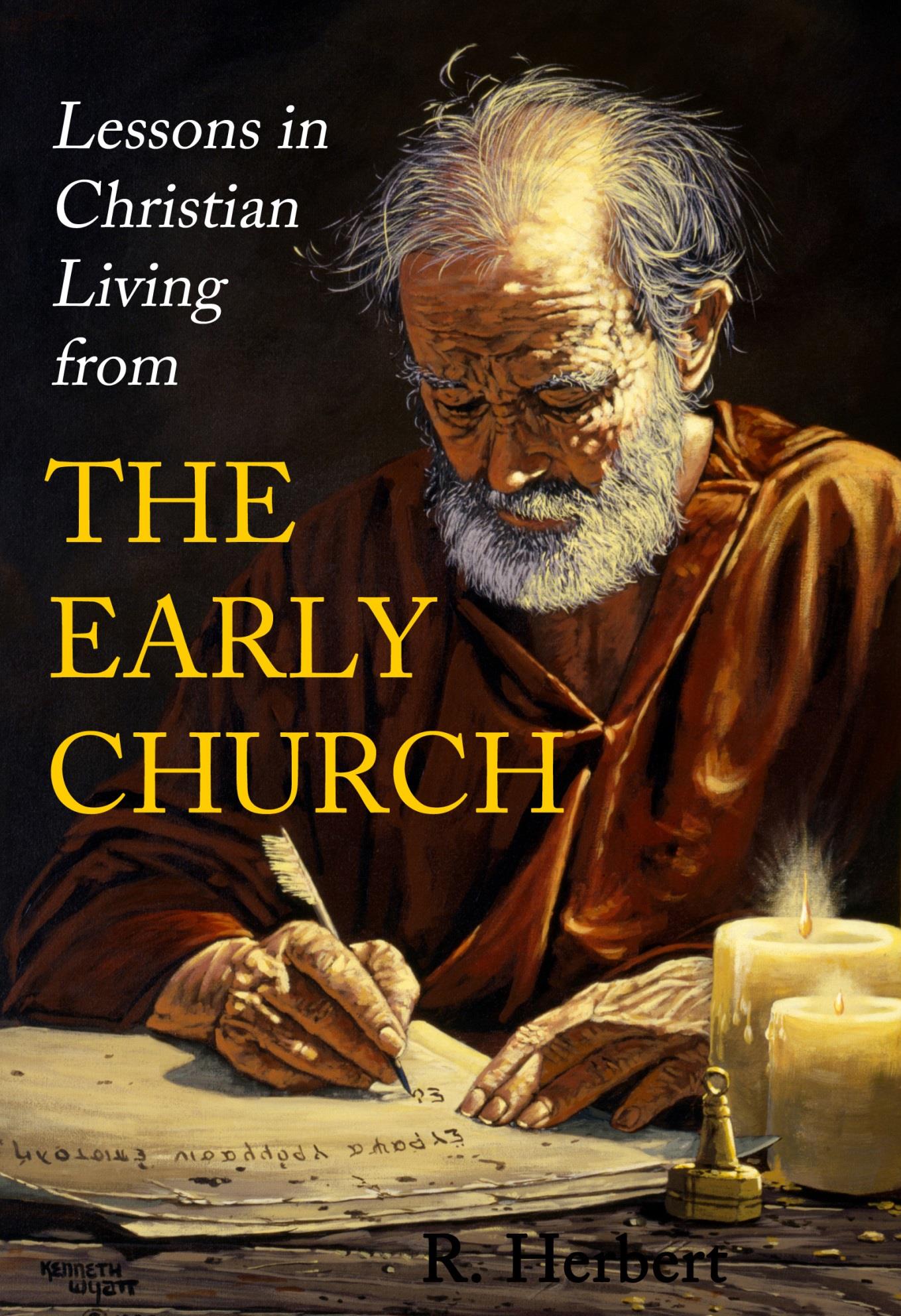
Cover: "Paul" © Kenneth Wyatt, reproduced by kind permission of the artist. In this wonderful painting, the apostle Paul is shown penning Greek words speaking of writing a letter or epistle. The Greek characters are large; many scholars feel that Paul may have written in such a manner due to failing eyesight (Galatians 4:15 and 6:11). The original artwork may be seen at http://bit.ly/1MoAHT5.
CONTENTS
A Note to the Reader
Introduction
PART ONE: FOUNDATION
1. The Book of Actions
2. The Unknown Apostle
3. Like Wind and Fire
4. The Universal Gospel
5. Priorities of the Spirit
6. What the Early Church Looked Like
7. Were the First Christians Communists?
8. Persecution!
9. Stephen and the Gifts of Faith and Power
10. The Man from the Ends of the Earth
11. A Centurion and Change in the Church
12. What Happened to James?
13. Faith and a Good Night's Sleep
14. The Man at the Door
15. Luke's Checkpoint Summaries
PART TWO: EXPANSION
16. Seeing the Light in Damascus
17. "Brother Saul" and the Faith of Ananias
18. Paul: Prepared to Serve
19. Barnabas: Son of Encouragement
20. The Church at Antioch
21. The Only Way
22. The Apostle Who Didn't Come to Dinner
23. Three Journeys – Three Lessons
24. Paul and Barnabas Disagree
25. An Encouraging Incident at Philippi
26. What Must I Do to Be Saved?
27. The Apostle Paul's Job Description
28. All Things to All People
29. A Matter of Citizenship
30. The Road to Rome
31. A Cell with a View
32. Paul after Acts
33. The Early Church after Acts
Afterword
A NOTE TO THE READER
Most of what we know about the origins of the Christian Church and its earliest history comes from the Book of Acts, or Acts of the Apostles – one of the most fascinating books in the New Testament. But Acts can be a complex as well as a captivating book for those who do not know it well. The book spans a number of decades of the first century, mentions more individuals than any other New Testament book, and, as we will see, describes constant action and many important events.
Like the Book of Acts, this book – Lessons in Christian Living from the Early Church – deals with only the first century of the Christian Faith, focusing mainly on the period from the founding of the Church in approximately AD 30 to around AD 60 when the apostle Paul was imprisoned in Rome. Only the last couple of chapters of this book go beyond that point to look at what happened to Paul and the early Church after the story line of Acts comes to a close.
But although The Early Church covers essentially the same timeframe, it is not a retelling of Acts or a commentary on it. Instead, this book consists of a collection of short essays dealing with the practical Christian lessons that we can learn from some of the lives, events, and conditions of the earliest years of the Christian Faith. A few of the chapters reproduce articles published on our websites, but most were specially written for this volume. If you would like to know more about the Book of Acts before looking at its lessons, the following Introduction sketches the background. If you would rather jump to the story itself, it begins here.
R. Herbert, Ph.D.
INTRODUCTION
According to tradition, the anonymous document now called the Book of Acts or the Acts of the Apostles was written sometime in the last decades of the first century by "Luke the Physician" (Colossians 4:14), who accompanied the apostle Paul on many of his travels.
Acts thus records much of the history of the early Church from an eyewitness perspective, as Luke was clearly present when many of the events occurred. In other situations Luke evidently heard of the events first-hand from people who witnessed them, so his account of early Christianity includes many important details and insights.
The Book of Acts also contains some intriguing clues regarding its origin and purpose. It is addressed to "Theophilus" (Acts 1:1) – the "most excellent Theophilus" for whom Luke also wrote his Gospel (Luke 1:3). Because Theophilus literally means "lover of God," it is sometimes thought that this might mean Luke and Acts were written as a record for any "Christian reader." This is possible, but Theophilus was not an uncommon name and it is just as likely that an actual individual was being addressed. Such an individual may have been a "patron" of Luke – supporting his research and writing – and probably a believer in Christianity himself (Luke 1:4).
There is perhaps one other possibility. Because Luke was with Paul for the two years the apostle was imprisoned in Rome while awaiting trial, some have wondered if Theophilus was the Roman official in charge of Imperial legal cases at the time, and Luke and Acts were written as legal briefs in support of Paul's case. It is true that Luke uses the same Greek word "excellency" that he uses of Theophilus to refer to the Roman governors Felix and Festus (Acts 23:26; 24:3; 26:25), but the title may simply be one of respect to his reader. In any case, Luke doubtless had in
mind an ultimately much wider audience than just Theophilus, whatever that person's identity may have been. Even if the book was not addressed directly to Christian readers in general, it certainly was written with them in mind.
From our modern perspective, Acts is often called the "bridge" between the four Gospels and the epistles of Paul. It certainly is that. Were it not for Acts, we would not know the outcome of the Gospel story or the background to so much of what Paul and the other apostles wrote about in their letters to early Christian churches and individuals. Acts truly is a key to understanding much of the New Testament, and it also answers a great many questions we might have regarding the early Church. How did the Church come into existence? How was it governed? What was it like? How did it change as it became established? Importantly, the answer to each of these questions carries lessons that we can apply in our lives in the Church today.
The Book of Acts is divided into two parts dealing with the founding of the Church (covered in Acts 1-12) and the spreading of its message throughout the Roman Empire (covered in Acts 12-28). Although it does not have a break in the middle to show this division, Acts is clearly organized to show the successive development of these two themes. We see this especially in the way Luke carefully selects material to show significant parallels between the two halves of Acts.
PARALLELS
In the first part of Acts (covered in this book in Part One: Foundation), we see the formation of the early Church in Jerusalem from the promised outpouring of the Spirit of God, and the Church's subsequent growth in Judea and nearby Samaria. Throughout this first period, the apostle Peter is the leading figure in the Book of Acts. We hear of other important early Christians such as Philip and Stephen who also accomplished great things, but the focus continually returns to
Peter. The final chapters of this section contain two vital transitional events. We see the receiving of the Holy Spirit by the Roman centurion Cornelius as the beginning of the conversion of the Gentiles, and we see the conversion of the Church's great enemy, Saul of Tarsus, setting the stage for the Gospel to be widely preached to the Gentile population of the Roman world.
In the second half of Acts (covered in this book in Part Two: Expansion), the stress is no longer on the Church's establishment within the Judean homeland, but on its spread to the city of Antioch in Syria – an area populated by Jews and Gentiles alike – and to the Gentile world beyond. Saul/Paul now takes center stage, and the work of this apostle is traced through three great missionary journeys – covering thousands of miles and lasting two, three, and four years respectively – until his captivity in Rome. We see other notable figures in this period of the early Church, too – not least Barnabas and Silas – but just as Peter is dominant in the first half of Acts, the focus now is on Paul. Although Peter is mentioned some 70 times in the first half of Luke's account, he is mentioned only once in the second half of the book – while Paul is mentioned about 180 times in the second half.
The parallel between Peter and Paul in the two halves of Acts is an important one which is carefully developed. Just as Peter healed a lame man (Acts 3:1-10) and others on whom his shadow fell (Acts 5:15), Paul is shown to have healed a lame man (Acts 14:8-10) and others who were touched by a cloth from him (Acts 19:12). Just as Peter was repeatedly thrown in prison and at one point miraculously released (Acts 4:3, 5:18, 12:3), Paul was also frequently imprisoned and on one occasion miraculously freed (Acts 16:23-24, 21:27-36). Peter counters an influential magician, Simon Magus (Acts 8:9-24), as does Paul in confronting Bar Jesus (Acts 13:6). Peter appears before the Sanhedrin and preaches the Gospel to the Jewish religious leaders (Acts 4:5-12, 5:29-32), as does Paul (Acts 22:30-23:6, 26:1-29).
Acts stresses many other similarities between the two apostles, and it is clear that Luke selects his material carefully to show the equality of Paul with Peter in their respective areas of taking the Gospel to the Gentiles and the Jews – though there is some small degree of overlap. Just as Peter oversaw the conversion of the Gentile Cornelius, Paul spoke to the Jewish Sanhedrin in Jerusalem, as well as preaching to many Jews, along with Gentiles, on his missionary journeys.
CONTINUITY
The fact that the first half of Acts stresses foundation and the second half of the book stresses expansion does not mean there is no continuity in the account, of course. Expansion is seen in the first half of the book ("and the Lord added to their number daily" – Acts 2:47), and foundation is seen in the second half (Paul established new churches in each city – Acts 14:23), so these and other ongoing themes run throughout Acts. We see continuous growth in both the number of believers and the geographical range of Christianity as it expands. At the same time we see a recurrent theme of persecution of the early Church – attacks which rise and fall in successive waves, often claiming lives and striving to limit the Faith, but never succeeding in stopping the foundation and expansion of the Church.
Another ongoing theme we find throughout Acts and one which we stress in this book is that of accomplishment. The travels of Peter and then Paul are synonymous with the outflowing of the Gospel as it spreads from its place of origin in Jerusalem farther and farther outward and eventually to Rome – the capital and center of the ancient civilized world.
But the accomplishment documented in Acts is not just the spread of an abstract religious idea. Luke is careful to show the value of the work being done at each stage of the early Church's growth – its results and outcomes that go beyond simple numbers of converts and cities visited – through the
establishment and the working of faith and change in the lives of those transformed by the Gospel. Many of the practical lessons of Christian living we can learn from Acts are found in these insights into the characters and accomplishments of the early Christians.
There is one other aspect of continuity in Acts that we must keep in mind as we look at the early Church and its lessons for us today. In tracing the development of the Church from its Jewish Christian origin in Jerusalem to a spiritual commonwealth of Gentile Christians in cities throughout the Roman Empire, Luke is not really looking just at the historical "Acts of the Apostles" (we must always keep in mind that is a later title given to Luke's book, not an original one), but at the continuation of the work of Jesus Christ that Luke described earlier in his Gospel.
Luke begins Acts with reference to "…all that Jesus began to do and to teach" (Acts 1:1), and the history of the early Church, as recounted in Acts, is simply the story of the continuation of that doing and teaching: "… you will be my witnesses in Jerusalem, and in all Judea and Samaria, and to the ends of the earth" (Acts 1:8). As his "witnesses," the early Christians did the same kind of works Jesus did and preached the same Gospel that he did.
Seeing this continuity helps us to better understand Luke's choice of material, the things he stresses and the things he only lightly touches upon. There is certainly no question that Luke's history of the early Church is a selective one; it is not only the best one we have – but also it is one which faithfully shows us the continuity of what Jesus Christ began to do, as well as providing us with many lessons from which we can personally profit in our own lives as He continues His work in the Church today.
Benjamin Franklin wrote: "Whoever shall introduce into public affairs the principles of primitive Christianity will change the face of the world;" and that is exactly what Luke attempted to show in Acts – and, of course, what Jesus of Nazareth intended.
PART ONE:
FOUNDATION
1 THE BOOK OF ACTIONS
If the Book of Acts were a movie, it would certainly be an Action film. It could be classified as a documentary, of course, but anyone watching the film would be struck by the constant, almost non-stop action. Acts tells of inspired people addressing huge crowds, healing the sick, running alongside chariots, being attacked and beaten, explaining, encouraging, traveling, being shipwrecked, being thrown in jail on false charges, being rescued and much more.
The action is almost constant, and we get the impression that the actors in the story are "supercharged" with a remarkable energy and determination. Of course, they were – as we see in the first chapter of Acts in the promise given by the resurrected Christ to his disciples:
"Do not leave Jerusalem, but wait for the gift my Father promised, which you have heard me speak about. For John baptized with water, but in a few days you will be baptized with the Holy Spirit … you will receive power when the Holy Spirit comes on you; and you will be my witnesses in Jerusalem, and in all Judea and Samaria, and to the ends of the earth" (Acts 1:4-8).
The giving of the Spirit of God was what would empower the constant action seen in the Book of Acts; and to understand just how true that is, we need to remember how inactive the disciples were before the Spirit's arrival. Depressed, and doubtless feeling disillusioned after the death of their teacher, the disciples were apparently in a state of shock and at the point of returning to their home areas (Luke 24) before Christ appeared to them and they began to understand the significance of what had happened.
After hearing of the miracle of Christ's resurrection, the disciples were still relatively inactive. Left to themselves they were unemployed and unempowered, and even after seeing the ascension of Christ, they had to be stirred on by angels who appeared to them: "Men of Galilee," they said, "why do you stand here looking into the sky?" (Acts 1:11).
We see the first glimpses of activity after this angelic nudging. The disciples returned to Jerusalem and began to pray regarding the commission and the promise they had been given (Acts 1:14), and Peter even rallied the believers to organize themselves to replace Judas (Acts 1:15-26). But this is nothing compared to what would happen soon.
When it arrived, the gift of the Spirit of God drastically changed the frozen inaction of the disciples into a fervent blaze of ongoing activity, as the unfolding chapters of Acts show. It is then that the "documentary" of Acts suddenly changes to the genre of "action," as we will soon see.
But there are lessons we can learn from the first chapter of Acts, beyond the difference that occurs with empowerment by the Spirit of God. One small but worthwhile lesson is found in the way the disciples, once prodded into preliminary action, began to pray actively even before the Spirit was given to them. They already had Christ's clear promise that the Spirit would soon arrive, but as the disciples began to understand what had happened and what was to come they did not just sit and wait – they prayed "constantly," as Acts 1:14 tells us.
It is as if the disciples had grasped the first of many lessons they would learn as the early Church was founded and began to grow – that they needed the power of action and that they had a part to play in letting that action be inspired in them. So even before the arrival of the Spirit of God, we find the disciples beginning to see that waiting for God to act should always be active waiting. This fact lies at the core of what we see as Acts continues.
2 THE UNKNOWN APOSTLE In those days Peter stood up among the believers (a group numbering about a hundred and twenty) and said "… it is necessary to choose one of the men who have been with us the whole time the Lord Jesus was living among us, beginning from John's baptism to the time when Jesus was taken up from us. For one of these must become a witness with us of his resurrection." So they nominated two men: Joseph called Barsabbas (also known as Justus) and Matthias. Then they prayed, "Lord, you know everyone's heart. Show us which of these two you have chosen to take over this apostolic ministry, which Judas left to go where he belongs." Then they cast lots, and the lot fell to Matthias; so he was added to the eleven apostles (Acts 1:15-16, 21-26).
The first chapters of Acts tell us that between two momentous events – the ascension of Jesus and the giving of the Holy Spirit – a much less conspicuous event occurred, regarding a person of little note, of whom virtually nothing is known: the choosing of the man Matthias to replace Judas as the twelfth apostle.
Although Peter tells us that Matthias was "with us the whole time the Lord Jesus was living among us," he is not mentioned in any of the four Gospels or earlier in Acts and must have been one of the many other disciples who followed Jesus (Luke 10:1, etc.). Certainly, it is not recorded that Matthias had distinguished himself in some notable way, and he seems to have been, in fact, one of many otherwise unremarkable followers of Christ. Yet there is perhaps a lesson in this fact. It is interesting that the early Church Father, Clement of Alexandria, wrote:
"Not that they became apostles through being chosen for some distinguished peculiarity of nature ... But they were capable of becoming apostles on being chosen by Him who foresees even ultimate issues. Matthias, accordingly … [was] substituted for Judas." (Stromateis vi.13).
Clement makes the important point that Matthias was apparently not chosen for what he had done – his résumé seems to have been a short one – but that he was chosen by the One who sees "ultimate issues" or outcomes. What was the outcome in Matthias' life? Neither Acts nor any of the Epistles seems to mention him again, yet we may have some clues. Despite varying traditions, several early scholars of the Church tell us that Matthias first preached the Gospel in Judaea, and then in Ethiopia where he was eventually martyred. A marker in a remote Roman fortress at Gonio (Apsaros) in that area of Africa claims that Matthias was buried there.
Although we have no exact details of Matthias' ministry and he probably remains the least-known of the apostles, we have no reason to doubt that in choosing this man God accomplished many things through him before his work was done. And there is a moral in his story for all of us: we may feel that our spiritual résumés are short and our accomplishments in God's service are few or largely unnoticed, but Matthias' life reminds us that we do not need to be in the spotlight to accomplish a ministry that may be important in God's eyes. What we do may even seem to be very far from the work being done by notable servants of God, but as long as we answer the call and persist in the work that is given to us, we are doing the work of the One who foresees ultimate outcomes.
3 LIKE WIND AND FIRE
When the day of Pentecost arrived, they were all together in one place. And suddenly there came from heaven a sound like a mighty rushing wind, and it filled the entire house where they were sitting. And divided tongues as of fire appeared to them and rested on each one of them. And they were all filled with the Holy Spirit … (Acts 2:1-4 ESV).
The bestowing of the Spirit of God on the early Christians was, in every sense, the beginning of the early Church. The description in Acts of the Spirit's arrival is a detailed one, and from it we learn several things. Luke mentions that the disciples were together "of one accord in one place" and the sense, although not apparent in some translations, is clearly one of agreement and unity as well as being in the same physical location.
The first sign of the Spirit's arrival was a "sound like a mighty rushing wind," and this seems to indicate that there was a sound "like" a wind rather than an actual movement of air, although a powerful wind is found as a symbol of the manifestation of God throughout the Old Testament (Job 38:1, etc.). Interestingly, the Greek word for the "wind" or "sound like wind" that suddenly filled the house where the disciples were is not the usual word for air movement produced by atmospheric conditions (anemos), but pnoè from the root of the word for the "breath" – as in Acts 17:25 where God is said to give us life and breath.
The effect of this sudden breath of power on the disciples is described literally as one of being "carried by violent blowing" (Acts 2:2). This is the sense of Peter's remark in his epistle written later that the prophets of past times "… spoke from God as they were carried along by the Holy Spirit" (2 Peter 1:21); but
the "breath" was also the fulfillment of Christ's action and words in one of his appearances to his disciples after his resurrection: "And with that he breathed on them and said, 'Receive the Holy Spirit'" (John 20:22).
The "tongues as of fire" that then appeared above the disciples' heads are also, of course, a symbol of God himself, as we see in numerous theophanies of fire beginning with that of the burning bush (Exodus 3: 2). But the "tongues like fire" are perhaps given additional significance in Luke's mention that the flames were "divided" (Acts 2:3) – apparently divided, yet together in the way that the two separate hands of the apostles were subsequently laid on the heads of new believers for their reception of the Spirit (Acts 8:14-19).
We do not know why there were two manifestations of the Spirit – sounding "as wind" and appearing "as fire." It was, of course, a double witness as something both heard and seen, and many commentators feel that the symbols of wind and fire imply enlivening (as with the "breath of life" and "living flames"). The earlier words of Jesus, spoken to the Pharisee Nicodemus, certainly seem to point to this understanding of the rushing wind as a symbol of spiritual rebirth in God:
"You should not be surprised at my saying, 'You must be born again.' The wind blows wherever it pleases. You hear its sound, but you cannot tell where it comes from or where it is going. So it is with everyone born of the Spirit" (John 3:6-8).
Sometimes people question why, if the Spirit is still given today, signs like the rushing wind and burning fire mentioned in Acts 2 are not apparent now. But this is to not understand that these signs were given for a specific reason at that particular time. Nothing is said in Acts that such signs were repeated when the Spirit was received by believers after this event, yet Acts gives us plenty of indication that the Spirit they were given enabled
many works and accomplishments once it had been received. Even in Acts 2, the great stress is not on the way in which the Spirit was received (a mere four verses), but on the manner in which it was then manifested in the lives of the apostles and other believers after it had been received (about forty verses). Certainly some of the manifestations of the Spirit were immediate and remarkably visible in the apostles, but the manifestations in most of the individuals receiving the Spirit after the Twelve were not so obvious.
In looking for the Spirit of God in our own lives, we should not be looking for extraordinary manifestations as though these are somehow a necessary proof of spirituality, but for the kinds of qualities Acts shows were exhibited by the early Christians on a daily basis. We will see occasional instances of the miraculous as we continue through Acts, but if we look closely, we will also see continuous instances of smaller, less obvious things that provide many lessons for us in our normal everyday lives and in our individual relationships with God.
4 THE UNIVERSAL GOSPEL
All of them were filled with the Holy Spirit and began to speak in other tongues as the Spirit enabled them. Now there were staying in Jerusalem God-fearing Jews from every nation under heaven. When they heard this sound, a crowd came together in bewilderment, because each one heard their own language being spoken. Utterly amazed, they asked: "Aren't all these who are speaking Galileans? Then how is it that each of us hears them in our native language? Parthians, Medes and Elamites; residents of Mesopotamia, Judea and Cappadocia, Pontus and Asia, Phrygia and Pamphylia, Egypt and the parts of Libya near Cyrene; visitors from Rome (both Jews and converts to Judaism); Cretans and Arabs—we hear them declaring the wonders of God in our own tongues!" (Acts 2:4-11)
The first chapter of Acts tells us that the Gospel of Jesus Christ was to be a universal one – to spread outward from Judea into all countries (Acts 1:8). When we read the story of the gift of the Spirit of God, given on the Day of Pentecost, we see the initial empowerment toward the fulfillment of this goal as the disciples were enabled to speak in many languages – in fact, the languages of "every nation under heaven" where there were "God-fearing Jews," including both Jewish born and Gentile proselytes (Acts 2:5). Luke catalogs these nations, moving essentially from East to West – from the area of modern Iran across the Near East and through the Mediterranean world, including much of North Africa and southern Europe. From an ancient perspective this was essentially the whole of the known civilized world, and certainly most every part of the world in which Jews might be found at that time.
That the "speaking in tongues" exhibited by the disciples was speaking in known languages rather than just the uttering of meaningless syllables is clear in that "each one heard their own language being spoken" (Acts 2:6, 8). The miracle must indeed have been an astounding one (vs. 12), but its surprising nature tends to overshadow other aspects of what happened that day regarding the universal message of the Gospel.
If we read a little further we find that the apostle Peter, in addressing the crowds who had witnessed this miracle, gave an impromptu sermon in which he explained what had happened using words from the prophet Joel:
"In the last days, God says, I will pour out my Spirit on all people. Your sons and daughters will prophesy, your young men will see visions, your old men will dream dreams. Even on my servants, both men and women, I will pour out my Spirit in those days, and they will prophesy" (Acts 2:17-18). If we read these verses quickly we notice the obvious parallel that Peter makes with the promised pouring out of the Spirit and the resultant prophesying – just as the crowds had witnessed that day. But we may overlook that true universality was also a clear theme of this text.
First we see that the promise was for the Spirit to be poured out on "all people" – racial and ethnic equality. Next we see that the Spirit would be poured out on "your sons and daughters" – gender equality. Then, on "young men" and "old men" – age equality. Finally, we see the promise to "servants … both men and women" – social equality. To us today, none of this may seem surprising, but in the ancient world these were revolutionary concepts. The fact that this kind of equality is so widely accepted and presumed in the modern world is to a great degree the result of the spread of Christianity.
In the ancient world there had perhaps never been such a full acknowledgement of the equality of all peoples. Throughout Israel's history, there had never been such a full acceptance of all peoples in a direct relationship with the God of Abraham, Isaac and Jacob. Those verses from the Book of Joel had been there all along, but they had traditionally been interpreted by their Jewish hearers as applying within the confines of Judaism at some future time. By including Joel's words in his message that day, Peter showed their intent to be far wider – that they applied to peoples "in every nation under heaven."
Acts tells us that Peter continued his sermon "with many other words" (Acts 2:40), but the final words Luke records of this revolutionary message are, fittingly: "The promise is for you and your children and for all who are far off — for all whom the Lord our God will call" (Acts 2:39, emphasis added).
The universal nature of Peter's sermon also reminds us that the calling we receive involves not just a personal responsibility to hear the message of the gospel, but also an implied responsibility to help carry that message to others.
The promise, Peter said, to those who would soon be returning to their families and communities in their home areas, was to "you and your children" and to "all who are far off." Who else would carry the message to their children but them? Who else would be carrying the message to "all who are far off" but them?
Today, who else will carry the message but those of us who hear it?
5 PRIORITIES OF THE SPIRIT
Although we remember that the first great work of the Spiritempowered apostles was the spectacular preaching, in different languages, of the Gospel on the Day of Pentecost, we don't always remember what the second apparent priority was of the Spirit's work through the early Church.
It is interesting that after the careful documentation in Acts of the first work of the Holy Spirit and the summary description of what the new church looked like in Acts 2, we find in Acts 3 another detailed description of the next work of the Spirit-filled apostles. Clearly the Spirit of God had been present and active in the lives of the new Christians in the intervening period, but Luke's account clearly moves from the first accomplishment and priority of the Spirit to a second one.
One day Peter and John were going into the Temple at the time of prayer – a time when the maximum number of witnesses would be present – and a man who had been lame from birth was begging at the Temple entrance. Notice Luke's description of what happened next:
Then Peter said, "Silver or gold I do not have, but what I do have I give you. In the name of Jesus Christ of Nazareth, walk." Taking him by the right hand, he helped him up, and instantly the man's feet and ankles became strong. He jumped to his feet and began to walk. Then he went with them into the temple courts, walking and jumping, and praising God. …While the man held on to Peter and John, all the people were astonished and came running to them in the place called Solomon's Colonnade (Acts 3:6-11).
The miracle was followed – exactly as with that of the Day of Pentecost – by a sermon from Peter explaining to the onlookers what had happened. But in this second incident the miracle of healing showed that the next great priority of the work of the Spirit in the early Church was exactly that which had been present in the ministry of Jesus, who had preached the Gospel and healed the sick (Matthew 4:23). When we remember that Acts is really not about the apostles, but about the continuation of all that Jesus taught and did (Acts 1:1) and what he had earlier commanded his disciples to do (Luke 9:2), we see the true continuity between the Gospels and Acts.
And there are a number of things that we today can learn from this incident if we utilize it as a model for our own service. Notice first that Peter's help to the lame man was preceded by invoking God's help. The apostle's words "In the name of Jesus Christ of Nazareth, walk" were, of course, as much a prayer as a command. There are many needs in this world, and asking God's help as we choose where to direct our energy, as well as for his help in the individual situations, is a fundamental principle we should always remember.
But concerned prayer of itself, when we are in the presence of a need, is not enough – as the apostle James so strongly reminds us (James 2:14-26). We must often do what we can to help as a prerequisite for God's help. In this case, Peter took the man by the hand and helped him up – and it was then that the healing occurred (Acts 3:7). As has been said, "The power was Christ's, but the hand was Peter's."
There is also a final lesson in this story that is easy to miss. Luke tells us that the healed man jumped to his feet and began to walk, then walked and jumped in the temple courts, praising God (vs. 8). Then, he tells us "…While the man held on to Peter and John …" (vs. 11). It was certainly not that the healing ceased to be effective – as we see in the continuation of the narrative – but rather that the man was doubtless exhausted from these
unprecedented exertions. The point is that Peter and John continued to help the man after his need was apparently met – they continued to look out for him and to help support him till he gained strength to function independently.
There is certainly a moral in this point. Physically we can think about the value of supporting aid work that does not simply feed the hungry for a day and then move on. The old principle of teaching a person to fish rather than just giving him a fish is one especially applicable to Christian aid work, and we can apply it in our own lives in helping others. And there is surely a spiritual parallel here also. All too often, even wellmeaning missionaries sometimes preach and move on – leaving those they helped without the spiritual guidance and support they need to continue in their new faith.
While there is nothing in Luke's narrative that exhorts us to follow the example of Peter's helping the lame man, we might remember that the incident is showcased in Acts as the second great work of the Spirit through the early Church. The principles we see in this example are sound ones for application in our lives, also. If we look first to God for guidance and intervention as we strive to help others, then do everything we can in our own power to assist them, following up with ongoing supportive help as necessary, we will be following the example of the Spirit that Christ himself promised would come to guide us (John 16:13).
6 WHAT THE EARLY CHURCH
LOOKED LIKE
What exactly did the early Church look like? If we read the description of the newborn Church as it is portrayed in the Book of Acts, we find something very different from modern ideas of a "church." In fact, a great many of the things we might mention today in describing a church were not even present. There were no church buildings, no special robes or identifying physical attributes of the church leaders or followers. There was no New Testament and no organization of belief in the form of catechisms, creeds or dogmas. How then would we have recognized the early Church?
The Book of Acts shows a number of things that were clear characteristics of the early Church – ways in which we would recognize it if we had lived then – and while some characteristics were unique for that time and circumstance, many are things that we should surely hope to see in the Church today: They devoted themselves to the apostles' teaching and to fellowship, to the breaking of bread and to prayer. Everyone was filled with awe at the many wonders and signs performed by the apostles. All the believers were together and had everything in common. They sold property and possessions to give to anyone who had need. Every day they continued to meet together in the temple courts. They broke bread in their homes and ate together with glad and sincere hearts, praising God and enjoying the favor of all the people. And the Lord added to their number daily those who were being saved (Acts 2:42-47).
In the space of these six verses Luke paints a vibrant picture of the early Church. We see first that it was a dedicated church – devoted to certain things. The Greek word translated "devoted" can mean "persevere," "adhere to," "be devoted to," "be attentive to" and several other things, but the general meaning of dedication is clear. Acts 2:42 tells us this dedication was applied to the teachings of the apostles, to fellowship, and to breaking bread – three forms of interaction with fellow Christians from the more formal to the more casual and from the greater opportunities for learning to the lesser.
Next, we see that the early church members were filled with "awe" (vs. 43) at the work being done in the Church. Not all the converted individuals can have been present at the "many wonders and signs" being performed – it is clear that they were talking and hearing about these things.
We are also told that the early believers had "everything in common," and although this does not reflect a kind of primitive communism as some have thought (as we will see in the next chapter), it is clear that the early Church was full of the spirit of giving and sharing.
Verse 46 tells us that the early Church met daily in the Temple. This was probably not formal religious activity, but simply meeting, discussing and fellowshipping – the stress is on the continuing interaction of the Church's membership.
The early Church was also characterized by a spirit of thankfulness – the example is given of eating together "with glad and sincere hearts" (vs. 46) – and "praise" (vs. 47).
Of great importance, we see that the Church was obviously "letting its light shine" and that its members were "enjoying the favor of all the people" (vs. 47B). The favor was not just with fellow Christians, but all the people. This fact clearly ties into the final thing Luke mentions: that "the Lord added to their number daily" (vs. 47B).
So this is what the early Church looked like. It was characterized not by externals or by physical things, but by the
Holy Spirit and by the believers' attitudes, their relationships, and their effect on those around them. The lesson to all of us today is not that we should necessarily be searching for a church looking like that to attend, but that we should be striving to make the church we already attend look like that.
7 WERE THE FIRST CHRISTIANS
COMMUNISTS?
All the believers were one in heart and mind. No one claimed that any of their possessions was their own, but they shared everything they had… And God's grace was so powerfully at work in them all that there were no needy persons among them. For from time to time those who owned land or houses sold them, brought the money from the sales and put it at the apostles' feet, and it was distributed to anyone who had need (Acts 4:32–35). Some have used these verses in Acts to try to prove that the early Christians followed a form of communism, but a careful reading of what the Bible says here shows that nothing could be further from the truth. We should note immediately that this seems to have been a temporary situation while the fledgling Church was becoming established and before any formal mechanisms for helping the poor within the Church were in place.
Many of those who had come to Jerusalem to keep the Feast of Pentecost (Acts 2) and had been converted were now staying there and had as yet no means of support. As a result many shared what they had at that time. But we should remember that once this temporary situation had passed, there is no evidence in Acts or elsewhere in the New Testament that the early Church continued in exactly the way described here.
Also, unlike communism as it is known in the modern world, the State was not in any way involved in this sharing; the Christians did not all share their property as a result of some decree or decision – rather "from time to time" people would decide to give, and only those people gave who wanted to do so.
There was also no requirement to share, as Peter himself clearly tells us in the story of Ananias and Sapphira, who gave but in a deceitful and underhanded manner by acting as though they were giving all while they were holding back part of the gift:
"Ananias … why has Satan filled your heart to lie to the Holy Spirit and to keep back for yourself part of the proceeds of the [sale of your] land? While it remained unsold, did it not remain your own? And after it was sold, was it not at your disposal? …You did not lie to men but to God!" (Acts 5:3–4).
Finally, we should notice that the early Christians' goods were not equally divided among everyone, but were "distributed to anyone who had need" (Acts 4:35).
This is all very different from modern era communism in which the State forcibly redistributes all wealth – theoretically sharing it equally between everyone in the society. There is also a clear difference in attitude. As has been jokingly said, though not without some truth, communism operates on a principle of "What's yours is mine," whereas the early Christians operated with the attitude of "What's mine is yours."
We should also remember that there is no room for communism in the teachings of Jesus. Although he recommended a certain rich young ruler sell all he had and give to the poor (not distribute it among Jesus and his followers), this appears to have been an individual test. We see that Jesus had Judas look after his funds and these funds were used as needed and, on occasion, some funds were given to the poor (John 13:29), rather than anything that was received being automatically equally distributed. Communism is, in fact, diametrically opposed to a great many of the teachings of Jesus, as we can see in the parable of the "talents" (Matthew 25:24–30) and the parable of the "minas" (Luke 19:12-27) where the servants are unequally rewarded.
As we continue through the Book of Acts, it is clear that the early Christians continued to hold their own property. Barnabas is said to have sold a field and given the money from the sale to the apostles (Acts 4:37), but the sale was evidently of a single field and nothing is said of his house and the rest of his property. It is clear that the early Christians retained their homes, and the private homes of numerous individuals continue to be mentioned throughout the book and elsewhere in the New Testament (Acts 2:46, 1 Corinthians 16:19, Colossians 4:15, etc.). So rather than being expected to give all we have, the lesson for us in the way in which the early Christians had "all things in common" is one of willingness to share and to give generously from what we have.
8 PERSECUTION!
"Remember what I told you: 'A servant is not greater than his master.' If they persecuted me, they will persecute you also. If they obeyed my teaching, they will obey yours also" (John 15:20). Jesus plainly warned his disciples that they would be persecuted if they followed him, and the fourth chapter of Acts records exactly when and how the promised persecution began:
The priests and the captain of the temple guard and the Sadducees came up to Peter and John while they were speaking to the people. They were greatly disturbed because the apostles were teaching the people, proclaiming in Jesus the resurrection of the dead. They seized Peter and John … The next day the rulers, the elders and the teachers of the law met in Jerusalem … They had Peter and John brought before them and began to question them (Acts 4:1-7). Notice that this was not a routine or impartial questioning. The NIV translation begins the passage by saying the religious authorities and temple guard "came up to" Peter and John, but the underlying Greek is much stronger, as we see in some other translations which have "seized" or "laid hands on them" – the promised persecution was already beginning.
But Peter and John stood their ground against the negative questioning and the threats that were leveled against them (Acts 4:8-13), and for the moment the religious authorities dared not
do more against the disciples, so they let them go – with threats and direct orders not to continue their teaching (Acts 4:18-21).
What Luke tells us next is perhaps as encouraging as it is amazing. We might expect that the earliest Christians would then have gone into "defensive mode," that they would now have exercised caution regarding where they spoke – perhaps even beginning to plan more secretive methods of getting out the Gospel. At the very least, we would expect them to pray for protection from the very real threats they had received.
Luke does tell us that on hearing of Peter's and John's narrow escape, the Christians "raised their voices together in prayer to God" (Acts 4:24), but it was not for protection. Luke tells us rather that they prayed: "Now, Lord, consider their threats and enable your servants to speak your word with great boldness" (Acts 4:29). That prayer was certainly answered (Acts 4:31), and the results are seen throughout the Book of Acts.
The prayer and its results also doubtless carry an important lesson for God's Church in any age. Perhaps we, too, when conditions turn against our beliefs, should be praying not so much for protection as for boldness; and we should take encouragement in the fact that in promising persecution would come, Jesus did not stop there, but – as we read above – he continued: "If they persecuted me, they will persecute you also. If they obeyed my teaching, they will obey yours also" (John 15:20, emphasis added). The Son of God foretold that persecution would occur, but he also promised that there would be those who would hear and follow – whenever the response to persecution is boldness.
9 STEPHEN AND THE GIFTS OF
FAITH AND POWER They chose Stephen, a man full of faith and of the Holy Spirit … Now Stephen, a man full of God's grace and power, performed great wonders and signs among the people (Acts 6:5, 8). Most Christians remember Stephen primarily for two things: he was the first Christian martyr, and his final prayer – like that of Christ – asked forgiveness for those who killed him. But there is much more we can learn in studying what is known about this man as recorded in the Book of Acts.
Stephen was one of the seven Greek-speaking Hellenistic Jews who were selected as deacons to help ensure a proper distribution of charitable aid to the Greek-speaking widows in the early church at Jerusalem (Acts 6:1-6). But Stephen's works evidently went well beyond physical service. We are told that he was "full of faith" and "performed great wonders and signs," and he is the first person named outside of the Twelve Apostles said to have had this power.
Luke actually gives two summaries of Stephen's traits and God-given abilities, as we see above – saying that he was "a man full of faith and of the Holy Spirit" (Acts 6:5) and "a man full of God's grace [many manuscripts read "faith"] and power" (Acts 6:8). Putting the verses together, it is clear that Stephen was full of faith and power.
Now notice an important fact. In telling the disciples to select the seven deacons, Peter stressed "choose seven men from among you who are known to be full of the Spirit and wisdom" (Acts 6:3). All these godly men were chosen because they had
the gift of the Holy Spirit in abundance ("full of"), but among the seven only Stephen was said to be also granted the "power" to do great deeds.
There may be an important lesson in this. How many times have you wondered why we as Christians do not do the miracles and great things of the early Church? We tend to answer the question theologically, with the argument that it is not now God's will, or that miracles were commonly given then to "establish" Christianity, or some such. But whatever our theological reasoning may tell us, we may experience doubt that if we only had enough faith and enough of God's Spirit – the same amount of faith and Spirit as Stephen and some of the leaders of the early Church – perhaps we, too, could do great works of healing and help.
What this chain of reasoning omits is that the Book of Acts itself tells us that all the chosen deacons had the Spirit of God in large measure, and doubtless all of them had faith, but even at a time when miracles were being done, only Stephen among the seven had both faith and power at work within him, and both appear to be necessary for great works.
We should remember that Abraham and many others throughout the Bible had great faith but did not accomplish healings or similar "great works." God develops the faith of all his children through his Spirit, if we let him (Galatians 5:22), and also gives us a measure of power in the same way (Ephesians 3:16), but he gives the power to do great things only where and when he elects to do so (1 Corinthians 12:9-10).
Stephen's life reminds us that we can live godly lives and do good works based on the Spirit's action in us without having to somehow work up more faith in order for God to do great works such as "wonders and signs" through us. Such works require great power, and great power is something God gives only when he desires to do so for specific circumstances – as an addition to the faith we all must have.
10 THE MAN FROM THE ENDS OF THE
EARTH
Now an angel of the Lord said to Philip, "Go south to the road— the desert road—that goes down from Jerusalem to Gaza." So he started out, and on his way he met an Ethiopian eunuch, an important official in charge of all the treasury of the Kandake (which means "queen of the Ethiopians"). This man had gone to Jerusalem to worship, and on his way home was sitting in his chariot reading the Book of Isaiah the prophet. Then Philip ran up to the chariot and heard the man reading Isaiah the prophet. "Do you understand what you are reading?" Philip asked. "How can I," he said, "unless someone explains it to me?" So he invited Philip to come up and sit with him (Acts 8:26-31). As we read the story of Philip and the Ethiopian eunuch, it is hard for us, as modern readers, to grasp the way in which the story would have been perceived by its original hearers in the early Church.
In ancient Judea and the Mediterranean world Ethiopia epitomized the idea of remoteness. The Greek poet Homer spoke of the inhabitants of Ethiopia as the "farthest of men" – the most remote known peoples (Odyssey 1.23), and the term Ethiopia was often used by classical writers to mean all of unknown subSaharan Africa – to "the ends of the earth."
This sense of the exotic and distant land from which the eunuch came was heightened by other details of the story – the fact that the inhabitants of Ethiopia were dark-skinned was exotic in itself. The fact that the man was a eunuch also placed him in a small minority of Jews or Gentile proselytes to the Jewish faith. Even more exceptional was the nature of the
eunuch's position as an important official in a distant land "ruled by women" (a number of the Kandake queens ruled Ethiopia during that era). All these factors would have come together in the minds of early Christians to form a very vivid image of a man from the ends of the earth.
We see more clearly how these facts would have been perceived when we apply them to the wording of the great commission given by Christ to his disciples before his ascension: "… you will be my witnesses in Jerusalem, and in all Judea and Samaria, and to the ends of the earth" (Acts 1:8B). Acts records that commission being fulfilled in Jerusalem (Acts 6:8-8:3), in Judea and Samaria (Acts 8:4-25) and, beginning in the story of the Ethiopian eunuch, to "the ends of the earth" (Acts 8:26-40).
That is doubtless why, out of all the thousands of people that were converted at that time (Acts 4:4, etc.), the story of the Ethiopian eunuch was selected to be told in detail. The commission certainly was to take the Gospel to all the Gentile world, not just to Ethiopia, but the early readers of Acts would have immediately recognized in this story how God was working out His purpose and beginning to fulfill His intentions.
There are many exemplary lessons we can see in the story of Philip and the Ethiopian eunuch: the willingness of Philip to follow the Spirit's prompting to do the work of God, the devotion of the Ethiopian to travel the huge distance to Jerusalem to worship, the humility of the powerful man in the way he asked Philip's help to understand God's word, among others.
But a lesson we should not forget is that if we, like the early Christians, keep in mind the plan and purposes of God, we will see them being fulfilled in and around us if we are observant. If we look for them, we will see the signs of God's work being done and be strengthened by them, as the word continues to go out to "the ends of the earth."
11 A CENTURION AND CHANGE IN
THE CHURCH
At Caesarea there was a man named Cornelius, a centurion in what was known as the Italian Regiment. He and all his family were devout and God-fearing; he gave generously to those in need and prayed to God regularly. One day at about three in the afternoon he had a vision. He distinctly saw an angel of God, who came to him and said … "Your prayers and gifts to the poor have come up as a memorial offering before God. Now send men to Joppa to bring back a man named Simon who is called Peter. He is staying with Simon the tanner, whose house is by the sea" (Acts 10:1-6). The cohors or regiment with which the centurion Cornelius served was stationed in Caesarea, the capital of the Roman province of Judea, and this is where an amazing story unfolded. Cornelius' regiment was made up of Roman citizens, and he himself was obviously a Gentile. But Cornelius was no ordinary Roman soldier.
Acts does not just say he was a "good" man or a "wellmeaning" individual. Luke focuses closely on his character and tells us that Cornelius was: "devout" and "God fearing" – having a right attitude; that he "gave generously" – he demonstrated love for others in his actions; and "prayed regularly" – he exhibited love for God in his words. Cornelius was, in short, a person good in "thought, word, and deed." We cannot do much better than that. Yet despite all his good words, works and attitude, Cornelius, as a Roman, would have been shunned by religious Jews because of his status as a Gentile.
But Acts tells us how God gave the apostle Peter a vision, about the same time Cornelius was given his message from God, showing Peter that even as a devout Jew he should call no man "unclean" – the very term often used by Jews to refer to Gentiles at that time. Peter openly explained this to Cornelius when he was directed to visit the centurion: "You are well aware that it is against our law for a Jew to associate with or visit a Gentile. But God has shown me that I should not call anyone impure or unclean" (Acts 10:28). When God gave his Spirit to Cornelius and others present with him, Peter concluded, "I now realize how true it is that God does not show favoritism but accepts from every nation the one who fears him and does what is right" (Acts 10:34-35). It is perhaps hard for us to realize today, in an age of worldwide Christianity, what a "quantum leap" this event was for Christianity. This undeniable granting of the Holy Spirit to the Gentile Cornelius (Acts 10:45-46) stands as one of the great turning points in Church history; but full acceptance of this idea throughout the Jewish-Christian community came slowly and painfully, as we see in the following chapters of Acts.
There is also a simple lesson in the story for us today. We can apply the principle behind Peter's words that "God does not show favoritism but accepts from every nation the one who fears him and does what is right" (Acts 10:35) in our own lives in relation to other Christians. We may have no problem accepting fellow believers of any nation, but many Christians view their own church, their own denomination, as the "right" group, with members of other groups being viewed as doctrinally, or in other ways, inferior.
In its most extreme form, this attitude becomes that of individuals who feel they are part of the only "true" church. But God's choosing of Cornelius shows us that we should completely turn from such exclusivity and realize with Peter that God can and does work with any individual who sincerely seeks him.
God clearly judges the hearts of individuals, not groups (Jeremiah 17:10), and we should always remember the principle he taught us through Cornelius – that God always accepts "the one who fears him and does what is right." If need be, we should remember to extend the principle that God "accepts from every nation," to God "accepts from every denomination." Understanding otherwise is to fail to learn one of the vital lessons about Christianity in the story of Cornelius.
12 WHAT HAPPENED TO JAMES? It was about this time that King Herod arrested some who belonged to the church, intending to persecute them. He had James, the brother of John, put to death with the sword (Acts 12:1-2). James was clearly one of the leading apostles of the early Church. Along with Peter and John, he was one of the three leading disciples during the ministry of Christ. In fact, throughout the Gospels, James is always mentioned before his brother John when the two are mentioned together, and he was frequently called James the Greater or James the Great to distinguish him from James, the son of Alphaeus (James the Lesser), and James, the brother of Jesus (the author of the Epistle of James).
So we might ask why the death of this leading apostle of the early Church at the hands of Herod Agrippa is related in only one verse (Acts 12:2) – the death of Judas is described in more detail (Matthew 27:3–10) – when the death of Stephen, a relatively unknown deacon, is covered extensively (over two complete chapters, Acts 6 and 7), including complete details of his final speech. It cannot be simply that Stephen was the "first Christian martyr," as his death was, in reality, only one of the long line of martyrs recorded throughout the Old and New Testaments.
On the other hand, James was apparently the first of the twelve apostles to be martyred for his faith, and the only apostle whose death is recorded in the New Testament – would we not expect to be told more of the details of his martyrdom?
The answer to this apparent imbalance is found in a better perception of what the Book of Acts really is. Although we all
know Luke's volume on the early Church as the "Acts of the Apostles" (Greek Praxeis Apostolon), this title was first used by the Church Father Irenaeus late in the second century, and it was not a title given to the book by Luke. Instead, as we have seen, Luke reminds us at the very outset of the book that his purpose in writing Luke-Acts was to record "all that Jesus began to do and to teach" (Acts 1:1). If we keep Luke's purpose in mind, we see Acts not as the acts of the apostles, but rather as the continuing acts of Christ himself.
Seen this way, the scant details given regarding the death of James – and the total lack of any mention of the deaths of the other disciples – show us that Acts is not really about the apostles, but about the One who worked through them and others, like Stephen and Philip, as well.
While the death of James may well have been carried out unseen and undocumented in one of Herod Agrippa's prison cells, the speech and subsequent death of Stephen was more visible and thus a major witness to the religious authorities of Jerusalem – the Sanhedrin before whom he was tried. In that sense, Stephen's death was a turning point in the spreading of the Gospel – it was after his witness and martyrdom in Jerusalem that Christians and Christianity began to spread outward.
Seen from this perspective, the death of James was actually insignificant. That does not mean that it was trivial or meaningless, but although James and the other disciples may have died deaths that were martyrdoms of faith, their deaths were apparently not as directly part of the unfolding plan and purpose that Luke shows was being worked out in the early Church – the spreading of the Gospel outwards throughout the world (Acts 1:8).
The deaths of James and Stephen were, of course, equally important in the eyes of the God who called them and worked great things through them both. However, the lives of James and all of the twelve disciples – which are recorded in detail –
accomplished far more than their deaths, even though they later suffered martyrdoms which evidenced their great faith.
If there is a lesson in the limited details we are given regarding what happened to James, it is that what we do in our lives is usually far more important than what we can accomplish in death. As successors of those called to serve God in the early Church, we should strive to follow their example in never fearing the possibility of death for our faith – only the possibility of not accomplishing what we have been given to do in our lives.
13 FAITH AND A GOOD NIGHT'S
SLEEP
Like most of us, the apostle Peter made his share of mistakes. He certainly showed an undeniable lack of faith on more than one occasion. We have only to remember the time that he, along with Jesus and the other disciples, was crossing the Sea of Galilee and the huge storm came up. We remember how Peter and the rest of the disciples frantically woke Jesus, who was sleeping peacefully in the ship, to tell him they were all going to drown (Matthew 8:23-25). And then, of course, there was the time Peter loudly proclaimed he would never desert Jesus, only to deny him and flee within a matter of hours (Luke 22). It's no wonder Jesus called Peter "you of little faith" on more than one occasion.
But it is amazing to see the difference the strong indwelling of the Spirit of God makes when it comes into even those of "little faith." In the Book of Acts, after the apostles and many others received the Spirit of God (Acts 2), we see an interesting change. Acts 12 tells us that after killing the disciple James, the brother of John, King Herod Agrippa had Peter arrested, intending to put him on trial.
We need to think about how Peter must have felt in this situation. He had been arrested during the Passover season – the anniversary of the death of Jesus – and the awful fate of his Master must have been very present in his mind, especially after James had just been killed. But notice the details of how Acts describes Peter's dramatic rescue from prison:
The night before Herod was to bring him to trial, Peter was sleeping between two soldiers, bound with two chains, and sentries stood guard at the entrance. Suddenly an angel of the Lord appeared and a light shone in the cell. He struck Peter on the side and woke him up. "Quick, get up!" he said, and the chains fell off Peter's wrists. Then the angel said to him, "Put on your clothes and sandals." And Peter did so. "Wrap your cloak around you and follow me," the angel told him. Peter followed him out of the prison, but he had no idea that what the angel was doing was really happening; he thought he was seeing a vision (Acts 12:6-9).
Now think about everything we know about Peter from the Gospels – his frequent lack of faith and propensity to "crumble," as well as his obvious fear. Given the dire circumstances of his imprisonment and the fate that likely awaited him, we would presume that Peter was probably lying sleepless in his cell – worrying over his situation and his possible martyrdom. But Peter was sleeping.
Even after the rescuing angel "turned the light on" in his cell, Peter continued to sleep, and we can almost hear him snoring peacefully. Acts tells us that the angel even had to poke him in the side (the Greek word pataxas means "striking" – not a gentle nudge) to wake him, and Peter had apparently been sleeping so soundly and deeply that even when he was awakened, he was still unsure of what was happening.
Can we even compare the Peter who woke the sleeping Jesus in terror in the storm on the Sea of Galilee with this Peter who likely faced death and yet now slept peacefully like his Master? Clearly, the powerful indwelling of the Spirit of God had transformed Peter, and his story can be an inspiring one to us all if we can recognize the amazing change that enabled this example of Christian faith under persecution.
We need not doubt for a minute that Peter was humanly concerned regarding his circumstances and aware of the danger he was in. In that ancient culture, guards were usually given the penalty awaiting prisoners they allowed to escape, and Acts tells us that when Peter was not found in his cell Herod had his guards executed (Acts 12:19).
Peter had every reason to be afraid. But just as the light that shone in his cell was not of his making, Peter was doubtless "reflecting" additional faith he had been given, and he knew that God would deliver him if it were not against his will. With that truth in mind, Peter was sleeping well – even when he was sleeping in Herod's cell.
If we find ourselves anxious or losing sleep regarding the outcome of difficult or potentially dangerous situations in our own lives, we can remember the example of Peter. Like the formerly fearful apostle, we too can come to the faith that deals confidently with times of uncertainty and trouble. Like Peter, we too can learn faith to sleep soundly.
14 THE MAN AT THE DOOR
After his miraculous escape, Peter] went to the house of Mary the mother of John, also called Mark, where many people had gathered and were praying. Peter knocked at the outer entrance, and a servant named Rhoda came to answer the door. When she recognized Peter's voice, she was so overjoyed she ran back without opening it and exclaimed, "Peter is at the door!" "You're out of your mind," they told her. When she kept insisting that it was so, they said, "It must be his angel." But Peter kept on knocking, and when they opened the door and saw him, they were astonished (Acts 12:12-16). The story of what happened after Peter's miraculous rescue from Herod's prison seems almost trivial by comparison to the events of the angelic rescue itself, and we can only presume that the details are recorded in order to teach a lesson rather than for their historical importance.
Luke tells us that once Peter realized what had happened to him was not a dream and that he was truly free, he went at once to the house where he knew believers would be present. A number of believers were, in fact, gathered there – praying for Peter's safety and release.
Many commentators give a rather negative account of how the servant girl, Rhoda, acted when Peter knocked on the door. These comments range from the more charitable - which tell us Rhoda was so overcome with joy to realize Peter was standing at the door that she could not think clearly and ran to tell the others rather than opening the door for him – to some rather less charitable commentaries which go as far as to suggest that Rhoda
was probably "just a simple servant girl" (apparently intimating that not much could be expected of her).
These commentaries all miss the tension of the situation. Peter's arrest did not take place in a vacuum. Persecution was already well underway, and the gathered believers were probably extremely on edge concerning their own safety and that of all Christians at that point in time. It seems perfectly likely that when a knock came to the door late in the night, the homeowners instructed the servant Rhoda to go to the door to see who was there – but not to open the door. Such a situation seems just as probable as any shortcoming on Rhoda's part, and Luke does not intimate in any way that the young woman was too excited to think clearly - just that she immediately ran back and told the disciples that it was, in fact, Peter at the door.
But focusing on Rhoda's message misses a major lesson in this account regarding the reception of the message. It is ironic that the believers were almost oblivious to the answer to their prayers when it did arrive, and that they almost refused to accept that their prayer was answered even when they were repeatedly assured it was true. Even when they saw Peter for themselves, "they were astonished" (vs. 16).
We can apply this story to ourselves by remembering that we should never pray and presume the prayer is perhaps not likely to be answered. That is doubting prayer at best, and unbelieving prayer at worst.
A second lesson we might consider is that when we pray, we should not then make physical arrangements that presume the prayer may not be answered. Note that Luke records not only that the door to the house was locked, but also that the "outer entrance" was locked. Middle Eastern homes still often have this same arrangement, with the house door set within an exterior court or vestibule area with its own "outer" door. If the believers had truly expected Peter's release, they might have at least left the outer door open for him.
These points may seem easy to make with the benefit of hindsight, but the details of this part of the story of Peter's rescue seem so small and otherwise so historically unimportant that they are surely there as reminders to us rather than being historically significant. They remind us that we should never presume that prayer is unlikely to be answered or that it is not being answered; and we should never make arrangements, due to lack of conviction, that actually hinder the outcome of the requests we make.
15 LUKE'S CHECKPOINT SUMMARIES
Luke's writings are among the most accomplished in the New Testament, and he was clearly an educated individual who was aware of Hellenistic literary styles and conventions. His works are structured clearly and logically, and in both his Gospel and in the Book of Acts the evangelist utilizes a narrative technique which is extremely helpful to his readers: the summary. By "summary" we do not mean a summary at the end of the book, but the use of ongoing "checkpoint" summaries given every so often to show the continuing development in his story.
These checkpoints tell us many things. Luke uses them in his Gospel to provide short summaries at important points in the life of Jesus (for example, Luke 2:40, 52). He uses them throughout the Book of Acts in the same way to provide summaries at key points in the careers of the apostles and the development of the early Church. The summaries tell the reader what has been accomplished, give us a sense of where we are now in the story, and help us understand what needs to be done next.
For example, in Acts 2, as we saw earlier, Luke summarizes the situation in the Christian community directly after the momentous events of the Day of Pentecost:
They devoted themselves to the apostles' teaching and to fellowship, to the breaking of bread and to prayer. Everyone was filled with awe at the many wonders and signs performed by the apostles. All the believers were together and had everything in common (Acts 2:42-44).
Luke gives many such summaries in the course of narrating Acts, and each one not only tells us numerous things about the
early Church, but some also give us a point of comparison – something to think about in our own lives. Looking at Luke's description of these early, Spirit-filled days, we see only superlatives in everything he describes – believers who are "devoted" to learning and fellowship, "filled" with awe, and having "everything" shared.
To take another example, in Acts 9:31 Luke summarizes the conditions at a time the Church was enjoying relative peace and security:
Then the church throughout Judea, Galilee and Samaria enjoyed a time of peace and was strengthened. Living in the fear of the Lord and encouraged by the Holy Spirit, it increased in numbers.
In this example we see that periods of peace and quiet gave the early Church special opportunities to be strengthened and grow. What happens when we have periods of peace and quiet – free from trials or stresses – in our lives? Do we just relax and coast? We may be appreciative and feel blessed, but do we use the opportunity to be strengthened and to grow?
That is exactly what Acts shows us occurred after one of Luke's summaries in Acts which forms the half-way point in the book: "But the word of God continued to spread and flourish" (Acts 12:24). Directly after this summary, major new growth is seen throughout the second half of the book.
It is clear that if we study them carefully, Luke's checkpoint summaries can be helpful in understanding the life of the early Church. It's a highly effective literary device and one that we can use in our own lives, too. Rather than just moving through life in either a condition of pleasure and coasting or perspiration and coping, we too can take stock regularly and ask ourselves what has been accomplished in our lives so far, where we are now in our walk with God, and what needs to be done next.
Just as Luke's short checkpoint summaries are of great value in understanding the growth of the early Church, if we use them in our own lives, short checkpoint summaries can be extremely useful in helping us understand and continue the story of our own growth.
PART TWO:
EXPANSION
16 SEEING THE LIGHT IN DAMASCUS
The story of the apostle Paul's conversion is repeated several times in the Book of Acts, first as told by Luke (Acts 9), and then twice more in the words of Paul himself (Acts 22, Acts 26). In each telling of the story we learn new details, but the constant elements repeated in each are: the appearance of Christ in a blaze of light to Saul/Paul outside of Damascus, the statement that Saul was persecuting Christ himself; the resultant darkness or blindness Saul suffered for three days; and the commission of Saul to do Christ's work which, as we will see, involved the concept of light as opposed to darkness.
It is easy to think of Saul's conversion as occurring instantly within however many minutes it took for the incident on the Damascus road to take place. But despite the fact that he must have come to near-instant realization that he had been terribly wrong in persecuting Christians, true and deep repentance usually takes time – and time is what Christ gave Saul at this point. Like Christ's three days in the grave, Saul was left for three days in darkness, just as we participate in Christ's death (Philippians 3:10, Romans 3:8) in the process of repentance.
It was doubtless during the three days of physical blindness and inner soul-searching that Saul came to see the ultimate truth about his own nature and what he had done. Christ did not send his servant Ananias to baptize Saul till three days after his appearance to him, so we can presume that it was in that time without light that Saul came to truly understand the spiritual darkness of the human heart left to itself and its need for spiritual light.
This motif of seeing the light is not only the theme of Saul's experience of the radiant glory of Christ, but it is also at the very center of the work Saul was given to do – as we see in the words of Christ Himself:
"I have appeared to you to appoint you as a servant and as a witness of what you have seen and will see of me ... I am sending you to them to open [the Gentile's] eyes and turn them from darkness to light, and from the power of Satan to God, so that they may receive forgiveness of sins and a place among those who are sanctified by faith in me" (Acts 26:16-18).
Why did this revelation of the light and the need to carry it to the Gentiles occur to Paul at Damascus and not in Jerusalem? Damascus, called the "eye of the whole East" in ancient times, sat on the intersection of two main highways and was the chief city of the Decapolis, the ten cities of the Roman Province of Asia. The city contained many Jews, but also many Gentiles, and it was, in effect, a major portal to the Gentile world. It was fitting that at Damascus Saul, the one who saw his own blindness after seeing the light of Christ, came to conversion and a desire to fulfill the task he was given – to carry the light into the darkness of the Gentile world.
We still see the centrality of that commission – to take the light to the Gentiles – in Paul's words many years later to the Corinthian church:
The god of this age has blinded the minds of unbelievers, so that they cannot see the light of the gospel that displays the glory of Christ, who is the image of God … For God, who said, "Let light shine out of darkness," made his light shine in our hearts to give us the light of the knowledge of God's glory displayed in the face of Christ (2 Corinthians 4:4-6).
The change from darkness into light as a metaphor of taking truth to the Gentiles as well as a metaphor of personal repentance was one Paul personally understood well from his experience of blindness, then coming to see. It was a symbolic image he also doubtless knew from the Book of Isaiah (Isaiah 9:2), the very scripture quoted by Christ at the beginning of his own ministry:
"… the people who were sitting in darkness saw a great light, and those who were sitting in the land and shadow of death, upon them a light dawned." From that time Jesus began to preach and say, "Repent, for the kingdom of heaven is at hand" (Matthew 4:16-17).
There is also a lesson in Paul's conversion that we should not miss. Sometimes people think that conversion is just "seeing the light," that it is, in effect, just a warm, positive, glowing experience of enhanced understanding. But the biblical description of Paul's conversion is in a sense a type of what conversion must be for all of us. As one commentary has put it, Saul's blindness is a kind of "parable" of repentance. It teaches us that it is only as the light brings us to see the darkness within ourselves for the first time that we find true repentance and can then turn to the light. Paul saw what we must all learn, that if we have never seen the darkness in which we sit, we cannot understand what the light is or choose it.
17 "BROTHER SAUL" AND THE FAITH
OF ANANIAS
The story of Saul's conversion on the road to Damascus is a powerful one even from our modern perspective. But from the viewpoint of the early Church, it was a breathtaking one. Could it really be that Saul, the man who was "breathing out murderous threats" against the disciples – hunting them down and handing them over to the persecuting authorities – was now changed, converted, one of their own? To many, the story must have seemed too good to be true, and terrifyingly dangerous to those who could easily lose their lives if they trusted what might be an elaborate plot to find them.
That is the perspective we must have if we are to understand the story of Ananias – a prominent Christian living in Damascus who was well aware of the destruction Saul was wreaking on the early Church:
In Damascus there was a disciple named Ananias. The Lord called to him in a vision, "Ananias!" "Yes, Lord," he answered. The Lord told him, "Go to the house of Judas on Straight Street and ask for a man from Tarsus named Saul, for he is praying. In a vision he has seen a man named Ananias come and place his hands on him to restore his sight" (Acts 9:10-12).
It's probably almost impossible to imagine how that instruction really felt to Ananias, but we get a glimpse of his reaction in his reply to the Lord:
"Lord," Ananias answered, "I have heard many reports about this man and all the harm he has done to your holy people in Jerusalem. And he has come here with authority from the chief priests to arrest all who call on your name." But the Lord said to Ananias, "Go! This man is my chosen instrument to proclaim my name to the Gentiles and their kings and to the people of Israel" (Acts 9:13-15).
We probably have to put this in modern terms to even begin to understand the situation. Suppose you were a Jew living in hiding in World War II Europe, and God told you to go meet one of the highest ranking officers of the SS or the Gestapo. Imagine you lived in Soviet Russia, or today in North Korea, where Christians are routinely executed, and were told to go help the head of the secret police responsible for eliminating Christians. But look at Ananias' response:
Then Ananias went to the house and entered it. Placing his hands on Saul, he said, "Brother Saul, the Lord – Jesus, who appeared to you on the road as you were coming here – has sent me so that you may see again and be filled with the Holy Spirit." Immediately, something like scales fell from Saul's eyes, and he could see again. He got up and was baptized (Acts 9:17-18).
We may casually read over those last few words telling us that Saul "got up and was baptized," but imagine Ananias' feelings waiting to see exactly what Saul would do once his sight was restored. Was this just a trap? What would Saul do next? The obedience and faith that Ananias demonstrated by going to Saul and helping to restore his sight were profound, to say the least. It was an act of faith and bravery potentially equivalent to helping a lion out of a trap.
And notice one more detail about the way in which Ananias did this. It may seem like a small detail until you think it
through, but the extent of Ananias' faith was such that the man not only obeyed God's instruction, but also fully accepted his enemy by addressing him with the words "Brother Saul." The level of Ananias' faith is seen again toward the end of Acts 9 which records that after his conversion Saul returned to Jerusalem, and that: "When he came to Jerusalem, he tried to join the disciples, but they were all afraid of him, not believing that he really was a disciple" (vs. 26). Ananias not only accepted God's word in faith while it was still unclear what Saul's intentions were, but also he accepted Saul as a brother.
Ananias is one of the many who, although not mentioned by name in the great "Faith Hall of Fame" found in Hebrews 11, can nevertheless be included in "all these" individuals of Hebrews 11:39 – the many others who are likewise worthy of inclusion. His name in Acts is the Greek form of the Hebrew name Hananiah, "favored of the Lord," and Paul himself later described Ananias as "a devout man according to the law, having a good report of all the Jews" (Acts 22:12).
According to tradition Ananias was eventually martyred, but we can presume that this man of God died in full faith. New Testament scholar F.F. Bruce summed up the life of Ananias in saying that he "has an honored place in sacred history, and a special claim upon the gratitude of all who in one way or another have entered into the blessing that stems from the life and work of the great apostle [Paul]."
18 PAUL: PREPARED TO SERVE
Perhaps more has been spoken and written about the man known as Saul or Paul than any other man in the Bible (certainly in the New Testament), apart from Jesus himself. Yet many Christians know little about his background before he became the "apostle to the Gentiles" and wrote the biblical epistles that bear his name.
Even Paul's name is often misunderstood. Many think he was called Saul until his conversion and Paul afterward – as a kind of confirmation of change from church-hater to church champion. But Saul and Paul were both names of this man. Many Jews in the first century – and perhaps all those living outside Judea in the wider Roman world – had two names: a Jewish name and a Greek or Latin name.
As a Jew of the tribe of Benjamin (Romans 11:1), Saul was probably named after the biblical King Saul (a man of the same tribe), and his Latin name was the closely sounding Paul (Paulus). In Acts we see he is called Saul for years after his conversion, and it is only when he embarks on his first missionary journey through the Roman world – where his Latin name would be more appropriate – that Acts begins to call him by his name Paul, and this name is then used primarily.
Paul was probably born around 5 BC to AD 5 in the city of Tarsus, the capital of the Roman province of Cilicia in southeast Asia Minor (what is today Turkey), though he was evidently raised in Jerusalem (Acts 22:3). Although of Jewish lineage, we know nothing of his family, though his nephew, his sister's son, is mentioned in Acts 23:16. His parents were undoubtedly devout as Paul calls himself a "Hebrew of the Hebrews" and says that he
was circumcised according to precise Jewish custom and trained in the beliefs of the strictest Jewish sect, the Pharisees (Philippians 3:5). He was trained, in fact, by the noted teacher, Gamaliel (Acts 22:3), who was himself the grandson of the great Jewish scholar Hillel the Elder. This is important not only because Paul had a "good teacher" and gained a deep understanding of the Scriptures (2 Peter 3:15-16), but also because the school of Hillel was noted for providing a broad education, probably further exposing Paul to Greek literature and philosophy. In fact, although we know from Acts that Paul could speak Hebrew, Greek may well have been his first language, and he was doubtless perfectly fluent in it.
Paul's biblical background and training not only enabled him to effectively argue matters of the law with other Jews, and to show them the prophecies of Christ in the Hebrew Bible, but also protected him on at least one occasion. Because the Pharisees rejected many of the teachings and attitudes of the ruling Sadducees and taught certain things they did not, such as the resurrection, he was able to use this situation in his defense when tried before the Sanhedrin in Jerusalem:
Then Paul, knowing that some of them were Sadducees and the others Pharisees, called out in the Sanhedrin, "My brothers, I am a Pharisee, descended from Pharisees. I stand on trial because of the hope of the resurrection of the dead" (Acts 23:6).
Paul's zealousness for the Jewish law made him a fervent and vicious enemy of Christianity which, before his conversion, he doubtless saw as a serious heresy of traditional Judaism that needed to be destroyed. But it also made him an ideal defender and teacher of the new Faith once he was converted to it. And Paul's background in a predominantly Gentile area and broad education also played an important part in preparing him for his future role as apostle to the Gentiles.
We see Paul's non-Jewish learning on many occasions – ranging from his quotation of Cretan poets (Acts 17:28) to his ability to speak to a philosophically-minded audience in the Areopagus of Athens (Acts 17:16-34). These details must never be forgotten when assessing Paul's calling as the apostle to the Gentiles. He was not only thoroughly trained in matters of the biblical law and its promises, but also conversant enough in the intellectual world of the Gentiles to be able to convey what would have often been quite alien and unintelligible concepts to them.
Paul was not unaware of the connection between the extensive training and preparation he had been given and the task to which he was called. In his letter to the Galatians he wrote: "… God, who set me apart from my mother's womb and called me by his grace, was pleased to reveal his Son in me so that I might preach him among the Gentiles …" (Galatians 1:1516). This does not say that Paul was divinely predestined to become an apostle to the Gentiles despite his own will. Rather, it shows that God, foreseeing the need to reach the Gentiles, planned ahead then worked with an individual to prepare him from birth for that role – in Paul's case, by being born in a Gentile area then also getting Jewish training. Paul's words to the Galatians seem, in fact, to echo the prophecy of Jeremiah 1:5: "Before I formed you in the womb I knew you, before you were born I set you apart; I appointed you as a prophet to the nations."
We may not have been called to a great commission like the apostle Paul, but that need not mean that God does not also guide our lives in preparation for the work He gives us to do. Take time to look at your own background sometime – think about the many ways in which your experiences may have prepared you to help others. We sometimes do not realize how we ourselves may have been trained in the graduate school of providential preparation. Reflect a little on how you, too, may have been prepared for the work you have been called to do.
19 BARNABAS: SON OF
ENCOURAGEMENT
Joseph, a Levite from Cyprus, whom the apostles called Barnabas (which means "son of encouragement"), (Acts 4:36). Along with Paul, Barnabas is perhaps the person who is shown as being closest to the stature of the Twelve Apostles in the Book of Acts. It is uncertain whether he was made an apostle, however, as he is never called such when mentioned by himself. He is also mentioned in contrast to the apostles: "Barnabas and the apostles;" and although Acts refers to Paul and Barnabas together as "apostles" in the plural, it is likely in those cases that the word is being used in its general sense of "messengers" or "missionaries" (the general meaning of "apostle" was translated missio in the Latin Bible), rather than as a formal title.
But Barnabas was clearly an important figure in the early Church. He is mentioned some 33 times in the New Testament – more than any other non-apostle, and more frequently than some of the Twelve Apostles themselves. We first meet him in Acts 4, where he is said to have sold a field and given the money to the Church (Acts 4:37), and where he is said to have been regularly called by the Aramaic name Barnabas – "son of encouragement" – rather than by his personal name, Joseph.
The name of Barnabas is also, of course, forever linked with that of Paul. It was Barnabas alone who risked befriending Paul and taking him to the apostles, when others thought Paul might be falsely claiming to have become a Christian in order to find and arrest more of them (Acts 9:27). When Paul eventually returned to his home area of Tarsus, it was Barnabas who brought him from there to join him in the work in Antioch (Acts
11:26A). The two men preached and taught together for a whole year during which Barnabas was clearly the leading Christian in Antioch and Paul still a relative newcomer (Acts 13:1).
We are told the Holy Spirit specifically chose the two leaders to be sent on the first missionary journey (Acts 13:2). But once the journey began, it is clear that Paul began to take the lead and is then mentioned before Barnabas on most occasions. The two men accomplished great work together, but we know that eventually they went separate ways over the disagreement regarding whether John Mark should accompany them (Acts 15:36-41). Later, Paul wrote that when he had to confront the apostle Peter for his failure to meet with Gentiles due to Jewish disfavor: "The other Jews joined him in his hypocrisy, so that by their hypocrisy even Barnabas was led astray" (Galatians 2:13); but it is clear that the wound between Paul and Barnabas was eventually healed (as we will see), and that Paul had the highest regard for his friend and earlier supporter and mentor.
But despite his considerable missionary accomplishments, together with Paul and on his own, it is the trait of encouragement that we see throughout Acts as the defining characteristic of the ministry of Barnabas. It was, after all, Barnabas' encouraging willingness to take John Mark on their joint missionary journey that had caused the split between Paul and himself, and if we look back to Acts 11, we see the trait again when the church in Jerusalem first sent Barnabas to Antioch:
When he arrived and saw what the grace of God had done, he was glad and encouraged them all to remain true to the Lord with all their hearts. He was a good man, full of the Holy Spirit and faith, and a great number of people were brought to the Lord (Acts 11:23-24).
In some ways these words were perhaps an obituary written for Barnabas after the fact, for Luke says here that Barnabas
"was" a good man. He is not mentioned again in Acts after chapter 15, and when Paul was a prisoner in Rome, he brought John Mark to him to help him (Colossians 4:10), which is usually presumed to indicate that Barnabas was by then no longer living.
But we should think on the lesson that Barnabas left us. He was not only a dedicated servant who accomplished much in the work of the Gospel, but his encouraging nature was clearly an example in how we can influence others for good through the traits we exhibit, if we are willing to do so.
Encouragement is also a gift of the Spirit of God (Romans 12:8), but it seems to be seldom given to those who are not already encouraging others. The story of Barnabas' life and work as a "son of encouragement" inspires us to ask ourselves how our own obituaries might be written in three or fewer words – do we have a positive trait that others would remember as being characteristic of us, and how might we strengthen and utilize it to the full?
20 THE CHURCH AT ANTIOCH Now those who had been scattered by the persecution that broke out when Stephen was killed traveled as far as Phoenicia, Cyprus and Antioch, spreading the word only among Jews. Some of them, however… went to Antioch and began to speak to Greeks also… and a great number of people believed and turned to the Lord. News of this reached the church in Jerusalem, and they sent Barnabas to Antioch. When he arrived and saw what the grace of God had done, he was glad and encouraged them all … Then Barnabas went to Tarsus to look for Saul, and when he found him, he brought him to Antioch. So for a whole year Barnabas and Saul met with the church and taught great numbers of people. The disciples were called Christians first at Antioch (Acts 11:19-26).
It was not accidental that when persecution broke out against the early Church, many Christians fled to Antioch in Syria. After Rome itself, and Alexandria in Egypt, Antioch was the third largest city in the Roman Empire, and was a true metropolis with great social and religious diversity.
The cosmopolitan nature of Antioch is seen in the five leading Christians in the Church there (Acts 13:1): Barnabas, evidently the senior figure, was from Cyprus (Acts 4:36); Simeon called Niger ("black") was probably from Cyrene in North Africa and may possibly have been the Simon of Cyrene who carried Christ's cross; Lucius of Cyrene is sometimes thought to be Luke himself, though this is highly unlikely; Manean, who was brought up in Judea with Herod Antipas, the son of Herod the Great; and finally, Saul, who was from Tarsus in Cilicia – an area that is now part of modern Turkey.
We can see from this list of its leaders that the church at Antioch was certainly no small outpost of Christianity. Many Jews and Gentiles were converted there (Acts 11:20-21), and Antioch, in fact, is mentioned in Acts more than any other city outside of Jerusalem, and the various mentions show the powerful work its church was doing.
We see this propensity for independent good work in the fact that when a famine arose, the believers in Antioch "… as each one was able, decided to provide help for the brothers and sisters living in Judea. This they did, sending their gift to the elders by Barnabas and Saul" (Acts 11:29). But the work of the Antiochan believers was not only inward looking in terms of helping other Christians. It was from Antioch that all three great missionary journeys mentioned in Acts were launched.
We should notice the details in regard to this missionary outreach which effectively changed the nature of the early Church. Although Christianity had now spread beyond Judea to some of the surrounding areas, its expansion was still very limited and almost random in nature – as when believers fled from persecution. Despite the commission the church had been given, there was, till now, no formal Christian outreach with the purpose of spreading the faith – and when it finally occurred, it was not from Jerusalem, but from Antioch:
While they were worshiping the Lord and fasting, the Holy Spirit said, "Set apart for me Barnabas and Saul for the work to which I have called them." So after they had fasted and prayed, they placed their hands on them and sent them off. The two of them, sent on their way by the Holy Spirit, went down to Seleucia and sailed from there to Cyprus (Acts 13:2-4).
Notice the duality in this description of the launching of the first missionary journey. We are told "they" (the church) sent Barnabas and Saul on the mission, and that they were sent by
"the Holy Spirit." We sense this duality, this close working of Church and Spirit in much of what occurred at Antioch. And as the first and later missions unfolded – all launched from Antioch – we see they were truly the beginning of the Gentile Church for which Paul (as Luke refers to him from this point) was prepared.
It was now that the fervent and independent nature of the Antiochan church led to expansion, not just in the conveying of the message of the Gospel, but also in the appointing of new elders and the establishment of new congregations (Acts 14:23).
The early church at Antioch presents us with a powerful lesson in how the Church grew then, one which applies equally today. If the Spirit of God is truly active in a church, just as in an individual, good works and growth will be evident.
21 THE ONLY WAY Many believers do not realize that the term "Christian" is actually one which arose relatively late in the development of "Christianity." As Acts 11:26 tells us, it was only as the early Church developed that the disciples were first called Christians in the city of Antioch in Syria. Believers were perhaps called Christians (from the Greek word Christos – the "Anointed One" or "Messiah") to distinguish them from the many Jews living in the area.
So if the believers were not called by the name of Christ at first, what were they called and how did they refer to their beliefs? The believers were certainly known as "disciples" and referred to themselves as "brothers," "members of the household of God" and even "saints," but the earliest known term describing what the early believers believed, the religion they followed, was simply "the Way." Acts 9:2 tells us that Saul sought to apprehend believers: "… so that if he found any there who belonged to the Way, whether men or women, he might take them as prisoners to Jerusalem." (See also Acts 18:25-26, 19:9 and other instances.)
Why was early Christianity referred to as "the Way"? Interestingly, Judaism had long thought of the Torah as a "way" in that it dictated a way of life which was synonymous with walking rightly before God, a way of righteousness described in the Book of Isaiah: "…This is the way; walk in it" (Isaiah 30:21B). The ancient Jewish Essene community at Qumran (where the Dead Sea Scrolls were found) also followed a "way" which, for them, was more a way of ritual and ultra-strict observance of the law.
For the Christians, however, there was a Messianic aspect to the term. Isaiah 40:3 (a verse quoted several times in the New Testament) says: "…prepare the way of the Lord…." For the early disciples, Jesus, as the Messiah promised throughout the Hebrew Scriptures, was the living embodiment of that way – and, of course, he himself had said: "I am the Way." But let's look at that affirmation a little more closely – Jesus said: "I am the way and the truth and the life. No one comes to the Father except through me" (John 14:6). In saying this Jesus made it clear that he was not only an embodiment of the right way of life, but he was also the "way" in the sense of being a road, a path, a way to the Father. This verse tells us, in fact, that Jesus is the only way to the Father. God is certainly a respecter of those everywhere who do good (Acts 10:34-35), but Christians accept the words of Christ that ultimately it is only through him that we find the way to eternal life.
So this earliest of terms for Christianity carries a lesson within itself. It is very easy to think of Christianity as "a Faith" – a distinct set of beliefs and doctrines to which we subscribe; but the words of Christ and the understanding of the earliest believers show that Christianity is not just "a set of beliefs," but a way of life, and a way upon which we travel toward the person and nature of God. This "Way" involves the desire and effort to live as Christ did – it is about how and where we walk as we follow in his steps.
And the way in which we walk may be the "narrow way" (Matthew 7:14), but it is not a single-lane pilgrim's track – it is a path in which we share the walk with others: "But if we walk in the light, as he is in the light, we have fellowship with one another…" (1 John 1:7 and see also 1 John 2:9-11). This is something we see throughout the Book of Acts – the earliest Christians knew there was only one "Way," and that our calling is to help others along that way as well as to walk in it ourselves.
22 THE APOSTLE WHO DIDN'T COME
TO DINNER
He had been invited, of course – not that he needed an invitation! – and we had saved a place for him. But he had not come to dinner for the past week, and it was beginning to look as though he would not be coming to dinner again any time soon. He may just have been busy, of course; any apostle – and especially one of the chief apostles – must have so many responsibilities. But it was strange, nonetheless. Some were even beginning to wonder if they had offended him, or if fellowship with the Gentile converts was not a pressing issue just now. But surely, it couldn't be, as some had even suggested, that Peter named Cephas viewed us as somehow less than equal in the fellowship of Christ … could it?
In the second chapter of Galatians Paul tells the amazing story:
When Cephas came to Antioch, I opposed him to his face … For before certain men came from James, he used to eat with the Gentiles. But when they arrived, he began to draw back and separate himself from the Gentiles because he was afraid of those who belonged to the circumcision group. The other Jews joined him in his hypocrisy, so that by their hypocrisy even Barnabas was led astray (Galatians 2:11-13).
Paul's stand against Peter's hypocrisy must have been a legendary event in the early Church. Paul certainly did not skirt the issue:
When I saw that they were not acting in line with the truth of the gospel, I said to Cephas in front of them all, "You are a Jew, yet you live like a Gentile and not like a Jew. How is it, then, that you force Gentiles to follow Jewish customs?" (Galatians 2:14).
Fortunately, Peter had the humility to accept Paul's reprimand (something worth thinking about in itself) and changed his behavior – fellowshipping again with the Gentile believers. Clearly, he learned a valuable lesson, one which lies behind the words written in one of his own epistles years later: "Show proper respect to everyone, love the family of believers …" (1 Peter 2:17).
But this story is given in the Bible for our admonition, not Peter's. Do we avoid certain people in the faith for any reason? Do we not fully accept other believers because of some difference in doctrine or belief? The apostle Peter made this mistake – are we above it?
We know that we are to "keep away from every believer who is idle and disruptive and does not live according to the teaching …" (2 Thessalonians 3:6, 14), but that does not apply to believers who are sincerely trying to do God's will. The writings of Paul and Luke, in Acts, made it abundantly clear that Gentile believers were to be fully accepted as brothers and sisters in the faith – even though they may not have had complete doctrinal understanding (Acts 15:28).
This principle also applies directly to us, of course, in dealing with fellow believers of other doctrinal persuasions. We may not agree with each other on things that we consider to be important, but that does not preclude our fellowship and helping one another in the Faith. Even though we may understand that principle intellectually, we must all ask ourselves whether there is some reason we are not showing up for dinner.
23 THREE JOURNEYS – THREE
LESSONS
There are many lessons that we can learn from Paul's three recorded missionary journeys, of course, but most of them are found in the accounts of individual people he met and events that occurred in the course of the journeys. Here, we look instead at three lessons which we can glean from the overall effects of the journeys themselves. First Journey (Acts 13-14): Contact Paul and Barnabas began their journey from Antioch in Syria traveling to Cyprus and then Asia Minor. At first, they preached in the local synagogues, but when many of the Jews rejected their message, the two missionaries turned to the Gentiles and many were converted to Christianity. This ministry to the Gentiles caused controversy with some Jewish Christians, and at the end of the journey Paul and Barnabas participated in a Church conference in Jerusalem in which they explained the situation with the Gentile churches, and the problem was largely settled.
But one of the most important aspects of this first journey was the congregations the two missionaries established. Acts 13:49, for example, tells us that "The word of the Lord spread through the whole region." This was not Paul and Barnabas going into every corner of the region, it was rather the local Christians reaching out and contacting others regarding the Gospel. At the end of this journey, we see that the two men retraced their steps and doubtless established communication between the churches they had now established. This interchurch communication is seen in the fact that at the conclusion
of the Jerusalem council, letters were sent to the Gentile churches in Syria and Cilicia that had experienced a particular problem (Acts 15:23-29).
Second Journey (Acts 15:36-18:22): Interaction After returning to Antioch for a while, Paul and Barnabas disagreed over an aspect of their next journey. Barnabas took Mark and Paul set out with Silas through Syria and Cilicia and then revisited the churches founded in parts of Asia Minor on the first missionary journey. They then continued to Greece, taking the Gospel to Europe and enabling the conversion of many new disciples including Timothy, Lydia, Aquila and Priscilla. On this journey we see the beginnings of interaction between church areas. After Paul taught Aquila and his wife Priscilla in Corinth, they travelled with him to the church he had founded in Ephesus where they stayed for a while (Acts 18:18-19). Clearly, by this time, local churches were communicating and believers visiting each other. Third Journey (Acts 18:23-20:38): Support On his third major missionary journey Paul returned to the churches of Asia Minor, Macedonia and Greece. Despite many trials and frequent resistance, he added yet more believers to the Church, and much work was again directed toward strengthening the ties with churches founded on the earlier journeys (Acts 18:22, etc.). On this third journey it is notable that Paul collected contributions the established churches had taken up to aid the impoverished believers in Jerusalem (as the church at Antioch had done in Acts 13), and these funds were delivered to the Jerusalem church on Paul's return. The overall lessons of church interaction are clear in these three journeys. We see increasing ties between groups of believers
beginning with contact, expanding through interaction, and culminating in support among mature churches. This was an important development, and we should remember that if Paul had not stressed the things he did that led to these three outcomes of his journeys, we would doubtless have to speak about the early churches instead of the early Church.
The application of these three lessons is also obvious for us. So many Christians today see themselves as part of a local congregation without looking much beyond that. Although there is some contact among local congregations, often people do not even know believers in churches that meet across the street from their own. Most people know little about other groups of believers; few regularly know and pray for, or otherwise support, the initiatives of other Christian groups.
If we look to the greater goals and purposes of the Church itself, we should perhaps, like the early Church, be willing to establish contact, develop interaction and support each other in ways that are mutually beneficial or simply further the work of the Gospel and accomplish good where good can be done. Such was the way of the early Church, and we clearly see it developing in the local churches that Paul founded on his three journeys.
24 PAUL AND BARNABAS DISAGREE
Some time later Paul said to Barnabas, "Let us go back and visit the believers in all the towns where we preached the word of the Lord and see how they are doing." Barnabas wanted to take John, also called Mark, with them, but Paul did not think it wise to take him, because he had deserted them in Pamphylia and had not continued with them in the work. They had such a sharp disagreement that they parted company. Barnabas took Mark and sailed for Cyprus, but Paul chose Silas and left, commended by the believers to the grace of the Lord (Acts 15:36-40). The story of the disagreement between Paul and Barnabas is a fascinating one with levels that we must think about to fully understand. The disagreement was evidently a major one between the two leaders (Acts 15:39), and even the NIVs wording "sharp disagreement" may not completely convey the severity of the difference. The word paroxusmos only appears here and as "provoke" in Hebrews 10:24 in the New Testament, but in the Greek Septuagint of the Old Testament we find the word used in Deuteronomy 29:27, "Therefore the Lord's anger burned," and Jeremiah 32:37, "the wrath of my anger." This was no small disagreement!
Why then was the disagreement between Paul and Barnabas so intense? It is perhaps easy to read the story and, with hindsight, to side with Barnabas who wanted to give the young Mark another chance, especially as we realize that it was Barnabas with his positive and accepting nature who had taken
Paul to the disciples in Jerusalem when everyone else feared to accept Paul (Acts 9:27).
But there are two details to the story we should keep in mind. Many translations of Acts simply say that Mark "left" Paul and Barnabas while they were on the first missionary journey, but his action at that time may have been more serious. The NIV says he "deserted" the two apostles, implying he left them in a negative manner, and the word Luke uses is afistemi which can mean not only to "desert," but also to "backslide" or even "fall away." It is exactly the word that Luke uses in his Gospel in recording the Parable of the Seed on different grounds, in which the seed that does not take root properly "falls away" under persecution. Further, Paul's opinion may have been a majority one, because we notice that after the disagreement "Barnabas took Mark and sailed for Cyprus, but Paul chose Silas and left, commended by the believers to the grace of the Lord" (Acts 15:40), which seems to imply it was Paul and Silas who were commended.
Whatever the cause and extent of the disagreement between Paul and Barnabas, it seems clear that in a sense both their opinions – Paul for truth and Barnabas for mercy – were correct. The work of Paul and Silas was greatly blessed in a situation where it could possibly have been hampered or compromised by the young Mark. On the other hand, Mark was given the opportunity he needed to grow under the accepting guidance of Barnabas, the "son of encouragement." The disagreement between Paul and Barnabas was certainly healed over time (1 Corinthians 9:6), and Paul would later speak of the matured Mark as someone who was useful to the work (2 Timothy 4:11), and he encouraged the Colossians to accept him (Colossians 4:10). The story carries a lesson from which we can all profit. Matters of truth and mercy are not always capable of easy decision. Sometimes the only way to choose between the two paths is to somehow choose both.
25 AN ENCOURAGING INCIDENT
AT PHILIPPI
The apostle Paul suffered many hardships and a great deal of mistreatment during his missionary journeys (2 Corinthians 11:25-26). Acts tells the story of how he and Silas, while they were at Philippi on the second journey, encountered a female slave who made a great deal of money for her owners by predicting the future. When Paul cast out the spirit that enabled her to do this, the woman's owners were infuriated and raised an uproar against the missionaries which led to them being seriously beaten:
The crowd joined in the attack against Paul and Silas, and the magistrates ordered them to be stripped and beaten with rods. After they had been severely flogged, they were thrown into prison, and the jailer was commanded to guard them carefully. When he received these orders, he put them in the inner cell and fastened their feet in the stocks (Acts 16:22-24). This was no simple "roughing up" at the hands of a few disgruntled individuals. Luke stresses that the crowds joined in the attack so it sounds as though the two men may well have been badly beaten even before they were "severely" beaten with rods in a professional level punishment. The pain of cumulative beatings like this would be intense and would have lasted for days. To add insult to the injury, Paul and Silas were then thrown into the "inner" cell – the lightless dungeon-like part of the prison where they were fastened in stocks so they could not even move.
These events took the concept of "no good deed goes unpunished" to new levels of irony. We can only imagine the levels of pain and discomfort Paul and Silas must have felt at this time. But Luke tells us that:
About midnight Paul and Silas were praying and singing hymns to God, and the other prisoners were listening to them. Suddenly there was such a violent earthquake that the foundations of the prison were shaken. At once all the prison doors flew open, and everyone's chains came loose (Acts 16:25-26).
The jailer himself was converted, and if you have read the account in Acts you know the end of the story is much happier. After they were freed, Paul and Silas left the jail and went to the house of the convert Lydia … where the believers tended their wounds and encouraged the two men? Actually, this is not what happened. It is certainly what we might have expected to have happened to the two missionaries, but Luke plainly tells us the very opposite: "After Paul and Silas came out of the prison, they went to Lydia's house, where they met with the brothers and sisters and encouraged them…" (Acts 16:40 emphasis added).
It was Paul and Silas who encouraged the believers! The lessons for us in this amazing twist to the story are clear. We may not rise to the level of encouraging that these two servants of God accomplished, but their actions teach us not only that any time is a good time for encouragement, but also that the most effective and meaningful time we can ever encourage others is when we ourselves are suffering.
Encouragement is a wonderful thing, but if we are not careful there is always a danger that when we ourselves are feeling buoyed by peace and happiness, our encouragement of others who are down or discouraged can seem slightly hollow – it's easy for us to say "be encouraged" when we are not the ones suffering. But when encouragement is given by those who are suffering
themselves, it carries a level of truth and effectiveness that cannot be doubted. It's a story we should try to remember. When we find ourselves in times of suffering, it can remind us that we may have the opportunity to encourage others more than we might ever otherwise do.
26 WHAT MUST I DO TO BE SAVED? The Book of Acts is the only book in the Bible that asks the direct question, "What must I do to be saved?" and then, concisely and clearly, gives us the answer. Luke tells us that during the second missionary journey, at Philippi, Paul and Silas were thrown into prison, but that after an earthquake miraculously freed them:
The jailer called for lights, rushed in and fell trembling before Paul and Silas. He then brought them out and asked, "Sirs, what must I do to be saved?" They replied, "Believe in the Lord Jesus, and you will be saved—you and your household" (Acts 16:29-31).
The reply is almost staggering in its simplicity and summarizes in a few short words much of the complex theology Paul patiently explains in his epistles. The fact that all that is necessary to be saved is to "believe" does not mean, of course, that nothing further will be done as a result of that crucial step of salvation. We see in the immediately following verses: "Then they spoke the word of the Lord to him and to all the others in his house … then immediately he and all his household were baptized" (Acts 16:32-33), showing that the jailor had more to learn and more to do as a result of his faith, as he continued down the path of salvation.
But there is another aspect to what the Philippian jailer was told that we often read over without thought. Luke tells us the object of the faith needed for salvation is "the Lord Jesus," which is interesting because he stresses this phrase throughout Acts. The name "Jesus" appears 68 times in the book, but it is frequently – to a noticeable degree – combined with the word
"Lord" (which is used some 110 times in the book). Unlike some other books of the New Testament, Acts rarely speaks of Jesus as "the Son" (only four times) or of God as "the Father" (only three times). Instead, Luke usually speaks of "God" (over 160 times) and "the Lord" or "the Lord Jesus."
This selective use of titles for Jesus shows us that rather than stressing the familial aspects of God and his relationship to us, Luke wished to stress for his audience the ruling aspect of the resurrected Christ. This approach of stressing a relationship of obedience and loyalty to Christ as ruler may well have been more understandable to a Gentile audience as opposed to faith in "Jesus Christ" – Jesus the Messiah long expected by the Jews. It is also an approach that balances the simple statement of faith. Faith is all that is needed, but faith in Jesus as Lord helps us to see the loyalty and obedience that stem from that belief. Paul himself speaks of that same obedience based on faith which: "… has been made known to all nations, according to the command of the eternal God, to bring about the obedience of faith" (Romans 16:26B ESV).
We do not know the name of this jailer of Philippi or hear of him again after the earthquake incident, but in many ways he is a type of us all. Many of us have to be shaken by events in our lives to bring things into better focus, but whether this is true in our own situations or not, most of us ask the same question at the beginning of the process of conversion. The jailer was fortunate to have Paul present in person to fully answer his question of "What must I do to be saved?" But the answer he received is the same one we find in studying the writings of Paul and summarized so concisely by Luke.
27 THE APOSTLE PAUL'S JOB
DESCRIPTION
Throughout the epistles of Paul the apostle gives us glimpses of how he saw his job description. Most of his epistles open by greeting those to whom he writes as an "apostle" or "servant" of Jesus Christ, but these are essentially job titles rather than job descriptions. Similarly, in his letter to Philemon Paul introduces himself as the "prisoner" of Jesus Christ because of his captivity, but once again this is a summary of his situation at that time, not an extended job description. It is interesting to look closely at examples where Paul elaborates more fully what the goals of his work were. We can find several such verses, but one particularly interesting description occurs in Paul's letter to Titus:
Paul, a servant of God and an apostle of Jesus Christ to further the faith of God's elect and their knowledge of the truth that leads to godliness—in the hope of eternal life (Titus 1:1-2a).
This description revolves around the famous triad of "faith, hope and love" Paul mentions in 1 Corinthians 13:13 and elsewhere, although the fact may not be obvious without thinking about it. In his letter to Titus we see he mentions faith and hope directly, and the third quality – love – is lightly veiled in the form of "godliness" which (although it can be more than love alone), the Bible frequently equates with love. Because God is love (1 John 4:8), godliness obviously is also love; and we see the equation made clear, for example, in 2 Peter 1:3-7 where godliness is positioned alongside brotherly affection and love.
But Paul does not mention his great triad of spiritual qualities just to include them in the letter. Instead, he stresses them in the statement of his job description as being at the heart and core of his work. Reading the whole of Titus 1:1-2 we see how Paul envisioned this. The apostle clearly saw a big part of his job as "furthering" or growing and expanding the faith of those God had called, as well as their "knowledge of the truth that leads to godliness" and their "hope of eternal life."
Most of us think of "faith, hope and love" in the context of 1 Corinthians 13, where they are discussed as qualities Paul shows we should be developing in ourselves. So it's easy to read over the same qualities in the epistle to Titus without grasping their significance for Paul – as key elements in the job he was called to do to help others. We may study, meditate and pray about these very qualities as things we should strive to develop in ourselves, but do we, like Paul, think of them as goals for the lives of others?
Remembering Paul's self-defined job description, we might think more about how we can help grow these qualities in others. For example, it's easy to see the outgoing aspect of our calling as essentially one of helping others to initial belief in Christ – but then it tends to stop. Perhaps we think of continuation in terms of ongoing "encouragement" of our brothers and sisters, but Paul shows us that he had specific goals in mind in the work he did. Faith, hope and love/godliness lie at the heart of what Paul had to say throughout his writings about living God's way of life. Titus 1:1-2 shows us that Paul also saw teaching and developing these qualities in others as an important part of doing God's work.
How do we apply this to help others grow these qualities? It's a big question, but if we want to imitate Paul as he tells us to do, just as he imitated Christ (1 Corinthians 4:16, 1 Corinthians 11:1), it's a question we should think on.
28 ALL THINGS TO ALL PEOPLE Though I am free and belong to no one, I have made myself a slave to everyone, to win as many as possible. To the Jews I became like a Jew, to win the Jews ... To those not having the law I became like one not having the law (though I am not free from God's law but am under Christ's law), so as to win those not having the law. To the weak I became weak, to win the weak. I have become all things to all people so that by all possible means I might save some (1 Corinthians 9:19-22). One of the most distinguishing traits of Paul's ministry was his ability to relate to people everywhere, and these verses from his letter to the Corinthians are a well-known summary of that principle of being all things to all people. However, the principle was one Paul applied not just to the outside world, but also to those in the Church.
A chapter later, in the same epistle, Paul stresses this truth even more clearly:
Do not cause anyone to stumble, whether Jews, Greeks or the church of God — even as I try to please everyone in every way. For I am not seeking my own good but the good of many, so that they may be saved (1 Corinthians 10:32–33).
We see the principle again in Paul's letter to the Galatians: "I plead with you, brothers and sisters, become like me, for I became like you" (Galatians 4:12).
Many today do not realize that the early Church was, for much of the first century, almost two churches. Jewish Christians
and Gentile Christians met in their own areas, and there was often little interchange between them. That there was tension between the two groups is seen in many ways, including the situation in which Paul confronted Peter himself in this regard (Galatians 2:11-14).
One example is particularly instructive. Acts 21 tells us that toward the end of Paul's ministry, the apostle visited Jerusalem and met with James, the brother of Jesus, who was the leading apostle there at that time. But this was no ordinary meeting. Even this late in Paul's ministry, there was clear tension between Paul as leader of the Gentile Christians and some of the Jewish Christians. But Paul, in following his principle of being all things to all people, doubtless moved the Jewish Christians by presenting them with a considerable gift from the Gentile churches that they had collected for the poor among the believers in Jerusalem (Acts 24:17). For their part, James and the Jewish Christians were clearly desirous to make things work:
Then they said to Paul: "You see, brother, how many thousands of Jews have believed, and all of them are zealous for the law. They have been informed that you teach all the Jews who live among the Gentiles to turn away from Moses, telling them not to circumcise their children or live according to our customs. What shall we do? They will certainly hear that you have come, so do what we tell you. There are four men with us who have made a vow. Take these men, join in their purification rites and pay their expenses, so that they can have their heads shaved. Then everyone will know there is no truth in these reports about you, but that you yourself are living in obedience to the law" (Acts 21:20-24).
This was the point at which many modern interand intradenominational meetings and negotiations might well erupt into arguments and recriminations. The Jewish Christians'
suggestion might even be understood as meaning that Paul was unclean through all his time in the Gentile world, and he should therefore join with Jews who would be purifying themselves at that time. But Paul's response is instructive: "The next day Paul took the men and purified himself along with them" (Acts 21:26). This event reminds us of how Paul had previously circumcised his assistant Timothy in order not to unnecessarily alienate Jews (Acts 16:3). In neither case was Paul backing down in weakness, however. He was not in any way turning away from full support of the Gentiles (as Peter unfortunately did in similar circumstances), but he was clearly showing that he was willing to undergo the Jewish practices in order to be a Jew to the Jews, to be all things to all people.
Recognizing Paul's approach in this area of being "all things to all people" – inside as well as outside the Church – is vital for our understanding of his ministry and what he accomplished, and it underscores an important lesson for us, too.
One of Paul's most quoted sayings is this: "Follow my example, as I follow the example of Christ" (1 Corinthians 11:1). We should never forget the context of this verse – that it follows the verses we looked at above, in which he tells us he strove to "be all things" and to "please everyone" so that they might be saved (1 Corinthians 9:19-22, 10:32–33). That, for Paul, was the only reason for being all things to all people.
29 A MATTER OF CITIZENSHIP The crowd listened to Paul … Then they raised their voices and shouted, "Rid the earth of him! He's not fit to live!" As they were shouting … the commander ordered that Paul be taken into the barracks. He directed that he be flogged and interrogated in order to find out why the people were shouting at him like this. As they stretched him out to flog him, Paul said to the centurion standing there, "Is it legal for you to flog a Roman citizen who hasn't even been found guilty?" When the centurion heard this, he went to the commander and reported it… The commander went to Paul and asked, "Tell me, are you a Roman citizen?" "Yes, I am," he answered. Then the commander said, "I had to pay a lot of money for my citizenship." "But I was born a citizen," Paul replied. Those who were about to interrogate him withdrew immediately. The commander himself was alarmed when he realized that he had put Paul, a Roman citizen, in chains (Acts 22:22-29). During his trip to Jerusalem after his third missionary journey, Paul was accosted in the Temple by Jews who disliked his teaching. The situation quickly became an ugly one and, as a result, Paul was arrested and – only by announcing his Roman citizenship – narrowly escaped severe injury and possible death through "flogging" – intense scourging by whips with sharp objects attached to their strands.
The immediate result of the announcement of Paul's citizenship was that those preparing to torture him stopped and did not strike him at all. Even the commanding officer was "alarmed" that he had come close to illegally whipping a Roman.
Roman citizenship certainly carried valuable privileges. It saved Paul on this occasion and would save him again later, as we read in Acts 25. But citizenship was not easily acquired – there were only three ways in which it could normally be obtained: through service, payment, or birth. A person could become a full citizen through twenty-five or more years of military service in Rome's legions. One could also become a citizen by paying a large sum of money for citizenship (as the commanding officer in this story, Claudius Lysias, evidently had done). Finally, one could acquire citizenship through birth, as Paul states he did. This may have been due to Tarsus being designated by Rome as a "free city" with citizenship privileges for its inhabitants, or simply because his parents were citizens.
But regardless of how one became a Roman citizen, the great privileges that came with the designation were such that citizenship was not only highly prized, but also very carefully respected. This fact makes for an ironic contrast with what occurred next in this story:
The commander wanted to find out exactly why Paul was being accused by the Jews. So the next day he released him and ordered the chief priests and all the members of the Sanhedrin to assemble. Then he brought Paul and had him stand before them. Paul looked straight at the Sanhedrin and said, "My brothers, I have fulfilled my duty to God in all good conscience to this day." At this the high priest Ananias ordered those standing near Paul to strike him on the mouth (Acts 22:30-23:2).
We see the irony when we understand that Paul's opening words to the Sanhedrin "I have fulfilled my duty to God in all good conscience to this day" include a Greek verb which literally means to be or to behave "as a citizen." Paul says, in effect, that he has been a good citizen of God and of the laws of God. It was on this announcement of Paul's spiritual citizenship that Ananias
ordered him to be struck. So the paradox is noticeable – while the announcement of his physical citizenship had led to the physical military leaders commanding Paul not be struck, the announcement of his spiritual citizenship was followed by the religious leaders ordering him to be struck.
Specifically, it was the High Priest Ananias who ordered Paul struck – a man whom the Jewish historian Josephus tells us was known for his cruelty, injustice, greed and self-glorification, and who was even summoned to Rome to be examined before Claudius (AD 52) because of his brutality. Perhaps Ananias was among the individuals Paul had in mind when he later wrote to the Philippians regarding spiritual citizenship:
… many live as enemies of the cross of Christ. Their destiny is destruction, their god is their stomach, and their glory is in their shame. Their mind is on earthly things. But our citizenship is in heaven (Philippians 3:18b-20a).
But we see in Paul's use of his "dual" citizenship status another perfect example of his being all things to all people. To the Roman commander Paul presented himself as a Roman citizen, to the Sanhedrin he presented himself as a Jew and a "citizen" of God. But this was not simply using his citizenships in order to protect himself. When he was rescued by the Romans from the Jews who were beating him, Paul did not immediately use his Roman status to escape the situation – he asked permission to speak to the crowd on the grounds that he was a Jew (Acts 22:3). On the basis of his identity with them, Paul then proceeded to take his message to the very people who had been beating him.
Being all things to all people should never be a shallow way of attempting to get what we want from others, but a way in which we are better able to reach them with our example and message.
30 THE ROAD TO ROME Anyone who has read about the ancient Roman Empire knows that Roman roads were well-constructed and famously straight. But after the apostle Paul's arrest in the Temple at Jerusalem (Acts 21:33) and his appeal to Caesar (Acts 25:12), his "road" to Rome was anything but smooth and straight. It is interesting that Paul going to Rome was clearly according to God's plan and will (Acts 27:24), but many things conspired to stop him or even to destroy him en route.
Beginning with the uproar that erupted in the Jerusalem Temple against Paul, nearly leading to his death (Acts 21:27-32), we find a string of human plots and natural disasters that successively threatened the apostle's life. He was almost "torn to pieces" by the Sanhedrin (Acts 23:10), and then narrowly escaped several plots to kill him (Acts 23:12, 25:3). When he finally got to the sea-leg of the journey to Rome, he survived both storm and shipwreck, as well as near death at the hands of the soldiers (Acts 27:42) and deadly snake bite (Acts 28:3).
Acts openly reports all these near-death experiences and the problems that beset the journey to Rome, but Luke's careful historical account also records Paul's providential rescue from the various dangers and near catastrophes. Not only was he helped to survive the various pitfalls along the way, but Luke also makes it clear that Paul was given favor in the eyes of those who had him in their custody at each stage of his journey so that he could repeatedly preach the Gospel to different levels of authority: first to the Jewish people (Acts 21:31), then the Council of the Sanhedrin (Acts 23:9), then the governor Festus (Acts 25:1-12), and King Herod Agrippa (Acts 25:13-27) before, eventually it seems, Caesar himself.
Specifically, Luke shows that Paul was shown repeated kindnesses by the Roman officers who held him in their custody. For example, the garrison commander in Jerusalem protected him, and the chief captain, Claudius Lysias, wrote a letter in Paul's favor (Acts 23:25-30). Paul was also treated kindly at sea by the centurion Julius, who even saved his life (Acts 27:3, 43). As we will see, once at Rome, although he was a prisoner being held for trial, Paul was given a great deal of personal liberty and the opportunity to preach the Gospel by the authorities there (Acts 28:30-31).
But we should not miss an important detail of the last leg of Paul's journey to Rome. Luke tells us: "The brothers and sisters there had heard that we were coming, and they traveled as far as the Forum of Appius and the Three Taverns to meet us. At the sight of these people Paul thanked God and was encouraged" (Acts 28:15). These brethren travelled some 30 and 40 miles respectively to meet Paul and welcome him, and the effect on Paul was clearly to be greatly encouraged. He arrived in Rome a prisoner, but not without a lot of protection, favor and encouragement along the way.
On the road we travel through life, we can learn a lesson from Luke's careful recording and become observant historians of the facts of our own lives. It is easy enough to see the sicknesses, accidents and problems that beset us along the way, but like Luke, we need to also recognize and remember the protection, favor and encouragement that we receive as we move toward our destination.
31 A CELL WITH A VIEW It is natural to read the last chapter of Acts with a rather somber mental picture of Paul imprisoned and awaiting trial and the execution we know eventually occurred. But the end that would come colors our perception of the near-end, and we may misunderstand the circumstances of Paul's imprisonment and what was accomplished through it.
First, Luke tells us: "When we got to Rome, Paul was allowed to live by himself, with a soldier to guard him" (Acts 28:16). This is hardly the darkened dungeon-like cell with horrible conditions we might sometimes imagine. In fact, as we will see, Paul was in a rented house (vs. 30) and was really in a situation that we would call "under house arrest." Rather than a dungeon, we should perhaps think of it as a cell "with a view." Paul may himself have expected much worse when he arrived in Rome. Notice Luke's description of the situation:
"For two whole years Paul stayed there in his own rented house and welcomed all who came to see him. He proclaimed the kingdom of God and taught about the Lord Jesus Christ—with all boldness and without hindrance!" (Acts 28:30-31).
These closing words of Acts tell us a great deal – all of it positive – but to fully appreciate the situation, we should stand back and look at what Paul was given in those two years. His conditions may actually have been the most comfortable he had enjoyed for quite a while. This is not to make light of his imprisonment, but to stress that he was not in the constant danger he had frequently faced. Paul clearly also had a great deal of freedom. He had funds (he rented the house), he could receive visitors – and even invite large groups to his house (Acts 28:23). He could proclaim the Gospel, and he could write important
letters. The only real restriction Paul faced was being unable to travel, and that may well have been for God's purposes.
Paul's imprisonment actually provided two years of protection. If we read the catalog of dangers the apostle regularly endured on his travels (2 Corinthians 11:23-28), we see that he was "exposed to death again and again" (vs 23B). As it was, Paul's house arrest protected him from this dangerous and exhausting lifestyle for two whole years.
The two years under house arrest not only provided a kind of relative "sabbatical" for Paul, but also they provided an almost unparalleled opportunity for accomplishment. The apostle was able to think, meditate, and write more than he ever normally could have done, and he produced some of the most mature and important letters of his career – epistles such as Ephesians, Philippians and Colossians. Beyond that, Paul was doubtless able to take advantage of the situation of being in Rome from which communications spread around the empire. Although he was not able to visit them, he was able to communicate with the churches he had founded and had the time to write to them and thoroughly establish them. He also was given the opportunity to work with, and continue to train, men like Timothy who would continue his work.
Although Acts is silent on the matter, it appears that after two years Paul was likely released around AD 62. The Roman court system was stretched beyond its capabilities; and if cases were not brought and concluded in two years, prisoners were routinely released. Paul's epistles seem to show this was what he expected, and the evidence of tradition and certain other facts suggest that he was released and possibly travelled considerably before being arrested again, tried, condemned and executed around AD 64.
But at the close of Acts it appears that the dark night of Paul's final imprisonment and execution still lay in the future. His two years under house arrest not only forced him to stop moving in his tireless service to the Gospel, but also gave him the
opportunity to accomplish things he probably never would have done otherwise – accomplishments that not only greatly profited the early Church, but which carried through to guide and strengthen the Church throughout history.
We do not need to look for personal lessons in such a positive ending to the Book of Acts; but if we do, we should remember that Paul, the arch-mover and tireless worker, may well have often felt constrained by his captivity, and yet it was precisely this captivity that enabled some of his greatest accomplishments. If we sometimes feel that we are slowed down or hindered from doing the things we would like to do because of illness or other restrictive and negative circumstances in our own lives, we should remember what Paul was able to accomplish – and perhaps was intended to accomplish – in his cell with a view.
32 PAUL AFTER ACTS It has always been my ambition to preach the gospel where Christ was not known… (Romans 15:20). The Book of Acts closes with Paul in prison in Rome, awaiting trial before Caesar. We do not know if such a trial took place at that time, but the situation recorded in Acts and many clues in Paul's own epistles suggest that it did not. A little detective work allows us to find the following facts which seem to be evidence of this possibility.
In his epistle to the Philippians, written while he was imprisoned in Rome, Paul states that he planned to send Timothy to them and that he fully expected to follow (Philippians 2:23-24), and in his letter to Philemon, written around the same time, he asks his friend to prepare a guest room for him "…because I hope to be restored to you in answer to your prayers" (Philemon 1:22). It seems unlikely that Paul would make these statements if he were not fairly sure that his case was probably going to expire and that he would then be released.
We also have some tantalizing clues as to what may have happened after Paul's release at the end of two years in Rome. When we look at the last of the Pauline epistles, we find the names of several places not mentioned in Acts or Paul's earlier epistles. For example, in 1 Timothy Paul tells Timothy to remain in Ephesus while he, Paul, travelled in Macedonia, but this situation does not fit what we find in Acts or Paul's other writings.
In his second epistle to Timothy, Paul requests that Timothy bring his cloak and parchments from Troas (2 Timothy 4:13), though if Paul was not released from prison in Rome, the last
time he would have been in Troas would have been some six years earlier (Acts 20:6, 17), making such a request unlikely. In the same letter Paul also mentions that he had left Trophimus sick at Miletus (2 Timothy 4:20), though on Paul's only visit to Miletus recorded in the Book of Acts he did not leave Trophimus there (Acts 20:15, 21:29).
In the same way, in his letter to Titus Paul says he had left Titus on the island of Crete (Titus 1:5), yet Paul is never said to have visited Crete anywhere in Acts. Paul also mentions to Titus that he planned to spend the winter in Nicopolis, though Acts never speaks of Paul being at this place even for a brief visit.
So the apparent evidence of the New Testament seems to fit with the tradition that survived in Christianity that Paul was released from prison in Rome at the end of two years, and that he travelled widely – perhaps as far as Spain in the West (Romans 15:24, 28) – before being arrested again. This information indicates that Paul may have written 1 Timothy and his letter to Titus in the period between his two imprisonments, and that he wrote 2 Timothy during his second imprisonment in Rome. It was in 2 Timothy that Paul, with greater finality than is seen in any of his other letters, wrote:
For I am already being poured out as a drink offering, and the time of my departure has come. I have fought the good fight, I have finished the race, I have kept the faith. Henceforth there is laid up for me the crown of righteousness, which the Lord, the righteous judge, will award to me on that Day, and not only to me but also to all who have loved his appearing (2 Timothy 4:6-8).
It was perhaps at this time, around AD 64, that Paul was tried and executed. The apostle had been assured by Christ himself that he would go to Rome and speak before Caesar (Acts 27:24), which he may have done in his first captivity or at this later time. But in either case Caesar would have been the
Emperor Nero, the brilliant yet degenerate and evil emperor who exemplified the shortcomings of human rule over the kingdoms of men. If Paul did, in fact, speak before Nero as he spoke before the governors and kings beneath the emperor, then he doubtless conveyed the message of salvation and of the righteous King to whom all men must submit that he had proclaimed throughout his ministry.
That message of the Gospel of Jesus Christ would have been preached then by Paul from the "lowest" to the very "highest" of men. It had also been preached over a considerable area of the Mediterranean world and established through him in such a way that long after Paul, even after the early Church as a whole, the message survived in Gentile regions and would continue to spread "to the ends of the earth."
33 THE EARLY CHURCH AFTER ACTS "… I will build my church, and the gates of hell shall not prevail against it …" (Matthew 16:18 ESV). What did Jesus mean by these words? Clearly, the "gates of hell" are metaphorical for death and destruction, but how do these words best fit what we know of the early Church and its subsequent history? The answer is already beginning to appear in the Book of Acts. Luke shows that two attacks were mounted against the early Church almost from its inception. These two "gates of hell," to use Christ's metaphor, were the destruction of Christian believers through persecution and the destruction of Christian beliefs through heresy and false teaching.
We know that Christ foretold that his followers would be persecuted (Matthew 10:16-22), and Acts shows that the persecution by outside forces began soon after the Day of Pentecost. We find exhortations to withstand persecution in many of the later New Testament writings, and we know the apostles and many others died as martyrs of the early Church.
But what persecution failed to do to the Church from the outside, heresy and false teaching then began to attempt to do from within. Christ had also foretold that there would be false teachings of Christianity (Matthew 24:4-5), and we see glimpses of this in Paul's letters, such as his warning to Timothy: "…people will not endure sound teaching, but …. will turn away from listening to the truth and wander into myths" (2 Timothy 4:3–4). We see heresy already among the Jewish Christians (Acts 15:1); and when Paul was first imprisoned in Rome, we read that heresy was occurring in the Gentile church at Colossi (Colossians 1:20-23).
When we turn to the writings of John, the last surviving apostle, we find that by the end of the first century the twin evils of persecution and heresy were rampant enemies of the Church. In the letters to the seven churches of Revelation – which may represent messages regarding conditions extant throughout the Church as well as seven actual congregations – we find persecution (Revelation 2:10) and false teaching (Revelation 2:16, 20) to be major problems. This situation also helps us to understand the epistles of John. Throughout his letters the last living apostle constantly stresses the two qualities of love and truth (for example, 2 John 1:3-7), as these are the spiritual opposites of the two threats of persecution and heresy that were becoming so widespread.
Although the beginnings of these threats to the Church are already seen in Acts, they become ever clearer as we move through the later New Testament writings, and they have continued, of course, to the present day. It is sobering to think that the early Church was threatened so soon by these attacks; and its story certainly remains as a lesson to us today that we must be aware of these ongoing dangers and willing to do what we can to fight them.
We need only look at today's news to see that new persecutions and new heresies arise around the world almost daily. The history of the early Church shows we must never grow complacent about these threats, but that we can also be encouraged. The words of the One who promised the gates of hell would not prevail against the Church cannot be broken. The evils that assailed Christianity from its beginning did not overcome the early Church, and although we must still struggle against them, we know they will not overcome it now.
AFTERWORD
This book is distributed without charge by the publisher. Its material is copyright, but sections may be reproduced in fair-use quotation, and the book may be freely distributed as long as it is given without charge. "Freely you have received; freely give" (Matthew 10:8).
You can look for more free Christian e-books on the publisher's websites at LivingWithFaith.org and TacticalChristianity.org. New books are added periodically.
