
Transubstantiation. 35
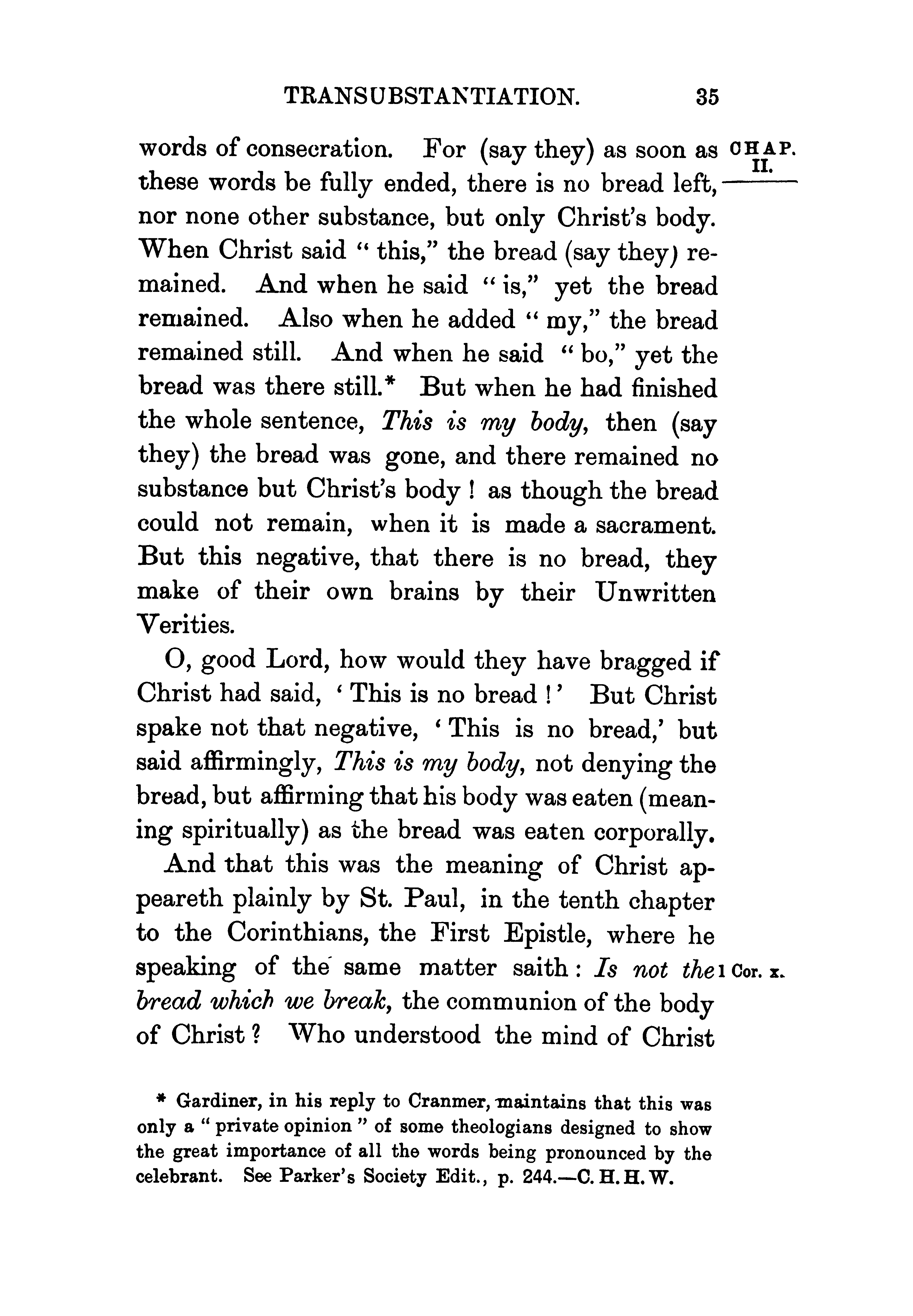
TRANSUBSTANTIATION.
words of consecration.
For (say they) as soon as CHAP.
II. these words be fully ended, there is no bread left, nor none other substance, but only Christ's body.
When Christ said "this," the bread (say they) remained.
And when he said " is," yet the bread remained.
Also when he added "my," the bread remained still.
And when he said "bo," yet the bread was there still.* But when he had finished the whole sentence, This is my body, then (say they) the bread was gone, and there remained no substance but Christ's body ! as though the bread could not remain, when it is made a sacrament.
But this negative, that there is no bread, they make of their own brains by their Unwritten
Verities.
0, good Lord, how would they have bragged if Christ had said, ' This is no bread ! ' But Christ spake not that negative, ' This is no bread,' but said affirmingly, This is my body, not denying the bread, but affirming that his body was eaten (meaning spiritually) as the bread was eaten corporally,
And that this was the meaning of Christ appeareth plainly by St. Paul, in the tenth chapter to the Corinthians, the First Epistle, where he speaking of the same matter saith : Is not the 1 Cor. x. bread which we break, the communion of the body of Christ 1 'Vho understood the mind of Christ
* Gardiner, in his reply to Cranmer, -maintains that this was only a "private opinion" of some theologians designed to show the great importance of all the words being pronounced by the celebrant.
See Parker's Society Edit., p. 244.-0. H. H. W.
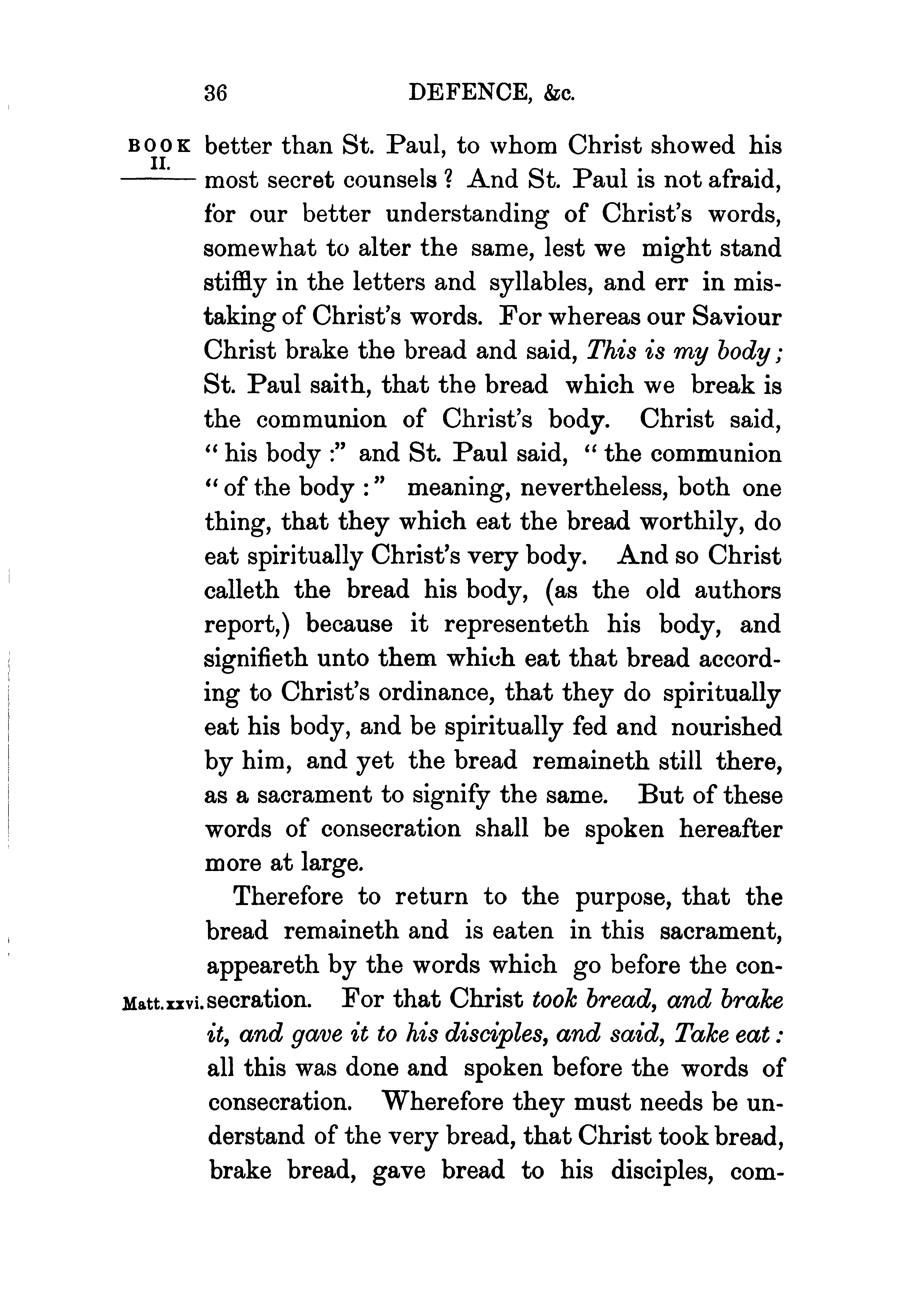
DEFENCE, &c.
Boo K better than St. Paul, to w horn Christ showed his II. most secret counsels 1 And St. Paul is not afraid, for our better understanding of Christ's words, somewhat to alter the same, lest we might stand stiffly in the letters and syllables, and err in mistaking of Christ's words. For whereas our Saviour
Christ brake the bread and said, This is my body; St. Paul saith, that the bread which we break is the communion of Christ's body.
Christ said, " his body :" and St. Paul said, " the communion " of the body : " meaning, nevertheless, both one thing, that they which eat the bread worthily, do eat spiritually Christ's very body.
And so Christ calleth the bread his body, (as the old authors report,) because it representeth his body, and signifieth unto them which eat that bread according to Christ's ordinance, that they do spiritually eat his body, and be spiritually fed and nourished by him, and yet the bread remaineth still there, as a sacrament to signify the same. But of these words of consecration shall be spoken hereafter more at large.
Therefore to return to the purpose, that the bread remaineth and is eaten in this sacrament, appeareth by the words which go before the conMatt.:u:vi. secration. For that Christ took bread, and brake it, and gave it to his disciples, and said, Take eat : all this was done and spoken before the words of consecration. Wherefore they must needs be understand of the very bread, that Christ took bread, brake bread, gave bread to his disciples, com-
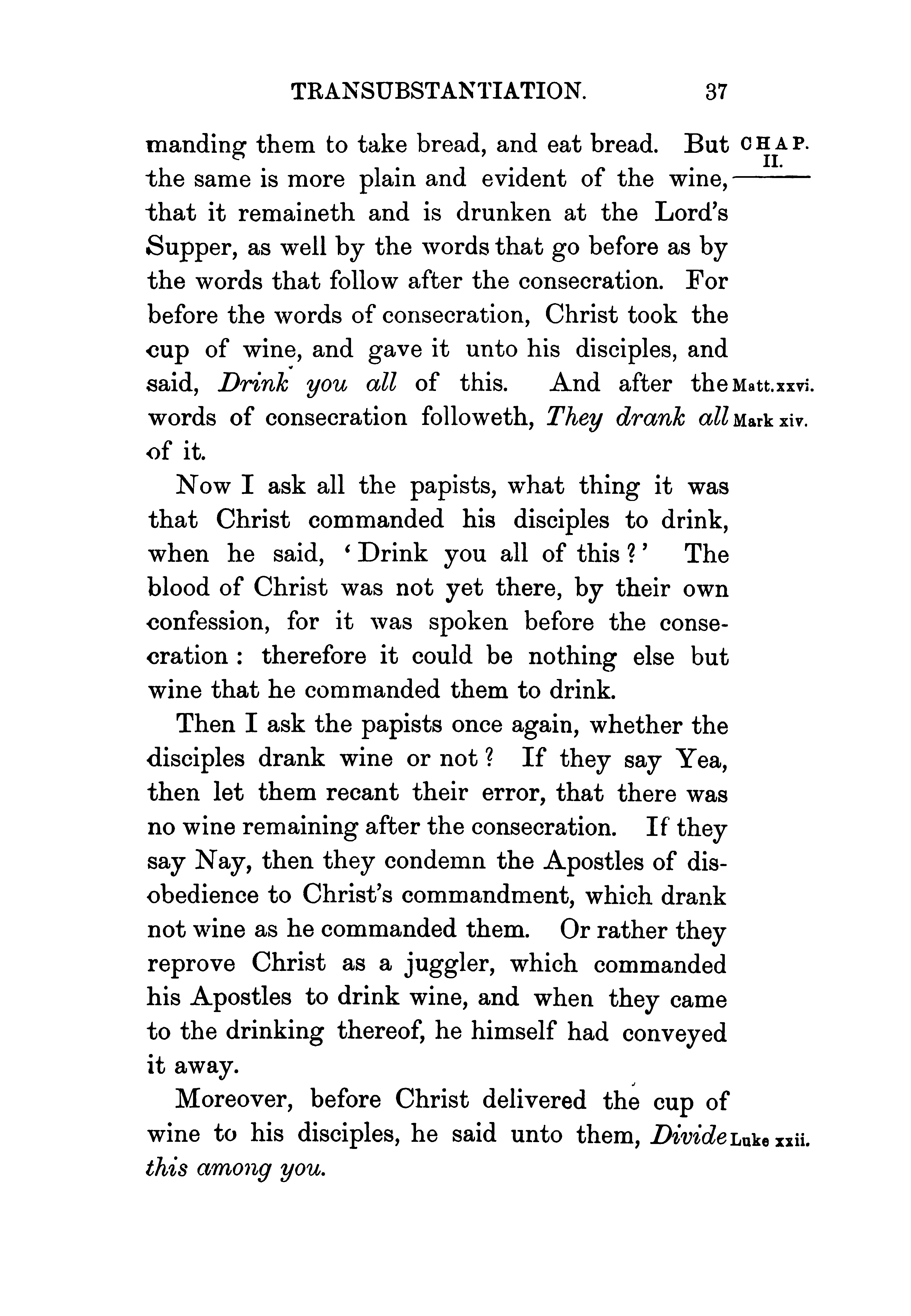
TRANSUBSTANTIATION.
mantling them to take bread, and eat bread. But CHAP.
II. the same is more plain and evident of the wine, --that it remaineth and is drunken at the Lord's
Supper, as well by the words that go before as by the words that follow after the consecration. For before the words of consecration, Christ took the cup of wine, and gave it unto his disciples, and said, Drink· you all of this.
And after the Matt.:n:vi. words of consecration followeth, They drank all Mark xiv. of it.
Now I ask all the papists, what thing it was that Christ commanded his disciples to drink, when he said, ' Drink you all of this ? '
The blood of Christ was not yet there, by their own confession, for it was spoken before the consecration : therefore it could be nothing else but wine that he commanded them to drink.
Then I ask the papists once again, whether the disciples drank wine or not 1 If they say Yea, then let them recant their error, that there was no wine remaining after the consecration.
If they say Nay, then they condemn the Apostles of disobedience to Christ's commandment, which drank not wine as he commanded them.
Or rather they reprove Christ as a juggler, which commanded his Apostles to drink wine, and when they came to the drinking thereof, he himself had conveyed it away.
Moreover, before Christ delivered th~ cup of wine to his disciples, he said unto them, DivideLukexxii. this among you.
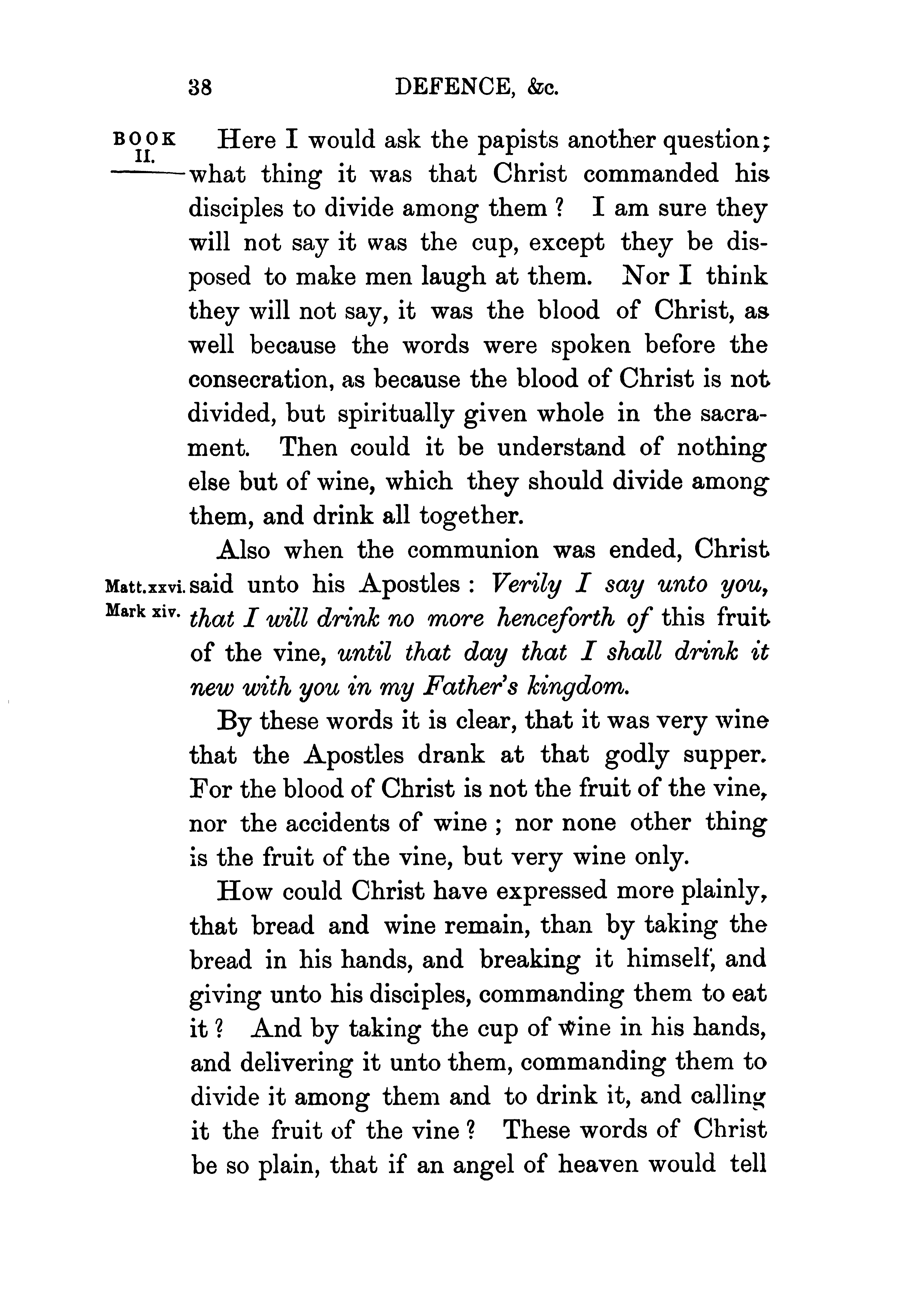
DEFENCE, &c.
BOOK Here I would ask the papists another question; II.
---what thing it was that Christ commanded his disciples to divide among them ? I am sure they will not say it was the cup, except they be disposed to make men laugh at them.
Nor I think they will not say, it was the blood of Christ, as well because the words were spoken before the consecration, as because the blood of Christ is not divided, but spiritually given whole in the sacrament.
Then could it be understand of nothing else but of wine, which they should divide among them, and drink all together.
Also when the communion was ended, Christ Matt.xxvi.said unto his Apostles:
Verily I say unto you, Mark xiv. that I will drink no more henceforth of this fruit of the vine, until that day that I shall drink it new with you in my Father's kingdom.
By these words it is clear, that it was very wine that the Apostles drank at that godly supper.
For the blood of Christ is not the fruit of the vine, nor the accidents of wine ; nor none other thing is the fruit of the vine, but very wine only.
How could Christ have expressed more plainly, that bread and wine remain, than by taking the bread in his hands, and breaking it himself~ and giving unto his disciples, commanding them to eat it 1 And by taking the cup of -Wine in his hands, and delivering it unto them, commanding them to divide it among them and to drink it, and callin~ it the fruit of the vine?
These words of Christ be so plain, that if an angel of heaven would tell
TRANSUBSTANTIATION.
us the contrary, he ought not to be believed: and CHAP. then much less may we believe the subtle lying of II. the papists.
If Christ would have had us to believe as a necessary article of our faith, that there remaineth neither bread nor wine, would he have spoken after this sort, using all such terms and circumstances as should make us believe that still there remaineth bread and wine ? What manner of teacher make they of Christ that say, he meant one thing, when his words be clean contrary ?
What Christian heart can patiently sufter this contumely of Christ?
But what crafty teachers be these papists, who devise phantasies of their own heads directly contrary to Christ's teaching, and then set the same abroad to Christian people, to be most assuredly believed as God's own most holy word ! St. Paul did not so, but followed herein the manner of Christ's speaking, in calling of bread "bread," and wine "wine," and never altering Christ's words herein : The bread which we break, saith 1 Cor x. he, is it not the communion of Christ's body ?
Now I ask again of the papists, whether he spake this of the bread consecrated or not consecrated ? They cannot say that he spake it of the bread unconsecrated, for that is not the communion of Christ's body by their own doctrine.
And if St. Paul spake it of bread consecrated, then they must needs confess, that after consecration such bread remaineth, as is broken bread, which can be
DEFENCE, &c.
Boo K none other than very true material bread.
And IL straightways after, St. Paul saith in the same 1 Cor. x. place, that we be partakers of one bread and one cup. And in the next chapter, speaking more fully of the same matter, four times he nameth the bread and the cup, never making mention of any transubstantiation, or remaining of accidents without any substance ; which things he would have made some mention of, if it had been a necessary article of our faith to believe that there remaineth no bread nor wine. Thus it is evident and plain by the words of the Scripture, that after consecration remaineth bread and wine, and that the papistical doctrine of transubstantiation
1s directly contrary to God's word.
CHAP.
Let us now consider also, how the same is III.
· t
d t
--against na ura reason an na ura operation•; ro;IB~ical which although they prevail not against God's u0:~~1n 8st word, yet when they be joined with God's word, reason. they be of great moment to confirm any truth.
Natural reason abhorreth vacuum, that is to say, that there should be any empty place, wherein no substance should be. But if there remain no bread nor wine, the place where they were before, and where their accidents be, is filled with no substance, but remaineth vacuum, clean contrary to the order of nature.
•see chap. :riv., p. 92 and fol.
TRANSUBSTANTIATION.
We see also that the wine, though it be conOHAP. llL secrated, yet will it turn to vinegar, and the bread--will mould, which then be nothing else but sour wine and moulded bread, which could not wax sour nor mouldy, if there were no bread nor wine there at all.
And if the sacraments were now brent [burned], (as in the old Church they burned all that remained uneaten,) let the papists tell what is brent.
They must needs say, that it is either bread, or the body of Christ.
But bread (say they) is none there.
Then must they needs burn the body of Christ, and be called Christ-burners, ( as heretofore they have burned many of his members,) except thoy will say, that accidents burn alone without any substance, contrary to all the course of nature.
The sacramental bread and wine also will nourish, which nourishment naturally cometh of the substance of the meats and drinks, and not of the accidents.
The wine also will poison, (as divers Bishops of Rome have had experiences, both in poisoning of other, and being poisoned themselves,) which poisoning they cannot ascribe to the most wholesome blood of our Saviour Christ, but only to the poisoned wine.
And most of all, it is against the nature of accidents to be in nothing.
For the definition of accidents is to be in some substance, .so that if they be, they must needs be in some-
DEFENCE, &c.
BOOE thing.
And if they be in nothing, then they II.
---be not.
And a thousand things more of like foolishness do the papists affirm by their transubstantiation, contrary to all nature and reason ; as that two bodies be in one place, and one body in many places at one time, and that substances be gendered of accidents only, and accidents converted into substances, and a body to be in a place and o~cupy no room, and generation to be without corruption, and corruption without generation, with many such like things, against all order and principles of nature and reason.
OHAP.
The papistical doctrine is also against all our Th IV. . outward senses, called our five wits.
For our e P:&Puti~ ~oceyes say, they see there bread and wine, our noses !: 1 18 smell bread and wine, our mouths taste, and our agaiDat all • oar nmea.hands feel bread and wme. And although the articles of our faith be above all our outward senses, so that we believe things which we can neither see, feel, hear, smell, nor taste, yet they be not contrary to our senses ; at the least so contrary, that in such things which we from time to time do see, smell, feel, hear, and taste, we sliall not trust our senses, but believe clean contrary.
Christ never made no such article of our faith.
Our faith teacheth us to believe things that we see not ; but it doth not bid us, that we shall not
TRANSUBSTANTIATION.
believe that we see daily with our eyes, and hear O~P. with our ears, and grope with our hands.
For--although our senses cannot reach so far as our faith doth, yet so far as the compass of our senses doth usua~ly reach, our faith is not contrary to the same, but rather our senses do confirm our faith.
Or else what availed it to St. Thomas for the confirmation of Christ's resurrection, that he did put his hand into Christ's side, and felt his John :sz. wounds, if he might not trust his senses nor give no credit thereto 1 Andb what a wide door is here opened to V alentinianus, Marcion, and other heretics, which said that Christ was not crucified, but that Simon
Cyrenreus was crucified for him, although to the sight of the people it seemed that Christ was crucified I Or to such heretics as said, that Christ was no man, although to men's sights he appeared in the form of man, and seemed to be hungry, dry, weary; to weep, sleep, eat, drink, yea and to die like as other men do. For if we once admit this doctrine, then no credit is to be given to our senses, we open a large field, and give a great occasion unto an innumerable rabblement of most heinous heresies.
And if there be no trust to be given to our senses in this matter of the sacrament, why then do the papists so stoutly affirm, that the accidents remain after the consecration, which cannot be b Lege Aug. In Psal. xxix. Pralfat.
Enarrationia 2., et Hilarium De Trin. lib. iii. et Contra Constantium.
44,
DEFENCE, &c.
BOOK judged but by the senses 1 For the Scripture II. speaketh no word of the accidents of bread and wine, but of the bread and wine themselves.
And it is against the nature and definition of accidents to be alone · without any substance.
Wherefore if we may not trust our senses in this matter of the sacrament, then if the substance of the bread and wine be gone, why may we not then say, that the accidents be gone also 1
And if we must nee~s believe our senses, as concerning the accidents of bread and wine, why may we not do the like of the substance, and .that rather than of the accidents 1 Forasmuch as after the consecration, the Scripture saith in no place, that there is no substance of bread nor of wine, but calleth them still by such names as signify the substances and not the accidents.
And, finally, if our senses be daily deceived in this matter, then is the sensible sacrament nothing else but an elusion of our senses. And so we make much for their purpose that said, that Christ was a crafty juggler, that made things to appear to men's sights that indeed were no such thi~gs, but forms only, figures, and appearances of them.
But to conclude in few words this process of our senses, let all the papists lay their heads together, and they shall ne,er be able to show one article of our faith so directly contrary to our senses, that all our senses by daily experience shall affirm a thing to be, and
TRANSUBSTANTIATION.
yet our faith shall teach us the contrary thereCHAP.
IV. unto.
Now forasmuch as it is declared, how this CH AP. v. papistical opinion of transubstantiation is againstTh . e pap1athe word of God, against nature, against reason, tti~al
~ocnne 18 and against all our senses, we shall show furthercontrary to the more, that it is against the faith and doctrine of faith of the old the old authors of Christ's Church, beginning atanthors
• , of Christ'e those authors, which were nearest unto Chnst sOhurcll. time, and therefore might best know the truth herein°.
First, J ustinus, a great learned man and anJustinns. holy martyr, the oldest author that this day is known to write any treaty upon the sacraments, and wrote not much above one hundred years after Christ's ascension.
• Ignatius, Ad PhiladelPhenses:
"Una est caro Domini Jesu, "et unus ejus sanguis qui pro no bis fusus est: unus etiam "panis pro omnibus confractus, et unus calix totius Ecclesire.'·
E:r.tBD. [Cranmer quotes from the Epistle as it stood in his time, before the interpolations had been pointed out.
Jenkyns gives the authorities in his Appendix.] Clemens in Pa:dagogo, lib. ii. cap. 2.
"Ipse quoque vino "usus est, nam ipse quoque homo ; et vinum benedixit, cum "dixit ; AcciPite bibite, hoc est sanguis meus, sanguis vitis ;
"Verbum, quod pro multis effunditur in r;missionem pecca- " torum, 'Sanctum lretitire .fl.uentum allegorice significat."
Et mox:
"Quod autem vinum esset, quod benedictum est, "ostendit rursum dicens discipulis : Non bibam ex fructu vitiJ
" hujus donec bibero iPsum vobiscum in regno Patris mei."
"Pontifex opertum panem et mdivisum aperit, in frusta con- " cidens, &c."
Dionysius, Eccles. Hier. cap. iii.
EMBD,
DEFENCE, &c.
B~fK He writeth in his second A:pology4, "That the --- "bread, water, and wine in this sacrament are not " to be taken as other common meats and drinks
" be, but they be meats ordained purposely to "give thanks to God, and therefore he called
" Eucharistia [ thanksgi,vi,ng ], and be called also " the body and blood of Christ.
And that it is "lawful for none to eat or drink of them, but " that profess Christ and live according to the " same. And yet the same meat and drink,"
" saith he, " is changed into our flesh and blood, '' and nourisheth our bodies."
By which saying it is evident, that J ustinus thought that the bread and wine remaine~ still; for else it could not have been turned into our flesh and blood, to nourish our bodies.
Next him was Iremeuse, above one hundred and fifty years after Christ, who, as it is supposed, could not be deceived in the necessary points of our faith, for he was a disciple of Polycarpus, which was disciple to St. John the Evangelist.
This Irenreus followeth the sense of Justinus wholly in this matter, and almost also his words, saying, "that the bread wherein we
"give thanks unto God, although it be of the " earth, yet when the name of God is called upon " it, it is not then common bread, but the bread
" of thanksgiving having two things in it, one 4 [Ed. Bened. Apol. i. p. 83. See book iii. ch. 8.]
• Irenaius Contra Valentin. lib. iv. cap. 34. [ed. Bened. Con. tra H(,(Jreses, hb. iv. cap. 18.]
TRANSUBSTANTIATION.
4'1
"earthly, and the other heavenly."
What meant OHAP.
V. he by the heaven)y thing, but the sanctification which cometh by the invocation of the name of God?
And what by the earthly thing, but the very bread, which, as he said before, is of the earth, and which also, he saith, doth nourish our bodies, as other bread doth which we do use1 ?
Shortly after Irenreus was Origen, about two hundred years after Christ's ascension; who also
.affirmeth, that the material bread remaineth, saying, "that the matter of the bread availeth no- ,, thing, but goeth down into the belly, and is
" avoided downward ; but the word of God, "spoken upon the bread, is it that availethg."
After Origen came Cyprian the holy martyr, .about the year of our Lord 250, who writeth against them that ministered this sacrament with water only, and without wine.
" Forasmuch," saith he, " as Christ said, I am a true vine, there- " fore the blood of Christ is not water, but wine ;
"nor it cannot be thought that his blood, whereby r Et idem Irenreus, lib. v : " Quando mixtus calix et fractua
"panis percipit verbum Dei, fit Eucharistra corporis et san- " guinis Christi, ex quibus augetur et consistit carnis nostrre
"substantia."
Et in eodem:
"Cum membra ejus sumus, et "per creaturam nutrimur, eum calicem qui est creatura suum "corpus confirmavit, ex quo nostra auget corpora."
Idem, lib. iv. cap. 34:
"Quomodo constabit eum panem, in quo " gratire acttB sunt, corpus esse Domini sui, et calicem san- " guinem ejus, si non ipsum Fabricatoris mundi filium esse "dicant 1" g Origenes, In Matt. cap. 15.
Idem, Contra Celsum, lib. iv: "Ubi pro collatis in nos bene- " ficiis gratias diximus, oblatis panibus vescimur."
DEFENCE, &c.
BOOK "we be redeemed and have life, is in the cup,.
II.
" when wine is not in the cup, whereby the blood "of Christ is showedt."
What words could Cyprian have spoken more plainly, to show that the wine doth remain, than to say thus: "If there be no -wine there is no "blood of Christ 1"
And yet he speaketh shortly after, as plainly, in the same Epistle: "Christ," saith he, "taking
"the cup, blessed it, and gave it to his disciples, Matt.xxvi." saying, Drink you all of this, for this is the " blood of the new testament, which shall be shed
"for many, for the remission of sins. I say unto " you, that from henceforth I will not drink of this
" creature of the vine, until I shall drink with " you new wine in the kingdom of my Father. By "these words of Christ," saith St. Cyprian, "we
"perceive, that the cup which the Lord offered, " was not only water, but also wine ; and that it
"was wine, that Christ called his blood; whereby "it is clear, that Christ's blood is not offered, if " there be no wine in the chalice." And after it followeth : " How shall we drink with Christ new
"wine of the creature of the vine, if in the sacri- " fice of God the Father and of Christ we do not " offer wine ? "
In these words of St. Cyprian appeareth most manifestly, that in this sacrament is not only offered very wine that is made of grapes that come of the vine, but also that we drink the h Cyprian. Ad Cmcilium, lib. ii. epistola 3.
TRANSUBSTANTIATION.
same.
And yet the same giveth us to underCHAP.
V. stand, that if we drink that wine worthily, we --drink also spiritually the very blood of Christ which was shed for our sinsi. kEusebius Emissenus, a man of singular fame inEEus.ebius m1ssem1s. learning, about three hundred years after Qhrist's ascension, did in few words set out this matter so plainly, both how the bread and wine be converted into the body and blood of Christ and yet remain still in their nature; and also how besides the outward receiving of bread and wine Christ is inwardly by faith received in our hearts, all this, I say, he doth so plainly set out, that more plainness cannot be reasonably desired in this matter.
For he saith, that the conversion of the visible creatures of bread and wine into the body and blood of Christ, is like unto our conversion in baptism, where outwardly nothing is changed but remaineth the same that was befo,re, but all the alteration is inwardly and spiritually.
"If thou wilt know," saith he1, " how it ought 1 Idem, in Sermone de LaPsis:
"Sanctificatus in Domini "sanguinem potus de pollutis visceribus erupit." Et, De Cama
Domini:
"Sceleratum os panis sanctificatus intravit."
Et in eodem: "Ante verba consecrationis panis ille communis,''
&c. vid. infra cap. xi.
[The treatise, De C<Ena Domini, is now considered spurious, and is attributed by the Benedictine editor to Arnoldus, Abbas Bonoo-Vallis.
See Bened. edit. and Cave, Hist. Liter.] k [The writings attributed to Eusebius Emissenus are generally held to be spurious.
Cave, Hist. Literaria.
The passage here cited is assigned to him on the authority of the Canon Law, from whence it is extracted.] 1 De Consecr. Dist. 2. "Quia."
DEFENCE, &c.
soox "not to seem to thee a new thing and impossible, II.
.bl h. b d .
" that earthly and corrupti e t ings e turne into " the substance of Christ, look upon thyself, which "art made new in baptism, when thou wast far
" from life, and banished as a stranger from mercy "and from the way of salvation, and inwardly
" wast dead, yet suddenly thou beganst another "life in Christ, and wast made new by wholesome
" mysteries, and wast turned into the body of the " Church, not by seeing, but by believing ; and of " the child of damnation, by a secret pureness, thou
"wast made the chosen son of God. Thou visibly " didst Temain in the same measure that thou
" hadst before, but invisibly thou wast made gTeater, "without any increase of thy body. Thou wast
" the selfsame person, and yet by the increase of " faith thou wast made another man. Outwatrdly
" nothing was added, but all the change was in- " watrdly. And so was man made the son of "Christ, and Christ formed in the mind of man.
IC Therefore as thou putting away thy former vile• IC ness didst receive a new dignity, not feeling any
" change in thy body ; and as the curing of thy "disease, the putting away of thine infection, the " wiping away of thy filthiness, be not seen with " thine eyes, but ar~ believed in thy mind : so " likewise, when thou dost go up to the reverend
'' altar to feed upon spiritual meat, in thy faith " look upon the body and blood of him that is thy
"God, honour him, touch him with thy mind, "take him in the hand of thy heart, and chiefly
TRANSUBSTANTIATION.
"drink him with the draught of thy inward CHAP, v.
"man."
Hitherto have I rehearsed the sayings of Eusebius, which be so plain, that no man can wish more plainly to be declared, that this mutation of the bread and wine into the body and blood of Christ, is a spiritual mutation, and that outwardly nothing is changed.
But as outwardly we eat the bread and drink the wine with our mouths, so inwardly by faith we spiritually eat the very flesh and drink the very blood of Christ.
Hilarius also in few words saith the same. Hilarius "There is a figure," saith he, "for bread and wine
"be outwardly seen. And there is also a truth of "that figure; for the body and blood of Christ
"be of a truth inwardly believedm." And this Hilarius was within less than three hundred and fifty years after Christ.
And Epiphanius, shortly after the same time, saithn, that the bread is meat, but the virtue that is in it, is it that giveth life.
But if there were no bread at all, how could it be meat ?
About the same time, or shortly after, about the year of our Lord 400, St. John Chrysostome writeth thus against them that used only water in the sacrament 0 :
" Christ," saith he, " minding to "pluck up that heresy by the roots, used wine, as "well before his resurrection when he gave the m Hilarius, Dist. 2. "Corpus."
EMBD. n Epiphanius, Contra Hareses, lib. iii. tom. 2. Et in Anace,Phaleosi.
° Chrysost. In Mat. cap. xxvi. horn. 83.
DEFENCE, &c.
B~f K "mysteries, as after at his table without mysteries.
---"
For he saith, 'of the fruit of the vine;' which "surely bringeth forth no water, but wine."
These words of Chrysostome declare plainly, that Christ in his holy tab]e both drank wine and gave wine to drink, which had not been true, if no wine had remained after the consecration, as the papists feign.
And yet more plainly St. ChrysostomeP declareth this matter in another place, saying : "The "bread, before it be sanctified, is called bread;
"but when it is sanctified by the means of the " priest, it is delivered from the name of bread,
"and is exalted to the name of the Lord's body, "although the nature of bread doth still remain."
P Ad CO!sarium Monachum.
[A few passages only of thi11 Epistle are preserved in Greek, by Jo. Damascene, Anastasiua, and N1cephorus. A Latin version is the sole authority for the remainder.
Its genuineness was disputed by Gardyner, and has been the subject of much controversy since.
Its history is curious.
Attention was :first directed to it by Peter Martyr, who brought a copy to England, which he presented to Cranmer.
When the Archbishop's library WalS dispersed at his death, this copy disappeared, and as Peter Martyr had not stated from whence it was procured, Cardinal Perron ventured to charge him with having forged it.
But in 1680, the accusation was proved to be false by the discovery of the original manuscript in the library of the D-ominican monastery of St.
Mark at Florence.
It was immediately printed, together with the extracts extant in Greek and a preface, by the discoverer,
Emeric Bigot ; but some doctors of the Sorbonne interfered, and prevented its publication.
The Latin version, however, was given to the world in 1685, by Stephen Le Moyna, in his
Varia Sacra; and in the following year, Wake, into whose hands the very leaves cut out at Paris had fallen, reprinted the whole in one of his tracts agaill'st Bossuet. The evidence in its
TRANSUBSTANTIATION.
"The nature of bread," saith he, "doth still reCHAP.
'' main," to the utter and manifest confutation of v. the papists, which say, that the accidents of bread
<lo remain, but not the nature and substance.
At the same time was St. Ambrose, who de-Ambrosius dareth the alteration of bread and wine into the body and blood of Christ not to be such, that the nature and substance of bread and wine be gone, but that through grace there is a spiritual mutation by the mighty power of God, so that he that worthily eateth of that bread doth spiritually eat
Christ, and dwelleth in Christ and Christ in him.
"For," saith St. Ambrose 4, speaking of this change of bread, into the body of Christ, " if the favour derived from the citations in Damascene, &c. is very conclusive, and has induced even the Roman Catholic writers, Bigot,
Hardouin, and Dupin, to place it among the genuine works of Chrysostom.
But the Benedictine editor, Montfaucon, condemns it as spurious, though he takes pains to explain away the ,expressions which it contains against transubstantiation.
Walchius, on the other side, says, " Contra pontificiolS satis pro- " batum est, Epistolai hujus auctorem omnino esse Chrysosto- " mum."
See Gardyner, Explication, book v. cap. 5. Confutatio Cavillationum, &c. Object. 201. Cranmer, Disputation with HarPsfield at Oxford.
Wake, Defence of the Exposition ()f the Doctrine of the Church of England.
Burnet, Reformat. vol. iii. p. 362. Chrysostom. Opera, ed. Bened. tom. iii. p. 736.
Dupin, Eccles. Writers, Cent. v. Walchius, Biblioth. Patrist. p. 224. where is a list of other authors who have written on the subject.-Jenkyns.J q De i1s qui Mystems initiantur, cap. ult.
Et, De Sacramentis, lib. iv. cap. 4.
[Jenkyns adds the following note:-The genuineness of both of these works was questioned in 1535, by Bullinger, who maintained in a. letter to Va.dianue, "stupido8 hos nequaquam 8888
" auctoris optimi et judicii emunctiesimi freturam," and asserted that Erasmus also wa.e of the same opinion
Both too, as Cranmer
DEFENCE, &c.
BOOK "word of God be of that force that it can make II.
" things of nought, and those things to be which " never were before, much more it can make
" things that were before, still to be, and also to be "changed into other things."
And he bringeth for example hereof, the change of us in baptism, wherein a man is so changed, (as is before dec1ared in the words of states in his Answer, were suspected by Melancthon; and one of them, the treatise on the sacraments, was repeatedly denied to be of any authority by Peter Martyr and Ridley.
The spuriousness indeed of the six books De Sacramentis, seems to admit of little doubt.
The Benedictine editors, though they print them among the genuine works of Ambroae, do not venture, after giving the arguments on both sides, to decide in their favour : and the following statement by Cave can scarcely be shaken.
"De Sacramentis libri vi. non tantum " a theologis reformatie sed et pontifici110 religionis quam pluri- " mis Ambrosio abJudicantur ; scripsisse quidem Ambrosium
" libros De Sacramentis certissimum est, qui vero hodie ex- " tant, aut ejus non sunt, aut adeo insigniter interpolati ut no- " vam plane faciem induerint.
Des1derantur in his qu110 ex " illis citant Augustinus et Bertramus ; aliam exhibent S. Scrip- " tur110 versionem, quam qua in genuinis operibus usus est
" Ambrosius ; repugnat styli diversitas patre mellifl.uo indigna ; " repugnant baud pauca a s110culo Ambrosiano aliena.
Vidit 11 h110c omnia ac ingenue agnovit eminentiss.
Card. Bona de "Reb. Liturg. lib. i. cap. 7. § 4. ubi hoc opusculum non nisi "ab octavi et noni s110culi scriptoribus tanquam legitimum Am- " brosii fretum laudari fatetur."
The case is not so strong against the other work, De Mysteriis, and the Benedictine editors stiffly maintain its genuineness: yet even of this Walchius writes: '' Ingenii moni- " mentum esse adulterinum satis constat."
See Answer, b. iii. ch. 15.
Peter Martyr, Tractat. de Eucharist. Tiguri, 1557. p. 163. Disputations at Cambridge, in Foxe, edit. 1641. vol. ii. p. 764. Ambros. Opera, ed. Baned. tom. ii. p. 321.
Cave, Historia Lit,raria. Walchius, Bi/Jlioth. Patrist. p. 479.]
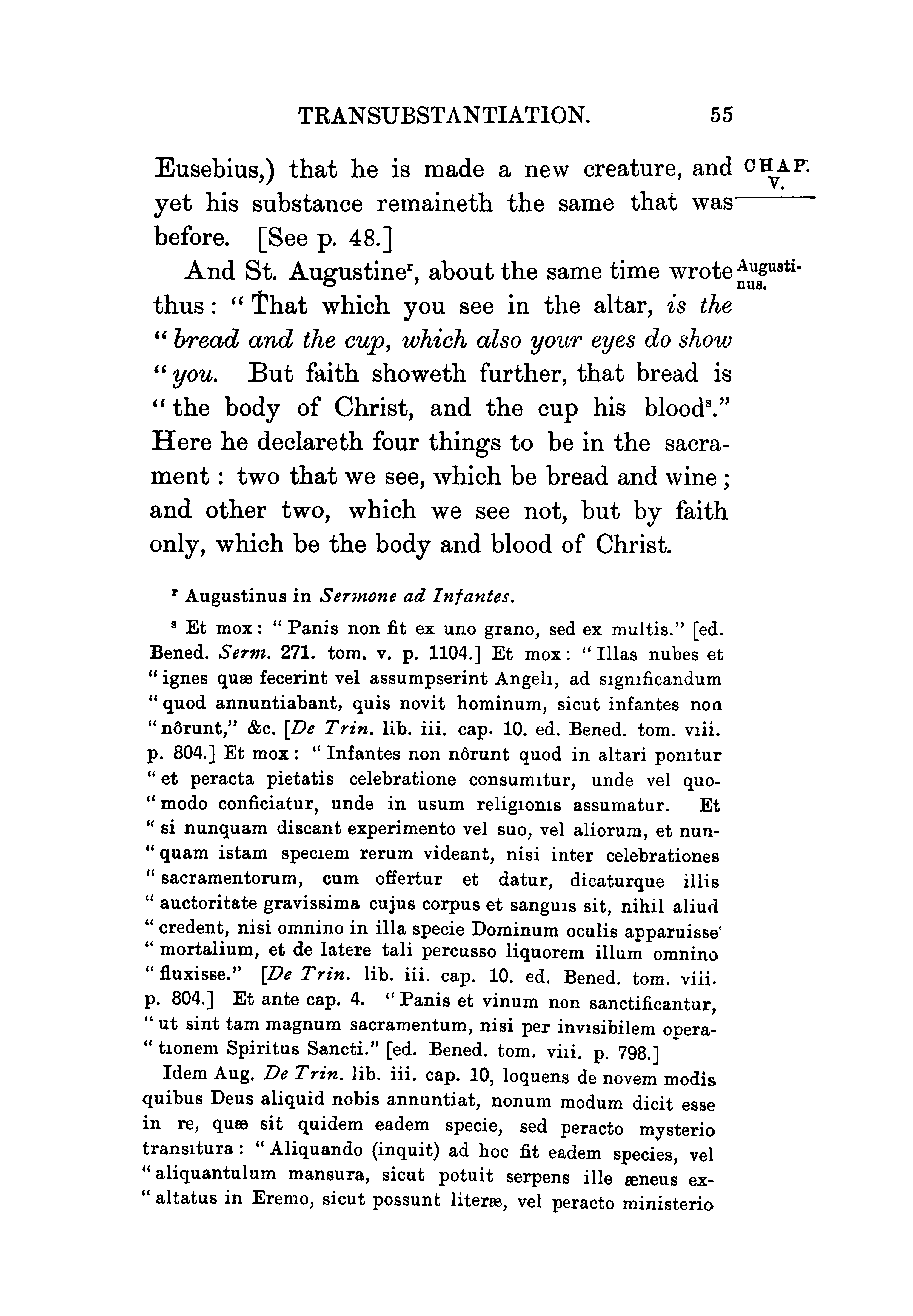
TRANSUBSTANTIATION.
Eusebius,) that he is made a new creature, and CH/P: yet his substance remaineth the same that was before.
[Seep. 48.J And St. Augustine\ about the same time wrote!;;.u sti• thus : " That which you see in the altar, is the " bread and the cup, which also your eyes do show
"you.
But faith showeth further, that bread is "the body of Christ, and the cup his blood"."
Here he declareth four things to be in the sacrament : two that we see, which be bread and wine ; and other two, which we see not, but by faith only, which be the body and blood of Christ. r Augustinus in Sermone ad lnfantes.
• Et mox: "Panis non fit ex uno grano, sed ex multis." [ed.
Bened. Serm. 271. tom. v. p. 1104.] Et mox: '' Illas nu bes et "ignes qure fecerint vel assumpserint Angeh, ad s1gmficandum "quod annuntiabant, quis novit hominum, sicut infantes non "norunt,"
&c. [De Trin. lib. iii. cap. 10. ed. Bened. tom. viii. p. 804.] Et mox: "Infantes non norunt quod in altari pomtur "et peracta pietatis celebratione consum1tur, unde vel quo- " modo conficiatur, unde in usum relig1oms assumatur.
Et "si nunquam discant experimento vet suo, vel aliorum, et nun- " quam istam spec1em rerum videant, nisi inter celebrationes
" sacramentorum, cum offertur et datur, dicaturque illis " auctoritate gravissima cujus corpus et sangms sit, nihil aliud
" credent, nisi omnino in ilia specie Dominum oculis apparuisse· " mortalium, et de latere tali percusso liquorem illum omnino
" fiuxisse.''
[De Trin. lib. iii. cap. 10. ed. Bened. tom. viii. p. 804.] Et ante cap. 4. "Panis et vinum non sanctificantur,
"ut sint tam magnum sacramentum, nisi per inv1sibilem opera- " t10nem Spiritus Sancti." [ed. Bened. tom. viii. p. 798.] •
Idem Aug. De Trin. lib. iii. cap. 10, loquens de novem modis quibus Deus aliquid nobis annuntiat, nonum modum <licit esse in re, qure sit quidem eadem specie, sed peracto mysterio trans1tura:
"Aliquando (inquit) ad hoc fit eadem species, vel "aliquantulum mansura, sicut potuit serpens ille amens ex- " altatus in Eremo, sicut possunt literre, vel peracto ministerio
DEFENCE, &c.
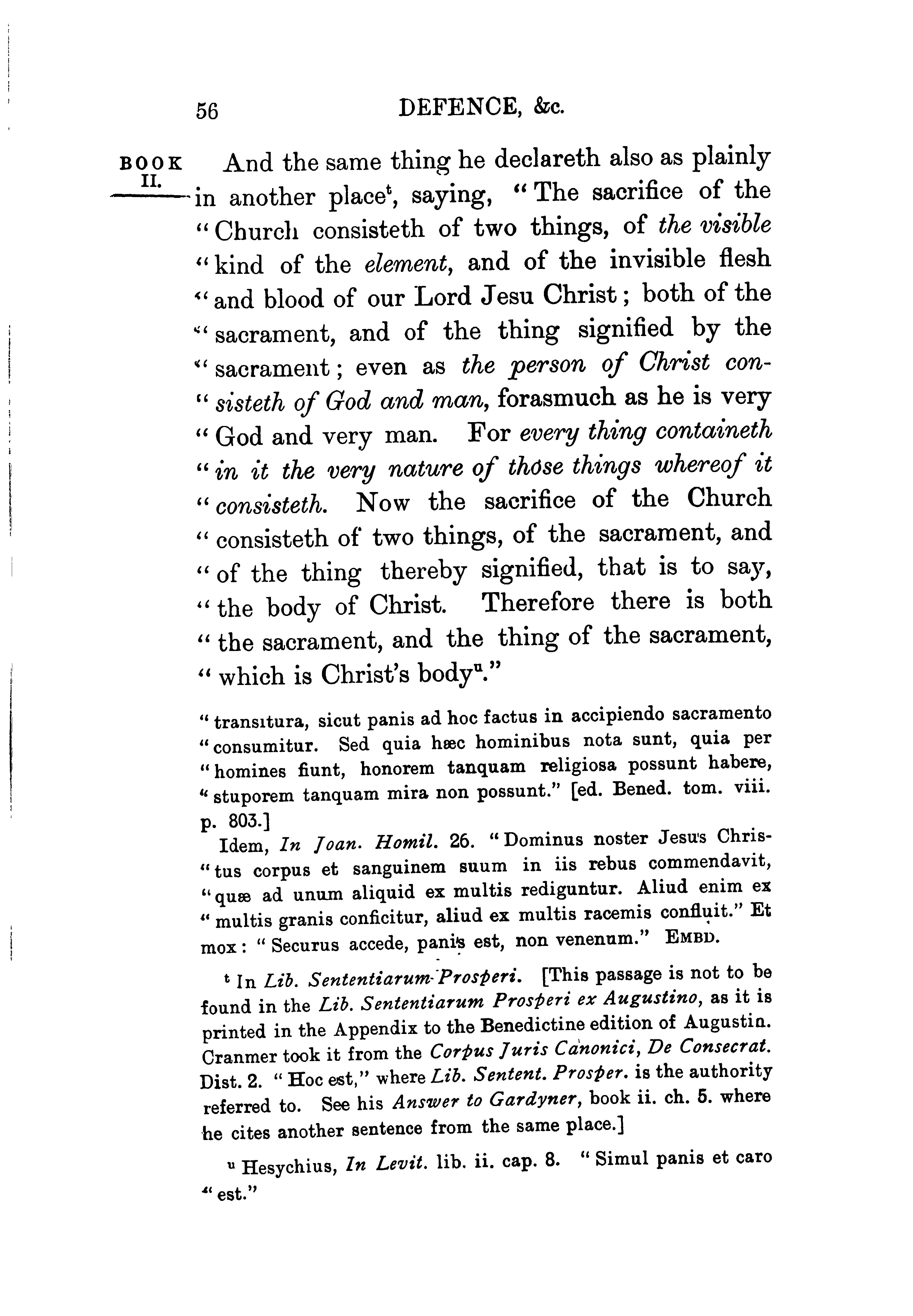
BOOK And the same thing he declareth also as plainly II.
---in another place\ saying, "The sacrifice of the "Church consisteth of two things, of the visible
" kind of the element, and of the invisible flesh " and blood of our Lord J esu Christ ; both of the ~• sacrament, and of the thing signified by the " sacrament ; even as the person of Ohnst con- " sisteth of God and man, forasmuch as he is very
" God and very man. For every thing containeth " in it the very nature of those things whereof it
" consisteth. Now the sacrifice of the Church "consisteth of two things, of the sacrament, and " of the thing thereby signified, that is to say,
'' the body of Christ.
Therefore there is both " the sacrament, and the thing of the sacrament, "which is Christ's bodyu."
" trans1tura, sicut panis ad hoc factus in accipiendo sacramento "consumitur.
Sed quia heec hominibus nota sunt, quia per "homines fiunt, honorem tanquam religiosa possunt habere,
"stuporem tanquam mira non possunt." [ed. Bened. tom. viii. p. 803.] Idem, In Joan. Homil. 26. "Dominus noster JesU's Chris- " tus corpus et sanguinem suum in iis rebus commendavit,
"quee ad unum aliquid ex multis rediguntur.
Aliud enim ex "multis granis conficitur, aliud ex multis racemis confl~it." Et mox : " Securus accede, pani'!J est, non venenum."
EMBD. t In Lib. Sententiarum--Prosperi.
[This passage is not to be found in the Lib. Sententiarum ProsPeri ex Augustina, as it is printed in the Appendix to the Benedictine edition of Augustin.
Cranmer took it from the CorPus Juris Ca'nonici, De Consecrat.
Dist. 2. "Hoc est," where Lib. Sentent. Prosper. is the authority referred to. See his Answe1' to Gardyner, book ii. ch. 5. where he cites another sentence from the same place.] u Hesychius, In Levit. lib. ii. cap. 8. " Simul panis et caro
.. est.''
TRANSUBSTANTIATION.
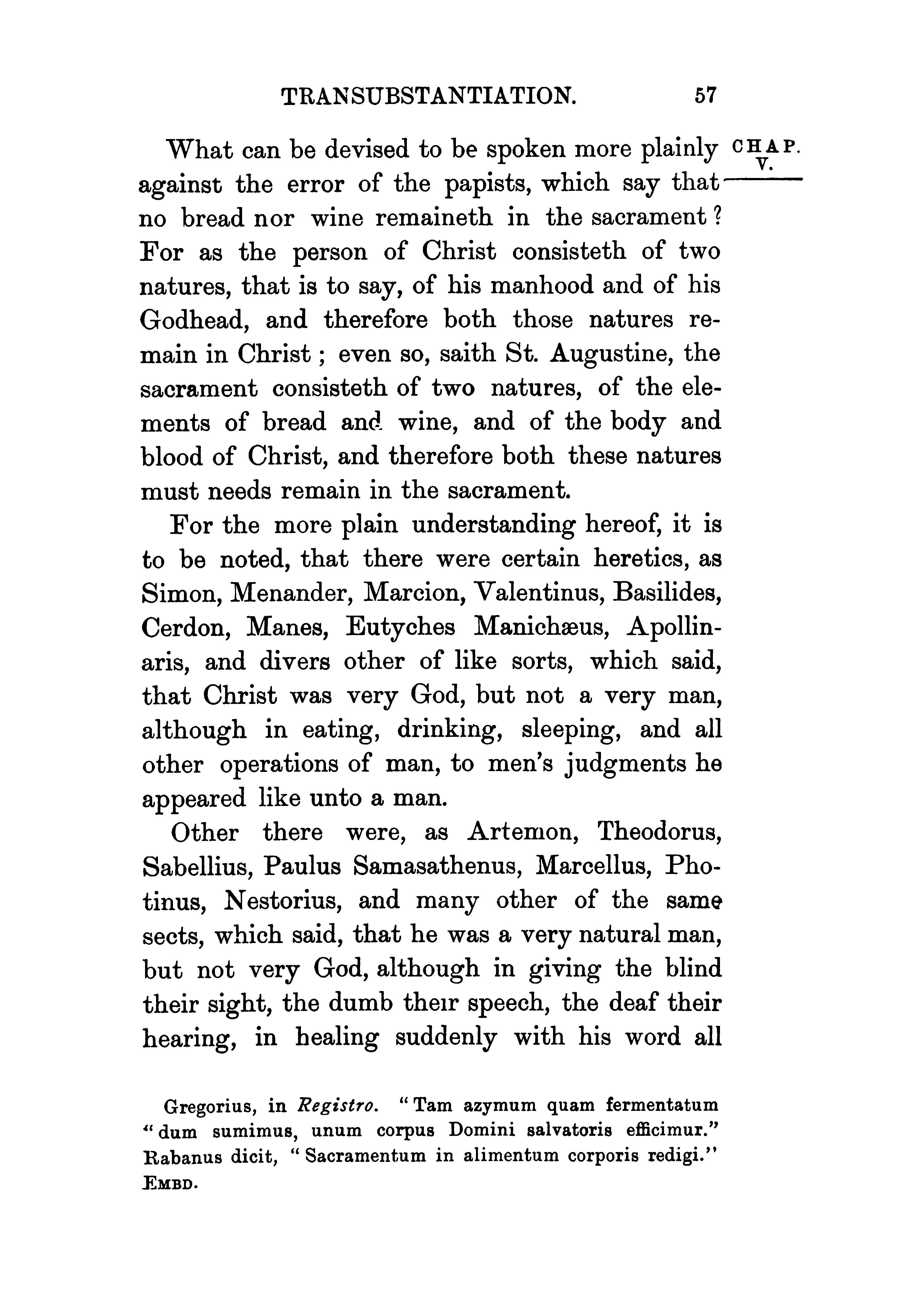
What can be devised to be spoken more plainly against the error of the papists, which say that no bread nor wine remaineth in the sacrament?
CHAP. v.
For as the person of Christ consisteth of two natures, that is to say, of his manhood and of his
Godhead, and therefore both those natures remain in Christ ; even so, saith St. Augustine, the sacrament consisteth of two natures, of the elements of bread and wine, and of the body and blood of Christ, and therefore both these natures must needs remain in the sacrament.
For the more plain understanding hereof, it is to be noted, that there were certain heretics, as Simon, Menander, Marcion, Valentinus, Basilides,
Cerdon, Manes, Eutyches Manichreus, Apollinaris, and divers other of like sorts, which said, that Christ was very God, but not a very man, although in eating, drinking, sleeping, and all other operations of man, to men's judgments he appeared like unto a man.
Other there were, as Artemon, Theodorus, Sabellius, Paulus Samasathenus, Marcellus, Photinus, Nestorius, and many other of the sam~ sects, which said, that he was a very natural man, but not very God, although in giving the blind their sight, the dumb their speech, the deaf their hearing, in healing suddenly with his word all
Gregorius, in Registro.
"Tam azymum quam fermentatum "dum sumimus, unum corpus Domini salvatoris efficimur."
Rabanus dicit, "Sacramentum in alimentum corporis redigi."
.EMBD,
DEFENCE, &c.
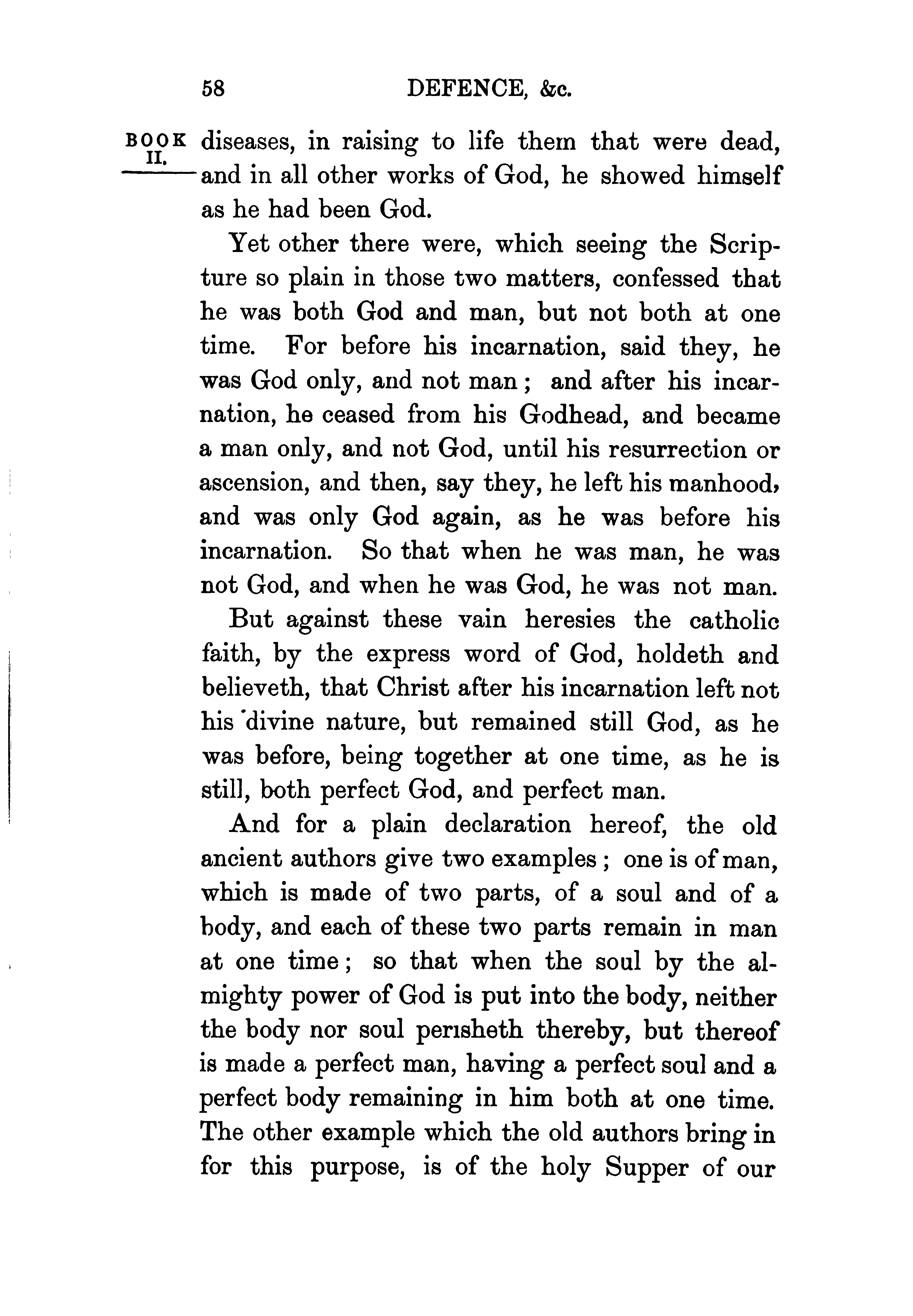
BOOK diseases, in raising to life them that were dead, II.
G ---and in all other works of od, he showed himse]f as he had been God.
Yet other there were, which seeing the Scripture so plain in those two matters, confessed that he was both God and man, but not both at one time. For before his incarnation, said they, he was God only, and not man ; and after his incarnation, he ceased from his Godhead, and became a man only, and not God, until his resurrection or ascension, and then, say they, he left his manhood, and was only God again, as he was before his incarnation.
So that when he was man, he was not God, and when he was God, he was not man.
But against these vain heresies the catholic faith, by the express word of God, ho]deth and believeth, that Christ aaer his incarnation left not his 'divine nature, but remained still God, as he was before, being together at one time, as he is stilJ, both perfect God, and perfect man.
And for a pJain declaration hereof, the old ancient authors give two examples; one is of man, which is made of two parts, of a soul and of a body, and each of these two parts remain in man at one time ; so that when the soul by the almighty power of God is put into the body, neither the body nor soul per1sheth thereby, but thereof is made a perfect man, having a perfect sou] and a perfect body remaining in him both at one time.
The other example which the old authors bring in for this purpose, is of the holy Supper of our
TRANSUBSTANTIATION.
Lord, which consisteth, say they, of two parts; OH/P· of the sacrament or visible element of bread and--wine, and of the body and blood of Christ.
And as in them that duly receive the sacrament the very natures of bread and wine cease not to be there, but remain there still, and be eaten corporally, as the body and blood of Christ be eaten spiritually ; so likewise doth the divine nature of Christ remain still with his humamty.
Let now the papists avaunt themselves of their transubstantiation, that there remaineth no bread nor wine in the ministration of the sacrament, if they will defend the wicked heresies before rehearsed, that Christ is not God and man both together.
But to prove that this was the mind of the old authors, beside the saying of St.
Augustine here recited, I shall also rehearse divers other.
St. John Chrysostome writeth against the pestilent error of Apollinaris, which affirmed that the Godhead and manhood in Christ were so mixed and confounded together, that they both made but one nature.
Against whom St. John Chrysostome writeth thus'"' : " When thou speakest of " God, thou must consider a thing that in nature is
"single, without composition, without conversion; " that is invisible, immortal, incircumscriptible,
" incomprehensible, with such like.
And when " thou speakest of man, thou meanest a nature "that is weak, subject to hunger, thirst, weeping,
"'Ad Casarium Monachum,
DEFENCE, &c.
BOOB: "fear, sweating, and such like passions, which II.
---" cannot be in the divine nature.
And when thou "speakest of Christ, thou joinest two natures " together in one person, who is both passible and " impassible ; passible, as concerning his flesh, and "impassible in his Deity."
And after he concludeth, saying, "Wherefore " Christ is both God and man : God by his im- " passible nature, and man because he suffered.
" He himself being one person, one son, one Lord, " hath the dominion and power of two natures
"joined together, which be not of one substance, " but each of them hath his properties distinct
" from the other.
And therefore remaineth there " two natures, distinct, and not confounded. For " as before the consecration of the bread, we call
" it bread, but when God's grace hath sanctified it " by the pri,est, it is delivered from the name of " 'bread, and is exalted to the name of the body of " the Lord, although the nature of the 'bread remain
" still in it, and it is not called two bodies, but one " body of God's son ; so likewise here the divine
"nature resteth in the body of Christ, and these " two make one son and one person."
These words of St. Chrysostome declare, and that not in obscure terms but in plain word~, that after the consecration the nature of bread remaineth still, although it have an higher name, and be called the body of Christ, to signify unto the godly eaters of that bread, that they spiritually eat the supernatural bread of the body of Christ,
TRANSUBSTANTIATION.
who spiritually is there present, and dwelleth in CHAP. them and they in him, although corporally he v. sitteth in heaven at the right hand of his Father.
Hereunto accordeth also GelasiusY, writingPope Gelasius. against Eutyches and Nestorius, of whom the one said, that Christ was a perfect man, but not God; and the other affirmed clean contrary, that he was very God, but not man.
But against these two heinous heresies Ge]asius proveth by most manifest scriptures, that Christ is both God and man ; and that after his incarnation remained in him as well the nature of his Godhead, as the nature of his manhood ; so that he hath in him two natures with their natural properties, and yet is he but one Christz.
Y Gelasius, Contra Eutychen et N estorium.
• Dicens, " Sacramenta qure sumimus corporis et sangum1s "Christi, divina res est, propter quod et per eadem divinre
"efficimur consortes naturre, et tamen esse non desmit sub- " stantia vel natura panis et vini.
Et certe imago et simihtudo •• corporis et sanguinis Christi in actione mysteriorum cele- " brantur.
Satis ergo nobis evidenter ostenditur, hoc nobis "in ipso Christo Domino sentiendum, quod in ejus imagine "profitemur, celebramus, et sumimus : ut sicut in hanc sc11icet
"divinam transeant (Spiritu Sancto perficiente) substantiam, " permanent tamen in sure proprietate naturre: sic illud ipsum "mysterium principale, (cujus nobis efficientiam virtutemque "veraciter reprresentant,) his ex quibus constat proprie per- " manentibus, unum Christum (quia integrum verumque) per- " manere demonstrant."
EMBD.
[The writers of the Church of Rome have laboured hard to prove that the author of this work was not Gelasius the Pope, but either Gelasius of Cyz1cus or Gelasius of Cresarea.
But, as Cave says, "frustra omnes:
"magna enim est veritas et prrevaluit.
Tandem v1 veritatis "adactus, manus ded1t ipse Labbreus.
D1ssert. de Script. Eccl.
"tom. 1. p. 342."
Cave, Hist. Lzter.-Jwky11,]
DEFENCE, &c.
BOOK And for the more evident declaration hereof, 11.
---he bringeth two examples ; the one is of man, who being but one, yet he is made of two parts, and hath in him two natures, remaining both together in him, that is to say, the body and the soul with their natural properties.
The other example is of the sacrament of the body and blood of Christ ; which, saith he, " is a "godly thing, and yet the substance or nature of " bread and, wine do not cease to be there still."
Note well these words against all the papists of our time, that Gelasius, which was Bishop of Rome• more than a thousand years past, writeth of this sacrament, that the bread and wine cease not to be there still ; as Christ ceased not to be
God after his incarnation, but remained still perfect God as he was beforeb.
Theodoretus 0 also affi.rmeth the same, both in his first and in his second Dialogue.
In· the first he saith thus : " He that called his natural body " wheat and bread, and also called himself a vine,
" the selfsame called bread and wine his body and " blood, and yet changed not their natures."
And in his second Dialogue he saith more plainly : " For," saith he, " as the bread and wine
" after the consecration lose not their proper nature, " but keep their former substance, form, and, figure,
• [A.D. 492,]
b Et Leo, ut habetur, De Consecrat. dist. 2. "Incamationis '' quoque e:s:emplo astruamus mysterii veritatem.''
Idem habet Ambrosius, De iis qui initiuntur Mysteriis, cap. ult.
" Theodoretus in Dialogis.
TRANSUBSTANTIATION.
"which they had before; even so the body of OHAP.
" Christ after his ascension was changed into the--- ~, godly substance."
Now let the papists choose which of these two they will grant, for one of them they must needs grant, either that the nature and substance of bread and wine remain still in the sacrament after the consecration, (and then must they recant their doctrine of transubstantiation,) or else that they be of the error of Nestorius and other, which did say that the nature of the Godhead remained not in Christ after his incarnation.
For all these old authors agree that it is in the one, as it is in the other.
Now forasmuch as it is proved sufficiently, as c HAP. well by the holy Scripture, as by natural operaVJ.
Tranaubt10n, by natural reason, by all our senses, and byst1111tiation came from the most old and best learned authors and holy Rome. martyrs of Christ's Church, that the substance of bread and wine do remain, and be_ received of faithful people in the blessed sacrament, or Supper of the Lord; it is a thing worthy to be considered and well weighed, what moved the school authors of late years to defend the contrary opinion, not only so far from all experience of our senses, and so far from all reason, but also clean contrary to the old Church of Christ and
DEFENCE, &c.
B~fK to God's most holy word. Surely nothing moved them thereto so much, as did the vain faith which they had in the Church and see of Rome.
For Johannes Scotus 4 , otherwise called Duns, the subtlest of all the school authors, in treating of this matter of transubstantiation, showeth plainly the cause thereof: "For," saith he, "the " w01rds of the Scripture might be expounded m01re
'-' easily and m01re plainly without transubstantia- " tion ; but the Church did choose this sense,
"which is more hard, being moved thereto, as it " seemeth, chiefly because that of the sacrannents
" men ought to hold as the holy Church of Rome " holdeth. But it holdeth that bread is transub- " stantiate or turned into the body, and wine into " the blood, as it is llhowed De summa Trinitate
"et Fide Catholica. 'Firmiter credimus.'"
Gabriel.
And Gabriel also, who of all other wrote most largely upon the canon of the Mass, saith thuse ;
" It is to be noted, that although it be taught in " the Scripture, that the body of Christ is truly
"contained a71d received of Christian people " under the kinds of bread and wine ; yet how
" the body of Christ is there, whether by con- " version of any thing into it, or without conver- " sion the body is there with the bread, both the " substance and accidents of bread remaining
" there still, it is not found expressed in the Bible.
" Yet f01rasmuch as of the sacraments men must d Scotus, Super 4. Sent. distinct. 11.
• Gabriel, Super Canonem Missre, lect. 40. [1580.]
TRANSUBSTANTIATION.
"hold as the holy Church of Rome holdeth, as it OH.AP.
" is written, De Hareticis, ' Ad abolendam ;' and VI.
" that Church holdeth and hath determined, that " the bread is transubstantiated into the body of " Christ, and the wine into his blood ; therefore is
" this opinion received of all them that be catholic, " that the substance of bread remaineth not, but " really and truly is turned, transubstantiated,
" and changed into the substance of the body of " Christ."
Thus you have heard the cause, wherefore this o HAP.
. . f b . . h'
VII. opm1on o transu stantiation at t IS present IS --holden and defended among Christian people ; that is to say, because the Church of Rome hath so determined ; although the contrary, by the papists' own confession, appear to be more easy, more true, and more according to the Scripturer.
But because our English papists (who speak more grossly herein than the Pope himself, affirming that the natural body of Christ is naturally in the bread and wine) cannot nor dare not ground their faith concerning transubstantiation r "Quoniam autem Ecclesia Romana transubstantionem esse " declaravit, ideo eligitur hie intellectus (ut inquit Scotus) 1ta
"difficilis, cum verba Scripturre possent salvari secundum in- " tellectum facilem et veriorem secundum apparentiam."
E:11.rnn.
[See Disputation at Oxford with Chedsey.]
DEFENCE, &c.
BOOK upon the Church of Rome; which although in Btro II. name it be called most holy, yet indeed it is the rJ.:.:!or most stinking dunghill of all wickedness that is t:!,t. under heaven, and the very synagogue of the Devil, which "\\thosoever followeth cannot but stumble, and fa.11 into a pit full of errors ; because,
I say, the English papists dare not now stablish their faith upon that foundation of Rome, therefore they seek fig-leaves, that is to say, vain r~ons gathered of their own brains, and authorities wrested from the intent and mind of the authors, wherewith to cover and hide their shameful errors.
Wherefore I thought it good somewhat to travail herein, to take away those fig-leaves, that their shameful errors may plainly to every man appear.
CHAP.
The greatest reason and of most importance, VIII. and of such strength, as they think or at the The first reason or lea.st as they pretend, that all the world cannot the h , • th" rt...
Sa · Oh • papists to answer t ereto, IS 1s : vur viour rist prove their 7 __ • z._ br ad br k . nd . h. d. tranaubta111,ng t,~ e , a e it, a gave it to is isatantia- • l .
· Th" · b d N h tion. cip es, saying, 1s IS my o y. ow, say t ey, :!r~~~~as soon as Christ had spoken these words, the ~!eanx_xii bread was straightway altered and changed, and awer. the ·substance thereof was converted into the substance of his precious body.
TRANSUBSTANTIATION.
But what Christian ears can patiently hear this Ofll" doctrine, that Christ is every day made anew, and madeg of another substance than he was made of in his mother's womb 1 For whereas, at his incarnation, he was made of the nature and substance of his blessed mother ; now, by these papists' opinion, he is made every day of the nature and substance of bread and wine, which, as they say, be turned into the substance of his body and blood. 0 what a marvellous metamorphosis and abominable heresy is this, to say that Christ is daily made anew, and of a new matter 1 whereof it followeth necessarily, that they make us every day a new Christ, and not the same that was born of the Virgin Mary, nor that was crucified upon the cross, as it shall be plainly proved by these arguments following.
First, thus : If Christ's body that was crucified was not made of bread, but the body that was eaten in the supper was made of bread, as the papists say, then Christ's body that was eaten was not the same that was crucified.
And again:
If Christ's body that was crucified was not made of bread, and Christ's body that was crucified was the same that was eaten at his last supper, then Christ's body that was eaten was ;not made of bread.
And moreover ; If Christ's body that was eaten at the last supper was the same that was crucified, and Christ's body that was eaten at the supper
, Roffens. Contra CEcolamPadium, lib. ii. cap. 20. [1580.J
DEFENCE, &c.
BOOK was made of bread, as the papists feign, then II.
Christ's body that was crucified was made of bread.
And in like manner it followeth: If the body of Christ in the sacrament be made of the substance of bread and wine, and the same body was conceived in the Virgin's womb, then the body of Christ in the Virgin's womb was made of bread and wine.
Or else turn the argument thus : The body of Christ in the Virgin's womb was not made of bread and wine ; but this body of Christ in the sacrament is made of bread and wine ; then this body of Christ is not the same that was conceived in the Virgin's womb.
Another argument : Christ that was born in the Virgin's womb, as concerning his body, was made of none other substance but of the substance of his blessed mother ; but Christ in the sacrament is made of another substance : then he is another
Christ.
And so the Antichrist of Rome, the chief author of all idolatry, would bring faithful Christian people from the true worshipping of Christ, that was made and born of the blessed Virgin
Mary through the operation of the Holy Ghost, and suffered for us upon the cross, to worship another Christ made of bread and wine through the consecration of a popish priest.
And thus the popish priests make themselves the makers of God. For, say they, the priest by the words of consecration maketh that thing
TRANSUBSTANTIATIOX
which is eaten and drunken in the·Lord's Supper; CHAP.
• VIII. and that, say they, is Christ him~elf, both God--and man ; and so they take upon them to make both God and man.
But let all true worshippers worship one God, -0ne Christ, once corporally made, of one only corporal substance, that is to say, of the blessed
Virgin Mary ; that once died, and rose once again, once ascended into heaven, and there sitteth and shall sit at the right hand of his Father evermore, although spiritually he be every day amongst us, and whosoever come together in his name, he is in the midst among them.
And he is the spiritual pasture and food of our souls, as meat and drink is of our bodies ; which he signifieth unto us by the institution of his most holy supper in bread and wine declaring that as the bread and wine corporally comfort and feed our bodies,so doth he with his flesh and blood spiritua1ly comfort and feed our souls.
And now may be easily answered the papists' The answer argument, whereof they do so much boast.
For more b h h f h .
. fdireotly. rag t ey never so muc o t eir convers10n o bread and wine into the body and blood of Christ, yet that conversion is spiritual, and putteth not away the corporal presence of the material bread and wine.
But forasmuch as the same is a most holy sacrament of our spiritual nourishment, which we have by the body and blood of our Saviour
Christ, there must needs remain the sensible element, that is to say, bread and w.ine, without the which there can be no sacrament.
DEFENCE, &c.
BOOK As in our spiritual regeneration there can be no II, sacrament of baptism, if there be no water.
For as baptism is no perfect sacrament of spiritual regeneration, without there be as well the element of water, as the Holy Ghost spiritually regenerating the person that is baptized, ( which is signified by the said water,) even so the Supper of our
Lord can be no perfect sacrament of spiritual foodp except there be as well bread and wine, as the body and blood of our Saviour Christ, spiritually feeding us, which by the said bread and wine is signified.
And howsoever the body and blood of our Saviour Christ be there present, they may as well be present there with the substance of bread and wine, as with the accidents of the same ; as the school authors do confess themselves, and it shall be well proved if the adversaries will deny it.
Thus you see the strongest argument of the papists answered unto, and the chief foundation whereupon they build their error of transubstantiation, utterly subverted and overthrown.
0!.f.P· Another reason have they of like strength.
If Theaecond the bread should remain, say they, then should ror1ment follow many absurdities, and chiefly, that Christ
!::~~~onhath taken the nature of bread, as he took the · n3ture of man, and so joined it to his substance.
THANSUDSTANTIA'l'ION.
And then as we have God verily incarnate for our OH.4.P:
IX. redemption, so should we have him impanate.
Thou mayest consider, good reader, that the rest The u- • ■war. of thenreasons be very weak and feeble, when these be the chief and strongest.
Truth it is indeed, that Christ should have been impanate, if he had joined the bread unto his substance in unity of person, that is to say, if he hadj_oined the bread unto him in such sort, that he had made the bread one person with himsel£ But forasmuch as he is joined to the bread but sacramental1y, there followeth no impanation thereof, no more than the Holy Ghost is inaquate, that is to say, mada water, being sacramentally joined to the water in baptism.
Nor he was not made a dove, MM at~ !ii· ar.-.1, when he took upon him the form of a dove, to Luka iii. signify that he whom St. John did baptize was very Christ.
But rather of the error of the papists themselves, (as one error draweth another after it,) should follow the great absurdity which they speak upon, that is to say, that Christ should be impanate and invinate.
For if Christ do use the bread in such wise that he doth not annihilate and make nothing of it, as the papists say, but maketh of it his own body, then is the bread joined to his body in a greater unity, than is his humanity to his Godhead.· For his Godhead is adjoined unto his humanity in unity of person, and not of nature : but our Saviour Christ, by their saying, adjoineth bread unto his body in
DEFENCE, &c.
B~f X unity both of nature and person.
So that the --· -bread and the body of Christ be but one thing, both in n~ture and person.
And so is there a more entire union between Christ and bread, than between his Godhead and manhood, or between his soul and his body. And thus these arguments of the papists return, like rivetted nails, upon their own heads.
CHAP.
Yet a third reason they have, which they x. gather out of the sixth of John, where Christ
The third .
. fi reason. saith: I am lively "bread, which came rom heaven.
John vi. If any man eat of this bread, he shall live for ever.
And the bread which I will give is my flesh, which I will give for the life of the world.
Then reason they after this fashion. If the bread which Christ gave be his flesh, then it cannot also be material bread ; and so it must needs follow, that the material bread is gone, and that none other substance remaineth but the flesh of Christ only.
The anTo this is soon made answer, that Christ in ewer. that place of John spake not of the material and sacramental bread, nor of the sacramental eating,
(for that was spoken two or three years before the sacrament was first ordained,) but he spake of John vi spiritual bread, many times repeating, I am the bread of life which came from heaven, and of
TRANSUBSTANTIATION.
spiritual eating by faith, after which sort he was CHAP. at the same present time eaten of as many as bex. lieved on him, although the sacrament was not at that time made and instituted.
And therefore he said : Your fathers did eat manna in the desert, a1J,d died ; but he that eateth this bread shall live for ever. Therefore this place of St. John can in no wise be understand of the sacramental bread, which neither came from heaven, neither giveth life to all that eat it.
Nor of such bread Christ could have then presently said, This is my flesh, except they will say that Christ did then consecrate, so many years before the institution of his holy Supper.
[See pp. 47 and 48.] Now that I have made a full, direct, and plain °~tP· .answer to the vain reasons and cavillations of the Authors
· t d .
· th t k l'k • wreS ted by pap1s s, or t"r reqmre o ma e 1 ew1se answerthepapiets h · h' t· l II · d · ftor their unto t e1r sop 1s 1ca a egat10ns an wrestmg o transubauthors unto their phantastical purposes.
There stantiation be chiefly three places, which at the first show .seem much to make for their intent, but when they shall be thoroughly weighed, they make nothing for them at all.
The first is a place of Cyprian\ in his Sermon of the Lord's Supper, where he saith, as is alleged h Cyprianus, De Ccena Domini.
[This Sermon, as has been already stated, pp. 48 and 49, is now held to be spuriou:1.]
DEFENCE, &c.
B ~f x in the Detection of the Devil's Sophistry\ " This "bread, which our Lord gave to his disciples,
" changed in nature, but not in outward form, is, "by the omnipotency of God's word, made flesh."
-Here the papists stick tooth and nail to these words, "changed in nature."
Ergo, say they, the The nature of the bread is changed.
Here is one chief anawer. point of the Devil's sophistry used, who in allegation of Scripture useth ever either to add thereto, or to take away from it, or to alter the sense thereo£ And so have they in this author left out those words which would open plainly all the whole matter.
For next the words which be here before of them recited, do follow these words :
"As in the person of Christ the humanity was " seen and the divinity was hid, even so did the "divinity ineffably put itself into the visible "sacrament11:." Which words of Cyprian do manifestly show, that the sacrament doth still remain
1 [Cranmer here refers t.o a work published by Gardyner in 1546, entitled, A Detection of the Dnil's
SoPhist,ie, whe,with he roblJeth the unlearned -J,eo-J,le of the true byleef in the mo.st blessed Sacrament of the aulte,.] 1c " Ut esset religioni circa sacrament& devotio, et ad verita- " tem eujUJI co:tpus sacrament& aunt sincerior pateret accesaus,
"usque ad participationem spiritus ; non quod usque ad con- " substantialitatem Christi, sed usque ad societatem germanissi- " mam ejus heec unitas perveniret." Et ibidem:
"Ex cea- " s.uet.o rerum effectu :fidei nostl'IB adjuta in:firmitas, sensibili " argumento edocta est, visibilibus sacramentis inesse vite "aiternai effectum ; et non tam corporali quam spirituali transi- " tione, Christo nos uniri."
Et mox:
"Nostra vero et ipsiua "conjunctio, nee miscet personas, nee unit subatantias, sed
"affectus conaociat et confmderat voluntatea."
EMBD.
TRANSUBSTANTIATION.
with the divinity; and that sacramentally the OHA.P XI. divinity is poured into the bread and wine, the same bread and wine stiJl remaining : like as the same divinity by unity of person was in the humanity of Christ, the same humanity still remaining with the divinity.
And yet the bread is changed, not in shape, nor substance, but in nature, as Cyprian truly saith, not meaning that the natural substance of bread is clean gone, but that by God's word there is added thereto another higher property, nature, and condition, far passing the nature and condition of common bread, that is to say, that the bread doth show unto us, as the same Cyprian saith, that we be partakers of the Spirit of God, and most purely joined unto Christ, and spiritually fed with his flesh and blood ; so that now the said mystical bread is both a corporal food for the body, and a spiritual food for the soul.
And likewise is the nature of the water changed in baptism ; forasmuch as beside his common nature, (which is to wash and make clean the body,) it declareth unto us, that our souls be also washed and made clean by the Holy
Ghost 1• And thus is answered the chief authority 1 Augustinus, In loan. xv. tract. 80. "Tam vos mun di estis,
"propter verlJum quod locutus sum volJis.
Quare non ait, "' Mundi estis propter baptismum quo loti estis,' sed ait, 'prop- " 'ter verbum quod loquutus sum vobis 1' Nisi quia et in aqua
"verbum mundat.
Detrahe verbum : 9.uid est aqua nisi aqua 1 '' Accedit verbum ad elementum, et fit sacramentum : etiam
"ipsum tanquam visibile verbum."
Et mox: "Unde ista tanta
DEFENCE, &c.
BOOK of the doctors, which the papists take for the II, ---principal defence of their error.
But for further declaration of St. Cyprian's mind herein, read the place of him before recited, pp. 47, 48.
OB.AP, Another authority they have of St. John Oh xn. Chrysostome, which they boast also to be invinryaoatom111. cible. Chrysostome, say they, writeth thus, in a certain Homily De Eucharistiam: "Dost thou see
" bread ? Dost thou see wine ? Do they avoid " beneath, as other meats do ? God forbid ; think
"not so. For as wax, if it be put into the fire, it " is made like the fire, no substance remaineth,
" nothing is left : so here also think thou, that the " mystenes be consumed by the substance of the "body.'~ At these words of Chrysostome the papists do triumph, as though they had won the field. Lo, say they, doth not Chrysostomus, the great clerk, say most plainly, that we see neither bread nor wine 1 but that, as wax in t,he fire, they be consumed to nothing, so that no substance remaineth 1
The But if they had rehearsed no more but the very answer, " virtue aqum, ut corpus tangat, et cor abluat, niai faciente
"verbol Non quia dicitur, aed quia creditur.
Nam et in " ipso verbo, aliud eat aonua transiens, aliud virtue :remanena :
"Hoc est verbum fidei q_uod prmdicamus."
EMBD. m [Entitled in the Benedictine edition, De Pt1nitentia, Hom. ix. See Authorities in Mr. Jenkyna' Appendix.]
TRANSUBSTANTIATION.
next sentence that followeth in Chrysostome, CHAP.
( . f ·1 d . .
) XII. which era ti y an rnahc10usly they eave out, the meaning of St. John Chrysostorne would easily have appeared, and yet will make them blush, if they be not utterly past shame.
For after the foresaid words of Chrysostome immediately follow these words : "Wherefore," saith he, "when
" ye come to these mysteries, do not think that "you receive by a man the body of God, but that " with tongues you receive fire by the angels
" Seraphin."
And straight after it followeth thus : " Think that the blood of salvation Howeth
" out of the pure and godly side of Christ, and so "corning to it receive it with pure lips.
Where- " fore, brethren, I pray you and beseech you, let " us not be from the church, nor let us not be
"occupied there with vain communication, but let "us stand fearful and trembling, casting down our
" eyes, lifting up our minds, mourning privily "without speech, and rejoicing in our hearts."
The&e words of Chrysostome do follow immediately after the other words, which the papists before rehearsed.
Therefore if the papists will .
/ gather of the words by them remted, that there is neither bread nor wine in the sacrament, I may as ·well gather of the words that follow, that there is neither priest nor Christ's body.
For as in the former sentence Chrysostome saith, that we may not think that we see bread and wine ; so in the second sentence he saith, that we may not think that we receive the body of
DEFENCE, &c.
-•~x Christ of the priest's hands.
Wherefore if upon --the second sentence, as the papists themse]ves will say, it cannot be truly gathered, that in the holy communion there is not the body of Christ ministered by the priest ; then must they confess also, that it cannot be well and tru]y gathered upon the first sentence, that there is no bread nor wine.
But there be all th~se things together in the holy communion · Christ himself spiritually eaten and •drunken, and nourishing the right believers ; the bread and wine as a sacrament declaring the same ; and the priest as a minister thereof.
Wherefore St. John Chrysostome meant not absolutely to deny that there is bread and wine, or ,to deny utterly the priest and the body of Christ
Neptin• to be there ; but he useth a speech which is no b.7 compa• naou, pure negative, but a negative by comparison.
Which fashion of speech is commonly used, not only in the Scripture, and among all good authors, but also iu all manner of languages.
For when two things be compared together, in the extolling of the more excellent or abasing of the more vile is many times used a negative by comparison, which n~vertheless is no pure negative, but only in the respect of the more excellent or the more base.
As by example : when the people, rejecting t};ie Prophet Samnel, desired to have a king, Almighty
1 &am:riii. God said to Samuel, They have not rejected thee, but me. Not meaning by this negative absolutely that they had not rejected Samuel, (in whose place they desired to have a king,) but by that one
TRANSUBSTANTIATION.
Inegative by comparison he understood two affirmaOHAP.
. h h hd . d XII. t1ves, that 1s to say, t at t ey a reJecte .Samuel, and not him alone, but also that they had
,chiefly rejected God.
And when the prophet David said in the person of Christ, I ann a worm, and not a man ; Peal xxii. iby· this negative he denied not utterly that Christ was a man, but the more vehemently to -express the great humiliation of Christ, he said that he was not abased only to the nature of man, ibut was brought so low, that he might rather be
,called a worm than a man.
This manner of speech was familiar and usual to St. Paul, as when he said, It is not I that do it, Rom. vii.
,but it is the sin that dwelleth in me.
And in .another place he saith, Christ sent me not to bap1 Cor. i. tize, but to preach the Gospel. And again he
:aaith, My speech and preaching was not in words Ibid cf man's persuasion, but in manifest declaration cf the Spirit and power.
And he saith also, Neither he that grafteth, nor he that watereth, is 1 Cor. iii. any thing ; but God that giveth the increase.
And he saith moreover, It is not I that live, biit Christ liveth within me.
And, God forbid that I should Gal. ii. re;'oice in any thing, but in the cross of our Lord Gal. vi.
Jesu Christ.
And further, We do not wrestleEphea. vi. against flesh and blood, but against the spirits
.()f darkness.
In all these sentences and many other like, although they be negatives, nevertheless St. Paul meant not clearly to deny that he did that evil
DEFENCE, &c.
BOOK whereof he spake, or utterly to say that he was II.
1 Oor. i. not sent to baptize, (who indeed did baptize at certain times, and was sent to do all things that pertained to salvation,) or that in his office of setting forth of God's word he used no witty persua~ions, (which indeed he used most discreetly,) or that the grafter and waterer be nothing, (which be God's creatures made to his simi]itude, and without whose work there should
Rom xv. be no increase,) or to say tp.at he was not alive, (who both Jived and ran from country to country,
G2 01or. _xi. to set forth God's glory,) or clearly to affirm that a, Vl. he g]oried and rejoiced in no other thing than in Christ's cross, (who rejoiced with all men that were in joy, and sorrowed with all that were in sorrow,) or to deny utterly that we wrestle against flesh and blood, (which cease not daily to wrest]e and war against our enemies, the world, the flesh, and the devil.) In all these sentences, St. Paul, as I said, meant not clearly to deny these things, which undoubtedly were all true, but he meant, that in comparison of other greater things, these smaller were not much to be esteemed ; but that the greater things were the chief things to be considered: as that sin committed by his infirmity, was rather to be imputed to original sin or corruption of nature, which lay lurking within him, than to his own will and consent.
And that although he was sent to baptize, yet he was chiefly sent to preach God's word. And that although he used wise and discreet persuasions
TRANSUBSTANTIATION.
therein, yet the success thereof came principally OH.A.P.
XII. of the power of God, and of the workmg of the--Holy Spirit-.
And that although the grafter and waterer of the garden be some things, and do not a little in their offices, yet it is God chiefly that giveth the increase.
And that although heG&l. ii. lived in this world, yet his chief life, concerning
God, was by Christ, whom he had living within him.
And that although he gloried in many other things, yea, in his own infirmities, yet his2 Cor. xi. greatest joy was in the redemption by the cross of xii. G&l. vi.
Christ.
And that although our spirit daily Gal. v. fighteth against our flesh, yet our chief and principal fight is against our ghostly enemies, theEphes vi. subtle and puissant wicked spirits and devils.
The same manner of speech used also St. Peter in his first Epistle, saying, That the apparel of1 Pet iii. women should not be outwardly with braided hair and setting on of gold, nor in putting on of gorgeous apparel, but that the inward man of the heart should be without corruption.
In which manner of speech he intended not utterly to forbid all braiding of hair, all gold and costly apparel to all women ; for every one must be apparelled according to their condition, state, and degree ; but he meant hereby clearly to condemn ~11 pride and excess in apparel, and to move all women that they should study to deck their souls inwardly with all virtues, and not to be curious outwardly to deck and adorn their bodies with sumptuous apparel.
DEFENCE, &c.
BOOK And our Saviour Christ himself was full of 'liI.at:·'ri. such manner of speeches.
Gather not unto you, saith he, treaS'Ure..tUpon earth: willing us thereby rather to set our minds upon heavenly treasure which ever endureth, than upon earthly treasure, which by many sundry occasions perisheth and is taken away from us. And yet worldly treasure must needs be had and possessed of some men, as the person, time, and occasion doth serve.
Katt-.z Likewise he said, When you be brought befcrre ki,ngs and princes, think not what and how you shall answer: not willing us by this negative, that we should negligently and unadvisedly answer we care not what, but that we should depend -of our heavenly Father, trusting that by his Holy
Spirit he will sufficiently instruct us of answer, rather than to trust of any answer to be de~sed by our own wit and study.
And in the same manner he spake, when he Katt. L said, It is not you that speak, but it is the Spirit of God that speaketh within you.
For the Spirit of God is he that principally putteth godly words into our mouths, and yet nevertheless we do speak according to his moving.
And to be short, in all these sentences following, Katt uiii. that is to say, Call no man your father upon Ibid. ean-th.-Let no man call you lord or master.-Fear
::t. z, not them that kill the body.-1 came not to send Mat;. u. peace upon ean-th.-lt is not in me to set you at my
John iv. right hand or left hand.-You shall not worship .John v. the Father neither in this mount, nor in Jerusalem.
TRANSUBSTANTIATION.
-I take no witness at no man.-My doctri,ne is CHAP.
XII. not mine.-I seek not my glory.
In all these John vii. negatives, our Saviour Christ spake not preciselyJohn viii. and utterly to deny all the foresaid things, but in comparison of them to prefer other things: as to prefer our Father and Lord in heaven above any worldly father, lord, or master in earth, and his fear above the fear of any creature, and his word and Gospel above all worldly peace : also to prefer spiritual and inward honouring of God in pure heart and mind, above local, corporal, and outward honour ; and that Christ preferred his Father's glory above his own.
Now forasmuch as I have declared at length the nature and kind of these negative speeches, (which be no pure negatives but by comparison,) it is easy hereby to make answer to St. John Chrysostome, who used this phrase of speech most of any author.
For his meaning in his foresaid Homily was not that in the celebration of the Lord's Supper is neither bread nor wine, neither priest, nor the body of Christ, (which the papists themselves must needs confess,) but his intent was to draw our minds upward to heaven, that we-should not consider so much the bread, wine, priest, and body of Christ, as we should consider his divinity and Holy Spirit given unto us to our eternal salvation.
And therefore in the same place he useth so many times these words, " Think, and think not ;" willing us by those words that we should not fix our thoughts and minds upon the bread, wme,
B~K priest, nor Christ's body; but to lift up our hearts ---higher unto his spirit and divinity, without the which his body availeth nothing, as he said himlohn vi. self: It is the spirit that giveth life, the flesh availeth nothing.
And as the same Chrysostome in many places moveth us not to consider the water in baptism, but rather to have respect to the Ho]y Gh~t, received in baptism, and represented by the water: even so doth he in this Homily of the holy communion move us to lift up our minds from all visible and corporal things to things invisible and spiritual 0 • Insomuch that although Christ was but one~ crucified, yet would Chrysostome have us to think that we see him daily whipped and scourged before our eyes, and his body hanging upon the cross, and the spear thrust into his side, and the most holy blood to flow out of his side into our mouths.
After which manner St. Paul wrote to the GalaGal. iii. tians, that Christ was painted and C'l'UC1,fied bejO'f'e their eyes.
OhryaostoTherefore, saith Chrysostome, in the same mus.
Homily, a little before the place rehearsed, n Chrysostomus, In 1 Cor. ii.
"Infidelis cum baptismatis " lavacrum audit, simpliciter aquam esse sibi persuadet.
Ego " verno non simpliciter video quod video, sed anima, per Spiritum "purgationem, necnon sepulturam, resurrectionem, justitiam,
" adoptionem, heereditatem, regnum cmlorum, SpiritO.s societa- " tem considero. Non enim aspectu judico qua, videntur, sed
"mentis oculis."
Hae loquendi forma usus est Chrysostomus, cum non solum de Eucharistia sed de Baptismo quoque dicit:
"Nihil sensibile traditum nobis a Christo."
TRANSUBSTANTIATION.
"What dost thou, 0 man 1 didst not thou promise o~i½_P, " to the priest which said, Lift up your minds and "hearts; and thou didst answer, We lift them up " unto the Lord 1 Art not thou ashamed and 4 ' afraid, being at that same hour found a liar 1 A " wonderful thing : the table is set forth, furnished
•• with God's mysteries, the Lamb of God is offered " for thee, the priest is careful for thee, spiritual
• · fire cometh out of that heavenly table, the " angels Seraphin be there present, covering their
•• faces with six wings; all the angelical powers " with the priest be means and intercessors for " thee, a spiritual fire cometh down from heaven,
" blood in the cup is drunk out of the most pure " side unto thy purification.
And art thou not "ashamed, afraid, and abashed, not endBavouring "' thyself to purchase God's mercy 1 0 man, doth
"' not thine own conscience condemn thee 1 There " be in the week one hundred and sixty-eight
'' hours, and God asketh but one of them to be '' given wholly unto him, and thou consumest that "' in worldly business, in trifling and talking; with "' what boldness then shalt thou come to these holy
" mysteries, 0 corrupt conscience 1 "
Hitherto I have rehearsed St. John Chrysostome's words, which do show, how our minds
.should be occupied at this holy table of our Lord, that is to say, withdrawn from the consideration of .sensible things, unto the contemplation of most heav~nly and godly things.
And thus is answered this place of Chrysostome, which the papists took
DEFENCE, &c.
BOOK: for an insoluble, and a place that no man was ableu.
---to answer.
But for a further declaration of"
Chrysostome's mind in this matter, read the place of him before rehearsed, pp. 51 and 59. o BA P.
Yet there is another place of. St. Ambrose0 • XIII, , which the papists think maketh much for their purpose ; but after ·due examination it shall plainly appear how much they be deceived. They allegethese words of St. Ambrose, in a book entitled,
De iis qui initiantur Mysteriis : " Let us prove " that there is not that thing which nature formed;
" but which benediction did consecrate, and that u benediction is of more strength than nature.
Bzod. iv. "For by the blessing, nature itself is also changed.
" Moses held a rod, he cast it from him, and it " was made a serpent.
Again he took the serpent " by the tail, and it was turned again into the " nature of a rod. Wherefore thou seest, that by " the grace of the Prophet, the nature of theEzod. vii. " serpent and rod was twice changed. The floods
" of Egypt ran pure water and suddenly blood " began to burst out of the veins of the springs,
" so that men co~ld not drink of the flood ; but, at " the prayer of the Prophet, the blood of the flood
" went away, and the nature of water came again.
" The people of the Hebrews were compassed " about on the one side with the Egyptians, and 0 Ambros. De iis qui Mysteriis initiantur.
TRANSUBSTANTIATION.
"on the other side with the sea.
Moses lifted up CHAP'
• • .
• XIII.
" his rod, the water d1v1deth itself and stood up Exod. xiv.
"like a wall, and between the waters was left a way " for them to pass on foot.
And Jordan. againstJosh. iii " nature, turned back to the head of his spring.
" Doth it not appear now that the nature of the "sea floods, or of the course of fresh water, was
" changed 1 The people was dry, Moses touched Exod. xvii.
'· a stone, and water came out of the stone.
Did " not grace here work above nature, to make the "stone to bring forth water, which it had not of '· nature 1 Marath, [Marah J was a most bitterExod. xv.
" flood, so that the people being dry could not " drink thereo£ Moses put wood into the " water, and the nature of the water lost his
" bitterness, which grace infused did suddenly2 Kings vi.
" moderate.
In the time of Heliseus [Elisha J " the Prophet, an axe-head fell from one of " the Prophet's servants into the water ; he that "lost the iron, desired the Prophet Heliseus' help,
" who put the helve into the water, and the iron " swam above.
Which thing we know was done " above nature, for iron is heavier than the liquor
"of water.
Thus we perceive that grace is of " more force than nature, and yet hitherto we " have rehearsed but the grace of the blessing
"of the prophets.
Now if the blessing of a " man be of such value that it may change nature, " what do we say of the consecration of God,
" wherein is the operation of the words of our "Saviour Christ? For this sacrament which thou
DEFENCE, &c.
BOOK "receivest is done by the word of Christ.
Then II.
--- " if the word of Helias [Elijah] was of such power "that it could bring fire down from heaven, shall
'' not the word of Christ be of that power to change " the kinds of the elements ? Of the ma:king of the '' whole world thou hast read, that God spake, and " the things were done ; he corwmanded, and they
" were created. The word then of Christ that " could of no things make things that were not, can
" it not change those things that be, into that thing '' which before they were not ? For it is no less
" matter to give to things new natures, than to '' alter natures4."
"Palm cxlviii.
Thus far have I rehearsed the words of St.
Ambrose, if the said book be his, (which they that be of greatest learning and judgment do not thinkr,) by which words the papists would prove, that in the Supper of the Lord after the words of consecration, as they be commonly called, there rernaineth neither bread nor wine, because that St. Ambrose saith in this place, that the nature of bread and wine is changed.
But to satisfy their minds, let us grant for their pleasure, that the foresaid book was St.
Ambrose's own work; yet the same book maketh The answer. q "Vera utique caro Christi, quoo cruc1fixa est, quai sepulta
" est, vere ergo cornis illius sacramentum est.
Ipse clamat "Dominus Jesus, Hoc est corpus meum. Ante benedictionem " verborum crelestium alia species nominatur: post consecra- " tionem corpus Christi signi:6.catur."
EMnD.
• (Respecting the spuriousness of this \\IQJ:k. and of that which is quoted shortly afterwards De Sacramentis, see note, pp. 53, 54.
TRANSUBSTANTIATION.
nothing for their purpose, but quite against them. o HAP.
XIII.
For he saith not that the substance of bread--and wine is gone, but he saith that their nature is changed; that is to say, that in the holy communion we ought not to receive the bread and wine as other common meats and drinks, but as things clean changed into a higher estate, nature, and condition, to be taken as holy meats and drinks, whereby we receive spiritual feeding and supernatural nourishment from heaven, of the very true body and blood of our Saviour Christ, through the omnipotent power of God and the wonderful working of the Holy Ghost.
Which so well agreeth with the substance of bread and wine still remaining, that if they were gone away, and not there, this our spiritual feeding could not be taught unto us by them.
And ·therefore in the most part of the examples which St. Ambrose allegeth for the wonderful alteration of natures, the substances did still remain, after the natures and properties were changed.
As when the water of Jordan, contrary to his nature, stood still like a wall, or flowed against the stream towards the head and spring, yet the substance of the water remained the same that it was before.
Likewise the stone, that above his nature and kind flowed water, was the self-same stone that it. was before.
And the flood of Marath [Marah ], that changed his nature of bitterness, changed, for all that, no part of his substance.
No more did that iron, which contrary
DEFENCE, &c.
B010X to his nature swam upon the water, lose thereby I.
• any part of the substance thereo£ Therefore as in these alterations of natures the substances nevertheless remained the same that they were before the alterations ; even so doth the substance of bread ancl wine remain in the Lord's Supper, and be naturally received and digested into the body, notwithstanding the sacramental mutation of the same into the body and blood of Christ.
Which sacramental mutation declareth the supernatural, spiritual, and inexplicable eating and drinking, feeding and digesting, of the same body and blood of Christ, in all them that godly and according to their duty, do receive the said sacramental bread and wine.
And that St. Ambrose thus meant, that the substance of bread and wine remain still after the consecration, it is most clear by three other examples of the same matter, following in the same chapter.
One is of them that be regenerated, in whom after their regeneration doth still remain their former natural substance.
Another is of the incarnation of our Saviour Christ, in the which perished no substance, but remained as well the substance of his Godhead, as the substance which he took of the blessed Virgin Mary.
The third example is of the water in baptism, where the water still remaineth water, although the Holy Ghost come upon the water, or rather upon him that is baptized therein.
And although the same St. Ambrose, in
TRANSUBSTANTIATION.
another book, entitled De Sacramentis, doth say, 0f1ft " That the bread is bread before the words of " consecration ; but when the consecration is done,
" of bread is made the body of Christr :" yet in the same book, and in the same chapter, he telleth in what manner and form the same is done by the words of Christ ; not by taking away the substance of the bread, but adding to the bread the grace of Christ's body, and so calling it the body of Christ.
And hereof he bringeth four examples ; the first, of the regeneration of a man ; the second is of the standing of the water of the Red Sea; the third is of the bitter water of Marath [Marah ]; and the fourth is of the iron that swam above the water.
In every of the which examples, the former substance remained still, notwithstanding alteration of the natures.
And he concludeth the whole matter in these few words : "If there be " so much strength in the words of the Lord J esu,
" that things had their beginning which never were " before, how much more be they able to work,
"that those things that were before should re- " main, and also be changed into other things !"
\Vhich words do show manifestly, that notwithstanding this wonderful sacramental and spiritual changing of the bread into the body of Christ, yet the substance of the bread remaineth the same that it was before.
Thus is a sufficient answer made unto three principal authorities, which the papists use to r Lib. 4. De Sacramentis, cap. 4.
DEFENCE, &c.
Boo K allege to stablish their error of transubstantiation :
II. the first of Cyprian, the second of St. John Chrysostome, and the third of St. Ambrose.
Other authorities and reasons some of them do bring for the same purpose ; but forasmuch as they be of small moment and weight and easy to be answered unto, I will pass them over at this time, and not trouble the reader with them, but leave them to be weighed by his discretion.
CHAP.
•And now I will rehearse divers difficulties, XIV. b d0 • d .
. h" h d --a sur 1ties, an mconvemences, w 1c must nee s AbaurJ!. 11 hi f b · • ditiea that10 ow upon t s error o tra11Bu stant1at1on; ~~w~ . tranaubwhereof not one doth follow of the true and right atantiation I!. • h h. h . d.
G d' d .1a1t w 1c 1s accor mg to o s wor .
First, if the papists he demanded, what thing it is that is broken, what is eaten, what 1s drunken, and what is chawed [ chewed] with the teeth, lips, and mouth in this sacrament, they have nothing to answer but the accidents. For, as they say, bread and wine be not the visible elements in this sacrament, but only their accidents ; and so they be forceq to say, that accidents be broken, eaten, drunken, ·cha wen [ chewed], and swallowed, without any substance at all : which is not only against all reason, but also against the doctrine of all ancient authors.
• See above, chap. iii.
TRANSUBSTANTIATION.
Secondly, these transubstantiators do say, conCHAP.
XIV. trary to all learning, that the accidents of bread --and wine do hang alone in the air without any substance wherein they may be stayed.
And what can be be said more foolishly?
Thirdly, that the substance of Christ's body is there really, corporally, and naturally present, without any accidents of the same.
And so the papists make accidents to be without substances, and substances to be without accidents.
Fourthly, they say, that the place where the bread and wine be, hath no substance there to fill that place, and so must they needs grant vacuum, which nature utterly abhorreth.
Fifthly, they are not ashamed to say, that substance is made of accidents, when the bread mouldeth, or is turned into worms, or when the wine soureth.
Sixthly, that substance is nourished without substance by accidents only, if it chance any cat, mouse, dog, or any other thing, to eat the sacra-· mental bread, or drink the sacramenta] wine.
These inconveniences and absurdities do follow of the fond papistical transubstantiation, with a number of other errors as evil or worse th1m these, whereunto they be never able to answer, as many of them have confessed themselves.
And it is a wonder to see, how in many of the foresaid things they vary among themselves.
Whereas the other doctrine of the Scripture, and of the old catholic Church, (but not of the lately
DEFENCE, &c.
BOOK corrupted Romish Church,) is plain and easy, as II.
---well to be understanded, as to answer to all the foresaid questions, without any absurdity or inconvenience following thereof: so that every answer shall agree with God's word, with the old Church, and also with all reason and true philosophy.
For as touching the first point, what is broken, what is eaten, what drunken, and what chawen
[ chewed] in this sacrament, it is easy to answer, 1 Oor x. The bread and wine, as St. Paul saith : The bread which we "break.
And as concerning the second and third points, neither is the substance of bread and wine without their proper accidents, nor their accidents hang alone· in the air without 'any substance, but according to all learning the substances of the bread and wine reserve their own accidents, and the accidents do rest in their own substances.
And also as concerning the fourth point, there is no place left void after consecration, as the papists dream, but bread and wine fulfil their places, as they did before.
And as touching the fifth point, whereof the worms or moulding is engendered, and whereof the vinegar cometh, the answer is easy to make, according to all learning and experience, that they come according to the course of nature of the substance of the bread and wine too long kept, and not of the accidents alone, as the papists do fondly phantasy.
TRANSUBSTANTIATION.
And likewise the substances of bread and wine c HAP.
XIV.
<lo feed and nourish the body of them that eat the --same, and not only the accidents.
In these answers is no absurdity nor inconveni- €nce, nothing spoken either contrary to holy
Scripture, or to natural reason, philosophy, or €xperience, or against any old ancient author, or the primitive or catholic Church ; but only against the malignant and papistical Church of Rome.
Whereas on the other side, that cursed synagogue of Antichrist hath defined and determined in this matter many things contrary to Christ's words,
<!Ontrary to the old catholic Church and the holy martyrs and doctors of the same, and contrary to .all natural reason, learning, and philosophy.
And the final end of all this Antichrist's doctrine is none other, but by subtlety and craft to bring
Christian people from the true honouring of Christ, unto the greatest idolatry that ever was in this world devised: as, by God's grace, shall be plainly set forth hereafter.
THUS ENDETH THE SECOND BOOK.
( 96 ) The Third Book teacheth the manner how Ghrist is present in his Supper. o BlP.
Now this matter of transubstantiation being, Th • as I trust, sufficiently resolved, which is the first e preCh:'i!i°fn part before rehearsed, wherein the papistical docth8 sacratrine varieth from the catholic truth, order remeut. quireth next to intreat of the second part, which is of the manner of the presence of the body and blood of our Saviour Christ in the sacrament thereof, wherein is no less contention than in the first part.
For a plain explication whereof, it is not unknown to all true faithful Christian people, that our Saviour Christ, being perfect God, and in all things equal and coeternal with his Father, for our sakes became _also a perfect man, taking flesh and blood of his blessed mother and Virgin Mary, and, saving sin, being in all thing8 like unto us, adjoining unto his divinity a most perfect soul and a most perfect body ; his soul being endued with life, sense, will, reason, wisdom, memory, and all other things required to the perfect soul of man; and his body being made of very flesh and 'bones, not only having all members of a perfect man's body in due order and proportion, but also being subject to hunger, thirst, labour, sweat, wearines1o1, cold, heat, and all other like infirmities and passions of man, and unto death also, and that the
'IHE PRESENCE OF CHRIST.
most vile and painful upon the cross.
And after c HAP.
I. his death he rose again with the selfsame visible--and palpable body, and appeared therewith, and showed the same unto his Apostles, and specially to Thomas, making him to put his hands into his side and to feel his wounds.
And with the Christ cor- . pu~yb selfsame body he forsook this world, and ascended~cended into heaven, ( the Apostles seeing and beholding his :!1e~ven body when it ascended,} and now sitteth at the right hand of his Father, and there shall remain until the last day, when he shall come to judge the quick and the dead.
Acts iii.
This is the true catholic faith which the Scripture teacheth, and the universal Church of Christ hath ever believed from the beginning, until within these four or five hundred years last past that the Bishop of Rome, with the assistance of his papists, hath set up a new faith and belief of their own devising, that the same body really, corporally, naturally, and sensibly is in this world still, and that in an hundred thousand places at one time, being enclosed in every pix and bread consecrated.
And although we do affirm according to God's c HAP. word, that Christ is in all persons that truly be-Th 1;. e 1ffer• lieve in him, in such sort, that with his flesh and ence be tween the blood he doth spiritually nourish them and feed true and
DEFENCE, &c.
B o o K them, and giveth them everlasting life, and doth th III. . assure them thereof, as well by the promise of his e papts· ti<:&l docword, as by the sacramental bread and wine in his tnnecon- :h~ning holy Supper, which he did institute for the same prea_ence of purpose, yet we do not a little vary from the Ohnat's ' body heinous errors of the papists.
The first For they teach, that Christ is in the bread and comparison. wine• : but we say, according to the truth, that he is in them that worthily eat and drink the bread and wine.
The sec~nd They say, that when any man eateth the bread compar1son. and drinketh the cup, Christ goeth into his mouth or stomach with the bread and wine, and no further : but we say, that Clirist is in the whole man. both in the body and soul of him that worthily e~teth the bread and drinketh the cup and not in his mouth or stomach only.
The third They say, that Christ is received in the mouth, compariand entereth in with the bread and wine:· we say, eon. that he is received in the heart, and entereth in by faith.
The fourth They say, that Christ is really in the sacracomparimental bread, being reserved an whole year, or so eon. long as the form of bread remaineth ; but after the receiving thereof, he flyeth up, say they, from the receiver unto heaven, as SCi>on as the bread is chawed in the mouth, or changed in the stomach: but we say, that Christ remaineth in the man that worthily receiveth it, so long as the man remaineth a member of Christ.
" Id eat, sub speciebue paois et vini.
EMBD.