
Mystagogical Lecture IV
FOURTH LECTURE ON THE MYSTERIES
The Eucharist (I): The Body and Blood of Christ "For I myself received from the Lord the traditions which in turn I passed on to you . ... "1
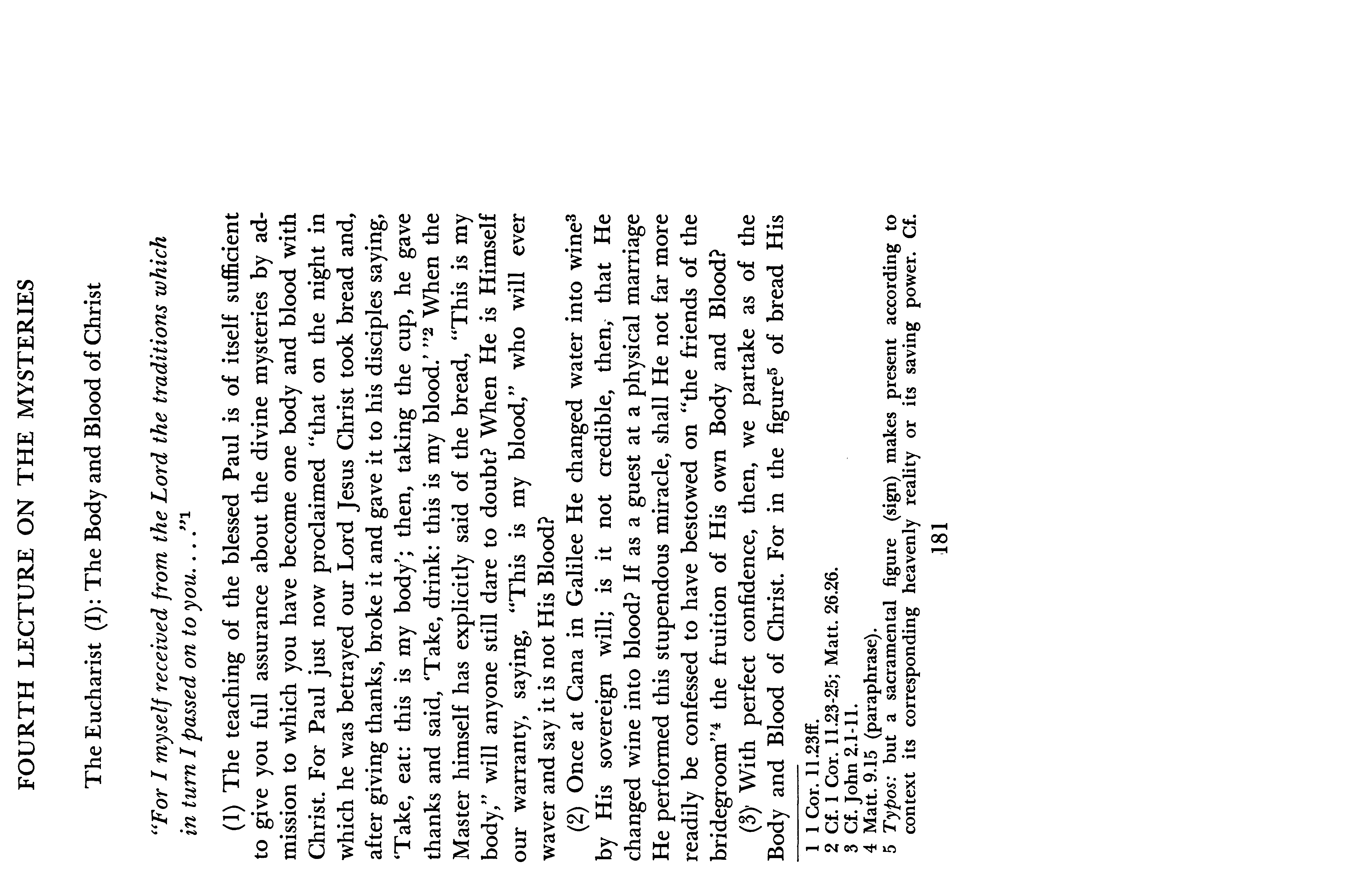
(1) The teaching of the blessed Paul is of itself sufficient to give you full assurance about the divine mysteries by admission to which you have become one body and blood with Christ. For Paul just now proclaimed "that on the night in which he was betrayed our Lord Jesus Christ took bread and, after giving thanks, broke it and gave it to his disciples saying,
'Take, eat: this is my body'; then, taking the cup, he gave thanks and said, 'Take, drink: this is my blood: "2 When the Master himself has explicitly said of the bread, "This is my body," will anyone still dare to doubt? When He is Himself our warranty, saying, "This is my blood," who will ever waver and say it is not His Blood?
(2) Once at Cana in Galilee He changed water into wine3 by His sovereign will; is it not credible, then, that He changed wine into blood? If as a guest at a physical marriage
He performed this stupendous miracle, shall He not far more readily be confessed to have bestowed on "the friends of the bridegroom"4 the fruition of His own Body and Blood?
(3), With perfect confidence, then, we partake as of the Body and Blood of Christ. For in the figure5 of bread His
1 1 Cor. 11.23ff.
2 Cf. 1 Cor. 11.23-25; Matt. 26.26.
3 Cf. John 2J-ll.
4 Matt. 9.15 (paraphrase).
5 Typos: but a sacramental figure (sign) makes present according to context its corresponding heavenly reality or its saving power. Cf.
ST. CYRIL OF JERUSALEM
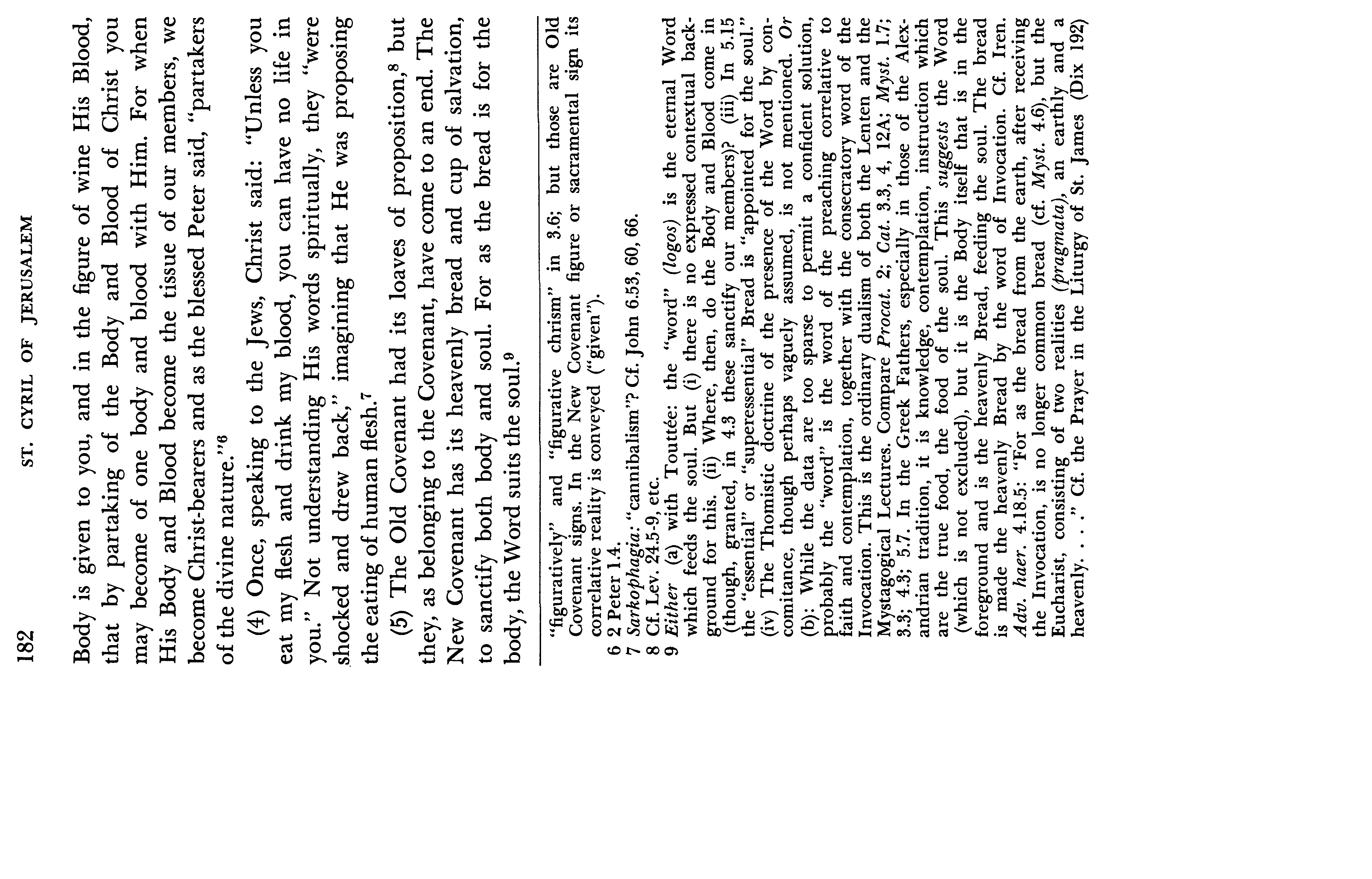
Body is given to you, and in the figure of wine His Blood, that by partaking of the Body and Blood of Christ you may become of one body and blood with Him. For when
His Body and Blood become the tissue of our members, we become Christ-bearers and as the blessed Peter said, "partakers of the divine nature."6
(4) Once, speaking to the Jews, Christ said: "Unless you eat my flesh and drink my blood, you can have no life in you." Not understanding His words spiritually, they "were shocked and drew back," imagining that He was proposing the eating of human ftesh. 7
(5) The Old Covenant had its loaves of proposition,S but they, as belonging to the Covenant, have come to an end. The New Covenant has its heavenly bread and cup of salvation, to sanctify both body and soul. For as the bread is for the body, the Word suits the soul.9
"figuratively" and "figurative chrism" in 3.6; but those are Old Covenant signs. In the New Covenant figure or sacramental sign its correlative reality is conveyed ("given").
6 2 Peter 1.4.
7 Sarkophagia: "cannibalism"? Cf. John 6.53, 60, 66.
8 Cf. Lev. 24.5-9, etc.
9 Either (a) with Touttee: the "word" (logos) is the eternal Word which feeds the sou!. But (i) there is no expressed contextual background for this. (ii) Where, then, do the Body and Blood come in (though, granted, in 4.3 these sanctify our members)? (iii) In 5.15 the "essential" or "superessential" Bread is "appointed for the sou!."
(iv) The Thomistic doctrine of the presence of the Word by concomitance, though perhaps vaguely assumed, is not mentioned. Or (b): While the data are too sparse to permit a confident solution, probably the "word" is the word of the preaching correlative to faith and contemplation, together with the consecratory word of the Invocation. This is the ordinary dualism of both the Lenten and the Mystagogical Lectures. Compare Procat. 2; Cat. 3.3, 4, 12A; Myst. 1.7;
3.3; 4.3; 5.7. In the Greek Fathers, especially in those of the Alexandrian tradition, it is knowledge, contemplation, instruction which are the true food, the food of the sou!. This suggests the Word
(which is not excluded), but it is the Body itself that is in the foreground and is the heavenly Bread, feeding the sou!. The bread is made the heavenly Bread by the word of Invocation. Cf. Iren.
Adv. haer. 4.18.5: "For as the bread from the earth, after receiving the Invocation, is no longer common bread (cf. Myst. 4.6), but the Eucharist, consisting of two realities (pragmata), an earthly and a heavenly .... " Cf. the Prayer in the Liturgy of St. James (Dix 192)
MYSTAGOGICAL LECTURE IV
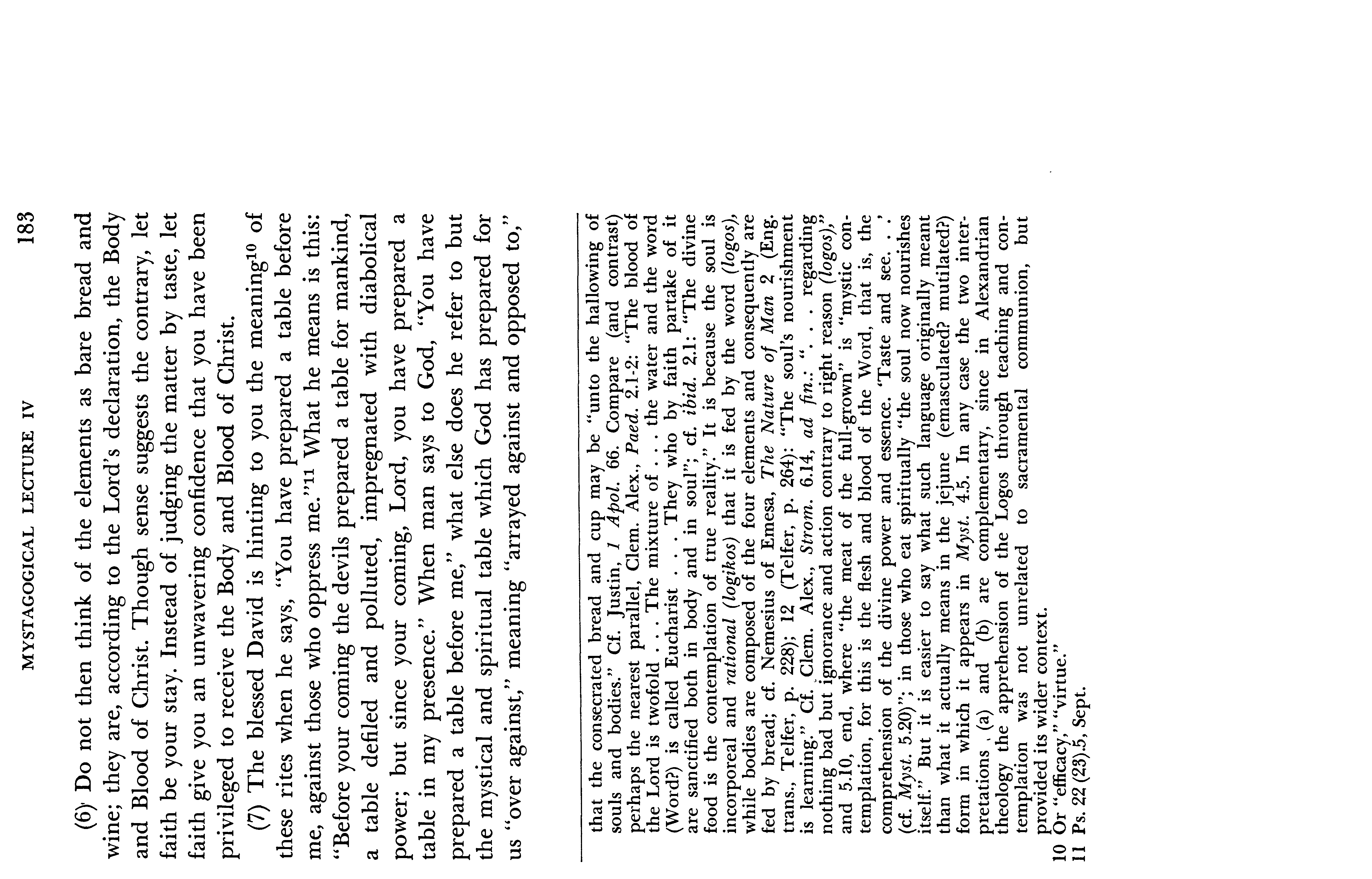
(6), Do not then think of the elements as bare bread and wine; they are, according to the Lord's declaration, the Body and Blood of Christ. Though sense suggests the contrary, let faith be your stay. Instead of judging the matter by taste, let faith give you an unwavering confidence that you have been privileged to receive the Body and Blood of Christ.
(7) The blessed David is hinting to you the meaninglO of these rites when he says, "You have prepared a table before me, against those who oppress me."ll What he means is this:
"Before your coming the devils prepared a table for mankind, a table defiled and polluted, impregnated with diabolical power; but since your coming, Lord, you have prepared a table in my presence." When man says to God, "You have prepared a table before me," what else does he refer to but the mystical and spiritual table which God has prepared for us "over against," meaning "arrayed against and opposed to," that the consecrated bread and cup may be "unto the hallowing of souls and bodies." Cf. Justin, 1 Apol. 66. Compare (and contrast) perhaps the nearest parallel, Clem. Alex., Paed. 2.1·2: "The blood of the Lord is twofold ... The mixture of ... the water and the word
(Word?) is called Eucharist ... They who by faith partake of it are sanctified both in body and in soul"; cf. ibid. 2.1: "The divine food is the contemplation of true reality." It is because the soul is incorporeal and rational (logikos) that it is fed by the word (logos), while bodies are composed of the four elements and consequently are fed by bread; cf. Nemesius of Emesa, The Nature of Man 2 (Eng. trans., Telfer, p. 228); 12 (Telfer, p. 264): "The soul's nourishment is learning." Cf .. Clem. Alex., Strom. 6.14, ad fin.: " ... regarding nothing bad but ignorance and action contrary to right reason (logos)," and 5.10, end, where "the meat of the full·grown" is "mystic contemplation, for this is the flesh and blood of the \Vord, that is, the comprehension of the divine power and essence. 'Taste and see. . .'
(cf. Myst. 5.20)"; in those who eat spiritually "the soul now nourishes itself." But it is easier to say what such language originally meant than what it actually means in the jejune (emasculated? mutilated?) form in which it appears in Myst. 4.5. In any case the two interpretations . (a) and (b) are complementary, since in Alexandrian theology the apprehension of the Logos through teaching and contemplation was not unrelated to sacramental communion, but provided its wider context.
10 Or "efficacy," "virtue."
11 Ps. 22 (23).5, Sept.
ST. CYRIL OF JERUSALEM
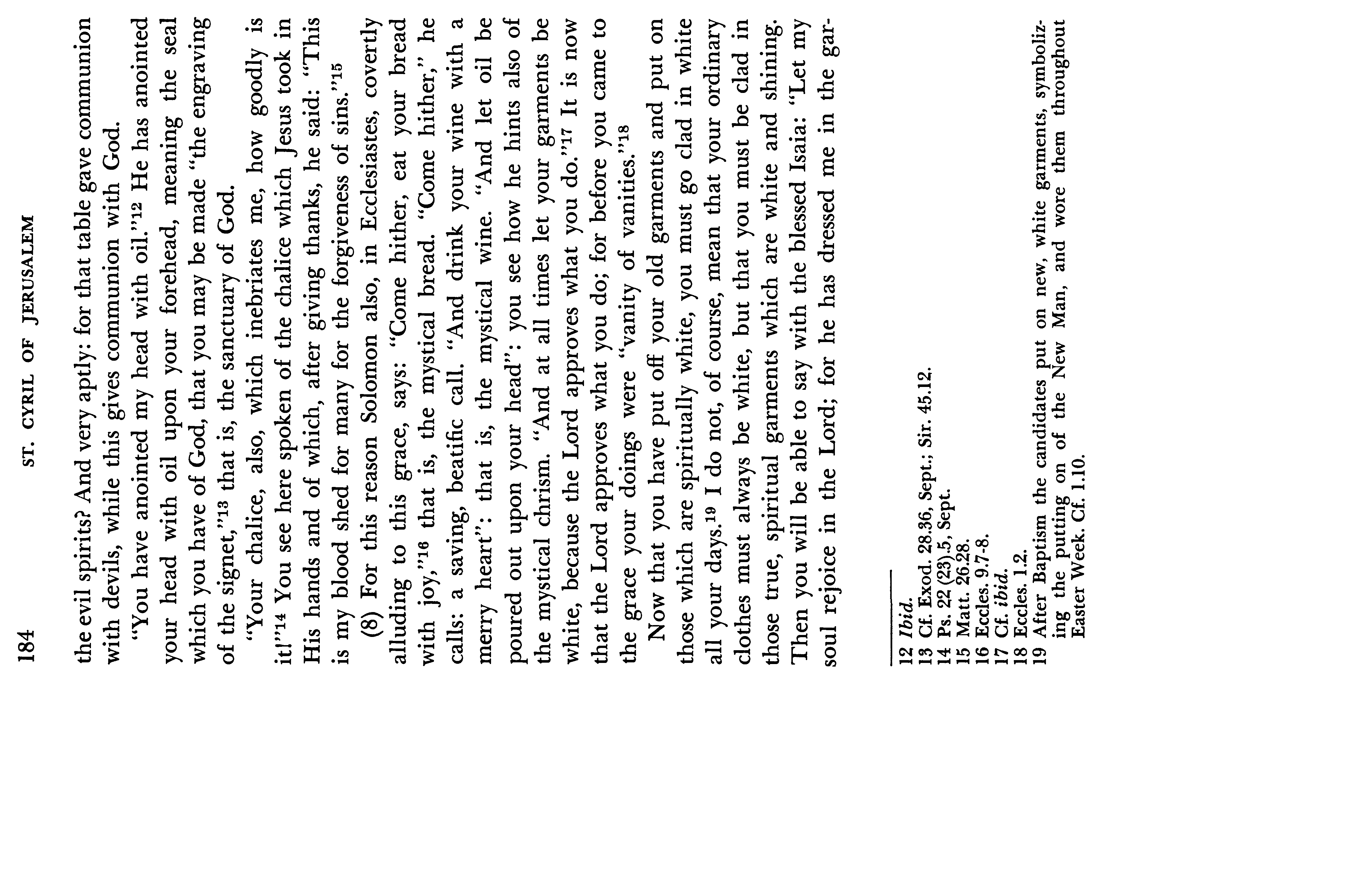
the evil spirits? And very aptly: for that table gave communion with devils, while this gives communion with God.
"You have anointed my head with Oil."12 He has anointed your head with oil upon your forehead, meaning the seal which you have of God, that you may be made "the engraving of the signet,"13 that is, the sanctuary of God.
"Your chalice, also, which inebriates me, how goodly is itl"14 You see here spoken of the chalice which Jesus took in His hands and of which, after giving thanks, he said: "This is my blood shed for many for the forgiveness of sins."15
(8) For this reason Solomon also, in Ecclesiastes, covertly alluding to this grace, says: "Come hither, eat your bread with joy,"16 that is, the mystical bread. "Come hither," he calls: a saving, beatific call. "And drink your wine with a merry heart": that is, the mystical wine. "And let oil be poured out upon your head": you see how he hints also of the mystical chrism. "And at all times let your garments be white, because the Lord approves what you dO."17 It is now that the Lord approves what you do; for before you came to the grace your doings were "vanity of vanities."18
Now that you have put off your old garments and put on those which are spiritually white, you must go clad in white all your days.l0 I do not, of course, mean that your ordinary clothes must always be white, but that you must be clad in those true, spiritual garments which are white and shining.
Then you will be able to say with the blessed Isaia: "Let my soul rejoice in the Lord; for he has dressed me in the gar12 Ibid.
13 Cf. Exod. 28.36, Sept.; Sir. 45.12.
14 Ps. 22 (23).5, Sept.
15 Matt. 26.28.
16 Eccles. 9.7-8.
17 Cf. ibid.
18 Eccles. 1.2.
19 After Baptism the candidates put on new, white garments, symbolizing the putting on of the New Man, and wore them throughout
Easter Week. Cf. l.lO.
MYSTAGOGICAL LECTURE IV
ments of salvation, and with the robe of gladness he has clothed me."20
(9)- In this knowledge, and in the firm conviction that the bread which is seen is not bread,21 though it is bread to the 20 Isa. 61.10.
21 (Ro phainomenos artos) Rather than "what seems bread" or "the seeming bread." The Myst. unequivocally teach the Real Presence, but they are vague about the mode of the presence and the way in which it is brought about (e.g., by transubstantiation). One cannot press either the analogies with the merely qualitative change effected by the epikli!sis (invocation) in the baptismal water, the chrism or food offered to idols (Cat. 3.3; Myst. 1.7; 2.3; 3.3, d. 5.7) or the analogy with Can a (4.3), especially as the miracle there ~as not a case of "transubstantiation," since the appearance ("accidents"), as well as the substance of the water, was changed. The mark of transubstantiation is that the substance of the bread, instead of remaining as the sacramental mediating sign of the Body of Christ, ceases to exist, being changed into that Body. Phainomenos artos (4.9) could mean "what seems bread," but consider the other relevant passagesthe repeated denial that the bread (and water and oil) is "mere, bare, common or ordinary (litos, psilos, koinos) bread" (1.7; 3.3, 6)
(which implies it is bread), and the description of the bread as the "antitypical Body" (5.20; d. note 17 on "antitype" at 2.6). Again at 4.3, "in the figure of bread is given to thee His Body," Touttee's transubstantiationist thesis leads him into the absurdity of arguing that "figure" (typos) means "semblance" (Diss. 3, cap. II, n. 83:
PG 33.265-266). But obviously the genitive is defining; the bread is the figure, the figure of the Body of Christ. Similarly what is meant here (4.9) is that "the bread that is seen with the eyes of the body" is not "really" bread by comparison with the true, heavenly Bread which it signifies and makes sacramentally present; it is not denied that it is, at its own lowly level, bread. The thought-category is that of the early Platonic doctrine of ideas or forms, in which earthly, sensible things are mere imperfect copies of the archetypal heavenly realities; it is these latter that are "really real." So, too, the Fathers say that the baptized, or monks, are "not men, but angels." Certainly this ("visible, sensible") is the usual meaning of phainomenos in Cyril. Cpo "the visibly lame" in Cat. 10.13. The Sermon provides some remarkable analogies. There (9) the paralytic is addressed: "Why await the visible (Ph.) motion of the waters? ... Glimpsing God visible in the flesh, attend not to the visible (man) but to the God who works through the visible man." Similarly (5) Cyril equivalently says that it was not the two blind men but the Pharisees who were
"really" blind. So (6) immediately after telling the paralytic that he has Christ, he tells him that he "has no man" and continues: "God you have . . ., One who is both God and man under different aspects (kata ti ... kata ti)." Probably in this last phrase-and d.
Cyril's statement (Cat. 4.9) that "Christ was twofold (diPlous)" and 15.1, "All things are twofold in ... Christ"-we have the clue to the Eucharistic theology of the Myst. Its model is christological: either as
ST. CYRIL OF JERUSALEM
taste, but the Body of Christ, and that the visible wine is not wine, though taste will have it so, but the Blood of Christ; and that it was of this that David sang of old: "Bread strengthens the heart of man, soon his face glistens joyously with Oil,"22 strengthen your heart, partaking of this Bread as spiritual, and make cheerful the face of your soul. God grant that, your soul's face unveiled with a clear conscience, you may "reflecting as in a glass the glory of the Lord," go "from glory to glory"23 in Christ Jesus our Lord, whose is the glory forever and ever. Amen.
Appended Note C The Doctrine in the Mystagogical Lectures on the Eucharistic Presence Two early Reformed theologians, Aubertin and Rivetus, interpreted the Eucharistic teaching of the Mystagogical Lectures in a way which, though inadequate, will reward the attention of the student. I shall therefore first summarize their interpretation as presented by Touttee and then make the necessary adjustments in a Catholic sense. Their interpretation is as follows.
While the Mystagogical Lectures recognize a real, spiritual (but not substantial) presence of Christ in the Eucharistic action, they the Word "became" flesh without ceasing to be the Word or (better) the mysterious coexistence, co-presence of two natures, a lower and a more exalted, in Christ. This interpretation accords well with the "dualism" of sacramental sign (water, oil, bread) and spiritual, supernatural reality which pervades the sacramental teaching of both the Lenten and the Mystagogical Lectures. Their viewpoint is pre-Scholastic: somewhat fluid and imprecise. Much earlier St. Irenaeus (Adv. haer. 4.18.5) stated this simple "dualism" of earthly and heavenly:
"For as the bread from the earth, after receiving the invocation of God, is no longer common bread, but the Eucharist, consisting of two realities, an earthly and a heavenly. . . ." That the model of the Myst. is christological is made practically certain by the parallel language in the Lenten Lectures, where Cyril repeatedly emphasizes
(12.1; 13.2, 3, 33) that Christ is "not a mere (psilos) man." Cf. also the "phainomenos darkness" of Myst. 1.4.
22 Ps. 103 (104).15, Sept.
23 Cf. 2 Cor. 3.18.
MYSTAGOGICAL LECTURE IV
view this presence dynamically and in terms of the benefit (spiritual effect) of the sacrament: that is, the devout believer's spiritual communion with Christ and, through his continued eating, !;lis ever-deepening mystical union with Him. References to the Bread and Wine being and becoming the Body and Blood of Christ are only symbolic, the language of signs and symbols which is appropriate to sacraments. The Mystagogical Lectures apply to the sacramental signs language strictly appropriate only to the reality (the spiritual benefit) which they signify and convey. In Holy Communion we spiritually partake of the Lord's Body and Blood in the sense that we gain the benefits of His Body broken and His Blood shed for us and are vouchsafed fellowship with God. Thus the consecrated Bread is the symbol or sacrament of the Body of Christ, or is the mystical Body of Christ; it become the efficacious figure of Christ's Bodyinsofar as it mediates the grace of His Passion. Lest the illustration from the miracle at Cana should mislead the audience, they are immediately warned (4.4) that they do not literally eat Christ's flesh (sarkophagia) but that the eating spoken of is spiritual, that (4.7) it is a mystical and spiritual Table to which they are invited, and (4.9) that they must "partake thereof as spiritual." In spite of some rhetorical flights the Mystagogiae have no serious doctrine of a "res et sacramentum." In all three sacraments the Mystagogiae know only two things: the sacramental sign and the grace-effect of the sacrament. It is true that they speak of the bread as being "changed," but not every change is substantial.
In 5.7 it is said that "everything that the Holy Spirit touches is sanctified and changed." That "changed" is here defined more precisely by "sanctified" is clear from the numerous passages (Cat.
3.3-4; Myst. 1.7; 3.3) implying that the changes effected by the consecration in the baptismal water, the chrism, and the eucharistic bread and wine are all of the same kind. It is a qualitative, not substantial, change and is compared to the change effected in meat when offered to idols. The illustration from Cana, therefore, is only intended to prove that He who changed the water substantially and sensibly can also change the wine sacramentally. Again, the warning in Myst. 4.6 not to regard the consecrated eucharistic elements as "bare" is exactly parallel to the warning in 3.3 not to regard the consecrated ointment as "bare." In no case is the change effected by the consecration substantial or "physical"; the sacramental elements are "changed" only in the sense that the consecration makes them God's instruments and imparts to them a spiritual or mystic power through which they impart to us the precious gifts promised by the Gospel. It is true that 4.9 says that the Bread is not bread, except to the taste; yet six times Myst. 4 calls it bread, and, after the statements in 3.3 that it is "not plain bread" or "bare bread," the 4.9 passage is clearly a metaphor or hyperbole. The comparison with the consecrated ointment in 3.3
ST. CYRIL OF JERUSALEM
is clearly the decisive passage, especially when taken in conjunction with the other parallels. The Mystagogiae speak indeed (4.3 and 5;
5.15) of the Body of Christ being "distributed through" or "assimilated into" our members and sanctifying not only our soul but our body, but they speak of the baptismal water and the chrism in exactly the same way: in Cat. 3.3·4 Cyril speaks of the water as purifying the body and enabling "the body also to partake of the Grace," while Myst. 3.4 and 7 describe the chrism as "a spiritual preservative of the body" and use of it language applicable only to the Holy Spirit whom it conveys.
The lectures are, indeed, somewhat inconsistent, but they are consistently inconsistent. To cite a parallel, the Mystagogiae (3.2) speak of the chrism as mere material ointment and as being only the "anti type" of the Holy Ghost, with whom Christ was anointed, and yet they go on (3.3, 4, 7) to identify it with the Holy Ghost, or at least to attribute to it sanctifying power, and even say (3.6) that the newly baptized were, after all, "truly anointed by the Holy
Ghost." Similarly, Cat. 3.3-4 speaks of the. baptismal water as a material element affecting only the body and yet also speaks of it as sanctifying and sealing the soul. In just the same way the Mystagogiae speak of the eucharistic Bread as the Body of Christ and yet also speak of it (4.5) as a material element affecting only our body: "for as bread answers to the body, so is the Word appropriate to the soul." In each case the material element sacramentally mediates a divine grace which sanctifies the soul. Such "strong" passages, therefore, as 4.3 and 6 about the eucharistic Bread are entirely analogous (1) to what is said in Cat. 3.3-4 about the baptismal water: "Regard not the Bath as simple water, but rather regard the spiritual grace that is given with the water. . . . For since man is body and soul ... the water cleanses the body and the Spirit seals the soul. . . When going down, therefore, into the water, regard not the bare element ... "; and (2) to what is said in Myst. 3.3 about the Chrism: "But beware of supposing this to be plain ointment. For as the bread ... , (so the ointment after the invocation becomes Christ's divinizing grace)," for "while your body is anointed with visible ointment, your soul is sanctified by the holy, life-giving Spirit." Again, there is the use of the word
"antitype." Myst. 5.20 speaks of the Bread and Wine as "the antitype of the (or "the anti typical") Body and Blood of Christ." Now, only thrice elsewhere do the Mystagogical Lectures use the word
"antitype": in 2.6 and twice in 3.1: and always in contrast with the archetype or original, though with reference to the spiritual grace conveyed through the sacramental symbol. Baptism (2.4-7) is the antitype of Christ's Passion, because our sacramental imitation of His death and resurrection mediates for us the fruits of the Redemption. Then in 3.1 the Chrism is twice called the antitype of the Holy Spirit, and is contrasted with Him; and yet in 3.7 it is
MYSTAGOGICAL LECTURE IV
identified with the Holy Spirit: "It shall teach you all things if It abides in you." Finally, there is the absurdity that if we take Myst.
4 literally, then we must, in logic, take literally the statement in 5.10 that in the Eucharist "we offer Christ slain in sacrifice," where the perfect participle suggests that "slain" represents a present state; then Holy Communion would indeed be a gruesome banquet (but see n. 33 there).
Now let us make the necessary adjustments. It is clear that the Mystagogiae conceive the Presence, not as merely virtual or dynamic, but in the traditional Catholic sense. For (a) neither the Lenten nor the Mystagogical Lectures ever say that the baptismal water actually becomes or is "the grace" which it imparts. (b) There is a closer analogy with Chrism. The Holy Spirit does seem to be conceived as actually "arriving" in person in His "antitype." (c)
The parallels drawn between the Bread and the water and ointment show (i) an analogy in the mode of consecration (by invocation) and (ii) that in each case the element is changed. But it remains to inquire into the nature of the change in each case. And the Mystagogiae speak of the Bread in a way which contrasts with its language about the water and the Chrism; they say repeatedly and with the utmost emphasis that it becomes and is the Body of Christ.
Moreover (4.3) "in the figure (the Bread) the Body is given to thee."
(d) Finally the denial (4.6) that the bread is psilos (mere, bare bread) both proves the real Presence and shows how the Mystagogiae conceive it. The Lenten Lectures provide the key. In Cat. 4.9 Cyril says that "Christ is double" (d. 15.1) and in 12.1; in 13.2, 3, 33 he says that Christ is not a mere (psilos) man, since He is also God.
Thus the model of the Jerusalem doctrine of the Eucharistic presence is christological. This, while excluding transubstantiation (for the bread is then as real as the sacred Manhood), safeguards the objective and substantial Presence. The emphasis, however, is upon the action and the eating. Finally, Cyril confined both doctrine and theological speculation to a minimum. He had no theory of how the divinity and humanity co-existed in Christ, though he may have thought of this co-presence as the Mystagogiae thought of the co-presence in the Eucharist (Myst. 4.7: "the mystic, intelligible
[noeten] Table") on the model of the indwelling of a Platonic "sensible" (earthly reality) by a noeton (the corresponding spiritual, heavenly reality) or as the soul permeates the body, "tota in toto et tota in qualibet parte" (d. the Logos-Sarx Christology). Cyril does not tell us how he conceived the "conversion" of the bread into the Body of Christ; probably he would have accepted the other christological analogy, that of the incarnation of the Word; this is the analogy suggested by Theophilus of Alexandria-as the Word became flesh without ceasing to be the Word (menan ho en).
Other Fathers, however, from ca. 380 use language hardly if at all distinguishable from that of transubstantiation: transelement,
ST. CYRIL OF JERUSALEM
metousioun, metastoicheioun, metarrhythmizein suggesting a change in what we would call the invisible atomic or nuclear structure of the bread-a regrettable concession, one may think, to the literalist piety of the simpler faithful.