
LOT.
Joseph Parker
T. De Witt Talmage
Author of introduction, etc.: C. B. Gillette
BIBLE CHARACTERS
The Expulsion From The Garden.
From the Painting by Gustave Dore
BIBLE CHARACTERS
DESCRIBED AND ANALYZED IN THE SERMONS AND
WRITINGS OF THE
FOLLOWING FAMOUS AUTHORS:
Dwight Lyman Moody.
T. De Witt Talmage.
Joseph Parker.
SUPPLEMENTED BY THE GREATEST POEMS IN PRINT.
CHICAGO:
THOS. W. JACKSON PUBLISHING COMPANY.
Entered according to Act of Congress, in the year 1902, by the
RHODES & McCLURE PUBLISHING COMPANY
in the Office of the Librarian of Congress, Washington, D. C.
All Rights Reserved.
INTRODUCTION.
BY THE REV. C. B. GILLETTE, PH. D.
It frequently occurs to the devout Bible student and to the earnest Christian that, if he could have had the personal acquaintance of Jesus, and other Bible characters, it would have helped materially in the cultivation of a religious and spiritual life. One feels that, if he could have been a James, or a John, a Martha, or a Mary; if he could have stood by Jesus himself, and listened to the words falling from His lips: observed his life, become acquainted with his thought, and felt that silent, subtle influence emanating from his personality; such would have been potential factors, aiding one onward and upward in the divine pathway.
So also, but in lesser degree, one regrets the impossibility of personal contact with Elijah, Isaiah, John, Paul, et al. But time has drawn the veil, and we cannot lift it. We must look at them through the varying atmosphere of many generations, and the best we can do is to avail ourselves of the best aids possible, and through them draw as near as possible to these great and good characters, so closely linked with our religious belief and our faith in the Infinite and Eternal.
One of Brooklyn’s greatest divines once said, that he had never visited Palestine personally, but by study he had become so thoroughly acquainted with that country, that, should he be left at any point in Palestine at midnight, he would be able to tell in the morning, from the surrounding topography, where he was.
So the editor of this volume has sought the scholars who have been recognized by the world as the leading religious teachers of their age, and culled from their utterances choice selections, respecting Jesus and the “Holy men of old, who spake as they were moved by the Holy Ghost.”
Dr. Talmage, who, perhaps, more than any other living preacher, has commanded the public ear.
Joseph Parker, who, from his immense intellectual store-house, well filled, has brought out such wonderful thoughts, respecting the Bible Characters.
Dwight L. Moody, who moved the millions, both of this country and Great Britain. What was the source of his power? Not superior scholarship—far from it. Not his general appearance: for that, while not mean, was neither imposing nor inspiring. Not his eloquence; he never depended upon that. What, then, was the source of his power? It was the power of God. The Holy Spirit used him as a means in the conversion of souls.
The editor of this volume then presents you, in this age, when intelligent minds are looking for the greatest and the best, with the best thoughts of these great men, respecting the Christ and other great characters which adorn the pages of the Holy Writ.
C. B. GILLETTE.
Chicago, Ill., January 1, 1902.
CONTENTS.
PAGE
DWIGHT LYMAN MOODY.
Abel
17
Abraham
18
Ahab
21
Barabbas
25
Bartimeus and Zacchæus
27
Belshazzar
32
Caleb
34
Daniel
36
David
54
Elijah
55
Gideon
60
Ittai
61
Jacob
63
Jacob’s Sons
67
John the Baptist
68
Joshua
84
Lot
95
Martha
103
Mephibosheth
107
Moses
111
Naaman
114
Peter
122
Saul
136
Simeon
141
The Good Samaritan
144
The Leper
149
The Penitent Thief
152
The Pharisee & The Publican
164
The Widow’s Son
172
Rock of Ages
175
Where He Leads I Follow
176
T. DE WITT TALMAGE.
Athaliah
177
David
181
Deborah
187
Dorcas
188
Ehud
198
Esau
200
Felix and Drusilla
201
Gallery of Characters
204
Gideon
206
Hezekiah
207
Jehoiakim
209
Jehu
211
Jesus at Emmaus
214
Job
215
Jonah
217
Joseph
220
Lazarus
224
Noah
230
Othniel
231
Paul
234
Pharaoh
246
Pontius Pilate
247
Queen of Sheba
252
Salome
254
Saul
257
Solomon
259
The Gentile Mother
263
Zacchæus
266
Nearer, My God, To Thee
268
JOSEPH PARKER.
Abijah
269
Ahab
282
Ahaziah
308
Asa
314
Athaliah
321
Balaam
328
Elah
339
Elijah
342
Elisha
332
Gehazi
374
Hezekiah
384
Jabez
401
Jehoram
404
Jehoram, King of Judah
414
Jehoshaphat
421
Jehu
430
Job
440
Micaiah
447
Moses
449
Nebuchadnezzar
457
Queen of Sheba
459
Rehoboam
461
Shishak
466
Solomon
467
Baseless Pride
476
ILLUSTRATIONS
Selected Especially for This Work
FROM THE GREAT ART GALLERIES OF THE WORLD
The Expulsion From The Garden.
Opposite Page Frontispiece
The Trial of the Faith of Abraham.
Opposite Page
“The First Mourners.”
The Arrival of The Good Samaritan at The Inn.
David.
Jacob Tending Flocks of Laban.
Moses Breaking The Tables of The Law.
The Prophet Amos.
The Despair of Judas.
Joseph Interpreting Pharaoh’s Dream.
St. Paul.
Solomon.
The Judgment of Solomon.
The Cross.
Moses in The Bulrushes.
The Trial of the Faith of Abraham. Genesis, xxii.
“The First Mourners.”—From the Painting by Bougereau.
BIBLE CHARACTERS
DESCRIBED IN HIS SOUL-WINNING SERMONS BY THE WORLD-KNOWN EVANGELIST,
Dwight Lyman Moody.
ABEL.
Abel was the first man who went to Heaven, and he went by way of blood. So we find it in all the worships of God from the earliest times.
In the story of Abel and Cain we are told: “In process of time it came to pass that Cain brought of the fruit of the ground an offering unto the Lord. And Abel also brought of the firstlings of his flock, and of the fat thereof, and the Lord had respect unto Abel and to his offering; but unto Cain and his offering He had not respect. And Cain was very wroth, and his countenance fell.”
Now, we find that Cain brought a bloodless sacrifice—“he brought of the fruit of the ground”—and Abel brought a bleeding lamb. Right on the morning of grace we see here that God had marked a way for men to come to Him, and that way was the way that Abel took, and Cain came to God with a sacrifice of his own, in his own way. Cain, perhaps, reasoned that he did not see why the products of the earth—why the fruit—should not be as acceptable to God as a bleeding lamb. He did not like a bleeding lamb, and so he brought his fruit.
Now, we do not know how there was any difference between those two boys. Both must have been brought up in the same way; both came from the same parents. Yet we find in the offerings there was a difference between them.
ABRAHAM.
In the twenty-second chapter of Genesis we find the story of Abraham and his only son, Isaac. Abraham was a follower of God, a man who loved and feared God, and He commanded him to make a blood sacrifice.
We read in this chapter that He commanded Abraham to make the sacrifice of his only son. And we read that the next morning the old man saddled his ass and started. He did not tell his wife any thing about it. If he had, she would likely have persuaded him to remain where he was. But he has heard the voice of God, and he obeys the command. He has heard God’s wish, and he is going to do it.
So, early in the morning—Abraham did not wait till 10 or 12 o’clock, but went early in the morning—he takes two of his young men with him and his son Isaac, and you can see him starting out on the three days’ journey. They have the wood and the fire, for he is going to worship his God.
As Abraham goes on, he looks at his boy and says: “It is a strange commandment that God has given. I love this boy dearly. I do not understand it, but I do know it is all right, for the Judge of all the earth makes no mistakes.” An order from the Judge of Heaven is enough for Abraham.
The first night comes, their little camp is made, and Isaac is asleep. But the old man does not sleep. He looks into the face of his sleeping boy, and sadly says: “I will have no boy soon. I shall never see him on this earth again. But I must obey God.”
I can see Abraham marching on the next day, and you might have seen him drying his tears as he glanced upon that only son and thought upon what he had been called upon to do. The second night comes; tomorrow is the day for the sacrifice. What a night that must have been to Abraham! Hear him say: “Tomorrow I must take the life of that boy—my only son, dearer to me than any thing on earth—dearer to me than my life.”
The third day comes, and as they go along they see the mountain in the distance. Then Abraham says to the young men: “You stay here with the beasts.” He takes the wood and the fire, and along with his boy prepares to ascend Mount Moriah, from the peak of which could be seen the spot where, a few hundred years later, the Son of man was offered up.
As they ascend the mountain Isaac says: “Here are the wood and the fire, father. But where is the sacrifice?” This question shows that the boy knew nothing of what was in store. How the question must have sunk down into the old man’s heart! And he only answers: “The Lord will provide a sacrifice.” It was not time to tell him, and they go on until they come to the place appointed by God, and build the altar, and lay the wood upon it. Every thing is ready, and I can just imagine the old man take the boy by the hand, and, leading him to a rock, sitting down there and telling him how God had called upon him to come out of his native land; how God had been in communion with him for fifty years; what God had done for him. “And now,” he says, “my boy, when I was in my bed three nights ago, God came to me with a strange message, in which He told me to offer my child as a sacrifice. I love you, my son, but God has told me to do this, and I must obey Him. So let us both go down on our knees and pray to Him.”
After they have sent up a petition to God, Abraham lays Isaac on the altar and kisses him for the last time. He lifts the knife to drive it into his son’s heart, when all at once he hears a voice: “Abraham! Abraham! Spare thine only son.”
Ah! There was no voice heard on Calvary to save the Son of Man. God showed mercy to the son of Abraham. You fathers and mothers, just picture to yourselves how you would suffer if you had to sacrifice your only son. And think what it must have caused God to give up His only Son. We are told that Abraham was glad. This manifestation of Abraham’s faith so pleased God that He showed him the grace of Heaven and lifted the curtain of time to let him look down into the future to see the Son of God offered, bearing the sins of the world.
AHAB.
There is a familiar saying: “Every man has his own price.”
Ahab had his, and he sold himself for a garden; Judas sold himself for thirty pieces of silver, and Esau for a mess of pottage.
Ahab sold himself just to please a fallen woman. And so we might go on—citing the men who have sold themselves. It is easy for us to condemn these men, but let us see if there are not men and women doing the same thing today. How many are selling themselves tonight for naught! It is easy enough to condemn Judas, Herod and Ahab, but in doing this do we not condemn ourselves?
We thought that slavery was hard. We thought it hard that those poor black people should be put upon the block, in the market, and sold to the highest bidder; but what do you think of those men who sell themselves today to evil?
Ahab sold himself to evil, and what did he get?
Elijah was the best friend that Ahab had, but he did not think so; he thought that Elijah was his enemy. Ahab was a religious man—that is, he thought he was. He had 850 prophets. “And what king has more? What king does more for religion than I?” So he would have said. There is a difference between religion and having Christ. There are a great many people that have religion but have no Christ in it—that have not a spark of Christianity.
This man was very religious, but he began wrong. His marriage was his first wrong step. He did not care about the law of God. He wanted to strengthen his kingdom. I can imagine they said: “We have outgrown the laws of Moses. We do not want your God; we have got something better. Here are the nations all around us worshiping Baal, and we will worship Baal.”
Ahab’s wife, Jezebel, wanted the patriarchs and the prophets put to death, and they were put to death. Obadiah had a few, but wherever they were found they were put to death. I suppose they said of Elijah: “That man belongs to the old Puritanical school.” He was bigoted and narrow. The idea of only worshiping one God! Ahab was willing to turn away from the God of Elijah, but he did not look to have Elijah reprove him, and thus he was his enemy. Many a man who has a good, praying mother thinks that mother is his enemy.
Ahab thought the God of Elijah was not going to carry out His warning. I will leave it to you if the man who warns you of danger is not the best friend you have got. If I saw a man about to walk over a precipice and he was blind and I did not warn him, would not the blood of that man be required at my hands? Would not I be guilty morally? Jezebel hated Elijah, and she disliked him for his warnings. The man who warns you is the best friend that you have got.
Suppose I am going home at night—at midnight—and I see a building on fire and I pass along and say not a word about it, and the occupants are all asleep and I go right home and go to bed, and in the morning I find that fifteen people in that house were burned up—how you would condemn me! And if in preaching the Gospel I do not warn you about your danger—about your sins and God’s punishment—what will you say to me when I meet you at the Eternal Throne? I do not want you to think that I am trying to please the people by preaching that the just and unjust will fare alike. You may be successful for a time. Ahab had two grand and glorious victories upon the battle field, and he was a very popular man for a while. He built a palace of ivory, and just here I want to speak of one act of that man.
When Ahab’s beautiful palace was finished, he found there was a poor man who had a garden near it. This Ahab wanted. And Ahab came to Naboth, the poor man, and wanted him to sell his garden. But Naboth said he could not do so, for it was against the law of his people. Then Ahab said to him: “I will give you a better place than this, and I will give you a better vineyard than this.” But Naboth was firm, and would not agree to sell his garden.
Many men would have liked to sell to the king. Such would have said: “We know it is against the law, but he is foolish not to sell to the king.”
Naboth said: “God forbid that I should sell.”
Ahab returns to his palace, where he pouts like a child. Jezebel notices him, and begins to speak with him. She asks: “What is the matter?” Ahab makes answer like a peevish child: “I want Naboth’s garden.” And she asks him why he does not take it, and then he tells her. Again she asks: “Are you not king of Israel?”
“Well! Then why do you not get it? I will get it for you, and it shall not cost you any thing. I will arrange it.”
Then Jezebel sent that infamous letter to the truculent elders. Those elders were just as bad as Jezebel. They knew that Naboth served the God of Heaven. The instructions of the letter were followed. The two witnesses said they saw Naboth despise God and the king, and so he was taken out and stoned to death. I can see him kneeling there and the crowds taking up the stones and hurling them at him.
Well, when Ahab goes down to take possession of that vineyard there is a message that had come from the throne of Heaven. God has been watching him. He notices all of us, and there is not a hellish act that has been, or is going to be, committed but God knows about it. Elijah stood before Ahab as the latter went down to that garden, and Ahab got out of his chariot and met him. He knew that Elijah knew all, and he did not like to be reproved. Ill-gotten gains do not bring peace. If you get any thing at the cost of the truth or honor, it will be peace lost for time, and perhaps for eternity.
As he walked through that garden, Ahab looked up and said: “Why, is not that Elijah?” He knew it was, and he knew what it meant. Elijah walks up to him and asks: “Hast thou killed and taken possession?” Ahab answers: “I wonder how he found that out. He knows all about me.” And then Elijah said: “In the place where the dogs licked the blood of Naboth they shall lick thy blood.”
Then Ahab asked the prophet: “Mine enemy, have you found me out?”
Elijah answered: “Yes. Because you have sold yourself to evil, you will be found out.”
A few years before, Ahab had laughed at Elijah, but he now remembered that every thing which Elijah’s God had promised had been done, and he could not get these words out of his mind: “In the place where the dogs licked the blood of Naboth they shall lick thy blood.” Sometimes just one act, that we can do in a minute, will cost us years of trouble and pain. Little did Ahab think that it was going to cost him his kingdom and cause his whole family to be swept from the face of the earth when he gave the promise to Jezebel to write that letter.
Ahab lived three years after Elijah met him in that garden, and how many times do you suppose those awful words of Elijah came into his mind? He could not get them out of his mind. Jezebel tried to help him, but she could not. He wanted to improve the garden, and no doubt he did improve it; but whenever he walked there the words came to him which Elijah had spoken. Then the time came for the judgment against Ahab to be carried out, and the Bible tells how it was done.
BARABBAS.
I have often thought what a night Barabbas must have spent just before the day when Christ was crucified.
As the sun goes down, he says to himself: “Tomorrow—only tomorrow—and I must die upon the cross! They will hang me up before a crowd of people; they will drive nails through my hands and feet; they will break my legs with bars of iron; and in that awful torture I shall die before this time tomorrow, and go up to the Judgment with all my crimes upon me.”
Maybe, they let his mother come to see him once more before dark. Perhaps he had a wife and children, and they came to see him for the last time. He could not sleep at all that night. He could hear somebody hammering in the prison yard, and knew they must be making the cross. He would start up every now and then, thinking that he heard the footsteps of the officers coming for him.
At last the light of the morning looks in through the bars of his prison.
“Today—this very day—they will open that door and lead me away to be crucified!”
Pretty soon he hears them coming. No mistake this time. They are unbarring the iron door. He hears them turning the key in the rusty lock. Then the door swings open. There are the soldiers.
Good-by to life and hope! Death—horrible death—now! And after death—what will there be then?
The officer of the guard speaks to him: “Barabbas, you are free!”
He hears the strange words, but they make very little impression on him. He is so near dead with fear and horror that the good news does not reach him. His ears catch the sound, but he thinks it is a foolish fancy. He is asleep and dreaming. He stands gazing a moment at the soldiers, and then he comes to himself.
“Do not laugh at me! Do not make sport of me! Take me away and crucify me, but do not tear my soul to pieces!” Again the officer speaks: “You are free! Here—the door is open! Go out—go home!”
Now he begins to take in the truth. But it is so wonderful a thing to get out of the clutches of the Roman law that he is afraid to believe the good news. And so he begins to doubt, and to ask how it can be.
They tell him that Pilate has promised the Jews the release of one prisoner that day, and that the Jews have chosen him instead of one Jesus of Nazareth, who was condemned to be crucified.
Now the poor man begins to weep. This breaks his heart. He knows this Jesus. He has seen Him perform some of His miracles. He was in the crowd, picking pockets, when Jesus fed the five thousand hungry people.
“What! That just man to die! And I—a thief, a highwayman, a murderer—to go free!”
And in the midst of his joy at his own release his heart breaks at the thought that his life is saved at such a cost.
BARTIMEUS AND ZACCHÆUS.
In the eighteenth chapter of the Gospel of St. Luke you will find Christ was going into Jericho, and as He drew near the gates of the city there was a poor blind man who sat by the wayside, begging people to give him a farthing, and crying out: “Have mercy on a poor blind man!”
This blind beggar met a man who said to him: “I have good news to tell you, Bartimeus.”
“What is it?” asked the beggar.
“There is a man of Israel who can give you sight.”
“Oh, no! There is no chance of my ever receiving my sight. I never shall see. In fact, I never saw the mother who gave me birth. I never saw the wife of my bosom. I never saw my own children. I never saw in this world, but I expect to see in the world to come.”
“Let me tell you. I have just come down from Jerusalem, and I saw that village carpenter, Jesus of Nazareth; and I saw a man who was born blind, who had received his sight, and I never saw a man who had better sight. He does not even have to use glasses.”
Then hope rises for the first time in this poor man’s heart, and he says: “Tell me how the man got his sight.”
“Oh,” says the other, “Jesus first spat upon the ground and made clay, and put it on his eyes, and then He told the man to wash his eyes in the pool of Siloam, and he would receive his sight. More than that, Bartimeus: He does not charge you any thing. You have no fee to pay. You just tell him what you want, and you get it—without money and without price. It does not need dukes, lords or influence. You just call upon Him yourself. And if He ever comes this way, do not let Him go back without your going to see Jesus.”
And Bartimeus said: “I will try it. There is no harm in trying it.”
I can imagine Bartimeus being led by a child to his seat, as usual, and that he is crying out: “Please give a blind beggar a farthing.”
He hears the footsteps of the coming multitude, and he inquires: “Who is passing? What does this multitude mean?” They tell him that it is Jesus of Nazareth passing by. The moment he hears that he says: “Why, that is the man that gave sight to the blind!”
The moment it reached his ear that it was Jesus of Nazareth, he began to cry out at the top of his voice: “Jesus, thou Son of David, have mercy upon me!”
Some of those who went before—perhaps Peter was one of them—rebuked him, thinking the Master was going up to Jerusalem to be crowned King, and did not want to be distracted. They never knew the Son of God when He was here. He would hush every harp in Heaven to hear a sinner pray. No music would delight Him so much. But the blind man still lifted up his voice, and cried louder: “Thou Son of David, have mercy on me!”
This prayer reached the ears of the Son of God, as prayer always will, and they led the poor blind man to Him. Well, when Jesus heard the blind beggar, He commanded him to be brought. So they ran to him, and said: “Be of good cheer. The Master calls you. He has a blessing for you.”
When Jesus saw Bartimeus He said: “What can I do for you?”
“Lord, that I may receive sight.”
“You shall have it.”
And the Lord gave it to him. And now the beggar follows with the crowd, glorifying God. I can imagine he sang as sweetly as Mr. Sankey—and no one can sing more sweetly than he—when he shouted: “Hosanna to the Son of David!” No one sang louder than this one who had received his sight. Then he follows on with the crowd, which we see pressing into the gates of the city. I can imagine, when he gets into the city, he says to himself: “I will go down and see Mrs. Bartimeus.” Of course, after all those years of blindness, he had some curiosity to see what his wife looked like.
As he is passing down the street, a man meets him, and turns around and says: “Bartimeus, is that you?”
“Yes; it is I.”
“Well, I thought so, and yet I feared my eyes must deceive me. How did you get your sight?”
“I just met Jesus of Nazareth outside the walls of the city, and I asked Him to have mercy on me; and He gave me sight.”
“Jesus of Nazareth! Is he now in this part of the country?”
“Yes; He is on His way to Jerusalem. He is now going down to the eastern gate.”
“I should like to see Him,” says the man. And he runs straightway down the street. But he can not get a glimpse of Him, being small of stature, on account of the great throng around Him. He runs to a sycamore tree, and says to himself: “If I get up there and hide, without any one seeing me, He can not get by without my having a good look at Him.”
A great many rich men do not like to be seen coming to Jesus.
Well, there he is in the sycamore tree, on a branch hanging right over the highway, and he says to himself: “He can not get by without my having a good look at Him.” All at once the crowd comes in sight. He looks at John. “That is not He.” He looks at Peter. “No, that is not He.” Then he sees One who is fairer than the sons of men. “That is He!” And Zacchæus, just peeping out from among the branches, looks down upon that wonderful—yes, that mighty—God-Man in amazement.
At last the crowd comes to the tree, and it looks as if Christ is going by; but He stops right under the tree. All at once He looks up and sees Zacchæus, and says to him: “Zacchæus, make haste and come down.”
I can imagine Zacchæus says to himself: “I wonder who told Him my name. I was never introduced to Him.” But Christ knew all about him.
Well, He said to Zacchæus: “Make haste and come down.” He may have added: “This is the last time I shall pass this way, Zacchæus.” That is the way He speaks to sinners. “This may be the last time I shall pass this way. This may be your last chance of eternity.” There are some people in this nineteenth century who do not believe in sudden conversions. I should like them to tell me where Zacchæus was converted. He certainly was not converted when he went up into the tree, but he certainly was converted when he came down. He must have been converted somewhere between the branches and the ground.
The Lord converted him right there. People say they do not believe in sudden conversions, and that if a man is converted suddenly he will not hold out—he will not be genuine. I wish we had a few men converted like Zacchæus in London. They would make no small stir. When a man begins to make restitution it is a pretty good sign of conversion. Let men give back money dishonestly obtained in London, and see how quickly people will believe in conversion. Zacchæus gave half his goods to the poor. What would be said if some of the rich men of London did that? Zacchæus gave half his goods all at once, and he said: “If I have taken any thing from any man falsely, I restore him fourfold.” I think that is the other half.
But to get Christ is worth more than all his wealth. I imagine, the next morning, one of the servants of Zacchæus going with a check for £100, and saying: “My master a few years ago took from you wrongfully about £25, and this is restitution money.”
That would give confidence in Zacchæus’s conversion.
BELSHAZZAR.
In the fifth chapter of Daniel we read the history of King Belshazzar. It is very short. Only one chapter tells us all we know about him. One short sight of his career is all we see. He just seems to burst upon the stage and then disappears. We are told that he gave a great feast, and at this feast he had a thousand of his lords, and they were drinking and praising the gods of silver, of gold, of brass, of iron and of wood, out of the vessels which had been brought from the Temple at Jerusalem.
As they were drinking out of these vessels of gold and silver from the house of God—I do not know but it was at the hour of midnight—all at once came forth the fingers of a man’s hand and began to write upon the wall of the banquet hall.
The king turns deathly pale, his knees shake together and he trembles from head to foot. Perhaps if some one had told him the time was coming when he would be put into the balance and weighed he would have laughed at him. But he knows the vital hour has come, and that the hand has written his doom in the words: “Mene, mene, tekel, upharsin.”
He calls the wise men of his kingdom, and the man who can interpret this will be made the third ruler of his realm, and shall be clothed in scarlet and have a chain about his neck. One after another tried, but the eyes of no uncircumcised man could make it out. Belshazzar was greatly troubled. At last one was spoken of who had been able to interpret the dream of his father, Nebuchadnezzar. He was told if he would send for Daniel the latter might interpret the writing.
So the prophet was brought in, and he looked upon the handwriting. He told the king how his father had gone against God, and how he (Belshazzar) had gone against the Lord of Heaven, and how his reign was finished. And this was the meaning of the mysterious writing:
“Mene—God hath numbered thy kingdom and finished it.
“Tekel—Thou art weighed in the balance, and art found wanting.
“Peres—Thy kingdom is divided, and given to the Medes and Persians.”
The trial is over, the verdict is rendered and the sentence brought out. That very night the king was hurled from his throne. That very night the army of Darius came tearing down the streets, and then you might have heard the clash of arms and shouts of war, and might have seen the king’s blood mingling with the wine in that banquet hall.
CALEB.
Caleb and Joshua are great favorites of mine. They have got a ring about them. They were not all the time looking for hindrances and obstacles in their way. They got their eyes above them.
You remember how those men were sent forward to spy out the land of Canaan. They had been sent out forty days to go over that land. They went from the wilderness of Zin to Rehob, and thence unto Hebron. And when they reached the “brook of Eshcol they secured a branch with one cluster of grapes, and bare it between two upon a staff; and they brought of the pomegranates and of the figs.”
They were gone forty days, and the twelve men brought back what Congress would call a majority and a minority report. Ten men reported that they had gone unto the land to which they were sent, and that surely it flowed with milk and honey. And so God’s word was true. They found milk and honey. And they brought along grapes.
But ten of them were full of unbelief. They further reported that they saw giants there—the sons of Anak, which come of the giants. The Hittites, Jebusites, Amalekites and Amorites dwelt there. They were all there, and also those great giants, in whose sight they were as grasshoppers. It was a great war city, and they asked themselves if they looked as though they were able to war with such giants. They said: “We are not able.”
They undoubtedly brought back maps and charts, and said: “There is the region. It would be monstrous for us to attempt to take it. There are massive iron gates and a great wall, and we are not able to take it. We are defenseless people—without any weapons. We will not be able to overcome those people.”
I can imagine one man said: “Why, I looked up at those giants, and I seemed as a little grasshopper, and I felt as small as a grasshopper. We can not hope to cope with those giants. It is a good land, but we will not be able to go up and possess it.”
Then they began to murmur. It does not take a very great while to get unbelievers to murmuring. But Caleb tried to encourage them. He says to them: “Let us go up at once and possess the land. We are well able to overcome it.”
Even Joshua joined in with Caleb, and they proved two with the faith. To be sure, they were in the minority; but if the Lord is with us we are able to prove a powerful majority over the enemy. They determined to take it, and they wandered across all through Canaan, but the people took up stones, and would have stoned them to death. But “the glory of the Lord appeared in the tabernacle of the congregation, before all the children of Israel.”
And about three millions of people wandered in the wilderness for forty years, until all the men laid themselves down in the desert grave and were kept out of the Promised Land—all on account of their unbelief. And I believe today that four-fifths of the church is wandering around in the wilderness, far away from the cross of Calvary and the Promised Land. We are able to have victory with God with us.
Ten men were looking at all those obstacles that this new land presented to them, while these two men—Caleb and Joshua—looked up yonder. And they saw God’s face and remembered the waste in Egypt, the crossing of the Red Sea, the destruction which was brought upon the Philistines, the water from the flint rock, and they believed that God was able—as He most certainly was—to give them that land He had promised.
DANIEL.
I want to talk about the life of the prophet, Daniel. The word means “God with him”—not the public with him, not his fellow men, but God. Therefore, he had to report himself to God and hold himself responsible to Him.
I do not know just what time Daniel went down to Babylon. I know that in the third year of King Jehoakim Nebuchadnezzar took ten thousand of the chief men of Jerusalem, and carried them captive down to Babylon. I am glad these chief men, who brought on the war, were given into the great king’s hands. Unlike too many of the ringleaders in our great war, they got the punishment on their own heads.
Among the captives were four young men. They had been converted, doubtless, under Jeremiah, the “weeping prophet” that God had sent to the children of Israel. Many had mocked at him when he lifted up his voice against their sins. They had laughed at his tears and told him to his face—as many say of us—that he was getting up a false excitement. But these four young men listened, and they had the backbone to come out for God.
And now, after they were come to Babylon, the king said a number of the children should be educated, and ordered the same kind of meat and wine set before them that were used in his palace, and that at the end of a year they should be brought before him. Daniel and his three friends were among these.
Now, no young man ever comes to the city without having great temptation cross his path as he enters it. And just at this turning point in his life, as in Daniel’s, must lie the secret of his success. This was the secret of young Daniel’s success: He took his stand with God right on his entering the gate of Babylon, and cried to God to keep him steadfast. And he needed to cry hard. A law of his and his nation’s God was that no man must eat meat offered to idols, but now comes the king’s first edict, that this young man should eat the same kind of meat he himself did. I do not think that it took young Daniel long to make up his mind. The law of God forbade it, and he would not do it. “He purposed in his heart”—in his heart; mark this—that he would not defile himself. He did not resolve in his head, but love in his heart prompted him. If some Chicago Christians could have advised Daniel, they would have said to him: “Don’t you do it; don’t set aside the meat. That would be a species of Phariseeism.” Oh, yes; they would have insisted to the poor young captive that he should carry out the commandments of his God when he was in his own country, but not there where he was but a poor slave; he could not possibly carry along his own religion down there to Babylon.
Thank God, this young man would not eat the meat, and, ordering it taken away, he got the eunuch to bring him pulse. And behold, when he came before the king, the eunuch’s fears were gone, for the faces of Daniel and the rest of the dear boys were fairer and fatter than any that the king looked down upon. They had not noses—like too many in our streets—as red as if they were just going to blossom. It is God’s truth, and Daniel tested it, that cold water, with a clear conscience, is far better than wine.
And the king one day had a dream, and all the wise men were called before him. But they all said: “We can not interpret it; it is too hard.” The king, being wroth, threatened them. Still getting no answer, he made an edict that all the wise men should be put to death. And the officers came to Daniel, with the rest of the wise men, but Daniel was not afraid.
I can imagine he prayed to God, falling low on his knees and with his face to the earth, and asked Him for guidance; and then he crawled into bed and slept like a child. We would hardly sleep well under such circumstances. And in his sleep God told him the meaning of the dream. There must have been joy among the wise men that one of their number had found it, and that the king would save their lives. And he is brought before the king, and cries out: “O king, while thou didst lie with thy head on thy pillow, thou didst dream, and in thy dream thou sawest a great image.”
I can imagine, at these opening words, how the kings eyes flashed, and how he cried out with joy: “Yes, that is it—the whole thing comes back to me now.”
And then Daniel, in a death-like stillness, unfolded all the interpretation, and told the king that the golden head of the great image represented his own government. I suppose Babylon was the biggest city ever in the world. It was sixty miles around. Some writers put the walls from sixty-five to eighty-five feet high and twenty-five feet wide. Four chariots could drive abreast on top of them. A street fifteen miles long divided the grand city, and hanging gardens in acres made the public parks. It was like Chicago—so flat that they had to resort to artificial mounds; and, again like Chicago, the products of vast regions flowed right into and through it.
This great kingdom, Daniel told the king, was his own; but he said a destroying kingdom should come, and afterward a third and fourth kingdom, when, at the last, the God of Heaven should set up His kingdom.
Daniel lived to see the first kingdom overthrown, when the Medes and Persians came in, and centuries after came Alexander, and then the Romans.
I believe in the literal fulfillment, so far, of Daniel’s God given words and in the sure fulfillment of the final prophecy of the “stone cut out of the mountains without hands,” that by-and-by shall grind the kingdoms of this world into dust, and bring in the Kingdom of Peace. Then will be the Millennium, and Christ will sway His scepter over all the earth.
Well, the king was very much pleased. He gave to Daniel a place near the throne, and he became one of the chief men of the world. His three friends were also put in high office. God had blessed them signally, and He blessed them still more—and that was, perhaps, a harder thing—in keeping them true to Him in their prosperity. Their faith and fortunes waxed strong together.
Time went on, and now we reach a crisis indeed. “Nebuchadnezzar, the king,” we read, “made an image of gold, one hundred and ten feet high and nine feet wide.” It was not gilded, but was solid gold. When Babylon was pillaged the second time a single god was found in the temple that was worth more than two million pounds sterling. The king’s monstrous image was set up in the Plains of Dura, near to the city. I suppose he wanted to please his kingly vanity by inaugurating a universal religion.
When the time came for the dedication I do not suppose Daniel was there. He was probably in Egypt, or some other province, on affairs of the empire. Counselors, satraps, high secretaries and the princes of the people were ordered to hasten to the dedication, and when they should hear the sound of the cornet, flute and psaltery announce that the great idol was consecrated they were to bow down and worship it.
Perhaps they called the ceremony the unveiling of the monument, as we should say. But one command was made certain. At a given signal all the people were to fall to the earth in worship. But in the law of God there is something against that. “Thou shalt have none other gods but Me.” God’s law went right against the king’s.
Would all of us have Daniel’s three friends to do the right thing at any hazard? Would none of us, without backbone, have advised them to just bow down a little, so that no one would notice it, or to merely bow down but not worship it?
The hour came, and Daniel’s friends refused to bow down. They refused utterly to bend the knee to a god of gold. How many cry out in this city: “Give me gold—give me money—and I will do any thing!” Such may think that men in Nebuchadnezzar’s time should not bow down to a golden idol, but they themselves are daily doing just that very thing. Money is their golden image, or position, or golden ambition.
Well, the informers came to the king, and told him that Shadrach, Meshach and Abednego had stood with unbended knee, and straightway they were hurried before him. The old king, speechless with rage, was gesturing his commands. I can imagine that one last chance was given them, after the king finally regained his voice, and that one of them, probably Meshach, spoke up in a firm but respectful voice that they must obey God rather than man.
At once the raging king cried out: “What is your God that He can deliver you out of our hands?” And in the same breath he screamed a command to bind them hand and foot and cast them into the fiery furnace, and make it seven times hotter than ever. The command was instantly executed, and the flames leaped out from the door and consumed the officers who cast them in.
But Jesus was with His servants as the flames raged about them, and soon word was brought to the king that four men walked about in the flames. Yes, they walked there with Jesus—they did not run—as in a green pasture and beside still waters. And directly the king rushed up and cried: “Ye sons of the living God, come forth.” And behold, even the hair of their heads was not singed. Then the king made a royal edict, that all in his realm should reverence the God of Shadrach, Meshach and Abednego.
Then the king had a dream, and he was greatly perturbed thereby. This time the particulars of the dream had not gone from him. They stood out vivid and clear in his mind, as he sent out to fetch the wise men, and called to them to give him the interpretation. But they can not give it.
When he had his first dream he had summoned these same soothsayers, but they had stood silent. And now they stand silent again as the second dream is told them. They can not interpret it. Then once again he sends for the prophet, Daniel, whom he had named after one of his gods, Belteshazzar. And the young prophet comes before the king, and as soon as the king sees Daniel he feels sure that he will now get the meaning.
Calling out from his throne, he tells how he had dreamed a dream, wherein he saw a tree in the midst of the earth, with branches that reached to Heaven, and the sight thereof to the ends of the earth. The beasts of the field had shelter under it, and the fowls of the air dwelt in the boughs thereof. The tree was very fair and had much fruit, and all flesh was fed on it. And then, lowering his voice, he tells how, as he gazed, he saw a watcher and a holy one come down from Heaven, who cried aloud: “Hew down the tree.”
“And now,” cries the king, “can you tell me the interpretation?”
For a time Daniel stands motionless. Does his heart fail him? The record simply says: “For one hour he was astonished.” The ready words doubtless rush to his lips, but he dislikes to let them out. He does not want to tell how the king’s kingdom and mind are going to depart from him, and he is to wander forth to eat grass like a beast. The king, too, hesitates; a dark foreboding for a time gets the better of curiosity. But soon he nerves himself to hear the worst, and speaks very kindly: “Do not be afraid to tell me, O Daniel! Let not the dream or its interpretation trouble thee.” And at last Daniel speaks: “O king, thou art the man. God has exalted thee over every king and over all the world, but thou shalt be brought low. Thou shalt be driven out from men, and shalt eat grass among the beasts of the field; but thy kingdom—as the great watcher spared the stump of the tree—shall afterward return to thee. Wherefore, O king, break off thy sins by righteousness and thine iniquities by showing mercy to the poor, if it may be a lengthening of thy tranquility.”
And straightway the king repented in sackcloth and ashes, and God stayed the doom. But twelve months from that time we see Nebuchadnezzar walking in his palace and boasting: “Is not this my great Babylon that I have built by the might of my power and for the honor of my majesty!” And behold, while he yet spake a voice came from Heaven, saying: “Thy kingdom hath departed.” And undoubtedly God then touched his reason, and straightway he ran madly through the gates to eat grass.
But his kingdom had not passed from him forever, and, according to the prophet’s word, at the end of seven years—or, possibly, seven months—his reason came back, and he returned to his palace. All his princes and officers gathered about him. Then he immediately sent out a new proclamation, and its closing words show his repentance, and how Daniel had brought this mighty king to God: “And at the end of the days I, Nebuchadnezzar, lifted up mine eyes unto Heaven, and my understanding returned unto me, and I blessed the Most High, and I praised and honored Him that liveth forever, whose dominion is an everlasting dominion, and His kingdom is from generation to generation.
“At the same time my reason returned unto me, and for the glory of my kingdom mine honor and brightness returned unto me, and my councilors and my lords sought unto me. I was established in my kingdom, and excellent majesty was added unto me.
“Now I, Nebuchadnezzar, praise and extol the King of Heaven, all whose works are truth and His ways judgment, and those that walk in pride He is able to abase.”
And then he passes from the stage. This is the last record of him, and undoubtedly he and Daniel now walk the crystal pavement together. That mighty monarch was led to the God of the Hebrews by the faith of this Hebrew slave, and just because he had a religion and dared to make it known.
But now we lose sight of the prophet for a few years, perhaps fifteen or twenty. The next we hear is that Belteshazzar is on the throne—possibly as regent. He is believed to have been a grandson of Nebuchadnezzar. One day he said he would make Daniel the third ruler of the people if he would interpret for him the handwriting on the wall. He was probably second himself, and Daniel would be next to him. Of this prince we have only one glimpse. The feast scene is the first and last we have of him, and it is enough. It was a great feast, and fully a thousand of his lords sat down together. In those days feasts sometimes lasted six months. How long this one lasted we do not know. The king caroused with his princes and satraps and all the mighty men of Babylon, drinking and rioting and praying to gods of silver and gold and brass and stubble—just what we are doing today, if we bow the knee to the gods of this world. And the revelers, waxing wanton, even go into the temple and lay sacrilegious hands on the sacred vessels that had been brought away from Jerusalem, and drank wine from them—drank toasts to idols and harlots. And, undoubtedly, as they are drinking they scoff at the God of Israel.
I see these revelers swearing and rioting when, suddenly, the king turns pale and trembles from head to foot. Above the golden candlesticks, on a bare space on the wall, he sees the writing of the God of Zion. He distinctly sees the terrible fingers. His voice shakes with terror, but he manages to falter out: “Bring in the wise men! Any man who can read the handwriting I will make third ruler of the kingdom.”
Then the wise men come trooping in, but there is no answer. Not one of them can read it. They are skilled in Chaldean lore, but this stumps them. At last the queen comes in and whispers: “O king, there is a man in the kingdom who can read that writing. When your grandfather could not interpret his dreams he sent for Daniel, the Hebrew, and he knew all about them. Can we find him?”
They did find him, and now we see the man of God again standing before a king’s throne. To the king’s hurried promises of gifts and honors Daniel replies: “You can keep your rewards.” Quietly he turns his eyes on the writing. He reads it at the first glance, for it is his Father’s handwriting. He says: “Mene—Thy kingdom hath departed from thee.
“Tekel—Thou art weighed in the balance, and art found wanting.
“Upharsin—Thy kingdom is divided. It is given over to the hands of the enemy.”
How these words of doom must have rung through the palace that night!
And the destruction did not tarry. The king recovered himself, banished his fears, and went on drinking in his hall. The mystery and its interpretation were as an idle tale. He thought he was perfectly secure. He had deemed the great walls of Babylon thoroughly safe. But there was Darius besieging the city; the enemy was right upon him. Was that safe? While they reveled, the river Euphrates, that flowed under the walls, was turned into another channel. The hosts of Medes and Persians rushed through, unobstructed, and in a few minutes more battered down the king’s gate and broke through the palace guard into the inmost palace chamber. And the king was slain, and his blood flowed in that banquet hall.
We are next told Darius took the throne and set over the people 120 rulers, and over these three presidents, of whom Daniel was first. And so we find him in office again. I do not know how long he was in that position. But by-and-by a conspiracy took head among his fellow officers to get rid of him. They got jealous and said: “Let’s see if we can get this man removed. He has bossed us long enough—the sanctimonious old Hebrew.”
And then he was so impracticable, they could not do any thing with him. There were plenty of collectors and treasurers, but he kept such a close eye on them that they only made their salaries. There was no plundering of the government with Daniel at the head. He was president of the princes, and all revenue accounts passed before him. I can overhear the plotters whispering: “If we can only put him out of the way, we can make enough in two or three years to retire from office, have a city house in Babylon and two or three villas in the country—have enough for all our days. We can then go down to Egypt and see something of the world. As things now are, we can only get our exact dues, and it will take years to get any thing respectable. Yes, let us down this pious Jew.”
Well, they worked things so as to get an investigating committee, hoping to catch him in his accounts. But they found no occasion for fault against him. If he had put any relatives in office it would have been found out. If he had been guilty of peculation, or in any way broken the unalterable statutes of the kingdom, it would have come to light. What a bright light was that, standing alone in that great city for God and the majesty of law!
But at last they struck on one weak point, as they called it—he would worship no one but the God of Israel. The law of his God was his only assailable side. The conspirators reasoned in their plotting: “If we can only get Darius to forbid any one making a request for thirty days except from the king himself, we shall trap him, and then we can cast him among the lions. We will take good care to have the lions hungry.”
And the hundred and twenty princes took long council together. “Take care,” they said; “you must draw up the paper which is to be signed by the king with a deal of care and discretion. The king loves him, and he has influence. Do not speak of the movement outside this meeting. It might come to the ears of the king, and we must talk to the king ourselves.”
When the mine is all ready, the hundred and twenty princes come to the king and open their business with flattering speech. Naturally, we hear these men saying: “King Darius, live for ever!” They tell him how prosperous the realm is, and how much the people think of him. And then they tell him, in the most plausible way that ever was, that if he would be remembered by children’s children to all ages, just to sign this decree. It would be a memorial of his greatness and goodness for ever. And the king replies graciously: “What is the decree you wish me to sign?” Casting his eye over the paper, he goes on: “I see no objection to that.” In the pleasure of granting a request he thinks nothing of Daniel, and the princes carefully refrain from jogging his memory. And he asks for his signet ring, and gives the royal stamp. The edict has become one of the laws of the Medes and Persians, that alter not. It reads: “Any man that worships any God but me for thirty days shall be cast into the lions’ den.”
The news spreads all through the city, and quickly gets to the ears of Daniel. I can imagine some of them going to the prophet and advising him about the edict, saying: “If you can only get out of the way for a little time—if you can just quit Babylon for thirty days—it will advance your own and the public interest together. You are the chief secretary and treasurer; in fact, you are the chief ruler in the government. You are an important man and can do as you please. Well, now, just you get out of Babylon. Or, if you will stay in Babylon, do not let them catch you on your knees. At all events, do not pray at the window toward Jerusalem. If you must pray, close that window, pull down the curtain and put something in the keyhole.”
I can imagine how that old prince, Daniel, now in his gray hairs, would view such a proposition—that he desert his God in his old age. All the remonstrances that must have been made fell dead. He just went on praying as usual three times a day, with his face toward Jerusalem. This old prophet found plenty of time to pray, though secretary and treasurer of the most important empire of the world. And besides his own business, he had to attend, doubtless, to much belonging of right to those hundred and twenty. But he would never have been too busy or ashamed at a prayer meeting to stand up for God.
Daniel had a purpose, and he dared to make that purpose known. He knew whom he worshiped. The idea of looking back to church records of long ago to see whether a man has professed religion is all wrong. In Babylon they knew whom Daniel believed on. These hundred and twenty knew the very day after the passage of the edict. He knows they are watching near his window when the hour comes for prayer. He can see two men close at his side, and he knows they are spies. Perhaps they may be taking down every word he says for the papers.
The moment comes, and Daniel falls on his knees. In tones even louder than ever he makes his prayer to the God of Israel, Abraham, Isaac and Jacob. He does not omit to pray for the king. It is right to pray for our rulers. The reason they are not better, oftentimes, is just because we do not pray for them.
And now the spies rush to the king and say, “O Darius, live for ever! Do you know there is a man here in your kingdom who will not obey you?”
“Will not obey me? Who is he?”
“Why, that man Daniel.”
And the king says: “I know he will not bow down and worship me. I know that Daniel worships the God of Heaven.”
Then the king sets his heart to deliver him, all the day, from those hundred and twenty men. But they come to him and say: “If you break your law, your kingdom will depart. Your subjects will no longer obey you. You must drive him to the lions’ den.”
So Darius is compelled to yield, and at last he gives the word to have Daniel sent away and cast into the den of lions. These men take good care to have the den filled with the most hungry beasts of Babylon. He is thrown headlong into the den, but the angel of God flies down, and Daniel lights unharmed on the bottom. The lions’ mouths are stopped. They are as harmless as lambs. The old prophet, at the wonted hour, drops on his knees and prays, with his face toward Jerusalem, as calmly as he did in his chamber. And when it gets later he just lays his head on one of the lions and goes to sleep. Undoubtedly no one in all Babylon sleeps more sweetly than does Daniel in the lions’ den.
In the palace, the king can not sleep. He orders his chariot, and early in the morning rattles over the pavement and jumps down at the lions’ den. I see the king alight from his chariot in eager haste, and hear him cry down through the mouth of the den: “O Daniel, servant of the living God! Is thy God, whom thou reverest continually, able to deliver thee from the lions?”
Hark! Why, it is a resurrection voice! It is Daniel, saying: “My God is able. He hath sent one of His angels, and hath shut the lions’ mouths.”
I can see them now just embrace each other, and together they jump into the chariot and away they go back to the palace to breakfast.
I want to say something further about Daniel. I want to refer to how an angel came to him, and, as we read in the twelfth chapter of Daniel, told him he was a man greatly beloved. Another angel had come to him with the same message. It is generally thought this last angel was the same one spoken of in Revelations—first chapter and thirteenth verse—as coming to John when banished to the Isle of Patmos. People thought he was sent off there alone, but he was not; the angel of God was with him.
And so with Daniel. Here, in the tenth chapter and fifth verse, he says: “Then I lifted up mine eyes, and behold, a certain man clothed with fine linen, and otherwise arrayed as God’s messenger, who cried: ‘O Daniel, a man greatly beloved, understand the words which I speak unto thee, and stand upright, for unto thee am I now sent.’”
It was Daniel’s need that brought him from the glory land. It was the Son of God right by his side in that strange land. And that was the second time when the word came to him, saying he was greatly beloved. Yes, three times a messenger came from the throne of God to tell him this. I love to speak of that precious verse in the eleventh chapter—the thirty-second verse: “The people that do know their God shall be strong and do exploits.” I also love to speak of the twelfth chapter and second and third verses: “And many of them that sleep in the dust of the earth shall awake, some to everlasting life and some to shame and everlasting contempt; and they that be wise shall shine as the stars of the firmament, and they that turn many to righteousness as the stars for ever and ever.”
This was the angel’s comfort to Daniel, and a great comfort it was. The fact with all of us is that we like to shine. There is no doubt about that. Every mother likes her child to shine. If her boy shines at school by reaching the head of his class, the proud mother tells all the neighbors, and she has a right to do so. But it is not the great of this world that will shine the brightest. For a few years they may shed bright light, but they go out in darkness, without an inner brightness. Supplying the brightness, they go out in black darkness.
Where are the great men who did not know Daniel’s God? Did they shine long? Why, we know of Nebuchadnezzar and the rest of them scarcely a thing, except as they fill in the story about these humble men of God. We are not told that statesmen shall shine; they may, for a few days or years, but they are soon forgotten. Look at those great ones who passed away in the days of Daniel. How wise in council they were! How mighty and victorious over hundreds of nations! What gods upon earth they were! Yet their names are forgotten—written only in the grave. Philosophers, falsely so-called—do they live? Behold men of science—scientific men they call themselves—going down into the bowels of the earth, digging away at some carcass and trying to make it talk against the voice of God! They shall go down to death, by-and-by, and their names shall rot.
But the man of God shines. Yes, he it is who shall shine as the stars for ever and ever. This Daniel has been gone for 2,500 years, but still increasing millions read of his life and actions. And so it shall be to the end. He will only be better known and better loved; he shall ever shine the brighter as the world grows older. Of a truth, they that be wise and turn many to righteousness shall shine on, like stars, to eternity.
DAVID.
You know how David fell. No man rose so high and fell so far, I think. God took him from the sheepfold and put him upon a throne. He took him from obscurity and made him king of Israel and Judea; gave him lands in abundance, and would have given him more if he had wanted them. He was on the pinnacle of glory, and honored among men.
But one day, while looking out of a window, he saw a woman with whom he became enamored. He yielded to the temptation, and ordered her to be brought into the palace, and committed the terrible sin of adultery. After that, as is the case with all men who commit a sin, he had to commit another to cover it up, so he laid plans to kill her husband, and ordered him to be put in a position in the ranks of his army so that he could be killed.
Months rolled away, and one day Nathan came into the palace of the king. I can imagine that David was glad to see him. Nathan began to tell him about two men who dwelt in a certain city. The one was rich, the other poor; one had herds and flocks, and the other had only a little ewe lamb, and he went on to tell how this rich man seized this ewe lamb, all that the poor man had, and slew it. I can see the anger of David as it flashed from his eye when he heard the story, and he cried: “As the Lord liveth, the man that hath done this thing shall surely die.” He turned to Nathan, and in tones of thunder demanded who the man was. “Thou art the man.” This was the reply of Nathan. David had convicted himself. “The man who did this thing shall die.” Then the Lord said: “I will raise up evil against thee out of thine own house, because thou hast kept this thing secret.”
Soon after this the hand of death was put upon that house. Not only did death enter David’s house, but it was not long before his eldest son committed adultery with his sister, and another committed murder—murdered his own brothers, and went off into a foreign land into exile. Then he got up a rebellion and drove the king from the throne, and at last died and was buried like a dog, and they heaped stones upon his resting place. “Whatsoever a man soweth, that shall he also reap.” David committed adultery, and so did his son; David committed murder, and his son did the same. He was paid back in his own coin. He learned the truth of this passage: “Whatsoever a man soweth, that shall he also reap.”
ELIJAH.
Let us go to Carmel for a few minutes.
King Ahab had forsaken the God of Israel, and all the court people and “upper ten” had followed his example. But there was an old prophet out in the mountains, to whom God said: “Go to Ahab, and tell him the heavens shall be shut up and there shall be no rain.”
Away he goes to the wicked king. He bursts in upon him like a clap of thunder, gives his message and hurries away.
I suppose Ahab laughed at the old prophet. “What! No more rain? Why, the fellow must be crazy.”
Pretty soon the weather gets very dry. The earth is parched, and begins to crack open. The rivers have but little water in them, and the brooks dry up altogether. The trees die; all the grass perishes, and the cattle die, too. Famine—starvation—death! If rain does not come pretty soon, there will not be a live man or woman left in all the kingdom.
One day the king was talking with the prophet, Obadiah.
You see, he did have one good man near him, along with all the prophets of the false god. Almost anybody likes to have one good man within reach, even if he is ever so bad. He may be wanted in a hurry some time.
“See here, Obadiah!” says King Ahab. “You go one way and I will go another, and we will see if we can find some water somewhere.”
Obadiah has not gone a great way before Elijah bursts out upon him.
“O Elijah! Is that you? Ahab has been hunting for you everywhere, and could not find you. He has sent off into all the kingdoms about, to have them fetch you, if you were there.”
“Yes; I am here,” says Elijah. “You go and tell Ahab I want to see him.”
“I dare not do that,” says Obadiah, “for just as soon as I tell him you are here, the Spirit will catch you away and take you off somewhere else, and then the king will be very angry, and maybe he will kill me.”
“No,” says Elijah. “As the Lord liveth, I will meet Ahab face to face this day.”
So Obadiah hurries off to find Ahab, and tells him he has seen the prophet.
“What! Elijah?”
“Why didn’t you bring him along?”
“He would not come. He says he wants you to come to him.”
Ahab was not used to have people talk that way to him, but he was anxious to see the prophet, so he went. And when he sees Elijah he is very angry, and asks: “Art thou he that troubleth Israel?”
“Not at all,” says Elijah. “You are the man that is troubling Israel—going off after Baal, and leading ever so many of the people with you. Now, we have had enough of this sort of thing. Some people are praying to God and some are praying to Baal, and we must have this question settled. You just bring all your prophets and all the priests of Baal up to Mount Carmel, and I also will come. We will make us each an altar, and offer sacrifice on it; and the god that answereth by fire, let Him be God.”
“Agreed,” says Ahab. And away he goes to tell his priests and get ready for the trial.
I fancy that was a great day when this question was decided.
All the places of business were closed, and everybody
was going up to Mount Carmel. There must have been
more people on Mount Carmel than there are today at
the races.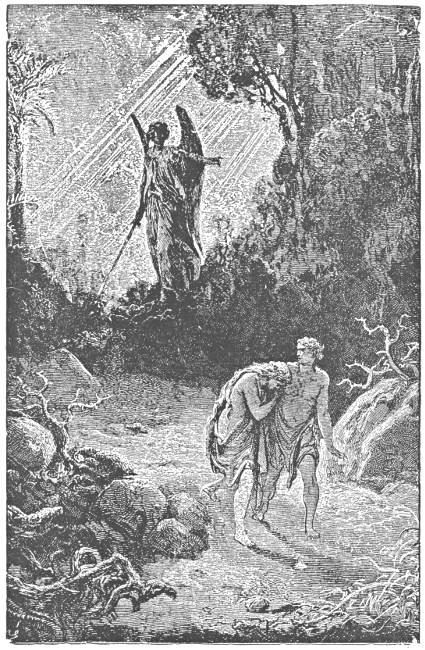
There were eight hundred and fifty of the prophets and priests of Baal altogether. I fancy I can see them all, going up in a grand procession, with the king in his chariot at their head.
“Fine-looking men, aren’t they?” says one man to another, as they go by. “They will be able to do great things up there on the mountain.”
But there Elijah marched, all alone—a rough man, clad in the skins of beasts, with a staff in his hand. No banners, no procession, no great men in his train! But the man who could hold the keys of Heaven for three years and six months was not afraid to be alone.
Now, Elijah says to the people: “How long will ye halt between two opinions? Let the priests of Baal build them an altar and offer sacrifice, but put no fire under, and I will do the same; and the god that answereth by fire, let Him be God.”
So the priests of Baal build their altar.
I am sure that, if God had not held him back, Satan would have brought up a little spark out of hell to set that sacrifice on fire. But God would not let him.
Then they begin to pray: “O Baal, hear us! O Baal, hear us!”
Elijah might have said: “Why haven’t you prayed to Baal for water this dry weather? You might just as well have asked him for water as for fire.”
After a long time they begin to get hoarse.
“You must pray louder than that, if you expect Baal to hear you,” says the old prophet. “Maybe he is asleep. Pray louder, so as to wake him up.”
Poor fellows! They haven’t any voice left. So they begin to pray in blood. They now cut themselves with knives, and lift their streaming hands and arms to Baal. But no fire comes down.
It is getting toward sundown.
The prophet of the Lord builds an altar. Mind you, he does not have any thing to do with the altar of Baal. He builds an entirely different one, on the ruins of the altar of the Lord, which had been broken down.
“We will not have any one saying there is any trick about this thing,” says the prophet. So they bring twelve barrels of water and pour over the altar. I do not know how they managed to get so much water, but they did it.
Then Elijah prays: “O God of Abraham and of Isaac and of Jacob, let it be known this day that Thou art God in Israel.”
He did not have to pray very loud. God heard him at once, and down came the fire. It burnt up the sacrifice—burnt up the wood—burnt up the water—burnt up the very stones of the altar. Jehovah is God; nobody can halt any longer.
Ah, but some of you say: “I, too, would have decided for God if I had been on Mount Carmel that day.” But Calvary is far more wonderful than Carmel. The sacrifice of Christ on the cross is more wonderful than the sacrifice which was burnt on that altar.
GIDEON.
I believe this man Gideon was called an enthusiast in the camp of Israel. The very idea of his going out to meet a hundred thousand men with pitchers and lanterns! How many people would have said: “The man has gone clean mad.” Yes, he was an enthusiast; but the Lord was with him.
If we lean upon ourselves we will have failure, but if we lean upon the arm of God we will see how swiftly God will give us victory. God wants the glory, and no flesh shall glory in His stead. Look at what He said to Gideon.
Gideon had called in an army of thirty-two thousand men. The Lord said to him: “You have too many men. If I give you victory, Israel will vaunt themselves against Me, saying: ‘My own hand hath saved me.’ You can not work with so many, because I must have the glory. Just say to all that are fearful: ‘Depart if you want to.’”
So Gideon proclaimed, in accordance with God’s command, saying: “Whosoever is fearful and afraid, let him return and depart early from Mount Gilead.” And there returned of the people twenty and two thousand, and there remained ten thousand.
I can imagine that Gideon became a little scared at first. Only ten thousand left! But the Lord came again, and said: “Gideon, you have got too many men. If I work with them, you will take the glory.” So he brought down the people unto the water, and the Lord said unto Gideon: “Every one that lappeth of the water with his tongue, as a dog lappeth, him shalt thou set by himself; likewise every one that boweth down upon his knees to drink.”
Three hundred lapped and ninety-seven hundred wheeled out of line. I can imagine they were like many Christians. What can God do with those who are like those of Gideon’s army who were full of fears and doubts? Look at the reduction in that great army. But three hundred men with the Almighty! Three hundred men that side with God can be a power for God. Three hundred like Gideon’s men will move any city. What a routing there was before that band! They fly like chaff before the wind. Do not call any thing small of God.
ITTAI.
I will read a few verses in the fifteenth chapter of Second Samuel, beginning at the nineteenth verse: “Then said the king to Ittai, the Gittite: ‘Wherefore goest thou also with us? Return to thy place, and abide with the king; for thou art a stranger, and also an exile.
“‘Whereas, thou camest but yesterday, should I this day make thee go up and down with us? Seeing I go whither I may, return thou, and take back thy brethren. Mercy and truth be with thee.’
“And Ittai answered the king, and said: ‘As the Lord liveth, and as my lord the king liveth, surely in what place my lord the king shall be, whether in death or life, even there also will thy servant be.’
“And David said to Ittai: ‘Go, and pass over.’ And Ittai, the Gittite, passed over, and all his men, and all the little ones that were with them.
“And all the country wept with a loud voice, and all the people passed over. The king also himself passed over the brook Kidron, and all the people passed over, toward the way of the wilderness.”
What must have been the feeling of David when he got outside the city and found this foreigner and stranger out there with six hundred men, ready and willing to go with him! He had had three men who sat at his table, and in the hour of trial, in the hour of trouble, they had deserted him. It is in the time of darkness that we find out our friends. You find then who are your friends.
Now, David was in trouble, and here was this Ittai standing right by him. How that must have cheered the heart of the king! He had been driven from the throne by Absalom, and the whole kingdom seemed to be going with Absalom. Absalom and those who were with him were planning to take the life of David, but here we find this stranger—this man Ittai—just following David; and when David told him to go back, see what he says. I think it is one of the sweetest things in the whole life of David:
“Then said the king to Ittai, the Gittite: ‘Wherefore goest thou also with us? Return to thy place, and abide with the king; for thou art a stranger, and also an exile.
“‘Whereas, thou camest but yesterday, should I this day make thee go up and down with us? Seeing I go whither I may, return thou, and take back thy brethren. Mercy and truth be with thee.’”
Here was a man who was attached to a person. That was the point I wanted to call your attention to. We are living, I think, in the day of shams. There are a good many people who are attached to creeds, denominations and churches. They are attached to this and to that, instead of a person. Creeds and churches are all right in their places, but if a man puts them in the place of the Savior and the personal Christ, then they are but snares. He would be willing to give up every thing but Christ in the hour of trouble, and if he is attached to Christ he will be able to say: “Wherever Thou goest I go.” David had nothing to offer this man. There he was—barefooted and leaving the throne. Ittai was attached to the man.
David was every thing to Ittai, and life was nothing. No man had better friends than David had in his day. What we want is to be attached to the Lord Jesus Christ as Ittai was attached to David.
JACOB.
The key to all Jacob’s difficulties will be found in the twentieth chapter of Matthew. It is the story of the laborers in the vineyard. The thought is in the second verse. The first men hired agreed to the bargain. The men would not go until the owner of the vineyard had made a bargain with them. He told them that he would pay them what was right. They got a penny. He gave them the lawful wages. They probably asked: “And is this all you are going to give us?”
Jacob was all the time making bargains.
The Christians who are making bargains with the Lord do not get as much as those who trust Him. It does not pay to make bargains with the Lord.
Jacob is a twin brother of most of us. Where you find one Joseph or one Daniel you will find a hundred Jacobs. We are not willing, all of us, to take God at His word and trust Him. There is a strong contrast between the character of Joseph and Jacob. The one trusted God implicitly, but Jacob wanted to trust Him no farther than he could see God. There would have been a great deal of murmuring if Jacob had been thrown into jail in Egypt.
No doubt Jacob got much of his weakness from his mother. There was a division in that home. Isaac favored Esau, and Rebekah favored Jacob. Such dissensions are just the thing to stir up the old Adam in the man. A mother and a father have no right to take this course. Rebekah plans continually to keep Jacob at home. The very thing that Rebekah tries to achieve, in that she fails. By nature Esau was the better of the two. If such a mean and contemptible nature as Jacob’s can be saved, then there is hope for all of us.
The Lord promised to Jacob from the bottom of the ladder what he should have. Jacob gets up and says: “If God will be with me and keep and clothe me, then shall the Lord be my God.” What a low and contemptible idea he had! God had promised him all from Dan to Beersheba.
That is the difficulty with the people at the present time. If God will bless us in our basket and store, we shall have Him for our God. We find Jacob after this in Haran, driving bargains all the time, and the worst of it is he gets beat every time. He had to work seven years for his wife, and then gets another woman in her place. He is paid back in his own coin. We must not think that God will allow us to deceive without punishing us for it. Jacob forgot all the vows which he made at Bethel, but God did not forget His. Some of God’s promises are unconditional. The promise which He made at Bethel was unconditional.
God chose Jacob rather than Esau. Some people say that God hated Esau before he was born. This is not the teaching of Scripture, even though one of the minor prophets long years after mentioned it. God says to Jacob after he had been in Haran for so many years: “I am the God of Bethel. Arise and dwell there.”
Jacob ought to have been proud, and should have left Haran like a prince, but instead he steals away like a thief. He starts off, and his uncle and father-in-law pursue. God took care of him. God was determined to keep His vows, and there is no doubt that, had not God interfered, Jacob would have been slain.
We find that Jacob stays behind, like a miserable coward, after he had sent his effects away. A man out of communication with God is a coward always.
There was a man who wrestled with Jacob. He was Christ. When did Jacob prevail? When his thigh was out of joint all he could do was to hold on and get the blessing. The man who is the lowest down is the man whom God lifts up the highest. The man that has the greatest humility will be the most exalted.
A great many say that Jacob was a different man. Would to God his thigh had been left out of joint, so that there was no more of the flesh in him. The next thing, we find Jacob and Esau embracing, and we would suppose that he would be filled with gratitude. But no. He goes down to Shechem and builds an altar and calls it by a high-sounding name. Jacob in Shechem, with this altar with a high-sounding name, was no better than he was in Haran without an altar. He built an altar, finally, at Bethel. He said that he would go to Bethel and build an altar to his God, as if the Shechem altar was no altar. He called it El-Bethel. Just the moment he came to Bethel the Lord God met him.
The next thing we hear is the saddest episode in the career of Jacob—the death of Rachel, his favorite wife. His sons go back to Shechem, and hunt up the old idols. His sons bring him back news from there that his most dearly loved son was dead. Do you see how Jacob begins to reap the harvest of the sins of his early days? For twenty long years he mourned that beloved boy. He deceived his own father, and his own sons, in turn, deceived him.
What a bitter life! What was Jacob’s dying testimony to Pharaoh? It would take ten thousand Jacobs to get one convert like Pharaoh. “Few and evil,” said Jacob, “have my days been.” He started with a lie in his mouth. He died in exile. He died in Egypt—not in the land which God had promised him. He would not let God choose for him. He was saved by fire—or, as Job said, by the skin of his teeth.
JACOB’S SONS.
Look at the sons of Jacob. Look at them when they took away their brother, and after they had delivered him into slavery see them coming back. How much they must have suffered with their secret during those twenty years! What misery they must have endured as they looked, during all those years, at their old father sorrowing for his son, Joseph! They knew the boy had not been killed. They knew he was in slavery.
For twenty years the sin was covered up, but at last it came back upon them. God had, in the meantime, been doing every thing for Joseph. He had raised him nearly to the throne of Egypt.
A famine struck the land of the father, and the old man sent his sons down into Egypt to purchase corn. God was at work. He was making these men bring their own sin home to themselves. Their consciences smote them, and they confessed, in the presence of Joseph, that their sin had found them out. Twenty years after it was committed that sin was resurrected, and they were brought face to face with it. “He that covereth his sin shall not prosper.”
JOHN THE BAPTIST.
I want to call your attention to John, the forerunner of Christ. On hearing the news of the death of the king Joseph brings Jesus back to Nazareth, and there He remained for thirty years.
I once read of the founder of the Russian Empire going down to a Dutch sea port as a stranger and in disguise, that he might learn how to build ships and return home and impart this knowledge to his own subjects. People have wondered at that. But this is a far greater wonder, that the Prince of Glory should come down here and learn the carpenter’s trade. He was not only the son of a carpenter, but He was a carpenter Himself. His father was a carpenter, and He was a carpenter, too, for we read that they brought it up against Him that He was a carpenter. We read: “And when He was come into His own country, He taught them in their synagogue, insomuch that they were astonished, and said: ‘Whence hath this man this wisdom and these mighty works? Is not this the carpenter’s son?’”
Right here is one lesson that we ought to learn, and that is, when Christ was here He was an industrious man. I have often said on this platform that I have never known a lazy man to be converted. If one ever was converted, he soon gave up his laziness. I tell you that laziness does not belong to Christ’s Kingdom. I do not believe a man would have a lazy hair in his head if he was converted to the Lord Jesus Christ. If a man has really been born of the Spirit of Christ, he is not lazy. He wants to find something to do, and no kind of manual labor is degrading. It is honorable. If our Master, who is the Prince of Peace and the King of Glory, could leave Heaven and come down here and work as a village carpenter, let us not think that manual labor is beneath our notice. Let us be willing to go out and work. If we can not find what we want, let us do what we can. If we can earn only twenty-five cents a day, let us earn that rather than do nothing. We not only want something to occupy our hands, but also our minds.
But this is not the point of the lecture this morning. I want to go back to those two wonderful men.
The thirty years have rolled away, and it is now time that this wonderful Messiah should come unto the nation. The Scriptures have been fulfilled, and the first sound we hear of His coming is that strange voice crying in the wilderness.
Those thirty years that have just expired were as nothing to the nation. Undoubtedly, the rumors about those two children, which created a great sensation at the time, had died out. The story of the shepherds on the plains of Bethlehem had gone out of popular recollection—faded away. The story of this child being brought into the Temple, and that old man and that old woman coming in there just at the time—that wonderful scene had faded away. Many who were in the Temple at that time had gone. Zacharias and Elizabeth had passed away, and the Roman Empire had also died, after sending out a decree that the country should be taxed. Herod was also dead.
A great change had taken place in thirty years. You just carry your minds back through thirty years, and see how many who stood with you thirty years ago—with whom you were acquainted—have gone, and are sleeping in their graves.
If the Holy Ghost had not come after Christ went to Heaven, the story of His death and His resurrection would have been forgotten as soon as His birth and His life. No doubt about that. It is that which has kept the memory of Christ in the world, and His name so fresh and fragrant. The Holy Ghost has come down here to keep in our minds the glory and beauty of Christ. Now, we find His forerunner comes.
Matthew says: “In those days came John the Baptist, preaching in the wilderness.”
Mark says: “The voice of one crying in the wilderness.”
Luke says: “The word of God came unto John, the son of Zacharias, in the wilderness.”
John’s account is: “There was a man sent from God, whose name was John.”
The last prophet had closed up his prophecy by saying that John should come before the Messiah, and that he should be the herald who would come to introduce Him. Now, these four evangelists all take up their pens, and they all notice it.
You know, if you let any four men write up any one thing, they will not all write about it alike. Why, when men went to the Centennial, at Philadelphia, not any four of them wrote about it alike. Let a man come in here, and let any four of us look at him. One will get a side view of him, one a front view, and so on; and no two of the four will see him alike.
So these evangelists wrote about John, but not one of the four used the same language. You know, it was said he was to be like Elijah. Well, he looked like him, dressed like him, and his preaching was like him.
He came suddenly and unexpectedly upon the world, and it was not long before his voice rang clear through the whole nation, and the whole nation was stirred. He stood between the two dispensations. He was the last prophet the new dispensation was to have. They had had some mighty prophets—wonderful men; but this man was to be the last one.
Now, we find this man standing there, as it were, between these two dispensations; and when he commenced to preach his preaching was very much like that of Elijah. He was a reformer. His cry was: “Repent! Reform!”
But if he had stopped there his reform would have died out with him. A great many reformations die out with the reformers because they cry out: “Repent! Repent! Reform! Reform!” but they do not get any farther than that. Thank God, John had something else to tell them. He did not stop at “Repent! Repent!” He kept telling them there was One coming mightier than himself. Undoubtedly that was what thrilled the nation. Talk about sensation! There was never a nation moved as that one nation was moved by John the Baptist.
In these days, if certain persons want to stir a town or city, they need to influence the leading men of that city to stand around them, help them and pray for them. But there stood John the Baptist, preaching in the wilderness, without any influence of your committee. He did not have Mr. Sankey to sing for him to draw out the people. He stood there upon the banks of the Jordan alone, preaching the glorious tidings that the Messiah was coming after him, and he probably was preaching this to the lowest beggar in the land.
There John was in the wilderness, dressed like his predecessor, Elijah. There he was, preaching in the wilderness; and just bear in mind, it was not any milk-and-water preaching. He gave the message just as God gave it to him. I suppose, if he had some of the Christians of the present day there, they would have said: “Do not be so bold; be mild about it. Don’t you know you must use a little moderation about this? Come, John! If you talk against these Pharisees they will cut your head off.”
But that did not enter his mind. It was not what they wanted. It was what God gave him to deliver; and if any man just takes the message and delivers it as God gives it to him, I tell you God will stand by him. He is going to succeed—mind that. He may be unsuccessful at first; his labor may seem to be unprofitable for a time, and people may turn away. But the time will come when his words will cut deep down into their hearts and lead them to salvation.
Then the people began to tremble. They had no newspapers then to print the sermons; they had no telegraph wires to flash them over the country. But one man just took the matter up and passed it to the next, and so on, and very soon it was spread over the whole country.
“There he is,” they said, “dressed just like Elijah, with his leathern girdle and his raiment of camel’s hair.” He comes out about 9 o’clock in the morning, and there he stands on the banks of the Jordan, and there he continues his talk. Day after day he is seen there, and his cry is: “Repent! Repent!” And that was his appeal.
Well, it is not very long before every city, town and village has heard of this wonder. John preached the law just as it was given him, and as a specimen of his preaching just read this. See how bold he was: “Then said he to the multitude that came forth to be baptized of him: ‘O generation of vipers!’”
O generation of vipers! Pretty hard talk, wasn’t it? I don’t know as you could get many people into this Tabernacle by such talk as that. But he knew what he was doing. He knew they hated his Master. He knew that, away down in their hearts, they were at enmity with God. Read a little farther, and see what he said: “O generation of vipers, who hath warned you to flee from the wrath to come?
“Bring forth, therefore, fruits worthy of repentance, and begin not to say within yourselves: ‘We have Abraham to our father.’ For I say unto you that God is able of these stones to raise up children unto Abraham.”
He knew the men pretty well. I do not know where he had been all these thirty years. But he had found out the human heart. He had found out human nature pretty well. And those people undoubtedly said: “We belong to the seed of Abraham. We are the descendants of Abraham. We do not need to be converted. We have got the law from Moses, and we obey that. Let these poor dogs of Gentiles be converted. It is not for us.”
And that is just the doctrine now.
“We do not need to be converted. John a first-rate reformer? Oh, yes; but that does not touch us. We go to church regularly. It is for these publicans and harlots. That kind of preaching is not for us. Oh, it is all good enough—all very good.”
And no doubt they would put up a Tabernacle for them—for the harlots and drunkards to go to.
“Oh, no! That preaching is not for us. It is good enough for them, but we do not need to go. We are the seed of Abraham. We belong to Moses, and we are not such bad men. What do you mean by conversion? We do not need to be born again. What do we need to be born again for? We pay our debts. We are good men.”
See? That same old spirit. Eighteen hundred years have rolled away, and you find human nature the same. John knew them pretty well.
“I say unto you that God is able of these stones to raise up children unto Abraham.”
You need not flatter yourselves that you are better than the other people. God can make children right out of these stones, and make them the seed of Abraham.
“And now, also, the ax is laid unto the root of the tree; every tree, therefore, which bringeth not forth good fruit is hewn down and cast into the fire.
“And the people asked him, saying: ‘What shall we do, then?’”
See! They had an inquiry meeting, right there on the banks of the Jordan.
“He answereth, and saith unto them: ‘He that hath two coats, let him impart to him that hath none; and he that hath meat, let him do likewise.’
“Then came, also, publicans to be baptized, and said unto him: ‘Master, what shall we do?’
“And he said unto them: ‘Exact no more than that which is appointed you.’
“And the soldiers likewise demanded of him, saying: ‘And what shall we do?’ And he said unto them: ‘Do violence to no man, neither accuse any falsely, and be content with your wages.’”
Now, that was his preaching up to the time that Christ came. As I said before, it was: “Repent! Repent! Reform! Reform!” And you may tell these men they ought to do better; but if you do not tell them how, you can not save them. Now, we find here, in this fifteenth verse, that they were looking for something more: “And as the people were in expectation, and all men mused in their hearts of John, whether he were the Christ or not, John answered, saying unto them all: ‘I, indeed, baptize you with water; but One mightier than I cometh, the latchet of whose shoes I am not worthy to unloose. He shall baptize you with the Holy Ghost and with fire.
“‘Whose fan is in His hand, and He will thoroughly purge His floor, and will gather the wheat into his garner; but the chaff He will burn with fire unquenchable.’
“And many other things in his exhortation preached he unto the people.”
Now, what a chance there was for John to have let self come in! When people were wondering in their hearts if he was not the true Messiah—if he was not Christ—he might have been tempted to come out and say he was more than himself—that he was Christ. But there was this commendable trait about John: He never preached up self.
He was preparing the nation to receive the Lord of Glory. He had come merely to introduce Him. He was nothing. Just as a man comes and introduces a friend to you, he barely introduces him and steps aside. He does not put himself forward.
So John introduces the Son of God, and then begins to fade away, and soon is gone. He had not come to introduce himself, but to preach Christ.
And let me say, right here, that this is the very height of preaching. When they begin to wonder who he is, he just comes right out and says: “I am not Jesus. I am only just one sent to introduce Him. I have come for that purpose. I have not come to preach up myself, but Him that is mighty to save.”
And then we find that while his star was just at its height, while he was just about at the zenith of his glory, while people were flocking in from the towns and villages to hear him, the chief rulers of Jerusalem send down a deputation to inquire what this religion meant. They appointed some influential men to find him out, and they said to him: “We have been sent by the chief priest of Jerusalem to find out who you are. Are you Christ?” And John answered: “No.” “Well, who are you? Are you this man or that man?” “No.” “Are you this prophet or that prophet?” “No.” “Well, who are you?”
Did he say: “I am Jesus”? No. “Merely Mr. Nobody—merely a voice crying in the wilderness.”
What a message that was to send back to Jerusalem! He was not trying to put himself forward. He was all the time trying to get out of self. In the nineteenth verse and first chapter of John we read: “And this is the record of John, when the Jews sent priests and Levites from Jerusalem to ask him: ‘Who art thou?’
“And he confessed, and denied not; but confessed: ‘I am not the Christ.’
“And they asked him: ‘What, then? Art thou Elias?’ And he saith: ‘I am not.’ ‘Art thou the prophet?’ And he answered: ‘No.’
“Then said they unto him: ‘Who art thou? That we may give an answer to them that sent us. What sayest thou of thyself?’
“He said: ‘I am the voice of One crying in the wilderness. Make straight the way of the Lord, as said the prophet, Esaias.’
“And they which were sent were of the Pharisees.
“And they asked him, and said unto him: ‘Why baptize thou, then, if thou be not Christ, nor Elias, neither that prophet?’
“John answered them, saying: ‘I baptize with water; but there standeth One among you whom ye know not. He it is who, coming after me, is preferred before me, whose shoe’s latchet I am unworthy to unloose.’
“These things were done in Bethabara, beyond Jordan, where John was baptizing.”
Now, this was the day, I say, when John was at the very zenith of his glory; but see how noble he stood. He did not take any honor or glory to himself, and in two different places he declared that he knew not this Stranger that he was the herald of—his Messiah.
Some are trying to make out that this was all planned by John and Jesus, that he should say he did not know Him. But he declares in two places that he did not know Him. They were brought up in two extremes of the country—one in the northern part of it, Nazareth, and the other at Hebron.
Talk about eloquence! John was one of the most eloquent men, I suppose, that ever lived. He was the herald of God, and when the nation was in a terrible state of excitement, and the chief priests of Jerusalem, and even the king himself, went to hear him.
There he stood on the banks of the Jordan. I can see the men and women on both sides of the river—little children, mothers with their babes in their arms—all intensely excited and leaning forward to catch what he says. “Now,” says John, “if you believe what I say, that if you have broken the law given at Sinai you have sinned, to be forgiven you must repent and come down into this Jordan, and I will baptize you in the name of the God of Hebron.”
The people went in by scores and hundreds, and there he baptized them. And as he stood there baptizing them I can imagine about twenty thousand people hanging upon his lips. There was a man came down through the crowd. I can imagine that John was a man who looked as though he was more like a mountain eagle, but his wings seemed to droop. That eye which had been so keen and so severe on the Israelites when he called them a generation of vipers became lusterless, his face fell and he shook his head, as this Stranger came.
I suppose, as He came walking along toward John, God revealed the fact to him and said: “This is My Son. This is the Savior of the world. This is the Prince of Peace.” And when John saw Him he quailed before Him, and he said: “I have need to be baptized of Thee.”
What excitement! How it must have thrilled the audience as John drew back and said: “I have need to be baptized of Thee.” John knew Him. John at once recognized Him. He knew He was the promised One of the law. John said: “I have need to be baptized of Thee, and comest Thou to me?” But Jesus said unto him: “Suffer it to be so now, that the law may be fulfilled.” Now, what excitement as these two men went down into the river together!
Oh, if Jordan could speak it could tell some wonderful stories! Wonderful scenes have taken place there. Naaman had gone into that river and washed, and had come forth clean. Elijah, going up with his mantle, struck the water and went over dry-shod, as also did Elisha after Elijah had ascended. But a more wonderful scene was taking place in Jordan than ever took place before. It was of transcendent interest to all mankind.
Our Lord was going down into Jordan to be baptized, and He was going to come up on resurrection ground. So He goes down with John the Baptist, and the moment He was baptized and came up out of the water the heavens were opened unto Him, and the Spirit of God descended upon Him like a dove, and alighted upon Him. Heaven witnessed the scene. God the Father spoke then. He broke the silence of ages. The God of the Old Testament was the Christ of the New. And he heard a voice from Heaven, saying: “This is My beloved Son, in whom I am well pleased.”
Some one says that was the first time God could look down on the world since Adam fell and say that He was well pleased. In Hebrews, tenth chapter and seventh verse, we read: “Lo, I come (in the volume of the book it is written of Me) to do Thy will, O God.”
He was the Son that was born above. The heavens opened and the Holy Ghost descended upon Him. The Spirit of the Lord came down on Him, and God owns Him and recognizes Him.
Now, there is another thought to which I want to call your attention. John’s preaching changed. But he was not like many men of the present day, who want to reform the world without Christ, who set a good example and tell men to sign pledges and to do this or that, and to trust in their own strength.
The moment John got his eye on Christ he had one text: “Behold the Lamb of God that taketh away the sins of the world.” That is how you are going to get rid of your sins. Says John: “I bear record of this in the Son of God.” And he told his disciples: “Now, you follow Him. Go with Him.”
One afternoon, as he sat there with his disciples, he said: “Behold the Lamb of God!” And they left him to follow Jesus—two of his own disciples. I tell you that is something which you do not like to do—to make your friends leave you; to preach them away—your own congregation. But now this man begins to ask his disciples to leave him. “Why,” said he, “I tell you I am not worthy to just unloose His shoes. He is more worthy than I am. Follow Him.” He began to preach up Christ. “He must increase; I must decrease.”
Some of his disciples came to him one day and said: “You know that Man you baptized over there in the Jordan? Well, more men are coming to Him than are coming to you.” That was jealousy—envy rankling in those men’s bosoms. But what did John say? “I told you that I was not He. Why, He must increase, and I must decrease. That’s right, I would rather see the crowd flocking to hear Him.”
John, I think, was terribly abused by some one. He was cast into prison. Then he sent two of his disciples to inquire of Christ if He was the true Messiah, or must he look for another. I do not know, but I have an idea that he wanted his disciples to leave him and go over to Jesus. So he called two of his most influential disciples and told them: “Now, you go and ask Him if He is the true Messiah.” I can not believe in John’s faith wavering; but, if he was wavering, he took the very best way, and sent those men to ask the Savior.
I see his deputation arrive, and when Jesus had finished preaching these disciples come up and say: “Our master has sent us to ask if You are the true Messiah? Or, shall he look for another?”
Jesus goes on healing the sick, causing the lame to leap, giving sight to the blind, making the deaf to hear, and after He had gone on performing these miracles He said to John’s messengers: “You go back and tell your master what you have seen and what you have heard. Go back and tell John that the blind see; that the deaf hear; that the lame walk, and that the poor have the Gospel preached to them.”
When John heard that, in prison, it settled all his doubts. His disciples believed, and the poor had the Gospel preached to them. That was the test, and then John’s disciples, one after another, left him. And now we find him thrown into prison. There he is, in prison—awaiting his appointed time.
Just bear in mind that God had sent him. His work was done. He had only just come to announce the Savior—only for that object. Some think that Christ’s treatment of John was rather hard—in fact, harsh; but the greatest tribute ever paid to any man was paid by Jesus to John.
“But what went ye out to see? A man clothed in soft raiment? Behold, they that wear soft clothing are in kings’ houses.
“But what went ye out to see? A prophet? Yea, I say unto you, and more than a prophet.
“For this is he of whom it is written: ‘Behold, I send my messenger before thy face, which shall prepare thy way before thee.’
“Verily, I say unto you: ‘Among them that are born of women there has not risen a greater than John the Baptist; notwithstanding he that is least in the kingdom of Heaven is greater than he.’”
There was none greater than this same John. Our Savior knew that John was going first. He knew that He was soon to die, and that John would have to come to Him; that they would soon be together in Glory, and then they could talk matters over; that John must sink out of sight, and the Lord of Glory must be the central object.
Jesus and John were like the Sun and Moon in comparison with the stars. All the prophets were like the stars in comparison with those two men. There was no prophet like John. None born of woman was greater. Moses was a mighty prophet. Elijah was the son of thunder, and a great and mighty prophet; and so was Elisha. But they were not to be compared with John.
What a character! He lost sight of himself entirely. Christ was uppermost; Christ was the all-in-all with him. He was beheaded outside the Promised Land. He was buried in Moab, somewhere near where Moses was laid away. The first and last prophet of that nation were buried near together, and there they lie, outside the Promised Land; but their bodies, by-and-by, will be resurrected, and they will be the grandest and most glorious in God’s kingdom.
JOSHUA.
Joshua was a man who walked by faith, and you will find the key to his character in three words—courage, obedience and faith.
Courage, obedience and faith. And he dared to be in the minority.
Now, friends, there are very few men at the present time who like to be in the minority. They always want to be in the majority. They want to go with the crowd. But when a man has laid hold of the Divine nature of God, and has become a product of the Divine nature, he is willing then to go against the crowd of the world and be numbered with the minority.
Where Joshua met the God of Israel first we are not told. We do not catch a glimpse of him until the man is about forty years old. The first sight we get of Joshua is as he comes up out of Egypt. We are told that after Moses had struck the rock in Horeb and the children of Israel had drank the water that came out of that rock—and that rock was typical of Christ and of God’s pure throne—Amalek came out to fight them, and after they had got a drink of this pure water they were willing to meet him.
We find that Joshua’s first battle was successful, and that his last one was successful. He never knew what defeat was. He was successful because he believed in the Lord God of Heaven—because he had perfect faith in God. Moses went up into the mountain to pray, and while he was praying Joshua was down fighting Amalek. And when Moses held up his hand Israel prevailed, and when he let down his hand Amalek prevailed.
“And Aaron and Hur stayed up his hands—the one on the one side and the other on the other side—and his hands were steady until the going down of the sun.”
His hands were up until Amalek was defeated.
There is only one thing against Joshua. He was opposed to the preaching of Eldad and Aminidab. He did not like to see Eldad and Aminidab out there preaching in the camp, because they did not belong to the Apostolic body. So he says to Moses: “I wish you would rebuke Eldad and Aminidab for preaching in the camp. I do not want them to preach there.”
But Moses said: “No! I will not rebuke Eldad and Aminidab. That’s just what we want. I wish to God there were more of them.”
After Moses rebuked Joshua we never hear him complaining any more about Eldad and Aminidab. That is the only thing on record against him. The next thing we hear of is the matter of those twelve spies, and I will pass over that. You remember how they came back, and Joshua and Caleb were the only two out of the twelve that dared to bring in a minority report. But now the forty years’ wilderness journey is over, and during all those forty years you can not find any place where Joshua or Caleb ever murmured or complained. They were not of that kind.
Now, as I said, the forty years’ wilderness journey is over, and Moses is about to leave. He went up into Mount Nebo, and “God kissed away his soul and buried him.”
Then Joshua was commanded to take charge of the army. The word of the Lord came to him, saying: “Joshua, arise and go over this Jordan. Moses, my servant, is dead.”
There was no president, no general, no marshal about it. There was no title at all, but just merely: “Joshua, arise and go over this Jordan.” Now, Joshua just obeyed, and here you will find the secret of his wonderful success. He did just what the Lord told him to do. He did not stand, like many people would have done, and say: “I don’t know how I am going to get these people over. Hadn’t you better wait, Lord, until the next day? How am I to get these three million people over this angry flood? Hadn’t we better wait until the waters recede?”
No! Joshua did not say that. He had got his command from God: “Arise and go.” When the Lord gave orders, that was enough. He had got His word, and he brings these children of Israel down in sight of the swollen stream. Faith must be tried. God will not have people whom He can not try.
Joshua brings them there in three days, in sight of the angry flood, with not a word of murmuring. If he had brought them there forty years before, what murmuring there would have been! We will get trained—every one of us.
They had had their faith tried in those forty years in the wilderness, and now they murmured not. There was not a word of complaint. But forty years before they would have asked, when they had got opposite Jericho: “What is He going to do? How are we going to get over? We’ve got to have a bridge or a pontoon. And even if we get over, they will see us and defeat us. They will slay us here on the bank of Jordan. Guess we had better turn around and go back.”
That is about what they would have said, what they would have tried, and what they would have done forty years before. But now Joshua tells the people that the priests are to walk out in front of them, and that the moment the priests touched the water—the moment the soles of their feet touched the water—the water was to be cut off.
There was faith for you! When those seven men took up the ark God was with them, and the moment the soles of their feet touched the water the waters were cut off, and they passed into the middle of the stream and put down the ark.
That ark represented the Almighty. He was in the ark, with the ark right there in the midst of death—for Jordan is death and judgment—right in the middle of the stream. He held that stream in the palm of His hand. And now the people pass beyond—three millions of them.
You can hear their solemn tread. Not a word said on their march through death and judgment until Joshua led them on to Resurrection Ground. After he had got them all over, he told twelve men—one from each tribe—to take each a stone and set them up where the priests stood, so that when their children asked “What mean ye by these stones?” they could tell how the Almighty brought them through dangers into the Promised Land.
Now, after they had placed their stones, the ark was brought up out of the Jordan, and the waters rolled off. Instead of moving right on at once to Jericho, the children of Israel stopped to keep the Passover. They were in no hurry. They were willing to worship God. They kept the Passover, and after that they started for Jericho. Jericho was shut off, undoubtedly, and surely the hearts of those people were filled with fear. Here the children of Israel had come to their country and their God had brought them through the Red Sea with an out-stretched arm. Surely there was a strange God among them. Jericho had no such God as that. He had defended them and led them, and had given them light and life after that.
But now Joshua just takes a walk around the walls of Jericho. God had ordered him to take it, and he must. And as he was walking around, viewing the walls of Jericho, all at once a man stood right in front of him with a drawn sword right over him, and God said: “No man can be able to stand before you all the days of your life.” And Joshua steps right up to him, and asks: “Art thou for us or for our adversaries?” The stranger answered: “I am captain of God’s host, come to lead you to victory.”
Then Joshua fell on his face, and God talked with him. How many men of the present time would have laughed at Joshua if they had been in Jericho! How much sport they would have made of him! If there had been a Jericho Herald, what articles would have come out! The idea of taking the city in that way! The ark was to come out, and the priests were to blow rams’ horns. That was very absurd, wasn’t it? Rams’ horns!
Well, the seventh day came, and they were up quite early in the morning. Here were these seven men blowing their rams’ horns, and the people going around for the seventh time. At the end of the seventh time Joshua says: “Shout, for the Lord has given you the city.” They shout, and down tumble the walls of the city. Then they went up and entered Jericho, and every man, woman and child of that city perished. God had given the order, and His commands were obeyed.
Now they move on to Ai. You know, after a victory is gained over some large town they attack and take the little outlying towns. So, in this case, they moved right on to Ai. Joshua sent men from Jericho to Ai, and they came back and told him that just a few thousand men could take Ai; and they go up and are repulsed. Then Joshua rends his clothes and falls on his face, and asks God what the fault was. He knew the fault was in the camp—not God’s.
When they went into Jericho they were told not to touch one solitary thing. But there was Acham, who saw a nice garment—perhaps he thought it would be a nice dress for his wife. He also saw two hundred shekels of silver and a wedge of gold, and he coveted all these things and took them. He hid them, but he could not conceal them. He had to confess that he had sinned against the Lord God of Israel. Those men of Ai were so humbled that they could not stand before the Lord.
After leaving Ai, we read that Joshua came to Mount Ebal, and there a wonderful thing took place. On one side, on the slope of Mount Gerizim, were half of the children of Israel, and on the other side, on the slope of Mount Ebal, were the other half. There were three million people gathered there, and the whole law of Moses was read over to them.
It was a solemn sight. Moreover, all the law of God was read—not a part, but the whole. Joshua read the blessings and cursings. He did not stand up there like some one reading a moral essay and say that they must be good for they were going into the Promised Land; that there were blessings for them, and said nothing about the curses. No; he did not do that. He read all.
It says here, in the eighth chapter: “And all Israel and their elders and officers and their judges stood on this side the ark and on that side, before the priests, the Levites, which bore the ark of the covenant of the Lord, as well the stranger as he that was born among them; half of them over against Mount Gerizim and half of them over against Mount Ebal, as Moses, the servant of the Lord, had commanded before, that they should bless the people of Israel. And afterward he read all the words of the law, the blessings and cursings, according to all that is written in the book of the law.”
Now, mark that. “He read all the words of the law, the blessings and cursings, according to all that is written in the book of the law.” If Joshua had been like many of the present day, he would have said to himself: “I will read the blessings, but not the cursings. I do not believe God is going to curse a man if he does wrong, so I will read the blessings and omit the cursings.” But, thank God, he read the whole law—the blessings and the cursings. He did not keep back any thing. “And there was not a word of all that Moses commanded which Joshua read not.” Thank God for such a man! That is the kind of men we want nowadays—men who will not cut the Bible to pieces like the king who took out his penknife and said: “I don’t like that; cut that out. I don’t like this; cut this out.” So they cut and slashed the Bible until very little was left.
The thirty-third verse of the eighth chapter says they were all there—“as well the stranger as he that was born among them.” You see, Joshua made no distinction. He read to the stranger as well as to those that were of the children of Israel. It was all read.
And now Joshua is ready to move on. The law had been read, they had worshiped their God, and they were ready to move on. Undoubtedly the nations throughout that land had heard how this solemn assembly had met on the mountain side and the law had been read. Now they are ready to move on again. They had been there about three days.
Some one now comes to Joshua with startling news. The messenger begins with the question: “Joshua, have you heard that there is a confederacy formed to oppose you? Instead of meeting one man you are to meet five. They are coming down from the mountains with great regiments of giants. Why, the mountains are full of the sons of Anak—full of giants—and some of them are six feet high. Why, they are so big that they would scare our own men to death. Why, one man came out and just shook his little finger at our men, and scared them out of their lives. There was not a man who dared to meet them. The whole land is full of giants. Do you know that they have formed a confederacy? Five kings are coming down against you with hordes of these giants.”
I see the old warrior. He does not tremble at all. He had received the word of God: “Joshua, be of good courage. No man shall be able to stand against you.” He moved on in his godly armor and in the name of his God, and he routed his adversaries. The hour was growing late, and he commanded Sun and Moon to stand still, and they obeyed him. So there were two days in one. He found the five kings hid away in a cave, and he took them out and hanged them. He took thirty-one kings and kingdoms. He just took that land by faith.
Now, some people ask: “What right had he to come over and take that land?” If you will read the fourth verse of the ninth chapter of Deuteronomy, you will see what right he had. “Speak not thou in thine heart, after that the Lord thy God hath cast them out from before thee, saying: ‘For my righteousness the Lord hath brought me in to possess this land.’ But, for the wickedness of these nations, the Lord doth drive them out from before thee.”
That is why He drove them out. Their cup of iniquity was filled, and God just dashed it to pieces. When any nation’s cup of iniquity is full, God sweeps them away.
Now, mark the Scripture: “Not for thy righteousness or for the uprightness of thine heart dost thou go to possess their land; but, for the wickedness of these nations, the Lord thy God hath driven them out from before thee, and that He may perform the word which the Lord swore unto thy fathers—Abraham, Isaac and Jacob.” “Understand, therefore, that the Lord thy God giveth thee not this good land to possess it for thy righteousness; for thou art a stiff-necked people.”
They were a stiff-necked people. It was not for the righteousness of the children of Israel that the Lord gave them this land. He hated these nations on account of their wickedness.
Now, Joshua has overcome them and driven them from the face of the earth, and this brings out one noble trait in his character. When he came to divide up the land, Joshua took the poorest treasure himself, that he might be near the ark. And there, on Mount Ephraim, he died at the ripe old age of one hundred and ten years. During all those years not a man was able to stand before him. See the contrast between his dying testimony and that of Jacob! Jacob’s self-reproach was: “Few and evil have the days of the years of my life been.” He had a stormy voyage.
Look and see this old warrior going to rest. He had tried God forty years. He had heard the crack of the slave driver’s whip, down there in Egypt. But probably he had a praying mother, who talked to him about this King of the Hebrews, about the God of Abraham, of Isaac and of Jacob, and he believed in that God. When Moses came down into Egypt he found this young man just in the prime of his life. Joshua recognized in Moses that he was an instrument of the Almighty, and that the King of the Hebrews had sent him there to deliver His people.
Joshua had tried God forty years in the wilderness, and when eighty years old he was called into the Promised Land. He had tried God thirty years in Canaan, and now, at the age of one hundred and ten, the aged and invincible warrior is going home. But he is not going to die like an infidel. He knows he is about to die, and he calls for all the tribes of Israel and their elders. These come up from the tribe of Benjamin, the tribe of Simeon, the tribe of Zebulon, and so on; and they are gathered at Shiloh, to be there to hear the old prophet and patriarch.
That man of God speaks, and what does he say? What is his dying testimony? How we all linger around the couch of our dying friends! How anxious we are to get their last words!
Well, let us turn back. What are the last words of this man who has tried God and proved God? These are the words: “I am going the way of all the earth; and ye know in your hearts and in all your souls that not one thing hath failed of all the good things which the Lord your God spake concerning you. All are come to pass unto you, and not one thing hath failed thereof.”
Not one good thing has failed! God has kept His word. God has made His word good. “Not one good thing hath failed.” What a dying testimony! How glorious! In the beautiful sunset light the old warrior sank away, like he was going to sleep. In the dusk of a beautiful Summer’s evening he passed away. There is the old man’s dying testimony. He could tell the people of God. He was the only one left. The rest had gone. Moses had sunk into his desert grave, and the other leaders of the tribe of Israel had passed away. But now he was going to die in the Promised Land.
Truly, he was a man of courage, obedience and faith.
LOT.
One reason why I take up this character is because I believe he is a representative man, and perhaps there is no Bible character that represents so many men of the present day as Lot of Sodom.
Where you can find one Abraham, one Daniel or one Joshua you can find a thousand Lots.
Lot started out very well. He got rich, and that was the beginning of his troubles. He and Abraham, his uncle, went down to Egypt, and they came out of Egypt with great wealth. The next thing we hear of is strife among their herdsmen.
But Lot could not get up a quarrel with Abraham. Abraham said to him: “You are my nephew, and I can not quarrel with you; but take your goods and go to the right and I will go to the left, or I will go to the right and you go to the left.” And they separated.
Right here Lot made his mistake. He should have said, in reply to Abraham: “No, uncle! I don’t want to leave you. The Lord has blessed me with you, and I do not wish to leave you.” But, if he had been determined to leave his uncle, he should have asked Abraham to choose for him. Instead of that, he lifted up his eyes and saw the well watered plains of Sodom, and that decided him.
No doubt Lot was very ambitious; he probably wanted to become richer. Perhaps there was a little spirit of rivalry toward his uncle. He wanted to excel Abraham in worldly goods—to become rich faster. So he saw and determined upon the well watered plains of Sodom. If he had asked Abraham he would not have gone there. If he had asked God, Lot would never have entered Sodom; no man ever goes into Sodom by God’s advice. He determined for himself, and pitched his tent toward Sodom. I do not know how long Lot lived upon those well watered plains, but no doubt the men of those days said of him when he had settled down: “There is a shrewd man; he is a smart man. Why, I can predict that in a very short time he will be a wealthier man than his uncle, Abraham. Look at these well watered plains. Why, he is a great deal better off than is Abraham now.”
Lot is in a position in which he can soon become a rich man. How long he remained on those plains I do not know, but the next thing we know is that he got into Sodom. We are told that Sodom was very wicked. Lot lived near it, and he went into it with his eyes open, for he knew all about it. The wickedness of Sodom was coming up to God. He was going to destroy it soon. Do you think, if Lot had asked Him, He would have permitted the nephew of Abraham to enter that city?
All the years that Lot was in Sodom we do not read that he had any family altar. He must have known it meant ruin for his family to take them in there. But he did not look at that. It was business that took him there. He might have said: “Well, I’ve got a large family. I’ve got a great many dependent upon me, and I must get rich faster; so I will go into Sodom. Business is the first consideration, and it must be attended to.” So he goes into Sodom, and the next thing we hear he is in trouble. Sodom had got a war on hand, and when he went into the city he was forced to take its side. In the war he was taken captive. It is a great mercy he was not killed in battle.
The first thing Abraham did when he heard of his nephew’s trouble was to set out after him. When Lot was captured in battle he was liable to be taken into slavery, and his children also. He might have died in slavery if Abraham had not gone after him. But Abraham takes his servants and sets out and overtakes the warriors who had taken Lot captive, and brought him back, with all the property that had been taken.
Now, you would think Lot would have kept out of Sodom. You would expect to hear of his saying: “I have had enough of Sodom; I will not go near it again.” You would think that men, when they get into this and that difficulty and affliction, would keep out of Sodom; but they will not. It is one of the greatest mysteries to me why men will remain in their Sodom when they have continual trouble.
So Lot went back. Probably he said: “I’ve lost a great deal, and I must go back and try to recover it. I must go back and make it up for my children.” And he prospered in Sodom.
If you had gone into Sodom before these angels came down you would probably have found that no man had got on so well. If they had a Congress, perhaps they sent him to represent Sodom, because no man had done better in business. That is the way of the world. Possibly they might have made him Mayor of Sodom. If you could have seen his “turnout,” it would have been one of the very best. Mrs. Lot must have moved in the most select society of the city. The Misses Lot were looked upon as the most fashionable people there. They got on well.
Perhaps Lot was a judge and had great influence. When the angels got to the gate they might have heard of the Honorable Judge Lot. It sounded pretty well. He might have owned many corner lots. He might have owned many buildings with “Lot” printed all over them, and on account of his property he might have been a very high man in Sodom. That is the way the world looks at it. No doubt the dispositions of those people were exactly as they are today. Human nature has been pretty much the same always.
But time rolls on, and Lot, while sitting at the gate one evening, saw two strangers upon the highway. They are coming toward Sodom. Likely these Sodomites did not know them, but twenty years before Lot had been in the company of Abraham, and he had seen these men at his uncle’s house—had seen them sitting at his uncle’s table. So he knew these angels when they approached, and he bowed down and worshiped them; he bowed down to the ground, and then invited them into his residence. But it was a sink of iniquity, and they would not enter in. Lot pressed his invitation upon them, and finally they accepted.
The news was soon noised around the streets that he had two strangers there, and it was not long before a crowd was around the door, and wanted to know whom he had inside.
Lot came out and endeavored to pacify them, but he was met with the derisive query: “Who made this fellow a judge over us?” He was dragged back into the house, and the door was shut against the mob. His influence was gone. He had been in the city twenty years and had not made a convert.
I suppose Lot lived in a marble front house there, and his heart was away from God. Then these men said to Lot: “Whom have you got here beside yourself? What is your family? Have you got any others beside yourself in this town?”
Well, the father and mother had to own up that they had married their children to some of the Sodomites. That was the result of his going into the city. You go into the world and live like the world, and see what the result will be. How many fathers and mothers are now mourning on account of marrying their sons and daughters to Sodomites! Marrying them to death and ruin!
These angels said to Lot: “If you have got any, get them out of this place, for God is determined to burn it up. Tell them this, and if they will not come, escape for your lives and leave them, for He will surely destroy the city.”
Now, all these twenty years we do not know that Lot ever had a family altar. He could not call his children around him and pray to his God. They had all become identified with Sodom and its people.
Look at that scene. There are the men at the outside of the door, groping about to find it, and the door opens and Lot starts out to tell his son-in-law of the coming destruction. I can see the old man, head bowed down, passing through the streets of Sodom at midnight.
He goes to a house and knocks. No sound; all are asleep. He knocks again, and likely shouts at the top of his voice; and the man gets up and opens the window. He puts his head out and asks: “Who’s there?”
“Lot, your father-in-law.”
“What has brought you out of bed at this hour? What’s up?”
“Why, two angels are at my house, who say that God is going to destroy Sodom and every one who shall remain here.”
“You go home and get to bed.”
They mock Lot. He has lost his testimony. They all think he is deluded.
I can see him now, going off to another daughter’s house. I know not how many daughters Lot had. He might have had as many daughters as Job. He goes to them, and they mock him, too.
There is that old man, in that midnight hour, plodding along those streets of Sodom to urge them to flee from the city, and they mock him. He had been long enough with Abraham to know that every thing that came from God could be relied upon.
Now he starts back home. You can see him—his head bowed down, his long white hair flowing over his bosom and tears flowing from those aged eyes! The world calls him a successful man; but what a miserable end is his! Look at him tonight! He had achieved his ambition, and was wealthy. He obtained what he longed for, but with it came leanness of soul.
Next morning the angels take him by the hand. He and his wife and two daughters are led out of the city. And they lingered. How could they do otherwise than linger, when they had left their sons and daughters in the city and knew they would be destroyed?
Yes, they linger. I do not blame them. They had, probably, a faint hope that the threatened storm might be stayed, and they could get their children out. But the angels took them by the hand and hastened them out of the city.
Poor mother! Ah, how sad when God came in judgment! I can see that mother hesitating, but God orders her not to look back. “Flee for your life; escape or you will be destroyed.” “No man having put his hand to the plow, and looking back, is fit for the kingdom of God.”
Mrs. Lot gets out of Sodom, but she looks back, and judgment falls upon her. And I believe that the condition of Lot’s wife is the condition of millions today. They have come out of Sodom, but their hearts are in the world. They ask: “Have I to give up the world? Have I to give up all and follow Christ?” They linger and look back, and judgment will fall upon them.
We are told in the Scriptures that the people were eating, drinking, buying and selling, planning and building until the very moment Lot went out of Sodom. Perhaps not a man in all Sodom took any account of his going out. It might have got rumored around that he was going because he believed the city was about to be destroyed, but no man believed it. His sons and daughters did not believe what their father said to them, and the Son of God says they were all destroyed—great and small, learned and unlearned, rich and poor. All alike perished.
Bear in mind that if you live in Sodom destruction will come upon you. The world may call you successful, but the only way to test success is to take a man’s whole life—not the beginning nor middle, but the whole of it. If a man is in Sodom, he will find at last the fruits of his life to be