
LUP_Kendal_Bede_04_Comm
COMMENTARIES
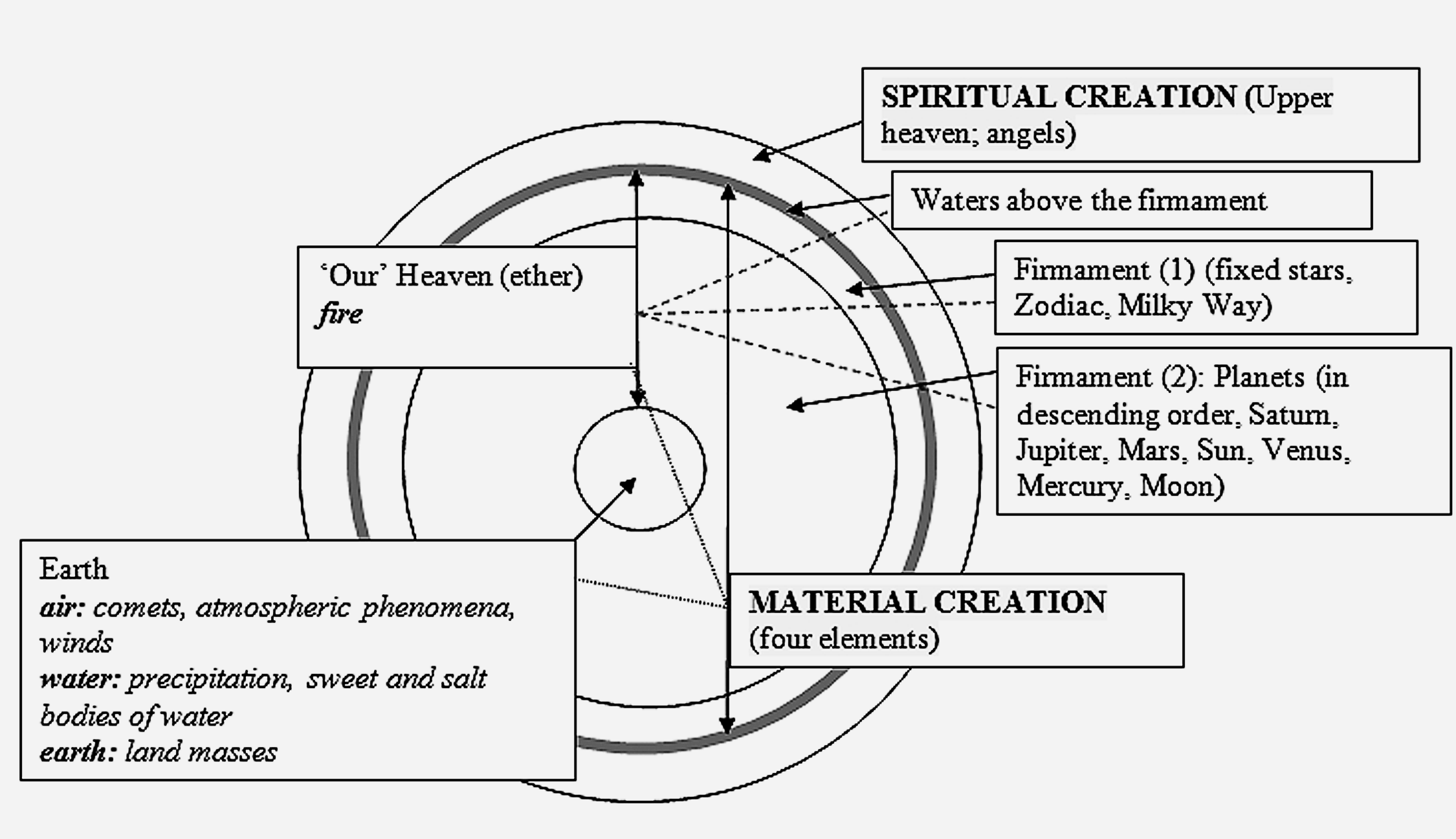
Figure 1 Schematic model of Bede's cosmos
COMMENTARY:
ON THE NATURE OF THINGS (ONT)
ONT, Verse epigraph Like two other of Bede's earliest works, his Commentary on the Apocalypse and On the Holy Places, On the Nature of Things is prefaced by a verse epigraph. The epigraph is curious, in that it suggests that the 'brief chapters' to follow will deal with both the 'natures of things' and the 'broad ages of fleeting time'. In fact, ONT does not deal with the world-ages, though OT certainly does. One solution would be that Bede composed the two works together, and intended them as companion-texts. But if this was the case, why did he not follow Isidore, his principal source, by keeping cosmography and chronology within the same covers? He did, to be sure, re-unite them in The Reckoning of Time (his preface to this work mentions them in the same breath) but on rather different terms, namely with the cosmography selected and integrated into the computistical framework. In sum, the contents of the epigraph seem to point to some conceptual unity between ONT and OT, while retaining separate vocational identities for the two works. See
Introduction, pp. 4–5.
ONT, Chapter 1: The Fourfold Work of God From the opening chapter of ONT, Bede telegraphs his intentions with regard to the book that is at once his model, and the rival he intends to surpass:
Isidore's De natura rerum. Where Isidore, in the conventional manner of a classical school-cosmography, begins his cosmography (following eight introductory chapters on time) with the universe, Bede begins with creation.
Isidore, to be sure, remarks that the subject of the first chapter of DNR, the day, happens to be almost the first visible thing created by God, but this is a pious aside, without structural significance for the work as a whole. In 'The Fourfold Work of God' Bede, leaning heavily on the thought of Augustine, establishes God's many-layered creative action as the foundation of the material universe. Creation understood as divine operatio or activity, operates in four dimensions or on four levels. In the dispensation of the Second Person of the Trinity, the eternal Word by which all things were made, one can say that
BEDE: ON THE NATURE OF THINGS AND ON TIMES
God's creation exists eternally. Secondly, there are the elements co-created with primordial matter; and in that sense, God made all that he made instantaneously. Thirdly, there was the creation described in Genesis, when the causes, created all together and all at once, acted in temporal sequence to differentiate the elements into the contents of the material world. Finally, God's work of creation continues in the form of his governance of the universe. The creative causes now operate to reproduce and replenish life, a theme developed in chapter 2. In sum, Bede does not begin his account of the universe with the universe itself, for to do so would imply that the cosmos is self-sufficient and eternal. Instead, he begins with the cause – or rather, the layered causality – that brings the world into being. He does not begin with the sequential narrative of Genesis, but with the wider metaphysical and theological context of creation itself as a divine action. The elements are not parts of the world, but properties of the matter from which God makes the world; the world is not self-existent, but encompassed by causes which direct its formation and assure its continued existence.1 He revisits this theme in chapter 5 of The Reckoning of Time, where he says that some Fathers claim that the initial simultaneous creation was a creation of 'a single seedbed material (seminaria … materies)', an idea derived from Augustine's De Genesi ad litteram (The Literal Interpretation of Genesis).2 It is therefore noteworthy that Bede's commentary On Genesis does not so distinguish the levels of divine creative action. To be sure,
Bede does stress that heaven and earth are created at one and the same time, even though human speech must perforce name the creation of earth after that of heaven,3 and he explains that though the Bible mentions the creation of earth and the waters together in Genesis 1:1-2, one may take the other two elements to be implicitly present.4 He also observes that the plants were created on the third day instantaneously in full springtime bloom, just as the first man was created an adult,5 and that all the genera of animals came into being instantly, even though the Bible refers to them one after another.6 But there is no hint here of pre-existing causes.
Bede's chapter is based on Augustine's enumeration of four kinds of creation, (1) the pre-existence of all things in the mind of God, (2) all matter,
(3) living things, (4) the offspring of living things:
1 See Wallis, 'Bede and Science'.
2 See in particular Augustine, DGAL 5.23 (CSEL 28.1, 167–69) and 6.10 (CSEL 28.1,
182–83). Bede quotes from DGAL in this chapter, and it was a foundational text for his On Genesis.
3 On Genesis 1.1:1, trans. Kendall, p. 68.
4 On Genesis 1.1:2a/b, trans. Kendall, pp. 70–71.
5 On Genesis 1.1:11-13, trans. Kendall, pp. 79–80.
6 On Genesis 1.1:25a/b, trans. Kendall, p. 89.
COMMENTARIES
But these things [i.e., all things that are, including space and time, and spiritual and material objects] exist (1) one way in the Word of God, where they were not made, but are eternal; (2) another way in the elements of the world, where everything that will be was made at once; (3) another way in things that are created partly from existing causes, and partly from causes not yet existing, but each of them severally coming into existence at its own appointed time, among which can be cited Adam, who was already formed from mud, but was also brought to life by the breath of God, like the risen grass [cf. Isa. 40:6]; and (4) another way in seeds, in which primordial things are repeated, as it were, led from things which existed from things that he created first, like the plant from the earth, the seed from the plant.7
Bede retains Augustine's four categories, but in accordance with his own interests puts the emphasis in (4) on time as the matrix of reproduction.
ONT, Chapter 2: The Formation of the World Bede's statement that on the seventh day God rested from the work of creation, but not from the governance (gubernatio) of creation – an idea which re-appears in a similar context and with identical terminology in On Genesis8 – has no traceable source. However it bears a striking resemblance to the notion of providence as extended creation in Augustinus Hibernicus's De mirabilibus sacrae scripturae (On the Marvels of Holy Scripture):
But we must consider more carefully how the same God can be considered to have finished then, and to be working now. On the sixth day he completed his work on the natures of created things, but even now he does not cease to govern them; and on the seventh day he rested from the work of creation (ab opere creationis), but he never ceases from the exercise of government (a gubernationis regimine). For we are to understand that God was a creator then (tunc
… Creator), but is a Governor now (nunc Gubernator). Therefore if among created things we see anything new arise, God should not be thought to have created a new nature, when he is only bringing forth from the hidden depths of its [existing] nature that which lay concealed within.9
While there is no direct evidence that Bede knew this work (though he definitely used other Irish cosmographical texts), this passage constitutes a significant piece of circumstantial evidence pointing in this direction.
7 Augustine, DGAL 6.10 (CSEL 28.1, 182.18–183.1) (trans. Kendall).
8 In Gen., ed. Jones, 35.1088-1092; On Genesis 1.2:3a/b, trans. Kendall, p. 100.
9 Trans. Carey, King of Mysteries, pp. 52–53; original text in PL 35.2151-2152. See Carey,
A Single Ray of the Sun, ch. 2.
BEDE: ON THE NATURE OF THINGS AND ON TIMES
ONT, Chapter 3: What the World Is Only in chapter 3 when the status of the created world is clarified does Bede turn from the act of creation to creation as the product of that act. Now he can pick up Isidore's definition of the universe and transform it with the help of Pliny's Natural History, notably by introducing the concept of the elements as the constituents of the universe.
ONT, Chapter 4: The Elements Pliny's definition of the world as the four elements actually constitutes Bede's plan for ONT, giving it a distinctive structure that sets it apart from Isidore's work. The four elements determine not only the qualities of material entities but also their location according to relative weight. Fire is the lightest element, and naturally moves to the highest place; earth is the heaviest, and will always seek the lowest position. Air is heavier than fire but lighter than water, while water is heavier than air but lighter than earth. Hence the elements define four vertically arranged realms in the material cosmos. Bede will arrange his text as a top-to-bottom survey of these realms: the heavens (fire, chs. 5–23), the atmosphere (air, chs. 24–37), the waters upon the earth (chs. 38–43) and the features of the earth itself (chs. 44–51). The idea of the elements as a vertical chain binding heaven and earth goes back to the roots of this schema in Plato's Timaeus 31B–32B, but Bede's immediate source was an Irish cosmography, the pseudo-Isidore's Liber de ordine creaturarum (The Book on the Order of Creatures). In On Genesis, Bede will link this vertical order to the sequence by which the cosmos is 'adorned' from the fourth to the sixth days of creation.10
The general statement that air rises above water is in his source, but Bede adds the detail about air and water in a vessel, which suggests some kind of simple experiment, like blowing air through a hollow reed into a vessel of water and observing the bubbles rising to the surface.
ONT, Chapter 5: The Firmament The term firmamentum to denote the sky 'fixed' above the earth is a purely
Biblical one, unknown to classical science. Bede uses the classical term coelum in this chapter, but the chapter heading implies, without going into detail or arguing the point, that he understood the firmament created by God on the second day as identical with the celestial sphere of the ancients.
His doctrine on the celestial realm is also strictly classical: it is the realm 10 On Genesis 1.1:14a/b, trans. Kendall, p. 80.
COMMENTARIES
of the element fire; it is a perfect sphere; it revolves once each day on its axis, which passes through the north and south poles of the Earth. Bede may be thinking of the terrestrial extremities of the axis when he refers to the wasting cold. The casual equation of the southern hemisphere with 'the chambers of the south' of Job 9:9 is typical of the oblique manner in which Bede connects cosmology with Christian learning. Unlike Isidore and some of the Irish writers of the seventh century, he does not spell out allegories or seek to explain the miracles or mysteries of Scripture. Rather, he glances sidewise from time to time at the sacred text.
Notice Bede's use of the term sapientes mundi, 'those who are knowledgeable about the world'. This seems to be a way of avoiding the term philosophi, which had negative overtones for Bede. Indeed, in his Biblical commentaries he equates philosophi with heretics.11
ONT, Chapter 6: The Varied Height of Heaven This chapter, a quotation from Pliny, elaborates on the spherical shape of the cosmos. The stars which rotate around the North Pole, particularly the Great Bear and Little Bear (or Big and Little Dipper) seem to be 'higher up' in the sky – that is, closer to the zenith – in higher latitudes than in lower ones. Likewise, the constellations further away from the North Pole will move towards the zenith the further one travels to the south, and new constellations invisible to northerners because of the intervening bulge of the planet will come into view. Bede is particularly interested in the issue of the sphericity of the universe and of planet Earth (see ch. 46 below).
As Wallis has argued elsewhere, Bede also saw the structure of the universe in vividly architectural terms, but successfully merged this with a rigorously spherical model of the physical cosmos.12 We can, perhaps, speculate that Bede's way of imaging the perfection of heaven and eternity had something to do with circularity, which is why the endless circle of the Paschal cycle was such a powerful allegory of the world to come.
ONT, Chapter 7: Upper Heaven In his commentary On Genesis, Bede observes that the 'heaven' whose simultaneous creation with 'earth' is recorded in Genesis 1:1 is the upper heaven, the abode of the angels (who were themselves created in the instant that upper heaven was created) and of God himself. It is not the heaven of 11 Bede, In primam partem Samuhelis 4.31.1; In Ezram et Neemiam 1, lines 1883–94. See
Brown, A Companion to Bede, p. 20 and nn. 12–13.
12 Wallis, 'Caedmon's Created World and the Monastic Encyclopedia'.
BEDE: ON THE NATURE OF THINGS AND ON TIMES
the stars and planets,13 which he calls 'our heaven'14 or the 'ether'.15 Upper heaven is an invisible spiritual realm, illuminated by a perpetual and invariable light which existed before the creation of material light.16 It is separated from the astronomical heavens by the 'waters above the firmament' (see ch.
8), and so is not part of the elemental zone of fire. The angels who inhabit this heaven are also immaterial, though they can assume bodies of such materiality that they can eat like men – a point discussed in some detail both in On Genesis 1 and in On Genesis 4 in the context of Abraham's and Lot's hospitality to the angels.17
ONT, Chapter 8: The Heavenly Waters In On Genesis, Bede explains that the reference to the abyss (Genesis 1:2) implies that God created waters along with heaven and earth, even before he created light.18 Water and earth in that sense were the first elements to be created. The essentially 'secular' vocation of ONT is nowhere so clearly illustrated as in this chapter, where Bede not only sets aside the historical narrative of creation, but sidesteps one of the most vexatious questions of Christian cosmology, namely, how to account for the existence of the 'waters above the firmament' of Genesis 1:7. In On Genesis, Bede was ready to meet this question head on. There he explained, with support from Augustine and Ambrose, that the waters above the firmament are actually solid – crystallized like quartz. Hence there is no need to be anxious that they would ever fall down. Moreover, like clouds that sail along in the air, these heavenly waters can remain aloft on the foundation of firmer elements below them.19
Here, on the other hand, Bede focuses on a totally different question – one which he would, interestingly, explicitly avoid in On Genesis. The waters are simply assumed to exist, and their nature is not discussed. But what is their purpose?20 The Irish pseudo-Isidore offers a naturalistic explanation: they were not a reservoir for the Flood, but a buffer to cool the intense heat of the heavenly bodies.
13 On Genesis 1.1:2a/b, trans. Kendall, pp. 69–70.
14 On Genesis 1.1:2a/b; 1.1:6-8, trans. Kendall, pp. 69 and 75.
15 On Genesis 1.1:21a/d, trans. Kendall, pp. 86–87.
16 On Genesis 1.1:2c, trans. Kendall, pp. 72–73.
17 On Genesis 1.1:29-30c; 4.18:2-3, trans. Kendall, pp. 95, 290–91.
18 On Genesis 1.1:2a/b, trans. Kendall, p. 70.
19 On Genesis 1.1:6-8, trans. Kendall, p. 76.
20 In On Genesis 1.1:6-8, trans. Kendall, p. 76, Bede bypasses the question of the purpose of these waters by asserting that it is something known to God alone.
COMMENTARIES
ONT, Chapter 9: The Five Circles of the World This chapter unfolds in a very matter-of-fact manner, but contains some potential sources of misunderstanding. Bede and his sources carefully distinguish between the divisions of the spherical universe into five zones, which projected onto the earth become five regions (the subject of this chapter), and the division of the inhabited lands of the earth into three continents (the subject of ch. 51). This distinction is reflected in two types of world-map: the zonal schema transmitted principally through Macrobius, and the T-O map, a presumably classical form that became attached to some manuscripts of Isidore of Seville's De natura rerum.21 While the T-O map represents the inhabited territories of the world as a disc of land encircled by a ribbon of ocean (see Commentary on ch. 51 below), the zonal map illustrates the globe in its entirety. Sometimes the two forms are combined, with the map of the inhabited continents inserted into the northern temperate zone.22
In the discussion in this chapter there are five circles and five regions.
The Latin circulus may refer to either. The circles are the northern (the Arctic Circle, 66°33'N), the summer solstitial (the Tropic of Cancer,
23°27'N), the equinoctial (the equator, 0°), the winter solstitial (the Tropic of Capricorn, 23°27'S), and the southern (the Antarctic Circle, 66°33'S).
These circles are conceived as imaginary lines on the Earth's surface (= parallels of latitude) or as projected upon the heavenly sphere. The same terms describe the five regions marked off by these circles: the North Frigid zone, the North Temperate zone, the Torrid zone, the South Temperate zone, and the South Frigid zone. However, it is important to bear in mind that Bede is still discussing the heavens. He is thus interested in the zones as markers of the annual passage of the sun through the seasons, as well as their implications for the climates of the earth. When this material was expanded in On the Reckoning of Time 34, this link between geography and time-reckoning would be made more explicit.
Bede describes the southern zone between the Tropic of Capricorn and the Antarctic Circle as 'temperate and habitable' without qualification, and this may have provoked some questions, or even criticisms, from his readers. In The Reckoning of Time 34, Bede will explain at some length that though this zone is theoretically habitable, it is inconceivable that it should actually be inhabited. His principal argument is from Pliny: the two
21 See Teresi, 'Anglo-Saxon and Early Anglo-Norman Mappaemundi', pp. 341–67, especially the schematic rendition of the two types on p. 347, and our Commentary on ONT 51.
22 E.g. in British Library, Cotton Tiberius B V (Winchester or Canterbury, s. xi2/4), illustrated in Teresi, pl. 9.
BEDE: ON THE NATURE OF THINGS AND ON TIMES
zones must be mutually isolated, since they are separated by the impassable equatorial region. Bede does not go into the religious implications of this, namely that if humans did exist in the southern temperate zone, it would negate both the Biblical account of the origin of the human race, and Christ's command to take the Gospel to all mankind.23 However, as we have seen, his general policy (in contrast to Isidore) is not to introduce theological issues or allegorical readings into ONT. God's act of creation is the overarching framework of the physical world, but Bede prefers to let particular facts tell their own story.
Bede's parting comment on the conditions at Thule is also rather curious.
He seems to imply that the sun never shines there, and for this reason (unde) the sea is perpetually frozen. However, in The Reckoning of Time 31, and even in On Times 7, Bede states that Thule, far from being in perpetual darkness, enjoys six months of unbroken daylight and six months of night.
When he says that the outermost circles 'always lack the sun', he may mean only that the sun is never directly overhead, as happens between the tropics of Cancer and Capricorn. See p. 79, n. 55.
ONT, Chapter 10: The Regions of the World In this chapter, Bede shifts his perspective slightly, from the circles of the world, to its plagae – 'regions' or 'quarters'. The context shows that he is working with the ancient Greco-Roman technique for laying out a sundial on the ground – making a compass or wind rose. This technique was certainly known in Bede's time and milieu, because it is represented in the astronomical sundial in the early eighth-century Calendar of St Willibrord
(Paris, BNF lat. 10837, fol. 42r).24 Willibrord's diagram specifies a solstitial day of 18 hours, so it was plainly created in the northern British Isles.25 To fashion such a compass, an observer in the northern hemisphere would have to face south, since the sun will always be south of the zenith. The dial or compass would be marked with the points on the horizon where the sun rises and sets on the two solstices and the equinoxes. The positions of sunrise
23 Augustine, DCD 16.9, discusses the question. Irish scholars were particularly curious about the possibility of antipodeans: see Smyth, Understanding the Universe in SeventhCentury Ireland, pp. 285–90 and Carey, 'Ireland and the Antipodes', pp. 1–10.
24 This technique is described in Pliny's NH 18.323. Bede did not have access to this book, but he and his contemporaries may have learned it from a manual of surveying.
25 See Obrist, 'The Astronomical Sundial in Saint Willibrord's Calendar and Its Early
Medieval Context', esp. pp. 84–88. On prehistoric and ancient horizon calendars, compasses and wind roses, see Taub, Ancient Meteorology, pp. 103–6; and McCluskey, Astronomies and Cultures in Early Medieval Europe, pp. 11–18, esp. p. 15.
COMMENTARIES
and sunset could be used anywhere on the globe, regardless of latitude, to establish the cardinal directions. Since the sun rises due east everywhere on earth at the equinoxes, the line between the equinoctial sunrise and sunset, passing through the observer, will divide the disc of the horizon in half. The 'east' is the zone of the horizon within which a sunrise can occur, with the point of equinoctial sunrise in the middle. The 'west' is the corresponding zone of possible sunsets. The 'south' is the space between the winter sunrise in the east and the winter sunset in the west, with due south in the middle of this arc; the 'north' is the corresponding sector between midsummer sunrise and sunset. East and west will be equal slices of the pie, as will north and south. However, depending on latitude, the east-west and north-south pairs will differ in size. As Bede observes, the length of the equinoctial day is constant, but the length of solstitial days will vary with latitude. The eastwest and north-south regions are equal [aequalia] only for persons halfway between the equator and the pole. They become progressively distorted as one moves either to the north or to the south. On any day of the year a line drawn from the point on the horizon where the sun rises through the observer on to the point on the horizon where the sun sets six months later will always be straight.
The use of a sunrise-sunset diagram as the basis of a compass can be illustrated by a horologium in the Willibrord tradition, based on a computus manuscript of the early twelfth century, Oxford, St John's College 17, fol.
35v (Figure 2). The centre of the diagram marks the observer's position, facing south (top); the circumference is the horizon.26 It is interesting, nonetheless, that Bede does not include such an illustration, or indeed any other illustration, in ONT. His model, Isidore's DNR, was famous for its schemata, particularly the circular diagrams that earned it the alternative title of Liber rotarum. But Bede seems to have deliberately chosen to eliminate them.
ONT, Chapter 11: The Stars Bede packs a substantial amount of cosmology into this chapter. First, he distinguishes two types of star: the stars that form the constellations, which are represented as fixed in the revolving shell of the firmament, and which rotate with that shell from east to west once each day; and the planets beneath them, which pursue an errant course. Small fiery bodies can fall from the ether into the atmosphere, and be blown about by the winds; these
26 For a description of the technique, see Obrist, 'The Astronomical Sundial in Saint Willibrord's Calendar and Its Early Medieval Context', pp. 71–118. See also below, p. 173.
BEDE: ON THE NATURE OF THINGS AND ON TIMES
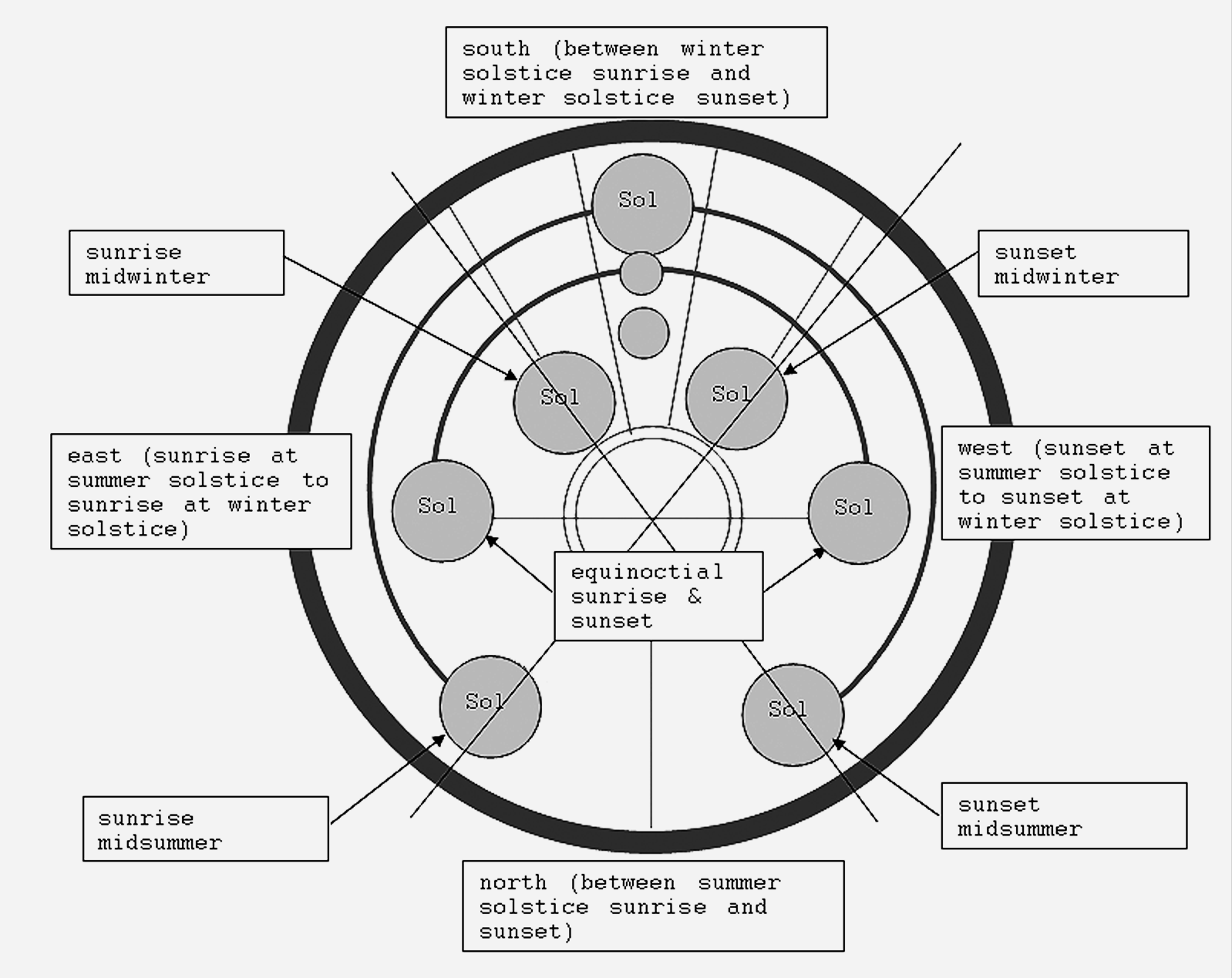
Figure 2 Horologium are (inter alia) the comets, and are not to be confused with the planets, as their movement is not produced by the revolutions of the heavens. Bede also introduces the subject of celestial influence. This was a fundamental and unquestioned notion in ancient physics. The heavens move and so are active; the earth does not, and so is passive. Changes in the position of the sun affect the seasons, and the moon's phases control the tides; hence it stood to reason that other terrestrial phenomena were subject to the influence of the planets and stars. However, Bede in accordance with the ancient traditions of astrometeorology keeps this influence on the macroscopic level of the weather and seasonal change,27 and avoids any suggestion of astrology.
Rather remarkably, Bede does not refer to the use of the stars as a nocturnal clock for monastic time-telling, or for corroborating the solar year.28
27 Cf. On Genesis 1.1:17b-18b, trans. Kendall, pp. 83–84. See also North, 'Medieval
Concepts of Celestial Influence', pp. 5–17; and for the classical background of astrometeorological almanacs and parapegmata, Taub, Ancient Meteorology, pp. 7–8, and ch. 2 passim.
28 For monastic time-telling by stars, see McCluskey, 'Gregory of Tours, Monastic
Timekeeping, and Early Christian Attitudes to Astronomy', pp. 9–22; for the heliacal rising
COMMENTARIES
ONT, Chapter 12: The Course of the Planets The planets lie in the zone of the heavens below the fixed stars, but above the atmosphere. Bede explains that their trajectory is contrary to that of the universe as a whole, meaning that while they are borne about from east to west once each day like the fixed stars, they simultaneously, and at varying rates, move in the opposite direction, from west to east, along the path of the ecliptic and across its width. From our modern point of view, the Earth is rotating around the sun, as well as turning on its own axis. Hence, while the whole dome of heaven seems to rise in the east and set in the west once each day, the stars which we are able to see will change slightly every night, as we change our position in our annual orbit. Thus the dome of the fixed stars seems to move slightly faster than one full rotation each day. We see new constellations rising over the eastern horizon each evening, and the sun, in the course of a year, or the moon in the course of a month, seems to move 'backwards', from west to east, along the zodiac. Bede alludes to the phenomena of planetary station and retrogradation, but does not explain these at any length. Briefly, in the course of their circuit around the ecliptic, the outer planets (Mars,
Jupiter and Saturn) will occasionally appear to stop and go backwards before resuming their journey from west to east. This is an illusion created by the earth's movement around the sun in the course of the year. The revival of Ptolemaic astronomy in the west, particularly from the twelfth century onwards, would provide sophisticated geometrical models to explain this phenomenon, but Bede, following Isidore, envisaged it as the product of the sun's attractive power.
If you are in the northern hemisphere, you will always have to face south if you want to look at the ecliptic, the path of the sun and the planets. If you are facing south, the heavens, in their diurnal rotation, will rise on your left
(east) and set on your right (west). In the course of their journey around the zodiac, the planets will, at varying speeds, 'swim against the current' from your right (west) to your left (east).29
ONT, Chapter 13: Their Order Bede now explains that the planets are not all on the same plane, but arranged in vertical order. Saturn is the farthest from Earth, and also from the sun, and so is cold. Its journey through the zodiac requires thirty years. Jupiter, the next in line, is temperate, but Mars, which is next to the sun, is fiery. The sun and setting of stars as means of indirectly defining the solar year, see McCluskey, Astronomies and Cultures, p. 8.
29 See the Byrhtferth gloss in PL 90, 209 and 327–28.
BEDE: ON THE NATURE OF THINGS AND ON TIMES
is in the middle of the ladder. Below it lie Venus, Mercury, and the moon.
Venus and Mercury seem, from a geocentric perspective, constantly to hover in the vicinity of the sun; from our modern heliocentric viewpoint, we know that this is because their orbits lie within that of the earth. Finally, there is the moon, which passes around the zodiac in 27 days and eight hours – a sidereal lunar month. Bede, however, wants to focus on the synodic lunar month of about 29 ½ days, from one conjunction of the moon and sun to the next. In particular, he is interested in the length of the moon's occultation at conjunction, and how this compares with the periods of occultation of the other planets. The final sentence is somewhat confusing, as Bede may not have fully grasped what Pliny was saying here. Pliny is speaking of the three higher planets: Mars, Jupiter and Saturn. When they are in conjunction with the sun at sunset, they will never be more than 11 degrees away at sunrise.
What Bede meant by 'and indeed they sometimes rise seven degrees from it' is impossible to determine, nor can his source be traced. The medieval glossators appear to have passed over this passage in silence.
It is important to remember that the periods Pliny and Bede are discussing here are those of the planets' circuits of the zodiac, which from Bede's point of view are their orbits around the earth, not their orbits around the sun. For the outer planets, Saturn, Jupiter, and Mars this makes little practical difference, and their zodiacal orbits are good approximations of modern values for their solar orbits (29.46, 11.86, and 1.88 years, respectively). But for the inner planets this is not so (the period of Venus's orbit about the sun is approximately 225 days, and that of Mercury's 88 days). Housman, 'Anth.
Lat. Ries. 678', p. 33, claims that in Ptolemaic geocentric astronomy the times of Venus's and Mercury's revolutions around the Earth are 'necessarily the same as the sun's, 365¼ days, though a single and particular revolution of either may exceed that time or fall short of it within certain limits'. But it is difficult to see why their orbits should have been interpreted as one year (as, according to Housman, was the teaching of Eudoxus) rather than 348 and 339 days.
ONT, Chapter 14: Their Orbits This passage from Pliny enunciates the doctrine of eccentric planetary orbits, with its corollary of variable velocity. In the Carolingian period, it was not only excerpted in computistical 'encyclopaedias', but illustrated with a diagram showing the apogee and perigee of each planet against the backdrop of the zodiac.30 That Bede should have included this material,
30 See the numerous studies by Eastwood, most recently Ordering the Heavens, ch. 3, part 4.
COMMENTARIES
which is not in Isidore, suggests a personal interest in celestial mechanics for its own sake.
ONT, Chapter 15: Why Their Colours Change Here again, Bede includes material from Pliny that bespeaks a curiosity about the planets that transcends the utilitarian needs of a school manual or adjunct to computus. Bede may have been skating on thin ice here. This chapter implies that the planets have distinctive characters, and that they interact with one another. Pliny had no difficulty with this concept, but Bede may have come to feel that this was not suitable speculation for a Christian scholar. In The Reckoning of Time 8, he will return to the theme of the characters of the planets, but in a different context, namely in connection with the Roman names of the weekdays. The tone changes to one of condemnation: this is 'the foolishness of the Gentiles, buttressed by faulty reasoning'.31
ONT, Chapter 16: The Circle of the Zodiac The discussion of the zodiac flows naturally from the description of the planets, since the zodiac is the path along which they travel. It also allows
Bede to tie the discussion of the planets back into the preceding material on the climates, for the northern and southern boundaries of the zodiac – the tropics of Cancer and Capricorn – are the boundaries of the habitable zone of the earth. Once again, however, Bede seems to have been captivated by the details of planetary astronomy. In this case, it is planetary latitudes, or the apparent weaving of the planets across the width of the zodiacal belt, a pattern produced by the fact that the plane of each planet's orbit is slightly different from that of the sun, which defines the zodiac. The moon's orbit, for example, is tilted at five degrees to the ecliptic, which is why it is not eclipsed at every conjunction. In this chapter, as in The Reckoning of Time
26, Bede repeats Pliny's strange assertion than the sun travels down the middle of the zodiac with a wavy and serpentine course. On the face of it, this is absurd: the sun's course is what defines the zodiac. How Bede or Pliny understood this claim is difficult to say, but Carolingian glossators and artists dutifully tried to represent the sun as weaving up and down along of the centre of the ecliptic.32
31 The Reckoning of Time, trans. Wallis, p. 34.
32 Eastwood, Ordering the Heavens, ch. 3, section 5.
BEDE: ON THE NATURE OF THINGS AND ON TIMES
ONT, Chapter 17: The Twelve Signs This chapter is a careful interweaving of material from Isidore's Etymologies and an anonymous text entitled De causis quibus nomina acceperunt duodecim signa.33 Its intention seems to be to reduce the meaning of the zodiac signs as much as possible to naturalistic terms connected with the weather conditions of the relevant season, or to astronomical phenomena such as the reversal of the sun's path in Cancer. Occasionally a reference to Greek mythology is unavoidable, but the reader is warned in advance that these are pagan fabulae. When he comes to treat the same subject in The Reckoning of Time 16, Bede will drop the explanations of the names of the signs entirely. What is emphasized there is the order of the signs, which should be memorized in order to calculate the position of the sun or moon.
Bede regarded the zodiac as an arbitrary system of less than fundamental significance. Here he accepts the 15th kalends of the month as the beginning of each sign, as he later does in DTR 6. But there, when it comes to the more critical matter of the vernal equinox, he asserts that by nature the equinox is the beginning of the zodiacal cycle, and that the vernal equinox is in the 4th degree of Aries. The zodiac begins on the anniversary of the first day of creation, but the vernal equinox was created on day four, when the sun was created.34
ONT, Chapter 18: The Milky Way This extremely short chapter not only reveals once again Bede's early curiosity about astronomy, but also the distinctive texture of his critical spirit. The theory that the Milky Way is illuminated by the sun's passage is relayed by Isidore (Etym. 13.5.7 and 3.46). It can also be found in book
18.281 of Pliny's Natural History, and in Macrobius's Saturnalia, neither of which Bede had access to. Bede offers an unprecedented critique of this theory: how could the Milky Way be kindled by the sun's transit, when the ecliptic only intersects the Milky Way in Sagittarius and Gemini? Where
Bede learned this bit of astronomy is uncertain: it is found in Martianus Capella, an author he seems not to have known, but also shows up in ch. 115 of the Bobbio Liber de computo (PL 129, 1329), so it might have reached him through an Irish intermediary. In any event, Bede rejects the notion, but offers no counter-theory. Hence we are left to reflect on what the objection itself can tell us about Bede's interests and way of thinking. Bede seems to be interested in the nature and source of light in the heavens. Not only does
33 Ed. Jones, CCSL 123C, 663–67; also in Jones, BP, pp. 102–3.
34 See Wallis, The Reckoning of Time, pp. 275 and 287–90.
COMMENTARIES
he specify in ch. 11 that the stars borrow their light from the sun, but he includes an entire chapter (15) on the different colours of the planets, and how they change. He also shows a marked fascination with the power of the sun, its ability to control the movement of other planets (ch. 12) and its fiery nature (ch. 19), which determines the climates of the planets in general
(ch. 13) and the different zones of the earth (ch. 9). He does not seem to have regarded the Milky Way as a belt of stars, for otherwise he would have ascribed their light to the sun. It is, rather, a shape (figura) or white circle
(candidum circulum). In sum, Bede did not quite know what to make of the Milky Way, and did not find the conventional explanations satisfactory. It was not a topic that he chose to recycle in The Reckoning of Time, for like the colours of the planets, it was not even distantly relevant to time-reckoning.
Interestingly, the Carolingian glossators simply explained and documented the theory which Bede rejected.35
ONT, Chapter 19: The Course and Size of the Sun Bede's error concerning the relative sizes of the moon and earth will be repeated and reinforced in ch. 22 below. The notion that the sun is somehow nourished on water (derived from Isidore) is retailed without comment.
Presumably it refers to evaporation. In any event, Bede quietly dropped the idea in favour of focussing on the moon's control of moisture (The Reckoning of Time, chs. 28–29).
ONT, Chapter 20: The Nature and Place of the Moon This chapter contains a number of points which apparently caused Bede's readers some confusion, and which he would later clarify in The Reckoning of Time, chs. 25–26. He paraphrases Pliny to make the following claims. First, as the day grows longer (die quidem crescente), a new moon (that is, a newly visible crescent moon) will appear 'supine', that is, with its horns pointing upwards from the horizon, as if it were on top of the sun (utpote superiorem soli) and lying to the north. When the day grows shorter (decrescente) the moon will appear upright, with its horns pointing to the side, and to the south. A full moon is always diametrically opposite the sun, 'being elevated with respect to the low sun and low with respect to the elevated sun'. Apparently, Bede's readers had problems with two issues: first, Isidore in DNR 38 says that the shape of the new moon (supine or upright) is an omen of rain or dry weather; secondly, Bede's use of the terms superior, sublimis and humilis created a 35 See the Byrhtferth glosses (PL 90, 234–35) and the Laon-Metz glossator (ed. Lipp, in
CCSL 123A, 210).
BEDE: ON THE NATURE OF THINGS AND ON TIMES
mistaken impression that the moon might actually be physically above the sun in the heavens, particularly when it appears further to the north of the sun in the sky – that is, closer to the zenith. Bede tackled the first problem in The Reckoning of Time 25. His explanation is somewhat compressed, and omits some astronomical technicalities, but it makes the following point: when the days begin to get longer than the nights – that is, at the spring equinox – a crescent moon appearing at sunset will be north of the celestial equator, and will be lit up from underneath so that its horns point upwards. When the days begin to grow shorter at the autumn equinox, the crescent moon at sunset will appear to the south of the celestial equator, and be lit up from the side. What
Bede does not explain is that these variations are caused by that fact that the ecliptic, along which the sun and moon travel, crosses the celestial equator twice as it swings to the north and south; consequently, its angle vis-à-vis the celestial equator changes. The angular relationship between ecliptic and equator at sunset (when a new crescent moon will become visible) varies throughout the year, which means that a crescent moon may lie to the north or south of the equator, and be lit up from underneath or from the side.36 These changes are absolutely regular, and have nothing to do with the weather.
Indeed, when Bede excerpts Isidore's DNR 38, for his own ONT 36, he pointedly omits Isidore's comments on the shape of the crescent moon. The second point of confusion – namely, the precise meaning of 'above' – will be clarified in The Reckoning of Time 26, where Bede will explain that the visible position of the moon to the north or south of the sun is not connected to its physical location. When he says that the crescent moon at sunset on the vernal equinox seems to be on top of the sun, what is meant is that the angle of the ecliptic is such that the moon seems to be almost directly above the sun in a vertical line; that is why it is lit up from below.
ONT, Chapter 21: Method for Determining the Course of the Moon through the Signs of the Zodiac In their descent from the heavens to the earth, Bede's readers are now finally standing beneath the moon. At this point, Bede invites them to change their orientation and look upwards to consider the position of the moon in relation to the background of the zodiac.
This is perhaps the most difficult chapter of On the Nature of Things for a modern reader to understand. It contains Bede's earliest attempt to expound a mathematical-astronomical formula (argumentum). Bede provides a formula for finding the sign for a moon of any age – a striking departure from his
36 For a fuller explanation with illustration, see Wallis, The Reckoning of Time, pp. 301–4.
COMMENTARIES
models, and evidence of the influence of computus. It should be compared to Reckoning of Time 17, where Bede fills in some of the background explanation that is lacking in this chapter, re-frames the terms in which the moon's advance on the sun is expressed, and alters the divisor from 9 to 10.37 This formula (and its revised version) may have been Bede's own invention: the revised version is found in the Bobbio Liber de computo, ch. 110 (PL 129,
1326), and may be derived from The Reckoning of Time.
The problem Bede sets here is to determine through how many signs of the zodiac the moon will have advanced on any given day after the day of the new moon (on which day the sun and the moon will have been in the same sign, which is assumed to be known). The moon advances, Bede states, through one sign every two days and 6 2/3 hours. That being the case, through how many signs will it have advanced after, say, 12 days? Obtaining the answer in a reasonable amount of time is the obstacle to be overcome.
With Arabic numerals and standard methods of long division it can easily be done. One method would be to divide 12 days by 2 days and 6 2/3 hours.
Converting days to hours, the answer is 288 hours divided by 54 2/3 hours = 5 11/41 signs or 5 signs and 14 2/3 hours. Bede could do this, but, working with Roman numerals, it would be a tedious task.38
Alternatively, one can calculate the fraction of a sign that the moon advances through in one day, and then multiply that fraction by the number of days of the moon (here, 12). This is possibly what Bede did. The fraction that the moon advances equals one day (= 24 hours) divided by two days and 6 2/3 hours (= 54 2/3 hours), that is, 18/41 (not 41/18 as Jones, BOT, p. 353, erroneously states). 18/41 times 12 = 5 11/41 or 5 signs and 14 2/3 hours, as above. Again, such a fraction (18/41) would be difficult to work with in Roman numerals, though Bede may have done so in order to come up with the formula that he offers to his readers.
How Bede constructed his formula remains unknown. We attempt a hypothetical reconstruction of his approach in Appendix 2. The formula suggests that Bede had an amazingly agile mathematical mind. We have already stated that he had to know the correct solution in order to construct the formula. It appears to be a procedure that is uniquely suited to this problem. It is simple to apply, requiring no more than a knowledge of how to multiply and divide by the numbers from one to nine. But the reason why it works is not transparent and cannot be understood without the ability to 37 See Jones, BOT, p. 353.
38 On the difficulty of performing calculations with Roman numerals, see Wallis, The Reckoning of Time, pp. 254–63.
BEDE: ON THE NATURE OF THINGS AND ON TIMES
make calculations more complicated than any Bede expected his readers to be able to perform.39 Wallis's suggestion that 'the technique of calculation was only taught to some advanced and dedicated students',40 goes far to explain why Bede does not reveal his calculations in this chapter.
The formula in On the Nature of Things differs from the corresponding one in The Reckoning of Time 17, in two ways. First, it expresses zodiacal distance in terms of signs and hours, whereas the Reckoning formula uses signs, puncti, and partes. Secondly, its goal is to find the position of a moon of any given age in the zodiac itself, whereas the Reckoning formula is designed to find out the distance along the zodiac which separates a moon of any given age from the sun. Hence in The Reckoning of Time 17, one multiplies the age of the moon by 4 (the moon travels 4 puncti away from or towards the sun per day) and divides by 10 (there are 10 puncti in a zodiac sign). This formula takes into account the forward movement of the sun through the zodiac by 1/3 punctus (or one pars) per day. Hence if one multiplies the age of a full moon of 15 days by 4 (60) and divides by 10, one will find the full moon exactly opposite the sun in the zodiac, six signs away. However, that same full moon will have actually advanced along the zodiac by six and one-half signs from the sign where it first appeared as a new moon, because the sun, during the fifteen days which have elapsed from conjunction to full moon, will have simultaneously advanced the distance of one-half of a zodiac sign.41
It is curious that such a formula should be provided in ONT and not in OT. It was clearly a subject which exercised Bede greatly, since he devotes considerable space to the issue in The Reckoning of Time (chs. 17–19) and 39 Bede introduces the topic of performing arithmetical calculations in DTR 1, 'Calculating or Speaking with the Fingers'. He does not explain how to multiply with large figures or do long division.
40 Wallis, The Reckoning of Time, p. 261.
41 The different intentions of the two formulas seem to have derailed some medieval readers.
The Byrhtferth gloss in PL 90, 237–39, refers to this formula as an 'argumentum inusitatum' but professes to find it preferable in terms of accuracy. However, Byrhtferth made the mistake of assuming that The Reckoning of Time formula was to find the position of the moon in the zodiac, and not to find the relative zodiacal distance separating the moon from the sun.
Why did Bede choose to provide a different formula, and more importantly, a totally different problem in The Reckoning of Time? We may speculate that the while the relative calibration of the moon's phases to the movement of the sun through the tropical year had evident computistical applications, Bede may have decided that there was no point in knowing what sign of the zodiac the moon was in per se. Indeed, such knowledge might even smack of astrological calculation. He certainly steers readers of The Reckoning of Time firmly away from any interest in tracking the sun's precise position in the zodiac (cf. The Reckoning of Time 3).
COMMENTARIES
furnishes no less than three methods of locating the moon in the zodiac, including a table. And yet it has little or no direct computistical value.
Knowing the age of the moon was definitely important for calculation, and the related issue of its appearance and phase was significant from the point of view both of establishing a credible Paschal cycle, and of explaining the theological significance of the rules for determining Easter. Where the moon stood in the zodiac was not per se a matter of computistical interest. Where it might have had relevance was in the medical sphere. In the Ecclesiastical
History, Bede relates the story of how bishop John of Beverly (d. 721) healed a nun at Watton of a swollen arm consequent on a bloodletting operation:
The abbess asked the bishop to deign to visit her and give her his blessing, believing that she would greatly improve if he blessed or touched her. Then he asked when the girl had been bled and, on hearing that it was on the fourth day of the moon, he exclaimed, 'You have acted foolishly and ignorantly to bleed her on the fourth day of the moon; I remember how Archbishop Theodore of blessed memory used to say that it was very dangerous to bleed a patient when the moon is waxing and the Ocean tide flowing. And what can I do for the girl if she is at the point of death?'.42
It should be noted that John states that a waxing moon contra-indicates bloodletting. Neither here nor in ch. 28 of The Reckoning of Time does
Bede state that the position of the moon in the zodiac should be taken into account. However, schemata linking body parts to the signs of the zodiac, and accompanied by admonitions concerning bloodletting from that limb when the moon is in the relevant sign, go back to Antiquity.43
ONT, Chapter 22: The Eclipse of the Sun and the Moon From this new vantage point (see above, p. 150), Bede's reader can now observe solar and lunar eclipses (chs. 22–23). One of the purposes of this chapter – perhaps of the study of computus and the compilation of tables – may have been precisely to allay anxiety about eclipses.44
Bede's erroneous idea about the size of the moon and earth is picked up from ch. 19; it is also repeated in DTR 27. The Carolingian glossators, and notably the BDTR glosses (see Introduction, p. 40) quietly rejected this notion, but they had the benefit of access to Martianus Capella and Calcidius.
Why did Bede believe this? Quoting Pliny, Bede states that a total eclipse 42 EH 5.3, trans. Colgrave and Mynors, p. 461.
43 The concept goes back to Ptolemy, Tetrabiblos 3.12, 147–48; see Tamsyn Barton,
Ancient Astrology, pp. 189–94; Nutton, Ancient Medicine, p. 266.
44 Cf. BDTR gloss on ch. 22 (PL 90, 412.10–413, end).
BEDE: ON THE NATURE OF THINGS AND ON TIMES
of the sun would not be possible if the moon were not larger than the earth.
The unstated assumption here is that an eclipse of the sun renders the sun invisible across the whole earth, or at least the hemisphere facing the sun, as if it were night. This would indeed be the case if the moon were the same size or larger than the earth, but since it is smaller the eclipse will be visible only from within the cone of the moon's shadow. Bede does not appear to know that the lunar shadow is conical and that solar eclipses are not visible everywhere on earth; hence he argues that the moon must be larger than the earth in order to block the sun's light – by implication, across the whole planet. Bede's sources did not help him here. Pliny (NH 2.10.56) mentions that eclipses are not visible everywhere, but ascribes this to (a) local cloud cover, or (b) the fact that a lunar eclipse would only be visible in the half of the planet where it was night-time, and a solar eclipse only where it was daylight. Isidore (DNR 20-21, Etym. 3.58–59, Letter of Sisebut) does not mention local visibility at all.
A major flaw in Bede's argument is that if the moon were larger than the earth, it would not be totally eclipsed by the shadow of the earth, which must be conical, since the earth is smaller than the sun. This point is implicitly addressed by Calcidius in his commentary on the Timaeus, who reports
Hipparchus's estimate that the earth is 27 times larger than the moon, and was well known from the Carolingian period onwards.45 His argument and the diagrams illustrating it later found its way, via the eleventh-century computist Abbo of Fleury, into Noviomagus's edition of Bede's The Reckoning of Time, and thence into Migne's edition (PL 90, 223).46
ONT, Chapter 23: Where there is No Eclipse and Why This chapter, taken from Pliny, reinforces the impression that Bede did not know that eclipses were visible only along specific tracks. Pliny imagines that the only regions which cannot see an eclipse are those where the earth itself is blocking the view, i.e., where the sun has already set or has not yet risen. The shadow of the eclipse is equated with the shadow of night sweeping across the planet.
ONT, Chapter 24: Comets The changeable moon and the anomalies of eclipses form a suitable transition to the realm of air, and the zone of unpredictable, albeit natural, atmospheric phenomena, such as comets and pestilences (chs. 24–37). The chapters on 45 Calcidius, Timaeus, pp. 139–44.
46 For the diagram, see Obrist, La cosmologie médiévale, pp. 138–39, and fig. 36.
COMMENTARIES
the air all stress change, variation and local peculiarity, and in this respect contrast with the chapters on the celestial phenomena of the zone of fire.
Comets, following ancient philosophers, are regarded as atmospheric events.
Bede's text highlights their sudden, unpredictable appearance, the highly variable length of time in which they are visible, their restricted range, and the unusual events they portend. The reference to portents, drawn from Isidore's
DNR, is rather unusual in itself, for both Bede and Isidore are concerned to downplay the idea that natural events are necessarily prophetic signs (see
Introduction, pp. 1–2). Indeed, rainbows, winds, weather and seismological events were the targets of attempts at rationalization of the natural world from the pre-Socratic philosophers to Lucretius, Seneca and beyond. Bede for the most part stands (albeit unconsciously) within this tradition.
ONT, Chapter 25: The Air Bede's theme of air as the region of variation and anomaly continues to be played out here. The atmosphere is not uniform, but varies in limpidity and luminosity, depending on altitude. Even the boundaries between air and heaven seem uncertain. The upper atmosphere between the air and the ether is said to belong to 'heaven', but it is not the 'heaven of heavens' where the stars are found, nor yet the quasi-heavens of the lower atmosphere, which is subject to destruction by flood and fire. The indeterminate nature of the 'heavens' had eschatological implications for Bede. In this chapter, he alludes to 2 Peter 3:6, a passage which exerted a particular fascination for him. It seemed to him proof, albeit negative proof, that the celestial regions would not be involved in the destruction and remaking of 'heaven' and earth at the end of the age. The only 'heaven' that would be burnt up would be the quasi-heavens of the air.47 He expounded on this idea at considerable length in his exposition of 2 Peter in the Commentary on the Catholic Epistles, and in The Reckoning of Time 70.48 His major source here was Augustine,
The City of God 20.24, but the intensity with which Bede pursued this idea suggests that it was particularly important for him.
ONT, Chapter 26: The Winds The agitation of the winds reinforces the theme of instability in the regions of the air. Isidore's account of the origin of the winds paints a picture of 47 Bede remarks that the Bible often uses the term 'heaven' when it means 'air': see On Genesis 1.1:20, trans. Kendall, p. 85.
48 Ep. Cath. 277.35-48, 279.110-25; trans. Hurst, pp. 147–48, 150–51. See Wallis, The Reckoning of Time, pp. 370–73.
BEDE: ON THE NATURE OF THINGS AND ON TIMES
violence and coercion: the winds are pressed together and shot out of mountain defiles, and their arbitrary movement summons the Biblical image of God as lord of the winds.
ONT, Chapter 27: The Order of the Winds The catalogue of the winds not only reinforces the imagery of variety, but also serves as a bridge to the phenomena Bede will expound in the next chapters. The winds are connected to snow and hail, thunder, tempests and earthquakes. So peculiar are the winds that even neighbouring regions or cities within the same province have distinctive winds.
ONT, Chapter 28: Thunder The theme of violence that underlies Bede's description of the winds is expanded in this chapter on thunder. Winds pent up in clouds produce thunder by causing the clouds to whirl about chaotically, crashing together like chariots colliding as they shoot out of the starting gate. By way of contrast, in his biographical sketch of Chad in EH 4.3, Bede commends as piety what he might have condemned (in the context of ONT) as superstition, namely the fear that any violent storm with thunder and lightning was a divine communication or warning of the Last Judgement.
ONT, Chapter 30: Where Lightning Is Not and Why Of all the uncanny phenomena of the atmosphere, lightning is the most local. Bede draws on Pliny to give a natural explanation of why it occurs in certain places or certain times. One may suspect an agenda here: to debunk the notion that lightning strikes are bolts of divine wrath intentionally aimed.
ONT, Chapter 31: The Rainbow This chapter and the next four are devoted to a group of phenomena that straddle the frontier between air and water. Rainbows and clouds are located in the air but formed of water suspended in the air; these aerial waters precipitate out as rain, hail and snow. In On Genesis Bede likewise remarks on the close affinity of air and water, and how air, though technically lighter than water and earth, can nonetheless support watery bodies like clouds and earthy ones like birds.49
The guiding purpose of ONT to furnish essentially natural explanations of phenomena leads Bede to analyse the rainbow without any reference to the Flood. Isidore's theory that the rainbow is the reflection of the sun against 49 On Genesis 1.1:20, trans. Kendall, p. 85.
COMMENTARIES
the black rain-cloud is essentially that of Aristotle's Meteorology 3.1-5. The rainbow, according to Aristotle's fuller account, is caused by the sun's rays, reflected from a dark rain-cloud to the eye of the observer. This reflection is a band of colours because the cloud is made up of numerous small drops, too small to reflect sun in its entirety, but capable only of reflecting its colours.
However, Aristotle considered the cloud as a single reflecting surface, and did not investigate the effect of light falling on a single drop. Nor did he provide a very satisfactory explanation of why the reflection was visible as a bow, or why only certain colours were produced. One of the most interesting and original achievements of medieval science was to critique this inadequate model and to propose an optical-mathematical and physical explanation.
ONT, Chapter 32: Clouds Using pseudo-Isidore and Isidore, Bede assembles a very credible explanation of the nature of clouds as condensed water vapour, formed by evaporation. However, the heat of the sun and the action of the winds are regarded not so much as the forces responsible for vaporization as the means by which water from any source is transmuted into sweet rain water. He invokes an idea which he will revisit in chapter 38, namely that filtering salt water through soil will make it sweet, just as straining sweet water through sea-weed will make it salt.
ONT, Chapter 33: Rains Clouds, being composed of water vapour, are essentially made of tiny drops of water. Bede imagines these droplets coalescing into larger drops which the air can no longer hold up (see ch. 8 on the waters above the firmament).
ONT, Chapter 36: Signs of Storms or Fair Weather The weather signs in this chapter are purely atmospheric – effects of the air and clouds on the appearance of the sun and moon. Bede passes over the notion purveyed by Isidore that the shape of the moon is an omen of weather
(see Commentary on ch. 20), though he appreciates the role of the constellations as markers of the seasons in announcing changes to the weather (see above, ch. 11).
ONT, Chapter 37: Pestilence To the modern reader, a chapter on epidemic disease in the midst of a discussion of meteorology seems anomalous. Until the nineteenth century, however, this would have seemed quite normal. From the time of Hippocrates's
BEDE: ON THE NATURE OF THINGS AND ON TIMES
Epidemics and Airs, Waters and Places onwards, westerners were accustomed to conceiving of an acute disease affecting many people simultaneously and in the same vicinity as the result of 'infection'. This infection was not, however, invasion by a subvisible microbe, virus or parasite; it was the tainting or corruption of the environment – the air in particular, but in consequence, the water and soil as well. This corruption was due to some kind of putrefaction or rotting, often visualized as a mist hanging in the air, or a warm muggy wind. Unseasonable weather could trigger this corruption. As Bede explains, pestilence is hatched from such corrupted air. Because air is ingested by all breathing creatures, and also penetrates the food grown in the soil, many people simultaneously fall ill. But Bede also struggled to incorporate a Biblical view of pestilence as the consequence of sin, something sent because of human fault. Not every event of this kind is a heavenly sign, however; sometimes bad weather is just bad weather. Bede's hesitations and qualifications are far from unusual; even Gregory of Tours, always on the alert for indicators of God's imminent justice, sometimes reported bizarre weather or outbreaks of pestilence without coming to any conclusion about the role of God. Gregory's account of the plague of Marseille in Historiae
9.22 is a case in point. He begins with a straightforward account of the plague's arrival by ship in the port and spread through the town. Bishop
Theodore ordered prayers and vigils; the plague eventually burned itself out, not immediately (which would suggest a miracle) but after a couple of months … but then came back again. Gregory offers no comment, which is his usual way of signalling his inability to read a divine message into any unusual event.50 In his Ecclesiastical History, Bede on the whole prefers to imply, rather than assert, that a plague is a divine visitation. He hints broadly that the plague that smites the dissolute Britons is punishment for their sins
(1.14), but does not rub the point in. The saintly Etheldreda prophesies a coming plague, which implies that it was no merely natural event (4.19).
The plague which carried off the pious and penitent Irish scholar (3.13) is described in neutral terms, though it might be an illustration of how a Christian should respond to an outbreak of disease; this is surely also the case with the accounts of exemplary deaths of plague victims in 4.7-8. The plague outbreak which killed Cedd (3.23) is reported in a matter-of-fact way, but the plague which carried off Chad in 672 (4.3) is explicitly a divine act. Bede rebukes the desperate East Saxons for reverting to paganism in their search for relief from the plague (3.30), which hints that they failed
50 De Nie, Views from a Many-Windowed Tower, esp. ch. 1.
COMMENTARIES
God's trial of their faith; this is made explicit in the parallel account of how some Northumbrians in the time of Cuthbert apostatized under similar circumstances (4.27). The plague of 664 which claimed bishop Tuda (3.27) is not depicted as divine in origin, though the chapter opens with an account of the solar eclipse of that year. However, while Bede is willing to entertain the notion that comets are omens (ONT 24), he treats eclipses that take place under normal astronomical conditions as natural events. In sum, Bede, like most medieval authors, prefers to leave his options open when it comes to determining the cause of pestilential disease. Moreover, divine will and natural processes were not regarded, particularly in the early medieval period, as mutually exclusive. Bede's world had no place for what later theologians would categorize as 'the supernatural'.51 God's actions in the world were detected, rather, by observing the preternatural, particularly the preternatural acceleration of natural processes.52
ONT, Chapter 38: On the Dual Nature of the Waters Chapters 38 through 42 seem to be a series of answers to questions: Which is natural, fresh water or salt water? What causes the tides? Why does the sea not overflow with all the water that pours into it? Why is it salt, despite the fact that fresh waters empty into it? Is the Red Sea really red?
ONT, Chapter 39: The Ocean's Tide In this chapter Bede seizes upon disparate observations about the moon and the tides in Pliny's Natural History and Pseudo-Isidore's (Irish) Liber de ordine creaturarum to sketch an analysis of their relationship that proved to be more precise and accurate than any previously attempted in western science. He would expand and in some respects modify this analysis in The Reckoning of Time.53 The key to his achievement was his insight in linking
Pliny's (somewhat obscurely worded) observation that the moon rises 47½ minutes later each day (NH 2.11.58) with his statement in a different context that peak high tides are correlated with the full moon and that they (whether
Pliny means peak high tides or merely high tides is unclear) recur at the same 51 On the development of this distinction, see Bartlett, The Natural and the Supernatural in the Middle Ages.
52 Smyth, Understanding the Universe, p. 232. Augustine, Tractatus in Iohannem 8.1
(CCSL 36, 81–82) describes the miracle of Cana, and states that what was miraculous was that the natural process by which the water in grapes becomes wine was spectacularly speeded by Christ's divine action. See also The City of God 21.4, 8.
53 On the changes introduced by Bede in his later book, see Eckenrode, 'The Growth of a Scientific Mind', pp. 187–212.
BEDE: ON THE NATURE OF THINGS AND ON TIMES
moment of the day after a period of a little more than eight years, specifically after 100 lunar months (NH 2.99.215). It was Bede's genius to equate
Pliny's figure for the retardation of the moonrise with his or his countrymen's empirical observations of tidal advances and to recognize that this implied a periodic cycle of the tides.
When he came to write DTR 29, he seems to have realized that he could not give mathematical precision to tidal periods in terms of the nineteenyear lunar cycle even though he knew that the tides followed the moon, and he may have felt it prudent not to calculate a tidal cycle on the basis of a 48-minute advance (the figure that he gives in DTR). For some reflections on Bede's thinking in this chapter of ONT, see Appendix 2.
ONT, Chapter 41: Why It Is Bitter Bede is entirely correct that the surface water of the seas is fresher than the depths, but his source, Pliny, actually says the opposite, namely that deeper waters are sweeter than surface waters (Pliny, NH 2.103.222).
ONT, Chapter 43: The Nile This chapter points to the roots of ONT, through Isidore, in ancient school cosmographies. The remarkable annual flooding of the Nile, to say nothing of the mystery of its origins, was a classic locus of scientific curiosity.
Seneca devotes all of book 4a of the Natural Questions to this topic, but Bede's principal source, Isidore, seems to have used Lucretius, DRN 6.716,
721–23.
ONT, Chapter 44: That the Earth Is Bound by Waters This is one of Bede's characteristic bridging chapters, in which, quite literally, the realms of water and that of earth intersect. Pliny's language is vivid, even emotional. Earth and water embrace to their mutual advantage, for earth would not hold together were it not moistened, and water would have no place were it not contained by the earth.54 Not only does water girdle the earth's surface, but it penetrates to its interior, and breaks out from its summits.55 Somewhat uncharacteristically, Bede adds a reference to the Creator in the opening sentence. This may be a devout response to Pliny's rapturous language, but it may also be Bede's way of neutralizing
54 A somewhat similar reflection on the interdependence of earth and water is found in Bede's On Genesis 1.1:24, trans. Kendall, p. 88.
55 Bede discusses the interpenetration of land and water in connection with the separation of earth and sea on the third day of creation in On Genesis 1.1:9, trans. Kendall, p. 78.
COMMENTARIES
the implication that the earth is a living being, perhaps a divinity. The issue was a very real one for Bede. In chapter 2 of The Reckoning of Time, in the midst of discussing the distinction between conventional and natural ways of dividing time, he feels obliged to point out that '[T]his Nature was created by the one true God when He commanded that the stars which He had set in the heavens should be the signs of seasons, days and years; it is not, as the folly of the pagans asserts, a creating goddess, one amongst many'.56
ONT, Chapter 45: The Position of the Earth When he turns to the earth itself, Bede refocuses his reader's attention on the fundamental architecture of his book: the four elements and their vertical arrangement. Earth is at the 'centre or pivot of the world' (ch. 45), because the element of earth seeks the lowest point; earthquakes and volcanoes are caused by air trapped within the earth and struggling to escape to its natural place (chs. 49–50). The sphericity of the earth can be demonstrated by the fact that different constellations are visible in different locations (ch. 46), and by the variations in sundial shadows and length of daylight with latitude (ch. 47).
ONT, Chapter 46: That the Earth Is Like a Globe Bede has the distinction of being one of the earliest Christian-Latin authors to state emphatically and unambiguously that the earth is spherical. Indeed, in The Reckoning of Time 32, he will spell out this fact even more explicitly: 'It is not merely circular like a shield [or] spread out like a wheel, but resembles more a ball, being equally round in all directions'.57 Most patristic writers, especially Latin writers, accepted the ancient scientific picture of a spherical earth without comment. But some, notably the Greek cosmographer Cosmas Indicopleustes, vigorously asserted the Biblical picture of the world as a flat rectangle of land poised over an abyss of water and crowned with a tent-like sky.58 This theory may have been known in Bede's England, perhaps through texts brought by archbishop Theodore of Canterbury.59 If it was, it may have been rather difficult to refute. Augustine acknowledged
56 Trans. Wallis, p. 14. For discussion of this remarkable passage, see Wallis, 'Si Naturam
Quaeras: Reframing Bede's "Science"', esp. pp. 80–82.
57 Wallis, The Reckoning of Time, p. 91.
58 On the patristic reception of classical views of the sphericity of the earth and Cosmas's counter-theory, see Inglebert, Interpretatio christiana, ch. 1.
59 On the knowledge of Cosmas Indicopleustes in Anglo-Saxon England, see Bischoff and Lapidge, Biblical Commentaries from the Canterbury School of Theodore and Hadrian, pp. 208–11; and cf. Neville, Representations of the Natural World in Old English Poetry, pp.
146–47.
BEDE: ON THE NATURE OF THINGS AND ON TIMES
that the sphericity of the earth was the general opinion of scientists and philosophers, but treats it as a hypothesis rather than an undisputed fact, and certainly not grounds for believing in the Antipodes.60 The seventh-century
Irish authors were even more ambivalent,61 Hence Bede's rather forceful defence of the spherical earth may have been a response to real doubt and disbelief.
ONT, Chapter 47: The Circles of the Earth These circles of latitude or climata are different from the circles described in ch. 9, which are on the celestial sphere, projected onto the earth, and which mark a celestial phenomenon, namely the passage of the sun around the inclined track of the ecliptic. These lines, however, represent a purely terrestrial phenomenon: the variation in the length of the day due to latitude, and the relative length of the shadow cast by the pin of a sundial. At many points in his writings on computus, natural science and Biblical exegesis, Bede likes to stress the distinction between the regular and uniform character of the heavens and the variations and particularities of terrestrial life. Variations in daylight with latitude is almost an obsession with him; he mentions it above in ch. 10, and even remarks in the opening chapter of the Ecclesiastical History on the length of the days in Britain. This fixation may have something to do with Bede's environment in northern England, where the extremes of summer light and winter darkness are so pronounced. But it is also a 'vocational' issue for monks, who were obliged constantly to adjust their schedules of communal prayer, particularly the night hours, to the changing lengths of day and night.62 This chapter and the one which follows will be reproduced and expanded upon in The Reckoning of Time, chs. 31–33.
ONT, Chapter 48: More on the Same Subject: the Art of Using Sundials This chapter is in a sense an appendix to the previous one. In it, Bede exploits a different section of Pliny's Natural History to illustrate some extreme cases of sundial shadows. The Mediterranean focus is evident, in that the northernmost point of reference is Ancona. But the issue is really the extreme south of the known world. Five thousand stades south of Alexandria, no shadow is cast at the summer solstice, which would put this site on the tropic of Cancer; but in the country of the Troglodytes, the shadows
60 See The City of God 16.9; cf. Inglebert, Interpretatio Christiana, p. 90.
61 Smyth, Understanding the Universe, pp. 271–78, 285 sqq.
62 For an illuminating discussion, see McCluskey, Astronomies and Cultures, ch. 6.
COMMENTARIES
actually fall to the north of the gnomon, which means that this land is south of the tropic. Bede does not pick up on an important point here, namely that the land of the Troglodytes must therefore be within the uninhabitably torrid equatorial zone of the earth (see ch. 9).
ONT, Chapter 49: Earthquake This and the following chapter seem, once again, to be responses to implicit questions. If the earth is the unmoved centre of the universe, why is it shaken by earthquakes? The response is framed in terms of the theory of the elements. Air 'unnaturally' pent within the earth struggles for release, causing violent shaking. The explanation of the volcanic activity of Mount
Etna is an extension of these observations.
ONT, Chapter 50: The Fire of Mount Etna Like earthquakes, volcanic activity was a favourite locus of ancient scientific and philosophical arguments that sought to provide physical explanations for apparently random and certainly terrifying phenomena. Mount Etna in Sicily has the distinction of being the subject of a poem in this vein, possibly
(though not certainly) by Seneca's friend Lucilius.63 Isidore, Bede's principal source of information, draws his lore from Pomponius Trogus, but the explanation is the classic one: wind moving at high pressure through underground channels. The reference to the 'dogs of Scylla' is a rare instance of Bede's retention of some of Isidore's material on classical mythology.
ONT, Chapter 51: The Division of the Earth The reversion to the division of the earth's land masses after Mount Etna may seem anomalous, but Bede is following Isidore in this. Pliny also uses such a chapter to bridge the cosmology of Book 2 to the cosmography which follows. As Isidore did not use Pliny elsewhere in his De natura rerum,
Fontaine considers this chapter a later addition, dating from the time of the composition of the Etymologies.64
In this chapter, Bede offers a concise description in two paragraphs of the geography of the world. The first paragraph, with the exception of the phrases, 'girded by the Ocean' and '[Asia] is comparable in size to the other two', is taken entirely from Pliny; it owes nothing verbally to Isidore.
Bede borrows his second paragraph from Isidore (with the changes we have indicated in the note). Isidore had it from Augustine.
63 Taub, Aetna and the Moon, pp. 45–55.
64 Fontaine, Traité, pp. 41–42.
BEDE: ON THE NATURE OF THINGS AND ON TIMES
The two details that Bede added to the first paragraph are crucial. They help make this chapter the nearest approach in words to what we know as the medieval T-O map – nearer than the corresponding descriptions in Pliny,
Augustine, or Isidore. However, the development of the T-O map is generally attributed to Isidore and Isidore's forebears, and there has not been much discussion of its history that links it to Bede.65 The earliest surviving
T-O map appears to be the one that is found on the last folio (f. 24v) of a seventh-century manuscript of Isidore's De Natura Rerum. This manuscript,
Escorial, Real Biblioteca R.II.18, ff. 9r–24v, dated 636 X 686, is the oldest exemplar of Isidore's work.66 However, f. 24v is in a different hand from that of the earlier folios and in the judgement of Jacques Fontaine 'semble légèrement postérieur au premier'.67 There are, in fact, two T-O diagrams, side by side, on the bottom margin of this folio. They are conveniently reproduced by G. Menéndez-Pidal.68 The diagram on the left appears to be the original; the one on the right a later copy.69 Both diagrams show a compass-drawn circle bisected by a horizontal line. The lower half of the circle in turn is bisected by a vertical radius. The horizontal diameter and vertical radius together comprise the 'T' which is inscribed within the 'O' of the T-O format. The word ASIA appears in the upper half circle; the word
EVROPA in the lower left quadrant; and the word AFRICA in the lower right quadrant. A faint larger circle encloses the diagram on the left, but not the one on the right.
The phrase 'girded by the Ocean' corresponds to the outer circle of the left-hand T-O map. The statement, that 'Asia is comparable in size to the other two', contradicts Pliny, who assigns this magnitude to Europe.70 Bede could have taken the assertion, though not the wording, from Augustine or Isidore.71 In any case, as Kendall wrote in the Introduction to Bede's On Genesis: 'If Bede visualized the earth as a globe with a particular orientation in space, it seems likely that he would have located the three continents known to him – Europe, Africa, and Asia – on the "top" of the globe. These would constitute "the upper part of the world," roughly in the form of a 65 But see Destombes, Mappemondes AD 1200–1500, pp. 35–36; Eckenrode, 'Venerable
Bede as a Scientist', p. 498; Harley and Woodward, The History of Cartography, vol. 1, pp.
302–3; Edson, 'World Maps and Easter Tables', pp. 26–30.
66 Fontaine, Traité, pp. 20–22.
67 Fontaine, Traité, p. 21.
68 Menéndez-Pidal, 'Mozárabes y Asturianos', plate 2.
69 Menéndez-Pidal, 'Mozárabes y Asturianos', p. 168.
70 NH 3.1.5. Pliny's view can be traced to Herodotus, The Histories 4.45.
71 DCD 16.17. Isidore copies Augustine, DNR 48.3; Etym. 14.2.3.
COMMENTARIES
circle of lands, surrounded by the world ocean. … Thus, if we imagine the Mediterranean as the vertical stroke of a capital T and the Don and the Nile as together forming the horizontal stroke, west would be at the bottom, east at the top, north on the left, and south on the right of our imaginary projection, with Europe in the lower left quadrant, Africa in the lower right, and Asia in the upper two quadrants of the circle of lands. These comprise the habitable regions of the north temperate zone – "the upper part of the world."
Projected on a flat surface, Bede's description of the circle of lands in On the Nature of Things would correspond precisely to the schematic T-O maps of the later Middle Ages …'. See Introduction, pp. 10–12.
COMMENTARY:
ON TIMES (OT)
OT, Chapter 1: Moments and Hours Following the model of earlier didactic treatments of time, notably Isidore's
DNR and the Irish dialogues, Bede arranges On Times according to the units of time, in ascending order of magnitude. However, he carefully restricts himself to those units which are actually used in computistical calculation.
He may have been criticized for this, because in chapter 3 of The Reckoning of Time he explains terms for even smaller units, namely ostensa and atoms.
However, he associates these with the specious calculations of astrologers, and by implication dismisses them from computus. It is important to bear in mind that Bede's minutum is not the modern 'minute'; indeed, he never thinks of the hour as divided into 60 parts. For our purposes, though, it might be helpful to remember that a punctus is 15 minutes, a minutum 6 minutes, and a momentum 1½ minutes.
This chapter illustrates two of Bede's principal preoccupations concern ing time. The first is the relationship between natural time – time as God created it, marked out by the movements of the heavens – and the conventions of human time.1 Chapter 2 will provide a concrete illustration of this distinction. The second is the notion of time-reckoning as a process of setting bounds, and hence bestowing order upon the 'fleeting and wavetossed course of time' (The Reckoning of Time 71). The motion of the stars which is the etymological root of the term momentum is the 'outermost boundary' that distinguishes one instant of time from the next; the etymology of hora is also linked to edges and boundaries. This theme will be picked up again in chapter 3.
OT, Chapter 2: The Day In this chapter Bede highlights the difference between the natural and universal day of 24 hours, and the conflicting meanings of the word 'day' in diverse human cultures. However, divinely created nature and particular
1 This is discussed in detail in Wallis, 'Si Naturam Quaeras: Reframing Bede's "Science"', esp. pp. 78–90.
COMMENTARIES
historic experience converge in the sacred time of God's chosen people, confirmed and fulfilled in the Gospel. Bede's claim that Moses reckoned the day from morning to morning may seem odd, given the Jewish practice of beginning the day at sundown. What he seems to have in mind is the description of the days of Creation in the opening chapter of Genesis: 'and there was evening and morning: one day (factumque est vespere et mane dies unus: Gen. 1:5)' – a locution he interprets to mean that the whole period from the beginning of Day One to the dawn of Day Two was the first day.2
He then compares this to the account of the Resurrection, which takes place (as he sees it) at dawn, that is, on the cusp of the Sabbath and the first day of the week. The imagery of light is profoundly important in Bede's overall view of the symbolism of the timing of Easter (see ch. 15 below), but the association of the Resurrection with the frontier between the seventh day and the first day will only be fully expounded in the closing chapter of The Reckoning of Time, where Easter symbolizes the transition between the temporal world and the new creation of the world to come.3
OT, Chapter 3: The Night The theme of boundaries and order enunciated in chapter 1 returns here.
Night seems to be an unchartable time of formless darkness. The moon does not consistently illuminate the night as the sun does the day, so its light does not 'make' the night; monks told time at night by the stars, but these could be blotted out by clouds. Hence night-time is ordered by less determinate signs like 'the uncertain light between light and darkness' or the 'first faint light of day'. Night is defined as absence and immobility, so it is all the more interesting that Bede, following Isidore, should have set out to impose order and shape on the night in the form of precisely defined periods. Bede adds an original comment: humans, it seems, are workaholics and need to be forcibly brought to a halt by darkness, lest they perish in their obsessive exertions.
Since computists deal only in natural 24-hour days, one may wonder why Bede devoted a chapter to the night, which is not, properly speaking, a unit of time. The more elaborate treatment of this theme in The Reckoning of Time 7, may hold the clue. Here Bede dilates on how night is but the shadow of the earth, and its darkness a kind of local optical illusion; the heavens, in fact, are always lit up by the splendour of the sun. He pins this discussion to a quotation from Song of Songs 2:16-17: 'until the day breaks and the 2 See Bede, On Genesis 1.1:5b (ed. Jones, pp. 9–10; trans. Kendall, p. 75).
3 The Reckoning of Time 71, trans. Wallis, pp. 246–49; cf. Wallis, pp. 373–75.
BEDE: ON THE NATURE OF THINGS AND ON TIMES
shadows give way'.4 We may infer, then, that Bede is continuing to reflect on the symbolism of Easter as the moment when temporal and earthly darkness is swept away by the true and everlasting light.
OT, Chapter 4: The Week This chapter on the week will be considerably expanded in The Reckoning of Time 8, and supplemented by an additional chapter on the 'prophetic weeks' of Daniel 9:24. Moreover, the symbolism of the week underpins the interpretation of the relationship of the Six World-Ages to the Seventh and Eighth Ages which Bede will borrow from Augustine. In On Times, however,
Bede sticks to computistical basics: he does not even mention the week of creation. On the other hand, given that the Church officially referred to the weekdays by number, a usage attributed to Pope Sylvester, it is interesting that Bede quotes Isidore's astrological explanation of the Roman planetary weekdays. In The Reckoning of Time, perhaps in response to his readers' puzzlement or alarm, he will qualify this by some scientific rationalizations: the moon does not really create bodies, but it controls humidity on earth and so is associated with the growth of bodies, etc. Evidently the planets and the pagan gods, Roman or Germanic, continued to provide the names for the weekdays that people used in everyday speech, and thus these names had to be addressed and explained.
OT, Chapter 5: The Month This chapter, like the chapter on the day, contrasts the authority of God's
'natural' time with the arbitrary diversity of human time-reckoning conventions. The month is properly the lunar synodic month, that is, the period from one new moon to the next. As Bede observes, it is 'a little more than
29½ days' long: the 'little more' is a crucial qualification, which will be explained in ch. 12, 'On the Leap of the Moon'. The task of the computist is to align the phenomena of the heavens with a calendar, and calendars work only with whole days. For this reason, the 29½-day lunar month is regularized into alternating 'full' and 'hollow' months of 30 and 29 days respectively. A solar month, on the other hand, is a sidereal month: it is one-twelfth of the time required for the sun to complete a circuit of the ecliptic. Bede declares that this solar month is 22 hours longer than the lunar month, but does not explain in detail why. The reason is as follows. The sun's annual circuit requires 365 days (the ¼-day leap year increment can be ignored for present purposes). Multiplied by 24 this yields 8760 hours; when these are
4 The Reckoning of Time 7, trans. Wallis, p. 29.
COMMENTARIES
divided by 12, the result is 730 hours per solar month. The lunar month of 29½ days is 708 hours, or 22 hours less. These 22 hours, multiplied by 12 months, total 264 hours or 11 days. These are the lunar 'epacts' – that is, the number of intercalary days needed to reconcile 12 lunar months (354 days) with the solar year (365 days). Bede's students evidently craved this explanation – and wanted to know as well what happened to the ¼-day increment: hence the more circumstantial account in The Reckoning of Time 11.
The Hebrews exemplify a calendar based on lunar months; the Egyptians 'demarcate the months according to the course of the sun'. Bede seems to favour the solar calendar as inherently more reliable.
OT, Chapter 6: The Months of the Romans In The Reckoning of Time, chs. 11–15, Bede presents a lavish antiquarian survey of the names of the months in ancient Israel, Egypt, Macedonia and Rome, culminating in an invaluable discussion of the pagan Anglo-Saxon months. In On Times, he confines himself to computistical essentials, and discusses only the Roman months, the ones his students will encounter in the Church's calendar. The Roman system of dating by reverse count from the marker dates of kalends, nones and ides also required some introduction, though here again, Bede only furnishes a basic historical-etymological explanation of the terms.
OT, Chapter 7: Solstice and Equinox The next unit up from the month is the year, but Bede mediates the leap in this and the following chapter by discussing two ways in which the circle of the year is articulated: first, by the four turning-points in the sun's trajectory around the ecliptic, namely the solstices and equinoxes; and secondly, by the earthly consequences of this turning, namely the four seasons. Given that On Times is a textbook based on the Alexandrian computus, as adapted for the West by Dionysius Exiguus, and that the Alexandrian reckoning of Easter vociferously promotes 21 March as the astronomical date of the vernal equinox, it is curious that Bede presents Isidore's obsolete Roman dates for the solstices and equinoxes (25 December, 25 March, 24 June and 24 September) without comment. He will correct himself in ch. 10 of On Times, and at much greater length in ch. 30 of The Reckoning of Time.
From a computistical perspective, the date of the vernal equinox is the only matter of significance, but it is worth pausing to consider why Bede even mentioned the old Roman dates. Comparing this chapter with The Reckoning of Time suggests that Bede is trying to absorb authoritative infor-
BEDE: ON THE NATURE OF THINGS AND ON TIMES
mation from Isidore, Pliny and others about how the sun's circuit affects time on earth. Unfortunately, both authors accept the old Roman dates, not the revised Alexandrian ones. Bede even quotes Pliny's statement that the equinox occurs in the 8th degree of Aries; in ch. 6 of The Reckoning of Time he will present a complex argument to the effect that the equinox must be in the 4th degree of Aries, because the sun was created on the fourth day of creation.5 Each sign of the zodiac marked off, spatially, 30° of the ecliptic
(360° divided by 12 = 30°) and, temporally, one notional month (365.25 days divided by 12 = 30.4375 days) of the year. The signs were related to the solar year by the rising and setting of the constellations for which they were named. Thus, taking Aries for illustration, Bede's statement means, theoretically, that 8/30 of the sign of Aries was above the horizon at sunrise on 25 March, and that the same 8/30 was below the horizon at sunset (practically speaking, it would be the only zodiacal constellation not visible at any period of the night at that time of year).
It seems doubtful that Bede and his students would have any means of directly measuring 8° of Aries; since each sign = 30° and 30+ days and therefore 1° = approximately one day, the conclusion he would expect them to draw from the statement, we think, is that on the vernal equinox Aries was in its eighth day (i.e., the sun entered Aries on 18 March).6 (N.B., because of the precession of the equinoxes the constellations are no longer in the signs of the zodiac to which they gave their names.) At the time Bede was writing, the vernal equinox, in fact, had moved forward to 17 March.7
Bede closes the first part of this chapter by remarking that the equinoctial days are of the same length the whole world over, regardless of latitude.
The second part of this chapter is a lengthy quotation from Pliny explaining how the solstitial days – notably those of the summer solstice – vary in length with latitude. This quotation will be considerably expanded in The Reckoning of Time 31. The section on the island of Britain was obviously of particular interest to Bede and his readers – indeed, it will be paraphrased in the opening chapter of Bede's Ecclesiastical History. It is therefore curious that he should have copied Pliny's rather confused statements about Thule's six months of continuous day followed by six months of continuous night without qualification or comment. Pliny is writing about two separate, but related, concepts – the Arctic Circle, where the day is 24 hours long on the summer solstice, and the North Pole, where the sun is above the horizon
5 Trans. Wallis, pp. 24–28; see also Wallis, p. 28, n. 48.
6 See DTR 16, and Wallis, The Reckoning of Time, Appendix 1.
7 See Jones, BOT, pp. 126–27.
COMMENTARIES
for half the year. Bede makes the distinction between the two clearer in The Reckoning of Time 31, but even there it is not certain whether he had thought through all the implications of the distinction. He repeats Pliny's uncertainty as to whether the longest day on Thule was 24 hours or six months (some authorities asserting the latter). The question is, whether in Bede's mind the uncertainty had to do with Thule's latitude (could it have been as far north as the North Pole?), or with the proposition that the day might be six months long everywhere north of the Arctic Circle. Given the usual precision of Bede's thinking on astronomical topics, the former seems likely, but we cannot be sure. In On the Nature of Things 9, and The Reckoning of Time
34, he speaks of a frozen sea lying one day's sail north of Thule.
OT, Chapter 8: The Seasons For those who dwell on earth, the principal consequence of the sun's annual journey to the northern sky and then back down to the south, other than variations of daylight, is the alternation of the seasons. The statement that the sun 'abides for a longer period of time' in winter is somewhat obscure.
What Bede appears to mean is that by the calculation of 'the ancients' winter has 92 days, spring 91, summer 90 and autumn 92. Therefore winter (along with autumn) is a longer season than spring or summer. Bede alludes to this point again in The Reckoning of Time 30, where he quotes the pseudoHippocratic Letter to Antigonus to the effect that winter is the longest season
(97 days in this case).8 In On Times, Bede merely reports that the ancients held that the seasons straddled the solstices and equinoxes. He does not explicitly endorse this scheme, and evidently some of his students wanted him to declare his own views on the subject. In The Reckoning of Time
35, he elaborates on different proposals for dating the seasons, and even cites Anatolius of Laodicea in support of the 'straddle' model. However, he follows this with a warning that Deuteronomy 16:1 specifies that the month in which Passover is celebrated is the first month of spring. Thus
Bede continues to evade the issue of when the seasons actually begin. Was he unsure on this subject? Did he think the question pointless or a matter of custom, like the beginning of the day in different cultures? Did he wish to remove computus from such questions, perhaps because they were redolent of pagan seasonal celebrations?
The closing paragraph of this chapter is a passage from Isidore's Etymologies explaining the correspondences between the seasons and the cardinal directions. Bede does not use Isidore's DNR 7, here, which extends the 8 Trans. Wallis, pp. 86–87.
BEDE: ON THE NATURE OF THINGS AND ON TIMES
metaphor to encompass the humours of the body and the ages of man. This is all the more interesting in that he does explore those dimensions in The Reckoning of Time 35. This is perhaps a good index of how On Times sticks close to computistical basics, while The Reckoning of Time takes a more encyclopaedic approach. Moreover, Bede's interest in medicine seems to have increased with time.
OT, Chapter 9: Years As is evident by now, the chapters of On Times are carefully linked, and the whole treatise is structured around leitmotifs. In the first paragraph of this chapter, Bede returns to the motif of the variable calendar conventions of different human societies, and uses these to bridge the solstices and equinoxes to the discussion of the year. Like the month, the year comes in both a solar and a lunar form. The solar year is tacitly presented as stable and invariable (see the remarks on the Egyptian year above), while the lunar year is variable: either 'common' (12 months, or 354 days) or 'embolismic'
(13 months, 384 days). Plainly this was far too concise for Bede's readers; The Reckoning of Time 45 provides a greatly expanded explanation. On the other hand, the Great Year will be swallowed up into a chapter tellingly entitled 'Natural Years' (The Reckoning of Time 36). Josephus's estimate is anomalously low compared to the immensely long Great Years of the ancient philosophers. Whether Bede knew of these speculations is uncertain, but he may have preferred a lower estimate because it was compatible with Biblical chronology.9
OT, Chapter 10: The Leap-Year Day This chapter closes the section of On Times devoted to the solar calendar by discussing its most significant computational anomaly, namely the insertion of the leap-year day. Ever conscious of the parallels and patterns in his textbook, Bede will open the section on the Paschal Table which follows by examining its cognate anomaly, the 'leap of the moon'.
The explanation seems quite straightforward, but actually provides us with a useful lesson in how Bede visualized the relationship of the heavenly
9 Bede might have been acquainted with Augustine's critique (The City of God 12.12-14) of the ancient concept of the Great Year, particularly its allegedly cyclical character and immense length: see de Callataÿ, Annus Platonicus, pp. 95–96. It is very unlikely that he knew of the arguments of the Greek Fathers Clement of Alexandria and Origen, or of the discussion by Cicero, Censorinus, Macrobius, etc. Pliny's estimate of the length of the Great Year in NH
10.4-5 is even shorter than Josephus's: five hundred and forty years (coinciding with the lifespan of the phoenix).
COMMENTARIES
bodies to the calendar – his distinctive spatial imagination of time.10 The quarter-day excess of the true solar year over its calculated length of 365 days means that the sun on the first year after the leap year will cross the ecliptic at the vernal equinox not at dawn, but a quarter-day (six hours) later.
One could say that the sun has run ahead of the calendar by six hours. But Bede sees it the other way around: the sun is 'lagging behind', meaning that it is not arriving at the ecliptic 'on time'. Instead of imaging the calendar catching up to the sun by adding one day to the count of days over four years, he seems to be imaging the calendar 'marking time' for 24 hours to let the sun catch up. This may be a function of the different ways in which one inserts the leap-year day. We add a day at the end of February, and hence implicitly imagine the calendar advancing further; but Bede, following
Roman custom, made the calendar 'stop' by counting the 6th kalends of March twice. Where we add a day, Bede loses one.
Though the issue of Bede's use of instrumentation to verify the true astronomical date of the vernal equinox has generated some controversy, there is no doubt that his invitation to his readers to observe the sun's 'lagging' at the vernal equinox was meant to be taken seriously. He was probably familiar with the ancient folk-surveying technique of constructing a horologium (actually, a compass) on the ground (see above, p. 143), because he mentions it in The Reckoning of Time 38 (horologiis lineis in terra).11
OT, Chapter 11: The Nineteen-year Cycle Chapter 11 marks a watershed in On Times, where Bede's attention moves from one computistical reference document – the solar calendar – to another, the Paschal Table. The structural basis of the Paschal Table is the nineteenyear lunisolar cycle discussed in the Introduction, pp. 23–25. From Bede's perspective, the only interest of the nineteen-year cycle lies in its capacity to identify and predict the full moon on which the date of Easter depends.
'Predict' is the active verb here, because the date of Easter had to be known well in advance, as several months of pre-Paschal observances had to be scheduled.
Bede is imagining that his reader is actually looking at a Dionysian Paschal table, where the nineteen years are usually divided into two sections: the ogdoas of eight years, and the hendecas of eleven years. These are relics of older cycles, notably the octoaëteris where three embolisms are inserted
10 This is discussed in greater detail in Wallis, 'Caedmon's Created World and the Monastic
Encyclopedia'.
11 DTR, ed. Jones, p. 401; The Reckoning of Time, trans. Wallis, p. 107.
BEDE: ON THE NATURE OF THINGS AND ON TIMES
over eight years, and the eleven-year cycle with four embolisms. The eightyear cycle is too long by about two days to be truly cyclic; the elevenyear cycle falls short by almost the same amount. Hence early computists conceived of the nineteen-year cycle as an eight-year cycle and an elevenyear cycle compensating for one another. They almost do – but the 'leap of the moon' is required to bring them fully into alignment at the end of nineteen years.
Bede provides a much fuller explanation in The Reckoning of Time 46.
The final paragraph in this chapter shows why this was necessary. Some people thought that the nineteen-year cycle really was a full eight-year cycle followed by a full eleven-year cycle, and that the two-day shortfall in the eight-year cycle would be supplied by the two leap-year days accumulated over the eight years. In The Reckoning of Time 41, Bede explains that leapyear day is only a 'non-day' within the artificial framework of the calendar.
In the real world, the bissextile day is a real day, and so it counts as a day for both the sun and the moon. It therefore cannot be used to bring the moon into alignment with the sun. The ogdoad and hendecad are not self-contained cycles, but complementary parts of a single nineteen-year cycle.
OT, Chapter 12: The 'Leap of the Moon'
For modern English speakers, the 'leap of the moon' (saltus lunae) might sound like the lunar equivalent of leap-year day. In fact, it is the inversion of the leap-year day phenomenon. As Bede puts it, while the sun 'lags' with respect to the calendar, the moon 'advances'. From one year to the next, the same phase of the moon in the same lunar month will appear a little earlier: Bede calculates the advance at one hour, 10½ momenta (15¾ modern minutes), plus 1/19 of one-half of a momentum. In The Reckoning of Time 42, he will substitute puncti for momenta, perhaps for greater ease of calculation. The advance there is expressed as one hour, one punctus (15 minutes) and 1/19 of a punctus. Either formula, when multiplied by 19, produces exactly one 24-hour day. Thus the moon is (in theory) one day older than its calculated age at the end of the 19-year cycle. The lunar count is adjusted to reality by 'leaping over' a day: the epact or age of the moon on 22 March in the year 1 of the cycle should be 29, but it is counted as 30, i.e., a new moon, the equivalent of zero.
Bede obviously based his calculation of the saltus increment on the theoretical proposition that the lunar cycle was retarded by exactly one day in nineteen years rather than on any precise observation of the actual retardation. Indeed, had he checked the theory with physical observations, he
COMMENTARIES
would have realized that something was not quite right. In The Reckoning of Time 43, he more or less admits this, trying to rationalize why the calculated moon and the visible moon do not always agree. The saltus increment for the nineteen-year cycle is in fact in error by about 1½ hours; in Bede's day, the slippage was noticeable – about 1½ days. It was precisely this slippage that resulted in the mis-dating of the eclipse of May 664 (see note 308 on chapter 22).
OT, Chapter 13: The Contents of the Paschal Cycle Chapter 13 is a commentary on the Paschal Table itself. The Dionysian table was arranged in eight columns, each with a heading or titulus. Dionysius furnished formulas (argumenta) for obtaining the data recorded under each titulus. These argumenta titulorum are laid out in ch. 14. In The Reckoning of Time, Bede will greatly extend this material, furnishing a chapter for each titulus of the table, following it with a chapter explaining the argumentum.
The Table lists from left to right the years of the Incarnation, the indictions, lunar epacts, solar concurrents, year of the lunar cycle, date of the 14th moon of the Paschal month, the date of Easter, and the age of the moon on Easter Sunday. Curiously, Bede does not dilate on the religious or historical significance of annus domini reckoning: indeed in The Reckoning of Time
46, he will reveal his scepticism about the historical foundation of Dionysius's chronology. On Times sticks to what is computistically significant about the era, namely, that is open-ended or prospective. As Bede says, the number of the years increases by one with each passing year. This means that one year can be distinguished from the next by a number (as distinct from, say, a consular or regnal name), and a number which can be projected indefinitely into the future (unlike a regnal year, which can only refer to the present and the past, or the indictions, which are cyclical). While the years of the Incarnation are universal, the indictions are 'Roman' – a purely secular numbering of years, which does not participate in the cyclical character of the table as a whole.
The third column lists the lunar epacts. This number represents the age of the moon on 22 March. That age will increase by 11 days each year, until the total tops 30 and an embolismic month is inserted. As Bede points out, one adds the annual lunar epact to the lunar 'regular' of any month to find the age of the moon on the first day of that month in years two through nineteen of the nineteen-year cycle. The lunar regular is a number assigned to each month of the calendar, which represents the age of the moon on the
BEDE: ON THE NATURE OF THINGS AND ON TIMES
first day of that month in year one of the nineteen-year cycle.12 The fourth column contains the solar epacts or concurrents, a number standing for the weekday of 24 March. Rather cryptically, Bede states that 'because of the loss [occasioned by] the leap-year day, they are of necessity completed in twenty-eight years'. Because the solar year is 52 weeks plus one day long, this cycle would repeat every seven years were it not for the 'loss' of the leap-year day. In normal years there is one day left over after 52 weeks (52
X 7 = 364 + 1 = 365), so the concurrent on 24 March will advance by one in successive years (if 24 March is Monday this year, then it will be Tuesday next year). But if the next year is a leap year the concurrent must advance by two (52 X 7 = 364 + 2 = 366) (if 24 March is Monday this year, then it will be Wednesday next year). It requires 28 years (7 weekdays times the four years of the leap-year cycle) to work though the sequence of concurrents, e.g. 1,2,3,4 (leap-year), 6,7,1,2 (leap-year), 4,5,6,7 (leap-year), and so forth. The reason for the choice of 24 March for the concurrent is not certain.13 Finally, Bede observes that a full Paschal cycle would have to work through this twenty-eight-year cycle 19 times. That is because while the lunar terminus of Easter – the fourteenth day of the moon of the Paschal month – recurs on the same date every nineteen years, that date will fall on a different weekday each year, and hence the date of the following Sunday,
Easter day, will vary. All the data in the Paschal table (apart from the annus domini and the computistically irrelevant indictions) will repeat in exactly the same sequence over five hundred and thirty-two years.
The fifth column is the lunar cycle. This is an old Roman variation on the nineteen-year cycle, which begins with a year in which 1 January, rather than 22 March, is a new moon. Lunar cycle year 1 corresponds to Dionysian cycle year 4. That is why Bede says the Dionysian cycle 'precedes' it by three years. The sixth column contains the calendar date of the 14th or full moon of the Paschal month, which is the lunar terminus for Easter. These recur on the same day every nineteen years. Easter, however (column seven), does not recur on the same date every nineteen years, because Easter must fall on a Sunday, and the weekday of the 14th moon will shift according to the cycle of the concurrents. In consequence, the age of the moon on Easter
Day (column eight) will also vary.
12 See Jones, BOT, p. 356, and Wallis, The Reckoning of Time, p. 65. In Jones's table, the lunar regulars are the figures for year "i" (the first horizontal row).
13 For a likely explanation, see Jones, BOT, pp. 387–88, and Wallis, The Reckoning of Time, p. 342.
COMMENTARIES
OT, Chapter 14: The Formulas for the Headings of the Paschal Tables Dionysius Exiguus initially presented his Romanized version of the Alexandrian Paschal Table as a critique of the clumsy attempt by Victorius of Aquitaine to construct a table based on the nineteen-year lunisolar cycle, but expressed in Roman calendar dates. Victorius's table enjoyed some unmerited prestige because it was commissioned by archdeacon Hilarius, later
Pope Hilarius. Dionysius was a foreigner in Rome and enjoyed no such patronage, so he sent his tables, accompanied by a translation of formulas
(argumenta) for calculating and verifying the data in each column used in Alexandria, to the otherwise obscure bishop Petronius.14 The argumenta were later expanded, particularly with a view to using them as a teaching aid: additional versions of the same formula were created, and the 'present year' was sometimes (though not always) updated to the time of writing.
Bede modified Dionysius's formulas in exactly this way, though he resisted the temptation to include formulas not pertinent to the eight columns of the Paschal table. The point of the formulas is not only to instruct the reader as to how the data in the table were generated, but to allow him to check the table for accuracy. Then as now, it is difficult to copy rows of figures accurately.
Bede only departs from Dionysius's text at the very end of the chapter, where he presents a rather different formula for finding epacts and concurrents for any year in the future. In ch. 55 of The Reckoning of Time, Bede presents still other formulas for ascertaining Paschal table data for the distant future. This stress on the future, indeed, the remote future, is particular to Bede, and rather curious. What practical purpose could be served by calculating the concurrent for one hundred years from now? One motive might be to reinforce the idea that the world was not about to end, or at least that as far as human knowledge can ascertain, it is just as likely that the world will continue a century from now as not. Only God knows when the age will come to a close. As our Introduction explains, Bede may have composed On Times with a view to deflating apocalyptic speculation.15 This novel formula may be an oblique reference to his determination on this point.
OT, Chapter 15. The Sacrament of the Easter Season Chapter 15 is presented almost as if it were the summary of an argument
– and indeed it is. The fact that Easter is a movable feast indicates that 14 Wallis, The Reckoning of Time, pp. liii–liv; Dionysius's text is edited by Krusch, 2,
75–81.
15 See above, pp. 29–30.
BEDE: ON THE NATURE OF THINGS AND ON TIMES
it is more than an anniversary; it embodies transition from death to life, and since it is what it symbolizes, it is truly a sacrament.16 The criteria for determining the date of Easter are three, relating respectively to the year, the month and the week. Easter takes place after the vernal equinox, because after the equinox, the days are longer than the nights, symbolizing the triumph of the true Light of the world. The equinox is the terminus a quo (as medieval Christians understood it) of the full moon of the ancient
Hebrew 'first month' of Nisan, the 'month of new grain' when new life came to the human race. Easter was celebrated in the third week of that lunar month, from the 15th to the 21st day of the moon, depending on when
Sunday fell. This, says Bede, refers to the third era of grace, following the epochs before and under the Law.
This period of the full moon of spring symbolizes 'the creation of glorious light'. The phrase as it stands is somewhat cryptic, but Bede's elaborations on this theme in The Reckoning of Time provide two possible lines of interpretation. The Sunday of Easter represents the Eighth Age of the world, which inaugurates a new creation (The Reckoning of Time 71). Sunday is the first day of the week, the anniversary of the first day of creation, when
God fashioned the first of his creatures, light (the sun was only created on the fourth day). Secondly, at the full moon of the vernal equinox the world is continuously illuminated for 24 hours – a fact which Bede explicitly connects to the mystery of the resurrection in The Reckoning of Time 64.
OT, Chapter 16: The Ages of the World – Chapter 22: The Sixth Age The chronicle of the Six Ages which occupies the remainder of On Times is a good illustration of Bede's working habits, at least when he was a young scholar, engaged in composing didactic treatises. It has been remarked that Bede laid the foundation course of a treatise by selecting a suitable base document, onto which he would add nuances, qualifications, alterations and additions – some culled from other authors, others supplied by his own reflection.17 In the case of the world-chronicle in On Times, the foundation is
Isidore's Chronica maiora,18 together with the world-chronicle in Etymolo16 For Bede's innovative understanding of 'sign' and its relationship to terms like 'sacrament' and 'allegory' or 'symbol', see Kendall, 'The Responsibility of Auctoritas', pp. 106–16.
17 Holtz, "Bède et la tradition grammaticale latine," pp. 9–18. Holtz focuses on Bede's grammatical and rhetorical output, but the foundation text phenomenon is also visible in Bede's earliest Biblical commentary on the Apocalypse, which uses Primasius (without naming him) in this way.
18 Mommsen's excellent edition of Isidore's Chronica maiora has been superseded in some respects by the recent edition of José Carlos Martin (CCSL 112), which includes a
COMMENTARIES
gies 5.38-39, known as Chronicon B. Indeed, with some minor exceptions these are almost the only sources Bede used. He seems to have used both, but showed no consistent preference for either. In our notes on the translation, we have adopted the policy of citing the Etymologies chronicle first where the information is found in both sources. However, this should not be construed to mean that we believe that Bede did, in fact, prefer the Etymologies chronicle.
While he revised its Old Testament chronology quite radically, and dropped references to the history of Spain (substituting a few discreet references to the arrival and conversion of the English), Bede was faithful to Isidore's and Eusebius's criteria for worthy matter. This included kings and rulers; cultural figures (at least in classical Antiquity); prophets and (later) important leaders of the Church; persecutions and heresies. The paratactic list-like style of the chronicle invited interpolation and excision; as our notes to the translation indicate, there are elements of the text which are represented in only some manuscript witnesses. When he produced his revised chronicle in ch. 66 of The Reckoning of Time, Bede would not only greatly expand his range of additional sources, but also adopt a stronger interpretive stance. For example, he would not only exploit the papal biographies in the Liber pontificum, but implicitly present the popes as the true rulers of Rome, particularly after the end of direct imperial rule in the West. He would also elaborate the terse final sentence of the Chronicle – 'The rest of the sixth age is known to God alone' – into a trenchant critique of apocalyptic speculation, both in the closing chapters of The Reckoning of Time and in the Letter to Plegwin. But it is also a reflection of Bede's fundamental posture towards historical time, for even the Ecclesiastical History ends on a note of tentative agnosticism: 'a future age shall see' (posterior aetas videbit) what the final outcome and the ultimate meaning of the story of the English Church and people will be.19 thorough study of the manuscript tradition. However, our translation is based on Mommsen's text of Bede's chronicle, reproduced by Jones, which in turn cites Mommsen's texts of both of Isidore's Chronicles. To minimize confusion, therefore, we have utilized Mommsen's edition of Isidore's Chronica maiora as well as his edition of Isidore's Chronicon epitome.
19 EH 5.23; see the perceptive remarks of Markus, 'Bede and the Tradition of Ecclesiastical
Historiography', p. 388.