
Introduction
Introduction T he passages collected in this book offer as comprehensive an account as space allows of the philosophy of St Thomas
Aquinas— hereafter called simply Thomas: in Anthony Kenny's opinion 'one of the dozen greatest philosophers of the western world'.1 Both enemies and friends have at times dissented from this view on the grounds that Thomas was first and foremost a Christian theologian. Bertrand Russell accused him of a lack of philosophical spirit: 'The find ing of arguments for a conclusion given in advance is not philosophy, but special pleading.'2 But much of philosophy consists in trying to discover some good reasons for our normal human beliefs and ways of proceeding, and Russell himself—as Kenny pointed out— 'took three hundred and sixty dense pages to offer a proof that 1 + 1 = 2'!3 Thomas, it is true, is not so much interested in the bases of arithmetic as in the bases for belief in God, and— as a Christian theologian— interested too in defending his Christian faith against unbelievers. But he thought that, as a consequence, one of his greatest tasks was to distinguish between beliefs that were philosophically provable ('discoverable by natural reason', as he puts it), assertions of faith which, though unproven, were philosophically sound in the sense of not disprovable, and beliefs demonstrably false.
Natural reason cannot discover the Trinity of persons in God; it learns about God from his causing of creatures, and knows only what characterizes him as the source of everything that exists. This was the starting-point we adopted earlier when discussing G od. . .
Indeed, trying to prove the Trinity by reason would injure the faith. . . and make it a laughing-stock to unbelievers, who would think our belief relied on such unconvincing arguments. The only
1 Anthony Kenny (ed.), Aquinas: A Collection of Critical Essays (London, 1969), 1.
2 Bertrand Russell, History of Western Philosophy (New York, 1945), 463.
3 Kenny (ed.), Aquinas, 2.
Introduction xii way of proving matters of faith is to quote authorities to those who accept them; to those who don't, we must be content to show [by natural reason] that what the faith teaches is not impossible.. .4
So Thomas felt called on to be a philosopher—to know what is provable by philosophical argument and what is not.
And it was precisely for that reason that he played such a large part in the thirteenth-century renewal in philosophy, and especially in that century's re-evaluation and reassimila tion of the philosophy of Aristotle.
For Thomas lived at a propitious time, in the full maturity of Europe's medieval Renaissance. Europe had spent centuries recovering from two enormous traumas: the fifth-century fall of the western Roman Empire to barbarian tribes, and the eighth-century fall of the Mediterranean Sea to Islam. By slow degrees society had regained a certain political stability and economic prosperity; and in the process learning too had expanded and prospered. In the century before Thomas the pace of that expansion quickened noticeably: in the con templative monastic schools, nourished on the biblical text and long centuries of inherited Christian wisdom, inhabited by people committed to lifelong religious service in common, but also in newer shorter-term groupings of professional scholars, gatherings of masters and students engaged in specialist academic study of Christian and non-Christian texts alike; and from these—at the end of the twelfth century— the early universities of Bologna, Paris, and Oxford took shape. In this new cultural milieu the treasures of ancient logic and mathematics, of philosophy and law, of medicine and science were avidly sought after and assimilated and brought into living contact with the divine teaching in the Scriptures; and in the process Christendom had to learn to converse, not only with the ancient thinkers of Greece and Rome, but with the contemporary thinkers of Judaism and Islam.
Into this world in 1225 Thomas was bom at Roccasecca,
This and subsequent quotations from Thomas are from St Thomas Aquinas, Summa Theologiae: A Concise Translation, ed. Timothy McDermott
(London, 1989). This quotation comes from p. 71 (la.32.1).
Introduction xiii near Aquino, the youngest son of an impoverished landowner of Lombard extraction and a woman with Norman blood in her veins. His father was vassal to Frederick II, king of Sicily,
Holy Roman Emperor— a sort of Renaissance prince before his time— always in friction, often engaged in outright war with the papacy; and the family demesne was sandwiched between the lands of the emperor to the south and the papal territories to the north. From the age of 5 Thomas was brought up in the school of the Benedictine monastery of Monte Cassino, amid a life of manual labour, prayer, scriptural reading, and meditation, and possibly he was intended to spend the rest of his life there, perhaps to become abbot of the place. But the fighting between Frederick and the Pope brought the emperor's troops into the monastery in 1239, and the 14-year-old was sent on to the University of Naples. Here the course of his life totally changed.
The University of Naples had been founded by Frederick for the secular education of his court functionaries, and at the time of Thomas's arrival it was the only university teach ing Aristotle's works of natural philosophy. Aristotle's logic was already familiar in the schools; the Roman senator
Boethius had translated many of those works into Latin as early as the sixth century, though not all were in circulation.
But in the twelfth century more and more of his works were translated, occasionally through the intermediary of Arabic translations, but most often directly from the Greek. Together with these translations came translations of the great works of Arabic culture: among them the works of Ibn Sina (9801037), the Aristotelian commentaries of Ibn Rushd (112698), and the work of the Jewish scholar Moses Maimonides
(1135-1204). To this world of human learning Thomas, as a young student of arts, was introduced by his Naples teachers, Peter of Ireland and Martin of Denmark. But he also met there a new religious order, one very different in its orientation from the monastic order of St Benedict that had formed his first years. This was the newly founded mendicant
Order of Preachers, dispersed twenty years earlier through out Europe by their founder, St Dominic, from an original community in the south of France. They were not as the
XIV Introduction Benedictines were, men of the land, communally rich, aristocrats, and representatives of the established order. They were rather men of the new towns, begging friars, 'not very respectable', as Brian Davies5 puts it: going out two by two to preach in town after town, taking nothing for their journey but a staff: no bread, no wallet, no money in their belts, wearing sandals and only one tunic.6 To train them selves for this task the friars were sent to study at the univer sities of the day, and at Naples Thomas made acquaintance not only with the philosophy of Aristotle, but with the reli gious spirit of the Dominicans. In 1244, at the age of 19 or 20, Thomas applied to join them; and after a two-year struggle with his family— during which, it would seem, he was forcibly imprisoned— the family gave in. From now on Thomas was to live his life in the universities and schools of the new thirteenth-century society, deeply involved in the confluence and reconciliation of Aristotelian learning and Christian teaching.
After a novitiate spent in Paris, he went on to study in Cologne under Albert the Great for the four years 1248-52.
In the latter year he returned to Paris as a 'bachelor' com menting firstly on the Scriptures, and then on the theological textbook of the time, the Sentences of Peter Lombard; and there he started the copious writing which was to occupy him for the next twenty years. He was licensed as a 'master' in 1256, and at the age of 32 occupied one of the Paris chairs in theology. At this time the ban on public and private study of Aristotle's non-logical and non-ethical works in the arts faculty of the university, imposed in 1215 and periodically renewed, was being relaxed; so that the arts faculty had begun to transform itself from a grammar school, so to speak, to a philosophy faculty. In any case, by an irony of history, the ban had never been imposed on the theology faculty, and Albert the Great, among others, had led the way in Aristotelian studies. So Thomas's acquaintance with the Greek philosopher was growing apace.
After three years Thomas was moved from Paris to the 5 Brian Davies, The Thought of Thomas Aquinas (Oxford, 1992), 3.
6 Cf. Mark 6: 6-13.
Introduction xv papal court at Orvieto, then after a further six years to Rome, and finally, with the court, to Viterbo. Here perhaps he met the Dominican translator William of Moerbeke, just starting on a great series of retranslations of Aristotle's works from the Greek. To what extent Thomas's influence contributed to these translations being made we cannot tell; certainly he took advantage of their appearance to begin an enormous work of commentary on them, designed to purify the Latin understanding of Aristode, and to some extent to offset the influence of Ibn Rushd's commentaries.
In 1269 he was recalled to Paris where hostility had devel oped between secular and religious masters, and there he engaged more than once in controversy with the Averroistic interpreters of Aristotle. Three years later he was back again in Italy founding a study-house at Naples, the city he had left to join the Dominicans twenty-eight years before. There, in 1273, he suddenly ceased all writing and teaching, and by March 1274 he was dead at the relatively early age of 49 or 50. He left behind him a mass of writings: commentaries on Aristotle, on scripture, and on other important authors, records of hundreds of disputations (public debates) on theological and philosophical subjects, small and large works on questions of the day, and several comprehensive text books of theology. These writings stretch to over eight and a half million words7— an average of some 1,190 words a day every day for twenty years. From such an immense output this World's Classics volume can select less than 2 per cent for translation: a mere 150,000 words!
What principles then have guided the selection and transla tion? Thirty-eight fairly lengthy passages have been chosen from a wide range of Thomas's works for their relevance to what nowadays is called 'philosophy of religion', though such a description of Thomas's work is something of an anachronism. The passages are lengthy because serious read ing cannot thrive on snippets. The passages must provide a medium of thought to which we can acclimatize, enough depth to dive into and swim around in; snippets are sprinkles
Computer-generated figures in the Index Thomisticus show 8,767,854 words in 118 works, 18 of which (comprising 81,277 words) are inauthentic or doubtful.
XVI Introduction which evaporate on contact. And the passages have been newly translated, with the aim of making sense of them to people who are not historians, and whose idiom of under standing is modern rather than medieval. Subject to the absolute requirement of faithfulness to Thomas's philo sophical meaning, I have, by preferring contemporary turns of phrase to more traditional translations, tried to enable a thoughtful communication with Thomas.
The thirty-eight passages have been arranged in six parts, which, read in order, form a comprehensive introduction to Thomas's 'philosophy of religion' (perpetuating for the moment the anachronism). Part I, for example, concentrates on Thomas's own views of philosophy and theology. It con tains a single passage, the longest in the collection, extracted from a commentary on a work of the sixth-century Christian
Boethius already mentioned. In it Thomas explains what characterizes Aristotelian science— the deduction of truths about some subject-matter from premisses defining that subject-matter— and sketches out the broad branches into which Aristotelian science divides. He distinguishes natural philosophy from mathematics, and metaphysics from both, defining their limits clearly and describing their different styles. He identifies metaphysics as the science that includes whatever natural reason has to say about God, and dis tinguishes this 'natural' theology from the 'revealed' theology based on scripture with which he has so often been accused of confusing it. It would have been possible to find the same teaching in the early pages of St Thomas's Summa
Theologiae, but not in anything like the detail presented here. And in any case, it has been deliberate policy to choose the passages in this selection from a wide range of Thomas's writings and not just from the pages of the Summa Theologiae.
Some passages, of course, do come from that work—a World's Classics volume could hardly ignore the main classic
St Thomas wrote. But the majority of the passages are lengthier treatments of their topics, drawn from other writ ings at other periods, to illustrate the range and continuity of Thomas's work, and the way his different writings can illuminate and comment on each other.
Introduction XVII And here, while talking oí the first passage in this col lection, seems to be the place to say a few words about Thomas's style and the style of medieval philosophical writ ing in general, lest the word 'writing' should lead to a sort of misunderstanding. Books, we must remember, were not common currency in the Middle Ages; there was no printed word, and students had far less access to the written than to the spoken word. Behind all Thomas's works then, in vary ing degree, stands the culture of the lectio, a word meaning at one and the same time reading and lecture. For lectures were normally exercises in reading a text in common, the lecturer alone, perhaps, having an actual copy of the text before him. As a result a certain structure of lecture became traditional, and we see it reflected in the works of philosophy and theology committed to writing at this time. Passage 1 is a good example: the way it illustrates medieval style and structure was indeed another reason for choosing it to head this selection.
For Passage 1 is itself the reading (or lectio) of another author's text: a short work of Boethius called the De Trinitate: our passage joins in Thomas's reading of it at chapter 2 of Boethius' text. As he reads it, the lecturer gives us a minute dissection of the text's structure showing how its parts relate one to the next, and then, taking part after part, he quotes and, if necessary, expands it so that we see how the structure works in practice, and includes explanatory comment on any odd words or difficult turns of thought as they occur. In all probability some questions of special interest arise in the course of this exposition. If so they can be dealt with in one of two ways: either they can form the subject of a digression in which the commentator signals his intention to depart from close textual exposition by saying 'But we ought to note that. . . ' or some similar phrase, or they can form the subject of a disputation or debate structured in the formal way everyone was familiar with— for disputation was the second sort of oral exercise in which medieval universities engaged.
Disputations were regular occurrences during the university terms, some on prepared subjects, some on subjects proposed
xviii Introduction extempore by the audience. In general they began with ques tions from the floor designed to throw doubt on the thesis the master had indicated he would uphold. These questions from the floor would be answered, there and then, in the presence of the master, by a bachelor deputed to the task—it was a searching exercise for him too. After a certain amount of time—maybe, on the following day—the master would deliver a summing-up in which he would be required to give a definitive defence of his thesis, taking into account the whole range of objections that had been brought against it.
This summing-up would consist of an argument in depth for the thesis, to which would be appended definitive explana tions of how his argument answers the objections with which the disputation started. Later still, at more leisure, the master might be able to edit such disputations for publication, and it is thought that the works of Thomas known as quaestiones disputatae (disputed questions) are such edited accounts of actual disputations. In these edited accounts the disputations are collected into groups—and later editors called the groups
'questions' and the individual disputations 'articles', so that a particular disputation might be referred to in the literature by some such title as Quaestiones Disputatae de Veritate, question 10, article 6. Several of the texts below are drawn from quaestiones disputatae in this way (and are always indicated as such), and the reader must read them as public debates. They always start with arguments casting doubt on the thesis the master might be expected to uphold. These are arguments actually thrown up from the floor during the disputation, and are not therefore in general the view of the master (of Thomas in the case of our passages) and cannot be quoted as such. Nor, and this is less often noticed, are they merely arbitrarily arranged, one after the other. Fre quently they are themselves structured, betraying a to-andfro that went on between the floor participants and the bachelor respondent. Thus sometimes, after an argument from the floor, will occur the words 'But it was said by the respondent. . . ', and then 'But against that...' and there will follow a buttressing argument not now addressed immediately to disproving the thesis but to disproving what-
Introduction XIX ever extra remark the respondent had made. Such arguments upon arguments can go on at several levels of remove from the main argument. So it will be seen that the linear number ing of these arguments in the editions and in my translation
(but not in the manuscripts) can sometimes be misleading, and I have tried to counter this by occasionally indenting arguments that are, so to speak, parasitic on remarks of the respondent.8 After all these arguments against the expected thesis come arguments in its favour. Don't be confused by the introductory phrase 'But against that.
. these are not arguments against the thesis but defences of it, attempts to rebut the doubts being raised from the floor, often by means of quoted authorities. At least, this is how the debate usually goes, though sometimes the master may decide that neither the doubts nor their rebuttals are to be upheld, and sum up in favour of some new position. In the written texts this summing-up by the master comes next, heralded by the phrase 'In reply'. In the disputations as we have them, this summing-up constitutes the body of the disputation, and contains the mature reflections of the text's author. After it come his mature replies to all the objections that began the debate (this time numbered in the manuscripts); and occa sionally there follow, as I have said, replies to the arguments in favour as well. Such is the bare-bones structure of an edited quaestio disputata, but one can't be rigid about it. The key to interpretation is always to be flexibly aware that behind the text lies a living debate, and that variations in structure may unexpectedly occur. One very good example of this is the quaestio disputata on God's Omnipotence included in Passage 26 (the last article); the structure, though clearly based on what we have just been saying, is so sui generis that it would take longer for me to describe it here than it would for the student to turn up the page and examine it for herself.
This structure of the living quaestio disputata was so familiar that it was imitated in expositions of text where no living disputation took place. To return, for example, to the e.g. Passages 9, 17, 21, 33 (Article 8).
XX Introduction exposition of Boethius' text from the De Trinitate which we have taken as our prime example: here the major questions arising during exposition of the text are not the subjects of digressions in the exposition but are held back to the end and then treated in imaginary debates or disputations which can be of some complexity. In general the structure is as described above: objections to a thesis, contrary arguments in favour, a summing-up 'in reply', and numbered answers to the objections. This structure is seen complete in the Boethius text in Part I (with the exception that I have sometimes omitted an objection and its answer that seemed less interest ing, in order to keep the size of the whole volume within limits); it is a structure which also underlies the passages taken from Thomas's commentary on Peter Lombard's
Sentences,9 but there I have always omitted Peter Lombard's text, together with Thomas's textual analysis and exposition, including only the parts that imitate quaestiones disputatae.
And in die Sentences the grouping of questions is consider ably more complex than the usual gathering of articles into 'questions'; there we have queries (quaestiunculae) within articles within questions within distinctions. By the time
Thomas came to write his Summa Theologiae, he had decided not to write a commentary on some author's text, but to raise the questions he wanted to raise in the order he wanted to raise them. Nevertheless, the structure he adopts is that of sets of disputed questions, though each article in a set is very much simplified in its microstructure. The simplification he adopts generally (but not always— see Passages 22 and 36) limits the objections to three and the arguments in favour to one, and he keeps the summing-up (or body of the article) to a modest length by multiplying articles rather than by dealing with too many points within each one.
Thomas's commentaries on the text of Aristode do not contain quaestiones disputatae. The structure of the lectio is there (text, analysis, and exposition), but it is not followed by disputed questions; questions of special interest suggested by the text are dealt with by digressions within the exposiPassages 24 and 34.
Introduction xxi tory comment. For this reason I have included only a few examples of this type of writing, for I wanted to give the reader passages in which he could reliably ascribe the thought to Thomas himself rather than to Aristotle expounded by St Thomas. However, Passage 5 from the commentary on the Physics and Passage .il from the commentary on the De
Memoria et Reminiscentia characteristically juxtapose exposition of Aristotle's text (in which embedded italicized text is quoted from Aristotle) with Thomas's digression
(where no italicized text occurs). Passage 30 from the com mentary on the De Interpretatione (known to Thomas as the Perihermeneias) is pure digression of Thomas, extracted from its context in an exposition of Aristotle's text. Many of the other short works included in Parts II and III can be thought of on the model of such 'digressions', designed to deal with some special point of interest: how elements are present within compounds, for example (Passage 8); though works like those on the principles of nature (Passage 4) or on being and essence (Passage 6) should perhaps rather be thought of as summary notes for students, collecting together and reconciling passages from several parts of Aristotle or similar authorities.
Part I of this World's Classics volume, then, contains one long passage from an early work, chosen because it intro duces the student to science, philosophy, and theology as Thomas understood them, and also because it illustrates the general style and structure of his writings.
Part II— Passages 2 -6 — is also introductory, dealing not so much with the structure of our thought as with the very general ways in which Thomas (following Aristotle) sees structure in things. Passage 2 starts with very general notions or ways of regarding things— as existent beings, as true, as good— notions not synonymous, but interconvertible in the sense that whatever is is good and is true. The problem is to preserve their interconvertibility without yielding to synonymity. Passage 3 deals with Aristotle's most basic divi sion of being according to Thomas— that between existing potentially and existing actually; Passage 4 (a complete small work, or opusculum) treats of the so-called four Aristotelian
XXII Introduction causes: matter, form, agent, and goal; and Passage 5 with the Aristotelian categories, laying special emphasis on the categories of action and passion and the Aristotelian thesis that action exists not in the agent but in the patient— a thesis of great importance in Thomas's later analysis of the rela tionship between agent God and patient universe. Finally,
Passage 6 is another complete opusculum-, the fine early work in which— with many references to the Arabic scholars
Ibn Slna and Ibn Rushd—Thomas discusses the Aristotelian concept of ousia, here called essence, and explains among other things his thesis that in God and only in God is essence identical with existence.
Part III— Passages 7—19—is still concerned with the Aristotelian philosophical account of the world we live in, but not now in general terms. What concerns us here is the variety of beings to which the general descriptions of Part II apply: a variety stretching from inanimate matter through the lower forms of life to the life of human beings. Passage 7 is a short introduction to this 'ladder of being'; Passage
8 (another complete opusculum) gives us a quick view of Thomas's physics and chemistry, based on the four elements of earth, air, fire, and water; Passages 9 and 10 distinguish levels of life in general, relating them to the abilities or powers that develop as life becomes more complex; Passages
11-17 deal with particular levels and abilities of life—with the senses, with mind, with the emotions, and with free will.
Finally, Passages 18—19 deal with the thesis that being human in some way transcends the material order. Here we get Thomas's account of Aristotle's thesis that mind is the form of the human body, so treated as to provide us with a point of insertion for his whole theology of human beings derived from the Judaeo-Christian scriptures. It is for this reason that Passage 19 from a commentary on scripture is included. It illustrates how philosophy and theology interact in Thomas: for here he says that an Aristotelian such as himself—to whom the soul is only part of man, and exists by nature in a body—would find the Platonic doctrine of the immortality of the soul hard to believe were it not shored up by the Christian doctrine of the resurrection of the body.
Introduction xxiii From here on the parts and their passages turn explicitly to God, drawing out of Aristotle implications that Aristotle would not have known to be there, but which, nevertheless, in Thomas's opinion, are matters of human learning and fall short of revealed theology. They therefore constitute points of insertion for revealed theology into Aristotelian philosophy of the sort already remarked on in relation to the soul; we shall have a word to say about such 'points of insertion' later.
Part IV— Passages 20-6— is concerned with a philo sophical view of God derived by way of reflection on the world, but not explicitly treating of God's relationship to that world. Thus Passage 20 discusses how to prove God's existence, Passage 21 (a deeply thought-out passage) explains the thesis that God is his existence, Passage 22 deals with God's transcendence of time, Passages 23-4 with his tran scendence of language, and Passages 25 and 26 with his transcendent knowledge and power.
The final two parts go on to explore the world's relation to God, divided in the way Thomas always divided his treat ment of this subject: into passages dealing with God as the world's beginning and with God as the world's end. Passages
27-33 (Part V) deal with God as creator, architect, designer, and manager of the world: in short with God as doer of the world— the one whose doing the world's being is. For his doing is not something we can identify over and above the world's being, it is the world's being as done. From this profound conception spring Thomas's accounts of God's agency in regard to chance and free will, and in regard to evil, and the notion that he is not at work in the world side by side with nature but as the cause of nature's own natural activity. The final passage of Part V is a sort of test-bed for the whole part: one must see why Thomas says both that God is at work in all nature and also that there is no commingling of creating with natural activity, in order to understand what Thomas has done to Aristotle, how he inserts theology into philosophy, the way in which he con ceives creation (actively considered) as totally transcending and outside of the universe— indeed it is God himself—and
XXIV Introduction yet (passively considered) as the universe itself existing in its relation to that transcendent act.
Part VI deals with God as the end of things. It too is a point of insertion: of Christian views of what life is about into Aristotelian ethics. Passage 34 explains in what sense
God and in what sense happiness is the goal of human living; Passage 35 is a profound analysis of the morality of human actions; Passage 36 introduces the notion of virtue and Passage 37 that of law. And finally Passage 38 reminds us that for Thomas all that we have seen is but preparation.
Although he thinks we should try and understand the world philosophically as a first stage, nevertheless he wants more: he wants to expand such human views of God and the world so as to accommodate specifically Christian notions of God's self-revelation through Christ and the religion of Israel. And in the final passage of this selection, we see him trying to articulate the very heart of Christian living— God as love, and the love of God— in ways that might appeal to an Aristotelian philosopher.
And this brings us back to the relation of philosophy to theology in Thomas and the anachronism of calling him a 'philosopher of religion'. The relation of philosophy to theology in Thomas seems to me to be very subtle and quite often misunderstood. To clarify it let me take a particular example of his building on Aristotelian philosophy, and identify four layers in the process. And what example could be more appropriate than Thomas's 'philosophy of religion' in a strict sense: his philosophical reflections on the nature of religion, and the way he uses them when building up his theology of Christ and Christianity?
The first layer is Thomas's recapitulation of the basic Aristotelian philosophy from which the process must start: in this case Aristotle's account of virtue in the Nicomachean
Ethics. Passage 36 in this collection—Thomas's account of virtue in the Summa Theologiae— is such a recapitulation.
There Thomas expounds the general Aristotelian notion of virtue as a disposition perfecting some ability of ours, and sketches the special claim moral or social or political virtues have to the title of virtue: dispositions which perfect our
Introduction xxv abilities to will and desire in certain crucial areas of moral life, especially in the area of our dealings with others.
All moral virtues concerned with activity as such [rather than with the passions] can be grouped generally under justice, concerned with whatever is owed to others. But there are many different sorts of debt: to equals, to superiors, to inferiors; and owed by contract, by promise or in gratitude. So diverse virtues exist: religion for repay ing God, loyalty to family and country, gratitude to benefactors, and so on. Only one of these special virtues is justice in the strict sense: concerned with debts strictly repayable by a measure of equivalence.10
But this passage already begins to develop Aristotle's account, not just to recapitulate it. The hints that Aristotle gives of sorts of justice to those who are not our equals are elaborated so as to provide a place for Thomas's own interests: in particular for a sort of justice to God, called here religion. In turning his Aristotelian eye on religion and its obligations, Thomas starts to draw on data available to him in scripture and the life of the Church. Nevertheless in this second layer of development, superimposed on recapitula tion, he is still elaborating a philosophy of religion. He uses the Scriptures and the Church not to teach him something lying above and beyond the reach of his reason, but simply to provide him with data about natural religion and the way humankind elaborates its natural social and moral rela tion to God. He uses it as we today would use the mass of anthropological data now available from all shapes and sizes of religions around the world.
Natural reason tells us that because of the inadequacies we perceive in ourselves we need to subject ourselves to some superior source of help and direction; and whatever that source might be, everybody calls it God. Our natural way of expressing such things is by using sensible signs, since we derive our knowledge from the senses. So natural reason leads us to offer sensible things to God as a sign of the subjection and honour we owe him, rather as we offer things to our temporal masters in recognition of their authority. This is what we call sacrifice, so offering sacrifice is an act of natural justice. The 10 Aquinas, ed. McDermott, 238 (la2ae.60.3).
XXVI Introduction particular sacrifices offered are determined by human or divine institution, and for that reason differ from people to people.11
Notice here the careful repetitions of the word 'natural'.
Notice also the way room is made for a diversity in human natural religion by the recognition of its symbolic nature.
To show God honour in symbolic rites is natural to all humankind; but what particular form the symbolic rites take will depend, and depend as of right, on the culture and law of various societies. This view that human laws and cultures have a right to build in their own ways on what is a law to us by our nature is further explored in Passage 37 of this collection. Thomas takes an attitude to natural religious worship that differs considerably from a more traditional view of non-Christian religions as devil-worship.
Having made this advance on Aristotle's philosophy of virtue, by developing within it a concept of natural religion,
Thomas is now in a position to add a third layer: linking now not only to scripture as anthropological source-book, but also to what faith tells him scripture is saying. This, as Passage 1 says, is where Thomas thinks he steps across from philosophy to revealed theology. The particular crossingpoint, the insertion point for theology within philosophy in this matter of religion, has already been hinted at: when
Thomas talked of the particular sacrifices differing peoples offer as determined not by a law of nature but by human or divine institution.12 That has made room for him to regard a particular human culture as divinely chosen, a particular human law to be adopted, so to speak, as God's human law.
Since man is also related to G od. . . by external actions in which he confesses himself God's servant— ritual acts of worship— the Old
Law also contained ritual or ceremonial injunctions regulating God's worship. The injunctions of the law that is in us by nature are general and require particular specification. Such specifications made by human law form part. . . of positively enacted law, and in a similar way the specifications made by God's law remain distinct
11 Aquinas, ed. McDermott, 405 (2a2ae.85.1).
12 Thomas is developing hints occurring in a somewhat confused form in Aristotle's Nicomachean Ethics, book 5, ch. 7.
Introduction xxvii from the moral injunctions of the law that is in us by nature. Thus the worship of God is virtuous behaviour commanded by a moral injunction, but the specifications put on this command— that God must be worshipped with such and such sacrifices and gifts— are ritual injunctions. Pseudo-Dionysius says God can't be revealed to men except through sense-images; so the scriptures express him not only verbally in figures of speech, but also symbolically to the eye in prescribed rituals.13
This quotation shows the serene way in which Thomas reconciles his philosophical and theological vision. He can see in the religion of Israel one particular example of the nature of human beings, of their social life, of their natural propensity to worship, of their need to specify in particular symbolic ways their open natural relation to their creator, and yet at the same time recognize it as the vehicle of a special revelation of God taking us beyond and above the natural world to look into the face of God himself. His last sentence above points to an analogy with language: the religion of Israel is at one and the same time an example of the languages men devise in order to address and express their gods, and God's exploiting of that example to speak about himself. Thomas's view of the interaction between such human ritual language and its divine message is quite sophisticated. Take, for example, this analysis of the sym bolism of Old Testament religion:
There was no natural reason for the Old Law observances, e.g. for refusing to make garments of wool and linen. The reason was symbolic. . . However, just as Old Testament history has a literal sense besides the figurative sense in which its happenings symbolize
Christ, so too the ritual injunctions of the Old Law have literal [symbolic] reasons as well as figurative [symbolic] reasons. The literal reasons explain the ritual injunctions in terms of what the divine worship meant at that time. The figurative reasons relate rather to Christ and the church to come. So, just as to understand metaphorical turns of phrase in scripture as metaphors is to grasp their literal sense (since that's what the words were used to mean), so the literal significance of Old Law rituals is to be found in the symbolic reason for instituting them at the time, namely, to 13 Aquinas, ed. McDermott, 297 (la2ae.99.3).
xxviii Introduction commemorate some deed of divine favour. The literal significance of the Passover is that it symbolized the liberation of the Jews from Egypt, and of circumcision that it symbolized God's pact with Abraham.14
The nuanced way in which the same phenomena show both a natural and a revealed face to Thomas— the symbolic is both humanly literal and divinely figurative—is typical of the openness of his theological account of God's grace to his philosophical account of the world's nature. He exhibits a calm determination to do justice to every facet of what he observes; it enables him to engage with the thoughts of various traditions in his own time, and makes him alive and readable today in our pluralist society. For him nature is a tool of grace, used to do something beyond its own powers, but only because it does have its own powers to contribute: if nature had no 'edge' of its own, grace could not do any thing with it. The Christian sacraments, for instance, are not simply, as for some other medieval theologians, mysterious
'medicines' that act merely by God's will; but the way they work can be articulated, and involves seeing what the Christian sacraments are in nature, ritual religious per formances akin to those of natural religion but now become tools of God.
You can't unite men in a religion unless they share visible symbols or sacraments keeping them together [Augustine, Contra Faustum,
1 9 .1 1 ]... Since the sacred realities signified by the sacraments are spiritual things that only mind can grasp, the sacraments must signify them with things our senses can perceive, just as the scriptures express them with analogies drawn from the perceptible world. . .
But sacraments are used both in man's worship of God and in God's sanctification of men, and since this latter lies in God's power, man cannot decide what should be used for the purpose: that is for God to determine. . . Just as the Holy Spirit decided the symbols this or that passage of scripture would use to signify spiritual things, so God determined what things should act as signs in this or that sacrament. For whether a thing makes us holy or not depends not on its natural power, but on God's decision. In the period when men
14 Aquinas, ed. McDermott, 301 (la2ae.102.l-2).
Introduction XXIX relied on the law that is in them by nature, interior instinct alone prompted them to worship God and choose what signs to use in worship. Later, men had to be given a law from above: partly because the law in their nature had become obscured by sins, and partly to make more explicit that it was the grace of Christ which was to make the whole race of mankind holy.15
The intricate interlayering of philosophy and theology is, I hope, becoming clearer. Thomas is not just interested in recapitulating Aristotle; he wants, at a second level, to develop him philosophically in ways which will illuminate how the natural world could be invaded by God's revelation. At a third level he then wants to develop his theology of that revelation in such a way that it shows the natural world still operative within the revealed world. But the full intricacy of the relation becomes clear only when we recognize a fourth and final interlayering of philosophy and theology in Thomas: one that we can also discern at work in the last quota tion. Thomas believes that the whole symbolic 'substance' of religion as described in his philosophy becomes in Christianity a 'tool' of God's self-gift to man. Now the words substance and tool here are words taken from Thomas's philosophical armoury, but used to express the very essence of what is happening in the Christian sacraments, something that can only be 'seen' by faith, something that can only be the sub ject of a revealed theology. This is the final layer in an intricate use of philosophy by Thomas: the use of terms developed and understood in a philosophical context to ex press the very theological message that transcends philosophy.
Words like substance and tool developed in a philo sophical context have to be taken up again and re-evaluated within a wholly theological vision. Within that vision things are focused as playing parts analogical with the parts played by substances and tools in the natural world. Words with their roots in philosophy must be allowed to bear new and richer flowers within the world of theology. This last layer of philosophy-within-theology— I am contrasting it with the third layer, in which theology was rather inserted within 15 Ibid. 547-9 (3a.61.1; 60.4-5).
XXX Introduction philosophy— has, I believe, led to many grievous mis understandings of Thomas: the idea, for example, that in the doctrine of the Eucharist, transubstantiation is saying some thing that we can reconstruct from an understanding of what substance and accident meant to Aristode. But that is not so. Rather each word of such a philosophy-within-theology account has to be born again, so to speak, within the theo logical reflection, has to be generated anew by the role it plays in a wholly theological context; only then can it play its part in what is primarily theological explanation, just as mathematical symbols have to be generated by physical facts before they can become of any explanatory use in physics
(though that too is often overlooked). The sacraments 'cause' grace for Thomas, it is true, but by a causality which, to nature's eye, is a mere 'symbolizing', and which only by the power of God revealed in Christ becomes a 'causing'— as Thomas says, a causing by symbolizing. 'For whether a thing makes us holy or not depends not on its natural power, but on God's decision.' And in the same way, Christ is present as 'substance' in the Eucharist by a mode of substantial presence new to philosophy, which can see here only the merely symbolic: a mode of presence not by some curious supernatural metaphysical mechanism construed on the model of a physical mechanism and lying behind or along side the symbolic core of the rite, but by God's power operat ing through Calvary in those ritual human actions and natural significances of things, the obedience of a hearing world to God's voice in Christ asserting meaning: 'This is my body'.
I have been giving an example of how Thomas, by recognizing a sharp difference between philosophy— man's learning— and theology— God's teaching, enables himself to layer the two intricately together in his writing. It is this intricate layering, I believe, rather than any confusion be tween philosophy and theology, that has caused much mis understanding of Thomas. Much ink has been spilt on the question of whether he is a theologian or a philosopher; I think it is like discussing whether somebody is a cyclist or a
Introduction xxxi pedestrian! Most people have both skills, and use whichever is the more appropriate in the context.
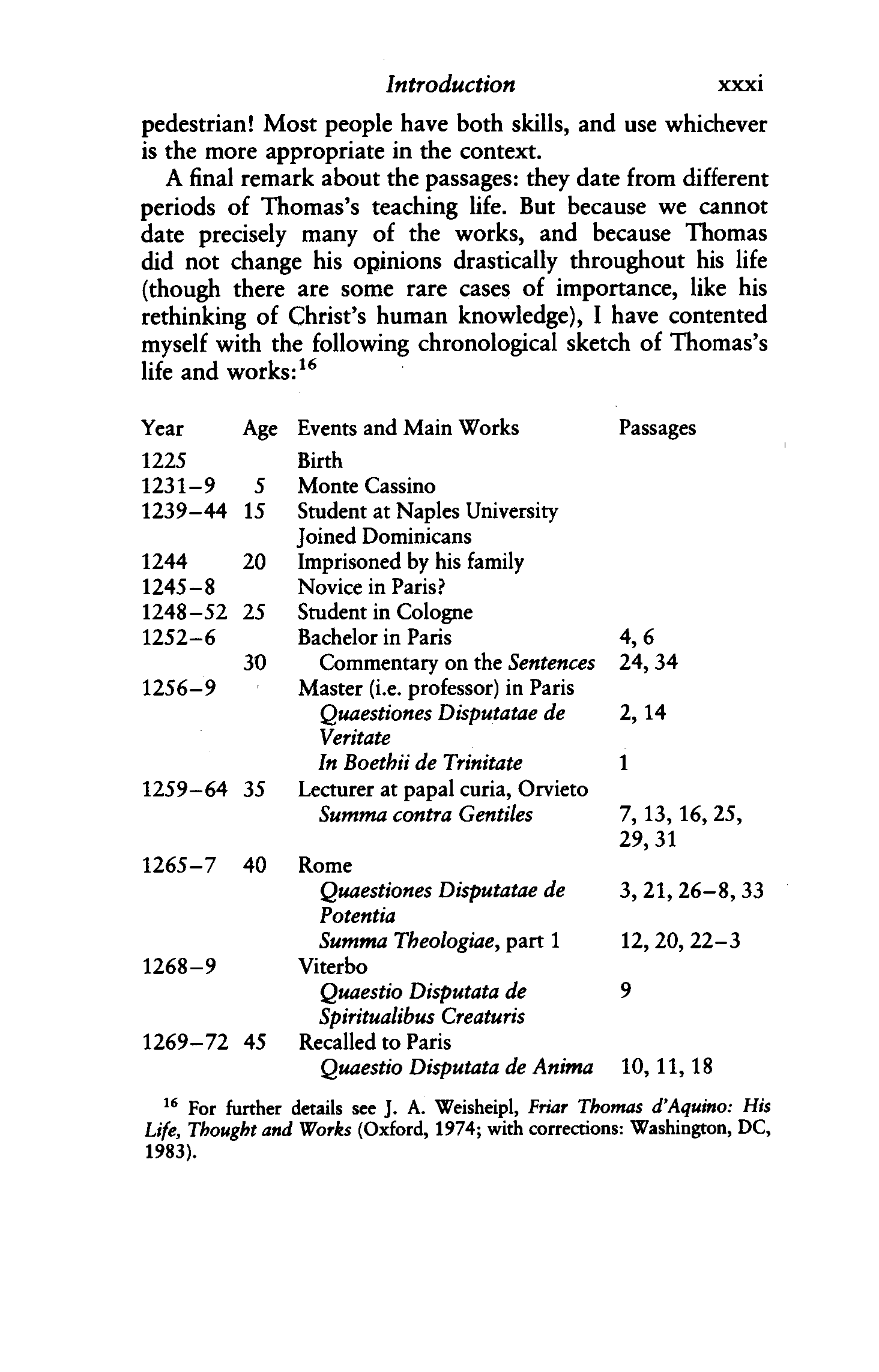
A final remark about the passages: they date from different periods of Thomas's teaching life. But because we cannot date precisely many of the works, and because Thomas did not change his opinions drastically throughout his life
(though there are some rare cases of importance, like his rethinking of Christ's human knowledge), I have contented myself with the following chronological sketch of Thomas's life and works:16
Year Age Events and Main Works Passages
Birth 1231-9
Monte Cassino 1239-44
Student at Naples University Joined Dominicans
Imprisoned by his family 1245-8 Novice in Paris?
1248-52
Student in Cologne 1252-6 Bachelor in Paris 4 ,6
Commentary on the Sentences 24, 34 1256-9 Master (i.e. professor) in Paris Quaestiones Disputatae de 2 ,1 4 Veritate In Boethii de Trinitate
1259-64
Lecturer at papal curia, Orvieto Summa contra Gentiles 7 ,1 3 ,1 6 , 25, 29,31 1 265-7
Rome Quaestiones Disputatae de 3, 21, 2 6 -8 , 33 Potentia Summa Theologiae, part 1 12,20, 2 2 -3 1268-9 Viterbo Quaestio Disputata de Spiritualibus Creaturis
1269-72
Recalled to Paris Quaestio Disputata de Anima 10,11,18 16 For further details see J. A. Weisheipl, Friar Thomas d'Aquino: His
Life, Thought and Works (Oxford, 1974; with corrections: Washington, DC, 1983).
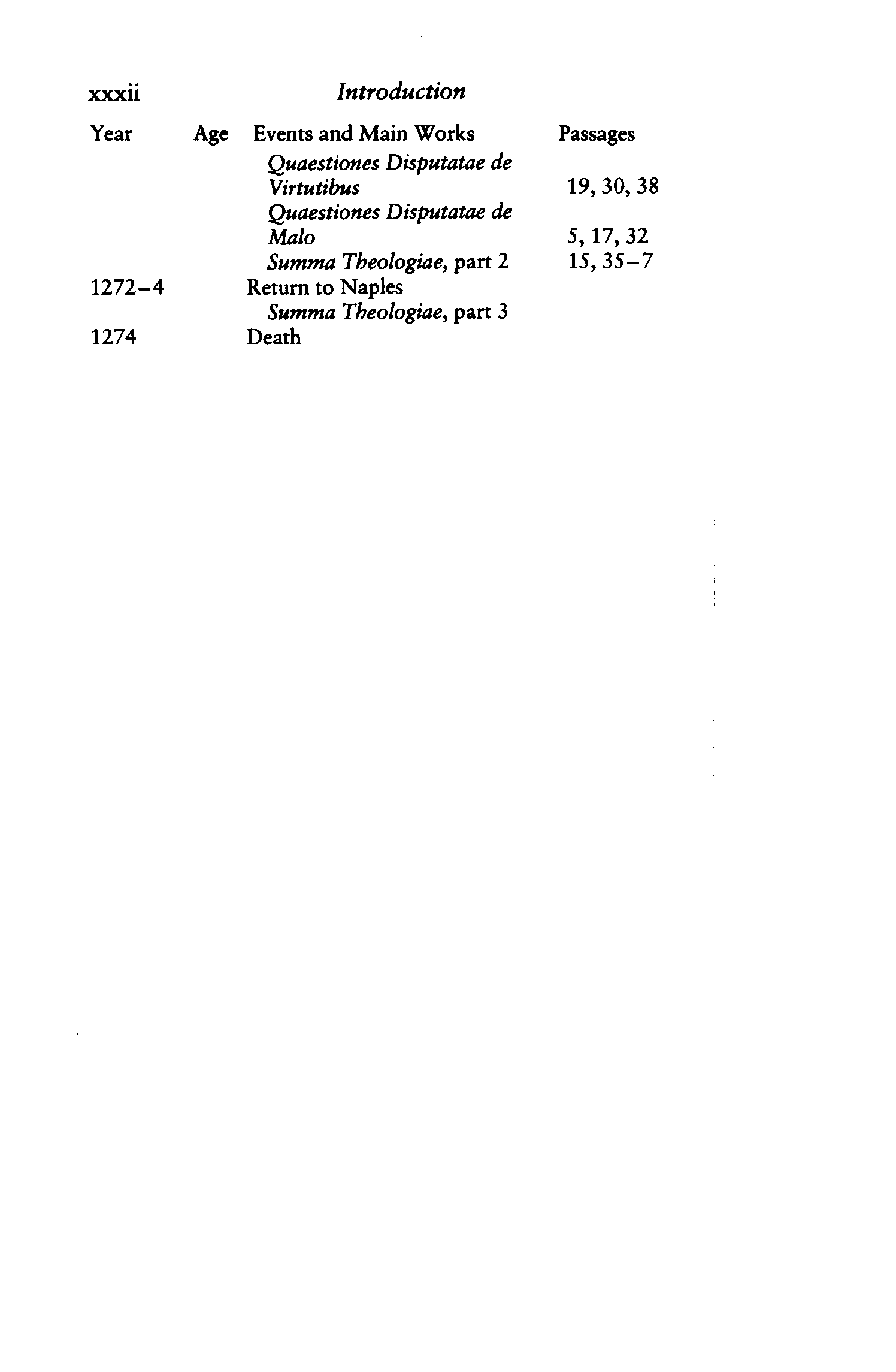
xxxii Introduction Year Age Events and Main Works Passages Quaestiones Disputatae de Virtutibus 19, 30, 38 Quaestiones Disputatae de Malo 5,17, 32 Summa Theologiae, part 2 1 5 ,3 5 -7 1272-4 Return to Naples Summa Theologiae, part 3
Death
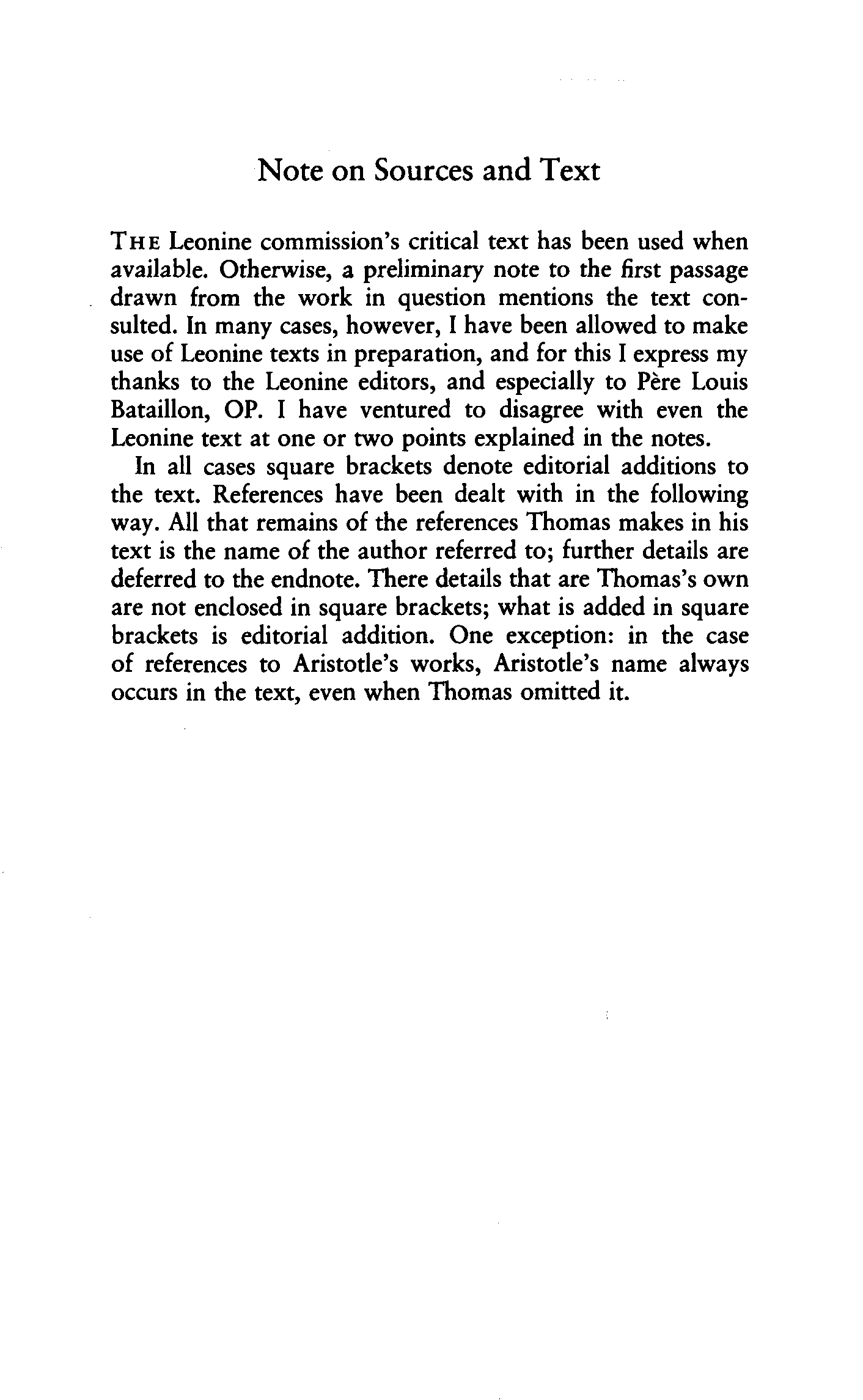
Note on Sources and Text T h e Leonine commission's critical text has been used when available. Otherwise, a preliminary note to the first passage drawn from the work in question mentions the text con sulted. In many cases, however, I have been allowed to make use of Leonine texts in preparation, and for this I express my thanks to the Leonine editors, and especially to Pére Louis
Bataillon, OP. I have ventured to disagree with even the Leonine text at one or two points explained in the notes.
In all cases square brackets denote editorial additions to the text. References have been dealt with in the following way. All that remains of the references Thomas makes in his text is the name of the author referred to; further details are deferred to the endnote. There details that are Thomas's own are not enclosed in square brackets; what is added in square brackets is editorial addition. One exception: in the case of references to Aristotle's works, Aristotle's name always occurs in the text, even when Thomas omitted it.
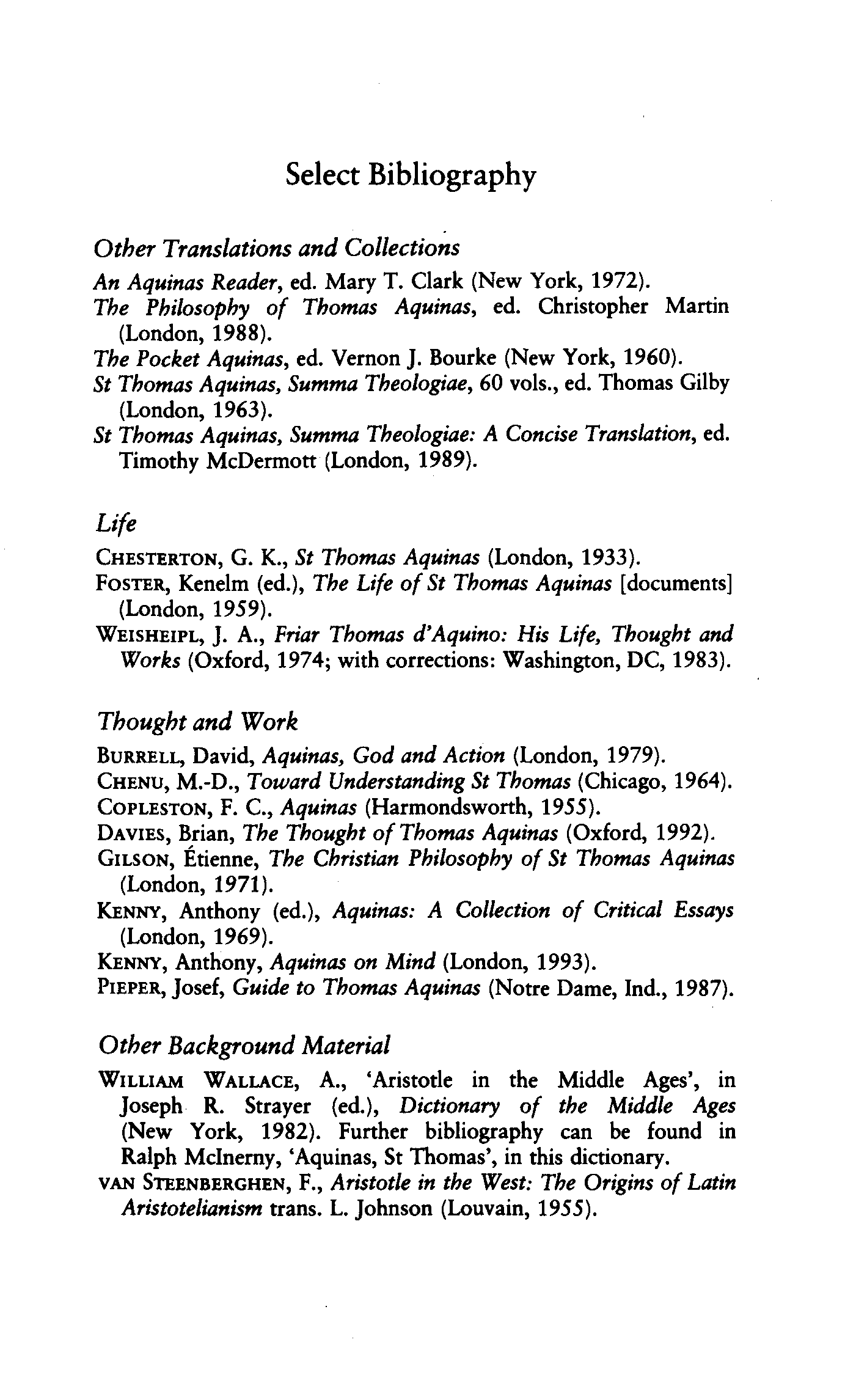
Select Bibliography Other Translations and Collections An Aquinas Reader, ed. Mary T. Clark (New York, 1972).
The Philosophy of Thomas Aquinas, ed. Christopher Martin (London, 1988).
The Pocket Aquinas, ed. Vernon J. Bourke (New York, 1960).
St Thomas Aquinas, Summa Theologiae, 60 vols., ed. Thomas Gilby (London, 1963).
St Thomas Aquinas, Summa Theologiae: A Concise Translation, ed.
Timothy McDermott (London, 1989).
Life Chesterton, G. K., St Thomas Aquinas (London, 1933).
Foster, Kenelm (ed.), The Life of St Thomas Aquinas [documents] (London, 1959).
Weisheipl, J. A., Friar Thomas d'Aquino: His Life, Thought and Works (Oxford, 1974; with corrections: Washington, DC, 1983).
Thought and Work B urrell, David, Aquinas, God and Action (London, 1979).
Chenu, M.-D., Toward Understanding St Thomas (Chicago, 1964).
Copleston, F. C., Aquinas (Harmondsworth, 1955).
Davies, Brian, The Thought of Thomas Aquinas (Oxford, 1992).
Gilson, Étienne, The Christian Philosophy of St Thomas Aquinas (London, 1971).
Kenny, Anthony (ed.), Aquinas: A Collection of Critical Essays (London, 1969).
Kenny, Anthony, Aquinas on Mind (London, 1993).
Pieper, Josef, Guide to Thomas Aquinas (Notre Dame, Ind., 1987).
Other Background Material William Wallace, A., 'Aristotle in the Middle Ages', in Joseph R.
Strayer (ed.), Dictionary of the Middle Ages (New York, 1982). Further bibliography can be found in Ralph Mclnemy, 'Aquinas, St Thomas', in this dictionary. van Steenberghen, F., Aristotle in the West: The Origins of Latin
Aristotelianism trans. L. Johnson (Louvain, 1955).
Select Bibliography xxxv Kenny, A., Kretzmann, N., and Pinborg, J. (eds.). The Cambridge
History of Later Medieval Philosophy (Cambridge, 1982).
Benson, R. L. and Constable G. (eds.), Renaissance and Renewal in the Twelfth Century (Oxford, 1985).
SELECTED
PHILOSOPHICAL
WRITINGS