
CHAPTER SIX
CHAPTER SIX
Thomism Today the philosophy of Aquinas occupies a favoured position in the intellectual life of the Catholic Church. And it is also generally regarded, of course, as representing in the modern world the prolongation of an ancient, some would say 'antiquated', philosophical tradition. Compared with, say, neopositivism on the one hand and existentialism on the other, Thomism is looked on as being eminently conservative. But in the Middle Ages Aquinas' philosophy never came to occupy the position in the Catholic Church which it enjoys today; it was simply one philosophy among others.
And mention has already been made in the first chapter of the fact that Aquinas was regarded by his contemporaries as an innovator. Indeed, some of his ideas met with opposition not only from theologians and philosophers outside the Order to which he belonged but even from some Dominicans. Thus in 1277, three years after Aquinas' death, Robert
Kilwardby, the Dominican archbishop of Canterbury, followed the example of the bishop of Paris in censuring a number of propositions which included a few that had been held by Aquinas. Soon after the latter's canonization in 1323 the Parisian censures of 1277 were withdrawn, as far as they affected Aquinas, attacks from outside the Order were diminished, and the theologico-philosophical system of Aquinas soon became the official doctrine of the Dominicans. But this does not mean that his system won general acceptance.
In the fourteenth century there were various 'schools', including the Thomists, who followed Aquinas, the Scotists, who followed John Duns Scotus, and the group which followed Giles of Rome. These groups, each of which followed a past and creative thinker, together formed the so-called 'ancient way' (via antiqua); and their influence was strongest in the Orders. This 'ancient way' was contrasted

AQUINAS with the 'modern way'
(via moderna) represented by the nominalist movement of the fourteenth century, the greatest figure of which was the English Franciscan, William of Ockham (d.
1349). This movement of thought was predominantly analytic and critical in character, with a marked interest in logical studies, and it bears some resemblance, sometimes a notable resemblance, to the prevailing trend in British philosophy today, though the points of similarity should not indeed be exaggerated. As one would expect with a new and 'modern' movement, it became fashionable and won widespread popularity, capturing most of the new universities which were founded in the course of the fourteenth and fifteenth centuries, though it also obtained a strong hold in the older universities such as Oxford and Paris. In time nominalism itself became a recognized tradition or school rather than a new and spreading movement of thought, and at the period of the Renaissance we find university chairs not only of Thomism and Scotism but also of nominalism.
It is therefore a very great mistake to think that medieval philosophy and Thomism are synonymous terms.
In the medieval period the favourite textbook in theology and philosophy was the work to which allusion has already been made in these pages, namely the Four Books of Opinions, commonly known as the Sentences, by the twelfth-century writer, Peter Lombard.
Aquinas, Duns Scotus, William of Ockham, all lectured on the Sentences and wrote commentaries on it. And when John Capreolus (d.
1444) wished to defend Aquinas' doctrines against the criticisms of Scotists and nominalists he did so by way of a commentary on the Sentences, using Aquinas' own commentary and referring to the Summa theologica and other works. In the course of time, however, the Summa theologica began to displace the Sentences as a textbook, and commentaries on the former began to appear. Thus a celebrated
Dominican called Thomas de Vio and generally known as Cajetan wrote commentaries on this work of Aquinas between 1507 and 1522, while Franciscus Sylvester de Sylves-

THOMISM tris (d.
1528), who is known as Ferrariensis, composed a commentary on the Summa contra Gentiles.
Commentaries continued to be written, but during the period of the Renaissance a freer style of writing came to be adopted. Through his Metaphysical Disputations the Jesuit
Francis Suarez (d.
1617), the famous writer on the philosophy of law, gave a powerful impetus to the construction of systematic philosophical works in which philosophical themes alone were treated and in which the old habit of commenting on a venerable predecessor's text was dropped.
The gradual growth of this newer style of writing among 1 was, of course, in tune with the practice
Scholastic authors of contemporary non-Scholastic philosophers, who were composing original philosophical works of their own. Moreover, in view of what was happening outside the Schools the Scholastics were compelled to separate philosophy from dogmatic theology not simply by asserting a distinction between them but also by actually separating them in their written works. In the first half of the seventeenth century there appeared the Thomist Vhilosophical Course (Cursus philosophicus thomisticus) of the Dominican writer, John of St Thomas (d.
1644), and this was followed by other systematic 'philosophical courses', some based on Aquinas, others, by Franciscans, on Duns Scotus.
This process of 'extracting' the philosophical system of a man who had himself never elaborated such a system in isolation from theology is sometimes spoken of in a disparaging manner, as though it constituted a distortion or perversion of the spirit of men like Aquinas and Duns Scotus. But it is very difficult to see what else the Scholastics could have done in the postRenaissance world, when outside the Schools philosophy was being pursued as an independent branch of study. And it is only reasonable to suppose that Aquinas, had he returned to his activity on earth in, say, the seventeenth or 1.
I use the term 'Scholastics' to mean in general those philosophers who consciously and deliberately adhered to one of the medieval traditions.
AQUINAS the eighteenth century, would have adapted his way of writing to the changed circumstances.
This activity in the composition first of commentaries and then of philosophical courses should not be taken to mean that the philosophy of Aquinas enjoyed an undisputed reign in the Catholic seminaries and educational institutions of the seventeenth, eighteenth, and nineteenth centuries. Leaving aside the devotion of the Dominicans to Aquinas and of the Franciscans to Duns Scotus and the considerable influence of Sudrez both inside and outside the Jesuit Order, one can say that in many ecclesiastical seminaries and educational institutions philosophy came to consist of an emasculated
Scholastic Aristotelianism, tinctured with ideas taken from other currents of thought, especially Cartesianism. Moreover, this ecclesiastical philosophy was only too often out of touch not only with contemporary philosophical thought in the world outside but even with contemporary science.
And it is necessary to bear this unhappy state of affairs in mind in order to appreciate the action of Pope Leo XIII when in his encyclical letter Aeterni Vatris (1879) he asserted the permanent value of the Thomist synthesis and urged Catholic philosophers to draw their inspiration from Aquinas, while developing Thomism to meet modern intellectual 1 He was not asking them to shut their eyes to all thought since the thirteenth century but rather to penetrate and develop the synthesis of a thinker who combined a profound and living belief in the Christian religion with a real needs. trust in the power of the human mind and in the value of philosophic reflection, uniting a readiness to see truth wherever it might be found with a fidelity to fundamental rational insights which prevented any surrender to passing fashion just because it was fashionable.
It is understandable, of course, that those who have quite different ideas about religion and who think that Aquinas' philosophical convictions are obsolete should regard the papal action as 1.
It is not strictly true to say that Leo XIII 'inaugurated* the revival of Thomism. What he did was to give impetus to an already existing movement

THOMISM being 'reactionary'. But when Leo XIII extolled Thomism he was not trying to put a full-stop to philosophical activity among Catholics; rather was he trying to renew it and give it a fresh impetus. And there can be little doubt that as a matter of fact the revival of philosophy among Catholics has coincided with the revival of Thomism.
Thomists insist that Thomism is acceptable on its own merits as a philosophy. And it is indeed clear that any philosophical system ultimately stands or falls by its own intrinsic merits or demerits. None the less, it would be idle to deny that there tends to be a de facto connexion between Thomism and Catholicism. There are indeed some philosophers who are not Catholics but whose philosophical outlook is more or less akin to that of the Thomists, and sometimes even identical with it. But it is noticeable that these philosophers are not infrequently thinkers whose religious convictions approximate to those of the Catholics. And one has only to go to an international philosophical congress to realize the truth of the observation that there is some de facto connexion between Thomism and Catholicism. Now, given this connexion, it is understandable that there is an inevitable tendency to use Thomism for apologetic purposes.
I have no wish to question the legitimacy of this procedure.
A Christian apologist who believes in the validity of the Thomist system is fully entitled to draw on it in his work.
And a Thomist philosopher who believes, as Aquinas himself believed, that man's final end is supernatural and that the supreme business of life is to attain it may naturally be inclined to stress those aspects of Thomist philosophy which point beyond itself. But though the use of Thomism for apologetic purposes is easily understandable, especially in the modern world, it may not be inappropriate to stress the fact that, whatever uses it may be put to, Thomism is and remains a philosophy. Despite its de facto connexion with 1 and if we wish to judge of its philosophical merits and its potentialiCatholicism, it is not part of the Catholic faith; i. A Catholic philosopher is not committed to Thomism because he is a Catholic.

AQUINAS ties for fruitful development, we have to turn to those Thomists who have written as serious philosophers rather than to the somewhat slick statements of Thomist positions by popular apologists.
One of the first tasks of Thomist philosophers in the modern era was obviously that of showing that Thomism was not inextricably entangled with discarded scientific theories and that the validity of its general principles was unaffected by the evolution of modern science.
In other words, one of their primary tasks was to show the falsity of the notion that the development of modern science had rendered metaphysical philosophy in general, and Thomism in particular, an antiquated and completely outdated mode of thought.
Nowadays the existence of Thomism and the presence of Thomists in our midst is taken for granted : it represents one of the recognized currents of thought. But in the last century this was not the case. The project of reviving the philosophy of Aquinas was commonly looked on as an exhibition of archaism, an impossible attempt to halt the march of modern knowledge by the childish device of putting back the hands of the clock. How, in particular, could a revival of medieval philosophy be reconciled with an acceptance of the ascertained results of modern science and with the spirit which animated the scientists?
The fulfilment of this task is associated very largely with the university of Louvain, and especially with the work of Cardinal Mercier (1851-1926) and his collaborators.
I cannot enter upon the history of Mercier's labours as a professor at Louvain; but it is necessary to emphasize the following point. Mercier was profoundly convinced of the validity of Aquinas' view that our knowledge starts with sense-perception and that metaphysical reflection is based upon knowledge of the material world. He interpreted this as implying that systematic philosophy must presuppose a knowledge of the sciences, that it must remain in contact with them, and that it must integrate their conclusions into itself. He

THOMISM therefore expounded the ideal not only of obtaining a thorough knowledge of scientific method and of the results obtained by scientists elsewhere than at Louvain but also of forming men who would devote themselves to the various particular sciences, in connexion with his own Institut Superieur de Philosophies and this, as he insisted, without any apologetic purpose. Neither religion nor metaphysics, he maintained, has anything to fear from the sciences; but the metaphysician needs scientific knowledge. And scientific knowledge can be obtained only by devoting oneself to a particular science for its own sake, and not with a view to obtaining results which can be used in religious apologetics.
It was in this spirit that he was instrumental in founding, for example, the laboratory of experimental psychology which won merited respect and fame under the direction of Professor Michotte, who had studied in Germany under Wundt.
Although Mercier made a distinction between the particular sciences and philosophy, and although he did not regard the latter as being simply a synthesis of the sciences, he spoke explicitly of philosophy as being the natural development and complement of the sciences. In his view the sciences begin the work of giving an explanatory account of empirical reality, and philosophy, utilizing their results, though employing also certain fundamental principles, gives the completest explanation of empirical reality which is possible for the human mind by its natural reflection. Like
Aquinas, he believed in self-evident principles which the metaphysician employs in the construction of his synthesis and explanatory account of empirical reality; but he emphasized so strongly the relation of metaphysics to the sciences that he tended to substitute for the distinction between the data of ordinary experience and philosophic reflection on these data the distinction between the established results of the sciences and philosophic reflection on these results. And this represents a point of view which is not acceptable to all Thomists. Obviously, no Thomist would deny the relevance of, for example, modern discoveries in
AQUINAS physiology and psychology to discussion of the body-mind problem and the fact that the problem has to be treated in the light of and with reference to these discoveries and theories. At the same time they prefer to stress metaphysics' independence of changing scientific hypotheses and its connexion with ordinary experience. But whichever point of view is to be preferred there can be no doubt at all that the labours of Mercier and his collaborators at Louvain contributed in a signal manner to winning respect for Thomism and to dissipating the notion that it is hostile to or suspicious or fearful of modern scientific developments and discoveries.
But the Thomists of the modern era had obviously to concern themselves not only with the relation of philosophy to science but also with the relation of Thomism to other philosophical traditions and currents of thought. And the attitudes of individual Thomists towards other philosophers have, not unnaturally, varied very considerably. While some have been inclined not only to underline differences but also to adopt a markedly polemical tone, others have consistently tried to understand the other philosophers' points of view and to discover the valuable and true elements in their thought. With those who adopted the former attitude, the concept of a 'perennial philosophy' has tended to be exceedingly narrow, while with the second group the concept has tended to take on a much wider significance. But though there are still some Thomists for whom non-Thomist philosophies seem to be little more than absurdities, it is the second attitude which has prevailed.
If one attends a congress of Thomist philosophers, one can hardly fail to be struck by the fair-mindedness and sympathy with which other thinkers are discussed. Generally speaking, the presentday Thomist is concerned not only to understand what Kant or Husserl or Heidegger says and why he says it, but also to discover his real contribution to philosophic thought. For it is taken for granted that an original thinker would not say what he says unless he had got hold of some truth or apprehended some aspect of reality to which it is worth while to draw attention.
If one allows for possible excep-

THOMISM tions, it is safe to say that the serious Thomist philosopher of today is free from the sort of attitude which it seems to be incumbent upon the orthodox Marxist to adopt in regard to non-Marxist philosophers. Indeed, Marxism is likely to receive a much more level-headed and discriminating treatment from the Thomist than the latter is likely to receive from the Marxist.
One important consequence of the interest taken by Thomists in non-Thomist thought and of the sympathetic and understanding treatment which they are generally prepared or even eager to accord it is that they are inevitably influenced by other philosophies and currents of thought.
This influence may not always perhaps be immediately evident. For in some cases at least Thomists have the rather disconcerting habit of finding texts in Aquinas to justify them in presenting as developments of his philosophy ideas which have certainly come to them via contemporary non-Thomist thinkers. It is odd to find, for example, a discussion which is plainly inspired by the writings of modern phenomenologists presented as a meditation on texts of Aquinas. On the other hand it is easy to understand that a philosopher who believes that Thomism is the 'perennial philosophy' should be eager to show not only that those elements in modern thought which he considers to be fruitful are compatible with the philosophy of the historic Aquinas but also that they can be regarded as being in some real sense developments of the latter and that they can be organically assimilated by a Thomism which is not looked on as a purely static importation from the thirteenth century. And in any case the point to which I wish to draw attention is that Thomists are concerned not only with understanding the non-Thomist philosophies but also with evaluating them in a positive and not simply negative manner.
In the last century the great importance and influence of Kant and the common preoccupation with epistemology or the theory of knowledge stimulated Thomists to develop their own epistemology. Yet if one speaks of 'their own epistemology', this statement can be misunderstood. For
AQUINAS although Thomists agree about the obvious fact that Aquinas never elaborated a theory of knowledge as a separate branch of philosophy they neither have been nor are in full agreement about the function and scope of epistemology or about the way in which Aquinas' remarks about knowledge and certainty should be developed. They agree, of course, in rejecting scepticism, positivism, subjective idealism and the pragmatist account of truth and in accepting realism and the mind's ability to attain truth and certainty. They reject scepticism, for example, not merely because a philosophy of scepticism would be clearly incompatible with Aquinas' position but rather for intrinsic reasons. But there is no general agreement about the precise nature of the chief epistemological problems or about the right method of tackling them. Some of the earlier Thomists took their stand more or less on common sense and on man's spontaneous conviction that he apprehends reality and truth. This attitude, however, met with the objection that it betrayed a misunderstanding of the nature of epistemological problems and that it was consequently incapable of dealing with them.
But there has been a great variety of opinions about the formulation and relative importance of these problems.
Some Thomists have regarded the problem of knowledge largely through the eyes of Descartes. They have started with what they call 'methodic doubt', have admitted the reality of Descartes' problems and have attempted to solve them in a less roundabout manner. Thus some, while taking the concrete intuition of the self as their point of departure, have endeavoured to justify by examination of this intuition both the affirmation of metaphysical principles and the assertion of the existence of material reality. By proceeding in this way they have hoped to avoid a bifurcation between ideal judgements (analytic in some sense) and judgements about existence, a bifurcation towards which Mercier is thought to have tended and which makes it difficult to bridge the gap between the order of ideas and the order of things.
Others, however, have interpreted the problems about knowledge primarily in terms of the philosophy of Kant. Thus in
THOMISM the fifth volume of his work he point de depart de la metaphysique the late Pere Marshal of Louvain undertook a prolonged critical comparison of the Thomist and Kantian positions. In the first part of the volume he developed the position of Aquinas himself in the light of the demands of the critical philosophy, stressing above all the dynamism of the intellect, its movement towards being, and developing the metaphysical implications of this intellectual dynamism.
In the second part he undertook to show how if one accepts the starting-point and method of Kant one is forced in the end to proceed beyond the latter's position into metaphysics.
For Marshal, therefore, Kant was not at all the philosophical ogre which he had been for many other Thomists in particular and Scholastics in general. For him the Kantian transcendental critique of knowledge was a powerful instrument for developing the germs of a Thomist critique which were present in the writings of Aquinas.
But though Marechal's writings have exercised a wide influence there are a number of Thomists who reject in decisive terms any attempt to develop a Thomist theory of knowledge on the basis of either a Kantian or a Cartesian starting-point.
Etienne Gilson, for example, will not allow that Descartes' problem of the existence of the extra-mental world is a real problem at all. At least it is a real problem only if Descartes' initial presuppositions and starting-point are accepted. As for Kant, if one starts with the presuppositions of the transcendental critique of knowledge, there can be no consistent way out in the direction of a realist metaphysics. Idealism, as it has developed historically, has drawn the logical conclusions from the premisses which were initially adopted, and one cannot without inconsistency and contradiction accept the starting-point and deny the conclusions.
1 Indeed, the whole attitude which is represented by preoccupation with the theory of knowledge and by the notion that a i. The validity of this point of view is, of course, questionable.
The truth of the statement that idealism, in its historic development, is a strictly logical deduction from a given set of premisses might well be challenged.

AQUINAS critique of knowledge must be carried through before existential judgements can be made justifiably and before any metaphysics of any kind is possible is both intrinsically unjustifiable and also incompatible with Aquinas' position.
This is not to say that no Thomist theory of knowledge is possible. But it must take the form of reflecting on the concrete act of apprehending the objectively existent and on the metaphysical conditions and implications of this act.
M. Gilson does not, of course, deny the obvious fact that we may be mistaken in thinking that a given judgement is true.
But he emphatically rejects any tendency to think that we can first doubt the possibility of knowledge and then 'justify' knowledge in some a priori manner. Other Thomists, however, while agreeing with Gilson that the problem of the existence of any datum other than the subject is a pseudoproblem, are not prepared to say that there is no critical problem at all and that there is no place for a critique of knowledge unless one is ready to adopt an idealist position.
The critical problem, they would say, can be stated in such a way that its mere formulation does not prejudge the issue between realism and idealism.
Turning to Aquinas' metaphysics we again find considerable differences of attitude among Thomists. Some of the latter, mainly, I think, among the older generation, give the impression of thinking that little more is required than to repeat what Aquinas said. This impression is not entirely justified, of course. For these writers realize the obvious fact that the criticisms levelled against the theories maintained by Aquinas and against his arguments in favour of these theories have to be met. And in attempting to meet them they do more than merely repeat the words of Aquinas. But their point of view seems to be that though his theories and arguments need some explanation and defence in view of later criticism there is no justified call for development in any other sense.
It is a fallacy, they would say, to suppose that because Aquinas lived in the thirteenth century his metaphysics is inadequate for the twentieth century unless it undergoes a process of 'development'. The fallacy lies in
THOMISM thinking that metaphysics and the sciences are of the same type and that because the latter change and develop the former must do so too. Metaphysics deals with things considered simply as beings, and their ontological structure remains the same, whatever new discoveries may be made and new hypotheses formed by the scientists. There is thus no reason at all why Aquinas should not himself have developed the permanently valid system of metaphysics.
Naturally, in another age, informed by an outlook different from that prevailing in the thirteenth century, it may be very difficult for people to appreciate and understand Aquinas' point of view and lines of thought; but this is an empirical statement of fact about people, which does not affect the metaphysical system considered in itself.
It is reasonable to demand a preliminary work of explanation and clarification; but this work constitutes a pedagogical introduction to the perennially valid metaphysical system. Any development that may be called for is really extrinsic to the system : it is a development in the outlook and mental dispositions of people rather than a development of the abstract system.
To a certain extent all Thomists would agree with this point of view. If a philosopher thought that a development was called for in Aquinas' metaphysics similar to the development in astronomy from a geocentric to a heliocentric hypothesis he would have no better reason for calling himself a Thomist' than a Copernican astronomer would have for calling himself a disciple of Ptolemy. But many Thomists would claim that there is ample room for a development of Aquinas' metaphysics which, while remaining faithful to the latter's spirit and outlook, amounts to more than a defence of his explicitly stated positions against attack. For example, behind Aquinas' proofs of the existence of God there lies a set of presuppositions which, though alluded to here and there in his writings, stand in need of elaboration and development.
It is clear that if the arguments are logically sound the conclusion must be implicitly contained in the premisses. And in this case to affirm the existence of any
AQUINAS finite thing is to affirm implicitly the existence of God.
It is not surprising, therefore, that we find some Thomists interpreting the judgement in a manner which bears a marked resemblance to the view maintained by, for example, F. H.
Bradley. The proofs of the existence of God do not, therefore, involve an illegitimate leap from the empirical to the transcendent, from the finite to the infinite; for they simply make explicit knowledge which is already implicitly contained in knowing that there is at least one changeable, contingent, finite being. Does not Aquinas himself say that 'all cognitive agents know God implicitly in everything they know' (De veritate, 22, 2, ad 1)?
But what is meant by implicit knowledge in this connexion? Does it mean simply that though one does not know one is capable of knowing?
Or does it mean something more than this? And if it does, how can this be reconciled with Aquinas' view that we have no innate idea of God and no intuition of the divine essence ?
Thomists point out that though Aquinas maintained that the primary natural object of the human mind is the nature of the material thing he also always held that the mind knows all that it does know as being, and that logically prior to the orientation of the human mind as human towards a particular kind of being there is the natural dynamic impulse of the mind as mind to being as such.
In fact, the mind is by its nature orientated, as it were, towards infinite being : there is a dynamic impulse towards the infinite, which is the ground of the will's orientation towards the infinite good and which ultimately makes metaphysics possible. Since this impulse or orientation of the mind does not constitute an innate idea of God, and still less an intuition of the divine essence, it is possible for man to substitute for the real infinite a pseudo-infinite, to construct, for example, the idea of 'the World' as a quasi-Absolute in which finite things are
I presuppose, of course, the interpretation of Aquinas' argument, which was defended in the third chapter, namely that he did not regard the proposition affirming God's existence as an empirical hypothesis in the modern sense.
I also presuppose the remarks about logical entailment in this context which I made in the same chapter.
THOMISM situated, or even to deny the infinite altogether, though this denial does not destroy the natural orientation of the mind towards the infinite. There is always an 'implicit knowledge' of God, though this does not become what is ordinarily called 'knowledge' until it is made explicit. And the proofs of the existence of God are one way in which it can become explicit. For they focus attention on those aspects of empirical reality which act, as it were, like pointers and give free play to the natural orientation of the mind. Behind all explicit argumentation in favour of God's existence there lies the natural drive of the mind towards transcendence, which must be seen in close connexion with the will's drive towards the infinite good. Indeed, some Thomists try first to show that there is in reality this natural drive or impulse of the human mind towards the infinite and then to argue directly that this natural intellectual dynamism manifests the reality, the real existence that is to say, of the concrete infinite God. They would claim that this line of thought is in harmony with Aquinas' teaching. The latter says, for example, that 'our mind in its understanding reaches out to the infinite. A sign of this is that whatever fine quantity is given the mind can conceive a greater. Now this orientation of the mind to the infinite would be in vain (frustra; that is, unintelligible and inexplicable) unless there were an infinite intelligible thing. There must therefore be an infinite intelligible thing, which must be the supreme being, and this we call God'
(C.G., i, 43). At the same time, these Thomists would say, the hints and remarks made by Aquinas on this subject have to be developed in order to satisfy the demands of critical reflection. And light can be shed on the way in which they should be developed by study not only of Christian philosophers like Blondel and thinkers belonging to the Augustinian tradition in general but also of the idealist current of thought.
Thomists have also shown themselves conscious of the need for exhibiting the relevance of Thomism to the modern situation of man by developing its social and political ideas and by applying Aquinas' principles to society in its present
*S7

AQUINAS forms. In this respect Jacques Maritain has made -a signal contribution. Some are inclined to think, rightly or wrongly, that in his general presentation ofThomism he lays too great an emphasis on the letter of Aquinas and on the commentaries of John of St Thomas; but in any case he has undoubtedly given a great impetus to the revival and deepening of the Thomist tradition. Indeed, Maritain and Gilson are the two best known modern Thomists. Maritain has discussed at length modern social and political developments, like totalitarianism, in the light of Aquinas' principles.
In his personal political convictions he is known as standing rather to the 'Left'; but whatever his views on detailed political issues may be he always insists on the Thomist idea of the person and on society as a society of 'persons' rather than of mere 'individuals'. In his eyes Thomist social and political theory, with its emphasis on the social nature of man and on the positive function of political society and of government combined with its emphasis on the spiritual and moral aspects of the human being which make him more than a mere member of the collectivity, can point the way between totalitarianism on the one hand and atomic individualism on the other. Starting with the idea of the person he has also emphasized the humanistic aspects of Thomism, insisting that the position of Aquinas is as far removed from the pessimism of Hobbes as from the optimism of Rousseau and showing that Aquinas' insistence on the spiritual side of human personality belongs to an integral humanism which avoids the one-sided conception of man and of his needs and development which we find, for example, in the Marxist philosophy.
It is clear, therefore, that though Thomists may give to the external observer the impression of being ultra-conservative and of all saying the same thing they are indifferent neither to non-Thomist thought nor to the need for developing Aquinas' positions. And in the process of fulfilling this need they display a much greater originality of thought and variety of ideas than might at first be suspected.
In other words, Thomism is not simply a museum piece; it is
THOMISM a living and developing movement of thought, deriving its inspiration from Aquinas but conducting its meditation on his writings in the light of subsequent philosophy and of subsequent cultural developments in general.
It is worth adding, however, that modern Thomists have been predominantly interested in continental philosophy of the speculative type. One can hear a great deal in Thomist circles about Heidegger, for example; one hears a great deal less about contemporary British and American philosophers of the empiricist tradition or about what can perhaps be called the linguistic movement in Anglo-American philosophy. This can, of course, be easily explained, if one bears in mind the differences between continental and Anglo-American philosophy in general, together with the fact that Thomism is far more widespread and vigorous in countries like France, Belgium, and Germany than it is in Britain. But I think that Thomist philosophy might benefit if its adherents paid rather more attention than they do to the prevailing currents of thought in Britain and America. For one thing, the influence of continental philosophy does not invariably contribute to the maintenance of that concern with preciseness and clarity that marked Aquinas himself and has characterized many of the older Thomists. For another thing, reflection on the foundations of their metaphysics in the light of modern empiricist criticism and of linguistic analysis might lead Thomists to achieve a greater clarification of, say, the nature of 'metaphysical principles' and of their status in relation to pure tautologies on the one hand and to empirical hypotheses on the other.
If no mention has been made in this section of logical developments, the reason is that there is not very much to be said.
Certain Thomists, like the Polish Dominican, I. M.
Bochenski, have studied the developments in 'modern logic' and its relation to the logic used by Aquinas, and the need is felt for more work of this kind.
It is certainly highly desirable that this need should be met. But though Thomists, apart perhaps from some ultra-traditionalists, feel no hostility towards or suspicion of modern logical developments
AQUINAS they are sceptical about the validity of any claim that modern logic has initiated a revolution in general philosophy. And they are not, of course, alone in feeling sceptical about this. Pioneers in a fresh line of work are only too apt to indulge in exaggerated claims about the omnicompetence of their pet study. At the same time it is reasonable to expect that some at least of those who draw their inspiration from medieval philosophy should devote particular attention to modern developments of a line of study which was so extensively pursued in the Middle Ages.
It has been pointed out in this chapter that the philosophy of Aquinas was not the only philosophical system of the Middle Ages. And it scarcely needs saying that it is not the only philosophy today. Indeed, the point which needs emphasizing is not that there are other philosophical systems but that Thomism is in fact a philosophy and that any de facto affiliations which it may have with Catholicism do not destroy its philosophical character. Fundamentally it is a sustained attempt by the human mind to understand man and his situation, the world in which he finds himself. And this it has in common with other systems. That which is peculiar to it is perhaps the emphasis it places on existence, on the act of existing, not in the existentialist sense of man as free, as 'creating' himself, but on existence considered as the fundamental act by which every thing is a reality.
But this emphasis does not place Thomism outside the class of philosophical systems : it simply gives it a special stamp.
In so far as the philosophy of Aquinas was the result of the reflection of a theologian-philosopher we can speak of it as a Christian interpretation of the world or as an attempt to understand empirical reality, especially on the existential level, in the light of Christianity. At the same time Aquinas himself distinguished clearly between philosophy and theology, and Thomism has developed as a philosophy which is prepared to stand or fall on its own intrinsic merits or demerits -and which appeals to reason, not to faith or to

THOMISM revelation. Thomists therefore can enter and do enter into intelligent discourse on the purely philosophical level with thinkers who belong to very different traditions and schools of thought.
But if Thomism is admittedly one among other philosophies, how can it be reasonably claimed, as Thomists are accustomed to claim, that it represents the 'perennial philosophy' ? How can this claim be even plausible ?
It may be appropriate to end this book with some brief remarks on this topic.
I am not concerned with trying to prove that Thomism is in fact the perennial philosophy:
I am concerned rather with trying to show that the claim is not so absurd as it sounds at first hearing.
The use of the word 'perennial' can lead to serious misunderstanding. For it suggests the idea of an acquired body of knowledge which is handed on in the form of propositions to be passively learned and accepted. And textbooks of Scholastic philosophy may seem to indicate by their structure and lay-out that this is in fact what is meant by a perennial philosophy. But it is sufficiently obvious that one does not become a philosopher by learning the propositions enunciated by Aquinas or by anyone else.
It is only by personal philosophic reflection that one becomes a philosopher. And if one means by perennial philosophy a work which is accomplished once and for all by the reflection of a determinate individual or group of thinkers and which only needs to be handed on, there is no such philosophy. For in a very real sense the work has to be done all over again by every philosopher. Nor, as we have already seen, does the Thomist concept of a perennial philosophy mean that all development is excluded. The claim that there is a perennial philosophy involves the claim that there is an abiding metaphysical pattern in the changing and developing universe, which is capable of being understood and stated. But it does not follow that any given man had or has a completely adequate understanding of it. The concept of a perennial philosophy is the concept of a developing insight rather than the concept of a static and once-for-all expression of

AQUINAS insight. Moreover, the claim that Thomism is the perennial philosophy is not intended by those who make it, at least by the more sensible among them,- to exclude the possibility of fresh insights into truth being contributed by non-Thomist philosophers.
It does, however, imply that these insights can be organically assimilated by a developing Thomism.
One condition for this organic assimilation is that Thomism should not be an unbalanced system which stresses one aspect of reality to such an extent that it is necessarily blind to other aspects. And it may be worth while to draw attention to one or two features of Thomism which suggest that it is in fact a balanced system. We find, for example, an 'empiricist' element and a 'rationalist' element. We find also a profound confidence in the power of the human reason coupled with a vivid consciousness of its limitations. The last mentioned factor prevents Thomism from degenerating into some form of 'Gnosticism', into professing, for example, to be able to plumb the depths of ultimate reality or, with Hegel, to read off, as it were, the contents of the divine mind.
1 Its confidence in the power of the human reason, on the other hand, divides it from those who, with Kierkegaard and with those theologians who have turned the latter's understandable attitude towards Hegelianism into an antiphilosophical dogma, would write off philosophy as a sign of human intellectual pride and as a confirmation of the powerlessness of man caused by the Fall. Thomism's confidence in the human reason enables it to enter into intelligent discourse with other philosophies, while its consciousness of the inevitable limitations of the human mind saves it from those speculative extravaganzas which incline commentators to dwell more on the psychology of their authors than on what the latter have said. In its theory of man Thomism tries to avoid materialism on the one hand i.
I do not mean to imply that Hegel was what is ordinarily thought of as a 'theist'. But it was partly, I think, his excessive confidence in the power and scope of the speculative reason which led him gradually to eliminate the belief in the divine transcendence with which he started in his early years.
THOMISM and sheer dualism on the other; and in its political theory it makes its way between the Scylla of totalitarianism and the Charybdis of atomic individualism.
Its humanism is a balanced humanism. The body is not declared worthless or shameful, and the sciences and the arts are not rejected in the name of religion. At the same time man is not declared, with Protagoras, to be the measure of all things.
To claim that Thomism is a balanced philosophy involves claiming that it is capable of doing justice to different aspects of reality without turning one aspect into the whole.
But it does not involve the claim that the integration of philosophic truth was finally accomplished by Aquinas. And there is at least one sense in which the Thomist himself can say, 'We cannot go back to the Middle Ages; we cannot go back to Aquinas'. If we are considering Aquinas' philosophy from a purely historical point of view, the fact that he said this or that is obviously of prime importance. But if we are considering Thomism as a living and developing philosophy, it is the philosophical positions themselves which count, and the fact that Thomas Aquinas held them in the thirteenth century is not strictly relevant. At the same time the claim that Thomism as a living and developing system of philosophy can do justice to different aspects of reality would be senseless unless it is added that it can do this without ceasing to be Thomism.
Similarly, if the concept of Thomism as the perennial philosophy is to have any meaning, there must be something which remains the same and permits us to speak with propriety of Thomism', whatever stage of development the philosophy may have reached.
Otherwise the name Thomism' would be in obvious danger of becoming empty of meaning.
The attempt has indeed been made to draw up a list of propositions which give, as it were, the essence of Thomism and which must be held by anyone who wishes to be recognized as a Thomist. But when the emphasis is placed on the acceptance of a set of propositions, it seems to me to be misplaced. If the propositions are true, this can only be because there is a certain stable and intelligible metaphysical struc-
AQUINAS ture of reality which discloses itself to the reflective mind of the philosopher. And if there is such a permanent structure, it will find expression, to some extent at least, in ordinary language in the form of an implicit metaphysic.
And if it can be shown not only that there is an implicit metaphysic which is not simply the reflection of linguistic forms but also that this implicit metaphysic leads naturally to an explicit metaphysic on Thomist lines, the claim that Thomism is the perennial philosophy might appear less unreasonable to philosophers at large. To those who think that philosophical theories must be erected on the changing hypotheses of the sciences, the philosophy of Aquinas can be of little but historical interest. But to those who think that philosophical reflection is grounded in common experience and that metaphysics has an intimate connexion with this experience it can be a source of constant stimulus and inspiration.
Bibliographical Notes i The Latin text of the Parma edition of the works of Aquinas
(25 vols., 1852-73) has been reprinted at New York in 1948.
Of the 'Leonine' critical edition of the works (Rome, 1882- ) only fifteen volumes have so far appeared.
There are English translations of the Summa theologica, the Summa contra Gentiles and the Quaestiones disputatae, edited by the English Dominican Fathers and published by Burns, Oates and Washbourne of London. A new edition of the Summa theologica (Summa theologiae), to be completed in sixty volumes, is being published at London by Blackfriars in conjunction with Eyre and Spottiswoode, with parallel Latin and English texts, introductions, notes, appendices, and glossaries.
On Being and Essence (Toronto, 1949) is an annotated translation by A. Maurer of the De ente et essentia. Truth
(2 vols., Chicago, 1952-3) is a translation by R. W. Mulligan of the De veritate. St Thomas On Kingship to the King of Cyprus (the Governance of Rulers) (Toronto, 1949) is an annotated translation by I. T. Eschmann of the De regimine principum. There is also an English translation of Aristotle's De anima with the Commentary of St Thomas Aquinas (Routledge and Kegan Paul, 1951) by K. Foster and S. Humphries.
The following collections of selected passages in English can be mentioned here Thomas Aquinas, Selected Writings, selected and edited by M. C. D'Arcy (Dent, Everyman's Library, 1934).
St Thomas Aquinas, Philosophical Texts, selected and translated by Thomas Gilby (Oxford,
1951).
Basic Writings of St Thomas Aquinas, edited by A. Pegis (2 vols., New York, 1945).
The following two works might prove helpful to students :
Farrell, Walter. A Companion to the Summa [theologica] (4 vols., New York, 194 1-2).

BIBLIOGRAPHICAL NOTES
Deferrari, R.
J., Barry, M.
I., and McGuiness, I. A Lexicon of St Thomas Aquinas (Catholic Univ. of America Press,
Washington, D.C., 1948).
II There are now a number of general histories of medieval philosophy available in English. Among shorter works are the following Copleston, F. C. Medieval Philosophy (Methuen, 1952).
Curtis, C. S. J. A Short History of Western Philosophy in the Middle Ages (Macdonald, 1950).
Hawkins, D.
J. B. A Sketch of Medieval Philosophy (Sheed and Ward, 1945).
Leff, G. Medieval Thought: St Augustine to Ockham (Penguin Books, 1958).
Knowles, D. The Evolution of Medieval Thought (Longmans, 1962).
Larger works include Copleston, F. C. A History of Philosophy (Burns, Oates and Washbourne); Vol.
2, Augustine to Scotus (1950); Vol. 3, Ockham to Sudrez (1953).
De Wulf, M. History of Mediaeval Philosophy, 3 vols. This work, of which the first two volumes were published in English by Longmans, has been republished by T.
Nelson.
Gilson, £. History of Christian Philosophy in the Middle Ages (Sheed and Ward, 1955).
Ill Of English works and English translations of foreign works on Aquinas one can mention the following Chesterton, G.
St Thomas Aquinas (Hodder and Stoughton, 1933, 1947).
D'Arcy, M. C. Thomas Aquinas (Benn, 1931; 2nd edition, Dublin, Clonmore and Reynolds, 1953).
Grabmann, M. Thomas Aquinas (Longmans, 1928).
Patterson, R.
L. The Concept of God in the Philosophy ol Aquinas (Allen and Unwin, 1933).
Sertillanges, A.
D. Foundations of Thomistic Philosophy (Sands, 1931).
And the following can be highly recommended Gilson, £. Le thomisme (2nd edition, Paris, 1952).
BIBLIOGRAPHICAL NOTES
IV For a fuller bibliography see Copleston, A History of Philosophy, vol. 2
(listed above). For considerably fuller bibliographies see De Wulfs History of Mediaeval Philosophy (mentioned above) and Ueberweg-Geyer's Die patristische und scholastische Vhitosophie
(Berlin, 1928). Students who desire something more can consult Mandonnet, P., and Destrez, J. Bibliographie thomiste (Paris,
1921).
Bourke, V.
J. Thomistic Bibliography, 1920-1940 (St Louis, Mo., U.S.A., 1945).
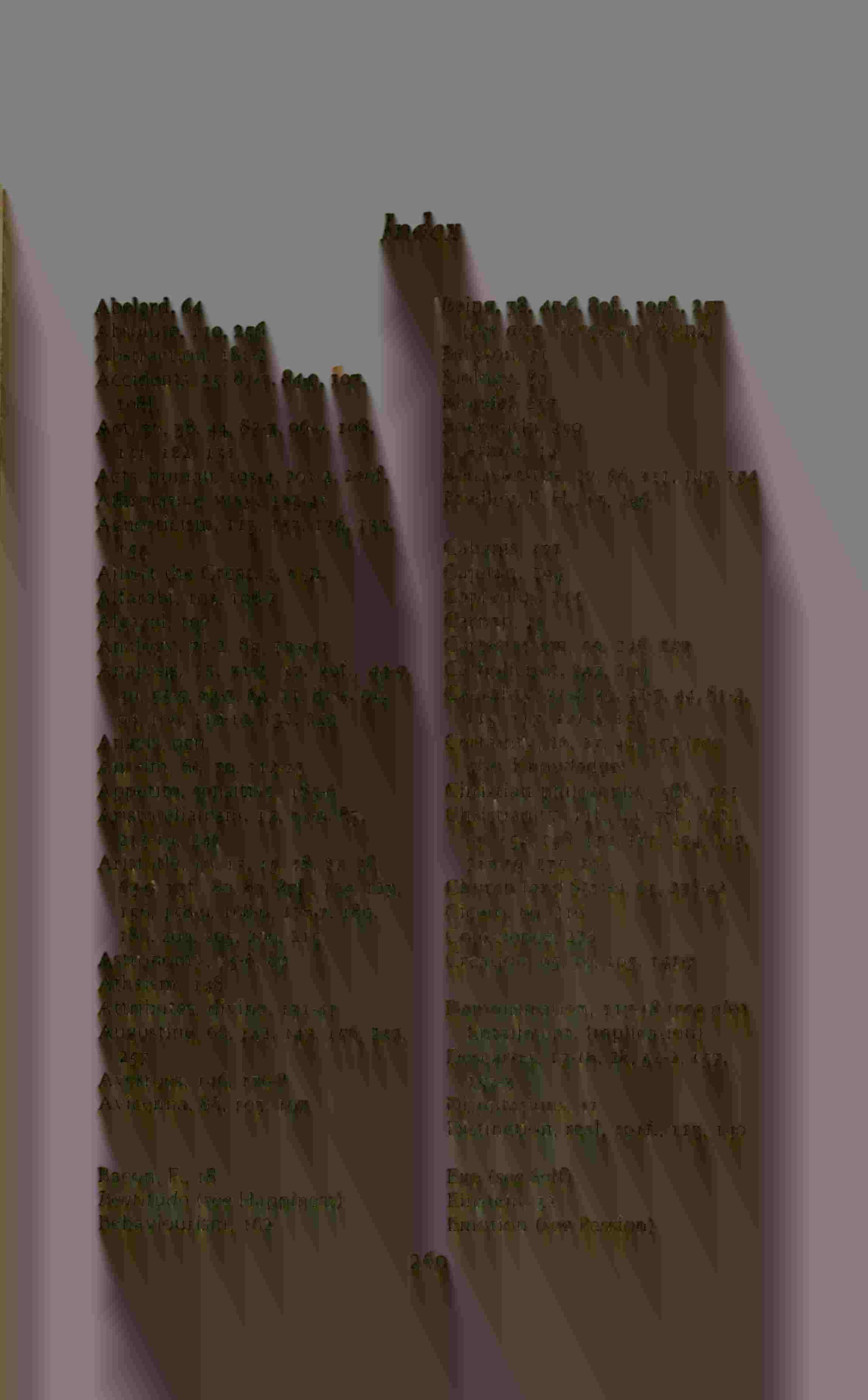
Index Being, 38, 45-6, 8of., 105I, 257 Abelard, 64 Absolute, 1 10, 256 Abstraction, 181-2 (see also Necessary Being) Bergson, 71 Biology, 80 Accidents, 35, 81-3, 84-9, 107, Blondel, 257 Bochenski, 259 Boethius, 14 Bonaventure, 27, 66, 111^ 143, 154 Bradley, F. H., 19, 256 io8f.
Act, 36, 38, 44, 82-3, 96-9, 108, 121, 122, 131 Acts, human, 193-4, 201-2, 2o6f.
Affirmative way, 133-41 Agnosticism, 113, 133, 136, 139, Cabanis, 171 Cajetan, 244 Capreolus, 244 Carnap, 19 Cartesianism, 59, 246, 253 Catholicism, 247, 260
Albert the Great, 9, 6311.
Alfarabi, 103, 106-7 Algazel, 107 Analogy, 71-2. 85, 134-41 Analysis, 22, 31-3, 37, 391"., 44-5, Causality, 31-4, Z9> 42-Z, 44. 81-2, 49, 53-5. 62-3, 64, 71. Si-s, 91,
115, 117, 1I1-4, 198
Certainty, 26, 27, 49, 252 (see 94, 106, 1 18-19, 132, 259 Angels, 95a Anselm, 66, 70, 1 12-13 also Knowledge) Christian philosophy, 581"., 131 Christianity, nf., 54, 581"., 66f., Appetite, sensitive, 185-6 Aristotelianism, 17, 63-9, 83, 213-19, 246 96, 154, 158, 172, 187, 204, 205, 217-19, 235, 260 Church (and State), 61, 238-42 Aristotle, 10, 13, 15, 18, 27, 28, &Z-9, 7Z*. 80, 83, 87f., 125, 127, 156, 158-9, 168-9, i7&7> 180, Cicero, 69, 216 Conscience, 228 186, 200, 205, 206, 215 Astronomy, 75-6, 80 Atheism, 148 Attributes, divine, 1 31-41 Augustine, 66, 142, 147, 156, 237, Creation, 65, 70, 105, 141-7 Demonstration, 1 17-18 {see also Entailment, Implication) Descartes, 17-18, 28, 51-2, 157,
Averroes, 146, 176-8 Avicenna, 88, 103, 107 252-3 Disputations, 11 Distinction, real, ioif., 113, 140 Ego (see Self) Bacon, R, 18 Beatitudo (see Happiness) Behaviourism, 162 Einstein, 32 Emotion (see Passion)
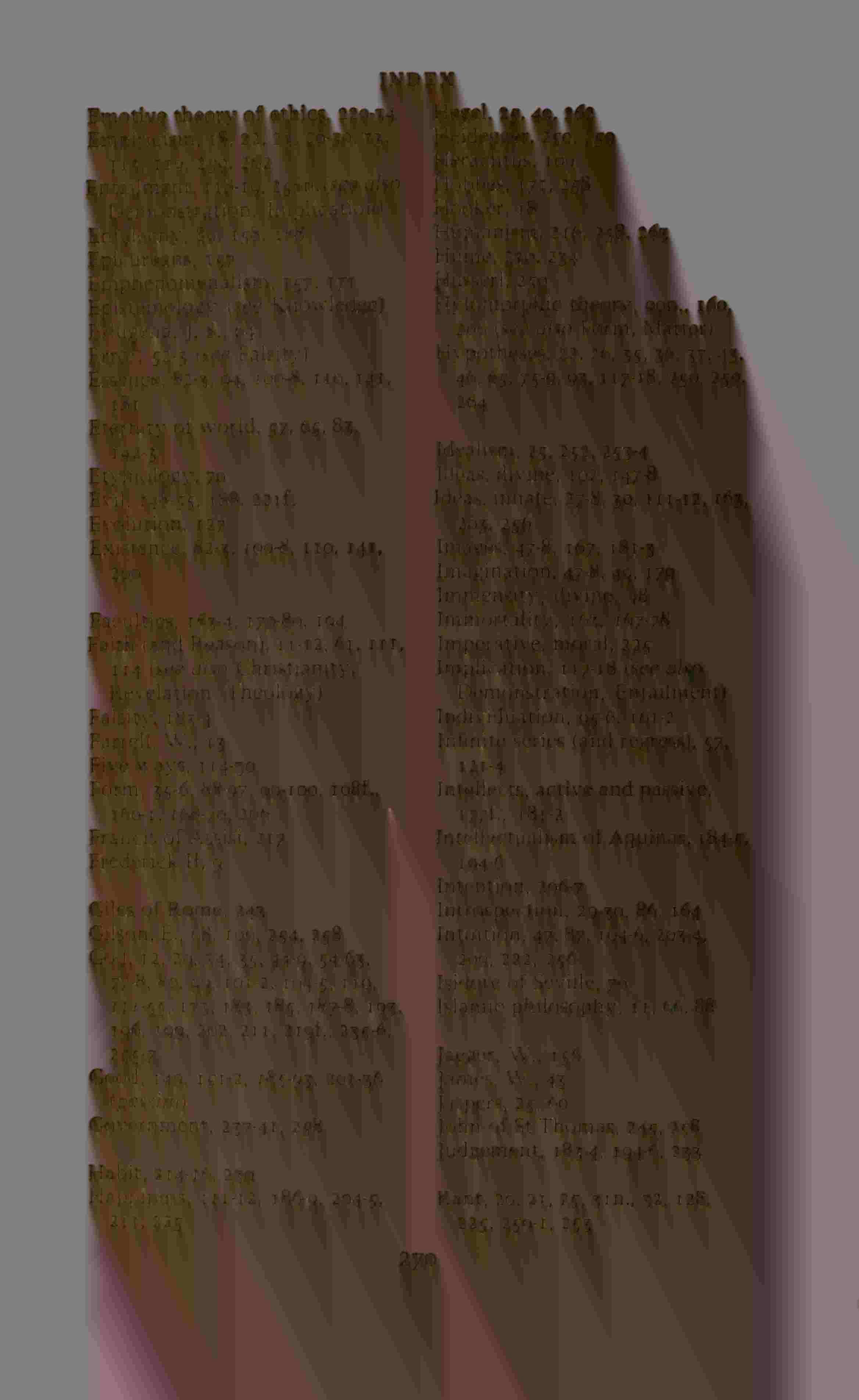
INDEX Hegel, 25, 49, 262 Heidegger, 250, 259 Heraclitus, 109 Hobbes, 171, 258 Hooker, 18 Humanism, 216, 258, 263 Hume, 230, 234 Husserl, 250 Hylomorphic theory, 9011., 160, Emotive theory of ethics, 229-34 Empiricism, 18, 22, 23, 26-30, 33, 113, 119, 259, 262 Entailment, 1 18-19, 256m (see also Demonstration, Implication) Entelechy, 89, 158, 168 Epicureans, 157 Epiphenomenalism, 157, 171 Epistemology (see Knowledge) 206 (see also Form, Matter) Hypotheses, 22, 26, 35, 36, 37, 43, Eriugena, J. S., 64 Error, 52-3 (see Falsity) Essence, 82-3, 94, 100-8, no, 141, 46, 65, 75-9, 93, 1 17-18, 250, 259,
Eternity of world, 57, 65, 83, Idealism, 25, 252, 253-4 142-3 Etymology, 70 Ideas, divine, 102, 147-8 Ideas, innate, 27-8, 30, 111-12, 163, Evil, 148-55. 188, 22lf.
203, 256 Images, 47-8, 167, 181-3 Imagination, 47-8, 49, 179 Immensity, divine, 48 Immortality, 163, 167-78 Imperative, moral, 225 Implication, 1 17-18 (see also Demonstration, Entailment) Evolution, 127 Existence, 82-3, 100-8, no, 141.
Faculties, 163-4, 179-80, 194 Faith (and Reason), 11-12, 61, in, 114 (see also Christianity, Revelation. Theology) Individuation, 95-6, 161-2 Falsity, 183-4 Farrell, W., 13 Five ways, 114-30 Form, 35-6, 88-97, 99-100, io8f., Infinite series (and regress), 57, 1 2 1-4 Intellects, active and passive, 1 601, 168-70, 206 i77f., 181-2 Intellectualism of Aquinas, 184-5, Francis of Assisi, 217 Frederick II, 9 194-6 Intention, 206-7 Giles of Rome, 243 Gilson, E., 68, 106, 254, 258 God, 12, 20, 34, 35, 44-9. 54-63, Introspection, 29-30, 86, 164 Intuition, 47, 87, 104-6, 203-4, 209, 222, 256 Isidore of Seville, 70 Islamic philosophy, 11, 66, 88 77-8, 8o, 99, 101-2, 104-5, IJ o, 111-55. 173. 183, 185, 187-8, 193, 196, 199, 202, 211, 2i9f., 235-6, Jaeger, W., 156 James, W., 43 Jaspers, 25, 60 John of St Thomas, 245, 258 Judgement, 183-4, 194-6, 233 255-7 Good, 149, 151-2, 185-93, 201-36 (passim) Government, 237-41, 258 Habit, 214-16, 230 Happiness, 111-12, 186-9, 204-5, Kant, 20, 21, 25, 3 in., 32, 128, 211, 225 225, 250-1, 253
INDEX Nicholas of Autrecourt, 19 Nietzsche, 9 Nominalism, 244 Kierkegaard, 262 Kilwardby, 243 Knowledge, 28-63, 104-5, H3» 158, 161-7, 178-85' 204, 233, 251-4 Obligation, 208-12, 224-5, 22611.
(see also Law) Ockham, W. of, 10, i28n., 170, Language, 69-72, 84-5. 87-8, 97.
100, 104-8, no, 139-41. 147-8.
264 (see also Analogy Analysis, Meaning) Law, types of, 219-42
Ontological argument, 1 12-13 Origen, 156, 163 Leibniz, 26, 28 Leo XIII, 246-7 Locke, 17-18, 85, 87n., 89 Logic, 33-4. 48-9, 63-4. 77, 229.
Pantheism, 145-6 Parmenides, 109, 146 Participation, 125-6 Passion, 213-19 Perennial philosophy, 250-1, 231, 234, 255, 259-60 Love, 185-6, 204 261-4 Perfection, degrees of, 107, 116Manichaeans, 151
Maritain, 106, 258 17. 125, 134-5 Person, 160, 167, 170, 204. 258
Peter Lombard, 9-10, 244 Phenomenalism, 171-2 (see also Epiphenomenalism) Phenomenologists, 251 Physics, 74-80 (see also Science) Marsilius, 242 Marston, R., 66 Marxism, 251, 258 Mathematics, 38, 4m.. 48, 53, 74, 77, 124, 218. 234
Matter, 36, 89-97, 99-100, 108-9, 160-2, 206 Mean, the, 217-18 Meaning, 28-9, 69-71, 103-4, 133Plato, 60, 71, 99, 125, 126, 131,
156, 160-3, 170 Plotinus, 61, 143, 156 Potentiality, 36, 38-9, 44, 83, 90, 41, 189 Medical science, 74-5, 217 Mercier, 248-50 Metaphysics, 20-72 (passim) 97-100, 101, 108, 121, 131, 186-7, 202-3, 224 Pragmatism, 252 Chapters 2 and 3, 248-9, 253-60, Principles, self-evident (see Pro263-4 Michotte, 249 Morality, 12, 40, 56, 189-93, positions) Propositions (of different types) 22, zo-s, 4o-z, 50, 74, 105, 113, 199-236 Moses, 1 40129, 249 Protagoras, 99, 263 Prudence, 215 Pseudo-Dionysius, 131, 148 Psychology, 78, 80, Chapter 4, Motion, 68, 74, 79, n4f., i2if.,
Mysticism, 10, 63, 105, 128
Ptolemy, 75-6, 255 Naturalism, n, 65, 66 Necessary being, 124-5 Negative way, 13 1-3 Neo-platonism, 61, 143, 147-8, 156 Newton, 32 Rationalism, 26, 228-34; moral,
Raymond, n
INDEX Realism, 94, 253 Reason, practical, 222f.
Reason, right, 212-14, 218, 221 Reason, speculative, 224n.
State, 61, 236-42 Stoics, 213-14, 216 Suirez, 245-6 Substance, 30, 35-6, 81-3, 84-9, Reflection, first and second, 50-1 108-10, 156-8, 160, 163 Relations, 36, 84 (see also Sylvestris, de, 244-5 Symbol, 48, 183 (see also Causality) Relativism, moral, 227-8, 234 Religious experience, 46 (see Language) Tautology, 42, 190, 192, 23m., also Mysticism) Renaissance, 17, 23, 37, 69, 92,
Theology, 12-14, 19, 54-63, 64-8.
Resurrection, 167-9 Revelation, 60-z, 167, 173, 199-200 74, 116, 158, 183, 199-200, 245 Theophrastus, 63m Thomism, 59, Chapter 6 Thomists, S7, 58, 105-6, 127 (see Right, 209L, 233-4 Rousseau, 258 also Thomism) Time, 79, 124 (see also Eternity Sartre, 216 Scepticism, 49, 52, 252 of world) Totalitarianism, 239, 258, 263 Transcendence, 49, 55, 117, 128.
Schiller, 176 Scholasticism, 43, 88, 245, 253, 141, 256-7, 262n.
Trinity, ss Truth, 49-54, 183-4, 252 Science, 17, 22-4, 35-8, 54, 62, 73-80, 92-3, 109, 248-50 Scotus, Duns, 10, 19, 66, 174-6, Unamuno, 172 Universals, 44. 94-5, i8on., 181-3 243-6 Self, 29-30, 51-2, 157 Seneca, 69 Sense-perception, 27-31, 46-9, 52-3, Values, 126, 211, 227, 233 (see also Morality) 56, 60, 77, 113, 157-8, 162-3, Virtues, 215-19 166-7, 178-84 Whitehead, 25 Will, i86f., 2o2f., 207 Will, free, 193-8 Wittgenstein, 68 Wolff, C, 20 Wrong, 209L, 233-4 Wundt, 249 Siger of Brabant, 177 Socrates, 9, 40 Soul, 29-30, 78. 87, 94-6, 99n., 156-78 Space, 48, 76 Species, 93-5, 181 Spinoza, 25, 26, 54, 60, 145

This book explains for the modern reader the philosophical ideas of Thomas Aquinas
Aquinas (1224—74) lived at a time when the Christian West was opening up to a wealth of Greek and Islamic philosophical speculation. An embodiment of the thirteenth-century ideal of a unified interpretation of reality (in which philosophy and theology work together in harmony), Aquinas was remarkable for the way in which he used and developed this legacy of ancient thought — an achievement which led his contemporaries to regard him as an advanced thinker.
Father Copleston's lucid and stimulating book examines this extraordinary man — whose influence is perhaps greater today than in his own lifetime — and his thought, relating his ideas wherever possible to problems as they are discussed today.
The cover shows St Thomas Aquinas, a detail from The Demidoff Altarpiece' by Crivelli in the National Gallery, London.
A PELICAN BOOK
020349-4 90000 Philosophy Biography/ Autobiography U.K.
£4.95
AUST.
$11.95
(recommended) IM.Z.
$14.99
9 780140"203493
(incl.
GST) CAN.
$7.95
U.S.A.
$5.95