
Chapter 16
for that, while if you do mourn, mourn especially that you have brought the cause of your pain on yourself by your own great offences and infinite sins. For just as a condemned man on receiving his sentence does not concern himself about the seating of the spectators, so he who laments and is genuinely mourning is not interested in pleasures, resentment, fame or wrongs or things of that sort. And just as townsfolk and contemned criminals have different accommodation, the state and position of those who are mourning and have committed offences deserving punishment ought to be completely different from those who are innocent and under no obligation. Otherwise there would be no difference between the guilty and the innocent in matters of punishment and reward.
The result would be great dereliction of duty, and evil behaviour would have more freedom than goodness. So everything must be renounced, everything despised, everything rejected and avoided, so that we can lay a firm foundation of penitent grieving. Then, loving Jesus Christ in reality, yearning for him, and holding him in one's heart, in reality experiencing pain for one's sins and faults, in reality seeking to know the coming Kingdom, while with true faith bearing in mind the reality of the torments and eternal judgement, and firmly and fully taking up the recollection and fear of one's own death, we should be aware of nothing else, and not care or be worried about anything else. For that reason, he who hurries towards the blessed state of impassibility and towards God should reckon himself to have experienced great loss every day that he is not insulted and despised. Impassibility after all is freedom from vices and passions and purity of heart and the adornment of all virtues. So consider yourself as already dead since there is no doubt that you have got to die. And as a final thought let this be the test for you of whether any thought, word or action of yours is of God, whether you are made more humble because of it, more inward and more recollected and established in God. If you find it is otherwise in yourself, you should be suspicious about it, whether it be not according to God, unacceptable to you and not to your benefit.
Chapter 16
How God's Providence includes everything
Certainly if we are to come directly, safely and nakedly to our Lord God without hindrance, freely and peacefully, as explained above, and be securely joined to him with even mind in prosperity or adversity, whether in life or in death, then our job is to commit everything unhesitatingly and resolutely, in general and individually, to his unquestionable and infallible providence. This is hardly surprising since it is he alone who gives to all things their being, their capacity and their action - that is, their strength, operation, nature, manner and order in number, weight and measure. Especially since just as a work of art presupposes a prior operation of nature, in the same way the operation of nature presupposes the work of God, creating, sustaining, ordering and administering it, for to him alone belong infinite power, wisdom, goodness and inherent mercy, justice, truth, love, and unchanging timelessness and omnipresence. So nothing can exist or act by its own power unless it acts in the power of God himself, who is the prime mover and the first principle, is the cause of every action, and the actor in every agent. For so far as the nature of the order of things is concerned, God provides for everything without intermediary, right down to the last detail. So nothing, from the greatest to the smallest things, can escape God's eternal providence, or fall away from it, whether in matters of the will, of causal events, or even of accidental circumstances outside of one's control. But God cannot do anything which does not fall under the order of his own providence, just as he cannot do anything which is not subject to its operation. Divine providence therefore extends to everything, in general and in particular, even including a man's thoughts. On which subject Scripture has this to say; Cast all your cares upon him, for he cares for you. (1 Peter 5.7) And again the prophet says, Cast your care upon the Lord, and he will feed you. (Psalm 55.22) And, Look at the nations of men, my son, and see that no one ever put his trust in the Lord, and was disappointed. For who has been faithful to his commandments and been abandoned? (Sirach 2.22) And our Lord himself said, Do not be anxious, saying, What shall we eat? (Matt. 6.25) So whatever and however much we can hope from God, we shall undoubtedly receive, as Moses says, Every place where you feet tread shall be yours. (Deut. 11.24) For a man shall receive all that he is able to desire, and so far as he can reach with his foot of faith, even so much shall he possess. That is why Bernard says, "God, the maker of everything, is so abounding in mercy that whatever size the cup of faith we are able to hold out to him, we shall undoubtedly have it filled." And so Mark has it, All that you ask in prayer believing that you will receive it, will be given you. (Mark 11.24) So the stronger and the more vehement our faith in God is, and the more reverently and persistently it is offered up to God, the more surely, the more abundantly and the quicker what we hoped for will be accomplished and obtained. Indeed if in doing this our faith in God is weak and slow to rise to God on account of the multitude and magnitude of our sins, we should remember this, that everything is possible with God, and that what he wishes is bound to take place, while what he does not wish cannot possibly happen, and that it is as easy for him to forgive and cancel countless sins, however enormous, as to do it with a single sin. While a sinner cannot, of himself, rise from innumerable sins, and free and absolve himself from them, and not even from just one sin. For we are unable not only to do, but even to think anything good, of ourselves, but this is from God. Nonetheless it is much more dangerous, other things being equal, to be ensnared in many sins than in a single one, since no sin is left unpunished, and every mortal sin deserves infinite punishment, and this by the rigour of justice since any such sin is against God who is indeed worthy of infinite reverence, dignity and honour. What is more, according to the Apostle Paul, God knows his own (2 Tim. 2.19), and it is impossible for any of them to perish by the whirlwinds and floods of any error, scandal, schism, persecution, heresy, tribulation, adversity or temptation, for he has foreseen from eternity and unchangeably the number of his elect and the extent of their merits in such a way that everything good and bad, what is theirs and not theirs, prosperity and adversity, all work together for them for good, except indeed that they appear even more glorious and commendable in adversity. So let us commit everything with full assurance, in general and in particular, confidently and unhesitatingly to divine providence, by which God permits however much and whatever sort of evil to happen to us. For it is good and will lead to good, since he permits it to exist, and it would not exist unless he permitted it to exist. Nor could it exist otherwise or more than he permits it to, because he knows how to, has the power to, and wills to change and convert it into something better. For just as it is by operation of providence that all good things exist, so it is by its permission that all bad things are changed into good. In this way in fact God's power, wisdom and mercy are shown forth through Christ our redeemer - his mercy and his justice, the power of grace and the weakness of nature, the beauty of everything in the association of opposites, the approval of the good, and the malice and punishment of the wicked. Similarly the contrition of the converted sinner, his confession, and penitence, the kindness of God, piety, charity and his praise and goodness (all show forth God's power and wisdom). Yet it does not always lead to good in those who do ill, but, as is usually the case, to great danger and extreme evil, in the loss, that is, of grace and their place in glory, and in the incurring of guilt and punishment, sometimes even eternal punishment, from which may Jesus Christ defend us. Amen.
Wikipedia article on Albert the Great.
Albert was eldest son of the Count of Bollstädt. It seems likely that Albertus was born sometime before 1200, given well-attested evidence that he was aged over 80 on his death in 1280; more than one source says that Albert was 87 on his death, which has led 1193 to be commonly given as the date of Albertus's birth. Albertus was probably born in Lauingen in Bavaria, since he called himself 'Albert of Lauingen', but this might simply be a family name.
Albertus was probably educated principally at the University of Padua, where he received instruction in Aristotle's writings. A late account by Rudolph de Novamagia refers to Albertus' encounter with the Blessed Virgin Mary, who convinced him to enter Holy Orders. In 1223 (or 1229) he became a member of the Dominican Order, against the wishes of his family, and studied theology at Bologna and elsewhere. Selected to fill the position of lecturer at Cologne, Germany, where the Dominicans had a house, he taught for several years there, and at Regensburg, Freiburg, Strasbourg, and Hildesheim. During his first tenure as lecturer at Cologne, Albert wrote his Summa de bono after discussion with Philip the Chancellor concerning the transcendental properties of being. In 1245, Albert became master of theology under Gueric of Saint-Quentin, the first German Dominican to achieve this distinction. Following this, Albert was able to teach theology at the University of Paris as a full-time professor, holding the seat of the Chair of Theology at the College of St. James. During this time Thomas Aquinas began to study under Albertus.
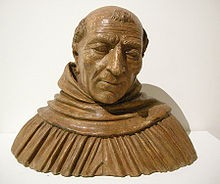
Bust of Albertus Magnus by Vincenzo Onofri, c. 1493
Albertus was the first to comment on virtually all of the writings of Aristotle, thus making them accessible to wider academic debate. The study of Aristotle brought him to study and comment on the teachings of Muslim academics, notably Avicenna and Averroes, and this would bring him into the heart of academic debate.
In 1254 Albertus was made provincial of the Dominican Order, and fulfilled the duties of the office with great care and efficiency. During his tenure he publicly defended the Dominicans against attacks by the secular and regular faculty of the University of Paris, commented on St. John, and answered what he perceived as errors of the Islamic philosopher Averroes.
In 1259 Albert took part in the General Chapter of the Dominicans at Valenciennes together with Thomas Aquinas, masters Bonushomo Britto, Florentius, and Peter (later Pope Innocent V) establishing a ratio studiorum or program of studies for the Dominicans that featured the study of philosophy as an innovation for those not sufficiently trained to study theology. This innovation initiated the tradition of Dominican scholastic philosophy put into practice, for example, in 1265 at the Order's studium provinciale at the convent of Santa Sabina in Rome, out of which would develop the Pontifical University of Saint Thomas Aquinas, Angelicum.
In 1260 Pope Alexander IV made him Bishop of Regensburg, an office from which he resigned after three years. During the exercise of his duties he enhanced his reputation for humility by refusing to ride a horse, in accord with the dictates of the Order, instead traversing his huge diocese on foot. This earned him the affectionate soubriquet "boots the bishop" from his flock. After his time as Bishop, he spent the remainder of his life partly in retirement in the various houses of his order and often preaching throughout southern Germany. In 1270 he preached the eighth Crusade in Austria. After this, he was especially known for acting as a mediator between conflicting parties. In Cologne he is not only known for being the founder of Germany's oldest university there, but also for "the big verdict" (der Große Schied) of 1258, which brought an end to the conflict between the citizens of Cologne and the Archbishop. Among the last of his labours was the defence of the orthodoxy of his former pupil, Thomas Aquinas, whose death in 1274 grieved Albertus.
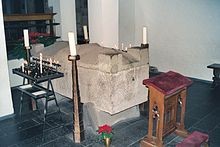
Roman sarcophagus containing the relics of Albertus Magnus in the crypt of St. Andrew's Church, Cologne, Germany
Roman sarcophagus containing the relics of Albertus Magnus in the crypt of St. Andrew's Church, Cologne, Germany
After suffering a collapse of health in 1278, he died on November 15, 1280, in the Dominican convent in Cologne, Germany. Since November 15, 1954, his relics are in a Roman sarcophagus in the crypt of the Dominican St. Andreas Church in Cologne.
Albertus is frequently mentioned by Dante, who made his doctrine of free will the basis of his ethical system. In his Divine Comedy, Dante places Albertus with his pupil Thomas Aquinas among the great lovers of wisdom (Spiriti Sapienti) in the Heaven of the Sun. Albertus is also mentioned, along with Agrippa and Paracelsus, in Mary Shelley's Frankenstein, in which his writings influence a young Victor Frankenstein.
Albertus was beatified in 1622. He was canonized and proclaimed a Doctor of the Church on December 16, 1931 by Pope Pius XI and the patron saint of natural scientists in 1941. St. Albert's feast day is November 15.
Writings
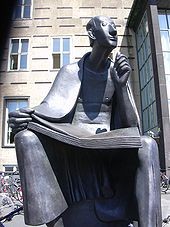
Albertus Magnus monument at the University of Cologne.
Albertus' writings, collected in 1899, ran to thirty-eight volumes. These displayed his prolific habits and encyclopaedic knowledge of topics such as logic, theology, botany, geography, astronomy, astrology, mineralogy, alchemy, zoology, physiology, phrenology, justice, law, friendship, and love. He digested, interpreted, and systematized all of Aristotle's works, gleaned from Latin translations and notes of the Arabian commentators, in accordance with Church doctrine. Most modern knowledge of Aristotle was preserved and presented by Albertus.
Albertus' activity, however, was more philosophical than theological. His philosophical works, occupying the first six and the last of the twenty-one volumes, are divided according to the Aristotelian scheme of the sciences, and consist of interpretations and condensations of Aristotle's works, with supplementary discussions upon contemporary topics, and occasional divergences from the opinions of the master.
His principal theological works are a commentary in three volumes on the
Books of the Sentences of Peter Lombard (Magister Sententiarum), and the Summa Theologiae in two volumes. The latter is in substance a more didactic repetition of the former.
Albertus's knowledge of physical science was considerable and for the age remarkably accurate. His industry in every department was great, and though we find in his system many gaps characteristic of scholastic philosophy, his extensive study of Aristotle trained him in systematic thought and exposition. An exception to this is his Latin treatise "De falconibus", in which he displays impressive knowledge of a) the differences between birds of prey and other birds; b) the different kinds of falcons; c) how to prepare them for the hunt; and d) cures for sick and wounded falcons. His scholarly legacy justifies his contemporaries' bestowing upon him the title Doctor Universalis.
In De Mineralibus Albert claims, "The aim of natural philosophy is not to simply to accept the statements of others, but to investigate the causes that are at work in nature." Aristotle greatly influences Albert's view on nature and philosophy. He begins with the principle that experiment is the only safe guide in such investigations. His studies of Aristotle and theology show their colours in nearly all of his works and volumes.
Albert placed emphasis on experiment as well as investigation, but he respected authority and tradition so much that many of his investigations or experiments were unpublished. Albert would often keep silent about many issues such as astronomy, physics and such because he felt that his theories were too advanced for the time he was living in.