
2. How do you know the Scriptures
MONERGISM BOOKS
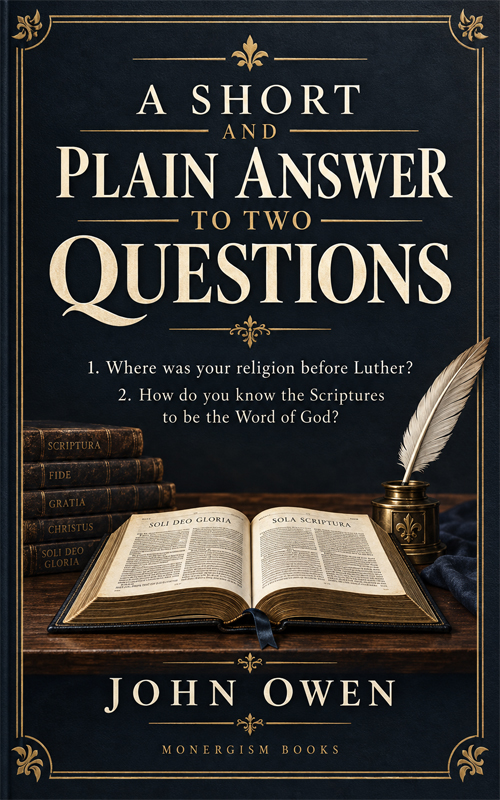
A SHORT AND PLAIN
ANSWER
TO TWO QUESTIONS
JOHN OWEN
1616-1683
A Short and Plain Answer to Two Questions by John Owen Original text in the public domain.
This digital edition has been prepared and professionally formatted by Monergism Books.
Cover design and electronic formatting © 2026 Monergism Books.
Scripture quotations retain the wording and references found in the original text unless otherwise indicated.
Individual copies may be downloaded, printed, and shared for personal, church, classroom, and other noncommercial educational use. This
Monergism edition may not be sold, publicly reposted, systematically redistributed, or incorporated into another website, digital library, database, retrieval system, artificial-intelligence system, or application. Please link directly to Monergism.com.
Published by Monergism Books www.monergism.com
HISTORICAL TITLE PAGE
A Short and Plain Answer to Two Questions by John Owen I. Where was your Religion before Luther?
II. How do you know the Scriptures to be the Word of God?
By a Protestant.
LONDON, Printed by T. N. for Jonathan Hutchinson Bookseller in the City of Durham. 1682.
Contents
Prefatory Address
Where Was Your Religion Before Luther?
How Do You Know the Scriptures to Be the Word of God?
A SHORT AND PLAIN ANSWER TO TWO QUESTIONS
Prefatory Address Sir, I have received your letter, wherein you seem to be at a loss for a ready and pertinent answer to two capping questions, by which the Papists are wont to puzzle and confound those silly souls, whom they compass sea and land to make proselytes. I know you are well satisfied that Popery is a grand cheat, upheld by fraud and violence, and has nothing truly rational to recommend it. But yet sometimes a man of honesty and good principles may be at a stand to render a satisfying reason for his belief and to obviate the cunning craftiness of those who lie in wait to deceive. I suppose, moreover, you cannot expect anything from me but what has been said before and what is infinitely better performed in some hundreds of printed books already extant, than any scribbling of mine will ever amount to. But yet since men often make most use of those reasons which arise in their own minds, by thinking and meditation; I shall, for my own satisfaction rather than for yours, note down as briefly and plainly as I can, such answers to those two questions you mention as shall at present occur to my thoughts; which nevertheless I shall communicate to you if perhaps they may be worth your acceptance. The first is:
JOHN OWEN
QUESTION 1
Where Was Your Religion Before Luther?
To this, the answer will be very short and easy, but then it will cast the whole stress of the business upon the later question. I say then, that our religion, as to the rules and principles of it, was before Luther, where it has been ever since, in the Scriptures: And as to the profession of it, it has been owned and maintained by the faithful in all ages, namely, such as have been kept by the power of God through faith unto salvation, against whom the gates of Hell and Rome have not been able to prevail. The Protestant religion we contend for is nothing else but Christianity uncorrupted, which was in its greatest purity before ever the Pope was heard of in the world. And Popery, that we oppose, is Christianity adulterated, or rather paganism
Christianised, which was in the cradle when the mystery of iniquity began to work, and grew up to be the man of sin, when Popes had gulled the world into so much slavery, as to endure their trampling upon princes. And this truth, as it appears in great measure from the Fathers and historians of the Church, and from all antiquity that has had the good fortune to escape the Expurgatory Index; so it is more especially, and most evidently manifest from the Scriptures, which makes way for the second question, which is the main subject of this epistle, namely:
A SHORT AND PLAIN ANSWER TO TWO QUESTIONS
QUESTION 2
How Do You Know the Scriptures to Be the Word of God?
With this question chiefly, they think to undo the simpler sort of heretics, as they are pleased to speak; and 'tis not impossible but some weak and unsteady minds may be shaken by it. For since we never heard God vocally pronounce it, nor ever saw Him deliver it unto the world as His act and deed; they would have us so easy and credulous as to believe that there is no way to be assured of its being His word, but upon the authority of the Church, and that no Church but theirs can have that authority. But this plea is as far from satisfying an inquisitive mind as my arguments are likely to be from convincing our adversaries. Now, if any unlearned, well-meaning person shall happen to be attacked by this or any such like question, and shall doubt of his own ability to repel the sophistry whereby they are wont to manage their needy cause: I should advise him to deal with them, as our Saviour sometime did with the captious and impertinent Jews; namely, to answer their question by asking another. As, who gave you authority to call in question the Scriptures? How dare you insinuate doubts into any Christian's mind concerning the truth and authority of that book, which is the rule of our duty both to God and man? Away with these too curious questions, of which a fool may ask more than a wise man can tell how to answer. It argues a desperate cause, and a religion highly suspicious, that cannot be maintained otherwise than by such pleas as tend to make men atheists.
But though it be safe and prudent for some people to put them off in this manner, yet without any tergiversation, I shall address myself to answer directly, as soon as I have proposed a query or two, which,
I think, will help introduce an answer to this grand question of theirs.
I demand therefore of our adversaries, how they know that the sun shines, or that there are any bodies in the world? Why may not all the objects we discern about us be certain phantasms only, or apparitions
JOHN OWEN
of the brain, which have no real existence in nature? Or, how come we to be assured that our whole life is any more than a dream? For since in our dreams, we verily believe the truth and reality of such things, as we laugh at when we are awake, why may we not hereafter awake into another state of life, in which we shall conclude our past life to have been a mere shadow?
If they will answer these enquiries, according to the nature of their own principles, then, all the proof we are to expect is only this: we have heard many people say this and that; or, thus we have been taught by our parents, or by our tutors and governors; and we believe them, and trouble ourselves no further. In this manner they would have us speak in the case of the Scriptures. They will not allow us to expect, or to endeavour, any rational satisfaction in the point; it is enough if we can but gape so wide as to swallow that Trojan Horse of papal authority. But verily we are not yet persuaded to make ourselves brutes for the Catholic cause; that is, we are unwilling to lay aside our own senses and human faculties, to commit the whole reason and conduct of our lives to "he said" and "she said."
And surely he that should pretend to dispute, and yet so palpably beg the question, would gain to be laughed at instead of a conclusion.
Upon supposition therefore, that they would be a little more philosophical and genteel in answering my questions, in case they were proposed to them, I will endeavour the like, according to my small skill, in answer to theirs. And that I may deal as civilly as I can,
I shall insist particularly upon none but the first, between which and this question of theirs, I will run a parallel, and attempt to show, that by the same arguments they will prove that the sun gives light, I will prove the Scriptures to be the word of God.
In the first place then, I shall consider what would be said by our adversaries, in answer to those extravagant questions I mentioned just now; and if I mistake their sense in this matter, I pray you inform me better by the next opportunity. For I seldom come into their company, and when I do, if they forbear, I am not forward to raise disputes. I suppose therefore they would tell me that these questions are about such things as all the world takes for granted upon the evidence of sense, and the uniform experience of all ages; that thus to deny principles were to turn sceptic, and so take the ready way never to come to any conclusion; just as if one that pretended to the
A SHORT AND PLAIN ANSWER TO TWO QUESTIONS
mathematics should deny the definitions and postulata of geometry, which have endured the test of most ages, and, as the common notions and sentiments of mankind, have bid defiance to all exceptions. Who would trouble his head to argue with such a person, as should deny that two and three make five, or that the whole is bigger than the half? We find by daily experience, and nobody can persuade us to the contrary, that when the sun is above the horizon we can see our way before us, the objects that are about us, and how to do our business, which in the dark we cannot do. "If any man walk in the day," (saith our Saviour) "he stumbleth not;" why? Because he seeth the light of this world; he needs not that any man should tell him it is light, he sees it himself, and his own sight is beyond all other men's arguments. But if a man walk in the dark, he stumbleth; and when night cometh, men cannot work. So that these questions you propose are altogether unquestionable; (1.) from the undeniable evidence of our senses;
(2.) from the clearest inferences of reason; and (3.) from the universal acknowledgment of mankind.
In this manner I presume they would answer my queries, nor do I know any better way. And just thus it is in the case before us; for, from these very grounds it will appear, that the Scriptures have proceeded from God. The sun does not more plainly direct our steps than the Scriptures do our lives and actions. The first enlightens our natural, and the latter, our moral walking. The one makes us discern the creatures that are about us, the other teaches how to use them to our greatest comfort and highest advantage. By the one we may conclude there is a God, as he is knowable by the things that are made; by the other we are instructed what to think of him, and how to behave ourselves in reference to him, and to our neighbour. The Scriptures are a lamp unto our feet, and a light unto our ways; and whilst we take heed thereto we walk securely, and never fail to find the benefit thereof; but when we forsake their conduct, we fall into a thousand errors and mischiefs, often discovered to our outward senses, in the discomposure of our bodies, and detriment of our estates; often too in the trouble and disorder of our minds, and not seldom in both these respects at once.
As for Example, the Scripture commands us to live soberly, to love our neighbour, to feed the hungry, to forgive injuries, and to deal
JOHN OWEN
justly with all men. And what are the consequences of our obedience in these things? Why, these: sound sleep, a healthy body, a peaceful soul, a cheerful life, bread to eat, the love of neighbours, the prayers of the poor, and a kind of universal respect and deference which virtue commands wherever it comes.
But then our disobedience to these precepts is usually followed by restless nights, racking pains, anxious thoughts, scaring dreams, trembling fears, perplexing doubts, the hatred of some, the curses of others, and the just condemnation of all. It's true, there are some reserved cases; God does sometimes try a virtuous soul with afflictions and often makes a soul virtuous by afflictions. He does again sometimes feed the epicure unto the day of slaughter and court the vicious by temporal enjoyments to reclaim them. Yet, in the meantime, the good are borne up with peace of mind and the expectation of a crown, and the wicked are busied in stupefying their senses to abate the sting of conscience and fear of hell.
But notwithstanding these reserved cases, I dare venture to affirm that there is not anything in the world whereof I am more certain, than that the Scripture is a most excellent rule for the government of my life and actions; and the ground of this assurance, in a great measure, is taken from sense. I am no more assured that the sun shines, or the fire warms, than I am that my conformity to the Scriptures is highly advantageous to me. The sun is not more necessary to the being of mankind than the Scriptures are to his well-being. The one gives natural life and light to the creation, the other enlightens the mind and teaches how to manage our lives, and the blessings thereof, to the best purpose. Without the first, the world would be a chaos; without the latter, it would be a kind of hell. Now the very first step of reason infers the conclusion: For, from whence should such a treasure of wisdom and truth proceed, but from the inexhaustible fountain of all goodness, God Almighty?
And let any man in the world (unto whose hands Divine Providence shall bring it) carefully peruse that book, and consider well the vast stock of wisdom, the immense treasures of love and bounty therein contained; let him observe the excellent rules it propounds, so fitted for all purposes and occasions of human life, that a universal conformity to it would make heaven upon earth; let him mark how all the disorders and miseries, contentions and bloodshed
A SHORT AND PLAIN ANSWER TO TWO QUESTIONS
in the world, proceed from men's disobedience thereto, and do constitute the formal reason of hell itself; and in a word, let him observe that whatever he does well, and which afterwards leaves him a grateful relish and ease of mind, is done according to the precepts of that book; and whatever he does amiss, which leaves a sting and poison behind it, is nothing else but a deviation from that rule. I say, let him but diligently read, and impartially consider these things, and he can be no better assured that there is a God, who is good and wise, merciful and just, than that the Holy Scriptures are the result of his goodness and mercy towards the sons of men; and that they do contain a declaration of his mind with respect unto us, and the rule of our duty in relation to him.
Why might not our adversaries demand of us, how we come to be certain that God is righteous and the Devil wicked? Is it lest the question should recur upon themselves? For since so many of their holy fathers have been so flagitious, as history makes mention, and since villainy is so far patronised by their Church, that the blackest criminals in that communion are often canonised for the greatest saints: one would be apt to suspect, they worship no other deity but the Pope, and that whilst they pronounce his Holiness, the secret reservation may be, his Wickedness.
I have heard indeed of a Pope that made this question, unless perhaps it were spoken by way of exclamation:
Quantum lucri ista fabula de Christo nobis peperit!
And this seems to be the proper language of that Church: For if they did believe the New Testament to be aught but a fable, they could not allow those doctrines and practices that are everywhere visible amongst them. For I reckon, that imposing upon the conscience things unrevealed, and beyond all possibility of belief, upon no less penalty than the Inquisition here, and damnation hereafter, is the very next door to infidelity and atheism. How can he be said to believe the truth, that would force another to believe a lie?
So that whilst our adversaries would seem to question the grounds upon which we assent unto the Scriptures, it's more than probable they themselves do not believe them at all.
I nothing doubt, for all that, but there are within the Romish Church, thousands of pious and devout souls, whose education and other unhappy circumstances, God will in great mercy consider; and,
JOHN OWEN
though under gross error and much ignorance, will bring them through the power of his grace unto salvation. If their foundation be upon the Rock, though they have built thereon hay and stubble, they may indeed suffer loss but shall escape utter ruin. I think too there are amongst them some learned men, as the Jansenists, and perhaps some others, whose lives and principles are far better than the rest, and who by an odd kind of fatality preserve their station in that Church. These, if they pursue their own rules and practice according to what they write, shall not (I hope) smart with the rest, when God comes to visit their iniquity. But as for those designing men, whose business it is to pry into the cabinets of princes, and to influence the affairs of kingdoms for the advantage of the Catholic cause; who though priests, affect to be ministers of state, not of Jesus Christ, whose kingdom is not of this world; they whose gospel is fire and sword, and their glad tidings of salvation some bloody massacre; whose faith is in the Pope, and whose heaven it is to be courted and canonized by a scarlet whore: I look upon these to be a generation of the vilest wretches that ever the earth bore, and in a far worse condition than
Turks or pagans. And yet these are the men that would have me receive the Scriptures upon their credit, who are the great shame and discredit of that holy Christian religion contained therein, and whose lives are one entire contradiction thereunto.
I suppose it will not be denied, that had we no inspired writings at all to direct us, there were nevertheless many reasons to believe the being of God. Scarce any people under heaven so brutish, as not to have some impressions of a deity. Scarce any person in the world so profligate, as not to have some checks of conscience: Besides what arguments may be drawn from the beauty of providence and harmony of the creation. Now the very notion of a God includes goodness, and the notion of goodness supposes a God: One is the stream, the other is the fountain. Let any man try how he can fancy the stream that should proceed from no original fountain at all. It is not imaginable sure, that any creature should be in the world, or that good things should be bestowed upon any creature, but they must proceed from some original, and that can be nothing else but God blessed forever. From whence I argue thus: If the invisible things of him from the creation be clearly seen, being understood by the things that are made, much
A SHORT AND PLAIN ANSWER TO TWO QUESTIONS
more may the visible characters of divine goodness, everywhere evident in the Scriptures, be clearly concluded to be from God.
Will any man object and say, Where are those visible characters of divine goodness contained in the Scriptures? Many people cannot see them. True indeed, and there are some too that cannot see the sun, but then they are blind, and cannot see anything at all. The sun illuminates the material visible world, and the Scripture gives us a prospect of a spiritual world and lets us see things divine; but then we must have eyes, and if we complain of darkness in the meridian light, where's the fault? Now if any man will say he can see no marks nor footsteps of divine goodness in the Scriptures; I would ask him, whether health and vigour of body, whether easiness and pleasure of mind, are good things or not? And whether he would choose to lie upon a rack, or a bed of roses? Or suppose a man by his own default, and wilfulness in going astray, be fallen into a pit, where he is certain either to be stung with vermin, or to die by wild beasts, or famish to death; would he not account it a kindness, not only to be delivered from the present danger, but conducted throughout the remainder of his journey, in such a way as is both safe and easy? If he answer in the affirmative, he yields the cause; if he deny, he must be a madman, past all sense of understanding of good or evil. Now if I pursue our adversaries to the gates of Bedlam, they must excuse me if I there bid farewell, and follow them no further. The sum is this: That which teaches us the best way imaginable to preserve health in our bodies and peace in our souls, to live comfortably at home and profitably to our neighbours, to honour our Creator and know ourselves, to avoid misery and attain happiness, must needs be an excellent rule, very much for our good, and must proceed from the true fountain of all goodness. But such is the Scripture, therefore it is the word of God.
Thus far I have considered the Scripture in reference chiefly to its utility; let us now observe it a little with respect to its verity. For sometimes it happens that a thing may be useful, which yet is not exactly true. As, for example, decimal arithmetic resolves a question speedily but not altogether exactly; yet it will come so near the truth as not to miss the ten-thousandth part of a farthing. And a clock will follow the motion of the sun for a week's time, with the error only of some few minutes; but neither the one nor the other, in strictness of speech, can be said to be true, though both are very useful. But now,