
Commentary on Revelation
We have two robes. One robe, through which we come before God, was put on at salvation. The other robe is the righteousness of our own conduct; it is our victory through which we come before Christ. In Revelation 3:18 the white garment (the second one) requires the paying of a price, but the redemption typified in the former case does not need to be purchased. No Christian will be condemned by God to perdition (John 5:24), but neither will there be a single Christian who will not be judged before the judgment seat of Christ concerning his conduct (2 Cor. 5:10). Their robes were cleansed not because of the great tribulation, but because of the blood of the Lamb. They applied the blood of the Lamb to their robes. This shows that they were contaminated on earth; nevertheless, they practiced 1 John 1:9 all the time so that they were cleansed.
4. Revelation 7:15 "Because of this they are before the throne of God and serve Him day and night in His temple; and He who sits upon the throne will tabernacle over them." "Because." According to the foregoing text, the reason that they can serve God is because they did not take the matter of sin lightly. 5. Revelation 7:16-17 "They will not hunger any more, neither will they thirst any more, neither will the sun beat upon them, nor any heat; for the Lamb who is in the midst of the throne will shepherd them and guide them to springs of waters of life; and God will wipe away every tear from their eyes." Compare this with Isaiah 49:10 (cf. Isa. 49:6; Acts 13:47; Isa 49:8; 2 Cor. 6:2). "They will not hunger any more, neither will they thirst any more" is the fulfillment of hope. "Neither will the sun beat upon them, nor any heat." In the new city, there is no need of the light of the sun or moon (Rev. 21:23; 22:5). It is not that there is no sun or moon, but there is no need to use their light. Yet there is still night on the new earth (21:25); since there is "day," there must be night. "God will wipe away every tear" because there is no need to shed tears anymore. One thing deserves our attention. The people in Revelation 7:9-17 and the manchild in Revelation 12:1-11 have many similarities: (1) Revelation 7:10 says that they were redeemed by the Lamb. Revelation 12:11 says that the man-child overcame because of the blood of the Lamb. (2) Revelation 7:9 says that they are standing before the throne. Revelation 12:5 says that the man-child is caught up to God and to His throne.
(3) Revelation 7:10 says, "Salvation to our God...and to the Lamb. Revelation 12:10 says, "Salvation...of our God and...Christ." (4) Revelation 7:4 through 8 says that twelve tribes were sealed. Revelation 12:1 says that on the woman's head was a crown of twelve stars. The crown of twelve stars does not refer to the apostles. Joseph's dream of the twelve stars clearly indicates that they refer to the twelve tribes. (5) Revelation 7:11 says that the angels are praising. Revelation 12:10 says that a loud voice in heaven speaks. (6) The people in Revelation 7:9 must have resurrected bodies before the throne of God. The man-child in Revelation 12:5 also has a resurrected body. The words "caught up" must be interpreted according to the rule of interpreting visions and must not be interpreted literally. According to Acts 13:33-34, we see that it refers to resurrection. In addition, if Christ did not put on the resurrected body, He could not see God and would be reckoned as naked (2 Cor. 5:2-3; Exo. 20:26; 28:42). First Corinthians 15 speaks of the fact of resurrection, while 2 Corinthians 5 speaks of the condition of resurrection. At the present time, there is no Christian before the throne; this will happen only in the future. In Revelation 4:6 the glassy sea is empty. Not until Revelation 15:2 are there people on the glassy sea. Acts 2:34 clearly says that David did not ascend into the heavens. First Samuel 28:13 clearly says that Samuel came up out of the earth. This shows that they have not yet put on resurrected bodies. Their bodies are still in Paradise (in Paradise as in Luke 23:43 and in Hades as in Acts 2:27). Only the Lord descended out of heaven and still remained in heaven (John 3:13). Even the taking up of Enoch and Elijah was perhaps to a certain place that God has put them; they have not yet received a resurrected body. (7) Revelation 7:15 says, "He who sits upon the throne will tabernacle over them," while Revelation 12:12 says, "O heavens and those who dwell in them." "Dwell in them" in the original Greek is "tabernacle in them." (8) The ones in Revelation 7:9 are the overcomers because: (a) the "white robes" are promised to those in Sardis who have not contaminated their robes; (b) to be spared from the hour of trial is promised to the overcomers in Philadelphia who have kept the word of endurance; and (c) the palm branches signify victory. In the same way, the man-child in Revelation 12:5 is the overcomers, who rule over the nations with an iron rod. This is the end of the inserted visions.
VIII. A GENERAL WORD CONCERNING THE SEALS, THE TRUMPETS, AND THE BOWLS The seals are unveiled in secret, while the trumpets are sounded in the open. In the Old Testament, the blowing of the trumpet was a solemn occasion. Hence, this book is also quite solemn. (Revelation 1:10 and 4:1 say, "like a trumpet.") The seventh seal produces the seven trumpets, while the seventh trumpet includes the seven bowls. The seven trumpets that come out of the seventh seal are sequential and extend over a period of time. For example, the fifth trumpet lasts for five months (9:5), while the sixth trumpet lasts for at least thirteen months. Furthermore, Revelation 10:7 and 11:2-3 together show that the seventh trumpet lasts for about three and a half years. According to 11:15, after the seventh trumpet is sounded, the kingdom of Christ will come. The seven bowls included in the seventh trumpet equal the seventh trumpet. The time for the pouring out of the seven bowls is the time for the blowing of the seventh trumpet. This is unlike the seven trumpets included in the seventh seal, which extend over a period of time. When the seventh trumpet is sounded, there will be very little time left. To facilitate our understanding, we have the following chart:
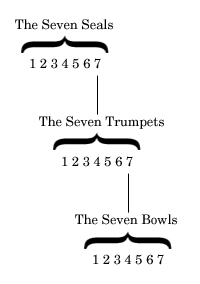
The opening of the seven seals takes approximately two thousand years. But one can only see what is written in the scroll after the seventh seal is opened. The seventh seal includes the seven trumpets. When the first through the sixth trumpets have sounded, one still cannot see what is written in the scroll. It is only at the time of the seventh trumpet that the scroll is opened. When the seventh trumpet is over, the kingdom will begin. By then we will see the new covenant and the blessings God has prepared on earth (Jer. 31:31-34; 33:14-15).
The seals extend over a period of time, and the trumpets also extend over a period of time. However, there is a difference between the trumpets and the seals. The seals will damage one fourth of the earth (Rev. 6:8), while the trumpets will damage one third of the earth (8:7). The beginning of the seventh trumpet is the beginning of the first bowl. The end of the seventh trumpet is the end of the seventh bowl. Moreover, this trumpet will last for at least three and a half years. Revelation 10:7 corresponds with Romans 16:25-26, and Revelation 11:15 is at the end of the seventh trumpet, when the kingdom is about to come. In between these two verses are three and a half years. Revelation 11:3 mentions three and a half years (42 months, 1260 days). Revelation 12:6 and 14 also mention three and a half years (1260 days and "a time and times and half a time"). In Revelation 11:7 the completion of the two witnesses' tesitimony will come after a period of time. We can say that the seventh seal "begets" the seven trumpets, while the seventh trumpet includes the seven bowls. The seven bowls describe the condition of the seventh trumpet. If we compare "Your wrath" in Revelation 11:15-18 with "the fury of God" in Revelation 15:1, we can see that the seven bowls are the fury of God. The seals are opened in heaven in secret, while the trumpets are sounded on earth and are heard by everyone. The bowls are physical and are not a mere sound. The opening of the seals is the judgment in the dispensation of grace. Only the believers know where these things such as famine, earthquake, and swords originate. They are not known to the unbelievers. Hence, they are hidden. The sounding of the trumpets signifies a change of dispensation; the dispensation of the gospel has ended. Chapter seven is on the sealing of the Israelites and the rapture of the overcoming believers. Chapter eight is a declaration of war. The trumpets convey the sense of announcement, while the bowls signify wrath. In the Old Testament, there is the "cup of wrath." But here, the bowl of wrath is stronger than the cup of wrath. From the following arguments we can see that the tribulations of the seven trumpets are real tribulations: (1) The book of Revelation is not a book of signs. (2) The sounding of the trumpets is audible and is not hidden. Whatever is sounded is what they signify. (At the sounding of the last trumpet, there is resurrection. Resurrection is miraculous. Of course, the first to the sixth trumpets are also miraculous.) (3) The seventh trumpet brings God's judgment to men.
(4) All the prophecies in the Old Testament, whether concerning judgment or the coming of the Lord, are to be interpreted literally. Why then should it be different in the New Testament? Since the ten plagues in Exodus were literal, why should the tribulations in Revelation not be interpreted literally? (5) By Revelation 7 the age of the church is over, and God has returned to the position of the Old Testament. Of course, as such, all the judgments have to be interpreted literally. Micah 7:15 says that God will execute judgment like He did in Egypt, only it will be a greater judgment (Isa. 11:15-16). Moreover, Jeremiah 23:7 and 8 say that God will execute a deliverance greater than that in Egypt. It therefore follows that the tribulations will be greater than those at the time of the exodus from Egypt. (6) The "marvels" prophesied in Exodus 34:10 will be fulfilled at the time of the sounding of the seven trumpets. (7) The "great and persistent plagues" mentioned in Deuteronomy 28:59 are all "extraordinary." God's judgments are always carried out through miracles. (8) The Lord said that the day of the Son of Man will be like the days of Noah and of Lot (Luke 17:26-28). At the time of Noah, God opened up the window of heaven and poured down rain. At the time of Lot, God sent fire from heaven. These were miraculous judgments. (9) God has to show men that He is Jehovah. In men's eyes, many calamities are only changes in nature. But to turn water into blood, and to turn only one third of it, proves that it is not a common change in nature. Rather, it has to be an act of God. Man is saturated with sin, and God has to come in to judge. The "great tribulation" in Matthew 24:21-28 concerns the Israelites. It is the persecution of Antichrist on the Israelites. The earliest this persecution will start is at the sounding of the fifth trumpet (Rev. 9:1-11). Actually, it starts at the seventh trumpet because only then do the events concerning Antichrist begin to transpire (10:7; 11:2; 12:12; 13:1-18). The "hour of trial" in Revelation 3:10 is for the whole world, while the "great tribulation" in Matthew 24:21-28 is for the Jews. The "hour of trial" of Revelation 3:10 begins from the time of the first trumpet, while the "great tribulation" of Matthew 24:21-28 will start, at the earliest, with the sounding of the fifth trumpet. Strictly speaking, it will start with the sounding of the seventh trumpet; otherwise, the world would persecute the Israelites (those who belong to God) even more.
IX. THE SEVENTH SEAL—SILENCE IN HEAVEN (REVELATION 8:1-2) "And when He opened the seventh seal, there was silence in heaven for about half an hour. And I saw the seven angels who stand before God, and seven trumpets were given to them." At the time that the seventh seal is opened, all noise stops. (The whole universe is silent; even the throne is silent.) This is because the age is about to change. "And I saw the seven angels who stand before God." The angels are standing, while the twenty-four elders are sitting. The seven angels have instruments in front of them. Hence, some have thought that Gabriel should be one among them (cf. Luke 1:19). The trumpets are for warfare (1 Cor. 14:8; Amos 3:6; Exo. 19:16). The heavenly will is ready for the sounding of the trumpets, but God has to wait for something to be accomplished before He will issue the command. God has to wait for His sons to express their sympathy towards Him; that is, He has to wait for the prayer of Revelation 8:3-5. Mr. Gordon said, "Prayer is the tracks for God's will to run on." X. THE SCENE IN HEAVEN AFTER THE OPENING OF THE SEVENTH SEAL (REVELATION 8:3-5) A. Revelation 8:3 "And another Angel came and stood at the altar, having a golden censer, and much incense was given to Him to offer with the prayers of all the saints upon the golden altar which was before the throne." The "another Angel" is the Priest; this is the Lord Jesus. The prayers of the saints are offered to God through the incense of this "another Angel." No Christian can offer up prayer by himself. There must be the incense, which is the merit of Christ's work, the fragrance of Christ. The believers' prayer must be joined to the fragrance of Christ before it can reach God. Why does this verse call the Lord an angel and not a priest? Hebrews 2:16 says, "Assuredly it is not to angels that He gives help." Hence, the Epistles show us that, in the Lord's relationship to us, He takes the position of a man. Hebrews 2:17 says, "He should have been made like His brothers in all things." Because He is a man, He can draw near to man. His being the "Angel" implies that He is higher than man. In Genesis 18:2, 16, and 22, the Lord is described as a man who drew near to Abraham. However, in Genesis 19:1 He came to Lot as an "angel," showing that He was apart from man. Later when He was helping Lot,
He appeared as a man again (Gen. 19:10, 12, 16). Revelation 8:3 says that the Lord is "another Angel." This means that the age has changed; He is no longer the Son of Man of the age of the gospel. He has now become "another Angel," yet He is still a priest. The saints here are in the midst of tribulations. In the Old Testament, the incense had to be lit with the fire from the altar; no strange fire could be offered up. The altar is a type of the Lord's cross. The incense is our prayer. Hence, one can only come to God through the merit and the redemption of the Lord's cross. Prayer cannot be offered up with strange fire (fire that is not from the altar). Hence, without the cross, there can be no prayer. B. Revelation 8:4 "And the smoke of the incense went up with the prayers of the saints out of the hand of the Angel before God." "The smoke of the incense." The incense is lit, and the smoke of the incense signifies the Lord's merit. Only smoke will ascend. Without the Lord's incense, no prayer can ascend to God. C. Revelation 8:5 "And the Angel took the censer and filled it with the fire of the altar and cast it to the earth; and there were thunders and voices and lightnings and an earthquake." "And there were thunders..." This is God's answer to the prayers. Although we do not know the content of the prayers, we know what the prayers are about from the fact that they are answered. The prayers of the saints here correspond with the cry from underneath the altar of the fifth seal; they are the prayers of those who ask to be avenged (Luke 18:1-8). "The Angel took the censer and filled it with the fire of the altar and cast it to the earth." It is cast back to the same place from whence it came. That which is cast to the earth is God's judgment.
CHAPTER FIVE THE SOUNDING OF THE SEVEN TRUMPETS (Revelation 8:6—11:19) "And the seven angels who had the seven trumpets prepared themselves to trumpet" (Rev. 8:6). The seven angels are now ready to sound the trumpets. I. THE FIRST TRUMPET (REVELATION 8:7)
"And the first trumpeted, and there was hail and fire mingled with blood, and it was cast to the earth; and the third part of the earth was burned up, and the third part of the trees were burned up, and all green grass was burned up." God's judgment begins from afar. Progressively, it turns to man. God's judgment begins with the things outside of man, for God still hopes that man will repent. This trumpet appears to cast fire on the earth, and one third of the trees on the earth are burned like wood. In the Old Testament, after the priests burned the sacrifices, the blood was poured out. Hence, both fire and blood are here. This fire will burn all the way into the abyss. One third of the green grass and the trees are burned. This indicates that God will first destroy the beauty of nature. II. THE SECOND TRUMPET (REVELATION 8:8-9) "And the second angel trumpeted, and as it were a great mountain burning with fire was cast into the sea; and the third part of the sea became blood, and the third part of the creatures which were in the sea and had life died, and the third part of the ships were destroyed." The calamity of this trumpet causes marine commerce to lose one third of its business. (Psalm 46:2 says, "...though the mountains be carried into the midst of the sea.") This trumpet damages the sea. III. THE THIRD TRUMPET (REVELATION 8:10-11) "And the third angel trumpeted, and a great star fell out of heaven, burning like a torch, and it fell upon the third part of the rivers and upon the springs of waters. And the name of the star is called Wormwood; and the third part of the waters became wormwood, and many of the men died from the waters because they were made bitter." The first trumpet is with fire. The second trumpet is also with fire. The third trumpet is still with fire. God remembers the covenant which He made with Noah and will not judge the earth with water. "Wormwood" means bitter (Jer. 9:13-15; 23:14-15; Lam. 3:15). This trumpet damages the fresh water. IV. THE FOURTH TRUMPET (REVELATION 8:12) "And the fourth angel trumpeted, and the third part of the sun and the third part of the moon and the third part of the stars were smitten, so that the third part of them would be darkened and the day would not appear for the third part of it, and the night likewise." The light of the sun, the light of the moon, and the light of the stars are all dimmed. The heavenly bodies are all changed, and the world is darkened. However, God does not smite the entire sun, moon, or stars because He remembers His own word in Genesis 8:22. The calamities of the seals are general, while the calamities of the trumpets are specific and definite. Today the seals have been fulfilled or are being fulfilled, but the time of the trumpets has not yet come. Not one trumpet has sounded yet. "And I saw, and I heard an eagle flying in mid-heaven, saying with a loud voice, Woe, woe, woe, to those who dwell on the earth because of the remaining trumpet sounds of the three angels who are about to trumpet!" (Rev. 8:13). The seven seals are divided into four and three. The seven trumpets are also divided into four and three. The first four trumpets are merely calamities. The last three trumpets are trumpets of woes (9:12; 11:14). The first four trumpets are not directed specifically at man, but only touch man indirectly. The last three trumpets, however, touch man directly. The eagle is just an eagle and is not a sign, for even Balaam's donkey was able to speak. "Those who dwell on the earth" are different from those who are sojourners on the earth.
V. THE FIFTH TRUMPET—THE FIRST WOE (REVELATION 9:1-12) The great tribulation may begin from the fifth trumpet because the fifth trumpet is the trumpet of woe and is close to the seventh trumpet. A. Revelation 9:1 "And the fifth angel trumpeted, and I saw a star out of heaven fallen to the earth, and to him was given the key of the pit of the abyss." This star cannot be interpreted literally like the star in 8:10 because the star here was given the key of the pit of the abyss. Who is this star? It is Satan himself. "A star out of heaven fallen to the earth." This corresponds with the casting down in 12:9. In the Bible, stars refer to messengers. Job 38:7 says, "When the morning stars sang together, / and all the sons of God shouted for joy." This clearly tells us that stars signify the angels in heaven. Since this star has fallen, it must not be a good star. It is he who transfigures himself into an angel of light for the purpose of deceiving others (2 Cor. 11:14).
All the three and a half years spoken of in Revelation begin at the same time and end at the same time. Revelation 11:2-3, 12:6-14, and 13:5 all happen at the same time. This star must fall before the start of the forty-two months (before the great tribulation) because it falls at the fifth trumpet. The seventh trumpet is also sounded before the start of the forty-two months. B. Revelation 9:2 "And he opened the pit of the abyss, and smoke went up out of the pit like the smoke of a great furnace; and the sun and the air were darkened by the smoke of the pit." The word "abyss" means "the depth." The abyss means the deepest pit. What is this abyss? It is the dwelling place of the devil. Luke 8:28 and 31 tell us that it is the place where the devil suffers. Because the devil is here, suffering is here. When the devil comes to the world, this world becomes the devil's world. The falling of the star here corresponds with Luke 10:18, which was the verdict of the casting down of Satan. Here in Revelation 9:1 we have the execution of the casting down of Satan. While Satan is restricted, the pit of the abyss remains closed. The smoke indicates that there is fire. It is difficult to say how the abyss is opened. Deuteronomy 29:23 says, "And that all its land is sulphur and salt, a burning waste; that it is not sown, nor does it sprout, nor does any vegetation come up in it; that it is like the overthrow of Sodom and Gomorrah, Admah and Zeboim, which Jehovah overthrew in His anger and burning wrath." The condition here is similar to the prophecy in Revelation 9:2. Concerning the "smoke," one can refer to Revelation 18:8-9, 18 and 19:3. In Revelation 8:12 the heaven lost one third of its light. Here in 9:2 it has become completely darkened. In the former case, it was caused by the diminishing of the light bearers themselves. Here it is caused by the darkening of the smoke. C. Revelation 9:3 "And out of the smoke came forth locusts to the earth, and to them power was given, as the scorpions of the earth have power." "Locusts." This kind of locust is not the ordinary kind of locust because: (1) According to Revelation 9:4, these locusts do not eat the trees and the shrubs like ordinary locusts do. Moreover, ordinary locusts do not harm men, but these do.
(2) They have power like the scorpions (9:3), and their torment is like that caused by the scorpions (v. 5). From verses 7 through 10 we can tell that their appearance is very peculiar and not like the ordinary locusts. (3) Exodus 10:14 says that there will never again be locusts like the ones that are there. (4) Proverbs 30:27 says that the locusts have no king, but the locusts here have a king. (5) They come out of the pit of the abyss. The abyss is not an ordinary dwelling, but the dwelling place of the devil. These locusts are probably a kind of special creature. We can see this from the following: (1) Revelation 9:3, 7, and 10 say that they have power like the scorpions and that they are like horses with tails like scorpions, and stings. Revelation 9:19 says that "the power of the horses are in their mouth and in their tails." Luke 10:17 through 19 says that the Lord has given the believers authority to tread upon serpents and scorpions. The Lord's cross has pronounced Satan cast down. Revelation 9:1 is the execution of the casting down of Satan. (2) They are possessed by the demons. This is why they are so special. The earth was originally created for man, while the abyss is reserved for the demons. The word "deep" in Genesis 1:2 is translated by the Septuagint as "the immeasurable depth," which is the same as the abyss. This is where the demons live. On the second day, when God divided the waters which were under the air from the waters which were above the air (Gen. 1:7-8), some demons drifted to the air. Hence, the air also became the dwelling place of the demons (Eph. 6:12). The sea may be the entrance to the abyss. Revelation 20:13 says that the sea will give up its dead. It is one thing for death and Hades to give up the dead, and it is another thing for the sea to give up its dead. The dead in the latter case are the ones who died before Genesis 1:2. Romans 10:7 tells us that the Lord Jesus once went into the abyss.
D. Revelation 9:4-5 "And it was said to them that they should not harm the grass of the earth or any green thing or any tree, but men who do not have the seal of God on their foreheads. And it was given them that they should not kill them, but that they should be tormented five months; and their torment was like the torment of a scorpion when it strikes a man."
From this we can see that these locusts have spiritual (supernatural) knowledge, for they can receive orders and can identify those who have been sealed by God. (The seal in Revelation 7:2-8 should be a kind of hidden sign of God.) God orders them not to harm those who are sealed, but He has not specifically ordered them to harm others. From the words "they should not kill them" in verse 5, we can see that the harming of the unsealed ones in verse 4 is something to which God only acquiesces. The tail of a scorpion has a sting. This sting is sharp and hollow. Within the sting of these scorpions there is a poison which can torment men for five months. The "scorpion" is used in the Old Testament as an idiom (2 Chron. 10:11). E. Revelation 9:6 "And in those days men will seek death and shall by no means find it; and they will long to die, and death flees from them." To "long to die" is to desire to die, while to "seek death" is to try to find a way to die. Today death seeks out men, but in the future, men will seek for death. They would rather seek for death than repent. F. Revelation 9:7-10 "And the locusts were like horses prepared for war, and on their heads there were as it were crowns like gold, and their faces were like faces of men. And they had hair like the hair of women, and their teeth were like the teeth of lions. And they had breastplates like breastplates of iron; and the sound of their wings was like the sound of chariots of many horses rushing into war. And they have tails like scorpions, and stings; and in their tails is their power to harm men for five months." The appearance of the locusts is like horses prepared for war. They have crowns like gold and breastplates like those of iron. These are for their own protection. This means that men will try their best to withstand them. G. Revelation 9:11 "They have a king over them, the angel of the abyss; his name in Hebrew is Abaddon; and in Greek he has the name Apollyon." The king in this verse is Antichrist. The star in 9:1 is Satan himself. Revelation 11:7 speaks of "the beast who comes up out of the abyss," and 13:1 speaks of "a beast coming up out of the sea." This shows that the abyss is under the sea. "Abaddon" is the name of a place. The word "destruction" in Proverbs 15:11, 27:20, and Job 26:6 is "Abaddon" in the original language. "Apollyon" is the name of a person; it means the destroying one (Jer. 4:7; 6:26; Isa. 16:4; Dan.
8:24-25; 9:26; 11:44). The name of the messenger from the abyss comes from his place of origin and his conduct. H. Revelation 9:12 "The first woe has passed; behold, two woes are yet coming after these things." In reading the first woe, we have to pay attention to two things: (1) Satan is cast down from heaven, and (2) Antichrist has come out from the abyss. In the first woe he appears on the earth. The forty-two months will be the time for him to actually reign. VI. THE SIXTH TRUMPET—THE SECOND WOE (REVELATION 9:13-21) A. Revelation 9:13 "And the sixth angel trumpeted, and I heard a voice out of the four horns of the golden altar which is before God." "A voice out of the four horns of the golden altar which is before God." Some say that this is God answering the prayers of the saints, but there are errors in saying this: (1)God's answer to prayers should start before the blowing of the first trumpet, that is, in Revelation 8:3, when the incense came with the prayers out of the golden altar. (The golden altar is the incense altar in the sanctuary.) (2)The voice does not come out of the golden altar but out of the four horns of the golden altar. If it were an answer to prayers, the voice should come out of the golden altar itself, since incense is burned in the middle of the altar and not on the four horns. In the Old Testament, only the blood of the sin offering was put upon the four horns of the golden altar (Lev. 16:18). Hence, "a voice out of the four horns of the golden altar which is before God" means that God's judgment of man is based on the work of the Lord Jesus. God judges because man does not receive the gospel and does not believe. This is God's voice, for only God is behind the incense altar.
B. Revelation 9:14 "Saying to the sixth angel who had the trumpet, Release the four angels who are bound at the great river Euphrates." This river will become the boundary of Israel in the future (see Deut. 1:7; 11:24). Israel's future boundary will certainly reach the great river Euphrates. Historical fact shows that when Rome was prosperous, her eastern boundary reached only as far as the great river Euphrates. As soon as the fifth trumpet is sounded,
Antichrist will appear, and as soon as the sixth trumpet is sounded, war will come. Perhaps at this point the four released angels will enter the territory of Rome and war against her. Antichrist will establish his kingdom. Although one would dare not say that Ezekiel 38:1-3, 5-6, 10-12, 15-18; 39:1-3, 11 refers definitely to the sixth trumpet in Revelation 9, neither can one say that they are unrelated. It can be said that Ezekiel 38 and 39 are completely fulfilled from the beginning of the sixth trumpet in Revelation 9 through the sixth bowl in Revelation 16. We still do not know what the name of the place "Magog" in Ezekiel 38:2 refers to. Most know that Rosh refers to Russia, Meshech is Moscow, and that Tubal is a city called Tobolsk in Russia. Perhaps in the future the four angels of the great river Euphrates will lead the soldiers of these four places to fight the war (Ezek. 38:15). Also, these countries, Persia, Ethiopia, and so forth, are neighboring countries of the great river Euphrates. The sixth trumpet in Revelation 9 tells us of their victory, whereas the sixth bowl in Revelation 16 tells us of their defeat. C. Revelation 9:15 "And the four angels were released, who had been prepared for the hour and day and month and year that they might kill the third part of men." These four angels like to kill. Once they are loosed, they go out to kill people. God does not command them to do so. He only releases them; they go out to kill. They are killers by nature. Every event in the prophecy is well-prepared in advance and then executed when the time comes. "The hour and day and month and year." Not only are the day and month and year ordained, but also the hour. The "third part" of the first through fourth trumpets is limited to the earth, the sea, the rivers, and the hosts in the heavens, but the "third part" of the sixth trumpet reaches men directly. The fourth seal kills the "fourth part" of men throughout the twenty centuries, but the "third part" of men that the sixth trumpet kills are killed within a short period of time. D. Revelation 9:16 "And the number of the armies of horsemen was two hundred million; I heard their number." No other country in the world produces more horses than Russia. Moreover, Russia exhausts her ability to have more horses. Persia, Egypt, Ethiopia, and so forth are also horse-producing countries. Horses are good for fighting and are not afraid of guns or artillery. In the future these ones will lead the army of horsemen to war.
E. Revelation 9:17 "And thus I saw the horses in the vision and those sitting on them, having breastplates of fire and of hyacinth and of brimstone; and the heads of the horses were like the heads of lions, and out of their mouths proceed fire and smoke and brimstone." Those who ride the horses have breastplates of three colors: fire, hyacinth, and brimstone. The breastplates are for self-protection. The horsemen do not fight, but merely direct the horses in the direction they should go. Even if they are human, those riding the horses must be particularly possessed by demons. F. Revelation 9:18 "By these three plagues the third part of the men were killed, by the fire and the smoke and the brimstone proceeding out of their mouths." Fire burns, smoke suffocates, and brimstone stinks. All three belong to hell (Rev. 19:3; 21:8). Those who kill are not the horsemen but are the horses themselves. Out of the mouths of the horses proceed fire and smoke and brimstone, by which the third part of men are killed. Therefore, it is the mouths of the horses that cause men to die. G. Revelation 9:19 "For the power of the horses are in their mouth and in their tails; for their tails are like serpents and had heads, and with them they harm men." The horses' tails are like serpents with heads, and with them they hurt men. It seems that Deuteronomy 28:49-57 supplements what the sixth trumpet does not say. H. Revelation 9:20-21 "And the rest of the men, who were not killed by these plagues, still did not repent of the works of their hands, so as not to worship the demons and the idols of gold and silver and brass and stone and wood, which can neither see nor hear nor walk; and they did not repent of their murders or of their sorceries or of their fornication or of their thefts." God permits the plagues to come upon men in this way in order to call them to repent. But the men refuse to repent, and instead, they commit six kinds of sins. These six sins are worshipping demons and idolatry, which offend God, and murder, sorcery, fornication, and theft, which offend men. The sixth seal speaks of men's fear of God's wrath; the sixth trumpet speaks of men's fierceness. As soon as the sixth seal ends, there is an insertion. The same is true as soon as the sixth trumpet ends.